EP4380794B1 - Multilayer nonwoven structure - Google Patents
Multilayer nonwoven structure Download PDFInfo
- Publication number
- EP4380794B1 EP4380794B1 EP22758536.1A EP22758536A EP4380794B1 EP 4380794 B1 EP4380794 B1 EP 4380794B1 EP 22758536 A EP22758536 A EP 22758536A EP 4380794 B1 EP4380794 B1 EP 4380794B1
- Authority
- EP
- European Patent Office
- Prior art keywords
- spunbonded
- layer
- propylene polymer
- range
- propylene
- Prior art date
- Legal status (The legal status is an assumption and is not a legal conclusion. Google has not performed a legal analysis and makes no representation as to the accuracy of the status listed.)
- Active
Links
Images

Classifications
-
- B—PERFORMING OPERATIONS; TRANSPORTING
- B01—PHYSICAL OR CHEMICAL PROCESSES OR APPARATUS IN GENERAL
- B01D—SEPARATION
- B01D39/00—Filtering material for liquid or gaseous fluids
- B01D39/14—Other self-supporting filtering material ; Other filtering material
- B01D39/16—Other self-supporting filtering material ; Other filtering material of organic material, e.g. synthetic fibres
- B01D39/1607—Other self-supporting filtering material ; Other filtering material of organic material, e.g. synthetic fibres the material being fibrous
- B01D39/1623—Other self-supporting filtering material ; Other filtering material of organic material, e.g. synthetic fibres the material being fibrous of synthetic origin
-
- B—PERFORMING OPERATIONS; TRANSPORTING
- B01—PHYSICAL OR CHEMICAL PROCESSES OR APPARATUS IN GENERAL
- B01D—SEPARATION
- B01D39/00—Filtering material for liquid or gaseous fluids
- B01D39/14—Other self-supporting filtering material ; Other filtering material
- B01D39/16—Other self-supporting filtering material ; Other filtering material of organic material, e.g. synthetic fibres
- B01D39/1607—Other self-supporting filtering material ; Other filtering material of organic material, e.g. synthetic fibres the material being fibrous
- B01D39/1623—Other self-supporting filtering material ; Other filtering material of organic material, e.g. synthetic fibres the material being fibrous of synthetic origin
- B01D39/163—Other self-supporting filtering material ; Other filtering material of organic material, e.g. synthetic fibres the material being fibrous of synthetic origin sintered or bonded
-
- B—PERFORMING OPERATIONS; TRANSPORTING
- B32—LAYERED PRODUCTS
- B32B—LAYERED PRODUCTS, i.e. PRODUCTS BUILT-UP OF STRATA OF FLAT OR NON-FLAT, e.g. CELLULAR OR HONEYCOMB, FORM
- B32B5/00—Layered products characterised by the non- homogeneity or physical structure, i.e. comprising a fibrous, filamentary, particulate or foam layer; Layered products characterised by having a layer differing constitutionally or physically in different parts
- B32B5/02—Layered products characterised by the non- homogeneity or physical structure, i.e. comprising a fibrous, filamentary, particulate or foam layer; Layered products characterised by having a layer differing constitutionally or physically in different parts characterised by structural features of a fibrous or filamentary layer
- B32B5/022—Non-woven fabric
-
- B—PERFORMING OPERATIONS; TRANSPORTING
- B32—LAYERED PRODUCTS
- B32B—LAYERED PRODUCTS, i.e. PRODUCTS BUILT-UP OF STRATA OF FLAT OR NON-FLAT, e.g. CELLULAR OR HONEYCOMB, FORM
- B32B5/00—Layered products characterised by the non- homogeneity or physical structure, i.e. comprising a fibrous, filamentary, particulate or foam layer; Layered products characterised by having a layer differing constitutionally or physically in different parts
- B32B5/22—Layered products characterised by the non- homogeneity or physical structure, i.e. comprising a fibrous, filamentary, particulate or foam layer; Layered products characterised by having a layer differing constitutionally or physically in different parts characterised by the presence of two or more layers which are next to each other and are fibrous, filamentary, formed of particles or foamed
- B32B5/24—Layered products characterised by the non- homogeneity or physical structure, i.e. comprising a fibrous, filamentary, particulate or foam layer; Layered products characterised by having a layer differing constitutionally or physically in different parts characterised by the presence of two or more layers which are next to each other and are fibrous, filamentary, formed of particles or foamed one layer being a fibrous or filamentary layer
- B32B5/26—Layered products characterised by the non- homogeneity or physical structure, i.e. comprising a fibrous, filamentary, particulate or foam layer; Layered products characterised by having a layer differing constitutionally or physically in different parts characterised by the presence of two or more layers which are next to each other and are fibrous, filamentary, formed of particles or foamed one layer being a fibrous or filamentary layer another layer next to it also being fibrous or filamentary
- B32B5/265—Layered products characterised by the non- homogeneity or physical structure, i.e. comprising a fibrous, filamentary, particulate or foam layer; Layered products characterised by having a layer differing constitutionally or physically in different parts characterised by the presence of two or more layers which are next to each other and are fibrous, filamentary, formed of particles or foamed one layer being a fibrous or filamentary layer another layer next to it also being fibrous or filamentary characterised by one fibrous or filamentary layer being a non-woven fabric layer
- B32B5/266—Layered products characterised by the non- homogeneity or physical structure, i.e. comprising a fibrous, filamentary, particulate or foam layer; Layered products characterised by having a layer differing constitutionally or physically in different parts characterised by the presence of two or more layers which are next to each other and are fibrous, filamentary, formed of particles or foamed one layer being a fibrous or filamentary layer another layer next to it also being fibrous or filamentary characterised by one fibrous or filamentary layer being a non-woven fabric layer next to one or more non-woven fabric layers
- B32B5/268—Layered products characterised by the non- homogeneity or physical structure, i.e. comprising a fibrous, filamentary, particulate or foam layer; Layered products characterised by having a layer differing constitutionally or physically in different parts characterised by the presence of two or more layers which are next to each other and are fibrous, filamentary, formed of particles or foamed one layer being a fibrous or filamentary layer another layer next to it also being fibrous or filamentary characterised by one fibrous or filamentary layer being a non-woven fabric layer next to one or more non-woven fabric layers characterised by at least one non-woven fabric layer that is a melt-blown fabric
- B32B5/269—Layered products characterised by the non- homogeneity or physical structure, i.e. comprising a fibrous, filamentary, particulate or foam layer; Layered products characterised by having a layer differing constitutionally or physically in different parts characterised by the presence of two or more layers which are next to each other and are fibrous, filamentary, formed of particles or foamed one layer being a fibrous or filamentary layer another layer next to it also being fibrous or filamentary characterised by one fibrous or filamentary layer being a non-woven fabric layer next to one or more non-woven fabric layers characterised by at least one non-woven fabric layer that is a melt-blown fabric characterised by at least one non-woven fabric layer that is a melt-blown fabric next to a non-woven fabric layer that is a spunbonded fabric
-
- B—PERFORMING OPERATIONS; TRANSPORTING
- B32—LAYERED PRODUCTS
- B32B—LAYERED PRODUCTS, i.e. PRODUCTS BUILT-UP OF STRATA OF FLAT OR NON-FLAT, e.g. CELLULAR OR HONEYCOMB, FORM
- B32B5/00—Layered products characterised by the non- homogeneity or physical structure, i.e. comprising a fibrous, filamentary, particulate or foam layer; Layered products characterised by having a layer differing constitutionally or physically in different parts
- B32B5/22—Layered products characterised by the non- homogeneity or physical structure, i.e. comprising a fibrous, filamentary, particulate or foam layer; Layered products characterised by having a layer differing constitutionally or physically in different parts characterised by the presence of two or more layers which are next to each other and are fibrous, filamentary, formed of particles or foamed
- B32B5/24—Layered products characterised by the non- homogeneity or physical structure, i.e. comprising a fibrous, filamentary, particulate or foam layer; Layered products characterised by having a layer differing constitutionally or physically in different parts characterised by the presence of two or more layers which are next to each other and are fibrous, filamentary, formed of particles or foamed one layer being a fibrous or filamentary layer
- B32B5/26—Layered products characterised by the non- homogeneity or physical structure, i.e. comprising a fibrous, filamentary, particulate or foam layer; Layered products characterised by having a layer differing constitutionally or physically in different parts characterised by the presence of two or more layers which are next to each other and are fibrous, filamentary, formed of particles or foamed one layer being a fibrous or filamentary layer another layer next to it also being fibrous or filamentary
- B32B5/265—Layered products characterised by the non- homogeneity or physical structure, i.e. comprising a fibrous, filamentary, particulate or foam layer; Layered products characterised by having a layer differing constitutionally or physically in different parts characterised by the presence of two or more layers which are next to each other and are fibrous, filamentary, formed of particles or foamed one layer being a fibrous or filamentary layer another layer next to it also being fibrous or filamentary characterised by one fibrous or filamentary layer being a non-woven fabric layer
- B32B5/271—Layered products characterised by the non- homogeneity or physical structure, i.e. comprising a fibrous, filamentary, particulate or foam layer; Layered products characterised by having a layer differing constitutionally or physically in different parts characterised by the presence of two or more layers which are next to each other and are fibrous, filamentary, formed of particles or foamed one layer being a fibrous or filamentary layer another layer next to it also being fibrous or filamentary characterised by one fibrous or filamentary layer being a non-woven fabric layer characterised by separate non-woven fabric layers that comprise chemically different strands or fibre material
-
- B—PERFORMING OPERATIONS; TRANSPORTING
- B32—LAYERED PRODUCTS
- B32B—LAYERED PRODUCTS, i.e. PRODUCTS BUILT-UP OF STRATA OF FLAT OR NON-FLAT, e.g. CELLULAR OR HONEYCOMB, FORM
- B32B7/00—Layered products characterised by the relation between layers; Layered products characterised by the relative orientation of features between layers, or by the relative values of a measurable parameter between layers, i.e. products comprising layers having different physical, chemical or physicochemical properties; Layered products characterised by the interconnection of layers
- B32B7/02—Physical, chemical or physicochemical properties
- B32B7/027—Thermal properties
-
- C—CHEMISTRY; METALLURGY
- C08—ORGANIC MACROMOLECULAR COMPOUNDS; THEIR PREPARATION OR CHEMICAL WORKING-UP; COMPOSITIONS BASED THEREON
- C08F—MACROMOLECULAR COMPOUNDS OBTAINED BY REACTIONS ONLY INVOLVING CARBON-TO-CARBON UNSATURATED BONDS
- C08F10/00—Homopolymers and copolymers of unsaturated aliphatic hydrocarbons having only one carbon-to-carbon double bond
- C08F10/04—Monomers containing three or four carbon atoms
- C08F10/06—Propene
-
- C—CHEMISTRY; METALLURGY
- C08—ORGANIC MACROMOLECULAR COMPOUNDS; THEIR PREPARATION OR CHEMICAL WORKING-UP; COMPOSITIONS BASED THEREON
- C08F—MACROMOLECULAR COMPOUNDS OBTAINED BY REACTIONS ONLY INVOLVING CARBON-TO-CARBON UNSATURATED BONDS
- C08F10/00—Homopolymers and copolymers of unsaturated aliphatic hydrocarbons having only one carbon-to-carbon double bond
- C08F10/04—Monomers containing three or four carbon atoms
- C08F10/08—Butenes
- C08F10/10—Isobutene
-
- C—CHEMISTRY; METALLURGY
- C08—ORGANIC MACROMOLECULAR COMPOUNDS; THEIR PREPARATION OR CHEMICAL WORKING-UP; COMPOSITIONS BASED THEREON
- C08F—MACROMOLECULAR COMPOUNDS OBTAINED BY REACTIONS ONLY INVOLVING CARBON-TO-CARBON UNSATURATED BONDS
- C08F4/00—Polymerisation catalysts
- C08F4/42—Metals; Metal hydrides; Metallo-organic compounds; Use thereof as catalyst precursors
- C08F4/44—Metals; Metal hydrides; Metallo-organic compounds; Use thereof as catalyst precursors selected from light metals, zinc, cadmium, mercury, copper, silver, gold, boron, gallium, indium, thallium, rare earths or actinides
- C08F4/60—Metals; Metal hydrides; Metallo-organic compounds; Use thereof as catalyst precursors selected from light metals, zinc, cadmium, mercury, copper, silver, gold, boron, gallium, indium, thallium, rare earths or actinides together with refractory metals, iron group metals, platinum group metals, manganese, rhenium technetium or compounds thereof
- C08F4/62—Refractory metals or compounds thereof
- C08F4/64—Titanium, zirconium, hafnium or compounds thereof
- C08F4/659—Component covered by group C08F4/64 containing a transition metal-carbon bond
- C08F4/65916—Component covered by group C08F4/64 containing a transition metal-carbon bond supported on a carrier, e.g. silica, MgCl2, polymer
-
- C—CHEMISTRY; METALLURGY
- C08—ORGANIC MACROMOLECULAR COMPOUNDS; THEIR PREPARATION OR CHEMICAL WORKING-UP; COMPOSITIONS BASED THEREON
- C08F—MACROMOLECULAR COMPOUNDS OBTAINED BY REACTIONS ONLY INVOLVING CARBON-TO-CARBON UNSATURATED BONDS
- C08F4/00—Polymerisation catalysts
- C08F4/42—Metals; Metal hydrides; Metallo-organic compounds; Use thereof as catalyst precursors
- C08F4/44—Metals; Metal hydrides; Metallo-organic compounds; Use thereof as catalyst precursors selected from light metals, zinc, cadmium, mercury, copper, silver, gold, boron, gallium, indium, thallium, rare earths or actinides
- C08F4/60—Metals; Metal hydrides; Metallo-organic compounds; Use thereof as catalyst precursors selected from light metals, zinc, cadmium, mercury, copper, silver, gold, boron, gallium, indium, thallium, rare earths or actinides together with refractory metals, iron group metals, platinum group metals, manganese, rhenium technetium or compounds thereof
- C08F4/62—Refractory metals or compounds thereof
- C08F4/64—Titanium, zirconium, hafnium or compounds thereof
- C08F4/659—Component covered by group C08F4/64 containing a transition metal-carbon bond
- C08F4/6592—Component covered by group C08F4/64 containing a transition metal-carbon bond containing at least one cyclopentadienyl ring, condensed or not, e.g. an indenyl or a fluorenyl ring
- C08F4/65922—Component covered by group C08F4/64 containing a transition metal-carbon bond containing at least one cyclopentadienyl ring, condensed or not, e.g. an indenyl or a fluorenyl ring containing at least two cyclopentadienyl rings, fused or not
- C08F4/65927—Component covered by group C08F4/64 containing a transition metal-carbon bond containing at least one cyclopentadienyl ring, condensed or not, e.g. an indenyl or a fluorenyl ring containing at least two cyclopentadienyl rings, fused or not two cyclopentadienyl rings being mutually bridged
-
- D—TEXTILES; PAPER
- D01—NATURAL OR MAN-MADE THREADS OR FIBRES; SPINNING
- D01F—CHEMICAL FEATURES IN THE MANUFACTURE OF ARTIFICIAL FILAMENTS, THREADS, FIBRES, BRISTLES OR RIBBONS; APPARATUS SPECIALLY ADAPTED FOR THE MANUFACTURE OF CARBON FILAMENTS
- D01F6/00—Monocomponent artificial filaments or the like of synthetic polymers; Manufacture thereof
- D01F6/02—Monocomponent artificial filaments or the like of synthetic polymers; Manufacture thereof from homopolymers obtained by reactions only involving carbon-to-carbon unsaturated bonds
- D01F6/04—Monocomponent artificial filaments or the like of synthetic polymers; Manufacture thereof from homopolymers obtained by reactions only involving carbon-to-carbon unsaturated bonds from polyolefins
- D01F6/06—Monocomponent artificial filaments or the like of synthetic polymers; Manufacture thereof from homopolymers obtained by reactions only involving carbon-to-carbon unsaturated bonds from polyolefins from polypropylene
-
- D—TEXTILES; PAPER
- D04—BRAIDING; LACE-MAKING; KNITTING; TRIMMINGS; NON-WOVEN FABRICS
- D04H—MAKING TEXTILE FABRICS, e.g. FROM FIBRES OR FILAMENTARY MATERIAL; FABRICS MADE BY SUCH PROCESSES OR APPARATUS, e.g. FELTS, NON-WOVEN FABRICS; COTTON-WOOL; WADDING ; NON-WOVEN FABRICS FROM STAPLE FIBRES, FILAMENTS OR YARNS, BONDED WITH AT LEAST ONE WEB-LIKE MATERIAL DURING THEIR CONSOLIDATION
- D04H1/00—Non-woven fabrics formed wholly or mainly of staple fibres or like relatively short fibres
- D04H1/40—Non-woven fabrics formed wholly or mainly of staple fibres or like relatively short fibres from fleeces or layers composed of fibres without existing or potential cohesive properties
- D04H1/42—Non-woven fabrics formed wholly or mainly of staple fibres or like relatively short fibres from fleeces or layers composed of fibres without existing or potential cohesive properties characterised by the use of certain kinds of fibres insofar as this use has no preponderant influence on the consolidation of the fleece
- D04H1/4282—Addition polymers
- D04H1/4291—Olefin series
-
- D—TEXTILES; PAPER
- D04—BRAIDING; LACE-MAKING; KNITTING; TRIMMINGS; NON-WOVEN FABRICS
- D04H—MAKING TEXTILE FABRICS, e.g. FROM FIBRES OR FILAMENTARY MATERIAL; FABRICS MADE BY SUCH PROCESSES OR APPARATUS, e.g. FELTS, NON-WOVEN FABRICS; COTTON-WOOL; WADDING ; NON-WOVEN FABRICS FROM STAPLE FIBRES, FILAMENTS OR YARNS, BONDED WITH AT LEAST ONE WEB-LIKE MATERIAL DURING THEIR CONSOLIDATION
- D04H1/00—Non-woven fabrics formed wholly or mainly of staple fibres or like relatively short fibres
- D04H1/40—Non-woven fabrics formed wholly or mainly of staple fibres or like relatively short fibres from fleeces or layers composed of fibres without existing or potential cohesive properties
- D04H1/42—Non-woven fabrics formed wholly or mainly of staple fibres or like relatively short fibres from fleeces or layers composed of fibres without existing or potential cohesive properties characterised by the use of certain kinds of fibres insofar as this use has no preponderant influence on the consolidation of the fleece
- D04H1/4374—Non-woven fabrics formed wholly or mainly of staple fibres or like relatively short fibres from fleeces or layers composed of fibres without existing or potential cohesive properties characterised by the use of certain kinds of fibres insofar as this use has no preponderant influence on the consolidation of the fleece using different kinds of webs, e.g. by layering webs
-
- D—TEXTILES; PAPER
- D04—BRAIDING; LACE-MAKING; KNITTING; TRIMMINGS; NON-WOVEN FABRICS
- D04H—MAKING TEXTILE FABRICS, e.g. FROM FIBRES OR FILAMENTARY MATERIAL; FABRICS MADE BY SUCH PROCESSES OR APPARATUS, e.g. FELTS, NON-WOVEN FABRICS; COTTON-WOOL; WADDING ; NON-WOVEN FABRICS FROM STAPLE FIBRES, FILAMENTS OR YARNS, BONDED WITH AT LEAST ONE WEB-LIKE MATERIAL DURING THEIR CONSOLIDATION
- D04H1/00—Non-woven fabrics formed wholly or mainly of staple fibres or like relatively short fibres
- D04H1/40—Non-woven fabrics formed wholly or mainly of staple fibres or like relatively short fibres from fleeces or layers composed of fibres without existing or potential cohesive properties
- D04H1/54—Non-woven fabrics formed wholly or mainly of staple fibres or like relatively short fibres from fleeces or layers composed of fibres without existing or potential cohesive properties by welding together the fibres, e.g. by partially melting or dissolving
- D04H1/56—Non-woven fabrics formed wholly or mainly of staple fibres or like relatively short fibres from fleeces or layers composed of fibres without existing or potential cohesive properties by welding together the fibres, e.g. by partially melting or dissolving in association with fibre formation, e.g. immediately following extrusion of staple fibres
-
- D—TEXTILES; PAPER
- D04—BRAIDING; LACE-MAKING; KNITTING; TRIMMINGS; NON-WOVEN FABRICS
- D04H—MAKING TEXTILE FABRICS, e.g. FROM FIBRES OR FILAMENTARY MATERIAL; FABRICS MADE BY SUCH PROCESSES OR APPARATUS, e.g. FELTS, NON-WOVEN FABRICS; COTTON-WOOL; WADDING ; NON-WOVEN FABRICS FROM STAPLE FIBRES, FILAMENTS OR YARNS, BONDED WITH AT LEAST ONE WEB-LIKE MATERIAL DURING THEIR CONSOLIDATION
- D04H3/00—Non-woven fabrics formed wholly or mainly of yarns or like filamentary material of substantial length
- D04H3/08—Non-woven fabrics formed wholly or mainly of yarns or like filamentary material of substantial length characterised by the method of strengthening or consolidating
- D04H3/16—Non-woven fabrics formed wholly or mainly of yarns or like filamentary material of substantial length characterised by the method of strengthening or consolidating with bonds between thermoplastic filaments produced in association with filament formation, e.g. immediately following extrusion
-
- D—TEXTILES; PAPER
- D04—BRAIDING; LACE-MAKING; KNITTING; TRIMMINGS; NON-WOVEN FABRICS
- D04H—MAKING TEXTILE FABRICS, e.g. FROM FIBRES OR FILAMENTARY MATERIAL; FABRICS MADE BY SUCH PROCESSES OR APPARATUS, e.g. FELTS, NON-WOVEN FABRICS; COTTON-WOOL; WADDING ; NON-WOVEN FABRICS FROM STAPLE FIBRES, FILAMENTS OR YARNS, BONDED WITH AT LEAST ONE WEB-LIKE MATERIAL DURING THEIR CONSOLIDATION
- D04H5/00—Non woven fabrics formed of mixtures of relatively short fibres and yarns or like filamentary material of substantial length
- D04H5/08—Non woven fabrics formed of mixtures of relatively short fibres and yarns or like filamentary material of substantial length characterised by the method of forming fleeces or layers, e.g. reorientation of fibres or yarns
-
- D—TEXTILES; PAPER
- D06—TREATMENT OF TEXTILES OR THE LIKE; LAUNDERING; FLEXIBLE MATERIALS NOT OTHERWISE PROVIDED FOR
- D06M—TREATMENT, NOT PROVIDED FOR ELSEWHERE IN CLASS D06, OF FIBRES, THREADS, YARNS, FABRICS, FEATHERS OR FIBROUS GOODS MADE FROM SUCH MATERIALS
- D06M17/00—Producing multi-layer textile fabrics
-
- B—PERFORMING OPERATIONS; TRANSPORTING
- B01—PHYSICAL OR CHEMICAL PROCESSES OR APPARATUS IN GENERAL
- B01D—SEPARATION
- B01D2239/00—Aspects relating to filtering material for liquid or gaseous fluids
- B01D2239/06—Filter cloth, e.g. knitted, woven non-woven; self-supported material
- B01D2239/0604—Arrangement of the fibres in the filtering material
- B01D2239/0618—Non-woven
-
- B—PERFORMING OPERATIONS; TRANSPORTING
- B01—PHYSICAL OR CHEMICAL PROCESSES OR APPARATUS IN GENERAL
- B01D—SEPARATION
- B01D2239/00—Aspects relating to filtering material for liquid or gaseous fluids
- B01D2239/06—Filter cloth, e.g. knitted, woven non-woven; self-supported material
- B01D2239/0604—Arrangement of the fibres in the filtering material
- B01D2239/0622—Melt-blown
-
- B—PERFORMING OPERATIONS; TRANSPORTING
- B01—PHYSICAL OR CHEMICAL PROCESSES OR APPARATUS IN GENERAL
- B01D—SEPARATION
- B01D2239/00—Aspects relating to filtering material for liquid or gaseous fluids
- B01D2239/06—Filter cloth, e.g. knitted, woven non-woven; self-supported material
- B01D2239/0604—Arrangement of the fibres in the filtering material
- B01D2239/0627—Spun-bonded
-
- B—PERFORMING OPERATIONS; TRANSPORTING
- B01—PHYSICAL OR CHEMICAL PROCESSES OR APPARATUS IN GENERAL
- B01D—SEPARATION
- B01D2239/00—Aspects relating to filtering material for liquid or gaseous fluids
- B01D2239/06—Filter cloth, e.g. knitted, woven non-woven; self-supported material
- B01D2239/065—More than one layer present in the filtering material
-
- B—PERFORMING OPERATIONS; TRANSPORTING
- B01—PHYSICAL OR CHEMICAL PROCESSES OR APPARATUS IN GENERAL
- B01D—SEPARATION
- B01D2239/00—Aspects relating to filtering material for liquid or gaseous fluids
- B01D2239/10—Filtering material manufacturing
-
- B—PERFORMING OPERATIONS; TRANSPORTING
- B01—PHYSICAL OR CHEMICAL PROCESSES OR APPARATUS IN GENERAL
- B01D—SEPARATION
- B01D2239/00—Aspects relating to filtering material for liquid or gaseous fluids
- B01D2239/12—Special parameters characterising the filtering material
-
- B—PERFORMING OPERATIONS; TRANSPORTING
- B01—PHYSICAL OR CHEMICAL PROCESSES OR APPARATUS IN GENERAL
- B01D—SEPARATION
- B01D2239/00—Aspects relating to filtering material for liquid or gaseous fluids
- B01D2239/12—Special parameters characterising the filtering material
- B01D2239/1291—Other parameters
-
- B—PERFORMING OPERATIONS; TRANSPORTING
- B32—LAYERED PRODUCTS
- B32B—LAYERED PRODUCTS, i.e. PRODUCTS BUILT-UP OF STRATA OF FLAT OR NON-FLAT, e.g. CELLULAR OR HONEYCOMB, FORM
- B32B2250/00—Layers arrangement
- B32B2250/03—3 layers
-
- B—PERFORMING OPERATIONS; TRANSPORTING
- B32—LAYERED PRODUCTS
- B32B—LAYERED PRODUCTS, i.e. PRODUCTS BUILT-UP OF STRATA OF FLAT OR NON-FLAT, e.g. CELLULAR OR HONEYCOMB, FORM
- B32B2250/00—Layers arrangement
- B32B2250/20—All layers being fibrous or filamentary
-
- B—PERFORMING OPERATIONS; TRANSPORTING
- B32—LAYERED PRODUCTS
- B32B—LAYERED PRODUCTS, i.e. PRODUCTS BUILT-UP OF STRATA OF FLAT OR NON-FLAT, e.g. CELLULAR OR HONEYCOMB, FORM
- B32B2250/00—Layers arrangement
- B32B2250/40—Symmetrical or sandwich layers, e.g. ABA, ABCBA, ABCCBA
-
- B—PERFORMING OPERATIONS; TRANSPORTING
- B32—LAYERED PRODUCTS
- B32B—LAYERED PRODUCTS, i.e. PRODUCTS BUILT-UP OF STRATA OF FLAT OR NON-FLAT, e.g. CELLULAR OR HONEYCOMB, FORM
- B32B2262/00—Composition or structural features of fibres which form a fibrous or filamentary layer or are present as additives
- B32B2262/02—Synthetic macromolecular fibres
- B32B2262/0253—Polyolefin fibres
-
- B—PERFORMING OPERATIONS; TRANSPORTING
- B32—LAYERED PRODUCTS
- B32B—LAYERED PRODUCTS, i.e. PRODUCTS BUILT-UP OF STRATA OF FLAT OR NON-FLAT, e.g. CELLULAR OR HONEYCOMB, FORM
- B32B2307/00—Properties of the layers or laminate
- B32B2307/30—Properties of the layers or laminate having particular thermal properties
-
- B—PERFORMING OPERATIONS; TRANSPORTING
- B32—LAYERED PRODUCTS
- B32B—LAYERED PRODUCTS, i.e. PRODUCTS BUILT-UP OF STRATA OF FLAT OR NON-FLAT, e.g. CELLULAR OR HONEYCOMB, FORM
- B32B2307/00—Properties of the layers or laminate
- B32B2307/70—Other properties
- B32B2307/718—Weight, e.g. weight per square meter
-
- B—PERFORMING OPERATIONS; TRANSPORTING
- B32—LAYERED PRODUCTS
- B32B—LAYERED PRODUCTS, i.e. PRODUCTS BUILT-UP OF STRATA OF FLAT OR NON-FLAT, e.g. CELLULAR OR HONEYCOMB, FORM
- B32B2555/00—Personal care
- B32B2555/02—Diapers or napkins
-
- C—CHEMISTRY; METALLURGY
- C08—ORGANIC MACROMOLECULAR COMPOUNDS; THEIR PREPARATION OR CHEMICAL WORKING-UP; COMPOSITIONS BASED THEREON
- C08F—MACROMOLECULAR COMPOUNDS OBTAINED BY REACTIONS ONLY INVOLVING CARBON-TO-CARBON UNSATURATED BONDS
- C08F2810/00—Chemical modification of a polymer
- C08F2810/10—Chemical modification of a polymer including a reactive processing step which leads, inter alia, to morphological and/or rheological modifications, e.g. visbreaking
-
- D—TEXTILES; PAPER
- D04—BRAIDING; LACE-MAKING; KNITTING; TRIMMINGS; NON-WOVEN FABRICS
- D04H—MAKING TEXTILE FABRICS, e.g. FROM FIBRES OR FILAMENTARY MATERIAL; FABRICS MADE BY SUCH PROCESSES OR APPARATUS, e.g. FELTS, NON-WOVEN FABRICS; COTTON-WOOL; WADDING ; NON-WOVEN FABRICS FROM STAPLE FIBRES, FILAMENTS OR YARNS, BONDED WITH AT LEAST ONE WEB-LIKE MATERIAL DURING THEIR CONSOLIDATION
- D04H3/00—Non-woven fabrics formed wholly or mainly of yarns or like filamentary material of substantial length
- D04H3/005—Synthetic yarns or filaments
- D04H3/007—Addition polymers
-
- D—TEXTILES; PAPER
- D06—TREATMENT OF TEXTILES OR THE LIKE; LAUNDERING; FLEXIBLE MATERIALS NOT OTHERWISE PROVIDED FOR
- D06M—TREATMENT, NOT PROVIDED FOR ELSEWHERE IN CLASS D06, OF FIBRES, THREADS, YARNS, FABRICS, FEATHERS OR FIBROUS GOODS MADE FROM SUCH MATERIALS
- D06M2101/00—Chemical constitution of the fibres, threads, yarns, fabrics or fibrous goods made from such materials, to be treated
- D06M2101/16—Synthetic fibres, other than mineral fibres
- D06M2101/18—Synthetic fibres consisting of macromolecular compounds obtained by reactions only involving carbon-to-carbon unsaturated bonds
-
- D—TEXTILES; PAPER
- D10—INDEXING SCHEME ASSOCIATED WITH SUBLASSES OF SECTION D, RELATING TO TEXTILES
- D10B—INDEXING SCHEME ASSOCIATED WITH SUBLASSES OF SECTION D, RELATING TO TEXTILES
- D10B2321/00—Fibres made from polymers obtained by reactions only involving carbon-to-carbon unsaturated bonds
- D10B2321/02—Fibres made from polymers obtained by reactions only involving carbon-to-carbon unsaturated bonds polyolefins
- D10B2321/022—Fibres made from polymers obtained by reactions only involving carbon-to-carbon unsaturated bonds polyolefins polypropylene
-
- D—TEXTILES; PAPER
- D10—INDEXING SCHEME ASSOCIATED WITH SUBLASSES OF SECTION D, RELATING TO TEXTILES
- D10B—INDEXING SCHEME ASSOCIATED WITH SUBLASSES OF SECTION D, RELATING TO TEXTILES
- D10B2501/00—Wearing apparel
- D10B2501/04—Outerwear; Protective garments
-
- D—TEXTILES; PAPER
- D10—INDEXING SCHEME ASSOCIATED WITH SUBLASSES OF SECTION D, RELATING TO TEXTILES
- D10B—INDEXING SCHEME ASSOCIATED WITH SUBLASSES OF SECTION D, RELATING TO TEXTILES
- D10B2505/00—Industrial
- D10B2505/04—Filters
-
- D—TEXTILES; PAPER
- D10—INDEXING SCHEME ASSOCIATED WITH SUBLASSES OF SECTION D, RELATING TO TEXTILES
- D10B—INDEXING SCHEME ASSOCIATED WITH SUBLASSES OF SECTION D, RELATING TO TEXTILES
- D10B2509/00—Medical; Hygiene
- D10B2509/02—Bandages, dressings or absorbent pads
- D10B2509/026—Absorbent pads; Tampons; Laundry; Towels
Definitions
- the present invention is directed to a nonwoven fabric (NF) comprising at least one melt blown layer (M) in combination with at least one spunbonded layer (S), said layer (M) comprising melt blown fibers and said layer (S) comprising spunbonded fibers, wherein said melt blown fibers and said spunbonded fibers comprise propylene polymers.
- NF nonwoven fabric
- M melt blown layer
- S spunbonded layer
- the present invention is further directed to an article comprising said nonwoven fabric (NF).
- Nonwoven polypropylene webs are widely used in filtration and hygiene.
- multilayer structures such as spunbonded/melt blown/spunbonded (SMS) multilayer structures are commonly used since different requirements must be combined.
- SMS spunbonded/melt blown/spunbonded
- the spunbonded layer is used as support and provides the mechanical properties
- the melt blown layer is much thinner and used mainly as functional layer.
- a good SMS structure should have the combination of good mechanical properties and good barrier properties. SMS structures are very popular in hygiene articles due to their excellent performance at low production cost.
- SMS structures are currently produced in a sequential process wherein the first spunbonded layer is made via a first spinneret and the melt blown layer is subsequently deposited on top of the spunbonded layer by means of a melt blown beam, and the second spunbonded layer is further deposited on top of the melt blown layer with a second spinneret so that the three layers are bonded together to obtain the SMS structure. Since these process steps are rather challenging, the properties of the polypropylenes for the spunbonded and the melt blown layers must be adapted accordingly.
- SMS structures are typically used in hygiene articles, recycling and/or reuse of the articles is impractical, therefore it is desirable to reduce the impact of these articles through reducing the amount of polymer present, i.e. by producing SMS structures with a particularly low grammage (weight per area of fabric).
- WO 2018/104388 A1 discloses a multilayer nonwoven fabric comprising melt blown (M) and spunbonded (S) layers in an SMMS structure, all layers comprising polypropylenes based on Ziegler-Natta (ZN) catalysts. The hydrohead of the resulting fabrics is, however, still insufficient.
- WO 2011/092092 A1 and WO 2015/082379 A1 both disclose melt blown fibres and webs from polypropylene homo- and copolymers based on Ziegler-Natta (ZN) catalysts, for which a similarly insufficient performance in multilayer nonwoven fabrics can be assumed.
- WO 2017/055173 A1 describes melt-blown webs with a widened process window and better barrier properties.
- SMS structures comprising polypropylene showing good barrier properties while the mechanical properties remain on a high level. Furthermore, the grammage should be beneficially low without compromising these properties
- NF Nonwoven fabric
- SMS structure comprising a spunbonded layer made of a polypropylene prepared in the presence of a single site catalyst and a melt blown layer made of a polypropylene produced in the presence of a Ziegler-Natta catalyst is featured by an increased hydrohead and improved mechanical properties.
- the present invention is directed to a nonwoven fabric (NF), comprising a multi-layer structure comprising
- the present invention is directed to a process for producing the nonwoven fabric of the invention, comprising the steps of:
- the present invention is further directed to an article, comprising the nonwoven fabric (NF) as described above, wherein the article is selected from filtration medium (filter), diaper, sanitary napkin, panty liner, incontinence product for adults, protective clothing, surgical drape, surgical gown, and surgical wear.
- NF nonwoven fabric
- propylene homopolymer relates to a polypropylene that consists substantially, i.e. of at least 99.0 mol-%, more preferably of at least 99.5 mol-%, still more preferably of at least 99.8 mol-%, like of at least 99.9 mol-%, of propylene units.
- propylene units are detectable, i.e. only propylene has been polymerized.
- a propylene random copolymer is a copolymer of propylene monomer units and comonomer units, preferably selected from ethylene and C4-C12 alpha-olefins, in which the comonomer units are distributed randomly over the polymeric chain.
- the propylene random copolymer can comprise comonomer units from one or more comonomers different in their amounts of carbon atoms. In the following amounts are given in mol-% unless it is stated otherwise.
- Typical for propylene homopolymers and propylene random copolymers is the presence of only one glass transition temperature.
- the nonwoven fabric is a SSMMS construction, i.e. consists of two melt blown layers (M) enclosed by three spunbonded layers (S).
- M melt blown layers
- S spunbonded layers
- the multilayer structure consists of the following layers in the given order:
- the nonwoven fabric consists of two melt blown layers (M) enclosed by three spunbonded layers (S).
- the nonwoven fabric (NF) is obtained in a sequential process comprising the steps
- the nonwoven fabric consists of two melt blown layers (M) enclosed by three spunbonded layers (S).
- the process for producing the nonwoven fabric (NF) of the present invention comprises, more preferably consists of, the steps of:
- melt blown layer (M) and the spunbonded layer (S) are described in more detail.
- the nonwoven fabric (NF) comprises at least one melt blown layer (M), said melt blown layer (M) comprising melt blown fibers (MBF).
- the melt blown fibers (MBF) make up at least 80 wt.-% of the melt blown layer(s) (M), more preferably at least 90 wt.-%, still more preferably at least 95 wt.-%. It is especially preferred that the melt blown layer(s) (M) consist of the melt blown fibers (MBF).
- the melt blown fibers are obtained from a first propylene polymer (PP1).
- the first propylene polymer (PP1) can be a propylene copolymer or a propylene homopolymer, the latter being preferred.
- the first propylene polymer (PP1) is a propylene copolymer
- the first propylene polymer (PP1) comprises monomers copolymerizable with propylene, for example comonomers such as ethylene and/or C 4 to C 8 ⁇ -olefins, in particular ethylene and/or C 4 to C 6 ⁇ -olefins, e.g. 1-butene and/or 1-hexene.
- the first propylene polymer (PP1) according to this invention comprises, especially consists of, monomers copolymerizable with propylene from the group consisting of ethylene, 1-butene and 1-hexene.
- the comonomer content of the first propylene polymer (PP1) is preferably in the range from 0.0 to 5.0 mol-%, yet more preferably in the range from 0.0 to 3.0 mol-%, still more preferably in the range from 0.0 to 1.0 mol-%, most preferably in the range from 0.0 to 0.5 mol-%.
- first propylene polymer (PP1) is a first propylene homopolymer (H-PP1).
- first propylene polymer (PP1) like the first propylene homopolymer (H-PP1) is its rather high melt flow rate, which differ(s) from other polymers used for instance in the melt blown technique to produce fibers. Accordingly, it is preferred that in the present invention the propylene homopolymer has a melt flow rate MFR 2 (final) (230 °C/2.16 kg) measured according to ISO 1133 in the range from 450 to 2000 g/10 min.
- the propylene homopolymer has a melt flow rate MFR 2 (final) (230 °C/2.16 kg) measured according to ISO 1133 in the range from 700 to 1800 g/10 min, still more preferably in the range from 900 to 1600 g/10 min and most preferably in the range from 1100 to 1500 g/10 min.
- melt flow rate (230°C/2.16 kg) of the first propylene polymer (PP1) refers to the melt flow rate (230°C/2.16 kg) after visbreaking.
- the first propylene polymer (PP1) like the first propylene homopolymer (H-PP1), has been visbroken.
- the melt flow rate MFR 2 (initial) (230°C/2.16 kg), i.e. the melt flow rate before visbreaking, of the first propylene polymer (PP1), like the first propylene homopolymer (H-PP1) is much lower, like from 15 to 150 g/10 min.
- the melt flow rate MFR 2 (initial) (230°C/2.16 kg) of the first propylene polymer (PP1), like the first propylene homopolymer (H-PP1), before visbreaking is from 30 to 120 g/10min, like from 50 to 100 g/10min.
- the first propylene polymer (PP1) has been visbroken wherein the first propylene polymer (PP1), like the first propylene homopolymer (H-PP1), fulfils inequation (I): 7.0 ⁇ MFR final MFR initial ⁇ 30.0 wherein MFR(final) is the melt flow rate MFR 2 (230 °C) determined according to ISO 1133 after visbreaking and MFR(initial) is the melt flow rate MFR2 (230 °C) determined according to ISO 1133 before visbreaking.
- MFR(final) is the melt flow rate MFR 2 (230 °C) determined according to ISO 1133 after visbreaking
- MFR(initial) is the melt flow rate MFR2 (230 °C) determined according to ISO 1133 before visbreaking.
- the first propylene polymer (PP1) like the first propylene homopolymer (H-PP1), fulfils inequation (Ia): 9.0 ⁇ MFR final MFR initial ⁇ 25.0
- the first propylene polymer (PP1) like the first propylene homopolymer (H-PP1), fulfils inequation (Ib): 10.0 ⁇ MFR final MFR initial ⁇ 20.0
- the first propylene polymer (PP1) like the first propylene homopolymer (H-PP1), fulfils inequation (II): 1.30 ⁇ MWD initial MWD final ⁇ 2.00 wherein MWD(final) is the molecular weight distribution (Mw/Mn), determined by Gel Permeation Chromatography, after visbreaking and MWD(initial) is the molecular weight distribution (Mw/Mn), determined by Gel Permeation Chromatography, before visbreaking.
- the first propylene polymer (PP1) like the first propylene homopolymer (H-PP1), fulfils inequation (IIa): 1.40 ⁇ MWD initial MWD final ⁇ 1.90
- the first propylene polymer (PP1) like the first propylene homopolymer (H-PP1), fulfils inequation (IIb): 1.50 ⁇ MWD initial MWD final ⁇ 1.80
- the first propylene polymer (PP1) like the first propylene homopolymer (H-PP1), fulfils inequation (IIc): 1.60 ⁇ MWD initial MWD final ⁇ 1.75
- first propylene polymer (PP1) like the first propylene homopolymer (H-PP1)
- first propylene polymer (PP1) like the first propylene homopolymer (H-PP1)
- Preferred mixing devices suited for visbreaking are discontinuous and continuous kneaders, twin screw extruders and single screw extruders with special mixing sections and co-kneaders.
- the molar mass distribution becomes narrower because the long molecular chains are more easily broken up or scissored and the molar mass M, will decrease, corresponding to an MFR 2 increase.
- the MFR 2 increases with increase in the amount of peroxide which is used.
- Such visbreaking may be carried out in any known manner, like by using a peroxide visbreaking agent.
- Typical visbreaking agents are 2,5-dimethyl-2,5-bis(tert.butyl-peroxy)hexane (DHBP) (for instance sold under the tradenames Luperox 101 and Trigonox 101), 2,5-dimethyl-2,5-bis(tert.butyl-peroxy)hexyne-3 (DYBP) (for instance sold under the tradenames Luperox 130 and Trigonox 145), dicumyl-peroxide (DCUP) (for instance sold under the tradenames Luperox DC and Perkadox BC), di-tert.butyl-peroxide (DTBP) (for instance sold under the tradenames Trigonox B and Luperox Di), tert.butyl-cumyl-peroxide (BCUP) (for instance sold under the tradenames Trigonox T and Luperox 801) and bis (tert.butylperoxy-isopropyl
- Suitable amounts of peroxide to be employed in accordance with the present invention are in principle known to the skilled person and can easily be calculated on the basis of the amount of first propylene polymer (PP1), like the first propylene homopolymer (H-PP1), to be subjected to visbreaking, the MFR 2 (230 °C/2.16 kg) value of the first propylene polymer (PP1), like the first propylene homopolymer (H-PP1), to be subjected to visbreaking and the desired target MFR 2 (230 °C/2.16 kg) of the product to be obtained.
- PP1 first propylene polymer
- H-PP1 first propylene homopolymer
- MFR 2 230 °C/2.16 kg
- the first propylene polymer (PP1) is preferably obtained by visbreaking the first propylene polymer (PP1), like the first propylene homopolymer (H-PP1), preferably visbreaking by the use of peroxide.
- a further characteristic of the first propylene polymer (PP1), like the first propylene homopolymer (H-PP1), is the low amount of mis-insertions of propylene within the polymer chain, which indicates that the first propylene polymer (PP1), like the first propylene homopolymer (H-PP1), is produced in the presence of a Ziegler-Natta catalyst, preferably in the presence of a Ziegler-Natta catalyst (ZN-C) as defined in more detail below.
- the first propylene polymer (PP1), like the first propylene homopolymer (H-PP1) is featured by low amount of 2,1 erythro regio-defects, i.e. in the range from 0.0 to 0.1 mol-%, determined by 13 C-NMR spectroscopy. In an especially preferred embodiment no 2,1 erythro regio-defects are detectable.
- the first propylene polymer (PP1) is featured by a xylene cold soluble (XCS) content in the range from 2.0 to 8.0 wt.-%
- the first propylene polymer (PP1) has preferably a xylene cold soluble content (XCS) in the range from 3.0 to 7.0 wt.-%, more preferably in the range from 4.0 to 6.0 wt.-%, still more preferably in the range from 4.5 to 5.5 wt.-%.
- the amount of xylene cold solubles (XCS) additionally indicates that the first propylene polymer (PP1), like the first propylene homopolymer (H-PP1), preferably does not contain elastomeric (co)polymers forming inclusions as a second phase for improving mechanical properties.
- a polymer containing elastomeric (co)polymers as insertions of a second phase would by contrast be called heterophasic and is preferably not part of the present invention.
- the presence of second phases or the so-called inclusions are for instance visible by high resolution microscopy, like electron microscopy or atomic force microscopy, or by dynamic mechanical thermal analysis (DMTA). Specifically, in DMTA the presence of a multiphase structure can be identified by the presence of at least two distinct glass transition temperatures.
- the first propylene polymer (PP1) like the first propylene homopolymer (H-PP1), according to this invention has no glass transition temperature below -30 °C, preferably below -25 °C, more preferably below -20 °C.
- the first propylene polymer (PP1) like the first propylene homopolymer (H-PP1), according to this invention has a glass transition temperature in the range from -12 to 5 °C, more preferably in the range from -10 to 2 °C.
- the first propylene polymer (PP1) is featured by a rather high weight molecular weight. Accordingly, it is preferred that the first propylene polymer (PP1), like the first propylene homopolymer (H-PP1), has a weight molecular weight Mw (initial) before visbreaking above 100,000 kg/mol, more preferably in the range from 100,000 to 200,000 kg/mol, still more preferably in the range from 110,000 kg/mol to 150,000 kg/mol.
- Mw weight molecular weight
- the first propylene polymer (PP1) like the first propylene homopolymer (H-PP1), has an initial molecular weight distribution (Mw(initial)/Mn(initial)) before visbreaking above 4.0, more preferably in the range from 4.0 to 10.0, still more preferably in the range from 5.0 to 8.0.
- Mw(initial)/Mn(initial) initial molecular weight distribution
- the first propylene polymer (PP1) like the first propylene homopolymer (H-PP1) has been visbroken.
- the first propylene polymer (PP1) like the first propylene homopolymer (H-PP1), has a final molecular weight distribution (Mw(final)/Mn(final)) after visbreaking in the range from 2.5 to 5.0, more preferably in the range from 3.0 to 4.5, most preferably in the range from 3.5 to 4.0.
- the first propylene polymer (PP1) is preferably a crystalline propylene homopolymer.
- crystalline indicates that the first propylene polymer (PP1), like the first propylene homopolymer (H-PP1), has a rather high melting temperature. Accordingly, throughout the invention the first propylene polymer (PP1), like the first propylene homopolymer (H-PP1), is regarded as crystalline unless otherwise indicated.
- the first propylene polymer (PP1) like the first propylene homopolymer (H-PP1), has a melting temperature T m measured by differential scanning calorimetry (DSC) in the range from 155 to 170 °C, more preferably in the range from 156 °C to 165 °C, most preferably in the range from 157 °C to 163 °C.
- DSC differential scanning calorimetry
- the melting temperature T m of the first propylene polymer (PP1), like the first propylene homopolymer (H-PP1) is at least 5.0 °C, more preferably at least 6.0 °C, yet more preferably at least 7.0 °C, still more preferably at least 8.0 C, most preferably at least 9.0 °C, higher than the melting temperature T m of the second propylene polymer (PP2).
- the melting temperature T m of the first propylene polymer (PP1), like the first propylene homopolymer (H-PP1) is preferably no more than 30.0 °C higher than the melting temperature Tm of the second propylene polymer (PP2).
- the first propylene polymer (PP1) like the first propylene homopolymer (H-PP1), has a crystallization temperature T c measured by differential scanning calorimetry (DSC) of equal or more than 115 °C, more preferably in the range from 115 to 130 °C, more preferably in the range from 120 to 125 °C.
- DSC differential scanning calorimetry
- the first propylene polymer (PP1) is preferably featured by high stiffness. Accordingly, the first propylene polymer (PP1), like the first propylene homopolymer (H-PP1), preferably has a rather high tensile modulus. Accordingly it is preferred that the first propylene polymer (PP1), like the first propylene homopolymer (H-PP1), has a tensile modulus measured at 23 °C according to ISO 527-1 (cross head speed 1 mm/min) of at least 1,200 MPa, more preferably in the range from 1,200 to 2,000 MPa, still more preferably in the range from 1,300 to 1,800 MPa.
- ISO 527-1 cross head speed 1 mm/min
- the first propylene polymer (PP1) can comprise, more preferably can consist of, two fractions, namely a first fraction of the first propylene polymer (PP1a) and a second fraction of the first propylene polymer (PP1b).
- PP1a a first fraction of the first propylene polymer
- PP1b a second fraction of the first propylene polymer
- the weight ratio between the first fraction of the first propylene polymer (PP1a) and the second fraction of the first propylene homopolymer (PP1b) [(PP1a):(PP1b)] is 70:30 to 40:60, more preferably 65:35 to 45:55.
- the first fraction of the first propylene polymer (PP1a) and the second fraction of the first propylene homopolymer (PP1b) may differ in the melt flow rate.
- the melt flow rate MFR 2 (230 °C) of the first fraction of the first propylene polymer (PP1a) and of the second fraction of the first propylene homopolymer (PP1b) are nearly identical, i.e. differ not more than 15% as calculated from the lower of the two values, preferably differ not more than 10%, like differ not more than 7%.
- the first propylene polymer (PP1), like the first propylene homopolymer (H-PP1), of the present invention may comprise further components.
- the inventive first propylene polymer (PP1), like the first propylene homopolymer (H-PP1) comprises as polymer components only the first propylene polymer (PP1), like the first propylene homopolymer (H-PP1), as defined in the instant invention. Accordingly, the amount of first propylene polymer (PP1), like the first propylene homopolymer (H-PP1), may not result in 100.0 wt.-% based on the total first propylene polymer (PP1), like the first propylene homopolymer (H-PP1).
- the term “sequential polymerization system” indicates that the first propylene polymer (PP1), like the first propylene homopolymer (H-PP1), is produced in at least two reactors connected in series. Accordingly, such a polymerization system comprises at least a first polymerization reactor (R1) and a second polymerization reactor (R2), and optionally a third polymerization reactor (R3).
- the term “polymerization reactor” shall indicate that the main polymerization takes place. Thus, in case the process consists of two polymerization reactors, this definition does not exclude the option that the overall system comprises for instance a pre-polymerization step in a pre-polymerization reactor.
- the term “consist of” is only a closing formulation in view of the main polymerization reactors.
- these reactors are gas phase reactors (GPRs), i.e. a first gas phase reactor (GPR1) and a second gas phase reactor (GPR2).
- GPR gas phase reactor
- a gas phase reactor (GPR) according to this invention is preferably a fluidized bed reactor, a fast fluidized bed reactor or a settled bed reactor or any combination thereof.
- the propylene polymer of the first polymerization reactor (R1) i.e. the first fraction of the first propylene polymer (PP1a), more preferably the polymer slurry of the loop reactor (LR) containing the first fraction of the first propylene polymer (PP1a)
- the second polymerization reactor (R2) i.e. into the (first) gas phase reactor (GPR1), without a flash step between the stages.
- This kind of direct feed is described in EP 887379 A , EP 887380 A , EP 887381 A and EP 991684 A .
- direct feed is meant a process wherein the content of the first polymerization reactor (R1), i.e. of the loop reactor (LR), the polymer slurry comprising the first fraction of the first propylene homopolymer (PP1a) is led directly to the next stage gas phase reactor.
- the optional second polymerization reactor (R2), and any subsequent reactor, for instance the third polymerization reactor (R3) are preferably gas phase reactors (GPRs).
- gas phase reactors (GPR) can be any mechanically mixed or fluid bed reactors.
- the gas phase reactors (GPRs) comprise a mechanically agitated fluid bed reactor with gas velocities of at least 0.2 m/sec.
- the gas phase reactor is a fluidized bed type reactor preferably with a mechanical stirrer.
- the first polymerization reactor (R1) is a slurry reactor (SR), like loop reactor (LR), whereas the second polymerization reactor (R2) and any optional subsequent reactor, like the third polymerization reactor (R3), are gas phase reactors (GPRs).
- SR slurry reactor
- R2 second polymerization reactor
- R3 gas phase reactors
- at least two, preferably two polymerization reactors (R1) and (R2) or three polymerization reactors (R1), (R2) and (R3) namely a slurry reactor (SR), like loop reactor (LR) and a (first) gas phase reactor (GPR1) and optionally a second gas phase reactor (GPR2), connected in series are used. If needed prior to the slurry reactor (SR) a pre-polymerization reactor may be placed.
- the Ziegler-Natta catalyst (ZN-C) is fed into the first polymerization reactor (R1) and is transferred with the polymer (slurry) obtained in the first polymerization reactor (R1) into the subsequent reactors, should any subsequent reactors be used. If the process covers also a pre-polymerization step it is preferred that all of the Ziegler-Natta catalyst (ZN-C) is fed in the pre-polymerization reactor. Subsequently the pre-polymerization product containing the Ziegler-Natta catalyst (ZN-C) is transferred into the first polymerization reactor (R1).
- a preferred multistage process is a "loop-gas phase"-process, such as developed by Borealis A/S, Denmark (known as BORSTAR ® technology) described e.g. in patent literature, such as in EP 0 887 379 , WO 92/12182 WO 2004/000899 , WO 2004/111095 , WO 99/24478 , WO 99/24479 or in WO 00/68315 .
- a further suitable slurry-gas phase process is the Spheripol ® process of Basell.
- the operating temperature in the first polymerization reactor (R1) is in the range from 62 to 85 °C, more preferably in the range from 65 to 82 °C, still more preferably in the range from 67 to 80 °C.
- the operating temperature in the optional second polymerization reactor (R2) is equal to or higher than the operating temperature in the first polymerization reactor (R1). Accordingly it is preferred that the operating temperature
- the pressure in the first polymerization reactor (R1) is in the range from 20 to 80 bar, preferably 30 to 70 bar, like 35 to 65 bar
- the pressure in the optional second polymerization reactor (R2) i.e. in the (first) gas phase reactor (GPR1)
- the pressure in the third polymerization reactor (R3) is in the range from 5 to 50 bar, preferably 15 to 40 bar.
- Preferably hydrogen is added in each polymerization reactor in order to control the molecular weight, i.e. the melt flow rate MFR 2 .
- the average residence time is rather long in the polymerization reactors (R1) and (R2).
- the reaction volume (V R ) equals to the reactor volume.
- the average residence time ( ⁇ ) in the first polymerization reactor (R1) is preferably at least 15 min, more preferably in the range from 15 to 80 min, still more preferably in the range from 20 to 60 min, like in the range from 24 to 50 min, and/or the average residence time ( ⁇ ) in the second polymerization reactor (R2) - if present - is preferably at least 70 min, more preferably in the range from 70 to 220 min, still more preferably in the range from 80 to 210 min, yet more preferably in the range from 90 to 200 min, like in the range from 90 to 190 min.
- the average residence time ( ⁇ ) in the third polymerization reactor (R3) - if present - is preferably at least 30 min, more preferably in the range from 30 to 120 min, still more preferably in the range from 40 to 100 min, like in the range from 50 to 90 min.
- the preparation of the propylene polymer can comprise in addition to the (main) polymerization of the propylene homopolymer in the at least one polymerization reactor (R1 and optional R2 and R3) prior thereto a pre-polymerization in a pre-polymerization reactor (PR) upstream to the first polymerization reactor (R1).
- a polypropylene (Pre-PP) is produced.
- the pre-polymerization is conducted in the presence of the Ziegler-Natta catalyst (ZN-C).
- ZN-C Ziegler-Natta catalyst
- the co-catalyst (Co), and the external donor (ED) are all introduced to the pre-polymerization step.
- the Ziegler-Natta catalyst (ZN-C), the co-catalyst (Co), and the external donor (ED) are only added in the pre-polymerization reactor (PR), if a pre-polymerization is applied.
- the pre-polymerization reaction is typically conducted at a temperature of 0 to 60 °C, preferably from 15 to 50 °C, and more preferably from 20 to 45 °C.
- the pressure in the pre-polymerization reactor is not critical but must be sufficiently high to maintain the reaction mixture in liquid phase.
- the pressure may be from 20 to 100 bar, for example 30 to 70 bar.
- the pre-polymerization is conducted as bulk slurry polymerization in liquid propylene, i.e. the liquid phase mainly comprises propylene, with optionally inert components dissolved therein.
- an ethylene feed is employed during pre-polymerization as mentioned above.
- Pre-PP polypropylene
- antistatic additive may be used to prevent the particles from adhering to each other or to the walls of the reactor.
- a mixture (MI) of the Ziegler-Natta catalyst (ZN-C) and the polypropylene (Pre-PP) produced in the pre-polymerization reactor (PR) is obtained.
- the Ziegler-Natta catalyst (ZN-C) is (finely) dispersed in the polypropylene (Pre-PP).
- the Ziegler-Natta catalyst (ZN-C) particles introduced in the pre-polymerization reactor (PR) split into smaller fragments, which are evenly distributed within the growing polypropylene (Pre-PP).
- the sizes of the introduced Ziegler-Natta catalyst (ZN-C) particles as well as of the obtained fragments are not of essential relevance for the instant invention and within the skilled knowledge.
- the second propylene polymer (PP2) like the second propylene homopolymer (H-PP2), according to this invention has no glass transition temperature below -30, preferably below -25 °C, more preferably below -20 °C.
- the second propylene polymer (PP2) is featured by a rather low weight molecular weight. Accordingly, it is preferred that the second propylene polymer (PP2), like the second propylene homopolymer (H-PP2), has a weight molecular weight Mw (initial) before visbreaking below 500 kg/mol, more preferably in the range from 100 to 400 kg/mol, still more preferably in the range from 250 kg/mol to 350 kg/mol.
- the second propylene polymer (PP2) like the second propylene homopolymer (H-PP2), has an initial molecular weight distribution (Mw(initial)/Mn(initial)) before visbreaking in the range from 2.0 to 5.0, more preferably in the range from 2.3 to 4.0, still more preferably in the range from 2.5 to 3.5.
- Mw(initial)/Mn(initial) initial molecular weight distribution
- the second propylene polymer (PP2) like the second propylene homopolymer (H-PP2), has been visbroken.
- the second propylene polymer (PP2) like the second propylene homopolymer (H-PP2), has a final molecular weight distribution (Mw(final)/Mn(final)) after visbreaking in the range from 2.0 to 4.5, in the range from 2.1 to 3.5, still more preferably in the range from 2.2 to 3.0.
- the second propylene polymer (PP2) is obtained by polymerizing propylene in the presence of a single site catalyst (SSC) as defined below. More preferably, the second propylene polymer (PP2), like the second propylene homopolymer (H-PP2), according to this invention is obtained by a process as defined in detail below by using the single site catalyst (SSC).
- SSC single site catalyst
- the second propylene polymer (PP2) may comprise, more preferably may consist of, two fractions, namely a first fraction of the second propylene polymer (PP2a) and a second fraction of the second propylene polymer (PP2b).
- PP2a first fraction of the second propylene polymer
- PP2b second fraction of the second propylene polymer
- the weight ratio between the first fraction of the second propylene polymer (PP2a) and the second fraction of the second propylene polymer (PP2b) [(PP2a):(PP2b)] is 70:30 to 40:60, more preferably 65:35 to 45:55.
- the second propylene polymer (PP2), like the second propylene homopolymer (H-PP2), of the present invention may comprise further components.
- the inventive second propylene polymer (PP2), like the second propylene homopolymer (H-PP2) comprises as polymer components only the second propylene polymer (PP2), like the second propylene homopolymer (H-PP2), as defined in the instant invention. Accordingly, the amount of second propylene polymer (PP2), like the second propylene homopolymer (H-PP2), may not result in 100.0 wt.-% based on the total second propylene polymer (PP2), like the second propylene homopolymer (H-PP2).
- the remaining part up to 100.0 wt.-% may be accomplished by further additives known in the art.
- this remaining part shall be not more than 5.0 wt.-%, like not more than 3.0 wt.-% within the total second propylene polymer (PP2), like the second propylene homopolymer (H-PP2).
- the inventive second propylene polymer (PP2), like the second propylene homopolymer (H-PP2) may comprise additionally small amounts of additives selected from the group consisting of antioxidants, stabilizers, fillers, colorants, nucleating agents and antistatic agents. In general, they are incorporated during granulation of the pulverulent product obtained in the polymerization.
- the second propylene polymer (PP2) like the second propylene homopolymer (H-PP2), constitutes at least to 95.0 wt.-%, more preferably at least 97.0 wt.-% to the total second propylene polymer (PP2), like the second propylene homopolymer (H-PP2).
- nonitol-derivatives such as 1,2,3,-trideoxy-4,6:5,7-bis-O-[(4-propylphenyl)methylene]-nonitol, sodium 2,2'-methylenebis (4, 6,-di-tert-butylphenyl) phosphate, vinylcycloalkane polymer, vinylalkane polymer, and mixtures thereof.
- the spunbonded layer (S) comprises spunbonded fibers (SBF) obtained from the second propylene polymer (PP2).
- the spunbonded fibers (SBF) preferably comprise at least 95 wt.-%, based on the total weight of the melt blown fibers, of the second propylene polymer (PP2), like the second propylene homopolymer (H-PP2), as described above. It is especially preferred that the spunbonded fibers (SBF) consist of the second propylene polymer (PP2), like the second propylene homopolymer (H-PP2).
- the spunbonded layer (S) comprises a spunbonded web (SBW) made of the spunbonded fibers (SBF) as described above. It is preferred that the total grammage of the one or more spunbonded layers (S), determined according to ISO 536:1995, is in the range from 5.0 to 100 g/m 2 , more preferably in the range from 8.0 to 50 g/m 2 , most preferably in the range from 10.0 to 20 g/m 2 .
- each instance of the spunbonded layer (S), more preferably each spunbonded web (SBW), has a grammage determined according to ISO 536:1995 in the range from 2.0 to 30 g/m 2 , 2.5 to 15 g/m 2 , 3.0 to 6.0 g/m 2 .
- the second propylene polymer (PP2) like the second propylene homopolymer (H-PP2), according to this invention is preferably produced in the presence of a single site catalyst, more preferably in the presence of a single site catalyst (SSC) as described below.
- SSC single site catalyst
- the second propylene polymer (PP2) like the second propylene homopolymer (H-PP2), is produced in a sequential polymerization process as further described below comprising at least two reactors (R1) and (R2), in the first reactor (R1) the first fraction of the second propylene polymer (PP2a) is produced and subsequently transferred into the second reactor (R2), in the second reactor (R2) the second fraction of the second propylene polymer (PP2b) is produced in the presence of the first fraction of the second propylene polymer (PP2a).
- a sequential polymerization process as further described below comprising at least two reactors (R1) and (R2), in the first reactor (R1) the first fraction of the second propylene polymer (PP2a) is produced and subsequently transferred into the second reactor (R2), in the second reactor (R2) the second fraction of the second propylene polymer (PP2b) is produced in the presence of the first fraction of the second propylene polymer (PP2a).
- the second propylene polymer (PP2) like the second propylene homopolymer (H-PP2), is preferably produced in a sequential polymerization process.
- the term “sequential polymerization system” indicates that the second propylene polymer (PP2), like the second propylene homopolymer (H-PP2), is produced in at least two reactors connected in series. Accordingly, the present polymerization system comprises at least a first polymerization reactor (R1) and a second polymerization reactor (R2), and optionally a third polymerization reactor (R3).
- the term “polymerization reactor” shall indicate that the main polymerization takes place. Thus, in case the process consists of two polymerization reactors, this definition does not exclude the option that the overall system comprises for instance a pre-polymerization step in a pre-polymerization reactor.
- the term “consist of” is only a closing formulation in view of the main polymerization reactors.
- At least one of the two polymerization reactors (R1) and (R2) is a gas phase reactor (GPR).
- the second polymerization reactor (R2) and the optional third polymerization reactor (R3) are gas phase reactors (GPRs), i.e. a first gas phase reactor (GPR1) and a second gas phase reactor (GPR2).
- a gas phase reactor (GPR) according to this invention is preferably a fluidized bed reactor, a fast fluidized bed reactor or a settled bed reactor or any combination thereof.
- the first polymerization reactor (R1) is preferably a slurry reactor (SR) and can be any continuous or simple stirred batch tank reactor or loop reactor operating in bulk or slurry.
- Bulk means a polymerization in a reaction medium that comprises of at least 60 % (w/w) monomer.
- the slurry reactor (SR) is preferably a (bulk) loop reactor (LR). Accordingly the average concentration of the first fraction (1 st F) of the second propylene polymer (PP2), like the second propylene homopolymer (H-PP2), (i.e.
- the first fraction of the second propylene polymer (PP2a)), in the polymer slurry within the loop reactor (LR) is typically from 15 wt.-% to 55 wt.-%, based on the total weight of the polymer slurry within the loop reactor (LR).
- the average concentration of the first fraction of the second propylene polymer (PP2a) in the polymer slurry within the loop reactor (LR) is from 20 wt.-% to 55 wt.-% and more preferably from 25 wt.-% to 52 wt.-%, based on the total weight of the polymer slurry within the loop reactor (LR).
- the propylene homopolymer of the first polymerization reactor (R1) i.e. the first fraction of the second propylene polymer (PP2a), more preferably the polymer slurry of the loop reactor (LR) containing the first fraction of the second propylene polymer (PP2a)
- the second polymerization reactor (R2) i.e. into the (first) gas phase reactor (GPR1), without a flash step between the stages.
- This kind of direct feed is described in EP 887379 A , EP 887380 A , EP 887381 A and EP 991684 A .
- direct feed is meant a process wherein the content of the first polymerization reactor (R1), i.e. of the loop reactor (LR), the polymer slurry comprising the first fraction of the second propylene polymer (PP2a), is led directly to the next stage gas phase reactor.
- the propylene homopolymer of the first polymerization reactor (R1) i.e. the first fraction of the second propylene polymer (PP2a), more preferably polymer slurry of the loop reactor (LR) containing the first fraction of the second propylene polymer (PP2a)
- the propylene homopolymer of the first polymerization reactor (R1) may be also directed into a flash step or through a further concentration step before fed into the second polymerization reactor (R2), i.e. into the gas phase reactor (GPR).
- this "indirect feed” refers to a process wherein the content of the first polymerization reactor (R1), of the loop reactor (LR), i.e. the polymer slurry, is fed into the second polymerization reactor (R2), into the (first) gas phase reactor (GPR1), via a reaction medium separation unit and the reaction medium as a gas from the separation unit.
- the second polymerization reactor (R2), and any subsequent reactor, for instance the third polymerization reactor (R3) are preferably gas phase reactors (GPRs).
- gas phase reactors (GPR) can be any mechanically mixed or fluid bed reactors.
- the gas phase reactors (GPRs) comprise a mechanically agitated fluid bed reactor with gas velocities of at least 0.2 m/sec.
- the gas phase reactor is a fluidized bed type reactor preferably with a mechanical stirrer.
- the first polymerization reactor (R1) is a slurry reactor (SR), like loop reactor (LR), whereas the second polymerization reactor (R2) and any optional subsequent reactor, like the third polymerization reactor (R3), are gas phase reactors (GPRs).
- SR slurry reactor
- R2 second polymerization reactor
- R3 gas phase reactors
- at least two, preferably two polymerization reactors (R1) and (R2) or three polymerization reactors (R1), (R2) and (R3) namely a slurry reactor (SR), like loop reactor (LR) and a (first) gas phase reactor (GPR1) and optionally a second gas phase reactor (GPR2), connected in series are used. If needed prior to the slurry reactor (SR) a pre-polymerization reactor is placed.
- the single site catalyst (SSC) is fed into the first polymerization reactor (R1) and is transferred with the polymer (slurry) obtained in the first polymerization reactor (R1) into the subsequent reactors. If the process covers also a pre-polymerization step, it is preferred that all of the single site catalyst (SSC) is fed in the pre-polymerization reactor. Subsequently the pre-polymerization product containing the single site catalyst (SSC) is transferred into the first polymerization reactor (R1).
- Boron based co-catalysts of interest include those of formula (VII) BY 3 (VII) wherein Y is the same or different and is a hydrogen atom, an alkyl group of from 1 to about 20 carbon atoms, an aryl group of from 6 to about 15 carbon atoms, alkylaryl, arylalkyl, haloalkyl or haloaryl each having from 1 to 10 carbon atoms in the alkyl radical and from 6-20 carbon atoms in the aryl radical or fluorine, chlorine, bromine or iodine.
- Preferred options are trifluoroborane, triphenylborane, tris(4-fluorophenyl) borane, tris(3,5-difluorophenyl)borane, tris(4-fluoromethylphenyl)borane, tris(2,4,6-trifluorophenyl)borane, tris(penta-fluorophenyl)borane, tris(tolyl)borane, tris(3,5-dimethyl-phenyl)borane, tris(3,5-difluorophenyl)borane and/or tris (3,4,5-trifluorophenyl)borane.
- the average particle size of the silica support can be typically from 10 to 100 ⁇ m. However, it has turned out that special advantages can be obtained if the support has a median particle size d50 from 15 to 80 ⁇ m, preferably from 18 to 50 ⁇ m.
- Suitable support materials are, for instance, ES757 produced and marketed by PQ Corporation, Sylopol 948 produced and marketed by Grace or SUNSPERA DM-L-303 silica produced by AGC Si-Tech Co. Supports can be optionally calcined prior to the use in catalyst preparation in order to reach optimal silanol group content.
- the present invention is further directed to an article comprising the nonwoven fabric (NF) as described above, wherein the article selected from the group consisting of filtration medium (filter), diaper, sanitary napkin, panty liner, incontinence product for adults, protective clothing, surgical drape, surgical gown, and surgical wear, comprising the inventive nonwoven fabric (NF).
- NF nonwoven fabric
- the article of the present invention comprises the nonwoven fabric (NF) in an amount in the range from 90 to 100 wt.-%, more preferably in the range from 95 to 100 wt.-%, most preferably in the range from 99 to 100 wt.-%, relative to the total weight of the article.
- NF nonwoven fabric
- NMR nuclear-magnetic resonance
- Standard single-pulse excitation was employed utilising the NOE and bi-level WALTZ 16 decoupling scheme ( Zhou, Z., Kuemmerle, R., Qiu, X., Redwine, D., Cong, R., Taha, A., Baugh, D. Winniford, B., J. Mag. Reson. 187 (2007) 225 ; Busico, V., Carbonniere, P., Cipullo, R., Pellecchia, R., Severn, J., Talarico, G., Macromol. Rapid Commun. 2007, 28, 11289 ). A total of 8192 (8k) transients were acquired per spectra.
- Quantitative 13 C ⁇ 1 H ⁇ NMR spectra were processed, integrated and relevant quantitative properties determined from the integrals using proprietary computer programs.
- the tacticity distribution was quantified through integration of the methyl region between 23.6-19.7 ppm correcting for any sites not related to the stereo sequences of interest ( Busico, V., Cipullo, R., Prog. Polym. Sci. 26 (2001) 443 ; Busico, V., Cipullo, R., Monaco, G., Vacatello, M., Segre, A.L., Macromolecules 30 (1997) 6251 ).
- MFR 2 (230 °C) is measured according to ISO 1133 (230 °C, 2.16 kg load)
- M n Number average molecular weight (M n ), weight average molecular weight (M w ) and molecular weight distribution (MWD)
- Mw, Mn Molecular weight averages
- Mw/Mn molecular weight distribution
- a PolymerChar GPC instrument equipped with infrared (IR) detector was used with 3 x Olexis and lx Olexis Guard columns from Polymer Laboratories and 1,2,4-trichlorobenzene (TCB, stabilized with 250 mg/L 2,6-Di tert butyl-4-methyl-phenol) as solvent at 160 °C and at a constant flow rate of 1 mL/min. 200 ⁇ l. of sample solution were injected per analysis.
- the column set was calibrated using universal calibration (according to ISO 16014-2:2003) with at least 15 narrow MWD polystyrene (PS) standards in the range from 0,5 kg/mol to 11 500 kg/mol.
- PS narrow MWD polystyrene
- the xylene soluble fraction at room temperature (XS, wt.-%): The amount of the polymer soluble in xylene is determined at 25 °C according to ISO 16152; 5 th edition; 2005-07-01.
- the glass transition temperature Tg is determined by dynamic mechanical analysis according to ISO 6721-7. The measurements are done in torsion mode on compression-moulded samples (40x10x1 mm 3 ) between -100 °C and +150 °C with a heating rate of 2 °C/min and a frequency of 1 Hz.
- the unit weight (grammage) of the nonwoven fabrics in g/m 2 was determined in accordance with ISO 536:1995.
- the number average fibre diameter was determined using scanning electron microscopy (SEM). A representative part of the web was selected and an SEM micrograph of suitable magnification was recorded, then the diameter of 20 fibres was measured and the number average calculated.
- SEM scanning electron microscopy
- the hydrohead or water resistance as determined by a hydrostatic pressure test is determined according to the WSP (worldwide strategic partners) standard test WSP 80.6 (09) as published in December 2009 .
- WSP 80.6 (09) as published in December 2009 .
- This industry standard is in turn based on ISO 811:1981 and uses specimens of 100 cm 2 at 23°C with purified water as test liquid and a rate of increase of the water pressure of 10 cm/min.
- the catalyst used in the polymerization process for the inventive second propylene polymer (PP2) for the spunbonded layer (S) of the inventive example (E2) was Anti- dimethylsilanediyl[2-methyl-4,8-di(3,5-dimethylphenyl)-1,5,6,7-tetrahydro-s-indacen-1-yl][2-methyl-4-(3,5-dimethylphenyl)-5-methoxy-6- tert -butylinden-1-yl] zirconium dichloride as disclosed in WO 2019/179959 A1 as MC-2.
- the supported metallocene catalyst was produced analogously to IE2 in WO 2019/179959 A1 .
- the catalyst used in the polymerization process for the comparative second propylene polymer (PP2) for the spunbonded layer (S) of the comparative example (E1) and for the first propylene polymer (PP1) used as the melt blown layer in all of the examples (E3) was prepared as follows:
- Mg alkoxide solution was prepared by adding, with stirring (70 rpm), into 11 kg of a 20 wt-% solution in toluene of butyl ethyl magnesium (Mg(Bu)(Et)), a mixture of 4.7 kg of 2-ethylhexanol and 1.2 kg of butoxypropanol in a 20 1 stainless steel reactor. During the addition, the reactor contents were maintained below 45 °C. After addition was completed, mixing (70 rpm) of the reaction mixture was continued at 60 °C for 30 minutes. After cooling to room temperature 2.3 kg g of the donor bis(2-ethylhexyl)citraconate was added to the Mg-alkoxide solution keeping temperature below 25 °C. Mixing was continued for 15 minutes under stirring (70 rpm).
- the thus obtained catalyst was used along with triethyl-aluminium (TEAL) as co-catalyst and dicyclopentyl dimethoxy silane (D-Donor) as donor for E1 and cyclohexylmethyl dimethoxy silane (C-Donor) as donor for E3, respectively.
- TEAL triethyl-aluminium
- D-Donor dicyclopentyl dimethoxy silane
- C-Donor cyclohexylmethyl dimethoxy silane
- the polymers E1, E2 and E3 have been mixed with 400 ppm calcium Stearate ( CAS No. 1592-23-0 ) and 1,000 ppm Irganox 1010 supplied by BASF AG, Germany (Pentaerythrityl-tetrakis(3-(3',5'-di-tert. butyl-4-hydroxyphenyl)-propionate, CAS No. 6683-19-8 ).
- the nonwoven fabrics were produced on a Reifen Reifenelle Reicofil RF5 semi-commercial line, equipped with spunbond (S-Extruder 1)- spunbond (S-Extruder 2)- Melt blown (M-Extruder 1)- Melt blown (M-Extruder 2)- spunbond (S-Extruder 3) beams.
- the machine is adjusted by the person skilled in the art to reach the target setting.
- the key parameters are listed in Table 3.
- Each product has 11.0 g/m 2 of spunbonded layers and 2.0 g/m 2 of melt blown layers, with each individual spunbonded layer having a grammage of 3.67 g/m 2 , and each individual melt blown layer having a grammage of 1.0 g/m 2 .
- the hydrohead (HH) and the tensile strength in the crossmachine direction (F-CD) of the nonwoven fabrics showed a dependence on the calender temperature. Whilst the HH decreased significantly at higher calender temperatures, the inventive nonwoven fabrics maintained high HH at much greater calender temperatures, before finally starting to decrease at calender temperatures of over 165 °C (in contrast to the comparative nonwoven fabrics that started to notably decrease at temperatures over 150 °C.
- the F-CD of both compositions increased with increasing calender temperature for both examples, however the values measured for the inventive nonwoven fabrics were superior to those of the comparative nonwoven fabrics at all temperatures.
Landscapes
- Engineering & Computer Science (AREA)
- Textile Engineering (AREA)
- Chemical & Material Sciences (AREA)
- Chemical Kinetics & Catalysis (AREA)
- Polymers & Plastics (AREA)
- Medicinal Chemistry (AREA)
- Health & Medical Sciences (AREA)
- Organic Chemistry (AREA)
- Crystallography & Structural Chemistry (AREA)
- Materials Engineering (AREA)
- Physics & Mathematics (AREA)
- Thermal Sciences (AREA)
- General Chemical & Material Sciences (AREA)
- Nonwoven Fabrics (AREA)
Description
- The present invention is directed to a nonwoven fabric (NF) comprising at least one melt blown layer (M) in combination with at least one spunbonded layer (S), said layer (M) comprising melt blown fibers and said layer (S) comprising spunbonded fibers, wherein said melt blown fibers and said spunbonded fibers comprise propylene polymers. The present invention is further directed to an article comprising said nonwoven fabric (NF).
- Nonwoven polypropylene webs are widely used in filtration and hygiene. In the field of nonwoven polypropylene webs, multilayer structures such as spunbonded/melt blown/spunbonded (SMS) multilayer structures are commonly used since different requirements must be combined. For example, in the classic SMS structure for hygiene articles, the spunbonded layer is used as support and provides the mechanical properties, and the melt blown layer is much thinner and used mainly as functional layer. A good SMS structure should have the combination of good mechanical properties and good barrier properties. SMS structures are very popular in hygiene articles due to their excellent performance at low production cost.
- SMS structures are currently produced in a sequential process wherein the first spunbonded layer is made via a first spinneret and the melt blown layer is subsequently deposited on top of the spunbonded layer by means of a melt blown beam, and the second spunbonded layer is further deposited on top of the melt blown layer with a second spinneret so that the three layers are bonded together to obtain the SMS structure. Since these process steps are rather challenging, the properties of the polypropylenes for the spunbonded and the melt blown layers must be adapted accordingly.
- In recent years, there is an increasing spotlight on reducing the impact of plastic waste on the environment. In many cases, this can be achieved through recycling the waste polyolefin to produce new articles in a circular economy. Since SMS structures are typically used in hygiene articles, recycling and/or reuse of the articles is impractical, therefore it is desirable to reduce the impact of these articles through reducing the amount of polymer present, i.e. by producing SMS structures with a particularly low grammage (weight per area of fabric).
- For example,
WO 2018/104388 A1 discloses a multilayer nonwoven fabric comprising melt blown (M) and spunbonded (S) layers in an SMMS structure, all layers comprising polypropylenes based on Ziegler-Natta (ZN) catalysts. The hydrohead of the resulting fabrics is, however, still insufficient. Furthermore,WO 2011/092092 A1 andWO 2015/082379 A1 both disclose melt blown fibres and webs from polypropylene homo- and copolymers based on Ziegler-Natta (ZN) catalysts, for which a similarly insufficient performance in multilayer nonwoven fabrics can be assumed.WO 2017/055173 A1 describes melt-blown webs with a widened process window and better barrier properties. - Thus, there is a need in the art for SMS structures comprising polypropylene showing good barrier properties while the mechanical properties remain on a high level. Furthermore, the grammage should be beneficially low without compromising these properties
- Accordingly, it is an object of the present invention to provide a Nonwoven fabric (NF) featured by excellent barrier and mechanical properties and low grammage.
- The finding of the present invention is that a SMS structure comprising a spunbonded layer made of a polypropylene prepared in the presence of a single site catalyst and a melt blown layer made of a polypropylene produced in the presence of a Ziegler-Natta catalyst is featured by an increased hydrohead and improved mechanical properties.
- Therefore, the present invention is directed to a nonwoven fabric (NF), comprising a multi-layer structure comprising
- i) at least one melt blown layer (M) comprising melt blown fibers (MBF) comprising a first propylene polymer (PP1) having:
- a) an amount of 2,1-regiodefects, as determined by 13C-NMR spectroscopic analysis, in the range from 0.0 to 0.1 mol-%; and
- b) a melting temperature Tm, determined by differential scanning calorimetry (DSC), in the range from 155 to 170 °C,
- ii) at least one spunbonded layer (S) comprising spunbonded fibers (SBF) comprising a second propylene polymer (PP2) having:
- a) an amount of 2,1-regiodefects, as determined by 13C-NMR spectroscopic analysis, in the range from 0.45 to 1.5 mol-%; and
- b) a melting temperature Tm, determined by differential scanning calorimetry (DSC), in the range from 145 to 160 °C.
- In a further embodiment, the present invention is directed to a process for producing the nonwoven fabric of the invention, comprising the steps of:
- a) producing the first spunbonded layer (S1) by depositing spunbonded fibers (SBF) through a spinneret,
- b) optionally producing at least one further spunbonded layer (S) by depositing spunbonded fibers (SBF) on the first spunbonded layer (S1) obtained in step a) through at least one further spinneret, thereby obtaining a multilayered structure comprising two or more, like two or three spunbonded layers (S) in sequence,
- c) producing the first melt blown layer (M1) by depositing melt blown fibers (MBF) on the first spunbonded layer (S1) obtained in step a) or on the outermost spunbonded layer (S) obtained in step b) through an extruder, thereby obtaining a multilayered structure comprising one or more, like one, two or three spunbonded layer(s) (S) and a melt blown layer (M) in sequence,
- d) optionally producing at least one further melt blown layer (M) by depositing melt blown fibers (MBF) on the first melt blown layer (M1) obtained in step c) through at least one further extruder, thereby obtaining a multilayered structure comprising one or more, like one, two or three spunbonded layer(s) (S) and two or more, like two or three melt blown layer(s) (M) in sequence,
- e) producing the second spunbonded layer (S2) by depositing spunbonded fibers (SBF) through a spinneret on the first melt blown layer (M1) obtained in step c) or on the outermost melt blown layer (M) obtained in step d), thereby obtaining a multilayered structure comprising one or more, like one, two or three spunbonded layer(s) (S), one or more, like one, two or three melt blown layer(s) (M), and one spunbonded layer (S) in sequence, and
- f) optionally producing at least one further spunbonded layer (S) by depositing spunbonded fibers (SBF) on the second spunbonded layer (S2) obtained in step e) through at least one further spinneret, thereby obtaining a multilayered structure comprising one or more, like one, two or three spunbonded layer(s) (S), one or more, like one, two or three melt blown layer(s) (M), and two or more, like one, two or three spunbonded layer(s) (S) in sequence.
- The present invention is further directed to an article, comprising the nonwoven fabric (NF) as described above, wherein the article is selected from filtration medium (filter), diaper, sanitary napkin, panty liner, incontinence product for adults, protective clothing, surgical drape, surgical gown, and surgical wear.
- Unless defined otherwise, all technical and scientific terms used herein have the same meaning as commonly understood by one of ordinary skill in the art to which the invention pertains. Although, any methods and materials similar or equivalent to those described herein can be used in practice for testing of the present invention, the preferred materials and methods are described herein. In describing and claiming the present invention, the following terminology will be used in accordance with the definitions set out below.
- Unless clearly indicated otherwise, use of the terms "a," "an," and the like refers to one or more.
- According to the present invention, the expression "propylene homopolymer" relates to a polypropylene that consists substantially, i.e. of at least 99.0 mol-%, more preferably of at least 99.5 mol-%, still more preferably of at least 99.8 mol-%, like of at least 99.9 mol-%, of propylene units. In another embodiment, only propylene units are detectable, i.e. only propylene has been polymerized.
- A propylene random copolymer is a copolymer of propylene monomer units and comonomer units, preferably selected from ethylene and C4-C12 alpha-olefins, in which the comonomer units are distributed randomly over the polymeric chain. The propylene random copolymer can comprise comonomer units from one or more comonomers different in their amounts of carbon atoms. In the following amounts are given in mol-% unless it is stated otherwise.
- Typical for propylene homopolymers and propylene random copolymers is the presence of only one glass transition temperature.
- The nonwoven fabric (NF) according to the present invention comprise at least one melt blown layer (M) and at least one spunbonded layer (S).
- Preferably, the nonwoven fabric (NF) is a multi-layer construction like an SMS-web comprising, a spunbonded layer (S), a melt blown layer (M) and another spunbonded layer (S).
- According to the present invention, the terms "SMS-web" or "SMS structure" are interchangeable and stand for a multilayer structure comprising at least one melt blown layer (M) and at least one spunbonded layer (S) obtained by depositing each layer on the subsequent layer.
- Alternatively, the multi-layer construction can also include a multiplicity of melt blown web layers (M) and spunbonded web layers (S), such as a SSMMS structure.
- It is therefore preferred that the multilayer structure comprises, more preferably consists of, the following layers in the given order:
- i) at least one spunbonded layer (S) comprising spunbonded fibers (S);
- ii) at least one melt blown layer (M) comprising melt blown fibers (M); and
- iii) at least one spunbonded layer (S) comprising spunbonded fibers (S),
- It is especially preferred that the nonwoven fabric (NF) is a SSMMS construction, i.e. consists of two melt blown layers (M) enclosed by three spunbonded layers (S). Thus, it is particularly preferred that the multilayer structure consists of the following layers in the given order:
- i) two spunbonded layer (S) comprising spunbonded fibers (S);
- ii) two melt blown layer (M) comprising melt blown fibers (M); and
- iii) one spunbonded layer (S) comprising spunbonded fibers (S),
- It is particularly preferred that each instance of the spunbonded layer (S) is the same and/or each instance of the melt blown layer (M) is the same. In one embodiment, each instance of the spunbonded layer (S) is the same and each instance of the melt blown layer (M) is the same.
- As outlined above, the nonwoven fabric (NF) according to the instant invention is featured by high barrier properties. Accordingly, it is preferred that the hydrohead of the nonwoven fabric (NF) is at least 100 mbar, more preferably at least 130 mbar, still more preferably 160 mbar.
- The weight per unit area of the nonwoven fabric (NF) depends very much on the end use, however it is preferred that the nonwoven fabric has a weight per unit area (i.e. grammage), determined according to ISO 536:1995,in the range from 6.0 to 100 g/m2, more preferably in the range from 9.0 to 50 g/m2, most preferably in the range from 12 to 20 g/m2.
- As outlined above, the nonwoven fabric (NF) according to the instant invention is featured by high mechanical properties. Accordingly, it is preferred that the tensile strength of the nonwoven fabric (NF) in the crossmachine direction (F-CD) is at least 100 N/5cm, more preferably at least 150 N/5cm, still more preferably 180 N/5cm.
- The nonwoven fabric (NF) may be obtained in a sequential process comprising the steps
- a) producing the first spunbonded layer (S1) by depositing spunbonded fibers (SBF) through a spinneret,
- b) optionally producing at least one further spunbonded layer (S) by depositing spunbonded fibers (SBF) on the first spunbonded layer (S1) obtained in step a) through at least one further spinneret, thereby obtaining a multilayered structure comprising two or more, like two or three spunbonded layers (S) in sequence,
- c) producing the first melt blown layer (M1) by depositing melt blown fibers (MBF) on the first spunbonded layer (S1) obtained in step a) or on the outermost spunbonded layer (S) obtained in step b) through an extruder, thereby obtaining a multilayered structure comprising one or more, like one, two or three spunbonded layer(s) (S) and a melt blown layer (M) in sequence,
- d) optionally producing at least one further melt blown layer (M) by depositing melt blown fibers (MBF) on the first melt blown layer (M1) obtained in step c) through at least one further extruder, thereby obtaining a multilayered structure comprising one or more, like one, two or three spunbonded layer(s) (S) and two or more, like two or three melt blown layer(s) (M) in sequence,
- e) producing the second spunbonded layer (S2) by depositing spunbonded fibers (SBF) through a spinneret on the first melt blown layer (M1) obtained in step c) or on the outermost melt blown layer (M) obtained in step d), thereby obtaining a multilayered structure comprising one or more, like one, two or three spunbonded layer(s) (S), one or more, like one, two or three melt blown layer(s) (M), and one spunbonded layer (S) in sequence, and
- f) optionally producing at least one further spunbonded layer (S) by depositing spunbonded fibers (SBF) on the second spunbonded layer (S2) obtained in step e) through at least one further spinneret, thereby obtaining a multilayered structure comprising one or more, like one, two or three spunbonded layer(s) (S), one or more, like one, two or three melt blown layer(s) (M), and two or more, like one, two or three spunbonded layer(s) (S) in sequence.
- As outlined above, it is preferred that the nonwoven fabric (NF) consists of two melt blown layers (M) enclosed by three spunbonded layers (S).
- Thus, it is especially preferred that the nonwoven fabric (NF) is obtained in a sequential process comprising the steps
- a) producing a first spunbonded layer (S1) by depositing spunbonded fibers (SBF) through a spinneret,
- b) producing a further spunbonded layer (S1a) by depositing spunbonded fibers (SF) through a spinneret on the first spunbonded layer (S1) obtained in step a), thereby obtaining a multilayered structure comprising two spunbonded layers (S)
- c) producing a first melt blown layer (M1) by depositing melt blown fibers (MBF) on the further spunbonded layer (S1a) obtained in step b) through an extruder, thereby obtaining a multilayered structure comprising two spunbonded layers (S) and one melt blown layer (M) in sequence,
- d) producing a second melt blown layer (M2) by depositing melt blown fibers (MBF) on the first melt blown layer (M1) obtained in step c) through a further extruder, thereby obtaining a multilayered structure comprising two spunbonded layers (S) and two melt blown layers (M) in sequence, and
- e) producing a second spunbonded layer (S2) by depositing spunbonded fibers (SBF) through a spinneret on the second melt blown layer (M2) obtained in step d), thereby obtaining a multilayered structure comprising two spunbonded layers (S), two melt blown layers (M) and one spunbonded layer (S) in sequence.
- The present invention is further directed to a process for producing the nonwoven fabric (NF) as described above and below, comprising, more preferably consisting of, the steps of:
- a) producing the first spunbonded layer (S1) by depositing spunbonded fibers (SBF) through a spinneret,
- b) optionally producing at least one further spunbonded layer (S) by depositing spunbonded fibers (SBF) on the first spunbonded layer (S1) obtained in step a) through at least one further spinneret, thereby obtaining a multilayered structure comprising two or more, like two or three spunbonded layers (S) in sequence,
- c) producing the first melt blown layer (M1) by depositing melt blown fibers (MBF) on the first spunbonded layer (S1) obtained in step a) or on the outermost spunbonded layer (S) obtained in step b) through an extruder, thereby obtaining a multilayered structure comprising one or more, like one, two or three spunbonded layer(s) (S) and a melt blown layer (M) in sequence,
- d) optionally producing at least one further melt blown layer (M) by depositing melt blown fibers (MBF) on the first melt blown layer (M1) obtained in step c) through at least one further extruder, thereby obtaining a multilayered structure comprising one or more, like one, two or three spunbonded layer(s) (S) and two or more, like two or three melt blown layer(s) (M) in sequence,
- e) producing the second spunbonded layer (S2) by depositing spunbonded fibers (SBF) through a spinneret on the first melt blown layer (M1) obtained in step c) or on the outermost melt blown layer (M) obtained in step d), thereby obtaining a multilayered structure comprising one or more, like one, two or three spunbonded layer(s) (S), one or more, like one, two or three melt blown layer(s) (M), and one spunbonded layer (S) in sequence, and
- f) optionally producing at least one further spunbonded layer (S) by depositing spunbonded fibers (SBF) on the second spunbonded layer (S2) obtained in step e) through at least one further spinneret, thereby obtaining a multilayered structure comprising one or more, like one, two or three spunbonded layer(s) (S), one or more, like one, two or three melt blown layer(s) (M), and two or more, like one, two or three spunbonded layer(s) (S) in sequence.
- As outlined above, it is preferred that the nonwoven fabric (NF) consists of two melt blown layers (M) enclosed by three spunbonded layers (S).
- Thus, it is especially preferred that the process for producing the nonwoven fabric (NF) of the present invention comprises, more preferably consists of, the steps of:
- a) producing a first spunbonded layer (S1) by depositing spunbonded fibers (SBF) through a spinneret,
- b) producing a further spunbonded layer (S1a) by depositing spunbonded fibers (SF) through a spinneret on the first spunbonded layer (S1) obtained in step a), thereby obtaining a multilayered structure comprising two spunbonded layers (S)
- c) producing a first melt blown layer (M1) by depositing melt blown fibers (MBF) on the further spunbonded layer (S1a) obtained in step b) through an extruder, thereby obtaining a multilayered structure comprising two spunbonded layers (S) and one melt blown layer (M) in sequence,
- d) producing a second melt blown layer (M2) by depositing melt blown fibers (MBF) on the first melt blown layer (M1) obtained in step c) through a further extruder, thereby obtaining a multilayered structure comprising two spunbonded layers (S) and two melt blown layers (M) in sequence, and
- e) producing a second spunbonded layer (S2) by depositing spunbonded fibers (SBF) through a spinneret on the second melt blown layer (M2) obtained in step d), thereby obtaining a multilayered structure comprising two spunbonded layers (S), two melt blown layers (M) and one spunbonded layer (S) in sequence.
- In the following, the melt blown layer (M) and the spunbonded layer (S) are described in more detail.
- As outlined above, the nonwoven fabric (NF) according to the present invention comprises at least one melt blown layer (M), said melt blown layer (M) comprising melt blown fibers (MBF).
- Preferably, the melt blown fibers (MBF) make up at least 80 wt.-% of the melt blown layer(s) (M), more preferably at least 90 wt.-%, still more preferably at least 95 wt.-%. It is especially preferred that the melt blown layer(s) (M) consist of the melt blown fibers (MBF).
- The melt blown fibers (MBF) are obtained from a first propylene polymer (PP1).
- The first propylene polymer (PP1) can be a propylene copolymer or a propylene homopolymer, the latter being preferred.
- In case the first propylene polymer (PP1) is a propylene copolymer, the first propylene polymer (PP1) comprises monomers copolymerizable with propylene, for example comonomers such as ethylene and/or C4 to C8 α-olefins, in particular ethylene and/or C4 to C6 α-olefins, e.g. 1-butene and/or 1-hexene. Preferably the first propylene polymer (PP1) according to this invention comprises, especially consists of, monomers copolymerizable with propylene from the group consisting of ethylene, 1-butene and 1-hexene. More specifically the first propylene polymer (PP1) of this invention comprises - apart from propylene - units derivable from ethylene and/or 1-butene. In a preferred embodiment, the first propylene polymer (PP1) comprises units derivable from ethylene and propylene only.
- The comonomer content of the first propylene polymer (PP1) is preferably in the range from 0.0 to 5.0 mol-%, yet more preferably in the range from 0.0 to 3.0 mol-%, still more preferably in the range from 0.0 to 1.0 mol-%, most preferably in the range from 0.0 to 0.5 mol-%.
- It is especially preferred that the first propylene polymer (PP1) is a first propylene homopolymer (H-PP1).
- One preferred requirement of the first propylene polymer (PP1), like the first propylene homopolymer (H-PP1) is its rather high melt flow rate, which differ(s) from other polymers used for instance in the melt blown technique to produce fibers. Accordingly, it is preferred that in the present invention the propylene homopolymer has a melt flow rate MFR2 (final) (230 °C/2.16 kg) measured according to ISO 1133 in the range from 450 to 2000 g/10 min. It is further preferred that the propylene homopolymer has a melt flow rate MFR2 (final) (230 °C/2.16 kg) measured according to ISO 1133 in the range from 700 to 1800 g/10 min, still more preferably in the range from 900 to 1600 g/10 min and most preferably in the range from 1100 to 1500 g/10 min.
- Unless otherwise indicated, throughout the instant invention the term melt flow rate (230°C/2.16 kg) of the first propylene polymer (PP1), like the first propylene homopolymer (H-PP1), refers to the melt flow rate (230°C/2.16 kg) after visbreaking.
- Thus, it is preferred that the first propylene polymer (PP1), like the first propylene homopolymer (H-PP1), has been visbroken.
- Accordingly, the melt flow rate MFR2 (initial) (230°C/2.16 kg), i.e. the melt flow rate before visbreaking, of the first propylene polymer (PP1), like the first propylene homopolymer (H-PP1), is much lower, like from 15 to 150 g/10 min. For example, the melt flow rate MFR2 (initial) (230°C/2.16 kg) of the first propylene polymer (PP1), like the first propylene homopolymer (H-PP1), before visbreaking is from 30 to 120 g/10min, like from 50 to 100 g/10min.
- In one embodiment of the present invention, the first propylene polymer (PP1), like the first propylene homopolymer (H-PP1), has been visbroken wherein the first propylene polymer (PP1), like the first propylene homopolymer (H-PP1), fulfils inequation (I):

- More preferably, the first propylene polymer (PP1), like the first propylene homopolymer (H-PP1), fulfils inequation (Ia):

- Still more preferably, the first propylene polymer (PP1), like the first propylene homopolymer (H-PP1), fulfils inequation (Ib):

- Most preferably, the first propylene polymer (PP1), like the first propylene homopolymer (H-PP1), fulfils inequation (Ic):

- It is further preferred that the first propylene polymer (PP1), like the first propylene homopolymer (H-PP1), fulfils inequation (II):

- More preferably, the first propylene polymer (PP1), like the first propylene homopolymer (H-PP1), fulfils inequation (IIa):

- Still more preferably, the first propylene polymer (PP1), like the first propylene homopolymer (H-PP1), fulfils inequation (IIb):

- Most preferably, the first propylene polymer (PP1), like the first propylene homopolymer (H-PP1), fulfils inequation (IIc):

- As mentioned above, one characteristic of first propylene polymer (PP1), like the first propylene homopolymer (H-PP1), is that the first propylene polymer (PP1), like the first propylene homopolymer (H-PP1), has been visbroken. Preferred mixing devices suited for visbreaking are discontinuous and continuous kneaders, twin screw extruders and single screw extruders with special mixing sections and co-kneaders.
- By visbreaking the first propylene polymer (PP1), like the first propylene homopolymer (H-PP1), with heat or at more controlled conditions with peroxides, the molar mass distribution (MWD) becomes narrower because the long molecular chains are more easily broken up or scissored and the molar mass M, will decrease, corresponding to an MFR2 increase. The MFR2 increases with increase in the amount of peroxide which is used.
- Such visbreaking may be carried out in any known manner, like by using a peroxide visbreaking agent. Typical visbreaking agents are 2,5-dimethyl-2,5-bis(tert.butyl-peroxy)hexane (DHBP) (for instance sold under the tradenames Luperox 101 and Trigonox 101), 2,5-dimethyl-2,5-bis(tert.butyl-peroxy)hexyne-3 (DYBP) (for instance sold under the tradenames Luperox 130 and Trigonox 145), dicumyl-peroxide (DCUP) (for instance sold under the tradenames Luperox DC and Perkadox BC), di-tert.butyl-peroxide (DTBP) (for instance sold under the tradenames Trigonox B and Luperox Di), tert.butyl-cumyl-peroxide (BCUP) (for instance sold under the tradenames Trigonox T and Luperox 801) and bis (tert.butylperoxy-isopropyl)benzene (DIPP) (for instance sold under the tradenames Perkadox 14S and Luperox DC). Suitable amounts of peroxide to be employed in accordance with the present invention are in principle known to the skilled person and can easily be calculated on the basis of the amount of first propylene polymer (PP1), like the first propylene homopolymer (H-PP1), to be subjected to visbreaking, the MFR2 (230 °C/2.16 kg) value of the first propylene polymer (PP1), like the first propylene homopolymer (H-PP1), to be subjected to visbreaking and the desired target MFR2 (230 °C/2.16 kg) of the product to be obtained. Accordingly, typical amounts of peroxide visbreaking agent are from 0.005 to 0.7 wt.-%, more preferably from 0.01 to 0.4 wt.-%, based on the total amount of first propylene polymer (PP1), like the first propylene homopolymer (H-PP1), employed.
- Typically, visbreaking in accordance with the present invention is carried out in an extruder, so that under the suitable conditions, an increase of melt flow rate is obtained. During visbreaking, higher molar mass chains of the starting product are broken statistically more frequently than lower molar mass molecules, resulting as indicated above in an overall decrease of the average molecular weight and an increase in melt flow rate.
- The first propylene polymer (PP1), like the first propylene homopolymer (H-PP1), is preferably obtained by visbreaking the first propylene polymer (PP1), like the first propylene homopolymer (H-PP1), preferably visbreaking by the use of peroxide.
- More precisely, the first propylene polymer (PP1), like the first propylene homopolymer (H-PP1), may be obtained by visbreaking the first propylene polymer (PP1), like the first propylene homopolymer (H-PP1), preferably by the use of peroxide as mentioned above, in an extruder.
- Preferably, the first propylene polymer (PP1), like the first propylene homopolymer (H-PP1), is isotactic. Accordingly, it is preferred that the first propylene polymer (PP1), like the first propylene homopolymer (H-PP1), has a rather high pentad concentration (mmmm%) i.e. more than 92.0 %, more preferably more than 92.5 %, like more than 92.5 to 98.5 %, still more preferably at least 93.0 %, like in the range from 93.0 to 97.5 %.
- A further characteristic of the first propylene polymer (PP1), like the first propylene homopolymer (H-PP1), is the low amount of mis-insertions of propylene within the polymer chain, which indicates that the first propylene polymer (PP1), like the first propylene homopolymer (H-PP1), is produced in the presence of a Ziegler-Natta catalyst, preferably in the presence of a Ziegler-Natta catalyst (ZN-C) as defined in more detail below. Accordingly, the first propylene polymer (PP1), like the first propylene homopolymer (H-PP1), is featured by low amount of 2,1 erythro regio-defects, i.e. in the range from 0.0 to 0.1 mol-%, determined by 13C-NMR spectroscopy. In an especially preferred embodiment no 2,1 erythro regio-defects are detectable.
- It is preferred that the first propylene polymer (PP1), like the first propylene homopolymer (H-PP1), is featured by a xylene cold soluble (XCS) content in the range from 2.0 to 8.0 wt.-% Accordingly, the first propylene polymer (PP1), like the first propylene homopolymer (H-PP1), has preferably a xylene cold soluble content (XCS) in the range from 3.0 to 7.0 wt.-%, more preferably in the range from 4.0 to 6.0 wt.-%, still more preferably in the range from 4.5 to 5.5 wt.-%.
- The amount of xylene cold solubles (XCS) additionally indicates that the first propylene polymer (PP1), like the first propylene homopolymer (H-PP1), is preferably free of any elastomeric polymer component, like an ethylene propylene rubber. In other words, the first propylene polymer (PP1), like the first propylene homopolymer (H-PP1), shall be not a heterophasic polypropylene, i.e. a system consisting of a polypropylene matrix in which an elastomeric phase is dispersed.
- The amount of xylene cold solubles (XCS) additionally indicates that the first propylene polymer (PP1), like the first propylene homopolymer (H-PP1), preferably does not contain elastomeric (co)polymers forming inclusions as a second phase for improving mechanical properties. A polymer containing elastomeric (co)polymers as insertions of a second phase would by contrast be called heterophasic and is preferably not part of the present invention. The presence of second phases or the so-called inclusions are for instance visible by high resolution microscopy, like electron microscopy or atomic force microscopy, or by dynamic mechanical thermal analysis (DMTA). Specifically, in DMTA the presence of a multiphase structure can be identified by the presence of at least two distinct glass transition temperatures.
- Accordingly, it is preferred that the first propylene polymer (PP1), like the first propylene homopolymer (H-PP1), according to this invention has no glass transition temperature below -30 °C, preferably below -25 °C, more preferably below -20 °C.
- On the other hand, in one preferred embodiment the first propylene polymer (PP1), like the first propylene homopolymer (H-PP1), according to this invention has a glass transition temperature in the range from -12 to 5 °C, more preferably in the range from -10 to 2 °C.
- Further, the first propylene polymer (PP1), like the first propylene homopolymer (H-PP1), is featured by a rather high weight molecular weight. Accordingly, it is preferred that the first propylene polymer (PP1), like the first propylene homopolymer (H-PP1), has a weight molecular weight Mw (initial) before visbreaking above 100,000 kg/mol, more preferably in the range from 100,000 to 200,000 kg/mol, still more preferably in the range from 110,000 kg/mol to 150,000 kg/mol.
- Additionally or alternatively to the previous paragraph, it is preferred that the first propylene polymer (PP1), like the first propylene homopolymer (H-PP1), has an initial molecular weight distribution (Mw(initial)/Mn(initial)) before visbreaking above 4.0, more preferably in the range from 4.0 to 10.0, still more preferably in the range from 5.0 to 8.0.
- As outlined above, it is preferred that the first propylene polymer (PP1), like the first propylene homopolymer (H-PP1) has been visbroken.
- Accordingly, it is preferred that the first propylene polymer (PP1), like the first propylene homopolymer (H-PP1), has a final molecular weight distribution (Mw(final)/Mn(final)) after visbreaking in the range from 2.5 to 5.0, more preferably in the range from 3.0 to 4.5, most preferably in the range from 3.5 to 4.0.
- Further, the first propylene polymer (PP1), like the first propylene homopolymer (H-PP1), is preferably a crystalline propylene homopolymer. The term "crystalline" indicates that the first propylene polymer (PP1), like the first propylene homopolymer (H-PP1), has a rather high melting temperature. Accordingly, throughout the invention the first propylene polymer (PP1), like the first propylene homopolymer (H-PP1), is regarded as crystalline unless otherwise indicated.
- The first propylene polymer (PP1), like the first propylene homopolymer (H-PP1), has a melting temperature Tm measured by differential scanning calorimetry (DSC) in the range from 155 to 170 °C, more preferably in the range from 156 °C to 165 °C, most preferably in the range from 157 °C to 163 °C.
- Furthermore, the melting temperature Tm of the first propylene polymer (PP1), like the first propylene homopolymer (H-PP1) is at least 5.0 °C, more preferably at least 6.0 °C, yet more preferably at least 7.0 °C, still more preferably at least 8.0 C, most preferably at least 9.0 °C, higher than the melting temperature Tm of the second propylene polymer (PP2). The melting temperature Tm of the first propylene polymer (PP1), like the first propylene homopolymer (H-PP1), is preferably no more than 30.0 °C higher than the melting temperature Tm of the second propylene polymer (PP2).
- Further it is preferred that the first propylene polymer (PP1), like the first propylene homopolymer (H-PP1), has a crystallization temperature Tc measured by differential scanning calorimetry (DSC) of equal or more than 115 °C, more preferably in the range from 115 to 130 °C, more preferably in the range from 120 to 125 °C.
- The first propylene polymer (PP1), like the first propylene homopolymer (H-PP1), is preferably featured by high stiffness. Accordingly, the first propylene polymer (PP1), like the first propylene homopolymer (H-PP1), preferably has a rather high tensile modulus. Accordingly it is preferred that the first propylene polymer (PP1), like the first propylene homopolymer (H-PP1), has a tensile modulus measured at 23 °C according to ISO 527-1 (cross head speed 1 mm/min) of at least 1,200 MPa, more preferably in the range from 1,200 to 2,000 MPa, still more preferably in the range from 1,300 to 1,800 MPa.
- Preferably, the first propylene polymer (PP1), like the first propylene homopolymer (H-PP1), is obtained by polymerizing propylene in the presence of a Ziegler-Natta catalyst as defined below. More preferably, the first propylene polymer (PP1), like the first propylene homopolymer (H-PP1), according to this invention is obtained by a process as defined in detail below by using the Ziegler-Natta catalyst.
- The first propylene polymer (PP1), like the first propylene homopolymer (H-PP1), can comprise, more preferably can consist of, two fractions, namely a first fraction of the first propylene polymer (PP1a) and a second fraction of the first propylene polymer (PP1b). Preferably the weight ratio between the first fraction of the first propylene polymer (PP1a) and the second fraction of the first propylene homopolymer (PP1b) [(PP1a):(PP1b)] is 70:30 to 40:60, more preferably 65:35 to 45:55.
- The first fraction of the first propylene polymer (PP1a) and the second fraction of the first propylene homopolymer (PP1b) may differ in the melt flow rate. However, it is preferred that the melt flow rate MFR2 (230 °C) of the first fraction of the first propylene polymer (PP1a) and of the second fraction of the first propylene homopolymer (PP1b) are nearly identical, i.e. differ not more than 15% as calculated from the lower of the two values, preferably differ not more than 10%, like differ not more than 7%.
- The first propylene polymer (PP1), like the first propylene homopolymer (H-PP1), of the present invention may comprise further components. However, it is preferred that the inventive first propylene polymer (PP1), like the first propylene homopolymer (H-PP1), comprises as polymer components only the first propylene polymer (PP1), like the first propylene homopolymer (H-PP1), as defined in the instant invention. Accordingly, the amount of first propylene polymer (PP1), like the first propylene homopolymer (H-PP1), may not result in 100.0 wt.-% based on the total first propylene polymer (PP1), like the first propylene homopolymer (H-PP1). Thus, the remaining part up to 100.0 wt.-% may be accomplished by further additives known in the art. However, this remaining part shall be not more than 5.0 wt.-%, like not more than 3.0 wt.-% within the total first propylene polymer (PP1), like the first propylene homopolymer (H-PP1). For instance, the inventive first propylene polymer (PP1), like the first propylene homopolymer (H-PP1), may comprise additionally small amounts of additives selected from the group consisting of antioxidants, stabilizers, fillers, colorants, nucleating agents and antistatic agents. In general, they are incorporated during granulation of the pulverulent product obtained in the polymerization. Accordingly, the first propylene polymer (PP1), like the first propylene homopolymer (H-PP1), constitutes at least to 95.0 wt.-%, more preferably at least 97.0 wt.-% to the total first propylene polymer (PP1), like the first propylene homopolymer (H-PP1).
- In case the first propylene polymer (PP1), like the first propylene homopolymer (H-PP1), comprises a α-nucleating agent, it is preferred that it is free of β-nucleating agents. The α-nucleating agent is preferably selected from the group consisting of
- (i) salts of monocarboxylic acids and polycarboxylic acids, e.g. sodium benzoate or aluminum tert-butylbenzoate, and
- (ii) dibenzylidenesorbitol (e.g. 1,3 : 2,4 dibenzylidenesorbitol) and C1-C8-alkylsubstituted dibenzylidenesorbitol derivatives, such as methyldibenzylidenesorbitol, ethyldibenzylidenesorbitol or dimethyldibenzylidenesorbitol (e.g. 1,3 : 2,4 di(methylbenzylidene) sorbitol), or substituted nonitol-derivatives, such as 1,2,3,-trideoxy-4,6:5,7-bis-O-[(4-propylphenyl)methylene]-nonitol, and
- (iii) salts of diesters of phosphoric acid, e.g. sodium 2,2'-methylenebis (4, 6,-di-tert-butylphenyl) phosphate or aluminium-hydroxy-bis[2,2'-methylene-bis(4,6-di-t-butylphenyl)phosphate], and
- (iv) vinylcycloalkane polymer and vinylalkane polymer (as discussed in more detail below), and
- (v) mixtures thereof.
- Such additives are generally commercially available and are described, for example, in "Plastic Additives Handbook", pages 871 to 873, 5th edition, 2001 of Hans Zweifel.
- Preferably, the first propylene polymer (PP1), like the first propylene homopolymer (H-PP1), contains up to 5.0 wt.-% of the α-nucleating agent. In a preferred embodiment, the propylene homopolymer contains not more than 500 ppm, more preferably of 0.025 to 200 ppm, more preferably of 0.1 to 200 ppm, still more preferably 0.3 to 200 ppm, most preferably 0.3 to 100 ppm of a α-nucleating agent, in particular selected from the group consisting of dibenzylidenesorbitol (e.g. 1,3 : 2,4 dibenzylidene sorbitol), dibenzylidenesorbitol derivative, preferably dimethyldibenzylidenesorbitol (e.g. 1,3 : 2,4 di(methylbenzylidene) sorbitol), or substituted nonitol-derivatives, such as 1,2,3,-trideoxy-4,6:5,7-bis-O-[(4-propylphenyl)methylene]-nonitol, sodium 2,2'-methylenebis (4, 6,-di-tert-butylphenyl) phosphate, vinylcycloalkane polymer, vinylalkane polymer, and mixtures thereof.
- As outlined above, the melt blown layer (M) according to the present invention comprises melt blown fibers (MBF) obtained from the first propylene polymer (PP1). The melt blown fibers (MBF) preferably comprise at least 95 wt.-%, based on the total weight of the melt blown fibers, of the first propylene polymer (PP1), like the first propylene homopolymer (H-PP1), as described above. It is especially preferred that the melt blown fibers (MBF) consist of the first propylene polymer (PP1), like the first propylene homopolymer (H-PP1).
- More preferably, the melt blown layer (M) according to the present invention comprises a melt blown web (MBW) made of the melt blown fibers (MBF) as described above. It is preferred that the total grammage of the one or more melt blown layers (M), determined according to ISO 536:1995, is in the range from 0.8 to 30 g/m2, more preferably in the range from 1.0 to 20 g/m2, most preferably in the range from 1.2 to 10 g/m2.
- It is further preferred that each instance of the melt blown layer (M), more preferably each melt blown web (MBW), has a grammage determined according to ISO 536:1995 in the range from 0.4 to 15 g/m2, 0.5 to 10 g/m2, 0.6 to 5.0 g/m2.
- The first propylene polymer (PP1), like the first propylene homopolymer (H-PP1), according to this invention is preferably produced in the presence of
- (a) a Ziegler-Natta catalyst (ZN-C) comprising compounds (TC) of a transition metal of Group 4 to 6 of IUPAC, a Group 2 metal compound (MC) and an internal donor (ID);
- (b) optionally a co-catalyst (Co), and
- (c) optionally an external donor (ED).
- Preferably, the first propylene polymer (PP1), like the first propylene homopolymer (H-PP1), is produced in a single reactor, i.e. is unimodal.
- The process for the preparation of the propylene homopolymer as well as the Ziegler-Natta catalyst (ZN-C) are further described in detail below.
- As already indicated above, the first propylene polymer (PP1), like the first propylene homopolymer (H-PP1), is preferably produced in a single polymerization process.
- In alternative embodiments, a sequential polymerization process may be employed.
- The term "sequential polymerization system" indicates that the first propylene polymer (PP1), like the first propylene homopolymer (H-PP1), is produced in at least two reactors connected in series. Accordingly, such a polymerization system comprises at least a first polymerization reactor (R1) and a second polymerization reactor (R2), and optionally a third polymerization reactor (R3). The term "polymerization reactor" shall indicate that the main polymerization takes place. Thus, in case the process consists of two polymerization reactors, this definition does not exclude the option that the overall system comprises for instance a pre-polymerization step in a pre-polymerization reactor. The term "consist of" is only a closing formulation in view of the main polymerization reactors.
- The first polymerization reactor (R1) is preferably a slurry reactor (SR) and can be any continuous or simple stirred batch tank reactor or loop reactor operating in bulk or slurry. Bulk means a polymerization in a reaction medium that comprises of at least 60 % (w/w) monomer. According to the present invention, the slurry reactor (SR) is preferably a (bulk) loop reactor (LR). Accordingly, the average concentration of the first propylene polymer (PP1), like the first propylene homopolymer (H-PP1), or the first fraction of the first propylene polymer (PP1a) if a sequential process is being used, in the polymer slurry within the loop reactor (LR) is typically from 15 wt.-% to 55 wt.-%, based on the total weight of the polymer slurry within the loop reactor (LR). In one preferred embodiment of the present invention the average concentration of the first propylene polymer (PP1), like the first propylene homopolymer (H-PP1), or the first fraction of the first propylene polymer (PP1a) if a sequential process is being used, in the polymer slurry within the loop reactor (LR) is from 20 wt.-% to 55 wt.-% and more preferably from 25 wt.-% to 52 wt.-%, based on the total weight of the polymer slurry within the loop reactor (LR).
- If other reactors are present, then these reactors, e.g. the optional second polymerization reactor (R2) and the optional third polymerization reactor (R3) are gas phase reactors (GPRs), i.e. a first gas phase reactor (GPR1) and a second gas phase reactor (GPR2). A gas phase reactor (GPR) according to this invention is preferably a fluidized bed reactor, a fast fluidized bed reactor or a settled bed reactor or any combination thereof.
- If a sequential process is being used, the propylene polymer of the first polymerization reactor (R1), i.e. the first fraction of the first propylene polymer (PP1a), more preferably the polymer slurry of the loop reactor (LR) containing the first fraction of the first propylene polymer (PP1a), is directly fed into the second polymerization reactor (R2), i.e. into the (first) gas phase reactor (GPR1), without a flash step between the stages. This kind of direct feed is described in
EP 887379 A EP 887380 A EP 887381 A EP 991684 A - Alternatively, the propylene polymer of the first polymerization reactor (R1), i.e. the first fraction of the propylene polymer (PP1a), more preferably polymer slurry of the loop reactor (LR) containing the first propylene homopolymer fraction (PP1a), may be also directed into a flash step or through a further concentration step before fed into the second polymerization reactor (R2), i.e. into the gas phase reactor (GPR). Accordingly, this "indirect feed" refers to a process wherein the content of the first polymerization reactor (R1), of the loop reactor (LR), i.e. the polymer slurry, is fed into the second polymerization reactor (R2), into the (first) gas phase reactor (GPR1), via a reaction medium separation unit and the reaction medium as a gas from the separation unit.
- More specifically, the optional second polymerization reactor (R2), and any subsequent reactor, for instance the third polymerization reactor (R3), are preferably gas phase reactors (GPRs). Such gas phase reactors (GPR) can be any mechanically mixed or fluid bed reactors. Preferably, the gas phase reactors (GPRs) comprise a mechanically agitated fluid bed reactor with gas velocities of at least 0.2 m/sec. Thus, it is appreciated that the gas phase reactor is a fluidized bed type reactor preferably with a mechanical stirrer.
- Thus, when a sequential polymerization process is used, it is preferred that the first polymerization reactor (R1) is a slurry reactor (SR), like loop reactor (LR), whereas the second polymerization reactor (R2) and any optional subsequent reactor, like the third polymerization reactor (R3), are gas phase reactors (GPRs). Accordingly in such a process at least two, preferably two polymerization reactors (R1) and (R2) or three polymerization reactors (R1), (R2) and (R3), namely a slurry reactor (SR), like loop reactor (LR) and a (first) gas phase reactor (GPR1) and optionally a second gas phase reactor (GPR2), connected in series are used. If needed prior to the slurry reactor (SR) a pre-polymerization reactor may be placed.
- The Ziegler-Natta catalyst (ZN-C) is fed into the first polymerization reactor (R1) and is transferred with the polymer (slurry) obtained in the first polymerization reactor (R1) into the subsequent reactors, should any subsequent reactors be used. If the process covers also a pre-polymerization step it is preferred that all of the Ziegler-Natta catalyst (ZN-C) is fed in the pre-polymerization reactor. Subsequently the pre-polymerization product containing the Ziegler-Natta catalyst (ZN-C) is transferred into the first polymerization reactor (R1).
- A preferred multistage process is a "loop-gas phase"-process, such as developed by Borealis A/S, Denmark (known as BORSTAR® technology) described e.g. in patent literature, such as in
EP 0 887 379WO 92/12182 WO 2004/000899 ,WO 2004/111095 ,WO 99/24478 WO 99/24479 WO 00/68315 - A further suitable slurry-gas phase process is the Spheripol® process of Basell.
- Especially good results are achieved in case the temperature in the reactors is carefully chosen.
- Accordingly it is preferred that the operating temperature in the first polymerization reactor (R1) is in the range from 62 to 85 °C, more preferably in the range from 65 to 82 °C, still more preferably in the range from 67 to 80 °C.
- Alternatively or additionally to the previous paragraph it is preferred that the operating temperature in the optional second polymerization reactor (R2) and in the optional third reactor (R3) is in the range from 62 to 95 °C, more preferably in the range from 67 to 92 °C.
- Preferably, the operating temperature in the optional second polymerization reactor (R2) is equal to or higher than the operating temperature in the first polymerization reactor (R1). Accordingly it is preferred that the operating temperature
- (a) in the first polymerization reactor (R1) is in the range from 62 to 85 °C, more preferably in the range from 65 to 82 °C, still more preferably in the range from 67 to 80 °C, like 70 to 80 °C;
and - (b) in the optional second polymerization reactor (R2) is in the range from 75 to 95 °C, more preferably in the range from 78 to 92 °C, still more preferably in the range from 78 to 88 °C,
- Typically the pressure in the first polymerization reactor (R1), preferably in the loop reactor (LR), is in the range from 20 to 80 bar, preferably 30 to 70 bar, like 35 to 65 bar, whereas the pressure in the optional second polymerization reactor (R2), i.e. in the (first) gas phase reactor (GPR1), and optionally in any subsequent reactor, like in the third polymerization reactor (R3), e.g. in the second gas phase reactor (GPR2), is in the range from 5 to 50 bar, preferably 15 to 40 bar.
- Preferably hydrogen is added in each polymerization reactor in order to control the molecular weight, i.e. the melt flow rate MFR2.
- Preferably, the average residence time is rather long in the polymerization reactors (R1) and (R2). In general, the average residence time (τ) is defined as the ratio of the reaction volume (VR) to the volumetric outflow rate from the reactor (Qo) (i.e. VR/Qo), i.e τ = VR/Qo [tau = VR/Qo]. In case of a loop reactor the reaction volume (VR) equals to the reactor volume.
- Accordingly the average residence time (τ) in the first polymerization reactor (R1) is preferably at least 15 min, more preferably in the range from 15 to 80 min, still more preferably in the range from 20 to 60 min, like in the range from 24 to 50 min, and/or the average residence time (τ) in the second polymerization reactor (R2) - if present - is preferably at least 70 min, more preferably in the range from 70 to 220 min, still more preferably in the range from 80 to 210 min, yet more preferably in the range from 90 to 200 min, like in the range from 90 to 190 min. Preferably the average residence time (τ) in the third polymerization reactor (R3) - if present - is preferably at least 30 min, more preferably in the range from 30 to 120 min, still more preferably in the range from 40 to 100 min, like in the range from 50 to 90 min.
- As mentioned above the preparation of the propylene polymer can comprise in addition to the (main) polymerization of the propylene homopolymer in the at least one polymerization reactor (R1 and optional R2 and R3) prior thereto a pre-polymerization in a pre-polymerization reactor (PR) upstream to the first polymerization reactor (R1).
- In the pre-polymerization reactor (PR) a polypropylene (Pre-PP) is produced. The pre-polymerization is conducted in the presence of the Ziegler-Natta catalyst (ZN-C). According to this embodiment the Ziegler-Natta catalyst (ZN-C), the co-catalyst (Co), and the external donor (ED) are all introduced to the pre-polymerization step. However, this shall not exclude the option that at a later stage for instance further co-catalyst (Co) and/or external donor (ED) is added in the polymerization process, for instance in the first reactor (R1). In one embodiment the Ziegler-Natta catalyst (ZN-C), the co-catalyst (Co), and the external donor (ED) are only added in the pre-polymerization reactor (PR), if a pre-polymerization is applied.
- The pre-polymerization reaction is typically conducted at a temperature of 0 to 60 °C, preferably from 15 to 50 °C, and more preferably from 20 to 45 °C.
- The pressure in the pre-polymerization reactor is not critical but must be sufficiently high to maintain the reaction mixture in liquid phase. Thus, the pressure may be from 20 to 100 bar, for example 30 to 70 bar.
- In a preferred embodiment, the pre-polymerization is conducted as bulk slurry polymerization in liquid propylene, i.e. the liquid phase mainly comprises propylene, with optionally inert components dissolved therein. Furthermore, according to the present invention, an ethylene feed is employed during pre-polymerization as mentioned above.
- It is possible to add other components also to the pre-polymerization stage. Thus, hydrogen may be added into the pre-polymerization stage to control the molecular weight of the polypropylene (Pre-PP) as is known in the art. Further, antistatic additive may be used to prevent the particles from adhering to each other or to the walls of the reactor.
- The precise control of the pre-polymerization conditions and reaction parameters is within the skill of the art.
- Due to the above defined process conditions in the pre-polymerization, preferably a mixture (MI) of the Ziegler-Natta catalyst (ZN-C) and the polypropylene (Pre-PP) produced in the pre-polymerization reactor (PR) is obtained. Preferably, the Ziegler-Natta catalyst (ZN-C) is (finely) dispersed in the polypropylene (Pre-PP). In other words, the Ziegler-Natta catalyst (ZN-C) particles introduced in the pre-polymerization reactor (PR) split into smaller fragments, which are evenly distributed within the growing polypropylene (Pre-PP). The sizes of the introduced Ziegler-Natta catalyst (ZN-C) particles as well as of the obtained fragments are not of essential relevance for the instant invention and within the skilled knowledge.
- As mentioned above, if a pre-polymerization is used, subsequent to said pre-polymerization, the mixture (MI) of the Ziegler-Natta catalyst (ZN-C) and the polypropylene (Pre-PP) produced in the pre-polymerization reactor (PR) is transferred to the first reactor (R1). Typically the total amount of the polypropylene (Pre-PP) in the final propylene copolymer (R-PP) is rather low and typically not more than 5.0 wt.-%, more preferably not more than 4.0 wt.-%, still more preferably in the range from 0.5 to 4.0 wt.-%, like in the range 1.0 of to 3.0 wt.-%.
- In case that pre-polymerization is not used, propylene and the other ingredients such as the Ziegler-Natta catalyst (ZN-C) are directly introduced into the first polymerization reactor (R1).
- Accordingly, the propylene polymer may be produced in a process comprising the following steps under the conditions set out above
- (a) in the first polymerization reactor (R1), i.e. in a loop reactor (LR), propylene is polymerized obtaining a first fraction of the propylene polymer (PP1a),
- (b) transferring said first fraction of the propylene polymer (PP1a) to a second polymerization reactor (R2),
- (c) in the second polymerization reactor (R2) propylene is polymerized in the presence of the first fraction of the propylene polymer (PP1a) obtaining a second fraction of the propylene polymer (PP1b) of the propylene homopolymer, said first fraction of the propylene polymer (PP1a) and said second fraction of the propylene polymer (PP1b),form the propylene polymer.
- Preferably, the propylene polymer is produced in a process comprising the following steps under the conditions set out above:
- (a) in the first polymerization reactor (R1), i.e. in a loop reactor (LR), propylene is polymerized obtaining a first propylene polymer (PP1),
- (b) removal of the first propylene polymer (PP1) from the first polymerization reactor.
- A pre-polymerization as described above can be accomplished prior to step (a).
- The catalyst used in the present invention is a solid Ziegler-Natta catalyst (ZN-C), which comprises compounds (TC) of a transition metal of Group 4 to 6 of IUPAC, like titanium, a Group 2 metal compound (MC), like a magnesium, and an internal donor (ID) being a non-phthalic compound, preferably a non-phthalic acid ester, still more preferably being a diester of non-phthalic dicarboxylic acids as described in more detail below. Thus, the catalyst is fully free of undesired phthalic compounds. Further, the solid catalyst is free of any external support material, like silica or MgCl2, but the catalyst is self-supported. A self-supported catalyst is not free of magnesium halides, since these are formed during the reaction between the magnesium compound and TiCl4; however, the presence of magnesium halides as external support media is excluded.
- The Ziegler-Natta catalyst (ZN-C) can be further defined by the way as obtained. Accordingly, the Ziegler-Natta catalyst (ZN-C) is preferably obtained by a process comprising the steps of
- a)
- a1) providing a solution of at least a Group 2 metal alkoxy compound (Ax) being the reaction product of a Group 2 metal compound (MC) and an alcohol (A) comprising in addition to the hydroxyl moiety at least one ether moiety optionally in an organic liquid reaction medium;
or - a2) a solution of at least a Group 2 metal alkoxy compound (Ax') being the reaction product of a Group 2 metal compound (MC) and an alcohol mixture of the alcohol (A) and a monohydric alcohol (B) of formula ROH, optionally in an organic liquid reaction medium;
or - a3) providing a solution of a mixture of the Group 2 alkoxy compound (Ax) and a Group 2 metal alkoxy compound (Bx) being the reaction product of a Group 2 metal compound (MC) and the monohydric alcohol (B), optionally in an organic liquid reaction medium; and
- a1) providing a solution of at least a Group 2 metal alkoxy compound (Ax) being the reaction product of a Group 2 metal compound (MC) and an alcohol (A) comprising in addition to the hydroxyl moiety at least one ether moiety optionally in an organic liquid reaction medium;
- b) adding said solution from step a) to at least one compound (TC) of a transition metal of Group 4 to 6 and
- c) obtaining the solid catalyst component particles,
- The internal donor (ID) or precursor thereof is added preferably to the solution of step a).
- According to the procedure above the Ziegler-Natta catalyst (ZN-C) can be obtained via precipitation method or via emulsion (liquid/liquid two-phase system) - solidification method depending on the physical conditions, especially temperature used in steps b) and c).
- In both methods (precipitation or emulsion-solidification) the catalyst chemistry is the same.
- In precipitation method combination of the solution of step a) with at least one transition metal compound (TC) in step b) is carried out and the whole reaction mixture is kept at least at 50 °C, more preferably in the temperature range of 55 to 110 °C, more preferably in the range from 70 to 100 °C, to secure full precipitation of the catalyst component in form of a solid particles (step c).
- In emulsion - solidification method in step b) the solution of step a) is typically added to the at least one transition metal compound (TC) at a lower temperature, such as from -10 to below 50°C, preferably from -5 to 30°C. During agitation of the emulsion, the temperature is typically kept at -10 to below 40°C, preferably from -5 to 30°C. Droplets of the dispersed phase of the emulsion form the active catalyst composition. Solidification (step c) of the droplets is suitably carried out by heating the emulsion to a temperature of 70 to 150°C, preferably to 80 to 110°C.
- The catalyst prepared by emulsion - solidification method is preferably used in the present invention.
- In a preferred embodiment in step a) the solution of a2) or a3) are used, i.e. a solution of (Ax') or a solution of a mixture of (Ax) and (Bx).
- Preferably, the Group 2 metal (MC) is magnesium.
- The magnesium alkoxy compounds (Ax), (Ax') and (Bx) can be prepared in situ in the first step of the catalyst preparation process, step a), by reacting the magnesium compound with the alcohol(s) as described above, or said magnesium alkoxy compounds can be separately prepared magnesium alkoxy compounds or they can be even commercially available as ready magnesium alkoxy compounds and used as such in the catalyst preparation process of the invention.
- Illustrative examples of alcohols (A) are monoethers of dihydric alcohols (glycol monoethers). Preferred alcohols (A) are C2 to C4 glycol monoethers, wherein the ether moieties comprise from 2 to 18 carbon atoms, preferably from 4 to 12 carbon atoms. Preferred examples are 2-(2-ethylhexyloxy)ethanol, 2-butyloxy ethanol, 2-hexyloxy ethanol and 1,3-propylene-glycol-monobutyl ether, 3-butoxy-2-propanol, with 2-(2-ethylhexyloxy)ethanol and 1,3-propylene-glycol-monobutyl ether, 3-butoxy-2-propanol being particularly preferred.
- Illustrative monohydric alcohols (B) are of formula ROH, with R being straight-chain or branched C6-C10 alkyl residue. The most preferred monohydric alcohol is 2-ethyl-1-hexanol or octanol.
- Preferably a mixture of Mg alkoxy compounds (Ax) and (Bx) or mixture of alcohols (A) and (B), respectively, are used and employed in a mole ratio of Bx:Ax or B:A from 8:1 to 2:1, more preferably 5:1 to 3:1.
- Magnesium alkoxy compound may be a reaction product of alcohol(s), as defined above, and a magnesium compound selected from dialkyl magnesiums, alkyl magnesium alkoxides, magnesium dialkoxides, alkoxy magnesium halides and alkyl magnesium halides. Alkyl groups can be a similar or different C1-C20 alkyl, preferably C2-C10 alkyl. Typical alkyl-alkoxy magnesium compounds, when used, are ethyl magnesium butoxide, butyl magnesium pentoxide, octyl magnesium butoxide and octyl magnesium octoxide. Preferably, the dialkyl magnesiums are used. Most preferred dialkyl magnesiums are butyl octyl magnesium or butyl ethyl magnesium.
- It is also possible that magnesium compound can react in addition to the alcohol (A) and alcohol (B) also with a polyhydric alcohol (C) of formula R" (OH)m to obtain said magnesium alkoxide compounds. Preferred polyhydric alcohols, if used, are alcohols, wherein R" is a straight-chain, cyclic or branched C2 to C10 hydrocarbon residue, and m is an integer of 2 to 6.
- The magnesium alkoxy compounds of step a) are thus selected from the group consisting of magnesium dialkoxides, diaryloxy magnesiums, alkyloxy magnesium halides, aryloxy magnesium halides, alkyl magnesium alkoxides, aryl magnesium alkoxides and alkyl magnesium aryloxides. In addition, a mixture of magnesium dihalide and a magnesium dialkoxide can be used.
- The solvents to be employed for the preparation of the present catalyst may be selected among aromatic and aliphatic straight chain, branched and cyclic hydrocarbons with 5 to 20 carbon atoms, more preferably 5 to 12 carbon atoms, or mixtures thereof. Suitable solvents include benzene, toluene, cumene, xylol, pentane, hexane, heptane, octane and nonane. Hexanes and pentanes are particular preferred.
- Mg compound is typically provided as a 10 to 50 wt-% solution in a solvent as indicated above. Typical commercially available Mg compound, especially dialkyl magnesium solutions are 20 - 40 wt-% solutions in toluene or heptanes.
- The reaction for the preparation of the magnesium alkoxy compound may be carried out at a temperature of 40° to 70°C. Most suitable temperature is selected depending on the Mg compound and alcohol(s) used.
- The transition metal compound of Group 4 to 6 is preferably a titanium compound, most preferably a titanium halide, like TiCl4.
- The internal donor (ID) used in the preparation of the catalyst used in the present invention is preferably selected from (di)esters of non-phthalic carboxylic (di)acids, 1,3-diethers, derivatives and mixtures thereof. Especially preferred donors are diesters of mono-unsaturated dicarboxylic acids, in particular esters belonging to a group comprising malonates, maleates, succinates, citraconates, glutarates, cyclohexene-1,2-dicarboxylates and benzoates, and any derivatives and/or mixtures thereof. Preferred examples are e.g. substituted maleates and citraconates, most preferably citraconates.
- In emulsion method, the two phase liquid-liquid system may be formed by simple stirring and optionally adding (further) solvent(s) and additives, such as the turbulence minimizing agent (TMA) and/or the emulsifying agents and/or emulsion stabilizers, like surfactants, which are used in a manner known in the art for facilitating the formation of and/or stabilize the emulsion. Preferably, surfactants are acrylic or methacrylic polymers. Particular preferred are unbranched C12 to C20 (meth)acrylates such as poly(hexadecyl)-methacrylate and poly(octadecyl)-methacrylate and mixtures thereof. Turbulence minimizing agent (TMA), if used, is preferably selected from α-olefin polymers of α-olefin monomers with 6 to 20 carbon atoms, like polyoctene, polynonene, polydecene, polyundecene or polydodecene or mixtures thereof. Most preferable it is polydecene.
- The solid particulate product obtained by precipitation or emulsion - solidification method may be washed at least once, preferably at least twice, most preferably at least three times with a aromatic and/or aliphatic hydrocarbons, preferably with toluene, heptane or pentane. The catalyst can further be dried, as by evaporation or flushing with nitrogen, or it can be slurried to an oily liquid without any drying step.
- The finally obtained Ziegler-Natta catalyst is desirably in the form of particles having generally an average particle size range of 5 to 200 µm, preferably 10 to 100. Particles are compact with low porosity and have surface area below 20 g/m2, more preferably below 10 g/m2. Typically, the amount of Ti is 1 to 6 wt-%,
Mg 10 to 20 wt-% anddonor 10 to 40 wt-% of the catalyst composition. - Detailed description of preparation of catalysts is disclosed in
WO 2012/007430 ,EP2610271 ,EP 261027 EP2610272 , which are incorporated here by reference. - The Ziegler-Natta catalyst (ZN-C) is preferably used in association with an alkyl aluminum cocatalyst and optionally external donors.
- As further component in the instant polymerization process, an external donor (ED) is preferably present. Suitable external donors (ED) include certain silanes, ethers, esters, amines, ketones, heterocyclic compounds and blends of these. It is especially preferred to use a silane. It is most preferred to use silanes of the general formula
Ra pRb qSi(ORc)(4-p-q)
- wherein Ra, Rb and Rc denote a hydrocarbon radical, in particular an alkyl or cycloalkyl group,
- and wherein p and q are numbers ranging from 0 to 3 with their sum p + q being equal to orless than 3. Ra, Rb and Rc can be chosen independently from one another and can be the same or different. Specific examples of such silanes are (tert-butyl)2Si(OCH3)2, (cyclohexyl)(methyl)Si(OCH3)2, (phenyl)2Si(OCH3)2 and (cyclopentyl)2Si(OCH3)2, or of general formula
Si(OCH2CH3)3(NR3R4)- wherein R3 and R4 can be the same or different a represent a hydrocarbon group having 1 to 12 carbon atoms.
- R3 and R4 are independently selected from the group consisting of linear aliphatic hydrocarbon group having 1 to 12 carbon atoms, branched aliphatic hydrocarbon group having 1 to 12 carbon atoms and cyclic aliphatic hydrocarbon group having 1 to 12 carbon atoms. It is in particular preferred that R3 and R4 are independently selected from the group consisting of methyl, ethyl, n-propyl, n-butyl, octyl, decanyl, iso-propyl, iso-butyl, isopentyl, tert.-butyl, tert.-amyl, neopentyl, cyclopentyl, cyclohexyl, methylcyclopentyl and cycloheptyl.
- More preferably, both R3 and R4 are the same, yet more preferably both R3 and R4 are an ethyl group.
- Especially preferred external donors (ED) are the dicyclopentyl dimethoxy silane donor (D donor) or the cyclohexylmethyl dimethoxy silane donor (C-Donor).
- In addition to the Ziegler-Natta catalyst (ZN-C) and the optional external donor (ED) a cocatalyst can be used. The co-catalyst is preferably a compound of group 13 of the periodic table (IUPAC), e.g. organo aluminum, such as an aluminum compound, like aluminum alkyl, aluminum halide or aluminum alkyl halide compound. Accordingly, in one specific embodiment the co-catalyst (Co) is a trialkylaluminium, like triethylaluminium (TEAL), dialkyl aluminium chloride or alkyl aluminium dichloride or mixtures thereof. In one specific embodiment the co-catalyst (Co) is triethylaluminium (TEAL).
- Preferably, the ratio between the co-catalyst (Co) and the external donor (ED) [Co/ED] and/or mthe ratio between the co-catalyst (Co) and the transition metal (TM) [Co/TM] should be carefully chosen.
- Accordingly,
- (a) the mol-ratio of co-catalyst (Co) to external donor (ED) [Co/ED] must be in the range from 5 to 45, preferably is in the range from 5 to 35, more preferably is in the range from 5 to 25;
and optionally - (b) the mol-ratio of co-catalyst (Co) to titanium compound (TC) [Co/TC] must be in the range from above 80 to 500, preferably is in the range from 100 to 350, still more preferably is in the range from 120 to 300.
- As outlined above, the first propylene polymer (PP1) can be nucleated, preferably α-nucleated. As nucleating agent, a polymeric nucleating agent, preferably a polymer of vinyl compound, more preferably a polymeric nucleating agent obtainable by polymerizing vinylcycloalkane monomers or vinylalkane monomers can be used.
- The polymeric nucleating agent is more preferably a polymerized vinyl compound according to the following formula
H2C=CH-CHR11R12
wherein R11 and R12 together form a 5- or 6-membered saturated, unsaturated or aromatic ring, optionally containing substituents, or independently represent an alkyl group comprising 1 to 4 carbon atoms, whereby in case R11 and R12 form an aromatic ring, the hydrogen atom of the -CHR11R12 moiety is not present. - Even more preferably, the polymeric nucleating agent is selected from: vinyl cycloalkane polymer, preferably vinyl cyclohexane (VCH) polymer, vinyl cyclopentane polymer, 3-methyl-1-butene polymer and vinyl-2-methyl cyclohexane polymer.
- The most preferred nucleating agent is vinyl cyclohexane (VCH) polymer.
- As mentioned above, in a preferred embodiment, nucleating agent is a polymeric nucleating agent, more preferably a polymer of vinyl compound according to the formula as defined above, even more preferably vinyl cyclohexane (VCH) polymer.
- The amount of nucleating agent preferably is not more than 10000 ppm by weight (means parts per million based on the total weight of the polypropylene composition (100 wt.-%), also abbreviated herein shortly as ppm), more preferably not more than 6000 ppm, even more preferably not more than 5000 ppm, based on the total weight of the first propylene polymer (PP1) (100 wt.-%).
- The amount of the nucleating agent still more preferably is not more than 500 ppm, preferably is from 0.025 to 200 ppm, and more preferably is from 0.1 to 200 ppm, more preferably is from 0.3 to 200 ppm, most preferably is from 0.3 to 100 ppm, based on the total weight of the first propylene polymer (PP1) (100 wt.-%).
- In the preferred embodiment the nucleating agent is a polymeric nucleating agent, most preferably a polymer of vinyl compound according to formula (III) as defined above, even more preferably vinyl cyclohexane (VCH) polymer as defined above, and the amount of said nucleating agent (B) is not more than 200 ppm, more preferably is from 0.025 to 200 ppm, and more preferably is from 0.1 to 200 ppm, more preferably is from 0.3 to 200 ppm, most preferably is from 0.3 to 100 ppm, based on the total weight of the first propylene polymer (PP1) (100 wt.-%).
- The nucleating agent may be introduced to the first propylene polymer (PP1) e.g. during the polymerization process of the first propylene polymer (PP1) or may be incorporated to the first propylene polymer (PP 1) by mechanical blending with a nucleated polymer, containing the polymeric nucleating agent (so-called master batch technology) or by mechanical blending of the first propylene polymer (PP1) with the nucleating agent as such.
- Thus, the nucleating agent can be introduced to the first propylene polymer (PP1) during the polymerization process of the first propylene polymer (PP1). The nucleating agent is preferably introduced to the first propylene polymer (PP1) by first polymerizing the above defined vinyl compound according to formula (II) as defined above, even more preferably vinyl cyclohexane (VCH), in the presence of a catalyst system as described above, comprising a solid Ziegler Natta catalyst component, a cocatalyst and optional external donor, and the obtained reaction mixture of the polymer of the vinyl compound according to formula (III) as defined above, even more preferably vinyl cyclohexane (VCH) polymer, and the catalyst system is then used for producing the first propylene polymer (PP1).
- The polymerization of the vinyl compound, e. g. VCH, can be done in any inert fluid that does not dissolve the polymer formed (e. g. polyVCH). It is important to make sure that the viscosity of the final catalyst/polymerized vinyl compound/inert fluid mixture is sufficiently high to prevent the catalyst particles from settling during storage and transport.
- The adjustment of the viscosity of the mixture can be done either before or after the polymerization of the vinyl compound. It is, e. g., possible to carry out the polymerization in a low viscosity oil and after the polymerization of the vinyl compound the viscosity can be adjusted by addition of a highly viscous substance. Such highly viscous substance can be a "wax", such as an oil or a mixture of an oil with a solid or highly viscous substance (oil-grease). The viscosity of such a viscous substance is usually 1,000 to 15,000 cP at room temperature. The advantage of using wax is that the catalyst storing and feeding into the process is improved. Since no washing, drying, sieving and transferring are needed, the catalyst activity is maintained. The weight ratio between the oil and the solid or highly viscous polymer is preferably less than 5: 1. In addition to viscous substances, liquid hydrocarbons, such as isobutane, propane, pentane and hexane, can also be used as a medium in the modification step.
- The polypropylenes produced with a catalyst modified with polymerized vinyl compounds contain essentially no free (unreacted) vinyl compounds. This means that the vinyl compounds shall be completely reacted in the catalyst modification step.
- Further, the reaction time of the catalyst modification by polymerization of a vinyl compound should be sufficient to allow for complete reaction of the vinyl monomer, i. e. the polymerization is continued until the amount of unreacted vinyl compounds in the reaction mixture (including the polymerization medium and the reactants) is less than 0.5 wt%, in particular less than 2000 ppm by weight (shown by analysis). Thus, when the prepolymerized catalyst contains a maximum of about 0.1 wt% vinyl compound, the final vinyl compound content in the polypropylene will be below the limit of determination using the GC-MS method (< 0.01 ppm by weight). Generally, when operating on an industrial scale, a polymerization time of at least 30 minutes is required, preferably the polymerization time is at least 1 hour and in particular at least 5 hours. Polymerization times even in the range from 6 to 50 hours can be used. The modification can be done at temperatures of 10 to 70°C, preferably 35 to 65°C.
- This catalyst modification step is known as BNT-technology and is performed during the above-described pre-polymerization step in order to introduce the polymeric nucleating agent.
- General preparation of such modified catalyst system vinyl compound (II) is disclosed e.g. in
EP 1 028 984 orWO 00/6831 - In another embodiment, the polymeric nucleating agent is added with the so called masterbatch technology, where an already nucleated polymer, preferably a propylene homopolymer, containing the polymeric nucleating agent (masterbatch) is blended with the first propylene polymer (PP1). Such a masterbatch is preferably prepared by polymerizing propylene in a sequential polymerization process.
- The produced propylene homopolymer, containing the polymeric nucleating agent, is the so-called carrier polymer. If the nucleating agent is added in the form of a masterbatch together with a carrier polymer, the concentration of the nucleating agent in the masterbatch is at least 10 ppm, typically at least 15 ppm. Preferably, this nucleating agent is present in the masterbatch in a range of from 10 to 2000 ppm, more preferably more than 15 to 1000 ppm, such as 20 to 500 ppm.
- As described above, the carrier polymer is preferably a propylene homopolymer, produced with a catalyst system as described above for the first propylene polymer (PP1) and having an MFR2 (230°C, 2.16 kg) in the range from 1.0 to 800 g/10 min, preferably 1.5 to 500 g/10 min, more preferably 2.0 to 200 g/10 min and most preferably 2.5 to 150 g/10 min.
- More preferably, the carrier polymer is an isotactic propylene homopolymer having a melting point very similar to the above defined propylene homopolymer as the first propylene polymer (PP1). Therefore, the carrier polymer has a melting temperature Tm measured by
differential scanning 25 calorimetry (DSC) of equal or more than 150°C, i.e. of equal or more than 150 to 168°C, more preferably of at least 155°C, i.e. in the range from 155 to 166°C. - If the nucleating agent is added in the form of a masterbatch, the amount of masterbatch added is in the range from 1.0 to 10 wt%, preferably 1.5 to 8.5 wt% and more preferably 2.0 to 7.0 wt%, based on the total weight of the first propylene polymer (PP1).
- As outlined above, the nonwoven fabric (NF) according to the present invention comprises at least one spunbonded layer(s) (S), said spunbonded layer(s) (S) comprising spunbonded fibers (SBF).
- Preferably, the spunbonded fibers (SBF) make up at least 80 wt.-% of the spunbonded layer(s) (S), more preferably at least 90 wt.-%, still more preferably at least 95 wt.-%. It is especially preferred that the spunbonded layer(s) (S) consist of the spunbonded fibers (SBF).
- The spunbonded fibers (SBF) are obtained from a second propylene polymer (PP2).
- The second propylene polymer (PP2) can be a propylene copolymer or a propylene homopolymer.
- In case the second propylene polymer (PP2) is a propylene copolymer, the second propylene polymer (PP2) comprises monomers copolymerizable with propylene, for example comonomers such as ethylene and/or C4 to C8 α-olefins, in particular ethylene and/or C4 to C6 α-olefins, e.g. 1-butene and/or 1-hexene. Preferably the second propylene polymer (PP2) according to this invention comprises, especially consists of, monomers copolymerizable with propylene from the group consisting of ethylene, 1-butene and 1-hexene. More specifically the second propylene polymer (PP2) of this invention comprises - apart from propylene - units derivable from ethylene and/or 1-butene. In a preferred embodiment, the second propylene polymer (PP2) comprises units derivable from ethylene and propylene only.
- The comonomer content of the second propylene polymer (PP2) is in the range from 0.0 to 5.0 mol-%, yet more preferably in the range from 0.0 to 3.0 mol-%, still more preferably in the range from 0.0 to 1.0 mol-%.
- In one embodiment, the second propylene polymer (PP2) is a second propylene homopolymer (H-PP2). Regarding the term "propylene homopolymer", reference is made to the definition provided above.
- The second propylene polymer (PP2), like the second propylene homopolymer (H-PP2), is preferably featured by a moderate melt flow rate. Accordingly, the second propylene polymer (PP2), like the second propylene homopolymer (H-PP2), has a melt flow rate MFR2 (final) (230 °C/2.16 kg) measured according to ISO 1133 in the range from 5.0 to 50 g/10 min, more preferably in the range from 10 to 45 g/10 min, still more preferably in the range from 15 to 40 g/10 min, yet more preferably in the range from 20 to 35 g/10 min, like in the range from 25 to 32 g/10 min.
- Unless otherwise indicated, throughout the instant invention the melt flow rate (230°C/2.16 kg) of the second propylene polymer (PP2), like the second propylene homopolymer (H-PP2), is preferably the melt flow rate (230°C/2.16 kg) after visbreaking (if visbreaking has been applied).
- Thus, it is preferred that the second propylene polymer (PP2), like the second propylene homopolymer (H-PP2), has been visbroken.
- Accordingly, the melt flow rate MFR2 (initial) (230°C/2.16 kg), i.e. the melt flow rate before visbreaking, of the second propylene polymer (PP2), like the second propylene homopolymer (H-PP2), is much lower, like from 0.1 to 5 g/10 min. For example, the melt flow rate MFR2 (initial) (230°C/2.16 kg) of the second propylene polymer (PP2), like the second propylene homopolymer (H-PP2), before visbreaking is from 1 to 4 g/10min, like from 2 to 3.5 g/10min.
- In one embodiment of the present invention, the second propylene polymer (PP2), like the second propylene homopolymer (H-PP2), has been visbroken wherein the second propylene polymer (PP2), like the second propylene homopolymer (H-PP2), fulfils inequation (III):

- More preferably, the second propylene polymer (PP2), like the second propylene homopolymer (H-PP2), fulfils inequation (Ia):

- Still more preferably, the second propylene polymer (PP2), like the second propylene homopolymer (H-PP2), fulfils inequation (Ib):

- Most preferably, the second propylene polymer (PP2), like the second propylene homopolymer (H-PP2), fulfils inequation (Ic):

- It is further preferred that the second propylene polymer (PP2), like the second propylene homopolymer (H-PP2), fulfils inequation (IV):

- More preferably, the second propylene polymer (PP2), like the second propylene homopolymer (H-PP2), fulfils inequation (IVa):

- Still more preferably, the second propylene polymer (PP2), like the second propylene homopolymer (H-PP2), fulfils inequation (IVb):

- Most preferably, the second propylene polymer (PP2), like the second propylene homopolymer (H-PP2), fulfils inequation (IVc):

- Regarding the visbreaking conditions and visbreaking agents for the of the second propylene polymer (PP2), like the second propylene homopolymer (H-PP2), reference is made to the definitions provided above with regard to the first propylene polymer (PP1).
- Preferably, the second propylene polymer (PP2), like the second propylene homopolymer (H-PP2), is isotactic. However, it is preferred that the second propylene polymer (PP2), like the second propylene homopolymer (H-PP2), has a pentad concentration (mmmm%), in the range from 95.00 to 99.99%, more preferably in the range from 97.00 to 99.97%, still more preferably in the range from 98.50 to 99.90%.
- A further characteristic of the second propylene polymer (PP2), like the second propylene homopolymer (H-PP2), is the presence of misinsertions of propylene within the polymer chain, which indicates that the second propylene polymer (PP2), like the second propylene homopolymer (H-PP2), is produced in the presence of a single site catalyst, preferably in the presence of a single site catalyst (SSC) as defined in more detail below. Accordingly, the second propylene polymer (PP2), like the second propylene homopolymer (H-PP2), is featured by an amount of 2,1 erythro regio-defects in the range from 0.45 to 1.50 mol-%, preferably in the range from 0.45 to 1.40 mol-%, still more preferably in the range from 0.50 to 1.00 mol-%, most preferably in the range from 0.50 to 0.85 mol-%, as determined by 13C-NMR spectroscopy.
- It is preferred that the second propylene polymer (PP2), like the second propylene homopolymer (H-PP2), is featured by rather low cold xylene soluble (XCS) content, i.e. by a xylene cold soluble (XCS) in the range from 0.1 to 2.0 wt.-%. Accordingly, the second propylene polymer (PP2), like the second propylene homopolymer (H-PP2), has preferably a xylene cold soluble content (XCS) in the range from more than 0.3 to 1.5 wt.-%, more preferably in the range from 0.4 to 1.2 wt.-%, still more preferably in the range from 0.5 to 1.0 wt.-%.
- The amount of xylene cold solubles (XCS) additionally indicates that the second propylene polymer (PP2), like the second propylene homopolymer (H-PP2), is preferably free of any elastomeric polymer component, like an ethylene propylene rubber. In other words, the second propylene polymer (PP2), like the second propylene homopolymer (H-PP2), shall be not a heterophasic polypropylene, i.e. a system consisting of a polypropylene matrix in which an elastomeric phase is dispersed. Such systems are featured by a rather high xylene cold soluble content.
- The amount of xylene cold solubles (XCS) additionally indicates that the second propylene polymer (PP2), like the second propylene homopolymer (H-PP2), preferably does not contain elastomeric (co)polymers forming inclusions as a second phase for improving mechanical properties. A polymer containing elastomeric (co)polymers as insertions of a second phase would by contrast be called heterophasic and is preferably not part of the present invention. The presence of second phases or the so-called inclusions are for instance visible by high resolution microscopy, like electron microscopy or atomic force microscopy, or by dynamic mechanical thermal analysis (DMTA). Specifically, in DMTA the presence of a multiphase structure can be identified by the presence of at least two distinct glass transition temperatures.
- Accordingly, it is preferred that the second propylene polymer (PP2), like the second propylene homopolymer (H-PP2), according to this invention has no glass transition temperature below -30, preferably below -25 °C, more preferably below -20 °C.
- On the other hand, in one preferred embodiment the second propylene polymer (PP2), like the second propylene homopolymer (H-PP2), according to this invention has a glass transition temperature in the range from -12 to 5 °C, more preferably in the range from -10 to 4 °C.
- Further, the second propylene polymer (PP2), like the second propylene homopolymer (H-PP2), is featured by a rather low weight molecular weight. Accordingly, it is preferred that the second propylene polymer (PP2), like the second propylene homopolymer (H-PP2), has a weight molecular weight Mw (initial) before visbreaking below 500 kg/mol, more preferably in the range from 100 to 400 kg/mol, still more preferably in the range from 250 kg/mol to 350 kg/mol.
- Additionally or alternatively to the previous paragraph, it is preferred that the second propylene polymer (PP2), like the second propylene homopolymer (H-PP2), has an initial molecular weight distribution (Mw(initial)/Mn(initial)) before visbreaking in the range from 2.0 to 5.0, more preferably in the range from 2.3 to 4.0, still more preferably in the range from 2.5 to 3.5.
- As outlined above, it is preferred that the second propylene polymer (PP2), like the second propylene homopolymer (H-PP2), has been visbroken.
- Accordingly, it is preferred that the second propylene polymer (PP2), like the second propylene homopolymer (H-PP2), has a final molecular weight distribution (Mw(final)/Mn(final)) after visbreaking in the range from 2.0 to 4.5, in the range from 2.1 to 3.5, still more preferably in the range from 2.2 to 3.0.
- The second propylene polymer (PP2), like the second propylene homopolymer (H-PP2), has a rather low melting temperature. Therefore, the second propylene polymer (PP2), like the second propylene homopolymer (H-PP2), has a melting temperature Tm measured by differential scanning calorimetry (DSC) in the range from 145 to 160 °C, i.e. in the range from 148 °C to 157 °C, more preferably in the range from 149 °C to 155 °C.
- Further it is preferred that the second propylene polymer (PP2), like the second propylene homopolymer (H-PP2), has a crystallization temperature Tc measured by differential scanning calorimetry (DSC) of equal or more than 100 °C, more preferably in the range from 105 to 115 °C, more preferably in the range from 107 to 113 °C.
- The second propylene polymer (PP2), like the second propylene homopolymer (H-PP2), is preferably featured by a lower stiffness. Accordingly, the second propylene polymer (PP2), like the second propylene homopolymer (H-PP2), preferably has a lower tensile modulus. Accordingly it is preferred that the second propylene polymer (PP2), like the second propylene homopolymer (H-PP2), has a tensile modulus measured at 23 °C according to ISO 527-1 (cross head speed 1 mm/min) of below 1,600 MPa, more preferably in the range from 1,000 to 1,500 MPa, still more preferably in the range from 1,100 to 1,400 MPa.
- Preferably, the second propylene polymer (PP2), like the second propylene homopolymer (H-PP2), is obtained by polymerizing propylene in the presence of a single site catalyst (SSC) as defined below. More preferably, the second propylene polymer (PP2), like the second propylene homopolymer (H-PP2), according to this invention is obtained by a process as defined in detail below by using the single site catalyst (SSC).
- The second propylene polymer (PP2), like the second propylene homopolymer (H-PP2), may comprise, more preferably may consist of, two fractions, namely a first fraction of the second propylene polymer (PP2a) and a second fraction of the second propylene polymer (PP2b). Preferably the weight ratio between the first fraction of the second propylene polymer (PP2a) and the second fraction of the second propylene polymer (PP2b) [(PP2a):(PP2b)] is 70:30 to 40:60, more preferably 65:35 to 45:55.
- The first fraction of the second propylene polymer (PP2a) and the second fraction of the second propylene polymer (PP2b) may differ in the melt flow rate. However, it is preferred that the melt flow rate MFR2 (230 °C) of the first fraction of the second propylene polymer (PP2a) and of the second fraction of the second propylene polymer (PP2b) are nearly identical, i.e. differ not more than 15% as calculated from the lower of the two values, preferably differ not more than 10%, like differ not more than 7%.
- The second propylene polymer (PP2), like the second propylene homopolymer (H-PP2), of the present invention may comprise further components. However, it is preferred that the inventive second propylene polymer (PP2), like the second propylene homopolymer (H-PP2), comprises as polymer components only the second propylene polymer (PP2), like the second propylene homopolymer (H-PP2), as defined in the instant invention. Accordingly, the amount of second propylene polymer (PP2), like the second propylene homopolymer (H-PP2), may not result in 100.0 wt.-% based on the total second propylene polymer (PP2), like the second propylene homopolymer (H-PP2). Thus, the remaining part up to 100.0 wt.-% may be accomplished by further additives known in the art. However, this remaining part shall be not more than 5.0 wt.-%, like not more than 3.0 wt.-% within the total second propylene polymer (PP2), like the second propylene homopolymer (H-PP2). For instance, the inventive second propylene polymer (PP2), like the second propylene homopolymer (H-PP2), may comprise additionally small amounts of additives selected from the group consisting of antioxidants, stabilizers, fillers, colorants, nucleating agents and antistatic agents. In general, they are incorporated during granulation of the pulverulent product obtained in the polymerization. Accordingly, the second propylene polymer (PP2), like the second propylene homopolymer (H-PP2), constitutes at least to 95.0 wt.-%, more preferably at least 97.0 wt.-% to the total second propylene polymer (PP2), like the second propylene homopolymer (H-PP2).
- In case the second propylene polymer (PP2), like the second propylene homopolymer (H-PP2), comprises a α-nucleating agent, it is preferred that it is free of β-nucleating agents. The α-nucleating agent is preferably selected from the group consisting of
- (i) salts of monocarboxylic acids and polycarboxylic acids, e.g. sodium benzoate or aluminum tert-butylbenzoate, and
- (ii) dibenzylidenesorbitol (e.g. 1,3 : 2,4 dibenzylidenesorbitol) and C1-C8-alkylsubstituted dibenzylidenesorbitol derivatives, such as methyldibenzylidenesorbitol, ethyldibenzylidenesorbitol or dimethyldibenzylidenesorbitol (e.g. 1,3 : 2,4 di(methylbenzylidene) sorbitol), or substituted nonitol-derivatives, such as 1,2,3,-trideoxy-4,6:5,7-bis-O-[(4-propylphenyl)methylene]-nonitol, and
- (iii) salts of diesters of phosphoric acid, e.g. sodium 2,2'-methylenebis (4, 6,-di-tert-butylphenyl) phosphate or aluminium-hydroxy-bis[2,2'-methylene-bis(4,6-di-t-butylphenyl)phosphate], and
- (iv) vinylcycloalkane polymer and vinylalkane polymer (as discussed in more detail below), and
- (v) mixtures thereof.
- Such additives are generally commercially available and are described, for example, in "Plastic Additives Handbook", pages 871 to 873, 5th edition, 2001 of Hans Zweifel.
- Preferably, the propylene homopolymer contains up to 5.0 wt.-% of the α-nucleating agent. In a preferred embodiment, the propylene homopolymer contains not more than 500 ppm, more preferably of 0.025 to 200 ppm, more preferably of 0.1 to 200 ppm, still more preferably 0.3 to 200 ppm, most preferably 0.3 to 100 ppm of a α-nucleating agent, in particular selected from the group consisting of dibenzylidenesorbitol (e.g. 1,3 : 2,4 dibenzylidene sorbitol), dibenzylidenesorbitol derivative, preferably dimethyldibenzylidenesorbitol (e.g. 1,3 : 2,4 di(methylbenzylidene) sorbitol), or substituted nonitol-derivatives, such as 1,2,3,-trideoxy-4,6:5,7-bis-O-[(4-propylphenyl)methylene]-nonitol, sodium 2,2'-methylenebis (4, 6,-di-tert-butylphenyl) phosphate, vinylcycloalkane polymer, vinylalkane polymer, and mixtures thereof.
- As outlined above, the spunbonded layer (S) according to the present invention comprises spunbonded fibers (SBF) obtained from the second propylene polymer (PP2). The spunbonded fibers (SBF) preferably comprise at least 95 wt.-%, based on the total weight of the melt blown fibers, of the second propylene polymer (PP2), like the second propylene homopolymer (H-PP2), as described above. It is especially preferred that the spunbonded fibers (SBF) consist of the second propylene polymer (PP2), like the second propylene homopolymer (H-PP2).
- More preferably, the spunbonded layer (S) according to the present invention comprises a spunbonded web (SBW) made of the spunbonded fibers (SBF) as described above. It is preferred that the total grammage of the one or more spunbonded layers (S), determined according to ISO 536:1995, is in the range from 5.0 to 100 g/m2, more preferably in the range from 8.0 to 50 g/m2, most preferably in the range from 10.0 to 20 g/m2.
- It is further preferred that each instance of the spunbonded layer (S), more preferably each spunbonded web (SBW), has a grammage determined according to ISO 536:1995 in the range from 2.0 to 30 g/m2, 2.5 to 15 g/m2, 3.0 to 6.0 g/m2.
- The second propylene polymer (PP2), like the second propylene homopolymer (H-PP2), according to this invention is preferably produced in the presence of a single site catalyst, more preferably in the presence of a single site catalyst (SSC) as described below.
- Preferably, the second propylene polymer (PP2), like the second propylene homopolymer (H-PP2), is produced in a sequential polymerization process as further described below comprising at least two reactors (R1) and (R2), in the first reactor (R1) the first fraction of the second propylene polymer (PP2a) is produced and subsequently transferred into the second reactor (R2), in the second reactor (R2) the second fraction of the second propylene polymer (PP2b) is produced in the presence of the first fraction of the second propylene polymer (PP2a).
- The process for the preparation of the propylene polymer as well as the single site catalyst (SSC) are further described in detail below.
- As already indicated above, the second propylene polymer (PP2), like the second propylene homopolymer (H-PP2), is preferably produced in a sequential polymerization process.
- The term "sequential polymerization system" indicates that the second propylene polymer (PP2), like the second propylene homopolymer (H-PP2), is produced in at least two reactors connected in series. Accordingly, the present polymerization system comprises at least a first polymerization reactor (R1) and a second polymerization reactor (R2), and optionally a third polymerization reactor (R3). The term "polymerization reactor" shall indicate that the main polymerization takes place. Thus, in case the process consists of two polymerization reactors, this definition does not exclude the option that the overall system comprises for instance a pre-polymerization step in a pre-polymerization reactor. The term "consist of" is only a closing formulation in view of the main polymerization reactors.
- Preferably, at least one of the two polymerization reactors (R1) and (R2) is a gas phase reactor (GPR). Still more preferably the second polymerization reactor (R2) and the optional third polymerization reactor (R3) are gas phase reactors (GPRs), i.e. a first gas phase reactor (GPR1) and a second gas phase reactor (GPR2). A gas phase reactor (GPR) according to this invention is preferably a fluidized bed reactor, a fast fluidized bed reactor or a settled bed reactor or any combination thereof.
- Accordingly, the first polymerization reactor (R1) is preferably a slurry reactor (SR) and can be any continuous or simple stirred batch tank reactor or loop reactor operating in bulk or slurry. Bulk means a polymerization in a reaction medium that comprises of at least 60 % (w/w) monomer. According to the present invention, the slurry reactor (SR) is preferably a (bulk) loop reactor (LR). Accordingly the average concentration of the first fraction (1st F) of the second propylene polymer (PP2), like the second propylene homopolymer (H-PP2), (i.e. the first fraction of the second propylene polymer (PP2a)), in the polymer slurry within the loop reactor (LR) is typically from 15 wt.-% to 55 wt.-%, based on the total weight of the polymer slurry within the loop reactor (LR). In one preferred embodiment of the present invention the average concentration of the first fraction of the second propylene polymer (PP2a) in the polymer slurry within the loop reactor (LR) is from 20 wt.-% to 55 wt.-% and more preferably from 25 wt.-% to 52 wt.-%, based on the total weight of the polymer slurry within the loop reactor (LR).
- Preferably the propylene homopolymer of the first polymerization reactor (R1), i.e. the first fraction of the second propylene polymer (PP2a), more preferably the polymer slurry of the loop reactor (LR) containing the first fraction of the second propylene polymer (PP2a), is directly fed into the second polymerization reactor (R2), i.e. into the (first) gas phase reactor (GPR1), without a flash step between the stages. This kind of direct feed is described in
EP 887379 A EP 887380 A EP 887381 A EP 991684 A - Alternatively, the propylene homopolymer of the first polymerization reactor (R1), i.e. the first fraction of the second propylene polymer (PP2a), more preferably polymer slurry of the loop reactor (LR) containing the first fraction of the second propylene polymer (PP2a), may be also directed into a flash step or through a further concentration step before fed into the second polymerization reactor (R2), i.e. into the gas phase reactor (GPR). Accordingly, this "indirect feed" refers to a process wherein the content of the first polymerization reactor (R1), of the loop reactor (LR), i.e. the polymer slurry, is fed into the second polymerization reactor (R2), into the (first) gas phase reactor (GPR1), via a reaction medium separation unit and the reaction medium as a gas from the separation unit.
- More specifically, the second polymerization reactor (R2), and any subsequent reactor, for instance the third polymerization reactor (R3), are preferably gas phase reactors (GPRs). Such gas phase reactors (GPR) can be any mechanically mixed or fluid bed reactors. Preferably, the gas phase reactors (GPRs) comprise a mechanically agitated fluid bed reactor with gas velocities of at least 0.2 m/sec. Thus, it is appreciated that the gas phase reactor is a fluidized bed type reactor preferably with a mechanical stirrer.
- Thus, in a preferred embodiment the first polymerization reactor (R1) is a slurry reactor (SR), like loop reactor (LR), whereas the second polymerization reactor (R2) and any optional subsequent reactor, like the third polymerization reactor (R3), are gas phase reactors (GPRs). Accordingly for the instant process at least two, preferably two polymerization reactors (R1) and (R2) or three polymerization reactors (R1), (R2) and (R3), namely a slurry reactor (SR), like loop reactor (LR) and a (first) gas phase reactor (GPR1) and optionally a second gas phase reactor (GPR2), connected in series are used. If needed prior to the slurry reactor (SR) a pre-polymerization reactor is placed.
- The single site catalyst (SSC) is fed into the first polymerization reactor (R1) and is transferred with the polymer (slurry) obtained in the first polymerization reactor (R1) into the subsequent reactors. If the process covers also a pre-polymerization step, it is preferred that all of the single site catalyst (SSC) is fed in the pre-polymerization reactor. Subsequently the pre-polymerization product containing the single site catalyst (SSC) is transferred into the first polymerization reactor (R1).
- A preferred multistage process is a "loop-gas phase"-process, such as developed by Borealis A/S, Denmark (known as BORSTAR® technology) described e.g. in patent literature, such as in
EP 0 887 379WO 92/12182 WO 2004/000899 ,WO 2004/111095 ,WO 99/24478 WO 99/24479 WO 00/68315 - A further suitable slurry-gas phase process is the Spheripol® process of Basell.
- Especially good results are achieved in case the temperature in the reactors is carefully chosen.
- Accordingly it is preferred that the operating temperature in the first polymerization reactor (R1) is in the range from 62 to 85 °C, more preferably in the range from 65 to 82 °C, still more preferably in the range from 67 to 80 °C.
- Alternatively or additionally to the previous paragraph it is preferred that the operating temperature in the second polymerization reactor (R2) and optional in the third reactor (R3) is in the range from 75 to 95 °C, more preferably in the range from 78 to 92 °C.
- Preferably, the operating temperature in the second polymerization reactor (R2) is equal to or higher than the operating temperature in the first polymerization reactor (R1). Accordingly it is preferred that the operating temperature
- (a) in the first polymerization reactor (R1) is in the range from 62 to 85 °C, more preferably in the range from 65 to 82 °C, still more preferably in the range from 67 to 80 °C, like 70 to 80 °C;
and - (b) in the second polymerization reactor (R2) is in the range from 62 to 95 °C, more preferably in the range from 65 to 92 °C, still more preferably in the range from 67 to 88 °C, with the proviso that the operating temperature in the in the second polymerization reactor (R2) is equal or higher to the operating temperature in the first polymerization reactor (R1).
- Typically the pressure in the first polymerization reactor (R1), preferably in the loop reactor (LR), is in the range from 20 to 80 bar, preferably 30 to 70 bar, like 35 to 65 bar, whereas the pressure in the second polymerization reactor (R2), i.e. in the (first) gas phase reactor (GPR1), and optionally in any subsequent reactor, like in the third polymerization reactor (R3), e.g. in the second gas phase reactor (GPR2), is in the range from 5 to 50 bar, preferably 15 to 40 bar.
- Preferably hydrogen is added in each polymerization reactor in order to control the molecular weight, i.e. the melt flow rate MFR2.
- Preferably, the average residence time is rather long in the polymerization reactors (R1) and (R2). In general, the average residence time (τ) is defined as the ratio of the reaction volume (VR) to the volumetric outflow rate from the reactor (Qo) (i.e. VR/Qo), i.e τ = VR/Qo [tau = VR/Qo]. In case of a loop reactor the reaction volume (VR) equals to the reactor volume.
- Accordingly the average residence time (τ) in the first polymerization reactor (R1) is preferably at least 15 min, more preferably in the range from 15 to 80 min, still more preferably in the range from 20 to 60 min, like in the range from 24 to 50 min, and/or the average residence time (τ) in the second polymerization reactor (R2) is preferably at least 70 min, more preferably in the range from 70 to 220 min, still more preferably in the range from 80 to 210 min, yet more preferably in the range from 90 to 200 min, like in the range from 90 to 190 min. Preferably the average residence time (τ) in the third polymerization reactor (R3) - if present - is preferably at least 30 min, more preferably in the range from 30 to 120 min, still more preferably in the range from 40 to 100 min, like in the range from 50 to 90 min.
- As mentioned above the preparation of the propylene homopolymer can comprise in addition to the (main) polymerization of the propylene homopolymer in the at least two polymerization reactors (R1, R3 and optional R3) prior thereto a pre-polymerization in a pre-polymerization reactor (PR) upstream to the first polymerization reactor (R1).
- In the pre-polymerization reactor (PR) a polypropylene (Pre-PP) is produced. The pre-polymerization is conducted in the presence of the single site catalyst (SSC). According to this embodiment, the single site catalyst is introduced to the pre-polymerization step. However, this shall not exclude the option that at a later stage for instance further co-catalyst is added in the polymerization process, for instance in the first reactor (R1). In one embodiment, all components of the single site catalyst are only added in the pre-polymerization reactor (PR), if a pre-polymerization is applied.
- The pre-polymerization reaction is typically conducted at a temperature of 0 to 60 °C, preferably from 15 to 50 °C, and more preferably from 20 to 45 °C.
- The pressure in the pre-polymerization reactor is not critical but must be sufficiently high to maintain the reaction mixture in liquid phase. Thus, the pressure may be from 20 to 100 bar, for example 30 to 70 bar.
- In a preferred embodiment, the pre-polymerization is conducted as bulk slurry polymerization in liquid propylene, i.e. the liquid phase mainly comprises propylene, with optionally inert components dissolved therein. Furthermore, according to the present invention, an ethylene feed is employed during pre-polymerization as mentioned above.
- It is possible to add other components also to the pre-polymerization stage. Thus, hydrogen may be added into the pre-polymerization stage to control the molecular weight of the polypropylene (Pre-PP) as is known in the art. Further, antistatic additive may be used to prevent the particles from adhering to each other or to the walls of the reactor.
- The precise control of the pre-polymerization conditions and reaction parameters is within the skill of the art.
- Due to the above defined process conditions in the pre-polymerization, preferably a mixture (MI) of the single site catalyst (SSC) and the polypropylene (Pre-PP) produced in the pre-polymerization reactor (PR) is obtained. Preferably, the single site catalyst (SSC) is (finely) dispersed in the polypropylene (Pre-PP). In other words, the single site catalyst (SSC) particles introduced in the pre-polymerization reactor (PR) are split into smaller fragments that are evenly distributed within the growing polypropylene (Pre-PP). The sizes of the introduced single site catalyst (SSC) particles as well as of the obtained fragments are not of essential relevance for the instant invention and within the skilled knowledge.
- As mentioned above, if a pre-polymerization is used, subsequent to said pre-polymerization, the mixture (MI) of the single site catalyst (SSC) and the polypropylene (Pre-PP) produced in the pre-polymerization reactor (PR) is transferred to the first reactor (R1). Typically the total amount of the polypropylene (Pre-PP) in the final propylene copolymer (R-PP) is rather low and typically not more than 5.0 wt.-%, more preferably not more than 4.0 wt.-%, still more preferably in the range from 0.5 to 4.0 wt.-%, like in the range 1.0 of to 3.0 wt.-%.
- In case that pre-polymerization is not used, propylene and the other ingredients such as the single site catalyst (SSC) are directly introduced into the first polymerization reactor (R1).
- Accordingly, the propylene homopolymer is preferably produced in a process comprising the following steps under the conditions set out above
- (a) in the first polymerization reactor (R1), i.e. in a loop reactor (LR), propylene is polymerized obtaining a first fraction of the second propylene polymer (PP2a),
- (b) transferring said first fraction of the second propylene polymer (PP2a) to a second polymerization reactor (R2),
- (c) in the second polymerization reactor (R2) propylene is polymerized in the presence of the first fraction of the second propylene polymer (PP2a) obtaining a second fraction of the second propylene polymer (PP2b), said first fraction of the second propylene polymer (PP2a) and said second first fraction of the second propylene polymer (PP2b) form the second propylene polymer (PP2).
- A pre-polymerization as described above can be accomplished prior to step (a).
- As pointed out above, in the specific process for the preparation of the propylene homopolymer as defined above a single site catalyst (SSC) should be used. Accordingly, the single site catalyst (SSC) will be now described in more detail.
- The single site catalyst according to the present invention may be any supported metallocene catalyst suitable for the production of highly isotactic polypropylene.
- It is preferred that the single site catalyst (SSC) comprises a metallocene complex, a co-catalyst system comprising a boron-containing co-catalyst and/or aluminoxane co-catalyst, and a silica support.
- In particular, it is preferred that the single site catalyst (SSC) comprises
- (i) a metallocene complex of the general formula (V)

- wherein each X independently is a sigma-donor ligand,
- L is a divalent bridge selected from -R'2C-, -R'2C-CR'2-, -R'2Si-, -R'2Si-SiR'2-, - R'2Ge-, wherein each R' is independently a hydrogen atom or a C1-C20-hydrocarbyl group optionally containing one or more heteroatoms from groups 14-16 of the periodic table or fluorine atoms, or optionally two R' groups taken together can form a ring,
- each R1 are independently the same or can be different and are hydrogen, a linear or branched C1-C6-alkyl group, a C7-20-arylalkyl, C7-20-alkylaryl group or C6-20-aryl group or an OY group, wherein Y is a C1-10-hydrocarbyl group, and optionally two adjacent R1 groups can be part of a ring including the phenyl carbons to which they are bonded,
- each R2 independently are the same or can be different and are a CH2-R8 group, with R8 being H or linear or branched C1-6-alkyl group, C3-8-cycloalkyl group, C6-10-aryl group,
- R3 is a linear or branched C1-C6-alkyl group, C7-20-arylalkyl, C7-20-alkylaryl group or C6-C20-aryl group,
- R4 is a C(R9)3 group, with R9 being a linear or branched C1-C6-alkyl group,
- R5 is hydrogen or an aliphatic C1-C20-hydrocarbyl group optionally containing one or more heteroatoms from groups 14-16 of the periodic table;
- R6 is hydrogen or an aliphatic C1-C20-hydrocarbyl group optionally containing one or more heteroatoms from groups 14-16 of the periodic table; or R5 and R6 can be taken together to form a 5 membered saturated carbon ring which is optionally substituted by n groups R10, n being from 0 to 4;
- each R10 is same or different and may be a C1-C20-hydrocarbyl group, or a C1-C20-hydrocarbyl group optionally containing one or more heteroatoms belonging to groups 14-16 of the periodic table;
- R7 is H or a linear or branched C1-C6-alkyl group or an aryl or heteroaryl group having 6 to 20 carbon atoms optionally substituted by one to three groups R11,
- each R11 are independently the same or can be different and are hydrogen, a linear or branched C1-C6-alkyl group, a C7-20-arylalkyl, C7-20-alkylaryl group or C6-20-aryl group or an OY group, wherein Y is a C1-10-hydrocarbyl group,
- (ii) a co-catalyst system comprising a boron containing co-catalyst and/or an aluminoxane co-catalyst, and
- (iii) a silica support.
- The term "sigma-donor ligand" is well understood by the person skilled in the art, i.e. a group bound to the metal via a sigma bond. Thus the anionic ligands "X" can independently be halogen or be selected from the group consisting of R', OR', SiR'3, OSiR'3, OSO2CF3, OCOR', SR', NR'2 or PR'2 group wherein R' is independently hydrogen, a linear or branched, cyclic or acyclic, C1 to C20 alkyl, C2 to C20 alkenyl, C2 to C20 alkynyl, C3 to C12 cycloalkyl, C6 to C20 aryl, C7 to C20 arylalkyl, C7 to C20 alkylaryl, C8 to C20 arylalkenyl, in which the R' group can optionally contain one or more heteroatoms belonging to groups 14 to 16. In a preferred embodiment the anionic ligands "X" are identical and either halogen, like Cl, or methyl or benzyl.
- A preferred monovalent anionic ligand is halogen, in particular chlorine (Cl).
- More preferably, the metallocene catalyst has the formula (Va)

- wherein each R1 are independently the same or can be different and are hydrogen or a linear or branched C1-C6 alkyl group, whereby at least on R1 per phenyl group is not hydrogen,
- R' is a C1-C10 hydrocarbyl group, preferably a C1-C4 hydrocarbyl group and more preferably a methyl group and
- X independently is a hydrogen atom, a halogen atom, C1-C6 alkoxy group, C1-C6 alkyl group, phenyl or benzyl group.
- Most preferably, X is chlorine, benzyl or a methyl group. Preferably, both X groups are the same. The most preferred options are two chlorides, two methyl or two benzyl groups, especially two chlorides.
- Preferred complexes of the metallocene catalyst include:
- rac-dimethylsilanediylbis[2-methyl-4-(3',5'-dimethylphenyl)-5-methoxy-6-tert-butylinden-1- yl] zirconium dichloride,
- rac-anti-dimethylsilanedlyl[2-methyl-4-(4'-tert-butylphenyl)-inden-1-yl][2-methyl-4-(4'-tertbutylphenyl)-
- 5-methoxy-6-tert-butylinden-1-yl] zirconium dichloride,
- rac-anti-dimethylsilanediyl[2-methyl-4-(4'-tert-butylphenyl)-inden-1-yl] [2-methyl-4-phenyl-5-methoxy-6-tert-butylinden-1-yl] zirconium dichloride,
- rac-anti-dimethylsilanediyl[2-methyl-4-(3',5'-tert-butylphenyl)-1,5,6,7-tetrahydro-sindacen-1-yl][2-methyl-4-(3',5'-dimethyl-phenyl)-5-methoxy-6-tert-butylinden-1-yl] zirconium dichloride,
- rac-anti-dimethylsilanediyl[2-methyl-4,8-bis-(4'-tert-butylphenyl)-1,5,6,7-tetrahydro-sindacen-1-yl] [2-methyl-4-(3',5'-dimethyl-phenyl)-5-methoxy-6-tert-butylinden-1-yl] zirconium dichloride,
- rac-anti-dimethylsilanediyl[2-methyl-4,8-bis-(3',5'-dimethylphenyl)-1,5,6,7-tetrahydro-s-indacen-1-yl] [2-methyl-4-(3',5'-dimethylphenyl)-5-methoxy-6-tert-butylinden-1-yl] zirconium dichloride,
- rac-anti-dimethylsilanediyl[2-methyl-4,8-bis-(3',5'-dimethylphenyl)-1,5,6,7-tetrahydro-s-indacen-1-yl][2-methyl-4-(3',5'-5 ditert-butyl-phenyl)-5-methoxy-6-tert-butylinden-1-yl] zirconium dichloride.
- Especially preferred is rac-anti-dimethylsilanediyl[2-methyl-4,8-bis-(3',5'-dimethylphenyl)-1,5,6,7-tetrahydro-s indacen-1-yl] [2-methyl-4-(3',5'-dimethylphenyl)-5-methoxy-6-tertbutylinden-1-yl] zirconium dichloride (Vb)
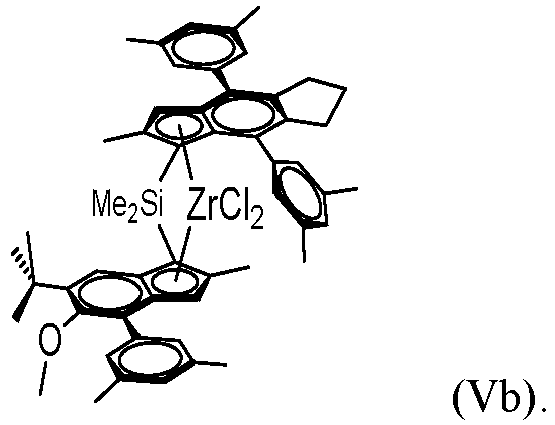
- The ligands required to form the complexes and hence catalysts of the invention can be synthesized by any process and the skilled organic chemist would be able to devise various synthetic protocols for the manufacture of the necessary ligand materials. For Example
WO2007/116034 discloses the necessary chemistry. Synthetic protocols can also generally be found inWO 2002/02576 WO 2011/135004 ,WO 2012/084961 ,WO 2012/001052 ,WO 2011/076780 ,WO 2015/158790 andWO 2018/122134 . Especially reference is made toWO 2019/179959 , in which the most preferred catalyst of the present invention is described. - According to the present invention a co-catalyst system comprising a boron containing co-catalyst and/or an aluminoxane co-catalyst is used in combination with the above defined metallocene catalyst complex.
- The aluminoxane co-catalyst can be one of formula (VI):

- Aluminoxanes are formed on partial hydrolysis of organoaluminum compounds, for example those of the formula AlR3, AlR2Y and Al2R3Y3 where R can be, for example, C1-C10 alkyl, preferably C1-C3 alkyl, or C3-C10 cycloalkyl, C7-C12 arylalkyl or alkylaryl and/or phenyl or naphthyl, and where Y can be hydrogen, halogen, preferably chlorine or bromine, or C1-C10 alkoxy, preferably methoxy or ethoxy. The resulting oxygen-containing aluminoxanes are not in general pure compounds but mixtures of oligomers of the formula (VI).
- The preferred aluminoxane is methylaluminoxane (MAO). Since the aluminoxanes used as co-catalysts according to the invention are not, owing to their mode of preparation, pure compounds, the molarity of aluminoxane solutions hereinafter is based on their aluminium content.
- According to the present invention, also a boron containing co-catalyst can be used instead of the aluminoxane co-catalyst or the aluminoxane co-catalyst can be used in combination with a boron containing co-catalyst.
- It will be appreciated by the person skilled in the art that where boron based co-catalysts are employed, it is normal to pre-alkylate the complex by reaction thereof with an aluminium alkyl compound, such as TIBA. This procedure is well known and any suitable aluminium alkyl, e.g. Al(C1-C6 alkyl)3 can be used. Preferred aluminium alkyl compounds are triethylaluminium, tri-isobutylaluminium, tri-isohexylaluminium, tri-n-octylaluminium and tri-isooctylaluminium.
- Alternatively, when a borate co-catalyst is used, the metallocene catalyst complex is in its alkylated version, that is for example a dimethyl or dibenzyl metallocene catalyst complex can be used.
- Boron based co-catalysts of interest include those of formula (VII)
BY3 (VII)
wherein Y is the same or different and is a hydrogen atom, an alkyl group of from 1 to about 20 carbon atoms, an aryl group of from 6 to about 15 carbon atoms, alkylaryl, arylalkyl, haloalkyl or haloaryl each having from 1 to 10 carbon atoms in the alkyl radical and from 6-20 carbon atoms in the aryl radical or fluorine, chlorine, bromine or iodine. Preferred examples for Y are methyl, propyl, isopropyl, isobutyl or trifluoromethyl, unsaturated groups such as aryl or haloaryl like phenyl, tolyl, benzyl groups, p-fluorophenyl, 3,5-difluorophenyl, pentachlorophenyl, pentafluorophenyl, 3,4,5-trifluorophenyl and 3,5-di(trifluoromethyl)phenyl. Preferred options are trifluoroborane, triphenylborane, tris(4-fluorophenyl) borane, tris(3,5-difluorophenyl)borane, tris(4-fluoromethylphenyl)borane, tris(2,4,6-trifluorophenyl)borane, tris(penta-fluorophenyl)borane, tris(tolyl)borane, tris(3,5-dimethyl-phenyl)borane, tris(3,5-difluorophenyl)borane and/or tris (3,4,5-trifluorophenyl)borane. - Particular preference is given to tris(pentafluorophenyl)borane.
- However it is preferred that borates are used, i.e. compounds containing a borate 3+ ion. Such ionic co-catalysts preferably contain a non-coordinating anion such as tetrakis(pentafluorophenyl)borate and tetraphenylborate. Suitable counterions are protonated amine or aniline derivatives such as methylammonium, anilinium, dimethylammonium, diethylammonium, N- methylanilinium, diphenylammonium, N,N-dimethylanilinium, trimethylammonium, triethylammonium, tri-n-butylammonium, methyldiphenylammonium, pyridinium, p-bromo-N,N- dimethylanilinium or p-nitro-N,N-dimethylanilinium.
- Preferred ionic compounds which can be used according to the present invention include:
- triethylammoniumtetra(phenyl)borate,
- tributylammoniumtetra(phenyl)borate,
- trimethylammoniumtetra(tolyl)borate,
- tributylammoniumtetra(tolyl)borate,
- tributylammoniumtetra(pentafluorophenyl)borate,
- tripropylammoniumtetra(dimethylphenyl)borate,
- tributylammoniumtetra(trifluoromethylphenyl)borate,
- tributylammoniumtetra(4-fluorophenyl)borate,
- N,N-dimethylcyclohexylammoniumtetrakis(pentafluorophenyl)borate,
- N,N-dimethylbenzylammoniumtetrakis(pentafluorophenyl)borate,
- N,N-dimethylaniliniumtetra(phenyl)borate,
- N,N-diethylaniliniumtetra(phenyl)borate,
- N,N-dimethylaniliniumtetrakis(pentafluorophenyl)borate,
- N,N-di(propyl)ammoniumtetrakis(pentafluorophenyl)borate,
- di(cyclohexyl)ammoniumtetrakist(pentafluorophenyl)borate,
- triphenylphosphoniumtetrakis(phenyl)borate,
- triethylphosphoniumtetrakis(phenyl)borate,
- diphenylphosphoniumtetrakis(phenyl)borate,
- tri(methylphenyl)phosphoniumtetrakis(phenyl)borate,
- tri(dimethylphenyl)phosphoniumtetrakis(phenyl)borate,
- triphenylcarbeniumtetrakis(pentafluorophenyl)borate,
- or ferroceniumtetrakis(pentafluorophenyl) borate.
- Preference is given to triphenylcarbeniumtetrakis(pentafluorophenyl) borate,
- N,N- dimethylcyclohexylammoniumtetrakis(pentafluorophenyl)borate or
- N,N- dimethylbenzylammoniumtetrakis(pentafluorophenyl)borate.
- It has been surprisingly found that certain boron co-catalysts are especially preferred. Preferred borates of use in the invention therefore comprise the trityl ion. Thus the use of N,N-dimethylammonium-tetrakispentafluorophenylborate and Ph3CB(PhF5)4 and analogues therefore are especially favoured.
- According to the present invention, the preferred co-catalysts are aluminoxanes, more preferably methylaluminoxanes, combinations of aluminoxanes with Al-alkyls, boron or borate co-catalysts, and combination of aluminoxanes with boron-based co-catalysts.
- Suitable amounts of co-catalyst will be well known to the person skilled in the art.
- The molar ratio of boron to the metal ion of the metallocene may be in the range 0.5:1 to 10:1 mol/mol, preferably 1:1 to 10:1, especially 1:1 to 5:1 mol/mol.
- The molar ratio of Al in the aluminoxane to the metal ion of the metallocene may be in the range 1:1 to 2000:1 mol/mol, preferably 10:1 to 1000: 1, and more preferably 50:1 to 500:1 mol/mol.
- The catalyst can be used in supported or unsupported form, preferably in supported form. The particulate support material used is preferably an organic or inorganic material, such as silica, alumina or zirconia or a mixed oxide such as silica-alumina, in particular silica, alumina or silica-alumina. The use of a silica support is preferred. The person skilled in the art is aware of the procedures required to support a metallocene catalyst.
- Especially preferably, the support is a porous material so that the complex may be loaded into the pores of the support, e.g. using a process analogous to those described in
WO94/14856 (Mobil WO95/12622 (Borealis WO2006/097497 . - The average particle size of the silica support can be typically from 10 to 100 µm. However, it has turned out that special advantages can be obtained if the support has a median particle size d50 from 15 to 80 µm, preferably from 18 to 50 µm.
- The average pore size of the silica support can be in the
range 10 to 100 nm and the pore volume from 1 to 3 mL/g. - Examples of suitable support materials are, for instance, ES757 produced and marketed by PQ Corporation, Sylopol 948 produced and marketed by Grace or SUNSPERA DM-L-303 silica produced by AGC Si-Tech Co. Supports can be optionally calcined prior to the use in catalyst preparation in order to reach optimal silanol group content.
- The use of these supports is routine in the art.
- The present invention is further directed to an article comprising the nonwoven fabric (NF) as described above, wherein the article selected from the group consisting of filtration medium (filter), diaper, sanitary napkin, panty liner, incontinence product for adults, protective clothing, surgical drape, surgical gown, and surgical wear, comprising the inventive nonwoven fabric (NF).
- It is preferred that the article of the present invention comprises the nonwoven fabric (NF) in an amount in the range from 90 to 100 wt.-%, more preferably in the range from 95 to 100 wt.-%, most preferably in the range from 99 to 100 wt.-%, relative to the total weight of the article.
- All preferable embodiments described above may be applied mutatis mutandis to the article of the present invention.
- The following definitions of terms and determination methods apply for the above general description of the invention including the claims as well as to the below examples unless otherwise defined.
- Quantitative nuclear-magnetic resonance (NMR) spectroscopy was used to quantify the isotacticity and regio-regularity of the propylene homopolymers.
- Quantitative 13C{1H} NMR spectra were recorded in the solution-state using a Bruker Advance III 400 NMR spectrometer operating at 400.15 and 100.62 MHz for 1H and 13C respectively. All spectra were recorded using a 13C optimized 10 mm extended temperature probehead at 125°C using nitrogen gas for all pneumatics.
- For propylene homopolymers approximately 200 mg of material was dissolved in 1,2-tetrachloroethane-d 2 (TCE-d 2). To ensure a homogenous solution, after initial sample preparation in a heat block, the NMR tube was further heated in a rotary oven for at least 1 hour. Upon insertion into the magnet the tube was spun at 10 Hz. This setup was chosen primarily for the high resolution needed for tacticity distribution quantification (Busico, V., Cipullo, R., Prog. Polym. Sci. 26 (2001) 443; Busico, V.; Cipullo, R., Monaco, G., Vacatello, M., Segre, A.L., Macromolecules 30 (1997) 6251). Standard single-pulse excitation was employed utilising the NOE and bi-level WALTZ 16 decoupling scheme (Zhou, Z., Kuemmerle, R., Qiu, X., Redwine, D., Cong, R., Taha, A., Baugh, D. Winniford, B., J. Mag. Reson. 187 (2007) 225; Busico, V., Carbonniere, P., Cipullo, R., Pellecchia, R., Severn, J., Talarico, G., Macromol. Rapid Commun. 2007, 28, 11289). A total of 8192 (8k) transients were acquired per spectra.
- Quantitative 13C{1H} NMR spectra were processed, integrated and relevant quantitative properties determined from the integrals using proprietary computer programs.
- For propylene homopolymers all chemical shifts are internally referenced to the methyl isotactic pentad (mmmm) at 21.85 ppm.
- Characteristic signals corresponding to regio defects (Resconi, L., Cavallo, L., Fait, A., Piemontesi, F., Chem. Rev. 2000, 100, 1253; Wang, W-J., Zhu, S., Macromolecules 33 (2000), 1157; Cheng, H. N., Macromolecules 17 (1984), 1950) or comonomer were observed.
- The tacticity distribution was quantified through integration of the methyl region between 23.6-19.7 ppm correcting for any sites not related to the stereo sequences of interest (Busico, V., Cipullo, R., Prog. Polym. Sci. 26 (2001) 443; Busico, V., Cipullo, R., Monaco, G., Vacatello, M., Segre, A.L., Macromolecules 30 (1997) 6251).
- Specifically the influence of regio-defects and comonomer on the quantification of the tacticity distribution was corrected for by subtraction of representative regio-defect and comonomer integrals from the specific integral regions of the stereo sequences.
- The isotacticity was determined at the pentad level and reported as the percentage of isotactic pentad (mmmm) sequences with respect to all pentad sequences:

- The presence of 2,1 erythro regio-defects was indicated by the presence of the two methyl sites at 17.7 and 17.2 ppm and confirmed by other characteristic sites. Characteristic signals corresponding to other types of regio-defects were not observed (Resconi, L., Cavallo, L., Fait, A., Piemontesi, F., Chem. Rev. 2000, 100, 1253).
- The amount of 2,1 erythro regio-defects was quantified using the average integral of the two characteristic methyl sites at 17.7 and 17.2 ppm:

- The amount of 1,2 primary inserted propene was quantified based on the methyl region with correction undertaken for sites included in this region not related to primary insertion and for primary insertion sites excluded from this region:

- The total amount of propene was quantified as the sum of primary inserted propene and all other present regio-defects:

- The mole percent of 2,1 erythro regio-defects was quantified with respect to all propene:

- MFR2 (230 °C) is measured according to ISO 1133 (230 °C, 2.16 kg load)
- Molecular weight averages (Mw, Mn), and the molecular weight distribution (MWD), i.e. the Mw/Mn (wherein Mn is the number average molecular weight and Mw is the weight average molecular weight), were determined by Gel Permeation Chromatography (GPC) according to ISO 16014-4:2003 and ASTM D 6474-99. A PolymerChar GPC instrument, equipped with infrared (IR) detector was used with 3 x Olexis and lx Olexis Guard columns from Polymer Laboratories and 1,2,4-trichlorobenzene (TCB, stabilized with 250 mg/L 2,6-Di tert butyl-4-methyl-phenol) as solvent at 160 °C and at a constant flow rate of 1 mL/min. 200 µl. of sample solution were injected per analysis. The column set was calibrated using universal calibration (according to ISO 16014-2:2003) with at least 15 narrow MWD polystyrene (PS) standards in the range from 0,5 kg/mol to 11 500 kg/mol. Mark Houwink constants for PS, PE and PP used are as described per ASTM D 6474-99. All samples were prepared by dissolving 5.0 - 9.0 mg of polymer in 8 mL (at 160 °C) of stabilized TCB (same as mobile phase) for 2.5 hours for PP or 3 hours for PE at max. 160°C under continuous gentle shaking in the autosampler of the GPC instrument.
- The xylene soluble fraction at room temperature (XS, wt.-%): The amount of the polymer soluble in xylene is determined at 25 °C according to ISO 16152; 5th edition; 2005-07-01.
- DSC analysis, melting temperature (Tm) and heat of fusion (Hf), crystallization temperature (Tc) and heat of crystallization (Hc): measured with a TA Instrument Q200 differential scanning calorimetry (DSC) on 5 to 7 mg samples. DSC is run according to ISO 11357 / part 3 /method C2 in a heat / cool / heat cycle with a scan rate of 10 °C/min in the temperature range of -30 to +225°C. Crystallization temperature (Tc) and heat of crystallization (Hc) are determined from the cooling step, while melting temperature (Tm) and heat of fusion (Hf) are determined from the second heating step.
- The glass transition temperature Tg is determined by dynamic mechanical analysis according to ISO 6721-7. The measurements are done in torsion mode on compression-moulded samples (40x10x1 mm3) between -100 °C and +150 °C with a heating rate of 2 °C/min and a frequency of 1 Hz.
- The unit weight (grammage) of the nonwoven fabrics in g/m2 was determined in accordance with ISO 536:1995.
- The filament fineness in denier has been calculated from the average fibre diameter by using the following correlation:

- The mechanical properties of the nonwoven fabrics were determined in accordance with EN 29073-3 (1989) "Test methods for nonwovens - Determination of tensile strength and elongation"
- The tensile modulus was measured according to ISO 527-2 (cross head speed = 1 mm/min; test speed 50 mm/min at 23 °C) using injection molded specimens as described in EN ISO 1873-2 (dog bone shape, 4 mm thickness). The measurement is done after 96 h conditioning time of the specimen.
- The number average fibre diameter was determined using scanning electron microscopy (SEM). A representative part of the web was selected and an SEM micrograph of suitable magnification was recorded, then the diameter of 20 fibres was measured and the number average calculated.
- The hydrohead or water resistance as determined by a hydrostatic pressure test is determined according to the WSP (worldwide strategic partners) standard test WSP 80.6 (09) as published in December 2009. This industry standard is in turn based on ISO 811:1981 and uses specimens of 100 cm2 at 23°C with purified water as test liquid and a rate of increase of the water pressure of 10 cm/min.
- The catalyst used in the polymerization process for the inventive second propylene polymer (PP2) for the spunbonded layer (S) of the inventive example (E2) was Anti-dimethylsilanediyl[2-methyl-4,8-di(3,5-dimethylphenyl)-1,5,6,7-tetrahydro-s-indacen-1-yl][2-methyl-4-(3,5-dimethylphenyl)-5-methoxy-6-tert-butylinden-1-yl] zirconium dichloride as disclosed in
WO 2019/179959 A1 as MC-2. The supported metallocene catalyst was produced analogously to IE2 inWO 2019/179959 A1 . - The catalyst used in the polymerization process for the comparative second propylene polymer (PP2) for the spunbonded layer (S) of the comparative example (E1) and for the first propylene polymer (PP1) used as the melt blown layer in all of the examples (E3) was prepared as follows:
-
- 20 % solution in toluene of butyl ethyl magnesium (Mg(Bu)(Et), BEM), provided by Chemtura
- 2-ethylhexanol, provided by Amphochem
- 3-Butoxy-2-propanol - (DOWANOL™ PnB), provided by Dow
- bis(2-ethylhexyl)citraconate, provided by SynphaBase
- TiCl4, provided by Millenium Chemicals
- Toluene, provided by Aspokem
- Viscoplex® 1-254, provided by Evonik
- Heptane, provided by Chevron
- Mg alkoxide solution was prepared by adding, with stirring (70 rpm), into 11 kg of a 20 wt-% solution in toluene of butyl ethyl magnesium (Mg(Bu)(Et)), a mixture of 4.7 kg of 2-ethylhexanol and 1.2 kg of butoxypropanol in a 20 1 stainless steel reactor. During the addition, the reactor contents were maintained below 45 °C. After addition was completed, mixing (70 rpm) of the reaction mixture was continued at 60 °C for 30 minutes. After cooling to room temperature 2.3 kg g of the donor bis(2-ethylhexyl)citraconate was added to the Mg-alkoxide solution keeping temperature below 25 °C. Mixing was continued for 15 minutes under stirring (70 rpm).
- 20.3 kg of TiCl4 and 1.1 kg of toluene were added into a 20 l stainless steel reactor. Under 350 rpm mixing and keeping the temperature at 0 °C, 14.5 kg of the Mg alkoxy compound prepared in example 1 was added during 1.5 hours. 1.7 l of Viscoplex® 1-254 and 7.5 kg of heptane were added and after 1 hour mixing at 0 °C the temperature of the formed emulsion was raised to 90 °C within 1 hour. After 30 minutes mixing was stopped catalyst droplets were solidified and the formed catalyst particles were allowed to settle. After settling (1 hour), the supernatant liquid was siphoned away. Then the catalyst particles were washed with 45 kg of toluene at 90°C for 20 minutes followed by two heptane washes (30 kg, 15 min). During the first heptane wash the temperature was decreased to 50 °C and during the second wash to room temperature.
- The thus obtained catalyst was used along with triethyl-aluminium (TEAL) as co-catalyst and dicyclopentyl dimethoxy silane (D-Donor) as donor for E1 and cyclohexylmethyl dimethoxy silane (C-Donor) as donor for E3, respectively.
- The aluminium to donor ratio, the aluminium to titanium ratio and the polymerization conditions are indicated in table 1.
Table 1: Preparation of base polymers E1, E2 and E3 E1 E2 E3 Prepolymerization TEAL/Ti [mol/mol] 102 n/a 150 TEAL/donor [mol/mol] 6 n/a 18.8 Temperature [°C] 30 20 20 res.time [h] 0.3 0.3 18 Donor [-] D n/a C Loop Temperature [°C] 80 70 75 Pressure [kPa] 5500 5500 3500 Split [%] 60 55 100 H2/C3 ratio [mol/kmol] 0.5 0.1 7.2 C2/C3 ratio [mol/kmol] 1.2 1.8 0.0 MFR2 [g/10min] 2.8 2.3 77.0 XCS [wt.-%] 0.3 1.1 4.9 GPR 1 Temperature [°C] 80 80 Pressure [kPa] 2100 2100 Split [%] 40 45 H2/C3 ratio [mol/kmol] 8 1.8 C2/C3 ratio [mol/kmol] 0.4 9.8 Properties of final base polymer MFR2 [g/10min] 2.3 2.3 79 XCS [wt.-%] 3.1 0.6 4.9 C2 [wt.-%] 0.3 0.3 0.0 Mw [kg/mol] 328 315 140 Mw/Mn [-] 8 2.8 6.5 Tm [°C] 160 151 163 Tg [°C] -0.5 0.6 0.0 Tc [°C] 116 114 122 2,1 [mol-%] 0.0 0.84 0.0 mmmm [%] 95.3 99.4 93.5 - The polymers E1, E2 and E3 have been mixed with 400 ppm calcium Stearate (CAS No. 1592-23-0) and 1,000 ppm Irganox 1010 supplied by BASF AG, Germany (Pentaerythrityl-tetrakis(3-(3',5'-di-tert. butyl-4-hydroxyphenyl)-propionate, CAS No. 6683-19-8).
- In a second step the polymers E1, E2 and E3 have been visbroken by using a co-rotating twin-screw extruder at 200-230°C and using an appropriate amount of (tert-butylperoxy)-2,5-dimethylhexane (Trigonox 101, distributed by Akzo Nobel, Netherlands) to achieve the target MFR2. The properties of the propylene homopolymers after visbreaking are summarized in table 2.
Table 2: Properties of the inventive and comparative examples after visbreaking Spunbonded (S) Melt blown (M) CE IE RE Isotacticity(mmmm) [%] 95.3 99.4 93.5 C2 content [wt.-%] 0.3 0.3 0.0 MFR final [g/10min] 27 27 1200 Mw/Mn [-] 4.7 2.4 3.8 XCS [wt.-%] 3.5 0.8 4.8 2,1 regio defects [%] 0.0 0.84 0.0 Tg [°C] -0.3 0.5 0.0 Tm [°C] 162 152 158 Tc [°C] 115 110 122 n.d. = not detected
n.a. = not applicable - The nonwoven fabrics were produced on a Reifenhäuser Reicofil RF5 semi-commercial line, equipped with spunbond (S-Extruder 1)- spunbond (S-Extruder 2)- Melt blown (M-Extruder 1)- Melt blown (M-Extruder 2)- spunbond (S-Extruder 3) beams. The machine is adjusted by the person skilled in the art to reach the target setting. The key parameters are listed in Table 3. Each product has 11.0 g/m2 of spunbonded layers and 2.0 g/m2 of melt blown layers, with each individual spunbonded layer having a grammage of 3.67 g/m2, and each individual melt blown layer having a grammage of 1.0 g/m2.
Table 3: Processing conditions for the production and properties of the nonwoven fabrics Example CE IE S-Extruder 1 Material [-] E1 E2 Melt temperature [°C] 262 266 Pressure [Pa] 4500 7200 Throughput [kg/h] 170 170 S-Extruder 2 Material [-] E1 E2 Melt temperature [°C] 263 267 Pressure [Pa] 4800 7000 Throughput [kg/h] 170 170 M-Extruder 1 Material [-] E3 E3 DCD [mm] 99 99 Melt temperature [°C] 261 261 Throughput [kg/h] 36 36 M-Extruder 2 Material [-] E3 E3 DCD [mm] 109 109 Melt temperature [°C] 261 261 Throughput [kg/h] 36 36 S-Extruder 3 Material [-] E1 E2 Melt temperature [°C] 262 265 Pressure [Pa] 3600 6500 Throughput [kg/h] 170 170 Fabric performance Grammage [g/m2] 13.0 13.0 Spunbonded fibre diameter [µm] 14.1 12.9 - The multilayer nonwoven fabric thus obtained was run through calender rolls to bind the layers. A number of comparative nonwoven fabrics and a number of inventive nonwoven fabrics were processed at different calender temperatures, then the properties of these nonwoven fabrics were evaluated as a function of calender temperature.
- As can be seen from
Figure 1 , the hydrohead (HH) and the tensile strength in the crossmachine direction (F-CD) of the nonwoven fabrics showed a dependence on the calender temperature. Whilst the HH decreased significantly at higher calender temperatures, the inventive nonwoven fabrics maintained high HH at much greater calender temperatures, before finally starting to decrease at calender temperatures of over 165 °C (in contrast to the comparative nonwoven fabrics that started to notably decrease at temperatures over 150 °C. The F-CD of both compositions increased with increasing calender temperature for both examples, however the values measured for the inventive nonwoven fabrics were superior to those of the comparative nonwoven fabrics at all temperatures. - Consequently, it can be concluded that both the mechanical and the barrier properties of the inventive nonwoven fabrics are superior to those of the comparative nonwoven fabrics, especially at higher calender temperatures. Furthermore, the grammage of the nonwoven fabrics is low, helping to avoid undue impact on the environment when these nonwoven fabrics are employed in hygiene articles.
Claims (14)
- A nonwoven fabric (NF), comprising a multilayer structure that comprises:i) at least one melt blown layer (M) comprising melt blown fibers (MBF) comprising a first propylene polymer (PP1) having:a) an amount of 2,1-regiodefects, as determined by 13C-NMR spectroscopic analysis, in the range from 0.0 to 0.1 mol-%; andb) a melting temperature Tm, determined by differential scanning calorimetry (DSC), in the range from 155 to 170 °C,ii) at least one spunbonded layer (S) comprising spunbonded fibers (SBF) comprising a second propylene polymer (PP2) having:wherein the melting temperature of the first polypropylene polymer Tm (PP1) is at least 5.0 °C higher than that of the second first polypropylene polymer Tm (PP2).a) an amount of 2,1-regiodefects, as determined by 13C-NMR spectroscopic analysis, in the range from 0.45 to 1.5 mol-%; andb) a melting temperature Tm, determined by differential scanning calorimetry (DSC), in the range from 145 to 160 °C.
- The nonwoven fabric (NF) according to claim 1, wherein the total grammage of the one or more melt blown layers (M), determined according to ISO 536:1995, is in the range from 0.8 to 30 g/m2, and/or the total grammage of the one or more spunbonded layers (S), determined according to ISO 536:1995, is in the range from 5.0 to 100 g/m2, preferably the total grammage of the one or more melt blown layers (M), determined according to ISO 536:1995, is in the range from 0.8 to 30 g/m2 and the total grammage of the one or more spunbonded layers (S), determined according to ISO 536:1995, is in the range from 5.0 to 100 g/m2.
- The nonwoven fabric (NF) according to either claim 1 or claim 2, wherein the first propylene polymer (PP1) and/or the second propylene polymer (PP2) are propylene homopolymers or propylene ethylene copolymers wherein the ethylene content, as determined by 1H-NMR spectroscopic analysis, is less than 0.5 mol-%.
- The nonwoven fabric (NF) according to any one of the preceding claims, wherein the first propylene polymer (PP1) has at least one of, preferably both of, the following properties:a) a melt flow rate (MFR2), measured according to ISO 1133 at 230 °C and 2.16 kg in the range from 450 to 2000 g/10 min; andb) a molecular weight distribution (Mw/Mn), determined by Gel Permeation Chromatography, in the range from 2.5 to 5.0.
- The nonwoven fabric (NF) according to any one of the preceding claims, wherein the second propylene polymer (PP2) has at least one of, preferably both of, the following properties:a) a melt flow rate (MFR2), measured according to ISO 1133 at 230 °C and 2.16 kg in the range from 5.0 to 50 g/10 min; andb) a molecular weight distribution (Mw/Mn), determined by Gel Permeation Chromatography, in the range from 2.0 to 4.5.
- The nonwoven fabric (NF) according to any one of the preceding claims, wherein the second propylene polymer (PP2) has a xylene cold soluble content (XCS) determined according to ISO 16152, in the range from 0.1 to 2.0 wt.-%.
- The nonwoven fabric (NF) according to any one of the preceding claims, wherein the first propylene polymer (PP1) has been visbroken, preferably wherein the first propylene polymer (PP1) fulfils either of, preferably both of, inequation (I) or inequation (II)
 wherein MFR(final) is the melt flow rate MFR2 (230 °C) determined according to ISO 1133 after visbreaking and MFR(initial) is the melt flow rate MFR2 (230 °C) determined according to ISO 1133 before visbreaking; and
 wherein MWD(final) is the molecular weight distribution (Mw/Mn), determined by Gel Permeation Chromatography, after visbreaking and MWD(initial) is the molecular weight distribution (Mw/Mn), determined by Gel Permeation Chromatography, before visbreaking.
 - The nonwoven fabric (NF) according to any one of the preceding claims, wherein the second propylene polymer (PP2) has been visbroken, preferably wherein the second propylene polymer (PP2) fulfils either of, preferably both of, inequation (III) or inequation (IV)
 wherein MFR(final) is the melt flow rate MFR2 (230 °C) determined according to ISO 1133 after visbreaking and MFR(initial) is the melt flow rate MFR2 (230 °C) determined according to ISO 1133 before visbreaking; and
 wherein MWD(final) is the molecular weight distribution (Mw/Mn), determined by Gel Permeation Chromatography, after visbreaking and MWD(initial) is the molecular weight distribution (Mw/Mn), determined by Gel Permeation Chromatography, before visbreaking.
 - The nonwoven fabric (NF) according to any one of the preceding claims, wherein the first propylene polymer (PP1) has been polymerized in the presence ofa) a Ziegler-Natta catalyst (ZN-C) comprising compounds (TC) of a transition metal of Group 4 to 6 of IUPAC, a Group 2 metal compound (MC) and an internal donor (ID), wherein said internal donor (ID) is a non-phthalic compound, preferably is a non-phthalic acid ester;b) optionally a co-catalyst (Co), andc) optionally an external donor (ED).
- The nonwoven fabric (NF) according to any one of the preceding claims, wherein the second propylene polymer (PP2) has been polymerized in the presence of a single site catalyst, preferably wherein the single site catalyst comprises(i) a metallocene complex of the general formula (V)
 wherein each X independently is a sigma-donor ligand,L is a divalent bridge selected from -R'2C-, -R'2C-CR'2-, -R'2Si-, -R'2Si-SiR'2-, -R'2Ge-, wherein each R' is independently a hydrogen atom or a C1-C20-hydrocarbyl group optionally containing one or more heteroatoms from groups 14-16 of the periodic table or fluorine atoms, or optionally two R' groups taken together can form a ring,each R1 are independently the same or can be different and are hydrogen, a linear or branched C1-C6-alkyl group, a C7-20-arylalkyl, C7-20-alkylaryl group or C6-20-aryl group or an OY group, wherein Y is a C1-10-hydrocarbyl group, and optionally two adjacent R1 groups can be part of a ring including the phenyl carbons to which they are bonded,each R2 independently are the same or can be different and are a CH2-R8 group, with R8 being H or linear or branched C1-6-alkyl group, C3-8-cycloalkyl group, C6-10-aryl group,R3 is a linear or branched C1-C6-alkyl group, C7-20-arylalkyl, C7-20-alkylaryl group or C6-C20-aryl group,R4 is a C(R9)3 group, with R9 being a linear or branched C1-C6-alkyl group,R5 is hydrogen or an aliphatic C1-C20-hydrocarbyl group optionally containing one or more heteroatoms from groups 14-16 of the periodic table;R6 is hydrogen or an aliphatic C1-C20-hydrocarbyl group optionally containing one or more heteroatoms from groups 14-16 of the periodic table; orR5 and R6 can be taken together to form a 5 membered saturated carbon ring which is optionally substituted by n groups R10, n being from 0 to 4;each R10 is same or different and may be a C1-C20-hydrocarbyl group, or a C1-C20-hydrocarbyl group optionally containing one or more heteroatoms belonging to groups 14-16 of the periodic table;R7 is H or a linear or branched C1-C6-alkyl group or an aryl or heteroaryl group having 6 to 20 carbon atoms optionally substituted by one to three groups R11,each R11 are independently the same or can be different and are hydrogen, a linear or branched C1-C6-alkyl group, a C7-20-arylalkyl, C7-20-alkylaryl group or C6-20-aryl group or an OY group, wherein Y is a C1-10-hydrocarbyl group,(ii) a co-catalyst system comprising a boron containing co-catalyst and/or an aluminoxane co-catalyst, and(iii) a silica support.
 - The nonwoven fabric (NF) according to any of the preceding claims, wherein the multilayer structure comprises, preferably consists of, the following layers in the given order:i) at least one spunbonded layer (S) comprising spunbonded fibers (S);ii) at least one melt blown layer (M) comprising melt blown fibers (M); andiii) at least one spunbonded layer (S) comprising spunbonded fibers (S),wherein each instance of the spunbonded layer (S) may be the same or different and each instance of the melt blown layer (M) may be the same or different.
- A process for producing the nonwoven fabric (NF) according to claim 11, comprising the steps of:a) producing the first spunbonded layer (S1) by depositing spunbonded fibers (SBF) through a spinneret,b) optionally producing at least one further spunbonded layer (S) by depositing spunbonded fibers (SBF) on the first spunbonded layer (S1) obtained in step a) through at least one further spinneret, thereby obtaining a multilayered structure comprising two or more, like two or three spunbonded layers (S) in sequence,c) producing the first melt blown layer (M1) by depositing melt blown fibers (MBF) on the first spunbonded layer (S1) obtained in step a) or on the outermost spunbonded layer (S) obtained in step b) through an extruder, thereby obtaining a multilayered structure comprising one or more, like one, two or three spunbonded layer(s) (S) and a melt blown layer (M) in sequence,d) optionally producing at least one further melt blown layer (M) by depositing melt blown fibers (MBF) on the first melt blown layer (M1) obtained in step c) through at least one further extruder, thereby obtaining a multilayered structure comprising one or more, like one, two or three spunbonded layer(s) (S) and two or more, like two or three melt blown layer(s) (M) in sequence,e) producing the second spunbonded layer (S2) by depositing spunbonded fibers (SBF) through a spinneret on the first melt blown layer (M1) obtained in step c) or on the outermost melt blown layer (M) obtained in step d), thereby obtaining a multilayered structure comprising one or more, like one, two or three spunbonded layer(s) (S), one or more, like one, two or three melt blown layer(s) (M), and one spunbonded layer (S) in sequence, andf) optionally producing at least one further spunbonded layer (S) by depositing spunbonded fibers (SBF) on the second spunbonded layer (S2) obtained in step e) through at least one further spinneret, thereby obtaining a multilayered structure comprising one or more, like one, two or three spunbonded layer(s) (S), one or more, like one, two or three melt blown layer(s) (M), and two or more, like one, two or three spunbonded layer(s) (S) in sequence.
- The nonwoven fabric according to any one of claims 1 to 11, obtainable via, preferably obtained by, the process of claim 12.
- An article, comprising the nonwoven fabric (NF) according to any one of claims 1 to 11 or 13, wherein the article is selected from filtration medium (filter), diaper, sanitary napkin, panty liner, incontinence product for adults, protective clothing, surgical drape, surgical gown, and surgical wear.
Applications Claiming Priority (2)
| Application Number | Priority Date | Filing Date | Title |
|---|---|---|---|
| EP21189680 | 2021-08-04 | ||
| PCT/EP2022/071689 WO2023012159A1 (en) | 2021-08-04 | 2022-08-02 | Multilayer nonwoven structure |
Publications (3)
| Publication Number | Publication Date |
|---|---|
| EP4380794A1 EP4380794A1 (en) | 2024-06-12 |
| EP4380794B1 true EP4380794B1 (en) | 2025-07-02 |
| EP4380794B8 EP4380794B8 (en) | 2025-08-06 |
Family
ID=77207139
Family Applications (1)
| Application Number | Title | Priority Date | Filing Date |
|---|---|---|---|
| EP22758536.1A Active EP4380794B8 (en) | 2021-08-04 | 2022-08-02 | Multilayer nonwoven structure |
Country Status (7)
| Country | Link |
|---|---|
| US (1) | US20250083409A1 (en) |
| EP (1) | EP4380794B8 (en) |
| KR (1) | KR20240040100A (en) |
| CN (1) | CN117897272A (en) |
| DK (1) | DK4380794T3 (en) |
| ES (1) | ES3038710T3 (en) |
| WO (1) | WO2023012159A1 (en) |
Families Citing this family (2)
| Publication number | Priority date | Publication date | Assignee | Title |
|---|---|---|---|---|
| CN117087299A (en) * | 2023-08-16 | 2023-11-21 | 华昊无纺布有限公司 | Ultra-low gram weight high hydrostatic pressure non-woven fabric and preparation process thereof |
| CN117103792A (en) * | 2023-08-16 | 2023-11-24 | 华昊无纺布有限公司 | Preparation process of five-layer heterogeneous super-soft non-woven fabric |
Family Cites Families (35)
| Publication number | Priority date | Publication date | Assignee | Title |
|---|---|---|---|---|
| FR2603996A1 (en) | 1986-09-17 | 1988-03-18 | Primat Didier | OBJECTIVE-FREE OPTICAL READING DEVICE |
| FI86867C (en) | 1990-12-28 | 1992-10-26 | Neste Oy | FLERSTEGSPROCESS FOR FRAMSTAELLNING AV POLYETEN |
| US5332706A (en) | 1992-12-28 | 1994-07-26 | Mobil Oil Corporation | Process and a catalyst for preventing reactor fouling |
| FI96866C (en) | 1993-11-05 | 1996-09-10 | Borealis As | Support olefin polymerization catalyst, its preparation and use |
| FI111845B (en) | 1997-06-24 | 2003-09-30 | Borealis Tech Oy | Process for producing propylene homopolymers and polymers with modified impact strength |
| FI111847B (en) | 1997-06-24 | 2003-09-30 | Borealis Tech Oy | Process for preparing copolymers of propylene |
| FI111846B (en) | 1997-06-24 | 2003-09-30 | Borealis Tech Oy | Process and apparatus for preparing mixtures of polypropylene |
| FI111848B (en) | 1997-06-24 | 2003-09-30 | Borealis Tech Oy | Process and equipment for the preparation of homopolymers and copolymers of propylene |
| FI974175L (en) | 1997-11-07 | 1999-05-08 | Borealis As | Method for producing polypropylene |
| FI980342A0 (en) | 1997-11-07 | 1998-02-13 | Borealis As | Polymerroer och -roerkopplingar |
| IT1302123B1 (en) | 1998-07-31 | 2000-07-31 | Ennio Truono | AUTOMATIC CLEANING DEVICE FOR REFLECTORS ARRANGED IN LONG AND HIGHWAYS |
| FI991057A0 (en) | 1999-05-07 | 1999-05-07 | Borealis As | High stiffness propylene polymers and process for their preparation |
| EP1313746B1 (en) | 2000-06-30 | 2005-07-27 | ExxonMobil Chemical Patents Inc. | Metallocenes with a bridged 4-phenyl-indenyl-ligand for olefin polymerisation |
| DE60239297D1 (en) | 2002-06-25 | 2011-04-07 | Borealis Tech Oy | POLYOLEFIN WITH IMPROVED SCRATCH RESISTANCE AND METHOD FOR ITS MANUFACTURE |
| EP1484343A1 (en) | 2003-06-06 | 2004-12-08 | Universiteit Twente | Process for the catalytic polymerization of olefins, a reactor system and its use in the same process |
| US9018112B2 (en) * | 2003-11-18 | 2015-04-28 | Exxonmobil Chemicals Patents Inc. | Extensible polypropylene-based nonwovens |
| PL1858907T3 (en) | 2005-03-18 | 2009-04-30 | Basell Polyolefine Gmbh | Metallocene compounds |
| WO2007116034A1 (en) | 2006-04-12 | 2007-10-18 | Basell Polyolefine Gmbh | Metallocene compounds |
| EP2113591A1 (en) * | 2008-04-29 | 2009-11-04 | Total Petrochemicals Research Feluy | Fibers and nonwovens comprising with improved mechanical and bonding properties |
| CN102666605B (en) | 2009-12-22 | 2014-08-06 | 博里利斯股份公司 | Catalysts |
| EP2529044B1 (en) * | 2010-01-28 | 2014-04-09 | Borealis AG | Melt blown fiber |
| EP2383299B1 (en) | 2010-04-28 | 2017-12-20 | Borealis AG | Solid particulate catalysts comprising bridged metallocenes |
| EP2402353B1 (en) | 2010-07-01 | 2018-04-25 | Borealis AG | Group 4 metallocenes useful as catalysts for the polymerization of olefins |
| EP2415790B1 (en) | 2010-07-13 | 2014-09-24 | Borealis AG | Catalyst component |
| EP2655431A1 (en) | 2010-12-22 | 2013-10-30 | Borealis AG | Bridged metallocene catalysts |
| ES2727405T3 (en) | 2011-12-30 | 2019-10-16 | Borealis Ag | Preparation of phthalate free ZN PP catalysts |
| EP2610272B1 (en) | 2011-12-30 | 2017-05-10 | Borealis AG | Catalyst component |
| BR112016011829B1 (en) | 2013-12-04 | 2022-01-18 | Borealis Ag | COMPOSITION OF POLYPROPYLENE, FIBER AND MELT BLOWN, ARTICLE AND USE OF POLYPROPYLENE COMPOSITION |
| PL2891667T3 (en) * | 2014-01-07 | 2017-07-31 | Borealis Ag | Heterophasic polypropylene polymer |
| EP2907841A1 (en) * | 2014-02-14 | 2015-08-19 | Borealis AG | Polypropylene composite |
| JP6734783B2 (en) | 2014-04-17 | 2020-08-05 | ボレアリス エージー | Improved catalyst system for producing polyethylene copolymers by high temperature solution polymerization method |
| ES2864859T3 (en) * | 2015-10-02 | 2021-10-14 | Borealis Ag | Melt blown belts with improved properties |
| CN109983167A (en) * | 2016-12-09 | 2019-07-05 | 博里利斯股份公司 | Multilayer Nonwoven Structure |
| JP7130649B2 (en) | 2016-12-29 | 2022-09-05 | ボレアリス エージー | catalyst |
| EP3768735B1 (en) | 2018-03-19 | 2021-12-29 | Borealis AG | Catalysts for olefin polymerization |
-
2022
- 2022-08-02 EP EP22758536.1A patent/EP4380794B8/en active Active
- 2022-08-02 KR KR1020247006376A patent/KR20240040100A/en active Pending
- 2022-08-02 DK DK22758536.1T patent/DK4380794T3/en active
- 2022-08-02 WO PCT/EP2022/071689 patent/WO2023012159A1/en not_active Ceased
- 2022-08-02 ES ES22758536T patent/ES3038710T3/en active Active
- 2022-08-02 CN CN202280052762.9A patent/CN117897272A/en active Pending
- 2022-08-02 US US18/292,572 patent/US20250083409A1/en active Pending
Also Published As
| Publication number | Publication date |
|---|---|
| ES3038710T3 (en) | 2025-10-14 |
| KR20240040100A (en) | 2024-03-27 |
| CN117897272A (en) | 2024-04-16 |
| EP4380794A1 (en) | 2024-06-12 |
| EP4380794B8 (en) | 2025-08-06 |
| WO2023012159A1 (en) | 2023-02-09 |
| DK4380794T3 (en) | 2025-08-25 |
| US20250083409A1 (en) | 2025-03-13 |
Similar Documents
| Publication | Publication Date | Title |
|---|---|---|
| KR102157139B1 (en) | Polypropylene composition | |
| US11390732B2 (en) | Polypropylene composition | |
| US10829624B2 (en) | Polypropylene composition with improved heat resistance | |
| EP4141068B1 (en) | A homopolymer-random copolymer blend having a beneficial balance of optical and mechanical properties | |
| EP3077426A1 (en) | Phthalate-free pp homopolymers for meltblown fibers | |
| US20230382091A1 (en) | Multilayer film with improved properties | |
| WO2016096690A1 (en) | Melt-blown webs without shots and with improved barrier properties | |
| KR102483265B1 (en) | Polypropylene-based composition with improved paintability | |
| US11084919B2 (en) | Soft and transparent polypropylene composition | |
| CN107787347A (en) | Soft multiphase atactic propene copolymer with improved definition | |
| EP3551794B1 (en) | Multilayer nonwoven structure | |
| US20250326923A1 (en) | Polymer composition comprising polypropylene and hydrocarbon resin | |
| US20250083409A1 (en) | Multilayer nonwoven structure | |
| CN116829605B (en) | Fiber-reinforced polypropylene composition | |
| CN119032124A (en) | Method for recycling polypropylene film | |
| EP3255189B1 (en) | Melt blown web with good water barrier properties | |
| US20250313687A1 (en) | Glass fiber composite | |
| US20240002555A1 (en) | In-situ reactor blend of ziegler-natta catalysed, nucleated polypropylene and a metallocene catalysed polypropylene |
Legal Events
| Date | Code | Title | Description |
|---|---|---|---|
| STAA | Information on the status of an ep patent application or granted ep patent |
Free format text: STATUS: UNKNOWN |
|
| STAA | Information on the status of an ep patent application or granted ep patent |
Free format text: STATUS: THE INTERNATIONAL PUBLICATION HAS BEEN MADE |
|
| PUAI | Public reference made under article 153(3) epc to a published international application that has entered the european phase |
Free format text: ORIGINAL CODE: 0009012 |
|
| STAA | Information on the status of an ep patent application or granted ep patent |
Free format text: STATUS: REQUEST FOR EXAMINATION WAS MADE |
|
| 17P | Request for examination filed |
Effective date: 20240304 |
|
| AK | Designated contracting states |
Kind code of ref document: A1 Designated state(s): AL AT BE BG CH CY CZ DE DK EE ES FI FR GB GR HR HU IE IS IT LI LT LU LV MC MK MT NL NO PL PT RO RS SE SI SK SM TR |
|
| DAV | Request for validation of the european patent (deleted) | ||
| DAX | Request for extension of the european patent (deleted) | ||
| STAA | Information on the status of an ep patent application or granted ep patent |
Free format text: STATUS: EXAMINATION IS IN PROGRESS |
|
| 17Q | First examination report despatched |
Effective date: 20241113 |
|
| GRAP | Despatch of communication of intention to grant a patent |
Free format text: ORIGINAL CODE: EPIDOSNIGR1 |
|
| STAA | Information on the status of an ep patent application or granted ep patent |
Free format text: STATUS: GRANT OF PATENT IS INTENDED |
|
| RIC1 | Information provided on ipc code assigned before grant |
Ipc: D04H 3/007 20120101ALN20250124BHEP Ipc: B01D 39/16 20060101ALI20250124BHEP Ipc: B32B 7/027 20190101ALI20250124BHEP Ipc: B32B 5/26 20060101AFI20250124BHEP |
|
| INTG | Intention to grant announced |
Effective date: 20250221 |
|
| P01 | Opt-out of the competence of the unified patent court (upc) registered |
Free format text: CASE NUMBER: APP_14684/2025 Effective date: 20250326 |
|
| GRAS | Grant fee paid |
Free format text: ORIGINAL CODE: EPIDOSNIGR3 |
|
| GRAA | (expected) grant |
Free format text: ORIGINAL CODE: 0009210 |
|
| STAA | Information on the status of an ep patent application or granted ep patent |
Free format text: STATUS: THE PATENT HAS BEEN GRANTED |
|
| REG | Reference to a national code |
Ref country code: DE Ref legal event code: R081 Ref document number: 602022017005 Country of ref document: DE Owner name: BOREALIS GMBH, AT Free format text: FORMER OWNER: BOREALIS AG, VIENNA, AT |
|
| AK | Designated contracting states |
Kind code of ref document: B1 Designated state(s): AL AT BE BG CH CY CZ DE DK EE ES FI FR GB GR HR HU IE IS IT LI LT LU LV MC MK MT NL NO PL PT RO RS SE SI SK SM TR |
|
| REG | Reference to a national code |
Ref country code: GB Ref legal event code: FG4D |
|
| REG | Reference to a national code |
Ref country code: CH Ref legal event code: EP Ref country code: CH Ref legal event code: PK Free format text: BERICHTIGUNG B8 |
|
| REG | Reference to a national code |
Ref country code: DE Ref legal event code: R096 Ref document number: 602022017005 Country of ref document: DE |
|
| RAP4 | Party data changed (patent owner data changed or rights of a patent transferred) |
Owner name: BOREALIS GMBH |
|
| REG | Reference to a national code |
Ref country code: IE Ref legal event code: FG4D |
|
| REG | Reference to a national code |
Ref country code: DK Ref legal event code: T3 Effective date: 20250821 |
|
| REG | Reference to a national code |
Ref country code: SE Ref legal event code: TRGR |
|
| PGFP | Annual fee paid to national office [announced via postgrant information from national office to epo] |
Ref country code: ES Payment date: 20250926 Year of fee payment: 4 |
|
| PGFP | Annual fee paid to national office [announced via postgrant information from national office to epo] |
Ref country code: DK Payment date: 20250825 Year of fee payment: 4 Ref country code: DE Payment date: 20250820 Year of fee payment: 4 |
|
| REG | Reference to a national code |
Ref country code: ES Ref legal event code: FG2A Ref document number: 3038710 Country of ref document: ES Kind code of ref document: T3 Effective date: 20251014 |
|
| PGFP | Annual fee paid to national office [announced via postgrant information from national office to epo] |
Ref country code: TR Payment date: 20250922 Year of fee payment: 4 Ref country code: IT Payment date: 20250901 Year of fee payment: 4 |
|
| PGFP | Annual fee paid to national office [announced via postgrant information from national office to epo] |
Ref country code: FR Payment date: 20250829 Year of fee payment: 4 Ref country code: AT Payment date: 20251020 Year of fee payment: 4 |
|
| PGFP | Annual fee paid to national office [announced via postgrant information from national office to epo] |
Ref country code: SE Payment date: 20250918 Year of fee payment: 4 |
|
| PGFP | Annual fee paid to national office [announced via postgrant information from national office to epo] |
Ref country code: CZ Payment date: 20250822 Year of fee payment: 4 |
|
| REG | Reference to a national code |
Ref country code: NL Ref legal event code: MP Effective date: 20250702 |
|
| PG25 | Lapsed in a contracting state [announced via postgrant information from national office to epo] |
Ref country code: PT Free format text: LAPSE BECAUSE OF FAILURE TO SUBMIT A TRANSLATION OF THE DESCRIPTION OR TO PAY THE FEE WITHIN THE PRESCRIBED TIME-LIMIT Effective date: 20251103 |
|
| PG25 | Lapsed in a contracting state [announced via postgrant information from national office to epo] |
Ref country code: NL Free format text: LAPSE BECAUSE OF FAILURE TO SUBMIT A TRANSLATION OF THE DESCRIPTION OR TO PAY THE FEE WITHIN THE PRESCRIBED TIME-LIMIT Effective date: 20250702 |
|
| REG | Reference to a national code |
Ref country code: AT Ref legal event code: MK05 Ref document number: 1808795 Country of ref document: AT Kind code of ref document: T Effective date: 20250702 |
|
| PG25 | Lapsed in a contracting state [announced via postgrant information from national office to epo] |
Ref country code: IS Free format text: LAPSE BECAUSE OF FAILURE TO SUBMIT A TRANSLATION OF THE DESCRIPTION OR TO PAY THE FEE WITHIN THE PRESCRIBED TIME-LIMIT Effective date: 20251102 |
|
| PG25 | Lapsed in a contracting state [announced via postgrant information from national office to epo] |
Ref country code: NO Free format text: LAPSE BECAUSE OF FAILURE TO SUBMIT A TRANSLATION OF THE DESCRIPTION OR TO PAY THE FEE WITHIN THE PRESCRIBED TIME-LIMIT Effective date: 20251002 |
|
| REG | Reference to a national code |
Ref country code: LT Ref legal event code: MG9D |
|
| PG25 | Lapsed in a contracting state [announced via postgrant information from national office to epo] |
Ref country code: AT Free format text: LAPSE BECAUSE OF FAILURE TO SUBMIT A TRANSLATION OF THE DESCRIPTION OR TO PAY THE FEE WITHIN THE PRESCRIBED TIME-LIMIT Effective date: 20250702 |
|
| PG25 | Lapsed in a contracting state [announced via postgrant information from national office to epo] |
Ref country code: FI Free format text: LAPSE BECAUSE OF FAILURE TO SUBMIT A TRANSLATION OF THE DESCRIPTION OR TO PAY THE FEE WITHIN THE PRESCRIBED TIME-LIMIT Effective date: 20250702 |
|
| PG25 | Lapsed in a contracting state [announced via postgrant information from national office to epo] |
Ref country code: HR Free format text: LAPSE BECAUSE OF FAILURE TO SUBMIT A TRANSLATION OF THE DESCRIPTION OR TO PAY THE FEE WITHIN THE PRESCRIBED TIME-LIMIT Effective date: 20250702 |
|
| PG25 | Lapsed in a contracting state [announced via postgrant information from national office to epo] |
Ref country code: GR Free format text: LAPSE BECAUSE OF FAILURE TO SUBMIT A TRANSLATION OF THE DESCRIPTION OR TO PAY THE FEE WITHIN THE PRESCRIBED TIME-LIMIT Effective date: 20251003 |
|
| PG25 | Lapsed in a contracting state [announced via postgrant information from national office to epo] |
Ref country code: LV Free format text: LAPSE BECAUSE OF FAILURE TO SUBMIT A TRANSLATION OF THE DESCRIPTION OR TO PAY THE FEE WITHIN THE PRESCRIBED TIME-LIMIT Effective date: 20250702 |
|
| PG25 | Lapsed in a contracting state [announced via postgrant information from national office to epo] |
Ref country code: PL Free format text: LAPSE BECAUSE OF FAILURE TO SUBMIT A TRANSLATION OF THE DESCRIPTION OR TO PAY THE FEE WITHIN THE PRESCRIBED TIME-LIMIT Effective date: 20250702 Ref country code: BG Free format text: LAPSE BECAUSE OF FAILURE TO SUBMIT A TRANSLATION OF THE DESCRIPTION OR TO PAY THE FEE WITHIN THE PRESCRIBED TIME-LIMIT Effective date: 20250702 |
|
| PG25 | Lapsed in a contracting state [announced via postgrant information from national office to epo] |
Ref country code: RS Free format text: LAPSE BECAUSE OF FAILURE TO SUBMIT A TRANSLATION OF THE DESCRIPTION OR TO PAY THE FEE WITHIN THE PRESCRIBED TIME-LIMIT Effective date: 20251002 |
|
| PG25 | Lapsed in a contracting state [announced via postgrant information from national office to epo] |
Ref country code: RO Free format text: LAPSE BECAUSE OF FAILURE TO SUBMIT A TRANSLATION OF THE DESCRIPTION OR TO PAY THE FEE WITHIN THE PRESCRIBED TIME-LIMIT Effective date: 20250702 |
|
| REG | Reference to a national code |
Ref country code: CH Ref legal event code: H13 Free format text: ST27 STATUS EVENT CODE: U-0-0-H10-H13 (AS PROVIDED BY THE NATIONAL OFFICE) Effective date: 20260324 |
|
| PG25 | Lapsed in a contracting state [announced via postgrant information from national office to epo] |
Ref country code: SM Free format text: LAPSE BECAUSE OF FAILURE TO SUBMIT A TRANSLATION OF THE DESCRIPTION OR TO PAY THE FEE WITHIN THE PRESCRIBED TIME-LIMIT Effective date: 20250702 |
|
| PG25 | Lapsed in a contracting state [announced via postgrant information from national office to epo] |
Ref country code: LU Free format text: LAPSE BECAUSE OF NON-PAYMENT OF DUE FEES Effective date: 20250802 |
|
| PG25 | Lapsed in a contracting state [announced via postgrant information from national office to epo] |
Ref country code: CH Free format text: LAPSE BECAUSE OF NON-PAYMENT OF DUE FEES Effective date: 20250831 |
|
| PG25 | Lapsed in a contracting state [announced via postgrant information from national office to epo] |
Ref country code: SK Free format text: LAPSE BECAUSE OF FAILURE TO SUBMIT A TRANSLATION OF THE DESCRIPTION OR TO PAY THE FEE WITHIN THE PRESCRIBED TIME-LIMIT Effective date: 20250702 |
|
| PLBE | No opposition filed within time limit |
Free format text: ORIGINAL CODE: 0009261 |
|
| STAA | Information on the status of an ep patent application or granted ep patent |
Free format text: STATUS: NO OPPOSITION FILED WITHIN TIME LIMIT |