EP4380715B1 - Air filtration assembly - Google Patents
Air filtration assembly Download PDFInfo
- Publication number
- EP4380715B1 EP4380715B1 EP22747792.4A EP22747792A EP4380715B1 EP 4380715 B1 EP4380715 B1 EP 4380715B1 EP 22747792 A EP22747792 A EP 22747792A EP 4380715 B1 EP4380715 B1 EP 4380715B1
- Authority
- EP
- European Patent Office
- Prior art keywords
- axis
- abutment
- air filtration
- filtration assembly
- profiles
- Prior art date
- Legal status (The legal status is an assumption and is not a legal conclusion. Google has not performed a legal analysis and makes no representation as to the accuracy of the status listed.)
- Active
Links
Images





Classifications
-
- B—PERFORMING OPERATIONS; TRANSPORTING
- B01—PHYSICAL OR CHEMICAL PROCESSES OR APPARATUS IN GENERAL
- B01D—SEPARATION
- B01D46/00—Filters or filtering processes specially modified for separating dispersed particles from gases or vapours
- B01D46/0002—Casings; Housings; Frame constructions
- B01D46/0005—Mounting of filtering elements within casings, housings or frames
-
- B—PERFORMING OPERATIONS; TRANSPORTING
- B01—PHYSICAL OR CHEMICAL PROCESSES OR APPARATUS IN GENERAL
- B01D—SEPARATION
- B01D46/00—Filters or filtering processes specially modified for separating dispersed particles from gases or vapours
- B01D46/24—Particle separators, e.g. dust precipitators, using rigid hollow filter bodies
- B01D46/2403—Particle separators, e.g. dust precipitators, using rigid hollow filter bodies characterised by the physical shape or structure of the filtering element
- B01D46/2411—Filter cartridges
-
- B—PERFORMING OPERATIONS; TRANSPORTING
- B01—PHYSICAL OR CHEMICAL PROCESSES OR APPARATUS IN GENERAL
- B01D—SEPARATION
- B01D46/00—Filters or filtering processes specially modified for separating dispersed particles from gases or vapours
- B01D46/56—Filters or filtering processes specially modified for separating dispersed particles from gases or vapours with multiple filtering elements, characterised by their mutual disposition
- B01D46/58—Filters or filtering processes specially modified for separating dispersed particles from gases or vapours with multiple filtering elements, characterised by their mutual disposition connected in parallel
-
- F—MECHANICAL ENGINEERING; LIGHTING; HEATING; WEAPONS; BLASTING
- F02—COMBUSTION ENGINES; HOT-GAS OR COMBUSTION-PRODUCT ENGINE PLANTS
- F02M—SUPPLYING COMBUSTION ENGINES IN GENERAL WITH COMBUSTIBLE MIXTURES OR CONSTITUENTS THEREOF
- F02M35/00—Combustion-air cleaners, air intakes, intake silencers, or induction systems specially adapted for, or arranged on, internal-combustion engines
- F02M35/02—Air cleaners
- F02M35/0201—Housings; Casings; Frame constructions; Lids; Manufacturing or assembling thereof
- F02M35/0202—Manufacturing or assembling; Materials for air cleaner housings
-
- F—MECHANICAL ENGINEERING; LIGHTING; HEATING; WEAPONS; BLASTING
- F02—COMBUSTION ENGINES; HOT-GAS OR COMBUSTION-PRODUCT ENGINE PLANTS
- F02M—SUPPLYING COMBUSTION ENGINES IN GENERAL WITH COMBUSTIBLE MIXTURES OR CONSTITUENTS THEREOF
- F02M35/00—Combustion-air cleaners, air intakes, intake silencers, or induction systems specially adapted for, or arranged on, internal-combustion engines
- F02M35/02—Air cleaners
- F02M35/0201—Housings; Casings; Frame constructions; Lids; Manufacturing or assembling thereof
- F02M35/0204—Housings; Casings; Frame constructions; Lids; Manufacturing or assembling thereof for connecting or joining to other devices, e.g. pipes
-
- F—MECHANICAL ENGINEERING; LIGHTING; HEATING; WEAPONS; BLASTING
- F02—COMBUSTION ENGINES; HOT-GAS OR COMBUSTION-PRODUCT ENGINE PLANTS
- F02M—SUPPLYING COMBUSTION ENGINES IN GENERAL WITH COMBUSTIBLE MIXTURES OR CONSTITUENTS THEREOF
- F02M35/00—Combustion-air cleaners, air intakes, intake silencers, or induction systems specially adapted for, or arranged on, internal-combustion engines
- F02M35/02—Air cleaners
- F02M35/024—Air cleaners using filters, e.g. moistened
- F02M35/02416—Fixing, mounting, supporting or arranging filter elements; Filter element cartridges
-
- F—MECHANICAL ENGINEERING; LIGHTING; HEATING; WEAPONS; BLASTING
- F02—COMBUSTION ENGINES; HOT-GAS OR COMBUSTION-PRODUCT ENGINE PLANTS
- F02M—SUPPLYING COMBUSTION ENGINES IN GENERAL WITH COMBUSTIBLE MIXTURES OR CONSTITUENTS THEREOF
- F02M35/00—Combustion-air cleaners, air intakes, intake silencers, or induction systems specially adapted for, or arranged on, internal-combustion engines
- F02M35/02—Air cleaners
- F02M35/024—Air cleaners using filters, e.g. moistened
- F02M35/02475—Air cleaners using filters, e.g. moistened characterised by the shape of the filter element
-
- B—PERFORMING OPERATIONS; TRANSPORTING
- B01—PHYSICAL OR CHEMICAL PROCESSES OR APPARATUS IN GENERAL
- B01D—SEPARATION
- B01D2265/00—Casings, housings or mounting for filters specially adapted for separating dispersed particles from gases or vapours
- B01D2265/02—Non-permanent measures for connecting different parts of the filter
- B01D2265/024—Mounting aids
- B01D2265/026—Mounting aids with means for avoiding false mounting
-
- B—PERFORMING OPERATIONS; TRANSPORTING
- B01—PHYSICAL OR CHEMICAL PROCESSES OR APPARATUS IN GENERAL
- B01D—SEPARATION
- B01D2265/00—Casings, housings or mounting for filters specially adapted for separating dispersed particles from gases or vapours
- B01D2265/02—Non-permanent measures for connecting different parts of the filter
- B01D2265/028—Snap, latch or clip connecting means
-
- B—PERFORMING OPERATIONS; TRANSPORTING
- B01—PHYSICAL OR CHEMICAL PROCESSES OR APPARATUS IN GENERAL
- B01D—SEPARATION
- B01D2271/00—Sealings for filters specially adapted for separating dispersed particles from gases or vapours
- B01D2271/02—Gaskets, sealings
-
- B—PERFORMING OPERATIONS; TRANSPORTING
- B01—PHYSICAL OR CHEMICAL PROCESSES OR APPARATUS IN GENERAL
- B01D—SEPARATION
- B01D2271/00—Sealings for filters specially adapted for separating dispersed particles from gases or vapours
- B01D2271/02—Gaskets, sealings
- B01D2271/022—Axial sealings
-
- B—PERFORMING OPERATIONS; TRANSPORTING
- B01—PHYSICAL OR CHEMICAL PROCESSES OR APPARATUS IN GENERAL
- B01D—SEPARATION
- B01D2279/00—Filters adapted for separating dispersed particles from gases or vapours specially modified for specific uses
- B01D2279/60—Filters adapted for separating dispersed particles from gases or vapours specially modified for specific uses for the intake of internal combustion engines or turbines
Definitions
- the present invention relates to an air filtration assembly of a vehicle. Furthermore, the present invention also relates to an engine air supply system of a vehicle comprising the air filtration assembly of a vehicle.
- the context to which the present invention pertains is that of air filtration assemblies in the automotive field. Specifically, it refers to the air filtration assemblies adapted to filter the air which is sucked in from the environment to be brought into the combustion chamber of the endothermic engine.
- the purpose of such assemblies is to filter the air so as to eliminate suspended particles therefrom which, arriving in the combustion chamber, could damage the engine (or the components thereof) or cause ineffective combustion.
- the known air filtration assemblies comprise specific boxes and specific filtering cartridges, typically panel elements, accommodated in said boxes.
- the main problem of the known air filtration assemblies lies precisely in an incorrect operation of the filtering cartridge thereof, typically due to a failure to correctly position it inside the box.
- reference numeral 1 indicates an air filtration assembly in accordance with the present invention.
- the air filtration assembly 1 is adapted to be part of a vehicle.
- the air filtration assembly 1 is adapted to be part of the engine air supply system of a vehicle.
- the air filtration assembly 1 is connectable to an air intake manifold of a vehicle.
- the air filtration assembly 1 is fluidly connectable to the combustion chamber of a combustion engine of a vehicle by means of said air intake manifold.
- the air filtration assembly 1 is crossable in suction by the ambient air. Inside the air filtration assembly 1, the ambient air is thus separated from the unwanted elements suspended therein.
- the present invention also relates to the engine air supply system of a vehicle which comprises the air filtration assembly 1.
- the air filtration assembly 1 of a vehicle comprises a box 2 and a filtering cartridge 3 accommodated in said box 2.
- said box 2 is fluidly connectable on one side to the external environment and on the other side to an air intake manifold of the vehicle.
- the air filtration occurs inside the box 2.
- the box 2 comprises a wall 21.
- said wall 21 comprises at least one outflow mouth 29 which is crossable by the air.
- the filtered air exits the box 2 from the outflow mouth 29.
- the outflow mouth 29 is fluidly connectable to the air intake manifold.
- the box 2 extends along a first axis V-V, preferably vertical, and a second axis Y-Y, preferably transverse.
- first axis V-V is orthogonal to the second axis Y-Y.
- the wall 21 extends along said first axis V-V and said second axis Y-Y.
- the box 2 extends along a longitudinal axis X-X as well.
- the longitudinal axis X-X is incident to the first axis V-V and to the second axis Y-Y.
- the longitudinal axis X-X extends from the wall 21.
- the longitudinal axis X-X extends orthogonally with respect to the first axis V-V and the second axis Y-Y, therefore, preferably, the longitudinal axis X-X is orthogonal to the wall 21.
- the box 2 substantially has the shape of a parallelepiped.
- the box 2 or specific portions thereof has a curved or arched shape.
- the filtering cartridge 3 comprises a plurality of tubular filtering partitions 4 and a plate group 5, to which said tubular filtering partitions 4 are integrally connected.
- the filtering cartridge 3 comprises at least two tubular filtering partitions 4 which are crossable, preferably radially, in filtration.
- the tubular filtering partitions 4 are radially crossable in filtration from the outside to the inside, so as to identify the dirty side of the filtering cartridge 3 outside the tubular filtering partitions 4 and the clean side of the filtering cartridge 3 therein, preferably in the inner cavities 40 of the tubular filtering partitions 4.
- each tubular filtering partition 4 extends along a filter axis F-F substantially parallel to the longitudinal axis X-X.
- the filtering cartridge 3 comprises at least two tubular filtering partitions 4 positioned defining a main extension row along the first axis V-V or the second axis Y-Y.
- two tubular filtering partitions 4 belonging to the same row and proximal to each other have the respective filter axes F-F mutually offset, along both the first axis V-V and the second axis Y-Y.
- each tubular filtering partition 4 has a filter diameter Df, Df1, Df2.
- the filter diameter refers to the outer diameter of the tubular filtering partition 4.
- the two tubular filtering partitions 4 belonging to the same row and proximal to each other have the respective filter axes F-F mutually offset along both the first axis V-V and the second axis Y-Y and define a projection P on the first axis V-V and/or on the second axis Y-Y which is less than the sum of the respective filter diameters.
- the two tubular filtering partitions 4 belonging to the same row and proximal to each other have the respective filter axes F-F mutually offset along both the first axis V-V and the second axis Y-Y and define a projection P on the first axis V-V and/or on the second axis Y-Y which is equal to the sum of the respective filter diameters.
- the tubular filtering partitions 4 substantially all have the same diameter Df.
- the diameter of a first tubular filtering partition Df1 is substantially equal to the diameter of a second tubular filtering partition Df2.
- the filtering cartridge 3 comprises at least two tubular filtering partitions 4.
- the filtering cartridge 3 comprises at least three tubular filtering partitions 4.
- the filtering cartridge 3 comprises at least a third tubular filtering partition 4 belonging to the same row of the two tubular filtering partitions 4 proximal to each other and with the respective filter axes F-F mutually offset along both the first axis V-V and along the second axis Y-Y.
- the filter axis F-F of said third tubular filtering partition 4 is mutually aligned with the filter axis F-F of one of the two tubular filtering partitions 4 belonging to the same row and proximal to each other.
- the filter axis F-F of said third tubular filtering partition 4 is aligned with the filter axis F-F of one of the two tubular filtering partitions 4 belonging to the same row and proximal to each other along the first axis V-V or the second axis Y-Y, in particular along the axis incident to the insertion direction Z.
- the filter axis F-F of said third tubular filtering partition 4 is mutually offset with respect to the filter axes F-F of both tubular filtering partitions 4 belonging to the same row and proximal to each other along both the first axis V-V and the second axis Y-Y.
- one or more rows of tubular filtering partitions 4 are identified.
- the row extends in a main direction along the first axis V-V or the second axis Y-Y, preferably in a direction orthogonal to the insertion direction Z.
- a row of tubular filtering partitions 4 is identified mainly extending along the axis Y-Y.
- tubular filtering partitions 4 are at least four.
- tubular filtering partitions extend over several rows.
- the filtering cartridge 3 comprises a plurality of rows, in which each row comprises at least two tubular filtering partitions 4 and extends in a main direction along the first axis V-V or the second axis Y-Y, preferably in a direction orthogonal to the insertion direction Z.
- the two tubular filtering partitions 4 of the belonging to the same row and proximal to each other have the respective filter axes F-F mutually offset along both the first axis V-V and the second axis Y-Y and define a projection P on the first axis V-V and/or on the second axis Y-Y lower than the sum of the respective filter diameters.
- the filtering cartridge 3 comprises two rows of tubular filtering partitions 4 which extend along the same main direction, preferably in a direction orthogonal to the insertion direction Z.
- the filtering cartridge 3 comprises two rows of tubular filtering partitions 4 which extend along different directions.
- the filtering cartridge 3 also comprises a plate group 5 to which the tubular filtering partitions 4 are operatively connected.
- the plate group 5 is adapted to support the tubular filtering partitions 4.
- the plate group 5 comprises at least one outflow opening 59 adapted to put the tubular filtering partitions 4, in particular the inner cavity 40 thereof, in fluid communication with the at least one outflow mouth 29.
- the plate group 5 comprises at least one outflow opening 59 for each tubular filtering partition 4.
- the wall 21 also comprises an outflow mouth 29 at each outflow opening 59.
- the outflow opening 59 is a duct extending longitudinally between the second face 52 and the first face 51 of the flat unit 5.
- the plate group 5 comprises a number of ducts equal to the number of tubular filtering partitions 4.
- the at least one outflow opening 59 has a shape such as to extend longitudinally between the second face 52 and the first face 51 to fluidly connect the tubular filtering partitions 4 to the at least one outflow mouth 29.
- the outflow opening 59 is an inner fluid manifold adapted to connect the tubular filtering partitions 4 with the at least one outflow mouth 29.
- the outflow opening 59 has a number of fluid passages on the second face 52 equal to the number of tubular filtering partitions 4 and a plurality of fluid passages on the first face 51, for example comprising a number of fluid passages on the first face 51 equal to the number of outflow openings 29 present in the wall 21.
- the plate group 5 extends with respect to an imaginary development plane S.
- said imaginary development plane S is positioned at the center line of the thickness of the plate group 5.
- the plate group 5 comprises a plate body 50.
- the plate body 50 is obtained by means of a plastic molding operation, such as injection molding.
- the plate group 5 comprises a first face 51 and a second face 52.
- the first face 51 is also called the sealing face.
- the second face 52 is also called the abutment or thrust face.
- the at least two tubular filtering partitions 4 are operatively connected to the plate body 50 of the plate group 5.
- the at least two tubular filtering partitions 4 are integrally connected to the plate group 5.
- the at least two tubular filtering partitions 4 are integrally connected to the second face 52.
- the first face 51 comprises at least one sealing profile 510.
- the plate group 5 comprises a single sealing profile 510 extending around the outflow opening 59 or the outflow openings present in the plate group 5, identifying a single sealing region through the engagement with the wall 21.
- the plate group 5 for each outflow opening 59, the plate group 5 comprises a respective sealing profile 510 extending around the respective outflow opening 59.
- the plate group 5 comprises three outflow openings 59 comprise three sealing profiles 510 identifying three sealing regions.
- the plate group 5 comprises sealing profiles 510 extending around a plurality of outflow openings 59.
- a sealing profile 510 extends around a plurality of outflow openings 59, preferably mutually aligned.
- each sealing profile 510 is an elastically yielding element.
- the sealing profile 510 is a removable element, for example which can be accommodated in a specially shaped seat, comprised in the plate body 50.
- the sealing profile 510 is a gasket member.
- the sealing profile 510 is integrated in the plate body 50.
- the sealing profile 510 is a sealing collar or lip integrally formed with the plate body 50, for example in the same material as the plate body 50.
- the sealing profile 510 is integrated in the plate body by over-molding.
- the sealing profile 510 is made of a fibrous material such as a non-woven fabric.
- the sealing profile 510 acts in an axial direction (in a direction parallel to the longitudinal direction X-X).
- each sealing profile 510 acts in an axial direction (in a direction parallel to the longitudinal direction X-X).
- the second face 52 comprises at least two abutment profiles 520.
- said abutment profiles 520 are orthogonally projecting elements, with respect to the imaginary development plane S, positioned axially and mutually spaced apart. That is to say that the abutment profiles 520 extend in height orthogonally to the insertion direction, i.e., in the longitudinal direction X-X, and are mutually and axially spaced apart with respect to the first axis V-V or with respect to the second axis Y-Y, preferably with respect to the second axis Y-Y, i.e., with respect to the axis orthogonal to the insertion direction Z.
- the abutment profiles 520 are mutually spaced apart with respect to the first axis V-V or with respect to the second axis Y-Y so that at least one tubular filtering partition 4 is positioned between two consecutive abutment profiles 520 (along the first axis V-V or the second Y-Y axis).
- the abutment profiles 520 are in a number such as to comprise end abutment profiles 523, axially distal, and at least one central abutment profile 522 positioned between the two end abutment profiles 523.
- a central abutment profile 522 is positioned between two proximal tubular filtering partitions 4.
- the plate group 5 comprises a central abutment profile 522 between each pair of proximal tubular filtering partitions 4.
- the central abutment profile 522 comprises a first portion 5221 and a second portion 5222.
- the central abutment profile 522 comprises a first portion 5221 and a second portion 5222 mutually spaced apart along the insertion direction Z.
- the central abutment profile 522 comprises a first portion 5221 and a second portion 5222 which are mutually separated.
- the first portion 5221 and the second portion 5222 are mutually separated along the insertion direction Z.
- the first portion 5221 is engaged and then the second portion 5222 is engaged.
- the first portion 5221 and the second portion 5222 are positioned so as to be mutually offset along the first axis V-V or the second axis Y-Y, in particular along the axis incident to the insertion direction Z.
- the filtering cartridge 3 is insertable into the box 2 along an insertion direction Z substantially parallel to the first axis V-V or the second axis Y-Y.
- the filtering cartridge 3 is insertable into the box 2 with an insertion operation in a single insertion direction.
- the insertion direction Z is substantially the first axis V-V corresponding to the vertical direction, so that the insertion operation also benefits from the action of the force of gravity.
- the box 2 comprises an accommodation region 25 between the wall 21 and at least two abutment elements 22 longitudinally spaced apart from the wall 21 and mutually axially spaced apart.
- the plate group 5 is accommodated in said accommodation region 25 with the at least one sealing profile 510 sealingly engaged with the wall 21 and the abutment profiles 520 engaged with the respective abutment elements 22.
- the abutment elements 22 comprised in the box 2 are in number and position as a function of the abutment profiles 520 comprised on the plate group 5.
- the box 2 comprises a container 20, in which the filtering cartridge 3 can be accommodated at least in part and a lid 200 adapted to engage and close the container 20.
- the accommodation region 25 is closed on one side by the container 20 and on the other side by the lid 200.
- one or more abutment profiles 520 are engaged by both the container 20 and the lid 200.
- the first portion 5221 is engaged by the container 20 and the second portion 5222 is engaged by the lid 200.
- the central abutment element 220 comprises a container abutment half-element 221 adapted to engage the first portion 5221 and a lid abutment half-element 222 adapted to engage the second portion 5222.
- the container abutment half-element 221 is accommodated on the container 20 while the lid abutment half-element 222 is accommodated on the lid 200.
- the flat unit 5 (in particular some of the components thereof) and, complementarily, the accommodation region 25 are mutually specially shaped in both a longitudinal direction and in a direction parallel to the insertion direction. In particular, therefore, such a coupling allows a single/unique mutual positioning.
- the at least one sealing profile 510 is shaped with respect to the imaginary development plane S having variable vertical distances dz1, dz1' measured in a direction orthogonal to the insertion direction Z, along said insertion direction Z.
- the sealing profile 510 is shaped so as to have specific portions at a first vertical distance dz1 from the imaginary development plane S and other portions at a different vertical distance dz1' from the imaginary development plane S.
- the sealing profiles 510 are mutually positioned with respect to the imaginary development plane S having variable vertical distances dz1, dz1' measured in a direction orthogonal to the insertion direction Z, along said insertion direction Z.
- each sealing profile 510 is positioned so as to be at a specific vertical distance from the imaginary development plane S.
- two consecutive sealing profiles 510, in the direction parallel to the insertion direction Z, are located at two different distances from said imaginary development plane S.
- the lower sealing profiles 510 or the lower portions of the sealing profiles 510 which in the insertion operations are the first to access the box 2 are located in a position preferably proximal to the imaginary development plane S with respect to the upper sealing profiles 510 or to the upper portions of the sealing profiles 510.
- the wall 21 is specially, complementarily, shaped.
- the abutment profiles 520 are shaped with respect to the imaginary development plane S having variable vertical distances dz2, dz2' measured in a direction orthogonal to the insertion direction Z, along said insertion direction Z.
- the abutment profile 520 is shaped so as to have specific portions at a first vertical distance dz2 from the imaginary development plane S and other portions at a different vertical distance dz2', dz2", dz2′′′. dz2 ⁇ , dz2′′′ ⁇ from the imaginary development plane S.
- the abutment profiles 520 are mutually positioned with respect to the imaginary development plane S having variable vertical distances dz2', dz2", dz2′′′, dz2 ⁇ , dz2′′′ ⁇ measured in a direction orthogonal to the insertion direction Z, along said insertion direction Z.
- the abutment profiles have a "serrated profile”.
- the abutment elements 22 are specially, complementarily, shaped.
- the abutment profiles 520 and the abutment elements 22 comprise respective abutment and thrust surfaces 523', 223', 5221', 221', 5222', 222' mutually slidingly engageable in the insertion operations of the cartridge 3 into the box 2.
- the abutment and thrust surfaces are shaped so that the cartridge 3 is thrust in the longitudinal direction, and is kept in position, towards the wall 21.
- the plate group 5, sectioned orthogonally with respect to the development plane S has elements, or portions of elements, proximal to said development plane S and elements, or portions of elements, distal from said development plane S.
- the plate group 5 sectioned orthogonally with respect to the development plane S has, on the first face 51 and/or the second face 52, elements, or portions of elements, proximal to said imaginary development plane S and elements, or portions of elements, distal from said imaginary development plane S.
- the plate group 5 has a shape such as to be tapered in the first region which enters, during the insertion operations, in the accommodation region 25. According to a preferred embodiment, the plate group 5 has a shape such as to be tapered at the bottom.
- the at least one sealing profile 510 is shaped with respect to the imaginary development plane S having variable longitudinal distances dx1, dx1' measured in a direction parallel to the longitudinal axis X-X, along the first axis V-V or the second axis Y-Y, preferably, along the axis orthogonal to the insertion direction Z.
- the sealing profile 510 is shaped so as to have specific portions at a first longitudinal distance dx1 from the imaginary development plane S and other portions at a different longitudinal distance dx1' from the imaginary development plane S.
- the sealing profiles 510 are mutually positioned with respect to the imaginary development plane S having variable longitudinal distances dx1, dx1' measured in a direction parallel to the longitudinal axis X-X , along the first axis V-V or the second axis Y-Y, preferably, along the axis orthogonal to the insertion direction Z.
- each sealing profile 510 is positioned so as to be at a specific longitudinal distance from the imaginary development plane S.
- two mutually consecutive sealing profiles 510 are located at two different longitudinal distances from the imaginary development plane S.
- the abutment profiles 520 are shaped with respect to the imaginary development plane S having variable longitudinal distances dx21', dx21", dx221', dx222', dx221", dx222", dx221′′′, dx222′′′ measured in a direction parallel to the longitudinal axis X-X, along the first axis V-V or the second axis Y-Y, preferably, along the axis orthogonal to the insertion direction Z.
- the abutment profile 520 is shaped so as to have specific portions at a first longitudinal distance from the imaginary development plane S and other portions at a different longitudinal distance from the imaginary development plane S.
- the abutment profiles 520 are mutually positioned with respect to the imaginary development plane S having variable longitudinal distances dx21', dx21", dx221', dx222', dx221", dx222", dx221''', dx222′′′ measured in a direction parallel to the longitudinal axis X-X, along the first axis V-V or the second axis Y-Y, preferably along the axis orthogonal to the insertion direction Z.
- each abutment profile 520 is positioned so as to be at a specific longitudinal distance from the imaginary development plane S.
- two mutually consecutive abutment profiles 520 along the insertion axis Z are located at two different longitudinal distances from the imaginary development plane S.
- the plate group 5 sectioned along the development plane S has elements, or portions of elements, longitudinally proximal to said plane and elements, or portions of elements, longitudinally distal from said plane.
- the plate group 5 sectioned orthogonally with respect to the development plane S orthogonally to the insertion direction has elements or portions of elements on the first face 51 and/or on the second face 52 which are longitudinally proximal to said imaginary development plane S and elements, or portions of elements, which are longitudinally distal from said imaginary development plane S.
- the plate group 5 has a shape such as to have a variable section preferably with a tapered trend in a preferred axial direction. Or, again according to the present invention, the plate group 5 has a shape such as to have a variable section, being centrally concave or convex.
- the box 2 (the accommodation region 25 thereof) in particular, the wall 21 and the abutment elements 22 are specially shaped to be engaged by the sealing profiles 510 and the abutment profiles 520.
- the wall 21 is specially shaped to comprise sealing surfaces 210 adapted to be engaged by said sealing profiles 510.
- the wall 21 comprises a plurality of sealing planes 210 positioned on different imaginary sealing planes T1, T2 which in a direction parallel to the insertion direction Z, with the filtering cartridge 3 accommodated, are in turn at variable longitudinal distances and variable (or respectively different) vertical distances with respect to the imaginary development plane S.
- the abutment elements 22 are located on different imaginary abutment planes R1, R2, R3, R4, R5, which, with the filtering cartridge 3 accommodated in the box 2, therefore the plate group 5 accommodated in the accommodation region 25, are in turn at variable longitudinal distances and at variable (or respectively different) vertical distances with respect to the imaginary development plane S.
- the plate group 5 observed laterally has a variable shape along the vertical axis and the plate group 5 observed from above has a variable shape along the longitudinal axis.
- At least one of the first face 51 and the second face 52 has said variable trend along the vertical axis and at least one of the first face 51 and the second face 52 has said variable trend along the longitudinal axis.
- the lid 200 can be assembled on the container 20 parallel to the insertion direction Z.
- the lid 200 can be assembled on the container 20 in rotation.
- the lid 200 can be fastened to the container 20 by screw or clip means.
- the lid 200 is adapted to engage the filtering cartridge 3 in a direction parallel to the insertion direction Z.
- the lid 200 is adapted to engage the plate group 5 in a direction parallel to the insertion direction.
- the lid 200 is preferably adapted to act as an axial abutment in the insertion direction.
- the box 2 comprises at least one inflow mouth 28.
- said at least one inflow mouth 28 is longitudinally spaced apart from the at least one outflow mouth 29.
- the filtering cartridge 3 further comprises an plate group 6.
- the auxiliary plate group 6 is longitudinally opposite to the plate group 5.
- the tubular filtering partitions 4 are integrally connected to the auxiliary plate group 6.
- the end abutment profiles with respect to the at least one central abutment profile are longitudinally farther from the imaginary development plane S.
- the end abutment profiles are mutually at different longitudinal distances from the imaginary development plane S.
- the end abutment profiles are at different longitudinal distances from each other, but simultaneously at different longitudinal distances also with respect to the at least one central abutment profile.
- the plate group 5 snap-engages the box 2.
- the plate group 5 snap-engages the container 20.
- the plate group 5 comprises a tooth 57 adapted to snap-engage a recess 27 present on the box 2.
- the tooth 57 is a flexible element in the transverse direction with respect to the insertion direction Z.
- the plate group 5 comprises a plurality of teeth 57 adapted to snap-engage the box 2, for example by finding accommodation in specific recesses.
- said teeth are specially shaped on the abutment profiles.
- the plate group 5 comprises elastically yielding teeth, adapted to engage the outer abutment elements, preferably in special snap accommodations.
- the snap engagement occurs at the end of insertion of the filtering cartridge 3 into the box 2 in the insertion direction.
- the cartridge is extracted from the box 2 by performing a pulling action which overcomes the elastic action of said elastically yielding teeth.
- the elastically yielding teeth act in a direction orthogonal to the longitudinal direction X-X.
- the plate group 5 consists of a plurality of distinct components mutually assembled together.
- the plate group comprises a first component to which the tubular filtering partitions are operatively connected and which comprises the at least one sealing profile and a second component, which can be assembled to the first, comprising the abutment profiles.
- the box 2 further comprises support elements adapted to support the auxiliary plate group 6.
- the air filtration assembly effectively exploits the spaces available inside the vehicle, in particular in the engine compartment, so as to have compact dimensions and have adequate filtering surfaces.
- the offset positioning between the tubular filtering partitions belonging to the same row allows an optimization of the spaces in the filtration chamber.
- the offset positioning between tubular filtering partitions belonging to the same row allows to increase the flexibility available for the sizing of the filtration assembly, for example by increasing the spaces available for positioning the abutment profiles and consequently improving the distribution uniformity of the thrust forces applied on the plate group of the filtering cartridge.
- the filtering cartridge can be installed inside the box by means of a guide/positioning system which can be executed and maneuvered in small spaces with, for example, vertical insertion or lateral insertion.
- the positioning guide system is very compact, thus allowing to improve the exploitation of the spaces inside the box, increasing the usable filtering surface and reducing the pressure drops imposed on the suction circuit by the filtering cartridge.
- the air filtration assembly ensures a simple and intuitive assembly and a simple and intuitive disassembly.
- the assembly and disassembly operations of the air filtration assembly are guided and foolproof.
- the filtering cartridge is insertable in the box according to a single insertion direction, facilitating the conduct of the maintenance procedure.
- the filtering cartridge but in particular the plate group thereof, is insertable in a guided manner in the box, in particular in the accommodation region so as to avoid damage or wear of the sealing profiles, minimizing the friction thereof with the wall and unwanted sliding.
- the maintenance operations are guided and overcome the possibility that unwanted breakages occur in the performance thereof.
- the positioning of the filtering cartridge ensures a safe and precise positioning of the sealing profiles, and therefore a stable, reliable sealed coupling which is resistant to vibrations and impacts.
- the thrust action undergone by the sealing profile (or by the sealing profiles) against the wall is obtained by means of a longitudinal component and by means of a transversal component such as to uniformly distribute the thrust action on the plate group.
- the abutment elements and the abutment profiles are mutually interacting so as to favor the engagement of the sealing profile (or of the sealing profiles).
- the abutment elements and the abutment profiles are specially structured to exert a uniform thrust/compression of the sealing profile (or of the sealing profiles).
- the abutment elements and abutment profiles perform an effective thrust action also in a central region of the plate group.
- the filtering cartridge stably maintains the watertight coupling by exploiting the limited chain of tolerances involved, optimizing the number of components required and therefore the production costs associated with the filtering cartridge.
- the filtering cartridge is automatically objectified by virtue of the particular shape of the plate group, facilitating the correct insertion thereof inside the box and offering the operator an immediate visual recognition system.
- the air filtration assembly requires original filtering cartridges specially shaped to operate with the box, thus also addressing the issue of non-original filtering cartridges.
- the rigid connection obtained between the filtering cartridge and the box, in particular between the plate group and the accommodation region, allows a safe and solid engagement, as well as a safe and solid seal between the parts.
- the box inside the vehicle can be positioned in any relative position without affecting the filtration methods.
Landscapes
- Engineering & Computer Science (AREA)
- Chemical & Material Sciences (AREA)
- Chemical Kinetics & Catalysis (AREA)
- Combustion & Propulsion (AREA)
- Mechanical Engineering (AREA)
- General Engineering & Computer Science (AREA)
- Manufacturing & Machinery (AREA)
- Physics & Mathematics (AREA)
- Geometry (AREA)
- Filtering Of Dispersed Particles In Gases (AREA)
- Filtering Materials (AREA)
Description
- The present invention relates to an air filtration assembly of a vehicle. Furthermore, the present invention also relates to an engine air supply system of a vehicle comprising the air filtration assembly of a vehicle.
- The context to which the present invention pertains is that of air filtration assemblies in the automotive field. Specifically, it refers to the air filtration assemblies adapted to filter the air which is sucked in from the environment to be brought into the combustion chamber of the endothermic engine.
- In particular, the purpose of such assemblies is to filter the air so as to eliminate suspended particles therefrom which, arriving in the combustion chamber, could damage the engine (or the components thereof) or cause ineffective combustion.
- It is therefore essential that the air filtration is carried out effectively and efficiently, avoiding the possibility of a drawing and therefore avoiding the possibility of dirt reaching the combustion chamber.
- The known air filtration assemblies comprise specific boxes and specific filtering cartridges, typically panel elements, accommodated in said boxes.
- The main problem of the known air filtration assemblies lies precisely in an incorrect operation of the filtering cartridge thereof, typically due to a failure to correctly position it inside the box.
- Specifically, in fact, in the known solutions of the prior art, the problem linked to the incorrect positioning of the filtering cartridge is typical, which engages the box with an ineffective seal, thus having a drawing of air, with consequent inefficient filtration. Furthermore, incorrectly performing the operations to insert the filtering cartridge into the box involves potential damage to the filtering cartridge and/or the sealing profiles thereof, again causing ineffective air filtration.
- In order to overcome this problem, multiple embodiments of air filtration assemblies have been implemented in the prior art in which the filtering cartridges and/or special components for accommodating the filtering cartridges, such as drawers, and/or the accommodation boxes of the filtering cartridges are subject to specific movements aimed at performing a correct positioning between the parts.
- However, such solutions are found to be particularly complex and bulky. This entails the limited use thereof, not finding space in the engine compartment of the vehicle or generally occupying installation spaces which are potentially useful for other components necessary for the operation of the vehicle. Examples of said known solutions are disclosed in documents
US2016/222928A1 ,US2017/319998A1 andUS2014/230384A1 . - The need is therefore strongly felt to provide an air filtration assembly which has a box and a filtering cartridge which can be accommodated in said box, in which the filtering cartridge has efficient filtering properties, and is simultaneously insertable into the box in a simple and intuitive manner, but above all correctly, preventing the possible incorrect positioning thereof and thus any undesired drawing or breakage. At the same time, said air filtration assembly must also have the smallest possible dimensions while maintaining said filtering efficiency.
- It is precisely the object of the present invention to provide an air filtration assembly in which the aforesaid requirements are fulfilled.
- Such an object is achieved by the air filtration assembly claimed in claim 1. In addition, such an object is also solved by an engine air supply system of a vehicle comprising the filtration assembly, according to claim 15.
- The claims dependent thereon show preferred variants implying further advantageous aspects.
- Further features and advantages of the invention will become apparent from the description provided below of preferred exemplary embodiments thereof, given by way of non-limiting example, with reference to the accompanying drawings, in which:
-
figures 1a, 1b, 1c and 1d show, in perspective, some disassembly steps of the air filtration assembly according to the present invention, in accordance with a preferred embodiment; -
figures 2, 2a and 2b show a container comprised in the air filtration assembly of the present invention in a top view and in two perspective views, respectively; -
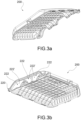
figures 3a e 3b show a lid comprised in the air filtration assembly of the present invention, respectively in two perspective views; -
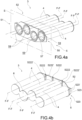
figures 4a and 4b show a filtering cartridge comprised in the air filtration assembly of the present invention, respectively in two perspective views; -
figures 5, 5a ,5b and 5c show a front view, a side view and a top view and a bottom view of a flat unit comprised in the filtering cartridge according to a preferred embodiment; -
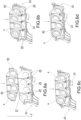
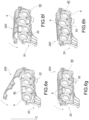
figures 6a, 6b, 6c, 6d ,6e, 6f, 6g and 6h show longitudinal sections of the air filtration assembly, in different assembly steps; -
figure 7 is a longitudinal sectional view along a first section plane obtained infigure 1c ; -
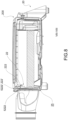
figure 8 is a longitudinal sectional view along a second section plane obtained infigure 1a . - In the accompanying figures, reference numeral 1 indicates an air filtration assembly in accordance with the present invention.
- In accordance with the present invention, the air filtration assembly 1 is adapted to be part of a vehicle. In particular, the air filtration assembly 1 is adapted to be part of the engine air supply system of a vehicle. Preferably, the air filtration assembly 1 is connectable to an air intake manifold of a vehicle. Preferably, the air filtration assembly 1 is fluidly connectable to the combustion chamber of a combustion engine of a vehicle by means of said air intake manifold.
- Preferably, the air filtration assembly 1 is crossable in suction by the ambient air. Inside the air filtration assembly 1, the ambient air is thus separated from the unwanted elements suspended therein.
- As mentioned, the present invention also relates to the engine air supply system of a vehicle which comprises the air filtration assembly 1.
- According to the present invention, the air filtration assembly 1 of a vehicle comprises a
box 2 and a filteringcartridge 3 accommodated in saidbox 2. - Preferably, said
box 2 is fluidly connectable on one side to the external environment and on the other side to an air intake manifold of the vehicle. - The air filtration occurs inside the
box 2. - In accordance with the present invention, the
box 2 comprises awall 21. Preferably, saidwall 21 comprises at least oneoutflow mouth 29 which is crossable by the air. Preferably, the filtered air exits thebox 2 from theoutflow mouth 29. Preferably, theoutflow mouth 29 is fluidly connectable to the air intake manifold. - In accordance with the invention, the
box 2 extends along a first axis V-V, preferably vertical, and a second axis Y-Y, preferably transverse. In accordance with a preferred embodiment, the first axis V-V is orthogonal to the second axis Y-Y. - Preferably, the
wall 21 extends along said first axis V-V and said second axis Y-Y. - In accordance with the present invention, the
box 2 extends along a longitudinal axis X-X as well. The longitudinal axis X-X is incident to the first axis V-V and to the second axis Y-Y. In other words, the longitudinal axis X-X extends from thewall 21. Preferably, the longitudinal axis X-X extends orthogonally with respect to the first axis V-V and the second axis Y-Y, therefore, preferably, the longitudinal axis X-X is orthogonal to thewall 21. - According to a preferred embodiment, the
box 2 substantially has the shape of a parallelepiped. Preferably, thebox 2 or specific portions thereof has a curved or arched shape. - In accordance with a preferred embodiment, the
filtering cartridge 3 comprises a plurality oftubular filtering partitions 4 and aplate group 5, to which saidtubular filtering partitions 4 are integrally connected. - In accordance with the present invention, the
filtering cartridge 3 comprises at least twotubular filtering partitions 4 which are crossable, preferably radially, in filtration. Preferably, thetubular filtering partitions 4 are radially crossable in filtration from the outside to the inside, so as to identify the dirty side of thefiltering cartridge 3 outside thetubular filtering partitions 4 and the clean side of thefiltering cartridge 3 therein, preferably in theinner cavities 40 of thetubular filtering partitions 4. - In accordance with the present invention, each
tubular filtering partition 4 extends along a filter axis F-F substantially parallel to the longitudinal axis X-X. - In accordance with the present invention, the
filtering cartridge 3 comprises at least twotubular filtering partitions 4 positioned defining a main extension row along the first axis V-V or the second axis Y-Y. - In accordance with the present invention, two
tubular filtering partitions 4 belonging to the same row and proximal to each other have the respective filter axes F-F mutually offset, along both the first axis V-V and the second axis Y-Y. - According to a preferred embodiment, each
tubular filtering partition 4 has a filter diameter Df, Df1, Df2. In particular, the filter diameter refers to the outer diameter of thetubular filtering partition 4. - In accordance with a preferred embodiment, the two
tubular filtering partitions 4 belonging to the same row and proximal to each other have the respective filter axes F-F mutually offset along both the first axis V-V and the second axis Y-Y and define a projection P on the first axis V-V and/or on the second axis Y-Y which is less than the sum of the respective filter diameters. - In accordance with a preferred embodiment, the two
tubular filtering partitions 4 belonging to the same row and proximal to each other have the respective filter axes F-F mutually offset along both the first axis V-V and the second axis Y-Y and define a projection P on the first axis V-V and/or on the second axis Y-Y which is equal to the sum of the respective filter diameters. - In accordance with a preferred embodiment, the
tubular filtering partitions 4 substantially all have the same diameter Df. In other words, the diameter of a first tubular filtering partition Df1 is substantially equal to the diameter of a second tubular filtering partition Df2. - According to a preferred embodiment, the
filtering cartridge 3 comprises at least twotubular filtering partitions 4. - Preferably, the
filtering cartridge 3 comprises at least threetubular filtering partitions 4. - In accordance with a preferred embodiment, the
filtering cartridge 3 comprises at least a thirdtubular filtering partition 4 belonging to the same row of the twotubular filtering partitions 4 proximal to each other and with the respective filter axes F-F mutually offset along both the first axis V-V and along the second axis Y-Y. - Preferably, the filter axis F-F of said third
tubular filtering partition 4 is mutually aligned with the filter axis F-F of one of the twotubular filtering partitions 4 belonging to the same row and proximal to each other. Preferably, the filter axis F-F of said thirdtubular filtering partition 4 is aligned with the filter axis F-F of one of the twotubular filtering partitions 4 belonging to the same row and proximal to each other along the first axis V-V or the second axis Y-Y, in particular along the axis incident to the insertion direction Z. - In accordance with a preferred embodiment, the filter axis F-F of said third
tubular filtering partition 4 is mutually offset with respect to the filter axes F-F of bothtubular filtering partitions 4 belonging to the same row and proximal to each other along both the first axis V-V and the second axis Y-Y. - In accordance with a preferred embodiment, according to the preferential arrangement of the
tubular filtering partitions 4, one or more rows oftubular filtering partitions 4 are identified. - According to the present description, the row extends in a main direction along the first axis V-V or the second axis Y-Y, preferably in a direction orthogonal to the insertion direction Z.
- For example, in the embodiment of the accompanying drawings, a row of
tubular filtering partitions 4 is identified mainly extending along the axis Y-Y. - Preferred embodiments are included in which the
tubular filtering partitions 4 are at least four. - Preferred embodiments are included in which the tubular filtering partitions extend over several rows.
- In accordance with a preferred embodiment, the
filtering cartridge 3 comprises a plurality of rows, in which each row comprises at least twotubular filtering partitions 4 and extends in a main direction along the first axis V-V or the second axis Y-Y, preferably in a direction orthogonal to the insertion direction Z. Preferably, the twotubular filtering partitions 4 of the belonging to the same row and proximal to each other have the respective filter axes F-F mutually offset along both the first axis V-V and the second axis Y-Y and define a projection P on the first axis V-V and/or on the second axis Y-Y lower than the sum of the respective filter diameters. - According to a preferred embodiment, the
filtering cartridge 3 comprises two rows oftubular filtering partitions 4 which extend along the same main direction, preferably in a direction orthogonal to the insertion direction Z. - According to a preferred embodiment, the
filtering cartridge 3 comprises two rows oftubular filtering partitions 4 which extend along different directions. - As said, in accordance with the present invention, furthermore, the
filtering cartridge 3 also comprises aplate group 5 to which thetubular filtering partitions 4 are operatively connected. In particular, theplate group 5 is adapted to support thetubular filtering partitions 4. - The
plate group 5 comprises at least oneoutflow opening 59 adapted to put thetubular filtering partitions 4, in particular theinner cavity 40 thereof, in fluid communication with the at least oneoutflow mouth 29. - According to a preferred embodiment, the
plate group 5 comprises at least oneoutflow opening 59 for eachtubular filtering partition 4. Preferably, thewall 21 also comprises anoutflow mouth 29 at eachoutflow opening 59. - In other words, according to a preferred embodiment, the
outflow opening 59 is a duct extending longitudinally between thesecond face 52 and thefirst face 51 of theflat unit 5. Preferably, theplate group 5 comprises a number of ducts equal to the number oftubular filtering partitions 4. - In accordance with an alternative embodiment, the at least one
outflow opening 59 has a shape such as to extend longitudinally between thesecond face 52 and thefirst face 51 to fluidly connect thetubular filtering partitions 4 to the at least oneoutflow mouth 29. In other words, in such an embodiment, theoutflow opening 59 is an inner fluid manifold adapted to connect thetubular filtering partitions 4 with the at least oneoutflow mouth 29. Preferably, therefore, theoutflow opening 59 has a number of fluid passages on thesecond face 52 equal to the number oftubular filtering partitions 4 and a plurality of fluid passages on thefirst face 51, for example comprising a number of fluid passages on thefirst face 51 equal to the number ofoutflow openings 29 present in thewall 21. - According to the present invention, the
plate group 5 extends with respect to an imaginary development plane S. - Preferably, said imaginary development plane S is positioned at the center line of the thickness of the
plate group 5. - Preferably, the
plate group 5 comprises aplate body 50. According to a preferred embodiment, theplate body 50 is obtained by means of a plastic molding operation, such as injection molding. - In accordance with the present invention, on the opposite sides of said imaginary development plane S, the
plate group 5 comprises afirst face 51 and asecond face 52. Thefirst face 51 is also called the sealing face. Thesecond face 52 is also called the abutment or thrust face. - In accordance with a preferred embodiment, the at least two
tubular filtering partitions 4 are operatively connected to theplate body 50 of theplate group 5. - According to a preferred embodiment, the at least two
tubular filtering partitions 4 are integrally connected to theplate group 5. - Preferably, in accordance with a preferred embodiment, the at least two
tubular filtering partitions 4 are integrally connected to thesecond face 52. - According to the present invention, the
first face 51 comprises at least one sealingprofile 510. - According to a preferred embodiment, the
plate group 5 comprises asingle sealing profile 510 extending around theoutflow opening 59 or the outflow openings present in theplate group 5, identifying a single sealing region through the engagement with thewall 21. - In accordance with a preferred embodiment, for each
outflow opening 59, theplate group 5 comprises arespective sealing profile 510 extending around therespective outflow opening 59. In other words, for example, embodiments of thefiltering cartridge 5 in which theplate group 5 comprises threeoutflow openings 59 comprise three sealingprofiles 510 identifying three sealing regions. - In some embodiments, the
plate group 5 comprises sealingprofiles 510 extending around a plurality ofoutflow openings 59. For example, a sealingprofile 510 extends around a plurality ofoutflow openings 59, preferably mutually aligned. - According to a preferred embodiment, each sealing
profile 510 is an elastically yielding element. - In accordance with a preferred embodiment, the sealing
profile 510 is a removable element, for example which can be accommodated in a specially shaped seat, comprised in theplate body 50. Preferably, as shown in the accompanying drawings, the sealingprofile 510 is a gasket member. - According to further preferred embodiments, the sealing
profile 510 is integrated in theplate body 50. In particular, the sealingprofile 510 is a sealing collar or lip integrally formed with theplate body 50, for example in the same material as theplate body 50. - According to further preferred embodiments, the sealing
profile 510 is integrated in the plate body by over-molding. - Preferably, the sealing
profile 510 is made of a fibrous material such as a non-woven fabric. - Preferably, the sealing
profile 510 acts in an axial direction (in a direction parallel to the longitudinal direction X-X). - Preferably, in the case of several sealing
profiles 510, each sealingprofile 510 acts in an axial direction (in a direction parallel to the longitudinal direction X-X). - According to the present invention, the
second face 52 comprises at least two abutment profiles 520. - Preferably, said abutment profiles 520 are orthogonally projecting elements, with respect to the imaginary development plane S, positioned axially and mutually spaced apart. That is to say that the abutment profiles 520 extend in height orthogonally to the insertion direction, i.e., in the longitudinal direction X-X, and are mutually and axially spaced apart with respect to the first axis V-V or with respect to the second axis Y-Y, preferably with respect to the second axis Y-Y, i.e., with respect to the axis orthogonal to the insertion direction Z.
- According to the present invention, the abutment profiles 520 are mutually spaced apart with respect to the first axis V-V or with respect to the second axis Y-Y so that at least one
tubular filtering partition 4 is positioned between two consecutive abutment profiles 520 (along the first axis V-V or the second Y-Y axis). - In accordance with a preferred embodiment, the abutment profiles 520 are in a number such as to comprise end abutment profiles 523, axially distal, and at least one
central abutment profile 522 positioned between the two end abutment profiles 523. - Preferably, a
central abutment profile 522 is positioned between two proximaltubular filtering partitions 4. - Preferably, the
plate group 5 comprises acentral abutment profile 522 between each pair of proximaltubular filtering partitions 4. - In the embodiments comprising three
tubular filtering partitions 4, two end abutment profiles 523 and two central abutment profiles 522 are identified, so that acentral abutment profile 522 is positioned between the first and secondtubular filtering partitions 4, and the othercentral abutment profile 522 is positioned between the second and thirdtubular filtering partitions 4. - In accordance with a preferred embodiment, the
central abutment profile 522 comprises afirst portion 5221 and asecond portion 5222. - In accordance with a preferred embodiment, the
central abutment profile 522 comprises afirst portion 5221 and asecond portion 5222 mutually spaced apart along the insertion direction Z. - In accordance with a preferred embodiment, the
central abutment profile 522 comprises afirst portion 5221 and asecond portion 5222 which are mutually separated. - Preferably, the
first portion 5221 and thesecond portion 5222 are mutually separated along the insertion direction Z. Preferably, in the insertion of thefiltering cartridge 3 into thebox 2 firstly thefirst portion 5221 is engaged and then thesecond portion 5222 is engaged. - According to a preferred embodiment, the
first portion 5221 and thesecond portion 5222 are positioned so as to be mutually offset along the first axis V-V or the second axis Y-Y, in particular along the axis incident to the insertion direction Z. - According to the present invention, the
filtering cartridge 3 is insertable into thebox 2 along an insertion direction Z substantially parallel to the first axis V-V or the second axis Y-Y. - In other words, the
filtering cartridge 3 is insertable into thebox 2 with an insertion operation in a single insertion direction. - In accordance with a preferred embodiment, the insertion direction Z is substantially the first axis V-V corresponding to the vertical direction, so that the insertion operation also benefits from the action of the force of gravity.
- In accordance with the present invention, the
box 2 comprises anaccommodation region 25 between thewall 21 and at least twoabutment elements 22 longitudinally spaced apart from thewall 21 and mutually axially spaced apart. - The
plate group 5 is accommodated in saidaccommodation region 25 with the at least one sealingprofile 510 sealingly engaged with thewall 21 and the abutment profiles 520 engaged with therespective abutment elements 22. - Preferably, the
abutment elements 22 comprised in thebox 2 are in number and position as a function of the abutment profiles 520 comprised on theplate group 5. - In other words, in said
accommodation region 25, theplate group 5 is insertable by an axial insertion operation along the insertion direction Z so that theplate group 5 sealingly engages thewall 21 with thefirst face 51 and so that it is engaged by theabutment elements 22 on thesecond face 52. Preferably, the abutment on thesecond face 52 involves an axial thrust, in the longitudinal direction, such as to thrust and keep thefirst face 51 in a thrust action on thewall 21. - In accordance with a preferred embodiment, the
box 2 comprises acontainer 20, in which thefiltering cartridge 3 can be accommodated at least in part and alid 200 adapted to engage and close thecontainer 20. - Preferably, the
accommodation region 25 is closed on one side by thecontainer 20 and on the other side by thelid 200. - According to a preferred embodiment, one or
more abutment profiles 520, preferably at least the central abutment profile 522 (or the central abutment profiles, if present), are engaged by both thecontainer 20 and thelid 200. - In accordance with a preferred embodiment, the
first portion 5221 is engaged by thecontainer 20 and thesecond portion 5222 is engaged by thelid 200. - In accordance with a preferred embodiment, the
central abutment element 220 comprises a container abutment half-element 221 adapted to engage thefirst portion 5221 and a lid abutment half-element 222 adapted to engage thesecond portion 5222. In other words, the container abutment half-element 221 is accommodated on thecontainer 20 while the lid abutment half-element 222 is accommodated on thelid 200. - As fully described below, the flat unit 5 (in particular some of the components thereof) and, complementarily, the
accommodation region 25 are mutually specially shaped in both a longitudinal direction and in a direction parallel to the insertion direction. In particular, therefore, such a coupling allows a single/unique mutual positioning. - According to a preferred embodiment, in accordance with the present invention, the at least one sealing
profile 510 is shaped with respect to the imaginary development plane S having variable vertical distances dz1, dz1' measured in a direction orthogonal to the insertion direction Z, along said insertion direction Z. - That is to say that the sealing
profile 510 is shaped so as to have specific portions at a first vertical distance dz1 from the imaginary development plane S and other portions at a different vertical distance dz1' from the imaginary development plane S. - Or according to a preferred embodiment, in accordance with the present invention, the sealing
profiles 510 are mutually positioned with respect to the imaginary development plane S having variable vertical distances dz1, dz1' measured in a direction orthogonal to the insertion direction Z, along said insertion direction Z. - That is to say that comprising a plurality of sealing
profiles 510, each sealingprofile 510 is positioned so as to be at a specific vertical distance from the imaginary development plane S. Preferably, therefore, twoconsecutive sealing profiles 510, in the direction parallel to the insertion direction Z, are located at two different distances from said imaginary development plane S. Preferably, thelower sealing profiles 510 or the lower portions of the sealingprofiles 510 which in the insertion operations are the first to access thebox 2 are located in a position preferably proximal to the imaginary development plane S with respect to the upper sealing profiles 510 or to the upper portions of the sealing profiles 510. - In accordance with what has been described above in relation to the shape and position of the sealing
profiles 510, thewall 21 is specially, complementarily, shaped. - In accordance with a preferred embodiment, in accordance with the present invention, the abutment profiles 520 are shaped with respect to the imaginary development plane S having variable vertical distances dz2, dz2' measured in a direction orthogonal to the insertion direction Z, along said insertion direction Z.
- That is to say that the
abutment profile 520 is shaped so as to have specific portions at a first vertical distance dz2 from the imaginary development plane S and other portions at a different vertical distance dz2', dz2", dz2‴. dz2ʺʺ, dz2‴ʺ from the imaginary development plane S. - Furthermore, in accordance with a preferred embodiment of the present invention, the abutment profiles 520 are mutually positioned with respect to the imaginary development plane S having variable vertical distances dz2', dz2", dz2‴, dz2ʺʺ, dz2‴ʺ measured in a direction orthogonal to the insertion direction Z, along said insertion direction Z. In other words, the abutment profiles have a "serrated profile".
- In accordance with what has been described above in relation to the shape and position of the abutment profiles 520, the
abutment elements 22 are specially, complementarily, shaped. - According to a preferred embodiment, the abutment profiles 520 and the
abutment elements 22 comprise respective abutment and thrust surfaces 523', 223', 5221', 221', 5222', 222' mutually slidingly engageable in the insertion operations of thecartridge 3 into thebox 2. - Preferably, the abutment and thrust surfaces are shaped so that the
cartridge 3 is thrust in the longitudinal direction, and is kept in position, towards thewall 21. - In other words, according to the present invention, the
plate group 5, sectioned orthogonally with respect to the development plane S, has elements, or portions of elements, proximal to said development plane S and elements, or portions of elements, distal from said development plane S. In other words, according to the present invention, theplate group 5 sectioned orthogonally with respect to the development plane S has, on thefirst face 51 and/or thesecond face 52, elements, or portions of elements, proximal to said imaginary development plane S and elements, or portions of elements, distal from said imaginary development plane S. - According to the present invention, the
plate group 5 has a shape such as to be tapered in the first region which enters, during the insertion operations, in theaccommodation region 25. According to a preferred embodiment, theplate group 5 has a shape such as to be tapered at the bottom. - According to a preferred embodiment, in accordance with the present invention, the at least one sealing
profile 510 is shaped with respect to the imaginary development plane S having variable longitudinal distances dx1, dx1' measured in a direction parallel to the longitudinal axis X-X, along the first axis V-V or the second axis Y-Y, preferably, along the axis orthogonal to the insertion direction Z. - That is to say that the sealing
profile 510 is shaped so as to have specific portions at a first longitudinal distance dx1 from the imaginary development plane S and other portions at a different longitudinal distance dx1' from the imaginary development plane S. - Or according to a preferred embodiment, in accordance with the present invention, the sealing
profiles 510 are mutually positioned with respect to the imaginary development plane S having variable longitudinal distances dx1, dx1' measured in a direction parallel to the longitudinal axis X-X , along the first axis V-V or the second axis Y-Y, preferably, along the axis orthogonal to the insertion direction Z. - That is to say that comprising a plurality of sealing
profiles 510, each sealingprofile 510 is positioned so as to be at a specific longitudinal distance from the imaginary development plane S. Preferably, therefore, two mutuallyconsecutive sealing profiles 510 are located at two different longitudinal distances from the imaginary development plane S. - According to a preferred embodiment, in accordance with the present invention, the abutment profiles 520 are shaped with respect to the imaginary development plane S having variable longitudinal distances dx21', dx21", dx221', dx222', dx221", dx222", dx221‴, dx222‴ measured in a direction parallel to the longitudinal axis X-X, along the first axis V-V or the second axis Y-Y, preferably, along the axis orthogonal to the insertion direction Z.
- That is to say that the
abutment profile 520 is shaped so as to have specific portions at a first longitudinal distance from the imaginary development plane S and other portions at a different longitudinal distance from the imaginary development plane S. - Or according to a preferred embodiment, in accordance with the present invention, the abutment profiles 520 are mutually positioned with respect to the imaginary development plane S having variable longitudinal distances dx21', dx21", dx221', dx222', dx221", dx222", dx221''', dx222‴ measured in a direction parallel to the longitudinal axis X-X, along the first axis V-V or the second axis Y-Y, preferably along the axis orthogonal to the insertion direction Z.
- That is to say that by comprising a plurality of
abutment profiles 520, eachabutment profile 520 is positioned so as to be at a specific longitudinal distance from the imaginary development plane S. Preferably, therefore, two mutuallyconsecutive abutment profiles 520 along the insertion axis Z are located at two different longitudinal distances from the imaginary development plane S. - In other words, according to the present invention, the
plate group 5 sectioned along the development plane S, has elements, or portions of elements, longitudinally proximal to said plane and elements, or portions of elements, longitudinally distal from said plane. In other words, according to the present invention, theplate group 5 sectioned orthogonally with respect to the development plane S orthogonally to the insertion direction, has elements or portions of elements on thefirst face 51 and/or on thesecond face 52 which are longitudinally proximal to said imaginary development plane S and elements, or portions of elements, which are longitudinally distal from said imaginary development plane S. - According to the present invention, the
plate group 5 has a shape such as to have a variable section preferably with a tapered trend in a preferred axial direction. Or, again according to the present invention, theplate group 5 has a shape such as to have a variable section, being centrally concave or convex. - As mentioned, the box 2 (the
accommodation region 25 thereof) in particular, thewall 21 and theabutment elements 22 are specially shaped to be engaged by the sealingprofiles 510 and the abutment profiles 520. - For example, in an embodiment, with the
cartridge 3 comprising a plurality of sealingprofiles 510, thewall 21 is specially shaped to comprise sealingsurfaces 210 adapted to be engaged by said sealing profiles 510. - For example, in accordance with a preferred embodiment, the
wall 21 comprises a plurality of sealingplanes 210 positioned on different imaginary sealing planes T1, T2 which in a direction parallel to the insertion direction Z, with thefiltering cartridge 3 accommodated, are in turn at variable longitudinal distances and variable (or respectively different) vertical distances with respect to the imaginary development plane S. - Or again, by way of example, in accordance with a preferred embodiment, the
abutment elements 22 are located on different imaginary abutment planes R1, R2, R3, R4, R5, which, with thefiltering cartridge 3 accommodated in thebox 2, therefore theplate group 5 accommodated in theaccommodation region 25, are in turn at variable longitudinal distances and at variable (or respectively different) vertical distances with respect to the imaginary development plane S. - In other words, according to the present invention, the
plate group 5 observed laterally has a variable shape along the vertical axis and theplate group 5 observed from above has a variable shape along the longitudinal axis. - Preferably, at least one of the
first face 51 and thesecond face 52 has said variable trend along the vertical axis and at least one of thefirst face 51 and thesecond face 52 has said variable trend along the longitudinal axis. - According to a preferred embodiment, the
lid 200 can be assembled on thecontainer 20 parallel to the insertion direction Z. - In accordance with a further preferred embodiment, the
lid 200 can be assembled on thecontainer 20 in rotation. - In accordance with a preferred embodiment, the
lid 200 can be fastened to thecontainer 20 by screw or clip means. - According to a preferred embodiment, the
lid 200 is adapted to engage thefiltering cartridge 3 in a direction parallel to the insertion direction Z. - Preferably, the
lid 200 is adapted to engage theplate group 5 in a direction parallel to the insertion direction. - In other words, the
lid 200 is preferably adapted to act as an axial abutment in the insertion direction. - According to a preferred embodiment, the
box 2 comprises at least oneinflow mouth 28. Preferably, said at least oneinflow mouth 28 is longitudinally spaced apart from the at least oneoutflow mouth 29. - In accordance with a preferred embodiment, the
filtering cartridge 3 further comprises anplate group 6. Preferably, theauxiliary plate group 6 is longitudinally opposite to theplate group 5. Preferably, thetubular filtering partitions 4 are integrally connected to theauxiliary plate group 6. - Furthermore, according to a preferred embodiment, the end abutment profiles with respect to the at least one central abutment profile are longitudinally farther from the imaginary development plane S.
- Or again, according to a preferred embodiment, the end abutment profiles are mutually at different longitudinal distances from the imaginary development plane S.
- In addition, according to a preferred embodiment, the end abutment profiles are at different longitudinal distances from each other, but simultaneously at different longitudinal distances also with respect to the at least one central abutment profile.
- It should be noted that mixed embodiments can also be included, with respect to those described above, always remaining in accordance with the above described principles of the present invention, having the arrangement of the sealing profiles of one solution and the abutment profiles of the other.
- According to a preferred embodiment, the
plate group 5 snap-engages thebox 2. - According to a preferred embodiment, the
plate group 5 snap-engages thecontainer 20. - In accordance with a preferred embodiment, the
plate group 5 comprises atooth 57 adapted to snap-engage arecess 27 present on thebox 2. Preferably, thetooth 57 is a flexible element in the transverse direction with respect to the insertion direction Z. - According to an alternative embodiment, the
plate group 5 comprises a plurality ofteeth 57 adapted to snap-engage thebox 2, for example by finding accommodation in specific recesses. - Preferably, said teeth are specially shaped on the abutment profiles.
- In accordance with a preferred embodiment, the
plate group 5 comprises elastically yielding teeth, adapted to engage the outer abutment elements, preferably in special snap accommodations. Preferably, the snap engagement occurs at the end of insertion of thefiltering cartridge 3 into thebox 2 in the insertion direction. Preferably, the cartridge is extracted from thebox 2 by performing a pulling action which overcomes the elastic action of said elastically yielding teeth. - Preferably, the elastically yielding teeth act in a direction orthogonal to the longitudinal direction X-X.
- In accordance with the present invention, described above, further embodiments are possible, for example in a preferred embodiment, the
plate group 5 consists of a plurality of distinct components mutually assembled together. For example, in a preferred embodiment, the plate group comprises a first component to which the tubular filtering partitions are operatively connected and which comprises the at least one sealing profile and a second component, which can be assembled to the first, comprising the abutment profiles. - In accordance with a preferred embodiment, the
box 2 further comprises support elements adapted to support theauxiliary plate group 6. - Innovatively, the air filtration assembly and the engine air supply system of a vehicle which comprises it, as described above, widely fulfill the purpose of the present invention, overcoming the typical problems of the prior art.
- Advantageously, the air filtration assembly effectively exploits the spaces available inside the vehicle, in particular in the engine compartment, so as to have compact dimensions and have adequate filtering surfaces.
- Advantageously, the offset positioning between the tubular filtering partitions belonging to the same row allows an optimization of the spaces in the filtration chamber.
- Advantageously, the offset positioning between tubular filtering partitions belonging to the same row allows to increase the flexibility available for the sizing of the filtration assembly, for example by increasing the spaces available for positioning the abutment profiles and consequently improving the distribution uniformity of the thrust forces applied on the plate group of the filtering cartridge.
- Advantageously, the filtering cartridge can be installed inside the box by means of a guide/positioning system which can be executed and maneuvered in small spaces with, for example, vertical insertion or lateral insertion.
- Advantageously, the positioning guide system is very compact, thus allowing to improve the exploitation of the spaces inside the box, increasing the usable filtering surface and reducing the pressure drops imposed on the suction circuit by the filtering cartridge.
- Advantageously, the air filtration assembly ensures a simple and intuitive assembly and a simple and intuitive disassembly. Advantageously, the assembly and disassembly operations of the air filtration assembly are guided and foolproof.
- Advantageously, the filtering cartridge is insertable in the box according to a single insertion direction, facilitating the conduct of the maintenance procedure.
- Advantageously, the filtering cartridge, but in particular the plate group thereof, is insertable in a guided manner in the box, in particular in the accommodation region so as to avoid damage or wear of the sealing profiles, minimizing the friction thereof with the wall and unwanted sliding.
- Advantageously, the maintenance operations are guided and overcome the possibility that unwanted breakages occur in the performance thereof.
- Advantageously, the positioning of the filtering cartridge ensures a safe and precise positioning of the sealing profiles, and therefore a stable, reliable sealed coupling which is resistant to vibrations and impacts.
- Advantageously, the thrust action undergone by the sealing profile (or by the sealing profiles) against the wall is obtained by means of a longitudinal component and by means of a transversal component such as to uniformly distribute the thrust action on the plate group.
- Advantageously, the abutment elements and the abutment profiles are mutually interacting so as to favor the engagement of the sealing profile (or of the sealing profiles). Advantageously, the abutment elements and the abutment profiles are specially structured to exert a uniform thrust/compression of the sealing profile (or of the sealing profiles). Preferably, advantageously, the abutment elements and abutment profiles perform an effective thrust action also in a central region of the plate group.
- Advantageously, the abutment elements and the abutment profiles are mutually interacting so as to ensure an adequate tightening of the sealing profile (or of the sealing profiles) along the entire length of the plate group, even in the case of cartridges having a plurality of tubular partitions organized in several rows, and therefore of greater size and weight than in the case of cartridges with two tubular filtering partitions.
- Advantageously, the filtering cartridge stably maintains the watertight coupling by exploiting the limited chain of tolerances involved, optimizing the number of components required and therefore the production costs associated with the filtering cartridge.
- Advantageously, the filtering cartridge is automatically objectified by virtue of the particular shape of the plate group, facilitating the correct insertion thereof inside the box and offering the operator an immediate visual recognition system.
- Advantageously, in order to function effectively, the air filtration assembly requires original filtering cartridges specially shaped to operate with the box, thus also addressing the issue of non-original filtering cartridges.
- Advantageously, the rigid connection obtained between the filtering cartridge and the box, in particular between the plate group and the accommodation region, allows a safe and solid engagement, as well as a safe and solid seal between the parts. Advantageously, the box inside the vehicle can be positioned in any relative position without affecting the filtration methods.
- It is clear that a person skilled in the art, in order to satisfy contingent requirements, may make changes to the air filtration assembly described above, all included within the scope of protection as defined by the following claims.
-
- 1 air filtration assembly
- 2 box
- 20 container
- 21 wall
- 210 sealing plane
- 200 lid
- 22 abutment elements
- 220 central abutment element
- 221 container abutment half-element
- 222 lid abutment half-element
- 223 end abutment element
- 25 accommodation region
- 27 tooth accommodation recess
- 28 inflow mouth
- 29 outflow mouth
- 3 filtering cartridge
- 4 tubular filtering partitions
- 40 inner cavity
- 5 plate group
- 50 plate body
- 51 first face, sealing face
- 510 sealing profile
- 52 second face, abutment face
- 520 abutment profile
- 522 central abutment profile
- 5221 first portion
- 5222 second portion
- 523 end abutment profile
- 523', 223', 5221', 221', 5222', 222' abutment and thrust surface
- 57 tooth
- 59 outflow opening
- 6 auxiliary plate group
- X-X longitudinal axis
- V-V first axis, vertical axis
- Y-Y second axis, transverse axis
- F-F filter axis
- Z insertion direction
- S imaginary development plane
- T1, T2 imaginary sealing plane
- R1, R2, R3, R4, R5 imaginary abutment plane
- dx1, dx1', dx21', dx21", dx221', dx222', dx221", dx222",
- dx221‴, dx222‴ variable longitudinal distance
- dz1, dz1', dz2, dz2', dz2", dz2‴, dz2ʺʺ, dz2''''' variable vertical distance
- Df, Df1, Df2 filter diameter
- P projection
Claims (15)
- An air filtration assembly (1) of a vehicle, comprising:i) a box (2) comprising a wall (21) extending along a first axis (V-V) and a second axis (Y-Y) comprising at least one outflow mouth (29) through which the air flows, wherein the box (2) further comprises a longitudinal axis (X-X) incident to the first axis (V-V) and the second axis (Y-Y);ii) a filtering cartridge (3) comprising:- at least two tubular filtering partitions (4) radially crossable during filtration, wherein each tubular filtering partition (4) extends along a filter axis (F-F) ;- a plate group (5) to which the at least two tubular filtering partitions (4) are operatively connected, wherein the plate group (5) extends with respect to an imaginary development plane (S) and, at the opposite sides of said imaginary development plane (S), it comprises a first face (51) comprising at least one sealing profile (510) and a second face (52) comprising at least two abutment profiles (520), wherein the plate group (5) comprises at least one outflow opening (59) suitable for putting the tubular filtering partitions (4) in fluid communication with the at least one outflow mouth (29);wherein the filtering cartridge (3) is insertable into the box (2) along an insertion direction (Z) substantially parallel to the first axis (V-V) or the second axis (Y-Y);wherein the box (2) comprises an housing region (25) between the wall (21) and at least two abutment elements (22) longitudinally spaced apart from the wall (21) and mutually axially spaced apart, wherein the plate group (5) is housed in said housing region (25) with the at least one sealing profile (510) sealingly engaged with the wall (21) and the abutment profiles (520) engaged with the respective abutment elements (22);wherein the at least one sealing profile (510) and/or the abutment profiles (520) are shaped or are mutually positioned with respect to the imaginary development plane (S) having vertical variable distances (dz1, dz1', dz2, dz2', dz2", dz2‴, dz2ʺʺ, dz2‴ʺ) therefrom, measured in a direction orthogonal to the insertion direction (Z), along said insertion direction (Z); andwherein the at least one sealing profile (510) and/or the abutment profiles (520) are shaped or are mutually positioned with respect to the imaginary development plane (S) having longitudinal variable distances (dx1, dx1', dx21', dx21", dx221', dx222', dx221", dx222", dx221‴, dx222‴) therefrom, measured in a direction parallel to the longitudinal axis (X-X), along the first axis (V-V) or the second axis (Y-Y);wherein the at least two tubular filtering partitions (4) are positioned defining a main extension row along the first axis (V-V) or the second axis (Y-Y);wherein two tubular filtering partitions (4) belonging to the same row and proximal to each other have the respective filter axes (F-F) mutually offset, along both the first axis (V-V) and the second axis (Y-Y).
- Air filtration assembly (1) according to claim 1, wherein each tubular filtering partition (4) has a filter diameter (Df, Df1, Df2), wherein the two tubular filtering partitions (4) belonging to the same row and proximal to each other define a projection (P) on the first axis (V-V) and/or the second axis (Y-Y) which is lower than the sum of the respective filter diameters.
- Air filtration assembly (1) according to any one of the preceding claims, wherein the filtering cartridge (3) comprises at least a third tubular filtering partition (4) belonging to the same row, wherein the filter axis (F-F) of said third tubular filtering partition (4) is mutually aligned with the filter axis (F-F) of one of the two tubular filtering partitions offset along the first axis (V-V) or the second axis (Y-Y), in particular along the axis incident to the insertion direction (Z).
- Air filtration assembly (1) according to any one of the preceding claims, wherein the plate group (5) comprises at least three abutment profiles (520) comprising two end abutment profiles (523) and at least one central abutment profile (522) positioned between the two end abutment profiles (523) and between two proximal tubular filtering partitions (4), wherein the box (2) comprises two end abutment elements (223) and at least one central abutment element (220).
- Air filtration assembly (1) according to claim 4, wherein the box (2) comprises a container (20), in which the filtering cartridge (3) is at least partially housable, and a lid (200) suitable for engaging the container (20) to close it, wherein the central abutment profile (522) comprises a first portion (5221) and a second portion (5222), wherein the central abutment element (220) comprises a container abutment half-element (221) suitable for engaging the first portion (5221) and a lid abutment half-element (222) suitable for engaging the second portion (5222).
- Air filtration assembly (1) according to claim 5, wherein the first portion (5221) and the second portion (5222) are positioned so as to be mutually offset along the first axis (V-V) or the second axis (Y-Y), in particular along the axis incident to the insertion direction (Z).
- Air filtration assembly (1) according to any one of the preceding claims, wherein the plate group (5) snap-engages the box (2).
- Air filtration assembly (1) according to claim 7, wherein the plate group (5) comprises a tooth (57) suitable for snap-engaging a recess on the box (2).
- Air filtration assembly (1) according to any one of the preceding claims, wherein the abutment profiles (520) and the abutment elements (22) comprise respective abutment and thrust surfaces (523', 223', 5221', 221', 5222', 222') mutually slidingly engageable during the operations of inserting the cartridge (3) into the box (2), wherein the abutment and thrust surfaces (523', 223', 5221', 221', 5222', 222') are shaped, preferably inclined, so that the cartridge (3) is pushed and held in position in the longitudinal direction towards the wall (21).
- Air filtration assembly (1) according to any one of the preceding claims, wherein the abutment profiles (520), and in turn the abutment elements (22), are positioned on different imaginary abutment planes (R1, R2, R3, R4, R5) mutually longitudinally spaced apart, i.e., each at a respective longitudinal distance (dx21', dx21", dx221', dx222', dx221", dx222", dx221‴, dx222‴) from the imaginary development plane (S).
- Air filtration assembly (1) according to any one of the preceding claims, wherein the plate group (5) comprises a plurality of outflow openings (59) and comprises respective sealing profiles (510) each extending about the respective outflow opening (59), identifying a respective sealing region in the engagement with the wall (21).
- Air filtration assembly (1) according to claim 11, wherein the sealing profiles (510), and in turn respective sealing planes (210) comprised in the main wall (21), are positioned on different imaginary sealing planes (T1, T2) mutually longitudinally spaced apart, i.e., each at a respective longitudinal distance (dx1, dx1') from the imaginary development plane (S).
- Air filtration assembly according to any one of the preceding claims, wherein the at least one outflow opening (59) is shaped such as to extend longitudinally between the second face (52) and the first face (51) to fluidically connect the tubular filtering partitions (4) to the at least one outflow mouth (29).
- Air filtration assembly (1) according to any one of the preceding claims, wherein the at least one sealing profile (510) is either an elastically yielding element integrated into the plate group or a removable element.
- An engine air supply system of a vehicle, comprising an air filtration assembly (1) according to any one of the preceding claims, wherein the box (2) is fluidically connected to an air intake manifold, and the air is drawn in from the external environment through the air filtration assembly (1).
Applications Claiming Priority (2)
| Application Number | Priority Date | Filing Date | Title |
|---|---|---|---|
| IT102021000020783A IT202100020783A1 (en) | 2021-08-02 | 2021-08-02 | AIR FILTRATION ASSEMBLY |
| PCT/IB2022/056927 WO2023012598A1 (en) | 2021-08-02 | 2022-07-27 | Air filtration assembly |
Publications (3)
| Publication Number | Publication Date |
|---|---|
| EP4380715A1 EP4380715A1 (en) | 2024-06-12 |
| EP4380715B1 true EP4380715B1 (en) | 2025-05-21 |
| EP4380715C0 EP4380715C0 (en) | 2025-05-21 |
Family
ID=78463726
Family Applications (1)
| Application Number | Title | Priority Date | Filing Date |
|---|---|---|---|
| EP22747792.4A Active EP4380715B1 (en) | 2021-08-02 | 2022-07-27 | Air filtration assembly |
Country Status (6)
| Country | Link |
|---|---|
| US (1) | US20240350961A1 (en) |
| EP (1) | EP4380715B1 (en) |
| KR (1) | KR20250033133A (en) |
| AU (1) | AU2022324756A1 (en) |
| IT (1) | IT202100020783A1 (en) |
| WO (1) | WO2023012598A1 (en) |
Family Cites Families (7)
| Publication number | Priority date | Publication date | Assignee | Title |
|---|---|---|---|---|
| DE4120920A1 (en) * | 1991-06-25 | 1993-01-07 | Didier Werke Ag | SOOT PARTICLE FILTER |
| DE10032384A1 (en) * | 2000-07-06 | 2002-01-31 | Daimler Chrysler Ag | Filter system for motor vehicle has inlet housing part with inlet chamber containing row of cartridge-shaped filter elements; fluid to be cleaned flows around cartridges in common |
| ITRE20110078A1 (en) * | 2011-10-05 | 2013-04-06 | Ufi Filters Spa | MANIFOLD ELEMENT FOR A FILTERING CARTRIDGE |
| ITRE20120007A1 (en) * | 2012-02-08 | 2013-08-09 | Ufi Filters Spa | FILTERING CARTRIDGE |
| ITRE20130064A1 (en) * | 2013-09-09 | 2015-03-10 | Ufi Filters Spa | MOTOR VEHICLE |
| CN107208580B (en) * | 2014-12-10 | 2019-05-10 | Ufi过滤股份公司 | Filter set for the air leading to the intake air intake of the internal combustion engine |
| US10532310B2 (en) * | 2014-12-27 | 2020-01-14 | Donaldson Company, Inc. | Filter cartridges; air cleaner assemblies; housings; features; components; and, methods |
-
2021
- 2021-08-02 IT IT102021000020783A patent/IT202100020783A1/en unknown
-
2022
- 2022-07-27 AU AU2022324756A patent/AU2022324756A1/en active Pending
- 2022-07-27 KR KR1020247007143A patent/KR20250033133A/en active Pending
- 2022-07-27 EP EP22747792.4A patent/EP4380715B1/en active Active
- 2022-07-27 US US18/294,130 patent/US20240350961A1/en active Pending
- 2022-07-27 WO PCT/IB2022/056927 patent/WO2023012598A1/en not_active Ceased
Also Published As
| Publication number | Publication date |
|---|---|
| US20240350961A1 (en) | 2024-10-24 |
| IT202100020783A1 (en) | 2023-02-02 |
| EP4380715A1 (en) | 2024-06-12 |
| KR20250033133A (en) | 2025-03-07 |
| WO2023012598A1 (en) | 2023-02-09 |
| EP4380715C0 (en) | 2025-05-21 |
| AU2022324756A1 (en) | 2024-03-21 |
Similar Documents
| Publication | Publication Date | Title |
|---|---|---|
| US10316804B2 (en) | Filter element with at least one guide crosspiece, filter with a filter element and filter housing of a filter | |
| EP3096857A1 (en) | Filter element having end cap seal and filter assembly | |
| ES2912342T3 (en) | Filter element of a filter device and filter device | |
| EP2976144A1 (en) | Filter assembly | |
| US20140102967A1 (en) | Fluid filter and head with quick connector | |
| EP3600602B1 (en) | Air filter system, air filter element for use in same, and method for servicing same | |
| US12472454B2 (en) | Air filtration assembly | |
| US20170241386A1 (en) | Fuel pump module with replaceable filter unit | |
| EP4380715B1 (en) | Air filtration assembly | |
| JP7271383B2 (en) | FUEL PUMP MODULE, FUEL SUPPLY DEVICE, AND METHOD OF INSTALLING FUEL PUMP MODULE ON FUEL TANK | |
| EP4380714B1 (en) | Air filtration assembly | |
| IT201800011124A1 (en) | BLOW-BY GAS FILTRATION ASSEMBLY WITH SUPPORT GROUP | |
| CN114251207B (en) | Air filter assembly | |
| CN116066272A (en) | Air filter assembly | |
| CN116066271A (en) | Air filter assembly | |
| JP2019015272A (en) | Fuel filter and fuel pump module | |
| WO2015102822A1 (en) | Filter element having dual filtration capacity and filter assembly | |
| CN111111302B (en) | Filter device | |
| CN110388288A (en) | Functional components for influencing the ventilation of the fuel tank and their arrangement on the suction duct | |
| KR20150074087A (en) | Device for conveying fuel | |
| KR20190128785A (en) | Air cleaner for vehicle | |
| WO2025169034A1 (en) | Air filtration assembly | |
| JPH0684760B2 (en) | Ejector pump for vehicle fuel tank system | |
| CN113294273A (en) | Motorcycle, air filter assembly and air inlet joint | |
| KR20190129177A (en) | Air cleaner for vehicle |
Legal Events
| Date | Code | Title | Description |
|---|---|---|---|
| STAA | Information on the status of an ep patent application or granted ep patent |
Free format text: STATUS: UNKNOWN |
|
| STAA | Information on the status of an ep patent application or granted ep patent |
Free format text: STATUS: THE INTERNATIONAL PUBLICATION HAS BEEN MADE |
|
| PUAI | Public reference made under article 153(3) epc to a published international application that has entered the european phase |
Free format text: ORIGINAL CODE: 0009012 |
|
| STAA | Information on the status of an ep patent application or granted ep patent |
Free format text: STATUS: REQUEST FOR EXAMINATION WAS MADE |
|
| 17P | Request for examination filed |
Effective date: 20240201 |
|
| AK | Designated contracting states |
Kind code of ref document: A1 Designated state(s): AL AT BE BG CH CY CZ DE DK EE ES FI FR GB GR HR HU IE IS IT LI LT LU LV MC MK MT NL NO PL PT RO RS SE SI SK SM TR |
|
| DAV | Request for validation of the european patent (deleted) | ||
| DAX | Request for extension of the european patent (deleted) | ||
| GRAP | Despatch of communication of intention to grant a patent |
Free format text: ORIGINAL CODE: EPIDOSNIGR1 |
|
| STAA | Information on the status of an ep patent application or granted ep patent |
Free format text: STATUS: GRANT OF PATENT IS INTENDED |
|
| INTG | Intention to grant announced |
Effective date: 20250128 |
|
| RAP3 | Party data changed (applicant data changed or rights of an application transferred) |
Owner name: UFI INNOVATION CENTER S.R.L. |
|
| GRAS | Grant fee paid |
Free format text: ORIGINAL CODE: EPIDOSNIGR3 |
|
| GRAA | (expected) grant |
Free format text: ORIGINAL CODE: 0009210 |
|
| STAA | Information on the status of an ep patent application or granted ep patent |
Free format text: STATUS: THE PATENT HAS BEEN GRANTED |
|
| AK | Designated contracting states |
Kind code of ref document: B1 Designated state(s): AL AT BE BG CH CY CZ DE DK EE ES FI FR GB GR HR HU IE IS IT LI LT LU LV MC MK MT NL NO PL PT RO RS SE SI SK SM TR |
|
| REG | Reference to a national code |
Ref country code: GB Ref legal event code: FG4D |
|
| REG | Reference to a national code |
Ref country code: CH Ref legal event code: EP |
|
| REG | Reference to a national code |
Ref country code: DE Ref legal event code: R096 Ref document number: 602022014995 Country of ref document: DE |
|
| REG | Reference to a national code |
Ref country code: IE Ref legal event code: FG4D |
|
| U01 | Request for unitary effect filed |
Effective date: 20250527 |
|
| U07 | Unitary effect registered |
Designated state(s): AT BE BG DE DK EE FI FR IT LT LU LV MT NL PT RO SE SI Effective date: 20250605 |
|
| U20 | Renewal fee for the european patent with unitary effect paid |
Year of fee payment: 4 Effective date: 20250624 |
|
| PG25 | Lapsed in a contracting state [announced via postgrant information from national office to epo] |
Ref country code: ES Free format text: LAPSE BECAUSE OF FAILURE TO SUBMIT A TRANSLATION OF THE DESCRIPTION OR TO PAY THE FEE WITHIN THE PRESCRIBED TIME-LIMIT Effective date: 20250521 |
|
| PG25 | Lapsed in a contracting state [announced via postgrant information from national office to epo] |
Ref country code: NO Free format text: LAPSE BECAUSE OF FAILURE TO SUBMIT A TRANSLATION OF THE DESCRIPTION OR TO PAY THE FEE WITHIN THE PRESCRIBED TIME-LIMIT Effective date: 20250821 Ref country code: GR Free format text: LAPSE BECAUSE OF FAILURE TO SUBMIT A TRANSLATION OF THE DESCRIPTION OR TO PAY THE FEE WITHIN THE PRESCRIBED TIME-LIMIT Effective date: 20250822 |
|
| PG25 | Lapsed in a contracting state [announced via postgrant information from national office to epo] |
Ref country code: PL Free format text: LAPSE BECAUSE OF FAILURE TO SUBMIT A TRANSLATION OF THE DESCRIPTION OR TO PAY THE FEE WITHIN THE PRESCRIBED TIME-LIMIT Effective date: 20250521 |
|
| PGFP | Annual fee paid to national office [announced via postgrant information from national office to epo] |
Ref country code: TR Payment date: 20250811 Year of fee payment: 4 |
|
| PG25 | Lapsed in a contracting state [announced via postgrant information from national office to epo] |
Ref country code: HR Free format text: LAPSE BECAUSE OF FAILURE TO SUBMIT A TRANSLATION OF THE DESCRIPTION OR TO PAY THE FEE WITHIN THE PRESCRIBED TIME-LIMIT Effective date: 20250521 |
|
| PG25 | Lapsed in a contracting state [announced via postgrant information from national office to epo] |
Ref country code: RS Free format text: LAPSE BECAUSE OF FAILURE TO SUBMIT A TRANSLATION OF THE DESCRIPTION OR TO PAY THE FEE WITHIN THE PRESCRIBED TIME-LIMIT Effective date: 20250821 |
|
| PG25 | Lapsed in a contracting state [announced via postgrant information from national office to epo] |
Ref country code: IS Free format text: LAPSE BECAUSE OF FAILURE TO SUBMIT A TRANSLATION OF THE DESCRIPTION OR TO PAY THE FEE WITHIN THE PRESCRIBED TIME-LIMIT Effective date: 20250921 |
|
| PG25 | Lapsed in a contracting state [announced via postgrant information from national office to epo] |
Ref country code: SM Free format text: LAPSE BECAUSE OF FAILURE TO SUBMIT A TRANSLATION OF THE DESCRIPTION OR TO PAY THE FEE WITHIN THE PRESCRIBED TIME-LIMIT Effective date: 20250521 |
|
| PG25 | Lapsed in a contracting state [announced via postgrant information from national office to epo] |
Ref country code: CZ Free format text: LAPSE BECAUSE OF FAILURE TO SUBMIT A TRANSLATION OF THE DESCRIPTION OR TO PAY THE FEE WITHIN THE PRESCRIBED TIME-LIMIT Effective date: 20250521 |
|
| PG25 | Lapsed in a contracting state [announced via postgrant information from national office to epo] |
Ref country code: SK Free format text: LAPSE BECAUSE OF FAILURE TO SUBMIT A TRANSLATION OF THE DESCRIPTION OR TO PAY THE FEE WITHIN THE PRESCRIBED TIME-LIMIT Effective date: 20250521 |
|
| REG | Reference to a national code |
Ref country code: CH Ref legal event code: H13 Free format text: ST27 STATUS EVENT CODE: U-0-0-H10-H13 (AS PROVIDED BY THE NATIONAL OFFICE) Effective date: 20260224 |
|
| PLBE | No opposition filed within time limit |
Free format text: ORIGINAL CODE: 0009261 |
|
| STAA | Information on the status of an ep patent application or granted ep patent |
Free format text: STATUS: NO OPPOSITION FILED WITHIN TIME LIMIT |
|
| REG | Reference to a national code |
Ref country code: CH Ref legal event code: L10 Free format text: ST27 STATUS EVENT CODE: U-0-0-L10-L00 (AS PROVIDED BY THE NATIONAL OFFICE) Effective date: 20260402 |
|
| PG25 | Lapsed in a contracting state [announced via postgrant information from national office to epo] |
Ref country code: CH Free format text: LAPSE BECAUSE OF NON-PAYMENT OF DUE FEES Effective date: 20250731 |
|
| 26N | No opposition filed |
Effective date: 20260224 |