EP4379894A1 - In-line manufacturing apparatus for lithium metal battery - Google Patents
In-line manufacturing apparatus for lithium metal battery Download PDFInfo
- Publication number
- EP4379894A1 EP4379894A1 EP22849674.1A EP22849674A EP4379894A1 EP 4379894 A1 EP4379894 A1 EP 4379894A1 EP 22849674 A EP22849674 A EP 22849674A EP 4379894 A1 EP4379894 A1 EP 4379894A1
- Authority
- EP
- European Patent Office
- Prior art keywords
- lithium
- foil tape
- lithium foil
- notching
- release film
- Prior art date
- Legal status (The legal status is an assumption and is not a legal conclusion. Google has not performed a legal analysis and makes no representation as to the accuracy of the status listed.)
- Pending
Links
Images




Classifications
-
- H—ELECTRICITY
- H01—ELECTRIC ELEMENTS
- H01M—PROCESSES OR MEANS, e.g. BATTERIES, FOR THE DIRECT CONVERSION OF CHEMICAL ENERGY INTO ELECTRICAL ENERGY
- H01M10/00—Secondary cells; Manufacture thereof
- H01M10/05—Accumulators with non-aqueous electrolyte
- H01M10/052—Li-accumulators
-
- B—PERFORMING OPERATIONS; TRANSPORTING
- B23—MACHINE TOOLS; METAL-WORKING NOT OTHERWISE PROVIDED FOR
- B23K—SOLDERING OR UNSOLDERING; WELDING; CLADDING OR PLATING BY SOLDERING OR WELDING; CUTTING BY APPLYING HEAT LOCALLY, e.g. FLAME CUTTING; WORKING BY LASER BEAM
- B23K26/00—Working by laser beam, e.g. welding, cutting or boring
- B23K26/36—Removing material
- B23K26/38—Removing material by boring or cutting
-
- B—PERFORMING OPERATIONS; TRANSPORTING
- B65—CONVEYING; PACKING; STORING; HANDLING THIN OR FILAMENTARY MATERIAL
- B65H—HANDLING THIN OR FILAMENTARY MATERIAL, e.g. SHEETS, WEBS, CABLES
- B65H45/00—Folding thin material
- B65H45/12—Folding articles or webs with application of pressure to define or form crease lines
- B65H45/20—Zig-zag folders
-
- H—ELECTRICITY
- H01—ELECTRIC ELEMENTS
- H01M—PROCESSES OR MEANS, e.g. BATTERIES, FOR THE DIRECT CONVERSION OF CHEMICAL ENERGY INTO ELECTRICAL ENERGY
- H01M10/00—Secondary cells; Manufacture thereof
- H01M10/04—Construction or manufacture in general
- H01M10/0404—Machines for assembling batteries
-
- H—ELECTRICITY
- H01—ELECTRIC ELEMENTS
- H01M—PROCESSES OR MEANS, e.g. BATTERIES, FOR THE DIRECT CONVERSION OF CHEMICAL ENERGY INTO ELECTRICAL ENERGY
- H01M10/00—Secondary cells; Manufacture thereof
- H01M10/04—Construction or manufacture in general
- H01M10/0459—Cells or batteries with folded separator between plate-like electrodes
-
- H—ELECTRICITY
- H01—ELECTRIC ELEMENTS
- H01M—PROCESSES OR MEANS, e.g. BATTERIES, FOR THE DIRECT CONVERSION OF CHEMICAL ENERGY INTO ELECTRICAL ENERGY
- H01M10/00—Secondary cells; Manufacture thereof
- H01M10/05—Accumulators with non-aqueous electrolyte
- H01M10/058—Construction or manufacture
- H01M10/0583—Construction or manufacture of accumulators with folded construction elements except wound ones, i.e. folded positive or negative electrodes or separators, e.g. with "Z"-shaped electrodes or separators
-
- H—ELECTRICITY
- H01—ELECTRIC ELEMENTS
- H01M—PROCESSES OR MEANS, e.g. BATTERIES, FOR THE DIRECT CONVERSION OF CHEMICAL ENERGY INTO ELECTRICAL ENERGY
- H01M4/00—Electrodes
- H01M4/02—Electrodes composed of, or comprising, active material
- H01M4/04—Processes of manufacture in general
-
- H—ELECTRICITY
- H01—ELECTRIC ELEMENTS
- H01M—PROCESSES OR MEANS, e.g. BATTERIES, FOR THE DIRECT CONVERSION OF CHEMICAL ENERGY INTO ELECTRICAL ENERGY
- H01M4/00—Electrodes
- H01M4/02—Electrodes composed of, or comprising, active material
- H01M4/13—Electrodes for accumulators with non-aqueous electrolyte, e.g. for lithium-accumulators; Processes of manufacture thereof
-
- H—ELECTRICITY
- H01—ELECTRIC ELEMENTS
- H01M—PROCESSES OR MEANS, e.g. BATTERIES, FOR THE DIRECT CONVERSION OF CHEMICAL ENERGY INTO ELECTRICAL ENERGY
- H01M4/00—Electrodes
- H01M4/02—Electrodes composed of, or comprising, active material
- H01M4/36—Selection of substances as active materials, active masses, active liquids
- H01M4/38—Selection of substances as active materials, active masses, active liquids of elements or alloys
- H01M4/381—Alkaline or alkaline earth metals elements
- H01M4/382—Lithium
-
- H—ELECTRICITY
- H01—ELECTRIC ELEMENTS
- H01M—PROCESSES OR MEANS, e.g. BATTERIES, FOR THE DIRECT CONVERSION OF CHEMICAL ENERGY INTO ELECTRICAL ENERGY
- H01M50/00—Constructional details or processes of manufacture of the non-active parts of electrochemical cells other than fuel cells, e.g. hybrid cells
- H01M50/50—Current conducting connections for cells or batteries
- H01M50/531—Electrode connections inside a battery casing
-
- B—PERFORMING OPERATIONS; TRANSPORTING
- B65—CONVEYING; PACKING; STORING; HANDLING THIN OR FILAMENTARY MATERIAL
- B65H—HANDLING THIN OR FILAMENTARY MATERIAL, e.g. SHEETS, WEBS, CABLES
- B65H2801/00—Application field
- B65H2801/72—Fuel cell manufacture
-
- H—ELECTRICITY
- H01—ELECTRIC ELEMENTS
- H01M—PROCESSES OR MEANS, e.g. BATTERIES, FOR THE DIRECT CONVERSION OF CHEMICAL ENERGY INTO ELECTRICAL ENERGY
- H01M4/00—Electrodes
- H01M4/02—Electrodes composed of, or comprising, active material
- H01M2004/026—Electrodes composed of, or comprising, active material characterised by the polarity
- H01M2004/027—Negative electrodes
-
- Y—GENERAL TAGGING OF NEW TECHNOLOGICAL DEVELOPMENTS; GENERAL TAGGING OF CROSS-SECTIONAL TECHNOLOGIES SPANNING OVER SEVERAL SECTIONS OF THE IPC; TECHNICAL SUBJECTS COVERED BY FORMER USPC CROSS-REFERENCE ART COLLECTIONS [XRACs] AND DIGESTS
- Y02—TECHNOLOGIES OR APPLICATIONS FOR MITIGATION OR ADAPTATION AGAINST CLIMATE CHANGE
- Y02E—REDUCTION OF GREENHOUSE GAS [GHG] EMISSIONS, RELATED TO ENERGY GENERATION, TRANSMISSION OR DISTRIBUTION
- Y02E60/00—Enabling technologies; Technologies with a potential or indirect contribution to GHG emissions mitigation
- Y02E60/10—Energy storage using batteries
-
- Y—GENERAL TAGGING OF NEW TECHNOLOGICAL DEVELOPMENTS; GENERAL TAGGING OF CROSS-SECTIONAL TECHNOLOGIES SPANNING OVER SEVERAL SECTIONS OF THE IPC; TECHNICAL SUBJECTS COVERED BY FORMER USPC CROSS-REFERENCE ART COLLECTIONS [XRACs] AND DIGESTS
- Y02—TECHNOLOGIES OR APPLICATIONS FOR MITIGATION OR ADAPTATION AGAINST CLIMATE CHANGE
- Y02P—CLIMATE CHANGE MITIGATION TECHNOLOGIES IN THE PRODUCTION OR PROCESSING OF GOODS
- Y02P70/00—Climate change mitigation technologies in the production process for final industrial or consumer products
- Y02P70/50—Manufacturing or production processes characterised by the final manufactured product
Definitions
- the present invention relates to an in-line manufacturing apparatus for lithium metal batteries, and more specifically, to an in-line manufacturing apparatus in which a storage process is omitted to solve a problem of decreased productivity caused by stickiness of lithium metal.
- Lithium-ion batteries are generally composed of cathode, anode, electrolyte, and separator film.
- the cathode determines the capacity and voltage of the battery as a source of lithium ions.
- the anode uses graphite having a stable structure as a function of reversibly absorbing/discharging lithium ions from the cathode and flowing current through an external circuit.
- the electrolyte acts as a medium to move lithium ions between the cathode and the anode, using materials with high ion conductivity.
- the separator film serves as a physical barrier to prevent the anode and cathode from mixing with each other, enabling only the movement of ions.
- the anode determines the lifespan and capacity of the battery.
- lithium metal was directly used for the anode, but the use of stable graphite materials in layered structures has been adopted due to safety concerns.
- silicon has gained attention for its energy density over 10 times higher than graphite and fast charging/discharging rate.
- research is needed to stabilize silicon, which expands in volume over 3-4 times more than graphite.
- the manufacturing process of the lithium-ion battery is largely divided into electrode process, assembly process, and chemical conversion process, and the detailed process is different for each battery type and manufacturer.
- the electrode process is a process of making cathode and anode plates, and is performed of mixing, coating, pressing, and slitting on a current collector substrate using a mixture in which cathode/anode active materials, conductive materials, and binders are mixed, and the cathode and anode manufacturing processes are carried out respectively.
- the assembly process is a process of assembling the cathode and anode plates made through the electrode process according to a cell shape with the separator film.
- the assembly process is performed of notching, stacking, tab welding, and packaging, and the electrode plates are stacked by winding or stacking as much as the capacity of a cell.
- the notching process is a process of cutting the electrode plate to an appropriate size according to the shape of the battery to manufacture tabs for the cathodes and anodes, and it influences the production speed of the battery.
- the notching process is performed by a press or a laser apparatus, and the press apparatus with a sharp press blade cuts a roll-type cathode/anode plates directly up and down so periodic blade replacement and maintenance are required.
- the laser apparatus cuts using an IR laser, so there is no additional maintenance cost, and the production speed is fast, but the initial investment cost is high.
- the electrode plates are wound or stacked by stacking according to the shape of the cell such as cylindrical, prismatic, pouch type to obtain a desired cell capacity.
- the chemical conversion process is a process for activating and stabilizing the lithium-ion battery. It charges/discharges the assembled battery to give it electrical characteristics and performs quality inspection and selection of the battery.
- the stacking process includes a method of notching and stacking with a laser, or a method of stacking after notching using a mold.
- lithium metal batteries that use lithium metal as the anode can increase their energy density to more than 1,000 Wh/L, which is higher than 800 Wh/L of lithium-ion batteries, so R&D is being concentrated.
- the lithium metal itself is soft and sticky, and there is a problem in that it sticks to each other, or foreign substances stick to the lithium metal, so it is difficult to make a lithium foil of less than 100um.
- the sticky phenomenon in which the lithium metal is stained on the mold occurs, causing a defect and degrading productivity.
- the lithium metal is stored in a magazine after notching, there is a problem in that the anode sticks to each other under pressure due to its own weight. In order to solve the above problem, loading a minimal amount that does not adhere can lead to a decrease in productivity due to frequent magazine replacements.
- the Korean Patent Publication 10-2019-0077835 is intended to solve the problems of a stack-and-folding type electrode assembly but does not suggest a solution when lithium metal is used as anode material, including a stacking part in which the cathode cell and the anode cell are continuously manufactured and alternately stacked.
- the present invention provides an apparatus for manufacturing a lithium metal battery, in which a process of storing in a magazine is eliminated to solve a phenomenon that a lithium metal is used as anode material during an assembly process, and a notching process and a stacking process are combined in an in-line technology.
- An apparatus for manufacturing a lithium metal battery comprises: a lithium foil tape unwinder peeling a release film on a lithium foil tape and transferring the lithium foil tape peeled off release film to a notching part; the notching part processing the lithium foil tape to form an anode plate having an electrode tab; and a stacking part inserting a separator film between the anode plate and the cathode plate directly transferred from the notching part in a zigzag manner to alternately stack the separator film.
- the notching part is characterized in that lithium is not stained by using a laser cutter.
- the notching part is configured by coupling the laser cutter and a slitter, the slitter cuts the lithium foil tape in a longitudinal direction, and the laser forms a tab while cutting the lithium foil tape in a transverse direction.
- the stacking part may be stacked between the cathode plate and the anode plate with the separator film inserted between the cathode plate and the anode plate.
- the lithium foil tape unwinder comprises: a release film rewinder which winds and winds the release film inserted between lithium foils so that the lithium foils do not stick to each other; a vision inspection part which optically scans and inspects whether the release film and the lithium foil tape are defective; and a pair of dancer rolls to minimize tension change caused by sudden tension disturbances.
- the apparatus for manufacturing a lithium metal battery according to the present invention eliminates the process of storing the lithium metal battery in the magazine and can solve the phenomenon that the lithium metal is attached to each other during the assembly process when the lithium metal is used as the anode material in which the notching process using a laser and the stacking process are combined using in-line technology.
- productivity since the stacking process is performed in-line without a magazine storage process after the notching process, productivity may be improved.
- the present invention uses lithium metal as an anode material of a battery.
- the battery is called as a 'lithium metal battery' to distinguish it from a ⁇ lithium-ion battery' using conventional graphite or the like as an anode material.
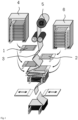
- FIG. 1 is a conceptual diagram illustrating a conventional zigzag stacking apparatus, demonstrating the concept in which a battery cell is formed by inserting a separator film 3 into a zigzag shape from a separator film unwinder 5 while alternately stacking a cathode plate 1 stacked on a cathode magazine 4 and an anode plate 2 stacked on an anode magazine 6.
- the anode plates 2 stacked on the anode magazine 6 may stick to each other due to their own weight due to the stickiness of the lithium metal, causing the continuous stacking process to be interrupted. Therefore, if only a small amount is stacked on the magazine so that they do not stick together, productivity decreases due to frequent magazine replacement.
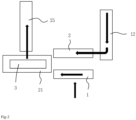
- FIG. 2 is a block diagram of the in-line manufacturing apparatus according to the present invention, in which the anode plate 2 is formed by a notching process using a laser, and the anode plate 2 is directly transferred to the stacking part 21 without being stored in the magazine, so that the separator film 3 is alternately inserted and stacked on the cathode plate 1 and discharged to the discharge part 25.
- FIG. 3 is a plan view of the in-line manufacturing apparatus according to the present invention, where the lithium foil tape, which is peeled off from the unwinder 11, is fed into the notching part 12 and processed into the anode plate 2.
- FIG. 4 is a perspective view of the lithium foil tape unwinder, and includes a release film rewinder 103 wound while peeling off the release film 102 inserted between the lithium foils such that the lithium foils do not stick to each other, a dancer roll 104 for minimizing a change in tension with respect to the sudden tension disturbances, and a vision inspection part 105 for optically scanning and inspecting whether the lithium foil tape is defective.
- the rolls of the in-line manufacturing apparatus use polypropylene or nylon rolls instead of metal rolls so as not to react with the lithium metal.
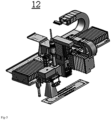
- FIG. 5 shows a laser apparatus constituting the notching part 12, and FIG. 6 shows an anode plate having a tab 112 formed by the notching process.
- the notching part cuts the transverse direction 113 and the longitudinal direction 114 using the laser apparatus to form the anode plate having a tab.
- the power of laser for cutting the anode plate is at a maximum of 200W, but in the present invention, a 300 W laser is used in order to receive a small influence on tolerance of upper and lower positions of the electrode.
- the horizontal direction 113 is cut by a laser by coupling a laser and a slitter, and the longitudinal direction 114 is cut using a slitter to form the anode plate having the tab.
- FIG. 7 is a perspective view of the zigzag stacking part 21 according to the present invention.
- the anode plate 2 processed in the notching part is transferred to be stacked in a zigzag shape with the separator film 3 inserted between the cathode plate 1 stored in the cathode plate magazine 4.
- the separator film 3 is supplied from the separator film unwinder 5.
- FIG. 8 shows a process of aligning the cathode plate and the anode plate on the stacking part 20 of the stacking part, and alignment is performed using the camera 22.
- FIG. 9 shows a packing part and a taping part according to the present invention.
- the packing part 23 fixes the anode plate and the cathode plate by wrapping the outer periphery of the cell stacked in the stack with the separator film twice.
- the taping part 24 fixes the edge of the separator film to a tape.
- the take-out part 25 transfers the stacked cells from the stacking part to the outside.
- the apparatus for manufacturing a lithium metal battery according to the present invention is a manufacturing apparatus which eliminates a process stored in a magazine and combines a notching process using a laser and a stacking process with an in-line technology and may be used when a lithium metal is used as an anode material in a battery assembly process.
- productivity since the stacking process is performed in-line without a magazine storage process after the notching process, productivity may be improved.
Landscapes
- Chemical & Material Sciences (AREA)
- Engineering & Computer Science (AREA)
- Chemical Kinetics & Catalysis (AREA)
- Electrochemistry (AREA)
- General Chemical & Material Sciences (AREA)
- Manufacturing & Machinery (AREA)
- Materials Engineering (AREA)
- Physics & Mathematics (AREA)
- Plasma & Fusion (AREA)
- Mechanical Engineering (AREA)
- Optics & Photonics (AREA)
- Secondary Cells (AREA)
- Battery Electrode And Active Subsutance (AREA)
Abstract
Description
- The present invention relates to an in-line manufacturing apparatus for lithium metal batteries, and more specifically, to an in-line manufacturing apparatus in which a storage process is omitted to solve a problem of decreased productivity caused by stickiness of lithium metal.
- Lithium-ion batteries are generally composed of cathode, anode, electrolyte, and separator film. The cathode determines the capacity and voltage of the battery as a source of lithium ions. The anode uses graphite having a stable structure as a function of reversibly absorbing/discharging lithium ions from the cathode and flowing current through an external circuit. The electrolyte acts as a medium to move lithium ions between the cathode and the anode, using materials with high ion conductivity. The separator film serves as a physical barrier to prevent the anode and cathode from mixing with each other, enabling only the movement of ions.
- The anode determines the lifespan and capacity of the battery. In the beginning, lithium metal was directly used for the anode, but the use of stable graphite materials in layered structures has been adopted due to safety concerns. Recently, silicon has gained attention for its energy density over 10 times higher than graphite and fast charging/discharging rate. However, research is needed to stabilize silicon, which expands in volume over 3-4 times more than graphite.
- The manufacturing process of the lithium-ion battery is largely divided into electrode process, assembly process, and chemical conversion process, and the detailed process is different for each battery type and manufacturer.
- The electrode process is a process of making cathode and anode plates, and is performed of mixing, coating, pressing, and slitting on a current collector substrate using a mixture in which cathode/anode active materials, conductive materials, and binders are mixed, and the cathode and anode manufacturing processes are carried out respectively.
- The assembly process is a process of assembling the cathode and anode plates made through the electrode process according to a cell shape with the separator film. The assembly process is performed of notching, stacking, tab welding, and packaging, and the electrode plates are stacked by winding or stacking as much as the capacity of a cell.
- The notching process is a process of cutting the electrode plate to an appropriate size according to the shape of the battery to manufacture tabs for the cathodes and anodes, and it influences the production speed of the battery.
- The notching process is performed by a press or a laser apparatus, and the press apparatus with a sharp press blade cuts a roll-type cathode/anode plates directly up and down so periodic blade replacement and maintenance are required. The laser apparatus cuts using an IR laser, so there is no additional maintenance cost, and the production speed is fast, but the initial investment cost is high.
- After the notching process is completed, the electrode plates are wound or stacked by stacking according to the shape of the cell such as cylindrical, prismatic, pouch type to obtain a desired cell capacity.
- The chemical conversion process is a process for activating and stabilizing the lithium-ion battery. It charges/discharges the assembled battery to give it electrical characteristics and performs quality inspection and selection of the battery.
- After the notching process, the stacking process includes a method of notching and stacking with a laser, or a method of stacking after notching using a mold.
- As a next-generation battery, lithium metal batteries that use lithium metal as the anode can increase their energy density to more than 1,000 Wh/L, which is higher than 800 Wh/L of lithium-ion batteries, so R&D is being concentrated.
- The lithium metal itself is soft and sticky, and there is a problem in that it sticks to each other, or foreign substances stick to the lithium metal, so it is difficult to make a lithium foil of less than 100um. In a punching or notching process using a mold, the sticky phenomenon in which the lithium metal is stained on the mold occurs, causing a defect and degrading productivity. In addition, when the lithium metal is stored in a magazine after notching, there is a problem in that the anode sticks to each other under pressure due to its own weight. In order to solve the above problem, loading a minimal amount that does not adhere can lead to a decrease in productivity due to frequent magazine replacements.
- Therefore, in order to use metallic lithium as the anode material, it is necessary to prevent it from sticking to rollers in the pressing process for making lithium foil, a special manufacturing process is required to prevent it from sticking to the mold in the notching process, and the magazine storage process must be omitted.
- The
Korean Patent Publication 10-2019-0077835 - The present invention provides an apparatus for manufacturing a lithium metal battery, in which a process of storing in a magazine is eliminated to solve a phenomenon that a lithium metal is used as anode material during an assembly process, and a notching process and a stacking process are combined in an in-line technology.
- An apparatus for manufacturing a lithium metal battery according to the present invention comprises: a lithium foil tape unwinder peeling a release film on a lithium foil tape and transferring the lithium foil tape peeled off release film to a notching part; the notching part processing the lithium foil tape to form an anode plate having an electrode tab; and a stacking part inserting a separator film between the anode plate and the cathode plate directly transferred from the notching part in a zigzag manner to alternately stack the separator film.
- The notching part is characterized in that lithium is not stained by using a laser cutter.
- The notching part is configured by coupling the laser cutter and a slitter, the slitter cuts the lithium foil tape in a longitudinal direction, and the laser forms a tab while cutting the lithium foil tape in a transverse direction.
- The stacking part may be stacked between the cathode plate and the anode plate with the separator film inserted between the cathode plate and the anode plate.
- The lithium foil tape unwinder comprises: a release film rewinder which winds and winds the release film inserted between lithium foils so that the lithium foils do not stick to each other; a vision inspection part which optically scans and inspects whether the release film and the lithium foil tape are defective; and a pair of dancer rolls to minimize tension change caused by sudden tension disturbances.
- The apparatus for manufacturing a lithium metal battery according to the present invention eliminates the process of storing the lithium metal battery in the magazine and can solve the phenomenon that the lithium metal is attached to each other during the assembly process when the lithium metal is used as the anode material in which the notching process using a laser and the stacking process are combined using in-line technology.
- In addition, since the stacking process is performed in-line without a magazine storage process after the notching process, productivity may be improved.
-
-
FIG. 1 is a conceptual diagram of a conventional zigzag stacking apparatus. -
FIG. 2 is a block diagram of an in-line manufacturing apparatus according to an embodiment of the present invention. -
FIG. 3 is a plan view of an in-line manufacturing apparatus according to an embodiment of the present invention. -
FIG. 4 is a perspective view of a lithium foil tape unwinder according to the present invention. -
FIG. 5 shows a laser apparatus constituting a notching part according to the present invention. -
FIG. 6 shows an anode plate forming a tab by notching process according to the present invention. -
FIG. 7 is a perspective view of a stacking part according to an embodiment of the present invention. -
FIG. 8 is a perspective view of a vision inspection part according to the present invention. -
FIG. 9 shows a packing part and a taping part according to the present invention. - The present invention uses lithium metal as an anode material of a battery. The battery is called as a 'lithium metal battery' to distinguish it from a `lithium-ion battery' using conventional graphite or the like as an anode material.
-
FIG. 1 is a conceptual diagram illustrating a conventional zigzag stacking apparatus, demonstrating the concept in which a battery cell is formed by inserting aseparator film 3 into a zigzag shape from aseparator film unwinder 5 while alternately stacking acathode plate 1 stacked on acathode magazine 4 and ananode plate 2 stacked on ananode magazine 6. - As explained in the background art, when the anode material is used as lithium metal, the
anode plates 2 stacked on theanode magazine 6 may stick to each other due to their own weight due to the stickiness of the lithium metal, causing the continuous stacking process to be interrupted. Therefore, if only a small amount is stacked on the magazine so that they do not stick together, productivity decreases due to frequent magazine replacement. - The present invention can improve productivity by solving the problem of anode electrode plates sticking to each other by performing the stacking process following the notching process in-line without a magazine storage process.
FIG. 2 is a block diagram of the in-line manufacturing apparatus according to the present invention, in which theanode plate 2 is formed by a notching process using a laser, and theanode plate 2 is directly transferred to thestacking part 21 without being stored in the magazine, so that theseparator film 3 is alternately inserted and stacked on thecathode plate 1 and discharged to thedischarge part 25. -
FIG. 3 is a plan view of the in-line manufacturing apparatus according to the present invention, where the lithium foil tape, which is peeled off from theunwinder 11, is fed into thenotching part 12 and processed into theanode plate 2. -
FIG. 4 is a perspective view of the lithium foil tape unwinder, and includes a release film rewinder 103 wound while peeling off therelease film 102 inserted between the lithium foils such that the lithium foils do not stick to each other, a dancer roll 104 for minimizing a change in tension with respect to the sudden tension disturbances, and avision inspection part 105 for optically scanning and inspecting whether the lithium foil tape is defective. - The rolls of the in-line manufacturing apparatus use polypropylene or nylon rolls instead of metal rolls so as not to react with the lithium metal.
-
FIG. 5 shows a laser apparatus constituting thenotching part 12, andFIG. 6 shows an anode plate having atab 112 formed by the notching process. The notching part cuts thetransverse direction 113 and thelongitudinal direction 114 using the laser apparatus to form the anode plate having a tab. To solve the problem of sticky lithium foil sticking to the press blade and reducing quality and productivity, it is cut using a laser. In general, the power of laser for cutting the anode plate is at a maximum of 200W, but in the present invention, a 300 W laser is used in order to receive a small influence on tolerance of upper and lower positions of the electrode. - In another embodiment of the notching part, the
horizontal direction 113 is cut by a laser by coupling a laser and a slitter, and thelongitudinal direction 114 is cut using a slitter to form the anode plate having the tab. -
FIG. 7 is a perspective view of thezigzag stacking part 21 according to the present invention. Theanode plate 2 processed in the notching part is transferred to be stacked in a zigzag shape with theseparator film 3 inserted between thecathode plate 1 stored in thecathode plate magazine 4. Theseparator film 3 is supplied from theseparator film unwinder 5. -
FIG. 8 shows a process of aligning the cathode plate and the anode plate on the stackingpart 20 of the stacking part, and alignment is performed using thecamera 22. -
FIG. 9 shows a packing part and a taping part according to the present invention. - The packing
part 23 fixes the anode plate and the cathode plate by wrapping the outer periphery of the cell stacked in the stack with the separator film twice. - The taping
part 24 fixes the edge of the separator film to a tape. - The take-out
part 25 transfers the stacked cells from the stacking part to the outside. - The apparatus for manufacturing a lithium metal battery according to the present invention is a manufacturing apparatus which eliminates a process stored in a magazine and combines a notching process using a laser and a stacking process with an in-line technology and may be used when a lithium metal is used as an anode material in a battery assembly process.
- In addition, since the stacking process is performed in-line without a magazine storage process after the notching process, productivity may be improved.
Claims (3)
- An in-line manufacturing apparatus for a lithium metal battery, comprising:a lithium foil tape unwinder peeling a release film on a lithium foil tape and transferring the lithium foil tape peeled off the release film to a notching part;the notching part forming an anode plate having an electrode tab by processing the lithium foil tape; anda stacking part inserting a separator film between the anode plate and a cathode plate directly transferred from the notching part in a zigzag manner to alternately stack the separator film.
- The in-line manufacturing apparatus as claimed in claim 1, wherein the notching part is a laser cutter.
- The in-line manufacturing apparatus as claimed in claim 1, wherein the lithium foil tape unwinder comprises:a release film rewinder which winds the release film inserted between lithium foils so that the lithium foils do not stick to each other;a vision inspection part which optically scans and inspects whether the release film and the lithium foil tape are defective; anda pair of dancer rolls to minimize tension change caused by sudden tension disturbances.
Applications Claiming Priority (2)
| Application Number | Priority Date | Filing Date | Title |
|---|---|---|---|
| KR1020210098106A KR102378979B1 (en) | 2021-07-26 | 2021-07-26 | In-line manufacturing apparatus for lithium batteries |
| PCT/KR2022/006166 WO2023008695A1 (en) | 2021-07-26 | 2022-04-29 | In-line manufacturing apparatus for lithium metal battery |
Publications (2)
| Publication Number | Publication Date |
|---|---|
| EP4379894A1 true EP4379894A1 (en) | 2024-06-05 |
| EP4379894A4 EP4379894A4 (en) | 2025-07-02 |
Family
ID=80935219
Family Applications (1)
| Application Number | Title | Priority Date | Filing Date |
|---|---|---|---|
| EP22849674.1A Pending EP4379894A4 (en) | 2021-07-26 | 2022-04-29 | Inline manufacturing device for lithium-metal batteries |
Country Status (4)
| Country | Link |
|---|---|
| US (1) | US12463239B2 (en) |
| EP (1) | EP4379894A4 (en) |
| KR (1) | KR102378979B1 (en) |
| WO (1) | WO2023008695A1 (en) |
Cited By (1)
| Publication number | Priority date | Publication date | Assignee | Title |
|---|---|---|---|---|
| DE102024123146A1 (en) * | 2024-08-14 | 2026-02-19 | Körber Technologies Gmbh | Device and method for dividing an endless web into segments and stacking system for the energy cell manufacturing industry |
Families Citing this family (4)
| Publication number | Priority date | Publication date | Assignee | Title |
|---|---|---|---|---|
| KR102378979B1 (en) * | 2021-07-26 | 2022-03-25 | (주)미디어테크 | In-line manufacturing apparatus for lithium batteries |
| CN119213590A (en) * | 2022-05-16 | 2024-12-27 | Lg电子株式会社 | Battery stack manufacturing device for secondary batteries |
| KR20250090449A (en) * | 2023-12-12 | 2025-06-20 | 삼성에스디아이 주식회사 | Cutter for cutting separating sheet and apparatus for assembling electrodes having same |
| WO2026080758A1 (en) * | 2024-10-11 | 2026-04-16 | Elevated Materials Us Llc | Multi-lane laser lithium metal transfer for pre-lithiating anode structures |
Family Cites Families (15)
| Publication number | Priority date | Publication date | Assignee | Title |
|---|---|---|---|---|
| WO1997034329A1 (en) * | 1996-03-14 | 1997-09-18 | Fuji Photo Film Co., Ltd. | Method and device for sticking lithium foil and method for manufacturing lithium electrode |
| KR101342711B1 (en) * | 2011-12-23 | 2013-12-16 | 주식회사 디에이테크놀로지 | Electrode Notching Apparatus for Secondary Battery |
| KR102042999B1 (en) * | 2016-02-05 | 2019-11-11 | 주식회사 엘지화학 | Method for Preparation of Stack and Folding-typed Electrode Assembly Having Electrode Taps with Various-Sized |
| IT201600119013A1 (en) * | 2016-11-24 | 2018-05-24 | Manz Italy Srl | Production of Electrical Energy Storage Devices |
| JP6930142B2 (en) * | 2017-03-08 | 2021-09-01 | 株式会社豊田自動織機 | Method for manufacturing lithium-doped negative electrode |
| KR102283684B1 (en) * | 2017-07-31 | 2021-08-02 | 주식회사 엘지에너지솔루션 | Lithium deposited anode for Lithium Second Battery and Method for Preparation thereof |
| KR102002875B1 (en) * | 2017-12-08 | 2019-07-23 | 주식회사 테크아이 | Secondary battery electrode notching system |
| KR102278998B1 (en) | 2017-12-26 | 2021-07-20 | 주식회사 엘지에너지솔루션 | Manufacturing system and manufacturing method of secondary battery |
| KR102299988B1 (en) * | 2018-01-16 | 2021-09-09 | 주식회사 엘지에너지솔루션 | Notching device and method for secondary battery |
| DE102018200958A1 (en) * | 2018-01-22 | 2019-07-25 | Volkswagen Aktiengesellschaft | Process for producing an electrode stack for energy storage, stacking plant |
| KR102789143B1 (en) * | 2018-08-13 | 2025-04-01 | 주식회사 엘지에너지솔루션 | Stack-folding typed electrode assembly and lithium metal battery including the same |
| CN115769429A (en) * | 2020-07-10 | 2023-03-07 | 松下控股株式会社 | Separator cutting device and separator cutting method |
| US20230411669A1 (en) * | 2021-01-08 | 2023-12-21 | Lg Energy Solution, Ltd. | Apparatus for Manufacturing Electrode Cell and Method for Controlling the Same |
| KR102940113B1 (en) * | 2021-02-04 | 2026-03-16 | 주식회사 엘지에너지솔루션 | Lamination apparatus and method of discharging defective elecrode cell assembly of the same |
| KR102378979B1 (en) * | 2021-07-26 | 2022-03-25 | (주)미디어테크 | In-line manufacturing apparatus for lithium batteries |
-
2021
- 2021-07-26 KR KR1020210098106A patent/KR102378979B1/en active Active
-
2022
- 2022-04-29 EP EP22849674.1A patent/EP4379894A4/en active Pending
- 2022-04-29 US US18/292,331 patent/US12463239B2/en active Active
- 2022-04-29 WO PCT/KR2022/006166 patent/WO2023008695A1/en not_active Ceased
Cited By (1)
| Publication number | Priority date | Publication date | Assignee | Title |
|---|---|---|---|---|
| DE102024123146A1 (en) * | 2024-08-14 | 2026-02-19 | Körber Technologies Gmbh | Device and method for dividing an endless web into segments and stacking system for the energy cell manufacturing industry |
Also Published As
| Publication number | Publication date |
|---|---|
| US12463239B2 (en) | 2025-11-04 |
| KR102378979B1 (en) | 2022-03-25 |
| EP4379894A4 (en) | 2025-07-02 |
| US20240332601A1 (en) | 2024-10-03 |
| WO2023008695A1 (en) | 2023-02-02 |
Similar Documents
| Publication | Publication Date | Title |
|---|---|---|
| EP4379894A1 (en) | In-line manufacturing apparatus for lithium metal battery | |
| US11196031B2 (en) | Electrode, method for manufacturing the electrode, and roller for manufacturing the electrode | |
| EP4181232B1 (en) | Lithium foil lamination apparatus for anode material of li-metal battery | |
| EP2973831B1 (en) | Electrochemical cell including a folded electrode, components thereof, battery including the electrochemical cell, and method of forming same | |
| EP3823075B1 (en) | Installation for manufacturing all-solid secondary battery and method for the manufacture of such a battery | |
| JP2020534651A (en) | Lithium anode device stack manufacturing | |
| JP2023537922A (en) | In-line contact prelithiation | |
| KR20170131649A (en) | Lithium ion secondary battery and manufacturing method thereof | |
| CN102017239A (en) | Electrode group for nonaqueous battery, its manufacturing method, cylindrical nonaqueous secondary battery and its manufacturing method | |
| US11108032B2 (en) | Method and apparatus for manufacturing secondary battery | |
| KR101562571B1 (en) | Device for Controlling Coating-Quantity of Electrode | |
| WO2023173931A1 (en) | Winding apparatus and method | |
| US10651508B2 (en) | Method for producing an electrode stack for a battery cell and battery cell | |
| CN108352509A (en) | Electrode and its manufacturing method | |
| EP4220747B1 (en) | Electrode and method for manufacturing the same | |
| CN217426826U (en) | Lithium battery negative plate | |
| KR20240111595A (en) | Electrode manufacturing apparatus and method | |
| KR20210017086A (en) | Electrode-assembly and manufacturing method thereof | |
| US20250316744A1 (en) | Secondary battery manufacturing device and battery module including secondary battery manufactured by secondary battery manufacturing device | |
| KR20170022697A (en) | Electrode assembly | |
| EP4550512A1 (en) | Method for manufacturing electrode assembly with improved processability, and electrode assembly manufactured using same | |
| US20260124780A1 (en) | Secondary battery electrode plate cutting device, secondary battery manufacturing device including same, and secondary battery manufacturing method | |
| US20260081203A1 (en) | Die apparatus for manufacturing secondary battery and link-type knockout unit for die apparatus | |
| US20260070080A1 (en) | Apparatus and method for coating electrode plate of secondary battery, and slot die uses in the apparatus and method | |
| EP4628440A1 (en) | Spacer for assisting winding core used in battery slitting process and structure including spacer |
Legal Events
| Date | Code | Title | Description |
|---|---|---|---|
| STAA | Information on the status of an ep patent application or granted ep patent |
Free format text: STATUS: THE INTERNATIONAL PUBLICATION HAS BEEN MADE |
|
| PUAI | Public reference made under article 153(3) epc to a published international application that has entered the european phase |
Free format text: ORIGINAL CODE: 0009012 |
|
| STAA | Information on the status of an ep patent application or granted ep patent |
Free format text: STATUS: REQUEST FOR EXAMINATION WAS MADE |
|
| 17P | Request for examination filed |
Effective date: 20240221 |
|
| AK | Designated contracting states |
Kind code of ref document: A1 Designated state(s): AL AT BE BG CH CY CZ DE DK EE ES FI FR GB GR HR HU IE IS IT LI LT LU LV MC MK MT NL NO PL PT RO RS SE SI SK SM TR |
|
| DAV | Request for validation of the european patent (deleted) | ||
| DAX | Request for extension of the european patent (deleted) | ||
| A4 | Supplementary search report drawn up and despatched |
Effective date: 20250602 |
|
| RIC1 | Information provided on ipc code assigned before grant |
Ipc: B65H 45/20 20060101ALI20250526BHEP Ipc: H01M 4/13 20100101ALI20250526BHEP Ipc: H01M 4/02 20060101ALI20250526BHEP Ipc: H01M 4/38 20060101ALI20250526BHEP Ipc: H01M 4/04 20060101ALI20250526BHEP Ipc: H01M 10/052 20100101ALI20250526BHEP Ipc: H01M 10/04 20060101ALI20250526BHEP Ipc: B65H 43/04 20060101ALI20250526BHEP Ipc: B65H 23/04 20060101ALI20250526BHEP Ipc: B65H 18/10 20060101ALI20250526BHEP Ipc: B23K 26/38 20140101ALI20250526BHEP Ipc: H01M 50/531 20210101ALI20250526BHEP Ipc: H01M 4/1395 20100101ALI20250526BHEP Ipc: H01M 10/0583 20100101AFI20250526BHEP |