EP4379181A1 - Control method and control apparatus for opening of vehicle door, and vehicle controller - Google Patents
Control method and control apparatus for opening of vehicle door, and vehicle controller Download PDFInfo
- Publication number
- EP4379181A1 EP4379181A1 EP22900414.8A EP22900414A EP4379181A1 EP 4379181 A1 EP4379181 A1 EP 4379181A1 EP 22900414 A EP22900414 A EP 22900414A EP 4379181 A1 EP4379181 A1 EP 4379181A1
- Authority
- EP
- European Patent Office
- Prior art keywords
- vehicle
- vehicle door
- knocking
- opening
- controlling
- Prior art date
- Legal status (The legal status is an assumption and is not a legal conclusion. Google has not performed a legal analysis and makes no representation as to the accuracy of the status listed.)
- Pending
Links
Images

Classifications
-
- E—FIXED CONSTRUCTIONS
- E05—LOCKS; KEYS; WINDOW OR DOOR FITTINGS; SAFES
- E05F—DEVICES FOR MOVING WINGS INTO OPEN OR CLOSED POSITION; CHECKS FOR WINGS; WING FITTINGS NOT OTHERWISE PROVIDED FOR, CONCERNED WITH THE FUNCTIONING OF THE WING
- E05F15/00—Power-operated mechanisms for wings
- E05F15/70—Power-operated mechanisms for wings with automatic actuation
- E05F15/73—Power-operated mechanisms for wings with automatic actuation responsive to movement or presence of persons or objects
- E05F15/75—Power-operated mechanisms for wings with automatic actuation responsive to movement or presence of persons or objects responsive to the weight or other physical contact of a person or object
-
- B—PERFORMING OPERATIONS; TRANSPORTING
- B60—VEHICLES IN GENERAL
- B60J—WINDOWS, WINDSCREENS, NON-FIXED ROOFS, DOORS, OR SIMILAR DEVICES FOR VEHICLES; REMOVABLE EXTERNAL PROTECTIVE COVERINGS SPECIALLY ADAPTED FOR VEHICLES
- B60J5/00—Doors
- B60J5/04—Doors arranged at the vehicle sides
-
- E—FIXED CONSTRUCTIONS
- E05—LOCKS; KEYS; WINDOW OR DOOR FITTINGS; SAFES
- E05F—DEVICES FOR MOVING WINGS INTO OPEN OR CLOSED POSITION; CHECKS FOR WINGS; WING FITTINGS NOT OTHERWISE PROVIDED FOR, CONCERNED WITH THE FUNCTIONING OF THE WING
- E05F15/00—Power-operated mechanisms for wings
- E05F15/70—Power-operated mechanisms for wings with automatic actuation
-
- E—FIXED CONSTRUCTIONS
- E05—LOCKS; KEYS; WINDOW OR DOOR FITTINGS; SAFES
- E05F—DEVICES FOR MOVING WINGS INTO OPEN OR CLOSED POSITION; CHECKS FOR WINGS; WING FITTINGS NOT OTHERWISE PROVIDED FOR, CONCERNED WITH THE FUNCTIONING OF THE WING
- E05F15/00—Power-operated mechanisms for wings
- E05F15/70—Power-operated mechanisms for wings with automatic actuation
- E05F15/73—Power-operated mechanisms for wings with automatic actuation responsive to movement or presence of persons or objects
-
- E—FIXED CONSTRUCTIONS
- E05—LOCKS; KEYS; WINDOW OR DOOR FITTINGS; SAFES
- E05F—DEVICES FOR MOVING WINGS INTO OPEN OR CLOSED POSITION; CHECKS FOR WINGS; WING FITTINGS NOT OTHERWISE PROVIDED FOR, CONCERNED WITH THE FUNCTIONING OF THE WING
- E05F15/00—Power-operated mechanisms for wings
- E05F15/40—Safety devices, e.g. detection of obstructions or end positions
-
- E—FIXED CONSTRUCTIONS
- E05—LOCKS; KEYS; WINDOW OR DOOR FITTINGS; SAFES
- E05F—DEVICES FOR MOVING WINGS INTO OPEN OR CLOSED POSITION; CHECKS FOR WINGS; WING FITTINGS NOT OTHERWISE PROVIDED FOR, CONCERNED WITH THE FUNCTIONING OF THE WING
- E05F15/00—Power-operated mechanisms for wings
- E05F15/40—Safety devices, e.g. detection of obstructions or end positions
- E05F15/42—Detection using safety edges
- E05F15/43—Detection using safety edges responsive to disruption of energy beams, e.g. light or sound
-
- E—FIXED CONSTRUCTIONS
- E05—LOCKS; KEYS; WINDOW OR DOOR FITTINGS; SAFES
- E05F—DEVICES FOR MOVING WINGS INTO OPEN OR CLOSED POSITION; CHECKS FOR WINGS; WING FITTINGS NOT OTHERWISE PROVIDED FOR, CONCERNED WITH THE FUNCTIONING OF THE WING
- E05F15/00—Power-operated mechanisms for wings
- E05F15/40—Safety devices, e.g. detection of obstructions or end positions
- E05F15/42—Detection using safety edges
- E05F15/43—Detection using safety edges responsive to disruption of energy beams, e.g. light or sound
- E05F2015/434—Detection using safety edges responsive to disruption of energy beams, e.g. light or sound with cameras or optical sensors
-
- E—FIXED CONSTRUCTIONS
- E05—LOCKS; KEYS; WINDOW OR DOOR FITTINGS; SAFES
- E05Y—INDEXING SCHEME ASSOCIATED WITH SUBCLASSES E05D AND E05F, RELATING TO CONSTRUCTION ELEMENTS, ELECTRIC CONTROL, POWER SUPPLY, POWER SIGNAL OR TRANSMISSION, USER INTERFACES, MOUNTING OR COUPLING, DETAILS, ACCESSORIES, AUXILIARY OPERATIONS NOT OTHERWISE PROVIDED FOR, APPLICATION THEREOF
- E05Y2400/00—Electronic control; Electrical power; Power supply; Power or signal transmission; User interfaces
- E05Y2400/10—Electronic control
- E05Y2400/44—Sensors not directly associated with the wing movement
-
- E—FIXED CONSTRUCTIONS
- E05—LOCKS; KEYS; WINDOW OR DOOR FITTINGS; SAFES
- E05Y—INDEXING SCHEME ASSOCIATED WITH SUBCLASSES E05D AND E05F, RELATING TO CONSTRUCTION ELEMENTS, ELECTRIC CONTROL, POWER SUPPLY, POWER SIGNAL OR TRANSMISSION, USER INTERFACES, MOUNTING OR COUPLING, DETAILS, ACCESSORIES, AUXILIARY OPERATIONS NOT OTHERWISE PROVIDED FOR, APPLICATION THEREOF
- E05Y2400/00—Electronic control; Electrical power; Power supply; Power or signal transmission; User interfaces
- E05Y2400/10—Electronic control
- E05Y2400/44—Sensors not directly associated with the wing movement
- E05Y2400/446—Vehicle state sensors, e.g. parked or inclination
-
- E—FIXED CONSTRUCTIONS
- E05—LOCKS; KEYS; WINDOW OR DOOR FITTINGS; SAFES
- E05Y—INDEXING SCHEME ASSOCIATED WITH SUBCLASSES E05D AND E05F, RELATING TO CONSTRUCTION ELEMENTS, ELECTRIC CONTROL, POWER SUPPLY, POWER SIGNAL OR TRANSMISSION, USER INTERFACES, MOUNTING OR COUPLING, DETAILS, ACCESSORIES, AUXILIARY OPERATIONS NOT OTHERWISE PROVIDED FOR, APPLICATION THEREOF
- E05Y2400/00—Electronic control; Electrical power; Power supply; Power or signal transmission; User interfaces
- E05Y2400/10—Electronic control
- E05Y2400/45—Control modes
- E05Y2400/456—Control modes for programming, e.g. learning or AI [artificial intelligence]
-
- E—FIXED CONSTRUCTIONS
- E05—LOCKS; KEYS; WINDOW OR DOOR FITTINGS; SAFES
- E05Y—INDEXING SCHEME ASSOCIATED WITH SUBCLASSES E05D AND E05F, RELATING TO CONSTRUCTION ELEMENTS, ELECTRIC CONTROL, POWER SUPPLY, POWER SIGNAL OR TRANSMISSION, USER INTERFACES, MOUNTING OR COUPLING, DETAILS, ACCESSORIES, AUXILIARY OPERATIONS NOT OTHERWISE PROVIDED FOR, APPLICATION THEREOF
- E05Y2400/00—Electronic control; Electrical power; Power supply; Power or signal transmission; User interfaces
- E05Y2400/10—Electronic control
- E05Y2400/50—Fault detection
- E05Y2400/508—Fault detection of detection
-
- E—FIXED CONSTRUCTIONS
- E05—LOCKS; KEYS; WINDOW OR DOOR FITTINGS; SAFES
- E05Y—INDEXING SCHEME ASSOCIATED WITH SUBCLASSES E05D AND E05F, RELATING TO CONSTRUCTION ELEMENTS, ELECTRIC CONTROL, POWER SUPPLY, POWER SIGNAL OR TRANSMISSION, USER INTERFACES, MOUNTING OR COUPLING, DETAILS, ACCESSORIES, AUXILIARY OPERATIONS NOT OTHERWISE PROVIDED FOR, APPLICATION THEREOF
- E05Y2400/00—Electronic control; Electrical power; Power supply; Power or signal transmission; User interfaces
- E05Y2400/10—Electronic control
- E05Y2400/52—Safety arrangements associated with the wing motor
- E05Y2400/53—Wing impact prevention or reduction
- E05Y2400/54—Obstruction or resistance detection
-
- E—FIXED CONSTRUCTIONS
- E05—LOCKS; KEYS; WINDOW OR DOOR FITTINGS; SAFES
- E05Y—INDEXING SCHEME ASSOCIATED WITH SUBCLASSES E05D AND E05F, RELATING TO CONSTRUCTION ELEMENTS, ELECTRIC CONTROL, POWER SUPPLY, POWER SIGNAL OR TRANSMISSION, USER INTERFACES, MOUNTING OR COUPLING, DETAILS, ACCESSORIES, AUXILIARY OPERATIONS NOT OTHERWISE PROVIDED FOR, APPLICATION THEREOF
- E05Y2400/00—Electronic control; Electrical power; Power supply; Power or signal transmission; User interfaces
- E05Y2400/80—User interfaces
- E05Y2400/85—User input means
- E05Y2400/852—Sensors
-
- E—FIXED CONSTRUCTIONS
- E05—LOCKS; KEYS; WINDOW OR DOOR FITTINGS; SAFES
- E05Y—INDEXING SCHEME ASSOCIATED WITH SUBCLASSES E05D AND E05F, RELATING TO CONSTRUCTION ELEMENTS, ELECTRIC CONTROL, POWER SUPPLY, POWER SIGNAL OR TRANSMISSION, USER INTERFACES, MOUNTING OR COUPLING, DETAILS, ACCESSORIES, AUXILIARY OPERATIONS NOT OTHERWISE PROVIDED FOR, APPLICATION THEREOF
- E05Y2400/00—Electronic control; Electrical power; Power supply; Power or signal transmission; User interfaces
- E05Y2400/80—User interfaces
- E05Y2400/85—User input means
- E05Y2400/856—Actuation thereof
-
- E—FIXED CONSTRUCTIONS
- E05—LOCKS; KEYS; WINDOW OR DOOR FITTINGS; SAFES
- E05Y—INDEXING SCHEME ASSOCIATED WITH SUBCLASSES E05D AND E05F, RELATING TO CONSTRUCTION ELEMENTS, ELECTRIC CONTROL, POWER SUPPLY, POWER SIGNAL OR TRANSMISSION, USER INTERFACES, MOUNTING OR COUPLING, DETAILS, ACCESSORIES, AUXILIARY OPERATIONS NOT OTHERWISE PROVIDED FOR, APPLICATION THEREOF
- E05Y2400/00—Electronic control; Electrical power; Power supply; Power or signal transmission; User interfaces
- E05Y2400/80—User interfaces
- E05Y2400/85—User input means
- E05Y2400/856—Actuation thereof
- E05Y2400/858—Actuation thereof by body parts, e.g. by feet
-
- E—FIXED CONSTRUCTIONS
- E05—LOCKS; KEYS; WINDOW OR DOOR FITTINGS; SAFES
- E05Y—INDEXING SCHEME ASSOCIATED WITH SUBCLASSES E05D AND E05F, RELATING TO CONSTRUCTION ELEMENTS, ELECTRIC CONTROL, POWER SUPPLY, POWER SIGNAL OR TRANSMISSION, USER INTERFACES, MOUNTING OR COUPLING, DETAILS, ACCESSORIES, AUXILIARY OPERATIONS NOT OTHERWISE PROVIDED FOR, APPLICATION THEREOF
- E05Y2400/00—Electronic control; Electrical power; Power supply; Power or signal transmission; User interfaces
- E05Y2400/80—User interfaces
- E05Y2400/85—User input means
- E05Y2400/856—Actuation thereof
- E05Y2400/858—Actuation thereof by body parts, e.g. by feet
- E05Y2400/86—Actuation thereof by body parts, e.g. by feet by hand
-
- E—FIXED CONSTRUCTIONS
- E05—LOCKS; KEYS; WINDOW OR DOOR FITTINGS; SAFES
- E05Y—INDEXING SCHEME ASSOCIATED WITH SUBCLASSES E05D AND E05F, RELATING TO CONSTRUCTION ELEMENTS, ELECTRIC CONTROL, POWER SUPPLY, POWER SIGNAL OR TRANSMISSION, USER INTERFACES, MOUNTING OR COUPLING, DETAILS, ACCESSORIES, AUXILIARY OPERATIONS NOT OTHERWISE PROVIDED FOR, APPLICATION THEREOF
- E05Y2900/00—Application of doors, windows, wings or fittings thereof
- E05Y2900/50—Application of doors, windows, wings or fittings thereof for vehicles
- E05Y2900/53—Type of wing
- E05Y2900/531—Doors
Definitions
- the present disclosure relates to the field of vehicle technologies, and in particular, to a method for controlling opening of a vehicle door, an apparatus for controlling opening of a vehicle door, a vehicle controller, and a computer-readable storage medium.
- a vehicle with a handleless vehicle door is provided in the related art, that is, no handle is disposed on the vehicle door of such a vehicle, and the vehicle door is unlocked by using a button apparatus on the B or C pillar of the vehicle. As such, the conventional handle is replaced.
- a precise method for controlling automatic door opening through sensing without manual operation is studied by using different control strategies.
- control strategy has a series of problems caused by perforation and sealing of sheet metal or a decorative panel, making it difficult for layout.
- a relatively complex algorithm is generally required, and hardware costs are also relatively high.
- the present disclosure is intended to resolve one of technical problems in the related art at least to some extent. Accordingly, the present disclosure provides a method for controlling opening of a vehicle door.
- the vehicle door is opened in a knocking manner.
- the method is simple to operate and creates greater interest in human-computer interaction.
- the determination in the knocking control method is made based on a principle such as mechanics, so that the algorithm is simplified, the original vehicle appearance can be maintained, and costs are reduced.
- the present disclosure provides an apparatus for controlling opening of a vehicle door.
- the present disclosure provides a vehicle controller.
- the present disclosure provides a vehicle.
- the present disclosure provides a computer-readable storage medium.
- An embodiment according to a first aspect of the present disclosure provides a method for controlling opening of a vehicle door, including: collecting a knocking signal; when it is determined, based on the knocking signal, that the knocking signal is effective, obtaining status information of a vehicle, where the status information includes a vehicle door status, a vehicle speed, and a lock status of the vehicle; and when it is determined that the status information of the vehicle meets a preset condition, responding to the knocking signal, and controlling the vehicle door to be opened.
- the knocking signal is first collected; then, when it is determined, based on the knocking signal, that the knocking signal is effective, the status information of the vehicle is obtained, where the status information includes the vehicle door status, the vehicle speed, and the lock status of the vehicle; and finally, when it is determined that the status information of the vehicle meets the preset condition, the knocking signal is responded to, and the vehicle door is controlled to be opened.
- the vehicle door is opened in a knocking manner. The method is simple to operate and creates greater interest in human-computer interaction. In addition, with the manner of opening through knocking, the original vehicle appearance can be maintained, and reconstruction costs are reduced.
- the method for controlling opening of a vehicle door may further have the following additional technical features:
- that it is determined, based on the knocking signal, that the knocking signal is effective includes: when a knocking force value corresponding to the knocking signal is greater than a preset knocking force value, determining that the knocking signal is effective.
- that it is determined, based on the knocking signal, that the knocking signal is effective includes: when a quantity of knocking signals collected within a first preset time period reaches a set quantity and a knocking force value corresponding to each of the knocking signals collected is greater than the preset knocking force value, determining that the knocking signal is effective.
- that it is determined, based on the knocking signal, that the knocking signal is effective includes: when the quantity of knocking signals collected within the first preset time period reaches the set quantity, the knocking force value corresponding to each of the knocking signals collected is greater than the preset knocking force value, and no knocking action occurs within a second preset time period that is after the vehicle door is opened and then closed, determining that the knocking signal is effective.
- the vehicle door when the vehicle door is in a closed state, the vehicle is in an unlocked state, and the vehicle speed of the vehicle is less than a preset vehicle speed, it is determined that the status information of the vehicle meets the preset condition.
- the method before the controlling the vehicle door to be opened, the method further includes: obtaining information about a road condition around the vehicle; and determining, based on the information about the road condition, whether an obstacle exists outside the vehicle door.
- the vehicle door when no obstacle exists outside the vehicle door, the vehicle door is controlled to be unlocked and to start opening.
- the method further includes: when it is determined that an obstacle exists outside the vehicle door, controlling the vehicle door to hover.
- the method for controlling opening of a vehicle door further includes: when it is determined that no obstacle exists outside the vehicle door, controlling the vehicle door to be opened to a preset maximum angle.
- An embodiment according to a second aspect of the present disclosure provides an apparatus for controlling opening of a vehicle door, comprising: a collection module, configured to collect a knocking signal; a determining module, configured to: when determining, based on the knocking signal, that the knocking signal is effective, obtain status information of a vehicle, where the status information includes a vehicle door status, a vehicle speed, and a lock status of the vehicle; and a control module, configured to: when determining that the status information of the vehicle meets a preset condition, respond to the knocking signal, and control the vehicle door to be opened.
- the collection module collects the knocking signal; then, when determining, based on the knocking signal, that the knocking signal is effective, the determining module obtains the status information of the vehicle, where the status information includes the vehicle door status, the vehicle speed, and the lock status of the vehicle; and when determining that the status information of the vehicle meets the preset condition, the control module responds to the knocking signal, and controls the vehicle door to be opened.
- the manner of opening the vehicle door through knocking is simple to operate and creates greater interest in human-computer interaction.
- the manner of opening through knocking the original vehicle appearance can be maintained, and reconstruction costs are reduced.
- An embodiment according to a third aspect of the present disclosure provides a vehicle controller, including: a memory, a processor, and a vehicle door opening controlling program stored in the memory and executable by the processor.
- a vehicle door opening controlling program stored in the memory and executable by the processor.
- the processor executes a vehicle door opening controlling program, to implement the foregoing method for controlling opening of a vehicle door.
- the method is simple to operate and creates greater interest in human-computer interaction.
- the manner of opening through knocking the original vehicle appearance can be maintained, and reconstruction costs are reduced.
- An embodiment according to a fifth aspect of the present disclosure provides a vehicle, including the foregoing vehicle controller.
- a human-computer interaction process may be more interesting, the original vehicle appearance can be maintained, and reconstruction costs are reduced.
- An embodiment according to a fifth aspect of the present disclosure provides a computer-readable storage medium, storing a vehicle door opening controlling program which, when executed by a processor, implements the method for controlling opening of a vehicle door.
- the processor executes the vehicle door opening controlling program stored on the processor, the foregoing method for controlling opening of a vehicle door is implemented.
- the method is simple to operate and creates greater interest in human-computer interaction.
- the manner of opening through knocking the original vehicle appearance can be maintained, and reconstruction costs are reduced.
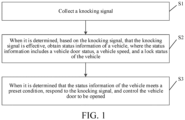
- FIG. 1 is a flowchart of a method for controlling opening of a vehicle door according to an embodiment of the present disclosure.
- the method for controlling opening of a vehicle door includes the following steps.
- a sensing surface of a knocking sensor receives knocking force and transfers the knocking signal to a vehicle controller through a wiring harness.
- the knocking sensor may be a force value detection sensor, and detects a knocking force value to distinguish an effective knocking signal.
- the knock sensor may be installed between an outer panel of the vehicle door and an inner panel of the vehicle door.
- the sensing surface fits the inner side of the outer panel of the vehicle door and may be fastened by using a corresponding bracket.
- the bracket is connected and fastened to the sheet metal by using a glue-type connecting material, to achieve an objective of fastening.
- the knocking sensor is hidden on the inner side of the sheet metal of the outer panel of the vehicle door, the outer panel of the vehicle door does not need to be perforated, thereby eliminating a series of problems caused by perforation and sealing of the sheet metal or a decorative plate.
- a layout is simple, and costs are reduced.
- An installation surface of the sensing surface of the knocking sensor is provided on the inner side of the outer panel of the vehicle door, to form a knocking sensing area. The user may be reminded by using different stickers in the knock sensing area on the outer side of the outer panel of the vehicle door based on an individual need.
- that it is determined, based on the knocking signal, that the knocking signal is effective may include: when a knocking force value corresponding to the knocking signal is greater than a preset knocking force value, determining that the knocking signal is effective.
- a knocking force value of a single knocking signal is used as an effective determining condition.
- the preset knocking force value is set to F
- a knocking force value of a knocking signal obtained by the knocking sensor in real time is f
- the knocking force value f is compared with the prestored F (the preset knocking force value). If f is greater than F, the knocking signal is effective. If f is less than or equal to F, it is considered that the knocking signal is ineffective.
- that it is determined, based on the knocking signal, that the knocking signal is effective may include: when a quantity of knocking signals collected within a first preset time period reaches a set quantity and a knocking force value corresponding to each of the knocking signals collected is greater than the preset knocking force value, determining that the knocking signal is effective.
- the first preset time period may be calibrated according to an actual situation. For example, the first preset time period may be 1s, and the set quantity may be 2.
- a quantity of effective knocking signals within the first preset time period and the knocking force values are used as effective determining conditions. For example, when two knocking signals are collected within the first preset time period, and a knocking force value of each of the knocking signals collected is greater than the preset knocking force value, it is considered that the knocking signal is effective. If the knocking signal is not collected twice within the first preset time period, or a knocking force value of the collected knocking signal does not reach the preset knocking force value, it is considered that the current knocking signal is ineffective.
- that it is determined, based on the knocking signal, that the knocking signal is effective may include: when the quantity of knocking signals collected within the first preset time period reaches the set quantity, the knocking force value corresponding to each of the knocking signals collected is greater than the preset knocking force value, and no knocking action occurs within a second preset time period that is after the vehicle door is opened and then closed, determining that the knocking signal is effective.
- the foregoing preset knocking force value, the first preset time period, and the second preset time period may be preset and stored based on an actual application.
- the first preset time period may be 1s and the second preset time period may be 500 ms.
- a quantity of knocks within the first preset time period, the knocking force value, and a first knock action time are used as effective determining conditions. For example, the determination is made based on the foregoing quantity of knocking signals within the first preset time period.
- a time of a first knocking signal is further obtained to determine whether the time falls within a time period that is after the vehicle door is opened and then closed. If not, it indicates that the current knocking signal is caused by vibration generated by closing the vehicle door. If yes, it indicates that the current knocking signal is effective. In such a manner, a case in which the vibration caused by closing the vehicle door is considered as the knocking signal may be avoided.
- a timing operation that starts on a system when the vehicle door is opened and then closed can automatically stop when a second preset time has elapsed since the timing and no knocking signal is detected, that is, all subsequent knocking operations meet a condition that the knocking action occurs within the second preset time period that is after the vehicle door is opened and then closed, and then effectiveness of the knocking signal is determined by using the method in which the quantity of effective knocking signals and the knocking force values within the first preset time period are used as the effective determining conditions.
- the foregoing timing operation automatically starts after the vehicle door is opened and then closed, and then effectiveness of the knocking signal is re-identified according to the foregoing determining method. It can be understood that the foregoing timing operation is reset to zero or restarted next time an operation that the vehicle door is opened and then closed occurs.
- the determining manners in the foregoing three embodiments may all implement the method for controlling a vehicle door in the present disclosure. Different determining methods can be selected based on an actual working condition of the vehicle. Accuracy of determining whether the knocking signal is effective in the foregoing embodiments gradually increase.
- the vehicle door when the vehicle door is in a closed state, the vehicle is in an unlocked state, and the vehicle speed of the vehicle is less than a preset vehicle speed, it is determined that the status information of the vehicle meets the preset condition.
- the preset vehicle speed may be preset based on an actual situation. For example, the preset vehicle speed may be 3 km/h.
- the vehicle door status, the vehicle speed, and the lock status of the vehicle are respectively obtained.
- the vehicle door is in a closed state
- the vehicle is in an unlocked state, that is, a lock-released state
- a current vehicle speed is less than the preset vehicle speed
- the status information of the vehicle meets the preset condition.
- the knocking signal is responded to, the vehicle door is controlled to be unlocked, a corresponding drive mechanism (a side door drive mechanism) is controlled to drive a motor, and the vehicle door is driven to move away from a vehicle body, to implement a door opening action.
- a corresponding drive mechanism a side door drive mechanism
- the method before the controlling the vehicle door to be opened, the method further includes: obtaining information about a road condition around the vehicle; and determining, based on the information about the road condition, whether an obstacle exists outside the vehicle door.
- image information at a same angle as a rearview mirror may be captured by using left and right cameras respectively installed on the rearview mirror of the vehicle, and is processed to determine whether there is an obstacle or pedestrian within a range.
- rear image information is collected by using a millimeter wave radar installed in the rear of the vehicle, to determine, based on the rear image information, whether there is an oncoming vehicle behind the vehicle.
- image information on both sides of the vehicle is collected by using an ultrasonic radar installed on a vehicle body.
- the millimeter wave radar may detect a human and an object 20 meters away, and the ultrasonic radar may detect a human, an object, a falling object, and a nearby small obstacle within 2 meters.
- the camera disposed on the rearview mirror of the vehicle, the ultrasonic radar on the vehicle body, and the millimeter wave radar in the rear of the vehicle all-round detection of the information about the road condition around the vehicle may be implemented.
- the vehicle door when an obstacle exists outside the vehicle door, the vehicle door is controlled to be unlocked. That is, when it is determined that an obstacle exists outside the vehicle door, the vehicle door is first controlled to be unlocked, but not to be opened. Then it is determined whether a distance between the obstacle and the vehicle is greater than a preset distance, for example, the vehicle door may be opened to an angle, so that a human may get on or off the vehicle. If the distance between the obstacle and the vehicle is greater than the preset distance, it is considered that the vehicle door may be opened, and then an opening angle of the vehicle door is controlled based on the distance between the obstacle and the vehicle.
- a preset distance for example, the vehicle door may be opened to an angle, so that a human may get on or off the vehicle.
- the vehicle door when no obstacle exists outside the vehicle door, the vehicle door is controlled to be unlocked and to start opening.
- a side door detection radar installed on a corresponding vehicle door is first waken up to make a determination regarding obstacles outside the vehicle door, feeds back, to a domain control, an obstacle signal and a distance to the obstacle, then obtains the information about the road condition around the vehicle based on feedback information, and determines whether an obstacle exists outside the vehicle door.
- the system may pre-store a safe distance based on an area required for opening of the vehicle door.
- the vehicle door If the distance to the obstacle obtained by the side door detection radar is less than or equal to the safe distance, that is, the obstacle falls within a vehicle door opening area, and the vehicle door easily collides with the obstacle after the vehicle door is opened, it is determined that an obstacle exists outside the vehicle door, and the vehicle door is controlled to be unlocked, but no driving signal is output to the side door drive mechanism, to keep the vehicle door in a closed state. If the distance obtained by the side door detection radar is greater than the safe distance, that is, the obstacle is located outside the vehicle door opening area, and the vehicle door does not collide with the obstacle during the opening of the vehicle door, it is determined that no obstacle exists outside the vehicle door, the vehicle door is controlled to be unlocked, and the side door drive mechanism performs a door opening action.
- a speed sensor or an acceleration sensor is disposed on the side door drive mechanism, and the speed sensor or the acceleration sensor is connected to the vehicle controller, to feed back an opening status of the vehicle door to the vehicle controller in real time.
- a vehicle door unlocking structure in this embodiment of the present disclosure is an electric unlocking structure.
- the foregoing safety distance may be set based on an actual opening direction of the vehicle door and a size of the vehicle door, and meeting normal opening of the vehicle door is used as a setting premise.
- the method further includes: when it is determined that an obstacle exists outside the vehicle door, controlling the vehicle door to hover.
- the vehicle door is controlled to stop immediately, that is, controls the vehicle door to hover. In this case, hitting the pedestrian in an unexpected situation or causing a risk of collision may be avoided.
- the method further includes: when it is determined that no obstacle exists outside the vehicle door, controlling the vehicle door to be opened to a preset maximum angle.
- the side door detection radar detects an obstacle outside the vehicle door in real time, and feeds back, to the vehicle controller in real time, an obstacle signal and a distance to the obstacle. Then the vehicle controller makes a determination on a surrounding road condition based on the obstacle information fed back in real time. If it is determined that there is no obstacle outside the vehicle door, the vehicle door is controlled to be opened to a preset maximum angle.
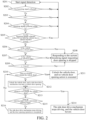
- the method for controlling opening of a vehicle door includes the following steps.
- step S202 It is determined whether a knocking signal is collected. If yes, step S203 is performed. If not, step S201 is performed.
- step S203 It is determined whether a knocking force value f corresponding to the knocking signal is greater than a preset knocking force value F. If yes, step S204 is performed. If not, step S201 is performed.
- step S204 It is determined whether two effective knocking signals are collected within a first preset time period of 1s. If yes, step S205 is performed. If not, step S201 is performed.
- step S205 It is determined whether the first knocking signal is collected within 500 ms after the vehicle door is opened and then closed. If yes, step S206 is performed. If not, step S201 is performed.
- step S206 It is determined whether the vehicle door is in a closed state. If yes, step S207 is performed. If not, step S208 is performed.
- step S207 It is determined whether the vehicle is in an unlocked state. If yes, step S209 is performed. If not, step S208 is performed.
- step S209 It is determined whether a current vehicle speed v is less than a set vehicle speed of 3 km/h. If yes, step S210 is performed. If not, step S208 is performed.
- step S210 It is determined whether an obstacle exists outside the vehicle door. If yes, step S211 is performed. If not, step S212 is performed.
- S212 The vehicle door is unlocked, and a side door drive mechanism executes a vehicle door opening action.
- step S213 It is determined whether an obstacle exists outside the vehicle door during opening. If yes, step S214 is performed. If not, step S215 is performed.
- S214 The side door drive mechanism stops driving, and the vehicle door hovers.
- step S215 It is determined whether an opening angle of the vehicle door reaches a maximum opening angle. If yes, step S216 is performed. If not, step S212 is performed.
- the knocking-triggered opening manner is simple to operate and creates greater interest in human-computer interaction.
- sheet metal or decorative panel usually needs to be perforated in the layout process for installation of an opening apparatus.
- special sealing is required at the opening to meet waterproof and dustproof requirements of the vehicle, and costs are relatively high.
- the perforation affects the overall appearance, is not conducive to the structural design.
- the layout manner in the present disclosure does not require perforation, and the opening apparatus is directly hidden inside the sheet metal or decorative panel, thereby eliminating a series of problems caused by perforation and sealing, reducing costs, causing no damage to the appearance of the vehicle, and facilitating the structural design.
- the knocking signal is first collected; then, when it is determined, based on the knocking signal, that the knocking signal is effective, the status information of the vehicle is obtained, where the status information includes the vehicle door status, the vehicle speed, and the lock status of the vehicle; and finally, when it is determined that the status information of the vehicle meets the preset condition, the knocking signal is responded to, and the vehicle door is controlled to be opened.
- the manner of opening the vehicle door through knocking is simple to operate and creates greater interest in human-computer interaction.
- the present disclosure further provides an apparatus for controlling opening of a vehicle door.
- the apparatus for controlling opening of a vehicle door in this embodiment of the present disclosure may include: a collection module 10, a determining module 20, and a control module 30.
- the collection module 10 is configured to collect a knocking signal.
- the determining module 20 is configured to: when determining, based on the knocking signal, that the knocking signal is effective, obtain status information of a vehicle, where the status information includes a vehicle door status, a vehicle speed, and a lock status of the vehicle.
- the control module 30 is configured to: when determining that the status information of the vehicle meets a preset condition, respond to the knocking signal, and control the vehicle door to be opened.
- that the determining module 20 determines, based on the knocking signal, that the knocking signal is effective is specifically performed to: when a knocking force value corresponding to the knocking signal is greater than a preset knocking force value, determine that the knocking signal is effective.
- determining module 20 determines, based on the knocking signal, that the knocking signal is effective is specifically performed to: when a quantity of knocking signals collected within a first preset time period reaches a set quantity and a knocking force value corresponding to each of the knocking signals collected is greater than the preset knocking force value, determine that the knocking signal is effective.
- the determining module 20 determines, based on the knocking signal, that the knocking signal is effective is specifically performed to: when the quantity of knocking signals collected within the first preset time period reaches the set quantity, the knocking force value corresponding to each of the knocking signals collected is greater than the preset knocking force value, and no knocking action occurs within a second preset time period that is after the vehicle door is opened and then closed, determine that the knocking signal is effective.
- the control module 30 determines that the status information of the vehicle meets the preset condition.
- control module 30 before controlling the vehicle door to be opened, is specifically further configured to: obtain information about a road condition around the vehicle; and determine, based on the information about the road condition, whether an obstacle exists outside the vehicle door.
- control module 30 controls the vehicle door to be unlocked and to start opening.
- control module 30 is specifically further configured to: when determining that an obstacle exists outside the vehicle door, control the vehicle door to hover.
- control module 30 is specifically further configured to: when determining that no obstacle exists outside the vehicle door, control the vehicle door to be opened to a preset maximum angle.
- the collection module collects the knocking signal; then, when determining, based on the knocking signal, that the knocking signal is effective, the determining module obtains the status information of the vehicle, where the status information includes the vehicle door status, the vehicle speed, and the lock status of the vehicle; and when determining that the status information of the vehicle meets the preset condition, the control module responds to the knocking signal, and controls the vehicle door to be opened.
- the manner of opening the vehicle door through knocking is simple to operate and creates greater interest in human-computer interaction.
- the manner of opening through knocking the original vehicle appearance can be maintained, and reconstruction costs are reduced.
- the present disclosure further provides a vehicle controller.
- the vehicle controller 300 in an embodiment of the present disclosure includes: a memory 310, a processor 320, and a vehicle door opening controlling program stored in the memory 310 and executable by the processor.
- the processor 320 executes the vehicle door opening controlling program, the method for controlling opening of a vehicle door is implemented.
- the processor executes the vehicle door opening controlling program, to implement the foregoing method for controlling opening of a vehicle door.
- the method is simple to operate and creates greater interest in human-computer interaction.
- the manner of opening through knocking the original vehicle appearance can be maintained, and reconstruction costs are reduced.
- the present disclosure further provides a vehicle.
- the vehicle 400 in an embodiment of the present disclosure includes: the foregoing vehicle controller 300.
- a human-computer interaction process may be more interesting, the original vehicle appearance is maintained, and reconstruction costs are reduced.
- the present disclosure further provides a computer-readable storage medium.
- a vehicle door opening controlling program is stored in the computer-readable storage medium, and when the vehicle door opening controlling program is executed by a processor, the method for controlling opening of a vehicle door is implemented.
- the processor executes the vehicle door opening controlling program stored on the processor, the foregoing method for controlling opening of a vehicle door is implemented.
- the manner of opening through knocking the original vehicle appearance can be maintained, and reconstruction costs are reduced.
- a "computer-readable medium” may be any apparatus that can include, store, communicate, propagate, or transmit the program for use by the instruction execution system, apparatus, or device or in combination with the instruction execution system, apparatus, or device. More specific examples (a non-exhaustive list) of the computer-readable medium include the following: an electrical connection (an electronic apparatus) having one or more wires, a portable computer diskette (a magnetic apparatus), a random access memory (RAM), a read-only memory (ROM), an erasable programmable read-only memory (EPROM or a flash memory), an optical fiber apparatus, and a portable compact disk read-only memory (CDROM).
- the computer-readable medium can even be paper or other suitable media on which the program can be printed, because the program can be obtained electronically by, for example, optically scanning paper or other media, then editing, interpreting, or processing in other suitable ways if necessary, and then storing it in a computer memory.
- parts of the present disclosure can be implemented by using hardware, software, firmware, or a combination thereof.
- multiple steps or methods may be implemented by using software or firmware that are stored in a memory and are executed by a proper instruction execution system.
- implementation may be performed by any one of the following technologies well known in the art or a combination thereof: a discrete logic circuit including a logic gate circuit for implementing a logic function of a data signal, a dedicated integrated circuit including a proper combined logic gate circuit, a programmable gate array (PGA), a field programmable gate array (FPGA), and the like.
- first and second are used merely for the purpose of description, and shall not be construed as indicating or implying relative importance or implying a quantity of indicated technical features. Therefore, a feature restricted by “first” or “second” may explicitly indicate or implicitly include at least one of such features.
- “multiple” means at least two, for example, two or three.
- a connection may be a fixed connection, a detachable connection, or an integral connection; or the connection may be a mechanical connection or an electrical connection; or the connection may be a direct connection, an indirect connection through an intermediary, or internal communication between two elements or mutual action relationship between two elements, unless otherwise specified explicitly.
- a person of ordinary skill in the art can understand specific meanings of the terms in the present disclosure based on specific situations.
Landscapes
- Engineering & Computer Science (AREA)
- Mechanical Engineering (AREA)
- Power-Operated Mechanisms For Wings (AREA)
- Lighting Device Outwards From Vehicle And Optical Signal (AREA)
- Financial Or Insurance-Related Operations Such As Payment And Settlement (AREA)
- Vehicle Body Suspensions (AREA)
- Lock And Its Accessories (AREA)
Abstract
Description
- The present disclosure claims priority to
Chinese Patent Application No. 202111443403.X filed on November 30, 2021 - The present disclosure relates to the field of vehicle technologies, and in particular, to a method for controlling opening of a vehicle door, an apparatus for controlling opening of a vehicle door, a vehicle controller, and a computer-readable storage medium.
- As people' demand for vehicles increases, there is an increasing need of the automated and intelligent electric-driven opening of side doors which are a mechanism for passengers to get on or off the vehicle. For conventional side doors, the passenger needs to pull the handle on the outer side of the door to unlock a vehicle door lock through a mechanical structure connection. After the vehicle door lock is unlocked, the passenger also needs to push the side door open for getting on or off. The process is cumbersome and makes it difficult for the passenger to get on or off especially when both hands of the passenger are occupied and cannot operate the handle on the side door.
- For a handleless automatic vehicle door system, a vehicle with a handleless vehicle door is provided in the related art, that is, no handle is disposed on the vehicle door of such a vehicle, and the vehicle door is unlocked by using a button apparatus on the B or C pillar of the vehicle. As such, the conventional handle is replaced. For an electric-driven door opening function of the automatic vehicle door system, a precise method for controlling automatic door opening through sensing without manual operation is studied by using different control strategies.
- However, the foregoing control strategy has a series of problems caused by perforation and sealing of sheet metal or a decorative panel, making it difficult for layout. In addition, to accurately identify a door opening intention of a user, a relatively complex algorithm is generally required, and hardware costs are also relatively high.
- The present disclosure is intended to resolve one of technical problems in the related art at least to some extent. Accordingly, the present disclosure provides a method for controlling opening of a vehicle door. The vehicle door is opened in a knocking manner. The method is simple to operate and creates greater interest in human-computer interaction. In addition, the determination in the knocking control method is made based on a principle such as mechanics, so that the algorithm is simplified, the original vehicle appearance can be maintained, and costs are reduced.
- The present disclosure provides an apparatus for controlling opening of a vehicle door.
- The present disclosure provides a vehicle controller.
- The present disclosure provides a vehicle.
- The present disclosure provides a computer-readable storage medium.
- An embodiment according to a first aspect of the present disclosure provides a method for controlling opening of a vehicle door, including: collecting a knocking signal; when it is determined, based on the knocking signal, that the knocking signal is effective, obtaining status information of a vehicle, where the status information includes a vehicle door status, a vehicle speed, and a lock status of the vehicle; and when it is determined that the status information of the vehicle meets a preset condition, responding to the knocking signal, and controlling the vehicle door to be opened.
- According to the method for controlling opening of a vehicle door in an embodiment of the present disclosure, the knocking signal is first collected; then, when it is determined, based on the knocking signal, that the knocking signal is effective, the status information of the vehicle is obtained, where the status information includes the vehicle door status, the vehicle speed, and the lock status of the vehicle; and finally, when it is determined that the status information of the vehicle meets the preset condition, the knocking signal is responded to, and the vehicle door is controlled to be opened. In the control method, the vehicle door is opened in a knocking manner. The method is simple to operate and creates greater interest in human-computer interaction. In addition, with the manner of opening through knocking, the original vehicle appearance can be maintained, and reconstruction costs are reduced.
- In addition, the method for controlling opening of a vehicle door according to the foregoing embodiment of the present disclosure may further have the following additional technical features:
- According to an embodiment of the present disclosure, that it is determined, based on the knocking signal, that the knocking signal is effective includes: when a knocking force value corresponding to the knocking signal is greater than a preset knocking force value, determining that the knocking signal is effective.
- According to another embodiment of the present disclosure, that it is determined, based on the knocking signal, that the knocking signal is effective includes: when a quantity of knocking signals collected within a first preset time period reaches a set quantity and a knocking force value corresponding to each of the knocking signals collected is greater than the preset knocking force value, determining that the knocking signal is effective.
- According to still another embodiment of the present disclosure, that it is determined, based on the knocking signal, that the knocking signal is effective includes: when the quantity of knocking signals collected within the first preset time period reaches the set quantity, the knocking force value corresponding to each of the knocking signals collected is greater than the preset knocking force value, and no knocking action occurs within a second preset time period that is after the vehicle door is opened and then closed, determining that the knocking signal is effective.
- According to an embodiment of the present disclosure, when the vehicle door is in a closed state, the vehicle is in an unlocked state, and the vehicle speed of the vehicle is less than a preset vehicle speed, it is determined that the status information of the vehicle meets the preset condition.
- According to an embodiment of the present disclosure, before the controlling the vehicle door to be opened, the method further includes: obtaining information about a road condition around the vehicle; and determining, based on the information about the road condition, whether an obstacle exists outside the vehicle door.
- According to an embodiment of the present disclosure, when no obstacle exists outside the vehicle door, the vehicle door is controlled to be unlocked and to start opening.
- According to an embodiment of the present disclosure, during the opening of the vehicle door, the method further includes: when it is determined that an obstacle exists outside the vehicle door, controlling the vehicle door to hover.
- According to an embodiment of the present disclosure, during the opening of the vehicle door, the method for controlling opening of a vehicle door further includes: when it is determined that no obstacle exists outside the vehicle door, controlling the vehicle door to be opened to a preset maximum angle.
- An embodiment according to a second aspect of the present disclosure provides an apparatus for controlling opening of a vehicle door, comprising: a collection module, configured to collect a knocking signal; a determining module, configured to: when determining, based on the knocking signal, that the knocking signal is effective, obtain status information of a vehicle, where the status information includes a vehicle door status, a vehicle speed, and a lock status of the vehicle; and a control module, configured to: when determining that the status information of the vehicle meets a preset condition, respond to the knocking signal, and control the vehicle door to be opened.
- Based on the apparatus for controlling opening of a vehicle door according to this embodiment of the present disclosure, the collection module collects the knocking signal; then, when determining, based on the knocking signal, that the knocking signal is effective, the determining module obtains the status information of the vehicle, where the status information includes the vehicle door status, the vehicle speed, and the lock status of the vehicle; and when determining that the status information of the vehicle meets the preset condition, the control module responds to the knocking signal, and controls the vehicle door to be opened. For the apparatus, the manner of opening the vehicle door through knocking is simple to operate and creates greater interest in human-computer interaction. In addition, with the manner of opening through knocking, the original vehicle appearance can be maintained, and reconstruction costs are reduced.
- An embodiment according to a third aspect of the present disclosure provides a vehicle controller, including: a memory, a processor, and a vehicle door opening controlling program stored in the memory and executable by the processor. When the vehicle door opening controlling program is executed by the processor, the method for controlling opening of a vehicle door is implemented.
- Based on the vehicle controller in this embodiment of the present disclosure, the processor executes a vehicle door opening controlling program, to implement the foregoing method for controlling opening of a vehicle door. The method is simple to operate and creates greater interest in human-computer interaction. In addition, with the manner of opening through knocking, the original vehicle appearance can be maintained, and reconstruction costs are reduced.
- An embodiment according to a fifth aspect of the present disclosure provides a vehicle, including the foregoing vehicle controller.
- For the vehicle in this embodiment of the present disclosure, based on the foregoing vehicle controller, a human-computer interaction process may be more interesting, the original vehicle appearance can be maintained, and reconstruction costs are reduced.
- An embodiment according to a fifth aspect of the present disclosure provides a computer-readable storage medium, storing a vehicle door opening controlling program which, when executed by a processor, implements the method for controlling opening of a vehicle door.
- Based on the computer-readable storage medium in this embodiment of the present disclosure, when the processor executes the vehicle door opening controlling program stored on the processor, the foregoing method for controlling opening of a vehicle door is implemented. The method is simple to operate and creates greater interest in human-computer interaction. In addition, with the manner of opening through knocking, the original vehicle appearance can be maintained, and reconstruction costs are reduced.
- The additional aspects and advantages of the present disclosure are partially provided in the following descriptions, some of which will become apparent from the following descriptions or may be learned from practices of the present disclosure.
-
-
FIG. 1 is a flowchart of a method for controlling opening of a vehicle door according to an embodiment of the present disclosure; -
FIG. 2 is a flowchart of a method for controlling opening of a vehicle door according to a specific embodiment of the present disclosure; -
FIG. 3 is a schematic block diagram of an apparatus for controlling opening of a vehicle door according to an embodiment of the present disclosure; -
FIG. 4 is a schematic block diagram of a vehicle controller according to an embodiment of the present disclosure; and -
FIG. 5 is a schematic block diagram of a vehicle according to an embodiment of the present disclosure. - The embodiments of the present disclosure are described below in detail. Examples of the embodiments are shown in the accompanying drawings, and same or similar reference signs in all the accompanying drawings indicate same or similar components or components having same or similar functions. The embodiments described below with reference to the accompanying drawings are exemplary, are intended to explain the present disclosure and cannot be construed as a limitation on the present disclosure.
- A method for controlling opening of a vehicle door, an apparatus for controlling opening of a vehicle door, a vehicle controller, and a computer-readable storage medium that are provided in the embodiments of the present disclosure are described below with reference to the accompanying drawings.
-
FIG. 1 is a flowchart of a method for controlling opening of a vehicle door according to an embodiment of the present disclosure. - As shown in
FIG. 1 , the method for controlling opening of a vehicle door according to this embodiment of the present disclosure includes the following steps. - S 1. A knocking signal is collected.
- Specifically, when a user knocks on a sensing area, a sensing surface of a knocking sensor receives knocking force and transfers the knocking signal to a vehicle controller through a wiring harness. The knocking sensor may be a force value detection sensor, and detects a knocking force value to distinguish an effective knocking signal.
- In an embodiment of the present disclosure, the knock sensor may be installed between an outer panel of the vehicle door and an inner panel of the vehicle door. On an inner side of sheet metal of the outer panel of the vehicle door, the sensing surface fits the inner side of the outer panel of the vehicle door and may be fastened by using a corresponding bracket. The bracket is connected and fastened to the sheet metal by using a glue-type connecting material, to achieve an objective of fastening. In addition, the knocking sensor is hidden on the inner side of the sheet metal of the outer panel of the vehicle door, the outer panel of the vehicle door does not need to be perforated, thereby eliminating a series of problems caused by perforation and sealing of the sheet metal or a decorative plate. A layout is simple, and costs are reduced. An installation surface of the sensing surface of the knocking sensor is provided on the inner side of the outer panel of the vehicle door, to form a knocking sensing area. The user may be reminded by using different stickers in the knock sensing area on the outer side of the outer panel of the vehicle door based on an individual need.
- S2. When it is determined, based on the knocking signal, that the knocking signal is effective, status information of a vehicle is obtained, where the status information includes a vehicle door status, a vehicle speed, and a lock status of the vehicle.
- According to an embodiment of the present disclosure, that it is determined, based on the knocking signal, that the knocking signal is effective may include: when a knocking force value corresponding to the knocking signal is greater than a preset knocking force value, determining that the knocking signal is effective.
- Specifically, a knocking force value of a single knocking signal is used as an effective determining condition. For example, the preset knocking force value is set to F, a knocking force value of a knocking signal obtained by the knocking sensor in real time is f, and the knocking force value f is compared with the prestored F (the preset knocking force value). If f is greater than F, the knocking signal is effective. If f is less than or equal to F, it is considered that the knocking signal is ineffective.
- To improve determining accuracy, according to another embodiment of the present disclosure, that it is determined, based on the knocking signal, that the knocking signal is effective may include: when a quantity of knocking signals collected within a first preset time period reaches a set quantity and a knocking force value corresponding to each of the knocking signals collected is greater than the preset knocking force value, determining that the knocking signal is effective. The first preset time period may be calibrated according to an actual situation. For example, the first preset time period may be 1s, and the set quantity may be 2.
- Specifically, a quantity of effective knocking signals within the first preset time period and the knocking force values are used as effective determining conditions. For example, when two knocking signals are collected within the first preset time period, and a knocking force value of each of the knocking signals collected is greater than the preset knocking force value, it is considered that the knocking signal is effective. If the knocking signal is not collected twice within the first preset time period, or a knocking force value of the collected knocking signal does not reach the preset knocking force value, it is considered that the current knocking signal is ineffective.
- To further improve determining accuracy, according to still another embodiment of the present disclosure, that it is determined, based on the knocking signal, that the knocking signal is effective may include: when the quantity of knocking signals collected within the first preset time period reaches the set quantity, the knocking force value corresponding to each of the knocking signals collected is greater than the preset knocking force value, and no knocking action occurs within a second preset time period that is after the vehicle door is opened and then closed, determining that the knocking signal is effective. The foregoing preset knocking force value, the first preset time period, and the second preset time period may be preset and stored based on an actual application. For example, the first preset time period may be 1s and the second preset time period may be 500 ms.
- Specifically, a quantity of knocks within the first preset time period, the knocking force value, and a first knock action time are used as effective determining conditions. For example, the determination is made based on the foregoing quantity of knocking signals within the first preset time period. When the quantity of knocks within the first preset time period reaches the set quantity, and a knocking force value corresponding to each of the knocking signals is greater than the preset knocking force value, to improve accuracy in determining whether the knocking signal is effective, a time of a first knocking signal is further obtained to determine whether the time falls within a time period that is after the vehicle door is opened and then closed. If not, it indicates that the current knocking signal is caused by vibration generated by closing the vehicle door. If yes, it indicates that the current knocking signal is effective. In such a manner, a case in which the vibration caused by closing the vehicle door is considered as the knocking signal may be avoided.
- In addition, in the foregoing manner, a timing operation that starts on a system when the vehicle door is opened and then closed can automatically stop when a second preset time has elapsed since the timing and no knocking signal is detected, that is, all subsequent knocking operations meet a condition that the knocking action occurs within the second preset time period that is after the vehicle door is opened and then closed, and then effectiveness of the knocking signal is determined by using the method in which the quantity of effective knocking signals and the knocking force values within the first preset time period are used as the effective determining conditions. The foregoing timing operation automatically starts after the vehicle door is opened and then closed, and then effectiveness of the knocking signal is re-identified according to the foregoing determining method. It can be understood that the foregoing timing operation is reset to zero or restarted next time an operation that the vehicle door is opened and then closed occurs.
- It should be noted that the determining manners in the foregoing three embodiments may all implement the method for controlling a vehicle door in the present disclosure. Different determining methods can be selected based on an actual working condition of the vehicle. Accuracy of determining whether the knocking signal is effective in the foregoing embodiments gradually increase.
- According to an embodiment of the present disclosure, when the vehicle door is in a closed state, the vehicle is in an unlocked state, and the vehicle speed of the vehicle is less than a preset vehicle speed, it is determined that the status information of the vehicle meets the preset condition. The preset vehicle speed may be preset based on an actual situation. For example, the preset vehicle speed may be 3 km/h.
- Specifically, when it is determined that the knocking signal is an effective signal, the vehicle door status, the vehicle speed, and the lock status of the vehicle are respectively obtained. When the vehicle door is in a closed state, the vehicle is in an unlocked state, that is, a lock-released state, and a current vehicle speed is less than the preset vehicle speed, the status information of the vehicle meets the preset condition.
- S3: When it is determined that the status information of the vehicle meets the preset condition, the knocking signal is responded to, and the vehicle door is controlled to be opened.
- Specifically, when it is determined that a status signal of the vehicle meets the preset condition, the knocking signal is responded to, the vehicle door is controlled to be unlocked, a corresponding drive mechanism (a side door drive mechanism) is controlled to drive a motor, and the vehicle door is driven to move away from a vehicle body, to implement a door opening action.
- According to an embodiment of the present disclosure, before the controlling the vehicle door to be opened, the method further includes: obtaining information about a road condition around the vehicle; and determining, based on the information about the road condition, whether an obstacle exists outside the vehicle door.
- Specifically, image information at a same angle as a rearview mirror may be captured by using left and right cameras respectively installed on the rearview mirror of the vehicle, and is processed to determine whether there is an obstacle or pedestrian within a range. Alternatively, rear image information is collected by using a millimeter wave radar installed in the rear of the vehicle, to determine, based on the rear image information, whether there is an oncoming vehicle behind the vehicle. In addition, image information on both sides of the vehicle is collected by using an ultrasonic radar installed on a vehicle body.
- The millimeter wave radar may detect a human and an
object 20 meters away, and the ultrasonic radar may detect a human, an object, a falling object, and a nearby small obstacle within 2 meters. By using the camera disposed on the rearview mirror of the vehicle, the ultrasonic radar on the vehicle body, and the millimeter wave radar in the rear of the vehicle, all-round detection of the information about the road condition around the vehicle may be implemented. - According to an embodiment of the present disclosure, when an obstacle exists outside the vehicle door, the vehicle door is controlled to be unlocked. That is, when it is determined that an obstacle exists outside the vehicle door, the vehicle door is first controlled to be unlocked, but not to be opened. Then it is determined whether a distance between the obstacle and the vehicle is greater than a preset distance, for example, the vehicle door may be opened to an angle, so that a human may get on or off the vehicle. If the distance between the obstacle and the vehicle is greater than the preset distance, it is considered that the vehicle door may be opened, and then an opening angle of the vehicle door is controlled based on the distance between the obstacle and the vehicle.
- According to an embodiment of the present disclosure, when no obstacle exists outside the vehicle door, the vehicle door is controlled to be unlocked and to start opening.
- Specifically, when the knocking signal is an effective signal and the status information of the vehicle meets the preset condition, before a corresponding vehicle door assembly is controlled to be opened, a side door detection radar installed on a corresponding vehicle door is first waken up to make a determination regarding obstacles outside the vehicle door, feeds back, to a domain control, an obstacle signal and a distance to the obstacle, then obtains the information about the road condition around the vehicle based on feedback information, and determines whether an obstacle exists outside the vehicle door. For example, the system may pre-store a safe distance based on an area required for opening of the vehicle door. If the distance to the obstacle obtained by the side door detection radar is less than or equal to the safe distance, that is, the obstacle falls within a vehicle door opening area, and the vehicle door easily collides with the obstacle after the vehicle door is opened, it is determined that an obstacle exists outside the vehicle door, and the vehicle door is controlled to be unlocked, but no driving signal is output to the side door drive mechanism, to keep the vehicle door in a closed state. If the distance obtained by the side door detection radar is greater than the safe distance, that is, the obstacle is located outside the vehicle door opening area, and the vehicle door does not collide with the obstacle during the opening of the vehicle door, it is determined that no obstacle exists outside the vehicle door, the vehicle door is controlled to be unlocked, and the side door drive mechanism performs a door opening action. In an embodiment, a speed sensor or an acceleration sensor is disposed on the side door drive mechanism, and the speed sensor or the acceleration sensor is connected to the vehicle controller, to feed back an opening status of the vehicle door to the vehicle controller in real time.
- It can be understood that a vehicle door unlocking structure in this embodiment of the present disclosure is an electric unlocking structure.
- It should be noted that the foregoing safety distance may be set based on an actual opening direction of the vehicle door and a size of the vehicle door, and meeting normal opening of the vehicle door is used as a setting premise.
- To prevent emergency occurrence, according to an embodiment of the present disclosure, during the opening of the vehicle door, the method further includes: when it is determined that an obstacle exists outside the vehicle door, controlling the vehicle door to hover.
- That is, during the opening of the vehicle door, when the obstacle is detected outside the vehicle door, for example, the obstacle is a pedestrian, and the pedestrian approaches the vehicle while the vehicle door automatically opens, or for example, there is a falling object or a small obstacle, the vehicle door is controlled to stop immediately, that is, controls the vehicle door to hover. In this case, hitting the pedestrian in an unexpected situation or causing a risk of collision may be avoided.
- According to an embodiment of the present disclosure, during the opening of the vehicle door, the method further includes: when it is determined that no obstacle exists outside the vehicle door, controlling the vehicle door to be opened to a preset maximum angle.
- Specifically, in a process in which the vehicle door is opened by using the side door drive mechanism, the side door detection radar detects an obstacle outside the vehicle door in real time, and feeds back, to the vehicle controller in real time, an obstacle signal and a distance to the obstacle. Then the vehicle controller makes a determination on a surrounding road condition based on the obstacle information fed back in real time. If it is determined that there is no obstacle outside the vehicle door, the vehicle door is controlled to be opened to a preset maximum angle. In a specific example of a method for controlling opening of a vehicle door in the present disclosure, as shown in
FIG. 2 , the method for controlling opening of a vehicle door includes the following steps. - S201: Signal detection is started.
- S202: It is determined whether a knocking signal is collected. If yes, step S203 is performed. If not, step S201 is performed.
- S203: It is determined whether a knocking force value f corresponding to the knocking signal is greater than a preset knocking force value F. If yes, step S204 is performed. If not, step S201 is performed.
- S204: It is determined whether two effective knocking signals are collected within a first preset time period of 1s. If yes, step S205 is performed. If not, step S201 is performed.
- S205: It is determined whether the first knocking signal is collected within 500 ms after the vehicle door is opened and then closed. If yes, step S206 is performed. If not, step S201 is performed.
- S206: It is determined whether the vehicle door is in a closed state. If yes, step S207 is performed. If not, step S208 is performed.
- S207: It is determined whether the vehicle is in an unlocked state. If yes, step S209 is performed. If not, step S208 is performed.
- S208: Responding to the current knocking signal requesting door opening is skipped.
- S209: It is determined whether a current vehicle speed v is less than a set vehicle speed of 3 km/h. If yes, step S210 is performed. If not, step S208 is performed.
- S210: It is determined whether an obstacle exists outside the vehicle door. If yes, step S211 is performed. If not, step S212 is performed.
- S211: The vehicle door is unlocked, and does not execute a vehicle door opening action.
- S212: The vehicle door is unlocked, and a side door drive mechanism executes a vehicle door opening action.
- S213: It is determined whether an obstacle exists outside the vehicle door during opening. If yes, step S214 is performed. If not, step S215 is performed.
- S214: The side door drive mechanism stops driving, and the vehicle door hovers.
- S215: It is determined whether an opening angle of the vehicle door reaches a maximum opening angle. If yes, step S216 is performed. If not, step S212 is performed.
- S216: The side door drive mechanism stops driving, and the door opening operation is completed.
- To sum up, compared with a conventional vehicle opening manner, in the control method in the present disclosure, the knocking-triggered opening manner is simple to operate and creates greater interest in human-computer interaction. Moreover, in an existing opening manner using an external handle or button, sheet metal or decorative panel usually needs to be perforated in the layout process for installation of an opening apparatus. In addition, special sealing is required at the opening to meet waterproof and dustproof requirements of the vehicle, and costs are relatively high. In addition, the perforation affects the overall appearance, is not conducive to the structural design. However, the layout manner in the present disclosure does not require perforation, and the opening apparatus is directly hidden inside the sheet metal or decorative panel, thereby eliminating a series of problems caused by perforation and sealing, reducing costs, causing no damage to the appearance of the vehicle, and facilitating the structural design.
- According to the method for controlling opening of a vehicle door in the embodiment of the present disclosure, the knocking signal is first collected; then, when it is determined, based on the knocking signal, that the knocking signal is effective, the status information of the vehicle is obtained, where the status information includes the vehicle door status, the vehicle speed, and the lock status of the vehicle; and finally, when it is determined that the status information of the vehicle meets the preset condition, the knocking signal is responded to, and the vehicle door is controlled to be opened. Compared with a conventional vehicle opening manner, the manner of opening the vehicle door through knocking is simple to operate and creates greater interest in human-computer interaction. In addition, with the manner of opening through knocking, the original vehicle appearance can be maintained, and reconstruction costs are reduced. Corresponding to the foregoing embodiment, the present disclosure further provides an apparatus for controlling opening of a vehicle door.
- As shown in
FIG. 3 , the apparatus for controlling opening of a vehicle door in this embodiment of the present disclosure may include: acollection module 10, a determiningmodule 20, and acontrol module 30. - The
collection module 10 is configured to collect a knocking signal. The determiningmodule 20 is configured to: when determining, based on the knocking signal, that the knocking signal is effective, obtain status information of a vehicle, where the status information includes a vehicle door status, a vehicle speed, and a lock status of the vehicle. Thecontrol module 30 is configured to: when determining that the status information of the vehicle meets a preset condition, respond to the knocking signal, and control the vehicle door to be opened. - According to an embodiment of the present disclosure, that the determining
module 20 determines, based on the knocking signal, that the knocking signal is effective is specifically performed to: when a knocking force value corresponding to the knocking signal is greater than a preset knocking force value, determine that the knocking signal is effective. - According to another embodiment of the present disclosure, that the determining
module 20 determines, based on the knocking signal, that the knocking signal is effective is specifically performed to: when a quantity of knocking signals collected within a first preset time period reaches a set quantity and a knocking force value corresponding to each of the knocking signals collected is greater than the preset knocking force value, determine that the knocking signal is effective. - According to still another embodiment of the present disclosure, that the determining
module 20 determines, based on the knocking signal, that the knocking signal is effective is specifically performed to: when the quantity of knocking signals collected within the first preset time period reaches the set quantity, the knocking force value corresponding to each of the knocking signals collected is greater than the preset knocking force value, and no knocking action occurs within a second preset time period that is after the vehicle door is opened and then closed, determine that the knocking signal is effective. - According to an embodiment of the present disclosure, when the vehicle door is in a closed state, the vehicle is in an unlocked state, and the vehicle speed of the vehicle is less than a preset vehicle speed, the
control module 30 determines that the status information of the vehicle meets the preset condition. - According to an embodiment of the present disclosure, before controlling the vehicle door to be opened, the
control module 30 is specifically further configured to: obtain information about a road condition around the vehicle; and determine, based on the information about the road condition, whether an obstacle exists outside the vehicle door. - According to an embodiment of the present disclosure, when no obstacle exists outside the vehicle door, the
control module 30 controls the vehicle door to be unlocked and to start opening. - According to an embodiment of the present disclosure, during the opening of the vehicle door, the
control module 30 is specifically further configured to: when determining that an obstacle exists outside the vehicle door, control the vehicle door to hover. - According to an embodiment of the present disclosure, during the opening of the vehicle door, the
control module 30 is specifically further configured to: when determining that no obstacle exists outside the vehicle door, control the vehicle door to be opened to a preset maximum angle. - It should be noted that for details not disclosed in the apparatus for controlling opening of a vehicle door in this embodiment of the present disclosure, refer to the details disclosed in the method for controlling opening of a vehicle door in the foregoing embodiment of the present disclosure. Details are not described herein.
- The sum up, for the apparatus for controlling opening of a vehicle door according to this embodiment of the present disclosure, the collection module collects the knocking signal; then, when determining, based on the knocking signal, that the knocking signal is effective, the determining module obtains the status information of the vehicle, where the status information includes the vehicle door status, the vehicle speed, and the lock status of the vehicle; and when determining that the status information of the vehicle meets the preset condition, the control module responds to the knocking signal, and controls the vehicle door to be opened. For the apparatus, the manner of opening the vehicle door through knocking is simple to operate and creates greater interest in human-computer interaction. In addition, with the manner of opening through knocking, the original vehicle appearance can be maintained, and reconstruction costs are reduced.
- Corresponding to the foregoing embodiment, the present disclosure further provides a vehicle controller.
- As shown in
FIG. 4 , thevehicle controller 300 in an embodiment of the present disclosure includes: amemory 310, aprocessor 320, and a vehicle door opening controlling program stored in thememory 310 and executable by the processor. When theprocessor 320 executes the vehicle door opening controlling program, the method for controlling opening of a vehicle door is implemented. - Based on the vehicle controller in this embodiment of the present disclosure, the processor executes the vehicle door opening controlling program, to implement the foregoing method for controlling opening of a vehicle door. The method is simple to operate and creates greater interest in human-computer interaction. In addition, with the manner of opening through knocking, the original vehicle appearance can be maintained, and reconstruction costs are reduced.
- Corresponding to the foregoing embodiment, the present disclosure further provides a vehicle.
- As shown in
FIG. 5 , thevehicle 400 in an embodiment of the present disclosure includes: the foregoingvehicle controller 300. - For the vehicle in this embodiment of the present disclosure, based on the foregoing vehicle controller, a human-computer interaction process may be more interesting, the original vehicle appearance is maintained, and reconstruction costs are reduced.
- Corresponding to the foregoing embodiment, the present disclosure further provides a computer-readable storage medium.
- For the computer-readable storage medium in this embodiment of the present disclosure, a vehicle door opening controlling program is stored in the computer-readable storage medium, and when the vehicle door opening controlling program is executed by a processor, the method for controlling opening of a vehicle door is implemented.
- Based on the computer-readable storage medium in this embodiment of the present disclosure, when the processor executes the vehicle door opening controlling program stored on the processor, the foregoing method for controlling opening of a vehicle door is implemented. In addition, with the manner of opening through knocking, the original vehicle appearance can be maintained, and reconstruction costs are reduced.
- It should be noted that the logic and/or steps shown in the flowcharts or described in any other manner herein, for example, a sequenced list that may be considered as executable instructions used for implementing logical functions, may be specifically implemented in any computer-readable medium to be used by an instruction execution system, apparatus, or device (for example, a computer-based system, a system including a processor, or another system that can obtain an instruction from the instruction execution system, apparatus, or device and execute the instruction) or to be used by combining such instruction execution systems, apparatuses, or devices. In the context of this specification, a "computer-readable medium" may be any apparatus that can include, store, communicate, propagate, or transmit the program for use by the instruction execution system, apparatus, or device or in combination with the instruction execution system, apparatus, or device. More specific examples (a non-exhaustive list) of the computer-readable medium include the following: an electrical connection (an electronic apparatus) having one or more wires, a portable computer diskette (a magnetic apparatus), a random access memory (RAM), a read-only memory (ROM), an erasable programmable read-only memory (EPROM or a flash memory), an optical fiber apparatus, and a portable compact disk read-only memory (CDROM). In addition, the computer-readable medium can even be paper or other suitable media on which the program can be printed, because the program can be obtained electronically by, for example, optically scanning paper or other media, then editing, interpreting, or processing in other suitable ways if necessary, and then storing it in a computer memory.
- It should be understood that, parts of the present disclosure can be implemented by using hardware, software, firmware, or a combination thereof. In the foregoing implementations, multiple steps or methods may be implemented by using software or firmware that are stored in a memory and are executed by a proper instruction execution system. For example, if hardware is used for implementation, same as in another implementation, implementation may be performed by any one of the following technologies well known in the art or a combination thereof: a discrete logic circuit including a logic gate circuit for implementing a logic function of a data signal, a dedicated integrated circuit including a proper combined logic gate circuit, a programmable gate array (PGA), a field programmable gate array (FPGA), and the like.
- In the description of this specification, the description of the reference terms "an embodiment", "some embodiments", "an example", "a specific example", "some examples", and the like means that specific features, structures, materials or characteristics described in combination with the embodiment(s) or example(s) are included in at least one embodiment or example of the present disclosure. In this specification, exemplary descriptions of the foregoing terms do not necessarily refer to the same embodiment or example. In addition, the described specific features, structures, materials, or characteristics may be combined in a proper manner in any one or more of the embodiments or examples.
- In addition, terms "first" and "second" are used merely for the purpose of description, and shall not be construed as indicating or implying relative importance or implying a quantity of indicated technical features. Therefore, a feature restricted by "first" or "second" may explicitly indicate or implicitly include at least one of such features. In the descriptions of the present disclosure, unless explicitly specified, "multiple" means at least two, for example, two or three.
- In the present disclosure, it should be noted that unless otherwise explicitly specified and limited, the terms "mount", "connect", "connection", and "fix" should be understood in a broad sense. For example, a connection may be a fixed connection, a detachable connection, or an integral connection; or the connection may be a mechanical connection or an electrical connection; or the connection may be a direct connection, an indirect connection through an intermediary, or internal communication between two elements or mutual action relationship between two elements, unless otherwise specified explicitly. A person of ordinary skill in the art can understand specific meanings of the terms in the present disclosure based on specific situations.
- Although the embodiments of the present disclosure have been shown and described above, it can be understood that, the foregoing embodiments are exemplary and should not be understood as limitation to the present disclosure. A person of ordinary skill in the art can make changes, modifications, replacements, or variations to the foregoing embodiments within the scope of the present disclosure.
Claims (13)
- A method for controlling opening of a vehicle door, comprising:collecting a knocking signal;when it is determined, based on the knocking signal, that the knocking signal is effective, obtaining status information of a vehicle, the status information comprising a vehicle door status, a vehicle speed, and a lock status of the vehicle; andwhen it is determined that the status information of the vehicle meets a preset condition, responding to the knocking signal, and controlling the vehicle door to be opened.
- The method for controlling opening of a vehicle door according to claim 1, wherein that it is determined, based on the knocking signal, that the knocking signal is effective comprises:
when a knocking force value corresponding to the knocking signal is greater than a preset knocking force value, determining that the knocking signal is effective. - The method for controlling opening of a vehicle door according to claim 1 or 2, wherein that it is determined, based on the knocking signal, that the knocking signal is effective comprises:
when a quantity of knocking signals collected within a first preset time period reaches a set quantity and a knocking force value corresponding to each of the knocking signals collected is greater than the preset knocking force value, determining that the knocking signal is effective. - The method for controlling opening of a vehicle door according to any one of claims 1 to 3, wherein that it is determined, based on the knocking signal, that the knocking signal is effective comprises:
when the quantity of knocking signals collected within the first preset time period reaches the set quantity, the knocking force value corresponding to each of the knocking signals collected is greater than the preset knocking force value, and no knocking action occurs within a second preset time period that is after the vehicle door is opened and then closed, determining that the knocking signal is effective. - The method for controlling opening of a vehicle door according to any one of claims 1 to 4, wherein when the vehicle door is in a closed state, the vehicle is in an unlocked state, and the vehicle speed of the vehicle is less than a preset vehicle speed, determining that the status information of the vehicle meets the preset condition.
- The method for controlling opening of a vehicle door according to any one of claims 1 to 5, before the controlling the vehicle door to be opened, the method further comprising:obtaining information about a road condition around the vehicle; anddetermining, based on the information about the road condition, whether an obstacle exists outside the vehicle door.
- The method for controlling opening of a vehicle door according to claim 6, wherein when no obstacle exists outside the vehicle door, the vehicle door is controlled to be unlocked and to start opening.
- The method for controlling opening of a vehicle door according to claim 7, during the opening of the vehicle door, the method further comprising:
when it is determined that an obstacle exists outside the vehicle door, controlling the vehicle door to hover. - The method for controlling opening of a vehicle door according to claim 7 or 8, during the opening of the vehicle door, the method further comprising:
when it is determined that no obstacle exists outside the vehicle door, controlling the vehicle door to be opened to a preset maximum angle. - An apparatus for controlling opening of a vehicle door, comprising:a collection module, configured to collect a knocking signal;a determining module, configured to: when determining, based on the knocking signal, that the knocking signal is effective, obtain status information of a vehicle, the status information comprising a vehicle door status, a vehicle speed, and a lock status of the vehicle; anda control module, configured to: when determining that the status information of the vehicle meets a preset condition, respond to the knocking signal, and control the vehicle door to be opened.
- A vehicle controller, comprising: a memory, a processor, and a vehicle door opening controlling program stored in the memory and executable by the processor, when the processor executes the vehicle door opening controlling program, the method for controlling opening of a vehicle door according to any one of claims 1 to 9 being implemented.
- A vehicle, comprising the vehicle controller according to claim 11.
- A computer-readable storage medium, storing a vehicle door opening controlling program which, when executed by a processor, implements the method for controlling opening of a vehicle door according to any one of claims 1 to 9.
Applications Claiming Priority (2)
| Application Number | Priority Date | Filing Date | Title |
|---|---|---|---|
| CN202111443403.XA CN116201439B (en) | 2021-11-30 | 2021-11-30 | Control method and control device for opening vehicle door and vehicle controller |
| PCT/CN2022/134625 WO2023098610A1 (en) | 2021-11-30 | 2022-11-28 | Control method and control apparatus for opening of vehicle door, and vehicle controller |
Publications (2)
| Publication Number | Publication Date |
|---|---|
| EP4379181A1 true EP4379181A1 (en) | 2024-06-05 |
| EP4379181A4 EP4379181A4 (en) | 2024-12-18 |
Family
ID=86506381
Family Applications (1)
| Application Number | Title | Priority Date | Filing Date |
|---|---|---|---|
| EP22900414.8A Pending EP4379181A4 (en) | 2021-11-30 | 2022-11-28 | CONTROL METHOD AND CONTROL APPARATUS FOR OPENING A VEHICLE DOOR AND VEHICLE CONTROL DEVICE |
Country Status (7)
| Country | Link |
|---|---|
| US (1) | US20240218728A1 (en) |
| EP (1) | EP4379181A4 (en) |
| JP (1) | JP2024544825A (en) |
| KR (1) | KR102852631B1 (en) |
| CN (1) | CN116201439B (en) |
| AU (1) | AU2022402802B2 (en) |
| WO (1) | WO2023098610A1 (en) |
Families Citing this family (4)
| Publication number | Priority date | Publication date | Assignee | Title |
|---|---|---|---|---|
| CN118273625A (en) * | 2023-11-29 | 2024-07-02 | 比亚迪股份有限公司 | Knock sensor for vehicle and vehicle |
| CN119102422A (en) * | 2024-08-26 | 2024-12-10 | 深圳引望智能技术有限公司 | Control method, device, terminal, vehicle terminal and storage medium |
| CN119466475A (en) * | 2024-10-29 | 2025-02-18 | 奇瑞汽车股份有限公司 | A kind of automobile front trunk intelligent opening and closing system and control method thereof |
| CN119122390B (en) * | 2024-10-29 | 2025-03-11 | 比亚迪股份有限公司 | Vehicle control method, controller, vehicle, storage medium, and program product |
Family Cites Families (26)
| Publication number | Priority date | Publication date | Assignee | Title |
|---|---|---|---|---|
| JP2006316489A (en) * | 2005-05-12 | 2006-11-24 | Honda Motor Co Ltd | Door opening and closing control device |
| JP4899437B2 (en) * | 2005-11-18 | 2012-03-21 | アイシン精機株式会社 | Control device for opening and closing body |
| JP2007153193A (en) * | 2005-12-07 | 2007-06-21 | Nissan Motor Co Ltd | Vehicle door opening / closing control device |
| JP5354258B2 (en) * | 2008-10-27 | 2013-11-27 | アイシン精機株式会社 | Opening and closing body control device |
| CN101670814B (en) * | 2009-08-28 | 2011-08-31 | 哈尔滨威帝电子股份有限公司 | Car door control system and control method based on CAN bus network |
| JP5360491B2 (en) * | 2009-11-13 | 2013-12-04 | アイシン精機株式会社 | Multifunctional camera system |
| JP5630318B2 (en) * | 2011-02-21 | 2014-11-26 | 株式会社デンソー | Smart entry system |
| JP2013119752A (en) * | 2011-12-08 | 2013-06-17 | Keihin Corp | Opening and closing device of vehicle door |
| JP6312138B2 (en) * | 2014-07-28 | 2018-04-18 | オムロンオートモーティブエレクトロニクス株式会社 | Door opening / closing control device |
| JP6451342B2 (en) * | 2015-01-23 | 2019-01-16 | 株式会社デンソー | Opening and closing body drive device for vehicle |
| JP2016186187A (en) * | 2015-03-27 | 2016-10-27 | 株式会社オートネットワーク技術研究所 | Door opening device and door opening system |
| US10443287B2 (en) * | 2015-07-29 | 2019-10-15 | Ford Global Technologies, Llc | Door position sensor and system for a vehicle |
| EP3344837A1 (en) * | 2015-09-03 | 2018-07-11 | Faraday & Future Inc. | System and method for opening and closing vehicle door |
| US9870701B2 (en) * | 2015-11-02 | 2018-01-16 | Hyundai Motor Company | Apparatus and method for controlling opening and closing of vehicle door |
| KR101876039B1 (en) * | 2015-11-02 | 2018-07-06 | 현대자동차주식회사 | Apparatus and method for controlling opening and closing vehicle door |
| KR20180020402A (en) * | 2016-08-18 | 2018-02-28 | 남궁곤 | Protective device for car door |
| DE102017109011A1 (en) * | 2017-04-27 | 2018-10-31 | Dr. Ing. H.C. F. Porsche Aktiengesellschaft | Method for controlling at least one functional device of a vehicle |
| CN108335385A (en) * | 2018-01-12 | 2018-07-27 | 珠海全志科技股份有限公司 | A kind of vehicle-mounted open-door system |
| US10913393B2 (en) * | 2018-04-19 | 2021-02-09 | Byton Limited | Door opening clearance detection |
| EP3594035B1 (en) * | 2018-07-10 | 2021-01-13 | Ningbo Geely Automobile Research & Development Co., Ltd. | A vehicle comprising a door opening warning system |
| CN108979440B (en) * | 2018-07-17 | 2020-05-05 | 北京经纬恒润科技有限公司 | Control method and system for automobile door |
| JP6946605B2 (en) * | 2018-12-27 | 2021-10-06 | 三井金属アクト株式会社 | Door automatic opening and closing system |
| DE102019214584A1 (en) * | 2019-09-24 | 2021-03-25 | Robert Bosch Gmbh | Device and method for controlling a function of a motor vehicle |
| CN110965893B (en) * | 2019-11-25 | 2021-09-03 | 广州小鹏汽车科技有限公司 | Vehicle and control method and device thereof |
| CN113232585B (en) * | 2021-05-07 | 2023-02-10 | 广州小鹏汽车科技有限公司 | Anti-collision method and device for vehicle door opening, vehicle and storage medium |
| CN113475868B (en) * | 2021-08-05 | 2022-10-11 | 九牧厨卫股份有限公司 | Control method of intelligent mirror cabinet and intelligent mirror cabinet |
-
2021
- 2021-11-30 CN CN202111443403.XA patent/CN116201439B/en active Active
-
2022
- 2022-11-28 EP EP22900414.8A patent/EP4379181A4/en active Pending
- 2022-11-28 AU AU2022402802A patent/AU2022402802B2/en active Active
- 2022-11-28 JP JP2024519486A patent/JP2024544825A/en active Pending
- 2022-11-28 WO PCT/CN2022/134625 patent/WO2023098610A1/en not_active Ceased
- 2022-11-28 KR KR1020247006084A patent/KR102852631B1/en active Active
-
2024
- 2024-03-15 US US18/606,291 patent/US20240218728A1/en active Pending
Also Published As
| Publication number | Publication date |
|---|---|
| WO2023098610A1 (en) | 2023-06-08 |
| AU2022402802B2 (en) | 2026-02-05 |
| AU2022402802A1 (en) | 2024-04-04 |
| CN116201439B (en) | 2025-04-08 |
| KR102852631B1 (en) | 2025-08-29 |
| EP4379181A4 (en) | 2024-12-18 |
| CN116201439A (en) | 2023-06-02 |
| US20240218728A1 (en) | 2024-07-04 |
| KR20240035605A (en) | 2024-03-15 |
| JP2024544825A (en) | 2024-12-05 |
Similar Documents
| Publication | Publication Date | Title |
|---|---|---|
| US20240218728A1 (en) | Method and apparatus for controlling opening of vehicle door, and vehicle controller | |
| CN209904702U (en) | Device and system for door collision detection | |
| CN108528333A (en) | A kind of lane change auxiliary alarm system | |
| US11987207B2 (en) | Vehicles and vehicle systems for operating powered running boards in an alarm deterrent mode | |
| CN115485449A (en) | control systems for vehicles | |
| CN110626154A (en) | A vehicle door opening warning method, device and system | |
| CN110466509A (en) | Automatic parking mode selecting method, electronic equipment and automobile | |
| CN114435244A (en) | A vehicle door switch obstacle detection method, device, device and medium | |
| CN114592759A (en) | An automatic door system, control method and vehicle | |
| CN116065918A (en) | Vehicle door control method, control system and vehicle | |
| CN114750687A (en) | Method, system, storage medium and device for vehicle-mounted life monitoring and alarming | |
| CN114750747B (en) | Automatic identification parking method and system capable of matching different human-machine parameters | |
| EP4270349A1 (en) | Vehicle occupant detection device, and execution timing control method | |
| CN210212210U (en) | Vehicle door opening early warning and active collision avoidance system | |
| CN110949286B (en) | Vehicle and its control method and device | |
| CN119122387A (en) | Adaptive adjustment method, device, vehicle and program product for automobile tailgate | |
| CN116901731A (en) | Range extender control method, device, equipment and medium for vehicle | |
| CN110450716A (en) | Automobile door opening Anticollision Radar | |
| CN118622110A (en) | Vehicle door and window control system and method | |
| CN116291104A (en) | Control method, device, equipment and medium for safe opening and closing of electric door | |
| CN118065734A (en) | Door control method, door control system and vehicle | |
| CN116923246A (en) | Intelligent wing door opening control method, device and system for new energy automobile | |
| JP2018172061A (en) | Vehicle control system and vehicle control system control method | |
| CN211493840U (en) | Anti-collision protection device for opening vehicle door | |
| CN120100274A (en) | An active door opening system and method for automobile based on millimeter wave and vision fusion |
Legal Events
| Date | Code | Title | Description |
|---|---|---|---|
| STAA | Information on the status of an ep patent application or granted ep patent |
Free format text: STATUS: THE INTERNATIONAL PUBLICATION HAS BEEN MADE |
|
| PUAI | Public reference made under article 153(3) epc to a published international application that has entered the european phase |
Free format text: ORIGINAL CODE: 0009012 |
|
| STAA | Information on the status of an ep patent application or granted ep patent |
Free format text: STATUS: REQUEST FOR EXAMINATION WAS MADE |
|
| 17P | Request for examination filed |
Effective date: 20240228 |
|
| AK | Designated contracting states |
Kind code of ref document: A1 Designated state(s): AL AT BE BG CH CY CZ DE DK EE ES FI FR GB GR HR HU IE IS IT LI LT LU LV MC ME MK MT NL NO PL PT RO RS SE SI SK SM TR |
|
| A4 | Supplementary search report drawn up and despatched |
Effective date: 20241120 |
|
| RIC1 | Information provided on ipc code assigned before grant |
Ipc: B60J 5/04 20060101ALI20241114BHEP Ipc: E05F 15/75 20150101AFI20241114BHEP |
|
| DAV | Request for validation of the european patent (deleted) | ||
| DAX | Request for extension of the european patent (deleted) | ||
| STAA | Information on the status of an ep patent application or granted ep patent |
Free format text: STATUS: EXAMINATION IS IN PROGRESS |
|
| 17Q | First examination report despatched |
Effective date: 20260319 |