EP4379072A1 - Non-oriented electrical steel sheet, iron core, iron core manufacturing method, and motor manufacturing method - Google Patents
Non-oriented electrical steel sheet, iron core, iron core manufacturing method, and motor manufacturing method Download PDFInfo
- Publication number
- EP4379072A1 EP4379072A1 EP22849575.0A EP22849575A EP4379072A1 EP 4379072 A1 EP4379072 A1 EP 4379072A1 EP 22849575 A EP22849575 A EP 22849575A EP 4379072 A1 EP4379072 A1 EP 4379072A1
- Authority
- EP
- European Patent Office
- Prior art keywords
- less
- steel sheet
- oriented electrical
- electrical steel
- iron core
- Prior art date
- Legal status (The legal status is an assumption and is not a legal conclusion. Google has not performed a legal analysis and makes no representation as to the accuracy of the status listed.)
- Withdrawn
Links
Images
Classifications
-
- C—CHEMISTRY; METALLURGY
- C22—METALLURGY; FERROUS OR NON-FERROUS ALLOYS; TREATMENT OF ALLOYS OR NON-FERROUS METALS
- C22C—ALLOYS
- C22C38/00—Ferrous alloys, e.g. steel alloys
- C22C38/18—Ferrous alloys, e.g. steel alloys containing chromium
- C22C38/40—Ferrous alloys, e.g. steel alloys containing chromium with nickel
- C22C38/58—Ferrous alloys, e.g. steel alloys containing chromium with nickel with more than 1.5% by weight of manganese
-
- C—CHEMISTRY; METALLURGY
- C22—METALLURGY; FERROUS OR NON-FERROUS ALLOYS; TREATMENT OF ALLOYS OR NON-FERROUS METALS
- C22C—ALLOYS
- C22C38/00—Ferrous alloys, e.g. steel alloys
- C22C38/60—Ferrous alloys, e.g. steel alloys containing lead, selenium, tellurium, or antimony, or more than 0.04% by weight of sulfur
-
- C—CHEMISTRY; METALLURGY
- C21—METALLURGY OF IRON
- C21D—MODIFYING THE PHYSICAL STRUCTURE OF FERROUS METALS; GENERAL DEVICES FOR HEAT TREATMENT OF FERROUS OR NON-FERROUS METALS OR ALLOYS; MAKING METAL MALLEABLE, e.g. BY DECARBURISATION OR TEMPERING
- C21D6/00—Heat treatment of ferrous alloys
- C21D6/008—Heat treatment of ferrous alloys containing Si
-
- C—CHEMISTRY; METALLURGY
- C21—METALLURGY OF IRON
- C21D—MODIFYING THE PHYSICAL STRUCTURE OF FERROUS METALS; GENERAL DEVICES FOR HEAT TREATMENT OF FERROUS OR NON-FERROUS METALS OR ALLOYS; MAKING METAL MALLEABLE, e.g. BY DECARBURISATION OR TEMPERING
- C21D8/00—Modifying the physical properties of ferrous metals or ferrous alloys by deformation combined with, or followed by, heat treatment
- C21D8/12—Modifying the physical properties of ferrous metals or ferrous alloys by deformation combined with, or followed by, heat treatment during manufacturing of articles with special electromagnetic properties
-
- C—CHEMISTRY; METALLURGY
- C21—METALLURGY OF IRON
- C21D—MODIFYING THE PHYSICAL STRUCTURE OF FERROUS METALS; GENERAL DEVICES FOR HEAT TREATMENT OF FERROUS OR NON-FERROUS METALS OR ALLOYS; MAKING METAL MALLEABLE, e.g. BY DECARBURISATION OR TEMPERING
- C21D8/00—Modifying the physical properties of ferrous metals or ferrous alloys by deformation combined with, or followed by, heat treatment
- C21D8/12—Modifying the physical properties of ferrous metals or ferrous alloys by deformation combined with, or followed by, heat treatment during manufacturing of articles with special electromagnetic properties
- C21D8/1216—Modifying the physical properties of ferrous metals or ferrous alloys by deformation combined with, or followed by, heat treatment during manufacturing of articles with special electromagnetic properties characterised by the working steps
- C21D8/1233—Cold rolling
-
- C—CHEMISTRY; METALLURGY
- C21—METALLURGY OF IRON
- C21D—MODIFYING THE PHYSICAL STRUCTURE OF FERROUS METALS; GENERAL DEVICES FOR HEAT TREATMENT OF FERROUS OR NON-FERROUS METALS OR ALLOYS; MAKING METAL MALLEABLE, e.g. BY DECARBURISATION OR TEMPERING
- C21D8/00—Modifying the physical properties of ferrous metals or ferrous alloys by deformation combined with, or followed by, heat treatment
- C21D8/12—Modifying the physical properties of ferrous metals or ferrous alloys by deformation combined with, or followed by, heat treatment during manufacturing of articles with special electromagnetic properties
- C21D8/1244—Modifying the physical properties of ferrous metals or ferrous alloys by deformation combined with, or followed by, heat treatment during manufacturing of articles with special electromagnetic properties characterised by the heat treatment
- C21D8/1261—Modifying the physical properties of ferrous metals or ferrous alloys by deformation combined with, or followed by, heat treatment during manufacturing of articles with special electromagnetic properties characterised by the heat treatment following hot rolling
-
- C—CHEMISTRY; METALLURGY
- C21—METALLURGY OF IRON
- C21D—MODIFYING THE PHYSICAL STRUCTURE OF FERROUS METALS; GENERAL DEVICES FOR HEAT TREATMENT OF FERROUS OR NON-FERROUS METALS OR ALLOYS; MAKING METAL MALLEABLE, e.g. BY DECARBURISATION OR TEMPERING
- C21D8/00—Modifying the physical properties of ferrous metals or ferrous alloys by deformation combined with, or followed by, heat treatment
- C21D8/12—Modifying the physical properties of ferrous metals or ferrous alloys by deformation combined with, or followed by, heat treatment during manufacturing of articles with special electromagnetic properties
- C21D8/1244—Modifying the physical properties of ferrous metals or ferrous alloys by deformation combined with, or followed by, heat treatment during manufacturing of articles with special electromagnetic properties characterised by the heat treatment
- C21D8/1266—Modifying the physical properties of ferrous metals or ferrous alloys by deformation combined with, or followed by, heat treatment during manufacturing of articles with special electromagnetic properties characterised by the heat treatment between cold rolling steps
-
- C—CHEMISTRY; METALLURGY
- C21—METALLURGY OF IRON
- C21D—MODIFYING THE PHYSICAL STRUCTURE OF FERROUS METALS; GENERAL DEVICES FOR HEAT TREATMENT OF FERROUS OR NON-FERROUS METALS OR ALLOYS; MAKING METAL MALLEABLE, e.g. BY DECARBURISATION OR TEMPERING
- C21D8/00—Modifying the physical properties of ferrous metals or ferrous alloys by deformation combined with, or followed by, heat treatment
- C21D8/12—Modifying the physical properties of ferrous metals or ferrous alloys by deformation combined with, or followed by, heat treatment during manufacturing of articles with special electromagnetic properties
- C21D8/1244—Modifying the physical properties of ferrous metals or ferrous alloys by deformation combined with, or followed by, heat treatment during manufacturing of articles with special electromagnetic properties characterised by the heat treatment
- C21D8/1272—Final recrystallisation annealing
-
- C—CHEMISTRY; METALLURGY
- C21—METALLURGY OF IRON
- C21D—MODIFYING THE PHYSICAL STRUCTURE OF FERROUS METALS; GENERAL DEVICES FOR HEAT TREATMENT OF FERROUS OR NON-FERROUS METALS OR ALLOYS; MAKING METAL MALLEABLE, e.g. BY DECARBURISATION OR TEMPERING
- C21D9/00—Heat treatment, e.g. annealing, hardening, quenching or tempering, adapted for particular articles; Furnaces therefor
- C21D9/46—Heat treatment, e.g. annealing, hardening, quenching or tempering, adapted for particular articles; Furnaces therefor for sheet metals
-
- C—CHEMISTRY; METALLURGY
- C22—METALLURGY; FERROUS OR NON-FERROUS ALLOYS; TREATMENT OF ALLOYS OR NON-FERROUS METALS
- C22C—ALLOYS
- C22C38/00—Ferrous alloys, e.g. steel alloys
-
- C—CHEMISTRY; METALLURGY
- C22—METALLURGY; FERROUS OR NON-FERROUS ALLOYS; TREATMENT OF ALLOYS OR NON-FERROUS METALS
- C22C—ALLOYS
- C22C38/00—Ferrous alloys, e.g. steel alloys
- C22C38/001—Ferrous alloys, e.g. steel alloys containing N
-
- C—CHEMISTRY; METALLURGY
- C22—METALLURGY; FERROUS OR NON-FERROUS ALLOYS; TREATMENT OF ALLOYS OR NON-FERROUS METALS
- C22C—ALLOYS
- C22C38/00—Ferrous alloys, e.g. steel alloys
- C22C38/002—Ferrous alloys, e.g. steel alloys containing In, Mg, or other elements not provided for in one single group C22C38/001 - C22C38/60
-
- C—CHEMISTRY; METALLURGY
- C22—METALLURGY; FERROUS OR NON-FERROUS ALLOYS; TREATMENT OF ALLOYS OR NON-FERROUS METALS
- C22C—ALLOYS
- C22C38/00—Ferrous alloys, e.g. steel alloys
- C22C38/004—Very low carbon steels, i.e. having a carbon content of less than 0,01%
-
- C—CHEMISTRY; METALLURGY
- C22—METALLURGY; FERROUS OR NON-FERROUS ALLOYS; TREATMENT OF ALLOYS OR NON-FERROUS METALS
- C22C—ALLOYS
- C22C38/00—Ferrous alloys, e.g. steel alloys
- C22C38/005—Ferrous alloys, e.g. steel alloys containing rare earths, i.e. Sc, Y, Lanthanides
-
- C—CHEMISTRY; METALLURGY
- C22—METALLURGY; FERROUS OR NON-FERROUS ALLOYS; TREATMENT OF ALLOYS OR NON-FERROUS METALS
- C22C—ALLOYS
- C22C38/00—Ferrous alloys, e.g. steel alloys
- C22C38/008—Ferrous alloys, e.g. steel alloys containing tin
-
- C—CHEMISTRY; METALLURGY
- C22—METALLURGY; FERROUS OR NON-FERROUS ALLOYS; TREATMENT OF ALLOYS OR NON-FERROUS METALS
- C22C—ALLOYS
- C22C38/00—Ferrous alloys, e.g. steel alloys
- C22C38/02—Ferrous alloys, e.g. steel alloys containing silicon
-
- C—CHEMISTRY; METALLURGY
- C22—METALLURGY; FERROUS OR NON-FERROUS ALLOYS; TREATMENT OF ALLOYS OR NON-FERROUS METALS
- C22C—ALLOYS
- C22C38/00—Ferrous alloys, e.g. steel alloys
- C22C38/04—Ferrous alloys, e.g. steel alloys containing manganese
-
- C—CHEMISTRY; METALLURGY
- C22—METALLURGY; FERROUS OR NON-FERROUS ALLOYS; TREATMENT OF ALLOYS OR NON-FERROUS METALS
- C22C—ALLOYS
- C22C38/00—Ferrous alloys, e.g. steel alloys
- C22C38/06—Ferrous alloys, e.g. steel alloys containing aluminium
-
- C—CHEMISTRY; METALLURGY
- C22—METALLURGY; FERROUS OR NON-FERROUS ALLOYS; TREATMENT OF ALLOYS OR NON-FERROUS METALS
- C22C—ALLOYS
- C22C38/00—Ferrous alloys, e.g. steel alloys
- C22C38/08—Ferrous alloys, e.g. steel alloys containing nickel
-
- C—CHEMISTRY; METALLURGY
- C22—METALLURGY; FERROUS OR NON-FERROUS ALLOYS; TREATMENT OF ALLOYS OR NON-FERROUS METALS
- C22C—ALLOYS
- C22C38/00—Ferrous alloys, e.g. steel alloys
- C22C38/12—Ferrous alloys, e.g. steel alloys containing tungsten, tantalum, molybdenum, vanadium, or niobium
-
- C—CHEMISTRY; METALLURGY
- C22—METALLURGY; FERROUS OR NON-FERROUS ALLOYS; TREATMENT OF ALLOYS OR NON-FERROUS METALS
- C22C—ALLOYS
- C22C38/00—Ferrous alloys, e.g. steel alloys
- C22C38/14—Ferrous alloys, e.g. steel alloys containing titanium or zirconium
-
- C—CHEMISTRY; METALLURGY
- C22—METALLURGY; FERROUS OR NON-FERROUS ALLOYS; TREATMENT OF ALLOYS OR NON-FERROUS METALS
- C22C—ALLOYS
- C22C38/00—Ferrous alloys, e.g. steel alloys
- C22C38/16—Ferrous alloys, e.g. steel alloys containing copper
-
- C—CHEMISTRY; METALLURGY
- C22—METALLURGY; FERROUS OR NON-FERROUS ALLOYS; TREATMENT OF ALLOYS OR NON-FERROUS METALS
- C22C—ALLOYS
- C22C38/00—Ferrous alloys, e.g. steel alloys
- C22C38/18—Ferrous alloys, e.g. steel alloys containing chromium
- C22C38/34—Ferrous alloys, e.g. steel alloys containing chromium with more than 1.5% by weight of silicon
-
- C—CHEMISTRY; METALLURGY
- C22—METALLURGY; FERROUS OR NON-FERROUS ALLOYS; TREATMENT OF ALLOYS OR NON-FERROUS METALS
- C22C—ALLOYS
- C22C38/00—Ferrous alloys, e.g. steel alloys
- C22C38/18—Ferrous alloys, e.g. steel alloys containing chromium
- C22C38/40—Ferrous alloys, e.g. steel alloys containing chromium with nickel
- C22C38/42—Ferrous alloys, e.g. steel alloys containing chromium with nickel with copper
-
- C—CHEMISTRY; METALLURGY
- C22—METALLURGY; FERROUS OR NON-FERROUS ALLOYS; TREATMENT OF ALLOYS OR NON-FERROUS METALS
- C22C—ALLOYS
- C22C38/00—Ferrous alloys, e.g. steel alloys
- C22C38/18—Ferrous alloys, e.g. steel alloys containing chromium
- C22C38/40—Ferrous alloys, e.g. steel alloys containing chromium with nickel
- C22C38/44—Ferrous alloys, e.g. steel alloys containing chromium with nickel with molybdenum or tungsten
-
- C—CHEMISTRY; METALLURGY
- C22—METALLURGY; FERROUS OR NON-FERROUS ALLOYS; TREATMENT OF ALLOYS OR NON-FERROUS METALS
- C22C—ALLOYS
- C22C38/00—Ferrous alloys, e.g. steel alloys
- C22C38/18—Ferrous alloys, e.g. steel alloys containing chromium
- C22C38/40—Ferrous alloys, e.g. steel alloys containing chromium with nickel
- C22C38/46—Ferrous alloys, e.g. steel alloys containing chromium with nickel with vanadium
-
- C—CHEMISTRY; METALLURGY
- C22—METALLURGY; FERROUS OR NON-FERROUS ALLOYS; TREATMENT OF ALLOYS OR NON-FERROUS METALS
- C22C—ALLOYS
- C22C38/00—Ferrous alloys, e.g. steel alloys
- C22C38/18—Ferrous alloys, e.g. steel alloys containing chromium
- C22C38/40—Ferrous alloys, e.g. steel alloys containing chromium with nickel
- C22C38/50—Ferrous alloys, e.g. steel alloys containing chromium with nickel with titanium or zirconium
-
- H—ELECTRICITY
- H01—ELECTRIC ELEMENTS
- H01F—MAGNETS; INDUCTANCES; TRANSFORMERS; SELECTION OF MATERIALS FOR THEIR MAGNETIC PROPERTIES
- H01F1/00—Magnets or magnetic bodies characterised by the magnetic materials therefor; Selection of materials for their magnetic properties
- H01F1/01—Magnets or magnetic bodies characterised by the magnetic materials therefor; Selection of materials for their magnetic properties of inorganic materials
- H01F1/03—Magnets or magnetic bodies characterised by the magnetic materials therefor; Selection of materials for their magnetic properties of inorganic materials characterised by their coercivity
- H01F1/12—Magnets or magnetic bodies characterised by the magnetic materials therefor; Selection of materials for their magnetic properties of inorganic materials characterised by their coercivity of soft-magnetic materials
- H01F1/14—Magnets or magnetic bodies characterised by the magnetic materials therefor; Selection of materials for their magnetic properties of inorganic materials characterised by their coercivity of soft-magnetic materials metals or alloys
- H01F1/147—Alloys characterised by their composition
- H01F1/14766—Fe-Si based alloys
- H01F1/14775—Fe-Si based alloys in the form of sheets
-
- H—ELECTRICITY
- H01—ELECTRIC ELEMENTS
- H01F—MAGNETS; INDUCTANCES; TRANSFORMERS; SELECTION OF MATERIALS FOR THEIR MAGNETIC PROPERTIES
- H01F1/00—Magnets or magnetic bodies characterised by the magnetic materials therefor; Selection of materials for their magnetic properties
- H01F1/01—Magnets or magnetic bodies characterised by the magnetic materials therefor; Selection of materials for their magnetic properties of inorganic materials
- H01F1/03—Magnets or magnetic bodies characterised by the magnetic materials therefor; Selection of materials for their magnetic properties of inorganic materials characterised by their coercivity
- H01F1/12—Magnets or magnetic bodies characterised by the magnetic materials therefor; Selection of materials for their magnetic properties of inorganic materials characterised by their coercivity of soft-magnetic materials
- H01F1/14—Magnets or magnetic bodies characterised by the magnetic materials therefor; Selection of materials for their magnetic properties of inorganic materials characterised by their coercivity of soft-magnetic materials metals or alloys
- H01F1/147—Alloys characterised by their composition
- H01F1/14766—Fe-Si based alloys
- H01F1/14791—Fe-Si-Al based alloys, e.g. Sendust
-
- H—ELECTRICITY
- H01—ELECTRIC ELEMENTS
- H01F—MAGNETS; INDUCTANCES; TRANSFORMERS; SELECTION OF MATERIALS FOR THEIR MAGNETIC PROPERTIES
- H01F1/00—Magnets or magnetic bodies characterised by the magnetic materials therefor; Selection of materials for their magnetic properties
- H01F1/01—Magnets or magnetic bodies characterised by the magnetic materials therefor; Selection of materials for their magnetic properties of inorganic materials
- H01F1/03—Magnets or magnetic bodies characterised by the magnetic materials therefor; Selection of materials for their magnetic properties of inorganic materials characterised by their coercivity
- H01F1/12—Magnets or magnetic bodies characterised by the magnetic materials therefor; Selection of materials for their magnetic properties of inorganic materials characterised by their coercivity of soft-magnetic materials
- H01F1/14—Magnets or magnetic bodies characterised by the magnetic materials therefor; Selection of materials for their magnetic properties of inorganic materials characterised by their coercivity of soft-magnetic materials metals or alloys
- H01F1/16—Magnets or magnetic bodies characterised by the magnetic materials therefor; Selection of materials for their magnetic properties of inorganic materials characterised by their coercivity of soft-magnetic materials metals or alloys in the form of sheets
-
- H—ELECTRICITY
- H01—ELECTRIC ELEMENTS
- H01F—MAGNETS; INDUCTANCES; TRANSFORMERS; SELECTION OF MATERIALS FOR THEIR MAGNETIC PROPERTIES
- H01F41/00—Apparatus or processes specially adapted for manufacturing or assembling magnets, inductances or transformers; Apparatus or processes specially adapted for manufacturing materials characterised by their magnetic properties
- H01F41/02—Apparatus or processes specially adapted for manufacturing or assembling magnets, inductances or transformers; Apparatus or processes specially adapted for manufacturing materials characterised by their magnetic properties for manufacturing cores, coils, or magnets
- H01F41/0206—Manufacturing of magnetic cores by mechanical means
- H01F41/0233—Manufacturing of magnetic circuits made from sheets
-
- H—ELECTRICITY
- H02—GENERATION; CONVERSION OR DISTRIBUTION OF ELECTRIC POWER
- H02K—DYNAMO-ELECTRIC MACHINES
- H02K1/00—Details of the magnetic circuit
- H02K1/02—Details of the magnetic circuit characterised by the magnetic material
-
- H—ELECTRICITY
- H02—GENERATION; CONVERSION OR DISTRIBUTION OF ELECTRIC POWER
- H02K—DYNAMO-ELECTRIC MACHINES
- H02K15/00—Processes or apparatus specially adapted for manufacturing, assembling, maintaining or repairing of dynamo-electric machines
- H02K15/02—Processes or apparatus specially adapted for manufacturing, assembling, maintaining or repairing of dynamo-electric machines of stator or rotor bodies
-
- B—PERFORMING OPERATIONS; TRANSPORTING
- B21—MECHANICAL METAL-WORKING WITHOUT ESSENTIALLY REMOVING MATERIAL; PUNCHING METAL
- B21D—WORKING OR PROCESSING OF SHEET METAL OR METAL TUBES, RODS OR PROFILES WITHOUT ESSENTIALLY REMOVING MATERIAL; PUNCHING METAL
- B21D28/00—Shaping by press-cutting; Perforating
- B21D28/02—Punching blanks or articles with or without obtaining scrap; Notching
- B21D28/22—Notching the peripheries of circular blanks, e.g. laminations for dynamo-electric machines
-
- B—PERFORMING OPERATIONS; TRANSPORTING
- B21—MECHANICAL METAL-WORKING WITHOUT ESSENTIALLY REMOVING MATERIAL; PUNCHING METAL
- B21D—WORKING OR PROCESSING OF SHEET METAL OR METAL TUBES, RODS OR PROFILES WITHOUT ESSENTIALLY REMOVING MATERIAL; PUNCHING METAL
- B21D28/00—Shaping by press-cutting; Perforating
- B21D28/24—Perforating, i.e. punching holes
- B21D28/26—Perforating, i.e. punching holes in sheets or flat parts
-
- C—CHEMISTRY; METALLURGY
- C22—METALLURGY; FERROUS OR NON-FERROUS ALLOYS; TREATMENT OF ALLOYS OR NON-FERROUS METALS
- C22C—ALLOYS
- C22C2202/00—Physical properties
- C22C2202/02—Magnetic
-
- Y—GENERAL TAGGING OF NEW TECHNOLOGICAL DEVELOPMENTS; GENERAL TAGGING OF CROSS-SECTIONAL TECHNOLOGIES SPANNING OVER SEVERAL SECTIONS OF THE IPC; TECHNICAL SUBJECTS COVERED BY FORMER USPC CROSS-REFERENCE ART COLLECTIONS [XRACs] AND DIGESTS
- Y02—TECHNOLOGIES OR APPLICATIONS FOR MITIGATION OR ADAPTATION AGAINST CLIMATE CHANGE
- Y02T—CLIMATE CHANGE MITIGATION TECHNOLOGIES RELATED TO TRANSPORTATION
- Y02T10/00—Road transport of goods or passengers
- Y02T10/60—Other road transportation technologies with climate change mitigation effect
- Y02T10/64—Electric machine technologies in electromobility
Definitions
- the present invention relates to a non oriented electrical steel sheet. More specifically, the present invention relates to a non oriented electrical steel sheet, which is suitable for iron cores of motors for electric vehicles, hybrid vehicles, or the like, an iron core, a manufacturing method of the iron core, a motor, and a manufacturing method of the motor.
- a motor in General, includes a stator and a rotor.
- an iron core for the stator there are an integrally punched iron core and a segmented iron core.
- an integrally punched iron core and the segmented iron core there is a demand for a non oriented electrical steel sheet having excellent magnetic characteristics in a rolling direction (hereinafter referred to as "L direction”) and in a transverse direction (hereinafter referred to as "C direction").
- an iron core for the rotor for instance, there is the iron core for the rotor of an interior permanent magnet motor (IPM motor).
- the permanent magnets are embedded inside the rotor core of the IPM motor.
- the motor shows excellent performance in a case where a gap between the stator and the rotor becomes smaller as an internal structure of the motor.
- each component of the motor is required to have a high shape accuracy.
- the above integrally punched iron core is formed by punching a steel sheet blank to be a hollow disc shape
- the above iron core for the rotor of the IPM motor is formed by punching the steel sheet blank to be a disc shape.
- the shape accuracy after punching may be deteriorated due to mechanical anisotropy of the steel sheet blank. Therefore, for these iron cores, it is desired for the non oriented electrical steel sheet to have small mechanical anisotropy.
- Patent Document 1 discloses a technique related to a non oriented electrical steel sheet having excellent magnetic characteristics.
- Patent Document 2 discloses a technique related to a non oriented electrical steel sheet that can improve efficiency of a motor including a segmented iron core.
- Patent Document 3 discloses a technique related to a non oriented electrical steel sheet having excellent magnetic characteristics.
- An object of the invention is to provide a non oriented electrical steel sheet with small magnetic anisotropy and small mechanical anisotropy for an iron core of motor, an iron core, a manufacturing method of the iron core, a motor, and a manufacturing method of the motor.
- An aspect of the present invention employs the following.
- the non oriented electrical steel sheet with small magnetic anisotropy and small mechanical anisotropy for the iron core of motor, the iron core, the manufacturing method of the iron core, the motor, and the manufacturing method of the motor.
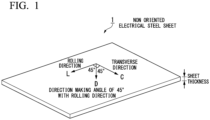
- Fig. 1 is a schematic illustration of a non oriented electrical steel sheet according to an embodiment of the present invention.
- Fig. 1 shows a schematic illustration of a non oriented electrical steel sheet according to the embodiment of the present invention.
- the non oriented electrical steel sheet according to the present embodiment contains Si, optional elements as necessary, and a balance consisting of Fe and impurities. Hereinafter, each element is explained.
- the C content is an element contained as an impurity and deteriorates the magnetic characteristics.
- the C content is to be 0.005% or less.
- the C content is 0.003% or less. Since it is preferable that the C content is low, a lower limit does not need to be limited, and the lower limit may be 0%. However, it is not easy to industrially control the content to be 0%, and thus, the lower limit may be more than 0% or 0.0010%.
- Si 1.0% or more and 5.0% or less
- Si is an element that is effective in increasing electrical resistivity of the steel sheet and reducing iron loss.
- the Si content is to be 1.0% or more.
- Si is an effective element for the non oriented electrical steel sheet for the iron core of motor to achieve small magnetic anisotropy and small mechanical anisotropy.
- the Si content is preferably more than 3.25%, more preferably 3.27% or more, further more preferably 3.30% or more, and further more preferably 3.40% or more.
- the Si content is to be 5.0% or less.
- the Si content is preferably 4.0% or less, and more preferably 3.5% or less.
- sol. Al 0% or more and less than 2.5%
- Al is an optional element that is effective in increasing the electrical resistivity of the steel sheet and reducing the iron loss.
- the sol. Al content is to be less than 2.5%.
- a lower limit of sol. Al does not need to be limited, and the lower limit may be 0%.
- the sol. Al content is preferably 0.10% or more.
- the sol. Al expresses acid-soluble aluminum.
- Si and Al are elements effective in achieving small magnetic anisotropy and small mechanical anisotropy.
- the total amount of Si and sol. Al is preferably more than 4.0%, more preferably more than 4.10%, and further more preferably more than 4.15%.
- Si and Al have a strong effect on solid solution strengthening. When the content is excessive, cold rolling becomes difficult to be performed.
- the total amount of Si and sol. Al is preferably less than 5.5%.
- Mn 0% or more and 3.0% or less
- Mn manganese
- Si silicon
- Al aluminum
- the Mn content is to be 3.0% or less.
- the Mn content is 2.5% or less.
- a lower limit of Mn does not need to be limited, and the lower limit may be 0%.
- the Mn content is preferably 0.0010% or more, and more preferably 0.010% or more.
- P phosphorus
- P is an element generally contained as an impurity.
- P has an effect in improving texture of the non oriented electrical steel sheet and thereby improving the magnetic characteristics.
- P may be included as necessary.
- P is a solid solution strengthening element.
- the P content is to be 0.3% or less.
- the P content is preferably 0.2% or less.
- a lower limit of P does not need to be limited, and the lower limit may be 0%. In order to reliably obtain the above effect, the P content is preferably 0.0010% or more, and more preferably 0.015% or more.
- the S content is to be 0.01% or less.
- the S content is preferably 0.005% or less, and more preferably 0.003% or less. Since it is preferable that the S content is low, a lower limit does not need to be limited, and the lower limit may be 0%. However, it is not easy to industrially control the content to be 0%, and thus, the lower limit may be 0.0001%.
- N 0% or more and 0.01% or less
- N nitrogen
- the N content is to be 0.01% or less.
- the N content is preferably 0.005% or less, and more preferably 0.003% or less. Since it is preferable that the N content is low, a lower limit does not need to be limited, and the lower limit may be 0%. However, it is not easy to industrially control the content to be 0%, and thus, the lower limit may be 0.0001% or more, may be more than 0.0015%, or may be 0.0025% or more.
- Sn (tin) and Sb (antimony) are optional elements having effect in improving the texture of the non oriented electrical steel sheet and thereby improving the magnetic characteristics (for instance, magnetic flux density).
- Sn and Sb may be included as necessary.
- the Sn content and the Sb content are to be 0.10% or less, respectively. Lower limits of Sn and Sb do not need to be limited, and the lower limits may be 0%.
- the Sn content is preferably 0.0010% or more, and more preferably 0.01% or more.
- the Sb content is preferably 0.0010% or more, more preferably 0.002% or more, further more preferably 0.01% or more, and further more preferably more than 0.025%.
- Ca is an optional element that suppresses precipitation of fine sulfides (MnS, Cu 2 S, or the like) by forming coarse sulfides.
- the Ca content is favorable, inclusions are controlled, the grain growth is improved during annealing, and thereby, the magnetic characteristics (for instance, iron loss) are improved.
- the content is excessive, the effect thereof is saturated, and the cost increases.
- the Ca content is to be 0.01% or less.
- the Ca content is preferably 0.008% or less, and more preferably 0.005% or less.
- a lower limit of Ca does not need to be limited, and the lower limit may be 0%.
- the Ca content is preferably 0.0003% or more.
- the Ca content is preferably 0.001% or more, and more preferably 0.003% or more.
- Cr Cr
- Cr Cr
- the Cr content is to be 5.0% or less.
- the Cr content is preferably 0.5% or less, and more preferably 0.1% or less.
- a lower limit of Cr does not need to be limited, and the lower limit may be 0%. In order to reliably obtain the above effect, the Cr content is preferably 0.0010% or more.
- Ni 0% or more and 5.0% or less
- Ni nickel
- the Ni content is an optional element that improves the magnetic characteristics (for instance, saturation magnetic flux density). However, when the content is excessive, the effect thereof is saturated, and the cost increases. Thus, the Ni content is to be 5.0% or less.
- the Ni content is preferably 0.5% or less, and more preferably 0.1% or less.
- a lower limit of Ni does not need to be limited, and the lower limit may be 0%. In order to reliably obtain the above effect, the Ni content is preferably 0.0010% or more.
- Cu copper
- Cu is an optional element that improves strength of the steel sheet.
- the saturation magnetic flux density may decrease, the effect thereof is saturated, and the cost increases.
- the Cu content is to be 5.0% or less.
- the Cu content is preferably 0.1 % or less.
- a lower limit of Cu does not need to be limited, and the lower limit may be 0%. In order to reliably obtain the above effect, the Cu content is preferably 0.0010% or more.
- Ce 0% or more and 0.10% or less
- Ce is an optional element that suppresses the precipitation of fine sulfides (MnS, Cu 2 S, or the like) by forming coarse sulfides coarse oxysulfides, or the like.
- the grain growth is improved, and the iron loss is improved.
- the Ce content is to be 0.10% or less.
- the Ce content is preferably 0.01% or less, more preferably 0.009% or less, and further more preferably 0.008% or less.
- a lower limit of Ce does not need to be limited, and the lower limit may be 0%.
- the Ce content is preferably 0.001% or more.
- the Ce content is more preferably 0.002% or more, more preferably 0.003% or more, and further more preferably 0.005% or more.
- the non oriented electrical steel sheet according to the present embodiment may contain, as a chemical composition, the optional elements such as B, O, Mg, Ti, V, Zr, Nd, Bi, W, Mo, Nb, and Y. Amounts of these optional elements may be controlled on the basis of known knowledge. For instance, the amounts of these optional elements may be as follows.
- non oriented electrical steel sheet according to the present embodiment may contain, as a chemical composition, by mass%, at least one of
- the B content is preferably 0.01% or less, the O content is preferably 0.01% or less, the Mg content is preferably 0.005% or less, the Ti content is preferably 0.002% or less, the V content is preferably 0.002% or less, the Zr content is preferably 0.002% or less, the Nd content is preferably 0.01% or less, the Bi content is preferably 0.01% or less, the W content is preferably 0.01% or less, the Mo content is preferably 0.01% or less, the Nb content is preferably 0.002% or less, and the Y content is preferably 0.01% or less.
- the Ti content is preferably 0.001% or more, the V content is preferably 0.002% or more, and the Nb content is preferably 0.002% or more.
- the chemical composition as described above may be measured by typical analytical methods for the steel.
- the chemical composition may be measured by using ICP-AES (Inductively Coupled Plasma-Atomic Emission Spectrometer: inductively coupled plasma emission spectroscopy spectrometry).
- the acid soluble Al may be measured by ICP-AES using filtrate after heating and dissolving the sample in acid.
- C and S may be measured by the infrared absorption method after combustion
- N may be measured by the thermal conductometric method after fusion in a current of inert gas
- O may be measured by, for instance, the non-dispersive infrared absorption method after fusion in a current of inert gas.
- the above chemical composition is that of the non oriented electrical steel sheet without insulation coating.
- the chemical composition is measured after removing the coating.
- the insulation coating may be removed by the following method. First, the non oriented electrical steel sheet having the insulation coating and the like is immersed in sodium hydroxide aqueous solution, sulfuric acid aqueous solution, and nitric acid aqueous solution in this order. The steel sheet after the immersion is washed. Finally, the steel sheet is dried with warm air. Thereby, it is possible to obtain the non oriented electrical steel sheet from which the insulation coating is removed. Alternatively, the insulation coating may be removed by grinding.
- an X1 value defined by the following expression 1 is to be less than 0.845.
- an X2 value defined by the following expression 2 is to be 0.800 or more.
- X 1 2 ⁇ B 50 L + B 50 C / 3 ⁇ I S .
- X 2 B 50 L + 2 ⁇ B 50 D + B 50 C / 4 ⁇ I S .
- I S in the expression 1 and expression 2 may be obtained by the following expression 3 and expression 4.
- the expression 3 is for obtaining the spontaneous magnetization assuming that the spontaneous magnetization of the steel sheet is simply attenuated by elements other than Fe.
- Density of the steel sheet in the expression 3 may be measured on the basis of JIS Z 8807:2012. In a case where the insulation coating is applied, the density may be measured by the above described method under condition such that the insulation coating exists, and the same value of the density is also used at the time of evaluating the magnetic characteristics described later. Density of Fe in the expression 3 may be 7.873 g/cm 3 .
- the X1 value is preferably 0.800 or more, and is preferably less than 0.830.
- the X2 value is preferably 0.805 or more, and is preferably 0.825 or less.
- an iron loss W 10/1k when excited so as to have the magnetic flux density of 1.0 T at frequency of 1 kHz is to be 80 W/kg or less.
- the iron loss W 10/1k is preferably 70 W/kg or less, and more preferably 49 W/kg or less.
- a lower limit of the iron loss W 10/1k does not need to be limited, the lower limit may be 30 W/kg as necessary.
- the magnetic characteristics may be measured on the basis of the single sheet tester (SST) method regulated by JIS C 2556: 2015.
- a test piece with smaller size for instance, a test piece of width 55 mm ⁇ length 55 mm
- the measurement based on the single sheet tester may be performed using two test pieces of width 8 mm ⁇ length 16 mm as a test piece of width 16 mm ⁇ length 16 mm.
- the average grain size is to be 30 ⁇ m or more and 200 ⁇ m or less.
- the average grain size may be measured on the basis of an intercept method regulated by JIS G 0551:2020.
- an average value of grain sizes may be measured by the intercept method along sheet thickness direction and rolling direction.
- an optical micrograph may be used, and for instance, a micrograph obtained at a magnification of 50-fold may be used.
- Sheet thickness is to be 0.35 mm or less.
- the sheet thickness is preferably 0.30 mm or less.
- the sheet thickness is to be 0.10 mm or more.
- the sheet thickness is preferably 0.15 mm or more.
- the sheet thickness may be measured by a micrometer.
- the sheet thickness is measured after removing the coating.
- the method for removing the insulation coating is as described above.
- the roundness after punching to be true circle is preferably more than 0.9997 and 1.0000 or less.
- a value (roundness) obtained by dividing a minimum value of a diameter of an outer circumference of the formed piece by a maximum value of a diameter of the outer circumference of the formed piece is preferably more than 0.9997 and 1.0000 or less.
- the above roundness is more than 0.9997, a shape accuracy of the punched piece can be regarded as high. As a result, when it is used for the motor, an increase in cogging torque and an increase in vibration noise can be favorably suppressed.
- the above roundness is preferably more than 0.9998, and more preferably 0.9999 or more.
- the roundness may be measured by the following method.
- the non oriented electrical steel sheet is punched using the die with the disc shape (true circle) of the outer diameter of 79.5 mm at a punching speed of 250 strokes/min by a 25 t continuous progressive press-working apparatus.
- the 60 sheets of punched pieces are laminated and fastened to form the core.
- the obtained disc-shaped core simulates the iron core for the rotor of the motor, and the roundness of the outer circumference can be used as an index of accuracy of an air gap with a stator core. Diameters of the outer circumference of the obtained disc-shaped core are measured at plural positions, and a ratio of a minimum value to a maximum value of the measured diameters is regarded as the roundness.
- the punching is conducted using the die with the disc shape (true circle) of the outer diameter of 79.5 mm and when the 60 sheets of punched pieces are laminated and fastened to be formed, the value obtained by dividing the minimum value of the diameter of the outer circumference of the formed piece by the maximum value of the diameter of the outer circumference of the formed piece is regarded as the roundness.
- the non oriented electrical steel sheet according to the present embodiment has small magnetic anisotropy and small mechanical anisotropy for the iron core of motor.
- the non oriented electrical steel sheet according to the present embodiment satisfies the X1 value of less than 0.845, the X2 value of 0.800 or more, and the iron loss W 10/1k of 80 W/kg or less, and as a result, it is possible to obtain the effect such that the roundness is excellent.
- the non oriented electrical steel sheet according to the present embodiment satisfies the X1 value of less than 0.830, the X2 value of 0.800 or more, and the iron loss W 10/1k of 49 W/kg or less, and as a result, it is possible to obtain the effect such that the roundness is more excellent. In this case, it can be judged that small magnetic anisotropy and small mechanical anisotropy are achieved for the iron core of motor.
- the non oriented electrical steel sheet according to the present embodiment Since the non oriented electrical steel sheet according to the present embodiment has small magnetic anisotropy and small mechanical anisotropy, it is suitable for the iron core of motor for electric vehicles, hybrid vehicles, or the like. Thus, an iron core including the non oriented electrical steel sheet according to the present embodiment exhibits excellent performance. Moreover, since the non oriented electrical steel sheet according to the present embodiment is suitable for the iron core of motor, a motor including the iron core exhibits excellent performance.
- the non oriented electrical steel sheet according to the present embodiment is not particularly limited in the manufacturing method as long as the above features are included.
- the following manufacturing method is an instance for manufacturing the non oriented electrical steel sheet according to the present embodiment and a favorable manufacturing method of the non oriented electrical steel sheet according to the present embodiment.
- the manufacturing method of the non oriented electrical steel sheet according to the present embodiment includes the following processes (A) to (D).
- the hot rolled steel sheet having the above chemical composition is subjected to cold rolling at the rolling reduction (cumulative rolling reduction) of 10% or larger and 75% or smaller.
- the rolling reduction in the first cold rolling process is smaller than 10% or larger than 75%, the intended magnetic characteristics and roundness may not be obtained.
- the rolling reduction in the first cold rolling process is to be 10% or larger and 75% or smaller.
- Conditions of the cold rolling other than the above are not particularly limited, and are appropriately selected depending on the chemical composition of the hot rolled steel sheet, the intended sheet thickness of the steel sheet, or the like.
- the hot rolled steel sheet is subject to cold rolling after a scale formed on a surface of the steel sheet during hot rolling is removed by pickling.
- the hot rolled steel sheet may be pickled either before the hot-band annealing or after the hot-band annealing.
- the cold rolled steel sheet obtained in the above first cold rolling process is subjected to intermediate annealing under condition such that an average heating rate from 500°C to 650°C is 300 °C/second or faster and 1000 °C/second or slower, a retention temperature is 700°C or higher and 1100°C or lower, a retention time is 10 seconds or longer and 300 seconds or shorter (0.0028 hours or longer and 0.0833 hours or shorter), and an average cooling rate from 700°C to 500°C is 25 °C/second or faster.
- Conditions of the intermediate annealing other than the above are not particularly limited.
- an upper limit of the average cooling rate from 700°C to 500°C does not need to be limited, the upper limit may be 70 °C/second as necessary.
- the retention temperature is preferably 850°C or higher.
- the retention time is preferably 180 seconds or shorter (0.05 hours or shorter).
- the average cooling rate from 700°C to 500°C is preferably 28 °C/second or faster.
- the Si content of more than 3.25%, the average heating rate from 500°C to 650°C of 300 °C/second or faster, the retention temperature of 850°C or higher, the retention time of 180 seconds or shorter, and the average cooling rate from 700°C to 500°C of 33 °C/second or faster are simultaneously satisfied in addition to satisfying the conditions of the present embodiment, it is possible to obtain the non oriented electrical steel sheet in which both desirable magnetic characteristics and roundness are simultaneously and preferably achieved.
- the intermediate-annealed steel sheet obtained in the above intermediate annealing process is subjected to cold rolling at the rolling reduction (cumulative rolling reduction) of 50% or larger and 85% or smaller to obtain the sheet thickness of 0.10 mm or more and 0.35 mm or less.
- the rolling reduction in the second cold rolling process is smaller than 50% or larger than 85%, the intended magnetic characteristics and roundness may not be obtained.
- the rolling reduction in the second cold rolling process is to be 50% or larger and 85% or smaller.
- the sheet thickness is to be 0.10 mm or more and 0.35 mm or less.
- the sheet thickness is preferably 0.15 mm or more and 0.30 mm or less.
- Conditions of the cold rolling other than the above are not particularly limited, and are appropriately selected depending on the chemical composition of the steel sheet, the intended sheet thickness of the steel sheet, or the like.
- the cold rolled steel sheet obtained in the above second cold rolling process is subjected to final annealing at the temperature range to be retained of 900°C or higher and 1200°C or lower.
- the final annealing temperature in the final annealing process is lower than 900°C, the average grain size may become less than 30 ⁇ m due to insufficient grain growth, and thereby sufficient magnetic characteristics may not be obtained.
- the final annealing temperature is to be 900°C or higher.
- the final annealing temperature is higher than 1200°C, the grain growth may proceed excessively, the average grain size may become more than 200 ⁇ m, and thereby sufficient magnetic characteristics may not be obtained.
- the final annealing temperature is to be 1200°C or lower.
- the final annealing time for retaining the cold rolled steel sheet in the temperature range of 900°C or higher and 1200°C or lower may not be particularly specified, but it is preferably 1 second or longer to more reliably obtain favorable magnetic characteristics. On the other hand, from a productive standpoint, the final annealing time is preferably 120 seconds or shorter.
- Conditions of the final annealing other than the above are not particularly limited.
- the hot rolled steel sheet to be subjected to the above first cold rolling process may be subjected to hot-band annealing.
- hot-band annealing it is possible to obtain favorable magnetic characteristics.
- the hot-band annealing may be performed by either box annealing or continuous annealing.
- the hot rolled steel sheet is preferably retained in a temperature range of 700°C or higher and 900°C or lower for 1 hour or longer and 20 hours or shorter.
- the hot rolled steel sheet is preferably retained in a temperature range of 850°C or higher and 1100°C or lower for 1 second or longer and 180 seconds or shorter.
- Conditions of the hot-band annealing other than the above are not particularly limited.
- the hot rolled steel sheet to be subjected to the first cold rolling process can be obtained by subjecting a steel ingot or steel piece (hereinafter referred to as "slab") having the above chemical composition to hot rolling.
- slab steel ingot or steel piece
- a steel having the above chemical composition is made into the slab by typical methods such as continuous casting or blooming the steel ingot.
- the slab is put into a heating furnace and then subjected to hot rolling. At this time, when the slab temperature is high, the hot rolling may be performed without putting the slab into the heating furnace.
- Conditions of the hot-band annealing are not particularly limited.
- a coating process of applying an insulation coating including only an organic component, only an inorganic component, or an organic-inorganic compound to a surface of the steel sheet may be performed by typical methods. From a standpoint of reducing an environmental load, an insulation coating that does not include chromium may be applied. Moreover, the coating process may be a process of applying an insulation coating that is adhesiveness by heating and pressurizing. As coating material exhibiting adhesiveness, an acrylic resin, a phenol resin, an epoxy resin, a melamine resin, or the like can be used.
- An iron core may be manufactured using the non oriented electrical steel sheet according to the present embodiment obtained as described above.
- a manufacturing method of the iron core may include a process of punching and laminating the above non oriented electrical steel sheet.
- a motor may be manufactured using the iron core.
- a manufacturing method of the motor may include a process of preparing an iron core by punching and laminating the above non oriented electrical steel sheet, and a process of assembling the motor using the iron core.
- the condition in the examples is an example condition employed to confirm the operability and the effects of the present invention, so that the present invention is not limited to the example condition.
- the present invention can employ various types of conditions as long as the conditions do not depart from the scope of the present invention and can achieve the object of the present invention.
- the present invention is explained in detail with reference to examples and comparative examples.
- Non oriented electrical steel sheets were prepared by performing each process under the conditions shown in Tables 1 to 16 using slabs whose chemical compositions were adjusted. Moreover, in a case where hot-band annealing was not performed, pickling was performed after hot rolling. In a case where hot-band annealing was performed, pickling for Test No. 1, 7, and 19 was performed before the hot-band annealing, and pickling for the others was performed after the hot-band annealing. Moreover, a retention time of the final annealing was 30 seconds.
- a chemical composition, a sheet thickness, an average grain size, an X1 value and an X2 value related to a magnetic flux density, an iron loss W 10/1k , and a roundness of the prepared non oriented electrical steel sheet were measured. Measurement methods thereof are as described above. Measurement results are shown in Tables 1 to 16.
- a chemical composition of the prepared non oriented electrical steel sheet was substantially the same as a chemical composition of the slab.
- the element represented by "-" in the table indicates that it was not consciously controlled and prepared.
- the Si content indicated by "3.3” in the table was more than 3.25%.
- the manufacturing condition represented by "-" in the table indicates that it was not controlled.
- a sheet thickness of the prepared non oriented electrical steel sheet was the same as a final sheet thickness after second cold rolling process.
- a roundness was defined as a ratio of maximum and minimum values of a diameter of an outer circumference of the above disc-shaped core, and the roundness was evaluated using the following criteria.
- the present invention it is possible to provide the non oriented electrical steel sheet with small magnetic anisotropy and small mechanical anisotropy for the iron core of motor, the iron core, the manufacturing method of the iron core, the motor and the manufacturing method of the motor. Accordingly, the present invention has significant industrial applicability.
Landscapes
- Chemical & Material Sciences (AREA)
- Engineering & Computer Science (AREA)
- Metallurgy (AREA)
- Organic Chemistry (AREA)
- Mechanical Engineering (AREA)
- Materials Engineering (AREA)
- Physics & Mathematics (AREA)
- Power Engineering (AREA)
- Electromagnetism (AREA)
- Manufacturing & Machinery (AREA)
- Crystallography & Structural Chemistry (AREA)
- Thermal Sciences (AREA)
- Dispersion Chemistry (AREA)
- Soft Magnetic Materials (AREA)
- Manufacturing Of Steel Electrode Plates (AREA)
- Manufacturing Cores, Coils, And Magnets (AREA)
- Iron Core Of Rotating Electric Machines (AREA)
Abstract
Description
- The present invention relates to a non oriented electrical steel sheet. More specifically, the present invention relates to a non oriented electrical steel sheet, which is suitable for iron cores of motors for electric vehicles, hybrid vehicles, or the like, an iron core, a manufacturing method of the iron core, a motor, and a manufacturing method of the motor.
- Priority is claimed on
Japanese Patent Application No. 2021-126290 filed on July 30, 2021 - Due to a need to reduce global warming gases, products with less energy consumption have been developed in industrial fields. For instance, in a field of an automobile, there are fuel-efficient vehicles such as hybrid-driven vehicles that combine a gasoline engine and a motor, and motor-driven electric vehicles. A technology common to these fuel-efficient vehicles is a motor, and increasing an efficiency of the motor has become an important technology.
- In General, a motor includes a stator and a rotor. As an iron core for the stator, there are an integrally punched iron core and a segmented iron core. For the integrally punched iron core and the segmented iron core, there is a demand for a non oriented electrical steel sheet having excellent magnetic characteristics in a rolling direction (hereinafter referred to as "L direction") and in a transverse direction (hereinafter referred to as "C direction").
- As an iron core for the rotor, for instance, there is the iron core for the rotor of an interior permanent magnet motor (IPM motor). The permanent magnets are embedded inside the rotor core of the IPM motor. Thus, for this iron core, there is a demand for a non oriented electrical steel sheet having excellent mechanical properties in addition to excellent magnetic characteristics.
- In addition, the motor shows excellent performance in a case where a gap between the stator and the rotor becomes smaller as an internal structure of the motor. Thus, each component of the motor is required to have a high shape accuracy. For instance, the above integrally punched iron core is formed by punching a steel sheet blank to be a hollow disc shape, and the above iron core for the rotor of the IPM motor is formed by punching the steel sheet blank to be a disc shape. However, in a case where the steel sheet blank is punched to be the hollow disc shape or the disc shape, the shape accuracy after punching may be deteriorated due to mechanical anisotropy of the steel sheet blank. Therefore, for these iron cores, it is desired for the non oriented electrical steel sheet to have small mechanical anisotropy.
- For instance,
Patent Document 1 discloses a technique related to a non oriented electrical steel sheet having excellent magnetic characteristics. Patent Document 2 discloses a technique related to a non oriented electrical steel sheet that can improve efficiency of a motor including a segmented iron core. Patent Document 3 discloses a technique related to a non oriented electrical steel sheet having excellent magnetic characteristics. -
- [Patent Document 1]
Japanese Patent (Granted) Publication No. 5447167 - [Patent Document 2]
Japanese Patent (Granted) Publication No. 5716315 - [Patent Document 3]
PCT International Publication No. WO2013/069754 - The present invention has been made in consideration of the above mentioned situations. An object of the invention is to provide a non oriented electrical steel sheet with small magnetic anisotropy and small mechanical anisotropy for an iron core of motor, an iron core, a manufacturing method of the iron core, a motor, and a manufacturing method of the motor.
- An aspect of the present invention employs the following.
-
- (1) A non oriented electrical steel sheet according to an aspect of the present invention includes a chemical composition containing, by mass%,
- 0.005% or less of C,
- 1.0% or more and 5.0% or less of Si,
- less than 2.5% of sol. Al,
- 3.0% or less of Mn,
- 0.3% or less of P,
- 0.01% or less of S,
- 0.01% or less of N,
- 0.10% or less of B,
- 0.10% or less of O,
- 0.10% or less of Mg,
- 0.01% or less of Ca,
- 0.10% or less of Ti,
- 0.10% or less of V,
- 5.0% or less of Cr,
- 5.0% or less of Ni,
- 5.0% or less of Cu,
- 0.10% or less of Zr,
- 0.10% or less of Sn,
- 0.10% or less of Sb,
- 0.10% or less of Ce,
- 0.10% or less of Nd,
- 0.10% or less of Bi,
- 0.10% or less of W,
- 0.10% or less of Mo,
- 0.10% or less of Nb,
- 0.10% or less of Y, and
- a balance consisting of Fe and impurities, wherein
- a sheet thickness is 0.10 mm or more and 0.35 mm or less,
- an average grain size is 30 µm or more and 200 µm or less,
- an X1 value defined by the
following expression 1 is less than 0.845, - an X2 value defined by the following expression 2 is 0.800 or more, and
- an iron loss W10/1k when excited so as to be a magnetic flux density of 1.0 T at a frequency of 1 kHz is 80 W/kg or less,
- where the
expression 1 is X1 = (2 × B50L + B50C) / (3 × Is), - where the expression 2 is X2 = (B50L + 2 × B50D + B50C) / (4 × Is), and
- where B50L denotes a magnetic flux density in a rolling direction when magnetized with a magnetizing force of 5000 A/m, Bsoc denotes a magnetic flux density in a transverse direction when magnetized with a magnetizing force of 5000 Alm, B50D denotes a magnetic flux density in a direction making an angle of 45° with the rolling direction when magnetized with a magnetizing force of 5000 A/m, and Is denotes a spontaneous magnetization at room temperature.
- (2) In the non oriented electrical steel according to (1), the chemical composition may include, by mass%, more than 3.25% and 5.0% or less of Si.
- (3) In the non oriented electrical steel according to (1) or (2), the chemical composition may include, by mass%, at least one of
- 0.0010% or more and 0.005% or less of C,
- 0.10% or more and less than 2.5% of sol. Al,
- 0.0010% or more and 3.0% or less of Mn,
- 0.0010% or more and 0.3% or less of P,
- 0.0001% or more and 0.01% or less of S,
- 0.0015% or more and 0.01% or less of N,
- 0.0001% or more and 0.10% or less of B,
- 0.0001% or more and 0.10% or less of O,
- 0.0001% or more and 0.10% or less of Mg,
- 0.0003% or more and 0.01% or less of Ca,
- 0.0001% or more and 0.10% or less of Ti,
- 0.0001% or more and 0.10% or less of V,
- 0.0010% or more and 5.0% or less of Cr,
- 0.0010% or more and 5.0% or less of Ni,
- 0.0010% or more and 5.0% or less of Cu,
- 0.0002% or more and 0.10% or less of Zr,
- 0.0010% or more and 0.10% or less of Sn,
- 0.0010% or more and 0.10% or less of Sb,
- 0.001% or more and 0.10% or less of Ce,
- 0.002% or more and 0.10% or less of Nd,
- 0.002% or more and 0.10% or less of Bi,
- 0.002% or more and 0.10% or less of W,
- 0.002% or more and 0.10% or less of Mo,
- 0.0001% or more and 0.10% or less of Nb, and
- 0.002% or more and 0.10% or less of Y.
- (4) In the non oriented electrical steel according to any one of (1) to (3), the chemical composition may include, by mass%, more than 4.0% in total of Si and sol. Al.
- (5) In the non oriented electrical steel according to any one of (1) to (4), the X1 value may be 0.800 or more and less than 0.830.
- (6) In the non oriented electrical steel according to any one of (1) to (5), the X2 value may be 0.805 or more and 0.825 or less.
- (7) An iron core according to an aspect of the present invention may include the non oriented electrical steel sheet according to any one of (1) to (6).
- (8) A manufacturing method of an iron core according to an aspect of the present invention may include a process of punching and laminating the non oriented electrical steel sheet according to any one of (1) to (6).
- (9) A motor according to an aspect of the present invention may include the iron core according to (7).
- (10) A manufacturing method of a motor may include
- a process of preparing an iron core by punching and laminating the non oriented electrical steel sheet according to any one of (1) to (6) and
- a process of assembling the motor using the iron core.
- According to the above aspects of the present invention, it is possible to provide the non oriented electrical steel sheet with small magnetic anisotropy and small mechanical anisotropy for the iron core of motor, the iron core, the manufacturing method of the iron core, the motor, and the manufacturing method of the motor.
-
Fig. 1 is a schematic illustration of a non oriented electrical steel sheet according to an embodiment of the present invention. - Hereinafter, a preferable embodiment of the present invention is described in detail. However, the present invention is not limited only to the configuration which is disclosed in the embodiment, and various modifications are possible without departing from the aspect of the present invention. In addition, the limitation range as described below includes a lower limit and an upper limit thereof. However, the value expressed by "more than" or "less than" does not include in the limitation range. "%" of the amount of respective elements expresses "mass%".
-
Fig. 1 shows a schematic illustration of a non oriented electrical steel sheet according to the embodiment of the present invention. - Limitation reasons of the chemical composition of the non oriented electrical steel sheet according to the present embodiment are explained.
- As a chemical composition, the non oriented electrical steel sheet according to the present embodiment contains Si, optional elements as necessary, and a balance consisting of Fe and impurities. Hereinafter, each element is explained.
- C (carbon) is an element contained as an impurity and deteriorates the magnetic characteristics. Thus, the C content is to be 0.005% or less. Preferably, the C content is 0.003% or less. Since it is preferable that the C content is low, a lower limit does not need to be limited, and the lower limit may be 0%. However, it is not easy to industrially control the content to be 0%, and thus, the lower limit may be more than 0% or 0.0010%.
- Si (silicon) is an element that is effective in increasing electrical resistivity of the steel sheet and reducing iron loss. Thus, the Si content is to be 1.0% or more. Moreover, Si is an effective element for the non oriented electrical steel sheet for the iron core of motor to achieve small magnetic anisotropy and small mechanical anisotropy. In this case, the Si content is preferably more than 3.25%, more preferably 3.27% or more, further more preferably 3.30% or more, and further more preferably 3.40% or more. On the other hand, when the Si content is excessive, a magnetic flux density deteriorates significantly. Thus, the Si content is to be 5.0% or less. The Si content is preferably 4.0% or less, and more preferably 3.5% or less.
- Al (aluminum) is an optional element that is effective in increasing the electrical resistivity of the steel sheet and reducing the iron loss. However, when the content is excessive, the magnetic flux density deteriorates significantly. Thus, the sol. Al content is to be less than 2.5%. A lower limit of sol. Al does not need to be limited, and the lower limit may be 0%. In order to reliably obtain the above effect, the sol. Al content is preferably 0.10% or more. Herein, the sol. Al expresses acid-soluble aluminum.
- Moreover, Si and Al are elements effective in achieving small magnetic anisotropy and small mechanical anisotropy. Thus, the total amount of Si and sol. Al is preferably more than 4.0%, more preferably more than 4.10%, and further more preferably more than 4.15%. On the other hand, Si and Al have a strong effect on solid solution strengthening. When the content is excessive, cold rolling becomes difficult to be performed. Thus, the total amount of Si and sol. Al is preferably less than 5.5%.
- Mn (manganese) is an optional element that is effective in increasing the electrical resistivity of the steel sheet and reducing the iron loss. However, since an alloying cost of is higher than Si or Al, an increase in the Mn content is economically disadvantageous. Thus, the Mn content is to be 3.0% or less. Preferably, the Mn content is 2.5% or less. A lower limit of Mn does not need to be limited, and the lower limit may be 0%. In order to reliably obtain the above effect, the Mn content is preferably 0.0010% or more, and more preferably 0.010% or more.
- P (phosphorus) is an element generally contained as an impurity. However, P has an effect in improving texture of the non oriented electrical steel sheet and thereby improving the magnetic characteristics. Thus, P may be included as necessary. However, P is a solid solution strengthening element. When the P content is excessive, the steel sheet is hardened and thereby the cold rolling becomes difficult to be performed. Thus, the P content is to be 0.3% or less. The P content is preferably 0.2% or less. A lower limit of P does not need to be limited, and the lower limit may be 0%. In order to reliably obtain the above effect, the P content is preferably 0.0010% or more, and more preferably 0.015% or more.
- S (sulfur) is contained as an impurity and forms fine MnS by bonding to Mn in steel. As a result, S suppresses grain growth during annealing and deteriorates the magnetic characteristics of the non oriented electrical steel sheet. Thus, the S content is to be 0.01% or less. The S content is preferably 0.005% or less, and more preferably 0.003% or less. Since it is preferable that the S content is low, a lower limit does not need to be limited, and the lower limit may be 0%. However, it is not easy to industrially control the content to be 0%, and thus, the lower limit may be 0.0001%.
- N (nitrogen) is contained as an impurity and forms fine A1N by bonding to Al in steel. As a result, N suppresses the grain growth during annealing and deteriorates the magnetic characteristics. Thus, the N content is to be 0.01% or less. The N content is preferably 0.005% or less, and more preferably 0.003% or less. Since it is preferable that the N content is low, a lower limit does not need to be limited, and the lower limit may be 0%. However, it is not easy to industrially control the content to be 0%, and thus, the lower limit may be 0.0001% or more, may be more than 0.0015%, or may be 0.0025% or more.
- Sn (tin) and Sb (antimony) are optional elements having effect in improving the texture of the non oriented electrical steel sheet and thereby improving the magnetic characteristics (for instance, magnetic flux density). Thus, Sn and Sb may be included as necessary. However, when the content is excessive, the steel may become brittle and fracture may occur during cold rolling. Moreover, the magnetic characteristics are deteriorated. Thus, the Sn content and the Sb content are to be 0.10% or less, respectively. Lower limits of Sn and Sb do not need to be limited, and the lower limits may be 0%. In order to reliably obtain the above effect, the Sn content is preferably 0.0010% or more, and more preferably 0.01% or more. Moreover, the Sb content is preferably 0.0010% or more, more preferably 0.002% or more, further more preferably 0.01% or more, and further more preferably more than 0.025%.
- Ca (calcium) is an optional element that suppresses precipitation of fine sulfides (MnS, Cu2S, or the like) by forming coarse sulfides. When the Ca content is favorable, inclusions are controlled, the grain growth is improved during annealing, and thereby, the magnetic characteristics (for instance, iron loss) are improved. However, when the content is excessive, the effect thereof is saturated, and the cost increases. Thus, the Ca content is to be 0.01% or less. The Ca content is preferably 0.008% or less, and more preferably 0.005% or less. A lower limit of Ca does not need to be limited, and the lower limit may be 0%. In order to reliably obtain the above effect, the Ca content is preferably 0.0003% or more. The Ca content is preferably 0.001% or more, and more preferably 0.003% or more.
- Cr (chromium) is an optional element that increases the electrical resistivity and improves the magnetic characteristics (for instance, iron loss). However, when the content is excessive, a saturation magnetic flux density may decrease, the effect thereof is saturated, and the cost increases. Thus, the Cr content is to be 5.0% or less. The Cr content is preferably 0.5% or less, and more preferably 0.1% or less. A lower limit of Cr does not need to be limited, and the lower limit may be 0%. In order to reliably obtain the above effect, the Cr content is preferably 0.0010% or more.
- Ni (nickel) is an optional element that improves the magnetic characteristics (for instance, saturation magnetic flux density). However, when the content is excessive, the effect thereof is saturated, and the cost increases. Thus, the Ni content is to be 5.0% or less. The Ni content is preferably 0.5% or less, and more preferably 0.1% or less. A lower limit of Ni does not need to be limited, and the lower limit may be 0%. In order to reliably obtain the above effect, the Ni content is preferably 0.0010% or more.
- Cu (copper) is an optional element that improves strength of the steel sheet. However, when the content is excessive, the saturation magnetic flux density may decrease, the effect thereof is saturated, and the cost increases. Thus, the Cu content is to be 5.0% or less. The Cu content is preferably 0.1 % or less. A lower limit of Cu does not need to be limited, and the lower limit may be 0%. In order to reliably obtain the above effect, the Cu content is preferably 0.0010% or more.
- Ce (cerium) is an optional element that suppresses the precipitation of fine sulfides (MnS, Cu2S, or the like) by forming coarse sulfides coarse oxysulfides, or the like. As a result, the grain growth is improved, and the iron loss is improved. However, when the content is excessive, the iron loss may be deteriorated by forming oxides in addition to sulfides and oxysulfides, and the effect thereof is saturated, and the cost increases. Thus, the Ce content is to be 0.10% or less. The Ce content is preferably 0.01% or less, more preferably 0.009% or less, and further more preferably 0.008% or less. A lower limit of Ce does not need to be limited, and the lower limit may be 0%. In order to reliably obtain the above effect, the Ce content is preferably 0.001% or more. The Ce content is more preferably 0.002% or more, more preferably 0.003% or more, and further more preferably 0.005% or more.
- In addition to the above elements, the non oriented electrical steel sheet according to the present embodiment may contain, as a chemical composition, the optional elements such as B, O, Mg, Ti, V, Zr, Nd, Bi, W, Mo, Nb, and Y. Amounts of these optional elements may be controlled on the basis of known knowledge. For instance, the amounts of these optional elements may be as follows.
- B: 0% or more and 0.10% or less
- O: 0% or more and 0.10% or less
- Mg: 0% or more and 0.10% or less
- Ti: 0% or more and 0.10% or less
- V: 0% or more and 0.10% or less
- Zr: 0% or more and 0.10% or less
- Nd: 0% or more and 0.10% or less
- Bi: 0% or more and 0.10% or less
- W: 0% or more and 0.10% or less
- Mo: 0% or more and 0.10% or less
- Nb: 0% or more and 0.10% or less
- Y: 0% or more and 0.10% or less
- Moreover, the non oriented electrical steel sheet according to the present embodiment may contain, as a chemical composition, by mass%, at least one of
- 0.0010% or more and 0.005% or less of C,
- 0.10% or more and less than 2.5% of sol. Al,
- 0.0010% or more and 3.0% or less of Mn,
- 0.0010% or more and 0.3% or less of P,
- 0.0001% or more and 0.01% or less of S,
- 0.0015% or more and 0.01% or less of N,
- 0.0001% or more and 0.10% or less of B,
- 0.0001% or more and 0.10% or less of O,
- 0.0001% or more and 0.10% or less of Mg,
- 0.0003% or more and 0.01% or less of Ca,
- 0.0001% or more and 0.10% or less of Ti,
- 0.0001% or more and 0.10% or less of V,
- 0.0010% or more and 5.0% or less of Cr,
- 0.0010% or more and 5.0% or less of Ni,
- 0.0010% or more and 5.0% or less of Cu,
- 0.0002% or more and 0.10% or less of Zr,
- 0.0010% or more and 0.10% or less of Sn,
- 0.0010% or more and 0.10% or less of Sb,
- 0.001 % or more and 0.10% or less of Ce,
- 0.002% or more and 0.10% or less of Nd,
- 0.002% or more and 0.10% or less of Bi,
- 0.002% or more and 0.10% or less of W,
- 0.002% or more and 0.10% or less of Mo,
- 0.0001% or more and 0.10% or less of Nb, and
- 0.002% or more and 0.10% or less of Y.
- The B content is preferably 0.01% or less, the O content is preferably 0.01% or less, the Mg content is preferably 0.005% or less, the Ti content is preferably 0.002% or less, the V content is preferably 0.002% or less, the Zr content is preferably 0.002% or less, the Nd content is preferably 0.01% or less, the Bi content is preferably 0.01% or less, the W content is preferably 0.01% or less, the Mo content is preferably 0.01% or less, the Nb content is preferably 0.002% or less, and the Y content is preferably 0.01% or less. Moreover, the Ti content is preferably 0.001% or more, the V content is preferably 0.002% or more, and the Nb content is preferably 0.002% or more.
- The chemical composition as described above may be measured by typical analytical methods for the steel. For instance, the chemical composition may be measured by using ICP-AES (Inductively Coupled Plasma-Atomic Emission Spectrometer: inductively coupled plasma emission spectroscopy spectrometry). Herein, the acid soluble Al may be measured by ICP-AES using filtrate after heating and dissolving the sample in acid. In addition, C and S may be measured by the infrared absorption method after combustion, N may be measured by the thermal conductometric method after fusion in a current of inert gas, and O may be measured by, for instance, the non-dispersive infrared absorption method after fusion in a current of inert gas.
- The above chemical composition is that of the non oriented electrical steel sheet without insulation coating. When the non oriented electrical steel sheet to be the measurement sample has the insulation coating and the like on the surface, the chemical composition is measured after removing the coating. For instance, the insulation coating may be removed by the following method. First, the non oriented electrical steel sheet having the insulation coating and the like is immersed in sodium hydroxide aqueous solution, sulfuric acid aqueous solution, and nitric acid aqueous solution in this order. The steel sheet after the immersion is washed. Finally, the steel sheet is dried with warm air. Thereby, it is possible to obtain the non oriented electrical steel sheet from which the insulation coating is removed. Alternatively, the insulation coating may be removed by grinding.
- As the magnetic flux density, an X1 value defined by the following
expression 1 is to be less than 0.845. Moreover, an X2 value defined by the following expression 2 is to be 0.800 or more.

- B50L denotes the magnetic flux density in a rolling direction when magnetized with magnetizing force of 5000 A/m,
- Bsoc denotes the magnetic flux density in a transverse direction when magnetized with magnetizing force of 5000 A/m,
- B50D denotes the magnetic flux density in a direction making an angle of 45° with the rolling direction when magnetized with magnetizing force of 5000 A/m, and
- Is denotes spontaneous magnetization at room temperature.
- IS in the
expression 1 and expression 2 may be obtained by the following expression 3 and expression 4. The expression 3 is for obtaining the spontaneous magnetization assuming that the spontaneous magnetization of the steel sheet is simply attenuated by elements other than Fe. Density of the steel sheet in the expression 3 may be measured on the basis of JIS Z 8807:2012. In a case where the insulation coating is applied, the density may be measured by the above described method under condition such that the insulation coating exists, and the same value of the density is also used at the time of evaluating the magnetic characteristics described later. Density of Fe in the expression 3 may be 7.873 g/cm3.IS=2.16×{(density of steel sheet)/(density of Fe)×[Fe content (mass%)]/100 Fe content (mass%)=100(mass%)-[total amount (mass%) of C, Si, Mn, sol. Al, P, S, N, B, O, Mg, Ca, Ti, V, Cr, Ni, Cu, Zr, Sn, Sb, Ce, Nd, Bi, W, Mo, Nb, and Y] - In order to achieve small magnetic anisotropy and small mechanical anisotropy as the non oriented electrical steel sheet for the iron core of motor, the X1 value is preferably 0.800 or more, and is preferably less than 0.830. Moreover, in order to further improve a roundness, the X2 value is preferably 0.805 or more, and is preferably 0.825 or less.
- As the iron loss, an iron loss W10/1k when excited so as to have the magnetic flux density of 1.0 T at frequency of 1 kHz is to be 80 W/kg or less. The iron loss W10/1k is preferably 70 W/kg or less, and more preferably 49 W/kg or less. Although a lower limit of the iron loss W10/1k does not need to be limited, the lower limit may be 30 W/kg as necessary.
- The magnetic characteristics may be measured on the basis of the single sheet tester (SST) method regulated by JIS C 2556: 2015. Instead of taking a test piece with size regulated by JIS, a test piece with smaller size, for instance, a test piece of width 55 mm × length 55 mm, may be taken and measured on the basis of the single sheet tester. In a case where the test piece of width 55 mm × length 55 mm is hardly taken, the measurement based on the single sheet tester may be performed using two test pieces of width 8 mm × length 16 mm as a test piece of width 16 mm × length 16 mm. At that time, it is preferable to use an Epstein equivalent value which is converted so as to correspond to a measurement value with an Epstein tester regulated in JIS C 2550:2011.
- When grain size is excessively coarse or fine, the iron loss under high frequency may deteriorates. Thus, the average grain size is to be 30 µm or more and 200 µm or less.
- The average grain size may be measured on the basis of an intercept method regulated by JIS G 0551:2020. For instance, in a longitudinal sectional micrograph, an average value of grain sizes may be measured by the intercept method along sheet thickness direction and rolling direction. As the longitudinal sectional micrograph, an optical micrograph may be used, and for instance, a micrograph obtained at a magnification of 50-fold may be used.
- Sheet thickness is to be 0.35 mm or less. The sheet thickness is preferably 0.30 mm or less. On the other hand, when the sheet thickness is excessively thin, productivity of the steel sheet and motor deteriorates significantly. Thus, the sheet thickness is to be 0.10 mm or more. The sheet thickness is preferably 0.15 mm or more.
- The sheet thickness may be measured by a micrometer. When the non oriented electrical steel sheet to be the measurement sample has the insulation coating and the like on the surface, the sheet thickness is measured after removing the coating. The method for removing the insulation coating is as described above.
- In addition, as mechanical anisotropy, the roundness after punching to be true circle is preferably more than 0.9997 and 1.0000 or less. Specifically, when the punching is conducted using a die with a disc shape of an outer diameter of 79.5 mm and when 60 sheets of punched pieces are laminated and fastened to be formed, a value (roundness) obtained by dividing a minimum value of a diameter of an outer circumference of the formed piece by a maximum value of a diameter of the outer circumference of the formed piece is preferably more than 0.9997 and 1.0000 or less.
- When the above roundness is more than 0.9997, a shape accuracy of the punched piece can be regarded as high. As a result, when it is used for the motor, an increase in cogging torque and an increase in vibration noise can be favorably suppressed. The above roundness is preferably more than 0.9998, and more preferably 0.9999 or more.
- The roundness may be measured by the following method. The non oriented electrical steel sheet is punched using the die with the disc shape (true circle) of the outer diameter of 79.5 mm at a punching speed of 250 strokes/min by a 25 t continuous progressive press-working apparatus. The 60 sheets of punched pieces are laminated and fastened to form the core. The obtained disc-shaped core simulates the iron core for the rotor of the motor, and the roundness of the outer circumference can be used as an index of accuracy of an air gap with a stator core. Diameters of the outer circumference of the obtained disc-shaped core are measured at plural positions, and a ratio of a minimum value to a maximum value of the measured diameters is regarded as the roundness. Specifically, when the punching is conducted using the die with the disc shape (true circle) of the outer diameter of 79.5 mm and when the 60 sheets of punched pieces are laminated and fastened to be formed, the value obtained by dividing the minimum value of the diameter of the outer circumference of the formed piece by the maximum value of the diameter of the outer circumference of the formed piece is regarded as the roundness.
- The non oriented electrical steel sheet according to the present embodiment has small magnetic anisotropy and small mechanical anisotropy for the iron core of motor. For instance, the non oriented electrical steel sheet according to the present embodiment satisfies the X1 value of less than 0.845, the X2 value of 0.800 or more, and the iron loss W10/1k of 80 W/kg or less, and as a result, it is possible to obtain the effect such that the roundness is excellent. Moreover, when the chemical composition and manufacturing conditions are favorably controlled, the non oriented electrical steel sheet according to the present embodiment satisfies the X1 value of less than 0.830, the X2 value of 0.800 or more, and the iron loss W10/1k of 49 W/kg or less, and as a result, it is possible to obtain the effect such that the roundness is more excellent. In this case, it can be judged that small magnetic anisotropy and small mechanical anisotropy are achieved for the iron core of motor.
- Since the non oriented electrical steel sheet according to the present embodiment has small magnetic anisotropy and small mechanical anisotropy, it is suitable for the iron core of motor for electric vehicles, hybrid vehicles, or the like. Thus, an iron core including the non oriented electrical steel sheet according to the present embodiment exhibits excellent performance. Moreover, since the non oriented electrical steel sheet according to the present embodiment is suitable for the iron core of motor, a motor including the iron core exhibits excellent performance.
- Hereinafter, an instance of a manufacturing method of the non oriented electrical steel sheet according to the present embodiment is explained below. The non oriented electrical steel sheet according to the present embodiment is not particularly limited in the manufacturing method as long as the above features are included. The following manufacturing method is an instance for manufacturing the non oriented electrical steel sheet according to the present embodiment and a favorable manufacturing method of the non oriented electrical steel sheet according to the present embodiment.
- The manufacturing method of the non oriented electrical steel sheet according to the present embodiment includes the following processes (A) to (D).
- (A) A first cold rolling process of subjecting a hot rolled steel sheet having the chemical composition described above to cold rolling under conditions such that a rolling reduction is 10% or larger and 75% or smaller.
- (B) An intermediate annealing process of subjecting the cold rolled steel sheet obtained in the first cold rolling process to intermediate annealing under condition such that an average heating rate from 500°C to 650°C is 300 °C/second or faster and 1000 °C/second or slower, a retention temperature is 700°C or higher and 1100°C or lower, a retention time is 10 seconds or longer and 300 seconds or shorter (0.0028 hours or longer and 0.0833 hours or shorter), and an average cooling rate from 700°C to 500°C is 25 °C/second or faster.
- (C) A second cold rolling process of subjecting the intermediate-annealed steel sheet obtained in the intermediate annealing process to cold rolling under conditions such that a rolling reduction is 50% or larger and 85% or smaller to obtain a sheet thickness of 0.10 mm or more and 0.35 mm or less.
- (D) A final annealing process of subjecting the cold rolled steel sheet obtained in the second cold rolling process to final annealing under conditions such that a temperature range to be retained is 900°C or higher and 1200°C or lower.
- Each process is explained below.
- In the first cold rolling process, the hot rolled steel sheet having the above chemical composition is subjected to cold rolling at the rolling reduction (cumulative rolling reduction) of 10% or larger and 75% or smaller.
- When the rolling reduction in the first cold rolling process is smaller than 10% or larger than 75%, the intended magnetic characteristics and roundness may not be obtained. Thus, the rolling reduction in the first cold rolling process is to be 10% or larger and 75% or smaller.
- Conditions of the cold rolling other than the above, such as a steel sheet temperature during cold rolling and a diameter of the rolling roll, are not particularly limited, and are appropriately selected depending on the chemical composition of the hot rolled steel sheet, the intended sheet thickness of the steel sheet, or the like.
- In general, the hot rolled steel sheet is subject to cold rolling after a scale formed on a surface of the steel sheet during hot rolling is removed by pickling. As described later, in a case where the hot rolled steel sheet is subjected to hot-band annealing, the hot rolled steel sheet may be pickled either before the hot-band annealing or after the hot-band annealing.
- In the intermediate annealing process, the cold rolled steel sheet obtained in the above first cold rolling process is subjected to intermediate annealing under condition such that an average heating rate from 500°C to 650°C is 300 °C/second or faster and 1000 °C/second or slower, a retention temperature is 700°C or higher and 1100°C or lower, a retention time is 10 seconds or longer and 300 seconds or shorter (0.0028 hours or longer and 0.0833 hours or shorter), and an average cooling rate from 700°C to 500°C is 25 °C/second or faster.
- When the above conditions are not satisfied in the intermediate annealing process, the intended magnetic characteristics and roundness may not be obtained. Conditions of the intermediate annealing other than the above are not particularly limited.
- Although an upper limit of the average cooling rate from 700°C to 500°C does not need to be limited, the upper limit may be 70 °C/second as necessary.
- The retention temperature is preferably 850°C or higher. The retention time is preferably 180 seconds or shorter (0.05 hours or shorter). The average cooling rate from 700°C to 500°C is preferably 28 °C/second or faster. In particular, when the Si content of more than 3.25%, the average heating rate from 500°C to 650°C of 300 °C/second or faster, the retention temperature of 850°C or higher, the retention time of 180 seconds or shorter, and the average cooling rate from 700°C to 500°C of 33 °C/second or faster are simultaneously satisfied in addition to satisfying the conditions of the present embodiment, it is possible to obtain the non oriented electrical steel sheet in which both desirable magnetic characteristics and roundness are simultaneously and preferably achieved.
- In the second cold rolling process, the intermediate-annealed steel sheet obtained in the above intermediate annealing process is subjected to cold rolling at the rolling reduction (cumulative rolling reduction) of 50% or larger and 85% or smaller to obtain the sheet thickness of 0.10 mm or more and 0.35 mm or less.
- When the rolling reduction in the second cold rolling process is smaller than 50% or larger than 85%, the intended magnetic characteristics and roundness may not be obtained. Thus, the rolling reduction in the second cold rolling process is to be 50% or larger and 85% or smaller.
- The sheet thickness is to be 0.10 mm or more and 0.35 mm or less. The sheet thickness is preferably 0.15 mm or more and 0.30 mm or less.
- Conditions of the cold rolling other than the above, such as a steel sheet temperature during cold rolling and a diameter of the rolling roll, are not particularly limited, and are appropriately selected depending on the chemical composition of the steel sheet, the intended sheet thickness of the steel sheet, or the like.
- In the final annealing process, the cold rolled steel sheet obtained in the above second cold rolling process is subjected to final annealing at the temperature range to be retained of 900°C or higher and 1200°C or lower.
- When the final annealing temperature in the final annealing process is lower than 900°C, the average grain size may become less than 30 µm due to insufficient grain growth, and thereby sufficient magnetic characteristics may not be obtained. Thus, the final annealing temperature is to be 900°C or higher. On the other hand, when the final annealing temperature is higher than 1200°C, the grain growth may proceed excessively, the average grain size may become more than 200 µm, and thereby sufficient magnetic characteristics may not be obtained. Thus, the final annealing temperature is to be 1200°C or lower.
- The final annealing time for retaining the cold rolled steel sheet in the temperature range of 900°C or higher and 1200°C or lower may not be particularly specified, but it is preferably 1 second or longer to more reliably obtain favorable magnetic characteristics. On the other hand, from a productive standpoint, the final annealing time is preferably 120 seconds or shorter.
- Conditions of the final annealing other than the above are not particularly limited.
- The hot rolled steel sheet to be subjected to the above first cold rolling process may be subjected to hot-band annealing. When the hot rolled steel sheet is subjected to hot-band annealing, it is possible to obtain favorable magnetic characteristics.
- The hot-band annealing may be performed by either box annealing or continuous annealing. When the box annealing is performed, the hot rolled steel sheet is preferably retained in a temperature range of 700°C or higher and 900°C or lower for 1 hour or longer and 20 hours or shorter. When the continuous annealing is performed, the hot rolled steel sheet is preferably retained in a temperature range of 850°C or higher and 1100°C or lower for 1 second or longer and 180 seconds or shorter.
- Conditions of the hot-band annealing other than the above are not particularly limited.
- The hot rolled steel sheet to be subjected to the first cold rolling process can be obtained by subjecting a steel ingot or steel piece (hereinafter referred to as "slab") having the above chemical composition to hot rolling.
- In the hot rolling, a steel having the above chemical composition is made into the slab by typical methods such as continuous casting or blooming the steel ingot. The slab is put into a heating furnace and then subjected to hot rolling. At this time, when the slab temperature is high, the hot rolling may be performed without putting the slab into the heating furnace.
- Conditions of the hot-band annealing are not particularly limited.
- After the final annealing process, a coating process of applying an insulation coating including only an organic component, only an inorganic component, or an organic-inorganic compound to a surface of the steel sheet may be performed by typical methods. From a standpoint of reducing an environmental load, an insulation coating that does not include chromium may be applied. Moreover, the coating process may be a process of applying an insulation coating that is adhesiveness by heating and pressurizing. As coating material exhibiting adhesiveness, an acrylic resin, a phenol resin, an epoxy resin, a melamine resin, or the like can be used.
- An iron core may be manufactured using the non oriented electrical steel sheet according to the present embodiment obtained as described above. A manufacturing method of the iron core may include a process of punching and laminating the above non oriented electrical steel sheet. Moreover, a motor may be manufactured using the iron core. A manufacturing method of the motor may include a process of preparing an iron core by punching and laminating the above non oriented electrical steel sheet, and a process of assembling the motor using the iron core.
- The effects of an aspect of the present invention are described in detail with reference to the following examples. However, the condition in the examples is an example condition employed to confirm the operability and the effects of the present invention, so that the present invention is not limited to the example condition. The present invention can employ various types of conditions as long as the conditions do not depart from the scope of the present invention and can achieve the object of the present invention. Hereinafter, the present invention is explained in detail with reference to examples and comparative examples.
- Non oriented electrical steel sheets were prepared by performing each process under the conditions shown in Tables 1 to 16 using slabs whose chemical compositions were adjusted. Moreover, in a case where hot-band annealing was not performed, pickling was performed after hot rolling. In a case where hot-band annealing was performed, pickling for Test No. 1, 7, and 19 was performed before the hot-band annealing, and pickling for the others was performed after the hot-band annealing. Moreover, a retention time of the final annealing was 30 seconds.
- A chemical composition, a sheet thickness, an average grain size, an X1 value and an X2 value related to a magnetic flux density, an iron loss W10/1k, and a roundness of the prepared non oriented electrical steel sheet were measured. Measurement methods thereof are as described above. Measurement results are shown in Tables 1 to 16. Herein, a chemical composition of the prepared non oriented electrical steel sheet was substantially the same as a chemical composition of the slab. The element represented by "-" in the table indicates that it was not consciously controlled and prepared. Moreover, the Si content indicated by "3.3" in the table was more than 3.25%. Moreover, the manufacturing condition represented by "-" in the table indicates that it was not controlled. Moreover, a sheet thickness of the prepared non oriented electrical steel sheet was the same as a final sheet thickness after second cold rolling process.
- Moreover, as the mechanical anisotropy, a roundness was defined as a ratio of maximum and minimum values of a diameter of an outer circumference of the above disc-shaped core, and the roundness was evaluated using the following criteria.
- Excellent: Roundness is 0.9999 or more and 1.0000 or less.
- Very Good: Roundness is more than 0.9998 and less than 0.9999.
- Good: Roundness is more than 0.9997 and 0.9998 or less.
- Poor: Roundness is 0.9997 or less.
- As shown in Tables 1 to 16, among Test Nos. 1 to 91, inventive examples showed small magnetic anisotropy and small mechanical anisotropy as the non oriented electrical steel sheet. On the other hand, among Test Nos. 1 to 91, comparative examples were not excellent in at least one of the magnetic characteristics and the roundness.
[Table 1] No. STEEL TYPE MANUFACTURING RESULTS CHEMICAL COMPOSITION (UNIT: mass%, BALANCE CONSISTING OF Fe AND IMPURITIES) C Si Mn sol. Al P S N B O Mg Ca Ti V Cr Ni 1 S1 0.002 1.8 0.2 2.3 0.01 0.003 0.002 - 0.002 - - - - - - 2 S1 0.002 1.8 0.2 2.3 0.01 0.003 0.002 - 0.002 < - - - - - 3 S1 0.002 1.8 0.2 2.3 0.01 0.003 0.002 - 0.002 < - - - - - 4 S1 0.002 1.8 0.2 2.3 0.01 0.003 0.002 - 0.002 < - - - - - 5 S1 0.002 1.8 0.2 2.3 0.01 0.003 0.002 - 0.002 - - - - - - 6 S1 0.002 1.8 0.2 2.3 0.01 0.003 0.002 - 0.002 - - - - - - 7 S1 0.002 1.8 0.2 2.3 0.01 0.003 0.002 - 0.002 - - - - - - 8 S1 0.002 1.8 0.2 2.3 0.01 0.003 0.002 - 0.002 - - - - - - 9 S1 0.002 1.8 0.2 2.3 0.01 0.003 0.002 - 0.002 - - - - - - 10 S1 0.002 1.8 0.2 2.3 0.01 0.003 0.002 - 0.002 - - - - - - 11 S2 0.002 2.0 2.0 2.0 0.01 0.003 0.002 - 0.002 - - - - - - 12 S3 0.002 2.9 0.2 1.1 0.01 0.001 0.002 - 0.002 - - - - - - 13 S4 0.002 2.0 0.2 1.0 0.08 0.003 0.002 - 0.002 - - - - - - 14 S5 0.002 2.3 1.2 1.7 0.01 0.003 0.002 - 0.002 - - - - - - 15 S6 0.002 2.3 1.2 1.7 0.01 0.003 0.002 - 0.002 - 0.003 - - - - 16 S7 0.002 2.3 1.2 1.7 0.01 0.003 0.002 - 0.002 - - - - - - 17 S8 0.002 2.3 1.2 1.7 0.01 0.003 0.002 - 0.002 - 0.003 - - - - 18 S2 0.002 2.0 2.0 2.0 0.01 0.003 0.002 - 0.002 - - - - - - 19 S2 0.002 2.0 2.0 2.0 0.01 0.003 0.002 - 0.002 - - - - - - 20 S2 0.002 2.0 2.0 2.0 0.01 0.003 0.002 - 0.002 - - - - - - 21 S2 0.002 2.0 2.0 2.0 0.01 0.003 0.002 - 0.002 - - - - - - 22 S9 0.002 3.3 1.2 1.5 0.02 0.001 0.002 - 0.002 - - - - - - 23 S10 0.002 3.3 0.9 0.7 0.01 0.001 0.002 - 0.002 - - - - - - 24 S11 0.002 3.4 0.9 1.5 0.02 0.001 0.002 - 0.002 - - - - - - 25 S9 0.002 3.3 1.2 1.5 0.02 0.001 0.002 - 0.002 - - - - - - [Table 2] No. STEEL TYPE MANUFACTURING RESULTS CHEMICAL COMPOSITION (UNIT: mass%, BALANCE CONSISTING OF Fe AND IMPURITIES) C Si Mn sol. Al P S N B O Mg Ca Ti V Cr Ni 26 S12 0.002 3.6 0.9 0.7 0.01 0.001 0.002 - 0.002 - - - - - - 27 S13 0.002 3.7 0.5 1.1 0.03 0.002 0.002 - 0.002 - - - - - - 28 S14 0.003 3.5 0.5 0.3 0.03 0.002 0.002 - 0.002 - - - - - - 29 S15 0.002 3.6 0.5 0.3 0.03 0.001 0.002 - 0.002 - - - - - - 30 S16 0.003 3.7 0.5 0.3 0.03 0.002 0.002 - 0.002 - - - - - - 31 S17 0.002 3.4 1.2 1.7 0.05 0.002 0.002 - 0.002 - - - - - - 32 S18 0.002 3.6 1.2 1.7 0.05 0.002 0.002 - 0.002 - - - - - - 33 S19 0.002 3.8 1.2 1.7 0.20 0.002 0.002 - 0.002 - - - - - - 34 S20 0.002 3.3 0.9 0.7 0.01 0.001 0.002 0.0002 0.002 - - - - - - 35 S21 0.002 3.4 0.9 1.5 0.02 0.001 0.002 - 0.002 0.0001 - - - - - 36 S22 0.002 3.3 1.2 1.5 0.02 0.001 0.002 - 0.002 - - 0.0015 - - - 37 S23 0.002 3.6 0.9 0.7 0.01 0.001 0.002 - 0.002 - - - 0.0015 - - 38 S24 0.002 3.7 0.5 1.1 0.03 0.002 0.002 - 0.002 - - - - 0.002 - 39 S25 0.003 3.5 0.5 0.3 0.03 0.002 0.002 - 0.002 - - - - - 0.002 40 S26 0.002 3.6 0.5 0.3 0.03 0.001 0.002 - 0.002 - - - - - - 41 S27 0.003 3.7 0.5 0.3 0.03 0.002 0.002 - 0.002 - - - - - - 42 S28 0.002 3.4 1.2 1.7 0.05 0.002 0.002 - 0.002 - 0.003 - - - - 43 S29 0.002 3.5 1.2 1.7 0.05 0.002 0.002 - 0.002 - - - - - - 44 S30 0.002 3.7 1.1 1.3 0.05 0.002 0.002 - 0.002 - - - - - - 45 S31 0.002 3.3 0.9 0.7 0.01 0.001 0.002 0.0003 0.002 - - - - - - 46 S32 0.002 3.4 0.9 1.3 0.02 0.001 0.002 - 0.002 0.0005 - - - - - 47 S33 0.001 3.3 1.2 1.0 0.02 0.001 0.002 - 0.002 - - 0.0018 - - - 48 S34 0.001 3.6 0.9 0.7 0.01 0.001 0.002 - 0.002 - - - 0.0018 - - 49 S35 0.001 3.7 0.5 1.1 0.03 0.002 0.002 - 0.002 - - - - 0.035 - 50 S36 0.003 3.5 0.5 0.3 0.03 0.002 0.002 - 0.002 - - - - - 0.041 [Table 3] No. STEEL TYPE MANUFACTURING RESULTS CHEMICAL COMPOSITION (UNIT: mass%, BALANCE CONSISTING OF Fe AND IMPURITIES) C Si Mn sol. Al P S N B O Mg Ca Ti V Cr Ni 51 S37 0.002 3.6 0.5 0.3 0.03 0.001 0.002 - 0.002 - - - - - - 52 S38 0.003 3.7 0.2 0.3 0.03 0.002 0.002 - 0.002 - - - - - - 53 S39 0.002 3.4 1.2 1.2 0.05 0.002 0.002 - 0.002 - - - - - - 54 S40 0.002 3.6 1.2 1.1 0.05 0.002 0.002 - 0.002 - - - - - - 55 S41 0.002 3.8 1.2 0.9 0.05 0.002 0.002 - 0.002 - - - - - - 56 S42 0.002 3.3 0.9 0.7 0.01 0.001 0.002 0.0030 0.002 - - - - - - 57 S43 0.002 3.4 0.9 0.8 0.02 0.001 0.002 - 0.002 0.0150 - - - - - 58 S44 0.001 3.3 1.2 0.8 0.02 0.001 0.002 - 0.002 - - 0.0025 - - - 59 S45 0.001 3.6 0.9 0.7 0.01 0.001 0.002 - 0.002 - - - 0.0035 - - 60 S46 0.001 3.7 0.5 0.3 0.03 0.002 0.002 - 0.002 - - - - 1.500 - 61 S47 0.003 3.5 0.5 0.3 0.03 0.002 0.002 - 0.002 - - - - - 1.200 62 S48 0.002 3.6 0.2 0.3 0.03 0.001 0.002 - 0.002 - - - - - - 63 S49 0.003 3.7 0.5 0.3 0.03 0.002 0.002 - 0.002 - - - - - - 64 S50 0.002 3.4 1.2 0.8 0.05 0.002 0.002 - 0.002 - - - - - - 65 S51 0.002 3.8 0.2 0.3 0.01 0.002 0.002 - 0.002 - - - - - - 66 S52 0.002 4.2 0.2 0.3 0.01 0.002 0.002 - 0.002 - - - - - - 67 S53 0.002 0.8 0.2 1.2 0.01 0.001 0.002 0.0003 0.002 - - - - - - 68 S54 0.002 5.5 1.2 1.7 0.05 0.002 0.002 - 0.002 - - - - - - 69 S55 0.002 1.2 3.5 0.3 0.02 0.001 0.002 - 0.002 0.0005 - - - - - 70 S56 0.001 1.5 1.2 3.5 0.02 0.001 0.002 - 0.002 - - - - - - 71 S57 0.001 1.5 0.9 0.7 0.35 0.001 0.002 - 0.002 - - - - - - 72 S58 0.001 1.2 0.5 1.1 0.03 0.020 0.002 - 0.002 - - - - - - 73 S59 0.003 2.0 0.5 0.3 0.03 0.002 0.020 - 0.002 - - 0.085 - - - 74 S60 0.001 2.8 0.5 1.1 0.03 0.001 0.002 - 0.002 - - - - 5.600 - 75 S61 0.003 2.8 0.5 0.3 0.03 0.002 0.002 - 0.002 - - - - - 5.200 [Table 4] No. STEEL TYPE MANUFACTURING RESULTS CHEMICAL COMPOSITION (UNIT: mass%. BALANCE CONSISTING OF Fe AND IMPURITIES) C Si Mn sol. Al P S N B O Mg Ca Ti V Cr Ni 76 S62 0.002 2.8 0.5 0.3 0.03 0.001 0.002 - 0.002 - - - - - - 77 S63 0.003 1.2 0.5 0.3 0.03 0.009 0.008 0.110 0.080 0.150 0.020 - - - - 78 S64 0.002 3.9 0.2 2.1 0.15 0.002 0.002 - 0.002 - - - - - - 79 S65 0.002 3.9 0.2 2.1 0.15 0.009 0.002 - 0.002 - - - - - - 80 S66 0.002 1.2 0.2 2.1 0.06 0.002 0.002 - 0.002 - - 0.1530 0.123 - - 81 S67 0.002 1.2 0.2 2.1 0.06 0.002 0.002 - 0.002 - - - - - - 82 S68 0.002 1.2 0.2 2.1 0.06 0.002 0.002 - 0.002 - - - - - - 83 S69 0.002 2.5 0.9 1.1 0.02 0.001 0.002 - 0.002 0.0001 - - - - - 84 S69 0.002 2.5 0.9 1.1 0.02 0.001 0.002 - 0.002 0.0001 - - - - - 85 S69 0.002 2.5 0.9 1.1 0.02 0.001 0.002 - 0.002 0.0001 - - - - - 86 S70 0.002 3.3 0.9 1.1 0.02 0.001 0.002 - 0.002 0.0001 - - - - - 87 S70 0.002 3.3 0.9 1.1 0.02 0.001 0.002 - 0.002 0.0001 - - - - - 88 S71 0.002 2.8 0.9 2.3 0.02 0.001 0.002 - 0.002 0.0001 - - - - - 89 S70 0.002 3.3 0.9 1.1 0.02 0.001 0.002 - 0.002 0.0001 - - - - - 90 S72 0.002 3.3 0.9 1.5 0.02 0.001 0.002 - 0.002 0.0001 - - - - - 91 S72 0.002 3.3 0.9 1.5 0.02 0.001 0.002 - 0.002 0.0001 - - - - - [Table 5] No. STEEL TYPE MANUFACTURING RESULTS CHEMICAL COMPOSITION (UNIT: mass%, BALANCE CONSISTING OF Fe AND IMPURITIES) DENSITY Is Cu Zr Sn Sb Ce Nd Bi W Mo Nb Y Si + sol. Al g/cm3 T 1 S1 - - - - - - - - - - - 4.1 7.516 1.973 2 S1 - - - - - - - - - - - 4.1 7.516 1.973 3 S1 - - - - - - - - - - - 4.1 7.516 1.973 4 S1 - - - - - - - - - - - 4.1 7.516 1.973 5 S1 - - - - - - - - - - - 4.1 7.516 1.973 6 S1 - - - - - - - - - - - 4.1 7.516 1.973 7 S1 - - - - - - - - - - - 4.1 7.516 1.973 8 S1 - - - - - - - - - - - 4.1 7.516 1.973 9 S1 - - - - - - - - - - - 4.1 7.516 1.973 10 S1 - - - - - - - - - - - 4.1 7.516 1.973 11 S2 - - - - - - - - - - - 4.0 7.520 1.939 12 S3 - - - - - - - - - - - 4.0 7.570 1.989 13 S4 - - - - - - - - - - - 3.0 7.640 2.027 14 S5 - - 0.020 - - - - - - - - 4.0 7.554 1.964 15 S6 - - 0.020 - - - - - - - - 4.0 7.546 1.962 16 S7 - - - 0.030 - - - - - - - 4.0 7.542 1.961 17 S8 - - - 0.030 - - - - - - - 4.0 7.532 1.958 18 S2 - - - - - - - - - - - 4.0 7.520 1.939 19 S2 - - - - - - - - - - - 4.0 7.520 1.939 20 S2 - - - - - - - - - - - 4.0 7.520 1.939 21 S2 - - - - - - - - - - - 4.0 7.520 1.939 22 S9 - - - - - - - - - - - 4.8 7.480 1.928 23 S10 - - - - - - - - - - - 4.0 7.569 1.974 24 S11 - - - - - - - - - - - 4.9 7.476 1.932 25 S9 - - - - - - - - - - - 4.8 7.480 1.928 [Table 6] No. STEEL TYPE MANUFACTURING RESULTS CHEMICAL COMPOSITION (UNIT: mass%, BALANCE CONSISTING OF Fe AND IMPURITIES) DENSITY Is Cu Zr Sn Sb Ce Nd Bi W Mo Nb Y Si + sol. Al g/cm3 T 26 S12 - - - - - - - - - - - 4.3 7.549 1.963 27 S13 - - - - - - - - - - - 4.8 7.503 1.949 28 S14 - - - - - - - - - - - 3.8 7.602 1.995 29 S15 - - - - - - - - - - - 3.9 7.596 1.992 30 S16 - - - - - - - - - - - 4.0 7.590 1.988 31 S17 - - - - - - - - - - - 5.1 7.452 1.914 32 S18 - - - - - - - - - - - 5.3 7.439 1.907 33 S19 - - - - - - - - - - - 5.5 7.426 1.897 34 S20 - - - - - 0.003 - - - - - 4.0 7.569 1.974 35 S21 - - - - - - 0.002 - - - - 4.9 7.476 1.931 36 S22 - - - - - - - 0.003 - - - 4.8 7.480 1.928 37 S23 - - - - - - - - 0.003 - - 4.3 7.549 1.963 38 S24 - - - - - - - - - 0.002 - 4.8 7.503 1.949 39 S25 - - - - - - - - - - 0.003 3.8 7.602 1.995 40 S26 0.002 - - - - - - - - - - 3.9 7.596 1.991 41 S27 - 0.0005 - - - - - - - - - 4.0 7.590 1.988 42 S28 - - 0.031 - - - - - - - - 5.1 7.452 1.914 43 S29 - - - 0.005 - - - - - - - 5.2 7.445 1.911 44 S30 - - - - 0.003 - - - - - - 5.0 7.477 1.925 45 S31 - - - - - 0.005 - - - - - 4.0 7.569 1.974 46 S32 - - - - - - 0.003 - - - - 4.7 7.497 1.941 47 S33 - - - - - - - 0.005 - - - 4.3 7.534 1.953 48 S34 - - - - - - - - 0.005 - - 4.3 7.549 1.963 49 S35 - - - - - - - - - 0.002 - 4.8 7.503 1.948 50 S36 - - - - - - - - - - 0.004 3.8 7.602 1.994 [Table 7] No. STEEL TYPE MANUFACTURING RESULTS CHEMICAL COMPOSITION (UNIT: mass%, BALANCE CONSISTING OF Fe AND IMPURITIES) DENSITY Is Cu Zr Sn Sb Ce Nd Bi W Mo Nb Y Si + sol. Al g/cm3 T 51 S37 0.047 - - - - - - - - - - 3.9 7.596 1.991 52 S38 - 0.0081 - - - - - - - - - 4.0 7.592 1.994 53 S39 - - 0.055 - - - - - - - - 4.6 7.506 1.937 54 S40 - - - 0.048 - - - - - - - 4.7 7.504 1.935 55 S41 - - - - 0.004 - - - - - - 4.7 7.512 1.938 56 S42 - - - - - 0.005 - - - - - 4.0 7.569 1.974 57 S43 - - - - - - 0.003 - - - - 4.2 7.551 1.965 58 S44 - - - - - - - 0.009 - - - 4.1 7.555 1.962 59 S45 - - - - - - - - 0.009 - - 4.3 7.549 1.963 60 S46 - - - - - - - - - 0.020 - 4.0 7.590 1.956 61 S47 - - - - - - - - - - 0.040 3.8 7.602 1.969 62 S48 1.800 - - - - - - - - - - 3.9 7.598 1.961 63 S49 - 0.0081 - - - - - - - - - 4.0 7.590 1.988 64 S50 - - 0.080 - - - - - - - - 4.2 7.549 1.956 65 S51 - - - 0.090 - - - - - - - 4.1 7.586 1.989 66 S52 - - - - 0.040 - - - - - - 4.5 7.560 1.975 67 S53 - - - - - 0.080 - - - - - 2.0 7.681 2.059 68 S54 - - - - - - - - - - - 7.2 7.317 1.838 69 S55 - - - - - - - - - - - 1.5 7.725 2.013 70 S56 - - - - - - - - - - - 5.0 7.379 1.898 71 S57 - - - - - - - - - - - 2.2 7.683 2.035 72 S58 - - - - - - - - - - - 2.3 7.663 2.042 73 S59 - - - - - - - - - - - 2.3 7.698 2.050 74 S60 - - - - - - - - - - - 3.9 7.561 1.866 75 S61 - - - - - - - - - - - 3.1 7.647 1.913 [Table 8] No. STEEL TYPE MANUFACTURING RESULTS CHEMICAL COMPOSITION (UNIT: mass%, BALANCE CONSISTING OF Fe AND IMPURITIES) DENSITY Is Cu Zr Sn Sb Ce Nd Bi W Mo Nb Y Si + sol. Al g/cm3 T 76 S62 5.300 - - - - - - - - - - 3.1 7.647 1.911 77 S63 - 0.153 - - - - - - - - - 1.5 7.750 2.072 78 S64 - - 0.210 - - - - - - - - 6.0 7.384 1.893 79 S65 - - - 0.210 0.150 - - - - - - 6.0 7.384 1.890 80 S66 - - - - - - - - - 0.159 - 3.3 7.558 1.990 81 S67 - - - - - 0.130 0.142 - - - 0.151 3.3 7.558 1.991 82 S68 - - - - - - - 0.152 0.154 - - 3.3 7.558 1.993 83 S69 - - - - - - - - - - - 3.6 7.577 1.985 84 S69 - - - - - - - - - - - 3.6 7.577 1.985 85 S69 - - - - - - - - - - - 3.6 7.577 1.985 86 S70 - - - - - - - - - - - 4.4 7.525 1.955 87 S70 - - - - - - - - - - - 4.4 7.525 1.955 88 S71 - - - - - - - - - - - 5.1 7.428 1.915 89 S70 - - - - - - - - - - - 4.4 7.525 1.955 90 S72 - - - - - - - - - - - 4.8 7.482 1.935 91 S72 - - - - - - - - - - - 4.8 7.482 1.935 [Table 9] No. STEEL TYPE MANUFACTURING CONDITIONS SHEET THICKNESS OF HOT ROLLED STEEL SHEET HOT BAND ANNEALING FIRST COLD ROLLING INTERMEDIATE ANNEALING SECOND COLD ROLLING FINAL ANNEALING TEMPERATURE RETENTION TEMPERATURE RETENTION TIME ROLLING REDUCTION INTERMEDIATE SHEET THICKNESS RETENT ION TEMPERATURE RETENTION TIME AVERAGE HEATING RATE FROM 500°C TO 650°C AVERAGE COOLING RATE FROM 700°C TO 500°C ROLLING REDUCTION FINAL SHEET THICKNESS mm °C hour % mm °C second °C/sec °C/sec % mm °C 1 S1 2.20 900 10 31.8 1.50 800 36000 0.011 0.011 80.0 0.30 1050 2 S1 2.30 - - 65.2 0.80 800 36000 0.011 0.011 75.0 0.20 1180 3 S1 2.30 - - 73.9 0.60 800 36000 0.011 0.011 66.8 0.20 1080 4 S1 2.20 - - 68.2 0.70 750 108000 0.011 0.011 64.3 0.25 950 5 S1 2.20 - - 60.9 0.86 900 36000 0.011 0.011 65.1 0.30 1050 6 S1 2.30 - - 56.5 1.00 800 36000 0.011 0.011 59.9 0.40 1000 7 S1 2.20 900 10 0.0 2.20 - - - - 86.5 0.30 1050 8 S1 2.19 - - 56.5 0.95 800 36000 0.011 0.011 47.4 0.50 950 9 S1 2.16 - - 65.2 0.75 800 36000 0.011 0.011 46.7 0.40 1140 10 S1 2.30 - - 78.3 0.50 800 36000 0.011 0.011 60.0 0.20 1000 11 S2 2.00 - - 55.0 0.90 750 36000 0.011 0.011 72.2 0.25 1050 12 S3 2.00 - - 57.0 0.86 800 36000 0.011 0.011 65.1 0.30 1100 13 S4 2.00 - - 55.0 0.90 800 36000 0.011 0.011 66.7 0.30 1140 14 S5 2.00 - - 20.0 1.60 800 14400 0.011 0.011 81.3 0.30 1100 15 S6 2.00 - - 20.0 1.60 800 14400 0.011 0.011 81.3 0.30 1100 16 S7 2.00 - - 20.0 1.60 800 14400 0.011 0.011 81.3 0.30 1100 17 S8 2.00 - - 20.0 1.60 800 14400 0.011 0.011 81.3 0.30 1100 18 S2 2.00 - - 55.0 0.90 800 36000 0.011 0.011 72.2 0.25 1100 19 S2 2.00 800 10 55.0 0.90 800 36000 0.011 0.011 72.2 0.25 1100 20 S2 2.00 950 0.0056 55.0 0.90 800 36000 0.011 0.011 72.2 0.25 1100 21 S2 2.30 1000 0.0167 70.0 0.69 1000 60 400 26 64.0 0.25 1000 22 S9 2.00 950 0.0056 55.0 0.90 800 36000 0.011 0.011 72.2 0.25 1100 23 S10 2.30 1000 0.0167 70.0 0.69 1000 60 350 31 64.0 0.25 1000 24 S11 2.30 1000 0.0167 73.0 0.62 1000 60 350 26 60.0 0.25 1000 25 S9 2.30 1000 0.0167 70.0 0.69 1000 60 400 32 64.0 0.25 1000 [Table 10] No. STEEL TYPE MANUFACTURING CONDITIONS SHEET THICKNESS OF HOT ROLLED STEEL SHEET HOT BAND ANNEALING FIRST COLD ROLLING INTERMEDIATE ANNEALING SECOND COLD ROLLING FINAL ANNEALING TEMPERATURE RETENTION TEMPERATURE RETENTION TIME ROLLING REDUCTION INTERMEDIATE SHEET THICKNESS RETENTION TEMPERATURE RETENTION TIME AVERAGE HEATING RATE FROM 500°C TO 650°C AVERAGE COOLING RATE FROM 700°C TO 500°C ROLLlNG REDUCTION FINAL SHEET THICKNESS mm °C hour % mm °C second °C/sec °C/sec % mm °C 26 S12 2.30 1000 0.0167 70.0 0.69 1000 60 500 36 64.0 0.25 1000 27 S13 2.00 1000 0.0167 70.0 0.60 1000 60 600 42 59.0 0.25 1000 28 S14 2.00 1000 0.0167 60.0 0.80 1000 60 700 37 69.0 0.25 1000 29 S15 2.00 980 0.0167 70.0 0.60 1000 60 800 46 59.0 0.25 1000 30 S16 2.00 1000 0.0167 70.0 0.60 1000 60 900 38 59.0 0.25 1000 31 S17 2.00 1000 0.0167 70.0 0.60 1000 60 400 35 59.0 0.25 1000 32 S18 2.00 1000 0.0167 70.0 0.60 1000 60 500 28 59.0 0.25 1000 33 S19 2.00 1050 0.0167 70.0 0.60 1000 60 600 33 59.0 0.25 1000 34 S20 2.00 1050 0.0333 30.0 1.40 1050 30 350 37 82.0 0.25 980 35 S21 2.00 1000 0.0333 30.0 1.40 1050 30 350 43 82.0 0.25 980 36 S22 2.00 980 0.0333 30.0 1.40 1050 30 400 38 82.0 0.25 980 37 S23 2.00 950 0.0333 30.0 1.40 1050 30 500 47 82.0 0.25 980 38 S24 2.00 1000 0.0333 30.0 1.40 1050 30 600 39 82.0 0.25 950 39 S25 2.00 1050 0.0333 30.0 1.40 1050 30 700 36 82.0 0.25 980 40 S26 2.00 1000 0.0333 30.0 1.40 1050 30 800 38 82.0 0.25 980 41 S27 2.00 1000 0.0333 30.0 1.40 1050 30 900 35 82.0 0.25 980 42 S28 2.00 1050 0.0333 30.0 1.40 1050 30 400 28 82.0 0.25 980 43 S29 2.00 950 0.0333 30.0 1.40 1050 30 500 33 82.0 0.25 980 44 S30 2.00 950 0.0333 30.0 1.40 1050 30 600 37 82.0 0.25 1000 45 S31 1.90 980 0.0278 12.0 1.67 1050 60 350 43 85.0 0.25 980 46 S32 1.90 980 0.0278 12.0 1.67 1050 60 350 38 85.0 0.25 1000 47 S33 1.90 980 0.0278 12.0 1.67 1050 60 400 47 85.0 0.25 980 48 S34 1.90 980 0.0278 12.0 1.67 1050 60 500 39 85.0 0.25 1000 49 S35 1.90 1050 0.0278 12.0 1.67 1050 60 600 36 85.0 0.25 980 50 S36 1.90 1000 0.0278 12.0 1.67 1050 60 700 38 85.0 0.25 1000 [Table 11] No. STEEL TYPE MANUFACTURING CONDITIONS SHEET THICKNESS OF HOT ROLLED STEELSHEET HOT BAND ANNEALING FIRST COLD ROLLING INTERMEDIATE ANNEALING SECOND COLD ROLLING FINAL RETENTION TEMPERATURE RETENTION TIME ROLLING REDUCTION INTERMEDIATE SHEET THICKNESS RETENTION TEMPERATURE RETENTION TIME AVERAGE HEATING RATE FROM 500°C TO 650°C AVERAGE COOLING RATE FROM 700°C TO 500°C ROLLING REDUCTION FINAL SHEET THICKNESS ANNEALING TEMPERATURE mm °C hour % mm °C second °C/sec °C/sec % mm °C 51 S37 1.90 980 0.0278 12.0 1.67 1050 60 800 46 85.0 0.25 980 52 S38 1.90 1050 0.0278 12.0 1.67 1050 60 900 38 85.0 0.25 1000 53 S39 1.90 980 0.0278 12.0 1.67 1050 60 400 35 85.0 0.25 980 54 S40 1.90 980 0.0278 12.0 1.67 1050 60 500 33 85.0 0.25 1000 55 S41 1.90 980 0.0278 12.0 1.67 1050 60 600 37 85.0 0.25 1000 56 S42 1.90 850 0.0167 12.0 1.67 850 30 350 43 85.0 0.25 1000 57 S43 1.90 850 0.0167 12.0 1.67 850 30 350 38 85.0 0.25 1000 58 S44 1.90 850 0.0167 12.0 1.67 850 30 400 47 85.0 0.25 1000 59 S45 1.90 850 0.0167 12.0 1.67 850 30 500 39 85.0 0.25 1000 60 S46 1.90 850 0.0167 12.0 1.67 850 30 600 36 85.0 0.25 1000 61 S47 1.90 850 0.0167 12.0 1.67 850 30 700 36 85.0 0.25 1000 62 S48 1.90 850 0.0167 12.0 1.67 850 30 800 34 85.0 0.25 1000 63 S49 1.90 850 0.0167 12.0 1.67 850 30 900 38 85.0 0.25 1000 64 S50 1.90 850 0.0167 12.0 1.67 850 30 400 44 85.0 0.25 1000 65 S51 1.90 850 0.0167 12.0 1.67 850 30 500 49 85.0 0.25 1000 66 S52 1.90 850 0.0167 12.0 1.67 850 30 600 58 85.0 0.25 1000 67 S53 2.00 1000 0.0500 55.0 0.90 1050 30 320 28 72.2 0.25 900 68 S54 2.00 1000 0.0500 FRACTURE - - - - - - - - 69 S55 2.00 1000 0.0500 55.0 0.90 1050 30 280 is 72.2 0.25 1100 70 S56 2.00 1000 0.0500 55.0 0.90 820 30 280 18 61.0 0.35 1100 71 S57 2.00 1000 0.0500 FRACTURE - - - - - - - - 72 S58 2.00 800 0.0500 0.0 2.00 - - - - 82.5 0.35 900 73 S59 2.00 800 0.0500 0.0 2.00 - - - - 82.5 0.35 900 74 S60 2.00 1000 0.0500 55.0 0.90 820 30 280 18 61.0 0.35 1000 75 S61 2.00 1000 0.0500 FRACTURE - - - - - - - - [Table 12] No. STEEL TYPE MANUFACTURING CONDITIONS SHEET THICKNESS OF HOT ROLLED STEEL SHEET HOT BAND ANNEALING FIRST COLD ROLLING INTERMEDIATE ANNEALING SECOND COLD ROLLING FINAL ANNEALING TEMPERATURE RETENTION TEMPERATURE RETENTION TIME ROLLING REDUCTION INTERMEDIATE SHEET THICKNESS RETENTION TEMPERATURE RETENTION TIME AVERAGE HEATING RATE FROM 500°C TO 650°C AVERAGE COOLING RATE FROM 700°C TO 500°C ROLLING REDUCTION FINAL SHEET THICKNESS mm °C hour % mm °C second °C/sec °C/sec % mm °C 76 S62 2.00 1000 0.0500 55.0 0.90 820 30 280 15 61.0 0.35 900 77 S63 2.00 1000 0.0500 55.0 0.90 820 30 150 20 61.0 0.35 900 78 S64 2.00 1000 0.0500 FRACTURE - - - - - - - - 79 S65 2.00 1000 0.0500 FRACTURE - - - - - - - - 80 S66 2.00 800 0.0500 12.0 1.76 830 30 250 15 80.0 0.35 900 81 S67 2.00 800 0.0500 12.0 1.76 830 30 250 17 80.0 0.35 900 82 S68 2.00 800 0.0500 12.0 1.76 830 30 250 19 80.0 0.35 900 83 S69 2.00 780 0.0500 0.0 2.00 - - - - 92.5 0.15 900 84 S69 2.00 780 0.0500 20.0 1.60 750 30 250 10 95.0 0.08 1150 85 S69 2.00 780 0.0500 60.0 0.80 750 30 250 21 50.0 0.40 1150 86 S70 2.00 1000 0.0333 49.0 1.02 1050 30 500 45 85.0 0.15 1000 87 S70 2.00 980 0.0333 30.0 1.40 1050 30 600 49 75.0 0.35 1000 88 S71 2.00 700 0.0333 49.0 1.02 800 30 1500 18 85.0 0.15 1000 89 S70 2.00 1000 0.0333 75.0 0.50 850 30 800 47 50.0 0.25 1000 90 S72 2.00 700 0.0333 49.0 1.02 800 30 45 35 85.0 0.15 1000 91 S72 2.00 700 0.0333 49.0 1.02 800 30 350 18 85.0 0.15 1000 [Table 13] No. STEEL TYPE MANUFACTURING RESULTS NOTE AVERAGE GRAIN SIZE W10/1k B50 X1 VALUE X2 VALUE ROUNDNESS L DIRECTION DIRECTION MAKING ANGLE OF 45° WITH L DIRECTION C DIRECTION µm W/kg T T T 1 S1 78 65 1.709 1.481 1.621 0.851 0.797 Poor COMPARATIVE EXAMPLE 2 S1 162 47 1.720 1.485 1.609 0.853 0.798 Poor COMPARATIVE EXAMPLE 3 S1 90 42 1.708 1.499 1.593 0.846 0.798 Poor COMPARATIVE EXAMPLE 4 S1 51 56 1.707 1.502 1.590 0.845 0.798 Poor COMPARATIVE EXAMPLE 5 S1 80 67 1.736 1.477 1.610 0.859 0.798 Poor COMPARATIVE EXAMPLE 6 S1 65 89 1.705 1.499 1.598 0.846 0.798 Poor COMPARATIVE EXAMPLE 7 S1 73 70 1.681 1.496 1.632 0.844 0.799 Poor COMPARATIVE EXAMPLE 8 S1 55 110 1.684 1.512 1.592 0.838 0.798 Poor COMPARATIVE EXAMPLE 9 S1 120 91 1.701 1.505 1.596 0.844 0.799 Poor COMPARATIVE EXAMPLE 10 S1 70 44 1.689 1.516 1.580 0.838 0.798 Poor COMPARATIVE EXAMPLE 11 S2 82 51 1.681 1.466 1.579 0.849 0.798 Poor COMPARATIVE EXAMPLE 12 S3 98 62 1.721 1.512 1.607 0.846 0.798 Poor COMPARATIVE EXAMPLE 13 S4 115 69 1.753 1.539 1.643 0.847 0.798 Poor COMPARATIVE EXAMPLE 14 S5 95 60 1.705 1.471 1.624 0.854 0.798 Poor COMPARATIVE EXAMPLE 15 S6 107 63 1.686 1.481 1.618 0.848 0.799 Poor COMPARATIVE EXAMPLE 16 S7 111 61 1.691 1.474 1.623 0.851 0.798 Poor COMPARATIVE EXAMPLE 17 S8 90 62 1.679 1.478 1.616 0.847 0.798 Poor COMPARATIVE EXAMPLE 18 S2 101 50 1.692 1.459 1.582 0.854 0.798 Poor COMPARATIVE EXAMPLE 19 S2 96 48 1.709 1.442 1.599 0.862 0.798 Poor COMPARATIVE EXAMPLE 20 S2 89 49 1.704 1.448 1.593 0.860 0.798 Poor COMPARATIVE EXAMPLE 21 S2 78 51 1.641 1.563 1.603 0.840 0.821 Good INVENTIVE EXAMPLE 22 S9 90 50 1.698 1.441 1.586 0.861 0.799 Poor COMPARATIVE EXAMPLE 23 S10 193 49 1.681 1.608 1.621 0.841 0.825 Good INVENTIVE EXAMPLE 24 S11 44 48 1.645 1.568 1.601 0.844 0.826 Good INVENTIVE EXAMPLE 25 S9 78 45 1.642 1.572 1.601 0.844 0.828 Good INVENTIVE EXAMPLE [Table 14] No. STEEL TYPE MANUFACTURING RESULTS NOTE AVERAGE GRAIN SIZE W10/1k B50 X1 VALUE X2 VALUE ROUNDNESS L DIRECTION DIRECTION MAK NG ANGLE OF 45° WITH L DIRECTION C DIRECTION µm W/kg T T T 26 S12 78 45 1.672 1.594 1.604 0.840 0.823 Good INVENTIVE EXAMPLE 27 S13 80 44 1.653 1.591 1.603 0.840 0.826 Good INVENTIVE EXAMPLE 28 S14 85 45 1.708 1.611 1.615 0.840 0.820 Good INVENTIVE EXAMPLE 29 S15 79 44 1.708 1.615 1.615 0.842 0.823 Good INVENTIVE EXAMPLE 30 S16 80 42 1.708 1.619 1.615 0.844 0.825 Good INVENTIVE EXAMPLE 31 S17 75 41 1.624 1.541 1.601 0.844 0.824 Good INVENTIVE EXAMPLE 32 S18 79 43 1.615 1.531 1.601 0.844 0.823 Good INVENTIVE EXAMPLE 33 S19 80 43 1.602 1.521 1.600 0.844 0.823 Good INVENTIVE EXAMPLE 34 S20 79 44 1.660 1.624 1.610 0.832 0.825 VeryGood INVENTIVE EXAMPLE 35 S21 80 45 1.620 1.581 1.605 0.836 0.827 VeryGood INVENTIVE EXAMPLE 36 S22 83 43 1.620 1.597 1.605 0.838 0.832 VeryGood INVENTIVE EXAMPLE 37 S23 85 44 1.635 1.605 1.621 0.830 0.823 VeryGood INVENTIVE EXAMPLE 38 S24 79 45 1.633 1.604 1.606 0.833 0.827 VeryGood INVENTIVE EXAMPLE 39 S25 85 44 1.667 1.624 1.641 0.831 0.821 VeryGood INVENTIVE EXAMPLE 40 S26 87 43 1.671 1.623 1.623 0.831 0.821 VeryGood INVENTIVE EXAMPLE 41 S27 90 44 1.681 1.625 1.612 0.834 0.823 VeryGood INVENTIVE EXAMPLE 42 S28 85 45 1.603 1.546 1.601 0.837 0.822 VeryGood INVENTIVE EXAMPLE 43 S29 91 46 1.601 1.568 1.601 0.838 0.829 VeryGood INVENTIVE EXAMPLE 44 S30 105 44 1.611 1.569 1.603 0.836 0.825 VeryGood INVENTIVE EXAMPLE 45 S31 80 43 1.650 1.602 1.610 0.829 0.819 Excellent INVENTIVE EXAMPLE 46 S32 83 44 1.605 1.599 1.601 0.826 0.825 Excellent INVENTIVE EXAMPLE 47 S33 87 43 1.610 1.598 1.604 0.824 0.821 Excellent INVENTIVE EXAMPLE 48 S34 79 45 1.625 1.594 1.621 0.827 0.819 Excellent INVENTIVE EXAMPLE 49 S35 75 46 1.619 1.579 1.606 0.829 0.819 Excellent INVENTIVE EXAMPLE 50 S36 79 43 1.657 1.581 1.641 0.828 0.810 Excellent INVENTIVE EXAMPLE [Table 15] No. STEEL TYPE MANUFACTURING RESULTS NOTE AVERAGE GRAIN SIZE W10/1k B50 X1 VALUE X2 VALUE ROUNDNESS L DIRECTION DIRECTION MAK NG ANGLE OF 45° WITH L DIRECTION C DIRECTION µm W/kg T T T 51 S37 82 44 1.661 1.621 1.623 0.828 0.820 Excellent INVENTIVE EXAMPLE 52 S38 75 45 1.669 1.615 1.612 0.827 0.816 Excellent INVENTIVE EXAMPLE 53 S39 79 44 1.601 1.597 1.601 0.826 0.825 Excellent INVENTIVE EXAMPLE 54 S40 83 45 1.600 1.581 1.601 0.827 0.822 Excellent INVENTIVE EXAMPLE 55 S41 77 43 1.602 1.594 1.601 0.826 0.824 Excellent INVENTIVE EXAMPLE 56 S42 83 42 1.601 1.591 1.601 0.811 0.808 Excellent INVENTIVE EXAMPLE 57 S43 79 43 1.602 1.593 1.602 0.815 0.813 Excellent INVENTIVE EXAMPLE 58 S44 73 46 1.603 1.599 1.601 0.817 0.816 Excellent INVENTIVE EXAMPLE 59 S45 71 42 1.604 1.598 1.602 0.817 0.815 Excellent INVENTIVE EXAMPLE 60 S46 91 41 1.603 1.581 1.601 0.819 0.814 Excellent INVENTIVE EXAMPLE 61 S47 88 43 1.602 1.581 1.601 0.813 0.808 Excellent INVENTIVE EXAMPLE 62 S48 83 46 1.601 1.549 1.601 0.816 0.803 Excellent INVENTIVE EXAMPLE 63 S49 91 44 1.605 1.601 1.602 0.807 0.806 Excellent INVENTIVE EXAMPLE 64 S50 81 42 1.604 1.601 1.602 0.820 0.819 Excellent INVENTIVE EXAMPLE 65 S51 85 41 1.602 1.598 1.601 0.805 0.804 Excellent INVENTIVE EXAMPLE 66 S52 84 40 1.609 1.605 1.605 0.814 0.813 Excellent INVENTIVE EXAMPLE 67 S53 65 86 1.743 1.610 1.721 0.843 0.812 Good COMPARATIVE EXAMPLE 68 S54 - - - - - - - - COMPARATIVE EXAMPLE 69 S55 51 84 1.691 1.551 1.641 0.832 0.799 Poor COMPARATIVE EXAMPLE 70 S56 233 82 1.521 1.491 1.501 0.798 0.791 Poor COMPARATIVE EXAMPLE 71 S57 - - - - - - - - COMPARATIVE EXAMPLE 72 S58 23 81 1.634 1.584 1.616 0.797 0.786 Poor COMPARATIVE EXAMPLE 73 S59 25 82 1.637 1.621 1.623 0.796 0.793 Poor COMPARATIVE EXAMPLE 74 S60 150 59 1.480 1.481 1.411 0.781 0.784 Poor COMPARATIVE EXAMPLE 75 S61 - - - - - - - - COMPARATIVE EXAMPLE [Table 16] No. STEEL TYPE MANUFACTURING RESULTS NOTE AVERAGE GRAIN SIZE W10/1k B50 X1 VALUE X2 VALUE ROUNDNESS L DIRECTION DIRECTION MAKING ANGLE OF 45° WITH DIRECTION C DIRECTION µm W/kg T T T 76 S62 15 81 1.510 1.411 1.422 0.775 0.753 Poor COMPARATIVE EXAMPLE 77 S63 25 82 1.667 1.651 1.633 0.799 0.797 Poor COMPARATIVE EXAMPLE 78 S64 - - - - - - - - COMPARATIVE EXAMPLE 79 S65 - - - - - - - - COMPARATIVE EXAMPLE 80 S66 15 83 1.590 1.581 1.580 0.797 0.795 Poor COMPARATIVE EXAMPLE 81 S67 23 81 1.595 1.584 1.578 0.798 0.796 Poor COMPARATIVE EXAMPLE 82 S68 25 82 1.597 1.586 1.555 0.794 0.793 Poor COMPARATIVE EXAMPLE 83 S69 33 39 1.581 1.534 1.541 0.790 0.780 Poor COMPARATIVE EXAMPLE 84 S69 80 43 1.579 1.535 1.541 0.789 0.780 Poor COMPARATIVE EXAMPLE 85 S69 187 87 1.649 1.514 1.649 0.831 0.797 Poor COMPARATIVE EXAMPLE 86 S70 86 37 1.651 1.601 1.621 0.840 0.828 Excellent INVENTIVE EXAMPLE 87 S70 89 69 1.653 1.615 1.631 0.842 0.833 Excellent INVENTIVE EXAMPLE 88 S71 89 44 1.531 1.518 1.528 0.799 0.796 Poor COMPARATIVE EXAMPLE 89 S70 97 48 1.668 1.549 1.562 0.835 0.809 Excellent INVENTIVE EXAMPLE 90 S72 85 46 1.533 1.516 1.529 0.791 0.787 Poor COMPARATIVE EXAMPLE 91 S72 86 48 1.549 1.514 1.548 0.800 0.791 Poor COMPARATIVE EXAMPLE - According to the above aspects of the present invention, it is possible to provide the non oriented electrical steel sheet with small magnetic anisotropy and small mechanical anisotropy for the iron core of motor, the iron core, the manufacturing method of the iron core, the motor and the manufacturing method of the motor. Accordingly, the present invention has significant industrial applicability.
-
- 1:
- NON ORIENTED ELECTRICAL STEEL SHEET
- L:
- ROLLING DIRECTION
- C:
- TRANSVERS DIRECTION
- D:
- DIRECTION MAKING ANGLE OF 45° WITH ROLLING DIRECTION
Claims (10)
- A non oriented electrical steel sheet comprising a chemical composition containing, by mass%,0.005% or less of C,1.0% or more and 5.0% or less of Si,less than 2.5% of sol. Al,3.0% or less of Mn,0.3% or less of P,0.01% or less of S,0.01% or less of N,0.10% or less of B,0.10% or less of O,0.10% or less of Mg,0.01% or less of Ca,0.10% or less of Ti,0.10% or less of V,5.0% or less of Cr,5.0% or less of Ni,5.0% or less of Cu,0.10% or less of Zr,0.10% or less of Sn,0.10% or less of Sb,0.10% or less of Ce,0.10% or less of Nd,0.10% or less of Bi,0.10% or less of W,0.10% or less of Mo,0.10% or less of Nb,0.10% or less of Y, anda balance consisting of Fe and impurities, whereina sheet thickness is 0.10 mm or more and 0.35 mm or less,an average grain size is 30 µm or more and 200 µm or less,an X1 value defined by a following expression 1 is less than 0.845,an X2 value defined by a following expression 2 is 0.800 or more, andan iron loss W10/1k when excited so as to be a magnetic flux density of 1.0 T at a frequency of 1 kHz is 80 W/kg or less,where the expression 1 is X1 = (2 × B50L + B50C) / (3 × Is),where the expression 2 is X2 = (B50L + 2 × B50D + B50C) / (4 × Is), andwhere B50L denotes a magnetic flux density in a rolling direction when magnetized with a magnetizing force of 5000 A/m, B50C denotes a magnetic flux density in a transverse direction when magnetized with a magnetizing force of 5000 A/m, B50D denotes a magnetic flux density in a direction making an angle of 45° with the rolling direction when magnetized with a magnetizing force of 5000 A/m, and Is denotes a spontaneous magnetization at room temperature.
- The non oriented electrical steel sheet according to claim 1, wherein the chemical composition contains, by mass%, more than 3.25% and 5.0% or less of Si.
- The non oriented electrical steel sheet according to claim 1 or 2, wherein the chemical composition contains, by mass%, at least one of0.0010% or more and 0.005% or less of C,0.10% or more and less than 2.5% of sol. Al,0.0010% or more and 3.0% or less of Mn,0.0010% or more and 0.3% or less of P,0.0001% or more and 0.01% or less of S,0.0015% or more and 0.01% or less of N,0.0001% or more and 0.10% or less of B,0.0001% or more and 0.10% or less of O,0.0001% or more and 0.10% or less of Mg,0.0003% or more and 0.01% or less of Ca,0.0001% or more and 0.10% or less of Ti,0.0001% or more and 0.10% or less of V,0.0010% or more and 5.0% or less of Cr,0.0010% or more and 5.0% or less of Ni,0.0010% or more and 5.0% or less of Cu,0.0002% or more and 0.10% or less of Zr,0.0010% or more and 0.10% or less of Sn,0.0010% or more and 0.10% or less of Sb,0.001% or more and 0.10% or less of Ce,0.002% or more and 0.10% or less of Nd,0.002% or more and 0.10% or less of Bi,0.002% or more and 0.10% or less of W,0.002% or more and 0.10% or less of Mo,0.0001% or more and 0.10% or less of Nb, and0.002% or more and 0.10% or less of Y.
- The non oriented electrical steel sheet according to any one of claims 1 to 3, wherein the chemical composition contains, by mass%, more than 4.0% in total of Si and sol. Al.
- The non oriented electrical steel sheet according to any one of claims 1 to 4, wherein the X1 value is 0.800 or more and less than 0.830.
- The non oriented electrical steel sheet according to any one of claims 1 to 5, wherein the X2 value is 0.805 or more and 0.825 or less.
- An iron core comprising the non oriented electrical steel sheet according to any one of claims 1 to 6.
- A manufacturing method of an iron core comprising a process of punching and laminating the non oriented electrical steel sheet according to any one of claims 1 to 6.
- A motor comprising the iron core according to claim 7.
- A manufacturing method of a motor comprisinga process of preparing an iron core by punching and laminating the non oriented electrical steel sheet according to any one of claims 1 to 6 anda process of assembling the motor using the iron core.
Applications Claiming Priority (2)
| Application Number | Priority Date | Filing Date | Title |
|---|---|---|---|
| JP2021126290 | 2021-07-30 | ||
| PCT/JP2022/029070 WO2023008514A1 (en) | 2021-07-30 | 2022-07-28 | Non-oriented electrical steel sheet, iron core, iron core manufacturing method, and motor manufacturing method |
Publications (2)
| Publication Number | Publication Date |
|---|---|
| EP4379072A1 true EP4379072A1 (en) | 2024-06-05 |
| EP4379072A4 EP4379072A4 (en) | 2024-11-20 |
Family
ID=85086088
Family Applications (1)
| Application Number | Title | Priority Date | Filing Date |
|---|---|---|---|
| EP22849575.0A Withdrawn EP4379072A4 (en) | 2021-07-30 | 2022-07-28 | Non-oriented electrical steel sheet, iron core, iron core manufacturing method, and motor manufacturing method |
Country Status (7)
| Country | Link |
|---|---|
| US (3) | US11859265B2 (en) |
| EP (1) | EP4379072A4 (en) |
| JP (1) | JP7243936B1 (en) |
| KR (1) | KR20230137416A (en) |
| CN (1) | CN116917521A (en) |
| BR (1) | BR112023014735A2 (en) |
| WO (1) | WO2023008514A1 (en) |
Families Citing this family (3)
| Publication number | Priority date | Publication date | Assignee | Title |
|---|---|---|---|---|
| JP7381941B2 (en) * | 2019-11-15 | 2023-11-16 | 日本製鉄株式会社 | Laminated core and electrical equipment |
| KR20240165997A (en) * | 2022-03-30 | 2024-11-25 | 닛폰세이테츠 가부시키가이샤 | Non-oriented electrical steel sheet and motor core |
| KR102942050B1 (en) | 2023-12-29 | 2026-03-23 | 현대제철 주식회사 | Non-oriented electrical steel sheet and method for manufacturing the same |
Family Cites Families (15)
| Publication number | Priority date | Publication date | Assignee | Title |
|---|---|---|---|---|
| JPS5816717Y2 (en) | 1977-09-08 | 1983-04-04 | 竹内 良子 | Stirring device |
| JPS6245875Y2 (en) | 1980-07-01 | 1987-12-09 | ||
| JPH07116508B2 (en) | 1989-03-03 | 1995-12-13 | 日本鋼管株式会社 | Manufacturing method of non-oriented electrical steel sheet with excellent magnetic properties |
| JP2970423B2 (en) | 1994-09-19 | 1999-11-02 | 住友金属工業株式会社 | Manufacturing method of non-oriented electrical steel sheet |
| JP3719183B2 (en) * | 2001-10-05 | 2005-11-24 | Jfeスチール株式会社 | Non-oriented electrical steel sheet for electric power steering motor and manufacturing method thereof |
| JP2005200756A (en) | 2004-01-19 | 2005-07-28 | Sumitomo Metal Ind Ltd | Method for producing non-oriented electrical steel sheet |
| JP5447167B2 (en) * | 2010-05-13 | 2014-03-19 | 新日鐵住金株式会社 | Non-oriented electrical steel sheet and manufacturing method thereof |
| JP5671872B2 (en) * | 2010-08-09 | 2015-02-18 | 新日鐵住金株式会社 | Non-oriented electrical steel sheet and manufacturing method thereof |
| JP5671870B2 (en) * | 2010-08-09 | 2015-02-18 | 新日鐵住金株式会社 | Non-oriented electrical steel sheet and manufacturing method thereof |
| JP5671871B2 (en) * | 2010-08-09 | 2015-02-18 | 新日鐵住金株式会社 | Non-oriented electrical steel sheet and manufacturing method thereof |
| JP5716315B2 (en) | 2010-08-10 | 2015-05-13 | 新日鐵住金株式会社 | Non-oriented electrical steel sheet and manufacturing method thereof |
| PL3575431T3 (en) | 2011-11-11 | 2022-04-04 | Nippon Steel Corporation | METHOD OF MAKING THIN SHEET FROM UNORIENTED ELECTROTECHNICAL STEEL |
| JP2017040002A (en) * | 2015-08-21 | 2017-02-23 | 日本金属株式会社 | Nonoriented electrical steel sheet for high frequency and method for producing the same |
| JP6651759B2 (en) * | 2015-09-16 | 2020-02-19 | 日本製鉄株式会社 | Non-oriented electrical steel sheet and manufacturing method thereof |
| JP2021126290A (en) | 2020-02-13 | 2021-09-02 | タカラベルモント株式会社 | Oral massager |
-
2022
- 2022-07-28 KR KR1020237029196A patent/KR20230137416A/en not_active Withdrawn
- 2022-07-28 CN CN202280017826.1A patent/CN116917521A/en not_active Withdrawn
- 2022-07-28 JP JP2022558029A patent/JP7243936B1/en active Active
- 2022-07-28 WO PCT/JP2022/029070 patent/WO2023008514A1/en not_active Ceased
- 2022-07-28 BR BR112023014735A patent/BR112023014735A2/en not_active Application Discontinuation
- 2022-07-28 EP EP22849575.0A patent/EP4379072A4/en not_active Withdrawn
- 2022-12-08 US US18/077,873 patent/US11859265B2/en active Active
-
2023
- 2023-07-10 US US18/349,604 patent/US20230349032A1/en not_active Abandoned
-
2025
- 2025-12-15 US US19/420,192 patent/US20260103787A1/en active Pending
Also Published As
| Publication number | Publication date |
|---|---|
| JPWO2023008514A1 (en) | 2023-02-02 |
| CN116917521A (en) | 2023-10-20 |
| US20260103787A1 (en) | 2026-04-16 |
| KR20230137416A (en) | 2023-10-04 |
| US11859265B2 (en) | 2024-01-02 |
| US20230349032A1 (en) | 2023-11-02 |
| JP7243936B1 (en) | 2023-03-22 |
| US20230113209A1 (en) | 2023-04-13 |
| EP4379072A4 (en) | 2024-11-20 |
| BR112023014735A2 (en) | 2024-02-06 |
| WO2023008514A1 (en) | 2023-02-02 |
Similar Documents
| Publication | Publication Date | Title |
|---|---|---|
| EP4379071A1 (en) | Non-oriented electrical steel sheet, iron core, iron core manufacturing method, and motor manufacturing method | |
| EP4379072A1 (en) | Non-oriented electrical steel sheet, iron core, iron core manufacturing method, and motor manufacturing method | |
| EP4265749A1 (en) | Non-oriented electrical steel sheet and method for manufacturing same | |
| EP3572545B1 (en) | Non-oriented electromagnetic steel sheet and production method therefor | |
| EP3162907B1 (en) | Electrical steel sheet | |
| EP4379070A1 (en) | Non-oriented electromagnetic steel sheet, iron core, method for manufacturing iron core, motor, and method for manufacturing motor | |
| EP3533890A1 (en) | Nonoriented electromagnetic steel sheet and method for producing same | |
| EP3943633B1 (en) | Non-oriented electrical steel sheet and method for producing thereof | |
| EP3943632A1 (en) | Non-oriented electromagnetic steel sheet | |
| WO2023190621A1 (en) | Non-oriented electromagnetic steel sheet and motor core | |
| EP4318879B1 (en) | Rotating electrical machine, stator core and rotor core set, method for manufacturing rotating electrical machine, method for manufacturing non-oriented electrical steel sheet for stator and non-oriented electrical steel sheet for rotor, method for manufacturing stator and rotor, and non-oriented electrical steel sheet set | |
| KR20250077595A (en) | Non-oriented electrical steel sheet and method for manufacturing the same | |
| KR20250079019A (en) | Non-oriented electrical steel sheet and its manufacturing method, and motor core | |
| EP4317477A1 (en) | Non-oriented electromagnetic steel sheet and method for manufacturing same | |
| KR102801388B1 (en) | Rotating electric machine, non-oriented electrical steel sheet and laminated core, and method for manufacturing rotating electric machine and method for manufacturing laminated core | |
| CN116323990B (en) | Set of rotating electrical machine, stator iron core and rotor iron core and manufacturing method thereof | |
| EP4060872A1 (en) | Rotor core, rotor, and rotating electric machine | |
| EP4596727A1 (en) | Non-oriented electromagnetic steel sheet, iron core, method for producing iron core, motor, and method for producing motor |
Legal Events
| Date | Code | Title | Description |
|---|---|---|---|
| STAA | Information on the status of an ep patent application or granted ep patent |
Free format text: STATUS: THE INTERNATIONAL PUBLICATION HAS BEEN MADE |
|
| PUAI | Public reference made under article 153(3) epc to a published international application that has entered the european phase |
Free format text: ORIGINAL CODE: 0009012 |
|
| STAA | Information on the status of an ep patent application or granted ep patent |
Free format text: STATUS: REQUEST FOR EXAMINATION WAS MADE |
|
| 17P | Request for examination filed |
Effective date: 20230812 |
|
| AK | Designated contracting states |
Kind code of ref document: A1 Designated state(s): AL AT BE BG CH CY CZ DE DK EE ES FI FR GB GR HR HU IE IS IT LI LT LU LV MC MK MT NL NO PL PT RO RS SE SI SK SM TR |
|
| DAV | Request for validation of the european patent (deleted) | ||
| DAX | Request for extension of the european patent (deleted) | ||
| A4 | Supplementary search report drawn up and despatched |
Effective date: 20241021 |
|
| RIC1 | Information provided on ipc code assigned before grant |
Ipc: B21D 28/02 20060101ALI20241015BHEP Ipc: C21D 9/46 20060101ALI20241015BHEP Ipc: C21D 6/00 20060101ALI20241015BHEP Ipc: H01F 1/147 20060101ALI20241015BHEP Ipc: C22C 38/14 20060101ALI20241015BHEP Ipc: C22C 38/60 20060101ALI20241015BHEP Ipc: C22C 38/00 20060101ALI20241015BHEP Ipc: C22C 38/16 20060101ALI20241015BHEP Ipc: C22C 38/12 20060101ALI20241015BHEP Ipc: C22C 38/08 20060101ALI20241015BHEP Ipc: C22C 38/04 20060101ALI20241015BHEP Ipc: H01F 41/02 20060101ALI20241015BHEP Ipc: H01F 1/16 20060101ALI20241015BHEP Ipc: C22C 38/34 20060101ALI20241015BHEP Ipc: C22C 38/02 20060101ALI20241015BHEP Ipc: C22C 38/06 20060101ALI20241015BHEP Ipc: C21D 8/12 20060101AFI20241015BHEP |
|
| STAA | Information on the status of an ep patent application or granted ep patent |
Free format text: STATUS: THE APPLICATION IS DEEMED TO BE WITHDRAWN |
|
| 18D | Application deemed to be withdrawn |
Effective date: 20250509 |