EP4376133A1 - Ionomer comprising compound derived from n,n-diallylamine and manufacturing method thereof - Google Patents
Ionomer comprising compound derived from n,n-diallylamine and manufacturing method thereof Download PDFInfo
- Publication number
- EP4376133A1 EP4376133A1 EP23211124.5A EP23211124A EP4376133A1 EP 4376133 A1 EP4376133 A1 EP 4376133A1 EP 23211124 A EP23211124 A EP 23211124A EP 4376133 A1 EP4376133 A1 EP 4376133A1
- Authority
- EP
- European Patent Office
- Prior art keywords
- ionomer
- equal
- integer
- compound
- disclosure
- Prior art date
- Legal status (The legal status is an assumption and is not a legal conclusion. Google has not performed a legal analysis and makes no representation as to the accuracy of the status listed.)
- Pending
Links
Images
Classifications
-
- H—ELECTRICITY
- H01—ELECTRIC ELEMENTS
- H01M—PROCESSES OR MEANS, e.g. BATTERIES, FOR THE DIRECT CONVERSION OF CHEMICAL ENERGY INTO ELECTRICAL ENERGY
- H01M8/00—Fuel cells; Manufacture thereof
- H01M8/10—Fuel cells with solid electrolytes
- H01M8/1016—Fuel cells with solid electrolytes characterised by the electrolyte material
- H01M8/1018—Polymeric electrolyte materials
- H01M8/102—Polymeric electrolyte materials characterised by the chemical structure of the main chain of the ion-conducting polymer
- H01M8/1023—Polymeric electrolyte materials characterised by the chemical structure of the main chain of the ion-conducting polymer having only carbon, e.g. polyarylenes, polystyrenes or polybutadiene-styrenes
-
- C—CHEMISTRY; METALLURGY
- C08—ORGANIC MACROMOLECULAR COMPOUNDS; THEIR PREPARATION OR CHEMICAL WORKING-UP; COMPOSITIONS BASED THEREON
- C08G—MACROMOLECULAR COMPOUNDS OBTAINED OTHERWISE THAN BY REACTIONS ONLY INVOLVING UNSATURATED CARBON-TO-CARBON BONDS
- C08G73/00—Macromolecular compounds obtained by reactions forming a linkage containing nitrogen with or without oxygen or carbon in the main chain of the macromolecule, not provided for in groups C08G12/00 - C08G71/00
- C08G73/06—Polycondensates having nitrogen-containing heterocyclic rings in the main chain of the macromolecule
- C08G73/0605—Polycondensates containing five-membered rings, not condensed with other rings, with nitrogen atoms as the only ring hetero atoms
- C08G73/0611—Polycondensates containing five-membered rings, not condensed with other rings, with nitrogen atoms as the only ring hetero atoms with only one nitrogen atom in the ring, e.g. polypyrroles
-
- C—CHEMISTRY; METALLURGY
- C08—ORGANIC MACROMOLECULAR COMPOUNDS; THEIR PREPARATION OR CHEMICAL WORKING-UP; COMPOSITIONS BASED THEREON
- C08G—MACROMOLECULAR COMPOUNDS OBTAINED OTHERWISE THAN BY REACTIONS ONLY INVOLVING UNSATURATED CARBON-TO-CARBON BONDS
- C08G61/00—Macromolecular compounds obtained by reactions forming a carbon-to-carbon link in the main chain of the macromolecule
- C08G61/12—Macromolecular compounds containing atoms other than carbon in the main chain of the macromolecule
- C08G61/122—Macromolecular compounds containing atoms other than carbon in the main chain of the macromolecule derived from five- or six-membered heterocyclic compounds, other than imides
- C08G61/123—Macromolecular compounds containing atoms other than carbon in the main chain of the macromolecule derived from five- or six-membered heterocyclic compounds, other than imides derived from five-membered heterocyclic compounds
- C08G61/124—Macromolecular compounds containing atoms other than carbon in the main chain of the macromolecule derived from five- or six-membered heterocyclic compounds, other than imides derived from five-membered heterocyclic compounds with a five-membered ring containing one nitrogen atom in the ring
-
- C—CHEMISTRY; METALLURGY
- C25—ELECTROLYTIC OR ELECTROPHORETIC PROCESSES; APPARATUS THEREFOR
- C25B—ELECTROLYTIC OR ELECTROPHORETIC PROCESSES FOR THE PRODUCTION OF COMPOUNDS OR NON-METALS; APPARATUS THEREFOR
- C25B13/00—Diaphragms; Spacing elements
- C25B13/04—Diaphragms; Spacing elements characterised by the material
- C25B13/08—Diaphragms; Spacing elements characterised by the material based on organic materials
-
- C—CHEMISTRY; METALLURGY
- C25—ELECTROLYTIC OR ELECTROPHORETIC PROCESSES; APPARATUS THEREFOR
- C25B—ELECTROLYTIC OR ELECTROPHORETIC PROCESSES FOR THE PRODUCTION OF COMPOUNDS OR NON-METALS; APPARATUS THEREFOR
- C25B9/00—Cells or assemblies of cells; Constructional parts of cells; Assemblies of constructional parts, e.g. electrode-diaphragm assemblies; Process-related cell features
- C25B9/17—Cells comprising dimensionally-stable non-movable electrodes; Assemblies of constructional parts thereof
- C25B9/19—Cells comprising dimensionally-stable non-movable electrodes; Assemblies of constructional parts thereof with diaphragms
- C25B9/23—Cells comprising dimensionally-stable non-movable electrodes; Assemblies of constructional parts thereof with diaphragms comprising ion-exchange membranes in or on which electrode material is embedded
-
- H—ELECTRICITY
- H01—ELECTRIC ELEMENTS
- H01M—PROCESSES OR MEANS, e.g. BATTERIES, FOR THE DIRECT CONVERSION OF CHEMICAL ENERGY INTO ELECTRICAL ENERGY
- H01M8/00—Fuel cells; Manufacture thereof
- H01M8/10—Fuel cells with solid electrolytes
- H01M8/1004—Fuel cells with solid electrolytes characterised by membrane-electrode assemblies [MEA]
-
- H—ELECTRICITY
- H01—ELECTRIC ELEMENTS
- H01M—PROCESSES OR MEANS, e.g. BATTERIES, FOR THE DIRECT CONVERSION OF CHEMICAL ENERGY INTO ELECTRICAL ENERGY
- H01M8/00—Fuel cells; Manufacture thereof
- H01M8/10—Fuel cells with solid electrolytes
- H01M8/1016—Fuel cells with solid electrolytes characterised by the electrolyte material
- H01M8/1018—Polymeric electrolyte materials
- H01M8/102—Polymeric electrolyte materials characterised by the chemical structure of the main chain of the ion-conducting polymer
- H01M8/103—Polymeric electrolyte materials characterised by the chemical structure of the main chain of the ion-conducting polymer having nitrogen, e.g. sulfonated polybenzimidazoles [S-PBI], polybenzimidazoles with phosphoric acid, sulfonated polyamides [S-PA] or sulfonated polyphosphazenes [S-PPh]
-
- H—ELECTRICITY
- H01—ELECTRIC ELEMENTS
- H01M—PROCESSES OR MEANS, e.g. BATTERIES, FOR THE DIRECT CONVERSION OF CHEMICAL ENERGY INTO ELECTRICAL ENERGY
- H01M8/00—Fuel cells; Manufacture thereof
- H01M8/10—Fuel cells with solid electrolytes
- H01M8/1016—Fuel cells with solid electrolytes characterised by the electrolyte material
- H01M8/1018—Polymeric electrolyte materials
- H01M8/1039—Polymeric electrolyte materials halogenated, e.g. sulfonated polyvinylidene fluorides
-
- H—ELECTRICITY
- H01—ELECTRIC ELEMENTS
- H01M—PROCESSES OR MEANS, e.g. BATTERIES, FOR THE DIRECT CONVERSION OF CHEMICAL ENERGY INTO ELECTRICAL ENERGY
- H01M8/00—Fuel cells; Manufacture thereof
- H01M8/10—Fuel cells with solid electrolytes
- H01M2008/1095—Fuel cells with polymeric electrolytes
-
- H—ELECTRICITY
- H01—ELECTRIC ELEMENTS
- H01M—PROCESSES OR MEANS, e.g. BATTERIES, FOR THE DIRECT CONVERSION OF CHEMICAL ENERGY INTO ELECTRICAL ENERGY
- H01M2300/00—Electrolytes
- H01M2300/0017—Non-aqueous electrolytes
- H01M2300/0065—Solid electrolytes
- H01M2300/0082—Organic polymers
-
- Y—GENERAL TAGGING OF NEW TECHNOLOGICAL DEVELOPMENTS; GENERAL TAGGING OF CROSS-SECTIONAL TECHNOLOGIES SPANNING OVER SEVERAL SECTIONS OF THE IPC; TECHNICAL SUBJECTS COVERED BY FORMER USPC CROSS-REFERENCE ART COLLECTIONS [XRACs] AND DIGESTS
- Y02—TECHNOLOGIES OR APPLICATIONS FOR MITIGATION OR ADAPTATION AGAINST CLIMATE CHANGE
- Y02E—REDUCTION OF GREENHOUSE GAS [GHG] EMISSIONS, RELATED TO ENERGY GENERATION, TRANSMISSION OR DISTRIBUTION
- Y02E60/00—Enabling technologies; Technologies with a potential or indirect contribution to GHG emissions mitigation
- Y02E60/30—Hydrogen technology
- Y02E60/50—Fuel cells
Definitions
- the present specification discloses an ionomer comprising compound derived from N,N-diallylamine and a method for preparing the same.
- renewable energy is in the limelight due to depletion of fossil fuels and climate change, and electrolysis technology for producing hydrogen using electricity from renewable energy is being used.
- Hydrogen is a very useful raw material and can be used as a fuel for many types of fuel cells.
- the water electrolysis device and fuel cell have a structure in which an anode and cathode are coated on both sides of an electrolyte membrane composed of a polymer material, which is called a membrane electrode assembly (MEA).
- MEA membrane electrode assembly
- the separator or ionomer included in the membrane electrode assembly requires excellent alkaline durability in order to operate in an alkaline environment.
- Currently used materials contain structures that are vulnerable to alkaline, so they are difficult to be applied and have a problem of insufficient durability.
- a structure including an aryl-ether structure is attacked by hydroxy group ions and is vulnerable to alkaline conditions. Therefore, it is required to develop a separator or ionomer that does not contain an aryl-ether structure.
- separators and ionomers based on polystyrene have been done on separators and ionomers based on polystyrene.
- phenyl is adsorbed on the electrode and oxidized, thereby reducing battery performance. Therefore, it is important to develop an ionomer that does not contain a phenyl group.
- Korean Patent Registration No. 10-0908780 discloses a membrane electrode assembly for water electrolysis and a method for manufacturing the same, which includes spray-coating a mixture of iridium (Ir) oxide and a proton conductive ionomer directly on one side of a solid polymer electrolyte membrane.
- Ir iridium
- a proton conductive ionomer directly on one side of a solid polymer electrolyte membrane.
- An object according to one aspect of the present disclosure is to provide an ionomer that has excellent alkaline durability, controls ion exchange capacity in a wide range, and provides excellent battery performance, and a method for preparing the same.
- an ionomer comprising a compound represented by Formula 1 below is provided:
- the disclosure provides a membrane electrode assembly comprising a cathode electrode; an anode electrode positioned opposite to the cathode electrode; and an electrolyte membrane positioned between the cathode electrode and the anode electrode, wherein at least one of the cathode electrode, the anode electrode, and the electrolyte membrane comprises the ionomer.
- the disclosure provides a water electrolysis device comprising the membrane electrode assembly.
- the disclosure provides a fuel cell comprising the membrane electrode assembly.
- the disclosure provides a method for preparing the ionomer, the method comprising the steps of modifying N,N-diallylamine to obtain N,N-diallylalkylamine; polymerizing the N,N-diallylalkylamine to obtain 3,4-dimethyl-N-alkyl-pyrrole monomer represented by Formula 2 below; and performing quaternization and crosslinking of the 3,4-dimethyl-N-alkyl-pyrrole monomer to obtain a compound represented by Formula 1.
- the ionomer according to one embodiment of the disclosure has an effect of providing excellent battery performance by controlling the ion exchange capability in a wide range while having excellent alkaline durability.
- an ionomer comprising a compound represented by Formula 1 below is provided.
- Formula 1 a compound represented by Formula 1 below is provided.
- the present inventors found problems in that when containing an aryl-ether structure, the isomer is attacked by hydroxy group ions and is vulnerable to alkaline conditions, and when containing a phenyl group, phenyl is adsorbed and oxidized on the electrode, thereby reducing battery performance, and thus, invented an ionomer not containing the aryl-ether structure or the phenyl group.
- the compound according to the disclosure has high alkaline stability because most of the beta hydrogen is present inside the compound.
- the present inventors can control a degree of hydrophilicity by selecting and applying hydrophilic functional groups and hydrophobicity in R 1 , R 2 and R 3 .
- the molecular weight of the repeating unit of the compound can be controlled, thereby controlling the ion exchange capacity (IEC) in a wide range.
- the molecular weight of the repeating unit of the compound is 150 to 667. More specifically, the molecular weight of the repeating unit of the compound may be 150 or more, 200 or more, 250 or more, 300 or more, 350 or more, 400 or more, 437 or more, 450 or more; 667 or less, 650 or less, 600 or less, 550 or less, 500 or less, 450 or less, but is not limited thereto.
- the ion exchange capacity (IEC) can be controlled in a wide range.
- the compound has a fluorine atom content of 0 to 67 F%. More specifically, the fluorine atom content of the compound may be 0 F% or more, 5 F% or more, 10 F% or more, 15 F% or more, 20 F% or more, 25 F% or more, 30 F% or more, 35 F% or more, 40 F% or more, 45 F% or more; 67 F% or less, 65 F% or less, 60 F% or less, 55 F% or less, 50 F% or less, 45 F% or less, but is not limited thereto.
- the ion exchange capacity (IEC) can be controlled in a wide range and the degree of hydrophilicity can be controlled at the same time.
- the ratio of m and n (m/n) is 0 to 1.
- IEC crosslinking density and ion exchange capacity
- the x is from 0 to 20.
- the ion exchange capacity (IEC) can be controlled in a wide range.
- the disclosure provides a membrane electrode assembly (MEA) comprising a cathode electrode; an anode electrode positioned opposite to the cathode electrode; and an electrolyte membrane positioned between the cathode electrode and the anode electrode, wherein at least one of the cathode electrode, the anode electrode, and the electrolyte membrane comprises the ionomer.
- MEA membrane electrode assembly
- the disclosure provides a water electrolysis device comprising the membrane electrode assembly.
- the hydrogen energy produced by a water electrolysis device has advantages of high efficiency, abundant fuel (water), and no emission of pollutants such as nitrogen oxides (NOx) or sulfur oxides (SOx).
- Hydrogen can be produced by electrolysis of pure water or electrolysis of aqueous alkali solution.
- the disclosure provides a fuel cell comprising the membrane electrode assembly.
- the fuel cell may be a polymer electrolyte membrane fuel cell (PEMFC).
- PEMFC polymer electrolyte membrane fuel cell
- the polymer electrolyte membrane fuel cell is a device that converts chemical energy into electrical energy, and can utilize energy with higher efficiency than conventional internal combustion engines, and is a clean energy source that does not emit environmental pollutants such as carbon dioxide, nitrous oxide, and sulfur oxide during the energy conversion process.
- the disclosure provides a method for preparing the ionomer comprising the steps of modifying N,N-diallylamine to obtain N,N-diallylalkylamine; polymerizing the N,N-diallylalkylamine to obtain 3,4-dimethyl-N-alkyl-pyrrole monomer represented by Formula 2 below; and performing quaternization and crosslinking of the 3,4-dimethyl-N-alkyl-pyrrole monomer to obtain a compound represented by Formula 1.
- Formula 1 Formula 1
- the ion exchange capacity (IEC) can be controlled in a wide range by using a synthesis method using N,N-diallylamine.
- the step of obtaining the N, N- diallylalkylamine is performed according to Scheme 1 below.
- an alkyl halide reagent When introducing an alkyl group into N,N-diallylamine, an alkyl halide reagent should be used, and one substituted with chloro or iodide may be used instead of bromo.
- the step of obtaining the 3,4-dimethyl-N-alkyl-pyrrole monomer is performed according to Scheme 2 below.
- the polymerization of N,N-diallylamine used in the disclosure can be easily scaled up by using inexpensive hydrochloric acid as a catalyst.
- a polymerization initiator may be used in the step of obtaining the 3,4-dimethyl-N-alkyl-pyrrole monomer.
- the polymerization initiator is one or more selected from the group consisting of potassium persulfate (KPS), ammonium persulfate (APS), sodium persulfate (SPS), benzoyl peroxide (BPO), 2,2'-azobis(2-amidinopropane)dihydrochloride (AAPH), 2,2'-azobis(2-methylpropionitrile) (AIBN), 2,2'-azobis(2-methylbutyronitrile) (AMBN), 2,2'-azobis(2,4-dimethylvaleronitrile) (ADVN), 1,1'-azobis(1-cyclohexanecarbonitrile) (ACHN), dimethyl-2,2'-azobisisobutyrate (MAIB), 4,4'-azobis(4-cyanovaleric acid) (ACVA), 1,1'-azobis(1-azo
- the step of obtaining the compound represented by Formula 1 is performed according to Scheme 3 below.
- the modification was performed by mixing 7.66 g of 2-bromohexane and 6.45 g of potassium carbonate (K 2 CO 3 ) as bromoalkyl in 5.00 g of N,N-diallylamine (Sigma Aldrich) to obtain N,N-diallylalkylamine.
- the polymerization was performed by mixing 3 g of N,N-diallylalkylamine with 0.65 g of 37 wt% hydrochloric acid and 0.45 g of ammonium persulfate (APS) to obtain 3,4-dimethyl-N-alkyl-pyrrole monomer.
- APS ammonium persulfate
- An electrolyte membrane was prepared using the compound prepared in Preparation Example 1.
- the ion exchange capability was evaluated according to Equation 1 below by acid-base titration using an aqueous solution of 1N NaOH and an aqueous solution of 1 N HCl.
- IEC V HCl XN HCl ⁇ V NaOH XN NaOH / Weight of sample g
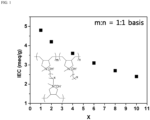
- FIG. 1 is a graph showing the results of evaluating the ion exchange capability of ionomers according to one embodiment of the disclosure.
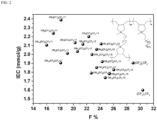
- FIG. 2 is a graph showing the evaluation results of the ion exchange capability of the ionomer according to one embodiment of the disclosure.
- DBr represents a repeating unit derived from a dibromoalkane reagent, and (i+2) represents the number of alkyl groups derived from the dibromoalkane reagent, (CF 2 ) j represents the n portion that is not crosslinked, and j represents the number of (CF 2 ) in the chain.
- -mn represents m and n in Formula 1, respectively.
- (CF 2 ) 5 CF 3 and (CF 2 ) 7 CF 3 indicate that m is 0 and only n portion exists).
Landscapes
- Chemical & Material Sciences (AREA)
- Chemical Kinetics & Catalysis (AREA)
- Engineering & Computer Science (AREA)
- Electrochemistry (AREA)
- Organic Chemistry (AREA)
- Sustainable Energy (AREA)
- Life Sciences & Earth Sciences (AREA)
- Sustainable Development (AREA)
- General Chemical & Material Sciences (AREA)
- Manufacturing & Machinery (AREA)
- Materials Engineering (AREA)
- Metallurgy (AREA)
- Crystallography & Structural Chemistry (AREA)
- Health & Medical Sciences (AREA)
- Medicinal Chemistry (AREA)
- Polymers & Plastics (AREA)
- Addition Polymer Or Copolymer, Post-Treatments, Or Chemical Modifications (AREA)
Abstract
The specification relates an ionomer comprising a compound derived from N,N-diallylamine and a method for preparing the same. The ionomer according to one embodiment of the disclosure has an effect of providing excellent battery performance by controlling the ion exchange capability in a wide range while having excellent alkaline durability.
Description
- This invention was made with the support of the Ministry of Science and ICT under Project No. 1711156125, which was conducted under the research project entitled "Development of reactive nano-composite filters for hazardous wastes from semiconductor/electronic industry" within the project named "Nano Material Technology Development" under the management of the National Research Foundation of Korea, from January 1, 2022 to December 31, 2022.
- This invention was made with the support of the Ministry of Science and ICT under Project No. 1711175402, which was conducted under the research project entitled "Solutions to Electromagnetic Interference in Future-mobility" within the project named "Support for research and operation expenses of the National Research Council of Science and Technology" under the management of the National Research Council of Science and Technology, from May 1, 2022 to December 31, 2022.
- The present specification discloses an ionomer comprising compound derived from N,N-diallylamine and a method for preparing the same.
- Renewable energy is in the limelight due to depletion of fossil fuels and climate change, and electrolysis technology for producing hydrogen using electricity from renewable energy is being used. Hydrogen is a very useful raw material and can be used as a fuel for many types of fuel cells. The water electrolysis device and fuel cell have a structure in which an anode and cathode are coated on both sides of an electrolyte membrane composed of a polymer material, which is called a membrane electrode assembly (MEA). The separator or ionomer included in the membrane electrode assembly requires excellent alkaline durability in order to operate in an alkaline environment. Currently used materials contain structures that are vulnerable to alkaline, so they are difficult to be applied and have a problem of insufficient durability. In particular, a structure including an aryl-ether structure is attacked by hydroxy group ions and is vulnerable to alkaline conditions. Therefore, it is required to develop a separator or ionomer that does not contain an aryl-ether structure. In addition, a lot of development has been done on separators and ionomers based on polystyrene. However, in the case of ionomers containing a phenyl group, phenyl is adsorbed on the electrode and oxidized, thereby reducing battery performance. Therefore, it is important to develop an ionomer that does not contain a phenyl group.
- In this regard,
Korean Patent Registration No. 10-0908780 - An object according to one aspect of the present disclosure is to provide an ionomer that has excellent alkaline durability, controls ion exchange capacity in a wide range, and provides excellent battery performance, and a method for preparing the same.
- In one aspect of the disclosure, an ionomer comprising a compound represented by Formula 1 below is provided:

- In another aspect, the disclosure provides a membrane electrode assembly comprising a cathode electrode; an anode electrode positioned opposite to the cathode electrode; and an electrolyte membrane positioned between the cathode electrode and the anode electrode, wherein at least one of the cathode electrode, the anode electrode, and the electrolyte membrane comprises the ionomer.
- In another aspect, the disclosure provides a water electrolysis device comprising the membrane electrode assembly.
- In another aspect, the disclosure provides a fuel cell comprising the membrane electrode assembly.
- In another aspect, the disclosure provides a method for preparing the ionomer, the method comprising the steps of modifying N,N-diallylamine to obtain N,N-diallylalkylamine; polymerizing the N,N-diallylalkylamine to obtain 3,4-dimethyl-N-alkyl-pyrrole monomer represented by
Formula 2 below; and performing quaternization and crosslinking of the 3,4-dimethyl-N-alkyl-pyrrole monomer to obtain a compound represented byFormula 1.
- The ionomer according to one embodiment of the disclosure has an effect of providing excellent battery performance by controlling the ion exchange capability in a wide range while having excellent alkaline durability.
-
-
FIG. 1 is a graph showing results of evaluating an ion exchange capacity of ionomers according to one embodiment of the disclosure. -
FIG. 2 is a graph showing results of evaluating an ion exchange capacity of ionomers according to one embodiment of the disclosure. - Hereinafter, preferred embodiments of the present disclosure will be described in detail with reference to the accompanying drawings.
- The Examples of the present disclosure disclosed herein are exemplified for the purpose of describing the Examples of the present disclosure only, and the Examples of the present disclosure may be carried out in various forms and should not be construed to limit the Examples described herein. Since the present disclosure may have various changes and different forms, it should be understood that the Examples are not intended to limit the present disclosure to specific disclosure forms and they include all the changes, equivalents and replacements included in the spirit and technical scope of the present disclosure.
- In the present specification, when one part is said to "comprise" an element, unless specifically mentioned otherwise, instead of excluding any other element, this may signify that the one part may further include other elements.
- Throughout the specification, the same reference numerals designate the same components. When a component such as a layer, a film, a region, or a plate is mentioned to be placed "on" or "above" another component, it will be understood that it may be directly on another component or that another component may be interposed therebetween throughout the specification. Throughout the specification, the terms "first", "second", etc., may be used to describe various components, and should not be limited by these terms. These terms are used only to distinguish one component from another, not for purposes of limitation.
- In one aspect of the disclosure, an ionomer comprising a compound represented by
Formula 1 below is provided.
- the m is an integer from 0 to 100,
- the n is an integer equal to 100-m,
- the R1 and the R3 are each independently -(CH2)xCH3, -(CH2)x(CF2)yCF3, or

- the R2 is -(CH2)x, -(CF2)x,

- The present inventors found problems in that when containing an aryl-ether structure, the isomer is attacked by hydroxy group ions and is vulnerable to alkaline conditions, and when containing a phenyl group, phenyl is adsorbed and oxidized on the electrode, thereby reducing battery performance, and thus, invented an ionomer not containing the aryl-ether structure or the phenyl group. The compound according to the disclosure has high alkaline stability because most of the beta hydrogen is present inside the compound.
- In addition, the present inventors can control a degree of hydrophilicity by selecting and applying hydrophilic functional groups and hydrophobicity in R1, R2 and R3. Through the modification of the monomer according to the disclosure, the molecular weight of the repeating unit of the compound can be controlled, thereby controlling the ion exchange capacity (IEC) in a wide range.
- In one embodiment, the molecular weight of the repeating unit of the compound is 150 to 667. More specifically, the molecular weight of the repeating unit of the compound may be 150 or more, 200 or more, 250 or more, 300 or more, 350 or more, 400 or more, 437 or more, 450 or more; 667 or less, 650 or less, 600 or less, 550 or less, 500 or less, 450 or less, but is not limited thereto. By controlling the molecular weight of the repeating unit of the compound, the ion exchange capacity (IEC) can be controlled in a wide range.
- In one embodiment, the compound has a fluorine atom content of 0 to 67 F%. More specifically, the fluorine atom content of the compound may be 0 F% or more, 5 F% or more, 10 F% or more, 15 F% or more, 20 F% or more, 25 F% or more, 30 F% or more, 35 F% or more, 40 F% or more, 45 F% or more; 67 F% or less, 65 F% or less, 60 F% or less, 55 F% or less, 50 F% or less, 45 F% or less, but is not limited thereto. By controlling the fluorine atom content, the ion exchange capacity (IEC) can be controlled in a wide range and the degree of hydrophilicity can be controlled at the same time.
- In one embodiment, the ratio of m and n (m/n) is 0 to 1. By controlling the ratio of m and n (m/n), it is possible to obtain an ionomer that has desired crosslinking density and ion exchange capacity (IEC), is insoluble in water and has mechanical stability.
- In one embodiment, the x is from 0 to 20. By controlling the x for R1, R2, and R3 in Formula 1, the ion exchange capacity (IEC) can be controlled in a wide range.
- In the disclosure, only a single polymer compound may be used as the ionomer.
- In another aspect, the disclosure provides a membrane electrode assembly (MEA) comprising a cathode electrode; an anode electrode positioned opposite to the cathode electrode; and an electrolyte membrane positioned between the cathode electrode and the anode electrode, wherein at least one of the cathode electrode, the anode electrode, and the electrolyte membrane comprises the ionomer.
- In another aspect, the disclosure provides a water electrolysis device comprising the membrane electrode assembly. The hydrogen energy produced by a water electrolysis device has advantages of high efficiency, abundant fuel (water), and no emission of pollutants such as nitrogen oxides (NOx) or sulfur oxides (SOx). Hydrogen can be produced by electrolysis of pure water or electrolysis of aqueous alkali solution.
- In another aspect, the disclosure provides a fuel cell comprising the membrane electrode assembly. The fuel cell may be a polymer electrolyte membrane fuel cell (PEMFC). The polymer electrolyte membrane fuel cell is a device that converts chemical energy into electrical energy, and can utilize energy with higher efficiency than conventional internal combustion engines, and is a clean energy source that does not emit environmental pollutants such as carbon dioxide, nitrous oxide, and sulfur oxide during the energy conversion process.
- In another aspect, the disclosure provides a method for preparing the ionomer comprising the steps of modifying N,N-diallylamine to obtain N,N-diallylalkylamine; polymerizing the N,N-diallylalkylamine to obtain 3,4-dimethyl-N-alkyl-pyrrole monomer represented by
Formula 2 below; and performing quaternization and crosslinking of the 3,4-dimethyl-N-alkyl-pyrrole monomer to obtain a compound represented byFormula 1.

Formula 1, - the m is an integer from 0 to 100,
- the n is an integer equal to 100-m,
- the R1 and the R3 are each independently -(CH2)xCH3, -(CH2)x(CF2)yCF3, or

- the R2 is -(CH2)x, -(CF2)x,

- In the disclosure, the ion exchange capacity (IEC) can be controlled in a wide range by using a synthesis method using N,N-diallylamine.
- In one embodiment, the step of obtaining the N, N- diallylalkylamine is performed according to
Scheme 1 below.

- When introducing an alkyl group into N,N-diallylamine, an alkyl halide reagent should be used, and one substituted with chloro or iodide may be used instead of bromo.
- In one embodiment, the step of obtaining the 3,4-dimethyl-N-alkyl-pyrrole monomer is performed according to
Scheme 2 below.
- The polymerization of N,N-diallylamine used in the disclosure can be easily scaled up by using inexpensive hydrochloric acid as a catalyst.
- In one embodiment, a polymerization initiator may be used in the step of obtaining the 3,4-dimethyl-N-alkyl-pyrrole monomer. The polymerization initiator is one or more selected from the group consisting of potassium persulfate (KPS), ammonium persulfate (APS), sodium persulfate (SPS), benzoyl peroxide (BPO), 2,2'-azobis(2-amidinopropane)dihydrochloride (AAPH), 2,2'-azobis(2-methylpropionitrile) (AIBN), 2,2'-azobis(2-methylbutyronitrile) (AMBN), 2,2'-azobis(2,4-dimethylvaleronitrile) (ADVN), 1,1'-azobis(1-cyclohexanecarbonitrile) (ACHN), dimethyl-2,2'-azobisisobutyrate (MAIB), 4,4'-azobis(4-cyanovaleric acid) (ACVA), 1,1'-azobis(1-acetoxy-1-phenylethane), 2,2'-azobis(2-methylbutylamide), 2,2'-azobis(4-methoxy-2,4-dimethylvaleronitrile), 2,2'-azobis(2-methylamidinopropane)dihydrochloride, 2,2'-azobis[2-(2-imidazolin-2-yl)propane], 2,2'-azobis[2-methyl-N-(2-hydroxyethyl)propionamide], 2,2'-azobis(2,4,4-trimethylpentane), 2-cyano-2-propylazoformamide, 2,2'-azobis(N-butyl-2-methylpropionamide), and 2,2'-azobis(N-cyclohexyl-2-methylpropionamide).
- In one embodiment, the step of obtaining the compound represented by
Formula 1 is performed according toScheme 3 below.

- Hereinafter, the disclosure will be described in detail with reference to preferred examples so that those skilled in the art can easily practice the disclosure. However, the disclosure may be embodied in many different forms, and is not limited to the examples described herein.
- The modification was performed by mixing 7.66 g of 2-bromohexane and 6.45 g of potassium carbonate (K2CO3) as bromoalkyl in 5.00 g of N,N-diallylamine (Sigma Aldrich) to obtain N,N-diallylalkylamine. Subsequently, the polymerization was performed by mixing 3 g of N,N-diallylalkylamine with 0.65 g of 37 wt% hydrochloric acid and 0.45 g of ammonium persulfate (APS) to obtain 3,4-dimethyl-N-alkyl-pyrrole monomer. Then, by mixing bromoalkane and dibromoalkane with the 3,4-dimethyl-N-alkyl-pyrrole monomer, quaternization reaction and cross-linking were performed to obtain the compound represented by
Formula 1. - An electrolyte membrane was prepared using the compound prepared in Preparation Example 1. For the electrolyte membrane, the ion exchange capability was evaluated according to
Equation 1 below by acid-base titration using an aqueous solution of 1N NaOH and an aqueous solution of 1 N HCl.
- IEC: Ion exchange capability(meq/g)
- VHCl: Volume of HCl(ml), VNaOH: Volume of NaOH(ml)
- NHCl: Concentration of HCl(N), NNaOH: Concentration of NaOH(N)
- For comparison, the compounds prepared by setting the x for R1, R2 and R3 to 1, 2, 4, 6, 8 and 10 respectively in
Formula 1 were prepared. The results were shown inFIG. 1. FIG. 1 is a graph showing the results of evaluating the ion exchange capability of ionomers according to one embodiment of the disclosure. - From
FIG. 1 , it can be confirmed that the ion exchange capability is enhanced as the molecular weight of the repeating unit of the compound decreases. Accordingly, it can be confirmed that the ion exchange capacity (IEC) can be controlled in a wide range by controlling the molecular weight of the repeating unit of the compound. - An electrolyte membrane was prepared using the compound prepared in Preparation Example 1. For the electrolyte membrane, the ion exchange capability was evaluated in the same manner as in Experimental Example 1. Meanwhile, the fluorine atom content (F%) of the compound prepared in Preparation Example 1 was measured by neutron activation. The results were shown in
FIG. 2 and Table 1.FIG. 2 is a graph showing the evaluation results of the ion exchange capability of the ionomer according to one embodiment of the disclosure. - (In the compound DBr(i+2)(CF2)j(CF3)-mn in Table 1 below, DBr represents a repeating unit derived from a dibromoalkane reagent, and (i+2) represents the number of alkyl groups derived from the dibromoalkane reagent, (CF2)j represents the n portion that is not crosslinked, and j represents the number of (CF2) in the chain. In addition, -mn represents m and n in
Formula 1, respectively. (CF2)5CF3 and (CF2)7CF3 indicate that m is 0 and only n portion exists).[Table 1] Compound Fluorine atom content (F%) Ion exchange capability (mmol/g) DBr4(CF2)5CF3-11 18.14 2.39 DBr8(CF2)5CF3-11 17.00 2.24 DBr12(CF2)5CF3-11 16.00 2.10 DBr4(CF2)7CF3-11 20.26 2.13 DBr8(CF2)7CF3-11 19.11 2.01 DBr12(CF2)7CF3-11 18.09 1.90 DBr4(CF2)5CF3-12 22.30 2.20 DBr8(CF2)5CF3-12 21.42 2.11 DBr12(CF2)5CF3-12 20.60 2.03 DBr4(CF2)7CF3-12 24.31 1.92 DBr8(CF2)7CF3-12 23.47 1.85 DBr12(CF2)7CF3-12 22.68 1.79 DBr4(CF2)5CF3-13 24.14 2.12 DBr8(CF2)5CF3-13 23.45 2.06 DBn2(CF2)5CF3-13 22.79 2.00 DBr4(CF2)7CF3-13 26.04 1.83 DBr8(CF2)7CF3-13 25.39 1.78 DBr12(CF2)7CF3-13 24.77 1.74 (CF2)5CF3 28.93 1.90 (CF2)7CF3 30.38 1.60 - From
FIG. 2 , by controlling the fluorine atom content of the compound, it is possible to control the degree of hydrophilicity while controlling the ion exchange capacity (IEC) in a wide range. - Although exemplary embodiments of the disclosure have been described above in relation to the above-mentioned preferred examples, various modifications and variations can be made without departing from the spirit and scope of the disclosure. Therefore, the appended claims contain such modifications or variations as fall within the true spirit of the disclosure.

the R1 is -(CH2)xCH3, -(CH2)x(CF2)yCF3 or

Claims (9)
- An ionomer comprising a compound represented by Formula 1 below:
 wherein the m is an integer from 0 to 100,the n is an integer equal to 100-m,the R1 and the R3 are each independently -(CH2)xCH3, -(CH2)x(CF2)yCF3, or
 the R2 is -(CH2)x, -(CF2)x,
- The ionomer of claim 1, wherein a molecular weight of a repeating unit of the compound is 150 to 667.
- The ionomer of claim 1 or 2, wherein a fluorine atom content of the compound is 0 to 67 F%.
- The ionomer of one of claims 1 to 3, wherein a ratio of the m and the n (m / n) is 0 to 1.
- The ionomer of one of claims 1, to 4 wherein the x is an integer from 0 to 20.
- A membrane electrode assembly comprising:a cathode electrode;an anode electrode positioned opposite to the cathode electrode; andan electrolyte membrane positioned between the cathode electrode and the anode electrode,wherein at least one of the cathode electrode, the anode electrode, and the electrolyte membrane comprises the ionomer of claim 1.
- A water electrolysis device comprising the membrane electrode assembly of claim 6.
- A fuel cell comprising the membrane electrode assembly of claim 6.
- A method for preparing the ionomer of claim 1, the method comprising the steps of:modifying N,N-diallylamine to obtain N,N-diallylalkylamine;polymerizing the N,N-diallylalkylamine to obtain 3,4-dimethyl-N-alkyl-pyrrole monomer represented by Formula 2 below; andperforming quaternization and crosslinking of the 3,4-dimethyl-N-alkyl-pyrrole monomer to obtain a compound represented by Formula 1:
 wherein the m is an integer from 0 to 100,the n is an integer equal to 100-m,the R1 and the R3 are each independently -(CH2)xCH3, -(CH2)x(CF2)yCF3, or
 the R2 is -(CH2)x, -(CF2)x,


Applications Claiming Priority (1)
| Application Number | Priority Date | Filing Date | Title |
|---|---|---|---|
| KR1020220158862A KR102866860B1 (en) | 2022-11-24 | 2022-11-24 | Ionomer comprising compound derived from n,n-diallylamine and manufacturing method thereof |
Publications (1)
| Publication Number | Publication Date |
|---|---|
| EP4376133A1 true EP4376133A1 (en) | 2024-05-29 |
Family
ID=88920913
Family Applications (1)
| Application Number | Title | Priority Date | Filing Date |
|---|---|---|---|
| EP23211124.5A Pending EP4376133A1 (en) | 2022-11-24 | 2023-11-21 | Ionomer comprising compound derived from n,n-diallylamine and manufacturing method thereof |
Country Status (3)
| Country | Link |
|---|---|
| US (1) | US20240191027A1 (en) |
| EP (1) | EP4376133A1 (en) |
| KR (1) | KR102866860B1 (en) |
Citations (4)
| Publication number | Priority date | Publication date | Assignee | Title |
|---|---|---|---|---|
| US20080199755A1 (en) * | 2005-09-17 | 2008-08-21 | Ian David Brotherston | Conductive polymers |
| KR100908780B1 (en) | 2007-09-27 | 2009-07-22 | 한국전력공사 | Membrane Electrode Assembly for Water Electrolysis and its Manufacturing Method |
| WO2010055889A1 (en) * | 2008-11-14 | 2010-05-20 | 株式会社トクヤマ | Anion-exchange membrane and method for producing same |
| CN103408443A (en) * | 2013-08-14 | 2013-11-27 | 中国海洋石油总公司 | Water-soluble polymer containing fluorine modified diallylamine and preparation method thereof |
Family Cites Families (3)
| Publication number | Priority date | Publication date | Assignee | Title |
|---|---|---|---|---|
| JP2009143975A (en) | 2007-12-11 | 2009-07-02 | Nippon Shokubai Co Ltd | Solid electrolyte material |
| JP2017107805A (en) * | 2015-12-11 | 2017-06-15 | 日東電工株式会社 | Electrolyte membrane, method of manufacturing the same, and membrane-electrode assembly for fuel cell equipped with electrolyte membrane |
| KR102938646B1 (en) * | 2019-12-06 | 2026-03-13 | 한양대학교 산학협력단 | A novel polyfluorene-based ionomer, an anion exchange membrane and method for preparing the same |
-
2022
- 2022-11-24 KR KR1020220158862A patent/KR102866860B1/en active Active
-
2023
- 2023-11-03 US US18/501,974 patent/US20240191027A1/en active Pending
- 2023-11-21 EP EP23211124.5A patent/EP4376133A1/en active Pending
Patent Citations (4)
| Publication number | Priority date | Publication date | Assignee | Title |
|---|---|---|---|---|
| US20080199755A1 (en) * | 2005-09-17 | 2008-08-21 | Ian David Brotherston | Conductive polymers |
| KR100908780B1 (en) | 2007-09-27 | 2009-07-22 | 한국전력공사 | Membrane Electrode Assembly for Water Electrolysis and its Manufacturing Method |
| WO2010055889A1 (en) * | 2008-11-14 | 2010-05-20 | 株式会社トクヤマ | Anion-exchange membrane and method for producing same |
| CN103408443A (en) * | 2013-08-14 | 2013-11-27 | 中国海洋石油总公司 | Water-soluble polymer containing fluorine modified diallylamine and preparation method thereof |
Non-Patent Citations (1)
| Title |
|---|
| JACKSON M B ET AL: "EFFECT OF ION-EXCHANGE RESIN STRUCTURE ON NITRATE SELECTIVITY", REACTIVE POLYMERS, ELSEVIER SCIENCE PUBLISHERS, AMSTERDAM, NL, vol. 12, no. 3, 1 June 1990 (1990-06-01), pages 277 - 290, XP000138320, ISSN: 0923-1137, DOI: 10.1016/0923-1137(90)90078-I * |
Also Published As
| Publication number | Publication date |
|---|---|
| KR102866860B1 (en) | 2025-10-14 |
| US20240191027A1 (en) | 2024-06-13 |
| KR20240077594A (en) | 2024-06-03 |
Similar Documents
| Publication | Publication Date | Title |
|---|---|---|
| Ran et al. | Highly conductive and stabilized side-chain-type anion exchange membranes: ideal alternatives for alkaline fuel cell applications | |
| JP4673623B2 (en) | ELECTRODE FOR FUEL CELL, FUEL CELL USING SAME, AND METHOD FOR PRODUCING THEM | |
| Kim et al. | 1, 2-Dimethylimidazole based bromine complexing agents for vanadium bromine redox flow batteries | |
| US9711817B2 (en) | Polymer electrolyte membrane and membrane-electrode assembly for polymer electrolyte fuel cell | |
| KR100919647B1 (en) | Fluoride ion scavenger for fuel cell components | |
| US12515211B2 (en) | Azulene-based branched poly aryl-piperidine anion exchange membranes and preparation methods thereof | |
| US20070207359A1 (en) | Crosslinked nano-inorganic particle/polymer electrolyte membrane and method for producing same, and membrane electrode assembly using same | |
| KR20260033480A (en) | Electrolyte for oxidation-reduction secondary battery containing vanadium ions and secondary battery containing the same | |
| EP4376133A1 (en) | Ionomer comprising compound derived from n,n-diallylamine and manufacturing method thereof | |
| EP4682188A1 (en) | Anion exchange membrane and method for manufacturing same | |
| US11482720B2 (en) | Membrane-electrode assembly with improved durability and proton conductivity and method for manufacturing the same | |
| KR101785012B1 (en) | Ion-exchnage Membrane | |
| El-Toony et al. | Casting of poly (vinyl alcohol)/glycidyl methacrylate reinforced with titanium dioxide nanoparticles for proton exchange fuel cells | |
| Hager et al. | Cationic groups in polystyrene/O-PBI blends influence performance and hydrogen crossover in AEMWE | |
| US20240204208A1 (en) | Electrochemical catalyst of core-shell structure and manufacturing method thereof | |
| CN110931264B (en) | A kind of iron in-situ doped sodium titanate electrode material and preparation method thereof | |
| KR102807872B1 (en) | Anion exchange membrane containing quaternary ammonium functional group and manufacturing method thereof | |
| CN117659798B (en) | A pH-sensitive imidazole-based polyion exchange membrane-modified graphite paper, its preparation method, and its application. | |
| CN114709476B (en) | Gel polymer electrolyte matrix material, electrolyte and battery | |
| Kodama et al. | Elucidation of Adsorption Mechanisms of Anionic Moieties in Polymers and Their Effect on the Oxygen Reduction Reaction on a Pt Surface Using a Pt (111) Single-Crystal Electrode and In-House Synthesized Ionomers | |
| Maruyama et al. | Performance of PEFC formed by using Pt-loaded activated carbon under high-and low-humidity conditions | |
| CN121338851A (en) | A method for preparing a phase-separated polyacrylate-based anion exchange membrane, its products, and applications. | |
| Motz et al. | Heteropoly Acid Functionalized Membranes for High Performance and Chemically Stable Fuel Cell Operation | |
| CN120895577A (en) | A method for constructing a disordered zinc silicate artificial SEI layer for aqueous zinc batteries | |
| CN119192475A (en) | A zwitterionic liquid-based solid electrolyte membrane and its preparation method and application |
Legal Events
| Date | Code | Title | Description |
|---|---|---|---|
| PUAI | Public reference made under article 153(3) epc to a published international application that has entered the european phase |
Free format text: ORIGINAL CODE: 0009012 |
|
| STAA | Information on the status of an ep patent application or granted ep patent |
Free format text: STATUS: REQUEST FOR EXAMINATION WAS MADE |
|
| 17P | Request for examination filed |
Effective date: 20231121 |
|
| AK | Designated contracting states |
Kind code of ref document: A1 Designated state(s): AL AT BE BG CH CY CZ DE DK EE ES FI FR GB GR HR HU IE IS IT LI LT LU LV MC ME MK MT NL NO PL PT RO RS SE SI SK SM TR |