EP4376111A1 - Manufacturing method of an aluminium battery - Google Patents
Manufacturing method of an aluminium battery Download PDFInfo
- Publication number
- EP4376111A1 EP4376111A1 EP23179949.5A EP23179949A EP4376111A1 EP 4376111 A1 EP4376111 A1 EP 4376111A1 EP 23179949 A EP23179949 A EP 23179949A EP 4376111 A1 EP4376111 A1 EP 4376111A1
- Authority
- EP
- European Patent Office
- Prior art keywords
- aluminum
- electrode sheet
- battery
- manufacturing
- electrolyte
- Prior art date
- Legal status (The legal status is an assumption and is not a legal conclusion. Google has not performed a legal analysis and makes no representation as to the accuracy of the status listed.)
- Pending
Links
- XAGFODPZIPBFFR-UHFFFAOYSA-N aluminium Chemical compound [Al] XAGFODPZIPBFFR-UHFFFAOYSA-N 0.000 title claims abstract description 146
- 229910052782 aluminium Inorganic materials 0.000 title claims abstract description 133
- 238000004519 manufacturing process Methods 0.000 title claims abstract description 20
- 239000004411 aluminium Substances 0.000 title 1
- 239000003792 electrolyte Substances 0.000 claims abstract description 29
- 239000002608 ionic liquid Substances 0.000 claims abstract description 29
- 238000002791 soaking Methods 0.000 claims abstract description 20
- 239000012299 nitrogen atmosphere Substances 0.000 claims abstract description 9
- -1 aluminum halide Chemical class 0.000 claims description 28
- JDIIGWSSTNUWGK-UHFFFAOYSA-N 1h-imidazol-3-ium;chloride Chemical compound [Cl-].[NH2+]1C=CN=C1 JDIIGWSSTNUWGK-UHFFFAOYSA-N 0.000 claims description 21
- 230000002596 correlated effect Effects 0.000 claims description 7
- VSCWAEJMTAWNJL-UHFFFAOYSA-K aluminium trichloride Chemical group Cl[Al](Cl)Cl VSCWAEJMTAWNJL-UHFFFAOYSA-K 0.000 description 18
- 238000003756 stirring Methods 0.000 description 9
- 238000006243 chemical reaction Methods 0.000 description 8
- 238000010586 diagram Methods 0.000 description 8
- 238000010438 heat treatment Methods 0.000 description 8
- VEXZGXHMUGYJMC-UHFFFAOYSA-M Chloride anion Chemical compound [Cl-] VEXZGXHMUGYJMC-UHFFFAOYSA-M 0.000 description 7
- BMQZYMYBQZGEEY-UHFFFAOYSA-M 1-ethyl-3-methylimidazolium chloride Chemical group [Cl-].CCN1C=C[N+](C)=C1 BMQZYMYBQZGEEY-UHFFFAOYSA-M 0.000 description 5
- 230000000694 effects Effects 0.000 description 4
- 239000012298 atmosphere Substances 0.000 description 3
- 238000000034 method Methods 0.000 description 3
- NJMWOUFKYKNWDW-UHFFFAOYSA-N 1-ethyl-3-methylimidazolium Chemical compound CCN1C=C[N+](C)=C1 NJMWOUFKYKNWDW-UHFFFAOYSA-N 0.000 description 2
- VEXZGXHMUGYJMC-UHFFFAOYSA-N Hydrochloric acid Chemical compound Cl VEXZGXHMUGYJMC-UHFFFAOYSA-N 0.000 description 2
- 238000001069 Raman spectroscopy Methods 0.000 description 2
- 238000001237 Raman spectrum Methods 0.000 description 2
- QAOWNCQODCNURD-UHFFFAOYSA-N Sulfuric acid Chemical compound OS(O)(=O)=O QAOWNCQODCNURD-UHFFFAOYSA-N 0.000 description 2
- 230000007423 decrease Effects 0.000 description 2
- 238000007599 discharging Methods 0.000 description 2
- 150000002500 ions Chemical class 0.000 description 2
- 230000003647 oxidation Effects 0.000 description 2
- 238000007254 oxidation reaction Methods 0.000 description 2
- MYMOFIZGZYHOMD-UHFFFAOYSA-N Dioxygen Chemical compound O=O MYMOFIZGZYHOMD-UHFFFAOYSA-N 0.000 description 1
- GRYLNZFGIOXLOG-UHFFFAOYSA-N Nitric acid Chemical compound O[N+]([O-])=O GRYLNZFGIOXLOG-UHFFFAOYSA-N 0.000 description 1
- 239000003929 acidic solution Substances 0.000 description 1
- 230000000875 corresponding effect Effects 0.000 description 1
- 229910017604 nitric acid Inorganic materials 0.000 description 1
- 239000001301 oxygen Substances 0.000 description 1
- 229910052760 oxygen Inorganic materials 0.000 description 1
- 230000002269 spontaneous effect Effects 0.000 description 1
- 238000004381 surface treatment Methods 0.000 description 1
- XLYOFNOQVPJJNP-UHFFFAOYSA-N water Substances O XLYOFNOQVPJJNP-UHFFFAOYSA-N 0.000 description 1
Images



Classifications
-
- H—ELECTRICITY
- H01—ELECTRIC ELEMENTS
- H01M—PROCESSES OR MEANS, e.g. BATTERIES, FOR THE DIRECT CONVERSION OF CHEMICAL ENERGY INTO ELECTRICAL ENERGY
- H01M10/00—Secondary cells; Manufacture thereof
- H01M10/05—Accumulators with non-aqueous electrolyte
- H01M10/058—Construction or manufacture
-
- H—ELECTRICITY
- H01—ELECTRIC ELEMENTS
- H01M—PROCESSES OR MEANS, e.g. BATTERIES, FOR THE DIRECT CONVERSION OF CHEMICAL ENERGY INTO ELECTRICAL ENERGY
- H01M10/00—Secondary cells; Manufacture thereof
- H01M10/05—Accumulators with non-aqueous electrolyte
- H01M10/054—Accumulators with insertion or intercalation of metals other than lithium, e.g. with magnesium or aluminium
-
- H—ELECTRICITY
- H01—ELECTRIC ELEMENTS
- H01M—PROCESSES OR MEANS, e.g. BATTERIES, FOR THE DIRECT CONVERSION OF CHEMICAL ENERGY INTO ELECTRICAL ENERGY
- H01M10/00—Secondary cells; Manufacture thereof
- H01M10/05—Accumulators with non-aqueous electrolyte
- H01M10/056—Accumulators with non-aqueous electrolyte characterised by the materials used as electrolytes, e.g. mixed inorganic/organic electrolytes
- H01M10/0561—Accumulators with non-aqueous electrolyte characterised by the materials used as electrolytes, e.g. mixed inorganic/organic electrolytes the electrolyte being constituted of inorganic materials only
- H01M10/0563—Liquid materials, e.g. for Li-SOCl2 cells
-
- H—ELECTRICITY
- H01—ELECTRIC ELEMENTS
- H01M—PROCESSES OR MEANS, e.g. BATTERIES, FOR THE DIRECT CONVERSION OF CHEMICAL ENERGY INTO ELECTRICAL ENERGY
- H01M4/00—Electrodes
- H01M4/02—Electrodes composed of, or comprising, active material
- H01M4/04—Processes of manufacture in general
- H01M4/0438—Processes of manufacture in general by electrochemical processing
- H01M4/044—Activating, forming or electrochemical attack of the supporting material
-
- H—ELECTRICITY
- H01—ELECTRIC ELEMENTS
- H01M—PROCESSES OR MEANS, e.g. BATTERIES, FOR THE DIRECT CONVERSION OF CHEMICAL ENERGY INTO ELECTRICAL ENERGY
- H01M4/00—Electrodes
- H01M4/02—Electrodes composed of, or comprising, active material
- H01M4/04—Processes of manufacture in general
- H01M4/049—Manufacturing of an active layer by chemical means
- H01M4/0492—Chemical attack of the support material
-
- H—ELECTRICITY
- H01—ELECTRIC ELEMENTS
- H01M—PROCESSES OR MEANS, e.g. BATTERIES, FOR THE DIRECT CONVERSION OF CHEMICAL ENERGY INTO ELECTRICAL ENERGY
- H01M4/00—Electrodes
- H01M4/02—Electrodes composed of, or comprising, active material
- H01M4/36—Selection of substances as active materials, active masses, active liquids
- H01M4/38—Selection of substances as active materials, active masses, active liquids of elements or alloys
-
- H—ELECTRICITY
- H01—ELECTRIC ELEMENTS
- H01M—PROCESSES OR MEANS, e.g. BATTERIES, FOR THE DIRECT CONVERSION OF CHEMICAL ENERGY INTO ELECTRICAL ENERGY
- H01M4/00—Electrodes
- H01M4/02—Electrodes composed of, or comprising, active material
- H01M2004/026—Electrodes composed of, or comprising, active material characterised by the polarity
- H01M2004/027—Negative electrodes
-
- H—ELECTRICITY
- H01—ELECTRIC ELEMENTS
- H01M—PROCESSES OR MEANS, e.g. BATTERIES, FOR THE DIRECT CONVERSION OF CHEMICAL ENERGY INTO ELECTRICAL ENERGY
- H01M2300/00—Electrolytes
- H01M2300/0017—Non-aqueous electrolytes
- H01M2300/002—Inorganic electrolyte
- H01M2300/0022—Room temperature molten salts
-
- Y—GENERAL TAGGING OF NEW TECHNOLOGICAL DEVELOPMENTS; GENERAL TAGGING OF CROSS-SECTIONAL TECHNOLOGIES SPANNING OVER SEVERAL SECTIONS OF THE IPC; TECHNICAL SUBJECTS COVERED BY FORMER USPC CROSS-REFERENCE ART COLLECTIONS [XRACs] AND DIGESTS
- Y02—TECHNOLOGIES OR APPLICATIONS FOR MITIGATION OR ADAPTATION AGAINST CLIMATE CHANGE
- Y02E—REDUCTION OF GREENHOUSE GAS [GHG] EMISSIONS, RELATED TO ENERGY GENERATION, TRANSMISSION OR DISTRIBUTION
- Y02E60/00—Enabling technologies; Technologies with a potential or indirect contribution to GHG emissions mitigation
- Y02E60/10—Energy storage using batteries
-
- Y—GENERAL TAGGING OF NEW TECHNOLOGICAL DEVELOPMENTS; GENERAL TAGGING OF CROSS-SECTIONAL TECHNOLOGIES SPANNING OVER SEVERAL SECTIONS OF THE IPC; TECHNICAL SUBJECTS COVERED BY FORMER USPC CROSS-REFERENCE ART COLLECTIONS [XRACs] AND DIGESTS
- Y02—TECHNOLOGIES OR APPLICATIONS FOR MITIGATION OR ADAPTATION AGAINST CLIMATE CHANGE
- Y02P—CLIMATE CHANGE MITIGATION TECHNOLOGIES IN THE PRODUCTION OR PROCESSING OF GOODS
- Y02P70/00—Climate change mitigation technologies in the production process for final industrial or consumer products
- Y02P70/50—Manufacturing or production processes characterised by the final manufactured product
Definitions
- the disclosure relates a manufacturing method of an aluminum battery.
- the surface of the aluminum electrode sheet used as the negative electrode of an aluminum battery often has an oxide layer, so during the charging and discharging process of the aluminum battery, the electrolyte in the battery often reacts with the oxide layer first, resulting in poor aluminum-dissolving reaction of the aluminum battery. This has a negative impact on the battery capacity, thereby reducing the capability of the aluminum battery.
- a manufacturing method of an aluminum battery, such that the aluminum battery may have better battery performance and further improve its capability, is provided in the disclosure.
- a manufacturing method of an aluminum battery includes the following operation.
- An aluminum electrode sheet having an oxide layer is provided.
- the aluminum electrode sheet is soaked in a first ionic liquid in a nitrogen atmosphere to remove the oxide layer, such that the aluminum electrode sheet has an exposed part of aluminum metal.
- the aluminum electrode sheet is removed from the first ionic liquid and used as a negative electrode of the aluminum battery.
- Electrolyte is provided.
- the exposed part of aluminum metal is in direct contact with the electrolyte.
- soak time is positively correlated with discharge capacity of the aluminum battery.
- a contact area where the exposed part of aluminum metal is in direct contact with the electrolyte is positively correlated with the battery capacity of the aluminum battery.
- the contact area where the exposed part of aluminum metal is in direct contact with the electrolyte is greater than or equal to 10%.
- the contact area where the exposed part of aluminum metal is in direct contact with the electrolyte is less than or equal to 100%.
- the first ionic liquid includes aluminum halide and imidazolium chloride.
- a usage amount of the aluminum halide is greater than or equal to a usage amount of imidazolium chloride.
- a molar ratio of the aluminum halide to the imidazolium chloride is between 1 and 2.
- the electrolyte includes a second ionic liquid.
- the second ionic liquid includes aluminum halide and imidazolium chloride.
- the manufacturing method of the aluminum battery of the disclosure uses an ionic liquid and a nitrogen atmosphere to perform a pretreatment step on the aluminum electrode sheet to be used as the negative electrode, so as to remove the oxide layer on the surface of the aluminum electrode sheet and form an exposed part of aluminum metal.
- the exposed part of aluminum metal of the negative electrode in the aluminum battery may be in direct contact with the electrolyte, increasing the reaction area between the negative electrode and the electrolyte and the amount of aluminum dissolved, so that the aluminum battery may have better battery performance, which may further improve its capability.
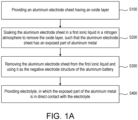
- FIG. 1A is a schematic flowchart of a manufacturing method of an aluminum battery according to an embodiment of the disclosure.
- FIG. 1B is a data graph of the discharge capacity versus soak time of an aluminum battery according to an embodiment of the disclosure.
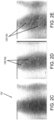
- FIG. 2A is a schematic diagram of an aluminum electrode sheet of an aluminum battery subjected to a soaking pretreatment in an ionic liquid for 24 hours of an embodiment of the disclosure.
- FIG. 2B is a schematic diagram of an aluminum electrode sheet of an aluminum battery subjected to a soaking pretreatment in an ionic liquid for 48 hours of an embodiment of the disclosure.
- FIG. 1A is a schematic flowchart of a manufacturing method of an aluminum battery according to an embodiment of the disclosure.
- FIG. 1B is a data graph of the discharge capacity versus soak time of an aluminum battery according to an embodiment of the disclosure.
- FIG. 2A is a schematic diagram of an aluminum electrode sheet of an aluminum battery subjected to a soaking pretreatment in an ionic liquid for 24 hours of an embodiment
- FIG. 3 is a Raman spectrum schematic diagram of an aluminum electrode sheet of an aluminum battery subjected to pretreatment with a soak time of 0 hours and a soak time of 48 hours of an embodiment of the disclosure.
- FIG. 2A and FIG. 2B are images obtained by using a digital microscope (X50), and the experimental conditions are, for example, soaking in an ionic liquid with a molar ratio of aluminum halide to imidazolium chloride of 1.8:1, a stirring temperature of 60°C, and a soak time of 24 hours ( FIG. 2A ) and 48 hours ( FIG. 2B ), respectively.
- 2E is aluminum chloride (AlCl 3 ), the imidazolium chloride is 1-ethyl-3-methylimidazolium chloride (EMIC), and the molar ratio of aluminum halide to imidazolium chloride is respectively 1.3:1 and 1.8:1. It should be noted that other unspecified content should be obtained and adjusted by those of ordinary skill in the art to which the disclosure belongs according to any content included in the spirit and scope of the appended patent.
- AlCl 3 aluminum chloride
- EMIC 1-ethyl-3-methylimidazolium chloride
- step S100 an aluminum electrode sheet 100 having an oxide layer 110 is provided.
- step S200 the aluminum electrode sheet 100 is soaked in the first ionic liquid is a nitrogen atmosphere to remove the oxide layer 110 so that the aluminum electrode sheet 100 has an exposed part of aluminum metal 120.
- the oxide layer 110 may be any oxide layer formed under any circumstances, such as aluminum metal formed due to exposure to the atmosphere.
- step S300 the aluminum electrode sheet 100 is removed from the first ionic liquid and used as the negative electrode structure of the aluminum battery, that is, the aluminum electrode sheet 100 is placed into the aluminum battery as the negative electrode structure after the pretreatment step of soaking.
- step S400 an electrolyte is provided, in which the exposed part of aluminum metal 120 is in direct contact with the electrolyte. Accordingly, the manufacturing method of the aluminum battery of this embodiment uses an ionic liquid and a nitrogen atmosphere to perform a pretreatment step on the aluminum electrode sheet 100 to be used as the negative electrode, so as to remove the oxide layer 110 on the surface of the aluminum electrode sheet 100 and form an exposed part of aluminum metal 120.
- the exposed part of aluminum metal 120 of the negative electrode in the aluminum battery may be in direct contact with the electrolyte, increasing the reaction area between the negative electrode and the electrolyte and the amount of aluminum dissolved, so that the aluminum battery may have better battery performance, which may further improve its performance.
- the soak time is positively correlated with the discharge capacity of the aluminum battery, that is, the longer the aluminum electrode sheet 100 to be used as the negative electrode is subjected to the pretreatment step, the more significant the subsequent impact on the battery performance of the aluminum battery.
- the soak time the time of performing the pretreatment step
- the discharge capacity of the aluminum battery is significantly improved, but the disclosure is not limited thereto.
- the electrolyte includes a second ionic liquid
- the second ionic liquid includes aluminum halide and imidazolium chloride.
- the aluminum halide includes aluminum chloride (AlCl 3 )
- the imidazolium chloride includes 1- Ethyl-3-methylimidazolium (EMIC) or l-butyl-3- methylimidazolium chloride (BMIC).
- EMIC 1- Ethyl-3-methylimidazolium
- BMIC l-butyl-3- methylimidazolium chloride
- the aforementioned ionic liquid may produce AlCl 4 - , Al 2 Cl 7 - , EMI + /BMI + , Al 3 + , Al + , and (coordination) complexes of the above ions.
- the aluminum electrode sheet 100 is used as the negative electrode of the aluminum battery after removing the oxide layer 110, and the exposed part of aluminum metal 120 is in direct contact with the electrolyte, during the charging and discharging process of the aluminum battery, Al 2 Cl 7 - and related Cl - ions are not required to additionally react with the oxide layer (which has been removed in the pretreatment step), which may accelerate the overall reaction efficiency.
- the nitrogen atmosphere is, for example, located in a glove box that may effectively control the atmosphere, so that repeated oxidation of aluminum metal in the atmosphere may be avoided, and the oxide layer 110 may be effectively removed from the aluminum electrode sheet 100. Since no acidic solution (e.g., hydrochloric acid, sulfuric acid, nitric acid, etc.) is used for surface treatment, no moisture remains, thereby reducing the probability of negative impact on the aluminum battery.
- no acidic solution e.g., hydrochloric acid, sulfuric acid, nitric acid, etc.
- the water/oxygen content of the nitrogen atmosphere is less than 100ppm (e.g., 90ppm, 70ppm, 50ppm, 30ppm, 10ppm, 1ppm or any value less than 100ppm above). Under the control of this condition, the probability of repeated oxidation of aluminum metal may be further reduced, but the disclosure is not limited thereto.
- the removal amount of the oxide layer is positively correlated with the soak time of the soaking step. For example, as shown in FIG. 2A and FIG. 2B , when the soak time reaches 48 hours, the surface of the aluminum electrode sheet 100 has obviously removed most of the oxide layer 110, but the disclosure is not limited thereto.
- the first ionic liquid includes aluminum halide and imidazolium chloride.
- the aluminum halide includes aluminum chloride (AlCl 3 )
- the imidazolium chloride includes 1- Ethyl-3- methylimidazolium (EMIC) or l-butyl-3-methylimidazolium chloride (BMIC).
- the aforementioned ionic liquid may produce AlCl 4 - , Al 2 Cl 7 - , EMI + /BMI + , Al 3 + , Al + , and (coordination) complexes of the above ions.
- Al 2 Cl 7 - reacts with the oxide layer 110, the more Al 2 Cl 7 - produced, the better the removal effect, but the disclosure is not limited thereto.
- the removal method of this embodiment may indeed effectively remove the oxide layer 110 on the aluminum electrode sheet 100.
- the aluminum halide is aluminum chloride (AlCl 3 )
- imidazolium chlorides include l-ethyl-3- methylimidazolium chloride (EMIC)
- EMIC l-ethyl-3- methylimidazolium chloride
- the ratio between AlCl 4 - and Al 2 Cl 7 - increases, and the molar ratio (referred to as the AE ratio) of aluminum chloride to l-ethyl-3- methylimidazolium chloride decreases.
- This trend may prove that the oxide layer 110 on the surface of the aluminum electrode sheet 100 has been effectively removed.
- FIG. 3 and Table 1 in particular initially soaking the aluminum electrode sheet 100 in an ionic liquid with an AE ratio of 1.8 (the corresponding soak time is 0 hours) versus after soaking the aluminum electrode 100 for 48 hours, the ratio between AlCl 4 - and Al 2 Cl 7 - increases and the AE ratio decreases, but the disclosure is not limited thereto.
- the pretreatment step further uses a heating step, a stirring step, a shaking step, or a combination thereof to improve the removal efficiency.
- a heating step, a stirring step, and a shaking step may be added at any point of the soaking step (during an initial soaking, a middle stage soaking, or a final stage soaking).
- One or more of the heating step, stirring step, and shaking step may be used, such as individually using the heating step, stirring step, or shaking step.
- each of the steps may be introduced into the soaking step at the same time or at different times, the disclosure is not limited thereto.
- the higher the temperature of the heating step e.g., greater than 60° C
- the longer the stirring step or shaking step e.g., greater than 24 hours
- the effect of removing the oxide layer 110 may be further improved, but the disclosure is not limited thereto.
- the manufacturing method of the aluminum battery of the disclosure uses an ionic liquid and a nitrogen atmosphere to perform a pretreatment step on the aluminum electrode sheet to be used as the negative electrode, so as to remove the oxide layer on the surface of the aluminum electrode sheet and form an exposed part of aluminum metal.
- the exposed part of aluminum metal of the negative electrode in the aluminum battery may be in direct contact with the electrolyte, increasing the reaction area between the negative electrode and the electrolyte and the amount of aluminum dissolved, so that the aluminum battery may have better battery performance, which may further improve its capability.
Landscapes
- Chemical & Material Sciences (AREA)
- Engineering & Computer Science (AREA)
- General Chemical & Material Sciences (AREA)
- Chemical Kinetics & Catalysis (AREA)
- Electrochemistry (AREA)
- Manufacturing & Machinery (AREA)
- Materials Engineering (AREA)
- Inorganic Chemistry (AREA)
- Battery Electrode And Active Subsutance (AREA)
- Secondary Cells (AREA)
- Cleaning And De-Greasing Of Metallic Materials By Chemical Methods (AREA)
Abstract
A manufacturing method of an aluminum battery includes: providing an aluminum electrode sheet (100) having an oxide layer (110); soaking the aluminum electrode sheet (100) in a first ionic liquid in a nitrogen atmosphere to remove the oxide layer (110), such that the aluminum electrode sheet (100) has an exposed part of aluminum metal (120); removing the aluminum electrode sheet (100) from the first ionic liquid and used as a negative electrode of the aluminum battery; and providing electrolyte. The exposed part of aluminum metal (120) is in direct contact with the electrolyte.
Description
- The disclosure relates a manufacturing method of an aluminum battery.
- Generally speaking, the surface of the aluminum electrode sheet used as the negative electrode of an aluminum battery often has an oxide layer, so during the charging and discharging process of the aluminum battery, the electrolyte in the battery often reacts with the oxide layer first, resulting in poor aluminum-dissolving reaction of the aluminum battery. This has a negative impact on the battery capacity, thereby reducing the capability of the aluminum battery.
- A manufacturing method of an aluminum battery, such that the aluminum battery may have better battery performance and further improve its capability, is provided in the disclosure.
- A manufacturing method of an aluminum battery includes the following operation. An aluminum electrode sheet having an oxide layer is provided. The aluminum electrode sheet is soaked in a first ionic liquid in a nitrogen atmosphere to remove the oxide layer, such that the aluminum electrode sheet has an exposed part of aluminum metal. The aluminum electrode sheet is removed from the first ionic liquid and used as a negative electrode of the aluminum battery. Electrolyte is provided. The exposed part of aluminum metal is in direct contact with the electrolyte.
- In an embodiment of the disclosure, soak time is positively correlated with discharge capacity of the aluminum battery.
- In an embodiment of the disclosure, a contact area where the exposed part of aluminum metal is in direct contact with the electrolyte is positively correlated with the battery capacity of the aluminum battery.
- In an embodiment of the disclosure, the contact area where the exposed part of aluminum metal is in direct contact with the electrolyte is greater than or equal to 10%.
- In an embodiment of the disclosure, the contact area where the exposed part of aluminum metal is in direct contact with the electrolyte is less than or equal to 100%.
- In an embodiment of the disclosure, the first ionic liquid includes aluminum halide and imidazolium chloride.
- In an embodiment of the disclosure, a usage amount of the aluminum halide is greater than or equal to a usage amount of imidazolium chloride.
- In an embodiment of the disclosure, a molar ratio of the aluminum halide to the imidazolium chloride is between 1 and 2.
- In an embodiment of the disclosure, the electrolyte includes a second ionic liquid.
- In an embodiment of the disclosure, the second ionic liquid includes aluminum halide and imidazolium chloride.
- Based on the above, the manufacturing method of the aluminum battery of the disclosure uses an ionic liquid and a nitrogen atmosphere to perform a pretreatment step on the aluminum electrode sheet to be used as the negative electrode, so as to remove the oxide layer on the surface of the aluminum electrode sheet and form an exposed part of aluminum metal. In this way, the exposed part of aluminum metal of the negative electrode in the aluminum battery may be in direct contact with the electrolyte, increasing the reaction area between the negative electrode and the electrolyte and the amount of aluminum dissolved, so that the aluminum battery may have better battery performance, which may further improve its capability.
- In order to make the above-mentioned features and advantages of the disclosure comprehensible, embodiments accompanied with drawings are described in detail below.
-
-
FIG. 1A is a schematic flowchart of a manufacturing method of an aluminum battery according to an embodiment of the disclosure. -
FIG. 1B is a data graph of the discharge capacity versus soak time of an aluminum battery according to an embodiment of the disclosure. -
FIG. 2A is a schematic diagram of an aluminum electrode sheet of an aluminum battery subjected to a soaking pretreatment in an ionic liquid for 24 hours of an embodiment of the disclosure. -
FIG. 2B is a schematic diagram of an aluminum electrode sheet of an aluminum battery subjected to a soaking pretreatment in an ionic liquid for 48 hours of an embodiment of the disclosure. -
FIG. 2C is a schematic diagram of an aluminum electrode sheet having an oxide layer that has not been subjected to the soaking step of some embodiments of the disclosure. -
FIG. 2D and FIG. 2E are schematic diagrams of the aluminum electrode sheet ofFIG. 2C subjected to the soaking step for 24 hours at different molar ratios of aluminum halide to imidazolium chloride. -
FIG. 3 is a Raman spectrum schematic diagram of an aluminum electrode sheet of an aluminum battery subjected to pretreatment with a soak time of 0 hours and a soak time of 48 hours of an embodiment of the disclosure. - Embodiments of the disclosure are explained in detail below. However, these embodiments are exemplary, the disclosure is not limited thereto, and the disclosure is defined by the scope of the claims.
- Unless otherwise defined, all terms (including technical and scientific terms) used herein have the same meaning as commonly understood by one of ordinary skill in the art to which this disclosure belongs. It should be further understood that terms (such as those defined in commonly used dictionaries) should be construed as having meanings consistent with their meanings in the context of the related art, and are not to be construed as idealized or excessive formal meaning, unless expressly defined as such herein.
-
FIG. 1A is a schematic flowchart of a manufacturing method of an aluminum battery according to an embodiment of the disclosure.FIG. 1B is a data graph of the discharge capacity versus soak time of an aluminum battery according to an embodiment of the disclosure.FIG. 2A is a schematic diagram of an aluminum electrode sheet of an aluminum battery subjected to a soaking pretreatment in an ionic liquid for 24 hours of an embodiment of the disclosure.FIG. 2B is a schematic diagram of an aluminum electrode sheet of an aluminum battery subjected to a soaking pretreatment in an ionic liquid for 48 hours of an embodiment of the disclosure.FIG. 3 is a Raman spectrum schematic diagram of an aluminum electrode sheet of an aluminum battery subjected to pretreatment with a soak time of 0 hours and a soak time of 48 hours of an embodiment of the disclosure. Here,FIG. 2A and FIG. 2B are images obtained by using a digital microscope (X50), and the experimental conditions are, for example, soaking in an ionic liquid with a molar ratio of aluminum halide to imidazolium chloride of 1.8:1, a stirring temperature of 60°C, and a soak time of 24 hours (FIG. 2A ) and 48 hours (FIG. 2B ), respectively. The aluminum halide used inFIG. 2D and FIG. 2E is aluminum chloride (AlCl3), the imidazolium chloride is 1-ethyl-3-methylimidazolium chloride (EMIC), and the molar ratio of aluminum halide to imidazolium chloride is respectively 1.3:1 and 1.8:1. It should be noted that other unspecified content should be obtained and adjusted by those of ordinary skill in the art to which the disclosure belongs according to any content included in the spirit and scope of the appended patent. - Referring to
FIG. 1A ,FIG. 1B ,FIG. 2A, FIG. 2B , andFIG. 3 , in step S100, analuminum electrode sheet 100 having anoxide layer 110 is provided. In step S200, thealuminum electrode sheet 100 is soaked in the first ionic liquid is a nitrogen atmosphere to remove theoxide layer 110 so that thealuminum electrode sheet 100 has an exposed part ofaluminum metal 120. It should be noted that since thealuminum electrode sheet 100 may be formed of the aluminum metal and theoxide layer 110 formed on its surface, when theoxide layer 110 is removed, the underlying aluminum metal is exposed, thereby forming the exposed part ofaluminum metal 120, but the disclosure is not limited thereto. In addition, theoxide layer 110 may be any oxide layer formed under any circumstances, such as aluminum metal formed due to exposure to the atmosphere. - In step S300, the
aluminum electrode sheet 100 is removed from the first ionic liquid and used as the negative electrode structure of the aluminum battery, that is, thealuminum electrode sheet 100 is placed into the aluminum battery as the negative electrode structure after the pretreatment step of soaking. In step S400, an electrolyte is provided, in which the exposed part ofaluminum metal 120 is in direct contact with the electrolyte. Accordingly, the manufacturing method of the aluminum battery of this embodiment uses an ionic liquid and a nitrogen atmosphere to perform a pretreatment step on thealuminum electrode sheet 100 to be used as the negative electrode, so as to remove theoxide layer 110 on the surface of thealuminum electrode sheet 100 and form an exposed part ofaluminum metal 120. In this way, the exposed part ofaluminum metal 120 of the negative electrode in the aluminum battery may be in direct contact with the electrolyte, increasing the reaction area between the negative electrode and the electrolyte and the amount of aluminum dissolved, so that the aluminum battery may have better battery performance, which may further improve its performance. - Furthermore, as shown in
FIG. 1B , the soak time is positively correlated with the discharge capacity of the aluminum battery, that is, the longer thealuminum electrode sheet 100 to be used as the negative electrode is subjected to the pretreatment step, the more significant the subsequent impact on the battery performance of the aluminum battery. For example, when the soak time (the time of performing the pretreatment step) is greater than 24 hours, the discharge capacity of the aluminum battery is significantly improved, but the disclosure is not limited thereto. - In some embodiments, the electrolyte includes a second ionic liquid, and the second ionic liquid includes aluminum halide and imidazolium chloride. For example, the aluminum halide includes aluminum chloride (AlCl3), and the imidazolium chloride includes 1- Ethyl-3-methylimidazolium (EMIC) or l-butyl-3- methylimidazolium chloride (BMIC). The aforementioned ionic liquid may produce AlCl4 -, Al2Cl7 -, EMI+/BMI+, Al3 +, Al+, and (coordination) complexes of the above ions. Since the
aluminum electrode sheet 100 is used as the negative electrode of the aluminum battery after removing theoxide layer 110, and the exposed part ofaluminum metal 120 is in direct contact with the electrolyte, during the charging and discharging process of the aluminum battery, Al2Cl7 - and related Cl- ions are not required to additionally react with the oxide layer (which has been removed in the pretreatment step), which may accelerate the overall reaction efficiency. - In addition, the more the exposed part of
aluminum metal 120, the larger the area that may participate in the reaction, so the amount of aluminum dissolved may be increased to effectively improve the battery performance of the aluminum battery, thereby improving its performance. That is, the contact area where the exposed part ofaluminum metal 120 is in direct contact with the electrolyte is positively correlated with the battery capacity of the aluminum battery. For example, when the contact area of the exposed part ofaluminum metal 120 in direct contact with the electrolyte is greater than or equal to 10%, and the contact area of the exposed part of aluminum metal in direct contact with the electrolyte is less than or equal to 100%, there may be a better improvement effect, but the disclosure is not limited thereto. It should be noted that when the contact area of the exposed part ofaluminum metal 120 in direct contact with the electrolyte is equal to 100%, it means that there is no oxide layer on thealuminum electrode sheet 100, and the oxide layer has been completely removed in the pretreatment step. - The details of the pretreatment step are further described below, however, these details are not intended to limit the disclosure.
- In this embodiment, the nitrogen atmosphere is, for example, located in a glove box that may effectively control the atmosphere, so that repeated oxidation of aluminum metal in the atmosphere may be avoided, and the
oxide layer 110 may be effectively removed from thealuminum electrode sheet 100. Since no acidic solution (e.g., hydrochloric acid, sulfuric acid, nitric acid, etc.) is used for surface treatment, no moisture remains, thereby reducing the probability of negative impact on the aluminum battery. - In some embodiments, the water/oxygen content of the nitrogen atmosphere is less than 100ppm (e.g., 90ppm, 70ppm, 50ppm, 30ppm, 10ppm, 1ppm or any value less than 100ppm above). Under the control of this condition, the probability of repeated oxidation of aluminum metal may be further reduced, but the disclosure is not limited thereto.
- In some embodiments, due to the spontaneous reaction between the first ionic liquid and the oxide layer, the longer the soak time, the greater the amount and area of the reaction, that is, the longer the soak time, the greater the removal amount of the oxide layer. Therefore, the removal amount of the oxide layer is positively correlated with the soak time of the soaking step. For example, as shown in
FIG. 2A and FIG. 2B , when the soak time reaches 48 hours, the surface of thealuminum electrode sheet 100 has obviously removed most of theoxide layer 110, but the disclosure is not limited thereto. - In some embodiments, the first ionic liquid includes aluminum halide and imidazolium chloride. For example, the aluminum halide includes aluminum chloride (AlCl3), and the imidazolium chloride includes 1- Ethyl-3- methylimidazolium (EMIC) or l-butyl-3-methylimidazolium chloride (BMIC). The aforementioned ionic liquid may produce AlCl4 -, Al2Cl7 -, EMI+/BMI+, Al3 +, Al+, and (coordination) complexes of the above ions. In addition, since Al2Cl7 - reacts with the
oxide layer 110, the more Al2Cl7 - produced, the better the removal effect, but the disclosure is not limited thereto. - In some embodiments, the usage amount of aluminum halide may be greater than or equal to the usage amount of imidazodium chloride, and the molar ratio of aluminum halide to imidazodium chloride is between 1 to 2 (e.g., aluminum halide:imidazodium chloride = 1:1, aluminum halide:imidazodium chloride = 1.2:1, aluminum halide:imidazodium chloride = 1.4:1, aluminum halide:imidazodium chloride = 1.6:1, aluminum halide:imidazodium chloride = 1.8:1, aluminum halide:imidazolium chloride = 2:1, or any molar ratio in the above range), but the disclosure is not limited thereto.
- In some embodiments, the higher the molar ratio of aluminum halide to imidazolium chloride, the better the removal effect may be. For example, as shown by comparing
FIG. 2C and FIG. 2D , after thealuminum electrode sheet 100 is soaked for 24 hours at a molar ratio of aluminum halide to imidazolium chloride of 1.3:1, it may be seen that at the position indicated by the arrow, the exposed part ofaluminum metal 120 appears as gray-whitish and rusty parts. As shown by comparingFIG. 2C and FIG. 2E , after thealuminum electrode sheet 100 is soaked for 24 hours at a molar ratio of aluminum halide to imidazolium chloride of 1.8:1, it may be seen that at the position indicated by the arrow, the exposed part ofaluminum metal 120 appears as more prominent gray-whitish and rusty strips. - In addition, it may be deduced by Raman spectroscopy that the removal method of this embodiment may indeed effectively remove the
oxide layer 110 on thealuminum electrode sheet 100. For example, when performing the soaking step, when the aluminum halide is aluminum chloride (AlCl3), and imidazolium chlorides include l-ethyl-3- methylimidazolium chloride (EMIC), since Al2Cl7 - reacts with theoxide layer 110, the longer the soaking time, the more AlCl4 - and the less Al2Cl7 -. That is, the ratio between AlCl4 - and Al2Cl7 - increases, and the molar ratio (referred to as the AE ratio) of aluminum chloride to l-ethyl-3- methylimidazolium chloride decreases. This trend may prove that theoxide layer 110 on the surface of thealuminum electrode sheet 100 has been effectively removed. As shown inFIG. 3 and Table 1, in particular initially soaking thealuminum electrode sheet 100 in an ionic liquid with an AE ratio of 1.8 (the corresponding soak time is 0 hours) versus after soaking thealuminum electrode 100 for 48 hours, the ratio between AlCl4 - and Al2Cl7 - increases and the AE ratio decreases, but the disclosure is not limited thereto.Table 1 Soak time Raman peak AE ratio AlCl4 - Al2Cl7 - Ratio (AlCl4 -/Al2Cl7 -) 0 hours 224 908.76 0.25 1.8 48 hours 797.54 1287.46 0.62 1.65 - In some embodiments, the pretreatment step further uses a heating step, a stirring step, a shaking step, or a combination thereof to improve the removal efficiency. For example, a heating step, a stirring step, and a shaking step may be added at any point of the soaking step (during an initial soaking, a middle stage soaking, or a final stage soaking). One or more of the heating step, stirring step, and shaking step may be used, such as individually using the heating step, stirring step, or shaking step. Alternatively, when using more than one steps of the above, such as using a combination of the heating step and the stirring step, using a combination of the stirring step and the shaking step, using a combination of heating step and the shaking step, or using a combination of the heating step, the stirring step and the shaking step, each of the steps may be introduced into the soaking step at the same time or at different times, the disclosure is not limited thereto.
- In some embodiments, the higher the temperature of the heating step (e.g., greater than 60° C), the longer the stirring step or shaking step (e.g., greater than 24 hours), the effect of removing the
oxide layer 110 may be further improved, but the disclosure is not limited thereto. - To sum up, the manufacturing method of the aluminum battery of the disclosure uses an ionic liquid and a nitrogen atmosphere to perform a pretreatment step on the aluminum electrode sheet to be used as the negative electrode, so as to remove the oxide layer on the surface of the aluminum electrode sheet and form an exposed part of aluminum metal. In this way, the exposed part of aluminum metal of the negative electrode in the aluminum battery may be in direct contact with the electrolyte, increasing the reaction area between the negative electrode and the electrolyte and the amount of aluminum dissolved, so that the aluminum battery may have better battery performance, which may further improve its capability.
Claims (10)
- A manufacturing method of an aluminum battery, comprising:providing an aluminum electrode sheet (100) having an oxide layer (110);soaking the aluminum electrode sheet (100) in a first ionic liquid in a nitrogen atmosphere to remove the oxide layer (110), such that the aluminum electrode sheet (100) has an exposed part of aluminum metal (120); andremoving the aluminum electrode sheet (100) from the first ionic liquid and using the aluminum electrode sheet (100) as a negative electrode of the aluminum battery; andproviding electrolyte, wherein the exposed part of aluminum metal (120) is in direct contact with the electrolyte.
- The manufacturing method of the aluminum battery according to claim 1, wherein soak time is positively correlated with discharge capacity of the aluminum battery.
- The manufacturing method of the aluminum battery according to claim 1, wherein a contact area where the exposed part of aluminum metal (120) is in direct contact with the electrolyte is positively correlated with battery capacity of the aluminum battery.
- The manufacturing method of the aluminum battery according to claim 3, wherein the contact area where the exposed part of aluminum metal (120) is in direct contact with the electrolyte is greater than or equal to 10%.
- The manufacturing method of the aluminum battery according to claim 4, wherein the contact area where the exposed part of aluminum metal (120) is in direct contact with the electrolyte is less than or equal to 100%.
- The manufacturing method of the aluminum battery according to claim 1, wherein the first ionic liquid comprises aluminum halide and imidazolium chloride.
- The manufacturing method of the aluminum battery according to claim 6, wherein a usage amount of the aluminum halide is greater than or equal to a usage amount of imidazolium chloride.
- The manufacturing method of the aluminum battery according to claim 6, wherein a molar ratio of the aluminum halide to the imidazolium chloride is between 1 and 2.
- The manufacturing method of the aluminum battery according to claim 1, wherein the electrolyte comprises a second ionic liquid.
- The manufacturing method of the aluminum battery according to claim 9, wherein the second ionic liquid comprises aluminum halide and imidazolium chloride.
Applications Claiming Priority (1)
| Application Number | Priority Date | Filing Date | Title |
|---|---|---|---|
| TW111144712A TWI852181B (en) | 2022-11-23 | 2022-11-23 | Manufacturing method of alluminum battery |
Publications (1)
| Publication Number | Publication Date |
|---|---|
| EP4376111A1 true EP4376111A1 (en) | 2024-05-29 |
Family
ID=86899134
Family Applications (1)
| Application Number | Title | Priority Date | Filing Date |
|---|---|---|---|
| EP23179949.5A Pending EP4376111A1 (en) | 2022-11-23 | 2023-06-19 | Manufacturing method of an aluminium battery |
Country Status (3)
| Country | Link |
|---|---|
| US (1) | US20240170727A1 (en) |
| EP (1) | EP4376111A1 (en) |
| TW (1) | TWI852181B (en) |
Citations (2)
| Publication number | Priority date | Publication date | Assignee | Title |
|---|---|---|---|---|
| US20120070683A1 (en) * | 2010-05-12 | 2012-03-22 | Sumitomo Electric Industries, Ltd. | Manufacturing method of aluminum structure and aluminum structure |
| WO2020033963A1 (en) * | 2018-08-10 | 2020-02-13 | Cornell University | Aqueous aluminum batteries and methods of making same |
Family Cites Families (1)
| Publication number | Priority date | Publication date | Assignee | Title |
|---|---|---|---|---|
| JP5703739B2 (en) * | 2010-03-26 | 2015-04-22 | 住友電気工業株式会社 | Method for producing porous aluminum body, battery electrode material using porous aluminum body, and electrode material for electric double layer capacitor |
-
2022
- 2022-11-23 TW TW111144712A patent/TWI852181B/en active
-
2023
- 2023-05-31 US US18/326,002 patent/US20240170727A1/en active Pending
- 2023-06-19 EP EP23179949.5A patent/EP4376111A1/en active Pending
Patent Citations (2)
| Publication number | Priority date | Publication date | Assignee | Title |
|---|---|---|---|---|
| US20120070683A1 (en) * | 2010-05-12 | 2012-03-22 | Sumitomo Electric Industries, Ltd. | Manufacturing method of aluminum structure and aluminum structure |
| WO2020033963A1 (en) * | 2018-08-10 | 2020-02-13 | Cornell University | Aqueous aluminum batteries and methods of making same |
Non-Patent Citations (1)
| Title |
|---|
| HAN XIAOMIN ET AL: "Electrolytes for rechargeable aluminum batteries", PROGRESS IN MATERIALS SCIENCE, PERGAMON PRESS, GB, vol. 128, 18 April 2022 (2022-04-18), XP087096168, ISSN: 0079-6425, [retrieved on 20220418], DOI: 10.1016/J.PMATSCI.2022.100960 * |
Also Published As
| Publication number | Publication date |
|---|---|
| TWI852181B (en) | 2024-08-11 |
| US20240170727A1 (en) | 2024-05-23 |
| TW202422918A (en) | 2024-06-01 |
Similar Documents
| Publication | Publication Date | Title |
|---|---|---|
| CN1269981C (en) | ALuminum material for electrode of electrolytic capacitor and method for producing aluminum foil for electrode of electrolytic capacitor, and electroytic capacitor | |
| WO2013077580A1 (en) | Etchant composition for copper/molybdenum alloy film | |
| KR20130028400A (en) | Method for manufacturing display device and an etching solution composition for metal layer containing copper/metal oxide layer | |
| CN109923712B (en) | Electrolytic copper foil for secondary battery and method for producing same | |
| KR20120140481A (en) | Etchant for metal interconnects and method for preparing liquid crystal display devices using the same | |
| EP4376111A1 (en) | Manufacturing method of an aluminium battery | |
| CN107447215B (en) | Etching solution composition for copper-based metal film and method of manufacturing array substrate for liquid crystal display device using the same | |
| CN108505094B (en) | Formation method for reducing leakage current of electrode foil | |
| KR101755203B1 (en) | Electrolytic Copper Foil for secondary battery and manufacturing method thereof | |
| EP4375396A1 (en) | Removal method applied to aluminum electrode sheet with oxide layer | |
| US8941091B2 (en) | Gate electrode comprising aluminum and zirconium | |
| KR102091586B1 (en) | Etchant composition for copper-containing metal layer and preparing method of an array substrate for liquid crystal display using same | |
| US11342537B2 (en) | Organic light-emitting diode device comprising self-repairing layer and manufacturing method therefor, display substrate and display device | |
| JPH1032146A (en) | Method of manufacturing electrode foil for aluminum electrolytic capacitor | |
| US20040085707A1 (en) | Electrolytic capacitor and a fabrication method therefor | |
| JP4576192B2 (en) | Method for producing electrode foil for aluminum electrolytic capacitor | |
| KR102260189B1 (en) | Etching solution composition and manufacturing method of an array substrate for Liquid crystal display using the same | |
| JP4971276B2 (en) | Aluminum hard foil electrode material and manufacturing method thereof | |
| KR101978389B1 (en) | Etchant composition and manufacturing method of an array substrate for image display device | |
| JP3689812B2 (en) | Lead acid battery | |
| EP4704175A1 (en) | Aluminum battery and manufacturing method thereof | |
| JP4497595B2 (en) | Aluminum alloy foil for electrolytic capacitors | |
| KR102169690B1 (en) | Etching solution composition for copper layer and titanium layer and method of preparing array substrate for liquid crystal display using the same | |
| CN120291188A (en) | Etching process of aluminum foil anode of aluminum electrolytic capacitor | |
| JPH0661104A (en) | Treatment method of electrode material for capacitor |
Legal Events
| Date | Code | Title | Description |
|---|---|---|---|
| PUAI | Public reference made under article 153(3) epc to a published international application that has entered the european phase |
Free format text: ORIGINAL CODE: 0009012 |
|
| STAA | Information on the status of an ep patent application or granted ep patent |
Free format text: STATUS: REQUEST FOR EXAMINATION WAS MADE |
|
| 17P | Request for examination filed |
Effective date: 20230619 |
|
| AK | Designated contracting states |
Kind code of ref document: A1 Designated state(s): AL AT BE BG CH CY CZ DE DK EE ES FI FR GB GR HR HU IE IS IT LI LT LU LV MC ME MK MT NL NO PL PT RO RS SE SI SK SM TR |
|
| RBV | Designated contracting states (corrected) |
Designated state(s): AL AT BE BG CH CY CZ DE DK EE ES FI FR GB GR HR HU IE IS IT LI LT LU LV MC ME MK MT NL NO PL PT RO RS SE SI SK SM TR |