EP4375898A1 - Apparatus, method and computer-readable storage medium for allocating operating rooms based on utilization rate by time period - Google Patents
Apparatus, method and computer-readable storage medium for allocating operating rooms based on utilization rate by time period Download PDFInfo
- Publication number
- EP4375898A1 EP4375898A1 EP23211932.1A EP23211932A EP4375898A1 EP 4375898 A1 EP4375898 A1 EP 4375898A1 EP 23211932 A EP23211932 A EP 23211932A EP 4375898 A1 EP4375898 A1 EP 4375898A1
- Authority
- EP
- European Patent Office
- Prior art keywords
- utilization rate
- time
- operating room
- information
- time period
- Prior art date
- Legal status (The legal status is an assumption and is not a legal conclusion. Google has not performed a legal analysis and makes no representation as to the accuracy of the status listed.)
- Granted
Links
Images



Classifications
-
- G—PHYSICS
- G06—COMPUTING OR CALCULATING; COUNTING
- G06Q—INFORMATION AND COMMUNICATION TECHNOLOGY [ICT] SPECIALLY ADAPTED FOR ADMINISTRATIVE, COMMERCIAL, FINANCIAL, MANAGERIAL OR SUPERVISORY PURPOSES; SYSTEMS OR METHODS SPECIALLY ADAPTED FOR ADMINISTRATIVE, COMMERCIAL, FINANCIAL, MANAGERIAL OR SUPERVISORY PURPOSES, NOT OTHERWISE PROVIDED FOR
- G06Q10/00—Administration; Management
- G06Q10/06—Resources, workflows, human or project management; Enterprise or organisation planning; Enterprise or organisation modelling
-
- G—PHYSICS
- G16—INFORMATION AND COMMUNICATION TECHNOLOGY [ICT] SPECIALLY ADAPTED FOR SPECIFIC APPLICATION FIELDS
- G16H—HEALTHCARE INFORMATICS, i.e. INFORMATION AND COMMUNICATION TECHNOLOGY [ICT] SPECIALLY ADAPTED FOR THE HANDLING OR PROCESSING OF MEDICAL OR HEALTHCARE DATA
- G16H40/00—ICT specially adapted for the management or administration of healthcare resources or facilities; ICT specially adapted for the management or operation of medical equipment or devices
- G16H40/20—ICT specially adapted for the management or administration of healthcare resources or facilities; ICT specially adapted for the management or operation of medical equipment or devices for the management or administration of healthcare resources or facilities, e.g. managing hospital staff or surgery rooms
-
- G—PHYSICS
- G16—INFORMATION AND COMMUNICATION TECHNOLOGY [ICT] SPECIALLY ADAPTED FOR SPECIFIC APPLICATION FIELDS
- G16H—HEALTHCARE INFORMATICS, i.e. INFORMATION AND COMMUNICATION TECHNOLOGY [ICT] SPECIALLY ADAPTED FOR THE HANDLING OR PROCESSING OF MEDICAL OR HEALTHCARE DATA
- G16H10/00—ICT specially adapted for the handling or processing of patient-related medical or healthcare data
- G16H10/60—ICT specially adapted for the handling or processing of patient-related medical or healthcare data for patient-specific data, e.g. for electronic patient records
Definitions
- One or more embodiments relate to an apparatus, method, and computer-readable recording medium for allocating operating rooms based on a utilization rate by time period.
- a plan is needed to efficiently allocate operating rooms so that utilization rates of operating rooms may be adjusted to an appropriate range and the variation in operating room utilization rates may be reduced.
- One or more embodiments include a technology that introduces the concept of an operation rate by time period to calculate an operation rate of each operating room by time period, and based on an average operation rate of each operating room by time period for a period set by a user, adjusts an operation rate of an operating room to an appropriate range and allocates operating rooms so that the deviation in operation rate by operating room is reduced.
- an operating room allocation apparatus may be provided.
- the apparatus may include: an information obtaining unit configured to obtain information about patient's entry and exit times in each operating room; a first calculation unit configured to calculate a utilization rate of the operating room for each certain time period based on the patient's entry and exit times; and a second calculation unit configured to receive certain time information from a user and calculate an average utilization rate by time period in the received time information.
- the operating room allocation apparatus may further obtain information about downtime of the operating room, and the first calculation unit specify a time obtained by adding the downtime to the exit time as a final exit time, may calculate a time from the entry time to the final exit time as a time the operating room was used, and calculate a utilization rate of the operating room for the each certain time period.
- the operating room allocation apparatus may divide a time from time information specified as the entry time to time information specified as the exit time by preset time intervals, may calculate a ratio of the operating room used for each of the preset time intervals, and calculate a utilization rate of the operating room.
- the first calculation unit may calculate a utilization rate from x1:00 to x1:30 as y 2 ⁇ y 1 30 when minute information y1 of the entry time and minute information y2 of the exit time are 30 minutes before or 30 minutes, may calculate a utilization rate from x1:30 to x1:60 as y 2 ⁇ y 1 30 when minute information y1 of the entry time and minute information y2 of the exit time are 30 minutes after, and may calculate a utilization rate from x1:00 to x1:30 as 30 ⁇ y 1 30 and calculates a utilization rate from x1:30 to x1:60 as y 2 ⁇ 30 30 when minute information y1 of the entry time is 30 minutes before or 30 minutes, and minute information y2 of the exit time is 30 minutes after.
- the first calculation unit may calculate a utilization rate from x1:00 to x1:30 as 30 ⁇ y 1 30 and calculates a utilization rate from x1:30 to x1:60 as 1 when minute information y1 of the entry time is 30 minutes before or 30 minutes, may calculate a utilization rate from x1:30 to x1:60 as 60 ⁇ y 1 30 when minute information y1 of the entry time is 30 minutes after, may calculate a utilization rate from x2:00 to x2:30 as y 2 30 when minute information y2 of the exit time is 30 minutes before or 30 minutes, may calculate a utilization rate from x2:00 to x2:30 as 1 and calculates a utilization rate from x2:30 to x2:60 as y 2 ⁇ 30 30 when minute information y2 of the exit time is 30 minutes after, and may
- the first calculation unit may calculate a utilization rate from x1:00 to x1:30 as 30 ⁇ y 1 30 and calculates a utilization rate from x1:30 to x1:60 as 1 when minute information y1 of the entry time is 30 minutes before or 30 minutes, may calculate a utilization rate from x1:30 to x1:60 as 60 ⁇ y 1 30 when minute information y1 of the entry time is 30 minutes after, may calculate a utilization rate from x2:00 to x2:30 as y 2 30 when minute information y2 of the exit time is 30 minutes before or 30 minutes, may calculate a utilization rate from x2:00 to x2:30 as 1 and calculates a utilization rate from x2:30 to x2:60 as y 2 ⁇ 30 30 when minute information y2 of the exit time is 30 minutes after, and may
- the first calculation unit may calculate a utilization rate from b:00 to b:30 as 1, and a utilization rate from b:30 to b:60 as 1 for an integer b that satisfies condition x1 ⁇ b ⁇ 23, and may calculate a utilization rate from c:00 to c:30 as 1, and a utilization rate from c:30 to c:60 as 1 for an integer c that satisfies condition 0 ⁇ c ⁇ x2.
- the first calculation unit may calculate a utilization rate at x1 o'clock as y 2 ⁇ y 1 60 .
- the first calculation unit may calculate a utilization rate at x1 o'clock as 60 ⁇ y 1 60 and calculates a utilization rate at x2 o'clock as y 2 60 , and may calculate a utilization rate at 'a' o'clock as 1 for an integer 'a' that satisfies condition x1 ⁇ a ⁇ x2.
- the first calculation unit may calculate a utilization rate at b o'clock as 1 for an integer b that satisfies condition x1 ⁇ b ⁇ 23, and may calculate a utilization rate at c o'clock as 1 for an integer c that satisfies condition 0 ⁇ c ⁇ x2.
- the second calculation unit may receive time information of at least one of day of the week, time period, and period from a user, filters a utilization rate by time period that satisfies the received time information, and then may calculate an average utilization rate by time period by averaging the filtered utilization rate by time period in the received time information.
- the operating room allocation apparatus may further include: an operating room allocation unit configured to allocate, from among operating rooms, an operating room where a patient can be operated on based on an average utilization rate of each of the operating rooms by time period.
- the operating room allocation apparatus may allocate an operating room where a patient can be operated on from among the operating rooms, so that an average utilization rate of each of the operating rooms by time period falls within a certain range.
- an operating room allocation method performed by an operating room allocation apparatus may be provided.
- the method according to an embodiment of the present disclosure may include: obtaining information about patient's entry and exit times in an operating room; calculating a utilization rate of the operating room for each certain time period based on the patient's entry and exit times; and receiving certain time information from a user and calculating an average utilization rate by time period in the received time information.
- the operating room allocation method wherein the obtaining may include obtaining information about downtime of the operating room, and the calculating of the utilization rate of the operating room may include calculating the utilization rate of the operating room for the each certain time period by additionally considering the downtime.
- the operating room allocation method wherein the calculating of the average utilization rate by time period may include receiving time information of at least one of day of the week, time period, and period from a user, filtering a utilization rate by time period that satisfies the received time information, and then calculating an average utilization rate by time period by averaging the filtered utilization rate by time period in the received time information.
- the operating room allocation method may further include allocating, from among operating rooms, an operating room where a patient can be operated on based on the average utilization rate.
- the operating room allocation method may include: allocating an operating room where a patient can be operated on from among the operating rooms, so that an average utilization rate of each of the operating rooms by time period falls within a certain range.
- a non-transitory computer-readable recording medium having recorded thereon a computer program may be provided.
- the non-transitory computer-readable recording medium having recorded thereon instructions executable by a processor to: obtain information about patient's entry and exit times in an operating room; calculate a utilization rate of the operating room for each certain time period based on the patient's entry and exit times; and receive certain time information from a user and calculate an average utilization rate by time period in the received time information.
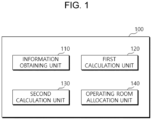
- FIG. 1 is a functional block diagram of an operating room allocation apparatus 100 according to an embodiment.
- the operating room allocation apparatus 100 of FIG. 1 may include an information obtaining unit 110, a first calculation unit 120, a second calculation unit 130, and an operating room allocation unit 140.
- the operating room allocation apparatus 100 may have all operations performed by a memory that stores data and instructions and one or more processors.
- One or more processors may control functional blocks included in FIG. 1 to perform operations to be described later.
- the information obtaining unit 110 may obtain information about patient's entry and exit times in each operating room, or information about downtime, which is a time to prepare for surgery in the operating room.
- the information obtaining unit 110 may operate in conjunction with an entry/exit record server or an entry/exit record database that records patient's entry time, exit time, and downtime.
- the first calculation unit 120 may calculate a utilization rate of each operating room.
- the utilization rate refers to the percentage of time an operating room is occupied during a specific period of time (e.g., time from patient entering the operating room to leaving the operating room, time to prepare for surgery in the operating room, etc.).
- an embodiment of this specification introduces the concept of 'a utilization rate of an operating room by time period' to provide a more detailed understanding of how the operating room is operated at a specific time.
- the first calculation unit 120 may calculate a utilization rate of an operating room by time period based on information about patient's entry and exit times in each operating room.
- the first calculation unit 120 may calculate a utilization rate of an operating room by time period by additionally considering information about a downtime as a time an operating room is occupied.
- the first calculation unit 120 may specify a time obtained by adding a downtime to an exit time as a final exit time, calculate a time from an entry time to the final exit time as a time an operating room was used, and calculate a utilization rate of the operating room by time period.
- Standards for entry and exit times according to an embodiment of this specification may be applied in various embodiments depending on administrator's settings.
- the first calculation unit 120 may divide a time from time information specified as an entry time to time information specified as an exit time by preset time intervals, calculate a ratio of an operating room used for each of the preset time intervals, and calculate a utilization rate of the operating room.
- the first calculation unit 120 may calculate a utilization rate of an operating room by time period in '30 minute' units. For example, when a patient's entry time in a specific operating room is expressed as x1:y1, and a patient's exit time is x2:y2, the first calculation unit 120 may calculate a utilization rate of the operating room per 30 minutes, as shown in 1) to 10) below, according to relationships between x1, y1, x2, and y2. In more detail, when 'hours' of entry and exit times are the same or different, a calculation method may be divided as follows depending on which time period interval (e.g., 0 minutes to 30 minutes or 30 minutes to 60 minutes) 'minutes' of the entry and exit times are included.
- time period interval e.g., 0 minutes to 30 minutes or 30 minutes to 60 minutes
- the formula 'x 100' which represents a utilization rate as a percentage, may be added according to designer's settings.
- the first calculation unit 120 may calculate a utilization rate of an operating room by time period in '1 hour' units. For example, when a patient's entry time in a specific operating room is expressed as x1:y1, and a patient's exit time is x2:y2, the first calculation unit 120 may calculate a utilization rate of the operating room per hour, as shown in 1) to 10) below, according to relationships between x1, y1, x2, and y2. In more detail, a calculation method may be divided as follows depending on whether 'hours' of entry and exit times are the same or different.
- 'x 100' which represents a utilization rate as a percentage, may be added according to designer's settings.
- the second calculation unit 130 may receive certain time information from a user and calculate an average utilization rate by time period in the received time information.
- the received time information may include at least one of a specific day of the week, a specific time period, and a specific period.
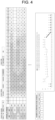
- FIG. 2 is an exemplary view showing results of the operating room allocation apparatus 100 calculating an average utilization rate for 30-minute intervals for each of five operating rooms during '07:00 to 22:00' on Mondays in the past month.
- the second calculation unit 130 may filter 30-minute utilization rate information between '07:00 to 22:00' on 'Monday' in the 'last 1 month' and calculate an average utilization rate by time period in the entered time information.
- the second calculation unit 130 may average the utilization rate information and calculate an average utilization rate from 08:00 to 08:30 in the entered time information as '67'.
- FIG. 3 is an exemplary view showing results of the operating room allocation apparatus 100 calculating an average utilization rate per hour for each of five operating rooms during '00:00 to 24:00' on Tuesdays of the past three months.
- the second calculation unit 130 may filter one-hour utilization rate information between '00:00 to 24:00' on 'Tuesday' of the 'last three months' and calculate an average utilization rate by time period in the entered time information.
- the second calculation unit 130 may average the utilization rate information and calculate an average utilization rate from 08:00 to 09:00 in the entered time information as '78'.
- the operating room allocation unit 140 may allocate an operating room where a patient can be operated on based on an average utilization rate of each operating room by time period. For example, the operating room allocation unit 140 may allocate an operating room where a new patient can be operated on so that an average utilization rate of each operating room by time period falls within a certain range.
- FIG. 4 is an exemplary view showing results of the operating room allocation apparatus 100 calculating an average utilization rate for 30-minute intervals for each operating room during '07:00 to 22:00' on Wednesdays in the last 12 months, and calculating a morning utilization rate and afternoon utilization rate for each operating room.
- the second calculation unit 130 may filter 30-minute utilization rate information between '07:00 to 22:00' on 'Wednesday' in the 'last 12 month' and calculate an average utilization rate by time period in the entered time information.
- the second calculation unit 130 may calculate an average utilization rate of each operating room in a morning time period by averaging utilization rates in the morning time period (e.g., 07:00 to 12:00) based on an average utilization rate of each operating room. For example, the second calculation unit 130 may calculate the average utilization rate of a specific operating room in a morning time period by averaging average utilization rates for 30-minute intervals from 07:00 to 12:00 of the specific operating room.
- a standard for a morning time period for calculating an average utilization rate in a morning time period may vary depending on administrator's settings. For example,'08:00 ⁇ 12:30' may be set as a morning time period, which is the standard for calculation. In this case, an average utilization rate of a specific operating room in a morning time period may be calculated by averaging average utilization rates for 30-minute intervals from 08:00 to 12:30 for the specific operating room.
- the second calculation unit 130 may calculate an average utilization rate of each operating room in an afternoon time period by averaging utilization rates in the afternoon time period (e.g., 12:00 to 22:00) based on an average utilization rate of each operating room. For example, the second calculation unit 130 may calculate the average utilization rate of a specific operating room in an afternoon time period by averaging average utilization rates for 30-minute intervals from 12:00 to 22:00 for the specific operating room.
- a standard for an afternoon time period for calculating an average utilization rate in an afternoon time period may vary depending on administrator's settings. For example,'12:30 ⁇ 17:00' may be set as an afternoon time period, which is a standard for calculation. In this case, an average utilization rate of a specific operating room in an afternoon time period may be calculated by averaging average utilization rates for 30-minute intervals from 12:30 to 17:30 for the specific operating room.
- the operating room allocation unit 140 may allocate a specific operating room to a department or surgeon based on the average utilization rate in the morning time period or the average utilization rate in the afternoon time period.
- FIG. 5 is a flowchart showing operations of an operating room allocation method performed by the operating room allocation apparatus 100 according to an embodiment. Each operation of the operating room allocation method according to FIG. 5 may be performed by the operating room allocation apparatus 100 illustrated in FIG. 1 , and each operation is described as follows.
- the information obtaining unit 110 may obtain information about patient's entry and exit times in an operating room.
- the first calculation unit 120 may calculate a utilization rate of the operating room for each certain time period based on the entry and exit times.
- the second calculation unit 130 may receive certain time information from a user and calculate an average utilization rate by time period in the received time information.
- the operating room allocation unit 140 may allocate an operating room where a patient can be operated on based on the average utilization rate.
- an operating room utilization rate may be adjusted to an appropriate range and operating rooms may be allocated so that the deviation in utilization rate for each operating room is reduced.
- operating rooms are allocated to increase a utilization rate of operating rooms with a utilization rate below a certain standard, and outside of regular surgery hours, operating rooms are allocated to lower a utilization rate of operating rooms with a utilization rate higher than a certain standard, allowing the hospital to operate operating rooms more efficiently and operate human and material resources more efficiently.
- the embodiments described above may be implemented through various devices.
- the embodiments may be implemented by hardware, firmware, software, or a combination thereof.
- an operating room utilization rate may be adjusted to an appropriate range and operating rooms may be allocated so that the deviation in utilization rate for each operating room is reduced.
- operating rooms are allocated to increase a utilization rate of operating rooms with a utilization rate below a certain standard, and outside of regular surgery hours, operating rooms are allocated to lower a utilization rate of operating rooms with a utilization rate higher than a certain standard, allowing the hospital to operate operating rooms more efficiently and operate human and material resources more efficiently.
- the embodiments described above may be implemented by hardware components, software components, and/or any combination thereof.
- the devices, the methods, and components described in the embodiments may be implemented by using general-purpose computers or special-purpose computers, such as a processor, a controller, an arithmetic logic unit (ALU), a digital signal processor, a microcomputer, a field programmable gate array (FPGA), a programmable logic unit (PLU), a microprocessor, or any other devices which may execute and respond to instructions.
- a processing apparatus may execute an operating system (OS) and a software application executed in the OS. Also, the processing apparatus may access, store, operate, process, and generate data in response to the execution of software. For convenience of understanding, it may be described that one processing apparatus is used.
- OS operating system
- the processing apparatus may access, store, operate, process, and generate data in response to the execution of software. For convenience of understanding, it may be described that one processing apparatus is used.
- the processing apparatus may include a plurality of processing elements and/or various types of processing elements.
- the processing apparatus may include a plurality of processors or a processor and a controller.
- other processing configurations such as a parallel processor, are also possible.
- the software may include computer programs, code, instructions, or any combination thereof, and may construct the processing apparatus for desired operations or may independently or collectively command the processing apparatus.
- the software and/or data may be permanently or temporarily embodied in any types of machines, components, physical devices, virtual equipment, computer storage mediums, or transmitted signal waves.
- the software may be distributed over network coupled computer systems so that it may be stored and executed in a distributed fashion.
- the software and/or data may be recorded in a computer-readable recording medium.
- a method according to an embodiment may be implemented as program instructions that can be executed by various computer devices, and recorded on a computer-readable recording medium.
- the computer-readable recording medium may include program instructions, data files, data structures or a combination thereof. Program instructions recorded on the medium may be particularly designed and structured for embodiments or available to one of ordinary skill in a field of computer software. Examples of the computer-readable recording medium include magnetic media, such as a hard disc, a floppy disc, and magnetic tape; optical media, such as a compact disc-read only memory (CD-ROM) and a digital versatile disc (DVD); magneto-optical media, such as floptical discs; and hardware devices specially configured to store and execute program instructions, such as ROM, random-access memory (RAM), a flash memory, etc.
- Program instructions may include, for example, high-level language code that can be executed by a computer using an interpreter, as well as machine language code made by a complier.
- An operating room allocation apparatus may be provided.
- the apparatus may include: an information obtaining unit configured to obtain information about patient's entry and exit times in each operating room; a first calculation unit configured to calculate a utilization rate of the operating room for each certain time period based on the patient's entry and exit times; and a second calculation unit configured to receive certain time information from a user and calculate an average utilization rate by time period in the received time information.
Landscapes
- Engineering & Computer Science (AREA)
- Business, Economics & Management (AREA)
- Health & Medical Sciences (AREA)
- General Business, Economics & Management (AREA)
- Public Health (AREA)
- Primary Health Care (AREA)
- Medical Informatics (AREA)
- General Health & Medical Sciences (AREA)
- Epidemiology (AREA)
- Biomedical Technology (AREA)
- Human Resources & Organizations (AREA)
- Strategic Management (AREA)
- Economics (AREA)
- Entrepreneurship & Innovation (AREA)
- Educational Administration (AREA)
- Game Theory and Decision Science (AREA)
- Development Economics (AREA)
- Marketing (AREA)
- Operations Research (AREA)
- Quality & Reliability (AREA)
- Tourism & Hospitality (AREA)
- Physics & Mathematics (AREA)
- General Physics & Mathematics (AREA)
- Theoretical Computer Science (AREA)
- Medical Treatment And Welfare Office Work (AREA)
Abstract
Description
- One or more embodiments relate to an apparatus, method, and computer-readable recording medium for allocating operating rooms based on a utilization rate by time period.
- As medical technology advances, customers' medical options are expanding and medical services are becoming more customer-centered, there is a need for efficient operation of operating rooms owned by hospitals so that customers may conveniently and quickly receive treatment at hospitals.
- In particular, the higher the ratio of non-operating time compared to operating time when an operating room is actually used, the longer customers have to wait for surgery, and the hospital cannot generate profits efficiently, making it difficult to provide good service.
- In addition, when a utilization rate of each operating room owned by a hospital varies greatly, working hours of each operating room in charge of the surgeon may vary, which may result in the surgeon working overtime in a specific operating room even though there is an empty operating room. Therefore, there may be a waste of human and material resources.
- Accordingly, a plan is needed to efficiently allocate operating rooms so that utilization rates of operating rooms may be adjusted to an appropriate range and the variation in operating room utilization rates may be reduced.
- One or more embodiments include a technology that introduces the concept of an operation rate by time period to calculate an operation rate of each operating room by time period, and based on an average operation rate of each operating room by time period for a period set by a user, adjusts an operation rate of an operating room to an appropriate range and allocates operating rooms so that the deviation in operation rate by operating room is reduced.
- As an embodiment of the present disclosure, an operating room allocation apparatus may be provided.
- The apparatus according to an embodiment of the present disclosure may include: an information obtaining unit configured to obtain information about patient's entry and exit times in each operating room; a first calculation unit configured to calculate a utilization rate of the operating room for each certain time period based on the patient's entry and exit times; and a second calculation unit configured to receive certain time information from a user and calculate an average utilization rate by time period in the received time information.
- The operating room allocation apparatus according to an embodiment of the present disclosure, wherein the information obtaining unit may further obtain information about downtime of the operating room, and the first calculation unit specify a time obtained by adding the downtime to the exit time as a final exit time, may calculate a time from the entry time to the final exit time as a time the operating room was used, and calculate a utilization rate of the operating room for the each certain time period.
- The operating room allocation apparatus according to an embodiment of the present disclosure, wherein the first calculation unit may divide a time from time information specified as the entry time to time information specified as the exit time by preset time intervals, may calculate a ratio of the operating room used for each of the preset time intervals, and calculate a utilization rate of the operating room.
- The operating room allocation apparatus according to an embodiment of the present disclosure, wherein, when the entry time is x1:y1, the exit time is x2:y2, x1 = x2, and the certain time is set at 30-minute intervals, the first calculation unit may calculate a utilization rate from x1:00 to x1:30 as


- The operating room allocation apparatus according to an embodiment of the present disclosure, wherein, when the entry time is x1:y1, the exit time is x2:y2, x1 ≠ x2, and the certain time is set at 30-minute intervals, the first calculation unit may calculate a utilization rate from x1:00 to x1:30 as

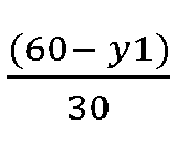


- The operating room allocation apparatus according to an embodiment of the present disclosure, wherein, when the entry time is x1:y1, the exit time is x2:y2, x1 ≠ x2, and the certain time is set at 30-minute intervals, the first calculation unit may calculate a utilization rate from x1:00 to x1:30 as


- The operating room allocation apparatus according to an embodiment of the present disclosure, wherein, when x1 > x2, the first calculation unit may calculate a utilization rate from b:00 to b:30 as 1, and a utilization rate from b:30 to b:60 as 1 for an integer b that satisfies condition x1< b <23, and may calculate a utilization rate from c:00 to c:30 as 1, and a utilization rate from c:30 to c:60 as 1 for an integer c that satisfies
condition 0< c <x2. - The operating room allocation apparatus according to an embodiment of the present disclosure, wherein, when the entry time is x1:y1, the exit time is x2:y2, x1 = x2, and the certain time is set at 1 hour intervals, the first calculation unit may calculate a utilization rate at x1 o'clock as

- The operating room allocation apparatus according to an embodiment of the present disclosure, wherein, when the entry time is x1:y1, the exit time is x2:y2, x1 ≠ x2, and the certain time is set at 1 hour intervals, the first calculation unit may calculate a utilization rate at x1 o'clock as


- The operating room allocation apparatus according to an embodiment of the present disclosure, wherein, when x1 > x2, the first calculation unit may calculate a utilization rate at b o'clock as 1 for an integer b that satisfies condition x1< b <23, and may calculate a utilization rate at c o'clock as 1 for an integer c that satisfies
condition 0< c <x2. - The operating room allocation apparatus according to an embodiment of the present disclosure, wherein the second calculation unit may receive time information of at least one of day of the week, time period, and period from a user, filters a utilization rate by time period that satisfies the received time information, and then may calculate an average utilization rate by time period by averaging the filtered utilization rate by time period in the received time information.
- The operating room allocation apparatus according to an embodiment of the present disclosure may further include: an operating room allocation unit configured to allocate, from among operating rooms, an operating room where a patient can be operated on based on an average utilization rate of each of the operating rooms by time period.
- The operating room allocation apparatus according to an embodiment of the present disclosure, wherein the operating room allocation unit may allocate an operating room where a patient can be operated on from among the operating rooms, so that an average utilization rate of each of the operating rooms by time period falls within a certain range.
- As an embodiment of the present disclosure, an operating room allocation method performed by an operating room allocation apparatus may be provided.
- The method according to an embodiment of the present disclosure may include: obtaining information about patient's entry and exit times in an operating room; calculating a utilization rate of the operating room for each certain time period based on the patient's entry and exit times; and receiving certain time information from a user and calculating an average utilization rate by time period in the received time information.
- The operating room allocation method according to an embodiment of the present disclosure, wherein the obtaining may include obtaining information about downtime of the operating room, and the calculating of the utilization rate of the operating room may include calculating the utilization rate of the operating room for the each certain time period by additionally considering the downtime.
- The operating room allocation method according to an embodiment of the present disclosure, wherein the calculating of the average utilization rate by time period may include receiving time information of at least one of day of the week, time period, and period from a user, filtering a utilization rate by time period that satisfies the received time information, and then calculating an average utilization rate by time period by averaging the filtered utilization rate by time period in the received time information.
- The operating room allocation method according to an embodiment of the present disclosure may further include allocating, from among operating rooms, an operating room where a patient can be operated on based on the average utilization rate.
- The operating room allocation method according to an embodiment of the present disclosure, wherein the allocating may include: allocating an operating room where a patient can be operated on from among the operating rooms, so that an average utilization rate of each of the operating rooms by time period falls within a certain range.
- As an embodiment of the present disclosure, a non-transitory computer-readable recording medium having recorded thereon a computer program may be provided.
- The non-transitory computer-readable recording medium having recorded thereon instructions executable by a processor to: obtain information about patient's entry and exit times in an operating room; calculate a utilization rate of the operating room for each certain time period based on the patient's entry and exit times; and receive certain time information from a user and calculate an average utilization rate by time period in the received time information.
-
-
FIG. 1 is a functional block diagram of an operatingroom allocation apparatus 100 according to an embodiment. -
FIG. 2 is an exemplary view showing results of the operatingroom allocation apparatus 100 calculating an average utilization rate for 30-minute intervals for each of five operating rooms during '07:00 to 22:00' on Mondays in the past month. -
FIG. 3 is an exemplary view showing results of the operatingroom allocation apparatus 100 calculating an average utilization rate per hour for each of five operating rooms during '00:00 to 24:00' on Tuesdays of the past three months. -
FIG. 4 is an exemplary view showing results of the operatingroom allocation apparatus 100 calculating an average utilization rate for 30-minute intervals for each operating room during '07:00 to 22:00' on Wednesdays in the last 12 months and calculating a morning utilization rate and afternoon utilization rate for each operating room. -
FIG. 5 is a flowchart showing operations of an operating room allocation method performed by the operatingroom allocation apparatus 100 according to an embodiment. - Hereinafter, embodiments of the present invention will be described with reference to the drawings. In the following description, descriptions of a well-known technical configuration in relation to a lead implantation system for a deep brain stimulator will be omitted. For example, descriptions of the configuration/structure/method of a device or system commonly used in deep brain stimulation, such as the structure of an implantable pulse generator, a connection structure/method of the implantable pulse generator and a lead, and a process for transmitting and receiving electrical signals measured through the lead with an external device, will be omitted. Even if these descriptions are omitted, one of ordinary skill in the art will be able to easily understand the characteristic configuration of the present invention through the following description.
-
FIG. 1 is a functional block diagram of an operatingroom allocation apparatus 100 according to an embodiment. - The operating
room allocation apparatus 100 ofFIG. 1 may include aninformation obtaining unit 110, afirst calculation unit 120, asecond calculation unit 130, and an operatingroom allocation unit 140. The operatingroom allocation apparatus 100 may have all operations performed by a memory that stores data and instructions and one or more processors. One or more processors may control functional blocks included inFIG. 1 to perform operations to be described later. - The
information obtaining unit 110 may obtain information about patient's entry and exit times in each operating room, or information about downtime, which is a time to prepare for surgery in the operating room. For example, theinformation obtaining unit 110 may operate in conjunction with an entry/exit record server or an entry/exit record database that records patient's entry time, exit time, and downtime. - The
first calculation unit 120 may calculate a utilization rate of each operating room. The utilization rate refers to the percentage of time an operating room is occupied during a specific period of time (e.g., time from patient entering the operating room to leaving the operating room, time to prepare for surgery in the operating room, etc.). - To achieve a goal of more efficient operating room allocation, an embodiment of this specification introduces the concept of 'a utilization rate of an operating room by time period' to provide a more detailed understanding of how the operating room is operated at a specific time.
- The
first calculation unit 120 may calculate a utilization rate of an operating room by time period based on information about patient's entry and exit times in each operating room. Thefirst calculation unit 120 may calculate a utilization rate of an operating room by time period by additionally considering information about a downtime as a time an operating room is occupied. For example, thefirst calculation unit 120 may specify a time obtained by adding a downtime to an exit time as a final exit time, calculate a time from an entry time to the final exit time as a time an operating room was used, and calculate a utilization rate of the operating room by time period. Standards for entry and exit times according to an embodiment of this specification may be applied in various embodiments depending on administrator's settings. - The
first calculation unit 120 may divide a time from time information specified as an entry time to time information specified as an exit time by preset time intervals, calculate a ratio of an operating room used for each of the preset time intervals, and calculate a utilization rate of the operating room. - As an example, the
first calculation unit 120 may calculate a utilization rate of an operating room by time period in '30 minute' units. For example, when a patient's entry time in a specific operating room is expressed as x1:y1, and a patient's exit time is x2:y2, thefirst calculation unit 120 may calculate a utilization rate of the operating room per 30 minutes, as shown in 1) to 10) below, according to relationships between x1, y1, x2, and y2. In more detail, when 'hours' of entry and exit times are the same or different, a calculation method may be divided as follows depending on which time period interval (e.g., 0 minutes to 30 minutes or 30 minutes to 60 minutes) 'minutes' of the entry and exit times are included. - 1) When 'hours' of entry and exit times are the same, and 'minutes' of entry and exit times are within the same time period interval (e.g., 0 minutes to 30 minutes), the calculation is as follows. That is, when x1 = x2 and minute information y1 of an entry time and minute information y2 of an exit time are 30 minutes before or 30 minutes, a 30-minute utilization rate from x1:00 to x1:30 may be calculated as

- 2) When 'hours' of entry and exit times are the same, and 'minutes' of entry and exit times are within the same time period interval (e.g., 30 minutes to 60 minutes), the calculation is as follows. That is, when x1 = x2 and minute information y1 of an entry time and minute information y2 of an exit time are 30 minutes after, a 30-minute utilization rate from x1:30 to x1:60 may be calculated as

- 3) When 'hours' of entry and exit times are the same, and 'minutes' of entry and exit times are included in different time period intervals, the calculation is as follows. That is, when x1 = x2 and minute information y1 of an entry time is 30 minutes before or 30 minutes and minute information y2 of an exit time is 30 minutes after, a 30-minute utilization rate from x1:00 to x1:30 may be calculated as


- 4) When 'hours' of entry and exit times are different, and the entry time is 30 minutes before or 30 minutes, the calculation of a utilization rate for a time period that includes the first entry time is as follows. That is, when x1 ≠ x2 and minute information y1 of an entry time is 30 minutes before or 30 minutes, a 30-minute utilization rate from x1:00 to x1:30 may be calculated as

- 5) When 'hours' of entry and exit times are different, and the entry time is 30 minutes after, the calculation of a utilization rate for a time period that includes the first entry time is as follows. That is, when x1 ≠ x2 and minute information y1 of an entry time is 30 minutes after, a 30-minute utilization rate from x1:30 to x1:60 may be calculated as

- 6) When 'hours' of entry and exit times are different, and the exit time is 30 minutes before or 30 minutes, the calculation of a utilization rate for a time period that includes the exit time is as follows. That is, when x1 ≠ x2 and minute information y2 of an exit time is 30 minutes before or 30 minutes, a 30-minute utilization rate from x2:00 to x2:30 may be calculated as

- 7) When 'hours' of entry and exit times are different, and the exit time is 30 minutes after, the calculation of a utilization rate for a time period that includes the exit time is as follows. That is, when x1 ≠ x2 and minute information y2 of an exit time is 30 minutes after, a 30-minute utilization rate from x2:00 to x2:30 may be calculated as 1, and a 30-minute utilization rate from x2:30 to x2:60 may be calculated as

- 8) When 'hours' of entry and exit times are different, the calculation of a utilization rate by time period between the entry and exit times is as follows. That is, when x1 ≠ x2 and there is an integer 'a' that satisfies condition x1< a <x2, a 30-minute utilization rate from a:00 to a:30 may be calculated as 1, and a 30-minute utilization rate from a:30 to a:60 may be calculated as 1.
- 9) When dates of entry and exit times are different, the calculation of a utilization rate by time period corresponding to the date including the entry time is as follows. That is, when x1 > x2 and there is an integer b that satisfies condition x1< b ≤23, a 30-minute utilization rate from b:00 to b:30 may be calculated as 1, and a 30-minute utilization rate from b:30 to b:60 may be calculated as 1.
- 10) When dates of entry and exit times are different, the calculation of a utilization rate by time period corresponding to the date including the exit time is as follows. That is, when x1 > x2 and there is an integer c that satisfies
condition 0 ≤ c <x2, a 30-minute utilization rate from c:00 to c:30 may be calculated as 1, and a 30-minute utilization rate from c:30 to c:60 may be calculated as 1. - In 1) to 10) above, the formula 'x 100', which represents a utilization rate as a percentage, may be added according to designer's settings.
- As an example, the
first calculation unit 120 may calculate a utilization rate of an operating room by time period in '1 hour' units. For example, when a patient's entry time in a specific operating room is expressed as x1:y1, and a patient's exit time is x2:y2, thefirst calculation unit 120 may calculate a utilization rate of the operating room per hour, as shown in 1) to 10) below, according to relationships between x1, y1, x2, and y2. In more detail, a calculation method may be divided as follows depending on whether 'hours' of entry and exit times are the same or different. - 1) When 'hours' of entry and exit times are the same, the calculation is as follows. That is, when x1 = x2, a 1-hour utilization rate at x1 o'clock may be calculated as

- 2) When 'hours' of entry and exit times are different, the calculation is as follows. That is, when x1 ≠ x2, a 1-hour utilization rate at x1 o'clock may be calculated as


- 3) When 'hours' of entry and exit times are different, the calculation between the entry and exit times is as follows. That is, when there is an integer 'a' that satisfies condition x1< a <x2, a 1-hour utilization rate at 'a' o'clock may be calculated as 1.
- 4) When dates of entry and exit times are different, the calculation of a utilization rate by time period corresponding to the date including the entry time is as follows. That is, when x1 > x2 and there is an integer b that satisfies condition x1< b ≤23, a utilization rate at b o'clock may be calculated as 1.
- 5) When dates of entry and exit times are different, the calculation of a utilization rate by time period corresponding to the date including the exit time is as follows. That is, when x1 > x2 and there is an integer c that satisfies
condition 0≤ c <x2, a 1-hour utilization rate at c o'clock may be calculated as 1. - In 1) to 5) above, 'x 100', which represents a utilization rate as a percentage, may be added according to designer's settings.
- The
second calculation unit 130 may receive certain time information from a user and calculate an average utilization rate by time period in the received time information. For example, the received time information may include at least one of a specific day of the week, a specific time period, and a specific period. -
FIG. 2 is an exemplary view showing results of the operatingroom allocation apparatus 100 calculating an average utilization rate for 30-minute intervals for each of five operating rooms during '07:00 to 22:00' on Mondays in the past month. - Referring to
FIG. 2 , when a user enters 'Monday' as the day of the week, 'Last 1 month' as the period, and '07-00-22-00' as the time period, thesecond calculation unit 130 may filter 30-minute utilization rate information between '07:00 to 22:00' on 'Monday' in the 'last 1 month' and calculate an average utilization rate by time period in the entered time information. - For example, among filtered utilization information, when 30-minute utilization information for operating room E01 from 08:00 to 08:30 is '65, 66, 67, 68, and 69', the
second calculation unit 130 may average the utilization rate information and calculate an average utilization rate from 08:00 to 08:30 in the entered time information as '67'. -
FIG. 3 is an exemplary view showing results of the operatingroom allocation apparatus 100 calculating an average utilization rate per hour for each of five operating rooms during '00:00 to 24:00' on Tuesdays of the past three months. - Referring to
FIG. 3 , when a user enters 'Tuesday' as the day of the week, 'Last 3 months' as the period, and '00-00-24-00' as the time period, thesecond calculation unit 130 may filter one-hour utilization rate information between '00:00 to 24:00' on 'Tuesday' of the 'last three months' and calculate an average utilization rate by time period in the entered time information. - For example, among filtered utilization information, when one-hour utilization information for operating room A01 from 08:00 to 09:00 is '73, 74, 75, 76, 77, 78, 78, 79, 80, 81, 82, and 83', the
second calculation unit 130 may average the utilization rate information and calculate an average utilization rate from 08:00 to 09:00 in the entered time information as '78'. - The operating
room allocation unit 140 may allocate an operating room where a patient can be operated on based on an average utilization rate of each operating room by time period. For example, the operatingroom allocation unit 140 may allocate an operating room where a new patient can be operated on so that an average utilization rate of each operating room by time period falls within a certain range. -
FIG. 4 is an exemplary view showing results of the operatingroom allocation apparatus 100 calculating an average utilization rate for 30-minute intervals for each operating room during '07:00 to 22:00' on Wednesdays in the last 12 months, and calculating a morning utilization rate and afternoon utilization rate for each operating room. - Referring to
FIG. 4 , when a user enters 'Wednesday' as the day of the week, 'Last 12 month' as the period, and '07:00~22:00' as the time period, thesecond calculation unit 130 may filter 30-minute utilization rate information between '07:00 to 22:00' on 'Wednesday' in the 'last 12 month' and calculate an average utilization rate by time period in the entered time information. - The
second calculation unit 130 may calculate an average utilization rate of each operating room in a morning time period by averaging utilization rates in the morning time period (e.g., 07:00 to 12:00) based on an average utilization rate of each operating room. For example, thesecond calculation unit 130 may calculate the average utilization rate of a specific operating room in a morning time period by averaging average utilization rates for 30-minute intervals from 07:00 to 12:00 of the specific operating room. However, a standard for a morning time period for calculating an average utilization rate in a morning time period may vary depending on administrator's settings. For example,'08:00~12:30' may be set as a morning time period, which is the standard for calculation. In this case, an average utilization rate of a specific operating room in a morning time period may be calculated by averaging average utilization rates for 30-minute intervals from 08:00 to 12:30 for the specific operating room. - The
second calculation unit 130 may calculate an average utilization rate of each operating room in an afternoon time period by averaging utilization rates in the afternoon time period (e.g., 12:00 to 22:00) based on an average utilization rate of each operating room. For example, thesecond calculation unit 130 may calculate the average utilization rate of a specific operating room in an afternoon time period by averaging average utilization rates for 30-minute intervals from 12:00 to 22:00 for the specific operating room. However, a standard for an afternoon time period for calculating an average utilization rate in an afternoon time period may vary depending on administrator's settings. For example,'12:30~17:00' may be set as an afternoon time period, which is a standard for calculation. In this case, an average utilization rate of a specific operating room in an afternoon time period may be calculated by averaging average utilization rates for 30-minute intervals from 12:30 to 17:30 for the specific operating room. - The operating
room allocation unit 140 may allocate a specific operating room to a department or surgeon based on the average utilization rate in the morning time period or the average utilization rate in the afternoon time period. -
FIG. 5 is a flowchart showing operations of an operating room allocation method performed by the operatingroom allocation apparatus 100 according to an embodiment. Each operation of the operating room allocation method according toFIG. 5 may be performed by the operatingroom allocation apparatus 100 illustrated inFIG. 1 , and each operation is described as follows. - In operation S1010, the
information obtaining unit 110 may obtain information about patient's entry and exit times in an operating room. - In operation S1020, the
first calculation unit 120 may calculate a utilization rate of the operating room for each certain time period based on the entry and exit times. - In operation S1030, the
second calculation unit 130 may receive certain time information from a user and calculate an average utilization rate by time period in the received time information. - In operation S1040, the operating
room allocation unit 140 may allocate an operating room where a patient can be operated on based on the average utilization rate. - In addition to the operations shown in
FIG. 5 , because theinformation obtaining unit 110,first calculation unit 120,second calculation unit 130, and operatingroom allocation unit 140 described above configure various embodiments to perform the operations described withFIG. 1 , even in the operations ofFIG. 5 , a new operation performed by each functional block may be added. Because a configuration of an additional operation and operations of components responsible for each operation to perform the operation have been described inFIGS. 1 to 3 , redundant descriptions will be omitted. - According to the embodiment described above, by calculating a utilization rate of each operating room by time period and using an average utilization rate of each operating room by time period for a period set by a user, an operating room utilization rate may be adjusted to an appropriate range and operating rooms may be allocated so that the deviation in utilization rate for each operating room is reduced.
- Accordingly, during regular surgery hours (e.g., the same hours as the regular working hours of workers within a hospital, which may be 08:00 to 17:00, 08:30 to 17:30, etc.), operating rooms are allocated to increase a utilization rate of operating rooms with a utilization rate below a certain standard, and outside of regular surgery hours, operating rooms are allocated to lower a utilization rate of operating rooms with a utilization rate higher than a certain standard, allowing the hospital to operate operating rooms more efficiently and operate human and material resources more efficiently.
- The embodiments described above may be implemented through various devices. For example, the embodiments may be implemented by hardware, firmware, software, or a combination thereof.
- According to an embodiment, by calculating a utilization rate of each operating room by time period and using an average utilization rate of each operating room by time period for a period set by a user, an operating room utilization rate may be adjusted to an appropriate range and operating rooms may be allocated so that the deviation in utilization rate for each operating room is reduced.
- Accordingly, during regular surgery hours, operating rooms are allocated to increase a utilization rate of operating rooms with a utilization rate below a certain standard, and outside of regular surgery hours, operating rooms are allocated to lower a utilization rate of operating rooms with a utilization rate higher than a certain standard, allowing the hospital to operate operating rooms more efficiently and operate human and material resources more efficiently.
- In addition, various effects directly or indirectly identified through this document may be provided.
- The embodiments described above may be implemented by hardware components, software components, and/or any combination thereof. For example, the devices, the methods, and components described in the embodiments may be implemented by using general-purpose computers or special-purpose computers, such as a processor, a controller, an arithmetic logic unit (ALU), a digital signal processor, a microcomputer, a field programmable gate array (FPGA), a programmable logic unit (PLU), a microprocessor, or any other devices which may execute and respond to instructions. A processing apparatus may execute an operating system (OS) and a software application executed in the OS. Also, the processing apparatus may access, store, operate, process, and generate data in response to the execution of software. For convenience of understanding, it may be described that one processing apparatus is used. However, one of ordinary skill in the art will understand that the processing apparatus may include a plurality of processing elements and/or various types of processing elements. For example, the processing apparatus may include a plurality of processors or a processor and a controller. Also, other processing configurations, such as a parallel processor, are also possible.
- The software may include computer programs, code, instructions, or any combination thereof, and may construct the processing apparatus for desired operations or may independently or collectively command the processing apparatus. In order to be interpreted by the processing apparatus or to provide commands or data to the processing apparatus, the software and/or data may be permanently or temporarily embodied in any types of machines, components, physical devices, virtual equipment, computer storage mediums, or transmitted signal waves. The software may be distributed over network coupled computer systems so that it may be stored and executed in a distributed fashion. The software and/or data may be recorded in a computer-readable recording medium.
- A method according to an embodiment may be implemented as program instructions that can be executed by various computer devices, and recorded on a computer-readable recording medium. The computer-readable recording medium may include program instructions, data files, data structures or a combination thereof. Program instructions recorded on the medium may be particularly designed and structured for embodiments or available to one of ordinary skill in a field of computer software. Examples of the computer-readable recording medium include magnetic media, such as a hard disc, a floppy disc, and magnetic tape; optical media, such as a compact disc-read only memory (CD-ROM) and a digital versatile disc (DVD); magneto-optical media, such as floptical discs; and hardware devices specially configured to store and execute program instructions, such as ROM, random-access memory (RAM), a flash memory, etc. Program instructions may include, for example, high-level language code that can be executed by a computer using an interpreter, as well as machine language code made by a complier.
- In concluding the detailed description, those skilled in the art will appreciate that many variations and modifications may be made to the preferred embodiments without substantially departing from the principles of the present invention. Therefore, the disclosed preferred embodiments of the invention are used in a generic and descriptive sense only and not for purposes of limitation.
An operating room allocation apparatus may be provided. The apparatus according to an embodiment of the present disclosure may include: an information obtaining unit configured to obtain information about patient's entry and exit times in each operating room; a first calculation unit configured to calculate a utilization rate of the operating room for each certain time period based on the patient's entry and exit times; and a second calculation unit configured to receive certain time information from a user and calculate an average utilization rate by time period in the received time information.
Claims (15)
- An operating room allocation apparatus comprising:an information obtaining unit configured to obtain information about patient's entry and exit times in each operating room;a first calculation unit configured to calculate a utilization rate of the operating room for each certain time period based on the patient's entry and exit times; anda second calculation unit configured to receive certain time information from a user and calculate an average utilization rate by time period in the received time information.
- The operating room allocation apparatus of claim 1, wherein the information obtaining unit further obtains information about downtime of the operating room, and
the first calculation unit specify a time obtained by adding the downtime to the exit time as a final exit time, calculate a time from the entry time to the final exit time as a time the operating room was used, and calculate a utilization rate of the operating room for the each certain time period. - The operating room allocation apparatus of claim 1 or 2, wherein the first calculation unit divides a time from time information specified as the entry time to time information specified as the exit time by preset time intervals, calculate a ratio of the operating room used for each of the preset time intervals, and calculate a utilization rate of the operating room.
- The operating room allocation apparatus according to any of claims 1-3, wherein, when the entry time is x1:y1, the exit time is x2:y2, x1 = x2, and the certain time is set at 30-minute intervals,the first calculation unit calculates a utilization rate from x1:00 to x1:30 as
 calculates a utilization rate from x1:30 to x1:60 as
 calculates a utilization rate from x1:00 to x1:30 as

- The operating room allocation apparatus according to any of claims 1-4, wherein, when the entry time is x1:y1, the exit time is x2:y2, x1 ≠ x2, and the certain time is set at 30-minute intervals,the first calculation unit calculates a utilization rate from x1:00 to x1:30 as
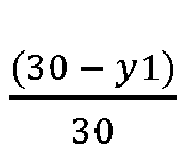 calculates a utilization rate from x1:30 to x1:60 as
 calculates a utilization rate from x2:00 to x2:30 as
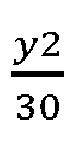 calculates a utilization rate from x2:00 to x2:30 as 1 and calculates a utilization rate from x2:30 to x2:60 as
 calculates a utilization rate from a:00 to a:30 as 1, and a utilization rate from a:30 to a:60 as 1 for an integer 'a' that satisfies condition x1< a <x2.
 - The operating room allocation apparatus according to any of claims 1-5, wherein, when x1 > x2,the first calculation unit calculates a utilization rate from b:00 to b:30 as 1, and a utilization rate from b:30 to b:60 as 1 for an integer b that satisfies condition x1< b <23, andcalculates a utilization rate from c:00 to c:30 as 1, and a utilization rate from c:30 to c:60 as 1 for an integer c that satisfies condition 0< c <x2.
- The operating room allocation apparatus according to any of claims 1-6, wherein, when the entry time is x1:y1, the exit time is x2:y2, x1 = x2, and the certain time is set at 1 hour intervals,
the first calculation unit calculates a utilization rate at x1 o'clock as
- The operating room allocation apparatus according to any of claims 1-7, wherein, when the entry time is x1:y1, the exit time is x2:y2, x1 ≠ x2, and the certain time is set at 1 hour intervals,the first calculation unit calculates a utilization rate at x1 o'clock as

 calculates a utilization rate at 'a' o'clock as 1 for an integer 'a' that satisfies condition x1< a <x2.
 - The operating room allocation apparatus according to any of claims 1-8, wherein, when x1 > x2,the first calculation unit calculates a utilization rate at b o'clock as 1 for an integer b that satisfies condition x1< b <23, andcalculates a utilization rate at c o'clock as 1 for an integer c that satisfies condition 0< c <x2.
- The operating room allocation apparatus according to any of claims 1-9, wherein the second calculation unit receives time information of at least one of day of the week, time period, and period from a user, filters a utilization rate by time period that satisfies the received time information, and then calculates an average utilization rate by time period by averaging the filtered utilization rate by time period in the received time information.
- The operating room allocation apparatus according to any of claims 1-10, further comprising:an operating room allocation unit configured to allocate, from among operating rooms, an operating room where a patient can be operated on based on an average utilization rate of each of the operating rooms by time period,wherein the operating room allocation unit preferably allocates an operating room where a patient can be operated on from among the operating rooms, so that an average utilization rate of each of the operating rooms by time period falls within a certain range.
- An operating room allocation method performed by an operating room allocation apparatus, the operating room allocation method comprising:obtaining information about patient's entry and exit times in an operating room;calculating a utilization rate of the operating room for each certain time period based on the patient's entry and exit times; andreceiving certain time information from a user and calculating an average utilization rate by time period in the received time information.
- The operating room allocation method of claim12, wherein the obtaining comprises:obtaining information about downtime of the operating room, andthe calculating of the utilization rate of the operating room comprises:
calculating the utilization rate of the operating room for the each certain time period by additionally considering the downtime, and/orwherein the calculating of the average utilization rate by time period comprises:
receiving time information of at least one of day of the week, time period, and period from a user, filtering a utilization rate by time period that satisfies the received time information, and then calculating an average utilization rate by time period by averaging the filtered utilization rate by time period in the received time information. - The operating room allocation method of any of claim 12 or 13, further comprising:
allocating, from among operating rooms, an operating room where a patient can be operated on based on the average utilization ratewherein the allocating preferably comprises:
allocating an operating room where a patient can be operated on from among the operating rooms, so that an average utilization rate of each of the operating rooms by time period falls within a certain range. - A non-transitory computer-readable recording medium having recorded thereon a computer program, the non-transitory computer-readable recording medium having recorded thereon instructions executable by a processor to:obtain information about patient's entry and exit times in an operating room;calculate a utilization rate of the operating room for each certain time period based on the patient's entry and exit times; andreceive certain time information from a user and calculate an average utilization rate by time period in the received time information.
Applications Claiming Priority (1)
| Application Number | Priority Date | Filing Date | Title |
|---|---|---|---|
| KR1020220160924A KR102936600B1 (en) | 2022-11-25 | 2022-11-25 | Apparatus, method and computer-readable storage medium for allocating operating room based on usage rate by time period |
Publications (2)
| Publication Number | Publication Date |
|---|---|
| EP4375898A1 true EP4375898A1 (en) | 2024-05-29 |
| EP4375898B1 EP4375898B1 (en) | 2025-12-31 |
Family
ID=88969648
Family Applications (1)
| Application Number | Title | Priority Date | Filing Date |
|---|---|---|---|
| EP23211932.1A Active EP4375898B1 (en) | 2022-11-25 | 2023-11-24 | DEVICE, METHOD AND COMPUTER-READABLE STORAGE MEDIUM FOR ALLOCATION OF OPERATING SPACE BASED ON USE RATE BY TIME PERIOD |
Country Status (3)
| Country | Link |
|---|---|
| US (1) | US20240177844A1 (en) |
| EP (1) | EP4375898B1 (en) |
| KR (1) | KR102936600B1 (en) |
Citations (2)
| Publication number | Priority date | Publication date | Assignee | Title |
|---|---|---|---|---|
| CA3161894A1 (en) * | 2019-12-19 | 2021-06-24 | Andrew Day | Optimizing patient placement and sequencing in a dynamic medical system using a complex heuristic with embedded machine learning |
| US11341462B1 (en) * | 2019-02-11 | 2022-05-24 | Allscripts Software Llc | Graphical user interface for generating a recurring appointment report based upon user input |
Family Cites Families (5)
| Publication number | Priority date | Publication date | Assignee | Title |
|---|---|---|---|---|
| US4075679A (en) * | 1975-12-08 | 1978-02-21 | Hewlett-Packard Company | Programmable calculator |
| JP4781085B2 (en) * | 2005-10-25 | 2011-09-28 | オリンパスメディカルシステムズ株式会社 | Surgical schedule display system |
| JP2011044041A (en) * | 2009-08-21 | 2011-03-03 | Takenaka Komuten Co Ltd | Medical management evaluation system and medical management evaluation program |
| JP5049357B2 (en) * | 2010-01-13 | 2012-10-17 | 株式会社日立メディコ | Medical equipment operation analysis support system |
| KR101815159B1 (en) | 2017-08-22 | 2018-01-30 | (주)에스텍휴먼서비스 | System of assigning for patient transportation and method thereof |
-
2022
- 2022-11-25 KR KR1020220160924A patent/KR102936600B1/en active Active
-
2023
- 2023-11-21 US US18/515,839 patent/US20240177844A1/en active Pending
- 2023-11-24 EP EP23211932.1A patent/EP4375898B1/en active Active
Patent Citations (2)
| Publication number | Priority date | Publication date | Assignee | Title |
|---|---|---|---|---|
| US11341462B1 (en) * | 2019-02-11 | 2022-05-24 | Allscripts Software Llc | Graphical user interface for generating a recurring appointment report based upon user input |
| CA3161894A1 (en) * | 2019-12-19 | 2021-06-24 | Andrew Day | Optimizing patient placement and sequencing in a dynamic medical system using a complex heuristic with embedded machine learning |
Also Published As
| Publication number | Publication date |
|---|---|
| EP4375898B1 (en) | 2025-12-31 |
| KR102936600B1 (en) | 2026-03-06 |
| US20240177844A1 (en) | 2024-05-30 |
| KR20240078198A (en) | 2024-06-03 |
Similar Documents
| Publication | Publication Date | Title |
|---|---|---|
| Dexter et al. | Estimating the incidence of prolonged turnover times and delays by time of day | |
| US5946659A (en) | System and method for notification and access of patient care information being simultaneously entered | |
| Green et al. | Using queueing theory to increase the effectiveness of emergency department provider staffing | |
| EP1241981B1 (en) | Dynamic bandwidth monitor and adjuster for remote communications with a medical device | |
| CN107463763A (en) | Medical treatment device connection status monitors | |
| Hesaraki et al. | Generating outpatient chemotherapy appointment templates with balanced flowtime and makespan | |
| CA3096951A1 (en) | System for managing clinical data | |
| CA2903159A1 (en) | Defining patient episodes based on healthcare events | |
| Swartzman | The patient arrival process in hospitals: statistical analysis | |
| EP1535208A4 (en) | System for remotely monitoring and controlling cpap apparatus | |
| EP4375898B1 (en) | DEVICE, METHOD AND COMPUTER-READABLE STORAGE MEDIUM FOR ALLOCATION OF OPERATING SPACE BASED ON USE RATE BY TIME PERIOD | |
| Wathour et al. | Variability of fitting parameters across cochlear implant centres | |
| US8504787B1 (en) | Techniques for determining data protection storage requirements | |
| CN111126941B (en) | Careplan processing method and device, electronic equipment and storage medium | |
| Dexter et al. | Modeling daily veterinary anesthetist patient care hours and probabilities of exceeding critical thresholds | |
| Grain | Analysis of operating theatre utilisation to drive efficiency and productivity improvements | |
| CN116504214A (en) | Cranial magnetic stimulation masking noise generating device, electronic equipment and storage medium | |
| CN111079195A (en) | Diagnosis appointment evidence storage method, device and medium based on block chain | |
| US20240194357A1 (en) | System and method to autonomously and remotely monitor, analyze and respond to physiological and diagnostic device data from a medical implant | |
| EP4597509A1 (en) | Method and apparatus for adjusting reservation capacity according to no-show rate based on prescription information of patient | |
| Bergman et al. | After-hours calls: a five-year longitudinal study in a family practice group | |
| Shapiro et al. | 177 The Current Landscape of Anticoagulation (AC) Stewardship Implementation Around the World: An International Survey | |
| US20240161911A1 (en) | Artificial intelligence-based scheduling of medical procedures in operating rooms | |
| CN120183640B (en) | A smart healthcare management system | |
| Britt | Stochastic goal programming and a metaheuristic for scheduling of operating rooms |
Legal Events
| Date | Code | Title | Description |
|---|---|---|---|
| PUAI | Public reference made under article 153(3) epc to a published international application that has entered the european phase |
Free format text: ORIGINAL CODE: 0009012 |
|
| STAA | Information on the status of an ep patent application or granted ep patent |
Free format text: STATUS: REQUEST FOR EXAMINATION WAS MADE |
|
| 17P | Request for examination filed |
Effective date: 20231124 |
|
| AK | Designated contracting states |
Kind code of ref document: A1 Designated state(s): AL AT BE BG CH CY CZ DE DK EE ES FI FR GB GR HR HU IE IS IT LI LT LU LV MC ME MK MT NL NO PL PT RO RS SE SI SK SM TR |
|
| STAA | Information on the status of an ep patent application or granted ep patent |
Free format text: STATUS: EXAMINATION IS IN PROGRESS |
|
| 17Q | First examination report despatched |
Effective date: 20250717 |
|
| GRAP | Despatch of communication of intention to grant a patent |
Free format text: ORIGINAL CODE: EPIDOSNIGR1 |
|
| STAA | Information on the status of an ep patent application or granted ep patent |
Free format text: STATUS: GRANT OF PATENT IS INTENDED |
|
| INTG | Intention to grant announced |
Effective date: 20250923 |
|
| GRAS | Grant fee paid |
Free format text: ORIGINAL CODE: EPIDOSNIGR3 |
|
| GRAA | (expected) grant |
Free format text: ORIGINAL CODE: 0009210 |
|
| STAA | Information on the status of an ep patent application or granted ep patent |
Free format text: STATUS: THE PATENT HAS BEEN GRANTED |
|
| AK | Designated contracting states |
Kind code of ref document: B1 Designated state(s): AL AT BE BG CH CY CZ DE DK EE ES FI FR GB GR HR HU IE IS IT LI LT LU LV MC ME MK MT NL NO PL PT RO RS SE SI SK SM TR |
|
| REG | Reference to a national code |
Ref country code: CH Ref legal event code: F10 Free format text: ST27 STATUS EVENT CODE: U-0-0-F10-F00 (AS PROVIDED BY THE NATIONAL OFFICE) Effective date: 20251231 Ref country code: GB Ref legal event code: FG4D |
|
| REG | Reference to a national code |
Ref country code: DE Ref legal event code: R096 Ref document number: 602023010422 Country of ref document: DE |
|
| REG | Reference to a national code |
Ref country code: IE Ref legal event code: FG4D |
|
| REG | Reference to a national code |
Ref country code: LT Ref legal event code: MG9D |
|
| PG25 | Lapsed in a contracting state [announced via postgrant information from national office to epo] |
Ref country code: NO Free format text: LAPSE BECAUSE OF FAILURE TO SUBMIT A TRANSLATION OF THE DESCRIPTION OR TO PAY THE FEE WITHIN THE PRESCRIBED TIME-LIMIT Effective date: 20260331 |
|
| PG25 | Lapsed in a contracting state [announced via postgrant information from national office to epo] |
Ref country code: FI Free format text: LAPSE BECAUSE OF FAILURE TO SUBMIT A TRANSLATION OF THE DESCRIPTION OR TO PAY THE FEE WITHIN THE PRESCRIBED TIME-LIMIT Effective date: 20251231 Ref country code: HR Free format text: LAPSE BECAUSE OF FAILURE TO SUBMIT A TRANSLATION OF THE DESCRIPTION OR TO PAY THE FEE WITHIN THE PRESCRIBED TIME-LIMIT Effective date: 20251231 |
|
| PG25 | Lapsed in a contracting state [announced via postgrant information from national office to epo] |
Ref country code: RS Free format text: LAPSE BECAUSE OF FAILURE TO SUBMIT A TRANSLATION OF THE DESCRIPTION OR TO PAY THE FEE WITHIN THE PRESCRIBED TIME-LIMIT Effective date: 20260331 |
|
| PG25 | Lapsed in a contracting state [announced via postgrant information from national office to epo] |
Ref country code: LV Free format text: LAPSE BECAUSE OF FAILURE TO SUBMIT A TRANSLATION OF THE DESCRIPTION OR TO PAY THE FEE WITHIN THE PRESCRIBED TIME-LIMIT Effective date: 20251231 |
|
| PG25 | Lapsed in a contracting state [announced via postgrant information from national office to epo] |
Ref country code: BG Free format text: LAPSE BECAUSE OF FAILURE TO SUBMIT A TRANSLATION OF THE DESCRIPTION OR TO PAY THE FEE WITHIN THE PRESCRIBED TIME-LIMIT Effective date: 20251231 |
|
| REG | Reference to a national code |
Ref country code: NL Ref legal event code: MP Effective date: 20251231 |