EP4375147A1 - Method for adjusting state of apparatus in vehicle, and vehicle - Google Patents
Method for adjusting state of apparatus in vehicle, and vehicle Download PDFInfo
- Publication number
- EP4375147A1 EP4375147A1 EP22923183.2A EP22923183A EP4375147A1 EP 4375147 A1 EP4375147 A1 EP 4375147A1 EP 22923183 A EP22923183 A EP 22923183A EP 4375147 A1 EP4375147 A1 EP 4375147A1
- Authority
- EP
- European Patent Office
- Prior art keywords
- vehicle device
- vehicle
- user
- information
- environmental information
- Prior art date
- Legal status (The legal status is an assumption and is not a legal conclusion. Google has not performed a legal analysis and makes no representation as to the accuracy of the status listed.)
- Pending
Links
Images


Classifications
-
- B—PERFORMING OPERATIONS; TRANSPORTING
- B62—LAND VEHICLES FOR TRAVELLING OTHERWISE THAN ON RAILS
- B62D—MOTOR VEHICLES; TRAILERS
- B62D1/00—Steering controls, i.e. means for initiating a change of direction of the vehicle
- B62D1/02—Steering controls, i.e. means for initiating a change of direction of the vehicle vehicle-mounted
- B62D1/16—Steering columns
- B62D1/18—Steering columns yieldable or adjustable, e.g. tiltable
- B62D1/183—Steering columns yieldable or adjustable, e.g. tiltable adjustable between in-use and out-of-use positions, e.g. to improve access
-
- B—PERFORMING OPERATIONS; TRANSPORTING
- B60—VEHICLES IN GENERAL
- B60H—ARRANGEMENTS OF HEATING, COOLING, VENTILATING OR OTHER AIR-TREATING DEVICES SPECIALLY ADAPTED FOR PASSENGER OR GOODS SPACES OF VEHICLES
- B60H1/00—Heating, cooling or ventilating devices
- B60H1/00642—Control systems or circuits; Control members or indication devices for heating, cooling or ventilating devices
- B60H1/00971—Control systems or circuits characterised by including features for locking or memorising of control modes
-
- B—PERFORMING OPERATIONS; TRANSPORTING
- B60—VEHICLES IN GENERAL
- B60N—SEATS SPECIALLY ADAPTED FOR VEHICLES; VEHICLE PASSENGER ACCOMMODATION NOT OTHERWISE PROVIDED FOR
- B60N2/00—Seats specially adapted for vehicles; Arrangement or mounting of seats in vehicles
- B60N2/02—Seats specially adapted for vehicles; Arrangement or mounting of seats in vehicles the seat or part thereof being movable, e.g. adjustable
- B60N2/0224—Non-manual adjustments, e.g. with electrical operation
-
- B—PERFORMING OPERATIONS; TRANSPORTING
- B60—VEHICLES IN GENERAL
- B60N—SEATS SPECIALLY ADAPTED FOR VEHICLES; VEHICLE PASSENGER ACCOMMODATION NOT OTHERWISE PROVIDED FOR
- B60N2/00—Seats specially adapted for vehicles; Arrangement or mounting of seats in vehicles
- B60N2/56—Heating or ventilating devices
-
- B—PERFORMING OPERATIONS; TRANSPORTING
- B60—VEHICLES IN GENERAL
- B60R—VEHICLES, VEHICLE FITTINGS, OR VEHICLE PARTS, NOT OTHERWISE PROVIDED FOR
- B60R16/00—Electric or fluid circuits specially adapted for vehicles and not otherwise provided for; Arrangement of elements of electric or fluid circuits specially adapted for vehicles and not otherwise provided for
- B60R16/02—Electric or fluid circuits specially adapted for vehicles and not otherwise provided for; Arrangement of elements of electric or fluid circuits specially adapted for vehicles and not otherwise provided for electric constitutive elements
- B60R16/037—Electric or fluid circuits specially adapted for vehicles and not otherwise provided for; Arrangement of elements of electric or fluid circuits specially adapted for vehicles and not otherwise provided for electric constitutive elements for occupant comfort, e.g. for automatic adjustment of appliances according to personal settings, e.g. seats, mirrors, steering wheel
-
- B—PERFORMING OPERATIONS; TRANSPORTING
- B62—LAND VEHICLES FOR TRAVELLING OTHERWISE THAN ON RAILS
- B62D—MOTOR VEHICLES; TRAILERS
- B62D1/00—Steering controls, i.e. means for initiating a change of direction of the vehicle
- B62D1/02—Steering controls, i.e. means for initiating a change of direction of the vehicle vehicle-mounted
- B62D1/04—Hand wheels
- B62D1/06—Rims, e.g. with heating means; Rim covers
-
- B—PERFORMING OPERATIONS; TRANSPORTING
- B62—LAND VEHICLES FOR TRAVELLING OTHERWISE THAN ON RAILS
- B62D—MOTOR VEHICLES; TRAILERS
- B62D1/00—Steering controls, i.e. means for initiating a change of direction of the vehicle
- B62D1/02—Steering controls, i.e. means for initiating a change of direction of the vehicle vehicle-mounted
- B62D1/16—Steering columns
- B62D1/18—Steering columns yieldable or adjustable, e.g. tiltable
-
- B—PERFORMING OPERATIONS; TRANSPORTING
- B60—VEHICLES IN GENERAL
- B60H—ARRANGEMENTS OF HEATING, COOLING, VENTILATING OR OTHER AIR-TREATING DEVICES SPECIALLY ADAPTED FOR PASSENGER OR GOODS SPACES OF VEHICLES
- B60H1/00—Heating, cooling or ventilating devices
- B60H1/00642—Control systems or circuits; Control members or indication devices for heating, cooling or ventilating devices
- B60H1/00735—Control systems or circuits characterised by their input, i.e. by the detection, measurement or calculation of particular conditions, e.g. signal treatment, dynamic models
- B60H1/00742—Control systems or circuits characterised by their input, i.e. by the detection, measurement or calculation of particular conditions, e.g. signal treatment, dynamic models by detection of the vehicle occupants' presence; by detection of conditions relating to the body of occupants, e.g. using radiant heat detectors
-
- B—PERFORMING OPERATIONS; TRANSPORTING
- B60—VEHICLES IN GENERAL
- B60H—ARRANGEMENTS OF HEATING, COOLING, VENTILATING OR OTHER AIR-TREATING DEVICES SPECIALLY ADAPTED FOR PASSENGER OR GOODS SPACES OF VEHICLES
- B60H1/00—Heating, cooling or ventilating devices
- B60H1/00642—Control systems or circuits; Control members or indication devices for heating, cooling or ventilating devices
- B60H1/00964—Control systems or circuits characterised by including features for automatic and non-automatic control, e.g. for changing from automatic to manual control
Definitions
- One or more embodiments of the present specification relate to the technical field of vehicles, and in particular to a method for adjusting the state of an in-vehicle device, and a vehicle.
- the objective of one or more embodiments of the present specification is to provide a method for adjusting the state of an in-vehicle device, and a vehicle, so as to solve the problem of user experience.
- a method for adjusting the state of an in-vehicle device includes the following steps: state information of the in-vehicle device adjusted by a user for multiple times is acquired; environmental information corresponding to a vehicle at each time the user adjusts the in-vehicle device is acquired; a corresponding relationship between the environmental information and the state information of the in-vehicle device is established; and when the user enters the vehicle again, the current environmental information is collected, and the state of the in-vehicle device is adjusted according to the current environmental information and the corresponding relationship.
- the corresponding relationship between the state information of the in-vehicle device adjusted by the user and the environmental information is acquired through information collection, and after the corresponding relationship is established, the state information of the in-vehicle device may be adjusted according to the corresponding relationship when the user uses the vehicle, so that the experience effect of the user is improved.
- the step of the corresponding relationship between the environmental information and the state information of the in-vehicle device is established includes: the state information of the in-vehicle device adjusted for multiple times under the same environmental information is acquired; and, the state information of the in-vehicle device corresponding to the environmental information is determined according to the frequency of the state information. The accuracy of the corresponding relationship is improved, thereby improving the experience effect of the user.
- the state information of the in-vehicle device includes at least one of a seat angle, a steering column angle, and heating temperatures of seats and a steering wheel.
- the method further includes: when the user changes the state of the in-vehicle device according to the current environmental information and the corresponding relationship, state information of the in-vehicle device changed by the user is recorded; and the changed state information of the in-vehicle device is updated to the corresponding relationship.
- the accuracy of the corresponding relationship is improved, thereby improving the experience effect of the user.
- the method further includes: the established corresponding relationship between the environmental information and the state information of the in-vehicle device is stored in a cloud module.
- the state information of the in-vehicle device adjusted by the user may be directly acquired by the cloud module.
- the method further includes: identity feature information of the user is acquired; and an association between the identity feature information of the user and the corresponding relationship is established. The accuracy of establishing the corresponding relationship is ensured.
- a control system of a vehicle includes: a control module, configured to collect state information of an in-vehicle device adjusted by a user; an environmental information collection module, configured to collect environmental information corresponding to a vehicle at each time the user adjusts the in-vehicle device; and a cloud module, configured to establish a corresponding relationship between the environmental information and the state information of the in-vehicle device; and when the user enters the vehicle again, collect the current environmental information, and adjust the state of the in-vehicle device according to the current environmental information and the corresponding relationship.
- the corresponding relationship between the state information of the in-vehicle device adjusted by the user and the environmental information is acquired through information collection, and after the corresponding relationship is established, the state information of the in-vehicle device may be adjusted according to the corresponding relationship when the user uses the vehicle, so that the experience effect of the user is improved.
- the cloud module is further configured to determine, according to the frequency of the state information, the state information of the in-vehicle device corresponding to the environmental information.
- the cloud module is further configured to: when the user changes the state of the in-vehicle device according to the current environmental information and the corresponding relationship, record changed state information of the in-vehicle device changed by the user; and update the changed state information of the in-vehicle device to the corresponding relationship.
- a vehicle in a third aspect, includes a vehicle body, and the control system described above, which is disposed in the vehicle body.
- the corresponding relationship between the state information of the in-vehicle device adjusted by the user and the environmental information is acquired through information collection, and after the corresponding relationship is established, the state information of the in-vehicle device may be adjusted according to the corresponding relationship when the user uses the vehicle, so that the experience effect of the user is improved.
- an electronic device including a memory, a processor, and a computer program stored on the memory and executable on the processor, wherein the processor implements, when executing the program, the method in the first aspect and any possible design in the first aspect.
- a non-transitory computer-readable storage medium stores a computer instruction, and the computer instruction is used for causing a computer to execute the method in the first aspect and any possible design in the first aspect.
- a computer program product including an instruction, wherein when running on a computer, the computer program product causes the computer to execute the method in the first aspect and any possible design in the first aspect.
- a technical carrier involved in payment in the embodiments of the present specification may include, for example, Near Field Communication (NFC), WIFI, 3G/4G/5G, POS machine card-swiping technology, two-dimensional code scanning technology, bar code scanning technology, Bluetooth, infrared, Short Message Service (SMS), Multimedia Message Service (MMS), etc.
- NFC Near Field Communication
- WIFI Wireless Fidelity
- 3G/4G/5G 3G/4G/5G
- POS machine card-swiping technology two-dimensional code scanning technology
- bar code scanning technology Bluetooth
- infrared Short Message Service
- SMS Short Message Service
- MMS Multimedia Message Service
- Biological features involved in biological recognition in the embodiments of the present specification may include, for example, eye features, voiceprint, fingerprint, palmprint, heartbeat, pulse, chromosome, DNA, human bite mark, and the like.
- the eyeprint may include biological features such as iris and sclera.
- a hidden door handle control method provided in the embodiments of the present application is applied to a vehicle with a hidden door handle
- the vehicle may be different types of vehicles, and may include, by means of power division, fuel vehicles and electric vehicles; and may include, by means of type division, saloon cars or SUVs (Sport Utility Vehicles).
- the state of an in-vehicle device needs to be adjusted, and the in-vehicle device includes a steering wheel, seats and the like, which are related to the driving state of the user. For example, when driving, the user needs to adjust the angle of the steering wheel, the angle of the seats, or the height of the seats, etc.
- the embodiments of the present application provide a hidden door handle control method, so as to improve the control precision of the hidden door handle.
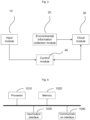
- Fig. 1 shows a hardware block diagram corresponding to a method for adjusting the state of an in-vehicle device provided in an embodiment of the present application.
- the hardware includes an input module 10, a control module 40, an environmental information collection module 20, a cloud module 30 and a load portion 50, wherein the input module 10 is configured to collect an adjustment demand instruction of a user for adjusting the in-vehicle device; the control module 40 is configured to control the load portion 50 to perform a corresponding operation according to the adjustment demand instruction, and meanwhile, the control module 40 records the state information of the adjusted in-vehicle device; the environmental information collection module 20 is configured to collect environmental information corresponding to a vehicle; and the information collected by the environmental information collection module 20 and the control module 40 is transmitted to the cloud module 30 for data processing, so as to make the environmental information correspond to the state information of the in-vehicle device.
- the load portion 50 is an in-vehicle device, including, but not limited to, a steering column motor, a seat motor, a seat heating apparatus, a seat ventilation apparatus, a seat massage apparatus, a steering wheel heating apparatus, etc.
- Fig. 2 shows a flowchart of a method for adjusting the state of an in-vehicle device provided in an embodiment of the present application.
- the method includes the following steps: Step 001: state information of the in-vehicle device adjusted by a user for multiple times.
- the state information of the in-vehicle device adjusted by the user is acquired.
- the user inputs an adjustment demand instruction by the input module 10.
- the input module 10 sends the adjustment demand instruction to the control module 40, the control module 40 is configured to control, according to the adjustment demand instruction of the user, the load portion 50 to perform adjustment, and meanwhile, the control module 40 records the state information of the load portion 50, so as to acquire the state information of adjusting the in-vehicle device.
- the state information of the in-vehicle device includes at least one of a seat angle, a steering column angle, and heating temperature of seats and a steering wheel.
- the control module 40 when the user inputs seat adjustment and steering wheel angle adjustment by the input module 10, the control module 40 is responsible for driving the seat motor and the steering column motor to act, so as to move to a driving position where the user wants to set.
- the user selects, by the input module 10, a seat heating level, a ventilation level, a massage mode, a steering wheel heating level and the like, and the control module 40 controls an environmental load to perform heating, ventilation and massage after receiving the input requirements, so as to achieve the environmental temperature and comfortable settings of the user.
- control module 40 acquires the state information of the in-vehicle device by recording the motion state of the motor (including but not limited to, the seat motor, the steering column motor, and the like), the motion frequency of the motor in each direction, the motion distance, environmental control, setting frequency of different modes and levels of comfort function, etc.
- the motion state of the motor including but not limited to, the seat motor, the steering column motor, and the like
- the motion frequency of the motor in each direction including but not limited to, the seat motor, the steering column motor, and the like
- the motion frequency of the motor in each direction including but not limited to, the motion distance, environmental control, setting frequency of different modes and levels of comfort function, etc.
- the adjustment is recorded by the control module 40, thereby acquiring the state information of adjusting the in-vehicle device for multiple times.
- Step 002 environmental information corresponding to a vehicle at each time the user adjusts the in-vehicle device each time is acquired.
- the environmental information corresponding to the vehicle may be collected by the environmental information collection module 20.
- the environmental information includes, but is not limited to, temperature information, humidity information, weather information, etc.
- the environmental information collection module 20 synchronously sends data, such as temperature weather and time of the day, to the cloud module 30 through networking.
- the environmental information collection module 20 may be a near-end module located in the vehicle or a remote module located in the cloud module 30.
- the environmental information collection module 20 may acquire the environmental information corresponding to the vehicle by weather forecast information.
- the remote module may acquire a specific position of the vehicle by means of a positioning apparatus of the vehicle, and acquire, by the cloud module 30, the environmental information of the position where the vehicle is located.
- the environmental information collection module 20 uploads the environmental information to the cloud module 30 for storage.
- Step 003 a corresponding relationship between the environmental information and the state information of the in-vehicle device is established.
- the corresponding relationship between the environmental information and the state information of the in-vehicle device is established by the cloud module 30.
- the state information of the in-vehicle device adjusted for multiple times is acquired under the same environmental information, and the state information of the in-vehicle device corresponding to the environmental information is determined according to the frequency of the state information.
- the cloud module 30 performs big data analysis according to the state information of the in-vehicle device which is stored in the control module 40, identifies a direction with higher operation frequency of the seats and the steering wheel after the in-vehicle device is adjusted, compares the movement distance between the seats and the steering wheel each time, and calculates a driving position suitable for the driver according to an appropriate algorithm.
- a supervised learning algorithm in a machine learning algorithm such as a naive Bayes classification algorithm
- a seat adjustment direction, a seat adjustment distance, a steering wheel adjustment direction, a steering wheel adjustment distance, a seat heating temperature, a steering wheel heating temperature, a seat ventilation level and weather are used as parameters. Every time after the user adjusts the pushed position and settings, the actual data is accumulated to a training sequence, and the parameters are updated, so that the precision is improved in the training.
- the information collection module synchronously sends data, such as temperature weather and time of the day, to the cloud module 30 through networking, and the cloud module 30 performs correspondence according to the collected state information of the in-vehicle device transmitted by the control module 40 and the corresponding environmental information, so as to establish the corresponding relationship.
- Step 004 when the user enters the vehicle again, collecting the current environmental information, and adjusting the state of the in-vehicle device according to the current environmental information and the corresponding relationship.
- the cloud module 30 adjusts the state of the in-vehicle device according to the collected environmental information of the current day and the previously established corresponding relationship.
- the cloud module 30 compares previous setting habits of the user (according to the corresponding relationship acquired above), and analyzes, by an algorithm, environmental settings suitable for the current weather temperature. If the weather is wet in rainy days, the user often turns on a third ventilation gear for dehumidification under this weather condition, and the cloud module 30 sends the control instruction to the control module 40, and performs corresponding adjustment by the control module 40.
- the cloud module 30 sends the control instruction to the control module 40, and performs corresponding adjustment by means of the control module 40.
- the environmental settings may be intelligently turned on for the user.
- weather information may be acquired, for example, in rainy days, when the in-vehicle temperature is 10 Celsius degrees, the user usually turns on the third seat heating gear for 15 minutes, these pieces of information may be used as machine learning parameters, and environmental settings suitable for the current weather temperature may be acquired by machine learning.
- Step 005 when the user changes the state of the in-vehicle device according to the current environmental information and the corresponding relationship, changed state information of the in-vehicle device changed by the user is updated; and the changed state information of the in-vehicle device is updated to the corresponding relationship.
- the control module 40 records the changed state information of the in-vehicle device changed by the user, and the changed state information of the in-vehicle device is uploaded to the cloud module 30, and the cloud module 30 updates the changed state information of the in-vehicle device to the corresponding relationship.
- the cloud module 30 has a deep self-learning function, if the user is unsatisfactory with the current push result, and if the user readjusts the position of the seat or the steering column, and resets the environmental comfort level, the control module 40 records the modification condition pushed at present and sends the data to the cloud module 30.
- the cloud module 30 optimizes the pushed position and the environmental comfort settings according to the current modification setting result of the user (the present pushed position is a suitable position, which is recalculated by iterating a previously adjusted position of the user, and the information of the previously pushed position will be covered), and driving posture and environmental settings most suitable for the driver may be found by means of continuous self-learning.
- Step 006 the established corresponding relationship between the environmental information and the state information of the in-vehicle device is stored in the cloud module 30.
- the data is stored and intelligently pushed by the cloud module 30, and when the user changes the vehicle, the state information of the in-vehicle device adjusted by the user may be directly acquired by the cloud module 30.
- the cloud module 30 may continue to push, according to the account login information, a driving position and environmental settings, which are suitable for the vehicle owner.
- the identity feature information of the user still needs to be acquired, so as to establish an association between the identity feature information of the user and the corresponding relationship. Therefore, the user corresponds to the state information of the in-vehicle device.
- the fingerprint information of the user may be collected by the input module 10, or different identity feature information of the user, such as appearance information or pupil information, may be collected by using a camera device.
- the method provided in the present embodiment is to simultaneously adjust the seats, the steering column, the seat environment and the massage by one control module 40, such that the cost of a single vehicle can be effectively reduced, the arrangement space is reduced, the weight of the vehicle is reduced, and the wiring harness connection length is decreased.
- the corresponding relationship between the state information of the in-vehicle device adjusted by the user and the environmental information is acquired through information collection, and after the corresponding relationship is established, the state information of the in-vehicle device may be adjusted according to the corresponding relationship when the user uses the vehicle, so that the experience effect of the user is improved.
- the embodiments of the present application further provide a control system of a vehicle.
- the control system includes: a control module 40, configured to collect state information of an in-vehicle device adjusted by a user; an environmental information collection module 20, configured to collect corresponding environmental information corresponding to a vehicle at each time the user adjusts the in-vehicle device; and a cloud module 30, configured to establish a corresponding relationship between the environmental information and the state information of the in-vehicle device; and when the user enters the vehicle again, collect the current environmental information, and adjust the state of the in-vehicle device according to the current environmental information and the corresponding relationship.
- a control module 40 configured to collect state information of an in-vehicle device adjusted by a user
- an environmental information collection module 20 configured to collect corresponding environmental information corresponding to a vehicle at each time the user adjusts the in-vehicle device
- a cloud module 30 configured to establish a corresponding relationship between the environmental information and the state information of the in-vehicle device;
- the corresponding relationship between the state information of the in-vehicle device adjusted by the user and the environmental information is acquired through information collection, and after the corresponding relationship is established, the state information of the in-vehicle device may be adjusted according to the corresponding relationship when the user uses the vehicle, so that the experience effect of the user is improved.
- the cloud module 30 is further configured to determine, according to the frequency of the state information, the state information of the in-vehicle device corresponding to the environmental information. Specifically, reference may be made to the related descriptions in Step 003.
- the cloud module 30 is further configured to: when the user changes the state of the in-vehicle device according to the current environmental information and the corresponding relationship, record changed state information of the in-vehicle device changed by the user; and update the changed state information of the in-vehicle device to the corresponding relationship.
- the cloud module 30 is further configured to: when the user changes the state of the in-vehicle device according to the current environmental information and the corresponding relationship, record changed state information of the in-vehicle device changed by the user; and update the changed state information of the in-vehicle device to the corresponding relationship.
- the embodiments of the present application further provide a vehicle.
- the vehicle includes a vehicle body, and the control system described above, which is disposed in the vehicle body.
- control system reference may be made to the descriptions described above, and with regard to an in-vehicle device of the vehicle, reference may be made to the load portion in Fig. 1 .
- the corresponding relationship between the state information of the in-vehicle device adjusted by the user and the environmental information is acquired through information collection, and after the corresponding relationship is established, the state information of the in-vehicle device may be adjusted according to the corresponding relationship when the user uses the vehicle, so that the experience effect of the user is improved.
- the method in one or more embodiments of the present specification may be executed by a single device, such as a computer or a server.
- the method in the present embodiment may also be applied to a distributed scenario, and is completed by a plurality of devices cooperating with each other.
- one of plurality of devices may execute only one or more steps of the method in one or more embodiments of the present specification, and the plurality of devices interact with each other to complete the method.
- Fig. 4 shows a schematic diagram of a hardware structure of a more specific electronic device provided in the present embodiment.
- the device may include: a processor 1010, a memory 1020, an input/output interface 1030, a communication interface 1040 and a bus 1050, wherein the processor 1010, the memory 1020, the input/output interface 1030 and the communication interface 1040 implement a communication connection therebetween in the device by means of the bus 1050.
- the processor 1010 may be implemented in the form of a general-purpose CPU (Central Processing Unit), a microprocessor, an Application Specific Integrated Circuit (ASIC), or one or more integrated circuits, and the like, so as to execute related programs to implement the technical solutions provided in the embodiments of the present specification.
- a general-purpose CPU Central Processing Unit
- ASIC Application Specific Integrated Circuit
- the memory 1020 may be implemented in the form of an ROM (Read Only Memory), an RAM (Random Access Memory), a static storage device, a dynamic storage device, etc.
- the memory 1020 may store an operating system and other application programs, and when the technical solutions provided in the embodiments of the present specification are implemented by using software or firmware, related program codes are stored in the memory 1020, and are called and executed by the processor 1010.
- the input/output interface 1030 is used for connecting the input/output module to implement information input and output.
- the input/output/module may be configured as a component in a device (not shown in the figure), and may also be externally connected with the device to provide corresponding functions.
- the input device may include a keyboard, a mouse, a touch screen, a microphone, various sensors and the like, and the output device may include a display, a loudspeaker, a vibrator, an indicator light, etc.
- the communication interface 1040 is used for connecting a communication module (not shown in the figure), so as to implement communication interaction between the present device and other devices.
- the communication module may implement communication in a wired manner (such as a USB, a network cable or the like), and may also implement communication in a wireless manner (such as a mobile network, WiFi, Bluetooth and the like).
- the bus 1050 includes a path that transmits information between various components of the device (such as the processor 1010, the memory 1020, the input/output interface 1030 and the communication interface 1040).
- the device may further include other components required for implementing normal operation.
- the foregoing device may also only include components required for implementing solutions of the embodiments of the present specification, and do not necessarily include all components shown in the figures.
- Computer-readable media of the present embodiment include permanent and non-permanent media, and removable and non-removable media, which may implement information storage in any method or technique.
- the information may be a computer-readable instruction, a data structure, a program module, or other data.
- Examples of storage media of a computer include, but are not limited to, a phase change memory (PRAM), a static random access memory (SRAM), a dynamic random access memory (DRAM), other types of random access memories (RAMs), a read only memory (ROM), an electrically erasable programmable read only memory (EEPROM), a flash memory or other memory techniques, a compact disc-read only memory (CD-ROM), a digital versatile disc (DVD) or other optical storages, a magnetic cassette tape, a magnetic tape-magnetic disk storage or other magnetic storage devices, or any other non-transmission medium, which may be used for storing information accessible to a computing device.
- PRAM phase change memory
- SRAM static random access memory
- DRAM dynamic random access memory
- RAMs random access memories
- ROM read only memory
- EEPROM electrically erasable programmable read only memory
- flash memory or other memory techniques
- CD-ROM compact disc-read only memory
- DVD digital versatile disc
- magnetic cassette tape a magnetic tape-magne
- a well-known power source/ground connection with an integrated circuit (IC) chip and other components may be shown or not in the provided drawings.
- the apparatus may be shown in the form of a block diagram, so as to avoid obscuring one or more embodiments of the present specification, and this also takes into account the fact that the details regarding the embodiments of these block diagram apparatuses are highly dependent on the platform which is about to implement one or more embodiments of the present specification (i.e., these details should be entirely within the understanding scope of those skilled in the art).
- DRAM dynamic RAM
Landscapes
- Engineering & Computer Science (AREA)
- Mechanical Engineering (AREA)
- Transportation (AREA)
- Chemical & Material Sciences (AREA)
- Combustion & Propulsion (AREA)
- Aviation & Aerospace Engineering (AREA)
- Physics & Mathematics (AREA)
- Thermal Sciences (AREA)
- User Interface Of Digital Computer (AREA)
- Selective Calling Equipment (AREA)
- Stored Programmes (AREA)
Abstract
Description
- One or more embodiments of the present specification relate to the technical field of vehicles, and in particular to a method for adjusting the state of an in-vehicle device, and a vehicle.
- In the era of Internet of Things, the information technology is rapidly developed, the demands of people on vehicle cabins are increasingly increased, various main engine plant pay more and more attention to user experience of the comfort of the cabins, and comfort function adjustment, such as electric seat adjustment, seat environment adjustment, electric steering wheel adjustment, steering wheel heating and the like, are increased on the vehicle configurations of public vehicle models. However, the existing vehicles cannot intelligently control in-vehicle facilities, resulting in poor user experience.
- In view of this, the objective of one or more embodiments of the present specification is to provide a method for adjusting the state of an in-vehicle device, and a vehicle, so as to solve the problem of user experience.
- In a first aspect, a method for adjusting the state of an in-vehicle device is provided. The method includes the following steps: state information of the in-vehicle device adjusted by a user for multiple times is acquired; environmental information corresponding to a vehicle at each time the user adjusts the in-vehicle device is acquired; a corresponding relationship between the environmental information and the state information of the in-vehicle device is established; and when the user enters the vehicle again, the current environmental information is collected, and the state of the in-vehicle device is adjusted according to the current environmental information and the corresponding relationship. When the method is utilized, the corresponding relationship between the state information of the in-vehicle device adjusted by the user and the environmental information is acquired through information collection, and after the corresponding relationship is established, the state information of the in-vehicle device may be adjusted according to the corresponding relationship when the user uses the vehicle, so that the experience effect of the user is improved.
- In a specific implementable scheme, the step of the corresponding relationship between the environmental information and the state information of the in-vehicle device is established includes: the state information of the in-vehicle device adjusted for multiple times under the same environmental information is acquired; and, the state information of the in-vehicle device corresponding to the environmental information is determined according to the frequency of the state information. The accuracy of the corresponding relationship is improved, thereby improving the experience effect of the user.
- In a specific implementable scheme, the state information of the in-vehicle device includes at least one of a seat angle, a steering column angle, and heating temperatures of seats and a steering wheel.
- In a specific implementable scheme, the method further includes: when the user changes the state of the in-vehicle device according to the current environmental information and the corresponding relationship, state information of the in-vehicle device changed by the user is recorded; and the changed state information of the in-vehicle device is updated to the corresponding relationship. The accuracy of the corresponding relationship is improved, thereby improving the experience effect of the user.
- In a specific implementable scheme, the method further includes: the established corresponding relationship between the environmental information and the state information of the in-vehicle device is stored in a cloud module. When the user changes the vehicle, the state information of the in-vehicle device adjusted by the user may be directly acquired by the cloud module.
- In a specific implementable scheme, the method further includes: identity feature information of the user is acquired; and an association between the identity feature information of the user and the corresponding relationship is established. The accuracy of establishing the corresponding relationship is ensured.
- According to a second aspect, a control system of a vehicle is provided. The control system includes: a control module, configured to collect state information of an in-vehicle device adjusted by a user; an environmental information collection module, configured to collect environmental information corresponding to a vehicle at each time the user adjusts the in-vehicle device; and a cloud module, configured to establish a corresponding relationship between the environmental information and the state information of the in-vehicle device; and when the user enters the vehicle again, collect the current environmental information, and adjust the state of the in-vehicle device according to the current environmental information and the corresponding relationship. When the technical solution is used, the corresponding relationship between the state information of the in-vehicle device adjusted by the user and the environmental information is acquired through information collection, and after the corresponding relationship is established, the state information of the in-vehicle device may be adjusted according to the corresponding relationship when the user uses the vehicle, so that the experience effect of the user is improved.
- In a specific implementable embodiment, the cloud module is further configured to determine, according to the frequency of the state information, the state information of the in-vehicle device corresponding to the environmental information.
- In a specific implementable embodiment, the cloud module is further configured to: when the user changes the state of the in-vehicle device according to the current environmental information and the corresponding relationship, record changed state information of the in-vehicle device changed by the user; and update the changed state information of the in-vehicle device to the corresponding relationship.
- In a third aspect, a vehicle is provided. The vehicle includes a vehicle body, and the control system described above, which is disposed in the vehicle body. When the technical solution is used, the corresponding relationship between the state information of the in-vehicle device adjusted by the user and the environmental information is acquired through information collection, and after the corresponding relationship is established, the state information of the in-vehicle device may be adjusted according to the corresponding relationship when the user uses the vehicle, so that the experience effect of the user is improved.
- In a fourth aspect, an electronic device is provided, including a memory, a processor, and a computer program stored on the memory and executable on the processor, wherein the processor implements, when executing the program, the method in the first aspect and any possible design in the first aspect.
- In a fifth aspect, a non-transitory computer-readable storage medium is provided. The non-transitory computer-readable storage medium stores a computer instruction, and the computer instruction is used for causing a computer to execute the method in the first aspect and any possible design in the first aspect.
- In a sixth aspect, a computer program product is further provided, including an instruction, wherein when running on a computer, the computer program product causes the computer to execute the method in the first aspect and any possible design in the first aspect.
- In addition, the technical effects brought by any possible design in the fourth aspect to the sixth aspect may refer to the effects brought by different design manners in the method portion, and thus details are not described herein again.
- To illustrate technical solutions in one or more embodiments of the present specification or in the prior art more clearly, a brief introduction on the drawings which are needed in the description of the embodiments or the prior art is given below. Apparently, the drawings in the description below are merely one or more embodiments of the present specification, based on which other drawings may be obtained by those ordinary skilled in the art without any creative effort.
-
Fig. 1 is a schematic diagram of an application scenario of a method for adjusting the state of an in-vehicle device provided in an embodiment of the present application; -
Fig. 2 is a flowchart of a method for adjusting the state of an in-vehicle device provided in an embodiment of the present application; -
Fig. 3 is a structural block diagram of a control system provided in an embodiment of the present application; and -
Fig. 4 is a structural block diagram of an electronic device provided in an embodiment of the present application. - In order to make the objectives, technical solutions and advantages of the present disclosure more clearly understood, the present disclosure will be further described in detail below in combination with specific embodiments and with reference to the drawings.
- It should be noted that, unless otherwise defined, the technical terms or scientific terms used in one or more embodiments of the present specification should have common meanings as understood by those ordinary skilled in the art to which the present disclosure belongs. The words "first", "second" and the like used in one or more embodiments of the present specification do not denote any order, quantity or importance, but are merely used for distinguishing different components. Words such as "including" or "containing" and the like are intended to indicate that an element or object in front of the word encompasses elements or objects listed after the word and their equivalents, without excluding other elements or objects. Words such as "connection" or "connected" and the like are not limited to physical or mechanical connections, but may include electrical connections, in regardless of in a direct or indirect manner. The terms "upper", "lower", "left", "right" and the like are only used for representing relative positional relationships, and when the absolute position of an described object is changed, the relative positional relationship may also be correspondingly changed.
- A technical carrier involved in payment in the embodiments of the present specification may include, for example, Near Field Communication (NFC), WIFI, 3G/4G/5G, POS machine card-swiping technology, two-dimensional code scanning technology, bar code scanning technology, Bluetooth, infrared, Short Message Service (SMS), Multimedia Message Service (MMS), etc.
- Biological features involved in biological recognition in the embodiments of the present specification may include, for example, eye features, voiceprint, fingerprint, palmprint, heartbeat, pulse, chromosome, DNA, human bite mark, and the like. The eyeprint may include biological features such as iris and sclera.
- A hidden door handle control method provided in the embodiments of the present application is applied to a vehicle with a hidden door handle, the vehicle may be different types of vehicles, and may include, by means of power division, fuel vehicles and electric vehicles; and may include, by means of type division, saloon cars or SUVs (Sport Utility Vehicles). When a user uses the vehicle, the state of an in-vehicle device needs to be adjusted, and the in-vehicle device includes a steering wheel, seats and the like, which are related to the driving state of the user. For example, when driving, the user needs to adjust the angle of the steering wheel, the angle of the seats, or the height of the seats, etc. When the existing vehicle is adjusted, the vehicle is just simply adjusted, for this purpose, the embodiments of the present application provide a hidden door handle control method, so as to improve the control precision of the hidden door handle.
- Referring first to
Fig. 1, Fig. 1 shows a hardware block diagram corresponding to a method for adjusting the state of an in-vehicle device provided in an embodiment of the present application. The hardware includes aninput module 10, acontrol module 40, an environmentalinformation collection module 20, acloud module 30 and aload portion 50, wherein theinput module 10 is configured to collect an adjustment demand instruction of a user for adjusting the in-vehicle device; thecontrol module 40 is configured to control theload portion 50 to perform a corresponding operation according to the adjustment demand instruction, and meanwhile, thecontrol module 40 records the state information of the adjusted in-vehicle device; the environmentalinformation collection module 20 is configured to collect environmental information corresponding to a vehicle; and the information collected by the environmentalinformation collection module 20 and thecontrol module 40 is transmitted to thecloud module 30 for data processing, so as to make the environmental information correspond to the state information of the in-vehicle device. - The
load portion 50 is an in-vehicle device, including, but not limited to, a steering column motor, a seat motor, a seat heating apparatus, a seat ventilation apparatus, a seat massage apparatus, a steering wheel heating apparatus, etc. - Referring to
Fig. 2, Fig. 2 shows a flowchart of a method for adjusting the state of an in-vehicle device provided in an embodiment of the present application. The method includes the following steps:
Step 001: state information of the in-vehicle device adjusted by a user for multiple times. - Specifically, when the user uses a vehicle each time, the state information of the in-vehicle device adjusted by the user is acquired. In conjunction with the hardware framework shown in
Fig. 1 , when the information is acquired, the user inputs an adjustment demand instruction by theinput module 10. Theinput module 10 sends the adjustment demand instruction to thecontrol module 40, thecontrol module 40 is configured to control, according to the adjustment demand instruction of the user, theload portion 50 to perform adjustment, and meanwhile, thecontrol module 40 records the state information of theload portion 50, so as to acquire the state information of adjusting the in-vehicle device. Exemplarily, the state information of the in-vehicle device includes at least one of a seat angle, a steering column angle, and heating temperature of seats and a steering wheel. - Exemplarily, when the user inputs seat adjustment and steering wheel angle adjustment by the
input module 10, thecontrol module 40 is responsible for driving the seat motor and the steering column motor to act, so as to move to a driving position where the user wants to set. The user selects, by theinput module 10, a seat heating level, a ventilation level, a massage mode, a steering wheel heating level and the like, and thecontrol module 40 controls an environmental load to perform heating, ventilation and massage after receiving the input requirements, so as to achieve the environmental temperature and comfortable settings of the user. Specifically, thecontrol module 40 acquires the state information of the in-vehicle device by recording the motion state of the motor (including but not limited to, the seat motor, the steering column motor, and the like), the motion frequency of the motor in each direction, the motion distance, environmental control, setting frequency of different modes and levels of comfort function, etc. - When the user adjusts the in-vehicle device at each time, the adjustment is recorded by the
control module 40, thereby acquiring the state information of adjusting the in-vehicle device for multiple times. - Step 002: environmental information corresponding to a vehicle at each time the user adjusts the in-vehicle device each time is acquired.
- Specifically, the environmental information corresponding to the vehicle may be collected by the environmental
information collection module 20. The environmental information includes, but is not limited to, temperature information, humidity information, weather information, etc. - When the information is collected, the environmental
information collection module 20 synchronously sends data, such as temperature weather and time of the day, to thecloud module 30 through networking. The environmentalinformation collection module 20 may be a near-end module located in the vehicle or a remote module located in thecloud module 30. When the environmentalinformation collection module 20 is a near-end module, the environmentalinformation collection module 20 may acquire the environmental information corresponding to the vehicle by weather forecast information. When the environmentalinformation collection module 20 is a remote module, the remote module may acquire a specific position of the vehicle by means of a positioning apparatus of the vehicle, and acquire, by thecloud module 30, the environmental information of the position where the vehicle is located. - While acquiring the corresponding environmental information when the user adjusts the state information of the in-vehicle device in each time, the environmental
information collection module 20 uploads the environmental information to thecloud module 30 for storage. - Step 003: a corresponding relationship between the environmental information and the state information of the in-vehicle device is established.
- Specifically, the corresponding relationship between the environmental information and the state information of the in-vehicle device is established by the
cloud module 30. - When the corresponding relationship is established, the state information of the in-vehicle device adjusted for multiple times is acquired under the same environmental information, and the state information of the in-vehicle device corresponding to the environmental information is determined according to the frequency of the state information. Specifically, the
cloud module 30 performs big data analysis according to the state information of the in-vehicle device which is stored in thecontrol module 40, identifies a direction with higher operation frequency of the seats and the steering wheel after the in-vehicle device is adjusted, compares the movement distance between the seats and the steering wheel each time, and calculates a driving position suitable for the driver according to an appropriate algorithm. For example, by using a supervised learning algorithm in a machine learning algorithm, such as a naive Bayes classification algorithm, a seat adjustment direction, a seat adjustment distance, a steering wheel adjustment direction, a steering wheel adjustment distance, a seat heating temperature, a steering wheel heating temperature, a seat ventilation level and weather are used as parameters. Every time after the user adjusts the pushed position and settings, the actual data is accumulated to a training sequence, and the parameters are updated, so that the precision is improved in the training. - In addition, the information collection module synchronously sends data, such as temperature weather and time of the day, to the
cloud module 30 through networking, and thecloud module 30 performs correspondence according to the collected state information of the in-vehicle device transmitted by thecontrol module 40 and the corresponding environmental information, so as to establish the corresponding relationship. - Step 004: when the user enters the vehicle again, collecting the current environmental information, and adjusting the state of the in-vehicle device according to the current environmental information and the corresponding relationship.
- Specifically, when the user enters the vehicle again, the current environmental information is acquired by the environmental
information collection module 20, and thecloud module 30 adjusts the state of the in-vehicle device according to the collected environmental information of the current day and the previously established corresponding relationship. Exemplarily, thecloud module 30 compares previous setting habits of the user (according to the corresponding relationship acquired above), and analyzes, by an algorithm, environmental settings suitable for the current weather temperature. If the weather is wet in rainy days, the user often turns on a third ventilation gear for dehumidification under this weather condition, and thecloud module 30 sends the control instruction to thecontrol module 40, and performs corresponding adjustment by thecontrol module 40. If the weather is cold in winter, the user often turns on a third seat heating and steering wheel gear under this weather condition; and thecloud module 30 sends the control instruction to thecontrol module 40, and performs corresponding adjustment by means of thecontrol module 40. In this way, the environmental settings may be intelligently turned on for the user. Exemplarily, weather information may be acquired, for example, in rainy days, when the in-vehicle temperature is 10 Celsius degrees, the user usually turns on the third seat heating gear for 15 minutes, these pieces of information may be used as machine learning parameters, and environmental settings suitable for the current weather temperature may be acquired by machine learning. - Step 005: when the user changes the state of the in-vehicle device according to the current environmental information and the corresponding relationship, changed state information of the in-vehicle device changed by the user is updated; and the changed state information of the in-vehicle device is updated to the corresponding relationship.
- Specifically, when the user is unsatisfactory with the state of the in-vehicle device, which is pushed according to the corresponding relationship, the user may adjust the state by the
input module 10, after adjusting the polarity of the in-vehicle device, thecontrol module 40 records the changed state information of the in-vehicle device changed by the user, and the changed state information of the in-vehicle device is uploaded to thecloud module 30, and thecloud module 30 updates the changed state information of the in-vehicle device to the corresponding relationship. - Exemplarily, the
cloud module 30 has a deep self-learning function, if the user is unsatisfactory with the current push result, and if the user readjusts the position of the seat or the steering column, and resets the environmental comfort level, thecontrol module 40 records the modification condition pushed at present and sends the data to thecloud module 30. Thecloud module 30 optimizes the pushed position and the environmental comfort settings according to the current modification setting result of the user (the present pushed position is a suitable position, which is recalculated by iterating a previously adjusted position of the user, and the information of the previously pushed position will be covered), and driving posture and environmental settings most suitable for the driver may be found by means of continuous self-learning. - Step 006: the established corresponding relationship between the environmental information and the state information of the in-vehicle device is stored in the
cloud module 30. - Specifically, the data is stored and intelligently pushed by the
cloud module 30, and when the user changes the vehicle, the state information of the in-vehicle device adjusted by the user may be directly acquired by thecloud module 30. For example, when the user changes the vehicle of the same platform, the user may still log in an account and query the previous setting habits, and thecloud module 30 may continue to push, according to the account login information, a driving position and environmental settings, which are suitable for the vehicle owner. - It should be understood that in the above method of the present application, the identity feature information of the user still needs to be acquired, so as to establish an association between the identity feature information of the user and the corresponding relationship. Therefore, the user corresponds to the state information of the in-vehicle device. When the identity feature information of the user is acquired, the fingerprint information of the user may be collected by the
input module 10, or different identity feature information of the user, such as appearance information or pupil information, may be collected by using a camera device. - It can be seen from the above description that, the method provided in the present embodiment is to simultaneously adjust the seats, the steering column, the seat environment and the massage by one
control module 40, such that the cost of a single vehicle can be effectively reduced, the arrangement space is reduced, the weight of the vehicle is reduced, and the wiring harness connection length is decreased. In addition, the corresponding relationship between the state information of the in-vehicle device adjusted by the user and the environmental information is acquired through information collection, and after the corresponding relationship is established, the state information of the in-vehicle device may be adjusted according to the corresponding relationship when the user uses the vehicle, so that the experience effect of the user is improved. - Referring to
Fig. 3 , the embodiments of the present application further provide a control system of a vehicle. The control system includes: acontrol module 40, configured to collect state information of an in-vehicle device adjusted by a user; an environmentalinformation collection module 20, configured to collect corresponding environmental information corresponding to a vehicle at each time the user adjusts the in-vehicle device; and acloud module 30, configured to establish a corresponding relationship between the environmental information and the state information of the in-vehicle device; and when the user enters the vehicle again, collect the current environmental information, and adjust the state of the in-vehicle device according to the current environmental information and the corresponding relationship. Specifically, reference may be made to the descriptions of the related method inFig. 2 . When the technical solution is used, the corresponding relationship between the state information of the in-vehicle device adjusted by the user and the environmental information is acquired through information collection, and after the corresponding relationship is established, the state information of the in-vehicle device may be adjusted according to the corresponding relationship when the user uses the vehicle, so that the experience effect of the user is improved. - In a specific implementable embodiment, the
cloud module 30 is further configured to determine, according to the frequency of the state information, the state information of the in-vehicle device corresponding to the environmental information. Specifically, reference may be made to the related descriptions inStep 003. - In a specific implementable embodiment, the
cloud module 30 is further configured to: when the user changes the state of the in-vehicle device according to the current environmental information and the corresponding relationship, record changed state information of the in-vehicle device changed by the user; and update the changed state information of the in-vehicle device to the corresponding relationship. Specifically, reference may be made to the related descriptions inStep 004. - The embodiments of the present application further provide a vehicle. The vehicle includes a vehicle body, and the control system described above, which is disposed in the vehicle body. With regard to the control system, reference may be made to the descriptions described above, and with regard to an in-vehicle device of the vehicle, reference may be made to the load portion in
Fig. 1 . When the technical solution is used, the corresponding relationship between the state information of the in-vehicle device adjusted by the user and the environmental information is acquired through information collection, and after the corresponding relationship is established, the state information of the in-vehicle device may be adjusted according to the corresponding relationship when the user uses the vehicle, so that the experience effect of the user is improved. - It should be noted that, the method in one or more embodiments of the present specification may be executed by a single device, such as a computer or a server. The method in the present embodiment may also be applied to a distributed scenario, and is completed by a plurality of devices cooperating with each other. In the case of such a distributed scenario, one of plurality of devices may execute only one or more steps of the method in one or more embodiments of the present specification, and the plurality of devices interact with each other to complete the method.
- Specific embodiments of the present specification are described above. Other embodiments are within the scope of the appended claims. In some cases, actions or steps recorded in the claims may be executed in an order different from that in the embodiments and may still achieve desired results. In addition, the processes described in the drawings do not necessarily require the shown particular order or sequential order to achieve the desired results. In some embodiments, multi-task processing and parallel processing are also possible or may be advantageous.
- For the convenience of description, when being described, the above apparatus is divided into various modules according to functions for description. Of course, the functions of the various modules may be implemented in the same or multiple pieces of software and/or hardware when one or more embodiments of the present specification are implemented.
- The apparatus in the above embodiments is used for implementing the corresponding method in the foregoing embodiments, and has the beneficial effects of the corresponding method embodiments, therefore details are not described herein again.
-
Fig. 4 shows a schematic diagram of a hardware structure of a more specific electronic device provided in the present embodiment. The device may include: aprocessor 1010, amemory 1020, an input/output interface 1030, acommunication interface 1040 and a bus 1050, wherein theprocessor 1010, thememory 1020, the input/output interface 1030 and thecommunication interface 1040 implement a communication connection therebetween in the device by means of the bus 1050. - The
processor 1010 may be implemented in the form of a general-purpose CPU (Central Processing Unit), a microprocessor, an Application Specific Integrated Circuit (ASIC), or one or more integrated circuits, and the like, so as to execute related programs to implement the technical solutions provided in the embodiments of the present specification. - The
memory 1020 may be implemented in the form of an ROM (Read Only Memory), an RAM (Random Access Memory), a static storage device, a dynamic storage device, etc. Thememory 1020 may store an operating system and other application programs, and when the technical solutions provided in the embodiments of the present specification are implemented by using software or firmware, related program codes are stored in thememory 1020, and are called and executed by theprocessor 1010. - The input/
output interface 1030 is used for connecting the input/output module to implement information input and output. The input/output/module may be configured as a component in a device (not shown in the figure), and may also be externally connected with the device to provide corresponding functions. The input device may include a keyboard, a mouse, a touch screen, a microphone, various sensors and the like, and the output device may include a display, a loudspeaker, a vibrator, an indicator light, etc. - The
communication interface 1040 is used for connecting a communication module (not shown in the figure), so as to implement communication interaction between the present device and other devices. The communication module may implement communication in a wired manner (such as a USB, a network cable or the like), and may also implement communication in a wireless manner (such as a mobile network, WiFi, Bluetooth and the like). - The bus 1050 includes a path that transmits information between various components of the device (such as the
processor 1010, thememory 1020, the input/output interface 1030 and the communication interface 1040). - It should be noted that, although only the
processor 1010, thememory 1020, the input/output interface 1030, thecommunication interface 1040 and the bus 1050 of the device are shown, during a specific implementation process, the device may further include other components required for implementing normal operation. In addition, those skilled in the art may understand that, the foregoing device may also only include components required for implementing solutions of the embodiments of the present specification, and do not necessarily include all components shown in the figures. - Computer-readable media of the present embodiment include permanent and non-permanent media, and removable and non-removable media, which may implement information storage in any method or technique. The information may be a computer-readable instruction, a data structure, a program module, or other data. Examples of storage media of a computer include, but are not limited to, a phase change memory (PRAM), a static random access memory (SRAM), a dynamic random access memory (DRAM), other types of random access memories (RAMs), a read only memory (ROM), an electrically erasable programmable read only memory (EEPROM), a flash memory or other memory techniques, a compact disc-read only memory (CD-ROM), a digital versatile disc (DVD) or other optical storages, a magnetic cassette tape, a magnetic tape-magnetic disk storage or other magnetic storage devices, or any other non-transmission medium, which may be used for storing information accessible to a computing device.
- It should be understood by those ordinary skilled in the art that, the discussion of any of the above embodiments is merely exemplary, and is not intended to imply that the scope (including the claims) of the present disclosure is limited to these examples; in the idea of the present disclosure, the technical features in the above embodiments or different embodiments may also be combined, the steps may be implemented in any order, and there are many other changes in different aspects of one or more embodiments of the present specification as described above, and for brevity, they are not provided in detail.
- In addition, to simplify the description and discussion, and in order not to render one or more embodiments of the specification difficult to understand, a well-known power source/ground connection with an integrated circuit (IC) chip and other components may be shown or not in the provided drawings. Furthermore, the apparatus may be shown in the form of a block diagram, so as to avoid obscuring one or more embodiments of the present specification, and this also takes into account the fact that the details regarding the embodiments of these block diagram apparatuses are highly dependent on the platform which is about to implement one or more embodiments of the present specification (i.e., these details should be entirely within the understanding scope of those skilled in the art). When specific details (e.g., circuits) are set forth to describe exemplary embodiments of the present disclosure, it will be apparent to those skilled in the art that, one or more embodiments of the present specification may be implemented without these specific details or with changes in these specific details. Therefore, these descriptions should be considered as illustrative and not restrictive.
- Although the present disclosure has been described in combination with specific embodiments of the present disclosure, many alternatives, modifications and variations of these embodiments will be apparent to those ordinary skilled in the art according to the foregoing descriptions. For example, other memory architectures (e.g., a dynamic RAM (DRAM)) may use the discussed embodiments.
- One or more embodiments of the present specification are intended to cover all such alternatives, modifications and variations that fall within the broad scope of the appended claims. Therefore, any omissions, modifications, equivalent alternatives, improvements and the like, made within the spirit and principles of one or more embodiments of the present specification, should be included within the protection scope of the present disclosure.
Claims (12)
- A method for adjusting the state of an in-vehicle device, comprising:acquiring state information of the in-vehicle device adjusted by a user for multiple times;acquiring environmental information corresponding to a vehicle at each time the user adjusts the in-vehicle device;establishing a corresponding relationship between the environmental information and the state information of the in-vehicle device; andin response to the user entering the vehicle again, collecting the current environmental information, and adjusting the state of the in-vehicle device according to the current environmental information and the corresponding relationship.
- The method as claimed in claim 1, wherein the step of establishing the corresponding relationship between the environmental information and the state information of the in-vehicle device comprises: acquiring the state information of the in-vehicle device adjusted for multiple times under the same environmental information; and determining, according to the frequency of the state information, the state information of the in-vehicle device corresponding to the environmental information.
- The method as claimed in claim 2, wherein the state information of the in-vehicle device at least comprises at least one of a seat angle, a steering column angle, and heating temperatures of seats and a steering wheel.
- The method as claimed in any one of claims 1-3, further comprising: in response to the user changing the state of the in-vehicle device according to the current environmental information and the corresponding relationship,
recording changed state information of the in-vehicle device changed by the user; and updating the changed state information of the in-vehicle device to the corresponding relationship. - The method as claimed in claim 4, further comprising: storing, in a cloud module, the established corresponding relationship between the environmental information and the state information of the in-vehicle device.
- The method as claimed in claim 4, further comprising: acquiring identity feature information of the user; and
establishing an association between the identity feature information of the user and the corresponding relationship. - A control system of a vehicle, comprising:a control module, configured to collect state information of an in-vehicle device adjusted by a user;an environmental information collection module, configured to collect corresponding environmental information corresponding to a vehicle at each time the user adjusts the in-vehicle device; anda cloud module, configured to establish a corresponding relationship between the environmental information and the state information of adjusting the in-vehicle device; and in response to the user entering the vehicle again, collect the current environmental information, and adjust the state of the in-vehicle device according to the current environmental information and the corresponding relationship.
- The control system as claimed in claim 7, wherein the cloud module is further configured to determine, according to the frequency of the state information, the state information of the in-vehicle device corresponding to the environmental information.
- The control system as claimed in claim 8, wherein the cloud module is further configured to: in response to the user changing the state of the in-vehicle device according to the current environmental information and the corresponding relationship, record changed state information of the in-vehicle device changed by the user; and update the changed state information of the in-vehicle device to the corresponding relationship.
- A vehicle, comprising a vehicle body, and the control system as claimed in any one of claims 7-9, which is disposed in the vehicle body.
- An electronic device, comprising a memory, a processor, and a computer program stored on the memory and executable on the processor, wherein the processor implements, when executing the program, the method as claimed in any one of claims 1-6.
- A non-transitory computer-readable storage medium, wherein the non-transitory computer-readable storage medium stores a computer instruction, and the computer instruction is used for causing a computer to execute the method as claimed in any one of claims 1-6.
Applications Claiming Priority (2)
| Application Number | Priority Date | Filing Date | Title |
|---|---|---|---|
| CN202210088009.7A CN114454835A (en) | 2022-01-25 | 2022-01-25 | A method for adjusting the state of equipment in a vehicle and an automobile |
| PCT/CN2022/103011 WO2023142375A1 (en) | 2022-01-25 | 2022-06-30 | Method for adjusting state of apparatus in vehicle, and vehicle |
Publications (2)
| Publication Number | Publication Date |
|---|---|
| EP4375147A1 true EP4375147A1 (en) | 2024-05-29 |
| EP4375147A4 EP4375147A4 (en) | 2024-12-25 |
Family
ID=81412339
Family Applications (1)
| Application Number | Title | Priority Date | Filing Date |
|---|---|---|---|
| EP22923183.2A Pending EP4375147A4 (en) | 2022-01-25 | 2022-06-30 | METHOD FOR ADJUSTING THE STATE OF A DEVICE IN A VEHICLE AND VEHICLE |
Country Status (3)
| Country | Link |
|---|---|
| EP (1) | EP4375147A4 (en) |
| CN (1) | CN114454835A (en) |
| WO (1) | WO2023142375A1 (en) |
Families Citing this family (3)
| Publication number | Priority date | Publication date | Assignee | Title |
|---|---|---|---|---|
| CN114454835A (en) * | 2022-01-25 | 2022-05-10 | 中国第一汽车股份有限公司 | A method for adjusting the state of equipment in a vehicle and an automobile |
| DE102023202723A1 (en) | 2023-03-27 | 2024-10-02 | Stellantis Auto Sas | Control and method for a seat heating of a motor vehicle |
| CN119078618B (en) * | 2024-09-29 | 2025-09-19 | 长城汽车股份有限公司 | Vehicle seat control method, electronic device and vehicle |
Family Cites Families (13)
| Publication number | Priority date | Publication date | Assignee | Title |
|---|---|---|---|---|
| JP5044272B2 (en) * | 2006-05-24 | 2012-10-10 | 株式会社日本自動車部品総合研究所 | Vehicle user support device |
| GB201400574D0 (en) * | 2014-01-14 | 2014-03-05 | Jaguar Land Rover Ltd | Automated climate control system and method |
| US9963012B2 (en) * | 2015-12-07 | 2018-05-08 | GM Global Technology Operations LLC | Personalizing vehicular comfort settings for a specific user |
| US10583709B2 (en) * | 2016-11-11 | 2020-03-10 | International Business Machines Corporation | Facilitating personalized vehicle occupant comfort |
| CN108770351B (en) * | 2018-04-25 | 2021-09-07 | 深圳市元征软件开发有限公司 | Vehicle seat adjustment method and vehicle seat adjustment device |
| CN109910798A (en) * | 2019-04-04 | 2019-06-21 | 白冰 | A kind of device and method adjusting vehicle-state |
| CN112026472B (en) * | 2019-06-04 | 2022-06-14 | 上海博泰悦臻网络技术服务有限公司 | Electronic equipment, intelligent cabin, environment adjusting method and device, and environment detecting method and device |
| EP3789250B1 (en) * | 2019-09-06 | 2021-08-04 | Hermann Schindler | Management system and method for identifying and bio-monitoring in vehicles |
| US11685382B2 (en) * | 2019-12-23 | 2023-06-27 | Qualcomm Incorporated | Passenger-less and driver-less vehicle operating modes |
| CN111674227A (en) * | 2020-05-12 | 2020-09-18 | 浙江吉利汽车研究院有限公司 | A vehicle comfort control method, device and computer storage medium |
| CN111619309B (en) * | 2020-06-01 | 2021-10-26 | 中国第一汽车股份有限公司 | Vehicle control method and device and vehicle control system |
| CN112644503B (en) * | 2021-01-08 | 2022-07-29 | 东风小康汽车有限公司重庆分公司 | Intelligent mode control method and system for electric automobile |
| CN114454835A (en) * | 2022-01-25 | 2022-05-10 | 中国第一汽车股份有限公司 | A method for adjusting the state of equipment in a vehicle and an automobile |
-
2022
- 2022-01-25 CN CN202210088009.7A patent/CN114454835A/en active Pending
- 2022-06-30 EP EP22923183.2A patent/EP4375147A4/en active Pending
- 2022-06-30 WO PCT/CN2022/103011 patent/WO2023142375A1/en not_active Ceased
Also Published As
| Publication number | Publication date |
|---|---|
| CN114454835A (en) | 2022-05-10 |
| EP4375147A4 (en) | 2024-12-25 |
| WO2023142375A1 (en) | 2023-08-03 |
Similar Documents
| Publication | Publication Date | Title |
|---|---|---|
| EP4375147A1 (en) | Method for adjusting state of apparatus in vehicle, and vehicle | |
| CN108725357B (en) | Parameter control method and system based on face recognition and cloud server | |
| US11155140B2 (en) | Facilitating personalized vehicle occupant comfort | |
| US20230110523A1 (en) | Personalization system and method for a vehicle based on spatial locations of occupants' body portions | |
| CN108725136B (en) | Vehicle-mounted air conditioner adjusting method, system, equipment and storage medium | |
| US9501693B2 (en) | Real-time multiclass driver action recognition using random forests | |
| US20210129852A1 (en) | Configuration of a Vehicle Based on Collected User Data | |
| US20170352267A1 (en) | Systems for providing proactive infotainment at autonomous-driving vehicles | |
| US20170351990A1 (en) | Systems and methods for implementing relative tags in connection with use of autonomous vehicles | |
| KR20200145825A (en) | Vehicle occupant participation using 3D gaze vector | |
| US12077162B2 (en) | System and method for transferring different settings between vehicles of different types | |
| CN107380103B (en) | Automatic automobile ornament adjusting method and system based on user identification and cloud sharing | |
| CN111572549A (en) | Driving environment adjusting method and system, storage medium and electronic equipment | |
| CN114248666A (en) | Seat adjusting method, device, medium and equipment based on face recognition | |
| CN114103962A (en) | Chassis input intent prediction | |
| CN115891871B (en) | Control method and device for vehicle cabin and computer readable storage medium | |
| CN115687761A (en) | Recommended method, device, equipment and vehicle for vehicle driving | |
| DE112018007858T5 (en) | Computer implemented method and processing system for predicting the return of a user to a vehicle | |
| CN115742674A (en) | Method, device, equipment and medium for adjusting temperature in automobile | |
| CN119018076A (en) | Vehicle control method, device, electronic equipment and vehicle | |
| CN116653925A (en) | Automatic parking method, device, electronic device and computer-readable storage medium | |
| CN114925733B (en) | Vehicle comfort evaluation method, device, electronic device and storage medium | |
| CN118457379A (en) | Method, device, equipment and storage medium for adjusting intelligent vehicle seat | |
| DE102024100380A1 (en) | REAR DISPLAY IMPROVEMENTS | |
| CN119611170B (en) | Seat adjusting method, electronic device, vehicle, storage medium, and computer product |
Legal Events
| Date | Code | Title | Description |
|---|---|---|---|
| STAA | Information on the status of an ep patent application or granted ep patent |
Free format text: STATUS: THE INTERNATIONAL PUBLICATION HAS BEEN MADE |
|
| PUAI | Public reference made under article 153(3) epc to a published international application that has entered the european phase |
Free format text: ORIGINAL CODE: 0009012 |
|
| STAA | Information on the status of an ep patent application or granted ep patent |
Free format text: STATUS: REQUEST FOR EXAMINATION WAS MADE |
|
| 17P | Request for examination filed |
Effective date: 20240221 |
|
| AK | Designated contracting states |
Kind code of ref document: A1 Designated state(s): AL AT BE BG CH CY CZ DE DK EE ES FI FR GB GR HR HU IE IS IT LI LT LU LV MC MK MT NL NO PL PT RO RS SE SI SK SM TR |
|
| A4 | Supplementary search report drawn up and despatched |
Effective date: 20241122 |
|
| RIC1 | Information provided on ipc code assigned before grant |
Ipc: B62D 1/183 20060101ALI20241118BHEP Ipc: B60H 1/00 20060101ALI20241118BHEP Ipc: B62D 1/06 20060101ALI20241118BHEP Ipc: B60N 2/56 20060101ALI20241118BHEP Ipc: B62D 1/18 20060101ALI20241118BHEP Ipc: B60N 2/02 20060101ALI20241118BHEP Ipc: B60R 16/037 20060101AFI20241118BHEP |
|
| DAV | Request for validation of the european patent (deleted) | ||
| DAX | Request for extension of the european patent (deleted) |