EP4373066A1 - Image processing apparatus, image processing method, and carrier medium - Google Patents
Image processing apparatus, image processing method, and carrier medium Download PDFInfo
- Publication number
- EP4373066A1 EP4373066A1 EP23208711.4A EP23208711A EP4373066A1 EP 4373066 A1 EP4373066 A1 EP 4373066A1 EP 23208711 A EP23208711 A EP 23208711A EP 4373066 A1 EP4373066 A1 EP 4373066A1
- Authority
- EP
- European Patent Office
- Prior art keywords
- document
- type
- image processing
- unit
- determination method
- Prior art date
- Legal status (The legal status is an assumption and is not a legal conclusion. Google has not performed a legal analysis and makes no representation as to the accuracy of the status listed.)
- Pending
Links
Images




Classifications
-
- H—ELECTRICITY
- H04—ELECTRIC COMMUNICATION TECHNIQUE
- H04N—PICTORIAL COMMUNICATION, e.g. TELEVISION
- H04N1/00—Scanning, transmission or reproduction of documents or the like, e.g. facsimile transmission; Details thereof
- H04N1/387—Composing, repositioning or otherwise geometrically modifying originals
- H04N1/3877—Image rotation
-
- G—PHYSICS
- G06—COMPUTING OR CALCULATING; COUNTING
- G06V—IMAGE OR VIDEO RECOGNITION OR UNDERSTANDING
- G06V30/00—Character recognition; Recognising digital ink; Document-oriented image-based pattern recognition
- G06V30/10—Character recognition
- G06V30/14—Image acquisition
- G06V30/146—Aligning or centring of the image pick-up or image-field
- G06V30/1463—Orientation detection or correction, e.g. rotation of multiples of 90 degrees
-
- H—ELECTRICITY
- H04—ELECTRIC COMMUNICATION TECHNIQUE
- H04N—PICTORIAL COMMUNICATION, e.g. TELEVISION
- H04N1/00—Scanning, transmission or reproduction of documents or the like, e.g. facsimile transmission; Details thereof
- H04N1/00002—Diagnosis, testing or measuring; Detecting, analysing or monitoring not otherwise provided for
- H04N1/00005—Diagnosis, testing or measuring; Detecting, analysing or monitoring not otherwise provided for relating to image data
-
- H—ELECTRICITY
- H04—ELECTRIC COMMUNICATION TECHNIQUE
- H04N—PICTORIAL COMMUNICATION, e.g. TELEVISION
- H04N1/00—Scanning, transmission or reproduction of documents or the like, e.g. facsimile transmission; Details thereof
- H04N1/00002—Diagnosis, testing or measuring; Detecting, analysing or monitoring not otherwise provided for
- H04N1/00026—Methods therefor
- H04N1/00037—Detecting, i.e. determining the occurrence of a predetermined state
-
- H—ELECTRICITY
- H04—ELECTRIC COMMUNICATION TECHNIQUE
- H04N—PICTORIAL COMMUNICATION, e.g. TELEVISION
- H04N1/00—Scanning, transmission or reproduction of documents or the like, e.g. facsimile transmission; Details thereof
- H04N1/00127—Connection or combination of a still picture apparatus with another apparatus, e.g. for storage, processing or transmission of still picture signals or of information associated with a still picture
- H04N1/00326—Connection or combination of a still picture apparatus with another apparatus, e.g. for storage, processing or transmission of still picture signals or of information associated with a still picture with a data reading, recognizing or recording apparatus, e.g. with a bar-code apparatus
- H04N1/00328—Connection or combination of a still picture apparatus with another apparatus, e.g. for storage, processing or transmission of still picture signals or of information associated with a still picture with a data reading, recognizing or recording apparatus, e.g. with a bar-code apparatus with an apparatus processing optically-read information
- H04N1/00331—Connection or combination of a still picture apparatus with another apparatus, e.g. for storage, processing or transmission of still picture signals or of information associated with a still picture with a data reading, recognizing or recording apparatus, e.g. with a bar-code apparatus with an apparatus processing optically-read information with an apparatus performing optical character recognition
-
- H—ELECTRICITY
- H04—ELECTRIC COMMUNICATION TECHNIQUE
- H04N—PICTORIAL COMMUNICATION, e.g. TELEVISION
- H04N1/00—Scanning, transmission or reproduction of documents or the like, e.g. facsimile transmission; Details thereof
- H04N1/00127—Connection or combination of a still picture apparatus with another apparatus, e.g. for storage, processing or transmission of still picture signals or of information associated with a still picture
- H04N1/00326—Connection or combination of a still picture apparatus with another apparatus, e.g. for storage, processing or transmission of still picture signals or of information associated with a still picture with a data reading, recognizing or recording apparatus, e.g. with a bar-code apparatus
- H04N1/00328—Connection or combination of a still picture apparatus with another apparatus, e.g. for storage, processing or transmission of still picture signals or of information associated with a still picture with a data reading, recognizing or recording apparatus, e.g. with a bar-code apparatus with an apparatus processing optically-read information
- H04N1/00336—Connection or combination of a still picture apparatus with another apparatus, e.g. for storage, processing or transmission of still picture signals or of information associated with a still picture with a data reading, recognizing or recording apparatus, e.g. with a bar-code apparatus with an apparatus processing optically-read information with an apparatus performing pattern recognition, e.g. of a face or a geographic feature
-
- H—ELECTRICITY
- H04—ELECTRIC COMMUNICATION TECHNIQUE
- H04N—PICTORIAL COMMUNICATION, e.g. TELEVISION
- H04N1/00—Scanning, transmission or reproduction of documents or the like, e.g. facsimile transmission; Details thereof
- H04N1/0035—User-machine interface; Control console
- H04N1/00405—Output means
- H04N1/00482—Output means outputting a plurality of job set-up options, e.g. number of copies, paper size or resolution
Definitions
- Embodiments of the present disclosure relate to an image processing apparatus, an image processing method, and a carrier medium.
- the document When a document is read by a scanner, the document may be read in a wrong direction such that the orientation of the document is reversed or sideways.
- Japanese Unexamined Patent Application Publication No. 2007-324648 discloses a technique of determining the top-bottom orientation using optical character recognition (OCR).
- OCR optical character recognition
- Japanese Unexamined Patent Application Publication No. 2022-090536 discloses a technique of determining the top-bottom orientation using a model of a neural network based on deep learning.
- a deep neural network is adopted in such a neural network model.
- the method of top-bottom determination is not selected in accordance with the characteristics of a document.
- the top-bottom orientation can be determined with high accuracy by the top-bottom determination using OCR.
- the accuracy of the top-bottom determination using a DNN is higher than that of the top-bottom determination using OCR.
- an image processing apparatus includes a document type determination unit to determine a type of a document read by a scanner, a method setting unit to set a top-bottom determination method based on the type of the document, and a top-bottom determination unit to determine a top-bottom orientation of a target image by the top-bottom determination method.
- the target image is obtained by reading the document with the scanner.
- the image processing method includes determining a type of a document read by a scanner, setting a top-bottom determination method based on the type of the document, and determining aa top-bottom orientation of a target image by the top-bottom determination method.
- the target image is obtained by reading the document with the scanner.
- Another aspect is a carrier medium carrying computer readable codes which, when executed by an image processing apparatus, cause the image processing apparatus to carry out the method described above.
- the top-bottom orientation of a document can be determined with high accuracy, using the top-bottom determination method based on the type of the document.
- FIG. 1 is a diagram illustrating scanning directions of a document.
- a document having the orientation as indicated by “north” may be read in the orientation as indicated by “south” (i.e., upside down) or in the orientation as indicated by "east” or “west” (i.e., sideways).
- the orientation of the document may be indicated by any label that is in a proper relation with the orientation.
- the top-bottom orientation may be indicated by indexes such as 0 to 3.
- top-bottom determination methods there are various methods to determine the top-bottom orientation of a document. For example, there is a top-bottom determination method based on a processing result of OCR, which may be referred to as an "OCR top-bottom determination method" in the following description. There are top-bottom determination methods that do not use OCR, such as a top-bottom determination method using a line rectangle and a top-bottom determination method based on a prediction result of a DNN. Such a top-bottom determination method based on a prediction result of a DNN may be referred to as “artificial intelligence (AI) top-bottom determination methods” in the following description.
- AI artificial intelligence
- OCR is not a standard function but is an optional function.
- the OCR top-bottom determination method is not usable.
- top-bottom determination methods that do not use OCR which may be referred to as “non-OCR top-bottom determination methods" in the following description, such as an AI top-bottom determination method can be used regardless of whether the OCR function is installed.
- non-OCR top-bottom determination methods such as an AI top-bottom determination method
- a plurality of top-bottom determination methods may become available some time after the introduction of an apparatus.
- the optional OCR function is not installed, and the AI top-bottom determination method that is a default top-bottom determination method installed in the apparatus is used.
- the optional OCR function is installed, a plurality of top-bottom determination methods becomes available.
- the frequency of performing top-bottom determination simultaneously with OCR will increase. In this case, the frequency of scanning a document easily processed by OCR increases, and the accuracy of the OCR top-bottom determination is probably higher than the AI top-bottom determination.
- the top-bottom determination method is not automatically switched at the time of installation of the optional OCR function, a user may forget to manually switch the top-bottom determination method.
- the default AI top-bottom determination method is applied even after the optional OCR function is installed.
- the accuracy of OCR top-bottom determination method may be good, but the accuracy of the AI top-bottom determination method may be poor. In such a case, not only the accuracy of top-bottom determination but also the accuracy of character recognition decreases.
- An approach to avoid the above-described inconvenience is switching the setting value of the top-bottom determination method according to whether the optional OCR function is installed. This approach, however, does not take account of a case where the user intends to perform top-bottom determination but not to use the optional OCR function installed on the apparatus.
- the user may decide to perform top-bottom determination but not to perform OCR.
- the OCR top-bottom determination method is used in the scanning of a document not suitable for OCR (for example, a document including many photographs or a document in a language not supported by OCR)
- the accuracy of top-bottom determination decreases.
- performing OCR increases the processing time and the file size, applying OCR to the document having no region subjected to OCR is not desirable.
- a mixture of a document suitable for OCR and a document unsuitable for OCR is scanned.
- a plurality of top-bottom determination methods is available, generally one top-bottom determination method is used for one scanning.
- the top-bottom determination method is not switched for each of documents (or each page of a document) scanned at a time.
- the OCR top-bottom determination method is set, only the OCR top-bottom determination method is used in the scanning of a plurality of documents (or in the scanning of a document having a plurality of pages or sheets).
- a plurality of documents scanned at a time may be a document having a plurality of pages scanned at a time. In this case, it is not desirable to scan a mixture of a document to be subjected to the OCR top-bottom determination method and a document to be subjected to the AI top-bottom determination method at a time.
- top-bottom determination methods are known in the art, but different types of documents are best recognized by different top-bottom determination methods.
- a top-bottom determination method that can determine the top and bottom of a document with high accuracy cannot determine the top and bottom of a different type of document with high accuracy.
- the accuracy of the OCR top-bottom determination method can be higher when the document is a text document in a language supported by the OCR function.
- the accuracy of the AI top-bottom determination method can be higher when the document is a text document in a language not supported by the OCR function or the document is, for example, a photograph having few characters.
- An object of embodiments of the present disclosure is selecting an appropriate top-bottom determination method in accordance with characteristics of a document so as to increase the accuracy of the top-bottom determination of a scanned image when a plurality of top-bottom determination methods is available.
- the image forming apparatus has functions of determining the top-bottom orientation of a scanned image obtained by reading a document with a scanner and correcting the top-bottom orientation of the scanned image so as to match the top-bottom orientation of the document.
- the image forming apparatus determines the type of a document (also referred to as "document type” in the following description) read by a scanner and determines the top-bottom orientation of an image using a top-bottom determination method corresponding to the document type.
- a document also referred to as "document type” in the following description
- the document type is determined based on setting information indicating whether OCR is to be used.
- setting information is referred to as "OCR setting information" in the following description.
- OCR is a function typically used for a document having many characters.
- OCR is a function typically used for a document having many characters.
- the probability that the document is suitable for the OCR top-bottom determination method is high.
- the probability that the document is suitable for the OCR top-bottom determination method is low. Accordingly, when the top-bottom determination method is selected in accordance with the OCR setting information, the suitable top-bottom determination method can be selected.
- FIG. 2 is a block diagram illustrating a hardware configuration of the image forming apparatus according to the present embodiment.
- an image forming apparatus 100 includes a controller 1010, a short-range communication circuit 1020, an engine controller 1030, a control panel 1040, and a network interface (I/F) 1050.
- the controller 1010 includes a central processing unit (CPU) 1001 as a main part of a computer, a system memory 1002, a northbridge (NB) 1003, a southbridge (SB) 1004, an application-specific integrated circuit (ASIC) 1005, a local memory 1006 as a storage device, a hard disk drive (HDD) controller 1007, and a hard disk or hard drive (HD) 1008 as a storage device.
- the NB 1003 and the ASIC 1005 are connected to each other by an accelerated graphics port (AGP) bus 1021.
- AGP accelerated graphics port
- the CPU 1001 controls the entire operation of the image forming apparatus 100.
- the NB 1003 is a bridge that connects the CPU 1001 to the system memory 1002, the SB 1004, and the AGP bus 1021.
- the NB 1003 includes a peripheral component interconnect (PCI) master, an AGP target, and a memory controller that controls reading and writing data from and to the system memory 1002.
- PCI peripheral component interconnect
- the system memory 1002 includes a read only memory (ROM) 1002a and a random access memory (RAM) 1002b.
- the ROM 1002a stores data and programs for implementing various functions of the controller 1010.
- the RAM 1002b is used to load the programs and the data.
- the RAM 1002b is also used as a memory for loading drawing data in printing.
- the programs stored in the RAM 1002b may be stored in a computer-readable recording medium, such as a compact disc read-only memory (CD-ROM), a compact disc-recordable (CD-R), or a digital versatile disc (DVD), as a file in a format installable or executable by a computer.
- CD-ROM compact disc read-only memory
- CD-R compact disc-recordable
- DVD digital versatile disc
- the SB 1004 is a bridge that connects the NB 1003 to PCI devices and peripheral devices.
- the ASIC 1005 is an integrated circuit (IC) dedicated to image processing and has a hardware element for image processing.
- the ASIC 1005 is a bridge that connects the AGP bus 1021, a PCI bus 1022, the HDD controller 1007, and the local memory 1006.
- the ASIC 1005 includes a PCI target, an AGP master, an arbiter (ARB) serving as a core of the ASIC 1005, a memory controller that controls the local memory 1006, a plurality of direct memory access controllers (DMACs), and a PCI unit.
- the DMACs rotate image data with, for example, a hardware logic.
- the PCI unit transfers and receives data to and from a scanner section 1031 and a printer section 1032 via the PCI bus 1022.
- the ASIC 1005 may be connected to a universal serial bus (USB) interface or an Institute of Electrical and Electronics Engineers (IEEE) 1394 interface.
- USB universal serial bus
- IEEE Institute of Electrical and Electronics Engineers
- the local memory 1006 is used as a buffer for an image to be copied and a buffer for coding.
- the HD 1008 is a storage device that stores image data, font data used in printing, and form data.
- the HDD controller 1007 controls an HDD to read or write data from or to the HD 1008 under the control of the CPU 1001.
- the AGP bus 1021 is a bus interface for a graphics accelerator card, which has been proposed to accelerate graphics processing.
- the AGP bus 1021 directly accesses the system memory 1002 at high throughput, thereby accelerating the graphics accelerator card.
- the short-range communication circuit 1020 is provided with a short-range communication antenna 1020a.
- the short-range communication circuit 1020 is a communication circuit in compliance with, for example, near field communication (NFC) or BLUETOOTH.
- NFC near field communication
- BLUETOOTH BLUETOOTH
- the engine controller 1030 includes the scanner section 1031 and the printer section 1032.
- the control panel 1040 includes a panel display 1040a and an operation panel 1040b.
- the panel display 1040a is, for example, a touch panel that displays current settings or a selection screen and receives user input.
- the operation panel 1040b includes, for example, a numeric keypad and a start key.
- the numeric keypad receives assigned values of image forming parameters including an image density parameter.
- the start key receives an instruction to start, for example, copying.
- the controller 1010 controls the entire operation of the image forming apparatus 100 and controls, for example, drawing, communication, and input from the control panel 1040.
- the scanner section 1031 and the printer section 1032 have a capability of image processing such as error diffusion and gamma conversion.
- the image forming apparatus 100 can sequentially switch among a document server function, a copier function, a printer function, and a facsimile function in accordance with input via, for example, an application switch key on the control panel 1040.
- the image forming apparatus 100 enters a document server mode when the document server function is selected, enters a copy mode when the copy function is selected, enters a printer mode when the printer function is selected, and enters a facsimile mode when the facsimile function is selected.
- the network I/F 1050 is an interface for performing data communication through a communication network.
- the short-range communication circuit 1020 and the network I/F 1050 are electrically connected to the ASIC 1005 via the PCI bus 1022.
- FIG. 3 is a block diagram illustrating a functional configuration of the image forming apparatus according to the present embodiment.
- the image forming apparatus 100 is a digital color image forming apparatus. As illustrated in FIG. 3 , the digital color image forming apparatus 100 includes a scanner 1, an image processing apparatus 2, a hard disk drive (HDD) 3, a plotter 4, and an image-file-format converter 5. The digital color image forming apparatus 100 functions as the scanner 1, the image processing apparatus 2, the HDD 3, the plotter 4, and the image-file-format converter 5 by executing programs.
- HDD hard disk drive
- the digital color image forming apparatus 100 functions as the scanner 1, the image processing apparatus 2, the HDD 3, the plotter 4, and the image-file-format converter 5 by executing programs.
- the scanner 1 reads image data from a document.
- the scanner 1 transmits the read image data (i.e., scanned image) to the image processing apparatus 2.
- the image processing apparatus 2 determines whether a pixel or pixel block of interest in the image data read by the scanner 1 is a text area or a non-text area (i.e., a pattern area) and whether the pixel or pixel block of interest has a chromatic color or an achromatic color. The image processing apparatus 2 performs color reproduction suitable for the document based on the determination result.
- the image processing apparatus 2 includes a gamma correction unit 21, an area detection unit 22, a data interface unit 23, a color processing and under color removal (UCR) unit 24, and a printer correction unit 25.
- the image processing apparatus 2 executes processing for obtaining a copy image and a scanned image.
- the gamma correction unit 21 performs one-dimensional conversion on the image data read by the scanner 1, to adjust the tone balance of each color of the image data. Specifically, the one-dimensional conversion is performed on 8-bit signals of each of red (R), green (G), and blue (B) after analog-to-digital conversion. For the sake of explanatory convenience, it is assumed in the present embodiment that density linear signals (RGB signals in which 0 is a signal value that indicates white) are obtained after the conversion.
- the output of the gamma correction unit 21 is transmitted to the area detection unit 22 and further to the data interface unit 23.
- the area detection unit 22 includes a character determination unit and a color determination unit.
- the character determination unit determines whether the pixel or pixel block of interest in the image data belongs a text area or a non-text area (i.e., an illustration or design area).
- the color determination unit determines whether the pixel or pixel block of interest in the image data is chromatic or achromatic.
- the data interface unit 23 is an HDD-management interface that temporarily stores, in the HDD 3, the image data processed by the gamma correction unit 21 and the determination result from the area detection unit 22.
- the data interface unit 23 transmits, to the color processing and UCR unit 24, the image data processed by the gamma correction unit 21 and the determination result from the area detection unit 22.
- the color processing and UCR unit 24 selects color processing or UCR processing based on the determination result from the area detection unit 22.
- the printer correction unit 25 receives cyan (c), magenta (m), yellow (y), and black (Bk) image signals from the color processing and UCR unit 24 and performs gamma correction and dithering in consideration of printer characteristics. Then, the printer correction unit 25 transmits the processed signals to the plotter 4.
- the HDD 3 temporarily stores the image data processed by the gamma correction unit 21 and the determination result from the area detection unit 22.
- the image data temporarily stored in the HDD 3 is read out by the image-file-format converter 5.
- the plotter 4 performs transferring and printing.
- the plotter 4 transfers the image data output from the image processing apparatus 2 to a recording medium.
- the image-file-format converter 5 reads, from the HDD 3, the image data processed by the gamma correction unit 21 and temporarily stored therein and performs top-bottom determination on the image data (also referred to as "target image” in the following description).
- the image-file-format converter 5 uses the result of the top-bottom determination to convert the image data into a file format of, for example, portable document format (PDF) or Office Open Extensible Markup Language (XML) document format adopted for MICROSOFT WORD.
- PDF portable document format
- XML Office Open Extensible Markup Language
- the image-file-format converter 5 includes a method selection unit 51, a top-bottom determination unit 52, and a file format conversion unit 53.
- the image-file-format converter 5 executes processing for top-bottom determination of image data. More specifically, the image-file-format converter 5 performs processing for determining the top-bottom orientation of image data and converting the file format using the result of the top-bottom determination.
- the method selection unit 51 selects the top-bottom determination method to be used by the top-bottom determination unit 52 on the subsequent stage.
- the top-bottom determination method selected by the method selection unit 51 is input to the top-bottom determination unit 52 in addition to the image data read from the HDD 3.
- the top-bottom determination unit 52 applies pre-processing corresponding to the top-bottom determination method selected by the method selection unit 51 to the image data read from the HDD 3. Then, the top-bottom determination unit 52 performs top-bottom determination by the method selected by the method selection unit 51. Examples of the pre-processing corresponding to the top-bottom determination method include binarization, reducing, and enlarging. A top-bottom determination result indicates one of north, east, west, and south as the location of the top of the document. The top-bottom determination result obtained by the top-bottom determination unit 52 is output to the file format conversion unit 53.
- the file format conversion unit 53 converts the image data read from the HDD 3 into data in a file format such as PDF or Office Open XML document format using the top-bottom determination result output from the top-bottom determination unit 52.
- FIG. 4 is a block diagram illustrating a functional configuration of the method selection unit according to the present embodiment.
- the method selection unit 51 includes a document type determination unit 511, a method setting unit 512, and a method updating unit 513.
- the document type determination unit 511 determines the document type of the image data read from the HDD 3.
- the document type determination result output by the document type determination unit 511 is input to the method setting unit 512 in addition to the image data read from the HDD 3. If the image forming apparatus 100 does not adopt a plurality of top-bottom determination methods, the document type determination can be omitted. When document type determination is not performed, only the image data read from the HDD 3 is input to the method setting unit 512.
- the document types and the number of document types determined by the document type determination unit 511 are not limited.
- documents may be classified into documents having many characters or numerals (e.g., a text document and a business form) and documents having few characters or numerals (e.g., a photograph and a drawing).
- documents may be classified into more subdivided document types.
- the method for determining the document type is not limited. A desirable method can be determined in accordance with document types to be determined and the number of document types.
- setting information indicating whether OCR is to be used is used for determining a document type, and documents are classified into documents having many characters or numerals and documents having few characters or numerals. These document types are also referred to as "many characters or numerals" type and “few characters or numerals” type in the description below.
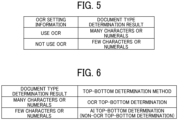
- FIG. 5 is a diagram illustrating a table storing document type determination results according to the present embodiment.
- the document type is determined as the "many characters or numerals" type.
- the OCR setting information indicates that OCR is not to be used
- the document type is determined as the "few characters or numerals” type. This is because OCR is typically used for a document having many characters.
- the method setting unit 512 sets a top-bottom determination method associated, in advance, with the document type based on the document type determination result output by the document type determination unit 511.
- the setting value of the top-bottom determination method set by the method setting unit 512 is input to the method updating unit 513 in addition to the image data read from the HDD 3.
- FIG. 6 is a diagram illustrating a table storing setting values of the top-bottom determination methods according to the present embodiment.
- the table of FIG. 6 is stored in any desired memory to be referred by the method setting unit 512. Further, as long as information indicating a specific top-bottom determination method can be obtained, such information does not have to be stored in a format of table as illustrated in FIG. 6 .
- the top-bottom determination method is set to the OCR top-bottom determination method.
- the top-bottom determination method is set to the AI top-bottom determination method.
- a non-OCR top-bottom determination method other than the AI top-bottom determination method may be associated with the "few characters or numerals" type.
- a common top-bottom determination method may be assigned to two or more document types. If the image forming apparatus 100 does not adopt a plurality of top-bottom determination methods, the method setting unit 512 sets one top-bottom determination method available.
- the method updating unit 513 presents, to a user, the setting value of the top-bottom determination method set by the method setting unit 512 based on the document type determination result and available options for the top-bottom determination method.
- the method updating unit 513 updates the setting value of the top-bottom determination method according to the user's selection. However, it is not essential to update the setting value of the top-bottom determination method.
- the method updating unit 513 outputs the setting value of the top-bottom determination method set by the method setting unit 512 as it is.
- the setting value of the top-bottom determination method updated (or not updated) by the method updating unit 513 is input to the top-bottom determination unit 52 in addition to the image data read from the HDD 3.
- FIG. 7 is a flowchart of the method selection process according to the present embodiment.
- step S 1 the document type determination unit 511 receives image data input to the method selection unit 51.
- the image data received in step S1 has been processed by the gamma correction unit 21 and temporarily stored in the HDD 3.
- the document type determination unit 511 then acquires the OCR setting information.
- the OCR setting information is set by the user when the scanner 1 reads a document.
- the document type determination unit 511 determines the document type of the document read by the scanner 1 based on the acquired OCR setting information. The document type determination unit 511 then transmits the image data and the document type determination result to the method setting unit 512.
- the document type is determined as the "many characters or numerals" type.
- the OCR setting information indicates that OCR is not to be used, the document type is determined as the "few characters or numerals" type.
- step S2 the method setting unit 512 receives the image data and the document type determination result from the document type determination unit 511. The method setting unit 512 then determines whether the document type determination result indicates the "many characters or numerals" type. If the document type determination result indicates the "many characters or numerals" type (YES in S2), the method setting unit 512 advances the process to step S3. By contrast, when the document type determination result indicates the "few characters or numerals" type (NO in S2), the method setting unit 512 advances the process to step S4.
- step S3 the method setting unit 512 sets the top-bottom determination method to the OCR top-bottom determination method. This is because there is a high probability that the top-bottom orientation is more accurately determined by the OCR top-bottom determination method when the document type is the "many characters or numerals" type.
- the method setting unit 512 transmits the image data and the setting value of the top-bottom determination method to the method updating unit 513.
- step S4 the method setting unit 512 sets the top-bottom determination method to the AI top-bottom determination method. This is because there is a high probability that the top-bottom orientation is more accurately determined by the AI top-bottom determination method when the document type is the "few characters or numerals" type.
- a non-OCR top-bottom determination method other than the AI top-bottom determination method may be set.
- the method setting unit 512 transmits the image data and the setting value of the top-bottom determination method to the method updating unit 513.
- step S5 the method updating unit 513 receives the image data and the setting value of the top-bottom determination method from the method setting unit 512.
- the method updating unit 513 presents, to the user, the setting value of the top-bottom determination method and available options of the top-bottom determination method.
- the method updating unit 513 displays a display screen (i.e., a user interface) on which the top-bottom determination method can be selected on the control panel 1040 of the image forming apparatus 100.
- step S6 the method updating unit 513 determines whether the user has changed the top-bottom determination method. Assuming that the user changes the top-bottom determination method by performing, on the control panel 1040, an operation of selecting a top-bottom determination method different from the top-bottom determination method indicated by the current setting value. In this case, the method updating unit 513 advances the process to step S7. By contrast, when the user has not changed the top-bottom determination method, the method updating unit 513 advances the process to step S8.
- step S7 the method updating unit 513 acquires the top-bottom determination method selected by the user.
- the method updating unit 513 then updates the setting value of the top-bottom determination method to the setting value indicating the acquired top-bottom determination method.
- step S8 the method updating unit 513 outputs the image data and the setting value of the top-bottom determination method to the method selection unit 51.
- the image data and the setting value of the top-bottom determination method output from the method selection unit 51 are input to the top-bottom determination unit 52.
- the image forming apparatus 100 sets a top-bottom determination method for determining the top-bottom orientation of an image based on the type of a document read by the scanner 1. For example, when a plurality of top-bottom determination methods is available, an appropriate top-bottom determination method varies depending on the type of the document. Selecting an appropriate top-bottom determination method in accordance with the type of document increases the accuracy of top-bottom determination. As a result, the image forming apparatus 100 according to the present embodiment can determine the top-bottom orientation of the document with high accuracy.
- the image forming apparatus 100 determines the type of a document in accordance with the setting information indicating whether to use OCR.
- the probability that the document is suitable for the OCR top-bottom determination method is high.
- the probability that the document is suitable for the OCR top-bottom determination method is low. Accordingly, the image forming apparatus 100 according to the present embodiment can select the top-bottom determination method suitable for the type of the document.
- the document type is determined based on the setting information indicating whether OCR is to be used.
- the document type is determined using a learned model prepared in advance by deep learning.
- the document type output from the learned model may be used as the determination result of the document type.
- the document type determination using the learned model may be combined with the document type determination using the OCR setting information described in the first embodiment. For example, when the result of document type determination using the OCR setting information differs from the result of document type determination using the learned model, one of the document type determination results may be given a high priority.
- the document type determination using the OCR setting information described in the first embodiment the document type is not determined for each document when a plurality of documents (or a document having a plurality of pages) is scanned at a time.
- the document type determination using a DNN is advantageous in that the document type can be determined for each document when a plurality of documents (or a document having a plurality of pages) is scanned at a time.
- the image forming apparatus 100 according to the present embodiment can switch the top-bottom determination method appropriately for each document when a plurality of documents (or a document having a plurality of pages) is scanned at a time.
- the image forming apparatus can have a functional configuration similar to that of the first embodiment illustrated in FIG. 3 except the differences described below.
- the document type determination unit 511 determines the document type of the image data read from the HDD 3 based on a prediction result provided by the learned model. When the image data read from the HDD 3 corresponds a plurality of documents (or a document having a plurality of pages), the document type determination unit 511 determines the document type of the image data for each document (or each page).
- the learned model in the present embodiment is a machine-learned model that has learned the relationship between an image representing the content of a document and the document type of the document.
- the structure of the learned model is a neural network model based on deep learning.
- a deep neural network (DNN) is adopted in such a neural network model.
- the learned model is a model for determining the document type based on a feature value extracted from the image representing the content of the document.
- the learned model may be any model that determines the document type based on the image.
- FIG. 8 is a diagram illustrating document type determination results according to the present embodiment.
- the learned model in the present embodiment receives image data obtained by reading a document with the scanner 1 and outputs a document type determination result representing "text document,” "business form,” “photograph,” or “drawing.”
- the document types to be determined are not limited thereto and can be set as desired.
- each document type output by the learned model is associated, in advance, with the top-bottom determination method to be set.
- FIG. 9 is a diagram illustrating a table storing setting values of the top-bottom determination methods according to the present embodiment. As illustrated in FIG. 9 , in the present embodiment, when the document type is "text document” or "business form,” the top-bottom determination method is set to the OCR top-bottom determination method. By contrast, when the document type is "photograph” or "drawing,” the top-bottom determination method is set to the AI top-bottom determination method. Alternatively, a non-OCR top-bottom determination method other than the AI top-bottom determination method may be associated with "photograph” or "drawing.”
- FIG. 10 is a flowchart of the method selection process according to the present embodiment.
- step S11 the document type determination unit 511 receives image data input to the method selection unit 51.
- the document type determination unit 511 acquires a learned model.
- the learned model determines the document type as one of "text document,” "business form,” “photograph,” and "drawing.”
- the document type determination unit 511 inputs the image data to the acquired learned model to determine the document type of the document read by the scanner 1.
- the document type determination unit 511 may perform pre-processing such as reducing or enlarging before inputting the image data to the learned model.
- the document type determination unit 511 transmits the image data and the document type determination result to the method setting unit 512.
- step S12 the method setting unit 512 receives the image data and the document type determination result from the document type determination unit 511. The method setting unit 512 then determines which document type the document type determination result indicates.
- step S13 When the document type determination result indicates "text document” or "business form,” the method setting unit 512 advances the process to step S13.
- the document type determination result indicates "photograph” or "drawing,” the method setting unit 512 advances the process to step S14.
- step S13 the method setting unit 512 sets the top-bottom determination method to the OCR top-bottom determination method. This is because when the document type is "text document” or "business form,” the document has many characters, and there is a high probability that the top-bottom orientation can be more accurately determined by the OCR top-bottom determination method.
- the method setting unit 512 transmits the image data and the setting value of the top-bottom determination method to the method updating unit 513.
- step S14 the method setting unit 512 sets the top-bottom determination method to the AI top-bottom determination method. This is because when the document type is "photograph" or "drawing," the document has few characters, and there is a high probability that the top-bottom orientation can be more accurately determined by the AI top-bottom determination method.
- a non-OCR top-bottom determination method other than the AI top-bottom determination method may be set.
- the method setting unit 512 transmits the image data and the setting value of the top-bottom determination method to the method updating unit 513.
- step S15 to step S18 is similar to the process from step S5 to step S8 in the first embodiment.
- the image forming apparatus 100 inputs, to a learned model, the image data obtained by reading a document with the scanner 1, to determine the type of the document. Since the use of machine learning enables more detailed classification of document types, the top-bottom determination method can be appropriately set according to the document type. Further, when a plurality of documents (or a document having a plurality of pages) is scanned at a time, the type of the document can be determined for each page. Accordingly, even for a mixture of documents suitable for different top-bottom determination methods, a suitable top-bottom determination method can be set for each document. As a result, the image forming apparatus 100 according to the present embodiment can determine the top-bottom orientation of the document with high accuracy.
- the image forming apparatus 100 in any one of the above-described embodiments is one example of an image processing apparatus capable of determining the top-bottom orientation of a scanned image.
- the image processing apparatus may be implemented by a computer that is provided separately from the scanner 1 and the plotter 4 and has the functions of the image processing apparatus 2, the image-file-format converter 5, and the HDD 3.
- the image processing apparatus may be implemented by a scanner apparatus having the functions of the image processing apparatus 2, the image-file-format converter 5, the HDD 3, and the scanner 1.
- processing circuit or circuitry includes a programmed processor to execute each function by software, such as a processor implemented by an electronic circuit; and devices, such as an application specific integrated circuit (ASIC), a digital signal processor (DSP), a field programmable gate array (FPGA), and conventional circuit modules arranged to perform the recited functions.
- ASIC application specific integrated circuit
- DSP digital signal processor
- FPGA field programmable gate array
- the present invention can be implemented in any convenient form, for example using dedicated hardware, or a mixture of dedicated hardware and software.
- the present invention may be implemented as computer software implemented by one or more networked processing apparatuses.
- the processing apparatuses include any suitably programmed apparatuses such as a general purpose computer, a personal digital assistant, a Wireless Application Protocol (WAP) or third-generation (3G)-compliant mobile telephone, and so on. Since the present invention can be implemented as software, each and every aspect of the present invention thus encompasses computer software implementable on a programmable device.
- the computer software can be provided to the programmable device using any conventional carrier medium (carrier means).
- the carrier medium includes a transient carrier medium such as an electrical, optical, microwave, acoustic or radio frequency signal carrying the computer code.
- transient medium is a Transmission Control Protocol/Internet Protocol (TCP/IP) signal carrying computer code over an IP network, such as the Internet.
- the carrier medium may also include a storage medium for storing processor readable code such as a floppy disk, a hard disk, a compact disc read-only memory (CD-ROM), a magnetic tape device, or a solid state memory device.
Landscapes
- Engineering & Computer Science (AREA)
- Multimedia (AREA)
- Signal Processing (AREA)
- Computer Vision & Pattern Recognition (AREA)
- Health & Medical Sciences (AREA)
- General Health & Medical Sciences (AREA)
- Biomedical Technology (AREA)
- Artificial Intelligence (AREA)
- Theoretical Computer Science (AREA)
- General Physics & Mathematics (AREA)
- Physics & Mathematics (AREA)
- Character Input (AREA)
- Editing Of Facsimile Originals (AREA)
- Control Or Security For Electrophotography (AREA)
- Facsimiles In General (AREA)
Abstract
An image processing apparatus includes a document type determination unit (511) to determine a type of a document read by a scanner, a method setting unit (512) to set a top-bottom determination method based on the type of the document, and a top-bottom determination unit (52) to determine a top-bottom orientation of a target image by the top-bottom determination method. The target image is obtained by reading the document with the scanner.
Description
- Embodiments of the present disclosure relate to an image processing apparatus, an image processing method, and a carrier medium.
- When a document is read by a scanner, the document may be read in a wrong direction such that the orientation of the document is reversed or sideways. There is a known technique of automatically determining the top-bottom orientation (may be referred to simply as "orientation") of a document read in such a wrong orientation and correcting the orientation of the document. Determining the top-bottom orientation may be referred to as top-bottom identification in the following description.
- For example,
Japanese Unexamined Patent Application Publication No. 2007-324648 Japanese Unexamined Patent Application Publication No. 2022-090536 - However, in the related art, the method of top-bottom determination is not selected in accordance with the characteristics of a document. For example, when the document is a text document or business form including many characters, the top-bottom orientation can be determined with high accuracy by the top-bottom determination using OCR. By contrast, when the document is a photograph or drawing having few characters, the accuracy of the top-bottom determination using a DNN is higher than that of the top-bottom determination using OCR.
- In one aspect, an image processing apparatus includes a document type determination unit to determine a type of a document read by a scanner, a method setting unit to set a top-bottom determination method based on the type of the document, and a top-bottom determination unit to determine a top-bottom orientation of a target image by the top-bottom determination method. The target image is obtained by reading the document with the scanner.
- Another aspect is an image processing method performed by an image processing apparatus. The image processing method includes determining a type of a document read by a scanner, setting a top-bottom determination method based on the type of the document, and determining aa top-bottom orientation of a target image by the top-bottom determination method. The target image is obtained by reading the document with the scanner.
- Another aspect is a carrier medium carrying computer readable codes which, when executed by an image processing apparatus, cause the image processing apparatus to carry out the method described above.
- According to the aspects of the present disclosure, the top-bottom orientation of a document can be determined with high accuracy, using the top-bottom determination method based on the type of the document.
- A more complete appreciation of embodiments of the present disclosure and many of the attendant advantages and features thereof can be readily obtained and understood from the following detailed description with reference to the accompanying drawings, wherein:
-
FIG. 1 is a diagram illustrating scanning directions of a document; -
FIG. 2 is a block diagram illustrating a hardware configuration of an image forming apparatus according to embodiments of the present disclosure; -
FIG. 3 is a block diagram illustrating a functional configuration of an image forming apparatus according to embodiments of the present disclosure; -
FIG. 4 is a block diagram illustrating a functional configuration of a method selection unit according to embodiments of the present disclosure; -
FIG. 5 is a diagram illustrating a table storing document type determination results according to a first embodiment of the present disclosure; -
FIG. 6 is a diagram illustrating a table storing setting values of top-bottom determination methods according to the first embodiment of the present disclosure; -
FIG. 7 is a flowchart of a method selection process according to the first embodiment of the present disclosure; -
FIG. 8 is a diagram illustrating document type determination results according to a second embodiment of the present disclosure; -
FIG. 9 is a diagram illustrating a table storing setting values of top-bottom determination methods according to the second embodiment of the present disclosure; and -
FIG. 10 is a flowchart of a method selection process according to the second embodiment of the present disclosure. - The accompanying drawings are intended to depict embodiments of the present disclosure and should not be interpreted to limit the scope thereof. The accompanying drawings are not to be considered as drawn to scale unless explicitly noted. Also, identical or similar reference numerals designate identical or similar components throughout the several views.
- In describing embodiments illustrated in the drawings, specific terminology is employed for the sake of clarity. However, the disclosure of this specification is not intended to be limited to the specific terminology so selected and it is to be understood that each specific element includes all technical equivalents that have a similar function, operate in a similar manner, and achieve a similar result.
- Referring now to the drawings, embodiments of the present disclosure are described below. In the drawings, an identical or similar reference numeral designates a component having identical or similar function, and redundant descriptions are omitted in the following description. As used herein, the singular forms "a," "an," and "the" are intended to include the plural forms as well, unless the context clearly indicates otherwise.
- When a document is read by a scanner, the document may be read in a wrong direction such that the orientation of the document is reversed or sideways.
FIG. 1 is a diagram illustrating scanning directions of a document. InFIG. 1 , for example, a document having the orientation as indicated by "north" may be read in the orientation as indicated by "south" (i.e., upside down) or in the orientation as indicated by "east" or "west" (i.e., sideways). - Although the labels of cardinal points ("north," "east," "west," and "south") indicate the top of the document in
FIG. 1 , the orientation of the document may be indicated by any label that is in a proper relation with the orientation. For example, the top-bottom orientation may be indicated by indexes such as 0 to 3. - There are various methods to determine the top-bottom orientation of a document. For example, there is a top-bottom determination method based on a processing result of OCR, which may be referred to as an "OCR top-bottom determination method" in the following description. There are top-bottom determination methods that do not use OCR, such as a top-bottom determination method using a line rectangle and a top-bottom determination method based on a prediction result of a DNN. Such a top-bottom determination method based on a prediction result of a DNN may be referred to as "artificial intelligence (AI) top-bottom determination methods" in the following description.
- In some scanners, OCR is not a standard function but is an optional function. When the scanner does not have an OCR function, the OCR top-bottom determination method is not usable.
- By contrast, top-bottom determination methods that do not use OCR, which may be referred to as "non-OCR top-bottom determination methods" in the following description, such as an AI top-bottom determination method can be used regardless of whether the OCR function is installed. In other words, when the OCR function is installed, both the OCR top-bottom determination method and the non-OCR top-bottom determination method can be used.
- A plurality of top-bottom determination methods may become available some time after the introduction of an apparatus. For example, at the time of introduction, the optional OCR function is not installed, and the AI top-bottom determination method that is a default top-bottom determination method installed in the apparatus is used. After the optional OCR function is installed, a plurality of top-bottom determination methods becomes available. When the optional OCR function is installed, the frequency of performing top-bottom determination simultaneously with OCR will increase. In this case, the frequency of scanning a document easily processed by OCR increases, and the accuracy of the OCR top-bottom determination is probably higher than the AI top-bottom determination.
- However, in a configuration in which the top-bottom determination method is not automatically switched at the time of installation of the optional OCR function, a user may forget to manually switch the top-bottom determination method. In this case, the default AI top-bottom determination method is applied even after the optional OCR function is installed. Depending on the document, the accuracy of OCR top-bottom determination method may be good, but the accuracy of the AI top-bottom determination method may be poor. In such a case, not only the accuracy of top-bottom determination but also the accuracy of character recognition decreases.
- An approach to avoid the above-described inconvenience is switching the setting value of the top-bottom determination method according to whether the optional OCR function is installed. This approach, however, does not take account of a case where the user intends to perform top-bottom determination but not to use the optional OCR function installed on the apparatus.
- For example, even if the optional OCR function is installed, there is an option of not performing OCR as in the case before the optional OCR function is installed. Depending on the document or the intended use, the user may decide to perform top-bottom determination but not to perform OCR. For example, when the OCR top-bottom determination method is used in the scanning of a document not suitable for OCR (for example, a document including many photographs or a document in a language not supported by OCR), the accuracy of top-bottom determination decreases. In addition, since performing OCR increases the processing time and the file size, applying OCR to the document having no region subjected to OCR is not desirable.
- Further, in actual use, sometimes a mixture of a document suitable for OCR and a document unsuitable for OCR is scanned. Even when a plurality of top-bottom determination methods is available, generally one top-bottom determination method is used for one scanning. In other words, the top-bottom determination method is not switched for each of documents (or each page of a document) scanned at a time. For example, when the OCR top-bottom determination method is set, only the OCR top-bottom determination method is used in the scanning of a plurality of documents (or in the scanning of a document having a plurality of pages or sheets). In this disclosure, a plurality of documents scanned at a time may be a document having a plurality of pages scanned at a time. In this case, it is not desirable to scan a mixture of a document to be subjected to the OCR top-bottom determination method and a document to be subjected to the AI top-bottom determination method at a time.
- Several kinds of top-bottom determination methods are known in the art, but different types of documents are best recognized by different top-bottom determination methods. In other words, a top-bottom determination method that can determine the top and bottom of a document with high accuracy cannot determine the top and bottom of a different type of document with high accuracy. For example, the accuracy of the OCR top-bottom determination method can be higher when the document is a text document in a language supported by the OCR function. The accuracy of the AI top-bottom determination method can be higher when the document is a text document in a language not supported by the OCR function or the document is, for example, a photograph having few characters. As a result, when a plurality of documents (or a document having a plurality of pages) of different types is scanned at a time, it is probable that changing the top-bottom determination method in accordance with whether the optional OCR function is installed lowers the accuracy of top-bottom determination depending on the document.
- An object of embodiments of the present disclosure is selecting an appropriate top-bottom determination method in accordance with characteristics of a document so as to increase the accuracy of the top-bottom determination of a scanned image when a plurality of top-bottom determination methods is available.
- A description is given of an image forming apparatus that reads a document with a scanner and outputs a scanned image, according to a first embodiment of the present disclosure. The image forming apparatus according to the present embodiment has functions of determining the top-bottom orientation of a scanned image obtained by reading a document with a scanner and correcting the top-bottom orientation of the scanned image so as to match the top-bottom orientation of the document.
- The image forming apparatus according to the present embodiment determines the type of a document (also referred to as "document type" in the following description) read by a scanner and determines the top-bottom orientation of an image using a top-bottom determination method corresponding to the document type.
- In the present embodiment, the document type is determined based on setting information indicating whether OCR is to be used. Such setting information is referred to as "OCR setting information" in the following description. OCR is a function typically used for a document having many characters. When a user selects the use of OCR, the probability that the document is suitable for the OCR top-bottom determination method is high. By contrast, when the user does not select the use of OCR, the probability that the document is suitable for the OCR top-bottom determination method is low. Accordingly, when the top-bottom determination method is selected in accordance with the OCR setting information, the suitable top-bottom determination method can be selected.
- A description is given of a hardware configuration of the image forming apparatus according to the present embodiment, with reference to
FIG. 2. FIG. 2 is a block diagram illustrating a hardware configuration of the image forming apparatus according to the present embodiment. - As illustrated in
FIG. 2 , animage forming apparatus 100 includes acontroller 1010, a short-range communication circuit 1020, anengine controller 1030, acontrol panel 1040, and a network interface (I/F) 1050. - Specifically, the
controller 1010 includes a central processing unit (CPU) 1001 as a main part of a computer, asystem memory 1002, a northbridge (NB) 1003, a southbridge (SB) 1004, an application-specific integrated circuit (ASIC) 1005, alocal memory 1006 as a storage device, a hard disk drive (HDD)controller 1007, and a hard disk or hard drive (HD) 1008 as a storage device. TheNB 1003 and theASIC 1005 are connected to each other by an accelerated graphics port (AGP)bus 1021. - The
CPU 1001 controls the entire operation of theimage forming apparatus 100. TheNB 1003 is a bridge that connects theCPU 1001 to thesystem memory 1002, theSB 1004, and theAGP bus 1021. TheNB 1003 includes a peripheral component interconnect (PCI) master, an AGP target, and a memory controller that controls reading and writing data from and to thesystem memory 1002. - The
system memory 1002 includes a read only memory (ROM) 1002a and a random access memory (RAM) 1002b. TheROM 1002a stores data and programs for implementing various functions of thecontroller 1010. For example, theRAM 1002b is used to load the programs and the data. TheRAM 1002b is also used as a memory for loading drawing data in printing. For the purpose of distribution, the programs stored in theRAM 1002b may be stored in a computer-readable recording medium, such as a compact disc read-only memory (CD-ROM), a compact disc-recordable (CD-R), or a digital versatile disc (DVD), as a file in a format installable or executable by a computer. - The
SB 1004 is a bridge that connects theNB 1003 to PCI devices and peripheral devices. TheASIC 1005 is an integrated circuit (IC) dedicated to image processing and has a hardware element for image processing. TheASIC 1005 is a bridge that connects theAGP bus 1021, aPCI bus 1022, theHDD controller 1007, and thelocal memory 1006. - The
ASIC 1005 includes a PCI target, an AGP master, an arbiter (ARB) serving as a core of theASIC 1005, a memory controller that controls thelocal memory 1006, a plurality of direct memory access controllers (DMACs), and a PCI unit. The DMACs rotate image data with, for example, a hardware logic. The PCI unit transfers and receives data to and from ascanner section 1031 and aprinter section 1032 via thePCI bus 1022. TheASIC 1005 may be connected to a universal serial bus (USB) interface or an Institute of Electrical and Electronics Engineers (IEEE) 1394 interface. - The
local memory 1006 is used as a buffer for an image to be copied and a buffer for coding. TheHD 1008 is a storage device that stores image data, font data used in printing, and form data. TheHDD controller 1007 controls an HDD to read or write data from or to theHD 1008 under the control of theCPU 1001. TheAGP bus 1021 is a bus interface for a graphics accelerator card, which has been proposed to accelerate graphics processing. TheAGP bus 1021 directly accesses thesystem memory 1002 at high throughput, thereby accelerating the graphics accelerator card. - The short-
range communication circuit 1020 is provided with a short-range communication antenna 1020a. The short-range communication circuit 1020 is a communication circuit in compliance with, for example, near field communication (NFC) or BLUETOOTH. - The
engine controller 1030 includes thescanner section 1031 and theprinter section 1032. Thecontrol panel 1040 includes apanel display 1040a and anoperation panel 1040b. Thepanel display 1040a is, for example, a touch panel that displays current settings or a selection screen and receives user input. Theoperation panel 1040b includes, for example, a numeric keypad and a start key. The numeric keypad receives assigned values of image forming parameters including an image density parameter. The start key receives an instruction to start, for example, copying. Thecontroller 1010 controls the entire operation of theimage forming apparatus 100 and controls, for example, drawing, communication, and input from thecontrol panel 1040. Thescanner section 1031 and theprinter section 1032 have a capability of image processing such as error diffusion and gamma conversion. - The
image forming apparatus 100 can sequentially switch among a document server function, a copier function, a printer function, and a facsimile function in accordance with input via, for example, an application switch key on thecontrol panel 1040. Theimage forming apparatus 100 enters a document server mode when the document server function is selected, enters a copy mode when the copy function is selected, enters a printer mode when the printer function is selected, and enters a facsimile mode when the facsimile function is selected. - The network I/
F 1050 is an interface for performing data communication through a communication network. The short-range communication circuit 1020 and the network I/F 1050 are electrically connected to theASIC 1005 via thePCI bus 1022. - A description is given below of a functional configuration of the image forming apparatus according to the present embodiment with reference to
FIG. 3 . -
FIG. 3 is a block diagram illustrating a functional configuration of the image forming apparatus according to the present embodiment. - The
image forming apparatus 100 according to the present embodiment is a digital color image forming apparatus. As illustrated inFIG. 3 , the digital colorimage forming apparatus 100 includes a scanner 1, animage processing apparatus 2, a hard disk drive (HDD) 3, a plotter 4, and an image-file-format converter 5. The digital colorimage forming apparatus 100 functions as the scanner 1, theimage processing apparatus 2, theHDD 3, the plotter 4, and the image-file-format converter 5 by executing programs. - The scanner 1 reads image data from a document. The scanner 1 transmits the read image data (i.e., scanned image) to the
image processing apparatus 2. - The
image processing apparatus 2 determines whether a pixel or pixel block of interest in the image data read by the scanner 1 is a text area or a non-text area (i.e., a pattern area) and whether the pixel or pixel block of interest has a chromatic color or an achromatic color. Theimage processing apparatus 2 performs color reproduction suitable for the document based on the determination result. - The
image processing apparatus 2 includes agamma correction unit 21, anarea detection unit 22, adata interface unit 23, a color processing and under color removal (UCR)unit 24, and a printer correction unit 25. Theimage processing apparatus 2 executes processing for obtaining a copy image and a scanned image. - The
gamma correction unit 21 performs one-dimensional conversion on the image data read by the scanner 1, to adjust the tone balance of each color of the image data. Specifically, the one-dimensional conversion is performed on 8-bit signals of each of red (R), green (G), and blue (B) after analog-to-digital conversion. For the sake of explanatory convenience, it is assumed in the present embodiment that density linear signals (RGB signals in which 0 is a signal value that indicates white) are obtained after the conversion. The output of thegamma correction unit 21 is transmitted to thearea detection unit 22 and further to thedata interface unit 23. - The
area detection unit 22 includes a character determination unit and a color determination unit. The character determination unit determines whether the pixel or pixel block of interest in the image data belongs a text area or a non-text area (i.e., an illustration or design area). The color determination unit determines whether the pixel or pixel block of interest in the image data is chromatic or achromatic. - The
data interface unit 23 is an HDD-management interface that temporarily stores, in theHDD 3, the image data processed by thegamma correction unit 21 and the determination result from thearea detection unit 22. Thedata interface unit 23 transmits, to the color processing andUCR unit 24, the image data processed by thegamma correction unit 21 and the determination result from thearea detection unit 22. - The color processing and
UCR unit 24 selects color processing or UCR processing based on the determination result from thearea detection unit 22. - The printer correction unit 25 receives cyan (c), magenta (m), yellow (y), and black (Bk) image signals from the color processing and
UCR unit 24 and performs gamma correction and dithering in consideration of printer characteristics. Then, the printer correction unit 25 transmits the processed signals to the plotter 4. - The
HDD 3 temporarily stores the image data processed by thegamma correction unit 21 and the determination result from thearea detection unit 22. The image data temporarily stored in theHDD 3 is read out by the image-file-format converter 5. - The plotter 4 performs transferring and printing. The plotter 4 transfers the image data output from the
image processing apparatus 2 to a recording medium. - The image-file-
format converter 5 reads, from theHDD 3, the image data processed by thegamma correction unit 21 and temporarily stored therein and performs top-bottom determination on the image data (also referred to as "target image" in the following description). The image-file-format converter 5 uses the result of the top-bottom determination to convert the image data into a file format of, for example, portable document format (PDF) or Office Open Extensible Markup Language (XML) document format adopted for MICROSOFT WORD. - The image-file-
format converter 5 includes amethod selection unit 51, a top-bottom determination unit 52, and a fileformat conversion unit 53. The image-file-format converter 5 executes processing for top-bottom determination of image data. More specifically, the image-file-format converter 5 performs processing for determining the top-bottom orientation of image data and converting the file format using the result of the top-bottom determination. - The
method selection unit 51 selects the top-bottom determination method to be used by the top-bottom determination unit 52 on the subsequent stage. The top-bottom determination method selected by themethod selection unit 51 is input to the top-bottom determination unit 52 in addition to the image data read from theHDD 3. - The top-
bottom determination unit 52 applies pre-processing corresponding to the top-bottom determination method selected by themethod selection unit 51 to the image data read from theHDD 3. Then, the top-bottom determination unit 52 performs top-bottom determination by the method selected by themethod selection unit 51. Examples of the pre-processing corresponding to the top-bottom determination method include binarization, reducing, and enlarging. A top-bottom determination result indicates one of north, east, west, and south as the location of the top of the document. The top-bottom determination result obtained by the top-bottom determination unit 52 is output to the fileformat conversion unit 53. - The file
format conversion unit 53 converts the image data read from theHDD 3 into data in a file format such as PDF or Office Open XML document format using the top-bottom determination result output from the top-bottom determination unit 52. - A description is given below of a functional configuration of the method selection unit according to the present embodiment with reference to
FIG. 4. FIG. 4 is a block diagram illustrating a functional configuration of the method selection unit according to the present embodiment. - The
method selection unit 51 includes a documenttype determination unit 511, amethod setting unit 512, and amethod updating unit 513. - The document
type determination unit 511 determines the document type of the image data read from theHDD 3. The document type determination result output by the documenttype determination unit 511 is input to themethod setting unit 512 in addition to the image data read from theHDD 3. If theimage forming apparatus 100 does not adopt a plurality of top-bottom determination methods, the document type determination can be omitted. When document type determination is not performed, only the image data read from theHDD 3 is input to themethod setting unit 512. - The document types and the number of document types determined by the document
type determination unit 511 are not limited. For example, documents may be classified into documents having many characters or numerals (e.g., a text document and a business form) and documents having few characters or numerals (e.g., a photograph and a drawing). Alternatively, documents may be classified into more subdivided document types. - The method for determining the document type is not limited. A desirable method can be determined in accordance with document types to be determined and the number of document types. In the present embodiment, setting information indicating whether OCR is to be used is used for determining a document type, and documents are classified into documents having many characters or numerals and documents having few characters or numerals. These document types are also referred to as "many characters or numerals" type and "few characters or numerals" type in the description below.
-
FIG. 5 is a diagram illustrating a table storing document type determination results according to the present embodiment. As illustrated inFIG. 5 , in the present embodiment, when the OCR setting information indicates that OCR is to be used, the document type is determined as the "many characters or numerals" type. By contrast, when the OCR setting information indicates that OCR is not to be used, the document type is determined as the "few characters or numerals" type. This is because OCR is typically used for a document having many characters. - The
method setting unit 512 sets a top-bottom determination method associated, in advance, with the document type based on the document type determination result output by the documenttype determination unit 511. The setting value of the top-bottom determination method set by themethod setting unit 512 is input to themethod updating unit 513 in addition to the image data read from theHDD 3. - Each document type that can be output by the document
type determination unit 511 is associated in advance with the top-bottom determination method to be set.FIG. 6 is a diagram illustrating a table storing setting values of the top-bottom determination methods according to the present embodiment. The table ofFIG. 6 is stored in any desired memory to be referred by themethod setting unit 512. Further, as long as information indicating a specific top-bottom determination method can be obtained, such information does not have to be stored in a format of table as illustrated inFIG. 6 . As illustrated inFIG. 6 , in the present embodiment, when the document type is the "many characters or numerals" type, the top-bottom determination method is set to the OCR top-bottom determination method. By contrast, when the document type is the "few characters or numerals" type, the top-bottom determination method is set to the AI top-bottom determination method. Alternatively, a non-OCR top-bottom determination method other than the AI top-bottom determination method may be associated with the "few characters or numerals" type. - When there are three or more document types that can be output, a common top-bottom determination method may be assigned to two or more document types. If the
image forming apparatus 100 does not adopt a plurality of top-bottom determination methods, themethod setting unit 512 sets one top-bottom determination method available. - The
method updating unit 513 presents, to a user, the setting value of the top-bottom determination method set by themethod setting unit 512 based on the document type determination result and available options for the top-bottom determination method. Themethod updating unit 513 updates the setting value of the top-bottom determination method according to the user's selection. However, it is not essential to update the setting value of the top-bottom determination method. When the user does not select another top-bottom determination method, themethod updating unit 513 outputs the setting value of the top-bottom determination method set by themethod setting unit 512 as it is. - The setting value of the top-bottom determination method updated (or not updated) by the
method updating unit 513 is input to the top-bottom determination unit 52 in addition to the image data read from theHDD 3. - A description is given below of a method selection process performed by the
method selection unit 51 according to the present embodiment with reference toFIG. 7. FIG. 7 is a flowchart of the method selection process according to the present embodiment. - In step S 1, the document
type determination unit 511 receives image data input to themethod selection unit 51. The image data received in step S1 has been processed by thegamma correction unit 21 and temporarily stored in theHDD 3. The documenttype determination unit 511 then acquires the OCR setting information. The OCR setting information is set by the user when the scanner 1 reads a document. - Subsequently, the document
type determination unit 511 determines the document type of the document read by the scanner 1 based on the acquired OCR setting information. The documenttype determination unit 511 then transmits the image data and the document type determination result to themethod setting unit 512. - In the present embodiment, as illustrated in
FIG. 5 , when the OCR setting information indicates that OCR is to be used, the document type is determined as the "many characters or numerals" type. By contrast, when the OCR setting information indicates that OCR is not to be used, the document type is determined as the "few characters or numerals" type. - In step S2, the
method setting unit 512 receives the image data and the document type determination result from the documenttype determination unit 511. Themethod setting unit 512 then determines whether the document type determination result indicates the "many characters or numerals" type. If the document type determination result indicates the "many characters or numerals" type (YES in S2), themethod setting unit 512 advances the process to step S3. By contrast, when the document type determination result indicates the "few characters or numerals" type (NO in S2), themethod setting unit 512 advances the process to step S4. - In step S3, the
method setting unit 512 sets the top-bottom determination method to the OCR top-bottom determination method. This is because there is a high probability that the top-bottom orientation is more accurately determined by the OCR top-bottom determination method when the document type is the "many characters or numerals" type. Themethod setting unit 512 transmits the image data and the setting value of the top-bottom determination method to themethod updating unit 513. - In step S4, the
method setting unit 512 sets the top-bottom determination method to the AI top-bottom determination method. This is because there is a high probability that the top-bottom orientation is more accurately determined by the AI top-bottom determination method when the document type is the "few characters or numerals" type. Alternatively, in step S4, a non-OCR top-bottom determination method other than the AI top-bottom determination method may be set. Themethod setting unit 512 transmits the image data and the setting value of the top-bottom determination method to themethod updating unit 513. - In step S5, the
method updating unit 513 receives the image data and the setting value of the top-bottom determination method from themethod setting unit 512. Themethod updating unit 513 presents, to the user, the setting value of the top-bottom determination method and available options of the top-bottom determination method. For example, themethod updating unit 513 displays a display screen (i.e., a user interface) on which the top-bottom determination method can be selected on thecontrol panel 1040 of theimage forming apparatus 100. - In step S6, the
method updating unit 513 determines whether the user has changed the top-bottom determination method. Assuming that the user changes the top-bottom determination method by performing, on thecontrol panel 1040, an operation of selecting a top-bottom determination method different from the top-bottom determination method indicated by the current setting value. In this case, themethod updating unit 513 advances the process to step S7. By contrast, when the user has not changed the top-bottom determination method, themethod updating unit 513 advances the process to step S8. - In step S7, the
method updating unit 513 acquires the top-bottom determination method selected by the user. Themethod updating unit 513 then updates the setting value of the top-bottom determination method to the setting value indicating the acquired top-bottom determination method. - In step S8, the
method updating unit 513 outputs the image data and the setting value of the top-bottom determination method to themethod selection unit 51. The image data and the setting value of the top-bottom determination method output from themethod selection unit 51 are input to the top-bottom determination unit 52. - As described above, the
image forming apparatus 100 according to the present embodiment sets a top-bottom determination method for determining the top-bottom orientation of an image based on the type of a document read by the scanner 1. For example, when a plurality of top-bottom determination methods is available, an appropriate top-bottom determination method varies depending on the type of the document. Selecting an appropriate top-bottom determination method in accordance with the type of document increases the accuracy of top-bottom determination. As a result, theimage forming apparatus 100 according to the present embodiment can determine the top-bottom orientation of the document with high accuracy. - The
image forming apparatus 100 according to the present embodiment determines the type of a document in accordance with the setting information indicating whether to use OCR. When the use of OCR is selected, the probability that the document is suitable for the OCR top-bottom determination method is high. When the user does not select the use of OCR, the probability that the document is suitable for the OCR top-bottom determination method is low. Accordingly, theimage forming apparatus 100 according to the present embodiment can select the top-bottom determination method suitable for the type of the document. - In the first embodiment, the document type is determined based on the setting information indicating whether OCR is to be used. In the second embodiment, the document type is determined using a learned model prepared in advance by deep learning.
- In the present embodiment, the document type output from the learned model may be used as the determination result of the document type. Alternatively, the document type determination using the learned model may be combined with the document type determination using the OCR setting information described in the first embodiment. For example, when the result of document type determination using the OCR setting information differs from the result of document type determination using the learned model, one of the document type determination results may be given a high priority.
- In some of cases where a plurality of documents (or a document having a plurality of pages) is scanned at a time, whether to use OCR is not settable for each document. As a result, in the document type determination using the OCR setting information described in the first embodiment, the document type is not determined for each document when a plurality of documents (or a document having a plurality of pages) is scanned at a time.
- By contrast, the document type determination using a DNN is advantageous in that the document type can be determined for each document when a plurality of documents (or a document having a plurality of pages) is scanned at a time. In other words, the
image forming apparatus 100 according to the present embodiment can switch the top-bottom determination method appropriately for each document when a plurality of documents (or a document having a plurality of pages) is scanned at a time. - The image forming apparatus according to the second embodiment can have a functional configuration similar to that of the first embodiment illustrated in
FIG. 3 except the differences described below. The documenttype determination unit 511 according to the present embodiment determines the document type of the image data read from theHDD 3 based on a prediction result provided by the learned model. When the image data read from theHDD 3 corresponds a plurality of documents (or a document having a plurality of pages), the documenttype determination unit 511 determines the document type of the image data for each document (or each page). - The learned model in the present embodiment is a machine-learned model that has learned the relationship between an image representing the content of a document and the document type of the document. In the present embodiment, the structure of the learned model is a neural network model based on deep learning. Typically, a deep neural network (DNN) is adopted in such a neural network model. In other words, the learned model is a model for determining the document type based on a feature value extracted from the image representing the content of the document. However, the learned model may be any model that determines the document type based on the image.
-
FIG. 8 is a diagram illustrating document type determination results according to the present embodiment. As illustrated inFIG. 8 , the learned model in the present embodiment receives image data obtained by reading a document with the scanner 1 and outputs a document type determination result representing "text document," "business form," "photograph," or "drawing." However, the document types to be determined are not limited thereto and can be set as desired. - In the present embodiment, each document type output by the learned model is associated, in advance, with the top-bottom determination method to be set.
FIG. 9 is a diagram illustrating a table storing setting values of the top-bottom determination methods according to the present embodiment. As illustrated inFIG. 9 , in the present embodiment, when the document type is "text document" or "business form," the top-bottom determination method is set to the OCR top-bottom determination method. By contrast, when the document type is "photograph" or "drawing," the top-bottom determination method is set to the AI top-bottom determination method. Alternatively, a non-OCR top-bottom determination method other than the AI top-bottom determination method may be associated with "photograph" or "drawing." - A description is given below of a method selection process performed by the
method selection unit 51 according to the present embodiment with reference toFIG. 10. FIG. 10 is a flowchart of the method selection process according to the present embodiment. - In step S11, the document
type determination unit 511 receives image data input to themethod selection unit 51. The documenttype determination unit 511 acquires a learned model. In the present embodiment, as illustrated inFIG. 8 , the learned model determines the document type as one of "text document," "business form," "photograph," and "drawing." - Subsequently, the document
type determination unit 511 inputs the image data to the acquired learned model to determine the document type of the document read by the scanner 1. The documenttype determination unit 511 may perform pre-processing such as reducing or enlarging before inputting the image data to the learned model. The documenttype determination unit 511 transmits the image data and the document type determination result to themethod setting unit 512. - In step S12, the
method setting unit 512 receives the image data and the document type determination result from the documenttype determination unit 511. Themethod setting unit 512 then determines which document type the document type determination result indicates. - When the document type determination result indicates "text document" or "business form," the
method setting unit 512 advances the process to step S13. By contrast, when the document type determination result indicates "photograph" or "drawing," themethod setting unit 512 advances the process to step S14. - In step S13, the
method setting unit 512 sets the top-bottom determination method to the OCR top-bottom determination method. This is because when the document type is "text document" or "business form," the document has many characters, and there is a high probability that the top-bottom orientation can be more accurately determined by the OCR top-bottom determination method. Themethod setting unit 512 transmits the image data and the setting value of the top-bottom determination method to themethod updating unit 513. - In step S14, the
method setting unit 512 sets the top-bottom determination method to the AI top-bottom determination method. This is because when the document type is "photograph" or "drawing," the document has few characters, and there is a high probability that the top-bottom orientation can be more accurately determined by the AI top-bottom determination method. Alternatively, in step S14, a non-OCR top-bottom determination method other than the AI top-bottom determination method may be set. Themethod setting unit 512 transmits the image data and the setting value of the top-bottom determination method to themethod updating unit 513. - The process from step S15 to step S18 is similar to the process from step S5 to step S8 in the first embodiment.
- As described above, the
image forming apparatus 100 according to the present embodiment inputs, to a learned model, the image data obtained by reading a document with the scanner 1, to determine the type of the document. Since the use of machine learning enables more detailed classification of document types, the top-bottom determination method can be appropriately set according to the document type. Further, when a plurality of documents (or a document having a plurality of pages) is scanned at a time, the type of the document can be determined for each page. Accordingly, even for a mixture of documents suitable for different top-bottom determination methods, a suitable top-bottom determination method can be set for each document. As a result, theimage forming apparatus 100 according to the present embodiment can determine the top-bottom orientation of the document with high accuracy. - Further, the
image forming apparatus 100 in any one of the above-described embodiments is one example of an image processing apparatus capable of determining the top-bottom orientation of a scanned image. In another example, the image processing apparatus may be implemented by a computer that is provided separately from the scanner 1 and the plotter 4 and has the functions of theimage processing apparatus 2, the image-file-format converter 5, and theHDD 3. In another example, the image processing apparatus may be implemented by a scanner apparatus having the functions of theimage processing apparatus 2, the image-file-format converter 5, theHDD 3, and the scanner 1. - Each of the functions of the above-described embodiments may be implemented by one or more pieces of processing circuitry. The "processing circuit or circuitry" in the present disclosure includes a programmed processor to execute each function by software, such as a processor implemented by an electronic circuit; and devices, such as an application specific integrated circuit (ASIC), a digital signal processor (DSP), a field programmable gate array (FPGA), and conventional circuit modules arranged to perform the recited functions.
- Any one of the above-described operations may be performed in various other ways, for example, in an order different from the one described above.
- The present invention can be implemented in any convenient form, for example using dedicated hardware, or a mixture of dedicated hardware and software. The present invention may be implemented as computer software implemented by one or more networked processing apparatuses. The processing apparatuses include any suitably programmed apparatuses such as a general purpose computer, a personal digital assistant, a Wireless Application Protocol (WAP) or third-generation (3G)-compliant mobile telephone, and so on. Since the present invention can be implemented as software, each and every aspect of the present invention thus encompasses computer software implementable on a programmable device. The computer software can be provided to the programmable device using any conventional carrier medium (carrier means). The carrier medium includes a transient carrier medium such as an electrical, optical, microwave, acoustic or radio frequency signal carrying the computer code. An example of such a transient medium is a Transmission Control Protocol/Internet Protocol (TCP/IP) signal carrying computer code over an IP network, such as the Internet. The carrier medium may also include a storage medium for storing processor readable code such as a floppy disk, a hard disk, a compact disc read-only memory (CD-ROM), a magnetic tape device, or a solid state memory device.
Claims (9)
- An image processing apparatus comprising:a document type determination unit (511) configured to determine a type of a document read by a scanner;a method setting unit (512) configured to set a top-bottom determination method based on the type of the document; anda top-bottom determination unit (52) configured to determine a top-bottom orientation of a target image by the top-bottom determination method, the target image being obtained by reading the document with the scanner.
- The image processing apparatus according to claim 1,
wherein the document type determination unit (511) is configured to determine the type of the document based on setting information indicating whether to perform character recognition on the target image. - The image processing apparatus according to claim 1,
wherein the document type determination unit (511) is configured to determine the type of the document based on a feature value of the target image. - The image processing apparatus according to claim 3,
wherein the document type determination unit (511) is configured to input the target image to a learned model so as to determine the type of the document, the learned model having learned a relationship between an image representing a content of a document and a type of the document. - The image processing apparatus according to claim 4,
wherein the document read by the scanner includes a plurality of documents, and the document type determination unit (511) is configured to determine the type of the document for each of the plurality of documents. - The image processing apparatus according to any one of claims 1 to 5, further comprising a method updating unit (513) configured to:present, to a user, the top-bottom determination method set by the method setting unit (512); andupdate the top-bottom determination method in accordance with an operation input by the user.
- The image processing apparatus according to any one of claims 1 to 6, further comprising
the scanner (1) to read the document to obtain the target image. - An image processing method performed by an image processing apparatus, the image processing method comprising:determining (S2; S12) a type of a document read by a scanner;setting (S3; S4; S13; S14) a top-bottom determination method based on the type of the document; anddetermining a top-bottom orientation of a target image by the top-bottom determination method, the target image being obtained by reading the document with the scanner.
- A carrier medium carrying computer readable codes which, when executed by an image processing apparatus, cause the image processing apparatus to carry out the method according to claim 8.
Applications Claiming Priority (1)
| Application Number | Priority Date | Filing Date | Title |
|---|---|---|---|
| JP2022185736A JP2024074521A (en) | 2022-11-21 | 2022-11-21 | Image processing device, image processing method, and program |
Publications (1)
| Publication Number | Publication Date |
|---|---|
| EP4373066A1 true EP4373066A1 (en) | 2024-05-22 |
Family
ID=88779137
Family Applications (1)
| Application Number | Title | Priority Date | Filing Date |
|---|---|---|---|
| EP23208711.4A Pending EP4373066A1 (en) | 2022-11-21 | 2023-11-09 | Image processing apparatus, image processing method, and carrier medium |
Country Status (3)
| Country | Link |
|---|---|
| US (1) | US12028499B2 (en) |
| EP (1) | EP4373066A1 (en) |
| JP (1) | JP2024074521A (en) |
Citations (3)
| Publication number | Priority date | Publication date | Assignee | Title |
|---|---|---|---|---|
| JP2007324648A (en) | 2006-05-30 | 2007-12-13 | Canon Inc | Image reading system and method for controlling image reading system |
| US20220182497A1 (en) * | 2020-12-07 | 2022-06-09 | Canon Kabushiki Kaisha | Image processing system, image processing apparatus, control method |
| US20220311892A1 (en) * | 2021-03-23 | 2022-09-29 | Ricoh Company, Ltd. | Image processing apparatus, image processing method, and recording medium |
Family Cites Families (57)
| Publication number | Priority date | Publication date | Assignee | Title |
|---|---|---|---|---|
| US6226011B1 (en) | 1997-04-01 | 2001-05-01 | Ricoh Company, Ltd. | Color conversion method for a color matching, a method for expanding a function of a program module and a color conversion method using the method for expanding a function of a program module |
| JP3764797B2 (en) | 1997-04-17 | 2006-04-12 | 株式会社リコー | Color conversion processing apparatus and method, and computer-readable recording medium storing program for causing computer to execute the method |
| JP4010752B2 (en) | 2000-07-26 | 2007-11-21 | 株式会社リコー | Image processing apparatus, image processing method, and computer-readable recording medium |
| US7013049B2 (en) | 2001-02-28 | 2006-03-14 | Ricoh Company, Ltd. | Image processing scheme |
| JP4293740B2 (en) | 2001-05-29 | 2009-07-08 | 株式会社リコー | Image compression device |
| US7127117B2 (en) | 2001-06-11 | 2006-10-24 | Ricoh Company, Ltd. | Image compression method and apparatus for suppressing quantization rate in particular region, image expansion method and apparatus therefor, and computer-readable storage medium storing program for the compression or expansion |
| US7228000B2 (en) | 2002-03-15 | 2007-06-05 | Ricoh Co., Ltd. | Image data generation with reduced amount of processing |
| US7330596B2 (en) | 2002-07-17 | 2008-02-12 | Ricoh Company, Ltd. | Image decoding technique for suppressing tile boundary distortion |
| JP3783956B2 (en) | 2002-07-23 | 2006-06-07 | 株式会社リコー | Image recording apparatus and image data selection method |
| US7245775B2 (en) | 2002-08-26 | 2007-07-17 | Ricoh Company, Ltd. | Image processing apparatus for compositing images |
| JP3988990B2 (en) | 2002-08-27 | 2007-10-10 | 株式会社リコー | Code conversion apparatus, code conversion method, program, and recording medium |
| JP2004104347A (en) | 2002-09-06 | 2004-04-02 | Ricoh Co Ltd | Image processing apparatus, image processing method, program, and recording medium |
| JP2004104650A (en) | 2002-09-12 | 2004-04-02 | Ricoh Co Ltd | Image processing device, image reading device, image forming device, image processing program, and storage medium |
| JP3956360B2 (en) | 2002-09-30 | 2007-08-08 | 株式会社リコー | Imaging apparatus and image processing method |
| US7450768B2 (en) | 2002-10-02 | 2008-11-11 | Ricoh Company, Ltd. | Apparatus and method for processing image data based on object movement speed within a frame |
| JP4093405B2 (en) | 2002-10-25 | 2008-06-04 | 株式会社リコー | Image processing apparatus, program, and storage medium |
| JP3928859B2 (en) | 2002-11-11 | 2007-06-13 | 株式会社リコー | Image processing apparatus, image processing method, program, and recording medium |
| JP2004172766A (en) | 2002-11-18 | 2004-06-17 | Ricoh Co Ltd | Image browsing apparatus, image browsing and saving method, program, and recording medium |
| US7454069B2 (en) | 2002-11-20 | 2008-11-18 | Ricoh Company, Ltd. | Image processing apparatus, image compressing apparatus, image decompressing apparatus, image processing method, image compressing method, image decompressing method, information processing apparatus, information processing method, program and recording medium |
| JP4179498B2 (en) | 2002-11-20 | 2008-11-12 | 株式会社リコー | Image processing apparatus and image processing method |
| JP3982686B2 (en) | 2002-11-21 | 2007-09-26 | 株式会社リコー | Code generation apparatus, code generation program, and storage medium |
| JP2004215021A (en) | 2003-01-06 | 2004-07-29 | Ricoh Co Ltd | Image processing apparatus, image processing method, program, and recording medium |
| JP2004236299A (en) | 2003-01-07 | 2004-08-19 | Ricoh Co Ltd | Image processing apparatus, image forming apparatus, image processing method, program, and storage medium |
| JP2004221633A (en) | 2003-01-09 | 2004-08-05 | Ricoh Co Ltd | Image processing apparatus, image processing program, and storage medium |
| JP2004242290A (en) | 2003-01-14 | 2004-08-26 | Ricoh Co Ltd | Image processing apparatus and image processing method, image editing processing system, image processing program, and storage medium |
| JP2004254298A (en) | 2003-01-30 | 2004-09-09 | Ricoh Co Ltd | Image processing apparatus, program, and storage medium |
| JP4136951B2 (en) | 2003-01-31 | 2008-08-20 | 株式会社リコー | Image processing apparatus, program, and storage medium |
| JP3948619B2 (en) | 2003-03-31 | 2007-07-25 | 株式会社リコー | Image compression apparatus, image compression method, program, and recording medium |
| JP4017112B2 (en) | 2003-04-30 | 2007-12-05 | 株式会社リコー | Encoded data generation apparatus and method, program, and information recording medium |
| JP4086196B2 (en) | 2003-06-27 | 2008-05-14 | 株式会社リコー | Image encoding apparatus, program, and storage medium |
| JP4229323B2 (en) | 2003-09-05 | 2009-02-25 | 株式会社リコー | Encoding apparatus, encoding method, and program |
| JP2005311766A (en) * | 2004-04-22 | 2005-11-04 | Fuji Xerox Co Ltd | Image reading device |
| JP4530274B2 (en) | 2005-01-11 | 2010-08-25 | 株式会社リコー | Code processing apparatus, code processing method, program, and information recording medium |
| JP4618676B2 (en) | 2005-04-28 | 2011-01-26 | 株式会社リコー | Structured document code transfer method, image processing system, server device, program, and information recording medium |
| US20060269151A1 (en) | 2005-05-25 | 2006-11-30 | Hiroyuki Sakuyama | Encoding method and encoding apparatus |
| JP4789192B2 (en) | 2006-04-12 | 2011-10-12 | 株式会社リコー | Code processing apparatus, program, and information recording medium |
| JP2008017032A (en) | 2006-07-04 | 2008-01-24 | Ricoh Co Ltd | Image processing apparatus and image processing method |
| US7876959B2 (en) * | 2006-09-06 | 2011-01-25 | Sharp Laboratories Of America, Inc. | Methods and systems for identifying text in digital images |
| US8200043B2 (en) * | 2008-05-01 | 2012-06-12 | Xerox Corporation | Page orientation detection based on selective character recognition |
| JP5167944B2 (en) | 2008-05-15 | 2013-03-21 | 株式会社リコー | Information processing apparatus, information processing method, program, and recording medium |
| JP5015088B2 (en) | 2008-08-06 | 2012-08-29 | 株式会社リコー | Image processing apparatus, image processing method, computer program, and information recording medium |
| JP2010146185A (en) * | 2008-12-17 | 2010-07-01 | Sharp Corp | Image processing apparatus, image reading apparatus, image sending apparatus, image processing method, program, and recording medium thereof |
| JP4927122B2 (en) * | 2009-06-15 | 2012-05-09 | シャープ株式会社 | Image processing method, image processing apparatus, image forming apparatus, program, and recording medium |
| JP2011008549A (en) | 2009-06-25 | 2011-01-13 | Sharp Corp | Image processor, image reader, multifunctional machine, image processing method, program, and recording medium |
| JP5413080B2 (en) | 2009-09-15 | 2014-02-12 | 株式会社リコー | Image processing apparatus and image processing method |
| US9043349B1 (en) * | 2012-11-29 | 2015-05-26 | A9.Com, Inc. | Image-based character recognition |
| JP2015195006A (en) | 2014-03-17 | 2015-11-05 | 株式会社リコー | Information processing apparatus and information processing system |
| JP2016139982A (en) * | 2015-01-28 | 2016-08-04 | 富士ゼロックス株式会社 | Image processing apparatus and image forming system |
| JP7102170B2 (en) * | 2018-02-28 | 2022-07-19 | キヤノン株式会社 | Image processing device and control method and program of image processing device |
| US11302108B2 (en) * | 2019-09-10 | 2022-04-12 | Sap Se | Rotation and scaling for optical character recognition using end-to-end deep learning |
| JP7528542B2 (en) | 2020-06-03 | 2024-08-06 | 株式会社リコー | Image processing device, method and program |
| JP2022091608A (en) * | 2020-12-09 | 2022-06-21 | 富士フイルムビジネスイノベーション株式会社 | Information processing equipment and information processing programs |
| TWI772010B (en) * | 2021-05-04 | 2022-07-21 | 虹光精密工業股份有限公司 | Image outputting device capable of calibrating orientations of scanning images and method thereof |
| JP7697300B2 (en) | 2021-07-16 | 2025-06-24 | 株式会社リコー | Image processing device, image processing method, and program |
| JP7739087B2 (en) * | 2021-08-24 | 2025-09-16 | キヤノン株式会社 | Information processing device, extraction processing device, image processing system, control method for information processing device, and program |
| JP7838267B2 (en) | 2021-12-22 | 2026-04-01 | 株式会社リコー | Image forming apparatus, method, and program |
| JP7746178B2 (en) * | 2022-01-28 | 2025-09-30 | キヤノン株式会社 | Program, information processing device and control method |
-
2022
- 2022-11-21 JP JP2022185736A patent/JP2024074521A/en active Pending
-
2023
- 2023-08-03 US US18/364,854 patent/US12028499B2/en active Active
- 2023-11-09 EP EP23208711.4A patent/EP4373066A1/en active Pending
Patent Citations (4)
| Publication number | Priority date | Publication date | Assignee | Title |
|---|---|---|---|---|
| JP2007324648A (en) | 2006-05-30 | 2007-12-13 | Canon Inc | Image reading system and method for controlling image reading system |
| US20220182497A1 (en) * | 2020-12-07 | 2022-06-09 | Canon Kabushiki Kaisha | Image processing system, image processing apparatus, control method |
| JP2022090536A (en) | 2020-12-07 | 2022-06-17 | キヤノン株式会社 | Image processing system, image processing device, and control method |
| US20220311892A1 (en) * | 2021-03-23 | 2022-09-29 | Ricoh Company, Ltd. | Image processing apparatus, image processing method, and recording medium |
Also Published As
| Publication number | Publication date |
|---|---|
| US20240171695A1 (en) | 2024-05-23 |
| JP2024074521A (en) | 2024-05-31 |
| US12028499B2 (en) | 2024-07-02 |
Similar Documents
| Publication | Publication Date | Title |
|---|---|---|
| EP4064226A1 (en) | Image processing apparatus, image processing method, and carrier means | |
| JP4927122B2 (en) | Image processing method, image processing apparatus, image forming apparatus, program, and recording medium | |
| CN101621601B (en) | Image processing apparatus, and image processing method | |
| US8422054B2 (en) | Remote copy system, image forming apparatus, control method therefor, and storage medium | |
| US8300944B2 (en) | Image processing method, image processing apparatus, image reading apparatus, image forming apparatus, image processing system, and storage medium | |
| EP3355568A1 (en) | Image processing apparatus and method for controlling the same | |
| JP2017146745A (en) | Information processing apparatus, control method, information processing system, and program | |
| US12266204B2 (en) | Information processing apparatus, image forming apparatus, and information processing method for automatically ordering page | |
| EP4202851A1 (en) | Image forming apparatus, image forming method, and carrier medium | |
| US12028499B2 (en) | Image processing apparatus, image processing method, and non-transitory recording medium | |
| US11297205B2 (en) | Image forming apparatus and non-transitory computer readable medium | |
| US10360446B2 (en) | Data processing apparatus, storage medium storing program, and data processing method | |
| JP2009017247A (en) | Image processing device and program | |
| US12505692B2 (en) | Information processing apparatus, image forming apparatus, and information processing method for easily setting rules for ordering page data | |
| JP2024148062A (en) | Image processing device, document type recognition method, and program | |
| US20240020997A1 (en) | Methods and systems for adjusting text colors in scanned documents | |
| JP2017005307A (en) | Information processor, control method thereof and computer program | |
| US11741155B2 (en) | Search system | |
| US9344602B2 (en) | Apparatus, printing apparatus, control method of printing, and storage medium | |
| US20210383108A1 (en) | Image processing apparatus, system, conversion method, and recording medium | |
| US20220109777A1 (en) | Image processing apparatus capable of improving compression efficiency of electronic documents, control method for image processing apparatus, and storage medium | |
| US20240346842A1 (en) | Scanning system, non-transitory computer-readable storage medium storing scanning program, and method for producing output matter | |
| EP4195646A1 (en) | Image processing apparatus, image forming system, image processing method, and carrier means | |
| US12387516B2 (en) | Information processing apparatus, image forming apparatus, and information processing method for automatically dividing page data based on the history | |
| EP4425906A1 (en) | Method of creating color chart data, information processing apparatus for creating color chart data, color chart, image forming system, and carrier medium |
Legal Events
| Date | Code | Title | Description |
|---|---|---|---|
| PUAI | Public reference made under article 153(3) epc to a published international application that has entered the european phase |
Free format text: ORIGINAL CODE: 0009012 |
|
| STAA | Information on the status of an ep patent application or granted ep patent |
Free format text: STATUS: REQUEST FOR EXAMINATION WAS MADE |
|
| 17P | Request for examination filed |
Effective date: 20231109 |
|
| AK | Designated contracting states |
Kind code of ref document: A1 Designated state(s): AL AT BE BG CH CY CZ DE DK EE ES FI FR GB GR HR HU IE IS IT LI LT LU LV MC ME MK MT NL NO PL PT RO RS SE SI SK SM TR |
|
| STAA | Information on the status of an ep patent application or granted ep patent |
Free format text: STATUS: EXAMINATION IS IN PROGRESS |
|
| 17Q | First examination report despatched |
Effective date: 20260407 |