EP4372848A2 - Electrochemical device separator - Google Patents
Electrochemical device separator Download PDFInfo
- Publication number
- EP4372848A2 EP4372848A2 EP23210827.4A EP23210827A EP4372848A2 EP 4372848 A2 EP4372848 A2 EP 4372848A2 EP 23210827 A EP23210827 A EP 23210827A EP 4372848 A2 EP4372848 A2 EP 4372848A2
- Authority
- EP
- European Patent Office
- Prior art keywords
- electrochemical device
- separator
- elongation
- secondary battery
- cathode
- Prior art date
- Legal status (The legal status is an assumption and is not a legal conclusion. Google has not performed a legal analysis and makes no representation as to the accuracy of the status listed.)
- Pending
Links
Images

Classifications
-
- H—ELECTRICITY
- H01—ELECTRIC ELEMENTS
- H01M—PROCESSES OR MEANS, e.g. BATTERIES, FOR THE DIRECT CONVERSION OF CHEMICAL ENERGY INTO ELECTRICAL ENERGY
- H01M50/00—Constructional details or processes of manufacture of the non-active parts of electrochemical cells other than fuel cells, e.g. hybrid cells
- H01M50/40—Separators; Membranes; Diaphragms; Spacing elements inside cells
- H01M50/409—Separators, membranes or diaphragms characterised by the material
- H01M50/411—Organic material
- H01M50/414—Synthetic resins, e.g. thermoplastics or thermosetting resins
- H01M50/417—Polyolefins
-
- H—ELECTRICITY
- H01—ELECTRIC ELEMENTS
- H01M—PROCESSES OR MEANS, e.g. BATTERIES, FOR THE DIRECT CONVERSION OF CHEMICAL ENERGY INTO ELECTRICAL ENERGY
- H01M10/00—Secondary cells; Manufacture thereof
- H01M10/05—Accumulators with non-aqueous electrolyte
- H01M10/052—Li-accumulators
-
- H—ELECTRICITY
- H01—ELECTRIC ELEMENTS
- H01M—PROCESSES OR MEANS, e.g. BATTERIES, FOR THE DIRECT CONVERSION OF CHEMICAL ENERGY INTO ELECTRICAL ENERGY
- H01M10/00—Secondary cells; Manufacture thereof
- H01M10/05—Accumulators with non-aqueous electrolyte
- H01M10/054—Accumulators with insertion or intercalation of metals other than lithium, e.g. with magnesium or aluminium
-
- H—ELECTRICITY
- H01—ELECTRIC ELEMENTS
- H01M—PROCESSES OR MEANS, e.g. BATTERIES, FOR THE DIRECT CONVERSION OF CHEMICAL ENERGY INTO ELECTRICAL ENERGY
- H01M10/00—Secondary cells; Manufacture thereof
- H01M10/05—Accumulators with non-aqueous electrolyte
- H01M10/056—Accumulators with non-aqueous electrolyte characterised by the materials used as electrolytes, e.g. mixed inorganic/organic electrolytes
- H01M10/0564—Accumulators with non-aqueous electrolyte characterised by the materials used as electrolytes, e.g. mixed inorganic/organic electrolytes the electrolyte being constituted of organic materials only
- H01M10/0566—Liquid materials
- H01M10/0568—Liquid materials characterised by the solutes
-
- H—ELECTRICITY
- H01—ELECTRIC ELEMENTS
- H01M—PROCESSES OR MEANS, e.g. BATTERIES, FOR THE DIRECT CONVERSION OF CHEMICAL ENERGY INTO ELECTRICAL ENERGY
- H01M10/00—Secondary cells; Manufacture thereof
- H01M10/42—Methods or arrangements for servicing or maintenance of secondary cells or secondary half-cells
- H01M10/44—Methods for charging or discharging
-
- H—ELECTRICITY
- H01—ELECTRIC ELEMENTS
- H01M—PROCESSES OR MEANS, e.g. BATTERIES, FOR THE DIRECT CONVERSION OF CHEMICAL ENERGY INTO ELECTRICAL ENERGY
- H01M4/00—Electrodes
- H01M4/02—Electrodes composed of, or comprising, active material
- H01M4/36—Selection of substances as active materials, active masses, active liquids
- H01M4/38—Selection of substances as active materials, active masses, active liquids of elements or alloys
- H01M4/381—Alkaline or alkaline earth metals elements
- H01M4/382—Lithium
-
- H—ELECTRICITY
- H01—ELECTRIC ELEMENTS
- H01M—PROCESSES OR MEANS, e.g. BATTERIES, FOR THE DIRECT CONVERSION OF CHEMICAL ENERGY INTO ELECTRICAL ENERGY
- H01M4/00—Electrodes
- H01M4/02—Electrodes composed of, or comprising, active material
- H01M4/36—Selection of substances as active materials, active masses, active liquids
- H01M4/58—Selection of substances as active materials, active masses, active liquids of inorganic compounds other than oxides or hydroxides, e.g. sulfides, selenides, tellurides, halogenides or LiCoFy; of polyanionic structures, e.g. phosphates, silicates or borates
- H01M4/581—Chalcogenides or intercalation compounds thereof
-
- H—ELECTRICITY
- H01—ELECTRIC ELEMENTS
- H01M—PROCESSES OR MEANS, e.g. BATTERIES, FOR THE DIRECT CONVERSION OF CHEMICAL ENERGY INTO ELECTRICAL ENERGY
- H01M50/00—Constructional details or processes of manufacture of the non-active parts of electrochemical cells other than fuel cells, e.g. hybrid cells
- H01M50/40—Separators; Membranes; Diaphragms; Spacing elements inside cells
- H01M50/409—Separators, membranes or diaphragms characterised by the material
- H01M50/411—Organic material
- H01M50/414—Synthetic resins, e.g. thermoplastics or thermosetting resins
-
- H—ELECTRICITY
- H01—ELECTRIC ELEMENTS
- H01M—PROCESSES OR MEANS, e.g. BATTERIES, FOR THE DIRECT CONVERSION OF CHEMICAL ENERGY INTO ELECTRICAL ENERGY
- H01M50/00—Constructional details or processes of manufacture of the non-active parts of electrochemical cells other than fuel cells, e.g. hybrid cells
- H01M50/40—Separators; Membranes; Diaphragms; Spacing elements inside cells
- H01M50/489—Separators, membranes, diaphragms or spacing elements inside the cells, characterised by their physical properties, e.g. swelling degree, hydrophilicity or shut down properties
-
- H—ELECTRICITY
- H02—GENERATION; CONVERSION OR DISTRIBUTION OF ELECTRIC POWER
- H02J—ELECTRIC POWER NETWORKS; CIRCUIT ARRANGEMENTS OR SYSTEMS FOR SUPPLYING OR DISTRIBUTING ELECTRIC POWER; SYSTEMS FOR STORING ELECTRIC ENERGY
- H02J7/00—Circuit arrangements for charging or discharging batteries or for supplying loads from batteries
- H02J7/80—Circuit arrangements for charging or discharging batteries or for supplying loads from batteries including monitoring or indicating arrangements
-
- H—ELECTRICITY
- H01—ELECTRIC ELEMENTS
- H01G—CAPACITORS; CAPACITORS, RECTIFIERS, DETECTORS, SWITCHING DEVICES, LIGHT-SENSITIVE OR TEMPERATURE-SENSITIVE DEVICES OF THE ELECTROLYTIC TYPE
- H01G11/00—Hybrid capacitors, i.e. capacitors having different positive and negative electrodes; Electric double-layer [EDL] capacitors; Processes for the manufacture thereof or of parts thereof
- H01G11/52—Separators
-
- H—ELECTRICITY
- H01—ELECTRIC ELEMENTS
- H01M—PROCESSES OR MEANS, e.g. BATTERIES, FOR THE DIRECT CONVERSION OF CHEMICAL ENERGY INTO ELECTRICAL ENERGY
- H01M4/00—Electrodes
- H01M4/02—Electrodes composed of, or comprising, active material
- H01M4/36—Selection of substances as active materials, active masses, active liquids
- H01M4/58—Selection of substances as active materials, active masses, active liquids of inorganic compounds other than oxides or hydroxides, e.g. sulfides, selenides, tellurides, halogenides or LiCoFy; of polyanionic structures, e.g. phosphates, silicates or borates
- H01M4/581—Chalcogenides or intercalation compounds thereof
- H01M4/5815—Sulfides
-
- Y—GENERAL TAGGING OF NEW TECHNOLOGICAL DEVELOPMENTS; GENERAL TAGGING OF CROSS-SECTIONAL TECHNOLOGIES SPANNING OVER SEVERAL SECTIONS OF THE IPC; TECHNICAL SUBJECTS COVERED BY FORMER USPC CROSS-REFERENCE ART COLLECTIONS [XRACs] AND DIGESTS
- Y02—TECHNOLOGIES OR APPLICATIONS FOR MITIGATION OR ADAPTATION AGAINST CLIMATE CHANGE
- Y02E—REDUCTION OF GREENHOUSE GAS [GHG] EMISSIONS, RELATED TO ENERGY GENERATION, TRANSMISSION OR DISTRIBUTION
- Y02E60/00—Enabling technologies; Technologies with a potential or indirect contribution to GHG emissions mitigation
- Y02E60/10—Energy storage using batteries
Definitions
- the disclosed subject matter relates generally to electrochemical devices, methods of cycling secondary batteries, and separators configured for use in electrochemical devices.
- electrochemical devices such as batteries, capacitors, electrochemical sensors, and fuel cells
- certain electrochemical devices such as secondary batteries
- can be discharged and re-charged defined as a cycle
- existing electrochemical devices cannot be cycled an infinite number of times, as after some number of cycles, a parasitic condition is exhibited, and the electrochemical device fails. Extending the number of cycles before a parasitic condition is exhibited would be desirable.
- an electrochemical device including: an anode; a cathode; an electrolyte; and a separator separating the anode from the cathode, where the separator includes a material, where the material includes at least one of: a linear polymer; a kinetic friction coefficient of up to 2.0; an elongation of at least 240, elongation defined as elongation at break; a ratio of elongation to thickness of at least 10; and/or a modulus of elasticity of up to 270 MPa.
- the material may include a polyethylene polymer.
- the electrochemical device may include a lithium-chalcogen battery.
- the anode may include at least one of an alkali metal from group IA, an alkaline earth metal from group IIA, an element from group IIIA, and/or some combination thereof.
- the cathode may include a chalcogen.
- the separator may have a surface roughness (Ra) of at least 1150 Angstroms.
- the linear polymer may have a weight average molecular weight of at least 200,000 g/mol.
- the separator may have a thickness of from 2 ⁇ m to 100 ⁇ m.
- the cathode may include a substrate coated with a coating including a carbon-chalcogen composite.
- the coating may further include a binder and conductive carbon.
- the electrochemical device may include a secondary battery that performs at least 2 cycles before exhibiting a parasitic condition.
- the linear polymer may include a linearity of at least 70%.
- the electrolyte may include at least one of LiBF 4 , LiC 2 F 6 NO 4 S 2 , LiNS 2 O 4 F 2 , LiBOB, LiPO 2 F 2 , LiPF 6 , ether, carbonate, and/or some combination thereof.
- a method of cycling a secondary battery that includes: (i) providing the electrochemical device as described herein, where the electrochemical device includes a secondary battery; (ii) at least partially discharging the secondary battery; (iii) at least partially charging the secondary battery; and (iv) repeating (ii) and (iii) until the secondary battery exhibits a parasitic condition during charging.
- the secondary battery may be at least partially discharged and charged at least 2 times before exhibiting the parasitic condition.
- a separator configured for use in an electrochemical device includes a material, where the material includes at least one of: a linear polymer; a kinetic friction coefficient of up to 2.0; an elongation of at least 240, elongation defined as elongation at break; a ratio of elongation to thickness of at least 10; and/or a modulus of elasticity of up to 270 MPa.
- the material may include a polyethylene polymer.
- the separator may have a surface roughness (Ra) of at least 1150 Angstroms.
- the linear polymer may have a weight average molecular weight of at least 200,000 g/mol.
- the separator may have a thickness of from 2 ⁇ m to 100 ⁇ m.
- the separator may be arranged in a secondary battery, and the secondary battery may include: an anode including at least one of an alkali metal from group IA, an alkaline earth metal from group IIA, an element from group IIIA, and/or some combination thereof; a cathode including a chalcogen; an electrolyte; and the separator separating the anode from the cathode.
- the transitional term “comprising” (and other comparable terms, e.g., “containing” and “including”) is “open-ended” and open to the inclusion of unspecified matter. Although described in terms of “comprising”, the terms “consisting essentially of” and “consisting of” are also within the scope of the disclosure.
- Non-limiting embodiments or aspects of the disclosed subject matter are directed to an electrochemical device comprising: an anode; a cathode; an electrolyte; and a separator separating the anode from the cathode, wherein the separator comprises a material, wherein the material comprises at least one of: a linear polymer; a kinetic friction coefficient of up to 2.0; an elongation of at least 240, elongation defined as elongation at break; a ratio of elongation to thickness of at least 10; and/or a modulus of elasticity of up to 270 MPa.
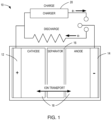
- an electrochemical device 10 is shown according to non-limiting embodiments or aspects.
- the electrochemical device 10 may comprise at least one of a battery, a capacitor, an electrochemical sensor, a fuel cell, or some combination thereof.
- the electrochemical device may comprise a secondary (rechargeable) battery.
- the electrochemical device 10 may comprise a cathode 12 and an anode 14 separated by a separator 16.
- the separator 16 may prevent contact of the cathode 12 and anode 14.
- the electrochemical device 10 may comprise an electrolyte 18.
- the electrolyte 18 may promote movement of ions from the cathode 12 to the anode 14 during charging and in reverse on discharge.
- the separator 16 may be configured to allow for ion transport therethrough during charging and/or discharging of the electrochemical device 10.
- the electrochemical device 10 may comprise a charger 20 configured to recharge the electrochemical device 10 after at least partial discharge thereof.
- the cathode 12 may comprise at least one of: at least one material including a chalcogen element (e.g., S, Se, O, and Te), fluoride, at least one intercalated cathode material (e.g., LiCoO 2 , LiMnO 2 , LiNiO 2 , LiCo x Ni y Mn 1-x-y O 2 ), and LiFePO 4 that may include various dopants such as Ni, Mg, Al, Cr, Zn, Ti, Fe, Co, Ni, Cu, Nd, and La, at least one supercapacitor material (e.g., metal oxides/hydroxides), conductive polymers, or some combination thereof.
- the cathode 12 may comprise a chalcogen.
- the cathode 12 may comprise sulfur.
- the cathode 12 may comprise a substrate coated with a coating comprising a carbon-chalcogen composite.
- the coating may further comprise a binder and conductive carbon.
- the binder may comprise a polymeric material.
- suitable polymeric materials include carboxy methyl cellulose (CMC), polyvinylidene fluoride (PVDF), polytetrafluoroethylene (PTFE), styrene-butadiene rubber (SBR), polyethylene glycol dimethyl ether (PEGDME), conductive polymer(s) (such as poly(3,4-ethylenedioxythiophene) (PEDOT)), polyacrylic acid (PAA), polyethylenimine (PEI), a latex polymer, an acrylate, a polyurethane, a polyurethane acrylate, and the like.
- CMC carboxy methyl cellulose
- PVDF polyvinylidene fluoride
- PTFE polytetrafluoroethylene
- SBR styrene
- the anode 14 may comprise at least one of: at least one element from group IVA (e.g., C, Si, Sn), at least one element from group IIIA (e.g., Al), at least one transition metal from group IB-VIIIB (e.g., Zn, Cd, Ag), at least one alkaline earth metal from group IIA (e.g., Mg, Ca), at least one alkali metal from group IA (e.g., Li, Na, K), at least one compound (e.g., Li x Si y , Li x Ge y , LiAl, Li x Sn y , LTO, NiO, SiO x ), or some combination thereof.
- the anode 14 may comprise at least one of an alkali metal from group IA, an alkaline earth metal from group IIA, an element from group IIIA, and/or some combination thereof.
- the anode 14 may comprise lithium.
- the electrochemical device 10 may comprise the cathode 12 comprising a chalcogen and the anode 14 comprising lithium, such as a sulfur cathode 12 and a lithium anode 14 (e.g., a lithium-chalcogen and/or lithium-sulfur battery).
- the electrolyte 18 may comprise at least one of LiBF 4 , LiC 2 F 6 NO 4 S 2 , LiNS 2 O 4 F 2 , LiBOB, LiPO 2 F 2 , LiPF 6 , ether, carbonate, or some combination thereof.
- the electrolyte 18 may be an electrolyte used in coin cell batteries, such as disclosed in U.S. Patent No. 11,114,696 which is incorporated herein by reference in its entirety.
- the electrolyte 18 may comprise an alkali metal, such as lithium and/or sodium.
- the electrolyte 18 may be a liquid, solid, or gel material.
- the electrolyte 18 may be positioned between the cathode 12 and the anode 14 (the electrodes).
- the electrolyte 18 may wet or soak the electrodes.
- the separator 16 may comprise a material that comprises a least one of: a linear polymer, a kinetic friction coefficient of up to 2.0, an elongation of at least 240, elongation defined as elongation at break, a ratio of elongation to thickness of at least 10, a modulus of elasticity of up to 270 MPa, or any combination thereof.
- the separator 16 may comprise a polymeric material.
- the polymeric separator may comprise a monolayer separator (e.g., monolayer polypropylene or polyethylene), a triple layer or other multilayer separator (e.g., a polypropylene-polyethylene-polypropylene separator, optionally ceramic and/or surfactant modified).
- the polymeric material may comprise a polypropylene polymer and/or a polyethylene polymer.
- the polymeric material may comprise a polyethylene polymer.
- the separator 16 may comprise a polyethylene polymer.
- the polyethylene polymer may comprise a linear polymer as defined herein.
- the polyethylene polymer may comprise high density polyethylene (Mw of 200,000-500,000 g/mol).
- the polyethylene polymer may comprise ultra-high weight molecular weight polyethylene (UHMWPE) (Mw of 4,000,000-6,000,000 g/mol).
- UHMWPE ultra-high weight molecular weight polyethylene
- Mw weight average molecular weight (Mw) is determined by standard high-temperature gel permeation chromatography (HT-GPC, ASTM D6474-19).
- the separator 16 may comprise a linear polymer.
- the linear polymer may comprise a linearity of at least 70%, such as at least 80%, at least 90%, at least 95%, or 100%.
- Polymer linearity as disclosed herein is determined by the simplified Randall Method using 13 C-NMR (either liquid NMR or melt-state magic angle spinning (MAS) NMR), where linearity is determined by 100 - [Area under the NMR curve of tertiary carbons/Area under the NMR curve of all carbons]%.
- chlorohydrocarbon solvents e.g., o-Dichlorobenzen-d4, 1,2,4-Trichlorobenzene (TCB)
- TBCB 1,2,4-Trichlorobenzene
- 13 C-NMR is performed at 500 MHz using a 7 mm 13 C- 1 H optimized high temperature probe.
- the linear polymer may have a weight average molecular weight of at least 200,000 g/mol, at least 500,000 at least g/mol, at least 800,000 g/mol, or at least 1,000,000 g/mol.
- the linear polymer may have a weight average molecular weight of up to 1,000,000,000 g/mol, such as up to 100,000,000 g/mol, up to 10,000,000 g/mol, or up to 6,000,000 g/mol.
- the linear polymer may comprise polyethylene.
- the separator 16 may comprise a kinetic friction coefficient up to 2.0, such as up to 1.5, or up to 1.0, as determined by ASTM D1894-14.
- the separator 16 may comprise a kinetic friction coefficient of from 0.4 to 2.0, such as from 0.4 to 1.0.
- the separator 16 may comprise an elongation of at least 240, such as at least 275, or at least 300.
- the separator 16 may comprise an elongation of up to 1200, such as up to 1000, or up to 750.
- the separator 16 may comprise an elongation of from 240 to 1200, such as from 275 to 1200, from 275 to 750, or from 300 to 750. Elongation as disclosed herein is determined at break as defined by ASTM D882 Tensile Testing.
- the separator 16 may have a thickness of 2 ⁇ m to 100 ⁇ m, such as from 8 ⁇ m to 30 ⁇ m, from 7 ⁇ m to 35 ⁇ m, from 5 ⁇ m to 50 ⁇ m, from 5 ⁇ m to 30 ⁇ m, or from 9 ⁇ m to 25 ⁇ m.
- the separator 16 may have a thickness of at least 2 ⁇ m, such as at least 5 ⁇ m, or at least 7 ⁇ m.
- the separator 16 may have a thickness of up to 100 ⁇ m, such as up to 50 ⁇ m, or up to 30 ⁇ m.
- the separator 16 may have a ratio of elongation to thickness of at least 10, such as at least 12, at least 13, at least 14, at least 15, or at least 16.
- the separator 16 may have a ratio of elongation to thickness of up to 100, such as up to 70.
- the separator 16 may have a ratio of elongation to thickness of from 10 to 100, such as from 13 to 70, or from 15 to 70.
- the ratio of elongation to thickness may be determined by dividing elongation at break of the separator 16 by the thickness thereof.
- the separator 16 may have a modulus of elasticity of up to 270 MPa, such as up to 240 MPa, up to 230 MPa, up to 220 MPa, or up to 200 MPa.
- the separator 16 may have a modulus of elasticity of at least 80 MPa, such as at least 90 MPa, or at least 100 MPa.
- the separator 16 may have a modulus of elasticity of from 80 to 270, such as from 90 to 240, from 90 to 200, or from 90 to 190. Modulus of elasticity as disclosed herein is determined by ASTM D882 Tensile Testing.
- the separator 16 may comprise a surface roughness (Ra) of at least 1100 Angstroms, such as at least 1150 Angstroms, at least 1175 Angstroms.
- the separator 16 may have a surface roughness (Ra) of up to 6500 Angstroms, such as up to 6000 Angstroms, up to 5000 Angstroms, or up to 4000 Angstroms.
- the separator 16 may have a surface roughness (Ra) of from 1100 to 6500, such as from 1150 to 6500 Angstroms, or from 1175 to 6500 Angstroms. Surface roughness as disclosed herein is determined using a ZYGO NewView 600 interferometer.
- the separator 16 may comprise a porosity of at least 15%, such as at least 25%, at least 30%, at least 40%, at least 50%, or at least 60%, as determined using a Micromeritics AutoPore V9600 porosimeter.
- the separator 16 may comprise a porosity of up to 90%, such as up to 85%, or up to 80%.
- the separator 16 may comprise a porosity of from 15-90%, such as from 20-85%, or from 25-80%.
- the separator 16 may comprise an average pore size of at least 0.05 ⁇ m, such as at least 0.07 ⁇ m, as determined using a Micromeritics AutoPore V9600 porosimeter.
- the separator 16 may comprise an average pore size of up to 1.0 ⁇ m, such as up to 0.8 ⁇ m, up to 0.6 ⁇ m, up to 0.15 ⁇ m, or up to 0.11 ⁇ m.
- the separator 16 may comprise an average pore size of from 0.05 ⁇ m to 1.0 ⁇ m, such as from 0.05 ⁇ m to 0.8 ⁇ m, from 0.05 ⁇ m to 0.6 ⁇ m, from 0.05 ⁇ m to 0.15 ⁇ m, or from 0.07 ⁇ m to 0.11 ⁇ m.
- the separator 16 may comprise a toughness of at least 180 MPa, such as at least 200 MPa, or at least 300 MPa, as determined by ASTM D882 Tensile Testing.
- the separator 16 may comprise a toughness of up to 1250 MPa, such as up to 1000 MPa, or up to 600 MPa.
- the separator 16 may comprise a toughness of from 180 to 1250 MPa, such as from 200 to 1000 MPa, or from 300 to 600 MPa.
- the separator 16 may comprise a tensile stress of at least 20 MPa, such as at least 25 MPa, as determined by ASTM D882 Tensile Testing.
- the separator 16 may comprise a tensile stress of up to 40 MPa, such as up to 35 MPa.
- the separator 16 may comprise a tensile stress of from 20 to 40 MPa, such as from 25 to 35 MPa.
- the separator 16 may comprise a tensile strain of at least 10 MPa, such as at least 14 MPa, as determined by ASTM D882 Tensile Testing.
- the separator 16 may comprise a tensile strain of up to 30 MPa, such as up to 27 MPa.
- the separator 16 may comprise a tensile strain of from 10 to 30 MPa, such as from 14 to 27 MPa.
- the separator 16 may be arranged in an electrochemical device 10 as described herein.
- the separator 16 may be arranged in a secondary (rechargeable) battery (a form of electrochemical device 10).
- the secondary battery containing the separator 16 may comprise the cathode 12 as described herein, such as the cathode 12 comprising a chalcogen.
- the secondary battery containing the separator 16 may comprise the anode 14 as described herein such as the anode 14 comprising at least one of an alkali metal from group IA, an alkaline earth metal from group IIA, an element from group IIIA, and/or some combination thereof (e.g., a lithium anode).
- the secondary battery containing the separator 16 may comprise the electrolyte 18 as described herein.
- the secondary battery containing the separator 16 may comprise the separator 16 arranged to separate the cathode 12 from the anode 14.
- the electrochemical device 10 may comprise a secondary (rechargeable) battery.
- the secondary battery may be used by at least partially discharging the battery (e.g., by use thereof), followed by at least partially charging the battery (e.g., using the charger 20).
- the secondary battery may perform at least 2 cycles, such as at least 5 cycles, at least 10 cycles, at least 15 cycles, or at least 20 cycles before exhibiting a parasitic condition.
- the secondary battery may perform from 2 to 45 cycles, such as from 5 to 45 cycles, such as from 10 to 45 cycles before exhibiting a parasitic condition.
- a “cycle” as used herein refers to a charge event followed by a discharge event ( see FIG. 2 ), with the except that the first cycle only includes a fully charged electrochemical device being discharged.
- a “cycle to fail” or “number of cycles before exhibiting a parasitic condition” refers to the number of cycles it takes for the electrochemical device to exhibit a parasitic condition.
- a parasitic condition is defined as the cycle number which is one cycle before the coulombic efficiency of the electrochemical device falling below 100%.
- the secondary battery may be exhibiting a non-parasitic cycling condition 22 for as many cycles as the secondary battery recharges before exhibiting the parasitic condition, and the secondary battery may be exhibiting a parasitic condition 24 at the first cycle for which the secondary battery exhibits the parasitic condition.
- the secondary battery underwent 12 cycles exhibiting a non-parasitic cycling condition 22 and exhibited a parasitic condition 24 on the 13 th cycle.
- the secondary battery may be cycled by: providing the electrochemical device 10 in the form of a secondary battery as described herein.
- the secondary battery may be at least partially discharged, and subsequently may be at least partially charged.
- the secondary battery may be discharged and charged in the cyclic manner described herein, which cycles may be repeated at least until the secondary battery exhibits a parasitic condition during a charging step.
- the secondary battery may comprise a coin cell battery, such as a 2032 coin cell battery.
- a coin cell battery may be fabricated from bottom to top by: into a negative case lid, stacking two stainless steel spacers (e.g., 500 ⁇ m thick and 18 mm in diameter), one lithium metal disc (e.g., 250 ⁇ m thick and 16 mm in diameter), adding electrolyte (e.g., 200 ⁇ l), placing a separator (e.g., 20 mm in diameter), adding additional electrolyte (e.g., 100 ⁇ l), placing a cathode, stacking a stainless steel spacer (e.g., 500 ⁇ m thick and 18 mm in diameter), a wave spring, and a positive case, followed by manual crimping (e.g., using a MTI MSK-110) hydraulic crimper) to a pressure of 1,000 psi, followed by releasing the crimping pressure.
- manual crimping e.g., using a
- Example electrochemical devices in the form of secondary batteries were prepared using polymeric separators having the following properties shown in Tables 1-2.
- the secondary batteries were coin cell batteries prepared as previously described.
- the anode used in the electrochemical device was a 250 ⁇ m thick lithium disc.
- the electrolyte used in the electrochemical device was a solvent-based electrolyte.
- the cathode used in the electrochemical device comprised a carbon-sulfur composite material.
- a regression analysis was performed on the data to determine which property, properties, and/or combination of properties most influences the number of cycles before exhibiting a parasitic condition.
- the regression analysis involved performing a linear regression analysis in which a P-value for each independent variable (e.g., properties of the separator) tests the null hypothesis that the variable has no correlation with the dependent variable (e.g., cycles before exhibiting a parasitic condition). If the P-value for a variable is less than the significance level, for example 0.01 or below, it indicates 99% confidence that the slope of the regression line is not zero and hence there is a significant linear relationship between the dependent and independent variables.
- a significance level for example 0.01 or below
- a first linear regression tested the significance of porosity, pore size, thickness (mm), roughness, and kinetic coefficient of friction of the separator on cycles before exhibiting a parasitic condition, and the following equation resulted.
- Table 3 also shows the coefficient associated with each property and its P-value.
- the P-values from Table 4 illustrated the strong correlation between the modulus of elasticity and/or thickness of the separator and the cycles before exhibiting a parasitic condition.
- a third linear regression tested the significance of porosity, pore size, kinetic coefficient of friction, and elongation at break of the separator on cycles before exhibiting a parasitic condition.
- this third linear regression only the data from Examples 1-7 and 11-23 were used (omitting Examples 8-10 which had significantly higher elongation at break, elongation/thickness, and toughness values compared to Examples 1-7 and 11-23). The following equation resulted. Table 5 also shows the coefficient associated with each property and its P-value.
- the P-values from Table 5 illustrated the strong correlation between the elongation at break of the separator and the cycles before exhibiting a parasitic condition. Due to the data indicating a strong correlation between thickness of the separator and elongation at break of the separator and the cycles before exhibiting a parasitic condition, it is also expected that there is a strong correlation between the ratio of elongation:thickness and the cycles before exhibiting a parasitic condition.
- polyethylene separators e.g., a linear polymer
- polypropylene separators e.g., a non-linear polymer
Landscapes
- Chemical & Material Sciences (AREA)
- Chemical Kinetics & Catalysis (AREA)
- Electrochemistry (AREA)
- General Chemical & Material Sciences (AREA)
- Engineering & Computer Science (AREA)
- Manufacturing & Machinery (AREA)
- Inorganic Chemistry (AREA)
- Materials Engineering (AREA)
- Physics & Mathematics (AREA)
- Condensed Matter Physics & Semiconductors (AREA)
- General Physics & Mathematics (AREA)
- Power Engineering (AREA)
- Cell Separators (AREA)
- Electric Double-Layer Capacitors Or The Like (AREA)
- Cell Electrode Carriers And Collectors (AREA)
- Secondary Cells (AREA)
- Battery Electrode And Active Subsutance (AREA)
Abstract
Description
- This application claims priority to
United States Provisional Patent Application No. 63/426,864 filed on November 21, 2022 - The disclosed subject matter relates generally to electrochemical devices, methods of cycling secondary batteries, and separators configured for use in electrochemical devices.
- The production of electrochemical devices, such as batteries, capacitors, electrochemical sensors, and fuel cells, presents many challenges. For example, certain electrochemical devices, such as secondary batteries, can be discharged and re-charged (defined as a cycle), so that they can be used multiple times. However, existing electrochemical devices cannot be cycled an infinite number of times, as after some number of cycles, a parasitic condition is exhibited, and the electrochemical device fails. Extending the number of cycles before a parasitic condition is exhibited would be desirable.
- Accordingly, it is an object of the presently disclosed subject matter to provide an electrochemical device that overcomes some or all of the deficiencies identified above.
- According to non-limiting embodiments or aspects, provided is an electrochemical device including: an anode; a cathode; an electrolyte; and a separator separating the anode from the cathode, where the separator includes a material, where the material includes at least one of: a linear polymer; a kinetic friction coefficient of up to 2.0; an elongation of at least 240, elongation defined as elongation at break; a ratio of elongation to thickness of at least 10; and/or a modulus of elasticity of up to 270 MPa.
- In some non-limiting embodiments or aspects, the material may include a polyethylene polymer.
- In some non-limiting embodiments or aspects, the electrochemical device may include a lithium-chalcogen battery.
- In some non-limiting embodiments or aspects, the anode may include at least one of an alkali metal from group IA, an alkaline earth metal from group IIA, an element from group IIIA, and/or some combination thereof.
- In some non-limiting embodiments or aspects, the cathode may include a chalcogen.
- In some non-limiting embodiments or aspects, the separator may have a surface roughness (Ra) of at least 1150 Angstroms.
- In some non-limiting embodiments or aspects, the linear polymer may have a weight average molecular weight of at least 200,000 g/mol.
- In some non-limiting embodiments or aspects, the separator may have a thickness of from 2 µm to 100 µm.
- In some non-limiting embodiments or aspects, the cathode may include a substrate coated with a coating including a carbon-chalcogen composite.
- In some non-limiting embodiments or aspects, the coating may further include a binder and conductive carbon.
- In some non-limiting embodiments or aspects, the electrochemical device may include a secondary battery that performs at least 2 cycles before exhibiting a parasitic condition.
- In some non-limiting embodiments or aspects, the linear polymer may include a linearity of at least 70%.
- In some non-limiting embodiments or aspects, the electrolyte may include at least one of LiBF4, LiC2F6NO4S2, LiNS2O4F2, LiBOB, LiPO2F2, LiPF6, ether, carbonate, and/or some combination thereof.
- According to non-limiting embodiments or aspects, provided is a method of cycling a secondary battery that includes: (i) providing the electrochemical device as described herein, where the electrochemical device includes a secondary battery; (ii) at least partially discharging the secondary battery; (iii) at least partially charging the secondary battery; and (iv) repeating (ii) and (iii) until the secondary battery exhibits a parasitic condition during charging.
- In some non-limiting embodiments or aspects, the secondary battery may be at least partially discharged and charged at least 2 times before exhibiting the parasitic condition.
- According to non-limiting embodiments or aspects, a separator configured for use in an electrochemical device includes a material, where the material includes at least one of: a linear polymer; a kinetic friction coefficient of up to 2.0; an elongation of at least 240, elongation defined as elongation at break; a ratio of elongation to thickness of at least 10; and/or a modulus of elasticity of up to 270 MPa.
- In some non-limiting embodiments or aspects, the material may include a polyethylene polymer.
- In some non-limiting embodiments or aspects, the separator may have a surface roughness (Ra) of at least 1150 Angstroms.
- In some non-limiting embodiments or aspects, the linear polymer may have a weight average molecular weight of at least 200,000 g/mol.
- In some non-limiting embodiments or aspects, the separator may have a thickness of from 2 µm to 100 µm.
- In some non-limiting embodiments or aspects, the separator may be arranged in a secondary battery, and the secondary battery may include: an anode including at least one of an alkali metal from group IA, an alkaline earth metal from group IIA, an element from group IIIA, and/or some combination thereof; a cathode including a chalcogen; an electrolyte; and the separator separating the anode from the cathode.
- Further embodiments or aspects are set forth in the following numbered clauses:
- Clause 1: An electrochemical device, comprising: an anode; a cathode; an electrolyte; and a separator separating the anode from the cathode, wherein the separator comprises a material, wherein the material comprises at least one of: a linear polymer; a kinetic friction coefficient of up to 2.0; an elongation of at least 240, elongation defined as elongation at break; a ratio of elongation to thickness of at least 10; and/or a modulus of elasticity of up to 270 MPa.
- Clause 2: The electrochemical device of clause 1, wherein the material comprises a polyethylene polymer.
- Clause 3: The electrochemical device of clause 1 or 2, wherein the electrochemical device comprises a lithium-chalcogen battery.
- Clause 4: The electrochemical device of any of clauses 1-3, wherein the anode comprises at least one of an alkali metal from group IA, an alkaline earth metal from group IIA, an element from group IIIA, and/or some combination thereof.
- Clause 5: The electrochemical device of any of clauses 1-4, wherein the cathode comprises a chalcogen.
- Clause 6: The electrochemical device of any of clauses 1-5, wherein the separator has a surface roughness (Ra) of at least 1150 Angstroms.
- Clause 7: The electrochemical device of any of clauses 1-6, wherein the linear polymer has a weight average molecular weight of at least 200,000 g/mol.
- Clause 8: The electrochemical device of any of clauses 1-7, wherein the separator has a thickness of from 2 µm to 100 µm.
- Clause 9: The electrochemical device of any of clauses 1-8, wherein the cathode comprises a substrate coated with a coating comprising a carbon-chalcogen composite.
- Clause 10: The electrochemical device of clause 9, wherein the coating further comprises a binder and conductive carbon.
- Clause 11: The electrochemical device of any of clauses 1-10, wherein the electrochemical device comprises a secondary battery that performs at least 2 cycles before exhibiting a parasitic condition.
- Clause 12: The electrochemical device of any of clauses 1-11, wherein the linear polymer comprises a linearity of at least 70%.
- Clause 13: The electrochemical device of any of clauses 1-12, wherein the electrolyte comprises at least one of LiBF4, LiC2F6NO4S2, LiNS2O4F2, LiBOB, LiPO2F2, LiPF6, ether, carbonate, and/or some combination thereof.
- Clause 14: A method of cycling a secondary battery, comprising: (i) providing the electrochemical device of any of clauses 1-13, wherein the electrochemical device comprises a secondary battery; (ii) at least partially discharging the secondary battery; (iii) at least partially charging the secondary battery; and (iv) repeating (ii) and (iii) until the secondary battery exhibits a parasitic condition during charging.
- Clause 15: The method of
clause 14, wherein the secondary battery is at least partially discharged and charged at least 2 times before exhibiting the parasitic condition. - Clause 16: A separator configured for use in an electrochemical device, the separator comprising a material, wherein the material comprises at least one of: a linear polymer; a kinetic friction coefficient of up to 2.0; an elongation of at least 240, elongation defined as elongation at break; a ratio of elongation to thickness of at least 10; and/or a modulus of elasticity of up to 270 MPa.
- Clause 17: The separator of
clause 16, wherein the material comprises a polyethylene polymer. - Clause 18: The separator of
clause 16 or 17, wherein the separator has a surface roughness (Ra) of at least 1150 Angstroms. - Clause 19: The separator of any of clauses 16-18, wherein the linear polymer has a weight average molecular weight of at least 200,000 g/mol.
- Clause 20: The separator of any of clauses 16-19, wherein the separator has a thickness of from 2 µm to 100 µm.
- Clause 21: The separator of any of clauses 16-20, wherein the separator is arranged in a secondary battery, the secondary battery comprising: an anode comprising at least one of an alkali metal from group IA, an alkaline earth metal from group IIA, an element from group IIIA, and/or some combination thereof; a cathode comprising a chalcogen; an electrolyte; and the separator separating the anode from the cathode.
- These and other features and characteristics of the presently disclosed subject matter, as well as the methods of operation and functions of the related elements of structures and the combination of parts and economies of manufacture, will become more apparent upon consideration of the following description and the appended claims with reference to the accompanying drawings, all of which form a part of this specification, wherein like reference numerals designate corresponding parts in the various figures. It is to be expressly understood, however, that the drawings are for the purpose of illustration and description only and are not intended as a definition of the limits of the disclosed subject matter. As used in the specification and the claims, the singular forms of "a," "an," and "the" include plural referents unless the context clearly dictates otherwise.
- Additional advantages and details of the disclosed subject matter are explained in greater detail below with reference to the exemplary embodiments or aspects that are illustrated in the accompanying figures, in which:
-
FIG. 1 shows a view of an electrochemical device according to some non-limiting embodiments or aspects of the presently disclosed subject matter; and -
FIG. 2 shows a graph of voltage and current over time for a rechargeable electrochemical device undergoing the cycling of a discharge/charge process according to some non-limiting embodiments or aspects of the presently disclosed subject matter. - For purposes of the description hereinafter, the terms "end," "upper," "lower," "right," "left," "vertical," "horizontal," "top," "bottom," "lateral," "longitudinal," and derivatives thereof shall relate to the disclosed subject matter as it is oriented in the drawing figures. However, it is to be understood that the disclosed subject matter may assume various alternative variations and step sequences, except where expressly specified to the contrary. It is also to be understood that the specific devices and processes illustrated in the attached drawings, and described in the following specification, are simply exemplary embodiments or aspects of the disclosed subject matter. Hence, specific dimensions and other physical characteristics related to the embodiments or aspects disclosed herein are not to be considered as limiting unless otherwise indicated.
- No aspect, component, element, structure, act, step, function, instruction, and/or the like used herein should be construed as critical or essential unless explicitly described as such. Also, as used herein, the articles "a" and "an" are intended to include one or more items and may be used interchangeably with "one or more" and "at least one." Furthermore, as used herein, the term "set" is intended to include one or more items (e.g., related items, unrelated items, a combination of related and unrelated items, and/or the like) and may be used interchangeably with "one or more" or "at least one." Where only one item is intended, the term "one" or similar language is used. Also, as used herein, the terms "has," "have," "having," or the like are intended to be open-ended terms. Further, the phrase "based on" is intended to mean "based at least partially on" unless explicitly stated otherwise.
- As used herein, the transitional term "comprising" (and other comparable terms, e.g., "containing" and "including") is "open-ended" and open to the inclusion of unspecified matter. Although described in terms of "comprising", the terms "consisting essentially of" and "consisting of" are also within the scope of the disclosure.
- Non-limiting embodiments or aspects of the disclosed subject matter are directed to an electrochemical device comprising: an anode; a cathode; an electrolyte; and a separator separating the anode from the cathode, wherein the separator comprises a material, wherein the material comprises at least one of: a linear polymer; a kinetic friction coefficient of up to 2.0; an elongation of at least 240, elongation defined as elongation at break; a ratio of elongation to thickness of at least 10; and/or a modulus of elasticity of up to 270 MPa.
- Referring to
FIG. 1 , anelectrochemical device 10 is shown according to non-limiting embodiments or aspects. Theelectrochemical device 10 may comprise at least one of a battery, a capacitor, an electrochemical sensor, a fuel cell, or some combination thereof. The electrochemical device may comprise a secondary (rechargeable) battery. - The
electrochemical device 10 may comprise acathode 12 and ananode 14 separated by aseparator 16. Theseparator 16 may prevent contact of thecathode 12 andanode 14. Theelectrochemical device 10 may comprise anelectrolyte 18. Theelectrolyte 18 may promote movement of ions from thecathode 12 to theanode 14 during charging and in reverse on discharge. Theseparator 16 may be configured to allow for ion transport therethrough during charging and/or discharging of theelectrochemical device 10. Theelectrochemical device 10 may comprise acharger 20 configured to recharge theelectrochemical device 10 after at least partial discharge thereof. - In some non-limiting embodiments or aspects, the
cathode 12 may comprise at least one of: at least one material including a chalcogen element (e.g., S, Se, O, and Te), fluoride, at least one intercalated cathode material (e.g., LiCoO2, LiMnO2, LiNiO2, LiCoxNiyMn1-x-yO2), and LiFePO4 that may include various dopants such as Ni, Mg, Al, Cr, Zn, Ti, Fe, Co, Ni, Cu, Nd, and La, at least one supercapacitor material (e.g., metal oxides/hydroxides), conductive polymers, or some combination thereof. Thecathode 12 may comprise a chalcogen. Thecathode 12 may comprise sulfur. - In some non-limiting embodiments or aspects, the
cathode 12 may comprise a substrate coated with a coating comprising a carbon-chalcogen composite. The coating may further comprise a binder and conductive carbon. The binder may comprise a polymeric material. Non-limiting examples of suitable polymeric materials include carboxy methyl cellulose (CMC), polyvinylidene fluoride (PVDF), polytetrafluoroethylene (PTFE), styrene-butadiene rubber (SBR), polyethylene glycol dimethyl ether (PEGDME), conductive polymer(s) (such as poly(3,4-ethylenedioxythiophene) (PEDOT)), polyacrylic acid (PAA), polyethylenimine (PEI), a latex polymer, an acrylate, a polyurethane, a polyurethane acrylate, and the like. - The
anode 14 may comprise at least one of: at least one element from group IVA (e.g., C, Si, Sn), at least one element from group IIIA (e.g., Al), at least one transition metal from group IB-VIIIB (e.g., Zn, Cd, Ag), at least one alkaline earth metal from group IIA (e.g., Mg, Ca), at least one alkali metal from group IA (e.g., Li, Na, K), at least one compound (e.g., LixSiy, LixGey, LiAl, LixSny, LTO, NiO, SiOx), or some combination thereof. Theanode 14 may comprise at least one of an alkali metal from group IA, an alkaline earth metal from group IIA, an element from group IIIA, and/or some combination thereof. Theanode 14 may comprise lithium. - In some non-limiting embodiments or aspects, the
electrochemical device 10 may comprise thecathode 12 comprising a chalcogen and theanode 14 comprising lithium, such as asulfur cathode 12 and a lithium anode 14 (e.g., a lithium-chalcogen and/or lithium-sulfur battery). - In some non-limiting embodiments or aspects, the
electrolyte 18 may comprise at least one of LiBF4, LiC2F6NO4S2, LiNS2O4F2, LiBOB, LiPO2F2, LiPF6, ether, carbonate, or some combination thereof. Theelectrolyte 18 may be an electrolyte used in coin cell batteries, such as disclosed inU.S. Patent No. 11,114,696 electrolyte 18 may comprise an alkali metal, such as lithium and/or sodium. - The
electrolyte 18 may be a liquid, solid, or gel material. Theelectrolyte 18 may be positioned between thecathode 12 and the anode 14 (the electrodes). Theelectrolyte 18 may wet or soak the electrodes. - The
separator 16 may comprise a material that comprises a least one of: a linear polymer, a kinetic friction coefficient of up to 2.0, an elongation of at least 240, elongation defined as elongation at break, a ratio of elongation to thickness of at least 10, a modulus of elasticity of up to 270 MPa, or any combination thereof. - In some non-limiting embodiments or aspects, the
separator 16 may comprise a polymeric material. The polymeric separator may comprise a monolayer separator (e.g., monolayer polypropylene or polyethylene), a triple layer or other multilayer separator (e.g., a polypropylene-polyethylene-polypropylene separator, optionally ceramic and/or surfactant modified). The polymeric material may comprise a polypropylene polymer and/or a polyethylene polymer. The polymeric material may comprise a polyethylene polymer. - In some non-limiting embodiments or aspects, the
separator 16 may comprise a polyethylene polymer. The polyethylene polymer may comprise a linear polymer as defined herein. The polyethylene polymer may comprise high density polyethylene (Mw of 200,000-500,000 g/mol). The polyethylene polymer may comprise ultra-high weight molecular weight polyethylene (UHMWPE) (Mw of 4,000,000-6,000,000 g/mol). As used herein, weight average molecular weight (Mw) is determined by standard high-temperature gel permeation chromatography (HT-GPC, ASTM D6474-19). - The
separator 16 may comprise a linear polymer. The linear polymer may comprise a linearity of at least 70%, such as at least 80%, at least 90%, at least 95%, or 100%. Polymer linearity as disclosed herein is determined by the simplified Randall Method using 13C-NMR (either liquid NMR or melt-state magic angle spinning (MAS) NMR), where linearity is determined by 100 - [Area under the NMR curve of tertiary carbons/Area under the NMR curve of all carbons]%. For liquid NMR testing, chlorohydrocarbon solvents (e.g., o-Dichlorobenzen-d4, 1,2,4-Trichlorobenzene (TCB)) can be used to dissolve the polymer. For melt-state MAS, 13C-NMR is performed at 500 MHz using a 7 mm 13C- 1H optimized high temperature probe. - The linear polymer may have a weight average molecular weight of at least 200,000 g/mol, at least 500,000 at least g/mol, at least 800,000 g/mol, or at least 1,000,000 g/mol. The linear polymer may have a weight average molecular weight of up to 1,000,000,000 g/mol, such as up to 100,000,000 g/mol, up to 10,000,000 g/mol, or up to 6,000,000 g/mol. The linear polymer may comprise polyethylene.
- The
separator 16 may comprise a kinetic friction coefficient up to 2.0, such as up to 1.5, or up to 1.0, as determined by ASTM D1894-14. Theseparator 16 may comprise a kinetic friction coefficient of from 0.4 to 2.0, such as from 0.4 to 1.0. - The
separator 16 may comprise an elongation of at least 240, such as at least 275, or at least 300. Theseparator 16 may comprise an elongation of up to 1200, such as up to 1000, or up to 750. Theseparator 16 may comprise an elongation of from 240 to 1200, such as from 275 to 1200, from 275 to 750, or from 300 to 750. Elongation as disclosed herein is determined at break as defined by ASTM D882 Tensile Testing. - The
separator 16 may have a thickness of 2 µm to 100 µm, such as from 8 µm to 30 µm, from 7 µm to 35 µm, from 5 µm to 50 µm, from 5 µm to 30 µm, or from 9 µm to 25 µm. Theseparator 16 may have a thickness of at least 2 µm, such as at least 5 µm, or at least 7 µm. Theseparator 16 may have a thickness of up to 100 µm, such as up to 50 µm, or up to 30 µm. - The
separator 16 may have a ratio of elongation to thickness of at least 10, such as at least 12, at least 13, at least 14, at least 15, or at least 16. Theseparator 16 may have a ratio of elongation to thickness of up to 100, such as up to 70. Theseparator 16 may have a ratio of elongation to thickness of from 10 to 100, such as from 13 to 70, or from 15 to 70. The ratio of elongation to thickness may be determined by dividing elongation at break of theseparator 16 by the thickness thereof. - The
separator 16 may have a modulus of elasticity of up to 270 MPa, such as up to 240 MPa, up to 230 MPa, up to 220 MPa, or up to 200 MPa. Theseparator 16 may have a modulus of elasticity of at least 80 MPa, such as at least 90 MPa, or at least 100 MPa. Theseparator 16 may have a modulus of elasticity of from 80 to 270, such as from 90 to 240, from 90 to 200, or from 90 to 190. Modulus of elasticity as disclosed herein is determined by ASTM D882 Tensile Testing. - The
separator 16 may comprise a surface roughness (Ra) of at least 1100 Angstroms, such as at least 1150 Angstroms, at least 1175 Angstroms. Theseparator 16 may have a surface roughness (Ra) of up to 6500 Angstroms, such as up to 6000 Angstroms, up to 5000 Angstroms, or up to 4000 Angstroms. Theseparator 16 may have a surface roughness (Ra) of from 1100 to 6500, such as from 1150 to 6500 Angstroms, or from 1175 to 6500 Angstroms. Surface roughness as disclosed herein is determined using a ZYGO NewView 600 interferometer. - The
separator 16 may comprise a porosity of at least 15%, such as at least 25%, at least 30%, at least 40%, at least 50%, or at least 60%, as determined using a Micromeritics AutoPore V9600 porosimeter. Theseparator 16 may comprise a porosity of up to 90%, such as up to 85%, or up to 80%. Theseparator 16 may comprise a porosity of from 15-90%, such as from 20-85%, or from 25-80%. - The
separator 16 may comprise an average pore size of at least 0.05 µm, such as at least 0.07 µm, as determined using a Micromeritics AutoPore V9600 porosimeter. Theseparator 16 may comprise an average pore size of up to 1.0 µm, such as up to 0.8 µm, up to 0.6 µm, up to 0.15 µm, or up to 0.11 µm. Theseparator 16 may comprise an average pore size of from 0.05 µm to 1.0 µm, such as from 0.05 µm to 0.8 µm, from 0.05 µm to 0.6 µm, from 0.05 µm to 0.15 µm, or from 0.07 µm to 0.11 µm. - The
separator 16 may comprise a toughness of at least 180 MPa, such as at least 200 MPa, or at least 300 MPa, as determined by ASTM D882 Tensile Testing. Theseparator 16 may comprise a toughness of up to 1250 MPa, such as up to 1000 MPa, or up to 600 MPa. Theseparator 16 may comprise a toughness of from 180 to 1250 MPa, such as from 200 to 1000 MPa, or from 300 to 600 MPa. - The
separator 16 may comprise a tensile stress of at least 20 MPa, such as at least 25 MPa, as determined by ASTM D882 Tensile Testing. Theseparator 16 may comprise a tensile stress of up to 40 MPa, such as up to 35 MPa. Theseparator 16 may comprise a tensile stress of from 20 to 40 MPa, such as from 25 to 35 MPa. - The
separator 16 may comprise a tensile strain of at least 10 MPa, such as at least 14 MPa, as determined by ASTM D882 Tensile Testing. Theseparator 16 may comprise a tensile strain of up to 30 MPa, such as up to 27 MPa. Theseparator 16 may comprise a tensile strain of from 10 to 30 MPa, such as from 14 to 27 MPa. - With continued reference to
FIG. 1 , theseparator 16 may be arranged in anelectrochemical device 10 as described herein. In some non-limiting embodiments or aspects, theseparator 16 may be arranged in a secondary (rechargeable) battery (a form of electrochemical device 10). The secondary battery containing theseparator 16 may comprise thecathode 12 as described herein, such as thecathode 12 comprising a chalcogen. The secondary battery containing theseparator 16 may comprise theanode 14 as described herein such as theanode 14 comprising at least one of an alkali metal from group IA, an alkaline earth metal from group IIA, an element from group IIIA, and/or some combination thereof (e.g., a lithium anode). The secondary battery containing theseparator 16 may comprise theelectrolyte 18 as described herein. The secondary battery containing theseparator 16 may comprise theseparator 16 arranged to separate thecathode 12 from theanode 14. - Referring to
FIGS. 1 and2 , theelectrochemical device 10 may comprise a secondary (rechargeable) battery. The secondary battery may be used by at least partially discharging the battery (e.g., by use thereof), followed by at least partially charging the battery (e.g., using the charger 20). The secondary battery may perform at least 2 cycles, such as at least 5 cycles, at least 10 cycles, at least 15 cycles, or at least 20 cycles before exhibiting a parasitic condition. The secondary battery may perform from 2 to 45 cycles, such as from 5 to 45 cycles, such as from 10 to 45 cycles before exhibiting a parasitic condition. - A "cycle" as used herein refers to a charge event followed by a discharge event (see
FIG. 2 ), with the except that the first cycle only includes a fully charged electrochemical device being discharged. A "cycle to fail" or "number of cycles before exhibiting a parasitic condition" refers to the number of cycles it takes for the electrochemical device to exhibit a parasitic condition. A parasitic condition is defined as the cycle number which is one cycle before the coulombic efficiency of the electrochemical device falling below 100%. Coulombic efficiency is defined in Equation 1 or Equation 2:

- For example, the secondary battery may be exhibiting a
non-parasitic cycling condition 22 for as many cycles as the secondary battery recharges before exhibiting the parasitic condition, and the secondary battery may be exhibiting aparasitic condition 24 at the first cycle for which the secondary battery exhibits the parasitic condition. For example, in the test performed and illustrated in the graph ofFIG. 2 , the secondary battery underwent 12 cycles exhibiting anon-parasitic cycling condition 22 and exhibited aparasitic condition 24 on the 13th cycle. - In some non-limiting embodiments or aspects, the secondary battery may be cycled by: providing the
electrochemical device 10 in the form of a secondary battery as described herein. The secondary battery may be at least partially discharged, and subsequently may be at least partially charged. The secondary battery may be discharged and charged in the cyclic manner described herein, which cycles may be repeated at least until the secondary battery exhibits a parasitic condition during a charging step. - The secondary battery may comprise a coin cell battery, such as a 2032 coin cell battery. Such a coin cell battery may be fabricated from bottom to top by: into a negative case lid, stacking two stainless steel spacers (e.g., 500 µm thick and 18 mm in diameter), one lithium metal disc (e.g., 250 µm thick and 16 mm in diameter), adding electrolyte (e.g., 200 µl), placing a separator (e.g., 20 mm in diameter), adding additional electrolyte (e.g., 100 µl), placing a cathode, stacking a stainless steel spacer (e.g., 500 µm thick and 18 mm in diameter), a wave spring, and a positive case, followed by manual crimping (e.g., using a MTI MSK-110) hydraulic crimper) to a pressure of 1,000 psi, followed by releasing the crimping pressure.
- The following examples are presented to demonstrate the general principles of the disclosure. The disclosure should not be considered as limited to the specific examples presented.
- Example electrochemical devices in the form of secondary batteries were prepared using polymeric separators having the following properties shown in Tables 1-2. The secondary batteries were coin cell batteries prepared as previously described. The anode used in the electrochemical device was a 250 µm thick lithium disc. The electrolyte used in the electrochemical device was a solvent-based electrolyte. The cathode used in the electrochemical device comprised a carbon-sulfur composite material.
Table 1 Example Porosity % Pore size (µm) Material Thickness (µm) Roughness Ra (Å) Kinetic Friction Coefficient (µ) Elongation (%) Elongation/Thickness 1 60 0.083 PP 25 1100 1.191 268 10.7 2 60 0.083 PP 25 1100 1.191 268 10.7 3 62 0.109 PE 12 1179 0.934 704 58.7 4 62 0.109 PE 12 1179 0.934 704 58.7 5 - - PE 16 1621 0.470 300 18.7 6 - - PE 16 1621 0.470 300 18.7 7 - - PE 16 1621 0.470 300 18.7 8 60 0.070 PE 18 1800 0.515 1179 65.5 9 60 0.070 PE 18 1800 0.515 1179 65.5 10 60 0.070 PE 18 1800 0.515 1179 65.5 11 - 0.101 PE 20 3997 0.442 580 29.0 12 - 0.101 PE 20 3997 0.442 580 29.0 13 - 0.101 PE 20 3997 0.442 580 29.0 14 64 0.086 PE 25 3169 0.461 505 20.2 15 64 0.086 PE 25 3169 0.461 505 20.2 16 66 0.100 PE 9 6500 0.580 242 26.9 17 66 0.100 PE 9 6500 0.580 242 26.9 18 62 0.074 PE 12 2729 0.477 408 34.0 19 62 0.074 PE 12 2729 0.477 408 34.0 20 62 0.074 PE 12 2729 0.477 408 34.0 21 64 0.084 PE 20 2265 0.572 332 16.6 22 64 0.084 PE 20 2265 0.572 332 16.6 23 64 0.084 PE 20 2265 0.572 332 16.6 Table 2 Example Toughness (MPa) Modulus of Elasticity (MPa) Tensile stress (MPa) Tensile strain (MPa) Cathode Loading (mg-s)1 Cycles to Fail 1 191 264.2 26.43 11.42 7.526 2 2 191 264.2 26.43 11.42 7.260 4 3 930 121.9 36.02 26.13 7.665 12 4 930 121.9 36.02 26.13 7.444 22 5 312 191.3 30.31 14.76 7.619 20 6 312 191.3 30.31 14.76 7.475 5 7 312 191.3 30.31 14.76 7.429 10 8 1249 103.3 26.56 21.62 7.429 21 9 1249 103.3 26.56 21.62 7.496 20 10 1249 103.3 26.56 21.62 4.470 14 11 564 116.6 26.83 20.61 7.470 7 12 564 116.6 26.83 20.61 7.532 23 13 564 116.6 26.83 20.61 7.296 18 14 424 104.4 23.98 19.80 7.465 17 15 424 104.4 23.98 19.80 7.265 44 16 235 156.0 31.81 18.36 7.757 7 17 235 156.0 31.81 18.36 7.613 2 18 347 90.0 24.58 23.32 7.337 19 19 347 90.0 24.58 23.32 7.613 17 20 347 90.0 24.58 23.32 7.670 6 21 364 130.2 33.42 22.75 7.578 24 22 364 130.2 33.42 22.75 7.588 26 23 364 130.2 33.42 22.75 7.649 28 1Refers to the milligrams of sulfur in the cathode disc, the cathode disc having a diameter of 12 mm. - Based on the properties and results from Tables 1-2, a regression analysis was performed on the data to determine which property, properties, and/or combination of properties most influences the number of cycles before exhibiting a parasitic condition. The regression analysis involved performing a linear regression analysis in which a P-value for each independent variable (e.g., properties of the separator) tests the null hypothesis that the variable has no correlation with the dependent variable (e.g., cycles before exhibiting a parasitic condition). If the P-value for a variable is less than the significance level, for example 0.01 or below, it indicates 99% confidence that the slope of the regression line is not zero and hence there is a significant linear relationship between the dependent and independent variables.
- A first linear regression tested the significance of porosity, pore size, thickness (mm), roughness, and kinetic coefficient of friction of the separator on cycles before exhibiting a parasitic condition, and the following equation resulted. Table 3 also shows the coefficient associated with each property and its P-value.
- Equation: Fish_Scale_Cathode_Parasitic = 43.1 - 0.863 Porosity + 640 Pore Size + 0.996 Thickness - 0.00379 Roughness - 52.6 Kinetic_Coefficient_of_Friction. The first linear regression had an R-squared value of 63.79.
Table 3 Term Coefficient P-value Adj. Sum Squared Constant 43.1 0.025 - Porosity -0.863 0.030 306.81 Pore Size 640 0.012 445.48 Thickness (mm) 0.996 0.023 341.21 Roughness -0.00379 0.029 312.88 Kinetic Coefficient of Friction -52.6 0.000 1098.48 - The P-values from Table 3 illustrated the strong correlation between the kinetic coefficient of friction of the separator and the cycles before exhibiting a parasitic condition.
- A second linear regression tested the significance of thickness (mm), elongation at break, toughness (MPa), and Modulus of Elasticity (MPa) of the separator on cycles before exhibiting a parasitic condition, and the following equation resulted. Table 4 also shows the coefficient associated with each property and its P-value.
- Equation: Fish_Scale_Cathode_Parasitic = 20.95 + 1.369 Thickness - 0.0599 Elongation + 0.0467 Toughness - 0.1619 Modulus of Elasticity. The second linear regression had an R-squared value of 56.33.
Table 4 Term Coefficient P-value Adj. Sum Squared Constant 20.95 0.016 - Thickness (mm) 1.369 0.002 693.5 Elongation at Break -0.0599 0.057 223.8 Toughness (MPa) 0.0467 0.072 196.9 Modulus of Elasticity (MPa) -0.1619 0.001 900.7 - The P-values from Table 4 illustrated the strong correlation between the modulus of elasticity and/or thickness of the separator and the cycles before exhibiting a parasitic condition.
- A third linear regression tested the significance of porosity, pore size, kinetic coefficient of friction, and elongation at break of the separator on cycles before exhibiting a parasitic condition. In this third linear regression, only the data from Examples 1-7 and 11-23 were used (omitting Examples 8-10 which had significantly higher elongation at break, elongation/thickness, and toughness values compared to Examples 1-7 and 11-23). The following equation resulted. Table 5 also shows the coefficient associated with each property and its P-value.
- Equation: Fish_Scale_Cathode_Parasitic = -897 + 15.54 Porosity - 1964 Pore Size + 88.7 Kinetic Coefficient of_Friction + 0.1183 Elongation. The third linear regression had an R-squared value of 68.25.
Table 5 Term Coefficient P-value Adj. Sum Squared Constant -897 0.018 - Porosity 15.54 0.015 592.06 Pore Size -1964 0.014 613.95 Kinetic Coefficient of Friction 88.7 0.040 378.58 Elongation at Break 0.1183 0.005 881.90 - The P-values from Table 5 illustrated the strong correlation between the elongation at break of the separator and the cycles before exhibiting a parasitic condition. Due to the data indicating a strong correlation between thickness of the separator and elongation at break of the separator and the cycles before exhibiting a parasitic condition, it is also expected that there is a strong correlation between the ratio of elongation:thickness and the cycles before exhibiting a parasitic condition.
- The experimental data also indicates that polyethylene separators (e.g., a linear polymer) achieved improved cycles compared to polypropylene separators (e.g., a non-linear polymer).
- Although the disclosed subject matter has been described in detail for the purpose of illustration based on what is currently considered to be the most practical and preferred embodiments or aspects, it is to be understood that such detail is solely for that purpose and that the disclosed subject matter is not limited to the disclosed embodiments or aspects, but, on the contrary, is intended to cover modifications and equivalent arrangements that are within the spirit and scope of the appended claims. For example, it is to be understood that the presently disclosed subject matter contemplates that, to the extent possible, one or more features of any embodiment or aspect can be combined with one or more features of any other embodiment or aspect.
Claims (15)
- An electrochemical device, comprising:an anode;a cathode;an electrolyte; anda separator separating the anode from the cathode,wherein the separator comprises a material, wherein the material comprises at least one of:a linear polymer;a kinetic friction coefficient of up to 2.0;an elongation of at least 240, elongation defined as elongation at break;a ratio of elongation to thickness of at least 10; and/ora modulus of elasticity of up to 270 MPa.
- The electrochemical device of claim 1, wherein the electrochemical device comprises a lithium-chalcogen battery.
- The electrochemical device of any preceding claim, wherein the anode comprises at least one of an alkali metal from group IA, an alkaline earth metal from group IIA, an element from group IIIA, and/or some combination thereof.
- The electrochemical device of any preceding claim, wherein the cathode comprises a chalcogen.
- The electrochemical device of any preceding claim, wherein the cathode comprises a substrate coated with a coating comprising a carbon-chalcogen composite; and optionally wherein the coating further comprises a binder and conductive carbon.
- The electrochemical device of any preceding claim, wherein the electrochemical device comprises a secondary battery that performs at least 2 cycles before exhibiting a parasitic condition.
- The electrochemical device of any preceding claim, wherein the linear polymer comprises a linearity of at least 70%.
- The electrochemical device of any preceding claim, wherein the electrolyte comprises at least one of LiBF4, LiC2F6NO4S2, LiNS2O4F2, LiBOB, LiPO2F2, LiPF6, ether, carbonate, and/or some combination thereof.
- A separator configured for use in an electrochemical device, the separator comprising a material, wherein the material comprises at least one of:a linear polymer;a kinetic friction coefficient of up to 2.0;an elongation of at least 240, elongation defined as elongation at break;a ratio of elongation to thickness of at least 10; and/ora modulus of elasticity of up to 270 MPa.
- The separator or electrochemical device of any preceding claim, wherein the material comprises a polyethylene polymer.
- The separator or electrochemical device of any preceding claim, wherein the separator or electrochemical device has a surface roughness (Ra) of at least 1150 Angstroms.
- The separator or electrochemical device of any preceding claim, wherein the linear polymer has a weight average molecular weight of at least 200,000 g/mol.
- The separator or electrochemical device of any preceding claim, wherein the separator or electrochemical device has a thickness of from 2 µm to 100 µm.
- The separator or electrochemical device of any preceding claim, wherein the separator or electrochemical device is arranged in a secondary battery, the secondary battery comprising:an anode comprising at least one of an alkali metal from group IA, an alkaline earth metal from group IIA, an element from group IIIA, and/or some combination thereof;a cathode comprising a chalcogen;an electrolyte; andthe separator separating the anode from the cathode.
- A method of cycling a secondary battery, comprising:(i) providing the electrochemical device of any of claims 1 to 8, wherein the electrochemical device comprises a secondary battery;(ii) at least partially discharging the secondary battery;(iii) at least partially charging the secondary battery; and(iv) repeating (ii) and (iii) until the secondary battery exhibits a parasitic condition during charging;and optionally wherein the secondary battery is at least partially discharged and charged at least 2 times before exhibiting the parasitic condition.
Applications Claiming Priority (1)
| Application Number | Priority Date | Filing Date | Title |
|---|---|---|---|
| US202263426864P | 2022-11-21 | 2022-11-21 |
Publications (2)
| Publication Number | Publication Date |
|---|---|
| EP4372848A2 true EP4372848A2 (en) | 2024-05-22 |
| EP4372848A3 EP4372848A3 (en) | 2024-07-03 |
Family
ID=88874711
Family Applications (1)
| Application Number | Title | Priority Date | Filing Date |
|---|---|---|---|
| EP23210827.4A Pending EP4372848A3 (en) | 2022-11-21 | 2023-11-20 | Electrochemical device separator |
Country Status (4)
| Country | Link |
|---|---|
| US (1) | US20240170803A1 (en) |
| EP (1) | EP4372848A3 (en) |
| JP (1) | JP2024074787A (en) |
| CN (1) | CN118057659A (en) |
Citations (1)
| Publication number | Priority date | Publication date | Assignee | Title |
|---|---|---|---|---|
| US11114696B2 (en) | 2017-12-28 | 2021-09-07 | GM Global Technology Operations LLC | Electrolyte system for lithium-chalcogen batteries |
Family Cites Families (13)
| Publication number | Priority date | Publication date | Assignee | Title |
|---|---|---|---|---|
| JP3449656B2 (en) * | 1994-11-11 | 2003-09-22 | 旭化成株式会社 | Battery separator |
| CN1134491C (en) * | 1999-02-19 | 2004-01-14 | 东燃化学株式会社 | Polyolefin microporous film and method for preparing same |
| JP4713702B2 (en) * | 2000-01-28 | 2011-06-29 | 日東電工株式会社 | Alkaline battery separator and method for producing the same |
| JP4773065B2 (en) * | 2004-05-31 | 2011-09-14 | 三菱樹脂株式会社 | Porous film, separator for nonaqueous electrolyte battery, and nonaqueous electrolyte battery |
| JP5657856B2 (en) * | 2007-01-29 | 2015-01-21 | 日立マクセル株式会社 | Porous membrane, battery separator and lithium secondary battery |
| JP5422372B2 (en) * | 2008-12-24 | 2014-02-19 | 三菱樹脂株式会社 | Battery separator and non-aqueous lithium secondary battery |
| JP5422374B2 (en) * | 2008-12-24 | 2014-02-19 | 三菱樹脂株式会社 | Battery separator and non-aqueous lithium secondary battery |
| KR20120104142A (en) * | 2009-06-23 | 2012-09-20 | 폴리발러 에스.이.씨. | Cast films, microporous membranes, and method of preparation thereof |
| CN105226224B (en) * | 2014-07-03 | 2018-01-02 | 中国科学院大连化学物理研究所 | A kind of application of porous ion conductive membranes in lithium-sulfur cell |
| JP6423724B2 (en) * | 2015-01-26 | 2018-11-14 | 旭化成株式会社 | Battery separator and non-aqueous electrolyte battery |
| US12021224B2 (en) * | 2018-11-22 | 2024-06-25 | Lg Energy Solution, Ltd. | Lithium-sulfur secondary battery |
| JP7533189B2 (en) * | 2019-12-20 | 2024-08-14 | 東レ株式会社 | Polyolefin-based microporous film, laminate, and nonaqueous electrolyte secondary battery using the same |
| CN112635919B (en) * | 2020-12-23 | 2022-10-14 | 江苏澳盛复合材料科技有限公司 | Flexible lithium battery diaphragm |
-
2023
- 2023-11-16 US US18/510,998 patent/US20240170803A1/en active Pending
- 2023-11-17 JP JP2023196093A patent/JP2024074787A/en active Pending
- 2023-11-20 EP EP23210827.4A patent/EP4372848A3/en active Pending
- 2023-11-21 CN CN202311560998.6A patent/CN118057659A/en active Pending
Patent Citations (1)
| Publication number | Priority date | Publication date | Assignee | Title |
|---|---|---|---|---|
| US11114696B2 (en) | 2017-12-28 | 2021-09-07 | GM Global Technology Operations LLC | Electrolyte system for lithium-chalcogen batteries |
Also Published As
| Publication number | Publication date |
|---|---|
| EP4372848A3 (en) | 2024-07-03 |
| JP2024074787A (en) | 2024-05-31 |
| US20240170803A1 (en) | 2024-05-23 |
| CN118057659A (en) | 2024-05-21 |
Similar Documents
| Publication | Publication Date | Title |
|---|---|---|
| EP3675265B1 (en) | Complex solid electrolyte membrane for all-solid-state battery and all-solid-state battery including same | |
| US11342577B2 (en) | Lithium metal battery including phase transformation layer facing lithium metal negative electrode | |
| US12374913B2 (en) | Charge/discharge management in electrochemical cells, including partial cycle control | |
| US8785020B2 (en) | Anode for cable-type secondary battery and cable-type secondary battery including the anode | |
| US10396398B2 (en) | Secondary battery | |
| JP5499758B2 (en) | Non-aqueous electrolyte secondary battery and manufacturing method thereof | |
| US9401508B2 (en) | Electrical storage device and electrode thereof | |
| US8465865B2 (en) | Cable-type secondary battery having metal-coated polymer current collector | |
| CN102035026B (en) | For the manufacture of the method for lithium rechargeable battery | |
| KR101168740B1 (en) | Electrode Assembly of Improved Power Property and Secondary Battery Comprising the Same | |
| EP2985813A1 (en) | Separator for lithium secondary battery, lithium secondary battery using the separator, and method of manufacturing the lithium secondary battery | |
| US20160164059A1 (en) | Composite separator for lithium secondary battery, and lithium secondary battery using the composite separator | |
| US10811670B2 (en) | Preparing method of electrode for lithium secondary battery, electrode for lithium secondary battery prepared thereby and lithium secondary battery comprising the same | |
| KR20220010688A (en) | All solid state secondary battery and manufacturing method thereof | |
| US20240291106A1 (en) | Separator having no separator substrate and electrochemical device including the same | |
| KR101282067B1 (en) | Electrode assembly with asymmetricly coated separator and electrochemical device comprising the same | |
| KR20220025321A (en) | Method of pre-lithiation and method of manufacturing a secondary battery including the same | |
| KR20140036437A (en) | Fabricating method of secondary battery and electrochemical cell having the secondary battery | |
| KR20210151211A (en) | Rechargeable battery cells and packs with high capacity, expandable temperature range, and high tolerance for overcharging and discharging misuse | |
| EP3644429A1 (en) | Aqueous electrolyte and energy storage device comprising same | |
| EP4372848A2 (en) | Electrochemical device separator | |
| KR20240020121A (en) | Press roller and lamination method using the same | |
| KR102265976B1 (en) | Electrode Assembly and Electrochemical device comprising the same | |
| EP4723184A1 (en) | Electrolyte composition | |
| US20260088444A1 (en) | Separator for secondary battery, secondary battery including the same, and manufacturing method of secondary battery |
Legal Events
| Date | Code | Title | Description |
|---|---|---|---|
| PUAI | Public reference made under article 153(3) epc to a published international application that has entered the european phase |
Free format text: ORIGINAL CODE: 0009012 |
|
| STAA | Information on the status of an ep patent application or granted ep patent |
Free format text: STATUS: THE APPLICATION HAS BEEN PUBLISHED |
|
| AK | Designated contracting states |
Kind code of ref document: A2 Designated state(s): AL AT BE BG CH CY CZ DE DK EE ES FI FR GB GR HR HU IE IS IT LI LT LU LV MC ME MK MT NL NO PL PT RO RS SE SI SK SM TR |
|
| PUAL | Search report despatched |
Free format text: ORIGINAL CODE: 0009013 |
|
| AK | Designated contracting states |
Kind code of ref document: A3 Designated state(s): AL AT BE BG CH CY CZ DE DK EE ES FI FR GB GR HR HU IE IS IT LI LT LU LV MC ME MK MT NL NO PL PT RO RS SE SI SK SM TR |
|
| RIC1 | Information provided on ipc code assigned before grant |
Ipc: H01M 50/417 20210101ALI20240529BHEP Ipc: H01M 10/0568 20100101ALI20240529BHEP Ipc: H01M 4/58 20100101AFI20240529BHEP |
|
| STAA | Information on the status of an ep patent application or granted ep patent |
Free format text: STATUS: REQUEST FOR EXAMINATION WAS MADE |
|
| 17P | Request for examination filed |
Effective date: 20241231 |