EP4372763A1 - Electrolyte composition and secondary battery - Google Patents
Electrolyte composition and secondary battery Download PDFInfo
- Publication number
- EP4372763A1 EP4372763A1 EP22842129.3A EP22842129A EP4372763A1 EP 4372763 A1 EP4372763 A1 EP 4372763A1 EP 22842129 A EP22842129 A EP 22842129A EP 4372763 A1 EP4372763 A1 EP 4372763A1
- Authority
- EP
- European Patent Office
- Prior art keywords
- electrolyte
- polymer
- electrolytic solution
- solid electrolyte
- layer
- Prior art date
- Legal status (The legal status is an assumption and is not a legal conclusion. Google has not performed a legal analysis and makes no representation as to the accuracy of the status listed.)
- Withdrawn
Links
Images


Classifications
-
- H—ELECTRICITY
- H01—ELECTRIC ELEMENTS
- H01B—CABLES; CONDUCTORS; INSULATORS; SELECTION OF MATERIALS FOR THEIR CONDUCTIVE, INSULATING OR DIELECTRIC PROPERTIES
- H01B1/00—Conductors or conductive bodies characterised by the conductive materials; Selection of materials as conductors
- H01B1/06—Conductors or conductive bodies characterised by the conductive materials; Selection of materials as conductors mainly consisting of other non-metallic substances
- H01B1/12—Conductors or conductive bodies characterised by the conductive materials; Selection of materials as conductors mainly consisting of other non-metallic substances organic substances
- H01B1/122—Ionic conductors
-
- H—ELECTRICITY
- H01—ELECTRIC ELEMENTS
- H01M—PROCESSES OR MEANS, e.g. BATTERIES, FOR THE DIRECT CONVERSION OF CHEMICAL ENERGY INTO ELECTRICAL ENERGY
- H01M10/00—Secondary cells; Manufacture thereof
- H01M10/05—Accumulators with non-aqueous electrolyte
- H01M10/056—Accumulators with non-aqueous electrolyte characterised by the materials used as electrolytes, e.g. mixed inorganic/organic electrolytes
- H01M10/0564—Accumulators with non-aqueous electrolyte characterised by the materials used as electrolytes, e.g. mixed inorganic/organic electrolytes the electrolyte being constituted of organic materials only
- H01M10/0566—Liquid materials
- H01M10/0567—Liquid materials characterised by the additives
-
- H—ELECTRICITY
- H01—ELECTRIC ELEMENTS
- H01B—CABLES; CONDUCTORS; INSULATORS; SELECTION OF MATERIALS FOR THEIR CONDUCTIVE, INSULATING OR DIELECTRIC PROPERTIES
- H01B1/00—Conductors or conductive bodies characterised by the conductive materials; Selection of materials as conductors
- H01B1/20—Conductive material dispersed in non-conductive organic material
- H01B1/22—Conductive material dispersed in non-conductive organic material the conductive material comprising metals or alloys
-
- H—ELECTRICITY
- H01—ELECTRIC ELEMENTS
- H01G—CAPACITORS; CAPACITORS, RECTIFIERS, DETECTORS, SWITCHING DEVICES, LIGHT-SENSITIVE OR TEMPERATURE-SENSITIVE DEVICES OF THE ELECTROLYTIC TYPE
- H01G11/00—Hybrid capacitors, i.e. capacitors having different positive and negative electrodes; Electric double-layer [EDL] capacitors; Processes for the manufacture thereof or of parts thereof
- H01G11/04—Hybrid capacitors
- H01G11/06—Hybrid capacitors with one of the electrodes allowing ions to be reversibly doped thereinto, e.g. lithium ion capacitors [LIC]
-
- H—ELECTRICITY
- H01—ELECTRIC ELEMENTS
- H01G—CAPACITORS; CAPACITORS, RECTIFIERS, DETECTORS, SWITCHING DEVICES, LIGHT-SENSITIVE OR TEMPERATURE-SENSITIVE DEVICES OF THE ELECTROLYTIC TYPE
- H01G11/00—Hybrid capacitors, i.e. capacitors having different positive and negative electrodes; Electric double-layer [EDL] capacitors; Processes for the manufacture thereof or of parts thereof
- H01G11/54—Electrolytes
- H01G11/58—Liquid electrolytes
- H01G11/64—Liquid electrolytes characterised by additives
-
- H—ELECTRICITY
- H01—ELECTRIC ELEMENTS
- H01M—PROCESSES OR MEANS, e.g. BATTERIES, FOR THE DIRECT CONVERSION OF CHEMICAL ENERGY INTO ELECTRICAL ENERGY
- H01M10/00—Secondary cells; Manufacture thereof
- H01M10/05—Accumulators with non-aqueous electrolyte
- H01M10/052—Li-accumulators
-
- H—ELECTRICITY
- H01—ELECTRIC ELEMENTS
- H01M—PROCESSES OR MEANS, e.g. BATTERIES, FOR THE DIRECT CONVERSION OF CHEMICAL ENERGY INTO ELECTRICAL ENERGY
- H01M10/00—Secondary cells; Manufacture thereof
- H01M10/05—Accumulators with non-aqueous electrolyte
- H01M10/056—Accumulators with non-aqueous electrolyte characterised by the materials used as electrolytes, e.g. mixed inorganic/organic electrolytes
-
- H—ELECTRICITY
- H01—ELECTRIC ELEMENTS
- H01M—PROCESSES OR MEANS, e.g. BATTERIES, FOR THE DIRECT CONVERSION OF CHEMICAL ENERGY INTO ELECTRICAL ENERGY
- H01M10/00—Secondary cells; Manufacture thereof
- H01M10/05—Accumulators with non-aqueous electrolyte
- H01M10/056—Accumulators with non-aqueous electrolyte characterised by the materials used as electrolytes, e.g. mixed inorganic/organic electrolytes
- H01M10/0561—Accumulators with non-aqueous electrolyte characterised by the materials used as electrolytes, e.g. mixed inorganic/organic electrolytes the electrolyte being constituted of inorganic materials only
- H01M10/0562—Solid materials
-
- H—ELECTRICITY
- H01—ELECTRIC ELEMENTS
- H01M—PROCESSES OR MEANS, e.g. BATTERIES, FOR THE DIRECT CONVERSION OF CHEMICAL ENERGY INTO ELECTRICAL ENERGY
- H01M4/00—Electrodes
- H01M4/02—Electrodes composed of, or comprising, active material
- H01M4/62—Selection of inactive substances as ingredients for active masses, e.g. binders, fillers
-
- H—ELECTRICITY
- H01—ELECTRIC ELEMENTS
- H01G—CAPACITORS; CAPACITORS, RECTIFIERS, DETECTORS, SWITCHING DEVICES, LIGHT-SENSITIVE OR TEMPERATURE-SENSITIVE DEVICES OF THE ELECTROLYTIC TYPE
- H01G11/00—Hybrid capacitors, i.e. capacitors having different positive and negative electrodes; Electric double-layer [EDL] capacitors; Processes for the manufacture thereof or of parts thereof
- H01G11/54—Electrolytes
- H01G11/56—Solid electrolytes, e.g. gels; Additives therein
-
- H—ELECTRICITY
- H01—ELECTRIC ELEMENTS
- H01G—CAPACITORS; CAPACITORS, RECTIFIERS, DETECTORS, SWITCHING DEVICES, LIGHT-SENSITIVE OR TEMPERATURE-SENSITIVE DEVICES OF THE ELECTROLYTIC TYPE
- H01G11/00—Hybrid capacitors, i.e. capacitors having different positive and negative electrodes; Electric double-layer [EDL] capacitors; Processes for the manufacture thereof or of parts thereof
- H01G11/54—Electrolytes
- H01G11/58—Liquid electrolytes
-
- H—ELECTRICITY
- H01—ELECTRIC ELEMENTS
- H01M—PROCESSES OR MEANS, e.g. BATTERIES, FOR THE DIRECT CONVERSION OF CHEMICAL ENERGY INTO ELECTRICAL ENERGY
- H01M12/00—Hybrid cells; Manufacture thereof
- H01M12/08—Hybrid cells; Manufacture thereof composed of a half-cell of a fuel-cell type and a half-cell of the secondary-cell type
-
- H—ELECTRICITY
- H01—ELECTRIC ELEMENTS
- H01M—PROCESSES OR MEANS, e.g. BATTERIES, FOR THE DIRECT CONVERSION OF CHEMICAL ENERGY INTO ELECTRICAL ENERGY
- H01M2300/00—Electrolytes
- H01M2300/0017—Non-aqueous electrolytes
- H01M2300/0065—Solid electrolytes
-
- H—ELECTRICITY
- H01—ELECTRIC ELEMENTS
- H01M—PROCESSES OR MEANS, e.g. BATTERIES, FOR THE DIRECT CONVERSION OF CHEMICAL ENERGY INTO ELECTRICAL ENERGY
- H01M2300/00—Electrolytes
- H01M2300/0017—Non-aqueous electrolytes
- H01M2300/0065—Solid electrolytes
- H01M2300/0068—Solid electrolytes inorganic
-
- H—ELECTRICITY
- H01—ELECTRIC ELEMENTS
- H01M—PROCESSES OR MEANS, e.g. BATTERIES, FOR THE DIRECT CONVERSION OF CHEMICAL ENERGY INTO ELECTRICAL ENERGY
- H01M2300/00—Electrolytes
- H01M2300/0017—Non-aqueous electrolytes
- H01M2300/0065—Solid electrolytes
- H01M2300/0068—Solid electrolytes inorganic
- H01M2300/0071—Oxides
-
- H—ELECTRICITY
- H01—ELECTRIC ELEMENTS
- H01M—PROCESSES OR MEANS, e.g. BATTERIES, FOR THE DIRECT CONVERSION OF CHEMICAL ENERGY INTO ELECTRICAL ENERGY
- H01M2300/00—Electrolytes
- H01M2300/0088—Composites
-
- H—ELECTRICITY
- H01—ELECTRIC ELEMENTS
- H01M—PROCESSES OR MEANS, e.g. BATTERIES, FOR THE DIRECT CONVERSION OF CHEMICAL ENERGY INTO ELECTRICAL ENERGY
- H01M2300/00—Electrolytes
- H01M2300/0088—Composites
- H01M2300/0091—Composites in the form of mixtures
-
- H—ELECTRICITY
- H01—ELECTRIC ELEMENTS
- H01M—PROCESSES OR MEANS, e.g. BATTERIES, FOR THE DIRECT CONVERSION OF CHEMICAL ENERGY INTO ELECTRICAL ENERGY
- H01M6/00—Primary cells; Manufacture thereof
- H01M6/14—Cells with non-aqueous electrolyte
- H01M6/18—Cells with non-aqueous electrolyte with solid electrolyte
-
- Y—GENERAL TAGGING OF NEW TECHNOLOGICAL DEVELOPMENTS; GENERAL TAGGING OF CROSS-SECTIONAL TECHNOLOGIES SPANNING OVER SEVERAL SECTIONS OF THE IPC; TECHNICAL SUBJECTS COVERED BY FORMER USPC CROSS-REFERENCE ART COLLECTIONS [XRACs] AND DIGESTS
- Y02—TECHNOLOGIES OR APPLICATIONS FOR MITIGATION OR ADAPTATION AGAINST CLIMATE CHANGE
- Y02E—REDUCTION OF GREENHOUSE GAS [GHG] EMISSIONS, RELATED TO ENERGY GENERATION, TRANSMISSION OR DISTRIBUTION
- Y02E60/00—Enabling technologies; Technologies with a potential or indirect contribution to GHG emissions mitigation
- Y02E60/10—Energy storage using batteries
Definitions
- the present invention relates to an electrolyte composition and to a secondary battery.
- Patent Literature 1 discloses a secondary battery containing a solid electrolyte which has lithium ion conductivity.
- the technique disclosed in Patent Literature 1 is based on additional incorporation, into the battery, of an electrolytic solution containing a lithium salt dissolved therein, to thereby enhance ion conductivity by virtue of the presence of the electrolytic solution at the intergranular interface of the solid electrolyte.
- Patent Literature 1 JP6682708B
- the electrolytic solution of the battery moves, to thereby easily provide an electrolytic solution-deficient portion in the solid electrolyte. Once such an electrolytic solution-deficient portion is provided, the contact area between the electrolytic solution and particles of the electrolyte decreases. In such a case, the internal resistance of the secondary battery may possibly increase.
- an object of the present invention is to provide an electrolyte composition and a secondary battery, each achieving suppressed movement of electrolytic solution.
- the present invention provides an electrolyte composition which contains a solid electrolyte having lithium ion conductivity; an electrolytic solution containing a lithium salt dissolved therein; and polymer particles (hereinafter may also be referred to as a "particulate polymer”) dispersed in the electrolytic solution.
- the present invention also provides a secondary battery having a positive electrode, an electrolyte layer, and a negative electrode, in that sequence. At least one member of the positive electrode, the electrolyte layer, and the negative electrode contains an electrolyte composition which contains a solid electrolyte having lithium ion conductivity; an electrolytic solution containing a lithium salt dissolved therein; and a particulate polymer dispersed in the electrolytic solution.
- polymer particles are dispersed in the electrolytic solution.
- undesired movement of the electrolytic solution can be suppressed.
- the polymer particles reduce movement of the electrolytic solution, whereby an increase in internal resistance can be suppressed.
- FIG. 1 is a schematic cross-sectional view of a secondary battery 10 according to an embodiment.
- the secondary battery 10 of the embodiment is a lithium ion solid battery in which power generation elements are formed of a solid.
- the concept "power generation elements formed of a solid" refers to the body of each power generation element being formed of a solid, and does not exclude a mode, for example, one in which a body is impregnated with a liquid.
- the secondary battery 10 includes, from top to bottom, a positive electrode 11, an electrolyte layer 14, and a negative electrode 15.
- the positive electrode 11, the electrolyte layer 14, and the negative electrode 15 are built in a case (not illustrated).
- the positive electrode 11 includes a composite layer 13 and a current-collecting layer 12 stacked thereon.
- the current-collecting layer 12 is a member having an electrical conductivity.
- Examples of the material of the current-collecting layer 12 include metals selected from among Ni, Ti, Fe, and Al; alloys each containing two or more of such metals; stainless steel; and carbon material.
- the composite layer 13 is formed of an electrolyte composition (describe below).
- the electrolyte composition contains a solid electrolyte 18 and an active material 19.
- the composite layer 13 may contain a conducting aid.
- the conducting aid include carbon black, acetylene black, Ketjen black, carbon fiber, Ni, Pt, and Ag.
- Examples of the active material 19 include a metal oxide in which the metal includes a transition metal.
- Examples of the metal oxide in which the metal includes a transition metal include a metal oxide in which the metal includes Li and at least one species selected from among Mn, Co, Ni, Fe, Cr, and V.
- Specific examples of the metal oxide in which the metal includes a transition metal include LiCoO 2 , LiNi 0.8 Co 0.15 Al 0.05 O 2 , LiMn 2 O 4 , LiNiVO 4 , LiNi 0.5 Mn 1.5 O 4 , LiNi 1/3 Mn 1/3 Co 1/3 O 4 , and LiFePO 4 .
- a coating layer may be provided on the active material 19.
- the coating layer include Al 2 O 3 , ZrO 2 , LiNbO 3 , Li 4 Ti 5 O 12 , LiTaO 3 LiNbO 3 , LiAlO 2 , Li 2 ZrO 3 , Li 2 WO 4 , Li 2 TiO 3 , Li 2 B 4 O 7 , Li 3 PO 4 , and Li 2 MoO 4 .
- the negative electrode 15 is formed of a composite layer 17 and a current-collecting layer 16 stacked thereon.
- the current-collecting layer 16 is a member having an electrical conductivity. Examples of the material of the current-collecting layer 16 include metals selected from among Ni, Ti, Fe, Cu, and Si; alloys each containing two or more of such metals; stainless steel; and carbon material.
- the composite layer 17 is formed of an electrolyte composition (describe below).
- the electrolyte composition contains the solid electrolyte 18 and an active material 20.
- the composite layer 17 may contain a conducting aid.
- the conducting aid include carbon black, acetylene black, Ketjen black, carbon fiber, Ni, Pt, and Ag.
- Examples of the active material 20 include Li, Li-Al alloy, Li 4 Ti 5 O 12 , graphite, In, Si, Si-Li alloy, and SiO.
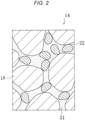
- FIG. 2 is a partial cross-sectional view of the electrolyte layer 14, which is an expanded representation of a part of FIG. 1 represented by II.
- the electrolyte layer 14 is formed of an electrolyte composition.
- the electrolyte composition contains the solid electrolyte 18; an electrolytic solution 21 containing a lithium salt dissolved therein; and polymer particles 22 dispersed in the electrolytic solution 21.
- the electrolyte composition for forming the composite layer 13 of the positive electrode 11 and the electrolyte composition for forming the composite layer 17 of the negative electrode 15 contain the electrolytic solution 21 and the polymer 22.
- the solid electrolyte 18 is a solid material which can achieve conduction of lithium ions.
- the solid electrolyte 18 contains one or more species selected from among oxides, sulfides, hydrides, and organic compounds. Among them, the solid electrolyte 18 is preferably formed of an oxide, since the oxide generates no toxic gas when exposed to air.
- the solid electrolyte 18 may be a composite substance, for example, an oxide having a surface on which a hydride is bonded.
- Examples of the solid electrolyte 18 of an oxide type include an oxide having a NASICON-type structure, an oxide having a perovskite structure, and an oxide having a garnet-type structure.
- Examples of the oxide having a NASICON-type structure include oxides each containing at least Li, M (M represents one more elements selected from Ti, Zr, and Ge), and P; e.g., Li(Al,Ti) 2 (PO 4 ) 3 and Li(Al,Ge) 2 (PO 4 ) 3 .
- Examples of the oxide having a perovskite structure include oxides each at least containing Li, Ti, and La; e.g., La 2/3 -xLi 3x TiO 3 .
- the solid electrolyte 18 formed of the garnet-type structure oxide is preferably one containing Li, La, Zr, and O.
- Examples of the solid electrolyte 18 include Li 7 La 3 Zr 2 O 12 , corresponding to the standard composition in which the hexavalent cation M is substituted by a tetravalent cation.
- the solid electrolyte 18 may further contain at least one element selected from the group consisting of Mg, Al, Si, Ca, Ti, V, Ga, Sr, Y, Nb, Sn, Sb, Ba, Hf, Ta, W, Bi, Rb, and lanthanoid (except for La).
- Examples of such an electrolyte include Li 6 La 3 Zr 1.5 W 0.5 O 12 , Li 6.15 La 3 Zr 1.75 Ta 0.25 Al 0.2 O 12 , Li 6.15 La 3 Zr 1.75 Ta 0.25 Ga 0.2 O 12 , Li 6.25 La 3 Zr 2 Ga 0.25 O 12 , Li 6.4 La 3 Zr 1.4 Ta 0.6 O 12 , Li 6.5 La 3 Zr 1.75 Te 0.25 O 12 , Li 6.75 La 3 Zr 1.75 Nb 0.25 O 12 , Li 6.9 La 3 Zr 1.675 Ta 0.289 Bi 0.036 O 12 , Li 6.46 Ga 0.23 La 3 Zr 1.85 Y 0.15 O 12 , Li 6.8 La 2.95 Ca 0.05 Zr 1.75 Nb 0.25 O 12 , Li 7.05 La 3.00 Zr 1.95 Gd 0.05 O 12 , and Li 6.20 Ba 0.30 La 2.95 Rb 0.05 Zr 2 O 12 .
- the solid electrolyte 18 preferably contains at least one of Mg and element A (A represents at least one element selected from the group consisting of Ca, Sr, and Ba), and satisfies all the following conditions (1) to (3) regarding mole proportions of the elements.
- the solid electrolyte 18 preferably contains both Mg and element A, and satisfies all the following conditions (4) to (6) regarding mole proportions of the elements.
- element A is preferably Sr.
- Examples of the sulfide-type solid electrolyte 18 include glass or ceramic materials such as those of a crystalline thio-LISICON type, an Li 10 GeP 2 S 12 type, an argyrodite type, an Li 7 P 3 S 11 , and an Li 2 S-P 2 S 5 .
- Examples of the hydride-type solid electrolyte 18 include a solid solution of LiBH 4 with a lithium halide compound (LiI, LiBr, LiCl) or a lithium amide (LiNH 2 ).
- Examples of the organic solid electrolyte 18 include polyethylene oxide, polypropylene oxide, and polyacrylonitrile.
- a lithium salt is dissolved in the solvent.
- the lithium salt is a compound for use in donation and acceptance of lithium ions between the positive electrode layer 11 and the negative electrode layer 15.
- the anion of the lithium salt include halide ions (e.g., I - , Cl - ,and Br - ), SCN - , BF 4 - , BF 3 (CF 3 ) - , BF 3 (C 2 F 5 ) - , PF 6 - , ClO 4 - , SbF 6 - , N(SO 2 F) 2 - , N(SO 2 CF 3 ) 2 - , N(SO 2 C 2 F 5 ) 2 - , B(C 6 H 5 ) 4 - , B(O 2 C 2 H 4 ) 2 - , C(SO 2 F) 3 - , C(SO 2 CF 3 ) 3 - , CF 3 COO - , CF 3 SO 2 O -
- N(SO 2 F) 2 - may be referred to as bis(fluorosulfonyl)imide anion (abbreviated as [FSI] - ); N(SO 2 CF 3 ) 2 - may be referred to as bis(trifluoromethanesulfonyl)imide anion (abbreviated as [TFSI] - ); bisoxalatoborate anion may be referred to as B(O 2 C 2 O 2 ) 2 - (abbreviated as [BOB] - ); and tris(fluorosulfonyl)carbanion may be referred to as C(SO 2 F) 3 - (abbreviated as [f3C] - ).
- An example of the lithium salt is at least one species selected from the group consisting of LiPF 6 , LiBF 4 , Li[FSI], Li[TFSI], Li[f3C], Li[BOB], LiClO 4 , LiBF 3 (CF 3 ), LiBF 3 (C 2 F 5 ), LiBF 3 (C 3 F 7 ), LiBF 3 (C 4 F 9 ), LiC(SO 2 CF 3 ) 3 , LiCF 3 SO 2 O, LiCF 3 COO, or LiRCOO (R represents a C1 to C4 alkyl group, a phenyl group, or a naphthyl group).
- the solvent of the electrolytic solution 21 No particular limitation is imposed on the solvent of the electrolytic solution 21, so long as the solvent is liquid within a temperature range ensuring satisfactory use of the secondary battery 10.
- the solvent include a carbonate ester, an aliphatic carboxylate ester, a phosphate ester, ⁇ -lactone, ether, nitrile, sulfolane, dimethyl sulfoxide, a fluorous solvent, and an ionic liquid. These solvents may be used in combination.
- carbonate ester examples include cyclic carbonate esters such as propylene carbonate, ethylene carbonate, butylene carbonate, vinylene carbonate, vinylethylene carbonate, and fluoroethylene carbonate; and chain carbonate esters such as dimethyl carbonate, diethyl carbonate, and ethyl methyl carbonate.
- cyclic carbonate esters such as propylene carbonate, ethylene carbonate, butylene carbonate, vinylene carbonate, vinylethylene carbonate, and fluoroethylene carbonate
- chain carbonate esters such as dimethyl carbonate, diethyl carbonate, and ethyl methyl carbonate.
- Examples of the aliphatic carboxylate ester include methyl formate, methyl acetate, and ethyl propionate.
- Examples of the phosphate ester include trimethyl phosphate.
- Examples of the ⁇ -lactone include ⁇ -butyrolactone.
- Examples of the ether include chain ethers such as 1,3-dioxaolane and 1,2-dialkoxyethane; and cyclic ethers such as tetrahydrofuran and 2-methyltetrahydrofuran.
- Examples of the nitrile include acetonitrile and propionitrile.
- Examples of the fluorous solvent include a hydrocarbon compound in which a hydrogen atom is substituted by a fluorine atom, and a derivative thereof.
- the ionic liquid is a compound formed of a cation and an anion, and assumes liquid at ambient temperature and atmospheric pressure.
- the ionic liquid preferably has a cationic component which is one or more species selected from the group consisting of ammonium, imidazolium, pyrrolidinium, and piperidinium.
- the anion component of the ionic liquid No particular limitation is imposed on the anion component of the ionic liquid.
- the anion component include inorganic anions such as BF 4 - and N(SO 2 F) 2 - ; and organic anions such as B(C 6 H 5 ) 4 - , CH 3 SO 3 - ,CF 3 SO 3 - , N(SO 2 CF 3 ) 2 - , and N(SO 2 C 4 F 9 ) 2 - .
- the anion component of the ionic liquid is preferably the same as that of the lithium salt, since coordination of the anion to lithium ions contained in the electrolytic solution 21 (i.e., interaction) can be easily controlled.
- Examples of the ionic liquid include N,N-diethyl-N-methyl-N-(2-methoxyethyl)ammonium bis(fluorosulfonyl)imide (DEME-FSI), N,N-diethyl-N-methyl-N-(2-methoxyethyl)ammonium bis(trifluoromethanesulfonyl)imide (DEME-TFSI), 1-ethyl-3-methylimidazolium bis(fluorosulfonyl)imide (EMI-FSI), 1-ethyl-3-methylimidazolium bis(trifluoromethanesulfonyl)imide (EMI-TFSI), N-butyl-N-methylpiperidinium bis(fluorosulfonyl)imide, N-methyl-N-propylpiperidinium bis(trifluoromethanesulfonyl)imide, N-methyl-N-propylpyrrolidinium bis(fluo
- the physical properties and functions of the electrolytic solution 21 are determined by the type and salt concentration in relation to the lithium salt and the solvent.
- the salt concentration (i.e., lithium ion concentration) of the electrolytic solution is, for example, 0.5 to 5 mol/dm 3 .
- the relative amount (vol. %) of the electrolytic solution 21 with respect to the total amount of the solid electrolyte 18 and the electrolytic solution 21 is preferably 50 vol.% or less (excluding 0 vol. %). That is, the ratio; solid electrolyte : electrolytic solution is (100-X) : X (0 ⁇ X ⁇ 50). Adjustment of the relative amount is conducted in order to ensure ion conductivity by the ionic liquid 21 present between particles of the solid electrolyte 18 and to prevent leakage of the electrolytic solution 21.
- the amount of the electrolytic solution 21 (vol. %) is determined in the following manner. Specifically, the electrolyte layer 14 is frozen or embedded in a 4-function epoxy resin or the like. Then, a vision field ( ⁇ 5,000) is selected at random from a cross-section of the electrolyte layer 14 (i.e., a cross-section obtained through polishing or irradiating with a focused ion beam (FIB)). The vision field is analyzed under an SEM equipped with an energy-dispersive X-ray spectrometer (EDS). In the analysis, the distributional feature of elements is specified, and the contrast of a reflective electron image is analyzed, to thereby determine the areas corresponding to the solid electrolyte 18 and the electrolytic solution 21.
- EDS energy-dispersive X-ray spectrometer
- the ratio of the cross-sectional area of the electrolytic solution 21 to the cross-section of the electrolyte layer 14 is considered to be a volume ratio of the electrolytic solution 21 to the electrolyte layer 14.
- the relative amount (vol. %) of electrolytic solution 21 is determined.
- the polymer 22 is a compound (polymer) in the form of particles dispersed in the electrolytic solution 21.
- the material of the polymer 22 include polyethylene, polypropylene, poly(ethylene terephthalate), polystyrene, polyamide, poly(vinyl alcohol), ethylene-vinyl alcohol copolymer, poly(vinylidene chloride), polyacrylonitrile, polycarbonate, and silicone.
- the solvent of the electrolytic solution 21 is selected from solvents which cannot dissolve the polymer 22.
- the tissue containing the solid electrolyte 18, the electrolytic solution 21, and the polymer 22 readily becomes dense, whereby a decrease in the contact area between the solid electrolyte 18 and the electrolytic solution 21 can be suppressed, to thereby secure the ion conductivity of the electrolyte layer 14.
- the solid electrolyte 18 formed of an oxide generally has intergranular resistance. However, by virtue of the presence of the electrolytic solution 21 in which the polymer 22 is dispersed is present between particles of the solid electrolyte 18, intergranular resistance can be reduced.
- particles of the polymer 22 contained in the composite layer 13 of the positive electrode 11 or in the composite layer 17 of the negative electrode 15 also is dispersed in the electrolytic solution 21.
- the polymer 22 is present between particles of the solid electrolyte 18, between the solid electrolyte 18 and the active material 19 or 20, or between particles of the active materials 19 or 20. Since the polymer 22 can reduce movement of the electrolytic solution 21, a decrease in the surface area of the electrolytic solution 21 in contact with the solid electrolyte 18 or the active material 19 or 20 can be prevented. As a result, ion conduction between particles of the solid electrolyte 18, ion conduction between the solid electrolyte 18 and the active material 19 or 20, and ion conduction between particles of the active material 19 or 20 can be secured.
- the volume of the active material 19 or 20 varies concomitantly with a charge/discharge process. Since the polymer 22 is present between the solid electrolyte 18 and the active material 19 or 20, or between the particles of the active material 19 or 20, the change in volume of the active material 19 or 20 upon a charge/discharge process can be buffered by the polymer 22. As a result, damage or other failures of the active material 19 and 20 can be mitigated, and the structure of the composite layer 13 or 17 can be maintained.
- FIG. 3A is a cross-section of one species of the polymer 22, and FIG. 3B is a cross-section of another species of the polymer 22.
- the expression "the polymer 22 is in the form of particles” refers to the case where a predominant amount of the particles of the polymer 22 have a cross-section almost equivalent to a circle (i.e., the particle is substantially spherical). Whether or not the particle of the polymer 22 is spherical is determined through the following procedure. Firstly, the interface between the positive electrode 11 (see FIG. 1 ) and the electrolyte layer 14, or the interface between the negative electrode 15 and the electrolyte layer 14 is cut along the direction orthogonal to the interface. The image of the cut surface including the polymer 22 is taken under an SEM. The imaging is carried out within a square area (100 ⁇ m ⁇ 100 ⁇ m) including a target object observed under the SEM.
- the square area in the cross-section of the electrolyte layer 14 may be enlarged to include an image including the polymer 22 in the cross-section of the composite layer 13 or 17.
- a circle 24 which circumscribes a contour 23 of a particle of the polymer 22 and which has the minimum area and a circle 25 which inscribes the contour 23 and which has the maximum area are drawn with respect to each particle of the polymer 22 through image processing.
- the diameter Do of the circle 24 and the diameter Di of the circle 25 are determined.
- the ratio of the number of the particles of the polymer 22 satisfying the condition: (Do-Di)/2 ⁇ Di, to the total number of the particles of the polymer 22 in the image is 80% or more, a predominant portion of the particles of the polymer 22 have a cross-section almost equivalent to a circle (i.e., the particles are substantially spherical). In such a case, the particles of the polymer 22 are evaluated as spherical.
- the polymer 22 may also be identified through Fourier transfer infrared spectroscopy (FTIR) or a microscopic-infrared spectroscopy, in which microscopy is combined with FTIR.
- FTIR Fourier transfer infrared spectroscopy
- microscopic-infrared spectroscopy in which microscopy is combined with FTIR.
- the polymer 22 is sampled from an object, and the sample is analyzed.
- analysis may be performed by means of a nuclear magnetic resonance (NMR) apparatus.
- NMR nuclear magnetic resonance
- the size of a particle of the polymer 22 is defined as a diameter of a circle having an area equal to cross-sectional area of a particle of the polymer 22 (i.e., a circle equivalent diameter) which has been determined through image analysis of particles of the polymer 22 observed in a cross-section.
- the size of a particle of the solid electrolyte 18 is defined as a circle-equivalent diameter of the particle of the solid electrolyte 18 which has been determined through image analysis of particles of the solid electrolyte 18 observed in a cross-section.
- the maximum size of a particle of the polymer 22 is smaller than that of the maximum size of a particle of the solid electrolyte 18. As a result, the function of the polymer 22 for suppressing the movement of the electrolytic solution 21 can be further enhanced.
- the polymer 22 content of the solid electrolyte 18 is preferably 5 to 30 vol. %. Adjustment of the polymer content is performed in order to avoid excessive suppression of ion conduction by the polymer 22 present between particles of the solid electrolyte 18, the polymer 22 present between the solid electrolyte 18 and the active material 19 or 20, and the polymer 22 present between particles of the active material 19 or 20, and to secure a dense structure involving the solid electrolyte 18, the electrolytic solution 21, and the polymer 22.
- the polymer 22 is preferably formed of silicone, which has excellent heat resistance and chemical stability and exhibits a wide potential window.
- Silicone generally refers to a polymer of an organic silicon compound (i.e., organopolysiloxane) having a skeleton of - Si(R 1 R 2 )-O- in which an organic group is bounded to a siloxane bond (Si-O).
- organic group R 1 R 2 include functional groups such as methyl, vinyl, phenyl, alkoxy, and hydroxyl.
- silicone is categorized into silicone rubber and silicone resin.
- Silicone rubber has a variety of organic groups and rubber elasticity.
- a typical example of silicon rubber has a cross-linked structure of dimethylpolysiloxane. Silicone rubber exhibits rubber elasticity at -50°C to 250°C.
- An example of the structure in which linear-chain dimethylpolysiloxane units are cross-linked is a block of linear polyorganosiloxane represented by -(R 3 2 SiO) a -.
- R 3 is selected from one or more C1 to C20 monovalent organic groups selected from, for example, alkyl groups such as methyl, ethyl, propyl, butyl, pentyl, hexyl, heptyl, octyl, decyl, dodecyl, tetradecyl, hexadecyl, and octadecyl; cycloalkyl groups such as cyclopentyl, cyclohexcyl, and cyclooctyl; and aryl groups such as phenyl and tolyl, or is from a monovalent organic group which is derived from any of the above examples by substituting a part of C-bonded hydrogen atoms with a halogen atom.
- the index "a" is, for example, 5 to 5,000, preferably 10 to 1,000.
- Silicone resin has a large amount of 3-dimenional network structure having a structural unit of R 3 SiO 3/2 or R 3 2 SiO 2/2 .
- R 3 is any of the same organic groups as described above. Silicone resin has particularly high heat resistance and does not swell in many solvents.
- Examples of the mode of the polymer 22 include the entire body formed of silicone rubber, the entire body formed of silicone resin, and a composite of silicone rubber and silicone resin.
- An example of the composite is a silicone rubber body coated with a silicone resin.
- the body of the polymer 22 preferably has a silicone resin on the surface thereof. When compared with a polymer body having a silicone rubber surface, the polymer body having a silicone resin surface provides better dispersibility and a wider potential window.
- Examples of the mode of the body of the polymer 22 having a silicone resin surface include the entire body formed of silicone resin, and a silicone rubber body coated with silicone resin. A composite formed of a silicone rubber body coated with silicone resin is more preferred, since the silicone rubber exhibits elasticity.
- any of the electrolyte layer 14 and the composite layers 13 and 17 may contain a binder.
- the binder serves as a binding agent for the solid electrolyte 18 and the active materials 19 and 20.
- the binder and the electrolytic solution 21 may be present in a separate manner, or may be co-present to form a gel. No particular limitation is imposed on the binder, and a preferred binder has a potential window wider than that of the electrolytic solution 21.
- An example of the binder is a poly(vinylidene fluoride)-hexafluoropropylene copolymer.
- any of the electrolyte layer 14 and the composite layers 13 and 17 may contain a solvent for dissolving the binder. Examples of the solvent include a carbonate ester, acetonitrile, and 1,2-dimethoxyethane.
- the polymer 22 content of the binder is preferably 5 to 30 vol. %. Adjustment of the polymer content is carried out in order to prevent deterioration of the binding performance of the binder which would otherwise be caused by the polymer 22, and to secure elasticity of any of the electrolyte layer 14 and the composite layers 13 and 17.
- the binder content (vol. %) can be determined from the relative area of the binder in a cross-section of the electrolyte layer 14 or the composite layer 13 or 17.
- the relative area of the binder can be determined through image analysis based on SEM-EDS.
- the secondary battery 10 is fabricated through, for example, the following procedure. Specifically, a lithium salt is dissolved in a solvent, to thereby prepare the electrolytic solution 21, which is then mixed with the solid electrolyte 18. In the resultant mixture, a solution of a binder is mixed with the mixture, to thereby form a slurry. The slurry is molded into a tape, which is then dried, to thereby yield a green sheet (electrolyte sheet) for yielding the electrolyte layer 14.
- the electrolytic solution 21 and the solid electrolyte 18 are mixed, and the active material 19 is added thereto.
- a solution of a binder is mixed with the polymer 22, to thereby prepare a slurry.
- the slurry is formed into a tape on the current-collecting layer 12 and then dried to form a green sheet (i.e., a positive electrode sheet) for providing the positive electrode 11.
- the electrolytic solution 21 and the solid electrolyte 18 are mixed, and the active material 20 is added thereto.
- a solution of a binder is mixed with the polymer 22, to thereby prepare a slurry.
- the slurry is formed into a tape on the current-collecting layer 16 and then dried to form a green sheet (i.e., a negative electrode sheet) for providing the negative electrode 15.
- the electrolyte sheet, the positive electrode sheet, and the negative electrode sheet are cut into a shape of interest.
- the cut products thereof are stacked from the positive electrode sheet, the electrolyte sheet, and the negative electrode sheet in that sequence, and the stacked product is pressed to integrate the sheets.
- a terminal (not illustrated) is connected, and the product is built in a case (not illustrated), and the case is closed.
- a secondary battery 10 in which the positive electrode 11, the electrolyte layer 14, and the negative electrode 15 stacked in that sequence can be fabricated.
- the polymer 22 contained in any of the positive electrode 11, the electrolyte layer 14, and the negative electrode 15 can suppress the movement of the electrolytic solution 21. As a result, a rise in internal resistance can be reduced.
- the secondary battery 10 is provided with the positive electrode 11 in which the composite layer 13 formed on one side of the current-collecting layer 12, and the negative electrode 15 in which the composite layer 17 formed on one side of the current-collecting layer 16.
- the embodiment is not limited to the above configuration.
- those skilled in the art can conceive application of, for example, the aforementioned elements of the above embodiment to a secondary battery provided with an electrode layer having the composite layer 13 and the composite layer 17 on respective surfaces of the current-collecting layer 12 (i.e., a bipolar electrode).
- a bipolar electrode By alternatingly stacking the bipolar electrode and the electrolyte layer 14, and putting the stacked product into a case (not illustrated), a secondary battery having a so-called bipolar structure can be fabricated.
- all of the composite layers 13 and 17 and the electrolyte layer 14 are each formed of an electrolyte composition.
- the invention is not limited to the above embodiment.
- at least one member of the composite layers 13 and 17 and the electrolyte layer 14 may be formed of an electrolyte composition.
- the above embodiment has been described, taking a lithium ion battery (secondary battery) containing an electrolyte composition as an example, to thereby illustrate the secondary battery 10 having the electrode layers (i.e., the positive electrode 11 and the negative electrode 15) and the electrolyte layer 14.
- the invention is not limited to the above embodiment.
- examples of other possible secondary batteries include secondary batteries such as a lithium-sulfur battery, a lithium-oxygen battery, and a lithium-air battery, a primary battery, and an electrolytic capacitor.
Landscapes
- Chemical & Material Sciences (AREA)
- Engineering & Computer Science (AREA)
- Electrochemistry (AREA)
- Chemical Kinetics & Catalysis (AREA)
- General Chemical & Material Sciences (AREA)
- Manufacturing & Machinery (AREA)
- Physics & Mathematics (AREA)
- Inorganic Chemistry (AREA)
- Power Engineering (AREA)
- Condensed Matter Physics & Semiconductors (AREA)
- General Physics & Mathematics (AREA)
- Spectroscopy & Molecular Physics (AREA)
- Microelectronics & Electronic Packaging (AREA)
- Dispersion Chemistry (AREA)
- Materials Engineering (AREA)
- Secondary Cells (AREA)
- Hybrid Cells (AREA)
- Battery Electrode And Active Subsutance (AREA)
- Electric Double-Layer Capacitors Or The Like (AREA)
- Conductive Materials (AREA)
- Primary Cells (AREA)
Abstract
Description
- The present invention relates to an electrolyte composition and to a secondary battery.
- In the related art, Patent Literature 1 discloses a secondary battery containing a solid electrolyte which has lithium ion conductivity. The technique disclosed in Patent Literature 1 is based on additional incorporation, into the battery, of an electrolytic solution containing a lithium salt dissolved therein, to thereby enhance ion conductivity by virtue of the presence of the electrolytic solution at the intergranular interface of the solid electrolyte.
- Patent Literature 1:
JP6682708B - In the related art, when external force is applied to a secondary battery, or when the temperature around a secondary battery increases, the electrolytic solution of the battery moves, to thereby easily provide an electrolytic solution-deficient portion in the solid electrolyte. Once such an electrolytic solution-deficient portion is provided, the contact area between the electrolytic solution and particles of the electrolyte decreases. In such a case, the internal resistance of the secondary battery may possibly increase.
- The present invention has been conceived to solve the above problem. Thus, an object of the present invention is to provide an electrolyte composition and a secondary battery, each achieving suppressed movement of electrolytic solution.
- In order to attain the above object, the present invention provides an electrolyte composition which contains a solid electrolyte having lithium ion conductivity; an electrolytic solution containing a lithium salt dissolved therein; and polymer particles (hereinafter may also be referred to as a "particulate polymer") dispersed in the electrolytic solution.
- The present invention also provides a secondary battery having a positive electrode, an electrolyte layer, and a negative electrode, in that sequence. At least one member of the positive electrode, the electrolyte layer, and the negative electrode contains an electrolyte composition which contains a solid electrolyte having lithium ion conductivity; an electrolytic solution containing a lithium salt dissolved therein; and a particulate polymer dispersed in the electrolytic solution.
- In the electrolyte composition of the present invention, polymer particles are dispersed in the electrolytic solution. Thus, undesired movement of the electrolytic solution can be suppressed. In the secondary battery containing the electrolyte composition, the polymer particles reduce movement of the electrolytic solution, whereby an increase in internal resistance can be suppressed.
-
- [
FIG. 1 ] A cross-section of a secondary battery according to an embodiment. - [
FIG. 2 ] A partial cross-sectional view of an electrolyte layer, which is an expanded representation of a part ofFIG. 1 represented by II. - [
FIG. 3A ] A cross-section of a polymer. - [
FIG. 3B ] A cross-section of another polymer. - Hereinafter, a preferred embodiment of the present invention will be described with reference to the attached drawings.
FIG. 1 is a schematic cross-sectional view of asecondary battery 10 according to an embodiment. Thesecondary battery 10 of the embodiment is a lithium ion solid battery in which power generation elements are formed of a solid. The concept "power generation elements formed of a solid" refers to the body of each power generation element being formed of a solid, and does not exclude a mode, for example, one in which a body is impregnated with a liquid. - As shown in
FIG. 1 , thesecondary battery 10 includes, from top to bottom, apositive electrode 11, anelectrolyte layer 14, and anegative electrode 15. Thepositive electrode 11, theelectrolyte layer 14, and thenegative electrode 15 are built in a case (not illustrated). - The
positive electrode 11 includes acomposite layer 13 and a current-collectinglayer 12 stacked thereon. The current-collectinglayer 12 is a member having an electrical conductivity. Examples of the material of the current-collectinglayer 12 include metals selected from among Ni, Ti, Fe, and Al; alloys each containing two or more of such metals; stainless steel; and carbon material. - The
composite layer 13 is formed of an electrolyte composition (describe below). The electrolyte composition contains asolid electrolyte 18 and anactive material 19. For lowering the electrical resistance of thecomposite layer 13, thecomposite layer 13 may contain a conducting aid. Examples of the conducting aid include carbon black, acetylene black, Ketjen black, carbon fiber, Ni, Pt, and Ag. - Examples of the
active material 19 include a metal oxide in which the metal includes a transition metal. Examples of the metal oxide in which the metal includes a transition metal include a metal oxide in which the metal includes Li and at least one species selected from among Mn, Co, Ni, Fe, Cr, and V. Specific examples of the metal oxide in which the metal includes a transition metal include LiCoO2, LiNi0.8Co0.15Al0.05O2, LiMn2O4, LiNiVO4, LiNi0.5Mn1.5O4, LiNi1/3Mn1/3Co1/3O4, and LiFePO4. - In order to suppress reaction between the
active material 19 and thesolid electrolyte 18, a coating layer may be provided on theactive material 19. Examples of the coating layer include Al2O3, ZrO2, LiNbO3, Li4Ti5O12, LiTaO3 LiNbO3, LiAlO2, Li2ZrO3, Li2WO4, Li2TiO3, Li2B4O7, Li3PO4, and Li2MoO4. - The
negative electrode 15 is formed of acomposite layer 17 and a current-collectinglayer 16 stacked thereon. The current-collectinglayer 16 is a member having an electrical conductivity. Examples of the material of the current-collectinglayer 16 include metals selected from among Ni, Ti, Fe, Cu, and Si; alloys each containing two or more of such metals; stainless steel; and carbon material. - The
composite layer 17 is formed of an electrolyte composition (describe below). The electrolyte composition contains thesolid electrolyte 18 and anactive material 20. For lowering the electrical resistance of thecomposite layer 17, thecomposite layer 17 may contain a conducting aid. Examples of the conducting aid include carbon black, acetylene black, Ketjen black, carbon fiber, Ni, Pt, and Ag. - Examples of the
active material 20 include Li, Li-Al alloy, Li4Ti5O12, graphite, In, Si, Si-Li alloy, and SiO. -
FIG. 2 is a partial cross-sectional view of theelectrolyte layer 14, which is an expanded representation of a part ofFIG. 1 represented by II. Theelectrolyte layer 14 is formed of an electrolyte composition. The electrolyte composition contains thesolid electrolyte 18; anelectrolytic solution 21 containing a lithium salt dissolved therein; andpolymer particles 22 dispersed in theelectrolytic solution 21. Similarly, the electrolyte composition for forming thecomposite layer 13 of thepositive electrode 11 and the electrolyte composition for forming thecomposite layer 17 of thenegative electrode 15 contain theelectrolytic solution 21 and thepolymer 22. - The
solid electrolyte 18 is a solid material which can achieve conduction of lithium ions. Thesolid electrolyte 18 contains one or more species selected from among oxides, sulfides, hydrides, and organic compounds. Among them, thesolid electrolyte 18 is preferably formed of an oxide, since the oxide generates no toxic gas when exposed to air. Thesolid electrolyte 18 may be a composite substance, for example, an oxide having a surface on which a hydride is bonded. - Examples of the
solid electrolyte 18 of an oxide type include an oxide having a NASICON-type structure, an oxide having a perovskite structure, and an oxide having a garnet-type structure. Examples of the oxide having a NASICON-type structure include oxides each containing at least Li, M (M represents one more elements selected from Ti, Zr, and Ge), and P; e.g., Li(Al,Ti)2(PO4)3 and Li(Al,Ge)2(PO4)3. Examples of the oxide having a perovskite structure include oxides each at least containing Li, Ti, and La; e.g., La2/3-xLi3xTiO3. - The standard composition of the garnet-type structure oxide is Li5La3M2O12 (M=Nb, Ta). The
solid electrolyte 18 formed of the garnet-type structure oxide is preferably one containing Li, La, Zr, and O. Examples of thesolid electrolyte 18 include Li7La3Zr2O12, corresponding to the standard composition in which the hexavalent cation M is substituted by a tetravalent cation. - In addition to Li, La, and Zr, the
solid electrolyte 18 may further contain at least one element selected from the group consisting of Mg, Al, Si, Ca, Ti, V, Ga, Sr, Y, Nb, Sn, Sb, Ba, Hf, Ta, W, Bi, Rb, and lanthanoid (except for La). Examples of such an electrolyte include Li6La3Zr1.5W0.5O12, Li6.15La3Zr1.75Ta0.25Al0.2O12, Li6.15La3Zr1.75Ta0.25Ga0.2O12, Li6.25La3Zr2Ga0.25O12, Li6.4La3Zr1.4Ta0.6O12, Li6.5La3Zr1.75Te0.25O12, Li6.75La3Zr1.75Nb0.25O12, Li6.9La3Zr1.675Ta0.289Bi0.036O12, Li6.46Ga0.23La3Zr1.85Y0.15O12, Li6.8La2.95Ca0.05Zr1.75Nb0.25O12, Li7.05La3.00Zr1.95Gd0.05O12, and Li6.20Ba0.30La2.95Rb0.05Zr2O12. - The
solid electrolyte 18 preferably contains at least one of Mg and element A (A represents at least one element selected from the group consisting of Ca, Sr, and Ba), and satisfies all the following conditions (1) to (3) regarding mole proportions of the elements. Alternatively, thesolid electrolyte 18 preferably contains both Mg and element A, and satisfies all the following conditions (4) to (6) regarding mole proportions of the elements. From the viewpoint of elevating the ion conductivity of thesolid electrolyte 18, element A is preferably Sr.


- Examples of the sulfide-type
solid electrolyte 18 include glass or ceramic materials such as those of a crystalline thio-LISICON type, an Li10GeP2S12 type, an argyrodite type, an Li7P3S11, and an Li2S-P2S5. Examples of the hydride-typesolid electrolyte 18 include a solid solution of LiBH4 with a lithium halide compound (LiI, LiBr, LiCl) or a lithium amide (LiNH2). Examples of the organicsolid electrolyte 18 include polyethylene oxide, polypropylene oxide, and polyacrylonitrile. - In the
electrolytic solution 21, a lithium salt is dissolved in the solvent. The lithium salt is a compound for use in donation and acceptance of lithium ions between thepositive electrode layer 11 and thenegative electrode layer 15. Examples of the anion of the lithium salt include halide ions (e.g., I-, Cl-,and Br-), SCN-, BF4 -, BF3(CF3)-, BF3(C2F5)-, PF6 -, ClO4 -, SbF6 -, N(SO2F)2 -, N(SO2CF3)2 -, N(SO2C2F5)2 -, B(C6H5)4 -, B(O2C2H4)2 -, C(SO2F)3 -, C(SO2CF3)3 -, CF3COO-, CF3SO2O-, C6F5SO2O-, and B(O2C2O2)2 -. - In some cases, N(SO2F)2 - may be referred to as bis(fluorosulfonyl)imide anion (abbreviated as [FSI]-); N(SO2CF3)2 - may be referred to as bis(trifluoromethanesulfonyl)imide anion (abbreviated as [TFSI]-); bisoxalatoborate anion may be referred to as B(O2C2O2)2 - (abbreviated as [BOB]-); and tris(fluorosulfonyl)carbanion may be referred to as C(SO2F)3 - (abbreviated as [f3C]-).
- An example of the lithium salt is at least one species selected from the group consisting of LiPF6, LiBF4, Li[FSI], Li[TFSI], Li[f3C], Li[BOB], LiClO4, LiBF3(CF3), LiBF3(C2F5), LiBF3(C3F7), LiBF3(C4F9), LiC(SO2CF3)3, LiCF3SO2O, LiCF3COO, or LiRCOO (R represents a C1 to C4 alkyl group, a phenyl group, or a naphthyl group).
- No particular limitation is imposed on the solvent of the
electrolytic solution 21, so long as the solvent is liquid within a temperature range ensuring satisfactory use of thesecondary battery 10. Examples of the solvent include a carbonate ester, an aliphatic carboxylate ester, a phosphate ester, γ-lactone, ether, nitrile, sulfolane, dimethyl sulfoxide, a fluorous solvent, and an ionic liquid. These solvents may be used in combination. - Examples of the carbonate ester include cyclic carbonate esters such as propylene carbonate, ethylene carbonate, butylene carbonate, vinylene carbonate, vinylethylene carbonate, and fluoroethylene carbonate; and chain carbonate esters such as dimethyl carbonate, diethyl carbonate, and ethyl methyl carbonate.
- Examples of the aliphatic carboxylate ester include methyl formate, methyl acetate, and ethyl propionate. Examples of the phosphate ester include trimethyl phosphate. Examples of the γ-lactone include γ-butyrolactone. Examples of the ether include chain ethers such as 1,3-dioxaolane and 1,2-dialkoxyethane; and cyclic ethers such as tetrahydrofuran and 2-methyltetrahydrofuran. Examples of the nitrile include acetonitrile and propionitrile. Examples of the fluorous solvent include a hydrocarbon compound in which a hydrogen atom is substituted by a fluorine atom, and a derivative thereof.
- The ionic liquid is a compound formed of a cation and an anion, and assumes liquid at ambient temperature and atmospheric pressure. When the solvent of the electrolytic solution is an ionic liquid, flame resistance can be enhanced. The ionic liquid preferably has a cationic component which is one or more species selected from the group consisting of ammonium, imidazolium, pyrrolidinium, and piperidinium.
- No particular limitation is imposed on the anion component of the ionic liquid. Examples of the anion component include inorganic anions such as BF4 - and N(SO2F)2 -; and organic anions such as B(C6H5)4 -, CH3SO3 -,CF3SO3 -, N(SO2CF3)2 -, and N(SO2C4F9)2 -. The anion component of the ionic liquid is preferably the same as that of the lithium salt, since coordination of the anion to lithium ions contained in the electrolytic solution 21 (i.e., interaction) can be easily controlled.
- Examples of the ionic liquid include N,N-diethyl-N-methyl-N-(2-methoxyethyl)ammonium bis(fluorosulfonyl)imide (DEME-FSI), N,N-diethyl-N-methyl-N-(2-methoxyethyl)ammonium bis(trifluoromethanesulfonyl)imide (DEME-TFSI), 1-ethyl-3-methylimidazolium bis(fluorosulfonyl)imide (EMI-FSI), 1-ethyl-3-methylimidazolium bis(trifluoromethanesulfonyl)imide (EMI-TFSI), N-butyl-N-methylpiperidinium bis(fluorosulfonyl)imide, N-methyl-N-propylpiperidinium bis(trifluoromethanesulfonyl)imide, N-methyl-N-propylpyrrolidinium bis(fluorosulfonyl)imide (P13-FSI), and N-methyl-N-propylpyrrolidinium bis(trifluoromethanesulfonyl)imide (P13-TFSI).
- The physical properties and functions of the
electrolytic solution 21 are determined by the type and salt concentration in relation to the lithium salt and the solvent. In order to secure lithium ion conductivity, the salt concentration (i.e., lithium ion concentration) of the electrolytic solution is, for example, 0.5 to 5 mol/dm3. - In the electrolyte layer 14 (electrolyte composition), the relative amount (vol. %) of the
electrolytic solution 21 with respect to the total amount of thesolid electrolyte 18 and theelectrolytic solution 21 is preferably 50 vol.% or less (excluding 0 vol. %). That is, the ratio; solid electrolyte : electrolytic solution is (100-X) : X (0<X≤50). Adjustment of the relative amount is conducted in order to ensure ion conductivity by theionic liquid 21 present between particles of thesolid electrolyte 18 and to prevent leakage of theelectrolytic solution 21. - The amount of the electrolytic solution 21 (vol. %) is determined in the following manner. Specifically, the
electrolyte layer 14 is frozen or embedded in a 4-function epoxy resin or the like. Then, a vision field (×5,000) is selected at random from a cross-section of the electrolyte layer 14 (i.e., a cross-section obtained through polishing or irradiating with a focused ion beam (FIB)). The vision field is analyzed under an SEM equipped with an energy-dispersive X-ray spectrometer (EDS). In the analysis, the distributional feature of elements is specified, and the contrast of a reflective electron image is analyzed, to thereby determine the areas corresponding to thesolid electrolyte 18 and theelectrolytic solution 21. The ratio of the cross-sectional area of theelectrolytic solution 21 to the cross-section of theelectrolyte layer 14 is considered to be a volume ratio of theelectrolytic solution 21 to theelectrolyte layer 14. Thus, the relative amount (vol. %) ofelectrolytic solution 21 is determined. - The
polymer 22 is a compound (polymer) in the form of particles dispersed in theelectrolytic solution 21. Examples of the material of thepolymer 22 include polyethylene, polypropylene, poly(ethylene terephthalate), polystyrene, polyamide, poly(vinyl alcohol), ethylene-vinyl alcohol copolymer, poly(vinylidene chloride), polyacrylonitrile, polycarbonate, and silicone. The solvent of theelectrolytic solution 21 is selected from solvents which cannot dissolve thepolymer 22. - Particles of the
polymer 22 are dispersed in theelectrolytic solution 21 so as to surround thesolid electrolyte 18. As a result, the space between particles of thesolid electrolyte 18 are partially filled with thepolymer 22. Thus, the tissue containing thesolid electrolyte 18, theelectrolytic solution 21, and thepolymer 22 readily becomes dense, whereby a decrease in the contact area between thesolid electrolyte 18 and theelectrolytic solution 21 can be suppressed, to thereby secure the ion conductivity of theelectrolyte layer 14. In a more specific case, thesolid electrolyte 18 formed of an oxide generally has intergranular resistance. However, by virtue of the presence of theelectrolytic solution 21 in which thepolymer 22 is dispersed is present between particles of thesolid electrolyte 18, intergranular resistance can be reduced. - Also, since the space between particles of the
solid electrolyte 18 is partially filled with thepolymer 22, transfer of theelectrolytic solution 21 present between the particles of thesolid electrolyte 18 is impeded. Since the movement of theelectrolytic solution 21 is impeded, even when external force is applied to theelectrolyte layer 14, or even when the temperature around theelectrolyte layer 14 increases, partial deficiency in theelectrolytic solution 21 between particles of thesolid electrolyte 18, or leakage of theelectrolytic solution 21 can be prevented. Also, since a decrease in surface area between thesolid electrolyte 18 and theelectrolytic solution 21 can be prevented, a rise in internal resistance of theelectrolyte layer 14 can be prevented. - Meanwhile, particles of the
polymer 22 contained in thecomposite layer 13 of thepositive electrode 11 or in thecomposite layer 17 of thenegative electrode 15 also is dispersed in theelectrolytic solution 21. In some cases, thepolymer 22 is present between particles of thesolid electrolyte 18, between thesolid electrolyte 18 and theactive material active materials polymer 22 can reduce movement of theelectrolytic solution 21, a decrease in the surface area of theelectrolytic solution 21 in contact with thesolid electrolyte 18 or theactive material solid electrolyte 18, ion conduction between thesolid electrolyte 18 and theactive material active material - In the
secondary battery 10 in which energy storage is achieved through insertion/elimination of lithium ions to and from theactive material active material polymer 22 is present between thesolid electrolyte 18 and theactive material active material active material polymer 22. As a result, damage or other failures of theactive material composite layer -
FIG. 3A is a cross-section of one species of thepolymer 22, andFIG. 3B is a cross-section of another species of thepolymer 22. The expression " thepolymer 22 is in the form of particles" refers to the case where a predominant amount of the particles of thepolymer 22 have a cross-section almost equivalent to a circle (i.e., the particle is substantially spherical). Whether or not the particle of thepolymer 22 is spherical is determined through the following procedure. Firstly, the interface between the positive electrode 11 (seeFIG. 1 ) and theelectrolyte layer 14, or the interface between thenegative electrode 15 and theelectrolyte layer 14 is cut along the direction orthogonal to the interface. The image of the cut surface including thepolymer 22 is taken under an SEM. The imaging is carried out within a square area (100 µm × 100 µm) including a target object observed under the SEM. - In the case where the thickness of the
electrolyte layer 14 is less than 100 µm, thereby failing to set the square area (100 µm × 100 µm) in the cross-section of theelectrolyte layer 14, the square area in the cross-section of theelectrolyte layer 14 may be enlarged to include an image including thepolymer 22 in the cross-section of thecomposite layer electrolyte layer 14 and thecomposite layers electrolyte layer 14 and thecomposite layers - After taking the cross-sectional image of interest, as shown in
FIGs. 3A and 3B , acircle 24 which circumscribes acontour 23 of a particle of thepolymer 22 and which has the minimum area and acircle 25 which inscribes thecontour 23 and which has the maximum area are drawn with respect to each particle of thepolymer 22 through image processing. The diameter Do of thecircle 24 and the diameter Di of thecircle 25 are determined. In the case where the ratio of the number of the particles of thepolymer 22 satisfying the condition: (Do-Di)/2<Di, to the total number of the particles of thepolymer 22 in the image is 80% or more, a predominant portion of the particles of thepolymer 22 have a cross-section almost equivalent to a circle (i.e., the particles are substantially spherical). In such a case, the particles of thepolymer 22 are evaluated as spherical. - The
polymer 22 may also be identified through Fourier transfer infrared spectroscopy (FTIR) or a microscopic-infrared spectroscopy, in which microscopy is combined with FTIR. Alternatively, thepolymer 22 is sampled from an object, and the sample is analyzed. Yet alternatively, analysis may be performed by means of a nuclear magnetic resonance (NMR) apparatus. - The size of a particle of the
polymer 22 is defined as a diameter of a circle having an area equal to cross-sectional area of a particle of the polymer 22 (i.e., a circle equivalent diameter) which has been determined through image analysis of particles of thepolymer 22 observed in a cross-section. The size of a particle of thesolid electrolyte 18 is defined as a circle-equivalent diameter of the particle of thesolid electrolyte 18 which has been determined through image analysis of particles of thesolid electrolyte 18 observed in a cross-section. The maximum size of a particle of thepolymer 22 is smaller than that of the maximum size of a particle of thesolid electrolyte 18. As a result, the function of thepolymer 22 for suppressing the movement of theelectrolytic solution 21 can be further enhanced. - The
polymer 22 content of thesolid electrolyte 18 is preferably 5 to 30 vol. %. Adjustment of the polymer content is performed in order to avoid excessive suppression of ion conduction by thepolymer 22 present between particles of thesolid electrolyte 18, thepolymer 22 present between thesolid electrolyte 18 and theactive material polymer 22 present between particles of theactive material solid electrolyte 18, theelectrolytic solution 21, and thepolymer 22. - The
polymer 22 is preferably formed of silicone, which has excellent heat resistance and chemical stability and exhibits a wide potential window. Silicone generally refers to a polymer of an organic silicon compound (i.e., organopolysiloxane) having a skeleton of - Si(R1R2)-O- in which an organic group is bounded to a siloxane bond (Si-O). Examples of the organic group R1R2 include functional groups such as methyl, vinyl, phenyl, alkoxy, and hydroxyl. Depending on its structure and properties, silicone is categorized into silicone rubber and silicone resin. - Silicone rubber has a variety of organic groups and rubber elasticity. A typical example of silicon rubber has a cross-linked structure of dimethylpolysiloxane. Silicone rubber exhibits rubber elasticity at -50°C to 250°C. An example of the structure in which linear-chain dimethylpolysiloxane units are cross-linked is a block of linear polyorganosiloxane represented by -(R3 2SiO)a-.
- R3 is selected from one or more C1 to C20 monovalent organic groups selected from, for example, alkyl groups such as methyl, ethyl, propyl, butyl, pentyl, hexyl, heptyl, octyl, decyl, dodecyl, tetradecyl, hexadecyl, and octadecyl; cycloalkyl groups such as cyclopentyl, cyclohexcyl, and cyclooctyl; and aryl groups such as phenyl and tolyl, or is from a monovalent organic group which is derived from any of the above examples by substituting a part of C-bonded hydrogen atoms with a halogen atom. For securing the surface smoothness, the index "a" is, for example, 5 to 5,000, preferably 10 to 1,000.
- Silicone resin has a large amount of 3-dimenional network structure having a structural unit of R3SiO3/2 or R3 2SiO2/2. R3 is any of the same organic groups as described above. Silicone resin has particularly high heat resistance and does not swell in many solvents.
- Examples of the mode of the
polymer 22 include the entire body formed of silicone rubber, the entire body formed of silicone resin, and a composite of silicone rubber and silicone resin. An example of the composite is a silicone rubber body coated with a silicone resin. The body of thepolymer 22 preferably has a silicone resin on the surface thereof. When compared with a polymer body having a silicone rubber surface, the polymer body having a silicone resin surface provides better dispersibility and a wider potential window. Examples of the mode of the body of thepolymer 22 having a silicone resin surface include the entire body formed of silicone resin, and a silicone rubber body coated with silicone resin. A composite formed of a silicone rubber body coated with silicone resin is more preferred, since the silicone rubber exhibits elasticity. - Any of the
electrolyte layer 14 and thecomposite layers solid electrolyte 18 and theactive materials electrolytic solution 21 may be present in a separate manner, or may be co-present to form a gel. No particular limitation is imposed on the binder, and a preferred binder has a potential window wider than that of theelectrolytic solution 21. An example of the binder is a poly(vinylidene fluoride)-hexafluoropropylene copolymer. Further, any of theelectrolyte layer 14 and thecomposite layers - When a binder is contained, the
polymer 22 content of the binder is preferably 5 to 30 vol. %. Adjustment of the polymer content is carried out in order to prevent deterioration of the binding performance of the binder which would otherwise be caused by thepolymer 22, and to secure elasticity of any of theelectrolyte layer 14 and thecomposite layers electrolyte layer 14 or thecomposite layer - The
secondary battery 10 is fabricated through, for example, the following procedure. Specifically, a lithium salt is dissolved in a solvent, to thereby prepare theelectrolytic solution 21, which is then mixed with thesolid electrolyte 18. In the resultant mixture, a solution of a binder is mixed with the mixture, to thereby form a slurry. The slurry is molded into a tape, which is then dried, to thereby yield a green sheet (electrolyte sheet) for yielding theelectrolyte layer 14. - Then, the
electrolytic solution 21 and thesolid electrolyte 18 are mixed, and theactive material 19 is added thereto. Separately, a solution of a binder is mixed with thepolymer 22, to thereby prepare a slurry. The slurry is formed into a tape on the current-collectinglayer 12 and then dried to form a green sheet (i.e., a positive electrode sheet) for providing thepositive electrode 11. - Similarly, the
electrolytic solution 21 and thesolid electrolyte 18 are mixed, and theactive material 20 is added thereto. Separately, a solution of a binder is mixed with thepolymer 22, to thereby prepare a slurry. The slurry is formed into a tape on the current-collectinglayer 16 and then dried to form a green sheet (i.e., a negative electrode sheet) for providing thenegative electrode 15. - The electrolyte sheet, the positive electrode sheet, and the negative electrode sheet are cut into a shape of interest. The cut products thereof are stacked from the positive electrode sheet, the electrolyte sheet, and the negative electrode sheet in that sequence, and the stacked product is pressed to integrate the sheets. To each of the current-collecting
layers secondary battery 10 in which thepositive electrode 11, theelectrolyte layer 14, and thenegative electrode 15 stacked in that sequence can be fabricated. In thesecondary battery 10, thepolymer 22 contained in any of thepositive electrode 11, theelectrolyte layer 14, and thenegative electrode 15 can suppress the movement of theelectrolytic solution 21. As a result, a rise in internal resistance can be reduced. - With reference to the above embodiment, the present invention has been described in detail. However, the present invention should not be limited to the aforementioned embodiment. Those skilled in the art can easily understand that the present invention may be modified in various manners, so long as such variations do not deviate from the scope and gist of the invention.
- In the above-described embodiment, the
secondary battery 10 is provided with thepositive electrode 11 in which thecomposite layer 13 formed on one side of the current-collectinglayer 12, and thenegative electrode 15 in which thecomposite layer 17 formed on one side of the current-collectinglayer 16. However, the embodiment is not limited to the above configuration. Needless to say, those skilled in the art can conceive application of, for example, the aforementioned elements of the above embodiment to a secondary battery provided with an electrode layer having thecomposite layer 13 and thecomposite layer 17 on respective surfaces of the current-collecting layer 12 (i.e., a bipolar electrode). By alternatingly stacking the bipolar electrode and theelectrolyte layer 14, and putting the stacked product into a case (not illustrated), a secondary battery having a so-called bipolar structure can be fabricated. - In the above-described embodiment, all of the
composite layers electrolyte layer 14 are each formed of an electrolyte composition. However, the invention is not limited to the above embodiment. In one possible mode of the secondary battery, at least one member of thecomposite layers electrolyte layer 14 may be formed of an electrolyte composition. - The above embodiment has been described, taking a lithium ion battery (secondary battery) containing an electrolyte composition as an example, to thereby illustrate the
secondary battery 10 having the electrode layers (i.e., thepositive electrode 11 and the negative electrode 15) and theelectrolyte layer 14. However, the invention is not limited to the above embodiment. Examples of other possible secondary batteries include secondary batteries such as a lithium-sulfur battery, a lithium-oxygen battery, and a lithium-air battery, a primary battery, and an electrolytic capacitor. -
- 10 secondary battery
- 11 positive electrode
- 13,17 composite layer (electrolyte composition)
- 14 electrolyte layer (electrolyte composition)
- 15 negative electrode
- 18 solid electrolyte
- 21 electrolytic solution
- 22 polymer
Claims (4)
- An electrolyte composition which comprises a solid electrolyte having lithium ion conductivity and an electrolytic solution containing a lithium salt dissolved therein,
wherein the composition further contains a particulate polymer dispersed in the electrolytic solution. - The electrolyte composition according to claim 1, wherein the polymer is a silicone.
- The electrolyte composition according to claim 2, wherein the polymer contains a silicone resin on a surface thereof.
- A secondary battery having a positive electrode, an electrolyte layer, and a negative electrode in that sequence,
wherein at least one of the positive electrode, the electrolyte layer, and the negative electrode contains the electrolyte composition as recited in any one of claims 1 to 3.
Applications Claiming Priority (2)
| Application Number | Priority Date | Filing Date | Title |
|---|---|---|---|
| JP2021116926A JP7288932B2 (en) | 2021-07-15 | 2021-07-15 | Electrolyte composition and secondary battery |
| PCT/JP2022/027465 WO2023286786A1 (en) | 2021-07-15 | 2022-07-12 | Electrolyte composition and secondary battery |
Publications (2)
| Publication Number | Publication Date |
|---|---|
| EP4372763A1 true EP4372763A1 (en) | 2024-05-22 |
| EP4372763A4 EP4372763A4 (en) | 2025-08-06 |
Family
ID=84919453
Family Applications (1)
| Application Number | Title | Priority Date | Filing Date |
|---|---|---|---|
| EP22842129.3A Withdrawn EP4372763A4 (en) | 2021-07-15 | 2022-07-12 | ELECTROLYTE COMPOSITION AND SECONDARY BATTERY |
Country Status (6)
| Country | Link |
|---|---|
| US (1) | US20240322243A1 (en) |
| EP (1) | EP4372763A4 (en) |
| JP (1) | JP7288932B2 (en) |
| KR (1) | KR20230171999A (en) |
| CN (1) | CN117178331A (en) |
| WO (1) | WO2023286786A1 (en) |
Families Citing this family (1)
| Publication number | Priority date | Publication date | Assignee | Title |
|---|---|---|---|---|
| WO2025070177A1 (en) * | 2023-09-29 | 2025-04-03 | 富士フイルム株式会社 | Electrode formation slurry for non-aqueous electrolyte secondary battery and non-aqueous electrolyte secondary battery |
Family Cites Families (4)
| Publication number | Priority date | Publication date | Assignee | Title |
|---|---|---|---|---|
| JP2013175315A (en) * | 2012-02-24 | 2013-09-05 | Toyota Industries Corp | Lithium ion secondary battery, and vehicle |
| EP3796337A4 (en) | 2018-05-16 | 2022-01-26 | NGK Spark Plug Co., Ltd. | ION CONDUCTOR AND LITHIUM BATTERY |
| KR102504868B1 (en) * | 2019-01-10 | 2023-02-28 | 주식회사 엘지에너지솔루션 | A solid electrolyte layer and an all-solid-state battery comprising the same |
| JP7270071B2 (en) * | 2020-01-09 | 2023-05-09 | 株式会社日本触媒 | Composition, slurry, method for producing electrode, and alkaline secondary battery |
-
2021
- 2021-07-15 JP JP2021116926A patent/JP7288932B2/en active Active
-
2022
- 2022-07-12 CN CN202280029498.7A patent/CN117178331A/en not_active Withdrawn
- 2022-07-12 US US18/577,935 patent/US20240322243A1/en active Pending
- 2022-07-12 EP EP22842129.3A patent/EP4372763A4/en not_active Withdrawn
- 2022-07-12 WO PCT/JP2022/027465 patent/WO2023286786A1/en not_active Ceased
- 2022-07-12 KR KR1020237039393A patent/KR20230171999A/en active Pending
Also Published As
| Publication number | Publication date |
|---|---|
| EP4372763A4 (en) | 2025-08-06 |
| KR20230171999A (en) | 2023-12-21 |
| JP7288932B2 (en) | 2023-06-08 |
| WO2023286786A1 (en) | 2023-01-19 |
| CN117178331A (en) | 2023-12-05 |
| JP2023013035A (en) | 2023-01-26 |
| US20240322243A1 (en) | 2024-09-26 |
Similar Documents
| Publication | Publication Date | Title |
|---|---|---|
| US10290894B2 (en) | Secondary battery and method for manufacturing same | |
| CN111670514B (en) | Composition for gel polymer electrolyte and lithium secondary battery including gel polymer electrolyte formed from the composition | |
| EP2442397B1 (en) | Electrolytic solution and lithium-ion secondary battery utilizing the same | |
| US8241795B2 (en) | Electrolytic solutions and battery | |
| EP3531491B1 (en) | Electrolyte for lithium secondary battery and lithium secondary battery comprising the same | |
| US10978748B2 (en) | Materials to improve the performance of lithium and sodium batteries | |
| KR102900090B1 (en) | Electrodes for storage devices and storage devices | |
| KR102271678B1 (en) | Non-aqueous electrolyte and lithium secondary battery comprising the same | |
| KR101395156B1 (en) | Ambient temperature molten salt, electrode, battery, agent for preventing charge-up, and method for observing sample | |
| CN112567557B (en) | Composition for gel polymer electrolyte and lithium secondary battery including gel polymer electrolyte formed from the composition | |
| EP3780223B1 (en) | Thermosetting electrolyte composition for lithium secondary battery, gel polymer electrolyte prepared therefrom, and lithium secondary battery including the same | |
| KR20160038735A (en) | Manufacturing method of lithium secondary battery | |
| ES2974182T3 (en) | Electrolyte for secondary lithium battery, and secondary lithium battery that includes the same | |
| US20240322243A1 (en) | Electrolyte composition and secondary battery | |
| EP3883037B1 (en) | Electrolyte for lithium secondary battery and lithium secondary battery including the same | |
| EP3944394A1 (en) | Non-aqueous electrolyte for lithium secondary battery and lithium secondary battery comprising same | |
| US20240332618A1 (en) | Electrochemical device and electronic device containing same | |
| EP4191706A2 (en) | Lithium secondary battery | |
| JP7784854B2 (en) | Energy storage devices | |
| KR102940856B1 (en) | Electrolyte solution for lithium secondary battery and lithium secondary battery including the same | |
| TWI904402B (en) | Electrolyte composition and secondary battery | |
| EP4329040A1 (en) | Non-aqueous electrolyte for lithium secondary battery and lithium secondary battery comprising same | |
| CN120660216A (en) | Electrolyte containing sulfonamide-type cyclic salt and energy storage battery and storage battery manufactured by same | |
| JP2012146465A (en) | Electrolytic solution for lithium ion battery and lithium ion battery | |
| US12027668B2 (en) | Non-aqueous electrolyte solution for lithium secondary battery and lithium secondary battery including the same |
Legal Events
| Date | Code | Title | Description |
|---|---|---|---|
| STAA | Information on the status of an ep patent application or granted ep patent |
Free format text: STATUS: THE INTERNATIONAL PUBLICATION HAS BEEN MADE |
|
| PUAI | Public reference made under article 153(3) epc to a published international application that has entered the european phase |
Free format text: ORIGINAL CODE: 0009012 |
|
| STAA | Information on the status of an ep patent application or granted ep patent |
Free format text: STATUS: REQUEST FOR EXAMINATION WAS MADE |
|
| 17P | Request for examination filed |
Effective date: 20240115 |
|
| AK | Designated contracting states |
Kind code of ref document: A1 Designated state(s): AL AT BE BG CH CY CZ DE DK EE ES FI FR GB GR HR HU IE IS IT LI LT LU LV MC MK MT NL NO PL PT RO RS SE SI SK SM TR |
|
| DAV | Request for validation of the european patent (deleted) | ||
| DAX | Request for extension of the european patent (deleted) | ||
| A4 | Supplementary search report drawn up and despatched |
Effective date: 20250707 |
|
| RIC1 | Information provided on ipc code assigned before grant |
Ipc: H01B 1/06 20060101AFI20250701BHEP Ipc: H01G 9/028 20060101ALI20250701BHEP Ipc: H01G 9/035 20060101ALI20250701BHEP Ipc: H01G 11/56 20130101ALI20250701BHEP Ipc: H01G 11/58 20130101ALI20250701BHEP Ipc: H01M 4/62 20060101ALI20250701BHEP Ipc: H01M 6/18 20060101ALI20250701BHEP Ipc: H01M 10/052 20100101ALI20250701BHEP Ipc: H01M 10/056 20100101ALI20250701BHEP Ipc: H01M 12/08 20060101ALI20250701BHEP |
|
| STAA | Information on the status of an ep patent application or granted ep patent |
Free format text: STATUS: THE APPLICATION HAS BEEN WITHDRAWN |
|
| 18W | Application withdrawn |
Effective date: 20251218 |