EP4371992B1 - Methods of preparing glufosinate - Google Patents
Methods of preparing glufosinate Download PDFInfo
- Publication number
- EP4371992B1 EP4371992B1 EP23171798.4A EP23171798A EP4371992B1 EP 4371992 B1 EP4371992 B1 EP 4371992B1 EP 23171798 A EP23171798 A EP 23171798A EP 4371992 B1 EP4371992 B1 EP 4371992B1
- Authority
- EP
- European Patent Office
- Prior art keywords
- group
- compound
- formula
- membered
- reaction
- Prior art date
- Legal status (The legal status is an assumption and is not a legal conclusion. Google has not performed a legal analysis and makes no representation as to the accuracy of the status listed.)
- Active
Links
Classifications
-
- C—CHEMISTRY; METALLURGY
- C07—ORGANIC CHEMISTRY
- C07F—ACYCLIC, CARBOCYCLIC OR HETEROCYCLIC COMPOUNDS CONTAINING ELEMENTS OTHER THAN CARBON, HYDROGEN, HALOGEN, OXYGEN, NITROGEN, SULFUR, SELENIUM OR TELLURIUM
- C07F9/00—Compounds containing elements of Groups 5 or 15 of the Periodic Table
- C07F9/02—Phosphorus compounds
- C07F9/547—Heterocyclic compounds, e.g. containing phosphorus as a ring hetero atom
- C07F9/6564—Heterocyclic compounds, e.g. containing phosphorus as a ring hetero atom having phosphorus atoms, with or without nitrogen, oxygen, sulfur, selenium or tellurium atoms, as ring hetero atoms
- C07F9/6581—Heterocyclic compounds, e.g. containing phosphorus as a ring hetero atom having phosphorus atoms, with or without nitrogen, oxygen, sulfur, selenium or tellurium atoms, as ring hetero atoms having phosphorus and nitrogen atoms with or without oxygen or sulfur atoms, as ring hetero atoms
- C07F9/6584—Heterocyclic compounds, e.g. containing phosphorus as a ring hetero atom having phosphorus atoms, with or without nitrogen, oxygen, sulfur, selenium or tellurium atoms, as ring hetero atoms having phosphorus and nitrogen atoms with or without oxygen or sulfur atoms, as ring hetero atoms having one phosphorus atom as ring hetero atom
- C07F9/65842—Cyclic amide derivatives of acids of phosphorus, in which one nitrogen atom belongs to the ring
-
- C—CHEMISTRY; METALLURGY
- C07—ORGANIC CHEMISTRY
- C07F—ACYCLIC, CARBOCYCLIC OR HETEROCYCLIC COMPOUNDS CONTAINING ELEMENTS OTHER THAN CARBON, HYDROGEN, HALOGEN, OXYGEN, NITROGEN, SULFUR, SELENIUM OR TELLURIUM
- C07F9/00—Compounds containing elements of Groups 5 or 15 of the Periodic Table
- C07F9/02—Phosphorus compounds
- C07F9/28—Phosphorus compounds with one or more P—C bonds
- C07F9/30—Phosphinic acids [R2P(=O)(OH)]; Thiophosphinic acids ; [R2P(=X1)(X2H) (X1, X2 are each independently O, S or Se)]
- C07F9/301—Acyclic saturated acids which can have further substituents on alkyl
-
- C—CHEMISTRY; METALLURGY
- C07—ORGANIC CHEMISTRY
- C07F—ACYCLIC, CARBOCYCLIC OR HETEROCYCLIC COMPOUNDS CONTAINING ELEMENTS OTHER THAN CARBON, HYDROGEN, HALOGEN, OXYGEN, NITROGEN, SULFUR, SELENIUM OR TELLURIUM
- C07F9/00—Compounds containing elements of Groups 5 or 15 of the Periodic Table
- C07F9/02—Phosphorus compounds
- C07F9/28—Phosphorus compounds with one or more P—C bonds
- C07F9/48—Phosphonous acids [RP(OH)2] including [RHP(=O)(OH)]; Thiophosphonous acids including [RP(SH)2], [RHP(=S)(SH)]; Derivatives thereof
- C07F9/4883—Amides or esteramides thereof, e.g. RP(NR'2)2 or RP(XR')(NR''2) (X = O, S)
-
- C—CHEMISTRY; METALLURGY
- C07—ORGANIC CHEMISTRY
- C07F—ACYCLIC, CARBOCYCLIC OR HETEROCYCLIC COMPOUNDS CONTAINING ELEMENTS OTHER THAN CARBON, HYDROGEN, HALOGEN, OXYGEN, NITROGEN, SULFUR, SELENIUM OR TELLURIUM
- C07F9/00—Compounds containing elements of Groups 5 or 15 of the Periodic Table
- C07F9/02—Phosphorus compounds
- C07F9/28—Phosphorus compounds with one or more P—C bonds
- C07F9/48—Phosphonous acids [RP(OH)2] including [RHP(=O)(OH)]; Thiophosphonous acids including [RP(SH)2], [RHP(=S)(SH)]; Derivatives thereof
- C07F9/4891—Monohalide derivatives RP (XR') (Hal) (X = O, S, N)
Definitions
- NACHEV I Total synthesis and enzyme-substrate interaction of D-, DL-, AND L-phosphinotricine, 'bialapos' (SF-1293) and its cyclic analogs
- JOURNAL OF THE CHEMICAL SOCIETY, PERKIN TRANSCATIONS 1, ROYAL SOCIETY OF CHEMOSTRY, CAMRBIDGE, UK, vol. 89, no.1, 1, January 1989 (1989-01-01), pages 125-131, XP002087193 discloses that DL-Phosphonotricine (3) and its cyclic analogue (4) have been synthesized using the four-component isocyanide condensation of Ugi an Ugi-analogous three-component condensation, respectively.
- haloalkyl group refers to an alkyl group having one or more halogen substituents (at most a perhaloalkyl group, that is, each hydrogen atom of the alkyl group is substituted by a halogen atom).
- a term "C 1 -C 6 haloalkyl group” refers to a C 1 -C 6 alkyl group having one or more halogen substituents (at most a perhaloalkyl group, that is, each hydrogen atom of the alkyl group is substituted by a halogen atom).
- C 1 haloalkyl group refers to a methyl group having 1, 2, or 3 halogen substituents. Examples of the haloalkyl group include CF 3 , C 2 F 5 , CHF 2 , CH 2 F, CH 2 CF 3 , CH 2 Cl, and the like.
- number ranges related to the number of substituents, the number of carbon atoms, and the number of ring atoms represent enumerations of all integers within the range, and the range is only used as a simplified representation.
- “1-4 substituents” represent 1, 2, 3, or 4 substituents
- "3-8 carbon atoms” represent 3, 4, 5, 6, 7, or 8 carbon atoms. Therefore, the number ranges related to the number of substituents, the number of carbon atoms, and the number of ring atoms also cover any one of its sub-ranges, and each sub-range is also construed as being disclosed herein.
- the L-enantiomer of the compound of formula (I) in the present disclosure may be preferably present in a greater ratio in the mixture of enantiomers.
- the mixture of enantiomers in any ratio of the compound of formula (I) includes L-glufosinate and D-glufosinate in a ratio of 50: 50 to 99.9: 0.1 (for example, 60: 40, 70: 30, 80: 20, 90: 10, 95: 5, or 99: 1).
- the compound of formula (III) can be hydrolyzed directly in a neutral condition, that is, a hydrolysis reaction can be performed directly in presence of water.
- a hydrolysis reaction can be performed directly in presence of water.
- the hydrolysis can also preferably be performed in presence of an acid or an alkali.
- the acids may be at least one selected from hydrochloric acid, sulfuric acid, hydrobromic acid, hydroiodic acid, phosphoric acid, nitric acid, formic acid, and acetic acid, and is preferably hydrochloric acid or sulfuric acid; and the alkali can be selected from hydroxide, carbonate, bicarbonate, or basic carbonate of alkali metal or alkaline earth metal, ammonia, organic alkali, or organic amine, and is preferably sodium hydroxide or triethylamine.
- the hydrolysis can be performed, for example, at a temperature of 30°C to 140°C (for example, 40°C, 50°C, 60°C, 70°C, 80°C, 90°C, 100°C, 110°C, 120°C, or 130°C) or preferably 70°C to 110°C.
- halogen may be selected from fluorine, chlorine, or bromine;
- the C 1 -C 6 alkyl group may be selected from a methyl group, an ethyl group, a propyl group, or an isopropyl group;
- the C 2 -C 6 alkenyl group may be selected from a vinyl group, a propenyl group, a 1-butenyl group, a 2-butenyl group, or an isobutenyl group;
- the C 2 -C 6 alkynyl group may be selected from an ethynyl group, a propynyl group, a 1-butynyl group, or 2-butynyl group;
- the C 3 -C 6 cycloalkyl group may be selected from a cyclopropyl group, a cyclobutyl group, a cyclopentyl group, or a cyclohexyl group; the three-membered
- R 1 , R 2 , R 3 , R 4 , and R 5 may be each independently selected from -Si(R 6 )(R 7 )(R 8 ), and R 6 , R 7 , and R 8 are each independently selected from hydrogen, a C 1 -C 6 alkyl group, a C 2 -C 6 alkenyl group, a C 2 -C 6 alkynyl group, a C 3 -C 6 cycloalkyl group, a three-membered to six-membered heterocycloalkyl group, a C 6 -C 10 aryl group, or a five-membered to ten-membered heteroaryl group, where the C 1 -C 6 alkyl group, the C 2 -C 6 alkenyl group, the C 2 -C 6 alkynyl group, the C 3 -C 6 cycloalkyl group, the three-membered to six-membered heteroaryl group, where the C 1 -C
- preparation method in the first aspect of the present disclosure may further include a step of preparing the compound of formula (III).
- the compound of formula (IV), the compound of formula (V), and/or the compound of formula (VII) used can be added to a reaction system as initial reactants, or can also be obtained by in situ reaction of another compound.
- the compound of formula (IV) can be obtained by the in-situ reaction of the compound of formula (VII) and the compound NHR 1 R 2 of formula (VIII), or obtained by the in-situ reaction of the compound of formula (V) and the compound of formula (VII); and the compound of formula (V) (herein, R 9 and R 10 can correspond to R 1 and R 2 , respectively) can be obtained by the in-situ reaction of the compound of formula (VII) and the compound of formula (VIII).
- the compound of formula (III) can also be obtained by subjecting the compound of formula (II) to a reaction with the compound of formula (VII) and the compound of formula (VIII).
- various steps for preparing the compound of formula (III) there is no limitation on a feeding order of various raw materials, that is, the various raw materials can be fed into the reaction system in any order.
- the foregoing steps for preparing the compound of formula (III) can preferably be performed in presence of a deacid reagent.
- the deacid reagent may be selected from NR 11 R 12 R 13 , where R 11 , R 12 , and R 13 are each independently selected from hydrogen, a C 1 -C 6 alkyl group, a C 2 -C 6 alkenyl group, a C 2 -C 6 alkynyl group, a C 3 -C 6 cycloalkyl group, a three-membered to six-membered heterocycloalkyl group, a C 6 -C 10 aryl group, or a five-membered to ten-membered heteroaryl group, or any two of R 11 , R 12 , and R 13 form a three-membered to six-membered heterocycloalkyl group together with the N atom to which they are attached, where the C 1 -C 6 alkyl group, the C
- the deacid reagent may be at least one selected from excesses of the compound of formula (VIII), ammonia, triethylamine, morpholine, and piperidine.
- the foregoing step for preparing the compound of formula (III) can be performed in absence of a solvent or in presence of an organic solvent.
- the organic solvent is selected from aromatic hydrocarbon solvents (for example, benzene, xylene, trimethylbenzene, ethylbenzene, diethylbenzene, cumene, diisopropylbenzene, halogenated benzene, or dihalobenzene), alkane solvents (for example, n-hexane, cyclohexane, n-heptane, methylcyclohexane, or ethylcyclohexane), halogenated hydrocarbon solvents (for example, dichloromethane, dichloroethane, chloroform, or carbon tetrachloride), ether solvents (for example, tetrahydrofuran, methyl tetrahydrofuran, methyl tert-butyl ether,
- aromatic hydrocarbon solvents
- a molar ratio among the compound of formula (II), total usage of the compounds of formulas (IV), (V) and (VII), and the deacid reagent may be 1: (0.9-5): (0.9-5), or preferably 1: (1.05-1.5): (1.05-1.5).
- the reaction may be performed at a temperature of -20°C to 10°C (for example, -10°C, -5°C, 0°C, or 5°C) for 1 to 15 hours (for example, 2h, 4h, 6h, or 12h), and then at 10°C to 120°C (for example, 20°C, 40°C, 60°C, 80°C, or 100°C) for 0.5 to 24 hours (for example, 1h, 2h, 4h, 6h, 12h, or 18h).
- 10°C to 120°C for example, 20°C, 40°C, 60°C, 80°C, or 100°C
- the compound of formula (III) may be further prepared in a method including steps of:
- a reaction raw material is basically the same as that in the foregoing solution except that it is clarified that the compound of formula (VI) obtained is used as an intermediate for a subsequent reaction. Therefore, for selection of the reaction raw material, the reaction system, reaction conditions, and the like in the alternative solution, refer to the foregoing solution for preparing the compound of formula (III). Details are not described herein again to avoid unnecessary redundancy.
- the reaction in step a) may be performed at a temperature of -20°C to 10°C for 1 to 15 hours; and the reaction in step b) is performed at a temperature of 10°C to 120°C for 0.5 to 24 hours.
- the present disclosure provides a method of preparing glufosinate represented by formula (I) or its salt or enantiomer, or a mixture of its enantiomers in any ratio, including steps of: in absence of a solvent or in presence of an organic solvent, subjecting a compound of formula (II) to a reaction with any one of the following compounds or mixtures: a compound of formula (IV), a compound of formula (V), a compound of formula (IV) and a compound of formula (V), a compound of formula (IV) and a compound of formula (VII), a compound of formula (V) and a compound of formula (VII), or a compound of formula (IV), a compound of formula (V) and a compound of formula (VII), to obtain an intermediate; and hydrolyzing the intermediate under an acidic, neutral, or alkaline condition, to obtain a compound of formula (I); where X 1 , X 2 , Y, R 1 , R 2 , R 9 , R
- the present disclosure provides a compound of formula (III) or its salt or enantiomer, or a mixture of its enantiomers in any ratio; where X 1 , Y, R 1 , R 2 , and * are as defined above.
- the compound of formula (III) can be prepared with reference to the first aspect of the present disclosure.
- the present disclosure provides a method of preparing a compound of formula (III) or its salt or enantiomer, or a mixture of its enantiomers in any ratio, including a step of: subjecting a compound of formula (II) to a reaction with any one of the following compounds or mixtures: a compound of formula (IV); a compound of formula (V); a compound of formula (IV) and a compound of formula (V); a compound of formula (IV) and a compound of formula (VII); a compound of formula (V) and a compound of formula (VII); or a compound of formula (IV), a compound of formula (V), and a compound of formula (VII); where X 1 , X 2 , Y, R 1 , R 2 , R 9 , R 10 , and * are as defined above.
- the present disclosure provides a method of preparing a compound of formula (III) or its salt or enantiomer, or a mixture of its enantiomers in any ratio, and the method includes preparing the compound of formula (III) from a reaction with the compound of formula (VI), where X 1 , Y, R 1 , R 2 , and * are as defined above.
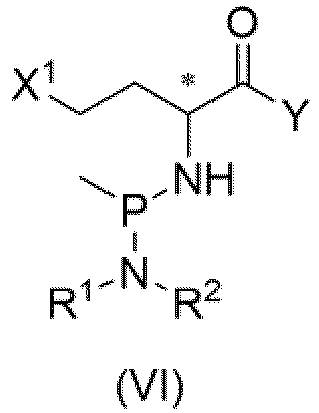
- the present disclosure provides a compound of formula (VI) or its salt or enantiomer, or a mixture of its enantiomers in any ratio; where X 1 , Y, R 1 , R 2 , and * are as defined above.
- the compound of formula (VI) can be prepared with reference to the first aspect of the present disclosure.
- the present disclosure provides a method of preparing a compound of formula (VI) or its salt or enantiomer, or a mixture of its enantiomers in any ratio, and the method includes subjecting a compound of formula (II) to a reaction with any one of the following compounds or mixtures: a compound of formula (IV); a compound of formula (V); a compound of formula (IV) and a compound of formula (V); a compound of formula (IV) and a compound of formula (VII); a compound of formula (V) and a compound of formula (VII); or a compound of formula (IV), a compound of formula (V), and a compound of formula (VII); where X 1 , X 2 , Y, R 1 , R 2 , R 9 , R 10 , and * are as defined above.
- the present disclosure provides a method of preparing a compound of formula (VI) or its salt or enantiomer, or a mixture of its enantiomers in any ratio, and the method includes subjecting a compound of formula (II) to a reaction with a compound of formula (VII) and a compound of formula (VIII); where X 1 , X 2 , Y, R 1 , R 2 , and * are as defined above.
- the present disclosure provides a composition including a compound of formula (IV) and a compound of formula (V); a compound of formula (IV) and a compound of formula (VII); or a compound of formula (IV), a compound of formula (V), and a compound of formula (VII); where X 2 , R 1 , R 2 , R 9 , R 10 , and * are as defined above.
- the present disclosure provides use of the composition in the ninth aspect in preparation of glufosinate represented by formula (I) or its salt or enantiomer, or a mixture of its enantiomers in any ratio:
- the compound (II-2) (32.84g, 0.163mol, 0.95eq.) was added into 50g of toluene, and the above compound (V-1) was added dropwise under ice bath cooling.
- the inner temperature of the reaction solution was controlled at 5°C to 10°C.
- the reaction was held for 2 hours after the dripping was completed.
- Nitrogen pressure filtration was performed, and the filter cake was washed twice with toluene.
- the combined filtrate was the solution of compound (VI-1), which can be directly used for the next reaction.
- the compound (II-2) (32.84g, 0.163mol, 0.95eq.) was added into 50g of toluene, and the above compound (V-2) was added dropwise under ice bath cooling.
- the inner temperature of the reaction solution was controlled at 5°C to 10°C.
- the reaction was held for 2 hours after the dropwise addition was completed.
- Nitrogen pressure filtration was performed, and the filter cake was washed twice with toluene.
- the combined filtrate was the solution of compound (VI-2), which can be directly used for the next reaction.
- the compound (II-3) (27.48g, 0.166mol, 0.97eq.) was added into 50g of toluene, then dimethylamine (7.48g, 0.166mol, 0.97eq.) was slowly added under ice bath cooling, the inner temperature of the reaction solution was controlled at 5°C to 10°C, then the above compound (IV-2) solution was added dropwise. The reaction was held for 2 hours after the dripping was completed. Nitrogen pressure filtration was performed, and the filter cake was washed twice with toluene. The combined filtrate was the solution of compound (VI-4), which can be directly used for the next reaction.
- the compound (II-4) (32.84g, 0.163mol, 0.95eq.) was added into 50g of toluene, and the above compound (V-1) was added dropwise under ice bath cooling.
- the inner temperature of the reaction solution was controlled at 5°C to 10°C.
- the reaction was held for 2 hours after the addition was completed.
- Nitrogen pressure filtration was performed, and the filter cake was washed twice with toluene.
- the combined filtrate was the solution of compound (VI-3), which can be directly used for the next reaction.
- the compound (II-4) (32.84g, 0.163mol, 0.95eq.) was added into 50g of toluene, and the above compound (V-2) was added dropwise under ice bath cooling.
- the inner temperature of the reaction solution was controlled at 5°C to 10°C.
- the reaction was held for 2 hours after the dropwise addition was completed.
- Nitrogen pressure filtration was performed, and the filter cake was washed twice with toluene.
- the combined filtrate was the solution of compound (VI-4), which can be directly used for the next reaction.
- the compound (II-1) (33.78g, 0.204mol, 0.95eq.) was added into 150g of toluene.
- Methyldichlorophosphine (25.1g, 0.215mol, 1.0eq.) was then added dropwise under ice bath cooling, simultaneously ammonia gas (18.46g, 1.084mol, 5.05eq.) was slowly Injected into the mixture.
- the inner temperature of the reaction solution was controlled at 5°C to 10°C.
- the reaction was held for 2 hours after the dropwise addition was completed, nitrogen pressure filtration was then performed, and the filter cake was washed twice with toluene.
- the combined filtrate was the solution of compound (VI-5), which can be directly used for the next reaction.
Landscapes
- Chemical & Material Sciences (AREA)
- Organic Chemistry (AREA)
- Health & Medical Sciences (AREA)
- Life Sciences & Earth Sciences (AREA)
- Biochemistry (AREA)
- General Health & Medical Sciences (AREA)
- Molecular Biology (AREA)
- Organic Low-Molecular-Weight Compounds And Preparation Thereof (AREA)
Description
- The present disclosure relates to the field of herbicides, and specifically, to methods of preparing glufosinate.
- Glufosinate is developed and produced by Hoechst AG in Germany with a chemical name of 4-[hydroxy(methyl)phosphono]-DL-homoalanine, which is a glutamine synthesis inhibitor and a non-selective contact herbicide. Its mechanism of action is to inhibit the activity of glutamine synthetase in plants, resulting in blocked glutamine synthesis, nitrogen metabolism disorder, and ammonium ion accumulation, thereby hindering the metabolism of the plants, and causing plants' death.
- Glufosinate has the characteristics such as wide herbicidal spectrum, high activity, low toxicity, easy degradation in soil, safety to crops, small drift, good environmental compatibility, and rapid herbicidal action, and can control and quickly kill over 100 kinds of annual and perennial broad-leaved weeds and grass weeds, such as crabgrass and ryegrass.
- In glufosinate racemates, only the L-isomer has a herbicidal activity and is easily decomposable in the soil, and thus has low toxicity to humans and animals, which further greatly reduce environmental burdens, and also has better activities and prevention effects against weeds with resistance than the racemates. Although glufosinate still dominates the global market, it is inevitable for the L-isomer to enter mainstream markets with technological innovation and progress.
- The preparation of chiral pure L-glufosinate generally includes chemical and biological methods, and the chemical methods include racemate resolution, asymmetric synthesis and L-amino acid based total synthesis.
-
WO1995023805A1 discloses a method of preparing [L]- or [D]-homoalanin-4-yl-(methyl)phosphonic acid and its salts by the racemic resolution of D,L-homoalanin-4-yl-(methyl)phosphonic acid, via precipitation of one of the diastereoisomeric salts using chiral bases such as quinine or cinchonine. The usage of expensive chiral resolution reagents and low yields make it impractical for industry application. -
US5442088A discloses a method of preparing L-glufosinate hydrochloride by using L-homoserine and its derivatives as starting material via ring-opening chlorination, esterification, Arbuzov reaction with methyl phosphite diester, and finally hydrolysis and purification, as shown below.
- Although the multi-step procedure is straightforward and convenient, the Michaelis-Arbuzov reaction is generally carried out at a relatively high temperature (e.g. 130-140°C, or above) due to the low activity of chlorinated amino acid derivative. Meanwhile, the side reaction between the by-product ethyl chloride and diethyl methylphosphonite occurs at the reaction temperature, which further significantly increases the consumption of diethyl methylphosphonite, and results in low ee of L-isomer by racemization of starting material and product in situ.
-
CN113490671B discloses the preparation method of L-glufosinate using halogenated homoserine esters derivatives with or without amino-protection group as starting materials, comprising condensation and cyclization with monochloromethyl phosphinate, and hydrolyzation, as shown below.
- Multi-step procedures such as cyclization, chlorination, esterification and amino group protection are carried out by using L-homoserine as raw material with obviously prolonged preparation time. In addition, the Arbuzov reaction inevitably generates halogenated alkanes, which are Class III carcinogens destroying ozonosphere, especially the smaller molecular ones.
- In addition, NACHEV I: "Total synthesis and enzyme-substrate interaction of D-, DL-, AND L-phosphinotricine, 'bialapos' (SF-1293) and its cyclic analogs", JOURNAL OF THE CHEMICAL SOCIETY, PERKIN TRANSCATIONS 1, ROYAL SOCIETY OF CHEMOSTRY, CAMRBIDGE, UK, vol. 89, no.1, 1, January 1989 (1989-01-01), pages 125-131, XP002087193 discloses that DL-Phosphonotricine (3) and its cyclic analogue (4) have been synthesized using the four-component isocyanide condensation of Ugi an Ugi-analogous three-component condensation, respectively. High selectivity of the enzyme-substrate interaction was established with the enzymes α-chymotrypsin, phosphodiesterase I, and alkaline mesintericopeptidase, as well as by separation of the racemic mixture to optical antipodes by the α-chymotrypsin.

-
EP4043468A1 discloses a preparation method for glufosinate ammonium or a salt thereof, an enantiomer thereof, or mixtures of the enantiomer thereof in all ratios, comprising reacting a compound of formula (II) or a salt, an enantiomer, or mixtures of the enantiomer in all ratios with one or more compounds of formula (III) or mixtures thereof.
- In recent years, with growing demand for glufosinate, developments and optimizations of the synthesis routes and procedures with mild reaction conditions, higher yield, lower cost, and simple operations are of great significance for reducing use of herbicides and increasing their efficiency.
- For the sake of conciseness, the reference to a compound of formula (N) (e.g., a compound of formula (III)) described hereinafter may also include any optical isomer, geometric isomer, tautomer, isomer mixture, or agriculturally acceptable salts of the compound of formula (N).
- The term "optical isomer" refers to various isomers formed by a compound which has one or more chiral centers, with each chiral center having an R configuration or an S configuration. The optical isomers include all diastereoisomers, enantiomers, mesoforms, racemates, or mixtures thereof. For example, the optical isomer can be separated via a chiral chromatographic column or chiral synthesis.
- The term "geometric isomer" refers to a cis isomer, a trans isomer, an E isomer and a Z isomer of a compound containing a double bond therein. The geometric isomer includes a cis isomer, a trans isomer, an E isomer, a Z isomer, or a mixture thereof.
- The term "tautomer" refers to an isomer generated from rapid movement of a specific atom in a molecule between two positions. A person skilled in the art can understand that tautomers can transform into each other, and may coexist when an equilibrium state is reached in a specific state.
- Unless otherwise specified, the reference to a compound of formula (N) (e.g., a compound of formula (III)) described herein also includes an isotope-labeled compound obtained by substituting any atom in the compound with its isotopic atom. That is, the compound of formula (N) in the present disclosure includes all agriculturally acceptable isotopically labeled compounds of the compound of formula (N), where one or more atoms are substituted by an atom having the same atomic number as an atom usually found in nature but a different atomic mass or mass quantity.
- Examples of isotopes suitable for inclusion in the compound in the present disclosure include isotopes of hydrogen, such as 2H(D) and 3H(T); isotopes of carbon, such as 11C, 13C, and 14C; isotopes of chlorine, such as 37Cl; isotopes of fluorine, such as 18F; isotopes of iodine such as 123I and 125I; isotopes of nitrogen such as 13N and 15N; isotopes of oxygen, such as 15O, 17O, and 18O; and isotopes of sulfur such as 35S.
- The isotopically labeled compound of formula (N) can generally be prepared by conventional techniques known to a person skilled in the art or by using a suitable isotopically labeled reagent in place of a previously used non-labeled reagent in a method analogous to that described in examples and preparations appended herein.
- The compound of formula (N) may exist in a form of agriculturally acceptable salts such as an acid addition salt and/or a base addition salt of the compound of formula (N). Unless otherwise specified, the "agriculturally acceptable salt" used herein includes an acid addition salt or a base addition salt that may exist in the compound of formula (N).
- The agriculturally acceptable salt of the compound of formula (N) includes the acid addition salt and base addition salt of the compound of formula (N). A suitable acid addition salt is formed by an acid that forms a non-toxic salt. Examples of the acid addition salt include, but are not limited to: acetate, adipate, aspartate, benzoate, benzenesulfonate, bicarbonate/carbonate, bisulfate/sulfate, borate, camphorsulfonate, citrate, cyclamate, edisylate, formate, fumarate, glucoheptonate, gluconate, glucuronic acid salt, hexafluorophosphate, 2-(4-hydroxybenzyl)benzoate, hydrochloride/chloride, hydrobromide/bromide, hydroiodide/iodide, 2-isethionate, lactate, malate, maleate, malonate, methanesulfonate, methylsulfate, naphthalate, 2-naphthalenesulfonate, nicotinate, nitrate, orotate, oxalate, palmitate, phosphate/hydrogen phosphate/dihydrogen phosphate, pyroglutamate, glucarate, stearate, salicylate, tannate, tartrate, tosylate, and trifluoroacetate. A suitable acid addition base is formed by a base that forms a non-toxic salt. Examples of the base addition salt include, but are not limited to, ammonium, aluminum, arginine, calcium, choline, diethylamine, diethanolamine, glycine, lysine, magnesium, meglumine, ethanolamine, potassium, sodium, lithium, tromethamine, and zinc salt. Half-salts of acids and bases such as hemisulfate and hemicalcium salts may also be formed. A method of preparing the agriculturally acceptable salt of the compound described herein is known to a person skilled in the art.
- Some compounds in the present disclosure can be present in an unsolvated form or a solvated form (including a hydrated form). In general, the compounds of formula (N) fall within the scope of the present disclosure regardless of whether the compounds exist in the solvated or unsolvated form.
- Some compounds in the present disclosure may exist in different crystalline or amorphous forms, and the compounds of formula (N) fall within the scope of the present disclosure regardless of the form of the compounds.
- To avoid ambiguity, definitions of terms used herein are provided below. Unless otherwise specified, the terms used herein have the same meanings as those described blow.
- As used in the specification of the disclosure and the appended claims, the singular forms, e.g., "a," "an" and "the" are intended to include the plural forms as well, unless the context clearly indicates otherwise.
- A term "substituted" used herein means that one or more (preferably, 1 to 5, or more preferably, 1 to 3) hydrogen atoms in a group are independently replaced by a corresponding number of substituents.
- A term "independently" used herein means that when the number of substituents is greater than one, these substituents may be the same or different.
- A term "optional" or "optionally" used herein means that an event described by the term may or may not occur. For example, a group "optionally substituted" means that the group may be unsubstituted or substituted.
- A term "heteroatom" used herein represents oxygen (O), nitrogen (N), or S(O)m (where m may be 0, 1, or 2, namely, a sulfur atom S, a sulfoxide group SO, or a sulfonyl group S(O)2).
- A term "alkyl group" used herein refers to saturated aliphatic hydrocarbon, including straight and branched chains. In some embodiments, an alkyl group has, for example, 1-6 or 1-3 carbon atoms. For example, the term "C1-C6 alkyl group" refers to a straight or branched chain radical having 1 to 6 carbon atoms. A definition of the term "C1-C6 alkyl group" includes terms "C1-C6 alkyl group", "C1-C3 alkyl group", and "C1-C4 alkyl group". Examples of the alkyl group include, but are not limited to, a methyl group, an ethyl group, a propyl group, an isopropyl group, a butyl group, an isobutyl group, a sec-butyl group, a tert-butyl group, a pentyl group, a 2-pentyl group, a 3-pentyl group, an isopentyl group, a neopentyl group, an (R)-2-methylbutyl group, an (S)-2-methylbutyl group, a 3-methylbutyl group, a 2,3-dimethylpropyl group, a 2,3-dimethylbutyl group, a hexyl group, and the like.
- A term "C3-C6 cycloalkyl group" used herein refers to a cycloalkyl group having 3 to 6 ring-forming carbon atoms. For example, the C3-C6 cycloalkyl group includes a cyclopropyl group, a cyclobutyl group, a cyclopentyl group, or a cyclohexyl group.
- A term "n-membered heterocycloalkyl group" used herein refers to a cycloalkyl group having m ring-forming carbon atoms and (n-m) ring-forming heteroatoms, where the heteroatom is at least one selected from N, O, and S. For example, three-membered to six-membered heterocycloalkyl groups include, but are not limited to, oxetane, thietane, azetidine, tetrahydrofuran, tetrahydrothiophene, pyrrolidine, tetrahydropyran, tetrahydrothiopyran, piperidine, morpholine, and piperazine.
- A term "C6-C10 aryl group" used herein refers to an aryl group having an aromatic ring including 6-10 carbon atoms, or preferably, a phenyl group.
- A term "n-membered heteroaryl group" used herein refers to a heteroaryl group having m carbon atoms forming an aromatic ring and (n-m) heteroatoms forming an aromatic ring, where the heteroatom is at least one selected from N, O, and S. For example, five-membered to ten-membered heteroaryl groups include, but are not limited to, pyrazine, pyrazole, pyrrole, furan, thiophene, thiazole, and pyridine.
- A term "haloalkyl group" used herein refers to an alkyl group having one or more halogen substituents (at most a perhaloalkyl group, that is, each hydrogen atom of the alkyl group is substituted by a halogen atom). For example, a term "C1-C6 haloalkyl group" refers to a C1-C6 alkyl group having one or more halogen substituents (at most a perhaloalkyl group, that is, each hydrogen atom of the alkyl group is substituted by a halogen atom). For another example, a term "C1 haloalkyl group" refers to a methyl group having 1, 2, or 3 halogen substituents. Examples of the haloalkyl group include CF3, C2F5, CHF2, CH2F, CH2CF3, CH2Cl, and the like.
- Herein, number ranges related to the number of substituents, the number of carbon atoms, and the number of ring atoms represent enumerations of all integers within the range, and the range is only used as a simplified representation. For example, "1-4 substituents" represent 1, 2, 3, or 4 substituents; and "3-8 carbon atoms" represent 3, 4, 5, 6, 7, or 8 carbon atoms. Therefore, the number ranges related to the number of substituents, the number of carbon atoms, and the number of ring atoms also cover any one of its sub-ranges, and each sub-range is also construed as being disclosed herein.
- According to a first aspect, the present disclosure provides a method of preparing glufosinate represented by formula (I) or its salt or enantiomer, or a mixture of its enantiomers in any ratio, comprising:


- X1 is halogen;
- Y is -OR3 or -N(R4)(R5);
- R1 and R2 are each independently selected from hydrogen, a C1-C6 alkyl group, a C2-C6 alkenyl group, a C2-C6 alkynyl group, a C3-C6 cycloalkyl group, a three-membered to six-membered heterocycloalkyl group, a C6-C10 aryl group, or a five-membered to ten-membered heteroaryl group, or R1 and R2 form a three-membered to six-membered heterocycloalkyl group together with the N atom to which they are attached, where the C1-C6 alkyl group, the C2-C6 alkenyl group, the C2-C6 alkynyl group, the C3-C6 cycloalkyl group, the three-membered to six-membered heterocycloalkyl group, the C6-C10 aryl group, or the five-membered to ten-membered heteroaryl group is optionally substituted by halogen, a carboxyl group, a hydroxyl group, a cyano group, an amino group, a nitro group, a C1-C3 alkyl group, a C1-C3 haloalkyl group, a C1-C3 alkoxy group, a C3-C6 cycloalkyl group, or a C6-C10 aryl group;
- R3, R4, and R5 are each independently selected from hydrogen, a C1-C6 alkyl group, a C2-C6 alkenyl group, a C2-C6 alkynyl group, a C3-C6 cycloalkyl group, a three-membered to six-membered heterocycloalkyl group, a C6-C10 aryl group, or a five-membered to ten-membered heteroaryl group, or R4 and R5 form a three-membered to six-membered heterocycloalkyl group together with the N atom to which they are attached, where the C1-C6 alkyl group, the C2-C6 alkenyl group, the C2-C6 alkynyl group, the C3-C6 cycloalkyl group, the three-membered to six-membered heterocycloalkyl group, the C6-C10 aryl group, or the five-membered to ten-membered heteroaryl group is optionally substituted by halogen, a carboxyl group, a hydroxyl group, a cyano group, an amino group, a nitro group, a C1-C3 alkyl group, a C1-C3 haloalkyl group, a C1-C3 alkoxy group, a C3-C6 cycloalkyl group, or a C6-C10 aryl group; and
- * denotes a chiral carbon atom.
- According to the present disclosure, the compound of formula (I) may be present in a form of a single enantiomer. For example, in an embodiment of the present disclosure, the compound of formula (I) may be pure L-glufosinate or D-glufosinate. In addition, the compound of formula (I) may also be present in a form of the mixture of its enantiomers, and each of the enantiomers may be present in any ratio in the mixture of enantiomers. For example, in an embodiment of the present disclosure, the mixture of enantiomers in any ratio of the compound of formula (I) includes L-glufosinate and D-glufosinate in a ratio of 0.1:99.9 to 99.9:0.1. However, because only L-glufosinate is active, the L-enantiomer of the compound of formula (I) in the present disclosure may be preferably present in a greater ratio in the mixture of enantiomers. For example, in an embodiment, the mixture of enantiomers in any ratio of the compound of formula (I) includes L-glufosinate and D-glufosinate in a ratio of 50: 50 to 99.9: 0.1 (for example, 60: 40, 70: 30, 80: 20, 90: 10, 95: 5, or 99: 1).
- In the preparation method in the first aspect of the present disclosure, the compound of formula (III) can be hydrolyzed directly in a neutral condition, that is, a hydrolysis reaction can be performed directly in presence of water. In addition, the hydrolysis can also preferably be performed in presence of an acid or an alkali. More specifically, the acids may be at least one selected from hydrochloric acid, sulfuric acid, hydrobromic acid, hydroiodic acid, phosphoric acid, nitric acid, formic acid, and acetic acid, and is preferably hydrochloric acid or sulfuric acid; and the alkali can be selected from hydroxide, carbonate, bicarbonate, or basic carbonate of alkali metal or alkaline earth metal, ammonia, organic alkali, or organic amine, and is preferably sodium hydroxide or triethylamine. In addition, in an embodiment of the present disclosure, the hydrolysis can be performed, for example, at a temperature of 30°C to 140°C (for example, 40°C, 50°C, 60°C, 70°C, 80°C, 90°C, 100°C, 110°C, 120°C, or 130°C) or preferably 70°C to 110°C.
- As a preferable solution of the compound of formula (III), R1, R2, R3, R4, and R5 may be each independently selected from hydrogen, a C1-C6 alkyl group, or a C3-C6 cycloalkyl group, and is preferably hydrogen, a methyl group, an ethyl group, a propyl group, an isopropyl group, a butyl group, an isobutyl group, a tert-butyl group, a pentyl group, a hexyl group, a cyclopropyl group, a cyclobutyl group, a cyclopentyl group, or a cyclohexyl group. In addition, in a preferable embodiment, when used herein, halogen may be selected from fluorine, chlorine, or bromine; the C1-C6 alkyl group may be selected from a methyl group, an ethyl group, a propyl group, or an isopropyl group; the C2-C6 alkenyl group may be selected from a vinyl group, a propenyl group, a 1-butenyl group, a 2-butenyl group, or an isobutenyl group; the C2-C6 alkynyl group may be selected from an ethynyl group, a propynyl group, a 1-butynyl group, or 2-butynyl group; the C3-C6 cycloalkyl group may be selected from a cyclopropyl group, a cyclobutyl group, a cyclopentyl group, or a cyclohexyl group; the three-membered to six-membered heterocycloalkyl group may be selected from a cyclopropyl group, a cyclobutyl group, a cyclopentyl group, or a cyclohexyl group including at least one heteroatom of N, O, or S; the C6-C10 aryl group may be selected from a phenyl group or a naphthyl group; and/or the five-membered to ten-membered heteroaryl group may be selected from a pyrazinyl group, a pyrazolyl group, a pyrrolyl group, a furyl group, a thienyl group, a thiazolyl group, or a pyridyl group.
- As an alternative solution to the compound of formula (III), R1, R2, R3, R4, and R5 may be each independently selected from -Si(R6)(R7)(R8), and R6, R7, and R8 are each independently selected from hydrogen, a C1-C6 alkyl group, a C2-C6 alkenyl group, a C2-C6 alkynyl group, a C3-C6 cycloalkyl group, a three-membered to six-membered heterocycloalkyl group, a C6-C10 aryl group, or a five-membered to ten-membered heteroaryl group, where the C1-C6 alkyl group, the C2-C6 alkenyl group, the C2-C6 alkynyl group, the C3-C6 cycloalkyl group, the three-membered to six-membered heterocycloalkyl group, the C6-C10 aryl group, or the five-membered to ten-membered heteroaryl group is optionally substituted by halogen, a carboxyl group, a hydroxyl group, a cyano group, an amino group, a nitro group, a C1-C3 alkyl group, a C1-C3 haloalkyl group, a C1-C3 alkoxy group, a C3-C6 cycloalkyl group, or a C6-C10 aryl group.
- Further, the preparation method in the first aspect of the present disclosure may further include a step of preparing the compound of formula (III).
- In an embodiment of the present disclosure, the compound of formula (III) is prepared by subjecting a compound of formula (II)


- X2 is halogen;
- R1, R2, X1, Y, and * are as defined above; and
- R9 and R10 are each independently selected from hydrogen, a C1-C6 alkyl group, a C2-C6 alkenyl group, a C2-C6 alkynyl group, a C3-C6 cycloalkyl group, a three-membered to six-membered heterocycloalkyl group, a C6-C10 aryl group, or a five-membered to ten-membered heteroaryl group, or R9 and R10 form a three-membered to six-membered heterocycloalkyl group together with the N atom to which they are attached, where the C1-C6 alkyl group, the C2-C6 alkenyl group, the C2-C6 alkynyl group, the C3-C6 cycloalkyl group, the three-membered to six-membered heterocycloalkyl group, the C6-C10 aryl group, or the five-membered to ten-membered heteroaryl group is optionally substituted by halogen, a carboxyl group, a hydroxyl group, a cyano group, an amino group, a nitro group, a C1-C3 alkyl group, a C1-C3 haloalkyl group, a C1-C3 alkoxy group, a C3-C6 cycloalkyl group, or a C6-C10 aryl group.
- In the step of preparing the compound of formula (III) described above, the compound of formula (IV), the compound of formula (V), and/or the compound of formula (VII) used can be added to a reaction system as initial reactants, or can also be obtained by in situ reaction of another compound. For example, the compound of formula (IV) can be obtained by the in-situ reaction of the compound of formula (VII) and the compound NHR1R2 of formula (VIII), or obtained by the in-situ reaction of the compound of formula (V) and the compound of formula (VII); and the compound of formula (V) (herein, R9 and R10 can correspond to R1 and R2, respectively) can be obtained by the in-situ reaction of the compound of formula (VII) and the compound of formula (VIII). As an alternative solution for preparing the compound of formula (III), the compound of formula (III) can also be obtained by subjecting the compound of formula (II) to a reaction with the compound of formula (VII) and the compound of formula (VIII). Further, in the foregoing various steps for preparing the compound of formula (III), there is no limitation on a feeding order of various raw materials, that is, the various raw materials can be fed into the reaction system in any order.
- According to the present disclosure, the foregoing steps for preparing the compound of formula (III) can preferably be performed in presence of a deacid reagent. Specifically, the deacid reagent may be selected from NR11R12R13, where R11, R12, and R13 are each independently selected from hydrogen, a C1-C6 alkyl group, a C2-C6 alkenyl group, a C2-C6 alkynyl group, a C3-C6 cycloalkyl group, a three-membered to six-membered heterocycloalkyl group, a C6-C10 aryl group, or a five-membered to ten-membered heteroaryl group, or any two of R11, R12, and R13 form a three-membered to six-membered heterocycloalkyl group together with the N atom to which they are attached, where the C1-C6 alkyl group, the C2-C6 alkenyl group, the C2-C6 alkynyl group, the C3-C6 cycloalkyl group, the three-membered to six-membered heterocycloalkyl group, the C6-C10 aryl group, or the five-membered to ten-membered heteroaryl group is optionally substituted by halogen, a carboxyl group, a hydroxyl group, a cyano group, an amino group, a nitro group, a C1-C3 alkyl group, a C1-C3 haloalkyl group, a C1-C3 alkoxy group, a C3-C6 cycloalkyl group, or a C6-C10 aryl group.
- In addition, since the compound NHR1R2 of the formula (VIII) conforms to a general formula of the foregoing deacid reagent, that is, the compound NHR1R2 meets a requirement for acting as the deacid reagent, an excess of the compound of the formula (VIII) can be added as a deacid reagent that is preferably present in the reaction. In a preferred embodiment of the present disclosure, the deacid reagent may be at least one selected from excesses of the compound of formula (VIII), ammonia, triethylamine, morpholine, and piperidine.
- Further, the foregoing step for preparing the compound of formula (III) can be performed in absence of a solvent or in presence of an organic solvent. In an embodiment of the present disclosure, the organic solvent is selected from aromatic hydrocarbon solvents (for example, benzene, xylene, trimethylbenzene, ethylbenzene, diethylbenzene, cumene, diisopropylbenzene, halogenated benzene, or dihalobenzene), alkane solvents (for example, n-hexane, cyclohexane, n-heptane, methylcyclohexane, or ethylcyclohexane), halogenated hydrocarbon solvents (for example, dichloromethane, dichloroethane, chloroform, or carbon tetrachloride), ether solvents (for example, tetrahydrofuran, methyl tetrahydrofuran, methyl tert-butyl ether, diisopropyl ether, methyl cyclopentyl ether, ethylene glycol dimethyl ether, dioxygen hexacyclic, or diglyme), ester solvents (for example, ethyl acetate, isopropyl acetate, or butyl acetate), amide solvents (for example, N,N-dimethylformamide, N,N-dimethylacetamide, hexamethylphosphoric triamide, N-methylpyrrolidone, or 1,3-dimethyl-2-imidazolinone), or sulfur-containing solvents (for example, dimethylsulfoxide or sulfolane). Preferably, the organic solvent is at least of selected from toluene and chlorobenzene.
- Consumption of each reactant and reaction conditions in the foregoing step for preparing the compound of formula (III) can be adjusted based on an actual need and knowledge of a person skilled in the art. In an embodiment of the present disclosure, a molar ratio among the compound of formula (II), total usage of the compounds of formulas (IV), (V) and (VII), and the deacid reagent may be 1: (0.9-5): (0.9-5), or preferably 1: (1.05-1.5): (1.05-1.5). In another embodiment of the present disclosure, the reaction may be performed at a temperature of -20°C to 10°C (for example, -10°C, -5°C, 0°C, or 5°C) for 1 to 15 hours (for example, 2h, 4h, 6h, or 12h), and then at 10°C to 120°C (for example, 20°C, 40°C, 60°C, 80°C, or 100°C) for 0.5 to 24 hours (for example, 1h, 2h, 4h, 6h, 12h, or 18h).
- As an alternative solution for preparing the compound of formula (III), the compound of formula (III) may be further prepared in a method including steps of:
- a) subjecting a compound of formula (II) to a reaction with any one of the following compounds or mixtures: a compound of formula (IV); a compound of formula (V); a compound of formula (IV) and a compound of formula (V); a compound of formula (IV) and a compound of formula (VII); a compound of formula (V) and a compound of formula (VII); or a compound of formula (IV), a compound of formula (V), and a compound of formula (VII);


- b) preparing the compound of formula (III) via a reaction with the compound of formula (VI);
- In the alternative solution, a reaction raw material is basically the same as that in the foregoing solution except that it is clarified that the compound of formula (VI) obtained is used as an intermediate for a subsequent reaction. Therefore, for selection of the reaction raw material, the reaction system, reaction conditions, and the like in the alternative solution, refer to the foregoing solution for preparing the compound of formula (III). Details are not described herein again to avoid unnecessary redundancy. Taking the reaction condition as an example for description, the reaction in step a) may be performed at a temperature of -20°C to 10°C for 1 to 15 hours; and the reaction in step b) is performed at a temperature of 10°C to 120°C for 0.5 to 24 hours.
- According to a second aspect, the present disclosure provides a method of preparing glufosinate represented by formula (I) or its salt or enantiomer, or a mixture of its enantiomers in any ratio, including steps of:


where X1, X2, Y, R1, R2, R9, R10, and * are as defined above. - For the organic solvent, the hydrolysis condition, and the like in the preparation method in the second aspect of the present disclosure, refer to the first aspect of the present disclosure. Details are not described herein again to avoid unnecessary redundancy.
- According to a third aspect, the present disclosure provides a compound of formula (III) or its salt or enantiomer, or a mixture of its enantiomers in any ratio;

- Preferably, the compound of formula (III) can be prepared with reference to the first aspect of the present disclosure.
- According to a fourth aspect, the present disclosure provides a method of preparing a compound of formula (III) or its salt or enantiomer, or a mixture of its enantiomers in any ratio, including a step of:


- According to a fifth aspect, the present disclosure provides a method of preparing a compound of formula (III) or its salt or enantiomer, or a mixture of its enantiomers in any ratio,


- According to a sixth aspect, the present disclosure provides a compound of formula (VI) or its salt or enantiomer, or a mixture of its enantiomers in any ratio;

- Preferably, the compound of formula (VI) can be prepared with reference to the first aspect of the present disclosure.
- According to a seventh aspect, the present disclosure provides a method of preparing a compound of formula (VI) or its salt or enantiomer, or a mixture of its enantiomers in any ratio,

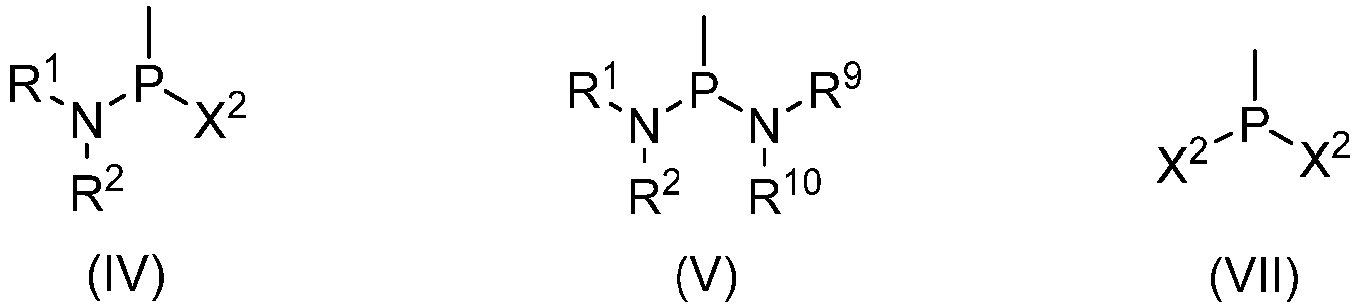
- According to an eighth aspect, the present disclosure provides a method of preparing a compound of formula (VI) or its salt or enantiomer, or a mixture of its enantiomers in any ratio,


- According to a ninth aspect, the present disclosure provides a composition including a compound of formula (IV) and a compound of formula (V); a compound of formula (IV) and a compound of formula (VII); or a compound of formula (IV), a compound of formula (V), and a compound of formula (VII);

- According to a tenth aspect, the present disclosure provides use of the composition in the ninth aspect in preparation of glufosinate represented by formula (I) or its salt or enantiomer, or a mixture of its enantiomers in any ratio:

- A person skilled in the art can understand that a definition and a preferred item described in one aspect of the present disclosure are also applicable to other aspects. A person skilled in the art can understand that the embodiments of various aspects of the present disclosure can be combined in various manners without departing from the subject and concept of the present disclosure, and these combinations also fall within the scope of the present disclosure.
- Compared with the prior art, the present disclosure at least has advantageous effects in that:
- 1. Due to the distinctive reaction mechanism, the halogenated hydrocarbon by-product in the Michaelis-Arbuzov reaction can be avoided. The halogenated hydrocarbon by-product is usually ethyl chloride and methyl chloride, both of which are Class III carcinogens and have a destructive effect on ozone in the aerosphere. Accordingly, the equipment and engineering investments required for the separation, purification, and collection of the foregoing by-products are eliminated, and the potential environmental and safety hazards brought by the foregoing by-products are also avoided.
- 2. The reaction is milder than the Michaelis-Arbuzov reaction, and reaction temperature can be reduced by 30°C to 80°C compared with that in the Michaelis-Arbuzov reaction, and by virtue of this, racemization of the L configuration at high temperature can also be reduced when L-glufosinate is prepared, thereby improving purity of the L configuration product.
- 3. The source of the raw material is simplified, and methyldichlorophosphine is directly used as the raw material without using methyl phosphite diester as the intermediate, which reduces the cost of the raw material.
- The present disclosure is further described below with reference to examples, but these examples are not intended to limit the scope of the present disclosure. Unless otherwise stated, all reactants used in the examples are commercially available; and instruments and devices used in synthesis experiments and product analyses and detection are all conventional instruments and devices commonly used in organic syntheses.
-

-

- Diethylamine (26.28g, 0.359mol, 2.1eq.) was added into 100g of toluene, the mixture was cooled to -5°C to 5°C in a nitrogen atmosphere, and methyldichlorophosphine (20g, 0.171mol, 1.0eq.) was then added dropwise with the temperature of the mixture maintained at -5°C to 5°C. After the addition was completed, compound (IV-1) was obtained and directly used for the next reaction after 0.5 hour of reaction at a constant temperature.
- m/z (ESI) 154.08 ([M+1]+, 100%); 31P NMR (33 MHz) δ: 144.57.
- In a nitrogen atmosphere, the compound (II-1) (26.92g, 0.163mol, 0.95eq.) and diethylamine (11.89g, 0.163mol, 0.95eq.) was added successively into 50g of toluene. After stirring evenly, the above compound (IV-1) was added dropwise under ice bath cooling. The inner temperature of the reaction solution was controlled at 5 to 10°C, and the reaction was held for 2 hours after the dropwise addition was completed. Nitrogen pressure filtration was performed, and the filter cake was washed twice with toluene. The combined filtrate was the solution of compound (VI-1), which can be directly used for the next reaction.
- m/z (ESI) 283.11 ([M+1]+, 100%).
- In a nitrogen atmosphere, the above compound (VI-1) solution was slowly heated to 80 to 85°C for 10 hours to obtain a solution of compound (III-1), which can be directly used for the next reaction.
- m/z (ESI) 247.18 ([M-Cl]+, 100%); 31P NMR (33 MHz) δ: 71.40.
- Added 150g of 30% hydrochloric acid into the above compound (III-1) solution and heated it to 95 to 105°C for reaction. After the reaction was completed, the resulting mixture was distilled under reduced pressure, and then 150g of absolute ethanol was added, the mixture was briefly boiled and cooled to crystallize, filtered and dried to obtain a white crystal, namely, 30.1g of the target product (I-1), yield: 83.5%, assay: 98.1%, and 97.3% ee value.
- m/z (ESI) 182.07 ([M+1]+, 100%);
- 31P NMR (243 MHz, D2O) δ: 53.67;
- 1H NMR (600 MHz, D2O) δ: 4.10 (t, J = 6.1 Hz, 1H), 2.25 - 2.05 (m, 2H), 1.99 - 1.75 (m, 2H), 1.47 (d, J = 14.1 Hz, 3H);
- 13C NMR (151 MHz, D2O) δ: 171.29, 52.96 (d, J = 16.6 Hz), 25.25 (d, J = 93.0 Hz), 22.72 (d, J = 2.6 Hz), 13.61 (d, J = 92.5 Hz).
-

-

- Slowly added dimethylamine (16.20g, 0.360mol, 2.1eq.) into 100g of pre cooled toluene to -5°C to 5°C in a nitrogen atmosphere, and then methyldichlorophosphine (20g, 0.171mol, 1.0eq.) was added dropwise with the temperature of the mixture maintained at -5°C to 5°C. After the dropwise addition was completed, compound (IV-2) was obtained and directly used for the next reaction after 0.5 hour of reaction at a constant temperature.
- m/z (ESI) 126.04 ([M+1]+, 100%); 31P NMR (33 MHz) δ: 150.61.
- In a nitrogen atmosphere, the compound (II-1) (27.20g, 0.164mol, 0.96eq.) was added into 50g of toluene. Dimethylamine (7.41g, 0.164mol, 0.96eq.) was slowly added under ice bath cooling, and the inner temperature of the reaction solution was controlled at 5°C to 10°C, then the above compound (IV-2) solution was added dropwise. The reaction was held for 2 hours after the dropwise addition was completed. Nitrogen pressure filtration was performed, and the filter cake was washed twice with toluene. The combined filtrate was the solution of compound (VI-2), which can be directly used for the next reaction.
- m/z (ESI) 255.12 ([M+1]+, 100%).
- In a nitrogen atmosphere, the above compound (VI-2) solution was slowly heated to 80°C to 85°C for 7 hours to obtain a solution of compound (III-2), which can be directly used for the next reaction.
- m/z (ESI) 219.14 ([M-Cl]+, 100%); 31P NMR (33 MHz) δ: 78.20.
- Added 150g of 30% hydrochloric acid into the above compound (III-2) solution and heated it to 95°C to 105°C for reaction. After the reaction was completed, the resulting mixture was distilled under reduced pressure, and then 150g of absolute ethanol was added, the mixture was briefly boiled and cooled to crystallize, filtered and dried to obtain a white crystal, namely, 28.7g of the target product (I-1), yield: 78.5%, assay: 97.6%, and 95.3% ee value.
-

-

- Diethylamine (51.30g, 0.701mol, 4.1eq.) was added into 150g of toluene, the mixture was cooled to -5°C to 5°C in a nitrogen atmosphere, and methyldichlorophosphine (20g, 0.171mol, 1.0eq.) was then added dropwise with the temperature of the mixture maintained at -5°C to 5°C. After the dropwise addition was completed, compound (V-1) was obtained and directly used for the next reaction after 0.5 hour of reaction at a constant temperature.
- m/z (ESI) 191.17 ([M+1]+, 100%); 31P NMR (33 MHz) δ: 79.29.
- In a nitrogen atmosphere, the compound (II-2) (32.84g, 0.163mol, 0.95eq.) was added into 50g of toluene, and the above compound (V-1) was added dropwise under ice bath cooling. The inner temperature of the reaction solution was controlled at 5°C to 10°C. The reaction was held for 2 hours after the dripping was completed. Nitrogen pressure filtration was performed, and the filter cake was washed twice with toluene. The combined filtrate was the solution of compound (VI-1), which can be directly used for the next reaction.
- m/z (ESI) 283.13 ([M+1]+, 100%).
- In a nitrogen atmosphere, the above compound (VI-1) solution was slowly heated to 80 to 85°C for 10 hours to obtain a solution of compound (III-1), which can be directly used for the next reaction.
- m/z (ESI) 247.17 ([M-Cl]+, 100%); 31P NMR (33 MHz) δ: 71.10.
- Added 150g of 30% hydrochloric acid into the above compound (III-1) solution and heated it to 95°C to 105°C for reaction. After the reaction was completed, the resulting mixture was distilled under reduced pressure, and then 150g of absolute ethanol was added, the mixture was briefly boiled and cooled to crystallize, filtered and dried to obtain a white crystal, namely, 26.7g of the target product (I-1), yield: 73.5%, assay: 97.5%, and 97.5% ee value.
-

-

- Slowly added dimethylamine (31.63g, 0.701mol, 4.1eq.) into 150g of toluene while lowering the temperature to -5°C to 5°C under nitrogen protection. methyldichlorophosphine (20g, 0.171mol, 1.0eq.) was added dropwise while maintaining the system temperature at -5°C to 5°C. After the dropwise addition was completed, compound (V-2) was obtained and directly used for the next reaction after 0.5 hour of reaction at a constant temperature.
- m/z (ESI) 135.09 ([M+1]+, 100%); 31P NMR (33 MHz) δ: 87.63.
- In a nitrogen atmosphere, the compound (II-2) (32.84g, 0.163mol, 0.95eq.) was added into 50g of toluene, and the above compound (V-2) was added dropwise under ice bath cooling. The inner temperature of the reaction solution was controlled at 5°C to 10°C. The reaction was held for 2 hours after the dropwise addition was completed. Nitrogen pressure filtration was performed, and the filter cake was washed twice with toluene. The combined filtrate was the solution of compound (VI-2), which can be directly used for the next reaction.
- m/z (ESI) 255.11 ([M+1]+, 100%).
- In a nitrogen atmosphere, the above compound (VI-2) solution was slowly heated to 80°C to 85°C for 8 hours to obtain a solution of compound (III-2), which can be directly used for the next reaction.
- m/z (ESI) 219.12 ([M-Cl]+, 100%); 31P NMR (33 MHz) δ: 77.90.
- Added 150g of 30% hydrochloric acid into the above compound (III-2) solution and heated it to 95°C to 105°C for reaction. After the reaction was completed, the resulting mixture was distilled under reduced pressure, and then 150g of absolute ethanol was added, the mixture was briefly boiled and cooled to crystallize, filtered and dried to obtain a white crystal, namely, 25.9g of the target product (I-1), yield: 70.5%, assay: 96.2%, and 97.3% ee value.
-

-

- Diethylamine (27.53g, 0.376mol, 2.2eq.) was added into 100g of toluene, the mixture was cooled to -5°C to 5°C in a nitrogen atmosphere, and methyldichlorophosphine (20g, 0.171mol, 1.0eq.) was then added dropwise with the temperature of the mixture maintained at -5°C to 5°C. After the addition was completed, compound (IV-1) was obtained and directly used for the next reaction after 0.5 hour of reaction at a constant temperature.
- In a nitrogen atmosphere, the compound (II-3) (27.77g, 0.168mol, 0.98eq.) and diethylamine (12.26g, 0.168mol, 0.98eq.) was added successively into 50g of toluene. After stirring evenly, the above compound (IV-1) was added dropwise under ice bath cooling. The inner temperature of the reaction solution was controlled at 5°C to 10°C, and the reaction was held for 2 hours after the addition was completed. Nitrogen pressure filtration was performed, and the filter cake was washed twice with toluene. The combined filtrate was the solution of compound (VI-3), which can be directly used for the next reaction.
- In a nitrogen atmosphere, the above compound (VI-3) solution was slowly heated to 80°C to 85°C for 10 hours to obtain a solution of compound (III-3), which can be directly used for the next reaction.
- Added 150g of 30% hydrochloric acid into the above compound (III-3) solution and heated it to 95 to 105°C for reaction. After the reaction was completed, the resulting mixture was distilled under reduced pressure, and then 150g of absolute ethanol was added, the mixture was briefly boiled and cooled to crystallize, filtered and dried to obtain a white crystal, namely, 30.2g of the target product (I-2), yield: 81.5%, assay: 98.5%.
-

-

- Slowly added dimethylamine (16.20g, 0.359mol, 2.1eq.) into 100g of toluene while lowering the temperature to -5 to 5°C under nitrogen protection. methyldichlorophosphine (20g, 0.171mol, 1.0eq.) was added dropwise while maintaining the system temperature at -5 to 5°C. After the addition was completed, compound (IV-2) was obtained and directly used for the next reaction after 0.5 hour of reaction at a constant temperature.
- In a nitrogen atmosphere, the compound (II-3) (27.48g, 0.166mol, 0.97eq.) was added into 50g of toluene, then dimethylamine (7.48g, 0.166mol, 0.97eq.) was slowly added under ice bath cooling, the inner temperature of the reaction solution was controlled at 5°C to 10°C, then the above compound (IV-2) solution was added dropwise. The reaction was held for 2 hours after the dripping was completed. Nitrogen pressure filtration was performed, and the filter cake was washed twice with toluene. The combined filtrate was the solution of compound (VI-4), which can be directly used for the next reaction.
- In a nitrogen atmosphere, the above compound (VI-4) solution was slowly heated to 80°C to 85°C for 6 hours to obtain a solution of compound (III-4), which can be directly used for the next reaction.
- Added 150g of 30% hydrochloric acid into the above compound (III-4) solution and heated it to 95°C to 105°C for reaction. After the reaction was completed, the resulting mixture was distilled under reduced pressure, and then 150g of absolute ethanol was added, the mixture was briefly boiled and cooled to crystallize, filtered and dried to obtain a white crystal, namely, 28.9g of the target product (I-2), yield: 77.5%, assay: 96.8%.
-

-
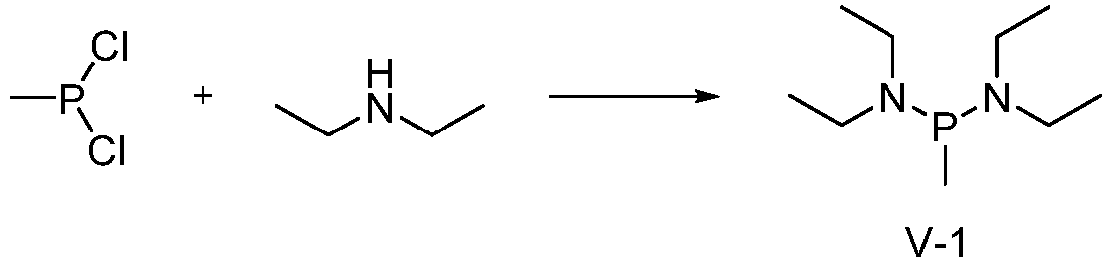
- Diethylamine (52.55g, 0.719mol, 4.2eq.) was added into 150g of toluene, the mixture was cooled to -5°C to 5°C in a nitrogen atmosphere, and methyldichlorophosphine (20g, 0.171mol, 1.0eq.) was then added dropwise with the temperature of the mixture maintained at -5°C to 5°C. After the addition was completed, compound (V-1) was obtained and directly used for the next reaction after 0.5 hour of reaction at a constant temperature.
- In a nitrogen atmosphere, the compound (II-4) (32.84g, 0.163mol, 0.95eq.) was added into 50g of toluene, and the above compound (V-1) was added dropwise under ice bath cooling. The inner temperature of the reaction solution was controlled at 5°C to 10°C. The reaction was held for 2 hours after the addition was completed. Nitrogen pressure filtration was performed, and the filter cake was washed twice with toluene. The combined filtrate was the solution of compound (VI-3), which can be directly used for the next reaction.
- In a nitrogen atmosphere, the above compound (VI-3) solution was slowly heated to 80 to 85°C for 10 hours to obtain a solution of compound (III-3), which can be directly used for the next reaction.
- Added 150g of 30% hydrochloric acid into the above compound (III-3) solution and heated it to 95°C to 105°C for reaction. After the reaction was completed, the resulting mixture was distilled under reduced pressure, and then 150g of absolute ethanol was added, the mixture was briefly boiled and cooled to crystallize, filtered and dried to obtain a white crystal, namely, 25.7g of the target product (I-2), yield: 71.1%, assay: 97.8%.
-

-

- Dimethylamine (31.24g, 0.693mol, 4.05eq.) was slowly added into 150g of toluene, the mixture was cooled to -5°C to 5°C in a nitrogen atmosphere, and methyldichlorophosphine (20g, 0.171mol, 1.0eq.) was then added dropwise with the temperature of the mixture maintained at -5°C to 5°C. After the addition was completed, compound (V-2) was obtained and directly used for the next reaction after 0.5 hour of reaction at a constant temperature.
- In a nitrogen atmosphere, the compound (II-4) (32.84g, 0.163mol, 0.95eq.) was added into 50g of toluene, and the above compound (V-2) was added dropwise under ice bath cooling. The inner temperature of the reaction solution was controlled at 5°C to 10°C. The reaction was held for 2 hours after the dropwise addition was completed. Nitrogen pressure filtration was performed, and the filter cake was washed twice with toluene. The combined filtrate was the solution of compound (VI-4), which can be directly used for the next reaction.
- In a nitrogen atmosphere, the above compound (VI-4) solution was slowly heated to 80°C to 85°C for 8 hours to obtain a solution of compound (III-4), which can be directly used for the next reaction.
- Added 150g of 30% hydrochloric acid into the above compound (III-4) solution and heated it to 95 to 105°C for reaction. After the reaction was completed, the resulting mixture was distilled under reduced pressure, and then 150g of absolute ethanol was added, the mixture was briefly boiled and cooled to crystallize, filtered and dried to obtain a white crystal, namely, 26.4g of the target product (I-2), yield: 72.5%, assay: 97.2%.
-

- In a nitrogen atmosphere, the compound (II-1) (40.37g, 0.244mol, 0.95eq.) and diethylamine (57.24g, 0.783mol, 3.05eq.) was added successively into 150g of toluene. After stirring evenly, methyldichlorophosphine (30.0g, 0.257mol, 1.0eq.) was then added dropwise under ice bath cooling. The inner temperature of the reaction solution was controlled at 5 to 10°C. The reaction was held for 2 hours after the dropwise addition was completed, nitrogen pressure filtration was then performed, and the filter cake was washed twice with toluene. The combined filtrate was the solution of compound (VI-1), which can be directly used for the next reaction.
- In a nitrogen atmosphere, the above compound (VI-1) solution was slowly heated to 80 to 85°C for 10 hours to obtain a solution of compound (III-1), which can be directly used for the next reaction.
- Added 150g of 30% hydrochloric acid into the above compound (III-1) solution and heated it to 95 to 105°C for reaction. After the reaction was completed, the resulting mixture was distilled under reduced pressure, and then 150g of absolute ethanol was added, the mixture was briefly boiled and cooled to crystallize, filtered and dried to obtain a white crystal, namely, 46.0g of the target product (I-1), yield: 85.5%, assay: 98.5%, and 97.5% ee value.
-

- In a nitrogen atmosphere, the compound (II-1) (33.78g, 0.204mol, 0.95eq.) was added into 150g of toluene. Methyldichlorophosphine (25.1g, 0.215mol, 1.0eq.) was then added dropwise under ice bath cooling, simultaneously ammonia gas (18.46g, 1.084mol, 5.05eq.) was slowly Injected into the mixture. The inner temperature of the reaction solution was controlled at 5°C to 10°C. The reaction was held for 2 hours after the dropwise addition was completed, nitrogen pressure filtration was then performed, and the filter cake was washed twice with toluene. The combined filtrate was the solution of compound (VI-5), which can be directly used for the next reaction.
- m/z (ESI) 227.07 ([M+1]+, 100%).
- In a nitrogen atmosphere, the above compound (VI-5) solution was slowly heated to 60°C to 65°C for 10 hours to obtain a solution of compound (III-5), which can be directly used for the next reaction.
- m/z (ESI) 191.11 ([M-Cl]+, 100%);
- Added 150g of 30% hydrochloric acid into the above compound (III-5) solution and heated it to 95 to 105°C for reaction. After the reaction was completed, the resulting mixture was distilled under reduced pressure, and then 150g of absolute ethanol was added, the mixture was briefly boiled and cooled to crystallize, filtered and dried to obtain a white crystal, namely, 31.5g of the target product (I-1), yield: 69.5%, assay: 97.5%, and 97.2% ee value.
-

-

- N-methylaniline (50.73g, 0.473mol, 2.05eq.) was dissolved in 100g toluene, and cooled to -5°C to 5°C under inert atmosphere, then methyldichlorophosphine (27g, 0.231mol, 1.0eq.) was added dropwise while maintaining the inner temperature at - 5°C to 5°C. After the addition was completed, the compound (IV-3) was obtained and directly used for the next reaction after 0.5 hour of reaction at a constant temperature.
- m/z (CI) 188.05 ([M+1]+, 100%); 31P NMR (33 MHz) δ: 140.51.
- In a nitrogen atmosphere, the compound (II-1) (37.48g, 0.226mol, 0.98 eq.) was added into 50g of toluene, and N-methylaniline (24.25g, 0.226mol, 0.98eq.) was added. After stirring evenly, the above compound (IV-3) solution was added dropwise under ice bath cooling, the inner temperature of the reaction solution was controlled at 5°C to 10°C. The reaction was held for 5 hours after dropwise addition was completed. Nitrogen pressure filtration was performed, and the filter cake was washed twice with toluene. The combined filtrate was the solution of compound (VI-6), which can be directly used for the next reaction.
- m/z (ESI) 317.13 ([M+1]+, 100%).
- In a nitrogen atmosphere, the above compound (VI-6) solution was slowly heated to 80 to 85°C for 12 hours to obtain a solution of compound (III-6), which can be directly used for the next reaction.
- m/z (ESI) 281.15 ([M-Cl]+, 100%); 31P NMR (33 MHz) δ: 60.31.
- Added 150g of 30% hydrochloric acid into the above compound (III-6) solution and heated it to 95 to 105°C for reaction. After the reaction was completed, the resulting mixture was distilled under reduced pressure, and then 150g of absolute ethanol was added, the mixture was briefly boiled and cooled to crystallize, filtered and dried to obtain a white crystal, namely, 36.1g of the target product (I-1), yield: 71.5%, assay: 97.5%, and 96.1% ee value.
Claims (29)
- A method of preparing glufosinate represented by formula (I) or its salt or enantiomer, or a mixture of its enantiomers in any ratio, comprising:

 X1 is halogen;Y is -OR3 or -N(R4)(R5);R1 and R2 are each independently selected from hydrogen, a C1-C6 alkyl group, a C2-C6 alkenyl group, a C2-C6 alkynyl group, a C3-C6 cycloalkyl group, a three-membered to six-membered heterocycloalkyl group, a C6-C10 aryl group, or a five-membered to ten-membered heteroaryl group, or R1 and R2 form a three-membered to six-membered heterocycloalkyl group together with the N atom to which they are attached, wherein the C1-C6 alkyl group, the C2-C6 alkenyl group, the C2-C6 alkynyl group, the C3-C6 cycloalkyl group, the three-membered to six-membered heterocycloalkyl group, the C6-C10 aryl group, or the five-membered to ten-membered heteroaryl group is optionally substituted by halogen, a carboxyl group, a hydroxyl group, a cyano group, an amino group, a nitro group, a C1-C3 alkyl group, a C1-C3 haloalkyl group, a C1-C3 alkoxy group, a C3-C6 cycloalkyl group, or a C6-C10 aryl group;R3, R4, and R5 are each independently selected from hydrogen, a C1-C6 alkyl group, a C2-C6 alkenyl group, a C2-C6 alkynyl group, a C3-C6 cycloalkyl group, a three-membered to six-membered heterocycloalkyl group, a C6-C10 aryl group, or a five-membered to ten-membered heteroaryl group, or R4 and R5 form a three-membered to six-membered heterocycloalkyl group together with the N atom to which they are attached, wherein the C1-C6 alkyl group, the C2-C6 alkenyl group, the C2-C6 alkynyl group, the C3-C6 cycloalkyl group, the three-membered to six-membered heterocycloalkyl group, the C6-C10 aryl group, or the five-membered to ten-membered heteroaryl group is optionally substituted by halogen, a carboxyl group, a hydroxyl group, a cyano group, an amino group, a nitro group, a C1-C3 alkyl group, a C1-C3 haloalkyl group, a C1-C3 alkoxy group, a C3-C6 cycloalkyl group, or a C6-C10 aryl group; and* denotes a chiral carbon atom.
 - The method of claim 1, wherein the hydrolysis is performed in presence of an acid or an alkali.
- The method of claim 2, wherein the acid is at least one selected from hydrochloric acid, sulfuric acid, hydrobromic acid, hydroiodic acid, phosphoric acid, nitric acid, formic acid, and acetic acid, and is preferably hydrochloric acid or sulfuric acid.
- The method of claim 2, wherein the alkali is selected from hydroxide, carbonate, bicarbonate or basic carbonate of alkali metal or alkaline earth metal, ammonia, organic alkali, or organic amine, and is preferably sodium hydroxide or triethylamine.
- The method of claim 1, wherein the hydrolysis is performed at a temperature of 30°C to 140°C or preferably 70°C to 110°C.
- The method of claim 1, wherein the enantiomer of the glufosinate is L-glufosinate or D-glufosinate.
- The method of claim 1, wherein the mixture of its enantiomers in any ratio comprises L-glufosinate and D-glufosinate in a ratio of 0.1: 99.9 to 99.9: 0.1, or preferably in a ratio of 50: 50 to 99.9: 0.1.
- The method of claim 1, whereinthe halogen is selected from fluorine, chlorine, or bromine;the C1-C6 alkyl group is selected from a methyl group, an ethyl group, a propyl group, or an isopropyl group;the C2-C6 alkenyl group is selected from a vinyl group, a propenyl group, a 1-butenyl group, a 2-butenyl group, or an isobutenyl group;the C2-C6 alkynyl group is selected from an ethynyl group, a propynyl group, a 1-butynyl group, or 2-butynyl group;the C3-C6 cycloalkyl group is selected from a cyclopropyl group, a cyclobutyl group, a cyclopentyl group, or a cyclohexyl group;the three-membered to six-membered heterocycloalkyl group is selected from a cyclopropyl group, a cyclobutyl group, a cyclopentyl group, or a cyclohexyl group comprising at least one heteroatom of N, O, or S;the C6-C10 aryl group is selected from a phenyl group or a naphthyl group; and/orthe five-membered to ten-membered heteroaryl group is selected from a pyrazinyl group, a pyrazolyl group, a pyrrolyl group, a furyl group, a thienyl group, a thiazolyl group, or a pyridyl group.
- The method of claim 1, wherein R1, R2, R3, R4, and R5 are each independently selected from hydrogen, a C1-C6 alkyl group, or a C3-C6 cycloalkyl group, and is preferably hydrogen, a methyl group, an ethyl group, a propyl group, an isopropyl group, a butyl group, an isobutyl group, a tert-butyl group, a pentyl group, a hexyl group, a cyclopropyl group, a cyclobutyl group, a cyclopentyl group, or a cyclohexyl group.
- The method of claim 1, wherein the compound of formula (III) is prepared by subjecting a compound of formula (II)

 X2 is halogen;R1, R2, X1, Y, and * are as defined in any one of claims 1, 8 or 9; andR9 and R10 are each independently selected from hydrogen, a C1-C6 alkyl group, a C2-C6 alkenyl group, a C2-C6 alkynyl group, a C3-C6 cycloalkyl group, a three-membered to six-membered heterocycloalkyl group, a C6-C10 aryl group, or a five-membered to ten-membered heteroaryl group, or R9 and R10 form a three-membered to six-membered heterocycloalkyl group together with the N atom to which they are attached, wherein the C1-C6 alkyl group, the C2-C6 alkenyl group, the C2-C6 alkynyl group, the C3-C6 cycloalkyl group, the three-membered to six-membered heterocycloalkyl group, the C6-C10 aryl group, or the five-membered to ten-membered heteroaryl group is optionally substituted by halogen, a carboxyl group, a hydroxyl group, a cyano group, an amino group, a nitro group, a C1-C3 alkyl group, a C1-C3 haloalkyl group, a C1-C3 alkoxy group, a C3-C6 cycloalkyl group, or a C6-C10 aryl group.
 - The method of claim 10, wherein the reaction is performed in presence of a deacid reagent.
- The method of claim 11, wherein the deacid reagent is selected from NR11R12R13, wherein R11, R12, and R13 are each independently selected from hydrogen, a C1-C6 alkyl group, a C2-C6 alkenyl group, a C2-C6 alkynyl group, a C3-C6 cycloalkyl group, a three-membered to six-membered heterocycloalkyl group, a C6-C10 aryl group, or a five-membered to ten-membered heteroaryl group, or any two of R11, R12, and R13 form a three-membered to six-membered heterocycloalkyl group together with the N atom to which they are attached, wherein the C1-C6 alkyl group, the C2-C6 alkenyl group, the C2-C6 alkynyl group, the C3-C6 cycloalkyl group, the three-membered to six-membered heterocycloalkyl group, the C6-C10 aryl group, or the five-membered to ten-membered heteroaryl group is optionally substituted by halogen, a carboxyl group, a hydroxyl group, a cyano group, an amino group, a nitro group, a C1-C3 alkyl group, a C1-C3 haloalkyl group, a C1-C3 alkoxy group, a C3-C6 cycloalkyl group, or a C6-C10 aryl group.
- The method of claim 11, wherein a molar ratio among the compound of formula (II), total usage of the compounds of formulas (IV), (V) and (VII), and the deacid reagent is 1: (0.9-5): (0.9-5), or preferably 1: (1.05-1.5): (1.05-1.5).
- The method of claim 10, wherein the reaction is performed in absence of a solvent or in presence of an organic solvent.
- The method of claim 14, wherein the organic solvent is selected from an aromatic hydrocarbon solvent, an alkane solvent, a halogenated hydrocarbon solvent, an ether solvent, an ester solvent, an amide solvent, or a sulfur-containing solvent, and preferably, the organic solvent is at least one selected from toluene and chlorobenzene.
- The method of claim 10, wherein the reaction is performed at a temperature of -20°C to 10°C for 1 to 15 hours, and then at 10°C to 120°C for 0.5 to 24 hours.
- The method of claim 1, wherein the compound of formula (III) is prepared by a method comprising the following steps:a) subjecting a compound of formula (II)


 b) preparing the compound of formula (III) via a reaction with the compound of formula (VI);wherein X1, X2, Y, R1, R2, R9, R10, and * are as defined in claim 10.
 - The method of claim 17, wherein the reaction in step a) is performed at a temperature of -20°C to 10°C for 1 to 15 hours.
- The method of claim 17, wherein the reaction in step b) is performed at a temperature of 10°C to 120°C for 0.5 to 24 hours.
- A method of preparing glufosinate represented by formula (I) or its salt or enantiomer, or a mixture of its enantiomers in any ratio, comprising the following steps:


 hydrolyzing the intermediate under an acidic, neutral, or alkaline condition, to obtain a compound of formula (I);wherein X1, X2, Y, R1, R2, R9, R10, and * are as defined in claim 10.
 - A compound formula (III) or its salt or enantiomer, or a mixture of its enantiomers in any ratio;

- The compound of formula (III) or its salt or enantiomer, or the mixture of its enantiomers in any ratio of claim 21, wherein the compound of formula (III) or its salt or enantiomer, or the mixture of its enantiomers in any ratio is prepared by the steps in the method of any one of claims 10 to 19.
- A method of preparing a compound of formula (III) or its salt or enantiomer, or a mixture of its enantiomers in any ratio, comprising:


- A method of preparing a compound of formula (III) or its salt or enantiomer, or a mixture of its enantiomers in any ratio, comprising:


- A compound formula (VI) or its salt or enantiomer, or a mixture of its enantiomers in any ratio;

- The compound of formula (VI) or its salt or enantiomer, or the mixture of its enantiomers in any ratio of claim 25, wherein the compound of formula (VI) or its salt or enantiomer, or the mixture of its enantiomers in any ratio is prepared by the steps in the method of any one of claims 17 to 19.
- A method of preparing a compound of formula (VI) or its salt or enantiomer, or a mixture of its enantiomers in any ratio, comprising:


- A method of preparing a compound of formula (VI) or its salt or enantiomer, or a mixture of its enantiomers in any ratio, comprising:


- Use of a composition in preparation of glufosinate represented by formula (I) or its salt or enantiomer, or a mixture of its enantiomers in any ratio:
 wherein the composition comprises a compound of formula (IV) and a compound of formula (V); a compound of formula (IV) and a compound of formula (VII); or a compound of formula (IV), a compound of formula (V), and a compound of formula (VII); and
 wherein X2, R1, R2, R9, R10, and * are as defined in claim 10.
Applications Claiming Priority (2)
| Application Number | Priority Date | Filing Date | Title |
|---|---|---|---|
| CN202211440553 | 2022-11-17 | ||
| CN202310033931.0A CN116041387B (en) | 2022-11-17 | 2023-01-10 | A kind of preparation method of glufosinate-ammonium |
Publications (3)
| Publication Number | Publication Date |
|---|---|
| EP4371992A1 EP4371992A1 (en) | 2024-05-22 |
| EP4371992C0 EP4371992C0 (en) | 2025-07-02 |
| EP4371992B1 true EP4371992B1 (en) | 2025-07-02 |
Family
ID=86330319
Family Applications (1)
| Application Number | Title | Priority Date | Filing Date |
|---|---|---|---|
| EP23171798.4A Active EP4371992B1 (en) | 2022-11-17 | 2023-05-05 | Methods of preparing glufosinate |
Country Status (1)
| Country | Link |
|---|---|
| EP (1) | EP4371992B1 (en) |
Families Citing this family (1)
| Publication number | Priority date | Publication date | Assignee | Title |
|---|---|---|---|---|
| EP4424690A4 (en) | 2022-12-02 | 2025-09-10 | Lier Chemical Co Ltd | Process for the preparation of glufosinate or a derivative thereof |
Citations (1)
| Publication number | Priority date | Publication date | Assignee | Title |
|---|---|---|---|---|
| EP4063374A1 (en) * | 2020-10-14 | 2022-09-28 | Lier Chemical Co., Ltd. | Method for preparing l-glufosinate |
Family Cites Families (4)
| Publication number | Priority date | Publication date | Assignee | Title |
|---|---|---|---|---|
| NZ239252A (en) * | 1990-08-09 | 1997-07-27 | Genta Inc | Reagent for attaching a psoralen-containing moiety to an oligonucleotide(derivative); oligonucleotide(derivative)-psoralen conjugates |
| TW353663B (en) | 1991-04-06 | 1999-03-01 | Hoechst Ag | Process for the preparation of phosphorus-containing L-amino acids, their derivatives and intermediates for this process |
| US9068045B2 (en) * | 2013-04-05 | 2015-06-30 | Reichhold, Inc. | Curing of liquid thermosetting resins |
| PL4043468T3 (en) * | 2020-01-20 | 2025-10-06 | Lier Chemical Co., Ltd. | Preparation method for glufosinate |
-
2023
- 2023-05-05 EP EP23171798.4A patent/EP4371992B1/en active Active
Patent Citations (1)
| Publication number | Priority date | Publication date | Assignee | Title |
|---|---|---|---|---|
| EP4063374A1 (en) * | 2020-10-14 | 2022-09-28 | Lier Chemical Co., Ltd. | Method for preparing l-glufosinate |
Non-Patent Citations (2)
| Title |
|---|
| "Names Reactions", 1 January 2014, SPRINGER, article LI JIE JACK: "Names Reactions", XP093231940 * |
| "Stratetic Applications of Named Reactions in Organic Synthesis", 1 January 2014, ELSEVIER, article KURTI LASZLO ET AL: "Stratetic Applications of Named Reactions in Organic Synthesis", XP093231943 * |
Also Published As
| Publication number | Publication date |
|---|---|
| EP4371992C0 (en) | 2025-07-02 |
| EP4371992A1 (en) | 2024-05-22 |
Similar Documents
| Publication | Publication Date | Title |
|---|---|---|
| CA3157884C (en) | Preparation method for glufosinate | |
| CN115873033B (en) | A kind of preparation method of glufosinate ammonium | |
| US20250163083A1 (en) | Methods of preparing glufosinate | |
| US12312371B2 (en) | Optically-active 2-amino-phosphonoalkane acid, optically-active 2-amino-phosphonoalkane acid salt, and hydrates of these | |
| EP4371992A1 (en) | Methods of preparing glufosinate | |
| US6197998B1 (en) | Process for producing N-glycyltyrosine and its crystal structure | |
| CN116478207B (en) | A method for preparing glufosinate | |
| CN116375764B (en) | Preparation method of glufosinate-ammonium | |
| EP2241552B1 (en) | Production method and beckmann rearrangement catalyst for producing a cyclic lactam compound | |
| US8183408B2 (en) | Process for production of N-carbamoyl-tert-leucine | |
| RU2844557C2 (en) | Methods of producing gluphosinate | |
| BR102023014787B1 (en) | GLUFOSINATE PREPARATION METHODS | |
| CN117164621A (en) | Preparation method of glufosinate-ammonium | |
| US20200377456A1 (en) | Process for the preparation of glycopyrrolate tosylate | |
| PT1581475E (en) | Synthesis of (r) and (s)-aminocarnitine and derivatives thereof from d-and l-aspartic acid | |
| EP0281393B1 (en) | Method for producing indan derivatives | |
| JPWO2004018407A1 (en) | Amino acid ester salt crystals and process for producing the same | |
| JP2023180566A (en) | Method for producing ergothioneine derivative | |
| JP2003300952A (en) | Preparation of sulfide derivatives |
Legal Events
| Date | Code | Title | Description |
|---|---|---|---|
| PUAI | Public reference made under article 153(3) epc to a published international application that has entered the european phase |
Free format text: ORIGINAL CODE: 0009012 |
|
| STAA | Information on the status of an ep patent application or granted ep patent |
Free format text: STATUS: EXAMINATION IS IN PROGRESS |
|
| 17P | Request for examination filed |
Effective date: 20230505 |
|
| AK | Designated contracting states |
Kind code of ref document: A1 Designated state(s): AL AT BE BG CH CY CZ DE DK EE ES FI FR GB GR HR HU IE IS IT LI LT LU LV MC ME MK MT NL NO PL PT RO RS SE SI SK SM TR |
|
| RBV | Designated contracting states (corrected) |
Designated state(s): AL AT BE BG CH CY CZ DE DK EE ES FI FR GB GR HR HU IE IS IT LI LT LU LV MC ME MK MT NL NO PL PT RO RS SE SI SK SM TR |
|
| R17C | First examination report despatched (corrected) |
Effective date: 20240126 |
|
| GRAP | Despatch of communication of intention to grant a patent |
Free format text: ORIGINAL CODE: EPIDOSNIGR1 |
|
| STAA | Information on the status of an ep patent application or granted ep patent |
Free format text: STATUS: GRANT OF PATENT IS INTENDED |
|
| R17C | First examination report despatched (corrected) |
Effective date: 20240126 |
|
| INTG | Intention to grant announced |
Effective date: 20241220 |
|
| GRAS | Grant fee paid |
Free format text: ORIGINAL CODE: EPIDOSNIGR3 |
|
| GRAA | (expected) grant |
Free format text: ORIGINAL CODE: 0009210 |
|
| STAA | Information on the status of an ep patent application or granted ep patent |
Free format text: STATUS: THE PATENT HAS BEEN GRANTED |
|
| AK | Designated contracting states |
Kind code of ref document: B1 Designated state(s): AL AT BE BG CH CY CZ DE DK EE ES FI FR GB GR HR HU IE IS IT LI LT LU LV MC ME MK MT NL NO PL PT RO RS SE SI SK SM TR |
|
| REG | Reference to a national code |
Ref country code: GB Ref legal event code: FG4D |
|
| REG | Reference to a national code |
Ref country code: CH Ref legal event code: EP |
|
| REG | Reference to a national code |
Ref country code: DE Ref legal event code: R096 Ref document number: 602023004415 Country of ref document: DE |
|
| REG | Reference to a national code |
Ref country code: IE Ref legal event code: FG4D |
|
| U01 | Request for unitary effect filed |
Effective date: 20250730 |
|
| U07 | Unitary effect registered |
Designated state(s): AT BE BG DE DK EE FI FR IT LT LU LV MT NL PT RO SE SI Effective date: 20250805 |
|
| PG25 | Lapsed in a contracting state [announced via postgrant information from national office to epo] |
Ref country code: IS Free format text: LAPSE BECAUSE OF FAILURE TO SUBMIT A TRANSLATION OF THE DESCRIPTION OR TO PAY THE FEE WITHIN THE PRESCRIBED TIME-LIMIT Effective date: 20251102 |
|
| PG25 | Lapsed in a contracting state [announced via postgrant information from national office to epo] |
Ref country code: NO Free format text: LAPSE BECAUSE OF FAILURE TO SUBMIT A TRANSLATION OF THE DESCRIPTION OR TO PAY THE FEE WITHIN THE PRESCRIBED TIME-LIMIT Effective date: 20251002 |
|
| PG25 | Lapsed in a contracting state [announced via postgrant information from national office to epo] |
Ref country code: HR Free format text: LAPSE BECAUSE OF FAILURE TO SUBMIT A TRANSLATION OF THE DESCRIPTION OR TO PAY THE FEE WITHIN THE PRESCRIBED TIME-LIMIT Effective date: 20250702 |
|
| PG25 | Lapsed in a contracting state [announced via postgrant information from national office to epo] |
Ref country code: GR Free format text: LAPSE BECAUSE OF FAILURE TO SUBMIT A TRANSLATION OF THE DESCRIPTION OR TO PAY THE FEE WITHIN THE PRESCRIBED TIME-LIMIT Effective date: 20251003 |
|
| PG25 | Lapsed in a contracting state [announced via postgrant information from national office to epo] |
Ref country code: CZ Free format text: LAPSE BECAUSE OF FAILURE TO SUBMIT A TRANSLATION OF THE DESCRIPTION OR TO PAY THE FEE WITHIN THE PRESCRIBED TIME-LIMIT Effective date: 20250702 |
|
| PG25 | Lapsed in a contracting state [announced via postgrant information from national office to epo] |
Ref country code: PL Free format text: LAPSE BECAUSE OF FAILURE TO SUBMIT A TRANSLATION OF THE DESCRIPTION OR TO PAY THE FEE WITHIN THE PRESCRIBED TIME-LIMIT Effective date: 20250702 |
|
| PG25 | Lapsed in a contracting state [announced via postgrant information from national office to epo] |
Ref country code: RS Free format text: LAPSE BECAUSE OF FAILURE TO SUBMIT A TRANSLATION OF THE DESCRIPTION OR TO PAY THE FEE WITHIN THE PRESCRIBED TIME-LIMIT Effective date: 20251002 |
|
| PG25 | Lapsed in a contracting state [announced via postgrant information from national office to epo] |
Ref country code: ES Free format text: LAPSE BECAUSE OF FAILURE TO SUBMIT A TRANSLATION OF THE DESCRIPTION OR TO PAY THE FEE WITHIN THE PRESCRIBED TIME-LIMIT Effective date: 20250702 |
|
| PG25 | Lapsed in a contracting state [announced via postgrant information from national office to epo] |
Ref country code: SM Free format text: LAPSE BECAUSE OF FAILURE TO SUBMIT A TRANSLATION OF THE DESCRIPTION OR TO PAY THE FEE WITHIN THE PRESCRIBED TIME-LIMIT Effective date: 20250702 |
|
| PG25 | Lapsed in a contracting state [announced via postgrant information from national office to epo] |
Ref country code: SK Free format text: LAPSE BECAUSE OF FAILURE TO SUBMIT A TRANSLATION OF THE DESCRIPTION OR TO PAY THE FEE WITHIN THE PRESCRIBED TIME-LIMIT Effective date: 20250702 |
|
| PLBE | No opposition filed within time limit |
Free format text: ORIGINAL CODE: 0009261 |
|
| STAA | Information on the status of an ep patent application or granted ep patent |
Free format text: STATUS: NO OPPOSITION FILED WITHIN TIME LIMIT |
|
| REG | Reference to a national code |
Ref country code: CH Ref legal event code: L10 Free format text: ST27 STATUS EVENT CODE: U-0-0-L10-L00 (AS PROVIDED BY THE NATIONAL OFFICE) Effective date: 20260518 |
|
| 26N | No opposition filed |
Effective date: 20260407 |
|
| U20 | Renewal fee for the european patent with unitary effect paid |
Year of fee payment: 4 Effective date: 20260527 |
|
| PGFP | Annual fee paid to national office [announced via postgrant information from national office to epo] |
Ref country code: TR Payment date: 20260430 Year of fee payment: 4 |