EP4371937A1 - Oxide composite particles, method for producing same, and resin composition - Google Patents
Oxide composite particles, method for producing same, and resin composition Download PDFInfo
- Publication number
- EP4371937A1 EP4371937A1 EP22841910.7A EP22841910A EP4371937A1 EP 4371937 A1 EP4371937 A1 EP 4371937A1 EP 22841910 A EP22841910 A EP 22841910A EP 4371937 A1 EP4371937 A1 EP 4371937A1
- Authority
- EP
- European Patent Office
- Prior art keywords
- oxide composite
- composite particles
- mass
- oxide
- particles
- Prior art date
- Legal status (The legal status is an assumption and is not a legal conclusion. Google has not performed a legal analysis and makes no representation as to the accuracy of the status listed.)
- Withdrawn
Links
- 239000011246 composite particle Substances 0.000 title claims abstract description 125
- 239000011342 resin composition Substances 0.000 title claims abstract description 50
- 238000004519 manufacturing process Methods 0.000 title claims description 18
- VYPSYNLAJGMNEJ-UHFFFAOYSA-N Silicium dioxide Chemical compound O=[Si]=O VYPSYNLAJGMNEJ-UHFFFAOYSA-N 0.000 claims abstract description 108
- 239000013078 crystal Substances 0.000 claims abstract description 69
- PNEYBMLMFCGWSK-UHFFFAOYSA-N Alumina Chemical compound [O-2].[O-2].[O-2].[Al+3].[Al+3] PNEYBMLMFCGWSK-UHFFFAOYSA-N 0.000 claims abstract description 57
- XAGFODPZIPBFFR-UHFFFAOYSA-N aluminium Chemical compound [Al] XAGFODPZIPBFFR-UHFFFAOYSA-N 0.000 claims abstract description 53
- 229910052782 aluminium Inorganic materials 0.000 claims abstract description 53
- 239000000377 silicon dioxide Substances 0.000 claims abstract description 21
- 229920005989 resin Polymers 0.000 claims abstract description 19
- 239000011347 resin Substances 0.000 claims abstract description 19
- 229910021493 α-cristobalite Inorganic materials 0.000 claims abstract description 19
- XUIMIQQOPSSXEZ-UHFFFAOYSA-N Silicon Chemical compound [Si] XUIMIQQOPSSXEZ-UHFFFAOYSA-N 0.000 claims abstract description 16
- KZHJGOXRZJKJNY-UHFFFAOYSA-N dioxosilane;oxo(oxoalumanyloxy)alumane Chemical compound O=[Si]=O.O=[Si]=O.O=[Al]O[Al]=O.O=[Al]O[Al]=O.O=[Al]O[Al]=O KZHJGOXRZJKJNY-UHFFFAOYSA-N 0.000 claims abstract description 16
- 229910052863 mullite Inorganic materials 0.000 claims abstract description 16
- 229910052710 silicon Inorganic materials 0.000 claims abstract description 16
- 239000010703 silicon Substances 0.000 claims abstract description 16
- 238000004833 X-ray photoelectron spectroscopy Methods 0.000 claims abstract description 14
- 239000002131 composite material Substances 0.000 claims abstract description 5
- 239000002245 particle Substances 0.000 claims description 65
- 238000010438 heat treatment Methods 0.000 claims description 29
- 238000000034 method Methods 0.000 claims description 27
- 239000000203 mixture Substances 0.000 claims description 22
- 239000002002 slurry Substances 0.000 claims description 12
- 239000000758 substrate Substances 0.000 claims description 10
- 238000002156 mixing Methods 0.000 claims description 6
- 239000011258 core-shell material Substances 0.000 claims description 5
- 238000005507 spraying Methods 0.000 claims description 4
- 238000007667 floating Methods 0.000 claims description 3
- 238000005259 measurement Methods 0.000 description 25
- 239000000523 sample Substances 0.000 description 18
- 229910052906 cristobalite Inorganic materials 0.000 description 11
- 238000004458 analytical method Methods 0.000 description 8
- 238000011156 evaluation Methods 0.000 description 8
- 239000000945 filler Substances 0.000 description 7
- QAOWNCQODCNURD-UHFFFAOYSA-N Sulfuric acid Chemical compound OS(O)(=O)=O QAOWNCQODCNURD-UHFFFAOYSA-N 0.000 description 6
- 238000002441 X-ray diffraction Methods 0.000 description 6
- 230000000052 comparative effect Effects 0.000 description 6
- 238000009826 distribution Methods 0.000 description 6
- 238000003991 Rietveld refinement Methods 0.000 description 5
- 239000007789 gas Substances 0.000 description 5
- 238000009616 inductively coupled plasma Methods 0.000 description 5
- -1 polyethylene Polymers 0.000 description 5
- 239000000243 solution Substances 0.000 description 5
- XLYOFNOQVPJJNP-UHFFFAOYSA-N water Substances O XLYOFNOQVPJJNP-UHFFFAOYSA-N 0.000 description 5
- 229910052681 coesite Inorganic materials 0.000 description 4
- 239000006185 dispersion Substances 0.000 description 4
- 230000017525 heat dissipation Effects 0.000 description 4
- 239000000463 material Substances 0.000 description 4
- 238000011002 quantification Methods 0.000 description 4
- 239000010453 quartz Substances 0.000 description 4
- 239000002994 raw material Substances 0.000 description 4
- 229910052682 stishovite Inorganic materials 0.000 description 4
- 229910052905 tridymite Inorganic materials 0.000 description 4
- LFQSCWFLJHTTHZ-UHFFFAOYSA-N Ethanol Chemical compound CCO LFQSCWFLJHTTHZ-UHFFFAOYSA-N 0.000 description 3
- RTAQQCXQSZGOHL-UHFFFAOYSA-N Titanium Chemical compound [Ti] RTAQQCXQSZGOHL-UHFFFAOYSA-N 0.000 description 3
- 238000004891 communication Methods 0.000 description 3
- 238000001035 drying Methods 0.000 description 3
- 230000004927 fusion Effects 0.000 description 3
- 239000007788 liquid Substances 0.000 description 3
- 239000012086 standard solution Substances 0.000 description 3
- 239000000126 substance Substances 0.000 description 3
- 229910052719 titanium Inorganic materials 0.000 description 3
- 239000010936 titanium Substances 0.000 description 3
- YCKRFDGAMUMZLT-UHFFFAOYSA-N Fluorine atom Chemical compound [F] YCKRFDGAMUMZLT-UHFFFAOYSA-N 0.000 description 2
- VEXZGXHMUGYJMC-UHFFFAOYSA-N Hydrochloric acid Chemical compound Cl VEXZGXHMUGYJMC-UHFFFAOYSA-N 0.000 description 2
- MXRIRQGCELJRSN-UHFFFAOYSA-N O.O.O.[Al] Chemical compound O.O.O.[Al] MXRIRQGCELJRSN-UHFFFAOYSA-N 0.000 description 2
- 239000004698 Polyethylene Substances 0.000 description 2
- 229920006362 Teflon® Polymers 0.000 description 2
- 238000011088 calibration curve Methods 0.000 description 2
- 238000010586 diagram Methods 0.000 description 2
- 238000005516 engineering process Methods 0.000 description 2
- 229910052731 fluorine Inorganic materials 0.000 description 2
- 239000011737 fluorine Substances 0.000 description 2
- 239000004570 mortar (masonry) Substances 0.000 description 2
- TWNQGVIAIRXVLR-UHFFFAOYSA-N oxo(oxoalumanyloxy)alumane Chemical compound O=[Al]O[Al]=O TWNQGVIAIRXVLR-UHFFFAOYSA-N 0.000 description 2
- 230000000704 physical effect Effects 0.000 description 2
- 229920000728 polyester Polymers 0.000 description 2
- 229920000573 polyethylene Polymers 0.000 description 2
- 239000000843 powder Substances 0.000 description 2
- 238000000634 powder X-ray diffraction Methods 0.000 description 2
- 239000007787 solid Substances 0.000 description 2
- 239000007921 spray Substances 0.000 description 2
- RNFJDJUURJAICM-UHFFFAOYSA-N 2,2,4,4,6,6-hexaphenoxy-1,3,5-triaza-2$l^{5},4$l^{5},6$l^{5}-triphosphacyclohexa-1,3,5-triene Chemical compound N=1P(OC=2C=CC=CC=2)(OC=2C=CC=CC=2)=NP(OC=2C=CC=CC=2)(OC=2C=CC=CC=2)=NP=1(OC=1C=CC=CC=1)OC1=CC=CC=C1 RNFJDJUURJAICM-UHFFFAOYSA-N 0.000 description 1
- 229910002012 Aerosil® Inorganic materials 0.000 description 1
- 229930185605 Bisphenol Natural products 0.000 description 1
- 229920000106 Liquid crystal polymer Polymers 0.000 description 1
- 239000004977 Liquid-crystal polymers (LCPs) Substances 0.000 description 1
- 229920000877 Melamine resin Polymers 0.000 description 1
- 239000004952 Polyamide Substances 0.000 description 1
- 239000004962 Polyamide-imide Substances 0.000 description 1
- 239000004642 Polyimide Substances 0.000 description 1
- 239000004721 Polyphenylene oxide Substances 0.000 description 1
- 239000004734 Polyphenylene sulfide Substances 0.000 description 1
- 239000004743 Polypropylene Substances 0.000 description 1
- 229920001807 Urea-formaldehyde Polymers 0.000 description 1
- 238000000563 Verneuil process Methods 0.000 description 1
- 230000001133 acceleration Effects 0.000 description 1
- 229920000122 acrylonitrile butadiene styrene Polymers 0.000 description 1
- 238000005054 agglomeration Methods 0.000 description 1
- 230000002776 aggregation Effects 0.000 description 1
- 125000003118 aryl group Chemical group 0.000 description 1
- 238000001636 atomic emission spectroscopy Methods 0.000 description 1
- IISBACLAFKSPIT-UHFFFAOYSA-N bisphenol A Chemical compound C=1C=C(O)C=CC=1C(C)(C)C1=CC=C(O)C=C1 IISBACLAFKSPIT-UHFFFAOYSA-N 0.000 description 1
- 238000004364 calculation method Methods 0.000 description 1
- 239000000919 ceramic Substances 0.000 description 1
- 238000005524 ceramic coating Methods 0.000 description 1
- 229910010293 ceramic material Inorganic materials 0.000 description 1
- 150000001875 compounds Chemical class 0.000 description 1
- 238000004200 deflagration Methods 0.000 description 1
- 150000001993 dienes Chemical class 0.000 description 1
- 230000000694 effects Effects 0.000 description 1
- 239000012776 electronic material Substances 0.000 description 1
- 239000003822 epoxy resin Substances 0.000 description 1
- GOAJGXULHASQGJ-UHFFFAOYSA-N ethene;prop-2-enenitrile Chemical group C=C.C=CC#N GOAJGXULHASQGJ-UHFFFAOYSA-N 0.000 description 1
- 239000004744 fabric Substances 0.000 description 1
- 239000010419 fine particle Substances 0.000 description 1
- 239000003063 flame retardant Substances 0.000 description 1
- 239000011521 glass Substances 0.000 description 1
- LNEPOXFFQSENCJ-UHFFFAOYSA-N haloperidol Chemical compound C1CC(O)(C=2C=CC(Cl)=CC=2)CCN1CCCC(=O)C1=CC=C(F)C=C1 LNEPOXFFQSENCJ-UHFFFAOYSA-N 0.000 description 1
- 239000012535 impurity Substances 0.000 description 1
- 230000001678 irradiating effect Effects 0.000 description 1
- 239000004850 liquid epoxy resins (LERs) Substances 0.000 description 1
- 125000005439 maleimidyl group Chemical class C1(C=CC(N1*)=O)=O 0.000 description 1
- 238000002844 melting Methods 0.000 description 1
- 230000008018 melting Effects 0.000 description 1
- 239000011812 mixed powder Substances 0.000 description 1
- 239000005011 phenolic resin Substances 0.000 description 1
- 239000004033 plastic Substances 0.000 description 1
- 229920003023 plastic Polymers 0.000 description 1
- 229920002492 poly(sulfone) Polymers 0.000 description 1
- 229920002647 polyamide Polymers 0.000 description 1
- 229920002312 polyamide-imide Polymers 0.000 description 1
- 229920001707 polybutylene terephthalate Polymers 0.000 description 1
- 229920000515 polycarbonate Polymers 0.000 description 1
- 239000004417 polycarbonate Substances 0.000 description 1
- 229920000647 polyepoxide Polymers 0.000 description 1
- 229920006393 polyether sulfone Polymers 0.000 description 1
- 229920001601 polyetherimide Polymers 0.000 description 1
- 229920000139 polyethylene terephthalate Polymers 0.000 description 1
- 239000005020 polyethylene terephthalate Substances 0.000 description 1
- 229920001721 polyimide Polymers 0.000 description 1
- 229920000069 polyphenylene sulfide Polymers 0.000 description 1
- 229920001155 polypropylene Polymers 0.000 description 1
- QQONPFPTGQHPMA-UHFFFAOYSA-N propylene Natural products CC=C QQONPFPTGQHPMA-UHFFFAOYSA-N 0.000 description 1
- 238000004445 quantitative analysis Methods 0.000 description 1
- 239000013074 reference sample Substances 0.000 description 1
- 229910052594 sapphire Inorganic materials 0.000 description 1
- 230000035945 sensitivity Effects 0.000 description 1
- 229920002050 silicone resin Polymers 0.000 description 1
- 239000002904 solvent Substances 0.000 description 1
- 238000001228 spectrum Methods 0.000 description 1
- 238000003892 spreading Methods 0.000 description 1
- 238000002210 supercritical carbon dioxide drying Methods 0.000 description 1
- 239000012085 test solution Substances 0.000 description 1
- 229920006305 unsaturated polyester Polymers 0.000 description 1
- 238000001291 vacuum drying Methods 0.000 description 1
- 238000009777 vacuum freeze-drying Methods 0.000 description 1
- 238000005406 washing Methods 0.000 description 1
- 229910003158 γ-Al2O3 Inorganic materials 0.000 description 1
- 229910006415 θ-Al2O3 Inorganic materials 0.000 description 1
Images
Classifications
-
- C—CHEMISTRY; METALLURGY
- C01—INORGANIC CHEMISTRY
- C01B—NON-METALLIC ELEMENTS; COMPOUNDS THEREOF; METALLOIDS OR COMPOUNDS THEREOF NOT COVERED BY SUBCLASS C01C
- C01B33/00—Silicon; Compounds thereof
- C01B33/113—Silicon oxides; Hydrates thereof
- C01B33/12—Silica; Hydrates thereof, e.g. lepidoic silicic acid
- C01B33/18—Preparation of finely divided silica neither in sol nor in gel form; After-treatment thereof
-
- C—CHEMISTRY; METALLURGY
- C08—ORGANIC MACROMOLECULAR COMPOUNDS; THEIR PREPARATION OR CHEMICAL WORKING-UP; COMPOSITIONS BASED THEREON
- C08K—Use of inorganic or non-macromolecular organic substances as compounding ingredients
- C08K9/00—Use of pretreated ingredients
- C08K9/02—Ingredients treated with inorganic substances
-
- C—CHEMISTRY; METALLURGY
- C01—INORGANIC CHEMISTRY
- C01F—COMPOUNDS OF THE METALS BERYLLIUM, MAGNESIUM, ALUMINIUM, CALCIUM, STRONTIUM, BARIUM, RADIUM, THORIUM, OR OF THE RARE-EARTH METALS
- C01F7/00—Compounds of aluminium
- C01F7/02—Aluminium oxide; Aluminium hydroxide; Aluminates
-
- C—CHEMISTRY; METALLURGY
- C08—ORGANIC MACROMOLECULAR COMPOUNDS; THEIR PREPARATION OR CHEMICAL WORKING-UP; COMPOSITIONS BASED THEREON
- C08K—Use of inorganic or non-macromolecular organic substances as compounding ingredients
- C08K3/00—Use of inorganic substances as compounding ingredients
- C08K3/34—Silicon-containing compounds
- C08K3/36—Silica
-
- C—CHEMISTRY; METALLURGY
- C08—ORGANIC MACROMOLECULAR COMPOUNDS; THEIR PREPARATION OR CHEMICAL WORKING-UP; COMPOSITIONS BASED THEREON
- C08L—COMPOSITIONS OF MACROMOLECULAR COMPOUNDS
- C08L101/00—Compositions of unspecified macromolecular compounds
-
- C—CHEMISTRY; METALLURGY
- C09—DYES; PAINTS; POLISHES; NATURAL RESINS; ADHESIVES; COMPOSITIONS NOT OTHERWISE PROVIDED FOR; APPLICATIONS OF MATERIALS NOT OTHERWISE PROVIDED FOR
- C09C—TREATMENT OF INORGANIC MATERIALS, OTHER THAN FIBROUS FILLERS, TO ENHANCE THEIR PIGMENTING OR FILLING PROPERTIES ; PREPARATION OF CARBON BLACK ; PREPARATION OF INORGANIC MATERIALS WHICH ARE NO SINGLE CHEMICAL COMPOUNDS AND WHICH ARE MAINLY USED AS PIGMENTS OR FILLERS
- C09C1/00—Treatment of specific inorganic materials other than fibrous fillers; Preparation of carbon black
- C09C1/28—Compounds of silicon
- C09C1/30—Silicic acid
- C09C1/3045—Treatment with inorganic compounds
- C09C1/3054—Coating
-
- C—CHEMISTRY; METALLURGY
- C09—DYES; PAINTS; POLISHES; NATURAL RESINS; ADHESIVES; COMPOSITIONS NOT OTHERWISE PROVIDED FOR; APPLICATIONS OF MATERIALS NOT OTHERWISE PROVIDED FOR
- C09C—TREATMENT OF INORGANIC MATERIALS, OTHER THAN FIBROUS FILLERS, TO ENHANCE THEIR PIGMENTING OR FILLING PROPERTIES ; PREPARATION OF CARBON BLACK ; PREPARATION OF INORGANIC MATERIALS WHICH ARE NO SINGLE CHEMICAL COMPOUNDS AND WHICH ARE MAINLY USED AS PIGMENTS OR FILLERS
- C09C3/00—Treatment in general of inorganic materials, other than fibrous fillers, to enhance their pigmenting or filling properties
- C09C3/06—Treatment with inorganic compounds
- C09C3/063—Coating
-
- C—CHEMISTRY; METALLURGY
- C09—DYES; PAINTS; POLISHES; NATURAL RESINS; ADHESIVES; COMPOSITIONS NOT OTHERWISE PROVIDED FOR; APPLICATIONS OF MATERIALS NOT OTHERWISE PROVIDED FOR
- C09K—MATERIALS FOR MISCELLANEOUS APPLICATIONS, NOT PROVIDED FOR ELSEWHERE
- C09K5/00—Heat-transfer, heat-exchange or heat-storage materials, e.g. refrigerants; Materials for the production of heat or cold by chemical reactions other than by combustion
- C09K5/08—Materials not undergoing a change of physical state when used
- C09K5/14—Solid materials, e.g. powdery or granular
-
- C—CHEMISTRY; METALLURGY
- C01—INORGANIC CHEMISTRY
- C01P—INDEXING SCHEME RELATING TO STRUCTURAL AND PHYSICAL ASPECTS OF SOLID INORGANIC COMPOUNDS
- C01P2002/00—Crystal-structural characteristics
- C01P2002/70—Crystal-structural characteristics defined by measured X-ray, neutron or electron diffraction data
- C01P2002/72—Crystal-structural characteristics defined by measured X-ray, neutron or electron diffraction data by d-values or two theta-values, e.g. as X-ray diagram
-
- C—CHEMISTRY; METALLURGY
- C01—INORGANIC CHEMISTRY
- C01P—INDEXING SCHEME RELATING TO STRUCTURAL AND PHYSICAL ASPECTS OF SOLID INORGANIC COMPOUNDS
- C01P2004/00—Particle morphology
- C01P2004/60—Particles characterised by their size
-
- C—CHEMISTRY; METALLURGY
- C01—INORGANIC CHEMISTRY
- C01P—INDEXING SCHEME RELATING TO STRUCTURAL AND PHYSICAL ASPECTS OF SOLID INORGANIC COMPOUNDS
- C01P2004/00—Particle morphology
- C01P2004/60—Particles characterised by their size
- C01P2004/61—Micrometer sized, i.e. from 1-100 micrometer
-
- C—CHEMISTRY; METALLURGY
- C01—INORGANIC CHEMISTRY
- C01P—INDEXING SCHEME RELATING TO STRUCTURAL AND PHYSICAL ASPECTS OF SOLID INORGANIC COMPOUNDS
- C01P2004/00—Particle morphology
- C01P2004/60—Particles characterised by their size
- C01P2004/62—Submicrometer sized, i.e. from 0.1-1 micrometer
-
- C—CHEMISTRY; METALLURGY
- C01—INORGANIC CHEMISTRY
- C01P—INDEXING SCHEME RELATING TO STRUCTURAL AND PHYSICAL ASPECTS OF SOLID INORGANIC COMPOUNDS
- C01P2004/00—Particle morphology
- C01P2004/80—Particles consisting of a mixture of two or more inorganic phases
- C01P2004/82—Particles consisting of a mixture of two or more inorganic phases two phases having the same anion, e.g. both oxidic phases
- C01P2004/84—Particles consisting of a mixture of two or more inorganic phases two phases having the same anion, e.g. both oxidic phases one phase coated with the other
-
- C—CHEMISTRY; METALLURGY
- C01—INORGANIC CHEMISTRY
- C01P—INDEXING SCHEME RELATING TO STRUCTURAL AND PHYSICAL ASPECTS OF SOLID INORGANIC COMPOUNDS
- C01P2006/00—Physical properties of inorganic compounds
- C01P2006/90—Other properties not specified above
-
- C—CHEMISTRY; METALLURGY
- C08—ORGANIC MACROMOLECULAR COMPOUNDS; THEIR PREPARATION OR CHEMICAL WORKING-UP; COMPOSITIONS BASED THEREON
- C08K—Use of inorganic or non-macromolecular organic substances as compounding ingredients
- C08K2201/00—Specific properties of additives
- C08K2201/002—Physical properties
- C08K2201/005—Additives being defined by their particle size in general
-
- H—ELECTRICITY
- H01—ELECTRIC ELEMENTS
- H01Q—ANTENNAS, i.e. RADIO AERIALS
- H01Q1/00—Details of, or arrangements associated with, antennas
- H01Q1/36—Structural form of radiating elements, e.g. cone, spiral, umbrella; Particular materials used therewith
Definitions
- the present invention relates to oxide composite particles, a method for producing the same, and a resin composition.
- Silica (SiO 2 ) as a high-frequency ceramic material has a low dielectric constant (3.7) and a quality factor index Qf (which is a value obtained by multiplying the reciprocal of dielectric loss tangent and measurement frequency) of about 120,000, and is therefore a promising material for a filler having low dielectric constant and low dielectric loss tangent.
- the shape of the filler is preferably closer to a sphere to facilitate blending with a resin.
- Spherical silica can easily be synthesized (for example, PTL 1) and has already been used for various purposes. Therefore, spherical silica is expected to widely be used also in high-frequency dielectric devices and the like.
- spherical silica is generally amorphous and has a thermal conductivity as low as about 1 W/m ⁇ K. Therefore, a resin composition containing spherical silica as a filler may be insufficient in heat dissipation properties.
- amorphous spherical silica may be crystallized into quartz, cristobalite or the like.
- PTLs 2 and 3 propose that amorphous spherical silica is crystallized into quartz or cristobalite by heat treatment.
- PTL 4 discloses a silica powder having an aluminum oxide-based ceramic coating film formed using aerosil.
- the resin composition may have high viscosity and low moldability.
- the resin composition may have high dielectric constant and high dielectric loss tangent. Therefore, it is desired to develop oxide composite particles which are mixed with a resin to give a resin composition having low viscosity, low dielectric constant, and low dielectric loss tangent.
- the present invention includes the following embodiments.
- the present invention can provide oxide composite particles to be mixed with a resin to obtain a resin composition having low viscosity, low dielectric constant, and low dielectric loss tangent, a method for producing the same, and the resin composition.
- Oxide composite particles according to the present embodiment contain silica and an oxide of aluminum.
- the "an oxide of aluminum” refer to a single oxide of aluminum, a composite oxide of aluminum, or both.
- the oxide composite particles contain 50% by mass or more of an ⁇ -cristobalite crystal phase, less than 5% by mass of an ⁇ -alumina crystal phase, and 10% by mass or less of a mullite crystal phase.
- the elemental ratio of aluminum to silicon (aluminum/silicon) as determined by X-ray photoelectron spectroscopy (hereinafter also referred to as XPS) is 0.01 to 5.0.
- the oxide composite particles according to the present embodiment contain an ⁇ -cristobalite crystal phase, an ⁇ -alumina crystal phase, and a mullite crystal phase so that their contents are respectively within the above-described ranges, which makes it possible to obtain a resin composition having low viscosity, low dielectric constant, and low dielectric loss tangent.
- the oxide composite particles according to the present embodiment have an aluminum/silicon elemental ratio of 0.01 to 5.0 as determined by XPS, and therefore have a structure such that the oxide of aluminum is present to some extent at the surface of the oxide composite particles and at least part of the surface of the oxide composite particles is coated with a layer composed of the oxide of aluminum.
- the resin composition can have low viscosity in the present embodiment because the layer composed of an oxide of aluminum, which has a relatively high melting point, prevents fusion between the oxide composite particles. Further, the ⁇ -cristobalite crystal phase contained in the oxide composite particles exhibits low dielectric constant and low dielectric loss tangent, and therefore low viscosity, low dielectric constant, and low dielectric loss tangent can be achieved as a whole.
- the oxide composite particles contain 50% by mass or more of an ⁇ -cristobalite crystal phase with respect to the total mass of the oxide composite particles (i.e., the total mass of the oxide composite particles is taken as 100% by mass). If the content of the ⁇ -cristobalite crystal phase is less than 50% by mass, the dielectric characteristics required for a high-performance resin composition for high-frequency substrates cannot be achieved. The content may be, for example, 55 to 99% by mass, 60 to 99% by mass, 65 to 98% by mass, or 70 to 98% by mass.
- the identification and quantification of the crystal phase are performed by powder X-ray diffraction/Rietveld method. The assignment of crystals can be performed by, for example, an X-ray database, etc. Specifically, analysis can be performed by the method described later.
- the oxide composite particles contain less than 5% by mass of an ⁇ -alumina crystal phase with respect to the total mass of the oxide composite particles (i.e., the total mass of the oxide composite particles is taken as 100% by mass). If the content of the ⁇ -alumina crystal phase is 5% by mass or more, an increase in dielectric characteristics, especially dielectric constant, occurs.
- the content may be, for example, 4% by mass or less, 0.01 to 4% by mass, 0.1 to 4% by mass, or 1 to 4% by mass. It should be noted that the content of the ⁇ -alumina crystal phase may be 0% by mass.
- the identification and quantification of the crystal phase and the assignment of crystals can be performed in the same manner as in the case of the ⁇ -cristobalite crystal phase. Specifically, analysis can be performed by the method described later.
- the oxide composite particles contain 10% by mass or less of a mullite crystal phase with respect to the total mass of the oxide composite particles (i.e., the total mass of the oxide composite particles is taken as 100% by mass). If the content of the mullite crystal phase exceeds 10% by mass, an increase in dielectric characteristics, especially dielectric loss tangent, occurs.
- the content of the mullite crystal phase may be 0.1 to 10% by mass, 0.5 to 10% by mass, 1 to 10% by mass, 1.5 to 9% by mass, or 2 to 8% by mass.
- the identification and quantification of the crystal phase and the assignment of crystals can be performed in the same manner as in the case of the ⁇ -cristobalite crystal phase. Specifically, analysis can be performed by the method described later.
- the oxide composite particles may contain 90% by mass or less of amorphous silica or 30% by mass or less of amorphous silica with respect to the total mass of the oxide composite particles (i.e., the total mass of the oxide composite particles is taken as 100% by mass). Particularly, when the content of amorphous silica is 10% by mass or less, the value of dielectric loss tangent can be kept low. It should be noted that the oxide composite particles according to the present embodiment do not always have to contain amorphous silica.
- the identification and quantification of amorphous silica can be performed in the same manner as in the case of the ⁇ -cristobalite crystal phase. Specifically, analysis can be performed by the method described later.
- the oxide composite particles may further contain another crystal phase or another amorphous phase other than the above-described ⁇ -cristobalite crystal phase, ⁇ -alumina crystal phase, mullite crystal phase, and amorphous silica.
- the another crystal phase include ⁇ -alumina, ⁇ -alumina, and quartz.
- the another amorphous phase include amorphous alumina.
- the content of the another crystal phase may be, for example, 0 to 8% by mass or 0 to 4% by mass with respect to the total mass of the oxide composite particles (i.e., the total mass of the oxide composite particles is taken as 100% by mass).
- the content of the another amorphous phase may be, for example, 0 to 8% by mass or 0 to 4% by mass with respect to the total mass of the oxide composite particles (i.e., the total mass of the oxide composite particles is taken as 100% by mass). It should be noted that the oxide composite particles do not always have to contain the another crystal phase or the another amorphous phase.
- the content of aluminum in the oxide composite particles (when the total mass of the oxide composite particles is taken as 100% by mass) is preferably 0.01 to 15% by mass in terms of a single oxide of aluminum (Al 2 O 3 ).
- a resulting resin composition can achieve heat dissipation performance at or above a certain level.
- the oxide composite particles When the content is 15% by mass or less, the oxide composite particles have low dielectric constant and low dielectric loss tangent, which makes it possible to use the oxide composite particles for high-frequency devices.
- the content may be, for example, 0.5 to 10% by mass or 1 to 6% by mass.
- aluminum herein refers to all aluminum elemental components presents as any compound, including a single oxide of aluminum represented by ⁇ -alumina and a composite oxide of aluminum represented by mullite in the oxide composite particles.
- the content of aluminum contained in the oxide composite particles in terms of a single oxide of aluminum (Al 2 O 3 ) can be measured by ICP (Inductively Coupled Plasma) analysis. Specifically, analysis can be performed by the method described later.
- the content of silica in the oxide composite particles (when the total mass of the oxide composite particles is taken as 100% by mass) is preferably 85 to 99.99% by mass. When the content is 85% by mass or more, the oxide composite particles have low dielectric constant and low dielectric loss tangent, which makes it possible to use the oxide composite particles for high-frequency devices. It should be noted that the content of silica can also be measured by ICP analysis in the same manner as the oxide content of aluminum. Specifically, analysis can be performed in the same manner as the method of measuring aluminum oxide components, which is described later.
- the oxide composite particles may further contain an additional component other than silica and an oxide of aluminum, and may consist of silica and an oxide of aluminum.
- the oxide composite particles have an elemental ratio of aluminum/silicon of 0.01 to 5.0 as determined by XPS (X-ray Photoelectron Spectroscopy). XPS can obtain information of elements present several nanometers below the surface of a measurement sample, and therefore the oxide composite particles according to the present embodiment whose elemental ratio described above is 0.01 or more have a structure such that the oxide of aluminum is present to some extent at the surface of the oxide composite particles and at least part of the surface of the oxide composite particles is coated with a layer composed of the oxide of aluminum.
- the elemental ratio is 5.0 or less, and therefore silica is also present at the surface of the oxide composite particles.
- the elemental ratio is preferably 0.05 to 4.7, more preferably 0.1 to 4.5, and even more preferably 0.2 to 4.2. It should be noted that the elemental ratio of aluminum/silicon determined by XPS can be measured by the method described later.
- the average particle diameter of the oxide composite particles is preferably 0.5 to 50 ⁇ m.
- the average particle diameter is 0.5 ⁇ m or more, a resulting resin composition can achieve a certain level of heat dissipation characteristics.
- the oxide composite particles can be used as an exoergic filler for high-frequency devices to fill a gap between materials.
- the average particle diameter may be, for example, 1 to 40 ⁇ m, 2 to 30 ⁇ m, or 5 to 20 ⁇ m. It should be noted that the average particle diameter is measured using a laser diffraction particle size distribution analyzer. Specifically, the average particle diameter can be measured by the method described later.
- the oxide composite particles according to the present embodiment are mixed with a resin, a resulting resin composition can have low viscosity, low dielectric constant, and low dielectric loss tangent. Therefore, the oxide composite particles according to the present embodiment are useful as a filler to be contained in a resin composition required to have such physical properties (e.g., a resin composition for high-frequency substrates, etc.).
- a method for producing oxide composite particles according to the present embodiment includes the steps of: mixing silica particles having an average particle diameter of 0.5 to 10 ⁇ m and alumina particles to obtain a mixture (hereinafter also referred to as mixture production step); and heating the mixture at 1300 to 1700°C for 2 to 8 hours (hereinafter also referred to as heating step).
- the method according to the present embodiment can easily and efficiently produce the oxide composite particles according to the present embodiment.
- silica particles having an average particle diameter of 0.5 to 10 ⁇ m and alumina particles are mixed to obtain a mixture.
- the silica particles used as a raw material are not limited in crystal system and may be amorphous, quartz, cristobalite, or the like, and a method for producing the silica particles is not limited, either.
- SiO 2 containing 90% by mass or more of an amorphous phase is preferably used, and SiO 2 formed from an amorphous phase is more preferably used.
- SiO 2 containing 90% by mass or more of an amorphous phase may be SiO 2 produced by, for example, a flame fusion method, a deflagration method, a gas phase method, or a wet method.
- the average particle diameter of the silica particles as a raw material can be, for example, 0.5 to 10 ⁇ m from the viewpoint of usability as base particles in a mixing process using a tumbling fluidized bed machine described later. It should be noted that the average particle diameter is measured in the same manner as the average particle diameter of the oxide composite particles.
- Alumina of the alumina particles used as a raw material is not limited, and examples thereof include ⁇ -Al 2 O 3 , ⁇ -Al 2 O 3 , ⁇ -Al 2 O 3 , and amorphous alumina. These may be used singly or in combination of two or more.
- the alumina particles may be in the form of an alumina slurry (alumina sol), and the alumina of the alumina particles may be alumina hydrate.
- this step is preferably a step of spraying an alumina slurry containing the alumina particles into an air stream in which the silica particles are floating using a tumbling fluidized bed machine to form particles having a core-shell structure such that the alumina particles adhere to a surface of the silica particles.
- the oxide composite particles according to the present invention can be more efficiently produced by mixing using a tumbling fluidized bed machine.
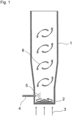
- FIG. 1 An example of the tumbling fluidized bed machine to be used in this step is shown in Fig. 1 .
- the tumbling fluidized bed machine 1 shown in Fig. 1 is equipped with a rotatable blade rotor 2 at the bottom and a spray nozzle 4 capable of spraying an alumina slurry (alumina sol) 5 on the side surface.
- Silica particles (not shown) are introduced into the tumbling fluidized bed machine 1, and when gas 3 is supplied from the bottom, the rotation of the blade rotor 2 causes the supplied gas 3 to form a swirling flow 6 together with the silica particles and the sprayed alumina slurry in the form of fine particles.
- the content of alumina particles contained in the alumina slurry is not limited and may be, for example, 1 to 50% by mass.
- the solvent of the alumina slurry may be water, ethanol, or the like.
- the mass ratio of alumina particles to silica particles (alumina particles/silica particles) to be mixed in the tumbling fluidized bed machine can be appropriately selected to be a desired content of each crystal phase, and can be, for example, 0.01 to 1.0.
- the temperature of the supplied gas (airflow) can be 10 to 100°C.
- the mixture obtained in the mixture production step is heated at 1300 to 1700°C for 2 to 8 hours.
- a heating device for heating the mixture is not limited as long as high-temperature heating can be performed, and examples thereof include an electric furnace and a pusher furnace.
- a heating atmosphere is not limited, and examples thereof include air, N 2 , Ar, and vacuum.
- a heating temperature is preferably 1300 to 1700°C, more preferably 1400 to 1650°C, and even more preferably 1500 to 1600°C.
- the heating temperature is 1300°C or higher, the content of cristobalite increases, and therefore thermal conductivity required for an exoergic filler and low dielectric constant and low dielectric loss tangent required for a filler for high-frequency substrates can be achieved.
- the heating temperature is 1700°C or lower, it is possible to prevent a reduction in the circularity of oxide composite particles due to fusion between particles caused by heating.
- a heating time is preferably 2 to 8 hours, more preferably 2 to 6 hours, and even more preferably 2 to 4 hours.
- the heating time is 2 hours or more, the content of cristobalite increases, and therefore thermal conductivity and dielectric characteristics can be achieved.
- the heating time is 8 hours or less, it is possible to prevent a reduction in the circularity of oxide composite particles due to fusion between particles caused by heating.
- the oxide composite particles obtained after heating may be in the form of agglomerates obtained by agglomeration of the particles.
- the agglomerates may directly be used as oxide composite particles.
- the agglomerates may be disintegrated before used as oxide composite particles.
- a method for disintegrating the agglomerates is not limited and may be, for example, a method using an agate mortar, a ball mill, a vibration mill, a jet mill, or a wet jet mill.
- the disintegration may be performed either by a dry method or a wet method in which the agglomerates are mixed with a liquid such as water or an alcohol.
- oxide composite particles are obtained by performing drying after disintegration.
- a method for drying is not limited, and examples thereof include heat drying, vacuum drying, freeze drying, and supercritical carbon dioxide drying.
- the method for producing oxide composite particles according to the present embodiment may further include, in addition to the mixture production step and the heating step, another step such as a classification step in which the oxide composite particles are classified to achieve a desired average particle diameter or a washing step to reduce impurities.
- another step such as a classification step in which the oxide composite particles are classified to achieve a desired average particle diameter or a washing step to reduce impurities.
- a resin composition according to the present embodiment contains the oxide composite particles according to the present embodiment and a resin.
- the resin composition according to the present embodiment contains the oxide composite particles according to the present embodiment and therefore can have low viscosity, low dielectric constant and low dielectric loss tangent.
- the resin is not limited, and examples thereof include polyethylene, polypropylene, epoxy resins, silicone resins, phenol resins, melamine resins, urea resins, unsaturated polyesters, fluorine resins, polyamides such as polyimides, polyamideimides, and polyetherimides, polyesters such as polybutylene terephthalate and polyethylene terephthalate, polyphenylene sulfides, wholly aromatic polyesters, polysulfones, liquid crystal polymers, polyether sulfones, polycarbonates, modified maleimide resins, ABS resins, AAS (acrylonitrile-acrylic rubber-styrene) resins, and AES (acrylonitrile-ethylene/propylene/diene rubber-styrene) resins. These resins may be used singly or in combination of two or more.
- the content of the oxide composite particles in the resin composition is appropriately selected depending on desired physical properties such as viscosity, dielectric constant, and dielectric loss tangent, and is preferably 20 to 80% by mass. This content corresponds to 11 to 67% by volume when the density of the oxide composite particles is 2.4 and the density of the resin is 1.2, and corresponds to 9 to 61% by volume when the density of the oxide composite particles is 3.1 and the density of the resin is 1.2.
- the resin composition according to the present embodiment may contain an additional component other than the oxide composite particles according to the present embodiment and the resin.
- the additional component include a flame retardant and glass cloth.
- particles different from the oxide composite particles according to the present embodiment in composition, specific surface area, average particle diameter, and others may further be mixed, which makes it easier to adjust the viscosity, thermal conductivity, dielectric constant, dielectric loss tangent, filling factor, and others of the resin composition.
- the viscosity of the resin composition according to the present embodiment is preferably 500 Pa ⁇ s or less, more preferably 450 Pa ⁇ s or less, and even more preferably 400 Pa ⁇ s or less.
- the dielectric constant of the resin composition according to the present embodiment is preferably 5.0 or less, more preferably 4.5 or less, and even more preferably 4.0 or less.
- the dielectric loss tangent of the resin composition according to the present embodiment is preferably 5.0 ⁇ 10 -4 or less, more preferably 4.5 ⁇ 10 -4 or less, and even more preferably 4.0 ⁇ 10 -4 or less. It should be noted that the viscosity, dielectric constant, and dielectric loss tangent of the resin composition are measured by the methods described later.
- the resin composition according to the present embodiment has low viscosity, low dielectric constant, and low dielectric loss tangent, and is therefore particularly useful as a resin composition for high-frequency substrates.
- the high-frequency substrates include fluorine substrates, PPE substrates, and ceramic substrates.
- a mixture containing particles having a core-shell structure such that the alumina particles adhere to the surface of the silica particles was produced using a tumbling fluidized bed machine. Specifically, an alumina slurry (trade name: PG008, manufactured by CABOT Corporation, solid content: 40% by mass) was diluted with pure water to prepare an alumina slurry with a solid content of 20% by mass.
- alumina slurry (trade name: PG008, manufactured by CABOT Corporation, solid content: 40% by mass) was diluted with pure water to prepare an alumina slurry with a solid content of 20% by mass.
- the alumina slurry was sprayed at a rate of 5.0 g/min into a tumbling fluidized bed machine (trade name: FD-MP-01, manufactured by Powrex Corporation) into which 500 g of silica particles (trade name: FB5D, manufactured by Denka Company Limited, average particle diameter: 4.8 ⁇ m) were introduced, and the two were mixed by a swirling flow to obtain a mixture.
- the amount of alumina particles added was 1% by mass.
- Oxide composite particles were prepared and evaluated in the same manner as in Example 1 except that the types and amounts of the raw materials added, the heating time, and the heating temperature were changed as shown in Table 1 or Table 2. It should be noted that in Examples 6, 7, and 8, air-classified silica particles having average particle diameters of 0.5 ⁇ m, 3.1 ⁇ m, and 8.2 ⁇ m, respectively, were used.
- Identification of each crystal phase contained in the oxide composite particles and measurement of the content of each crystal phase were performed by powder X-ray diffraction measurement/Rietveld method.
- a sample horizontal-type multipurpose X-ray diffractometer manufactured by Rigaku Corporation, trade name: RINT-Ultima IV
- Measurement was performed under the following conditions: X-ray source: CuK ⁇ , tube voltage: 40 kV, tube current: 40 mA, scan speed: 10.0°/min, and 2 ⁇ scan range: 10° to 70°.
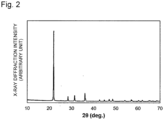
- X-ray diffraction pattern of the oxide composite particles of Example 1 is shown in Fig. 2 .
- the quantitative analysis of crystal phases was performed using Rietveld method software (manufactured by MDI, trade name: integrated powder XRD software Jade+9.6).
- the proportion (% by mass) of each crystal phase was determined by X-ray diffraction measurement of an oxide composite particle sample and calculation by Rietveld analysis.
- the content (Rc) (% by mass) of ⁇ -cristobalite as a silica component in the oxide composite particle sample was calculated from the ratio between the peak area (As) of an ⁇ -cristobalite crystal phase-derived peak among X-ray diffraction peaks obtained by X-ray diffraction measurement of the oxide composite particle sample and the peak area (Ac) of an X-ray diffraction peak obtained by measuring a cristobalite reference sample (JAWE 551) manufactured by Japan Association for Working Environment Measurement.
- Rc 100 As/Ac
- each crystal phase determined by Rietveld analysis is defined as follows: the content of an ⁇ -cristobalite crystal phase is defined as C, the content of an ⁇ -alumina crystal phase is defined as A, the content of a mullite crystal phase is defined as M, and the content of another crystal phase is defined as X.
- Rc, A ⁇ Rc/C, M ⁇ Rc/C, and X ⁇ Rc/C obtained by multiplying Rc/C, which is the ratio of C and Rc, by C, A, M, and X were respectively defined as the contents (% by mass) of an ⁇ -cristobalite crystal phase, an ⁇ -alumina crystal phase, a mullite crystal crystal phase, and another crystal phase, and the rest was defined as an amorphous component.
- the elemental ratio of aluminum/silicon at the surface of the oxide composite particles was measured using an X-ray photoelectron spectrometer (XPS, manufactured by Thermo Fisher Scientific, trade name: K-Alpha).
- the oxide composite particles were introduced into the device and then measured by irradiating a measurement area of 400 ⁇ 200 ⁇ m with monochromatic Al-K ⁇ rays.
- a peak corresponding to an aluminum-oxygen bond (near a binding energy of 75 eV) and a peak corresponding to a silicon-oxygen bond (near a binding energy of 103 eV) were extracted from the spectra obtained by the measurement, and the respective peak area ratios corrected using a relative sensitivity factor provided by ULVAC-PHI, Inc. were used as the elemental ratios of aluminum/silicon.
- the elemental ratio herein can be considered as a number ratio of the number of atoms of elements present in the measurement range (surface of the oxide composite particle).
- 0.1 g of oxide composite particles were placed in a Teflon (R) container, 2 mL of 6M sulfuric acid was added, and the Teflon (R) container was tightly closed and then heated in a drier adjusted to 230°C for 16 hours. After allowing to cool, the decomposed solution was diluted to 10 mL with pure water to serve as a test solution, which was diluted with dilute sulfuric acid, if necessary.
- the measurement sample was analyzed by ICP optical emission spectrometry (ICP spectroscopic analyzer: manufactured by Agilent Technologies, Inc., trade name: 5110 VDV), and the amount of aluminum in the oxide composite particles was measured to calculate the content of aluminum in terms of a single oxide of aluminum (Al 2 O 3 ).
- the measurement wavelength was set at 396.152 nm. It should be noted that calibration curves were prepared with the following standard solutions.
- titanium 99.9% or more pure
- An aluminum standard solution (A11000, manufactured by Fujifilm Wako Pure Chemical Industries, Ltd) were divided into 10-mL spitz tubes at 0 mg/L, 0.1 mg/L, 1.0 mg/L, and 10 mg/L, and 2 mL of 6 M sulfuric acid and 1 mL of the titanium solution were added thereto to prepare a volume of a standard solution for calibration curves.
- the average particle diameter was measured using a laser diffraction particle size distribution analyzer (manufactured by Beckman Coulter, Inc., trade name: LS 13 320). 50 cm 3 of pure water and 0.1 g of a measurement sample were placed in a disposable plastic cup and subjected to dispersion treatment for 1 minute in an ultrasonic homogenizer (manufactured by Microtec Co., Ltd., trade name: Smurt NR-50M). The dispersion liquid of the measurement sample obtained by dispersion treatment was added drop by drop with a dropper to the laser diffraction particle size distribution analyzer, and measurement was performed 30 seconds after a predetermined amount of the dispersion liquid was added.
- a laser diffraction particle size distribution analyzer manufactured by Beckman Coulter, Inc., trade name: LS 13 320. 50 cm 3 of pure water and 0.1 g of a measurement sample were placed in a disposable plastic cup and subjected to dispersion treatment for 1 minute in an ultrasonic homogenizer (manu
- particle size distribution was calculated.
- the average particle diameter was determined by multiplying the value of a measured particle diameter by a relative particle volume (percentage difference) and dividing by the total relative particle volume (100%). It should be noted that % herein means % by volume.
- the oxide composite particles and a polyethylene powder (manufactured by Sumitomo Seika Chemicals Company, Limited., trade name: FLO-THENE UF-20S) were weighed so that the content of the oxide composite particles was 40% by volume, and were mixed by a vibration mixer manufactured by Resodyn (acceleration 60 g, treatment time 2 minutes).
- a predetermined volume of the obtained mixed powder was weighed (so that the thickness was about 0.5 mm), placed in a metallic frame having a diameter of 3 cm, and formed into a sheet by a nanoimprint device (manufactured by SCIVAX, trade name: X-300) under the conditions of 140°C, 5 minutes, and 30000 N to obtain an evaluation sample.
- the sheet as the evaluation sample has a thickness of about 0.5 mm.
- the shape or size of the evaluation sample does not influence the evaluation results as long as the evaluation sample can be loaded in a measurement device, but is about 1 to 3 cm square.
- the dielectric characteristics were measured by the following method.
- a 36 GHz cavity resonator manufactured by SUMTEC, Inc.
- a vector network analyzer (trade name: 85107, manufactured by Keysight Technologies)
- the evaluation sample 1.5 cm square, thickness 0.5 mm
- the evaluation sample was rotated after every measurement to repeat the measurement 5 times in the same manner.
- the average of the obtained values of f0 and the average of the obtained values of Qu were determined as measured values.
- the dielectric constant and the dielectric loss tangent (tan ⁇ c) were respectively calculated from f0 and Qu using analysis software (software manufactured by SUMTEC, Inc.).
- the measurement temperature was 20°C and the humidity was 60%RH.
- the oxide composite particles and a bisphenol A-type liquid epoxy resin (manufactured by Mitsubishi Chemical Corporation, trade name: JER828) were mixed so that the content of the oxide composite particles was 40% by volume with respect to the total volume, and were kneaded by a planetary stirrer ("Awatori Rentaro AR-250" manufactured by THINKY CORPORATION, rotation speed 2000 rpm) to prepare a resin composition.
- the viscosity of the obtained resin composition was measured using a rheometer ("MCR-302" manufactured by Anton Parr GmbH) under the following conditions.
- the resin compositions respectively containing the oxide composite particles of Examples 1 to 8 according to the embodiment of the present invention had low viscosity (500 Pa ⁇ s or less), low dielectric constant (5.0 or less), and low dielectric loss tangent (5.0 ⁇ 10 -4 or less).
Landscapes
- Chemical & Material Sciences (AREA)
- Organic Chemistry (AREA)
- Chemical Kinetics & Catalysis (AREA)
- Health & Medical Sciences (AREA)
- Medicinal Chemistry (AREA)
- Polymers & Plastics (AREA)
- Inorganic Chemistry (AREA)
- Engineering & Computer Science (AREA)
- Life Sciences & Earth Sciences (AREA)
- Geology (AREA)
- Physics & Mathematics (AREA)
- Combustion & Propulsion (AREA)
- Thermal Sciences (AREA)
- Materials Engineering (AREA)
- Compositions Of Macromolecular Compounds (AREA)
Abstract
Description
- The present invention relates to oxide composite particles, a method for producing the same, and a resin composition.
- With the recent increase in the volume of information and communications in the field of communication, use of high-frequency bands has been spreading in electronic devices, communication devices, and the like. Therefore, materials for use in high-frequency devices are required to have low dielectric constant and low dielectric loss tangent. Further, related electronic materials and members have become increasingly smaller and highly integrated, and therefore materials for use in high-frequency devices are required to have higher heat dissipation properties.
- Silica (SiO2) as a high-frequency ceramic material has a low dielectric constant (3.7) and a quality factor index Qf (which is a value obtained by multiplying the reciprocal of dielectric loss tangent and measurement frequency) of about 120,000, and is therefore a promising material for a filler having low dielectric constant and low dielectric loss tangent. The shape of the filler is preferably closer to a sphere to facilitate blending with a resin. Spherical silica can easily be synthesized (for example, PTL 1) and has already been used for various purposes. Therefore, spherical silica is expected to widely be used also in high-frequency dielectric devices and the like.
- However, such spherical silica is generally amorphous and has a thermal conductivity as low as about 1 W/m·K. Therefore, a resin composition containing spherical silica as a filler may be insufficient in heat dissipation properties. In order to improve thermal conductivity, amorphous spherical silica may be crystallized into quartz, cristobalite or the like. For example,
PTLs PTL 4 discloses a silica powder having an aluminum oxide-based ceramic coating film formed using aerosil. -
- PTL 1:
Japanese Patent Laid-Open No. 58-138740 - PTL 2:
Japanese Patent No. 6207753 - PTL 3: International Publication No.
WO 2018/186308 - PTL 4:
Japanese Patent Laid-Open No. 10-251042 - However, when oxide composite particles containing cristobalite or alumina are mixed with a resin to prepare a resin composition, the resin composition may have high viscosity and low moldability. The resin composition may have high dielectric constant and high dielectric loss tangent. Therefore, it is desired to develop oxide composite particles which are mixed with a resin to give a resin composition having low viscosity, low dielectric constant, and low dielectric loss tangent.
- It is an object of the present invention to provide oxide composite particles to be mixed with a resin to obtain a resin composition having low viscosity, low dielectric constant, and low dielectric loss tangent, a method for producing the same, and the resin composition.
- The present invention includes the following embodiments.
- [1] Oxide composite particles containing silica and an oxide of aluminum (a single oxide or a composite oxide, or both), wherein
- the oxide composite particles contain 50% by mass or more of an α-cristobalite crystal phase, less than 5% by mass of an α-alumina crystal phase, and 10% by mass or less of a mullite crystal phase, and
- an elemental ratio of aluminum to silicon (aluminum/silicon) as determined by X-ray photoelectron spectroscopy is 0.01 to 5.0.
- [2] The oxide composite particles according to [1], wherein a content of the aluminum contained in the oxide composite particles is 0.01 to 15% by mass in terms of a single oxide of aluminum (Al2O3).
- [3] The oxide composite particles according to [1] or [2], wherein an average particle diameter of the oxide composite particles is 0.5 to 50 µm.
- [4] The oxide composite particles according to any one of [1] to [3], wherein the oxide composite particles contain 0.1 to 10% by mass of the mullite crystal phase.
- [5] A method for producing the oxide composite particles according to any one of [1] to [4], the method including the steps of:
- mixing silica particles having an average particle diameter of 0.5 to 10 µm and alumina particles to obtain a mixture; and
- heating the mixture at 1300 to 1700°C for 2 to 8 hours.
- [6] The method for producing the oxide composite particles according to [5], wherein the step to obtain a mixture is a step of spraying an alumina slurry containing the alumina particles into an air stream in which the silica particles are floating using a tumbling fluidized bed machine to form particles having a core-shell structure such that the alumina particles adhere to a surface of the silica particles.
- [7] A resin composition containing the oxide composite particles according to any one of [1] to [4] and a resin.
- [8] The resin composition according to [7], wherein a content of the oxide composite particles in the resin composition is 20 to 80% by mass.
- [9] The resin composition according to [7] or [8], which is a resin composition for high-frequency substrates.
- The present invention can provide oxide composite particles to be mixed with a resin to obtain a resin composition having low viscosity, low dielectric constant, and low dielectric loss tangent, a method for producing the same, and the resin composition.
-
-
Fig. 1 is a schematic diagram showing an example of a tumbling fluidized bed machine to be used in the method according to the present embodiment. -
Fig. 2 is a diagram showing the X-ray diffraction pattern of oxide composite particles of Example 1. - Hereinbelow, an embodiment of the present invention will be described. However, the present invention is not limited to the following embodiment.
- Oxide composite particles according to the present embodiment contain silica and an oxide of aluminum. In the present embodiment, the "an oxide of aluminum" refer to a single oxide of aluminum, a composite oxide of aluminum, or both. Here, the oxide composite particles contain 50% by mass or more of an α-cristobalite crystal phase, less than 5% by mass of an α-alumina crystal phase, and 10% by mass or less of a mullite crystal phase. Further, the elemental ratio of aluminum to silicon (aluminum/silicon) as determined by X-ray photoelectron spectroscopy (hereinafter also referred to as XPS) is 0.01 to 5.0.
- The oxide composite particles according to the present embodiment contain an α-cristobalite crystal phase, an α-alumina crystal phase, and a mullite crystal phase so that their contents are respectively within the above-described ranges, which makes it possible to obtain a resin composition having low viscosity, low dielectric constant, and low dielectric loss tangent. Particularly, the oxide composite particles according to the present embodiment have an aluminum/silicon elemental ratio of 0.01 to 5.0 as determined by XPS, and therefore have a structure such that the oxide of aluminum is present to some extent at the surface of the oxide composite particles and at least part of the surface of the oxide composite particles is coated with a layer composed of the oxide of aluminum. With such a structure, the resin composition can have low viscosity in the present embodiment because the layer composed of an oxide of aluminum, which has a relatively high melting point, prevents fusion between the oxide composite particles. Further, the α-cristobalite crystal phase contained in the oxide composite particles exhibits low dielectric constant and low dielectric loss tangent, and therefore low viscosity, low dielectric constant, and low dielectric loss tangent can be achieved as a whole.
- The oxide composite particles contain 50% by mass or more of an α-cristobalite crystal phase with respect to the total mass of the oxide composite particles (i.e., the total mass of the oxide composite particles is taken as 100% by mass). If the content of the α-cristobalite crystal phase is less than 50% by mass, the dielectric characteristics required for a high-performance resin composition for high-frequency substrates cannot be achieved. The content may be, for example, 55 to 99% by mass, 60 to 99% by mass, 65 to 98% by mass, or 70 to 98% by mass. The identification and quantification of the crystal phase are performed by powder X-ray diffraction/Rietveld method. The assignment of crystals can be performed by, for example, an X-ray database, etc. Specifically, analysis can be performed by the method described later.
- The oxide composite particles contain less than 5% by mass of an α-alumina crystal phase with respect to the total mass of the oxide composite particles (i.e., the total mass of the oxide composite particles is taken as 100% by mass). If the content of the α-alumina crystal phase is 5% by mass or more, an increase in dielectric characteristics, especially dielectric constant, occurs. The content may be, for example, 4% by mass or less, 0.01 to 4% by mass, 0.1 to 4% by mass, or 1 to 4% by mass. It should be noted that the content of the α-alumina crystal phase may be 0% by mass. The identification and quantification of the crystal phase and the assignment of crystals can be performed in the same manner as in the case of the α-cristobalite crystal phase. Specifically, analysis can be performed by the method described later.
- The oxide composite particles contain 10% by mass or less of a mullite crystal phase with respect to the total mass of the oxide composite particles (i.e., the total mass of the oxide composite particles is taken as 100% by mass). If the content of the mullite crystal phase exceeds 10% by mass, an increase in dielectric characteristics, especially dielectric loss tangent, occurs. The content of the mullite crystal phase may be 0.1 to 10% by mass, 0.5 to 10% by mass, 1 to 10% by mass, 1.5 to 9% by mass, or 2 to 8% by mass. The identification and quantification of the crystal phase and the assignment of crystals can be performed in the same manner as in the case of the α-cristobalite crystal phase. Specifically, analysis can be performed by the method described later.
- The oxide composite particles may contain 90% by mass or less of amorphous silica or 30% by mass or less of amorphous silica with respect to the total mass of the oxide composite particles (i.e., the total mass of the oxide composite particles is taken as 100% by mass). Particularly, when the content of amorphous silica is 10% by mass or less, the value of dielectric loss tangent can be kept low. It should be noted that the oxide composite particles according to the present embodiment do not always have to contain amorphous silica. The identification and quantification of amorphous silica can be performed in the same manner as in the case of the α-cristobalite crystal phase. Specifically, analysis can be performed by the method described later.
- The oxide composite particles may further contain another crystal phase or another amorphous phase other than the above-described α-cristobalite crystal phase, α-alumina crystal phase, mullite crystal phase, and amorphous silica. Examples of the another crystal phase include γ-alumina, θ-alumina, and quartz. Examples of the another amorphous phase include amorphous alumina. The content of the another crystal phase may be, for example, 0 to 8% by mass or 0 to 4% by mass with respect to the total mass of the oxide composite particles (i.e., the total mass of the oxide composite particles is taken as 100% by mass). The content of the another amorphous phase may be, for example, 0 to 8% by mass or 0 to 4% by mass with respect to the total mass of the oxide composite particles (i.e., the total mass of the oxide composite particles is taken as 100% by mass). It should be noted that the oxide composite particles do not always have to contain the another crystal phase or the another amorphous phase.
- The content of aluminum in the oxide composite particles (when the total mass of the oxide composite particles is taken as 100% by mass) is preferably 0.01 to 15% by mass in terms of a single oxide of aluminum (Al2O3). When the content is 0.01% by mass or more, a resulting resin composition can achieve heat dissipation performance at or above a certain level. When the content is 15% by mass or less, the oxide composite particles have low dielectric constant and low dielectric loss tangent, which makes it possible to use the oxide composite particles for high-frequency devices. The content may be, for example, 0.5 to 10% by mass or 1 to 6% by mass. It should be noted that "aluminum" herein refers to all aluminum elemental components presents as any compound, including a single oxide of aluminum represented by α-alumina and a composite oxide of aluminum represented by mullite in the oxide composite particles. The content of aluminum contained in the oxide composite particles in terms of a single oxide of aluminum (Al2O3) can be measured by ICP (Inductively Coupled Plasma) analysis. Specifically, analysis can be performed by the method described later.
- The content of silica in the oxide composite particles (when the total mass of the oxide composite particles is taken as 100% by mass) is preferably 85 to 99.99% by mass. When the content is 85% by mass or more, the oxide composite particles have low dielectric constant and low dielectric loss tangent, which makes it possible to use the oxide composite particles for high-frequency devices. It should be noted that the content of silica can also be measured by ICP analysis in the same manner as the oxide content of aluminum. Specifically, analysis can be performed in the same manner as the method of measuring aluminum oxide components, which is described later.
- The oxide composite particles may further contain an additional component other than silica and an oxide of aluminum, and may consist of silica and an oxide of aluminum.
- The oxide composite particles have an elemental ratio of aluminum/silicon of 0.01 to 5.0 as determined by XPS (X-ray Photoelectron Spectroscopy). XPS can obtain information of elements present several nanometers below the surface of a measurement sample, and therefore the oxide composite particles according to the present embodiment whose elemental ratio described above is 0.01 or more have a structure such that the oxide of aluminum is present to some extent at the surface of the oxide composite particles and at least part of the surface of the oxide composite particles is coated with a layer composed of the oxide of aluminum. The elemental ratio is 5.0 or less, and therefore silica is also present at the surface of the oxide composite particles. As a result, an area of the surface having a smooth structure increases, which makes it possible to lower the viscosity of the resin composition. The elemental ratio is preferably 0.05 to 4.7, more preferably 0.1 to 4.5, and even more preferably 0.2 to 4.2. It should be noted that the elemental ratio of aluminum/silicon determined by XPS can be measured by the method described later.
- The average particle diameter of the oxide composite particles is preferably 0.5 to 50 µm. When the average particle diameter is 0.5 µm or more, a resulting resin composition can achieve a certain level of heat dissipation characteristics. When the average particle diameter is 50 µm or less, the oxide composite particles can be used as an exoergic filler for high-frequency devices to fill a gap between materials. The average particle diameter may be, for example, 1 to 40 µm, 2 to 30 µm, or 5 to 20 µm. It should be noted that the average particle diameter is measured using a laser diffraction particle size distribution analyzer. Specifically, the average particle diameter can be measured by the method described later.
- When the oxide composite particles according to the present embodiment are mixed with a resin, a resulting resin composition can have low viscosity, low dielectric constant, and low dielectric loss tangent. Therefore, the oxide composite particles according to the present embodiment are useful as a filler to be contained in a resin composition required to have such physical properties (e.g., a resin composition for high-frequency substrates, etc.).
- A method for producing oxide composite particles according to the present embodiment includes the steps of: mixing silica particles having an average particle diameter of 0.5 to 10 µm and alumina particles to obtain a mixture (hereinafter also referred to as mixture production step); and heating the mixture at 1300 to 1700°C for 2 to 8 hours (hereinafter also referred to as heating step). The method according to the present embodiment can easily and efficiently produce the oxide composite particles according to the present embodiment.
- In this step, silica particles having an average particle diameter of 0.5 to 10 µm and alumina particles are mixed to obtain a mixture. The silica particles used as a raw material are not limited in crystal system and may be amorphous, quartz, cristobalite, or the like, and a method for producing the silica particles is not limited, either. However, SiO2 containing 90% by mass or more of an amorphous phase is preferably used, and SiO2 formed from an amorphous phase is more preferably used. SiO2 containing 90% by mass or more of an amorphous phase may be SiO2 produced by, for example, a flame fusion method, a deflagration method, a gas phase method, or a wet method.
- The average particle diameter of the silica particles as a raw material can be, for example, 0.5 to 10 µm from the viewpoint of usability as base particles in a mixing process using a tumbling fluidized bed machine described later. It should be noted that the average particle diameter is measured in the same manner as the average particle diameter of the oxide composite particles.
- Alumina of the alumina particles used as a raw material is not limited, and examples thereof include γ-Al2O3, θ-Al2O3, α-Al2O3, and amorphous alumina. These may be used singly or in combination of two or more. As will be described later, the alumina particles may be in the form of an alumina slurry (alumina sol), and the alumina of the alumina particles may be alumina hydrate.
- Particularly, this step is preferably a step of spraying an alumina slurry containing the alumina particles into an air stream in which the silica particles are floating using a tumbling fluidized bed machine to form particles having a core-shell structure such that the alumina particles adhere to a surface of the silica particles. The oxide composite particles according to the present invention can be more efficiently produced by mixing using a tumbling fluidized bed machine.
- An example of the tumbling fluidized bed machine to be used in this step is shown in
Fig. 1 . The tumblingfluidized bed machine 1 shown inFig. 1 is equipped with arotatable blade rotor 2 at the bottom and aspray nozzle 4 capable of spraying an alumina slurry (alumina sol) 5 on the side surface. Silica particles (not shown) are introduced into the tumblingfluidized bed machine 1, and whengas 3 is supplied from the bottom, the rotation of theblade rotor 2 causes the suppliedgas 3 to form aswirling flow 6 together with the silica particles and the sprayed alumina slurry in the form of fine particles. As a result, it is possible to efficiently form particles having a core-shell structure such that the alumina particles adhere to the surface of the silica particles. - The content of alumina particles contained in the alumina slurry is not limited and may be, for example, 1 to 50% by mass. The solvent of the alumina slurry may be water, ethanol, or the like. The mass ratio of alumina particles to silica particles (alumina particles/silica particles) to be mixed in the tumbling fluidized bed machine can be appropriately selected to be a desired content of each crystal phase, and can be, for example, 0.01 to 1.0. The temperature of the supplied gas (airflow) can be 10 to 100°C.
- In this step, the mixture obtained in the mixture production step is heated at 1300 to 1700°C for 2 to 8 hours. A heating device for heating the mixture is not limited as long as high-temperature heating can be performed, and examples thereof include an electric furnace and a pusher furnace. A heating atmosphere is not limited, and examples thereof include air, N2, Ar, and vacuum.
- A heating temperature is preferably 1300 to 1700°C, more preferably 1400 to 1650°C, and even more preferably 1500 to 1600°C. When the heating temperature is 1300°C or higher, the content of cristobalite increases, and therefore thermal conductivity required for an exoergic filler and low dielectric constant and low dielectric loss tangent required for a filler for high-frequency substrates can be achieved. When the heating temperature is 1700°C or lower, it is possible to prevent a reduction in the circularity of oxide composite particles due to fusion between particles caused by heating. A heating time is preferably 2 to 8 hours, more preferably 2 to 6 hours, and even more preferably 2 to 4 hours. When the heating time is 2 hours or more, the content of cristobalite increases, and therefore thermal conductivity and dielectric characteristics can be achieved. When the heating time is 8 hours or less, it is possible to prevent a reduction in the circularity of oxide composite particles due to fusion between particles caused by heating.
- The oxide composite particles obtained after heating may be in the form of agglomerates obtained by agglomeration of the particles. The agglomerates may directly be used as oxide composite particles. However, if necessary, the agglomerates may be disintegrated before used as oxide composite particles. A method for disintegrating the agglomerates is not limited and may be, for example, a method using an agate mortar, a ball mill, a vibration mill, a jet mill, or a wet jet mill. The disintegration may be performed either by a dry method or a wet method in which the agglomerates are mixed with a liquid such as water or an alcohol. In the case of wet disintegration, oxide composite particles are obtained by performing drying after disintegration. A method for drying is not limited, and examples thereof include heat drying, vacuum drying, freeze drying, and supercritical carbon dioxide drying.
- The method for producing oxide composite particles according to the present embodiment may further include, in addition to the mixture production step and the heating step, another step such as a classification step in which the oxide composite particles are classified to achieve a desired average particle diameter or a washing step to reduce impurities.
- A resin composition according to the present embodiment contains the oxide composite particles according to the present embodiment and a resin. The resin composition according to the present embodiment contains the oxide composite particles according to the present embodiment and therefore can have low viscosity, low dielectric constant and low dielectric loss tangent.
- The resin is not limited, and examples thereof include polyethylene, polypropylene, epoxy resins, silicone resins, phenol resins, melamine resins, urea resins, unsaturated polyesters, fluorine resins, polyamides such as polyimides, polyamideimides, and polyetherimides, polyesters such as polybutylene terephthalate and polyethylene terephthalate, polyphenylene sulfides, wholly aromatic polyesters, polysulfones, liquid crystal polymers, polyether sulfones, polycarbonates, modified maleimide resins, ABS resins, AAS (acrylonitrile-acrylic rubber-styrene) resins, and AES (acrylonitrile-ethylene/propylene/diene rubber-styrene) resins. These resins may be used singly or in combination of two or more.
- The content of the oxide composite particles in the resin composition is appropriately selected depending on desired physical properties such as viscosity, dielectric constant, and dielectric loss tangent, and is preferably 20 to 80% by mass. This content corresponds to 11 to 67% by volume when the density of the oxide composite particles is 2.4 and the density of the resin is 1.2, and corresponds to 9 to 61% by volume when the density of the oxide composite particles is 3.1 and the density of the resin is 1.2.
- The resin composition according to the present embodiment may contain an additional component other than the oxide composite particles according to the present embodiment and the resin. Examples of the additional component include a flame retardant and glass cloth. Further, particles different from the oxide composite particles according to the present embodiment in composition, specific surface area, average particle diameter, and others may further be mixed, which makes it easier to adjust the viscosity, thermal conductivity, dielectric constant, dielectric loss tangent, filling factor, and others of the resin composition.
- The viscosity of the resin composition according to the present embodiment is preferably 500 Pa·s or less, more preferably 450 Pa·s or less, and even more preferably 400 Pa·s or less. The dielectric constant of the resin composition according to the present embodiment is preferably 5.0 or less, more preferably 4.5 or less, and even more preferably 4.0 or less. The dielectric loss tangent of the resin composition according to the present embodiment is preferably 5.0 × 10⁻⁴ or less, more preferably 4.5 × 10⁻⁴ or less, and even more preferably 4.0 × 10⁻⁴ or less. It should be noted that the viscosity, dielectric constant, and dielectric loss tangent of the resin composition are measured by the methods described later.
- The resin composition according to the present embodiment has low viscosity, low dielectric constant, and low dielectric loss tangent, and is therefore particularly useful as a resin composition for high-frequency substrates. Specific examples of the high-frequency substrates include fluorine substrates, PPE substrates, and ceramic substrates.
- Hereinbelow, an embodiment of the present invention will more specifically be described with reference to examples, but the present invention is not limited to these examples.
- A mixture containing particles having a core-shell structure such that the alumina particles adhere to the surface of the silica particles was produced using a tumbling fluidized bed machine. Specifically, an alumina slurry (trade name: PG008, manufactured by CABOT Corporation, solid content: 40% by mass) was diluted with pure water to prepare an alumina slurry with a solid content of 20% by mass. The alumina slurry was sprayed at a rate of 5.0 g/min into a tumbling fluidized bed machine (trade name: FD-MP-01, manufactured by Powrex Corporation) into which 500 g of silica particles (trade name: FB5D, manufactured by Denka Company Limited, average particle diameter: 4.8 µm) were introduced, and the two were mixed by a swirling flow to obtain a mixture. The amount of alumina particles added was 1% by mass.
- Then, 10 g of the mixture obtained in the mixture production step was placed in an alumina crucible and heated in an electric furnace by increasing the temperature from a room temperature at 10°C/min. At this time, the heating temperature was 1500°C and the heating time was 4 hours. After heated, the mixture was naturally cooled. After cooled, the sample was disintegrated in an agate mortar and sieved through a screen having an opening of 106 µm to obtain oxide composite particles. The oxide composite particles were evaluated by the methods described later.
- Oxide composite particles were prepared and evaluated in the same manner as in Example 1 except that the types and amounts of the raw materials added, the heating time, and the heating temperature were changed as shown in Table 1 or Table 2. It should be noted that in Examples 6, 7, and 8, air-classified silica particles having average particle diameters of 0.5 µm, 3.1 µm, and 8.2 µm, respectively, were used.
- The characteristics of the oxide composite particles prepared in Examples and Comparative Examples were evaluated by the methods described below. The evaluation results are shown in Table 1 and Table 2.
- Identification of each crystal phase contained in the oxide composite particles and measurement of the content of each crystal phase were performed by powder X-ray diffraction measurement/Rietveld method. As a measurement device, a sample horizontal-type multipurpose X-ray diffractometer (manufactured by Rigaku Corporation, trade name: RINT-Ultima IV) was used. Measurement was performed under the following conditions: X-ray source: CuKα, tube voltage: 40 kV, tube current: 40 mA, scan speed: 10.0°/min, and 2θ scan range: 10° to 70°. As an example, the X-ray diffraction pattern of the oxide composite particles of Example 1 is shown in
Fig. 2 . The quantitative analysis of crystal phases was performed using Rietveld method software (manufactured by MDI, trade name: integrated powder XRD software Jade+9.6). The proportion (% by mass) of each crystal phase was determined by X-ray diffraction measurement of an oxide composite particle sample and calculation by Rietveld analysis. At this time, by using the following formula (2), the content (Rc) (% by mass) of α-cristobalite as a silica component in the oxide composite particle sample was calculated from the ratio between the peak area (As) of an α-cristobalite crystal phase-derived peak among X-ray diffraction peaks obtained by X-ray diffraction measurement of the oxide composite particle sample and the peak area (Ac) of an X-ray diffraction peak obtained by measuring a cristobalite reference sample (JAWE 551) manufactured by Japan Association for Working Environment Measurement.
- The thus determined α-cristobalite content and the proportion of the crystal phase separately obtained by Rietveld analysis were compared to calculate the contents of each crystal phase and an amorphous silica component in the oxide composite particle sample in the following manner.
- The content (% by mass) of each crystal phase determined by Rietveld analysis is defined as follows: the content of an α-cristobalite crystal phase is defined as C, the content of an α-alumina crystal phase is defined as A, the content of a mullite crystal phase is defined as M, and the content of another crystal phase is defined as X. At this time, Rc, A × Rc/C, M × Rc/C, and X × Rc/C obtained by multiplying Rc/C, which is the ratio of C and Rc, by C, A, M, and X were respectively defined as the contents (% by mass) of an α-cristobalite crystal phase, an α-alumina crystal phase, a mullite crystal crystal phase, and another crystal phase, and the rest was defined as an amorphous component.
- The elemental ratio of aluminum/silicon at the surface of the oxide composite particles was measured using an X-ray photoelectron spectrometer (XPS, manufactured by Thermo Fisher Scientific, trade name: K-Alpha). The oxide composite particles were introduced into the device and then measured by irradiating a measurement area of 400 × 200 µm with monochromatic Al-Kα rays. A peak corresponding to an aluminum-oxygen bond (near a binding energy of 75 eV) and a peak corresponding to a silicon-oxygen bond (near a binding energy of 103 eV) were extracted from the spectra obtained by the measurement, and the respective peak area ratios corrected using a relative sensitivity factor provided by ULVAC-PHI, Inc. were used as the elemental ratios of aluminum/silicon. It should be noted that the elemental ratio herein can be considered as a number ratio of the number of atoms of elements present in the measurement range (surface of the oxide composite particle).
- First, 0.1 g of oxide composite particles were placed in a Teflon (R) container, 2 mL of 6M sulfuric acid was added, and the Teflon (R) container was tightly closed and then heated in a drier adjusted to 230°C for 16 hours. After allowing to cool, the decomposed solution was diluted to 10 mL with pure water to serve as a test solution, which was diluted with dilute sulfuric acid, if necessary. Thereafter, the measurement sample was analyzed by ICP optical emission spectrometry (ICP spectroscopic analyzer: manufactured by Agilent Technologies, Inc., trade name: 5110 VDV), and the amount of aluminum in the oxide composite particles was measured to calculate the content of aluminum in terms of a single oxide of aluminum (Al2O3). The measurement wavelength was set at 396.152 nm. It should be noted that calibration curves were prepared with the following standard solutions.
- 6.0 g of titanium (99.9% or more pure) was warmed and dissolved in 50 mL of 6 M hydrochloric acid, and then the resulting solution was diluted to 100 mL to prepare a titanium solution. An aluminum standard solution (A11000, manufactured by Fujifilm Wako Pure Chemical Industries, Ltd) were divided into 10-mL spitz tubes at 0 mg/L, 0.1 mg/L, 1.0 mg/L, and 10 mg/L, and 2 mL of 6 M sulfuric acid and 1 mL of the titanium solution were added thereto to prepare a volume of a standard solution for calibration curves.
- The average particle diameter was measured using a laser diffraction particle size distribution analyzer (manufactured by Beckman Coulter, Inc., trade name: LS 13 320). 50 cm3 of pure water and 0.1 g of a measurement sample were placed in a disposable plastic cup and subjected to dispersion treatment for 1 minute in an ultrasonic homogenizer (manufactured by Microtec Co., Ltd., trade name: Smurt NR-50M). The dispersion liquid of the measurement sample obtained by dispersion treatment was added drop by drop with a dropper to the laser diffraction particle size distribution analyzer, and measurement was performed 30 seconds after a predetermined amount of the dispersion liquid was added. From the data of light intensity distribution of diffracted/scattered light by the measurement sample detected by a sensor in the laser diffraction particle size distribution analyzer, particle size distribution was calculated. The average particle diameter was determined by multiplying the value of a measured particle diameter by a relative particle volume (percentage difference) and dividing by the total relative particle volume (100%). It should be noted that % herein means % by volume.
- The oxide composite particles and a polyethylene powder (manufactured by Sumitomo Seika Chemicals Company, Limited., trade name: FLO-THENE UF-20S) were weighed so that the content of the oxide composite particles was 40% by volume, and were mixed by a vibration mixer manufactured by Resodyn (acceleration 60 g,
treatment time 2 minutes). A predetermined volume of the obtained mixed powder was weighed (so that the thickness was about 0.5 mm), placed in a metallic frame having a diameter of 3 cm, and formed into a sheet by a nanoimprint device (manufactured by SCIVAX, trade name: X-300) under the conditions of 140°C, 5 minutes, and 30000 N to obtain an evaluation sample. The sheet as the evaluation sample has a thickness of about 0.5 mm. The shape or size of the evaluation sample does not influence the evaluation results as long as the evaluation sample can be loaded in a measurement device, but is about 1 to 3 cm square. - The dielectric characteristics were measured by the following method. A 36 GHz cavity resonator (manufactured by SUMTEC, Inc.) was connected to a vector network analyzer (trade name: 85107, manufactured by Keysight Technologies), and the evaluation sample (1.5 cm square, thickness 0.5 mm) was set to cover a hole provided in the resonator and having a diameter of 10 mm to measure a resonance frequency (f0) and an unloaded Q value (Qu). The evaluation sample was rotated after every measurement to repeat the
measurement 5 times in the same manner. The average of the obtained values of f0 and the average of the obtained values of Qu were determined as measured values. The dielectric constant and the dielectric loss tangent (tanδc) were respectively calculated from f0 and Qu using analysis software (software manufactured by SUMTEC, Inc.). The measurement temperature was 20°C and the humidity was 60%RH. - The oxide composite particles and a bisphenol A-type liquid epoxy resin (manufactured by Mitsubishi Chemical Corporation, trade name: JER828) were mixed so that the content of the oxide composite particles was 40% by volume with respect to the total volume, and were kneaded by a planetary stirrer ("Awatori Rentaro AR-250" manufactured by THINKY CORPORATION, rotation speed 2000 rpm) to prepare a resin composition. The viscosity of the obtained resin composition was measured using a rheometer ("MCR-302" manufactured by Anton Parr GmbH) under the following conditions.
- Plate shape: circular
flat plate 10 mm ϕ - Sample thickness: 1 mm
- Temperature: 25 ± 1°C
- Shear rate: 1 s-1
- As can be seen from Table 1 and Table 2, the resin compositions respectively containing the oxide composite particles of Examples 1 to 8 according to the embodiment of the present invention had low viscosity (500 Pa·s or less), low dielectric constant (5.0 or less), and low dielectric loss tangent (5.0 × 10⁻⁴ or less).
-
- 1
- Tumbling fluidized bed machine
- 2
- Blade rotor
- 3
- Gas
- 4
- Spray nozzle
- 5
- Alumina slurry (alumina sol)
- 6
- Swirling flow
| Example 1 | Example 2 | Example 3 | Example 4 | Example 5 | Example 6 | Example 7 | Example 8 | ||
| Average particle diameter of silica particles (um) | 4.8 | 4.8 | 4.8 | 4.8 | 4.8 | 0.5 | 3.1 | 8.2 | |
| Amount of alumina particles added (% by mass) | 1 | 6 | 6 | 6 | 6 | 6 | 6 | 6 | |
| Heating temperature (°C) | 1500 | 1500 | 1400 | 1300 | 1700 | 1400 | 1400 | 1500 | |
| Heating time (h) | 4 | 4 | 2 | 8 | 2 | 4 | 4 | 4 | |
| Oxide composite particles | α-Cristobalite crystal phase content (% by mass) | 99 | 87 | 64 | 52 | 88 | 79 | 69 | 98 |
| α-Alumina crystal phase content (% by mass) | 0 | 2 | 4 | 4 | 2 | 4 | 4 | 0 | |
| Mullite crystal phase content (% by mass) | 1 | 10 | 4 | 2 | 10 | 8 | 5 | 1 | |
| XPS aluminum/silicon elemental ratio(-) | 0.1 | 0.7 | 4.2 | 4.1 | 0.8 | 3.7 | 4.1 | 0.2 | |
| Aluminum content in terms of a single oxide of aluminum (% by mass) | 1 | 6 | 6 | 6 | 6 | 6 | 6 | 6 | |
| Average particle diameter (um) | 11.4 | 15.1 | 5.5 | 6.1 | 20.1 | 0.5 | 4.2 | 18.7 | |
| Resin composition | Dielectric constant (-) | 3.9 | 3.9 | 4.3 | 4.0 | 4.0 | 4.1 | 4.1 | 4.0 |
| Dielectric loss tangent (10-4) | 2.6 | 1.4 | 3.9 | 4.4 | 0.8 | 4.9 | 4.3 | 1.9 | |
| Viscosity (PaS) | 380 | 420 | 360 | 340 | 480 | 430 | 380 | 400 | |
| Comparative Example 1 | Comparative Example 2 | Comparative Example 3 | Comparative Example 4 | ||
| Average particle diameter of silica particles (um) | 4.8 | 4.8 | 4.8 | 4.8 | |
| Amount of alumina particles added (% by mass) | 10 | 12 | 20 | 20 | |
| Heating temperature (°C) | 1500 | 1400 | 1300 | 1400 | |
| Heating time (h) | 4 | 2 | 2 | 4 | |
| Oxide composite particles | α-Cristobalite crystal phase content (% by mass) | 86 | 53 | 7 | 48 |
| α-Alumina crystal phase content (% by mass) | 0 | 7 | 1 | 4 | |
| Mullite crystal phase content (% by mass) | 14 | 8 | 2 | 21 | |
| XPS aluminum/silicon elemental ratio (-) | 0.9 | 1.5 | 3.2 | 5.4 | |
| Aluminum content in terms of a single oxide of aluminum (% by mass) | 10 | 12 | 20 | 20 | |
| Average particle diameter (um) | 12.1 | 5.8 | 11.1 | 13.2 | |
| Resin composition | Dielectric constant (-) | 4.2 | 4.4 | 3.8 | 4.4 |
| Dielectric loss tangent (10-4) | 3.1 | 10.8 | 15.6 | 12.3 | |
| Viscosity (PaS) | 620 | 510 | 490 | 560 | |
Claims (9)
- Oxide composite particles comprising silica and an oxide of aluminum (a single oxide or a composite oxide, or both), whereinthe oxide composite particles contain 50% by mass or more of an α-cristobalite crystal phase, less than 5 % by mass of an α-alumina crystal phase, and 10% by mass or less of a mullite crystal phase, andan elemental ratio of aluminum to silicon (aluminum/silicon) as determined by X-ray photoelectron spectroscopy is 0.01 to 5.0.
- The oxide composite particles according to claim 1, wherein a content of the aluminum contained in the oxide composite particles is 0.01 to 15% by mass in terms of a single oxide of aluminum (Al2O3).
- The oxide composite particles according to claim 1 or 2, wherein an average particle diameter of the oxide composite particles is 0.5 to 50 µm.
- The oxide composite particles according to claim 1 or 2, wherein the oxide composite particles contain 0.1 to 10% by mass of the mullite crystal phase.
- A method for producing the oxide composite particles according to claim 1 or 2, the method comprising the steps of:mixing silica particles having an average particle diameter of 0.5 to 10 µm and alumina particles to obtain a mixture; andheating the mixture at 1300 to 1700°C for 2 to 8 hours.
- The method for producing the oxide composite particles according to claim 5, wherein the step to obtain a mixture is a step of spraying an alumina slurry containing the alumina particles into an air stream in which the silica particles are floating using a tumbling fluidized bed machine to form particles having a core-shell structure such that the alumina particles adhere to a surface of the silica particles.
- A resin composition comprising the oxide composite particles according to claim 1 or 2 and a resin.
- The resin composition according to claim 7, wherein a content of the oxide composite particles in the resin composition is 20 to 80% by mass.
- The resin composition according to claim 7, which is a resin composition for high-frequency substrates.
Applications Claiming Priority (2)
| Application Number | Priority Date | Filing Date | Title |
|---|---|---|---|
| JP2021116388 | 2021-07-14 | ||
| PCT/JP2022/025304 WO2023286566A1 (en) | 2021-07-14 | 2022-06-24 | Oxide composite particles, method for producing same, and resin composition |
Publications (2)
| Publication Number | Publication Date |
|---|---|
| EP4371937A1 true EP4371937A1 (en) | 2024-05-22 |
| EP4371937A4 EP4371937A4 (en) | 2024-12-04 |
Family
ID=84920026
Family Applications (1)
| Application Number | Title | Priority Date | Filing Date |
|---|---|---|---|
| EP22841910.7A Withdrawn EP4371937A4 (en) | 2021-07-14 | 2022-06-24 | COMPOSITE OXIDE PARTICLES, THEIR PRODUCTION METHOD, AND RESIN COMPOSITION |
Country Status (7)
| Country | Link |
|---|---|
| US (1) | US20240317975A1 (en) |
| EP (1) | EP4371937A4 (en) |
| JP (1) | JP7642821B2 (en) |
| KR (1) | KR20240018602A (en) |
| CN (1) | CN117651736A (en) |
| TW (1) | TW202321179A (en) |
| WO (1) | WO2023286566A1 (en) |
Families Citing this family (1)
| Publication number | Priority date | Publication date | Assignee | Title |
|---|---|---|---|---|
| WO2025173061A1 (en) * | 2024-02-13 | 2025-08-21 | 株式会社アドマテックス | Spherical metal oxide particle material and method for producing same, inorganic filler, resin composition, and slurry composition |
Family Cites Families (9)
| Publication number | Priority date | Publication date | Assignee | Title |
|---|---|---|---|---|
| JPS627753Y2 (en) | 1981-04-21 | 1987-02-23 | ||
| JPS58138740A (en) | 1982-02-15 | 1983-08-17 | Denki Kagaku Kogyo Kk | Resin composition |
| JPH10251042A (en) * | 1997-03-10 | 1998-09-22 | Nippon Electric Glass Co Ltd | Silica filler powder and glass-ceramic composition |
| JP4033188B2 (en) * | 2004-02-27 | 2008-01-16 | 日本電気株式会社 | Flame retardant resin composition |
| JP5062396B2 (en) * | 2006-12-28 | 2012-10-31 | 信越化学工業株式会社 | High purity cristobalite particles and production method thereof |
| JP6305007B2 (en) * | 2013-10-18 | 2018-04-04 | 新日鉄住金マテリアルズ株式会社 | Spherical amorphous silica particles, method for producing the same, and resin composition containing the same |
| CN106660813B (en) | 2014-08-25 | 2019-06-11 | 新日铁住金高新材料株式会社 | Spherical crystalline silica particles and method for producing the same |
| SG10202111099VA (en) | 2017-04-05 | 2021-11-29 | Nippon Steel Chemical & Mat Co Ltd | Spherical crystalline silica particles and method for producing same |
| JP6934344B2 (en) * | 2017-07-18 | 2021-09-15 | デンカ株式会社 | Powder for spherical silica filler and its manufacturing method |
-
2022
- 2022-06-24 EP EP22841910.7A patent/EP4371937A4/en not_active Withdrawn
- 2022-06-24 JP JP2023535208A patent/JP7642821B2/en active Active
- 2022-06-24 CN CN202280049541.6A patent/CN117651736A/en active Pending
- 2022-06-24 TW TW111123599A patent/TW202321179A/en unknown
- 2022-06-24 US US18/578,955 patent/US20240317975A1/en active Pending
- 2022-06-24 WO PCT/JP2022/025304 patent/WO2023286566A1/en not_active Ceased
- 2022-06-24 KR KR1020247000486A patent/KR20240018602A/en not_active Withdrawn
Also Published As
| Publication number | Publication date |
|---|---|
| US20240317975A1 (en) | 2024-09-26 |
| JP7642821B2 (en) | 2025-03-10 |
| KR20240018602A (en) | 2024-02-13 |
| JPWO2023286566A1 (en) | 2023-01-19 |
| TW202321179A (en) | 2023-06-01 |
| CN117651736A (en) | 2024-03-05 |
| EP4371937A4 (en) | 2024-12-04 |
| WO2023286566A1 (en) | 2023-01-19 |
Similar Documents
| Publication | Publication Date | Title |
|---|---|---|
| EP4353681A1 (en) | Oxide composite particles, method for producing same, and resin composition | |
| EP4269343A1 (en) | Oxide composite particles, method for producing same and resin composition | |
| US20240317975A1 (en) | Oxide composite particles, method for producing same, and resin composition | |
| EP4421036A1 (en) | Spherical silica particles and resin composition using same | |
| JP7473725B1 (en) | Silica Powder | |
| JP7813363B2 (en) | Magnesium oxide powder and resin composition using the same | |
| US20230332032A1 (en) | Oxide powder and method for producing same, and resin composition | |
| EP4349785A1 (en) | Inorganic oxide powder, method for producing same, and resin composition | |
| JP7671345B2 (en) | Inorganic oxide powder, its manufacturing method, and resin composition | |
| JP7813362B2 (en) | Magnesium oxide powder and resin composition using the same | |
| US20240417545A1 (en) | Spherical silica particles, and resin composition using same | |
| CN116648429A (en) | Oxide composite particles, method for producing the same, and resin composition | |
| JP2026064509A (en) | Surface-treated silica powder, packaging, and storage method | |
| JP2026064519A (en) | Surface-treated silica powder, method for producing surface-treated silica powder |
Legal Events
| Date | Code | Title | Description |
|---|---|---|---|
| STAA | Information on the status of an ep patent application or granted ep patent |
Free format text: STATUS: THE INTERNATIONAL PUBLICATION HAS BEEN MADE |
|
| PUAI | Public reference made under article 153(3) epc to a published international application that has entered the european phase |
Free format text: ORIGINAL CODE: 0009012 |
|
| STAA | Information on the status of an ep patent application or granted ep patent |
Free format text: STATUS: REQUEST FOR EXAMINATION WAS MADE |
|
| 17P | Request for examination filed |
Effective date: 20240212 |
|
| AK | Designated contracting states |
Kind code of ref document: A1 Designated state(s): AL AT BE BG CH CY CZ DE DK EE ES FI FR GB GR HR HU IE IS IT LI LT LU LV MC MK MT NL NO PL PT RO RS SE SI SK SM TR |
|
| DAV | Request for validation of the european patent (deleted) | ||
| DAX | Request for extension of the european patent (deleted) | ||
| A4 | Supplementary search report drawn up and despatched |
Effective date: 20241105 |
|
| RIC1 | Information provided on ipc code assigned before grant |
Ipc: C09K 5/14 20060101ALI20241029BHEP Ipc: C01F 7/02 20220101ALI20241029BHEP Ipc: C08K 3/36 20060101ALI20241029BHEP Ipc: C08K 3/22 20060101ALI20241029BHEP Ipc: C08L 101/00 20060101ALI20241029BHEP Ipc: C01B 33/18 20060101AFI20241029BHEP |
|
| STAA | Information on the status of an ep patent application or granted ep patent |
Free format text: STATUS: THE APPLICATION HAS BEEN WITHDRAWN |
|
| 18W | Application withdrawn |
Effective date: 20250321 |