EP4371471B1 - Method of measuring a fluorescence signal and a visible light image, image capturing and processing device - Google Patents
Method of measuring a fluorescence signal and a visible light image, image capturing and processing device Download PDFInfo
- Publication number
- EP4371471B1 EP4371471B1 EP23205166.4A EP23205166A EP4371471B1 EP 4371471 B1 EP4371471 B1 EP 4371471B1 EP 23205166 A EP23205166 A EP 23205166A EP 4371471 B1 EP4371471 B1 EP 4371471B1
- Authority
- EP
- European Patent Office
- Prior art keywords
- image
- visible light
- fluorescence
- images
- prism
- Prior art date
- Legal status (The legal status is an assumption and is not a legal conclusion. Google has not performed a legal analysis and makes no representation as to the accuracy of the status listed.)
- Active
Links
Images




Classifications
-
- A—HUMAN NECESSITIES
- A61—MEDICAL OR VETERINARY SCIENCE; HYGIENE
- A61B—DIAGNOSIS; SURGERY; IDENTIFICATION
- A61B5/00—Measuring for diagnostic purposes; Identification of persons
- A61B5/41—Detecting, measuring or recording for evaluating the immune or lymphatic systems
- A61B5/414—Evaluating particular organs or parts of the immune or lymphatic systems
- A61B5/418—Evaluating particular organs or parts of the immune or lymphatic systems lymph vessels, ducts or nodes
-
- A—HUMAN NECESSITIES
- A61—MEDICAL OR VETERINARY SCIENCE; HYGIENE
- A61B—DIAGNOSIS; SURGERY; IDENTIFICATION
- A61B1/00—Instruments for performing medical examinations of the interior of cavities or tubes of the body by visual or photographical inspection, e.g. endoscopes; Illuminating arrangements therefor
- A61B1/00002—Operational features of endoscopes
- A61B1/00004—Operational features of endoscopes characterised by electronic signal processing
- A61B1/00009—Operational features of endoscopes characterised by electronic signal processing of image signals during a use of endoscope
-
- A—HUMAN NECESSITIES
- A61—MEDICAL OR VETERINARY SCIENCE; HYGIENE
- A61B—DIAGNOSIS; SURGERY; IDENTIFICATION
- A61B1/00—Instruments for performing medical examinations of the interior of cavities or tubes of the body by visual or photographical inspection, e.g. endoscopes; Illuminating arrangements therefor
- A61B1/00002—Operational features of endoscopes
- A61B1/00004—Operational features of endoscopes characterised by electronic signal processing
- A61B1/00009—Operational features of endoscopes characterised by electronic signal processing of image signals during a use of endoscope
- A61B1/000094—Operational features of endoscopes characterised by electronic signal processing of image signals during a use of endoscope extracting biological structures
-
- A—HUMAN NECESSITIES
- A61—MEDICAL OR VETERINARY SCIENCE; HYGIENE
- A61B—DIAGNOSIS; SURGERY; IDENTIFICATION
- A61B1/00—Instruments for performing medical examinations of the interior of cavities or tubes of the body by visual or photographical inspection, e.g. endoscopes; Illuminating arrangements therefor
- A61B1/00064—Constructional details of the endoscope body
- A61B1/00071—Insertion part of the endoscope body
- A61B1/0008—Insertion part of the endoscope body characterised by distal tip features
- A61B1/00096—Optical elements
-
- A—HUMAN NECESSITIES
- A61—MEDICAL OR VETERINARY SCIENCE; HYGIENE
- A61B—DIAGNOSIS; SURGERY; IDENTIFICATION
- A61B1/00—Instruments for performing medical examinations of the interior of cavities or tubes of the body by visual or photographical inspection, e.g. endoscopes; Illuminating arrangements therefor
- A61B1/00163—Optical arrangements
- A61B1/00186—Optical arrangements with imaging filters
-
- A—HUMAN NECESSITIES
- A61—MEDICAL OR VETERINARY SCIENCE; HYGIENE
- A61B—DIAGNOSIS; SURGERY; IDENTIFICATION
- A61B1/00—Instruments for performing medical examinations of the interior of cavities or tubes of the body by visual or photographical inspection, e.g. endoscopes; Illuminating arrangements therefor
- A61B1/04—Instruments for performing medical examinations of the interior of cavities or tubes of the body by visual or photographical inspection, e.g. endoscopes; Illuminating arrangements therefor combined with photographic or television appliances
- A61B1/042—Instruments for performing medical examinations of the interior of cavities or tubes of the body by visual or photographical inspection, e.g. endoscopes; Illuminating arrangements therefor combined with photographic or television appliances characterised by a proximal camera, e.g. a CCD camera
-
- A—HUMAN NECESSITIES
- A61—MEDICAL OR VETERINARY SCIENCE; HYGIENE
- A61B—DIAGNOSIS; SURGERY; IDENTIFICATION
- A61B1/00—Instruments for performing medical examinations of the interior of cavities or tubes of the body by visual or photographical inspection, e.g. endoscopes; Illuminating arrangements therefor
- A61B1/04—Instruments for performing medical examinations of the interior of cavities or tubes of the body by visual or photographical inspection, e.g. endoscopes; Illuminating arrangements therefor combined with photographic or television appliances
- A61B1/043—Instruments for performing medical examinations of the interior of cavities or tubes of the body by visual or photographical inspection, e.g. endoscopes; Illuminating arrangements therefor combined with photographic or television appliances for fluorescence imaging
-
- A—HUMAN NECESSITIES
- A61—MEDICAL OR VETERINARY SCIENCE; HYGIENE
- A61B—DIAGNOSIS; SURGERY; IDENTIFICATION
- A61B1/00—Instruments for performing medical examinations of the interior of cavities or tubes of the body by visual or photographical inspection, e.g. endoscopes; Illuminating arrangements therefor
- A61B1/06—Instruments for performing medical examinations of the interior of cavities or tubes of the body by visual or photographical inspection, e.g. endoscopes; Illuminating arrangements therefor with illuminating arrangements
- A61B1/0653—Instruments for performing medical examinations of the interior of cavities or tubes of the body by visual or photographical inspection, e.g. endoscopes; Illuminating arrangements therefor with illuminating arrangements with wavelength conversion
-
- A—HUMAN NECESSITIES
- A61—MEDICAL OR VETERINARY SCIENCE; HYGIENE
- A61B—DIAGNOSIS; SURGERY; IDENTIFICATION
- A61B1/00—Instruments for performing medical examinations of the interior of cavities or tubes of the body by visual or photographical inspection, e.g. endoscopes; Illuminating arrangements therefor
- A61B1/313—Instruments for performing medical examinations of the interior of cavities or tubes of the body by visual or photographical inspection, e.g. endoscopes; Illuminating arrangements therefor for introducing through surgical openings, e.g. laparoscopes
- A61B1/3132—Instruments for performing medical examinations of the interior of cavities or tubes of the body by visual or photographical inspection, e.g. endoscopes; Illuminating arrangements therefor for introducing through surgical openings, e.g. laparoscopes for laparoscopy
-
- A—HUMAN NECESSITIES
- A61—MEDICAL OR VETERINARY SCIENCE; HYGIENE
- A61B—DIAGNOSIS; SURGERY; IDENTIFICATION
- A61B5/00—Measuring for diagnostic purposes; Identification of persons
- A61B5/0033—Features or image-related aspects of imaging apparatus, e.g. for MRI, optical tomography or impedance tomography apparatus; Arrangements of imaging apparatus in a room
- A61B5/0035—Features or image-related aspects of imaging apparatus, e.g. for MRI, optical tomography or impedance tomography apparatus; Arrangements of imaging apparatus in a room adapted for acquisition of images from more than one imaging mode, e.g. combining MRI and optical tomography
-
- A—HUMAN NECESSITIES
- A61—MEDICAL OR VETERINARY SCIENCE; HYGIENE
- A61B—DIAGNOSIS; SURGERY; IDENTIFICATION
- A61B5/00—Measuring for diagnostic purposes; Identification of persons
- A61B5/0059—Measuring for diagnostic purposes; Identification of persons using light, e.g. diagnosis by transillumination, diascopy, fluorescence
- A61B5/0071—Measuring for diagnostic purposes; Identification of persons using light, e.g. diagnosis by transillumination, diascopy, fluorescence by measuring fluorescence emission
-
- A—HUMAN NECESSITIES
- A61—MEDICAL OR VETERINARY SCIENCE; HYGIENE
- A61B—DIAGNOSIS; SURGERY; IDENTIFICATION
- A61B5/00—Measuring for diagnostic purposes; Identification of persons
- A61B5/0059—Measuring for diagnostic purposes; Identification of persons using light, e.g. diagnosis by transillumination, diascopy, fluorescence
- A61B5/0077—Devices for viewing the surface of the body, e.g. camera, magnifying lens
-
- G—PHYSICS
- G01—MEASURING; TESTING
- G01N—INVESTIGATING OR ANALYSING MATERIALS BY DETERMINING THEIR CHEMICAL OR PHYSICAL PROPERTIES
- G01N21/00—Investigating or analysing materials by the use of optical means, i.e. using sub-millimetre waves, infrared, visible or ultraviolet light
- G01N21/62—Systems in which the material investigated is excited whereby it emits light or causes a change in wavelength of the incident light
- G01N21/63—Systems in which the material investigated is excited whereby it emits light or causes a change in wavelength of the incident light optically excited
- G01N21/64—Fluorescence; Phosphorescence
- G01N21/645—Specially adapted constructive features of fluorimeters
- G01N21/6456—Spatial resolved fluorescence measurements; Imaging
-
- G—PHYSICS
- G02—OPTICS
- G02B—OPTICAL ELEMENTS, SYSTEMS OR APPARATUS
- G02B21/00—Microscopes
- G02B21/36—Microscopes arranged for photographic purposes or projection purposes or digital imaging or video purposes including associated control and data processing arrangements
- G02B21/365—Control or image processing arrangements for digital or video microscopes
- G02B21/367—Control or image processing arrangements for digital or video microscopes providing an output produced by processing a plurality of individual source images, e.g. image tiling, montage, composite images, depth sectioning, image comparison
-
- G—PHYSICS
- G02—OPTICS
- G02B—OPTICAL ELEMENTS, SYSTEMS OR APPARATUS
- G02B23/00—Telescopes, e.g. binoculars; Periscopes; Instruments for viewing the inside of hollow bodies; Viewfinders; Optical aiming or sighting devices
- G02B23/24—Instruments or systems for viewing the inside of hollow bodies, e.g. fibrescopes
- G02B23/2407—Optical details
- G02B23/2453—Optical details of the proximal end
-
- G—PHYSICS
- G02—OPTICS
- G02B—OPTICAL ELEMENTS, SYSTEMS OR APPARATUS
- G02B27/00—Optical systems or apparatus not provided for by any of the groups G02B1/00 - G02B26/00, G02B30/00
- G02B27/10—Beam splitting or combining systems
- G02B27/12—Beam splitting or combining systems operating by refraction only
- G02B27/126—The splitting element being a prism or prismatic array, including systems based on total internal reflection
-
- G—PHYSICS
- G06—COMPUTING OR CALCULATING; COUNTING
- G06T—IMAGE DATA PROCESSING OR GENERATION, IN GENERAL
- G06T11/00—Two-dimensional [2D] image generation
-
- G—PHYSICS
- G06—COMPUTING OR CALCULATING; COUNTING
- G06T—IMAGE DATA PROCESSING OR GENERATION, IN GENERAL
- G06T5/00—Image enhancement or restoration
- G06T5/50—Image enhancement or restoration using two or more images, e.g. averaging or subtraction
-
- G—PHYSICS
- G06—COMPUTING OR CALCULATING; COUNTING
- G06T—IMAGE DATA PROCESSING OR GENERATION, IN GENERAL
- G06T7/00—Image analysis
- G06T7/0002—Inspection of images, e.g. flaw detection
- G06T7/0012—Biomedical image inspection
-
- G—PHYSICS
- G06—COMPUTING OR CALCULATING; COUNTING
- G06T—IMAGE DATA PROCESSING OR GENERATION, IN GENERAL
- G06T7/00—Image analysis
- G06T7/70—Determining position or orientation of objects or cameras
-
- H—ELECTRICITY
- H04—ELECTRIC COMMUNICATION TECHNIQUE
- H04N—PICTORIAL COMMUNICATION, e.g. TELEVISION
- H04N23/00—Cameras or camera modules comprising electronic image sensors; Control thereof
- H04N23/50—Constructional details
- H04N23/55—Optical parts specially adapted for electronic image sensors; Mounting thereof
-
- H—ELECTRICITY
- H04—ELECTRIC COMMUNICATION TECHNIQUE
- H04N—PICTORIAL COMMUNICATION, e.g. TELEVISION
- H04N23/00—Cameras or camera modules comprising electronic image sensors; Control thereof
- H04N23/50—Constructional details
- H04N23/555—Constructional details for picking-up images in sites, inaccessible due to their dimensions or hazardous conditions, e.g. endoscopes or borescopes
-
- H—ELECTRICITY
- H04—ELECTRIC COMMUNICATION TECHNIQUE
- H04N—PICTORIAL COMMUNICATION, e.g. TELEVISION
- H04N23/00—Cameras or camera modules comprising electronic image sensors; Control thereof
- H04N23/56—Cameras or camera modules comprising electronic image sensors; Control thereof provided with illuminating means
-
- H—ELECTRICITY
- H04—ELECTRIC COMMUNICATION TECHNIQUE
- H04N—PICTORIAL COMMUNICATION, e.g. TELEVISION
- H04N23/00—Cameras or camera modules comprising electronic image sensors; Control thereof
- H04N23/70—Circuitry for compensating brightness variation in the scene
- H04N23/74—Circuitry for compensating brightness variation in the scene by influencing the scene brightness using illuminating means
-
- A—HUMAN NECESSITIES
- A61—MEDICAL OR VETERINARY SCIENCE; HYGIENE
- A61B—DIAGNOSIS; SURGERY; IDENTIFICATION
- A61B1/00—Instruments for performing medical examinations of the interior of cavities or tubes of the body by visual or photographical inspection, e.g. endoscopes; Illuminating arrangements therefor
- A61B1/313—Instruments for performing medical examinations of the interior of cavities or tubes of the body by visual or photographical inspection, e.g. endoscopes; Illuminating arrangements therefor for introducing through surgical openings, e.g. laparoscopes
-
- G—PHYSICS
- G01—MEASURING; TESTING
- G01N—INVESTIGATING OR ANALYSING MATERIALS BY DETERMINING THEIR CHEMICAL OR PHYSICAL PROPERTIES
- G01N21/00—Investigating or analysing materials by the use of optical means, i.e. using sub-millimetre waves, infrared, visible or ultraviolet light
- G01N21/17—Systems in which incident light is modified in accordance with the properties of the material investigated
- G01N2021/1765—Method using an image detector and processing of image signal
-
- G—PHYSICS
- G02—OPTICS
- G02B—OPTICAL ELEMENTS, SYSTEMS OR APPARATUS
- G02B2207/00—Coding scheme for general features or characteristics of optical elements and systems of subclass G02B, but not including elements and systems which would be classified in G02B6/00 and subgroups
- G02B2207/113—Fluorescence
-
- G—PHYSICS
- G06—COMPUTING OR CALCULATING; COUNTING
- G06T—IMAGE DATA PROCESSING OR GENERATION, IN GENERAL
- G06T2207/00—Indexing scheme for image analysis or image enhancement
- G06T2207/10—Image acquisition modality
- G06T2207/10064—Fluorescence image
-
- G—PHYSICS
- G06—COMPUTING OR CALCULATING; COUNTING
- G06T—IMAGE DATA PROCESSING OR GENERATION, IN GENERAL
- G06T2207/00—Indexing scheme for image analysis or image enhancement
- G06T2207/10—Image acquisition modality
- G06T2207/10068—Endoscopic image
-
- G—PHYSICS
- G06—COMPUTING OR CALCULATING; COUNTING
- G06T—IMAGE DATA PROCESSING OR GENERATION, IN GENERAL
- G06T2207/00—Indexing scheme for image analysis or image enhancement
- G06T2207/10—Image acquisition modality
- G06T2207/10141—Special mode during image acquisition
- G06T2207/10152—Varying illumination
-
- G—PHYSICS
- G06—COMPUTING OR CALCULATING; COUNTING
- G06T—IMAGE DATA PROCESSING OR GENERATION, IN GENERAL
- G06T2207/00—Indexing scheme for image analysis or image enhancement
- G06T2207/20—Special algorithmic details
- G06T2207/20212—Image combination
- G06T2207/20221—Image fusion; Image merging
-
- G—PHYSICS
- G06—COMPUTING OR CALCULATING; COUNTING
- G06T—IMAGE DATA PROCESSING OR GENERATION, IN GENERAL
- G06T2207/00—Indexing scheme for image analysis or image enhancement
- G06T2207/30—Subject of image; Context of image processing
- G06T2207/30004—Biomedical image processing
-
- G—PHYSICS
- G06—COMPUTING OR CALCULATING; COUNTING
- G06T—IMAGE DATA PROCESSING OR GENERATION, IN GENERAL
- G06T2207/00—Indexing scheme for image analysis or image enhancement
- G06T2207/30—Subject of image; Context of image processing
- G06T2207/30168—Image quality inspection
Definitions
- the present disclosure relates to a method of measuring a fluorescence signal in a tissue of a body part, to which a fluorescent agent has been added, and of imaging a surface of the body part, wherein the tissue to which the fluorescent agent has been added forms part of the body part. Furthermore, the disclosure relates to an image capturing and processing device configured to measure a fluorescence signal in a tissue of a body part, to which a fluorescent agent has been added and configured to image a surface of the body part, wherein the tissue to which the fluorescent agent has been added forms part of the body part. The disclosure also relates to an endoscope or laparoscope comprising such image capturing and processing device.
- the disclosure relates to a method of diagnosing lymphedema and to a method of long-term therapy of lymphedema.
- Lymphedema is an accumulation of lymphatic fluid in the body's tissue. While oxygenated blood is pumped via the arteries from the heart to the tissue, deoxygenated blood returns to the heart via the veins. Because the pressure level on the arterial side is much higher than on the vein side, a colorless fluid part of the blood is pushed into the space between the cells. Typically, more fluid is pushed out, than reabsorbed on the vein side. The excess fluid is transported by the lymphatic capillaries. Furthermore, the fluid carries away local and foreign substances such as larger proteins and cellular debris. Once in the lymphatic system, this fluid including the transported substances is referred to as lymph or lymph fluid.
- the lymphatic system comprises lymphatic vessels having one way valves similar to vein valves for transporting the lymph to the next lymph node.
- the lymph node performs removal of certain substances and cleans the fluid before it drains back to the blood stream.
- lymphatic system becomes obstructed in that the lymph flow is blocked or not performed at the desired level, the lymph fluid accumulates in the interstitial space between the tissue cells. This accumulation, which is due to an impairment of lymphatic transport, is called lymphedema.
- lymphedema The accumulation of lymph can cause inflammatory reaction which damages the cells surrounding the affected areas. It can further cause fibrosis which can turn into a hardening of the affected tissue.
- lymphedema is a lifelong condition for that no cure or medication exists, early diagnoses and appropriate early counter measures for improving drainage and reducing the fluid load are of high importance for patients' well-being and recovering.
- Possible treatments such as lymphatic massage and compression bandages up to surgery depend on the level of severity, which is a four stage system defined by the World Health Organization (WHO) as follows: Stage 1: a normal flow in the lymphatic system. No signs or symptoms. Stage 2: accumulation of fluid with swelling. Stage 3: permanent swelling that does not resolve with elevation of the affected limb or body part. Stage 4: elephantiasis (large deformed limb), skin thickening with "wart like” growth and extensive scarring.
- WHO World Health Organization
- lymphoscintigraphy For diagnosis of the function of the lymphatic system, commonly used techniques are a manual inspection of the affected limb or body part by a physician.
- a known imaging technique is lymphoscintigraphy.
- MRI Magnetic Resonance Imaging
- CT Computer Tomography
- PET-CT-scan PET-CT-scan
- ultrasound imaging is performed.
- ICG Indocyanine Green
- ICG is a green colored medical dye that is used for over 40 years.
- the dye emits fluorescent light when exited with near infrared light having a wavelength between 600 nm and 800 nm. Due to this excitation, ICG emits fluorescence light between 750 nm and 950 nm.
- the fluorescence of the ICG dye can be detected using a CCD or CMOS sensor or camera.
- the fluorescent dye is administered to the tissue of an affected limb or body part and the concentration and flow of the lymphatic fluid can be traced on the basis of the detected fluorescence light.
- US 2022/0322922 A1 and US 2015/0148630 A1 disclose methods and apparatuses for acquisition of images in the visible light range and fluorescence images in the infrared band.
- WO 2021/035094 A1 discloses that a stitching algorithm can be applied to merge individual images into a common and larger image.
- US 2015/198797 A1 discloses both of the above.
- the invention does not encompass capturing images by manipulating an image capturing device within a living body.
- the object is solved by a method of measuring a fluorescence signal in a tissue of a body part, to which a fluorescent agent has been added, and of imaging a surface of the body part, wherein the tissue to which the fluorescent agent has been added forms part of the body part, the method comprising the steps of:
- two images namely the large visible light image and the large fluorescent image
- these two images are linked to each other.
- the two images share a common coordinate system, which means that objects that can be seen in one of the images, for example in the fluorescence image, can be found in the visible light image at the same position.
- the visible light image reproduces the surface of the body part as it can be objected with the human eye.
- an intensity of the fluorescence light is reproduced.
- both images are displayed using the same image scale, image orientation and show the same region of interest of the body part. This is due to the fact, both images are captured with in particular identical viewing direction and identical field of view. Based on the image information that is provided, the user is set into position to exactly spot the point or position at which a certain fluorescence phenomena is observed, at the real body part. This provides unparalleled advantages with respect to diagnosis and therapy.
- fluorescence image and “visible light image” are not limited to 2D images. Images within the meaning of this specification can be 2D images but also 3D images or 2D images comprising additional information. 2D images can be captured using a specialized camera equipment. 3D images can be captured using for example a stereo camera equipment. The 2D or 3D images can also be line scans, which can be captured using an image line scanner. The images can also be LIDAR scans that similar to 3D images also comprise a depth information. The data from the LIDAR scanner can be added to 2D images as additional information. The combination of the 2D image data and the LIDAR scan data leads to the similar information as a 3D image because the 2D image data can be combined with corresponding depth information.
- stitching is not limited to the combination of two or more 2D images. Stitching can also be performed on the basis of the other above mentioned image data, for example on the basis of 3D image data. Further information like for example the depth information that is captured by the LIDAR scanner can also be taken into account when executing the stitching algorithm.
- a "visible light image” is an image of the real world situation. It reproduces an image impression similar to what can be seen by the human eye. Unlike the human eye, the visible light image can be a color image, a greyscale image or even a false color scale plot.
- the visible light image shows the surface of the body part comprising the tissue to which the fluorescent agent has be administered. If the tissue is arranged at the surface of the body part, the imaging of the surface of the body part includes imaging of the surface of the tissue.
- Stitching can be performed on the basis of two or more 2D images and results in a larger 2D image.
- the stitching algorithm is executed on the basis of a plurality of 3D images, the result is a large 3D image.
- additional information for example from a LIDAR scanner, a time of flight sensor or a similar device
- the step of stitching includes the reconstruction of a 3D image from a 2D image data plus additional information.
- Stitching of images comprises the step of identifying unique special features that correspond to each other and are shown in the two images that have to be stitched together. This requires that the field of view of the two images that are combined in the stitching process overlap at least slightly.
- the step of repeating the capturing of the fluorescence image and the visible light image to provide a series of fluorescence images and a series of visible light images is executed in that the individual subsequent images of said sequence are captured in that the field of view of the subsequent images are at least slightly overlapping.
- the previously mentioned additional information which can be used for the stitching process, is however not limited to depth information, which is assigned to for example every individual pixel in the 2D image. It is also possible that during the image acquisition of the series of fluorescent images and visible light images, the image capturing device acquires, as further data, data about spatial orientation of the image capturing device.
- the spatial orientation can be for example an orientation of the image acquisition device in the coordinate system of an examination room. This orientation can be characterized by the three space coordinates x, y and z together with a viewing direction (for example a vector in the coordinate system of the examination room) and a tilt angle of the image capturing device about the viewing direction (for example an angle of rotation of the image capturing device about the viewing direction).
- This information can be captured for every single image (or image pair comprising a fluorescence image and a visible light image) of the series of visible light images and fluorescence images.
- this additional information indicating the orientation of the image capturing device in space can be used.
- the orientation of the image capturing device in for example a coordinate system of the examination room can be recalculated into an orientation of the image capturing in relation to the body part.
- the information can be used when performing the 3D reconstruction of the body part during the step of stitching.
- the stitching algorithm can also be applied in any other application to generate a large visible light image and a large fluorescence image.
- the method is in particular not limited to the assessment of the lymphatic system.
- the assessment can be performed on for example blood vessels and blood flow or on a perfusion assessment of organs and tissues.
- the assessment can also encompass visually locating tissue with certain characteristica (e.g. tumorous tissue), locating glands (e.g. parathyroid glands) and nerves. This list is not exhaustive.
- the stitching algorithm can be applied on images obtained in open surgery or in minimally invasive clutch. Images on which stitching is performed and which are captured during minimally invasive acidy, can be obtained using an endoscope, for example an endoscope having a rigid shaft or an endoscope having a flexible shaft.
- a method of measuring a fluorescence signal in a body part, to which a fluorescent agent has been added, and of imaging a surface of the body part comprising the steps of:
- the method further comprises the step of: outputting the large visible light image and the large fluorescence image.
- the method is in particular not limited to the use of a fluorescent agent and/or dye.
- the method can be performed without the use of a dye, by exploiting the effect of auto-fluorescence of certain tissue, for example of parathyroid glands or intestinal tissue. Furthermore, the absence of auto-fluorescence can be used for example to determine lesions.
- the method in particular comprises the step of outputting the large visible light image and the large auto-fluorescence image.
- the fluorescence image is in fact an image detected in the visible light spectrum. This applies for example, if Patent Blue, methylene blue or isosulfan blue is applied as the fluorescent agent or dye, because the light emission of this substance can be seen with the naked eye.
- Fluorescence images typically offer rare special features that are suitable for performance of the stitching process. Because the visible light image and the fluorescence image are linked by a known and constant relationship with respect to viewing direction and/or perspective, the parameters of the stitching algorithm used for the visible light images can also be applied for the stitching of the fluorescence images. In other words, due to the fact the visible light image and the fluorescence image are captured via optically aligned sensors, the same stitching parameters can be used for stitching of the visible light images and for stitching of the fluorescence images. This significantly enhances the stitching process and results in a large fluorescence image of better quality.
- one or more of the fluorophores or agents giving rise to the autofluorescence may be an endogenous tissue fluorophore (e.g., NADH, thyroid gland, parathyroid gland etc.).
- endogenous tissue fluorophore e.g., NADH, thyroid gland, parathyroid gland etc.
- the method according to aspects of the disclosure can be performed with different fluorescent agents and dyes. Basically, any combination of an appropriate dye plus the suitable or matching excitation light source can be applied.
- the method can also be performed without the use of a dye exploiting the effect of auto-fluorescence of certain tissue (e.g. parathyroid glands) or molecules.
- dyes that can be applied and are mainly used for the lymphatic system are for example: Indocyanine Green (ICG), methylene blue, isosulfan blue or Patent Blue. Patent Blue can even be seen with the naked eye. Hence, no fluorescence is needed, but the stitching of the images can be performed anyway.
- ICG Indocyanine Green
- methylene blue methylene blue
- isosulfan blue Patent Blue
- Patent Blue can even be seen with the naked eye. Hence, no fluorescence is needed, but the stitching of the images can be performed anyway.
- the stitching algorithm is for example a panorama stitching algorithm, in which the images are analyzed to extract special and distinguishing features. These features are then linked to each other in the multiple images and image transformation (for example shifting, rotation, stretching along one or more axis or a keystone correction) is performed. The location of the linked features is used to determine the image transformation parameters, which are also referred to as the stitching parameters. Subsequent to image orientation, the images are merged and thereby "stitched" together. This transformation can be executed in the same way on both, the visible light images and the fluorescence images. Finally, the two images are output. This output can include the step of displaying the images for example on a screen. For example the two images are shown side-by-side. According to the above referred embodiment the two images are shown in an overlay image.
- image transformation for example shifting, rotation, stretching along one or more axis or a keystone correction
- the step of performing the stitching of the series of images is not limited to the stitching of 2D images.
- the step of stitching can also comprise a reconstruction of a 3D image based on for example a series of 3D images or based on a series of 2D images plus additional information.
- the function of the lymphatic system is affected in a limb of the body.
- the method of measuring the fluorescence signal is not limited to the inspection of a limb.
- the method generally refers to the inspection of a body part, which can be a limb of a patient but also the corpus, the head, the neck, the back or any other part of the body. It is also possible that the body part is an organ.
- the method of measuring the fluorescence signal as an indicator for the lymphatic flow is in this case performed during open surgery. The same applies to a situation in which the surgery is minimally invasive surgery, which is performed using an endoscope or laparoscope.
- the viewing direction and the perspective of the fluorescence image and the visible light image are identical and, in particular, the fluorescence image and the visible light image are captured through one and the same, in particular through one single, objective lens.
- the fluorescence image and the visible light image can be captured by an image capturing device, which comprises a prism assembly and a plurality of image sensors assigned thereto.
- the prism structure comprises filters for separating the visible wavelength range from the infrared wavelength range, at which the exited emission of the fluorescent agent typically takes place.
- the different wavelength bands i.e. the visible light (also abbreviated Vis) and the infrared light (is also abbreviated IR), are directed to different sensors.
- the capturing of the visible light image and the fluorescence image through one single objective lens allows a perfect alignment of the viewing direction and perspective of the two images. In particular, the viewing direction and the perspective of the visible light image and the fluorescence image are identical.
- capturing of the fluorescence image and capturing of the visible light image are performed simultaneously in absence of time-switching between a signal of the fluorescence image and a signal of the visible light image.
- the method dispenses with time-switching of signals.
- the infrared image which is the fluorescence image
- the visible light image are captured exactly at the same time using separate image sensors.
- the images can also be captured with a high frame repeat rate, which allows the method to be applied in situations where reliable hand eye coordination is necessary. High frame rates of 60 fps or even higher are possible. High frame rates can typically not be achieved when time-switching is applied.
- the fluorescence image and the visible light image are captured on individual sensors, the sensors can be arranged exactly in focus.
- the settings of the sensors can be adjusted to the individual requirements for image acquisition of the visible light image and fluorescence image. This pertains for example to an adjustment of the sensor gain, the noise reduction, the exposure time, etc..
- the method can further comprise the steps of repeatedly capturing the fluorescence image and the visible light image of the same section of the surface of the body part while measuring the distance. A plurality of sets of fluorescence and visible light images are captured at different distances. Subsequently, an analysis of the sets of images in view of imaging quality is performed and a best matching distance resulting in the highest quality of images is determined.
- the output signal which can be an audio signal, an optical signal or can be generated based on a basis of a measurement of a time of flight sensor, can also be indicative of a deviation of the measured distance from the best matching distance. Hence, the operator is directly informed whether or not the optimum image capturing conditions in particular with respect to illumination are applied during the measurement.
- the step of image capturing can be performed by a robot or another automatic camera holder.
- the output signal is used as an input for the robot or the automatic camera holder to adjust to best matching distance. No signal output is necessary in this case but the robot or camera holder will automatically move according to a stored and best matching distance.
- the measurement of the fluorescence signal is performed on a tissue, to which at least a first and a second fluorescent agent has been added, wherein the step of capturing the fluorescence image comprises:
- the fluorescent agent comprises a first and a second fluorescent dye.
- the first fluorescent dye can be for example a methylene blue
- the second dye can be ICG.
- the step of capturing the fluorescence image comprises capturing a first fluorescence image of the fluorescent light emitted by the first fluorescent dye and, capturing a second fluorescence image of the fluorescent light emitted by the second fluorescent dye. Capturing of the two images is in particular performed without time switching.
- the first fluorescence image can be captured in a wavelength range, which is between 700 nm and 800 nm, if methylene blue is used as the first fluorescent dye.
- the second fluorescence image can be captured in a wavelength range, which is between 800 nm and 900 nm, if ICG is used as the second fluorescent dye. Fluorescence imaging which is based on two different fluorescent agents offers new possibilities for measurements and diagnosis.
- an image capturing and processing device configured to measure a fluorescence signal in a tissue of a body part, to which a fluorescent agent has been added, and configured to image a surface of the body part, wherein the tissue to which the fluorescent agent has been added forms part of the body part
- the image capturing an processing device comprising an imaging unit, which further comprises:
- the device is configured in that the stitching unit is configured to apply the same stitching algorithm for stitching of the visible light images and for stitching of the fluorescence images.
- the stitching algorithm uses the same stitching parameters, which have been determined and used for the stitching of the visible images for the stitching of the fluorescence images.
- the device is also configured in that the stitching unit is configured to apply the stitching algorithm in that the same stitching parameters, which have been determined and used for the stitching of the fluorescence images, are applied for stitching of the visible light images.
- the stitching is not limited to the stitching of 2D images. It is also possible to perform stitching on the basis of 3D images.
- the stitching can include an image reconstruction of 3D images. This can also be performed by the stitching unit.
- the stitching unit can be further configured to take into account additional information for performance of for example a 3D reconstruction.
- This additional information can be for example an orientation of the image capturing device or a depth information, which forms part of the 3D image or is the result of a scanning procedure.
- the image capturing device comprises a scanner for scanning of a surface of the body part, for example a LIDAR scanner, a time of flight camera or any other comparable device.
- the device is not limited to the assessment of the lymphatic system.
- the device can be configured for assessment of for example blood vessels and blood flow or on a perfusion assessment of organs and tissues.
- the assessment can also encompass visually locating tissue with certain characteristica (e.g. tumorous tissue), locating glands (e.g. parathyroid glands) and nerves. This list is not exhaustive.
- device is not limited to the use of a fluorescent agent and/or dye.
- the device can be operated without the use of a dye, by exploiting the effect of auto-fluorescence of certain tissue, for example of parathyroid glands.
- an image capturing and processing device configured to measure an auto-fluorescence signal in a tissue of a body part or on a body part, wherein the image capturing and processing device is further configured to image a surface of the body part, wherein the tissue forms part of the body part, the image capturing and processing device comprising an imaging unit, which further comprises:
- the device is further enhanced in that the fluorescence imaging unit and the visible light imaging unit are configured in that the viewing direction and the perspective of the fluorescence image and the visible light image are identical, wherein in particular the fluorescence imaging unit and the visible light imaging unit are configured in that the fluorescence image and the visible light image are captured through one and the same objective lens.
- the device is enhanced in that the fluorescence imaging unit and the visible light imaging unit are configured to capture the fluorescence image and the visible light image simultaneously, in absence of time-switching between a signal of the fluorescence image and a signal of the visible light image.
- the image capturing device which comprises the fluorescence imaging unit and the visible light imaging unit further comprises a dichroic prism assembly configured to receive fluorescent light and visible light through an entrance face, comprising: a first prism, a second prism, a first compensator prism located between the first prism and the second prism,
- the above-referred five prism assembly allows to capture two fluorescence imaging wavelengths and the three colors for visible light imaging, for example red, blue and green.
- the five prism assembly is advantageous in that the optical paths of the light traveling from the entrance surface to a respective one of the sensors have identical length. Hence, all sensors are in focus and furthermore, there is no timing gap between the signals of the sensors.
- the device does not require time-switching of the received signals. This allows an image capture using a high frame rate and enhanced image quality.
- the image capturing device which comprises the fluorescence imaging unit and the visible light imaging unit, defines a first, a second, and a third optical path for directing fluorescence light and visible light to a first, a second, and a third sensor, respectively
- the image capturing device further comprises a dichroic prism assembly, configured to receive the fluorescent light and the visible light through an entrance face, the dichroic prism assembly comprising: a first prism, a second prism and a third prism, each prism having a respective first, second, and third exit face, wherein: the first exit face is provided with the first sensor, the second exit face is provided with the second sensor, and the third exit face is provided with the third sensor, wherein in particular the first optical path is provided with a first filter, the second optical path is provided with a second filter, and the third optical path is provided with a third filter, wherein the first, second, and third filters, in any order, are a green filter, an infrared filter, and a red/
- the first, second, and third filters are a red/green/blue patterned filter (RGB filter), a first infrared filter, and a second infrared filter, wherein in particular, the first and second infrared filter have different transmission wavelength.
- RGB filter red/green/blue patterned filter
- first infrared filter a first infrared filter
- second infrared filter a second infrared filter
- the image capturing and processing device can be also enhanced in that the illumination unit, the fluorescence imaging unit and the visible light imaging unit are arranged in a single image capturing device, which further comprises a measurement unit configured to measure a distance between the surface of the body part, which is captured in the visible light image, and in particular the image capturing device is configured to output a signal, which is indicative of the measured distance.
- an endoscope or laparoscope being configured as the image capturing device in an image capturing and processing device according to one or more of the previously mentioned embodiments.
- the device for image capturing and processing can be used in open surgery as well as during surgery using an endoscope or laparoscope. Same or similar advantages, which have been mentioned with respect to the method and/or the device apply to the endoscope or laparoscope in a same or similar way.
- the method of diagnosing lymphedema is further enhanced in that the fluorescent agent is administered to an arm or leg of a patient by injecting the fluorescent agent in tissue between phalanges of the foot or hand of the patient. Arms and/or legs are typically affected by lymphedema. Hence, the application of a new and successful method of diagnosing lymphedema is particularly useful when performed with respect to these limbs.
- the object is also solved by a method of long-term therapy of lymphedema, comprising the steps of diagnosing a severity of lymphedema by performing the steps according to the previously mentioned method of diagnosing lymphedema on a patient. Furthermore, the method of long-term therapy comprises the steps of
- the image capturing device 10 is configured to image a surface 11 of the body part 4 and to detect the fluorescence signal, which results from illumination of the fluorescent agent 8 with excitation light.
- the surface 11 of the body part 4 is a surface of for example an inner organ.
- the surface 11 of the body part 4 is identical to the surface of the tissue, to which the fluorescent agent 8 has been administered.
- the image capturing device 10 comprises an illumination unit 16 (not shown in Fig. 1 ).
- the captured images are communicated to a processing device 12, which also forms part of the image capturing and processing device 2.
- the results of the analysis are output, for example displayed on a display 14 of the processing device 12.
- the image capturing device 10 can be handled by a physician 3.
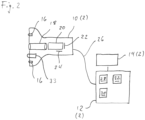
- Fig. 2 is a schematic illustration showing the image capturing device 10 and the processing unit 12 of the image capturing and processing device 2 in more detail.
- the image capturing device 10 comprises an illumination unit 16 which is configured to illuminate the tissue with excitation light having a wavelength suitable to generate fluorescent light by exciting emission of the fluorescent agent 8. For example, a plurality of LEDs is provided in the illumination unit 16.
- the image capturing device 10 further comprises an objective lens 18 through which visible light and a fluorescence light are captured.
- Light is guided through the objective lens 18 to a prism assembly 20.
- the prism assembly 20 is configured to separate fluorescent light, which is in particular in a wavelength range between 750 nm and 950 nm, from visible light that results in the visible light image.
- the fluorescent light is directed on a fluorescence imaging unit 22, which is for example a CCD or CMOS sensor plus additional wavelength filters and electronics, if necessary.
- the fluorescence imaging unit 22 is configured to capture a fluorescence image by spatially resolved measurement of the emitted light, i.e. the excited emission of the fluorescent agent 8, so as to provide the fluorescence image.
- the prism assembly 20 is configured to direct visible light on the visible light imaging unit 24 so as to allow the unit to capture the visible light image of a section of a surface 11 of the patient's body part 4.
- the prism assembly 20 is configured to direct fluorescent light on the fluorescence imaging unit 22.
- the prism assembly 20, the fluorescence imaging unit 22 and the visible light imaging unit 24 will be explained in detail further below.
- the image capturing device 10 is as scanning unit, for example an image line scanning unit or a LIDAR scanning unit.
- the image capturing device 10 can also be 3D camera, which is suitable to capture a pair of stereoscopic images from which a 3D image including depth information can be calculated.
- the image capturing device 10 can be a combination of these devices.
- the image data is communicated from the image capturing device 10 to the processing device 12 via a suitable data link 26, which can be a wireless datalink or a wired data link, for example a data cable.
- the image capturing device 10 is configured in that the fluorescence imaging unit 22 and the visible light imaging unit 24 are operated to simultaneously capture the visible light image and the fluorescence image.
- the image capturing device 10 does not perform time switching between the signal of the fluorescence image and the signal of the visible light image.
- the sensors of the fluorescence imaging unit 22 and the visible light imaging unit 24 are exclusively used for capturing images in the respective wavelength range, which means that the sensors of the imaging units 22, 24 are used for either capturing a fluorescence image in the IR spectrum or for capturing a visible light image in the visible spectrum.
- the sensors 22, 24 are not used for capturing images in both wavelength ranges. This results in significant advantages.
- the sensors can be exactly positioned in focus, which is not possible when an image sensor is used for both purposes, i.e. to capture visible light and infrared light, because the focus point for these different wavelengths typically differ in position.
- the sensor parameters can be adjusted individually, for example with respect to a required exposure time or sensor gain. Individual settings are advantageous because IR signals are typically lower than visible light signals.
- the fluorescence imaging unit 22 and the visible light imaging unit 24 have a fixed spatial relationship to each other. This is because the units are arranged in one single mounting structure or frame of the image capturing device 10. Furthermore, the fluorescence imaging unit 22 and the visible light imaging unit 24 use the same objective lens 18 and prism assembly 20 for imaging of the fluorescence image and the visible light image, respectively. Due to these measures, the fluorescence imaging unit 22 and the visible light imaging 24 are configured in that a viewing direction and a perspective of the fluorescence image and the visible light image are linked via a known and constant relationship. In the given embodiment, the viewing direction of the two images are identical because both units 22, 24 image via the same objective lens 18.
- the image capturing device 10 is further configured to operate the fluorescence imaging unit 22 and the visible light imaging unit 24 to repeat the capturing of the fluorescence image and the visible light image so as to provide a series of fluorescence images and a series of visible light images.
- This operation can be performed by the processing device 12 operating the image sensor of the fluorescence imaging unit 22 and the image sensor of visible light imaging unit 24.
- the series of images is typically captured while an operator or physician 3 (see Fig. 1 ) moves the image capturing device 10 along a longitudinal direction L of the body part 4 of the patient 6. This movement can be performed in that subsequent images of the series of images comprise overlapping parts. In other words, details which are shown in a first image of the series of images are also shown in a subsequent second image of the series.
- the frequency of image acquisition can be set to a sufficiently high value.
- the capturing of the images can be manually initiated by for example the physician 3 or the capturing of images can be controlled by the image capturing device 10 in that the described prerequisite is fulfilled.
- the image capturing device 10 can be further configured to acquire a position and orientation of the image capturing device 10 during this movement. For example, a position and orientation of the image capturing device 10 in a reference system of the examination room or in a reference system of the patient 6 can be determined for each image or image pair that is captured. This information can be stored and communicated to together with the image or image pair comprising the visible image and the fluorescence image. This information can be useful for the subsequent reconstruction of images so as to generate a 3D image from the series of 2D images.
- the series of visible light images is processed by a stitching unit 28 (see Fig. 2 ).
- the stitching unit 28 is configured to apply a stitching algorithm on the series of visible light images to generate a large visible light image of the body part 4.
- the large image is "larger" in that it shows a greater section of the body part 4 of the patient 6, which is analyzed with the image capturing device 10, then a single image.
- stitching shall not be understood in that the process of stitching is limited to a combination of two or more 2D images. Stitching can also be performed on the basis of 3D images, wherein the result of this process is a larger 3D image.
- the process of stitching can also be performed on the basis of 2D images plus an additional information on the direction of view, from which the 2D images have been captured. Further information on the position of the image capturing device 10 can also be taken into account.
- a larger 3D image can be generated, i.e. stitched together from a series of 2D images plus information on the position and orientation of the image capturing device 10. It is also possible to combine 3D scanning data, for example from a LIDAR sensor, with 2D image information. Also in this case, the result of the stitching process is a larger 3D image.
- the stitching algorithm starts with stitching of the visible light images.
- the stitching algorithm generates and applies a set of stitching parameters when preforming the stitching operation.
- the detailed operation of the stitching unit 28 will be described further below.
- the stitching unit 28 is configured to apply the stitching algorithm not only on the series of visible light images but also on the series of fluorescence images so as to generate a large fluorescence image.
- the process of stitching is not limited to the combination of two or more 2D images. It is also possible to generate a 3D fluorescence image in a similar way as it is described above for the visible light images.
- the stitching algorithm, which is applied for stitching of the fluorescence images is the same algorithm which is used for stitching of the visible light images. Furthermore, the stitching of the fluorescence images is performed using the same set of stitching parameters which was determined when performing the stitching of the visible light images. This is possible, because there is a fixed relationship between the viewing direction and perspective of the visible light images and the fluorescence images. Naturally, if the viewing direction and perspective of the visible light images and the fluorescence images are not identical, a fixed offset or a shift in the stitching parameters has to be applied. This takes into account the known and fixed spatial relationship between the IR and Vis image sensors and the corresponding optics.
- the visible light image and the fluorescence image in particular the large visible light image and the large fluorescence image are superimposed so as to provide an overlay image, in particular in a large overlay image, of the body part 4. This is performed by a superimposing unit 30 of the processing device 12.
- the overlay image can also be output via the display 14.
- Fig. 4 there is the overlay image 9, wherein in addition to the images shown in Figs. 3a) and 3b ), stitching of the visible light images 5 and fluorescence images 7 has been performed.
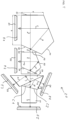
- the sensors D1 and D2 are IR sensors, configured for capturing the fluorescence image 7.
- the sensors D1 and D2 plus suitable electronics are a part of the fluorescence imaging unit 22.
- the sensors D3, D4 and D5 are for capturing the three components of the visible light image 5.
- the sensors D3, D4 and D5 plus suitable electronics are a part of the visible light imaging unit 24. It is also possible to consider the corresponding prisms that direct the light beams on the sensors, a part of the respective unit, i.e. the fluorescence imaging unit 22 and the visible light imaging unit 24, respectively.
- Fig. 6 schematically shows an endoscope 50 or laparoscope, according to an embodiment of the disclosure .
- the differences between lap-aroscopes and endoscopes are relatively small, when considering the aspects of the invention.
- a laparoscope configuration is usually also possible.
- an endoscope 50 By way of an example only, in the following, reference will be made to an endoscope 50.
- the endoscope 50 comprises an image capturing device 10 that has been explained in further detail above.
- the image capturing device 10 comprises an objective lens 18 through which the fluorescent light image 7 and the visible light image 5 are captured.
- the objective lens 18 focuses the incoming light through the entrance face S1 of the prism assembly 20 on the sensors D1 to D5.
- the objective lens 18 can also be integrated in the last part of the endoscope part to match the prism back focal length.
- the endoscope 50 comprises an optical fiber 52 connected to a light source 54 that couples light into the endoscope 50.
- the light source 54 can provide white light for illumination of the surface 11 of the body part 4 and for capturing of the visible light image 5.
- the light source 54 can be configured to emit excitation light which is suitable to excite the fluorescent dye that is applied as the fluorescent agent to emit fluorescence light.
- the light source 54 can be configured to emit both, visible light and light in the IR spectrum.
- the endoscope 50 can have a flexible shaft 56 or a rigid shaft 56.
- a lens system consisting of lens elements and/or relay rod lenses can be used to guide the light through the shaft 56.
- the fiber bundle 51 can be used for guiding the light of the light source 54 to the tip of the endoscope shaft 56.
- a fiber bundle 58 is arranged in the shaft 56 of the endoscope 50.
- the entire image capturing device 10 can be miniaturized and arranged at a distal tip or end of the endoscope shaft 56.
- Fig. 7 shows a flowchart of the stitching algorithm, which can be used for stitching of the visible light images and the fluorescence images.
- the flow chart is more or less self-explanatory and will be very briefly described.
- the acquired series of images (S1) is forwarded to the stitching unit 24 of the processing device 12.
- the algorithm then performs a frame preselection (step S2). In this preselection step, frames suitable for stitching are selected.
- S3 represents the selected images to be stitched, they then undergo preprocessing (step S4).
- preprocessed images S5 a feature extraction is performed (step S6).
- image matching step S8 is performed using the images known from S3 and the extracted features from step S7.
- a transformation of the images is estimated (step S10).
- This estimate of image transformation (S11), also referred to as stitching parameters, is applied (step S12).
- the application of the transformation results in transformed images (S13).
- a further image correction can be performed, for example an exposure correction (step S14).
- the transformed and corrected images (S15) are stitched together by locating seams (step S16), i.e. lines along which the images are joined together.
- the data indicating the location of the seams (S17) is used together with the transformed and corrected images (S12) to create a composition of images (step S18). In the given embodiment, this results in the large visible light image or the large fluorescence image, as the stitching results (S19).
- the image capturing device 10, which is applied for capturing the visible light images 5 and the fluorescence images 7 can further comprise a measurement unit 32 which is configured to measure a distance d (see Fig. 1 ) between the surface 11 of the patient's body part 4, which is captured in the visible light image 5, and the image capturing device 10.
- a distance sensor 33 which communicates with the measurement unit 32 and which can form part of the measurement unit 32, is for example an ultrasonic sensor, a laser distance sensor or any other suitable distance measurement device.
- the image capturing device 10 is configured to output a signal, which is indicative of the measured distance d. Thereby, the measurement performed by the distance sensor 33 is communicated to a user.
- the image capturing device 10 outputs an optical or acoustical signal giving the operator of the device 10 information on a best distance d for performance of the measurement. Performing the measurement with constant distance d significantly enhances the measurement results, because there is inter alia a homogeneous illumination.
- Fig. 8 there is an embodiment of another prism assembly 20 of the image capturing device 10.
- the prism assembly 20 comprising prisms P5, P6, and P7, which, for example, are configured for splitting light in red, green and blue components towards respective sensors D3, D4, and D5.
- the prism assembly 20 is configured to split incoming light in a green component, a red/blue component and an infrared component and to direct these towards the respective sensors D3, D4, and D5.
- the prism assembly 20 is configured to split incoming light in a visible light component, which is directed to a red/green/blue sensor (RGB sensor), a first infrared component of a first wavelength or wavelength interval and a second infrared component of a second wavelength or wavelength interval, and to direct these towards the respective sensors D3, D4, and D5.
- RGB sensor red/green/blue sensor
- an optical coating C1 is placed and between prisms P6 and P7 an optical coating C2 is placed, each optical coating C1 and C2 having a different reflectance and wavelength sensitivity.
- the incoming beam I is partially reflected back to the same face of the prism P5 as through which the light entered (beam J).
- the beam, now labelled K is once again reflected towards filter F3 and sensor D3.
- the reflection from J to K is an internal reflection.
- filter F3 and sensor D3 receive light reflected by coating C1
- filter F4 and sensor D4 receive light from beam L reflected by coating S2 (beams M and N).
- Filter F5 and sensor D5 receives light from beam O that has traversed the prisms unhindered.
- the coatings and filters are selected accordingly.
- the filter F3 can be a patterned filter (red/blue).
- red/blue there is an array of red and blue filters in an alternating pattern.
- the pattern can consist of groups of 2x2 pixels, which are filtered for one particular color.
- Filter F4 can be a green filter, which means the filter comprising only green filters.
- Filter F5 can be an IR filter. Each pixel is filtered with an IR filter.
- the coatings C1, C2 should match the filters F3, F4, F5.
- the first coating C1 may transmit visible light while reflecting IR light, so that IR light is guided towards IR filter F3.
- the second coating C2 may be transparent for green light while reflecting red and blue light, so that filter F4 should be the red/blue patterned filter and F5 should be the green filter 23.
- the coatings C1, C2 and the filters F3, F4, F5 are configured in that for example the sensor D4 is a color sensor (RGB sensor) for detecting the visible light image in all three colors.
- the sensor D3 can be configured for detecting fluorescence light of the first wavelength and the sensor D5 is configured for detecting fluorescence light of the second wavelength.
- the sensor D3 is for detecting fluorescence light of a first wavelength or wavelength interval
- the sensor D5 is for detecting fluorescence light of a second wavelength or wavelength interval
- the sensor D1 is for detecting fluorescence light of a third wavelength or wavelength interval
- the sensor D2 is for detecting fluorescence light of a fourth wavelength or wavelength interval.
Landscapes
- Health & Medical Sciences (AREA)
- Life Sciences & Earth Sciences (AREA)
- Engineering & Computer Science (AREA)
- Physics & Mathematics (AREA)
- Surgery (AREA)
- General Health & Medical Sciences (AREA)
- Medical Informatics (AREA)
- Pathology (AREA)
- Public Health (AREA)
- Veterinary Medicine (AREA)
- Biomedical Technology (AREA)
- Heart & Thoracic Surgery (AREA)
- Molecular Biology (AREA)
- Animal Behavior & Ethology (AREA)
- Biophysics (AREA)
- Nuclear Medicine, Radiotherapy & Molecular Imaging (AREA)
- Radiology & Medical Imaging (AREA)
- Optics & Photonics (AREA)
- General Physics & Mathematics (AREA)
- Signal Processing (AREA)
- Multimedia (AREA)
- Theoretical Computer Science (AREA)
- Computer Vision & Pattern Recognition (AREA)
- Analytical Chemistry (AREA)
- Chemical & Material Sciences (AREA)
- Immunology (AREA)
- Quality & Reliability (AREA)
- Biochemistry (AREA)
- Astronomy & Astrophysics (AREA)
- Vascular Medicine (AREA)
- Investigating, Analyzing Materials By Fluorescence Or Luminescence (AREA)
- Endoscopes (AREA)
Priority Applications (2)
| Application Number | Priority Date | Filing Date | Title |
|---|---|---|---|
| JP2023194561A JP2024072286A (ja) | 2022-11-15 | 2023-11-15 | 蛍光信号と可視光画像の測定方法、画像取り込みおよび処理装置 |
| US18/510,036 US20240156348A1 (en) | 2022-11-15 | 2023-11-15 | Method of measuring a fluorescence signal and a visible light image, image capturing and processing device |
Applications Claiming Priority (1)
| Application Number | Priority Date | Filing Date | Title |
|---|---|---|---|
| US202263425393P | 2022-11-15 | 2022-11-15 |
Publications (2)
| Publication Number | Publication Date |
|---|---|
| EP4371471A1 EP4371471A1 (en) | 2024-05-22 |
| EP4371471B1 true EP4371471B1 (en) | 2025-07-02 |
Family
ID=88510992
Family Applications (1)
| Application Number | Title | Priority Date | Filing Date |
|---|---|---|---|
| EP23205166.4A Active EP4371471B1 (en) | 2022-11-15 | 2023-10-23 | Method of measuring a fluorescence signal and a visible light image, image capturing and processing device |
Country Status (4)
| Country | Link |
|---|---|
| US (1) | US20240156348A1 (https=) |
| EP (1) | EP4371471B1 (https=) |
| JP (1) | JP2024072286A (https=) |
| CN (1) | CN118044784A (https=) |
Families Citing this family (2)
| Publication number | Priority date | Publication date | Assignee | Title |
|---|---|---|---|---|
| US12498329B2 (en) * | 2023-12-05 | 2025-12-16 | Genesee Valley Innovations, LLC | Heterogeneous chiplet ID using photoluminescence in uASSEMBLER system |
| WO2025244130A1 (ja) * | 2024-05-23 | 2025-11-27 | オリンパスメディカルシステムズ株式会社 | 蛍光内視鏡装置 |
Citations (1)
| Publication number | Priority date | Publication date | Assignee | Title |
|---|---|---|---|---|
| US20150198797A1 (en) * | 2012-07-10 | 2015-07-16 | Aïmago S.A. | Perfusion assessment multi-modality optical medical device |
Family Cites Families (7)
| Publication number | Priority date | Publication date | Assignee | Title |
|---|---|---|---|---|
| US20110071403A1 (en) * | 2009-09-21 | 2011-03-24 | Board Of Regents Of The University Of Texas System | Functional near-infrared fluorescence lymphatic mapping for diagnosing, accessing, monitoring and directing therapy of lymphatic disorders |
| NL2009124C2 (en) * | 2012-07-05 | 2014-01-07 | Quest Photonic Devices B V | Method and device for detecting fluorescence radiation. |
| JP6893877B2 (ja) * | 2014-10-29 | 2021-06-23 | スペクトラル エムディー, インコーポレイテッドSpectral Md, Inc. | 組織を分類するための反射モードマルチスペクトル時間分解型光学イメージングの方法および装置 |
| NL2018494B1 (en) * | 2017-03-09 | 2018-09-21 | Quest Photonic Devices B V | Method and apparatus using a medical imaging head for fluorescent imaging |
| EP4183328A1 (en) * | 2017-04-04 | 2023-05-24 | Aranz Healthcare Limited | Anatomical surface assessment methods, devices and systems |
| CN114599263A (zh) * | 2019-08-21 | 2022-06-07 | 艾科缇弗外科公司 | 用于医疗成像的系统和方法 |
| WO2021038729A1 (ja) * | 2019-08-27 | 2021-03-04 | 株式会社島津製作所 | 治療支援装置および治療支援方法 |
-
2023
- 2023-10-23 EP EP23205166.4A patent/EP4371471B1/en active Active
- 2023-11-14 CN CN202311517622.7A patent/CN118044784A/zh active Pending
- 2023-11-15 US US18/510,036 patent/US20240156348A1/en active Pending
- 2023-11-15 JP JP2023194561A patent/JP2024072286A/ja active Pending
Patent Citations (1)
| Publication number | Priority date | Publication date | Assignee | Title |
|---|---|---|---|---|
| US20150198797A1 (en) * | 2012-07-10 | 2015-07-16 | Aïmago S.A. | Perfusion assessment multi-modality optical medical device |
Also Published As
| Publication number | Publication date |
|---|---|
| EP4371471A1 (en) | 2024-05-22 |
| JP2024072286A (ja) | 2024-05-27 |
| US20240156348A1 (en) | 2024-05-16 |
| CN118044784A (zh) | 2024-05-17 |
Similar Documents
| Publication | Publication Date | Title |
|---|---|---|
| JP6892511B2 (ja) | 同時可視および蛍光内視鏡イメージング | |
| EP4371471B1 (en) | Method of measuring a fluorescence signal and a visible light image, image capturing and processing device | |
| US10694117B2 (en) | Masking approach for imaging multi-peak fluorophores by an imaging system | |
| US20120123205A1 (en) | Additional systems and methods for providing real-time anatomical guidance in a disgnostic or therapeutic procedure | |
| US20110237895A1 (en) | Image capturing method and apparatus | |
| CN106572792A (zh) | 用于多光谱成像的方法和部件 | |
| CN108024689A (zh) | 内窥镜装置 | |
| EP4371472B1 (en) | Image capturing and processing device | |
| JP2002095663A (ja) | センチネルリンパ節光断層画像取得方法および装置 | |
| JP2024072286A5 (https=) | ||
| EP4372680A1 (en) | Computer based clinical decision support system and method for determining a classification of a lymphedema induced fluorescence pattern | |
| JP2024072288A5 (https=) | ||
| JP2022545172A5 (https=) | ||
| JP2021035549A (ja) | 内視鏡システム | |
| JP2024072287A5 (https=) | ||
| JP3654324B2 (ja) | 蛍光検出装置 | |
| EP4371473A1 (en) | Method of measuring a fluorescence signal and of determining a 3d representation, image capturing and processing device | |
| JP2026500611A (ja) | 蛍光イメージングのための動き補正付き背景差分 | |
| Noonan et al. | Laser-induced fluorescence and reflected white light imaging for robot-assisted MIS | |
| JP2024072289A5 (https=) | ||
| US20260090722A1 (en) | Systems and methods for real time, quantitative, hyperspectral and optical property imaging for in vivo intraoperative multiplex molecular guided surgery | |
| WO2024226295A1 (en) | System and method for multispectral imaging and mapping of tissue oxygen saturation |
Legal Events
| Date | Code | Title | Description |
|---|---|---|---|
| PUAI | Public reference made under article 153(3) epc to a published international application that has entered the european phase |
Free format text: ORIGINAL CODE: 0009012 |
|
| STAA | Information on the status of an ep patent application or granted ep patent |
Free format text: STATUS: THE APPLICATION HAS BEEN PUBLISHED |
|
| AK | Designated contracting states |
Kind code of ref document: A1 Designated state(s): AL AT BE BG CH CY CZ DE DK EE ES FI FR GB GR HR HU IE IS IT LI LT LU LV MC ME MK MT NL NO PL PT RO RS SE SI SK SM TR |
|
| STAA | Information on the status of an ep patent application or granted ep patent |
Free format text: STATUS: REQUEST FOR EXAMINATION WAS MADE |
|
| STAA | Information on the status of an ep patent application or granted ep patent |
Free format text: STATUS: EXAMINATION IS IN PROGRESS |
|
| 17P | Request for examination filed |
Effective date: 20241009 |
|
| RBV | Designated contracting states (corrected) |
Designated state(s): AL AT BE BG CH CY CZ DE DK EE ES FI FR GB GR HR HU IE IS IT LI LT LU LV MC ME MK MT NL NO PL PT RO RS SE SI SK SM TR |
|
| 17Q | First examination report despatched |
Effective date: 20241106 |
|
| GRAP | Despatch of communication of intention to grant a patent |
Free format text: ORIGINAL CODE: EPIDOSNIGR1 |
|
| STAA | Information on the status of an ep patent application or granted ep patent |
Free format text: STATUS: GRANT OF PATENT IS INTENDED |
|
| INTG | Intention to grant announced |
Effective date: 20250226 |
|
| GRAS | Grant fee paid |
Free format text: ORIGINAL CODE: EPIDOSNIGR3 |
|
| GRAA | (expected) grant |
Free format text: ORIGINAL CODE: 0009210 |
|
| STAA | Information on the status of an ep patent application or granted ep patent |
Free format text: STATUS: THE PATENT HAS BEEN GRANTED |
|
| P01 | Opt-out of the competence of the unified patent court (upc) registered |
Free format text: CASE NUMBER: APP_23157/2025 Effective date: 20250515 |
|
| AK | Designated contracting states |
Kind code of ref document: B1 Designated state(s): AL AT BE BG CH CY CZ DE DK EE ES FI FR GB GR HR HU IE IS IT LI LT LU LV MC ME MK MT NL NO PL PT RO RS SE SI SK SM TR |
|
| REG | Reference to a national code |
Ref country code: GB Ref legal event code: FG4D |
|
| REG | Reference to a national code |
Ref country code: CH Ref legal event code: EP |
|
| REG | Reference to a national code |
Ref country code: DE Ref legal event code: R096 Ref document number: 602023004497 Country of ref document: DE |
|
| REG | Reference to a national code |
Ref country code: IE Ref legal event code: FG4D |
|
| REG | Reference to a national code |
Ref country code: NL Ref legal event code: FP |
|
| PGFP | Annual fee paid to national office [announced via postgrant information from national office to epo] |
Ref country code: FR Payment date: 20250908 Year of fee payment: 3 |
|
| PG25 | Lapsed in a contracting state [announced via postgrant information from national office to epo] |
Ref country code: PT Free format text: LAPSE BECAUSE OF FAILURE TO SUBMIT A TRANSLATION OF THE DESCRIPTION OR TO PAY THE FEE WITHIN THE PRESCRIBED TIME-LIMIT Effective date: 20251103 |
|
| REG | Reference to a national code |
Ref country code: AT Ref legal event code: MK05 Ref document number: 1808282 Country of ref document: AT Kind code of ref document: T Effective date: 20250702 |
|
| PG25 | Lapsed in a contracting state [announced via postgrant information from national office to epo] |
Ref country code: IS Free format text: LAPSE BECAUSE OF FAILURE TO SUBMIT A TRANSLATION OF THE DESCRIPTION OR TO PAY THE FEE WITHIN THE PRESCRIBED TIME-LIMIT Effective date: 20251102 |
|
| PGFP | Annual fee paid to national office [announced via postgrant information from national office to epo] |
Ref country code: DE Payment date: 20250827 Year of fee payment: 3 |
|
| PG25 | Lapsed in a contracting state [announced via postgrant information from national office to epo] |
Ref country code: NO Free format text: LAPSE BECAUSE OF FAILURE TO SUBMIT A TRANSLATION OF THE DESCRIPTION OR TO PAY THE FEE WITHIN THE PRESCRIBED TIME-LIMIT Effective date: 20251002 |
|
| REG | Reference to a national code |
Ref country code: LT Ref legal event code: MG9D |
|
| PG25 | Lapsed in a contracting state [announced via postgrant information from national office to epo] |
Ref country code: AT Free format text: LAPSE BECAUSE OF FAILURE TO SUBMIT A TRANSLATION OF THE DESCRIPTION OR TO PAY THE FEE WITHIN THE PRESCRIBED TIME-LIMIT Effective date: 20250702 |
|
| PG25 | Lapsed in a contracting state [announced via postgrant information from national office to epo] |
Ref country code: FI Free format text: LAPSE BECAUSE OF FAILURE TO SUBMIT A TRANSLATION OF THE DESCRIPTION OR TO PAY THE FEE WITHIN THE PRESCRIBED TIME-LIMIT Effective date: 20250702 |
|
| PG25 | Lapsed in a contracting state [announced via postgrant information from national office to epo] |
Ref country code: HR Free format text: LAPSE BECAUSE OF FAILURE TO SUBMIT A TRANSLATION OF THE DESCRIPTION OR TO PAY THE FEE WITHIN THE PRESCRIBED TIME-LIMIT Effective date: 20250702 |
|
| PG25 | Lapsed in a contracting state [announced via postgrant information from national office to epo] |
Ref country code: GR Free format text: LAPSE BECAUSE OF FAILURE TO SUBMIT A TRANSLATION OF THE DESCRIPTION OR TO PAY THE FEE WITHIN THE PRESCRIBED TIME-LIMIT Effective date: 20251003 |
|
| PG25 | Lapsed in a contracting state [announced via postgrant information from national office to epo] |
Ref country code: SE Free format text: LAPSE BECAUSE OF FAILURE TO SUBMIT A TRANSLATION OF THE DESCRIPTION OR TO PAY THE FEE WITHIN THE PRESCRIBED TIME-LIMIT Effective date: 20250702 Ref country code: CZ Free format text: LAPSE BECAUSE OF FAILURE TO SUBMIT A TRANSLATION OF THE DESCRIPTION OR TO PAY THE FEE WITHIN THE PRESCRIBED TIME-LIMIT Effective date: 20250702 |
|
| PG25 | Lapsed in a contracting state [announced via postgrant information from national office to epo] |
Ref country code: LV Free format text: LAPSE BECAUSE OF FAILURE TO SUBMIT A TRANSLATION OF THE DESCRIPTION OR TO PAY THE FEE WITHIN THE PRESCRIBED TIME-LIMIT Effective date: 20250702 |
|
| PG25 | Lapsed in a contracting state [announced via postgrant information from national office to epo] |
Ref country code: PL Free format text: LAPSE BECAUSE OF FAILURE TO SUBMIT A TRANSLATION OF THE DESCRIPTION OR TO PAY THE FEE WITHIN THE PRESCRIBED TIME-LIMIT Effective date: 20250702 Ref country code: BG Free format text: LAPSE BECAUSE OF FAILURE TO SUBMIT A TRANSLATION OF THE DESCRIPTION OR TO PAY THE FEE WITHIN THE PRESCRIBED TIME-LIMIT Effective date: 20250702 |
|
| PG25 | Lapsed in a contracting state [announced via postgrant information from national office to epo] |
Ref country code: RS Free format text: LAPSE BECAUSE OF FAILURE TO SUBMIT A TRANSLATION OF THE DESCRIPTION OR TO PAY THE FEE WITHIN THE PRESCRIBED TIME-LIMIT Effective date: 20251002 |
|
| PG25 | Lapsed in a contracting state [announced via postgrant information from national office to epo] |
Ref country code: ES Free format text: LAPSE BECAUSE OF FAILURE TO SUBMIT A TRANSLATION OF THE DESCRIPTION OR TO PAY THE FEE WITHIN THE PRESCRIBED TIME-LIMIT Effective date: 20250702 |
|
| PG25 | Lapsed in a contracting state [announced via postgrant information from national office to epo] |
Ref country code: RO Free format text: LAPSE BECAUSE OF FAILURE TO SUBMIT A TRANSLATION OF THE DESCRIPTION OR TO PAY THE FEE WITHIN THE PRESCRIBED TIME-LIMIT Effective date: 20250702 |
|
| PG25 | Lapsed in a contracting state [announced via postgrant information from national office to epo] |
Ref country code: SM Free format text: LAPSE BECAUSE OF FAILURE TO SUBMIT A TRANSLATION OF THE DESCRIPTION OR TO PAY THE FEE WITHIN THE PRESCRIBED TIME-LIMIT Effective date: 20250702 |
|
| PG25 | Lapsed in a contracting state [announced via postgrant information from national office to epo] |
Ref country code: DK Free format text: LAPSE BECAUSE OF FAILURE TO SUBMIT A TRANSLATION OF THE DESCRIPTION OR TO PAY THE FEE WITHIN THE PRESCRIBED TIME-LIMIT Effective date: 20250702 |
|
| PG25 | Lapsed in a contracting state [announced via postgrant information from national office to epo] |
Ref country code: IT Free format text: LAPSE BECAUSE OF FAILURE TO SUBMIT A TRANSLATION OF THE DESCRIPTION OR TO PAY THE FEE WITHIN THE PRESCRIBED TIME-LIMIT Effective date: 20250702 |
|
| PG25 | Lapsed in a contracting state [announced via postgrant information from national office to epo] |
Ref country code: EE Free format text: LAPSE BECAUSE OF FAILURE TO SUBMIT A TRANSLATION OF THE DESCRIPTION OR TO PAY THE FEE WITHIN THE PRESCRIBED TIME-LIMIT Effective date: 20250702 Ref country code: SK Free format text: LAPSE BECAUSE OF FAILURE TO SUBMIT A TRANSLATION OF THE DESCRIPTION OR TO PAY THE FEE WITHIN THE PRESCRIBED TIME-LIMIT Effective date: 20250702 |