EP4371375B1 - Control of a lighting system for color point and flux level control - Google Patents
Control of a lighting system for color point and flux level control Download PDFInfo
- Publication number
- EP4371375B1 EP4371375B1 EP22750800.9A EP22750800A EP4371375B1 EP 4371375 B1 EP4371375 B1 EP 4371375B1 EP 22750800 A EP22750800 A EP 22750800A EP 4371375 B1 EP4371375 B1 EP 4371375B1
- Authority
- EP
- European Patent Office
- Prior art keywords
- lighting
- color point
- color
- dimming
- current
- Prior art date
- Legal status (The legal status is an assumption and is not a legal conclusion. Google has not performed a legal analysis and makes no representation as to the accuracy of the status listed.)
- Active
Links
Images


Classifications
-
- H—ELECTRICITY
- H05—ELECTRIC TECHNIQUES NOT OTHERWISE PROVIDED FOR
- H05B—ELECTRIC HEATING; ELECTRIC LIGHT SOURCES NOT OTHERWISE PROVIDED FOR; CIRCUIT ARRANGEMENTS FOR ELECTRIC LIGHT SOURCES, IN GENERAL
- H05B45/00—Circuit arrangements for operating light-emitting diodes [LED]
- H05B45/20—Controlling the colour of the light
- H05B45/24—Controlling the colour of the light using electrical feedback from LEDs or from LED modules
-
- H—ELECTRICITY
- H05—ELECTRIC TECHNIQUES NOT OTHERWISE PROVIDED FOR
- H05B—ELECTRIC HEATING; ELECTRIC LIGHT SOURCES NOT OTHERWISE PROVIDED FOR; CIRCUIT ARRANGEMENTS FOR ELECTRIC LIGHT SOURCES, IN GENERAL
- H05B45/00—Circuit arrangements for operating light-emitting diodes [LED]
- H05B45/20—Controlling the colour of the light
- H05B45/28—Controlling the colour of the light using temperature feedback
-
- H—ELECTRICITY
- H05—ELECTRIC TECHNIQUES NOT OTHERWISE PROVIDED FOR
- H05B—ELECTRIC HEATING; ELECTRIC LIGHT SOURCES NOT OTHERWISE PROVIDED FOR; CIRCUIT ARRANGEMENTS FOR ELECTRIC LIGHT SOURCES, IN GENERAL
- H05B47/00—Circuit arrangements for operating light sources in general, i.e. where the type of light source is not relevant
- H05B47/10—Controlling the light source
- H05B47/105—Controlling the light source in response to determined parameters
-
- H—ELECTRICITY
- H05—ELECTRIC TECHNIQUES NOT OTHERWISE PROVIDED FOR
- H05B—ELECTRIC HEATING; ELECTRIC LIGHT SOURCES NOT OTHERWISE PROVIDED FOR; CIRCUIT ARRANGEMENTS FOR ELECTRIC LIGHT SOURCES, IN GENERAL
- H05B47/00—Circuit arrangements for operating light sources in general, i.e. where the type of light source is not relevant
- H05B47/10—Controlling the light source
- H05B47/175—Controlling the light source by remote control
Definitions
- the invention relates to the control of lighting systems, in particular to enable flux level control (i.e. dimming) while maintaining a desired color point.
- Multi-channel lamps enable color point control by having different channels with different color points, and independently controlling the drive levels applied to the different channels.
- PWM dimming pulse width modulation
- LED lamp it is for example well known to use pulse width modulation, PWM, dimming in multi-channel lamps, in particular for LED lamps.
- PWM dimming is very attractive since the LED behavior can be well predicted.
- the same current is always driven through the LED lamp, and changing the dimming level only involves selecting a time duration that the lamp is on. By selecting a sufficiently high frequency of the PWM control signal, the on-off cycling is not visible to the human eye.
- PWM dimming systems use a fixed current, so current correction (i.e. correcting for color point variations as a function of current) is not needed as mentioned above. It is however common practice to correct the color points (e.g. XYZ values of the CIE 1936 color space) of each channel for temperature, especially when a direct red LED is used.
- US2010/301777A1 discloses a method for the temperature-dependent adjustment of the color properties or the photometric properties of an LED illuminating device having LEDs emitting light of different colors or wavelengths or LED color groups emitting light of the same color or wavelength within a color group, the luminous flux portions thereof determine the color of light, color temperature and/or the chromaticity coordinates of the light mixture emitted by the LED illuminating device.
- US2010/259182A1 discloses a light source comprising one or more first light-emitting elements for generating light having a first wavelength range and one or more second light-emitting elements for generating light having a second wavelength range.
- the first light-emitting elements and second light-emitting elements are responsive to separate control signals provided thereto.
- a control system receives a signal representative of the operating temperature from one or more sensing devices and determines first and second control signals based on the desired color of light and the operating temperature.
- the light emitted by the first and second light-emitting elements as a result of the received first and second control signals can be blended to substantially obtain the desired color of light.
- the desired color of light generated can thus be substantially independent of junction temperature induced changes in the operating characteristics of the light-emitting elements.
- a method of controlling a lighting system which comprises a plurality of lighting channels with light sources having different color points, comprising:
- This method determines current drive levels for a set of channels in order to achieve a desired color point and a desired brightness (e.g. dimming level), but ensuring that the effect that operating the channels at different currents has on the resulting color point is taken into account. It enables color point control as well as brightness level (i.e. dimming level) control, so that the color point remains constant for all brightness (i.e. dimming) levels.
- This provides an analog current level control approach, which may be used alone or in combination with a digital (PWM) current level control.
- a first compensation measure is that a temperature (e.g. LED junction temperature) resulting from different drive currents is determined, and this is used to model how the color point will vary. This temperature compensation is known.
- the method of the invention additionally takes into account the way different color points of the lighting channels require a different drive current. Blue and green LEDs in particular show a considerable color shift. Thus, the color point information is additionally updated in dependence on the current drive level for the respective lighting channel. This may be implemented in various ways, for example depending on the types of light source.
- the balance of the different channels needs to change in order to achieve the desired set point of the complete light source.
- Another effect is that the drive current and flux are non-linearly related, especially when there is a large range of possible drive currents. Part of the non-linearity is due to intrinsic effects in the LED die. All of these effects are manifested as a flux change in relation to the current so that a different current drive level is needed to achieve a given flux.
- the color shift is independent of temperature so that they are modelled as independent effects (which can be corrected in either order), and a temperature control loop alone cannot provide full compensation.
- the method of the invention thereby enables non-linear flux versus current to be taken into account as well as the change in color point with current, separately and in addition to temperature compensation.
- the method is iterative and repeats steps until sufficient color point control accuracy is reached.
- the second to sixth step are repeated until the temperature estimate converges to a value which deviates, when being updated, by less than a threshold, and the current drive levels converge to values which deviate, when being updated, by less than a threshold.
- the method may iteratively arrive at a correct set of color points (and output flux) by suitable adaptation of the current drive levels, based on an accurate temperature estimate and with compensation for the effects that the current drive levels have on the color point.
- the second step may comprise transforming CIE 1936 XYZ color coordinates to CIE xy chromaticity color coordinates, applying temperature corrections on dx/dt and dy/dt, and transforming back to XYZ color coordinates.
- the third step may comprise using information relating to the rate of change of CIE xy chromaticity color coordinates with respect to drive current.
- This approach for modeling the dependence of color on drive current is particularly suitable for phosphor-converted LEDs.
- the third step may comprise:
- This approach for modeling the dependence of color on drive current is particularly suitable for direct LEDs.
- the method takes into account the way a dominant wavelength requires a different drive current.
- the first sub-step for example uses a model for converting from a color point to a representative wavelength.
- the representative wavelength is a dominant wavelength for that color point.
- the dominant wavelength is for example defined by (in the CIE color coordinate space) drawing a line through a white point and the x,y coordinates. The wavelength where the line intersects with the perimeter of the color space is the dominant wavelength.
- the second sub-step for example uses a model of the current dependency of different wavelengths and determines a color point shift with wavelength based on a model of the CIE x,y color coordinates as a function of a dominant wavelength.
- the third sub-step for example uses a model for converting from a representative wavelength to a color point.
- the second and third steps translate between current and wavelength so that a relationship between wavelength and current can be used.
- the method may further comprise applying pulse width modulation to the drive currents for the lighting channels.
- an analog drive current scheme may be combined with a PWM drive scheme.
- the PWM setting (for one or more of the channels) may for example be set to be 1.
- difference in channels is implemented by PWM control with the longest possible duty cycles, and further scaling use amplitude modulation control.
- the invention also provides a method of controlling a lighting system which comprises a plurality of lighting channels with light sources having different color points, three possible configurations combining the analog method defined above and PWM dimming by either:
- the method above which is an analog dimming method, may thus be combined with PWM dimming, based on the dimming level applied.
- the PWM dimming may initially be used (for high brightness) and the method above may be used for low brightness levels. This increases the resolution at low brightness.
- the analog dimming may initially be used (for high brightness) to avoid flicker and PWM dimming may be used for low brightness levels. This reduces the required dimming range for the analog dimming and improves the accuracy of the analog dimming model.
- the invention also provides a computer program comprising computer program code which is adapted, when said program is run on a computer, to implement the method defined above.
- the invention also provides a processor for controlling a lighting system which comprises a plurality of lighting channels with light sources having different color points, wherein the processor is programmed using the computer program defined above.
- a lighting controller may incorporate the processor.
- the invention also provides a lighting system comprising:
- the invention provides a method of controlling a lighting system in which (nominal) color point information in respect of the light sources is adjusted both in dependence on a temperature estimate and on the current drive levels needed.
- the method thus compensates separately for the light source temperature and the effect that the calculated current drive levels have on the color point and flux.
- An iterative loop finds the current drive levels to achieve a desired color point and flux.
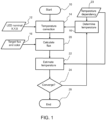
- Figure 1 shows a known method for determining flux levels for separate channels to take account of temperature. Drive currents are derived from the flux levels.
- An input to the flow diagram includes the nominal color points 12 of the individual LEDs under reference conditions. These are for example provided as CIE 1931 XYZ coordinates for easy calculation. However, the color point information may be processed in another color space.
- a temperature correction to the XYZ coordinates is made in step 14 based on a temperature estimate, which starts as an initial temperature estimate in step 16 and in subsequent iterations is generated by the method, as will be clear from the explanation below.
- the relative flux contribution of each of the channels can be calculated in step 20.
- the LED temperatures can be estimated in step 22. This takes account of on a temperature dependency model 23. Convergence of the temperature estimation is checked in step 24. If there is not yet convergence between the estimated temperature and the previous temperature estimation, the method returns to the XYZ correction step 14.
- step 28 ends in step 28 when there is convergence.
- the invention extends the temperature compensation to enable amplitude modulation of the current, and in particular so that the effect of a non-constant drive current on the color point can be compensated.
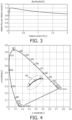
- Figure 2 shows a CIE chromaticity diagram.
- the regions 30R, 30G, 30B show how the color points of the red, green and blue LEDs shift due to amplitude modulation dimming from 100% to a 0.1% dimming level for phosphor-converted LEDs. The different points are for different dimming levels. It can be seen that the color point shift is most pronounced for the blue and green LEDs.
- LEDs In addition to the color point shift, LEDs also show a non-linear behavior between output flux and current, especially given the large range of currents.
- Figure 3 shows a typical relative flux per relative current (y-axis) versus the relative current (x-axis).
- the graph shows the change of slope of the relative flux versus relative current curve. The relationship is non-linear as shown.
- Figure 4 shows the color point shift of the lighting system at a 2% dimming level.
- the crosses in region 40 show the color point shifts for 2700K, 4000K and 6500K target color points.
- the target color points are on the solid line.
- the shifts are approximately twice as large as the allowed color point deviations in the ANSI regulations.
- This invention provides a suitable method for correcting the non-linear behavior of the flux and color point with current.
- the invention provides additional features to be added to the known corrections for temperature.
- the aim is to describe the change of color point, for example as XYZ coordinates, as a function of temperature as well as current.
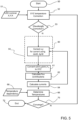
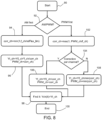
- Figures 5 and 6 show a method of controlling a lighting system which comprises a plurality of lighting channels with light sources having different color points.
- the method starts in step 50 and then comprises a first step of receiving nominal color point information 51 in respect of the light sources.
- the color point information is adjusted in dependence on a temperature estimate.
- This temperature estimate is derived later in the method and is fed back, thereby forming an iterative loop.
- the temperature estimate is updated during each iteration, and the temperature correction is based on the most up to date, i.e. most recent, temperature estimate (or an initial estimate at the beginning of the method).
- the temperature correction for example involves transforming CIE 1936 XYZ color coordinates to CIE xyY chromaticity color coordinates, and applying temperature corrections on dx/dT and dy/dT and the flux level. This provides an effective (known) way to implement temperature compensation.
- step 52 the output of step 52 is xyY values.
- the flow chart of Figures 5 and 6 includes two possible correction approaches, one based on the dependency of x and y chromaticity values with current and the other based on the dependency of wavelength on current.
- Step 53 determines whether the correction is based on wavelength or current.
- Figure 5 shows the only steps of the correction method based on current.
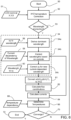
- Figure 6 shows the alternative paths through the method. The first steps (50,52,53) and last steps (61,62,64,66,70) are common to both paths through the method.
- the invention may provide a system which has only one of these two approaches, or it may provide a system which enables a choice to be made as shown in Figures 5 and 6 .
- a third step 54 involves further adjusting the color point information in dependence on a current drive level for the respective lighting channel.
- This current drive level is also derived later in the flow chart and is fed back, again thereby forming an iterative loop.
- the current settings are updated during each iteration, and the color point adaptation, to take account of current levels, is based on the most up to date, i.e. most recent, current settings.
- a first order approximation for correcting the color point is to apply a linear relation between the color point and the current, so using factors dx/dI and dy/dI.
- the third step 54 in Figure 5 then comprises using information relating to the rate of change of CIE xy chromaticity color coordinates with respect to drive current in step 80. This approach for modeling the dependence of color on drive current is particularly suitable for phosphor-converted LEDs.
- Step 61 converts back to XYZ coordinates.
- a fourth step 62 involves using the further adjusted color point information to determine a flux contribution of each lighting channel to achieve a desired combined color point and combined light output flux from the plurality of lighting channels.
- the fourth step 62 provides an output in the form of a set of relative flux fractions f1..fn for an n channel system.
- the relative flux fractions indicate how much flux each channel should make in order to meet the target flux.
- the values f are between 0 and 1. If a target color point value X,Y,Z and the X,Y,Z values of the LEDs (after temperature and current compensation) result in a value of f larger than 1, the target is not achievable and needs to be scaled.
- a fifth step 64 involves updating the current drive levels for the plurality of lighting channels to create updated current drive levels. These are the current levels required to achieve the determined flux contribution of each lighting channel. These current levels are fed back to step 80.
- the shift may be instead modelled as a rate of change of wavelength as a shift in d ⁇ /dI.
- a sixth step 66 involves updating the temperature estimate to create an updated temperature estimate. This uses a temperature dependency model 68.
- a convergence test is performed in step 70 to determine if the iterative process can be stopped. If there is convergence, the method ends in step 72, and if there is not, the method returns to the second step 52.
- Figure 6 shows the steps of the method if the wavelength-based approach is selected.
- the third step 54 then comprises a first sub-step 54a of deriving a representative wavelength for the adjusted color point information.
- a conversion step may be used from XYZ to xyY if needed.
- the representative wavelength is a dominant wavelength.
- the dominant wavelength is for example defined in the CIE color coordinates by drawing a line through a white point and the x,y coordinates.
- the wavelength where the line intersects with the perimeter of the color space is the dominant wavelength.
- a color shift as a result of the current is found to move more or less parallel with the perimeter in the CIE space so a dominant wavelength is a robust way of representing this color shift.
- a second sub-step 54b involves adjusting the representative wavelength in dependence on a the most recent current drive level for the respective lighting channel. This makes use of a model 58 of the dependency of the dominant wavelength on current, i.e. using the value d ⁇ /dI.
- a third sub-step 54c involves further adjusting the color point information based on the adjusted representative wavelength. This makes use of a conversion function 60 which maps back the dominant wavelength to xy values. This conversion function for example describes the chromaticity color coordinates x and y as a function of the dominant wavelength.
- This approach for modeling the dependence of color on drive current is particularly suitable for direct LEDs.
- the method takes into account the way a dominant wavelength requires a different drive current.
- the same step 61 converts back to XYZ coordinates.
- the same fourth step 62 is used, and again involves using the further adjusted color point information to determine a flux contribution of each lighting channel to achieve a desired combined color point and combined light output flux from the plurality of lighting channels.
- the same fifth step 64 involves updating the current drive levels for the plurality of lighting channels to create updated current drive levels. These are the current levels required to achieve the determined flux contribution of each lighting channel. These current levels are fed back to step 54b.
- the same sixth step 66 involves updating the temperature estimate to create an updated temperature estimate using the temperature dependency model 68.
- step 70 The same convergence test is performed in step 70 to determine if the iterative process can be stopped. If there is convergence, the method ends in step 72, and if there is not, the method returns to the second step.
- a light source may comprise both direct and phosphor-converted LEDs.
- the two different correction models may be combined within a system.
- either correction model may be used for either or both types of LED.
- the wavelength correction approach will give better results.
- the most appropriate model may be found by fitting the measurement data against different coordinate systems and chosing the most appropriate. Further improvements can be made by using non-linear polynomial fits, power fits, exponential fits or logarithmic fits.
- This method thereby determines current drive levels for a set of channels in order to achieve a desired color point and a desired brightness (e.g. dimming level), but ensuring that the effect of operating the channels at different currents on the resulting color point is taken into account. It enables color point control as well as brightness level (i.e. dimming level) control, so that the color point remains constant for all brightness (i.e. dimming) levels.
- the method takes into account the way different color points of the lighting channels requires a different drive current.
- the method enables the balance of the different channels to be changed in order to achieve a desired set point of the complete light source.
- the color shift as a function of drive current is treated independently of temperature so that they are modelled as independent effects.
- the method enables the non-linear flux versus current relationship explained above to be taken into account as well as the change in color point with current, separately and in addition to temperature compensation.
- the convergence test for example involves determining if the temperature estimate has converged such that a next update gives a change below a threshold. Similarly, the convergence may (instead or as well) test is the current drive levels have converged such that a next update gives a change below a threshold.
- the method may iteratively arrive at a correct set of color points (and output flux) by suitable adaptation of the current drive levels, based on an accurate temperature estimate and with compensation for the effects that the current drive levels have on the color point.
- the method described above is based on an analog amplitude modulation approach. However, this may be combined with a digital pulse width modulation approach in various ways, as described below.
- amplitude modulation in addition to a PWM dimmed system may be used to improve the resolution.
- Many standard PWM systems just use an 8-bit dimming control. However, at deep dimming, an 8-bit resolution is not sufficient.
- amplitude dimming from 100% to 12.5% adds an accuracy gain comparable to 3 additional bits in a full PWM system.
- One option is to use amplitude modulation dimming below a certain total system dimming level, so that the initial dimming is performed using PWM dimming. This approach will however show inherent flicker of a PWM dimmed system when there is high brightness.
- amplitude modulation may for example be down to a 20% dimming level to avoid a large current range and a wide range for consistent LED behavior fitting. Below the 20% level, additional dimming is then implemented using PWM control.
- Figure 7 shows how the relative flux contribution of each channel is obtained with respect to the Y0 value of the LED channel, i.e. the fraction value f_ch for the channel.
- the method involves solving the vector equations shown which map between the temperature and current corrected LED values and the target XYZ values (X T , Y T , Z T ).
- the output is thus the relative flux fractions f1..fn for an n channel system.
- the relative flux fractions indicate how much flux each channel should make in order to meet the target flux. The system needs to ensure the value of f is between 0 and 1. If f is larger than 1, the right-hand side target should be scaled.
- Figure 8 shows a method which enables PWM dimming down to a threshold brightness then uses amplitude modulation or enables amplitude modulation down to a threshold then uses PWM dimming.
- the method is used after the desired flux levels are known, from the method described above (step 62).
- the color point and flux of a channel after the temperature correction is defined as x0,y0,Y0.
- Y0_ch is a temperature corrected flux of the particular channel as indicated in the flow diagram at the end of the step 54.
- x(It_ch) and y(It_ch) give the color point correction for the target current (It) for each channel (ch) after amplitude modulation dimming.
- Yt_ch is the target flux (Yt) of a channel (ch) at a PWM setting of 1 (i.e. when permanently on).
- It_ch is the target current (It) of a channel (ch) after amplitude modulation dimming.
- Ych is the function that describes the non-linear relation between flux and current.
- relFlux_lim gives the flux relative to Y0 below which PWM dimming is to be used.
- PWM_lim describes the lowest dimming level at which PWM dimming is still used.
- Scenario (i) above (first dim the system with PWM dimming and add amplitude modulation dimming to increase resolution at low dimming) uses the target relFluxlim.
- relFlux_lim 0, there is pure amplitude modulation dimming, an no initial PWM dimming.
- Scenario (ii) above (first dim the system with amplitude modulation dimming to avoid flickering and add PWM dimming to avoid a too large AM dimming range) uses the target PWM_lim, when PWM_lim ⁇ 1.
- PWM_lim 1 there is the combined system of scenario (iii) in that PWM dimming is always used.
- Yt_ch is the amount of flux a channel should give after AM dimming.
- Yt_ch f_ch*Y0_ch.
- Yt_ch f_ch*Y_ch, /PWM_ch.
- step 90 The method starts in step 90.
- step 92 it is selected if amplitude modulation is to be first used or if PWM dimming is to be first used.
- the target relFlux_lim and channel fractions are input into step 94.
- the limit value is a value up to which the color point correction using current is still accurate enough.
- the correction is the difference between the lowest value allowed and the calculated relative flux f_ch.
- the target flux is inversely scaled with corr_ch and the PWM setting is scaled with corr_ch.
- step 98 the required current is then found for the new value Yt_ch.
- the PWM and target current values have been found.
- Step 104 determines if a correction per channel is needed.
- the "yes” path provides a correction factor per channel (and the ability in the driver to individually control the current per channel).
- the “no” path uses only a single correction for all channels which is the same all channels.
- Y0_ch is the flux of the channel at nominal current. If a correction is applied to the PWM value (e.g. to make a channel fraction f_ch larger), the flux at 100% PWM needs to be reduced to Yt_ch.
- the target flux is inversely scaled with corr_ch and the PWM setting is scaled with corr_ch.
- step 98 the required current is then found for the new value Yt_ch.
- the PWM and target current values have been found.
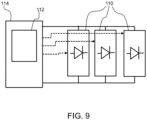
- Figure 8 shows a lighting system comprising a plurality of lighting channels 110, the different lighting channels having light sources with different color point.
- a lighting controller 112 is part of a lighting driver 114 and controls the drive currents to the different lighting channels using the methods explained above.
- a computer program may be stored/distributed on a suitable medium, such as an optical storage medium or a solid-state medium supplied together with or as part of other hardware, but may also be distributed in other forms, such as via the Internet or other wired or wireless telecommunication systems.
- a suitable medium such as an optical storage medium or a solid-state medium supplied together with or as part of other hardware, but may also be distributed in other forms, such as via the Internet or other wired or wireless telecommunication systems.
Landscapes
- Circuit Arrangement For Electric Light Sources In General (AREA)
Description
- The invention relates to the control of lighting systems, in particular to enable flux level control (i.e. dimming) while maintaining a desired color point.
- Multi-channel lamps enable color point control by having different channels with different color points, and independently controlling the drive levels applied to the different channels.
- It is for example well known to use pulse width modulation, PWM, dimming in multi-channel lamps, in particular for LED lamps. PWM dimming is very attractive since the LED behavior can be well predicted. In particular, the same current is always driven through the LED lamp, and changing the dimming level only involves selecting a time duration that the lamp is on. By selecting a sufficiently high frequency of the PWM control signal, the on-off cycling is not visible to the human eye.
- However, there is increasing attention for flickering, which is an inherent disadvantage of PWM dimming for low PWM frequencies (which are less expensive to implement). Furthermore, there is an increasing focus in the integrated circuit, IC, industry on ICs with amplitude modulation dimming capabilities.
- PWM dimming systems use a fixed current, so current correction (i.e. correcting for color point variations as a function of current) is not needed as mentioned above. It is however common practice to correct the color points (e.g. XYZ values of the CIE 1936 color space) of each channel for temperature, especially when a direct red LED is used.
- To be able to use mainstream amplitude dimming ICs and achieve desired control of the output color point of the lighting system, current effects become a problem in achieving accurate color point control.
-
CA2791258A1 discloses a method of operating a lighting fixture comprising a plurality of discrete illumination sources of distinguishably different color coordinates comprises determining target color coordinates and luminous flux at which to operate the lighting fixture, determining input electrical power values for each of the plurality of discrete illumination sources that substantially produce the target color coordinates and luminous flux by referencing a calibration data lookup table having calibration data based on measurements of the plurality of discrete illumination sources, determining a color mixing zone defined by three distinguishably different color coordinates of the plurality of discrete illumination sources within which the target color coordinates lie according to the calibration data, determining luminous flux ratios for each of the plurality of discrete illumination sources having one of the three distinguishably different color coordinates defining the color mixing zone that substantially produces the target color coordinates. -
US2010/301777A1 discloses a method for the temperature-dependent adjustment of the color properties or the photometric properties of an LED illuminating device having LEDs emitting light of different colors or wavelengths or LED color groups emitting light of the same color or wavelength within a color group, the luminous flux portions thereof determine the color of light, color temperature and/or the chromaticity coordinates of the light mixture emitted by the LED illuminating device. -
US2010/259182A1 discloses a light source comprising one or more first light-emitting elements for generating light having a first wavelength range and one or more second light-emitting elements for generating light having a second wavelength range. The first light-emitting elements and second light-emitting elements are responsive to separate control signals provided thereto. A control system receives a signal representative of the operating temperature from one or more sensing devices and determines first and second control signals based on the desired color of light and the operating temperature. The light emitted by the first and second light-emitting elements as a result of the received first and second control signals can be blended to substantially obtain the desired color of light. The desired color of light generated can thus be substantially independent of junction temperature induced changes in the operating characteristics of the light-emitting elements. - The invention is defined by the claims.
- According to examples in accordance with an aspect of the invention, there is provided a method of controlling a lighting system which comprises a plurality of lighting channels with light sources having different color points, comprising:
- a first step of receiving color point information comprising nominal color point information in respect of the light sources;
- a second step of adjusting the color point information in dependence on a currently up to date temperature estimate;
- a third step of further adjusting the color point information in dependence on a currently up to date current drive level for the respective lighting channel, wherein the second and third steps may be performed in either order;
- a fourth step of using the further adjusted color point information to determine a flux contribution of each lighting channel to achieve a desired combined color point and combined light output flux from the plurality of lighting channels;
- a fifth step of updating the current drive levels for the plurality of lighting channels to create updated current drive levels to achieve the flux contribution of each lighting channel;
- a sixth step of updating the temperature estimate to create an updated temperature estimate based on the updated current drive levels; and
- repeating the second to sixth steps if required.
- This method determines current drive levels for a set of channels in order to achieve a desired color point and a desired brightness (e.g. dimming level), but ensuring that the effect that operating the channels at different currents has on the resulting color point is taken into account. It enables color point control as well as brightness level (i.e. dimming level) control, so that the color point remains constant for all brightness (i.e. dimming) levels. This provides an analog current level control approach, which may be used alone or in combination with a digital (PWM) current level control.
- A first compensation measure is that a temperature (e.g. LED junction temperature) resulting from different drive currents is determined, and this is used to model how the color point will vary. This temperature compensation is known.
- The method of the invention additionally takes into account the way different color points of the lighting channels require a different drive current. Blue and green LEDs in particular show a considerable color shift. Thus, the color point information is additionally updated in dependence on the current drive level for the respective lighting channel. This may be implemented in various ways, for example depending on the types of light source.
- Due to the color shift, the balance of the different channels needs to change in order to achieve the desired set point of the complete light source. Another effect is that the drive current and flux are non-linearly related, especially when there is a large range of possible drive currents. Part of the non-linearity is due to intrinsic effects in the LED die. All of these effects are manifested as a flux change in relation to the current so that a different current drive level is needed to achieve a given flux.
- The color shift is independent of temperature so that they are modelled as independent effects (which can be corrected in either order), and a temperature control loop alone cannot provide full compensation.
- The method of the invention thereby enables non-linear flux versus current to be taken into account as well as the change in color point with current, separately and in addition to temperature compensation. The method is iterative and repeats steps until sufficient color point control accuracy is reached.
- The second to sixth steps are repeated until:
- the temperature estimate converges to a value which deviates, when being updated, by less than a threshold; and/or
- the current drive levels converge to values which deviate, when being updated, by less than a threshold.
- In an embodiment, the second to sixth step are repeated until the temperature estimate converges to a value which deviates, when being updated, by less than a threshold, and the current drive levels converge to values which deviate, when being updated, by less than a threshold.
- Thus, the method may iteratively arrive at a correct set of color points (and output flux) by suitable adaptation of the current drive levels, based on an accurate temperature estimate and with compensation for the effects that the current drive levels have on the color point.
- The second step may comprise transforming CIE 1936 XYZ color coordinates to CIE xy chromaticity color coordinates, applying temperature corrections on dx/dt and dy/dt, and transforming back to XYZ color coordinates.
- This provides an effective way to implement temperature compensation.
- In one approach, the third step may comprise using information relating to the rate of change of CIE xy chromaticity color coordinates with respect to drive current.
- This approach for modeling the dependence of color on drive current is particularly suitable for phosphor-converted LEDs.
- In another approach, the third step may comprise:
- a first sub-step of deriving a representative wavelength for the adjusted color point information;
- a second sub-step of adjusting the representative wavelength in dependence on a currently up to date current drive level for the respective lighting channel; and
- a third sub-step of further adjusting the color point information based on the adjusted representative wavelength.
- This approach for modeling the dependence of color on drive current is particularly suitable for direct LEDs. In this way, the method takes into account the way a dominant wavelength requires a different drive current.
- The first sub-step for example uses a model for converting from a color point to a representative wavelength. The representative wavelength is a dominant wavelength for that color point. The dominant wavelength is for example defined by (in the CIE color coordinate space) drawing a line through a white point and the x,y coordinates. The wavelength where the line intersects with the perimeter of the color space is the dominant wavelength.
- The second sub-step for example uses a model of the current dependency of different wavelengths and determines a color point shift with wavelength based on a model of the CIE x,y color coordinates as a function of a dominant wavelength.
- The third sub-step for example uses a model for converting from a representative wavelength to a color point.
- Thus, the second and third steps translate between current and wavelength so that a relationship between wavelength and current can be used.
- The method may further comprise applying pulse width modulation to the drive currents for the lighting channels. Thus, an analog drive current scheme may be combined with a PWM drive scheme. The PWM setting (for one or more of the channels) may for example be set to be 1. Thus, difference in channels is implemented by PWM control with the longest possible duty cycles, and further scaling use amplitude modulation control.
- The invention also provides a method of controlling a lighting system which comprises a plurality of lighting channels with light sources having different color points, three possible configurations combining the analog method defined above and PWM dimming by either:
- (i) First dimming the lighting system with PWM dimming and add applying the analog method defined above, or
- (ii) First dimming the lighting system by applying the analog method defined above and add PWM dimming, or
- (iii) Combining applying the analog method defined above and PWM dimming for all dimming levels.
- The method above, which is an analog dimming method, may thus be combined with PWM dimming, based on the dimming level applied.
- In a first approach, the PWM dimming may initially be used (for high brightness) and the method above may be used for low brightness levels. This increases the resolution at low brightness.
- In a second approach, the analog dimming may initially be used (for high brightness) to avoid flicker and PWM dimming may be used for low brightness levels. This reduces the required dimming range for the analog dimming and improves the accuracy of the analog dimming model.
- The invention also provides a computer program comprising computer program code which is adapted, when said program is run on a computer, to implement the method defined above.
- The invention also provides a processor for controlling a lighting system which comprises a plurality of lighting channels with light sources having different color points, wherein the processor is programmed using the computer program defined above.
- A lighting controller may incorporate the processor.
- The invention also provides a lighting system comprising:
- a plurality of lighting channels, the different lighting channels having light sources with different color point; and
- a lighting controller as defined above for controlling the drive currents to the different lighting channels.
- These and other aspects of the invention will be apparent from and elucidated with reference to the embodiment(s) described hereinafter.
- For a better understanding of the invention, and to show more clearly how it may be carried into effect, reference will now be made, by way of example only, to the accompanying drawings, in which:
-
Fig. 1 shows a known method for determining flux levels for separate channels to take account of temperature; -
Fig. 2 shows a CIE chromaticity diagram and shows the effect of amplitude modulation dimming on phosphor-converted LEDs; -
Fig. 3 shows a typical relationship between relative flux per relative current (y-axis) versus relative current (x-axis); -
Fig. 4 shows a color point shift of the lighting system at a 2% dimming level; -
Fig. 5 shows first option within a method of controlling a lighting system; -
Fig. 6 shows second option within the method ofFig. 5 ; -
Fig. 7 shows how channel fractions are determined; -
Fig. 8 shows a method by which amplitude modulation and PWM may be combined; and -
Fig. 9 shows a lighting system. - The invention will be described with reference to the Figures.
- It should be understood that the detailed description and specific examples, while indicating exemplary embodiments of the apparatus, systems and methods, are intended for purposes of illustration only and are not intended to limit the scope of the invention. These and other features, aspects, and advantages of the apparatus, systems and methods of the present invention will become better understood from the following description, appended claims, and accompanying drawings. It should be understood that the Figures are merely schematic and are not drawn to scale. It should also be understood that the same reference numerals are used throughout the Figures to indicate the same or similar parts.
- The invention provides a method of controlling a lighting system in which (nominal) color point information in respect of the light sources is adjusted both in dependence on a temperature estimate and on the current drive levels needed. The method thus compensates separately for the light source temperature and the effect that the calculated current drive levels have on the color point and flux. An iterative loop finds the current drive levels to achieve a desired color point and flux.
-
Figure 1 shows a known method for determining flux levels for separate channels to take account of temperature. Drive currents are derived from the flux levels. - The method starts at step 10. An input to the flow diagram includes the nominal color points 12 of the individual LEDs under reference conditions. These are for example provided as CIE 1931 XYZ coordinates for easy calculation. However, the color point information may be processed in another color space.
- A temperature correction to the XYZ coordinates is made in
step 14 based on a temperature estimate, which starts as an initial temperature estimate instep 16 and in subsequent iterations is generated by the method, as will be clear from the explanation below. - Given a target color and flux, provided as input 18, the relative flux contribution of each of the channels can be calculated in
step 20. - Based on the calculated flux requirements, the LED temperatures can be estimated in
step 22. This takes account of on atemperature dependency model 23. Convergence of the temperature estimation is checked instep 24. If there is not yet convergence between the estimated temperature and the previous temperature estimation, the method returns to theXYZ correction step 14. - The process ends in
step 28 when there is convergence. - The invention extends the temperature compensation to enable amplitude modulation of the current, and in particular so that the effect of a non-constant drive current on the color point can be compensated.
- The impact of amplitude modulation dimming has been analyzed for typical red, green and blue LEDs. Especially the blue and the green LEDs show a considerable color shift with dimming.
-
Figure 2 shows a CIE chromaticity diagram. Theregions - In addition to the color point shift, LEDs also show a non-linear behavior between output flux and current, especially given the large range of currents.
-
Figure 3 shows a typical relative flux per relative current (y-axis) versus the relative current (x-axis). The graph shows the change of slope of the relative flux versus relative current curve. The relationship is non-linear as shown. - Applying the known algorithm for color point control, using temperature compensation but neglecting the shifts of flux and color point with current, will result in considerable color shifts of the LED device.
-
Figure 4 shows the color point shift of the lighting system at a 2% dimming level. The crosses inregion 40 show the color point shifts for 2700K, 4000K and 6500K target color points. The target color points are on the solid line. The shifts are approximately twice as large as the allowed color point deviations in the ANSI regulations. - It can be concluded that the combination of amplitude modulation dimming without proper compensation for non-linearity in flux versus current and the color point shift will not lead to acceptable color consistency.
- This invention provides a suitable method for correcting the non-linear behavior of the flux and color point with current. The invention provides additional features to be added to the known corrections for temperature. Thus, the aim is to describe the change of color point, for example as XYZ coordinates, as a function of temperature as well as current.
-
Figures 5 and6 show a method of controlling a lighting system which comprises a plurality of lighting channels with light sources having different color points. - The method starts in
step 50 and then comprises a first step of receiving nominalcolor point information 51 in respect of the light sources. In asecond step 52, the color point information is adjusted in dependence on a temperature estimate. This temperature estimate is derived later in the method and is fed back, thereby forming an iterative loop. Thus, the temperature estimate is updated during each iteration, and the temperature correction is based on the most up to date, i.e. most recent, temperature estimate (or an initial estimate at the beginning of the method). - The temperature correction for example involves transforming CIE 1936 XYZ color coordinates to CIE xyY chromaticity color coordinates, and applying temperature corrections on dx/dT and dy/dT and the flux level. This provides an effective (known) way to implement temperature compensation. The formulas for the transformation are generally known and given by:


- In this example, the output of
step 52 is xyY values. - The flow chart of
Figures 5 and6 includes two possible correction approaches, one based on the dependency of x and y chromaticity values with current and the other based on the dependency of wavelength on current. -
Step 53 determines whether the correction is based on wavelength or current.Figure 5 then shows the only steps of the correction method based on current.Figure 6 shows the alternative paths through the method. The first steps (50,52,53) and last steps (61,62,64,66,70) are common to both paths through the method. - Note that the invention may provide a system which has only one of these two approaches, or it may provide a system which enables a choice to be made as shown in
Figures 5 and6 . - A third step 54 (which is used in both approaches but with different steps) involves further adjusting the color point information in dependence on a current drive level for the respective lighting channel. This current drive level is also derived later in the flow chart and is fed back, again thereby forming an iterative loop. Thus, the current settings are updated during each iteration, and the color point adaptation, to take account of current levels, is based on the most up to date, i.e. most recent, current settings.
- A first order approximation for correcting the color point is to apply a linear relation between the color point and the current, so using factors dx/dI and dy/dI.
- If the data is in XYZ form, the can be conversion to xyY form. The
third step 54 inFigure 5 then comprises using information relating to the rate of change of CIE xy chromaticity color coordinates with respect to drive current instep 80. This approach for modeling the dependence of color on drive current is particularly suitable for phosphor-converted LEDs. -
Step 61 converts back to XYZ coordinates. - A
fourth step 62 involves using the further adjusted color point information to determine a flux contribution of each lighting channel to achieve a desired combined color point and combined light output flux from the plurality of lighting channels. - In this
fourth step 62, the non-linear flux relation (as shown inFigure 3 ) can be compensated. Flux variation with current and temperature are modelled directly as Y = Y(I,T). - The
fourth step 62 provides an output in the form of a set of relative flux fractions f1..fn for an n channel system. The relative flux fractions indicate how much flux each channel should make in order to meet the target flux. The values f are between 0 and 1. If a target color point value X,Y,Z and the X,Y,Z values of the LEDs (after temperature and current compensation) result in a value of f larger than 1, the target is not achievable and needs to be scaled. - Form this set of desired flux levels for each channel, a
fifth step 64 involves updating the current drive levels for the plurality of lighting channels to create updated current drive levels. These are the current levels required to achieve the determined flux contribution of each lighting channel. These current levels are fed back to step 80. - Given the non-linear nature of the color point shift with current in direct LEDs, the shift may be instead modelled as a rate of change of wavelength as a shift in dλ/dI.
- From these updated current levels, a
sixth step 66 involves updating the temperature estimate to create an updated temperature estimate. This uses atemperature dependency model 68. - A convergence test is performed in
step 70 to determine if the iterative process can be stopped. If there is convergence, the method ends instep 72, and if there is not, the method returns to thesecond step 52. -
Figure 6 shows the steps of the method if the wavelength-based approach is selected. - The
third step 54 then comprises a first sub-step 54a of deriving a representative wavelength for the adjusted color point information. This makes use of aconversion function 56 which maps from xy values to dominant wavelength. Again, a conversion step may be used from XYZ to xyY if needed. - The representative wavelength is a dominant wavelength. The dominant wavelength is for example defined in the CIE color coordinates by drawing a line through a white point and the x,y coordinates. The wavelength where the line intersects with the perimeter of the color space is the dominant wavelength A color shift as a result of the current is found to move more or less parallel with the perimeter in the CIE space so a dominant wavelength is a robust way of representing this color shift.
- A second sub-step 54b involves adjusting the representative wavelength in dependence on a the most recent current drive level for the respective lighting channel. This makes use of a
model 58 of the dependency of the dominant wavelength on current, i.e. using the value dλ/dI. - A third sub-step 54c involves further adjusting the color point information based on the adjusted representative wavelength. This makes use of a
conversion function 60 which maps back the dominant wavelength to xy values. This conversion function for example describes the chromaticity color coordinates x and y as a function of the dominant wavelength. - This approach for modeling the dependence of color on drive current is particularly suitable for direct LEDs. In this way, the method takes into account the way a dominant wavelength requires a different drive current.
- The
same step 61 converts back to XYZ coordinates. - The same
fourth step 62 is used, and again involves using the further adjusted color point information to determine a flux contribution of each lighting channel to achieve a desired combined color point and combined light output flux from the plurality of lighting channels. - Form this set of desired flux levels for each channel, the same
fifth step 64 involves updating the current drive levels for the plurality of lighting channels to create updated current drive levels. These are the current levels required to achieve the determined flux contribution of each lighting channel. These current levels are fed back tostep 54b. - The same
sixth step 66 involves updating the temperature estimate to create an updated temperature estimate using thetemperature dependency model 68. - The same convergence test is performed in
step 70 to determine if the iterative process can be stopped. If there is convergence, the method ends instep 72, and if there is not, the method returns to the second step. - Note that a light source may comprise both direct and phosphor-converted LEDs. Thus the two different correction models may be combined within a system. However, either correction model may be used for either or both types of LED. However, for direct LEDs especially, the wavelength correction approach will give better results.
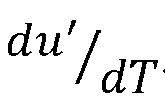
- Of course, there are other transformations that may be used to give a simple relationship between temperature and current on the one hand and the CIE 1936 XYZ coordinates on the other hand. Another method could for example be to use CIE 1976 coordinates and describe the shifts first as


- The most appropriate model may be found by fitting the measurement data against different coordinate systems and chosing the most appropriate. Further improvements can be made by using non-linear polynomial fits, power fits, exponential fits or logarithmic fits.
- This method thereby determines current drive levels for a set of channels in order to achieve a desired color point and a desired brightness (e.g. dimming level), but ensuring that the effect of operating the channels at different currents on the resulting color point is taken into account. It enables color point control as well as brightness level (i.e. dimming level) control, so that the color point remains constant for all brightness (i.e. dimming) levels. The method takes into account the way different color points of the lighting channels requires a different drive current.
- The method enables the balance of the different channels to be changed in order to achieve a desired set point of the complete light source. The color shift as a function of drive current is treated independently of temperature so that they are modelled as independent effects. The method enables the non-linear flux versus current relationship explained above to be taken into account as well as the change in color point with current, separately and in addition to temperature compensation.
- The convergence test for example involves determining if the temperature estimate has converged such that a next update gives a change below a threshold. Similarly, the convergence may (instead or as well) test is the current drive levels have converged such that a next update gives a change below a threshold.
- Thus, the method may iteratively arrive at a correct set of color points (and output flux) by suitable adaptation of the current drive levels, based on an accurate temperature estimate and with compensation for the effects that the current drive levels have on the color point.
- The method described above is based on an analog amplitude modulation approach. However, this may be combined with a digital pulse width modulation approach in various ways, as described below.
- The use of amplitude modulation in addition to a PWM dimmed system may be used to improve the resolution. Many standard PWM systems just use an 8-bit dimming control. However, at deep dimming, an 8-bit resolution is not sufficient. By changing the overall current using amplitude modulation, a gain in resolution can be achieved. For example, amplitude dimming from 100% to 12.5% adds an accuracy gain comparable to 3 additional bits in a full PWM system.
- One option is to use amplitude modulation dimming below a certain total system dimming level, so that the initial dimming is performed using PWM dimming. This approach will however show inherent flicker of a PWM dimmed system when there is high brightness.
- An alternative option is to start the system dimming using amplitude modulation. This initial amplitude modulation may for example be down to a 20% dimming level to avoid a large current range and a wide range for consistent LED behavior fitting. Below the 20% level, additional dimming is then implemented using PWM control.
- Thus there are three possible configurations which combine amplitude modulation and PWM dimming.
- (i) First dim the system with PWM dimming. Add amplitude modulation dimming to increase resolution at low dimming (i.e. low brightness) levels.
- (ii) First dim the system with amplitude modulation dimming to avoid flickering. Add PWM dimming to avoid a too large AM dimming range and reduce the risk of model fit inaccuracies.
- (iii) Combine amplitude modulation and PWM dimming for all dimming levels. This may for example involve always dimming in such a way that the largest PWM duty ratio always reaches 1. In this way, the PWM control sets the differences between channels, but with the maximum duty cycle. Amplitude dimming then provides a scaling. This could be especially attractive in shunt switched multi-channel systems.
-
Figure 7 shows how the relative flux contribution of each channel is obtained with respect to the Y0 value of the LED channel, i.e. the fraction value f_ch for the channel. - The method involves solving the vector equations shown which map between the temperature and current corrected LED values and the target XYZ values (XT, YT, ZT).
- This yields fractions f1 to fn for the channels. The output is thus the relative flux fractions f1..fn for an n channel system. The relative flux fractions indicate how much flux each channel should make in order to meet the target flux. The system needs to ensure the value of f is between 0 and 1. If f is larger than 1, the right-hand side target should be scaled.
-
Figure 8 shows a method which enables PWM dimming down to a threshold brightness then uses amplitude modulation or enables amplitude modulation down to a threshold then uses PWM dimming. - The method is used after the desired flux levels are known, from the method described above (step 62).
- Some values will be defined to enable
Figure 8 to be understood. - The color point and flux of a channel after the temperature correction is defined as x0,y0,Y0.
- Thus, Y0_ch is a temperature corrected flux of the particular channel as indicated in the flow diagram at the end of the
step 54. - x(It_ch) and y(It_ch) give the color point correction for the target current (It) for each channel (ch) after amplitude modulation dimming.
- Yt_ch is the target flux (Yt) of a channel (ch) at a PWM setting of 1 (i.e. when permanently on).
- It_ch is the target current (It) of a channel (ch) after amplitude modulation dimming.
- When the iteration is completed, Ych(It_ch)=Yt_ch. In other words, the flux of the channel at the target current is equal to the target flux.
- Ych is the function that describes the non-linear relation between flux and current.
- If amplitude modulation dimming is to be used first, a target value relFlux_lim is defined. relFlux_lim gives the flux relative to Y0 below which PWM dimming is to be used.
- If PWM dimming is to be used first, a target value PWM_lim is defined. PWM_lim describes the lowest dimming level at which PWM dimming is still used.
- Scenario (i) above (first dim the system with PWM dimming and add amplitude modulation dimming to increase resolution at low dimming) uses the target relFluxlim. When relFlux_lim =0, there is pure amplitude modulation dimming, an no initial PWM dimming.
- Scenario (ii) above (first dim the system with amplitude modulation dimming to avoid flickering and add PWM dimming to avoid a too large AM dimming range) uses the target PWM_lim, when PWM_lim < 1. When PWM_lim =1 there is the combined system of scenario (iii) in that PWM dimming is always used.
- To get to the desired lighting system color point, each channel should deliver f_ch *Y0_chlumen, wherein f_ch *Y0_ch=PWM_ch*Yt_ch.
- Yt_ch is the amount of flux a channel should give after AM dimming.
- In a full AM dimmed system Yt_ch = f_ch*Y0_ch. In a PWM dimmed system Yt_ch= f_ch*Y_ch, /PWM_ch. The non-linear relation Ych(Ich) is used to determine the current so that f_ch*Y0_ch = Ych(Ich).
- The method starts in
step 90. - In
step 92 it is selected if amplitude modulation is to be first used or if PWM dimming is to be first used. - For using amplitude modulation dimming first, the target relFlux_lim and channel fractions are input into
step 94. -
Step 94 sets a correction value for each channel corr_ch = min(1, fch/relFlux_lim). This correction cannot be greater than 1. - This involves checking if the required lumen per channel is lower than a limit value. If it is lower, a correction is applied. The limit value is a value up to which the color point correction using current is still accurate enough.
-
Step 96 sets the target channel flux Yt_ch = Y0_ch x fch/corr_ch and sets the PWM value PWM _ch=corr _ch. The correction is the difference between the lowest value allowed and the calculated relative flux f_ch. - Thus the target flux is inversely scaled with corr_ch and the PWM setting is scaled with corr_ch.
- In
step 98, the required current is then found for the new value Yt_ch. Thus, the PWM and target current values have been found. - For using PWM dimming first, the target PWM_lim and channel fractions are input into
step 102. Step 102 sets a correction value for each channel corr_ch = max(1, PWM_lim/f_ch). Thus, the correction cannot be greater than 1. - Step 104 determines if a correction per channel is needed.
- This is a decision based on the preference of the designer. The "yes" path provides a correction factor per channel (and the ability in the driver to individually control the current per channel). The "no" path uses only a single correction for all channels which is the same all channels.
- If a correction per channel is needed, step 106 sets the target channel flux Yt_ch = Y0_ch/corr_ch and PWM_ch=corr_ch.
- Y0_ch is the flux of the channel at nominal current. If a correction is applied to the PWM value (e.g. to make a channel fraction f_ch larger), the flux at 100% PWM needs to be reduced to Yt_ch.
- f_ch is the flux fraction per channel. f_ch=flux(It_ch)/flux(Inom_ch)*PWM, where flux(It_ch) is the flux at PWM=1 and target current It, flux(Inom_ch) is the flux of that channel at nominal current.
- The target flux is inversely scaled with corr_ch and the PWM setting is scaled with corr_ch.
- If a correction per channel is not needed, step 108 sets the target channel flux Yt_ch = Y0_ch/min(corr_ch) and PWM_ch=min(corr_ch).
- In this case, all PWMs are scaled in a similar manner, so also the currents will be scaled the same (in first order).
- In
step 98, the required current is then found for the new value Yt_ch. Thus, the PWM and target current values have been found. -
Figure 8 shows a lighting system comprising a plurality oflighting channels 110, the different lighting channels having light sources with different color point. A lighting controller 112 is part of alighting driver 114 and controls the drive currents to the different lighting channels using the methods explained above. - The steps of the method (e.g. in
Figures 5 and6 ) have been numbered. However, this does not mean that additional steps may not be present. - Variations to the disclosed embodiments can be understood and effected by those skilled in the art in practicing the claimed invention, from a study of the drawings, the disclosure and the appended claims. In the claims, the word "comprising" does not exclude other elements or steps, and the indefinite article "a" or "an" does not exclude a plurality.
- A computer program may be stored/distributed on a suitable medium, such as an optical storage medium or a solid-state medium supplied together with or as part of other hardware, but may also be distributed in other forms, such as via the Internet or other wired or wireless telecommunication systems.
- If the term "adapted to" is used in the claims or description, it is noted the term "adapted to" is intended to be equivalent to the term "configured to".
- Any reference signs in the claims should not be construed as limiting the scope.
Claims (14)
- A method of controlling a lighting system which comprises a plurality of lighting channels with light sources having different color points, comprising:a first step (51) of receiving color point information comprising nominal color point information in respect of the light sources;a second step (52) of adjusting the color point information in dependence on a currently up to date temperature estimate;a third step (54) of further adjusting the color point information in dependence on a currently up to date current drive level for the respective lighting channel, wherein the second and third steps may be performed in either order;a fourth step (62) of using the further adjusted color point information to determine a flux contribution of each lighting channel to achieve a desired combined color point and combined light output flux from the plurality of lighting channels;a fifth step (64) of updating the current drive levels for the plurality of lighting channels to create updated current drive levels to achieve the flux contribution of each lighting channel;a sixth step (66) of updating the temperature estimate to create an updated temperature estimate based on the updated current drive levels; andrepeating the second to sixth steps until (i) the temperature estimate converges to a value which deviates, when being updated, by less than a threshold, and/or (ii) the current drive levels converge to values which deviate, when being updated, by less than a threshold.
- The method of claim 1, comprising repeating the second to sixth steps until (i) the temperature estimate converges to a value which deviates, when being updated, by less than a threshold, and (ii) the current drive levels converge to values which deviate, when being updated, by less than a threshold.
- The method of any one of claims 1 to 2, wherein the second step (52) comprises transforming CIE 1936 XYZ color coordinates to CIE xyY chromaticity color coordinates, applying temperature corrections on dx/dT and dy/dT and flux, and transforming back to XYZ color coordinates.
- The method of any one of claims 1 to 3, wherein the third step comprises (54) using information relating to the rate of change of CIE xy chromaticity color coordinates with respect to drive current.
- The method of any one of claims 1 to 3, wherein the third step (54) comprises:a first sub-step (54a) of deriving a representative wavelength for the adjusted color point information;a second sub-step (54b) of adjusting the representative wavelength in dependence on a currently up to date current drive level for the respective lighting channel; anda third sub-step (54c) of further adjusting the color point information based on the adjusted representative wavelength.
- The method of claim 5, wherein the first sub-step (54a) uses a model for (56) converting from a color point to a representative wavelength.
- The method of claim 6, wherein the second sub-step (54b) uses a model (58) of the current dependency of different wavelengths and determines a color point shift with wavelength based on a model of the CIE x,y color coordinates as a function of a dominant wavelength.
- The method of any one of claims 5 to 7, wherein the third sub-step (54c) uses a model (60) for converting from a representative wavelength to a color point.
- The method of any one of claims 1 to 8, further comprising applying pulse width modulation to the drive currents for the lighting channels.
- A method of controlling a lighting system which comprises a plurality of lighting channels with light sources having different color points, comprising
three possible configurations combining the method of any one of claims 1 to 8 and PWM dimming by either:(i) First dimming the lighting system with PWM dimming and add applying the method of any one of claims 1 to 8; or(ii) First dimming the lighting system by applying the method of any one of claims 1 to 8 and add PWM dimming; or(iii) Combining applying the method of any one of claims 1 to 8 and PWM dimming for all dimming levels. - A computer program comprising computer program code which is adapted, when said program is run on a computer, to implement the method of any one of claims 1 to 10.
- A processor for controlling a lighting system which comprises a plurality of lighting channels with light sources having different color points, wherein the processor is programmed using the computer program of claim 11.
- A lighting controller (102) comprising a processor as claimed in claim 12.
- A lighting system comprising:a plurality of lighting channels (110), the different lighting channels having light sources with different color point; anda lighting controller (112) as claimed in claim 13. for controlling the drive currents to the different lighting channels.
Applications Claiming Priority (2)
| Application Number | Priority Date | Filing Date | Title |
|---|---|---|---|
| EP21186192 | 2021-07-16 | ||
| PCT/EP2022/069339 WO2023285393A1 (en) | 2021-07-16 | 2022-07-11 | Control of a lighting system for color point and flux level control |
Publications (2)
| Publication Number | Publication Date |
|---|---|
| EP4371375A1 EP4371375A1 (en) | 2024-05-22 |
| EP4371375B1 true EP4371375B1 (en) | 2025-02-12 |
Family
ID=76958858
Family Applications (1)
| Application Number | Title | Priority Date | Filing Date |
|---|---|---|---|
| EP22750800.9A Active EP4371375B1 (en) | 2021-07-16 | 2022-07-11 | Control of a lighting system for color point and flux level control |
Country Status (5)
| Country | Link |
|---|---|
| US (1) | US12538398B2 (en) |
| EP (1) | EP4371375B1 (en) |
| JP (1) | JP7529937B2 (en) |
| CN (1) | CN117643175B (en) |
| WO (1) | WO2023285393A1 (en) |
Families Citing this family (1)
| Publication number | Priority date | Publication date | Assignee | Title |
|---|---|---|---|---|
| CN117769078A (en) * | 2023-11-17 | 2024-03-26 | 漳州立达信光电子科技有限公司 | Calculation method, device, terminal and storage medium for lighting duty cycle |
Citations (13)
| Publication number | Priority date | Publication date | Assignee | Title |
|---|---|---|---|---|
| WO2004025998A2 (en) | 2002-09-16 | 2004-03-25 | First Flower & Fruit Company A/S | Led system for producing light |
| WO2006011108A1 (en) | 2004-07-23 | 2006-02-02 | Koninklijke Philips Electronics N.V. | System for temperature prioritised colour controlling of a solid-state lighting unit |
| US20060082331A1 (en) | 2004-09-29 | 2006-04-20 | Tir Systems Ltd. | System and method for controlling luminaires |
| WO2008006205A1 (en) | 2006-07-13 | 2008-01-17 | Tir Technology Lp | Light source and method for optimising illumination characteristics thereof |
| US20100259182A1 (en) | 2006-02-10 | 2010-10-14 | Tir Technology Lp | Light source intensity control system and method |
| US20100301777A1 (en) | 2007-09-07 | 2010-12-02 | Regine Kraemer | Method and Device For Adjusting the Color or Photometric Properties of an Led Illumination Device |
| WO2011036612A1 (en) | 2009-09-23 | 2011-03-31 | Koninklijke Philips Electronics N.V. | Color control of lighting system |
| WO2011106661A1 (en) | 2010-02-25 | 2011-09-01 | B/E Aerospace, Inc. | Calibration method for led lighting systems |
| WO2013157773A1 (en) | 2012-04-17 | 2013-10-24 | (주)대원정밀전자 | System for controlling illuminance of multi-channel lighting and method therefor |
| WO2014067830A1 (en) | 2012-10-31 | 2014-05-08 | Tridonic Jennersdorf Gmbh | Method and arrangement for the temperature-corrected control of leds using look-up tables |
| US9013467B2 (en) | 2013-07-19 | 2015-04-21 | Institut National D'optique | Controlled operation of a LED lighting system at a target output color |
| US9167656B2 (en) | 2012-05-04 | 2015-10-20 | Abl Ip Holding Llc | Lifetime correction for aging of LEDs in tunable-white LED lighting devices |
| US10321541B2 (en) | 2011-03-11 | 2019-06-11 | Ilumi Solutions, Inc. | LED lighting device |
Family Cites Families (10)
| Publication number | Priority date | Publication date | Assignee | Title |
|---|---|---|---|---|
| US20090033612A1 (en) * | 2007-07-31 | 2009-02-05 | Roberts John K | Correction of temperature induced color drift in solid state lighting displays |
| JP2013521171A (en) | 2010-02-25 | 2013-06-10 | ビーイー・エアロスペース・インコーポレーテッド | Aircraft LED washlight system and control method thereof |
| US9161416B2 (en) * | 2011-11-29 | 2015-10-13 | Koninklijke Philips N.V. | Method for adjusting a color point of light emitted from an organic light emitting diode OLED |
| EP2955711B1 (en) * | 2014-05-09 | 2018-11-21 | Ams Ag | Method for calibrating a color space transformation, method for color space transformation and color control system |
| US9491824B2 (en) * | 2014-08-05 | 2016-11-08 | Svetlana Eden | Method and apparatus for precise temperature brightness compensation of LED |
| US9900957B2 (en) * | 2015-06-11 | 2018-02-20 | Cree, Inc. | Lighting device including solid state emitters with adjustable control |
| DE102015119329A1 (en) * | 2015-11-10 | 2017-05-11 | Osram Oled Gmbh | An organic light emitting device device, a method of manufacturing an organic device light emitting device, and a method of operating an organic device light emitting device |
| TWI826530B (en) | 2018-10-19 | 2023-12-21 | 荷蘭商露明控股公司 | Method of driving an emitter array and emitter array device |
| DE112019005988T5 (en) * | 2018-11-29 | 2021-10-07 | Nippon Seiki Co., Ltd. | Display device |
| US11459997B2 (en) | 2020-03-26 | 2022-10-04 | Ocean Power Technologies, Inc. | Wave energy converter including a dual-point absorber connected to an above-water installation via a linkage |
-
2022
- 2022-07-11 WO PCT/EP2022/069339 patent/WO2023285393A1/en not_active Ceased
- 2022-07-11 JP JP2024502423A patent/JP7529937B2/en active Active
- 2022-07-11 US US18/577,249 patent/US12538398B2/en active Active
- 2022-07-11 EP EP22750800.9A patent/EP4371375B1/en active Active
- 2022-07-11 CN CN202280049746.4A patent/CN117643175B/en active Active
Patent Citations (13)
| Publication number | Priority date | Publication date | Assignee | Title |
|---|---|---|---|---|
| WO2004025998A2 (en) | 2002-09-16 | 2004-03-25 | First Flower & Fruit Company A/S | Led system for producing light |
| WO2006011108A1 (en) | 2004-07-23 | 2006-02-02 | Koninklijke Philips Electronics N.V. | System for temperature prioritised colour controlling of a solid-state lighting unit |
| US20060082331A1 (en) | 2004-09-29 | 2006-04-20 | Tir Systems Ltd. | System and method for controlling luminaires |
| US20100259182A1 (en) | 2006-02-10 | 2010-10-14 | Tir Technology Lp | Light source intensity control system and method |
| WO2008006205A1 (en) | 2006-07-13 | 2008-01-17 | Tir Technology Lp | Light source and method for optimising illumination characteristics thereof |
| US20100301777A1 (en) | 2007-09-07 | 2010-12-02 | Regine Kraemer | Method and Device For Adjusting the Color or Photometric Properties of an Led Illumination Device |
| WO2011036612A1 (en) | 2009-09-23 | 2011-03-31 | Koninklijke Philips Electronics N.V. | Color control of lighting system |
| WO2011106661A1 (en) | 2010-02-25 | 2011-09-01 | B/E Aerospace, Inc. | Calibration method for led lighting systems |
| US10321541B2 (en) | 2011-03-11 | 2019-06-11 | Ilumi Solutions, Inc. | LED lighting device |
| WO2013157773A1 (en) | 2012-04-17 | 2013-10-24 | (주)대원정밀전자 | System for controlling illuminance of multi-channel lighting and method therefor |
| US9167656B2 (en) | 2012-05-04 | 2015-10-20 | Abl Ip Holding Llc | Lifetime correction for aging of LEDs in tunable-white LED lighting devices |
| WO2014067830A1 (en) | 2012-10-31 | 2014-05-08 | Tridonic Jennersdorf Gmbh | Method and arrangement for the temperature-corrected control of leds using look-up tables |
| US9013467B2 (en) | 2013-07-19 | 2015-04-21 | Institut National D'optique | Controlled operation of a LED lighting system at a target output color |
Non-Patent Citations (3)
| Title |
|---|
| "International Conference on Intelligent Computing and Applications; December 21-22, 2016; Akurdi, Pune, India", vol. 632, 1 January 2018, SPRINGER SINGAPORE, ISBN: 978-981-10-5520-1, ISSN: 2194-5357, article SRIVIDYA R., KURIAN CIJI PEARL, SRINIVASAN C. R., SOWMYA R.: "An Embedded System for Color Point Control of LEDs Against Ambient Temperature Variations", pages: 533 - 542, XP093336494, DOI: 10.1007/978-981-10-5520-1_48 |
| DYBLE MARC, NARENDRAN NADARAJAH, BIERMAN ANDREW, KLEIN TERENCE: "Impact of dimming white LEDs: chromaticity shifts due to different dimming methods", FIFTH INTERNATIONAL CONFERENCE ON SOLID STATE LIGHTING; OPTICS AND PHOTONICS 2005 31 JULY - 4 AUGUST 2005 SAN DIEGO, CALIFORNIA, UNITED STATES, SPIE, vol. 5941, 18 August 2005 (2005-08-18) - 2005-08-04, pages 59411H - 9, XP093336486, DOI: 10.1117/12.625924 |
| LEE ALBERT T. L.; CHEN HUANTING; TAN SIEW-CHONG; HUI S. Y. RON: "Precise Dimming and Color Control of LED Systems Based on Color Mixing", IEEE TRANSACTIONS ON POWER ELECTRONICS, INSTITUTE OF ELECTRICAL AND ELECTRONICS ENGINEERS, USA, vol. 31, no. 1, 1 January 2016 (2016-01-01), USA , pages 65 - 80, XP011669886, ISSN: 0885-8993, DOI: 10.1109/TPEL.2015.2448641 |
Also Published As
| Publication number | Publication date |
|---|---|
| JP7529937B2 (en) | 2024-08-06 |
| JP2024524721A (en) | 2024-07-05 |
| CN117643175B (en) | 2025-11-14 |
| US12538398B2 (en) | 2026-01-27 |
| EP4371375A1 (en) | 2024-05-22 |
| CN117643175A (en) | 2024-03-01 |
| WO2023285393A1 (en) | 2023-01-19 |
| US20240284569A1 (en) | 2024-08-22 |
Similar Documents
| Publication | Publication Date | Title |
|---|---|---|
| US8710768B2 (en) | Algorithm for color corrected analog dimming in multi-color LED system | |
| EP2082620B1 (en) | Method and driver for determining drive values for driving a lighting device | |
| US9167656B2 (en) | Lifetime correction for aging of LEDs in tunable-white LED lighting devices | |
| KR101300565B1 (en) | Led luminary system | |
| EP1346609B1 (en) | Led luminary system | |
| JP5386488B2 (en) | Method and apparatus for adjusting color characteristics or photometric characteristics of LED lighting apparatus | |
| US10863599B2 (en) | White light tuning | |
| KR20110053448A (en) | Adjustable color light source | |
| US10492256B2 (en) | Method and device for calibrating LED lighting | |
| CN114126145B (en) | Method for adjusting linear perception of color temperature of lamp and application thereof | |
| US12538398B2 (en) | Control of a lighting system for color point and flux level control | |
| CN105009191A (en) | Color control method | |
| US11129252B2 (en) | Output stabilization of mixed color temperature LED lighting systems | |
| KR101749115B1 (en) | Lighting apparatus controlling light flux and method for controlling same | |
| KR101746541B1 (en) | Lighting apparatus and method for controlling same | |
| CN114651529B (en) | Light emitting diode (LED) based lighting device arranged to emit a specific emission light following the Planckian locus in color space | |
| US10805995B2 (en) | Light-emitting module and control module | |
| US8841852B2 (en) | Illumination apparatus with signal filters | |
| JP7351518B2 (en) | LED drive circuit, LED lighting system, and LED drive method | |
| CN116113101B (en) | A method and related apparatus for color temperature switching | |
| JP2023049429A (en) | Light emission control device, light-emitting device, and illuminating device | |
| JP2023183024A (en) | Adjustable color LED lighting device and dimming method |
Legal Events
| Date | Code | Title | Description |
|---|---|---|---|
| STAA | Information on the status of an ep patent application or granted ep patent |
Free format text: STATUS: UNKNOWN |
|
| STAA | Information on the status of an ep patent application or granted ep patent |
Free format text: STATUS: THE INTERNATIONAL PUBLICATION HAS BEEN MADE |
|
| PUAI | Public reference made under article 153(3) epc to a published international application that has entered the european phase |
Free format text: ORIGINAL CODE: 0009012 |
|
| STAA | Information on the status of an ep patent application or granted ep patent |
Free format text: STATUS: REQUEST FOR EXAMINATION WAS MADE |
|
| 17P | Request for examination filed |
Effective date: 20240216 |
|
| AK | Designated contracting states |
Kind code of ref document: A1 Designated state(s): AL AT BE BG CH CY CZ DE DK EE ES FI FR GB GR HR HU IE IS IT LI LT LU LV MC MK MT NL NO PL PT RO RS SE SI SK SM TR |
|
| GRAP | Despatch of communication of intention to grant a patent |
Free format text: ORIGINAL CODE: EPIDOSNIGR1 |
|
| STAA | Information on the status of an ep patent application or granted ep patent |
Free format text: STATUS: GRANT OF PATENT IS INTENDED |
|
| DAV | Request for validation of the european patent (deleted) | ||
| DAX | Request for extension of the european patent (deleted) | ||
| INTG | Intention to grant announced |
Effective date: 20240903 |
|
| GRAS | Grant fee paid |
Free format text: ORIGINAL CODE: EPIDOSNIGR3 |
|
| GRAA | (expected) grant |
Free format text: ORIGINAL CODE: 0009210 |
|
| STAA | Information on the status of an ep patent application or granted ep patent |
Free format text: STATUS: THE PATENT HAS BEEN GRANTED |
|
| P01 | Opt-out of the competence of the unified patent court (upc) registered |
Free format text: CASE NUMBER: APP_67991/2024 Effective date: 20241224 |
|
| AK | Designated contracting states |
Kind code of ref document: B1 Designated state(s): AL AT BE BG CH CY CZ DE DK EE ES FI FR GB GR HR HU IE IS IT LI LT LU LV MC MK MT NL NO PL PT RO RS SE SI SK SM TR |
|
| REG | Reference to a national code |
Ref country code: GB Ref legal event code: FG4D |
|
| REG | Reference to a national code |
Ref country code: CH Ref legal event code: EP |
|
| REG | Reference to a national code |
Ref country code: DE Ref legal event code: R096 Ref document number: 602022010595 Country of ref document: DE |
|
| REG | Reference to a national code |
Ref country code: IE Ref legal event code: FG4D |
|
| REG | Reference to a national code |
Ref country code: NL Ref legal event code: MP Effective date: 20250212 |
|
| PG25 | Lapsed in a contracting state [announced via postgrant information from national office to epo] |
Ref country code: RS Free format text: LAPSE BECAUSE OF FAILURE TO SUBMIT A TRANSLATION OF THE DESCRIPTION OR TO PAY THE FEE WITHIN THE PRESCRIBED TIME-LIMIT Effective date: 20250512 |
|
| PG25 | Lapsed in a contracting state [announced via postgrant information from national office to epo] |
Ref country code: FI Free format text: LAPSE BECAUSE OF FAILURE TO SUBMIT A TRANSLATION OF THE DESCRIPTION OR TO PAY THE FEE WITHIN THE PRESCRIBED TIME-LIMIT Effective date: 20250212 |
|
| PG25 | Lapsed in a contracting state [announced via postgrant information from national office to epo] |
Ref country code: PL Free format text: LAPSE BECAUSE OF FAILURE TO SUBMIT A TRANSLATION OF THE DESCRIPTION OR TO PAY THE FEE WITHIN THE PRESCRIBED TIME-LIMIT Effective date: 20250212 |
|
| PG25 | Lapsed in a contracting state [announced via postgrant information from national office to epo] |
Ref country code: ES Free format text: LAPSE BECAUSE OF FAILURE TO SUBMIT A TRANSLATION OF THE DESCRIPTION OR TO PAY THE FEE WITHIN THE PRESCRIBED TIME-LIMIT Effective date: 20250212 |
|
| REG | Reference to a national code |
Ref country code: LT Ref legal event code: MG9D |
|
| PG25 | Lapsed in a contracting state [announced via postgrant information from national office to epo] |
Ref country code: NO Free format text: LAPSE BECAUSE OF FAILURE TO SUBMIT A TRANSLATION OF THE DESCRIPTION OR TO PAY THE FEE WITHIN THE PRESCRIBED TIME-LIMIT Effective date: 20250512 Ref country code: IS Free format text: LAPSE BECAUSE OF FAILURE TO SUBMIT A TRANSLATION OF THE DESCRIPTION OR TO PAY THE FEE WITHIN THE PRESCRIBED TIME-LIMIT Effective date: 20250612 |
|
| PG25 | Lapsed in a contracting state [announced via postgrant information from national office to epo] |
Ref country code: NL Free format text: LAPSE BECAUSE OF FAILURE TO SUBMIT A TRANSLATION OF THE DESCRIPTION OR TO PAY THE FEE WITHIN THE PRESCRIBED TIME-LIMIT Effective date: 20250212 |
|
| PG25 | Lapsed in a contracting state [announced via postgrant information from national office to epo] |
Ref country code: HR Free format text: LAPSE BECAUSE OF FAILURE TO SUBMIT A TRANSLATION OF THE DESCRIPTION OR TO PAY THE FEE WITHIN THE PRESCRIBED TIME-LIMIT Effective date: 20250212 |
|
| PG25 | Lapsed in a contracting state [announced via postgrant information from national office to epo] |
Ref country code: PT Free format text: LAPSE BECAUSE OF FAILURE TO SUBMIT A TRANSLATION OF THE DESCRIPTION OR TO PAY THE FEE WITHIN THE PRESCRIBED TIME-LIMIT Effective date: 20250612 Ref country code: LV Free format text: LAPSE BECAUSE OF FAILURE TO SUBMIT A TRANSLATION OF THE DESCRIPTION OR TO PAY THE FEE WITHIN THE PRESCRIBED TIME-LIMIT Effective date: 20250212 |
|
| PG25 | Lapsed in a contracting state [announced via postgrant information from national office to epo] |
Ref country code: GR Free format text: LAPSE BECAUSE OF FAILURE TO SUBMIT A TRANSLATION OF THE DESCRIPTION OR TO PAY THE FEE WITHIN THE PRESCRIBED TIME-LIMIT Effective date: 20250513 Ref country code: BG Free format text: LAPSE BECAUSE OF FAILURE TO SUBMIT A TRANSLATION OF THE DESCRIPTION OR TO PAY THE FEE WITHIN THE PRESCRIBED TIME-LIMIT Effective date: 20250212 |
|
| PG25 | Lapsed in a contracting state [announced via postgrant information from national office to epo] |
Ref country code: SE Free format text: LAPSE BECAUSE OF FAILURE TO SUBMIT A TRANSLATION OF THE DESCRIPTION OR TO PAY THE FEE WITHIN THE PRESCRIBED TIME-LIMIT Effective date: 20250212 |
|
| PG25 | Lapsed in a contracting state [announced via postgrant information from national office to epo] |
Ref country code: SM Free format text: LAPSE BECAUSE OF FAILURE TO SUBMIT A TRANSLATION OF THE DESCRIPTION OR TO PAY THE FEE WITHIN THE PRESCRIBED TIME-LIMIT Effective date: 20250212 |
|
| PG25 | Lapsed in a contracting state [announced via postgrant information from national office to epo] |
Ref country code: DK Free format text: LAPSE BECAUSE OF FAILURE TO SUBMIT A TRANSLATION OF THE DESCRIPTION OR TO PAY THE FEE WITHIN THE PRESCRIBED TIME-LIMIT Effective date: 20250212 |
|
| PGFP | Annual fee paid to national office [announced via postgrant information from national office to epo] |
Ref country code: DE Payment date: 20250926 Year of fee payment: 4 |
|
| PG25 | Lapsed in a contracting state [announced via postgrant information from national office to epo] |
Ref country code: IT Free format text: LAPSE BECAUSE OF FAILURE TO SUBMIT A TRANSLATION OF THE DESCRIPTION OR TO PAY THE FEE WITHIN THE PRESCRIBED TIME-LIMIT Effective date: 20250212 |
|
| PG25 | Lapsed in a contracting state [announced via postgrant information from national office to epo] |
Ref country code: AT Free format text: LAPSE BECAUSE OF FAILURE TO SUBMIT A TRANSLATION OF THE DESCRIPTION OR TO PAY THE FEE WITHIN THE PRESCRIBED TIME-LIMIT Effective date: 20250212 |
|
| PGFP | Annual fee paid to national office [announced via postgrant information from national office to epo] |
Ref country code: FR Payment date: 20250725 Year of fee payment: 4 |
|
| PG25 | Lapsed in a contracting state [announced via postgrant information from national office to epo] |
Ref country code: EE Free format text: LAPSE BECAUSE OF FAILURE TO SUBMIT A TRANSLATION OF THE DESCRIPTION OR TO PAY THE FEE WITHIN THE PRESCRIBED TIME-LIMIT Effective date: 20250212 Ref country code: CZ Free format text: LAPSE BECAUSE OF FAILURE TO SUBMIT A TRANSLATION OF THE DESCRIPTION OR TO PAY THE FEE WITHIN THE PRESCRIBED TIME-LIMIT Effective date: 20250212 |
|
| PG25 | Lapsed in a contracting state [announced via postgrant information from national office to epo] |
Ref country code: RO Free format text: LAPSE BECAUSE OF FAILURE TO SUBMIT A TRANSLATION OF THE DESCRIPTION OR TO PAY THE FEE WITHIN THE PRESCRIBED TIME-LIMIT Effective date: 20250212 |
|
| PG25 | Lapsed in a contracting state [announced via postgrant information from national office to epo] |
Ref country code: SK Free format text: LAPSE BECAUSE OF FAILURE TO SUBMIT A TRANSLATION OF THE DESCRIPTION OR TO PAY THE FEE WITHIN THE PRESCRIBED TIME-LIMIT Effective date: 20250212 |
|
| REG | Reference to a national code |
Ref country code: DE Ref legal event code: R026 Ref document number: 602022010595 Country of ref document: DE |
|
| PLBI | Opposition filed |
Free format text: ORIGINAL CODE: 0009260 |
|
| REG | Reference to a national code |
Ref country code: CH Ref legal event code: L10 Free format text: ST27 STATUS EVENT CODE: U-0-0-L10-L00 (AS PROVIDED BY THE NATIONAL OFFICE) Effective date: 20251119 |
|
| 26 | Opposition filed |
Opponent name: NOVAGRAAF INTERNATIONAL SA Effective date: 20251112 |
|
| PLAX | Notice of opposition and request to file observation + time limit sent |
Free format text: ORIGINAL CODE: EPIDOSNOBS2 |
|
| REG | Reference to a national code |
Ref country code: CH Ref legal event code: H13 Free format text: ST27 STATUS EVENT CODE: U-0-0-H10-H13 (AS PROVIDED BY THE NATIONAL OFFICE) Effective date: 20260224 |
|
| PG25 | Lapsed in a contracting state [announced via postgrant information from national office to epo] |
Ref country code: LU Free format text: LAPSE BECAUSE OF NON-PAYMENT OF DUE FEES Effective date: 20250711 |
|
| REG | Reference to a national code |
Ref country code: BE Ref legal event code: MM Effective date: 20250731 |
|
| PG25 | Lapsed in a contracting state [announced via postgrant information from national office to epo] |
Ref country code: BE Free format text: LAPSE BECAUSE OF NON-PAYMENT OF DUE FEES Effective date: 20250731 |
|
| PLBB | Reply of patent proprietor to notice(s) of opposition received |
Free format text: ORIGINAL CODE: EPIDOSNOBS3 |
|
| PG25 | Lapsed in a contracting state [announced via postgrant information from national office to epo] |
Ref country code: CH Free format text: LAPSE BECAUSE OF NON-PAYMENT OF DUE FEES Effective date: 20250731 |
|
| PG25 | Lapsed in a contracting state [announced via postgrant information from national office to epo] |
Ref country code: LT Free format text: LAPSE BECAUSE OF FAILURE TO SUBMIT A TRANSLATION OF THE DESCRIPTION OR TO PAY THE FEE WITHIN THE PRESCRIBED TIME-LIMIT Effective date: 20250212 |
|
| PG25 | Lapsed in a contracting state [announced via postgrant information from national office to epo] |
Ref country code: IE Free format text: LAPSE BECAUSE OF NON-PAYMENT OF DUE FEES Effective date: 20250711 |
|
| PG25 | Lapsed in a contracting state [announced via postgrant information from national office to epo] |
Ref country code: MC Free format text: LAPSE BECAUSE OF FAILURE TO SUBMIT A TRANSLATION OF THE DESCRIPTION OR TO PAY THE FEE WITHIN THE PRESCRIBED TIME-LIMIT Effective date: 20250212 |
|
| PG25 | Lapsed in a contracting state [announced via postgrant information from national office to epo] |
Ref country code: CY Free format text: LAPSE BECAUSE OF FAILURE TO SUBMIT A TRANSLATION OF THE DESCRIPTION OR TO PAY THE FEE WITHIN THE PRESCRIBED TIME-LIMIT Effective date: 20250212 |