EP4369684A2 - Verfahren zur bereitstellung von streaming-daten-resilienz unter verwendung eines verteilten nachrichtenwarteschlangensystems - Google Patents
Verfahren zur bereitstellung von streaming-daten-resilienz unter verwendung eines verteilten nachrichtenwarteschlangensystems Download PDFInfo
- Publication number
- EP4369684A2 EP4369684A2 EP24163977.2A EP24163977A EP4369684A2 EP 4369684 A2 EP4369684 A2 EP 4369684A2 EP 24163977 A EP24163977 A EP 24163977A EP 4369684 A2 EP4369684 A2 EP 4369684A2
- Authority
- EP
- European Patent Office
- Prior art keywords
- streaming data
- message
- data platform
- queue
- service
- Prior art date
- Legal status (The legal status is an assumption and is not a legal conclusion. Google has not performed a legal analysis and makes no representation as to the accuracy of the status listed.)
- Pending
Links
Images



Classifications
-
- G—PHYSICS
- G06—COMPUTING OR CALCULATING; COUNTING
- G06F—ELECTRIC DIGITAL DATA PROCESSING
- G06F9/00—Arrangements for program control, e.g. control units
- G06F9/06—Arrangements for program control, e.g. control units using stored programs, i.e. using an internal store of processing equipment to receive or retain programs
- G06F9/46—Multiprogramming arrangements
- G06F9/54—Interprogram communication
- G06F9/546—Message passing systems or structures, e.g. queues
-
- H—ELECTRICITY
- H04—ELECTRIC COMMUNICATION TECHNIQUE
- H04L—TRANSMISSION OF DIGITAL INFORMATION, e.g. TELEGRAPHIC COMMUNICATION
- H04L51/00—User-to-user messaging in packet-switching networks, transmitted according to store-and-forward or real-time protocols, e.g. e-mail
- H04L51/21—Monitoring or handling of messages
- H04L51/214—Monitoring or handling of messages using selective forwarding
-
- H—ELECTRICITY
- H04—ELECTRIC COMMUNICATION TECHNIQUE
- H04L—TRANSMISSION OF DIGITAL INFORMATION, e.g. TELEGRAPHIC COMMUNICATION
- H04L51/00—User-to-user messaging in packet-switching networks, transmitted according to store-and-forward or real-time protocols, e.g. e-mail
- H04L51/21—Monitoring or handling of messages
- H04L51/23—Reliability checks, e.g. acknowledgments or fault reporting
-
- H—ELECTRICITY
- H04—ELECTRIC COMMUNICATION TECHNIQUE
- H04L—TRANSMISSION OF DIGITAL INFORMATION, e.g. TELEGRAPHIC COMMUNICATION
- H04L63/00—Network architectures or network communication protocols for network security
- H04L63/08—Network architectures or network communication protocols for network security for authentication of entities
-
- H—ELECTRICITY
- H04—ELECTRIC COMMUNICATION TECHNIQUE
- H04L—TRANSMISSION OF DIGITAL INFORMATION, e.g. TELEGRAPHIC COMMUNICATION
- H04L63/00—Network architectures or network communication protocols for network security
- H04L63/14—Network architectures or network communication protocols for network security for detecting or protecting against malicious traffic
- H04L63/1408—Network architectures or network communication protocols for network security for detecting or protecting against malicious traffic by monitoring network traffic
- H04L63/1416—Event detection, e.g. attack signature detection
-
- H—ELECTRICITY
- H04—ELECTRIC COMMUNICATION TECHNIQUE
- H04L—TRANSMISSION OF DIGITAL INFORMATION, e.g. TELEGRAPHIC COMMUNICATION
- H04L67/00—Network arrangements or protocols for supporting network services or applications
- H04L67/01—Protocols
- H04L67/10—Protocols in which an application is distributed across nodes in the network
-
- H—ELECTRICITY
- H04—ELECTRIC COMMUNICATION TECHNIQUE
- H04L—TRANSMISSION OF DIGITAL INFORMATION, e.g. TELEGRAPHIC COMMUNICATION
- H04L69/00—Network arrangements, protocols or services independent of the application payload and not provided for in the other groups of this subclass
- H04L69/40—Network arrangements, protocols or services independent of the application payload and not provided for in the other groups of this subclass for recovering from a failure of a protocol instance or entity, e.g. service redundancy protocols, protocol state redundancy or protocol service redirection
Definitions
- Real-time data processing environments can include diverse types of data systems and devices that provide and process data.
- the real-time data may be time-critical and/or mission-critical data that needs to be processed and provided to other systems in a timely manner.
- a banking system may be required to process large amounts of real-time data to perform various banking functions including processing transactions and providing fraud detection.
- a failure occurs, it is critical that data is not lost and the systems are returned to an operating state as quickly as possible.
- Embodiments discussed herein are directed to solving these and other problems.
- Embodiments discussed herein are directed to providing streaming data in a resilient manner.
- embodiments may include devices, systems, components, and so forth to provide techniques and computer-implemented including receiving data from a data service provider, communicating one or more messages comprising the data to a streaming data platform, and detecting failures of delivery of a message of the one or more messages to the streaming data platform.
- Embodiments further include communicating the message to a distributed message queue service, wherein the message is communicated to the distributed message queue service based on the detection of the failure of delivery and stored in a queue of a distributed message queue system.
- the system includes publishing the message to the streaming data platform, determining whether the message published to the streaming data platform was successful or unsuccessful, and retrying publishing of the message to the streaming data platform when publication of the message is unsuccessful.
- Embodiments are generally directed to providing resiliency in capturing and processing streaming data from one or more data sources. More specifically, embodiments include utilizing a distributed cloud-based message queue system to process and provide messages including the data from real-time data streams.
- a streaming system may include applications that receive and process the streaming data. The applications may provide the processed data to a streaming data platform that may be used by other consumer applications to further process and/or store the data.
- the streaming data platform may be used to provide intelligent real-time decisions for customers utilizing the system.
- data from an application to the streaming data platform may be failed to be delivered. In these instances, the undelivered data may be provided to the distributed message queue system to store in a queue and provide to the streaming data platform once any issues are resolved.
- the streaming may include the applications that may receive the data, process the data, and utilize the distributed message queue system to send all of the processed data to the streaming data platform.
- the application may retry to send the undelivered to the streaming data platform.
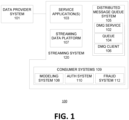
- FIG. 1 illustrates a system 100 to process streaming data in real-time or near real-time while providing resilient backup capabilities utilizing a distributed message queue system 105 and services 102.
- the data may be provided by one or more systems based on any number of event occurrences.
- the data is received by a streaming system 120 to process and provide to other internal systems, such as consumer systems 109. These systems may do additional processing with the data to provide insights.
- the system 100 may be part of a banking platform and the streaming data may be related to banking functions, such as performing transactions, processing credit or loan applications, and other general banking functions.
- the data may be required to perform critical functions, such as fraud detection, transaction authentication, loan/credit approval, and so forth.
- Utilization of the distributed messages queue system 105 ensures that the system 100 may continue to provide critical functionality with fault tolerance by providing backup data paths and logging capabilities.
- the system 100 may include a streaming data system 120 that may receive and process the streaming data from one or more internal or external data sources, such as a data provider system 101.
- a data provider system 101 may be any type of computing system that may provide data in real-time or near real-time and in a streaming manner.
- the data provider system 101 may be a payment processing system, such as TSYS ® , SQUARE ® , STRIPE ® , Synovus Financial Corp, Fiserv, First Data Corp., and so forth, and may communicate data to the streaming system 120 while performing transactions.
- the data may include transaction data, e.g., merchant identifying information, price of transactions, time/date of transactions, etc.
- the data may also include authentication data for customers, e.g., the user or card identifier, account number or token, card security code of verification value, expiration date, etc.
- the data provider system 101 may provide the data while a transaction is occurring and may be utilized by one or more of the consumer systems 109 to provide insights and make determinations, e.g., authenticating the user, detecting fraud, providing incentives, updating models, and so forth.
- system 100 may include more than one or more data provider systems 101 and are not limited in this manner.
- additional data provider systems 101 may include a customer service system providing customer service information, a news service system providing news, a rewards system providing rewards data, a voice response system providing voice response data.
- the streaming system 120 may receive the data through one or more application programming interfaces (APIs) portals coupled with the one or more data provider system(s) 101.
- the data may be received by one or more service application(s) 103 of the streaming system 120 configured to send the streaming data to a streaming data platform 107.
- a service application 103 may be a software engine or component to couple with one or more of the APIs to receive the data from a data provider system 101, process the data, and provide the data to the consumer systems 109.
- the streaming data platform 107 may process data in a Java ® format and may utilize a binary transmission control protocol (TCP)-based protocol. Further, the service application 103 may utilize a producer API to publish streams of records in a Java format. In other instances, the streaming data platform 107 may utilize a consumer API and subscribe to streams of records in a Java format.
- TCP binary transmission control protocol
- a service application 103 may provide the processed data in one or more messages directly to the streaming data platform 107 to publish to the consumer systems 109.
- the distributed message queue system 105 may only be utilized during data loss events as a backup to ensure that undelivered messages are eventually delivered to the streaming data platform 107.
- a service application 103 may utilize the distributed message queue system 105 to provide the processed data to the streaming data platform 107.
- the service application 103 may handle undelivered data. More specifically, the distributed message queue system 105 may notify the service application 103 of undelivered data and the service application 103 may send the undelivered processed data directly to the streaming data platform 107 to publish to the consumer systems 109.
- the streaming system 120 may include a number of different service application(s) 103 to perform various operations to process the streaming data.
- a service application 103 may be an authentication engine to receive and process data for authentication, e.g., processing authentication request data to make authentication decisions.
- the service application 103 may be a fraud engine to process data for fraud detection, e.g., transaction information, location of the transaction, amount of transaction, e.g., make real-time fraud determinations.
- the service application 103 may be a modeling engine to receive and process data for model scoring, e.g., determining model features and scores, detecting model errors and warnings, and utilizing transaction data, analytical data, and other data for data validation.
- the streaming data platform 107 may receive processed data either directly from a service application 103 or from the distributed message queue system 105, as previously discussed.
- the streaming data platform 107 may publish the data for one or more of the consumer systems 109 to further process and/or store the data.
- a consumer system 109 may include a modeling system 108 that may receive the data including model scoring to update models, generate new models, perform model validation, and store in a data store.
- the consumer system 109 may include an authentication system 110 to further process the data for authentication and store authentication decisions in a data store.
- the consumer system 109 may include a fraud system 112 to further process data to perform fraud defensive actions, update account statuses, apply account restrictions, create a fraud case, and trigger alerts.
- the streaming system 120 may be part of a critical system providing banking services to customers and providers, such as transaction processing and fraud detection.
- any data loss is detrimental to the streaming system 120 and consumer systems 109 utilizing the data.
- Previously solutions used systems and servers to log the data and where, at times, subject to the same outages and the primary system processing the data.
- previous systems utilized a system configured with APACHE ® including APACHE's log4j to log data during a failure event and provide once the primary system came back online.
- APACHE ® including APACHE's log4j to log data during a failure event and provide once the primary system came back online.
- APACHE ® when the failure event occurred it would also take down the APACHE ® system itself.
- APACHE's log4j did log data during a failure, it was slow to come online, e.g., fifteen plus minutes.
- Embodiments discussed herein were developed to provide a store and forward solution to provide resiliency and to eliminate failure event downtime. More specifically, embodiments include utilizing a distributed message queue system 105 having a distributed message queue service 102, a queue 104, and a distributed message client 106 to store and forward data during failure events.
- the distributed message queue system 105 may be a cloud-based system, such as Amazon Web Services (AWS ® ), and the distributed message queue service 102 may be AWS's Simple Queue Service (SQS ® ).
- the distributed message queue client 106 may be AWS's Lambda ® client.
- the service application 103 may detect a failure of delivery of one or more messages to the streaming data platform 107. For example, the service application 103 may receive or determine a delivery timeout (100 milliseconds (ms)) or determine a connectivity failure. In these instances, the service application 103 may be configured to redirect the failed messages to the distributed message queue system 105 to ensure that streaming data corresponding to the failed messages is not lost and is ultimately delivered to the streaming data platform 107 and consumer systems 109. In some embodiments, the distributed message queue system 105 may be configured to trigger an alarm when failed messages are being delivered. The alarm may trigger when a specified number of 'error' messages are received and processed. For example, a cloud watch alarm for error monitoring with metric filter - "ERROR" - GUID for > 10 in 5 min. Also QueueDepth CloudWatch alarm may be setup from the distributed message queue system for > 1000 in Imin for 3 times.
- a delivery timeout 100 milliseconds (ms)
- the service application 103 may be configured to redirect the failed
- the service application 103 may communicate via an API the one or more failed messages to the distributed message queue system 105. More specifically, the service application 103 may invoke or utilize the distributed message queue service 102 and send the message(s) for storage in queue 104.
- the queue 104 may be an encrypted queue with one or more topics configured for notification in each region for each application.
- the distributed message queue system 105 may publish or send the messages to the streaming data platform 107 and/or maintain them in queue 104 until they can be delivered. More specifically, the distributed message queue client 106 may publish the message(s) to the streaming data platform 107. In one example, the distributed message queue client 106 may poll the queue 104 for the message and send the messages to the streaming data platform 107.
- the queue 104 may be configured on the distributed message queue system 105 as an event source for the client 106. When an event occurs, a message or record of the message is in the queue 104, and the event may be triggered and detected by the client 106.
- the client 106 may retrieve the message(s) from the queue 104 and send the message(s) as a single message or in a batch, e.g., five messages.
- each service application 103 may be configured with an associated queue 104, and the client 106 may process and send data the streaming data platform 107 based on which queue 104 has the data.
- a single queue 104 may be used for all of the service applications 103 and the client 106 may automatically discover the correct consumer for the streaming data platform 107 based on a message envelope.
- the distributed message queue client 106 may determine whether the message published to the streaming data platform 107 was delivered successfully or unsuccessfully. In some instances, the streaming data platform 107 may not be able to handle and/or receive the message(s) from the distributed message queue client 106. For example, the streaming data platform 107 may throttle the data, an error may be returned to the client 106, the platform 107 may not respond, etc.
- the distributed message queue client 106 may retry publishing the messages(s) to the streaming data platform 107 when the publication of the message(s) are unsuccessful and until the message(s) are successfully delivered or a period of time has expired. In some instances, the distributed message client 106 may send the message(s) unsuccessfully delivered back to the queue 104 until some later point in time prior to retrying publication. For example, the client 106 may send the message(s) back to the queue 104, wait 1000 ms, and then retry publishing the message(s) to the streaming data platform 107. Note that embodiments are not limited in this manner and the time is configura
- the service application 103 may send all of the messages to the distributed message queue system 105 to send to the streaming data platform 107.
- service application 103 may, communicate via API messages including the streaming data and processed streaming data to the distributed message queue service 102.
- the distributed message queue service 102 may store each of the messages the queue 104 for publishing to the streaming data platform 107
- the service application 103 may invoke the 'SendMessageRequest' instance of SQS and include the name of the queue 104 and the body of the message.
- the request is then passed to the distributed message queue service 102 send message method, which may return a send message response object to the service application 103.
- the distributed message queue system 105 may utilize the distributed message queue client 106 to publish each of the one or more messages stored in the queue 104 to the streaming data platform 107. For example, the distributed message queue client 106 may poll the queue 104 for the message(s) and send the message(s) to the streaming data platform 107. As discussed above, the queue 104 may be configured on the distributed message queue system 105 as an event source for the client 106. When an event occurs, a message or record of the message is in the queue 104 and an event may be triggered and detected by the client 106. The client 106 may retrieve the message(s) from the queue 104 and send the message(s) as a single message or in a batch, e.g., five messages.
- the message(s) may not be delivered to the streaming data platform 107.
- the distributed message queue client 106 may determine whether the message published to the streaming data platform 107 was delivered successfully or unsuccessfully. In these instances, the distributed message queue client 106 may store the undelivered messages back in the queue 104 and the distributed message queue service 102 may return an object to the service application 103 that a failure of delivery occurred. In embodiments, the service application 103 may determine a failure of delivery that occurred based on the information received from the distributed message queue system 105. In these instances, the service application 103 may communicate undelivered messages directly to the streaming data platform 107.
- the service application 103 may retry sending the undelivered messages to the streaming data platform 107. For example, the service application 103 may determine whether the message communicated directly to the streaming data platform 107 was successful or unsuccessful and retry communication of the message to the streaming data platform 107 when the message is unsuccessful. The service application 103 may continue to retry to communicate the message until delivery of to the streaming data platform 107 is successful or a defined period of time has expired.
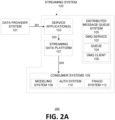
- FIG. 2A illustrates an example processing flow 200 of system 100 where the service application 103 sends messages directly to the streaming data platform 107 unless there is a failure.
- messages are being delivered to the streaming data platform 107 without failures.
- the service application 103 may receive streaming data from one or more data provider systems 101.
- the streaming data may include data to perform banking functions.
- the service application 103 may receive the data, process the data, and generate one or more messages of the streaming data to send to the streaming data platform 107.
- the service application 103 may send the one or more messages to the streaming data platform 107.
- the streaming data platform 107 may send the messages to the consumer system 109.
- the streaming data platform 107 may publish the data and one or more of the consumer system 109 may subscribe and receive particular data.
- the modeling system 108 and authentication system 110 may subscribe and receive authentication data.
- the fraud system 112 may subscribe and receive fraud data.
- the modeling system 108 may subscribe and receive model data.
- FIG. 2B illustrates an example processing flow 220 in the same configuration as FIG. 2A ; however, a failure event is handled.
- the service application 103 may receive streaming data from one or more data provider systems 101.
- the service application 103 may receive the data, process the data, and generate one or more messages of the streaming data to send to the streaming data platform 107.
- the service application 103 may send the one or more messages to the streaming data platform 107.
- the service application 103 may detect a failure of delivery of one or more the messages to the streaming data platform 107 as indicated by dotted line 225.
- the service application 103 may be configured to redirect the failed messages to the distributed message queue system.
- the service application 103 may communicate via an API the one or more failed messages to the distributed message queue system 105.
- the service application 103 may invoke or utilize the distributed message queue service 102 and send the message(s) for storage in queue 104.
- the distributed message queue system 105 including the distributed message queue client 106 may publish or send the messages to the streaming data platform 107.
- the streaming data platform 107 may not receive the messages and/or the messages may not be deliverable to the streaming data platform 107.
- the distributed message queue client 106 may determine whether the message published to the streaming data platform 107 was delivered successfully or unsuccessfully.
- the distributed message queue system 105 may determine the message(s) that were not received by the streaming data platform 107. For example, streaming data platform 107 may throttle the data, an error may be returned to the client 106, the platform 107 may not respond, etc. Further, at line 231, the distributed message queue client 106 may retry publishing the messages(s) to the streaming data platform 107 when the publication of the message(s) are unsuccessful and until the message(s) are successfully delivered or a period of time has expired.
- the streaming data platform 107 may send the messages to the consumer system 109.
- the streaming data platform 107 may publish the data and one or more of the consumer system 109 may subscribe and receive particular data.
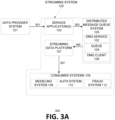
- FIG. 3A illustrates an example processing flow 300 of system 100 where the service application 103 sends messages all of the messages to the distributed message queue system 105 to further send to the streaming data platform 107.
- messages are being delivered to the streaming data platform 107 without failures.
- the service application 103 may receive streaming data from one or more data provider systems 101.
- the service application 103 may receive the data, process the data, and generate one or more messages of the streaming data to send to the streaming data platform 107.
- the service application 103 may send one or more messages to the distributed message queue system 105.
- service application 103 may communicate via API messages including the streaming data and processed streaming data to the distributed message queue service 102.
- the distributed message queue service 102 may store each of the messages the queue 104 for publishing to the streaming data platform 107.
- the distributed message queue system 105 may utilize the distributed message queue client 106 to publish each of the one or more messages stored in the queue 104 to the streaming data platform 107.
- the client 106 may retrieve the message(s) from the queue 104 and send the message(s) as a single message or in a batch, as previously discussed.
- the streaming data platform 107 may send the messages to the consumer system 109.
- FIG. 3B illustrates an example processing flow 320 similar to FIG. 3A .
- the distributed message queue system 105 may fail to deliver one or more messages to the streaming data platform 107.
- the streaming system 120 performs the same operations as corresponding lines 301, 303, and 305, respectively.
- the distributed message queue client 106 may determine whether the message published to the streaming data platform 107 was delivered successfully or unsuccessfully. In these instances, the distributed message queue client 106 may store the undelivered messages back in the queue 104 and the distributed message queue service 102 may return an object to the service application 103 that a failure of delivery occurred at line 329. In embodiments, the service application 103 may determine a failure of delivery that occurred based on the information received from the distributed message queue system 105.
- the service application 103 may communicate undelivered messages directly to the streaming data platform 107. If messages communicated by the service application 103 to the streaming data platform 107, the service application 103 may retry sending the undelivered messages to the streaming data platform 107 at line 333. For example, the service application 103 may determine whether the message communicated directly to the streaming data platform 107 was successful or unsuccessful and retry communication of the message to the streaming data platform 107 when the message is unsuccessful. The service application 103 may continue to retry to communicate the message until delivery of to the streaming data platform 107 is successful or a defined period of time has expired. At line 335, the streaming data platform 107 may communicate received messages to the consumer systems 109, as previously discussed.
- FIG 4 illustrates an example of a logic flow 400 that may be representative of one or more operations performed by a streaming system 100 to provide resilient streaming capabilities.
- the logic flow 400 includes receiving streaming data from a data service provider.
- the streaming data may be utilized by consumer system 109 to provide critical functionality, such as those found in a banking computing system.
- the streaming data may be received by a service application 103 of the streaming system 120 based on the service application 103.
- a service application 103 may perform operations and processing on the streaming data to provide services for the system 100.
- the logic flow 400 includes communicating one or more messages including the streaming data to a streaming data platform.
- the messages may be generated by the service application 103 in accordance with the streaming data platform 107.
- the streaming data platform 107 may process data in a Java ® format and may utilize a binary transmission control protocol (TCP)-based protocol.
- TCP binary transmission control protocol
- the service application 103 may utilize a producer API to publish streams of records in a Java format.
- the streaming data platform may utilize a consumer API and subscribe to streams of records in a Java format.
- the logic flow 400 includes detecting a failure of delivery of messages to the streaming data platform.
- the service application 103 may receive an indication that a message cannot be delivered or the delivery timed out.
- the logic flow 400 includes communicating the message to a distributed message queue service.
- the service application 103 may utilize an API provided by the service 102 of the distributed message queue system 105.
- the logic flow 400 includes publishing the message to the streaming data platform. More specifically, a distributed message queue client 106 may retrieve the failed message from a queue 104 and publish it to the streaming data platform 107.
- the logic flow 400 includes determining whether the message published to the streaming data platform was successful or unsuccessful. For example, the distributed message queue client 106 may determine if the message was delivered. In response to determining the message was delivered to the streaming data platform, the client 106 may notify the service application 103 via the service 102 and a return object.
- the logic flow 400 includes retrying publishing of the message to the streaming data platform when the publication of the message is unsuccessful.
- the client 106 may retry sending the messages instantaneously, e.g., as soon as the client 106 knows of the failed delivery.
- the client 106 may return the message to the queue 104 and may retry at a later point in time.
- the queue 104 may be a first-in-first-out queue and the client 106 may retry once the failed message come through the queue.
- FIG 5 illustrates an example of a logic flow 500 that may be representative of one or more operations performed by a streaming system 120 to provide resilient streaming capabilities.
- the logic flow 500 includes receiving streaming data from a data service provider, as similarly discussed with respect to block 410 of flow 400.
- the logic flow 500 includes communicating one or more messages comprising the data to a distributed message queue service on a distributed message queue service system.
- the distributed message queue service system may store each of the one or more messages in a queue for publishing to a streaming data platform.
- the logic flow 500 includes publishing each of the one or more messages stored in the queue to the streaming data platform. More specifically, a distributed message queue service client of the distributed message queue system may publish the messages stored in the queue to be received by the streaming data platform 107.
- the logic flow 500 includes determining a failure of delivery of a message of one or more messages to the streaming data platform published by the distributed message queue service client. More specifically, the service application 103 may receive an indication, e.g., via a return object, of a failure to deliver one or more messages from the distributed message queue system 105. At block 550, the logic flow 500 includes communicating, by the service application, the message directly to the streaming data platform.
- the computing architecture 600 can comprise a computer 602 having a processing unit 604, a system memory 606 and a system bus 608.
- the processing unit 604 can be any of various commercially available processors or can be a specially designed processor.
- the system bus 608 provides an interface for system components including, but not limited to, an interface between the system memory 606 and the processing unit 604.
- the system bus 608 can be any of several types of bus structure that may further interconnect to a memory bus (with or without a memory controller), a peripheral bus, and a local bus using any of a variety of commercially available bus architectures.
- the system memory 606 can include any type of computer-readable storage media including any type of volatile and non-volatile memory.
- the computer 602 can include any type of computer-readable storage media including an internal (or external) hard disk drive (HDD) 614.
- the computer 602 can include any other type of disk drive such as, for example, a magnetic floppy disk and/or an optical disk drive.
- the HDD 614 can be connected to the system bus 608 by a HDD interface 624.
- any number of program modules can be stored in the drives and system memory 606 and/or 614 such as, for example, an operating system 630, one or more application programs 632, other program modules 634, and program data 636.
- a user can enter commands and information into the computer 602 through one or more wired/wireless input devices such as, for example, a keyboard 638 and a pointing device, such as a mouse 640. These and other input devices can be connected to the processing unit 604 through an input device interface 642 that is coupled to the system bus 608.
- a monitor 644 or other type of display device can also be connected to the system bus 608 via an interface, such as a video adaptor 646.
- the monitor 644 may be internal or external to the computer 602.
- the computer 602 may operate in a networked environment using logical connections via wired and/or wireless communications to one or more remote computers, such as a remote computer 648.
- the remote computer 648 can be a workstation, a server computer, a router, a personal computer, portable computer, microprocessor-based entertainment appliance, a smartphone, a tablet, a peer device or other common network node, and typically includes many or all of the elements described relative to the computer 602.
- the logical connections depicted include wired and/or wireless connectivity to networks 652 such as, for example, a local area network (LAN) and/or larger networks, for example, a wide area network (WAN).
- Networks 652 can provide connectivity to a global communications network such as, for example, the Internet.
- a network adapter 656 can facilitate wired and/or wireless communications to the networks 652.
- the computer 602 is operable to communicate over any known wired or wireless communication technology, standard, or protocol according to any known computer networking technology, standard, or protocol.
Landscapes
- Engineering & Computer Science (AREA)
- Computer Networks & Wireless Communication (AREA)
- Signal Processing (AREA)
- General Engineering & Computer Science (AREA)
- Computer Security & Cryptography (AREA)
- Software Systems (AREA)
- Theoretical Computer Science (AREA)
- Computing Systems (AREA)
- Computer Hardware Design (AREA)
- Physics & Mathematics (AREA)
- General Physics & Mathematics (AREA)
- Information Transfer Between Computers (AREA)
- Computer And Data Communications (AREA)
Applications Claiming Priority (4)
| Application Number | Priority Date | Filing Date | Title |
|---|---|---|---|
| US202062961059P | 2020-01-14 | 2020-01-14 | |
| US16/881,469 US11509619B2 (en) | 2020-01-14 | 2020-05-22 | Techniques to provide streaming data resiliency utilizing a distributed message queue system |
| PCT/US2021/013345 WO2021146363A1 (en) | 2020-01-14 | 2021-01-14 | Techniques to provide streaming data resiliency utilizing a distributed message queue system |
| EP21704123.5A EP4091315B1 (de) | 2020-01-14 | 2021-01-14 | Verfahren zur bereitstellung von streaming-datenrobustheit unter verwendung eines verteilten nachrichtenwarteschlangensystems |
Related Parent Applications (2)
| Application Number | Title | Priority Date | Filing Date |
|---|---|---|---|
| EP21704123.5A Division EP4091315B1 (de) | 2020-01-14 | 2021-01-14 | Verfahren zur bereitstellung von streaming-datenrobustheit unter verwendung eines verteilten nachrichtenwarteschlangensystems |
| EP21704123.5A Division-Into EP4091315B1 (de) | 2020-01-14 | 2021-01-14 | Verfahren zur bereitstellung von streaming-datenrobustheit unter verwendung eines verteilten nachrichtenwarteschlangensystems |
Publications (2)
| Publication Number | Publication Date |
|---|---|
| EP4369684A2 true EP4369684A2 (de) | 2024-05-15 |
| EP4369684A3 EP4369684A3 (de) | 2024-08-07 |
Family
ID=76763436
Family Applications (2)
| Application Number | Title | Priority Date | Filing Date |
|---|---|---|---|
| EP21704123.5A Active EP4091315B1 (de) | 2020-01-14 | 2021-01-14 | Verfahren zur bereitstellung von streaming-datenrobustheit unter verwendung eines verteilten nachrichtenwarteschlangensystems |
| EP24163977.2A Pending EP4369684A3 (de) | 2020-01-14 | 2021-01-14 | Verfahren zur bereitstellung von streaming-daten-resilienz unter verwendung eines verteilten nachrichtenwarteschlangensystems |
Family Applications Before (1)
| Application Number | Title | Priority Date | Filing Date |
|---|---|---|---|
| EP21704123.5A Active EP4091315B1 (de) | 2020-01-14 | 2021-01-14 | Verfahren zur bereitstellung von streaming-datenrobustheit unter verwendung eines verteilten nachrichtenwarteschlangensystems |
Country Status (7)
| Country | Link |
|---|---|
| US (3) | US11509619B2 (de) |
| EP (2) | EP4091315B1 (de) |
| CN (2) | CN115280740B (de) |
| CA (1) | CA3164843A1 (de) |
| ES (1) | ES2988715T3 (de) |
| PL (1) | PL4091315T3 (de) |
| WO (1) | WO2021146363A1 (de) |
Families Citing this family (4)
| Publication number | Priority date | Publication date | Assignee | Title |
|---|---|---|---|---|
| CN113506178B (zh) * | 2021-07-27 | 2025-01-10 | 中国工商银行股份有限公司 | 交易引流数据统计分析方法、装置、设备、介质和程序产品 |
| CN114385684A (zh) * | 2021-12-30 | 2022-04-22 | 苏州中科先进技术研究院有限公司 | 一种BaaS平台数据服务发布方法及其系统 |
| CN115001998B (zh) * | 2022-04-26 | 2024-02-23 | 北京贝壳时代网络科技有限公司 | 一种消息服务的容灾方法和装置 |
| US12455780B2 (en) * | 2023-10-09 | 2025-10-28 | Bank Of America Corporation | Data reconciliation architecture for improved fault tolerance |
Family Cites Families (22)
| Publication number | Priority date | Publication date | Assignee | Title |
|---|---|---|---|---|
| US6832243B1 (en) * | 2000-08-15 | 2004-12-14 | International Business Machines Corporation | Methods and apparatus for defining, observing and evaluating message delivery outcome on a per-message basis |
| US7093025B1 (en) * | 2000-10-04 | 2006-08-15 | International Business Machines Corporation | SMTP extension for email delivery failure |
| US7177917B2 (en) * | 2000-12-27 | 2007-02-13 | Softwired Ag | Scaleable message system |
| US7337234B2 (en) * | 2002-04-05 | 2008-02-26 | Oracle International Corporation | Retry technique for multi-tier network communication systems |
| US7350184B2 (en) * | 2002-05-02 | 2008-03-25 | Bea Systems, Inc. | System and method for enterprise application interactions |
| US7185034B2 (en) | 2002-08-01 | 2007-02-27 | Oracle International Corporation | Buffered message queue architecture for database management systems with guaranteed at least once delivery |
| US8230019B2 (en) * | 2003-07-17 | 2012-07-24 | International Business Machines Corporation | Alerting electronic mail users of undeliverable recipients |
| US7996849B2 (en) * | 2007-02-14 | 2011-08-09 | International Business Machines Corporation | Method, apparatus and software for managing a transactional message queue |
| US10841839B2 (en) * | 2009-01-28 | 2020-11-17 | Headwater Research Llc | Security, fraud detection, and fraud mitigation in device-assisted services systems |
| US8266290B2 (en) * | 2009-10-26 | 2012-09-11 | Microsoft Corporation | Scalable queues on a scalable structured storage system |
| US20110185237A1 (en) * | 2010-01-28 | 2011-07-28 | Futurewei Technologies, Inc. | System and Method for Delivering Messages |
| US8595328B2 (en) * | 2010-11-03 | 2013-11-26 | International Business Machines Corporation | Self-updating node controller for an endpoint in a cloud computing environment |
| CN104753817B (zh) * | 2013-12-25 | 2019-02-05 | 中国移动通信集团公司 | 一种云计算消息队列服务本地模拟方法和系统 |
| US9584593B2 (en) * | 2014-06-27 | 2017-02-28 | Amazon Technologies, Inc. | Failure management in a distributed strict queue |
| EP3278213B1 (de) * | 2015-06-05 | 2025-01-08 | C3.ai, Inc. | Systeme, verfahren und vorrichtungen für eine anwendungsentwicklungsplattform eines internets der dinge eines unternehmens |
| US10212120B2 (en) | 2016-04-21 | 2019-02-19 | Confluent, Inc. | Distributed message queue stream verification |
| US20200348662A1 (en) * | 2016-05-09 | 2020-11-05 | Strong Force Iot Portfolio 2016, Llc | Platform for facilitating development of intelligence in an industrial internet of things system |
| US10904173B2 (en) | 2017-06-09 | 2021-01-26 | Equinix, Inc. | Near real-time messaging service for data center infrastructure monitoring data |
| US10277524B1 (en) | 2018-02-23 | 2019-04-30 | Capital One Services, Llc | Monitoring data streams and scaling computing resources based on the data streams |
| CN110196885B (zh) * | 2019-06-13 | 2021-02-02 | 东方电子股份有限公司 | 一种云化分布式实时数据库系统 |
| US11641275B2 (en) * | 2019-12-11 | 2023-05-02 | LendingClub Bank, National Association | Encryption key rotation framework |
| US11863470B2 (en) * | 2020-11-11 | 2024-01-02 | Musarubra Us Llc | Systems and methods for delivery using a message queue |
-
2020
- 2020-05-22 US US16/881,469 patent/US11509619B2/en active Active
-
2021
- 2021-01-14 ES ES21704123T patent/ES2988715T3/es active Active
- 2021-01-14 CN CN202180021072.2A patent/CN115280740B/zh active Active
- 2021-01-14 EP EP21704123.5A patent/EP4091315B1/de active Active
- 2021-01-14 WO PCT/US2021/013345 patent/WO2021146363A1/en not_active Ceased
- 2021-01-14 PL PL21704123.5T patent/PL4091315T3/pl unknown
- 2021-01-14 EP EP24163977.2A patent/EP4369684A3/de active Pending
- 2021-01-14 CN CN202410484862.XA patent/CN118363773A/zh active Pending
- 2021-01-14 CA CA3164843A patent/CA3164843A1/en active Pending
-
2022
- 2022-10-17 US US17/967,060 patent/US12074840B2/en active Active
-
2024
- 2024-07-18 US US18/776,418 patent/US20250016130A1/en active Pending
Also Published As
| Publication number | Publication date |
|---|---|
| EP4369684A3 (de) | 2024-08-07 |
| WO2021146363A1 (en) | 2021-07-22 |
| US12074840B2 (en) | 2024-08-27 |
| US20210218699A1 (en) | 2021-07-15 |
| US20250016130A1 (en) | 2025-01-09 |
| CN115280740A (zh) | 2022-11-01 |
| US20230037390A1 (en) | 2023-02-09 |
| EP4091315C0 (de) | 2024-05-01 |
| ES2988715T3 (es) | 2024-11-21 |
| PL4091315T3 (pl) | 2024-08-26 |
| CN115280740B (zh) | 2024-05-10 |
| US11509619B2 (en) | 2022-11-22 |
| EP4091315A1 (de) | 2022-11-23 |
| CA3164843A1 (en) | 2021-07-22 |
| CN118363773A (zh) | 2024-07-19 |
| EP4091315B1 (de) | 2024-05-01 |
Similar Documents
| Publication | Publication Date | Title |
|---|---|---|
| US12074840B2 (en) | Techniques to provide streaming data resiliency utilizing a distributed message queue system | |
| US12393949B2 (en) | Methods and systems for providing a decision making platform | |
| US7769807B2 (en) | Policy based auditing of workflows | |
| US9015731B2 (en) | Event handling system and method | |
| US10936591B2 (en) | Idempotent command execution | |
| CN115374098A (zh) | 高并发支付订单防重方法、装置、系统、设备、介质和程序产品 | |
| US8429451B2 (en) | Method of handling a message | |
| CN113703997A (zh) | 集成多种消息代理的双向异步通信中间件系统及实现方法 | |
| US20150371327A1 (en) | System for dynamically selecting a communications fabric | |
| CN113177052A (zh) | 一种分布式系统业务数据一致性处理方法、装置 | |
| US20050050540A1 (en) | Software agents incorporating message-driven beans for J2EE computing environment | |
| CN119105887B (zh) | 消息处理方法、装置、电子设备及存储介质 | |
| CN119515384A (zh) | 一种交易查证方法、程序产品、电子设备及存储介质 | |
| CN111552907A (zh) | 消息处理方法、装置、设备和存储介质 | |
| HK40083650A (en) | Techniques to provide streaming data resiliency utilizing a distributed message queue system | |
| HK40114016A (zh) | 利用分布式消息队列系统提供流数据弹性的技术 | |
| HK40083650B (zh) | 利用分布式消息队列系统提供流数据弹性的技术 | |
| Shkuta et al. | Comparative analysis of tools for the integration of IT systems: Narzędzia do integracji systemów informatycznych-analiza porównawcza | |
| US20200401446A1 (en) | Intermediary system for data streams | |
| US12481970B2 (en) | Error detection for wire-transfer requests in wire-transfer applications in a computing environment | |
| US20250390406A1 (en) | Method and system for automatic validation of data delivery | |
| CN120807085A (zh) | 用于处理订单的方法、装置、介质和程序产品 | |
| CN121441900A (zh) | 文件传输方法、装置、设备、介质及程序产品 | |
| CN113132458A (zh) | 一种基于流量复制的异常处理方法和系统 | |
| CN121334241A (zh) | 设备控制方法、装置、系统及产品 |
Legal Events
| Date | Code | Title | Description |
|---|---|---|---|
| PUAI | Public reference made under article 153(3) epc to a published international application that has entered the european phase |
Free format text: ORIGINAL CODE: 0009012 |
|
| STAA | Information on the status of an ep patent application or granted ep patent |
Free format text: STATUS: THE APPLICATION HAS BEEN PUBLISHED |
|
| AC | Divisional application: reference to earlier application |
Ref document number: 4091315 Country of ref document: EP Kind code of ref document: P |
|
| AK | Designated contracting states |
Kind code of ref document: A2 Designated state(s): AL AT BE BG CH CY CZ DE DK EE ES FI FR GB GR HR HU IE IS IT LI LT LU LV MC MK MT NL NO PL PT RO RS SE SI SK SM TR |
|
| REG | Reference to a national code |
Ref country code: DE Ref legal event code: R079 Free format text: PREVIOUS MAIN CLASS: H04L0051230000 Ipc: H04L0067100000 |
|
| PUAL | Search report despatched |
Free format text: ORIGINAL CODE: 0009013 |
|
| AK | Designated contracting states |
Kind code of ref document: A3 Designated state(s): AL AT BE BG CH CY CZ DE DK EE ES FI FR GB GR HR HU IE IS IT LI LT LU LV MC MK MT NL NO PL PT RO RS SE SI SK SM TR |
|
| RIC1 | Information provided on ipc code assigned before grant |
Ipc: H04L 69/40 20220101ALI20240703BHEP Ipc: G06F 16/182 20190101ALI20240703BHEP Ipc: G06F 9/54 20060101ALI20240703BHEP Ipc: H04L 67/10 20220101AFI20240703BHEP |
|
| STAA | Information on the status of an ep patent application or granted ep patent |
Free format text: STATUS: REQUEST FOR EXAMINATION WAS MADE |
|
| 17P | Request for examination filed |
Effective date: 20250203 |
|
| GRAP | Despatch of communication of intention to grant a patent |
Free format text: ORIGINAL CODE: EPIDOSNIGR1 |
|
| STAA | Information on the status of an ep patent application or granted ep patent |
Free format text: STATUS: GRANT OF PATENT IS INTENDED |