EP4368576A1 - Core-shell particle and lithium ion battery - Google Patents
Core-shell particle and lithium ion battery Download PDFInfo
- Publication number
- EP4368576A1 EP4368576A1 EP23151436.5A EP23151436A EP4368576A1 EP 4368576 A1 EP4368576 A1 EP 4368576A1 EP 23151436 A EP23151436 A EP 23151436A EP 4368576 A1 EP4368576 A1 EP 4368576A1
- Authority
- EP
- European Patent Office
- Prior art keywords
- core
- shell
- lithium
- negative electrode
- shell layer
- Prior art date
- Legal status (The legal status is an assumption and is not a legal conclusion. Google has not performed a legal analysis and makes no representation as to the accuracy of the status listed.)
- Granted
Links
Images

Classifications
-
- C—CHEMISTRY; METALLURGY
- C01—INORGANIC CHEMISTRY
- C01G—COMPOUNDS CONTAINING METALS NOT COVERED BY SUBCLASSES C01D OR C01F
- C01G33/00—Compounds of niobium
- C01G33/006—Compounds containing niobium, with or without oxygen or hydrogen, and containing two or more other elements
-
- H—ELECTRICITY
- H01—ELECTRIC ELEMENTS
- H01M—PROCESSES OR MEANS, e.g. BATTERIES, FOR THE DIRECT CONVERSION OF CHEMICAL ENERGY INTO ELECTRICAL ENERGY
- H01M4/00—Electrodes
- H01M4/02—Electrodes composed of, or comprising, active material
- H01M4/36—Selection of substances as active materials, active masses, active liquids
- H01M4/362—Composites
- H01M4/366—Composites as layered products
-
- H—ELECTRICITY
- H01—ELECTRIC ELEMENTS
- H01M—PROCESSES OR MEANS, e.g. BATTERIES, FOR THE DIRECT CONVERSION OF CHEMICAL ENERGY INTO ELECTRICAL ENERGY
- H01M10/00—Secondary cells; Manufacture thereof
- H01M10/05—Accumulators with non-aqueous electrolyte
- H01M10/052—Li-accumulators
-
- H—ELECTRICITY
- H01—ELECTRIC ELEMENTS
- H01M—PROCESSES OR MEANS, e.g. BATTERIES, FOR THE DIRECT CONVERSION OF CHEMICAL ENERGY INTO ELECTRICAL ENERGY
- H01M10/00—Secondary cells; Manufacture thereof
- H01M10/05—Accumulators with non-aqueous electrolyte
- H01M10/052—Li-accumulators
- H01M10/0525—Rocking-chair batteries, i.e. batteries with lithium insertion or intercalation in both electrodes; Lithium-ion batteries
-
- H—ELECTRICITY
- H01—ELECTRIC ELEMENTS
- H01M—PROCESSES OR MEANS, e.g. BATTERIES, FOR THE DIRECT CONVERSION OF CHEMICAL ENERGY INTO ELECTRICAL ENERGY
- H01M4/00—Electrodes
- H01M4/02—Electrodes composed of, or comprising, active material
- H01M4/13—Electrodes for accumulators with non-aqueous electrolyte, e.g. for lithium-accumulators; Processes of manufacture thereof
- H01M4/131—Electrodes based on mixed oxides or hydroxides, or on mixtures of oxides or hydroxides, e.g. LiCoOx
-
- H—ELECTRICITY
- H01—ELECTRIC ELEMENTS
- H01M—PROCESSES OR MEANS, e.g. BATTERIES, FOR THE DIRECT CONVERSION OF CHEMICAL ENERGY INTO ELECTRICAL ENERGY
- H01M4/00—Electrodes
- H01M4/02—Electrodes composed of, or comprising, active material
- H01M4/36—Selection of substances as active materials, active masses, active liquids
- H01M4/48—Selection of substances as active materials, active masses, active liquids of inorganic oxides or hydroxides
- H01M4/485—Selection of substances as active materials, active masses, active liquids of inorganic oxides or hydroxides of mixed oxides or hydroxides for inserting or intercalating light metals, e.g. LiTi2O4 or LiTi2OxFy
-
- H—ELECTRICITY
- H01—ELECTRIC ELEMENTS
- H01M—PROCESSES OR MEANS, e.g. BATTERIES, FOR THE DIRECT CONVERSION OF CHEMICAL ENERGY INTO ELECTRICAL ENERGY
- H01M4/00—Electrodes
- H01M4/02—Electrodes composed of, or comprising, active material
- H01M4/36—Selection of substances as active materials, active masses, active liquids
- H01M4/48—Selection of substances as active materials, active masses, active liquids of inorganic oxides or hydroxides
- H01M4/50—Selection of substances as active materials, active masses, active liquids of inorganic oxides or hydroxides of manganese
- H01M4/505—Selection of substances as active materials, active masses, active liquids of inorganic oxides or hydroxides of manganese of mixed oxides or hydroxides containing manganese for inserting or intercalating light metals, e.g. LiMn2O4 or LiMn2OxFy
-
- H—ELECTRICITY
- H01—ELECTRIC ELEMENTS
- H01M—PROCESSES OR MEANS, e.g. BATTERIES, FOR THE DIRECT CONVERSION OF CHEMICAL ENERGY INTO ELECTRICAL ENERGY
- H01M4/00—Electrodes
- H01M4/02—Electrodes composed of, or comprising, active material
- H01M4/36—Selection of substances as active materials, active masses, active liquids
- H01M4/48—Selection of substances as active materials, active masses, active liquids of inorganic oxides or hydroxides
- H01M4/52—Selection of substances as active materials, active masses, active liquids of inorganic oxides or hydroxides of nickel, cobalt or iron
- H01M4/525—Selection of substances as active materials, active masses, active liquids of inorganic oxides or hydroxides of nickel, cobalt or iron of mixed oxides or hydroxides containing iron, cobalt or nickel for inserting or intercalating light metals, e.g. LiNiO2, LiCoO2 or LiCoOxFy
-
- H—ELECTRICITY
- H01—ELECTRIC ELEMENTS
- H01M—PROCESSES OR MEANS, e.g. BATTERIES, FOR THE DIRECT CONVERSION OF CHEMICAL ENERGY INTO ELECTRICAL ENERGY
- H01M4/00—Electrodes
- H01M4/02—Electrodes composed of, or comprising, active material
- H01M4/36—Selection of substances as active materials, active masses, active liquids
- H01M4/58—Selection of substances as active materials, active masses, active liquids of inorganic compounds other than oxides or hydroxides, e.g. sulfides, selenides, tellurides, halogenides or LiCoFy; of polyanionic structures, e.g. phosphates, silicates or borates
- H01M4/5825—Oxygenated metallic salts or polyanionic structures, e.g. borates, phosphates, silicates, olivines
-
- H—ELECTRICITY
- H01—ELECTRIC ELEMENTS
- H01M—PROCESSES OR MEANS, e.g. BATTERIES, FOR THE DIRECT CONVERSION OF CHEMICAL ENERGY INTO ELECTRICAL ENERGY
- H01M4/00—Electrodes
- H01M4/02—Electrodes composed of, or comprising, active material
- H01M4/62—Selection of inactive substances as ingredients for active masses, e.g. binders, fillers
- H01M4/624—Electric conductive fillers
- H01M4/626—Metals
-
- C—CHEMISTRY; METALLURGY
- C01—INORGANIC CHEMISTRY
- C01P—INDEXING SCHEME RELATING TO STRUCTURAL AND PHYSICAL ASPECTS OF SOLID INORGANIC COMPOUNDS
- C01P2004/00—Particle morphology
- C01P2004/80—Particles consisting of a mixture of two or more inorganic phases
- C01P2004/82—Particles consisting of a mixture of two or more inorganic phases two phases having the same anion, e.g. both oxidic phases
- C01P2004/84—Particles consisting of a mixture of two or more inorganic phases two phases having the same anion, e.g. both oxidic phases one phase coated with the other
- C01P2004/86—Thin layer coatings, i.e. the coating thickness being less than 0.1 time the particle radius
-
- C—CHEMISTRY; METALLURGY
- C01—INORGANIC CHEMISTRY
- C01P—INDEXING SCHEME RELATING TO STRUCTURAL AND PHYSICAL ASPECTS OF SOLID INORGANIC COMPOUNDS
- C01P2006/00—Physical properties of inorganic compounds
- C01P2006/40—Electric properties
-
- H—ELECTRICITY
- H01—ELECTRIC ELEMENTS
- H01M—PROCESSES OR MEANS, e.g. BATTERIES, FOR THE DIRECT CONVERSION OF CHEMICAL ENERGY INTO ELECTRICAL ENERGY
- H01M4/00—Electrodes
- H01M4/02—Electrodes composed of, or comprising, active material
- H01M2004/021—Physical characteristics, e.g. porosity, surface area
-
- H—ELECTRICITY
- H01—ELECTRIC ELEMENTS
- H01M—PROCESSES OR MEANS, e.g. BATTERIES, FOR THE DIRECT CONVERSION OF CHEMICAL ENERGY INTO ELECTRICAL ENERGY
- H01M4/00—Electrodes
- H01M4/02—Electrodes composed of, or comprising, active material
- H01M2004/026—Electrodes composed of, or comprising, active material characterised by the polarity
- H01M2004/027—Negative electrodes
-
- Y—GENERAL TAGGING OF NEW TECHNOLOGICAL DEVELOPMENTS; GENERAL TAGGING OF CROSS-SECTIONAL TECHNOLOGIES SPANNING OVER SEVERAL SECTIONS OF THE IPC; TECHNICAL SUBJECTS COVERED BY FORMER USPC CROSS-REFERENCE ART COLLECTIONS [XRACs] AND DIGESTS
- Y02—TECHNOLOGIES OR APPLICATIONS FOR MITIGATION OR ADAPTATION AGAINST CLIMATE CHANGE
- Y02E—REDUCTION OF GREENHOUSE GAS [GHG] EMISSIONS, RELATED TO ENERGY GENERATION, TRANSMISSION OR DISTRIBUTION
- Y02E60/00—Enabling technologies; Technologies with a potential or indirect contribution to GHG emissions mitigation
- Y02E60/10—Energy storage using batteries
Definitions
- the technical field relates to a lithium-ion battery, and core-shell particles used in a negative electrode composition of the battery.
- Lithium titanate Li 4 Ti 5 O 12
- TiNb 2 O 7 , TNO Titanium niobate
- TNO titanium niobate
- a conventional lithium battery has high energy density, but has poor charging rate ( ⁇ 5C, charging capacity of 50%).
- a lithium titanate battery has a fast charging rate (>5C, charging capacity of at least 80%), but has insufficient energy density, limiting its application in energy density.
- titanium niobate has higher capacity and energy density, and may greatly increase the energy density of a fast rechargeable lithium battery. Titanium niobate can therefore be widely applied to improve the durability and charging rate of electric vehicles; to enhance the energy storage density of energy storage systems; and to reduce the charging time of consumer electronics.
- titanium niobate has excellent properties at low temperatures, allowing it to adapt to various harsh environments.
- titanium niobate has poor electrical conductivity. Titanium niobate requires further improvement to make its application possible as an active material in power lithium batteries, and to obtain better performance such as charge-discharge capacity and cycle life.
- One embodiment of the disclosure provides a core-shell particle, includes a core having a chemical structure of Ti (1-x) M1 x Nb (2-y) M2 y O (7-z) Q z , wherein M1 is Li or Mg; M2 is Fe, Mn, V, Ni, Cr, or Cu; Q is F, Cl, Br, I, or S; x is 0 to 0.15; y is 0 to 0.15; and z is 0 to 2; and a shell layer, wrapping at least a portion of the surface of the core, and the shell layer includes Cu, Nb, Ti, and O.
- a lithium battery including: a negative electrode; a positive electrode; and an electrolyte, disposed between the negative electrode and the positive electrode, wherein the negative electrode comprises a core-shell particle, includes a core having a chemical structure of Ti (1-x) M1 x Nb (2-y) M2 y O (7-z) Q z , wherein M1 is Li or Mg; M2 is Fe, Mn, V, Ni, Cr, or Cu; Q is F, Cl, Br, I, or S; x is 0 to 0.15; y is 0 to 0.15; and z is 0 to 2; and a shell layer, wrapping at least a portion of the surface of the core, and the shell layer includes Cu, Nb, Ti, and O.
- a core-shell particle which includes: a core having chemical structure of Ti (1-x) M1 x Nb (2-y) M2 y O (7-z) Q z , wherein M1 is Li or Mg; M2 is Fe, Mn, V, Ni, Cr, or Cu; Q is F, Cl, Br, I, or S; x is 0 to 0.15; y is 0 to 0.15; and z is 0 to 2; and a shell layer wrapping at least a portion of the surface of the core, and the shell layer includes Cu, Nb, Ti, and O.
- the forming method of the core-shell particles includes mixing a niobium source, a titanium source, and other optional dopants (eg, a fluorine source, optionally), follows by sintering to form the core. Then, the core is mixed with a copper source to form a copper-containing shell layer on the core to obtain core-shell particles. It is worth noting that the copper source is not pre-mixed with niobium source, titanium source, and other dopants prior to the sintering step.
- the copper source, niobium source, titanium source are mixed before sintering, then copper-doped titanium niobate material is obtained, rather than a core-shell particle with copper-containing shell layer and titanium niobate core.
- Cu in the shell layer partially diffuses into the core, while Nb and Ti in the core partially diffuse into the shell layer. Even so, there is a distinct interface between the shell layer and the core, the shell layer is an amorphous structure, while the core is a crystalline structure.
- the main metal composition of the core is Ti and Nb, while the main metal composition of the shell layer is Cu.
- the weight ratio between the core and the shell layer is 1:0.004 to 1:0.02. If the weight ratio of the shell layer is too large, the intercalation and de-intercalation of lithium ions may be hindered. If the weight ratio of the shell layer is too small, the core-shell particle material behaves similarly to that without the shell layer.
- the shell layer has a Cu content of 5 to 15 atomic %, a Nb content of 0 to 5 atomic %, a Ti content of 0 to 6 atomic %, and an O content of 70 to 90 atomic %.
- the content of Nb and Ti in the shell layer depend on the temperature and time of sintering to form the copper-containing shell layer. If the sintering temperature is too high or the sintering time is too long, the thickness of the shell layer may be too thick which may hinder the intercalation and de-intercalation of the lithium ions. If the sintering temperature is too low or the sintering time is too short, the reaction may be incomplete with residual copper sulfate remained, causing higher surface resistance.
- the thickness of the shell layer is 5 nm to 50 nm. If the shell layer is too thin, the core-shell particle material behaves similarly to that without the shell layer. If the shell layer is too thick, the intercalation and intercalation of the lithium ions may be hindered.
- the shell layer is a discontinuous film.
- a portion of the core surface may be exposed from the shell layer.
- the shell layer may cover the core surface completely.
- the median primary particle size (D50) of the core-shell particles is 100 nm to 400 nm. If the primary particle size of the core-shell particles is too large, the conducting paths of the electrons and the lithium ions may be increased, and the conducting time scale may be extended, thereby reducing the rate capability. If the median primary particle size (D50) of the core-shell particles is too small, the specific surface area of the material may be expanded, causing poor dispersion during mixing, and reducing the density and uniformity of the material on the electrode.
- An embodiment of the present disclosure provides a lithium ion battery, including: a negative electrode; a positive electrode; and an electrolyte, disposed between the negative electrode and the positive electrode, wherein the negative electrode includes the core-shell particles.
- the negative electrode may further include conductive carbon black, a binder, or other suitable composition.
- the negative electrode further includes lithium titanate particles, and the weight ratio of the core-shell particles to the lithium titanate particles is 90:10 to 10:90, in order to improve the rate performance of the negative electrode and to reduce the material cost. If the amount of the lithium titanate is too low, the negative electrode behaves similarly to that without the lithium titanate particle. If the amount of lithium titanate is too high, the gram capacitance of the composite material will drop significantly.
- the chemical structure of lithium titanate is Li 4 Ti 5 O a , and 8 ⁇ a ⁇ 12.
- the positive electrode includes lithium cobaltate, lithium nickelate, lithium manganate, ternary positive electrode material, lithium iron phosphate, lithium iron manganese phosphate, or a combination thereof.
- the electrolytes can be classified into liquid, colloidal, and solid states according to their morphology. Liquid electrolytes are composed of lithium salts, solvents or ionic liquids.
- lithium salts are LiPF 6 , LiAsF 6 , LiClO 4 , LiBF 4 , LiTFSI, or LiCF 3 SO 3 , etc.
- solvents are cyclic carbonates (such as ethylene carbonate, propylene carbonate), linear carbonate (such as dimethyl carbonate, diethyl carbonate, ethyl methyl carbonate), or ether compounds (such as dimethyl ether, 1,3-dioxolane) and the like.
- Solid electrolytes are divided into polymers and glass ceramics. In contrast. when measuring the performance of the negative electrode with core-shell particles, the negative electrode can be assembled with lithium metal positive electrode and typical electrolyte to form a half-cell with lithium positive electrode and electrolyte.
- Niobium oxide, titanium oxide, and fluorine source (Mg 2 F) of stoichiometric ratio were added to de-ionized water containing dispersant PVA BP-05, and then completely mixed for 18 hours to obtain a thoroughly dispersed slurry.
- the thoroughly dispersed slurry was pelletized by spray drying to obtain precursor powder.
- the precursor powder was put into a crucible and sintered at 1015 °C for 3 hours to obtain fluorine-doped titanium niobate material Mg 0.02 Ti 0.98 Nb 2 O 6.96 F 0.04 .
- the circular negative electrode plate, a lithium metal positive electrode plate, and an electrolyte were assembled to form CR2032 half-cell to test their electrochemical properties.
- Fig. 1A shows curves of the voltages versus the capacities of the battery at different charge-discharge rates, the discharging is carried out at constant current-constant voltage, while the charging is carried out at constant current with a charging rate of 1C.
- Fig. 1B shows curves of the capacities versus the charge-discharge cycling number of the battery. Table 1 shows the capacities versus voltages of the battery at different charge-discharge rates and the capacitance retention of the battery after 50 cycles.
- the circular negative electrode plate, a lithium metal positive electrode plate, and an electrolyte were assembled to form CR2032 half-cells to test their electrochemical properties.
- Fig. 2A shows curves of the voltages versus the capacities of the battery at different charge-discharge rates, the discharging is carried out at constant current-constant voltage, while the charging is carried out at constant current with a charging rate of 1C.
- Fig. 2B shows curves of the capacities versus the charge-discharge cycling number of the battery. Table 1 shows the capacities versus the voltages of the battery at different charge-discharge rates and the capacitance retention of the battery after 50 cycles.
- KS4 commercially available from TIMCAL TIMREX
- Super P commercially available from TIMCAL TIMREX
- PVDF commercially available from Solef
- the circular negative electrode plate, a lithium metal positive electrode plate, and an electrolyte were assembled to form CR2032 half-cells to test their electrochemical properties.
- Table 1 shows the capacities versus voltages of the battery at different charge-discharge rates and the capacitance retention of the battery after 50 cycles.
- the core-shell particles with shell containing copper Compared with those without shell material, and with core-shell particles with shell containing silver, the core-shell particles with shell containing copper have higher charge-discharge capacity and longer cycle time.
- Niobium oxide and titanium oxide of stoichiometric ratio were added to de-ionized water containing PVA BP-05 dispersant, and then mixed thoroughly for 18 hours to obtain a thoroughly dispersed slurry paste.
- the thoroughly dispersed slurry was pelletized by spray drying to obtain precursor powder.
- the precursor powder was put into an aluminum crucible and sintered at 1100 °C for 12 hours to obtain titanium niobate material TiNb 2 O 7 .
- the circular negative electrode plate, a lithium metal positive electrode plate, and an electrolyte were assembled to form CR2032 half-cells to test their electrochemical properties.
- Table 3 shows the capacities of the battery at different charge-discharge rates.
- EDX X-ray energy dispersive analyzer
- the circular negative electrode plate, a lithium metal positive electrode plate, and an electrolyte were assembled to form CR2032 half-cells to test their electrochemical properties.
- Table 3 shows the capacities of the battery at different charge-discharge rates.
- the circular negative electrode plate, a lithium metal positive electrode plate, and an electrolyte were assembled to form CR2032 half-cells to test their electrochemical properties.
- Table 3 shows the capacities of the battery at different charge-discharge rates.
- the circular negative electrode plate, a lithium metal positive electrode plate, and an electrolyte were assembled to form CR2032 half-cell to test their electrochemical properties.
- Table 3 shows the capacities of the battery at different charge-discharge rates.
- niobium oxide 5.38 g of niobium oxide, 4.72 g of titanium oxide, and 0.6278 of CuSO 4 .5H 2 O were added to deionized water containing dispersant PVA BP-05, and mixed thoroughly for 18 hours to obtain a thoroughly dispersed slurry. The thoroughly dispersed slurry was pelletized by spray drying to obtain precursor powder.
- the precursor powder was put into an aluminum crucible and sintered at 1015 °C for 3 hours to obtain copper-doped titanium niobate, in the present example the copper is doped thoroughly in the titanium niobate, rather than forming a shell layer coated titanium niobate core, 85 parts by weight of the titanium niobate, 6 parts by weight of KS4 (commercially available from TIMCAL TIMREX), 4 parts by weight of Super P (commercially available from TIMCAL TIMREX), and 5 parts by weight of PVDF (commercially available from Solef) were thoroughly mixed to prepare a paste, and the paste was then coated on an aluminum foil to form a coating layer with a thickness less than 150 micrometers.
- KS4 commercially available from TIMCAL TIMREX
- Super P commercially available from TIMCAL TIMREX
- PVDF commercially available from Solef
- the coating layer was rolled through a calendering machine to have 65% original thickness, thereby forming a negative electrode plate.
- the negative electrode plate was cut to a circle shape with a diameter of 12mm.
- the circular negative electrode plate, a lithium metal positive electrode plate, and an electrolyte were assembled to form CR2032 half-cells to test their electrochemical properties.
- Table 3 shows the capacities of the battery at different charge-discharge rates Table 3 Capacity at 0.2C/0.2C (mAh/g) Capacity at 1C/1C (mAh/g) Capacity at 5C/5C (mAh/g) Capacity at 6C/6C (mAh/g) Comparative Example 3 (w/o shell layer) 233.4 196.9 110.1 98.5 Example 2 (w/ Cu shell layer) 259.4 231.7 151.6 126.4 Example 3 (w/ Cu shell layer) 250.9 226.3 151.3 124.0 Example 4 (w/ Cu shell layer) 252.5 227.7 154.9 133.2 Comparative Example 4 (doped Cu, w/o shell layer) 247.3 217.4 144.0 114.4
Landscapes
- Chemical & Material Sciences (AREA)
- Chemical Kinetics & Catalysis (AREA)
- Electrochemistry (AREA)
- General Chemical & Material Sciences (AREA)
- Inorganic Chemistry (AREA)
- Engineering & Computer Science (AREA)
- Composite Materials (AREA)
- Manufacturing & Machinery (AREA)
- Materials Engineering (AREA)
- Crystallography & Structural Chemistry (AREA)
- Organic Chemistry (AREA)
- Battery Electrode And Active Subsutance (AREA)
- Secondary Cells (AREA)
- Inorganic Compounds Of Heavy Metals (AREA)
Abstract
Description
- The technical field relates to a lithium-ion battery, and core-shell particles used in a negative electrode composition of the battery.
- Although the major material used in conventional carbon negative electrodes has a good capacity (~350mA/g), it still has issues about cycle lifetime, safety, fast charging, and the like. Lithium titanate (Li4Ti5O12) is a fast rechargeable negative electrode material with a long lifetime and high safety, but its capacity is low (~165mAh/g). Titanium niobate (TiNb2O7, TNO) is suitable for use as a fast rechargeable negative electrode of the next generation due to higher theoretical capacity (~380mAh/g), having working potential of 1.6V which can hinder dendrite growth, good safety, high cycle lifetime, and high tapped density. A conventional lithium battery has high energy density, but has poor charging rate (<5C, charging capacity of 50%). A lithium titanate battery has a fast charging rate (>5C, charging capacity of at least 80%), but has insufficient energy density, limiting its application in energy density. Compared to lithium titanate, titanium niobate has higher capacity and energy density, and may greatly increase the energy density of a fast rechargeable lithium battery. Titanium niobate can therefore be widely applied to improve the durability and charging rate of electric vehicles; to enhance the energy storage density of energy storage systems; and to reduce the charging time of consumer electronics. In addition, titanium niobate has excellent properties at low temperatures, allowing it to adapt to various harsh environments. However, titanium niobate has poor electrical conductivity. Titanium niobate requires further improvement to make its application possible as an active material in power lithium batteries, and to obtain better performance such as charge-discharge capacity and cycle life.
- One embodiment of the disclosure provides a core-shell particle, includes a core having a chemical structure of Ti(1-x)M1xNb(2-y)M2yO(7-z)Qz, wherein M1 is Li or Mg; M2 is Fe, Mn, V, Ni, Cr, or Cu; Q is F, Cl, Br, I, or S; x is 0 to 0.15; y is 0 to 0.15; and z is 0 to 2; and a shell layer, wrapping at least a portion of the surface of the core, and the shell layer includes Cu, Nb, Ti, and O.
- One embodiment provides a lithium battery, including: a negative electrode; a positive electrode; and an electrolyte, disposed between the negative electrode and the positive electrode, wherein the negative electrode comprises a core-shell particle, includes a core having a chemical structure of Ti(1-x)M1xNb(2-y)M2yO(7-z)Qz, wherein M1 is Li or Mg; M2 is Fe, Mn, V, Ni, Cr, or Cu; Q is F, Cl, Br, I, or S; x is 0 to 0.15; y is 0 to 0.15; and z is 0 to 2; and a shell layer, wrapping at least a portion of the surface of the core, and the shell layer includes Cu, Nb, Ti, and O.
- A detailed description is given in the following embodiments with reference to the accompanying drawings.
- The disclosure can be more fully understood by reading the subsequent detailed description and examples with references made to the accompanying drawings, wherein:
-
FIG. 1A shows curves of the voltages versus the capacities of a battery at different charge-discharge rates according to an embodiment of the disclosure. -
FIG. 1B shows the capacities corresponding to the charge and discharge cycling numbers according to an embodiment of the disclosure. -
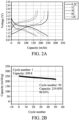
FIG. 2A shows curves of the voltages versus the capacities of a battery at different charge-discharge rates according to an embodiment of the disclosure. -
FIG. 2B shows the capacities corresponding to the charge and discharge cycling numbers according to an embodiment of the disclosure. - In the following detailed description, for purposes of explanation, numerous specific details are set forth in order to provide a thorough understanding of the disclosed embodiments. It will be apparent, however, that one or more embodiments may be practiced without these specific details. In other instances, well-known structures and devices are schematically shown in order to simplify the drawing.
- One embodiment of the disclosure provides a core-shell particle, which includes: a core having chemical structure of Ti(1-x)M1xNb(2-y)M2yO(7-z)Qz, wherein M1 is Li or Mg; M2 is Fe, Mn, V, Ni, Cr, or Cu; Q is F, Cl, Br, I, or S; x is 0 to 0.15; y is 0 to 0.15; and z is 0 to 2; and a shell layer wrapping at least a portion of the surface of the core, and the shell layer includes Cu, Nb, Ti, and O. In some embodiments, the forming method of the core-shell particles includes mixing a niobium source, a titanium source, and other optional dopants (eg, a fluorine source, optionally), follows by sintering to form the core. Then, the core is mixed with a copper source to form a copper-containing shell layer on the core to obtain core-shell particles. It is worth noting that the copper source is not pre-mixed with niobium source, titanium source, and other dopants prior to the sintering step. If the copper source, niobium source, titanium source are mixed before sintering, then copper-doped titanium niobate material is obtained, rather than a core-shell particle with copper-containing shell layer and titanium niobate core. For the core-shell particle, Cu in the shell layer partially diffuses into the core, while Nb and Ti in the core partially diffuse into the shell layer. Even so, there is a distinct interface between the shell layer and the core, the shell layer is an amorphous structure, while the core is a crystalline structure. In addition, the main metal composition of the core is Ti and Nb, while the main metal composition of the shell layer is Cu.
- In one embodiment, the weight ratio between the core and the shell layer is 1:0.004 to 1:0.02. If the weight ratio of the shell layer is too large, the intercalation and de-intercalation of lithium ions may be hindered. If the weight ratio of the shell layer is too small, the core-shell particle material behaves similarly to that without the shell layer.
- In some embodiments, the shell layer has a Cu content of 5 to 15 atomic %, a Nb content of 0 to 5 atomic %, a Ti content of 0 to 6 atomic %, and an O content of 70 to 90 atomic %. The content of Nb and Ti in the shell layer depend on the temperature and time of sintering to form the copper-containing shell layer. If the sintering temperature is too high or the sintering time is too long, the thickness of the shell layer may be too thick which may hinder the intercalation and de-intercalation of the lithium ions. If the sintering temperature is too low or the sintering time is too short, the reaction may be incomplete with residual copper sulfate remained, causing higher surface resistance.
- In some embodiments, the thickness of the shell layer is 5 nm to 50 nm. If the shell layer is too thin, the core-shell particle material behaves similarly to that without the shell layer. If the shell layer is too thick, the intercalation and intercalation of the lithium ions may be hindered.
- In some embodiments, the shell layer is a discontinuous film. For example, a portion of the core surface may be exposed from the shell layer. However, in other embodiments, the shell layer may cover the core surface completely.
- In some embodiments, the median primary particle size (D50) of the core-shell particles is 100 nm to 400 nm. If the primary particle size of the core-shell particles is too large, the conducting paths of the electrons and the lithium ions may be increased, and the conducting time scale may be extended, thereby reducing the rate capability. If the median primary particle size (D50) of the core-shell particles is too small, the specific surface area of the material may be expanded, causing poor dispersion during mixing, and reducing the density and uniformity of the material on the electrode.
- An embodiment of the present disclosure provides a lithium ion battery, including: a negative electrode; a positive electrode; and an electrolyte, disposed between the negative electrode and the positive electrode, wherein the negative electrode includes the core-shell particles. The negative electrode may further include conductive carbon black, a binder, or other suitable composition.
- In some embodiments, the negative electrode further includes lithium titanate particles, and the weight ratio of the core-shell particles to the lithium titanate particles is 90:10 to 10:90, in order to improve the rate performance of the negative electrode and to reduce the material cost. If the amount of the lithium titanate is too low, the negative electrode behaves similarly to that without the lithium titanate particle. If the amount of lithium titanate is too high, the gram capacitance of the composite material will drop significantly. For example, the chemical structure of lithium titanate is Li4Ti5Oa, and 8 ≦ a≦12.
- In some embodiments, the positive electrode includes lithium cobaltate, lithium nickelate, lithium manganate, ternary positive electrode material, lithium iron phosphate, lithium iron manganese phosphate, or a combination thereof. In some embodiments, the electrolytes can be classified into liquid, colloidal, and solid states according to their morphology. Liquid electrolytes are composed of lithium salts, solvents or ionic liquids. Commonly used lithium salts are LiPF6, LiAsF6, LiClO4, LiBF4, LiTFSI, or LiCF3SO3, etc., and commonly used solvents are cyclic carbonates (such as ethylene carbonate, propylene carbonate), linear carbonate (such as dimethyl carbonate, diethyl carbonate, ethyl methyl carbonate), or ether compounds (such as dimethyl ether, 1,3-dioxolane) and the like. Solid electrolytes are divided into polymers and glass ceramics. In contrast. when measuring the performance of the negative electrode with core-shell particles, the negative electrode can be assembled with lithium metal positive electrode and typical electrolyte to form a half-cell with lithium positive electrode and electrolyte.
- Below, exemplary embodiments will be described in detail with reference to accompanying drawings so as to be easily realized by a person having ordinary knowledge in the art. The inventive concept may be embodied in various forms without being limited to the exemplary embodiments set forth herein. Descriptions of well-known parts are omitted for clarity, and like reference numerals refer to like elements throughout.
- Niobium oxide, titanium oxide, and fluorine source (Mg2F) of stoichiometric ratio were added to de-ionized water containing dispersant PVA BP-05, and then completely mixed for 18 hours to obtain a thoroughly dispersed slurry. The thoroughly dispersed slurry was pelletized by spray drying to obtain precursor powder. The precursor powder was put into a crucible and sintered at 1015 °C for 3 hours to obtain fluorine-doped titanium niobate material Mg0.02Ti0.98Nb2O6.96F0.04.
- 85 parts by weight of the fluorine-doped titanium niobate, 6 parts by weight of KS4 (commercially available from TIMCAL TIMREX), 4 parts by weight of Super P (commercially available from TIMCAL TIMREX), and 5 parts by weight of PVDF (commercially available from Solef) were thoroughly mixed to prepare a paste, and the paste was then coated on an aluminum foil to form a coating layer with a thickness less than 150 micrometers. The coating layer was rolled through a calendering machine to have 65% of the original thickness, thereby forming a negative electrode plate. The negative electrode plate was cut to a circle shape with a diameter of 12mm. The circular negative electrode plate, a lithium metal positive electrode plate, and an electrolyte were assembled to form CR2032 half-cell to test their electrochemical properties. The electrolyte composition was 1M LiPF6 solution, and the solvent was ethylene carbonate (EC) and dimethyl carbonate (DMC) (EC:DMC=1:2, v/v).
Fig. 1A shows curves of the voltages versus the capacities of the battery at different charge-discharge rates, the discharging is carried out at constant current-constant voltage, while the charging is carried out at constant current with a charging rate of 1C.Fig. 1B shows curves of the capacities versus the charge-discharge cycling number of the battery. Table 1 shows the capacities versus voltages of the battery at different charge-discharge rates and the capacitance retention of the battery after 50 cycles. - 20 g of the fluorine and magnesium doped titanium niobate material Mg0.02Ti0.98Nb2O6.96F0.04 prepared from Comparative Example 1 was added to 0.3139g of CuSO4.5H2O aqueous solution, and stirred thoroughly at room temperature, then heated up to 100 °C to evaporate water to obtain dry powder. Then the dry powder was put into an alumina crucible, and after sintering at 700 °C for 2 hours, core-shell particles with titanium niobate doped with fluorine and magnesium core, wrapped with a surface-coated shell layer (containing copper) were obtained.
- 85 parts by weight of the fluorine-doped titanium niobate, 6 parts by weight of KS4 (commercially available from TIMCAL TIMREX), 4 parts by weight of Super P (commercially available from TIMCAL TIMREX), and 5 parts by weight of PVDF (commercially available from Solef) were thoroughly mixed to prepare a paste, and the paste was then coated on an aluminum foil to form a coating layer with a thickness less than 150 micrometers. The coating layer was rolled through a calendering machine to have 65% of the original thickness, thereby forming a negative electrode plate. The negative electrode plate was cut to a circle shape with a diameter of 12mm. The circular negative electrode plate, a lithium metal positive electrode plate, and an electrolyte were assembled to form CR2032 half-cells to test their electrochemical properties. The electrolyte composition was 1M LiPF6 solution, and the solvent was ethylene carbonate (EC) and dimethyl carbonate (DMC) (EC:DMC=1:2, v/v).
Fig. 2A shows curves of the voltages versus the capacities of the battery at different charge-discharge rates, the discharging is carried out at constant current-constant voltage, while the charging is carried out at constant current with a charging rate of 1C.Fig. 2B shows curves of the capacities versus the charge-discharge cycling number of the battery. Table 1 shows the capacities versus the voltages of the battery at different charge-discharge rates and the capacitance retention of the battery after 50 cycles. - 20 g of the fluorine and magnesium-doped titanium niobate material Mg0.02Ti0.98Nb2O6.96F0.04 prepared from Comparative Example 1 was added to 0.315g of AgNOs aqueous solution, and stirred thoroughly at room temperature, then heated up to 90 °C to evaporate water to obtain dry powder. Then the dry powder was put into an alumina crucible, and after sintering at 700 °C for 1 hour, core-shell particles with titanium niobate doped with fluorine and magnesium core, wrapped with a surface coated-shell layer (containing copper) were obtained.
- 85 parts by weight of the core-shell particle, 6 parts by weight of KS4 (commercially available from TIMCAL TIMREX), 4 parts by weight of Super P (commercially available from TIMCAL TIMREX), and 5 parts by weight of PVDF (commercially available from Solef) were thoroughly mixed to prepare a paste, and the paste was then coated on an aluminum foil to form a coating layer with a thickness less than 150 micrometers. The coating layer was rolled through a calendering machine to have 65% of the original thickness, thereby forming a negative electrode plate. The negative electrode plate was cut to a circle shape with a diameter of 12mm. The circular negative electrode plate, a lithium metal positive electrode plate, and an electrolyte were assembled to form CR2032 half-cells to test their electrochemical properties. The electrolyte composition was 1M LiPF6 solution, and the solvent was ethylene carbonate (EC) and dimethyl carbonate (DMC) (EC:DMC=1:2, v/v). Table 1 shows the capacities versus voltages of the battery at different charge-discharge rates and the capacitance retention of the battery after 50 cycles.
Table 1 Capacity at 0.2C/0.2C (mAh/g) Capacity at 1C/1C (mAh/g) Capacity at 5C/5C (mAh/g) Capacity at 6C/6C (mAh/g) Capacity retention after 50 cycles at 1C/1C Comparative Example 1 248.5 228.9 178.0 163.3 74.78% Example 1 250.5 229.4 183.2 172.5 88.03% Comparative Example 2 250.6 228.8 151.4 133.5 74.4% - Compared with those without shell material, and with core-shell particles with shell containing silver, the core-shell particles with shell containing copper have higher charge-discharge capacity and longer cycle time.
- Niobium oxide and titanium oxide of stoichiometric ratio were added to de-ionized water containing PVA BP-05 dispersant, and then mixed thoroughly for 18 hours to obtain a thoroughly dispersed slurry paste. The thoroughly dispersed slurry was pelletized by spray drying to obtain precursor powder. The precursor powder was put into an aluminum crucible and sintered at 1100 °C for 12 hours to obtain titanium niobate material TiNb2O7.
- 85 parts by weight of the titanium niobate, 6 parts by weight of KS4 (commercially available from TIMCAL TIMREX), 4 parts by weight of Super P (commercially available from TIMCAL TIMREX), and 5 parts by weight of PVDF (commercially available from Solef) were thoroughly mixed to prepare a paste, and the paste was then coated on an aluminum foil to form a coating layer with a thickness less than 150 micrometers. The coating layer was rolled through a calendering machine to have 65% of the original thickness, thereby forming a negative electrode plate. The negative electrode plate was cut to a circle shape with a diameter of 12mm. The circular negative electrode plate, a lithium metal positive electrode plate, and an electrolyte were assembled to form CR2032 half-cells to test their electrochemical properties. The electrolyte composition was 1M LiPF6 solution, and the solvent was ethylene carbonate (EC) and dimethyl carbonate (DMC) (EC:DMC=1:2, v/v). Table 3 shows the capacities of the battery at different charge-discharge rates.
- 20 g of the titanium niobate material TiNb2O7 prepared from Comparative Example 3 was added to 0.3139g of CuSO4.5H2O aqueous solution, and stirred thoroughly at room temperature, then heated up to 100 °C to evaporate water to obtain dry powder. Then the dry powder was put into an alumina crucible, and after sintering at 600 °C for 1 hour, core-shell particles with titanium niobate core, wrapped with a surface-coated shell layer (containing copper) were obtained. The element compositions at different positions in the shell layer and the core are analyzed by X-ray energy dispersive analyzer (EDX), as shown in Table 2:
Table 2 shell layer core position 1 position 2 position 3 position 4 position 5 O 86.63 86.57 75.24 61.05 62.94 Ti 1.43 2.54 4.85 14.18 14.24 Cu 11.38 8.62 14.05 3.95 3.74 Nb 0.55 2.27 5.87 20.83 19.08 Total 100 100 100 100 100 - It can be seen from Table 2 that within the shell layer there are some Ti and Nb diffused from the core to the shell layer, and within the core some Cu diffused from the shell layer to the core. In spite of that, the shell layer mainly contains Cu, while the core mainly contains Nb and Ti.
- 85 parts by weight of the titanium niobate, 6 parts by weight of KS4 (commercially available from TIMCAL TIMREX), 4 parts by weight of Super P (commercially available from\ TIMCAL TIMREX), and 5 parts by weight of PVDF (commercially available from Solef) were thoroughly mixed to prepare a paste, and the paste was then coated on aluminum foil to form a coating layer with a thickness less than 150 micrometers. The coating layer was rolled through a calendering machine to have 65% of the original thickness, thereby forming a negative electrode plate. The negative electrode plate was cut to a circle shape with a diameter of 12mm. The circular negative electrode plate, a lithium metal positive electrode plate, and an electrolyte were assembled to form CR2032 half-cells to test their electrochemical properties. The electrolyte composition was 1M LiPF6 solution, and the solvent was ethylene carbonate (EC) and dimethyl carbonate (DMC) (EC:DMC=1:2, v/v). Table 3 shows the capacities of the battery at different charge-discharge rates.
- 20 g of the titanium niobate material TiNb2O7 prepared from Comparative Example 1 was added to 0.3139 g of CuSO4.5H2O aqueous solution, and stirred thoroughly at room temperature, then heated up to 100 °C to evaporate water to obtain dry powder. Then the dry powder was put into an alumina crucible, and after sintering at 700 °C for 1 hour, core-shell particles with titanium niobate core, wrapped with a surface-coated shell (containing copper) were obtained.
- 85 parts by weight of the titanium niobate, 6 parts by weight of KS4 (commercially available from TIMCAL TIMREX), 4 parts by weight of Super P (commercially available from TIMCAL TIMREX), and 5 parts by weight of PVDF (commercially available from Solef) were thoroughly mixed to prepare a paste, and the paste was then coated on an aluminum foil to form a coating layer with a thickness less than 150 micrometers. The coating layer was rolled through a calendering machine to have 65% of the original thickness, thereby forming a negative electrode plate. The negative electrode plate was cut to a circle shape with a diameter of 12mm. The circular negative electrode plate, a lithium metal positive electrode plate, and an electrolyte were assembled to form CR2032 half-cells to test their electrochemical properties. The electrolyte composition was 1M LiPF6 solution, and the solvent was ethylene carbonate (EC) and dimethyl carbonate (DMC) (EC:DMC=1:2, v/v). Table 3 shows the capacities of the battery at different charge-discharge rates.
- 20 g of the titanium niobate material TiNb2O7 prepared from Comparative Example 3 was added to 0.6278 g of CuSO4.5H2O aqueous solution, and stirred thoroughly at room temperature, then heated up to 100 °C to evaporate water to obtain dry powder. Then the dry powder was put into an alumina crucible, and after sintering at 600 °C for 1 hour, core-shell particles with titanium niobate core, wrapped with a surface-coated shell (containing copper) were obtained.
- 85 parts by weight of the titanium niobate, 6 parts by weight of KS4 (commercially available from TIMCAL TIMREX), 4 parts by weight of Super P (commercially available from TIMCAL TIMREX), and 5 parts by weight of PVDF (commercially available from Solef) were thoroughly mixed to prepare a paste, and the paste was then coated on an aluminum foil to form a coating layer with a thickness less than 150 micrometers. The coating layer was rolled through a calendering machine to have 65% of the original thickness, thereby forming a negative electrode plate. The negative electrode plate was cut to a circle shape with a diameter of 12mm. The circular negative electrode plate, a lithium metal positive electrode plate, and an electrolyte were assembled to form CR2032 half-cell to test their electrochemical properties. The electrolyte composition was 1M LiPF6 solution, and the solvent was ethylene carbonate (EC) and dimethyl carbonate (DMC) (EC:DMC=1:2, v/v). Table 3 shows the capacities of the battery at different charge-discharge rates.
- 5.38 g of niobium oxide, 4.72 g of titanium oxide, and 0.6278 of CuSO4.5H2O were added to deionized water containing dispersant PVA BP-05, and mixed thoroughly for 18 hours to obtain a thoroughly dispersed slurry. The thoroughly dispersed slurry was pelletized by spray drying to obtain precursor powder. The precursor powder was put into an aluminum crucible and sintered at 1015 °C for 3 hours to obtain copper-doped titanium niobate, in the present example the copper is doped thoroughly in the titanium niobate, rather than forming a shell layer coated titanium niobate core, 85 parts by weight of the titanium niobate, 6 parts by weight of KS4 (commercially available from TIMCAL TIMREX), 4 parts by weight of Super P (commercially available from TIMCAL TIMREX), and 5 parts by weight of PVDF (commercially available from Solef) were thoroughly mixed to prepare a paste, and the paste was then coated on an aluminum foil to form a coating layer with a thickness less than 150 micrometers. The coating layer was rolled through a calendering machine to have 65% original thickness, thereby forming a negative electrode plate. The negative electrode plate was cut to a circle shape with a diameter of 12mm. The circular negative electrode plate, a lithium metal positive electrode plate, and an electrolyte were assembled to form CR2032 half-cells to test their electrochemical properties. The electrolyte composition was 1M LiPF6 solution, and the solvent was ethylene carbonate (EC) and dimethyl carbonate (DMC) (EC:DMC=1:2, v/v). Table 3 shows the capacities of the battery at different charge-discharge rates
Table 3 Capacity at 0.2C/0.2C (mAh/g) Capacity at 1C/1C (mAh/g) Capacity at 5C/5C (mAh/g) Capacity at 6C/6C (mAh/g) Comparative Example 3 (w/o shell layer) 233.4 196.9 110.1 98.5 Example 2 (w/ Cu shell layer) 259.4 231.7 151.6 126.4 Example 3 (w/ Cu shell layer) 250.9 226.3 151.3 124.0 Example 4 (w/ Cu shell layer) 252.5 227.7 154.9 133.2 Comparative Example 4 (doped Cu, w/o shell layer) 247.3 217.4 144.0 114.4 - It will be apparent to those skilled in the art that various modifications and variations can be made to the disclosed methods and materials. It is intended that the specification and examples be considered as exemplary only, with the true scope of the disclosure being indicated by the following claims and their equivalents.
Claims (10)
- A core-shell particle, comprising:a core, having chemical structure of Ti(1-x)M1xNb(2-y)M2yO(7-z)Qz,wherein M1 is Li or Mg,M2 is Fe, Mn, V, Ni, Cr, or Cu,Q is F, Cl, Br, I, or S,x is 0 to 0.15,y is 0 to 0.15, andz is 0 to 2; anda shell layer wrapping at least a portion of the surface of the core, and the shell layer comprises Cu, Nb, Ti, and O.
- The core-shell particle as claimed in claim 1, wherein the core and the shell layer have a weight ratio of 1:0.004 to 1:0.02.
- The core-shell particle as claimed in claim 1 or 2, wherein the shell layer has a Cu content of 5 to 15 atomic %, a Nb content of 0 to 5 atomic %, a Ti content of 0 to 6 atomic %, and an O content of 70 to 90 atomic %.
- The core-shell particle as claimed in any one of claims 1 to 3, wherein the shell layer has a thickness of 5 nm to 50 nm.
- The core-shell particle as claimed in any one of claims 1 to 4, wherein the shell layer is an amorphous structure.
- The core-shell particle as claimed in any one of claims 1 to 5, wherein the shell layer is a discontinuous film.
- The core-shell particle as claimed in any one of claims 1 to 6, wherein the median primary particle size (D50) of the core-shell particles is 100 nm to 400 nm
- A lithium ion battery, comprising:a negative electrode;a positive electrode; andan electrolyte disposed between the negative electrode and the positive electrode, wherein the negative electrode comprises the core-shell particle as claimed in claim 1.
- The lithium ion battery as claimed in claim 8, wherein the negative electrode further comprises a lithium titanate particle, the core-shell particle and the lithium titanate particle have a weight ratio of 90: 10 to 10:90.
- The lithium ion battery as claimed in claims 8 or 9, wherein the positive electrode comprises lithium cobaltate, lithium nickelate, lithium manganate, ternary positive electrode material, lithium iron phosphate, lithium iron manganese phosphate, or a combination thereof.
Applications Claiming Priority (1)
| Application Number | Priority Date | Filing Date | Title |
|---|---|---|---|
| TW111143108A TWI832549B (en) | 2022-11-11 | 2022-11-11 | Core-shell particle and lithium ion battery |
Publications (2)
| Publication Number | Publication Date |
|---|---|
| EP4368576A1 true EP4368576A1 (en) | 2024-05-15 |
| EP4368576B1 EP4368576B1 (en) | 2025-05-21 |
Family
ID=84981319
Family Applications (1)
| Application Number | Title | Priority Date | Filing Date |
|---|---|---|---|
| EP23151436.5A Active EP4368576B1 (en) | 2022-11-11 | 2023-01-13 | Core-shell particle and lithium ion battery |
Country Status (6)
| Country | Link |
|---|---|
| US (1) | US12586786B2 (en) |
| EP (1) | EP4368576B1 (en) |
| JP (1) | JP7520092B2 (en) |
| KR (1) | KR102797356B1 (en) |
| CN (1) | CN118039821A (en) |
| TW (1) | TWI832549B (en) |
Citations (2)
| Publication number | Priority date | Publication date | Assignee | Title |
|---|---|---|---|---|
| US20200140339A1 (en) * | 2018-11-06 | 2020-05-07 | Industrial Technology Research Institute | Doped titanium niobate and battery |
| US11005094B2 (en) * | 2018-03-07 | 2021-05-11 | Global Graphene Group, Inc. | Electrochemically stable elastomer-encapsulated particles of anode active materials for lithium batteries |
Family Cites Families (13)
| Publication number | Priority date | Publication date | Assignee | Title |
|---|---|---|---|---|
| KR20030022347A (en) | 2000-08-03 | 2003-03-15 | 시바 스페셜티 케미칼스 홀딩 인크. | Photostable, silylated benzotriazole UV absorbers and compositions stabilized therewith |
| CA2810191C (en) | 2010-07-30 | 2018-06-12 | Board Of Regents, The University Of Texas System | Niobium oxide compositions and methods for using same |
| JP5649492B2 (en) | 2011-03-22 | 2015-01-07 | 株式会社東芝 | Battery active material, non-aqueous electrolyte battery and battery pack |
| CN105722791B (en) | 2013-11-15 | 2018-01-26 | 住友金属矿山株式会社 | Method for producing surface-treated oxide particles and oxide particles obtained by the method |
| KR101749187B1 (en) | 2013-11-19 | 2017-06-20 | 삼성에스디아이 주식회사 | Negative active material and negative electrode and lithium battery containing the material, and method for manufacturing the material |
| CN105047871A (en) | 2015-06-18 | 2015-11-11 | 哈尔滨工业大学 | Doped lithium ion battery anode material and preparation method thereof |
| CN108878873B (en) | 2017-05-11 | 2021-07-30 | 中国科学院宁波材料技术与工程研究所 | Modified surface structure of lithium iron phosphate cathode material and its preparation method and application |
| CN109428066A (en) | 2017-08-30 | 2019-03-05 | 中国科学院宁波材料技术与工程研究所 | Core-shell material and preparation method thereof, lithium ion battery negative material and lithium ion battery |
| JP6710668B2 (en) * | 2017-09-19 | 2020-06-17 | 株式会社東芝 | Active materials, electrodes, secondary batteries, battery packs, and vehicles |
| WO2019133251A1 (en) * | 2017-12-29 | 2019-07-04 | Sachem, Inc. | LimMOxFy SHELL FORMATION ON CATHODE CERAMIC PARTICLE FOR LI ION BATTERY THROUGH ONIUM METAL OXIDE FLUORIDE PRECURSOR |
| US20200056088A1 (en) | 2018-08-19 | 2020-02-20 | Veldman Consulting Corporation | Surfactant product, manufacturing method and use thereof in oil and gas well operations |
| CN111354923A (en) | 2018-12-24 | 2020-06-30 | 北方奥钛纳米技术有限公司 | Negative electrode material and preparation method thereof, negative plate and lithium ion battery |
| CN110943207B (en) * | 2019-10-28 | 2022-06-14 | 浙江锋锂新能源科技有限公司 | Modified TiNb2O7Material and modification method |
-
2022
- 2022-11-11 TW TW111143108A patent/TWI832549B/en active
- 2022-11-28 US US17/994,710 patent/US12586786B2/en active Active
- 2022-11-30 JP JP2022191932A patent/JP7520092B2/en active Active
- 2022-12-14 CN CN202211610116.8A patent/CN118039821A/en active Pending
-
2023
- 2023-01-13 EP EP23151436.5A patent/EP4368576B1/en active Active
- 2023-01-30 KR KR1020230011681A patent/KR102797356B1/en active Active
Patent Citations (2)
| Publication number | Priority date | Publication date | Assignee | Title |
|---|---|---|---|---|
| US11005094B2 (en) * | 2018-03-07 | 2021-05-11 | Global Graphene Group, Inc. | Electrochemically stable elastomer-encapsulated particles of anode active materials for lithium batteries |
| US20200140339A1 (en) * | 2018-11-06 | 2020-05-07 | Industrial Technology Research Institute | Doped titanium niobate and battery |
Non-Patent Citations (1)
| Title |
|---|
| YUAN TAO ET AL: "Recent Advances in Titanium Niobium Oxide Anodes for High-Power Lithium-Ion Batteries", ENERGY & FUELS, vol. 34, no. 11, 19 November 2020 (2020-11-19), WASHINGTON, DC, US., pages 13321 - 13334, XP055878784, ISSN: 0887-0624, Retrieved from the Internet <URL:https://pubs.acs.org/doi/pdf/10.1021/acs.energyfuels.0c02732> DOI: 10.1021/acs.energyfuels.0c02732 * |
Also Published As
| Publication number | Publication date |
|---|---|
| CN118039821A (en) | 2024-05-14 |
| US20240162431A1 (en) | 2024-05-16 |
| JP7520092B2 (en) | 2024-07-22 |
| JP2024070761A (en) | 2024-05-23 |
| KR20240069569A (en) | 2024-05-20 |
| TW202419404A (en) | 2024-05-16 |
| TWI832549B (en) | 2024-02-11 |
| EP4368576B1 (en) | 2025-05-21 |
| US12586786B2 (en) | 2026-03-24 |
| KR102797356B1 (en) | 2025-04-21 |
Similar Documents
| Publication | Publication Date | Title |
|---|---|---|
| US11855282B2 (en) | Pre-lithiated electrode materials and cells employing the same | |
| US12559430B2 (en) | Doped titanium niobate and battery | |
| KR100599602B1 (en) | Positive electrode for lithium secondary battery and lithium secondary battery comprising same | |
| KR101023354B1 (en) | Lithium Titanium Oxide with Enhanced Electroconductivity | |
| EP1443575B1 (en) | Positive plate material and cell comprising it | |
| US6924064B2 (en) | Positive active material for non-aqueous electrolyte secondary battery and non-aqueous electrolyte secondary battery comprising same | |
| WO2006109495A1 (en) | Nonaqueous electrolyte secondary battery | |
| US11677065B2 (en) | Cathode active material of lithium secondary battery | |
| KR20090088625A (en) | Anode active material, manufacturing method thereof, and anode and lithium battery using same | |
| JP2000260423A (en) | Electrode | |
| KR20240109114A (en) | Anode active material for lithium secondary battery and lithium secondary battery including the same | |
| KR101646994B1 (en) | Positive active material for rechargeable lithium battery, method for manufacturing the same, and rechargeable lithium battery including the same | |
| KR101553389B1 (en) | Positive active material for rechargeable lithium battery, coating material for positive active material, method of manufacturing the same and rechargeable lithium battery including same | |
| KR20140109317A (en) | Positive active material for rechargeable lithium battery, method of manufacturing the same and rechargeable lithium battery including same | |
| US20240243271A1 (en) | Doped titanium niobate and battery | |
| KR20110011497A (en) | Cathode active material, a cathode comprising the same, and a lithium battery employing the anode | |
| EP4368576B1 (en) | Core-shell particle and lithium ion battery | |
| KR102436440B1 (en) | Cathode, method for manufacturing the same, and rechargeable lithium battery comprising the same | |
| KR101701415B1 (en) | Anode active material, method of preparing the same, and anode and lithium battery containing the material | |
| KR20180094567A (en) | Positive active material for lithium secondary battery | |
| EP3489198A1 (en) | Cathode active material of lithium secondary battery | |
| KR101783316B1 (en) | Positive electrode active material for rechargable lithium battery and rechargable lithium battery including the same | |
| KR101524807B1 (en) | Positive active material for rechargeable lithium battery, method of manufacturing the same and rechargeable lithium battery including same | |
| KR101777399B1 (en) | Method for manufacturing positive electrode active material for rechargable lithium battery |
Legal Events
| Date | Code | Title | Description |
|---|---|---|---|
| PUAI | Public reference made under article 153(3) epc to a published international application that has entered the european phase |
Free format text: ORIGINAL CODE: 0009012 |
|
| STAA | Information on the status of an ep patent application or granted ep patent |
Free format text: STATUS: REQUEST FOR EXAMINATION WAS MADE |
|
| 17P | Request for examination filed |
Effective date: 20230919 |
|
| AK | Designated contracting states |
Kind code of ref document: A1 Designated state(s): AL AT BE BG CH CY CZ DE DK EE ES FI FR GB GR HR HU IE IS IT LI LT LU LV MC ME MK MT NL NO PL PT RO RS SE SI SK SM TR |
|
| GRAP | Despatch of communication of intention to grant a patent |
Free format text: ORIGINAL CODE: EPIDOSNIGR1 |
|
| STAA | Information on the status of an ep patent application or granted ep patent |
Free format text: STATUS: GRANT OF PATENT IS INTENDED |
|
| INTG | Intention to grant announced |
Effective date: 20240827 |
|
| GRAJ | Information related to disapproval of communication of intention to grant by the applicant or resumption of examination proceedings by the epo deleted |
Free format text: ORIGINAL CODE: EPIDOSDIGR1 |
|
| STAA | Information on the status of an ep patent application or granted ep patent |
Free format text: STATUS: REQUEST FOR EXAMINATION WAS MADE |
|
| GRAP | Despatch of communication of intention to grant a patent |
Free format text: ORIGINAL CODE: EPIDOSNIGR1 |
|
| INTC | Intention to grant announced (deleted) | ||
| STAA | Information on the status of an ep patent application or granted ep patent |
Free format text: STATUS: GRANT OF PATENT IS INTENDED |
|
| INTG | Intention to grant announced |
Effective date: 20250206 |
|
| GRAS | Grant fee paid |
Free format text: ORIGINAL CODE: EPIDOSNIGR3 |
|
| P01 | Opt-out of the competence of the unified patent court (upc) registered |
Free format text: CASE NUMBER: APP_12006/2025 Effective date: 20250312 |
|
| GRAA | (expected) grant |
Free format text: ORIGINAL CODE: 0009210 |
|
| STAA | Information on the status of an ep patent application or granted ep patent |
Free format text: STATUS: THE PATENT HAS BEEN GRANTED |
|
| AK | Designated contracting states |
Kind code of ref document: B1 Designated state(s): AL AT BE BG CH CY CZ DE DK EE ES FI FR GB GR HR HU IE IS IT LI LT LU LV MC ME MK MT NL NO PL PT RO RS SE SI SK SM TR |
|
| REG | Reference to a national code |
Ref country code: GB Ref legal event code: FG4D |
|
| REG | Reference to a national code |
Ref country code: CH Ref legal event code: EP |
|
| REG | Reference to a national code |
Ref country code: DE Ref legal event code: R096 Ref document number: 602023003532 Country of ref document: DE |
|
| REG | Reference to a national code |
Ref country code: IE Ref legal event code: FG4D |
|
| REG | Reference to a national code |
Ref country code: NL Ref legal event code: MP Effective date: 20250521 |
|
| PG25 | Lapsed in a contracting state [announced via postgrant information from national office to epo] |
Ref country code: FI Free format text: LAPSE BECAUSE OF FAILURE TO SUBMIT A TRANSLATION OF THE DESCRIPTION OR TO PAY THE FEE WITHIN THE PRESCRIBED TIME-LIMIT Effective date: 20250521 Ref country code: PT Free format text: LAPSE BECAUSE OF FAILURE TO SUBMIT A TRANSLATION OF THE DESCRIPTION OR TO PAY THE FEE WITHIN THE PRESCRIBED TIME-LIMIT Effective date: 20250922 Ref country code: ES Free format text: LAPSE BECAUSE OF FAILURE TO SUBMIT A TRANSLATION OF THE DESCRIPTION OR TO PAY THE FEE WITHIN THE PRESCRIBED TIME-LIMIT Effective date: 20250521 |
|
| REG | Reference to a national code |
Ref country code: LT Ref legal event code: MG9D |
|
| PG25 | Lapsed in a contracting state [announced via postgrant information from national office to epo] |
Ref country code: GR Free format text: LAPSE BECAUSE OF FAILURE TO SUBMIT A TRANSLATION OF THE DESCRIPTION OR TO PAY THE FEE WITHIN THE PRESCRIBED TIME-LIMIT Effective date: 20250822 Ref country code: NO Free format text: LAPSE BECAUSE OF FAILURE TO SUBMIT A TRANSLATION OF THE DESCRIPTION OR TO PAY THE FEE WITHIN THE PRESCRIBED TIME-LIMIT Effective date: 20250821 |
|
| PG25 | Lapsed in a contracting state [announced via postgrant information from national office to epo] |
Ref country code: NL Free format text: LAPSE BECAUSE OF FAILURE TO SUBMIT A TRANSLATION OF THE DESCRIPTION OR TO PAY THE FEE WITHIN THE PRESCRIBED TIME-LIMIT Effective date: 20250521 Ref country code: PL Free format text: LAPSE BECAUSE OF FAILURE TO SUBMIT A TRANSLATION OF THE DESCRIPTION OR TO PAY THE FEE WITHIN THE PRESCRIBED TIME-LIMIT Effective date: 20250521 |
|
| PG25 | Lapsed in a contracting state [announced via postgrant information from national office to epo] |
Ref country code: BG Free format text: LAPSE BECAUSE OF FAILURE TO SUBMIT A TRANSLATION OF THE DESCRIPTION OR TO PAY THE FEE WITHIN THE PRESCRIBED TIME-LIMIT Effective date: 20250521 |
|
| PG25 | Lapsed in a contracting state [announced via postgrant information from national office to epo] |
Ref country code: HR Free format text: LAPSE BECAUSE OF FAILURE TO SUBMIT A TRANSLATION OF THE DESCRIPTION OR TO PAY THE FEE WITHIN THE PRESCRIBED TIME-LIMIT Effective date: 20250521 |
|
| PG25 | Lapsed in a contracting state [announced via postgrant information from national office to epo] |
Ref country code: RS Free format text: LAPSE BECAUSE OF FAILURE TO SUBMIT A TRANSLATION OF THE DESCRIPTION OR TO PAY THE FEE WITHIN THE PRESCRIBED TIME-LIMIT Effective date: 20250821 |
|
| PG25 | Lapsed in a contracting state [announced via postgrant information from national office to epo] |
Ref country code: IS Free format text: LAPSE BECAUSE OF FAILURE TO SUBMIT A TRANSLATION OF THE DESCRIPTION OR TO PAY THE FEE WITHIN THE PRESCRIBED TIME-LIMIT Effective date: 20250921 |
|
| PG25 | Lapsed in a contracting state [announced via postgrant information from national office to epo] |
Ref country code: LV Free format text: LAPSE BECAUSE OF FAILURE TO SUBMIT A TRANSLATION OF THE DESCRIPTION OR TO PAY THE FEE WITHIN THE PRESCRIBED TIME-LIMIT Effective date: 20250521 |
|
| REG | Reference to a national code |
Ref country code: AT Ref legal event code: MK05 Ref document number: 1796640 Country of ref document: AT Kind code of ref document: T Effective date: 20250521 |
|
| PG25 | Lapsed in a contracting state [announced via postgrant information from national office to epo] |
Ref country code: DK Free format text: LAPSE BECAUSE OF FAILURE TO SUBMIT A TRANSLATION OF THE DESCRIPTION OR TO PAY THE FEE WITHIN THE PRESCRIBED TIME-LIMIT Effective date: 20250521 Ref country code: AT Free format text: LAPSE BECAUSE OF FAILURE TO SUBMIT A TRANSLATION OF THE DESCRIPTION OR TO PAY THE FEE WITHIN THE PRESCRIBED TIME-LIMIT Effective date: 20250521 Ref country code: SM Free format text: LAPSE BECAUSE OF FAILURE TO SUBMIT A TRANSLATION OF THE DESCRIPTION OR TO PAY THE FEE WITHIN THE PRESCRIBED TIME-LIMIT Effective date: 20250521 |
|
| PG25 | Lapsed in a contracting state [announced via postgrant information from national office to epo] |
Ref country code: CZ Free format text: LAPSE BECAUSE OF FAILURE TO SUBMIT A TRANSLATION OF THE DESCRIPTION OR TO PAY THE FEE WITHIN THE PRESCRIBED TIME-LIMIT Effective date: 20250521 |
|
| PG25 | Lapsed in a contracting state [announced via postgrant information from national office to epo] |
Ref country code: EE Free format text: LAPSE BECAUSE OF FAILURE TO SUBMIT A TRANSLATION OF THE DESCRIPTION OR TO PAY THE FEE WITHIN THE PRESCRIBED TIME-LIMIT Effective date: 20250521 |
|
| PG25 | Lapsed in a contracting state [announced via postgrant information from national office to epo] |
Ref country code: SK Free format text: LAPSE BECAUSE OF FAILURE TO SUBMIT A TRANSLATION OF THE DESCRIPTION OR TO PAY THE FEE WITHIN THE PRESCRIBED TIME-LIMIT Effective date: 20250521 |
|
| PG25 | Lapsed in a contracting state [announced via postgrant information from national office to epo] |
Ref country code: IT Free format text: LAPSE BECAUSE OF FAILURE TO SUBMIT A TRANSLATION OF THE DESCRIPTION OR TO PAY THE FEE WITHIN THE PRESCRIBED TIME-LIMIT Effective date: 20250521 |
|
| REG | Reference to a national code |
Ref country code: DE Ref legal event code: R097 Ref document number: 602023003532 Country of ref document: DE |
|
| PLBE | No opposition filed within time limit |
Free format text: ORIGINAL CODE: 0009261 |
|
| STAA | Information on the status of an ep patent application or granted ep patent |
Free format text: STATUS: NO OPPOSITION FILED WITHIN TIME LIMIT |
|
| REG | Reference to a national code |
Ref country code: CH Ref legal event code: L10 Free format text: ST27 STATUS EVENT CODE: U-0-0-L10-L00 (AS PROVIDED BY THE NATIONAL OFFICE) Effective date: 20260402 |
|
| PGFP | Annual fee paid to national office [announced via postgrant information from national office to epo] |
Ref country code: DE Payment date: 20260128 Year of fee payment: 4 |
|
| PGFP | Annual fee paid to national office [announced via postgrant information from national office to epo] |
Ref country code: FR Payment date: 20260126 Year of fee payment: 4 |
|
| 26N | No opposition filed |
Effective date: 20260224 |