EP4367311B1 - Vliesstoffe mit verbesserter weichheit - Google Patents
Vliesstoffe mit verbesserter weichheit Download PDFInfo
- Publication number
- EP4367311B1 EP4367311B1 EP22748611.5A EP22748611A EP4367311B1 EP 4367311 B1 EP4367311 B1 EP 4367311B1 EP 22748611 A EP22748611 A EP 22748611A EP 4367311 B1 EP4367311 B1 EP 4367311B1
- Authority
- EP
- European Patent Office
- Prior art keywords
- polypropylene
- nonwoven fabric
- following
- layer
- polymer
- Prior art date
- Legal status (The legal status is an assumption and is not a legal conclusion. Google has not performed a legal analysis and makes no representation as to the accuracy of the status listed.)
- Active
Links
Images

Classifications
-
- A—HUMAN NECESSITIES
- A61—MEDICAL OR VETERINARY SCIENCE; HYGIENE
- A61L—METHODS OR APPARATUS FOR STERILISING MATERIALS OR OBJECTS IN GENERAL; DISINFECTION, STERILISATION OR DEODORISATION OF AIR; CHEMICAL ASPECTS OF BANDAGES, DRESSINGS, ABSORBENT PADS OR SURGICAL ARTICLES; MATERIALS FOR BANDAGES, DRESSINGS, ABSORBENT PADS OR SURGICAL ARTICLES
- A61L15/00—Chemical aspects of, or use of materials for, bandages, dressings or absorbent pads
- A61L15/16—Bandages, dressings or absorbent pads for physiological fluids such as urine or blood, e.g. sanitary towels, tampons
- A61L15/22—Bandages, dressings or absorbent pads for physiological fluids such as urine or blood, e.g. sanitary towels, tampons containing macromolecular materials
- A61L15/24—Macromolecular compounds obtained by reactions only involving carbon-to-carbon unsaturated bonds; Derivatives thereof
-
- D—TEXTILES; PAPER
- D04—BRAIDING; LACE-MAKING; KNITTING; TRIMMINGS; NON-WOVEN FABRICS
- D04H—MAKING TEXTILE FABRICS, e.g. FROM FIBRES OR FILAMENTARY MATERIAL; FABRICS MADE BY SUCH PROCESSES OR APPARATUS, e.g. FELTS, NON-WOVEN FABRICS; COTTON-WOOL; WADDING ; NON-WOVEN FABRICS FROM STAPLE FIBRES, FILAMENTS OR YARNS, BONDED WITH AT LEAST ONE WEB-LIKE MATERIAL DURING THEIR CONSOLIDATION
- D04H3/00—Non-woven fabrics formed wholly or mainly of yarns or like filamentary material of substantial length
- D04H3/005—Synthetic yarns or filaments
- D04H3/007—Addition polymers
-
- B—PERFORMING OPERATIONS; TRANSPORTING
- B32—LAYERED PRODUCTS
- B32B—LAYERED PRODUCTS, i.e. PRODUCTS BUILT-UP OF STRATA OF FLAT OR NON-FLAT, e.g. CELLULAR OR HONEYCOMB, FORM
- B32B5/00—Layered products characterised by the non- homogeneity or physical structure, i.e. comprising a fibrous, filamentary, particulate or foam layer; Layered products characterised by having a layer differing constitutionally or physically in different parts
- B32B5/02—Layered products characterised by the non- homogeneity or physical structure, i.e. comprising a fibrous, filamentary, particulate or foam layer; Layered products characterised by having a layer differing constitutionally or physically in different parts characterised by structural features of a fibrous or filamentary layer
- B32B5/022—Non-woven fabric
-
- B—PERFORMING OPERATIONS; TRANSPORTING
- B32—LAYERED PRODUCTS
- B32B—LAYERED PRODUCTS, i.e. PRODUCTS BUILT-UP OF STRATA OF FLAT OR NON-FLAT, e.g. CELLULAR OR HONEYCOMB, FORM
- B32B5/00—Layered products characterised by the non- homogeneity or physical structure, i.e. comprising a fibrous, filamentary, particulate or foam layer; Layered products characterised by having a layer differing constitutionally or physically in different parts
- B32B5/02—Layered products characterised by the non- homogeneity or physical structure, i.e. comprising a fibrous, filamentary, particulate or foam layer; Layered products characterised by having a layer differing constitutionally or physically in different parts characterised by structural features of a fibrous or filamentary layer
- B32B5/06—Layered products characterised by the non- homogeneity or physical structure, i.e. comprising a fibrous, filamentary, particulate or foam layer; Layered products characterised by having a layer differing constitutionally or physically in different parts characterised by structural features of a fibrous or filamentary layer characterised by a fibrous or filamentary layer mechanically connected, e.g. by needling to another layer, e.g. of fibres, of paper
- B32B5/067—Layered products characterised by the non- homogeneity or physical structure, i.e. comprising a fibrous, filamentary, particulate or foam layer; Layered products characterised by having a layer differing constitutionally or physically in different parts characterised by structural features of a fibrous or filamentary layer characterised by a fibrous or filamentary layer mechanically connected, e.g. by needling to another layer, e.g. of fibres, of paper characterised by the fibrous or filamentary layer being mechanically connected by hydroentangling
-
- B—PERFORMING OPERATIONS; TRANSPORTING
- B32—LAYERED PRODUCTS
- B32B—LAYERED PRODUCTS, i.e. PRODUCTS BUILT-UP OF STRATA OF FLAT OR NON-FLAT, e.g. CELLULAR OR HONEYCOMB, FORM
- B32B5/00—Layered products characterised by the non- homogeneity or physical structure, i.e. comprising a fibrous, filamentary, particulate or foam layer; Layered products characterised by having a layer differing constitutionally or physically in different parts
- B32B5/22—Layered products characterised by the non- homogeneity or physical structure, i.e. comprising a fibrous, filamentary, particulate or foam layer; Layered products characterised by having a layer differing constitutionally or physically in different parts characterised by the presence of two or more layers which are next to each other and are fibrous, filamentary, formed of particles or foamed
- B32B5/24—Layered products characterised by the non- homogeneity or physical structure, i.e. comprising a fibrous, filamentary, particulate or foam layer; Layered products characterised by having a layer differing constitutionally or physically in different parts characterised by the presence of two or more layers which are next to each other and are fibrous, filamentary, formed of particles or foamed one layer being a fibrous or filamentary layer
- B32B5/26—Layered products characterised by the non- homogeneity or physical structure, i.e. comprising a fibrous, filamentary, particulate or foam layer; Layered products characterised by having a layer differing constitutionally or physically in different parts characterised by the presence of two or more layers which are next to each other and are fibrous, filamentary, formed of particles or foamed one layer being a fibrous or filamentary layer another layer next to it also being fibrous or filamentary
- B32B5/265—Layered products characterised by the non- homogeneity or physical structure, i.e. comprising a fibrous, filamentary, particulate or foam layer; Layered products characterised by having a layer differing constitutionally or physically in different parts characterised by the presence of two or more layers which are next to each other and are fibrous, filamentary, formed of particles or foamed one layer being a fibrous or filamentary layer another layer next to it also being fibrous or filamentary characterised by one fibrous or filamentary layer being a non-woven fabric layer
- B32B5/266—Layered products characterised by the non- homogeneity or physical structure, i.e. comprising a fibrous, filamentary, particulate or foam layer; Layered products characterised by having a layer differing constitutionally or physically in different parts characterised by the presence of two or more layers which are next to each other and are fibrous, filamentary, formed of particles or foamed one layer being a fibrous or filamentary layer another layer next to it also being fibrous or filamentary characterised by one fibrous or filamentary layer being a non-woven fabric layer next to one or more non-woven fabric layers
- B32B5/267—Layered products characterised by the non- homogeneity or physical structure, i.e. comprising a fibrous, filamentary, particulate or foam layer; Layered products characterised by having a layer differing constitutionally or physically in different parts characterised by the presence of two or more layers which are next to each other and are fibrous, filamentary, formed of particles or foamed one layer being a fibrous or filamentary layer another layer next to it also being fibrous or filamentary characterised by one fibrous or filamentary layer being a non-woven fabric layer next to one or more non-woven fabric layers characterised by at least one non-woven fabric layer that is a spunbonded fabric
-
- B—PERFORMING OPERATIONS; TRANSPORTING
- B32—LAYERED PRODUCTS
- B32B—LAYERED PRODUCTS, i.e. PRODUCTS BUILT-UP OF STRATA OF FLAT OR NON-FLAT, e.g. CELLULAR OR HONEYCOMB, FORM
- B32B5/00—Layered products characterised by the non- homogeneity or physical structure, i.e. comprising a fibrous, filamentary, particulate or foam layer; Layered products characterised by having a layer differing constitutionally or physically in different parts
- B32B5/22—Layered products characterised by the non- homogeneity or physical structure, i.e. comprising a fibrous, filamentary, particulate or foam layer; Layered products characterised by having a layer differing constitutionally or physically in different parts characterised by the presence of two or more layers which are next to each other and are fibrous, filamentary, formed of particles or foamed
- B32B5/24—Layered products characterised by the non- homogeneity or physical structure, i.e. comprising a fibrous, filamentary, particulate or foam layer; Layered products characterised by having a layer differing constitutionally or physically in different parts characterised by the presence of two or more layers which are next to each other and are fibrous, filamentary, formed of particles or foamed one layer being a fibrous or filamentary layer
- B32B5/26—Layered products characterised by the non- homogeneity or physical structure, i.e. comprising a fibrous, filamentary, particulate or foam layer; Layered products characterised by having a layer differing constitutionally or physically in different parts characterised by the presence of two or more layers which are next to each other and are fibrous, filamentary, formed of particles or foamed one layer being a fibrous or filamentary layer another layer next to it also being fibrous or filamentary
- B32B5/265—Layered products characterised by the non- homogeneity or physical structure, i.e. comprising a fibrous, filamentary, particulate or foam layer; Layered products characterised by having a layer differing constitutionally or physically in different parts characterised by the presence of two or more layers which are next to each other and are fibrous, filamentary, formed of particles or foamed one layer being a fibrous or filamentary layer another layer next to it also being fibrous or filamentary characterised by one fibrous or filamentary layer being a non-woven fabric layer
- B32B5/266—Layered products characterised by the non- homogeneity or physical structure, i.e. comprising a fibrous, filamentary, particulate or foam layer; Layered products characterised by having a layer differing constitutionally or physically in different parts characterised by the presence of two or more layers which are next to each other and are fibrous, filamentary, formed of particles or foamed one layer being a fibrous or filamentary layer another layer next to it also being fibrous or filamentary characterised by one fibrous or filamentary layer being a non-woven fabric layer next to one or more non-woven fabric layers
- B32B5/268—Layered products characterised by the non- homogeneity or physical structure, i.e. comprising a fibrous, filamentary, particulate or foam layer; Layered products characterised by having a layer differing constitutionally or physically in different parts characterised by the presence of two or more layers which are next to each other and are fibrous, filamentary, formed of particles or foamed one layer being a fibrous or filamentary layer another layer next to it also being fibrous or filamentary characterised by one fibrous or filamentary layer being a non-woven fabric layer next to one or more non-woven fabric layers characterised by at least one non-woven fabric layer that is a melt-blown fabric
- B32B5/269—Layered products characterised by the non- homogeneity or physical structure, i.e. comprising a fibrous, filamentary, particulate or foam layer; Layered products characterised by having a layer differing constitutionally or physically in different parts characterised by the presence of two or more layers which are next to each other and are fibrous, filamentary, formed of particles or foamed one layer being a fibrous or filamentary layer another layer next to it also being fibrous or filamentary characterised by one fibrous or filamentary layer being a non-woven fabric layer next to one or more non-woven fabric layers characterised by at least one non-woven fabric layer that is a melt-blown fabric characterised by at least one non-woven fabric layer that is a melt-blown fabric next to a non-woven fabric layer that is a spunbonded fabric
-
- D—TEXTILES; PAPER
- D01—NATURAL OR MAN-MADE THREADS OR FIBRES; SPINNING
- D01D—MECHANICAL METHODS OR APPARATUS IN THE MANUFACTURE OF ARTIFICIAL FILAMENTS, THREADS, FIBRES, BRISTLES OR RIBBONS
- D01D5/00—Formation of filaments, threads, or the like
- D01D5/08—Melt spinning methods
- D01D5/098—Melt spinning methods with simultaneous stretching
- D01D5/0985—Melt spinning methods with simultaneous stretching by means of a flowing gas (e.g. melt-blowing)
-
- D—TEXTILES; PAPER
- D01—NATURAL OR MAN-MADE THREADS OR FIBRES; SPINNING
- D01F—CHEMICAL FEATURES IN THE MANUFACTURE OF ARTIFICIAL FILAMENTS, THREADS, FIBRES, BRISTLES OR RIBBONS; APPARATUS SPECIALLY ADAPTED FOR THE MANUFACTURE OF CARBON FILAMENTS
- D01F1/00—General methods for the manufacture of artificial filaments or the like
- D01F1/02—Addition of substances to the spinning solution or to the melt
- D01F1/10—Other agents for modifying properties
-
- D—TEXTILES; PAPER
- D01—NATURAL OR MAN-MADE THREADS OR FIBRES; SPINNING
- D01F—CHEMICAL FEATURES IN THE MANUFACTURE OF ARTIFICIAL FILAMENTS, THREADS, FIBRES, BRISTLES OR RIBBONS; APPARATUS SPECIALLY ADAPTED FOR THE MANUFACTURE OF CARBON FILAMENTS
- D01F6/00—Monocomponent artificial filaments or the like of synthetic polymers; Manufacture thereof
- D01F6/44—Monocomponent artificial filaments or the like of synthetic polymers; Manufacture thereof from mixtures of polymers obtained by reactions only involving carbon-to-carbon unsaturated bonds as major constituent with other polymers or low-molecular-weight compounds
- D01F6/46—Monocomponent artificial filaments or the like of synthetic polymers; Manufacture thereof from mixtures of polymers obtained by reactions only involving carbon-to-carbon unsaturated bonds as major constituent with other polymers or low-molecular-weight compounds of polyolefins
-
- D—TEXTILES; PAPER
- D04—BRAIDING; LACE-MAKING; KNITTING; TRIMMINGS; NON-WOVEN FABRICS
- D04H—MAKING TEXTILE FABRICS, e.g. FROM FIBRES OR FILAMENTARY MATERIAL; FABRICS MADE BY SUCH PROCESSES OR APPARATUS, e.g. FELTS, NON-WOVEN FABRICS; COTTON-WOOL; WADDING ; NON-WOVEN FABRICS FROM STAPLE FIBRES, FILAMENTS OR YARNS, BONDED WITH AT LEAST ONE WEB-LIKE MATERIAL DURING THEIR CONSOLIDATION
- D04H1/00—Non-woven fabrics formed wholly or mainly of staple fibres or like relatively short fibres
- D04H1/40—Non-woven fabrics formed wholly or mainly of staple fibres or like relatively short fibres from fleeces or layers composed of fibres without existing or potential cohesive properties
- D04H1/42—Non-woven fabrics formed wholly or mainly of staple fibres or like relatively short fibres from fleeces or layers composed of fibres without existing or potential cohesive properties characterised by the use of certain kinds of fibres insofar as this use has no preponderant influence on the consolidation of the fleece
- D04H1/4282—Addition polymers
- D04H1/4291—Olefin series
-
- D—TEXTILES; PAPER
- D04—BRAIDING; LACE-MAKING; KNITTING; TRIMMINGS; NON-WOVEN FABRICS
- D04H—MAKING TEXTILE FABRICS, e.g. FROM FIBRES OR FILAMENTARY MATERIAL; FABRICS MADE BY SUCH PROCESSES OR APPARATUS, e.g. FELTS, NON-WOVEN FABRICS; COTTON-WOOL; WADDING ; NON-WOVEN FABRICS FROM STAPLE FIBRES, FILAMENTS OR YARNS, BONDED WITH AT LEAST ONE WEB-LIKE MATERIAL DURING THEIR CONSOLIDATION
- D04H1/00—Non-woven fabrics formed wholly or mainly of staple fibres or like relatively short fibres
- D04H1/40—Non-woven fabrics formed wholly or mainly of staple fibres or like relatively short fibres from fleeces or layers composed of fibres without existing or potential cohesive properties
- D04H1/54—Non-woven fabrics formed wholly or mainly of staple fibres or like relatively short fibres from fleeces or layers composed of fibres without existing or potential cohesive properties by welding together the fibres, e.g. by partially melting or dissolving
- D04H1/56—Non-woven fabrics formed wholly or mainly of staple fibres or like relatively short fibres from fleeces or layers composed of fibres without existing or potential cohesive properties by welding together the fibres, e.g. by partially melting or dissolving in association with fibre formation, e.g. immediately following extrusion of staple fibres
-
- D—TEXTILES; PAPER
- D04—BRAIDING; LACE-MAKING; KNITTING; TRIMMINGS; NON-WOVEN FABRICS
- D04H—MAKING TEXTILE FABRICS, e.g. FROM FIBRES OR FILAMENTARY MATERIAL; FABRICS MADE BY SUCH PROCESSES OR APPARATUS, e.g. FELTS, NON-WOVEN FABRICS; COTTON-WOOL; WADDING ; NON-WOVEN FABRICS FROM STAPLE FIBRES, FILAMENTS OR YARNS, BONDED WITH AT LEAST ONE WEB-LIKE MATERIAL DURING THEIR CONSOLIDATION
- D04H3/00—Non-woven fabrics formed wholly or mainly of yarns or like filamentary material of substantial length
- D04H3/08—Non-woven fabrics formed wholly or mainly of yarns or like filamentary material of substantial length characterised by the method of strengthening or consolidating
- D04H3/14—Non-woven fabrics formed wholly or mainly of yarns or like filamentary material of substantial length characterised by the method of strengthening or consolidating with bonds between thermoplastic yarns or filaments produced by welding
-
- B—PERFORMING OPERATIONS; TRANSPORTING
- B32—LAYERED PRODUCTS
- B32B—LAYERED PRODUCTS, i.e. PRODUCTS BUILT-UP OF STRATA OF FLAT OR NON-FLAT, e.g. CELLULAR OR HONEYCOMB, FORM
- B32B2250/00—Layers arrangement
- B32B2250/20—All layers being fibrous or filamentary
-
- B—PERFORMING OPERATIONS; TRANSPORTING
- B32—LAYERED PRODUCTS
- B32B—LAYERED PRODUCTS, i.e. PRODUCTS BUILT-UP OF STRATA OF FLAT OR NON-FLAT, e.g. CELLULAR OR HONEYCOMB, FORM
- B32B2262/00—Composition or structural features of fibres which form a fibrous or filamentary layer or are present as additives
- B32B2262/02—Synthetic macromolecular fibres
- B32B2262/0253—Polyolefin fibres
-
- B—PERFORMING OPERATIONS; TRANSPORTING
- B32—LAYERED PRODUCTS
- B32B—LAYERED PRODUCTS, i.e. PRODUCTS BUILT-UP OF STRATA OF FLAT OR NON-FLAT, e.g. CELLULAR OR HONEYCOMB, FORM
- B32B2555/00—Personal care
-
- B—PERFORMING OPERATIONS; TRANSPORTING
- B32—LAYERED PRODUCTS
- B32B—LAYERED PRODUCTS, i.e. PRODUCTS BUILT-UP OF STRATA OF FLAT OR NON-FLAT, e.g. CELLULAR OR HONEYCOMB, FORM
- B32B2555/00—Personal care
- B32B2555/02—Diapers or napkins
-
- D—TEXTILES; PAPER
- D10—INDEXING SCHEME ASSOCIATED WITH SUBLASSES OF SECTION D, RELATING TO TEXTILES
- D10B—INDEXING SCHEME ASSOCIATED WITH SUBLASSES OF SECTION D, RELATING TO TEXTILES
- D10B2321/00—Fibres made from polymers obtained by reactions only involving carbon-to-carbon unsaturated bonds
- D10B2321/02—Fibres made from polymers obtained by reactions only involving carbon-to-carbon unsaturated bonds polyolefins
- D10B2321/021—Fibres made from polymers obtained by reactions only involving carbon-to-carbon unsaturated bonds polyolefins polyethylene
-
- D—TEXTILES; PAPER
- D10—INDEXING SCHEME ASSOCIATED WITH SUBLASSES OF SECTION D, RELATING TO TEXTILES
- D10B—INDEXING SCHEME ASSOCIATED WITH SUBLASSES OF SECTION D, RELATING TO TEXTILES
- D10B2321/00—Fibres made from polymers obtained by reactions only involving carbon-to-carbon unsaturated bonds
- D10B2321/02—Fibres made from polymers obtained by reactions only involving carbon-to-carbon unsaturated bonds polyolefins
- D10B2321/022—Fibres made from polymers obtained by reactions only involving carbon-to-carbon unsaturated bonds polyolefins polypropylene
-
- D—TEXTILES; PAPER
- D10—INDEXING SCHEME ASSOCIATED WITH SUBLASSES OF SECTION D, RELATING TO TEXTILES
- D10B—INDEXING SCHEME ASSOCIATED WITH SUBLASSES OF SECTION D, RELATING TO TEXTILES
- D10B2509/00—Medical; Hygiene
- D10B2509/02—Bandages, dressings or absorbent pads
- D10B2509/026—Absorbent pads; Tampons; Laundry; Towels
Definitions
- Embodiments of the presently-disclosed invention relate generally to nonwoven fabrics having a plurality of mono-component spunbond fibers comprising a polymeric material including a polymeric blend of (i) at least one polypropylene polymer, (ii) at least one polyethylene polymer, and (iii) at least one compatibilizer comprising at least one polypropylene-polyethylene copolymer, in which the nonwoven fabrics have improved softness and hand feel.
- US5266392A also relates to nonwoven fabrics.
- a variety of personal hygiene products require a topsheet or the like that is soft to the touch to provide comfort to the user and/or reduces skin irritation associated with extended use of such personal hygiene products.
- the present invention is concerned with a nonwoven fabric defined in claim 1. Preferred embodiments are defined in claims 2 to 10 and 15. Further, the present invention is concerned with a method of making a nonwoven fabric defined in claim 11. Preferred embodiments are defined in claims 12 and 13. Moreover, the present invention is concerned with an article defined in claim 14.
- the present invention provides a nonwoven fabric including a plurality of mono-component spunbond fibers comprising a polymeric material including a polymeric blend of (i) at least one polypropylene polymer, (ii) at least one polyethylene polymer, and (iii) at least one compatibilizer comprising or consisting of at least one polypropylene-polyethylene copolymer.
- a nonwoven web e.g., unconsolidated mono-component fibers
- the nonwoven fabric e.g., already consolidated to at least some degree.
- a nonwoven web formed from the mono-component spunbond fibers may be thermally bonded (e.g., ultrasonic bonded, thermal calendering, etc.) at reduced temperatures, which provides energy savings as well as good tensile properties at lower bond temperatures.
- the reduced onset of melting temperature (e.g., softening and/or melting initiates at a lower temperature) provides valuable benefits when attempting lamination with lower melt structures, such as polyethylene films, allowing lower processing energy, and less chance of film damage/holes at bonding sites.
- the reduced onset of melting temperature is further advantageous when utilized in a spunbond-meltblown-spunbond (SMS) nonwoven fabric. This is due to the suppression of the melt point of the spunbond layer or layers, such as those described and disclosed herein.
- SMS spunbond-meltblown-spunbond
- the certain embodiments of the invention may improve both tensile strength while retaining hydrostatic head values.
- the reduction in the onset of melting for the spunbond mono-component fibers may also be valuable in porosity measurements, such as maximum pore size reduction due to the prevention of small pinholes that can be created in the meltblown structure.
- the nonwoven fabric may be provided as a component of a composite structure, such as a SMS-type nonwoven fabric or a nonwoven-film laminate.
- substantially may encompass the whole amount as specified, according to certain embodiments of the invention, or largely but not the whole amount specified (e.g., 95%, 96%, 97%, 98%, or 99% of the whole amount specified) according to other embodiments of the invention.
- polymer or “polymeric”, as used interchangeably herein, may comprise homopolymers, copolymers, such as, for example, block, graft, random, and alternating copolymers, terpolymers, etc., and blends and modifications thereof.
- polymer or “polymeric” shall include all possible structural isomers; stereoisomers including, without limitation, geometric isomers, optical isomers or enantionmers; and/or any chiral molecular configuration of such polymer or polymeric material. These configurations include, but are not limited to, isotactic, syndiotactic, and atactic configurations of such polymer or polymeric material.
- polymer or “polymeric” shall also include polymers made from various catalyst systems including, without limitation, the Ziegler-Natta catalyst system and the metallocene/single-site catalyst system.
- polymer or “polymeric” shall also include, in according to certain embodiments of the invention, polymers produced by fermentation process or biosourced.
- nonwoven and nonwoven web may comprise a web having a structure of individual fibers, filaments, and/or threads that are interlaid but not in an identifiable repeating manner as in a knitted or woven fabric.
- Nonwoven fabrics or webs may be formed by any process conventionally known in the art such as, for example, meltblowing processes, spunbonding processes, needle-punching, hydroentangling, air-laid, and bonded carded web processes.
- a "nonwoven web”, as used herein, may comprise a plurality of individual fibers that have not been subjected to a consolidating process.
- fabric and nonwoven fabric may comprise a web of fibers in which a plurality of the fibers are mechanically entangled or interconnected, fused together, and/or chemically bonded together.
- a nonwoven web of individually laid fibers may be subjected to a bonding or consolidation process to bond at least a portion of the individually fibers together to form a coherent (e.g., united) web of interconnected fibers.
- consolidated and “consolidation”, as used herein, may comprise the bringing together of at least a portion of the fibers of a nonwoven web into closer proximity or attachment there-between (e.g., thermally fused together, chemically bonded together, and/or mechanically entangled together) to form a bonding site, or bonding sites, which function to increase the resistance to external forces (e.g., abrasion and tensile forces), as compared to the unconsolidated web.
- the bonding site or bonding sites may comprise a discrete or localized region of the web material that has been softened or melted and optionally subsequently or simultaneously compressed to form a discrete or localized deformation in the web material.
- the term "consolidated” may comprise an entire nonwoven web that has been processed such that at least a portion of the fibers are brought into closer proximity or attachment there-between (e.g., thermally fused together, chemically bonded together, and/or mechanically entangled together), such as by thermal bonding or mechanical entanglement (e.g., hydroentanglement) as merely a few examples.
- a web may be considered a "consolidated nonwoven", “nonwoven fabric” or simply as a “fabric” according to certain embodiments of the invention.
- staple fiber may comprise a cut fiber from a filament.
- any type of filament material may be used to form staple fibers.
- staple fibers may be formed from polymeric fibers, and/or elastomeric fibers.
- Non-limiting examples of materials may comprise polyolefins (e.g., a polypropylene or polypropylene-containing copolymer), polyethylene terephthalate, and polyamides.
- the average length of staple fibers may comprise, by way of example only, from about 2 centimeter to about 15 centimeter.
- spunbond may comprise fibers which are formed by extruding molten thermoplastic material as filaments from a plurality of fine, usually circular, capillaries of a spinneret with the diameter of the extruded filaments then being rapidly reduced.
- spunbond fibers are generally not tacky when they are deposited onto a collecting surface and may be generally continuous as disclosed and described herein. It is noted that the spunbond used in certain composites of the invention may include a nonwoven described in the literature as SPINLACE ® . Spunbond fibers, for example, may comprises continuous fibers.
- continuous fibers refers to fibers which are not cut from their original length prior to being formed into a nonwoven web or nonwoven fabric. Continuous fibers may have average lengths ranging from greater than about 15 centimeters to more than one meter, and up to the length of the web or fabric being formed.
- a continuous fiber as used herein, may comprise a fiber in which the length of the fiber is at least 1,000 times larger than the average diameter of the fiber, such as the length of the fiber being at least about 5,000, 10,000, 50,000, or 100,000 times larger than the average diameter of the fiber.
- meltblown may comprise fibers formed by extruding a molten thermoplastic material through a plurality of fine die capillaries as molten threads or filaments into converging high velocity, usually hot, gas (e.g. air) streams which attenuate the filaments of molten thermoplastic material to reduce their diameter, which may be to microfiber diameter, according to certain embodiments of the invention.
- the die capillaries may be circular.
- the meltblown fibers are carried by the high velocity gas stream and are deposited on a collecting surface to form a web of randomly disbursed meltblown fibers.
- Meltblown fibers may comprise microfibers which may be continuous or discontinuous and are generally tacky when deposited onto a collecting surface. Meltblown fibers, however, are shorter in length than those of spunbond fibers.
- layer may comprise a generally recognizable combination of similar material types and/or functions existing in the X-Y plane.
- multi-component fibers may comprise fibers formed from at least two different polymeric materials (e.g., two or more) extruded from separate extruders but spun together to form one fiber.
- bi-component fibers may comprise fibers formed from two different polymeric materials extruded from separate extruders but spun together to form one fiber.
- the polymeric materials or polymers are arranged in a substantially constant position in distinct zones across the cross-section of the multi-component fibers and extend continuously along the length of the multi-component fibers.
- the configuration of such a multi-component fibers may be, for example, a sheath/core arrangement wherein one polymer is surrounded by another, or may be a side-by-side arrangement, a pie arrangement, or an "islands-in-the-sea" arrangement, each as is known in the art of multicomponent, including bicomponent, fibers.
- the term "monocomponent fibers”, as used herein may comprise fibers formed from a single polymer or polymeric blend (e.g., a blend or mixture of two or more polymers) extruded from a single extruder.
- the single polymer or polymeric blend for example, may define a polymeric matrix in which one or more additives (e.g., fillers) may be dispersed.
- machine direction comprises the direction in which the fabric produced or conveyed.
- cross-direction comprises the direction of the fabric substantially perpendicular to the MD.
- the term "aspect ratio” comprise a ratio of the length of the major axis to the length of the minor axis of the cross-section of the fiber in question.
- a disclosure of from about 10 to about 15 includes the disclosure of intermediate ranges, for example, of: from about 10 to about 11; from about 10 to about 12; from about 13 to about 15; from about 14 to about 15; etc.
- all single decimal (e.g., numbers reported to the nearest tenth) end points that can create a smaller range within a given range disclosed herein are within the scope of certain embodiments of the invention.
- a disclosure of from about 1.5 to about 2.0 includes the disclosure of intermediate ranges, for example, of: from about 1.5 to about 1.6; from about 1.5 to about 1.7; from about 1.7 to about 1.8; etc.
- the present invention provides a nonwoven fabric including a plurality of mono-component spunbond fibers comprising a polymeric material including a polymeric blend of (i) at least one polypropylene polymer, (ii) at least one polyethylene polymer, and (iii) at least one compatibilizer comprising or consisting of at least one polypropylene-polyethylene copolymer.
- the nonwoven fabric has one or more of the following: (i) a TS7 value of at most 30 as determined by a Tissue Softness Analyzer (TSA) from Emtec innovative Testing Solutions; (ii) a HF value of at least 40 as determined by a Tissue Softness Analyzer (TSA) from Emtec innovative Testing Solutions; (iii) a delta value of at least 20, wherein the delta value is determined by subtracting the TS7 value from the HF value; (iv) a TS7 value that is from 5% to 35% lower than that of an identically constructed nonwoven fabric (e.g., identical basis weight, identical bonding pattern, identical bonded area, etc.) formed from 100% polypropylene (e.g., the same polypropylene used in the polymeric blend); and (v) a HF value that is from 5% to 35% larger than that of an identically constructed nonwoven fabric (e.g., identical basis weight, identical bonding pattern, identical bonded area, etc.) formed from 100% polypropylene
- the softness values determined by the TSA includes "TS7" data, which is a direct measurement of the softness of the sample (e.g., via measurement of blade vibration by the TSA device due to the stiffness of the fibers).
- the "HF” values are composite values based on the "TS7” data, a “TS750” data, and “D” data.
- the "HF” values provide an objective evaluation of the samples overall hand-feel.
- "TS750” data is a direct measurement of the samples roughness (e.g., via measurement of vertical vibrations from the sample by the TSA device due to horizontal blade movement across the surface of the sample.
- the "D” data is a direct measurement of the stiffness of the sample by the TSA device due to the sample deformation under a defined force.
- the nonwoven fabric has a TS7 value from about 2 to about 50, such as at least about any of the following: 2, 3, 4, 5, 6, 8, 10, 12, 14, 15, 16, 18, 19, 20, 21, 22, 23, 24, and 25, and/or at most about any of the following: 50, 45, 40, 35, 30, 29,28, 27, 26, and 25. Additionally or alternatively, the nonwoven fabric has a HF value from about 40 to about 120, such as at least about any of the following: 40, 42, 44, 46, 48, 50, 52, 54, 56, 58, 60, 65, and 70, and/or at most about any of the following: 120, 115, 110, 105, 100, 95, 90, 85, 80, 75, and 70.
- the nonwoven fabric has a delta value is from about 20 to about 75, such as at least about any of the following: 20, 22, 24, 26, 28, 30, 32, 34, and 35, and/or at most about any of the following: 75, 70, 65, 60, 55, 50, 45, 44, 42, 40, 38, 36, and 35.
- the nonwoven fabric has a TS7 value that is from about 5% to about 35% lower than that of an identically constructed nonwoven fabric (e.g., identical basis weight, identical bonding pattern, identical bonded area, etc.) formed from 100% polypropylene (e.g., the same polypropylene used in the polymeric blend), such as at least about any of the following: 5, 6, 8, 10, 12, 14, and 15% lower, and/or at most about 35, 30, 25, 24, 22, 20, 18, 16, and 15% lower.
- an identically constructed nonwoven fabric e.g., identical basis weight, identical bonding pattern, identical bonded area, etc.
- 100% polypropylene e.g., the same polypropylene used in the polymeric blend
- the TS7 value for the nonwoven fabric has in increased softness relative to an identically constructed nonwoven fabric (e.g., identical basis weight, identical bonding pattern, identical bonded area, etc.) formed from 100% polypropylene (e.g., the same polypropylene used in the polymeric blend) as evidenced by the reduced/lower TS7 value.
- an identically constructed nonwoven fabric e.g., identical basis weight, identical bonding pattern, identical bonded area, etc.
- 100% polypropylene e.g., the same polypropylene used in the polymeric blend
- the nonwoven fabric in accordance with certain embodiments of the invention may have a TS7 value of 24, while an identically constructed nonwoven fabric formed from 100% polypropylene (e.g., the same polypropylene used in the polymeric blend) may have a TS7 value of 31 (e.g., about 29% lower TS7 value for the nonwoven fabric in accordance with certain embodiments of the invention).
- the nonwoven fabric has a HF value that is from about 5% to about 35% larger than that of an identically constructed nonwoven fabric formed from 100% polypropylene (e.g., the same polypropylene used in the polymeric blend), such as at least about any of the following: 5, 6, 8, 10, 12, 14, and 15% larger, and/or at most about 35, 30, 25, 24, 22, 20, 18, 16, and 15% larger.
- the HF value for the nonwoven fabric has in increased overall hand feel relative to an identically constructed nonwoven fabric formed from 100% polypropylene (e.g., the same polypropylene used in the polymeric blend) as evidenced by the increased/larger HF value.
- the nonwoven fabric in accordance with certain embodiments of the invention may have a HF value of 60, while an identically constructed nonwoven fabric formed from 100% polypropylene (e.g., the same polypropylene used in the polymeric blend) may have a HF value of 46 (e.g., about 27% larger HF value for the nonwoven fabric in accordance with certain embodiments of the invention).
- the polymeric blend may comprise from about 60 to about 90 wt.% of the at least one polypropylene polymer, such as at least about any of the following: 60, 62, 64, 65, 66, 68, 70, 72, 74, 77, 78, and 80 wt.% of the at least one polypropylene polymer, and/or at most about any of the following: 90, 88, 86, 85, 84, 83, 82, 81, and 80 wt.% of the at least one polypropylene polymer.
- the at least one polypropylene polymer may be a first polypropylene polymer (e.g., a single polypropylene polymer).
- the at least one polypropylene polymer may have a melt flow rate (MFR) of from about 10 to about 100 g/ 10 min as determined by ASTM D1238 (230C°/2.16 kg), such as at least about any of the following: 10, 12, 14, 16, 18, 20, 22, 24, 25, 26, 28, 30, 32, 34, 35, 36, 38, 40, 42, 44, 45, 46, 48, and 50 g / 10 min, and/or at most about any of the following: 100, 95, 90, 85, 80, 75, 70, 65, 60, 58, 56, 55, 54, 52, and 50 g / 10 min.
- MFR melt flow rate
- the polymeric blend may comprise from about 5 to about 30 wt.% of the at least one polyethylene polymer, such as at least about any of the following: 5, 6, 8, 10, 12, 14, and 15 wt.% of the at least one polyethylene polymer, and/or at most about any of the following: 30, 28, 26, 25, 24, 22, 20, 18, 16, and 15 wt.% of the at least one polyethylene polymer.
- the at least one polyethylene polymer may be a first polyethylene polymer (e.g., a single polyethylene polymer).
- the at least one polyethylene polymer may have a melt flow rate (MFR) of from about 1 to about 30 g/ 10 min as determined by ASTM D1238 (190C°/2.16 kg), such as at least about any of the following: 1, 2, 4, 5, 6, 8, 10, 12, 14, and 15 g / 10 min, and/or at most about any of the following: 30, 25, 20, 18, 16, and 15 g / 10 min.
- MFR melt flow rate
- the polymeric blend may comprise from about 1 to about 10 wt.% of the at least one polypropylene-polyethylene copolymer, such as at least about any of the following: 1, 2, 3, 4, and 5 wt.% of the at least one polypropylene-polyethylene copolymer, and/or at most about any of the following: 10, 9, 8, 7, 6, and 5 wt.% of the at least one polypropylene-polyethylene copolymer.
- the at least one polypropylene-polyethylene copolymer for example, may be a first polypropylene-polyethylene copolymer (e.g., a single polypropylene-polyethylene copolymer).
- the first polypropylene-polyethylene copolymer comprises a first block copolymer.
- the first polypropylene-polyethylene copolymer is an EP-iPP diblock polymer.
- the first polypropylene-polyethylene copolymer may have an ethylene monomer content from about 5 to about 60% by weight, such as at least about any of the following: 5, 6,8, 10,12, 14, 15, 16, 18, 20, 22, 24, 25, 26, 28, 30, 32, 34, 35, 26, 38, 40, 42, 44, and 45% by weight, and/or at most about any of the following: 60, 58, 56, 55, 54, 52, 50, 48, 46, and 45% by weight.
- the at least one polypropylene-polyethylene copolymer (e.g., first polypropylene-polyethylene copolymer) has a melt flow rate (MFR) of from 0.5 g/ 10 min to 20 g/ 10 min as determined by ASTM D1238 (230C°/2.16 kg), such as at least the any of the following: 0.5, 1, 1.5, 2, 2.5, 3, 3.5, 4, 4.5, 5, 5.5, 6, 6.5, 7, 7.5, 8, 8.5, 9, 9.5, and 10 g/ 10 min as determined by ASTM D1238 (230C°/2.16 kg), and/or at most any of the following: 20, 19, 18, 17, 16, 15, 14, 13, 12, 11, and 10 g/ 10 min as determined by ASTM D1238 (230C°/2.16 kg).
- MFR melt flow rate
- the first polypropylene-polyethylene copolymer may comprise a copolymer formed from a single-site catalyst, such as a metallocene-catalyzed copolymer.
- a single-site catalyst such as a metallocene-catalyzed copolymer.
- polypropylene-based polymers with significant amounts of ethylene content can be produced in a variety of configurations (e.g., well-defined blocks) to further enhance the copolymers' ability to bridge the generally immiscible polymers.
- Such a material includes Vistamaxx TM (e.g., Vistamaxx TM 6202), a polypropylene-based elastomer that comprises a copolymer of propylene and ethylene.
- These propylene-based elastomers for example, comprise isotactic polypropylene microcrystalline regions and random amorphous regions (e.g., ethylene).
- Such olefinic copolymers may comprise hard blocks and soft blocks, where the hard blocks are primarily propylene and the soft blocks are primarily ethylene.
- the hard blocks e.g., propylene
- the soft blocks may comprise from 90-10% by weight of the copolymer.
- these copolymers include a random ethylene distribution throughout the copolymer.
- Vistamaxx TM e.g., Vistamaxx TM 6202 copolymers are commercially available from ExxonMobil.
- Vistamaxx TM 6202 has a density of 0.862 g/cc, a MI (190 C/2.16 kg) of 9.1, a MFR (230 C/2.16 kg load) of 20, and an ethylene content of 15% by weight.
- An additional example includes an olefin diblock copolymer comprising an EP-iPP diblock polymer such as Intune TM , which is a polypropylene-based block copolymer including ethylene monomers.
- the first polypropylene-polyethylene copolymer disclosed herein may be prepared, for example, by a process comprising contacting an addition polymerizable monomer or mixture of monomers under addition polymerization conditions with a composition comprising at least one addition polymerization catalyst, a co-catalyst and a chain shuttling agent ("CSA"), in which the process is characterized by formation of at least some of the growing polymer chains under differentiated process conditions in two or more reactors operating under steady state polymerization conditions or in two or more zones of a reactor operating under plug flow polymerization conditions.
- CSA chain shuttling agent
- the first polypropylene-polyethylene copolymer may comprise an olefin block copolymer formed from a single-site catalyst or other catalyst systems. That is, the first polypropylene-polyethylene copolymer may not be produced from a single-site catalyst in accordance with certain embodiments of the invention.
- the first polypropylene-polyethylene copolymer is devoid of anhydride functionality, such as maleic anhydride functionality.
- the copolymers formed from a single-site catalyst as discussed above may be differentiated from conventional, random copolymers, physical blends of polymers, and block copolymers prepared via sequential monomer addition.
- These copolymers may be differentiated from random copolymers by characteristics such as higher melting temperatures for a comparable amount of comonomer, block composite index, as described below; differentiated from a physical blend by characteristics such as block composite index, better tensile strength, improved fracture strength, finer morphology, improved optics, and greater impact strength at lower temperature; differentiated from block copolymers prepared by sequential monomer addition by molecular weight distribution, rheology, shear thinning, rheology ratio, and in that there is block polydispersity.
- the first polypropylene-polyethylene copolymer may comprise an EP-iPP diblock polymer that has an ethylene content from 43 to 48% by weight, or from 43.5 to 47% by weight, or from 44 to 47% by weight, based on the weight of the diblock copolymer.
- the EP-iPP diblock polymer may have a propylene content from 57 to 52% by weight, or from 56.5 to 53% by weight, or from 56 to 53% by weight, based on the weight of the EP-iPP diblock polymer.
- the polymeric blend has a first MFR ratio between a first MFR of the at least one polypropylene polymer as determined by ASTM D1238 (230C°/2.16 kg) and a second MFR of the at least one polyethylene polymer as determined by ASTM D1238 (230C°/2.16 kg) is from about 5:1 to about 20:1, such as at least about any of the following: 5:1, 6:1, 7:1, 8:1, 9:1, 10:1, 11:1, and 12:1, and/or at most about any of the following: 20:1, 19:1, 18:1, 17:1, 16:1, 15:1, 14:1, 13:1, and 12:1.
- the polymeric blend has a MFR from about 20 to about 60 g/ 10 min as determined by ASTM D1238 (230C°/2.16 kg), such as at least about any of the following: 20, 22, 24, 25, 26, 28, 30, 32, 34, 35, 36, 38, and 40 g/ 10 min as determined by ASTM D1238 (230C°/2.16 kg), and/or at most about any of the following: 60, 59, 58, 56, 55, 54, 52, 50, 49, 48, 47, 46, 45, 44, 43, 42, 41, and 40 g/ 10 min as determined by ASTM D1238 (230C°/2.16 kg).
- the plurality of mono-component spunbond fibers have an average diameter from about 10 to about 30 microns, such as at least about any of the following: 10, 12, 14, 15, 16, 18, and 20 microns, and/or at most about any of the following: 30, 28, 26, 25, 24, 22, and 20 microns.
- the polymeric material may further comprises a compatibilizer comprising an anhydride functionality, such as maleic anhydride or maleic anhydride modified polymers. Additionally or alternatively, the polymeric material further comprises one or more fillers, such as one or more organic fillers and/or one or more inorganic fillers (e.g., particulates of calcium carbonate, pigments, etc.). In accordance with certain embodiments of the invention, the polymeric material further comprises one or more slip agents, such as an amide.
- the one or more slip agents for example, may comprise a primary amide, a secondary amide, a tertiary amide, a bis-amide, or any combination thereof.
- the one or more slip agents may comprise one or more primary amides.
- primary amides suitable as a slip agent in accordance with certain embodiments of the invention may comprise erucamide, oleamide, strearamide, behenamide, or any combination thereof.
- certain embodiments of the invention may comprise one or more slip agents comprising one or more secondary amides.
- secondary amides suitable as slip agents in accordance with certain embodiments of the invention comprise oleyl palmitamide, strearyl erucamide, or any combination thereof.
- certain embodiments of the invention may comprise one or more slip agents comprising one or more bis-amides, such as ethylene bis-amides.
- bis-amides suitable as a slip agents in accordance with certain embodiments of the invention comprise ethylene bis-strearamide, ethylene bis-oleamide, or any combination thereof.
- Slip agents in accordance with certain embodiments of the invention, may comprise an amide (e.g., a primary amide, a secondary amide, a tertiary amide, bis-amide, etc.) including one or more saturated or unsaturated aliphatic chains.
- the one or more aliphatic chains may each independently comprise from about 1 to about 30 carbon atoms (e.g., about 5 to about 30 carbon atoms).
- a secondary amides and bis-amides may comprise two saturated and/or unsaturated carbon chains the may each independently comprise from about 1 to about 30 carbon atoms (e.g., about 5 to about 30 carbon atoms).
- the one or more aliphatic chains may each independently comprise from at least about any of the following: 1, 5, 10, 15, 16, 17, 18, 19, 20, 21, 22, 23, 24, and 25 carbon atoms and/or at most about 30, 29, 28, 27, 26, 25, 20, and 15 carbon atoms (e.g., about 15 to about 25 carbon atoms, about 20 to 30 carbon atoms, etc.).
- the slip agent may comprise an amide including an unsaturated aliphatic chain having one or more elements or unsaturation.
- the slip agent includes an unsaturated aliphatic chain comprising from about 1 to about 10 elements of unsaturation (e.g., 1, 2, 3, 4, 5, 6, 7, 8, 9, or 10 elements of saturation).
- the plurality of mono-component spunbond fibers comprise a round cross-section, non-round cross-section, or both.
- non-round cross-section fibers may comprise a pie-shaped cross-section, a multilobal cross-section, or a ribbon-shaped cross-section.
- the plurality of mono-component spunbond fibers comprise a non-round cross-section having an aspect ratio of at least about 1.5:1, such as from about 1.5:1 to about 10:1.
- the plurality of mono-component spunbond fibers define a first nonwoven layer
- the nonwoven fabric further comprises one or more additional nonwoven layers including, for example, at least a second nonwoven layer.
- the nonwoven fabric may comprise a multilayer nonwoven fabric.
- the one or more additional layers may comprise a spunbond layer, a meltblown layer, a carded layer, a hydroentangled layer, a cellulosic layer, or any combination thereof.
- the nonwoven fabric includes one or more cellulosic layers located directly or indirectly between the first nonwoven layer and the second nonwoven layer, wherein the second nonwoven layer comprises a second spunbond layer or a spunbond-meltblown-spunbond layer.
- the nonwoven fabric may be provided as a component of a composite structure, such as a SMS-type nonwoven fabric.
- the plurality of mono-component spunbond fibers may define a first spunbond nonwoven layer of a SMS structure, in which each 'S' may include from about 1 to about 5 spunbond layers and the 'M' may include from about 1 to about 5 meltblown layers.
- a second plurality of mono-component spunbond fibers may define a second spunbond nonwoven layer of a SMS structure.
- each of the outermost spunbond layers maybe formed from mono-component spunbond fibers as described and disclosed herein.
- the onset of melting for the spunbond layer(s), such as those described and disclosed herein, is at least about 3°C lower than a second onset of melting for the meltblown layer(s), such as at least about any 3, 5, 6, 8, and 10°C, and/or at most about any of the following: 40, 35, 30, 25, 20, 18, 15, 12, and 10°C.
- a difference between the onset of melting for the spunbond layer(s) and a second onset of melting for the meltblown layer(s) may be at least about 3°C, such as at least about any 3, 5, 6, 8, and 10°C, and/or at most about any of the following: 40, 35, 30, 25, 20, 18, 15, 12, and 10°C, in which the onset of melting for the spunbond layer(s) is lower than the second onset of melting for the meltblown layer(s).
- the present invention provides an SMS construct, in which one or both of the outermost spunbond nonwoven layers are formed with a polymeric material and/or polymeric blend as described and disclosed herein.
- the SMS construct may include a first spunbond layer, at least one meltblown layer, and at least a second spunbond layer, the at least one meltblown layer is located between the first spunbond layer and the second spunbond layer.
- the first spunbond layer includes the plurality of mono-component spunbond fibers and defines a first outermost spunbond nonwoven layer of the SMS construct.
- the second spunbond layer includes a second plurality of mono-component spunbond fibers and defines a second outermost spunbond nonwoven layer of the SMS construct, in which the second plurality of mono-component spunbond fibers are formed from an identical polymeric material or polymeric blend as the first spunbond layer.
- each of the outermost spunbond nonwoven layers may be formed from a polymeric material and/or polymeric composition as described and disclosed herein.
- the at least one meltblown layer may comprise a plurality of meltblown fibers comprising a meltblown polymeric composition including from 50% to 100% by weight of one or more polypropylenes and/or a polypropylene with a vis-breaker, such as at least about any of the following: 50, 60, 70, 80, and 90% by weight, and/or at most about any of the following: 100, 99, 98, 96, 95, 94, 92, and 90% by weight.
- a vis-breaker such as at least about any of the following: 50, 60, 70, 80, and 90% by weight, and/or at most about any of the following: 100, 99, 98, 96, 95, 94, 92, and 90% by weight.
- the meltblown polymeric composition may have a melt flow rate from about 500 to about 2000 g/ 10 min as determined by ASTM D1238 (230C°/2.16 kg), such as at least about any of the following: 500, 600, 700, 800, 900, 1000, 1100, and 1200 g/ 10 min as determined by ASTM D1238 (230C°/2.16 kg), and/or at most about any of the following: 2000, 1900, 1800, 1600, 1500, 1400, and 1200 g/ 10 min as determined by ASTM D1238 (230C°/2.16 kg).
- the nonwoven fabric may have been thermally consolidated at a temperature below an onset of melting of the meltblown polymeric composition noted above with respect to the different in onset of melting points between the spunbond nonwoven layers and the at least one meltblown layer.
- the lower onset of melting for the spunbond nonwoven layers provides for the consolidation of the SMS construct at a temperature sufficient to bond the individual layers together to form the SMS construct, while not imparting holes (e.g., pinholes) in the meltblown layer.
- the plurality of meltblown fibers have not been softened or melted during the thermal bonding operation.
- the at least one meltblown layer is devoid of pinholes.
- the present invention also provides a method of forming a SMS construct in which the SMS construct is consolidated at a temperature below that onset of softening and/or melting of the plurality of meltblown fibers.
- Such resulting SMS constructs may provide both high tensile strength and high hydrohead due to the lowered optimum bonding temperature of the spunbond nonwoven layer(s) preventing the formation of pinholes in the meltblown layer(s) (e.g., as compared to 100% PP spunbond nonwoven layers)
- the nonwoven fabric may be provided as a component of a composite structure, such as a nonwoven-film laminate.
- the nonwoven fabric may be directly bonded to a polymeric film layer, such as a polyethylene film.
- the polymeric film layer may comprise a mono-layer film or a multi-layer film (e.g., core layer sandwiched between two skin layer).
- the polymeric film layer may comprises a microporous film and/or a monolithic film (e.g., devoid or substantially devoid of pores).
- the onset of melting for the spunbond layer(s), such as those described and disclosed herein, is at least about 3°C lower than a third onset of melting for the polymeric film layer, such as at least about any 3, 5, 6, 8, and 10°C, and/or at most about any of the following: 40, 35, 30, 25, 20, 18, 15, 12, and 10°C.
- a difference between the onset of melting for the spunbond layer(s) and a third onset of melting for the polymeric film layer may be at least about 3°C, such as at least about any 3, 5, 6, 8, and 10°C, and/or at most about any of the following: 40, 35, 30, 25, 20, 18, 15, 12, and 10°C, in which the onset of melting for the spunbond layer(s) is lower than the third onset of melting for the polymeric film layer.
- the nonwoven fabric has a basis weight of at least about 2 grams-per-square-meter (gsm), such as at least about any of the following: 2, 4, 5, 6, 8, 10, 12, 14, 15, 16, 18, 20, 22, 25, 28, 30, 32, 35, 38, 40, 42, 45, 48, 50, 52, 55, 58, and 60 gsm, and/or at most about any of the following: 100, 95, 90, 85, 80, 75, 70, 65, and 60 gsm.
- gsm grams-per-square-meter
- the present invention provides a method of making a nonwoven fabric, such as those described and disclosed herein.
- the method may comprise the following: (a) forming a polymeric melt including a polymeric blend of (i) at least one polypropylene polymer, (ii) at least one polyethylene polymer, and (iii) at least one compatibilizer comprising or consisting of at least one polypropylene-polyethylene copolymer; (b) forming a plurality of mono-component spunbond fibers via melt-spinning the polymeric melt; and (c) consolidating the plurality of mono-component spunbond fibers to form a nonwoven fabric in accordance with nonwoven fabrics as described and disclosed herein.
- the step of forming the polymeric melt comprises selecting and blending that at least one polypropylene polymer, the at least one polyethylene polymer, and the at least one compatibilizer at an elevated temperature, in which the MFR of the at least one polyethylene polymer is less than the MFR of the at least one polypropylene polymer at the elevated temperature (e.g., 230°C) and a difference between the MFR of the at least one polypropylene polymer and the MFR of the at least one polyethylene polymer is less than about 35.
- the difference between the MFR of the at least one polypropylene polymer and the MFR of the at least one polyethylene polymer may be from about 1 to about 35, such as at least about any of the following: 1, 3, 5, 8, 10, 12, 15, 18, and 20, and/or at most about any of the following: 35, 32, 20, 28, 26, 25, 24, 22, and 20.
- the elevated temperature comprises from about 190°C to about 250°C, such as at least about any of the following: 190, 200, 210, and 215°C, and/or at most about any of the following: 250, 245, 240, 235, 230, 225, 220, and 215°C.
- the polymeric blend may be extruded and/or meltspun at one or more the above-referenced elevated temperatures. In accordance with certain embodiments of the invention, the polymeric blend may be extruded and meltspun at the same elevated temperature.
- the step of consolidating the plurality of mono-component spunbond fibers may comprise a thermal bonding operation, an ultrasonic bonding operation, a mechanical bonding operation, an adhesive bonding operation, or any combination thereof.
- the consolidating step may comprise forming a plurality of individual bond sites by a thermal bonding operation or an ultrasonic operation.
- the plurality of individual bond sites define a bonded area.
- the bonded area may comprise from about 3% to about 30% of the nonwoven fabric, such as at least about any of the following: 3, 4, 5, 6, 8, 10, 12, 14, and 15%, and/or at most about any of the following: 30, 28,26, 25, 24, 22, 20, 18, 16, and 15%.
- the step of forming the plurality of individual bond sites may be performed at temperature from about 120°C to about 150°C, such as at least about any of the following: 120, 122, 124, 125, 126, 128, 130, 132, 134, and 135°C, and/or at most about any of the following: 150, 148, 146, 145, 144, 142, 140, 138, 136, and 135°C.
- the present invention provides an article comprising one or more nonwoven fabrics as described and disclosed herein.
- the article may comprise an adult diaper, a baby diaper, a pull-up, of a feminine hygiene pad.
- the article may comprise a topsheet comprising a nonwoven fabric as described and disclosed herein.
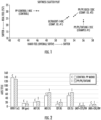
- a first nonwoven fabric i.e., PP Control-140C in Figure 1
- monocomponent fibers were formed from 100% by weight of a polypropylene homopolymer (i.e., PP3155E5 from Exxon) having a MFR of 36 g/10 min per ASTM D1238 (230°C/2.16kg).
- This nonwoven fabric was thermally point bonded at a temperature of 140°C.
- a second nonwoven fabric (i.e., Example #1 in Figure 1 ) of monocomponent fibers was formed from the following polymeric composition: (i) 80% by weight of a polypropylene homopolymer (i.e., PP3155E5 from Exxon) having a MFR of 36 g/10 min per ASTM D1238 (230°C/2.16kg); (ii) 15% by weight of a linear low density polyethylene (i.e., PE-Dowlex 2036.01G from Dow) having a MFR of 2.5 g/10 min per ASTM D1238 (190°C/2.16kg); and (iii) 5% by weight of an EP-iPP diblock polymer (i.e., Intune TM - Dow D5545) having a MFR of 9.5 g/10 min per ASTM D1238 (230°C/2.16kg).
- This nonwoven fabric was thermally point bonded at a temperature of 135°C.
- a third nonwoven fabric (i.e., Comp. Ex. #1 in Figure 1 ) of monocomponent fibers was formed from the following polymeric composition: (i) 93.5% by weight of a polypropylene homopolymer (i.e., PP3155E5 from Exxon) having a MFR of 36 g/10 min per ASTM D1238 (230°C/2.16kg); (ii) 5% by weight of a Vistamaxx TM 6202FL, which has a MFR of 9.1 g / 10 min per ASTM D1238 (230°C/2.16kg).
- a polypropylene homopolymer i.e., PP3155E5 from Exxon
- Vistamaxx TM 6202FL which has a MFR of 9.1 g / 10 min per ASTM D1238 (230°C/2.16kg.
- a fourth nonwoven fabric (i.e., Comp. Ex. #2 in Figure 1 ) of polypropylene-polyethylene bicomponent fibers having a sheath/core configuration with the sheath being formed from a polyethylene and the core being formed from a polypropylene homopolymer (i.e., PP3155E5 from Exxon) described above.
- the polyethylene was ASPUN TM 6850A from Dow. This nonwoven fabric was thermally point bonded at a temperature of 130°C.
- Example 1 had the lowest "TS7" values, which as noted above is a direct measurement of the softness of a sample. Additionally, Example 1 had the largest HF value, which as noted above is an objective evaluation of a sample's overall hand-feel. In this regard, Example 1 outperformed the control sample as well as each of the comparative examples.
- a first nonwoven fabric (i.e., Control PP Mono in Tables 2 and 3) of monocomponent fibers was formed from 100% by weight of a polypropylene homopolymer (i.e., PP3155E5 from Exxon) having a MFR of 36 g/10 min per ASTM D1238 (230°C/2.16kg). This nonwoven fabric was thermally point bonded at a temperature of 137°C.
- a polypropylene homopolymer i.e., PP3155E5 from Exxon
- the polypropylene homopolymer used to form the monocomponent fibers of the control was subjected differential scanning calorimetry (DSC) as shown on Figure 3A .
- DSC differential scanning calorimetry
- the DSC curve includes a single peak 10 with an onset of melting 12 of approximately 147°C.
- a second nonwoven fabric (i.e., PP/PE/Intune in Tables 2 and 3) of monocomponent fibers was formed from the following polymeric composition: (i) 80% by weight of a polypropylene homopolymer (i.e., PP3155E5 from Exxon) having a MFR of 36 g/10 min per ASTM D1238 (230°C/2.16kg); (ii) 15% by weight of a linear low density polyethylene (i.e., PE-Dowlex 2036.01G from Dow) having a MFR of 2.5 g/10 min per ASTM D1238 (190°C/2.16kg); and (iii) 5% by weight of an EP-iPP diblock polymer (i.e., IntuneTM - Dow D5545) having a MFR of 9.5 g/10 min per ASTM D1238 (230°C/2.16kg).
- This nonwoven fabric was thermally point bonded at a temperature of 130°C.
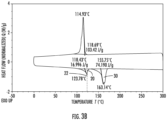
- the polymeric composition used to form the monocomponent fibers of Example 1 was subjected differential scanning calorimetry (DSC) as shown on Figure 3B .
- the DSC curve includes two prominent peaks.
- the DSC curve includes a first peak 20, which represents the melting of the polyethylene component, and a second peak 30, which is associated with the polypropylene component.
- the first peak 20 has an onset of melting of approximately 124°C.
- the polymeric composition of Example 1 provides a significant reduction in an onset of melting, which enables the use of reduced calendering temperatures (e.g., reduced bonding temperatures) while still providing good tensile properties as shown in Table 3.
- the approximate onset of melting for the polymeric composition of Example 1 has been superimposed by dashed line 23 on the DSC curve of Figure 3A to help illustrate the reduction in onset of melting.
- a third nonwoven fabric (i.e., PP/PE/Intune/NHP01 in Tables 2 and 3) of monocomponent fibers was formed from the following a polymeric composition: (A) a polymeric blend of (i) 80% by weight of a polypropylene homopolymer (i.e., PP3155E5 from Exxon) having a MFR of 36 g/10 min per ASTM D1238 (230°C/2.16kg), (ii) 15% by weight of a linear low density polyethylene (i.e., PE-Dowlex 2036.01G from Dow) having a MFR of 2.5 g/10 min per ASTM D1238 (190°C/2.16kg), and (iii) 5% by weight of an EP-iPP diblock polymer (i.e., IntuneTM - Dow D5545) having a MFR of 9.5 g/10 min per ASTM D1238 (230°C/2.16kg); and (B) 1.5% of erucamide by
- nonwoven fabrics formed from a polymeric blend in accordance with certain embodiments of the invention provide similar to improved tensile strengths while being bonded at a lower temperature.
Landscapes
- Engineering & Computer Science (AREA)
- Textile Engineering (AREA)
- Chemical & Material Sciences (AREA)
- Health & Medical Sciences (AREA)
- Chemical Kinetics & Catalysis (AREA)
- General Chemical & Material Sciences (AREA)
- Life Sciences & Earth Sciences (AREA)
- Epidemiology (AREA)
- Materials Engineering (AREA)
- Animal Behavior & Ethology (AREA)
- General Health & Medical Sciences (AREA)
- Public Health (AREA)
- Veterinary Medicine (AREA)
- Hematology (AREA)
- Manufacturing & Machinery (AREA)
- Mechanical Engineering (AREA)
- Nonwoven Fabrics (AREA)
Claims (15)
- Vliesstoff, aufweisend:eine Vielzahl von Monokomponenten-Spinnvliesfasern, aufweisend ein Polymermaterial, das eine Polymermischung aus (i) mindestens einem Polypropylenpolymer, (ii) mindestens einem Polyethylenpolymer und (iii) mindestens einem Kompatibilisierungsmittel, das mindestens ein erstes Polypropylen-Polyethylen-Copolymer aufweist oder daraus besteht, umfasst, wobei das erste Polypropylen-Polyethylen-Copolymer ein erstes Blockcopolymer oder ein erstes EP-iPP-Diblockpolymer ist und das erste Polypropylen-Polyethylen-Copolymer eine Schmelzflussrate (MFR) von 0,5 bis 20 g/10 min, bestimmt nach ASTM D1238 (230°C/2,16 kg), aufweist;wobei das Vliesgewebe eines oder mehrere der folgenden Merkmale aufweist: (i) einen TS7-Wert von höchstens 30, bestimmt durch einen Tissue Softness Analyzer (TSA) von Emtec Innovative Testing Solutions; (ii) einen HF-Wert von mindestens 40, bestimmt durch einen Tissue Softness Analyzer (TSA) von Emtec Innovative Testing Solutions; (iii) einen Delta-Wert von mindestens 20, wobei der Delta-Wert durch Subtrahieren des TS7-Wertes vom HF-Wert bestimmt wird; (iv) einen TS7-Wert, der 5 % bis 35 % niedriger ist als der eines identisch konstruierten Vliesstoffs aus 100% Polypropylen; und (v) einen HF-Wert, der 5 % bis 35 % höher ist als der eines identisch konstruierten Vliesstoffs aus 100 % Polypropylen.
- Vliesstoff nach Anspruch 1, wobei der Vliesstoff einen oder mehrere der folgenden Werte aufweist: (i) ein TS7-Wert von 2 bis 30, wie mindestens einer der folgenden: 2, 3, 4, 5, 6, 8, 10, 12, 14, 15, 16, 18, 19, 20, 21, 22, 23, 24 und 25, und/oder höchstens einen der folgenden Werte aufweist: 30, 29, 28, 27, 26 und 25; (ii) ein HF-Wert von 40 bis 120, wie mindestens einer der folgenden: 40, 42, 44, 46, 48, 50, 52, 54, 56, 58, 60, 65 und 70, und/oder höchstens einen der folgenden Werte: 120, 115, 110, 105, 100, 95, 90, 85, 80, 75 und 70; (iii) ein Delta-Wert von 20 bis 75, wie mindestens einer der folgenden: 20, 22, 24, 26, 28, 30, 32, 34 und 35, und/oder höchstens eine der folgenden: 75, 70, 65, 60, 55, 50, 45, 44, 42, 40, 38, 36 und 35; oder (iv) eine beliebige Kombination davon.
- Vliesstoff nach Ansprüchen 1-2, wobei die Polymermischung aufweist: (a) 60 bis 90 Gew.-% des mindestens einen Polypropylenpolymers, wie mindestens eines der folgenden: 60, 62, 64, 65, 66, 68, 70, 72, 74, 77, 78 und 80 Gew.-% des mindestens einen Polypropylenpolymers und/oder höchstens eines der folgenden: 90, 88, 86, 85, 84, 83, 82, 81 und 80 Gew.-% des mindestens einen Polypropylenpolymers, (b) 5 bis 30 Gew.-% des mindestens einen Polyethylenpolymers, wie mindestens eines der folgenden: 5, 6, 8, 10, 12, 14 und 15 Gew.-% des mindestens einen Polyethylenpolymers und/oder höchstens eines der folgenden: 30, 28, 26, 25, 24, 22, 20, 18, 16 und 15 Gew.-% des mindestens einen Polyethylenpolymers und (c) 1 bis 10 Gew.-% des mindestens einen Polypropylen-Polyethylen-Copolymers, wie mindestens eines der folgenden: 1, 2, 3, 4 und 5 Gew.-% des mindestens einen Polypropylen-Polyethylen-Copolymers und/oder höchstens eines der folgenden: 10, 9, 8, 7, 6 und 5 Gew.-% des mindestens einen Polypropylen-Polyethylen-Copolymers.
- Vliesstoff nach Anspruch 1 bis 3, wobei das erste Polypropylen-Polyethylen-Copolymer (i) einen Ethylenmonomergehalt von 5 bis 60 Gew.-% aufweist, wie mindestens eine der folgenden: 5, 6, 8, 10,12, 14, 15, 16, 18, 20, 22, 24, 25, 26, 28, 30, 32, 34, 35, 26, 38, 40, 42, 44 und 45 Gew.-% und/oder höchstens einen der folgenden Werte: 60, 58, 56, 55, 54, 52, 50, 48, 46 und 45 Gew.-%.
- Vliesstoff gemäß den Ansprüchen 1 bis 4, wobei ein erstes MFR-Verhältnis zwischen einem ersten MFR des mindestens einen Polypropylenpolymers, bestimmt gemäß ASTM D1238 (230°C/2,16 kg), und einem zweiten MFR des mindestens einen Polyethylenpolymers, bestimmt gemäß ASTM D1238 (230°C/2,16 kg), von 5: 1 bis 20:1, wie mindestens eine der folgenden: 5:1, 6:1, 7:1, 8:1, 9:1, 10:1, 11:1 und 12:1, und/oder höchstens eine der folgenden: 20:1, 19:1, 18:1, 17:1, 16:1, 15:1, 14:1, 13:1 und 12:1.
- Vliesstoff nach den Ansprüchen 1 bis 5, wobei das polymere Material ferner einen oder mehrere Füllstoffe aufweist, wie einen oder mehrere organische Füllstoffe und/oder einen oder mehrere anorganische Füllstoffe; und/oder ein oder mehrere Gleitmittel, die ein oder mehrere Amide aufweisen, wie Erucamid, Oleamid, Strearamid, Behenamid, Oleylpalmitamid, Stearylerucamid, Ethylenbisstrearamid, Ethylenbisoleamid oder eine beliebige Kombination davon.
- Vliesstoff nach den Ansprüchen 1 bis 6, wobei die Vielzahl von Monokomponenten-Spinnvliesfasern eine erste Vliesschicht definiert und wobei der Vliesstoff ferner eine oder mehrere zusätzliche Vliesschichten aufweist, die mindestens eine zweite Vliesschicht einschließen.
- Vliesstoff nach Anspruch 7, wobei die eine oder die mehreren zusätzlichen Schichten eine Spinnvliesschicht, eine schmelzgeblasene Schicht, eine kardierte Schicht, eine wasserstrahlverfestigte Schicht, eine Celluloseschicht oder eine beliebige Kombination davon aufweist bzw. aufweisen.
- Vliesstoff nach Anspruch 8, wobei der Vliesstoff ein SMS-Konstrukt aufweist, das eine erste Spinnvliesschicht, mindestens eine schmelzgeblasene Schicht und mindestens eine zweite Spinnvliesschicht umfasst, die mindestens eine schmelzgeblasene Schicht zwischen der ersten Spinnvliesschicht und der zweiten Spinnvliesschicht angeordnet ist; wobei die erste Spinnvliesschicht die Vielzahl von Einkomponenten-Spinnvliesfasern umfasst und eine erste äußerste Spinnvlies-Vliesschicht des SMS-Aufbaus definiert.
- Vliesstoff nach Anspruch 9, wobei die zweite Spinnvliesschicht eine zweite Vielzahl von Einkomponenten-Spinnvliesfasern umfasst und eine zweite äußerste Spinnvlieslage des SMS-Aufbaus definiert; wobei die zweite Vielzahl von Einkomponenten-Spinnvliesfasern aus einem identischen Polymermaterial oder einer Polymermischung wie die erste Spinnvliesschicht gebildet ist.
- Verfahren zur Herstellung eines Vliesstoffs, aufweisend:(a) Bilden einer Polymerschmelze, die eine Polymermischung aus (i) mindestens einem Polypropylenpolymer, (ii) mindestens einem Polyethylenpolymer und (iii) mindestens einem Polypropylen-Polyethylen-Copolymer umfasst,(b) Bilden einer Vielzahl von Einkomponenten-Spinnvliesfasern durch Schmelzspinnen der Polymerschmelze;(c) Verfestigen der Vielzahl von Monokomponenten-Spinnvliesfasern, um einen Vliesstoff gemäß einem der Ansprüche 1 bis 10 zu bilden.
- Verfahren nach Anspruch 11, wobei der Schritt des Bildens der Polymerschmelze das Auswählen und Mischen des mindestens einen Polypropylenpolymers, des mindestens einen Polyethylenpolymers und des mindestens einen Kompatibilisierungsmittels bei einer erhöhten Temperatur aufweist, wobei eine Schmelzflussrate (MFR) des mindestens einen Polyethylenpolymers geringer ist als eine MFR des mindestens einen Polypropylenpolymers bei der erhöhten Temperatur und eine Differenz zwischen der MFR des mindestens einen Polypropylenpolymers und der MFR des mindestens einen Polyethylenpolymers geringer ist als 35 g/10 min (230°C/2,16 kg), bestimmt nach ASTM D1238.
- Verfahren nach Anspruch 11-12, wobei das Verfestigen der Vielzahl von Monokomponenten-Spinnvliesfasern das Ausbilden einer Vielzahl von einzelnen Bindungsstellen durch einen thermischen Bindungsvorgang oder einen Ultraschallvorgang aufweist, und wobei das Ausbilden der Vielzahl von einzelnen Bindungsstellen bei einer Temperatur von 120°C bis 150°C durchgeführt wird, wie beispielsweise bei mindestens einer der folgenden: 120, 122, 124, 125, 126, 128, 130, 132, 134 und 135°C und/oder höchstens eine der folgenden Temperaturen: 150, 148, 146, 145, 144, 142, 140, 138, 136 und 135°C.
- Artikel, aufweisend: eine Oberschicht, aufweisend einen Vliesstoff gemäß einem der Ansprüche 1-10, wobei der Artikel eine Erwachsenenwindel, eine Babywindel, einen Pull-up oder eine Damenbinde aufweist.
- Vliesstoff nach Anspruch 1, wobei das polymere Material ein oder mehrere Gleitmittel aufweist, die ein oder mehrere Amide aufweisen, wie Erucamid, Oleamid, Strearamid, Behenamid, Oleylpalmitamid, Stearylerucamid, Ethylenbisstrearamid, Ethylenbisoleamid oder eine beliebige Kombination davon.
Priority Applications (1)
| Application Number | Priority Date | Filing Date | Title |
|---|---|---|---|
| EP25169595.3A EP4560061A3 (de) | 2021-07-07 | 2022-07-06 | Vliesstoffe mit verbesserter weichheit |
Applications Claiming Priority (3)
| Application Number | Priority Date | Filing Date | Title |
|---|---|---|---|
| US202163219147P | 2021-07-07 | 2021-07-07 | |
| US202163257209P | 2021-10-19 | 2021-10-19 | |
| PCT/US2022/036185 WO2023283222A1 (en) | 2021-07-07 | 2022-07-06 | Nonwoven fabrics having improved softness |
Related Child Applications (2)
| Application Number | Title | Priority Date | Filing Date |
|---|---|---|---|
| EP25169595.3A Division EP4560061A3 (de) | 2021-07-07 | 2022-07-06 | Vliesstoffe mit verbesserter weichheit |
| EP25169595.3A Division-Into EP4560061A3 (de) | 2021-07-07 | 2022-07-06 | Vliesstoffe mit verbesserter weichheit |
Publications (2)
| Publication Number | Publication Date |
|---|---|
| EP4367311A1 EP4367311A1 (de) | 2024-05-15 |
| EP4367311B1 true EP4367311B1 (de) | 2025-05-14 |
Family
ID=82748135
Family Applications (2)
| Application Number | Title | Priority Date | Filing Date |
|---|---|---|---|
| EP25169595.3A Pending EP4560061A3 (de) | 2021-07-07 | 2022-07-06 | Vliesstoffe mit verbesserter weichheit |
| EP22748611.5A Active EP4367311B1 (de) | 2021-07-07 | 2022-07-06 | Vliesstoffe mit verbesserter weichheit |
Family Applications Before (1)
| Application Number | Title | Priority Date | Filing Date |
|---|---|---|---|
| EP25169595.3A Pending EP4560061A3 (de) | 2021-07-07 | 2022-07-06 | Vliesstoffe mit verbesserter weichheit |
Country Status (8)
| Country | Link |
|---|---|
| US (1) | US12415012B2 (de) |
| EP (2) | EP4560061A3 (de) |
| DK (1) | DK4367311T3 (de) |
| ES (1) | ES3039449T3 (de) |
| FI (1) | FI4367311T3 (de) |
| MX (1) | MX2024000272A (de) |
| PL (1) | PL4367311T3 (de) |
| WO (1) | WO2023283222A1 (de) |
Families Citing this family (2)
| Publication number | Priority date | Publication date | Assignee | Title |
|---|---|---|---|---|
| US20240376649A1 (en) * | 2023-05-11 | 2024-11-14 | The Procter & Gamble Company | Carded calendered nonwovens |
| WO2024229793A1 (en) * | 2023-05-11 | 2024-11-14 | The Procter & Gamble Company | Absorbent article comprising a carded calendered nonwoven |
Family Cites Families (10)
| Publication number | Priority date | Publication date | Assignee | Title |
|---|---|---|---|---|
| US5266392A (en) * | 1991-09-16 | 1993-11-30 | Exxon Chemical Patents Inc. | Plastomer compatibilized polyethylene/polypropylene blends |
| CA2148289C (en) * | 1994-05-20 | 2006-01-10 | Ruth Lisa Levy | Perforated nonwoven fabrics |
| IT1299169B1 (it) * | 1998-04-29 | 2000-02-29 | Meraklon S R L | Fibra in fiocco da miscele di resine polipropileniche con polietilene per la produzione di tessuto-non-tessuto termosaldato. |
| WO2012177376A1 (en) | 2011-06-21 | 2012-12-27 | Exxonmobil Chemical Patents Inc. | Elastic nonwoven materials comprising propylene-based and ethylene-based polymers |
| US9994982B2 (en) * | 2013-03-12 | 2018-06-12 | Fitesa Germany Gmbh | Extensible nonwoven fabric |
| RU2665448C1 (ru) * | 2015-01-02 | 2018-08-29 | Ска Хайджин Продактс Аб | Впитывающее изделие |
| US20170009401A1 (en) | 2015-07-10 | 2017-01-12 | The Procter & Gamble Company | Fibrous Structures and Methods for Making Same |
| WO2018017169A1 (en) | 2016-07-22 | 2018-01-25 | Exxonmobil Chemical Patents Inc. | Polypropylene nonwoven fibers, fabrics and methods for making same |
| DE112018000611B4 (de) | 2017-01-31 | 2026-03-26 | The Procter & Gamble Company | Geformtes Vlies |
| US20220192897A1 (en) * | 2020-12-18 | 2022-06-23 | The Procter & Gamble Company | Nonwoven webs with visually discernible patterns and patterned surfactants |
-
2022
- 2022-07-06 EP EP25169595.3A patent/EP4560061A3/de active Pending
- 2022-07-06 US US17/858,258 patent/US12415012B2/en active Active
- 2022-07-06 DK DK22748611.5T patent/DK4367311T3/da active
- 2022-07-06 WO PCT/US2022/036185 patent/WO2023283222A1/en not_active Ceased
- 2022-07-06 EP EP22748611.5A patent/EP4367311B1/de active Active
- 2022-07-06 PL PL22748611.5T patent/PL4367311T3/pl unknown
- 2022-07-06 FI FIEP22748611.5T patent/FI4367311T3/fi active
- 2022-07-06 ES ES22748611T patent/ES3039449T3/es active Active
- 2022-07-06 MX MX2024000272A patent/MX2024000272A/es unknown
Also Published As
| Publication number | Publication date |
|---|---|
| EP4367311A1 (de) | 2024-05-15 |
| US12415012B2 (en) | 2025-09-16 |
| US20230015896A1 (en) | 2023-01-19 |
| EP4560061A2 (de) | 2025-05-28 |
| EP4560061A3 (de) | 2025-06-25 |
| PL4367311T3 (pl) | 2025-09-22 |
| WO2023283222A1 (en) | 2023-01-12 |
| MX2024000272A (es) | 2024-01-31 |
| DK4367311T3 (da) | 2025-08-25 |
| ES3039449T3 (en) | 2025-10-21 |
| FI4367311T3 (fi) | 2025-08-13 |
Similar Documents
| Publication | Publication Date | Title |
|---|---|---|
| US11591730B2 (en) | Extensible nonwoven fabric | |
| EP1369518B1 (de) | Vliesstoffe aus schrumpffasern und laminate daraus | |
| JP5405675B2 (ja) | 弾性メルトブロー積層体構造体およびこれを作製するための方法 | |
| EP0625221B1 (de) | Elastische vliesstoffe und verfahren zur herstellung derselben | |
| EP2034057A1 (de) | Elastisches Spinnvlies und elastische Vliesfaser damit | |
| WO2014086614A1 (en) | Polypropylene fibers and fabrics | |
| EP2813611A1 (de) | Gesponnene und gebundene Vliesfaser und Faserprodukt | |
| JP7138197B2 (ja) | スパンボンド不織布、衛生材料、及びスパンボンド不織布の製造方法 | |
| EP1057916B1 (de) | Vliesstoff aus kompositfasern | |
| US20250179701A1 (en) | High loft nonwoven fabrics | |
| EP4367311B1 (de) | Vliesstoffe mit verbesserter weichheit | |
| EP2151512A1 (de) | Fasern und Vliese mit erhöhter Oberflächenrauhheit | |
| JP2002242069A (ja) | 混合繊維からなる不織布及びその製造方法並びに該不織布からなる積層体 | |
| KR101837204B1 (ko) | 우수한 벌키성을 갖는 폴리프로필렌 복합방사 스펀본드 부직포 및 그 제조방법 | |
| JPWO2020196663A1 (ja) | 不織布積層体及び衛生用品 | |
| CN117597479A (zh) | 具有改善的柔软度的非织造织物 | |
| JP4694204B2 (ja) | スパンボンド不織布およびこれを用いた積層体、ならびにこれらの製造方法 | |
| KR102611319B1 (ko) | 방사성, 벌키성 및 유연성이 우수한 폴리올레핀 복합방사 섬유 제조방법 | |
| WO2025180393A1 (en) | Nonwoven fabrics |
Legal Events
| Date | Code | Title | Description |
|---|---|---|---|
| STAA | Information on the status of an ep patent application or granted ep patent |
Free format text: STATUS: UNKNOWN |
|
| STAA | Information on the status of an ep patent application or granted ep patent |
Free format text: STATUS: THE INTERNATIONAL PUBLICATION HAS BEEN MADE |
|
| PUAI | Public reference made under article 153(3) epc to a published international application that has entered the european phase |
Free format text: ORIGINAL CODE: 0009012 |
|
| STAA | Information on the status of an ep patent application or granted ep patent |
Free format text: STATUS: REQUEST FOR EXAMINATION WAS MADE |
|
| 17P | Request for examination filed |
Effective date: 20240202 |
|
| AK | Designated contracting states |
Kind code of ref document: A1 Designated state(s): AL AT BE BG CH CY CZ DE DK EE ES FI FR GB GR HR HU IE IS IT LI LT LU LV MC MK MT NL NO PL PT RO RS SE SI SK SM TR |
|
| RAV | Requested validation state of the european patent: fee paid |
Extension state: MA Effective date: 20240202 |
|
| GRAP | Despatch of communication of intention to grant a patent |
Free format text: ORIGINAL CODE: EPIDOSNIGR1 |
|
| STAA | Information on the status of an ep patent application or granted ep patent |
Free format text: STATUS: GRANT OF PATENT IS INTENDED |
|
| INTG | Intention to grant announced |
Effective date: 20241213 |
|
| GRAS | Grant fee paid |
Free format text: ORIGINAL CODE: EPIDOSNIGR3 |
|
| GRAA | (expected) grant |
Free format text: ORIGINAL CODE: 0009210 |
|
| STAA | Information on the status of an ep patent application or granted ep patent |
Free format text: STATUS: THE PATENT HAS BEEN GRANTED |
|
| AK | Designated contracting states |
Kind code of ref document: B1 Designated state(s): AL AT BE BG CH CY CZ DE DK EE ES FI FR GB GR HR HU IE IS IT LI LT LU LV MC MK MT NL NO PL PT RO RS SE SI SK SM TR |
|
| REG | Reference to a national code |
Ref country code: GB Ref legal event code: FG4D |
|
| REG | Reference to a national code |
Ref country code: CH Ref legal event code: EP |
|
| REG | Reference to a national code |
Ref country code: DE Ref legal event code: R096 Ref document number: 602022014713 Country of ref document: DE |
|
| REG | Reference to a national code |
Ref country code: IE Ref legal event code: FG4D |
|
| REG | Reference to a national code |
Ref country code: FI Ref legal event code: FGE |
|
| REG | Reference to a national code |
Ref country code: DK Ref legal event code: T3 Effective date: 20250818 |
|
| REG | Reference to a national code |
Ref country code: SE Ref legal event code: TRGR |
|
| REG | Reference to a national code |
Ref country code: NL Ref legal event code: MP Effective date: 20250514 |
|
| PG25 | Lapsed in a contracting state [announced via postgrant information from national office to epo] |
Ref country code: PT Free format text: LAPSE BECAUSE OF FAILURE TO SUBMIT A TRANSLATION OF THE DESCRIPTION OR TO PAY THE FEE WITHIN THE PRESCRIBED TIME-LIMIT Effective date: 20250915 |
|
| PGFP | Annual fee paid to national office [announced via postgrant information from national office to epo] |
Ref country code: ES Payment date: 20250902 Year of fee payment: 4 Ref country code: FI Payment date: 20250901 Year of fee payment: 4 |
|
| PGFP | Annual fee paid to national office [announced via postgrant information from national office to epo] |
Ref country code: DE Payment date: 20250901 Year of fee payment: 4 |
|
| REG | Reference to a national code |
Ref country code: LT Ref legal event code: MG9D |
|
| PG25 | Lapsed in a contracting state [announced via postgrant information from national office to epo] |
Ref country code: NO Free format text: LAPSE BECAUSE OF FAILURE TO SUBMIT A TRANSLATION OF THE DESCRIPTION OR TO PAY THE FEE WITHIN THE PRESCRIBED TIME-LIMIT Effective date: 20250814 |
|
| PGFP | Annual fee paid to national office [announced via postgrant information from national office to epo] |
Ref country code: GR Payment date: 20250902 Year of fee payment: 4 |
|
| PG25 | Lapsed in a contracting state [announced via postgrant information from national office to epo] |
Ref country code: NL Free format text: LAPSE BECAUSE OF FAILURE TO SUBMIT A TRANSLATION OF THE DESCRIPTION OR TO PAY THE FEE WITHIN THE PRESCRIBED TIME-LIMIT Effective date: 20250514 |
|
| PGFP | Annual fee paid to national office [announced via postgrant information from national office to epo] |
Ref country code: TR Payment date: 20250902 Year of fee payment: 4 Ref country code: PL Payment date: 20250902 Year of fee payment: 4 Ref country code: LU Payment date: 20250902 Year of fee payment: 4 Ref country code: IT Payment date: 20250731 Year of fee payment: 4 |
|
| REG | Reference to a national code |
Ref country code: AT Ref legal event code: MK05 Ref document number: 1794850 Country of ref document: AT Kind code of ref document: T Effective date: 20250514 |
|
| PG25 | Lapsed in a contracting state [announced via postgrant information from national office to epo] |
Ref country code: BG Free format text: LAPSE BECAUSE OF FAILURE TO SUBMIT A TRANSLATION OF THE DESCRIPTION OR TO PAY THE FEE WITHIN THE PRESCRIBED TIME-LIMIT Effective date: 20250514 |
|
| PG25 | Lapsed in a contracting state [announced via postgrant information from national office to epo] |
Ref country code: HR Free format text: LAPSE BECAUSE OF FAILURE TO SUBMIT A TRANSLATION OF THE DESCRIPTION OR TO PAY THE FEE WITHIN THE PRESCRIBED TIME-LIMIT Effective date: 20250514 |
|
| PG25 | Lapsed in a contracting state [announced via postgrant information from national office to epo] |
Ref country code: AT Free format text: LAPSE BECAUSE OF FAILURE TO SUBMIT A TRANSLATION OF THE DESCRIPTION OR TO PAY THE FEE WITHIN THE PRESCRIBED TIME-LIMIT Effective date: 20250514 |
|
| PGFP | Annual fee paid to national office [announced via postgrant information from national office to epo] |
Ref country code: FR Payment date: 20250811 Year of fee payment: 4 |
|
| PGFP | Annual fee paid to national office [announced via postgrant information from national office to epo] |
Ref country code: SE Payment date: 20250811 Year of fee payment: 4 |
|
| REG | Reference to a national code |
Ref country code: ES Ref legal event code: FG2A Ref document number: 3039449 Country of ref document: ES Kind code of ref document: T3 Effective date: 20251021 |
|
| PG25 | Lapsed in a contracting state [announced via postgrant information from national office to epo] |
Ref country code: RS Free format text: LAPSE BECAUSE OF FAILURE TO SUBMIT A TRANSLATION OF THE DESCRIPTION OR TO PAY THE FEE WITHIN THE PRESCRIBED TIME-LIMIT Effective date: 20250814 |
|
| PGFP | Annual fee paid to national office [announced via postgrant information from national office to epo] |
Ref country code: CZ Payment date: 20250905 Year of fee payment: 4 |
|
| PG25 | Lapsed in a contracting state [announced via postgrant information from national office to epo] |
Ref country code: IS Free format text: LAPSE BECAUSE OF FAILURE TO SUBMIT A TRANSLATION OF THE DESCRIPTION OR TO PAY THE FEE WITHIN THE PRESCRIBED TIME-LIMIT Effective date: 20250914 |
|
| PG25 | Lapsed in a contracting state [announced via postgrant information from national office to epo] |
Ref country code: LV Free format text: LAPSE BECAUSE OF FAILURE TO SUBMIT A TRANSLATION OF THE DESCRIPTION OR TO PAY THE FEE WITHIN THE PRESCRIBED TIME-LIMIT Effective date: 20250514 |
|
| REG | Reference to a national code |
Ref country code: GR Ref legal event code: EP Ref document number: 20250401642 Country of ref document: GR Effective date: 20251009 |
|
| PG25 | Lapsed in a contracting state [announced via postgrant information from national office to epo] |
Ref country code: SM Free format text: LAPSE BECAUSE OF FAILURE TO SUBMIT A TRANSLATION OF THE DESCRIPTION OR TO PAY THE FEE WITHIN THE PRESCRIBED TIME-LIMIT Effective date: 20250514 |
|
| PGFP | Annual fee paid to national office [announced via postgrant information from national office to epo] |
Ref country code: DK Payment date: 20251030 Year of fee payment: 4 |
|
| PG25 | Lapsed in a contracting state [announced via postgrant information from national office to epo] |
Ref country code: EE Free format text: LAPSE BECAUSE OF FAILURE TO SUBMIT A TRANSLATION OF THE DESCRIPTION OR TO PAY THE FEE WITHIN THE PRESCRIBED TIME-LIMIT Effective date: 20250514 |
|
| PG25 | Lapsed in a contracting state [announced via postgrant information from national office to epo] |
Ref country code: SK Free format text: LAPSE BECAUSE OF FAILURE TO SUBMIT A TRANSLATION OF THE DESCRIPTION OR TO PAY THE FEE WITHIN THE PRESCRIBED TIME-LIMIT Effective date: 20250514 |
|
| REG | Reference to a national code |
Ref country code: CH Ref legal event code: H13 Free format text: ST27 STATUS EVENT CODE: U-0-0-H10-H13 (AS PROVIDED BY THE NATIONAL OFFICE) Effective date: 20260224 |
|
| PG25 | Lapsed in a contracting state [announced via postgrant information from national office to epo] |
Ref country code: RO Free format text: LAPSE BECAUSE OF FAILURE TO SUBMIT A TRANSLATION OF THE DESCRIPTION OR TO PAY THE FEE WITHIN THE PRESCRIBED TIME-LIMIT Effective date: 20250514 |
|
| PLBE | No opposition filed within time limit |
Free format text: ORIGINAL CODE: 0009261 |
|
| STAA | Information on the status of an ep patent application or granted ep patent |
Free format text: STATUS: NO OPPOSITION FILED WITHIN TIME LIMIT |
|
| REG | Reference to a national code |
Ref country code: CH Ref legal event code: L10 Free format text: ST27 STATUS EVENT CODE: U-0-0-L10-L00 (AS PROVIDED BY THE NATIONAL OFFICE) Effective date: 20260325 |