EP4366200A1 - Funkrahmensendeverfahren und -vorrichtung sowie funkrahmenempfangsverfahren und -vorrichtung - Google Patents
Funkrahmensendeverfahren und -vorrichtung sowie funkrahmenempfangsverfahren und -vorrichtung Download PDFInfo
- Publication number
- EP4366200A1 EP4366200A1 EP22845106.8A EP22845106A EP4366200A1 EP 4366200 A1 EP4366200 A1 EP 4366200A1 EP 22845106 A EP22845106 A EP 22845106A EP 4366200 A1 EP4366200 A1 EP 4366200A1
- Authority
- EP
- European Patent Office
- Prior art keywords
- information
- link
- information element
- mle
- station
- Prior art date
- Legal status (The legal status is an assumption and is not a legal conclusion. Google has not performed a legal analysis and makes no representation as to the accuracy of the status listed.)
- Pending
Links
Images





Classifications
-
- H—ELECTRICITY
- H04—ELECTRIC COMMUNICATION TECHNIQUE
- H04L—TRANSMISSION OF DIGITAL INFORMATION, e.g. TELEGRAPHIC COMMUNICATION
- H04L5/00—Arrangements affording multiple use of the transmission path
- H04L5/0091—Signalling for the administration of the divided path, e.g. signalling of configuration information
-
- H—ELECTRICITY
- H04—ELECTRIC COMMUNICATION TECHNIQUE
- H04W—WIRELESS COMMUNICATION NETWORKS
- H04W28/00—Network traffic management; Network resource management
- H04W28/02—Traffic management, e.g. flow control or congestion control
- H04W28/06—Optimizing the usage of the radio link, e.g. header compression, information sizing, discarding information
-
- H—ELECTRICITY
- H04—ELECTRIC COMMUNICATION TECHNIQUE
- H04L—TRANSMISSION OF DIGITAL INFORMATION, e.g. TELEGRAPHIC COMMUNICATION
- H04L1/00—Arrangements for detecting or preventing errors in the information received
- H04L1/0001—Systems modifying transmission characteristics according to link quality, e.g. power backoff
- H04L1/0023—Systems modifying transmission characteristics according to link quality, e.g. power backoff characterised by the signalling
- H04L1/0028—Formatting
-
- H—ELECTRICITY
- H04—ELECTRIC COMMUNICATION TECHNIQUE
- H04L—TRANSMISSION OF DIGITAL INFORMATION, e.g. TELEGRAPHIC COMMUNICATION
- H04L69/00—Network arrangements, protocols or services independent of the application payload and not provided for in the other groups of this subclass
- H04L69/14—Multichannel or multilink protocols
-
- H—ELECTRICITY
- H04—ELECTRIC COMMUNICATION TECHNIQUE
- H04W—WIRELESS COMMUNICATION NETWORKS
- H04W76/00—Connection management
- H04W76/10—Connection setup
- H04W76/11—Allocation or use of connection identifiers
-
- H—ELECTRICITY
- H04—ELECTRIC COMMUNICATION TECHNIQUE
- H04W—WIRELESS COMMUNICATION NETWORKS
- H04W76/00—Connection management
- H04W76/10—Connection setup
- H04W76/15—Setup of multiple wireless link connections
-
- H—ELECTRICITY
- H04—ELECTRIC COMMUNICATION TECHNIQUE
- H04L—TRANSMISSION OF DIGITAL INFORMATION, e.g. TELEGRAPHIC COMMUNICATION
- H04L47/00—Traffic control in data switching networks
- H04L47/10—Flow control; Congestion control
- H04L47/34—Flow control; Congestion control ensuring sequence integrity, e.g. using sequence numbers
-
- H—ELECTRICITY
- H04—ELECTRIC COMMUNICATION TECHNIQUE
- H04W—WIRELESS COMMUNICATION NETWORKS
- H04W84/00—Network topologies
- H04W84/02—Hierarchically pre-organised networks, e.g. paging networks, cellular networks, WLAN [Wireless Local Area Network] or WLL [Wireless Local Loop]
- H04W84/10—Small scale networks; Flat hierarchical networks
- H04W84/12—WLAN [Wireless Local Area Networks]
Definitions
- This application relates to the field of wireless local area network (wireless local area network, WLAN) technologies, and in particular, to a radio frame sending method and apparatus, and a radio frame receiving method and apparatus.
- wireless local area network wireless local area network, WLAN
- the devices support simultaneous communication on 2.4 gigahertz (GHz), 5 GHz, and 6 GHz frequency bands, or support simultaneous communication on different channels of a same frequency band. This improves a communication rate between devices.
- Such devices are generally referred to as multi-link devices (multi-link device, MLD).
- the multi-link devices may be multi-link access point devices or multi-link station devices.
- one multi-link device may send a radio frame including a multi-link element (multi-link element, MLE) to another multi-link device.
- MLE multi-link element
- the MLE may be used to carry station information of the multi-link device.
- a maximum length of the information carried in the MLE is fixed, and the maximum length is configured by a length (Length) field in the MLE.
- the length of the station information, carried in the MLE, of the multi-link device may be greater than the maximum length configured for the MLE. Consequently, radio frame transmission fails because the MLE cannot carry the station information of the multi-link device, and communication efficiency is affected.
- Embodiments of this application provide a radio frame sending method and apparatus, and a radio frame receiving method and apparatus, to carry station information of a multi-link station device in a manner in which a plurality of MLEs of a radio frame carry station information of a same link. This avoids a radio frame transmission failure and improves communication efficiency.
- an embodiment of this application provides a radio frame sending method applied to WLAN communication.
- the method is performed by a multi-link device or some components (for example, a processor, a chip, or a chip system) in the multi-link device.
- the multi-link device generates a radio frame.
- the radio frame includes a first multi-link element MLE and a second MLE, the first MLE includes a first information element, the second MLE includes a second information element, and the first information element and the second information element correspond to station information of a same link.
- the multi-link device sends the radio frame.
- the radio frame sent by the multi-link device includes the first MLE and the second MLE, and the first information element included in the first MLE and the second information element included in the second MLE correspond to the station information of the same link.
- the station information of the multi-link station device is carried in a manner in which a plurality of MLEs of a radio frame carry station information of a same link. This avoids a radio frame transmission failure and improves communication efficiency.
- first information element and the second information element correspond to the station information of the same link may also be expressed as that the first information element and the second information element correspond to different portions of the station information of the same link.
- the station information of the same link is fragmented into at least two portions. One portion of the station information of the link corresponds to the first information element (which is also referred to as that one portion of the station information of the link is carried in the first information element), and the other portion of the station information of the link corresponds to the second information element (which is also referred to as that the other portion of the station information of the link is carried in the second information element).
- an embodiment of this application provides a radio frame receiving method applied to WLAN communication.
- the method is performed by a multi-link device or some components (for example, a processor, a chip, or a chip system) in the multi-link device.
- a multi-link device receives a radio frame.
- the radio frame includes a first multi-link element MLE and a second MLE, the first MLE includes a first information element, the second MLE includes a second information element, and the first information element and the second information element correspond to station information of a same link.
- the multi-link device determines the station information based on the radio frame.
- the radio frame received by the multi-link device includes the first MLE and the second MLE, and the first information element included in the first MLE and the second information element included in the second MLE correspond to the station information of the same link.
- the station information of the multi-link station device is carried in a manner in which a plurality of MLEs of a radio frame carry station information of a same link. This avoids a radio frame transmission failure and improves communication efficiency.
- an embodiment of this application provides a radio frame sending apparatus used in WLAN communication.
- the apparatus may specifically be a multi-link device or some components (for example, a processor, a chip, or a chip system) in the multi-link device.
- the apparatus includes a transceiver unit and a processing unit.
- the processing unit is configured to generate a radio frame.
- the radio frame includes a first multi-link element MLE and a second MLE, the first MLE includes a first information element, the second MLE includes a second information element, and the first information element and the second information element correspond to station information of a same link.
- the transceiver unit is configured to send the radio frame.
- the radio frame sent by the transceiver unit includes the first MLE and the second MLE, and the first information element included in the first MLE and the second information element included in the second MLE correspond to the station information of the same link.
- the station information of the multi-link station device is carried in a manner in which a plurality of MLEs of a radio frame carry station information of a same link. This avoids a radio frame transmission failure and improves communication efficiency.
- an embodiment of this application provides a radio frame receiving apparatus used in WLAN communication.
- the apparatus may specifically be a multi-link device or some components (for example, a processor, a chip, or a chip system) in the multi-link device.
- the apparatus includes a transceiver unit and a processing unit.
- the transceiver unit is configured to receive a radio frame.
- the radio frame includes a first multi-link element MLE and a second MLE, the first MLE includes a first information element, the second MLE includes a second information element, and the first information element and the second information element correspond to station information of a same link.
- the processing unit is configured to determine the station information based on the radio frame.
- the radio frame received by the transceiver unit includes the first MLE and the second MLE, and the first information element included in the first MLE and the second information element included in the second MLE correspond to the station information of the same link.
- the station information of the multi-link station device is carried in a manner in which a plurality of MLEs of a radio frame carry station information of a same link. This avoids a radio frame transmission failure and improves communication efficiency.
- the first information element and the second information element each include a link identifier (Link ID) field, and a value of the link identifier field of the first information element is the same as a value of the link identifier field of the second information element.
- Link ID link identifier
- an information element may identify, by using a link identifier field included in the information element, a link on which station information carried in the information element is located. That the value of the link identifier field of the first information element is the same as the value of the link identifier field of the second information element may indicate that a link on which the station information carried in the first information element is located is the same as a link on which the station information carried in the second information element is located. Therefore, a same value of the link identifier fields indicates that the first information element and the second information element correspond to the station information of the same link.
- the first information element includes first indication information, and the first indication information indicates whether the station information is fragmented.
- the first information element may include the first indication information indicating whether the station information is fragmented, to indicate that station information, carried in the first information element, of a link is fragmented into at least two fragments, and at least one of the at least two fragments is carried in another information element (for example, the second information element). Therefore, the first indication information indicates that the first information element and the second information element correspond to the station information of the same link.
- the second information element includes the first indication information.
- the first indication information indicates whether the station information is fragmented.
- the first indication information indicates whether different fragments of the station information are carried in different information elements.
- the first indication information indicates that the station information is fragmented, and the station information of the first information element is a first fragment.
- the first indication information indicates that the station information is fragmented, and the station information of the first information element is a last fragment.
- the first indication information indicates that the station information is fragmented, and the station information of the first information element is an intermediate fragment (neither the first fragment nor the last fragment).
- the first indication information indicates that the station information is not fragmented.
- the first indication information is carried in a station control (STA control) information field of the first information element.
- STA control station control
- the first indication information indicating whether the station information is fragmented may be carried in the station control field of the first information element, to provide a specific implementation of implementing the first indication information.
- the first information element includes second indication information
- the second indication information indicates a quantity of information elements that carry the station information
- the first information element may include the second indication information indicating the quantity of information elements that carry the station information, to indicate that station information, carried in the first information element, of a link is carried in a plurality of information elements (at least including the second information element), and indicate a quantity of the plurality of information elements. Therefore, the second indication information indicates that the first information element and the second information element correspond to the station information of the same link.
- the second information element includes the second indication information.
- the second indication information indicates a quantity of fragments of the station information.
- the second indication information indicates a quantity of information elements that carry the station information, and the information elements that carry the station information include the first information element.
- the second indication information indicates a quantity of information elements that carry the station information, and the information elements that carry the station information do not include the first information element.
- the second indication information indicates a sequence number of the information element that carries the station information, and the sequence number is a forward sequence number.
- the second indication information indicates a sequence number of the information element that carries the station information, and the sequence number is a backward sequence number.
- the second indication information is carried in a station control field of the first information element.
- the second indication information indicating the quantity of information elements that carry the station information may be carried in the station control field of the first information element, to provide a specific implementation of implementing the second indication information.
- the second information element includes third indication information, and the third indication information indicates that the second information element is a last information element in a plurality of information elements that carry the station information.
- the second information element may include the third indication information indicating that the second information element is the last information element in the plurality of information elements that carry the station information, to indicate that station information, carried in the second information element, of a link is carried in a plurality of information elements (at least including the second information element), and that the second information element is the last information element in the plurality of information elements. Therefore, the third indication information indicates that the first information element and the second information element correspond to the station information of the same link.
- the third indication information indicates that there is no other information element that carries the station information after the second information element.
- the station information is fragmented into a plurality of fragments, and the third indication information indicates that a fragment, carried in the second information element, of the station information is a last fragment.
- the third indication information includes a non-inheritance field (non-inheritance element).
- the first information element and the second information element each include a complete profile (Complete Profile) field, and a value of the complete profile field of the first information element is the same as a value of the complete profile field of the second information element.
- an information element may indicate, by using a complete profile field included in the information element, a related profile of station information carried in the information element. That the value of the complete profile field of the first information element is the same as the value of the complete profile field of the second information element may indicate that a profile of station information carried in the first information element is the same as a profile of station information carried in the second information element. Therefore, a same value of the complete profile fields indicates that both the first information element and the second information element in the radio frame carry complete station information.
- the second information element does not include the complete profile field.
- the first information element includes a station information (STA Info) field
- the station information field indicates related station information of the first information element and related station information of the second information element.
- an information element may indicate, by using a station information field included in the information element, related station information carried in the information element.
- the station information field of the first information element not only indicates the related station information carried in the first information element, but also indicates the related station information carried in the second information element. Therefore, the station information field of the first information element indicates that the first information element and the second information element correspond to the station information of the same link.
- the second information element does not include a station information field; or the second information element includes the station information field, and a value of the station information field is a reserved (reserved) value.
- the second information element may not carry the station information field, or the station information field of the second information element is set to a reserved value, to carry other information/data different from information in the station information field by using the reserved value. Therefore, the station information field of the first information element is reused to indicate the related station information of the plurality of information elements, to reduce overheads and further improve communication efficiency.
- the second information element includes a station information field.
- the station information field includes at least one of the following: a medium access control address present (medium access control address present, MAC Address Present) field, a beacon interval present (Beacon Interval Present) field, a delivery traffic indication message information present (delivery traffic indication message information present, DTIM Info Present) field, and a non-simultaneous transmit and receive link pair present (non-simultaneous transmit and receive link pair present, NSTR Link Pair Present) field.
- a medium access control address present medium access control address present, MAC Address Present
- Beacon Interval Present Beacon Interval Present
- delivery traffic indication message information present delivery traffic indication message information present
- DTIM Info Present delivery traffic indication message information present
- NSTR Link Pair Present non-simultaneous transmit and receive link pair present
- the station information field may specifically include at least one of the foregoing fields, to indicate related station information.
- an element type of the first information element is the same as an element type of the second information element.
- the element type of the first information element is the same as the element type of the second information element, that is, the station information of the same link is carried in a plurality of information elements of a same element type.
- the first information element and the second information element each include a type field, and a value of the type field of the first information element is the same as a value of the type field of the second information element.
- the type field is a subelement identifier (subelement ID) field.
- an element type of the first information element is different from an element type of the second information element.
- the element type of the first information element is different from the element type of the second information element, that is, the station information of the same link is carried in a plurality of information elements of different element types.
- the first information element and the second information element each include a type field, and a value of the type field of the first information element is different from a value of the type field of the second information element.
- the type field of the information element indicates a type of the information element
- different values of the type field may indicate that the element type of the first information element is different from the element type of the second information element.
- the type field is a subelement identifier (subelement ID) field.
- the first MLE and the second MLE are adjacent MLEs.
- the first MLE and the second MLE may be MLEs at adjacent locations in the radio frame.
- a manner in which the station information of the same link is carried in a plurality of adjacent MLEs in the radio frame may help a receive end of the radio frame obtain the station information of the same link.
- the radio frame there is no other MLE between the first MLE and the second MLE.
- the first MLE is located before the second MLE, or in the radio frame, the second MLE is located after the first MLE.
- the first MLE includes a common information field
- the common information field indicates multi-link common information of the first MLE and multi-link common information of the second MLE.
- an information element may indicate, by using a common information field included in the information element, multi-link common information carried in the information element.
- the common information field of the first information element not only indicates the multi-link common information carried in the first information element, but also indicates the multi-link common information carried in the second information element. Therefore, the common information field of the first information element indicates multi-link common information corresponding to the first information element and the second information element.
- the second MLE does not include a common information field; or the second MLE includes the common information field, and a value of the common information field of the second MLE is a reserved value.
- the second information element may not carry the common information field, or the common information field of the second information element is set to a reserved value, to carry other information/data different from information in the common information field by using the reserved value. Therefore, the common information field of the first information element is reused to indicate the multi-link common information of the plurality of information elements, to reduce overheads and further improve communication efficiency.
- the second information element includes a common information field.
- the first MLE includes a multi-link control field
- the multi-link control field indicates multi-link control information of the first MLE and multi-link control information of the second MLE.
- an information element may indicate, by using a multi-link control field included in the information element, multi-link control information carried in the information element.
- the multi-link control field of the first information element not only indicates the multi-link control information carried in the first information element, but also indicates the multi-link control information carried in the second information element. Therefore, the multi-link control field of the first information element indicates multi-link control information corresponding to the first information element and the second information element.
- the second MLE does not include a multi-link control field; or the second MLE includes the multi-link control field, and a value of a presence bitmap (Presence bitmap) field in the multi-link control field of the second MLE is all 0s.
- a presence bitmap Presence bitmap
- the second information element may not carry the multi-link control information field, or the multi-link control field of the second information element is set to a reserved value, to carry other information/data different from information in the multi-link control field by using the reserved value. Therefore, the multi-link control field of the first information element is reused to indicate the multi-link control information of the plurality of information elements, to reduce overheads and further improve communication efficiency.
- the second information element includes a common information field.
- the radio frame is an association request frame, a reassociation request frame, an association response frame, a reassociation response frame, or a probe response frame.
- the radio frame may carry the first MLE and the second MLE, and the first information element included in the first MLE and the second information element included in the second MLE correspond to the station information of the same link. Therefore, station information of a multi-link station device may be carried in different radio frames in a manner in which a plurality of MLEs of a radio frame carry station information of a same link, to improve communication efficiency.
- an embodiment of this application provides a communication apparatus, including at least one processor.
- the at least one processor is coupled to a memory.
- the memory is configured to store a program or instructions.
- the at least one processor is configured to execute the program or the instructions, so that the apparatus implements the method in any one of the first aspect or the possible implementations of the first aspect, the method in any one of the second aspect or the possible implementations of the second aspect, the method in any one of the third aspect or the possible implementations of the third aspect, or the method in any one of the fourth aspect or the possible implementations of the fourth aspect.
- an embodiment of this application provides a computer-readable storage medium storing one or more computer-executable instructions.
- the processor When the computer-executable instructions are executed by a processor, the processor performs the method in any one of the first aspect or the possible implementations of the first aspect, the method in any one of the second aspect or the possible implementations of the second aspect, the method in any one of the third aspect or the possible implementations of the third aspect, or the method in any one of the fourth aspect or the possible implementations of the fourth aspect.
- an embodiment of this application provides a computer program product (which is also referred to as a computer program) storing one or more computers.
- the processor executes the method in any one of the first aspect or the possible implementations of the first aspect, the method in any one of the second aspect or the possible implementations of the second aspect, the method in any one of the third aspect or the possible implementations of the third aspect, or the method in any one of the fourth aspect or the possible implementations of the fourth aspect.
- an embodiment of this application provides a chip system.
- the chip system includes at least one processor, configured to support a communication apparatus in implementing a function in any one of the first aspect or the possible implementations of the first aspect, a function in any one of the second aspect or the possible implementations of the second aspect, a function in any one of the third aspect or the possible implementations of the third aspect, or a function in any one of the fourth aspect or the possible implementations of the fourth aspect.
- the chip system further includes a memory.
- the memory is configured to store program instructions and data that are necessary for the communication apparatus.
- the chip system may include a chip, or may include a chip and another discrete component.
- the chip system further includes an interface circuit, and the interface circuit provides program instructions and/or data for the at least one processor.
- an embodiment of this application provides a communication system.
- the communication system includes the communication apparatus in the third aspect and the communication apparatus in the fourth aspect, and/or the communication system includes the communication apparatus in the fifth aspect.
- the radio frame transmitted in a WLAN communication process includes the first MLE and the second MLE, and the first information element included in the first MLE and the second information element included in the second MLE correspond to the station information of the same link.
- the station information of the multi-link device is carried in a manner in which a plurality of MLEs of a radio frame carry station information of a same link. This avoids a radio frame transmission failure and improves communication efficiency.
- a maximum length of information carried in the information element of the MLE is fixed.
- the radio frame fails to be transmitted because the station information of the link in the multi-link device cannot be carried.
- the station information of the same link in the multi-link station device is carried in a manner in which a plurality of information elements (including the first information element and the second information element) of the radio frame carry the station information of the same link. This avoids a radio frame transmission failure and improves communication efficiency.
- some optional features in embodiments of this application may be independently implemented without depending on another feature, for example, a solution on which the optional features are currently based, to resolve a corresponding technical problem and achieve a corresponding effect.
- the optional features are combined with other features as required.
- the apparatus provided in embodiments of this application may also correspondingly implement these features or functions. Details are not described herein.
- a plurality of means two or more than two unless otherwise specified.
- At least one of the following items (pieces) or a similar expression thereof refers to any combination of these items, including any combination of singular items (pieces) or plural items (pieces).
- at least one item (piece) of a, b, or c may indicate: a, b, c, a and b, a and c, b and c, or a, b, and c, where a, b, and c may be singular or plural.
- the technical solutions provided in this application are applicable to a WLAN scenario, for example, are applicable to standards of an IEEE 802.11 system, for example, 802.11a/b/g, 802.11n, 802.11ac, 802.11ax, or a next generation of 802.11ax, for example, 802.11be or a further next generation standard.
- IEEE 802.11 system for example, 802.11a/b/g, 802.11n, 802.11ac, 802.11ax, or a next generation of 802.11ax, for example, 802.11be or a further next generation standard.
- Bluetooth Bluetooth
- high-performance wireless LAN high performance radio LAN, HIPERLAN
- WAN wide area network
- PAN personal area network
- embodiments of this application may be applied to a wireless local area network system, for example, an Internet of things (Internet of things, IoT) or a vehicle-to-everything (Vehicle to X, V2X) network.
- a wireless local area network system for example, an Internet of things (Internet of things, IoT) or a vehicle-to-everything (Vehicle to X, V2X) network.
- IoT Internet of things
- V2X vehicle-to-everything
- embodiments of this application are applicable to other possible communication systems, for example, a long term evolution (long term evolution, LTE) system, an LTE frequency division duplex (frequency division duplex, FDD) system, an LTE time division duplex (time division duplex, TDD) system, a universal mobile telecommunications system (universal mobile telecommunications system, UMTS), a worldwide interoperability for microwave access (worldwide interoperability for microwave access, WiMAX) communication system, a 5th
- a radio frame sending method and apparatus and a radio frame receiving method and apparatus provided in embodiments of this application may be used in a wireless communication system.
- the wireless communication system may be a wireless local area network (wireless local area network, WLAN) or a cellular network.
- the method may be implemented by a communication device in the wireless communication system or a chip or a processor in the communication device.
- the communication device may be a wireless communication device that supports parallel transmission over a plurality of links.
- the communication device is referred to as a multi-link device (multi-link device, MLD) or a multi-band device (multi-band device).
- MLD multi-link device
- multi-band device multi-band device
- FIG. 1 is a schematic diagram of a communication system according to an embodiment of this application.
- the communication system mainly includes at least one multi-link access point device (Multi-link AP device) and at least one multi-link non-access point station device (Multi-link non-AP STA device) (multi-link station device for short).
- the multi-link access point device and the multi-link station device may be collectively referred to as multi-link devices. The following provides descriptions about the multi-link device.
- the multi-link device includes one or more affiliated stations (affiliated station, denoted as an affiliated STA).
- the affiliated STA is a logical station and may operate on a single link.
- the affiliated station may be an access point (access point, AP) or a non-access point station (non-access point station, non-AP STA).
- a multi-link device whose affiliated station is an AP may be referred to as a multi-link AP, a multi-link AP device (multi-link AP device) or an AP multi-link device (AP multi-link device); and a multi-link device (multi-link non-AP STA device) whose affiliated station is a non-AP STA may be referred to as a multi-link STA, a multi-link STA device, or a STA multi-link device (STA multi-link device).
- a multi-link device includes an affiliated STA is also briefly described as "a multi-link device includes a STA” in embodiments of this application.
- a multi-link device includes a plurality of logical stations, and each of the logical stations operates on a single link, but a plurality of logical stations are allowed to operate on a same link.
- a link identifier mentioned below represents one station operating on one link. In other words, if there is more than one station on one link, more than one link identifier is used to represent the more than one station.
- a link mentioned below sometimes also represents a station operating on the link.
- a link identifier may be used to identify one link or a station on one link.
- the multi-link AP device and the multi-link STA device may negotiate or communicate with each other about a correspondence between a link identifier and one link or a station on one link. Therefore, during data transmission, a link identifier is carried to indicate a link or a station on a link, instead of transmitting a large amount of signaling information for indication. This reduces signaling overheads and improves transmission efficiency.
- a multi-link AP device may send a management frame, for example, a beacon (beacon) frame, during establishment of a BSS, where the management frame carries an element including a plurality of link identifier information fields, and a correspondence between a link identifier and a station operating on one link may be established in each of the link identifier information fields.
- Each of the link identifier information fields includes a link identifier, and further includes one or more of the following: a medium access control (medium access control, MAC) address, an operating class, and a channel number, where one or more of the MAC address, the operating class, and the channel number may indicate a link.
- MAC medium access control
- the multi-link AP device and the multi-link station device negotiate a plurality of link identifier information fields.
- the multi-link AP device or the multi-link station device may represent a station in the multi-link device by using a link identifier, and the link identifier may further represent one or more attributes of a MAC address of the station, an operating class, and a channel number.
- the MAC address may alternatively be replaced with an association identifier of the multi-link AP device associated with the station.
- the link identifier (which is a numeric ID) represents an operating class and a channel number corresponding to the link, and also represents an identifier of a station operating on the link, for example, a MAC address or an AID of the station.
- the multi-link device may implement wireless communication according to the 802.11 series protocol. For example, a station complying with extremely high throughput (extremely high throughput, EHT), or a station complying with the 802.11be or compatible with a station supporting the 802.11be implements communication with another device. Certainly, the another device may be or may not be a multi-link device.
- EHT extremely high throughput
- the another device may be or may not be a multi-link device.
- the non-AP MLD in this application may be a wireless communication chip, a wireless sensor, or a wireless communication terminal.
- the non-AP MLD may be a user terminal, a user apparatus, an access apparatus, a subscriber station, a subscriber unit, a mobile station, a user agent, or user equipment that has a Wi-Fi communication function.
- the user terminal may be any one of various devices having a wireless communication function, for example, a handheld device, a vehicle-mounted device, a wearable device, an Internet of Things (Internet of things, IoT) device, a computing device, another processing device connected to a wireless modem, and user equipment (user equipment, UE) of various forms, a mobile station (mobile station, MS), a terminal (terminal), terminal equipment (terminal equipment), a portable communication device, a handheld device, a portable computing device, an entertainment device, a game device or system, a global positioning system device, any other suitable device configured for network communication via a wireless medium, and the like.
- a wireless communication function for example, a handheld device, a vehicle-mounted device, a wearable device, an Internet of Things (Internet of things, IoT) device, a computing device, another processing device connected to a wireless modem, and user equipment (user equipment, UE) of various forms, a mobile station (mobile station, MS), a terminal (terminal), terminal equipment (termin
- the non-AP MLD may support the 802.11be standard or a next-generation WLAN standard of the 802.11be standard.
- the non-AP MLD may also support a plurality of WLAN standards such as 802.11ax, 802.11ac, 802.11n, 802.11g, 802.11b, and 802.11a.
- the AP MLD in embodiments of this application may be an apparatus that is deployed in a wireless communication network to provide a wireless communication function for a non-AP associated with the AP MLD.
- the AP MLD is mainly deployed at home, inside a building, and in a campus, with a typical coverage radius of tens of meters to hundreds of meters. Certainly, the AP MLD may alternatively be deployed outdoors.
- the AP MLD is equivalent to a bridge that connects the wired network and the wireless network.
- a main function of the AP MLD is to connect various wireless network clients together and then connect the wireless network to the Ethernet.
- the AP MLD may be a communication device with a Wi-Fi chip, for example, a base station, a router, a gateway, a repeater, a communication server, a switch, or a bridge.
- the base station may include a macro base station, a micro base station, a relay station, and the like in various forms.
- the AP MLD may support the 802.11be standard or a next-generation WLAN standard of the 802.11be standard.
- the AP MLD may also support WLAN standards such as 802.11ax, 802.11ac, 802.11n, 802.11g, 802.11b, and 802.11a.
- the multi-link access point device and the multi-link station device may communicate with each other using a plurality of radio frames, for example, an association request frame, a reassociation request frame, an association response frame, a reassociation response frame, and a probe response frame.
- Different radio frames may carry a multi-link element (multi-link element, MLE) for carrying station information of a multi-link device.
- MLE multi-link element
- the MLE may also be referred to as a multi-link information unit.
- one station in a multi-link station device may send an association request frame to one access point in a multi-link access point device, where the association request frame carries an MLE for carrying information of a current station of the multi-link station device and information of another station in the multi-link device.
- an association response frame returned by the access point to the station may also carry an MLE for carrying information of a current access point of the multi-link access point device and information of another access point in the multi-link device.
- FIG. 3 is a schematic diagram of a frame structure of an MLE.
- the MLE includes an element identifier (Element ID) field (for example, a value of this field may be 255 shown in FIG. 3 ), a length (Length) field, an element identifier extension (Element ID Extension) field, a multi-link control (Multi-Link Control) field, a common information (Common Info) field, and a link information (Link Info) field.
- the common info field carries common information of a plurality of stations in a multi-link device and information of the multi-link device.
- the link info field carries station information of each link in the multi-link device.
- the multi-link control field carries a type of the multi-link element, and indication information indicating which fields are present (present) and which fields are not present in the common info field.
- the link info field may further include one or more per-STA profile (Per-STA Profile) fields.
- Per-STA Profile per-STA profile
- a quantity of per-STA profile fields is x (x is greater than 1) is used.
- Each per-STA profile field may further include a subelement identifier (Subelement ID) field (for example, a value of the subelement ID field may be 0 shown in FIG. 3 ), a length (Length) field, and a data (Data) field.
- Subelement ID subelement identifier
- Data data
- the data field may further include a station control (STA Control) field, a station information (STA Info) field, and a station profile (STA Profile) field.
- STA Control station control
- STA Info station information
- STA Profile station profile
- the STA profile field includes a plurality of fields (field). For example, a quantity of fields is m (x is greater than 1) in FIG. 3 .
- the STA profile field further includes a plurality of elements (Element). For example, a quantity of elements is n (n is greater than 1) in FIG. 3 .
- the STA profile field further includes a non-inheritance element (Non-inheritance element) (if present).
- a length of content that can be carried in the MLE is limited, and a specific length of the MLE is indicated by the length field in the MLE.
- the length field indicates a quantity of octets following the length field in the MLE.
- a length of the length field in the MLE is 8 bits, which indicates a length of 0 to 255 octets.
- a length of information that needs to be carried in the MLE may exceed 255 octets, resulting that only one MLE is insufficient to carry the information of the multi-link device.
- the station information of each link in the multi-link device is carried in the per-STA profile subelement (subelement) in the link info field, while a length of each per-STA profile is also limited.
- a length of the length field in the per-STA profile is 8 bits, so that the data part can carry a maximum of 255 octets.
- the station information of each link may be longer than 255 octets. Consequently, only one per-STA profile is insufficient to carry the station information of each link.
- BSS basic service set
- FIG. 4 is a schematic diagram of a structure of a radio frame in which multiple basic service set identifiers are in a same frame (Multiple BSSID elements in same frame).
- the structure of the radio frame includes two adjacent multiple basic service set identifier elements (Multiple BSSID element).
- Each of the multiple BSSID elements includes the following fields: an element identifier (Element ID) field (for example, a value of the element ID field is 71 shown in FIG. 3 ), a length field, a maximum BSS identifier indicator (Max BSSID Indicator) field, and a nontransmitted BSSID profile subelement (Nontransmitted BSSID Profile subelement, or referred to as a nontransmitted BSSID profile) field.
- There are 0 or more nontransmitted BSSID profile subelement fields (0 or more Nontransmitted BSSID Profile).
- a quantity of nontransmitted BSSID profile subelement fields is i (i is greater than 1) is used.
- a nontransmitted BSSID profile subelement i includes a subelement ID field (for example, a value of the subelement ID field is 0), a length field, and a data field.
- the data field includes a nontransmitted BSSID capability element (Nontransmitted BSSID Capability element) field, a service set identifier element (SSID element), a multiple BSSID-index element (Multiple BSSID-Index element), one or more elements, and a non-inheritance element (if present).
- a nontransmitted BSSID profile subelement i in a multiple BSSID element 1 includes elements 1 to L (L is greater than 1)
- a nontransmitted BSSID profile subelement i in a multiple BSSID element 2 includes element (L+1) to element Y (Y is greater than L).
- the multiple BSSID element carries information about a plurality of virtual APs in a multi-link device to which an AP belongs.
- the length field occupies 8 bits, indicating that a maximum of 255 octets can be carried. However, a length of the information of the plurality of virtual APs may exceed 255 octets. Therefore, a plurality of multiple BSSID elements are used to carry the information of the plurality of virtual APs.
- the multiple BSSID element 1 carries a first portion of information about a BSS 1 to a BSS i
- the multiple BSSID element 2 carries the remaining portion of information about the BSS i and information about a BSS (i+1). Content of the two multiple BSSID elements may be concatenated, to obtain information about the BSS 1 to the BSS (i+1).
- Information about each BSS starts with a nontransmitted BSSID capability element.
- the station needs to read an information element 1 of a data part of the nontransmitted BSSID profile subelement in the multiple BSSID element 2, to determine, based on whether the information element 1 is a nontransmitted BSSID capability element, whether the nontransmitted BSSID profile subelement is information about a new BSS or a remaining portion of information about a previous BSS.
- the first field of the per-STA profile subelement is a STA Control field instead of an information element.
- Content carried in the STA control field is variable. Different from content of a fixed information unit, content of a first byte (element ID) of the STA control field is fixed. Therefore, it cannot be determined, by reading the first byte of the data part of the per-STA profile in the second MLE, whether the per-STA profile is information about a new AP or a remaining portion of information about a previous AP.
- an implementation in which information about a same AP is carried in multiple BSSID elements in the current multiple BSSID element scenario is not applicable to a process in which station information of a same link is carried in a plurality of MLEs in the MLE scenario. Therefore, in a current WLAN radio frame transmission process, a solution to resolve a radio frame transmission failure because the MLE cannot carry station information of the multi-link device is urgently needed.
- this application provides a radio frame sending method and apparatus, and a radio frame receiving method and apparatus, to carry station information of a multi-link station device in a manner in which a plurality of information elements in a plurality of MLEs of a radio frame carry station information of a same link. This avoids a radio frame transmission failure and improves communication efficiency.
- FIG. 5 is a schematic flowchart of a communication method according to an embodiment of this application. The method includes the following steps. It may be understood that, as shown in FIG. 5 , the communication method relates to radio frame transmission. Therefore, the communication method may also be referred to as a radio frame sending method, or referred to as a radio frame receiving method.
- a radio frame sending apparatus generates a radio frame.
- the radio frame sending apparatus generates the radio frame.
- the radio frame includes a first multi-link element MLE and a second MLE, the first MLE includes a first information element, the second MLE includes a second information element, and the first information element and the second information element correspond to station information of a same link.
- first information element and the second information element correspond to the station information of the same link may also be expressed as that the first information element and the second information element correspond to different portions of the station information of the same link.
- the station information of the same link is fragmented into at least two portions. One portion of the station information of the link corresponds to the first information element (which is also referred to as that one portion of the station information of the link is carried in the first information element), and the other portion of the station information of the link corresponds to the second information element (which is also referred to as that the other portion of the station information of the link is carried in the second information element).
- both the radio frame sending apparatus and a radio frame receiving apparatus may be multi-link devices.
- the radio frame sending apparatus may be a multi-link access point device, and the radio frame receiving apparatus is a multi-link station device.
- the radio frame sending apparatus may be a multi-link station device, and the radio frame receiving apparatus is a multi-link access point device.
- both the radio frame sending apparatus and the radio frame receiving apparatus may be stations in a multi-link device, and the station may be an AP or a non-AP STA.
- the radio frame sending apparatus may be an AP in the multi-link device, and the radio frame receiving apparatus is a non-AP STA in the multi-link device.
- the radio frame sending apparatus may be a non-AP STAin the multi-link device, and the radio frame receiving apparatus is an AP in the multi-link device.
- the radio frame generated by the radio frame sending apparatus in step S 101 may be an association request frame, a reassociation request frame, an association response frame, a reassociation response frame, or a probe response frame.
- the radio frame may carry the first MLE and the second MLE, and the first information element included in the first MLE and the second information element included in the second MLE correspond to the station information of the same link. Therefore, station information of a multi-link station device may be carried in different radio frames in a manner in which a plurality of MLEs carry station information of a same link, to improve communication efficiency.
- the first MLE (or the second MLE) may indicate at least one MLE, that is, "first” or “second” does not limit a quantity of MLEs indicated by the first MLE (or the second MLE).
- the first information element (or the second information element) may indicate at least one information element.
- a quantity of MLEs indicated by the first MLE (or the second MLE) is not limited, and a quantity of information elements indicated by the first information element (or the second information element) is not limited either.
- the first information element and the second information element each include a link identifier (Link ID) field, and a value of the link identifier field of the first information element is the same as a value of the link identifier field of the second information element.
- an information element may identify, by using a link identifier field included in the information element, a link on which station information carried in the information element is located. That the value of the link identifier field of the first information element is the same as the value of the link identifier field of the second information element may indicate that a link on which the station information carried in the first information element is located is the same as a link on which the station information carried in the second information element is located. Therefore, a same value of the link identifier fields indicates that the first information element and the second information element correspond to the station information of the same link.
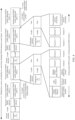
- the following describes an implementation process in which the first MLE and the second MLE each include one MLE in a scenario shown in FIG. 6 .
- the first MLE is denoted as an MLE 1 or a 1 st MLE
- the second MLE is denoted as an MLE 2 or a 2 nd MLE.
- a 1 st MLE carries a per-STA profile 1 to a per-STA profile x
- a 2 nd MLE carries a per-STA profile x+1 to a per-STA profile y.
- For the per-STA profile x and the per-STA profile x+1 if values of link ID fields in STA control fields are equal (both equal to a), it indicates that the per-STA profile x and the per-STA profile x+1 carry station information of a same link.
- a value of a link ID field in a STA control field of a per-STA profile subelement 1 of the MLE 2 is set to be the same as a value of a link ID field in a STA control field of a last per-STA profile subelement of a previous MLE (namely, the MLE 1), to indicate that content carried in the per-STA profile subelement 1 of the MLE 2 is a continuation of content of the last per-STA profile subelement of the previous MLE.
- values of link ID fields in STA control fields of two per-STA profile subelements are the same, STA profiles carried in the two per-STA profile subelements carry station information of a same link.
- a STA profile field of the per-STA profile subelement does not carry content of a STA profile field of the previous per-STA profile subelement.
- an element type of the first information element is the same as an element type of the second information element.
- the element type of the first information element is the same as the element type of the second information element, that is, the station information of the same link is carried in a plurality of information elements of a same element type.
- the first information element and the second information element each include a type field, and a value of the type field of the first information element is the same as a value of the type field of the second information element.
- the type field is a subelement identifier (subelement ID shown in FIG. 3 ) field.
- an element type of the first information element is different from an element type of the second information element.
- the element type of the first information element is different from the element type of the second information element, that is, the station information of the same link is carried in a plurality of information elements of different element types.
- the first information element and the second information element each include a type field, and a value of the type field of the first information element is different from a value of the type field of the second information element.
- the type field of the information element indicates a type of the information element, and different values of the type field may indicate that the element type of the first information element is different from the element type of the second information element.
- a first value of the type field indicates that a corresponding information element (the first information element) carries a start portion of the station information of the link
- a second value (the second value is different from the first value) of the type field indicates that a corresponding information element (the second information element) carries a subsequent portion (a non-start portion) of the station information of the link.
- the second value of the type field indicates that the corresponding information element (the second information element) and a previous information element (which may be the first information element or the second information element) carry the station information of the same link.
- the information element does not carry a STA control field or a STA info field.
- the first value (or the second value, or a third value, or a fourth value) may be indicated by using a value of at least one bit.
- a value of at least one bit when a quantity of bits of the at least one bit is 1, the value may include “0” or "1".
- a quantity of bits of the at least one bit when a quantity of bits of the at least one bit is 2, the value may include “10", “11", “00”, or "01”.
- a quantity of bits of the at least one bit is 3 the value may include "110”, "111", “100”, “101", “011", “000”, “001”, or "010".
- a quantity of bits of the at least one bit is another quantity, a similar manner may be used for implementation. Details are not described herein again.
- the type field is a subelement identifier (subelement ID shown in FIG. 3 ) field.
- a new subelement is defined as the second information element, to carry information that cannot be carried in the per-STA profile subelement (namely, the first information element).
- the following provides descriptions by using implementation examples shown in Table 1 and Table 2.
- subelements that may be currently included in a link info field part of the current MLE include a per-STA profile subelement indicated by a subelement ID whose value is 0 and a vendor specific (Vendor Specific) subelement indicated by a subelement ID whose value is 221.
- a new subelement is defined, and a value of a subelement ID of the subelement may be 1 or another value.
- a value of a subelement ID whose value is a reserved value is any one of 1 to 220 and 222 to 255.
- the newly defined subelement may be referred to as a per-STA profile extension subelement (Per-STA Profile Extension subelement), or may be referred to as another element name different from the name of the per-STA profile. This is not specifically limited herein.
- the new subelement is used to carry link information that cannot be carried in the per-STA profile.
- station information of a link may be fragmented into several parts.
- a first part is carried in a per-STA profile subelement, and other parts are carried in one or more per-STA profile extension subelements.
- a difference lies in that values of subelement IDs are different.
- a frame structure of the per-STA profile extension subelement may be similar to an implementation process of the per-STA profile in FIG. 3 .
- a data field may not include a STA control field and a STAinfo field, and includes only a STA profile field.
- the STA profile field includes fields, or the STA profile field does not include fields.
- a frame structure of the per-STA profile extension subelement may be similar to an implementation process of the per-STA profile in FIG. 3 .
- a data field may also include a STA control field and a STA info field, and a STA profile field does not include fields.
- a frame structure of the per-STA profile extension subelement may be similar to an implementation process of the per-STA profile in FIG. 3 .
- a data field may also include a STA control field and a STA info field, and a STA profile field further includes fields.
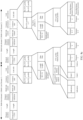
- the following uses an example to describe a fragmented transmission manner of station information of a link.
- information about another station in an MLD in which a station is located is carried in a first MLE (which is denoted as an MLE 1 or a 1 st MLE) and a second MLE (which is denoted as an MLE 2 or a 2 nd MLE).
- the 1 st MLE carries a per-STA profile 1 to a per-STA profile x
- the 2 nd MLE carries per-STA profile extension and another per-STA profile. Because the 2 nd MLE carries the per-STA profile extension, it indicates that the per-STA profile extension and a previous per-STA profile (namely, the per-STA profile x) carry the station information of the same link.
- the first information element includes first indication information, and the first indication information indicates whether the station information is fragmented.
- the first information element may include the first indication information indicating whether the station information is fragmented, to indicate that station information, carried in the first information element, of a link is fragmented into at least two fragments, and at least one of the at least two fragments is carried in another information element (for example, the second information element). Therefore, the first indication information indicates that the first information element and the second information element correspond to the station information of the same link.
- the second information element also includes the first indication information.
- the first indication information may be indicated by using one bit. For example, when a value of the first indication information is a first value, it indicates that the station information is fragmented and a remaining portion of the station information is carried in a next per-STA profile information element. In addition, when a value of the first indication information is a second value, it indicates that the station information is not fragmented. Especially, the value may be changed, or an indication process of the first indication information is implemented in another manner. This is not limited herein.
- a function of the first indication information may alternatively be expressed in another form.
- the first indication information indicates whether the station information is fragmented.
- the first indication information indicates whether different fragments of the station information are carried in different information elements.
- the first indication information may be indicated by using different values of the bit, or may be indicated in another manner. This is not limited herein.
- the first indication information may be indicated by using two bits. For example, when a value of the first indication information is a first value, it indicates that the station information is fragmented, and station information of the first information element is a first fragment. For another example, when a value of the first indication information is a second value, it indicates that the station information is fragmented, and station information of the first information element is a last fragment. For another example, when a value of the first indication information is a third value, it indicates that the station information is fragmented, and station information of the first information element is an intermediate fragment (neither a first fragment nor a last fragment).
- a value of the first indication information is a fourth value, it indicates that the first indication information indicates that the station information is not fragmented.
- the value may be changed, or an indication process of the first indication information is implemented in another manner. This is not limited herein.
- the first indication information is carried in a station control (for example, STA control in STA info shown in FIG. 3 ) field of the first information element.
- the first indication information indicating whether the station information is fragmented may be carried in the station control field of the first information element, to provide a specific implementation of implementing the first indication information.
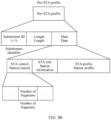
- the STA control field of the per-STA profile subelement may carry the first indication information.
- the first indication information indicates that the per-STA profile subelement indicates whether the station information is fragmented.
- the first indication information is a more fragment (More Fragment) field in FIG. 8a , or may be another field name. This is not limited herein.
- the more fragment field may be implemented by using one bit or two bits. For specific implementation, refer to the foregoing descriptions.
- the first information element includes second indication information
- the second indication information indicates a quantity of information elements that carry the station information.
- the first information element may include the second indication information indicating the quantity of information elements that carry the station information, to indicate that station information, carried in the first information element, of a link is carried in a plurality of information elements (at least including the second information element), and indicate a quantity of the plurality of information elements. Therefore, the second indication information indicates that the first information element and the second information element correspond to the station information of the same link.
- the second information element includes the second indication information.
- the second indication information may be indicated by using one or more bits, to indicate the quantity of information elements that carry the station information.
- the second indication information when the second indication information is indicated by using k (k is a natural number) bits, it may indicate that a maximum quantity of information elements that carry the station information is the k th power of 2.
- k is a natural number
- a value of k 1, it may indicate that a maximum quantity of information elements that carry the station information is 2.
- a value of k when a value of k is 4, it may indicate that a maximum quantity of information elements that carry the station information is 16.
- the quantity of information elements that carry the station information may alternatively be indicated in a similar manner.
- the plurality of information elements may be a plurality of continuous information elements located in the radio frame.
- the second indication information may alternatively be expressed in another form.
- the second indication information indicates a quantity of fragments of the station information.
- the second indication information indicates the quantity of information elements that carry the station information, and the information elements that carry the station information include the first information element.
- the second indication information indicates the quantity of information elements that carry the station information, and the information elements that carry the station information do not include the first information element.
- the second indication information indicates a sequence number of the information element that carries the station information, and the sequence number is a forward sequence number.
- the second indication information indicates a sequence number of the information element that carries the station information, and the sequence number is a backward sequence number.
- the first indication information may be indicated by using different values of the k bits, or may be indicated in another manner. This is not limited herein.
- the STA control field of the per-STA profile subelement may carry the second indication information.
- the second indication information indicates that the per-STA profile subelement indicates a quantity of fragments into which the station information is fragmented, or indicates a quantity of fragments into which remaining portion, other than the per-STA profile fragment, of the station information is fragmented.
- the second indication information is a number of fragments (Number of Fragments) field in FIG. 8b , or may be another field. This is not limited herein.
- the number of fragments field may be implemented by using one or more bits. For specific implementation, refer to the foregoing descriptions.
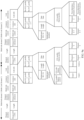
- the following uses an implementation example in FIG. 8c to describe a fragmented transmission manner of station information of a link.
- information about another station in an MLD in which a station is located is carried in a first MLE (which is denoted as an MLE 1 or a 1 st MLE) and a second MLE (which is denoted as an MLE 2 or a 2 nd MLE).
- the 1 st MLE carries a per-STA profile 1 to a per-STA profile x
- the 2 nd MLE carries a per-STA profile x+1 to a per-STA profile y. It can be learned from indication information of a STA control field of the per-STA profile x that the per-STA profile x and the per-STA profile x+1 carry station information of a same link.
- the second information element includes third indication information
- the third indication information indicates that the second information element is a last information element in the plurality of information elements that carry the station information.
- the second information element may include the third indication information indicating that the second information element is the last information element in the plurality of information elements that carry the station information, to indicate that station information, carried in the second information element, of a link is carried in a plurality of information elements (at least including the second information element), and that the second information element is the last information element in the plurality of information elements. Therefore, the third indication information indicates that the first information element and the second information element correspond to the station information of the same link. In other words, if an information element does not carry the third indication information, it indicates that the information element and a next information element carry station information of a same link.
- the first information element in the radio frame may indicate that station information, carried in the first information element, of a link is not fragmented.
- the third indication information indicates that there is no other information element that carries the station information after the second information element.
- the station information is fragmented into a plurality of fragments, and the third indication information indicates that a fragment, carried in the second information element, of the station information is a last fragment.
- the third indication information includes a non-inheritance element (non-inheritance element).
- a non-inheritance element is carried in a last per-STA profile subelement corresponding to the station information, and a previous (not the last) per-STA profile subelement does not carry a non-inheritance element. If the station information is not fragmented, a non-inheritance element needs to be carried in all corresponding per-STA profile subelements, and a value of a length field of the non-inheritance element is set to 1, to indicate that only an element ID extension field exists after the length field, and that no other field exists.
- a first MLE which is denoted as an MLE 1 or a 1 st MLE
- a second MLE which is denoted as an MLE 2 or a 2 nd MLE
- the 1 st MLE carries a per-STA profile 1 to a per-STA profile x
- the 2 nd MLE carries a per-STA profile x+1 to a per-STA profile y.
- the per-STA profile x does not carry a non-inheritance element, it can be learned that the per-STA profile x and the per-STA profile x+1 carry station information of a same link. In addition, because the per-STA profile x+1 carries a non-inheritance element, it can be learned that the per-STA profile x+1 is the last per-STA profile subelement that carries the station information.
- the non-inheritance element is optional in the per-STA profile subelement.
- the non-inheritance element includes a series of ID numbers and ID extension numbers of elements that cannot be inherited by a reported STA from a reporting STA.
- the reporting STA is a STA that sends the MLE, and the reported STA is a STA on another link.
- the third indication information it is required that the non-inheritance element needs to be carried in the last per-STA profile subelement that carries the station information. Therefore, as shown in FIG.
- the non-inheritance element when the non-inheritance element does not need to be carried (that is, the station does not include a non-inheritance information element), the non-inheritance element also needs to be carried in the per-STA profile subelement, and a value of a length field of the non-inheritance element is set to 1, to indicate that only the element ID extension field exists after the length field, and no other field exists.
- the first information element and the second information element each include a complete profile (Complete Profile) field, and a value of the complete profile field of the first information element is the same as a value of the complete profile field of the second information element.
- an information element may indicate, by using a complete profile field included in the information element, a related profile of station information carried in the information element. That the value of the complete profile field of the first information element is the same as the value of the complete profile field of the second information element may indicate that a profile of station information carried in the first information element is the same as a profile of station information carried in the second information element. Therefore, a same value of the complete profile fields indicates that both the first information element and the second information element in the radio frame carry complete station information.
- the second information element does not include the complete profile field.
- the second information element includes the complete profile field, and a value of the complete profile field of the second information element is a reserved (reserved) value.
- the value of the complete profile field indicates other information (in addition to indicating whether the information element carries complete station information of a corresponding link).
- the first information element includes a station information (STA Info) field, and the station information field indicates related station information of the first information element and related station information of the second information element.
- STA Info station information
- an information element may indicate, by using a station information field included in the information element, related station information carried in the information element.
- the station information field of the first information element not only indicates the related station information carried in the first information element, but also indicates the related station information carried in the second information element. Therefore, the station information field of the first information element indicates that the first information element and the second information element correspond to the station information of the same link.
- the second information element does not include a station information field; or the second information element includes the station information field, and a value of the station information field is a reserved (reserved) value.
- the second information element may not carry the station information field, or the station information field of the second information element is set to a reserved value, to carry other information/data different from information in the station information field by using the reserved value. Therefore, the station information field of the first information element is reused to indicate the related station information of the plurality of information elements, to reduce overheads and further improve communication efficiency.
- a current station information field includes at least one piece of the following information: a MAC address indicating an address of a station on a link, a beacon interval indicating a period for receiving a beacon frame by the station, DTIM info indicating a period for receiving a DTIM beacon frame by the station and time for receiving a next DTIM beacon frame, and an NSTR indication bitmap indicating a capability of the station on the link to perform simultaneous transmission and reception together with a station on another link.
- a value of the station information field is a reserved value
- the value of the station information field indicates other information (other than the at least one piece of information).
- the second information element includes a station information field.
- the station information field includes at least one of the following: a medium access control address present (medium access control address present, MAC Address Present) field, a beacon interval present (Beacon Interval Present) field, a delivery traffic indication message information present (delivery traffic indication message information present, DTIM Info Present) field, and an NSTR link pair present field.
- the station information field may specifically include at least one of the foregoing fields, to indicate related station information.
- the first MLE and the second MLE are adjacent MLEs.
- the first MLE and the second MLE may be MLEs at adjacent locations in the radio frame.
- a manner in which the station information of the same link is carried in a plurality of adj acent MLEs in the radio frame may help a receive end of the radio frame obtain the station information of the same link.
- the radio frame there is no other MLE between the first MLE and the second MLE.
- the first MLE is located before the second MLE, or in the radio frame, the second MLE is located after the first MLE.
- the first MLE includes a common information field
- the common information field indicates multi-link common information of the first MLE and multi-link common information of the second MLE.
- an information element may indicate, by using a common information field included in the information element, multi-link common information carried in the information element.
- the common information field of the first information element not only indicates the multi-link common information carried in the first information element, but also indicates the multi-link common information carried in the second information element. Therefore, the common information field of the first information element indicates multi-link common information corresponding to the first information element and the second information element.
- the second MLE does not include a common information field; or the second MLE includes the common information field, and a value of the common information field of the second MLE is a reserved value.
- the second information element may not carry the common information field, or the common information field of the second information element is set to a reserved value, to carry other information/data different from information in the common information field by using the reserved value. Therefore, the common information field of the first information element is reused to indicate the multi-link common information of the plurality of information elements, to reduce overheads and further improve communication efficiency.
- the second information element includes a common information field.
- the first MLE includes a multi-link control field
- the multi-link control field indicates multi-link control information of the first MLE and multi-link control information of the second MLE.
- an information element may indicate, by using a multi-link control field included in the information element, multi-link control information carried in the information element.
- the multi-link control field of the first information element not only indicates the multi-link control information carried in the first information element, but also indicates the multi-link control information carried in the second information element. Therefore, the multi-link control field of the first information element indicates multi-link control information corresponding to the first information element and the second information element.
- the second MLE does not include a multi-link control field; or the second MLE includes the multi-link control field, and a value of a presence bitmap (Presence bitmap) field in the multi-link control field of the second MLE is all 0s.
- the second information element may not carry the multi-link control information field, or the multi-link control field of the second information element is set to a reserved value, to carry other information/data different from information in the multi-link control field by using the reserved value. Therefore, the multi-link control field of the first information element is reused to indicate the multi-link control information of the plurality of information elements, to reduce overheads and further improve communication efficiency.
- the second information element includes a common information field.
- the radio frame sending apparatus sends the radio frame.
- the radio frame sending apparatus sends the radio frame in step S102.
- the radio frame receiving apparatus receives the radio frame in step S102.
- the radio frame sending apparatus and the radio frame receiving apparatus may perform radio frame transmission based on the communication system shown in FIG. 1 or FIG. 2 , that is, the radio frame is transmitted by using one or more of a plurality of links between the radio frame sending apparatus and the radio frame receiving apparatus.
- the radio frame sending apparatus may perform sending preprocessing on the radio frame, and send, in step S 102, a processing result obtained through sending preprocessing.
- the sending preprocessing may include encryption, scrambling, and another manner.
- the radio frame sending apparatus may receive the processing result obtained by performing sending preprocessing on the radio frame, and perform, in step S102, receiving preprocessing on the processing result, to obtain the radio frame.
- the receiving preprocessing may include decryption, descrambling, and another manner.
- the radio frame receiving apparatus determines the station information based on the radio frame.
- the radio frame receiving apparatus determines the station information based on the radio frame received in step S102.
- the radio frame receiving apparatus determines the station information of the same link by using the first information element included in the first MLE of the radio frame and the second information element included in the second MLE, to obtain the station information of the same link in the plurality of MLEs.
- the radio frame receiving apparatus may determine, based on target information included in the radio frame, the station information of the same link corresponding to the first information element included in the first MLE and the second information element included in the second MLE.
- the target information may include at least one of the following: the link ID, the subelement ID, the first indication information, the second indication information, the third indication information, and the like.
- the radio frame receiving apparatus receives the radio frame in step S102. If the radio frame includes at least two MLEs, and values of link ID fields in per-STA profile subelements included in each MLE of the at least two MLEs are the same, the radio frame receiving apparatus may determine, in step S103, that STA profiles carried in the per-STA profile subelements carry the station information of the same link. Further, the station may concatenate per-STA profile subelements, in a sequence in which the per-STA profile subelements appear in the radio frame, corresponding to link IDs of a same value, to obtain the station information of the same link.
- the radio frame receiving apparatus receives the radio frame in step S102. If the radio frame includes at least two MLEs, and each MLE other than a 1 st MLE in the at least two MLEs includes a per-STA profile extension subelement, the radio frame receiving apparatus may determine, in step S103, that STA profiles carried in per-STA profile extension subelements and a STA profile carried in a previous adjacent per-STA profile carry the station information of the same link. Further, the station may concatenate the per-STA profile subelements in a sequence in which the per-STA profile subelements appear in the radio frame, to obtain the station information of the same link.
- the radio frame receiving apparatus receives the radio frame in step S102. If the radio frame includes at least two MLEs, the radio frame receiving apparatus determines, based on the first indication information of per-STA profile subelements of the at least two MLEs, whether station information, carried in the per-STA profile subelement, of a link is fragmented.
- the radio frame receiving apparatus concatenates, in step S103, fields of STA profiles carried in a next per-STA profile subelement (or next per-STA profile subelements) in a sequence in which per-STA profile subelements appear in the radio frame, to obtain the station information of the same link.
- the radio frame receiving apparatus receives the radio frame in step S102. If the radio frame includes at least two MLEs, the radio frame receiving apparatus determines, based on the second indication information of per-STA profile subelements of the at least two MLEs, a quantity of per-STA profiles that carry station information, carried in the per-STA profile subelement, of a link.
- the radio frame receiving apparatus concatenates, based on the quantity of per-STA profiles indicated by the second indication information, fields of STA profiles carried in a next per-STA profile subelement (or next per-STA profile subelements) in a sequence in which the per-STA profile subelements appear in the radio frame, to obtain the station information of the same link.
- the radio frame receiving apparatus receives the radio frame in step S102. If the radio frame includes at least two MLEs, the radio frame receiving apparatus determines, based on the third indication information of per-STA profile subelements of the at least two MLEs, that the per-STA profile subelement is a last per-STA profile in a plurality of per-STA profiles that carry station information of a link.
- the radio frame receiving apparatus concatenates, in step S103 based on the third indication information, fields of STA profiles carried in a previous per-STA profile subelement (or a plurality of previous per-STA profile subelements) before the per-STA profile subelement in a sequence in which per-STA profile subelements appear in the radio frame, to obtain the station information of the same link.
- a length of the length field of the MLE shown in FIG. 3 is 8 bits, to indicate a length of 0 to 255 bytes.
- a length of information that needs to be carried by the MLE may exceed 255 bytes. Consequently, only one MLE is insufficient to carry the information about the multi-link device.
- a length of the length field of the per-STA profile shown in FIG. 3 is 8 bits, so that the data part can carry a maximum of 255 octets.
- station information of each link may be longer than 255 octets. Consequently, only one per-STA profile is insufficient to carry the station information of each link.
- the radio frame sent or received by the multi-link device includes the first MLE and the second MLE, and the first information element included in the first MLE and the second information element included in the second MLE correspond to the station information of the same link. Therefore, station information of a multi-link station device may be carried in a manner in which a plurality of MLEs of a radio frame carry station information of a same link. This can ensure that the data part of the per-STA profile does not exceed 255 bytes, ensure that a length of content carried in the MLE does not exceed 255 bytes, avoid a radio frame transmission failure, and improve communication efficiency.
- FIG. 10 is a schematic diagram of a communication apparatus 1000 according to an embodiment of this application.
- the communication apparatus 1000 includes a processing unit 1001 and a transceiver unit 1002.
- the communication apparatus 1000 may specifically be a radio frame sending apparatus, configured to implement the radio frame sending method in any one of the foregoing embodiments.
- the processing unit 1001 and the transceiver unit 1002 may be configured to perform the following processes.
- the processing unit 1001 is configured to generate a radio frame.
- the radio frame includes a first multi-link element MLE and a second MLE, the first MLE includes a first information element, the second MLE includes a second information element, and the first information element and the second information element correspond to station information of a same link.
- the transceiver unit 1002 is configured to send the radio frame.
- a length of the length field of the MLE shown in FIG. 3 is 8 bits, to indicate a length of 0 to 255 bytes.
- a length of information that needs to be carried by the MLE may exceed 255 bytes. Consequently, only one MLE is insufficient to carry the information about the multi-link device.
- a length of the length field of the per-STA profile shown in FIG. 3 is 8 bits, so that the data part can carry a maximum of 255 octets.
- station information of each link may be longer than 255 octets. Consequently, only one per-STA profile is insufficient to carry the station information of each link.
- the radio frame sent by the transceiver unit 1002 includes the first MLE and the second MLE, and the first information element included in the first MLE and the second information element included in the second MLE correspond to the station information of the same link. Therefore, station information of a multi-link station device may be carried in a manner in which a plurality of MLEs of a radio frame carry station information of a same link. This can ensure that the data part of the per-STA profile does not exceed 255 bytes, ensure that a length of content carried in the MLE does not exceed 255 bytes, avoid a radio frame transmission failure, and improve communication efficiency.
- the communication apparatus 1000 may specifically be a radio frame sending apparatus, configured to implement the radio frame sending method in any one of the foregoing embodiments.
- the processing unit 1001 and the transceiver unit 1002 may be configured to perform the following processes.
- the transceiver unit 1002 is configured to receive a radio frame.
- the radio frame includes a first multi-link element MLE and a second MLE, the first MLE includes a first information element, the second MLE includes a second information element, and the first information element and the second information element correspond to station information of a same link.
- the processing unit 1001 is configured to determine the station information based on the radio frame.
- a length of the length field of the MLE shown in FIG. 3 is 8 bits, to indicate a length of 0 to 255 bytes.
- a length of information that needs to be carried by the MLE may exceed 255 bytes. Consequently, only one MLE is insufficient to carry the information about the multi-link device.
- a length of the length field of the per-STA profile shown in FIG. 3 is 8 bits, so that the data part can carry a maximum of 255 octets.
- station information of each link may be longer than 255 octets. Consequently, only one per-STA profile is insufficient to carry the station information of each link.
- the radio frame received by the transceiver unit 1002 includes the first MLE and the second MLE, and the first information element included in the first MLE and the second information element included in the second MLE correspond to the station information of the same link. Therefore, station information of a multi-link station device may be carried in a manner in which a plurality of MLEs of a radio frame carry station information of a same link. This can ensure that the data part of the per-STA profile does not exceed 255 bytes, ensure that a length of content carried in the MLE does not exceed 255 bytes, avoid a radio frame transmission failure, and improve communication efficiency.
- the MLE (the first MLE or the second MLE) or the information element (the first information element or the second information element) included in the radio frame transmitted (received or sent) by the communication apparatus shown in FIG. 10 may further be optimized, which is specifically as follows:
- the first information element and the second information element each include a link identifier (Link ID) field, and a value of the link identifier field of the first information element is the same as a value of the link identifier field of the second information element.
- Link ID link identifier
- the first information element includes first indication information, and the first indication information indicates whether the station information is fragmented.
- the second information element includes the first indication information.
- the first indication information indicates whether the station information is fragmented.
- the first indication information indicates whether different fragments of the station information are carried in different information elements.
- the first indication information indicates that the station information is fragmented, and the station information of the first information element is a first fragment.
- the first indication information indicates that the station information is fragmented, and the station information of the first information element is a last fragment.
- the first indication information indicates that the station information is fragmented, and the station information of the first information element is an intermediate fragment (neither the first fragment nor the last fragment).
- the first indication information indicates that the station information is not fragmented.
- the first indication information is carried in a station control (STA control) information field of the first information element.
- STA control station control
- the first information element includes second indication information
- the second indication information indicates a quantity of information elements that carry the station information
- the second information element includes the second indication information.
- the second indication information indicates a quantity of fragments of the station information.
- the second indication information indicates a quantity of information elements that carry the station information, and the information elements that carry the station information include the first information element.
- the second indication information indicates a quantity of information elements that carry the station information, and the information elements that carry the station information do not include the first information element.
- the second indication information indicates a sequence number of the information element that carries the station information, and the sequence number is a forward sequence number.
- the second indication information indicates a sequence number of the information element that carries the station information, and the sequence number is a backward sequence number.
- the second indication information is carried in a station control field of the first information element.
- the second information element includes third indication information, and the third indication information indicates that the second information element is a last information element in the plurality of information elements that carry the station information.
- the third indication information indicates that there is no other information element that carries the station information after the second information element.
- the station information is fragmented into a plurality of fragments, and the third indication information indicates that a fragment, carried in the second information element, of the station information is a last fragment.
- the third indication information includes a non-inheritance field (non-inheritance element).
- the first information element and the second information element each include a complete profile (Complete Profile) field, and a value of the complete profile field of the first information element is the same as a value of the complete profile field of the second information element.
- Complete Profile Complete Profile
- the second information element does not include the complete profile field.
- the first information element includes a station information (STA Info) field
- the station information field indicates related station information of the first information element and related station information of the second information element.
- the second information element does not include a station information field; or the second information element includes the station information field, and a value of the station information field is a reserved (reserved) value.
- the second information element includes a station information field.
- the station information field includes at least one of the following: a medium access control address present (medium access control address present, MAC Address Present) field, a beacon interval present (Beacon Interval Present) field, a delivery traffic indication message information present (delivery traffic indication message information present, DTIM Info Present) field, and an NSTR link pair present field.
- an element type of the first information element is the same as an element type of the second information element.
- the first information element and the second information element each include a type field, and a value of the type field of the first information element is the same as a value of the type field of the second information element.
- the type field is a subelement identifier (Subelement ID) field.
- an element type of the first information element is different from an element type of the second information element.
- the first information element and the second information element each include a type field, and a value of the type field of the first information element is different from a value of the type field of the second information element.
- the type field is a subelement identifier (Subelement ID) field.
- the first MLE and the second MLE are adj acent MLEs.
- the radio frame there is no other MLE between the first MLE and the second MLE.
- the first MLE is located before the second MLE, or in the radio frame, the second MLE is located after the first MLE.
- the first MLE includes a common information field
- the common information field indicates multi-link common information of the first MLE and multi-link common information of the second MLE.
- the second MLE does not include a common information field; or the second MLE includes the common information field, and a value of the common information field of the second MLE is a reserved value.
- the second information element includes a common information field.
- the first MLE includes a multi-link control field
- the multi-link control field indicates multi-link control information of the first MLE and multi-link control information of the second MLE.
- the second MLE does not include a multi-link control field; or the second MLE includes the multi-link control field, and a value of a presence bitmap (Presence bitmap) field in the multi-link control field of the second MLE is all 0s.
- a presence bitmap Presence bitmap
- the second information element includes a common information field.
- the radio frame is an association request frame, a reassociation request frame, an association response frame, a reassociation response frame, or a probe response frame.
- the communication apparatus 1000 may further be configured to perform the foregoing other embodiments in FIG. 1 to FIG. 9 and achieve corresponding advantageous effects.
- the communication apparatus 1000 may further be configured to perform the foregoing other embodiments in FIG. 1 to FIG. 9 and achieve corresponding advantageous effects.
- the communication apparatus 1000 may further be configured to perform the foregoing other embodiments in FIG. 1 to FIG. 9 and achieve corresponding advantageous effects.
- the communication apparatus 1000 may further be configured to perform the foregoing other embodiments in FIG. 1 to FIG. 9 and achieve corresponding advantageous effects.
- the communication apparatus 1000 may further be configured to perform the foregoing other embodiments in FIG. 1 to FIG. 9 and achieve corresponding advantageous effects.
- FIG. 11 is a schematic diagram of a structure of a communication apparatus 1100 according to an embodiment of this application.
- the communication apparatus 1100 includes a processor 1101 and a transceiver 1102.
- the communication apparatus 1100 may be a radio frame sending apparatus, a radio frame receiving apparatus, or a chip in a radio frame sending apparatus or a radio frame receiving apparatus.
- FIG. 11 shows only main components of the communication apparatus 1100.
- the communication apparatus may further include a memory 1103 and an input/output apparatus (not shown in the figure).
- the processor 1101 is mainly configured to: process a communication protocol and communication data, control the entire communication apparatus, execute a software program, and process data of the software program.
- the memory 1103 is mainly configured to store the software program and the data.
- the transceiver 1102 may include a radio frequency circuit and an antenna.
- the radio frequency circuit is mainly configured to perform conversion between a baseband signal and a radio frequency signal and process a radio frequency signal.
- the antenna is mainly configured to transmit and receive a radio frequency signal in a form of an electromagnetic wave.
- the input/output apparatus such as a touchscreen, a display, or a keyboard, is mainly configured to: receive data input by a user and output data to the user.
- the processor 1101, the transceiver 1102, and the memory 1103 may be connected through a communication bus.
- the processor 1101 may read the software program in the memory 1103, interpret and execute instructions of the software program, and process data of the software program.
- the processor 1101 performs baseband processing on the to-be-sent data, and then outputs a baseband signal to a radio frequency circuit.
- the radio frequency circuit performs radio frequency processing on the baseband signal, and then sends, by using the antenna, a radio frequency signal in an electromagnetic wave form.
- the radio frequency circuit receives a radio frequency signal through the antenna, converts the radio frequency signal into a baseband signal, and outputs the baseband signal to the processor 1101.
- the processor 1101 converts the baseband signal into data, and processes the data.
- the processor 1101 may include a communication interface for implementing receiving and sending functions.
- the communication interface may be a transceiver circuit, an interface, or an interface circuit.
- the transceiver circuit, the interface, or the interface circuit configured to implement the receiving and sending functions may be separated, or may be integrated together.
- the transceiver circuit, the interface, or the interface circuit may be configured to read and write code/data.
- the transceiver circuit, the interface, or the interface circuit may be configured to transmit or transfer a signal.
- the processor 1101 may store instructions.
- the instructions may be a computer program.
- the computer program is run on the processor 1101, so that the communication apparatus 1100 can perform the method described in any one of the foregoing embodiments.
- the computer program may be fixed in the processor 1101, and in this case, the processor 1101 may be implemented by hardware.
- the communication apparatus 1100 may include a circuit, and the circuit may implement a sending, receiving, or communication function in any one of the foregoing embodiments.
- the processor and the communication interface described in this application may be implemented on an integrated circuit (integrated circuit, IC), an analog IC, a radio frequency integrated circuit (radio frequency integrated circuit, RFIC), a mixed signal IC, an application-specific integrated circuit (application-specific integrated circuit, ASIC), a printed circuit board (printed circuit board, PCB), an electronic device, or the like.
- the processor and the communication interface may be manufactured using various IC technologies, for example, a complementary metal oxide semiconductor (complementary metal oxide semiconductor, CMOS), an N-type metal oxide semiconductor (N-type Metal-oxide-semiconductor, NMOS), a P-channel metal oxide semiconductor (positive channel metal oxide semiconductor, PMOS), a bipolar junction transistor (bipolar junction transistor, BJT), a bipolar CMOS (BiCMOS), silicon germanium (SiGe), and gallium arsenide (GaAs).
- CMOS complementary metal oxide semiconductor
- N-type Metal-oxide-semiconductor NMOS
- P-channel metal oxide semiconductor positive channel metal oxide semiconductor
- PMOS bipolar junction transistor
- BJT bipolar junction transistor
- BiCMOS bipolar CMOS
- SiGe silicon germanium
- GaAs gallium arsenide
- the radio frequency circuit and the antenna may be disposed independent of the processor that performs baseband processing.
- the radio frequency circuit and the antenna may be disposed remotely and independent of the communication apparatus.
- the communication apparatus may be an independent device or may be a part of a large device.
- the communication apparatus may be:
- the processor 1101 may be configured to perform, for example but not limited to, baseband related processing; and the transceiver 1102 may be configured to perform, for example but not limited to, radio frequency receiving and sending.
- the foregoing components may be separately disposed on chips independent of each other, or at least some or all of the components may be disposed on a same chip.
- the processor may be divided into an analog baseband processor and a digital baseband processor.
- the analog baseband processor and the transceiver may be integrated on a same chip, and the digital baseband processor may be disposed on an independent chip. With continuous development of integrated circuit technologies, more and more components may be integrated on a same chip.
- the digital baseband processor may be integrated on a same chip with a plurality of application processors (for example, but not limited to a geometric processor and a multimedia processor).
- the chip may be referred to as a system on chip (system on chip). Whether components are independently disposed on different chips or are integrated and disposed on one or more chips usually depends on specific requirements of a product design. Specific implementation forms of the foregoing components are not limited in embodiments of the present invention.
- An embodiment of this application further provides a computer-readable storage medium.
- the computer-readable storage medium stores computer program code.
- an electronic device performs the method in any one of the foregoing embodiments.
- An embodiment of this application further provides a computer program product.
- the computer program product runs on a computer, the computer is enabled to perform the method in any one of the foregoing embodiments.
- An embodiment of this application further provides a communication apparatus.
- the apparatus may exist in a product form of a chip.
- a structure of the apparatus includes a processor and an interface circuit.
- the processor is configured to communicate with another apparatus through the interface circuit, to enable the apparatus to perform the method in any one of the foregoing embodiments.
- An embodiment of this application further provides a WLAN communication system, including a radio frame sending apparatus and a radio frame receiving apparatus.
- the radio frame sending apparatus and the radio frame receiving apparatus may perform the method in any one of the foregoing embodiments.
- the software instructions may include a corresponding software module.
- the software module may be stored in a random access memory (Random Access Memory, RAM), a flash memory, an erasable programmable read-only memory (Erasable Programmable ROM, EPROM), an electrically erasable programmable read-only memory (Electrically EPROM, EEPROM), a register, a hard disk, a removable hard disk, a compact disc read-only memory (CD-ROM), or any other form of storage medium well-known in the art.
- RAM Random Access Memory
- EPROM erasable programmable read-only memory
- EPROM electrically erasable programmable read-only memory
- CD-ROM compact disc read-only memory
- a storage medium is coupled to the processor, to enable the processor to read information from the storage medium and write information into the storage medium.
- the storage medium may be a component of the processor.
- the processor and the storage medium may be disposed in an ASIC.
- the ASIC may be located in a core network interface device.
- the processor and the storage medium may exist in the core network interface device as discrete components.
- the computer-readable medium includes a computer-readable storage medium and a communication medium.
- the communication medium includes any medium that facilitates transmission of a computer program from one place to another.
- the storage medium may be any available medium accessible to a general-purpose computer or a special-purpose computer.
Landscapes
- Engineering & Computer Science (AREA)
- Signal Processing (AREA)
- Computer Networks & Wireless Communication (AREA)
- Computer Security & Cryptography (AREA)
- Quality & Reliability (AREA)
- Mobile Radio Communication Systems (AREA)
- Communication Control (AREA)
Applications Claiming Priority (2)
| Application Number | Priority Date | Filing Date | Title |
|---|---|---|---|
| CN202110826539.2A CN115694716B (zh) | 2021-07-21 | 2021-07-21 | 无线帧发送方法及装置、无线帧接收方法及装置 |
| PCT/CN2022/102304 WO2023000941A1 (zh) | 2021-07-21 | 2022-06-29 | 无线帧发送方法及装置、无线帧接收方法及装置 |
Publications (2)
| Publication Number | Publication Date |
|---|---|
| EP4366200A1 true EP4366200A1 (de) | 2024-05-08 |
| EP4366200A4 EP4366200A4 (de) | 2024-10-16 |
Family
ID=84978954
Family Applications (1)
| Application Number | Title | Priority Date | Filing Date |
|---|---|---|---|
| EP22845106.8A Pending EP4366200A4 (de) | 2021-07-21 | 2022-06-29 | Funkrahmensendeverfahren und -vorrichtung sowie funkrahmenempfangsverfahren und -vorrichtung |
Country Status (10)
| Country | Link |
|---|---|
| US (1) | US20240155425A1 (de) |
| EP (1) | EP4366200A4 (de) |
| JP (1) | JP2024528695A (de) |
| KR (1) | KR20240036623A (de) |
| CN (1) | CN115694716B (de) |
| AU (1) | AU2022313924B2 (de) |
| BR (1) | BR112024001166A2 (de) |
| CA (1) | CA3226621A1 (de) |
| MX (1) | MX2024000987A (de) |
| WO (1) | WO2023000941A1 (de) |
Families Citing this family (3)
| Publication number | Priority date | Publication date | Assignee | Title |
|---|---|---|---|---|
| US20230030195A1 (en) * | 2021-07-28 | 2023-02-02 | Nxp Usa, Inc. | Wireless transmission of a per-station profile and apparatus for transmission |
| US12409163B2 (en) | 2021-07-30 | 2025-09-09 | Evecxia Therapeutics, Inc. | Method of enhancing 5-hydroxytryptophan (5-HTP) exposure |
| WO2025007313A1 (zh) * | 2023-07-05 | 2025-01-09 | 北京小米移动软件有限公司 | 低时延业务传输方法、接入点设备、站点设备及通信系统 |
Family Cites Families (10)
| Publication number | Priority date | Publication date | Assignee | Title |
|---|---|---|---|---|
| RU2590888C2 (ru) * | 2012-04-24 | 2016-07-10 | ЭлДжи ЭЛЕКТРОНИКС ИНК. | Способ и устройство для передачи и приема кадра, включающего в себя частичный идентификатор ассоциации в системе беспроводной lan |
| US11076385B2 (en) * | 2018-08-10 | 2021-07-27 | Intel Corporation | Block acknowledgement and fragmentation in multi-link communication between multi-link logical entities |
| US11134542B2 (en) * | 2019-03-20 | 2021-09-28 | Intel Corporation | Multi-link discovery signaling in extremely high throughput (EHT) systems |
| CN116567855B (zh) * | 2019-07-05 | 2024-03-01 | 华为技术有限公司 | 一种多链路通信方法及相关设备 |
| US11445431B2 (en) * | 2019-07-12 | 2022-09-13 | Qualcomm Incorporated | Multi-link communication |
| CN118158793A (zh) * | 2019-07-12 | 2024-06-07 | 华为技术有限公司 | 一种多链路通信方法及相关装置 |
| EP3997899A1 (de) * | 2019-07-12 | 2022-05-18 | Interdigital Patent Holdings, Inc. | Verfahren zum ermöglichen von multi-link-wlans |
| CN121193393A (zh) * | 2019-11-15 | 2025-12-23 | 华为技术有限公司 | 一种链路标识和收发能力指示方法及相关设备 |
| US11602002B2 (en) * | 2020-01-04 | 2023-03-07 | Nxp Usa, Inc. | Method and apparatus for multi-link operations |
| GB2592931B (en) * | 2020-03-10 | 2023-01-11 | Canon Kk | Method and apparatus for Multi-Link setup between multi-link non-AP logical entities |
-
2021
- 2021-07-21 CN CN202110826539.2A patent/CN115694716B/zh active Active
-
2022
- 2022-06-29 CA CA3226621A patent/CA3226621A1/en active Pending
- 2022-06-29 MX MX2024000987A patent/MX2024000987A/es unknown
- 2022-06-29 AU AU2022313924A patent/AU2022313924B2/en active Active
- 2022-06-29 JP JP2024503800A patent/JP2024528695A/ja active Pending
- 2022-06-29 KR KR1020247005271A patent/KR20240036623A/ko active Pending
- 2022-06-29 WO PCT/CN2022/102304 patent/WO2023000941A1/zh not_active Ceased
- 2022-06-29 EP EP22845106.8A patent/EP4366200A4/de active Pending
- 2022-06-29 BR BR112024001166A patent/BR112024001166A2/pt unknown
-
2024
- 2024-01-19 US US18/417,722 patent/US20240155425A1/en active Pending
Also Published As
| Publication number | Publication date |
|---|---|
| CA3226621A1 (en) | 2023-01-26 |
| KR20240036623A (ko) | 2024-03-20 |
| BR112024001166A2 (pt) | 2024-04-30 |
| AU2022313924B2 (en) | 2025-09-11 |
| US20240155425A1 (en) | 2024-05-09 |
| AU2022313924A1 (en) | 2024-02-08 |
| JP2024528695A (ja) | 2024-07-30 |
| EP4366200A4 (de) | 2024-10-16 |
| CN115694716B (zh) | 2026-01-09 |
| WO2023000941A1 (zh) | 2023-01-26 |
| CN115694716A (zh) | 2023-02-03 |
| MX2024000987A (es) | 2024-04-18 |
Similar Documents
| Publication | Publication Date | Title |
|---|---|---|
| US20240155425A1 (en) | Radio frame sending method and apparatus, and radio frame receiving method and apparatus | |
| EP4181451B1 (de) | Funkrahmensendeverfahren und -vorrichtung | |
| EP4380111A1 (de) | Funkrahmensendeverfahren und -vorrichtung sowie funkrahmenempfangsverfahren und -vorrichtung | |
| US11963083B2 (en) | Communication method and apparatus | |
| EP4387377A1 (de) | Kommunikationsverfahren und kommunikationsvorrichtung | |
| EP4387376A1 (de) | Übertragungsverfahren und -vorrichtung für getunnelte direktverbindungseinrichtung | |
| EP4369847A1 (de) | Funkrahmensendeverfahren und -vorrichtung sowie funkrahmenempfangsverfahren und -vorrichtung | |
| RU2812041C2 (ru) | Способ и устройство передачи радио кадров и способ и устройство приема радио кадров | |
| EP4661498A1 (de) | Verfahren und vorrichtung zur informationsanzeige in btm | |
| HK40111838A (zh) | 无线帧发送方法及装置、无线帧接收方法及装置 |
Legal Events
| Date | Code | Title | Description |
|---|---|---|---|
| STAA | Information on the status of an ep patent application or granted ep patent |
Free format text: STATUS: THE INTERNATIONAL PUBLICATION HAS BEEN MADE |
|
| PUAI | Public reference made under article 153(3) epc to a published international application that has entered the european phase |
Free format text: ORIGINAL CODE: 0009012 |
|
| STAA | Information on the status of an ep patent application or granted ep patent |
Free format text: STATUS: REQUEST FOR EXAMINATION WAS MADE |
|
| 17P | Request for examination filed |
Effective date: 20240129 |
|
| AK | Designated contracting states |
Kind code of ref document: A1 Designated state(s): AL AT BE BG CH CY CZ DE DK EE ES FI FR GB GR HR HU IE IS IT LI LT LU LV MC MK MT NL NO PL PT RO RS SE SI SK SM TR |
|
| REG | Reference to a national code |
Ref country code: DE Ref legal event code: R079 Free format text: PREVIOUS MAIN CLASS: H04L0001000000 Ipc: H04W0028060000 |
|
| A4 | Supplementary search report drawn up and despatched |
Effective date: 20240916 |
|
| RIC1 | Information provided on ipc code assigned before grant |
Ipc: H04L 5/00 20060101ALN20240910BHEP Ipc: H04L 69/14 20220101ALN20240910BHEP Ipc: H04W 76/11 20180101ALN20240910BHEP Ipc: H04W 84/12 20090101ALN20240910BHEP Ipc: H04W 28/06 20090101AFI20240910BHEP |
|
| DAV | Request for validation of the european patent (deleted) | ||
| DAX | Request for extension of the european patent (deleted) | ||
| STAA | Information on the status of an ep patent application or granted ep patent |
Free format text: STATUS: EXAMINATION IS IN PROGRESS |
|
| 17Q | First examination report despatched |
Effective date: 20250702 |