EP4365859B1 - Systeme und verfahren zur echtzeitverfolgung von trajektorien mithilfe von bewegungssensoren - Google Patents
Systeme und verfahren zur echtzeitverfolgung von trajektorien mithilfe von bewegungssensoren Download PDFInfo
- Publication number
- EP4365859B1 EP4365859B1 EP23195865.3A EP23195865A EP4365859B1 EP 4365859 B1 EP4365859 B1 EP 4365859B1 EP 23195865 A EP23195865 A EP 23195865A EP 4365859 B1 EP4365859 B1 EP 4365859B1
- Authority
- EP
- European Patent Office
- Prior art keywords
- sensor data
- feature vectors
- scaled
- real
- window
- Prior art date
- Legal status (The legal status is an assumption and is not a legal conclusion. Google has not performed a legal analysis and makes no representation as to the accuracy of the status listed.)
- Active
Links
Images



Classifications
-
- G—PHYSICS
- G06—COMPUTING OR CALCULATING; COUNTING
- G06V—IMAGE OR VIDEO RECOGNITION OR UNDERSTANDING
- G06V40/00—Recognition of biometric, human-related or animal-related patterns in image or video data
- G06V40/20—Movements or behaviour, e.g. gesture recognition
- G06V40/28—Recognition of hand or arm movements, e.g. recognition of deaf sign language
-
- G—PHYSICS
- G06—COMPUTING OR CALCULATING; COUNTING
- G06F—ELECTRIC DIGITAL DATA PROCESSING
- G06F3/00—Input arrangements for transferring data to be processed into a form capable of being handled by the computer; Output arrangements for transferring data from processing unit to output unit, e.g. interface arrangements
- G06F3/01—Input arrangements or combined input and output arrangements for interaction between user and computer
- G06F3/03—Arrangements for converting the position or the displacement of a member into a coded form
- G06F3/033—Pointing devices displaced or positioned by the user, e.g. mice, trackballs, pens or joysticks; Accessories therefor
- G06F3/0346—Pointing devices displaced or positioned by the user, e.g. mice, trackballs, pens or joysticks; Accessories therefor with detection of the device orientation or free movement in a three-dimensional [3D] space, e.g. 3D mice, 6-DOF [six degrees of freedom] pointers using gyroscopes, accelerometers or tilt-sensors
-
- G—PHYSICS
- G06—COMPUTING OR CALCULATING; COUNTING
- G06F—ELECTRIC DIGITAL DATA PROCESSING
- G06F1/00—Details not covered by groups G06F3/00 - G06F13/00 and G06F21/00
- G06F1/16—Constructional details or arrangements
- G06F1/1613—Constructional details or arrangements for portable computers
- G06F1/163—Wearable computers, e.g. on a belt
-
- G—PHYSICS
- G06—COMPUTING OR CALCULATING; COUNTING
- G06F—ELECTRIC DIGITAL DATA PROCESSING
- G06F1/00—Details not covered by groups G06F3/00 - G06F13/00 and G06F21/00
- G06F1/16—Constructional details or arrangements
- G06F1/1613—Constructional details or arrangements for portable computers
- G06F1/1633—Constructional details or arrangements of portable computers not specific to the type of enclosures covered by groups G06F1/1615 - G06F1/1626
- G06F1/1684—Constructional details or arrangements related to integrated I/O peripherals not covered by groups G06F1/1635 - G06F1/1675
- G06F1/1694—Constructional details or arrangements related to integrated I/O peripherals not covered by groups G06F1/1635 - G06F1/1675 the I/O peripheral being a single or a set of motion sensors for pointer control or gesture input obtained by sensing movements of the portable computer
-
- G—PHYSICS
- G06—COMPUTING OR CALCULATING; COUNTING
- G06F—ELECTRIC DIGITAL DATA PROCESSING
- G06F3/00—Input arrangements for transferring data to be processed into a form capable of being handled by the computer; Output arrangements for transferring data from processing unit to output unit, e.g. interface arrangements
- G06F3/01—Input arrangements or combined input and output arrangements for interaction between user and computer
- G06F3/011—Arrangements for interaction with the human body, e.g. for user immersion in virtual reality
- G06F3/014—Hand-worn input/output arrangements, e.g. data gloves
-
- G—PHYSICS
- G06—COMPUTING OR CALCULATING; COUNTING
- G06F—ELECTRIC DIGITAL DATA PROCESSING
- G06F3/00—Input arrangements for transferring data to be processed into a form capable of being handled by the computer; Output arrangements for transferring data from processing unit to output unit, e.g. interface arrangements
- G06F3/01—Input arrangements or combined input and output arrangements for interaction between user and computer
- G06F3/048—Interaction techniques based on graphical user interfaces [GUI]
- G06F3/0487—Interaction techniques based on graphical user interfaces [GUI] using specific features provided by the input device, e.g. functions controlled by the rotation of a mouse with dual sensing arrangements, or of the nature of the input device, e.g. tap gestures based on pressure sensed by a digitiser
- G06F3/0488—Interaction techniques based on graphical user interfaces [GUI] using specific features provided by the input device, e.g. functions controlled by the rotation of a mouse with dual sensing arrangements, or of the nature of the input device, e.g. tap gestures based on pressure sensed by a digitiser using a touch-screen or digitiser, e.g. input of commands through traced gestures
- G06F3/04883—Interaction techniques based on graphical user interfaces [GUI] using specific features provided by the input device, e.g. functions controlled by the rotation of a mouse with dual sensing arrangements, or of the nature of the input device, e.g. tap gestures based on pressure sensed by a digitiser using a touch-screen or digitiser, e.g. input of commands through traced gestures for inputting data by handwriting, e.g. gesture or text
-
- G—PHYSICS
- G06—COMPUTING OR CALCULATING; COUNTING
- G06N—COMPUTING ARRANGEMENTS BASED ON SPECIFIC COMPUTATIONAL MODELS
- G06N3/00—Computing arrangements based on biological models
- G06N3/02—Neural networks
- G06N3/04—Architecture, e.g. interconnection topology
- G06N3/0464—Convolutional networks [CNN, ConvNet]
-
- G—PHYSICS
- G06—COMPUTING OR CALCULATING; COUNTING
- G06N—COMPUTING ARRANGEMENTS BASED ON SPECIFIC COMPUTATIONAL MODELS
- G06N3/00—Computing arrangements based on biological models
- G06N3/02—Neural networks
- G06N3/08—Learning methods
- G06N3/09—Supervised learning
Definitions
- the disclosure herein generally relates to real-time tracking, and, more particularly, to systems and methods for real-time tracking of trajectories using motion sensors.
- Document ZHANG JUN ET AL. "Attention-Based Convolutional and Recurrent Neural Networks for Driving Behavior Recognition Using Smartphone Sensor Data” discloses that driving behaviour recognition is a challenging task that exploits the acceleration and angular velocity information of the vehicle collected by smartphone to identify various driving events. This paper proposes an end-to-end deep learning framework to automatically extract features of driving behaviours.
- AirContour discloses that recognizing in-air hand gestures will benefit a wide range of applications such as sign-language recognition, remote control with hand gestures, and "writing" in the air as a new way of text input. This article presents AirContour, which focuses on in-air writing gesture recognition with a wrist-worn device.
- Embodiments of the present disclosure present technological improvements as solutions to one or more of the above-mentioned technical problems recognized by the inventors in conventional systems.
- a processor implemented method for real-time tracking of trajectories using motion sensors comprises acquiring, via one or more hardware processors, a first sensor data and a second sensor data from a first sensor and a second sensor respectively, wherein the first sensor data and the second sensor data are associated with a user; converting, via the one or more hardware processors, the first sensor data and the second sensor data into a first set of scaled sensor data and a second set of scaled sensor data; calculating, via the one or more hardware processors, a delta value in a plurality of axis for each sensor value from the second sensor data based on a duration between a current sensor value and a previous sensor value; generating, via the one or more hardware processors, a Euler Rodriguez matrix based on the calculated delta value in the plurality of axis for each sensor value from the second sensor data; generating, via the one or more hardware processors, a plurality of feature vectors based on the first set of scaled sensor data,
- the method further comprises continually acquiring in real-time, via the one or more hardware processors, a first test sensor data and a second test sensor data from the first sensor and the second sensor respectively, wherein the first test sensor data and the second test sensor data are associated with a user; converting in real-time, via the one or more hardware processors, the first test sensor data and the second test sensor data into a first set of scaled test sensor data and a second set of scaled test sensor data; calculating in real-time, via the one or more hardware processors, a test delta value in the plurality of axis for each sensor value from the second test sensor data based on a duration between a current sensor value and a previous sensor value; generating in real-time, via the one or more hardware processors, the Euler Rodriguez matrix based on the calculated test delta value in the plurality of axis for each sensor value from the second test sensor data; obtaining in real-time, via the one or more hardware processors, a set of feature vectors based on the first set of scale
- the user is in at least one of a first position, and a second position.
- the first sensor data and the second sensor data are scaled between a first associated pre-defined threshold and a second associated pre-defined threshold to obtain the first set of scaled sensor data and the second set of scaled sensor data.
- a set of pre-defined initial coordinates are associated with a first window prior to applying the window technique or during application of the windowing technique.
- a processor implemented system for real-time tracking of trajectories using motion sensors.
- the system comprises: a memory storing instructions; one or more communication interfaces; and one or more hardware processors coupled to the memory via the one or more communication interfaces, wherein the one or more hardware processors are configured by the instructions to: acquire a first sensor data and a second sensor data from a first sensor and a second sensor respectively, wherein the first sensor data and the second sensor data are associated with a user; convert the first sensor data and the second sensor data into a first set of scaled sensor data and a second set of scaled sensor data; calculate a delta value in a plurality of axis for each sensor value from the second sensor data based on a duration between a current sensor value and a previous sensor value; generate a Euler Rodriguez matrix based on the calculated delta value in the plurality of axis for each sensor value from the second sensor data; generate a plurality of feature vectors based on the first set of scaled sensor data, the second set of scaled
- the one or more hardware processors are further configured by the instructions to continually acquire in real-time, a first test sensor data and a second test sensor data from the first sensor and the second sensor respectively, wherein the first test sensor data and the second test sensor data are associated with a user; convert in real-time, the first test sensor data and the second test sensor data into a first set of scaled test sensor data and a second set of scaled test sensor data; calculate in real-time, a test delta value in the plurality of axis for each sensor value from the second test sensor data based on a duration between a current sensor value and a previous sensor value; generate in real-time, the Euler Rodriguez matrix based on the calculated test delta value in the plurality of axis for each sensor value from the second test sensor data; obtain in real-time, a set of feature vectors based on the first set of scaled test sensor data, the second set of scaled test sensor data, and the Euler Rodriguez matrix; and iteratively perform, for each subset of feature vectors until a
- the user is in at least one of a first position, and a second position.
- one or more non-transitory machine-readable information storage mediums comprising one or more instructions which when executed by one or more hardware processors cause real-time tracking of trajectories using motion sensors by acquiring a first sensor data and a second sensor data from a first sensor and a second sensor respectively, wherein the first sensor data and the second sensor data are associated with a user; converting the first sensor data and the second sensor data into a first set of scaled sensor data and a second set of scaled sensor data; calculating a delta value in a plurality of axis for each sensor value from the second sensor data based on a duration between a current sensor value and a previous sensor value; generating a Euler Rodriguez matrix based on the calculated delta value in the plurality of axis for each sensor value from the second sensor data; generating a plurality of feature vectors based on the first set of scaled sensor data, the second set of scaled sensor data, and the Euler Rodriguez matrix; applying a windowing technique comprising a pre-
- the user is in at least one of a first position, and a second position.
- the first sensor data and the second sensor data are scaled between a first associated pre-defined threshold and a second associated pre-defined threshold to obtain the first set of scaled sensor data and the second set of scaled sensor data.
- a set of pre-defined initial coordinates are associated with a first window prior to applying the window technique or during application of the windowing technique.
- tracking motion using inertial sensors embedded in commercial grade wearables like smartwatches has proved to be a challenging task, especially if real-time tracking is a requirement.
- various approaches have been presented over time, specializing in one or more usage scenarios, either they require additional sensing modality affecting the ubiquity of the solution, and/or are not efficient enough for real-time tracking, especially on low-power embedded devices with limited computing capabilities.
- tracking while the user is on the move, e.g., walking adds up to the challenges.
- Sensor data from wearable device is used to train a machine learning model which learns multi-direction straight line movement patterns of arm, providing multidirectional inferences while air-writing irrespective of plane of writing around the user, effecting a real-time trajectory output.
- Data from sensors are obtained in real-time and scaled.
- Euler Rodrigues Matrix (ERM) is generated based delta value obtained using sensor data.
- the scaled sensor data and ERM are used for generating feature vectors. Windowing technique is applied for subsets of feature vectors to obtain label for each window and machine learning model is trained with the label and window. Further, during real-time, sensor data is obtained, and coordinates are estimated for each window in real-time based on which trajectories are tracked in real-time for each window
- Wrist tracking entails modeling certain elbow-shoulder interactions using a set of angles which in turn are used to decide the attitude and location of wrist.
- System and method of the present disclosure explore an approach for modeling arm motion.
- a motion trajectory can be assumed to be constituted of multiple straight line ministrokes in different directions (similar to 3D chain code used in pattern recognition and vision to represent motion trajectories), which are observed to have distinctive rotational properties.
- the system and method of the present disclosure build a model for detecting direction of strokes made by the arm in certain fixed directions, which is affected by training a simple and efficient neural network along these directions encompassing motion properties and handling small inter-user variations in writing dynamics.
- the present disclosure first tries to establish the dynamics of arm movement while a normal air-writing motion, with a target of identifying discerning features of motion which can then be used for a machine learning task. It has been observed that the rotational characteristics as experienced on wrist when arm is moved along a straight line on a plane (e.g., P1) with rotation happening both at shoulder and elbow, show unique trend along each direction of motion (direction codes 0, 1, 2... as marked on P1, with two adjoining directions being 30° apart). This appears as rotation of wrist along a fixed axis of rotation through the line of motion. To both capture and verify above properties, the system and method use angle-axis equivalent of the gyroscope sensor (interpreted as its quaternion).
- any air-writing motion for a 2D shape (letter, symbol or whole words, etc.) or scenarios like a contactless control of a 2D pointing mechanism
- the user writes on a virtual surface in air approximately at a fixed distance from shoulder, with no direct motion happening perpendicular to the direction of writing, or rotation along longitudinal axis of the forearm.
- Such surfaces are depicted in figure 3(c) as D1 and D2. Since it is concluded above that the rotational characteristics of 2D straight line strokes stays the same in every plane around the user, any surface (e.g., D1, D2) can be assumed to be composed of infinite no. of such planes. Hence, these characteristics can be concluded to be valid among each such surface owing to moving elbow as the direction changes, but do not hold for any substantial motion made perpendicular to these surfaces, which can be considered an input for the depth dimension.
- the method of the present disclosure provides 2D embedding of motion trajectory even with the user writing a long continuous stroke, e.g., from left to right or top to bottom with respect to shoulder.
- the present disclosure established the uniqueness in rotational parameters of the forearm while moving wrist along a particular straight line in a plane.
- a modeling task can be established utilizing this property for every mini stroke in the motion trajectory for inferring direction of the stroke.
- every sample from the inertial sensor is passed through a filter/estimator for processing along with information of previous states in order to update the internal model's current state based on the sensor's physics model.
- System and method of the present disclosure leverage machine learning paradigms in order to determine current location update by considering a set of samples at a time (data window) which are independent of previous data windows.
- the present disclosure defines a learning task with input instance as a window of n data samples (10 samples or 0.1 seconds data is preferred as per the experimental results conducted) to enable detection of mini-strokes, which is orders of size smaller than that commonly used for gesture recognition (typically 2-5 seconds).
- gesture classification tasks employ readings directly from accelerometer and gyroscope as constituent features into their classification models.
- Direction of stroke is better reflected in the instantaneous axis of rotation ⁇ i in device coordinate system (DCS), than the instantaneous rate of rotation, where the former can be captured in elements of R i capturing all the interaxis dependencies well while the rotation occurs.
- DCS device coordinate system
- R i is a derived property of gyroscope data, but rather than the model learning this behavior in motion on its own, the system of the present disclosure use e jk i as Euler-Rodriguez features (ERF) as part of the feature set for the ML model training. More specifically, the system and method chose Convolution Neural Network architecture for the trajectory estimation task with 2 convolutional layers followed by fully-connected layers ( figure 2 ) capable of running in real-time on low-power embedded devices.
- the designing task can be posed as a classification task where the model infers the correct stroke class using inertial features from a data window. Since the feature set tracks a continuous motion with the model's output ranging in the interval [0, 2 ⁇ ] radian, the task can also be posed as a regression one where system learns underlying mathematical model relating inertial parameters to the best estimate of stroke angle. Although regression model can provide a slightly smoother output but owing to the discontinuity at the range's edge (2 ⁇ - 0 rad) in training labels, the model behaved erratically there.
- FIGS. 1 through 8 where similar reference characters denote corresponding features consistently throughout the figures, there are shown preferred embodiments and these embodiments are described in the context of the following exemplary system and/or method.
- FIG. 1 depicts an exemplary system 100 for real-time tracking of trajectories using motion sensors, in accordance with an embodiment of the present disclosure.
- the system 100 includes one or more hardware processors 104, communication interface device(s) or input/output (I/O) interface(s) 106 (also referred as interface(s)), and one or more data storage devices or memory 102 operatively coupled to the one or more hardware processors 104.
- the one or more processors 104 may be one or more software processing components and/or hardware processors.
- the hardware processors can be implemented as one or more microprocessors, microcomputers, microcontrollers, digital signal processors, central processing units, state machines, logic circuitries, and/or any devices that manipulate signals based on operational instructions.
- the processor(s) is/are configured to fetch and execute computer-readable instructions stored in the memory.
- the system 100 can be implemented in a variety of computing systems, such as laptop computers, notebooks, hand-held devices (e.g., smartphones, tablet phones, mobile communication devices, and the like), workstations, mainframe computers, servers, a network cloud, and the like.
- the I/O interface device(s) 106 can include a variety of software and hardware interfaces, for example, a web interface, a graphical user interface, and the like and can facilitate multiple communications within a wide variety of networks N/W and protocol types, including wired networks, for example, LAN, cable, etc., and wireless networks, such as WLAN, cellular, or satellite.
- the I/O interface device(s) can include one or more ports for connecting a number of devices to one another or to another server.
- the memory 102 may include any computer-readable medium known in the art including, for example, volatile memory, such as static random-access memory (SRAM) and dynamic-random access memory (DRAM), and/or non-volatile memory, such as read only memory (ROM), erasable programmable ROM, flash memories, hard disks, optical disks, and magnetic tapes.
- volatile memory such as static random-access memory (SRAM) and dynamic-random access memory (DRAM)
- DRAM dynamic-random access memory
- non-volatile memory such as read only memory (ROM), erasable programmable ROM, flash memories, hard disks, optical disks, and magnetic tapes.
- a database 108 is comprised in the memory 102, wherein the database 108 comprises information pertaining to sensors (e.g., accelerometer, gyroscope, and the like), data collected from various sensors, scaled sensor data, delta value computed from the gyroscope sensor data, Euler Rodriguez matrix, feature vectors, labels annotated (either by the system 100 or by one or more users such as subject matter experts/domain experts, and the like), associated coordinates obtained during application of window on subset of feature vectors, various trajectories tracked by the system 100 during real-time inference of an action/gesture performed by one or more users, and the like.
- the database 108 further comprises one or more machine learning (ML) models, and the like.
- ML machine learning
- the memory 102 further comprises (or may further comprise) information pertaining to input(s)/output(s) of each step performed by the systems and methods of the present disclosure.
- input(s) fed at each step and output(s) generated at each step are comprised in the memory 102 and can be utilized in further processing and analysis.
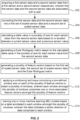
- FIG. 2 depicts an exemplary flow chart illustrating a method for training one or more machine learning (ML) models for real-time tracking of trajectories using motion sensors, using the system 100 of FIG. 1 , in accordance with an embodiment of the present disclosure.
- the system(s) 100 comprises one or more data storage devices or the memory 102 operatively coupled to the one or more hardware processors 104 and is configured to store instructions for execution of steps of the method by the one or more processors 104.
- the steps of the method of the present disclosure will now be explained with reference to components of the system 100 of FIG. 1 , and other diagrams as depicted in figures.
- the one or more hardware processors 104 acquire a first sensor data and a second sensor data from a first sensor and a second sensor respectively.
- the first sensor data and the second sensor data are associated with a user (or one or more users, says users A, B, and so on).
- the first sensor data is accelerometer data
- the second sensor data is a gyroscope data obtained from accelerometer and gyroscope respectively.
- the accelerometer and gyroscope are configured in a wearable device (e.g., say a smartwatch), in one embodiment of the present disclosure.
- the accelerometer and gyroscope are also referred to as inertial sensors, motion sensors, and interchangeably used herein.
- the wearable device is worn by the user.
- the user is in at least one of a first position and a second position.
- the first position refers to the user being in a static/standstill position and the second position refers to the user in motion or vice versa.
- linear acceleration data from the watch Application Programming Interface (API) available in all major APIs like WearOS ® , Tizen ® , iOS ® with efficient onboard signal processing
- API Application Programming Interface
- the system 100 acquires sensor data from inertial sensors including accelerometer and gyroscope from a local device (e.g., smartwatch or any smart device configured with accelerometer and gyroscope), which must be strapped down to the node to be tracked (e.g., a wrist, knee, etc.). Every data sample can be transferred in real time to the system 100 where the actual trajectory processing takes place, which is termed as Remote System. Data sample can be also buffered on the local device and sent as a burst to the system, designed as per the use case demands.
- a local device e.g., smartwatch or any smart device configured with accelerometer and gyroscope
- Every data sample can be transferred in real time to the system 100 where the actual trajectory processing takes place, which is termed as Remote System.
- Data sample can be also buffered on the local device and sent as a burst to the system, designed as per the use case demands.
- Data sample can be also processed for trajectory calculation on the local device itself without any sensor data transfer to a remote system wherein the system 100 is integrated in the local device (e.g., wearable device), and the local device can run the machine learning inferences on itself for calculating motion trajectory.
- the local device e.g., wearable device
- the one or more hardware processors 104 convert the first sensor data and the second sensor data into a first set of scaled sensor data and a second set of scaled sensor data.
- the first sensor data and the second sensor data are scaled between a first associated pre-defined threshold and a second associated pre-defined threshold to obtain the first set of scaled sensor data and the second set of scaled sensor data.
- i th accelerometer data sample (also referred as accelerometer data/first sensor data) be defined as a collection of 3-axis data as a i x , a i y , and a i z for acceleration in X, Y and Z axis of the local device respectively.
- i th gyroscope data sample (also referred as gyroscope data/second sensor data) be defined as a collection of 3-axis data as g i x , g i y , and g i z for rate of rotation around X, Y and Z axis of the local device respectively.
- the present disclosure first tries to establish the dynamics of arm movement while a normal air-writing motion, with a target of identifying discerning features of motion which can then be used for a machine learning task. It has been observed that the rotational characteristics as experienced on wrist when arm is moved along a straight line on a plane (e.g., P1) with rotation happening both at shoulder and elbow, show unique trend along each direction of motion (direction codes 0, 1, 2... as marked on P1, with two adjoining directions being 30° apart). This appears as rotation of wrist along a fixed axis of rotation through the line of motion. To both capture and verify above properties, the system and method use angle-axis equivalent of the gyroscope sensor (interpreted as its quaternion).
- the local device's rotation from (i - 1) th to i th sample ( dT seconds apart) can be expressed in the form of a single compound rotation along a fixed axis, provided the rotation is infinitesimally small which is an assumption made by the system 100 at a sampling rate of 100 Hertz which is the operating rate.
- accelerometer data sample is referred as accelerometer sample or first sensor data and interchangeably used herein.
- gyroscope data sample may be referred to as gyroscope sample or the second sensor data and interchangeably used herein.
- Accelerometer samples may be scaled between a fixed range: A min (e.g., the first associated pre-defined threshold) and A max (e.g., the second associated pre-defined threshold).
- Gyroscope samples may be scaled between a fixed range: G min (e.g., the first associated pre-defined threshold) and G max (e.g., the second associated pre-defined threshold).
- the one or more hardware processors 104 calculate a delta value in a plurality of axis for each sensor value from the second sensor data based on a duration between a current sensor value and a previous sensor value.
- the one or more hardware processors 104 generate a Euler Rodriguez matrix based on the calculated delta value in the plurality of axis for each sensor value from the second sensor data.
- a Euler Rodriguez matrix can be derived relating every pair of consecutive data samples from inertial sensors.
- dT duration between a current sensor value and a previous sensor value.
- dT duration between i th and i + 1 th sample.
- ⁇ i x r i x d ⁇ i
- ⁇ i y r i y d ⁇ i
- ⁇ i z r i z d ⁇ i
- a Euler-Rodriguez Matrix can then be derived for d ⁇ i rotation, relating device's attitude at the two samples:
- R i c ′ ⁇ i x 2 + c c ′ ⁇ i x ⁇ i y ⁇ ⁇ i z s c ′ ⁇ i x ⁇ i z ⁇ ⁇ i y s c ′ ⁇ i x ⁇ i y + ⁇ i z s c ′ ⁇ i y 2 + c c ′ ⁇ i y ⁇ i z ⁇ ⁇ i x s c ′ ⁇ i x ⁇ i z + ⁇ i y s c ′ ⁇ i y ⁇ i z ⁇ ⁇ i x s c ′ ⁇ i x ⁇ i z + ⁇ i y s c ′
- the one or more hardware processors 104 generate a plurality of feature vectors based on the first set of scaled sensor data, the second set of scaled sensor data, and the Euler Rodriguez matrix. For better accuracy of real-time trajectories estimation, the diagonal elements of the Euler Rodriguez matrix are scaled by the system 100, in an embodiment of the present disclosure.
- the system 100 performs element scaling (ES) operation which is simply unit scaling of each element but within limits fixed for every source (( A min , A max ), ( G min , G max ),( r min , r max ) for accelerometer, gyroscope, and ERF).
- ES element scaling
- the one or more hardware processors 104 apply a windowing technique comprising a pre-defined window size on each of the plurality of feature vectors to obtain a plurality of windows. Each window amongst the plurality of windows comprises one or more associated feature vectors amongst the plurality of feature vectors.
- the one or more hardware processors 104 train one or more machine learning (ML) models based on a label annotated to each window amongst the plurality of windows.
- the label indicates a stroke direction of data comprised in each window.
- the stroke direction is a straight-line stroke direction for each window of feature vectors.
- the system and method implement the annotating/labeling as the straight-line stroke direction being tracked/estimated for each window of feature vectors.
- collection of sensor data is in the form of straight-line strokes in different directions of the space of movement of the node to be tracked (for e.g., tracking a wrist while drawing shapes in air).
- sensor data was collected while moving the arm in a writing posture along straight lines as shown in FIG. 3 , along with the label for each direction of stroke. This enables the system 100 to provide 2D outputs of the motion trajectories for wrist while drawing in air.
- FIG. 4 illustrates sensor data collection while moving an arm in a writing posture along straight lines, in accordance with an embodiment of the present disclosure.
- FIG. 5 illustrates training stroke directions for 3D training, in accordance with an embodiment of the present disclosure.
- FIG. 6 illustrates training stroke directions for 3D training showing a single plane highlighted inside the 3D sphere with stroke lines, in accordance with an embodiment of the present disclosure.
- 12 stroke directions were chosen as pi/6 radians apart for 2D, as shown in FIG. 4 .
- W i is the window which has n feature vectors starting at i th feature vector F i .
- the system 100 and method used a window size of 15 samples for a sampling rate of 100 samples.
- a machine learning model can be trained using ( W i , L i ) as a single training instance, where L i is the label of the stroke direction which the data of W i represents. It is noted that ( W i , L i ) is defined only for certain values of i, which depends on the size of the window, m. If the samples start from index 0, the values that i can take for ( W i , L i ) are 0, m , 2m, 3 m , and so on. In an embodiment, certain feature vectors from one window can be overlapped with the next, in which case the i for an instance ( W i , L i ) takes values accordingly.
- the ML model itself trained to detect different directions of mini strokes for the motion trajectory can be saved in the form of a collection of weights and parameters defining the trained model on a persistent storage medium on whichever device the real time inferences need to be made (local device or the remote system).
- the machine learning model may be designed using a neural network architecture with two or more 2D convolutional layers, or as per implementation requirement with satisfies conditions for an acceptable accuracy of the performance of the final trained ML model.
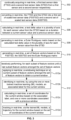
- FIG. 3 depicts an exemplary flow chart illustrating a method for real-time tracking of trajectories using motion sensors, via the one or more trained machine learning (ML) models comprised in the system 100 of FIG. 1 , in accordance with an embodiment of the present disclosure. More specifically, during real-time inference the system 100 continually acquires a first test sensor data (FTSD) and a second test sensor data (STSD) from the first sensor and the second sensor respectively in step 302.
- FTSD test sensor data
- STSD second test sensor data
- the first test sensor data (FTSD) and the second test sensor data (STSD) are associated with the user (or one or more users, wherein the one or more users may be either same set of users (e.g., the users A, B, and so on of step 202) from whom sensor data was acquired for training the ML models or a different set of users altogether (e.g., say users U1, U2, and so on).
- the first test sensor data (FTSD) and the second test sensor data (STSD) are converted in real-time into a first set of scaled test sensor data (FSSTSD) and a second set of scaled test sensor data (SSSTSD) in step 304.
- a test delta value in the plurality of axis for each sensor value from the second test sensor data is calculated in real-time based on a duration between a current sensor value and a previous sensor value in step 306.
- the Euler Rodriguez matrix (ERM) is generated in real-time based on the calculated test delta value in the plurality of axis for each sensor value from the second test sensor data (STSD) in step 308.
- a set of feature vectors are obtained in real-time based on the first set of scaled test sensor data (FSSTSD), the second set of scaled test sensor data (SSSTSD), and the Euler Rodriguez matrix (ERM) in step 310.
- the steps 302 till 310 of FIG. 3 remain same as that of steps 202 till 210 of FIG. 2 .
- the diagonal elements of Euler Rodriguez matrix may be scaled during real-time inference for better estimation of trajectories.
- the system 100 iteratively performs a series of steps until a last subset of feature vector.
- the expression 'subset' as used herein refers to at least a few feature vectors from the set of feature vectors generated.
- the system 100 applies the windowing technique on a current subset of feature vectors amongst the set of feature vectors to obtain a current window.
- an associated label L i
- a set of coordinates for the current window (e.g., say 2 nd window) is calculated in real-time based on the associated label, and one or more coordinates associated with a previous window (1 st window), at step 312c.
- the system 100 tracks in real-time, via the one or more trained ML models, a trajectory for the current window based on the set of coordinates of the current window at step 312d.
- a set of pre-defined initial coordinates (e.g., 0,0) are associated with a first window during application of the windowing technique.
- windowing technique is applied with the assumption of coordinates being (0,0).
- the above steps are repeated until the user continues to perform one or more actions (e.g., a writing posture as mentioned above).
- the system 100 may implement machine learning optimizations available today wherein the ML models are leveraged to run the models on hardware(s) with constrained computational power.
- ⁇ L i is the angle (in radians) pointed to by the label L i as estimated by the machine learning model for the current window W i .
- user can add their own custom gesture to be drawn in air to the system 100 by using only one example template, which is possible with the approach of tracking proposed in the present disclosure.
- the system 100 designed over the method described herein can even be used while the user is walking, jogging, moving on stairs while drawing anything shape air owing to the kind of features which are used by the machine learning model devised, lending a big factor of practicality (e.g., using gestures in a moving car, or while walking, jogging etc.).
- tracking of arm is shown to be possible on a low-power hardware in real-time using a single wrist wearable to affect many applications on user level without any investment on additional hardware.
- Medical applications like monitoring patient's progress in miscellaneous Neuro Musculoskeletal disorders can be performed by leveraging just a wrist wearable and providing patient with certain pre-drawn shapes on screen, and the patient can try to follow those shapes by wearing the wrist wearable, which can very well be a commercial smartwatch (for example).
- Another application can be a contactless input to a computer in the form of a pointing device, where the trajectories calculated while moving arm in air in a natural writing posture are converted to the coordinates of pointer movement, and all this is possible using only a single commercial wrist wearable (e.g., a smartwatch).
- the system 100 does not require hardware of high computation power since the method/system 100 aims to be deployed in any use case on a hardware with low computational power.
- moving full arm in air is a more natural way of interacting with digital devices, rather than using only hand movements or head movements as many of the conventional systems and approaches devise.
- such applications can be enormous helpful to reduce physical contact on highly used public touch points, reducing the spread of any contaminants or infections.
- system and method of the present disclosure can perform tracking not just for rotations around elbow, but the movement of full arm with elbow undergoing rotation/translation, and shoulder undergoing rotation at the same time, using a single wrist wearable capable of running in real time on low-power embedded hardware, enhancing economic factor of the invention.
- Tracking can be performed, for e.g., when the user is drawing any shape in air in any plane of motion (e.g., left, right, top, bottom with respect to user's shoulder).
- the system and method of the present disclosure conducted experimental results for a set of 5 subjects, excluding the subject whose data was used to train the model, to explore user-independence in air-writing modeling. Subjects were given a few minutes to scribble shapes on screen using the system 100 to get acquainted with air-writing posture.
- the present disclosure used a smart watch, transferring sensor data in real-time over WiFi to a Raspberry Pi 3B where all the pre-processing and inferencing was performed using TFLite framework (e.g., a framework known in the art).
- TFLite framework e.g., a framework known in the art.
- the present disclosure compared outputs of the method described herein with those generated by Kinect V2 camera for the wrist joint, where subjects wearing smartwatch drew certain shapes/words at varied speeds and in different directions (changing body direction accordingly so that the drawing plane stays in front of the camera).
- FIG. 7 shows the trajectories generated by Kinect V2 and the system/method of the present disclosure for two of the subjects. It is noted that method/system of the present disclosure can not only track small gestures and shapes but also complete words, which can be really useful for a contact-less and ubiquitous text input.
- the method and system of the present disclosure are capable of tracking longer words too when drawn in curved fashion in air as their 2D embeddings (not shown in FIGS.). Although, straight line artifacts are still visible in method's output in FIG. 7 (especially for "abcd") owing to it being trained on straight line strokes, these can be minimized if the system 100 is trained on more directions. Overall, the method/system of the present disclosure was able to reproduce trajectory shapes with good reliability.
- FIG. 7 depicts trajectories derived while user writing in air using the system/method of the present disclosure, and comparison with Kinect V2 camera trajectories (prior art), in accordance with an embodiment of the present disclosure.
- the system of the present disclosure as a contactless pointing device:
- One of the key use cases in HCI for air-writing is the ability to digitally control movement of a pointer in a contactless manner.
- Many research works involving inertial sensors track orientation of hand or head to effect pointer movement on screen.
- the present disclosure tested the method described herein as a similar pointing solution where the trajectories generated while air-writing are converted directly to screen coordinates, moving the mouse pointer accordingly.
- Table 1 illustrates results of using the method/system as a contactless pointing device experimented using ISO pointing task ( px: pixels, bps: bits per second).
- Table 1 D (px) W (px) W e ( px ) ID (bits) Level ID e ( bits ) t m ( sec ) TP (bps) 1002 150 135.05 2.94 Very Low 3.11 1.24 2.49 1072 80 87.62 3.85 Low 3.73 1.52 2.46 1092 60 68.39 4.26 Medium 4.09 1.71 2.39
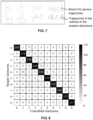
- FIG. 8 depicts a confusion matrix for gesture recognition of 10 gestures tested, in accordance with an embodiment of the present disclosure. Each gesture was performed 120 times. In the confusion matrix depicted in FIG. 8 , each diagonal entry shows the number of instances of correct classification of the gestures. Non-diagonal entries show target gesture misclassified as the gesture code on X-axis. A total gesture detection accuracy of 93.6% has been achieved by the system and method of the present disclosure.
- Present disclosure provides system and method for leveraging machine learning paradigms using convolution neural network(s) (CNN) for modeling arm motion while air-writing to derive motion information for mini-strokes and create real-time trajectory.
- CNN convolution neural network
- the system and method described herein also calibration-free in practice, was shown to provide outputs of air-written shapes in any plane around the subject, even while going on stairs or jogging.
- the system was shown in light of multiple use cases in a user-independent manner, including a contactless pointing device tested with subjects on the ISO pointing task, and a generic gesture recognition tested in a free-living scenario with subjects drawing gestures even while walking, with the ability of gesture detection with just 1 template per gesture. All of the applications ran in real-time on a computationally constrained Raspberry Pi 3B.
- the training of the one or more machine learning models as described herein is achieved by using certain instances of data windows of features derived from motion sensors mapped to certain labels, and the inferencing predicts the labels when presented with such a data window. This is a typical way a machine learning pipeline works.
- the system and method of the present disclosure uses this pipeline to perform an estimation of directions for every data window of motion sensing features (representing a mini stroke) constituting the trajectory of the whole movement performed in space, where the ML model is trained on motion data features derived in the pre-processing (e.g., refer steps 202 and 204) from motion data collected while moving the node (wrist, foot, etc.) in straight lines where the labels represent various directions of those straight lines, and when the system 100 is in use, the inferencing by the method uses this model to decide direction for every mini stroke while any shape is drawn in air.
- the pre-processing e.g., refer steps 202 and 204
- This method of training and applying the windowing technique to feature vectors enables the system 100 and the method to calculate the trajectory of movement in real time and provide a high degree of practicality, e.g., ability to calculate trajectories of air-written shapes made even while the user is in motion using only data from motion sensors embedded in the wearable device.
- acceleration-based features can be reduced in the overall motion feature vectors and more stress on rotational features can be placed to minimize the effect of external acceleration. This can provide a more robust and acceptable tracking input even when there is an external motion.
- Such computer-readable storage means contain program-code means for implementation of one or more steps of the method, when the program runs on a server or mobile device or any suitable programmable device.
- the hardware device can be any kind of device which can be programmed including e.g., any kind of computer like a server or a personal computer, or the like, or any combination thereof.
- the device may also include means which could be e.g., hardware means like e.g., an application-specific integrated circuit (ASIC), a field-programmable gate array (FPGA), or a combination of hardware and software means, e.g., an ASIC and an FPGA, or at least one microprocessor and at least one memory with software processing components located therein.
- the means can include both hardware means and software means.
- the method embodiments described herein could be implemented in hardware and software.
- the device may also include software means. Alternatively, the embodiments may be implemented on different hardware devices, e.g., using a plurality of CPUs.
- the embodiments herein can comprise hardware and software elements.
- the embodiments that are implemented in software include but are not limited to, firmware, resident software, microcode, etc.
- the functions performed by various components described herein may be implemented in other components or combinations of other components.
- a computer-usable or computer readable medium can be any apparatus that can comprise, store, communicate, propagate, or transport the program for use by or in connection with the instruction execution system, apparatus, or device.
- a computer-readable storage medium refers to any type of physical memory on which information or data readable by a processor may be stored.
- a computer-readable storage medium may store instructions for execution by one or more processors, including instructions for causing the processor(s) to perform steps or stages consistent with the embodiments described herein.
- the term "computer-readable medium” should be understood to include tangible items and exclude carrier waves and transient signals, i.e., be non-transitory. Examples include random access memory (RAM), read-only memory (ROM), volatile memory, nonvolatile memory, hard drives, CD ROMs, DVDs, flash drives, disks, and any other known physical storage media.
Landscapes
- Engineering & Computer Science (AREA)
- Theoretical Computer Science (AREA)
- General Engineering & Computer Science (AREA)
- Physics & Mathematics (AREA)
- General Physics & Mathematics (AREA)
- Human Computer Interaction (AREA)
- Computer Hardware Design (AREA)
- General Health & Medical Sciences (AREA)
- Health & Medical Sciences (AREA)
- Multimedia (AREA)
- Biophysics (AREA)
- Social Psychology (AREA)
- Computer Vision & Pattern Recognition (AREA)
- Life Sciences & Earth Sciences (AREA)
- Artificial Intelligence (AREA)
- Biomedical Technology (AREA)
- Psychiatry (AREA)
- Computational Linguistics (AREA)
- Data Mining & Analysis (AREA)
- Evolutionary Computation (AREA)
- Molecular Biology (AREA)
- Computing Systems (AREA)
- Mathematical Physics (AREA)
- Software Systems (AREA)
- User Interface Of Digital Computer (AREA)
Claims (15)
- Prozessorimplementiertes Verfahren zur Echtzeitverfolgung von Trajektorien unter Verwendung von Bewegungssensoren, umfassend:Erfassen, über einen oder mehrere Hardwareprozessoren, von ersten Sensordaten und zweiten Sensordaten von einem Beschleunigungsmesser bzw. einem Gyroskop, wobei die ersten Sensordaten und die zweiten Sensordaten einem Benutzer (202) zugeordnet sind, wobei der Beschleunigungsmesser und das Gyroskop in einer tragbaren Vorrichtung konfiguriert sind, die von dem Benutzer getragen wird;Umwandeln, über den einen oder die mehreren Hardwareprozessoren, der ersten Sensordaten und der zweiten Sensordaten in einen ersten Satz von skalierten Sensordaten und einen zweiten Satz von skalierten Sensordaten (204);Berechnen, über den einen oder die mehreren Hardwareprozessoren, eines Deltawerts in einer Mehrzahl von Achsen für jeden Sensorwert aus den zweiten Sensordaten basierend auf einer Dauer zwischen einem aktuellen Sensorwert und einem vorherigen Sensorwert (206);Berechnen, über den einen oder die mehreren Hardwareprozessoren, einer Euler-Rodriguez-Matrix basierend auf dem berechneten Deltawert in der Mehrzahl von Achsen für jeden Sensorwert aus den zweiten Sensordaten (208);Definieren, über den einen oder die mehreren Hardwareprozessoren, einer Mehrzahl von Merkmalsvektoren, wobei die Mehrzahl von Merkmalsvektoren den ersten Satz von skalierten Sensordaten, den zweiten Satz von skalierten Sensordaten und die Euler-Rodriguez-Matrix (210) umfasst, wobei die Mehrzahl von Merkmalsvektoren durch Durchführen einer Elementskalierungs-ES-Operation des ersten Satzes von skalierten Sensordaten, des zweiten Satzes von skalierten Sensordaten und der Euler-Rodriguez-Matrix innerhalb fester Grenzwerte definiert wird, wobei die festen Grenzwerte aus Mehrgeschwindigkeits-Stoke-Daten abgeleitet werden, und wobei eine Diagonalskalierungs-DS-Operation der Euler-Rodriguez-Matrix vor der ES-Operation durchgeführt wird;Anwenden, über den einen oder die mehreren Hardwareprozessoren, einer Fensterungstechnik, die eine vordefinierte Fenstergröße umfasst, auf jeden der Mehrzahl von Merkmalsvektoren, um eine Mehrzahl von Fenstern zu erhalten, wobei jedes Fenster unter der Mehrzahl von Fenstern einen oder mehrere zugeordnete Merkmalsvektoren unter der Mehrzahl von Merkmalsvektoren (212) umfasst, wobei jedes Fenster eine Sammlung einer vordefinierten Anzahl von aufeinanderfolgenden Merkmalsvektoren der Mehrzahl von Merkmalsvektoren ist; undTrainieren, über den einen oder die mehreren Hardwareprozessoren, eines oder mehrerer Maschinenlern-ML-Modelle basierend auf einem Label, das jedem Fenster aus der Mehrzahl von Fenstern zugeordnet ist, wobei das Label eine Strichrichtung von Daten angibt, die in jedem Fenster (214) enthalten sind, wobei das Maschinenlern-Modell eine Klassifizierungsaufgabe durchführt, um die Strichrichtung unter Verwendung der Mehrzahl von Merkmalsvektoren in jedem Fenster abzuleiten.
- Prozessorimplementiertes Verfahren nach Anspruch 1, ferner umfassend:kontinuierliches Erfassen, in Echtzeit, über den einen oder die mehreren Hardwareprozessoren, von ersten Testsensordaten und zweiten Testsensordaten von dem Beschleunigungsmesser bzw. dem Gyroskop, wobei die ersten Testsensordaten und die zweiten Testsensordaten dem Benutzer (302) zugeordnet sind;Umwandeln, in Echtzeit, über den einen oder die mehreren Hardwareprozessoren, der ersten Testsensordaten und der zweiten Testsensordaten in einen ersten Satz von skalierten Testsensordaten und einen zweiten Satz von skalierten Testsensordaten (304);Berechnen, in Echtzeit, über den einen oder die mehreren Hardwareprozessoren, eines Testdeltawerts in der Mehrzahl von Achsen für jeden Sensorwert aus den zweiten Testsensordaten basierend auf einer Dauer zwischen einem aktuellen Sensorwert und einem vorherigen Sensorwert (306);Berechnen, in Echtzeit, über den einen oder die mehreren Hardwareprozessoren, der Euler-Rodriguez-Matrix basierend auf dem berechneten Testdeltawert in der Mehrzahl von Achsen für jeden Sensorwert aus den zweiten Testsensordaten (308);Erhalten, in Echtzeit, über den einen oder die mehreren Hardwareprozessoren, eines Satzes von Merkmalsvektoren basierend auf dem ersten Satz von skalierten Testsensordaten, dem zweiten Satz von skalierten Testsensordaten und der Euler-Rodriguez-Matrix (310); unditeratives Durchführen, für jeden Teilsatz von Merkmalsvektoren bis zu einem letzten Teilsatz von Merkmalsvektoren unter dem Satz von Merkmalsvektoren (312):Anwenden, in Echtzeit, über den einen oder die mehreren Hardwareprozessoren, der Fensterungstechnik auf einen aktuellen Teilsatz von Merkmalsvektoren unter dem Satz von Merkmalsvektoren, um ein aktuelles Fenster (312a) zu erhalten;Identifizieren, in Echtzeit, unter Verwendung des einen oder der mehreren trainierten Maschinenlern-ML-Modelle über den einen oder die mehreren Hardwareprozessoren, eines assoziierten Labels für das aktuelle Fenster (312b);Berechnen, in Echtzeit, über den einen oder die mehreren Hardwareprozessoren, eines Satzes von Koordinaten für das aktuelle Fenster basierend auf dem assoziierten Label und einer oder mehreren Koordinaten, die mit einem vorherigen Fenster assoziiert sind (312c); undVerfolgen, in Echtzeit, über das eine oder die mehreren trainierten ML-Modelle, einer Trajektorie für das aktuelle Fenster basierend auf dem Satz von Koordinaten des aktuellen Fensters (312d).
- Prozessorimplementiertes Verfahren nach Anspruch 1, wobei sich der Benutzer in mindestens einer von einer ersten Position und einer zweiten Position befindet.
- Prozessorimplementiertes Verfahren nach Anspruch 1, wobei die ersten Sensordaten und die zweiten Sensordaten zwischen einem ersten assoziierten vordefinierten Schwellenwert und einem zweiten assoziierten vordefinierten Schwellenwert skaliert werden, um den ersten Satz von skalierten Sensordaten und den zweiten Satz von skalierten Sensordaten zu erhalten.
- Prozessorimplementiertes Verfahren nach Anspruch 2, wobei ein Satz von vordefinierten anfänglichen Koordinaten mit einem ersten Fenster während der Anwendung der Fensterungstechnik assoziiert wird.
- System (100) zur Echtzeitverfolgung von Trajektorien unter Verwendung von Bewegungssensoren, umfassend:einen Speicher (102), der Anweisungen speichert;eine oder mehrere Kommunikationsschnittstellen (106); undeinen oder mehrere Hardwareprozessoren (104), die mit dem Speicher (102) über die eine oder die mehreren Kommunikationsschnittstellen (106) gekoppelt sind, wobei der eine oder die mehreren Hardwareprozessoren (104) durch die Anweisungen konfiguriert sind zum:Erfassen von ersten Sensordaten und zweiten Sensordaten von einem Beschleunigungsmesser bzw. einem Gyroskop, wobei die ersten Sensordaten und die zweiten Sensordaten einem Benutzer zugeordnet sind, wobei der Beschleunigungsmesser und das Gyroskop in einer tragbaren Vorrichtung konfiguriert sind, die von dem Benutzer getragen wird;Umwandeln der ersten Sensordaten und der zweiten Sensordaten in einen ersten Satz von skalierten Sensordaten und einen zweiten Satz von skalierten Sensordaten;Berechnen eines Deltawerts in einer Mehrzahl von Achsen für jeden Sensorwert aus den zweiten Sensordaten basierend auf einer Dauer zwischen einem aktuellen Sensorwert und einem vorherigen Sensorwert;Berechnen einer Euler-Rodriguez-Matrix basierend auf dem berechneten Deltawert in der Mehrzahl von Achsen für jeden Sensorwert aus den zweiten Sensordaten;Definieren einer Mehrzahl von Merkmalsvektoren, die den ersten Satz von skalierten Sensordaten, den zweiten Satz von skalierten Sensordaten und die Euler-Rodriguez-Matrix umfassen, wobei die Mehrzahl von Merkmalsvektoren durch Durchführen einer Elementskalierungs-ES-Operation des ersten Satzes von skalierten Sensordaten, des zweiten Satzes von skalierten Sensordaten und der Euler-Rodriguez-Matrix innerhalb fester Grenzwerte definiert wird, wobei die festen Grenzwerte aus Mehrgeschwindigkeits-Stoke-Daten abgeleitet werden, und wobei eine Diagonalskalierungs-DS-Operation der Euler-Rodriguez-Matrix vor der ES-Operation durchgeführt wird;Anwenden einer Fensterungstechnik, die eine vordefinierte Fenstergröße umfasst, auf jeden der Mehrzahl von Merkmalsvektoren, um eine Mehrzahl von Fenstern zu erhalten, wobei jedes Fenster unter der Mehrzahl von Fenstern einen oder mehrere zugeordnete Merkmalsvektoren unter der Mehrzahl von Merkmalsvektoren umfasst, wobei jedes Fenster eine Sammlung einer vordefinierten Anzahl von aufeinanderfolgenden Merkmalsvektoren der Mehrzahl von Merkmalsvektoren ist; undTrainieren eines oder mehrerer Maschinenlern-ML-Modelle basierend auf einem Label, das jedem Fenster aus der Mehrzahl von Fenstern zugeordnet ist, wobei das Label eine Strichrichtung von Daten angibt, die in jedem Fenster enthalten sind, wobei das Maschinenlern-Modell eine Klassifizierungsaufgabe durchführt, um die Strichrichtung unter Verwendung der Mehrzahl von Merkmalsvektoren in jedem Fenster abzuleiten.
- System nach Anspruch 6, wobei der eine oder die mehreren Hardwareprozessoren ferner durch die Anweisungen konfiguriert sind zum:kontinuierlichen Erfassen, in Echtzeit, von ersten Testsensordaten und zweiten Testsensordaten von dem Beschleunigungsmesser bzw. dem Gyroskop, wobei die ersten Testsensordaten und die zweiten Testsensordaten dem Benutzer zugeordnet sind;Umwandeln, in Echtzeit, der ersten Testsensordaten und der zweiten Testsensordaten in einen ersten Satz von skalierten Testsensordaten und einen zweiten Satz von skalierten Testsensordaten;Berechnen, in Echtzeit, eines Testdeltawerts in der Mehrzahl von Achsen für jeden Sensorwert aus den zweiten Testsensordaten basierend auf einer Dauer zwischen einem aktuellen Sensorwert und einem vorherigen Sensorwert;Erzeugen, in Echtzeit, der Euler-Rodriguez-Matrix basierend auf dem berechneten Testdeltawert in der Mehrzahl von Achsen für jeden Sensorwert aus den zweiten Testsensordaten;Erhalten, in Echtzeit, eines Satzes von Merkmalsvektoren basierend auf dem ersten Satz von skalierten Testsensordaten, dem zweiten Satz von skalierten Testsensordaten und der Euler-Rodriguez-Matrix; unditeratives Durchführen, für jeden Teilsatz von Merkmalsvektoren bis zu einem letzten Teilsatz von Merkmalsvektoren unter dem Satz von Merkmalsvektoren:Anwenden, in Echtzeit, der Fensterungstechnik auf einen aktuellen Teilsatz von Merkmalsvektoren unter dem Satz von Merkmalsvektoren, um ein aktuelles Fenster zu erhalten;Identifizieren, in Echtzeit, unter Verwendung des einen oder der mehreren trainierten Maschinenlern-ML-Modelle über den einen oder die mehreren Hardwareprozessoren, eines assoziierten Labels für das aktuelle Fenster;Berechnen, in Echtzeit, eines Satzes von Koordinaten für das aktuelle Fenster basierend auf dem assoziierten Label und einer oder mehreren Koordinaten, die mit einem vorherigen Fenster assoziiert sind; undVerfolgen, in Echtzeit, über das eine oder die mehreren trainierten ML-Modelle, einer Trajektorie für das aktuelle Fenster basierend auf dem Satz von Koordinaten des aktuellen Fensters.
- System nach Anspruch 6, wobei sich der Benutzer in mindestens einer von einer ersten Position und einer zweiten Position befindet.
- System nach Anspruch 6, wobei die ersten Sensordaten und die zweiten Sensordaten zwischen einem ersten assoziierten vordefinierten Schwellenwert und einem zweiten assoziierten vordefinierten Schwellenwert skaliert werden, um den ersten Satz von skalierten Sensordaten und den zweiten Satz von skalierten Sensordaten zu erhalten.
- System nach Anspruch 7, wobei ein Satz von vordefinierten anfänglichen Koordinaten mit einem ersten Fenster während der Anwendung der Fensterungstechnik assoziiert wird.
- Ein oder mehrere nichtflüchtige maschinenlesbare Informationsspeichermedien, umfassend eine oder mehrere Anweisungen, die, wenn sie von einem oder mehreren Hardwareprozessoren ausgeführt werden, diese veranlassen, die folgenden Schritte zur Echtzeitverfolgung von Trajektorien unter Verwendung von Bewegungssensoren durchzuführen:Erfassen von ersten Sensordaten und zweiten Sensordaten von einem Beschleunigungsmesser bzw. einem Gyroskop, wobei die ersten Sensordaten und die zweiten Sensordaten einem Benutzer zugeordnet sind, wobei der Beschleunigungsmesser und das Gyroskop in einer tragbaren Vorrichtung konfiguriert sind, die von dem Benutzer getragen wird;Umwandeln der ersten Sensordaten und der zweiten Sensordaten in einen ersten Satz von skalierten Sensordaten und einen zweiten Satz von skalierten Sensordaten;Berechnen eines Deltawerts in einer Mehrzahl von Achsen für jeden Sensorwert aus den zweiten Sensordaten basierend auf einer Dauer zwischen einem aktuellen Sensorwert und einem vorherigen Sensorwert;Berechnen einer Euler-Rodriguez-Matrix basierend auf dem berechneten Deltawert in der Mehrzahl von Achsen für jeden Sensorwert aus den zweiten Sensordaten;Definieren einer Mehrzahl von Merkmalsvektoren, die den ersten Satz von skalierten Sensordaten, den zweiten Satz von skalierten Sensordaten und die Euler-Rodriguez-Matrix umfassen, wobei die Mehrzahl von Merkmalsvektoren durch Durchführen einer Elementskalierungs-ES-Operation des ersten Satzes von skalierten Sensordaten, des zweiten Satzes von skalierten Sensordaten und der Euler-Rodriguez-Matrix innerhalb fester Grenzwerte definiert wird, wobei die festen Grenzwerte aus Mehrgeschwindigkeits-Stoke-Daten abgeleitet werden, und wobei eine Diagonalskalierungs-DS-Operation der Euler-Rodriguez-Matrix vor der ES-Operation durchgeführt wird;Anwenden einer Fensterungstechnik, die eine vordefinierte Fenstergröße umfasst, auf jeden der Mehrzahl von Merkmalsvektoren, um eine Mehrzahl von Fenstern zu erhalten, wobei jedes Fenster unter der Mehrzahl von Fenstern einen oder mehrere zugeordnete Merkmalsvektoren unter der Mehrzahl von Merkmalsvektoren umfasst, wobei jedes Fenster eine Sammlung einer vordefinierten Anzahl von aufeinanderfolgenden Merkmalsvektoren der Mehrzahl von Merkmalsvektoren ist; undTrainieren eines oder mehrerer Maschinenlern-ML-Modelle basierend auf einem Label, das jedem Fenster aus der Mehrzahl von Fenstern zugeordnet ist, wobei das Label eine Strichrichtung von Daten angibt, die in jedem Fenster enthalten sind, wobei das Maschinenlern-Modell eine Klassifizierungsaufgabe durchführt, um die Strichrichtung unter Verwendung der Mehrzahl von Merkmalsvektoren in jedem Fenster abzuleiten.
- Ein oder mehrere nichtflüchtige maschinenlesbare Informationsspeichermedien nach Anspruch 11, wobei die eine oder die mehreren Anweisungen, die, wenn sie von einem oder mehreren Hardwareprozessoren ausgeführt werden, ferner veranlassen:kontinuierliches Erfassen, in Echtzeit, von ersten Testsensordaten und zweiten Testsensordaten von dem Beschleunigungsmesser bzw. dem Gyroskop, wobei die ersten Testsensordaten und die zweiten Testsensordaten dem Benutzer zugeordnet sind;Umwandeln, in Echtzeit, der ersten Testsensordaten und der zweiten Testsensordaten in einen ersten Satz von skalierten Testsensordaten und einen zweiten Satz von skalierten Testsensordaten;Berechnen, in Echtzeit, eines Testdeltawerts in der Mehrzahl von Achsen für jeden Sensorwert aus den zweiten Testsensordaten basierend auf einer Dauer zwischen einem aktuellen Sensorwert und einem vorherigen Sensorwert;Berechnen, in Echtzeit, der Euler-Rodriguez-Matrix basierend auf dem berechneten Testdeltawert in der Mehrzahl von Achsen für jeden Sensorwert aus den zweiten Testsensordaten;Erhalten, in Echtzeit, eines Satzes von Merkmalsvektoren basierend auf dem ersten Satz von skalierten Testsensordaten, dem zweiten Satz von skalierten Testsensordaten und der Euler-Rodriguez-Matrix; unditeratives Durchführen, für jeden Teilsatz von Merkmalsvektoren bis zu einem letzten Teilsatz von Merkmalsvektoren unter dem Satz von Merkmalsvektoren:Anwenden, in Echtzeit, der Fensterungstechnik auf einen aktuellen Teilsatz von Merkmalsvektoren unter dem Satz von Merkmalsvektoren, um ein aktuelles Fenster zu erhalten;Identifizieren, in Echtzeit, unter Verwendung des einen oder der mehreren trainierten Maschinenlern-ML-Modelle, eines assoziierten Labels für das aktuelle Fenster;Berechnen, in Echtzeit, eines Satzes von Koordinaten für das aktuelle Fenster basierend auf dem assoziierten Label und einer oder mehreren Koordinaten, die mit einem vorherigen Fenster assoziiert sind; undVerfolgen, in Echtzeit, über das eine oder die mehreren trainierten ML-Modelle, einer Trajektorie für das aktuelle Fenster basierend auf dem Satz von Koordinaten des aktuellen Fensters.
- Ein oder mehrere nichtflüchtige maschinenlesbare Informationsspeichermedien nach Anspruch 11, wobei sich der Benutzer in mindestens einer von einer ersten Position und einer zweiten Position befindet.
- Ein oder mehrere nichtflüchtige maschinenlesbare Informationsspeichermedien nach Anspruch 11, wobei die ersten Sensordaten und die zweiten Sensordaten zwischen einem ersten assoziierten vordefinierten Schwellenwert und einem zweiten assoziierten vordefinierten Schwellenwert skaliert werden, um den ersten Satz von skalierten Sensordaten und den zweiten Satz von skalierten Sensordaten zu erhalten.
- Ein oder mehrere nichtflüchtige maschinenlesbare Informationsspeichermedien nach Anspruch 12, wobei ein Satz von vordefinierten anfänglichen Koordinaten mit einem ersten Fenster während der Anwendung der Fensterungstechnik assoziiert wird.
Applications Claiming Priority (1)
| Application Number | Priority Date | Filing Date | Title |
|---|---|---|---|
| IN202221063147 | 2022-11-04 |
Publications (3)
| Publication Number | Publication Date |
|---|---|
| EP4365859A1 EP4365859A1 (de) | 2024-05-08 |
| EP4365859C0 EP4365859C0 (de) | 2025-02-12 |
| EP4365859B1 true EP4365859B1 (de) | 2025-02-12 |
Family
ID=87971827
Family Applications (1)
| Application Number | Title | Priority Date | Filing Date |
|---|---|---|---|
| EP23195865.3A Active EP4365859B1 (de) | 2022-11-04 | 2023-09-07 | Systeme und verfahren zur echtzeitverfolgung von trajektorien mithilfe von bewegungssensoren |
Country Status (2)
| Country | Link |
|---|---|
| US (1) | US12111982B2 (de) |
| EP (1) | EP4365859B1 (de) |
Family Cites Families (24)
| Publication number | Priority date | Publication date | Assignee | Title |
|---|---|---|---|---|
| EP2911089B1 (de) * | 2014-02-25 | 2018-04-04 | Karlsruher Institut für Technologie | Verfahren und System zur Erkennung von Handschrift und Gesten |
| EP3170062B1 (de) * | 2014-07-18 | 2019-08-21 | Apple Inc. | Detektion von anhebegesten in einer vorrichtung |
| US10817065B1 (en) * | 2015-10-06 | 2020-10-27 | Google Llc | Gesture recognition using multiple antenna |
| US10218882B2 (en) * | 2015-12-31 | 2019-02-26 | Microsoft Technology Licensing, Llc | Feedback for object pose tracker |
| EP3432204B1 (de) * | 2017-07-20 | 2024-01-17 | Tata Consultancy Services Limited | Telepräsenzrahmen für die markierung von regionen von interesse mit kopfmontagevorrichtungen |
| TW201928604A (zh) * | 2017-12-22 | 2019-07-16 | 美商蝴蝶網路公司 | 用於基於超音波資料來識別姿勢的方法和設備 |
| US20230072423A1 (en) * | 2018-01-25 | 2023-03-09 | Meta Platforms Technologies, Llc | Wearable electronic devices and extended reality systems including neuromuscular sensors |
| US20200310541A1 (en) * | 2019-03-29 | 2020-10-01 | Facebook Technologies, Llc | Systems and methods for control schemes based on neuromuscular data |
| US10386481B1 (en) * | 2018-07-19 | 2019-08-20 | King Abdullah University Of Science And Technology | Angle-of-arrival-based gesture recognition system and method |
| US10867391B2 (en) * | 2018-09-28 | 2020-12-15 | Adobe Inc. | Tracking viewer engagement with non-interactive displays |
| US10877568B2 (en) * | 2018-12-19 | 2020-12-29 | Arizona Board Of Regents On Behalf Of Arizona State University | Three-dimensional in-the-air finger motion based user login framework for gesture interface |
| US11126835B2 (en) * | 2019-02-21 | 2021-09-21 | Tata Consultancy Services Limited | Hand detection in first person view |
| US11256342B2 (en) * | 2019-04-03 | 2022-02-22 | Facebook Technologies, Llc | Multimodal kinematic template matching and regression modeling for ray pointing prediction in virtual reality |
| US10802600B1 (en) * | 2019-09-20 | 2020-10-13 | Facebook Technologies, Llc | Virtual interactions at a distance |
| US11422623B2 (en) * | 2019-10-23 | 2022-08-23 | Interlake Research, Llc | Wrist worn computing device control systems and methods |
| US11157086B2 (en) * | 2020-01-28 | 2021-10-26 | Pison Technology, Inc. | Determining a geographical location based on human gestures |
| US20240146350A1 (en) * | 2020-09-16 | 2024-05-02 | Genki Instruments ehf. | Smart ring |
| WO2022144839A1 (en) * | 2020-12-31 | 2022-07-07 | Cipia Vision Ltd. | Systems and methods for determining driver control over a vehicle |
| CN113052172A (zh) | 2021-03-23 | 2021-06-29 | Oppo广东移动通信有限公司 | 字符矫正方法、装置、终端设备及存储介质 |
| WO2023009580A2 (en) * | 2021-07-28 | 2023-02-02 | Multinarity Ltd | Using an extended reality appliance for productivity |
| US12314476B2 (en) * | 2021-11-10 | 2025-05-27 | Pencil Learning Technologies, Inc. | Multi-user collaborative interfaces for streaming video |
| US12322129B2 (en) * | 2021-11-15 | 2025-06-03 | Microsoft Technology Licensing, Llc | Camera localization |
| US11782522B1 (en) * | 2022-03-25 | 2023-10-10 | Huawei Technologies Co., Ltd. | Methods and systems for multimodal hand state prediction |
| US11822732B1 (en) * | 2023-02-15 | 2023-11-21 | City University Of Hong Kong | Interactive wearable device and method of machine learning based training thereof |
-
2023
- 2023-09-07 EP EP23195865.3A patent/EP4365859B1/de active Active
- 2023-09-12 US US18/465,409 patent/US12111982B2/en active Active
Also Published As
| Publication number | Publication date |
|---|---|
| EP4365859A1 (de) | 2024-05-08 |
| EP4365859C0 (de) | 2025-02-12 |
| US20240160297A1 (en) | 2024-05-16 |
| US12111982B2 (en) | 2024-10-08 |
Similar Documents
| Publication | Publication Date | Title |
|---|---|---|
| Ehatisham-Ul-Haq et al. | Robust human activity recognition using multimodal feature-level fusion | |
| Al-Amin et al. | Action recognition in manufacturing assembly using multimodal sensor fusion | |
| WO2021051131A1 (en) | Hand pose estimation from stereo cameras | |
| Kang et al. | Development of head detection and tracking systems for visual surveillance | |
| US20190102044A1 (en) | Depth-Based Touch Detection | |
| JP2020505614A (ja) | 1つ以上の慣性センサからの向き情報を補正する装置および方法 | |
| US11854231B2 (en) | Localizing an augmented reality device | |
| US20160162673A1 (en) | Technologies for learning body part geometry for use in biometric authentication | |
| CN103718175A (zh) | 检测对象姿势的设备、方法和介质 | |
| Yin et al. | AirContour: Building contour-based model for in-air writing gesture recognition | |
| Dawar et al. | Real-time continuous detection and recognition of subject-specific smart TV gestures via fusion of depth and inertial sensing | |
| Kamal et al. | A novel multi-modal rehabilitation monitoring over human motion intention recognition | |
| US20220265168A1 (en) | Real-time limb motion tracking | |
| US20260010225A1 (en) | Egocentric human body pose tracking | |
| Hanzla et al. | Human pose estimation and event recognition via feature extraction and neuro-fuzzy classifier | |
| EP4131186A1 (de) | Durch maschinenlernen unterstützte absichtsbestimmung unter verwendung von zugangskontrollinformationen | |
| US20250069261A1 (en) | Ar data simulation with gaitprint imitation | |
| Tariq et al. | Deepils: Toward accurate domain-invariant aiot-enabled inertial localization system | |
| US20260064192A1 (en) | Hand chirality estimation for extended reality tracking | |
| Yam-Viramontes et al. | Implementation of a natural user interface to command a drone | |
| EP4365859A1 (de) | Systeme und verfahren zur echtzeitverfolgung von trajektorien mithilfe von bewegungssensoren | |
| Ghobadi et al. | Foot-mounted inertial measurement unit for activity classification | |
| Bastico et al. | Continuous person identification and tracking in healthcare by integrating accelerometer data and deep learning filled 3D skeletons | |
| Agarwal et al. | Gestglove: A wearable device with gesture based touchless interaction | |
| KR102827263B1 (ko) | 비디오에서 사람을 식별하는 시스템 및 방법 |
Legal Events
| Date | Code | Title | Description |
|---|---|---|---|
| PUAI | Public reference made under article 153(3) epc to a published international application that has entered the european phase |
Free format text: ORIGINAL CODE: 0009012 |
|
| STAA | Information on the status of an ep patent application or granted ep patent |
Free format text: STATUS: THE APPLICATION HAS BEEN PUBLISHED |
|
| AK | Designated contracting states |
Kind code of ref document: A1 Designated state(s): AL AT BE BG CH CY CZ DE DK EE ES FI FR GB GR HR HU IE IS IT LI LT LU LV MC ME MK MT NL NO PL PT RO RS SE SI SK SM TR |
|
| STAA | Information on the status of an ep patent application or granted ep patent |
Free format text: STATUS: REQUEST FOR EXAMINATION WAS MADE |
|
| 17P | Request for examination filed |
Effective date: 20240722 |
|
| RBV | Designated contracting states (corrected) |
Designated state(s): AL AT BE BG CH CY CZ DE DK EE ES FI FR GB GR HR HU IE IS IT LI LT LU LV MC ME MK MT NL NO PL PT RO RS SE SI SK SM TR |
|
| REG | Reference to a national code |
Ref country code: DE Ref legal event code: R079 Free format text: PREVIOUS MAIN CLASS: G06V0040200000 Ref country code: DE Ref legal event code: R079 Ref document number: 602023002003 Country of ref document: DE Free format text: PREVIOUS MAIN CLASS: G06V0040200000 Ipc: G06F0001160000 |
|
| GRAP | Despatch of communication of intention to grant a patent |
Free format text: ORIGINAL CODE: EPIDOSNIGR1 |
|
| STAA | Information on the status of an ep patent application or granted ep patent |
Free format text: STATUS: GRANT OF PATENT IS INTENDED |
|
| RIC1 | Information provided on ipc code assigned before grant |
Ipc: G06F 3/04883 20220101ALI20241023BHEP Ipc: G06V 40/20 20220101ALI20241023BHEP Ipc: G06N 3/0464 20230101ALI20241023BHEP Ipc: G06F 1/16 20060101AFI20241023BHEP |
|
| INTG | Intention to grant announced |
Effective date: 20241104 |
|
| GRAS | Grant fee paid |
Free format text: ORIGINAL CODE: EPIDOSNIGR3 |
|
| GRAA | (expected) grant |
Free format text: ORIGINAL CODE: 0009210 |
|
| STAA | Information on the status of an ep patent application or granted ep patent |
Free format text: STATUS: THE PATENT HAS BEEN GRANTED |
|
| AK | Designated contracting states |
Kind code of ref document: B1 Designated state(s): AL AT BE BG CH CY CZ DE DK EE ES FI FR GB GR HR HU IE IS IT LI LT LU LV MC ME MK MT NL NO PL PT RO RS SE SI SK SM TR |
|
| REG | Reference to a national code |
Ref country code: GB Ref legal event code: FG4D |
|
| REG | Reference to a national code |
Ref country code: CH Ref legal event code: EP |
|
| REG | Reference to a national code |
Ref country code: DE Ref legal event code: R096 Ref document number: 602023002003 Country of ref document: DE |
|
| REG | Reference to a national code |
Ref country code: IE Ref legal event code: FG4D |
|
| U01 | Request for unitary effect filed |
Effective date: 20250212 |
|
| U07 | Unitary effect registered |
Designated state(s): AT BE BG DE DK EE FI FR IT LT LU LV MT NL PT RO SE SI Effective date: 20250218 |
|
| PG25 | Lapsed in a contracting state [announced via postgrant information from national office to epo] |
Ref country code: RS Free format text: LAPSE BECAUSE OF FAILURE TO SUBMIT A TRANSLATION OF THE DESCRIPTION OR TO PAY THE FEE WITHIN THE PRESCRIBED TIME-LIMIT Effective date: 20250512 |
|
| PG25 | Lapsed in a contracting state [announced via postgrant information from national office to epo] |
Ref country code: PL Free format text: LAPSE BECAUSE OF FAILURE TO SUBMIT A TRANSLATION OF THE DESCRIPTION OR TO PAY THE FEE WITHIN THE PRESCRIBED TIME-LIMIT Effective date: 20250212 |
|
| PG25 | Lapsed in a contracting state [announced via postgrant information from national office to epo] |
Ref country code: ES Free format text: LAPSE BECAUSE OF FAILURE TO SUBMIT A TRANSLATION OF THE DESCRIPTION OR TO PAY THE FEE WITHIN THE PRESCRIBED TIME-LIMIT Effective date: 20250212 |
|
| PG25 | Lapsed in a contracting state [announced via postgrant information from national office to epo] |
Ref country code: NO Free format text: LAPSE BECAUSE OF FAILURE TO SUBMIT A TRANSLATION OF THE DESCRIPTION OR TO PAY THE FEE WITHIN THE PRESCRIBED TIME-LIMIT Effective date: 20250512 Ref country code: IS Free format text: LAPSE BECAUSE OF FAILURE TO SUBMIT A TRANSLATION OF THE DESCRIPTION OR TO PAY THE FEE WITHIN THE PRESCRIBED TIME-LIMIT Effective date: 20250612 |
|
| PG25 | Lapsed in a contracting state [announced via postgrant information from national office to epo] |
Ref country code: HR Free format text: LAPSE BECAUSE OF FAILURE TO SUBMIT A TRANSLATION OF THE DESCRIPTION OR TO PAY THE FEE WITHIN THE PRESCRIBED TIME-LIMIT Effective date: 20250212 |
|
| PG25 | Lapsed in a contracting state [announced via postgrant information from national office to epo] |
Ref country code: GR Free format text: LAPSE BECAUSE OF FAILURE TO SUBMIT A TRANSLATION OF THE DESCRIPTION OR TO PAY THE FEE WITHIN THE PRESCRIBED TIME-LIMIT Effective date: 20250513 |
|
| PG25 | Lapsed in a contracting state [announced via postgrant information from national office to epo] |
Ref country code: SM Free format text: LAPSE BECAUSE OF FAILURE TO SUBMIT A TRANSLATION OF THE DESCRIPTION OR TO PAY THE FEE WITHIN THE PRESCRIBED TIME-LIMIT Effective date: 20250212 |
|
| PG25 | Lapsed in a contracting state [announced via postgrant information from national office to epo] |
Ref country code: CZ Free format text: LAPSE BECAUSE OF FAILURE TO SUBMIT A TRANSLATION OF THE DESCRIPTION OR TO PAY THE FEE WITHIN THE PRESCRIBED TIME-LIMIT Effective date: 20250212 |
|
| PG25 | Lapsed in a contracting state [announced via postgrant information from national office to epo] |
Ref country code: SK Free format text: LAPSE BECAUSE OF FAILURE TO SUBMIT A TRANSLATION OF THE DESCRIPTION OR TO PAY THE FEE WITHIN THE PRESCRIBED TIME-LIMIT Effective date: 20250212 |
|
| U20 | Renewal fee for the european patent with unitary effect paid |
Year of fee payment: 3 Effective date: 20250925 |
|
| PLBE | No opposition filed within time limit |
Free format text: ORIGINAL CODE: 0009261 |
|
| STAA | Information on the status of an ep patent application or granted ep patent |
Free format text: STATUS: NO OPPOSITION FILED WITHIN TIME LIMIT |
|
| 26N | No opposition filed |
Effective date: 20251113 |