EP4365169A1 - Compound and preparation method thereof - Google Patents
Compound and preparation method thereof Download PDFInfo
- Publication number
- EP4365169A1 EP4365169A1 EP22856269.0A EP22856269A EP4365169A1 EP 4365169 A1 EP4365169 A1 EP 4365169A1 EP 22856269 A EP22856269 A EP 22856269A EP 4365169 A1 EP4365169 A1 EP 4365169A1
- Authority
- EP
- European Patent Office
- Prior art keywords
- formula
- compound represented
- compound
- preparing
- present
- Prior art date
- Legal status (The legal status is an assumption and is not a legal conclusion. Google has not performed a legal analysis and makes no representation as to the accuracy of the status listed.)
- Pending
Links
Images

Classifications
-
- C—CHEMISTRY; METALLURGY
- C07—ORGANIC CHEMISTRY
- C07D—HETEROCYCLIC COMPOUNDS
- C07D327/00—Heterocyclic compounds containing rings having oxygen and sulfur atoms as the only ring hetero atoms
- C07D327/02—Heterocyclic compounds containing rings having oxygen and sulfur atoms as the only ring hetero atoms one oxygen atom and one sulfur atom
- C07D327/04—Five-membered rings
-
- C—CHEMISTRY; METALLURGY
- C07—ORGANIC CHEMISTRY
- C07C—ACYCLIC OR CARBOCYCLIC COMPOUNDS
- C07C303/00—Preparation of esters or amides of sulfuric acids; Preparation of sulfonic acids or of their esters, halides, anhydrides or amides
- C07C303/02—Preparation of esters or amides of sulfuric acids; Preparation of sulfonic acids or of their esters, halides, anhydrides or amides of sulfonic acids or halides thereof
- C07C303/20—Preparation of esters or amides of sulfuric acids; Preparation of sulfonic acids or of their esters, halides, anhydrides or amides of sulfonic acids or halides thereof by addition of sulfurous acid or salts thereof to compounds having carbon-to-carbon multiple bonds
-
- C—CHEMISTRY; METALLURGY
- C07—ORGANIC CHEMISTRY
- C07D—HETEROCYCLIC COMPOUNDS
- C07D327/00—Heterocyclic compounds containing rings having oxygen and sulfur atoms as the only ring hetero atoms
- C07D327/02—Heterocyclic compounds containing rings having oxygen and sulfur atoms as the only ring hetero atoms one oxygen atom and one sulfur atom
- C07D327/06—Six-membered rings
-
- C—CHEMISTRY; METALLURGY
- C07—ORGANIC CHEMISTRY
- C07D—HETEROCYCLIC COMPOUNDS
- C07D327/00—Heterocyclic compounds containing rings having oxygen and sulfur atoms as the only ring hetero atoms
- C07D327/10—Heterocyclic compounds containing rings having oxygen and sulfur atoms as the only ring hetero atoms two oxygen atoms and one sulfur atom, e.g. cyclic sulfates
-
- H—ELECTRICITY
- H01—ELECTRIC ELEMENTS
- H01M—PROCESSES OR MEANS, e.g. BATTERIES, FOR THE DIRECT CONVERSION OF CHEMICAL ENERGY INTO ELECTRICAL ENERGY
- H01M10/00—Secondary cells; Manufacture thereof
- H01M10/05—Accumulators with non-aqueous electrolyte
- H01M10/052—Li-accumulators
-
- H—ELECTRICITY
- H01—ELECTRIC ELEMENTS
- H01M—PROCESSES OR MEANS, e.g. BATTERIES, FOR THE DIRECT CONVERSION OF CHEMICAL ENERGY INTO ELECTRICAL ENERGY
- H01M10/00—Secondary cells; Manufacture thereof
- H01M10/05—Accumulators with non-aqueous electrolyte
- H01M10/056—Accumulators with non-aqueous electrolyte characterised by the materials used as electrolytes, e.g. mixed inorganic/organic electrolytes
- H01M10/0564—Accumulators with non-aqueous electrolyte characterised by the materials used as electrolytes, e.g. mixed inorganic/organic electrolytes the electrolyte being constituted of organic materials only
- H01M10/0566—Liquid materials
- H01M10/0567—Liquid materials characterised by the additives
-
- Y—GENERAL TAGGING OF NEW TECHNOLOGICAL DEVELOPMENTS; GENERAL TAGGING OF CROSS-SECTIONAL TECHNOLOGIES SPANNING OVER SEVERAL SECTIONS OF THE IPC; TECHNICAL SUBJECTS COVERED BY FORMER USPC CROSS-REFERENCE ART COLLECTIONS [XRACs] AND DIGESTS
- Y02—TECHNOLOGIES OR APPLICATIONS FOR MITIGATION OR ADAPTATION AGAINST CLIMATE CHANGE
- Y02E—REDUCTION OF GREENHOUSE GAS [GHG] EMISSIONS, RELATED TO ENERGY GENERATION, TRANSMISSION OR DISTRIBUTION
- Y02E60/00—Enabling technologies; Technologies with a potential or indirect contribution to GHG emissions mitigation
- Y02E60/10—Energy storage using batteries
Definitions
- the present invention relates to a precursor compound of a cyclic sulfonic acid ester derivative compound, and a method for preparing same.
- 1,3-Propane sultone and 1,4-butane sultone are known as useful nonaqueous electrolyte additives of a lithium secondary battery.
- 1,3-propane sultone and 1,4-butane sultone have problems concerning toxic issues, gas production, stability, or the like. Accordingly, research on a cyclic sulfonic acid ester derivative compound which may be used as an additive in a nonaqueous electrolyte instead of 1,3-propane sultone and 1,4-butane sultone, is being actively conducted.
- a cyclic sulfonic acid ester derivative compound introducing a derivative at the gamma position of 1,3-propane sultone (carbon position beside oxygen in a ring structure) or a cyclic sulfonic acid ester derivative compound introducing a derivative at the delta position of 1,4-butane sultone (carbon position beside oxygen in a ring structure), that may, if used as the additive of the nonaqueous electrolyte of a secondary battery, form an electrode-electrolyte interface that is stable at a high temperature and has low resistance, and may improve the life characteristics of a lithium secondary battery, is being actively conducted.
- the present invention provides a compound used as a precursor for preparing a cyclic sulfonic acid ester derivative compound, and a method for preparing same.
- the present invention provides a compound and a method for preparing same.
- a derivative may be stably introduced at a carbon position beside oxygen in the ring structure of a cyclic sulfonic acid ester derivative compound.
- FIG. 1 is a 1 H-NMR spectrum of a compound represented by Formula a.
- the present invention provides a compound represented by Formula I.
- a substituent in a substituted alkyl group, may be deuterium, a halogen group, a hydroxyl group, an amino group, a thiol group, a cyano group, or a linear or branched C 1 -C 6 alkoxy group.
- the compound represented by Formula I is the precursor of a cyclic sulfonic acid ester derivative compound, and a derivative may be stably introduced at a carbon position beside oxygen in the ring structure of the cyclic sulfonic acid ester derivative compound.
- R 1 to R 8 may be each independently hydrogen; or an unsubstituted C 1 -C 6 alkyl group. Particularly, R 1 to R 8 may be all hydrogen in terms of easy synthesis and structural stability.
- the compound represented by Formula I may be a compound represented by Formula a or b.
- the compound represented by Formula I may particularly be a compound represented by Formula a.
- the compound represented by Formula I may be used as a precursor for preparing a cyclic sulfonic acid ester derivative compound.
- the compound represented by Formula I may be used as a precursor for preparing compound of Formula II.
- the compound represented by Formula II may be prepared by i) reacting the hydroxyl group of the compound represented by Formula I with SOCl 2 to form sulfonyl chloride, and then, reacting with an alkyl-alcohol, fluoro-alcohol or cyano-alcohol, or the like, or prepared by ii) reacting the hydroxyl group of the compound represented by Formula I with a compound including a halogen atom, an isocyanate or thiocyanate functional group, or the like.
- a thin and stable SEI layer may be formed, and accordingly, a lithium secondary battery having stability at a high temperature and excellent life characteristics may be provided.
- the present invention provides a method for preparing the compound represented by Formula I, comprising: (A) a step of reacting a compound represented by Formula 1 with sodium metabisulfite or sodium hydrogen sulfite to prepare a compound represented by Formula 2; (B) a step of reacting the compound represented by Formula 2 with thionyl halide to prepare a compound represented by Formula 3; and (C) a step of hydrolyzing the compound represented by Formula 3 to prepare the compound represented by Formula I.
- R 1 to R 8 are each independently hydrogen; or an unsubstituted C 1 -C 6 alkyl group in terms of easy synthesis. Particularly, R 1 to R 8 may be all hydrogen in terms of easy synthesis and structural stability.
- Step (A) is a step of adding sodium hydrogen sulfite to the alkene of the compound represented by Formula 1.
- pH may be set so that the sodium hydrogen sulfite may be added to carbon to which R 5 and R 6 are bonded to produce a main product (the compound represented by Formula 2).
- step (A) may be performed under pH 7.0-7.5, particularly, pH 7.0-7.3 to produce the compound represented by Formula 2 as a main product, and the pH may be controlled by sodium hydroxide.
- step (A) may be performed at 60°C to 70°C.
- Step (A) may particularly be a step of reacting the compound represented by Formula 1 with sodium metabisulfite or sodium hydrogen sulfite at 60°C to 70°C for 5 hours to 10 hours, and water may be used as a solvent.
- step (B) may be performed at 60°C to 70°C.
- Step (B) may particularly be a step of reacting the compound represented by Formula 2 with thionyl halide at 60°C to 70°C for 5 hours to 10 hours, and a nonpolar solvent such as CHCl 3 may be used as a solvent.
- the thionyl halide of step (B) may be thionyl fluoride or thionyl chloride.
- step (B) may be performed under a catalyst such as N,N-dimethylformamide.
- Step (C) is a step of injecting an alcohol or water to Formula 3 that is an intermediate to undergo a hydrolysis process to form a sultone structure.
- step (C) may be performed at room temperature, for example, at 20°C to 30°C.
- Step (C) may be a step of reacting the compound represented by Formula 3 with water or an alcohol at room temperature for 1 hour to 5 hours, and the alcohol may be, for example, methanol, ethanol, or the like.
- 1 H-NMR data of the compound represented by Formula a are as follows, and a 1 H-NMR spectrum is shown in FIG. 1 .
Landscapes
- Chemical & Material Sciences (AREA)
- Organic Chemistry (AREA)
- Organic Low-Molecular-Weight Compounds And Preparation Thereof (AREA)
- Physics & Mathematics (AREA)
- Condensed Matter Physics & Semiconductors (AREA)
- General Physics & Mathematics (AREA)
- Inorganic Chemistry (AREA)
- Engineering & Computer Science (AREA)
- Manufacturing & Machinery (AREA)
- Chemical Kinetics & Catalysis (AREA)
- Electrochemistry (AREA)
- General Chemical & Material Sciences (AREA)
Abstract
Description
- The present application claims the benefit of priority based on
Korean Patent Application No. 10-2021-0107249, filed on August 13, 2021 - The present invention relates to a precursor compound of a cyclic sulfonic acid ester derivative compound, and a method for preparing same.
- 1,3-Propane sultone and 1,4-butane sultone are known as useful nonaqueous electrolyte additives of a lithium secondary battery. However, 1,3-propane sultone and 1,4-butane sultone have problems concerning toxic issues, gas production, stability, or the like. Accordingly, research on a cyclic sulfonic acid ester derivative compound which may be used as an additive in a nonaqueous electrolyte instead of 1,3-propane sultone and 1,4-butane sultone, is being actively conducted. For example, research on a cyclic sulfonic acid ester derivative compound introducing a derivative at the gamma position of 1,3-propane sultone (carbon position beside oxygen in a ring structure) or a cyclic sulfonic acid ester derivative compound introducing a derivative at the delta position of 1,4-butane sultone (carbon position beside oxygen in a ring structure), that may, if used as the additive of the nonaqueous electrolyte of a secondary battery, form an electrode-electrolyte interface that is stable at a high temperature and has low resistance, and may improve the life characteristics of a lithium secondary battery, is being actively conducted.
- Concerning this, in order to easily prepare the cyclic sulfonic acid ester derivative compound introducing a derivative at the gamma position of 1,3-propane sultone or the cyclic sulfonic acid ester derivative compound introducing a derivative at the delta position of 1,4-butane sultone, that is, in order to easily prepare a cyclic sulfonic acid ester derivative compound, research on a compound used as a precursor for preparing the derivative compound is required.
- The present invention provides a compound used as a precursor for preparing a cyclic sulfonic acid ester derivative compound, and a method for preparing same.
- In order to solve the above-described tasks, the present invention provides a compound and a method for preparing same.
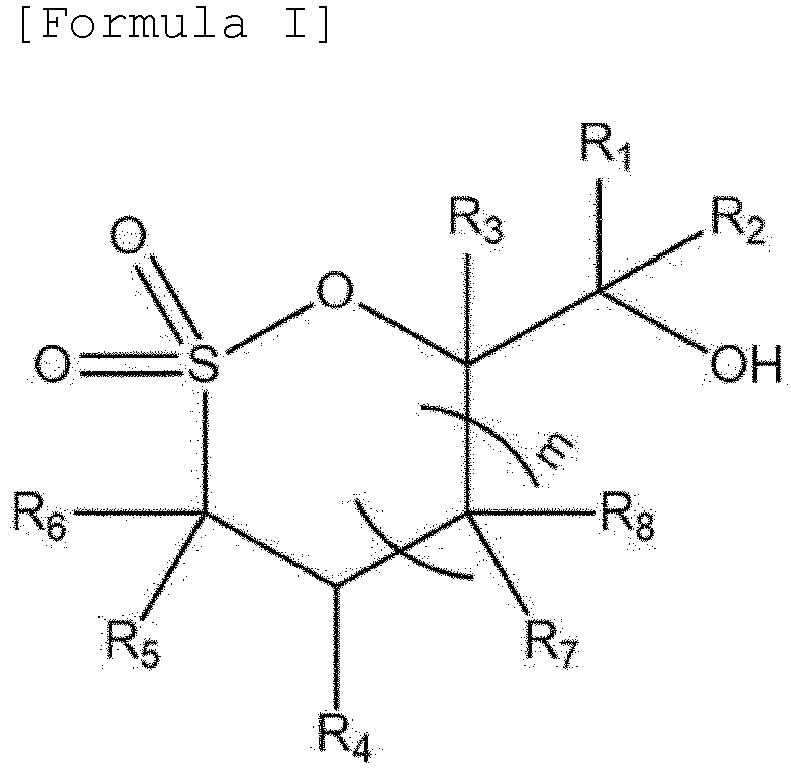
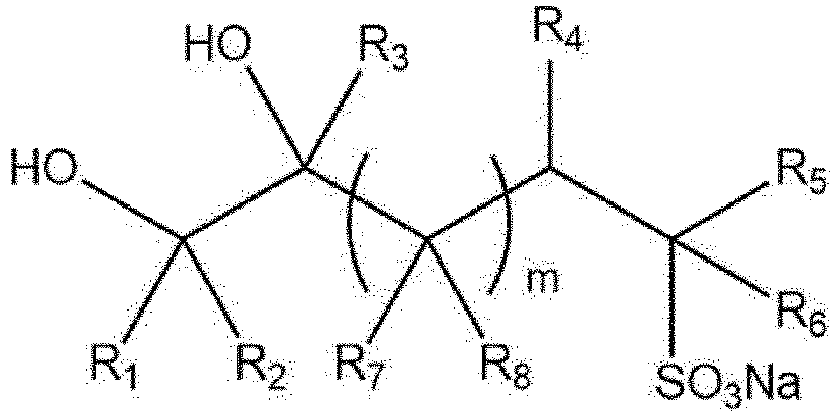
- (1) The present invention provides a compound represented by Formula I.

- In Formula I,
- m is 0 or 1, and
- R1 to R8 are each independently hydrogen; or a substituted or unsubstituted C1-C10 alkyl group.
- (2) The present invention provides the compound according to (1) above, wherein R1 to R8 are each independently hydrogen; or an unsubstituted C1-C6 alkyl group.
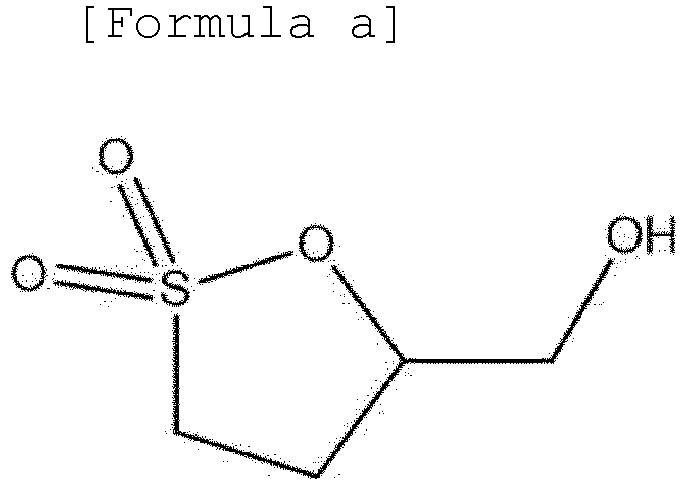
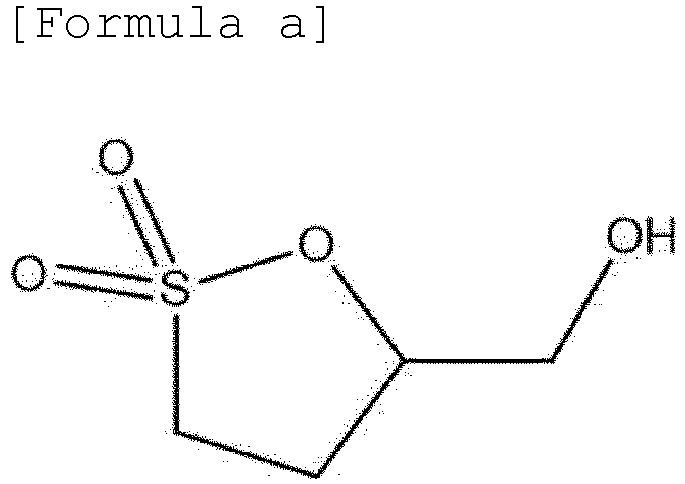
- (3) The present invention provides the compound according to (1) or (2) above, wherein the compound represented by Formula I is a compound represented by Formula a or b.

- (4) In addition, the present invention provides a method for preparing the compound represented by Formula I, comprising: (A) a step of reacting a compound represented by Formula 1 with sodium metabisulfite or sodium hydrogen sulfite to prepare a compound represented by Formula 2; (B) a step of reacting the compound represented by Formula 2 with thionyl halide to prepare a compound represented by Formula 3; and (C) a step of hydrolyzing the compound represented by Formula 3 to prepare the compound represented by Formula I.


- In Formula 1 to Formula 3,
- m is 0 or 1,
- R1 to R8 are each independently hydrogen; or a substituted or unsubstituted C1-C10 alkyl group, and
- X is halogen.
- (5) The present invention provides the method for preparing the compound according to (4) above, wherein R1 to R8 are each independently hydrogen; or an unsubstituted C1-C6 alkyl group.
- (6) The present invention provides the method for preparing the compound according to (4) or (5) above, wherein step (A) is performed under pH 7.0-7.5.
- (7) The present invention provides the method for preparing the compound according to any one of (4) to (6) above, wherein step (A) is performed at 60°C to 70°C.
- (8) The present invention provides the method for preparing the compound according to any one of (4) to (7) above, wherein step (B) is performed at 60°C to 70°C.
- (9) The present invention provides the method for preparing the compound according to any one of (4) to (8) above, wherein step (B) is performed at room temperature.
- By using the compound represented by Formula I according to the present invention, a derivative may be stably introduced at a carbon position beside oxygen in the ring structure of a cyclic sulfonic acid ester derivative compound.
-
FIG. 1 is a 1H-NMR spectrum of a compound represented by Formula a. - Hereinafter, the present invention will be described in more detail.
- It will be understood that words or terms used in the description and claims of the present invention shall not be interpreted as the meaning defined in commonly used dictionaries. It will be understood that the words or terms should be interpreted as having a meaning that is consistent with their meaning in the technical idea of the invention, based on the principle that an inventor may properly define the meaning of the words to best explain the invention.
- The terms used in the specification are used for only explaining example embodiment and do not intend to limit the present invention. The singular forms are intended to include the plural forms as well, unless the context clearly indicates otherwise. It will be further understood that the terms "comprises", "comprising", "having", or the like, used in this specification, specify the presence of stated features, numerals, steps, elements, or the combination thereof, but do not preclude the presence or addition of one or more other features, numerals, steps, elements, or the combination thereof.
- The present invention provides a compound represented by Formula I.

- In Formula I,
- m is 0 or 1, and
- R1 to R8 are each independently hydrogen, or a substituted or unsubstituted C1-C10 alkyl group.
- In the present invention, in a substituted alkyl group, a substituent may be deuterium, a halogen group, a hydroxyl group, an amino group, a thiol group, a cyano group, or a linear or branched C1-C6 alkoxy group.
- The compound represented by Formula I is the precursor of a cyclic sulfonic acid ester derivative compound, and a derivative may be stably introduced at a carbon position beside oxygen in the ring structure of the cyclic sulfonic acid ester derivative compound.
- According to the present invention, in terms of easy synthesis of Formula I, R1 to R8 may be each independently hydrogen; or an unsubstituted C1-C6 alkyl group. Particularly, R1 to R8 may be all hydrogen in terms of easy synthesis and structural stability.
- Meanwhile, if m is 0, it could be more favorable in terms of reduction decomposition.
- According to the present invention, the compound represented by Formula I may be a compound represented by Formula a or b. The compound represented by Formula I may particularly be a compound represented by Formula a.


- Meanwhile, the compound represented by Formula I may be used as a precursor for preparing a cyclic sulfonic acid ester derivative compound. For example, the compound represented by Formula I may be used as a precursor for preparing compound of Formula II.

- In Formula II,
- m is 0 or 1, and
- R1 to R8 are each independently hydrogen; or a substituted or unsubstituted C1-C10 alkyl group,
- Y is -SO2R', -SO3R', -OC(=O)NHR', -OC(=S)NHR', and
- R' is a lithium salt or a substituted or unsubstituted C1-C10 alkyl group.
- The compound represented by Formula II may be prepared by i) reacting the hydroxyl group of the compound represented by Formula I with SOCl2 to form sulfonyl chloride, and then, reacting with an alkyl-alcohol, fluoro-alcohol or cyano-alcohol, or the like, or prepared by ii) reacting the hydroxyl group of the compound represented by Formula I with a compound including a halogen atom, an isocyanate or thiocyanate functional group, or the like.
- If the compound represented by Formula II is included in a nonaqueous electrolyte, a thin and stable SEI layer may be formed, and accordingly, a lithium secondary battery having stability at a high temperature and excellent life characteristics may be provided.
- In addition, the present invention provides a method for preparing the compound represented by Formula I, comprising: (A) a step of reacting a compound represented by Formula 1 with sodium metabisulfite or sodium hydrogen sulfite to prepare a compound represented by Formula 2; (B) a step of reacting the compound represented by Formula 2 with thionyl halide to prepare a compound represented by Formula 3; and (C) a step of hydrolyzing the compound represented by Formula 3 to prepare the compound represented by Formula I.

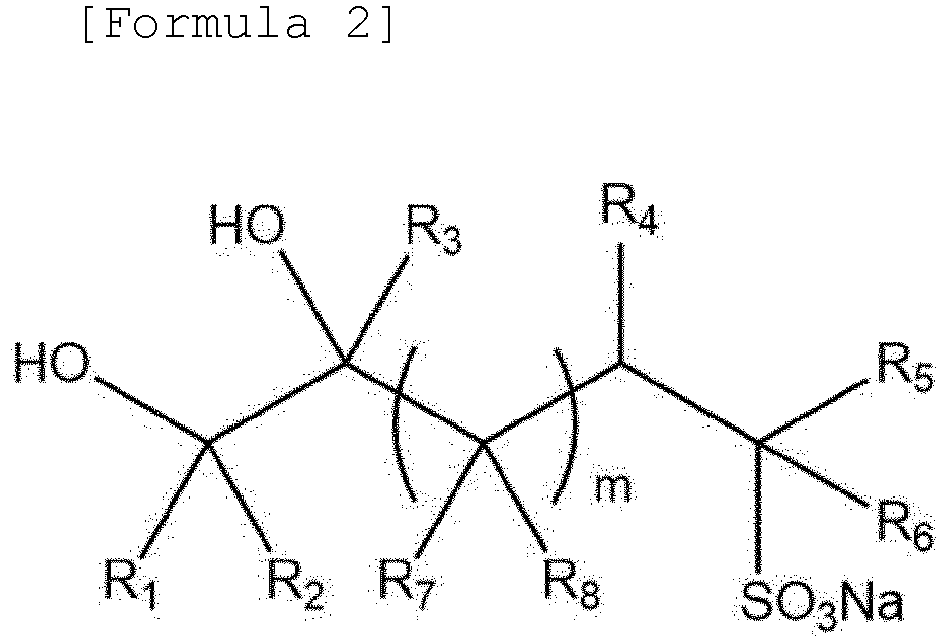

- In Formula 1 to Formula 3,
- m is 0 or 1,
- R1 to R8 are each independently hydrogen; or a substituted or unsubstituted C1-C10 alkyl group, and
- X is a halogen group.
- According to the present invention, R1 to R8 are each independently hydrogen; or an unsubstituted C1-C6 alkyl group in terms of easy synthesis. Particularly, R1 to R8 may be all hydrogen in terms of easy synthesis and structural stability.
- Step (A) is a step of adding sodium hydrogen sulfite to the alkene of the compound represented by Formula 1. In this case, pH may be set so that the sodium hydrogen sulfite may be added to carbon to which R5 and R6 are bonded to produce a main product (the compound represented by Formula 2).
- According to the present invention, step (A) may be performed under pH 7.0-7.5, particularly, pH 7.0-7.3 to produce the compound represented by Formula 2 as a main product, and the pH may be controlled by sodium hydroxide.
- According to the present invention, step (A) may be performed at 60°C to 70°C. Step (A) may particularly be a step of reacting the compound represented by Formula 1 with sodium metabisulfite or sodium hydrogen sulfite at 60°C to 70°C for 5 hours to 10 hours, and water may be used as a solvent.
- Step (B) is a step of forming a ring including -O-S(=O)-O- of the compound represented by Formula 3 by two hydroxyl groups of the compound represented by Formula 2.
- According to the present invention, step (B) may be performed at 60°C to 70°C. Step (B) may particularly be a step of reacting the compound represented by Formula 2 with thionyl halide at 60°C to 70°C for 5 hours to 10 hours, and a nonpolar solvent such as CHCl3 may be used as a solvent. Meanwhile, the thionyl halide of step (B) may be thionyl fluoride or thionyl chloride. In addition, step (B) may be performed under a catalyst such as N,N-dimethylformamide.
- Step (C) is a step of injecting an alcohol or water to Formula 3 that is an intermediate to undergo a hydrolysis process to form a sultone structure.
- According to the present invention, step (C) may be performed at room temperature, for example, at 20°C to 30°C. Step (C) may be a step of reacting the compound represented by Formula 3 with water or an alcohol at room temperature for 1 hour to 5 hours, and the alcohol may be, for example, methanol, ethanol, or the like.
- Hereinafter, a preferred embodiment will be suggested to assist the understanding of the present invention. However, the embodiment is only for illustrating the present invention, and various changes and modifications may be possible within the scope and technical range of the present description. Such changes and modifications are of course possible within the claims attached herewith.
-

- 32 g (368 mmol) of 3-butene-1,2-diol was dissolved in 200 ml of DI water, and 76 g (404 mmol) of Na2S2O5 was injected thereto. Sodium hydroxide was added thereto, and the reaction was performed at 65°C for 7 hours while maintaining pH to a level of 7.0. After finishing the reaction, the reaction solution was cooled to room temperature, and distillation under a reduced pressure was performed. If the solution started to be milky and opaque, the distillation under a reduced pressure was stopped, and methanol was injected. Then, the reaction solution was filtered, and the filtrate solution was distilled under a reduced pressure to precipitate a white solid. The precipitate was dried in a vacuum oven of 60°C, to obtain 77 g (purity: 90%) of sodium 3,4-dihydroxybutane sulfonate.
- 30 g (160 mmol, purity 90%) of 3,4-sodium dihydroxybutane sulfonate was suspended in 200 ml of CHCl3, 0.58 g (10 mmol, Aldrich Co.) of N,N-dimethylformamide (DMF) was added thereto, and 37.57 g (320 mmol, Aldrich Co.) of thionyl chloride was added little by little dropwisely, followed by reacting at 65°C for 7 hours. After finishing the reaction, the reaction solution was cooled to room temperature and filtered, and the filtrate solution was concentrated under a reduced pressure.
- To the solution concentrated under a reduced pressure, 50 g (1.57 mol, Aldrich Co.) of methanol was added, and reaction was performed at room temperature for 2 hours.
- After finishing the reaction, the reaction solution was concentrated under a reduced pressure. To the solution thus concentrated, 50 ml of ethyl acetate and 30 ml of water were added and stirred. An organic layer (ethyl acetate layer) was extracted, washed with water and then concentrated again to obtain 20 g (yield: 83%) of a compound represented by Formula a (5-(hydroxymethyl)-1,2-oxathiolan-2,2-dioxide) as a transparent liquid.
- 1H-NMR data of the compound represented by Formula a are as follows, and a 1H-NMR spectrum is shown in
FIG. 1 . - 1H-NMR (Acetonitrile-d3): δ 4.67(1H), δ 3.6-3.8(2H), δ 3.2-3.4(2H), δ 2.3-2.6(2H)
Claims (9)
- A compound represented by Formula I:
 in Formula I,m is 0 or 1, andR1 to R8 are each independently hydrogen; or a substituted or unsubstituted C1-C10 alkyl group.
 - The compound according to claim 1, wherein R1 to R8 are each independently hydrogen; or an unsubstituted C1-C6 alkyl group.
- The compound according to claim 1, which is represented by Formula a or b:

- A method for preparing the compound according to claim 1, the method comprising:(A) reacting a compound represented by Formula 1 with sodium metabisulfite or sodium hydrogen sulfite to prepare a compound represented by Formula 2;(B) reacting the compound represented by Formula 2 with thionyl halide to prepare a compound represented by Formula 3; and(C) hydrolyzing the compound represented by Formula 3 to prepare the compound represented by Formula I:


 in Formula 1 to Formula 3,m is 0 or 1,R1 to R8 are each independently hydrogen; or a substituted or unsubstituted C1-C10 alkyl group, andX is halogen.
 - The method for preparing the compound according to claim 4, wherein R1 to R8 are each independently hydrogen; or an unsubstituted C1-C6 alkyl group.
- The method for preparing the compound according to claim 4, wherein step (A) is performed under pH 7.0-7.5.
- The method for preparing the compound according to claim 4, wherein step (A) is performed at 60°C to 70°C.
- The method for preparing the compound according to claim 4, wherein step (B) is performed at 60°C to 70°C.
- The method for preparing the compound according to claim 4, wherein step (B) is performed at room temperature.
Applications Claiming Priority (2)
| Application Number | Priority Date | Filing Date | Title |
|---|---|---|---|
| KR20210107249 | 2021-08-13 | ||
| PCT/KR2022/012080 WO2023018276A1 (en) | 2021-08-13 | 2022-08-12 | Compound and preparation method thereof |
Publications (2)
| Publication Number | Publication Date |
|---|---|
| EP4365169A1 true EP4365169A1 (en) | 2024-05-08 |
| EP4365169A4 EP4365169A4 (en) | 2024-11-27 |
Family
ID=85200203
Family Applications (1)
| Application Number | Title | Priority Date | Filing Date |
|---|---|---|---|
| EP22856269.0A Pending EP4365169A4 (en) | 2021-08-13 | 2022-08-12 | Compound and preparation method thereof |
Country Status (6)
| Country | Link |
|---|---|
| US (1) | US20240360097A1 (en) |
| EP (1) | EP4365169A4 (en) |
| JP (1) | JP7722779B2 (en) |
| KR (1) | KR20230025362A (en) |
| CN (1) | CN117881666A (en) |
| WO (1) | WO2023018276A1 (en) |
Family Cites Families (13)
| Publication number | Priority date | Publication date | Assignee | Title |
|---|---|---|---|---|
| JP4281030B2 (en) * | 1998-08-28 | 2009-06-17 | 株式会社ジーエス・ユアサコーポレーション | Non-aqueous electrolyte battery |
| US7608364B2 (en) * | 2003-01-10 | 2009-10-27 | Nec Corporation | Lithium ion secondary battery |
| JP2006172775A (en) * | 2004-12-14 | 2006-06-29 | Hitachi Ltd | Energy storage device, module thereof and automobile using the same |
| WO2012147818A1 (en) * | 2011-04-26 | 2012-11-01 | 宇部興産株式会社 | Non-aqueous electrolytic solution, electrical storage device utilizing same, and cyclic sulfonic acid ester compound |
| CN102807552A (en) * | 2012-07-31 | 2012-12-05 | 福建创鑫科技开发有限公司 | Method for synthetizing 2, 4-butane sulfonic acid lactone |
| KR102234380B1 (en) * | 2014-10-28 | 2021-03-30 | 삼성에스디아이 주식회사 | Electrolyte for rechargeable lithium battery and rechargeable lithium battery including the same |
| PL3349290T3 (en) * | 2015-09-09 | 2024-04-02 | Sumitomo Seika Chemicals Co., Ltd. | Additive for nonaqueous electrolyte solutions, nonaqueous electrolyte solution, and electricity storage device |
| CN105047995B (en) * | 2015-09-22 | 2018-05-08 | 宁德新能源科技有限公司 | Lithium ion battery of electrolyte including the electrolyte and preparation method thereof |
| JP7187125B2 (en) * | 2018-03-27 | 2022-12-12 | 三菱ケミカル株式会社 | NON-AQUEOUS ELECTROLYTE AND ENERGY DEVICE USING THE SAME |
| KR102070028B1 (en) * | 2018-06-27 | 2020-01-29 | 삼화페인트공업주식회사 | Method for preparing sultone derivatives |
| US20210184199A1 (en) * | 2019-12-11 | 2021-06-17 | GM Global Technology Operations LLC | Methods of lithiating metal anodes using electrolytes |
| KR102779079B1 (en) * | 2020-02-28 | 2025-03-11 | 주식회사 엘지에너지솔루션 | Additives for non-aqueous electrolyte, non-aqueous electrolyte and lithium secondary battery comprsing the same |
| KR102803274B1 (en) * | 2020-09-28 | 2025-05-07 | 주식회사 엘지에너지솔루션 | Additives for non-aqueous electrolyte, non-aqueous electrolyte and lithium secondary battery comprsing the same |
-
2022
- 2022-08-12 CN CN202280051076.XA patent/CN117881666A/en active Pending
- 2022-08-12 KR KR1020220101068A patent/KR20230025362A/en active Pending
- 2022-08-12 JP JP2024504234A patent/JP7722779B2/en active Active
- 2022-08-12 EP EP22856269.0A patent/EP4365169A4/en active Pending
- 2022-08-12 WO PCT/KR2022/012080 patent/WO2023018276A1/en not_active Ceased
- 2022-08-12 US US18/292,092 patent/US20240360097A1/en active Pending
Also Published As
| Publication number | Publication date |
|---|---|
| EP4365169A4 (en) | 2024-11-27 |
| KR20230025362A (en) | 2023-02-21 |
| WO2023018276A1 (en) | 2023-02-16 |
| JP7722779B2 (en) | 2025-08-13 |
| CN117881666A (en) | 2024-04-12 |
| JP2024526989A (en) | 2024-07-19 |
| US20240360097A1 (en) | 2024-10-31 |
Similar Documents
| Publication | Publication Date | Title |
|---|---|---|
| ES2536488T3 (en) | Method for the preparation of (R) -1-aryl-2-tetrazolyl-ethyl ester of carbamic acid | |
| JP6954456B2 (en) | Method for Producing Lithium Sulfamate and New Lithium Sulfamate | |
| CN111662268B (en) | Preparation method and application of cyclic sulfate compound | |
| JP2014196303A (en) | Method for producing fluorine-containing n-alkylsulfonylimide compound and method for producing ionic compound | |
| JPWO2008056776A1 (en) | Tetrazolium mesoionic compound, ionic liquid comprising tetrazolium mesoionic compound, and method for producing tetrazolium mesoionic compound | |
| US20240360097A1 (en) | Compound and Method for Preparing Same | |
| US11180469B2 (en) | Method for preparing sultone derivatives | |
| US9550736B2 (en) | Salt of bicyclic aromatic anions for Li-ion batteries | |
| EP4342887B1 (en) | METHOD FOR THE PREPARATION OF A CYCLICAL SULFONIC ACID ESTER DERIVATIVE COMPOUND | |
| WO2018086379A1 (en) | Cyanovinyl sulfonate and synthesis method thereof | |
| AU2023331400A1 (en) | Preparation method for glufosinate or derivative thereof | |
| WO2010113492A1 (en) | Fluorine-containing n-alkyl sulfonyl imide compound, manufacturing method therefor, and method of manufacturing an ionic compound | |
| KR20230108134A (en) | Manufacturing method of cyclic sulfonic acid ester derivative compound | |
| JP2001335590A (en) | Sulfonyl group-containing phosphazene derivative and method for producing the same | |
| JPS63316773A (en) | Process for producing 4-nitro-5-imidazolylether and -thioether | |
| CN115925561B (en) | Synthesis method of hair dye primary intermediate | |
| US20230096085A1 (en) | Fluorine-containing pyrimidine compound and production method therefor | |
| CN119220991B (en) | Preparation method of alkenylsulfinyl imine | |
| JP3044383B2 (en) | Method for producing nitrogen-containing 6-membered ring compound | |
| CN108840857A (en) | A kind of preparation method of quinoline | |
| CN102442947A (en) | Preparation method of Montelukast Sodium intermediate | |
| CN120247826A (en) | A method for preparing tetrazole derivatives | |
| KR101569098B1 (en) | Method for synthesizing heteroleptic ruthenium complex compounds | |
| CN117069624A (en) | Preparation method of fluorosulfonyl carboxylate, esters prepared therefrom and uses of esters | |
| JP2009023915A (en) | Method for producing dithiacyclopentene derivative or diselenacyclopentene derivative |
Legal Events
| Date | Code | Title | Description |
|---|---|---|---|
| STAA | Information on the status of an ep patent application or granted ep patent |
Free format text: STATUS: THE INTERNATIONAL PUBLICATION HAS BEEN MADE |
|
| PUAI | Public reference made under article 153(3) epc to a published international application that has entered the european phase |
Free format text: ORIGINAL CODE: 0009012 |
|
| STAA | Information on the status of an ep patent application or granted ep patent |
Free format text: STATUS: REQUEST FOR EXAMINATION WAS MADE |
|
| 17P | Request for examination filed |
Effective date: 20240130 |
|
| AK | Designated contracting states |
Kind code of ref document: A1 Designated state(s): AL AT BE BG CH CY CZ DE DK EE ES FI FR GB GR HR HU IE IS IT LI LT LU LV MC MK MT NL NO PL PT RO RS SE SI SK SM TR |
|
| DAV | Request for validation of the european patent (deleted) | ||
| DAX | Request for extension of the european patent (deleted) | ||
| A4 | Supplementary search report drawn up and despatched |
Effective date: 20241030 |
|
| RIC1 | Information provided on ipc code assigned before grant |
Ipc: H01M 10/0567 20100101ALI20241024BHEP Ipc: C07D 327/06 20060101ALI20241024BHEP Ipc: C07D 327/04 20060101AFI20241024BHEP |