EP4364733A1 - Copper chelator, anticancer agent and prophylactic or therapeutic agent for wilson's disease - Google Patents
Copper chelator, anticancer agent and prophylactic or therapeutic agent for wilson's disease Download PDFInfo
- Publication number
- EP4364733A1 EP4364733A1 EP22832934.8A EP22832934A EP4364733A1 EP 4364733 A1 EP4364733 A1 EP 4364733A1 EP 22832934 A EP22832934 A EP 22832934A EP 4364733 A1 EP4364733 A1 EP 4364733A1
- Authority
- EP
- European Patent Office
- Prior art keywords
- compound
- copper
- compound represented
- agent
- disease
- Prior art date
- Legal status (The legal status is an assumption and is not a legal conclusion. Google has not performed a legal analysis and makes no representation as to the accuracy of the status listed.)
- Pending
Links
Images

Classifications
-
- A—HUMAN NECESSITIES
- A61—MEDICAL OR VETERINARY SCIENCE; HYGIENE
- A61P—SPECIFIC THERAPEUTIC ACTIVITY OF CHEMICAL COMPOUNDS OR MEDICINAL PREPARATIONS
- A61P35/00—Antineoplastic agents
-
- A—HUMAN NECESSITIES
- A61—MEDICAL OR VETERINARY SCIENCE; HYGIENE
- A61K—PREPARATIONS FOR MEDICAL, DENTAL OR TOILETRY PURPOSES
- A61K31/00—Medicinal preparations containing organic active ingredients
- A61K31/275—Nitriles; Isonitriles
- A61K31/277—Nitriles; Isonitriles having a ring, e.g. verapamil
-
- A—HUMAN NECESSITIES
- A61—MEDICAL OR VETERINARY SCIENCE; HYGIENE
- A61P—SPECIFIC THERAPEUTIC ACTIVITY OF CHEMICAL COMPOUNDS OR MEDICINAL PREPARATIONS
- A61P39/00—General protective or antinoxious agents
- A61P39/02—Antidotes
-
- A—HUMAN NECESSITIES
- A61—MEDICAL OR VETERINARY SCIENCE; HYGIENE
- A61P—SPECIFIC THERAPEUTIC ACTIVITY OF CHEMICAL COMPOUNDS OR MEDICINAL PREPARATIONS
- A61P39/00—General protective or antinoxious agents
- A61P39/04—Chelating agents
-
- C—CHEMISTRY; METALLURGY
- C07—ORGANIC CHEMISTRY
- C07C—ACYCLIC OR CARBOCYCLIC COMPOUNDS
- C07C255/00—Carboxylic acid nitriles
- C07C255/01—Carboxylic acid nitriles having cyano groups bound to acyclic carbon atoms
- C07C255/32—Carboxylic acid nitriles having cyano groups bound to acyclic carbon atoms having cyano groups bound to acyclic carbon atoms of a carbon skeleton containing at least one six-membered aromatic ring
- C07C255/42—Carboxylic acid nitriles having cyano groups bound to acyclic carbon atoms having cyano groups bound to acyclic carbon atoms of a carbon skeleton containing at least one six-membered aromatic ring the carbon skeleton being further substituted by singly-bound nitrogen atoms, not being further bound to other hetero atoms
- C07C255/44—Carboxylic acid nitriles having cyano groups bound to acyclic carbon atoms having cyano groups bound to acyclic carbon atoms of a carbon skeleton containing at least one six-membered aromatic ring the carbon skeleton being further substituted by singly-bound nitrogen atoms, not being further bound to other hetero atoms at least one of the singly-bound nitrogen atoms being acylated
-
- C—CHEMISTRY; METALLURGY
- C07—ORGANIC CHEMISTRY
- C07C—ACYCLIC OR CARBOCYCLIC COMPOUNDS
- C07C291/00—Compounds containing carbon and nitrogen and having functional groups not covered by groups C07C201/00 - C07C281/00
- C07C291/10—Isocyanides
-
- C—CHEMISTRY; METALLURGY
- C12—BIOCHEMISTRY; BEER; SPIRITS; WINE; VINEGAR; MICROBIOLOGY; ENZYMOLOGY; MUTATION OR GENETIC ENGINEERING
- C12P—FERMENTATION OR ENZYME-USING PROCESSES TO SYNTHESISE A DESIRED CHEMICAL COMPOUND OR COMPOSITION OR TO SEPARATE OPTICAL ISOMERS FROM A RACEMIC MIXTURE
- C12P13/00—Preparation of nitrogen-containing organic compounds
- C12P13/002—Nitriles (-CN)
-
- C—CHEMISTRY; METALLURGY
- C12—BIOCHEMISTRY; BEER; SPIRITS; WINE; VINEGAR; MICROBIOLOGY; ENZYMOLOGY; MUTATION OR GENETIC ENGINEERING
- C12R—INDEXING SCHEME ASSOCIATED WITH SUBCLASSES C12C - C12Q, RELATING TO MICROORGANISMS
- C12R2001/00—Microorganisms ; Processes using microorganisms
- C12R2001/01—Bacteria or Actinomycetales ; using bacteria or Actinomycetales
Definitions
- the present invention relates to a copper chelating agent.
- the present invention also relates to an anticancer agent and a prophylactic or therapeutic agent for Wilson's disease.
- Non-Patent Literature 1 describes that a P07101 strain of actinomycetes belonging to the genus Kitasatospora (Kitasatospora sp.) produced hazimycin A and analogous compounds thereof, and hazimycin A had an antimicrobial activity against gram-positive bacteria and Candida albicans.
- Non-Patent Literature 1 Acta Pharmaceutica Sinica B Volume 5, Issue 6, 2015, Pages 564 to 568
- Wilson's disease copper is an essential trace element in life, but when copper is excessively present in cells, it exhibits toxicity.
- Wilson's disease As copper overload, Wilson's disease is known. In Wilson's disease, copper is deposited in organs of the whole body due to disorder of excretion of copper into bile, causing histological damage. Copper chelating agents are used for the treatment of Wilson's disease, but conventionally used therapeutic agents may have strong side effects.
- a substance having a copper chelating action is known to inhibit the action of cytochrome C oxidase, which is an enzyme essential for energy production of cells. When the activity of the cytochrome C oxidase is inhibited, not only energy is insufficient, but also toxic active oxygen is generated.
- a substance having a copper chelating action exhibits, for example, an anticancer action by such an action (for example, Curr Med Chem. 2010; 17(25): pages 2685 to 2698 ). Therefore, a substance having a copper chelating action is also useful as an active ingredient of an anticancer agent. As described above, a compound having a copper chelating action is useful in, for example, the pharmaceutical field, and a new copper chelating agent is required.
- Non-Patent Literature 1 describes that, as described above, hazimycin A had an antimicrobial activity against gram-positive bacteria and the like. However, the chelating action of hazimycin A and its analogous compounds has not been studied.
- An object of the present invention is to provide a copper chelating agent. Another object of the present invention is to provide an anticancer agent and a prophylactic or therapeutic agent for Wilson's disease.
- the copper chelating agent of the present invention contains at least one selected from the group consisting of a compound represented by the following Formula (1), a compound represented by the following Formula (2), a compound represented by the following Formula (3), a compound represented by the following Formula (4), a salt thereof, and a solvate thereof.
- the anticancer agent of the present invention contains at least one selected from the group consisting of a compound represented by the above Formula (1), a compound represented by the above Formula (2), a compound represented by the above Formula (3), a compound represented by the above Formula (4), a salt thereof, and a solvate thereof.
- the prophylactic or therapeutic agent for Wilson's disease of the present invention contains at least one selected from the group consisting of a compound represented by the above Formula (1), a compound represented by the above Formula (2), a compound represented by the above Formula (3), a compound represented by the above Formula (4), a salt thereof, and a solvate thereof.
- a copper chelating agent can be provided. Further, according to the present invention, an anticancer agent and a prophylactic or therapeutic agent for Wilson's disease can be provided.
- the copper chelating agent, the anticancer agent, and the prophylactic or therapeutic agent for Wilson's disease of the present invention will be described.
- the present invention is not limited to the following configuration, and may be appropriately modified without departing from the gist of the present invention.
- the present invention also includes a combination of a plurality of preferred configurations described below.
- the copper chelating agent of the present invention contains at least one selected from the group consisting of a compound represented by the following Formula (1), a compound represented by the following Formula (2), a compound represented by the following Formula (3), a compound represented by the following Formula (4), a salt thereof, and a solvate thereof.
- the compound represented by the above Formula (1) is also referred to as a compound (1) in the present specification.
- At least one compound selected from the group consisting of the compound (1), the compound (2), the compound (3), the compound (4), a salt thereof, and a solvate thereof is also referred to as a compound (I).
- the copper chelating agent of the present invention may contain, as the compound (I), one of the above compounds or two or more thereof.
- the compound (1), the compound (2), the compound (3), and the compound (4) have two asymmetric carbon atoms in the structures thereof.
- These compounds include any of a compound in which each asymmetric carbon atom has an R configuration, a compound in which each asymmetric carbon atom has an S configuration, and a compound of any combination thereof.
- any of racemic compounds, racemic mixtures, single enantiomers, and diastereomeric mixtures thereof is included in the above compounds.
- the compound (1), the compound (2), the compound (3), and the compound (4) are each preferably a compound in which the absolute configurations of two asymmetric carbon atoms are both the S configuration (SS) or a compound in which the absolute configurations of two asymmetric carbon atoms are both the R configuration (RR), more preferably a compound in which the absolute configurations of two asymmetric carbon atoms are both the S configuration (SS).
- Preferred embodiments of the compound represented by the above Formula (1) include a compound represented by the following Formula (1a).
- Preferred embodiments of the compound represented by the above Formula (2) include a compound represented by the following Formula (2a).
- Preferred embodiments of the compound represented by the above Formula (3) include a compound represented by the following Formula (3a).
- Preferred embodiments of the compound represented by the above Formula (4) include a compound represented by the following Formula (4a).
- the compound (1a), the compound (2a), the compound (3a), and the compound (4a) are substances produced by actinomycetes belonging to the genus Kitasatospora.
- the compound (1a), the compound (2a), the compound (3a), the compound (4a), a salt thereof, and a solvate thereof are useful in various fields such as medicines and foods and beverages as substances having a copper chelating action derived from actinomycetes.
- the copper chelating agent of the present invention preferably contains at least one selected from the group consisting of a compound represented by the above Formula (1), a salt thereof, and a solvate thereof.
- the compound (1), a salt thereof, and a solvate thereof are preferable because they have a high copper chelating action.
- the compound (1) is more preferably a compound represented by the above Formula (1a).
- the salt of the compound is not limited as long as it is a pharmaceutically acceptable salt.
- an acidic salt or a basic salt can be employed.
- the acidic salt include inorganic acid salts such as hydrochloride, sulfate, nitrate, hydrofluoride, hydrobromide, and phosphate; and organic acid salts such as acetate, tartrate, lactate, citrate, fumarate, maleate, malate, succinate, methanesulfonate, ethanesulfonate, benzenesulfonate, p-toluenesulfonate, naphthalenesulfonate, and camphorsulfonate.
- Examples of the basic salt include alkali metal salts such as sodium salts and potassium salts; alkaline earth metal salts such as calcium salts and magnesium salts; salts with ammonia; and salts with organic amines such as morpholine, piperidine, pyrrolidine, monoalkylamine, dialkylamine, trialkylamine, mono(hydroxyalkyl)amine, di(hydroxyalkyl)amine, and tri(hydroxyalkyl)amine.
- alkali metal salts such as sodium salts and potassium salts
- alkaline earth metal salts such as calcium salts and magnesium salts
- salts with ammonia and salts with organic amines
- organic amines such as morpholine, piperidine, pyrrolidine, monoalkylamine, dialkylamine, trialkylamine, mono(hydroxyalkyl)amine, di(hydroxyalkyl)amine, and tri(hydroxyalkyl)amine.
- the solvate of the compound or a salt thereof is not limited as long as it is a solvate of the compound or a salt thereof, and a solvent.
- the solvent include water; alcohols such as ethanol and glycerol; and acetic acid.
- the solvate is preferably for example, a hydrate and an alcoholate, more preferably a hydrate.
- the method for producing the compound (I) is not limited.
- the compound (I) can be produced, for example, by a known chemical synthesis method.
- the target compound obtained by synthesis can be purified by an ordinary purification method such as reverse phase high performance liquid chromatography, and chromatography using, for example, an ion exchange resin or a synthetic adsorbent resin.
- the compound (I) can also be produced by a method including a culture step of culturing an actinomycete capable of producing the compound, and a collection step of collecting the compound or a salt thereof, or a solvate thereof from a culture obtained in the culture step.
- Examples of the actinomycete capable of producing the compound (I) include actinomycetes belonging to the genus Kitasatospora, such as an actinomycete P07101 strain of the genus Kitasatospora (Non-Patent Literature 1) and a HV058 strain of Kitasatospora purpeofusca (accession number NITE BP-03475).
- actinomycetes belonging to the genus Kitasatospora such as an actinomycete P07101 strain of the genus Kitasatospora (Non-Patent Literature 1) and a HV058 strain of Kitasatospora purpeofusca (accession number NITE BP-03475).
- Kitasatospora purpeofusca HV058 strain (HV058 SIID.34879-01) has been deposited at the National Institute of Technology and Evaluation, Patent Microorganisms Depositary (292-0818, #122, 2-5-8, Kazusakamatari, Kisarazu-shi, Chiba, Japan) (accession date: 23, April, 2021, accession number: NITE BP-03475).
- the actinomycete P07101 strain of the genus Kitasatospora described in Non-Patent Literature 1 can produce the compound (1a), the compound (2a), the compound (3a), and the compound (4a).
- the culturing in the culture step can be performed according to a known method used for culturing actinomycetes.
- the medium is not limited as long as the actinomycete can grow and the target substance is produced.
- a known medium which is usually used as a medium for actinomycetes can be used as it is, or a medium modified as appropriate can be used.
- a liquid medium or a solid medium can be used, but a liquid medium is preferably used.
- the culture conditions can also be those used for culturing actinomycetes.
- the compound (I) can be accumulated in the culture.
- the culture contains a medium and bacterial cells of actinomycetes.
- the compound (I) accumulates in the medium and/or in the bacterial cells of actinomycetes.
- the compound (I) is collected from a culture obtained in the culture step.
- the compound (I) may be in any form of the above compound or a salt thereof, or a solvate thereof.
- the method for collecting the compound (I) is not limited, and a known method used for separation and purification of a compound can be employed.
- the compound (I) obtained by the above method may be one type or a mixture of two or more types of compounds.
- Whether the desired compound is obtained can be confirmed by a known method (for example, mass spectrometry, nuclear magnetic resonance spectroscopy (NMR), or high-performance liquid chromatography (HPLC)).
- a known method for example, mass spectrometry, nuclear magnetic resonance spectroscopy (NMR), or high-performance liquid chromatography (HPLC)).
- the compound represented by the above Formula (1), the compound represented by the above Formula (2), the compound represented by the above Formula (3), the compound represented by the above Formula (4), a salt thereof, and a solvate thereof have a copper chelating action.
- the copper chelating agent of the present invention usually contains the compound (I) as an active ingredient.
- the copper chelating agent of the present invention can be used in the fields of, for example, medicines, foods and beverages, washing, and daily necessities.
- the copper chelating agent of the present invention can be provided in the form of, for example, medicines, foods and beverages, detergents, and daily necessities.
- the copper chelating agent of the present invention is usually provided as a composition containing components such as the compound (I) and an additive (also referred to as a composition for copper chelate).
- the copper chelating agent can contain components such as optional additives depending on its application.
- the food or beverage may contain, for example, any additive, component, or the like acceptable for foods or beverages, in addition to the compound or a salt thereof, or a solvate thereof.
- the copper chelating agent of the present invention can be used for removal of copper ions, for example, by utilizing the copper chelating action of the compound (I).
- the copper chelating agent of the present invention can be used, for example, in the form of a medicine, as a prophylactic or therapeutic agent for Wilson's disease, an anticancer agent, an agent for removing copper ions from the living body, and an agent for promoting excretion of copper.
- the copper chelating agent of the present invention can be used for removal of copper ions in the production of pharmaceutical preparations.
- the copper chelating agent of the present invention can also be used for the production of foods and beverages, and the like.
- the copper chelating agent of the present invention can be used by utilizing a copper chelating action to remove copper ions from foods and beverages.
- copper can also be utilized by retaining copper by utilizing the copper chelating action of the compound (I).
- the copper chelating agent of the present invention can also be used for, for example, applications of a detergent, a stabilizer, a softener for hard water, a reagent for chelate titration of copper, a reagent for colorimetry, a copper ion buffer, a precipitant or an extractant (reagent for separation and purification of copper salt), and a reagent for gravimetry.
- the compound (I) can be used for the prevention or treatment of a disease in which the copper chelating action is effective for the prevention or treatment thereof.
- a disease in which the copper chelating action is effective for the prevention or treatment thereof examples include cancer and Wilson's disease.
- An anticancer agent containing at least one selected from the group consisting of a compound represented by the above Formula (1), a compound represented by the above Formula (2), a compound represented by the above Formula (3), a compound represented by the above Formula (4), a salt thereof, and a solvate thereof is also one of the present invention.
- a prophylactic or therapeutic agent for Wilson's disease containing at least one selected from the group consisting of a compound represented by the above Formula (1), a compound represented by the above Formula (2), a compound represented by the above Formula (3), a compound represented by the above Formula (4), a salt thereof, and a solvate thereof is also one of the present invention.
- prevention means delaying or preventing the onset of the symptom or disease, or reducing the risk of a subject developing the symptom or disease.
- Treatment means alleviating the symptom or disease, preventing or delaying the worsening of the symptom or disease, or curing the symptom or disease.
- the anticancer agent and the prophylactic or therapeutic agent for Wilson's disease of the present invention usually contain the compound (I) as an active ingredient.
- a preferred embodiment of the compound (I) is the same as that of the copper chelating agent described above.
- the anticancer agent or prophylactic or therapeutic agent for Wilson's disease of the present invention preferably contains at least one selected from the group consisting of a compound represented by the above Formula (1), a salt thereof, and a solvate thereof.
- the compound represented by the above Formula (1) is more preferably a compound represented by the above Formula (1a).
- the copper chelating agent, the anticancer agent, and the prophylactic or therapeutic agent for Wilson's disease of the present invention may be collectively referred to as "agent of the present invention”.
- the application subject (also referred to as an administration subject) of the agent of the present invention is not limited. Examples thereof include mammals such as human, monkey, mouse, rat, rabbit, dog, cat, pig, cow, horse, sheep, and goat, and the application subject is preferably human.
- Examples of the application subject of the anticancer agent include cancer patients, and subjects who desire or need prevention or treatment of cancer.
- Examples of the application subject of the prophylactic or therapeutic agent for Wilson's disease include patients with Wilson's disease, and subjects who desire or need prevention or treatment of Wilson's disease.
- Examples of the application subject of the agent of the present invention include subjects who desire or need removal of copper ions from the body, and subjects who desire or need promotion of excretion of copper ions.
- the form of the agent of the present invention is not limited, and may take a form that is usually used depending on the application.
- the agent of the present invention may contain optional additives in addition to the compound or a salt thereof, or a solvate thereof.
- the additive is not limited as long as it is a pharmaceutically acceptable component.
- examples of such additives include carriers, excipients, binders, disintegrants, lubricants, antioxidants, and colorants.
- the copper chelating agent, the anticancer agent, or the prophylactic or therapeutic agent for Wilson's disease of the present invention is provided, for example, as a pharmaceutical composition containing the compound (I) and an additive such as a pharmaceutically acceptable carrier.
- the administration route when the copper chelating agent, the anticancer agent, or the prophylactic or therapeutic agent for Wilson's disease of the present invention is administered to a subject is not limited, and may be either oral administration or parenteral administration (for example, transdermal, transmucosal, enteral, or injection administration).
- parenteral administration for example, transdermal, transmucosal, enteral, or injection administration.
- the dosage form for oral administration include liquid preparations, tablets, powders, fine granules, granules, dragees, capsules, suspensions, emulsions, and chewables.
- Examples of the dosage form for parenteral administration include injections, drops, and external preparations for skin (for example, patches, creams, and ointments).
- the content of the compound (I) in the agent of the present invention can be appropriately adjusted according to the use mode and the like.
- the content of the compound (I) in the copper chelating agent, the anticancer agent, or the prophylactic or therapeutic agent for Wilson's disease may be, for example, 0.0001 wt% or more and 90 wt% or less, preferably 0.001 wt% or more and 50 wt% or less.
- the amount of the compound (I) is the total thereof.
- the dose thereof can be appropriately set according to, for example, the administration route, the application subject, the body weight of the subject, and the disease, but is not limited thereto.
- the compound (I) when the compound (I) is administered to an adult, the compound (I) can be administered in a range of 0.001 mg/kg or more and 100 mg/kg or less per day.
- the number of administrations is, for example, once, twice, or three times per day.
- the present invention also encompasses a method for preventing or treating cancer or Wilson's disease by administering the compound (I) described above.
- the present invention also encompasses use of the compound (I) for the prevention or treatment of cancer or Wilson's disease.
- the present invention also encompasses use of the compound (I) for the production of a copper chelating agent.
- the present invention also encompasses use of the compound (I) for the production of an anticancer agent or a prophylactic or therapeutic agent for Wilson's disease.
- the present invention also encompasses a method for promoting excretion of copper ions, or a method for removing copper ions by administering the compound (I) described above.
- the present invention also encompasses use of the compound (I) for producing an agent for removing copper ions from the living body, and an agent for promoting excretion of copper ions.
- a preferred subject and the like are the same as the preferred application subject (administration subject) and the like of the agent of the present invention.
- the compound (1a) and the compound (2a) were obtained by culturing a Kitasatospora purpeofusca HV058 strain (hereinafter, described as HV058 strain).
- Kitasatospora purpeofusca HV058 strain was seeded on the following medium and cultured.
- the Kitasatospora purpeofusca HV058 strain has been deposited at the National Institute of Technology and Evaluation, Patent Microorganisms Depositary (292-0818, #122, 2-5-8, Kazusakamatari, Kisarazu-shi, Chiba, Japan) (accession date: 23, April, 2021, accession number: NITE BP-03475).
- the fraction containing the bacterial cells and the synthetic adsorbent was separated by centrifugation from the culture solution of the HV058 strain to which the synthetic adsorbent was added. Then, the bacterial cells and DIAION HP20 were washed with water in an amount 5 times the volume thereof. Subsequently, to the bacterial cells and DIAION HP20, methanol in an amount of 5 times the volume thereof was added, followed by extraction to obtain a crude extraction fraction. The obtained crude extraction fraction was fractionated by silica gel column chromatography.
- the crude extraction fraction was subjected to silica gel column chromatography (Silica gel 60N (spherical, neutral) 63 to 210 ⁇ m, manufactured by Kanto Chemical Co., Inc.), and elution was performed while the methanol content was increased stepwise by 10% from 90% chloroform +10% methanol to finally 100% methanol.
- the desired compound was detected in a 90% chloroform +10% methanol fraction (referred to as a fraction (I)) and a 70% chloroform +30% methanol fraction (referred to as a fraction (II)).
- the desired product was purified from these fractions (I) and (II) by reverse phase high performance liquid chromatography.
- the fraction (I) obtained above was vacuum-dried, and then the obtained powder was dissolved in methanol and purified under the following conditions by high-performance liquid chromatography (HPLC) to fractionate the water-soluble fraction.
- HPLC high-performance liquid chromatography
- Target peaks were detected at elution times of 12 minutes, 25 minutes, and 35 minutes under the above conditions.
- fraction (II) obtained above was vacuum-dried, and then the resulting powder was dissolved in methanol and purified under the above conditions by HPLC in the same manner as the fraction (I) to fractionate the water-soluble fraction.
- An aqueous CuCl 2 solution was added to a methanol solution of 10 mM compound (1a) or 10 mM compound (2a) so as to have a final concentration of 100 mM, and the mixture was shaken at 30°C for 60 minutes, and then analyzed by LC-MS.
- a methanol solution of 10 mM compound (1a) or 10 mM compound (2a) to which an aqueous CuCl 2 solution was not added was also analyzed by LC-MS.
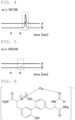
- FIGS. 1 and 2 show the results of LC-MS analysis of a compound (1a) and a sample in which a copper ion is added to the compound (1a).
- FIG. 1 is an MS spectrum of ions at m/z 379.00.
- FIG. 2 is an MS spectrum of ions at m/z 441.00.
- A is a compound (1a) (a methanol solution of the compound (1a) to which a copper ion is not added)
- B is a sample in which a copper ion is added to the compound (1a) (a sample in which a copper ion is added to a methanol solution of the compound (1a)).
- the ion at m/z 379.00 is an ion of the compound (1a). From FIG. 1 , when a copper ion was not added to the compound (1a), a peak of the ion at m/z 379.00 (peak surrounded by a dotted line) was observed (A in FIG. 1 ). Meanwhile, in the sample in which a copper ion was added to the compound (1a), the peak of the ion at m/z 379.00 was not observed (B in FIG. 1 ).
- the ion at m/z 441.00 is an ion of a complex of the compound (1a) and a copper ion. From FIG. 2 , in the sample in which a copper ion was added to the compound (1a), a peak of the ion at m/z 441.00 (peak surrounded by a dotted line) was observed (B in FIG. 2 ). Meanwhile, when a copper ion was not added to the compound (1a), the peak of the ion at m/z 441.00 was not observed (A in FIG. 2 ).
- FIG. 3 shows an estimated chemical formula of a complex of a compound (1a) and a copper ion.
- FIGS. 4 and 5 show the results of LC-MS analysis of a compound (2a) and a sample in which a copper ion is added to the compound (2a).
- FIG. 4 is an MS spectrum of ions at m/z 397.00.
- FIG. 5 is an MS spectrum of ions at m/z 459.00.
- A represents a compound (2a) (a methanol solution of the compound (2a) to which a copper ion is not added)
- B represents a sample in which a copper ion is added to the compound (2a) (a sample in which a copper ion is added to a methanol solution of the compound (2a)).
- the ion at m/z 397.00 is an ion of the compound (2a). From FIG. 4 , when a copper ion was not added to the compound (2a), a peak of the ion at m/z 397.00 (peak surrounded by a dotted line) was observed (A in FIG. 4 ). Meanwhile, in the sample in which a copper ion was added to the compound (2a), the peak of the ion at m/z 397.00 was small (B in FIG. 4 ).
- the ion at m/z 459.00 is an ion of a complex of the compound (2a) and a copper ion. From FIG. 5 , in the sample in which a copper ion was added to the compound (2a), a peak of the ion at m/z 459.00 (peak surrounded by a dotted line) was observed (B in FIG. 5 ). Meanwhile, when a copper ion was not added to the compound (2a), the peak of the ion at m/z 459.00 was not observed (A in FIG. 5 ).
- FIG. 6 shows an estimated chemical formula of a complex of a compound represented by Formula (2a) and a copper ion.
- FIGS. 1 and 2 and FIGS. 4 and 5 show that the copper chelating action of the compound (1a) is stronger than that of the compound (2a). From these results, it was presumed that the isonitrile group (-NC) of these compounds exhibited a copper chelating action.
Landscapes
- Health & Medical Sciences (AREA)
- Chemical & Material Sciences (AREA)
- Organic Chemistry (AREA)
- Life Sciences & Earth Sciences (AREA)
- General Health & Medical Sciences (AREA)
- Medicinal Chemistry (AREA)
- Pharmacology & Pharmacy (AREA)
- Animal Behavior & Ethology (AREA)
- Public Health (AREA)
- Veterinary Medicine (AREA)
- Chemical Kinetics & Catalysis (AREA)
- General Chemical & Material Sciences (AREA)
- Nuclear Medicine, Radiotherapy & Molecular Imaging (AREA)
- Toxicology (AREA)
- Epidemiology (AREA)
- Zoology (AREA)
- Wood Science & Technology (AREA)
- Engineering & Computer Science (AREA)
- Microbiology (AREA)
- Genetics & Genomics (AREA)
- General Engineering & Computer Science (AREA)
- Bioinformatics & Cheminformatics (AREA)
- Biochemistry (AREA)
- Biotechnology (AREA)
- Organic Low-Molecular-Weight Compounds And Preparation Thereof (AREA)
- Pharmaceuticals Containing Other Organic And Inorganic Compounds (AREA)
Abstract
Description
- The present invention relates to a copper chelating agent. The present invention also relates to an anticancer agent and a prophylactic or therapeutic agent for Wilson's disease.
- Physiologically active substances such as antibiotics have been hitherto found from metabolites of actinomycetes. Non-Patent Literature 1 describes that a P07101 strain of actinomycetes belonging to the genus Kitasatospora (Kitasatospora sp.) produced hazimycin A and analogous compounds thereof, and hazimycin A had an antimicrobial activity against gram-positive bacteria and Candida albicans.
- Non-Patent Literature 1: Acta Pharmaceutica Sinica B Volume 5,
- Incidentally, copper is an essential trace element in life, but when copper is excessively present in cells, it exhibits toxicity. As copper overload, Wilson's disease is known. In Wilson's disease, copper is deposited in organs of the whole body due to disorder of excretion of copper into bile, causing histological damage. Copper chelating agents are used for the treatment of Wilson's disease, but conventionally used therapeutic agents may have strong side effects. A substance having a copper chelating action is known to inhibit the action of cytochrome C oxidase, which is an enzyme essential for energy production of cells. When the activity of the cytochrome C oxidase is inhibited, not only energy is insufficient, but also toxic active oxygen is generated. It is considered that a substance having a copper chelating action exhibits, for example, an anticancer action by such an action (for example, Curr Med Chem. 2010; 17(25): pages 2685 to 2698). Therefore, a substance having a copper chelating action is also useful as an active ingredient of an anticancer agent. As described above, a compound having a copper chelating action is useful in, for example, the pharmaceutical field, and a new copper chelating agent is required.
- Non-Patent Literature 1 describes that, as described above, hazimycin A had an antimicrobial activity against gram-positive bacteria and the like. However, the chelating action of hazimycin A and its analogous compounds has not been studied.
- An object of the present invention is to provide a copper chelating agent. Another object of the present invention is to provide an anticancer agent and a prophylactic or therapeutic agent for Wilson's disease.
- The copper chelating agent of the present invention contains at least one selected from the group consisting of a compound represented by the following Formula (1), a compound represented by the following Formula (2), a compound represented by the following Formula (3), a compound represented by the following Formula (4), a salt thereof, and a solvate thereof.

- The anticancer agent of the present invention contains at least one selected from the group consisting of a compound represented by the above Formula (1), a compound represented by the above Formula (2), a compound represented by the above Formula (3), a compound represented by the above Formula (4), a salt thereof, and a solvate thereof.
- The prophylactic or therapeutic agent for Wilson's disease of the present invention contains at least one selected from the group consisting of a compound represented by the above Formula (1), a compound represented by the above Formula (2), a compound represented by the above Formula (3), a compound represented by the above Formula (4), a salt thereof, and a solvate thereof.
- According to the present invention, a copper chelating agent can be provided. Further, according to the present invention, an anticancer agent and a prophylactic or therapeutic agent for Wilson's disease can be provided.
-
-
FIG. 1 shows the results of LC-MS analysis of a compound (1a) and a sample in which a copper ion is added to the compound (1a) (MS spectrum of ions at m/z 379.00) (A: the compound (1a), B: the sample in which a copper ion is added to the compound (1a)). -
FIG. 2 shows the results of LC-MS analysis of a compound (1a) and a sample in which a copper ion is added to the compound (1a) (MS spectrum of ions at m/z 441.00) (A: the compound (1a), B: the sample in which a copper ion is added to the compound (1a)). -
FIG. 3 shows an estimated chemical formula of a complex of a compound (1a) and a copper ion. -
FIG. 4 shows the results of LC-MS analysis of a compound (2a) and a sample in which a copper ion is added to the compound (2a) (MS spectrum of ions at m/z 397.00) (A: the compound (2a), B: the sample in which a copper ion is added to the compound (2a)). -
FIG. 5 shows the results of LC-MS analysis of a compound (2a) and a sample in which a copper ion is added to the compound (2a) (MS spectrum of ions at m/z 459.00) (A: the compound (2a), B: the sample in which a copper ion is added to the compound (2a)). -
FIG. 6 shows an estimated chemical formula of a complex of a compound (2a) and a copper ion. - Hereinafter, the copper chelating agent, the anticancer agent, and the prophylactic or therapeutic agent for Wilson's disease of the present invention will be described. Note that the present invention is not limited to the following configuration, and may be appropriately modified without departing from the gist of the present invention. The present invention also includes a combination of a plurality of preferred configurations described below.
- The copper chelating agent of the present invention contains at least one selected from the group consisting of a compound represented by the following Formula (1), a compound represented by the following Formula (2), a compound represented by the following Formula (3), a compound represented by the following Formula (4), a salt thereof, and a solvate thereof.

- The compound represented by the above Formula (1) is also referred to as a compound (1) in the present specification. The same applies to compounds of other formula numbers, and for example, the compounds represented by Formulae (2) to (4) are also referred to as compounds (2) to (4), respectively.
- At least one compound selected from the group consisting of the compound (1), the compound (2), the compound (3), the compound (4), a salt thereof, and a solvate thereof is also referred to as a compound (I). The copper chelating agent of the present invention may contain, as the compound (I), one of the above compounds or two or more thereof.
- The compound (1), the compound (2), the compound (3), and the compound (4) have two asymmetric carbon atoms in the structures thereof. These compounds include any of a compound in which each asymmetric carbon atom has an R configuration, a compound in which each asymmetric carbon atom has an S configuration, and a compound of any combination thereof. In addition, any of racemic compounds, racemic mixtures, single enantiomers, and diastereomeric mixtures thereof is included in the above compounds.
- The compound (1), the compound (2), the compound (3), and the compound (4) are each preferably a compound in which the absolute configurations of two asymmetric carbon atoms are both the S configuration (SS) or a compound in which the absolute configurations of two asymmetric carbon atoms are both the R configuration (RR), more preferably a compound in which the absolute configurations of two asymmetric carbon atoms are both the S configuration (SS).
- Preferred embodiments of the compound represented by the above Formula (1) include a compound represented by the following Formula (1a).
- Preferred embodiments of the compound represented by the above Formula (2) include a compound represented by the following Formula (2a).
- Preferred embodiments of the compound represented by the above Formula (3) include a compound represented by the following Formula (3a).
- Preferred embodiments of the compound represented by the above Formula (4) include a compound represented by the following Formula (4a).

- The compound (1a), the compound (2a), the compound (3a), and the compound (4a) are substances produced by actinomycetes belonging to the genus Kitasatospora. The compound (1a), the compound (2a), the compound (3a), the compound (4a), a salt thereof, and a solvate thereof are useful in various fields such as medicines and foods and beverages as substances having a copper chelating action derived from actinomycetes.
- The copper chelating agent of the present invention preferably contains at least one selected from the group consisting of a compound represented by the above Formula (1), a salt thereof, and a solvate thereof. The compound (1), a salt thereof, and a solvate thereof are preferable because they have a high copper chelating action. The compound (1) is more preferably a compound represented by the above Formula (1a).
- The salt of the compound is not limited as long as it is a pharmaceutically acceptable salt. As the salt, either an acidic salt or a basic salt can be employed. Examples of the acidic salt include inorganic acid salts such as hydrochloride, sulfate, nitrate, hydrofluoride, hydrobromide, and phosphate; and organic acid salts such as acetate, tartrate, lactate, citrate, fumarate, maleate, malate, succinate, methanesulfonate, ethanesulfonate, benzenesulfonate, p-toluenesulfonate, naphthalenesulfonate, and camphorsulfonate. Examples of the basic salt include alkali metal salts such as sodium salts and potassium salts; alkaline earth metal salts such as calcium salts and magnesium salts; salts with ammonia; and salts with organic amines such as morpholine, piperidine, pyrrolidine, monoalkylamine, dialkylamine, trialkylamine, mono(hydroxyalkyl)amine, di(hydroxyalkyl)amine, and tri(hydroxyalkyl)amine.
- The solvate of the compound or a salt thereof is not limited as long as it is a solvate of the compound or a salt thereof, and a solvent. Examples of the solvent include water; alcohols such as ethanol and glycerol; and acetic acid. Among them, the solvate is preferably for example, a hydrate and an alcoholate, more preferably a hydrate.
- The method for producing the compound (I) is not limited. The compound (I) can be produced, for example, by a known chemical synthesis method. The target compound obtained by synthesis can be purified by an ordinary purification method such as reverse phase high performance liquid chromatography, and chromatography using, for example, an ion exchange resin or a synthetic adsorbent resin.
- The compound (I) can also be produced by a method including a culture step of culturing an actinomycete capable of producing the compound, and a collection step of collecting the compound or a salt thereof, or a solvate thereof from a culture obtained in the culture step.
- Examples of the actinomycete capable of producing the compound (I) include actinomycetes belonging to the genus Kitasatospora, such as an actinomycete P07101 strain of the genus Kitasatospora (Non-Patent Literature 1) and a HV058 strain of Kitasatospora purpeofusca (accession number NITE BP-03475). The Kitasatospora purpeofusca HV058 strain (HV058 SIID.34879-01) has been deposited at the National Institute of Technology and Evaluation, Patent Microorganisms Depositary (292-0818, #122, 2-5-8, Kazusakamatari, Kisarazu-shi, Chiba, Japan) (accession date: 23, April, 2021, accession number: NITE BP-03475). For example, the actinomycete P07101 strain of the genus Kitasatospora described in Non-Patent Literature 1 can produce the compound (1a), the compound (2a), the compound (3a), and the compound (4a).
- The culturing in the culture step can be performed according to a known method used for culturing actinomycetes.
- The medium is not limited as long as the actinomycete can grow and the target substance is produced. As the medium, a known medium which is usually used as a medium for actinomycetes can be used as it is, or a medium modified as appropriate can be used. As the medium, either a liquid medium or a solid medium can be used, but a liquid medium is preferably used.
- The culture conditions can also be those used for culturing actinomycetes.
- By the above culturing, the compound (I) can be accumulated in the culture. The culture contains a medium and bacterial cells of actinomycetes. The compound (I) accumulates in the medium and/or in the bacterial cells of actinomycetes.
- In the collection step, the compound (I) is collected from a culture obtained in the culture step. The compound (I) may be in any form of the above compound or a salt thereof, or a solvate thereof.
- The method for collecting the compound (I) is not limited, and a known method used for separation and purification of a compound can be employed. The compound (I) obtained by the above method may be one type or a mixture of two or more types of compounds.
- Whether the desired compound is obtained can be confirmed by a known method (for example, mass spectrometry, nuclear magnetic resonance spectroscopy (NMR), or high-performance liquid chromatography (HPLC)).
- The compound represented by the above Formula (1), the compound represented by the above Formula (2), the compound represented by the above Formula (3), the compound represented by the above Formula (4), a salt thereof, and a solvate thereof have a copper chelating action. The copper chelating agent of the present invention usually contains the compound (I) as an active ingredient.
- The copper chelating agent of the present invention can be used in the fields of, for example, medicines, foods and beverages, washing, and daily necessities. The copper chelating agent of the present invention can be provided in the form of, for example, medicines, foods and beverages, detergents, and daily necessities. The copper chelating agent of the present invention is usually provided as a composition containing components such as the compound (I) and an additive (also referred to as a composition for copper chelate). The copper chelating agent can contain components such as optional additives depending on its application.
- For example, when the copper chelating agent of the present invention is used as a food or beverage, the food or beverage may contain, for example, any additive, component, or the like acceptable for foods or beverages, in addition to the compound or a salt thereof, or a solvate thereof.
- The copper chelating agent of the present invention can be used for removal of copper ions, for example, by utilizing the copper chelating action of the compound (I). In one embodiment, the copper chelating agent of the present invention can be used, for example, in the form of a medicine, as a prophylactic or therapeutic agent for Wilson's disease, an anticancer agent, an agent for removing copper ions from the living body, and an agent for promoting excretion of copper.
- In one embodiment, the copper chelating agent of the present invention can be used for removal of copper ions in the production of pharmaceutical preparations.
- The copper chelating agent of the present invention can also be used for the production of foods and beverages, and the like. For example, the copper chelating agent of the present invention can be used by utilizing a copper chelating action to remove copper ions from foods and beverages. In one embodiment, copper can also be utilized by retaining copper by utilizing the copper chelating action of the compound (I). For example, it is also possible to prepare a complex in which a copper ion is coordinated to the compound (I) in advance, incorporate the complex in a health food and the like, and use the complex as a supplement of copper.
- The copper chelating agent of the present invention can also be used for, for example, applications of a detergent, a stabilizer, a softener for hard water, a reagent for chelate titration of copper, a reagent for colorimetry, a copper ion buffer, a precipitant or an extractant (reagent for separation and purification of copper salt), and a reagent for gravimetry.
- The compound (I) can be used for the prevention or treatment of a disease in which the copper chelating action is effective for the prevention or treatment thereof. Examples of the disease or condition in which the copper chelating action is effective for the prevention or treatment thereof include cancer and Wilson's disease.
- An anticancer agent containing at least one selected from the group consisting of a compound represented by the above Formula (1), a compound represented by the above Formula (2), a compound represented by the above Formula (3), a compound represented by the above Formula (4), a salt thereof, and a solvate thereof is also one of the present invention.
- A prophylactic or therapeutic agent for Wilson's disease containing at least one selected from the group consisting of a compound represented by the above Formula (1), a compound represented by the above Formula (2), a compound represented by the above Formula (3), a compound represented by the above Formula (4), a salt thereof, and a solvate thereof is also one of the present invention.
- In the present specification, prevention means delaying or preventing the onset of the symptom or disease, or reducing the risk of a subject developing the symptom or disease. Treatment means alleviating the symptom or disease, preventing or delaying the worsening of the symptom or disease, or curing the symptom or disease.
- The anticancer agent and the prophylactic or therapeutic agent for Wilson's disease of the present invention usually contain the compound (I) as an active ingredient.
- In the anticancer agent and the prophylactic or therapeutic agent for Wilson's disease of the present invention, a preferred embodiment of the compound (I) is the same as that of the copper chelating agent described above. The anticancer agent or prophylactic or therapeutic agent for Wilson's disease of the present invention preferably contains at least one selected from the group consisting of a compound represented by the above Formula (1), a salt thereof, and a solvate thereof. The compound represented by the above Formula (1) is more preferably a compound represented by the above Formula (1a).
- Hereinafter, the copper chelating agent, the anticancer agent, and the prophylactic or therapeutic agent for Wilson's disease of the present invention may be collectively referred to as "agent of the present invention".
- The application subject (also referred to as an administration subject) of the agent of the present invention is not limited. Examples thereof include mammals such as human, monkey, mouse, rat, rabbit, dog, cat, pig, cow, horse, sheep, and goat, and the application subject is preferably human. Examples of the application subject of the anticancer agent include cancer patients, and subjects who desire or need prevention or treatment of cancer. Examples of the application subject of the prophylactic or therapeutic agent for Wilson's disease include patients with Wilson's disease, and subjects who desire or need prevention or treatment of Wilson's disease. Examples of the application subject of the agent of the present invention include subjects who desire or need removal of copper ions from the body, and subjects who desire or need promotion of excretion of copper ions.
- The form of the agent of the present invention is not limited, and may take a form that is usually used depending on the application.
- The agent of the present invention may contain optional additives in addition to the compound or a salt thereof, or a solvate thereof. For example, when the agent of the present invention is used in pharmaceutical applications, the additive is not limited as long as it is a pharmaceutically acceptable component. Examples of such additives include carriers, excipients, binders, disintegrants, lubricants, antioxidants, and colorants. The copper chelating agent, the anticancer agent, or the prophylactic or therapeutic agent for Wilson's disease of the present invention is provided, for example, as a pharmaceutical composition containing the compound (I) and an additive such as a pharmaceutically acceptable carrier.
- The administration route when the copper chelating agent, the anticancer agent, or the prophylactic or therapeutic agent for Wilson's disease of the present invention is administered to a subject is not limited, and may be either oral administration or parenteral administration (for example, transdermal, transmucosal, enteral, or injection administration). Examples of the dosage form for oral administration include liquid preparations, tablets, powders, fine granules, granules, dragees, capsules, suspensions, emulsions, and chewables. Examples of the dosage form for parenteral administration include injections, drops, and external preparations for skin (for example, patches, creams, and ointments).
- The content of the compound (I) in the agent of the present invention can be appropriately adjusted according to the use mode and the like. The content of the compound (I) in the copper chelating agent, the anticancer agent, or the prophylactic or therapeutic agent for Wilson's disease may be, for example, 0.0001 wt% or more and 90 wt% or less, preferably 0.001 wt% or more and 50 wt% or less. When two or more types of compounds are used for the compound (I), the amount of the compound (I) is the total thereof.
- When the compound (I) is administered to a subject, the dose thereof can be appropriately set according to, for example, the administration route, the application subject, the body weight of the subject, and the disease, but is not limited thereto. For example, when the compound (I) is administered to an adult, the compound (I) can be administered in a range of 0.001 mg/kg or more and 100 mg/kg or less per day. The number of administrations is, for example, once, twice, or three times per day.
- The present invention also encompasses a method for preventing or treating cancer or Wilson's disease by administering the compound (I) described above. The present invention also encompasses use of the compound (I) for the prevention or treatment of cancer or Wilson's disease.
- The present invention also encompasses use of the compound (I) for the production of a copper chelating agent. The present invention also encompasses use of the compound (I) for the production of an anticancer agent or a prophylactic or therapeutic agent for Wilson's disease.
- The present invention also encompasses a method for promoting excretion of copper ions, or a method for removing copper ions by administering the compound (I) described above. The present invention also encompasses use of the compound (I) for producing an agent for removing copper ions from the living body, and an agent for promoting excretion of copper ions.
- In the above method and use, a preferred subject and the like are the same as the preferred application subject (administration subject) and the like of the agent of the present invention.
- Hereinafter, examples more specifically disclosing the present invention will be described. Note that the present invention is not limited only to these examples.
- The compound (1a) and the compound (2a) were obtained by culturing a Kitasatospora purpeofusca HV058 strain (hereinafter, described as HV058 strain).
- A Kitasatospora purpeofusca HV058 strain was seeded on the following medium and cultured. The Kitasatospora purpeofusca HV058 strain has been deposited at the National Institute of Technology and Evaluation, Patent Microorganisms Depositary (292-0818, #122, 2-5-8, Kazusakamatari, Kisarazu-shi, Chiba, Japan) (accession date: 23, April, 2021, accession number: NITE BP-03475).
- Medium specification: 1 L of
ISP medium 4 to which 4% DIAION (registered trademark) HP20 (manufactured by Mitsubishi Chemical Corporation) was added - Culture conditions: 30°C, 7 days, 140 rpm
-
ISP medium 4 was prepared and used in the following composition. - Components (per 1 L): Soluble starch (10.000 g), K2HPO4 (1.000 g), MgSO4·7H2O (1.000 g), NaCl (1.000 g), (NH4)2SO4 (2.000 g), CaCO3 (2.000 g), FeSO4·7H2O (0.001 g), MnCl2·7H2O (0.001 g), ZnSO4·7H2O (0.001 g)
- Final pH (25°C): 7.2 ± 0.2
- After the above culturing, the fraction containing the bacterial cells and the synthetic adsorbent was separated by centrifugation from the culture solution of the HV058 strain to which the synthetic adsorbent was added. Then, the bacterial cells and DIAION HP20 were washed with water in an amount 5 times the volume thereof. Subsequently, to the bacterial cells and DIAION HP20, methanol in an amount of 5 times the volume thereof was added, followed by extraction to obtain a crude extraction fraction. The obtained crude extraction fraction was fractionated by silica gel column chromatography. Specifically, the crude extraction fraction was subjected to silica gel column chromatography (Silica gel 60N (spherical, neutral) 63 to 210 µm, manufactured by Kanto Chemical Co., Inc.), and elution was performed while the methanol content was increased stepwise by 10% from 90% chloroform +10% methanol to finally 100% methanol. The desired compound was detected in a 90% chloroform +10% methanol fraction (referred to as a fraction (I)) and a 70% chloroform +30% methanol fraction (referred to as a fraction (II)). Thus, the desired product was purified from these fractions (I) and (II) by reverse phase high performance liquid chromatography.
- The fraction (I) obtained above was vacuum-dried, and then the obtained powder was dissolved in methanol and purified under the following conditions by high-performance liquid chromatography (HPLC) to fractionate the water-soluble fraction.
- Apparatus: High-performance liquid chromatograph system Prominence (manufactured by Shimadzu Corporation)
- System controller: CBM-20 Alite
- Pump: LC-20AD
- Detector: SPD-M20A
- Column: Cosmosil 5C18MS-II 10 mm I.D. × 250 mm (manufactured by Nacalai Tesque, Inc.)
- Elution conditions:
- Liquid A: H2O
- Liquid B: Acetonitrile
- Concentration of liquid B: 15 vol%
- Flow rate: 3.0 mL/min
- Temperature: 30°C
- Detection: 210 nm
- Target peaks were detected at elution times of 12 minutes, 25 minutes, and 35 minutes under the above conditions.
- As a result of analyzing fragment ions of the peak at an elution time of 12 minutes by LC-MS/MS, it was found that a compound represented by the following Formula (3a) (compound (3a)) was obtained.
- As a result of analyzing fragment ions of the peak at an elution time of 25 minutes by LC-MS/MS, it was found that a compound represented by the following Formula (1a) (compound (1a)) was obtained.
- As a result of analyzing fragment ions of the peak at an elution time of 35 minutes by LC-MS/MS, it was found that a compound represented by the following Formula (4a) (compound (4a)) was obtained.
- The fraction (II) obtained above was vacuum-dried, and then the resulting powder was dissolved in methanol and purified under the above conditions by HPLC in the same manner as the fraction (I) to fractionate the water-soluble fraction.
- As a result, a target peak was detected at an elution time of 20 minutes. As a result of analyzing fragment ions by LC-MS/MS, it was found that a compound represented by the following Formula (2a) (compound (2a)) was obtained.

- The copper chelating action of the compound represented by the above Formula (1a) (compound (1a)) and the compound represented by the above Formula (2) (compound (2a)) was evaluated by the following method.
- An aqueous CuCl2 solution was added to a methanol solution of 10 mM compound (1a) or 10 mM compound (2a) so as to have a final concentration of 100 mM, and the mixture was shaken at 30°C for 60 minutes, and then analyzed by LC-MS. A methanol solution of 10 mM compound (1a) or 10 mM compound (2a) to which an aqueous CuCl2 solution was not added was also analyzed by LC-MS.
- Pure water to which 0.1% formic acid was added was used as a solvent A, and acetonitrile was used as a solvent B. The samples were separated on a reversed-phase column (Cosmosil 5.0C18-MS-II 2.0 × 100 mm (manufactured by Nacalai Tesque, Inc.)). At this time, the flow rate was set to 0.2 ml/min, and elution was performed in a gradient mode in which the proportion of the solvent B was set to 2% until 2 minutes, and then changed from 2 to 98% from 2 to 15 minutes. The eluted sample was ionized by electrospray ionization method in a positive mode.
- The results of the LC-MS analysis are shown in
FIGS. 1, 2 ,4 and 5 . -
FIGS. 1 and 2 show the results of LC-MS analysis of a compound (1a) and a sample in which a copper ion is added to the compound (1a).FIG. 1 is an MS spectrum of ions at m/z 379.00.FIG. 2 is an MS spectrum of ions at m/z 441.00. InFIGS. 1 and 2 , A is a compound (1a) (a methanol solution of the compound (1a) to which a copper ion is not added), and B is a sample in which a copper ion is added to the compound (1a) (a sample in which a copper ion is added to a methanol solution of the compound (1a)). - The ion at m/z 379.00 is an ion of the compound (1a). From
FIG. 1 , when a copper ion was not added to the compound (1a), a peak of the ion at m/z 379.00 (peak surrounded by a dotted line) was observed (A inFIG. 1 ). Meanwhile, in the sample in which a copper ion was added to the compound (1a), the peak of the ion at m/z 379.00 was not observed (B inFIG. 1 ). - The ion at m/z 441.00 is an ion of a complex of the compound (1a) and a copper ion. From
FIG. 2 , in the sample in which a copper ion was added to the compound (1a), a peak of the ion at m/z 441.00 (peak surrounded by a dotted line) was observed (B inFIG. 2 ). Meanwhile, when a copper ion was not added to the compound (1a), the peak of the ion at m/z 441.00 was not observed (A inFIG. 2 ). - The above results show that the compound (1a) has a copper chelating action.
FIG. 3 shows an estimated chemical formula of a complex of a compound (1a) and a copper ion. -
FIGS. 4 and 5 show the results of LC-MS analysis of a compound (2a) and a sample in which a copper ion is added to the compound (2a).FIG. 4 is an MS spectrum of ions at m/z 397.00.FIG. 5 is an MS spectrum of ions at m/z 459.00. InFIGS. 4 and 5 , A represents a compound (2a) (a methanol solution of the compound (2a) to which a copper ion is not added), and B represents a sample in which a copper ion is added to the compound (2a) (a sample in which a copper ion is added to a methanol solution of the compound (2a)). - The ion at m/z 397.00 is an ion of the compound (2a). From
FIG. 4 , when a copper ion was not added to the compound (2a), a peak of the ion at m/z 397.00 (peak surrounded by a dotted line) was observed (A inFIG. 4 ). Meanwhile, in the sample in which a copper ion was added to the compound (2a), the peak of the ion at m/z 397.00 was small (B inFIG. 4 ). - The ion at m/z 459.00 is an ion of a complex of the compound (2a) and a copper ion. From
FIG. 5 , in the sample in which a copper ion was added to the compound (2a), a peak of the ion at m/z 459.00 (peak surrounded by a dotted line) was observed (B inFIG. 5 ). Meanwhile, when a copper ion was not added to the compound (2a), the peak of the ion at m/z 459.00 was not observed (A inFIG. 5 ). - The above results show that the compound (2a) has a copper chelating action.
FIG. 6 shows an estimated chemical formula of a complex of a compound represented by Formula (2a) and a copper ion. - A comparison between
FIGS. 1 and 2 andFIGS. 4 and 5 show that the copper chelating action of the compound (1a) is stronger than that of the compound (2a). From these results, it was presumed that the isonitrile group (-NC) of these compounds exhibited a copper chelating action.
Claims (4)
- A copper chelating agent comprising at least one selected from the group consisting of a compound represented by the following Formula (1), a compound represented by the following Formula (2), a compound represented by the following Formula (3), a compound represented by the following Formula (4), a salt thereof, and a solvate thereof.

- An anticancer agent comprising at least one selected from the group consisting of a compound represented by the following Formula (1), a compound represented by the following Formula (2), a compound represented by the following Formula (3), a compound represented by the following Formula (4), a salt thereof, and a solvate thereof.


- A prophylactic or therapeutic agent for Wilson's disease, comprising at least one selected from the group consisting of a compound represented by the following Formula (1), a compound represented by the following Formula (2), a compound represented by the following Formula (3), a compound represented by the following Formula (4), a salt thereof, and a solvate thereof.

- The agent according to any one of claims 1 to 3, comprising at least one selected from the group consisting of the compound represented by Formula (1), a salt thereof, and a solvate thereof.
Applications Claiming Priority (2)
| Application Number | Priority Date | Filing Date | Title |
|---|---|---|---|
| JP2021109058 | 2021-06-30 | ||
| PCT/JP2022/024735 WO2023276786A1 (en) | 2021-06-30 | 2022-06-21 | Copper chelator, anticancer agent and prophylactic or therapeutic agent for wilson's disease |
Publications (2)
| Publication Number | Publication Date |
|---|---|
| EP4364733A1 true EP4364733A1 (en) | 2024-05-08 |
| EP4364733A4 EP4364733A4 (en) | 2025-08-06 |
Family
ID=84691756
Family Applications (1)
| Application Number | Title | Priority Date | Filing Date |
|---|---|---|---|
| EP22832934.8A Pending EP4364733A4 (en) | 2021-06-30 | 2022-06-21 | Copper chelator, anticancer agent, and prophylactic or therapeutic agent for Wilson's disease |
Country Status (5)
| Country | Link |
|---|---|
| US (1) | US20240139144A1 (en) |
| EP (1) | EP4364733A4 (en) |
| JP (1) | JP7619580B2 (en) |
| CN (1) | CN117769415A (en) |
| WO (1) | WO2023276786A1 (en) |
Family Cites Families (2)
| Publication number | Priority date | Publication date | Assignee | Title |
|---|---|---|---|---|
| US4440751A (en) * | 1980-10-06 | 1984-04-03 | Schering Corporation | Broad spectrum antibiotic complex produced by a novel micromonospora |
| JP2003521453A (en) * | 1998-09-25 | 2003-07-15 | グリコックス コーポレイション リミティド | Fructoseamine oxidase: antagonists and inhibitors |
-
2022
- 2022-06-21 JP JP2023531841A patent/JP7619580B2/en active Active
- 2022-06-21 EP EP22832934.8A patent/EP4364733A4/en active Pending
- 2022-06-21 CN CN202280046380.5A patent/CN117769415A/en active Pending
- 2022-06-21 WO PCT/JP2022/024735 patent/WO2023276786A1/en not_active Ceased
-
2023
- 2023-12-26 US US18/396,305 patent/US20240139144A1/en active Pending
Also Published As
| Publication number | Publication date |
|---|---|
| JPWO2023276786A1 (en) | 2023-01-05 |
| EP4364733A4 (en) | 2025-08-06 |
| CN117769415A (en) | 2024-03-26 |
| JP7619580B2 (en) | 2025-01-22 |
| WO2023276786A1 (en) | 2023-01-05 |
| US20240139144A1 (en) | 2024-05-02 |
Similar Documents
| Publication | Publication Date | Title |
|---|---|---|
| Miles et al. | Isolation and identification of pectenotoxins-13 and-14 from Dinophysis acuta in New Zealand | |
| CA2754154C (en) | Method for the industrial purification of biologically active phycotoxins | |
| EP2500022A1 (en) | Antibacterial agent for drug-resistant bacteria, method for screening for same, and use of same | |
| US20240139144A1 (en) | Copper chelator, anticancer agent and prophylactic or therapeutic agent for wilson's disease | |
| JP3107584B2 (en) | Antibiotic GE2270 factors B1, B2, C1, C2, D1, D2, E and T | |
| KR100249871B1 (en) | Antibiotic ge 2270 factor c2a | |
| KR101308539B1 (en) | novel compounds Fusarisetins and uses thereof | |
| EP4365301A1 (en) | Compound, manufacturing method therefor, antimicrobial agent, and medicinal drug | |
| NZ221527A (en) | Scymnol sulphates | |
| CN113387788B (en) | Podosporone compound and its preparation method and use | |
| JP2004083529A (en) | Blood pressure suppressant using red koji yeast, and production method therefor | |
| JP3733163B2 (en) | Compound TAN-2177, its production and use | |
| JP6660301B2 (en) | Novel compound, its production method and its use | |
| EP2103304A1 (en) | Composition for improving brain function | |
| CN103374057B (en) | A kind of compound glycine transporter to inhibit activities | |
| CN104232711B (en) | The isolation and purification method of iron chelate in a kind of natural products | |
| JP2023072735A (en) | Oral composition for treating or preventing xeroderma | |
| JP5802518B2 (en) | Novel compound, method for producing the same, and use thereof | |
| KR20250006724A (en) | Novel diterpene compounds and derivatives, uses thereof, and producing method thereof | |
| EP0289354A2 (en) | Antibiotic TAN-950A, its production and use | |
| JP4755248B2 (en) | Novel antibiotics, bisporides A1, A2 and A3 and bisporides B1, B2a, B2b and B3 and methods for producing these antibiotics | |
| JPS59139320A (en) | Antitumor agent | |
| CN117062824A (en) | Compounds for treating neurodegenerative diseases and methods for isolating them | |
| JPH0565260A (en) | Polyene compound and its production | |
| JPH08119992A (en) | New antitumor substance |
Legal Events
| Date | Code | Title | Description |
|---|---|---|---|
| STAA | Information on the status of an ep patent application or granted ep patent |
Free format text: STATUS: THE INTERNATIONAL PUBLICATION HAS BEEN MADE |
|
| PUAI | Public reference made under article 153(3) epc to a published international application that has entered the european phase |
Free format text: ORIGINAL CODE: 0009012 |
|
| STAA | Information on the status of an ep patent application or granted ep patent |
Free format text: STATUS: REQUEST FOR EXAMINATION WAS MADE |
|
| 17P | Request for examination filed |
Effective date: 20240126 |
|
| AK | Designated contracting states |
Kind code of ref document: A1 Designated state(s): AL AT BE BG CH CY CZ DE DK EE ES FI FR GB GR HR HU IE IS IT LI LT LU LV MC MK MT NL NO PL PT RO RS SE SI SK SM TR |
|
| DAV | Request for validation of the european patent (deleted) | ||
| DAX | Request for extension of the european patent (deleted) | ||
| A4 | Supplementary search report drawn up and despatched |
Effective date: 20250709 |
|
| RIC1 | Information provided on ipc code assigned before grant |
Ipc: A61K 31/277 20060101AFI20250703BHEP Ipc: A61P 35/00 20060101ALI20250703BHEP Ipc: A61P 39/02 20060101ALI20250703BHEP Ipc: A61P 39/04 20060101ALI20250703BHEP Ipc: C07C 291/10 20060101ALI20250703BHEP Ipc: C12P 1/06 20060101ALI20250703BHEP Ipc: C07C 255/44 20060101ALI20250703BHEP |