EP4362519A2 - Kommunikationsendgerät, netzwerkvorrichtung, kommunikationsverfahren und aufdeckungsverfahren - Google Patents
Kommunikationsendgerät, netzwerkvorrichtung, kommunikationsverfahren und aufdeckungsverfahren Download PDFInfo
- Publication number
- EP4362519A2 EP4362519A2 EP24163790.9A EP24163790A EP4362519A2 EP 4362519 A2 EP4362519 A2 EP 4362519A2 EP 24163790 A EP24163790 A EP 24163790A EP 4362519 A2 EP4362519 A2 EP 4362519A2
- Authority
- EP
- European Patent Office
- Prior art keywords
- suci
- network apparatus
- scheme
- identifier
- protection scheme
- Prior art date
- Legal status (The legal status is an assumption and is not a legal conclusion. Google has not performed a legal analysis and makes no representation as to the accuracy of the status listed.)
- Granted
Links
Images


Classifications
-
- H—ELECTRICITY
- H04—ELECTRIC COMMUNICATION TECHNIQUE
- H04W—WIRELESS COMMUNICATION NETWORKS
- H04W12/00—Security arrangements; Authentication; Protecting privacy or anonymity
- H04W12/02—Protecting privacy or anonymity, e.g. protecting personally identifiable information [PII]
-
- H—ELECTRICITY
- H04—ELECTRIC COMMUNICATION TECHNIQUE
- H04L—TRANSMISSION OF DIGITAL INFORMATION, e.g. TELEGRAPHIC COMMUNICATION
- H04L63/00—Network architectures or network communication protocols for network security
- H04L63/04—Network architectures or network communication protocols for network security for providing a confidential data exchange among entities communicating through data packet networks
- H04L63/0407—Network architectures or network communication protocols for network security for providing a confidential data exchange among entities communicating through data packet networks wherein the identity of one or more communicating identities is hidden
- H04L63/0414—Network architectures or network communication protocols for network security for providing a confidential data exchange among entities communicating through data packet networks wherein the identity of one or more communicating identities is hidden during transmission, i.e. party's identity is protected against eavesdropping, e.g. by using temporary identifiers, but is known to the other party or parties involved in the communication
-
- H—ELECTRICITY
- H04—ELECTRIC COMMUNICATION TECHNIQUE
- H04L—TRANSMISSION OF DIGITAL INFORMATION, e.g. TELEGRAPHIC COMMUNICATION
- H04L63/00—Network architectures or network communication protocols for network security
- H04L63/04—Network architectures or network communication protocols for network security for providing a confidential data exchange among entities communicating through data packet networks
- H04L63/0428—Network architectures or network communication protocols for network security for providing a confidential data exchange among entities communicating through data packet networks wherein the data content is protected, e.g. by encrypting or encapsulating the payload
-
- H—ELECTRICITY
- H04—ELECTRIC COMMUNICATION TECHNIQUE
- H04W—WIRELESS COMMUNICATION NETWORKS
- H04W12/00—Security arrangements; Authentication; Protecting privacy or anonymity
- H04W12/03—Protecting confidentiality, e.g. by encryption
-
- H—ELECTRICITY
- H04—ELECTRIC COMMUNICATION TECHNIQUE
- H04W—WIRELESS COMMUNICATION NETWORKS
- H04W12/00—Security arrangements; Authentication; Protecting privacy or anonymity
- H04W12/04—Key management, e.g. using generic bootstrapping architecture [GBA]
- H04W12/047—Key management, e.g. using generic bootstrapping architecture [GBA] without using a trusted network node as an anchor
- H04W12/0471—Key exchange
-
- H—ELECTRICITY
- H04—ELECTRIC COMMUNICATION TECHNIQUE
- H04W—WIRELESS COMMUNICATION NETWORKS
- H04W12/00—Security arrangements; Authentication; Protecting privacy or anonymity
- H04W12/06—Authentication
-
- H—ELECTRICITY
- H04—ELECTRIC COMMUNICATION TECHNIQUE
- H04W—WIRELESS COMMUNICATION NETWORKS
- H04W12/00—Security arrangements; Authentication; Protecting privacy or anonymity
- H04W12/10—Integrity
-
- H—ELECTRICITY
- H04—ELECTRIC COMMUNICATION TECHNIQUE
- H04W—WIRELESS COMMUNICATION NETWORKS
- H04W12/00—Security arrangements; Authentication; Protecting privacy or anonymity
- H04W12/60—Context-dependent security
- H04W12/69—Identity-dependent
- H04W12/72—Subscriber identity
Definitions
- the present disclosure relates to a next-generation system that can include unified data management (UDM).
- UDM unified data management
- UDM unified data management
- SIDF subscription identifier de-concealing function
- SUCI is generated by user equipment (UE).
- UE user equipment
- SUCI includes a concealed subscription permanent identifier (SUPI).
- Non Patent Literature 1 discloses that UDM performs SUCI de-concealment to obtain SUPI.
- UDM selects an authentication method used for authentication processing between a terminal and a network based on SUPI.
- the related art described above has a problem in that UDM cannot execute the SUCI de-concealment process because a protection scheme used for concealment of SUPI is unknown to the UDM.
- An object of the present disclosure is to provide a communication terminal, a network apparatus, and a method that solve the above problem.
- a communication terminal comprises control means for generating a Subscription Concealed Identifier (SUCI) including a Subscription Permanent Identifier (SUPI) concealed using a predetermined protection scheme and a protection scheme identifier identifying the protection scheme, and transmission means for sending the SUCI to a first network apparatus during Registration Procedure, the SUCI being sent for a second network apparatus to de-conceal the SUPI from the SUCI based on the protection scheme used to generate the SUCI.
- SUCI Subscription Concealed Identifier
- SUPI Subscription Permanent Identifier
- a network apparatus comprises reception means for receiving a message including a Subscription Concealed Identifier (SUCI) generated by a communication terminal, the SUCI including a Subscription Permanent Identifier (SUPI) concealed using a protection scheme and a protection scheme identifier identifying the protection scheme, and control means for de-concealing the SUPI from the SUCI based on the protection scheme used to generate the SUCI.
- SUCI Subscription Concealed Identifier
- SUPI Subscription Permanent Identifier
- a communication method comprises generating a Subscription Concealed Identifier (SUCI) including a Subscription Permanent Identifier (SUPI) concealed using a predetermined protection scheme and a protection scheme identifier identifying the protection scheme, and sending the SUCI to a first network apparatus during Registration Procedure, the SUCI being sent for a second network apparatus to de-conceal the SUPI from the SUCI based on the protection scheme used to generate the SUCI.
- SUCI Subscription Concealed Identifier
- SUPI Subscription Permanent Identifier
- a de-concealment method comprises receiving a message including a Subscription Concealed Identifier (SUCI) generated by a communication terminal, the SUCI including a Subscription Permanent Identifier (SUPI) concealed using a protection scheme and a protection scheme identifier identifying the protection scheme, and de-concealing the SUPI from the SUCI based on the protection scheme used to generate the SUCI.
- SUCI Subscription Concealed Identifier
- SUPI Subscription Permanent Identifier
- An effect in the present disclosure resides in that SUPI can be reliably acquired in a network.
- the inventors state that there are the following two problems in the SUCI de-concealment process based on SIDF services.
- PLMN public land mobile network
- protection scheme ex. SUPI concealment scheme and its method, or elliptic curve or security profile used in SUPI concealment
- the home network will not be able to de-conceal the SUPI, and hence identification of a subscription/subscriber will not be possible.
- the problem scenario is considered the following cases.
- Various elliptic curves proposed for SUPI concealment in 5G include secp384r1, NIST P-384, NIST P-256, brainpool384, brainpool256, M-383, Curve41417, and Curve25519.
- the UDM in the home network offers the SIDF service, where a UDM is required to handle the de-concealment of SUPIs with different protection schemes for a large number of subscribers simultaneously.
- a single point failure at UDM/SIDF will affect the entire SUPI de-concealment process in a PLMN.
- SPSI sent by UE is not protected during the sending to the core network, the SPSI may get tampered by an attacker, and it will leave the core network unable to identify a right protection scheme, so that SUPI de-concealment process will fail.
- the SUPI security profile identifier indicates a security profile that contains the security parameters such as a key derivation function (KDF), hash, a message authentication code (MAC), mackeylen, maclen, ENC, enckeylen, EC Diffie-Hellman primitive, EC domain parameters, point compression, backwards compatibility mode to support in SUCI de-concealment.
- KDF key derivation function
- MAC message authentication code
- mackeylen maclen
- ENC enckeylen
- EC Diffie-Hellman primitive EC Diffie-Hellman primitive
- point compression point compression
- backwards compatibility mode to support in SUCI de-concealment.
- the SPSI is sent by the UE to the network along with the SUCI as its sub-parameter or as an individual parameter during a registration procedure.
- the home network Based on the SPSI received from the UE, the home network identifies the protection scheme or method, or the elliptic curve or the security profile used for SUPI concealment. The network uses this information to identify an appropriate protection scheme/method/ECC curve/security profile to de-conceal (decrypt) the SUPI from SUCI accordingly.
- UDM instance invokes the SIDF service/functionality/function to de-conceal the SUCI.
- the UDM may offer SIDF services specific to the different SUPI protection schemes supported in 5G (the UDM has/offers multiple SIDF instances or services or functionalities).
- the UDM/AUSF invokes a right UDM/SIDF instance or SIDF service to de-conceal the SUCI based on a curve type and/or SUPI protection scheme and its method or a security profile used in SUPI concealment which are notified by the SPSI.
- UDM/AUSF invokes the right UDM/SIDF instance or SIDF service based on an access type.
- UDM/AUSF invokes the right UDM/SIDF instance or SIDF service to de-conceal SUPI based on SUPI types such as international mobile subscriber identify (IMSI) and non-IMSI types.
- SUPI international mobile subscriber identify
- IMSI international mobile subscriber identify
- UDM/AUSF invokes the right UDM/SIDF instance or SIDF service to de-conceal SUPI based on the service types or network slices provided to the UE.
- AUSF in a home network invokes SIDF in a case where the AUSF receives a subscription identification request/information request message from the serving network with SUCI and SPSI to de-conceal SUCI.
- SPSI is notified to the AUSF by UE via the serving network.
- a home network entity/AUSF invokes the right UDM/SIDF instance to de-conceal the SUCI based on the SUPI protection scheme indicated by the SPSI.
- Variant 1 More than one UDM instance provide SIDF service, where each instance supports all the 5G supported SUPI protection schemes to prevent single point of failure.
- Variant 2 More than one UDM instance provide SIDF service, where every instance supports a specific SUPI protection schemes used in 5G to prevent single point of failure.
- Variant 3 For every SUPI protection scheme supported in 5G, multiple UDM instances may offer a similar service to prevent single point of failure.
- Variant 4 Specific UDM/SIDF instance is assigned and invoked for handling a SUPI de-concealment service request from AUSF/UDM for entities outside PLMN.
- Variant 5 Specific UDM/SIDF instance is assigned and invoked for handling a SUPI de-concealment service request from AUSF for 3rd party service providers.
- the integrity of SPSI is protected by UE using a secret key shared between the UE and a home network.
- the secret key is pre-provisioned at UE by the home network or generated at the UE and the home network. If a shared secret key is used for SPSI integrity protection, it may be an ephemeral shared key, an ephemeral master shared key, an ephemeral mac key, or a key derived from these keys during execution of an elliptic curve integrated encryption scheme or other elliptic curve based protection schemes.
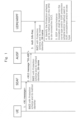
- the MAC generation and an SPSI integrity verification process is shown in Fig. 2 .
- the home network generates a MAC using a secret shared key and verifies the MAC of SPSI received from UE to check if the SPSI is not tampered by any attacker.
- a function (f) used in MAC generation may be any mac algorithm such as NIA-1, NIA-2 or NIA-3.
- SPSI is optionally confidentiality protected by UE using an HN public key. If the SPSI is confidentiality protected, the home network decrypts the SPSI using its private key or a key derived from the private key.
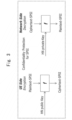
- An SPSI encryption and decryption process is shown in Fig. 3 .
- Functions (f) are an encryption algorithm at a UE side and a decryption algorithm at a network side which are used for SPSI confidentiality protection.
- the SPSI confidentiality protection is based on public-key cryptography (asymmetric) encryption algorithms like RSA or elliptic curve cryptography (ECC) or any other schemes derived therefrom.
- SPSI confidentiality has an advantage that the SPSI confidentiality ensures subscriber/subscription/user privacy in all scenarios including a case where a null scheme is used in SUPI concealment/protection.
- an algorithm or a function is used for integrity protection or encryption of SPSI, then (i) it may be negotiated between UE and a core network, or (ii) an algorithm ID/function ID may be sent by UE in a registration request.
- a method for lack of SUPI protection scheme and its method indication includes the following steps.
- a method for lack of integrity and confidentiality protection of SUPI protection scheme identifier includes the following steps.
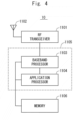
- Fig. 4 is a block diagram showing a configuration example of the communication terminal 10.
- the communication terminal 10 may be UE.
- a radio frequency (RF) transceiver 1101 performs analog RF signal processing for communicating with a base station.
- the analog RF signal processing to be performed by the RF transceiver 1101 includes frequency up conversion, frequency down conversion, and amplification.
- the RF transceiver 1101 is coupled with an antenna 1102 and a baseband processor 1103.
- the RF transceiver 1101 receives modulation symbol data from the baseband processor 1103, generates a transmission RF signal, and supplies the transmission RF signal to the antenna 1102.
- the modulation symbol data may be orthogonal frequency division multiplexing (OFDM) symbol data.
- the RF transceiver 1101 also generates a baseband reception signal based on the reception RF signal received by the antenna 1102, and supplies this to the baseband processor 1103.
- OFDM orthogonal frequency division multiplexing
- the baseband processor 1103 performs digital baseband signal processing (data plane processing) and control plane processing for wireless communication.
- the digital baseband signal processing includes (a) data compression/decompression, (b) data segmentation/concatenation, and (c) transmission format (transmission frame) generation/decomposition.
- the digital baseband signal processing includes (d) channel coding/decoding, and (e) modulation (symbol mapping)/demodulation.
- the digital baseband signal processing includes (f) generation of OFDM symbol data (baseband OFDM signal) by inverse fast Fourier transform (IFFT), etc.
- the control plane processing includes communication management of a layer 1, a layer 2, and a layer 3.
- the layer 1 is, for example, transmission power control.
- the layer 2 is, for example, radio resource management and hybrid automatic repeat request (HARQ) processing.
- the layer 3 is, for example, signaling for attach, mobility, and call management.
- the digital baseband signal processing by the baseband processor 1103 may include signal processing of a packet data convergence protocol (PDCP) layer, a radio link control (RLC) layer, an MAC layer, and a PHY layer.
- PDCP packet data convergence protocol
- RLC radio link control
- MAC media access control
- PHY physical layer
- control plane processing by the baseband processor 1103 may include processing of a non-access stratum (NAS) protocol, an RRC protocol, and MAC CE.
- NAS non-access stratum
- the baseband processor 1103 may include a modem processor for performing the digital baseband signal processing and a protocol stack processor for performing the control plane processing.
- the modem processor is, for example, a digital signal processor (DSP).
- DSP digital signal processor
- the protocol stack processor for performing the control plane processing is, for example, a central processing unit (CPU) or a micro processing unit (MPU). In this case, the protocol stack processor for performing the control plane processing may be shared with an application processor 1104 described later.
- the application processor 1104 is also called a CPU, a MPU, a microprocessor, or a processor core.
- the application processor 1104 may include a plurality of processors (a plurality of processor cores).
- the application processor 1104 realizes various functions of the communication terminal 10 by executing a system software program and various application programs read from a memory 1106 or a memory (not shown).
- the system software program may be, for example, an operating system (OS).
- the application program may be, for example, a call application, a WEB browser, a mailer, a camera operation application, or a music reproduction application.
- the baseband processor 1103 and the application processor 1104 may be integrated on a single chip, as indicated by a dashed line (1105) in Fig. 4 .
- the baseband processor 1103 and the application processor 1104 may be implemented as a single system-on-chip (SoC) apparatus 1105.
- SoC apparatus is also sometimes called a system large scale integration (LSI) or a chipset.
- the memory 1106 is a volatile memory or a non-volatile memory, or a combination thereof.
- the memory 1106 may include multiple physically independent memory apparatuses.
- the volatile memory is, for example, a static random access memory (SRAM) or dynamic RAM (DRAM), or a combination thereof.
- the non-volatile memory is a mask read only memory (MROM), electrically erasable programmable ROM (EEPROM), a flash memory, a hard disk drive, or any combination thereof.
- the memory 1106 may include an external memory apparatus accessible by the baseband processor 1103, the application processor 1104, and the SoC 1105.
- the memory 1106 may include a built-in memory apparatus which is integrated within the baseband processor 1103, the application processor 1104, or the SoC 1105. Further, the memory 1106 may include a memory within a universal integrated circuit card (UICC).
- UICC universal integrated circuit card
- the memory 1106 may store a software module (computer program) including a command group and data for performing the processing by the communication terminal 10 described in the above example embodiment.
- the baseband processor 1103 or the application processor 1104 may be configured to perform the processing of the communication terminal 10 described in the above example embodiment by reading the software module from the memory 1106 and executing the read software module.
- Fig. 5 is a block diagram showing a configuration example of the network apparatus 20.
- the network apparatus 20 may be a core network apparatus.
- the core network apparatus may be an AMF entity, a UDM entity, a SEAF entity, an AUSF entity, or an ARPF entity.
- the network apparatus 20 includes a network interface 1201, a processor 1202, and a memory 1203.
- the network interface 1201 is used to communicate with a network node (e.g., AN50, SMF30, etc.).
- the network interface 1201 may include, for example, a network interface card (NIC) conforming to Institute of Electrical and Electronics Engineers (IEEE) 802.3 series.
- NIC network interface card
- the processor 1202 reads software (computer program) from the memory 1203 and executes the read software to perform the processing of the network apparatus 20 described with reference to a sequence diagram and a flowchart in the above example embodiment.
- the processor 1202 may be, for example, a microprocessor, a MPU, or a CPU.
- the processor 1202 may include multiple processors.
- the memory 1203 is configured by a combination of a volatile memory and a non-volatile memory.
- the memory 1203 may include a storage located remotely from the processor 1202. In this case, the processor 1202 may access the memory 1203 via an I/O interface (not shown).
- the memory 1203 is used to store a group of software modules.
- the processor 1202 can perform the processing of the network apparatus 20 described in the above example embodiment by reading this group of software modules from the memory 1203 and executing it.
- the magnetic recording medium may be a flexible disk, a magnetic tape, or a hard disk drive.
- the semiconductor memory may be, for example, mask ROM, programmable ROM (PROM), erasable PROM (EPROM), flash ROM, or a random access memory (RAM).
- the program may be supplied to the computer by various types of transitory computer readable media. Examples of the transitory computer readable media include electrical signals, optical signals, and electromagnetic waves.
- the transitory computer readable medium can supply the program to the computer via a wired communication path such as an electric wire or an optical fiber, or a wireless communication path.
- a communication terminal comprising:
- the communication terminal according to any one of Supplementary notes 1 to 3, wherein the second network apparatus is a second core network apparatus.
- the communication terminal according to Supplementary note 4, wherein the second core network apparatus is a Unified Data Management (UDM).
- UDM Unified Data Management
- the communication terminal according to any one of Supplementary notes 1 to 5, wherein the first network apparatus is a first core network apparatus.
- the communication terminal according to Supplementary note 6, wherein the first core network apparatus is an Authentication Management Field (AMF).
- AMF Authentication Management Field
- the communication terminal according to any one of Supplementary notes 1 to 7, wherein the protection scheme identifier identifies a profile.
- a network apparatus comprising:
- the network apparatus according to Supplementary note 9, wherein the network apparatus is a core network apparatus.
- the network apparatus according to Supplementary note 10, wherein the core network apparatus is a Unified Data Management (UDM).
- UDM Unified Data Management
- a communication method comprising:
- the communication method according to any one of Supplementary notes 12 to 16, wherein the first network apparatus is a first core network apparatus.
- AMF Authentication Management Field
- a de-concealment method comprising:
Landscapes
- Engineering & Computer Science (AREA)
- Computer Security & Cryptography (AREA)
- Computer Networks & Wireless Communication (AREA)
- Signal Processing (AREA)
- Computer Hardware Design (AREA)
- Computing Systems (AREA)
- General Engineering & Computer Science (AREA)
- Mobile Radio Communication Systems (AREA)
Priority Applications (1)
| Application Number | Priority Date | Filing Date | Title |
|---|---|---|---|
| EP26154851.5A EP4708941A1 (de) | 2018-01-12 | 2019-01-09 | Kommunikationsendgerät, netzwerkvorrichtung, kommunikationsverfahren und aufdeckungsverfahren |
Applications Claiming Priority (3)
| Application Number | Priority Date | Filing Date | Title |
|---|---|---|---|
| IN201811001460 | 2018-01-12 | ||
| PCT/JP2019/000338 WO2019139033A1 (ja) | 2018-01-12 | 2019-01-09 | 通信端末、ネットワーク装置、通信方法、及び非秘匿化方法 |
| EP19738734.3A EP3739924B1 (de) | 2018-01-12 | 2019-01-09 | Kommunikationsendgerät, netzwerkvorrichtung, kommunikationsverfahren und aufdeckungsverfahren |
Related Parent Applications (1)
| Application Number | Title | Priority Date | Filing Date |
|---|---|---|---|
| EP19738734.3A Division EP3739924B1 (de) | 2018-01-12 | 2019-01-09 | Kommunikationsendgerät, netzwerkvorrichtung, kommunikationsverfahren und aufdeckungsverfahren |
Related Child Applications (2)
| Application Number | Title | Priority Date | Filing Date |
|---|---|---|---|
| EP26154851.5A Division-Into EP4708941A1 (de) | 2018-01-12 | 2019-01-09 | Kommunikationsendgerät, netzwerkvorrichtung, kommunikationsverfahren und aufdeckungsverfahren |
| EP26154851.5A Division EP4708941A1 (de) | 2018-01-12 | 2019-01-09 | Kommunikationsendgerät, netzwerkvorrichtung, kommunikationsverfahren und aufdeckungsverfahren |
Publications (4)
| Publication Number | Publication Date |
|---|---|
| EP4362519A2 true EP4362519A2 (de) | 2024-05-01 |
| EP4362519A3 EP4362519A3 (de) | 2024-05-15 |
| EP4362519C0 EP4362519C0 (de) | 2026-03-11 |
| EP4362519B1 EP4362519B1 (de) | 2026-03-11 |
Family
ID=67219134
Family Applications (3)
| Application Number | Title | Priority Date | Filing Date |
|---|---|---|---|
| EP19738734.3A Active EP3739924B1 (de) | 2018-01-12 | 2019-01-09 | Kommunikationsendgerät, netzwerkvorrichtung, kommunikationsverfahren und aufdeckungsverfahren |
| EP24163790.9A Active EP4362519B1 (de) | 2018-01-12 | 2019-01-09 | Kommunikationsendgerät, netzwerkvorrichtung, kommunikationsverfahren und aufdeckungsverfahren |
| EP26154851.5A Pending EP4708941A1 (de) | 2018-01-12 | 2019-01-09 | Kommunikationsendgerät, netzwerkvorrichtung, kommunikationsverfahren und aufdeckungsverfahren |
Family Applications Before (1)
| Application Number | Title | Priority Date | Filing Date |
|---|---|---|---|
| EP19738734.3A Active EP3739924B1 (de) | 2018-01-12 | 2019-01-09 | Kommunikationsendgerät, netzwerkvorrichtung, kommunikationsverfahren und aufdeckungsverfahren |
Family Applications After (1)
| Application Number | Title | Priority Date | Filing Date |
|---|---|---|---|
| EP26154851.5A Pending EP4708941A1 (de) | 2018-01-12 | 2019-01-09 | Kommunikationsendgerät, netzwerkvorrichtung, kommunikationsverfahren und aufdeckungsverfahren |
Country Status (6)
| Country | Link |
|---|---|
| US (3) | US11290874B2 (de) |
| EP (3) | EP3739924B1 (de) |
| JP (2) | JP7078063B2 (de) |
| CN (1) | CN111869251A (de) |
| ES (1) | ES2985229T3 (de) |
| WO (1) | WO2019139033A1 (de) |
Families Citing this family (10)
| Publication number | Priority date | Publication date | Assignee | Title |
|---|---|---|---|---|
| ES2985229T3 (es) | 2018-01-12 | 2024-11-04 | Nec Corp | Terminal de comunicación, dispositivo de red, método de comunicación y método de desocultación |
| PL3834519T3 (pl) * | 2018-08-09 | 2026-02-16 | Nokia Technologies Oy | Sposób i urządzenie do realizacji zabezpieczeń połączeń w heterogenicznych sieciach dostępowych |
| WO2021007235A1 (en) * | 2019-07-08 | 2021-01-14 | Nix John A | Eap-tls authentication with concealed user identities and wireless networks |
| EP4055859A4 (de) * | 2019-11-08 | 2022-10-26 | ZTE Corporation | Drahtloses kommunikationsverfahren für registrierungsverfahren |
| CN115398946B (zh) * | 2020-04-28 | 2025-05-27 | 中兴通讯股份有限公司 | 认证与密钥协商中的认证服务器功能选择 |
| IT202100008951A1 (it) * | 2021-04-09 | 2022-10-09 | St Microelectronics Srl | Procedimento di occultamento di identificativo di sottoscrizione in un equipaggiamento utente di una rete di comunicazione mobile e corrispondente sistema e prodotto informatico |
| CN113840273B (zh) * | 2021-09-18 | 2023-05-09 | 中国联合网络通信集团有限公司 | 用户隐藏标识符生成方法、终端、usim、设备及介质 |
| US20250016552A1 (en) * | 2021-10-04 | 2025-01-09 | Telefonaktiebolaget Lm Ericsson (Publ) | Conveying Data to a Communication Network |
| US12513515B2 (en) * | 2022-08-08 | 2025-12-30 | Kevin McTiernan | Identity resolution of a user equipment (UE) connectable to a fifth generation (5G) mobile network |
| CN116723502A (zh) * | 2023-07-12 | 2023-09-08 | 中国电信股份有限公司技术创新中心 | 一种隐私保护增强方法及相关装置 |
Family Cites Families (4)
| Publication number | Priority date | Publication date | Assignee | Title |
|---|---|---|---|---|
| US10873464B2 (en) * | 2016-03-10 | 2020-12-22 | Futurewei Technologies, Inc. | Authentication mechanism for 5G technologies |
| EP3487196B1 (de) * | 2017-11-16 | 2023-08-02 | Nokia Technologies Oy | Verwaltung der privatsphäreneinheitsauswahl in einem kommunikationssystem |
| US20190182654A1 (en) * | 2017-12-08 | 2019-06-13 | Nokia Technologies Oy | Preventing covert channel between user equipment and home network in communication system |
| ES2985229T3 (es) | 2018-01-12 | 2024-11-04 | Nec Corp | Terminal de comunicación, dispositivo de red, método de comunicación y método de desocultación |
-
2019
- 2019-01-09 ES ES19738734T patent/ES2985229T3/es active Active
- 2019-01-09 EP EP19738734.3A patent/EP3739924B1/de active Active
- 2019-01-09 US US16/961,548 patent/US11290874B2/en active Active
- 2019-01-09 EP EP24163790.9A patent/EP4362519B1/de active Active
- 2019-01-09 WO PCT/JP2019/000338 patent/WO2019139033A1/ja not_active Ceased
- 2019-01-09 CN CN201980018760.6A patent/CN111869251A/zh active Pending
- 2019-01-09 JP JP2019564717A patent/JP7078063B2/ja active Active
- 2019-01-09 EP EP26154851.5A patent/EP4708941A1/de active Pending
-
2022
- 2022-02-15 US US17/672,274 patent/US11528599B2/en active Active
- 2022-05-16 JP JP2022079916A patent/JP7398030B2/ja active Active
- 2022-11-11 US US17/985,256 patent/US11877148B2/en active Active
Non-Patent Citations (2)
| Title |
|---|
| "Security Architecture and Procedures for 5G System (Release 15", 3GPP TS 33.501, January 2018 (2018-01-01) |
| "System Architecture for 5G System; Stage 2 (Release 15", 3GPP TS 23.501, December 2017 (2017-12-01) |
Also Published As
| Publication number | Publication date |
|---|---|
| EP3739924C0 (de) | 2024-04-17 |
| US11290874B2 (en) | 2022-03-29 |
| US20220174480A1 (en) | 2022-06-02 |
| JP2022107011A (ja) | 2022-07-20 |
| EP3739924A4 (de) | 2021-03-03 |
| JP7078063B2 (ja) | 2022-05-31 |
| JPWO2019139033A1 (ja) | 2021-01-07 |
| EP4362519C0 (de) | 2026-03-11 |
| EP3739924B1 (de) | 2024-04-17 |
| JP7398030B2 (ja) | 2023-12-14 |
| EP4362519B1 (de) | 2026-03-11 |
| EP3739924A1 (de) | 2020-11-18 |
| US11528599B2 (en) | 2022-12-13 |
| EP4362519A3 (de) | 2024-05-15 |
| US11877148B2 (en) | 2024-01-16 |
| EP4708941A1 (de) | 2026-03-11 |
| WO2019139033A1 (ja) | 2019-07-18 |
| US20230076879A1 (en) | 2023-03-09 |
| CN111869251A (zh) | 2020-10-30 |
| US20200344601A1 (en) | 2020-10-29 |
| ES2985229T3 (es) | 2024-11-04 |
Similar Documents
| Publication | Publication Date | Title |
|---|---|---|
| US11877148B2 (en) | Communication terminal, network apparatus, communication method, and de-concealment method | |
| US12470918B2 (en) | Communication terminal, core network device, core network node, network node, and key deriving method | |
| US11265705B2 (en) | Communication system, communication terminal, AMF entity, and communication method | |
| CN116017424B (zh) | 用于控制认证请求的隐私指示符 | |
| US12604181B2 (en) | Subscription concealed identifier privacy | |
| JP6962432B2 (ja) | 通信方法、コントロールプレーン装置、コントロールプレーン装置もしくは通信端末のための方法、及び通信端末 | |
| EP3375165A1 (de) | Verfahren und vorrichtung zum herunterladen eines profils auf eine eingebettete universelle integrierte schaltungskarte eines endgeräts | |
| WO2017079177A9 (en) | Apparatus and methods for electronic subscriber identity module (esim) installation notification | |
| EP3369032B1 (de) | Verwaltung des integritätsschutzes einer paketdateneinheit einer logischen verbindungssteuerung | |
| WO2017026930A1 (en) | Methods and devices for privacy enhancement in networks | |
| US20250088998A1 (en) | Activation of broadband network services via cellular network user equipment | |
| WO2020089853A1 (en) | Scrambling of reference signals in wireless communication networks | |
| WO2018139588A1 (ja) | 通信端末、情報管理方法、及びコンピュータ可読媒体 | |
| WO2020090861A1 (ja) | 通信端末、コアネットワーク装置、通信方法、及び通信システム |
Legal Events
| Date | Code | Title | Description |
|---|---|---|---|
| PUAI | Public reference made under article 153(3) epc to a published international application that has entered the european phase |
Free format text: ORIGINAL CODE: 0009012 |
|
| STAA | Information on the status of an ep patent application or granted ep patent |
Free format text: STATUS: REQUEST FOR EXAMINATION WAS MADE |
|
| REG | Reference to a national code |
Ref country code: DE Ref legal event code: R079 Free format text: PREVIOUS MAIN CLASS: H04W0012100000 Ipc: H04W0012020000 Ref country code: DE Ref legal event code: R079 Ref document number: 602019082522 Country of ref document: DE Free format text: PREVIOUS MAIN CLASS: H04W0012100000 Ipc: H04W0012020000 |
|
| PUAL | Search report despatched |
Free format text: ORIGINAL CODE: 0009013 |
|
| 17P | Request for examination filed |
Effective date: 20240315 |
|
| AC | Divisional application: reference to earlier application |
Ref document number: 3739924 Country of ref document: EP Kind code of ref document: P |
|
| AK | Designated contracting states |
Kind code of ref document: A2 Designated state(s): AL AT BE BG CH CY CZ DE DK EE ES FI FR GB GR HR HU IE IS IT LI LT LU LV MC MK MT NL NO PL PT RO RS SE SI SK SM TR |
|
| AK | Designated contracting states |
Kind code of ref document: A3 Designated state(s): AL AT BE BG CH CY CZ DE DK EE ES FI FR GB GR HR HU IE IS IT LI LT LU LV MC MK MT NL NO PL PT RO RS SE SI SK SM TR |
|
| RIC1 | Information provided on ipc code assigned before grant |
Ipc: H04W 12/10 20210101ALI20240409BHEP Ipc: H04W 12/06 20210101ALI20240409BHEP Ipc: H04L 9/40 20220101ALI20240409BHEP Ipc: H04W 12/02 20090101AFI20240409BHEP |
|
| RBV | Designated contracting states (corrected) |
Designated state(s): AL AT BE BG CH CY CZ DE DK EE ES FI FR GB GR HR HU IE IS IT LI LT LU LV MC MK MT NL NO PL PT RO RS SE SI SK SM TR |
|
| STAA | Information on the status of an ep patent application or granted ep patent |
Free format text: STATUS: EXAMINATION IS IN PROGRESS |
|
| 17Q | First examination report despatched |
Effective date: 20250218 |
|
| GRAJ | Information related to disapproval of communication of intention to grant by the applicant or resumption of examination proceedings by the epo deleted |
Free format text: ORIGINAL CODE: EPIDOSDIGR1 |
|
| GRAP | Despatch of communication of intention to grant a patent |
Free format text: ORIGINAL CODE: EPIDOSNIGR1 |
|
| GRAP | Despatch of communication of intention to grant a patent |
Free format text: ORIGINAL CODE: EPIDOSNIGR1 |
|
| STAA | Information on the status of an ep patent application or granted ep patent |
Free format text: STATUS: GRANT OF PATENT IS INTENDED |
|
| INTG | Intention to grant announced |
Effective date: 20250919 |
|
| GRAS | Grant fee paid |
Free format text: ORIGINAL CODE: EPIDOSNIGR3 |
|
| GRAA | (expected) grant |
Free format text: ORIGINAL CODE: 0009210 |
|
| STAA | Information on the status of an ep patent application or granted ep patent |
Free format text: STATUS: THE PATENT HAS BEEN GRANTED |
|
| AC | Divisional application: reference to earlier application |
Ref document number: 3739924 Country of ref document: EP Kind code of ref document: P |
|
| AK | Designated contracting states |
Kind code of ref document: B1 Designated state(s): AL AT BE BG CH CY CZ DE DK EE ES FI FR GB GR HR HU IE IS IT LI LT LU LV MC MK MT NL NO PL PT RO RS SE SI SK SM TR |
|
| REG | Reference to a national code |
Ref country code: CH Ref legal event code: F10 Free format text: ST27 STATUS EVENT CODE: U-0-0-F10-F00 (AS PROVIDED BY THE NATIONAL OFFICE) Effective date: 20260311 Ref country code: GB Ref legal event code: FG4D |
|
| REG | Reference to a national code |
Ref country code: IE Ref legal event code: FG4D |
|
| U01 | Request for unitary effect filed |
Effective date: 20260317 |
|
| U07 | Unitary effect registered |
Designated state(s): AT BE BG DE DK EE FI FR IT LT LU LV MT NL PT RO SE SI Effective date: 20260323 |