EP4360868A2 - Auger for grinding polyurethane for a tire filing machine - Google Patents
Auger for grinding polyurethane for a tire filing machine Download PDFInfo
- Publication number
- EP4360868A2 EP4360868A2 EP23218995.1A EP23218995A EP4360868A2 EP 4360868 A2 EP4360868 A2 EP 4360868A2 EP 23218995 A EP23218995 A EP 23218995A EP 4360868 A2 EP4360868 A2 EP 4360868A2
- Authority
- EP
- European Patent Office
- Prior art keywords
- auger
- flights
- cylindrical column
- another
- degrees
- Prior art date
- Legal status (The legal status is an assumption and is not a legal conclusion. Google has not performed a legal analysis and makes no representation as to the accuracy of the status listed.)
- Withdrawn
Links
Images

Classifications
-
- B—PERFORMING OPERATIONS; TRANSPORTING
- B29—WORKING OF PLASTICS; WORKING OF SUBSTANCES IN A PLASTIC STATE IN GENERAL
- B29D—PRODUCING PARTICULAR ARTICLES FROM PLASTICS OR FROM SUBSTANCES IN A PLASTIC STATE
- B29D30/00—Producing pneumatic or solid tyres or parts thereof
- B29D30/04—Resilient fillings for rubber tyres; Filling tyres therewith
-
- B—PERFORMING OPERATIONS; TRANSPORTING
- B02—CRUSHING, PULVERISING, OR DISINTEGRATING; PREPARATORY TREATMENT OF GRAIN FOR MILLING
- B02C—CRUSHING, PULVERISING, OR DISINTEGRATING IN GENERAL; MILLING GRAIN
- B02C19/00—Other disintegrating devices or methods
- B02C19/22—Crushing mills with screw-shaped crushing means
-
- B—PERFORMING OPERATIONS; TRANSPORTING
- B02—CRUSHING, PULVERISING, OR DISINTEGRATING; PREPARATORY TREATMENT OF GRAIN FOR MILLING
- B02C—CRUSHING, PULVERISING, OR DISINTEGRATING IN GENERAL; MILLING GRAIN
- B02C18/00—Disintegrating by knives or other cutting or tearing members which chop material into fragments
- B02C18/06—Disintegrating by knives or other cutting or tearing members which chop material into fragments with rotating knives
- B02C18/16—Details
- B02C18/18—Knives; Mountings thereof
-
- B—PERFORMING OPERATIONS; TRANSPORTING
- B29—WORKING OF PLASTICS; WORKING OF SUBSTANCES IN A PLASTIC STATE IN GENERAL
- B29B—PREPARATION OR PRETREATMENT OF THE MATERIAL TO BE SHAPED; MAKING GRANULES OR PREFORMS; RECOVERY OF PLASTICS OR OTHER CONSTITUENTS OF WASTE MATERIAL CONTAINING PLASTICS
- B29B17/00—Recovery of plastics or other constituents of waste material containing plastics
- B29B17/04—Disintegrating plastics, e.g. by milling
- B29B17/0404—Disintegrating plastics, e.g. by milling to powder
-
- B—PERFORMING OPERATIONS; TRANSPORTING
- B29—WORKING OF PLASTICS; WORKING OF SUBSTANCES IN A PLASTIC STATE IN GENERAL
- B29B—PREPARATION OR PRETREATMENT OF THE MATERIAL TO BE SHAPED; MAKING GRANULES OR PREFORMS; RECOVERY OF PLASTICS OR OTHER CONSTITUENTS OF WASTE MATERIAL CONTAINING PLASTICS
- B29B17/00—Recovery of plastics or other constituents of waste material containing plastics
- B29B17/04—Disintegrating plastics, e.g. by milling
- B29B17/0412—Disintegrating plastics, e.g. by milling to large particles, e.g. beads, granules, flakes, slices
-
- B—PERFORMING OPERATIONS; TRANSPORTING
- B29—WORKING OF PLASTICS; WORKING OF SUBSTANCES IN A PLASTIC STATE IN GENERAL
- B29B—PREPARATION OR PRETREATMENT OF THE MATERIAL TO BE SHAPED; MAKING GRANULES OR PREFORMS; RECOVERY OF PLASTICS OR OTHER CONSTITUENTS OF WASTE MATERIAL CONTAINING PLASTICS
- B29B17/00—Recovery of plastics or other constituents of waste material containing plastics
- B29B17/04—Disintegrating plastics, e.g. by milling
- B29B2017/042—Mixing disintegrated particles or powders with other materials, e.g. with virgin materials
-
- B—PERFORMING OPERATIONS; TRANSPORTING
- B29—WORKING OF PLASTICS; WORKING OF SUBSTANCES IN A PLASTIC STATE IN GENERAL
- B29B—PREPARATION OR PRETREATMENT OF THE MATERIAL TO BE SHAPED; MAKING GRANULES OR PREFORMS; RECOVERY OF PLASTICS OR OTHER CONSTITUENTS OF WASTE MATERIAL CONTAINING PLASTICS
- B29B17/00—Recovery of plastics or other constituents of waste material containing plastics
- B29B17/04—Disintegrating plastics, e.g. by milling
- B29B2017/0424—Specific disintegrating techniques; devices therefor
- B29B2017/0448—Cutting discs
-
- B—PERFORMING OPERATIONS; TRANSPORTING
- B29—WORKING OF PLASTICS; WORKING OF SUBSTANCES IN A PLASTIC STATE IN GENERAL
- B29B—PREPARATION OR PRETREATMENT OF THE MATERIAL TO BE SHAPED; MAKING GRANULES OR PREFORMS; RECOVERY OF PLASTICS OR OTHER CONSTITUENTS OF WASTE MATERIAL CONTAINING PLASTICS
- B29B17/00—Recovery of plastics or other constituents of waste material containing plastics
- B29B17/04—Disintegrating plastics, e.g. by milling
- B29B2017/0424—Specific disintegrating techniques; devices therefor
- B29B2017/0484—Grinding tools, roller mills or disc mills
-
- B—PERFORMING OPERATIONS; TRANSPORTING
- B29—WORKING OF PLASTICS; WORKING OF SUBSTANCES IN A PLASTIC STATE IN GENERAL
- B29K—INDEXING SCHEME ASSOCIATED WITH SUBCLASSES B29B, B29C OR B29D, RELATING TO MOULDING MATERIALS OR TO MATERIALS FOR MOULDS, REINFORCEMENTS, FILLERS OR PREFORMED PARTS, e.g. INSERTS
- B29K2075/00—Use of PU, i.e. polyureas or polyurethanes or derivatives thereof, as moulding material
-
- B—PERFORMING OPERATIONS; TRANSPORTING
- B29—WORKING OF PLASTICS; WORKING OF SUBSTANCES IN A PLASTIC STATE IN GENERAL
- B29K—INDEXING SCHEME ASSOCIATED WITH SUBCLASSES B29B, B29C OR B29D, RELATING TO MOULDING MATERIALS OR TO MATERIALS FOR MOULDS, REINFORCEMENTS, FILLERS OR PREFORMED PARTS, e.g. INSERTS
- B29K2105/00—Condition, form or state of moulded material or of the material to be shaped
- B29K2105/26—Scrap or recycled material
-
- B—PERFORMING OPERATIONS; TRANSPORTING
- B29—WORKING OF PLASTICS; WORKING OF SUBSTANCES IN A PLASTIC STATE IN GENERAL
- B29L—INDEXING SCHEME ASSOCIATED WITH SUBCLASS B29C, RELATING TO PARTICULAR ARTICLES
- B29L2030/00—Pneumatic or solid tyres or parts thereof
-
- B—PERFORMING OPERATIONS; TRANSPORTING
- B60—VEHICLES IN GENERAL
- B60C—VEHICLE TYRES; TYRE INFLATION; TYRE CHANGING; CONNECTING VALVES TO INFLATABLE ELASTIC BODIES IN GENERAL; DEVICES OR ARRANGEMENTS RELATED TO TYRES
- B60C19/00—Tyre parts or constructions not otherwise provided for
- B60C19/12—Puncture preventing arrangements
-
- Y—GENERAL TAGGING OF NEW TECHNOLOGICAL DEVELOPMENTS; GENERAL TAGGING OF CROSS-SECTIONAL TECHNOLOGIES SPANNING OVER SEVERAL SECTIONS OF THE IPC; TECHNICAL SUBJECTS COVERED BY FORMER USPC CROSS-REFERENCE ART COLLECTIONS [XRACs] AND DIGESTS
- Y02—TECHNOLOGIES OR APPLICATIONS FOR MITIGATION OR ADAPTATION AGAINST CLIMATE CHANGE
- Y02W—CLIMATE CHANGE MITIGATION TECHNOLOGIES RELATED TO WASTEWATER TREATMENT OR WASTE MANAGEMENT
- Y02W30/00—Technologies for solid waste management
- Y02W30/50—Reuse, recycling or recovery technologies
- Y02W30/62—Plastics recycling; Rubber recycling
Definitions
- the present invention relates to augers for grinding polyurethane rubber (such as recycled tires) into small bits that can then be combined with virgin rubber to provide a flatproofing material that can be injected into tires.
- polyurethane rubber such as recycled tires
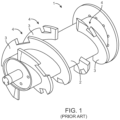
- Fig. 1 shows the Applicant's pre-existing auger 1 that was used to grind recycled polyurethane tires (which is later combined with virgin rubber to be used as a tire-filling and flatproofing material).
- the Applicant's pre-existing auger 1 comprises a large central cylinder 2 with relatively short flights extending therefrom.
- the large central cylinder extends approximately 60% or 70% of the full diameter to the edges of the flights 3.
- the outer edges of the flights 3 have notches 4 therein such that a portion of the outer edges of the flights 3 are cut away.
- flights 3 are not arranged in pairs extending radially outwardly from opposite sides of the central cylinder.
- a new tougher material has been introduced to the market and it would be desirable to use this new material in tire refilling operations.
- the old material was cured virgin material and/or a blend of cured virgin polyurethane and used polyurethane.
- the new tougher material is a blend of virgin polyurethane and crumb rubber granules in varying percentages and/or harder shore formulations (e.g. Heviduty TM variant circa 50 shore A), again in either virgin based or when blended with rubber crumb granules in varying percentages.
- This new material has proven very difficult to grind up using the existing auger 1. Specifically, attempting to grind the new material with the existing auger 1 has typically damaged the auger, or its motor or gears. As such, this new material must typically be discarded into landfills. It would instead be desirable to provide a new auger design that is specifically suitable for work with this new material. The present auger's novel shape and design solves this problem.
- the present system provides an auger for a grinder for a tire filling machine, comprising: a cylindrical column, and a plurality of flights extending outwardly from the cylindrical core.
- the flights are arranged in pairs extending radially outwards from the cylindrical column at 180 degrees to one another, and (ii) each flight has a sharpened leading edge.
- each pair of flights extends approximately half way around the circumference of the cylindrical column and the sharpened leading edges (and the trailing edges) of each pair of flights are positioned at 180 degrees to one another. Preferably, there are no outer edge notches in the flights.
- successive pairs of flights are positioned at angles around the central cylindrical column of approximately 50 or 60 degrees to one another. As such, three successive pairs of flights together completely extend around the cylindrical column such that the entire circumference of the cylinder is covered by three successive pairs of flights.
- the auger comprises 2 sets of 3 of these pairs of flights. As such, the present auger may include at least 12 sharpened leading edges.
- the present auger had a relatively smaller central cylinder and relatively larger flights (as compared to the pre-existing auger 1 design).
- the ratio of the outer diameter of the cylindrical column to the outer diameter of the flights is 0.45 to 0.65.
- the present auger was designed to function well with grinding the new tougher material.
- the present auger involved a number of non-obvious design changes from the Applicant's pre-existing auger (seen in Fig. 1 ).
- the Applicant performed numerous design tests and experiments. A large number of factors had to be redesigned, and these new features had to be tested together. Altering any one design factor had an impact on the other design factors. All of these changes needed to be balanced off against one another, and multiple iterations of the present auger design had to be performed to achieve the final design.
- variables including, but not limited to, the following all had to be simultaneously designed, tested, and balanced off against one another:
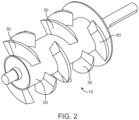
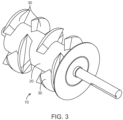
- Auger 10 for a grinder for a tire filling machine is provided.
- Auger 10 comprises: a cylindrical column 20; and a plurality of flights 30 extending outwardly from the cylindrical core.
- Flights 30 are arranged in pairs extending radially outwards from the cylindrical column at 180 degrees to one another. For example, as seen in Figs. 4 to 5C , flights 30A and 30B are positioned opposite to one another. Similarly, flights 30Cand 30D are positioned opposite to one another. Similarly, flights 30E and 30F are positioned opposite to one another. Each flight 30 has a sharpened leading edge 31A, 31B, 31C, 31D, 31E and 31F.
- each pair of flights extends approximately half way around the circumference of the cylindrical column.
- flights 30A and 30B together extend 1/2 way around cylinder 20.
- the sharpened leading edges of each pair of flights e.g.: 31A and 31B
- trailing edges 32A and 32B are also positioned at 180 degrees to one another.
- each flight 30 extends fully to the same radial distance away from the center of cylindrical column 20 around its entire circumference.
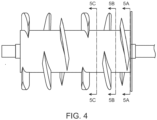
- Fig. 4 shows the relative positions of the pairs of flights 30 around the circumference of cylinder 20.
- successive pairs of flights i.e.: 30A/30B is a first pair, and 30C/30D being the second pair
- 30A/30B is a first pair
- 30C/30D being the second pair
- auger 10 may comprise two sets of these three pairs of flights. In other words, the sectional views 5A-5A, 5B-5B and 5C-5C are repeated twice on Fig. 4 . As such, auger 10 may have twelve sharpened leading edges 31. This provides excellent cutting advantages that were simply not possible with the pre-existing auger 1 of Fig. 1 .
- the diameter of cylinder 20 is small as compared to the full outer diameter of flights 30. This offer the advantage of a greater internal work volume for performing the grinding operation.
- the ratio of the outer diameter of the cylindrical column 20 to the outer diameter of the flights 30 is 0.45 to 0.65.
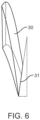
- Fig. 6 shows an example of a sharpened leading edge 31that is cut with a 1:7 blade edge. This sharpness also provides excellent cutting advantages that were simply not possible with the pre-existing auger.
- auger 10 is made of T1 armored steel giving extra strength advantages that were not possible with the pre-existing stainless steel auger.
Landscapes
- Engineering & Computer Science (AREA)
- Mechanical Engineering (AREA)
- Food Science & Technology (AREA)
- Environmental & Geological Engineering (AREA)
- Polishing Bodies And Polishing Tools (AREA)
- Tires In General (AREA)
- Screw Conveyors (AREA)
- Crushing And Pulverization Processes (AREA)
- Earth Drilling (AREA)
Abstract
Description
- The present application claims priority to
U.S. Provisional Patent Application, S.N. 62/899,925, filed September 13, 2019 - The present invention relates to augers for grinding polyurethane rubber (such as recycled tires) into small bits that can then be combined with virgin rubber to provide a flatproofing material that can be injected into tires.
- Examples of the Applicant's tire filling systems can be found in
US Patents 6,988,524 and6,918,979 , incorporated herein by reference.Fig. 1 shows the Applicant's pre-existingauger 1 that was used to grind recycled polyurethane tires (which is later combined with virgin rubber to be used as a tire-filling and flatproofing material). - The Applicant's pre-existing
auger 1 comprises a largecentral cylinder 2 with relatively short flights extending therefrom. Specifically, the large central cylinder extends approximately 60% or 70% of the full diameter to the edges of theflights 3. In addition, the outer edges of theflights 3 havenotches 4 therein such that a portion of the outer edges of theflights 3 are cut away. As can also be seen inFig. 1 ,flights 3 are not arranged in pairs extending radially outwardly from opposite sides of the central cylinder. Recently, a new tougher material has been introduced to the market and it would be desirable to use this new material in tire refilling operations. The old material was cured virgin material and/or a blend of cured virgin polyurethane and used polyurethane. The new tougher material is a blend of virgin polyurethane and crumb rubber granules in varying percentages and/or harder shore formulations (e.g. Heviduty™ variant circa 50 shore A), again in either virgin based or when blended with rubber crumb granules in varying percentages. This new material has proven very difficult to grind up using the existingauger 1. Specifically, attempting to grind the new material with theexisting auger 1 has typically damaged the auger, or its motor or gears. As such, this new material must typically be discarded into landfills. It would instead be desirable to provide a new auger design that is specifically suitable for work with this new material. The present auger's novel shape and design solves this problem. - The present system provides an auger for a grinder for a tire filling machine, comprising: a cylindrical column, and a plurality of flights extending outwardly from the cylindrical core. Importantly, (i) the flights are arranged in pairs extending radially outwards from the cylindrical column at 180 degrees to one another, and (ii) each flight has a sharpened leading edge.
- In preferred aspects, each pair of flights extends approximately half way around the circumference of the cylindrical column and the sharpened leading edges (and the trailing edges) of each pair of flights are positioned at 180 degrees to one another. Preferably, there are no outer edge notches in the flights.
- In preferred aspects, successive pairs of flights are positioned at angles around the central cylindrical column of approximately 50 or 60 degrees to one another. As such, three successive pairs of flights together completely extend around the cylindrical column such that the entire circumference of the cylinder is covered by three successive pairs of flights. In preferred embodiments, the auger comprises 2 sets of 3 of these pairs of flights. As such, the present auger may include at least 12 sharpened leading edges.
- In preferred aspects, the present auger had a relatively smaller central cylinder and relatively larger flights (as compared to the
pre-existing auger 1 design). In one preferred embodiment, the ratio of the outer diameter of the cylindrical column to the outer diameter of the flights is 0.45 to 0.65. -
-
Fig. 1 is a perspective view of the Applicant's pre-existing auger. -
Fig. 2 is a front perspective view of the present auger. -
Fig. 3 is a rear perspective view of the present auger. -
Fig. 4 is a side elevation view of the present auger. -
Fig. 5A is a sectional view taken alongline 5A-5A inFig. 4 . -
Fig. 5B is a sectional view taken alongline 5B-5B inFig. 4 . -
Fig. 5C is a sectional view taken alongline 5C-5C inFig. 4 . -
Fig. 6 illustrates the sharpened leading edge of one of the flights. - As stated in the Background Section above, the present auger was designed to function well with grinding the new tougher material. As such, the present auger involved a number of non-obvious design changes from the Applicant's pre-existing auger (seen in
Fig. 1 ). When designing the present auger, the Applicant performed numerous design tests and experiments. A large number of factors had to be redesigned, and these new features had to be tested together. Altering any one design factor had an impact on the other design factors. All of these changes needed to be balanced off against one another, and multiple iterations of the present auger design had to be performed to achieve the final design. - For example, variables including, but not limited to, the following all had to be simultaneously designed, tested, and balanced off against one another:
- (a) the diameter of cylindrical column vs. the diameter of flights;
- (b) the radial position of the flights around the cylindrical column, and how far each of the flights extend around the cylindrical column;
- (c) the number of flights that are to be positioned around the cylindrical column;
- (d) the distance the flights extend along the length of the cylindrical column;
- (e) the thickness of the flights;
- (f) the presence or absence of notches in the flights;
- (g) the overlap (or underlap) of the flights around the cylindrical column;
- (h) the angle of attack of the flights;
- (i) the presence or absence of sharpened leading edges of the flights; and
- (j) the axial separation distances between the flights, and whether these distances are uniform or vary along the axial length of the cylindrical column.
- As best seen in
Figs. 2 and3 , thepresent auger 10 for a grinder for a tire filling machine is provided.Auger 10 comprises: acylindrical column 20; and a plurality offlights 30 extending outwardly from the cylindrical core. -
Flights 30 are arranged in pairs extending radially outwards from the cylindrical column at 180 degrees to one another. For example, as seen inFigs. 4 to 5C ,flights flights 30Cand 30D are positioned opposite to one another. Similarly,flights flight 30 has a sharpenedleading edge - As can also be seen, each pair of flights extends approximately half way around the circumference of the cylindrical column. For example,
flights cylinder 20. As such the sharpened leading edges of each pair of flights (e.g.: 31A and 31B) are positioned at 180 degrees to one another. Moreover, trailingedges - Preferably, there are no outer edge notches in the flights (in contrast to
notches 4 in the pre-existing design shown inFig. 1 ). As such, eachflight 30 extends fully to the same radial distance away from the center ofcylindrical column 20 around its entire circumference. -
Fig. 4 shows the relative positions of the pairs offlights 30 around the circumference ofcylinder 20. As seen by comparingFigs. 4 ,5A, 5B and 5C , successive pairs of flights (i.e.: 30A/30B is a first pair, and 30C/30D being the second pair) are positioned at angles of approximately 50 or 60 degrees to one another. As a result, only three successive pairs of flights are needed to completely extend aroundcylindrical column 20 such that the entire circumference of thecylinder 20 is covered by these three successive pairs offlights 30. - As can also be seen in
Fig. 4 ,auger 10 may comprise two sets of these three pairs of flights. In other words, thesectional views 5A-5A, 5B-5B and 5C-5C are repeated twice onFig. 4 . As such,auger 10 may have twelve sharpened leadingedges 31. This provides excellent cutting advantages that were simply not possible with thepre-existing auger 1 ofFig. 1 . - In addition, in preferred aspects, the diameter of
cylinder 20 is small as compared to the full outer diameter offlights 30. This offer the advantage of a greater internal work volume for performing the grinding operation. In optional preferred aspects, the ratio of the outer diameter of thecylindrical column 20 to the outer diameter of theflights 30 is 0.45 to 0.65. - Lastly,
Fig. 6 shows an example of a sharpened leading edge 31that is cut with a 1:7 blade edge. This sharpness also provides excellent cutting advantages that were simply not possible with the pre-existing auger. - In preferred embodiments, auger 10 is made of T1 armored steel giving extra strength advantages that were not possible with the pre-existing stainless steel auger.
The following numbered paragraphs contain statements of broad combinations of technical features in accordance with various aspects of devices and methods disclosed herein: - 1. An auger for a grinder for a tire filling machine, comprising:
- a cylindrical column; and
- a plurality of flights extending outwardly from the cylindrical core, wherein
- (i) the flights are arranged in pairs extending radially outwards from the cylindrical column at 180 degrees to one another, and
- (ii) each flight has a sharpened leading edge.
- 2. The auger of
para 1, wherein each pair of flights extends approximately halfway around the circumference of the cylindrical column. - 3. The auger of
para 1, wherein the sharpened leading edges of each pair of flights are positioned at 180 degrees to one another. - 4. The auger of
para 1, wherein the trailing edges of each pair of flights are positioned at 180 degrees to one another. - 5. The auger of
para 1, wherein each flight extends to the same radial distance from the center of the cylindrical column around the entire circumference of the flight such that there are no outer edge notches in the flights. - 6. The auger of
para 1, wherein successive pairs of flights are positioned at angles of approximately 50 or 60 degrees to one another. - 7. The auger of para 6, wherein three successive pairs of flights together completely extend around the cylindrical column such that the entire circumference of the cylinder is covered by three successive pairs of flights.
- 8. The auger of
para 1, wherein the auger comprises 2 sets of 3 pairs of flights. - 9. The auger of para8, wherein the flights on the auger comprises at least 12 sharpened leading edges.
- 10. The auger of
para 1, wherein the ratio of the outer diameter of the cylindrical column to the outer diameter of the flights is 0.45 to 0.65. - 11. The auger of
para 1, wherein the sharpened leading edges are each cut with a 1:7 blade edge. - 12. The auger of
para 1, wherein the auger is made of T1 armored steel.
Claims (12)
- An auger for a grinder for a tire filling machine, comprising:a cylindrical column; anda plurality of flights extending outwardly from the cylindrical core, wherein(i) the flights are arranged in pairs extending radially outwards from the cylindrical column at 180 degrees to one another, and(ii) each flight has a sharpened leading edge.
- The auger of claim 1, wherein each pair of flights extends approximately halfway around the circumference of the cylindrical column.
- The auger of claim 1, wherein the sharpened leading edges of each pair of flights are positioned at 180 degrees to one another.
- The auger of claim 1, wherein the trailing edges of each pair of flights are positioned at 180 degrees to one another.
- The auger of claim 1, wherein each flight extends to the same radial distance from the center of the cylindrical column around the entire circumference of the flight such that there are no outer edge notches in the flights.
- The auger of claim 1, wherein successive pairs of flights are positioned at angles of approximately 50 or 60 degrees to one another.
- The auger of claim 6, wherein three successive pairs of flights together completely extend around the cylindrical column such that the entire circumference of the cylinder is covered by three successive pairs of flights.
- The auger of claim 1, wherein the auger comprises 2 sets of 3 pairs of flights.
- The auger of claim 8, wherein the flights on the auger comprises at least 12 sharpened leading edges.
- The auger of claim 1, wherein the ratio of the outer diameter of the cylindrical column to the outer diameter of the flights is 0.45 to 0.65.
- The auger of claim 1, wherein the sharpened leading edges are each cut with a 1:7 blade edge.
- The auger of claim 1, wherein the auger is made of T1 armored steel.
Applications Claiming Priority (3)
| Application Number | Priority Date | Filing Date | Title |
|---|---|---|---|
| US201962899925P | 2019-09-13 | 2019-09-13 | |
| EP20863336.2A EP3972805B1 (en) | 2019-09-13 | 2020-08-07 | Auger for grinding polyurethane for a tire filling machine |
| PCT/US2020/045434 WO2021050181A1 (en) | 2019-09-13 | 2020-08-07 | Auger for grinding polyurethane for a tire filling machine |
Related Parent Applications (1)
| Application Number | Title | Priority Date | Filing Date |
|---|---|---|---|
| EP20863336.2A Division EP3972805B1 (en) | 2019-09-13 | 2020-08-07 | Auger for grinding polyurethane for a tire filling machine |
Publications (2)
| Publication Number | Publication Date |
|---|---|
| EP4360868A2 true EP4360868A2 (en) | 2024-05-01 |
| EP4360868A3 EP4360868A3 (en) | 2024-07-17 |
Family
ID=74867296
Family Applications (2)
| Application Number | Title | Priority Date | Filing Date |
|---|---|---|---|
| EP20863336.2A Active EP3972805B1 (en) | 2019-09-13 | 2020-08-07 | Auger for grinding polyurethane for a tire filling machine |
| EP23218995.1A Withdrawn EP4360868A3 (en) | 2019-09-13 | 2020-08-07 | Auger for grinding polyurethane for a tire filing machine |
Family Applications Before (1)
| Application Number | Title | Priority Date | Filing Date |
|---|---|---|---|
| EP20863336.2A Active EP3972805B1 (en) | 2019-09-13 | 2020-08-07 | Auger for grinding polyurethane for a tire filling machine |
Country Status (7)
| Country | Link |
|---|---|
| US (1) | US11065625B2 (en) |
| EP (2) | EP3972805B1 (en) |
| CN (1) | CN114502353A (en) |
| CA (1) | CA3152247C (en) |
| ES (1) | ES2978029T3 (en) |
| WO (1) | WO2021050181A1 (en) |
| ZA (1) | ZA202202990B (en) |
Citations (2)
| Publication number | Priority date | Publication date | Assignee | Title |
|---|---|---|---|---|
| US6918979B2 (en) | 2000-08-16 | 2005-07-19 | Pc Industries | Method for making tires filled with flatproofing material |
| US6988524B2 (en) | 2000-08-16 | 2006-01-24 | Pc Industries | Apparatus for making tires filled with flatproofing material |
Family Cites Families (8)
| Publication number | Priority date | Publication date | Assignee | Title |
|---|---|---|---|---|
| US2985211A (en) * | 1960-02-02 | 1961-05-23 | Letz Mfg Co | Feed cutter |
| US4142689A (en) * | 1977-09-26 | 1979-03-06 | Kemp Jr Dennis E | Shredder-feed device |
| US5052630A (en) * | 1990-02-27 | 1991-10-01 | Mac Corporation | Method and apparatus to reduce material |
| US5601239A (en) * | 1995-07-05 | 1997-02-11 | Wood Waste Energy, Inc. | Bulk material shredder and method |
| US20020020479A1 (en) * | 2000-08-16 | 2002-02-21 | Shaffer Charles A. | Tires filled with flatproofing material |
| JP2003062831A (en) * | 2001-08-27 | 2003-03-05 | Plan 21 Corporation | Apparatus for melting and reducing volume of waste polystyrene foam and method for reducing volume using the same |
| CH700976A1 (en) * | 2009-05-11 | 2010-11-15 | Buss Ag | Mixing and kneading machine for continuous treatment processes as well as procedures for carrying out continuous preparation processes by means of a mixing and kneading machine. |
| FI128349B (en) * | 2018-08-08 | 2020-03-31 | Suomen Biokiertotuote Oy | Method for manufacturing a growing substrate |
-
2020
- 2020-08-07 EP EP20863336.2A patent/EP3972805B1/en active Active
- 2020-08-07 CA CA3152247A patent/CA3152247C/en active Active
- 2020-08-07 WO PCT/US2020/045434 patent/WO2021050181A1/en not_active Ceased
- 2020-08-07 US US16/988,108 patent/US11065625B2/en active Active
- 2020-08-07 EP EP23218995.1A patent/EP4360868A3/en not_active Withdrawn
- 2020-08-07 CN CN202080070050.0A patent/CN114502353A/en active Pending
- 2020-08-07 ES ES20863336T patent/ES2978029T3/en active Active
-
2022
- 2022-03-11 ZA ZA2022/02990A patent/ZA202202990B/en unknown
Patent Citations (2)
| Publication number | Priority date | Publication date | Assignee | Title |
|---|---|---|---|---|
| US6918979B2 (en) | 2000-08-16 | 2005-07-19 | Pc Industries | Method for making tires filled with flatproofing material |
| US6988524B2 (en) | 2000-08-16 | 2006-01-24 | Pc Industries | Apparatus for making tires filled with flatproofing material |
Also Published As
| Publication number | Publication date |
|---|---|
| CN114502353A (en) | 2022-05-13 |
| CA3152247C (en) | 2023-04-18 |
| EP3972805A1 (en) | 2022-03-30 |
| US11065625B2 (en) | 2021-07-20 |
| EP3972805A4 (en) | 2022-11-16 |
| ZA202202990B (en) | 2022-12-21 |
| ES2978029T3 (en) | 2024-09-04 |
| CA3152247A1 (en) | 2021-03-18 |
| EP3972805B1 (en) | 2023-12-27 |
| US20210078011A1 (en) | 2021-03-18 |
| EP4360868A3 (en) | 2024-07-17 |
| WO2021050181A1 (en) | 2021-03-18 |
Similar Documents
| Publication | Publication Date | Title |
|---|---|---|
| KR101677917B1 (en) | end milling cutter for processing of fiber reinforced materials such as carbon fiber reinforced plastics | |
| KR101674239B1 (en) | Twist drill | |
| EP2931461B1 (en) | Cutting tool and replaceable cutting head having spiral driven surfaces therefor | |
| US20150107729A1 (en) | Method of manufacturing arcuate blades for a broadhead | |
| US10207336B2 (en) | Rotary tool, particularly a drill, and a cutting head for such a rotary tool | |
| CN106794525B (en) | Tangential cutting insert and milling cutter including the same | |
| DE102012007250A1 (en) | cutting blade | |
| EP4360868A2 (en) | Auger for grinding polyurethane for a tire filing machine | |
| US7469730B2 (en) | Rotatable cutting tool | |
| CN108620640A (en) | Rotary cutter | |
| US6896017B2 (en) | Rotatable cutting tool | |
| EP0914912B1 (en) | Apparatus for radially setting inserts in cutter heads for working wood or plastic | |
| DE102017214760B3 (en) | Method for sharpening a tool and molding for such a method | |
| DE102015200878A1 (en) | Knife with special cutting edges | |
| EP3341172B1 (en) | Apparatus for removing construction material | |
| EP3071356B1 (en) | Milling tool | |
| US12427643B2 (en) | Handle system with storage for woodworking tools | |
| EP3263306B1 (en) | Tire mold molding element, tire vulcanization molding mold, and tire | |
| US1446342A (en) | Rotary cutting tool | |
| CA2914059C (en) | High-productivity drill bits | |
| EP2422941B1 (en) | Cutting blade with cornerless non-circular central recess | |
| WO2016182983A1 (en) | Milling cutter | |
| EP3382042B1 (en) | Scraping roller |
Legal Events
| Date | Code | Title | Description |
|---|---|---|---|
| PUAI | Public reference made under article 153(3) epc to a published international application that has entered the european phase |
Free format text: ORIGINAL CODE: 0009012 |
|
| STAA | Information on the status of an ep patent application or granted ep patent |
Free format text: STATUS: THE APPLICATION HAS BEEN PUBLISHED |
|
| AC | Divisional application: reference to earlier application |
Ref document number: 3972805 Country of ref document: EP Kind code of ref document: P |
|
| AK | Designated contracting states |
Kind code of ref document: A2 Designated state(s): AL AT BE BG CH CY CZ DE DK EE ES FI FR GB GR HR HU IE IS IT LI LT LU LV MC MK MT NL NO PL PT RO RS SE SI SK SM TR |
|
| REG | Reference to a national code |
Ref country code: DE Ref legal event code: R079 Free format text: PREVIOUS MAIN CLASS: B29K0075000000 Ipc: B29C0048395000 |
|
| PUAL | Search report despatched |
Free format text: ORIGINAL CODE: 0009013 |
|
| AK | Designated contracting states |
Kind code of ref document: A3 Designated state(s): AL AT BE BG CH CY CZ DE DK EE ES FI FR GB GR HR HU IE IS IT LI LT LU LV MC MK MT NL NO PL PT RO RS SE SI SK SM TR |
|
| RIC1 | Information provided on ipc code assigned before grant |
Ipc: B29D 30/04 20060101ALI20240610BHEP Ipc: B29K 75/00 20060101ALI20240610BHEP Ipc: B29B 17/04 20060101ALI20240610BHEP Ipc: B29C 48/64 20190101ALI20240610BHEP Ipc: B29C 48/59 20190101ALI20240610BHEP Ipc: B02C 19/22 20060101ALI20240610BHEP Ipc: B02C 19/00 20060101ALI20240610BHEP Ipc: B29C 48/395 20190101AFI20240610BHEP |
|
| STAA | Information on the status of an ep patent application or granted ep patent |
Free format text: STATUS: THE APPLICATION IS DEEMED TO BE WITHDRAWN |
|
| 18D | Application deemed to be withdrawn |
Effective date: 20250118 |