EP4358098B1 - Verfahren zur schätzung eines zukünftigen wertes einer physikalischen grösse eines industriellen systems, wie z.b. eines kernreaktors - Google Patents
Verfahren zur schätzung eines zukünftigen wertes einer physikalischen grösse eines industriellen systems, wie z.b. eines kernreaktors Download PDFInfo
- Publication number
- EP4358098B1 EP4358098B1 EP23203947.9A EP23203947A EP4358098B1 EP 4358098 B1 EP4358098 B1 EP 4358098B1 EP 23203947 A EP23203947 A EP 23203947A EP 4358098 B1 EP4358098 B1 EP 4358098B1
- Authority
- EP
- European Patent Office
- Prior art keywords
- variable
- sequence
- variables
- successive
- reactor
- Prior art date
- Legal status (The legal status is an assumption and is not a legal conclusion. Google has not performed a legal analysis and makes no representation as to the accuracy of the status listed.)
- Active
Links
Images



Classifications
-
- G—PHYSICS
- G21—NUCLEAR PHYSICS; NUCLEAR ENGINEERING
- G21C—NUCLEAR REACTORS
- G21C17/00—Monitoring; Testing ; Maintaining
-
- G—PHYSICS
- G21—NUCLEAR PHYSICS; NUCLEAR ENGINEERING
- G21C—NUCLEAR REACTORS
- G21C17/00—Monitoring; Testing ; Maintaining
- G21C17/02—Devices or arrangements for monitoring coolant or moderator
-
- G—PHYSICS
- G01—MEASURING; TESTING
- G01M—TESTING STATIC OR DYNAMIC BALANCE OF MACHINES OR STRUCTURES; TESTING OF STRUCTURES OR APPARATUS, NOT OTHERWISE PROVIDED FOR
- G01M99/00—Subject matter not provided for in other groups of this subclass
- G01M99/005—Testing of complete machines, e.g. washing-machines or mobile phones
-
- G—PHYSICS
- G21—NUCLEAR PHYSICS; NUCLEAR ENGINEERING
- G21C—NUCLEAR REACTORS
- G21C17/00—Monitoring; Testing ; Maintaining
- G21C17/10—Structural combination of fuel element, control rod, reactor core, or moderator structure with sensitive instruments, e.g. for measuring radioactivity, strain
-
- G—PHYSICS
- G21—NUCLEAR PHYSICS; NUCLEAR ENGINEERING
- G21C—NUCLEAR REACTORS
- G21C17/00—Monitoring; Testing ; Maintaining
- G21C17/10—Structural combination of fuel element, control rod, reactor core, or moderator structure with sensitive instruments, e.g. for measuring radioactivity, strain
- G21C17/112—Measuring temperature
-
- G—PHYSICS
- G21—NUCLEAR PHYSICS; NUCLEAR ENGINEERING
- G21D—NUCLEAR POWER PLANT
- G21D3/00—Control of nuclear power plant
- G21D3/08—Regulation of any parameters in the plant
Definitions
- the invention relates to the estimation of a future state of a complex industrial system and in particular of a nuclear power plant and a nuclear reactor.
- a complex industrial system is understood here as a system whose state depends on many physical quantities and whose evolution depends very sensitively on its initial conditions. Such a system requires the measurement or knowledge of many variables to be characterized. The evolution of such a system also depends on many variables, variables whose evolutions can depend on each other.
- a nuclear reactor is an example of a complex industrial system.
- it is the neutron population that governs the initial generation of energy, energy that is communicated to a coolant fluid through various transfer mechanisms.
- This population and its spatial distribution vary over time depending on its interaction with the surrounding matter, including the fuel and the coolant.
- This variation is notably a function of neutron absorption (fissile, fertile, and sterile), diffusion, reflection, and leakage. It should be noted that a variation in the population can cause variations in the properties of the surrounding matter, variations that can then have a retroactive effect on the neutron population.
- nuclear fission following an interaction between a heavy nucleus and a neutron produces energy that can be absorbed by the coolant.
- the temperature of the surrounding medium is modified and this temperature variation in turn modifies the nuclear reactivity in the reactor, such as the probability of absorption of a free neutron by a heavy nucleus.
- the phenomena involved in the reactor are of diverse natures and they interact with each other.
- the neutron population depends on the kinetics of the neutron production processes by fission divided between prompt neutrons and delayed neutrons, the latter being in the minority and appearing several seconds after the prompt neutrons being essential to enable the reactor to be controlled.
- the invention relates in particular to the field of operating a nuclear reactor in an electricity production plant. More specifically, it is used for the neutron simulation of nuclear cores in operation, in order to enable the operator of a nuclear unit to assess the foreseeable safety margins.
- a nuclear unit is understood to mean an electricity production unit, consisting schematically of a nuclear boiler, circuits supplying the current-generating turbine, and the control system enabling an operator to manage the electricity production.
- the simulation tool does not replace them, but allows, in compliance with the management rules, to optimize management and better adapt to the constraints of the electricity network.
- the simulation tool allows the nuclear unit to adapt more quickly, all as part of an overall approach to reducing CO2 emissions.
- the field of the present invention falls within the digital simulation of complex physical phenomena such as those occurring during the operation of a nuclear unit.
- controlling a nuclear reactor requires knowing the current state of the reactor in order to be able to reach a predetermined operating point using control means available to the operator.
- neutronics is the central branch because it governs the generation of the aforementioned phenomena, it allows the characterization of the neutron population distributed spatially and temporally according to an energy spectrum which will depend on the interaction with matter. These interactions are absorption (fissile, fertile and sterile), diffusion, reflection, neutron leaks. It is necessary to add a kinetic component linked to the effective production of neutrons by fission divided into prompt neutrons and delayed neutrons, the latter being in the minority and born several seconds after the prompt neutrons are essential to allow the control of a nuclear reactor.
- This optimization can take many forms, and the operator's action is fundamental to making the choices that lead to it.
- This dilution causes water movements leading to the discharge of borated water, which constitutes an effluent, a waste that is penalizing for the operator, even if this waste can be recovered.
- xenon 135 one of the fission products, produced directly or by disintegration of other fission products, is a very important neutron poison, the production of which is linked to the current state of the nuclear unit but also to its past states, and strongly impacts future states. Produced and consumed under neutron flux, xenon thus reaches an equilibrium level linked to the current power. In the event of a power drop, xenon production continues but not its consumption due to the drop in neutron flux, which causes an accumulation of xenon that must be compensated to stabilize a new power level.
- xenon oscillations The physics of xenon causes oscillating phenomena, referred to as xenon oscillations, temporal and spatial, which, if not controlled, can lead to the exit of the acceptable operating range of the nuclear reactor. In concrete terms, this can result in an automatic shutdown of the core due to non-compliance with safety margins. Accurate simulation of the future state of the core is therefore fundamental for the control of a maneuvering nuclear unit.
- the axial direction z can be defined as the vertical direction given by a plumb line. This z direction is oriented vertically upwards within the reactor. To characterize the difference between a power P h in the upper half of the reactor core and a power P b in the lower half of the reactor core.
- the axial offset is a relative value of power compared to the total instantaneous power.
- the axial imbalance “DPAX” is a relative power value compared to the nominal power P n , nominal power which is not necessarily equal to the total instantaneous power Pt.
- This simulation ensures that dangerous temperature thresholds for the integrity of the nuclear fuel are not exceeded.
- the axial offset parameter cannot be understood without a simulation tool over periods of several hours by an operator, even a very experienced one.
- An absorber rod is, as its name suggests, a long rod of absorbent material.
- the rods are grouped into clusters. Each cluster is inserted into a fuel assembly. They are grouped into groups of clusters of equivalent neutron-absorbing weight, distributed evenly throughout the core, so that their insertion does not destabilize the radial power distribution.
- the role of simulation is also to allow the operator to prepare for a power transient.
- the OAP allows simulations to be carried out.
- the results of these simulations are also presented graphically to the user (control diagram, position of the groups, boron concentration curve, etc.) to allow them to visualize the future state of the core.
- the process is iterative: the operator formulates hypotheses (for example, obtaining a state by placing the bars at a given position), visualizes their impact, then modifies them and restarts a simulation if necessary, until his control requirements are met (for example, minimizing the volume of liquid effluents, obtaining core stability as soon as possible, increasing power more quickly, etc.).
- 1D codes provide the axial parameters of interest for control, but modeling a complex entity such as a nuclear core as a simple "1D wire" is limited on large cores.
- a complex entity such as a nuclear core as a simple "1D wire”
- neutrons have a low-dimensional mean free path compared to the overall geometry, parts of the core that are far apart will behave in a physically decoupled manner.
- To correctly simulate these "decoupled sectors" of the core it is necessary to introduce 3D modeling.
- the main aim of the invention is the determination of the stability state of a core which coincides with the initial state - that is to say the initial conditions - of the core of the nuclear reactor for which it is desired to simulate the trajectory of the operating point from said initial (stable) state to a final state, the desired target.
- One aim of the invention is to propose a method for estimating future values of a physical quantity of a complex system.
- the invention also relates to a computer program comprising instructions adapted to the implementation of at least one of the steps of the method as presented above when said program is executed on a computer.
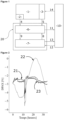
- the variables can be measured by sensors 2 of the system 1 so as to generate measurement sequences.
- the sensors 2 are connected via a connection 4 to a processing unit 6 of an estimation device 20.
- the connection 4 makes it possible to transmit the measurement sequences to the processing unit 6.
- the measurement can be the signal directly from the sensor or a value deduced from one or more of these signals.
- a part of the variables can be controlled via a control center 3 of the system 1.
- the sequence of successive values of the command can then constitute in itself a measurement sequence of the controlled variable.
- the control center can be connected by a connection 5 to the processing unit 6 so as to transmit the sequences of controlled values to the processing unit 6.
- the variables of the plurality of variables are chosen for their relevance to the stability of system 1.
- a sequence of successive values taken by a quantity can also be referred to as a "time series". Such a sequence gives the evolution of the quantity over time.
- Each measurement in the sequence is time-stamped, i.e. it is associated with a measurement instant. It is therefore possible to plot a graph of the evolution of the quantity over time from the sequence of successive values.
- the time step separating two successive values is preferably constant within a sequence. Two distinct variables can be measured so that their time steps are equal or different.
- the processing unit 6 performs a normalization of each sequence of successive measurements.
- Each variable is associated with a normalized variable defined as the ratio of the variable to a reference value, for example the value taken by the variable at a nominal operating point of the system.
- the reference value is predefined before the implementation of the process.
- the processing unit 6 determines a stability parameter of the system so as to obtain a sequence of successive values of the stability parameter.
- the stability parameter is a sum weighted by predetermined coefficients of variation rates of the standardized variables.
- CCS Composite Stability Criterion
- the CCS parameter appears here as the sum of p variation rates ⁇ P j / ⁇ t each rate being weighted by a coefficient or relative weight ⁇ j .
- the variables P j are normalized and the coefficients ⁇ j are dimensionless, so that the CCS is inversely homogeneous to a time.
- the CCS can be expressed in "dP" which is inversely homogeneous to a time.
- the unit called "dP” was named “de Penguern” in honor of Lionel de Penguern, an EDF physicist, part of whose work concerned the stability of nuclear reactors.
- the orders of magnitude mean that the CCS is often expressed in milli dP, or 10 -3 dP or mdP.
- variable P j varies by the quantity ⁇ P j during the time interval ⁇ t. These variations are deduced from the sequence of successive measurements of the variable P j .
- the rates of change of two different variables are not necessarily determined over the same time interval durations. This may be the case, for example, if the two variables are not measured with the same time step. But it may also be the case if a characteristic time of change of the first variable is very different from a characteristic time of change of the second variable.
- the coefficients are predetermined from historical data during a preliminary data analysis phase.
- predetermined threshold a threshold s - hereinafter referred to as the "predetermined threshold” - and the coefficients ⁇ j which are the predetermined coefficients.
- the processing unit 6 determines a most recent stability time interval in which for each point of the interval the stability parameter is less than or equal to a predetermined threshold for a duration greater than or equal to a predetermined duration.
- the predetermined duration can be established from historical data during a preliminary data analysis phase.
- the predetermined duration can in particular be given by a fraction of a time characteristic of an instability phenomenon that affects the industrial system, such as for example the most significant or the slowest instability phenomenon.
- an estimator 7 of the estimation device 20 is used to carry out an estimation for a particular variable of the plurality of variables of a part of the sequence of successive measurements of the particular variable, so as to obtain a sequence of successive estimations of the particular variable.
- the particular variable may be chosen as the most relevant variable among the plurality of variables with respect to the stability of the system 1.
- the estimator 7 may optionally produce an estimate of all of the plurality of variables.
- the estimator here estimates a history of system 1, that is, the evolution of system 1 over a time range that has already taken place, since we have measurements of system 1 for this time range.
- Estimator 7 provides a sequence of successive estimates of the particular variable that can therefore be compared to the measurements of this particular variable.
- the time range that is the subject of this estimation corresponds to the most recent stability time interval, and more precisely a time start of the sequence of successive measurements that is estimated is an instant included in the most recent stability time interval.
- estimator 7 only a part of the part of the sequence of successive measurements of the particular variable is estimated by estimator 7.
- Estimator 7 is a system 1 simulation tool that provides predictions as close to reality as possible.
- an estimator 7 necessarily has limitations. For example, it may not take into account the control history, which is not necessarily known to the developer of the simulation code.
- estimator 7 also has limitations because some phenomena that occur in system 1 are not taken into account in the simulation code. This is the case for phenomena that are not modeled, because either they are too complex, or too heavy in terms of calculation (the code must indeed be fast enough to have industrial applications), or because they are linked to the imperfection of experimental measurements (bias, noise, uncertainties).
- the processing unit 6 performs a comparison of the sequence of successive estimates produced by the estimator 7 and the part of the sequence of successive measurements.
- the processing unit 6 determines the difference between the estimate made and the measurements taken of the particular variable.
- the processing unit 6 is configured to determine, from this comparison and for example from the difference, a value of a recalibration parameter.
- the recalibration parameter is configured to be used by the estimator 7 to improve the estimate already made and more generally the estimates made for the corresponding period of time.
- the comparison carried out by processing unit 6 provides information relating to the simulation limits of estimator 7, and in particular information not taken into account by estimator 7 such as the piloting history or non-modeled phenomena.
- the recalibration parameter can be of different nature, but it is a parameter used by estimator 7 to produce its estimates and whose value can be adjusted.
- estimator 7 produces the estimate of the future value of the physical quantity of the system using the value of the recalibration parameter.
- the recalibration parameter is transmitted from the processing unit 6 to the estimator 7.
- the value of the recalibration parameter is readjusted in the code of the estimator 7. In this way, the estimates produced by the estimator 7 are improved, because the information not taken into account by the estimator 7 such as the piloting history or the non-modeled phenomena are taken into account, at least partially, via the recalibration parameter.
- the method is based on the use of a stability parameter that identifies the most recent time range of stable operation of the system.
- a stability range In relation to this stability range, the accuracy of an estimate produced by the estimator is evaluated by comparing it to a true measurement.
- a recalibration parameter is determined which, once transmitted to the estimator, allows the correction of the estimates that the estimator may subsequently produce.
- the estimates produced of a future value of a quantity of the system can be improved in particular if the future value corresponds to a period of instability of the system.
- the method includes a step of recording successive measurements of the variables over time in order to obtain the sequences of successive measurements. This step is prior to or simultaneous with the first step mentioned above.
- a nuclear reactor is the site of a fission chain reaction, mainly of uranium-235 nuclei by neutrons. Since the neutrons emitted during a fission are too energetic to produce other fissions, it is necessary to slow them down to reach lower energy levels, where the probability of producing fissions is higher. It is the water circulating in the nuclear core that serves to slow down the neutrons (acting as a moderator), and also to transport the heat produced during fissions (acting as a coolant).
- An absorber is a compound, introduced deliberately, or produced by reactions in the core, which captures neutrons preventing them from producing fissions.
- the chain reaction can therefore be controlled using rods, or clusters, of absorbers and boron. Controlling these parameters allows the desired conditions to be established in the core to produce the desired power.
- An operating domain consists of a set of operating points, these points representing physical quantities associated with the normal operation of the reactor.
- the objective of a nuclear reactor pilot is to maintain the state of the nuclear unit so that all predefined operating points remain within the said operating domain.
- the nuclear unit concerned can operate in such a way as to satisfy the request, or refuse to do so for safety reasons, if its condition does not allow it in compliance with the safety criteria.
- the process allows the power transient to be simulated, based on the current state of the reactor, in order to see if the safety criteria are met. This is to avoid wrongly refusing to operate when conditions allow it.
- the process also allows the piloting strategy to be refined in order to optimize the knowledge-based piloting phase.
- a fourth variable is the concentration of a chemical species in the coolant, the chemical species being configured to absorb neutrons in the reactor.
- this chemical species is Boron.
- a fifth variable is the position of a device configured to absorb neutrons in the reactor. More specifically, this is the axial position of this device, which can be held above the area where the neutrons circulate or lowered into this area. The lower the device is positioned in the structure, the more neutrons it captures. This allows the power and temperature of the reactor to be modulated.
- Such a device can be divided into different units that can be activated, i.e. lowered into the area where the neutrons circulate, independently of each other.
- a first unit can be a group of rods forming a power compensation group (which can be designated by the abbreviation GCP).
- the GCP aims to compensate for the power defect, that is to say the antireactivity due to the power variation.
- the GCP itself can be made up of several sub-units of different absorption rods.
- the GCP is made up of multiple absorber rods that are inserted into the core. They are not all introduced at the same time into the core, so as to preserve the progressiveness of the absorbing action. They are divided into several sub-groups (G1, G2, N1 and N2) which each have several clusters of absorber rods, which have different absorption levels, and which are distributed homogeneously in the core so as not to radially unbalance the neutron flux.
- a second unit can be a regulating group (which can be referred to as the R group) of absorber bars.
- the R group is a group intended for controlling the core temperature.
- the plurality of variables could also include the following variables: the average temperature of the reactor core, the temperature of the hot branch, the temperature of the cold branch, the density of the water in the core, the effective temperature of the fuel and the associated Doppler effect, the temperature of the water in the core and the associated vacuum effect, boron distribution in the core, xenon-135 distribution in the core, samarium-149 distribution in the core, chemical measurements, azimuthal power imbalance along the radial dimension of the core (also known as " tilt ").
- the Doppler effect corresponds to a counter-reaction linked to the increase in temperature in nuclear reactors.
- uranium 238 in particular which is the main site of this effect.
- the neutron absorption cross-section of uranium 238 varies greatly in the epithermal domain of the neutron energy spectrum, the site of very many resonances whose amplitude varies with the fuel temperature.
- the resonances broaden and therefore the neutron captures not generating fissions immediately increase, leading to a decrease in the neutron flux and therefore a decrease in the number of fissions which leads to a decrease in the power produced.
- the Doppler effect is one of the self-stabilizing effects in the case of a power transient and therefore a temperature transient (like the moderating effect, see below) of PWRs. It is a beneficial effect sought for the intrinsic safety of nuclear reactors. This effect has a rapid time kinetics, it is one of the effects that acts first when a power transient occurs.
- the void coefficient characterizes the evolution of the reactor's reactivity in the event of a decrease in the density of the coolant, which in this case is water.
- reactivity measures the reactor's tendency to increase its power (supercritical state), decrease it (subcritical state), or remain in a stable state (critical state).
- the void coefficient is part of the composition of the reactivity of a nuclear reactor core. Pressurized water reactors are designed so that water is both a coolant and a neutron moderator (in other words, a neutron slower), giving the reactors a negative void coefficient, which is what is sought.
- a negative void coefficient corresponds to a self-stabilizing effect of the nuclear reaction: if the neutron power increases, the density of the water decreases, which has the effect of reducing the density of the moderator (water is both a coolant and a moderator), therefore reducing the probability of neutron shock by diffusion reaction on a water molecule, hence less neutron slowing down, hence a reduction in the number of fissions and consequently in the power.
- the use of the five power variables, average temperature of a reactor vessel, axial power imbalance DPAX, concentration in the heat transfer fluid in a chemical species configured for absorbing neutrons in the reactor and position of a device configured to absorb neutrons in the reactor allows to describe the stability of the reactor in general.
- the use of the other variables mentioned above in addition to or in replacement of the five variables allows to describe the stability of other parts of the reactor such as for example the active core of the reactor, the steam generator, the Primary circuit or the Secondary circuit...
- the stability parameter or Composite Stability Criterion is then written in the form of a sum of 5 variation rates of the 5 variables.
- the predetermined duration involved in the application of the process can be given on the basis of the phenomenon of instability of the xenon oscillation.
- the characteristic oscillation time being between 15 and 35 hours, a predetermined duration between 3 and 15 hours can be chosen.
- estimator 7 includes a neutron calculation code in order to simulate the behavior of the nuclear core.
- This code integrates implementations of nuclear physics equations and numerical solvers to solve them.
- the code uses a 3D model of the reactor to perform the calculations.
- This 3D aspect can correspond to an explicit three-dimensional modeling of the core in the calculation code, as is the case in the method presented here, or to a two-dimensional modeling (generally, a core brought to a radial plane) followed by a deployment of the results in the axial direction (we then have a 2D x 1D approach).
- the physical parameters introduced are calculated by the neutron calculation code which is more precisely a nuclear reactor physics code whose main principles are now explained.
- the 3D nuclear reactor physics code is understood here as software configured to calculate the three-dimensional distribution of power (in Watts) in a nuclear reactor core from structural data (geometry, chemical composition, heavy nuclei composition, etc.).
- the software must be able to calculate, for example, the distribution of coolant temperatures in the reactor core using three-dimensional geometry.
- the coolant is the fluid that removes the heat produced by nuclear fission. This calculation can be performed, in particular, by a module in the code called the "thermohydraulic module.”
- the software must also be able to calculate the temperature distribution of the nuclear fuel. This calculation can be carried out in particular by a module of the code called “thermal module” or “thermomechanical module” if mechanical aspects are also addressed (e.g. pellet-cladding interaction).
- the software must also be able to calculate the distribution of the neutron flux from which the power is derived. This calculation can be carried out in particular by a module called the "neutron module”.
- Neutronics modifies the coolant temperatures
- the coolant temperature modifies the fuel temperatures.
- the temperatures of the moderator and the fuel modify the neutronics.
- fission nuclear physics
- the neutronic module modifies the temperature of the fuel.
- Neutron scattering is a theoretical model used to treat a simplified form of the Boltzmann equation that governs the behavior of neutrons in matter. Descriptions of the theoretical models can be found in the French-language references "The Physics of Nuclear Reactors, 3rd Edition” (author Serge Marguet, ISBN 978-2-7430-1105-5, Lavoisier edition) ) and in English “The physics of nuclear reactors” (author Serge Marguet, ISBN 978-3-319-59558-7, Springer edition ). Other, older reference works present the fundamental principles of nuclear reactor physics such as the “Treatise on Neutronics” by Jean Bussac and Paul Reuss, published by HERMANN ISBN 2-705-6011-9 - second edition, 1985 .
- the reactor physics code can produce results necessary for the operation and safety of the reactor, by providing considerable assistance in the control of a nuclear reactor core, and in particular for the location and values of hot spots, an "intelligent" distribution of power, calculated responses of the various instrumentations of the core, control and stability of the reactor as a function of time, irradiation of nuclear fuels (burn-up evaluation), and the three-dimensional distribution of Xenon 135.
- the particular variable chosen to implement the process is the axial power imbalance which is particularly relevant for estimating the stability of the reactor.
- the recalibration parameter can be chosen as a parameter ⁇ 0 involved in the definition of the diffusion coefficients of fast neutrons within the reactor at the upper limit and at the lower limit according to the vertical axis z of the reactor.
- Fast neutrons correspond to the most energetic population of neutrons generated in the reactor.
- P denotes the reactor power and P nom the nominal power of the reactor
- the parameter ⁇ p is a predetermined correction coefficient which only depends on the power P.
- the reflection of neutrons at the upper and lower limits is part of the modeling limits of neutron scattering in the reactor.
- the error made is all the more significant as the deviation from the nominal power of the reactor is significant.
- the part of the error made in the estimates which comes from this deviation from the nominal power is taken into account by the term ⁇ p (PP nom ) which is cancelled when the deviation from the nominal power is zero.
- FIG. 2 illustrates the effect of the process on the accuracy of the estimates provided.
- the Figure 2 represents three curves 21, 22 and 23 of the DPAX axial imbalance over time.
- Curve 21 represents a measured DPAX axial imbalance.
- the estimation was carried out by the estimator using the value of a recalibration parameter estimated by comparing a sequence of successive estimations and measurements of the axial imbalance with a time start of the sequence of successive measurements corresponding to an instant which is not included in a stability time interval.
- the estimation corresponds to the method described above. It was carried out by the estimator using the value of a recalibration parameter estimated by comparing a sequence of successive estimates and measurements of the axial imbalance with a time start of the sequence of successive measurements corresponding to an instant which is included in a stability time interval, namely the most recent stability time interval.
- Estimation curve 23 is significantly closer to measurement curve 21 than estimation curve 21. In practice, curve 23 provides a sufficiently precise estimate to allow the operator to calmly understand the course of action to be taken, whereas curve 21 does not provide sufficient precision.
- recalibration parameter determined on the basis of the most recent stability time interval therefore provides better accuracy in the estimation. This is referred to as the 'green' recalibration parameter.
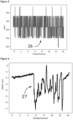
- THE figures 3 to 9 illustrate a calculation of the stability parameter for a time range of approximately 15 hours. Each of the figures represents the variations of a variable over this time range so that the time is plotted on the abscissa on an axis graduated in hours.
- FIG. 3 represents a 24 curve of normalized power, the vertical axis is graduated as a percentage of the nominal power.
- FIG. 4 represents a 25 temperature curve, the vertical axis is graduated in degrees Celsius.
- FIG. 6 represents a curve 27 of axial power imbalance, the vertical axis is graduated in percentage (the DPAX is calculated as a power ratio, therefore without unit. It is expressed as a percentage).
- FIG. 7 represents a curve 28 of the position of a first device, which is a first unit "G1" of the GCP neutron absorption group, the vertical axis is graduated in steps which correspond to a length: one step is equal to 1.5 centimeters.
- the insertion and extraction of the bars are implemented in a discrete manner so that the bars can only take a series of discrete axial positions. Each insertion (respectively extraction) of a bar is done by moving downwards (respectively upwards) by a fixed length of the order of 1.5 cm, which defines a step.
- FIG 8 represents a curve 29 of the position of a second neutron absorption device, the regulation group R, the vertical axis is graduated in steps.
- the step is defined here in the same way as before.
- FIG. 9 represents a cloud of points 30 representing the stability parameter as a function of time.
- the stability parameter is determined from the previous variables, the vertical axis is graduated in dP.
- Line 31 represents the predetermined threshold equal here to 30 mdP.
- the recalibration parameter to be used for an estimation must therefore come from a previous stability phase. If there has not yet been one, for example in the case of a core startup, it is possible to use a default parameter that is equivalent to no recalibration, which allows for correct predictability. Indeed, the recalibration model's main objective is to compensate for historical effects that are, in fact, limited when the reactor has been operating for a short time. "Mandatory" stability phases are required for carrying out periodic tests. The recalibration parameters will thus have a minimum of adequate ranges to be determined.
- the stability parameter can be provided to the operator to indicate the current reactor stability level or past stability levels.
- a human-machine interaction device 10 makes it possible to display the stability parameter calculated by the processing unit 6.
- a connection 11 between the human-machine interaction device 10 and the processing unit 6 makes it possible to transfer this information.
- Such a display of the stability parameter on the human-machine interaction device 10 allows the operator, depending on the gray level or the color code green (stable) / orange (in the process of stabilization) / red (not stable), to immediately assess the state of the slice. This can be an aid, for example, when launching certain tests requiring a sufficiently stable starting point.
- a reactor maneuver is performed in a first part on the left of the curve corresponding to a safety parameter most often indicating an unstable state of the reactor (areas at gray level 42).
- the second part once the maneuver is completed, allows viewing a state in the process of stabilizing the reactor (areas at gray level 42) then a stable state of the reactor. This visualization allows the operator to ensure that a planned test or a new maneuver is launched when the reactor is in a stable state.
- the estimation of the future value of the physical quantity of the system can also take into account a reactor control scenario corresponding to a sequence of at least one variable controllable by an operator.
- a controllable variable can be a power setpoint, the position of a device configured to absorb neutrons in the reactor, a flow rate of the heat transfer fluid or the concentration of a chemical species in the heat transfer fluid.
- a power setpoint or a load program is a change in the electrical power of the reactor as a function of time. This change can in particular be given in the form of a sequence of successive values of a power to be respected, that is to say values of a setpoint of power, as a function of time.
- a power setpoint is therefore understood here as a physical quantity homogeneous to a power and which is the power to be respected.
- the operator can define a control scenario, i.e. the different actions he plans to carry out. These relate to controllable variables such as the positions of the control rods or the boron concentration.
- the operator chooses for at least one controllable variable a sequence of successive values that the variable will take over the next few hours.
- the operator then enters the data characterizing the scenario as input to the estimator 7 via a connection 12 between the estimator 7 and the human-machine interface device, as illustrated in Figure 1 .
- the operator may rely on a first estimate of the evolution of the axial power imbalance without a scenario being specified and on the basis of this simulation, he determines a scenario and restarts a second estimate of the evolution of the axial power imbalance which this time takes into account the determined scenario.
- the first and second estimates are transmitted via a connection 13 from the estimator 7 to the human-machine interface device 10, as illustrated in Figure 1 .
- the method as presented may also comprise a step of estimating future values of the variables of the plurality of variables of the system and a step of determining a future value of the stability parameter from the future values of the variables of the plurality of variables of the system.
- each variable of the plurality of variables which is the physical quantity for which the process estimates a future value.
- a first advantage of the modified method is to identify possible future stability ranges of the reactor.
- a stability time interval begins. It lasts as long as the estimated stability parameter remains less than or equal to the predetermined threshold.
- the second advantage of this method is to solve the problem of the first value of the estimates being different from the corresponding measurement.
- the process can be modified as follows.
- the local adjustment parameter is kept as long as the estimated stability parameter remains significantly constant.
- the stability parameter used for this purpose is estimated from the estimated values of the variables of the plurality of variables.
- the local recalibration parameter is replaced by a mixed recalibration parameter which is calculated by taking into account the local recalibration parameter and the 'green' recalibration parameter.
- the method may further comprise a step of determining a score of the control scenario.
- This score may be a value of a quantity chosen from a volume of effluent produced, an average deviation from the reference axial imbalance and an average distance to limits of an operating domain of the reactor.
- This control diagram representing the axial imbalance as a function of the total instantaneous power.
- This diagram illustrates in particular a safety zone or operating range of the reactor which is an area around a reference line.
- the reference axial imbalance corresponds to this reference line.
- the reactor must operate in the zone close to the reference line.
- the operating range of the reactor and thus the limits of this range are also defined in relation to the control diagram.
- This operating range is a safety zone that lies around the reference line. It can be defined, for example, by limiting axial imbalance lines in the diagram. The average distance to the limits can be evaluated as the distance to one of these limiting axial imbalance lines.
- the scenario score provides the operator with an assessment of the estimated scenario in relation to effluent production criteria that will require specific treatment or reactor stability criteria.
- the method comprises a step of comparing the scores of the first scenario and the second scenario.
- the method can further provide a ranking of the scenarios in ascending order for the criterion retained or if several criteria have been calculated for each of these criteria.
- the decision support device 20 which can provide this classification of scenarios whose estimates are carried out by the estimator 7.
- the latter can send the corresponding instructions to the control center 3 of the system 1, for example via the connection 14 between the human-machine interface device 10 and the control center 3, as illustrated in Figure 1 .
- An object of the invention is a computer program comprising instructions adapted to the implementation of at least one of the steps of the method as it has been presented until now when said program is executed on a computer.
Landscapes
- Physics & Mathematics (AREA)
- Engineering & Computer Science (AREA)
- Plasma & Fusion (AREA)
- General Engineering & Computer Science (AREA)
- High Energy & Nuclear Physics (AREA)
- General Physics & Mathematics (AREA)
- Monitoring And Testing Of Nuclear Reactors (AREA)
Claims (9)
- Verfahren zur Schätzung eines zukünftigen Wertes einer physikalischen Größe eines industriellen Systems (1), wobei das Verfahren die folgenden, von einer Schätzvorrichtung durchgeführten Schritte umfasst:- für jede Variable einer Vielzahl von Variablen des Systems, Erhalten einer Sequenz aufeinanderfolgender Messungen der Variablen, wobei jede Variable einer normierten Variablen zugeordnet ist, die als das Verhältnis der Variablen zu einem Referenzwert definiert ist, und Normierung der Sequenz der aufeinanderfolgenden Messungen derart, dass eine Sequenz aufeinanderfolgender Messungen der normierten Variablen erhalten wird,- Bestimmen eines Stabilitätsparameters des Systems derart, dass eine Sequenz aufeinanderfolgender Werte des Stabilitätsparameters erhalten wird, wobei der Stabilitätsparameter eine durch vorgegebene Koeffizienten der Änderungsraten der normierten Variablen gewichtete Summe ist,- Identifizieren eines jüngsten zeitlichen Stabilitätsintervalls, in dem für jeden Punkt des Intervalls der Stabilitätsparameter seit einer Dauer, die größer oder gleich einer vorbestimmten Dauer ist, kleiner oder gleich einem vorbestimmten Schwellenwert ist,- Schätzen für eine besondere Variable der Vielzahl von Variablen eines Teils der Sequenz aufeinanderfolgender Messungen der bestimmten Variablen derart, dass eine Sequenz aufeinanderfolgender Schätzungen der besonderen Variablen erhalten wird, wobei ein zeitlicher Beginn der Sequenz aufeinanderfolgender Messungen einem Zeitpunkt entspricht, der in dem Zeitintervall enthalten ist, wobei die Schätzung von einem Schätzer (7) der Schätzvorrichtung durchgeführt wird,- Vergleichen der Sequenz aufeinanderfolgender Schätzungen und des Teils der Sequenz aufeinanderfolgender Messungen derart, dass ein Wert eines Rekalibrierungsparameters bestimmt wird, wobei der Rekalibrierungsparameter ausgelegt ist, um vom Schätzer verwendet zu werden, um die Schätzung zu verbessern, und- Schätzen des zukünftigen Wertes der physikalischen Größe des Systems (1) durch den Schätzer (7) unter Verwendung des Wertes des Rekalibrierungsparameters.
- Verfahren nach Anspruch 1, das ferner einen Schritt des Aufzeichnens aufeinanderfolgender Messungen der Variablen im Laufe der Zeit derart umfasst, dass die Sequenzen aufeinanderfolgenden Messungen erhalten werden.
- Verfahren nach einem der Ansprüche 1 bis 2, wobei, wenn das industrielle System ein Kernreaktor ist, die Vielzahl physikalischer Variablen umfasst:- eine Reaktorleistung,- eine mittlere Temperatur eines Reaktorbehälters,- ein axiales Leistungsungleichgewicht,- eine Konzentration einer chemischen Spezies in einem Wärmeträgerfluid, das im Reaktor zirkuliert, wobei die chemische Spezies ausgelegt ist, um Neutronen im Reaktor zu absorbieren, und- eine Position einer Vorrichtung, die ausgelegt ist, um Neutronen im Reaktor zu absorbieren,wobei die besondere Variable das axiale Leistungsungleichgewicht ist.
- Verfahren nach Anspruch 3, wobei die Schätzung des zukünftigen Wertes der physikalischen Größe des Systems ein Szenario der Steuerung des Reaktors berücksichtigt, das einer Sequenz aufeinanderfolgender Werte mindestens einer von einem Bediener steuerbaren Variablen entspricht.
- Verfahren nach Anspruch 4, das einen Schritt des Schätzens zukünftiger Werte der Variablen der Vielzahl von Variablen des Systems und einen Schritt des Bestimmens eines zukünftigen Wertes des Stabilitätsparameters ausgehend von den zukünftigen Werten der Variablen der Vielzahl von Systemvariablen umfasst.
- Verfahren nach einem der Ansprüche 4 bis 5, das ferner einen Schritt des Bestimmens eines Scores des Steuerungsszenarios umfasst, wobei der Score ein Wert einer Größe ist, die aus einem Volumen des erzeugten Abwassers, einer mittleren Abweichung von dem axialen Referenzungleichgewicht und einer mittleren Entfernung von den Grenzen eines Betriebsbereichs des Reaktors ausgewählt wird.
- Verfahren nach einem der Ansprüche 4 bis 6, wobei das Steuerungsszenario ein erstes Steuerungsszenario ist, wobei die Schätzung des zukünftigen Wertes der physikalischen Größe des Systems ein zweites Mal durchgeführt wird, indem das erste Szenario durch ein zweites Steuerungsszenario des Reaktors ersetzt wird, das einer anderen Sequenz aufeinanderfolgender Werte mindestens einer steuerbaren Variablen entspricht, wobei das Verfahren vorzugsweise einen Schritt des Vergleichens der Scores des ersten Szenarios und des zweiten Szenarios umfasst.
- Rechnerprogramm, das Anweisungen umfasst, die für die Durchführung mindestens einer der Schritte des Verfahrens nach einem der Ansprüche 1 bis 7 geeignet sind, wenn das Programm auf einem Computer ausgeführt wird.
- Vorrichtung (20) zur Schätzung eines zukünftigen Wertes einer physikalischen Größe eines industriellen Systems (1), wobei die Vorrichtung (20) ausgelegt ist, um das Verfahren nach einem der Ansprüche 1 bis 7 durchzuführen, wobei die Vorrichtung eine Verarbeitungseinheit (6) umfasst, die ausgelegt ist, um- für jede Variable der Vielzahl von Variablen des Systems die Zeitreihen von Messungen von Variablen des Systems (1) zu erhalten, eine Sequenz aufeinanderfolgender Messungen der Variablen, wobei jede Variable einer normierten Variablen zugeordnet ist, die als das Verhältnis der Variablen zu einem Referenzwert definiert ist, und die Sequenz der aufeinanderfolgenden Messungen derart zu normieren, dass eine Sequenz aufeinanderfolgender Messungen der normierten Variablen erhalten wird,- den Stabilitätsparameter des Systems derart zu bestimmen, dass eine Sequenz aufeinanderfolgender Werte des Stabilitätsparameters erhalten wird, wobei der Stabilitätsparameter eine durch vorgegebene Koeffizienten der Änderungsraten der normierten Variablen gewichtete Summe ist,- das jüngste zeitliche Stabilitätsintervall zu identifizieren, in dem für jeden Punkt des Intervalls der Stabilitätsparameter seit einer Dauer, die größer oder gleich einer vorgegebenen Dauer ist, kleiner oder gleich einem vorgegebenen Schwellenwert ist,wobei die Vorrichtung ferner den Schätzer (7) umfasst, der ausgelegt ist, um für eine besondere Variable der Vielzahl von Variablen einen Teil der Sequenz aufeinanderfolgender Messungen der besonderen Variablen derart zu schätzen, dass eine Sequenz aufeinanderfolgender Schätzungen der bestimmten Variable erhalten wird, wobei ein zeitlicher Beginn der Sequenz aufeinanderfolgender Messungen einem Zeitpunkt entspricht, der in dem Zeitintervall enthalten ist,wobei die Verarbeitungseinheit ausgelegt ist, um die Sequenz aufeinanderfolgender Schätzungen und den Teil der Sequenz aufeinanderfolgender Messungen derart zu vergleichen, dass ein Wert eines Rekalibrierungsparameters bestimmt wird, wobei der Rekalibrierungsparameter ausgelegt ist, um vom Schätzer (7) zur Verbesserung der Schätzung verwendet zu werden,wobei der Schätzer (7) ausgelegt ist, um den zukünftigen Wert der physikalischen Größe unter Verwendung des Wertes des Rekalibrierungsparameters zu schätzen.
Applications Claiming Priority (1)
| Application Number | Priority Date | Filing Date | Title |
|---|---|---|---|
| FR2210720A FR3140981B1 (fr) | 2022-10-18 | 2022-10-18 | Procédé d’estimation d’une valeur future d’une grandeur physique d’un système industriel tel qu’un réacteur nucléaire |
Publications (3)
| Publication Number | Publication Date |
|---|---|
| EP4358098A1 EP4358098A1 (de) | 2024-04-24 |
| EP4358098B1 true EP4358098B1 (de) | 2025-04-30 |
| EP4358098C0 EP4358098C0 (de) | 2025-04-30 |
Family
ID=85685472
Family Applications (1)
| Application Number | Title | Priority Date | Filing Date |
|---|---|---|---|
| EP23203947.9A Active EP4358098B1 (de) | 2022-10-18 | 2023-10-17 | Verfahren zur schätzung eines zukünftigen wertes einer physikalischen grösse eines industriellen systems, wie z.b. eines kernreaktors |
Country Status (4)
| Country | Link |
|---|---|
| US (1) | US20240282472A1 (de) |
| EP (1) | EP4358098B1 (de) |
| CN (1) | CN117912729A (de) |
| FR (1) | FR3140981B1 (de) |
Families Citing this family (2)
| Publication number | Priority date | Publication date | Assignee | Title |
|---|---|---|---|---|
| CN119596864B (zh) * | 2024-11-20 | 2026-03-13 | 嘉兴研科光电科技有限公司 | 一种uv型触摸屏制备方法及装置 |
| CN119808408B (zh) * | 2024-12-30 | 2025-10-28 | 中广核研究院有限公司 | 核反应堆的堆芯瞬态仿真方法 |
Family Cites Families (5)
| Publication number | Priority date | Publication date | Assignee | Title |
|---|---|---|---|---|
| US7461038B2 (en) * | 2005-12-21 | 2008-12-02 | General Electric Company | Method and apparatus for evaluating robustness of proposed solution to constraint problem and considering robustness in developing a constraint problem solution |
| WO2011142383A1 (ja) * | 2010-05-14 | 2011-11-17 | 株式会社東芝 | 原子炉の出力監視装置 |
| GB201513799D0 (en) * | 2015-08-04 | 2015-09-16 | Stratophase Ltd | Method and System for Compensating Perturbed Measurements |
| FR3077412B1 (fr) * | 2018-02-01 | 2021-07-23 | Framatome Sa | Procede de regulation de parametres operatoires d'un reacteur nucleaire et reacteur nucleaire correspondant |
| FR3122030B1 (fr) * | 2021-04-14 | 2023-11-24 | Framatome Sa | Procédé et ensemble de pilotage d’un réacteur nucléaire, réacteur nucléaire équipé d’un tel ensemble |
-
2022
- 2022-10-18 FR FR2210720A patent/FR3140981B1/fr active Active
-
2023
- 2023-10-17 EP EP23203947.9A patent/EP4358098B1/de active Active
- 2023-10-17 US US18/380,899 patent/US20240282472A1/en active Pending
- 2023-10-18 CN CN202311352780.1A patent/CN117912729A/zh active Pending
Also Published As
| Publication number | Publication date |
|---|---|
| US20240282472A1 (en) | 2024-08-22 |
| FR3140981A1 (fr) | 2024-04-19 |
| FR3140981B1 (fr) | 2026-04-10 |
| EP4358098A1 (de) | 2024-04-24 |
| CN117912729A (zh) | 2024-04-19 |
| EP4358098C0 (de) | 2025-04-30 |
Similar Documents
| Publication | Publication Date | Title |
|---|---|---|
| EP2481052B1 (de) | Verfahren zur Unterstützung des Betriebs eines Kernreaktors | |
| EP4358098A1 (de) | Verfahren zur schätzung eines zukünftigen wertes einer physikalischen grösse eines industriellen systems, wie z.b. eines kernreaktors | |
| EP2218078B1 (de) | Verfahren zur ermittlung des zahlenwertes einer die steuerbarkeit eines kernreaktors repräsentierenden kenngrösse | |
| EP3850641B1 (de) | Verfahren zum betrieb eines kernreaktors mit online-berechnung des ctfr, zugehöriger kernreaktor | |
| EP3724591B1 (de) | Verfahren zur beurteilung der verschmutzung eines wärmetauschers | |
| FR2868866A1 (fr) | Procede et dispositif de surveillance du coeur d'un reacteur nucleaire | |
| EP3850643B1 (de) | Verfahren zum schutz eines kernreaktors und entsprechender kernreaktor | |
| EP3729466B1 (de) | Verfahren zur bestimmung mindestens eines schwellwerts von mindestens einem betriebsparameter eines kernreaktors sowie zugehöriges computerprogramm und elektronisches system | |
| FR3122030A1 (fr) | Procédé et ensemble de pilotage d’un réacteur nucléaire, réacteur nucléaire équipé d’un tel ensemble | |
| EP0010036A1 (de) | Betriebsverfahren für einen leichtwassergekühlten Kernreaktor | |
| EP1556870A1 (de) | Verfahren zum bestimmen eines grenzwertes eines betriebsparameters eines kernreaktors, entsprechende vorrichtung, rechnerprogramm und träger | |
| EP0339301B1 (de) | Verfahren zur Bestimmung und Abschätzung der Notabschaltreserve eines Druckwasserkernreaktors | |
| e Silva et al. | Reactivity estimation during a reactivity-initiated accident using the extended Kalman filter | |
| US20240145106A1 (en) | Method For Estimating A Future Value Of The Axial Power Imbalance In A Nuclear Reactor | |
| EP3659158B1 (de) | Verfahren zur überwachung eines kernreaktors mit einer relaxation einer schwelle und zugehöriges programm, träger und kernreaktor | |
| EP4362047B1 (de) | Verfahren zur schätzung eines zukünftigen wertes des axialen leistungsungleichgewichts in einem kernreaktor | |
| Younan et al. | Modelling and Validation of CANDU Shim Operation Using Coupled TRACE/PARCS with Regulating System Response | |
| FR3164564A1 (fr) | Procédé d’aide à la stabilisation d’un réacteur nucléaire | |
| FR3164563A1 (fr) | Procédé d’aide au maintien d’un état de stabilité d’un réacteur nucléaire | |
| FR3164562A1 (fr) | Procédé d’aide à la réalisation d’un bilan de réactivité d’un réacteur nucléaire | |
| Kim | SUBGR: A Program to Generate Subgroup Data for the Subgroup Resonance Self-Shielding Calculation | |
| KR102831301B1 (ko) | 원자력 발전 부하추종 및 출력운전을 위한 반응도 감시 장치와 구성 방법 | |
| FR3167476A1 (fr) | Méthode de détermination d’un coefficient de réactivité d’un réacteur nucléaire | |
| Baker et al. | ATF Transient Prescription Tests in TREAT | |
| Novog et al. | A statistical methodology for determination of safety systems actuation setpoints based on extreme value statistics |
Legal Events
| Date | Code | Title | Description |
|---|---|---|---|
| PUAI | Public reference made under article 153(3) epc to a published international application that has entered the european phase |
Free format text: ORIGINAL CODE: 0009012 |
|
| STAA | Information on the status of an ep patent application or granted ep patent |
Free format text: STATUS: THE APPLICATION HAS BEEN PUBLISHED |
|
| AK | Designated contracting states |
Kind code of ref document: A1 Designated state(s): AL AT BE BG CH CY CZ DE DK EE ES FI FR GB GR HR HU IE IS IT LI LT LU LV MC ME MK MT NL NO PL PT RO RS SE SI SK SM TR |
|
| STAA | Information on the status of an ep patent application or granted ep patent |
Free format text: STATUS: REQUEST FOR EXAMINATION WAS MADE |
|
| 17P | Request for examination filed |
Effective date: 20240830 |
|
| RBV | Designated contracting states (corrected) |
Designated state(s): AL AT BE BG CH CY CZ DE DK EE ES FI FR GB GR HR HU IE IS IT LI LT LU LV MC ME MK MT NL NO PL PT RO RS SE SI SK SM TR |
|
| GRAP | Despatch of communication of intention to grant a patent |
Free format text: ORIGINAL CODE: EPIDOSNIGR1 |
|
| STAA | Information on the status of an ep patent application or granted ep patent |
Free format text: STATUS: GRANT OF PATENT IS INTENDED |
|
| RIC1 | Information provided on ipc code assigned before grant |
Ipc: G21D 3/08 20060101AFI20241025BHEP |
|
| INTG | Intention to grant announced |
Effective date: 20241129 |
|
| RIN1 | Information on inventor provided before grant (corrected) |
Inventor name: PENIT, THOMAS Inventor name: MARGUET, SERGE Inventor name: DELCOIGNE, FRANCK Inventor name: BODET, PATRICK |
|
| GRAS | Grant fee paid |
Free format text: ORIGINAL CODE: EPIDOSNIGR3 |
|
| GRAA | (expected) grant |
Free format text: ORIGINAL CODE: 0009210 |
|
| STAA | Information on the status of an ep patent application or granted ep patent |
Free format text: STATUS: THE PATENT HAS BEEN GRANTED |
|
| AK | Designated contracting states |
Kind code of ref document: B1 Designated state(s): AL AT BE BG CH CY CZ DE DK EE ES FI FR GB GR HR HU IE IS IT LI LT LU LV MC ME MK MT NL NO PL PT RO RS SE SI SK SM TR |
|
| REG | Reference to a national code |
Ref country code: CH Ref legal event code: EP Ref country code: GB Ref legal event code: FG4D Free format text: NOT ENGLISH |
|
| REG | Reference to a national code |
Ref country code: DE Ref legal event code: R096 Ref document number: 602023003198 Country of ref document: DE |
|
| REG | Reference to a national code |
Ref country code: IE Ref legal event code: FG4D Free format text: LANGUAGE OF EP DOCUMENT: FRENCH |
|
| U01 | Request for unitary effect filed |
Effective date: 20250526 |
|
| U07 | Unitary effect registered |
Designated state(s): AT BE BG DE DK EE FI FR IT LT LU LV MT NL PT RO SE SI Effective date: 20250603 |
|
| PG25 | Lapsed in a contracting state [announced via postgrant information from national office to epo] |
Ref country code: ES Free format text: LAPSE BECAUSE OF FAILURE TO SUBMIT A TRANSLATION OF THE DESCRIPTION OR TO PAY THE FEE WITHIN THE PRESCRIBED TIME-LIMIT Effective date: 20250430 |
|
| PG25 | Lapsed in a contracting state [announced via postgrant information from national office to epo] |
Ref country code: GR Free format text: LAPSE BECAUSE OF FAILURE TO SUBMIT A TRANSLATION OF THE DESCRIPTION OR TO PAY THE FEE WITHIN THE PRESCRIBED TIME-LIMIT Effective date: 20250731 Ref country code: NO Free format text: LAPSE BECAUSE OF FAILURE TO SUBMIT A TRANSLATION OF THE DESCRIPTION OR TO PAY THE FEE WITHIN THE PRESCRIBED TIME-LIMIT Effective date: 20250730 |
|
| PG25 | Lapsed in a contracting state [announced via postgrant information from national office to epo] |
Ref country code: PL Free format text: LAPSE BECAUSE OF FAILURE TO SUBMIT A TRANSLATION OF THE DESCRIPTION OR TO PAY THE FEE WITHIN THE PRESCRIBED TIME-LIMIT Effective date: 20250430 |
|
| PG25 | Lapsed in a contracting state [announced via postgrant information from national office to epo] |
Ref country code: HR Free format text: LAPSE BECAUSE OF FAILURE TO SUBMIT A TRANSLATION OF THE DESCRIPTION OR TO PAY THE FEE WITHIN THE PRESCRIBED TIME-LIMIT Effective date: 20250430 |
|
| PG25 | Lapsed in a contracting state [announced via postgrant information from national office to epo] |
Ref country code: RS Free format text: LAPSE BECAUSE OF FAILURE TO SUBMIT A TRANSLATION OF THE DESCRIPTION OR TO PAY THE FEE WITHIN THE PRESCRIBED TIME-LIMIT Effective date: 20250731 |
|
| U20 | Renewal fee for the european patent with unitary effect paid |
Year of fee payment: 3 Effective date: 20250911 |
|
| PG25 | Lapsed in a contracting state [announced via postgrant information from national office to epo] |
Ref country code: IS Free format text: LAPSE BECAUSE OF FAILURE TO SUBMIT A TRANSLATION OF THE DESCRIPTION OR TO PAY THE FEE WITHIN THE PRESCRIBED TIME-LIMIT Effective date: 20250830 |
|
| PG25 | Lapsed in a contracting state [announced via postgrant information from national office to epo] |
Ref country code: SM Free format text: LAPSE BECAUSE OF FAILURE TO SUBMIT A TRANSLATION OF THE DESCRIPTION OR TO PAY THE FEE WITHIN THE PRESCRIBED TIME-LIMIT Effective date: 20250430 |
|
| PG25 | Lapsed in a contracting state [announced via postgrant information from national office to epo] |
Ref country code: CZ Free format text: LAPSE BECAUSE OF FAILURE TO SUBMIT A TRANSLATION OF THE DESCRIPTION OR TO PAY THE FEE WITHIN THE PRESCRIBED TIME-LIMIT Effective date: 20250430 |
|
| PG25 | Lapsed in a contracting state [announced via postgrant information from national office to epo] |
Ref country code: SK Free format text: LAPSE BECAUSE OF FAILURE TO SUBMIT A TRANSLATION OF THE DESCRIPTION OR TO PAY THE FEE WITHIN THE PRESCRIBED TIME-LIMIT Effective date: 20250430 |
|
| PLBE | No opposition filed within time limit |
Free format text: ORIGINAL CODE: 0009261 |
|
| STAA | Information on the status of an ep patent application or granted ep patent |
Free format text: STATUS: NO OPPOSITION FILED WITHIN TIME LIMIT |
|
| REG | Reference to a national code |
Ref country code: CH Ref legal event code: L10 Free format text: ST27 STATUS EVENT CODE: U-0-0-L10-L00 (AS PROVIDED BY THE NATIONAL OFFICE) Effective date: 20260311 |
|
| 26N | No opposition filed |
Effective date: 20260202 |
|
| PG25 | Lapsed in a contracting state [announced via postgrant information from national office to epo] |
Ref country code: MC Free format text: LAPSE BECAUSE OF FAILURE TO SUBMIT A TRANSLATION OF THE DESCRIPTION OR TO PAY THE FEE WITHIN THE PRESCRIBED TIME-LIMIT Effective date: 20250430 |