EP4358070A1 - Cumulative calculation device, cumulative calculation method, and program - Google Patents
Cumulative calculation device, cumulative calculation method, and program Download PDFInfo
- Publication number
- EP4358070A1 EP4358070A1 EP21945917.9A EP21945917A EP4358070A1 EP 4358070 A1 EP4358070 A1 EP 4358070A1 EP 21945917 A EP21945917 A EP 21945917A EP 4358070 A1 EP4358070 A1 EP 4358070A1
- Authority
- EP
- European Patent Office
- Prior art keywords
- binary operation
- cumulative calculation
- cumulation
- new
- calculation device
- Prior art date
- Legal status (The legal status is an assumption and is not a legal conclusion. Google has not performed a legal analysis and makes no representation as to the accuracy of the status listed.)
- Granted
Links
Images

Classifications
-
- H—ELECTRICITY
- H04—ELECTRIC COMMUNICATION TECHNIQUE
- H04L—TRANSMISSION OF DIGITAL INFORMATION, e.g. TELEGRAPHIC COMMUNICATION
- H04L9/00—Cryptographic mechanisms or cryptographic arrangements for secret or secure communications; Network security protocols
- H04L9/08—Key distribution or management, e.g. generation, sharing or updating, of cryptographic keys or passwords
- H04L9/0816—Key establishment, i.e. cryptographic processes or cryptographic protocols whereby a shared secret becomes available to two or more parties, for subsequent use
- H04L9/085—Secret sharing or secret splitting, e.g. threshold schemes
-
- G—PHYSICS
- G06—COMPUTING OR CALCULATING; COUNTING
- G06F—ELECTRIC DIGITAL DATA PROCESSING
- G06F7/00—Methods or arrangements for processing data by operating upon the order or content of the data handled
- G06F7/38—Methods or arrangements for performing computations using exclusively denominational number representation, e.g. using binary, ternary, decimal representation
-
- G—PHYSICS
- G06—COMPUTING OR CALCULATING; COUNTING
- G06F—ELECTRIC DIGITAL DATA PROCESSING
- G06F7/00—Methods or arrangements for processing data by operating upon the order or content of the data handled
- G06F7/38—Methods or arrangements for performing computations using exclusively denominational number representation, e.g. using binary, ternary, decimal representation
- G06F7/48—Methods or arrangements for performing computations using exclusively denominational number representation, e.g. using binary, ternary, decimal representation using non-contact-making devices, e.g. tube, solid state device; using unspecified devices
- G06F7/544—Methods or arrangements for performing computations using exclusively denominational number representation, e.g. using binary, ternary, decimal representation using non-contact-making devices, e.g. tube, solid state device; using unspecified devices for evaluating functions by calculation
Definitions
- the present invention relates to a cumulative calculation device, a cumulative calculation method, and a program.
- NPL 1 discloses a three-party secret sharing technique.
- NPL 2 discloses a method of calculating statistical values (an average value, a maximum value, totalization, and the like) of grouped data for each group through secret calculation. Note that these statistical values are implemented by cumulating associative binary operations.
- the conventional method is designed exclusively to perform calculation of statistical values for an individual group (that is, calculation of accumulation of binary arithmetic operations) while concealing the group for secret calculation, and the efficiency is low because the accumulation calculation method used in normal data processing, which is not secret calculation, cannot be used as it is for secret calculation.
- An embodiment of the present invention has been made in view of the foregoing points, and an object of the present invention is to perform cumulative calculation for an individual group efficiently.
- v (v 1 , ..., v n )
- v 1 to v i ' form a first group
- v i'+1 to v i" form a second group
- v i"+1 to v n form a third group
- the cumulative calculation device 10 when the cumulative calculation is performed by the binary operation in each group, the cumulative calculation device 10 according to the present embodiment generates a new binary operation in which cumulation for each group can be calculated by the foregoing binary operation by cumulative calculation on the entire data (that is, all n values v 1 ', ..., v n ' to be described later) and calculates cumulation of the entire data by the new binary operation. Since the cumulative calculation of the entire data is used in normal data processing, the cumulative calculation device 10 according to the present embodiment can perform the calculation efficiently, for example, even when the cumulative calculation for each group is performed by secret calculation.
- Fig. 1 illustrates a hardware configuration of the cumulative calculation device 10 according to the embodiment.
- the cumulative calculation device 10 according to the embodiment is implemented with a hardware configuration of a general computer or a computer system, and includes an input device 101, a display device 102, an external I/F 103, a communication I/F 104, a processor 105, and a memory device 106. These hardware components are connected to be capable of communicating with each other via a bus 107.
- the input device 101 is, for example, a keyboard, a mouse, a touch panel, various physical buttons, or the like.
- the display device 102 is, for example, a display or the like. Note that the cumulative calculation device 10 may not include, for example, at least one of the input device 101 and the display device 102.
- the external I/F 103 is an interface with an external device such as the recording medium 103a.
- the cumulative calculation device 10 can perform reading or writing of the recording medium 103a via the external I/F 103.
- the recording medium 103a include a compact disc (CD), a digital versatile disk (DVD), a secure digital memory card (SD memory card), and a Universal Serial Bus (USB) memory card.
- the communication I/F 104 is an interface that connects the cumulative calculation device 10 to a communication network.
- the processor 105 is, for example, any of various calculation devices such as a central processing unit (CPU) and a graphics processing unit (GPU).
- the memory device 106 is, for example, any of various storage devices such as a hard disk drive (HDD), a solid-state drive (SSD), a flash memory, a random access memory (RAM), and a read-only memory (ROM).
- the cumulative calculation device 10 has the hardware configuration illustrated in Fig. 1 , and thus is capable of implementing various types of processing to be described below.
- the hardware configuration illustrated in Fig. 1 is exemplary, and the cumulative calculation device 10 may include, for example, a plurality of processors 105 or may include a plurality of memory devices 106.
- the cumulative calculation device 10 may have various types of hardware components other than the illustrated hardware components.
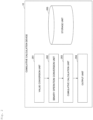
- Fig. 2 illustrates a functional configuration of the cumulative calculation device 10 according to the embodiment.
- the cumulative calculation device 10 includes a value conversion unit 201, a binary operation generation unit 202, a cumulative calculation unit 203, an output unit 204, and a storage unit 205.
- the value conversion unit 201, the binary operation generation unit 202, the cumulative calculation unit 203, and the output unit 204 are implemented by, for example, processing which the processor 105 is caused to execute by one or more programs installed on the cumulative calculation device 10.
- the storage unit 205 is implemented by, for example, the memory device 106. Note that the storage unit 205 may be implemented by, for example, a storage device or the like connected to the cumulative calculation device 10 via a communication network.
- the binary operation generation unit 202 generates a new binary operation capable of calculating cumulation for each group through an original binary operation by cumulative calculation on the entire data.
- the output unit 204 extracts a result of the cumulative calculation for each group by the original binary operation from the result of the cumulative calculation by the new binary operation and outputs the extracted result.
- the binary operation generation unit 202 generates a new binary operation denoted as follows that is capable of calculating cumulation for each group by the original binary operation by cumulative calculation on the entire data (that is, all n values v 1 ', ..., v n ') .
- ⁇ ′ a new binary operation denoted as follows that is capable of calculating cumulation for each group by the original binary operation by cumulative calculation on the entire data (that is, all n values v 1 ', ..., v n ') .
- step S102 The binary operation is defined as follows (step S102).
- w x ⁇ ′ y z zy + 1 ⁇ z w ⁇ y , x OR z
- w and y variables which can have any values
- x and z variables which can have values of 0 or 1
- OR is an operator which is 1 when at least one of x and z is 1 and 0 otherwise (that is, an operator indicating a logical sum).
- i 1, ..., n
- the following cumulation is obtained.
- s i ′ ⁇ 1 ′ ⁇ ′ ⁇ 2 ′ ⁇ ′ ... ⁇ ′ ⁇ i ′
- the output destination for the output unit 204 may be set discretionarily, for example, the output may be stored in the storage unit 205, or may be transmitted to another device or apparatus, or the like can be considered.
- max(x, y) is a binary operation of outputting the maximum values of x and y.
- step S102 a new binary operation defined by the foregoing Math. 3 is generated.
- u (3, 5, 5, 5, 4, 6, 1, 3, 3, 8) is extracted and output. From this u, it can be understood that the cumulative calculation for each group by the original binary operation max(x, y) (that is, the calculation of a maximum value of the cumulation until each element in the group) is performed.
- Example 1 s 1 ', ..., s 10 ' are calculated in order from the left by the new binary operation in step S103. However, instead, s 1 ', ..., s 10 ' are calculated in parallel in this embodiment. Accordingly, it is possible to execute cumulative calculation more efficiently than in Example 1. Note that it has been known that an associative binary operation can be calculated in parallel.
- the cumulative calculation device 10 assigns flags in which a head element of a group is 1 and other elements are 0 to values to be cumulated when cumulative calculation is executed by the binary operation in each group, defines a new binary operation, and performs cumulative calculation on the entire data (that is, all the pairs of values and flags) by the new binary operation.
- This new binary operation uses the fact that the value of cumulation has already been calculated for the head element of a group to regard the flag as indicating whether the calculation has been done, and thereby, is an extension of the original binary operation to a binary operation for the pairs of values and flags.
- the cumulative calculation device 10 can perform secret calculation efficiently even when cumulative calculation is performed for each group by, for example, secret calculation (including secret sharing). This is because by using any method of applying binary operations with which the cumulative calculation is desired in a determined order, the cumulative calculation for each group can be performed by secret calculation in the same order. Therefore, for example, by using max or min as the binary operation, a group by max or a group by min s or the like in the secret calculation can be efficiently implemented.
- the cumulative calculation device 10 according to the embodiment is not only used for normal data processing but is also applicable to, for example, a case where data processing and data analysis are performed while keeping data contents secret.
- the cumulative calculation device 10 according to the embodiment can generate training data of a machine learning model that implements a predetermined task (for example, certain prediction, classification, or the like) while keeping data contents secret.
- the cumulative calculation device 10 according to the embodiment may be able to perform various predictions and classifications by a machine learning model learned by the training data, and also control another device, apparatus, system, and the like based on results of the predictions or classifications.
Landscapes
- Engineering & Computer Science (AREA)
- General Physics & Mathematics (AREA)
- Theoretical Computer Science (AREA)
- Physics & Mathematics (AREA)
- Computing Systems (AREA)
- Mathematical Analysis (AREA)
- Mathematical Optimization (AREA)
- Pure & Applied Mathematics (AREA)
- General Engineering & Computer Science (AREA)
- Computational Mathematics (AREA)
- Computer Security & Cryptography (AREA)
- Computer Networks & Wireless Communication (AREA)
- Signal Processing (AREA)
- Complex Calculations (AREA)
Abstract
Description
- The present invention relates to a cumulative calculation device, a cumulative calculation method, and a program.
- As a method of obtaining a specific calculation result without restoring an encrypted numerical value, a method called secret calculation is known from the related art. For example, NPL 1 discloses a three-party secret sharing technique.
- A technique for totalizing grouped data is known as one of the data processing techniques in the related art. For example, NPL 2 discloses a method of calculating statistical values (an average value, a maximum value, totalization, and the like) of grouped data for each group through secret calculation. Note that these statistical values are implemented by cumulating associative binary operations.
-
- [NPL 1] Koji Chida, Koki Hamada, Dai Ikarashi, and Katsumi Takahashi, "Reconsideration of Lightweight Verifiable Three-Party Secret Function Calculation", In CSS, 2010.
- [NPL 2] Dai Ikarashi, Koji Chida, Koki Hamada, and Katsumi Takahashi, Efficiency of Lightweight Verifiable Three-Party Secret Function Computation and Secure Database Processing Using the Same. In SCIS, pp. 1 to 8, 2011
- However, the conventional method is designed exclusively to perform calculation of statistical values for an individual group (that is, calculation of accumulation of binary arithmetic operations) while concealing the group for secret calculation, and the efficiency is low because the accumulation calculation method used in normal data processing, which is not secret calculation, cannot be used as it is for secret calculation.
- An embodiment of the present invention has been made in view of the foregoing points, and an object of the present invention is to perform cumulative calculation for an individual group efficiently.
- In order to achieve the foregoing object, a cumulative calculation device according to an embodiment is a cumulative calculation device that, with respect to a column v=(v1, ..., vn) of n values divided into groups, calculates cumulation for each of the groups through an associative binary operation. The cumulative calculation device includes: a value conversion unit configured to convert v into v'=(v1', ...., vn') (where vi'=(vi, ci)) when c=(c1, ..., cn) is a column of values in which 1 corresponds to a head element of the group and 0 corresponds to elements other than the head element among elements v1, ..., vn of v; a binary operation generation unit configured to generate a new binary operation for calculating a new pair (p, q) for two pairs (w, x) and (y, z) (where x, z ∈ {0, 1}) using the binary operation; a cumulative calculation unit configured to calculate cumulation si' (where si' is cumulation from v1' to vi' through the new binary operation) through the new binary operation for i=1, ..., n; and an output unit configured to extract a column u=(u1, ..., un) of values indicating the cumulation for said each of the groups from each si' (where i=1, ..., n) and output the extracted u. The new binary operation sets an operation result of w and y by the binary operation to p when z=0, sets y to p when z=1, and sets a logical sum of x and z to q.
- It is possible to perform the cumulative calculation for each group efficiently.
-
- [
Fig. 1 ]
Fig. 1 is a diagram illustrating an example of a hardware configuration of a cumulative calculation device according to an embodiment. - [
Fig. 2 ]
Fig. 2 is a diagram illustrating an example of a functional configuration of the cumulative calculation device according to the embodiment. - [
Fig. 3 ]
Fig. 3 is a flowchart illustrating an example of a flow of cumulative calculation processing according to the embodiment. - Hereinafter, an embodiment of the present invention will be described. In the embodiment, a
cumulative calculation device 10 capable of performing cumulative calculation for each group efficiently will be described. - Here, a column of n values is denoted as v=(v1, ..., vn), and each element vi (where i=1, ..., n) of v is divided into several groups. It is assumed that elements in the same group are arranged to have consecutive indexes (element numbers).
- For example, when the column is divided into three groups, there are certain i' and i" (where 1≤i'<i"<n), v1 to vi' form a first group, vi'+1 to vi" form a second group, and vi"+1 to vn form a third group.

- The above expression is assumed to be a binary operation.
- At this time, when the cumulative calculation is performed by the binary operation in each group, the
cumulative calculation device 10 according to the present embodiment generates a new binary operation in which cumulation for each group can be calculated by the foregoing binary operation by cumulative calculation on the entire data (that is, all n values v1', ..., vn' to be described later) and calculates cumulation of the entire data by the new binary operation. Since the cumulative calculation of the entire data is used in normal data processing, thecumulative calculation device 10 according to the present embodiment can perform the calculation efficiently, for example, even when the cumulative calculation for each group is performed by secret calculation. -
Fig. 1 illustrates a hardware configuration of thecumulative calculation device 10 according to the embodiment. As illustrated inFig. 1 , thecumulative calculation device 10 according to the embodiment is implemented with a hardware configuration of a general computer or a computer system, and includes aninput device 101, adisplay device 102, an external I/F 103, a communication I/F 104, aprocessor 105, and amemory device 106. These hardware components are connected to be capable of communicating with each other via abus 107. - The
input device 101 is, for example, a keyboard, a mouse, a touch panel, various physical buttons, or the like. Thedisplay device 102 is, for example, a display or the like. Note that thecumulative calculation device 10 may not include, for example, at least one of theinput device 101 and thedisplay device 102. - The external I/
F 103 is an interface with an external device such as therecording medium 103a. Thecumulative calculation device 10 can perform reading or writing of therecording medium 103a via the external I/F 103. Note that examples of therecording medium 103a include a compact disc (CD), a digital versatile disk (DVD), a secure digital memory card (SD memory card), and a Universal Serial Bus (USB) memory card. - The communication I/
F 104 is an interface that connects thecumulative calculation device 10 to a communication network. Theprocessor 105 is, for example, any of various calculation devices such as a central processing unit (CPU) and a graphics processing unit (GPU). Thememory device 106 is, for example, any of various storage devices such as a hard disk drive (HDD), a solid-state drive (SSD), a flash memory, a random access memory (RAM), and a read-only memory (ROM). - The
cumulative calculation device 10 according to the embodiment has the hardware configuration illustrated inFig. 1 , and thus is capable of implementing various types of processing to be described below. Note that the hardware configuration illustrated inFig. 1 is exemplary, and thecumulative calculation device 10 may include, for example, a plurality ofprocessors 105 or may include a plurality ofmemory devices 106. Thecumulative calculation device 10 may have various types of hardware components other than the illustrated hardware components. -
Fig. 2 illustrates a functional configuration of thecumulative calculation device 10 according to the embodiment. As shown inFig. 2 , thecumulative calculation device 10 according to the embodiment includes avalue conversion unit 201, a binaryoperation generation unit 202, acumulative calculation unit 203, anoutput unit 204, and astorage unit 205. Thevalue conversion unit 201, the binaryoperation generation unit 202, thecumulative calculation unit 203, and theoutput unit 204 are implemented by, for example, processing which theprocessor 105 is caused to execute by one or more programs installed on thecumulative calculation device 10. Thestorage unit 205 is implemented by, for example, thememory device 106. Note that thestorage unit 205 may be implemented by, for example, a storage device or the like connected to thecumulative calculation device 10 via a communication network. - The
value conversion unit 201 converts v into v'=(v1', ...., vn') (where vi'=(vi, ci) when c=(c1, ..., cn) is a column of values in which 1 corresponds to the head element of a group and 0 corresponds to elements other than the head element among elements v1, ..., vn of v. - The binary
operation generation unit 202 generates a new binary operation capable of calculating cumulation for each group through an original binary operation by cumulative calculation on the entire data. - The
cumulative calculation unit 203 performs cumulative calculation by the new binary operation on all v'= (v1', ..., Vn'). - The
output unit 204 extracts a result of the cumulative calculation for each group by the original binary operation from the result of the cumulative calculation by the new binary operation and outputs the extracted result. - The
storage unit 205 stores a column v= (v1, ..., vn) of n values as cumulative calculation targets, intermediate results of the cumulative calculation, a cumulative calculation result, and the like. - A flow of the cumulative calculation processing according to the embodiment will be described with reference to
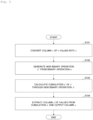
Fig. 3 . - First, the
value conversion unit 201 converts a column of values in which 1 corresponds to the head element in a group and 0 corresponds to other elements among elements of v into c=(c1, ..., cn), and converts v into v'=(v1', ..., vn') (where vi'= (vi, ci) (step S101)). - Subsequently, the binary
operation generation unit 202 generates a new binary operation denoted as follows that is capable of calculating cumulation for each group by the original binary operation by cumulative calculation on the entire data (that is, all n values v1', ..., vn') .
- The binary operation is defined as follows (step S102).

- Subsequently, the
cumulative calculation unit 203 calculates cumulation by the new binary operation on all v'= (v1', ..., vn') (step S103). That is, thecumulative calculation unit 203 calculates the cumulation s'=(s1', ..., sn') of v' by the new binary operation. Here, for i=1, ..., n, the following cumulation is obtained.
- Then, with setting each si' as si'= (ui, di), the
output unit 204 extracts a column u=(u1, ..., un) of the values, and outputs the column u as a cumulative result of the original binary operation (step S104). At this time, each ui is the result of the cumulative calculation of v1, ..., vi by the original binary operation. For each i=1, ..., n, di=1. - Note that although the output destination for the
output unit 204 may be set discretionarily, for example, the output may be stored in thestorage unit 205, or may be transmitted to another device or apparatus, or the like can be considered. - Hereinafter, examples of the foregoing cumulative calculation processing will be described.
- In this example, a case will be described in which a column v=(3, 5, 1, 2, 4, 6, 1, 3, 2, 8) of values that is divided into four groups of four, two, one, and three elements from the head is given, and cumulative calculation for each group is performed through a binary operation max(x, y).
- Note that max(x, y) is a binary operation of outputting the maximum values of x and y.
- First, in the foregoing step S101, a column c=(1, 0, 0, 0, 1, 0, 1, 1, 0, 0) of values in which 1 corresponds to the head element of the group and 0 corresponds to the other elements is generated, and v is converted into the following v'.
v'= ((v1, c1), ..., (v10, c10) = ((3, 1), (5, 0), (1, 0), (2, 0), (4, 1), (6, 0) (1, 1), (3, 1), (2, 0), (8, 0)) - In the foregoing step S102, a new binary operation defined by the foregoing Math. 3 is generated. In the foregoing step S103, cumulation is calculated on all v'= ((v1, c1), ..., (v10, c10)) by the new binary operation.
- For example,

- By using a cumulative calculation method of calculating the above expression in order from the left, s'=(s1', ..., s10') can be calculated as follows.

- Accordingly, in the foregoing step S104, u=(3, 5, 5, 5, 4, 6, 1, 3, 3, 8) is extracted and output. From this u, it can be understood that the cumulative calculation for each group by the original binary operation max(x, y) (that is, the calculation of a maximum value of the cumulation until each element in the group) is performed.
- In the foregoing Example 1, s1', ..., s10' are calculated in order from the left by the new binary operation in step S103. However, instead, s1', ..., s10' are calculated in parallel in this embodiment. Accordingly, it is possible to execute cumulative calculation more efficiently than in Example 1. Note that it has been known that an associative binary operation can be calculated in parallel.
- As described above, the
cumulative calculation device 10 according to the present embodiment assigns flags in which a head element of a group is 1 and other elements are 0 to values to be cumulated when cumulative calculation is executed by the binary operation in each group, defines a new binary operation, and performs cumulative calculation on the entire data (that is, all the pairs of values and flags) by the new binary operation. This new binary operation uses the fact that the value of cumulation has already been calculated for the head element of a group to regard the flag as indicating whether the calculation has been done, and thereby, is an extension of the original binary operation to a binary operation for the pairs of values and flags. - Accordingly, the
cumulative calculation device 10 according to the embodiment can perform secret calculation efficiently even when cumulative calculation is performed for each group by, for example, secret calculation (including secret sharing). This is because by using any method of applying binary operations with which the cumulative calculation is desired in a determined order, the cumulative calculation for each group can be performed by secret calculation in the same order. Therefore, for example, by using max or min as the binary operation, a group by max or a group by min s or the like in the secret calculation can be efficiently implemented. - Accordingly, the
cumulative calculation device 10 according to the embodiment is not only used for normal data processing but is also applicable to, for example, a case where data processing and data analysis are performed while keeping data contents secret. As a specific example, thecumulative calculation device 10 according to the embodiment can generate training data of a machine learning model that implements a predetermined task (for example, certain prediction, classification, or the like) while keeping data contents secret. In addition, thecumulative calculation device 10 according to the embodiment may be able to perform various predictions and classifications by a machine learning model learned by the training data, and also control another device, apparatus, system, and the like based on results of the predictions or classifications. - The present invention is not limited to the specifically disclosed embodiments, and various modifications, changes, combinations with known techniques, and the like can be made without departing from the scope of the claims.
-
- 10
- Cumulative calculation device
- 101
- Input device
- 102
- Display device
- 103
- External I/F
- 103a
- Recording medium
- 104
- Communication I/F
- 105
- Processor
- 106
- Memory device
- 107
- Bus
- 20
- Value Conversion unit
- 202
- Binary operation generation unit
- 203
- Cumulative calculation unit
- 204
- Output unit
- 205
- Storage unit
Claims (5)
- A cumulative calculation device that, with respect to a column v=(v1, ..., vn) of n values divided into groups, calculates cumulation for each of the groups through an associative binary operation, the cumulative calculation device comprising:a value conversion unit configured to, by forming c=(c1, ..., cn) as a column of values in which 1 corresponds to a head element of a group and 0 corresponds to elements other than the head element among elements v1, ..., vn of v, convert v into v'= (v1', ...., vn') (where vi'=(vi, ci));a binary operation generation unit configured to generate a new binary operation for calculating a new pair (p, q) for two pairs (w, x) and (y, z) (where x, z∈{ 0, 1}) using the binary operation;a cumulative calculation unit configured to calculate cumulation si' (where si' is cumulation from v1' to vi' by the new binary operation) by the new binary operation for i=1, ..., n; andan output unit configured to extract a column u=(u1, ..., un) of values indicating the cumulation for said each of the groups from each si' (where i=1, ..., n), and output the extracted u,wherein the new binary operation sets an operation result of w and y by the binary operation to p when z=0, sets y to p when z=1, and sets a logical sum of x and z to q.
- The cumulative calculation device according to claim 1,wherein the binary operation generation unit generates the new binary operation by defining an operational result of (w, x) and (y, z) by the new binary operation as (zy+(1-z)r, xORz),where r is an operational result of w and y by the binary operation, and OR is an operator indicating the logical sum.
- The cumulative calculation device according to claim 1 or 2,
wherein the output unit extracts u= (u1, ..., un) as si'=(ui, di), and outputs the extracted u. - A cumulative calculation method performed by a cumulative calculation device that, with respect to a column v= (v1, ..., vn) of n values divided into groups, calculates cumulation for each of the groups through an associative binary operation, the method comprising:a value conversion procedure of converting v into v'=(v1', ...., vn') (where vi'=(vi, ci)) when c=(c1, ..., cn) is a column of values in which 1 corresponds to a head element of the group and 0 corresponds to elements other than the head element among elements v1, ..., vn of v;a binary operation generation procedure of generating a new binary operation for calculating a new pair (p, q) for two pairs (w, x) and (y, z) (where x, z∈{ 0, 1}) using the binary operation;a cumulative calculation procedure of calculating a cumulative si' (where si' is cumulation from v1' to vi' from the new binary operation) by the new binary operation for i=1, ..., n; andan output procedure of extracting a column u=(u1, ..., un) of values indicating the cumulation for said each of the groups from each si' (where i=1, ..., n) and outputting the extracted u, wherein the new binary operation sets an operation result of w and y by the binary operation to p when z=0, sets y to p when z=1, and sets a logical sum of x and z to q.
- A program causing a computer to function as the cumulative calculation device according to any one of claims 1 to 3.
Applications Claiming Priority (1)
| Application Number | Priority Date | Filing Date | Title |
|---|---|---|---|
| PCT/JP2021/022586 WO2022264237A1 (en) | 2021-06-14 | 2021-06-14 | Cumulative calculation device, cumulative calculation method, and program |
Publications (3)
| Publication Number | Publication Date |
|---|---|
| EP4358070A1 true EP4358070A1 (en) | 2024-04-24 |
| EP4358070A4 EP4358070A4 (en) | 2025-03-26 |
| EP4358070B1 EP4358070B1 (en) | 2026-03-25 |
Family
ID=84526861
Family Applications (1)
| Application Number | Title | Priority Date | Filing Date |
|---|---|---|---|
| EP21945917.9A Active EP4358070B1 (en) | 2021-06-14 | 2021-06-14 | Cumulative calculation device, cumulative calculation method, and program |
Country Status (5)
| Country | Link |
|---|---|
| US (1) | US20240281208A1 (en) |
| EP (1) | EP4358070B1 (en) |
| JP (1) | JP7544274B2 (en) |
| CN (1) | CN117480545A (en) |
| WO (1) | WO2022264237A1 (en) |
Families Citing this family (1)
| Publication number | Priority date | Publication date | Assignee | Title |
|---|---|---|---|---|
| AU2019461061B2 (en) * | 2019-08-14 | 2023-03-30 | Ntt, Inc. | Secure gradient descent computation method, secure deep learning method, secure gradient descent computation system, secure deep learning system, secure computation apparatus, and program |
Family Cites Families (13)
| Publication number | Priority date | Publication date | Assignee | Title |
|---|---|---|---|---|
| FR2780535B1 (en) * | 1998-06-25 | 2000-08-25 | Inst Nat Rech Inf Automat | ACQUISITION DATA PROCESSING DEVICE, ESPECIALLY IMAGE DATA |
| CN101031944A (en) * | 2004-09-30 | 2007-09-05 | 索尼株式会社 | Encryption computing method, encryption device, and computer program |
| JP4876156B2 (en) * | 2009-07-29 | 2012-02-15 | 京楽産業.株式会社 | Electronic device, game machine, main control board, peripheral board, authentication method and authentication program |
| WO2011086668A1 (en) * | 2010-01-13 | 2011-07-21 | 三菱電機株式会社 | Secret retrieval system, public parameter generation device, encryption device, user secret key generation device, query issue device, retrieval device, computer program, secret retrieval method, public parameter generation method, encryption method, user secret key generation method, query issue method, and retrieval method |
| JP5466763B2 (en) * | 2010-07-23 | 2014-04-09 | 日本電信電話株式会社 | ENCRYPTION DEVICE, DECRYPTION DEVICE, ENCRYPTION METHOD, DECRYPTION METHOD, PROGRAM, AND RECORDING MEDIUM |
| JP5860378B2 (en) * | 2012-10-16 | 2016-02-16 | 日本電信電話株式会社 | Secret calculation system, aggregate function device, secret calculation method, and program |
| CN106170943A (en) * | 2013-09-25 | 2016-11-30 | 汤姆逊许可公司 | Privacy Preserving Ridge Regression Using Partially Homomorphic Encryption and Masking |
| AU2019259260B2 (en) * | 2018-04-25 | 2021-07-15 | Ntt, Inc. | Secure aggregate sum system, secure computation apparatus, secure aggregate sum method, and program |
| AU2019259261B2 (en) * | 2018-04-25 | 2021-07-08 | Ntt, Inc. | Secure aggregate maximum system, secure aggregate minimum system, secure computation apparatus, secure aggregate maximum method, secure aggregate minimum method, and program |
| CN112005288B (en) * | 2018-04-26 | 2023-08-04 | 日本电信电话株式会社 | Secret aggregate median system, secret computing device, secret aggregate median method, and recording medium |
| EP3796290B1 (en) * | 2018-05-17 | 2023-07-12 | Nippon Telegraph And Telephone Corporation | Secret cross tabulation system, secret calculation device, secret cross tabulation method, and program |
| US11593362B2 (en) * | 2018-05-25 | 2023-02-28 | Nippon Telegraph And Telephone Corporation | Secure aggregate function computation system, secure computation apparatus, secure aggregate function computation method, and program |
| CN111126579B (en) * | 2019-11-05 | 2023-06-27 | 复旦大学 | In-memory computing device suitable for binary convolutional neural network computation |
-
2021
- 2021-06-14 WO PCT/JP2021/022586 patent/WO2022264237A1/en not_active Ceased
- 2021-06-14 US US18/568,542 patent/US20240281208A1/en active Pending
- 2021-06-14 CN CN202180099278.7A patent/CN117480545A/en active Pending
- 2021-06-14 EP EP21945917.9A patent/EP4358070B1/en active Active
- 2021-06-14 JP JP2023528779A patent/JP7544274B2/en active Active
Also Published As
| Publication number | Publication date |
|---|---|
| EP4358070B1 (en) | 2026-03-25 |
| EP4358070A4 (en) | 2025-03-26 |
| WO2022264237A1 (en) | 2022-12-22 |
| CN117480545A (en) | 2024-01-30 |
| US20240281208A1 (en) | 2024-08-22 |
| JPWO2022264237A1 (en) | 2022-12-22 |
| JP7544274B2 (en) | 2024-09-03 |
Similar Documents
| Publication | Publication Date | Title |
|---|---|---|
| US20190318104A1 (en) | Data analysis server, data analysis system, and data analysis method | |
| US12282384B2 (en) | Systems and methods for detecting drift | |
| US20190164056A1 (en) | Processing apparatus , learning apparatus, processing method, and nonvolatile recording medium | |
| CN116109121B (en) | User demand mining method and system based on big data analysis | |
| JP6624052B2 (en) | Attribute conversion device, attribute conversion method, learning device, attribute conversion program, and learning program | |
| EP4358070B1 (en) | Cumulative calculation device, cumulative calculation method, and program | |
| JP2024502153A (en) | Training device, classification device, training method, classification method, and program | |
| US11645539B2 (en) | Machine learning-based techniques for representing computing processes as vectors | |
| KR20220029004A (en) | Cloud-based deep learning task execution time prediction system and method | |
| JP6213665B2 (en) | Information processing apparatus and clustering method | |
| JP2018181052A (en) | Model identification device, prediction device, monitoring system, model identification method and prediction method | |
| JP7395396B2 (en) | Information processing device, information processing method and program | |
| JP2021135357A (en) | Classification system, information processing device, classification method and program | |
| KR102321064B1 (en) | Apparatus and method for generating signed network | |
| US12299047B2 (en) | Secret grouping apparatus, secret grouping system, secret grouping method, and program | |
| JP6831307B2 (en) | Solution calculation device, solution calculation method and solution calculation program | |
| US20250350457A1 (en) | Secure computation device, secure computation method, and program | |
| US20210271993A1 (en) | Observed event determination apparatus, observed event determination method, and computer readable recording medium | |
| WO2021255778A1 (en) | Learning data selection method, learning data selection device, and learning data selection program | |
| EP4488851A1 (en) | Information processing device, information processing method, and information processing program | |
| EP4465279A1 (en) | Secret random number calculation system, secret random number calculation device, secret random number calculation method, secret cluster calculation system, secret cluster calculation device, secret cluster calculation method, and program | |
| US12283092B2 (en) | Information processing device, learning method, and recording medium | |
| US20240403659A1 (en) | Secure grouping apparatus, secure grouping method, and program | |
| WO2025187205A1 (en) | Training device, training method, and non-transitory computer-readable medium | |
| JP6835756B2 (en) | Work identification device, work identification method and program |
Legal Events
| Date | Code | Title | Description |
|---|---|---|---|
| STAA | Information on the status of an ep patent application or granted ep patent |
Free format text: STATUS: THE INTERNATIONAL PUBLICATION HAS BEEN MADE |
|
| PUAI | Public reference made under article 153(3) epc to a published international application that has entered the european phase |
Free format text: ORIGINAL CODE: 0009012 |
|
| STAA | Information on the status of an ep patent application or granted ep patent |
Free format text: STATUS: REQUEST FOR EXAMINATION WAS MADE |
|
| 17P | Request for examination filed |
Effective date: 20231211 |
|
| AK | Designated contracting states |
Kind code of ref document: A1 Designated state(s): AL AT BE BG CH CY CZ DE DK EE ES FI FR GB GR HR HU IE IS IT LI LT LU LV MC MK MT NL NO PL PT RO RS SE SI SK SM TR |
|
| DAV | Request for validation of the european patent (deleted) | ||
| DAX | Request for extension of the european patent (deleted) | ||
| REG | Reference to a national code |
Ref country code: DE Ref legal event code: R079 Free format text: PREVIOUS MAIN CLASS: G09C0001000000 Ipc: G06F0007544000 Ref country code: DE Ref legal event code: R079 Ref document number: 602021050904 Country of ref document: DE Free format text: PREVIOUS MAIN CLASS: G09C0001000000 Ipc: G06F0007544000 |
|
| A4 | Supplementary search report drawn up and despatched |
Effective date: 20250220 |
|
| RIC1 | Information provided on ipc code assigned before grant |
Ipc: H04L 9/08 20060101ALI20250214BHEP Ipc: G06F 7/544 20060101AFI20250214BHEP |
|
| RAP3 | Party data changed (applicant data changed or rights of an application transferred) |
Owner name: NTT, INC. |
|
| GRAP | Despatch of communication of intention to grant a patent |
Free format text: ORIGINAL CODE: EPIDOSNIGR1 |
|
| STAA | Information on the status of an ep patent application or granted ep patent |
Free format text: STATUS: GRANT OF PATENT IS INTENDED |
|
| INTG | Intention to grant announced |
Effective date: 20251016 |
|
| GRAS | Grant fee paid |
Free format text: ORIGINAL CODE: EPIDOSNIGR3 |
|
| GRAA | (expected) grant |
Free format text: ORIGINAL CODE: 0009210 |
|
| STAA | Information on the status of an ep patent application or granted ep patent |
Free format text: STATUS: THE PATENT HAS BEEN GRANTED |
|
| AK | Designated contracting states |
Kind code of ref document: B1 Designated state(s): AL AT BE BG CH CY CZ DE DK EE ES FI FR GB GR HR HU IE IS IT LI LT LU LV MC MK MT NL NO PL PT RO RS SE SI SK SM TR |
|
| REG | Reference to a national code |
Ref country code: CH Ref legal event code: F10 Free format text: ST27 STATUS EVENT CODE: U-0-0-F10-F00 (AS PROVIDED BY THE NATIONAL OFFICE) Effective date: 20260325 Ref country code: GB Ref legal event code: FG4D |
|
| REG | Reference to a national code |
Ref country code: DE Ref legal event code: R096 Ref document number: 602021050904 Country of ref document: DE |
|
| REG | Reference to a national code |
Ref country code: IE Ref legal event code: FG4D |