EP4358056A1 - Method for determining upload frequency and program thereof - Google Patents
Method for determining upload frequency and program thereof Download PDFInfo
- Publication number
- EP4358056A1 EP4358056A1 EP23190814.6A EP23190814A EP4358056A1 EP 4358056 A1 EP4358056 A1 EP 4358056A1 EP 23190814 A EP23190814 A EP 23190814A EP 4358056 A1 EP4358056 A1 EP 4358056A1
- Authority
- EP
- European Patent Office
- Prior art keywords
- area
- unit
- route
- frequency
- congestion
- Prior art date
- Legal status (The legal status is an assumption and is not a legal conclusion. Google has not performed a legal analysis and makes no representation as to the accuracy of the status listed.)
- Withdrawn
Links
Images



Classifications
-
- G—PHYSICS
- G08—SIGNALLING
- G08G—TRAFFIC CONTROL SYSTEMS
- G08G1/00—Traffic control systems for road vehicles
- G08G1/01—Detecting movement of traffic to be counted or controlled
- G08G1/0104—Measuring and analyzing of parameters relative to traffic conditions
- G08G1/0108—Measuring and analyzing of parameters relative to traffic conditions based on the source of data
- G08G1/0112—Measuring and analyzing of parameters relative to traffic conditions based on the source of data from the vehicle, e.g. floating car data [FCD]
-
- G—PHYSICS
- G01—MEASURING; TESTING
- G01C—MEASURING DISTANCES, LEVELS OR BEARINGS; SURVEYING; NAVIGATION; GYROSCOPIC INSTRUMENTS; PHOTOGRAMMETRY OR VIDEOGRAMMETRY
- G01C21/00—Navigation; Navigational instruments not provided for in groups G01C1/00 - G01C19/00
- G01C21/26—Navigation; Navigational instruments not provided for in groups G01C1/00 - G01C19/00 specially adapted for navigation in a road network
- G01C21/34—Route searching; Route guidance
- G01C21/3453—Special cost functions, i.e. other than distance or default speed limit of road segments
- G01C21/3492—Special cost functions, i.e. other than distance or default speed limit of road segments employing speed data or traffic data, e.g. real-time or historical
-
- G—PHYSICS
- G08—SIGNALLING
- G08G—TRAFFIC CONTROL SYSTEMS
- G08G1/00—Traffic control systems for road vehicles
- G08G1/01—Detecting movement of traffic to be counted or controlled
- G08G1/0104—Measuring and analyzing of parameters relative to traffic conditions
- G08G1/0125—Traffic data processing
- G08G1/0133—Traffic data processing for classifying traffic situation
-
- G—PHYSICS
- G08—SIGNALLING
- G08G—TRAFFIC CONTROL SYSTEMS
- G08G1/00—Traffic control systems for road vehicles
- G08G1/01—Detecting movement of traffic to be counted or controlled
- G08G1/0104—Measuring and analyzing of parameters relative to traffic conditions
- G08G1/0137—Measuring and analyzing of parameters relative to traffic conditions for specific applications
- G08G1/0141—Measuring and analyzing of parameters relative to traffic conditions for specific applications for traffic information dissemination
-
- H—ELECTRICITY
- H04—ELECTRIC COMMUNICATION TECHNIQUE
- H04W—WIRELESS COMMUNICATION NETWORKS
- H04W4/00—Services specially adapted for wireless communication networks; Facilities therefor
- H04W4/30—Services specially adapted for particular environments, situations or purposes
- H04W4/40—Services specially adapted for particular environments, situations or purposes for vehicles, e.g. vehicle-to-pedestrians [V2P]
- H04W4/44—Services specially adapted for particular environments, situations or purposes for vehicles, e.g. vehicle-to-pedestrians [V2P] for communication between vehicles and infrastructures, e.g. vehicle-to-cloud [V2C] or vehicle-to-home [V2H]
Definitions
- the embodiment discussed herein is related to a method for determining an upload frequency and a program thereof.
- a technology for monitoring an amount of data of collected vehicle information per unit of area and reducing the amount of data of vehicle information to be collected for each area in accordance with the amount of data of collected vehicle information has been known.
- Japanese Laid-open Patent Publication No. 2019-79422 International Publication Pamphlet No. WO 2017/037784 , and Japanese Laid-open Patent Publication No. 2020-38362 are disclosed as related art.
- An area where the amount of data of collected vehicle information is large indicates an area where a traffic volume is large and a traffic demand is large.
- the amount of data of vehicle information to be collected is reduced in the area where the amount of data of collected vehicle information is large.
- accuracy of the estimation decreases even in the area where the traffic demand is large.
- an object of the present disclosure is to improve accuracy of estimating a congestion status in an area where a traffic demand is large.
- a method for determining an upload frequency includes calculating for each area, by a computer, a counted number of routes for routes identified based on route search requests received for a predetermined period in past, and determining an upload frequency of uploading vehicle information from a terminal associated with a vehicle in each area in accordance with the counted number of routes for each area.
- the accuracy of estimating the congestion status in the area where the traffic demand is large may be improved.
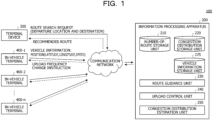
- FIG. 1 is a diagram illustrating an example of a system configuration of an information processing system.
- An information processing system 100 of the present embodiment includes an information processing apparatus 200, a terminal device 300, and in-vehicle terminals 400-1, 400-2, ..., and 400-n.
- the in-vehicle terminals 400-1, 400-2, ..., and 400-n are referred to as in-vehicle terminals 400 in a case where these in-vehicle terminals are not distinguished from each other.
- the information processing apparatus 200, the terminal device 300, and the in-vehicle terminals 400 are coupled to each other via a network such as the Internet.
- the information processing apparatus 200 of the present embodiment Upon receiving a search request for a route (hereinafter, referred to as a route search request) including a departure location and a destination from the terminal device 300, the information processing apparatus 200 of the present embodiment extracts an optimum route from the departure location to the destination and outputs the optimum route to the terminal device 300.
- the optimum route according to the present embodiment is a route along which a time to arrive at the destination from the departure location is a shortest time.
- the terminal device 300 is a terminal device held by a user of the information processing system 100 of the present embodiment, and may be, for example, a smartphone, a car navigation device mounted on a vehicle, or the like.
- the terminal device 300 may include the in-vehicle terminal 400.
- the in-vehicle terminal 400 is a terminal mounted on a vehicle, and periodically uploads vehicle information on the vehicle to the information processing apparatus 200.
- the vehicle information includes positional information indicating a position of the vehicle and speed information indicating a speed of the vehicle.
- the vehicle information is latitude and longitude indicating the position of the vehicle and the speed of the vehicle.
- the information processing apparatus 200 of the present embodiment includes a number-of-route storage unit 210, a congestion distribution storage unit 220, a vehicle information storage unit 225, a route guidance unit 230, an upload control unit 240, and a congestion distribution estimation unit 250.
- the number-of-route storage unit 210 stores number-of-route information indicating the number of routes presented to a user who has made a route search request. Information indicating the number of routes is stored for each area.
- the congestion distribution storage unit 220 stores congestion distribution information indicating a congestion status of a road in an area for each area. Pieces of vehicle information collected from the in-vehicle terminals 400 are stored in the vehicle information storage unit 225 for each area.
- the route guidance unit 230 Upon receiving the route search request from the terminal device 300, the route guidance unit 230 extracts the optimum route while referring to the congestion distribution storage unit 220, outputs the optimum route to the terminal device 300, and updates the number-of-route storage unit 210.
- the upload control unit 240 estimates the magnitude of traffic demand of each area based on the number of routes for each area. The estimation of the magnitude of the traffic demand may be periodically performed or may be performed whenever a route is presented in response to a new route search request.
- the upload control unit 240 determines an upload frequency of the vehicle information from the in-vehicle terminal 400 for each area in accordance with the magnitude of the traffic demand of each area, and notifies the in-vehicle terminal 400 in each area of the upload frequency of the vehicle information.
- the upload control unit 240 increases the upload frequency from the in-vehicle terminal 400 in an area where the traffic demand is regarded as being large and decreases the upload frequency from the in-vehicle terminal 400 in an area where the traffic demand is regarded as being small.
- the upload control unit 240 determines the frequency of performing estimation processing of the congestion status by the congestion distribution estimation unit 250 in accordance with the magnitude of the traffic demand of each area, and notifies the congestion distribution estimation unit 250 of the determined frequency.
- the magnitude of the traffic demand of each area is referred to as a distribution of traffic demands.
- the congestion distribution estimation unit 250 calculates the congestion status of the road in the area at the frequency notified by the upload control unit 240.
- the upload frequency of the vehicle information is different between the area where the traffic demand is large and the area where the traffic demand is small.
- the upload frequency of vehicle information from the in-vehicle terminal 400 is determined for each area in accordance with the distribution of traffic demands.
- the congestion status of the road in the area is more frequently estimated.
- the frequency of estimating the congestion status of the area where the traffic demand is small becomes low.
- a processing load for estimating the congestion status in the information processing apparatus 200 may be reduced.
- a latest congestion status may be reflected in the route presented to the user.
- the information processing apparatus 200 includes the number-of-route storage unit 210, the congestion distribution storage unit 220, and the vehicle information storage unit 225 in FIG. 1 , the present embodiment is not limited thereto. A part or all of the number-of-route storage unit 210, the congestion distribution storage unit 220, and the vehicle information storage unit 225 may be provided in an external device capable of communicating with the information processing apparatus 200.
- the information processing apparatus 200 may be implemented by a plurality of information processing apparatuses.
- the route guidance unit 230, the upload control unit 240, and the congestion distribution estimation unit 250 may be implemented by a plurality of information processing apparatuses.
- FIG. 2 is a diagram illustrating an example of a hardware configuration of the information processing apparatus.
- the information processing apparatus 200 of the present embodiment is a computer including an input device 201, an output device 202, a drive device 203, an auxiliary storage device 204, a memory device 205, an arithmetic processing device 206, and an interface device 207, which are coupled to each other via a bus B.
- the input device 201 is a device used for inputting various kinds of information, and is implemented by, for example, a keyboard, a pointing device, or the like.
- the output device 202 is used for outputting various kinds of information, and is implemented by, for example, a display or the like.
- the interface device 207 includes a local area network (LAN) card or the like, and is used for being coupled to a network.
- LAN local area network
- a program for implementing the route guidance unit 230, the upload control unit 240, and the congestion distribution estimation unit 250 included in the information processing apparatus 200 is at least a part of various programs for controlling the information processing apparatus 200.
- the program is provided through distribution of a recording medium 208, download from the network, or the like.
- Various types of recording media such as a recording medium on which information is optically, electrically, or magnetically recorded, for example, a compact disc read-only memory (CD-ROM), a flexible disk, a magneto-optical disc, or the like, and a semiconductor memory or the like in which information is electrically recorded, for example, a read-only memory (ROM), a flash memory, or the like may be used as the recording medium 208 on which the program is recorded.
- the program recorded in the recording medium 208 is installed in the auxiliary storage device 204 from the recording medium 208 through the drive device 203 when the recording medium 208 in which the program is recorded is set in the drive device 203.
- the program downloaded from the network is installed in the auxiliary storage device 204 through the interface device 207.
- the auxiliary storage device 204 implements the number-of-route storage unit 210, the congestion distribution storage unit 220, the vehicle information storage unit 225, and the like included in the information processing apparatus 200, stores the program installed in the information processing apparatus 200, and stores various desired files, data, and the like used by the information processing apparatus 200.
- the memory device 205 reads the program from the auxiliary storage device 204 and stores the program.
- the arithmetic processing device 206 implements various kinds of processing to be described later.
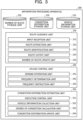
- FIG. 3 is a diagram illustrating the functional configuration of the information processing apparatus.
- the information processing apparatus 200 of the present embodiment includes the number-of-route storage unit 210, the congestion distribution storage unit 220, the vehicle information storage unit 225, the route guidance unit 230, the upload control unit 240, and the congestion distribution estimation unit 250.
- the number-of-route storage unit 210 stores, as a search result by the route guidance unit 230, a result obtained by counting the number of routes output to the terminal device 300 for each area.
- the number-of-route storage unit 210 may store number-of-route information in which area identification information for identifying an area and the number of routes counted for each area are associated with each other.
- the congestion distribution storage unit 220 stores congestion distribution information indicating the congestion status of the road for each area estimated by the congestion distribution estimation unit 250.
- the congestion distribution information may be information in which identification information for identifying a section of the road, a degree of congestion estimated for each section of the road, and area identification information for identifying an area are associated with each other.
- the vehicle information collected from the in-vehicle terminal 400 is stored in the vehicle information storage unit 225 for each area.
- the area identification information of the area identified from the positional information included in the vehicle information and the vehicle information may be stored in the vehicle information storage unit 225 in association with each other.
- the route guidance unit 230 includes an input reception unit 231, a route extraction unit 232, a route identification unit 233, a route output unit 234, and a number-of-route update unit 235.
- the input reception unit 231 receives the route search request from the terminal device 300.
- the input reception unit 231 receives various inputs to the information processing apparatus 200.
- the departure location and the destination are included in the route search request.
- the route extraction unit 232 extracts routes that link the departure location and the destination.
- the route extraction unit 232 may extract the routes while referring to a map information database (not illustrated) or the like.
- the map information database may be provided over the Internet or may be included in the information processing apparatus 200.
- the route identification unit 233 identifies the optimum route from the routes extracted by the route extraction unit 232 while referring to the congestion distribution storage unit 220. For example, the route identification unit 233 identifies a route along which the time to arrive at the destination from the departure location is shortest, based on the congestion distribution information stored in the congestion distribution storage unit 220.
- the route output unit 234 outputs the route identified by the route identification unit 233 to the terminal device 300 that is an input source of the route search request.
- the input source of the route search request may be the in-vehicle terminal 400.
- the number-of-route update unit 235 updates the number-of-route storage unit 210.
- the upload control unit 240 of the present embodiment includes a demand estimation unit 241, a frequency determination unit 242, and a frequency instruction unit 243.
- the demand estimation unit 241 estimates the magnitude of the traffic demand for each area while referring to the number-of-route storage unit 210. For example, the demand estimation unit 241 estimates the distribution of traffic demands while referring to the number-of-route storage unit 210.
- the frequency determination unit 242 determines the upload frequency of the vehicle information from the in-vehicle terminal 400 in each area.
- the frequency determination unit 242 determines an estimation frequency of the congestion status of the road in each area in accordance with the distribution of traffic demands estimated by the demand estimation unit 241.
- the frequency instruction unit 243 notifies the in-vehicle terminal 400 of the upload frequency determined by the frequency determination unit 242.
- the frequency instruction unit 243 notifies the congestion distribution estimation unit 250 of the estimation frequency determined by the frequency determination unit 242.
- the congestion distribution estimation unit 250 includes an execution control unit 251, a vehicle information collection unit 252, a degree-of-congestion calculation unit 253, and a congestion distribution update unit 254.
- the execution control unit 251 controls the execution of the processing in accordance with the frequency notified by the upload control unit 240.
- the vehicle information collection unit 252 collects the vehicle information uploaded from the in-vehicle terminal 400, and stores the vehicle information in the vehicle information storage unit 225.
- the degree-of-congestion calculation unit 253 calculates, for each area, a degree of congestion for each section of the road in the area in accordance with an execution instruction by the execution control unit 251. For example, the degree-of-congestion calculation unit 253 may set, as the degree of congestion of each section, a result obtained by counting the number of vehicles present in the section for each section of the road while referring to the vehicle information storage unit 225.
- the road is divided into a plurality of sections in advance over a map, and is associated with information identifying the road and the section.
- the congestion distribution update unit 254 updates the congestion distribution storage unit 220 based on the degree of congestion calculated by the degree-of-congestion calculation unit 253.
- FIG. 4 is a diagram for describing the distribution of traffic demands of the present embodiment.
- the presented route is considered to be a route along which the user passes in the near future.
- an area including a route that is presented to users a large number of times is an area where many users will pass in the near future, and may be referred to as an area where the traffic demand is large.
- an area including a route that is presented to users a small number of times is an area where a small number of people pass in the near future, and may be referred to as an area where the traffic demand is small.
- the routes presented to the user as the search results are counted in a predetermined period in the past, and the distribution of traffic demands in each area is calculated in accordance with the counting result.
- the predetermined period in the past may be, for example, one minute or the like.
- routes 21, 22, 23, 24, 25, and 26 are presented in response to the route search request from users in a predetermined period in the past in a certain region 12.
- the demand estimation unit 241 of the upload control unit 240 estimates an area including the largest number of routes among six routes as an area where the traffic demand is the largest.
- the number of routes included in each area is counted for each area, and the upload frequency of the vehicle information for each area and the estimation frequency of the congestion status for each area are determined in accordance with the number of routes.
- six level thresholds are provided for the counted number of routes, and an area where the number of routes included in the area is equal to or greater than a threshold having a largest value among the six level thresholds is set as the area where the traffic demand is the largest.
- an area where the number of routes included in the area is equal to or smaller than a smallest threshold among the six thresholds is set as the area where the traffic demand is the smallest.
- an area 12a is estimated to have a largest traffic demand
- an area 12c is estimated to have a smallest traffic demand
- an area 12b is estimated to have an intermediate traffic demand.
- the upload control unit 240 of the present embodiment determines the upload frequency of the vehicle information from the in-vehicle terminal 400 present in each area in accordance with the magnitude of the traffic demand for each area estimated in this manner.
- the frequency determination unit 242 of the upload control unit 240 may divide the upload frequency into, for example, seven levels in which the number of routes included in the area corresponds to the six level thresholds, and may set the upload frequency for each area.
- an upload frequency of the area 12a estimated to have the largest traffic demand becomes the highest
- an upload frequency of the area 12c estimated to have the smallest traffic demand becomes the lowest
- the upload control unit 240 of the present embodiment determines the estimation frequency for estimating the congestion status in each area in accordance with the magnitude of the traffic demand for each area. For example, the frequency determination unit 242 of the upload control unit 240 may divide the estimation frequency into, for example, seven levels in which the number of routes included in the area corresponds to the six level thresholds, and may set the estimation frequency for each area.
- the frequency determination unit 242 may set the estimation frequency such that the congestion status is estimated at a timing when the vehicle information is uploaded. For example, the frequency determination unit 242 may determine the estimation frequency for each area such that the congestion status is estimated in accordance with the upload of the vehicle information.
- the level of the threshold set for the number of routes, the level of the upload frequency, and the level of the estimation frequency in FIG. 4 are examples and are not limited thereto, and may be arbitrarily changed by an administrator of the information processing system 100 of the present embodiment.
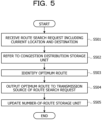
- FIG. 5 is a first flowchart illustrating the processing of the information processing apparatus.
- FIG. 5 illustrates processing of the route guidance unit 230 of the information processing apparatus 200. Whenever the information processing apparatus 200 receives the route search request, the processing of FIG. 5 is executed.
- the input reception unit 231 receives an input of the route search request including a current location and a destination from the terminal device 300 (step S501).
- the route guidance unit 230 causes the route extraction unit 232 to extract candidates for the route from the current location to the destination, and causes the route identification unit 233 to refer to the congestion distribution storage unit 220 (step S502) to identify the optimum route (step S503).
- the route guidance unit 230 causes the route output unit 234 to output information indicating the optimum route to the terminal device 300 (step S504).
- the route guidance unit 230 causes the number-of-route update unit 235 to update the number-of-route storage unit 210 based on the optimum route output to the terminal device 300 (step S505), and ends the processing.
- the number-of-route update unit 235 updates the number-of-route storage unit 210 by incrementing the number of routes of each area including the optimum route output to the terminal device 300 by 1.
- FIG. 6 is a second flowchart illustrating the processing of the information processing apparatus.
- the processing of FIG. 6 may be executed whenever the number-of-route storage unit 210 is updated, or may be periodically executed for each predetermined period.
- the upload control unit 240 of the present embodiment causes the demand estimation unit 241 to estimate the distribution of traffic demands while referring to the number-of-route storage unit 210 (step S601). For example, the upload control unit 240 estimates the magnitude of the traffic demand of each area in accordance with the number of routes counted for each area.
- the upload control unit 240 causes the frequency determination unit 242 to determine the upload frequency of the vehicle information for each area based on the magnitude of the traffic demand for each area (step S602).
- the upload control unit 240 causes the frequency instruction unit 243 to notify the in-vehicle terminal 400 in each area of the upload frequency (step S603).
- the upload control unit 240 determines the frequency of estimating the congestion status of the road in the area in accordance with the magnitude of the traffic demand for each area (step S604).
- the upload control unit 240 causes the frequency instruction unit 243 to notify the congestion distribution estimation unit 250 of the frequency of estimating the congestion status for each area (step S605), and ends the processing.
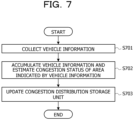
- FIG. 7 is a third flowchart illustrating the processing of the information processing apparatus.
- the processing of FIG. 7 is processing executed for each area and is executed at the frequency determined by the upload control unit 240.
- the execution of the processing of FIG. 7 is instructed by the execution control unit 251 in accordance with the frequency for each area notified by the upload control unit 240.
- the congestion distribution estimation unit 250 causes the vehicle information collection unit 252 to collect the vehicle information uploaded from the in-vehicle terminal 400 in the area (step S701).
- the congestion distribution estimation unit 250 causes the degree-of-congestion calculation unit 253 to estimate the congestion status of the area (step S702).
- the degree-of-congestion calculation unit 253 may calculate the degree of congestion for each section of the road included in the area, and may estimate the congestion status of the area from the calculated degree of congestion for each section of the road.
- the congestion distribution estimation unit 250 causes the congestion distribution update unit 254 to update the congestion distribution storage unit 220 (step S703), and ends the processing.
- the congestion distribution update unit 254 reflects the newly calculated degree of congestion of each section of the road in the congestion distribution information stored in the congestion distribution storage unit 220.
- the magnitude of the traffic demand is estimated for each area
- the upload frequency of the vehicle information and the estimation frequency of the congestion status for each road are set to be high for the area where the traffic demand is large, and the upload frequency and the estimation frequency are set to be low for the area where the traffic demand is small.
- the accuracy of the estimation of the congestion status of the area where the traffic demand is large may be improved while the communication load between the information processing apparatus 200 and the in-vehicle terminal 400 and the processing load of the information processing apparatus 200 are reduced.
- the accuracy of the guidance of the optimum route presented to the user may be improved while the communication load and the processing load are reduced.
Landscapes
- Engineering & Computer Science (AREA)
- Physics & Mathematics (AREA)
- General Physics & Mathematics (AREA)
- Radar, Positioning & Navigation (AREA)
- Remote Sensing (AREA)
- Chemical & Material Sciences (AREA)
- Analytical Chemistry (AREA)
- Automation & Control Theory (AREA)
- Computer Networks & Wireless Communication (AREA)
- Signal Processing (AREA)
- Traffic Control Systems (AREA)
- Navigation (AREA)
Abstract
A method for determining an upload frequency includes calculating for each area, by a computer, a counted number of routes for routes identified based on route search requests received for a predetermined period in past, and determining an upload frequency of uploading vehicle information from a terminal associated with a vehicle in each area in accordance with the counted number of routes for each area.
Description
- The embodiment discussed herein is related to a method for determining an upload frequency and a program thereof.
- A technology for monitoring an amount of data of collected vehicle information per unit of area and reducing the amount of data of vehicle information to be collected for each area in accordance with the amount of data of collected vehicle information has been known.
-
Japanese Laid-open Patent Publication No. 2019-79422 WO 2017/037784 , andJapanese Laid-open Patent Publication No. 2020-38362 - An area where the amount of data of collected vehicle information is large indicates an area where a traffic volume is large and a traffic demand is large. However, in the technology of the related art described above, the amount of data of vehicle information to be collected is reduced in the area where the amount of data of collected vehicle information is large. Thus, in a case where a congestion status is estimated by using the vehicle information, there is a possibility that accuracy of the estimation decreases even in the area where the traffic demand is large.
- According to one aspect, an object of the present disclosure is to improve accuracy of estimating a congestion status in an area where a traffic demand is large.
- According to an aspect of the embodiment, a method for determining an upload frequency includes calculating for each area, by a computer, a counted number of routes for routes identified based on route search requests received for a predetermined period in past, and determining an upload frequency of uploading vehicle information from a terminal associated with a vehicle in each area in accordance with the counted number of routes for each area.
- Accordingly, the accuracy of estimating the congestion status in the area where the traffic demand is large may be improved.
-
-
FIG. 1 is a diagram illustrating an example of a system configuration of an information processing system; -
FIG. 2 is a diagram illustrating an example of a hardware configuration of an information processing apparatus; -
FIG. 3 is a diagram illustrating a functional configuration of the information processing apparatus; -
FIG. 4 is a diagram for describing a distribution of traffic demands of the present embodiment; -
FIG. 5 is a first flowchart illustrating processing of the information processing apparatus; -
FIG. 6 is a second flowchart illustrating the processing of the information processing apparatus; and -
FIG. 7 is a third flowchart illustrating the processing of the information processing apparatus. - Hereinafter, an embodiment will be described with reference to the drawings.
FIG. 1 is a diagram illustrating an example of a system configuration of an information processing system. - An
information processing system 100 of the present embodiment includes aninformation processing apparatus 200, aterminal device 300, and in-vehicle terminals 400-1, 400-2, ..., and 400-n. The in-vehicle terminals 400-1, 400-2, ..., and 400-n are referred to as in-vehicle terminals 400 in a case where these in-vehicle terminals are not distinguished from each other. - The
information processing apparatus 200, theterminal device 300, and the in-vehicle terminals 400 are coupled to each other via a network such as the Internet. - Upon receiving a search request for a route (hereinafter, referred to as a route search request) including a departure location and a destination from the
terminal device 300, theinformation processing apparatus 200 of the present embodiment extracts an optimum route from the departure location to the destination and outputs the optimum route to theterminal device 300. The optimum route according to the present embodiment is a route along which a time to arrive at the destination from the departure location is a shortest time. - The
terminal device 300 is a terminal device held by a user of theinformation processing system 100 of the present embodiment, and may be, for example, a smartphone, a car navigation device mounted on a vehicle, or the like. For example, theterminal device 300 may include the in-vehicle terminal 400. - The in-
vehicle terminal 400 is a terminal mounted on a vehicle, and periodically uploads vehicle information on the vehicle to theinformation processing apparatus 200. For example, the vehicle information includes positional information indicating a position of the vehicle and speed information indicating a speed of the vehicle. For example, the vehicle information is latitude and longitude indicating the position of the vehicle and the speed of the vehicle. - The
information processing apparatus 200 of the present embodiment includes a number-of-route storage unit 210, a congestiondistribution storage unit 220, a vehicleinformation storage unit 225, aroute guidance unit 230, anupload control unit 240, and a congestiondistribution estimation unit 250. - The number-of-
route storage unit 210 stores number-of-route information indicating the number of routes presented to a user who has made a route search request. Information indicating the number of routes is stored for each area. The congestiondistribution storage unit 220 stores congestion distribution information indicating a congestion status of a road in an area for each area. Pieces of vehicle information collected from the in-vehicle terminals 400 are stored in the vehicleinformation storage unit 225 for each area. - Upon receiving the route search request from the
terminal device 300, theroute guidance unit 230 extracts the optimum route while referring to the congestiondistribution storage unit 220, outputs the optimum route to theterminal device 300, and updates the number-of-route storage unit 210. - The
upload control unit 240 estimates the magnitude of traffic demand of each area based on the number of routes for each area. The estimation of the magnitude of the traffic demand may be periodically performed or may be performed whenever a route is presented in response to a new route search request. - The
upload control unit 240 determines an upload frequency of the vehicle information from the in-vehicle terminal 400 for each area in accordance with the magnitude of the traffic demand of each area, and notifies the in-vehicle terminal 400 in each area of the upload frequency of the vehicle information. - For example, the
upload control unit 240 increases the upload frequency from the in-vehicle terminal 400 in an area where the traffic demand is regarded as being large and decreases the upload frequency from the in-vehicle terminal 400 in an area where the traffic demand is regarded as being small. - The
upload control unit 240 determines the frequency of performing estimation processing of the congestion status by the congestiondistribution estimation unit 250 in accordance with the magnitude of the traffic demand of each area, and notifies the congestiondistribution estimation unit 250 of the determined frequency. In the following description, there may be a case where the magnitude of the traffic demand of each area is referred to as a distribution of traffic demands. - For each area, the congestion
distribution estimation unit 250 calculates the congestion status of the road in the area at the frequency notified by theupload control unit 240. - In the present embodiment, as described above, the upload frequency of the vehicle information is different between the area where the traffic demand is large and the area where the traffic demand is small. For example, in the present embodiment, the upload frequency of vehicle information from the in-
vehicle terminal 400 is determined for each area in accordance with the distribution of traffic demands. - Thus, in the present embodiment, as an area has a larger traffic demand, a larger amount of vehicle information is uploaded. The accuracy of estimation of a degree of congestion of the area where the traffic demand is large may be improved while a communication load of the
information processing apparatus 200 is reduced. - In the present embodiment, as an area have a larger traffic demand, the congestion status of the road in the area is more frequently estimated. The frequency of estimating the congestion status of the area where the traffic demand is small becomes low.
- Thus, in the present embodiment, a processing load for estimating the congestion status in the
information processing apparatus 200 may be reduced. According to the present embodiment, as an area has a larger traffic demand, a latest congestion status may be reflected in the route presented to the user. - Although the
information processing apparatus 200 includes the number-of-route storage unit 210, the congestiondistribution storage unit 220, and the vehicleinformation storage unit 225 inFIG. 1 , the present embodiment is not limited thereto. A part or all of the number-of-route storage unit 210, the congestiondistribution storage unit 220, and the vehicleinformation storage unit 225 may be provided in an external device capable of communicating with theinformation processing apparatus 200. - The
information processing apparatus 200 may be implemented by a plurality of information processing apparatuses. For example, theroute guidance unit 230, theupload control unit 240, and the congestiondistribution estimation unit 250 may be implemented by a plurality of information processing apparatuses. - Hereinafter, the
information processing apparatus 200 of the present embodiment will be described with reference toFIG. 2. FIG. 2 is a diagram illustrating an example of a hardware configuration of the information processing apparatus. - The
information processing apparatus 200 of the present embodiment is a computer including aninput device 201, anoutput device 202, adrive device 203, anauxiliary storage device 204, amemory device 205, anarithmetic processing device 206, and aninterface device 207, which are coupled to each other via a bus B. - The
input device 201 is a device used for inputting various kinds of information, and is implemented by, for example, a keyboard, a pointing device, or the like. Theoutput device 202 is used for outputting various kinds of information, and is implemented by, for example, a display or the like. Theinterface device 207 includes a local area network (LAN) card or the like, and is used for being coupled to a network. - A program for implementing the
route guidance unit 230, the uploadcontrol unit 240, and the congestiondistribution estimation unit 250 included in theinformation processing apparatus 200 is at least a part of various programs for controlling theinformation processing apparatus 200. For example, the program is provided through distribution of arecording medium 208, download from the network, or the like. Various types of recording media such as a recording medium on which information is optically, electrically, or magnetically recorded, for example, a compact disc read-only memory (CD-ROM), a flexible disk, a magneto-optical disc, or the like, and a semiconductor memory or the like in which information is electrically recorded, for example, a read-only memory (ROM), a flash memory, or the like may be used as therecording medium 208 on which the program is recorded. - The program recorded in the
recording medium 208 is installed in theauxiliary storage device 204 from therecording medium 208 through thedrive device 203 when therecording medium 208 in which the program is recorded is set in thedrive device 203. The program downloaded from the network is installed in theauxiliary storage device 204 through theinterface device 207. - The
auxiliary storage device 204 implements the number-of-route storage unit 210, the congestiondistribution storage unit 220, the vehicleinformation storage unit 225, and the like included in theinformation processing apparatus 200, stores the program installed in theinformation processing apparatus 200, and stores various desired files, data, and the like used by theinformation processing apparatus 200. At the start of theinformation processing apparatus 200, thememory device 205 reads the program from theauxiliary storage device 204 and stores the program. According to the program stored in thememory device 205, thearithmetic processing device 206 implements various kinds of processing to be described later. - Next, a functional configuration of the
information processing apparatus 200 of the present embodiment will be described with reference toFIG. 3. FIG. 3 is a diagram illustrating the functional configuration of the information processing apparatus. - The
information processing apparatus 200 of the present embodiment includes the number-of-route storage unit 210, the congestiondistribution storage unit 220, the vehicleinformation storage unit 225, theroute guidance unit 230, the uploadcontrol unit 240, and the congestiondistribution estimation unit 250. - The number-of-
route storage unit 210 stores, as a search result by theroute guidance unit 230, a result obtained by counting the number of routes output to theterminal device 300 for each area. For example, the number-of-route storage unit 210 may store number-of-route information in which area identification information for identifying an area and the number of routes counted for each area are associated with each other. - The congestion
distribution storage unit 220 stores congestion distribution information indicating the congestion status of the road for each area estimated by the congestiondistribution estimation unit 250. For example, the congestion distribution information may be information in which identification information for identifying a section of the road, a degree of congestion estimated for each section of the road, and area identification information for identifying an area are associated with each other. - The vehicle information collected from the in-
vehicle terminal 400 is stored in the vehicleinformation storage unit 225 for each area. The area identification information of the area identified from the positional information included in the vehicle information and the vehicle information may be stored in the vehicleinformation storage unit 225 in association with each other. - The
route guidance unit 230 includes aninput reception unit 231, aroute extraction unit 232, aroute identification unit 233, aroute output unit 234, and a number-of-route update unit 235. - For example, the
input reception unit 231 receives the route search request from theterminal device 300. Theinput reception unit 231 receives various inputs to theinformation processing apparatus 200. The departure location and the destination are included in the route search request. - When the route search request is input, the
route extraction unit 232 extracts routes that link the departure location and the destination. Theroute extraction unit 232 may extract the routes while referring to a map information database (not illustrated) or the like. For example, the map information database may be provided over the Internet or may be included in theinformation processing apparatus 200. - The
route identification unit 233 identifies the optimum route from the routes extracted by theroute extraction unit 232 while referring to the congestiondistribution storage unit 220. For example, theroute identification unit 233 identifies a route along which the time to arrive at the destination from the departure location is shortest, based on the congestion distribution information stored in the congestiondistribution storage unit 220. - The
route output unit 234 outputs the route identified by theroute identification unit 233 to theterminal device 300 that is an input source of the route search request. The input source of the route search request may be the in-vehicle terminal 400. - Whenever the route is output to the
terminal device 300, the number-of-route update unit 235 updates the number-of-route storage unit 210. - The upload
control unit 240 of the present embodiment includes ademand estimation unit 241, afrequency determination unit 242, and afrequency instruction unit 243. - The
demand estimation unit 241 estimates the magnitude of the traffic demand for each area while referring to the number-of-route storage unit 210. For example, thedemand estimation unit 241 estimates the distribution of traffic demands while referring to the number-of-route storage unit 210. - In accordance with the distribution of traffic demands estimated by the
demand estimation unit 241, thefrequency determination unit 242 determines the upload frequency of the vehicle information from the in-vehicle terminal 400 in each area. Thefrequency determination unit 242 determines an estimation frequency of the congestion status of the road in each area in accordance with the distribution of traffic demands estimated by thedemand estimation unit 241. - The
frequency instruction unit 243 notifies the in-vehicle terminal 400 of the upload frequency determined by thefrequency determination unit 242. Thefrequency instruction unit 243 notifies the congestiondistribution estimation unit 250 of the estimation frequency determined by thefrequency determination unit 242. - Details of processing of the upload
control unit 240 will be described later. - The congestion
distribution estimation unit 250 includes anexecution control unit 251, a vehicleinformation collection unit 252, a degree-of-congestion calculation unit 253, and a congestiondistribution update unit 254. - The
execution control unit 251 controls the execution of the processing in accordance with the frequency notified by the uploadcontrol unit 240. The vehicleinformation collection unit 252 collects the vehicle information uploaded from the in-vehicle terminal 400, and stores the vehicle information in the vehicleinformation storage unit 225. - The degree-of-
congestion calculation unit 253 calculates, for each area, a degree of congestion for each section of the road in the area in accordance with an execution instruction by theexecution control unit 251. For example, the degree-of-congestion calculation unit 253 may set, as the degree of congestion of each section, a result obtained by counting the number of vehicles present in the section for each section of the road while referring to the vehicleinformation storage unit 225. The road is divided into a plurality of sections in advance over a map, and is associated with information identifying the road and the section. - The congestion
distribution update unit 254 updates the congestiondistribution storage unit 220 based on the degree of congestion calculated by the degree-of-congestion calculation unit 253. - Hereinafter, the distribution of traffic demands of the present embodiment will be further described with reference to
FIG. 4. FIG. 4 is a diagram for describing the distribution of traffic demands of the present embodiment. - Generally, in a case where the route that is the search result is presented to the user, the presented route is considered to be a route along which the user passes in the near future.
- Thus, an area including a route that is presented to users a large number of times is an area where many users will pass in the near future, and may be referred to as an area where the traffic demand is large.
- By contrast, an area including a route that is presented to users a small number of times is an area where a small number of people pass in the near future, and may be referred to as an area where the traffic demand is small.
- Focusing on this point, in the present embodiment, for each area divided in advance in the map, the routes presented to the user as the search results are counted in a predetermined period in the past, and the distribution of traffic demands in each area is calculated in accordance with the counting result. The predetermined period in the past may be, for example, one minute or the like.
- In the example illustrated in
FIG. 4 ,routes certain region 12. - In this case, the
demand estimation unit 241 of the uploadcontrol unit 240 estimates an area including the largest number of routes among six routes as an area where the traffic demand is the largest. - In the present embodiment, as described above, the number of routes included in each area is counted for each area, and the upload frequency of the vehicle information for each area and the estimation frequency of the congestion status for each area are determined in accordance with the number of routes.
- In the example illustrated in
FIG. 4 , six level thresholds are provided for the counted number of routes, and an area where the number of routes included in the area is equal to or greater than a threshold having a largest value among the six level thresholds is set as the area where the traffic demand is the largest. - In the example illustrated in
FIG. 4 , an area where the number of routes included in the area is equal to or smaller than a smallest threshold among the six thresholds is set as the area where the traffic demand is the smallest. - Accordingly, in the example illustrated in
FIG. 4 , anarea 12a is estimated to have a largest traffic demand, anarea 12c is estimated to have a smallest traffic demand, and anarea 12b is estimated to have an intermediate traffic demand. - The upload
control unit 240 of the present embodiment determines the upload frequency of the vehicle information from the in-vehicle terminal 400 present in each area in accordance with the magnitude of the traffic demand for each area estimated in this manner. - For example, the
frequency determination unit 242 of the uploadcontrol unit 240 may divide the upload frequency into, for example, seven levels in which the number of routes included in the area corresponds to the six level thresholds, and may set the upload frequency for each area. - In the example of
FIG. 4 , an upload frequency of thearea 12a estimated to have the largest traffic demand becomes the highest, and an upload frequency of thearea 12c estimated to have the smallest traffic demand becomes the lowest. - The upload
control unit 240 of the present embodiment determines the estimation frequency for estimating the congestion status in each area in accordance with the magnitude of the traffic demand for each area. For example, thefrequency determination unit 242 of the uploadcontrol unit 240 may divide the estimation frequency into, for example, seven levels in which the number of routes included in the area corresponds to the six level thresholds, and may set the estimation frequency for each area. - The
frequency determination unit 242 may set the estimation frequency such that the congestion status is estimated at a timing when the vehicle information is uploaded. For example, thefrequency determination unit 242 may determine the estimation frequency for each area such that the congestion status is estimated in accordance with the upload of the vehicle information. - The level of the threshold set for the number of routes, the level of the upload frequency, and the level of the estimation frequency in
FIG. 4 are examples and are not limited thereto, and may be arbitrarily changed by an administrator of theinformation processing system 100 of the present embodiment. - Hereinafter, processing of the
information processing apparatus 200 of the present embodiment will be described with reference toFIGs. 5 to 7 . -
FIG. 5 is a first flowchart illustrating the processing of the information processing apparatus.FIG. 5 illustrates processing of theroute guidance unit 230 of theinformation processing apparatus 200. Whenever theinformation processing apparatus 200 receives the route search request, the processing ofFIG. 5 is executed. - In the
route guidance unit 230, theinput reception unit 231 receives an input of the route search request including a current location and a destination from the terminal device 300 (step S501). - Subsequently, the
route guidance unit 230 causes theroute extraction unit 232 to extract candidates for the route from the current location to the destination, and causes theroute identification unit 233 to refer to the congestion distribution storage unit 220 (step S502) to identify the optimum route (step S503). - Subsequently, the
route guidance unit 230 causes theroute output unit 234 to output information indicating the optimum route to the terminal device 300 (step S504). - Subsequently, the
route guidance unit 230 causes the number-of-route update unit 235 to update the number-of-route storage unit 210 based on the optimum route output to the terminal device 300 (step S505), and ends the processing. - For example, the number-of-
route update unit 235 updates the number-of-route storage unit 210 by incrementing the number of routes of each area including the optimum route output to theterminal device 300 by 1. - Next, processing of the upload
control unit 240 included in theinformation processing apparatus 200 will be described with reference toFIG. 6. FIG. 6 is a second flowchart illustrating the processing of the information processing apparatus. The processing ofFIG. 6 may be executed whenever the number-of-route storage unit 210 is updated, or may be periodically executed for each predetermined period. - The upload
control unit 240 of the present embodiment causes thedemand estimation unit 241 to estimate the distribution of traffic demands while referring to the number-of-route storage unit 210 (step S601). For example, the uploadcontrol unit 240 estimates the magnitude of the traffic demand of each area in accordance with the number of routes counted for each area. - Subsequently, the upload
control unit 240 causes thefrequency determination unit 242 to determine the upload frequency of the vehicle information for each area based on the magnitude of the traffic demand for each area (step S602). - Subsequently, the upload
control unit 240 causes thefrequency instruction unit 243 to notify the in-vehicle terminal 400 in each area of the upload frequency (step S603). - The upload
control unit 240 determines the frequency of estimating the congestion status of the road in the area in accordance with the magnitude of the traffic demand for each area (step S604). - Subsequently, the upload
control unit 240 causes thefrequency instruction unit 243 to notify the congestiondistribution estimation unit 250 of the frequency of estimating the congestion status for each area (step S605), and ends the processing. - Next, processing of the congestion
distribution estimation unit 250 included in theinformation processing apparatus 200 will be described with reference toFIG. 7. FIG. 7 is a third flowchart illustrating the processing of the information processing apparatus. - The processing of
FIG. 7 is processing executed for each area and is executed at the frequency determined by the uploadcontrol unit 240. For example, the execution of the processing ofFIG. 7 is instructed by theexecution control unit 251 in accordance with the frequency for each area notified by the uploadcontrol unit 240. - In the
information processing apparatus 200, the congestiondistribution estimation unit 250 causes the vehicleinformation collection unit 252 to collect the vehicle information uploaded from the in-vehicle terminal 400 in the area (step S701). - Subsequently, the congestion
distribution estimation unit 250 causes the degree-of-congestion calculation unit 253 to estimate the congestion status of the area (step S702). For example, the degree-of-congestion calculation unit 253 may calculate the degree of congestion for each section of the road included in the area, and may estimate the congestion status of the area from the calculated degree of congestion for each section of the road. - Subsequently, the congestion
distribution estimation unit 250 causes the congestiondistribution update unit 254 to update the congestion distribution storage unit 220 (step S703), and ends the processing. - For example, the congestion
distribution update unit 254 reflects the newly calculated degree of congestion of each section of the road in the congestion distribution information stored in the congestiondistribution storage unit 220. - In the present embodiment, as described above, the magnitude of the traffic demand is estimated for each area, the upload frequency of the vehicle information and the estimation frequency of the congestion status for each road are set to be high for the area where the traffic demand is large, and the upload frequency and the estimation frequency are set to be low for the area where the traffic demand is small.
- Thus, according to the present embodiment, the accuracy of the estimation of the congestion status of the area where the traffic demand is large may be improved while the communication load between the
information processing apparatus 200 and the in-vehicle terminal 400 and the processing load of theinformation processing apparatus 200 are reduced. - Accordingly, according to the present embodiment, the accuracy of the guidance of the optimum route presented to the user may be improved while the communication load and the processing load are reduced.
Claims (7)
- A method for determining an upload frequency, the method comprising:calculating for each area, by a computer, a counted number of routes for routes identified based on route search requests received for a predetermined period in past; anddetermining an upload frequency of uploading vehicle information from a terminal associated with a vehicle in each area in accordance with the counted number of routes for each area.
- The method according to claim 1, further comprising:
determining a frequency of estimating a congestion status in each area in accordance with the counted number of routes for each area. - The method according to claim 1 or 2, wherein the upload frequency becomes high as the counted number of routes becomes large.
- The method according to claim 2 or 3, wherein the frequency of estimating the congestion status becomes high as the counted number of routes becomes large.
- The method according to any one of claims 2 to 4, further comprising:
estimating the congestion status in each area at a timing corresponding to the frequency of estimating determined for each area. - The method according to any one of claims 1 to 5, further comprising:receiving a route search request; andidentifying a route while referring to a storage unit in which information indicating a congestion status of each area is stored.
- A program that causes a computer to execute the method according to any one of claims 1 to 6.
Applications Claiming Priority (1)
| Application Number | Priority Date | Filing Date | Title |
|---|---|---|---|
| JP2022169184A JP2024061319A (en) | 2022-10-21 | 2022-10-21 | Upload frequency determination method and upload frequency determination program |
Publications (1)
| Publication Number | Publication Date |
|---|---|
| EP4358056A1 true EP4358056A1 (en) | 2024-04-24 |
Family
ID=87567262
Family Applications (1)
| Application Number | Title | Priority Date | Filing Date |
|---|---|---|---|
| EP23190814.6A Withdrawn EP4358056A1 (en) | 2022-10-21 | 2023-08-10 | Method for determining upload frequency and program thereof |
Country Status (2)
| Country | Link |
|---|---|
| EP (1) | EP4358056A1 (en) |
| JP (1) | JP2024061319A (en) |
Citations (4)
| Publication number | Priority date | Publication date | Assignee | Title |
|---|---|---|---|---|
| JP2012014718A (en) * | 2011-09-01 | 2012-01-19 | Honda Motor Co Ltd | Traffic information processing device and traffic information management system |
| WO2017037784A1 (en) | 2015-08-28 | 2017-03-09 | 日産自動車株式会社 | Probe data collection method and probe data collection device |
| JP2019079422A (en) | 2017-10-26 | 2019-05-23 | トヨタ自動車株式会社 | Information management device and program |
| JP2020038362A (en) | 2018-08-31 | 2020-03-12 | 株式会社デンソー | Vehicle-side device, server, method, and storage medium |
-
2022
- 2022-10-21 JP JP2022169184A patent/JP2024061319A/en active Pending
-
2023
- 2023-08-10 EP EP23190814.6A patent/EP4358056A1/en not_active Withdrawn
Patent Citations (4)
| Publication number | Priority date | Publication date | Assignee | Title |
|---|---|---|---|---|
| JP2012014718A (en) * | 2011-09-01 | 2012-01-19 | Honda Motor Co Ltd | Traffic information processing device and traffic information management system |
| WO2017037784A1 (en) | 2015-08-28 | 2017-03-09 | 日産自動車株式会社 | Probe data collection method and probe data collection device |
| JP2019079422A (en) | 2017-10-26 | 2019-05-23 | トヨタ自動車株式会社 | Information management device and program |
| JP2020038362A (en) | 2018-08-31 | 2020-03-12 | 株式会社デンソー | Vehicle-side device, server, method, and storage medium |
Non-Patent Citations (1)
| Title |
|---|
| KAI LIU ET AL: "An Analysis of the Cost Efficiency of Probe Vehicle Data at Different Transmission Frequencies", INTERNATIONAL JOURNAL OF ITS RESEARCH, vol. 4, 1 December 2006 (2006-12-01), XP055636676 * |
Also Published As
| Publication number | Publication date |
|---|---|
| JP2024061319A (en) | 2024-05-07 |
Similar Documents
| Publication | Publication Date | Title |
|---|---|---|
| CN113167590B (en) | System and method for map matching | |
| US20090248288A1 (en) | Systems and methods for generating pattern keys for use in navigation systems to predict user destinations | |
| WO2009118988A1 (en) | Driving support device, driving support method, and driving support program | |
| CN106662457B (en) | Destination estimation system and destination estimation method | |
| US11421995B2 (en) | Map matching device, map matching system, map matching method and program | |
| JP2006293876A (en) | Traffic information collecting device and in-vehicle device | |
| CN113970338B (en) | Travel mode recommendation method, related method, device and system | |
| CN113494919B (en) | Navigation planning method and device based on personal local experience route | |
| CN107045794B (en) | Road condition processing method and device | |
| RU2664034C1 (en) | Traffic information creation method and system, which will be used in the implemented on the electronic device cartographic application | |
| EP4358056A1 (en) | Method for determining upload frequency and program thereof | |
| JP2018184135A (en) | Operation curve creation device | |
| CN104969031B (en) | Traffic information providing system | |
| JP2018169411A (en) | Image transmission system, terminal, image transmission method, and image transmission program | |
| JP2016004478A (en) | Information providing device and information providing method | |
| CN112990595B (en) | Travel time prediction method and device, storage medium and electronic equipment | |
| CN117377859A (en) | Provide route-specific services to vehicle users based on predicted navigation routes | |
| US12018956B2 (en) | Device, method, and program for predicting destination | |
| KR101275748B1 (en) | System for user rajectory prediction based on learned trajectory model and GPS log and method thereof | |
| WO2010101199A1 (en) | Road traffic information creation device and road traffic information creation method | |
| JP4714258B2 (en) | Device, method and program for selecting route | |
| JP2020115135A (en) | Image transmission system, terminal, image transmission method, and image transmission program | |
| CN117308984A (en) | A vehicle driving path prediction method and storage medium | |
| CN118155442A (en) | Vehicle path optimization method and system for complex road | |
| JP4898140B2 (en) | Traffic guidance system, terminal device, and server device |
Legal Events
| Date | Code | Title | Description |
|---|---|---|---|
| PUAI | Public reference made under article 153(3) epc to a published international application that has entered the european phase |
Free format text: ORIGINAL CODE: 0009012 |
|
| STAA | Information on the status of an ep patent application or granted ep patent |
Free format text: STATUS: THE APPLICATION HAS BEEN PUBLISHED |
|
| AK | Designated contracting states |
Kind code of ref document: A1 Designated state(s): AL AT BE BG CH CY CZ DE DK EE ES FI FR GB GR HR HU IE IS IT LI LT LU LV MC ME MK MT NL NO PL PT RO RS SE SI SK SM TR |
|
| STAA | Information on the status of an ep patent application or granted ep patent |
Free format text: STATUS: THE APPLICATION IS DEEMED TO BE WITHDRAWN |
|
| 18D | Application deemed to be withdrawn |
Effective date: 20241025 |