EP4358052A1 - Public address system commissioning - Google Patents
Public address system commissioning Download PDFInfo
- Publication number
- EP4358052A1 EP4358052A1 EP23199439.3A EP23199439A EP4358052A1 EP 4358052 A1 EP4358052 A1 EP 4358052A1 EP 23199439 A EP23199439 A EP 23199439A EP 4358052 A1 EP4358052 A1 EP 4358052A1
- Authority
- EP
- European Patent Office
- Prior art keywords
- audio
- public address
- address system
- controller
- played
- Prior art date
- Legal status (The legal status is an assumption and is not a legal conclusion. Google has not performed a legal analysis and makes no representation as to the accuracy of the status listed.)
- Pending
Links
Images


Classifications
-
- H—ELECTRICITY
- H04—ELECTRIC COMMUNICATION TECHNIQUE
- H04R—LOUDSPEAKERS, MICROPHONES, GRAMOPHONE PICK-UPS OR LIKE ACOUSTIC ELECTROMECHANICAL TRANSDUCERS; ELECTRIC HEARING AIDS; PUBLIC ADDRESS SYSTEMS
- H04R27/00—Public address systems
-
- G—PHYSICS
- G08—SIGNALLING
- G08B—SIGNALLING SYSTEMS, e.g. PERSONAL CALLING SYSTEMS; ORDER TELEGRAPHS; ALARM SYSTEMS
- G08B29/00—Checking or monitoring of signalling or alarm systems; Prevention or correction of operating errors, e.g. preventing unauthorised operation
- G08B29/12—Checking intermittently signalling or alarm systems
- G08B29/126—Checking intermittently signalling or alarm systems of annunciator circuits
-
- H—ELECTRICITY
- H04—ELECTRIC COMMUNICATION TECHNIQUE
- H04H—BROADCAST COMMUNICATION
- H04H20/00—Arrangements for broadcast or for distribution combined with broadcast
- H04H20/53—Arrangements specially adapted for specific applications, e.g. for traffic information or for mobile receivers
-
- H—ELECTRICITY
- H04—ELECTRIC COMMUNICATION TECHNIQUE
- H04H—BROADCAST COMMUNICATION
- H04H20/00—Arrangements for broadcast or for distribution combined with broadcast
- H04H20/12—Arrangements for observation, testing or troubleshooting
-
- H—ELECTRICITY
- H04—ELECTRIC COMMUNICATION TECHNIQUE
- H04H—BROADCAST COMMUNICATION
- H04H20/00—Arrangements for broadcast or for distribution combined with broadcast
- H04H20/53—Arrangements specially adapted for specific applications, e.g. for traffic information or for mobile receivers
- H04H20/59—Arrangements specially adapted for specific applications, e.g. for traffic information or for mobile receivers for emergency or urgency
-
- H—ELECTRICITY
- H04—ELECTRIC COMMUNICATION TECHNIQUE
- H04R—LOUDSPEAKERS, MICROPHONES, GRAMOPHONE PICK-UPS OR LIKE ACOUSTIC ELECTROMECHANICAL TRANSDUCERS; ELECTRIC HEARING AIDS; PUBLIC ADDRESS SYSTEMS
- H04R29/00—Monitoring arrangements; Testing arrangements
- H04R29/007—Monitoring arrangements; Testing arrangements for public address systems
-
- H—ELECTRICITY
- H04—ELECTRIC COMMUNICATION TECHNIQUE
- H04S—STEREOPHONIC SYSTEMS
- H04S7/00—Indicating arrangements; Control arrangements, e.g. balance control
- H04S7/30—Control circuits for electronic adaptation of the sound field
- H04S7/301—Automatic calibration of stereophonic sound system, e.g. with test microphone
Definitions
- the present disclosure relates to devices, systems, and methods for public address system commissioning.
- Facilities such as commercial facilities, office buildings, hospitals, campuses (e.g., including buildings and outdoor spaces), and the like, may have an alarm system that can be triggered during an event, such as an emergency situation (e.g., a fire) to warn occupants to evacuate.
- an alarm system can include a public address system which can amplify and emit noises.
- noises may include human voices, pre-recorded messages, alarms, tones, and/or other audible sounds.
- the public address system can utilize microphone(s), amplifier(s), speaker(s), and/or other devices to emit such audible sounds.
- the public address system can emit noises in an emergency situation
- the public address system can also emit noises to perform announcements, play music, and/or be utilized for any other purpose.
- Such a public address system can be sufficiently audible at a distance and/or over a large area, especially in an emergency situation.
- one or more embodiments include a computing device comprising a memory and a processor to execute instructions stored in the memory to communicate an audio file to a controller of a public address system of a facility, wherein the audio file is configured to be played by a speaker of the public address system, receive a recording of the played audio file, compare values of a plurality of audio parameters associated with the recording to target values of the plurality of audio parameters, and modify an audio setting on the controller of the public address system based on the comparison.
- an input is received which causes noise to be audibly output.
- an event can cause a pre-recorded message to be amplified and transmitted to speakers for the speakers to audibly emit the pre-recorded message.
- a user may provide an input by speaking into a microphone, and the spoken message from the user can be received by the microphone, amplified, and transmitted to speakers for the speakers to audibly emit the spoken message from the user.
- Some facilities may include logical expressions configured to cause the public address system to take actions. For example, in response to an event occurring, such as a fire, the public address system may take predefined actions defined according to logical expressions, such as sending a particular message for emission in one location and sending a different message for emission in another location. For example, if the facility includes five floors, a message can be sent to speakers on the fifth-floor detailing to occupants of the fifth floor how to evacuate and why, whereas a different message can be sent to speakers on the fourth-floor detailing to occupants of the fourth floor how to evacuate and why. Such messages may differ as different evacuation routes may exist for different floors/areas of a facility.
- Public address systems can be commissioned (e.g., when they are installed). Commissioning, as referred to herein, is the process of assuring that all systems and components of a public address system are designed, installed, inspected, tested, operated, and maintained according to the operational requirements of the facility (e.g., owner or final client). Commissioning can include verifying that the audio played by the speakers in a facility is audible and/or intelligible. Stated differently, commissioning can include verifying and/or ensuring that values of various parameters of the audio played by the speakers of a facility (referred to herein as "audio parameters") meet or exceed target values. Audio parameters are known to those of skill in the art and can refer, for example, to volume, frequency, bandwidth, pitch, filter cutoff frequency, etc.
- an acoustic simulation report may be obtained (e.g., from a third party). Based on this report, speaker and/or controller audio settings can be determined. In some instances, sound pressure level can be determined. In small and/or mediumsized facilities the cost of these steps may be prohibitive.
- a first technician may travel throughout the facility with a communications device (e.g., a walkie talkie) while a second technician operates a controller and/or computing device that causes audio to be played by the various speakers.
- a communications device e.g., a walkie talkie
- a second technician operates a controller and/or computing device that causes audio to be played by the various speakers.
- each speaker may be tested individually, one by one. The quality of the audio played by the different speakers is communicated from the first technician back to the second technician. Adjustments can be made by the second technician based on the feedback received from the first technician. This approach is time-consuming and involves multiple technicians and their associated costs.
- the speakers of a public address system can include microphones. These microphones can record the audio played by the speakers in a facility. The recorded audio from the different zones of the facility can be analyzed by a computing device. In some embodiments, audio parameters of the recorded audio can be displayed (e.g., via graphs, charts, etc.). In some embodiments, audio settings can be automatically adjusted by the computing device. In some embodiments, audio settings may be adjusted manually based on information provided by the computing devices. For example, the computing device can make recommendations associated with adjusting audio settings.
- a can refer to one or more such things, while “a plurality of” something can refer to more than one such things.
- a number of components can refer to one or more components, while “a plurality of components” can refer to more than one component.
- FIG. 1 is an example of a system 100 for public address system commissioning, in accordance with one or more embodiments of the present disclosure.
- the system 100 can include a facility 102, a computing device 104, a public address system 106, and a mobile device 122.
- a facility 102 can be a building, a campus (e.g., building(s) with outdoor spaces), etc. and can include a public address system 106.
- public address system refers to an electronic system to cause noise to be audibly output.
- the public address system 106 can be utilized at the facility 102 in order to amplify and emit audible noises, including pre-recorded messages, alarms, tones, and/or other audible sounds. Such audible noises may be emitted during an event, such as a public address, an emergency situation, etc.
- the public address system 106 can include components to emit such audible noises, including an amplifier 108, microphone 110, and speaker 112.
- the term "amplifier” refers to an electronic device that is configured to increase the power of an electrical signal.
- the signal can be an audio signal that is to be emitted into the facility 102.
- the term “microphone” refers to an electronic device that converts sound into an electrical signal.
- the term “speaker” refers to an electronic device that converts an electrical signal into audible sound.
- the microphone 110 can convert sound, such as audio played by the speaker 112, into an electrical signal that can be processed by the computing device 104.
- the microphone 110 can convert sound, such as a speaker's voice, into an electrical signal that can be amplified via the amplifier 108 and audibly emitted to the facility 102 via the speaker 112.
- the amplifier 108 can amplify an electrical signal corresponding to a pre-recorded message or sound that can be audibly emitted to the facility 102 via the speaker 112. Such emission of voice and/or pre-recorded messages/sounds are further described herein.
- the public address system 106 is illustrated in Figure 1 as including a single amplifier 108, a single microphone 110, and a single speaker 112, embodiments of the present disclosure are not so limited.
- the public address system 106 can include multiple amplifiers 108, multiple microphones 110, and/or multiple speakers 112.
- the public address system 106 can perform actions when an event occurs in the facility.
- the term "event” refers to an occurrence.
- An event can be, for example, a non-emergency event (e.g., an announcement), an emergency event (e.g., a fire or other emergency), among other types of events.
- the public address system 106 can include a controller 114.
- the controller 114 is configured to cause the public address system 106 to perform predefined actions during an event.
- the event is an emergency event (e.g., a fire)
- the controller 114 can cause the public address system 106 to emit instructions on where and how to evacuate the facility 102 (e.g., via the speaker 112), emit warning tones (e.g., via the speaker 112), among other predefined actions.
- the event can be a fire.
- Causing the controller 114 to perform the predefined actions can include causing the speaker 112 to output a pre-recorded message.
- the controller 114 can cause the speaker 112 to output a first pre-recorded message on a first floor of the facility 102 (e.g., "Proceed to nearest exit"), cause another speaker in the facility 102 to output a second pre-recorded message on a second floor of the facility 102 (e.g., "Proceed to east stairwell and move down one floor, exit facility from emergency exit”), etc.
- the event types are described above as being an emergency event (e.g., a fire) and an announcement, embodiments of the present disclosure are not so limited.
- the event can be any other event.
- the controller 116 can include audio settings 116.
- the audio settings 116 can include settings for various parameters of played audio known to those of skill in the art including volume, frequency, bandwidth, pitch, filter cutoff frequency, etc.
- the audio settings can be adjusted manually (e.g., via user input) and/or automatically (e.g., without user input).
- the audio settings 116 can be stored at the controller 114.
- the audio settings 116 can be stored in memory (e.g., not illustrated in Figure 1 ) of the controller 114, and a processor associated with the controller 114 can execute instructions to cause the public address system 106 (e.g., speakers 112 of the public address system 106) to exhibit the audio settings, as described above.
- a processor associated with the controller 114 can execute instructions to cause the public address system 106 (e.g., speakers 112 of the public address system 106) to exhibit the audio settings, as described above.
- embodiments of the present disclosure are not so limited to storing the audio settings 116 locally at the controller 114.
- the audio settings 116 may be stored remotely at the computing device 104, remotely at a remote computing device (e.g., not illustrated in Figure 1 ) such as a cloud server, and may be accessed by the controller 114 via a network relationship between the controller 114 and the remote computing device, etc.
- a remote computing device e.g., not illustrated in Figure 1
- the controller 114 may be accessed by the controller 114 via a network relationship between the controller 114 and the remote computing device, etc.
- the facility 102 can include a computing device 104.
- the computing device 104 can access the public address system 106 in the facility 102.
- the computing device 104 can connect, via a network relationship, to the controller 114 to view and/or modify the audio settings 116.
- Examples of such a network relationship can include a local area network (LAN), wide area network (WAN), personal area network (PAN), a distributed computing environment (e.g., a cloud computing environment), storage area network (SAN), Metropolitan area network (MAN), a cellular communications network, Long Term Evolution (LTE), visible light communication (VLC), Bluetooth, Worldwide Interoperability for Microwave Access (WiMAX), Near Field Communication (NFC), infrared (IR) communication, Public Switched Telephone Network (PSTN), radio waves, and/or the Internet, among other types of network relationships.
- LAN local area network
- WAN wide area network
- PAN personal area network
- a distributed computing environment e.g., a cloud computing environment
- SAN storage area network
- MAN Metropolitan area network
- cellular communications network e.g., Long Term Evolution (LTE), visible light communication (VLC), Bluetooth, Worldwide Interoperability for Microwave Access (WiMAX), Near Field Communication (NFC), infrared (IR) communication, Public
- An audio file (sometimes referred to herein simply as "audio") can be communicated to the controller 114 from the computing device 104.
- the controller 114 can cause the audio to be played by the speaker 112.
- the played audio can be received by the microphone 110, which can convert the audio to an electrical signal and communicate the electrical signal to the computing device 104.
- the computing device 104 can compare values of a plurality of audio parameters associated with the recording to target values of the plurality of audio parameters. Based on the comparison, the computing device 104 can generate a report 120, as is further described herein.
- the report 120 can be generated by the computing device 104 after comparing the values of the audio parameters to target values of the audio parameters to determine how the public address system 106 performed against how the public address system 106 was intended to perform.
- the term "report" refers to an account of a particular matter in textual and/or graphical form.
- the report 120 can be an account of how the speakers 112 of the public address system 106 performed when a simulated event occurs.
- the report 120 can be stored at the computing device 104.
- the report 120 can be stored remotely from the computing device 104 (e.g., at the controller 114, at a remote computing device (e.g., not illustrated in Figure 1 ), etc.
- the report 120 can include a display of the values of the plurality of audio parameters.
- the report 120 can be used to modify the audio settings 116 on the controller 114.
- the modification is made without any user input.
- the modification is made responsive to a user input (e.g., via the computing device 104 and/or the mobile device 122).
- a list of proposed audio settings is provided via the user interface 124 and a selection of one of the audio settings can be made by a user.
- a recommendation associated with adjusting an audio setting on the controller is included in the report.
- the system 100 can further include a mobile device 122.
- the mobile device 122 can be configured to access the computing device 104 in order to access the report 120.
- the mobile device 122 can access the computing device 104 via a network relationship between the computing device 104 and the mobile device 122.
- the mobile device 122 can display the report 120 on a user interface 124 of the mobile device 122.
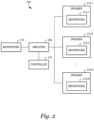
- Figure 2 is an example of a public address system 206 in accordance with one or more embodiments of the present disclosure.
- the system 206 can include an amplifier 208, a microphone 210, speakers 212-1, 212-2, 212-N, and a controller 214.
- the microphone 210 can be accessed by a user to speak audio to be played by the speakers 212, for instance.
- each of the speakers 212 can be associated with a respective microphone.
- the speaker 212-1 includes a microphone 213-1
- the speaker 212-2 includes a microphone 213-2
- the speaker 212-N includes a microphone 213-N.
- a speaker "being associated with” or “including” a microphone includes the speaker and the microphone being contained within a single housing.
- microphones may be attached or affixed to speakers before installation of the speakers in the facility. In some embodiments, microphones may be attached or affixed to speakers after installation of the speakers in the facility.
- a microphone associated with a particular speaker can be configured to receive audio played by that speaker.
- the microphone 213-1 can be configured to receive audio played by the speaker 212-1.
- a microphone associated with a particular speaker can be configured to receive audio played by a different speaker.
- the microphone 213-1 can be configured to receive audio played by the speaker 212-2 and/or 212-N.
- Figure 3 is an example of a computing device 304 for public address system commissioning, in accordance with one or more embodiments of the present disclosure.
- the computing device 304 can include a memory 316 and a processor 318 for public address system commissioning in accordance with the present disclosure.
- the memory 316 can be any type of storage medium that can be accessed by the processor 318 to perform various examples of the present disclosure.
- the memory 316 can be a non-transitory computer readable medium having computer readable instructions (e.g., executable instructions/computer program instructions) stored thereon that are executable by the processor 318 for public address system commissioning in accordance with the present disclosure.
- the memory 316 can be volatile or nonvolatile memory.
- the memory 316 can also be removable (e.g., portable) memory, or non-removable (e.g., internal) memory.
- the memory 316 can be random access memory (RAM) (e.g., dynamic random access memory (DRAM) and/or phase change random access memory (PCRAM)), read-only memory (ROM) (e.g., electrically erasable programmable read-only memory (EEPROM) and/or compact-disc read-only memory (CD-ROM)), flash memory, a laser disc, a digital versatile disc (DVD) or other optical storage, and/or a magnetic medium such as magnetic cassettes, tapes, or disks, among other types of memory.
- RAM random access memory
- DRAM dynamic random access memory
- PCRAM phase change random access memory
- ROM read-only memory
- EEPROM electrically erasable programmable read-only memory
- CD-ROM compact-disc read-only memory
- flash memory a laser disc
- memory 316 is illustrated as being located within computing device 304, embodiments of the present disclosure are not so limited.
- memory 316 can also be located internal to another computing resource (e.g., enabling computer readable instructions to be downloaded over the Internet or another wired or wireless connection).
Landscapes
- Engineering & Computer Science (AREA)
- Signal Processing (AREA)
- Physics & Mathematics (AREA)
- Acoustics & Sound (AREA)
- Otolaryngology (AREA)
- General Health & Medical Sciences (AREA)
- Health & Medical Sciences (AREA)
- Emergency Management (AREA)
- Business, Economics & Management (AREA)
- Computer Security & Cryptography (AREA)
- General Physics & Mathematics (AREA)
- Telephonic Communication Services (AREA)
- Alarm Systems (AREA)
Abstract
Devices, systems, and methods for public address system commissioning are described herein. In some examples, one or more embodiments include a computing device comprising a memory and a processor to execute instructions stored in the memory to communicate an audio file to a controller of a public address system of a facility, wherein the audio file is configured to be played by a speaker of the public address system, receive a recording of the played audio file, compare values of a plurality of audio parameters associated with the recording to target values of the plurality of audio parameters, and modify an audio setting on the controller of the public address system based on the comparison.
Description
- The present disclosure relates to devices, systems, and methods for public address system commissioning.
- Facilities, such as commercial facilities, office buildings, hospitals, campuses (e.g., including buildings and outdoor spaces), and the like, may have an alarm system that can be triggered during an event, such as an emergency situation (e.g., a fire) to warn occupants to evacuate. Such an alarm system can include a public address system which can amplify and emit noises. Such noises may include human voices, pre-recorded messages, alarms, tones, and/or other audible sounds. The public address system can utilize microphone(s), amplifier(s), speaker(s), and/or other devices to emit such audible sounds. Additionally, while the public address system can emit noises in an emergency situation, the public address system can also emit noises to perform announcements, play music, and/or be utilized for any other purpose. Such a public address system can be sufficiently audible at a distance and/or over a large area, especially in an emergency situation.
-
-
Figure 1 is an example of a system for public address system commissioning, in accordance with one or more embodiments of the present disclosure. -
Figure 2 is an example of a public address system in accordance with one or more embodiments of the present disclosure. -
Figure 3 is an example of a computing device for public address system commissioning, in accordance with one or more embodiments of the present disclosure. - Devices, systems, and methods for public address system action commissioning are described herein. In some examples, one or more embodiments include a computing device comprising a memory and a processor to execute instructions stored in the memory to communicate an audio file to a controller of a public address system of a facility, wherein the audio file is configured to be played by a speaker of the public address system, receive a recording of the played audio file, compare values of a plurality of audio parameters associated with the recording to target values of the plurality of audio parameters, and modify an audio setting on the controller of the public address system based on the comparison.
- In an event in which a public address system is utilized, an input is received which causes noise to be audibly output. For example, an event can cause a pre-recorded message to be amplified and transmitted to speakers for the speakers to audibly emit the pre-recorded message. In another example, a user may provide an input by speaking into a microphone, and the spoken message from the user can be received by the microphone, amplified, and transmitted to speakers for the speakers to audibly emit the spoken message from the user.
- Some facilities may include logical expressions configured to cause the public address system to take actions. For example, in response to an event occurring, such as a fire, the public address system may take predefined actions defined according to logical expressions, such as sending a particular message for emission in one location and sending a different message for emission in another location. For example, if the facility includes five floors, a message can be sent to speakers on the fifth-floor detailing to occupants of the fifth floor how to evacuate and why, whereas a different message can be sent to speakers on the fourth-floor detailing to occupants of the fourth floor how to evacuate and why. Such messages may differ as different evacuation routes may exist for different floors/areas of a facility.
- Public address systems can be commissioned (e.g., when they are installed). Commissioning, as referred to herein, is the process of assuring that all systems and components of a public address system are designed, installed, inspected, tested, operated, and maintained according to the operational requirements of the facility (e.g., owner or final client). Commissioning can include verifying that the audio played by the speakers in a facility is audible and/or intelligible. Stated differently, commissioning can include verifying and/or ensuring that values of various parameters of the audio played by the speakers of a facility (referred to herein as "audio parameters") meet or exceed target values. Audio parameters are known to those of skill in the art and can refer, for example, to volume, frequency, bandwidth, pitch, filter cutoff frequency, etc.
- In previous approaches, commissioning a public address system can be laborious, time consuming, and costly. For instance, in large facilities, such as airports, an acoustic simulation report may be obtained (e.g., from a third party). Based on this report, speaker and/or controller audio settings can be determined. In some instances, sound pressure level can be determined. In small and/or mediumsized facilities the cost of these steps may be prohibitive. Instead, in order to determine whether the system performs as configured, a first technician may travel throughout the facility with a communications device (e.g., a walkie talkie) while a second technician operates a controller and/or computing device that causes audio to be played by the various speakers. In some cases, each speaker may be tested individually, one by one. The quality of the audio played by the different speakers is communicated from the first technician back to the second technician. Adjustments can be made by the second technician based on the feedback received from the first technician. This approach is time-consuming and involves multiple technicians and their associated costs.
- Embodiments of the present disclosure can reduce (e.g., eliminate) the need for multiple technicians and save time and money. For example, in some embodiments, the speakers of a public address system can include microphones. These microphones can record the audio played by the speakers in a facility. The recorded audio from the different zones of the facility can be analyzed by a computing device. In some embodiments, audio parameters of the recorded audio can be displayed (e.g., via graphs, charts, etc.). In some embodiments, audio settings can be automatically adjusted by the computing device. In some embodiments, audio settings may be adjusted manually based on information provided by the computing devices. For example, the computing device can make recommendations associated with adjusting audio settings.
- In the following detailed description, reference is made to the accompanying drawings that form a part hereof. The drawings show by way of illustration how one or more embodiments of the disclosure may be practiced.
- These embodiments are described in sufficient detail to enable those of ordinary skill in the art to practice one or more embodiments of this disclosure. It is to be understood that other embodiments may be utilized and that process, electrical, and/or structural changes may be made without departing from the scope of the present disclosure.
- As will be appreciated, elements shown in the various embodiments herein can be added, exchanged, combined, and/or eliminated so as to provide a number of additional embodiments of the present disclosure. The proportion and the relative scale of the elements provided in the figures are intended to illustrate the embodiments of the present disclosure and should not be taken in a limiting sense.
- The figures herein follow a numbering convention in which the first digit or digits correspond to the drawing figure number and the remaining digits identify an element or component in the drawing. Similar elements or components between different figures may be identified by the use of similar digits. For example, 108 may reference element "08" in
Figure 1 , and a similar element may be referenced as 208 inFigure 2 . - As used herein, "a", "an", or "a number of" something can refer to one or more such things, while "a plurality of" something can refer to more than one such things. For example, "a number of components" can refer to one or more components, while "a plurality of components" can refer to more than one component.
-
Figure 1 is an example of a system 100 for public address system commissioning, in accordance with one or more embodiments of the present disclosure. The system 100 can include afacility 102, acomputing device 104, apublic address system 106, and amobile device 122. - As mentioned above, a
facility 102 can be a building, a campus (e.g., building(s) with outdoor spaces), etc. and can include apublic address system 106. As used herein, the term "public address system" refers to an electronic system to cause noise to be audibly output. Thepublic address system 106 can be utilized at thefacility 102 in order to amplify and emit audible noises, including pre-recorded messages, alarms, tones, and/or other audible sounds. Such audible noises may be emitted during an event, such as a public address, an emergency situation, etc. - The
public address system 106 can include components to emit such audible noises, including anamplifier 108,microphone 110, andspeaker 112. As used herein, the term "amplifier" refers to an electronic device that is configured to increase the power of an electrical signal. For example, the signal can be an audio signal that is to be emitted into thefacility 102. As used herein, the term "microphone" refers to an electronic device that converts sound into an electrical signal. As used herein, the term "speaker" refers to an electronic device that converts an electrical signal into audible sound. In some examples, themicrophone 110 can convert sound, such as audio played by thespeaker 112, into an electrical signal that can be processed by thecomputing device 104. In some examples, themicrophone 110 can convert sound, such as a speaker's voice, into an electrical signal that can be amplified via theamplifier 108 and audibly emitted to thefacility 102 via thespeaker 112. In some examples, theamplifier 108 can amplify an electrical signal corresponding to a pre-recorded message or sound that can be audibly emitted to thefacility 102 via thespeaker 112. Such emission of voice and/or pre-recorded messages/sounds are further described herein. - Although the
public address system 106 is illustrated inFigure 1 as including asingle amplifier 108, asingle microphone 110, and asingle speaker 112, embodiments of the present disclosure are not so limited. For example, thepublic address system 106 can includemultiple amplifiers 108,multiple microphones 110, and/ormultiple speakers 112. - As mentioned above, the
public address system 106 can perform actions when an event occurs in the facility. As used herein, the term "event" refers to an occurrence. An event can be, for example, a non-emergency event (e.g., an announcement), an emergency event (e.g., a fire or other emergency), among other types of events. - As illustrated in
Figure 1 , thepublic address system 106 can include a controller 114. The controller 114 is configured to cause thepublic address system 106 to perform predefined actions during an event. In an example in which the event is an emergency event (e.g., a fire), the controller 114 can cause thepublic address system 106 to emit instructions on where and how to evacuate the facility 102 (e.g., via the speaker 112), emit warning tones (e.g., via the speaker 112), among other predefined actions. - In some examples, the event can be a fire. Causing the controller 114 to perform the predefined actions can include causing the
speaker 112 to output a pre-recorded message. For example, the controller 114 can cause thespeaker 112 to output a first pre-recorded message on a first floor of the facility 102 (e.g., "Proceed to nearest exit"), cause another speaker in thefacility 102 to output a second pre-recorded message on a second floor of the facility 102 (e.g., "Proceed to east stairwell and move down one floor, exit facility from emergency exit"), etc. Although the event types are described above as being an emergency event (e.g., a fire) and an announcement, embodiments of the present disclosure are not so limited. For example, the event can be any other event. - The
controller 116 can includeaudio settings 116. Theaudio settings 116 can include settings for various parameters of played audio known to those of skill in the art including volume, frequency, bandwidth, pitch, filter cutoff frequency, etc. The audio settings can be adjusted manually (e.g., via user input) and/or automatically (e.g., without user input). - As illustrated in
Figure 1 , theaudio settings 116 can be stored at the controller 114. For example, theaudio settings 116 can be stored in memory (e.g., not illustrated inFigure 1 ) of the controller 114, and a processor associated with the controller 114 can execute instructions to cause the public address system 106 (e.g.,speakers 112 of the public address system 106) to exhibit the audio settings, as described above. However, embodiments of the present disclosure are not so limited to storing theaudio settings 116 locally at the controller 114. For example, theaudio settings 116 may be stored remotely at thecomputing device 104, remotely at a remote computing device (e.g., not illustrated inFigure 1 ) such as a cloud server, and may be accessed by the controller 114 via a network relationship between the controller 114 and the remote computing device, etc. - As illustrated in
Figure 1 , thefacility 102 can include acomputing device 104. Thecomputing device 104 can access thepublic address system 106 in thefacility 102. For example, thecomputing device 104 can connect, via a network relationship, to the controller 114 to view and/or modify theaudio settings 116. Examples of such a network relationship can include a local area network (LAN), wide area network (WAN), personal area network (PAN), a distributed computing environment (e.g., a cloud computing environment), storage area network (SAN), Metropolitan area network (MAN), a cellular communications network, Long Term Evolution (LTE), visible light communication (VLC), Bluetooth, Worldwide Interoperability for Microwave Access (WiMAX), Near Field Communication (NFC), infrared (IR) communication, Public Switched Telephone Network (PSTN), radio waves, and/or the Internet, among other types of network relationships. - An audio file (sometimes referred to herein simply as "audio") can be communicated to the controller 114 from the
computing device 104. The controller 114 can cause the audio to be played by thespeaker 112. The played audio can be received by themicrophone 110, which can convert the audio to an electrical signal and communicate the electrical signal to thecomputing device 104. Thecomputing device 104 can compare values of a plurality of audio parameters associated with the recording to target values of the plurality of audio parameters. Based on the comparison, thecomputing device 104 can generate areport 120, as is further described herein. - The
report 120 can be generated by thecomputing device 104 after comparing the values of the audio parameters to target values of the audio parameters to determine how thepublic address system 106 performed against how thepublic address system 106 was intended to perform. As used herein, the term "report" refers to an account of a particular matter in textual and/or graphical form. For example, thereport 120 can be an account of how thespeakers 112 of thepublic address system 106 performed when a simulated event occurs. - As illustrated in
Figure 1 , thereport 120 can be stored at thecomputing device 104. However, embodiments of the present disclosure are not so limited. For example, thereport 120 can be stored remotely from the computing device 104 (e.g., at the controller 114, at a remote computing device (e.g., not illustrated inFigure 1 ), etc. Thereport 120 can include a display of the values of the plurality of audio parameters. - The
report 120 can be used to modify theaudio settings 116 on the controller 114. In some embodiments, the modification is made without any user input. In some embodiments, the modification is made responsive to a user input (e.g., via thecomputing device 104 and/or the mobile device 122). In an example, a list of proposed audio settings is provided via theuser interface 124 and a selection of one of the audio settings can be made by a user. In another example, a recommendation associated with adjusting an audio setting on the controller is included in the report. - The system 100 can further include a
mobile device 122. Themobile device 122 can be configured to access thecomputing device 104 in order to access thereport 120. Themobile device 122 can access thecomputing device 104 via a network relationship between thecomputing device 104 and themobile device 122. Themobile device 122 can display thereport 120 on auser interface 124 of themobile device 122. -
Figure 2 is an example of apublic address system 206 in accordance with one or more embodiments of the present disclosure. As illustrated inFigure 2 , thesystem 206 can include anamplifier 208, amicrophone 210, speakers 212-1, 212-2, 212-N, and acontroller 214. Themicrophone 210 can be accessed by a user to speak audio to be played by thespeakers 212, for instance. As illustrated inFigure 2 , each of thespeakers 212 can be associated with a respective microphone. For instance, the speaker 212-1 includes a microphone 213-1, the speaker 212-2 includes a microphone 213-2, and the speaker 212-N includes a microphone 213-N. In some embodiments, a speaker "being associated with" or "including" a microphone includes the speaker and the microphone being contained within a single housing. In some embodiments, microphones may be attached or affixed to speakers before installation of the speakers in the facility. In some embodiments, microphones may be attached or affixed to speakers after installation of the speakers in the facility. - In some embodiments, a microphone associated with a particular speaker can be configured to receive audio played by that speaker. For example, the microphone 213-1 can be configured to receive audio played by the speaker 212-1. In some embodiments, a microphone associated with a particular speaker can be configured to receive audio played by a different speaker. For example, the microphone 213-1 can be configured to receive audio played by the speaker 212-2 and/or 212-N.
-
Figure 3 is an example of acomputing device 304 for public address system commissioning, in accordance with one or more embodiments of the present disclosure. As illustrated inFigure 3 , thecomputing device 304 can include amemory 316 and aprocessor 318 for public address system commissioning in accordance with the present disclosure. - The
memory 316 can be any type of storage medium that can be accessed by theprocessor 318 to perform various examples of the present disclosure. For example, thememory 316 can be a non-transitory computer readable medium having computer readable instructions (e.g., executable instructions/computer program instructions) stored thereon that are executable by theprocessor 318 for public address system commissioning in accordance with the present disclosure. - The
memory 316 can be volatile or nonvolatile memory. Thememory 316 can also be removable (e.g., portable) memory, or non-removable (e.g., internal) memory. For example, thememory 316 can be random access memory (RAM) (e.g., dynamic random access memory (DRAM) and/or phase change random access memory (PCRAM)), read-only memory (ROM) (e.g., electrically erasable programmable read-only memory (EEPROM) and/or compact-disc read-only memory (CD-ROM)), flash memory, a laser disc, a digital versatile disc (DVD) or other optical storage, and/or a magnetic medium such as magnetic cassettes, tapes, or disks, among other types of memory. - Further, although
memory 316 is illustrated as being located withincomputing device 304, embodiments of the present disclosure are not so limited. For example,memory 316 can also be located internal to another computing resource (e.g., enabling computer readable instructions to be downloaded over the Internet or another wired or wireless connection). - Although specific embodiments have been illustrated and described herein, those of ordinary skill in the art will appreciate that any arrangement calculated to achieve the same techniques can be substituted for the specific embodiments shown. This disclosure is intended to cover any and all adaptations or variations of various embodiments of the disclosure.
- It is to be understood that the above description has been made in an illustrative fashion, and not a restrictive one. Combination of the above embodiments, and other embodiments not specifically described herein will be apparent to those of skill in the art upon reviewing the above description.
- The scope of the various embodiments of the disclosure includes any other applications in which the above structures and methods are used. Therefore, the scope of various embodiments of the disclosure should be determined with reference to the appended claims, along with the full range of equivalents to which such claims are entitled.
- In the foregoing Detailed Description, various features are grouped together in example embodiments illustrated in the figures for the purpose of streamlining the disclosure. This method of disclosure is not to be interpreted as reflecting an intention that the embodiments of the disclosure require more features than are expressly recited in each claim.
- Rather, as the following claims reflect, inventive subject matter lies in less than all features of a single disclosed embodiment. Thus, the following claims are hereby incorporated into the Detailed Description, with each claim standing on its own as a separate embodiment.
Claims (15)
- A computing device (104, 304) for public address system (106, 206) commissioning, comprising:a memory (316); anda processor (318) configured to execute executable instructions stored in the memory to:communicate an audio file to a controller (114, 214) of a public address system (106, 206) of a facility (102), wherein the audio file is configured to be played by a speaker (112, 212) of the public address system;receive a recording of the played audio file;compare values of a plurality of audio parameters associated with the recording to target values of the plurality of audio parameters; andmodify an audio setting (116) on the controller (114, 214) of the public address system (106, 206) based on the comparison.
- The device of claim 1, wherein the audio file is created via a microphone (110, 210) in the facility (102).
- The device of claim 1, wherein the recording of the played audio file is created by a microphone (213) associated with the speaker (112, 212).
- The device of claim 1, wherein the recording of the played audio file is created by a different microphone (213) in a different speaker (112, 212) of the public address system.
- The device of claim 1, wherein the instructions to modify the audio setting (116) on the controller (114, 214) based on the comparison include instructions to modify the audio setting (116) without any user input.
- The device of claim 1, wherein the instructions to modify the audio setting (116) on the controller (114, 214) based on the comparison include instructions to modify the audio setting (116) responsive to a user input.
- The device of claim 6, wherein the user input is made using a mobile device (122).
- The device of claim 1, including instructions to generate a report (120) that includes the values of the plurality of audio parameters associated with the recording.
- The device of claim 1, wherein the plurality of audio parameters associated with the recording include:a volume of the played audio file;a frequency of the played audio file; anda bandwidth of the played audio file.
- The device of claim 1, including instructions to:receive a plurality of recordings of the played audio file created by a plurality of microphones (213) associated with a plurality of speakers (112, 212) distributed in the facility (102);compare values of a plurality of audio parameters associated with the recordings to target values of the plurality of audio parameters; andmodify an audio setting (116) on the controller (114, 214) of the public address system (106, 206) based on the comparisons.
- A system, comprising:a computing device (104, 304);a public address system (106, 206), comprising:a controller (114, 214);an amplifier (108, 208);a speaker (112, 212); anda microphone (213);wherein:the controller (114, 214) is configured to cause the speaker (112, 212) to play audio;the microphone (213) is configured to convert the played audio to an electrical signal;the computing device (104, 304) is configured to:determine values of a plurality of audio parameters associated with the audio based on the electrical signal;compare the values to target values of the plurality of audio parameters.
- The system of claim 11, wherein the computing device (104, 304) is configured to display the values of the plurality of audio parameters.
- The system of claim 11, wherein the computing device (104, 304) is configured to automatically adjust an audio setting (116) on the controller (114, 214) based on the comparison.
- The system of claim 11, wherein the computing device (104, 304) is configured to display a recommendation associated with adjusting an audio setting (116) on the controller (114, 214) based on the comparison.
- The system of claim 11, wherein the microphone (213) and the speaker (112, 212) are contained within a single housing.
Applications Claiming Priority (1)
| Application Number | Priority Date | Filing Date | Title |
|---|---|---|---|
| US17/969,164 US20240236593A9 (en) | 2022-10-19 | 2022-10-19 | Public address system commissioning |
Publications (1)
| Publication Number | Publication Date |
|---|---|
| EP4358052A1 true EP4358052A1 (en) | 2024-04-24 |
Family
ID=88197011
Family Applications (1)
| Application Number | Title | Priority Date | Filing Date |
|---|---|---|---|
| EP23199439.3A Pending EP4358052A1 (en) | 2022-10-19 | 2023-09-25 | Public address system commissioning |
Country Status (3)
| Country | Link |
|---|---|
| US (1) | US20240236593A9 (en) |
| EP (1) | EP4358052A1 (en) |
| CN (1) | CN117914436A (en) |
Citations (3)
| Publication number | Priority date | Publication date | Assignee | Title |
|---|---|---|---|---|
| US20200314573A1 (en) * | 2019-03-29 | 2020-10-01 | Mitsubishi Heavy Industries, Ltd. | Method of acoustic tuning in aircraft cabin |
| US20220201414A1 (en) * | 2020-12-21 | 2022-06-23 | Johnson Controls Fire Protection LP | Characterization of reverberation of audible spaces |
| EP4344254A1 (en) * | 2022-09-22 | 2024-03-27 | Honeywell International Inc. | Operating public address systems with ip-based amplifiers |
Family Cites Families (4)
| Publication number | Priority date | Publication date | Assignee | Title |
|---|---|---|---|---|
| US5652544A (en) * | 1994-11-09 | 1997-07-29 | Crest Audio Inc. | Apparatus and method for programming an amplifier |
| US6876968B2 (en) * | 2001-03-08 | 2005-04-05 | Matsushita Electric Industrial Co., Ltd. | Run time synthesizer adaptation to improve intelligibility of synthesized speech |
| WO2016033400A1 (en) * | 2014-08-29 | 2016-03-03 | Harman International Industries, Inc. | Wireless speaker system |
| AU2020433340B2 (en) * | 2020-03-06 | 2026-02-19 | Algoriddim Gmbh | Method, device and software for applying an audio effect to an audio signal separated from a mixed audio signal |
-
2022
- 2022-10-19 US US17/969,164 patent/US20240236593A9/en active Pending
-
2023
- 2023-09-25 EP EP23199439.3A patent/EP4358052A1/en active Pending
- 2023-09-26 CN CN202311251654.7A patent/CN117914436A/en active Pending
Patent Citations (3)
| Publication number | Priority date | Publication date | Assignee | Title |
|---|---|---|---|---|
| US20200314573A1 (en) * | 2019-03-29 | 2020-10-01 | Mitsubishi Heavy Industries, Ltd. | Method of acoustic tuning in aircraft cabin |
| US20220201414A1 (en) * | 2020-12-21 | 2022-06-23 | Johnson Controls Fire Protection LP | Characterization of reverberation of audible spaces |
| EP4344254A1 (en) * | 2022-09-22 | 2024-03-27 | Honeywell International Inc. | Operating public address systems with ip-based amplifiers |
Also Published As
| Publication number | Publication date |
|---|---|
| US20240137718A1 (en) | 2024-04-25 |
| CN117914436A (en) | 2024-04-19 |
| US20240236593A9 (en) | 2024-07-11 |
Similar Documents
| Publication | Publication Date | Title |
|---|---|---|
| US9736264B2 (en) | Personal audio system using processing parameters learned from user feedback | |
| US9703524B2 (en) | Privacy protection in collective feedforward | |
| EP3375195B1 (en) | Annoyance noise suppression | |
| US10531178B2 (en) | Annoyance noise suppression | |
| US11470433B2 (en) | Characterization of reverberation of audible spaces | |
| US10275209B2 (en) | Sharing of custom audio processing parameters | |
| US8103007B2 (en) | System and method of detecting speech intelligibility of audio announcement systems in noisy and reverberant spaces | |
| US20070192098A1 (en) | System And Method For Dynamic Modification Of Speech Intelligibility Scoring | |
| EP4344254A1 (en) | Operating public address systems with ip-based amplifiers | |
| US10595117B2 (en) | Annoyance noise suppression | |
| US20240236593A9 (en) | Public address system commissioning | |
| US20190286409A1 (en) | Privacy protection in collective feedforward | |
| JP4882338B2 (en) | Multi-speaker system | |
| EP4274262A1 (en) | Public address system action auditing | |
| US12100289B2 (en) | Hearing aid for alarms and other sounds | |
| JP6927726B2 (en) | Broadcast system and slave station equipment | |
| US20230292061A1 (en) | Hearing aid in-ear announcements | |
| US20220230614A1 (en) | Dynamic network based sound masking | |
| WO2023112668A1 (en) | Sound analysis device, sound analysis method, and recording medium |
Legal Events
| Date | Code | Title | Description |
|---|---|---|---|
| PUAI | Public reference made under article 153(3) epc to a published international application that has entered the european phase |
Free format text: ORIGINAL CODE: 0009012 |
|
| STAA | Information on the status of an ep patent application or granted ep patent |
Free format text: STATUS: REQUEST FOR EXAMINATION WAS MADE |
|
| 17P | Request for examination filed |
Effective date: 20230925 |
|
| AK | Designated contracting states |
Kind code of ref document: A1 Designated state(s): AL AT BE BG CH CY CZ DE DK EE ES FI FR GB GR HR HU IE IS IT LI LT LU LV MC ME MK MT NL NO PL PT RO RS SE SI SK SM TR |
|
| STAA | Information on the status of an ep patent application or granted ep patent |
Free format text: STATUS: EXAMINATION IS IN PROGRESS |
|
| 17Q | First examination report despatched |
Effective date: 20251105 |