EP4357984A1 - Eingeschränkte suche: verbesserung der nas-qualität mit mehreren zielen durch fokus auf anfrage - Google Patents
Eingeschränkte suche: verbesserung der nas-qualität mit mehreren zielen durch fokus auf anfrage Download PDFInfo
- Publication number
- EP4357984A1 EP4357984A1 EP23204401.6A EP23204401A EP4357984A1 EP 4357984 A1 EP4357984 A1 EP 4357984A1 EP 23204401 A EP23204401 A EP 23204401A EP 4357984 A1 EP4357984 A1 EP 4357984A1
- Authority
- EP
- European Patent Office
- Prior art keywords
- enas
- neural
- bound
- architectures
- offspring
- Prior art date
- Legal status (The legal status is an assumption and is not a legal conclusion. Google has not performed a legal analysis and makes no representation as to the accuracy of the status listed.)
- Pending
Links
Images





Classifications
-
- G—PHYSICS
- G06—COMPUTING OR CALCULATING; COUNTING
- G06N—COMPUTING ARRANGEMENTS BASED ON SPECIFIC COMPUTATIONAL MODELS
- G06N3/00—Computing arrangements based on biological models
- G06N3/02—Neural networks
- G06N3/08—Learning methods
- G06N3/0985—Hyperparameter optimisation; Meta-learning; Learning-to-learn
-
- G—PHYSICS
- G06—COMPUTING OR CALCULATING; COUNTING
- G06N—COMPUTING ARRANGEMENTS BASED ON SPECIFIC COMPUTATIONAL MODELS
- G06N3/00—Computing arrangements based on biological models
- G06N3/02—Neural networks
- G06N3/04—Architecture, e.g. interconnection topology
- G06N3/045—Combinations of networks
-
- G—PHYSICS
- G06—COMPUTING OR CALCULATING; COUNTING
- G06N—COMPUTING ARRANGEMENTS BASED ON SPECIFIC COMPUTATIONAL MODELS
- G06N3/00—Computing arrangements based on biological models
- G06N3/02—Neural networks
- G06N3/08—Learning methods
- G06N3/086—Learning methods using evolutionary algorithms, e.g. genetic algorithms or genetic programming
-
- G—PHYSICS
- G06—COMPUTING OR CALCULATING; COUNTING
- G06N—COMPUTING ARRANGEMENTS BASED ON SPECIFIC COMPUTATIONAL MODELS
- G06N3/00—Computing arrangements based on biological models
- G06N3/02—Neural networks
- G06N3/04—Architecture, e.g. interconnection topology
- G06N3/0464—Convolutional networks [CNN, ConvNet]
Definitions
- the present disclosure relates to neural architecture search (NAS), and, more particularly, to methods that introduce model requirement or preference into NAS searching stage to yield better quality of Pareto front.
- NAS neural architecture search
- AI artificial intelligence
- ML machine learning
- DL deep learning
- NN neural network
- NAS neural architecture search
- an evolutionary neural architecture search method can include the following steps of: (a) performing one or more evolutionary operations on an initial population of neural architectures to generate offspring neural architectures; (b) evaluating performance of each of the offspring neural architectures to obtain at least one evaluation value of the offspring neural architecture with respect to a performance metric; (c) adjusting the evaluation values of the offspring neural architectures based on at least one constraint on the evaluation values; (d) selecting at least one of the offspring neural architectures as a new population of neural architectures using a selection strategy; (e) outputting the new population of neural architectures as a last population of neural architectures when a stopping criterion is achieved; and (f) iterating steps (a) to (d) with the new population of neural architectures being taken as the initial population
- adjusting the evaluation values of the neural architectures can include at least one of performing a clip algorithm to apply an enough-bound on the evaluation values of the offspring neural architectures and performing an extinct algorithm to apply a must-bound on the evaluation values of the offspring neural architectures.
- at least one of the enough-bound and the must-bound can be constant for every iteration of steps (a) to (d).
- at least one of the enough-bound and the must-bound can vary for at least two consecutive iterations of steps (a) to (d).
- the at least one of the enough-bound and the must-bound can gradually increase as steps (a) to (d) iterate.
- the must-bound can gradually increase as steps (a) to (d) iterate.
- the enough-bound can gradually increase as steps (a) to (d) iterate.
- the evolutionary operations can include at least one of crossover and mutation.
- the selection strategy can include one of non-dominated soring, elitism, discarding the worst, roulette wheel selection and tournament selection.
- the apparatus can include circuitry, the circuitry configured to perform an evolutionary neural architecture search (ENAS) method, the ENAS method can include comprising the following steps of: (a) performing one or more evolutionary operations on an initial population of neural architectures to generate offspring neural architectures; (b) evaluating performance of each of the offspring neural architectures to obtain at least one evaluation value of the offspring neural architecture with respect to a performance metric; (c) adjusting the evaluation values of the offspring neural architectures based on at least one constraint on the evaluation values; (d) selecting at least one of the offspring neural architectures as a new population of neural architectures using a selection strategy; (e) outputting the new population of neural architectures as a last population of neural architectures when a stopping criterion is achieved; and (f) iterating steps (a) to (d) with the new population of neural architectures being taken as the initial population of neural architectures when the stopping criterion is not achieved yet.
- ENAS evolutionary neural architecture search
- the non-transitory machine-readable storage medium can stores instructions which, when executed by a processor, causes the processor to execute an evolutionary neural architecture search (ENAS) method, the ENAS method including the following steps of: (a) performing one or more evolutionary operations on an initial population of neural architectures to generate offspring neural architectures; (b) evaluating performance of each of the offspring neural architectures to obtain at least one evaluation value of the offspring neural architecture with respect to a performance metric; (c) adjusting the evaluation values of the offspring neural architectures based on at least one constraint on the evaluation values; (d) selecting at least one of the offspring neural architectures as a new population of neural architectures using a selection strategy; (e) outputting the new population of neural architectures as a last population of neural architectures when a stopping criterion is achieved; and (f) iterating steps (a) to (d) with the new population of neural architectures being taken as the initial population of
- ENAS evolutionary neural architecture search
- DNNs deep neural networks
- CNN convolutional neural networks
- CNN convolutional neural networks
- NAS neural architecture search
- NAS algorithms can be classified into three categories, based on the optimizers (or search strategies) they employ: reinforcement learning (RL), gradient, and evolutionary computation (EC).
- RL-based NAS algorithms use a recurrent neural network (RNN), for example, to sample the representation of neural architecture, and then adopt reinforcement learning to constantly adjust the neural architectures.
- RNN recurrent neural network
- RL-based NAS algorithms may require as many as thousands of graphics processing units (GPUs) performing several days.
- Gradient-based NAS algorithms continuously relax the previously discrete search space, allowing efficient search of neural architecture using the gradient descent strategy.
- EC-based NAS ENAS
- ENAS EC-based NAS
- FIG. 1 illustrates a flowchart of an ENAS method 100 that performs a populating updating process.
- the ENAS method100 includes an initial space (or stage) 110 and a search space (or stage) 120.
- a population is defined or sampled in advance, each individual in which can represent a candidate model for the ENAS, i.e ., a DNN model.
- the population in the initial space 110 can be initialized from trivial initial conditions or randomly initialized in an encoding space.
- the fitness of the individuals can be evaluated based on a certain evaluation criterion.
- initial population for the search space 120 is generated, each of which has been evaluated exceeding the evaluation criterion and is defined as a neural architecture a NAS approach might discover.
- the search space 120 can also be reduced by incorporating prior knowledge about typical properties of neural architectures well-suited for a task (e.g ., rich initialization), forming a well-designed search space.
- At least one DNN model can be sampled from the initial population in every evolution step and serve as a parent to generate offsprings by performing evolutionary operations, e.g., crossover, mutation, etc., at step 121.
- crossover can include swapping some of the hyperparameters (e.g ., the number of channels) of two layers of the DNN model.
- mutation can include adding or removing a layer, changing the hyperparameters ( e.g ., the number of channels) of a layer, adding skip connections, as well as changing training hyperparameters of the DNN model.
- the ENAS method 100 aims to find a neural architecture that maximizes some performance measure, such as accuracy (measured based on peak signal-to-noise ratio (PSNR), for example), latency, power consumption, memory requirement, operating speed, operating cycle, etc. Therefore, in the search space 120, the generated offsprings are evaluated to determine their performance, at step 122.
- the offsprings e.g., DNN models, can be trained on training data and their performance can be evaluated on validation data.
- the offsprings are selected, at step 123.
- the selection strategies used at step 123 can include elitism (retaining the individuals with higher fitness values), discarding the worst (removing the individuals with poor fitness values from the population), roulette wheel selection (giving every individual a probability according to its fitness value among the population to survive or be discarded, regardless it is the best or not), tournament selection (selecting the best one from an equally likely sampling of individuals), etc.
- step 124 whether a stopping criterion of the population updating process is achieved is determined. For example, if the generation of offsprings generated has not reached a generation limit yet, steps 121 to 123 can be executed sequentially again; otherwise, the population updating process of the ENAS method 100 ends and the last population is generated.
- NAS is formulated as a single-objective optimization progress (e.g ., accuracy) with the goal of finding a neural architecture that has minimal validation error, for example.
- AI models need to be evaluated by more than its accuracy performance.
- latency, power consumption and other hardware-metrics also need to be taken into consideration, which makes NAS become a multi-objective optimization progress.
- Multi-objective NAS does not solely aim to minimize the validation error, but simultaneously optimize multiple objectives, e.g., accuracy, latency, power consumption and memory requirement.
- objectives e.g., accuracy, latency, power consumption and memory requirement.
- a cost function can be customized to bring the multi-objective problem to a single-objective problem.
- a cost function demonstrates poor generalizability, and a dedicated cost function may be needed for each application.
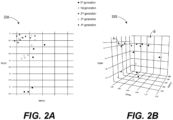
- DNN models thus searched may become sparser when the number of objectives increases, and, thus, multi-objective NAS may lead to extremely diversified solutions and cause only a small portion of models can meet the predefined requirements. For example, as shown in FIGs.
- the candidate DNN models of the fourth generation are sparser in a three-objective NAS 200B (e.g ., PSNR, power consumption and latency) than in a two-objective NAS 200A (e.g ., PSNR and latency), and models A and B are extremely diversified though they may have similar cost function values. Accordingly, lots of searching resources may be wasted on unqualified models which results in inadequate quantity and quality of qualified candidate models.
- a three-objective NAS 200B e.g ., PSNR, power consumption and latency
- a two-objective NAS 200A e.g ., PSNR and latency
- NAS searching objective space e.g., the search space 120
- must-bound and enough-bound can be introduced into multi-objective NAS. For example, if a model is worse than the must-bound, it is counted as unqualified and should not be in the final candidate model list. As another example, if a model is better than the enough-bound, not extra credit is grated to it and is has a predefined evaluation value with respect to the enough-bound.
- aspects of the present disclosure introduce a clip algorithm (Clip (x)) and an extinct algorithm (Extinct (x)) to apply the enough-bound and the must-bound, respectively, on the evolved models.
- the clip algorithm can adjust and determine the evaluation value of a model based on a clip condition.
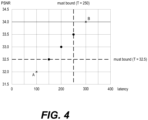
- NAS can be avoided focusing on invalid optimization directions. For example, as shown in FIG.
- the enough-bound (T) for the latency index of any candidate model is 150
- NAS can thus be avoided focusing on invalid optimization directions. For example, also as shown in FIG.
- the enough-bound (T) for the PSNR index of any candidate model is 33.5
- the extinct algorithm can adjust and determine the evaluation value of a model based on an extinct condition.
- NAS can be avoided focusing on invalid optimization directions.
- the must-bound (T) for the PSNR index of any candidate model is 32.5
- NAS can be avoided focusing on invalid optimization directions. For example, also as shown in FIG.
- the must-bound (T) for the latency index of any candidate model is 250
- FIG. 5 illustrates a flowchart of an ENAS method 500 that performs a populating updating process according to some embodiments of the present disclosure.
- the ENAS method 500 can include an initial space (or stage) 510 and a search space (or stage) 520.
- the ENAS method 500 introduces model requirement or preference into NAS searching stage to yield better quality of Pareto front. Therefore, NAS searching objective space, e.g., the search space 520, can be applied with constraints, e.g ., must-bound and enough-bound, and only focus on the potentially qualified candidate models.
- the initial space 510 can include the initial space 110.
- the search space 520 of the ENAS method 500 can differ from the search space 120 of the ENAS method 100 in that the search space 520 further includes an extinct step 525 and a clip step 526, in addition to the evolution step 121, the evaluation step 122, the selection step 123 and the stopping criterion step 124.
- some of the steps of the ENAS method 500 shown can be performed concurrently or in a different order than shown, can be substituted by other method steps, or can be omitted. Additional method steps can also be performed as desired.
- the initial population generated in the initial space 510 are input to the search space 520, evolutionary operations, e.g., crossover, mutation, etc., are performed on the parent population at step 121 to generate offsprings, and the offsprings generated at step 121 are evaluated to determine their performance at step 122, e.g., evaluation values of a model. Then, the ENAS method 500 can proceed to step 525.
- evolutionary operations e.g., crossover, mutation, etc.
- the offsprings with at least one of the evaluation values being clipped are selected, none of which have greater or less evaluation values than the must-bound, depending on the extinct condition.
- the selection strategies used at step 123 can include elitism, discarding the worst, roulette wheel selection, tournament selection, non-dominated soring, etc.
- the ENAS method 500 can proceed to step 124, at which whether a stopping criterion of the population updating process is achieved is determined. For example, if the generation of offsprings generated has not reached a generation limit yet, steps 121 to 123 can be executed sequentially again; otherwise, the population updating process of the ENAS method 500 ends and the last population is generated.
- FIG. 6 illustrates an application and simulation example of an ENAS method that introduces must-bound and/or enough-bound, e.g., the ENAS method 500, according to some embodiments of the present disclosure.
- the ENAS method is used for super-resolution (SR) models to maximize PSNR (must-bound) and minimize latency and power of the SR models (must-bound and enough-bound, respectively).
- SR super-resolution
- a must-bound e.g. , 34.25
- the baseline which does not introduce any constraints, finds only 5 candidate models and its hypervolume (HV) (a metric that determines the quality of Pareto front) is only 0.0167.
- HV hypervolume
- the must-bound on PSNR finds as many as 25 candidate models and its HV achieves 0.0226, 35.33% greater than 0.0167
- the must-bound on PSNR and enough-bound and must-bound on latency and power, respectively finds as many as 35 candidate models and its HV achieves 0.0220, 31.74% greater than 0.0167.
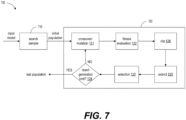
- FIG. 7 illustrates a flowchart of an ENAS method 700 that performs a populating updating process according to some embodiments of the present disclosure.
- the ENAS method 700 can include an initial space (or stage) 710 and a search space (or stage) 720.
- the ENAS method 700 introduces model requirement or preference into NAS searching stage to yield better quality of Pareto front.
- the initial space 710 can include the initial space 110.
- the search space 720 of the ENAS method 700 can differ from the search space 520 of the ENAS method 500 in that in the search space 720 step 525 and step 526 are executed in a reverse order from step 525 and step 526 executed in the search space 520.
- a clip algorithm (Clip (x)) can be first used to adjust and determine at least one of the evaluation values of the model based on a clip condition at step 526, and an extinct algorithm (Extinct (x)) can then be used to adjust and determine at least one of the remaining evaluation values of the model based on an extinct condition at step 525.
- an extinct algorithm Extinct (x)
- some of the steps of the ENAS method 700 shown can be performed concurrently or in a different order than shown, can be substituted by other method steps, or can be omitted. Additional method steps can also be performed as desired.
- FIG. 8 illustrates a flowchart of an ENAS method 800 that performs a populating updating process according to some embodiments of the present disclosure.
- the ENAS method 800 can include an initial space (or stage) 810 and a search space (or stage) 820.
- the ENAS method 800 introduces model requirement or preference into NAS searching stage to yield better quality of Pareto front.
- the initial space 810 can include the initial space 110.
- the search space 820 of the ENAS method 800 can differ from the search space 520 of the ENAS method 500 and the search space 720 of the ENAS method 700 in that the search space 820 includes only one of step 525 and step 526.
- the ENAS method 800 uses an extinct algorithm (Extinct (x)) at step 525 to adjust and determine at least one of the evaluation values of the model based on an extinct condition.
- the ENAS method 800 uses a clip algorithm (Clip (x)) at step 526 to adjust and determine at least one of the evaluation values of the model based on a clip condition.
- the extinct condition at step 525 and the clip condition at step 526 are static, and the must-bound and the enough-bound used by an extinct algorithm (Extinct (x)) and a clip algorithm (Clip (x)), respectively, are constant for every evolutionary iteration of the ENAS methods 500, 700 and 800.
- at least one of the extinct condition and the clip condition can be dynamic, and the must-bound and the enough-bound used by an extinct algorithm (Extinct (x)) and a clip algorithm (Clip (x)), respectively, can vary during the evolutionary iteration of an ENAS method according to some embodiments of the present disclosure, e.g., the ENAS methods 500, 700 and 800.
- the must-bound can be increased gradually for every, every other, etc. evolutionary iteration.
- the must-bound used during the first evolutionary iteration of the ENAS method can be increased to must-bound ⁇ a ratio R ( e.g ., greater than one) that is used during the second evolutionary iteration of the ENAS method
- the must-bound ⁇ the ratio R used during the second evolutionary iteration of the ENAS method can be increased to the must-bound ⁇ (the ratio R) 2 that is used during the third evolutionary iteration of the ENAS method, ...
- the must-bound ⁇ (the ratio R) (generation limit-2) used during the second to last evolutionary iteration of the ENAS method can be increased to the must-bound ⁇ (the ratio R) (generation limit-1) that is used during the last evolutionary iteration of the ENAS method.
- the enough-bound used during the first evolutionary iteration of the ENAS method can be increased to clip-bound ⁇ a ratio R (e.g ., greater than one) that is used during the second evolutionary iteration of the ENAS method
- the enough-bound ⁇ the ratio R used during the second evolutionary iteration of the ENAS method can be increased to the must-bound ⁇ (the ratio R) 2 that is used during the third evolutionary iteration of the ENAS method, ...
- the enough-bound ⁇ (the ratio R) (generation limit-2) used during the second to last evolutionary iteration of the ENAS method can be increased to the enough-bound ⁇ (the ratio R) (generation limit-1) that is used during the last evolutionary iteration of the ENAS method.
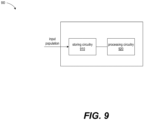
- FIG. 9 is a functional block diagram of an apparatus 900.
- the apparatus 900 can include circuitry, e.g ., storing circuitry 910 and processing circuitry 920, that is configured to perform an ENAS method, e.g., the ENAS methods 500, 700 and 800.
- an ENAS method e.g., the ENAS methods 500, 700 and 800.
- the ENAS method can include the following steps of: (a) performing one or more evolutionary operations on an initial population of neural architectures to generate offspring neural architectures; (b) evaluating performance of each of the offspring neural architectures to obtain at least one evaluation value of the offspring neural architecture with respect to a performance metric; (c) adjusting the evaluation values of the offspring neural architectures based on at least one constraint on the evaluation values; (d) selecting at least one of the offspring neural architectures as a new population of neural architectures using a selection strategy; (e) outputting the new population of neural architectures as a last population of neural architectures when a stopping criterion is achieved; and (f) iterating steps (a) to (d) with the new population of neural architectures being taken as the initial population of neural architectures when the stopping criterion is not achieved yet.
- adjusting the evaluation values of the neural architectures can include at least one of performing a clip algorithm to apply an enough-bound on the evaluation values of the offspring neural architectures and performing an extinct algorithm to apply a must-bound on the evaluation values of the offspring neural architectures.
- at least one of the enough-bound and the must-bound can be constant for every iteration of steps (a) to (d).
- at least one of the enough-bound and the must-bound can vary for at least two consecutive iterations of steps (a) to (d).
- the at least one of the enough-bound and the must-bound can gradually increase as steps (a) to (d) iterate.
- the must-bound can gradually increase as steps (a) to (d) iterate.
- the enough-bound can gradually increase as steps (a) to (d) iterate.
- the evolutionary operations can include at least one of crossover and mutation.
- the selection strategy can include one of non-dominated soring, elitism, discarding the worst, roulette wheel selection and tournament selection.
- the non-transitory machine-readable storage medium can stores instructions which, when executed by a processor, causes the processor to execute an evolutionary neural architecture search (ENAS) method, the ENAS method including the following steps of: (a) performing one or more evolutionary operations on an initial population of neural architectures to generate offspring neural architectures; (b) evaluating performance of each of the offspring neural architectures to obtain at least one evaluation value of the offspring neural architecture with respect to a performance metric; (c) adjusting the evaluation values of the offspring neural architectures based on at least one constraint on the evaluation values; (d) selecting at least one of the offspring neural architectures as a new population of neural architectures using a selection strategy; (e) outputting the new population of neural architectures as a last population of neural architectures when a stopping criterion is achieved; and (f) iterating steps (a) to (d) with the new population of neural architectures being taken as the initial population of
- ENAS evolutionary neural architecture search
- non-transitory is a limitation of the medium itself (i.e., tangible, not a signal) as opposed to a limitation on data storage persistency (e.g. , RAM vs. ROM).
- the non-transitory machine-readable storage medium may be any tangible medium that may contain or store a program for use by or in connection with an instruction execution system, apparatus, or device.
- the machine-readable storage medium may be a machine-readable signal medium or a machine-readable storage medium.
- a machine-readable medium may include but not limited to an electronic, magnetic, optical, electromagnetic, infrared, or semiconductor system, apparatus, or device, or any suitable combination of the foregoing.
- machine-readable storage medium More specific examples of the machine-readable storage medium would include an electrical connection having one or more wires, a portable computer diskette, a hard disk, a random access memory (RAM), a read-only memory (ROM), an erasable programmable read-only memory (EPROM or Flash memory), an optical fiber, a portable compact disc read-only memory (CD-ROM), an optical storage device, a magnetic storage device, or any suitable combination of the foregoing.
- RAM random access memory
- ROM read-only memory
- EPROM or Flash memory erasable programmable read-only memory
- CD-ROM portable compact disc read-only memory
- magnetic storage device or any suitable combination of the foregoing.
- the processes and functions described herein can be implemented as a computer program which, when executed by one or more processors, can cause the one or more processors to perform the respective processes and functions.
- the computer program may be stored or distributed on a suitable medium, such as an optical storage medium or a solid-state medium supplied together with, or as part of, other hardware.
- the computer program may also be distributed in other forms, such as via the Internet or other wired or wireless telecommunication systems.
- the computer program can be obtained and loaded into an apparatus, including obtaining the computer program through physical medium or distributed system, including, for example, from a server connected to the Internet.
- the computer program may be accessible from a computer-readable medium providing program instructions for use by or in connection with a computer or any instruction execution system.
- the computer readable medium may include any apparatus that stores, communicates, propagates, or transports the computer program for use by or in connection with an instruction execution system, apparatus, or device.
- the computer-readable medium can be magnetic, optical, electronic, electromagnetic, infrared, or semiconductor system (or apparatus or device) or a propagation medium.
- the computer-readable medium may include a computer-readable non-transitory storage medium such as a semiconductor or solid state memory, magnetic tape, a removable computer diskette, a random access memory (RAM), a read-only memory (ROM), a magnetic disk and an optical disk, and the like.
- the computer-readable non-transitory storage medium can include all types of computer readable medium, including magnetic storage medium, optical storage medium, flash medium, and solid state storage medium.
Landscapes
- Engineering & Computer Science (AREA)
- Physics & Mathematics (AREA)
- Theoretical Computer Science (AREA)
- Health & Medical Sciences (AREA)
- Life Sciences & Earth Sciences (AREA)
- Computing Systems (AREA)
- General Physics & Mathematics (AREA)
- Computational Linguistics (AREA)
- Data Mining & Analysis (AREA)
- Evolutionary Computation (AREA)
- General Health & Medical Sciences (AREA)
- Molecular Biology (AREA)
- Biomedical Technology (AREA)
- General Engineering & Computer Science (AREA)
- Biophysics (AREA)
- Mathematical Physics (AREA)
- Software Systems (AREA)
- Artificial Intelligence (AREA)
- Bioinformatics & Cheminformatics (AREA)
- Bioinformatics & Computational Biology (AREA)
- Evolutionary Biology (AREA)
- Physiology (AREA)
- Management, Administration, Business Operations System, And Electronic Commerce (AREA)
- Supply And Distribution Of Alternating Current (AREA)
Applications Claiming Priority (2)
| Application Number | Priority Date | Filing Date | Title |
|---|---|---|---|
| US202263380249P | 2022-10-20 | 2022-10-20 | |
| US18/482,211 US20240232636A9 (en) | 2022-10-20 | 2023-10-06 | Constrained search: improve multi-objective nas quality by focus on demand |
Publications (1)
| Publication Number | Publication Date |
|---|---|
| EP4357984A1 true EP4357984A1 (de) | 2024-04-24 |
Family
ID=88417391
Family Applications (1)
| Application Number | Title | Priority Date | Filing Date |
|---|---|---|---|
| EP23204401.6A Pending EP4357984A1 (de) | 2022-10-20 | 2023-10-18 | Eingeschränkte suche: verbesserung der nas-qualität mit mehreren zielen durch fokus auf anfrage |
Country Status (2)
| Country | Link |
|---|---|
| US (1) | US20240232636A9 (de) |
| EP (1) | EP4357984A1 (de) |
-
2023
- 2023-10-06 US US18/482,211 patent/US20240232636A9/en active Pending
- 2023-10-18 EP EP23204401.6A patent/EP4357984A1/de active Pending
Non-Patent Citations (2)
| Title |
|---|
| A. MAESANI ET AL: "Artificial evolution by viability rather than competition", PLOS ONE, vol. 9, no. 1, E86831, 29 January 2014 (2014-01-29), XP093140960, DOI: 10.1371/journal.pone.0086831 * |
| S. LI ET AL: "Automatic design of convolutional neural network architectures under resource constraints", IEEE TRANSACTIONS ON NEURAL NETWORKS AND LEARNING SYSTEMS, vol. 34, no. 8, 9 November 2021 (2021-11-09), pages 3832 - 3846, XP011946006, DOI: 10.1109/TNNLS.2021.3123105 * |
Also Published As
| Publication number | Publication date |
|---|---|
| US20240135184A1 (en) | 2024-04-25 |
| US20240232636A9 (en) | 2024-07-11 |
Similar Documents
| Publication | Publication Date | Title |
|---|---|---|
| EP3966747B1 (de) | Elektronische vorrichtung und verfahren zur steuerung der elektronischen vorrichtung | |
| US20240354346A1 (en) | Speculative decoding in autoregressive generative artificial intelligence models | |
| CN111406264A (zh) | 神经架构搜索 | |
| CN110210558B (zh) | 评估神经网络性能的方法及装置 | |
| CN112906883B (zh) | 用于深度神经网络的混合精度量化策略确定方法和系统 | |
| CN113407185B (zh) | 基于贝叶斯优化的编译器优化选项推荐方法 | |
| WO2025159825A1 (en) | Efficient speculative decoding in autoregressive generative artificial intelligence models | |
| CN118428454A (zh) | 一种模型无关元学习方法、装置、设备及存储介质 | |
| KR20250165324A (ko) | 자동회귀 생성형 인공 지능 모델들에서의 추측 디코딩 | |
| CN111210017B (zh) | 确定布局顺序及数据处理的方法、装置、设备及存储介质 | |
| US20240135184A1 (en) | Constrained search: improve multi-objective nas quality by focus on demand | |
| CN115222012B (zh) | 用于压缩神经网络的方法和装置 | |
| KR102212875B1 (ko) | 해 탐색 시스템 및 방법, 해 탐색 프로그램 | |
| CN110929849B (zh) | 一种基于神经网络模型压缩的视频检测方法和装置 | |
| CN113641905A (zh) | 模型训练方法、信息推送方法、装置、设备及存储介质 | |
| US20250028713A1 (en) | Systems and methods for machine learning evaluation pipeline | |
| CN119783719A (zh) | 演化神经架构搜寻方法及电子装置 | |
| CN119356848A (zh) | 一种应用感知的配置参数自演化调优方法及系统 | |
| Lee et al. | Efficient decoupled neural architecture search by structure and operation sampling | |
| CN114444645A (zh) | 一种多策略多元宇宙群的智能优化算法 | |
| CN117671231A (zh) | 基于特征和路径搜索的目标检测方法及系统 | |
| CN120409592B (zh) | 一种注意力剪裁方法、装置、电子设备及存储介质 | |
| CN119599353B (zh) | 用于贵金属检测多工序并行机车间的调度方法及装置 | |
| CN117689011B (zh) | 一种模型调整方法、装置、设备及存储介质 | |
| RU2254602C2 (ru) | Способ адаптивной автоматической самонастройки многопараметрических систем автоматического управления на оптимальные условия |
Legal Events
| Date | Code | Title | Description |
|---|---|---|---|
| PUAI | Public reference made under article 153(3) epc to a published international application that has entered the european phase |
Free format text: ORIGINAL CODE: 0009012 |
|
| STAA | Information on the status of an ep patent application or granted ep patent |
Free format text: STATUS: THE APPLICATION HAS BEEN PUBLISHED |
|
| AK | Designated contracting states |
Kind code of ref document: A1 Designated state(s): AL AT BE BG CH CY CZ DE DK EE ES FI FR GB GR HR HU IE IS IT LI LT LU LV MC ME MK MT NL NO PL PT RO RS SE SI SK SM TR |
|
| STAA | Information on the status of an ep patent application or granted ep patent |
Free format text: STATUS: REQUEST FOR EXAMINATION WAS MADE |
|
| 17P | Request for examination filed |
Effective date: 20241022 |
|
| RBV | Designated contracting states (corrected) |
Designated state(s): AL AT BE BG CH CY CZ DE DK EE ES FI FR GB GR HR HU IE IS IT LI LT LU LV MC ME MK MT NL NO PL PT RO RS SE SI SK SM TR |