EP4357973A1 - Vorrichtung und verfahren zur datenformatumwandlung - Google Patents
Vorrichtung und verfahren zur datenformatumwandlung Download PDFInfo
- Publication number
- EP4357973A1 EP4357973A1 EP21950402.4A EP21950402A EP4357973A1 EP 4357973 A1 EP4357973 A1 EP 4357973A1 EP 21950402 A EP21950402 A EP 21950402A EP 4357973 A1 EP4357973 A1 EP 4357973A1
- Authority
- EP
- European Patent Office
- Prior art keywords
- data
- tensor data
- read
- converted
- tensor
- Prior art date
- Legal status (The legal status is an assumption and is not a legal conclusion. Google has not performed a legal analysis and makes no representation as to the accuracy of the status listed.)
- Pending
Links
Images




Classifications
-
- G—PHYSICS
- G06—COMPUTING OR CALCULATING; COUNTING
- G06N—COMPUTING ARRANGEMENTS BASED ON SPECIFIC COMPUTATIONAL MODELS
- G06N3/00—Computing arrangements based on biological models
- G06N3/02—Neural networks
- G06N3/04—Architecture, e.g. interconnection topology
-
- G—PHYSICS
- G06—COMPUTING OR CALCULATING; COUNTING
- G06F—ELECTRIC DIGITAL DATA PROCESSING
- G06F13/00—Interconnection of, or transfer of information or other signals between, memories, input/output devices or central processing units
- G06F13/10—Program control for peripheral devices
- G06F13/12—Program control for peripheral devices using hardware independent of the central processor, e.g. channel or peripheral processor
- G06F13/122—Program control for peripheral devices using hardware independent of the central processor, e.g. channel or peripheral processor where hardware performs an I/O function other than control of data transfer
-
- G—PHYSICS
- G06—COMPUTING OR CALCULATING; COUNTING
- G06F—ELECTRIC DIGITAL DATA PROCESSING
- G06F13/00—Interconnection of, or transfer of information or other signals between, memories, input/output devices or central processing units
- G06F13/14—Handling requests for interconnection or transfer
- G06F13/20—Handling requests for interconnection or transfer for access to input/output bus
- G06F13/28—Handling requests for interconnection or transfer for access to input/output bus using burst mode transfer, e.g. direct memory access DMA, cycle steal
-
- G—PHYSICS
- G06—COMPUTING OR CALCULATING; COUNTING
- G06N—COMPUTING ARRANGEMENTS BASED ON SPECIFIC COMPUTATIONAL MODELS
- G06N3/00—Computing arrangements based on biological models
- G06N3/02—Neural networks
- G06N3/04—Architecture, e.g. interconnection topology
- G06N3/045—Combinations of networks
-
- G—PHYSICS
- G06—COMPUTING OR CALCULATING; COUNTING
- G06N—COMPUTING ARRANGEMENTS BASED ON SPECIFIC COMPUTATIONAL MODELS
- G06N3/00—Computing arrangements based on biological models
- G06N3/02—Neural networks
- G06N3/06—Physical realisation, i.e. hardware implementation of neural networks, neurons or parts of neurons
- G06N3/063—Physical realisation, i.e. hardware implementation of neural networks, neurons or parts of neurons using electronic means
-
- Y—GENERAL TAGGING OF NEW TECHNOLOGICAL DEVELOPMENTS; GENERAL TAGGING OF CROSS-SECTIONAL TECHNOLOGIES SPANNING OVER SEVERAL SECTIONS OF THE IPC; TECHNICAL SUBJECTS COVERED BY FORMER USPC CROSS-REFERENCE ART COLLECTIONS [XRACs] AND DIGESTS
- Y02—TECHNOLOGIES OR APPLICATIONS FOR MITIGATION OR ADAPTATION AGAINST CLIMATE CHANGE
- Y02D—CLIMATE CHANGE MITIGATION TECHNOLOGIES IN INFORMATION AND COMMUNICATION TECHNOLOGIES [ICT], I.E. INFORMATION AND COMMUNICATION TECHNOLOGIES AIMING AT THE REDUCTION OF THEIR OWN ENERGY USE
- Y02D10/00—Energy efficient computing, e.g. low power processors, power management or thermal management
Definitions
- This application relates to the field of artificial intelligence technologies, and in particular, to a data format conversion apparatus and method.
- a convolutional neural network is widely used in image processing, audio recognition, semantic recognition, intelligent recommendation, and other fields and has excellent performance. Therefore, the convolutional neural network becomes a research hotspot of artificial intelligence.
- the rapid development of artificial intelligence applications in various fields proposes a new requirement for hardware computing power.
- a neural network processing unit (Neural Network Processing Unit, NPU) is a processor configured to perform convolutional neural network calculation.
- NPU is continuously developed, and efficiency of performing convolutional neural network calculation by the NPU is continuously improved.
- using the NPU to accelerate an operation of the convolutional neural network, improve running efficiency of an application related to the convolutional neural network, and shorten execution time of the application related to the convolutional neural network becomes a current research hotspot of the NPU.
- image data is usually transmitted between layers of a neural network in a form of a 4-dimensional vector, and the form of the 4-dimensional vector may be NCHW (num, channel, height, width).
- NCHW number, channel, height, width
- a format of image data used to implement the operation of the convolutional neural network may be NCHW or NHWC.
- a data format that is more suitable for a hardware architecture needs to be used to reduce operation time.
- a graphics processing unit English: graphics processing unit, GPU for short
- an NHWC data format is more suitable. If the data format is NCHW, the data format may be first converted from NCHW to NHWC before calculation is performed. In this process, data transmission overheads are generated in a reading/writing process during the data format conversion.
- vector calculation needs to be performed during the data format conversion, and the vector calculation process increases power consumption overheads of hardware.
- a data format conversion apparatus and method are provided, to reduce data transmission overheads, offline preprocessing time overheads, and vector calculation time and hardware overheads in a conventional technology, and improve efficiency of running a neural network model on a neural network processor. This facilitates popularization and use of the processor.
- an embodiment of this application provides a data format conversion apparatus.
- the data format conversion apparatus is located in a direct memory access DMA module of a processor.
- a data format that is of tensor data and that is supported by the processor is a first data format.
- the DMA module includes: a DMA controller DMAC. If a second data format of tensor data stored in an external memory is different from the first data format, the DMAC is configured to convert, in a process of transmitting to-be-converted tensor data between a memory of the processor and the external memory, the to-be-converted tensor data from the first data format into the second data format or from the second data format into the first data format, to obtain converted tensor data.
- the first data format and the second data format respectively indicate a placement manner of the to-be-converted tensor data or the converted tensor data when the to-be-converted tensor data or the converted tensor data is stored.
- data format conversion is implemented in a process of transmitting data between the memory and the external memory.
- converted data is output to the external memory after the vector processing unit converts a data format of the original data, and the data is read from the external memory again during the operation in the conventional technology
- the data format conversion apparatus in this embodiment of this application can reduce data transmission overheads and vector calculation time and hardware overheads, and improve efficiency of running a neural network model on a neural network processor.
- the data format conversion apparatus in this embodiment of this application can reduce offline preprocessing time overheads, and a process of reading and writing tensor data may be preconfigured based on a data format supported by the processor and a data format of tensor data stored in the external memory.
- the data format conversion apparatus works with a general-purpose software framework, internal format details are hidden, and a unified data format is presented to the outside, so that a developer does not need to understand a requirement of the processor for the data format. This facilitates popularization and use of the processor
- the data format conversion apparatus includes: a transpose buffer TPB, and the TPB includes a write port and a read port.
- the DMAC is configured to write the to-be-converted tensor data into the TPB through the write port in a first direction, when a product of a quantity of rows of data stored in the first direction of the TPB and a splitting width meets a read port bit width, read a first part of data of the to-be-converted tensor data from the TPB through the read port in a second direction at the splitting width, and splice and store the first part of data in an order of the first direction, to obtain the converted tensor data.
- the splitting width is a parameter for splitting data in one dimensional direction of the to-be-converted tensor data, and the first direction is perpendicular to the second direction.
- the transpose buffer TPB is disposed in the DMA module, and ports for writing and reading in different directions are disposed in the TPB, so that a data format of tensor data can be converted in a data transfer process.
- This can reduce the data transmission overheads, the offline preprocessing time overheads of data format conversion, and the vector calculation time and hardware overheads in the conventional technology, and greatly improve the efficiency of running the neural network model on the neural network processor.
- the TPB includes a first buffer and a second buffer, the first buffer includes a first write port and a first read port, and the second buffer includes a second write port and a second read port.
- the DMAC is configured to read the first part of data of the to-be-converted tensor data in the TPB from the second buffer through the second read port in the second direction at the splitting width when writing the to-be-converted tensor data into the first buffer through the first write port in the first direction, and splice the first part of data in the order of the first direction; or the DMAC is configured to read the first part of data of the to-be-converted tensor data in the TPB from the first buffer through the first read port in the second direction at the splitting width when writing the to-be-converted tensor data into the second buffer through the second write port in the first direction, and splice the first part of data in the order of the first direction.
- Reading and writing can be implemented in parallel by using a buffer of a ping-pong structure, to improve efficiency of data format conversion and transmission.
- the data format conversion apparatus further includes: a reorder buffer ROB.
- the to-be-converted tensor data is to-be-read tensor data stored in the external memory of the data format conversion apparatus.
- the DMAC is configured to determine a cascading manner based on the to-be-converted tensor data, the splitting width, and the read port bit width.
- the cascading manner is a manner of combining two dimensions higher than a lowest dimension of the to-be-converted tensor data.
- the DMAC is configured to generate, based on the cascading manner and/or a bus bit width, a read request for reading the to-be-converted tensor data.
- the read request is used to read first tensor data, and the first tensor data is at least a part of data of the to-be-converted tensor data.
- the DMAC is configured to send a read command in a preset order based on the read request and the bus bit width.
- the read command carries a number specified in the preset order, and the preset order is an order from a lower dimension to a higher dimension based on the two dimensions.
- the read command is used to read second tensor data in the first tensor data, the second tensor data is at least a part of data of the first tensor data, and the number carried in the read command indicates an order of writing the second tensor data into the ROB.
- the DMAC is further configured to: read the second tensor data from the ROB in an order of the number, and write the second tensor data into the TPB through the write port in the first direction.
- the DMAC is further configured to: read, when the product of the quantity of rows of data stored in the first direction of the TPB and the splitting width meets the read port bit width, a second part of data of the second tensor data from the TPB through the read port in the second direction at the splitting width, splice the second part of data in the order of the first direction, and store the spliced second part of data into a matrix buffer of the DMA module.
- the ROB is disposed in the DMA module, and it can also be ensured that data is read and written in sequence in a scenario of out-of-order reading of a bus.
- the read command further includes a logical address of the second tensor data and/or a size of the second tensor data.
- the size of the second tensor data is less than or equal to the bus bit width.
- the logical address included in the read command changes with a dimension other than the lowest dimension of the to-be-read tensor data based on an order of the number carried in the read command.
- the DMAC when a remainder of a quantity of lowest dimensions of the to-be-read tensor data and a quantity of pieces of data corresponding to the splitting width is greater than 0, the DMAC is configured to perform supplementation processing on the lowest dimension based on the quantity of pieces of data corresponding to the splitting width and the remainder.
- Data in any dimension can be split through supplementation processing, to implement conversion of tensor data in any dimension. This is applicable to a plurality of conversion scenarios.
- data can be continuously transferred after being supplemented, thereby improving data transfer efficiency and improving bus utilization.
- the data format conversion apparatus further includes: a reorder buffer ROB.
- the to-be-converted tensor data is to-be-output tensor data stored in a matrix buffer of the DMA module.
- the DMAC is configured to: sequentially read the to-be-output tensor data from the matrix buffer based on a bus bit width, and write the to-be-output tensor data into the TPB through the write port in the first direction.
- the DMAC is configured to: read, when the product of the quantity of rows of data stored in the first direction of the TPB and the splitting width meets the read port bit width, a third part of data of the to-be-output tensor data from the TPB through the read port in the second direction at the splitting width, splice the third part of data in the order of the first direction to obtain third tensor data, and store the third tensor data into the ROB in an order of reading the third tensor data through the read port.
- the DMAC is configured to generate a write command based on the third tensor data stored in the ROB.
- the write command carries a number that is specified based on an order of storing the third tensor data into the ROB, and the number carried in the write command indicates an order of writing the third tensor data into the external memory of the processor.
- a data format of tensor data can be converted in a process of outputting the tensor data inside the processor, so that the data transmission overheads, the offline preprocessing time overheads of data format conversion, and the vector calculation time and hardware overheads in the conventional technology can be reduced, and the efficiency of running the neural network model on the neural network processor can be greatly improved.
- the DMAC when a lowest dimension of the to-be-output tensor data is different from a preset lowest dimension, the DMAC is configured to delete a supplemented part of the third tensor data based on the lowest dimension of the to-be-output tensor data and the preset lowest dimension before storing the third tensor data into the ROB.
- an embodiment of this application provides a processor.
- the processor includes the data format conversion apparatus according to the first aspect or one or more of the plurality of possible implementations of the first aspect.
- an embodiment of this application provides a data format conversion method.
- the method is applied to a direct memory access DMA controller DMAC of a DMA module of a processor.
- a data format that is of tensor data and that is supported by the processor is a first data format.
- the method includes: if a second data format of tensor data stored in an external memory is different from the first data format, converting, in a process of transmitting to-be-converted tensor data between a memory of the processor and the external memory, the to-be-converted tensor data from the first data format into the second data format or from the second data format into the first data format, to obtain converted tensor data, where the first data format and the second data format respectively indicate a placement manner of the to-be-converted tensor data or the converted tensor data when the to-be-converted tensor data or the converted tensor data is stored.
- data format conversion is implemented in a process of transmitting data between the memory and the external memory.
- converted data is output to the external memory after the vector processing unit converts a data format of the original data, and data is read from the external memory again during the operation in the conventional technology
- this embodiment of this application can reduce data transmission overheads and vector calculation time and hardware overheads, and improve efficiency of running a neural network model on a neural network processor.
- this embodiment of this application can reduce offline preprocessing time overheads, and a process of reading and writing tensor data may be preconfigured based on a data format supported by the processor and a data format of tensor data stored in the external memory.
- a process of reading and writing tensor data may be preconfigured based on a data format supported by the processor and a data format of tensor data stored in the external memory.
- the DMA module further includes: a transpose buffer TPB, the TPB includes a write port and a read port, and the converting, in a process of transmitting to-be-converted tensor data between a memory of the processor and the external memory, the to-be-converted tensor data from the first data format into the second data format or from the second data format into the first data format, to obtain converted tensor data includes: writing the to-be-converted tensor data into the TPB through the write port in a first direction, when a product of a quantity of rows of data stored in the first direction of the TPB and a splitting width meets a read port bit width, reading a first part of data of the to-be-converted tensor data from the TPB through the read port in a second direction at the splitting width, and splicing and storing the first part of data in an order of the first direction, to obtain the converted tensor data, where the splitting
- the transpose buffer TPB is disposed in the DMA module, and ports for writing and reading in different directions are disposed in the TPB, so that a data format of tensor data can be converted in a data transfer process.
- This can reduce the data transmission overheads, the offline preprocessing time overheads of data format conversion, and the vector calculation time and hardware overheads in the conventional technology, and greatly improve the efficiency of running the neural network model on the neural network processor.
- the TPB includes a first buffer and a second buffer
- the first buffer includes a first write port and a first read port
- the second buffer includes a second write port and a second read port
- reading a first part of data of the to-be-converted tensor data from the TPB through the read port in a second direction at the splitting width includes: reading the first part of data of the to-be-converted tensor data in the TPB from the second buffer through the second read port in the second direction at the splitting width when writing the to-be-converted tensor data into the first buffer through the first write port in the first direction; or reading the first part of data of the to-be-converted tensor data
- the DMA further includes: a reorder buffer ROB.
- the method further includes: determining a cascading manner based on the to-be-converted tensor data, the splitting width, and the read port bit width, where the cascading manner is a manner of combining two dimensions higher than a lowest dimension of the to-be-converted tensor data; generating, based on the cascading manner and/or a bus bit width, a read request for reading the to-be-converted tensor data, where the read request is used to read first tensor data, and the first tensor data is at least a part of data of the to-be-converted tensor data; and sending a read command in a preset order based on the read request and the bus bit width, where the read command
- the converting, in a process of transmitting to-be-converted tensor data between a memory of the processor and the external memory, the to-be-converted tensor data from the first data format into the second data format or from the second data format into the first data format, to obtain converted tensor data includes: reading the second tensor data from the ROB in an order of the number, and writing the second tensor data into the TPB through the write port in the first direction; and reading, when the product of the quantity of rows of data stored in the first direction of the TPB and the splitting width meets the read port bit width, a second part of data of the second tensor data from the TPB through the read port in the second direction at the splitting width, splicing the second part of data in the order of the first direction, and storing the spliced second part of data into a matrix buffer of the DMA module, to obtain the converted tensor data.
- the read command further includes a logical address of the second tensor data and a size of the second tensor data, where the size of the second tensor data is less than or equal to the bus bit width; and the logical address included in the read command changes with a dimension other than the lowest dimension of the to-be-read tensor data based on an order of the number carried in the read command.
- the method further includes: when a remainder of a quantity of lowest dimensions of the to-be-read tensor data and a quantity of pieces of data corresponding to the splitting width is greater than 0, performing supplementation processing on the lowest dimension based on the quantity of pieces of data corresponding to the splitting width and the remainder.
- Data in any dimension can be split through supplementation processing, to implement conversion of tensor data in any dimension. This is applicable to a plurality of conversion scenarios.
- data can be continuously transferred after being supplemented, thereby improving data transfer efficiency and improving bus utilization.
- the DMA module further includes: a reorder buffer ROB., and when the to-be-converted tensor data is to-be-output tensor data stored in a matrix buffer of the DMA module, the converting, in a process of transmitting to-be-converted tensor data between a memory of the processor and the external memory, the to-be-converted tensor data from the first data format into the second data format or from the second data format into the first data format includes: sequentially reading the to-be-output tensor data from the matrix buffer based on a bus bit width, and writing the to-be-output tensor data into the TPB through the write port in the first direction; reading, when the product of the quantity of rows of data stored in the first direction of the TPB and the splitting width meets the read port bit width, a third part of data of the to-be-output tensor data from the TPB through
- a data format of tensor data can be converted in a process of outputting the tensor data inside the processor, so that the data transmission overheads, the offline preprocessing time overheads of data format conversion, and the vector calculation time and hardware overheads in the conventional technology can be reduced, and the efficiency of running the neural network model on the neural network processor can be greatly improved.
- the method further includes: deleting a supplemented part of the third tensor data based on the lowest dimension of the to-be-output tensor data and the preset lowest dimension.
- an embodiment of this application provides a data format conversion apparatus, including: a processor; and a memory, configured to store instructions executable by the processor.
- the processor is configured to implement the data format conversion method according to the third aspect or one or more of the plurality of possible implementations of the third aspect when executing the instructions.
- an embodiment of this application provides a non-volatile computer-readable storage medium, storing computer program instructions.
- the computer program instructions when executed by a processor, implement the data format conversion method according to the third aspect or one or more of the plurality of possible implementations of the third aspect.
- an embodiment of this application provides a computer program product, including computer-readable code or a non-volatile computer-readable storage medium carrying the computer-readable code.
- a processor in the electronic device performs the data format conversion method according to the third aspect or one or more of the plurality of possible implementations of the third aspect.
- an embodiment of this application provides a terminal device.
- the terminal device may include the processor according to the second aspect, may include the data format conversion apparatus according to the first aspect or one or more of the plurality of possible implementations of the first aspect, or may perform the data format conversion method according to the third aspect or one or more of the plurality of possible implementations of the third aspect.
- example herein means “used as an example, embodiment, or illustration”. Any embodiment described as an “example” is not necessarily explained as being superior or better than other embodiments.
- the tensor is a feature description of a block of stored data, and the tensor records information such as a shape and a type of the data.
- the tensor may be understood as tensor data.
- An artificial intelligence deep learning framework TensorFlow is used as an example, and a rank (rank), a shape (shape), and a dimension number (dimension number) are usually used to describe a dimension of the tensor.
- a relationship among the rank, the shape, and the dimension number may be shown in Table 1.
- Table 1 Rank Shape Dimension number Example 0 [] 0 1 1 [D1] 1 [2] 2 [D1, D2] 2 [2, 3] 3 [D1, D2, D3] 3 [2, 3, 4] ... [] ... [] ... [] n [D1, D2, D3, ..., Dn] n [1,2,3, ..., n]
- a 2-rank tensor A [2, 3], indicating a two-dimensional matrix.
- the matrix is a matrix with two rows and three columns.
- data format conversion is implemented by adding an operator (which is referred to as a conversion operator below) to a neural network.
- conversion operators are inserted before and after a convolution operation or matrix multiplication operator.
- data format conversion is performed in a vector processing unit. If data format conversion needs to be performed on original data, a processor first reads the original data from an external memory into a buffer of the vector processing unit; and after converting a data format of the original data, the vector processing unit outputs converted data to the external memory. During the operation, the processor reads the converted data in the external memory into an internal memory for operation.
- data format conversion between layers in the neural network can be further reduced in a network convergence manner.
- a convolutional neural network When a convolutional neural network is run on an NPU, a graph fusion mode is used for the entire neural network, and all operators of the entire neural network support a same data format applicable to the hardware architecture.
- the convolutional neural network includes a convolution layer, an activation layer, a pooling layer, and the like. Operators at each layer in the network use a data format suitable for the hardware architecture, and a layer that does not require matrix calculation also supports the data format. In this manner, original input data of the neural network is first converted offline into a data format suitable for calculation of the hardware architecture, and an operation is performed. Output data obtained through calculation is also converted offline and output.
- an embodiment of this application provides a data format conversion apparatus, so that a data format of tensor data can be converted in a data transmission process, and data transmission overheads, offline preprocessing time overheads of data format conversion, and vector calculation time and hardware overheads in the conventional technology can be reduced, and efficiency of running a neural network model on a neural network processor can be greatly improved.
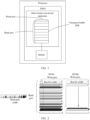
- FIG. 1 is a block diagram of a data format conversion apparatus according to an embodiment of this application. As shown in FIG. 1 , the data format conversion apparatus in this embodiment of this application may be located in a direct memory access (Direct Memory Access, DMA) module of a processor.
- DMA Direct Memory Access
- the processor may be a field programmable gate array (field programmable gate array, FPGA), may be a dedicated integrated chip (application-specific integrated circuit, ASIC), may be a system chip (system on chip, SoC), may be a central processing unit (central processor unit, CPU), may be a network processor (network processor, NP) or a neural network processing unit (neural network processing unit, NPU), may be a digital signal processing circuit (digital signal processor, DSP), may be a microcontroller (micro controller unit, MCU), or may be a programmable controller (programmable logic device, PLD) or another integrated chip.
- FPGA field programmable gate array
- ASIC application-specific integrated circuit
- SoC system on chip
- CPU central processing unit
- CPU central processor unit
- NP network processor
- NPU neural network processing unit
- DSP digital signal processing circuit
- microcontroller micro controller unit, MCU
- PLD programmable logic device
- the DMA module may include a DMA controller (Direct Memory Access Controller, DMAC), and the DMAC is configured to control data transmission between a memory of the processor and an external memory.
- the external memory may be a read-only memory (read-only memory, ROM) or another type of static storage device that can store static information and instructions, or a random access memory (random access memory, RAM) or another type of dynamic storage device that can store information and instructions.
- the external memory may also include a non-volatile memory (non-volatile memory), for example, a flash memory (flash memory), a hard disk drive (hard disk drive, HDD), or a solid-state drive (solid-state drive, SSD).
- the external memory may further include a combination of the foregoing types of memories.
- the external memory may be an electrically erasable programmable read-only memory (electrically erasable programmable read-only memory, EEPROM), a compact disc read-only memory (compact disc read-only memory, CD-ROM) or another compact disc storage medium, an optical disc storage medium (including a compact disc, a laser disc, an optical disc, a digital versatile disc, a Blu-ray disc, or the like), a magnetic disk storage medium, another magnetic storage device, or any other medium that can be configured to carry or store expected program code in a form of an instruction or a data structure and that is accessible by a computer, but is not limited thereto.
- EEPROM electrically erasable programmable read-only memory
- CD-ROM compact disc read-only memory
- CD-ROM compact disc read-only memory
- an optical disc storage medium including a compact disc, a laser disc, an optical disc, a digital versatile disc, a Blu-ray disc, or the like
- a magnetic disk storage medium another magnetic storage device, or any other medium
- a data format that is of tensor data and that is supported by the processor is a first data format
- a data format of tensor data stored in the external memory is a second data format.
- the first data format and the second data format each may indicate a placement manner of the tensor data when the tensor data is stored in a memory.
- the first data format may be NHWC
- the second data format may be NCHW
- the first data format may be NCHW
- the second data format may be NHWC.
- Specific formats of the first data format and the second data format are not limited in this application.
- the DMAC is configured to convert, in a process of transmitting to-be-converted tensor data between the memory of the processor and the external memory, the to-be-converted tensor data from the first data format into the second data format or from the second data format into the first data format, to obtain converted tensor data. That is, the first data format and the second data format may respectively indicate a placement manner of the to-be-converted tensor data or the converted tensor data when the to-be-converted tensor data or the converted tensor data is stored.
- the placement manner of the to-be-converted tensor data in the memory is the first data format.
- the processor needs to output the to-be-converted tensor data to the external memory, and the DMAC may convert, in a process of outputting the to-be-converted tensor data in the memory to the external memory, the to-be-converted tensor data from the first data format into the second data format, to obtain the converted tensor data, that is, the converted tensor data is stored in the external memory in the second data format.
- the placement manner of the to-be-converted tensor data when the to-be-converted tensor data is stored in the external memory is the second data format.
- the DMAC may convert, in a process of reading the to-be-converted tensor data in the external memory into the memory, the to-be-converted tensor data from the second data format into the first data format, to obtain the converted tensor data, that is, the converted tensor data is stored in the memory of the processor in the first data format.
- a specific process in which the DMAC converts, in the process of transmitting the to-be-converted tensor data between the memory of the processor and the external memory, the to-be-converted tensor data from the first data format into the second data format or from the second data format into the first data format may be implemented by using a software program.
- the DMAC may calculate an offset address of the read data based on the data formats (the first data format and the second data format) before and after the conversion, and read and store the data based on the calculated offset address. For example, it is assumed that to-be-converted tensor data is [X, Y], which is shown in Table 2.
- a storage order of the to-be-converted tensor data is 0, 1, 2, 3, 4..., 16, 17, 18, and 19.
- the DMAC may calculate the offset address based on the format of the to-be-converted tensor data.
- the to-be-converted tensor data is a matrix with five rows and four columns, a base address for storing the to-be-converted tensor data is B, and a size of each piece of data in the to-be-converted tensor data is represented as size.
- the DMAC may calculate an offset address of data read each time, which is 0, 4*size, 8*size, 12*size, 16*size, 1*size, 2*size, ..., 3*size, 7*size, ..., and 19*size.
- the DMAC may sequentially read 0, 4, 8, 12, 16, ..., 3, 7, 11, 15, and 19 based on the calculated offset addresses and store 0, 4, 8, 12, 16, ..., 3, 7, 11, 15, and 19 based on a read order, to obtain a matrix [Y, X] with four rows and five columns, which is shown in Table 3.
- a manner of reading data by the DMAC may be determined based on the first data format supported by the processor and the second data format stored in the external memory.
- a specific reading process is not limited in this application.
- the data format conversion apparatus includes: a transpose buffer (Transpose Buffer, TPB), and the TPB includes a write port and a read port.
- TPB may be a static random access memory (Static Random Access Memory, SRAM).
- SRAM Static Random Access Memory
- the TPB may be provided with two groups of data and address buses, one group of data and address bus serves as the write port, and the other group of data and address bus serves as the read port.
- FIG. 1 is a schematic diagram of a structure of a transpose buffer according to an embodiment of this application. As shown in FIG.
- the TPB may include a plurality of rows of buffers, each row of buffer may further include a plurality of buffer units, and a bit width of each row of buffer is related to a quantity of the plurality of buffer units included in each row of buffer and a size of each buffer unit.
- each row of buffer may be the same.
- each buffer unit has a same size, and each row of buffer includes a same quantity of buffer units. Because the TPB is of a configured hardware structure, a quantity of rows of the plurality of rows of buffers of the TPB is fixed, and is preset based on an actual requirement of an application scenario.
- the DMAC is configured to: write the to-be-converted tensor data into the TPB through the write port in a first direction, when a product of a quantity of rows of data stored in the first direction of the TPB and a splitting width meets a read port bit width, read a first part of data of the to-be-converted tensor data from the TPB through the read port in a second direction at the splitting width, and splice and store the first part of data in an order of the first direction, to obtain the converted tensor data.
- the read port bit width may be a size of data that can be read through the read port of the TPB at a time.
- the splitting width is a parameter for splitting data in one dimensional direction of the to-be-converted tensor data, for example, a size of data split in a lowest dimension of the to-be-converted tensor data.
- a data format of the to-be-converted tensor data is [X, Y, Z]
- the splitting width may be determined based on a requirement of an actual application scenario. This is not limited in this application.
- the first direction is perpendicular to the second direction.
- the first direction may be a vertical direction
- the second direction may be a horizontal direction.
- the first direction may be a horizontal direction
- the second direction may be a vertical direction. This is not limited in this application.
- the to-be-converted tensor data may be tensor data stored in the external memory.
- the processor reads the tensor data stored in the external memory into the memory for calculation, and performs data format conversion in the reading process.
- the to-be-converted tensor data may be tensor data stored in the memory of the processor.
- a result obtained through calculation may be output to the external memory, and data format conversion may be performed in the output process.
- the DMAC may write the to-be-converted tensor data into the TPB through the write port in the first direction, when the product of the quantity of rows of data stored in the first direction of the TPB and the splitting width meets the read port bit width, read the to-be-converted tensor data from the TPB through the read port in the second direction at the splitting width, and perform the data format conversion in a splicing process.
- That the product of the quantity of rows of data stored in the first direction of the TPB and the splitting width meets the read port bit width may mean that a product of a size of the splitting width and the quantity of rows is equal to a size of data read at a time based on the read port bit width. For example, if the splitting width is 32B, and the read port bit width is 256B, when eight (256/32) rows of to-be-converted tensor data are fully stored in the first direction of the TPB, the product 8*32B of the quantity of rows of data stored in the first direction and the splitting width is equal to the read port bit width 256B.
- 32B is read based on one row of to-be-converted tensor data
- the read port bit width is 256B
- the eight rows of to-be-converted tensor data may be read through the read port of the TPB in the first direction at a time, and the read first part of data is spliced and stored.
- the to-be-converted tensor data is [X, Y], which is shown in Table 2, and it is assumed that the DMAC obtains one row of the to-be-converted tensor data each time, and writes the row of data into one row of buffer of the TPB through the write port.
- a manner of storing the to-be-converted tensor data in the TPB may be shown in Table 2.
- the DMAC may read data through the read port in a horizontal direction at the splitting width, and splice the read data in a row order. It is assumed that a quantity of pieces of split data corresponding to the splitting width is 1.
- data read for the first time is 0, 4, 8, 12, and 16 and is spliced into a row of data (0, 4, 8, 12, 16).
- Data read each time through the read port of the TPB is spliced into a row of data, and each row of data obtained through splicing may be spliced into new tensor data, to obtain converted tensor data (Y, X, 1), which is shown in Table 3.
- the structure form of the TPB, the data format of the tensor data, the first direction, and the second direction shown in FIG. 1 are merely some examples of this application.
- This application is not limited thereto.
- the first direction may be a horizontal direction
- the second direction is a vertical direction.
- the structure form of the TPB may be set based on a data format supported by the processor.
- the formats of the tensor data in Table 1 and Table 2 are merely examples of this application. This application is not limited thereto.
- the splitting width is merely an example, and this application is not limited thereto.
- a specific conversion process of the data format conversion apparatus in this embodiment of this application is preset based on the first data format and the second data format, and a unified data format is presented to the outside.
- the processor performs data format conversion based on a specific data dimension, and a developer does not need to understand a requirement of the processor for the data format.
- the data format conversion apparatus and the DMAC are disposed in the DMA module of the processor. If the first data format supported by the processor is different from the second data format of the tensor data stored in the external memory, the DMAC may convert the to-be-converted tensor data between the first data format conversion and the second data format in the process of transmitting the to-be-converted tensor data between the memory of the processor and the external memory, to obtain the converted tensor data.
- the data format conversion apparatus in this embodiment of this application can reduce data transmission overheads and vector calculation time and hardware overheads, and improve efficiency of running a neural network model on a neural network processor.
- the data format conversion apparatus in this embodiment of this application can reduce offline preprocessing time overheads, and a process of reading and writing tensor data may be preconfigured based on a data format supported by the processor and a data format of tensor data stored in the external memory.
- the data format conversion apparatus works with a general-purpose software framework, internal format details are hidden, and a unified data format is presented to the outside, so that a developer does not need to understand a requirement of the processor for the data format. This facilitates popularization and use of the processor.
- the TPB in this embodiment of this application may use a buffer of a ping-pong structure, to implement parallel data format conversion, thereby improving data format conversion and transmission efficiency.
- the TPB in this embodiment of this application may include a first buffer and a second buffer, the first buffer includes a first write port and a first read port, and the second buffer includes a second write port and a second read port.
- One of the first buffer and the second buffer is a ping path buffer, and the other is a pong path buffer. In this case, when a data volume is large, a writing process and a reading process may be performed in parallel.
- FIG. 2 is a schematic diagram of a structure of a TPB according to an embodiment of this application.
- "burst" in the figure represents a bus bit width
- the bus bit width may be a system bus bit width, that is, a quantity of bits of binary data that can be simultaneously transmitted through a system bus of the processor or a width of data written/read through the bus each time.
- the TPB includes the write port and the read port.
- a width of data written through the write port at a time is a write port bit width
- a width of data read through the read port at a time is a read port bit width.
- the write port bit width or the read port bit width of the TPB may be the same as or different from the bus bit width.
- the read port bit width/the write port bit width of the TPB may be greater than the bus bit width. This is not limited in this application. In this embodiment of this application, the data format conversion apparatus and method in this application are described by using an example in which the read port bit width/the write port bit width of the TPB is the same as the bus bit width.
- a buffer on the left side represents a ping path buffer
- a buffer on the right side represents a pong path buffer.
- a read port of the ping path buffer already meets the read port bit width, and data in the ping path buffer may start to be read. In a process of reading the ping path buffer, data may continue to be written into the pong path buffer.
- a read port of the pong path buffer already meets the read port bit width, after the data in the ping path buffer is read, data in the pong path buffer may start to be read, and the data continues to be simultaneously written into the ping path buffer
- the DMAC is configured to: read the first part of data of the to-be-converted tensor data in the TPB from the second buffer through the second read port in the second direction at the splitting width when writing the to-be-converted tensor data into the first buffer through the first write port in the first direction, and splice the first part of data in the order of the first direction; or the DMAC is configured to: read the to-be-converted tensor data from the first buffer through the first read port in the second direction when writing the first part of data of the to-be-converted tensor data in the TPB into the second buffer through the second write port in the first direction at the splitting width, and splice the first part of data in the order of the first direction.
- Reading and writing can be implemented in parallel by using the buffer of the ping-pong structure, to improve the data format conversion and transmission efficiency.
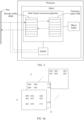
- the data format conversion apparatus further includes: a reorder buffer (ReOrder Buffer, ROB).
- the reorder buffer is configured to interact with an external bus to ensure sequential reading and writing of data.
- FIG. 3 is a block diagram of a data format conversion apparatus according to an embodiment of this application. As shown in FIG. 3 , the ROB is located between the bus and the TPB. When data is read and written, sequential reading and sequential writing are ensured under control of the DMAC.
- the DMAC is configured to determine a cascading manner based on the to-be-converted tensor data, the splitting width, and the read port bit width.
- the cascading manner is a manner of combining two dimensions higher than a lowest dimension of the to-be-converted tensor data.
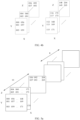
- FIG. 4a is a schematic diagram of to-be-converted tensor data according to an embodiment of this application.
- the to-be-converted tensor data is 4 ⁇ 4 ⁇ 10.
- the read port bit width is W1
- the splitting width is W2
- W1/W2 8. That is, when the TPB fully stores eight rows, the read port bit width is met.
- the cascading manner is to cascade two dimensions higher than the lowest dimension in a direction from a lower dimension to a higher dimension, and use a quantity of dimensions that meet the read port bit width as a group.
- every eight dimensions in a direction from Y to X in X and Y dimensions are used as a group.
- eight dimensions on the left side of a dotted line are used as a group, and in the X and Y dimensions, every eight dimensions are used as a group.
- two dimensional directions higher than the lowest dimension may be divided into a plurality of cascaded blocks in the cascading manner.
- the first two dimensions in an X-dimensional direction and four dimensions in a Y-dimensional direction form a cascaded block
- the last two dimensions in the Y-dimensional direction and four dimensions in the Y-dimensional direction form a cascaded block.
- the DMAC is configured to generate a read request based on the cascading manner, the bus bit width, and the to-be-converted tensor data.
- the read request is used to read the to-be-converted tensor data from the external memory.
- the DMAC may generate a plurality of read requests. Each read request is used to read a part of data (first tensor data) of the to-be-converted tensor data.
- a size of the part of data in a lowest dimensional direction is less than or equal to the bus bit width, and cascading manners of the part of data are the same in two dimensional directions higher than the lowest dimensional direction. It is assumed that a quantity of pieces of data in the lowest dimension that is read at a time based on the bus bit width burst is Z burst .
- a size of a part of data corresponding to each read request in the lowest dimensional direction is equal to the bus bit width. If a remainder of a quantity of pieces of data of the to-be-converted tensor data in the lowest dimension and Z burst is greater than 0, a size of at least a part of data in the lowest dimensional direction is less than the bus bit width.
- FIG. 4b shows a manner of splitting a part of data corresponding to a read request according to an embodiment of this application.
- Z burst is 10
- the cascading manner is shown in FIG. 4a .
- the DMAC generates, based on the cascading manner, two read requests for reading the to-be-converted tensor data shown in FIG. 4a .
- One of the read requests corresponds to the part of data shown in FIG. 4b .
- FIG. 5a is to-be-converted tensor data according to an embodiment of this application.
- FIG. 5b is a schematic diagram of a manner of splitting a part of data corresponding to a read request according to an embodiment of this application. It is assumed that Z burst is 10, the to-be-converted tensor data is 4 ⁇ 4 ⁇ 18, and the cascading manner is the same as that in FIG. 4b .
- a first part (1) of data and a second part (2) of data are data of one cascaded block, and a third part (3) of data and a fourth part (4) of data are data of one cascaded block.
- each part of data corresponding to the read request generated by the DMAC based on the to-be-converted tensor data, the bus bit width, and the cascading manner is shown in FIG. 5b .
- Numbers (1), (2), (3), and (4) below each part of data indicate an order of reading data, that is, in a cascading order, data of a first cascaded block is read, and data of a next cascaded block is read. The data is read in an order shown by middle arrows in FIG. 5b .
- data of one cascaded block may be read in two times.
- FIG. 5b shows a cascading manner of data and a manner of reading data of each cascaded block when the data is read, but not a manner of splitting the data during format conversion.
- the DMAC is further configured to send a plurality of read commands in a preset order based on the read request and the bus bit width.
- a size of a part of data corresponding to one read request is greater than the bus bit width. Therefore, the plurality of read commands may be generated based on one read request.
- Each read command is used to read a part of tensor data (second tensor data) in the first tensor data, and a size of the second tensor data is less than or equal to the bus bit width.
- the preset order may be a cascading order from a low dimension to a high dimension in a cascaded block corresponding to the read request.
- the DMAC is configured to send a read command based on a cascading order in a cascaded block.
- the cascading order is from a low dimension to a high dimension.
- Each read command may carry a corresponding number, and the number carried in the read command indicates an order of writing the to-be-converted tensor data into the ROB.
- a plurality of read commands corresponding to one read request may be numbered in the cascading order, and a target number (Target Identity, tagID) is used to mark an order of a sent read command. For example, as shown in FIG. 5b , for the first part (1) of data in FIG.
- the DMAC may send eight read commands in an order from a dimension Y to a dimension X.
- Each read command may be used to read data in a Z-dimensional direction, and tagIDs carried in the eight read commands are from tagID 0 to tagID 7.
- the read command further includes a logical address of the second tensor data and/or a size of the second tensor data.
- the size of the second tensor data may be the bus bit width or may be less than the bus bit width.
- the logical address included in the read command changes with a dimension other than the lowest dimension of the to-be-read tensor data based on an order of the number carried in the read command.
- the bus bit width is B (burst)
- data in a Z direction is first read
- a quantity of pieces of data in the Z direction that is read at a time based on the bus bit width B is Z0.
- ZO is 10.
- a quantity of read commands sent by the DMAC is 8
- an offset address carried in a read command 1 is 0
- an offset address carried in a read command 2 is Z*size, where size indicates a size of each piece of data in the tensor data in the example in FIG.
- an offset address carried in a read command 3 is 2*Z*size
- an offset address carried in a read command 4 is 3*Z*size
- data that may be read based on the offset address carried in the read command 1 and the bus bit width is (000, 004, 008, ..., 036)
- data that may be read based on the read command 2 is (001, 005, 009, ..., 037)
- data that may be read based on the read command 3 is (002, 006, 0010, ..., 038), ...
- data that may be read based on the read command 5 is (056, 060, 064, ..., 092), and the like.
- a lowest dimension of to-be-read tensor data is greater than the bus bit width, and data in the lowest dimension (Z) cannot be completely read at a time based on the bus bit width.
- the DMA may perform splitting in the lowest dimension Z.
- the to-be-converted tensor data is 4 ⁇ 4 ⁇ 18. 10 pieces of data in the lowest dimension are read at a time based on the bus bit width, a quantity of lowest dimensions is 18, and a remainder of 18/10 is 8. Therefore, the DMAC may split the to-be-converted tensor data during reading.
- the DMAC may send eight read commands in the manner shown in FIG. 4b , and tagIDs carried in the eight read commands are from tagID 0 to tagID 7.
- FIG. 4a , FIG. 4b , FIG. 5a , and FIG. 5b are merely examples for describing a tensor data splitting manner, and do not represent an actual data storage form.
- a storage manner of the to-be-converted tensor data stored in the external memory does not change, and splitting occurs in a reading process.
- the DMAC is further configured to: receive the second tensor data corresponding to the read command, and write the second tensor data into the ROB based on a number carried in the second tensor data.
- the second tensor data is a part of data of the to-be-read tensor data, and the second tensor data carries the number of the corresponding read command.
- FIG. 6 is a schematic diagram of an ROB according to an embodiment of this application. As shown in FIG. 6 , it is assumed that the DMA module first receives second tensor data corresponding to a read command carrying a number tagID 2, and the DMAC may write the second tensor data into one row of buffer corresponding to the tagID 2 in the ROB shown in FIG. 6 .
- FIG. 6 is merely a schematic diagram of a data storage manner in the ROB.
- the DMAC may calculate an offset address of the second tensor data based on a size of the second tensor data and the tagID, and write the second tensor data into the ROB based on a base address of the ROB and the offset address of the second tensor data.
- the DMAC is further configured to: read the second tensor data from the ROB in an order of the number, and write the second tensor data into the TPB through the write port in the first direction.
- the DMAC is further configured to: read, when the product of the quantity of rows of data stored in the first direction of the TPB and the splitting width meets the read port bit width, a second part of data of the second tensor data from the TPB through the read port in the second direction at the splitting width, splice the second part of data in the order of the first direction, and store the spliced second part of data into a matrix buffer of the DMA module.
- Tensor data in same X and Y dimensions is placed in a row of buffer of the TPB.
- the DMA module may further include a matrix buffer.
- the matrix buffer may be a random access memory (Random Access Memory, RAM).
- RAM Random Access Memory
- the TPB shown in FIG. 3 may be the buffer of the ping-pong structure shown in FIG. 2 .
- the DMAC may be configured to: read the second tensor data from the ROB in the order of the number, and write the second tensor data into the ping path buffer through the first write port in the vertical direction. If the ping path buffer already meets the read port bit width, data in the ping path buffer may start to be read through the first read port at the splitting width, and the second tensor data read from the ROB may continue to be simultaneously written into the pong path buffer through the second write port in the vertical direction. If the pong path buffer already meets the read port bit width, after the data in the ping path buffer is read, data in the pong path buffer may start to be read at the splitting width, and the data continues to be simultaneously written into the ping path buffer.
- the second part of data When the second tensor data is read from the TPB through the first read port/the second read port, the second part of data may be spliced in an order of the vertical direction to obtain a row of tensor data. As shown in FIG. 2 , the leftmost side is tensor data obtained by splicing each row of data (the second part of data) read through the read port, and the row of tensor data may be written into the matrix buffer. By performing the foregoing process, format conversion of the externally input tensor data may be completed.
- the DMAC when a remainder of a quantity of lowest dimensions of the to-be-read tensor data and a quantity Z' of pieces of data corresponding to the splitting width is greater than 0, the DMAC is configured to perform supplementation processing on the lowest dimension based on the quantity of pieces of data corresponding to the splitting width and the remainder.
- Data in any dimension can be split through supplementation processing, to implement conversion of tensor data in any dimension. This is applicable to a plurality of conversion scenarios.
- data can be continuously transferred after being supplemented, thereby improving data transfer efficiency and improving bus utilization.
- the DMAC may perform a supplementation operation during data format conversion.
- the DMAC may be configured to perform supplementation processing on the lowest dimension when the second tensor data in the ROB is written into the TPB, or perform supplementation processing when reading the second tensor data in the TPB from the read port for splicing. This is not limited in this application.
- FIG. 7 is a schematic diagram of a supplementation scenario according to an embodiment of this application.
- a dimension of the to-be-converted tensor data is 4 ⁇ 4 ⁇ 18.
- a quantity of pieces of data in the lowest dimension that is read at a time at the splitting width is 5, a quantity of lowest dimensions is 18, and a remainder of 18/5 is 3. Therefore, for the second part (2) of data and the fourth part (4) of data shown in FIG. 5b , the DMAC may supplement the lowest dimension with 0 to 5.
- FIG. 7 when data on a rightmost side is read from the read port of the ping path buffer of the TPB, and supplementation processing is performed when the data is spliced in the vertical direction.
- a specific manner of the supplementation processing is: After each read first part of data is supplemented, the data is spliced in the vertical direction (the first direction).
- FIG. 7 shows data of a supplemented part.
- the DMAC when the to-be-converted tensor data is to-be-output tensor data stored in a matrix buffer of the DMA module, the DMAC is configured to: sequentially read the to-be-output tensor data from the matrix buffer based on the bus bit width, and write the to-be-output tensor data into the TPB through the write port in the first direction in a reading order.
- the DMAC is configured to read, when the product of the quantity of rows of data stored in the first direction of the TPB and the splitting width meets the read port bit width, a third part of data of the to-be-output tensor data from the TPB through the read port in the second direction at the splitting width, splice the third part of data in the order of the first direction to obtain third tensor data, and store the third tensor data into the ROB in an order of reading the third tensor data from the read port.
- the DMAC is configured to generate a write command based on the third tensor data stored in the ROB.
- the write command carries a number that is specified based on an order of storing the third tensor data into the ROB, and the number carried in the write command indicates an order of writing the third tensor data into the external memory of the processor.
- the tagID may be used to mark an order of the sent write command. For a specific manner, refer to the data reading process. Details are not described again.
- the DMAC when a lowest dimension of the to-be-output tensor data is different from a preset lowest dimension, the DMAC is configured to delete a supplemented part of the third tensor data based on the lowest dimension of the to-be-output tensor data and the preset lowest dimension before storing the third tensor data into the ROB.
- the preset lowest dimension may be a lowest dimension of to-be-output tensor data that is determined in advance based on data before calculation.
- the lowest dimension of the to-be-output tensor data is different from the preset lowest dimension, it indicates that before the to-be-output tensor data is obtained through calculation, supplementation processing is performed on input tensor data. Therefore, for the to-be-output tensor data, the supplemented part may be deleted.
- FIG. 8 is a schematic diagram of a process of deleting a supplemented part according to an embodiment of this application.
- the data format conversion apparatus deletes a supplemented part during output.
- the data is supplemented and arranged based on a size of the bus bit width.
- the DMAC may delete data corresponding to the supplemented part and write the data into the ROB.
- an application scenario of the data format conversion apparatus is a process in which an NPU loads externally stored tensor data to the NPU in a process of running a neural network, performs an operation on the tensor data to obtain an operation result, and outputs the operation result.
- the operation result may alternatively be tensor data.
- FIG. 9 is a block diagram of a hardware architecture of an application scenario according to an embodiment of this application.
- a hardware architecture of an NPU in an application scenario of the data format conversion apparatus in this application may include: a DMA module, a matrix calculation module, a vector calculation module, and the like.
- the DMA module is configured to exchange data between the NPU and the outside, and buffer data.
- the matrix calculation module is configured to perform matrix calculation.
- the vector calculation module is configured to perform vector calculation.
- the data format conversion apparatus in this application may be located in the DMA module.
- FIG. 10 is a flowchart of a process of running a neural network in an NPU according to an embodiment of this application.
- the NPU reads original tensor data from an external bus through a DMA module.
- Tensor data read each time passes through the DMA module, and a data format conversion apparatus in the DMA module performs data format conversion on the input tensor data, and stores converted tensor data into a matrix buffer RAM in the DMA module.
- the DMA module determines whether matrix calculation is performed on the input data. If the matrix calculation is performed, the DMA module transfers the converted tensor data to a matrix calculation module for calculation. After the calculation is completed, a first calculation result is obtained.
- the DMA module stores the first calculation result from the matrix calculation module into the data format conversion apparatus in the DMA module, performs data format conversion through the data format conversion apparatus to obtain a converted first calculation result, and outputs the converted first calculation result to the NPU, to complete a complete operation process. If the DMA module determines that the matrix calculation is not performed on the input data, vector calculation needs to be performed.
- the converted tensor calculation module is transferred from the matrix buffer to a vector calculation module (a vector buffer), and a second calculation result is obtained after the vector calculation is performed.
- the DMA module stores the second calculation result from the vector calculation module into the data format conversion apparatus in the DMA module, performs data format conversion through the data format conversion apparatus to obtain a converted second calculation result, and outputs the converted second calculation result to the NPU, to complete a complete operation process.
- the data format conversion apparatus in the DMA module needs to perform data format conversion on the input tensor data and the output tensor data.
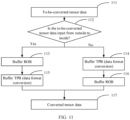
- FIG. 11 is a flowchart of data format conversion according to an embodiment of this application.
- a DMA may first determine whether to-be-converted tensor data is input from the outside of an NPU to the inside of the NPU, or is output from the inside of the NPU to the outside of the NPU. If the DMA determines that the to-be-converted tensor data is input from the outside of the NPU to the inside of the NPU, as shown in FIG. 3 and FIG. 11 , the DMA may first buffer the read to-be-converted tensor data into the ROB, and transmit the read to-be-converted tensor data to the TPB for data format conversion to obtain converted tensor data.
- the DMA may first buffer the read to-be-converted tensor data into the TPB for data format conversion, and buffer the to-be-converted tensor data buffered in the TPB into the ROB in the foregoing manner, to obtain converted tensor data.
- an external data format of the NPU is NHWC and an internal data format of the NPU is NC1HWCO is used to describe a data format conversion process in this embodiment of this application. It is assumed that a bus bit width is 256B, a minimum unit for splitting is 32B, and CO in a data format of fp16 data is 16. Specific values of the bus bit width and the minimum unit for splitting are merely examples, and are not intended to limit this application in any manner.
- NHWC is converted to NC1HWC0.
- FIG. 12a is a schematic diagram of a format conversion process of tensor data according to an embodiment of this application.
- FIG. 12b and FIG. 12c-1 and FIG. 12c-2 are each a schematic diagram of tensor data according to an embodiment of this application.
- the tensor data shown in FIG. 12b is to-be-converted tensor data, and the tensor data shown in FIG. 12c-1 and FIG. 12c-2 is converted tensor data.
- the to-be-converted tensor data is stored in an order of C->W->H->N outside the NPU, and C1 is located in a dimension higher than H and W.
- HWC may be first converted, and the conversion is performed one by one in an N direction.
- a cascading manner of a specific quantity of data blocks in H and W directions may be first determined based on a splitting width and a read port bit width, and a read request may be generated based on the cascading manner and a bus bit width.
- the read request is used to read a part of data of the to-be-converted tensor data. Because tensor data is transmitted based on the bus bit width burst during data transmission, a size of the part of data read based on the read request may be greater than the bus bit width. Therefore, a plurality of read commands may be sent to read the tensor data. It is assumed that burst is 256B.
- the read commands are sent in a cascading order based on the bus bit width (burst), and tagID indicates an order of a sent read command.
- the NPU After receiving data, the NPU first transmits the read tensor data to the ROB based on the tagID. Then, the NPU reads the tensor data from the ROB in an order of the tagID, and stores the tensor data into the TPB through the write port of the TPB in a reading order in a vertical direction.
- the tensor data is read from each row of buffer of the TPB based on the splitting bit width of 32B, the data is spliced in an order of the vertical direction, and output horizontally one piece by one piece.
- the data is stored in the matrix buffer in an output order. In this way, the data format conversion is completed. Format conversion of the entire NHWC data is completed based on the procedure.
- a data format of the converted tensor data is shown in FIG. 12c-1 and FIG. 12c-2 .
- the converted tensor data is stored in the NPU in an order of C0->W->H->Cl ->N.
- NC1HWC0 is converted to NHWC.
- FIG. 13 is a schematic diagram of a format conversion process of tensor data according to an embodiment of this application.
- the tensor data shown in FIG. 12b is converted tensor data
- the tensor data shown in FIG. 12c-1 and FIG. 12c-2 is to-be-converted tensor data.
- the to-be-converted tensor data is stored in the NPU in an order of CO->W->H->C1->N.
- data C1HWC0 inside the NPU is read one piece by one piece in an N direction and written in a vertical direction through the write port of the TPB.
- C1 and C0 of data in a longitudinal direction are combined into C and output to the ROB one piece by one piece in a horizontal direction. Then, the data is output to the outside of the NPU from the ROB through a bus.
- the to-be-converted tensor data is stored in the order of C->W->H->N outside the NPU, as shown in FIG. 12b .
- this application further provides a data format conversion method.
- the method is applied to a direct memory access DMA controller DMAC of a DMA module of a processor, a data format that is of tensor data and that is supported by the processor is a first data format, and the method includes: if a second data format of tensor data stored in an external memory is different from the first data format, converting, in a process of transmitting to-be-converted tensor data between a memory of the processor and the external memory, the to-be-converted tensor data from the first data format into the second data format or from the second data format into the first data format, to obtain converted tensor data, where the first data format and the second data format respectively indicate a placement manner of the to-be-converted tensor data or the converted tensor data when the to-be-converted tensor data or the converted tensor data is stored.
- the converting, in a process of transmitting to-be-converted tensor data between a memory of the processor and the external memory, the to-be-converted tensor data from the first data format into the second data format or from the second data format into the first data format may include: if the to-be-converted tensor data is tensor data stored in the external memory, converting the to-be-converted tensor data from the second data format into the first data format in a process of reading the to-be-converted tensor data into the memory; or if the to-be-converted tensor data is tensor data in the memory, converting the to-be-converted tensor data from the first data format into the second data format in a process of outputting the to-be-converted tensor data to the external memory.
- a data format of tensor data is converted in a data transfer process.
- converted data is output to the external memory after the vector processing unit converts a data format of the original data, and the data is read from the external memory again during the operation in the conventional technology, data transmission overheads and time and hardware overheads generated during vector calculation in the conventional technology can be reduced, and efficiency of running a neural network model on a neural network processor can be greatly improved.
- the data format conversion apparatus in this embodiment of this application can reduce offline preprocessing time overheads, and a process of reading and writing tensor data may be preconfigured based on a data format supported by the processor and a data format of tensor data stored in the external memory.
- the data format conversion apparatus works with a general-purpose software framework, internal format details are hidden, and a unified data format is presented to the outside, so that a developer does not need to understand a requirement of the processor for the data format. This facilitates popularization and use of the processor.
- the DMA module further includes a transpose buffer TPB, where the TPB includes a write port and a read port, and the converting, in a process of transmitting to-be-converted tensor data between a memory of the processor and the external memory, the to-be-converted tensor data from the first data format into the second data format or from the second data format into the first data format, to obtain converted tensor data includes: writing the to-be-converted tensor data into the TPB through the write port in a first direction, when a product of a quantity of rows of data stored in the first direction of the TPB and a splitting width meets a read port bit width, reading a first part of data of the to-be-converted tensor data from the TPB through the read port in a second direction at the splitting width, and splicing and storing the first part of data in an order of the first direction, to obtain the converted tensor data, where the splitting width is a parameter for splitting
- the transpose buffer TPB is disposed in the DMA module, and ports for writing and reading in different directions are disposed in the TPB, so that a data format of tensor data can be converted in a data transfer process.
- This can reduce the data transmission overheads, the offline preprocessing time overheads of data format conversion, and the vector calculation time and hardware overheads in the conventional technology, and greatly improve the efficiency of running the neural network model on the neural network processor
- the TPB includes a first buffer and a second buffer
- the first buffer includes a first write port and a first read port
- the second buffer includes a second write port and a second read port
- the writing the to-be-converted tensor data into the TPB through the write port in a first direction, and when a product of a quantity of rows of data stored in the first direction of the TPB and a splitting width meets a read port bit width, reading a first part of data of the to-be-converted tensor data from the TPB through the read port in a second direction at the splitting width includes:
- Reading and writing can be implemented in parallel by using the buffer of the ping-pong structure, to improve the data format conversion and transmission efficiency.
- the buffer of the ping-pong structure to improve the data format conversion and transmission efficiency.
- the DMA module further includes: a reorder buffer ROB, and when the to-be-converted tensor data is to-be-read tensor data stored in the external memory, the method further includes:
- the method may further include: receiving the second tensor data corresponding to the read command, where the second tensor data carries the number of the corresponding read command, and writing the second tensor data into the ROB based on the number of the read command carried in the second tensor data.
- the converting, in a process of transmitting to-be-converted tensor data between a memory of the processor and the external memory, the to-be-converted tensor data from the first data format into the second data format or from the second data format into the first data format, to obtain converted tensor data includes:
- the ROB is disposed in the DMA module, and it can also be ensured that data is read and written in sequence in a scenario of out-of-order reading of a bus.
- the read command further includes a logical address of the second tensor data and a size of the second tensor data, where the size of the second tensor data is less than or equal to the bus bit width; and the logical address included in the read command changes with a dimension other than the lowest dimension of the to-be-read tensor data based on an order of the number carried in the read command.
- the method further includes: when a remainder of a quantity of lowest dimensions of the to-be-read tensor data and a quantity of pieces of data corresponding to the splitting width is greater than 0, performing supplementation processing on the lowest dimension based on the quantity of pieces of data corresponding to the splitting width and the remainder.
- Data in any dimension can be split through supplementation processing, to implement conversion of tensor data in any dimension. This is applicable to a plurality of conversion scenarios.
- data can be continuously transferred after being supplemented, thereby improving data transfer efficiency and improving bus utilization.
- the DMA module further includes: a reorder buffer ROB, and when the to-be-converted tensor data is to-be-output tensor data stored in a matrix buffer of the DMA module, the converting, in a process of transmitting to-be-converted tensor data between a memory of the processor and the external memory, the to-be-converted tensor data from the first data format into the second data format or from the second data format into the first data format includes:
- a data format of tensor data can be converted in a process of outputting the tensor data inside the NPU, so that the data transmission overheads, the offline preprocessing time overheads of data format conversion, and the vector calculation time and hardware overheads in the conventional technology can be reduced, and the efficiency of running the neural network model on the neural network processor can be greatly improved.
- the method further includes: generating a write command based on the third tensor data stored in the ROB, where the write command carries a number that is specified based on an order of storing the third tensor data into the ROB, and the number carried in the write command indicates an order of writing the third tensor data into the external memory of the processor
- the method further includes: deleting a supplemented part of the third tensor data based on the lowest dimension of the to-be-output tensor data and the preset lowest dimension.
- An embodiment of this application provides a data format conversion apparatus, including: a processor and a memory configured to store instructions executable by the processor.
- the processor is configured to execute the instructions to implement the foregoing method.
- An embodiment of this application provides a non-volatile computer-readable storage medium, storing computer program instructions.
- the computer program instructions when executed by a processor, implement the foregoing method.
- An embodiment of this application provides a computer program product, including computer-readable code or a non-volatile computer-readable storage medium carrying the computer-readable code.
- the computer-readable code When the computer-readable code is run in a processor of an electronic device, the processor in the electronic device performs the foregoing method.
- the computer-readable storage medium may be a tangible device that can retain and store instructions for use by an instruction execution device.
- the computer-readable storage medium may be, for example, but is not limited to, an electrical storage device, a magnetic storage device, an optical storage device, an electromagnetic storage device, a semiconductor storage device, or any suitable combination thereof.
- the computer-readable storage medium include: a portable computer disk, a hard disk drive, a random access memory (Random Access Memory, RAM), a read-only memory (Read-Only Memory, ROM), an erasable programmable read-only memory (Electrically Programmable Read-Only-Memory, EPROM or a flash memory), a static random access memory (Static Random Access Memory, SRAM), a portable compact disc read-only memory (Compact Disc Read-Only Memory, CD-ROM), a digital versatile disc (Digital Video Disc, DVD), a memory stick, a floppy disk, a mechanical coding device, for example, a punching card or a groove protrusion structure that stores instructions, and any suitable combination thereof.
- the computer-readable program instructions or code described herein may be downloaded from a computer-readable storage medium to each computing/processing device, or downloaded to an external computer or an external storage device over a network, for example, the Internet, a local area network, a wide area network, and/or a wireless network.
- the network may include a copper transmission cable, optical fiber transmission, wireless transmission, a router, a firewall, a switch, a gateway computer, and/or an edge server.
- a network adapter card or network interface in each computing/processing device receives the computer-readable program instructions from the network, and forwards the computer-readable program instructions for storage in a computer-readable storage medium in each computing/processing device.
- the computer program instructions used to perform operations in this application may be assembly instructions, instruction set architecture (Instruction Set Architecture, ISA) instructions, machine instructions, machine-related instructions, microcode, firmware instructions, status setting data, or source code or target code written in one programming language or any combination of a plurality of programming languages.
- the programming languages include object-oriented programming languages such as Smalltalk and C++, and conventional procedural programming languages such as "C" or a similar programming language.
- the computer-readable program instructions may be executed entirely on a user computer, partly on the user computer, as a stand-alone software package, partly on the user computer and partly on a remote computer, or entirely on the remote computer or a server.
- the remote computer When the remote computer is used, the remote computer may be connected to the user computer over any type of network, including a local area network (Local Area Network, LAN) or a wide area network (Wide Area Network, WAN), or may be connected to an external computer (for example, connected by using an internet service provider over the Internet).
- an electronic circuit for example, a programmable logic circuit, a field-programmable gate array (Field-Programmable Gate Array, FPGA), or a programmable logic array (Programmable Logic Array, PLA), is customized by using status information of computer-readable program instructions.
- the electronic circuit may execute the computer-readable program instructions, to implement various aspects of this application.
- These computer-readable program instructions may be provided to a processor of a general-purpose computer, a special-purpose computer, or another programmable data processing apparatus to produce a machine, so that the instructions, when executed by the processor of the computer or the another programmable data processing apparatus, create an apparatus for implementing functions/actions specified in one or more blocks in the flowcharts and/or block diagrams.
- These computer-readable program instructions may alternatively be stored in the computer-readable storage medium. These instructions enable a computer, a programmable data processing apparatus, and/or another device to work in a specific manner Therefore, the computer-readable medium storing the instructions includes an artifact that includes instructions for implementing various aspects of the functions/actions specified in the one or more blocks in the flowcharts and/or the block diagrams.
- the computer-readable program instructions may alternatively be loaded onto a computer, another programmable data processing apparatus, or another device, so that a series of operation steps are performed on the computer, the another programmable data processing apparatus, or the another device to produce a computerimplemented process. Therefore, the instructions executed on the computer, the another programmable data processing apparatus, or the another device implements the functions/actions specified in the one or more blocks in the flowcharts and/or block diagrams.
- each block in the flowcharts or block diagrams may represent a module, a program segment, or a part of the instructions, and the module, the program segment, or the part of the instructions includes one or more executable instructions for implementing a specified logical function.
- a function marked in the block may also occur in a sequence different from that marked in the accompanying drawings. For example, two continuous blocks may actually be executed substantially in parallel, and may sometimes be executed in a reverse order, depending on a function involved.
- each block in the block diagrams and/or the flowcharts, and combinations of the blocks in the block diagrams and/or the flowcharts may be implemented by hardware (for example, a circuit or an ASIC (Application Specific Integrated Circuit, application-specific integrated circuit)) that performs a corresponding function or action, or may be implemented by a combination of the hardware and software, for example, firmware.
- hardware for example, a circuit or an ASIC (Application Specific Integrated Circuit, application-specific integrated circuit)
- ASIC Application Specific Integrated Circuit, application-specific integrated circuit
Landscapes
- Engineering & Computer Science (AREA)
- Theoretical Computer Science (AREA)
- Physics & Mathematics (AREA)
- General Engineering & Computer Science (AREA)
- General Physics & Mathematics (AREA)
- Biophysics (AREA)
- Health & Medical Sciences (AREA)
- Life Sciences & Earth Sciences (AREA)
- Biomedical Technology (AREA)
- Computational Linguistics (AREA)
- Artificial Intelligence (AREA)
- Data Mining & Analysis (AREA)
- Evolutionary Computation (AREA)
- General Health & Medical Sciences (AREA)
- Molecular Biology (AREA)
- Computing Systems (AREA)
- Mathematical Physics (AREA)
- Software Systems (AREA)
- Neurology (AREA)
- Communication Control (AREA)
- Memory System Of A Hierarchy Structure (AREA)
- Compression, Expansion, Code Conversion, And Decoders (AREA)
Applications Claiming Priority (1)
| Application Number | Priority Date | Filing Date | Title |
|---|---|---|---|
| PCT/CN2021/107113 WO2023000136A1 (zh) | 2021-07-19 | 2021-07-19 | 数据格式转换装置及方法 |
Publications (2)
| Publication Number | Publication Date |
|---|---|
| EP4357973A1 true EP4357973A1 (de) | 2024-04-24 |
| EP4357973A4 EP4357973A4 (de) | 2024-08-14 |
Family
ID=84979636
Family Applications (1)
| Application Number | Title | Priority Date | Filing Date |
|---|---|---|---|
| EP21950402.4A Pending EP4357973A4 (de) | 2021-07-19 | 2021-07-19 | Vorrichtung und verfahren zur datenformatumwandlung |
Country Status (4)
| Country | Link |
|---|---|
| US (1) | US20240152471A1 (de) |
| EP (1) | EP4357973A4 (de) |
| CN (1) | CN117693757A (de) |
| WO (1) | WO2023000136A1 (de) |
Cited By (1)
| Publication number | Priority date | Publication date | Assignee | Title |
|---|---|---|---|---|
| WO2024226323A1 (en) * | 2023-04-27 | 2024-10-31 | Microsoft Technology Licensing, Llc | Reduced latency tensor transposition without redundant buffer |
Families Citing this family (6)
| Publication number | Priority date | Publication date | Assignee | Title |
|---|---|---|---|---|
| US12561260B1 (en) | 2023-03-31 | 2026-02-24 | Amazon Technologies, Inc. | Flow control for crossbar based transpose |
| US12423580B1 (en) * | 2023-03-31 | 2025-09-23 | Amazon Technologies, Inc. | Crossbar based transpose data transfers |
| CN118132456B (zh) * | 2024-03-06 | 2025-01-24 | 北京壁仞科技开发有限公司 | 数据存储方法、数据处理方法、数据存储器、数据处理器 |
| US20260079867A1 (en) * | 2024-09-17 | 2026-03-19 | Advanced Micro Devices, Inc. | Iterative direct memory access for cache-friendly write out |
| US20260161361A1 (en) * | 2024-12-11 | 2026-06-11 | Moffett International Co., Limited | Processor, method, and system for tensor transpose for machine learning |
| CN121257615B (zh) * | 2025-12-03 | 2026-03-06 | 上海壁仞科技股份有限公司 | 一种张量拼接方法、装置、设备、存储介质及程序产品 |
Family Cites Families (9)
| Publication number | Priority date | Publication date | Assignee | Title |
|---|---|---|---|---|
| GB201801639D0 (en) * | 2018-02-01 | 2018-03-21 | Ruff Brendan Patrick | Low precision efficient multiplication free convolutional filter bank device |
| US10761757B2 (en) * | 2018-06-30 | 2020-09-01 | Intel Corporation | Apparatus and method for coherent, accelerated conversion between data representations |
| US11861484B2 (en) * | 2018-09-28 | 2024-01-02 | Qualcomm Incorporated | Neural processing unit (NPU) direct memory access (NDMA) hardware pre-processing and post-processing |
| CN112840356B (zh) * | 2018-10-09 | 2023-04-11 | 华为技术有限公司 | 运算加速器、处理方法及相关设备 |
| CN111783933A (zh) * | 2019-04-04 | 2020-10-16 | 北京芯启科技有限公司 | 一种对深度卷积神经网络计算加速的、结合主存储器的数据载入装置的硬件电路设计及方法 |
| CN111176725B (zh) * | 2019-12-27 | 2022-05-06 | 北京市商汤科技开发有限公司 | 数据处理方法、装置、设备和存储介质 |
| CN111882038A (zh) * | 2020-07-24 | 2020-11-03 | 深圳力维智联技术有限公司 | 模型转换方法与装置 |
| CN113095476A (zh) * | 2021-03-09 | 2021-07-09 | 苏州芯启微电子科技有限公司 | 一种用于通用张量计算的硬件加速装置及方法 |
| CN112988621A (zh) * | 2021-03-12 | 2021-06-18 | 苏州芯启微电子科技有限公司 | 一种张量数据的数据载入装置及方法 |
-
2021
- 2021-07-19 WO PCT/CN2021/107113 patent/WO2023000136A1/zh not_active Ceased
- 2021-07-19 EP EP21950402.4A patent/EP4357973A4/de active Pending
- 2021-07-19 CN CN202180100705.9A patent/CN117693757A/zh active Pending
-
2024
- 2024-01-18 US US18/416,413 patent/US20240152471A1/en active Pending
Cited By (1)
| Publication number | Priority date | Publication date | Assignee | Title |
|---|---|---|---|---|
| WO2024226323A1 (en) * | 2023-04-27 | 2024-10-31 | Microsoft Technology Licensing, Llc | Reduced latency tensor transposition without redundant buffer |
Also Published As
| Publication number | Publication date |
|---|---|
| WO2023000136A1 (zh) | 2023-01-26 |
| EP4357973A4 (de) | 2024-08-14 |
| CN117693757A (zh) | 2024-03-12 |
| US20240152471A1 (en) | 2024-05-09 |
Similar Documents
| Publication | Publication Date | Title |
|---|---|---|
| US20240152471A1 (en) | Data format conversion apparatus and method | |
| US12061564B2 (en) | Network-on-chip data processing based on operation field and opcode | |
| US11593594B2 (en) | Data processing method and apparatus for convolutional neural network | |
| US12367165B2 (en) | Operation accelerator and compression method | |
| US20220050636A1 (en) | Method and Apparatus for Transmitting Data Processing Request | |
| CN111176725B (zh) | 数据处理方法、装置、设备和存储介质 | |
| CN119338010B (zh) | 基于大模型的数据处理方法和装置、存储介质及电子设备 | |
| CN114286990B (zh) | 存储器中的辅助ai处理 | |
| WO2019127926A1 (zh) | 一种稀疏神经网络的计算方法及计算装置、电子装置、计算机可读存储介质以及计算机程序产品 | |
| CN117112201A (zh) | 硬件资源调度方法、装置、计算机设备和存储介质 | |
| CN116911367B (zh) | 数据处理方法、装置、电子设备及计算机可读存储介质 | |
| US20220113944A1 (en) | Arithmetic processing device | |
| CN114648105A (zh) | 多输出神经网络的切片方法、装置、芯片及存储介质 | |
| CN115049531B (zh) | 图像渲染方法、装置、图形处理设备及存储介质 | |
| CN111813449A (zh) | 运算方法、装置及相关产品 | |
| CN111178373B (zh) | 运算方法、装置及相关产品 | |
| CN111913971A (zh) | 存储数据的修改方法、装置、电子设备及存储介质 | |
| KR20090124177A (ko) | 대용량 이미지 처리 장치 및 그 방법 | |
| CN111061507A (zh) | 运算方法、装置、计算机设备和存储介质 | |
| WO2022000324A1 (zh) | 数据编码方法、数据解码方法、数据处理方法、编码器、解码器、系统、可移动平台与计算机可读介质 | |
| CN111382852B (zh) | 数据处理装置、方法、芯片及电子设备 | |
| CN115731111A (zh) | 图像数据处理装置及方法、电子设备 | |
| CN120223781B (zh) | Sata存储设备信息传输方法、装置和sata交换机 | |
| CN112395008A (zh) | 运算方法、装置、计算机设备和存储介质 | |
| CN112395009A (zh) | 运算方法、装置、计算机设备和存储介质 |
Legal Events
| Date | Code | Title | Description |
|---|---|---|---|
| STAA | Information on the status of an ep patent application or granted ep patent |
Free format text: STATUS: THE INTERNATIONAL PUBLICATION HAS BEEN MADE |
|
| PUAI | Public reference made under article 153(3) epc to a published international application that has entered the european phase |
Free format text: ORIGINAL CODE: 0009012 |
|
| STAA | Information on the status of an ep patent application or granted ep patent |
Free format text: STATUS: REQUEST FOR EXAMINATION WAS MADE |
|
| 17P | Request for examination filed |
Effective date: 20240117 |
|
| AK | Designated contracting states |
Kind code of ref document: A1 Designated state(s): AL AT BE BG CH CY CZ DE DK EE ES FI FR GB GR HR HU IE IS IT LI LT LU LV MC MK MT NL NO PL PT RO RS SE SI SK SM TR |
|
| REG | Reference to a national code |
Ref country code: DE Ref legal event code: R079 Free format text: PREVIOUS MAIN CLASS: G06N0003040000 Ipc: G06F0013280000 |
|
| A4 | Supplementary search report drawn up and despatched |
Effective date: 20240715 |
|
| RIC1 | Information provided on ipc code assigned before grant |
Ipc: G06N 3/045 20230101ALI20240709BHEP Ipc: G06F 13/12 20060101ALI20240709BHEP Ipc: G06N 3/063 20230101ALI20240709BHEP Ipc: G06N 3/04 20230101ALI20240709BHEP Ipc: G06F 13/28 20060101AFI20240709BHEP |
|
| DAV | Request for validation of the european patent (deleted) | ||
| DAX | Request for extension of the european patent (deleted) |