EP4357536B1 - Electric work machine - Google Patents
Electric work machine Download PDFInfo
- Publication number
- EP4357536B1 EP4357536B1 EP23201506.5A EP23201506A EP4357536B1 EP 4357536 B1 EP4357536 B1 EP 4357536B1 EP 23201506 A EP23201506 A EP 23201506A EP 4357536 B1 EP4357536 B1 EP 4357536B1
- Authority
- EP
- European Patent Office
- Prior art keywords
- fan
- hydraulic oil
- electric motor
- oil tank
- hydraulic
- Prior art date
- Legal status (The legal status is an assumption and is not a legal conclusion. Google has not performed a legal analysis and makes no representation as to the accuracy of the status listed.)
- Active
Links
Images



Classifications
-
- E—FIXED CONSTRUCTIONS
- E02—HYDRAULIC ENGINEERING; FOUNDATIONS; SOIL SHIFTING
- E02F—DREDGING; SOIL-SHIFTING
- E02F3/00—Dredgers; Soil-shifting machines
- E02F3/04—Dredgers; Soil-shifting machines mechanically-driven
- E02F3/28—Dredgers; Soil-shifting machines mechanically-driven with digging tools mounted on a dipper- or bucket-arm, i.e. there is either one arm or a pair of arms, e.g. dippers, buckets
-
- E—FIXED CONSTRUCTIONS
- E02—HYDRAULIC ENGINEERING; FOUNDATIONS; SOIL SHIFTING
- E02F—DREDGING; SOIL-SHIFTING
- E02F9/00—Component parts of dredgers or soil-shifting machines, not restricted to one of the kinds covered by groups E02F3/00 - E02F7/00
- E02F9/20—Drives; Control devices
- E02F9/2058—Electric or electro-mechanical or mechanical control devices of vehicle sub-units
- E02F9/2091—Control of energy storage means for electrical energy, e.g. battery or capacitors
-
- E—FIXED CONSTRUCTIONS
- E02—HYDRAULIC ENGINEERING; FOUNDATIONS; SOIL SHIFTING
- E02F—DREDGING; SOIL-SHIFTING
- E02F3/00—Dredgers; Soil-shifting machines
- E02F3/04—Dredgers; Soil-shifting machines mechanically-driven
- E02F3/28—Dredgers; Soil-shifting machines mechanically-driven with digging tools mounted on a dipper- or bucket-arm, i.e. there is either one arm or a pair of arms, e.g. dippers, buckets
- E02F3/30—Dredgers; Soil-shifting machines mechanically-driven with digging tools mounted on a dipper- or bucket-arm, i.e. there is either one arm or a pair of arms, e.g. dippers, buckets with a dipper-arm pivoted on a cantilever beam, i.e. boom
- E02F3/32—Dredgers; Soil-shifting machines mechanically-driven with digging tools mounted on a dipper- or bucket-arm, i.e. there is either one arm or a pair of arms, e.g. dippers, buckets with a dipper-arm pivoted on a cantilever beam, i.e. boom working downwardly and towards the machine, e.g. with backhoes
- E02F3/325—Backhoes of the miniature type
-
- E—FIXED CONSTRUCTIONS
- E02—HYDRAULIC ENGINEERING; FOUNDATIONS; SOIL SHIFTING
- E02F—DREDGING; SOIL-SHIFTING
- E02F3/00—Dredgers; Soil-shifting machines
- E02F3/04—Dredgers; Soil-shifting machines mechanically-driven
- E02F3/28—Dredgers; Soil-shifting machines mechanically-driven with digging tools mounted on a dipper- or bucket-arm, i.e. there is either one arm or a pair of arms, e.g. dippers, buckets
- E02F3/36—Component parts
-
- E—FIXED CONSTRUCTIONS
- E02—HYDRAULIC ENGINEERING; FOUNDATIONS; SOIL SHIFTING
- E02F—DREDGING; SOIL-SHIFTING
- E02F9/00—Component parts of dredgers or soil-shifting machines, not restricted to one of the kinds covered by groups E02F3/00 - E02F7/00
- E02F9/08—Superstructures; Supports for superstructures
-
- E—FIXED CONSTRUCTIONS
- E02—HYDRAULIC ENGINEERING; FOUNDATIONS; SOIL SHIFTING
- E02F—DREDGING; SOIL-SHIFTING
- E02F9/00—Component parts of dredgers or soil-shifting machines, not restricted to one of the kinds covered by groups E02F3/00 - E02F7/00
- E02F9/08—Superstructures; Supports for superstructures
- E02F9/0858—Arrangement of component parts installed on superstructures not otherwise provided for, e.g. electric components, fenders, air-conditioning units
-
- E—FIXED CONSTRUCTIONS
- E02—HYDRAULIC ENGINEERING; FOUNDATIONS; SOIL SHIFTING
- E02F—DREDGING; SOIL-SHIFTING
- E02F9/00—Component parts of dredgers or soil-shifting machines, not restricted to one of the kinds covered by groups E02F3/00 - E02F7/00
- E02F9/08—Superstructures; Supports for superstructures
- E02F9/0858—Arrangement of component parts installed on superstructures not otherwise provided for, e.g. electric components, fenders, air-conditioning units
- E02F9/0866—Engine compartment, e.g. heat exchangers, exhaust filters, cooling devices, silencers, mufflers, position of hydraulic pumps in the engine compartment
-
- E—FIXED CONSTRUCTIONS
- E02—HYDRAULIC ENGINEERING; FOUNDATIONS; SOIL SHIFTING
- E02F—DREDGING; SOIL-SHIFTING
- E02F9/00—Component parts of dredgers or soil-shifting machines, not restricted to one of the kinds covered by groups E02F3/00 - E02F7/00
- E02F9/08—Superstructures; Supports for superstructures
- E02F9/0858—Arrangement of component parts installed on superstructures not otherwise provided for, e.g. electric components, fenders, air-conditioning units
- E02F9/0883—Tanks, e.g. oil tank, urea tank, fuel tank
-
- E—FIXED CONSTRUCTIONS
- E02—HYDRAULIC ENGINEERING; FOUNDATIONS; SOIL SHIFTING
- E02F—DREDGING; SOIL-SHIFTING
- E02F9/00—Component parts of dredgers or soil-shifting machines, not restricted to one of the kinds covered by groups E02F3/00 - E02F7/00
- E02F9/20—Drives; Control devices
- E02F9/2058—Electric or electro-mechanical or mechanical control devices of vehicle sub-units
- E02F9/2062—Control of propulsion units
- E02F9/207—Control of propulsion units of the type electric propulsion units, e.g. electric motors or generators
-
- E—FIXED CONSTRUCTIONS
- E02—HYDRAULIC ENGINEERING; FOUNDATIONS; SOIL SHIFTING
- E02F—DREDGING; SOIL-SHIFTING
- E02F9/00—Component parts of dredgers or soil-shifting machines, not restricted to one of the kinds covered by groups E02F3/00 - E02F7/00
- E02F9/20—Drives; Control devices
- E02F9/22—Hydraulic or pneumatic drives
-
- B—PERFORMING OPERATIONS; TRANSPORTING
- B60—VEHICLES IN GENERAL
- B60Y—INDEXING SCHEME RELATING TO ASPECTS CROSS-CUTTING VEHICLE TECHNOLOGY
- B60Y2200/00—Type of vehicle
- B60Y2200/40—Special vehicles
- B60Y2200/41—Construction vehicles, e.g. graders, excavators
- B60Y2200/412—Excavators
Definitions
- Patent Document 1 discloses an electric work machine in which an electric motor and a hydraulic pump are arranged below a battery unit that supplies electric power to the electric motor.
- Patent Document 1 Japanese Unexamined Patent Application Publication No. 2022-97079 .
- Patent document JP 4 859859 B2 shows an other arrangement.
- FIG. 1 is a side view illustrating a schematic configuration of a hydraulic excavator (electric excavator) 1 provided as an example of an electric work machine according to the present embodiment.
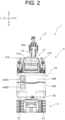
- FIG. 2 is a rear view of the hydraulic excavator 1.
- the hydraulic excavator 1 includes a lower traveling body 2, a work machine 3, and an upper turning body 4.
- each direction is defined as follows.
- a forward direction is a direction in which an operator (manipulator, driver) seated on a driver seat 41a of the upper turning body 4 faces front
- a backward direction is a direction opposite to the forward direction. Therefore, in a state where the upper turning body 4 does not turn with respect to the lower traveling body 2 (0 degree turning angle), a front-back direction of the upper turning body 4 coincides with a direction in which the lower traveling body 2 moves forward and backward.
- a left side is defined as "left”
- a right side is defined as "right”.
- a gravity direction perpendicular to the front-back direction and a left-right direction is defined as an up-down direction, in which an upstream side of the gravity direction is defined as "up”, and a downstream side thereof is defined as “down”.
- the hydraulic excavator 1 is illustrated in a state where the upper turning body 4 does not turn with respect to the lower traveling body 2.
- a forward is denoted by a symbol "F”, likewise, backward by "B”, rightward by "R”, leftward by “L”, upward by "U”, and downward by "D”.
- the lower traveling body 2 includes a pair of left and right crawlers 21 and a pair of left and right traveling motors 22.
- Each of the traveling motors 22 is a hydraulic motor.
- the left and right traveling motors 22 drive the left and right crawlers 21, respectively, thereby allowing the hydraulic excavator 1 to move forward and backward.
- the lower traveling body 2 is provided with a blade 23 for performing a ground leveling work and a blade cylinder 23a.
- the blade cylinder 23a is a hydraulic cylinder that rotates the blade 23 in the up-down direction.
- the work machine 3 includes a boom 31, an arm 32, and a bucket 33.
- the boom 31, the arm 32, and the bucket 33 can be independently driven, thereby enabling to perform excavation work of earth, sand, and the like.
- the boom 31 is rotated by a boom cylinder 31a.
- the boom cylinder 31a has a base end portion thereof supported by a front portion of the upper turning body 4, and is movable freely in an extendable and retractable manner.
- the arm 32 is rotated by an arm cylinder 32a.
- the arm cylinder 32a has a base end portion thereof supported by the boom 31, and is movable freely in an extendable and retractable manner.
- the bucket 33 is rotated by a bucket cylinder 33a.
- the bucket cylinder 33a has a base end portion thereof supported by the arm 32, and is movable freely in an extendable and retractable manner.
- the boom cylinder 31a, the arm cylinder 32a, and the bucket cylinder 33a each include a hydraulic cylinder.
- the upper turning body 4 is located above the lower traveling body 2 and provided capable of turning with respect to the lower traveling body 2 via a turning bearing (not illustrated).
- a steering unit 41 In the upper turning body 4, a steering unit 41, a turning frame 42, a turning motor 43, and an engine room 44 are arranged.
- the turning motor 43 By driving of the turning motor 43 as a hydraulic motor, the upper turning body 4 turns via a turning bearing.
- the hydraulic excavator 1 includes the turning frame 42 as a machine body frame.
- the upper turning body 4 includes a hydraulic pump 71 (see FIG. 3 ) arranged.
- the hydraulic excavator 1 includes the hydraulic pump 71.
- the hydraulic pump 71 is driven by an electric motor 61 (see FIG. 3 , etc.) inside the engine room 44.
- the hydraulic pump 71 supplies a hydraulic oil (pressure oil) to hydraulic motors (for example, the left and right traveling motors 22 and the turning motor 43), and hydraulic cylinders (for example, the blade cylinder 23a, the boom cylinder 31a, the arm cylinder 32a, and the bucket cylinder 33a).
- the hydraulic motors and the hydraulic cylinders that are driven with the hydraulic oil supplied from the hydraulic pump 71 are collectively referred to as a hydraulic actuator 73 (see FIG. 3 ).
- the steering unit 41 is installed on the turning frame 42.
- the driver seat 41a is arranged on the steering unit 41.
- Various levers 41b are arranged around the driver seat 41a. The operator is seated on the driver seat 41a and operates the lever 41b, thereby driving the hydraulic actuator 73. This allows the lower traveling body 2 to travel, the blade 23 to perform a ground leveling work, the work machine 3 to perform an excavation work, the upper turning body 4 to turn, and the like.
- a battery unit 53 is arranged on the upper turning body 4.
- the hydraulic excavator 1 includes the battery unit 53.
- the battery unit 53 is composed of, for example, a lithium-ion battery unit, and stores electric power for driving the electric motor 61.
- the battery unit 53 may be composed of a plurality of batteries as a unit or may be composed of a single battery cell. In the present embodiment, the battery unit 53 is composed of three batteries as a unit (see FIG. 5 ), but the number of batteries to be unitized is not limited to the above three.
- the electric motor 61 is driven by electric power supplied from the battery unit 53 via the junction box 65 and the inverter 63.
- the electric motor 61 is composed of a permanent magnet motor or an induction motor.
- the electric motor 61 is arranged (vibration-isolation supported) above the turning frame 42 (see FIG. 1 ).
- the charger 62 converts an AC voltage supplied from the external power source via the power feed cable into a DC voltage.
- the inverter 63 converts a DC voltage supplied from the battery unit 53 into an AC voltage and supplies the AC voltage to the electric motor 61. This rotates the electric motor 61.
- the AC voltage (current) from the inverter 63 to the electric motor 61 is supplied based on a rotation instruction being output from the system controller 67.
- the electric motor 61, the hydraulic pump 71, and the hydraulic oil tank 74 are arranged below the battery unit 53 on the turning frame 42. Further, the electric motor 61, the hydraulic pump 71, and the hydraulic oil tank 74 are arranged in this order from a right side to a left side of the turning frame 42 below the battery unit 53. In other words, the electric motor 61, the hydraulic pump 71, and the hydraulic oil tank 74 are arranged side by side in a lateral direction (left-right direction) of the turning frame 42. At this time, the electric motor 61 is arranged on the right side (one side) in the lateral direction, and the hydraulic oil tank 74 is arranged on the left side (another side) in the lateral direction.
- the fan 81 is arranged in the engine room 44 that contains the battery unit 53.
- the hydraulic excavator 1 includes the engine room 44 and the fan 81.
- the fan 81 is an electric fan, and generates a wind flow in the engine room 44.
- the fan 81 includes a first fan 81a and a second fan 81b.
- the first fan 81a is arranged behind the battery unit 53.
- the second fan 81b is arranged behind the battery unit 53 and below the first fan 81a.
- the battery unit 53 is increased in capacity (increased in size) in the small-sized hydraulic excavator 1
- only the battery unit 53 can be increased in size while the electric motor 61, the hydraulic pump 71, and the hydraulic oil tank 74 are arranged below the battery unit 53.
- This facilitates an increase in size of the battery unit 53, i.e., an increase in capacity of the battery unit 53, while keeping the layout compact as described above.
- the electric motor 61, the hydraulic pump 71, and the hydraulic oil tank 74 are arranged side by side in the lateral direction of the turning frame 42, thereby driving the fan 81 and cooling (air-cooling) the electric motor 61, the hydraulic pump 71, and the hydraulic oil tank 74, the electric motor 61, the hydraulic pump 71, and the hydraulic oil tank 74, which are located below the battery unit 53, can be collectively and efficiently cooled by wind blown in the lateral direction of the turning frame 42.
- the electric motor 61 and the hydraulic oil tank 74 are arranged on opposite sides to each other in the lateral direction on the turning frame 42.
- the electric motor 61 and the hydraulic oil tank 74 are desirably arranged on one side (for example, the right side) and another side (for example, the left side) in the lateral direction, respectively, on the turning frame 42.
- the hydraulic pump 71 is desirably arranged between the electric motor 61 and the hydraulic oil tank 74.
- the fan 81 is desirably arranged behind the battery unit 53. In short, it is desirable that the fan 81 be arranged between the battery unit 53 and the rear hood 44B serving as the rear wall of the engine room 44.
- the fan 81 be arranged in the vicinity of the hydraulic oil tank 74 in the engine room 44 from the viewpoint of efficiently cooling the hydraulic oil tank by efficiently making wind hit the hydraulic oil tank 74, which tends to have a high temperature, by driving the fan 81.
- the fan 81 be arranged on a side of the hydraulic oil tank 74 in the lateral direction in the engine room 44.
- the fan 81 is desirably arranged on another side in the lateral direction in the engine room 44.
- the exhaust ports 44B1 and 44B2 as the first openings be provided at a position facing the fan 81 in the rear hood 44B serving as the rear wall of the engine room 44.
- the right hood 44R as a sidewall connected to the rear hood 44B of the engine room 44 and located on one side (for example, the right side) in the lateral direction with respect to the rear hood 44B is provided with the vent holes 44R1 and 44R2 as the second openings.
- the fan 81 desirably includes the first fan 81a and the second fan 81b arranged side by side in the up-down direction in the engine room 44.
- the hydraulic excavator 1 further includes an oil cooler 82.
- the oil cooler 82 is a heat exchanger that cools the hydraulic oil by heat exchange, and is arranged in the engine room 44. Further, the oil cooler 82 is connected to a hydraulic oil tank 74 and supplies the cooled hydraulic oil to the hydraulic oil tank 74. It is desirable that the oil cooler 82 be arranged between the fan 81 and the first opening from the viewpoint of making the wind generated in the engine room 44 by the driving of the fan 81 hit the oil cooler 82 and effectively utilizing the wind for cooling the oil cooler 82 and from the viewpoint of efficiently discharging the wind after hitting the oil cooler 82 to the outside via the exhaust ports 44B1 and 44B2 (first openings).
- the wind used for cooling the hydraulic oil tank 74 arranged below the battery unit 53 is increased in temperature by the high-temperature hydraulic oil tank 74. For this reason, when the wind generated by the driving of the second fan 81b arranged below hits the oil cooler 82, the wind that has increased in temperature after hitting the hydraulic oil tank 74 hits the oil cooler 82, and there is concern that the cooling efficiency of the oil cooler 82 will decrease.
- the oil cooler 82 it is desirable to make the wind (having a relatively low temperature) used for cooling the battery unit 53 located above the hydraulic oil tank 74 hit the oil cooler 82.
- the oil cooler 82 it is desirable that the oil cooler 82 be arranged between the first fan 81a located at the uppermost part and the first opening (particularly, the exhaust port 44B1).
- the electrical equipment EQ (the charger 62, the inverter 63, the junction box 65, the DC-DC converter 66, and the lead battery 54)
- a fan dedicated to cooling the electrical equipment EQ is not required, which is desirable in that the configuration can be simplified.
- the electrical equipment EQ is arranged on a side (for example, the right side) of the fan 81.
- the electric motor 61, the hydraulic pump 71, and the hydraulic oil tank 74 are arranged in this order from the right side toward the left side in the lateral direction in the engine room 44
- the components may be arranged in this order from the left side toward the right side in the lateral direction.
- one side in the lateral direction may be the left side
- another side in the lateral direction may be the right side.
- the arrangement of the components in the lateral direction of the turning frame 42 may be reversed from that in the present embodiment.
- the electric work machine may be an agricultural machine such as a combine harvester or a tractor.
- An electric work machine according to supplementary note (2) is the electric work machine according to supplementary note (1), where the electric motor and the hydraulic oil tank are respectively arranged on one side and another side in the lateral direction on the machine body frame.
- An electric work machine according to supplementary note (3) is the electric work machine according to supplementary note (2), where the hydraulic pump is arranged between the electric motor and the hydraulic oil tank.
- An electric work machine is the electric work machine according to supplementary note (2) or (3), further including: an engine room that contains the battery unit (and also contains the electric motor and the hydraulic pump); and a fan that generates a flow of wind in the engine room, where the fan is arranged between the battery unit and a rear wall of the engine room.
- An electric work machine according to supplementary note (5) is the electric work machine according to supplementary note (4), where the fan is arranged on the another side in the lateral direction in the engine room.
- An electric work machine is the electric work machine according to supplementary note (5), where a first opening is provided at a position facing the fan in the rear wall of the engine room and a second opening is provided in a side wall connected to the rear wall of the engine room and located on one side in the lateral direction with respect to the rear wall.
- An electric work machine is the electric work machine according to the supplementary note (6), where the fan includes a first fan and a second fan arranged side by side in a vertical direction in the engine room.
- An electric work machine is the electric work machine according to supplementary note (7), where an oil cooler for cooling the hydraulic oil is arranged between the fan and the first opening.
- An electric work machine is the electric work machine according to supplementary note (8), where the oil cooler is arranged between the first fan located at the uppermost part and the first opening.
- An electric work machine is the electric work machine according to any one of supplementary notes (5) to (9), further including electrical equipment arranged on a side (in a lateral direction) of the fan.
- the present invention is applicable to work machines such as a construction machine and an agricultural machine, for example.
Landscapes
- Engineering & Computer Science (AREA)
- Mining & Mineral Resources (AREA)
- Civil Engineering (AREA)
- General Engineering & Computer Science (AREA)
- Structural Engineering (AREA)
- Mechanical Engineering (AREA)
- Power Engineering (AREA)
- Operation Control Of Excavators (AREA)
Description
- The present invention relates to an electric work machine.
- Conventionally, an electric work machine including an electric motor and a hydraulic pump has been proposed. For example,
Patent Document 1 discloses an electric work machine in which an electric motor and a hydraulic pump are arranged below a battery unit that supplies electric power to the electric motor. - Patent Document 1:
Japanese Unexamined Patent Application Publication No. 2022-97079 JP 4 859859 B2 - The hydraulic pump is driven by the electric motor and pumps hydraulic oil to a hydraulic actuator. The hydraulic oil is contained in a hydraulic oil tank. In a configuration of
Patent Document 1, the hydraulic oil tank is arranged on a side of the battery unit. Therefore, there is room for improvement in achieving a layout suitable for a small-sized electric work machine, i.e., a compact layout including the hydraulic oil tank and the battery unit. In particular, even when the battery unit is increased in size in order to increase a capacity of the battery unit in a small-sized electric work machine, it is necessary to secure a space for arranging the hydraulic oil tank separately from the battery unit in the configuration ofPatent Document 1. For this reason, it is more difficult to achieve the compact layout, and it may become difficult to increase the capacity of the battery unit. - In addition, when the electric motor and the hydraulic pump are driven, heat is generated, and the hydraulic oil flowing through the hydraulic actuator also reaches a high temperature and therefore, the hydraulic oil tank that contains the hydraulic oil also reaches a high temperature. In order to ensure cooling performance of the electric motor, the hydraulic pump, and the hydraulic oil tank, it is desirable to achieve a layout which also takes into consideration cooling efficiency in cooling these components.
- The present invention has been made in order to solve the above problems, and an object of the present invention is to provide an electric work machine that has a compact layout and facilitates an increase in capacity of a battery unit while also taking into consideration the cooling efficiency in cooling an electric motor, a hydraulic pump, and a hydraulic oil tank.
- An electric work machine according to one aspect of the present invention includes an electric motor, a battery unit that stores electric power for driving the electric motor, a hydraulic oil tank that contains hydraulic oil, and a hydraulic pump that is driven by the electric motor and is connected to the hydraulic oil tank, where the electric motor, the hydraulic pump, and the hydraulic oil tank are arranged below the battery unit on a machine body frame and are arranged side by side in a lateral direction of the machine body frame, according to
claims 1 or 10. - It is possible to achieve an electric work machine that has a compact layout and facilitates an increase in capacity of the battery unit while also taking into consideration cooling efficiency when cooling the electric motor, the hydraulic pump, and the hydraulic oil tank.
-
-
FIG. 1 is a side view illustrating a schematic configuration of a hydraulic excavator provided as an example of an electric work machine according to one embodiment of the present invention. -
FIG. 2 is a rear view of the above-mentioned hydraulic excavator. -
FIG. 3 is a block diagram schematically illustrating a configuration of an electric system and a hydraulic system of the above-mentioned hydraulic excavator. -
FIG. 4 is a plan view illustrating an internal configuration of an engine room of the above-mentioned hydraulic excavator. -
FIG. 5 is a perspective view of an inside of the above-mentioned engine room when viewed obliquely from a rear upper side. -
FIG. 6 is a perspective view of an inside of the above-mentioned engine room when viewed obliquely from a rear lower side. - An embodiment of the present invention will be described as follows with reference to the drawings.
-
FIG. 1 is a side view illustrating a schematic configuration of a hydraulic excavator (electric excavator) 1 provided as an example of an electric work machine according to the present embodiment.FIG. 2 is a rear view of thehydraulic excavator 1. Thehydraulic excavator 1 includes alower traveling body 2, awork machine 3, and an upper turningbody 4. - Here, in this embodiment, each direction is defined as follows. A forward direction is a direction in which an operator (manipulator, driver) seated on a
driver seat 41a of the upper turningbody 4 faces front, and a backward direction is a direction opposite to the forward direction. Therefore, in a state where the upper turningbody 4 does not turn with respect to the lower traveling body 2 (0 degree turning angle), a front-back direction of the upper turningbody 4 coincides with a direction in which the lowertraveling body 2 moves forward and backward. As viewed from the operator seated on thedriver seat 41a, a left side is defined as "left" and a right side is defined as "right". A gravity direction perpendicular to the front-back direction and a left-right direction is defined as an up-down direction, in which an upstream side of the gravity direction is defined as "up", and a downstream side thereof is defined as "down". In the drawings, thehydraulic excavator 1 is illustrated in a state where the upper turningbody 4 does not turn with respect to the lower travelingbody 2. Further, in the drawings, as necessary, a forward is denoted by a symbol "F", likewise, backward by "B", rightward by "R", leftward by "L", upward by "U", and downward by "D". - The
lower traveling body 2 includes a pair of left andright crawlers 21 and a pair of left andright traveling motors 22. Each of thetraveling motors 22 is a hydraulic motor. The left and right travelingmotors 22 drive the left andright crawlers 21, respectively, thereby allowing thehydraulic excavator 1 to move forward and backward. The lower travelingbody 2 is provided with ablade 23 for performing a ground leveling work and ablade cylinder 23a. Theblade cylinder 23a is a hydraulic cylinder that rotates theblade 23 in the up-down direction. - The
work machine 3 includes aboom 31, anarm 32, and abucket 33. Theboom 31, thearm 32, and thebucket 33 can be independently driven, thereby enabling to perform excavation work of earth, sand, and the like. - The
boom 31 is rotated by aboom cylinder 31a. Theboom cylinder 31a has a base end portion thereof supported by a front portion of the upper turningbody 4, and is movable freely in an extendable and retractable manner. Thearm 32 is rotated by anarm cylinder 32a. Thearm cylinder 32a has a base end portion thereof supported by theboom 31, and is movable freely in an extendable and retractable manner. Thebucket 33 is rotated by abucket cylinder 33a. Thebucket cylinder 33a has a base end portion thereof supported by thearm 32, and is movable freely in an extendable and retractable manner. - The
boom cylinder 31a, thearm cylinder 32a, and thebucket cylinder 33a each include a hydraulic cylinder. - The upper turning
body 4 is located above the lower travelingbody 2 and provided capable of turning with respect to the lower travelingbody 2 via a turning bearing (not illustrated). In the upper turningbody 4, asteering unit 41, aturning frame 42, a turningmotor 43, and anengine room 44 are arranged. By driving of the turningmotor 43 as a hydraulic motor, the upper turningbody 4 turns via a turning bearing. Thehydraulic excavator 1 includes theturning frame 42 as a machine body frame. - The upper turning
body 4 includes a hydraulic pump 71 (seeFIG. 3 ) arranged. Namely, thehydraulic excavator 1 includes thehydraulic pump 71. Thehydraulic pump 71 is driven by an electric motor 61 (seeFIG. 3 , etc.) inside theengine room 44. Thehydraulic pump 71 supplies a hydraulic oil (pressure oil) to hydraulic motors (for example, the left andright traveling motors 22 and the turning motor 43), and hydraulic cylinders (for example, theblade cylinder 23a, theboom cylinder 31a, thearm cylinder 32a, and thebucket cylinder 33a). The hydraulic motors and the hydraulic cylinders that are driven with the hydraulic oil supplied from thehydraulic pump 71 are collectively referred to as a hydraulic actuator 73 (seeFIG. 3 ). - The
steering unit 41 is installed on the turningframe 42. Thedriver seat 41a is arranged on thesteering unit 41.Various levers 41b are arranged around thedriver seat 41a. The operator is seated on thedriver seat 41a and operates thelever 41b, thereby driving thehydraulic actuator 73. This allows thelower traveling body 2 to travel, theblade 23 to perform a ground leveling work, thework machine 3 to perform an excavation work, theupper turning body 4 to turn, and the like. - A
battery unit 53 is arranged on theupper turning body 4. Namely, thehydraulic excavator 1 includes thebattery unit 53. Thebattery unit 53 is composed of, for example, a lithium-ion battery unit, and stores electric power for driving theelectric motor 61. Thebattery unit 53 may be composed of a plurality of batteries as a unit or may be composed of a single battery cell. In the present embodiment, thebattery unit 53 is composed of three batteries as a unit (seeFIG. 5 ), but the number of batteries to be unitized is not limited to the above three. - Moreover, the
upper turning body 4 is provided with a power feed port, which is not illustrated. The above-mentioned power feed port and an external power source (commercial power source) are connected via a power feed cable. This allows charging of thebattery unit 53. - The
upper turning body 4 is further provided with alead battery 54. Thelead battery 54 outputs a low voltage (12 V, for example) DC voltage. The output from thelead battery 54 is supplied as a control voltage to, for example, a system controller 67 (seeFIG. 3 ), a drive unit of a fan 81 (seeFIG. 5 ), and the like. - The
hydraulic excavator 1 may be configured by using hydraulic equipment such as thehydraulic actuator 73 and an actuator driven by electric power, in combination. As the actuator driven by electric power, for example, an electric traveling motor, an electric cylinder, and an electric turning motor are included. -
FIG. 3 is a block diagram schematically illustrating a configuration of electric and hydraulic systems of thehydraulic excavator 1. Thehydraulic excavator 1 includes theelectric motor 61, acharger 62, aninverter 63, and a Power Drive Unit (PDU) 64, ajunction box 65, a DC-DC converter 66, and asystem controller 67. Thesystem controller 67 is composed of an electronic control unit also called an Electronic Control Unit (ECU) and electrically controls each unit of thehydraulic excavator 1. Thecharger 62, theinverter 63, thejunction box 65, the DC-DC converter 66, and the above-mentionedlead battery 54 are also collectively referred to as electrical equipment EQ. - The
electric motor 61 is driven by electric power supplied from thebattery unit 53 via thejunction box 65 and theinverter 63. Theelectric motor 61 is composed of a permanent magnet motor or an induction motor. Theelectric motor 61 is arranged (vibration-isolation supported) above the turning frame 42 (seeFIG. 1 ). - The
charger 62 converts an AC voltage supplied from the external power source via the power feed cable into a DC voltage. Theinverter 63 converts a DC voltage supplied from thebattery unit 53 into an AC voltage and supplies the AC voltage to theelectric motor 61. This rotates theelectric motor 61. The AC voltage (current) from theinverter 63 to theelectric motor 61 is supplied based on a rotation instruction being output from thesystem controller 67. - The
PDU 64 is a battery control unit that controls input and output of thebattery unit 53 by controlling an internal battery relay, and is also called a power management unit (PMU). Thejunction box 65 is configured by including a charger relay, an inverter relay, a fuse, and the like. The voltage being output from the above-mentionedcharger 62 is supplied to thebattery unit 53 via thejunction box 65 and thePDU 64. The voltage being output from thebattery unit 53 is supplied to theinverter 63 via thePDU 64 and thejunction box 65. - The DC-
DC converter 66 lowers a high-voltage (300 V, for example) DC voltage supplied from thebattery unit 53 via thejunction box 65 to a low voltage (12 V, for example). Similar to the output from thelead battery 54, the voltage being output from the DC-DC converter 66 is supplied to thesystem controller 67, the drive unit of the fan 81, and the like. In the present embodiment, a plurality of the DC-DC converters 66 are provided (seeFIG. 5 ), but a single DC-DC converter 66 may be provided. - The
hydraulic pump 71 is connected to a rotary shaft (output shaft) of theelectric motor 61. Thehydraulic pump 71 is connected to ahydraulic oil tank 74 that contains (stores) hydraulic oil via a hydraulic hose 75 (seeFIGS. 5 and6 ). Namely, thehydraulic excavator 1 includes the hydraulic oil tank that contains hydraulic oil. Thehydraulic pump 71 causes the hydraulic oil in thehydraulic oil tank 74 to be supplied to thehydraulic actuator 73 via acontrol valve 72. As a result, thehydraulic actuator 73 is driven. Thecontrol valve 72 is a direction switch valve that controls a flow direction and a flow rate of the hydraulic oil supplied to thehydraulic actuator 73. -
FIG. 4 is a plan view illustrating a configuration of an inside of theengine room 44.FIG. 5 is a perspective view of the inside of theengine room 44 as viewed obliquely from a rear upper side.FIG. 6 is a perspective view of the inside of theengine room 44 as viewed obliquely from a rear lower side. The arrangement of the above-mentioned components in theengine room 44 will be described below. In theengine room 44, each component is supported on the turningframe 22 via a support member such as a stay, but the support member is not illustrated in the drawings for the purpose of clarifying an arrangement position of each component. - As illustrated in
FIGS. 4 to 6 , theelectric motor 61, thehydraulic pump 71, and thehydraulic oil tank 74 are arranged below thebattery unit 53 on the turningframe 42. Further, theelectric motor 61, thehydraulic pump 71, and thehydraulic oil tank 74 are arranged in this order from a right side to a left side of the turningframe 42 below thebattery unit 53. In other words, theelectric motor 61, thehydraulic pump 71, and thehydraulic oil tank 74 are arranged side by side in a lateral direction (left-right direction) of the turningframe 42. At this time, theelectric motor 61 is arranged on the right side (one side) in the lateral direction, and thehydraulic oil tank 74 is arranged on the left side (another side) in the lateral direction. - The
charger 62 is arranged above the turningframe 42 and behind thebattery unit 53. Thelead battery 54 is arranged above the turningframe 42 and behind thehydraulic pump 71. In other words, thelead battery 54 is arranged even further below thecharger 62. Theinverter 63 is arranged behind thebattery unit 53 and between thecharger 62 and thelead battery 54. - The
junction box 65 is arranged even further below theinverter 63 and even further behind theelectric motor 61. The DC-DC converter 66 is arranged behind thejunction box 65. ThePDU 64 is arranged on a right side of the battery unit 53 (seeFIG. 6 ). - The fan 81 is arranged in the
engine room 44 that contains thebattery unit 53. Namely, thehydraulic excavator 1 includes theengine room 44 and the fan 81. The fan 81 is an electric fan, and generates a wind flow in theengine room 44. In the present embodiment, the fan 81 includes a first fan 81a and a second fan 81b. The first fan 81a is arranged behind thebattery unit 53. The second fan 81b is arranged behind thebattery unit 53 and below the first fan 81a. - When the fan 81 (the first fan 81a and the second fan 81b) is driven, air is sucked into the
engine room 44 from two vent holes 44R1 and 44R2 (both are second openings; seeFIG. 1 ) provided in aright hood 44R serving as a sidewall on the right side of theengine room 44. The sucked air flows from the right side toward the left side in theengine room 44, and is discharged to the outside through two exhaust ports 44B1 and 44B2 (both are first openings; seeFIG. 2 ) provided in arear hood 44B serving as a rear wall of theengine room 44. The two vent holes 44R1 and 44R2 are vertically arranged side by side in theright hood 44R. The two exhaust ports 44B1 and 44B2 are vertically arranged side by side in therear hood 44B, and are arranged facing the first fan 81a and the second fan 81b, respectively. Theright hood 44R is detachably connected to a right end of therear hood 44B. - The components (including the
electric motor 61, thebattery unit 53, etc.) arranged in theengine room 44 can be cooled (air-cooled) by the flow of air in theengine room 44. - In the present embodiment, as described above, the
electric motor 61, thehydraulic pump 71, and thehydraulic oil tank 74 are arranged below thebattery unit 53 on the turningframe 42, and are arranged side by side in the lateral direction of the turningframe 42. Thus, a space below thebattery unit 53 on the turningframe 42 can be effectively utilized as a space for arranging theelectric motor 61, thehydraulic pump 71, and thehydraulic oil tank 74. Therefore, in the small-sizedhydraulic excavator 1, it is possible to achieve a compact layout including thehydraulic oil tank 74 and thebattery unit 53, for example, as compared with a configuration in which thehydraulic oil tank 74 is arranged on a side of thebattery unit 53. - Further, in the present embodiment, even when the
battery unit 53 is increased in capacity (increased in size) in the small-sizedhydraulic excavator 1, only thebattery unit 53 can be increased in size while theelectric motor 61, thehydraulic pump 71, and thehydraulic oil tank 74 are arranged below thebattery unit 53. This facilitates an increase in size of thebattery unit 53, i.e., an increase in capacity of thebattery unit 53, while keeping the layout compact as described above. - Further, even in an assumed case in which the
electric motor 61, thehydraulic pump 71, and thehydraulic oil tank 74 are arranged side by side in the lateral direction of the turningframe 42, thereby driving the fan 81 and cooling (air-cooling) theelectric motor 61, thehydraulic pump 71, and thehydraulic oil tank 74, theelectric motor 61, thehydraulic pump 71, and thehydraulic oil tank 74, which are located below thebattery unit 53, can be collectively and efficiently cooled by wind blown in the lateral direction of the turningframe 42. - Therefore, according to the arrangement of the
electric motor 61 and the like according to the present embodiment, it is possible to achieve the small-sizedhydraulic excavator 1 having a compact layout and capable of facilitating an increase in capacity of thebattery unit 53 while taking into consideration a cooling efficiency of theelectric motor 61, thehydraulic pump 71, and thehydraulic oil tank 74. - From the viewpoint of cooling the
electric motor 61 and thehydraulic oil tank 74 in a well-balanced manner, it is desirable to cool theelectric motor 61 having a relatively low temperature first and then cool thehydraulic oil tank 74 having a relatively high temperature by wind blown by the fan 81. For this purpose, it is desirable that theelectric motor 61 and thehydraulic oil tank 74 are arranged on opposite sides to each other in the lateral direction on the turningframe 42. In other words, as illustrated inFIG. 4 and the like, theelectric motor 61 and thehydraulic oil tank 74 are desirably arranged on one side (for example, the right side) and another side (for example, the left side) in the lateral direction, respectively, on the turningframe 42. - In addition, from the viewpoint of cooling the
electric motor 61, thehydraulic pump 71, and thehydraulic oil tank 74 in a well-balanced manner, it is desirable to cool theelectric motor 61 having a relatively low temperature first, and then cool thehydraulic pump 71 having a high temperature, and finally cool thehydraulic oil tank 74 having the highest temperature by wind blown by the fan 81. For this purpose, as shown inFIG. 4 and the like, thehydraulic pump 71 is desirably arranged between theelectric motor 61 and thehydraulic oil tank 74. - From the viewpoint of avoiding an increase in lateral dimension of the
engine room 44 due to the installation of the fan 81, the fan 81 is desirably arranged behind thebattery unit 53. In short, it is desirable that the fan 81 be arranged between thebattery unit 53 and therear hood 44B serving as the rear wall of theengine room 44. - In addition, it is desirable that the fan 81 be arranged in the vicinity of the
hydraulic oil tank 74 in theengine room 44 from the viewpoint of efficiently cooling the hydraulic oil tank by efficiently making wind hit thehydraulic oil tank 74, which tends to have a high temperature, by driving the fan 81. In this respect, it is desirable that the fan 81 be arranged on a side of thehydraulic oil tank 74 in the lateral direction in theengine room 44. In short, the fan 81 is desirably arranged on another side in the lateral direction in theengine room 44. - From the viewpoint of cooling the
electric motor 61, thehydraulic pump 71, and thehydraulic oil tank 74 in this order in a well-balanced manner in theengine room 44, it is desirable to generate a flow of wind from a side of theelectric motor 61 toward thehydraulic oil tank 74 side in theengine room 44. For this purpose, it is desirable that, when the fan 81 is driven, air is sucked into theengine room 44 from the vent holes 44R1 and 44R2 (second openings) close to theelectric motor 61, and the air is discharged to the outside of theengine room 44 from the exhaust ports 44B1 and 44B2 close to thehydraulic oil tank 74. From this point of view, it is desirable that the exhaust ports 44B1 and 44B2 as the first openings be provided at a position facing the fan 81 in therear hood 44B serving as the rear wall of theengine room 44. Further, it is desirable that theright hood 44R as a sidewall connected to therear hood 44B of theengine room 44 and located on one side (for example, the right side) in the lateral direction with respect to therear hood 44B is provided with the vent holes 44R1 and 44R2 as the second openings. - From the viewpoint of simultaneously and efficiently cooling the
battery unit 53, theelectric motor 61 arranged below thebattery unit 53, and the like, it is desirable to cool thebattery unit 53, theelectric motor 61, and the like by wind generated by the driving of separate fans 81. In short, it is desirable to cool thebattery unit 53 by the wind generated by the driving of the first fan 81a. Further, it is desirable to cool theelectric motor 61 and the like arranged below thebattery unit 53 by the wind generated by the driving of the second fan 81b arranged below the first fan 81a. Therefore, the fan 81 desirably includes the first fan 81a and the second fan 81b arranged side by side in the up-down direction in theengine room 44. - In the present embodiment, as illustrated in
FIGS. 5 and6 , thehydraulic excavator 1 further includes anoil cooler 82. Theoil cooler 82 is a heat exchanger that cools the hydraulic oil by heat exchange, and is arranged in theengine room 44. Further, theoil cooler 82 is connected to ahydraulic oil tank 74 and supplies the cooled hydraulic oil to thehydraulic oil tank 74. It is desirable that theoil cooler 82 be arranged between the fan 81 and the first opening from the viewpoint of making the wind generated in theengine room 44 by the driving of the fan 81 hit theoil cooler 82 and effectively utilizing the wind for cooling theoil cooler 82 and from the viewpoint of efficiently discharging the wind after hitting theoil cooler 82 to the outside via the exhaust ports 44B1 and 44B2 (first openings). - Herein, for example, the wind used for cooling the
hydraulic oil tank 74 arranged below thebattery unit 53 is increased in temperature by the high-temperaturehydraulic oil tank 74. For this reason, when the wind generated by the driving of the second fan 81b arranged below hits theoil cooler 82, the wind that has increased in temperature after hitting thehydraulic oil tank 74 hits theoil cooler 82, and there is concern that the cooling efficiency of theoil cooler 82 will decrease. - Therefore, from the viewpoint of efficiently cooling the
oil cooler 82, it is desirable to make the wind (having a relatively low temperature) used for cooling thebattery unit 53 located above thehydraulic oil tank 74 hit theoil cooler 82. In this respect, it is desirable that theoil cooler 82 be arranged between the first fan 81a located at the uppermost part and the first opening (particularly, the exhaust port 44B1). - When the wind generated by the driving of the fan 81 and used for cooling the
battery unit 53 and the like in theengine room 44 can be effectively utilized for cooling the electrical equipment EQ (thecharger 62, theinverter 63, thejunction box 65, the DC-DC converter 66, and the lead battery 54), a fan dedicated to cooling the electrical equipment EQ is not required, which is desirable in that the configuration can be simplified. In this respect, it is desirable that the electrical equipment EQ is arranged on a side (for example, the right side) of the fan 81. - In this case, since the wind generated by the driving of the fan 81 flows against the electrical equipment EQ (hits the electrical equipment EQ or flows along a surface of the electrical equipment EQ) in the
engine room 44, the electrical equipment EQ is cooled (air-cooled). - In the present embodiment, an example in which the
electric motor 61, thehydraulic pump 71, and thehydraulic oil tank 74 are arranged in this order from the right side toward the left side in the lateral direction in theengine room 44 has been described, but the components may be arranged in this order from the left side toward the right side in the lateral direction. In other words, one side in the lateral direction may be the left side, and another side in the lateral direction may be the right side. In this case, the arrangement of the components in the lateral direction of the turningframe 42 may be reversed from that in the present embodiment. - The
hydraulic excavator 1, which is a construction machine, has been described as the example of the electric work machine in the present embodiment, but the electric work machine is not limited to thehydraulic excavator 1 and may be any other construction machine such as a wheel loader. The electric work machine may be an agricultural machine such as a combine harvester or a tractor. - The
hydraulic excavator 1 described in the present embodiment can also be referred to as an electric work machine as illustrated in the following supplementary notes. - An electric work machine according to supplementary note (1) includes: an electric motor, a battery unit that stores electric power for driving the electric motor; a hydraulic oil tank that contains hydraulic oil; and a hydraulic pump that is driven by the electric motor and connected to the hydraulic oil tank, where the electric motor, the hydraulic pump, and the hydraulic oil tank are arranged below the battery unit on a machine body frame and are arranged side by side in a lateral direction of the machine body frame.
- An electric work machine according to supplementary note (2) is the electric work machine according to supplementary note (1), where the electric motor and the hydraulic oil tank are respectively arranged on one side and another side in the lateral direction on the machine body frame.
- An electric work machine according to supplementary note (3) is the electric work machine according to supplementary note (2), where the hydraulic pump is arranged between the electric motor and the hydraulic oil tank.
- An electric work machine according to supplementary note (4) is the electric work machine according to supplementary note (2) or (3), further including: an engine room that contains the battery unit (and also contains the electric motor and the hydraulic pump); and a fan that generates a flow of wind in the engine room, where the fan is arranged between the battery unit and a rear wall of the engine room.
- An electric work machine according to supplementary note (5) is the electric work machine according to supplementary note (4), where the fan is arranged on the another side in the lateral direction in the engine room.
- An electric work machine according to supplementary note (6) is the electric work machine according to supplementary note (5), where a first opening is provided at a position facing the fan in the rear wall of the engine room and a second opening is provided in a side wall connected to the rear wall of the engine room and located on one side in the lateral direction with respect to the rear wall.
- An electric work machine according to a supplementary note (7) is the electric work machine according to the supplementary note (6), where the fan includes a first fan and a second fan arranged side by side in a vertical direction in the engine room.
- An electric work machine according to supplementary note (8) is the electric work machine according to supplementary note (7), where an oil cooler for cooling the hydraulic oil is arranged between the fan and the first opening.
- An electric work machine according to supplementary note (9) is the electric work machine according to supplementary note (8), where the oil cooler is arranged between the first fan located at the uppermost part and the first opening.
- An electric work machine according to supplementary note (10) is the electric work machine according to any one of supplementary notes (5) to (9), further including electrical equipment arranged on a side (in a lateral direction) of the fan.
- Although the embodiment of the present invention has been described above, the scope of the invention is not limited thereto, and can be expanded or modified without deviating from the gist of the present invention.
- The present invention is applicable to work machines such as a construction machine and an agricultural machine, for example.
-
- 1 Hydraulic excavator (electric work machine)
- 42 Turning frame (machine body frame)
- 44 Engine room
- 44B Rear hood (rear wall)
- 44B1 Exhaust port (second opening)
- 44B2 Exhaust port (second opening)
- 44R Right hood (side wall)
- 44R1 Vent hole (first opening)
- 44R2 Vent hole (first opening)
- 53 Battery unit
- 54 Lead battery (electrical equipment)
- 61 Electric motor
- 62 Charger (electrical equipment)
- 63 Inverter (electrical equipment)
- 65 Junction box (electrical equipment)
- 66 DC-DC converter (electrical equipment)
- 71 Hydraulic pump
- 74 Hydraulic oil tank
- 81 Fan
- 81a First fan
- 81b Second fan
- 82 Oil cooler
- EQ Electrical equipment
Claims (10)
- An electric work machine (1) comprising: an electric motor (61); a battery unit (53) that stores electric power for driving the electric motor; a hydraulic oil tank (74) that contains hydraulic oil; and a hydraulic pump (71) that is driven by the electric motor and is connected to the hydraulic oil tank, wherein the electric motor, the hydraulic pump, and the hydraulic oil tank are arranged below the battery unit on a machine body frame (42) and are arranged side by side in a lateral direction of the machine body frame, characterized in that the electric motor (61) and the hydraulic oil tank (74) are respectively arranged on one side and another side in the lateral direction on the machine body frame (42).
- The electric work machine according to claim 1,
wherein the hydraulic pump is arranged between the electric motor and the hydraulic oil tank. - The electric work machine according to claim 1,
further comprising: an engine room that contains the battery unit; and a fan that generates a flow of wind in the engine room, wherein the fan is arranged between the battery unit and a rear wall of the engine room. - The electric work machine according to claim 3,
wherein the fan is arranged on the another side in the lateral direction in the engine room. - The electric work machine according to claim 4,
wherein a first opening is provided at a position facing the fan in the rear wall of the engine room, and a second opening is provided in a side wall connected to the rear wall of the engine room and located on one side in the lateral direction with respect to the rear wall. - The electric work machine according to claim 5,
wherein the fan includes a first fan and a second fan arranged side by side in a vertical direction in the engine room. - The electric work machine according to claim 6,
wherein an oil cooler for cooling the hydraulic oil is arranged between the fan and the first opening. - The electric work machine according to claim 7,
wherein the oil cooler is arranged between the first fan located at the uppermost part and the first opening. - The electric work machine according to any one of claims 4 to 8, further comprising electrical equipment arranged on a side of the fan.
- An electric work machine (1) comprising: an electric motor (61); a battery unit (53) that stores electric power for driving the electric motor; a hydraulic oil tank (74) that contains hydraulic oil; and a hydraulic pump (71) that is driven by the electric motor and is connected to the hydraulic oil tank, wherein the electric motor, the hydraulic pump, and the hydraulic oil tank are arranged below the battery unit on a machine body frame and are arranged side by side in a lateral direction of the machine body frame, characterized in the hydraulic oil tank (74) and the battery unit (53) are arranged so that they overlap with each other when viewed from above the machine body frame (42).
Priority Applications (2)
| Application Number | Priority Date | Filing Date | Title |
|---|---|---|---|
| EP26159544.1A EP4722458A2 (en) | 2022-10-20 | 2023-10-04 | Electric work machine |
| EP25172907.5A EP4567203A3 (en) | 2022-10-20 | 2023-10-04 | Electric work machine |
Applications Claiming Priority (1)
| Application Number | Priority Date | Filing Date | Title |
|---|---|---|---|
| JP2022168257A JP2024060766A (en) | 2022-10-20 | 2022-10-20 | Electrical work machinery |
Related Child Applications (4)
| Application Number | Title | Priority Date | Filing Date |
|---|---|---|---|
| EP25172907.5A Division EP4567203A3 (en) | 2022-10-20 | 2023-10-04 | Electric work machine |
| EP25172907.5A Previously-Filed-Application EP4567203A3 (en) | 2022-10-20 | 2023-10-04 | Electric work machine |
| EP25172907.5A Division-Into EP4567203A3 (en) | 2022-10-20 | 2023-10-04 | Electric work machine |
| EP26159544.1A Division EP4722458A2 (en) | 2022-10-20 | 2023-10-04 | Electric work machine |
Publications (2)
| Publication Number | Publication Date |
|---|---|
| EP4357536A1 EP4357536A1 (en) | 2024-04-24 |
| EP4357536B1 true EP4357536B1 (en) | 2025-06-04 |
Family
ID=88291224
Family Applications (3)
| Application Number | Title | Priority Date | Filing Date |
|---|---|---|---|
| EP23201506.5A Active EP4357536B1 (en) | 2022-10-20 | 2023-10-04 | Electric work machine |
| EP26159544.1A Pending EP4722458A2 (en) | 2022-10-20 | 2023-10-04 | Electric work machine |
| EP25172907.5A Withdrawn EP4567203A3 (en) | 2022-10-20 | 2023-10-04 | Electric work machine |
Family Applications After (2)
| Application Number | Title | Priority Date | Filing Date |
|---|---|---|---|
| EP26159544.1A Pending EP4722458A2 (en) | 2022-10-20 | 2023-10-04 | Electric work machine |
| EP25172907.5A Withdrawn EP4567203A3 (en) | 2022-10-20 | 2023-10-04 | Electric work machine |
Country Status (4)
| Country | Link |
|---|---|
| EP (3) | EP4357536B1 (en) |
| JP (1) | JP2024060766A (en) |
| KR (1) | KR20240055637A (en) |
| CN (1) | CN117917497A (en) |
Family Cites Families (9)
| Publication number | Priority date | Publication date | Assignee | Title |
|---|---|---|---|---|
| JP4162847B2 (en) * | 2000-12-15 | 2008-10-08 | 日立建機株式会社 | Construction machine and cooling device for construction machine |
| JP2006069357A (en) * | 2004-09-01 | 2006-03-16 | Yanmar Co Ltd | Battery-driven electric working vehicle |
| JP4859859B2 (en) * | 2006-02-07 | 2012-01-25 | 株式会社竹内製作所 | Work vehicle |
| JP5297976B2 (en) * | 2009-10-26 | 2013-09-25 | 株式会社竹内製作所 | Work vehicle |
| JP5331750B2 (en) * | 2010-05-18 | 2013-10-30 | 住友建機株式会社 | Construction equipment suction pipe piping structure |
| CN104039598B (en) * | 2013-01-08 | 2015-09-02 | 株式会社小松制作所 | Battery-type working machines and battery-type forklifts |
| JP2015140643A (en) * | 2014-01-30 | 2015-08-03 | 日立建機株式会社 | Construction machine |
| JP7652500B2 (en) * | 2020-11-12 | 2025-03-27 | 住友建機株式会社 | Excavator |
| JP7393323B2 (en) | 2020-12-18 | 2023-12-06 | ヤンマーホールディングス株式会社 | construction machinery |
-
2022
- 2022-10-20 JP JP2022168257A patent/JP2024060766A/en active Pending
-
2023
- 2023-09-18 KR KR1020230123731A patent/KR20240055637A/en active Pending
- 2023-10-04 EP EP23201506.5A patent/EP4357536B1/en active Active
- 2023-10-04 EP EP26159544.1A patent/EP4722458A2/en active Pending
- 2023-10-04 EP EP25172907.5A patent/EP4567203A3/en not_active Withdrawn
- 2023-10-19 CN CN202311356465.6A patent/CN117917497A/en active Pending
Also Published As
| Publication number | Publication date |
|---|---|
| EP4567203A2 (en) | 2025-06-11 |
| US20240133156A1 (en) | 2024-04-25 |
| CN117917497A (en) | 2024-04-23 |
| EP4722458A2 (en) | 2026-04-08 |
| EP4567203A3 (en) | 2025-08-20 |
| US20240229417A9 (en) | 2024-07-11 |
| EP4357536A1 (en) | 2024-04-24 |
| KR20240055637A (en) | 2024-04-29 |
| JP2024060766A (en) | 2024-05-07 |
Similar Documents
| Publication | Publication Date | Title |
|---|---|---|
| EP4170098B1 (en) | Electric work machine techinical field | |
| US12523008B2 (en) | Electric work vehicle | |
| EP4306724A1 (en) | Electric work machine | |
| EP4190626A1 (en) | Electric working machine | |
| KR20240002208A (en) | Electrically powered working machine | |
| US20230417019A1 (en) | Electric work machine | |
| EP4357536B1 (en) | Electric work machine | |
| US12618224B2 (en) | Electric work machine | |
| JP2024004139A (en) | electric work machine | |
| EP4397814B1 (en) | Electric work machine | |
| EP4481122B1 (en) | Electric work machine | |
| EP4726111A1 (en) | Work machine | |
| EP4726110A1 (en) | Work machine | |
| JP2024004141A (en) | electric work machine | |
| KR20260051958A (en) | Working machine |
Legal Events
| Date | Code | Title | Description |
|---|---|---|---|
| PUAI | Public reference made under article 153(3) epc to a published international application that has entered the european phase |
Free format text: ORIGINAL CODE: 0009012 |
|
| STAA | Information on the status of an ep patent application or granted ep patent |
Free format text: STATUS: THE APPLICATION HAS BEEN PUBLISHED |
|
| AK | Designated contracting states |
Kind code of ref document: A1 Designated state(s): AL AT BE BG CH CY CZ DE DK EE ES FI FR GB GR HR HU IE IS IT LI LT LU LV MC ME MK MT NL NO PL PT RO RS SE SI SK SM TR |
|
| STAA | Information on the status of an ep patent application or granted ep patent |
Free format text: STATUS: REQUEST FOR EXAMINATION WAS MADE |
|
| 17P | Request for examination filed |
Effective date: 20241022 |
|
| GRAP | Despatch of communication of intention to grant a patent |
Free format text: ORIGINAL CODE: EPIDOSNIGR1 |
|
| STAA | Information on the status of an ep patent application or granted ep patent |
Free format text: STATUS: GRANT OF PATENT IS INTENDED |
|
| INTG | Intention to grant announced |
Effective date: 20250102 |
|
| GRAS | Grant fee paid |
Free format text: ORIGINAL CODE: EPIDOSNIGR3 |
|
| GRAA | (expected) grant |
Free format text: ORIGINAL CODE: 0009210 |
|
| STAA | Information on the status of an ep patent application or granted ep patent |
Free format text: STATUS: THE PATENT HAS BEEN GRANTED |
|
| AK | Designated contracting states |
Kind code of ref document: B1 Designated state(s): AL AT BE BG CH CY CZ DE DK EE ES FI FR GB GR HR HU IE IS IT LI LT LU LV MC ME MK MT NL NO PL PT RO RS SE SI SK SM TR |
|
| REG | Reference to a national code |
Ref country code: GB Ref legal event code: FG4D |
|
| REG | Reference to a national code |
Ref country code: CH Ref legal event code: EP |
|
| REG | Reference to a national code |
Ref country code: DE Ref legal event code: R096 Ref document number: 602023003830 Country of ref document: DE |
|
| REG | Reference to a national code |
Ref country code: IE Ref legal event code: FG4D |
|
| REG | Reference to a national code |
Ref country code: NL Ref legal event code: MP Effective date: 20250604 |
|
| PG25 | Lapsed in a contracting state [announced via postgrant information from national office to epo] |
Ref country code: ES Free format text: LAPSE BECAUSE OF FAILURE TO SUBMIT A TRANSLATION OF THE DESCRIPTION OR TO PAY THE FEE WITHIN THE PRESCRIBED TIME-LIMIT Effective date: 20250604 Ref country code: FI Free format text: LAPSE BECAUSE OF FAILURE TO SUBMIT A TRANSLATION OF THE DESCRIPTION OR TO PAY THE FEE WITHIN THE PRESCRIBED TIME-LIMIT Effective date: 20250604 |
|
| REG | Reference to a national code |
Ref country code: LT Ref legal event code: MG9D |
|
| PG25 | Lapsed in a contracting state [announced via postgrant information from national office to epo] |
Ref country code: GR Free format text: LAPSE BECAUSE OF FAILURE TO SUBMIT A TRANSLATION OF THE DESCRIPTION OR TO PAY THE FEE WITHIN THE PRESCRIBED TIME-LIMIT Effective date: 20250905 Ref country code: NO Free format text: LAPSE BECAUSE OF FAILURE TO SUBMIT A TRANSLATION OF THE DESCRIPTION OR TO PAY THE FEE WITHIN THE PRESCRIBED TIME-LIMIT Effective date: 20250904 |
|
| PG25 | Lapsed in a contracting state [announced via postgrant information from national office to epo] |
Ref country code: PL Free format text: LAPSE BECAUSE OF FAILURE TO SUBMIT A TRANSLATION OF THE DESCRIPTION OR TO PAY THE FEE WITHIN THE PRESCRIBED TIME-LIMIT Effective date: 20250604 |
|
| PG25 | Lapsed in a contracting state [announced via postgrant information from national office to epo] |
Ref country code: BG Free format text: LAPSE BECAUSE OF FAILURE TO SUBMIT A TRANSLATION OF THE DESCRIPTION OR TO PAY THE FEE WITHIN THE PRESCRIBED TIME-LIMIT Effective date: 20250604 |
|
| PG25 | Lapsed in a contracting state [announced via postgrant information from national office to epo] |
Ref country code: HR Free format text: LAPSE BECAUSE OF FAILURE TO SUBMIT A TRANSLATION OF THE DESCRIPTION OR TO PAY THE FEE WITHIN THE PRESCRIBED TIME-LIMIT Effective date: 20250604 |
|
| PG25 | Lapsed in a contracting state [announced via postgrant information from national office to epo] |
Ref country code: RS Free format text: LAPSE BECAUSE OF FAILURE TO SUBMIT A TRANSLATION OF THE DESCRIPTION OR TO PAY THE FEE WITHIN THE PRESCRIBED TIME-LIMIT Effective date: 20250904 |
|
| PG25 | Lapsed in a contracting state [announced via postgrant information from national office to epo] |
Ref country code: LV Free format text: LAPSE BECAUSE OF FAILURE TO SUBMIT A TRANSLATION OF THE DESCRIPTION OR TO PAY THE FEE WITHIN THE PRESCRIBED TIME-LIMIT Effective date: 20250604 |
|
| PG25 | Lapsed in a contracting state [announced via postgrant information from national office to epo] |
Ref country code: NL Free format text: LAPSE BECAUSE OF FAILURE TO SUBMIT A TRANSLATION OF THE DESCRIPTION OR TO PAY THE FEE WITHIN THE PRESCRIBED TIME-LIMIT Effective date: 20250604 |
|
| PG25 | Lapsed in a contracting state [announced via postgrant information from national office to epo] |
Ref country code: PT Free format text: LAPSE BECAUSE OF FAILURE TO SUBMIT A TRANSLATION OF THE DESCRIPTION OR TO PAY THE FEE WITHIN THE PRESCRIBED TIME-LIMIT Effective date: 20251006 |
|
| REG | Reference to a national code |
Ref country code: AT Ref legal event code: MK05 Ref document number: 1800447 Country of ref document: AT Kind code of ref document: T Effective date: 20250604 |
|
| PG25 | Lapsed in a contracting state [announced via postgrant information from national office to epo] |
Ref country code: IS Free format text: LAPSE BECAUSE OF FAILURE TO SUBMIT A TRANSLATION OF THE DESCRIPTION OR TO PAY THE FEE WITHIN THE PRESCRIBED TIME-LIMIT Effective date: 20251004 |
|
| PGFP | Annual fee paid to national office [announced via postgrant information from national office to epo] |
Ref country code: DE Payment date: 20251021 Year of fee payment: 3 |
|
| PG25 | Lapsed in a contracting state [announced via postgrant information from national office to epo] |
Ref country code: SM Free format text: LAPSE BECAUSE OF FAILURE TO SUBMIT A TRANSLATION OF THE DESCRIPTION OR TO PAY THE FEE WITHIN THE PRESCRIBED TIME-LIMIT Effective date: 20250604 Ref country code: AT Free format text: LAPSE BECAUSE OF FAILURE TO SUBMIT A TRANSLATION OF THE DESCRIPTION OR TO PAY THE FEE WITHIN THE PRESCRIBED TIME-LIMIT Effective date: 20250604 |
|
| PGFP | Annual fee paid to national office [announced via postgrant information from national office to epo] |
Ref country code: FR Payment date: 20251030 Year of fee payment: 3 |
|
| PG25 | Lapsed in a contracting state [announced via postgrant information from national office to epo] |
Ref country code: CZ Free format text: LAPSE BECAUSE OF FAILURE TO SUBMIT A TRANSLATION OF THE DESCRIPTION OR TO PAY THE FEE WITHIN THE PRESCRIBED TIME-LIMIT Effective date: 20250604 |
|
| PG25 | Lapsed in a contracting state [announced via postgrant information from national office to epo] |
Ref country code: EE Free format text: LAPSE BECAUSE OF FAILURE TO SUBMIT A TRANSLATION OF THE DESCRIPTION OR TO PAY THE FEE WITHIN THE PRESCRIBED TIME-LIMIT Effective date: 20250604 |
|
| PG25 | Lapsed in a contracting state [announced via postgrant information from national office to epo] |
Ref country code: SK Free format text: LAPSE BECAUSE OF FAILURE TO SUBMIT A TRANSLATION OF THE DESCRIPTION OR TO PAY THE FEE WITHIN THE PRESCRIBED TIME-LIMIT Effective date: 20250604 |
|
| PG25 | Lapsed in a contracting state [announced via postgrant information from national office to epo] |
Ref country code: IT Free format text: LAPSE BECAUSE OF FAILURE TO SUBMIT A TRANSLATION OF THE DESCRIPTION OR TO PAY THE FEE WITHIN THE PRESCRIBED TIME-LIMIT Effective date: 20250604 |
|
| REG | Reference to a national code |
Ref country code: DE Ref legal event code: R097 Ref document number: 602023003830 Country of ref document: DE |
|
| PG25 | Lapsed in a contracting state [announced via postgrant information from national office to epo] |
Ref country code: RO Free format text: LAPSE BECAUSE OF FAILURE TO SUBMIT A TRANSLATION OF THE DESCRIPTION OR TO PAY THE FEE WITHIN THE PRESCRIBED TIME-LIMIT Effective date: 20250604 |
|
| PLBE | No opposition filed within time limit |
Free format text: ORIGINAL CODE: 0009261 |
|
| STAA | Information on the status of an ep patent application or granted ep patent |
Free format text: STATUS: NO OPPOSITION FILED WITHIN TIME LIMIT |
|
| PG25 | Lapsed in a contracting state [announced via postgrant information from national office to epo] |
Ref country code: DK Free format text: LAPSE BECAUSE OF FAILURE TO SUBMIT A TRANSLATION OF THE DESCRIPTION OR TO PAY THE FEE WITHIN THE PRESCRIBED TIME-LIMIT Effective date: 20250604 |
|
| REG | Reference to a national code |
Ref country code: CH Ref legal event code: L10 Free format text: ST27 STATUS EVENT CODE: U-0-0-L10-L00 (AS PROVIDED BY THE NATIONAL OFFICE) Effective date: 20260416 |