EP4357477A1 - Wire rod having excellent drawability, and manufacturing method therefor - Google Patents
Wire rod having excellent drawability, and manufacturing method therefor Download PDFInfo
- Publication number
- EP4357477A1 EP4357477A1 EP22825215.1A EP22825215A EP4357477A1 EP 4357477 A1 EP4357477 A1 EP 4357477A1 EP 22825215 A EP22825215 A EP 22825215A EP 4357477 A1 EP4357477 A1 EP 4357477A1
- Authority
- EP
- European Patent Office
- Prior art keywords
- wire rod
- billet
- less
- temperature
- excellent drawability
- Prior art date
- Legal status (The legal status is an assumption and is not a legal conclusion. Google has not performed a legal analysis and makes no representation as to the accuracy of the status listed.)
- Pending
Links
Images


Classifications
-
- C—CHEMISTRY; METALLURGY
- C21—METALLURGY OF IRON
- C21D—MODIFYING THE PHYSICAL STRUCTURE OF FERROUS METALS; GENERAL DEVICES FOR HEAT TREATMENT OF FERROUS OR NON-FERROUS METALS OR ALLOYS; MAKING METAL MALLEABLE, e.g. BY DECARBURISATION OR TEMPERING
- C21D9/00—Heat treatment, e.g. annealing, hardening, quenching or tempering, adapted for particular articles; Furnaces therefor
- C21D9/52—Heat treatment, e.g. annealing, hardening, quenching or tempering, adapted for particular articles; Furnaces therefor for wires; for strips ; for rods of unlimited length
- C21D9/525—Heat treatment, e.g. annealing, hardening, quenching or tempering, adapted for particular articles; Furnaces therefor for wires; for strips ; for rods of unlimited length for wire, for rods
-
- B—PERFORMING OPERATIONS; TRANSPORTING
- B21—MECHANICAL METAL-WORKING WITHOUT ESSENTIALLY REMOVING MATERIAL; PUNCHING METAL
- B21B—ROLLING OF METAL
- B21B1/00—Metal-rolling methods or mills for making semi-finished products of solid or profiled cross-section; Sequence of operations in milling trains; Layout of rolling-mill plant, e.g. grouping of stands; Succession of passes or of sectional pass alternations
- B21B1/16—Metal-rolling methods or mills for making semi-finished products of solid or profiled cross-section; Sequence of operations in milling trains; Layout of rolling-mill plant, e.g. grouping of stands; Succession of passes or of sectional pass alternations for rolling wire rods, bars, merchant bars, rounds wire or material of like small cross-section
-
- B—PERFORMING OPERATIONS; TRANSPORTING
- B21—MECHANICAL METAL-WORKING WITHOUT ESSENTIALLY REMOVING MATERIAL; PUNCHING METAL
- B21C—MANUFACTURE OF METAL SHEETS, WIRE, RODS, TUBES, PROFILES OR LIKE SEMI-MANUFACTURED PRODUCTS OTHERWISE THAN BY ROLLING; AUXILIARY OPERATIONS USED IN CONNECTION WITH METAL-WORKING WITHOUT ESSENTIALLY REMOVING MATERIAL
- B21C47/00—Winding-up, coiling or winding-off metal wire, metal band or other flexible metal material characterised by features relevant to metal processing only
- B21C47/02—Winding-up or coiling
-
- C—CHEMISTRY; METALLURGY
- C21—METALLURGY OF IRON
- C21D—MODIFYING THE PHYSICAL STRUCTURE OF FERROUS METALS; GENERAL DEVICES FOR HEAT TREATMENT OF FERROUS OR NON-FERROUS METALS OR ALLOYS; MAKING METAL MALLEABLE, e.g. BY DECARBURISATION OR TEMPERING
- C21D7/00—Modifying the physical properties of iron or steel by deformation
- C21D7/13—Modifying the physical properties of iron or steel by deformation by hot working
-
- C—CHEMISTRY; METALLURGY
- C21—METALLURGY OF IRON
- C21D—MODIFYING THE PHYSICAL STRUCTURE OF FERROUS METALS; GENERAL DEVICES FOR HEAT TREATMENT OF FERROUS OR NON-FERROUS METALS OR ALLOYS; MAKING METAL MALLEABLE, e.g. BY DECARBURISATION OR TEMPERING
- C21D8/00—Modifying the physical properties of ferrous metals or ferrous alloys by deformation combined with, or followed by, heat treatment
- C21D8/02—Modifying the physical properties of ferrous metals or ferrous alloys by deformation combined with, or followed by, heat treatment during manufacturing of plates or strips
- C21D8/0221—Modifying the physical properties of ferrous metals or ferrous alloys by deformation combined with, or followed by, heat treatment during manufacturing of plates or strips characterised by the working steps
- C21D8/0226—Hot rolling
-
- C—CHEMISTRY; METALLURGY
- C21—METALLURGY OF IRON
- C21D—MODIFYING THE PHYSICAL STRUCTURE OF FERROUS METALS; GENERAL DEVICES FOR HEAT TREATMENT OF FERROUS OR NON-FERROUS METALS OR ALLOYS; MAKING METAL MALLEABLE, e.g. BY DECARBURISATION OR TEMPERING
- C21D8/00—Modifying the physical properties of ferrous metals or ferrous alloys by deformation combined with, or followed by, heat treatment
- C21D8/06—Modifying the physical properties of ferrous metals or ferrous alloys by deformation combined with, or followed by, heat treatment during manufacturing of rods or wires
-
- C—CHEMISTRY; METALLURGY
- C21—METALLURGY OF IRON
- C21D—MODIFYING THE PHYSICAL STRUCTURE OF FERROUS METALS; GENERAL DEVICES FOR HEAT TREATMENT OF FERROUS OR NON-FERROUS METALS OR ALLOYS; MAKING METAL MALLEABLE, e.g. BY DECARBURISATION OR TEMPERING
- C21D9/00—Heat treatment, e.g. annealing, hardening, quenching or tempering, adapted for particular articles; Furnaces therefor
- C21D9/52—Heat treatment, e.g. annealing, hardening, quenching or tempering, adapted for particular articles; Furnaces therefor for wires; for strips ; for rods of unlimited length
-
- C—CHEMISTRY; METALLURGY
- C22—METALLURGY; FERROUS OR NON-FERROUS ALLOYS; TREATMENT OF ALLOYS OR NON-FERROUS METALS
- C22C—ALLOYS
- C22C38/00—Ferrous alloys, e.g. steel alloys
- C22C38/001—Ferrous alloys, e.g. steel alloys containing N
-
- C—CHEMISTRY; METALLURGY
- C22—METALLURGY; FERROUS OR NON-FERROUS ALLOYS; TREATMENT OF ALLOYS OR NON-FERROUS METALS
- C22C—ALLOYS
- C22C38/00—Ferrous alloys, e.g. steel alloys
- C22C38/02—Ferrous alloys, e.g. steel alloys containing silicon
-
- C—CHEMISTRY; METALLURGY
- C22—METALLURGY; FERROUS OR NON-FERROUS ALLOYS; TREATMENT OF ALLOYS OR NON-FERROUS METALS
- C22C—ALLOYS
- C22C38/00—Ferrous alloys, e.g. steel alloys
- C22C38/04—Ferrous alloys, e.g. steel alloys containing manganese
-
- C—CHEMISTRY; METALLURGY
- C22—METALLURGY; FERROUS OR NON-FERROUS ALLOYS; TREATMENT OF ALLOYS OR NON-FERROUS METALS
- C22C—ALLOYS
- C22C38/00—Ferrous alloys, e.g. steel alloys
- C22C38/06—Ferrous alloys, e.g. steel alloys containing aluminium
-
- C—CHEMISTRY; METALLURGY
- C22—METALLURGY; FERROUS OR NON-FERROUS ALLOYS; TREATMENT OF ALLOYS OR NON-FERROUS METALS
- C22C—ALLOYS
- C22C38/00—Ferrous alloys, e.g. steel alloys
- C22C38/18—Ferrous alloys, e.g. steel alloys containing chromium
-
- C—CHEMISTRY; METALLURGY
- C21—METALLURGY OF IRON
- C21D—MODIFYING THE PHYSICAL STRUCTURE OF FERROUS METALS; GENERAL DEVICES FOR HEAT TREATMENT OF FERROUS OR NON-FERROUS METALS OR ALLOYS; MAKING METAL MALLEABLE, e.g. BY DECARBURISATION OR TEMPERING
- C21D2211/00—Microstructure comprising significant phases
- C21D2211/003—Cementite
-
- C—CHEMISTRY; METALLURGY
- C21—METALLURGY OF IRON
- C21D—MODIFYING THE PHYSICAL STRUCTURE OF FERROUS METALS; GENERAL DEVICES FOR HEAT TREATMENT OF FERROUS OR NON-FERROUS METALS OR ALLOYS; MAKING METAL MALLEABLE, e.g. BY DECARBURISATION OR TEMPERING
- C21D2211/00—Microstructure comprising significant phases
- C21D2211/004—Dispersions; Precipitations
-
- C—CHEMISTRY; METALLURGY
- C21—METALLURGY OF IRON
- C21D—MODIFYING THE PHYSICAL STRUCTURE OF FERROUS METALS; GENERAL DEVICES FOR HEAT TREATMENT OF FERROUS OR NON-FERROUS METALS OR ALLOYS; MAKING METAL MALLEABLE, e.g. BY DECARBURISATION OR TEMPERING
- C21D2211/00—Microstructure comprising significant phases
- C21D2211/009—Pearlite
Definitions
- the present invention relates to a mechanical structural wire rod, which is applicable to vehicles, construction components and the like, and a manufacturing method therefor, and to a wire rod having excellent drawability, and a method for manufacturing the same.
- a mechanical structural steel material used in automobiles, construction parts, etc., such as bearings, is typically manufactured by drawing a rolled wire rod and cold working the rolled wire rod, into a complex shape.
- the steel material described above is a hypereutectoid steel, and is difficult to process, it is difficult to directly draw the rolled wire rod.
- a spheroidization softening heat treatment is performed, a material is sized through wire drawing, and then, an increase in strength due to wire drawing is corrected through an additional spheroidization softening heat treatment to prepare a soften material.
- the spheroidization softening heat treatment described above is intended to improve cold workability, through such a spheroidization softening heat treatment, cementite in a microstructure is spheroidized, and distribution of homogeneous particles is induced. Thereby, it is possible to prevent disconnection during wire drawing, improve a lifespan of a processed dice, and reduce hardness of the material being processed.
- An aspect of the present disclosure to provide a wire rod used in mechanical structural parts such as bearings, or the like, specifically, to a wire rod that can omit or shorten a spheroidization softening heat treatment, and secure drawing characteristics and strength, and a manufacturing method therefor.
- a wire rod having excellent drawability including, by weight%: C: 0.8 to 1.2%, Si: 0.01 to 0.6%, Mn: 0.1 to 0.6%, Cr: 0.8 to 2.0%, Al: 0.01 to 0.06%, N: 0.02% or less (excluding 0), with a balance of Fe and inevitable impurities,
- a method for manufacturing a wire rod having excellent drawability including: heating a steel slab, including, by weight%: C: 0.8 to 1.2%, Si: 0.01 to 0.6%, Mn: 0.1 to 0.6%, Cr: 0.8 to 2.0%, Al: 0.01 to 0.06%, N: 0.02% or less (excluding 0), with a balance of Fe and inevitable impurities, and performing rolling on the steel slab to prepare a billet;
- a wire rod for mechanical structural parts such as bearings, or the like, having drawing characteristics and strength, even though a spheroidization softening heat treatment may be omitted or shortened, and a manufacturing method therefor may be provided.
- cost reduction and carbon reduction effects in the manufacturing process may be achieved.
- the inventors of the present invention recognized that, in a wire rod used in mechanical structural parts such as bearings, or the like, when performing a spheroidization softening heat treatment, a lot of heat treatment costs and time are required, which acts as an environmental burden. Accordingly, even if the spheroidization softening heat treatment is shortened or omitted, the present inventors have conducted a method for securing excellent drawability for manufacturing parts in depth during wire drawing, thereby completing the present invention.
- the wire rod of the present disclosure includes: by wt%, C: 0.8 to 1.2%, Si: 0.01 to 0.6%, Mn: 0.1 to 0.6%, Cr: 0.8 to 2.0%, Al: 0.01 to 0.06%, N: 0.02% or less (excluding 0), with a balance of Fe, and inevitable impurities.
- C 0.8 to 1.2%
- Si 0.01 to 0.6%
- Mn 0.1 to 0.6%
- Cr 0.8 to 2.0%
- Al 0.01 to 0.06%
- N 0.02% or less (excluding 0)
- % for each component below refers to weight %.
- Carbon (C) is an element added to secure a certain level of strength.
- a content of C is less than 0.8 %, it may be difficult to secure sufficient strength even after quenching and tempering heat treatment after a spheroidization softening heat treatment and forging processing process due to a decrease in strength of a base material.
- the content of C exceeds 1.2 %, precipitates of a new phase such as (FeCr) 3 C may cause a problem such as center segregation during solidification of a slab such as bloom, or the like. Therefore, the content of C is preferably 0.8 to 1.2%, and more preferably 0.9 to 1.1%.
- Silicon (Si) is a representative substitutional element added to secure a certain level of strength.
- a content of Si is less than 0.01 %, it may be difficult to secure strength of steel and sufficient hardenability.
- the content of Si exceeds 0.6 %, there is a disadvantage in that cold forgeability deteriorates during forging after the spheroidization softening heat treatment. Therefore, the content of Si is preferably 0.01 to 0.6%.
- Manganese (Mn) as an element that enhances solid solution strengthening by forming a substitutional solid solution in a matrix structure, is an element that can secure a desired degree of strength without deteriorating ductility, and is a representative austenite former.
- Mn Manganese
- the content of Mn is preferably 0.1 to 0.6%.
- Cr Chromium
- a content of Cr is less than 0.8%, it may be difficult to secure sufficient hardenability to obtain martensite during hardening and tempering heat treatment after a forging process.
- the content of Cr exceeds 2.0%, there may be a high possibility of a large amount of low-temperature structures occurring in a wire rod increases due to central segregation. Accordingly, the content of Cr is preferably 0.8 to 2.0%, and more preferably 1.0 to 2.0%.
- Aluminum (Al) is an element that not only has a deoxidizing effect, but also helps in inhibiting austenite grain growth and ensuring a fraction of proeutectoid ferrite to be close to an equilibrium phase by precipitating Al-based carbonitrides.
- a content of Al is less than 0.01%, dissolved aluminum is not sufficient, so most of the Al is dissolved, and aluminum nitride (AlN), which inhibits austenite grain growth during heat treatment, is not sufficiently generated, so the content of Al is preferably 0.01% or more.
- the content of Al exceeds 0.06%, hard inclusions such as Al 2 O 3 , or the like, may increase, and in particular, nozzle clogging due to inclusions may occur during continuous casting. Therefore, the content of Al is preferably 0.01 to 0.06%.
- Nitrogen (N) is an element having a solid solution strengthening effect, but when a content of N exceeds 0.02%, toughness and ductility of a material may decrease due to dissolved nitrogen, which is not combined with nitride, so the content of N is preferably 0.02% or less.
- the wire rod according to an aspect of the present disclosure may include a balance of Fe and other inevitable impurities in addition to the components described above.
- unintended impurities may inevitably be mixed from a raw material or the surrounding environment, and thus, these impurities may not be completely excluded. Since these impurities are known to those skilled in the art, all the contents are not specifically mentioned in the present specification.
- additional addition of effective components other than the above-described components is not entirely excluded.
- the microstructure of the wire rod includes a pearlite main structure and proeutectoid cementite.
- the proeutectoid cementite is formed in a network shape at grain boundaries along prior austenite grains, and generated pearlite is formed within the grain boundaries.
- supersaturated carbon in austenite is precipitated as Fe 3 C, and proeutectoid cementite is formed at the grain boundaries of prior austenite. Due to refinement of grains, which is a diffusion path of elements, proeutectoid cementite has a network shape.
- AlN is precipitated within the microstructure, and it is preferable that 20 or more AlN particles with an average particle diameter of 30 nm or less are distributed per unit area ( ⁇ m 2 ). If the average particle diameter of AlN exceeds 30 nm, an effect of inhibiting grain growth due to pinning is significantly reduced, so it is preferable to have a size of 30 nm or less. If AlN particles are present in an amount of less than 20 per unit area ( ⁇ m 2 ) , even though AlN particles is generated, the number of AlN particles is not sufficient to suppress grain growth, so grain coarsening may occur. It is more preferable that the number of AlN particles having a size of 30 nm or less per unit area ( ⁇ m 2 ) is 50 or more.
- the pearlite and proeutectoid cementite preferably includes, by area fraction: 10% or less of proeutectoid cementite, with a remainder of pearlite, and may further include one or more of 5% or less of one or more of proeutectoid ferrite, bainite, and martensite.
- a fraction of proeutectoid cementite exceeds 10%, toughness may rapidly decrease, so the fraction thereof is preferable not to exceed 10%.
- one or more of proeutectoid ferrite, bainite, and martensite may be generated to some extent, but when the fraction exceeds 5%, breakage may easily occur during drawing, so the fraction is preferable not to exceed 5%.
- the characteristics of grain boundaries are a major factor in determining a diffusion rate and serve to determine a total heat treatment time.
- cementite in a pearlite structure changes a shape thereof from plate-like to spherical, and strength of a material decreases depending on a degree of spheroidization.
- metal atoms move through various diffusion paths through defect spaces in a material, and diffuse through a vacancy, which is an atomic defect, and dislocations or pipes, which are a type of line defect, grain boundaries, and the like.
- a vacancy which is an atomic defect
- dislocations or pipes which are a type of line defect, grain boundaries, and the like.
- dislocations and grain boundaries have a relatively large space, which is advantageous for rapid diffusion.
- the wire rod of the present disclosure has a microstructure satisfying the following Relational Expression 1, so that a wire rod with excellent drawability may be obtained even if the spheroidization softening heat treatment is omitted or shortened.
- the block grains refer to a group of grains with the same orientation of ferrite among cementite and ferrite constituting pearlite, and an average size thereof refers to an average particle diameter of the grains.
- a length of the proeutectoid cementite refers to a total length of the proeutectoid cementite measured in a unit area (1200 ⁇ m 2 ). As described above, since the proeutectoid cementite is formed along prior austenite grain boundaries, a length of the proeutectoid cementite preferably refers to a length measured along the grain boundaries.
- the wire rod of the present disclosure may be drawn by at least 15% without a spheroidization softening heat treatment before a drawing process, wherein the wire rod has a tensile strength (TS) of 1200 MPa or more, and a reduction rate of cross-sectional area of 20% or more.
- the wire rod of the present disclosure may be drawn even if the spheroidization softening heat treatment is omitted. Due to a coarse grain size of commonly used materials, defects such as chevron cracks may occur even with a drawing amount of around 10%. However, the wire rod of the present disclosure does not have defects such as cracks thereinside, even with a drawing amount of exceeding 15%, or approximately 30%.
- wire rods are manufactured into steel wires, which usually apply two spheroidization softening heat treatments and a drawing process for sizing the material.
- a typical spheroidization softening heat treatment is performed at a temperature of Ae1 to Ae1+100°C, and is a heat treatment method in which carbides with an average aspect ratio of cementite of 3 or less are generated in an entire region from a surface to a center portion after the heat treatment.
- the wire rod of the present disclosure may provide a greater amount of wire drawing than conventional materials through improved drawability through manufacturing a fine-grained wire rod, and promotes generation of spheroidized cementite during spheroidization heat treatment, so cementite having an average aspect ratio of less than 3 and a low tensile strength of less than 740 MPa is obtained with just one spheroidization heat treatment after drawing.
- cold forging or cold forging processing for manufacturing a final product may be facilitated.
- a method for manufacturing a wire rod may be described in detail.
- a steel slab having the above-described alloy composition for example, a bloom
- the steel slab may be rolled to manufacture a billet
- the billet may be heated, wire rolled, and cooled to manufacture the wire rod of the present disclosure.
- each step is described in detail.
- a steel slab having the above-described alloy composition for example, a bloom is prepared, and heated to a temperature of 1100 to 1300°C.
- a heating temperature of the steel slab is lower than 1100°C, the temperature is low and is not sufficient to diffuse elements in the steel slab, making it difficult to eliminate a concentrated segregation layer created during continuous casting.
- the temperature exceeds 1300°C, scales may be formed on a surface of the steel slab at a rapid rate, so that surface flaws may occur during rolling, or productivity may decrease due to material loss.
- the heating time of the steel slab is preferably 2 to 10 hours, and if the heating time of the steel slab is less than 2 hours, it is difficult to reach a target temperature even inside the steel slab, and if the heating time exceeds 10 hours, a depth of a surface decarburization layer increases and the decarburization layer may remain even after finishing rolling, so it is preferable that the heating time does not exceed 10 hours.
- a billet is manufactured by rolling the heated steel slab.
- the billet manufactured after rolling the steel slab is generally cooled to room temperature through air cooling, but in the present disclosure, a billet having a temperature of 500°C or more is cooled at a cooling rate of 5°C/s or more.
- water cooling is preferably performed, and as a specific example, it is preferably charged into a water cooling chamber to prevent precipitation and coarsening of AlN as much as possible.
- a billet having a temperature of 500°C or less AlN precipitates and coarsens, making it difficult to secure AlN of 30 nm or less because AlN is not sufficiently dissolved during heating a billet for manufacturing a wire rod, which is the next process.
- the prepared billet is heated to a temperature within a range of 950 to 1050°C.
- the heating temperature is less than 950°C, rolling properties may deteriorate, and when the billet heating temperature exceeds 1050°C, rapid cooling is required for rolling, so that not only is cooling control difficult, but it can also be difficult to ensure good product quality, due to occurrence of cracks, or the like.
- the heating time is preferably 80 to 120 minutes. If the heating time is less than 80 minutes, it is difficult to reach a target temperature even inside the material, and an atmosphere in which reverse transformation is not completed may partially occur. If it exceeds 120 minutes, a depth of a surface decarburization layer increases and the decarburization layer may remain after finishing rolling, which is not preferable.
- the heated billet is wire-rolled to obtain a wire rod. It is preferable that wire rod rolling is groove rolling causing the billet to have a form of a wire rod.
- an austenite grain size (AGS) before finish rolling is 5 to 20 um.
- finish rolling is preferably performed at a temperature within a range of 730°C to Acm with a deformation amount of 0.3 or more. It is more preferable that the deformation amount is 0.5 or more.
- Acm refers to a temperature at which cementite dissolves during heating or precipitates during cooling in hypereutectoid steel.
- the AGS before the finish rolling is less than 5 ⁇ m, there may be a problem that roll load increases, so that a lifespan of equipment is shortened because it is implemented through rough rolling at a low temperature. If the AGS before the finish rolling exceeds 20 ⁇ m, it may be difficult to manufacture a wire rod with fine grains because an increase in critical deformation is required during finish rolling. In addition, when the finish rolling temperature is lower than 730°C, rolling roll load may increase, so that the equipment life is shortened, and when the finish rolling temperature is higher than Acm, phase transformation does not occur, making it difficult to manufacture fine-grained wire rods.
- [C] and [All refer to an alloy composition C and Al content (% by weight), a unit of AGS is ⁇ m, and a unit of finish rolling temperature is °C.
- a content of carbon affects formation of cementite (Fe 3 C) in a prepared wire rod and spheroidized heat-treated material, which affects mechanical properties such as tensile strength, or the like, so it is required to contain an appropriate amount of carbon.
- an amount of Al decreases, an amount of AlN precipitated decreases and grain growth cannot be suppressed, so an optimal amount thereof is required.
- the larger the AGS before finish rolling the lower a rolling amount and finish rolling temperature should be to reduce the grain size, so it is preferable to manage an appropriate AGS and finish rolling temperature from a perspective of process costs.
- Relational Expression 2 reflects this technical viewpoint, and when a value thereof in Relational Expression 2 exceeds 80, it is difficult to expect appropriate cementite formation and grain refinement effects.
- the wire rod After the wire rod rolling, the wire rod is wound and cooled.
- the cooling is preferably performed at an average cooling rate of 3°C/sec or more until a temperature range of 550 to 650°C, and then after the temperature of 550 to 650°C, cooling is preferably performed at an average cooling rate of 1°C/sec or less.
- a cooling rate therebelow is preferably 1°C/sec or less in terms of suppressing low-temperature structures such as bainite and martensite.
- the wire rod after drawing the wire rod prepared as above, the wire rod may be heated to Ae1 to Ae1+100°C and maintained for 5 to 15 hours, and then subjected to a spheroidization heat treatment by being cooled to 660°C at 20°C/hr or less to prepare a spheroidized material.
- the heating temperature is less than Ae1
- Ae1 refers to a temperature at which austenite is generated during heating, or at which austenite disappears during cooling.
- the holding time is less than 5 hours, there may be a disadvantage in that an aspect ratio of cementite increases because the spheroidization heat treatment does not proceed sufficiently, and when the holding time exceeds 15 hours, there may be a disadvantage in that costs increase.
- the heating temperature exceeds 20°C/hr, there may be a disadvantage in that pearlite is reformed due to a rapid cooling rate.
- a wire rod After the spheroidization heat treatment, a wire rod has a low tensile strength of 740 MPa or less and an average cementite aspect ratio of 3 or less, which can facilitate cold forging or cold forging processing to manufacture a final product.
- an austenite grain size (AGS) before finish rolling was collected by cutting a material through a cutting crop performed before finish hot rolling, and immediately quenching the same in water, and AGS was measured using an ASTM E112 method. For the collected specimens, five arbitrary 1/4 points from the diameter were measured and then expressed as an average value.
- An average block grain size was measured using EBSD and ASTM E112 methods.
- a block is a region where a crystal orientation of ferrite within pearlite is the same, and a size having a crystal orientation difference of at least 15 degrees was defined as a block size.
- Inventive Example 1 and Comparative Example 5 were observed and shown in FIGS. 3 and 4 , respectively.
- the size of the block was quantified using the ASTM E112 method. For a specimen collected after removing an unwater-cooling portion after rolling a wire rod, the measured material was measured at five arbitrary 1/4 points from the diameter, and then expressed as an average value.
- Drawability was evaluated by drawing the prepared wire rod having a diameter of 9 mm at a cross-sectional reduction rate of 5 to 50%, and a center portion of a L cross-section of the drawn material was photographed at 5,000x magnification to check whether defects such as chevron cracks occurred at a pearlite interface or proeutectoid cementite interface, and whether cracks occurred or did not occur was indicated as O/X.
- the average aspect ratio of cementite after the one-time spheroidization heat treatment was measured by photographing 1/4 to 1/2 points in a diameter direction of the wire rod at 3,000x magnification using a SEM in 3 fields of view, automatically measuring a long axis/short axis of cementite within the field of view using an image measurement program, and then performing statistical processing.
- Relational Expression 2 is calculated by 2500*([C]-1) 2 +100000*([Al]-0.035) 2 +(AGS-12.5) 4 /130+(finish rolling temperature-760) 2 /65, where [C] and [Al] are contents of C and Al (% by weight) in an alloy composition, AGS is an average austenite grain size, a unit is um, and a unit of the finish rolling temperature is °C.
- proeutectoid C refers to proeutectoid cementite
- P refers to pearlite
- B refers to bainite
- M refers to martensite.
- Relational Expression 1 refers to an average block grain size ( ⁇ m)) 2 /(proeutectoid cementite length ( ⁇ m/1200 ⁇ m 2 )).
- the wire rods of Inventive examples 1 to 5 satisfying the conditions proposed by the present disclosure may secure excellent drawability with a cross-sectional reduction rate of 20% or more even without spherical softening heat treatment, and at the same time, may secure high strength of 1200 MPa or more.
- a wire rod having an average cementite aspect ratio of 3 or less may be provided with just one spheroidization heat treatment after drawing processing.
- FIG. 1 is a photograph of a microstructure of the wire rod of Inventive Example 1 observed using a scanning electron microscope (SEM).
- the microstructure of the wire rod is composed of proeutectoid cementite and generated pearlite, and in FIG. 1 , an arrow indicates proeutectoid cementite.
- proeutectoid cementite is formed along prior austenite grain boundaries.
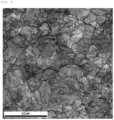
- FIG. 3 is an EBSD photograph of Inventive Example 1, and it can be confirmed that a grain orientation difference is at least 2 degrees, and an average block grain size of Inventive Example 1 is about 4.7um, which is very small compared to normal manufacturing conditions.
- Comparative Example 1 air cooling was performed after rolling a steel slab, so AlN in a steel material became coarse, and in Comparative Example 2, an AlN content in the steel composition was low, so AlN was hardly produced.
- the number of AlN with a size of 30 nm or less per ⁇ m 2 was 20 or less, and grain growth was not suppressed during cooling the wire rod, so that the size of block grains was not controlled.
- Comparative Example 3 it has a low carbon content, and proeutectoid ferrite remains in a wire rod, so drawing characteristics were superior to those of other Comparative Example, but the strength was low due to the low carbon content, which makes it difficult to use for the intended purpose due to the low strength of the material even after spheroidization heat treatment.
- FIG. 2 is a photograph of a microstructure of the wire rod of Comparative Example 5 observed with an SEM, and it can be confirmed that crystal grains are larger in size and a length of proeutectoid cementite produced along prior austenite grain boundaries is shorter compared to FIG. 1 .
- FIG. 4 is an EBSD photograph of Comparative Example 5, in which a grain orientation difference was distinguished as in FIG. 3 . Compared with FIG. 3 , it can be seen that in Comparative Example 5 of FIG. 4 , a block grain size was coarse.
- Comparative Example 6 fine grains were not obtained due to a small amount of finish rolling, and coarse grains appeared in the wire rod, resulting in poor drawing characteristics.
- the fine grains produced by rolling were coarsened due to a low initial cooling rate, so fine wire rod grains were not obtained, resulting in poor drawing characteristics.
- martensite and bainite appeared due to a fast cooling rate, so that it could be confirmed that internal cracks occurred with only 5% drawing.
Landscapes
- Chemical & Material Sciences (AREA)
- Engineering & Computer Science (AREA)
- Mechanical Engineering (AREA)
- Materials Engineering (AREA)
- Metallurgy (AREA)
- Organic Chemistry (AREA)
- Crystallography & Structural Chemistry (AREA)
- Physics & Mathematics (AREA)
- Thermal Sciences (AREA)
- Manufacturing & Machinery (AREA)
- Heat Treatment Of Steel (AREA)
- Heat Treatment Of Strip Materials And Filament Materials (AREA)
Abstract
Description
- The present invention relates to a mechanical structural wire rod, which is applicable to vehicles, construction components and the like, and a manufacturing method therefor, and to a wire rod having excellent drawability, and a method for manufacturing the same.
- A mechanical structural steel material used in automobiles, construction parts, etc., such as bearings, is typically manufactured by drawing a rolled wire rod and cold working the rolled wire rod, into a complex shape.
- However, since the steel material described above is a hypereutectoid steel, and is difficult to process, it is difficult to directly draw the rolled wire rod. For this purpose, a spheroidization softening heat treatment is performed, a material is sized through wire drawing, and then, an increase in strength due to wire drawing is corrected through an additional spheroidization softening heat treatment to prepare a soften material.
- The spheroidization softening heat treatment described above is intended to improve cold workability, through such a spheroidization softening heat treatment, cementite in a microstructure is spheroidized, and distribution of homogeneous particles is induced. Thereby, it is possible to prevent disconnection during wire drawing, improve a lifespan of a processed dice, and reduce hardness of the material being processed.
- However, when the above spheroidization softening heat treatment is performed, heat treatment costs may be high and an elongated production time may be required, which may cause an increase in manufacturing costs. In addition, it does not meet the recent demands of the times to minimize energy consumption for a reduction of carbon emissions. Therefore, in recent years, when providing a wire rod used in bearings, or the like, there is a demand for the development of wire rods that can secure excellent drawing characteristics while omitting or shortening the spheroidization softening heat treatment.
- An aspect of the present disclosure to provide a wire rod used in mechanical structural parts such as bearings, or the like, specifically, to a wire rod that can omit or shorten a spheroidization softening heat treatment, and secure drawing characteristics and strength, and a manufacturing method therefor.
- The object of the present invention is not limited to the above. A person skilled in the art would have no difficulty in understanding the further subject matter of the present invention from the general content of this specification.
- According to an aspect of the present disclosure, provided is a wire rod having excellent drawability, the wire rod including, by weight%: C: 0.8 to 1.2%, Si: 0.01 to 0.6%, Mn: 0.1 to 0.6%, Cr: 0.8 to 2.0%, Al: 0.01 to 0.06%, N: 0.02% or less (excluding 0), with a balance of Fe and inevitable impurities,
- wherein a microstructure includes a pearlite main structure and proeutectoid cementite, and includes
- at least 20 AlN particles with an average particle diameter of 30 nm or less per unit area (µm2) are included, and
- the following Relational Expression 1 is satisfied.

- According to another aspect of the present disclosure, provided is a method for manufacturing a wire rod having excellent drawability, the method including: heating a steel slab, including, by weight%: C: 0.8 to 1.2%, Si: 0.01 to 0.6%, Mn: 0.1 to 0.6%, Cr: 0.8 to 2.0%, Al: 0.01 to 0.06%, N: 0.02% or less (excluding 0), with a balance of Fe and inevitable impurities, and performing rolling on the steel slab to prepare a billet;
- cooling the prepared billet;
- heating the billet to a temperature of 950 to 1050°C;
- wire rolling the heated billet to a prepare a wire rod; and
- winding the wire rod, cooling the wire rod at an average cooling rate of 3°C/sec or more to a temperature of 550 to 650°C, and cooling the same at an average cooling rate of 1°C/sec or less to a temperature of 550°C to 650°C or less,
- wherein the wire rolling is performed so that an austenite grain size (AGS) is 5 to 20 um before finish rolling, and the finish rolling is performed at a temperature range of 730°C to Acm and a deformation amount of 0.3 or more.
- As set forth above, according to the present disclosure, a wire rod for mechanical structural parts such as bearings, or the like, having drawing characteristics and strength, even though a spheroidization softening heat treatment may be omitted or shortened, and a manufacturing method therefor may be provided. Thereby, cost reduction and carbon reduction effects in the manufacturing process may be achieved.
- The various and beneficial advantages and effects of the present invention are not limited to the above-described content, and may be more easily understood through description of specific embodiments of the present disclosure.
-
-
FIG. 1 is a photograph of the microstructure of Inventive Example 1 in an embodiment of the present disclosure observed with a scanning electron microscope (SEM). -
FIG. 2 is a photograph of the microstructure of Comparative Example 5 in an embodiment of the present disclosure observed with a scanning electron microscope (SEM). -
FIG. 3 is a photograph of the microstructure of Inventive Example 1 observed using Electron Backscatter Diffraction (EBSD) in an embodiment of the present disclosure. -
FIG. 4 is a photograph of the microstructure of Comparative Example 5 observed using Electron Backscatter Diffraction (EBSD) in an embodiment of the present disclosure. - Terms used in the present specification are for explaining specific exemplary embodiments rather than limiting the present disclosure. In addition, a singular form used in the present specification includes a plural form also, unless the relevant definition has a clearly opposite meaning thereto.
- The meaning of "comprising" used in the specification is to embody the configuration and is not to exclude the presence or addition of other configurations.
- Unless otherwise defined, all terms including technical terms and scientific terms used in the present specification have the same meaning as would be commonly understood by a person with ordinary skill in the art to which the present disclosure pertains. Pre-defined terms are interpreted as being consistent with the relevant technical literature and the disclosure herein.
- Hereinafter, the present invention will be described in detail. The inventors of the present invention recognized that, in a wire rod used in mechanical structural parts such as bearings, or the like, when performing a spheroidization softening heat treatment, a lot of heat treatment costs and time are required, which acts as an environmental burden. Accordingly, even if the spheroidization softening heat treatment is shortened or omitted, the present inventors have conducted a method for securing excellent drawability for manufacturing parts in depth during wire drawing, thereby completing the present invention.
- First, in an aspect of the present disclosure, a wire rod will be described in detail.
- The wire rod of the present disclosure includes: by wt%, C: 0.8 to 1.2%, Si: 0.01 to 0.6%, Mn: 0.1 to 0.6%, Cr: 0.8 to 2.0%, Al: 0.01 to 0.06%, N: 0.02% or less (excluding 0), with a balance of Fe, and inevitable impurities. Hereinafter, a role and content of each component will be described. % for each component below refers to weight %.
- Carbon (C) is an element added to secure a certain level of strength. When a content of C is less than 0.8 %, it may be difficult to secure sufficient strength even after quenching and tempering heat treatment after a spheroidization softening heat treatment and forging processing process due to a decrease in strength of a base material. When the content of C exceeds 1.2 %, precipitates of a new phase such as (FeCr)3C may cause a problem such as center segregation during solidification of a slab such as bloom, or the like. Therefore, the content of C is preferably 0.8 to 1.2%, and more preferably 0.9 to 1.1%.
- Silicon (Si) is a representative substitutional element added to secure a certain level of strength. When a content of Si is less than 0.01 %, it may be difficult to secure strength of steel and sufficient hardenability. When the content of Si exceeds 0.6 %, there is a disadvantage in that cold forgeability deteriorates during forging after the spheroidization softening heat treatment. Therefore, the content of Si is preferably 0.01 to 0.6%.
- Manganese (Mn), as an element that enhances solid solution strengthening by forming a substitutional solid solution in a matrix structure, is an element that can secure a desired degree of strength without deteriorating ductility, and is a representative austenite former. When a content of Mn is less than 0.1%, strength through solid solution strengthening is not guaranteed, and it is difficult to expect an improvement in toughness. In addition, when the content of Mn exceeds 0.6%, defects such as chevron cracks may occur due to MnS during forging after the spheroidization softening heat treatment. Therefore, the content of Mn is preferably 0.1 to 0.6%.
- Chromium (Cr), like Mn, is an element improving hardenability of steel. When a content of Cr is less than 0.8%, it may be difficult to secure sufficient hardenability to obtain martensite during hardening and tempering heat treatment after a forging process. When the content of Cr exceeds 2.0%, there may be a high possibility of a large amount of low-temperature structures occurring in a wire rod increases due to central segregation. Accordingly, the content of Cr is preferably 0.8 to 2.0%, and more preferably 1.0 to 2.0%.
- Aluminum (Al) is an element that not only has a deoxidizing effect, but also helps in inhibiting austenite grain growth and ensuring a fraction of proeutectoid ferrite to be close to an equilibrium phase by precipitating Al-based carbonitrides. When a content of Al is less than 0.01%, dissolved aluminum is not sufficient, so most of the Al is dissolved, and aluminum nitride (AlN), which inhibits austenite grain growth during heat treatment, is not sufficiently generated, so the content of Al is preferably 0.01% or more. Meanwhile, when the content of Al exceeds 0.06%, hard inclusions such as Al2O3, or the like, may increase, and in particular, nozzle clogging due to inclusions may occur during continuous casting. Therefore, the content of Al is preferably 0.01 to 0.06%.
- Nitrogen (N) is an element having a solid solution strengthening effect, but when a content of N exceeds 0.02%, toughness and ductility of a material may decrease due to dissolved nitrogen, which is not combined with nitride, so the content of N is preferably 0.02% or less.
- The wire rod according to an aspect of the present disclosure may include a balance of Fe and other inevitable impurities in addition to the components described above. However, in a general manufacturing process, unintended impurities may inevitably be mixed from a raw material or the surrounding environment, and thus, these impurities may not be completely excluded. Since these impurities are known to those skilled in the art, all the contents are not specifically mentioned in the present specification. In addition, additional addition of effective components other than the above-described components is not entirely excluded.
- Meanwhile, the microstructure of the wire rod according to an aspect of the present disclosure, includes a pearlite main structure and proeutectoid cementite. Specifically, the proeutectoid cementite is formed in a network shape at grain boundaries along prior austenite grains, and generated pearlite is formed within the grain boundaries. During cooling, supersaturated carbon in austenite is precipitated as Fe3C, and proeutectoid cementite is formed at the grain boundaries of prior austenite. Due to refinement of grains, which is a diffusion path of elements, proeutectoid cementite has a network shape.
- AlN is precipitated within the microstructure, and it is preferable that 20 or more AlN particles with an average particle diameter of 30 nm or less are distributed per unit area (µm2). If the average particle diameter of AlN exceeds 30 nm, an effect of inhibiting grain growth due to pinning is significantly reduced, so it is preferable to have a size of 30 nm or less. If AlN particles are present in an amount of less than 20 per unit area (µm2) , even though AlN particles is generated, the number of AlN particles is not sufficient to suppress grain growth, so grain coarsening may occur. It is more preferable that the number of AlN particles having a size of 30 nm or less per unit area (µm2) is 50 or more.
- Meanwhile, the pearlite and proeutectoid cementite preferably includes, by area fraction: 10% or less of proeutectoid cementite, with a remainder of pearlite, and may further include one or more of 5% or less of one or more of proeutectoid ferrite, bainite, and martensite. When a fraction of proeutectoid cementite exceeds 10%, toughness may rapidly decrease, so the fraction thereof is preferable not to exceed 10%. Meanwhile, during a process of manufacturing a wire rod, one or more of proeutectoid ferrite, bainite, and martensite may be generated to some extent, but when the fraction exceeds 5%, breakage may easily occur during drawing, so the fraction is preferable not to exceed 5%.
- During a spheroidization softening heat treatment, the characteristics of grain boundaries are a major factor in determining a diffusion rate and serve to determine a total heat treatment time. During the softening heat treatment, cementite in a pearlite structure changes a shape thereof from plate-like to spherical, and strength of a material decreases depending on a degree of spheroidization.
- During the softening heat treatment, metal atoms move through various diffusion paths through defect spaces in a material, and diffuse through a vacancy, which is an atomic defect, and dislocations or pipes, which are a type of line defect, grain boundaries, and the like. Compared to atomic defects, dislocations and grain boundaries have a relatively large space, which is advantageous for rapid diffusion.
- In order to omit the softening heat treatment or shorten the time, it is preferable to increase an area of relative grain boundaries through grain refinement, but adverse effects such as reduced equipment life, productivity, and the like, due to an increase in rolling load may occur. Accordingly, the wire rod of the present disclosure has a microstructure satisfying the following Relational Expression 1, so that a wire rod with excellent drawability may be obtained even if the spheroidization softening heat treatment is omitted or shortened.

- The block grains refer to a group of grains with the same orientation of ferrite among cementite and ferrite constituting pearlite, and an average size thereof refers to an average particle diameter of the grains.
- A length of the proeutectoid cementite refers to a total length of the proeutectoid cementite measured in a unit area (1200 µm2). As described above, since the proeutectoid cementite is formed along prior austenite grain boundaries, a length of the proeutectoid cementite preferably refers to a length measured along the grain boundaries.
- The wire rod of the present disclosure may be drawn by at least 15% without a spheroidization softening heat treatment before a drawing process, wherein the wire rod has a tensile strength (TS) of 1200 MPa or more, and a reduction rate of cross-sectional area of 20% or more. The wire rod of the present disclosure may be drawn even if the spheroidization softening heat treatment is omitted. Due to a coarse grain size of commonly used materials, defects such as chevron cracks may occur even with a drawing amount of around 10%. However, the wire rod of the present disclosure does not have defects such as cracks thereinside, even with a drawing amount of exceeding 15%, or approximately 30%. This is because it is easy to rotate a colony when applying wire drawing, thereby relieving external stress and preventing defects such as cracks from occurring with a small amount of wire drawing. In addition, as the amount of wire drawing increases, vacancies such as dislocations and vacancies are created, further promoting spheroidization behavior during the spheroidization softening heat treatment after wire drawing.
- In order to manufacture mechanical parts such as bearing steel with a complex shape, or the like, wire rods are manufactured into steel wires, which usually apply two spheroidization softening heat treatments and a drawing process for sizing the material. A typical spheroidization softening heat treatment is performed at a temperature of Ae1 to Ae1+100°C, and is a heat treatment method in which carbides with an average aspect ratio of cementite of 3 or less are generated in an entire region from a surface to a center portion after the heat treatment. However, the wire rod of the present disclosure may provide a greater amount of wire drawing than conventional materials through improved drawability through manufacturing a fine-grained wire rod, and promotes generation of spheroidized cementite during spheroidization heat treatment, so cementite having an average aspect ratio of less than 3 and a low tensile strength of less than 740 MPa is obtained with just one spheroidization heat treatment after drawing. Thus, cold forging or cold forging processing for manufacturing a final product may be facilitated.
- Next, a method for manufacturing a wire rod, according to another aspect of the present disclosure will be described in detail. As a preferred example of manufacturing the wire rod of the present disclosure, a steel slab having the above-described alloy composition, for example, a bloom, may be heated and the steel slab may be rolled to manufacture a billet, and the billet may be heated, wire rolled, and cooled to manufacture the wire rod of the present disclosure. Hereinafter, each step is described in detail.
- First, a steel slab having the above-described alloy composition, for example, a bloom is prepared, and heated to a temperature of 1100 to 1300°C. When a heating temperature of the steel slab is lower than 1100°C, the temperature is low and is not sufficient to diffuse elements in the steel slab, making it difficult to eliminate a concentrated segregation layer created during continuous casting. Meanwhile, when the temperature exceeds 1300°C, scales may be formed on a surface of the steel slab at a rapid rate, so that surface flaws may occur during rolling, or productivity may decrease due to material loss. Meanwhile, the heating time of the steel slab is preferably 2 to 10 hours, and if the heating time of the steel slab is less than 2 hours, it is difficult to reach a target temperature even inside the steel slab, and if the heating time exceeds 10 hours, a depth of a surface decarburization layer increases and the decarburization layer may remain even after finishing rolling, so it is preferable that the heating time does not exceed 10 hours.
- A billet is manufactured by rolling the heated steel slab. The billet manufactured after rolling the steel slab is generally cooled to room temperature through air cooling, but in the present disclosure, a billet having a temperature of 500°C or more is cooled at a cooling rate of 5°C/s or more. For this purpose, water cooling is preferably performed, and as a specific example, it is preferably charged into a water cooling chamber to prevent precipitation and coarsening of AlN as much as possible. When a billet having a temperature of 500°C or less, AlN precipitates and coarsens, making it difficult to secure AlN of 30 nm or less because AlN is not sufficiently dissolved during heating a billet for manufacturing a wire rod, which is the next process.
- The prepared billet is heated to a temperature within a range of 950 to 1050°C. When the billet heating temperature is less than 950°C, rolling properties may deteriorate, and when the billet heating temperature exceeds 1050°C, rapid cooling is required for rolling, so that not only is cooling control difficult, but it can also be difficult to ensure good product quality, due to occurrence of cracks, or the like. The heating time is preferably 80 to 120 minutes. If the heating time is less than 80 minutes, it is difficult to reach a target temperature even inside the material, and an atmosphere in which reverse transformation is not completed may partially occur. If it exceeds 120 minutes, a depth of a surface decarburization layer increases and the decarburization layer may remain after finishing rolling, which is not preferable.
- The heated billet is wire-rolled to obtain a wire rod. It is preferable that wire rod rolling is groove rolling causing the billet to have a form of a wire rod. In the present disclosure, it is preferable that an austenite grain size (AGS) before finish rolling is 5 to 20 um. Thereafter, finish rolling is preferably performed at a temperature within a range of 730°C to Acm with a deformation amount of 0.3 or more. It is more preferable that the deformation amount is 0.5 or more. Here, Acm refers to a temperature at which cementite dissolves during heating or precipitates during cooling in hypereutectoid steel.
- If the AGS before the finish rolling is less than 5 µm, there may be a problem that roll load increases, so that a lifespan of equipment is shortened because it is implemented through rough rolling at a low temperature. If the AGS before the finish rolling exceeds 20 µm, it may be difficult to manufacture a wire rod with fine grains because an increase in critical deformation is required during finish rolling. In addition, when the finish rolling temperature is lower than 730°C, rolling roll load may increase, so that the equipment life is shortened, and when the finish rolling temperature is higher than Acm, phase transformation does not occur, making it difficult to manufacture fine-grained wire rods.
- Meanwhile, when rolling the wire rod, it is preferable to satisfy the conditions of the following Relational Expression (2).

- In the above Relational Expression(2), [C] and [All refer to an alloy composition C and Al content (% by weight), a unit of AGS is µm, and a unit of finish rolling temperature is °C.
- A content of carbon affects formation of cementite (Fe3C) in a prepared wire rod and spheroidized heat-treated material, which affects mechanical properties such as tensile strength, or the like, so it is required to contain an appropriate amount of carbon. As an amount of Al decreases, an amount of AlN precipitated decreases and grain growth cannot be suppressed, so an optimal amount thereof is required. In addition, the larger the AGS before finish rolling, the lower a rolling amount and finish rolling temperature should be to reduce the grain size, so it is preferable to manage an appropriate AGS and finish rolling temperature from a perspective of process costs. Relational Expression 2 reflects this technical viewpoint, and when a value thereof in Relational Expression 2 exceeds 80, it is difficult to expect appropriate cementite formation and grain refinement effects.
- After the wire rod rolling, the wire rod is wound and cooled. The cooling is preferably performed at an average cooling rate of 3°C/sec or more until a temperature range of 550 to 650°C, and then after the temperature of 550 to 650°C, cooling is preferably performed at an average cooling rate of 1°C/sec or less. When the average cooling rate until the temperature range of 550 to 650°C is less than 3°C/sec, it is difficult to maintain fine grains secured during rolling below a transformation point. Meanwhile, after reaching the temperature of 550 to 650°C, a cooling rate therebelow is preferably 1°C/sec or less in terms of suppressing low-temperature structures such as bainite and martensite.
- In the present disclosure, after drawing the wire rod prepared as above, the wire rod may be heated to Ae1 to Ae1+100°C and maintained for 5 to 15 hours, and then subjected to a spheroidization heat treatment by being cooled to 660°C at 20°C/hr or less to prepare a spheroidized material. When the heating temperature is less than Ae1, there may be a disadvantage in that a spheroidization heat treatment time becomes longer, and when the heating temperature exceeds Ae1+100°C, an effect of the spheroidization heat treatment may not be sufficient because spheroidization carbide seeds are reduced. Here, Ae1 refers to a temperature at which austenite is generated during heating, or at which austenite disappears during cooling. When the holding time is less than 5 hours, there may be a disadvantage in that an aspect ratio of cementite increases because the spheroidization heat treatment does not proceed sufficiently, and when the holding time exceeds 15 hours, there may be a disadvantage in that costs increase. When the heating temperature exceeds 20°C/hr, there may be a disadvantage in that pearlite is reformed due to a rapid cooling rate. After the spheroidization heat treatment, a wire rod has a low tensile strength of 740 MPa or less and an average cementite aspect ratio of 3 or less, which can facilitate cold forging or cold forging processing to manufacture a final product.
- Hereinafter, the present disclosure will be specifically described through the following Examples. However, it should be noted that the following examples are only for describing the present disclosure by illustration, and not intended to limit the right scope of the present disclosure. The reason is that the right scope of the present disclosure is determined by the matters described in the claims and reasonably inferred therefrom.
- A steel slab (bloom) having alloy compositions (% by weight, a balance of Fe and inevitable impurities) shown in Table 1 below was prepared, and then was subjected to steel slab rolling to manufacture a billet. After continuous casting, the steel slab was subjected to homogenization heat treatment at 1200°C for 4 hours and then rolled at 1000°C. In the case of water cooling according to the cooling method disclosed in Table 2 after the steel slab rolling, the steel slab was air cooled to a temperature of 500°C and then charged into a water cooling chamber and cooled at a cooling rate of 5°C/s or more. Thereafter, the manufactured billet was manufactured into a wire rod having a diameter of 9 mm under the wire rod manufacturing conditions disclosed in Table 2 below. The microstructure and mechanical properties of the thus prepared wire rod was measured, and the results were shown in Table 3. Meanwhile, after drawing the prepared wire rod, an average aspect ratio and tensile strength of cementite were measured by one soft spheroidization heat treatment (maintained at 780°C for 8 hours and then cooled to 640°C at a cooling rate of 15°C/hr), and the results were shown in Table 4.
- Meanwhile, in Table 2, an austenite grain size (AGS) before finish rolling was collected by cutting a material through a cutting crop performed before finish hot rolling, and immediately quenching the same in water, and AGS was measured using an ASTM E112 method. For the collected specimens, five arbitrary 1/4 points from the diameter were measured and then expressed as an average value.
- An average block grain size was measured using EBSD and ASTM E112 methods. A block is a region where a crystal orientation of ferrite within pearlite is the same, and a size having a crystal orientation difference of at least 15 degrees was defined as a block size. Among the following examples, Inventive Example 1 and Comparative Example 5 were observed and shown in
FIGS. 3 and4 , respectively. The size of the block was quantified using the ASTM E112 method. For a specimen collected after removing an unwater-cooling portion after rolling a wire rod, the measured material was measured at five arbitrary 1/4 points from the diameter, and then expressed as an average value. In addition, for a specimen collected after removing an unwater-cooling portion after rolling a wire rod, a length of proeutectoid cementite was photographed at five arbitrary 1/4 points from the diameter at ×3000 using an SEM, and a total length of proeutectoid cementite was analyzed using measured using Leica's Clemex vision software, and an average of the 5 points was obtained. - Drawability was evaluated by drawing the prepared wire rod having a diameter of 9 mm at a cross-sectional reduction rate of 5 to 50%, and a center portion of a L cross-section of the drawn material was photographed at 5,000x magnification to check whether defects such as chevron cracks occurred at a pearlite interface or proeutectoid cementite interface, and whether cracks occurred or did not occur was indicated as O/X.
- Meanwhile, the average aspect ratio of cementite after the one-time spheroidization heat treatment was measured by photographing 1/4 to 1/2 points in a diameter direction of the wire rod at 3,000x magnification using a SEM in 3 fields of view, automatically measuring a long axis/short axis of cementite within the field of view using an image measurement program, and then performing statistical processing.
[Table 1] Steel type C Si Mn Cr Al N Steel type 1 1.05 0.29 0.30 1.69 0.023 0.006 Steel type 2 1.01 0.28 0.35 1.33 0.024 0.005 Steel type 3 0.96 0.25 0.35 1.36 0.023 0.004 Steel type 4 1.00 0.25 0.33 1.36 0.027 0.006 Steel type 5 0.95 0.24 0.33 1.39 0.029 0.005 Steel type 6 1.00 0.30 0.27 1.51 0.025 0.003 Steel type 7 0.97 0.23 0.33 1.41 0.003 0.006 Steel type 8 0.50 0.20 0.27 1.48 0.023 0.006 Steel type 9 0.97 0.20 0.32 1.34 0.030 0.003 Steel type 10 1.04 0.22 0.27 1.57 0.030 0.003 Steel type 11 0.98 0.23 0.27 1.65 0.026 0.003 Steel type 12 0.98 0.28 0.30 1.50 0.024 0.007 Steel type 13 1.03 0.25 0.27 1.60 0.021 0.007 [Table 2] Stee l type Divisi on Cool ing meth od afte r roll ing stee l slab Billet heatin g temper ature (°C) Billet heating time (min.) Before finish roll ing AGS (µm) Finis h rolli ng tempe ratur e (°C) Finish rollin g deform ation rate Relati onal Expres sion 2 Cooling speed to a temperat ure of 600°C (°C/sec) Cooling speed after 600°C (°C/sec ) Stee 1 type 1 Invent ive exampl e 1 Wate r cool ing 960 83 10 779 0.6 28 3.2 0.6 Stee 1 type 2 Invent ive exampl e 2 Wate r cool ing 1030 92 12 769 1 14 4.7 1 Stee 1 type 3 Invent ive exampl e 3 Wate r cool ing 1050 105 8 761 0.5 22 4.9 1 Stee 1 type 4 Invent ive exampl e 4 Wate r cool ing 1003 110 7 773 1 16 3.6 0.8 Stee l type 5 Invent ive exampl e 5 Wate r cool ing 955 97 10 754 0.5 11 4.4 0.7 Stee l type 6 Compar ative Exampl e 1 Air cool ing 959 99 12 769 1 11 3.5 0.6 Stee l type 7 Compar ative Exampl e 2 Wate r cool ing 1049 83 8 746 0.8 111 4.3 0.8 Stee l type 8 Compar ative Exampl e 3 Wate r cool ing 1014 105 7 739 0.6 654 3.8 0.9 Stee l type 9 Compar ative Exampl e 4 Wate r cool ing 1237 85 24 747 0.9 142 3.5 0.7 Stee l type 10 Compar ative Exampl e 5 Wate r cool ing 1050 99 12 876 0.5 214 4.9 1 Stee l type 11 Compar ative Exampl e 6 Wate r cool ing 982 88 11 758 0.2 10 3 0.6 Stee l type 12 Compar ative Exampl e 7 Wate r cool ing 977 94 12 760 0.5 13 1.2 0.5 Stee l type 13 Comparative Exampl e 8 Water cool ing 968 105 10 761 1 22 3.7 5 - In Table 2, Relational Expression 2 is calculated by 2500*([C]-1)2+100000*([Al]-0.035)2+(AGS-12.5)4/130+(finish rolling temperature-760)2/65, where [C] and [Al] are contents of C and Al (% by weight) in an alloy composition, AGS is an average austenite grain size, a unit is um, and a unit of the finish rolling temperature is °C.
[Table 3] Divisio n Microstr ucture The number of AlN, less than 30 nm, per µm2 Block grain average size (µm) Length of proeutec toid (µm/1200 µm2) Relation al Expressi on 1 Tensile strength (MPa) Cross-sectional reduction rate (%) Inventi ve example 1 Proeutec toid C + P 67 4.7 212 0.10 1270 28 Inventi ve example 2 Proeutec toid C + P 90 3.2 206 0.05 1251 35 Inventi ve example 3 Proeutec toid C + P 68 6.4 225 0.18 1239 26 Inventi ve example 4 Proeutec toid C + P 69 3 241 0.04 1262 37 Inventi ve example 5 Proeutec toid C + P 71 7.2 156 0.33 1292 31 Compara tive Example 1 Proeutec toid C + P 13 10.2 63 1.65 1178 17 Compara tive Example 2 Proeutec toid C + P 16 9.7 67 1.40 1182 19 Compara tive Example 3 Proeutec toid C + P 76 4.3 230 0.08 850 31 Compara tive Example 4 Proeutec toid C + P 60 12.4 70 2.20 1157 17 Compara tive Example 5 Proeutec toid C + P 86 11.6 62 2.17 1162 19 Compara tive Example 6 Proeutec toid C + P 79 12.1 57 2.57 1171 16 Compara tive Example 7 Proeutec toid C + P 69 9 112 0.72 1192 19 Comparative Example 8 Proeutectoid C + P + B + M 48 Cannot be measured 192 Cannot be measured 1491 12 - In Table 3, proeutectoid C refers to proeutectoid cementite, P refers to pearlite, B refers to bainite, and M refers to martensite. In addition, Relational Expression 1 refers to an average block grain size (µm))2/(proeutectoid cementite length (µm/1200µm2)).
[Table 4] Divisi on Whether cracks occur inside a material depending on a drawing amount (%) Microstructure and mechanical properties after a drawing amount of applied thereto and spheroidization heat treatment 5 10 15 20 30 40 50 Amount of wire rod before sphere idizat ion heat treatm ent (%) Averag e aspect ratio of cement ite after sphere idizat ion heat treatm ent Tensil e streng th after sphere idizat ion heat treatm ent (MPa) Invent ive exampl e 1 ○ ○ ○ ○ ○ ○ X 30 1.7 716 Invent ive exampl e 2 ○ ○ ○ ○ ○ ○ ○ 20 2.3 724 Invent ive exampl e 3 ○ ○ ○ ○ ○ ○ ○ 40 2.5 721 Invent ive exampl e 4 ○ ○ ○ ○ ○ X X 30 2.5 730 Invent ive exampl e 5 ○ ○ ○ ○ ○ ○ X 40 1.6 726 Compar ative Exampl e 1 ○ X X X X X X 5 5.7 811 Compar ative Exampl e 2 ○ ○ X X X X X 10 6.1 807 Compar ative Exampl e 3 ○ ○ ○ ○ ○ ○ X 40 2.3 607 Compar ative Exampl e 4 ○ X X X X X X 5 7.3 813 Compar ative Exampl e 5 ○ X X X X X X 5 6.2 827 Compar ative Exampl e 6 ○ X X X X X X 5 6.9 832 Compar ative Exampl e 7 ○ ○ X X X X X 10 5.8 789 Compar ative Exampl e 8 X X X X X X X 0 7.6 812 - As can be seen from Tables 1 to 4 above, the wire rods of Inventive examples 1 to 5 satisfying the conditions proposed by the present disclosure may secure excellent drawability with a cross-sectional reduction rate of 20% or more even without spherical softening heat treatment, and at the same time, may secure high strength of 1200 MPa or more. In addition, a wire rod having an average cementite aspect ratio of 3 or less may be provided with just one spheroidization heat treatment after drawing processing. In particular,
FIG. 1 is a photograph of a microstructure of the wire rod of Inventive Example 1 observed using a scanning electron microscope (SEM). Referring toFIG.1 , in Inventive Example 1, the microstructure of the wire rod is composed of proeutectoid cementite and generated pearlite, and inFIG. 1 , an arrow indicates proeutectoid cementite. As shown inFIG.1 , it can be confirmed that proeutectoid cementite is formed along prior austenite grain boundaries.FIG. 3 is an EBSD photograph of Inventive Example 1, and it can be confirmed that a grain orientation difference is at least 2 degrees, and an average block grain size of Inventive Example 1 is about 4.7um, which is very small compared to normal manufacturing conditions. - Meanwhile, in Comparative Example 1, air cooling was performed after rolling a steel slab, so AlN in a steel material became coarse, and in Comparative Example 2, an AlN content in the steel composition was low, so AlN was hardly produced. As a result, in the wire rods of Comparative Examples 1 and 2, the number of AlN with a size of 30 nm or less per µm2 was 20 or less, and grain growth was not suppressed during cooling the wire rod, so that the size of block grains was not controlled. In Comparative Example 3, it has a low carbon content, and proeutectoid ferrite remains in a wire rod, so drawing characteristics were superior to those of other Comparative Example, but the strength was low due to the low carbon content, which makes it difficult to use for the intended purpose due to the low strength of the material even after spheroidization heat treatment.
- In Comparative Example 4, a size of AGS before finish rolling is larger than that of the Inventive examples due to a high billet heating temperature. Since coarse AGS can be grain refined through a high critical deformation rate, insufficient finish rolling deformation rate, eventually causes coarse grains to appear in the wire rod, resulting in poor drawability. In Comparative Example 5, fine grains were not obtained due to a high finish rolling temperature, and, like Comparative Example 4, the drawing characteristics were not excellent due to the coarse grains.
FIG. 2 is a photograph of a microstructure of the wire rod of Comparative Example 5 observed with an SEM, and it can be confirmed that crystal grains are larger in size and a length of proeutectoid cementite produced along prior austenite grain boundaries is shorter compared toFIG. 1 .FIG. 4 is an EBSD photograph of Comparative Example 5, in which a grain orientation difference was distinguished as inFIG. 3 . Compared withFIG. 3 , it can be seen that in Comparative Example 5 ofFIG. 4 , a block grain size was coarse. - In Comparative Example 6, fine grains were not obtained due to a small amount of finish rolling, and coarse grains appeared in the wire rod, resulting in poor drawing characteristics. In the wire rod of Comparative Example 7, the fine grains produced by rolling were coarsened due to a low initial cooling rate, so fine wire rod grains were not obtained, resulting in poor drawing characteristics. In the case of Comparative Example 8, martensite and bainite appeared due to a fast cooling rate, so that it could be confirmed that internal cracks occurred with only 5% drawing.
- While example embodiments have been illustrated and described above, it will be apparent to those skilled in the art that modifications and variations could be made without departing from the scope of the present disclosure as defined by the appended claims.
Claims (10)
- A wire rod having excellent drawability including by weight%:C: 0.8 to 1.2%, Si: 0.01 to 0.6%, Mn: 0.1 to 0.6%, Cr: 0.8 to 2.0%, Al: 0.01 to 0.06%, N: 0.02% or less (excluding 0), with a balance of Fe and inevitable impurities,wherein a microstructure includes a pearlite main structure and proeutectoid cementite, and includes at least 20 AlN particles with an average particle diameter of 30 nm or less per unit area (µm2), andthe following Relational Expression 1 is satisfied,

- The wire rod having excellent drawability of claim 1, wherein the proeutectoid cementite is formed at grain boundaries along prior austenite grains, and is formed in a network shape.
- The wire rod having excellent drawability of claim 1, wherein the microstructure comprises, by area fraction: 10 % or less of proeutectoid cementite and a balance of pearlite.
- The wire rod having excellent drawability of claim 1, wherein the wire rod has a tensile strength of 1200MPa or more and a cross-sectional reduction rate of 20% or more.
- The wire rod having excellent drawability of claim 1, wherein the wire rod is not subjected to a spheroidization softening heat treatment before a drawing process, and is drawn by at least 15% during wire drawing.
- The wire rod having excellent drawability of claim 1, wherein the wire rod has an average aspect ratio of cementite of 3 or less after the wire drawing and spheroidization heat treatment.
- A method for manufacturing a wire rod having excellent drawability, comprising:
heating a steel slab, including by weight:C: 0.8 to 1.2%, Si: 0.01 to 0.6%, Mn: 0.1 to 0.6%, Cr: 0.8 to 2.0%, Al: 0.01 to 0.06%, N: 0.02% or less (excluding 0), with a balance of Fe and other inevitable impurities, and performing rolling on the steel slab to prepare a billet;cooling the prepared billet;heating the billet to a temperature of 950 to 1050°C;wire rolling the heated billet to a prepare a wire rod; andwinding the wire rod, cooling the wire rod at an average cooling rate of 3°C/sec or more to 550 to 650°C, and cooling the same at an average cooling rate of 1°C/sec or less to a temperature of 550°C to 650°C or less,wherein the wire rolling is performed so that an austenite grain size (AGS) is 5 to 20 um before finish rolling, and the finish rolling is performed at a temperature range of 730°C to Acm and a deformation amount of 0.3 or more. - The method for manufacturing a wire rod having excellent drawability of claim 7, wherein the hot rolling is performed to satisfy the condition of Relational Expression (2) below,

in the above Relational Expression (2), [C] and [Al] refer to an alloy composition C and Al content (% by weight), a unit of AGS is um, and a unit of finish rolling temperature is °C. - The method for manufacturing a wire rod having excellent drawability of claim 7, wherein the billet is heated to a temperature within a range of 1100 to 1300°C for 2 to 10 hours, and the billet having a temperature of 500°C or more at a cooling rate of 5°C /s or more after the billet is rolled.
- The method for manufacturing a wire rod having excellent drawability of claim 7, wherein the billet heating time is 80 to 120 minutes.
Applications Claiming Priority (2)
| Application Number | Priority Date | Filing Date | Title |
|---|---|---|---|
| KR1020210079485A KR102967379B1 (en) | 2021-06-18 | Steel wire rod having excellent drawability and method for manufacturing the same | |
| PCT/KR2022/008084 WO2022265289A1 (en) | 2021-06-18 | 2022-06-08 | Wire rod having excellent drawability, and manufacturing method therefor |
Publications (2)
| Publication Number | Publication Date |
|---|---|
| EP4357477A1 true EP4357477A1 (en) | 2024-04-24 |
| EP4357477A4 EP4357477A4 (en) | 2025-09-03 |
Family
ID=84527195
Family Applications (1)
| Application Number | Title | Priority Date | Filing Date |
|---|---|---|---|
| EP22825215.1A Pending EP4357477A4 (en) | 2021-06-18 | 2022-06-08 | WIRE ROD WITH EXCELLENT DRAWABILITY AND MANUFACTURING PROCESS THEREFOR |
Country Status (5)
| Country | Link |
|---|---|
| US (1) | US20240254588A1 (en) |
| EP (1) | EP4357477A4 (en) |
| JP (2) | JP2024521184A (en) |
| CN (1) | CN117396626B (en) |
| WO (1) | WO2022265289A1 (en) |
Family Cites Families (13)
| Publication number | Priority date | Publication date | Assignee | Title |
|---|---|---|---|---|
| JP3527641B2 (en) * | 1998-08-26 | 2004-05-17 | 株式会社神戸製鋼所 | Steel wire with excellent cold workability |
| US6949149B2 (en) * | 2002-12-18 | 2005-09-27 | The Goodyear Tire & Rubber Company | High strength, high carbon steel wire |
| JP5400591B2 (en) * | 2009-11-30 | 2014-01-29 | 株式会社神戸製鋼所 | Bearing steel with excellent cold workability |
| JP5521885B2 (en) * | 2010-08-17 | 2014-06-18 | 新日鐵住金株式会社 | Steel wire for machine parts with high strength and excellent hydrogen embrittlement resistance, machine parts and method for producing the same |
| PL3093363T3 (en) * | 2014-01-10 | 2019-12-31 | Nippon Steel Corporation | Bearing part |
| SG11201702762WA (en) * | 2014-10-20 | 2017-06-29 | Nippon Steel & Sumitomo Metal Corp | Steel wire rod for bearings having excellent drawability and coil formability after drawing |
| JP6193842B2 (en) * | 2014-12-11 | 2017-09-06 | 株式会社神戸製鋼所 | Steel wire rod for bearing |
| EP3533898B1 (en) * | 2016-10-28 | 2020-12-02 | Nippon Steel Corporation | Wire rod and manufacturing method therefor |
| KR101940873B1 (en) * | 2016-12-22 | 2019-01-21 | 주식회사 포스코 | Steel wire rod and steel wire having high toughness and method for manufacturing thereof |
| KR101917461B1 (en) * | 2016-12-22 | 2018-11-09 | 주식회사 포스코 | High strength wire rod and heat-treated wire rod having excellent drawability and method for manufacturing thereof |
| KR102085077B1 (en) * | 2017-12-26 | 2020-03-05 | 주식회사 포스코 | Medium carbon steel wire rod, processed good using the same, and methods for manufacturing thereof |
| KR102224892B1 (en) * | 2019-06-24 | 2021-03-05 | 현대제철 주식회사 | Manufacturing method for steel wire rod having excellent drawability and steel wire rod manufactured using the same |
| CN110846557B (en) * | 2019-12-05 | 2020-11-27 | 宝钢特钢韶关有限公司 | High carbon chromium grinding ball steel and preparation method thereof |
-
2022
- 2022-06-08 EP EP22825215.1A patent/EP4357477A4/en active Pending
- 2022-06-08 US US18/561,348 patent/US20240254588A1/en active Pending
- 2022-06-08 CN CN202280038429.2A patent/CN117396626B/en active Active
- 2022-06-08 WO PCT/KR2022/008084 patent/WO2022265289A1/en not_active Ceased
- 2022-06-08 JP JP2023573200A patent/JP2024521184A/en active Pending
-
2025
- 2025-10-03 JP JP2025167664A patent/JP2025186557A/en active Pending
Also Published As
| Publication number | Publication date |
|---|---|
| JP2025186557A (en) | 2025-12-23 |
| KR20220169272A (en) | 2022-12-27 |
| JP2024521184A (en) | 2024-05-28 |
| CN117396626B (en) | 2026-01-02 |
| US20240254588A1 (en) | 2024-08-01 |
| EP4357477A4 (en) | 2025-09-03 |
| WO2022265289A1 (en) | 2022-12-22 |
| CN117396626A (en) | 2024-01-12 |
Similar Documents
| Publication | Publication Date | Title |
|---|---|---|
| CN107614726B (en) | Steel sheet and method for producing same | |
| JP5357994B2 (en) | Machine structural steel for cold working and method for producing the same | |
| JP6079904B2 (en) | Bearing parts | |
| CN102741441B (en) | Steel wire with excellent cold forging characteristics and manufacturing process thereof | |
| JP5576785B2 (en) | Steel material excellent in cold forgeability and manufacturing method thereof | |
| WO2011062012A1 (en) | Steel wire for low-temperature annealing and method for producing the same | |
| EP3719155B1 (en) | High-strength cold-rolled steel sheet and method for manufacturing same | |
| WO2015076384A1 (en) | High-carbon steel sheet and method for producing same | |
| EP3901310B1 (en) | Wire rod of which softening heat treatment can be omitted, and manufacturing method therefor | |
| JP3527641B2 (en) | Steel wire with excellent cold workability | |
| US20220170126A1 (en) | High-carbon hot-rolled steel sheet and method for manufacturing the same | |
| JP3737323B2 (en) | Steel wire rod and bar steel excellent in cold forgeability after spheronization and manufacturing method thereof | |
| KR20200097806A (en) | High carbon hot-rolled steel sheet and its manufacturing method | |
| JP5124847B2 (en) | Rolling method of high carbon chromium bearing steel | |
| JP2022122483A (en) | Hot rolled steel sheet and method for producing the same | |
| EP3875628A1 (en) | Steel wire rod enabling omission of softening heat treatment and method of manufacturing same | |
| US20240254588A1 (en) | Wire rod having excellent drawability, and manufacturing method therefor | |
| KR102967379B1 (en) | Steel wire rod having excellent drawability and method for manufacturing the same | |
| KR102421642B1 (en) | Wire rod for bearing and methods for manufacturing thereof | |
| JP7444096B2 (en) | Hot rolled steel sheet and its manufacturing method | |
| WO2025100150A1 (en) | Steel component and method for manufacturing same | |
| JP2025062918A (en) | Steel | |
| JP2025062921A (en) | Steel |
Legal Events
| Date | Code | Title | Description |
|---|---|---|---|
| STAA | Information on the status of an ep patent application or granted ep patent |
Free format text: STATUS: THE INTERNATIONAL PUBLICATION HAS BEEN MADE |
|
| PUAI | Public reference made under article 153(3) epc to a published international application that has entered the european phase |
Free format text: ORIGINAL CODE: 0009012 |
|
| STAA | Information on the status of an ep patent application or granted ep patent |
Free format text: STATUS: REQUEST FOR EXAMINATION WAS MADE |
|
| 17P | Request for examination filed |
Effective date: 20231220 |
|
| AK | Designated contracting states |
Kind code of ref document: A1 Designated state(s): AL AT BE BG CH CY CZ DE DK EE ES FI FR GB GR HR HU IE IS IT LI LT LU LV MC MK MT NL NO PL PT RO RS SE SI SK SM TR |
|
| DAV | Request for validation of the european patent (deleted) | ||
| DAX | Request for extension of the european patent (deleted) | ||
| REG | Reference to a national code |
Ref country code: DE Ref legal event code: R079 Free format text: PREVIOUS MAIN CLASS: C22C0038180000 Ipc: C22C0038000000 |
|
| A4 | Supplementary search report drawn up and despatched |
Effective date: 20250801 |
|
| RIC1 | Information provided on ipc code assigned before grant |
Ipc: C22C 38/00 20060101AFI20250728BHEP Ipc: C22C 38/04 20060101ALI20250728BHEP Ipc: C22C 38/02 20060101ALI20250728BHEP Ipc: C22C 38/06 20060101ALI20250728BHEP Ipc: C22C 38/18 20060101ALI20250728BHEP Ipc: C21D 8/06 20060101ALI20250728BHEP Ipc: C21D 9/52 20060101ALI20250728BHEP Ipc: C21D 8/02 20060101ALI20250728BHEP Ipc: B21B 1/16 20060101ALI20250728BHEP |