EP4357430A1 - Non-baked pencil lead and method for manufacturing same - Google Patents
Non-baked pencil lead and method for manufacturing same Download PDFInfo
- Publication number
- EP4357430A1 EP4357430A1 EP22824639.3A EP22824639A EP4357430A1 EP 4357430 A1 EP4357430 A1 EP 4357430A1 EP 22824639 A EP22824639 A EP 22824639A EP 4357430 A1 EP4357430 A1 EP 4357430A1
- Authority
- EP
- European Patent Office
- Prior art keywords
- mass
- acid
- pencil lead
- soluble polymer
- baked pencil
- Prior art date
- Legal status (The legal status is an assumption and is not a legal conclusion. Google has not performed a legal analysis and makes no representation as to the accuracy of the status listed.)
- Pending
Links
Images
Classifications
-
- C—CHEMISTRY; METALLURGY
- C09—DYES; PAINTS; POLISHES; NATURAL RESINS; ADHESIVES; COMPOSITIONS NOT OTHERWISE PROVIDED FOR; APPLICATIONS OF MATERIALS NOT OTHERWISE PROVIDED FOR
- C09D—COATING COMPOSITIONS, e.g. PAINTS, VARNISHES OR LACQUERS; FILLING PASTES; CHEMICAL PAINT OR INK REMOVERS; INKS; CORRECTING FLUIDS; WOODSTAINS; PASTES OR SOLIDS FOR COLOURING OR PRINTING; USE OF MATERIALS THEREFOR
- C09D13/00—Pencil-leads; Crayon compositions; Chalk compositions
-
- B—PERFORMING OPERATIONS; TRANSPORTING
- B43—WRITING OR DRAWING IMPLEMENTS; BUREAU ACCESSORIES
- B43K—IMPLEMENTS FOR WRITING OR DRAWING
- B43K19/00—Non-propelling pencils; Styles; Crayons; Chalks
- B43K19/02—Pencils with graphite; Coloured pencils
-
- B—PERFORMING OPERATIONS; TRANSPORTING
- B43—WRITING OR DRAWING IMPLEMENTS; BUREAU ACCESSORIES
- B43K—IMPLEMENTS FOR WRITING OR DRAWING
- B43K19/00—Non-propelling pencils; Styles; Crayons; Chalks
- B43K19/16—Making non-propelling pencils
- B43K19/18—Making pencil writing-cores
Definitions
- the present invention relates to a non-baked pencil lead and a method for manufacturing the non-baked pencil lead.
- a baked pencil lead is generally manufactured by kneading graphite and clay to form a lead, sintering the clay at a high temperature of around 1,000°C to obtain a lead body, and then impregnating pores generated in the lead body with oil or the like.
- Such a baked pencil lead is widely used because graphite is fixed to a paper surface by the impregnated oil and erasability by an eraser is favorable (for example, Japanese Patent Application Laid-Open ( JP-A) No. 2007-138031 ).
- JP-A Japanese Patent Application Laid-Open
- a conventional non-baked pencil lead contains a wax or a resin as a binder, and is manufactured by kneading the binder with various inorganic or organic pigments, molding the mixture into a lead shape with an extrusion molding machine or the like, and then, for example, performing a drying treatment if necessary (for example, JP-A No. 2012-52109 ).
- the binder is a wax or a resin, and thus the strength may be poor. Therefore, in a case in which the tip is sharpened, sufficient tip strength cannot be obtained at the time of writing in some cases. Moreover, there is almost no erasability by an eraser.
- An object of each embodiment of the present application is to provide a non-baked pencil lead that has sufficient strength at the time of writing even in a case in which the tip of the pencil lead is sharpened, has little deterioration due to moisture absorption, has erasability, and achieves both improvement in density of a writing line and improvement in fixability, which cannot be obtained by a conventional method.
- a non-baked pencil lead of a first aspect of the application contains a water-soluble polymer, a crosslinking agent, and a powder, in which the water-soluble polymer is selected from a group consisting of a carboxymethyl cellulose salt, starch, polyvinyl alcohol, and xanthan gum, and the crosslinking agent is selected from a group consisting of an acid, polyamide epoxy, polyacrylamide, titanium alkoxide, and glyoxal.
- the water-soluble polymer is a carboxymethyl cellulose salt and the crosslinking agent is an acid.
- the acid is an organic acid.
- the organic acid is a polymeric acid.
- the powder is at least one of a filler or a pigment.
- the non-baked pencil lead of a sixth aspect of the application further contains cellulose, in addition to the configuration of any one of the first to fifth aspects.
- a lead body after molding is porous.
- a method for manufacturing a non-baked pencil lead of an eighth aspect of the application includes a step of preparing a mixture of a water-soluble polymer, a crosslinking agent, and a powder, and a step of molding the mixture into a lead body. Moreover, in which in the molding step, the water-soluble polymer is reacted with the crosslinking agent so as to be crosslinked.
- each embodiment of the present application is configured as described above, it is possible to provide a non-baked pencil lead that has sufficient strength at the time of writing even in a case in which the tip of the pencil lead is sharpened, has little deterioration due to moisture absorption, has erasability, and achieves both improvement in density of a writing line and improvement in fixability, which cannot be obtained by a conventional method.
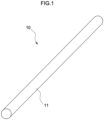
- Fig. 1 is a perspective view schematically illustrating an appearance of a non-baked pencil lead of an embodiment.
- a non-baked pencil lead of an embodiment of the application contains a water-soluble polymer, a crosslinking agent, and a powder, in which the water-soluble polymer is selected from a group consisting of a carboxymethyl cellulose salt, starch, polyvinyl alcohol, and xanthan gum, and the crosslinking agent is selected from a group consisting of an acid, polyamide epoxy, polyacrylamide, titanium alkoxide, and glyoxal.
- the water-soluble polymer is a carboxymethyl cellulose salt and the crosslinking agent is an acid.
- the carboxymethyl cellulose salt is a derivative of cellulose and refers to carboxymethyl cellulose in which hydrogen (-H) is substituted with a carboxymethyl group (-CH 2 COOH) in a part of the hydroxy group of a glucopyranose monomer constituting the skeleton of cellulose, in which a hydrogen ion at the terminal of the carboxymethyl group is substituted with a metal ion.
- the metal ion include a sodium ion and a potassium ion.
- sodium carboxymethyl cellulose represented by a structural formula of the following Formula (1) is mentioned as an example of the carboxymethyl cellulose salt.
- the acid may be either an organic acid or an inorganic acid.
- the sodium ion of the sodium carboxymethyl cellulose is substituted with an acid to form acid-type carboxymethyl cellulose, which is insolubilized to suppress moisture absorption.
- the powder in the present embodiment is at least one of a filler or a pigment.
- the filler is not particularly limited as long as it is used for a conventional non-baked pencil lead, and any filler can be used.
- white fillers such as boron nitride, kaolin, talc, mica, and calcium carbonate can be used, and depending on the hue of a solid drawing material, colored fillers can also be used, and mixtures of several kinds thereof can also be used.
- preferred examples thereof include boron nitride, kaolin, and talc from their physical properties and shapes.
- pigments such as titanium oxide, iron black, carbon black, Prussian blue, ultramarine blue, Blue No. 1, red iron oxide, yellow iron oxide, chromium oxide, chromium hydroxide, zinc oxide, zirconium oxide, cobalt oxide, argentine, bismuth oxychloride, mica titanium, Blue No. 2, Blue No. 404, Red No. 2, Red No. 3, Red No. 102, Red No. 104, Red No. 105, Red No. 106, DPP red, Yellow No. 4, Yellow No. 5, and Green No. 3, and these can be used singly or as a mixture of two or more kinds thereof.
- pigments such as titanium oxide, iron black, carbon black, Prussian blue, ultramarine blue, Blue No. 1, red iron oxide, yellow iron oxide, chromium oxide, chromium hydroxide, zinc oxide, zirconium oxide, cobalt oxide, argentine, bismuth oxychloride, mica titanium, Blue No. 2, Blue No. 404, Red No. 2, Red No
- the acid in the embodiment may be either an inorganic acid or an organic acid, but is more preferably an organic acid.
- the organic acid is a generic term for organic compounds exhibiting acidity, and many of them are carboxylic acids such as formic acid, acetic acid, oxalic acid, citric acid, tartaric acid, and acrylic acid.
- carboxylic acids such as formic acid, acetic acid, oxalic acid, citric acid, tartaric acid, and acrylic acid.
- an unsaturated carboxylic acid having one or more double bonds in a hydrocarbon chain, such as acrylic acid is preferable.
- the organic acid is preferably a polymeric acid. That is, this polymeric acid is obtained by polymerizing plural molecules of unsaturated carboxylic acid monomers in the organic acid at a double bond moiety.
- the molecular weight of the polymeric acid is not particularly limited, and is preferably from 5,000 to 1,000,000. Since the molecular weight is 5,000 or more, in a case in which sodium ions of individual monomers constituting the carboxymethyl cellulose acid salt are substituted with an acid, polymers are crosslinked at a large number of sites, and thus the stability of bonding is improved. Since the molecular weight is 1,000,000 or less, mixing with the powder is facilitated.
- the non-baked pencil lead can be manufactured by the following manufacturing method. That is, the production method includes a step of preparing a mixture of a carboxymethyl cellulose salt, an acid, and a powder, and a step of molding the mixture into a lead body. Moreover, in the molding step, the carboxymethyl cellulose salt is reacted with the acid to be crosslinked.
- a carboxymethyl cellulose salt, an acid, and a powder are kneaded to prepare a mixture.
- a solvent can also be added if necessary.
- the mixture obtained by preparation is extruded into a pencil lead shape with a plunger type or screw type extruder.
- the solvent is then removed by drying (about 40°C, 24 hours).
- a non-baked pencil lead 10 having a substantially cylindrical lead body 11 as illustrated in Fig. 1 is obtained.
- the lead body after molding is porous having pores derived from the microscopic structure of the powder.
- the pores may be left as they are, or may be heated at from 60 to 80°C for 12 hours and then impregnated with fats and oils and/or waxes if necessary.
- a lower alcohol such as methanol or ethanol, water, or the like is used.
- an oily substance which is liquid at normal temperature for example, liquid paraffin, spindle oil, silicone oil, ⁇ -olefin oligomer, squalane, or the like can be suitably used.
- silicone oil is particularly favorable, and examples thereof include dimethyl silicone oil, methyl phenyl silicone oil, methyl hydrogen silicone oil, cyclic dimethyl silicone oil, polyether-modified silicone oil, methylstyryl-modified silicone oil, and alkyl-modified silicone oil.
- various water-soluble organic polymer binders such as polyvinyl alcohol and methyl cellulose can also be used as an auxiliary binder.
- cellulose may be further contained.
- a non-baked pencil lead obtained by kneading and molding at least a carboxymethyl cellulose salt, an acid, and a powder is manufactured so that a non-baked pencil lead with suppressed hygroscopic deterioration of strength and having erasability is manufactured. Further, it is possible to improve both the density of the writing line and the fixability.
- the content of the powder with respect to the total amount of Example 1 was set to 70 mass% for graphite and 14 mass% for talc. Moreover, the content of carboxymethyl cellulose sodium salt (SUNROSE F20LC, Nippon Paper Industries Co., Ltd.) with respect to the total amount was set to 8 mass%. Moreover, the content of polyacrylic acid (AQUALIC HL-415, NIPPON SHOKUBAI CO., LTD.) as the acid with respect to the total amount was set to 8 mass%. Note that the viscosity at 1% of SUNROSE F20LC at 25°C was from 150 to 250 mPa ⁇ m and the degree of etherification was from 0.55 to 0.65.
- the content of the powder with respect to the total amount of Example 2 was set to 70 mass% for graphite and 14 mass% for talc. Moreover, the content of carboxymethyl cellulose sodium salt (SUNROSE F10MC, Nippon Paper Industries Co., Ltd.) with respect to the total amount was set to 8 mass%. Moreover, the content of polyacrylic acid (AQUALIC HL-415, NIPPON SHOKUBAI CO., LTD.) as the acid with respect to the total amount was set to 8 mass%. Note that the viscosity at 1% of SUNROSE F10MC at 25°C was from 50 to 150 mPa ⁇ m and the degree of etherification was from 0.65 to 0.75.
- the content of the powder with respect to the total amount of Example 3 was set to 70 mass% for graphite and 14 mass% for talc. Moreover, the content of carboxymethyl cellulose sodium salt (SUNROSE F30MC, Nippon Paper Industries Co., Ltd.) with respect to the total amount was set to 8 mass%. Moreover, the content of polyacrylic acid (AQUALIC HL-415, NIPPON SHOKUBAI CO., LTD.) as the acid with respect to the total amount was set to 8 mass%. Note that the viscosity at 1% of SUNROSE F30MC at 25°C was from 250 to 350 mPa ⁇ m and the degree of etherification was from 0.65 to 0.75.
- the content of the powder with respect to the total amount of Example 4 was set to 70 mass% for graphite and 14 mass% for talc. Moreover, the content of carboxymethyl cellulose sodium salt (SUNROSE F120MC, Nippon Paper Industries Co., Ltd.) with respect to the total amount was set to 8 mass%. Moreover, the content of polyacrylic acid (AQUALIC HL-415, NIPPON SHOKUBAI CO., LTD.) as the acid with respect to the total amount was set to 8 mass%. Note that the viscosity at 1% of SUNROSE F120MC at 25°C was from 850 to 1,200 mPa ⁇ m and the degree of etherification was from 0.65 to 0.75.
- the content of the powder with respect to the total amount of Example 5 was set to 70 mass% for graphite and 14 mass% for talc. Moreover, the content of carboxymethyl cellulose sodium salt (SUNROSE F20HC, Nippon Paper Industries Co., Ltd.) with respect to the total amount was set to 8 mass%. Moreover, the content of polyacrylic acid (AQUALIC HL-415, NIPPON SHOKUBAI CO., LTD.) as the acid with respect to the total amount was set to 8 mass%. Note that the viscosity at 1% of SUNROSE F20HC at 25°C was from 150 to 250 mPa ⁇ m and the degree of etherification was from 0.80 to 1.00.
- the content of the powder with respect to the total amount of Example 6 was set to 70 mass% for graphite and 14 mass% for talc. Moreover, the content of carboxymethyl cellulose sodium salt (SUNROSE F30MC, Nippon Paper Industries Co., Ltd.) with respect to the total amount was set to 8 mass%. Moreover, the content of polyacrylic acid (AQUALIC AS-58, NIPPON SHOKUBAI CO., LTD.) as the acid with respect to the total amount was set to 8 mass%.
- carboxymethyl cellulose sodium salt SUNROSE F30MC, Nippon Paper Industries Co., Ltd.
- polyacrylic acid AQUALIC AS-58, NIPPON SHOKUBAI CO., LTD.
- Example 7 The content of the powder with respect to the total amount of Example 7 was set to 70 mass% for graphite and 20 mass% for talc. Moreover, the content of carboxymethyl cellulose sodium salt (SUNROSE F30MC, Nippon Paper Industries Co., Ltd.) with respect to the total amount was set to 5 mass%. Moreover, the content of citric acid as the acid with respect to the total amount was set to 5 mass%.
- the content of the powder with respect to the total amount of Example 8 was set to 70 mass% for graphite and 20 mass% for talc. Moreover, the content of carboxymethyl cellulose sodium salt (SUNROSE F30MC, Nippon Paper Industries Co., Ltd.) with respect to the total amount was set to 5 mass%. Moreover, the content of oxalic acid as the acid with respect to the total amount was set to 5 mass%.
- the content of the powder with respect to the total amount of Example 9 was set to 70 mass% for graphite and 20 mass% for talc. Moreover, the content of carboxymethyl cellulose sodium salt (SUNROSE F30MC, Nippon Paper Industries Co., Ltd.) with respect to the total amount was set to 5 mass%. Moreover, the content of hydrochloric acid as the acid with respect to the total amount was set to 5 mass%.
- the content of the powder with respect to the total amount was set to 70 mass% for graphite and 22 mass% for talc. Moreover, the content of carboxymethyl cellulose sodium salt (SUNROSE F30MC, Nippon Paper Industries Co., Ltd.) with respect to the total amount was set to 5 mass%. Note that, in Comparative Example 1, no acid was contained.
- the content of the powder with respect to the total amount was set to 70 mass% for graphite and 14 mass% for talc. Moreover, the content of carboxymethyl cellulose sodium salt (SUNROSE F30MC, Nippon Paper Industries Co., Ltd.) with respect to the total amount was set to 5 mass%. Note that, in Comparative Example 2, sodium polyacrylate (AQUALIC DL-522) was used instead of the acid, and the content thereof with respect to the total amount was set to 8 mass%.
- the bending strength of each of the non-baked pencil leads of Examples 1 to 9 and Comparative Examples 1 and 2 was measured. Specifically, for each non-baked pencil lead, a three-point bending strength was measured at a distance of 40 mm between supporting points at a temperature of 23°C to determine a pressure (unit: MPa) at the time of breakage. The measurement was performed twice, that is, immediately after the manufacture and after standing-still in an environment of a temperature of 35°C and a humidity of 80% for 72 hours after the manufacture. The results are shown in Table 1 below.
- the "strength decreasing rate" in the following Table 1 is a numerical value Z (%) calculated by the following Formula (3), in a case in which the bending strength immediately after manufacture is designated as X and the bending strength after 3 days from the manufacture is designated as Y.
- Example 9 15.0 12.0 20.1 Comparative Example 1 35.0 14.8 57.7 Comparative Example 2 33.8 5.6 83.5
- Example 10 had a composition containing 60 mass% of graphite as the powder, 5 mass% of starch (NSP-EA, NIPPON STARCH CHEMICAL CO., LTD.; the same applies hereinafter) and 5 mass% of polyvinyl alcohol (PVA-105, Kuraray Co., Ltd.; the same applies hereinafter) as the water-soluble polymer, 5 mass% of polyacrylic acid (AQUALIC HL-415, NIPPON SHOKUBAI CO., LTD.; the same applies hereinafter) as a polymeric organic acid as the crosslinking agent, and 25 mass% of carbon black (MA-100, Mitsubishi Chemical Corporation; the same applies hereinafter) as a pigment.
- NSP-EA NIPPON STARCH CHEMICAL CO., LTD.
- PVA-105 polyvinyl alcohol
- PVA-105 Kuraray Co., Ltd.
- polyacrylic acid AQUALIC HL-415, NIPPON SHOKUBAI CO., LTD.; the
- Example 11 had a composition containing 48 mass% of graphite as the powder, 4 mass% of polyvinyl alcohol and 4 mass% of xanthan gum (Echo Gum, MP Gokyo Food & Chemical Co., Ltd.) as the water-soluble polymer, 4 mass% of polyacrylic acid as the crosslinking agent, 35 mass% of carbon black as a pigment, and 5 mass% of stearic acid soap (LI-ST, Nitto Chemical Industry Co., Ltd.; the same applies hereinafter) as metal soap.
- xanthan gum Echo Gum, MP Gokyo Food & Chemical Co., Ltd.
- Example 12 had a composition containing 47 mass% of graphite as the powder, 6 mass% of starch and 6 mass% of polyvinyl alcohol as the water-soluble polymer, 6 mass% of polyamide epoxy (Sumirez Resin 650, Taoka Chemical Co., Ltd.) as the crosslinking agent, and 35 mass% of carbon black as a pigment.
- Example 13 had a composition containing 45 mass% of graphite and 10 mass% of talc as the powder, 3 mass% of carboxymethyl cellulose sodium salt (SUNROSE F30MC, Nippon Paper Industries Co., Ltd.) as the water-soluble polymer, 4 mass% of starch and 4 mass% of polyvinyl alcohol, 4 mass% of polyacrylic acid as the crosslinking agent, and 30 mass% of carbon black as a pigment.
- carboxymethyl cellulose sodium salt SUNROSE F30MC, Nippon Paper Industries Co., Ltd.
- Example 14 had a composition containing 45 mass% of graphite and 10 mass% of talc as the powder, 1 mass% of carboxymethyl cellulose sodium salt (SUNROSE F30MC, Nippon Paper Industries Co., Ltd.) as the water-soluble polymer, 4 mass% of starch and 4 mass% of polyvinyl alcohol, 4 mass% of polyacrylic acid as the crosslinking agent, 30 mass% of carbon black as a pigment, and 2 mass% of cellulose nanofibers (TC-02X, Nippon Paper Industries Co., Ltd.).
- carboxymethyl cellulose sodium salt SUNROSE F30MC, Nippon Paper Industries Co., Ltd.
- Example 15 had a composition containing 45 mass% of graphite and 10 mass% of talc as the powder, 1 mass% of carboxymethyl cellulose sodium salt (SUNROSE F30MC, Nippon Paper Industries Co., Ltd.) as the water-soluble polymer, 4 mass% of starch and 4 mass% of polyvinyl alcohol, 4 mass% of polyacrylic acid as the crosslinking agent, 30 mass% of carbon black as a pigment, and 2 mass% of cellulose powder (KC FLOCK W-400G, Nippon Paper Industries Co., Ltd.).
- Example 16 had a composition containing 47 mass% of graphite as the powder, 6 mass% of starch and 6 mass% of polyvinyl alcohol as the water-soluble polymer, 6 mass% of polyacrylamide (Harmide PY, Harima Chemicals Group, Inc.) as the crosslinking agent, 30 mass% of carbon black, and 5 mass% of stearic acid soap as metal soap.
- Example 17 had a composition containing 50 mass% of graphite and 6 mass% of talc as the powder, 2 mass% of carboxymethyl cellulose sodium salt (SUNROSE F30MC, Nippon Paper Industries Co., Ltd.) as the water-soluble polymer, 5 mass% of starch and 5 mass% of polyvinyl alcohol, 2 mass% of titanium alkoxide (ORGATIX TA-10, Matsumoto Fine Chemical Co., Ltd.) as the crosslinking agent, and 30 mass% of carbon black as a pigment.
- SUNROSE F30MC carboxymethyl cellulose sodium salt
- SUNROSE F30MC Nippon Paper Industries Co., Ltd.
- starch 5 mass% of starch and 5 mass% of polyvinyl alcohol
- 2 mass% of titanium alkoxide (ORGATIX TA-10, Matsumoto Fine Chemical Co., Ltd.) as the crosslinking agent
- carbon black 30 mass% of carbon black as a pigment.
- Example 18 had a composition containing 50 mass% of graphite and 6 mass% of talc as the powder, 2 mass% of carboxymethyl cellulose sodium salt (SUNROSE F30MC, Nippon Paper Industries Co., Ltd.) as the water-soluble polymer, 5 mass% of starch and 5 mass% of polyvinyl alcohol, 2 mass% of glyoxal (reagent, FUJIFILM Wako Pure Chemical Corporation) as the crosslinking agent, and 30 mass% of carbon black as a pigment.
- SUNROSE F30MC carboxymethyl cellulose sodium salt
- Comparative Example 3 had a composition containing 60 mass% of graphite and 10 mass% of talc as the powder, 5 mass% of carboxymethyl cellulose sodium salt (SUNROSE F30MC, Nippon Paper Industries Co., Ltd.) as the water-soluble polymer, 25 mass% of carbon black as a pigment.
- carboxymethyl cellulose sodium salt SUNROSE F30MC, Nippon Paper Industries Co., Ltd.
- Comparative Example 4 had a composition containing 60 mass% of graphite and 10 mass% of talc as the powder, 5 mass% of polyacrylic acid as the crosslinking agent, and 25 mass% of carbon black as a pigment.
- Comparative Example 5 had a composition containing 55 mass% of graphite and 10 mass% of talc as the powder, 5 mass% of starch and 5 mass% of polyvinyl alcohol as the water-soluble polymer, and 25 mass% of carbon black as a pigment.
- the strength decreasing rate was 52.5%, which was lower than half of the bending strength immediately after manufacture.
- the strength decreasing rate was 30.0%, which was decreased to 70% of the bending strength immediately after manufacture.
- the strength decreasing rate was 66.9%, which was decreased to about 30% of the bending strength immediately after manufacture.
- the lead tip shape the lead was scraped into a conical shape at an angle of 17 ⁇ 1°, the tip thereof was formed into a truncated cone of 0.6 ⁇ 0.1 mm, and it was confirmed that the tip shape was not distorted.
- the pencil shaft having the tip adjusted as described above was held at 60° with a dedicated fixing jig. Then, a load was applied at a speed of 10 mm/min, and the load in a case in which the tip was chipped was measured and taken as a tip strength value. Note that, in a case in which the load rapidly decreased by 0.7 N or more, it was determined that the lead was broken.
- Example 10 5.0 1.67 0.409
- Example 11 5.5 1.73 0.420
- Example 12 5.5 1.76 0.391
- Example 13 6.1 2.29 0.593
- Example 14 4.4 2.17 0.557
- Example 15 6.3 1.96 0.528
- Example 16 4.0 2.57 0.602
- Example 17 3.6 2.67 0.664
- the invention can be used as a non-baked pencil lead.
Landscapes
- Chemical & Material Sciences (AREA)
- Life Sciences & Earth Sciences (AREA)
- Engineering & Computer Science (AREA)
- Materials Engineering (AREA)
- Wood Science & Technology (AREA)
- Organic Chemistry (AREA)
- Inks, Pencil-Leads, Or Crayons (AREA)
Abstract
Description
- The present invention relates to a non-baked pencil lead and a method for manufacturing the non-baked pencil lead.
- Conventionally, a baked pencil lead is generally manufactured by kneading graphite and clay to form a lead, sintering the clay at a high temperature of around 1,000°C to obtain a lead body, and then impregnating pores generated in the lead body with oil or the like. Such a baked pencil lead is widely used because graphite is fixed to a paper surface by the impregnated oil and erasability by an eraser is favorable (for example, Japanese Patent Application Laid-Open (
JP-A) No. 2007-138031 - Moreover, a conventional non-baked pencil lead contains a wax or a resin as a binder, and is manufactured by kneading the binder with various inorganic or organic pigments, molding the mixture into a lead shape with an extrusion molding machine or the like, and then, for example, performing a drying treatment if necessary (for example,
JP-A No. 2012-52109 - On the other hand, there is also a technique in which, by using a carboxymethyl cellulose salt as a binder, a non-baked pencil lead does not impair writing feeling and colorability even under high humidity and expansion of the lead due to moisture absorption does not occur (
JP-A No. H11-335617 - An object of each embodiment of the present application is to provide a non-baked pencil lead that has sufficient strength at the time of writing even in a case in which the tip of the pencil lead is sharpened, has little deterioration due to moisture absorption, has erasability, and achieves both improvement in density of a writing line and improvement in fixability, which cannot be obtained by a conventional method.
- A non-baked pencil lead of a first aspect of the application contains a water-soluble polymer, a crosslinking agent, and a powder, in which the water-soluble polymer is selected from a group consisting of a carboxymethyl cellulose salt, starch, polyvinyl alcohol, and xanthan gum, and the crosslinking agent is selected from a group consisting of an acid, polyamide epoxy, polyacrylamide, titanium alkoxide, and glyoxal.
- In the non-baked pencil lead of a second aspect of the application, the water-soluble polymer is a carboxymethyl cellulose salt and the crosslinking agent is an acid.
- In the non-baked pencil lead of a third aspect of the application, in addition to the configuration of the second aspect, the acid is an organic acid.
- In the non-baked pencil lead of a fourth aspect of the application, in addition to the configuration of the third aspect, the organic acid is a polymeric acid.
- In the non-baked pencil lead of a fifth aspect of the application, in addition to the configuration of any one of the first to fourth aspects, the powder is at least one of a filler or a pigment.
- The non-baked pencil lead of a sixth aspect of the application further contains cellulose, in addition to the configuration of any one of the first to fifth aspects.
- In the non-baked pencil lead of a seventh aspect of the application, in addition to the configuration of any one of the first to sixth aspects, a lead body after molding is porous.
- A method for manufacturing a non-baked pencil lead of an eighth aspect of the application includes a step of preparing a mixture of a water-soluble polymer, a crosslinking agent, and a powder, and a step of molding the mixture into a lead body. Moreover, in which in the molding step, the water-soluble polymer is reacted with the crosslinking agent so as to be crosslinked.
- In the method for manufacturing a non-baked pencil lead of a ninth aspect of the application, in addition to the configuration of the eighth aspect, in which the water-soluble polymer is a carboxymethyl cellulose salt and the crosslinking agent is an acid. Advantageous Effects of Invention
- Since each embodiment of the present application is configured as described above, it is possible to provide a non-baked pencil lead that has sufficient strength at the time of writing even in a case in which the tip of the pencil lead is sharpened, has little deterioration due to moisture absorption, has erasability, and achieves both improvement in density of a writing line and improvement in fixability, which cannot be obtained by a conventional method.
-
Fig. 1 is a perspective view schematically illustrating an appearance of a non-baked pencil lead of an embodiment. - A non-baked pencil lead of an embodiment of the application contains a water-soluble polymer, a crosslinking agent, and a powder, in which the water-soluble polymer is selected from a group consisting of a carboxymethyl cellulose salt, starch, polyvinyl alcohol, and xanthan gum, and the crosslinking agent is selected from a group consisting of an acid, polyamide epoxy, polyacrylamide, titanium alkoxide, and glyoxal. Preferably, the water-soluble polymer is a carboxymethyl cellulose salt and the crosslinking agent is an acid.
- The carboxymethyl cellulose salt is a derivative of cellulose and refers to carboxymethyl cellulose in which hydrogen (-H) is substituted with a carboxymethyl group (-CH2COOH) in a part of the hydroxy group of a glucopyranose monomer constituting the skeleton of cellulose, in which a hydrogen ion at the terminal of the carboxymethyl group is substituted with a metal ion. Examples of the metal ion include a sodium ion and a potassium ion. For example, sodium carboxymethyl cellulose represented by a structural formula of the following Formula (1) is mentioned as an example of the carboxymethyl cellulose salt.

- The acid may be either an organic acid or an inorganic acid. The sodium ion of the sodium carboxymethyl cellulose is substituted with an acid to form acid-type carboxymethyl cellulose, which is insolubilized to suppress moisture absorption.
- The powder in the present embodiment is at least one of a filler or a pigment.
- The filler is not particularly limited as long as it is used for a conventional non-baked pencil lead, and any filler can be used. For example, white fillers such as boron nitride, kaolin, talc, mica, and calcium carbonate can be used, and depending on the hue of a solid drawing material, colored fillers can also be used, and mixtures of several kinds thereof can also be used. In particular, preferred examples thereof include boron nitride, kaolin, and talc from their physical properties and shapes.
- Examples of the pigment include pigments such as titanium oxide, iron black, carbon black, Prussian blue, ultramarine blue, Blue No. 1, red iron oxide, yellow iron oxide, chromium oxide, chromium hydroxide, zinc oxide, zirconium oxide, cobalt oxide, argentine, bismuth oxychloride, mica titanium, Blue No. 2, Blue No. 404, Red No. 2, Red No. 3, Red No. 102, Red No. 104, Red No. 105, Red No. 106, DPP red, Yellow No. 4, Yellow No. 5, and Green No. 3, and these can be used singly or as a mixture of two or more kinds thereof.
- The acid in the embodiment may be either an inorganic acid or an organic acid, but is more preferably an organic acid.
- The organic acid is a generic term for organic compounds exhibiting acidity, and many of them are carboxylic acids such as formic acid, acetic acid, oxalic acid, citric acid, tartaric acid, and acrylic acid. As the organic acid in the present aspect, among these carboxylic acids, an unsaturated carboxylic acid having one or more double bonds in a hydrocarbon chain, such as acrylic acid, is preferable.
- The organic acid is preferably a polymeric acid. That is, this polymeric acid is obtained by polymerizing plural molecules of unsaturated carboxylic acid monomers in the organic acid at a double bond moiety. Examples thereof include polyacrylic acid represented by a structural formula of the following Formula 2 in which acrylic acid (CH2=CHCOOH) is polymerized to have a molecular weight of about 25,000.
[-CH2CH(COOH)-]n Formula (2)
- The molecular weight of the polymeric acid is not particularly limited, and is preferably from 5,000 to 1,000,000. Since the molecular weight is 5,000 or more, in a case in which sodium ions of individual monomers constituting the carboxymethyl cellulose acid salt are substituted with an acid, polymers are crosslinked at a large number of sites, and thus the stability of bonding is improved. Since the molecular weight is 1,000,000 or less, mixing with the powder is facilitated.
- The non-baked pencil lead can be manufactured by the following manufacturing method. That is, the production method includes a step of preparing a mixture of a carboxymethyl cellulose salt, an acid, and a powder, and a step of molding the mixture into a lead body. Moreover, in the molding step, the carboxymethyl cellulose salt is reacted with the acid to be crosslinked.
- For example, a carboxymethyl cellulose salt, an acid, and a powder are kneaded to prepare a mixture. At this time, a solvent can also be added if necessary. The mixture obtained by preparation is extruded into a pencil lead shape with a plunger type or screw type extruder. In the case of using a solvent, the solvent is then removed by drying (about 40°C, 24 hours). By this molding, a
non-baked pencil lead 10 having a substantiallycylindrical lead body 11 as illustrated inFig. 1 is obtained. The lead body after molding is porous having pores derived from the microscopic structure of the powder. The pores may be left as they are, or may be heated at from 60 to 80°C for 12 hours and then impregnated with fats and oils and/or waxes if necessary. As the solvent, a lower alcohol such as methanol or ethanol, water, or the like is used. - As the fats and oils, an oily substance which is liquid at normal temperature, for example, liquid paraffin, spindle oil, silicone oil, α-olefin oligomer, squalane, or the like can be suitably used. Among these, silicone oil is particularly favorable, and examples thereof include dimethyl silicone oil, methyl phenyl silicone oil, methyl hydrogen silicone oil, cyclic dimethyl silicone oil, polyether-modified silicone oil, methylstyryl-modified silicone oil, and alkyl-modified silicone oil.
- In addition to the above, various water-soluble organic polymer binders such as polyvinyl alcohol and methyl cellulose can also be used as an auxiliary binder. Moreover, in addition to the above components, cellulose may be further contained.
- By the manufacturing method as described above, a non-baked pencil lead obtained by kneading and molding at least a carboxymethyl cellulose salt, an acid, and a powder is manufactured so that a non-baked pencil lead with suppressed hygroscopic deterioration of strength and having erasability is manufactured. Further, it is possible to improve both the density of the writing line and the fixability.
- Hereinafter, each of Examples and Comparative Examples will be described. In the following Examples and Comparative Examples, CSP (Nippon Kokuen Group) was used as graphite and High micron HE5 (Takehara Chemical Industrial Co., Ltd.) was used as talc.
- Raw materials of non-baked pencil leads of Examples 1 to 9 and Comparative Examples 1 and 2 had the following composition.
- The content of the powder with respect to the total amount of Example 1 was set to 70 mass% for graphite and 14 mass% for talc. Moreover, the content of carboxymethyl cellulose sodium salt (SUNROSE F20LC, Nippon Paper Industries Co., Ltd.) with respect to the total amount was set to 8 mass%. Moreover, the content of polyacrylic acid (AQUALIC HL-415, NIPPON SHOKUBAI CO., LTD.) as the acid with respect to the total amount was set to 8 mass%. Note that the viscosity at 1% of SUNROSE F20LC at 25°C was from 150 to 250 mPa·m and the degree of etherification was from 0.55 to 0.65.
- The content of the powder with respect to the total amount of Example 2 was set to 70 mass% for graphite and 14 mass% for talc. Moreover, the content of carboxymethyl cellulose sodium salt (SUNROSE F10MC, Nippon Paper Industries Co., Ltd.) with respect to the total amount was set to 8 mass%. Moreover, the content of polyacrylic acid (AQUALIC HL-415, NIPPON SHOKUBAI CO., LTD.) as the acid with respect to the total amount was set to 8 mass%. Note that the viscosity at 1% of SUNROSE F10MC at 25°C was from 50 to 150 mPa·m and the degree of etherification was from 0.65 to 0.75.
- The content of the powder with respect to the total amount of Example 3 was set to 70 mass% for graphite and 14 mass% for talc. Moreover, the content of carboxymethyl cellulose sodium salt (SUNROSE F30MC, Nippon Paper Industries Co., Ltd.) with respect to the total amount was set to 8 mass%. Moreover, the content of polyacrylic acid (AQUALIC HL-415, NIPPON SHOKUBAI CO., LTD.) as the acid with respect to the total amount was set to 8 mass%. Note that the viscosity at 1% of SUNROSE F30MC at 25°C was from 250 to 350 mPa·m and the degree of etherification was from 0.65 to 0.75.
- The content of the powder with respect to the total amount of Example 4 was set to 70 mass% for graphite and 14 mass% for talc. Moreover, the content of carboxymethyl cellulose sodium salt (SUNROSE F120MC, Nippon Paper Industries Co., Ltd.) with respect to the total amount was set to 8 mass%. Moreover, the content of polyacrylic acid (AQUALIC HL-415, NIPPON SHOKUBAI CO., LTD.) as the acid with respect to the total amount was set to 8 mass%. Note that the viscosity at 1% of SUNROSE F120MC at 25°C was from 850 to 1,200 mPa·m and the degree of etherification was from 0.65 to 0.75.
- The content of the powder with respect to the total amount of Example 5 was set to 70 mass% for graphite and 14 mass% for talc. Moreover, the content of carboxymethyl cellulose sodium salt (SUNROSE F20HC, Nippon Paper Industries Co., Ltd.) with respect to the total amount was set to 8 mass%. Moreover, the content of polyacrylic acid (AQUALIC HL-415, NIPPON SHOKUBAI CO., LTD.) as the acid with respect to the total amount was set to 8 mass%. Note that the viscosity at 1% of SUNROSE F20HC at 25°C was from 150 to 250 mPa·m and the degree of etherification was from 0.80 to 1.00.
- The content of the powder with respect to the total amount of Example 6 was set to 70 mass% for graphite and 14 mass% for talc. Moreover, the content of carboxymethyl cellulose sodium salt (SUNROSE F30MC, Nippon Paper Industries Co., Ltd.) with respect to the total amount was set to 8 mass%. Moreover, the content of polyacrylic acid (AQUALIC AS-58, NIPPON SHOKUBAI CO., LTD.) as the acid with respect to the total amount was set to 8 mass%.
- The content of the powder with respect to the total amount of Example 7 was set to 70 mass% for graphite and 20 mass% for talc. Moreover, the content of carboxymethyl cellulose sodium salt (SUNROSE F30MC, Nippon Paper Industries Co., Ltd.) with respect to the total amount was set to 5 mass%. Moreover, the content of citric acid as the acid with respect to the total amount was set to 5 mass%.
- The content of the powder with respect to the total amount of Example 8 was set to 70 mass% for graphite and 20 mass% for talc. Moreover, the content of carboxymethyl cellulose sodium salt (SUNROSE F30MC, Nippon Paper Industries Co., Ltd.) with respect to the total amount was set to 5 mass%. Moreover, the content of oxalic acid as the acid with respect to the total amount was set to 5 mass%.
- The content of the powder with respect to the total amount of Example 9 was set to 70 mass% for graphite and 20 mass% for talc. Moreover, the content of carboxymethyl cellulose sodium salt (SUNROSE F30MC, Nippon Paper Industries Co., Ltd.) with respect to the total amount was set to 5 mass%. Moreover, the content of hydrochloric acid as the acid with respect to the total amount was set to 5 mass%.
- The content of the powder with respect to the total amount was set to 70 mass% for graphite and 22 mass% for talc. Moreover, the content of carboxymethyl cellulose sodium salt (SUNROSE F30MC, Nippon Paper Industries Co., Ltd.) with respect to the total amount was set to 5 mass%. Note that, in Comparative Example 1, no acid was contained.
- The content of the powder with respect to the total amount was set to 70 mass% for graphite and 14 mass% for talc. Moreover, the content of carboxymethyl cellulose sodium salt (SUNROSE F30MC, Nippon Paper Industries Co., Ltd.) with respect to the total amount was set to 5 mass%. Note that, in Comparative Example 2, sodium polyacrylate (AQUALIC DL-522) was used instead of the acid, and the content thereof with respect to the total amount was set to 8 mass%.
- Each of the raw materials of Examples 1 to 9 and Comparative Examples 1 and 2 was kneaded, and then extruded into a pencil lead shape with a plunger type or screw type extruder to obtain a non-baked pencil lead.
- The bending strength of each of the non-baked pencil leads of Examples 1 to 9 and Comparative Examples 1 and 2 was measured. Specifically, for each non-baked pencil lead, a three-point bending strength was measured at a distance of 40 mm between supporting points at a temperature of 23°C to determine a pressure (unit: MPa) at the time of breakage. The measurement was performed twice, that is, immediately after the manufacture and after standing-still in an environment of a temperature of 35°C and a humidity of 80% for 72 hours after the manufacture. The results are shown in Table 1 below. The "strength decreasing rate" in the following Table 1 is a numerical value Z (%) calculated by the following Formula (3), in a case in which the bending strength immediately after manufacture is designated as X and the bending strength after 3 days from the manufacture is designated as Y.

[Table 1] Example/Comparative Example Bending strength (MPa) Strength decreasing rate (%) Immediately after manufacture After 3 days from manufacture Example 1 39.8 28.9 27.4 Example 2 48.0 38.2 20.5 Example 3 44.8 35.6 20.6 Example 4 42.5 37.3 12.2 Example 5 34.3 31.9 7.0 Example 6 36.6 27.6 24.5 Example 7 17.0 10.6 37.6 Example 8 21.3 16.5 22.7 Example 9 15.0 12.0 20.1 Comparative Example 1 35.0 14.8 57.7 Comparative Example 2 33.8 5.6 83.5 - First, in Comparative Example 1 not containing an acid as a raw material, the strength decreasing rate was 57.7%, which was lower than half of the bending strength immediately after manufacture. Moreover, in Comparative Example 2 in which a salt (sodium polyacrylate) was used instead of an acid as a raw material, the strength decreasing rate was 83.5%, which is a remarkable decrease in bending strength.
- On the other hand, in all of the non-baked pencil leads of Examples 1 to 9, the strength decreasing rate was lower than that in Comparative Examples. In particular, in Example 5, the strength decreasing rate was 7.0%, and the bending strength immediately after manufacture was almost maintained.
- As a result, in Examples 1 to 9, it is presumed that, since the carboxymethyl cellulose salt was insolubilized into acid-type carboxymethyl cellulose by the acid, the reaction with moisture in the air was suppressed. Furthermore, in a case in which a polymeric acid is used as the acid (Examples 1 to 5), it is presumed that the acid-type carboxymethyl cellulose is stabilized by not only insolubilization of the carboxymethyl cellulose salt by the acid but also crosslinking with the linear moiety of the polymer.
- Raw materials of non-baked pencil leads of Examples 10 to 18 and Comparative Examples 3 to 5 had the following composition. The "mass%" indication shown below is the content with respect to the total amount.
- Example 10 had a composition containing 60 mass% of graphite as the powder, 5 mass% of starch (NSP-EA, NIPPON STARCH CHEMICAL CO., LTD.; the same applies hereinafter) and 5 mass% of polyvinyl alcohol (PVA-105, Kuraray Co., Ltd.; the same applies hereinafter) as the water-soluble polymer, 5 mass% of polyacrylic acid (AQUALIC HL-415, NIPPON SHOKUBAI CO., LTD.; the same applies hereinafter) as a polymeric organic acid as the crosslinking agent, and 25 mass% of carbon black (MA-100, Mitsubishi Chemical Corporation; the same applies hereinafter) as a pigment.
- Example 11 had a composition containing 48 mass% of graphite as the powder, 4 mass% of polyvinyl alcohol and 4 mass% of xanthan gum (Echo Gum, MP Gokyo Food & Chemical Co., Ltd.) as the water-soluble polymer, 4 mass% of polyacrylic acid as the crosslinking agent, 35 mass% of carbon black as a pigment, and 5 mass% of stearic acid soap (LI-ST, Nitto Chemical Industry Co., Ltd.; the same applies hereinafter) as metal soap.
- Example 12 had a composition containing 47 mass% of graphite as the powder, 6 mass% of starch and 6 mass% of polyvinyl alcohol as the water-soluble polymer, 6 mass% of polyamide epoxy (Sumirez Resin 650, Taoka Chemical Co., Ltd.) as the crosslinking agent, and 35 mass% of carbon black as a pigment.
- Example 13 had a composition containing 45 mass% of graphite and 10 mass% of talc as the powder, 3 mass% of carboxymethyl cellulose sodium salt (SUNROSE F30MC, Nippon Paper Industries Co., Ltd.) as the water-soluble polymer, 4 mass% of starch and 4 mass% of polyvinyl alcohol, 4 mass% of polyacrylic acid as the crosslinking agent, and 30 mass% of carbon black as a pigment.
- Example 14 had a composition containing 45 mass% of graphite and 10 mass% of talc as the powder, 1 mass% of carboxymethyl cellulose sodium salt (SUNROSE F30MC, Nippon Paper Industries Co., Ltd.) as the water-soluble polymer, 4 mass% of starch and 4 mass% of polyvinyl alcohol, 4 mass% of polyacrylic acid as the crosslinking agent, 30 mass% of carbon black as a pigment, and 2 mass% of cellulose nanofibers (TC-02X, Nippon Paper Industries Co., Ltd.).
- Example 15 had a composition containing 45 mass% of graphite and 10 mass% of talc as the powder, 1 mass% of carboxymethyl cellulose sodium salt (SUNROSE F30MC, Nippon Paper Industries Co., Ltd.) as the water-soluble polymer, 4 mass% of starch and 4 mass% of polyvinyl alcohol, 4 mass% of polyacrylic acid as the crosslinking agent, 30 mass% of carbon black as a pigment, and 2 mass% of cellulose powder (KC FLOCK W-400G, Nippon Paper Industries Co., Ltd.).
- Example 16 had a composition containing 47 mass% of graphite as the powder, 6 mass% of starch and 6 mass% of polyvinyl alcohol as the water-soluble polymer, 6 mass% of polyacrylamide (Harmide PY, Harima Chemicals Group, Inc.) as the crosslinking agent, 30 mass% of carbon black, and 5 mass% of stearic acid soap as metal soap.
- Example 17 had a composition containing 50 mass% of graphite and 6 mass% of talc as the powder, 2 mass% of carboxymethyl cellulose sodium salt (SUNROSE F30MC, Nippon Paper Industries Co., Ltd.) as the water-soluble polymer, 5 mass% of starch and 5 mass% of polyvinyl alcohol, 2 mass% of titanium alkoxide (ORGATIX TA-10, Matsumoto Fine Chemical Co., Ltd.) as the crosslinking agent, and 30 mass% of carbon black as a pigment.
- Example 18 had a composition containing 50 mass% of graphite and 6 mass% of talc as the powder, 2 mass% of carboxymethyl cellulose sodium salt (SUNROSE F30MC, Nippon Paper Industries Co., Ltd.) as the water-soluble polymer, 5 mass% of starch and 5 mass% of polyvinyl alcohol, 2 mass% of glyoxal (reagent, FUJIFILM Wako Pure Chemical Corporation) as the crosslinking agent, and 30 mass% of carbon black as a pigment.
- Comparative Example 3 had a composition containing 60 mass% of graphite and 10 mass% of talc as the powder, 5 mass% of carboxymethyl cellulose sodium salt (SUNROSE F30MC, Nippon Paper Industries Co., Ltd.) as the water-soluble polymer, 25 mass% of carbon black as a pigment.
- Comparative Example 4 had a composition containing 60 mass% of graphite and 10 mass% of talc as the powder, 5 mass% of polyacrylic acid as the crosslinking agent, and 25 mass% of carbon black as a pigment.
- Comparative Example 5 had a composition containing 55 mass% of graphite and 10 mass% of talc as the powder, 5 mass% of starch and 5 mass% of polyvinyl alcohol as the water-soluble polymer, and 25 mass% of carbon black as a pigment.
- Each of the raw materials of Examples 10 to 18 and Comparative Examples 3 to 5 was kneaded, and then extruded into a pencil lead shape with a plunger type or screw type extruder to obtain a non-baked pencil lead.
- The bending strength of each of the non-baked pencil leads of Examples 10 to 18 and Comparative Examples 3 to 5 was measured in the same manner as in the (3) shown above. The results are shown in Table 2 below.
[Table 2] Example/Comparative Example Bending strength (MPa) Strength decreasing rate (%) Immediately after manufacture After 3 days from manufacture Example 10 30.8 30.3 1.6 Example 11 44.2 44.1 0.3 Example 12 32.2 29.5 8.5 Example 13 55.5 51.1 7.9 Example 14 30.9 29.5 4.7 Example 15 59.2 58.5 1.2 Example 16 22.8 20.7 9.3 Example 17 24.0 22.1 7.7 Example 18 15.7 14.7 6.1 Comparative Example 3 32.2 15.3 52.5 Comparative Example 4 18.5 6.1 66.9 Comparative Example 5 29.3 20.5 30.0 - First, in Comparative Example 3 not containing a crosslinking agent as a raw material, the strength decreasing rate was 52.5%, which was lower than half of the bending strength immediately after manufacture. Similarly, also in Comparative Example 5 not containing a crosslinking agent, the strength decreasing rate was 30.0%, which was decreased to 70% of the bending strength immediately after manufacture. Moreover, in Comparative Example 4 not containing a water-soluble polymer as a raw material, the strength decreasing rate was 66.9%, which was decreased to about 30% of the bending strength immediately after manufacture.
- On the other hand, in all of the non-baked pencil leads of Examples 10 to 18, the strength decreasing rate was remarkably lower than that in Comparative Examples. In particular, in Example 5, the strength decreasing rate was 0.3%, and the bending strength immediately after manufacture was almost maintained.
- As a result, in Examples 10 to 18, it is presumed that since the water-soluble polymer was insolubilized by the crosslinking agent, the reaction with moisture in the air was suppressed, and the decrease in strength was also suppressed. Furthermore, in a case in which a polymeric organic acid is used as the acid (Examples 10, 11, and 13 to 15), it is presumed that the water-soluble polymer is stabilized by not only insolubilization of the water-soluble polymer by the acid but also crosslinking with the linear moiety of the polymer.
- For the lead tip shape, the lead was scraped into a conical shape at an angle of 17 ± 1°, the tip thereof was formed into a truncated cone of 0.6 ± 0.1 mm, and it was confirmed that the tip shape was not distorted. The pencil shaft having the tip adjusted as described above was held at 60° with a dedicated fixing jig. Then, a load was applied at a speed of 10 mm/min, and the load in a case in which the tip was chipped was measured and taken as a tip strength value. Note that, in a case in which the load rapidly decreased by 0.7 N or more, it was determined that the lead was broken.
- The machine writing measurement of the record type defined in 8.7 Writing density of JIS S 6006 was performed, and a machine writing wear amount of the non-baked lead was calculated.
- In the method defined in 8.7 Writing density of JIS S 6006, the density of a streak writing line was measured using a colorimeter.
- The measurement results of the tip strength, the machine writing wear amount, and the drawing line density are shown in the following Table 3.
[Table 3] Example/Comparative Example Tip strength (N) Machine writing wear amount (mm) Drawing line density Example 10 5.0 1.67 0.409 Example 11 5.5 1.73 0.420 Example 12 5.5 1.76 0.391 Example 13 6.1 2.29 0.593 Example 14 4.4 2.17 0.557 Example 15 6.3 1.96 0.528 Example 16 4.0 2.57 0.602 Example 17 3.6 2.67 0.664 Example 18 3.0 3.04 0.673 Comparative Example 3 4.8 1.52 0.566 Comparative Example 4 2.5 - - Comparative Example 5 4.2 1.13 0.235 - From the results shown in Table 3, it was found that the tip strength, the writing quality, and the drawing line density having no problem in practical use regarding the formulation of each Example could be realized.
- The invention can be used as a non-baked pencil lead.
Claims (9)
- A non-baked pencil lead comprising: a water-soluble polymer; a crosslinking agent; and a powder,wherein the water-soluble polymer is selected from a group consisting of a carboxymethyl cellulose salt, starch, polyvinyl alcohol, and xanthan gum, andthe crosslinking agent is selected from a group consisting of an acid, polyamide epoxy, polyacrylamide, titanium alkoxide, and glyoxal.
- The non-baked pencil lead according to claim 1, wherein the water-soluble polymer is a carboxymethyl cellulose salt and the crosslinking agent is an acid.
- The non-baked pencil lead according to claim 2, wherein the acid is an organic acid.
- The non-baked pencil lead according to claim 3, wherein the organic acid is a polymeric acid.
- The non-baked pencil lead according to any one of claims 1 to 4, wherein the powder is at least one of a filler or a pigment.
- The non-baked pencil lead according to any one of claims 1 to 5, further comprising cellulose.
- The non-baked pencil lead according to any one of claims 1 to 6, wherein a lead body after molding is porous.
- A method of manufacturing a non-baked pencil lead, comprising:preparing a mixture of a water-soluble polymer, a crosslinking agent, and a powder; andmolding the mixture into a lead body, wherein the water-soluble polymer is reacted with the crosslinking agent so as to be crosslinked.
- The method of manufacturing a non-baked pencil lead according to claim 8, wherein the water-soluble polymer is a carboxymethyl cellulose salt and the crosslinking agent is an acid.
Applications Claiming Priority (2)
| Application Number | Priority Date | Filing Date | Title |
|---|---|---|---|
| JP2021101630 | 2021-06-18 | ||
| PCT/JP2022/016268 WO2022264643A1 (en) | 2021-06-18 | 2022-03-30 | Non-baked pencil lead and method for manufacturing same |
Publications (2)
| Publication Number | Publication Date |
|---|---|
| EP4357430A1 true EP4357430A1 (en) | 2024-04-24 |
| EP4357430A4 EP4357430A4 (en) | 2025-06-25 |
Family
ID=84527073
Family Applications (1)
| Application Number | Title | Priority Date | Filing Date |
|---|---|---|---|
| EP22824639.3A Pending EP4357430A4 (en) | 2021-06-18 | 2022-03-30 | Non-baked pencil lead and method for manufacturing same |
Country Status (6)
| Country | Link |
|---|---|
| US (1) | US20240209230A1 (en) |
| EP (1) | EP4357430A4 (en) |
| JP (1) | JPWO2022264643A1 (en) |
| KR (1) | KR20240022534A (en) |
| CN (1) | CN117396568A (en) |
| WO (1) | WO2022264643A1 (en) |
Families Citing this family (1)
| Publication number | Priority date | Publication date | Assignee | Title |
|---|---|---|---|---|
| JP2026046120A (en) * | 2024-08-30 | 2026-03-13 | 三菱鉛筆株式会社 | Non-fired pencil lead and method for manufacturing the same |
Family Cites Families (9)
| Publication number | Priority date | Publication date | Assignee | Title |
|---|---|---|---|---|
| JP2726198B2 (en) * | 1992-06-03 | 1998-03-11 | 三菱鉛筆株式会社 | Non-fired colored pencil lead and its manufacturing method |
| JP3922803B2 (en) | 1998-05-27 | 2007-05-30 | 株式会社サクラクレパス | Non-firing colored pencil lead |
| JP2006182969A (en) * | 2004-12-28 | 2006-07-13 | Mitsubishi Pencil Co Ltd | Non-firing colored pencil lead |
| JP4919652B2 (en) | 2005-11-18 | 2012-04-18 | 三菱鉛筆株式会社 | Solid drawing material and method for producing the same |
| JP4288618B2 (en) * | 2006-09-15 | 2009-07-01 | 独立行政法人 日本原子力研究開発機構 | Method for producing carboxymethylcellulose gel |
| US9090784B2 (en) | 2010-08-05 | 2015-07-28 | Mitsubishi Pencil Company, Limited | Solid drawing material and solid drawing tool |
| JP6423169B2 (en) * | 2014-04-28 | 2018-11-14 | 三菱鉛筆株式会社 | Non-firing colored pencil lead |
| CN108129914B (en) * | 2017-12-08 | 2021-03-16 | 陕西科技大学 | Color pencil lead with high flexural strength and preparation method thereof |
| JP2020002191A (en) * | 2018-06-25 | 2020-01-09 | 三菱鉛筆株式会社 | Non-fired pencil lead |
-
2022
- 2022-03-30 KR KR1020247000249A patent/KR20240022534A/en active Pending
- 2022-03-30 WO PCT/JP2022/016268 patent/WO2022264643A1/en not_active Ceased
- 2022-03-30 EP EP22824639.3A patent/EP4357430A4/en active Pending
- 2022-03-30 JP JP2023529624A patent/JPWO2022264643A1/ja active Pending
- 2022-03-30 US US18/565,183 patent/US20240209230A1/en active Pending
- 2022-03-30 CN CN202280037640.2A patent/CN117396568A/en active Pending
Also Published As
| Publication number | Publication date |
|---|---|
| US20240209230A1 (en) | 2024-06-27 |
| EP4357430A4 (en) | 2025-06-25 |
| KR20240022534A (en) | 2024-02-20 |
| CN117396568A (en) | 2024-01-12 |
| WO2022264643A1 (en) | 2022-12-22 |
| JPWO2022264643A1 (en) | 2022-12-22 |
Similar Documents
| Publication | Publication Date | Title |
|---|---|---|
| EP4357430A1 (en) | Non-baked pencil lead and method for manufacturing same | |
| DE112021002064T5 (en) | AQUEOUS DISPERSION, AQUEOUS EMULSION, COATING AGENT, COATED PAPER, MULTI-LAYER STRUCTURE, PACKAGING MATERIAL, ADHESIVE AND METHOD OF MAKING AN AQUEOUS EMULSION | |
| EP3006623B1 (en) | Composite paper having oil resistance | |
| HU185995B (en) | Compositions and products based on cement | |
| US6211289B1 (en) | Modified polyvinylacetals with low solution viscosity | |
| CN85103647A (en) | Make size obtain stable impression composition | |
| EP2058546B1 (en) | Method for producing friction discs from fibre-reinforced ceramic materials | |
| EP4653502A1 (en) | Unfired pencil lead | |
| DE60302504T2 (en) | Polyvinyl acetal and its use | |
| DE19529661C1 (en) | Coating slip for paper | |
| KR20070109908A (en) | Process for producing ceramic green film with acetalized polyvinyl alcohol | |
| EP3812431A1 (en) | Non-calcined pencil lead | |
| CN108410236A (en) | Solid water color color compositions | |
| HU190910B (en) | Method for producing glue suitable for fixing sorbent layer of pressurized one and multiple layer chromatography | |
| WO2004065484A1 (en) | Use of melamine resin foils and/or films for coating three-dimensionally structured surfaces and/or moulded bodies | |
| CN118516017A (en) | Uncalcined pencil lead | |
| US4023974A (en) | Unburnt lead refill for writing and drawing pencils | |
| EP3019661B1 (en) | Impregnating materials for release papers | |
| JP7770805B2 (en) | Non-baked porous pencil lead | |
| CA3148492C (en) | Core for writing, drawing and/or painting implements and method for the production thereof | |
| WO2006008037A1 (en) | Use of melamine resin foils and/or films for 3d coating | |
| HU199163B (en) | Plastic compositions | |
| KR20030078423A (en) | Pencil Lead Composition and Pencil Lead Manufacturing Thereby | |
| JP2569631B2 (en) | Reinforcement material for hydraulic inorganic extruded product | |
| JPH0542987B2 (en) |
Legal Events
| Date | Code | Title | Description |
|---|---|---|---|
| STAA | Information on the status of an ep patent application or granted ep patent |
Free format text: STATUS: THE INTERNATIONAL PUBLICATION HAS BEEN MADE |
|
| PUAI | Public reference made under article 153(3) epc to a published international application that has entered the european phase |
Free format text: ORIGINAL CODE: 0009012 |
|
| STAA | Information on the status of an ep patent application or granted ep patent |
Free format text: STATUS: REQUEST FOR EXAMINATION WAS MADE |
|
| 17P | Request for examination filed |
Effective date: 20231222 |
|
| AK | Designated contracting states |
Kind code of ref document: A1 Designated state(s): AL AT BE BG CH CY CZ DE DK EE ES FI FR GB GR HR HU IE IS IT LI LT LU LV MC MK MT NL NO PL PT RO RS SE SI SK SM TR |
|
| DAV | Request for validation of the european patent (deleted) | ||
| DAX | Request for extension of the european patent (deleted) | ||
| A4 | Supplementary search report drawn up and despatched |
Effective date: 20250522 |
|
| RIC1 | Information provided on ipc code assigned before grant |
Ipc: B43K 19/18 20060101ALI20250516BHEP Ipc: B43K 19/02 20060101ALI20250516BHEP Ipc: C09D 13/00 20060101AFI20250516BHEP |