EP4357330A1 - Fluorine-containing pillararene - Google Patents
Fluorine-containing pillararene Download PDFInfo
- Publication number
- EP4357330A1 EP4357330A1 EP22825072.6A EP22825072A EP4357330A1 EP 4357330 A1 EP4357330 A1 EP 4357330A1 EP 22825072 A EP22825072 A EP 22825072A EP 4357330 A1 EP4357330 A1 EP 4357330A1
- Authority
- EP
- European Patent Office
- Prior art keywords
- group
- independently
- organic group
- hydrogen atom
- compound according
- Prior art date
- Legal status (The legal status is an assumption and is not a legal conclusion. Google has not performed a legal analysis and makes no representation as to the accuracy of the status listed.)
- Pending
Links
Classifications
-
- C—CHEMISTRY; METALLURGY
- C07—ORGANIC CHEMISTRY
- C07C—ACYCLIC OR CARBOCYCLIC COMPOUNDS
- C07C43/00—Ethers; Compounds having groups, groups or groups
- C07C43/02—Ethers
- C07C43/20—Ethers having an ether-oxygen atom bound to a carbon atom of a six-membered aromatic ring
- C07C43/225—Ethers having an ether-oxygen atom bound to a carbon atom of a six-membered aromatic ring containing halogen
-
- C—CHEMISTRY; METALLURGY
- C07—ORGANIC CHEMISTRY
- C07C—ACYCLIC OR CARBOCYCLIC COMPOUNDS
- C07C271/00—Derivatives of carbamic acids, i.e. compounds containing any of the groups, the nitrogen atom not being part of nitro or nitroso groups
- C07C271/06—Esters of carbamic acids
- C07C271/40—Esters of carbamic acids having oxygen atoms of carbamate groups bound to carbon atoms of six-membered aromatic rings
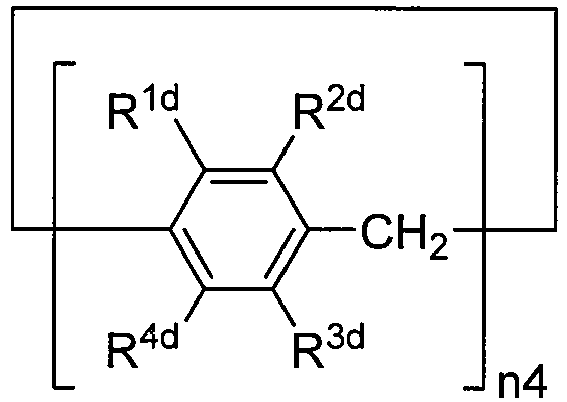
- C07C271/42—Esters of carbamic acids having oxygen atoms of carbamate groups bound to carbon atoms of six-membered aromatic rings with the nitrogen atoms of the carbamate groups bound to hydrogen atoms or to acyclic carbon atoms
- C07C271/44—Esters of carbamic acids having oxygen atoms of carbamate groups bound to carbon atoms of six-membered aromatic rings with the nitrogen atoms of the carbamate groups bound to hydrogen atoms or to acyclic carbon atoms to hydrogen atoms or to carbon atoms of unsubstituted hydrocarbon radicals
-
- C—CHEMISTRY; METALLURGY
- C07—ORGANIC CHEMISTRY
- C07C—ACYCLIC OR CARBOCYCLIC COMPOUNDS
- C07C43/00—Ethers; Compounds having groups, groups or groups
- C07C43/02—Ethers
- C07C43/20—Ethers having an ether-oxygen atom bound to a carbon atom of a six-membered aromatic ring
- C07C43/21—Ethers having an ether-oxygen atom bound to a carbon atom of a six-membered aromatic ring containing rings other than six-membered aromatic rings
-
- C—CHEMISTRY; METALLURGY
- C08—ORGANIC MACROMOLECULAR COMPOUNDS; THEIR PREPARATION OR CHEMICAL WORKING-UP; COMPOSITIONS BASED THEREON
- C08G—MACROMOLECULAR COMPOUNDS OBTAINED OTHERWISE THAN BY REACTIONS ONLY INVOLVING UNSATURATED CARBON-TO-CARBON BONDS
- C08G61/00—Macromolecular compounds obtained by reactions forming a carbon-to-carbon link in the main chain of the macromolecule
- C08G61/02—Macromolecular compounds containing only carbon atoms in the main chain of the macromolecule, e.g. polyxylylenes
-
- C—CHEMISTRY; METALLURGY
- C08—ORGANIC MACROMOLECULAR COMPOUNDS; THEIR PREPARATION OR CHEMICAL WORKING-UP; COMPOSITIONS BASED THEREON
- C08L—COMPOSITIONS OF MACROMOLECULAR COMPOUNDS
- C08L65/00—Compositions of macromolecular compounds obtained by reactions forming a carbon-to-carbon link in the main chain; Compositions of derivatives of such polymers
-
- C—CHEMISTRY; METALLURGY
- C09—DYES; PAINTS; POLISHES; NATURAL RESINS; ADHESIVES; COMPOSITIONS NOT OTHERWISE PROVIDED FOR; APPLICATIONS OF MATERIALS NOT OTHERWISE PROVIDED FOR
- C09D—COATING COMPOSITIONS, e.g. PAINTS, VARNISHES OR LACQUERS; FILLING PASTES; CHEMICAL PAINT OR INK REMOVERS; INKS; CORRECTING FLUIDS; WOODSTAINS; PASTES OR SOLIDS FOR COLOURING OR PRINTING; USE OF MATERIALS THEREFOR
- C09D165/00—Coating compositions based on macromolecular compounds obtained by reactions forming a carbon-to-carbon link in the main chain; Coating compositions based on derivatives of such polymers
-
- C—CHEMISTRY; METALLURGY
- C09—DYES; PAINTS; POLISHES; NATURAL RESINS; ADHESIVES; COMPOSITIONS NOT OTHERWISE PROVIDED FOR; APPLICATIONS OF MATERIALS NOT OTHERWISE PROVIDED FOR
- C09J—ADHESIVES; NON-MECHANICAL ASPECTS OF ADHESIVE PROCESSES IN GENERAL; ADHESIVE PROCESSES NOT PROVIDED FOR ELSEWHERE; USE OF MATERIALS AS ADHESIVES
- C09J165/00—Adhesives based on macromolecular compounds obtained by reactions forming a carbon-to-carbon link in the main chain; Adhesives based on derivatives of such polymers
-
- C—CHEMISTRY; METALLURGY
- C07—ORGANIC CHEMISTRY
- C07C—ACYCLIC OR CARBOCYCLIC COMPOUNDS
- C07C2602/00—Systems containing two condensed rings
- C07C2602/36—Systems containing two condensed rings the rings having more than two atoms in common
- C07C2602/48—Systems containing two condensed rings the rings having more than two atoms in common the bicyclo ring system containing ten carbon atoms
-
- C—CHEMISTRY; METALLURGY
- C07—ORGANIC CHEMISTRY
- C07C—ACYCLIC OR CARBOCYCLIC COMPOUNDS
- C07C2603/00—Systems containing at least three condensed rings
- C07C2603/92—Systems containing at least three condensed rings with a condensed ring system consisting of at least two mutually uncondensed aromatic ring systems, linked by an annular structure formed by carbon chains on non-adjacent positions of the aromatic system, e.g. cyclophanes
-
- C—CHEMISTRY; METALLURGY
- C08—ORGANIC MACROMOLECULAR COMPOUNDS; THEIR PREPARATION OR CHEMICAL WORKING-UP; COMPOSITIONS BASED THEREON
- C08G—MACROMOLECULAR COMPOUNDS OBTAINED OTHERWISE THAN BY REACTIONS ONLY INVOLVING UNSATURATED CARBON-TO-CARBON BONDS
- C08G2261/00—Macromolecular compounds obtained by reactions forming a carbon-to-carbon link in the main chain of the macromolecule
- C08G2261/10—Definition of the polymer structure
- C08G2261/14—Side-groups
- C08G2261/141—Side-chains having aliphatic units
- C08G2261/1412—Saturated aliphatic units
-
- C—CHEMISTRY; METALLURGY
- C08—ORGANIC MACROMOLECULAR COMPOUNDS; THEIR PREPARATION OR CHEMICAL WORKING-UP; COMPOSITIONS BASED THEREON
- C08G—MACROMOLECULAR COMPOUNDS OBTAINED OTHERWISE THAN BY REACTIONS ONLY INVOLVING UNSATURATED CARBON-TO-CARBON BONDS
- C08G2261/00—Macromolecular compounds obtained by reactions forming a carbon-to-carbon link in the main chain of the macromolecule
- C08G2261/10—Definition of the polymer structure
- C08G2261/14—Side-groups
- C08G2261/142—Side-chains containing oxygen
- C08G2261/1424—Side-chains containing oxygen containing ether groups, including alkoxy
-
- C—CHEMISTRY; METALLURGY
- C08—ORGANIC MACROMOLECULAR COMPOUNDS; THEIR PREPARATION OR CHEMICAL WORKING-UP; COMPOSITIONS BASED THEREON
- C08G—MACROMOLECULAR COMPOUNDS OBTAINED OTHERWISE THAN BY REACTIONS ONLY INVOLVING UNSATURATED CARBON-TO-CARBON BONDS
- C08G2261/00—Macromolecular compounds obtained by reactions forming a carbon-to-carbon link in the main chain of the macromolecule
- C08G2261/10—Definition of the polymer structure
- C08G2261/14—Side-groups
- C08G2261/143—Side-chains containing nitrogen
-
- C—CHEMISTRY; METALLURGY
- C08—ORGANIC MACROMOLECULAR COMPOUNDS; THEIR PREPARATION OR CHEMICAL WORKING-UP; COMPOSITIONS BASED THEREON
- C08G—MACROMOLECULAR COMPOUNDS OBTAINED OTHERWISE THAN BY REACTIONS ONLY INVOLVING UNSATURATED CARBON-TO-CARBON BONDS
- C08G2261/00—Macromolecular compounds obtained by reactions forming a carbon-to-carbon link in the main chain of the macromolecule
- C08G2261/10—Definition of the polymer structure
- C08G2261/14—Side-groups
- C08G2261/143—Side-chains containing nitrogen
- C08G2261/1432—Side-chains containing nitrogen containing amide groups
-
- C—CHEMISTRY; METALLURGY
- C08—ORGANIC MACROMOLECULAR COMPOUNDS; THEIR PREPARATION OR CHEMICAL WORKING-UP; COMPOSITIONS BASED THEREON
- C08G—MACROMOLECULAR COMPOUNDS OBTAINED OTHERWISE THAN BY REACTIONS ONLY INVOLVING UNSATURATED CARBON-TO-CARBON BONDS
- C08G2261/00—Macromolecular compounds obtained by reactions forming a carbon-to-carbon link in the main chain of the macromolecule
- C08G2261/10—Definition of the polymer structure
- C08G2261/14—Side-groups
- C08G2261/146—Side-chains containing halogens
-
- C—CHEMISTRY; METALLURGY
- C08—ORGANIC MACROMOLECULAR COMPOUNDS; THEIR PREPARATION OR CHEMICAL WORKING-UP; COMPOSITIONS BASED THEREON
- C08G—MACROMOLECULAR COMPOUNDS OBTAINED OTHERWISE THAN BY REACTIONS ONLY INVOLVING UNSATURATED CARBON-TO-CARBON BONDS
- C08G2261/00—Macromolecular compounds obtained by reactions forming a carbon-to-carbon link in the main chain of the macromolecule
- C08G2261/10—Definition of the polymer structure
- C08G2261/14—Side-groups
- C08G2261/148—Side-chains having aromatic units
-
- C—CHEMISTRY; METALLURGY
- C08—ORGANIC MACROMOLECULAR COMPOUNDS; THEIR PREPARATION OR CHEMICAL WORKING-UP; COMPOSITIONS BASED THEREON
- C08G—MACROMOLECULAR COMPOUNDS OBTAINED OTHERWISE THAN BY REACTIONS ONLY INVOLVING UNSATURATED CARBON-TO-CARBON BONDS
- C08G2261/00—Macromolecular compounds obtained by reactions forming a carbon-to-carbon link in the main chain of the macromolecule
- C08G2261/10—Definition of the polymer structure
- C08G2261/22—Molecular weight
- C08G2261/226—Oligomers, i.e. up to 10 repeat units
-
- C—CHEMISTRY; METALLURGY
- C08—ORGANIC MACROMOLECULAR COMPOUNDS; THEIR PREPARATION OR CHEMICAL WORKING-UP; COMPOSITIONS BASED THEREON
- C08G—MACROMOLECULAR COMPOUNDS OBTAINED OTHERWISE THAN BY REACTIONS ONLY INVOLVING UNSATURATED CARBON-TO-CARBON BONDS
- C08G2261/00—Macromolecular compounds obtained by reactions forming a carbon-to-carbon link in the main chain of the macromolecule
- C08G2261/30—Monomer units or repeat units incorporating structural elements in the main chain
- C08G2261/34—Monomer units or repeat units incorporating structural elements in the main chain incorporating partially-aromatic structural elements in the main chain
- C08G2261/342—Monomer units or repeat units incorporating structural elements in the main chain incorporating partially-aromatic structural elements in the main chain containing only carbon atoms
-
- C—CHEMISTRY; METALLURGY
- C08—ORGANIC MACROMOLECULAR COMPOUNDS; THEIR PREPARATION OR CHEMICAL WORKING-UP; COMPOSITIONS BASED THEREON
- C08G—MACROMOLECULAR COMPOUNDS OBTAINED OTHERWISE THAN BY REACTIONS ONLY INVOLVING UNSATURATED CARBON-TO-CARBON BONDS
- C08G2261/00—Macromolecular compounds obtained by reactions forming a carbon-to-carbon link in the main chain of the macromolecule
- C08G2261/40—Polymerisation processes
- C08G2261/42—Non-organometallic coupling reactions, e.g. Gilch-type or Wessling-Zimmermann type
Definitions
- the present disclosure relates to a fluorinecontaining pillararene.
- a compound such as a pillararene, a crown ether, a cyclodextrin, a calixarene, or a cucurbituril is known.
- a pillararene which has a symmetrical pillar structure, has attracted attention because of its various properties such as the ability to function as a host molecule that can incorporate a guest molecule (Patent Literature 1).
- Patent Literature 1 JP 2015-221893 A
- An object of the present disclosure is to provide a novel pillararene having good water repellency, and particularly a novel pillararene containing a fluorine atom.
- the present disclosure includes the following aspects.
- a fluorinecontaining pillararene can be provided.
- a "monovalent organic group” means a monovalent group containing carbon.
- the monovalent organic group is not limited, and can be a hydrocarbon group or a derivative thereof.
- a derivative of a hydrocarbon group means a group having one or more N, O, S, Si, amide, sulfonyl, siloxane, carbonyl, carbonyloxy, or the like at an end or in a molecular chain of the hydrocarbon group.
- the organic group means a monovalent organic group.
- a "hydrocarbon group” means a group that contains carbon and hydrogen and that is obtained by removing one hydrogen atom from a hydrocarbon.
- the hydrocarbon group is not limited, and examples thereof include a C 1-20 hydrocarbon group optionally substituted with one or more substituents, such as an aliphatic hydrocarbon group or an aromatic hydrocarbon group.
- the "aliphatic hydrocarbon group” may be linear, branched, or cyclic, and may be saturated or unsaturated.
- the hydrocarbon group may also include one or more ring structures.
- the substituent for the "hydrocarbon group” is not limited, and examples thereof include one or more groups selected from a halogen atom, a C 1-6 alkyl group, a C 2-6 alkenyl group, a C 2-6 alkynyl group, a C 3-10 cycloalkyl group, a C 3-10 unsaturated cycloalkyl group, a 5- to 10-membered heterocyclyl group, a 5- to 10-membered unsaturated heterocyclyl group, a C 6-10 aryl group, and a 5-to 10-membered heteroaryl group, optionally substituted with one or more halogen atoms.
- R 1a is each independently at each occurrence a hydrogen atom or an organic group
- R 2a is each independently at each occurrence a hydrogen atom or an organic group
- R 3a is each independently at each occurrence a hydrogen atom or an organic group
- R 4a is each independently at each occurrence a hydrogen atom or an organic group
- at least one of R 1a , R 2a , R 3a , and R 4a is an organic group having 2 or more carbon atoms and having a fluoroalkyl group or a fluorophenyl group.
- at least one of R 1a , R 2a , R 3a , and R 4a is an organic group having 2 or more carbon atoms and having a fluoroalkyl group.
- the compound represented by Formula (1A) can have high miscibility, heat resistance, and water and oil repellency by having an organic group having 2 or more carbon atoms and having a fluoroalkyl group or a fluorophenyl group.
- organic group examples include a group including an alkyl group, an alkyloxy group, an alkyl ether group, a tosyl group, a triflate group, a phenyl group, or the like, optionally substituted with a substituent.
- the substituent is not limited, and examples thereof include one or more groups selected from a halogen atom, a C 1-6 alkyl group, a C 2-6 alkenyl group, a C 2-6 alkynyl group, a C 3-10 cycloalkyl group, a C 3-10 unsaturated cycloalkyl group, a 5- to 10-membered heterocyclyl group, a 5- to 10-membered unsaturated heterocyclyl group, a C 6-10 aryl group, and a 5- to 10-membered heteroaryl group, optionally substituted with one or more halogen atoms, and a reactive functional group.
- the reactive functional group is not limited, and examples thereof include a hydroxyl group, an amino group, a carboxyl group, a thiol group, an isocyanate group, a vinyl group, an acetylene group, a nitrile group, and an epoxy group.
- the alkyl group is preferably a C 1-30 alkyl group.
- the alkyl group may be linear or branched.
- the C 1-30 alkyl group can be a C 1-20 alkyl group, preferably a C 1-10 alkyl group, and more preferably a C 1-30 alkyl group.
- the C 1-30 alkyl group can be a C 17-30 alkyl group, preferably a C 18-30 alkyl group, and more preferably a C 26-30 alkyl group.
- the alkyloxy group is typically a group represented by -O-R 31 wherein R 31 is an alkyl group.
- the alkyl group of R 31 is optionally substituted with any of the substituents described above, and preferably optionally substituted with a fluorine atom.
- the alkyl group is preferably a C 1-30 alkyl group optionally substituted with a fluorine atom.
- the alkyl group may be linear or branched.
- the C 1-30 alkyl group can be a C 1-20 alkyl group, preferably a C 1-10 alkyl group, and more preferably a C 1-30 alkyl group.
- R 31 is a group represented by preferably -R 32 -R 33 wherein R 32 is an unsubstituted C 1-30 alkylene group, preferably C 1-20 alkylene group, and more preferably C 1-10 alkylene group, and R 33 is a C 1-10 perfluoroalkyl group, and preferably a C 1-6 perfluoroalkyl group.
- the alkyl ether group is a compound having one or more ethereal oxygen atoms in a molecular chain of the alkyl group.
- the alkyl ether group is typically a group represented by -R 36 -R 37 -(O-R 38 ) m -R 39 .
- R 36 is a single bond or an oxygen atom.
- R 37 is a single bond or a C 1-10 alkylene group.
- R 38 is a C 1-10 alkylene group.
- R 39 is a C 1-10 alkyl group optionally substituted with a fluorine atom.
- the organic group can be an alkyl group, an alkyloxy group, or an alkyl ether group, having an end substituted with a reactive functional group.
- the group is optionally further substituted with another substituent.
- R 1a and R 3a are each independently an organic group, and at least one of R 1a and R 3a is an organic group having 2 or more carbon atoms and having a fluoroalkyl group or a fluorophenyl group, preferably a fluoroalkyl group, or R 2a and R 4a are each independently an organic group, and at least one of R 2a and R 4a is an organic group having 2 or more carbon atoms and having a fluoroalkyl group or a fluorophenyl group, preferably a fluoroalkyl group.
- At least two of R 1a , R 2a , R 3a , and R 4a are each an organic group having 2 or more carbon atoms and having a fluoroalkyl group or a fluorophenyl group. In one embodiment, at least two of R 1a , R 2a , R 3a , and R 4a are each an organic group having 2 or more carbon atoms and having a fluoroalkyl group.
- two of R 1a , R 2a , R 3a , and R 4a are each an organic group having 2 or more carbon atoms and having a fluoroalkyl group or a fluorophenyl group. In one embodiment, two of R 1a , R 2a , R 3a , and R 4a are each an organic group having 2 or more carbon atoms and having a fluoroalkyl group.
- R 1a and R 3a are each independently an organic group having 2 or more carbon atoms and having a fluoroalkyl group or a fluorophenyl group, preferably a fluoroalkyl group, or R 2a and R 4a are each independently an organic group having 2 or more carbon atoms and having a fluoroalkyl group or a fluorophenyl group, preferably a fluoroalkyl group.
- R 2a and R 4a are each a hydrogen atom, or R 1a and R 3a are each a hydrogen atom.
- R 1a and R 3a are each independently an organic group having 2 or more carbon atoms and having a fluoroalkyl group or a fluorophenyl group, preferably a fluoroalkyl group, and R 2a and R 4a are each a hydrogen atom, or R 2a and R 4a are each independently an organic group having 2 or more carbon atoms and having a fluoroalkyl group or a fluorophenyl group, preferably a fluoroalkyl group, and R 1a and R 3a are each a hydrogen atom.
- R 1a and R 3a are each an organic group having 2 or more carbon atoms and having a fluoroalkyl group or a fluorophenyl group, preferably a fluoroalkyl group, and R 2a and R 4a are each a hydrogen atom, or R 2a and R 4a are each an organic group having 2 or more carbon atoms and having a fluoroalkyl group or a fluorophenyl group, preferably a fluoroalkyl group, and R 1a and R 3a are each a hydrogen atom.
- the fluoroalkyl group is preferably a C 1-10 fluoroalkyl group, and more preferably a C 1-6 fluoroalkyl group.
- the fluoroalkyl group may be linear or branched, and is preferably linear.
- the fluoroalkyl group is preferably a perfluoroalkyl group.
- the fluorophenyl group may be a phenyl group substituted with 1 to 5 fluorine atoms, and is preferably a phenyl group substituted with 5 fluorine atoms.
- the organic group having 2 or more carbon atoms having a fluoroalkyl group is a group represented by the following formula: -(O p1 -R 11a q1 )-Rf a wherein
- the C 1-10 alkylene group in R 11a is preferably a C 1-6 alkylene group, and more preferably a C 2-6 alkylene group.
- the alkylene group may be linear or branched, and is preferably linear.
- R 11a is each independently at each occurrence a C 1-10 alkylene group.
- R 11a is each independently at each occurrence -CONH-.
- the C 1-10 fluoroalkyl group in Rf a is preferably a C 1-6 fluoroalkyl group.
- the fluoroalkyl group may be linear or branched, and is preferably linear.
- the fluoroalkyl group is preferably a perfluoroalkyl group.
- p1 is an integer of 0 to 2, and is preferably 1 or 2. In one embodiment, p1 is 1. In another embodiment, p1 is 2.
- q1 is an integer of 0 to 3, and preferably an integer of 1 to 3, and is more preferably 1 or 2. In one embodiment, q1 is 1. In another embodiment, q1 is 2.
- the organic group having 2 or more carbon atoms and having a fluoroalkyl group is a group represented by -O-R 11a -(O-R 11a ) r1 -Rf a wherein
- the organic group having 2 or more carbon atoms and having a fluoroalkyl group is a group represented by -O-R 11a -(O-R 11a ) r1 -Rf a wherein
- the organic group having 2 or more carbon atoms and having a fluorophenyl group is a group represented by the following formula: -(O p3 -R 11p q3 )-Rf p wherein
- the C 1-10 alkylene group in R 11p is preferably a C 1-6 alkylene group, and more preferably a C 1-6 alkylene group.
- the alkylene group may be linear or branched, and is preferably linear.
- p3 is an integer of 0 to 2, and is preferably 1 or 2. In one embodiment, p1 is 1. In another embodiment, p1 is 2.
- q3 is an integer of 0 to 3, and preferably an integer of 1 to 3, and is more preferably 1 or 2. In one embodiment, q1 is 1. In another embodiment, q1 is 2.
- the organic group having 2 or more carbon atoms and having a fluorophenyl group is a group represented by the following formula: -O-R 11p -Rf p wherein
- the molecular weight of the compound represented by Formula (1A) above can be preferably 500 to 10,000, and more preferably 1,000 to 5,000.
- the static contact angle of the resulting film with water is 80° or more, and preferably 90° or more.
- the compound represented by Formula (1A) above can be obtained by converting a substituent of a pillar[n]arene to an organic group having 2 or more carbon atoms and having a fluoroalkyl group.
- the compound represented by Formula (1A) above can be obtained by introducing a hydroxyl group at a predetermined position of a pillar[n]arene and reacting the hydroxyl group with a tosylate, a halide, or the like of an organic group having 2 or more carbon atoms and having a fluoroalkyl group.
- the SP value is a solubility parameter and serves as a measure of solubility.
- the SP value is a value unique to a substance; and a larger numerical value thereof shows higher polarity, and a smaller numerical value thereof shows lower polarity.
- the SP value is the value ⁇ (cal/cm 3 ) 1/2 calculated from the following expression after determining the evaporation energy ( ⁇ ei) and the molar volume ( ⁇ vi) by using the Fedors method ( R.F. Fedors. Polyme. Eng. Sic., 14, 147(1974 )).
- ⁇ ⁇ ⁇ ei / ⁇ ⁇ vi 1 / 2
- R 1b is each independently at each occurrence a hydrogen atom or an organic group
- R 2b is each independently at each occurrence a hydrogen atom or an organic group
- R 3b is each independently at each occurrence a hydrogen atom or an organic group
- R 4b is each independently at each occurrence a hydrogen atom or an organic group
- at least one of R 1b , R 2b , R 3b , and R 4b is an organic group having a fluorine atom
- the organic group having a fluorine atom has an SP value of 8.0 or less.
- the compound represented by Formula (1B) can have high miscibility, heat resistance, and water and oil repellency by having an organic group having a fluorine atom and having an SP value of 8.0 or less.
- the organic group is defined as described for the organic group in Formula (1A) above.
- R 1b and R 3b are each independently an organic group, and at least one of R 1b and R 3b is an organic group having a fluorine atom and having an SP value of 8.0 or less, or R 2b and R 4b are each independently an organic group, and at least one of R 2b and R 4b is an organic group having a fluorine atom and having an SP value of 8.0 or less.
- At least two of R 1b , R 2b , R 3b , and R 4b are each an organic group having a fluorine atom and having an SP value of 8.0 or less.
- two of R 1b , R 2b , R 3b , and R 4b are each an organic group having a fluorine atom and having an SP value of 8.0 or less.
- R 1b and R 3b are each independently an organic group having a fluorine atom and having an SP value of 8.0 or less, or R 2b and R 4b are each independently an organic group having a fluorine atom and having an SP value of 8.0 or less.
- R 2b and R 4b are each a hydrogen atom, or R 1b and R 3b are each a hydrogen atom.
- R 1b and R 3b are each independently an organic group having a fluorine atom and having an SP value of 8.0 or less, and R 2b and R 4b are each a hydrogen atom, or R 2b and R 4b are each independently an organic group having a fluorine atom and having an SP value of 8.0 or less, and R 2b and R 4b are each a hydrogen atom.
- R 1b and R 3b are each an organic group having a fluorine atom and having an SP value of 8.0 or less, and R 2b and R 4b are each a hydrogen atom, or R 2b and R 4b are each an organic group having a fluorine atom and having an SP value of 8.0 or less, and R 1b and R 3b are each a hydrogen atom.
- the SP value of the organic group having a fluorine atom is preferably 4.0 to 7.5, and more preferably 6.0 to 7.5.
- the organic group having a fluorine atom has a C 1-10 fluoroalkyl group.
- the fluoroalkyl group is preferably a C 1-6 fluoroalkyl group.
- the fluoroalkyl group may be linear or branched, and is preferably linear.
- the fluoroalkyl group is preferably a perfluoroalkyl group.
- the organic group having a fluorine atom has a fluorophenyl group.
- the fluorophenyl group is a phenyl group substituted with 1 to 5, preferably 5, fluorine atoms.
- the organic group having a fluorine atom is a group represented by the following formula: -(O p2 -R 11b q2 )-Rf b wherein
- the organic group having 2 or more carbon atoms having a fluorophenyl group is a group represented by the following formula: - (O p1 -R 11a q1 )-Rf p wherein
- the C 1-10 alkylene group in R 11b is preferably a C 1-6 alkylene group, and more preferably a C 2-6 alkylene group.
- the alkylene group may be linear or branched, and is preferably linear.
- the C 1-10 fluoroalkyl group in Rf b is preferably a C 1-6 fluoroalkyl group.
- the fluoroalkyl group may be linear or branched, and is preferably linear.
- the fluoroalkyl group is preferably a perfluoroalkyl group.
- p2 is an integer of 0 to 2, and is preferably 1 or 2. In one embodiment, p2 is 1. In another embodiment, p2 is 2.
- q2 is an integer of 0 to 3, and preferably an integer of 1 to 3, and is more preferably 1 or 2. In one embodiment, q2 is 1. In another embodiment, q2 is 2.
- the organic group having a fluorine atom is a group represented by -O-R 11b -(O-R 11b ) r2 -Rf b wherein
- the organic group having a fluorine atom is a group represented by -O-R 11b -(O-R 11b ) r2 -Rf b wherein
- n2 is an integer of 4 to 20, and preferably an integer of 4 to 6, and is more preferably 5 or 6.
- the molecular weight of the compound represented by Formula (1B) above can be preferably 500 to 10,000, and more preferably 1,000 to 5,000.
- the static contact angle of the resulting film with water is 80° or more, and preferably 90° or more.
- the compound represented by Formula (1B) above can be produced by the same method as for the compound represented by Formula (1A) above.
- the compound represented by Formula (1B) above can be obtained by introducing a hydroxyl group at a predetermined position of a pillar[n]arene and reacting the hydroxyl group with a tosylate, a halide, or the like of an organic group having a fluorine atom.
- R 1c is each independently at each occurrence a hydrogen atom or an organic group
- R 2c is each independently at each occurrence a hydrogen atom or an organic group
- R 3c is each independently at each occurrence a hydrogen atom or an organic group
- R 4c is each independently at each occurrence a hydrogen atom or an organic group
- at least one of R 1c , R 2c , R 3c , and R 4c is an organic group having a long-chain alkyl group having 17 or more carbon atoms.
- the compound represented by Formula (1C) can have high miscibility, heat resistance, and water repellency by having an organic group having a long-chain alkyl group having 17 or more carbon atoms.
- the organic group is defined as described for the organic group in Formula (1A) above.
- the number of carbon atoms in the long-chain alkyl group is preferably 17 to 30, more preferably 18 to 30, and further preferably 26 to 30.
- the organic group having a long-chain alkyl group is preferably a group represented by -O-R 12c wherein R 12c is a long-chain alkyl group having 17 or more carbon atoms, preferably a C 17-30 alkyl group, and preferably a C 18-30 alkyl group or a C 26-30 alkyl group.
- the long-chain alkyl group may be linear or branched, and is preferably linear.
- R 1c and R 3c are each independently an organic group, and at least one of R 1c and R 3c is an organic group having a long-chain alkyl group having 17 or more carbon atoms, or R 2c and R 4c are each independently an organic group, and at least one of R 2c and R 4c is an organic group having a long-chain alkyl group having 17 or more carbon atoms.
- At least two of R 1c , R 2c , R 3c , and R 4c are each an organic group having a long-chain alkyl group having 17 or more carbon atoms.
- two of R 1c , R 2c , R 3c , and R 4c are each an organic group having a long-chain alkyl group having 17 or more carbon atoms.
- R 1c and R 3c are each independently an organic group having a long-chain alkyl group having 17 or more carbon atoms, and preferably -O-R 12c
- R 2c and R 4c are each independently an organic group having a long-chain alkyl group having 17 or more carbon atoms, and preferably -O-R 12c .
- R 2c and R 4c are each a hydrogen atom, or R 1c and R 3c are each a hydrogen atom.
- R 1c and R 3c are each independently an organic group having a long-chain alkyl group having 17 or more carbon atoms, and R 2c and R 4c are each a hydrogen atom, or R 2c and R 4c are each independently an organic group having a long-chain alkyl group having 17 or more carbon atoms, and R 1c and R 3c are each a hydrogen atom.
- R 1c and R 3c are each an organic group having a long-chain alkyl group having 17 or more carbon atoms, and R 2c and R 4c are each a hydrogen atom, or R 2c and R 4c are each an organic group having a long-chain alkyl group having 17 or more carbon atoms, and R 1c and R 3c are each a hydrogen atom.
- n3 is an integer of 4 to 20, and preferably an integer of 4 to 6, and is more preferably 5 or 6.
- the molecular weight of the compound represented by Formula (1C) above can be preferably 500 to 10,000, and more preferably 1,000 to 5,000.
- the static contact angle of the resulting film with water is 80° or more, and preferably 90° or more.
- the compound represented by Formula (1C) above can be produced by the same method as for the compound represented by Formula (1A) above.
- the compound represented by Formula (1C) above can be obtained by introducing a hydroxyl group at a predetermined position of a pillar[n]arene and reacting the hydroxyl group with a tosylate, a halide, or the like of an organic group having a long-chain alkyl group having 17 or more carbon atoms.
- R 1d is each independently at each occurrence a hydrogen atom or an organic group
- R 2d is each independently at each occurrence a hydrogen atom or an organic group
- R 3d is each independently at each occurrence a hydrogen atom or an organic group
- R 4d is each independently at each occurrence a hydrogen atom or an organic group
- at least one of R 1d , R 2d , R 3d , and R 4d is an organic group having an alkyl group, and the alkyl group has an SP value of 8.2 or more.
- the compound represented by Formula (1D) can have high miscibility, heat resistance, and water repellency by having an organic group having an alkyl group having an SP value of 8.2 or more.
- the organic group is defined as described for the organic group in Formula (1A) above.
- R 1d and R 3d are each independently an organic group, and at least one of R 1d and R 3d is an organic group having an alkyl group having an SP value of 8.2 or more, or R 2d and R 4d are each independently an organic group, and at least one of R 2d and R 4d is an organic group having an alkyl group having an SP value of 8.2 or more.
- At least two of R 1d , R 2b , R 3d , and R 4d are each an organic group having an alkyl group having an SP value of 8.2 or more.
- R 1d , R 2d , R 3d , and R 4d are each an organic group having an alkyl group having an SP value of 8.2 or more.
- R 1d and R 3d are each independently an organic group having an alkyl group having an SP value of 8.2 or more, or R 2d and R 4d are each independently an organic group having an alkyl group having an SP value of 8.2 or more.
- R 2d and R 4d are each a hydrogen atom, or R 1d and R 3d are each a hydrogen atom.
- R 1d and R 3d are each independently an organic group having an alkyl group having an SP value of 8.2 or more, and R 2d and R 4d are each a hydrogen atom, or R 2d and R 4d are each independently an organic group having an alkyl group having an SP value of 8.2 or more, and R 1d and R 3d are each a hydrogen atom.
- R 1d and R 3d are each an organic group having an alkyl group having an SP value of 8.2 or more, and R 2d and R 4d are each a hydrogen atom, or R 2d and R 4d are each an organic group having an alkyl group having an SP value of 8.2 or more, and R 1d and R 3d are each a hydrogen atom.
- the SP value of the alkyl group is preferably 8.2 to 8.4.
- the organic group having an alkyl group is preferably a group represented by -O-R 12d wherein R 12d is a long-chain alkyl group having 17 or more carbon atoms, preferably a C 17-30 alkyl group, and preferably a C 18-30 alkyl group or a C 26-30 alkyl group.
- the long-chain alkyl group may be linear or branched, and is preferably linear.
- n4 is an integer of 4 to 20, and preferably an integer of 4 to 6, and is more preferably 5 or 6.
- the molecular weight of the compound represented by Formula (1D) above can be preferably 500 to 10,000, and more preferably 1,000 to 5,000.
- the static contact angle of the resulting film with water is 80° or more, and preferably 90° or more.
- the compound represented by Formula (1D) above can be produced by the same method as for the compound represented by Formula (1A) above.
- the compound represented by Formula (1D) above can be obtained by introducing a hydroxyl group at a predetermined position of a pillar[n]arene and reacting the hydroxyl group with a tosylate, a halide, or the like of an organic group having an alkyl group.
- composition including a compound represented by Formula (lA), (1B), (1C), or (1D) above.
- composition of the present disclosure may include the compounds of the present disclosure singly or may include two or more thereof in combination.
- composition of the present disclosure may be a liquid or a solid.
- each component may be included as a so-called inclusion, which is what is obtained by including a further component in the pillararene of the present disclosure, or for example, may be a so-called surface adhered substance, which is what is obtained by adhering a further component to the pillararene of the present disclosure.
- composition of the present disclosure may include a solvent in addition to the compound of the present disclosure.
- the solvent examples include water; an aliphatic hydrocarbon such as hexane, cyclohexane, heptane, octane, nonane, decane, undecane, dodecane, or a mineral spirit; an aromatic hydrocarbon such as benzene, toluene, xylene, naphthalene, or solvent naphtha; an ester such as methyl acetate, ethyl acetate, propyl acetate, n-butyl acetate, isopropyl acetate, isobutyl acetate, cellosolve acetate, propylene glycol methyl ether acetate, carbitol acetate, diethyl oxalate, ethyl pyruvate, ethyl-2-hydroxybutyrate, ethyl acetoacetate, amyl acetate, methyl lactate, ethyl lactate, methyl 3-meth
- the composition includes a solvent
- the compound represented by Formula (1A), (1B), (1C), or (1D) may be a substance swollen by the solvent.
- the solvent may be a gas. That is, the composition of the present disclosure may include a mixture of the compound represented by Formula (1A), (1B), (1C), or (1D) above and a gas of the solvent.
- the solvent as a gas can be preferably a hydrocarbon, more preferably a C 4-10 hydrocarbon such as butane, pentane, hexane, cyclohexane, heptane, octane, nonane, or decane, and further preferably pentane or hexane.
- a gas of such a solvent By including a gas of such a solvent, the contact angle of the film obtained by using the composition of the present disclosure can be improved.
- composition of the present disclosure may include a thermoplastic resin such as a non-fluororesin or a fluororesin.
- non-fluororesin examples include a polyolefin-based resin such as polyethylene (for example, linear low-density polyethylene, low-density polyethylene, high-density polyethylene, or ultra-high molecular weight polyethylene), polypropylene including various structural isomers (syndiotactic, isotactic, and atactic structures), poly-(4-methylpentene-1), ethylene-propylene copolymer, ethylene-vinyl acetate copolymer (EVA), a chlorinated polyethylene-based resin, or a modified polyolefin, a cycloolefin resin, a polyvinyl chloride-based resin such as polyvinyl chloride, polyvinylidene chloride, a polystyrene or polystyrene derivative-based resin including various structural isomers, polyamide, polyimide, polyamideimide, polycarbonate, an ionomer, an acrylic resin such as polymethyl methacrylate
- fluororesin examples include polytetrafluoroethylene (PTFE), tetrafluoroethylene (TFE)/perfluoroalkyl vinyl ether (PAVE) copolymer [PFA], TFE/hexafluoropropylene (HFP) copolymer [FEP], ethylene [Et]/TFE copolymer [ETFE], Et/TFE/HFP copolymer, polychlorotrifluoroethylene [PCTFE], chlorotrifluoroethylene (CTFE)/TFE copolymer, Et/CTFE copolymer, polyvinylidene fluoride [PVDF], vinylidene fluoride (VDF)/TFE copolymer, and polyvinyl fluoride [PVF].
- PTFE polytetrafluoroethylene
- TFE tetrafluoroethylene
- PAVE perfluoroalkyl vinyl ether copolymer
- HFP hexafluoropropylene copolymer
- composition of the present disclosure may include a filler.
- the filler examples include, in addition to silica and carbon black, a metal oxide such as calcium oxide, titanium oxide, aluminum oxide, or magnesium oxide; a metal hydroxide such as magnesium hydroxide, aluminum hydroxide, or calcium hydroxide; a carbonate such as magnesium carbonate, aluminum carbonate, calcium carbonate, or barium carbonate; a silicate such as magnesium silicate, calcium silicate, sodium silicate, or aluminum silicate; a sulfate such as aluminum sulfate, calcium sulfate, or barium sulfate; synthetic hydrotalcite; a metal sulfide such as molybdenum disulfide, iron sulfide, or copper sulfide; diatomaceous earth, asbestos, lithopone (zinc sulfide/barium sulfide), graphite, carbon fluoride, calcium fluoride, coke, a fine quartz powder, talc, a mica powder, wollastonite, a carbon fiber, an aramid fiber
- the compounds and the composition of the present disclosure can be used in a wide range of applications, such as a compatibilizer, an adhesive, a surface-treating agent (for example, water repellent), a highly heat-resistant material, an adsorptive separation material, and a material for a formed article.
- a compatibilizer for example, an adhesive
- a surface-treating agent for example, water repellent
- a highly heat-resistant material for example, aluminum oxide
- an adsorptive separation material for a formed article.
- the compounds and the composition of the present disclosure can each be formed into a formed article. Therefore, the disclosure also provides a formed article formed from any of the compounds and the composition of the disclosure.
- the method for forming the compounds and the composition of the present disclosure is not limited, and may be a general forming method such as extrusion forming, injection molding, press forming, vacuum forming, transfer molding, casting, or the like.
- the shape of the resulting formed article is not limited, and for example, may be any desired shape such as block-like, sheet-like, film-like, rod-like, or various other shapes depending on the applications.
- the pillararene of the present disclosure when obtaining a film, can be dissolved in a good solvent, cast on a substrate, and heated to the boiling point of the solvent or higher to volatilize the solvent to form a film.
- a formed article of any of the compounds or the composition of the present disclosure has high heat resistance and water repellency.
- a film obtained by casting any of the compounds or the composition of the present disclosure can be treated with a gas of a hydrocarbon, preferably a C 4-10 hydrocarbon such as butane, pentane, hexane, cyclohexane, heptane, octane, nonane, or decane, more preferably pentane or hexane to improve the water contact angle.
- a gas of a hydrocarbon preferably a C 4-10 hydrocarbon such as butane, pentane, hexane, cyclohexane, heptane, octane, nonane, or decane, more preferably pentane or hexane to improve the water contact angle.
- the disclosure provides a material including a substrate treated with any of the compounds and/or the composition of the disclosure.
- a substrate that can be treated with any of the compounds and the composition of the present disclosure can be composed of, for example, glass, a resin (which, for example, may be a natural or synthetic resin, such as a common plastic material), a metal, a ceramic, a semiconductor (silicon, germanium, or the like), a fiber (woven fabric, nonwoven fabric, or the like), fur, leather, a wood, a ceramic material, a stone material, a building member, a sanitary material, an adsorptive separation material, or any suitable material.
- a resin which, for example, may be a natural or synthetic resin, such as a common plastic material
- a metal a ceramic, a semiconductor (silicon, germanium, or the like)
- a fiber woven fabric, nonwoven fabric, or the like
- fur leather, a wood, a ceramic material, a stone material, a building member, a sanitary material, an adsorptive separation material, or any suitable material.
- a substrate treated with any of the compounds or the composition of the present disclosure has high heat resistance and water repellency.
- liquid-repellent composition including a pillararene represented by Formula (1E) below and a hydrocarbon compound: wherein
- the formed article of the liquid-repellent composition has high water repellency.
- the organic group is an organic group having preferably 1 to 30 carbon atoms, and more preferably 1 to 20 carbon atoms.
- the liquid-repellent composition may further include a solvent.
- the solvent included in the liquid-repellent composition can be a C 4-10 hydrocarbon such as butane, pentane, hexane, cyclohexane, heptane, octane, nonane, or decane, and further preferably pentane or hexane.
- the hydrocarbon compound included in the liquid-repellent composition can be preferably a C 4-10 hydrocarbon such as butane, pentane, hexane, cyclohexane, heptane, octane, nonane, or decane, and further preferably pentane or hexane.
- the hydrocarbon compound included in the liquid-repellent composition may be the same as or different from the solvent.
- the pillararene represented by Formula (1E) and the hydrocarbon compound may be included as a so-called inclusion, which is what is obtained by including the hydrocarbon compound in the pillararene represented by Formula (1E), or for example, may be a so-called surface adhered substance, which is what is obtained by adhering the hydrocarbon compound to the pillararene.
- the pillararene represented by Formula (1E) may be a substance swollen by the solvent.
- the inclusion and the surface adhered substance can be obtained by treating the pillararene represented by Formula (1E) with a gas of a hydrocarbon compound.
- Paraformaldehyde (0.31 g, 10 mmol) was added to a solution of 1,4-dipentyloxybenzene (1.66 g, 10 mmol) in 1,2-dichloroethane (20 mL) in a nitrogen atmosphere.
- boron trifluoride diethyl etherate (1.25 mL, 10 mmol) was added, and the resulting mixture was stirred at a temperature of 30°C for 3 hours.
- the solution was poured into methanol, and the precipitate was collected by filtration. The precipitate was dissolved in trichloromethane, and the undissolved portion was removed by filtration.
- Pillar[5]arene in a hydroquinone form (0.305 g, 0.5 mmol), was dissolved in dimethylsulfoxide (5 mL). After that, stearyl isocyanate (1.478 g, 5 mmol) was added, and 1 drop of dibutyltin laurate as a catalyst was added. The resulting mixture was heated to 40°C and allowed to react for 6 hours. The reaction solution and the precipitate were cleaned with hexane and water in presented order to obtain the target compound.
- the SP values of the side chain structures of Synthesis Examples 1 to 4 were in the range of 6.9 to 7.4.
- a fluororesin having an SP value of 5.9 it is considered that the pillararene compound and the fluororesin have good miscibility because the SP values of the both are close to each other.
- the SP value was calculated by the Fedors method described above. Results thereof are shown in the following table.
- the pillararenes obtained in Synthesis Examples 1, 2, 4, and 5 above were dissolved in dichloromethane.
- the obtained solutions were cast on glass substrates, respectively, dichloromethane was volatilized at room temperature, and then the resulting solids were heated to 160°C and melted. Next, the resulting melts were cooled at room temperature to obtain cast films of the pillararenes.
- a sample bottle containing a solvent and the cast films obtained above were added, the cast, films were exposed to solvent vapor for 17 hours, and then air-dried in a fume hood for 2 hours to obtain solvent-treated films.
- the combinations of cast films and solvents are as follows.
- the high melting point of the compound can suppress softening of the resin. Therefore, the pillararenes of the present disclosure can be used in a wide range of applications such as an application requiring heat resistance.
- the compounds of the present disclosure can be used in a wide range of applications, such as a compatibilizer, an adhesive, a surface-treating agent, a highly heat-resistant material, an adsorptive separation material, and a material for a formed article.
Landscapes
- Chemical & Material Sciences (AREA)
- Organic Chemistry (AREA)
- Chemical Kinetics & Catalysis (AREA)
- Health & Medical Sciences (AREA)
- Medicinal Chemistry (AREA)
- Polymers & Plastics (AREA)
- Life Sciences & Earth Sciences (AREA)
- Engineering & Computer Science (AREA)
- Materials Engineering (AREA)
- Wood Science & Technology (AREA)
- Organic Low-Molecular-Weight Compounds And Preparation Thereof (AREA)
- Materials Applied To Surfaces To Minimize Adherence Of Mist Or Water (AREA)
- Pyrrole Compounds (AREA)
- Indole Compounds (AREA)
Abstract
Description
- The present disclosure relates to a fluorinecontaining pillararene.
- As a cyclic compound, a compound such as a pillararene, a crown ether, a cyclodextrin, a calixarene, or a cucurbituril is known. Among these, a pillararene, which has a symmetrical pillar structure, has attracted attention because of its various properties such as the ability to function as a host molecule that can incorporate a guest molecule (Patent Literature 1).
- Patent Literature 1:
JP 2015-221893 A - An object of the present disclosure is to provide a novel pillararene having good water repellency, and particularly a novel pillararene containing a fluorine atom.
- The present disclosure includes the following aspects.
- [1] A compound represented by Formula (1A) below:

- R1a is each independently at each occurrence a hydrogen atom or an organic group,
- R2a is each independently at each occurrence a hydrogen atom or an organic group,
- R3a is each independently at each occurrence a hydrogen atom or an organic group,
- R4a is each independently at each occurrence a hydrogen atom or an organic group,
- provided that at least one of R1a, R2a, R3a, and R4a is an organic group having 2 or more carbon atoms and having a fluoroalkyl group or a fluorophenyl group, and
- n1 is an integer of 4 to 20.
- [2] The compound according to [1] above, wherein
- R1a and R3a are each independently an organic group,
- provided that at least one of Rla and R3a is an organic group having 2 or more carbon atoms and having a fluoroalkyl group or a fluorophenyl group, or
- R2a and R4a are each independently an organic group,
- provided that at least one of R2a and R4a is an organic group having 2 or more carbon atoms and having a fluoroalkyl group or a fluorophenyl group.
- [3] The compound according to [1] or [2] above, wherein
- R1a and R3a are each independently an organic group having 2 or more carbon atoms and having a fluoroalkyl group or a fluorophenyl group, or
- R2a and R4a are each independently an organic group having 2 or more carbon atoms and having a fluoroalkyl group or a fluorophenyl group.
- [4] The compound according to any one of [1] to [3] above, wherein
- R2a and R4a are each a hydrogen atom, or
- R1a and R3a are each a hydrogen atom.
- [5] The compound according to any one of [1] to [4] above, wherein n1 is an integer of 4 to 6.
- [6] The compound according to any one of [1] to [5] above, wherein
- the organic group having 2 or more carbon atoms and having a fluoroalkyl group is -(Op1-R11a q1)-Rfa,
- R11a is each independently at each occurrence a C1-10 alkylene group or -CONH-,
- Rfa is a C1-10 fluoroalkyl group,
- p1 is an integer of 0 to 2,
- q1 is an integer of 0 to 3, and
- in (Op1-R11a q1), occurrence order of O and R11a is not limited.
- [7] The compound according to any one of [1] to [6] above, wherein
- the organic group having 2 or more carbon atoms and having a fluoroalkyl group is -O-R11a-(O-R11a)r1-Rfa,
- R11a is each independently a C1-10 alkylene group or -CONH-,
- Rfa is a C1-10 fluoroalkyl group, and
- r1 is 0 or 1.
- [8] The compound according to any one of [1] to [7] above, wherein the fluoroalkyl group is a perfluoroalkyl group.
- [9] The compound according to any one of [1] to [8] above, wherein
- R1a and R3a are each -O-R11a-(O-R11a)r1-Rfa, and R2a and R4a are each a hydrogen atom, or
- R2a and R4a are each -O-R11a-(O-R11a)r1-Rfa, and R1a and R3a are each a hydrogen atom,
- R11a is each independently a C1-10 alkylene group or -CONH-,
- Rfa is a C1-10 perfluoroalkyl group,
- r1 is 0 or 1, and
- n1 is an integer of 4 to 6.
- [10] The compound according to any one of [1] to [5] above, wherein
the organic group having 2 or more carbon atoms and having a fluorophenyl group is a group represented by the following formula:
-(Op3-R11p q3)-RfP
wherein- R11p is each independently at each occurrence a C1-10 alkylene group,
- RfP is a phenyl group substituted by 1 to 5 fluorine,
- p3 is an integer of 0 to 2,
- q3 is an integer of 0 to 3, and
- in (Op3-R11p q3), occurrence order of O and R11p is not limited.
- [11] The compound according to any one of [1] to [5] above, wherein
the organic group having 2 or more carbon atoms and having a fluorophenyl group is a group represented by the following formula:
-O-R11p-Rfp
wherein- R11p is each independently at each occurrence a C1-10 alkylene group, and
- RfP is a phenyl group substituted with 1 to 5 fluorine atoms.
- [12] The compound according to any one of [1] to [5] above, wherein
- R1a and R3a are each -O-R11p-Rfp, and R2a and R4a are each a hydrogen atom, or
- R2a and R4a are -O-R11p-Rfp, and R1a and R3a are each a hydrogen atom,
- R11p is each independently a C1-6 alkylene group,
- RfP is a phenyl group substituted with 1 to 5 fluorine atoms, and
- n1 is an integer of 4 to 6.
- [13] The compound according to any one of [1] to [12] above, wherein when the compound is formed into a film, a static contact angle of the film with water is 80° or more.
- [14] A compound represented by Formula (1B) below:

- R1b is each independently at each occurrence a hydrogen atom or an organic group,
- R2b is each independently at each occurrence a hydrogen atom or an organic group,
- R3b is each independently at each occurrence a hydrogen atom or an organic group, and
- R4b is each independently at each occurrence a hydrogen atom or an organic group,
- provided that at least one of R1b, R2b, R3b, and R4b is an organic group having a fluorine atom, and the organic group having a fluorine atom has an SP value of 8.0 or less, and n2 is an integer of 4 to 20.
- [15] The compound according to [14] above, wherein
- R1b and R3b are each independently an organic group, provided that at least one of R1b and R3b is an organic group having a fluorine atom and having an SP value of 8.0 or less, or
- R2b and R4b are each independently an organic group, provided that at least one of R2b and R4b is an organic group having a fluorine atom and having an SP value of 8.0 or less.
- [16] The compound according to [14] or [15] above, wherein R1b and R3b are each independently an organic group having a fluorine atom and having an SP value of 8.0 or less, or R2b and R4b are each independently an organic group having a fluorine atom and having an SP value of 8.0 or less.
- [17] The compound according to any one of [14] to [16] above, wherein
- R2b and R4b are each a hydrogen atom, or
- R1b and R3b are each a hydrogen atom.
- [18] The compound according to any one of [14] to [17] above, wherein n2 is an integer of 4 to 6.
- [19] The compound according to any one of [14] to [18] above, wherein the SP value of the organic group having a fluorine atom is 4.0 to 7.5.
- [20] The compound according to any one of [14] to [19] above, wherein the organic group having a fluorine atom has a C1-10 fluoroalkyl group.
- [21] The compound according to [30] above, wherein the C1-10 fluoroalkyl group is a C1-10 perfluoroalkyl group.
- [22] The compound according to any one of [14] to [21] above, wherein
- R1b and R3b are each -O-R11b-(O-R11b)r2-Rfb, and R2b and R4b are each a hydrogen atom, or
- R2b and R4b are each -O-R11b-(O-R11b)r2-Rfb, and R1b and R3b are each a hydrogen atom,
- R11b is each independently a C1-10 alkylene group,
- Rfb is a C1-10 perfluoroalkyl group,
- r2 is 0 or 1, and
- n2 is an integer of 4 to 6.
- [23] The compound according to any one of [14] to [22] above, wherein when the compound is formed into a film, a static contact angle of the film with water is 80° or more.
- [24] A compound represented by Formula (1C) below:

- R1c is each independently at each occurrence a hydrogen atom or an organic group,
- R2c is each independently at each occurrence a hydrogen atom or an organic group,
- R3c is each independently at each occurrence a hydrogen atom or an organic group,
- R4c is each independently at each occurrence a hydrogen atom or an organic group,
- provided that at least one of R1c, R2c, R3c, and R4c is an organic group having a long-chain alkyl group having 17 or more carbon atoms, and
- n3 is an integer of 4 to 20.
- [25] The compound according to [24] above, wherein
- R1c and R3c are each independently an organic group,
- provided that at least one of R1c and R3c is an organic group having a long-chain alkyl group having 17 or more carbon atoms, or
- R2c and R4c are each independently an organic group,
- provided that at least one of R2c and R4c is an organic group having a long-chain alkyl group having 17 or more carbon atoms.
- [26] The compound according to [24] or [25] above, wherein R1c and R3c are each independently an organic group having a long-chain alkyl group having 17 or more carbon atoms, and R2c and R4c are each independently an organic group having a long-chain alkyl group having 17 or more carbon atoms.
- [27] The compound according to any one of [24] to [26] above, wherein the number of carbon atoms in the long-chain alkyl group is 17 to 30.
- [28] The compound according to any one of [24] to [27] above, wherein
- R1c and R3c are each independently -O-R12c, or
- R2c and R4c are each independently -O-R12c, and
- R12c is a C17-30 alkyl group.
- [29] The compound according to any one of [24] to [28] above, wherein
- R2c and R4c are each a hydrogen atom, or
- R1c and R3c are each a hydrogen atom.
- [30] The compound according to any one of [24] to [29] above, wherein n3 is an integer of 4 to 6.
- [31] The compound according to any one of [24] to [30] above, wherein
- R1c and R3c are each -O-R12c, and R2c and R4c are each a hydrogen atom, or
- R2c and R4c are each -O-R12c, and R1c and R3c is each a hydrogen atom,
- R12c is a C17-30 alkyl group, and
- n3 is an integer of 4 to 6.
- [32] The compound according to any one of [24] to [31] above, wherein when the compound is formed into a film, a static contact angle of the film with water is 80° or more.
- [33] A compound represented by Formula (1D) below:
- R1d is each independently at each occurrence a hydrogen atom or an organic group,
- R2d is each independently at each occurrence a hydrogen atom or an organic group,
- R3d is each independently at each occurrence a hydrogen atom or an organic group, and
- R4d is each independently at each occurrence a hydrogen atom or an organic group,
- provided that at least one of R1d, R2d, R3d, and R4d is an organic group having an alkyl group, and the alkyl group has an SP value of 8.2 or more, and
- n4 is an integer of 4 to 20.
- [34] The compound according to [33] above, wherein
- R1d and R3d are each independently an organic group,
- provided that at least one of R1d and R3d is an organic group having an alkyl group having an SP value of 8.2 or more, or R2d and R4d are each independently an organic group,
- provided that at least one of R2d and R4d is an organic group having an alkyl group having an SP value of 8.2 or more.
- [35] The compound according to [33] or [34] above, wherein
- R1d and R3d are each independently an organic group having an alkyl group having an SP value of 8.2 or more, or
- R2d and R4d are each independently an organic group having an alkyl group having an SP value of 8.2 or more.
- [36] The compound according to any one of [33] to [35] above, wherein
- R2d and R4d are each a hydrogen atom, or
- R1d and R3d are each a hydrogen atom.
- [37] The compound according to any one of [33] to [36] above, wherein n4 is an integer of 4 to 6.
- [38] The compound according to any one of [33] to [37] above, wherein the SP value of the alkyl group is 8.2 to 8.4.
- [39] The compound according to any one of [33] to [38] above, wherein
- R1d and R3d are each -O-R12d, and R2d and R4d are each a hydrogen atom, or
- R2d and R4d are each -O-R12d, and R1d and R3d is each a hydrogen atom,
- R12d is a C17-30 alkyl group, and
- n4 is an integer of 4 to 6.
- [40] The compound according to any one of [33] to [39] above, wherein when the compound is formed into a film, a static contact angle of the film with water is 80° or more.
- [41] A composition comprising at least one of the compound according to any one of [1] to [40] above.
- [42] A formed article of the compound according to any one of [1] to [40] above.
- [43] A formed article formed from the composition according to [41] above.
- [44] The formed article according to [42] or [43] above, wherein the formed article is a film.
- [45] A material comprising a substrate treated with the compound according to any one of [1] to [40] above or the composition according to [41] above.
- [46] A liquid-repellent composition comprising a pillararene represented by Formula (1E) below and a hydrocarbon compound:

- R1e, R2e, R3e, and R4e are each independently a hydrogen atom or an organic group, and
- n5 is 5 or 6.
- [47] The liquid-repellent composition according to [46] above, wherein the organic group is an organic group having 1 to 30 carbon atoms.
- [48] The liquid-repellent composition of [46] or [47] above, wherein the liquid-repellent composition further comprises a solvent.
- According to the present disclosure, a fluorinecontaining pillararene can be provided.
- As used herein, a "monovalent organic group" means a monovalent group containing carbon. The monovalent organic group is not limited, and can be a hydrocarbon group or a derivative thereof. A derivative of a hydrocarbon group means a group having one or more N, O, S, Si, amide, sulfonyl, siloxane, carbonyl, carbonyloxy, or the like at an end or in a molecular chain of the hydrocarbon group. When an "organic group" is simply shown, the organic group means a monovalent organic group.
- As used herein, a "hydrocarbon group" means a group that contains carbon and hydrogen and that is obtained by removing one hydrogen atom from a hydrocarbon. The hydrocarbon group is not limited, and examples thereof include a C1-20 hydrocarbon group optionally substituted with one or more substituents, such as an aliphatic hydrocarbon group or an aromatic hydrocarbon group. For example, the "aliphatic hydrocarbon group" may be linear, branched, or cyclic, and may be saturated or unsaturated. In addition, the hydrocarbon group may also include one or more ring structures.
- As used herein, the substituent for the "hydrocarbon group" is not limited, and examples thereof include one or more groups selected from a halogen atom, a C1-6 alkyl group, a C2-6 alkenyl group, a C2-6 alkynyl group, a C3-10 cycloalkyl group, a C3-10 unsaturated cycloalkyl group, a 5- to 10-membered heterocyclyl group, a 5- to 10-membered unsaturated heterocyclyl group, a C6-10 aryl group, and a 5-to 10-membered heteroaryl group, optionally substituted with one or more halogen atoms.
- In a first aspect, the present disclosure provides a compound represented by Formula (1A) below:

- R1a is each independently at each occurrence a hydrogen atom or an organic group,
- R2a is each independently at each occurrence a hydrogen atom or an organic group,
- R3a is each independently at each occurrence a hydrogen atom or an organic group,
- R4a is each independently at each occurrence a hydrogen atom or an organic group,
- provided that at least one of R1a, R2a, R3a, and R4a is an organic group having 2 or more carbon atoms and having a fluoroalkyl group, and
- n1 is an integer of 4 to 20.
- In Formula (1A) above, R1a is each independently at each occurrence a hydrogen atom or an organic group, R2a is each independently at each occurrence a hydrogen atom or an organic group, R3a is each independently at each occurrence a hydrogen atom or an organic group, R4a is each independently at each occurrence a hydrogen atom or an organic group, and at least one of R1a, R2a, R3a, and R4a is an organic group having 2 or more carbon atoms and having a fluoroalkyl group or a fluorophenyl group. In one embodiment, at least one of R1a, R2a, R3a, and R4a is an organic group having 2 or more carbon atoms and having a fluoroalkyl group.
- The compound represented by Formula (1A) can have high miscibility, heat resistance, and water and oil repellency by having an organic group having 2 or more carbon atoms and having a fluoroalkyl group or a fluorophenyl group.
- Examples of the organic group include a group including an alkyl group, an alkyloxy group, an alkyl ether group, a tosyl group, a triflate group, a phenyl group, or the like, optionally substituted with a substituent.
- The substituent is not limited, and examples thereof include one or more groups selected from a halogen atom, a C1-6 alkyl group, a C2-6 alkenyl group, a C2-6 alkynyl group, a C3-10 cycloalkyl group, a C3-10 unsaturated cycloalkyl group, a 5- to 10-membered heterocyclyl group, a 5- to 10-membered unsaturated heterocyclyl group, a C6-10 aryl group, and a 5- to 10-membered heteroaryl group, optionally substituted with one or more halogen atoms, and a reactive functional group.
- The reactive functional group is not limited, and examples thereof include a hydroxyl group, an amino group, a carboxyl group, a thiol group, an isocyanate group, a vinyl group, an acetylene group, a nitrile group, and an epoxy group.
- The alkyl group is preferably a C1-30 alkyl group. For example, the alkyl group may be linear or branched. In one embodiment, the C1-30 alkyl group can be a C1-20 alkyl group, preferably a C1-10 alkyl group, and more preferably a C1-30 alkyl group. In another embodiment, the C1-30 alkyl group can be a C17-30 alkyl group, preferably a C18-30 alkyl group, and more preferably a C26-30 alkyl group.
- The alkyloxy group is typically a group represented by -O-R31 wherein R31 is an alkyl group.
- The alkyl group of R31 is optionally substituted with any of the substituents described above, and preferably optionally substituted with a fluorine atom. The alkyl group is preferably a C1-30 alkyl group optionally substituted with a fluorine atom. For example, the alkyl group may be linear or branched. In one embodiment, the C1-30 alkyl group can be a C1-20 alkyl group, preferably a C1-10 alkyl group, and more preferably a C1-30 alkyl group.
- R31 is a group represented by preferably -R32-R33 wherein R32 is an unsubstituted C1-30 alkylene group, preferably C1-20 alkylene group, and more preferably C1-10 alkylene group, and R33 is a C1-10 perfluoroalkyl group, and preferably a C1-6 perfluoroalkyl group.
- The alkyl ether group is a compound having one or more ethereal oxygen atoms in a molecular chain of the alkyl group. The alkyl ether group is typically a group represented by -R36-R37-(O-R38)m-R39. In the above formula, R36 is a single bond or an oxygen atom. R37 is a single bond or a C1-10 alkylene group. R38 is a C1-10 alkylene group. R39 is a C1-10 alkyl group optionally substituted with a fluorine atom.
- In one embodiment, the organic group can be an alkyl group, an alkyloxy group, or an alkyl ether group, having an end substituted with a reactive functional group. The group is optionally further substituted with another substituent.
- In one embodiment, R1a and R3a are each independently an organic group, and at least one of R1a and R3a is an organic group having 2 or more carbon atoms and having a fluoroalkyl group or a fluorophenyl group, preferably a fluoroalkyl group, or R2a and R4a are each independently an organic group, and at least one of R2a and R4a is an organic group having 2 or more carbon atoms and having a fluoroalkyl group or a fluorophenyl group, preferably a fluoroalkyl group.
- In one embodiment, at least two of R1a, R2a, R3a, and R4a are each an organic group having 2 or more carbon atoms and having a fluoroalkyl group or a fluorophenyl group. In one embodiment, at least two of R1a, R2a, R3a, and R4a are each an organic group having 2 or more carbon atoms and having a fluoroalkyl group.
- In one embodiment, two of R1a, R2a, R3a, and R4a are each an organic group having 2 or more carbon atoms and having a fluoroalkyl group or a fluorophenyl group. In one embodiment, two of R1a, R2a, R3a, and R4a are each an organic group having 2 or more carbon atoms and having a fluoroalkyl group.
- In one embodiment, R1a and R3a are each independently an organic group having 2 or more carbon atoms and having a fluoroalkyl group or a fluorophenyl group, preferably a fluoroalkyl group, or R2a and R4a are each independently an organic group having 2 or more carbon atoms and having a fluoroalkyl group or a fluorophenyl group, preferably a fluoroalkyl group.
- In one embodiment, R2a and R4a are each a hydrogen atom, or R1a and R3a are each a hydrogen atom.
- In a preferable embodiment, R1a and R3a are each independently an organic group having 2 or more carbon atoms and having a fluoroalkyl group or a fluorophenyl group, preferably a fluoroalkyl group, and R2a and R4a are each a hydrogen atom, or R2a and R4a are each independently an organic group having 2 or more carbon atoms and having a fluoroalkyl group or a fluorophenyl group, preferably a fluoroalkyl group, and R1a and R3a are each a hydrogen atom.
- In a more preferable embodiment, R1a and R3a are each an organic group having 2 or more carbon atoms and having a fluoroalkyl group or a fluorophenyl group, preferably a fluoroalkyl group, and R2a and R4a are each a hydrogen atom, or R2a and R4a are each an organic group having 2 or more carbon atoms and having a fluoroalkyl group or a fluorophenyl group, preferably a fluoroalkyl group, and R1a and R3a are each a hydrogen atom.
- The fluoroalkyl group is preferably a C1-10 fluoroalkyl group, and more preferably a C1-6 fluoroalkyl group. For example, the fluoroalkyl group may be linear or branched, and is preferably linear. The fluoroalkyl group is preferably a perfluoroalkyl group.
- For example, the fluorophenyl group may be a phenyl group substituted with 1 to 5 fluorine atoms, and is preferably a phenyl group substituted with 5 fluorine atoms.
- In one embodiment, the organic group having 2 or more carbon atoms having a fluoroalkyl group is a group represented by the following formula:
-(Op1-R11a q1)-Rfa
wherein - R11a is each independently at each occurrence a C1-10 alkylene group or -CONH-,
- Rfa is a C1-10 fluoroalkyl group,
- p1 is an integer of 0 to 2,
- q1 is an integer of 0 to 3, and
- in (Op1-R11a q1), occurrence order of O and R11a is not limited.
- The C1-10 alkylene group in R11a is preferably a C1-6 alkylene group, and more preferably a C2-6 alkylene group. For example, the alkylene group may be linear or branched, and is preferably linear.
- In one embodiment, R11a is each independently at each occurrence a C1-10 alkylene group.
- In another embodiment, R11a is each independently at each occurrence -CONH-.
- The C1-10 fluoroalkyl group in Rfa is preferably a C1-6 fluoroalkyl group. For example, the fluoroalkyl group may be linear or branched, and is preferably linear. The fluoroalkyl group is preferably a perfluoroalkyl group.
- p1 is an integer of 0 to 2, and is preferably 1 or 2. In one embodiment, p1 is 1. In another embodiment, p1 is 2.
- q1 is an integer of 0 to 3, and preferably an integer of 1 to 3, and is more preferably 1 or 2. In one embodiment, q1 is 1. In another embodiment, q1 is 2.
- In a preferable embodiment, the organic group having 2 or more carbon atoms and having a fluoroalkyl group is a group represented by
-O-R11a-(O-R11a)r1-Rfa
wherein - R11a is each independently a C1-10 alkylene group or -CONH-,
- Rfa is a C1-10 fluoroalkyl group, and
- r1 is 0 or 1.
- In a more preferable embodiment, the organic group having 2 or more carbon atoms and having a fluoroalkyl group is a group represented by
-O-R11a-(O-R11a)r1-Rfa
wherein - R11a is each independently a C1-10 alkylene group or -CONH-,
- Rfa is a C1-10 perfluoroalkyl group, and
- r1 is 0 or 1.
- In one aspect, the organic group having 2 or more carbon atoms and having a fluorophenyl group is a group represented by the following formula:
-(Op3-R11p q3)-Rfp
wherein - R11p is each independently at each occurrence a C1-10 alkylene group, preferably a C1-6 alkylene group, and more preferably a C1-3 alkylene group,
- RfP is a phenyl group substituted with 1 to 5, preferably 5, fluorine atoms,
- p3 is an integer of 0 to 2,
- q3 is an integer of 0 to 3, and
- in (OP3-R11p q3), occurrence order of O and R11p is not limited.
- The C1-10 alkylene group in R11p is preferably a C1-6 alkylene group, and more preferably a C1-6 alkylene group. For example, the alkylene group may be linear or branched, and is preferably linear.
- p3 is an integer of 0 to 2, and is preferably 1 or 2. In one embodiment, p1 is 1. In another embodiment, p1 is 2.
- q3 is an integer of 0 to 3, and preferably an integer of 1 to 3, and is more preferably 1 or 2. In one embodiment, q1 is 1. In another embodiment, q1 is 2.
- In a preferable embodiment, the organic group having 2 or more carbon atoms and having a fluorophenyl group is a group represented by the following formula:
-O-R11p-Rfp
wherein - R11p is each independently at each occurrence a C1-10 alkylene group, preferably a C1-6 alkylene group, and more preferably a C1-3 alkylene group, and
- RfP is a phenyl group substituted with 1 to 5, preferably 5, fluorine atoms.
- n1 is an integer of 4 to 20, and preferably an integer of 4 to 6, and is more preferably 5 or 6.
- In a particularly preferable embodiment,
- R1a and R3a are each -O-R11a-(O-R11a)r1-Rfa, and R2a and R4a are each a hydrogen atom, or
- R2a and R4a are each -O-R11a-(O-R11a)r1-Rfa, and R1a and R3a are each a hydrogen atom,
- R11a is each independently a C1-10 alkylene group, and preferably a C1-6 alkylene group,
- Rfa is a C1-10 perfluoroalkyl group, and preferably a C1-6 perfluoroalkyl group,
- r1 is 0 or 1, and
- n1 is an integer of 4 to 6, and is preferably 5 or 6.
- In another particularly preferable embodiment,
- R1a and R3a are each -O-R11p-Rfp, and R2a and R4a are each a hydrogen atom, or
- R2a and R4a are -O-R11p-Rfp, and R1a and R3a are each a hydrogen atom,
- R13p is each independently a C1-6 alkylene group, and preferably a C1-3 alkylene group,
- RfP is a phenyl group substituted with 1 to 5, preferably 5, fluorine atoms, and
- n1 is an integer of 4 to 6, and is preferably 5 or 6.
- The molecular weight of the compound represented by Formula (1A) above can be preferably 500 to 10,000, and more preferably 1,000 to 5,000.
- When the compound represented by Formula (1A) above is formed into a film, the static contact angle of the resulting film with water is 80° or more, and preferably 90° or more.
- The compound represented by Formula (1A) above can be obtained by converting a substituent of a pillar[n]arene to an organic group having 2 or more carbon atoms and having a fluoroalkyl group. Typically, the compound represented by Formula (1A) above can be obtained by introducing a hydroxyl group at a predetermined position of a pillar[n]arene and reacting the hydroxyl group with a tosylate, a halide, or the like of an organic group having 2 or more carbon atoms and having a fluoroalkyl group.
- In a second aspect, the present disclosure provides a compound represented by Formula (1B) below:

- R1b is each independently at each occurrence a hydrogen atom or an organic group,
- R2b is each independently at each occurrence a hydrogen atom or an organic group,
- R3b is each independently at each occurrence a hydrogen atom or an organic group, and
- R4b is each independently at each occurrence a hydrogen atom or an organic group,
- provided that at least one of R1b, R2b, R3b, and R4b is an organic group having a fluorine atom, and the organic group having a fluorine atom has an SP value of 8.0 or less, and
- n2 is an integer of 4 to 20.
- As used herein, the SP value is a solubility parameter and serves as a measure of solubility. The SP value is a value unique to a substance; and a larger numerical value thereof shows higher polarity, and a smaller numerical value thereof shows lower polarity. The SP value is the value δ(cal/cm3)1/2 calculated from the following expression after determining the evaporation energy (Δei) and the molar volume (Δvi) by using the Fedors method (R.F. Fedors. Polyme. Eng. Sic., 14, 147(1974)).

- In Formula (1B) above, R1b is each independently at each occurrence a hydrogen atom or an organic group, R2b is each independently at each occurrence a hydrogen atom or an organic group, R3b is each independently at each occurrence a hydrogen atom or an organic group, R4b is each independently at each occurrence a hydrogen atom or an organic group, at least one of R1b, R2b, R3b, and R4b is an organic group having a fluorine atom, and the organic group having a fluorine atom has an SP value of 8.0 or less.
- The compound represented by Formula (1B) can have high miscibility, heat resistance, and water and oil repellency by having an organic group having a fluorine atom and having an SP value of 8.0 or less.
- The organic group is defined as described for the organic group in Formula (1A) above.
- In one embodiment, R1b and R3b are each independently an organic group, and at least one of R1b and R3b is an organic group having a fluorine atom and having an SP value of 8.0 or less, or R2b and R4b are each independently an organic group, and at least one of R2b and R4b is an organic group having a fluorine atom and having an SP value of 8.0 or less.
- In one embodiment, at least two of R1b, R2b, R3b, and R4b are each an organic group having a fluorine atom and having an SP value of 8.0 or less.
- In one embodiment, two of R1b, R2b, R3b, and R4b are each an organic group having a fluorine atom and having an SP value of 8.0 or less.
- R1b and R3b are each independently an organic group having a fluorine atom and having an SP value of 8.0 or less, or R2b and R4b are each independently an organic group having a fluorine atom and having an SP value of 8.0 or less.
- In one embodiment, R2b and R4b are each a hydrogen atom, or R1b and R3b are each a hydrogen atom.
- In a preferable embodiment, R1b and R3b are each independently an organic group having a fluorine atom and having an SP value of 8.0 or less, and R2b and R4b are each a hydrogen atom, or R2b and R4b are each independently an organic group having a fluorine atom and having an SP value of 8.0 or less, and R2b and R4b are each a hydrogen atom.
- In a more preferable embodiment, R1b and R3b are each an organic group having a fluorine atom and having an SP value of 8.0 or less, and R2b and R4b are each a hydrogen atom, or R2b and R4b are each an organic group having a fluorine atom and having an SP value of 8.0 or less, and R1b and R3b are each a hydrogen atom.
- The SP value of the organic group having a fluorine atom is preferably 4.0 to 7.5, and more preferably 6.0 to 7.5.
- In a preferable embodiment, the organic group having a fluorine atom has a C1-10 fluoroalkyl group. The fluoroalkyl group is preferably a C1-6 fluoroalkyl group. For example, the fluoroalkyl group may be linear or branched, and is preferably linear. The fluoroalkyl group is preferably a perfluoroalkyl group.
- In another preferable embodiment, the organic group having a fluorine atom has a fluorophenyl group. The fluorophenyl group is a phenyl group substituted with 1 to 5, preferably 5, fluorine atoms.
- In one embodiment, the organic group having a fluorine atom is a group represented by the following formula:
-(Op2-R11b q2)-Rfb
wherein - R11b is each independently at each occurrence a C1-10 alkylene group,
- Rfb is a C1-10 fluoroalkyl group,
- p2 is an integer of 0 to 2,
- q2 is an integer of 0 to 3, and
- in (Op2-R11b q2), occurrence order of O and R11b is not limited.
- In one embodiment, the organic group having 2 or more carbon atoms having a fluorophenyl group is a group represented by the following formula:
- (Op1-R11a q1)-Rfp
wherein - R11a is each independently at each occurrence a C1-10 alkylene group,
- RfP is a phenyl group substituted with 1 to 5, preferably 5, fluorine atoms,
- p1 is an integer of 0 to 2,
- q1 is an integer of 0 to 3, and
- in (Op1-R11a q1), occurrence order of O and R11a is not limited.
- The C1-10 alkylene group in R11b is preferably a C1-6 alkylene group, and more preferably a C2-6 alkylene group. For example, the alkylene group may be linear or branched, and is preferably linear.
- The C1-10 fluoroalkyl group in Rfb is preferably a C1-6 fluoroalkyl group. For example, the fluoroalkyl group may be linear or branched, and is preferably linear. The fluoroalkyl group is preferably a perfluoroalkyl group.
- p2 is an integer of 0 to 2, and is preferably 1 or 2. In one embodiment, p2 is 1. In another embodiment, p2 is 2.
- q2 is an integer of 0 to 3, and preferably an integer of 1 to 3, and is more preferably 1 or 2. In one embodiment, q2 is 1. In another embodiment, q2 is 2.
- In a preferable embodiment, the organic group having a fluorine atom is a group represented by
-O-R11b-(O-R11b)r2-Rfb
wherein - R11b is each independently a C1-10 alkylene group,
- Rfb is a C1-10 fluoroalkyl group, and
- r2 is 0 or 1.
- In a more preferable embodiment, the organic group having a fluorine atom is a group represented by
-O-R11b-(O-R11b)r2-Rfb
wherein - R11b is each independently a C1-10 alkylene group,
- Rfb is a C1-10 fluoroalkyl group, and
- r2 is 0 or 1.
- n2 is an integer of 4 to 20, and preferably an integer of 4 to 6, and is more preferably 5 or 6.
- In a particularly preferable embodiment,
- R1b and R3b are each -O-R11b-(O-R11b)r2-Rfb, and R2b and R4b are each a hydrogen atom, or
- R2b and R4b are each -O-R11b-(O-R11b)r2-Rfb, and R1b and R3b are each a hydrogen atom,
- R11b is each independently a C1-10 alkylene group, and preferably a C1-6 alkylene group,
- Rfb is a C1-10 perfluoroalkyl group, and preferably a C1-6 perfluoroalkyl group,
- r2 is 0 or 1, and
- n2 is an integer of 4 to 6, and is preferably 5 or 6.
- The molecular weight of the compound represented by Formula (1B) above can be preferably 500 to 10,000, and more preferably 1,000 to 5,000.
- When the compound represented by Formula (1B) above is formed into a film, the static contact angle of the resulting film with water is 80° or more, and preferably 90° or more.
- The compound represented by Formula (1B) above can be produced by the same method as for the compound represented by Formula (1A) above. For example, the compound represented by Formula (1B) above can be obtained by introducing a hydroxyl group at a predetermined position of a pillar[n]arene and reacting the hydroxyl group with a tosylate, a halide, or the like of an organic group having a fluorine atom.
- In a third aspect, the present disclosure provides a compound represented by Formula (1C) below:

- R1c is each independently at each occurrence a hydrogen atom or an organic group,
- R2c is each independently at each occurrence a hydrogen atom or an organic group,
- R3c is each independently at each occurrence a hydrogen atom or an organic group,
- R4c is each independently at each occurrence a hydrogen atom or an organic group,
- provided that at least one of R1c, R2c, R3c, and R4c is an organic group having a long-chain alkyl group having 17 or more carbon atoms, and
- n3 is an integer of 4 to 20.
- In Formula (1C) above, R1c is each independently at each occurrence a hydrogen atom or an organic group, R2c is each independently at each occurrence a hydrogen atom or an organic group, R3c is each independently at each occurrence a hydrogen atom or an organic group, R4c is each independently at each occurrence a hydrogen atom or an organic group, and at least one of R1c, R2c, R3c, and R4c is an organic group having a long-chain alkyl group having 17 or more carbon atoms.
- The compound represented by Formula (1C) can have high miscibility, heat resistance, and water repellency by having an organic group having a long-chain alkyl group having 17 or more carbon atoms.
- The organic group is defined as described for the organic group in Formula (1A) above.
- The number of carbon atoms in the long-chain alkyl group is preferably 17 to 30, more preferably 18 to 30, and further preferably 26 to 30.
- The organic group having a long-chain alkyl group is preferably a group represented by -O-R12c wherein R12c is a long-chain alkyl group having 17 or more carbon atoms, preferably a C17-30 alkyl group, and preferably a C18-30 alkyl group or a C26-30 alkyl group.
- For example, the long-chain alkyl group may be linear or branched, and is preferably linear.
- In one embodiment, R1c and R3c are each independently an organic group, and at least one of R1c and R3c is an organic group having a long-chain alkyl group having 17 or more carbon atoms, or R2c and R4c are each independently an organic group, and at least one of R2c and R4c is an organic group having a long-chain alkyl group having 17 or more carbon atoms.
- In one embodiment, at least two of R1c, R2c, R3c, and R4c are each an organic group having a long-chain alkyl group having 17 or more carbon atoms.
- In one embodiment, two of R1c, R2c, R3c, and R4c are each an organic group having a long-chain alkyl group having 17 or more carbon atoms.
- In one embodiment, R1c and R3c are each independently an organic group having a long-chain alkyl group having 17 or more carbon atoms, and preferably -O-R12c, or R2c and R4c are each independently an organic group having a long-chain alkyl group having 17 or more carbon atoms, and preferably -O-R12c.
- In one embodiment, R2c and R4c are each a hydrogen atom, or R1c and R3c are each a hydrogen atom.
- In a preferable embodiment, R1c and R3c are each independently an organic group having a long-chain alkyl group having 17 or more carbon atoms, and R2c and R4c are each a hydrogen atom, or R2c and R4c are each independently an organic group having a long-chain alkyl group having 17 or more carbon atoms, and R1c and R3c are each a hydrogen atom.
- In a more preferable embodiment, R1c and R3c are each an organic group having a long-chain alkyl group having 17 or more carbon atoms, and R2c and R4c are each a hydrogen atom, or R2c and R4c are each an organic group having a long-chain alkyl group having 17 or more carbon atoms, and R1c and R3c are each a hydrogen atom.
- n3 is an integer of 4 to 20, and preferably an integer of 4 to 6, and is more preferably 5 or 6.
- In a particularly preferable embodiment,
- R1c and R3c are each -O-R12c, and R2c and R4c are each a hydrogen atom, or
- R2c and R4c are each -O-R12c, and R1c and R3c is each a hydrogen atom,
- R12c is a C17-30 alkyl group, and preferably a C18-30 alkyl group or a C26-30 alkyl group, and
- n3 is an integer of 4 to 6, and is preferably 5 or 6.
- The molecular weight of the compound represented by Formula (1C) above can be preferably 500 to 10,000, and more preferably 1,000 to 5,000.
- When the compound represented by Formula (1C) above is formed into a film, the static contact angle of the resulting film with water is 80° or more, and preferably 90° or more.
- The compound represented by Formula (1C) above can be produced by the same method as for the compound represented by Formula (1A) above. For example, the compound represented by Formula (1C) above can be obtained by introducing a hydroxyl group at a predetermined position of a pillar[n]arene and reacting the hydroxyl group with a tosylate, a halide, or the like of an organic group having a long-chain alkyl group having 17 or more carbon atoms.
- In a fourth aspect, the present disclosure provides a compound represented by Formula (1D) below:
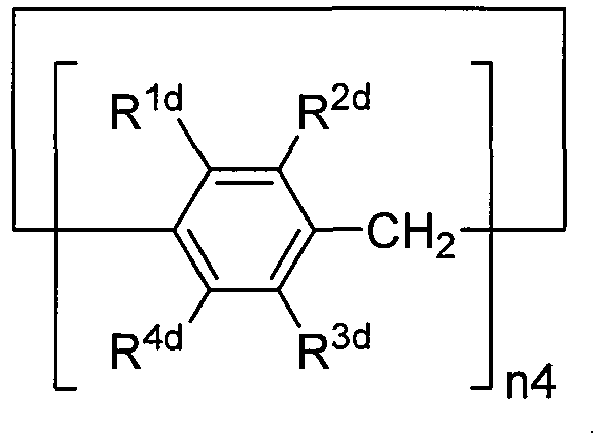
- R1d is each independently at each occurrence a hydrogen atom or an organic group,
- R2d is each independently at each occurrence a hydrogen atom or an organic group,
- R3d is each independently at each occurrence a hydrogen atom or an organic group, and
- R4d is each independently at each occurrence a hydrogen atom or an organic group,
- provided that at least one of R1d, R2d, R3d, and R4d is an organic group having an alkyl group, and the alkyl group has an SP value of 8.2 or more, and
- n4 is an integer of 4 to 20.
- In Formula (1D) above, R1d is each independently at each occurrence a hydrogen atom or an organic group, R2d is each independently at each occurrence a hydrogen atom or an organic group, R3d is each independently at each occurrence a hydrogen atom or an organic group, R4d is each independently at each occurrence a hydrogen atom or an organic group, at least one of R1d, R2d, R3d, and R4d is an organic group having an alkyl group, and the alkyl group has an SP value of 8.2 or more.
- The compound represented by Formula (1D) can have high miscibility, heat resistance, and water repellency by having an organic group having an alkyl group having an SP value of 8.2 or more.
- The organic group is defined as described for the organic group in Formula (1A) above.
- In one embodiment, R1d and R3d are each independently an organic group, and at least one of R1d and R3d is an organic group having an alkyl group having an SP value of 8.2 or more, or R2d and R4d are each independently an organic group, and at least one of R2d and R4d is an organic group having an alkyl group having an SP value of 8.2 or more.
- In one embodiment, at least two of R1d, R2b, R3d, and R4d are each an organic group having an alkyl group having an SP value of 8.2 or more.
- In one embodiment, two of R1d, R2d, R3d, and R4d are each an organic group having an alkyl group having an SP value of 8.2 or more.
- In one embodiment, R1d and R3d are each independently an organic group having an alkyl group having an SP value of 8.2 or more, or R2d and R4d are each independently an organic group having an alkyl group having an SP value of 8.2 or more.
- In one embodiment, R2d and R4d are each a hydrogen atom, or R1d and R3d are each a hydrogen atom.
- In a preferable embodiment, R1d and R3d are each independently an organic group having an alkyl group having an SP value of 8.2 or more, and R2d and R4d are each a hydrogen atom, or R2d and R4d are each independently an organic group having an alkyl group having an SP value of 8.2 or more, and R1d and R3d are each a hydrogen atom.
- In a more preferable embodiment, R1d and R3d are each an organic group having an alkyl group having an SP value of 8.2 or more, and R2d and R4d are each a hydrogen atom, or R2d and R4d are each an organic group having an alkyl group having an SP value of 8.2 or more, and R1d and R3d are each a hydrogen atom.
- The SP value of the alkyl group is preferably 8.2 to 8.4.
- In a preferable embodiment, the organic group having an alkyl group is preferably a group represented by -O-R12d wherein R12d is a long-chain alkyl group having 17 or more carbon atoms, preferably a C17-30 alkyl group, and preferably a C18-30 alkyl group or a C26-30 alkyl group.
- For example, the long-chain alkyl group may be linear or branched, and is preferably linear.
- n4 is an integer of 4 to 20, and preferably an integer of 4 to 6, and is more preferably 5 or 6.
- In a particularly preferable embodiment,
- the compound according to any one of claims 30 to 35, wherein R1d and R3d are each -O-R12d, and R2d and R4d are each a hydrogen atom, or
- R2d and R4d are each -O-R12d, and R1d and R3d is each a hydrogen atom,
- R12d is a C17-30 alkyl group, and preferably a C18-30 alkyl group or a C26-30 alkyl group, and
- n4 is an integer of 4 to 6, and is preferably 5 or 6.
- The molecular weight of the compound represented by Formula (1D) above can be preferably 500 to 10,000, and more preferably 1,000 to 5,000.
- When the compound represented by Formula (1D) above is formed into a film, the static contact angle of the resulting film with water is 80° or more, and preferably 90° or more.
- The compound represented by Formula (1D) above can be produced by the same method as for the compound represented by Formula (1A) above. For example, the compound represented by Formula (1D) above can be obtained by introducing a hydroxyl group at a predetermined position of a pillar[n]arene and reacting the hydroxyl group with a tosylate, a halide, or the like of an organic group having an alkyl group.
- The present disclosure provides a composition including a compound represented by Formula (lA), (1B), (1C), or (1D) above.
- The composition of the present disclosure may include the compounds of the present disclosure singly or may include two or more thereof in combination.
- For example, the composition of the present disclosure may be a liquid or a solid.
- In the composition of the present disclosure, each component may be included as a so-called inclusion, which is what is obtained by including a further component in the pillararene of the present disclosure, or for example, may be a so-called surface adhered substance, which is what is obtained by adhering a further component to the pillararene of the present disclosure.
- The composition of the present disclosure may include a solvent in addition to the compound of the present disclosure.
- Examples of the solvent include water; an aliphatic hydrocarbon such as hexane, cyclohexane, heptane, octane, nonane, decane, undecane, dodecane, or a mineral spirit; an aromatic hydrocarbon such as benzene, toluene, xylene, naphthalene, or solvent naphtha; an ester such as methyl acetate, ethyl acetate, propyl acetate, n-butyl acetate, isopropyl acetate, isobutyl acetate, cellosolve acetate, propylene glycol methyl ether acetate, carbitol acetate, diethyl oxalate, ethyl pyruvate, ethyl-2-hydroxybutyrate, ethyl acetoacetate, amyl acetate, methyl lactate, ethyl lactate, methyl 3-methoxypropionate, ethyl 3-methoxypropionate, methyl 2-hydroxyisobutyrate, or ethyl 2-hydroxyisobutyrate; a ketone such as acetone, methyl ethyl ketone, methyl isobutyl ketone, 2-hexanone, cyclohexanone, methylamino ketone, or 2-heptanone; a glycol ether such as ethyl cellosolve, methyl cellosolve, methyl cellosolve acetate, ethyl cellosolve acetate, propylene glycol monomethyl ether, propylene glycol monoethyl ether, propylene glycol monobutyl ether, propylene glycol monomethyl ether acetate, propylene glycol monoethyl ether acetate, propylene glycol monobutyl ether acetate, dipropylene glycol dimethyl ether, or ethylene glycol monoalkyl ether; an alcohol such as methanol, ethanol, isopropanol, n-butanol, isobutanol, tert-butanol, sec-butanol, 3-pentanol, octyl alcohol, 3-methyl-3-methoxybutanol, or tert-amyl alcohol; a glycol such as ethylene glycol or propylene glycol; a cyclic ether such as tetrahydrofuran, tetrahydropyran, or dioxane; an amide such as N,N-dimethylformamide or N,N-dimethylacetamide; an ether alcohol such as methyl cellosolve, cellosolve, isopropyl cellosolve, butyl cellosolve, or diethylene glycol monomethyl ether; diethylene glycol monoethyl ether acetate; and a fluorinecontaining solvent such as 1,1,2-trichloro-1,2,2-trifluoroethane, 1,2-dichloro-1,1,2,2-tetrafluoroethane, dimethylsulfoxide, 1,1-dichloro-1,2,2,3,3-pentafluoropropane (HCFC225), ZEORORA H, HFE7100, HFE7200, HFE7300, CF3CH2OH, CF3CF2CH2OH, or (CF3)2CHOH. These may be used singly or in combinations of two or more.
- When the composition includes a solvent, for example, the compound represented by Formula (1A), (1B), (1C), or (1D) may be a substance swollen by the solvent.
- For example, the solvent may be a gas. That is, the composition of the present disclosure may include a mixture of the compound represented by Formula (1A), (1B), (1C), or (1D) above and a gas of the solvent.
- The solvent as a gas can be preferably a hydrocarbon, more preferably a C4-10 hydrocarbon such as butane, pentane, hexane, cyclohexane, heptane, octane, nonane, or decane, and further preferably pentane or hexane. By including a gas of such a solvent, the contact angle of the film obtained by using the composition of the present disclosure can be improved.
- The composition of the present disclosure may include a thermoplastic resin such as a non-fluororesin or a fluororesin.
- Examples of the non-fluororesin include a polyolefin-based resin such as polyethylene (for example, linear low-density polyethylene, low-density polyethylene, high-density polyethylene, or ultra-high molecular weight polyethylene), polypropylene including various structural isomers (syndiotactic, isotactic, and atactic structures), poly-(4-methylpentene-1), ethylene-propylene copolymer, ethylene-vinyl acetate copolymer (EVA), a chlorinated polyethylene-based resin, or a modified polyolefin, a cycloolefin resin, a polyvinyl chloride-based resin such as polyvinyl chloride, polyvinylidene chloride, a polystyrene or polystyrene derivative-based resin including various structural isomers, polyamide, polyimide, polyamideimide, polycarbonate, an ionomer, an acrylic resin such as polymethyl methacrylate (PMMA) including various structural isomers, acrylic-styrene copolymer (AS resin), acrylonitrile-butadiene-styrene copolymer (ABS resin), butadiene-styrene copolymer, ethylene-vinyl alcohol copolymer (EVOH), a polyester such as polyethylene terephthalate (PET), polybutylene terephthalate (PBT), or polycyclohexane terephthalate (PCT), polyphenylene sulfide (PPS), polyether sulfone, polyether, polyether ketone (PEK), polyether ether ketone (PEEK), polyether ketone ketone (PEKK) polyetherimide, polyacetal (POM), polyphenylene oxide, modified polyphenylene oxide, polyarylate, aromatic polyester (liquid crystal polymer), a polyurethane-based resin, epoxy resin, phenolic resin, urea resin, melamine resin, unsaturated polyester, silicone resin, polydimethyl silicone (PDMS), polyurethane, a biodegradable resin such as polylactic acid (PLA) or polycaprolactone, or a copolymer, a mixture, a polymer alloy, or the like including the above.
- Examples of the fluororesin include polytetrafluoroethylene (PTFE), tetrafluoroethylene (TFE)/perfluoroalkyl vinyl ether (PAVE) copolymer [PFA], TFE/hexafluoropropylene (HFP) copolymer [FEP], ethylene [Et]/TFE copolymer [ETFE], Et/TFE/HFP copolymer, polychlorotrifluoroethylene [PCTFE], chlorotrifluoroethylene (CTFE)/TFE copolymer, Et/CTFE copolymer, polyvinylidene fluoride [PVDF], vinylidene fluoride (VDF)/TFE copolymer, and polyvinyl fluoride [PVF].
- The composition of the present disclosure may include a filler.
- Examples of the filler include, in addition to silica and carbon black, a metal oxide such as calcium oxide, titanium oxide, aluminum oxide, or magnesium oxide; a metal hydroxide such as magnesium hydroxide, aluminum hydroxide, or calcium hydroxide; a carbonate such as magnesium carbonate, aluminum carbonate, calcium carbonate, or barium carbonate; a silicate such as magnesium silicate, calcium silicate, sodium silicate, or aluminum silicate; a sulfate such as aluminum sulfate, calcium sulfate, or barium sulfate; synthetic hydrotalcite; a metal sulfide such as molybdenum disulfide, iron sulfide, or copper sulfide; diatomaceous earth, asbestos, lithopone (zinc sulfide/barium sulfide), graphite, carbon fluoride, calcium fluoride, coke, a fine quartz powder, talc, a mica powder, wollastonite, a carbon fiber, an aramid fiber, various whiskers, a glass fiber, an organic reinforcing agent, an organic filler, polytetrafluoroethylene, mica, celite, and clay. These may be used singly or as a mixture of two or more.
- The compounds and the composition of the present disclosure can be used in a wide range of applications, such as a compatibilizer, an adhesive, a surface-treating agent (for example, water repellent), a highly heat-resistant material, an adsorptive separation material, and a material for a formed article.
- The compounds and the composition of the present disclosure can each be formed into a formed article. Therefore, the disclosure also provides a formed article formed from any of the compounds and the composition of the disclosure.
- The method for forming the compounds and the composition of the present disclosure is not limited, and may be a general forming method such as extrusion forming, injection molding, press forming, vacuum forming, transfer molding, casting, or the like.
- The shape of the resulting formed article is not limited, and for example, may be any desired shape such as block-like, sheet-like, film-like, rod-like, or various other shapes depending on the applications.
- For example, when obtaining a film, the pillararene of the present disclosure can be dissolved in a good solvent, cast on a substrate, and heated to the boiling point of the solvent or higher to volatilize the solvent to form a film.
- A formed article of any of the compounds or the composition of the present disclosure has high heat resistance and water repellency.
- A film obtained by casting any of the compounds or the composition of the present disclosure can be treated with a gas of a hydrocarbon, preferably a C4-10 hydrocarbon such as butane, pentane, hexane, cyclohexane, heptane, octane, nonane, or decane, more preferably pentane or hexane to improve the water contact angle.
- When using any of the compounds or the composition of the present disclosure as a surface-treating agent, various substrates can be treated. Therefore, the disclosure provides a material including a substrate treated with any of the compounds and/or the composition of the disclosure.
- A substrate that can be treated with any of the compounds and the composition of the present disclosure can be composed of, for example, glass, a resin (which, for example, may be a natural or synthetic resin, such as a common plastic material), a metal, a ceramic, a semiconductor (silicon, germanium, or the like), a fiber (woven fabric, nonwoven fabric, or the like), fur, leather, a wood, a ceramic material, a stone material, a building member, a sanitary material, an adsorptive separation material, or any suitable material.
- A substrate treated with any of the compounds or the composition of the present disclosure has high heat resistance and water repellency.
- The present disclosure provides a liquid-repellent composition including a pillararene represented by Formula (1E) below and a hydrocarbon compound:
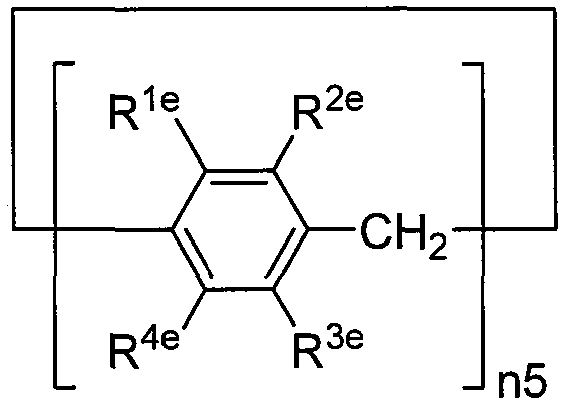
- R1e, R2e, R3e, and R4e are each independently a hydrogen atom or an organic group, and
- n5 is 5 or 6.
- The formed article of the liquid-repellent composition has high water repellency.
- The organic group is an organic group having preferably 1 to 30 carbon atoms, and more preferably 1 to 20 carbon atoms.
- The liquid-repellent composition may further include a solvent.
- Examples of the solvent include the same solvents as described for the composition including the compound represented by Formula (1A), (1B), (1C), or (1D) above. The solvent included in the liquid-repellent composition can be a C4-10 hydrocarbon such as butane, pentane, hexane, cyclohexane, heptane, octane, nonane, or decane, and further preferably pentane or hexane.
- The hydrocarbon compound included in the liquid-repellent composition can be preferably a C4-10 hydrocarbon such as butane, pentane, hexane, cyclohexane, heptane, octane, nonane, or decane, and further preferably pentane or hexane.
- The hydrocarbon compound included in the liquid-repellent composition may be the same as or different from the solvent.
- In the liquid-repellent composition, the pillararene represented by Formula (1E) and the hydrocarbon compound may be included as a so-called inclusion, which is what is obtained by including the hydrocarbon compound in the pillararene represented by Formula (1E), or for example, may be a so-called surface adhered substance, which is what is obtained by adhering the hydrocarbon compound to the pillararene.
- When the liquid-repellent composition includes a solvent, for example, the pillararene represented by Formula (1E) may be a substance swollen by the solvent.
- The inclusion and the surface adhered substance can be obtained by treating the pillararene represented by Formula (1E) with a gas of a hydrocarbon compound.
- The compounds of the present disclosure have been described in detail above. The methods for producing the compounds of the present disclosure, and the like are not limited to those given as examples above.
- The compounds of the present disclosure will be more specifically described through the following Examples, but the present disclosure is not limited to these Examples.
- Dehydrated dimethylformamide (30 mL) and dehydrated tetrahydrofuran (30 mL) were added to pillar[5]arene in a hydroquinone form (1.30 g, 2.13 mmol), and then NaH (1.33 g, 66.7 mmol) was added. 1-Tosyloxy-4,4,4-trifluorobutane (12.1 g, 42.9 mmol) was added, and then the reaction was carried out at 60°C for 72 hours. The temperature was returned to room temperature, and then methanol was added to quench the reaction. After concentration, separation was carried out with dichloromethane and saturated brine, and Na2SO4 was added to the chloroform layer for drying. Na2SO4 was removed by filtration, and concentration was carried out. Purification by silica column chromatography (hexane:dichloromethane = 2:1) gave the following substituted pillar[5]arene (yield of 15%).

- The following substituted pillar[5]arene (yield of 13%) was obtained in the same manner as in Synthesis Example 1 except that 4,4,5,5,5-pentafluoropentyl-p-toluenesulfonate (14.3 g, 42.9 mmol) was used instead of 1-tosyloxy-4,4,4-trifluorobutane.

- C2F5[5]: 1H NMR (400 MHz, CDCl3) δ 6.76 (s, 10H), 3.75-4.03 (m, 20H), 3.73 (s, 10H), 2.25-2.34 (m, 20H), 2.08-2.11 (m, 20H)
- The following substituted pillar[5]arene (yield of 5.3%) was obtained in the same manner as in Synthesis Example 1 except that 8-[(6-bromohexyl)oxy]-1,1,1,2,2,3,3,4,4,5,5,6,6-tridecafluoro-octane (22.6 g, 42.9 mmol) was used instead of 1-tosyloxy-4,4,4-trifluorobutane.

- The following substituted pillar [6] arene (yield of 24%) was obtained in the same manner as in Synthesis Example 1 except that pillar[6]arene in a hydroquinone form (1.30 g, 1.77 mmol), was used instead of pillar[5]arene in a hydroquinone form, and 4,4,5,5,5-pentafluoropentyl-p-toluenesulfonate (14.3 g, 42.9 mmol) was used instead of 1-tosyloxy-4,4,4-trifluorobutane.

- Paraformaldehyde (0.31 g, 10 mmol) was added to a solution of 1,4-dipentyloxybenzene (1.66 g, 10 mmol) in 1,2-dichloroethane (20 mL) in a nitrogen atmosphere. Next, boron trifluoride diethyl etherate (1.25 mL, 10 mmol) was added, and the resulting mixture was stirred at a temperature of 30°C for 3 hours. The solution was poured into methanol, and the precipitate was collected by filtration. The precipitate was dissolved in trichloromethane, and the undissolved portion was removed by filtration. Trichloromethane was removed under reduced pressure, and the target compound (0.413 g, yield of 23.2%) was crystallized with acetone.
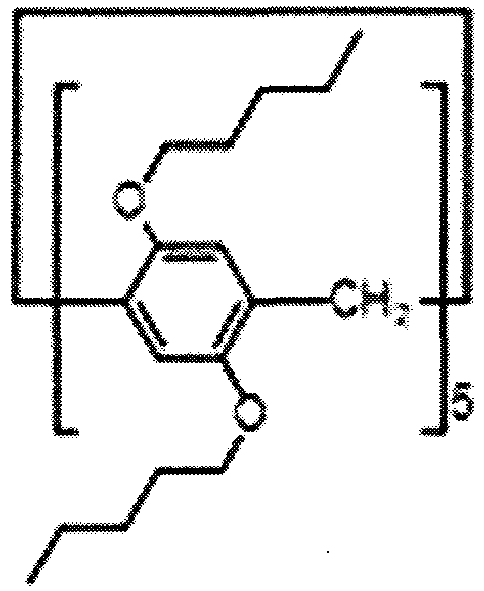
- Pillar[6]arene in a hydroquinone form (0.582 g, 0.795 mmol), was dissolved in acetonitrile (60 mL). Next, pentafluorobenzyl bromide (5.00 g, 19.2 mmol)) was added, and further, K2CO3 (1.65 g, 11.9 mmol) and KI (0.319 g, 1.92 mmol) were added. The resulting mixture was heated to 60°C and allowed to react for 72 hours. The target product was isolated by silica gel chromatography (dichloromethane:hexane = 20 to 25:80 to 75). 1H NMR and HPLC demonstrated that the target compound was obtained.
1H NMR (CDCl3, 400 MHz, TMS) δ 6.71 (s, 12H), 4.80 (s, 24H), 3.70 (s, 12H)
- Pillar[5]arene in a hydroquinone form (0.305 g, 0.5 mmol), was dissolved in dimethylsulfoxide (5 mL). After that, stearyl isocyanate (1.478 g, 5 mmol) was added, and 1 drop of dibutyltin laurate as a catalyst was added. The resulting mixture was heated to 40°C and allowed to react for 6 hours. The reaction solution and the precipitate were cleaned with hexane and water in presented order to obtain the target compound. FT-IR demonstrated that the target compound was obtained, by disappearance of the peak derived from pillararene in a hydroquinone form, that was broad around 3000 to 3500 cm-1, disappearance of the C=O peak derived from stearyl isocyanate at 2266 cm-1, and generation of the C=O peak derived from the urethane bond around 1708 cm-1.

- The SP values of side chains of the pillararenes of Synthesis Examples 1 to 4 were calculated by the Fedors method described above. Results thereof are shown in the following table.
- As shown in the following table, the SP values of the side chain structures of Synthesis Examples 1 to 4 were in the range of 6.9 to 7.4. On the other hand, for example, when a fluororesin having an SP value of 5.9 is selected, it is considered that the pillararene compound and the fluororesin have good miscibility because the SP values of the both are close to each other.
[Table 1] Side chain structure SP value Synthesis Example 1 -O-(CH2)3-CF3 7.0 Synthesis Example 2 -O-(CH2)3-C2F5 6.9 Synthesis Example 3 -O-(CH2)6-O-(CH2)2-C6F13 7.4 Synthesis Example 4 -O-(CH2)3-C2F5 6.9 - When the side chain structure is a long-chain alkyloxy group: -O-C17H35, -O-C20H41, -O-C26H53, or -O-C30H61 (all linear), the SP value was calculated by the Fedors method described above. Results thereof are shown in the following table.
- As shown in the following table, the SP values of the side chain structures of Reference Examples 1 to 4 were 8.4 to 8.5. On the other hand, for example, when a fluororesin having an SP value of 8.1 is selected, it is considered that the pillararene compound and the fluororesin have good miscibility because the SP values of both are close to each other.
[Table 2] Side chain structure SP value Reference Example 1 -O-C17H35 8.4 Reference Example 2 -O-C20H41 8.4 Reference Example 3 -O-C26H53 8.4 Reference Example 4 -O-C30H61 8.5 - The pillararenes obtained in Synthesis Examples 1, 2, 4, and 5 above were dissolved in dichloromethane. The obtained solutions were cast on glass substrates, respectively, dichloromethane was volatilized at room temperature, and then the resulting solids were heated to 160°C and melted. Next, the resulting melts were cooled at room temperature to obtain cast films of the pillararenes.
- A sample bottle containing a solvent and the cast films obtained above were added, the cast, films were exposed to solvent vapor for 17 hours, and then air-dried in a fume hood for 2 hours to obtain solvent-treated films. The combinations of cast films and solvents are as follows.
- Cast film of Synthesis Example 2: pentane, hexane, heptane, octane
- Cast film of Synthesis Example 4: cyclohexane
- Cast film of Synthesis Example 5: pentane, hexane
- Each of the air-dried samples was dissolved in deuterated chloroform, and the integrated values of the 1H NMR peaks of the pillararene and the alkane moiety demonstrated that the solvent(s) was(were) included in the pillararene.
- The contact angles of the cast films obtained from the compounds of Synthesis Examples 1, 2, 4, and 5 and the solvent-treated films obtained above were measured before and after the exposure. The contact angle was measured by using water with a fully automatic compact contact angle meter (P200A-HSM, Meiwafosis Co., Ltd.). Results thereof are shown in the following table.
[Table 3] Initial contact angle (°) Contact angle after solvent vapor treatment (°) Pentane Hexane Cyclohexane Heptane Octane Synthesis Example 1 99 - - - - - Synthesis Example 2 101 121 113 - 101 102 Synthesis Example 4 108 - - 110 - - Synthesis Example 5 97 102 106 - - - - The above results demonstrated that the films of the pillararenes of Synthesis Examples 1, 2, 4, and 5 had good water repellency. In particular, these demonstrated that the films had much better water repellency when treated with solvent vapor.
- The melting points of the cast films obtained from the compounds of Synthesis Examples 1, 2, 4, and 5 were measured with DSC7020 (Hitachi High-Tech Science Co., Tokyo, Japan). Results thereof are shown in the following table.
[Table 4] Melting point (°) Synthesis Example 1 148 Synthesis Example 2 117 Synthesis Example 4 87 Synthesis Example 5 83 - The above results demonstrated that the pillararenes of Synthesis Examples 1, 2, and 4, particularly Synthesis Examples 1 and 2, had a high melting point and excellent heat resistance. When any of the compounds is used as an additive to a resin, the high melting point of the compound can suppress softening of the resin. Therefore, the pillararenes of the present disclosure can be used in a wide range of applications such as an application requiring heat resistance.
- The compounds of the present disclosure can be used in a wide range of applications, such as a compatibilizer, an adhesive, a surface-treating agent, a highly heat-resistant material, an adsorptive separation material, and a material for a formed article.
Claims (48)
- A compound represented by Formula (1A) below:
 R1a is each independently at each occurrence a hydrogen atom or an organic group,R2a is each independently at each occurrence a hydrogen atom or an organic group,R3a is each independently at each occurrence a hydrogen atom or an organic group,R4a is each independently at each occurrence a hydrogen atom or an organic group,provided that at least one of R1a, R2a, R3a, and R4a is an organic group having 2 or more carbon atoms and having a fluoroalkyl group or a fluorophenyl group, andn1 is an integer of 4 to 20.
 - The compound according to claim 1, whereinR1a and R3a are each independently an organic group,provided that at least one of R1a and R3a is an organic group having 2 or more carbon atoms and having a fluoroalkyl group or a fluorophenyl group, orR2a and R4a are each independently an organic group,provided that at least one of R2a and R4a is an organic group having 2 or more carbon atoms and having a fluoroalkyl group or a fluorophenyl group.
- The compound according to claim 1 or 2, whereinR1a and R3a are each independently an organic group having 2 or more carbon atoms and having a fluoroalkyl group or a fluorophenyl group, orR2a and R4a are each independently an organic group having 2 or more carbon atoms and having a fluoroalkyl group or a fluorophenyl group.
- The compound according to any one of claims 1 to 3, whereinR2a and R4a are each a hydrogen atom, orR1a and R3a are each a hydrogen atom.
- The compound according to any one of claims 1 to 4, wherein n1 is an integer of 4 to 6.
- The compound according to any one of claims 1 to 5, whereinthe organic group having 2 or more carbon atoms and having a fluoroalkyl group is - (Op1-R11a q1)-Rfa,R11a is each independently at each occurrence a C1-10 alkylene group or -CONH-,Rfa is a C1-10 fluoroalkyl group,p1 is an integer of 0 to 2,q1 is an integer of 0 to 3, andin (Op1-R11a q1), occurrence order of O and R11a is not limited.
- The compound according to any one of claims 1 to 6, whereinthe organic group having 2 or more carbon atoms and having a fluoroalkyl group is -O-R11a-(O-R11a)r1-Rfa,R11a is each independently a C1-10 alkylene group or -CONH-,Rfa is a C1-10 fluoroalkyl group, andr1 is 0 or 1.
- The compound according to any one of claims 1 to 7, wherein the fluoroalkyl group is a perfluoroalkyl group.
- The compound according to any one of claims 1 to 8, whereinR1a and R3a are each -O-R11a-(O-R11a)r1-Rfa, and R2a and R4a are each a hydrogen atom, orR2a and R4a are each -O-R11a-(O-R11a)r1-Rfa, and R1a and R3a are each a hydrogen atom,R11a is each independently a C1-10 alkylene group or -CONH-,Rfa is a C1-10 perfluoroalkyl group,r1 is 0 or 1, andn1 is an integer of 4 to 6.
- The compound according to any one of claims 1 to 5, wherein
the organic group having 2 or more carbon atoms and having a fluorophenyl group is a group represented by the following formula:
-(Op3-R11p q3)-Rfp
whereinR11p is each independently at each occurrence a C1-10 alkylene group,Rfp is a phenyl group substituted by 1 to 5 fluorine,p3 is an integer of 0 to 2,q3 is an integer of 0 to 3, andin (Op3-R 11p q3), occurrence order of O and R11p is not limited. - The compound according to any one of claims 1 to 5,
whereinthe organic group having 2 or more carbon atoms and having a fluorophenyl group is a group represented by the following formula:
-O-R11p-Rfp
whereinR11p is each independently at each occurrence a C1-10 alkylene group, andRfP is a phenyl group substituted with 1 to 5 fluorine atoms. - The compound according to any one of claims 1 to 5, whereinR1a and R3a are each -O-R11p-Rfp, and R2a and R4a are each a hydrogen atom, orR2a and R4a are -O-R11p-Rfp, and R1a and R3a are each a hydrogen atom,R11p is each independently a C1-6 alkylene group,RfP is a phenyl group substituted with 1 to 5 fluorine atoms, andn1 is an integer of 4 to 6.
- The compound according to any one of claims 1 to 12, wherein when the compound is formed into a film, a static contact angle of the film with water is 80° or more.
- A compound represented by Formula (1B) below:
 R1b is each independently at each occurrence a hydrogen atom or an organic group,R2b is each independently at each occurrence a hydrogen atom or an organic group,R3b is each independently at each occurrence a hydrogen atom or an organic group, andR4b is each independently at each occurrence a hydrogen atom or an organic group,provided that at least one of R1b, R2b, R3b, and R4b is an organic group having a fluorine atom, and the organic group having a fluorine atom has an SP value of 8.0 or less, and n2 is an integer of 4 to 20.
 - The compound according to claim 14, whereinR1b and R3b are each independently an organic group,provided that at least one of R1b and R3b is an organic group having a fluorine atom and having an SP value of 8.0 or less, orR2b and R4b are each independently an organic group,provided that at least one of R2b and R4b is an organic group having a fluorine atom and having an SP value of 8.0 or less.
- The compound according to claim 14 or 15, whereinR1b and R3b are each independently an organic group having a fluorine atom and having an SP value of 8.0 or less, orR2b and R4b are each independently an organic group having a fluorine atom and having an SP value of 8.0 or less.
- The compound according to any one of claims 14 to 16, whereinR2b and R4b are each a hydrogen atom, orR1b and R3b are each a hydrogen atom.
- The compound according to any one of claims 14 to 17, wherein n2 is an integer of 4 to 6.
- The compound according to any one of claims 14 to 18, wherein the SP value of the organic group having a fluorine atom is 4.0 to 7.5.
- The compound according to any one of claims 14 to 19, wherein the organic group having a fluorine atom has a C1-10 fluoroalkyl group.
- The compound according to claim 20, wherein the C1-10 fluoroalkyl group is a C1-10 perfluoroalkyl group.
- The compound according to any one of claims 14 to 21, whereinR1b and R3b are each -O-R11b-(O-R11b)r2-Rfb, and R2b and R4b are each a hydrogen atom, orR2b and R4b are each -O-R11b-(O-R11b)r2-Rfb, and R1b and R3b are each a hydrogen atom,R11b is each independently a C1-10 alkylene group,Rfb is a C1-10 perfluoroalkyl group,r2 is 0 or 1, andn2 is an integer of 4 to 6.
- The compound according to any one of claims 14 to 22, wherein when the compound is formed into a film, a static contact angle of the film with water is 80° or more.
- A compound represented by Formula (1C) below:
 R1c is each independently at each occurrence a hydrogen atom or an organic group,R2c is each independently at each occurrence a hydrogen atom or an organic group,R3c is each independently at each occurrence a hydrogen atom or an organic group,R4c is each independently at each occurrence a hydrogen atom or an organic group,provided that at least one of R1c, R2c, R3c, and R4c is an organic group having a long-chain alkyl group having 17 or more carbon atoms, andn3 is an integer of 4 to 20.
 - The compound according to claim 24, whereinR1c and R3c are each independently an organic group,provided that at least one of R1c and R3c is an organic group having a long-chain alkyl group having 17 or more carbon atoms, orR2c and R4c are each independently an organic group,provided that at least one of R2c and R4c is an organic group having a long-chain alkyl group having 17 or more carbon atoms.
- The compound according to claim 24 or 25, whereinR1c and R3c are each independently an organic group having a long-chain alkyl group having 17 or more carbon atoms, andR2c and R4c are each independently an organic group having a long-chain alkyl group having 17 or more carbon atoms.
- The compound according to any one of claims 24 to 26, wherein the number of carbon atoms in the long-chain alkyl group is 17 to 30.
- The compound according to any one of claims 24 to 27, whereinR1c and R3c are each independently -O-R12c, orR2c and R4c are each independently -O-R12c, andR12c is a C17-30 alkyl group.
- The compound according to any one of claims 24 to 28, whereinR2c and R4c are each a hydrogen atom, orR1c and R3c are each a hydrogen atom.
- The compound according to any one of claims 24 to 29, wherein n3 is an integer of 4 to 6.
- The compound according to any one of claims 24 to 30, whereinR1c and R3c are each -O-R12c, and R2c and R4c are each a hydrogen atom, orR2c and R4c are each -O-R12c, and R1c and R3c is each a hydrogen atom,R12c is a C17-30 alkyl group, andn3 is an integer of 4 to 6.
- The compound according to any one of claims 24 to 31, wherein when the compound is formed into a film, a static contact angle of the film with water is 80° or more.
- A compound represented by Formula (1D) below:
 R1d is each independently at each occurrence a hydrogen atom or an organic group,R2d is each independently at each occurrence a hydrogen atom or an organic group,R3d is each independently at each occurrence a hydrogen atom or an organic group, andR4d is each independently at each occurrence a hydrogen atom or an organic group,provided that at least one of R1d, R2d, R3d, and R4d is an organic group having an alkyl group, and the alkyl group has an SP value of 8.2 or more, andn4 is an integer of 4 to 20.
 - The compound according to claim 33, whereinR1d and R3d are each independently an organic group,provided that at least one of R1d and R3d is an organic group having an alkyl group having an SP value of 8.2 or more, orR2d and R4d are each independently an organic group,provided that at least one of R2d and R4d is an organic group having an alkyl group having an SP value of 8.2 or more.
- The compound according to claim 33 or 34, whereinR1d and R3d are each independently an organic group having an alkyl group having an SP value of 8.2 or more, orR2d and R4d are each independently an organic group having an alkyl group having an SP value of 8.2 or more.
- The compound according to any one of claims 33 to 35, whereinR2d and R4d are each a hydrogen atom, orR1d and R3d are each a hydrogen atom.
- The compound according to any one of claims 33 to 36, wherein n4 is an integer of 4 to 6.
- The compound according to any one of claims 33 to 37, wherein the SP value of the alkyl group is 8.2 to 8.4.
- The compound according to any one of claims 33 to 38, whereinR1d and R3d are each -O-R12d, and R2d and R4d are each a hydrogen atom, orR2d and R4d are each -O-R12d, and R1d and R3d is each a hydrogen atom,R12d is a C17-30 alkyl group, andn4 is an integer of 4 to 6.
- The compound according to any one of claims 33 to 39, wherein when the compound is formed into a film, a static contact angle of the film with water is 80° or more.
- A composition comprising at least one of the compound according to any one of claims 1 to 40.
- A formed article of the compound according to any one of claims 1 to 40.
- A formed article formed from the composition according to claim 41.
- The formed article according to claim 42 or 43, wherein the formed article is a film.
- A material comprising a substrate treated with the compound according to any one of claims 1 to 40 or the composition according to claim 41.
- A liquid-repellent composition comprising a pillararene represented by Formula (1E) below and a hydrocarbon compound:
 R1e, R2e, R3e, and R4e are each independently a hydrogen atom or an organic group, andn5 is 5 or 6.
 - The liquid-repellent composition according to claim 46, wherein the organic group is an organic group having 1 to 30 carbon atoms.
- The liquid-repellent composition of claim 46 or 47, wherein the liquid-repellent composition further comprises a solvent.
Applications Claiming Priority (2)
| Application Number | Priority Date | Filing Date | Title |
|---|---|---|---|
| JP2021101149 | 2021-06-17 | ||
| PCT/JP2022/024222 WO2022265084A1 (en) | 2021-06-17 | 2022-06-16 | Fluorine-containing pillararene |
Publications (2)
| Publication Number | Publication Date |
|---|---|
| EP4357330A1 true EP4357330A1 (en) | 2024-04-24 |
| EP4357330A4 EP4357330A4 (en) | 2025-01-01 |
Family
ID=84527558
Family Applications (1)
| Application Number | Title | Priority Date | Filing Date |
|---|---|---|---|
| EP22825072.6A Pending EP4357330A4 (en) | 2021-06-17 | 2022-06-16 | Fluorine-containing pillararene |
Country Status (6)
| Country | Link |
|---|---|
| US (1) | US20240132432A1 (en) |
| EP (1) | EP4357330A4 (en) |
| JP (1) | JP7292690B2 (en) |
| CN (1) | CN117545732A (en) |
| TW (1) | TW202336002A (en) |
| WO (1) | WO2022265084A1 (en) |
Families Citing this family (3)
| Publication number | Priority date | Publication date | Assignee | Title |
|---|---|---|---|---|
| JP7475617B1 (en) * | 2022-10-14 | 2024-04-30 | ダイキン工業株式会社 | Pillararene Complexes |
| EP4585655A4 (en) * | 2022-10-14 | 2026-01-07 | Daikin Ind Ltd | PILOT COMPLEX |
| JP7480966B2 (en) * | 2022-10-14 | 2024-05-10 | ダイキン工業株式会社 | Pillararene Complexes |
Family Cites Families (5)
| Publication number | Priority date | Publication date | Assignee | Title |
|---|---|---|---|---|
| JP2015221893A (en) | 2014-04-30 | 2015-12-10 | 国立大学法人金沢大学 | polymer |
| JP6551827B2 (en) * | 2015-03-06 | 2019-07-31 | 国立大学法人金沢大学 | Porous carbon material and method for producing the same |
| JP2018039758A (en) * | 2016-09-08 | 2018-03-15 | 国立大学法人金沢大学 | Aggregate, clathrate, luminescent material |
| CN108659215B (en) * | 2018-06-05 | 2019-08-09 | 福州大学 | A kind of fluorine-containing polyarylether compound containing pillar [5] arene and preparation method thereof |
| US11923419B2 (en) * | 2019-08-20 | 2024-03-05 | Regents Of The University Of Minnesota | Non-covalent modification of graphene-based chemical sensors |
-
2022
- 2022-06-16 CN CN202280042592.6A patent/CN117545732A/en active Pending
- 2022-06-16 JP JP2022097536A patent/JP7292690B2/en active Active
- 2022-06-16 WO PCT/JP2022/024222 patent/WO2022265084A1/en not_active Ceased
- 2022-06-16 EP EP22825072.6A patent/EP4357330A4/en active Pending
- 2022-06-17 TW TW111122677A patent/TW202336002A/en unknown
-
2023
- 2023-12-18 US US18/542,922 patent/US20240132432A1/en active Pending
Also Published As
| Publication number | Publication date |
|---|---|
| EP4357330A4 (en) | 2025-01-01 |
| TW202336002A (en) | 2023-09-16 |
| WO2022265084A1 (en) | 2022-12-22 |
| JP2023001080A (en) | 2023-01-04 |
| JP7292690B2 (en) | 2023-06-19 |
| CN117545732A (en) | 2024-02-09 |
| US20240132432A1 (en) | 2024-04-25 |
Similar Documents
| Publication | Publication Date | Title |
|---|---|---|
| US20240132432A1 (en) | Fluorine-containing pillararene | |
| EP3668555B1 (en) | Polymeric coatings | |
| US11254638B2 (en) | Nitrileoxide compound | |
| Graham et al. | Fluoropolymers with very low surface energy characteristics | |
| CN112166153A (en) | Transient polymer formulations, articles thereof, and methods of making and using the same | |
| CN113439111B (en) | Composition and article | |
| KR102800150B1 (en) | Curable composition | |
| EP4036148B1 (en) | Fluoropolyether group-containing silane compound | |
| WO2016143869A1 (en) | Nitrile oxide compound | |
| CN104302690B (en) | For the resin molded product for preparing the emulsion compositions of zinc-containing solid catalyst layered product and being prepared using the emulsion compositions | |
| Wang et al. | Construction of enhanced self-plasticized PVC via grafting with a bio-derived Mannich base | |
| KR101901522B1 (en) | High fluorinated polymer compound with high glass transition temperature and solubility in fluorous solvents | |
| Raihane et al. | Radical copolymerization of 2, 2, 2-trifluoroethyl methacrylate with cyano compounds for dielectric materials: Synthesis and characterization | |
| JPWO2014136952A1 (en) | Fluorine-containing nitrile oxide compounds | |
| US6531558B1 (en) | Fluoromonomers and method of production, and new fluoropolymers produced therefrom | |
| Tran et al. | Weatherability and wear resistance characteristics of plasma fluoropolymer coatings deposited on an elastomer substrate | |
| EP4215553A1 (en) | Fluorine-containing polymer and method for manufacturing same | |
| US20230167211A1 (en) | Monomer isomerization and polymer fluorination for sustainable depolymerizable polymers | |
| Hino et al. | Cationic copolymerization behavior of cyclic ether monomers with norbornene‐containing cyclic carbonate or spiro–orthoether structure | |
| Gao et al. | Synthesis and characterization of poly (methyl methacrylate-butyl acrylate) by using glow-discharge electrolysis plasma | |
| US6355702B1 (en) | Acyclic monomers which when cured are reworkable through thermal decomposition | |
| Li et al. | The dielectric properties of low temperature thermally cross-linked polystyrene and poly (methyl methacrylate) thin films | |
| US12209062B2 (en) | Nitrile oxide compound | |
| Vasuta et al. | Fluorocarbon minimization via semifluorinated copolymer films by combining spin coating and ring-opening metathesis polymerization | |
| WO2021193173A1 (en) | Composition for hard coat layer formation use, hard coat film, method for producing hard coat film, and article including hard coat film |
Legal Events
| Date | Code | Title | Description |
|---|---|---|---|
| STAA | Information on the status of an ep patent application or granted ep patent |
Free format text: STATUS: THE INTERNATIONAL PUBLICATION HAS BEEN MADE |
|
| PUAI | Public reference made under article 153(3) epc to a published international application that has entered the european phase |
Free format text: ORIGINAL CODE: 0009012 |
|
| STAA | Information on the status of an ep patent application or granted ep patent |
Free format text: STATUS: REQUEST FOR EXAMINATION WAS MADE |
|
| 17P | Request for examination filed |
Effective date: 20240115 |
|
| AK | Designated contracting states |
Kind code of ref document: A1 Designated state(s): AL AT BE BG CH CY CZ DE DK EE ES FI FR GB GR HR HU IE IS IT LI LT LU LV MC MK MT NL NO PL PT RO RS SE SI SK SM TR |
|
| DAV | Request for validation of the european patent (deleted) | ||
| DAX | Request for extension of the european patent (deleted) | ||
| A4 | Supplementary search report drawn up and despatched |
Effective date: 20241202 |
|
| RIC1 | Information provided on ipc code assigned before grant |
Ipc: C07C 43/21 20060101ALI20241126BHEP Ipc: C07C 43/225 20060101ALI20241126BHEP Ipc: C07C 271/44 20060101ALI20241126BHEP Ipc: C08G 61/02 20060101ALI20241126BHEP Ipc: C09K 3/00 20060101ALI20241126BHEP Ipc: C09J 165/00 20060101ALI20241126BHEP Ipc: C09D 165/00 20060101ALI20241126BHEP Ipc: C08L 65/00 20060101ALI20241126BHEP Ipc: C09K 3/18 20060101ALI20241126BHEP Ipc: C08L 61/12 20060101ALI20241126BHEP Ipc: C08G 8/28 20060101ALI20241126BHEP Ipc: C07C 43/205 20060101AFI20241126BHEP |
|
| STAA | Information on the status of an ep patent application or granted ep patent |
Free format text: STATUS: EXAMINATION IS IN PROGRESS |
|
| 17Q | First examination report despatched |
Effective date: 20251029 |