EP4356326B1 - Verfahren zum abrufen von gespeicherten informationen bezüglich eines bretterpakets - Google Patents
Verfahren zum abrufen von gespeicherten informationen bezüglich eines bretterpakets Download PDFInfo
- Publication number
- EP4356326B1 EP4356326B1 EP22732668.3A EP22732668A EP4356326B1 EP 4356326 B1 EP4356326 B1 EP 4356326B1 EP 22732668 A EP22732668 A EP 22732668A EP 4356326 B1 EP4356326 B1 EP 4356326B1
- Authority
- EP
- European Patent Office
- Prior art keywords
- boards
- pack
- digital
- during
- features
- Prior art date
- Legal status (The legal status is an assumption and is not a legal conclusion. Google has not performed a legal analysis and makes no representation as to the accuracy of the status listed.)
- Active
Links
Images




Classifications
-
- G—PHYSICS
- G06—COMPUTING OR CALCULATING; COUNTING
- G06Q—INFORMATION AND COMMUNICATION TECHNOLOGY [ICT] SPECIALLY ADAPTED FOR ADMINISTRATIVE, COMMERCIAL, FINANCIAL, MANAGERIAL OR SUPERVISORY PURPOSES; SYSTEMS OR METHODS SPECIALLY ADAPTED FOR ADMINISTRATIVE, COMMERCIAL, FINANCIAL, MANAGERIAL OR SUPERVISORY PURPOSES, NOT OTHERWISE PROVIDED FOR
- G06Q10/00—Administration; Management
- G06Q10/08—Logistics, e.g. warehousing, loading or distribution; Inventory or stock management
- G06Q10/087—Inventory or stock management, e.g. order filling, procurement or balancing against orders
-
- G—PHYSICS
- G05—CONTROLLING; REGULATING
- G05B—CONTROL OR REGULATING SYSTEMS IN GENERAL; FUNCTIONAL ELEMENTS OF SUCH SYSTEMS; MONITORING OR TESTING ARRANGEMENTS FOR SUCH SYSTEMS OR ELEMENTS
- G05B19/00—Program-control systems
- G05B19/02—Program-control systems electric
- G05B19/18—Numerical control [NC], i.e. automatically operating machines, in particular machine tools, e.g. in a manufacturing environment, so as to execute positioning, movement or co-ordinated operations by means of program data in numerical form
- G05B19/182—Numerical control [NC], i.e. automatically operating machines, in particular machine tools, e.g. in a manufacturing environment, so as to execute positioning, movement or co-ordinated operations by means of program data in numerical form characterised by the machine tool function, e.g. thread cutting, cam making, tool direction control
-
- G—PHYSICS
- G06—COMPUTING OR CALCULATING; COUNTING
- G06Q—INFORMATION AND COMMUNICATION TECHNOLOGY [ICT] SPECIALLY ADAPTED FOR ADMINISTRATIVE, COMMERCIAL, FINANCIAL, MANAGERIAL OR SUPERVISORY PURPOSES; SYSTEMS OR METHODS SPECIALLY ADAPTED FOR ADMINISTRATIVE, COMMERCIAL, FINANCIAL, MANAGERIAL OR SUPERVISORY PURPOSES, NOT OTHERWISE PROVIDED FOR
- G06Q50/00—Information and communication technology [ICT] specially adapted for implementation of business processes of specific business sectors, e.g. utilities or tourism
- G06Q50/02—Agriculture; Fishing; Forestry; Mining
-
- G—PHYSICS
- G05—CONTROLLING; REGULATING
- G05B—CONTROL OR REGULATING SYSTEMS IN GENERAL; FUNCTIONAL ELEMENTS OF SUCH SYSTEMS; MONITORING OR TESTING ARRANGEMENTS FOR SUCH SYSTEMS OR ELEMENTS
- G05B2219/00—Program-control systems
- G05B2219/30—Nc systems
- G05B2219/45—Nc applications
- G05B2219/45229—Woodworking
Definitions
- This invention relates to a method for retrieving saved information relative to a first pack of boards and a use of that method.
- This invention relates in general to the wood processing sector, and in particular to the plants in which logs are cut to obtain boards, as well as the plants which subsequently process those boards.
- the cutting of boards and their subsequent processing to obtain the end product may be carried out either one immediately after the other, or one when some time has passed after the other.
- the boards are stored by creating packs of boards constituted of a plurality of superposed layers of boards.
- the layers are separated from each other by interposing strips of wood, which are positioned oriented perpendicularly to the orientation of the boards in the layers; the latter in contrast being the same in all of the layers.
- the grouping of boards in packs of boards is particularly used in wood cutting plants where sorting of the boards based on a size or quality measurement is used.
- the boards are grouped in packs of boards with uniform features, which can be subsequently sold or processed in other lines.
- Storage of the boards in packs of boards is also used to subject the boards to the necessary period of drying/desiccation.
- the boards can initially be positioned in the various layers at a predetermined distance from each other, to allow good air circulation around all of the boards.
- the drying/desiccation has finished, in many cases the layers of the pack of boards are compacted, moving the boards towards each other perpendicularly to their main line of extension.
- the tracking of individual boards is generally based on an active recognition of features of the boards, such as surface appearance features or internal features (for example the distribution of knots), which as a whole are commonly known as the "fingerprint", since they allow the board to be identified with good precision.
- the main problem encountered when using tracking based on the "fingerprint" of the boards is the volume of operations which must be performed by the computers assigned that function. Indeed, the higher the number of boards to be identified present at all times in the system memory, the longer the average processing time needed by the computer before a match is identified between a real board to be identified and one of the saved boards.
- Italian application No. 102015000071674 describes a method for retrieving a quality class assessment report for a wooden board which has previously undergone a quality class assessment when the assessment report and an image of at least a portion of a face of the wooden board were associated with each other and stored electronically in an electronic database.
- the method comprises a step of capturing at least one image of a portion of the wooden board and a step of comparing the captured image with the images stored in the electronic database, to identify the stored image that corresponds to the wooden board.
- the evaluation report which is stored in the electronic database in association with the identified stored image, is then provided to a user.
- US 2018/182088 A1 describes an image processing system which receives an image depicting a pack of boards, applies a homographic transformation to estimate a frontal view of the front face and identifies a plurality of divisions between rows in the estimate. For each adjacent pair of the plurality of divisions between rows, a plurality of vertical divisions is identified. The image processing system identifies a set of bounding boxes defined by pairs of adjacent divisions between rows and pairs of adjacent vertical divisions. Based on the bounding boxes, the image processing system determines the number of boards in the bundle.
- SE 1930309 describes a system to track logs in a wood processing chain, which includes a database arrangement that includes pre-recorded image of a given log, wherein the given log is associated with log identification information.
- the system further includes a plurality of imaging devices implemented at a sorting station. The plurality of imaging devices is configured to capture a first set of images from at least a first prespecified oblique angle.
- the system further includes a data processing arrangement that is configured to: identify the given log at the sorting station; compare the at least one prerecorded image with the captured first set of images at the sorting station in order to find an optimum image from the compared images for identification of the given log; determine a plurality of physical characteristics; and append the log identification information with the determined physical characteristics of the given log.
- This invention was based on the insight that a significant improvement in the tracking of the individual packs of boards could also be advantageously used to make tracking of the individual boards after a period of storage much more high-performance.
- one aim of this invention has been to provide a method for retrieving saved information relative to a pack of boards.
- a further aim of this invention has been to provide a method for determining a match between a board and one of a plurality of known boards.
- a pack 1 of boards shall be understood to be a set of boards 2 which are positioned in a plurality of superposed layers 3.
- Each layer 3 comprises a plurality of boards 2 which all have the same thickness.
- the layers 3 may be separated from each other by strips of wood 4 with known thickness, or not; however, preferably, the strips of wood 4 interposed between two adjacent layers 3 all have the same thickness.
- This invention is applied both in the case in which the pack 1 of boards comprises boards 2 which all have the same dimensions, and in the case in which the boards 2 have different dimensions.
- Each board 2 has an outer surface constituted of six flat surfaces, facing opposite ways in pairs; in particular it is possible to identify two main surfaces 5 which extend parallel to a main longitudinal axis of the board 2 (those with maximum extent), two end surfaces 6 perpendicular to the main axis (those with minimum extent) and two lateral secondary surfaces 7, which also extend parallel to the main longitudinal axis (whose extent is less than or equal to that of the main surfaces).
- the boards 2 of all of the layers 3 are positioned with the same orientation, that is to say, with the relative main lines of extension all substantially parallel to each other. Moreover, advantageously, the boards 2 are resting on one of their main surfaces 5, with the other facing upwards.
- the pack 1 of boards as a whole is roughly in the shape of a parallelepiped, and in it it is possible to identify a lower face facing downwards and usually hidden from view, an upper face 8 and four lateral faces 9.
- this invention relates to a method for retrieving saved information relative to a pack 1 of boards, where the first pack 1 of boards belongs to a plurality of known packs of boards 2, that is to say, packs of boards 2 for which one or more features are known.
- a pack 1 of boards may be known because its origin and/or its date of creation are known.
- the individual boards 2 which belong to it may be known and, if necessary, their position inside the pack 1 of boards. All of this information may be part of the saved information relative to the known pack 1 of boards.
- the method for retrieving the saved information applies to a first pack 1 of boards, which is known to belong to the plurality of known packs of boards 2. In some cases, this may even be the only information known for the pack, although in most cases it is also known (or at least obvious for the operator) which type of wood it is, and what the dimensions are of the pack 1 of boards and of the layers 3 and of the boards 2 which belong to it.
- the method in question comprises two macro-steps, a preparation step and a retrieval step, both advantageously carried out using electronic devices.
- a preparation step for each known pack 1 of boards, a digital dataset relative to the known pack 1 of boards is added to a first digital archive; the digital data may already be available or may be generated during the step.
- the retrieval step is carried out with regard to a first pack 1 of boards which belongs to the plurality of known packs of boards 2, for which the preparation step has previously been carried out.
- information relative to the first pack 1 of boards is extracted from the relative digital dataset present in the first digital archive.
- the retrieval step is carried out after the preparation step. More generally, the retrieval step may be carried out only after at least partly carrying out the preparation step, in such a way that at least some digital datasets are present in the first digital archive.
- the preparation step may go on for some time and in terms of time overlap the carrying out of various retrieval steps.
- the relative digital dataset is added to the first digital archive. Therefore, at full speed, on one hand the first digital archive will be continuously enriched with new datasets, and on the other hand, for each first pack 1 of boards whose information is to be retrieved, the retrieval step is carried out by drawing on the data at that moment present in the first digital archive.
- the first digital archive is linked to identification of the pack 1 of boards in a particular position of a plant, once each known pack 1 of boards is identified in a corresponding first pack 1 of boards which passes at that position, the corresponding dataset may even be removed from the first digital archive or be shifted into a different section of the first digital archive so that it will no longer be considered during the subsequent retrieval steps.
- the preparation step comprises both a generation step, and a saving step.
- a first electronic device is used to generate one or more reference images, each of which shows at least one reference portion of the known pack 1 of boards.
- the reference images advantageously show the outer appearance of the reference portion.
- different types of reference images may be adopted, on their own or in combination with each other.
- the reference images are simple photographic images acquired with a normal camera which operates in the visible band, preferably acquired in predetermined lighting conditions with white light.
- each reference image is generated by acquiring a digital image of the at least one reference portion of the relative known pack 1 of boards.
- each reference image is in contrast generated artificially by combining previously obtained digital images (combination step). That may be carried out when the boards 2, which constitute the known pack 1 of boards, are in turn known and have already had images of their surface acquired.
- the digital images are combined with each other to effectively create an overall reference image.
- the digital images are only implicitly combined with each other, without effectively creating an overall reference image. Indeed, as explained below, what is of interest in terms of carrying out the method according to this invention are not necessarily the reference images, but reference features linked to them.
- the generation step comprises first identifying which known boards 2 are present in the reference portion of the relative known pack 1 of boards and if necessary what is the orientation of each board 2.
- the reference images are obtained by combining digital images of the known boards 2, previously obtained.
- the combination of the images comprises the combination of all of the images of the surfaces of the boards 2 of the pack which are visible.
- the digital image combination step is carried out while also taking into account the distance between the boards 2 present in the various layers 3 of the known pack 1 of boards.
- each known pack 1 of boards corresponds to at least part of one of either the upper face 8 or the lateral faces 9 of the known pack 1 of boards.
- each known pack 1 of boards corresponds to the whole upper face 8 or to a whole lateral face of the known pack 1 of boards.
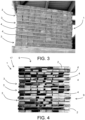
- the reference portion of the known pack 1 of boards comprises one or more boards 2 in predetermined positioned, not necessarily adjacent to each other (for example the four faces in the corners of the face of Figure 4 ).
- each reference image shows at least one side of at least one board 2 placed at a predefined position inside the known pack 1 of boards. In some embodiments, that at least one side is visible from the outside of the known pack 1 of boards. In other embodiments that side may be seen only after extraction of the board 2 from the known pack 1 of boards; in that case an image of the side will have to be captured before the known pack 1 of boards is formed.
- first reference images are generated, each of which shows at least one first reference portion, preferably of one of either the upper face 8 or the lateral faces 9 of the known pack 1 of boards
- second references images are generated, each of which shows at least one second reference portion, preferably of another of either the upper face 8 or the lateral faces 9 of the known pack 1 of boards.
- the subject matter of the first reference images and the second reference images is a first reference portion and a second reference portion with their positioning rotated 180° (about a vertical central axis) relative to the known pack 1 of boards, such as the two faces in which the end surfaces 6 of the boards 2 are visible. This allows management of the cases in which in the subsequent retrieval step the first pack 1 of boards may without a preference have one of two orientations rotated 180° relative to each other.
- the acquisition occurs using an image acquisition device 11 associated with the plant, for example at, or near, a stacking station in which each pack is formed.
- Activation of acquisition may occur automatically through a processing unit 12 connected to the image acquisition device 11, following a trigger signal generated by a photocell 13 (for example fitted at a path through which the pack 1 of boards comes out of the stacking station, or generated by an electronic control system of the production line, for example upon completion of the pack 1 of boards.
- the image acquisition device 11 is advantageously calibrated (with known methods, for example by capturing an image of a chessboard), in such a way as to be able to compensate via software for any distortions due to the lens and/or the position. That also allows identification with good precision, in the images acquired by the image acquisition device 11, of the expected position of a preset reference point of the pack 1 of boards.
- the reference point may be linked to the first board 2 of the upper layer 3 or of the lower layer 3; by appropriately structuring the mechanics of the line for forming the pack 1 of boards (for example the position of the photocell 13) it is indeed possible to know with good precision, obviously within predetermined tolerances, the position of that first board 2.
- the preparation step comprises carrying out the saving step, during which, for each known pack 1 of boards, the relative digital dataset is created in the first digital archive present in a digital memory 15.
- the saving step is advantageously carried out by a first computer (or more than one if necessary).
- the first computer is separate from the first electronic device and is operatively connected to the first electronic device to receive the reference images from it.
- the first computer may also carry out the function of the first electronic device (in particular if the generation step comprises the combination step).
- the reference features are image descriptors.
- the reference features coincide with the reference image or with parts of it.
- the method comprises carrying out the retrieval step, by means of which it is possible to retrieve the information relative to the first pack 1 of boards.
- the retrieval step in turn is divided into at least three sub-steps: an observation step, a comparison step and an extraction step.
- the observation step is a step during which, using a digital camera 16, at least one digital photograph 17 of at least one comparison portion of the first pack 1 of boards is acquired.
- the methods for acquisition of the digital photograph 17 may be all of those described above with reference to acquisition of the reference images.
- the methods for acquisition of the digital photograph 17 will correspond to the methods adopted for the acquisition of the reference images or of the parts of which they are composed.
- both the reference images and the digital photograph 17 are acquired in the visible band.
- acquisition of the digital photograph 17 may advantageously be carried out using at least one digital camera 16 active in the visible band.
- that digital camera 16 may be, as desired, alternatively a smartphone camera 18 or a tablet camera 19, an image acquisition device 11 of a wood processing plant, or a digital camera fitted on a fork-lift truck 20 or on a pallet truck used for moving packs of boards 2.
- the fork-lift truck or the pallet truck may also be equipped with an electronic interface by means of which the operator can receive the information about the pack 1 of boards photographed by the camera, obtained at the end of the retrieval step (for example so as to know its identity, to know whether or not it is the one he/she is looking for, etc.).
- the digital camera 16 is a fixed camera of a wood processing plant, and the reference images are acquired by means of an image acquisition device 11, it is advantageous to ensure that they are fitted in a position which is preferably similar relative to the position of the pack 1 of boards at the moment of acquisition of the relative images/photographs, as well as ensuring that the lighting conditions are similar.
- the method according to this invention may also be carried out in conditions where that does not apply.
- At least one digital photograph 17 is acquired in which both the comparison portion of the pack 1 of boards, and other elements extraneous to the comparison portion are visible; in this case, the extraneous elements may be ignored during the subsequent comparison step. That can be achieved by processing the digital photograph 17 in such a way as to eliminate from it the parts which show the elements extraneous to the comparison portion, thereby identifying what is of interest.
- the at least one digital photograph 17 is acquired by photographing a board 2 of the first pack 1 of boards, after the board 2 has been extracted from the first pack 1 of boards. In this case, it is possible to photograph surfaces of the board 2 which were not visible when the board 2 was still in the pack 1 of boards.
- each reference portion and each comparison portion may correspond to the whole upper face 8 of the respective pack 1 of boards, or to a whole face of it which comprises the end surfaces 6 of the boards 2, or to a predetermined number of layers 3 (those higher up, lower down, or others) inside a specific face of the known pack 1 of boards, etc.
- the first pack 1 of boards at least two possible comparison portions are identifiable which meet the selected criterion; for example, there are two faces in which the end surfaces 6 of the boards 2 are present, there are two possible orientations of the upper face 8 such as to position the boards 2 with a predetermined orientation (for example they are horizontal or vertical in the image), etc.
- the one or more reference images have been generated both for the first reference portion and for the second reference portion. Otherwise, the digital image of the first pack 1 of boards may be acquired only for one of the possible comparison portions (which will then be compared with both of the corresponding reference portions of each known pack 1 of boards).
- At least one first digital photograph 17 of at least one first comparison portion, and at least one second digital photograph 17 of at least one second comparison portion are acquired; in accordance with what is explained below, in the comparison step the two will be compared respectively with first reference images and with second reference images.
- the comparison step is carried out by means of a second computer (or more than one) and comprises comparing first features, linked to the digital photograph 17, with the saved reference features relative to the one or more reference images of one or more of said known packs of boards 2.
- the second computer may coincide with the first computer.
- That comparison has the aim of identifying a match between the first features and the saved reference features relative to one of the saved reference images (which will be related to a specific known pack 1 of boards). Obviously the identification of what is a reference feature in the reference images and a first feature in the digital photograph 17 is performed in the same way.
- the first features are compared one after another with the reference features of a plurality of reference images (all of those available or only some relevant ones depending on the embodiments), which are related to a plurality of known packs of boards 2.
- the comparison step it may be considered that there is a match between the digital photograph 17 and a saved reference image, when the first features relative to the digital photograph 17 differ from the reference features of that reference image, by less than a preset deviation.
- the preset deviation may also be assessed by assessing its inverse (that is to say, a similarity score).
- the comparison step ends when that match is found.
- the comparison step is carried out for all of the relevant reference images, and the match may be identified either for the reference image for which the deviation between the first features relative to the digital photograph 17 and the reference features is lowest, or only in the case in which the lowest deviation determined in that way, between the first features relative to the digital photograph 17 and the reference features, is also sufficiently lower than all of the other deviations calculated (above all than the deviation closest to it).
- the relevant reference images are all of the reference images available.
- the relevant reference images are only those which relate to known packs of boards 2 which have features in common with the first pack, such as, for example, the type of wood, the number of layers 3, the length of the boards 2, the thickness of the layers 3, etc. Using this known information, in some cases it is indeed possible to drastically reduce the times for carrying out the comparison step.
- the common features may be automatically determined by the electronic management system or may be requested from the operator or supplied by him/her.
- the comparison step is carried out even without knowing beforehand the thickness and/or the width of the individual boards 2 which constitute the first pack 1 of boards.
- the comparison step also comprises a calibration step, during which the at least one digital photograph 17 is made comparable to the one or more reference images.
- the calibration step may relate to a calibration of the colours, of the white, of the brightness, of the contrast, etc.
- the calibration step may comprise modifying the at least one digital photograph 17 to reduce distortions due to perspective effects and/or due to the position of the camera relative to the first pack 1 of boards.
- that modification may transform the at least one digital photograph 17 in such a way that it appears as if it had been acquired by a camera placed, relative to the pack, in an observation point similar to that in which the image acquisition device 11 used for acquisition of the reference images is located.
- the calibration step is carried out using as a reference an object with known features which is visible in the digital photograph 17, such as for example a chessboard.
- the same object with known features may also be inserted in the reference images.
- the comparison step comprises a dividing step, during which in each digital photograph 17 first areas 21 are identified which are each considered to correspond to a different board 2 of the first pack 1 of boards or to an empty space included between two adjacent boards 2.
- the first areas 21 are advantageously identified by an electronic processing device which applies an image processing algorithm to the digital photograph 17.
- the indication that the first areas 21 are each "considered to correspond" to a different board 2 of the first pack 1 of boards, is intended to indicate that, since the result is from a software processing of the photograph, it is not possible to be certain that each first area identified in the digital photograph 17 effectively corresponds to a different board 2 or to an empty space; as for all automatic image processing techniques a percentage of error, however small, cannot be ruled out.
- the areas which are identified as corresponding to empty spaces 10 are eliminated by the subsequent processing operations (that is to say, especially in the case in which the empty spaces 10 may be modified over time following handling of the packs of boards 2); in contrast, in other embodiments, even the empty spaces 10 are considered in the comparison step.
- the identification of the various areas is facilitated when the position of the base of the pack 1 of boards is known, for example thanks to the fact that the position of the digital camera 16 is fixed relative to the first pack 1 of boards.
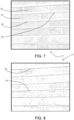
- the identification of the first areas 21 may advantageously be carried out by calculating the gradient along two orthogonal lines (advantageously the horizontal line and the vertical line - which relate to the real object).
- Figures 7 and 8 show, with two different levels of brightness and contrast, how the assessment of the vertical gradient allows identification with good precision of the separating line 22 between the individual layers 3.
- each layer 3 comprises more than one board 2 (this generally applies only for the faces in which the end surfaces 6 of the boards 2 are visible), inside each layer 3 of boards 2 identified in the image of the pack it is possible to identify the position of the end of each board 2 present, in this case too, for example, by using the information given by the horizontal gradient of the image to identify where it starts and ends. Knowing beforehand the permitted widths for the boards 2 allows more certain segmentation.
- Figures 9 and 10 show, again with different levels of brightness and contrast, how the assessment of the horizontal gradient allows identification with precision of the separating line 23 between adjacent boards 2, and between boards 2 and empty spaces 10.
- the first features are organised as a matrix, in which the layer 3 to which the board 2 belongs is saved as a vertical coordinate of the first areas 21, whilst the position of the centres 24 of the first areas 21 is saved as a horizontal coordinate on each layer 3 of boards 2.
- the comparison step also comprises a plurality of comparison sub-steps, during each of which one of the first areas 21 is compared with one of a plurality of second areas identified in the reference images.
- the second areas are each considered to correspond to a different board 2 which, in this case, belongs to the relative known pack 1 of boards.
- the second areas are determined with the same methods as described for the first areas 21, but applied to the reference images.
- the reference features may therefore correspond either to the second areas themselves or to features which characterise them or which may be identified in them.
- a similarity score may be calculated, attempting to associate with each other the first areas 21 and the second areas identified respectively in the digital photograph 17 and in the various reference images.
- the search for this association may be based on the number of the layer 3 and the coordinate of the board 2 inside it. The boards 2 for which no match is found will have a negative impact in the assessment of the score.
- a search may be carried out for the geometric overlap of the centres of the first areas 21 of the digital photograph 17 and of the second areas of each reference image, which associates within a preset tolerance (of around one centimetre) the highest number of boards 2.
- those values may be associated with the presence or absence of knots on the surface, with the presence on the surface of the board 2 of grains which are mainly horizontal or vertical, etc.
- the index may again be of the quantized type but not just binary, or of the non-quantized type; for example, it may comprise a value expressed by a real number between 0 and 1 which indicates the intensity of a predetermined feature of the wood.
- the possible features to which reference may be made include: the colour (in black and white or in RGB), the brightness, the intensity of the grains, the direction of the grains, the estimated position of the pith of the starting log (on the inside or the outside of the surface, as well as in which direction, above, below, on the right or on the left).
- each index assigned to one of the first areas 21 represents a first feature of the digital photograph 17. What is described above applies in the same way both to the digital photograph 17, and to the reference images.
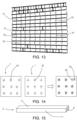
- FIGs 11 to 13 An example embodiment is illustrated in Figures 11 to 13 ; having taken a first pack 1 of boards whose saved information one wants to retrieve, a digital photograph 17 is taken of a whole face of it in which the end surfaces 6 of the boards 2 are present ( Figure 11 ). The digital photograph 17 is then processed in such a way as to identify the first areas 21 which are considered to correspond to a board 2 of the pack 1 of boards (the first areas 21 are separated from each other by the white strips in Figure 12 ). The value 1 is assigned to the first areas 21 which are darker than average (the other areas are assigned the value 0 or no value); the resulting matrix is graphically illustrated in Figure 13 , in which the individual cells are delimited by the separating lines between the first areas 21 identified in Figure 12 .
- the first features relative to each digital photograph 17 are determined by processing the digital photograph 17 in the same predetermined way (for example, as described above, with at least one of the following: an image processing algorithm, a machine learning algorithm, a neural network or a deep neural network).
- the comparison step comparing the first features and the reference features may be carried out by the second computer by calculating a similarity score between the first pack of boards P1 and the known pack of boards P2 considered each time.
- A is the set of pairs of first areas 21 and second areas which are associated between the digital photograph 17 and the reference image
- N F is the number of features assessed for each area
- f ki P1 is the value of the feature i for the board k of the pack P1
- f hi P 2 is the value of the feature i for the board h of the pack P2
- N u P1 is the number of boards without a match of the pack P1
- N u P2 is the number of boards without a match of the pack P2
- ⁇ a penalty constant ⁇ k h ⁇ A ⁇ i N F f ki P 1 ⁇ f hi P 2 2 +
- the similarity score is calculated for all of the reference images, added to the similarity score condition there may be a validation, based on the ratio of the best similarity score to the second similarity score obtained exceeding a second threshold.
- the at least one digital photograph 17 is compared directly with each saved reference image.
- the comparison step is carried out by applying a deep learning algorithm, for which the input is constituted of the digital photograph 17 and of the reference image to be compared with it, and the output is constituted of an identifier (numeric or vectorial) representative of the distance between the two images.
- a deep learning algorithm for which the input is constituted of the digital photograph 17 and of the reference image to be compared with it, and the output is constituted of an identifier (numeric or vectorial) representative of the distance between the two images.
- Deep learning algorithms are also already known in log recognition (see for example Wimmer, G., Schraml, R., Hofbauer, H., Petutschnigg, A., & Uhl, A. (2021).
- deep learning techniques may also be used to identify the first areas 21 and the second areas in the relative images.
- the current tracking system for the packs of boards 2 using bar codes may be used to automatically or semi-automatically create a dataset of images on which to set and verify the deep learning algorithm or to acquire a sufficient number of samples to subsequently carry out the training.
- the known packs of boards 2 remain substantially unchanged in their overall structure, that is to say, in the positioning of the different boards 2 relative to each other, although it is possible for the boards 2 to undergo some modifications, for example following desiccation processes which may tend to deform the individual boards 2.
- the packs of boards 2 may undergo one or more movement and/or processing steps which cause a modification in their overall structure, and in particular of the distances between the boards 2 which constitute each layer 3.
- a pack 1 of boards may have an irregular arrangement of the boards 2 (lack of axial alignment, irregular lateral distancing, etc. - as illustrated 3 for example in Figure 2 ), subsequently it may undergo a compacting and alignment operation which may mean that at the moment of carrying out the retrieval step they are much more orderly (alignment of all end surfaces 6, all of the boards 2 drawn near each other, etc. - as illustrated 3 for example in Figure 3 ).
- the method comprises carrying out the extraction step.
- the extraction step by means of a third computer (or more than one) which may or may not coincide with the second computer, the information of interest relative to the known pack 1 of boards which has been identified as that corresponding to the first pack 1 of boards during the comparison step is extracted from the first digital archive.
- information is extracted which belongs to the digital dataset to which the reference features for which the comparison step identified the match belong.
- the information extracted in this way is assigned (even only virtually by means of the third computer or another computer) to the first pack 1 of boards, in order to be able to make the necessary use of it.
- the information may correspond to an identifier which characterises the pack 1 of boards, or to a plurality of identifiers which characterise the individual boards 2.
- the latter may also be associated with the positions of the boards 2 in the pack or in the layers 3.
- What is described above may be applied both for retrieving the information relative to the first pack 1 of boards only once, and, by applying the method multiple times, for retrieving it multiple times, for example in successive stations for processing and/or handling the pack.
- the method described above for retrieving saved information relative to a first pack 1 of boards is used in the context of a method for determining a match between a first board 2 and one of a plurality of known boards 2, of the type commonly adopted in wood processing plants, that is to say, of the type based on recognition of the boards 2 by means of inspection/observation of their features.
- Methods of this type are characterised by the fact that they comprise a comparing step, carried out by a computer (which may or may not correspond to one of the first computer, the second computer and the third computer), during which first identifying features relative to the first board 2 are compared with second identifying features relative to each board 2 of the plurality of known boards 2, which are saved in a second digital archive.
- the aim of comparing is to find a match between those identifying features, from which it may be inferred that the first board 2 which is being inspected, corresponds to the known board 2 for which the match between the information occurs.
Landscapes
- Engineering & Computer Science (AREA)
- Business, Economics & Management (AREA)
- General Physics & Mathematics (AREA)
- Physics & Mathematics (AREA)
- Economics (AREA)
- Marketing (AREA)
- Theoretical Computer Science (AREA)
- General Business, Economics & Management (AREA)
- Tourism & Hospitality (AREA)
- Strategic Management (AREA)
- Human Resources & Organizations (AREA)
- Automation & Control Theory (AREA)
- Human Computer Interaction (AREA)
- Manufacturing & Machinery (AREA)
- Marine Sciences & Fisheries (AREA)
- Life Sciences & Earth Sciences (AREA)
- Primary Health Care (AREA)
- Animal Husbandry (AREA)
- Agronomy & Crop Science (AREA)
- Health & Medical Sciences (AREA)
- General Health & Medical Sciences (AREA)
- Mining & Mineral Resources (AREA)
- Accounting & Taxation (AREA)
- Finance (AREA)
- Development Economics (AREA)
- Entrepreneurship & Innovation (AREA)
- Operations Research (AREA)
- Quality & Reliability (AREA)
- Image Processing (AREA)
- Information Retrieval, Db Structures And Fs Structures Therefor (AREA)
Claims (16)
- Ein Verfahren zum Abrufen gespeicherter Informationen in Bezug auf ein erstes Plattenpaket (1), wobei das erste Plattenpaket (1) zu einer Mehrzahl bekannter Plattenpakete (2) gehört, wobei jedes bekannte Plattenpaket (1) eine Mehrzahl von übereinander liegenden Schichten (3) beinhaltet und jede dieser übereinander liegenden Schichten (3) dabei eine Mehrzahl von Platten (2) beinhaltet, das Verfahren beinhaltet dabei einen Vorbereitungsschritt, während dessen für jedes bekannte Plattenpaket (1) ein digitaler Datensatz in Bezug auf das bekannte Plattenpakets (1) in ein erstes digitales Archiv hinzugefügt wird, und einen Abrufschritt, während dessen Informationen in Bezug auf das erste Plattenpaket (1) aus dem entsprechenden digitalen Datensatz, der sich im ersten digitalen Archiv befindet, entnommen werden; wobei, für jede der Mehrzahl bekannter Plattenpakete (2) der Vorbereitungsschritt seinerseits folgende Arbeitsschritte beinhaltet:einen Erzeugungsschritt, während dessen mithilfe eines ersten elektronischen Geräts ein oder mehrere Referenzbilder erzeugt werden, von denen jedes mindestens einen Referenzabschnitt des bekannten Plattenpakets (1) zeigt, jeder Referenzabschnitt beinhaltet dabei eine Mehrzahl von Platten (2) in vorher festgelegten Positionen und die Referenzabschnitte sind dabei so ausgewählt, dass sie dieselbe Position im Verhältnis zu dem jeweiligen bekannten Plattenpaket (1) haben; undeinen Speicherschritt, der von einem ersten Computer durchgeführt wird, während dessen Referenzmerkmale, die mit dem einen oder den mehreren Referenzbildern des bekannten Plattenpakets (1) verbunden sind, in einem digitalen Speicher (15) gespeichert werden, zusammen mit den Informationen in Bezug auf das bekannte Plattenpaket (1), wodurch besagter digitaler Datensatz in Bezug auf das bekannte Plattenpaket (1) erzeugt wird;
wobei der Satz digitaler Datensätze in Bezug auf die Mehrzahl bekannter Plattenpakete (2) besagtes erstes digitales Archiv bildet; wobei der Abrufschritt seinerseits Folgendes beinhaltet:einen Beobachtungsschritt, während dessen mindestens eine Digitalkamera (16) dazu verwendet wird, mindestens ein digitales Foto (17) von mindestens einem Vergleichsabschnitt des ersten Plattenpakets (1) aufzunehmen, der Vergleichsabschnitt wird dabei so ausgewählt, dass er in Bezug auf das erste Plattenpaket (1) eine Position hat, die der Position entspricht, die jede Referenzposition in Bezug auf das jeweilige bekannte Plattenpaket (1) hat;einen Vergleichsschritt, der mithilfe eines zweiten Computers durchgeführt wird, während dessen erste Merkmale, die mit dem mindestens einen digitalen Foto (17) verbunden sind, mit den gespeicherten Referenzmerkmalen in Bezug auf das eine oder die mehreren Referenzbilder des besagten bekannten Plattenpakets (2) verglichen werden, um eine Übereinstimmung zwischen den ersten Merkmalen, die mit dem mindestens einen digitalen Foto (17) verbunden sind, und den gespeicherten Referenzmerkmalen in Bezug auf eines der gespeicherten Referenzbilder zu identifizieren;einen Abrufschritt, der mithilfe eines dritten Computers durchgeführt wird, während dessen der Abruf aus dem ersten digitalen Archiv und die Zuweisung zum ersten Plattenpaket (1) der Informationen in Bezug auf das bekannte Plattenpaket (1), die zu demselben digitalen Datensatz gehören, zu dem die Referenzmerkmale gehören, für die der Vergleichsschritt die Übereinstimmung identifiziert hat, erfolgen; wobei weiter:der Vergleichsschritt einen Teilungsschritt beinhaltet und, für jedes Referenzbild, eine Mehrzahl von Vergleichsunterschritten;während des Teilungsschritts werden dabei erste Bereiche (21) des mindestens einen digitalen Fotos (17) identifiziert, von denen jeder einer anderen Platte (2) des ersten Plattenpakets (1) entsprechend angesehen werden;während jedes Vergleichsunterschritts wird einer der ersten Bereiche (21) mit einem aus einer Mehrzahl zweiter Bereiche, die auf dem Referenzbild identifiziert wurden, verglichen, die zweiten Bereich des Referenzbilds werden dabei jeweils einer anderen Platte (2) des bekannten Plattenpakets (1) entsprechend angesehen; während jedes Vergleichsunterschritts wird Folgendes ausgeführt:- ein Korrelationsschritt, während dessen für jeden ersten Bereich (21) eine Suche nach einem zweiten Bereich im Referenzbild durchgeführt wird, der eine Position im jeweiligen bekannten Plattenpaket hat, die der Position des ersten Bereichs (21) im ersten Plattenpaket (1) entspricht; und- für jeden zweiten Bereich, der auf diese Art identifiziert wurde, ein Analyseschritt, während dessen Merkmale dieses zweiten Bereichs mit Merkmalen des ersten Bereichs (21) mit entsprechender Position verglichen werden, um eine Übereinstimmung oder das Fehlen einer Übereinstimmung zwischen den Merkmalen des zweiten Bereichs und den Merkmalen des ersten Bereichs (21) mit entsprechender Position festzustellen;besagte Merkmale, die mit dem mindestens einen digitalen Foto (17) verbunden sind, bestehen aus besagten Merkmalen erster Bereiche (21), die beim Trennungsschritt identifiziert wurden;
undbesagte gespeicherte Referenzmerkmale jedes Referenzbilds bestehen aus besagten Merkmalen besagter zweiter Bereiche, die im Referenzbild identifiziert wurden. - Das Verfahren nach dem Patentanspruch 1, wobei, während des Erzeugungsschritts jedes Referenzbild durch die Aufnahme eines digitalen Bilds des mindestens einen Referenzabschnitts des jeweiligen bekannten Plattenpakets (1) erzeugt wird.
- Das Verfahren nach dem Patentanspruch 1, wobei, während des Erzeugungsschritts jedes Referenzbild dadurch erzeugt wird, dass identifiziert wird, welche Platten (2) in besagtem Referenzabschnitt des jeweiligen bekannten Plattenpakets (1) vorhanden sind, und dadurch, dass digitale Bilder, die vorher von diesen Platten (2) erhalten wurden, kombiniert werden.
- Das Verfahren nach dem Patentanspruch 3, vor dem Vorbereitungsschritt auch einen Überwachungsschritt beinhaltend, um die Erzeugung jedes bekannten Plattenpakets (1) zu überwachen, der mithilfe eines vierten Computers ausgeführt wird, während dessen Daten über die Identität und die Position jeder Platte (2) innerhalb des bekannten Plattenpakets (1) im digitalen Speicher (15) gespeichert werden.
- Das Verfahren nach jedem der Patentansprüche 1 bis 4, wobei besagter Referenzabschnitt jedes bekannten Plattenpakets (1) mindestens einem Teil von entweder der Oberseite (8) oder den Seitenflächen (9) des bekannten Plattenpakets (1) entspricht.
- Das Verfahren nach jedem der Patentansprüche 1 bis 5, wobei jedes Referenzbild einen Teil oder alles von entweder der Oberseite (8) oder den Seitenflächen (9) des jeweiligen bekannten Plattenpakets (1) zeigt.
- Das Verfahren nach jedem der Patentansprüche 1 bis 6, wobei während des Beobachtungsschritts mindestens ein digitales Foto (17) aufgenommen wird, in dem sowohl besagter Vergleichsabschnitt des Plattenpakets (1) als auch weitere Elemente, die nicht zum Vergleichsabschnitt gehören, sichtbar sind, und wobei besagte, nicht zugehörige Elemente während des Vergleichsschritts nicht berücksichtigt werden.
- Das Verfahren nach jedem der Patentansprüche 1 bis 7, wobei der Vergleichsschritt auch einen Kalibrierschritt beinhaltet, während dessen das mindestens eine digitale Foto (17) mit dem einen oder den mehreren Referenzbildern vergleichbar gemacht wird.
- Das Verfahren nach dem Patentanspruch 8, wobei während des Kalibrierschritts das mindestens eine digitale Foto (17) verändert wird, um Verzerrungen aufgrund perspektivischer Auswirkungen und/oder aufgrund der Position der Kamera im Verhältnis zum ersten Plattenpaket (1) zu verringern.
- Das Verfahren nach jedem der Patentansprüche 1 bis 9, wobei während des Vergleichsschritts davon ausgegangen wird, dass eine Übereinstimmung zwischen dem digitalen Foto (17) und einem gespeicherten Referenzbild herrscht, wenn sich die ersten Merkmale in Bezug auf das digitale Foto (17) um weniger als eine vorher festgelegte Abweichung von den Referenzmerkmalen unterscheiden.
- Das Verfahren nach jedem der Patentansprüche 1 bis 10, wobei nach der Ausführung des Vorbereitungsschritts und vor der Ausführung des Abrufschritts das erste Plattenpaket (1) eine oder mehrere Bewegungs- und/oder Verarbeitungsschritte durchläuft, die eine Veränderung von Abständen zwischen den Platten (2), aus denen jede Schicht (3) besteht, verursachen.
- Das Verfahren nach jedem der Patentansprüche 1 bis 11, wobei während des Erzeugungsschritts für jedes bekannte Plattenpaket (1) die Erzeugung eines oder mehrerer erster Referenzbilder stattfindet, von denen jedes mindestens einen ersten Referenzabschnitt des bekannten Plattenpakets (1) zeigt, und eines oder mehrerer zweiter Referenzbilder, von denen jedes mindestens einen zweiten Referenzabschnitt des bekannten Plattenpakets (1) zeigt.
- Das Verfahren nach dem Patentanspruch 12, wobei der erste Referenzabschnitt und der zweite Referenzabschnitt in dem jeweiligen bekannten Plattenpaket (1) in Positionen platziert sind, die im Verhältnis zueinander um 180° um eine Vertikalachse gedreht sind, und wobei während des Vergleichsschritts das digitale Foto (17) mit dem ersten Referenzbild und mit dem zweiten Referenzbild verglichen wird.
- Das Verfahren nach dem Patentanspruch 12, wobei während des Beobachtungsschritts die Aufnahme von mindestens einem ersten digitalen Foto (17) von mindestens einem ersten Vergleichsabschnitt des ersten Plattenpakets (1) und mindestens eines zweiten digitalen Fotos (17) von mindestens einem zweiten Vergleichsabschnitt des ersten Plattenpakets (1) erfolgt.
- Das Verfahren nach jedem der Patentansprüche 1 bis 14, wobei die Kamera, mit der der Beobachtungsschritt durchgeführt wird, Folgendes ist:eine Smartphone-Kamera oder eine Tablet-Kamera; odereine feststehende Kamera einer Holzverarbeitungsanlage; odereine Kamera, die an einem Gabelstapler oder einem Palettenhubwagen befestigt ist, der verwendet wird, um Plattenpakete (2) zu bewegen.
- Ein Verfahren zur Feststellung einer Übereinstimmung zwischen einer ersten Platte (2) und einer aus einer ersten Mehrzahl bekannter Platten (2), das Verfahren beinhaltet dabei einen Vergleichsschritt, der von einem Computer durchgeführt wird, während dessen erste Identifikationsmerkmale in Bezug auf die erste Platte (2) mit zweiten Identifikationsmerkmalen in Bezug auf Platten (2) der ersten Mehrzahl bekannter Platten (2), die in einem zweiten digitalen Archiv gespeichert sind, verglichen werden, um eine Übereinstimmung zwischen den ersten Identifikationsmerkmalen und den zweiten Identifikationsmerkmalen zu finden, wobei:die erste Platte (2) aus einem ersten Plattenpaket (1) entnommen wird;vor der Durchführung des Vergleichsschritts das Verfahren zum Abruf gespeicherter Informationen in Bezug auf das erste Plattenpakets (1) nach jedem der Patentansprüche 1 bis 15 durchgeführt wird, um ein oder mehrere Plattenpakete (1) zu identifizieren, aus denen die erste Platte (2) entnommen worden sein könnte, aus einer Mehrzahl bekannter Plattenpakete (2), das identifizierte eine oder die identifizierten mehreren Paketplatten beinhalten dabei allgemein eine zweite Mehrzahl bekannter Platten (2), die einer Untergruppe besagter erster Mehrzahl bekannter Platten (2) entspricht; undder Vergleichsschritt wird durchgeführt, indem die ersten Identifikationsmerkmale ausschließlich mit den zweiten Identifikationsmerkmalen in Bezug auf jede bekannte Platte (2), die dabei zu besagter zweiter Mehrzahl bekannter Platten (2) gehört, verglichen werden.
Applications Claiming Priority (2)
| Application Number | Priority Date | Filing Date | Title |
|---|---|---|---|
| IT102021000015656A IT202100015656A1 (it) | 2021-06-15 | 2021-06-15 | Metodo per recuperare informazioni memorizzate relative ad un pacchetto di tavole |
| PCT/IB2022/055415 WO2022263981A1 (en) | 2021-06-15 | 2022-06-10 | Method for retrieving saved information relative to a pack of boards |
Publications (3)
| Publication Number | Publication Date |
|---|---|
| EP4356326A1 EP4356326A1 (de) | 2024-04-24 |
| EP4356326C0 EP4356326C0 (de) | 2025-03-12 |
| EP4356326B1 true EP4356326B1 (de) | 2025-03-12 |
Family
ID=77711293
Family Applications (1)
| Application Number | Title | Priority Date | Filing Date |
|---|---|---|---|
| EP22732668.3A Active EP4356326B1 (de) | 2021-06-15 | 2022-06-10 | Verfahren zum abrufen von gespeicherten informationen bezüglich eines bretterpakets |
Country Status (5)
| Country | Link |
|---|---|
| US (1) | US20240280955A1 (de) |
| EP (1) | EP4356326B1 (de) |
| CA (1) | CA3221091A1 (de) |
| IT (1) | IT202100015656A1 (de) |
| WO (1) | WO2022263981A1 (de) |
Families Citing this family (1)
| Publication number | Priority date | Publication date | Assignee | Title |
|---|---|---|---|---|
| EP4708229A1 (de) * | 2024-09-09 | 2026-03-11 | Fritz Egger GmbH & Co. OG | Verfahren zum erzeugen eines datensatzes zum identifizieren von holzwerkstoffplatten und verfahren zum identifizieren von holzwerkstoffplatten |
Family Cites Families (26)
| Publication number | Priority date | Publication date | Assignee | Title |
|---|---|---|---|---|
| US4185672A (en) * | 1974-02-06 | 1980-01-29 | Reed Ltd. | Integrated tree processing mill |
| NZ270892A (en) * | 1994-08-24 | 1997-01-29 | Us Natural Resources | Detecting lumber defects utilizing optical pattern recognition algorithm |
| US5674335A (en) * | 1995-01-06 | 1997-10-07 | Aman; James A. | Automated end labeler system |
| US5844807A (en) * | 1995-11-09 | 1998-12-01 | Marquip, Inc. | Automated system and method for optimizing and palletizing articles |
| US5960413A (en) * | 1996-03-05 | 1999-09-28 | Amon; James A. | Portable system for inventory identification and classification |
| CA2203970C (en) * | 1996-05-01 | 2003-12-02 | Newnes Machine Ltd. | Method and apparatus for video lumber grading |
| US6729836B2 (en) * | 2002-03-13 | 2004-05-04 | Stingel, Iii Frederick J. | Automated container storage and delivery system |
| US7406190B2 (en) * | 2003-07-24 | 2008-07-29 | Lucidyne Technologies, Inc. | Wood tracking by identification of surface characteristics |
| US7266422B1 (en) * | 2004-04-09 | 2007-09-04 | Fanuc Robotics America, Inc. | Automated palletizing cases having mixed sizes and shapes |
| US8295583B2 (en) * | 2008-07-31 | 2012-10-23 | Metaform Ltd. | System and method for automatic recognition of undetected assets |
| US8594835B2 (en) * | 2009-04-10 | 2013-11-26 | Symbotic, LLC | Control system for storage and retrieval systems |
| US10421209B2 (en) * | 2010-09-02 | 2019-09-24 | Steven L. Aylsworth | Adaptable lumber retrieval method |
| US9147014B2 (en) * | 2011-08-31 | 2015-09-29 | Woodtech Measurement Solutions | System and method for image selection of bundled objects |
| US9126770B1 (en) * | 2012-02-09 | 2015-09-08 | Automatan, Inc. | Aligning and stacking palletizing machine |
| US8965561B2 (en) * | 2013-03-15 | 2015-02-24 | Cybernet Systems Corporation | Automated warehousing using robotic forklifts |
| WO2016048977A1 (en) * | 2014-09-22 | 2016-03-31 | Illinois Tool Works Inc. | Pallet handling apparatus for removing pallets from carriers |
| US9488986B1 (en) * | 2015-07-31 | 2016-11-08 | Hand Held Products, Inc. | System and method for tracking an item on a pallet in a warehouse |
| US20170210561A1 (en) * | 2015-10-05 | 2017-07-27 | Sabil Abdelali | Palletized storage and distribution system |
| ITUB20155441A1 (it) * | 2015-11-11 | 2017-05-11 | Microtec Srl | Metodo per richiamare un rapporto di valutazione di classe qualitativa per una tavola di legno e sistema che utilizza tale metodo |
| US10239225B1 (en) * | 2016-01-14 | 2019-03-26 | Wein Holding LLC | Automated system and method to enhance safety and strength of wood truss structures |
| US9827683B1 (en) * | 2016-07-28 | 2017-11-28 | X Development Llc | Collaborative inventory monitoring |
| US10071856B2 (en) * | 2016-07-28 | 2018-09-11 | X Development Llc | Inventory management |
| WO2018122605A1 (en) * | 2016-12-27 | 2018-07-05 | Fordaq, Sa | Automatic detection, counting, and measurement of lumber boards using a handheld device |
| US10579875B2 (en) * | 2017-10-11 | 2020-03-03 | Aquifi, Inc. | Systems and methods for object identification using a three-dimensional scanning system |
| US10825164B1 (en) * | 2017-12-06 | 2020-11-03 | Boise Cascade Company | Imaging system for analysis of wood products |
| SE544458C2 (en) * | 2019-10-03 | 2022-06-07 | Tracy Of Sweden Ab | System and method for tracking logs in a wood processing chain |
-
2021
- 2021-06-15 IT IT102021000015656A patent/IT202100015656A1/it unknown
-
2022
- 2022-06-10 US US18/570,616 patent/US20240280955A1/en active Pending
- 2022-06-10 CA CA3221091A patent/CA3221091A1/en active Pending
- 2022-06-10 EP EP22732668.3A patent/EP4356326B1/de active Active
- 2022-06-10 WO PCT/IB2022/055415 patent/WO2022263981A1/en not_active Ceased
Also Published As
| Publication number | Publication date |
|---|---|
| EP4356326A1 (de) | 2024-04-24 |
| EP4356326C0 (de) | 2025-03-12 |
| IT202100015656A1 (it) | 2022-12-15 |
| WO2022263981A1 (en) | 2022-12-22 |
| US20240280955A1 (en) | 2024-08-22 |
| CA3221091A1 (en) | 2022-12-22 |
Similar Documents
| Publication | Publication Date | Title |
|---|---|---|
| DE102018133524A1 (de) | Verfahren zum Bereitstellen von Tafelplanungsgeometriedaten, Verfahren und Laserflachbettmaschine zum Ausschneiden von Werkstücken | |
| DE102021108925A1 (de) | Vorrichtung und Verfahren für eine Prüfung einer Kennzeichnung eines Produkts | |
| CN117557570A (zh) | 一种轨道车辆异常检测方法及系统 | |
| EP4356326B1 (de) | Verfahren zum abrufen von gespeicherten informationen bezüglich eines bretterpakets | |
| CN114219794A (zh) | 基于机器视觉的刨花板表面质量评估方法及系统 | |
| Pahlberg et al. | Recognition of boards using wood fingerprints based on a fusion of feature detection methods | |
| CN114281282A (zh) | 一种印刷监控方法及其系统 | |
| CN117462242A (zh) | 一种皮肤科智能激光祛斑控制系统 | |
| CN113822836B (zh) | 标记图像的方法 | |
| CN114743082B (zh) | 一种基于机器视觉的卷烟成品烟箱特征识别方法 | |
| Andersson et al. | Classification of compression wood using digital image analysis | |
| EP4327302A1 (de) | Verfahren zum identifizieren von holzwerkstoffplatten | |
| CN118735917B (zh) | 一种智能食品包装缺陷检测系统 | |
| Savolainen | Matching method for mutated veneer sheet images using gray-level co-occurrence matrix features | |
| CN116308435B (zh) | 一种基于智能溯源秤的农产品精准化识别方法及系统 | |
| US20250342579A1 (en) | Method and system for performing quality control of objects in an apparatus which produces the objects in continuous cycle | |
| Espitia et al. | Optical mark recognition based on image processing techniques for the answer sheets of the Colombian high-stakes tests | |
| Sukrisdyanto et al. | Wood Strength Classification Based on RGB Color and Image Texture Using KNN Method | |
| Li et al. | An image processing method to recognize position of sawn boards within the log | |
| CN112184665A (zh) | 一种应用于纸塑行业的人工智能缺陷侦测系统 | |
| CN119540227B (zh) | 刨花板外观质量量化评价方法、装置、设备、介质及产品 | |
| US20260008113A1 (en) | Method and device for producing sawn timber | |
| CN117314913B (zh) | 一种基于视觉识别的水光针头残次品检测方法和系统 | |
| CN118521327B (zh) | 一种基于供应链的数据追溯方法 | |
| CN113658177B (zh) | 一种基于图像识别的板材计数系统 |
Legal Events
| Date | Code | Title | Description |
|---|---|---|---|
| STAA | Information on the status of an ep patent application or granted ep patent |
Free format text: STATUS: UNKNOWN |
|
| STAA | Information on the status of an ep patent application or granted ep patent |
Free format text: STATUS: THE INTERNATIONAL PUBLICATION HAS BEEN MADE |
|
| PUAI | Public reference made under article 153(3) epc to a published international application that has entered the european phase |
Free format text: ORIGINAL CODE: 0009012 |
|
| STAA | Information on the status of an ep patent application or granted ep patent |
Free format text: STATUS: REQUEST FOR EXAMINATION WAS MADE |
|
| 17P | Request for examination filed |
Effective date: 20231127 |
|
| AK | Designated contracting states |
Kind code of ref document: A1 Designated state(s): AL AT BE BG CH CY CZ DE DK EE ES FI FR GB GR HR HU IE IS IT LI LT LU LV MC MK MT NL NO PL PT RO RS SE SI SK SM TR |
|
| REG | Reference to a national code |
Ref country code: DE Ipc: G06Q0010087000 Ref country code: DE Ref legal event code: R079 Ref document number: 602022011760 Country of ref document: DE Free format text: PREVIOUS MAIN CLASS: G06Q0010080000 Ipc: G06Q0010087000 |
|
| DAV | Request for validation of the european patent (deleted) | ||
| DAX | Request for extension of the european patent (deleted) | ||
| GRAP | Despatch of communication of intention to grant a patent |
Free format text: ORIGINAL CODE: EPIDOSNIGR1 |
|
| STAA | Information on the status of an ep patent application or granted ep patent |
Free format text: STATUS: GRANT OF PATENT IS INTENDED |
|
| RIC1 | Information provided on ipc code assigned before grant |
Ipc: G06Q 50/02 20240101ALI20240920BHEP Ipc: G06Q 10/087 20230101AFI20240920BHEP |
|
| INTG | Intention to grant announced |
Effective date: 20241002 |
|
| GRAJ | Information related to disapproval of communication of intention to grant by the applicant or resumption of examination proceedings by the epo deleted |
Free format text: ORIGINAL CODE: EPIDOSDIGR1 |
|
| STAA | Information on the status of an ep patent application or granted ep patent |
Free format text: STATUS: REQUEST FOR EXAMINATION WAS MADE |
|
| GRAP | Despatch of communication of intention to grant a patent |
Free format text: ORIGINAL CODE: EPIDOSNIGR1 |
|
| STAA | Information on the status of an ep patent application or granted ep patent |
Free format text: STATUS: GRANT OF PATENT IS INTENDED |
|
| INTC | Intention to grant announced (deleted) | ||
| INTG | Intention to grant announced |
Effective date: 20241210 |
|
| GRAS | Grant fee paid |
Free format text: ORIGINAL CODE: EPIDOSNIGR3 |
|
| GRAA | (expected) grant |
Free format text: ORIGINAL CODE: 0009210 |
|
| STAA | Information on the status of an ep patent application or granted ep patent |
Free format text: STATUS: THE PATENT HAS BEEN GRANTED |
|
| AK | Designated contracting states |
Kind code of ref document: B1 Designated state(s): AL AT BE BG CH CY CZ DE DK EE ES FI FR GB GR HR HU IE IS IT LI LT LU LV MC MK MT NL NO PL PT RO RS SE SI SK SM TR |
|
| REG | Reference to a national code |
Ref country code: GB Ref legal event code: FG4D |
|
| REG | Reference to a national code |
Ref country code: CH Ref legal event code: EP |
|
| REG | Reference to a national code |
Ref country code: DE Ref legal event code: R096 Ref document number: 602022011760 Country of ref document: DE |
|
| REG | Reference to a national code |
Ref country code: IE Ref legal event code: FG4D |
|
| U01 | Request for unitary effect filed |
Effective date: 20250312 |
|
| U07 | Unitary effect registered |
Designated state(s): AT BE BG DE DK EE FI FR IT LT LU LV MT NL PT RO SE SI Effective date: 20250318 |
|
| PG25 | Lapsed in a contracting state [announced via postgrant information from national office to epo] |
Ref country code: RS Free format text: LAPSE BECAUSE OF FAILURE TO SUBMIT A TRANSLATION OF THE DESCRIPTION OR TO PAY THE FEE WITHIN THE PRESCRIBED TIME-LIMIT Effective date: 20250612 |
|
| PG25 | Lapsed in a contracting state [announced via postgrant information from national office to epo] |
Ref country code: ES Free format text: LAPSE BECAUSE OF FAILURE TO SUBMIT A TRANSLATION OF THE DESCRIPTION OR TO PAY THE FEE WITHIN THE PRESCRIBED TIME-LIMIT Effective date: 20250312 |
|
| PG25 | Lapsed in a contracting state [announced via postgrant information from national office to epo] |
Ref country code: NO Free format text: LAPSE BECAUSE OF FAILURE TO SUBMIT A TRANSLATION OF THE DESCRIPTION OR TO PAY THE FEE WITHIN THE PRESCRIBED TIME-LIMIT Effective date: 20250612 |
|
| PG25 | Lapsed in a contracting state [announced via postgrant information from national office to epo] |
Ref country code: HR Free format text: LAPSE BECAUSE OF FAILURE TO SUBMIT A TRANSLATION OF THE DESCRIPTION OR TO PAY THE FEE WITHIN THE PRESCRIBED TIME-LIMIT Effective date: 20250312 |
|
| PG25 | Lapsed in a contracting state [announced via postgrant information from national office to epo] |
Ref country code: GR Free format text: LAPSE BECAUSE OF FAILURE TO SUBMIT A TRANSLATION OF THE DESCRIPTION OR TO PAY THE FEE WITHIN THE PRESCRIBED TIME-LIMIT Effective date: 20250613 |
|
| U20 | Renewal fee for the european patent with unitary effect paid |
Year of fee payment: 4 Effective date: 20250624 |
|
| PG25 | Lapsed in a contracting state [announced via postgrant information from national office to epo] |
Ref country code: SM Free format text: LAPSE BECAUSE OF FAILURE TO SUBMIT A TRANSLATION OF THE DESCRIPTION OR TO PAY THE FEE WITHIN THE PRESCRIBED TIME-LIMIT Effective date: 20250312 |
|
| PG25 | Lapsed in a contracting state [announced via postgrant information from national office to epo] |
Ref country code: PL Free format text: LAPSE BECAUSE OF FAILURE TO SUBMIT A TRANSLATION OF THE DESCRIPTION OR TO PAY THE FEE WITHIN THE PRESCRIBED TIME-LIMIT Effective date: 20250312 |
|
| PG25 | Lapsed in a contracting state [announced via postgrant information from national office to epo] |
Ref country code: CZ Free format text: LAPSE BECAUSE OF FAILURE TO SUBMIT A TRANSLATION OF THE DESCRIPTION OR TO PAY THE FEE WITHIN THE PRESCRIBED TIME-LIMIT Effective date: 20250312 |
|
| PG25 | Lapsed in a contracting state [announced via postgrant information from national office to epo] |
Ref country code: SK Free format text: LAPSE BECAUSE OF FAILURE TO SUBMIT A TRANSLATION OF THE DESCRIPTION OR TO PAY THE FEE WITHIN THE PRESCRIBED TIME-LIMIT Effective date: 20250312 |
|
| PG25 | Lapsed in a contracting state [announced via postgrant information from national office to epo] |
Ref country code: IS Free format text: LAPSE BECAUSE OF FAILURE TO SUBMIT A TRANSLATION OF THE DESCRIPTION OR TO PAY THE FEE WITHIN THE PRESCRIBED TIME-LIMIT Effective date: 20250712 |
|
| REG | Reference to a national code |
Ref country code: CH Ref legal event code: W10 Free format text: ST27 STATUS EVENT CODE: U-0-0-W10-W00 (AS PROVIDED BY THE NATIONAL OFFICE) Effective date: 20251105 |
|
| RAP4 | Party data changed (patent owner data changed or rights of a patent transferred) |
Owner name: MICROTEC S.P.A. |
|
| U1H | Name or address of the proprietor changed after the registration of the unitary effect |
Owner name: MICROTEC S.P.A.; IT |
|
| PLBE | No opposition filed within time limit |
Free format text: ORIGINAL CODE: 0009261 |
|
| STAA | Information on the status of an ep patent application or granted ep patent |
Free format text: STATUS: NO OPPOSITION FILED WITHIN TIME LIMIT |
|
| REG | Reference to a national code |
Ref country code: CH Ref legal event code: L10 Free format text: ST27 STATUS EVENT CODE: U-0-0-L10-L00 (AS PROVIDED BY THE NATIONAL OFFICE) Effective date: 20260121 |
|
| REG | Reference to a national code |
Ref country code: CH Ref legal event code: H13 Free format text: ST27 STATUS EVENT CODE: U-0-0-H10-H13 (AS PROVIDED BY THE NATIONAL OFFICE) Effective date: 20260127 |
|
| PG25 | Lapsed in a contracting state [announced via postgrant information from national office to epo] |
Ref country code: MC Free format text: LAPSE BECAUSE OF FAILURE TO SUBMIT A TRANSLATION OF THE DESCRIPTION OR TO PAY THE FEE WITHIN THE PRESCRIBED TIME-LIMIT Effective date: 20250312 |
|
| 26N | No opposition filed |
Effective date: 20251215 |