EP4354970A1 - Electronic device for vehicle and operation method thereof - Google Patents
Electronic device for vehicle and operation method thereof Download PDFInfo
- Publication number
- EP4354970A1 EP4354970A1 EP23768772.8A EP23768772A EP4354970A1 EP 4354970 A1 EP4354970 A1 EP 4354970A1 EP 23768772 A EP23768772 A EP 23768772A EP 4354970 A1 EP4354970 A1 EP 4354970A1
- Authority
- EP
- European Patent Office
- Prior art keywords
- network
- electronic device
- vehicle
- vehicular electronic
- data
- Prior art date
- Legal status (The legal status is an assumption and is not a legal conclusion. Google has not performed a legal analysis and makes no representation as to the accuracy of the status listed.)
- Pending
Links
Images







Classifications
-
- H—ELECTRICITY
- H04—ELECTRIC COMMUNICATION TECHNIQUE
- H04W—WIRELESS COMMUNICATION NETWORKS
- H04W48/00—Access restriction; Network selection; Access point selection
- H04W48/16—Discovering, processing access restriction or access information
-
- H—ELECTRICITY
- H04—ELECTRIC COMMUNICATION TECHNIQUE
- H04L—TRANSMISSION OF DIGITAL INFORMATION, e.g. TELEGRAPHIC COMMUNICATION
- H04L67/00—Network arrangements or protocols for supporting network services or applications
- H04L67/01—Protocols
- H04L67/12—Protocols specially adapted for proprietary or special-purpose networking environments, e.g. medical networks, sensor networks, networks in vehicles or remote metering networks
-
- B—PERFORMING OPERATIONS; TRANSPORTING
- B60—VEHICLES IN GENERAL
- B60L—PROPULSION OF ELECTRICALLY-PROPELLED VEHICLES; SUPPLYING ELECTRIC POWER FOR AUXILIARY EQUIPMENT OF ELECTRICALLY-PROPELLED VEHICLES; ELECTRODYNAMIC BRAKE SYSTEMS FOR VEHICLES IN GENERAL; MAGNETIC SUSPENSION OR LEVITATION FOR VEHICLES; MONITORING OPERATING VARIABLES OF ELECTRICALLY-PROPELLED VEHICLES; ELECTRIC SAFETY DEVICES FOR ELECTRICALLY-PROPELLED VEHICLES
- B60L53/00—Methods of charging batteries, specially adapted for electric vehicles; Charging stations or on-board charging equipment therefor; Exchange of energy storage elements in electric vehicles
- B60L53/60—Monitoring or controlling charging stations
- B60L53/65—Monitoring or controlling charging stations involving identification of vehicles or their battery types
-
- B—PERFORMING OPERATIONS; TRANSPORTING
- B60—VEHICLES IN GENERAL
- B60L—PROPULSION OF ELECTRICALLY-PROPELLED VEHICLES; SUPPLYING ELECTRIC POWER FOR AUXILIARY EQUIPMENT OF ELECTRICALLY-PROPELLED VEHICLES; ELECTRODYNAMIC BRAKE SYSTEMS FOR VEHICLES IN GENERAL; MAGNETIC SUSPENSION OR LEVITATION FOR VEHICLES; MONITORING OPERATING VARIABLES OF ELECTRICALLY-PROPELLED VEHICLES; ELECTRIC SAFETY DEVICES FOR ELECTRICALLY-PROPELLED VEHICLES
- B60L53/00—Methods of charging batteries, specially adapted for electric vehicles; Charging stations or on-board charging equipment therefor; Exchange of energy storage elements in electric vehicles
- B60L53/60—Monitoring or controlling charging stations
- B60L53/68—Off-site monitoring or control, e.g. remote control
-
- H—ELECTRICITY
- H04—ELECTRIC COMMUNICATION TECHNIQUE
- H04L—TRANSMISSION OF DIGITAL INFORMATION, e.g. TELEGRAPHIC COMMUNICATION
- H04L67/00—Network arrangements or protocols for supporting network services or applications
- H04L67/50—Network services
- H04L67/51—Discovery or management thereof, e.g. service location protocol [SLP] or web services
-
- H—ELECTRICITY
- H04—ELECTRIC COMMUNICATION TECHNIQUE
- H04L—TRANSMISSION OF DIGITAL INFORMATION, e.g. TELEGRAPHIC COMMUNICATION
- H04L67/00—Network arrangements or protocols for supporting network services or applications
- H04L67/50—Network services
- H04L67/60—Scheduling or organising the servicing of application requests, e.g. requests for application data transmissions using the analysis and optimisation of the required network resources
- H04L67/61—Scheduling or organising the servicing of application requests, e.g. requests for application data transmissions using the analysis and optimisation of the required network resources taking into account QoS or priority requirements
-
- H—ELECTRICITY
- H04—ELECTRIC COMMUNICATION TECHNIQUE
- H04W—WIRELESS COMMUNICATION NETWORKS
- H04W12/00—Security arrangements; Authentication; Protecting privacy or anonymity
-
- H—ELECTRICITY
- H04—ELECTRIC COMMUNICATION TECHNIQUE
- H04W—WIRELESS COMMUNICATION NETWORKS
- H04W12/00—Security arrangements; Authentication; Protecting privacy or anonymity
- H04W12/40—Security arrangements using identity modules
- H04W12/45—Security arrangements using identity modules using multiple identity modules
-
- H—ELECTRICITY
- H04—ELECTRIC COMMUNICATION TECHNIQUE
- H04W—WIRELESS COMMUNICATION NETWORKS
- H04W36/00—Hand-off or reselection arrangements
- H04W36/14—Reselecting a network or an air interface
- H04W36/142—Reselecting a network or an air interface over the same radio air interface technology
-
- H—ELECTRICITY
- H04—ELECTRIC COMMUNICATION TECHNIQUE
- H04W—WIRELESS COMMUNICATION NETWORKS
- H04W36/00—Hand-off or reselection arrangements
- H04W36/24—Reselection being triggered by specific parameters
- H04W36/32—Reselection being triggered by specific parameters by location or mobility data, e.g. speed data
- H04W36/322—Reselection being triggered by specific parameters by location or mobility data, e.g. speed data by location data
-
- H—ELECTRICITY
- H04—ELECTRIC COMMUNICATION TECHNIQUE
- H04W—WIRELESS COMMUNICATION NETWORKS
- H04W36/00—Hand-off or reselection arrangements
- H04W36/34—Reselection control
- H04W36/36—Reselection control by user or terminal equipment
- H04W36/362—Conditional handover
-
- H—ELECTRICITY
- H04—ELECTRIC COMMUNICATION TECHNIQUE
- H04W—WIRELESS COMMUNICATION NETWORKS
- H04W4/00—Services specially adapted for wireless communication networks; Facilities therefor
-
- H—ELECTRICITY
- H04—ELECTRIC COMMUNICATION TECHNIQUE
- H04W—WIRELESS COMMUNICATION NETWORKS
- H04W4/00—Services specially adapted for wireless communication networks; Facilities therefor
- H04W4/30—Services specially adapted for particular environments, situations or purposes
- H04W4/40—Services specially adapted for particular environments, situations or purposes for vehicles, e.g. vehicle-to-pedestrians [V2P]
-
- H—ELECTRICITY
- H04—ELECTRIC COMMUNICATION TECHNIQUE
- H04W—WIRELESS COMMUNICATION NETWORKS
- H04W48/00—Access restriction; Network selection; Access point selection
- H04W48/18—Selecting a network or a communication service
-
- H—ELECTRICITY
- H04—ELECTRIC COMMUNICATION TECHNIQUE
- H04W—WIRELESS COMMUNICATION NETWORKS
- H04W84/00—Network topologies
- H04W84/02—Hierarchically pre-organised networks, e.g. paging networks, cellular networks, WLAN [Wireless Local Area Network] or WLL [Wireless Local Loop]
- H04W84/04—Large scale networks; Deep hierarchical networks
- H04W84/042—Public Land Mobile systems, e.g. cellular systems
-
- H—ELECTRICITY
- H04—ELECTRIC COMMUNICATION TECHNIQUE
- H04W—WIRELESS COMMUNICATION NETWORKS
- H04W84/00—Network topologies
- H04W84/02—Hierarchically pre-organised networks, e.g. paging networks, cellular networks, WLAN [Wireless Local Area Network] or WLL [Wireless Local Loop]
- H04W84/10—Small scale networks; Flat hierarchical networks
- H04W84/105—PBS [Private Base Station] network
-
- B—PERFORMING OPERATIONS; TRANSPORTING
- B60—VEHICLES IN GENERAL
- B60L—PROPULSION OF ELECTRICALLY-PROPELLED VEHICLES; SUPPLYING ELECTRIC POWER FOR AUXILIARY EQUIPMENT OF ELECTRICALLY-PROPELLED VEHICLES; ELECTRODYNAMIC BRAKE SYSTEMS FOR VEHICLES IN GENERAL; MAGNETIC SUSPENSION OR LEVITATION FOR VEHICLES; MONITORING OPERATING VARIABLES OF ELECTRICALLY-PROPELLED VEHICLES; ELECTRIC SAFETY DEVICES FOR ELECTRICALLY-PROPELLED VEHICLES
- B60L2240/00—Control parameters of input or output; Target parameters
- B60L2240/60—Navigation input
- B60L2240/68—Traffic data
-
- B—PERFORMING OPERATIONS; TRANSPORTING
- B60—VEHICLES IN GENERAL
- B60L—PROPULSION OF ELECTRICALLY-PROPELLED VEHICLES; SUPPLYING ELECTRIC POWER FOR AUXILIARY EQUIPMENT OF ELECTRICALLY-PROPELLED VEHICLES; ELECTRODYNAMIC BRAKE SYSTEMS FOR VEHICLES IN GENERAL; MAGNETIC SUSPENSION OR LEVITATION FOR VEHICLES; MONITORING OPERATING VARIABLES OF ELECTRICALLY-PROPELLED VEHICLES; ELECTRIC SAFETY DEVICES FOR ELECTRICALLY-PROPELLED VEHICLES
- B60L2240/00—Control parameters of input or output; Target parameters
- B60L2240/70—Interactions with external data bases, e.g. traffic centres
-
- G—PHYSICS
- G07—CHECKING-DEVICES
- G07C—TIME OR ATTENDANCE REGISTERS; REGISTERING OR INDICATING THE WORKING OF MACHINES; GENERATING RANDOM NUMBERS; VOTING OR LOTTERY APPARATUS; ARRANGEMENTS, SYSTEMS OR APPARATUS FOR CHECKING NOT PROVIDED FOR ELSEWHERE
- G07C5/00—Registering or indicating the working of vehicles
- G07C5/008—Registering or indicating the working of vehicles communicating information to a remotely located station
-
- H—ELECTRICITY
- H04—ELECTRIC COMMUNICATION TECHNIQUE
- H04L—TRANSMISSION OF DIGITAL INFORMATION, e.g. TELEGRAPHIC COMMUNICATION
- H04L67/00—Network arrangements or protocols for supporting network services or applications
- H04L67/50—Network services
- H04L67/52—Network services specially adapted for the location of the user terminal
-
- H—ELECTRICITY
- H04—ELECTRIC COMMUNICATION TECHNIQUE
- H04W—WIRELESS COMMUNICATION NETWORKS
- H04W88/00—Devices specially adapted for wireless communication networks, e.g. terminals, base stations or access point devices
- H04W88/02—Terminal devices
- H04W88/06—Terminal devices adapted for operation in multiple networks or having at least two operational modes, e.g. multi-mode terminals
Definitions
- the disclosure relates to a vehicular electronic device for performing a network search.
- Vehicular electronic devices are devices which are mounted in vehicles to provide and manage a connected service remotely.
- data obtained from the vehicular electronic device can be transmitted to a server and used for data management and analysis.
- data for vehicle updates can be received by the vehicular electronic device from the server and used for vehicle maintenance and management.
- an operation method of a vehicular electronic device may be provided.
- the operation method may include identifying an occurrence of a preset event.
- the operation method may further include identifying a network state of the vehicular electronic device, based on identification of the occurrence of the preset event.
- the operation method may further include searching for a second network, based on the network state indicating connection to a first network.
- the operation method may further include, based on the found second network being available, accessing the second network.
- the operation method may further include transmitting/receiving data related to a vehicle to/from the server by using the second network.
- the first network may be a public network
- the second network may be a private network.
- an operation method of a vehicular electronic device for a vehicle may be provided.
- the operation method may comprise identifying an occurrence of a preset event.
- the method may further comprise identifying a network state of the vehicular electronic device, in response to identifying the occurrence of the preset event.
- the method may further include searching for a second network in response to the identified network state indicating a connection of the vehicular electronic device to a first network.
- the method may further comprise accessing the second network in response to detecting the second network and transmitting/receiving data related to the vehicle to/from a server using the second network.
- the first network may be a public network
- the second network may be a private network.
- a vehicular electronic device may be provided.
- the vehicular electronic device may include at least one processor, a communication interface, and a memory storing one or more instructions.
- the one or more processors may be configured to execute the one or more instructions stored in the memory to identify an occurrence of a preset event.
- the one or more processors may be configured to execute the one or more instructions stored in the memory to identify a network state of the vehicular electronic device, based on the occurrence of the preset event being identified.
- the one or more processors may be configured to execute the one or more instructions stored in the memory to search for a second network, based on the network state indicating connection to a first network.
- the one or more processors may be configured to execute the one or more instructions stored in the memory to access the second network, based on the found second network being available.
- the one or more processors may be configured to execute the one or more instructions stored in the memory to transmit/receive data related to the vehicle to/from the server by using the second network.
- the first network may be a public network
- the second network may be a private network. That is, according to an embodiment of the disclosure, a vehicular electronic device for a vehicle may be provided.
- the vehicular electronic device may comprise a communication interface, a memory storing one or more instructions, and at least one processor configured to execute the one or more instructions stored in the memory.
- the at least one processor may be further configured to identify an occurrence of a preset event.
- the at least one processor may be further configured to identify a network state of the vehicular electronic device in response to identifying the occurrence of the preset event.
- the at least one processor may be additionally configured to search for a second network in response to the identified network state indicating a connection of the vehicular electronic device to a first network.
- the at least one processor may be further configured to access the second network in response to detecting the second network.
- the at least one processor may also be configured to transmit/receive data related to the vehicle to/from the server using the second network.
- the first network may be a public network
- the second network may be a private network.
- a non-transitory computer-readable recording medium having recorded thereon a computer program for executing one of methods described above and to be described below, performed by the vehicular electronic device, of searching for a network may be provided.
- transmitting data to and from the vehicular electronic device and the server using the second network, where the second network is a private network enables the data to be transmitted more efficiently. That is, the transmitted data does not put a strain on the capabilities of the public network, and so contributes to reducing network load in the existing public network. Additionally, the user encounters reduced costs relating to the transmitting of data over the public network. In this way, private or corporate companies may be enabled to efficiently manage vehicles to create various mobility services.
- the expression "at least one of a, b or c" indicates only a, only b, only c, both a and b, both a and c, both b and c, all of a, b, and c, or variations thereof.
- FIG. 1 is a diagram for describing a method, performed by a vehicular electronic device, of forming a communication connection with a server by searching for a network, according to an embodiment of the disclosure.
- the vehicular electronic device 2000 may be an electronic device mounted within a vehicle 100.
- the vehicle 100 may refer to an internal combustion engine vehicle or an electric vehicle, and may include a movable device (e.g., a robot).
- a movable device e.g., a robot
- an electric car is illustrated for convenience of description.
- the vehicle 100 is not limited thereto.
- the vehicular electronic device 2000 may be mounted in the vehicle 100.
- the function and shape of the vehicular electronic device 2000 may vary.
- the vehicular electronic device 2000 may include a display installed in a digital cockpit in which a dashboard, an infotainment system, audio, lighting control, etc. of the vehicle 100 are implemented with digital technology.
- the vehicular electronic device 2000 may be implemented as being included in an in-vehicle infotainment (IVI) system for implementing IVI technology.
- IVI system refers to a system that displays or uses various pieces of information available in vehicles such that a user (driver and/or passenger) may easily and conveniently recognize the various pieces of information, such as radio, navigation, voice commands, and automatic safety diagnosis.
- Infotainment is a term corresponding to a combination of information and entertainment, and may be a term that collectively refers to both information and entertainment.
- the IVI system may refer to a system that allows information to be used suddenly and conveniently like entertainment.
- the vehicular electronic device 2000 may be an electronic device that electronically processes data for operating the vehicle 100, without including a component (e.g., a display) for visually displaying information.
- the vehicular electronic device 2000 may be an electronic device that transmits traveling information and the like to the server 3000 and updates system software and the like to provide and manage connected services remotely.
- the vehicular electronic device 2000 mounted on the vehicle 100 may search for the network 110 in order to perform data communication with a server 3000.
- the vehicular electronic device 2000 may search for and connect to the network 110, in order to remotely provide and manage a connected service when the vehicle 100 is in operation.
- the vehicle 100 being in operation may include the vehicle being driven, or the engine of the vehicle being turned on, or a user sitting in a seat of the vehicle.
- the disclosure is not limited thereto, and the vehicular electronic device 2000 may maintain a communication connection with the network 110 even when the engine of the vehicle 100 is turned off.
- the vehicular electronic device 2000 may perform communication between the vehicle 100 and the server 3000 to transmit/receive information necessary or helpful for driving or using the vehicle.
- the vehicular electronic device 2000 may use a private network to enhance security and/or transmit/receive important data with a high security level, in data transmission/reception with the server 3000 using the network 110. That is, the vehicular electronic device 2000 may communicate with the server 3000 using a private network to improve the security of the telecommunication transmission or to share important data of a sensitive nature or with a high security level.
- the vehicular electronic device 2000 may include two or more subscriber identity modules (SIMs).
- SIM may be a SIM card inserted into a physical SIM slot or may be an embedded SIM (eSIM), but the disclosure is not limited thereto.
- eSIM embedded SIM
- the vehicular electronic device 2000 may authenticate a user of the vehicular electronic device 2000 for a public network by using a first SIM, and may authenticate the user of the vehicular electronic device 2000 for a private network by using a second SIM.
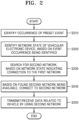
- FIG. 2 is a flowchart of an operation, performed by a vehicular electronic device according to an embodiment of the disclosure, of using a private network.
- the vehicular electronic device 2000 identifies an occurrence of a preset event.
- a pre-set (or pre-defined or prestored) event refers to a trigger for the vehicular electronic device 2000 to search for and connect to a private network.
- the preset event may be included as one or more pre-set events.
- the vehicular electronic device 2000 may identify that at least one of the preset events occurs, in relation to the driving and/or use of the vehicle 100.
- Various types of pre-set events may be identified by the vehicular electronic device 2000.
- the various types of pre-set events may include, but are not limited to, whether the vehicle 100 is charged, whether the vehicle 100 enters a pre-registered area, whether the engine of the vehicle 100 is turned on/off (or whether a motor is turned on/off), whether a shift gear of the vehicle 100 is in park (P) or neutral (N), whether a user input for the vehicular electronic device 2000 is received.
- the preset event to trigger the search for a private network may include an electric vehicle being in a fully charged state, or a state of being charged.
- the preset event may include the engine or motor of the vehicle being turned on, or being on.
- the preset event may include receiving a user input indicative of a user's desire to search for a private network.
- the preset event may include the vehicle entering a pre-registered or otherwise specified region or area.
- the pre-registered or otherwise specified region or area may be a specific location, such as a home garage, or may be an area within a certain distance of a particular location.
- the preset event may include a shift gear of the vehicle being in a park or neutral state.
- the vehicular electronic device 2000 may output inducing information to the driver/user of the vehicle 100 so that a pre-set event occurs, or may drive the vehicle 100 so that a pre-set event occurs.
- Inducing information may be information which alerts or informs the user to a state of the vehicle.
- Inducing information may be information which provides the user with information on how to remedy the state of the vehicle. For example, when a remaining capacity of the battery is less than or equal to a pre-set value, the vehicular electronic device 2000 may induce the driver/user to charge the battery, or may cause the vehicle 100 to return to a pre-registered area to start charging.
- the inducing information may be provided as an audio, visual or other suitable indication to the user that a remaining capacity of the battery is below the preset level.
- the inducing information may inform the user that the battery requires charging, and may comprise information regarding an availability of charging points to induce or encourage the user to charge the battery.
- the vehicular electronic device 2000 identifies the network state of the vehicular electronic device 2000, based on identification of event occurrence. That is, in response to the preset event being identified, the vehicular electronic device 2000 identifies the network state of the vehicular electronic device 2000. Identifying the network state may comprise identifying whether the vehicular electronic device 2000 is connected to a network. Identifying the network state may comprise identifying a type of network to which the vehicular electronic device 2000 is connected. For example, identifying the type of network may comprise identifying whether the connected network is a public network or a private network. Identifying the type of network may comprise identifying a security level of the connected network.
- the vehicular electronic device 2000 may search for a public network to receive a communication service.
- the vehicular electronic device 2000 may search for, for example, a public land mobile network (PLMN).
- PLMN public land mobile network
- the vehicular electronic device 2000 may search for and connect to a PLMN when the power of the vehicular electronic device 2000 is turned on, but conditions for searching for and connecting the PLMN are not limited thereto.
- the PLMN is a network operated by a communication service provider, and the vehicular electronic device 2000 may connect to 3G/4G/5G communication services provided by the communication service provider, by using the PLMN to which the vehicular electronic device 2000 has subscribed.
- the default setting of a communication network basically used by the vehicular electronic device 2000 may be a public network. That is, the vehicular electronic device 2000 may connect to and use a public communication network by default.
- the vehicular electronic device 2000 may search for a private network to transmit/receive specific data (e.g., safe transmission of security data) for a predetermined purpose.
- specific data e.g., safe transmission of security data
- the vehicular electronic device 2000 may search for a citizens Broadband Radio Service (CBRS), or a private 5G (or local 5G), etc. as a private network, but the disclosure is not limited thereto.
- CBRS citizens Broadband Radio Service
- 5G or local 5G
- the types of network connected to the vehicular electronic device 2000 will be classified into a first network and a second network.
- the first network may be a public network
- the second network may be a private network.
- the vehicular electronic device 2000 may identify whether a network currently being connected to the vehicular electronic device 2000 is the first network or the second network.
- the vehicular electronic device 2000 searches for the second network, based on a network state indicating connection to the first network. That is, in response to the network state indicating that the vehicular electronic device 2000 is connected to the first network, the vehicular electronic device 2000 may commence a search for a second network. In other words, if the network state indicates that the vehicular electronic device 2000 is not connected to a private network (the second network), the vehicular electronic device 2000 may search for the second network.
- the vehicular electronic device 2000 may search for the second network and, when the second network is found, identify whether the service of the second network is available.
- the vehicular electronic device 2000 may retry a search for the second network, based on a preset search period. That is, when the search for the second network does not successfully find the second network, the vehicular electronic device 2000 may retry the search for the second network based on a preset search period.
- the preset search period may comprise a preset waiting period, the preset waiting period being a length of time that the vehicular electronic device 2000 waits before commencing another search for the second network.
- the vehicular electronic device 2000 may stop the search for the second network.
- the search for the second network by the vehicular electronic device 2000 is stopped, the search for the second network may resume when an occurrence of another pre-set event is identified, or after a second preset waiting period has passed.
- the vehicular electronic device 2000 When it is checked whether the service of the second network is available, the vehicular electronic device 2000 according to an embodiment of the disclosure may perform step S240. That is, when the second network has been found and it has been verified that the service of the second network is available, the vehicular electronic device 2000 may perform step S240.
- the vehicular electronic device 2000 connects to the second network, based on the found second network being available. That is, in response to the second network identified in the search being available, the vehicular electronic device connects to the second network.
- the vehicular electronic device 2000 may include two or more SIMs.
- the SIM may be a SIM card inserted into a physical SIM slot or may be an embedded SIM (eSIM), but the disclosure is not limited thereto.
- eSIM embedded SIM
- the dual SIM may have various types.
- the dual SIM may be, but is not limited to, Dual SIM Standby (DSDS) or Dual SIM Dual Active (DSDA).
- the vehicular electronic device 2000 may authenticate the user of the vehicular electronic device 2000 for the first network by using a first SIM.
- the vehicular electronic device 2000 may authenticate the user of the vehicular electronic device 2000 for the second network by using a second SIM.
- the vehicular electronic device 2000 transmits/receives data related to the vehicle by using the second network. That is, the vehicular electronic device 2000 transmits data related to the vehicle to the server using the second network, and receives data related to the vehicle from the server using the second network.
- the data related to the vehicle 100 may include log data collected by the vehicular electronic device 2000 and data for updating the vehicular electronic device 2000.
- the log data may include data related to driving of the vehicle 100 that is, a driving history of the vehicle, (e.g., a driving speed, a driving route, a driving distance, and brake performance) and data related to an operation of the electronic device 2000 (e.g., user account related data of the vehicle 100, and payment related data of the user using the vehicular electronic device 2000).
- the data for updating the vehicular electronic device 2000 may include, for example, data for a firmware update, data for an OS update, or data for updating an application installed in the vehicular electronic device 2000.
- the vehicular electronic device 2000 may determine the priorities of data items for updating a vehicle.
- the vehicular electronic device 2000 may request the server 3000 for data for updating the vehicle, based on the priorities. That is, the vehicular electronic device 2000 may request data for updating the vehicle from the server based on the determined priorities of the data items.
- the vehicular electronic device 2000 may determine the priority of update data by predicting a vehicle charging completion time and assuming that data transmission/reception is possible during the vehicle charging completion time within a limited time period. For example, update data which is likely to be result in the update being completed within the predicted vehicle charging completion time may have a higher priority than update data relating to an update which is unlikely to be completed within the predicted vehicle charging time.
- the vehicular electronic device 2000 may first perform an important firmware update, and may perform an update of other auxiliary vehicle information and/or service information in a second order.
- specific items included in the data related to the vehicle 100 may differ according to the types of vehicle (e.g., an unmanned vehicle in a factory and an unmanned delivery robot vehicle). This will now be described in detail.
- vehicle e.g., an unmanned vehicle in a factory and an unmanned delivery robot vehicle.
- the vehicular electronic device 2000 may quickly and safely transmit/receive large-capacity data related to the vehicle by using the second network.
- FIG. 3 is a diagram for explaining the types of vehicles on which a vehicular electronic device according to an embodiment of the disclosure is mountable.
- the vehicle 100 on which the vehicle electronic device 2000 according to an embodiment of the disclosure is mounted may be classified into any of various types according to functions, purposes, and shapes of the vehicle 100.
- the vehicle 100 may be a robotic vehicle 310 that moves within a store.
- the robot vehicle 310 may perform various roles, such as serving, guiding, and responding to customers, while driving in a store.
- the vehicular electronic device 2000 may collect data related to driving of the robot vehicle 310 and log data related to the operation of the vehicular electronic device 2000 mounted in the robot vehicle 310.
- the vehicle 100 may be an unmanned delivery vehicle 320 that delivers goods, mail, food, etc. indoors/outdoors.
- the unmanned delivery vehicle 320 may deliver a package to a recipient.
- the vehicular electronic device 2000 may collect data related to driving of the unmanned delivery vehicle 320 and log data related to the operation of the vehicular electronic device 2000 mounted in the unmanned delivery vehicle 320.
- the vehicle 100 may be an unmanned cargo vehicle 330 that delivers and arranges cargoes in factories, warehouses, and the like.
- the vehicular electronic device 2000 may collect data related to driving of the unmanned delivery vehicle 330 and log data related to the operation of the vehicular electronic device 2000 mounted in the unmanned cargo vehicle 330.
- the vehicle 100 may be an unmanned agricultural vehicle 340.
- the unmanned agricultural vehicle 340 may convey a delivery to a recipient.
- the vehicular electronic device 2000 may collect data related to driving of the unmanned agricultural vehicle 340 and log data related to the operation of the vehicular electronic device 2000 mounted in the unmanned agricultural vehicle 340.
- the vehicular electronic device 2000 may transmit log data to the server 3000, and may receive, from the server 3000, data for updating the vehicle 100 (e.g., the robot vehicle 310, the unmanned delivery vehicle 320, the unmanned cargo vehicle 330, or the unmanned agricultural vehicle 340).
- the data for updating the vehicle 100 may be based on the transmitted log data.
- the vehicular electronic device 2000 may transmit/receive the above-described data by identifying an occurrence of a preset event and connecting the second network, which is a private network, based on the identification of the event occurrence.
- the type of vehicle 100 on which the vehicular electronic device 2000 is mounted is not limited to the above-described examples.
- Types of vehicles may include, for example, various types of vehicles, such as vehicles operated in research laboratories or racing/research tracks for vehicle testing, and transport vehicles operated in airports, aircraft hangars, docks, shipyards, and the like.
- the vehicular electronic device 2000 may transmit/receive log data collected according to the type of vehicle 100 and update data corresponding to the type of vehicle 100 to and from the server 3000. Specific examples of the log data and the data related to update will be described with reference to FIG. 6 .
- FIG. 4A is a diagram for explaining a second network that is used by a vehicular electronic device according to an embodiment of the disclosure.
- CBRS citizens Broadband Radio Service
- the second network is a private network.
- the second network is not limited thereto.
- private 5G communication may be used as the second network.
- CBRS is a communication band with a 150 MHz bandwidth (3550 MHz to 3700 MHz) in a 3.5 GHz band.
- a CBRS network architecture used by the vehicular electronic device 2000 may include, but is not limited to, a CBRS eNodeB (or gNodeB, etc.) capable of supporting a CBRS band, a core network (e.g., an Evolved Packet Core (EPC) capable of providing packet services), and a network for multimedia services (e.g., an IP multimedia subsystem (IMS)).
- a CBRS eNodeB or gNodeB, etc.
- a core network e.g., an Evolved Packet Core (EPC) capable of providing packet services
- EPC Evolved Packet Core
- multimedia services e.g., an IP multimedia subsystem (IMS)
- the vehicular electronic device 2000 may access an Internet 402 or a private local area network (LAN) 404 by using the CBRS network architecture.
- LAN local area network
- the CBRS network architecture may include a frequency sharing management system (e.g., a spectrum access system (SAS) 410).
- SAS spectrum access system
- the SAS 410 may manage frequency interference when the vehicular electronic device 2000 uses a CBRS frequency.
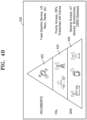
- CBRS users may be differentiated by a CBRS hierarchy 420. This will now be described in more detail with reference to FIG. 4B .
- FIG. 4B is a diagrams for explaining three tier of a CBRS network.
- the CBRS hierarchy 420 may include three user tiers.
- Tier 1 of the CBRS hierarchy 420 is incumbents 422.
- the incumbents 422 include users such as a fixed satellite service, a US navy, and a radar.
- Tier 2 of the CBRS hierarchy 420 is a priority access license (PAL) 424.
- the PAL 424 includes users (e.g., telecoms carriers) who have paid a cost for at least some of CBRS frequencies and have been licensed for the at least some of the CBRS frequencies.
- Tier 3 of the CBRS hierarchy 420 is a general authorized access (GAA) 426.
- the GAA 426 includes general electronic devices, loT devices, smartphones, and the like.
- Access of the vehicular electronic device 2000 according to an embodiment of the disclosure to the CBRS network may be performed by the SAS 410, which is a frequency sharing management system.
- the vehicular electronic device 2000 may obtain an access authority for the CBRS network through the SAS 410 and then may use the CBRS network.
- the users of the GAA 426 need to accept interference from the users of the incumbents 422 and the users of the PAL 424 with licenses to some extent, and do not need to cause interference to the users of an upper user layer.
- the vehicular electronic device 2000 according to an embodiment of the disclosure may be included in the GAA 426 (or, alternatively, included in the PAL 424), and may access the CBRS network by obtaining an access authority for the CBRS network from the SAS 410.
- the CBRS network is a private network that may be used to supplement general public wireless communications (e.g., 4G and 5G networks).
- the CBRS network may be established in, for example, electric vehicle charging stations, distribution warehouses, companies, government offices, hospitals, factories, airports, public places, and stores.
- a pre-set event e.g., access to an electric vehicle charging station or charging plug-in
- the vehicular electronic device 2000 may obtain, from the SAS 410, an access authority for a CBRS network built in a place where the vehicle 100 is located, and thus may access the CBRS network. In other words, the vehicular electronic device 2000 may access the second network.
- FIG. 5A is a diagram for explaining an operation, performed by a vehicular electronic device according to an embodiment of the disclosure, of identifying an occurrence of a pre-set event.
- a coverage range 510 also known as an application range
- a coverage range 520 of a mobile network. Since the use of the CBRS network is only possible within the application range 510 of the CBRS network, the vehicular electronic device 2000 according to an embodiment of the disclosure may store location information of a place or location where the CBRS network is or may be established, in order to use the CBRS network.
- the preset event may be whether a vehicle is charged (e.g., wired charging plug-in or wireless charging start).
- the vehicular electronic device 2000 may identify whether vehicle charging has occurred.
- the preset event may be the vehicle 100 entering a pre-registered area (e.g., an area where a CBRS network is established (an electric vehicle charging station, a specific location in a factory/store/warehouse, etc.)).
- the vehicular electronic device 2000 may identify whether the vehicle 100 enters the pre-registered area.
- the vehicular electronic device 2000 may determine that the preset event has been identified.
- the aforementioned preset event is only an example, and various event triggers for the vehicular electronic device 2000 to start searching for the CBRS network and attempt connection may be set in the vehicular electronic device 2000.
- the vehicular electronic device 2000 may identify the network state of the vehicular electronic device 2000, based on identification of event occurrence, and may perform operations for accessing a private network. That is, the network state of the vehicular electronic device 2000 may be identified in response to the identification of the preset event occurrence. Because this has already been described above, a redundant description thereof will be omitted.
- the vehicular electronic device 2000 may quickly transmit/receive data of a large capacity and/or high security importance by using an improved network in a private area. That is, the CBRS network is the improved network compared to the public network because the CBRS network enables the vehicular electronic device 2000 to quickly, efficiently and securely transmit or receive a large quantity of data and/or data of a sensitive nature or of high security importance to or from the server.
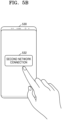
- FIG. 5B is a diagram for explaining another operation, performed by a vehicular electronic device according to an embodiment of the disclosure, of identifying an occurrence of a pre-set event.
- the preset event identified by the vehicular electronic device 2000 may include reception of a user input for a network search. That is, the vehicular electronic device 2000 may detect a user input indicative of a user's intention to connect to the second network. The vehicular electronic device 2000 may identify whether the user input for a network search (e.g., a CBRS network) is received. If the user input for performing a network search is identified, where the network search comprises a search for a private network, then the vehicular electronic device 2000 may determine that the preset event has been identified.
- a network search e.g., a CBRS network
- the vehicular electronic device 2000 may receive a user input from a user device 530 connected with the vehicle 100 via a wireless connection (or may also include a wired connection).
- a user of the user device 530 may, for example, touch a user interface for requesting a second network connection 532 on a screen of the user device 530, in order to transmit/receive vehicle-related data.
- the vehicular electronic device 2000 may receive a user input from the user device 530 through wireless/wired communication.
- the vehicular electronic device 2000 may receive a user input of touching a user interface for the second network connection 532, with respect to the screen of a display mounted on the vehicle 100. That is, the vehicular electronic device 2000 may receive a user input on a user interface provided on a display mounted in the vehicle.
- the user input may comprise a touch performed by the user on the user interface to select an icon representing an instruction to connect to the second network, the icon being displayed on the user interface.
- the display mounted on the vehicle 100 may be a component included in the vehicular electronic device 2000, and may be mounted in the vehicle 100 separately from the vehicular electronic device 2000 and capable of wireless/wired communication with the vehicular electronic device 2000.
- the vehicular electronic device 2000 may identify the network state of the vehicular electronic device 2000, based on identification of an occurrence of the preset event, and may perform operations for accessing a private network. Because this has already been described above, a redundant description thereof will be omitted.
- the vehicular electronic device 2000 may quickly transmit/receive data of a large capacity and/or high security importance using an improved network in a private area.
- FIG. 6 is a diagram for explaining the log data that is collected by a vehicular electronic device according to an embodiment of the disclosure.
- the vehicular electronic device 2000 may collect, as log data 600, various data obtainable from a parked state and/or a running state of the vehicle 100.
- the log data 600 may include, but is not limited to, data 610 related to driving of the vehicle 100 and data 620 related to an operation of the vehicular electronic device 2000.
- the data 610 related to driving of the vehicle 100 may refer to data obtainable as the vehicle 100 drives.
- the data 610 may constitute data related to a driving history of the vehicle.
- the data 620 related to the operation of the vehicular electronic device 2000 may refer to data obtainable as the vehicular electronic device 2000 operates while the vehicle 100 is parked and/or driving.
- the vehicle 100 on which the vehicle electronic device 2000 according to an embodiment of the disclosure is mounted may be classified into any of various types according to functions, purposes, and shapes of the vehicle 100. Accordingly, the log data 600, or the type of log data 600, collected for each vehicle may vary.
- the vehicular electronic device 2000 may collect different log data 600 collectable according to the type of vehicle 100 which the vehicular electronic device 2000 is associated with, and may transmit the collected different log data 600 to the server 3000.
- the vehicular electronic device 2000 may receive data 630 for updating the vehicle 100 from the server 3000.
- the data 630 for updating the vehicle 100 may be determined based on the log data 600. That is, the server 3000 may transmit data 630 for updating the vehicle 100 to the vehicle 100 based on the log data 600 received from the vehicular electronic device 2000.
- the log data 600 and the data 630 for vehicle update, or updating a vehicle will now be described by illustrating the type of vehicle 100 described above with reference to FIG. 3 , to help understanding.
- the vehicle 100 may be the robot vehicle 310 that moves within a store. While the vehicle may be a robot vehicle 310 that moves within other environments such as government offices, companies, etc. only a store is described herein for convenience of description. However, it should be clear to the skilled person that the invention is not limited to this example.
- the vehicular electronic device 2000 When the vehicular electronic device 2000 is mounted on the robot vehicle 310, the vehicular electronic device 2000 may collect the log data 600 of the robot vehicle 310.
- the vehicle electronic device 2000 may collect a driving speed, a driving route, a driving distance, a driving time, environment information about an environment on the driving route, on/off information of an engine or motor, data related to autonomous driving, etc.
- This data may comprise the data 610 related to the driving of the robot vehicle 310.
- the vehicular electronic device 2000 may collect, as the log data 600, various pieces of information obtainable as the vehicular electronic device 2000 operates within the robot vehicle 310, such as power on/off information of the vehicular electronic device 2000, product information about products sold at a store, network state information, visit information of a store customer, user account information of the store customer, order product information, payment information, and drivable residual battery information.
- This data may comprise the data 620 related to the operation of the vehicular electronic device 2000 in the robot vehicle 310.
- the log data 600 of the robot vehicle 310 is not limited to the aforementioned examples.
- the vehicular electronic device 2000 may transmit the collected log data 600 of the robot vehicle 310 to the server 3000.
- the collected log data 600 may be transmitted to the server 3000 using the second network.
- the vehicular electronic device 2000 may receive the data 630 for updating the robot vehicle 310 from the server 3000.
- the data 630 may be transmitted to the vehicular electronic device 2000 using the second network.
- the vehicular electronic device 2000 may receive data for performing a firmware update, for performing an OS update, or for updating an application installed in the robot vehicle 310.
- the vehicular electronic device 2000 may also receive data including store information to be provided to a user using the robot vehicle 310 when visiting the store, product information about products in the store, in-store map information, current event/discount information, and the like.
- the data 630 for updating the robot vehicle 310 is not limited to the aforementioned examples.
- the data 630 for updating the robot vehicle 310 may be determined based on the log data 600. For example, when a predetermined number of products are sold and exhausted in a store, the robot vehicle 310 may be updated so that product information to be displayed on the robot vehicle 310 may be displayed as sold out.
- the vehicle 100 may be an unmanned (or manned) delivery vehicle 320 that delivers goods, mail, food, etc. indoors/outdoors.
- the unmanned delivery vehicle 320 may deliver a package to a recipient.
- the vehicular electronic device 2000 when the vehicular electronic device 2000 is mounted on the unmanned delivery vehicle 320, the vehicular electronic device 2000 may collect the log data 600 of the unmanned delivery vehicle 320.
- the vehicle electronic device 2000 may collect a driving speed, a driving route, a driving distance, a driving time, environment information about an environment on the driving route, engine on/off information (or motor on/off information), data related to autonomous driving, etc., which are the data 610 related to the driving of the robot vehicle 320.
- the vehicular electronic device 2000 may collect, as the log data 600, various pieces of information obtainable as the vehicular electronic device 2000 operates within the unmanned delivery vehicle 310, such as power on/off information of the vehicular electronic device 2000, outdoor traffic volume information and traffic signal information to a delivery destination, road accident occurrence information, building floor/room number information for indoor delivery, delivery information, delivery sender/receiver information, orderer payment information, user account management information, delivery order information, expected delivery time information & delivery completion time, expected delivery route & actual route information, and drivable residual battery information of the unmanned delivery vehicle 320, which are related to an operation of the in-vehicle electronic device 2000 in the unmanned delivery vehicle 320.
- the vehicular electronic device 2000 may transmit the log data 600 of the unmanned delivery vehicle 320 to the server 3000.
- the log data 600 may be transmitted using the second network.
- the vehicular electronic device 2000 may receive the data 630 for updating the unmanned delivery vehicle 320 from the server 3000.
- the data 630 may be received using the second network.
- the vehicular electronic device 2000 may receive data for firmware update, data for OS update, data for updating an application installed in the unmanned delivery vehicle 320, and data including real-time traffic condition information, newly added delivery information, and the like.
- the data 630 for updating the unmanned delivery vehicle 320 is not limited to the aforementioned examples.
- the vehicle 100 may be an unmanned (or manned) cargo vehicle 330 that delivers and arranges cargoes in factories, warehouses, and the like.
- the vehicular electronic device 2000 may collect the log data 600 of the unmanned cargo vehicle 330.
- the vehicle electronic device 2000 may collect a driving speed, a driving route, a driving distance, a driving time, on/off information of an engine or motor, data related to autonomous driving, etc., which are the data 610 related to the driving of the unmanned cargo vehicle 330.
- the vehicular electronic device 2000 may collect, as the log data 600, various pieces of information obtainable as the vehicular electronic device 2000 operates within the unmanned cargo vehicle 330, such as power on/off information of the vehicular electronic device 2000, logistics warehousing/releasing information in a factory/warehouse, stock information, factory/warehouse visitor information, and drivable residual battery information, etc., which are related to an operation of the vehicular electronic device 2000 in the unmanned cargo vehicle 330.
- the vehicular electronic device 2000 may transmit the log data 600 of the unmanned cargo vehicle 330 to the server 3000, and may receive the data 630 for updating the unmanned cargo vehicle 330 from the server 3000.
- the vehicle 100 may be an unmanned (or manned) agricultural vehicle 340.
- the vehicular electronic device 2000 may collect the log data 600 of the unmanned agricultural vehicle 340, and may receive the data 630 for updating the unmanned agricultural vehicle 340 from the server 3000.
- the vehicular electronic device 2000 may manage and update environment information such as a state, a quantity, and a temperature/humidity of crops grown using the unmanned agricultural vehicle 340.
- the vehicle 100 may be, for example, vehicles operated in research laboratories or racing/research tracks for vehicle testing, and transport vehicles operated in airports, aircraft hangars, docks, shipyards, and the like.
- the vehicular electronic device 2000 may collect the log data 600 of the vehicle 100, and may receive the data 630 for updating the vehicle 100 from the server 3000.
- the vehicular electronic device 2000 may collect and manage the log data 600 including various vehicle driving data, such as a speed for each wheel, brake performance, a wheel balance, a rotation angle, and suspension, so that the log data 600 may be utilized to research/develop and test the vehicle 100.
- vehicle driving data such as a speed for each wheel, brake performance, a wheel balance, a rotation angle, and suspension
- the log data 600 may be utilized to research/develop and test the vehicle 100.
- data of high security importance for research/development and testing may be transmitted/received using the second network, which is a private network.
- the vehicular electronic device 2000 may maintain and update sensitive internal data unique to logistics and aviation/shipping companies, and various data related to aircraft/ship parts and maintenance.
- the vehicular electronic device 2000 may transmit/receive the above-described exemplary data of the log data 600 and the data 630 for updating the vehicle 100, by using the second network, which is a private network.
- FIG. 7 is a diagram for explaining a subscriber identity module (SIM) included in the vehicular electronic device according to an embodiment of the disclosure.
- SIM subscriber identity module
- the vehicular electronic device 2000 may include two or more SIMs.
- the SIM may be a SIM card inserted into a physical SIM slot or may be an embedded SIM (eSIM), but the disclosure is not limited thereto.
- eSIM embedded SIM
- the vehicular electronic device 2000 may authenticate the user of the vehicular electronic device 2000 for a first network 712 by using a first SIM 710.
- the vehicular electronic device 2000 may authenticate the user of the vehicular electronic device 2000 for a second network 722 by using a second SIM 720.
- the dual SIM may have various types.
- the dual SIM may be, but is not limited to, Dual SIM Standby (DSDS) or Dual SIM Dual Active (DSDA).
- the vehicular electronic device 2000 may identify the type of the dual SIM.
- the vehicular electronic device 2000 may determine whether to start searching for the second network based on the type of the dual SIM type and first network use information of the vehicular electronic device 2000.
- the type of each of the first SIM 710 and the second SIM 720 may be Dual SIM Standby (DSDS).
- DSDS Dual SIM Standby
- the first SIM 710 and the second SIM 720 are normally in a standby state, but, when one SIM is in a call state, the other SIM is not available.
- the vehicular electronic device 2000 may identify use information of the first network 712 of the first SIM 710, before performing a search for and a connection to the second network 722 by using the second SIM 720.
- the vehicular electronic device 2000 may wait until the call using the first SIM 710 is terminated, and then, when the call is terminated, the vehicular electronic device 2000 may enable a communication service for the second network 722 to be connected using the second SIM 720.
- the type of each of the first SIM 710 and the second SIM 720 may be Dual SIM Dual Active (DSDA).
- DSDA Dual SIM Dual Active
- simultaneous activation of the first SIM 710 and the second SIM 720 is possible, and thus, even when the use information of the first network 712 indicates a call state, the vehicular electronic device 2000 may enable a communication service for the second network 722 to be connected using the second SIM 720.
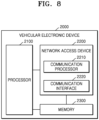
- FIG. 8 is a block diagram of a configuration of the vehicular electronic device according to an embodiment of the disclosure.
- the vehicular electronic device 2000 may include a processor 2100, a network access device 2200, and a memory 2300.
- the network access device 2200 may include a communication processor 2210 and a communication interface 2220.
- the vehicular electronic device 2000 may be an electronic device that transmits/receives data used for operating the vehicle 100 to/from a server, for example, an electronic device that provides a communication function with the server 3000.
- the vehicular electronic device 2000 may perform communication between the vehicle 100 and the server 3000 to transmit/receive information necessary for driving or using the vehicle.
- the vehicular electronic device 2000 may be an electronic device for implementing IVI technology, which provides services, information, and/or content to a user.
- the processor 2100 may control overall operations of the vehicular electronic device 2000. For example, the processor 2100 may transmit/receive vehicle-related data and provide services, information, and/or content to users, by executing one or more instructions of the program stored in the memory 2300. One or more processors 2100 may be included.
- the processor 2100 may include, but is not limited to, at least one of a central processing unit, a microprocessor, a graphics processing unit, application specific integrated circuits (ASICs), digital signal processors (DSPs), digital signal processing devices (DSPDs), programmable logic devices (PLDs), field programmable gate arrays (FPGAs), an application processor, a neural processing unit, or an Al dedicated processor designed with a hardware structure specialized for processing an Al model.
- ASICs application specific integrated circuits
- DSPs digital signal processors
- DSPDs digital signal processing devices
- PLDs programmable logic devices
- FPGAs field programmable gate arrays
- an application processor a neural processing unit
- Al dedicated processor designed with a hardware structure specialized for processing an Al model.
- the network access device 2200 is a configuration controlling data transmission/reception of the vehicular electronic device 2000, and may be in charge of communications between the vehicle and an external electronic device (for example, the server 3000 and a mobile device).
- the network access device 2200 may perform a network search necessary for the vehicular electronic device 2000 to use a communication service of the first and/or second networks.
- the communication processor 2210 may control overall operations of the network access device 2200. For example, the communication processor 2210 may cause the network access device 2200 to search for and access the first and second networks, by executing the one or more instructions of the program stored in the memory 2300. In this case, access authority to the second network may be obtained using the aforementioned SAS.
- the communication processor 2210 may include, but is not limited to, at least one of a central processing unit, a microprocessor, application specific integrated circuits (ASICs), digital signal processors (DSPs), digital signal processing devices (DSPDs), programmable logic devices (PLDs), field programmable gate arrays (FPGAs), a telematics control unit, or a communication processor (CP) module.
- the CP module is a modem chipset, and a network may perform communication with an external electronic device (e.g., the server 3000) via a communication network according to the 3rd generation (3G), 4G, or 5G communication standard.
- 3G 3rd generation
- 4G 4G
- 5G communication standard e.g., 5G communication standard
- the communication interface 2220 may perform data communications with the server 3000 or a base station by using at least one of data communication methods including a wireless LAN, Wi-Fi, Bluetooth, Zigbee, Wi-Fi Direct (WFD), infrared communication (IrDA), Bluetooth Low Energy (BLE), Wireless Broadband Internet (Wibro), World Interoperability for Microwave Access (WiMAX), a shared wireless access protocol (SWAP), Wireless Gigabit Alliance (WiGig), or RF communication.
- data communication methods including a wireless LAN, Wi-Fi, Bluetooth, Zigbee, Wi-Fi Direct (WFD), infrared communication (IrDA), Bluetooth Low Energy (BLE), Wireless Broadband Internet (Wibro), World Interoperability for Microwave Access (WiMAX), a shared wireless access protocol (SWAP), Wireless Gigabit Alliance (WiGig), or RF communication.
- the communication interface 2220 may include at least one communication circuit and/or module performing wireless communication.
- the communication interface 2220 may include at least one of an antenna, a Bluetooth module, a Wi-Fi module, a global positioning system (GPS) module, or an RF module.
- GPS global positioning system
- the communication interface 2220 may include at least one short-range communication module that performs communication according to a communication standard such as Bluetooth Low Energy (BLE), near field communication (NFC)/radio frequency identification (RFID), Wi-Fi Direct, ultra-wideband (UWB), and/or ZIGBEE.
- BLE Bluetooth Low Energy
- NFC near field communication
- RFID radio frequency identification
- UWB ultra-wideband
- ZIGBEE ZIGBEE
- Instructions, a data structure, and program code readable by the processor 2100 and the communication processor 2210 may be stored in the memory 2300. According to embodiments of the disclosure, operations performed by the processor 2100 and the communication processor 2210 may be implemented by executing the instructions or codes of a program stored in the memory 2300.
- the memory 2300 may include at least one of a flash memory type, a hard disk type, a multimedia card micro type, a card type memory (for example, a secure digital (SD) or extreme digital (XD) memory), a random access memory (RAM), a static random access memory (SRAM), a read-only memory (ROM), an electrically erasable programmable ROM (EEPROM), a programmable ROM (PROM), magnetic memory, a magnetic disk, or an optical disk.
- a flash memory type for example, a secure digital (SD) or extreme digital (XD) memory
- RAM random access memory
- SRAM static random access memory
- ROM read-only memory
- EEPROM electrically erasable programmable ROM
- PROM programmable ROM
- FIG. 9 is a diagram illustrating communication of the vehicular electronic device with the server 3000, according to an embodiment of the disclosure.
- the vehicular electronic device 2000 mounted on the vehicle 100 is shown on the roof of the vehicle 100. However, this does not limit the location of the vehicular electronic device 2000.
- the server 3000 may include a server, a server system, a server-based apparatus, or the like, which transmits/receives data to/from the vehicular electronic device 2000 via a communication network 3100 and processes the data.
- the communication network 3100 may be the first network (e.g., a 4G/5G network), which is a public network, and/or the second network (e.g., a CBRS network), which is a private network, according to the above-described embodiments.
- the vehicular electronic device 2000 may transmit/receive data for a general communication service to/from a server or the like of a communication service provider by using the first network, and transmit/receive data related to the vehicle 100 to/from the server 3000 by using the second network.
- the vehicular electronic device 2000 may transmit log data 910 to the server 3000 by using the second network.
- the log data 910 may include the data related to driving of the vehicle 100 and the data related to an operation of the vehicular electronic device 2000. This has been described above, so redundant descriptions thereof will be omitted.
- the vehicular electronic device 2000 may receive update data 920 related to vehicle update from the server 3000 by using the second network, stores the received update data 920, and perform updating. This has been described above, so redundant descriptions thereof will be omitted.
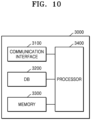
- FIG. 10 is a block diagram of the server according to an embodiment of the disclosure.
- the server 3000 may be mutually connected to the vehicular electronic device 2000 in a wireless communication manner, and perform data communication.
- the server 3000 may include at least a communication interface 3100, a database (DB) 3200, and a processor 3400.
- the communication interface 3100 may include at least one component that enables communication via a local area network (LAN), a wide area network (WAN), a value added network (VAN), a mobile radio communication network, a satellite communication network, and a combination thereof.
- LAN local area network
- WAN wide area network
- VAN value added network
- mobile radio communication network a mobile radio communication network
- satellite communication network and a combination thereof.
- the communication interface 3100 may receive log data from the vehicular electronic device 2000 and transmit update data to the vehicular electronic device 2000.
- the communication interface 2100 may also transmit a service, information, and/or content, to the vehicular electronic device 2000 so as to provide the service, information, and/or content to a user.
- the DB 3200 may store data received from the vehicular electronic device 2000, data to be received from or provided to another external device (not shown), and data desired by the server 3000 to be provided to the vehicular electronic device 2000.
- the memory 3300 may store various pieces of data, programs, or applications for driving and controlling the server 3000.
- a program stored in the memory 3300 may include one or more instructions.
- the program (one or more instructions) or application stored in the memory 3300 may be executed by the processor 3400.
- the processor 3400 may entirely control the server 3000.
- the processor 3400 may execute one or more programs stored in the memory 3300.
- the processor 3400 may include an application processor (AP), a central processing unit (CPU), a graphics processing unit (GPU), a neural processing unit, or an Al-dedicated processor designed in a hardware structure specialized for processing of an Al model.
- AP application processor
- CPU central processing unit
- GPU graphics processing unit
- neural processing unit or an Al-dedicated processor designed in a hardware structure specialized for processing of an Al model.
- the processor 3400 may control the server 3000 to provide, to the vehicular electronic device 2000, vehicle-related data, service, information, and content.
- the disclosure provides a method of transmitting/receiving vehicle-related data by performing a network search operation based on an occurrence of a preset event or by causing a preset event, in an efficient network search, selection, and connection method of the vehicular electronic device 2000.
- vehicular electronic devices transmit/receive data using a public network provided by a general communication service provider, a large amount of data can be used. This large data use can lead to a significant financial burden on a user of the vehicle.
- some of the data may include sensitive information of a high security importance.
- vehicular electronic devices transmit/receive such high security data in a public network, there is a risk of unwanted data leakage.
- a method performed by vehicular electronic devices for searching for a private network in order to efficiently transmit/receive data is required. That is, an efficient network search method capable of searching for and using a private network, and consequently reducing resources such as batteries of vehicular electronic devices is required.
- an operation method of a vehicular electronic device may be provided.
- the operation method may include identifying an occurrence of a preset event.
- the operation method may further include identifying a network state of the vehicular electronic device, based on identification of the occurrence of the preset event.
- the operation method may further include searching for a second network, based on the network state indicating connection to a first network.
- the operation method may further include accessing the second network, based on the found second network being available; and
- the operation method may further include transmitting/receiving data related to the vehicle to/from the server by using the second network.
- the first network may be a public network
- the second network may be a private network.
- the identifying of the occurrence of the preset event may include identifying at least one of whether the vehicle is charged or whether the vehicle enters a pre-registered area.
- the identifying of the occurrence of the preset event may further include identifying whether a user input for network search is received by the vehicular electronic device.
- Data related to the vehicle may include log data related to driving of the vehicle and data related to an operation of the vehicular electronic device.
- the operation method may further include collecting the log data as the vehicle is operated.
- the transmitting/receiving of the data related to the vehicle to/from the server by using the second network may include sending the log data to the server.
- the transmitting/receiving of the data related to the vehicle to/from the server by using the second network may further include receiving, from the server, data for updating the vehicle, the data being determined based on the log data.
- the operation method may further include determining a priority of a data item for updating the vehicle.
- the operation method may further include requesting the server for the data for updating the vehicle, based on the priority.
- the second network may be a citizens Broadband Radio Service (CBRS) or local 5 th generation mobile communication (5G).
- CBRS citizens Broadband Radio Service
- 5G 5 th generation mobile communication
- the vehicular electronic device may include two or more subscriber identity modules (SIMs).
- SIMs subscriber identity modules
- the operation method may further include authenticating a user of the vehicular electronic device for the first network by using a first SIM.
- the operation method may further include authenticating a user of the vehicular electronic device for the second network by using a second SIM.
- the operation method may further include identifying types of the first SIM and the second SIM.
- the searching for the second network may include starting searching for the second network, based on the types of the first SIM and the second SIM and first network use information of the vehicular electronic device.
- the searching for the second network may include retrying the search for the second network at preset search intervals, based on the second network being not found.
- Embodiments of the disclosure can also be embodied as a storage medium including instructions executable by a computer such as a program module executed by the computer.
- a computer readable medium can be any available medium which can be accessed by the computer and includes all volatile/non-volatile and removable/non-removable media. Further, the computer readable medium may include all computer storage and communication media.
- the computer storage medium includes all volatile/non-volatile and removable/non-removable media embodied by a certain method or technology for storing information such as computer readable instruction code, a data structure, a program module or other data.
- Communication media may typically include computer readable instructions, data structures, or other data in a modulated data signal, such as program modules.
- computer-readable storage media may be provided in the form of non-transitory storage media.
- the 'non-transitory storage medium' is a tangible device and only means that it does not contain a signal (e.g., electromagnetic waves). This term does not distinguish a case in which data is stored semi-permanently in a storage medium from a case in which data is temporarily stored.
- the non-transitory recording medium may include a buffer in which data is temporarily stored.
- a method may be provided by being included in a computer program product.
- the computer program product which is a commodity, may be traded between sellers and buyers.
- Computer program products are distributed in the form of device-readable storage media (e.g., compact disc read only memory (CD-ROM)), or may be distributed (e.g., downloaded or uploaded) through an application store or between two user devices (e.g., smartphones) directly and online.
- device-readable storage media e.g., compact disc read only memory (CD-ROM)
- CD-ROM compact disc read only memory
- two user devices e.g., smartphones
- at least a portion of the computer program product e.g., a downloadable app
- a device-readable storage medium such as a memory of a manufacturer's server, a server of an application store, or a relay server, or may be temporarily generated.
Landscapes
- Engineering & Computer Science (AREA)
- Computer Networks & Wireless Communication (AREA)
- Signal Processing (AREA)
- Computer Security & Cryptography (AREA)
- Mechanical Engineering (AREA)
- Transportation (AREA)
- Power Engineering (AREA)
- Health & Medical Sciences (AREA)
- Computing Systems (AREA)
- General Health & Medical Sciences (AREA)
- Medical Informatics (AREA)
- Traffic Control Systems (AREA)
- Telephonic Communication Services (AREA)
Abstract
Description
- The disclosure relates to a vehicular electronic device for performing a network search.
- Vehicular electronic devices are devices which are mounted in vehicles to provide and manage a connected service remotely. When a vehicle is being parked or driven, data obtained from the vehicular electronic device can be transmitted to a server and used for data management and analysis. In addition, data for vehicle updates can be received by the vehicular electronic device from the server and used for vehicle maintenance and management.
- The present invention has been devised in the above context.
- According to an embodiment of the disclosure, an operation method of a vehicular electronic device may be provided. The operation method may include identifying an occurrence of a preset event. The operation method may further include identifying a network state of the vehicular electronic device, based on identification of the occurrence of the preset event. The operation method may further include searching for a second network, based on the network state indicating connection to a first network. The operation method may further include, based on the found second network being available, accessing the second network. The operation method may further include transmitting/receiving data related to a vehicle to/from the server by using the second network. The first network may be a public network, and the second network may be a private network. That is, according to an embodiment of the disclosure, an operation method of a vehicular electronic device for a vehicle may be provided. The operation method may comprise identifying an occurrence of a preset event. The method may further comprise identifying a network state of the vehicular electronic device, in response to identifying the occurrence of the preset event. The method may further include searching for a second network in response to the identified network state indicating a connection of the vehicular electronic device to a first network. The method may further comprise accessing the second network in response to detecting the second network and transmitting/receiving data related to the vehicle to/from a server using the second network. The first network may be a public network, and the second network may be a private network.
- According to an embodiment of the disclosure, a vehicular electronic device may be provided. The vehicular electronic device may include at least one processor, a communication interface, and a memory storing one or more instructions. The one or more processors may be configured to execute the one or more instructions stored in the memory to identify an occurrence of a preset event. The one or more processors may be configured to execute the one or more instructions stored in the memory to identify a network state of the vehicular electronic device, based on the occurrence of the preset event being identified. The one or more processors may be configured to execute the one or more instructions stored in the memory to search for a second network, based on the network state indicating connection to a first network. The one or more processors may be configured to execute the one or more instructions stored in the memory to access the second network, based on the found second network being available. The one or more processors may be configured to execute the one or more instructions stored in the memory to transmit/receive data related to the vehicle to/from the server by using the second network. The first network may be a public network, and the second network may be a private network. That is, according to an embodiment of the disclosure, a vehicular electronic device for a vehicle may be provided. The vehicular electronic device may comprise a communication interface, a memory storing one or more instructions, and at least one processor configured to execute the one or more instructions stored in the memory. The at least one processor may be further configured to identify an occurrence of a preset event. The at least one processor may be further configured to identify a network state of the vehicular electronic device in response to identifying the occurrence of the preset event. The at least one processor may be additionally configured to search for a second network in response to the identified network state indicating a connection of the vehicular electronic device to a first network. The at least one processor may be further configured to access the second network in response to detecting the second network. The at least one processor may also be configured to transmit/receive data related to the vehicle to/from the server using the second network. The first network may be a public network, and the second network may be a private network.
- According to an embodiment of the disclosure, a non-transitory computer-readable recording medium having recorded thereon a computer program for executing one of methods described above and to be described below, performed by the vehicular electronic device, of searching for a network may be provided.
- Advantageously, transmitting data to and from the vehicular electronic device and the server using the second network, where the second network is a private network, enables the data to be transmitted more efficiently. That is, the transmitted data does not put a strain on the capabilities of the public network, and so contributes to reducing network load in the existing public network. Additionally, the user encounters reduced costs relating to the transmitting of data over the public network. In this way, private or corporate companies may be enabled to efficiently manage vehicles to create various mobility services.
- Furthermore, by transmitting data over a private network rather than a public network, the risk of unwanted data leakage is reduced. Therefore, potentially high security or sensitive data may be transmitted between the vehicular electronic device and the server more securely.
-
-
FIG. 1 is a diagram for describing a method, performed by a vehicular electronic device, of forming a communication connection with a server by searching for a network, according to an embodiment of the disclosure. -
FIG. 2 is a flowchart of an operation, performed by a vehicular electronic device according to an embodiment of the disclosure, of using a private network. -
FIG. 3 is a diagram for explaining the types of vehicles on which a vehicular electronic device according to an embodiment of the disclosure is mountable. -
FIG. 4A is a diagram for explaining a second network that is used by a vehicular electronic device according to an embodiment of the disclosure. -
FIG. 4B is a diagram for explaining three layers of a Citizens Broadband Radio Service (CBRS) network. -
FIG. 5A is a diagram for explaining an operation, performed by a vehicular electronic device according to an embodiment of the disclosure, of identifying an occurrence of a pre-set event. -
FIG. 5B is a diagram for explaining another operation, performed by a vehicular electronic device according to an embodiment of the disclosure, of identifying an occurrence of a pre-set event. -
FIG. 6 is a diagram for explaining log data that is collected by a vehicular electronic device according to an embodiment of the disclosure. -
FIG. 7 is a diagram for explaining a subscriber identity module (SIM) included in a vehicular electronic device according to an embodiment of the disclosure. -
FIG. 8 is a block diagram of a configuration of a vehicular electronic device according to an embodiment of the disclosure. -
FIG. 9 is a diagram illustrating communication of a vehicular electronic device with a server, according to an embodiment of the disclosure. -
FIG. 10 is a block diagram of a server according to an embodiment of the disclosure. - Throughout the disclosure, the expression "at least one of a, b or c" indicates only a, only b, only c, both a and b, both a and c, both b and c, all of a, b, and c, or variations thereof.
- Hereinafter, the terms used in the specification will be briefly described, and then the disclosure will be described in detail. Although general terms widely used at present were selected for describing the disclosure in consideration of the functions thereof, these general terms may vary according to intentions of one of ordinary skill in the art, case precedents, the advent of new technologies, and the like. Terms arbitrarily selected by the applicant of the disclosure may also be used in a specific case. In this case, their meanings need to be given in the detailed description. Hence, the terms must be defined based on their meanings and the contents of the entire specification, not by simply stating the terms.
- An expression used in the singular may encompass the expression of the plural, unless it has a clearly different meaning in the context. Unless otherwise defined, all terms (including technical and scientific terms) used herein have the same meaning as commonly understood by one of ordinary skill in the art to which this disclosure belongs.
- The terms "comprises" and/or "comprising" or "includes" and/or "including" when used in this specification, specify the presence of stated elements, but do not preclude the presence or addition of one or more other elements. The terms "unit", "-er (-or)", and "module" when used in this specification refers to a unit in which at least one function or operation is performed, and may be implemented as hardware, software, or a combination of hardware and software.
- Embodiments of the disclosure are described in detail herein with reference to the accompanying drawings so that this disclosure may be easily performed by one of ordinary skill in the art to which the disclosure pertains. The disclosure may, however, be embodied in many different forms and should not be construed as being limited to the embodiments set forth herein. In the drawings, parts irrelevant to the description are omitted for simplicity of explanation, and like numbers refer to like elements throughout.
-
FIG. 1 is a diagram for describing a method, performed by a vehicular electronic device, of forming a communication connection with a server by searching for a network, according to an embodiment of the disclosure. - Referring to
FIG. 1 , the vehicularelectronic device 2000 according to an embodiment of the disclosure may be an electronic device mounted within avehicle 100. - In an embodiment of the disclosure, the
vehicle 100 may refer to an internal combustion engine vehicle or an electric vehicle, and may include a movable device (e.g., a robot). In an embodiment of the disclosure, an electric car is illustrated for convenience of description. However, thevehicle 100 is not limited thereto. - In an embodiment of the disclosure, the vehicular
electronic device 2000 may be mounted in thevehicle 100. The function and shape of the vehicularelectronic device 2000 may vary. - For example, the vehicular
electronic device 2000 according to an embodiment of the disclosure may include a display installed in a digital cockpit in which a dashboard, an infotainment system, audio, lighting control, etc. of thevehicle 100 are implemented with digital technology. - The vehicular
electronic device 2000 according to an embodiment of the disclosure may be implemented as being included in an in-vehicle infotainment (IVI) system for implementing IVI technology. The IVI system refers to a system that displays or uses various pieces of information available in vehicles such that a user (driver and/or passenger) may easily and conveniently recognize the various pieces of information, such as radio, navigation, voice commands, and automatic safety diagnosis. Infotainment is a term corresponding to a combination of information and entertainment, and may be a term that collectively refers to both information and entertainment. In other words, the IVI system may refer to a system that allows information to be used happily and conveniently like entertainment. - The vehicular
electronic device 2000 according to the disclosed embodiment may be an electronic device that electronically processes data for operating thevehicle 100, without including a component (e.g., a display) for visually displaying information. For example, the vehicularelectronic device 2000 may be an electronic device that transmits traveling information and the like to theserver 3000 and updates system software and the like to provide and manage connected services remotely. - According to an embodiment of the disclosure, the vehicular
electronic device 2000 mounted on thevehicle 100 may search for thenetwork 110 in order to perform data communication with aserver 3000. The vehicularelectronic device 2000 may search for and connect to thenetwork 110, in order to remotely provide and manage a connected service when thevehicle 100 is in operation. Thevehicle 100 being in operation may include the vehicle being driven, or the engine of the vehicle being turned on, or a user sitting in a seat of the vehicle. However, the disclosure is not limited thereto, and the vehicularelectronic device 2000 may maintain a communication connection with thenetwork 110 even when the engine of thevehicle 100 is turned off. The vehicularelectronic device 2000 may perform communication between thevehicle 100 and theserver 3000 to transmit/receive information necessary or helpful for driving or using the vehicle. - According to an embodiment of the disclosure, the vehicular
electronic device 2000 may use a private network to enhance security and/or transmit/receive important data with a high security level, in data transmission/reception with theserver 3000 using thenetwork 110. That is, the vehicularelectronic device 2000 may communicate with theserver 3000 using a private network to improve the security of the telecommunication transmission or to share important data of a sensitive nature or with a high security level. - According to an embodiment of the disclosure, the vehicular
electronic device 2000 may include two or more subscriber identity modules (SIMs). The SIM may be a SIM card inserted into a physical SIM slot or may be an embedded SIM (eSIM), but the disclosure is not limited thereto. When the vehicularelectronic device 2000 includes a dual SIM, the vehicularelectronic device 2000 may authenticate a user of the vehicularelectronic device 2000 for a public network by using a first SIM, and may authenticate the user of the vehicularelectronic device 2000 for a private network by using a second SIM. -
FIG. 2 is a flowchart of an operation, performed by a vehicular electronic device according to an embodiment of the disclosure, of using a private network. - In operation S210, the vehicular
electronic device 2000 according to an embodiment of the disclosure identifies an occurrence of a preset event. - According to an embodiment of the disclosure, a pre-set (or pre-defined or prestored) event refers to a trigger for the vehicular
electronic device 2000 to search for and connect to a private network. The preset event may be included as one or more pre-set events. The vehicularelectronic device 2000 may identify that at least one of the preset events occurs, in relation to the driving and/or use of thevehicle 100. Various types of pre-set events may be identified by the vehicularelectronic device 2000. For example, the various types of pre-set events may include, but are not limited to, whether thevehicle 100 is charged, whether thevehicle 100 enters a pre-registered area, whether the engine of thevehicle 100 is turned on/off (or whether a motor is turned on/off), whether a shift gear of thevehicle 100 is in park (P) or neutral (N), whether a user input for the vehicularelectronic device 2000 is received. For example, the preset event to trigger the search for a private network may include an electric vehicle being in a fully charged state, or a state of being charged. The preset event may include the engine or motor of the vehicle being turned on, or being on. The preset event may include receiving a user input indicative of a user's desire to search for a private network. The preset event may include the vehicle entering a pre-registered or otherwise specified region or area. For example, the pre-registered or otherwise specified region or area may be a specific location, such as a home garage, or may be an area within a certain distance of a particular location. The preset event may include a shift gear of the vehicle being in a park or neutral state. However, these are merely examples of preset events and the invention is not limited to these examples. - According to an embodiment of the disclosure, based on the state of the
vehicle 100, the vehicularelectronic device 2000 may output inducing information to the driver/user of thevehicle 100 so that a pre-set event occurs, or may drive thevehicle 100 so that a pre-set event occurs. Inducing information may be information which alerts or informs the user to a state of the vehicle. Inducing information may be information which provides the user with information on how to remedy the state of the vehicle. For example, when a remaining capacity of the battery is less than or equal to a pre-set value, the vehicularelectronic device 2000 may induce the driver/user to charge the battery, or may cause thevehicle 100 to return to a pre-registered area to start charging. For example, the inducing information may be provided as an audio, visual or other suitable indication to the user that a remaining capacity of the battery is below the preset level. The inducing information may inform the user that the battery requires charging, and may comprise information regarding an availability of charging points to induce or encourage the user to charge the battery. - In operation S220, the vehicular
electronic device 2000 according to an embodiment of the disclosure identifies the network state of the vehicularelectronic device 2000, based on identification of event occurrence. That is, in response to the preset event being identified, the vehicularelectronic device 2000 identifies the network state of the vehicularelectronic device 2000. Identifying the network state may comprise identifying whether the vehicularelectronic device 2000 is connected to a network. Identifying the network state may comprise identifying a type of network to which the vehicularelectronic device 2000 is connected. For example, identifying the type of network may comprise identifying whether the connected network is a public network or a private network. Identifying the type of network may comprise identifying a security level of the connected network. - According to an embodiment of the disclosure, the vehicular
electronic device 2000 may search for a public network to receive a communication service. The vehicularelectronic device 2000 may search for, for example, a public land mobile network (PLMN). In detail, the vehicularelectronic device 2000 may search for and connect to a PLMN when the power of the vehicularelectronic device 2000 is turned on, but conditions for searching for and connecting the PLMN are not limited thereto. The PLMN is a network operated by a communication service provider, and the vehicularelectronic device 2000 may connect to 3G/4G/5G communication services provided by the communication service provider, by using the PLMN to which the vehicularelectronic device 2000 has subscribed. In other words, the default setting of a communication network basically used by the vehicularelectronic device 2000 may be a public network. That is, the vehicularelectronic device 2000 may connect to and use a public communication network by default. - According to an embodiment of the disclosure, the vehicular
electronic device 2000 may search for a private network to transmit/receive specific data (e.g., safe transmission of security data) for a predetermined purpose. For example, the vehicularelectronic device 2000 may search for a Citizens Broadband Radio Service (CBRS), or a private 5G (or local 5G), etc. as a private network, but the disclosure is not limited thereto. - According to an embodiment of the disclosure, the types of network connected to the vehicular
electronic device 2000 will be classified into a first network and a second network. The first network may be a public network, and the second network may be a private network. - When an occurrence of a pre-set event is identified as described above in operation S210, the vehicular
electronic device 2000 according to an embodiment of the disclosure may identify whether a network currently being connected to the vehicularelectronic device 2000 is the first network or the second network. - In operation S230, the vehicular
electronic device 2000 according to an embodiment of the disclosure searches for the second network, based on a network state indicating connection to the first network. That is, in response to the network state indicating that the vehicularelectronic device 2000 is connected to the first network, the vehicularelectronic device 2000 may commence a search for a second network. In other words, if the network state indicates that the vehicularelectronic device 2000 is not connected to a private network (the second network), the vehicularelectronic device 2000 may search for the second network. - According to an embodiment of the disclosure, the vehicular
electronic device 2000 may search for the second network and, when the second network is found, identify whether the service of the second network is available. - According to an embodiment of the disclosure, when the second network is not found, the vehicular
electronic device 2000 may retry a search for the second network, based on a preset search period. That is, when the search for the second network does not successfully find the second network, the vehicularelectronic device 2000 may retry the search for the second network based on a preset search period. The preset search period may comprise a preset waiting period, the preset waiting period being a length of time that the vehicularelectronic device 2000 waits before commencing another search for the second network. When the search for the second network is retried a pre-set number of times or more and the second network is still not successfully found, the vehicularelectronic device 2000 may stop the search for the second network. When the search for the second network by the vehicularelectronic device 2000 is stopped, the search for the second network may resume when an occurrence of another pre-set event is identified, or after a second preset waiting period has passed. - When it is checked whether the service of the second network is available, the vehicular
electronic device 2000 according to an embodiment of the disclosure may perform step S240. That is, when the second network has been found and it has been verified that the service of the second network is available, the vehicularelectronic device 2000 may perform step S240. - In operation S240, the vehicular
electronic device 2000 according to an embodiment of the disclosure connects to the second network, based on the found second network being available. That is, in response to the second network identified in the search being available, the vehicular electronic device connects to the second network. - According to an embodiment of the disclosure, the vehicular
electronic device 2000 may include two or more SIMs. The SIM may be a SIM card inserted into a physical SIM slot or may be an embedded SIM (eSIM), but the disclosure is not limited thereto. When the vehicularelectronic device 2000 includes a dual SIM, the dual SIM may have various types. For example, the dual SIM may be, but is not limited to, Dual SIM Standby (DSDS) or Dual SIM Dual Active (DSDA). - According to an embodiment of the disclosure, the vehicular
electronic device 2000 may authenticate the user of the vehicularelectronic device 2000 for the first network by using a first SIM. When the vehicularelectronic device 2000 connects to the second network, the vehicularelectronic device 2000 may authenticate the user of the vehicularelectronic device 2000 for the second network by using a second SIM. - In operation S250, the vehicular
electronic device 2000 according to an embodiment of the disclosure transmits/receives data related to the vehicle by using the second network. That is, the vehicularelectronic device 2000 transmits data related to the vehicle to the server using the second network, and receives data related to the vehicle from the server using the second network. - According to an embodiment of the disclosure, the data related to the
vehicle 100 may include log data collected by the vehicularelectronic device 2000 and data for updating the vehicularelectronic device 2000. The log data may include data related to driving of thevehicle 100 that is, a driving history of the vehicle, (e.g., a driving speed, a driving route, a driving distance, and brake performance) and data related to an operation of the electronic device 2000 (e.g., user account related data of thevehicle 100, and payment related data of the user using the vehicular electronic device 2000). The data for updating the vehicularelectronic device 2000 may include, for example, data for a firmware update, data for an OS update, or data for updating an application installed in the vehicularelectronic device 2000. - According to an embodiment of the disclosure, the vehicular
electronic device 2000 may determine the priorities of data items for updating a vehicle. The vehicularelectronic device 2000 may request theserver 3000 for data for updating the vehicle, based on the priorities. That is, the vehicularelectronic device 2000 may request data for updating the vehicle from the server based on the determined priorities of the data items. For example, the vehicularelectronic device 2000 may determine the priority of update data by predicting a vehicle charging completion time and assuming that data transmission/reception is possible during the vehicle charging completion time within a limited time period. For example, update data which is likely to be result in the update being completed within the predicted vehicle charging completion time may have a higher priority than update data relating to an update which is unlikely to be completed within the predicted vehicle charging time. As a further example, the vehicularelectronic device 2000 may first perform an important firmware update, and may perform an update of other auxiliary vehicle information and/or service information in a second order. - According to an embodiment of the disclosure, specific items included in the data related to the
vehicle 100 may differ according to the types of vehicle (e.g., an unmanned vehicle in a factory and an unmanned delivery robot vehicle). This will now be described in detail. - The vehicular
electronic device 2000 according to an embodiment of the disclosure may quickly and safely transmit/receive large-capacity data related to the vehicle by using the second network. -
FIG. 3 is a diagram for explaining the types of vehicles on which a vehicular electronic device according to an embodiment of the disclosure is mountable. - Referring to
FIG. 3 , thevehicle 100 on which the vehicleelectronic device 2000 according to an embodiment of the disclosure is mounted may be classified into any of various types according to functions, purposes, and shapes of thevehicle 100. - According to an embodiment of the disclosure, the
vehicle 100 may be arobotic vehicle 310 that moves within a store. Therobot vehicle 310 may perform various roles, such as serving, guiding, and responding to customers, while driving in a store. As therobot vehicle 310 is operated, the vehicularelectronic device 2000 may collect data related to driving of therobot vehicle 310 and log data related to the operation of the vehicularelectronic device 2000 mounted in therobot vehicle 310. - According to an embodiment of the disclosure, the
vehicle 100 may be anunmanned delivery vehicle 320 that delivers goods, mail, food, etc. indoors/outdoors. Theunmanned delivery vehicle 320 may deliver a package to a recipient. As theunmanned delivery vehicle 320 is operated, the vehicularelectronic device 2000 may collect data related to driving of theunmanned delivery vehicle 320 and log data related to the operation of the vehicularelectronic device 2000 mounted in theunmanned delivery vehicle 320. - According to an embodiment of the disclosure, the
vehicle 100 may be anunmanned cargo vehicle 330 that delivers and arranges cargoes in factories, warehouses, and the like. As theunmanned cargo vehicle 330 is operated, the vehicularelectronic device 2000 may collect data related to driving of theunmanned delivery vehicle 330 and log data related to the operation of the vehicularelectronic device 2000 mounted in theunmanned cargo vehicle 330. - According to an embodiment of the disclosure, the
vehicle 100 may be an unmannedagricultural vehicle 340. The unmannedagricultural vehicle 340 may convey a delivery to a recipient. As the unmannedagricultural vehicle 340 is operated, the vehicularelectronic device 2000 may collect data related to driving of the unmannedagricultural vehicle 340 and log data related to the operation of the vehicularelectronic device 2000 mounted in the unmannedagricultural vehicle 340. - The vehicular
electronic device 2000 according to an embodiment of the disclosure may transmit log data to theserver 3000, and may receive, from theserver 3000, data for updating the vehicle 100 (e.g., therobot vehicle 310, theunmanned delivery vehicle 320, theunmanned cargo vehicle 330, or the unmanned agricultural vehicle 340). The data for updating thevehicle 100 may be based on the transmitted log data. In this case, the vehicularelectronic device 2000 may transmit/receive the above-described data by identifying an occurrence of a preset event and connecting the second network, which is a private network, based on the identification of the event occurrence. - The type of
vehicle 100 on which the vehicularelectronic device 2000 is mounted is not limited to the above-described examples. Types of vehicles may include, for example, various types of vehicles, such as vehicles operated in research laboratories or racing/research tracks for vehicle testing, and transport vehicles operated in airports, aircraft hangars, docks, shipyards, and the like. - The vehicular
electronic device 2000 according to an embodiment of the disclosure may transmit/receive log data collected according to the type ofvehicle 100 and update data corresponding to the type ofvehicle 100 to and from theserver 3000. Specific examples of the log data and the data related to update will be described with reference toFIG. 6 . -
FIG. 4A is a diagram for explaining a second network that is used by a vehicular electronic device according to an embodiment of the disclosure. - In
FIG. 4A and the following drawings, a Citizens Broadband Radio Service (CBRS) network is illustrated as the second network, which is a private network. However, the second network is not limited thereto. For example, private 5G communication may be used as the second network. CBRS is a communication band with a 150 MHz bandwidth (3550 MHz to 3700 MHz) in a 3.5 GHz band. - Referring to
FIG. 4A , a CBRS network architecture used by the vehicularelectronic device 2000 may include, but is not limited to, a CBRS eNodeB (or gNodeB, etc.) capable of supporting a CBRS band, a core network (e.g., an Evolved Packet Core (EPC) capable of providing packet services), and a network for multimedia services (e.g., an IP multimedia subsystem (IMS)). - The vehicular
electronic device 2000 may access anInternet 402 or a private local area network (LAN) 404 by using the CBRS network architecture. - According to an embodiment of the disclosure, the CBRS network architecture may include a frequency sharing management system (e.g., a spectrum access system (SAS) 410). The
SAS 410 may manage frequency interference when the vehicularelectronic device 2000 uses a CBRS frequency. - According to an embodiment of the disclosure, CBRS users may be differentiated by a
CBRS hierarchy 420. This will now be described in more detail with reference toFIG. 4B . -
FIG. 4B is a diagrams for explaining three tier of a CBRS network. - Referring to
FIG. 4B , theCBRS hierarchy 420 may include three user tiers. Tier 1 of theCBRS hierarchy 420 isincumbents 422. Theincumbents 422 include users such as a fixed satellite service, a US navy, and a radar. Tier 2 of theCBRS hierarchy 420 is a priority access license (PAL) 424. ThePAL 424 includes users (e.g., telecoms carriers) who have paid a cost for at least some of CBRS frequencies and have been licensed for the at least some of the CBRS frequencies. Tier 3 of theCBRS hierarchy 420 is a general authorized access (GAA) 426. TheGAA 426 includes general electronic devices, loT devices, smartphones, and the like. - Access of the vehicular
electronic device 2000 according to an embodiment of the disclosure to the CBRS network may be performed by theSAS 410, which is a frequency sharing management system. The vehicularelectronic device 2000 may obtain an access authority for the CBRS network through theSAS 410 and then may use the CBRS network. In this case, the users of theGAA 426 need to accept interference from the users of theincumbents 422 and the users of thePAL 424 with licenses to some extent, and do not need to cause interference to the users of an upper user layer. The vehicularelectronic device 2000 according to an embodiment of the disclosure may be included in the GAA 426 (or, alternatively, included in the PAL 424), and may access the CBRS network by obtaining an access authority for the CBRS network from theSAS 410. - The CBRS network is a private network that may be used to supplement general public wireless communications (e.g., 4G and 5G networks). The CBRS network may be established in, for example, electric vehicle charging stations, distribution warehouses, companies, government offices, hospitals, factories, airports, public places, and stores. When the vehicular
electronic device 2000 according to an embodiment of the disclosure identifies a pre-set event (e.g., access to an electric vehicle charging station or charging plug-in), the vehicularelectronic device 2000 may obtain, from theSAS 410, an access authority for a CBRS network built in a place where thevehicle 100 is located, and thus may access the CBRS network. In other words, the vehicularelectronic device 2000 may access the second network. -
FIG. 5A is a diagram for explaining an operation, performed by a vehicular electronic device according to an embodiment of the disclosure, of identifying an occurrence of a pre-set event. - Referring to
FIG. 5A , it may be seen that acoverage range 510, also known as an application range, of the CBRS network is smaller than acoverage range 520 of a mobile network. Since the use of the CBRS network is only possible within theapplication range 510 of the CBRS network, the vehicularelectronic device 2000 according to an embodiment of the disclosure may store location information of a place or location where the CBRS network is or may be established, in order to use the CBRS network. - According to an embodiment of the disclosure, various types of events may be defined as the preset event identified by the vehicular
electronic device 2000. For example, the preset event may be whether a vehicle is charged (e.g., wired charging plug-in or wireless charging start). The vehicularelectronic device 2000 may identify whether vehicle charging has occurred. The preset event may be thevehicle 100 entering a pre-registered area (e.g., an area where a CBRS network is established (an electric vehicle charging station, a specific location in a factory/store/warehouse, etc.)). The vehicularelectronic device 2000 may identify whether thevehicle 100 enters the pre-registered area. If the vehicularelectronic device 2000 identifies an occurrence of any of these activities, then the vehicularelectronic device 2000 may determine that the preset event has been identified. However, the aforementioned preset event is only an example, and various event triggers for the vehicularelectronic device 2000 to start searching for the CBRS network and attempt connection may be set in the vehicularelectronic device 2000. - The vehicular
electronic device 2000 according to an embodiment of the disclosure may identify the network state of the vehicularelectronic device 2000, based on identification of event occurrence, and may perform operations for accessing a private network. That is, the network state of the vehicularelectronic device 2000 may be identified in response to the identification of the preset event occurrence. Because this has already been described above, a redundant description thereof will be omitted. - Because the vehicular
electronic device 2000 according to an embodiment of the disclosure transmits/receives vehicle-related data by using the CBRS network, the vehicularelectronic device 2000 may quickly transmit/receive data of a large capacity and/or high security importance by using an improved network in a private area. That is, the CBRS network is the improved network compared to the public network because the CBRS network enables the vehicularelectronic device 2000 to quickly, efficiently and securely transmit or receive a large quantity of data and/or data of a sensitive nature or of high security importance to or from the server. -
FIG. 5B is a diagram for explaining another operation, performed by a vehicular electronic device according to an embodiment of the disclosure, of identifying an occurrence of a pre-set event. - According to an embodiment of the disclosure, the preset event identified by the vehicular
electronic device 2000 may include reception of a user input for a network search. That is, the vehicularelectronic device 2000 may detect a user input indicative of a user's intention to connect to the second network. The vehicularelectronic device 2000 may identify whether the user input for a network search (e.g., a CBRS network) is received. If the user input for performing a network search is identified, where the network search comprises a search for a private network, then the vehicularelectronic device 2000 may determine that the preset event has been identified. - For example, the vehicular
electronic device 2000 may receive a user input from auser device 530 connected with thevehicle 100 via a wireless connection (or may also include a wired connection). A user of theuser device 530 may, for example, touch a user interface for requesting asecond network connection 532 on a screen of theuser device 530, in order to transmit/receive vehicle-related data. In this case, the vehicularelectronic device 2000 may receive a user input from theuser device 530 through wireless/wired communication. - For example, the vehicular
electronic device 2000 may receive a user input of touching a user interface for thesecond network connection 532, with respect to the screen of a display mounted on thevehicle 100. That is, the vehicularelectronic device 2000 may receive a user input on a user interface provided on a display mounted in the vehicle. The user input may comprise a touch performed by the user on the user interface to select an icon representing an instruction to connect to the second network, the icon being displayed on the user interface. In this case, the display mounted on thevehicle 100 may be a component included in the vehicularelectronic device 2000, and may be mounted in thevehicle 100 separately from the vehicularelectronic device 2000 and capable of wireless/wired communication with the vehicularelectronic device 2000. - The vehicular
electronic device 2000 according to an embodiment of the disclosure may identify the network state of the vehicularelectronic device 2000, based on identification of an occurrence of the preset event, and may perform operations for accessing a private network. Because this has already been described above, a redundant description thereof will be omitted. - Because the vehicular
electronic device 2000 according to an embodiment of the disclosure transmits/receives vehicle-related data using the CBRS network, the vehicularelectronic device 2000 may quickly transmit/receive data of a large capacity and/or high security importance using an improved network in a private area. -
FIG. 6 is a diagram for explaining the log data that is collected by a vehicular electronic device according to an embodiment of the disclosure. - According to an embodiment of the disclosure, the vehicular
electronic device 2000 may collect, aslog data 600, various data obtainable from a parked state and/or a running state of thevehicle 100. Thelog data 600 may include, but is not limited to,data 610 related to driving of thevehicle 100 anddata 620 related to an operation of the vehicularelectronic device 2000. Thedata 610 related to driving of thevehicle 100 may refer to data obtainable as thevehicle 100 drives. Thedata 610 may constitute data related to a driving history of the vehicle. Thedata 620 related to the operation of the vehicularelectronic device 2000 may refer to data obtainable as the vehicularelectronic device 2000 operates while thevehicle 100 is parked and/or driving. - As described above, the
vehicle 100 on which the vehicleelectronic device 2000 according to an embodiment of the disclosure is mounted may be classified into any of various types according to functions, purposes, and shapes of thevehicle 100. Accordingly, thelog data 600, or the type oflog data 600, collected for each vehicle may vary. - The vehicular
electronic device 2000 according to an embodiment of the disclosure may collectdifferent log data 600 collectable according to the type ofvehicle 100 which the vehicularelectronic device 2000 is associated with, and may transmit the collecteddifferent log data 600 to theserver 3000. The vehicularelectronic device 2000 may receivedata 630 for updating thevehicle 100 from theserver 3000. Thedata 630 for updating thevehicle 100 may be determined based on thelog data 600. That is, theserver 3000 may transmitdata 630 for updating thevehicle 100 to thevehicle 100 based on thelog data 600 received from the vehicularelectronic device 2000. - The
log data 600 and thedata 630 for vehicle update, or updating a vehicle, will now be described by illustrating the type ofvehicle 100 described above with reference toFIG. 3 , to help understanding. - According to an embodiment of the disclosure, the
vehicle 100 may be therobot vehicle 310 that moves within a store. While the vehicle may be arobot vehicle 310 that moves within other environments such as government offices, companies, etc. only a store is described herein for convenience of description. However, it should be clear to the skilled person that the invention is not limited to this example. When the vehicularelectronic device 2000 is mounted on therobot vehicle 310, the vehicularelectronic device 2000 may collect thelog data 600 of therobot vehicle 310. In detail, the vehicleelectronic device 2000 may collect a driving speed, a driving route, a driving distance, a driving time, environment information about an environment on the driving route, on/off information of an engine or motor, data related to autonomous driving, etc. This data may comprise thedata 610 related to the driving of therobot vehicle 310. The vehicularelectronic device 2000 may collect, as thelog data 600, various pieces of information obtainable as the vehicularelectronic device 2000 operates within therobot vehicle 310, such as power on/off information of the vehicularelectronic device 2000, product information about products sold at a store, network state information, visit information of a store customer, user account information of the store customer, order product information, payment information, and drivable residual battery information. This data may comprise thedata 620 related to the operation of the vehicularelectronic device 2000 in therobot vehicle 310. However, thelog data 600 of therobot vehicle 310 is not limited to the aforementioned examples. The vehicularelectronic device 2000 may transmit the collectedlog data 600 of therobot vehicle 310 to theserver 3000. The collectedlog data 600 may be transmitted to theserver 3000 using the second network. - According to an embodiment of the disclosure, the vehicular
electronic device 2000 may receive thedata 630 for updating therobot vehicle 310 from theserver 3000. Thedata 630 may be transmitted to the vehicularelectronic device 2000 using the second network. For example, the vehicularelectronic device 2000 may receive data for performing a firmware update, for performing an OS update, or for updating an application installed in therobot vehicle 310. The vehicularelectronic device 2000 may also receive data including store information to be provided to a user using therobot vehicle 310 when visiting the store, product information about products in the store, in-store map information, current event/discount information, and the like. However, thedata 630 for updating therobot vehicle 310 is not limited to the aforementioned examples. Thedata 630 for updating therobot vehicle 310 may be determined based on thelog data 600. For example, when a predetermined number of products are sold and exhausted in a store, therobot vehicle 310 may be updated so that product information to be displayed on therobot vehicle 310 may be displayed as sold out. - According to an embodiment of the disclosure, the
vehicle 100 may be an unmanned (or manned)delivery vehicle 320 that delivers goods, mail, food, etc. indoors/outdoors. Theunmanned delivery vehicle 320 may deliver a package to a recipient. - According to an embodiment of the disclosure, when the vehicular
electronic device 2000 is mounted on theunmanned delivery vehicle 320, the vehicularelectronic device 2000 may collect thelog data 600 of theunmanned delivery vehicle 320. In detail, the vehicleelectronic device 2000 may collect a driving speed, a driving route, a driving distance, a driving time, environment information about an environment on the driving route, engine on/off information (or motor on/off information), data related to autonomous driving, etc., which are thedata 610 related to the driving of therobot vehicle 320. The vehicularelectronic device 2000 may collect, as thelog data 600, various pieces of information obtainable as the vehicularelectronic device 2000 operates within theunmanned delivery vehicle 310, such as power on/off information of the vehicularelectronic device 2000, outdoor traffic volume information and traffic signal information to a delivery destination, road accident occurrence information, building floor/room number information for indoor delivery, delivery information, delivery sender/receiver information, orderer payment information, user account management information, delivery order information, expected delivery time information & delivery completion time, expected delivery route & actual route information, and drivable residual battery information of theunmanned delivery vehicle 320, which are related to an operation of the in-vehicleelectronic device 2000 in theunmanned delivery vehicle 320. The vehicularelectronic device 2000 may transmit thelog data 600 of theunmanned delivery vehicle 320 to theserver 3000. Thelog data 600 may be transmitted using the second network. - According to an embodiment of the disclosure, the vehicular
electronic device 2000 may receive thedata 630 for updating theunmanned delivery vehicle 320 from theserver 3000. Thedata 630 may be received using the second network. For example, the vehicularelectronic device 2000 may receive data for firmware update, data for OS update, data for updating an application installed in theunmanned delivery vehicle 320, and data including real-time traffic condition information, newly added delivery information, and the like. However, thedata 630 for updating theunmanned delivery vehicle 320 is not limited to the aforementioned examples. - According to an embodiment of the disclosure, the
vehicle 100 may be an unmanned (or manned)cargo vehicle 330 that delivers and arranges cargoes in factories, warehouses, and the like. When the vehicularelectronic device 2000 is mounted on theunmanned cargo vehicle 330, the vehicularelectronic device 2000 may collect thelog data 600 of theunmanned cargo vehicle 330. In detail, the vehicleelectronic device 2000 may collect a driving speed, a driving route, a driving distance, a driving time, on/off information of an engine or motor, data related to autonomous driving, etc., which are thedata 610 related to the driving of theunmanned cargo vehicle 330. The vehicularelectronic device 2000 may collect, as thelog data 600, various pieces of information obtainable as the vehicularelectronic device 2000 operates within theunmanned cargo vehicle 330, such as power on/off information of the vehicularelectronic device 2000, logistics warehousing/releasing information in a factory/warehouse, stock information, factory/warehouse visitor information, and drivable residual battery information, etc., which are related to an operation of the vehicularelectronic device 2000 in theunmanned cargo vehicle 330. The vehicularelectronic device 2000 may transmit thelog data 600 of theunmanned cargo vehicle 330 to theserver 3000, and may receive thedata 630 for updating theunmanned cargo vehicle 330 from theserver 3000. - According to an embodiment of the disclosure, the
vehicle 100 may be an unmanned (or manned)agricultural vehicle 340. The vehicularelectronic device 2000 may collect thelog data 600 of the unmannedagricultural vehicle 340, and may receive thedata 630 for updating the unmannedagricultural vehicle 340 from theserver 3000. For example, the vehicularelectronic device 2000 may manage and update environment information such as a state, a quantity, and a temperature/humidity of crops grown using the unmannedagricultural vehicle 340. - According to an embodiment of the disclosure, the
vehicle 100 may be, for example, vehicles operated in research laboratories or racing/research tracks for vehicle testing, and transport vehicles operated in airports, aircraft hangars, docks, shipyards, and the like. The vehicularelectronic device 2000 may collect thelog data 600 of thevehicle 100, and may receive thedata 630 for updating thevehicle 100 from theserver 3000. - For example, when the
vehicle 100 is a vehicle operated in a laboratory or racing/research track for vehicle testing, the vehicularelectronic device 2000 may collect and manage thelog data 600 including various vehicle driving data, such as a speed for each wheel, brake performance, a wheel balance, a rotation angle, and suspension, so that thelog data 600 may be utilized to research/develop and test thevehicle 100. In this case, data of high security importance for research/development and testing may be transmitted/received using the second network, which is a private network. - For example, when the
vehicle 100 is a transport vehicle or the like operated in an airport, an aircraft hangar, a dock, a shipyard, etc., the vehicularelectronic device 2000 may maintain and update sensitive internal data unique to logistics and aviation/shipping companies, and various data related to aircraft/ship parts and maintenance. In this case, the vehicularelectronic device 2000 may transmit/receive the above-described exemplary data of thelog data 600 and thedata 630 for updating thevehicle 100, by using the second network, which is a private network. -
FIG. 7 is a diagram for explaining a subscriber identity module (SIM) included in the vehicular electronic device according to an embodiment of the disclosure. - According to an embodiment of the disclosure, the vehicular
electronic device 2000 may include two or more SIMs. The SIM may be a SIM card inserted into a physical SIM slot or may be an embedded SIM (eSIM), but the disclosure is not limited thereto. - According to an embodiment of the disclosure, the vehicular
electronic device 2000 may authenticate the user of the vehicularelectronic device 2000 for afirst network 712 by using afirst SIM 710. When the vehicularelectronic device 2000 connects to asecond network 722, the vehicularelectronic device 2000 may authenticate the user of the vehicularelectronic device 2000 for asecond network 722 by using asecond SIM 720. - When the vehicular
electronic device 2000 includes a dual SIM, the dual SIM may have various types. For example, the dual SIM may be, but is not limited to, Dual SIM Standby (DSDS) or Dual SIM Dual Active (DSDA). - According to an embodiment of the disclosure, when the vehicular
electronic device 2000 is currently using thefirst network 712 and the vehicularelectronic device 2000 attempts to search for thesecond network 722 as pre-set conditions are satisfied, the vehicularelectronic device 2000 may identify the type of the dual SIM. The vehicularelectronic device 2000 may determine whether to start searching for the second network based on the type of the dual SIM type and first network use information of the vehicularelectronic device 2000. - For example, the type of each of the
first SIM 710 and thesecond SIM 720 may be Dual SIM Standby (DSDS). In the case of the DSDS type, thefirst SIM 710 and thesecond SIM 720 are normally in a standby state, but, when one SIM is in a call state, the other SIM is not available. According to an embodiment of the disclosure, the vehicularelectronic device 2000 may identify use information of thefirst network 712 of thefirst SIM 710, before performing a search for and a connection to thesecond network 722 by using thesecond SIM 720. For example, when thefirst SIM 710 is in a call by using thefirst network 712, the vehicularelectronic device 2000 may wait until the call using thefirst SIM 710 is terminated, and then, when the call is terminated, the vehicularelectronic device 2000 may enable a communication service for thesecond network 722 to be connected using thesecond SIM 720. - For example, the type of each of the
first SIM 710 and thesecond SIM 720 may be Dual SIM Dual Active (DSDA). In this case, simultaneous activation of thefirst SIM 710 and thesecond SIM 720 is possible, and thus, even when the use information of thefirst network 712 indicates a call state, the vehicularelectronic device 2000 may enable a communication service for thesecond network 722 to be connected using thesecond SIM 720. -
FIG. 8 is a block diagram of a configuration of the vehicular electronic device according to an embodiment of the disclosure. - Referring to
FIG. 8 , the vehicularelectronic device 2000 may include aprocessor 2100, anetwork access device 2200, and amemory 2300. For example, thenetwork access device 2200 may include acommunication processor 2210 and acommunication interface 2220. - The vehicular
electronic device 2000 according to an embodiment of the disclosure may be an electronic device that transmits/receives data used for operating thevehicle 100 to/from a server, for example, an electronic device that provides a communication function with theserver 3000. In detail, the vehicularelectronic device 2000 may perform communication between thevehicle 100 and theserver 3000 to transmit/receive information necessary for driving or using the vehicle. The vehicularelectronic device 2000 may be an electronic device for implementing IVI technology, which provides services, information, and/or content to a user. - The
processor 2100 may control overall operations of the vehicularelectronic device 2000. For example, theprocessor 2100 may transmit/receive vehicle-related data and provide services, information, and/or content to users, by executing one or more instructions of the program stored in thememory 2300. One ormore processors 2100 may be included. - The
processor 2100 may include, but is not limited to, at least one of a central processing unit, a microprocessor, a graphics processing unit, application specific integrated circuits (ASICs), digital signal processors (DSPs), digital signal processing devices (DSPDs), programmable logic devices (PLDs), field programmable gate arrays (FPGAs), an application processor, a neural processing unit, or an Al dedicated processor designed with a hardware structure specialized for processing an Al model. - The
network access device 2200 is a configuration controlling data transmission/reception of the vehicularelectronic device 2000, and may be in charge of communications between the vehicle and an external electronic device (for example, theserver 3000 and a mobile device). Thenetwork access device 2200 may perform a network search necessary for the vehicularelectronic device 2000 to use a communication service of the first and/or second networks. - The
communication processor 2210 may control overall operations of thenetwork access device 2200. For example, thecommunication processor 2210 may cause thenetwork access device 2200 to search for and access the first and second networks, by executing the one or more instructions of the program stored in thememory 2300. In this case, access authority to the second network may be obtained using the aforementioned SAS. - The
communication processor 2210 may include, but is not limited to, at least one of a central processing unit, a microprocessor, application specific integrated circuits (ASICs), digital signal processors (DSPs), digital signal processing devices (DSPDs), programmable logic devices (PLDs), field programmable gate arrays (FPGAs), a telematics control unit, or a communication processor (CP) module. The CP module is a modem chipset, and a network may perform communication with an external electronic device (e.g., the server 3000) via a communication network according to the 3rd generation (3G), 4G, or 5G communication standard. However, when theprocessor 2100 may support a function performed by thecommunication processor 2220, thenetwork access device 2200 may be omitted. - The
communication interface 2220 may perform data communications with theserver 3000 or a base station by using at least one of data communication methods including a wireless LAN, Wi-Fi, Bluetooth, Zigbee, Wi-Fi Direct (WFD), infrared communication (IrDA), Bluetooth Low Energy (BLE), Wireless Broadband Internet (Wibro), World Interoperability for Microwave Access (WiMAX), a shared wireless access protocol (SWAP), Wireless Gigabit Alliance (WiGig), or RF communication. - The
communication interface 2220 may include at least one communication circuit and/or module performing wireless communication. For example, thecommunication interface 2220 may include at least one of an antenna, a Bluetooth module, a Wi-Fi module, a global positioning system (GPS) module, or an RF module. - The
communication interface 2220 may include at least one short-range communication module that performs communication according to a communication standard such as Bluetooth Low Energy (BLE), near field communication (NFC)/radio frequency identification (RFID), Wi-Fi Direct, ultra-wideband (UWB), and/or ZIGBEE. - Instructions, a data structure, and program code readable by the
processor 2100 and thecommunication processor 2210 may be stored in thememory 2300. According to embodiments of the disclosure, operations performed by theprocessor 2100 and thecommunication processor 2210 may be implemented by executing the instructions or codes of a program stored in thememory 2300. - The
memory 2300 may include at least one of a flash memory type, a hard disk type, a multimedia card micro type, a card type memory (for example, a secure digital (SD) or extreme digital (XD) memory), a random access memory (RAM), a static random access memory (SRAM), a read-only memory (ROM), an electrically erasable programmable ROM (EEPROM), a programmable ROM (PROM), magnetic memory, a magnetic disk, or an optical disk. -
FIG. 9 is a diagram illustrating communication of the vehicular electronic device with theserver 3000, according to an embodiment of the disclosure. - Referring to
FIG. 9 , the vehicularelectronic device 2000 mounted on thevehicle 100 is shown on the roof of thevehicle 100. However, this does not limit the location of the vehicularelectronic device 2000. - The
server 3000 may include a server, a server system, a server-based apparatus, or the like, which transmits/receives data to/from the vehicularelectronic device 2000 via acommunication network 3100 and processes the data. Thecommunication network 3100 may be the first network (e.g., a 4G/5G network), which is a public network, and/or the second network (e.g., a CBRS network), which is a private network, according to the above-described embodiments. - The vehicular
electronic device 2000 may transmit/receive data for a general communication service to/from a server or the like of a communication service provider by using the first network, and transmit/receive data related to thevehicle 100 to/from theserver 3000 by using the second network. - For example, the vehicular
electronic device 2000 may transmit logdata 910 to theserver 3000 by using the second network. Thelog data 910 may include the data related to driving of thevehicle 100 and the data related to an operation of the vehicularelectronic device 2000. This has been described above, so redundant descriptions thereof will be omitted. - For example, the vehicular
electronic device 2000 may receiveupdate data 920 related to vehicle update from theserver 3000 by using the second network, stores the receivedupdate data 920, and perform updating. This has been described above, so redundant descriptions thereof will be omitted. -
FIG. 10 is a block diagram of the server according to an embodiment of the disclosure. - According to an embodiment of the disclosure, the
server 3000 may be mutually connected to the vehicularelectronic device 2000 in a wireless communication manner, and perform data communication. - The
server 3000 according to an embodiment of the disclosure may include at least acommunication interface 3100, a database (DB) 3200, and aprocessor 3400. - The
communication interface 3100 according to an embodiment of the disclosure may include at least one component that enables communication via a local area network (LAN), a wide area network (WAN), a value added network (VAN), a mobile radio communication network, a satellite communication network, and a combination thereof. - The
communication interface 3100 according to an embodiment of the disclosure may receive log data from the vehicularelectronic device 2000 and transmit update data to the vehicularelectronic device 2000. Thecommunication interface 2100 may also transmit a service, information, and/or content, to the vehicularelectronic device 2000 so as to provide the service, information, and/or content to a user. - The
DB 3200 may store data received from the vehicularelectronic device 2000, data to be received from or provided to another external device (not shown), and data desired by theserver 3000 to be provided to the vehicularelectronic device 2000. - The
memory 3300 may store various pieces of data, programs, or applications for driving and controlling theserver 3000. A program stored in thememory 3300 may include one or more instructions. The program (one or more instructions) or application stored in thememory 3300 may be executed by theprocessor 3400. - The
processor 3400 may entirely control theserver 3000. Theprocessor 3400 may execute one or more programs stored in thememory 3300. - The
processor 3400 according to an embodiment of the disclosure may include an application processor (AP), a central processing unit (CPU), a graphics processing unit (GPU), a neural processing unit, or an Al-dedicated processor designed in a hardware structure specialized for processing of an Al model. - The
processor 3400 may control theserver 3000 to provide, to the vehicularelectronic device 2000, vehicle-related data, service, information, and content. - The disclosure provides a method of transmitting/receiving vehicle-related data by performing a network search operation based on an occurrence of a preset event or by causing a preset event, in an efficient network search, selection, and connection method of the vehicular
electronic device 2000. When vehicular electronic devices transmit/receive data using a public network provided by a general communication service provider, a large amount of data can be used. This large data use can lead to a significant financial burden on a user of the vehicle. In addition, some of the data may include sensitive information of a high security importance. When vehicular electronic devices transmit/receive such high security data in a public network, there is a risk of unwanted data leakage. - As such, a method performed by vehicular electronic devices for searching for a private network in order to efficiently transmit/receive data is required. That is, an efficient network search method capable of searching for and using a private network, and consequently reducing resources such as batteries of vehicular electronic devices is required.
- The technical problems of the disclosure are not limited to the aforementioned features, and other unstated technical problems will be clearly understood by one of ordinary skill in the art in view of descriptions below.
- According to an aspect of the disclosure, an operation method of a vehicular electronic device may be provided. The operation method may include identifying an occurrence of a preset event. The operation method may further include identifying a network state of the vehicular electronic device, based on identification of the occurrence of the preset event. The operation method may further include searching for a second network, based on the network state indicating connection to a first network. The operation method may further include accessing the second network, based on the found second network being available; and The operation method may further include transmitting/receiving data related to the vehicle to/from the server by using the second network. The first network may be a public network, and the second network may be a private network.
- The identifying of the occurrence of the preset event may include identifying at least one of whether the vehicle is charged or whether the vehicle enters a pre-registered area.
- The identifying of the occurrence of the preset event may further include identifying whether a user input for network search is received by the vehicular electronic device.
- Data related to the vehicle may include log data related to driving of the vehicle and data related to an operation of the vehicular electronic device. The operation method may further include collecting the log data as the vehicle is operated.
- The transmitting/receiving of the data related to the vehicle to/from the server by using the second network may include sending the log data to the server. The transmitting/receiving of the data related to the vehicle to/from the server by using the second network may further include receiving, from the server, data for updating the vehicle, the data being determined based on the log data.
- The operation method may further include determining a priority of a data item for updating the vehicle. The operation method may further include requesting the server for the data for updating the vehicle, based on the priority.
- The second network may be a Citizens Broadband Radio Service (CBRS) or local 5th generation mobile communication (5G).
- The vehicular electronic device may include two or more subscriber identity modules (SIMs). The operation method may further include authenticating a user of the vehicular electronic device for the first network by using a first SIM. The operation method may further include authenticating a user of the vehicular electronic device for the second network by using a second SIM.
- The operation method may further include identifying types of the first SIM and the second SIM. The searching for the second network may include starting searching for the second network, based on the types of the first SIM and the second SIM and first network use information of the vehicular electronic device.
- The searching for the second network may include retrying the search for the second network at preset search intervals, based on the second network being not found.
- Embodiments of the disclosure can also be embodied as a storage medium including instructions executable by a computer such as a program module executed by the computer. A computer readable medium can be any available medium which can be accessed by the computer and includes all volatile/non-volatile and removable/non-removable media. Further, the computer readable medium may include all computer storage and communication media. The computer storage medium includes all volatile/non-volatile and removable/non-removable media embodied by a certain method or technology for storing information such as computer readable instruction code, a data structure, a program module or other data. Communication media may typically include computer readable instructions, data structures, or other data in a modulated data signal, such as program modules.
- In addition, computer-readable storage media may be provided in the form of non-transitory storage media. The 'non-transitory storage medium' is a tangible device and only means that it does not contain a signal (e.g., electromagnetic waves). This term does not distinguish a case in which data is stored semi-permanently in a storage medium from a case in which data is temporarily stored. For example, the non-transitory recording medium may include a buffer in which data is temporarily stored.
- According to an embodiment of the disclosure, a method according to various disclosed embodiments may be provided by being included in a computer program product. The computer program product, which is a commodity, may be traded between sellers and buyers. Computer program products are distributed in the form of device-readable storage media (e.g., compact disc read only memory (CD-ROM)), or may be distributed (e.g., downloaded or uploaded) through an application store or between two user devices (e.g., smartphones) directly and online. In the case of online distribution, at least a portion of the computer program product (e.g., a downloadable app) may be stored at least temporarily in a device-readable storage medium, such as a memory of a manufacturer's server, a server of an application store, or a relay server, or may be temporarily generated.
- While the disclosure has been particularly shown and described with reference to exemplary embodiments thereof, it will be understood that various changes in form and details may be made therein without departing from the spirit and scope of the disclosure. Thus, the above-described embodiments should be considered in descriptive sense only and not for purposes of limitation. For example, each component described as a single type may be implemented in a distributed manner, and similarly, components described as being distributed may be implemented in a combined form.
- The scope of the disclosure is indicated by the scope of the claims to be described below rather than the above detailed description, and all changes or modified forms derived from the meaning and scope of the claims and the concept of equivalents thereof should be interpreted as being included in the scope of the disclosure.
Claims (15)
- An operation method of a vehicular electronic device 2000 for a vehicle, the operation method comprising:identifying an occurrence of a preset event (S210);identifying a network state of the vehicular electronic device, in response to identifying the occurrence of the preset event (S220);searching for a second network, in response to the identified network state indicating a connection of the vehicular electronic device to a first network (S230);in response to detecting the second network, accessing the second network (S240); andtransmitting/receiving data related to the vehicle to/from a server using the second network (S250),wherein the first network is a public network, and the second network is a private network.
- The operation method of claim 1, wherein the identifying of the occurrence of the preset event comprises identifying at least one of a charging state of the vehicle or the vehicle being located in a pre-registered area.
- The operation method of claim 1 or claim 2, wherein the identifying of the occurrence of the preset event further comprises identifying a receipt of a user input for requesting the searching of network by the vehicular electronic device.
- The operation method of any of the preceding claims, whereindata related to the vehicle comprises log data related to a driving history of the vehicle and data related to an operation of the vehicular electronic device, andthe operation method further comprises collecting the log data as the vehicle is operated.
- The operation method of claim 4, wherein the transmitting/receiving of the data related to the vehicle to/from the server by using the second network comprises:sending the log data to the server; andreceiving, from the server, data for updating the vehicle, the data for updating the vehicle being determined based on the log data.
- The operation method of claim 5, further comprising:determining a priority of a data item for updating the vehicle; andrequesting, from the server, the data for updating the vehicle, based on the determined priority.
- The operation method of any of the preceding claims, whereinthe vehicular electronic device comprises a first subscriber identity module, SIMs,, and a second SIM; andthe operation method further comprises:authenticating a user of the vehicular electronic device for the first network using the first SIM; andauthenticating the user of the vehicular electronic device for the second network using the second SIM.
- A vehicular electronic device 2000 for a vehicle, the vehicular electronic device comprising:a communication interface 2220;a memory 2300 storing one or more instructions; andat least one processor 2100 configured to execute the one or more instructions stored in the memory;wherein the at least one processor 2100 is further configured to:identify an occurrence of a preset event;identify a network state of the vehicular electronic device, in response to identifying the occurrence of the preset event;search for a second network, in response to the identified network state indicating a connection of the vehicular electronic device to a first network;in response to detecting the second network, access the second network; andtransmit/receive data related to the vehicle to/from the server using the second network;wherein the first network is a public network, and the second network is a private network.
- The vehicular electronic device of claim 8, wherein the at least one processor is further configured to identify the occurrence of the preset event by identifying at least one of a charging state of the vehicle or the vehicle being located in a pre-registered area.
- The vehicular electronic device of claim 8 or claim 9, wherein the at least one processor is further configured to identify the occurrence of the preset event by identifying the receipt of a user input for network search by the vehicular electronic device.
- The vehicular electronic device of any of claims 8 to 10, whereindata related to the vehicle comprises log data related to a driving history of the vehicle and data related to an operation of the vehicular electronic device, andthe at least one processor is further configured to collect the log data as the vehicle is operated.
- The vehicular electronic device of claim 11, wherein the at least one processor is further configured to:send the log data to the server; andreceive, from the server, data for updating the vehicle, the data for updating the vehicle being determined based on the log data.
- The vehicular electronic device of claim 12, wherein the one or more processors are configured to execute the one or more instructions stored in the memory to:determine priority of a data item for updating the vehicle; andrequest, from the server, the data for updating the vehicle, based on the determined priority.
- The vehicular electronic device of any of claims 8 to 13, whereinthe vehicular electronic device comprises a first subscriber identity module, SIMs, and a second SIM; andthe at least one processor is further configured to:authenticate a user of the vehicular electronic device for the first network using the first SIM; andauthenticate the user of the vehicular electronic device for the second network using the second SIM.
- A computer-readable recording medium having recorded thereon a computer program, which, when executed by a computer, performs the method of any of claims 1 to 7.
Applications Claiming Priority (2)
| Application Number | Priority Date | Filing Date | Title |
|---|---|---|---|
| KR1020220111677A KR20240032549A (en) | 2022-09-02 | 2022-09-02 | Electronic device for vehicle and operating method for the same |
| PCT/KR2023/012427 WO2024049084A1 (en) | 2022-09-02 | 2023-08-22 | Electronic device for vehicle and operation method thereof |
Publications (2)
| Publication Number | Publication Date |
|---|---|
| EP4354970A1 true EP4354970A1 (en) | 2024-04-17 |
| EP4354970A4 EP4354970A4 (en) | 2024-12-25 |
Family
ID=88197141
Family Applications (1)
| Application Number | Title | Priority Date | Filing Date |
|---|---|---|---|
| EP23768772.8A Pending EP4354970A4 (en) | 2022-09-02 | 2023-08-22 | ELECTRONIC DEVICE FOR A VEHICLE AND METHOD OF OPERATING THE SAME |
Country Status (3)
| Country | Link |
|---|---|
| EP (1) | EP4354970A4 (en) |
| KR (1) | KR20240032549A (en) |
| WO (1) | WO2024049084A1 (en) |
Family Cites Families (8)
| Publication number | Priority date | Publication date | Assignee | Title |
|---|---|---|---|---|
| KR101677893B1 (en) * | 2011-12-15 | 2016-11-22 | 한국전자통신연구원 | Apparatus and method for selecting communication network |
| JP2016025505A (en) * | 2014-07-22 | 2016-02-08 | 本田技研工業株式会社 | In-vehicle communication device |
| US9894601B2 (en) * | 2015-08-18 | 2018-02-13 | Ford Global Technologies, Llc | System and method for dynamic wireless carrier swap system |
| JP7067876B2 (en) * | 2017-06-08 | 2022-05-16 | 矢崎エナジーシステム株式会社 | In-vehicle wireless communication device and communication control method |
| US11284339B2 (en) * | 2018-06-29 | 2022-03-22 | Google Llc | Profile selection for CBRS communication |
| JP2020150296A (en) * | 2019-03-11 | 2020-09-17 | 三菱自動車工業株式会社 | Vehicle wireless communication device |
| KR20210027820A (en) * | 2019-09-03 | 2021-03-11 | 현대자동차주식회사 | Vehicle and controlling method of the vehicle |
| FR3111204B1 (en) * | 2020-06-04 | 2023-12-22 | Renault | Securing the connection between a vehicle and a remote server for managing said vehicle |
-
2022
- 2022-09-02 KR KR1020220111677A patent/KR20240032549A/en active Pending
-
2023
- 2023-08-22 WO PCT/KR2023/012427 patent/WO2024049084A1/en not_active Ceased
- 2023-08-22 EP EP23768772.8A patent/EP4354970A4/en active Pending
Also Published As
| Publication number | Publication date |
|---|---|
| WO2024049084A1 (en) | 2024-03-07 |
| EP4354970A4 (en) | 2024-12-25 |
| KR20240032549A (en) | 2024-03-12 |
Similar Documents
| Publication | Publication Date | Title |
|---|---|---|
| US12356472B2 (en) | Micro-navigation for a vehicle | |
| US9367968B2 (en) | System and methods for mobile applications using vehicle telematics data | |
| US20190263271A1 (en) | Execution of charge session swap based on charging priority | |
| CA3154483A1 (en) | Micro-navigation for a vehicle | |
| US20150285642A1 (en) | Reduced network flow and computational load using a spatial and temporal variable scheduler | |
| US9949267B2 (en) | Vehicle telematics services in coordination with a handheld wireless device | |
| JP5947440B1 (en) | Parking lot management system, information processing apparatus, information processing method, information processing program, and vehicle-mounted device | |
| US10019771B2 (en) | Method and system for enabling after-hours vehicle pick up | |
| US11568359B2 (en) | Management device, management method, and program | |
| CN109523179A (en) | Fleet management's method, apparatus, system, electronic equipment, storage medium | |
| JP2020157859A (en) | Vehicle control system | |
| CN110784850A (en) | Fleet-to-fleet network | |
| US20220180305A1 (en) | Delivery method for a traveling vehicle using a drone | |
| US20250371531A1 (en) | Systems and methods for generating a one-time use token for item purchase | |
| US12429347B2 (en) | Control apparatus, vehicle, and control method | |
| KR20240032549A (en) | Electronic device for vehicle and operating method for the same | |
| US20250037068A1 (en) | Interactive delivery | |
| CN110544374B (en) | Vehicle control method and system | |
| CN113947233A (en) | Vehicle allocation system, information processing device, and vehicle allocation processing method | |
| JP7701248B2 (en) | Information processing device, program, and information processing method | |
| US20250380318A1 (en) | Micro-Navigation For A Vehicle | |
| CN114648184A (en) | Unmanned vehicle scheduling management method, electronic device and storage medium | |
| KR102850293B1 (en) | Safety management server for handling accident in self-driving sharing vehicle and method for the same | |
| CN113395677B (en) | Unmanned vehicle-based interaction method and device, electronic equipment and storage medium | |
| US20220163968A1 (en) | Control apparatus, system, vehicle, and service provision method |
Legal Events
| Date | Code | Title | Description |
|---|---|---|---|
| STAA | Information on the status of an ep patent application or granted ep patent |
Free format text: STATUS: UNKNOWN |
|
| STAA | Information on the status of an ep patent application or granted ep patent |
Free format text: STATUS: THE INTERNATIONAL PUBLICATION HAS BEEN MADE |
|
| PUAI | Public reference made under article 153(3) epc to a published international application that has entered the european phase |
Free format text: ORIGINAL CODE: 0009012 |
|
| STAA | Information on the status of an ep patent application or granted ep patent |
Free format text: STATUS: REQUEST FOR EXAMINATION WAS MADE |
|
| 17P | Request for examination filed |
Effective date: 20230921 |
|
| AK | Designated contracting states |
Kind code of ref document: A1 Designated state(s): AL AT BE BG CH CY CZ DE DK EE ES FI FR GB GR HR HU IE IS IT LI LT LU LV MC ME MK MT NL NO PL PT RO RS SE SI SK SM TR |
|
| A4 | Supplementary search report drawn up and despatched |
Effective date: 20241125 |
|
| RIC1 | Information provided on ipc code assigned before grant |
Ipc: H04W 4/40 20180101ALI20241119BHEP Ipc: H04W 88/06 20090101ALI20241119BHEP Ipc: H04W 84/10 20090101ALI20241119BHEP Ipc: H04W 84/04 20090101ALI20241119BHEP Ipc: H04W 48/18 20090101ALI20241119BHEP Ipc: H04W 36/36 20090101ALI20241119BHEP Ipc: H04W 36/32 20090101ALI20241119BHEP Ipc: H04W 36/14 20090101ALI20241119BHEP Ipc: H04W 12/45 20210101ALI20241119BHEP Ipc: H04W 48/16 20090101AFI20241119BHEP |
|
| DAV | Request for validation of the european patent (deleted) | ||
| DAX | Request for extension of the european patent (deleted) |