EP4354538A1 - Electrode plate forming device - Google Patents
Electrode plate forming device Download PDFInfo
- Publication number
- EP4354538A1 EP4354538A1 EP22897348.3A EP22897348A EP4354538A1 EP 4354538 A1 EP4354538 A1 EP 4354538A1 EP 22897348 A EP22897348 A EP 22897348A EP 4354538 A1 EP4354538 A1 EP 4354538A1
- Authority
- EP
- European Patent Office
- Prior art keywords
- pole piece
- accommodating cavity
- forming apparatus
- slitting
- master
- Prior art date
- Legal status (The legal status is an assumption and is not a legal conclusion. Google has not performed a legal analysis and makes no representation as to the accuracy of the status listed.)
- Pending
Links
Images


Classifications
-
- H—ELECTRICITY
- H01—ELECTRIC ELEMENTS
- H01M—PROCESSES OR MEANS, e.g. BATTERIES, FOR THE DIRECT CONVERSION OF CHEMICAL ENERGY INTO ELECTRICAL ENERGY
- H01M4/00—Electrodes
- H01M4/02—Electrodes composed of, or comprising, active material
- H01M4/04—Processes of manufacture in general
-
- H—ELECTRICITY
- H01—ELECTRIC ELEMENTS
- H01M—PROCESSES OR MEANS, e.g. BATTERIES, FOR THE DIRECT CONVERSION OF CHEMICAL ENERGY INTO ELECTRICAL ENERGY
- H01M4/00—Electrodes
- H01M4/02—Electrodes composed of, or comprising, active material
- H01M4/04—Processes of manufacture in general
- H01M4/043—Processes of manufacture in general involving compressing or compaction
- H01M4/0435—Rolling or calendering
-
- B—PERFORMING OPERATIONS; TRANSPORTING
- B23—MACHINE TOOLS; METAL-WORKING NOT OTHERWISE PROVIDED FOR
- B23P—METAL-WORKING NOT OTHERWISE PROVIDED FOR; COMBINED OPERATIONS; UNIVERSAL MACHINE TOOLS
- B23P23/00—Machines or arrangements of machines for performing specified combinations of different metal-working operations not covered by a single other subclass
- B23P23/06—Metal-working plant comprising a number of associated machines or apparatus
-
- B—PERFORMING OPERATIONS; TRANSPORTING
- B26—HAND CUTTING TOOLS; CUTTING; SEVERING
- B26D—CUTTING; DETAILS COMMON TO MACHINES FOR PERFORATING, PUNCHING, CUTTING-OUT, STAMPING-OUT OR SEVERING
- B26D7/00—Details of apparatus for cutting, cutting-out, stamping-out, punching, perforating, or severing by means other than cutting
- B26D7/08—Means for treating work or cutting member to facilitate cutting
- B26D7/088—Means for treating work or cutting member to facilitate cutting by cleaning or lubricating
-
- H—ELECTRICITY
- H01—ELECTRIC ELEMENTS
- H01M—PROCESSES OR MEANS, e.g. BATTERIES, FOR THE DIRECT CONVERSION OF CHEMICAL ENERGY INTO ELECTRICAL ENERGY
- H01M10/00—Secondary cells; Manufacture thereof
- H01M10/05—Accumulators with non-aqueous electrolyte
- H01M10/052—Li-accumulators
-
- H—ELECTRICITY
- H01—ELECTRIC ELEMENTS
- H01M—PROCESSES OR MEANS, e.g. BATTERIES, FOR THE DIRECT CONVERSION OF CHEMICAL ENERGY INTO ELECTRICAL ENERGY
- H01M10/00—Secondary cells; Manufacture thereof
- H01M10/05—Accumulators with non-aqueous electrolyte
- H01M10/052—Li-accumulators
- H01M10/0525—Rocking-chair batteries, i.e. batteries with lithium insertion or intercalation in both electrodes; Lithium-ion batteries
-
- H—ELECTRICITY
- H01—ELECTRIC ELEMENTS
- H01M—PROCESSES OR MEANS, e.g. BATTERIES, FOR THE DIRECT CONVERSION OF CHEMICAL ENERGY INTO ELECTRICAL ENERGY
- H01M10/00—Secondary cells; Manufacture thereof
- H01M10/05—Accumulators with non-aqueous electrolyte
- H01M10/058—Construction or manufacture
- H01M10/0587—Construction or manufacture of accumulators having only wound construction elements, i.e. wound positive electrodes, wound negative electrodes and wound separators
-
- H—ELECTRICITY
- H01—ELECTRIC ELEMENTS
- H01M—PROCESSES OR MEANS, e.g. BATTERIES, FOR THE DIRECT CONVERSION OF CHEMICAL ENERGY INTO ELECTRICAL ENERGY
- H01M4/00—Electrodes
- H01M4/02—Electrodes composed of, or comprising, active material
- H01M4/13—Electrodes for accumulators with non-aqueous electrolyte, e.g. for lithium-accumulators; Processes of manufacture thereof
- H01M4/139—Processes of manufacture
-
- B—PERFORMING OPERATIONS; TRANSPORTING
- B23—MACHINE TOOLS; METAL-WORKING NOT OTHERWISE PROVIDED FOR
- B23D—PLANING; SLOTTING; SHEARING; BROACHING; SAWING; FILING; SCRAPING; LIKE OPERATIONS FOR WORKING METAL BY REMOVING MATERIAL, NOT OTHERWISE PROVIDED FOR
- B23D19/00—Shearing machines or shearing devices cutting by rotary discs
-
- Y—GENERAL TAGGING OF NEW TECHNOLOGICAL DEVELOPMENTS; GENERAL TAGGING OF CROSS-SECTIONAL TECHNOLOGIES SPANNING OVER SEVERAL SECTIONS OF THE IPC; TECHNICAL SUBJECTS COVERED BY FORMER USPC CROSS-REFERENCE ART COLLECTIONS [XRACs] AND DIGESTS
- Y02—TECHNOLOGIES OR APPLICATIONS FOR MITIGATION OR ADAPTATION AGAINST CLIMATE CHANGE
- Y02E—REDUCTION OF GREENHOUSE GAS [GHG] EMISSIONS, RELATED TO ENERGY GENERATION, TRANSMISSION OR DISTRIBUTION
- Y02E60/00—Enabling technologies; Technologies with a potential or indirect contribution to GHG emissions mitigation
- Y02E60/10—Energy storage using batteries
Definitions
- the present application relates to the technical field of pole piece production, and in particular, to a pole piece forming apparatus.
- Batteries are widely used in electrical devices, such as mobile phones, notebook computers, battery cars, electric cars, electric planes, electric ships, electric toy cars, electric toy ships, electric toy planes and electric tools. Batteries can include nickel-cadmium batteries, nickel-hydrogen batteries, lithium-ion batteries and secondary alkaline zinc-manganese batteries.
- pole pieces are important parts of the batteries. Safety problems are prone to occurring in the production process of the pole pieces, and thus how to ensure safety in the production process of the pole pieces is a technical problem that has been continuously researched in the battery technologies.
- a pole piece forming apparatus which can improve safety in the production process of pole pieces.
- the present application provides a pole piece forming apparatus, which includes: an unwinding device, configured to dispose a master pole piece body; a lithium replenishment device, configured to clad a lithium strip to a surface of the master pole piece body and form a master pole piece; a slitting device, configured to slit the master pole piece into a plurality of pole pieces; a plurality of winding devices, configured to pull the pole pieces to travel, each of the winding devices winding one corresponding pole piece; and a protection device, provided with an accommodating cavity in which the slitting device is disposed, and configured to at least partially separate particles from an external environment in a case that the slitting device slits the master pole piece and generates the particles.
- the pole piece forming apparatus by disposing the protection device and providing the protection device with the accommodating cavity in which the slitting device is disposed, air content at a slitting place of the master pole piece can be effectively reduced, thereby reducing the risk of combustion of lithium particles or other particles generated by slitting, i.e., reducing the risk of sparking at the slitting place of the master pole piece, and effectively improving the safety in the production process of the pole pieces.
- the accommodating cavity can prevent at least part of the particles from splashing to the outside of the accommodating cavity, such that environment cleanliness in the production process of the pole pieces can be effectively improved, and meanwhile the structural integrity of the pole pieces is improved, thereby improving the work safety of the pole pieces in the subsequent using process.
- the protection device includes a cover body with the accommodating cavity formed therein.
- the cover body is provided with a pole piece inlet and a pole piece outlet oppositely disposed.
- the pole piece inlet is configured to allow the master pole piece to enter the accommodating cavity
- the pole piece outlet is configured to allow the slit pole pieces to be pulled out from the accommodating cavity.
- the pole piece forming apparatus further includes a negative pressure device.
- the negative pressure device is configured to suck air in the accommodating cavity. The provision of the negative pressure device can effectively ensure that the air content in the accommodating cavity is maintained within a preset range, thereby further reducing the risk of sparking at the slicing place of the master pole piece.
- the pole piece forming apparatus further includes an inert gas input device communicating with the accommodating cavity.
- the inert gas input device is configured to input inert gas into the accommodating cavity.
- the inert gas input device includes: an input pipeline, communicating with the accommodating cavity for inputting the inert air into the accommodating cavity; an output pipeline, communicating with the accommodating cavity for outputting the inert air in the accommodating cavity; and a cooling and pumping unit, disposed outside the accommodating cavity, the cooling and pumping unit communicating with the input pipeline and the output pipeline, for cooling the inert air and supplying power to circular flow of the inert air between the accommodating cavity and the cooling and pumping unit.
- the inert gas input device further includes a filter unit.
- the filter unit is disposed between the output pipeline and the cooling and pumping unit and configured to filter the inert gas.
- purity of the inert gas can be increased, which is conducive to ensuring the protection effect of the inert gas on performance stability of the pole pieces. Meanwhile, the damage caused by the particles generated in the slitting process of the master pole piece to the cooling and pumping unit is reduced, and the risk of the damage to the pole pieces from the particles entering the accommodating cavity along with the inert gas is reduced.
- the pole piece forming apparatus further includes a particle collecting device communicating with the accommodating cavity.
- the particle collecting device is configured to collect the particles in the accommodating cavity. The risk of production environment cleanliness reduction of the pole pieces caused by the particles in the accommodating cavity drifting into the external environment is reduced. And through the particle collecting device, centralized treatment of the particles generated in the slitting process of the master pole piece is also facilitated.
- the particle collecting device includes: a dust suction assembly, communicating with the accommodating cavity for sucking the particles in the accommodating cavity; and a filter assembly, communicating with the dust suction assembly for filtering out the particles sucked by the dust suction assembly.
- the provision of the dust suction assembly can more efficiently suck out the particles in the accommodating cavity.
- the provision of the filter assembly is conducive to filtering out the particles from a mixture of the gas and the particles sucked out by the dust suction assembly to effectively separate the gas from the particles. As such, it is more convenient to collect the particles generated by slitting the master pole piece.
- the pole piece forming apparatus further includes an electric lead.
- the electric lead electrically connects the particle collecting device with a ground for eliminating static electricity of the particle collecting device.
- the slitting device includes a cutter, the cutter being configured to slit the master pole piece.
- the pole piece forming apparatus further includes a demoulding device, the demoulding device being configured to spray a mould release agent to the cutter; and/or, the pole piece forming apparatus further includes a lubricating device, the lubricating device being configured to spray a lubricant to the cutter.
- the provision of the demoulding device the risk that the cutter adheres to the pole pieces in the process of slitting the master pole piece can be effectively reduced.
- the provision of the lubricating device can reduce the temperature of the cutter, and also, can ensure normal work of the cutter.
- Batteries such as lithium-ion secondary batteries, lithium-ion primary batteries, lithium-sulfur batteries, sodium-lithium ion batteries, sodium ion batteries or magnesium ion batteries, etc., have the advantages of high energy density, high power density, multiple recycling times, long storage time, etc., and have been widely used in electrical devices suitable for batteries.
- the electrical device may be a vehicle, a mobile phone, a portable device, a notebook computer, a ship, a spacecraft, an electric toy, an electric tool, and the like.
- Vehicles may be fuel vehicles, gas vehicles or new energy vehicles, and new energy vehicles may be pure electric vehicles, hybrid vehicles or extended-range vehicles;
- Spacecraft include airplanes, rockets, space shuttles and spaceships, etc.;
- Electric toys include fixed or mobile electric toys, such as game machines, electric car toys, electric ship toys, electric plane toys and so on;
- Electric tools include metal slitting electric tools, grinding electric tools, assembly electric tools and railway electric tools, such as electric drills, electric grinders, electric wrenches, electric screwdrivers, electric hammers, impact electric drills, concrete vibrators and planers, etc.
- pole pieces of battery need to go through coating, rolling, drying, slitting and other processes, and some pole pieces need to be supplemented with lithium.
- the inventor improves the structure of the pole piece forming apparatus.
- the technical solution described in the embodiments of the present application is applicable to the pole piece forming apparatus.
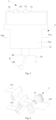
- Fig. 1 shows a schematic structural diagram of a pole piece forming apparatus provided by an embodiment of the present application.
- the pole piece forming apparatus includes an unwinding device 1, a lithium replenishment device 2, a slitting device 3, a plurality of winding devices 4 and a protection device 5.
- the unwinding device 1 is configured to dispose a master pole piece body 200.
- the lithium replenishment device 2 is configured to clad a lithium strip to a surface of the master pole piece body 200 and form a master pole piece 210.
- the slitting device 3 is configured to slit the master pole piece 210 into a plurality of pole pieces 211.
- the plurality of winding devices 4 are configured to pull the pole pieces 211 to travel, and each winding device 4 winds one corresponding pole piece 211.
- the protection device 5 is provided with an accommodating cavity 51a in which the slitting device 3 is disposed, and configured to at least partially separate particles from an external environment in a case that the slitting device 3 slits the master pole piece 210 and generates the particles.
- the lithium strip is cladded to the surface of the master pole piece body 200 to form the master pole piece 210, and a lithium film is formed on a surface of the master pole piece 210.
- the slitting device 3 can slit the master pole piece 210 into the plurality of pole pieces 211 in a manner of rubbing against and slitting the master pole piece 210. In this process, the slitting device 3 inevitably rubs against the lithium film.
- the slitting device 3 is disposed in the accommodating cavity 51a, but not all structures of the slitting device 3 are disposed in the accommodating cavity 51a. As long as the portion of the slitting device 3 slitting the master pole piece 210 to form the pole pieces 211 is located in the accommodating cavity 51a to ensure that the slitting process of the master pole piece 210 is performed in the accommodating cavity 51a, other structures cannot be disposed in the accommodating cavity 51a.
- Particles generated in the process of slitting the master pole piece 210 by the slitting device 3 also include other particles, in addition to lithium particles.
- Lithium has relatively high chemical activity, and thus is relatively prone to being combined with oxygen in air to generate sparks and release heat in a relatively high temperature environment.
- the other particles other than the lithium particles may also generate sparks in the relatively high temperature environment, depending on a specific material of the master pole piece body 200.
- the accommodating cavity 51a of the protection device 5 can be sealed, and can also be semi-closed.
- the slitting device 3 is located in the accommodating cavity 51a, it is difficult for the air from the external environment to enter the accommodating cavity 51a, or the amount of the air entering the accommodating cavity 51a is limited, and thus in the process of rubbing against and slitting the lithium film by the slitting device 3, the concentration of the air in the accommodating cavity 51a is relatively small. Even if the temperature of a rubbing slitting place of the lithium film by the slitting device 3 is relatively high, it is also relatively difficult for the lithium particles or the other particles generated at the rubbing slitting place to generate a combustion reaction because there is not enough oxygen.
- the master pole piece 210 is slit in the accommodating cavity 51a, and the generated particles can be at least partially blocked by the accommodating cavity 51a, thus reducing the risk that the particles are splashed into the external environment and also reducing the risk that the particles are splashed onto the pole pieces 211.
- the pole piece forming apparatus provided by the embodiment of the present application, by disposing the protection device 5 and providing the protection device 5 with the accommodating cavity 51a in which the slitting device 3 is disposed, the air content at the slitting place of the master pole piece 210 can be effectively reduced, thereby reducing the risk of combustion of the lithium particles or the other particles generated by slitting, i.e., reducing the risk of sparking at the slitting place of the master pole piece 210, and effectively improving the safety in the production process of the pole pieces 211.
- the accommodating cavity 51a can prevent at least part of the particles from splashing to the outside of the accommodating cavity 51a, such that environment cleanliness in the production process of the pole pieces 211 can be effectively improved, and meanwhile the structural integrity of the pole pieces 211 is improved, thereby improving the work safety of the pole pieces 211 in the subsequent using process.
- the specific structure of the protection device 5 is not limited so long as the accommodating cavity 51a capable of containing the slitting device 3 is provided.
- the protection device 5 includes a cover body 51 with the accommodating cavity 51a formed therein.
- the cover body 51 is provided with a pole piece inlet 51b and a pole piece outlet 51c oppositely disposed.
- the pole piece inlet 51b is configured to allow the master pole piece 210 to enter the accommodating cavity 51a
- the pole piece outlet 51c is configured to allow the slit pole pieces 211 to be pulled out from the accommodating cavity 51a.
- the structure and pattern of the cover body 51 are not limited so long as the pole piece inlet 5 1b and the pole piece outlet 5 1b are provided.
- the structure of the protection device 5 can be simplified under the premise of ensuring normal operation of the pole piece forming apparatus, and the cover body 51 has a better effect of isolation from the external environment, and can collect scrap lithium generated in the slitting process of the master pole piece 210.
- the particles splashed into the environment are reduced, thereby reducing the risk of the excessively high content of dust in the environment, and meanwhile the content of the lithium particles in the air is reduced, which is conducive to reducing the risk of explosion after the lithium particles encounter an open fire.
- the material of the cover body 51 is not limited so long as the accommodating cavity 5 1a can be formed therein.
- the cover body 51 is made of a visual material. As such, it is convenient to observe the working condition in the process of slitting the master pole piece 210 by the slitting device 3.
- the pole piece forming apparatus further includes a negative pressure device 6.
- the negative pressure device 6 is configured to suck air in the accommodating cavity 51a.
- the negative pressure device 6 can effectively ensure that the air content in the accommodating cavity 51a is maintained within a preset range, thereby further reducing the risk of sparking at the slicing place of the master pole piece 210.
- the negative pressure device 6 can be a vacuum pump or an air compressor, etc, can continuously suck the air from the accommodating cavity 51a, and can also intermittently suck the air from the accommodating cavity 51a. The configuration is performed depending on the specific situation.
- the pole piece forming apparatus further includes an inert gas input device 7 communicating with the accommodating cavity 51a.
- the inert gas input device 7 is configured to input inert gas into the accommodating cavity 51a.
- the inert gas can be gas such as nitrogen, carbon monoxide or carbon dioxide that is not prone to a chemical reaction at normal temperature or low temperature.
- the inert gas input device 7 can continuously input the inert gas into the accommodating cavity 51a, and can also input the inert gas into the accommodating cavity 51a at intervals, so as to maintain the air content in the accommodating cavity 51a within the preset range. It can be understood that the inert gas is not prone to reacting with lithium and can drive away gas such as oxygen in the accommodating cavity 51a that is prone to chemically reacting with the lithium particles. As such, the risk of sparking in the slitting process of the master pole piece 210 is further reduced.
- the inert gas input into the accommodating cavity 51a can be normal temperature inert gas or cooled inert gas.
- the cooled inert gas is input into the accommodating cavity 51a.
- the temperature of the cooled inert air is less than or equal to zero degrees Celsius.
- the inert gas input by inert gas input device 7 into the accommodating cavity 51a can be allowed to escape into the air, and can also be recycled.
- the inert gas input device 7 is provided with a corresponding structure. There is no limitation herein.
- the inert gas input device 7 includes an input pipeline 71, an output pipeline 72 and a cooling and pumping unit 73.
- the input pipeline 71 communicates with the accommodating cavity 51a for inputting the inert gas into the accommodating cavity 51a.
- the output pipeline 72 communicates with the accommodating cavity 51a for outputting the inert air in the accommodating cavity 51a.
- the cooling and pumping unit 73 is disposed outside the accommodating cavity 51a, the cooling and pumping unit communicates with the input pipeline 71 and the output pipeline 72, for cooling the inert air and supplying power to circular flow of the inert air between the accommodating cavity 51a and the cooling and pumping unit 73.
- the inert gas is cooled by the cooling and pumping unit 73, then enters the accommodating cavity 51a via the input pipeline 71 to drive away the air in the accommodating cavity 51a, cools the pole pieces 211 and the slitting places of the pole pieces 211, and then flows into the cooling and pumping unit 73 via the output pipeline 72 under the negative pressure of the cooling and pumping unit 73.
- the pole pieces 211 are cooled, and the risk of rubbing sparking in a case of slitting the pole pieces 210 is reduced.
- the inert gas can directly enter the cooling and pumping unit 73 via the input pipeline 71. It is also possible to remove the particles or air or the like mixed in the inert gas through filtration, etc. and then deliver the inert gas into the cooling and pumping unit 73.
- the configuration can be performed depending on the specific situation, which is not limited herein.
- the inert gas input device 7 further includes a filter unit 74.
- the filter unit 74 is disposed between the output pipeline 72 and the cooling and pumping unit 73 and configured to filter the inert gas.
- the filter unit 74 can be configured to filter the particles in the inert gas, and can also configured to filter oxygen in the inert gas, or can filter both the particles in the inert gas and the oxygen in the inert gas.
- the configuration is performed depending on the specific situation, which is not limited herein.
- the particles generated by slitting the master pole piece 210 and air from the external environment may be mixed therein.
- the filter unit 74 the purity of the inert gas can be increased, which is conducive to ensuring the protection effect of the inert gas on performance stability of the pole pieces 211. Meanwhile, the damage caused by the particles generated in the slitting process of the master pole piece 210 to the cooling and pumping unit 73 is reduced, and the risk of the damage to the pole pieces 211 from the particles entering the accommodating cavity 51a along with the inert gas is reduced.
- the particles generated in the slitting process of the master pole piece 210 can be retained in the accommodating cavity 51a to be subsequently collected manually, and can also be mechanically collected in the production process of the pole pieces 211.
- the pole piece forming apparatus further includes a particle collecting device 8 communicating with the accommodating cavity 51a.
- the particle collecting device 8 is configured to collect the particles in the accommodating cavity 51a.
- the particles in the accommodating cavity 51a can be collected.
- the risk of production environment cleanliness reduction of the pole pieces 211 caused by the particles in the accommodating cavity 51a drifting into the external environment is reduced.
- centralized treatment of the particles generated in the slitting process of the master pole piece 210 is also facilitated.
- the particle collecting device 8 can be disposed on the upper portion, lower portion or side portion of the slitting accommodating cavity 51a, which is not limited herein. As an example, the particle collecting device 8 is disposed on the lower side of the accommodating cavity 51a, and the particles more easily fall downwards under the effect of the gravity thereof, such that the particles are conveniently collected.
- the particle collecting device 8 includes a dust suction assembly 81 and a filter assembly 82.
- the dust suction assembly 81 communicates with the accommodating cavity 51a for sucking the particles in the accommodating cavity 51a.
- the filter assembly 82 communicates with the dust suction assembly 81 for filtering out the particles sucked by the dust suction assembly 81.
- the provision of the dust suction assembly 81 can more efficiently suck out the particles in the accommodating cavity 51a.
- the provision of the filter assembly 82 is conducive to filtering out the particles from a mixture of the gas and the particles sucked out by the dust suction assembly 81 to effectively separate the gas from the particles. As such, it is more convenient to collect the particles generated by slitting the master pole piece 210.
- the particles in the mixture of the gas and the particles sucked out by the dust suction assembly 81 can be directly discharged into the external environment after being filtered out by the filter assembly 82, can also be discharged into the accommodating cavity 51a again after being filtered, or are directly discharged to the accommodating cavity 51a.
- the dust suction assembly 81 can communicate with the inert gas input device 7, such that the inert gas sucked out by the dust suction assembly 81 is input into the accommodating cavity 51a again by the inert gas input device 7. As such, the inert gas can be recycled.
- the pole piece forming apparatus further includes an electric lead 10.
- the electric lead 10 electrically connects the particle collecting device 8 with a ground for eliminating static electricity of the particle collecting device 8.
- the particles may rub against each other and thus generate static electricity.
- the electric lead 10 to electrically connect the particle collecting device 8 with the ground, the static electricity generated by rubbing of the particles is eliminated, and the risk of sparking due to rubbing of the particles is further reduced.
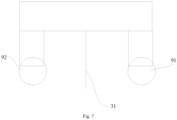
- the slitting device 3 includes a cutter 31.
- the cutter 31 is configured to slitting the master pole piece 210.
- the pole piece forming apparatus further includes a demoulding device 91.
- the demoulding device 91 is configured to spray a mould release agent to the cutter 31. It can be understood that by spraying the mould release agent to the cutter 31, the risk that the cutter 31 adheres to the pole pieces 211 in the process of slitting the master pole piece 210, thus affecting the service life of the cutter 31 can be effectively reduced, and meanwhile, the risk that notches are generated at the slit edges of the pole pieces 211, thus breaking the pole pieces 211 is reduced.
- the pole piece forming apparatus further includes a lubricating device 92.
- the lubricating device 92 is configured to spray a lubricant to the cutter 31. It can be understood that by spraying the lubricant to the cutter 31 by the lubricating device 92, normal work of the cutter 31 can be effectively ensured, and the lubricant can effectively reduce the temperature of the cutter 31.
Landscapes
- Engineering & Computer Science (AREA)
- Chemical & Material Sciences (AREA)
- Chemical Kinetics & Catalysis (AREA)
- General Chemical & Material Sciences (AREA)
- Electrochemistry (AREA)
- Manufacturing & Machinery (AREA)
- Mechanical Engineering (AREA)
- Materials Engineering (AREA)
- Life Sciences & Earth Sciences (AREA)
- Forests & Forestry (AREA)
- Physics & Mathematics (AREA)
- Optics & Photonics (AREA)
- Battery Electrode And Active Subsutance (AREA)
- Shearing Machines (AREA)
Abstract
Description
- The present application claims priority of a
Chinese Patent Application 202111433515.7 entitled "POLE PIECE FORMING APPARATUS" filed on November 29, 2021 - The present application relates to the technical field of pole piece production, and in particular, to a pole piece forming apparatus.
- Batteries are widely used in electrical devices, such as mobile phones, notebook computers, battery cars, electric cars, electric planes, electric ships, electric toy cars, electric toy ships, electric toy planes and electric tools. Batteries can include nickel-cadmium batteries, nickel-hydrogen batteries, lithium-ion batteries and secondary alkaline zinc-manganese batteries.
- In the development of battery technologies, pole pieces are important parts of the batteries. Safety problems are prone to occurring in the production process of the pole pieces, and thus how to ensure safety in the production process of the pole pieces is a technical problem that has been continuously researched in the battery technologies.
- Provided in the present application is a pole piece forming apparatus, which can improve safety in the production process of pole pieces.
- The present application provides a pole piece forming apparatus, which includes: an unwinding device, configured to dispose a master pole piece body; a lithium replenishment device, configured to clad a lithium strip to a surface of the master pole piece body and form a master pole piece; a slitting device, configured to slit the master pole piece into a plurality of pole pieces; a plurality of winding devices, configured to pull the pole pieces to travel, each of the winding devices winding one corresponding pole piece; and a protection device, provided with an accommodating cavity in which the slitting device is disposed, and configured to at least partially separate particles from an external environment in a case that the slitting device slits the master pole piece and generates the particles.
- According to the pole piece forming apparatus provided by the present application, by disposing the protection device and providing the protection device with the accommodating cavity in which the slitting device is disposed, air content at a slitting place of the master pole piece can be effectively reduced, thereby reducing the risk of combustion of lithium particles or other particles generated by slitting, i.e., reducing the risk of sparking at the slitting place of the master pole piece, and effectively improving the safety in the production process of the pole pieces. In addition, the accommodating cavity can prevent at least part of the particles from splashing to the outside of the accommodating cavity, such that environment cleanliness in the production process of the pole pieces can be effectively improved, and meanwhile the structural integrity of the pole pieces is improved, thereby improving the work safety of the pole pieces in the subsequent using process.
- In some embodiments, the protection device includes a cover body with the accommodating cavity formed therein. The cover body is provided with a pole piece inlet and a pole piece outlet oppositely disposed. The pole piece inlet is configured to allow the master pole piece to enter the accommodating cavity, and the pole piece outlet is configured to allow the slit pole pieces to be pulled out from the accommodating cavity. As such, the particles splashed into the environment can be further reduced, thereby reducing the risk of excessively high content of dust in the environment, and meanwhile the content of the lithium particles in air is reduced, which is conducive to reducing the risk of explosion after the lithium particles encounter an open fire.
- In some embodiments, the pole piece forming apparatus further includes a negative pressure device. The negative pressure device is configured to suck air in the accommodating cavity. The provision of the negative pressure device can effectively ensure that the air content in the accommodating cavity is maintained within a preset range, thereby further reducing the risk of sparking at the slicing place of the master pole piece.
- In some embodiments, the pole piece forming apparatus further includes an inert gas input device communicating with the accommodating cavity. The inert gas input device is configured to input inert gas into the accommodating cavity. As such, the risk of sparking in the slitting process of the master pole piece is further reduced.
- In some embodiments, the inert gas input device includes: an input pipeline, communicating with the accommodating cavity for inputting the inert air into the accommodating cavity; an output pipeline, communicating with the accommodating cavity for outputting the inert air in the accommodating cavity; and a cooling and pumping unit, disposed outside the accommodating cavity, the cooling and pumping unit communicating with the input pipeline and the output pipeline, for cooling the inert air and supplying power to circular flow of the inert air between the accommodating cavity and the cooling and pumping unit. By arranging in this way, activity efficiency of lithium films on the surfaces of the pole pieces can be effectively kept, thereby ensuring electrical performance of the pole pieces in the subsequent using process. Meanwhile, the risk of rubbing sparking of the pole pieces can also be reduced.
- In some embodiments, the inert gas input device further includes a filter unit. The filter unit is disposed between the output pipeline and the cooling and pumping unit and configured to filter the inert gas. By providing the filter unit, purity of the inert gas can be increased, which is conducive to ensuring the protection effect of the inert gas on performance stability of the pole pieces. Meanwhile, the damage caused by the particles generated in the slitting process of the master pole piece to the cooling and pumping unit is reduced, and the risk of the damage to the pole pieces from the particles entering the accommodating cavity along with the inert gas is reduced.
- In some embodiments, the pole piece forming apparatus further includes a particle collecting device communicating with the accommodating cavity. The particle collecting device is configured to collect the particles in the accommodating cavity. The risk of production environment cleanliness reduction of the pole pieces caused by the particles in the accommodating cavity drifting into the external environment is reduced. And through the particle collecting device, centralized treatment of the particles generated in the slitting process of the master pole piece is also facilitated.
- In some embodiments, the particle collecting device includes: a dust suction assembly, communicating with the accommodating cavity for sucking the particles in the accommodating cavity; and a filter assembly, communicating with the dust suction assembly for filtering out the particles sucked by the dust suction assembly. The provision of the dust suction assembly can more efficiently suck out the particles in the accommodating cavity. Whereas, the provision of the filter assembly is conducive to filtering out the particles from a mixture of the gas and the particles sucked out by the dust suction assembly to effectively separate the gas from the particles. As such, it is more convenient to collect the particles generated by slitting the master pole piece.
- In some embodiments, the pole piece forming apparatus further includes an electric lead. The electric lead electrically connects the particle collecting device with a ground for eliminating static electricity of the particle collecting device. By arranging in this way, the risk of rubbing sparking of the particles can be further reduced.
- In some embodiments, the slitting device includes a cutter, the cutter being configured to slit the master pole piece. The pole piece forming apparatus further includes a demoulding device, the demoulding device being configured to spray a mould release agent to the cutter; and/or, the pole piece forming apparatus further includes a lubricating device, the lubricating device being configured to spray a lubricant to the cutter.
- The provision of the demoulding device, the risk that the cutter adheres to the pole pieces in the process of slitting the master pole piece can be effectively reduced. Whereas, the provision of the lubricating device can reduce the temperature of the cutter, and also, can ensure normal work of the cutter.
- In order to more clearly illustrate the technical solutions in embodiments of the present application, the following will briefly introduce the drawings that are desired to be used in the embodiments of the present application. Obviously, the drawings in the following description are merely some embodiments of the present application, from which other drawings may be obtained without exerting inventive effort by those ordinarily skilled in the art.
-
Fig. 1 is a schematic structural diagram of a pole piece forming apparatus provided by an embodiment of the present application; -
Fig. 2 is a schematic structural diagram of another pole piece forming apparatus provided by an embodiment of the present application; -
Fig. 3 is a schematic structural diagram of a pole piece forming apparatus with part of structures omitted provided by an embodiment of the present application; -
Fig. 4 is a schematic structural diagram of another pole piece forming apparatus with part of structures omitted provided by an embodiment of the present application; -
Fig. 5 is a schematic structural diagram of yet another pole piece forming apparatus with part of structures omitted provided by an embodiment of the present application; -
Fig. 6 is a schematic structural diagram of the pole piece forming apparatus with part of the structures omitted provided by the embodiment of the present application; and -
Fig. 7 is a schematic structural diagram of the pole piece forming apparatus with part of the structures omitted provided by the embodiment of the present application. - In the drawings, the drawing are not necessarily drawn to actual scale.
- Illustrations of reference numerals:
- 1. unwinding device; 2. lithium replenishment device; 3. slitting device; 31. cutter; 4. winding device; 5. protection device; 51. cover body; 51a. accommodating cavity; 51b. pole piece inlet; 51c. pole piece outlet; 6. negative pressure device; 7. inert gas input device; 71. input pipeline; 72. output pipeline; 73. cooling and pumping unit; 74. filter unit; 8. particle collecting device; 81. dust suction assembly; 82. filter assembly; 91. demoulding device; 92. lubricating device; 10. electric lead;
- 200. master pole piece body; 210. master pole piece; 211. pole piece.
- Embodiments of the present application are described in further detail below with reference to the accompanying drawings and embodiments. The following detailed description of the embodiments and the accompanying drawings are used to exemplify the principles of the present application, but are not intended to limit the scope of the present application, i.e., the present application is not limited to the described embodiments.
- In the description of the present application, it should be noted that, unless otherwise stated, "a plurality of" means more than two. The terms "up", "down", "left", "right", "inside", "outside" and the like indicate orientations or positional relationships for ease of description and simplification of the description only and are not intended to indicate or imply that the device or element in question must have a particular orientation, be constructed and operate in a particular orientation and therefore cannot be construed as limiting to the present application. In addition, the terms of "first", "second", "third"and the like are for descriptive purposes only and cannot be construed as indicating or implying relative importance. "Perpendicular" is not vertical in the strict sense, but within the allowable range of errors. "Parallelism" is not parallel in the strict sense, but within the allowable range of errors.
- The locative words appearing in the following description are all directions shown in the figure and are not intended to limit the specific structure of the present application. In the description of the present application, it should be noted that the terms "install", "connect" and "couple" are to be understood in a broad sense, unless otherwise expressly specified and limited, for example, it may refer to a fixed connection, may also refer to a detachable connection, or may refer to an integral connection; it may refer to a direct connection or an indirect connection via an intermediate medium. For those ordinarily skilled in the art, the specific meanings of the above terms in the present application will be understood according to the specific circumstances.
- Batteries, such as lithium-ion secondary batteries, lithium-ion primary batteries, lithium-sulfur batteries, sodium-lithium ion batteries, sodium ion batteries or magnesium ion batteries, etc., have the advantages of high energy density, high power density, multiple recycling times, long storage time, etc., and have been widely used in electrical devices suitable for batteries. For example, the electrical device may be a vehicle, a mobile phone, a portable device, a notebook computer, a ship, a spacecraft, an electric toy, an electric tool, and the like. Vehicles may be fuel vehicles, gas vehicles or new energy vehicles, and new energy vehicles may be pure electric vehicles, hybrid vehicles or extended-range vehicles; Spacecraft include airplanes, rockets, space shuttles and spaceships, etc.; Electric toys include fixed or mobile electric toys, such as game machines, electric car toys, electric ship toys, electric plane toys and so on; Electric tools include metal slitting electric tools, grinding electric tools, assembly electric tools and railway electric tools, such as electric drills, electric grinders, electric wrenches, electric screwdrivers, electric hammers, impact electric drills, concrete vibrators and planers, etc.
- In the production process of battery, the pole pieces of battery need to go through coating, rolling, drying, slitting and other processes, and some pole pieces need to be supplemented with lithium.
- It was found by the application that in the production process of the pole pieces, sparks are generated at a slitting place of a master pole piece in the process of slitting the master pole piece into the pole pieces. With regard to this, the inventor has carefully studied the production process of the pole pieces, and the results shown that since the a lithium strip is cladded to the surface of the master pole piece, scrap lithium is inevitably generated at a slitting place in the process of cutting the master pole piece by the slitter. Whereas, as the working time of the slitter increases, the slitter constantly rubs against the master pole piece, and the surface temperature of the slitter gradually increases. Coupled with heat generated by rubbing, rubbing slitting places of the scrap lithium and the slitting device are combined with oxygen in air in a relatively high temperature environment, a chemical reaction of combustion occurs, and sparks are generated. As a result, safety in the production process of the pole pieces is seriously affected. In addition, particles generated in the production process of the pole piece can be splashed into the air, and in particular, onto the pole pieces. As a result, the particles remain on the surfaces of the pole pieces and generate concave-convex electricity on the surfaces of the pole pieces. The pole pieces can be punctured in the subsequent using process. The punctured pole pieces are prone to the risk of short-circuited sparking in the using process.
- Based on the above problems found by the inventor, the inventor improves the structure of the pole piece forming apparatus. The technical solution described in the embodiments of the present application is applicable to the pole piece forming apparatus.
-
Fig. 1 shows a schematic structural diagram of a pole piece forming apparatus provided by an embodiment of the present application. - According to the pole piece forming apparatus provided by the embodiment of the present application, the pole piece forming apparatus includes an unwinding
device 1, alithium replenishment device 2, aslitting device 3, a plurality of windingdevices 4 and aprotection device 5. The unwindingdevice 1 is configured to dispose a masterpole piece body 200. Thelithium replenishment device 2 is configured to clad a lithium strip to a surface of the masterpole piece body 200 and form amaster pole piece 210. Theslitting device 3 is configured to slit themaster pole piece 210 into a plurality ofpole pieces 211. The plurality of windingdevices 4 are configured to pull thepole pieces 211 to travel, and each windingdevice 4 winds one correspondingpole piece 211. Theprotection device 5 is provided with anaccommodating cavity 51a in which theslitting device 3 is disposed, and configured to at least partially separate particles from an external environment in a case that theslitting device 3 slits themaster pole piece 210 and generates the particles. - The lithium strip is cladded to the surface of the master
pole piece body 200 to form themaster pole piece 210, and a lithium film is formed on a surface of themaster pole piece 210. Theslitting device 3 can slit themaster pole piece 210 into the plurality ofpole pieces 211 in a manner of rubbing against and slitting themaster pole piece 210. In this process, theslitting device 3 inevitably rubs against the lithium film. - The
slitting device 3 is disposed in theaccommodating cavity 51a, but not all structures of theslitting device 3 are disposed in theaccommodating cavity 51a. As long as the portion of theslitting device 3 slitting themaster pole piece 210 to form thepole pieces 211 is located in theaccommodating cavity 51a to ensure that the slitting process of themaster pole piece 210 is performed in theaccommodating cavity 51a, other structures cannot be disposed in theaccommodating cavity 51a. - Particles generated in the process of slitting the
master pole piece 210 by theslitting device 3 also include other particles, in addition to lithium particles. Lithium has relatively high chemical activity, and thus is relatively prone to being combined with oxygen in air to generate sparks and release heat in a relatively high temperature environment. Certainly, the other particles other than the lithium particles may also generate sparks in the relatively high temperature environment, depending on a specific material of the masterpole piece body 200. - Specifically, the
accommodating cavity 51a of theprotection device 5 can be sealed, and can also be semi-closed. Theslitting device 3 is located in theaccommodating cavity 51a, it is difficult for the air from the external environment to enter theaccommodating cavity 51a, or the amount of the air entering theaccommodating cavity 51a is limited, and thus in the process of rubbing against and slitting the lithium film by theslitting device 3, the concentration of the air in theaccommodating cavity 51a is relatively small. Even if the temperature of a rubbing slitting place of the lithium film by theslitting device 3 is relatively high, it is also relatively difficult for the lithium particles or the other particles generated at the rubbing slitting place to generate a combustion reaction because there is not enough oxygen. - In addition, since the
slitting device 3 is located in theaccommodating cavity 51a, themaster pole piece 210 is slit in theaccommodating cavity 51a, and the generated particles can be at least partially blocked by theaccommodating cavity 51a, thus reducing the risk that the particles are splashed into the external environment and also reducing the risk that the particles are splashed onto thepole pieces 211. As such, it is difficult for the particles to damage thepole pieces 211, which reduces the risk of thepole pieces 211 being punctured, thereby reducing the risk that thepole pieces 211 is short-circuited in the using process. - According to the pole piece forming apparatus provided by the embodiment of the present application, by disposing the
protection device 5 and providing theprotection device 5 with theaccommodating cavity 51a in which theslitting device 3 is disposed, the air content at the slitting place of themaster pole piece 210 can be effectively reduced, thereby reducing the risk of combustion of the lithium particles or the other particles generated by slitting, i.e., reducing the risk of sparking at the slitting place of themaster pole piece 210, and effectively improving the safety in the production process of thepole pieces 211. In addition, theaccommodating cavity 51a can prevent at least part of the particles from splashing to the outside of theaccommodating cavity 51a, such that environment cleanliness in the production process of thepole pieces 211 can be effectively improved, and meanwhile the structural integrity of thepole pieces 211 is improved, thereby improving the work safety of thepole pieces 211 in the subsequent using process. - The specific structure of the
protection device 5 is not limited so long as theaccommodating cavity 51a capable of containing theslitting device 3 is provided. - In some embodiments, the
protection device 5 includes acover body 51 with theaccommodating cavity 51a formed therein. Thecover body 51 is provided with apole piece inlet 51b and apole piece outlet 51c oppositely disposed. Thepole piece inlet 51b is configured to allow themaster pole piece 210 to enter theaccommodating cavity 51a, and thepole piece outlet 51c is configured to allow theslit pole pieces 211 to be pulled out from theaccommodating cavity 51a. - Specifically, the structure and pattern of the
cover body 51 are not limited so long as thepole piece inlet 5 1b and thepole piece outlet 5 1b are provided. By arranging thecover body 51, the structure of theprotection device 5 can be simplified under the premise of ensuring normal operation of the pole piece forming apparatus, and thecover body 51 has a better effect of isolation from the external environment, and can collect scrap lithium generated in the slitting process of themaster pole piece 210. The particles splashed into the environment are reduced, thereby reducing the risk of the excessively high content of dust in the environment, and meanwhile the content of the lithium particles in the air is reduced, which is conducive to reducing the risk of explosion after the lithium particles encounter an open fire. - The material of the
cover body 51 is not limited so long as theaccommodating cavity 5 1a can be formed therein. In some embodiments, thecover body 51 is made of a visual material. As such, it is convenient to observe the working condition in the process of slitting themaster pole piece 210 by theslitting device 3. - In some embodiments, as shown in
Fig. 2 , the pole piece forming apparatus further includes anegative pressure device 6. Thenegative pressure device 6 is configured to suck air in theaccommodating cavity 51a. - In the production process of the
pole pieces 211, the external air inevitably enters theaccommodating cavity 51a. Thus, the provision of thenegative pressure device 6 can effectively ensure that the air content in theaccommodating cavity 51a is maintained within a preset range, thereby further reducing the risk of sparking at the slicing place of themaster pole piece 210. Specifically, thenegative pressure device 6 can be a vacuum pump or an air compressor, etc, can continuously suck the air from theaccommodating cavity 51a, and can also intermittently suck the air from theaccommodating cavity 51a. The configuration is performed depending on the specific situation. - In some implementations, as shown in
Fig.3 , the pole piece forming apparatus further includes an inertgas input device 7 communicating with theaccommodating cavity 51a. The inertgas input device 7 is configured to input inert gas into theaccommodating cavity 51a. - Specifically, the inert gas can be gas such as nitrogen, carbon monoxide or carbon dioxide that is not prone to a chemical reaction at normal temperature or low temperature. The inert
gas input device 7 can continuously input the inert gas into theaccommodating cavity 51a, and can also input the inert gas into theaccommodating cavity 51a at intervals, so as to maintain the air content in theaccommodating cavity 51a within the preset range. It can be understood that the inert gas is not prone to reacting with lithium and can drive away gas such as oxygen in theaccommodating cavity 51a that is prone to chemically reacting with the lithium particles. As such, the risk of sparking in the slitting process of themaster pole piece 210 is further reduced. - The inert gas input into the
accommodating cavity 51a can be normal temperature inert gas or cooled inert gas. - In some alternative embodiments, the cooled inert gas is input into the
accommodating cavity 51a. The temperature of the cooled inert air is less than or equal to zero degrees Celsius. As such, after thepole pieces 211 are slit, lithium films on the surfaces of thepole pieces 211 are cooled under the cooling effect of the cooled inert gas. In the subsequent process, the lithium films on the surfaces of thepole pieces 211 are not prone to chemically reacting with the air even if thepole pieces 211 are in contact with the air. As such, activity efficiency of the lithium films on the surfaces of thepole pieces 211 is effectively kept, thereby ensuring electrical performance of thepole pieces 211 in the subsequent using process. - The inert gas input by inert
gas input device 7 into theaccommodating cavity 51a can be allowed to escape into the air, and can also be recycled. Correspondingly, the inertgas input device 7 is provided with a corresponding structure. There is no limitation herein. - In some embodiments, the inert
gas input device 7 includes aninput pipeline 71, anoutput pipeline 72 and a cooling andpumping unit 73. Theinput pipeline 71 communicates with theaccommodating cavity 51a for inputting the inert gas into theaccommodating cavity 51a. Theoutput pipeline 72 communicates with theaccommodating cavity 51a for outputting the inert air in theaccommodating cavity 51a. The cooling andpumping unit 73 is disposed outside theaccommodating cavity 51a, the cooling and pumping unit communicates with theinput pipeline 71 and theoutput pipeline 72, for cooling the inert air and supplying power to circular flow of the inert air between theaccommodating cavity 51a and the cooling andpumping unit 73. - By arranging in this way, the inert gas is cooled by the cooling and
pumping unit 73, then enters theaccommodating cavity 51a via theinput pipeline 71 to drive away the air in theaccommodating cavity 51a, cools thepole pieces 211 and the slitting places of thepole pieces 211, and then flows into the cooling andpumping unit 73 via theoutput pipeline 72 under the negative pressure of the cooling andpumping unit 73. By circulating in this way, thepole pieces 211 are cooled, and the risk of rubbing sparking in a case of slitting thepole pieces 210 is reduced. - The inert gas can directly enter the cooling and
pumping unit 73 via theinput pipeline 71. It is also possible to remove the particles or air or the like mixed in the inert gas through filtration, etc. and then deliver the inert gas into the cooling andpumping unit 73. The configuration can be performed depending on the specific situation, which is not limited herein. - In some embodiments, the inert
gas input device 7 further includes afilter unit 74. Thefilter unit 74 is disposed between theoutput pipeline 72 and the cooling andpumping unit 73 and configured to filter the inert gas. - Specifically, the
filter unit 74 can be configured to filter the particles in the inert gas, and can also configured to filter oxygen in the inert gas, or can filter both the particles in the inert gas and the oxygen in the inert gas. The configuration is performed depending on the specific situation, which is not limited herein. - It can be understood that in the process that the inert gas passes through the
accommodating cavity 51a, the particles generated by slitting themaster pole piece 210 and air from the external environment may be mixed therein. By providing thefilter unit 74, the purity of the inert gas can be increased, which is conducive to ensuring the protection effect of the inert gas on performance stability of thepole pieces 211. Meanwhile, the damage caused by the particles generated in the slitting process of themaster pole piece 210 to the cooling andpumping unit 73 is reduced, and the risk of the damage to thepole pieces 211 from the particles entering theaccommodating cavity 51a along with the inert gas is reduced. - The particles generated in the slitting process of the
master pole piece 210 can be retained in theaccommodating cavity 51a to be subsequently collected manually, and can also be mechanically collected in the production process of thepole pieces 211. - In some embodiments, the pole piece forming apparatus further includes a
particle collecting device 8 communicating with theaccommodating cavity 51a. Theparticle collecting device 8 is configured to collect the particles in theaccommodating cavity 51a. - By providing the
particle collecting device 8, the particles in theaccommodating cavity 51a can be collected. The risk of production environment cleanliness reduction of thepole pieces 211 caused by the particles in theaccommodating cavity 51a drifting into the external environment is reduced. And through theparticle collecting device 8, centralized treatment of the particles generated in the slitting process of themaster pole piece 210 is also facilitated. - The
particle collecting device 8 can be disposed on the upper portion, lower portion or side portion of the slittingaccommodating cavity 51a, which is not limited herein. As an example, theparticle collecting device 8 is disposed on the lower side of theaccommodating cavity 51a, and the particles more easily fall downwards under the effect of the gravity thereof, such that the particles are conveniently collected. - The specific structure of the
particle collecting device 8 is not limited. In some embodiments, theparticle collecting device 8 includes adust suction assembly 81 and afilter assembly 82. Thedust suction assembly 81 communicates with theaccommodating cavity 51a for sucking the particles in theaccommodating cavity 51a. Thefilter assembly 82 communicates with thedust suction assembly 81 for filtering out the particles sucked by thedust suction assembly 81. - The provision of the
dust suction assembly 81 can more efficiently suck out the particles in theaccommodating cavity 51a. Whereas, the provision of thefilter assembly 82 is conducive to filtering out the particles from a mixture of the gas and the particles sucked out by thedust suction assembly 81 to effectively separate the gas from the particles. As such, it is more convenient to collect the particles generated by slitting themaster pole piece 210. - The particles in the mixture of the gas and the particles sucked out by the
dust suction assembly 81 can be directly discharged into the external environment after being filtered out by thefilter assembly 82, can also be discharged into theaccommodating cavity 51a again after being filtered, or are directly discharged to theaccommodating cavity 51a. - In the embodiment where the pole piece forming apparatus includes the inert
gas input device 7, thedust suction assembly 81 can communicate with the inertgas input device 7, such that the inert gas sucked out by thedust suction assembly 81 is input into theaccommodating cavity 51a again by the inertgas input device 7. As such, the inert gas can be recycled. - In some embodiments, the pole piece forming apparatus further includes an
electric lead 10. Theelectric lead 10 electrically connects theparticle collecting device 8 with a ground for eliminating static electricity of theparticle collecting device 8. - It can be understood that in the process of collecting the particles by the
particle collecting device 8, the particles may rub against each other and thus generate static electricity. By configuring theelectric lead 10 to electrically connect theparticle collecting device 8 with the ground, the static electricity generated by rubbing of the particles is eliminated, and the risk of sparking due to rubbing of the particles is further reduced. - In some embodiments, the
slitting device 3 includes acutter 31. Thecutter 31 is configured to slitting themaster pole piece 210. - In some embodiments, the pole piece forming apparatus further includes a
demoulding device 91. Thedemoulding device 91 is configured to spray a mould release agent to thecutter 31. It can be understood that by spraying the mould release agent to thecutter 31, the risk that thecutter 31 adheres to thepole pieces 211 in the process of slitting themaster pole piece 210, thus affecting the service life of thecutter 31 can be effectively reduced, and meanwhile, the risk that notches are generated at the slit edges of thepole pieces 211, thus breaking thepole pieces 211 is reduced. - In some embodiments, the pole piece forming apparatus further includes a
lubricating device 92. The lubricatingdevice 92 is configured to spray a lubricant to thecutter 31. It can be understood that by spraying the lubricant to thecutter 31 by the lubricatingdevice 92, normal work of thecutter 31 can be effectively ensured, and the lubricant can effectively reduce the temperature of thecutter 31. - Although the present application has been described with reference to preferred embodiments, various modifications may be made thereto and components therein may be replaced with equivalents without departing from the scope of the present application. In particular, the various technical features mentioned in the various embodiments may be combined in any manner so long as there is no structural conflict. The present application is not limited to the specific embodiments disclosed herein but includes all technical solutions falling within the scope of the claims.
Claims (10)
- A pole piece forming apparatus, comprising:an unwinding device, configured to dispose a master pole piece body;a lithium replenishment device, configured to clad a lithium strip to a surface of the master pole piece body and form a master pole piece;a slitting device for slitting the master pole piece into a plurality of pole pieces;a plurality of winding devices, configured to pull the pole pieces to travel, each of the winding devices winding one corresponding pole piece; anda protection device, provided with an accommodating cavity in which the slitting device is disposed, and configured to at least partially separate particles from an external environment in a case that the slitting device slits the master pole piece and generates the particles.
- The pole piece forming apparatus according to claim 1, wherein the protection device comprises a cover body with the accommodating cavity formed therein, the cover body being provided with a pole piece inlet and a pole piece outlet oppositely disposed, the pole piece inlet being configured to allow the master pole piece to enter the accommodating cavity, and the pole piece outlet being configured to allow the slit pole pieces to be pulled out from the accommodating cavity.
- The pole piece forming apparatus according to claim 1 or 2, wherein the pole piece forming apparatus further comprises a negative pressure device, the negative pressure device being configured to suck air in the accommodating cavity.
- The pole piece forming apparatus according to any one of claims 1 to 3, wherein the pole piece forming apparatus further comprises an inert gas input device communicating with the accommodating cavity, the inert gas input device being configured to input inert gas into the accommodating cavity.
- The pole piece forming apparatus according to claim 4, wherein the inert gas input device comprises:an input pipeline, communicating with the accommodating cavity for inputting the inert air into the accommodating cavity;an output pipeline, communicating with the accommodating cavity for outputting the inert air in the accommodating cavity; anda cooling and pumping unit, disposed outside the accommodating cavity, the cooling and pumping unit communicating with the input pipeline and the output pipeline, for cooling the inert air and supplying power to circular flow of the inert air between the accommodating cavity and the cooling and pumping unit.
- The pole piece forming apparatus according to claim 5, wherein the inert gas input device further comprises a filter unit, the filter unit being disposed between the output pipeline and the cooling and pumping unit and configured to filter the inert gas.
- The pole piece forming apparatus according to any one of claims 1 to 6, wherein the pole piece forming apparatus further comprises a particle collecting device communicating with the accommodating cavity, the particle collecting device being configured to collect the particles in the accommodating cavity.
- The pole piece forming apparatus according to claim 7, wherein the particle collecting device comprises:a dust suction assembly, communicating with the accommodating cavity for sucking the particles in the accommodating cavity; anda filter assembly, communicating with the dust suction assembly for filtering out the particles sucked by the dust suction assembly.
- The pole piece forming apparatus according to claim 7 or 8, wherein the pole piece forming apparatus further comprises an electric lead, the electric lead electrically connecting the particle collecting device with a ground for eliminating static electricity of the particle collecting device.
- The pole piece forming apparatus according to any one of claims 1 to 9, wherein the slitting device comprises a cutter, the cutter being configured to slit the master pole piece; and
the pole piece forming apparatus further comprises a demoulding device, the demoulding device being configured to spray a mould release agent to the cutter; and/or, the pole piece forming apparatus further comprises a lubricating device, the lubricating device being configured to spray a lubricant to the cutter.
Applications Claiming Priority (2)
| Application Number | Priority Date | Filing Date | Title |
|---|---|---|---|
| CN202111433515.7A CN116190544A (en) | 2021-11-29 | 2021-11-29 | Pole piece forming equipment |
| PCT/CN2022/121048 WO2023093262A1 (en) | 2021-11-29 | 2022-09-23 | Electrode plate forming device |
Publications (2)
| Publication Number | Publication Date |
|---|---|
| EP4354538A1 true EP4354538A1 (en) | 2024-04-17 |
| EP4354538A4 EP4354538A4 (en) | 2024-11-27 |
Family
ID=86451106
Family Applications (1)
| Application Number | Title | Priority Date | Filing Date |
|---|---|---|---|
| EP22897348.3A Pending EP4354538A4 (en) | 2021-11-29 | 2022-09-23 | DEVICE FOR FORMING AN ELECTRODE PLATE |
Country Status (4)
| Country | Link |
|---|---|
| US (1) | US12506136B2 (en) |
| EP (1) | EP4354538A4 (en) |
| CN (1) | CN116190544A (en) |
| WO (1) | WO2023093262A1 (en) |
Families Citing this family (2)
| Publication number | Priority date | Publication date | Assignee | Title |
|---|---|---|---|---|
| CN117086409B (en) * | 2023-10-19 | 2023-12-26 | 四川中哲新材料科技有限公司 | Sodium ion battery pole piece pressing and slicing equipment |
| CN118002847B (en) * | 2023-11-30 | 2025-02-25 | 林爱珊 | A slitting machine for lithium battery processing |
Family Cites Families (18)
| Publication number | Priority date | Publication date | Assignee | Title |
|---|---|---|---|---|
| KR101069163B1 (en) * | 2007-01-06 | 2011-09-30 | 주식회사 엘지화학 | Lithium secondary battery with improved safety against ignition and explosion |
| US20080248386A1 (en) * | 2007-04-05 | 2008-10-09 | Obrovac Mark N | Electrodes with raised patterns |
| US20110179926A1 (en) * | 2010-01-22 | 2011-07-28 | Phoenix Silicon International Corporation | Protection structure for cutting electrode strip |
| CN201785070U (en) * | 2010-07-16 | 2011-04-06 | 美卓造纸机械公司 | Dust removal equipment in slitting reeling machine of fiber-web machine |
| CN203466256U (en) * | 2013-09-04 | 2014-03-05 | 东莞新能源科技有限公司 | Negative electrode plate treatment device of lithium ion battery |
| US9520619B2 (en) * | 2013-11-27 | 2016-12-13 | The Boeing Company | Methods of inerting lithium-containing batteries and associated containers |
| JP6121353B2 (en) * | 2014-03-26 | 2017-04-26 | 株式会社日立ハイテクノロジーズ | Electric storage device manufacturing apparatus and electric storage device manufacturing method |
| CN107123785A (en) * | 2016-02-25 | 2017-09-01 | 宁德时代新能源科技股份有限公司 | Lithium system is mended to pole piece |
| JP7113227B2 (en) * | 2018-03-09 | 2022-08-05 | パナソニックIpマネジメント株式会社 | lithium secondary battery |
| KR101920850B1 (en) * | 2018-04-19 | 2018-11-21 | 국방과학연구소 | The machine manufacturing lithium electrode for thermal batteries |
| CN109360943A (en) * | 2018-12-03 | 2019-02-19 | 东莞塔菲尔新能源科技有限公司 | A kind of pole piece mends lithium device and mends lithium method |
| CN112563444B (en) | 2019-09-25 | 2022-08-30 | 北京卫蓝新能源科技有限公司 | Asynchronous heating and rolling device, large-width ultrathin metal lithium foil, and preparation method and application thereof |
| KR102873027B1 (en) * | 2019-11-25 | 2025-10-17 | 주식회사 엘지에너지솔루션 | The Slitter |
| CN211757322U (en) * | 2019-12-30 | 2020-10-27 | 珠海华冠科技股份有限公司 | Dust removal system of electric core winder and square power electric core winder |
| CN212434665U (en) | 2020-07-23 | 2021-01-29 | 天津中能锂业有限公司 | Wide-width ultrathin lithium foil and equipment for preparing wide-width ultrathin lithium foil |
| CN112475415A (en) | 2020-11-21 | 2021-03-12 | 曹鸿雁 | Pole piece slitting machine for battery production |
| CN114916246B (en) * | 2020-12-09 | 2026-01-30 | 宁德新能源科技有限公司 | A wound electrode assembly, an electrochemical device, and an electronic device |
| CN113020399A (en) * | 2021-03-29 | 2021-06-25 | 蜂巢能源科技有限公司 | Pole piece die cutting system and method |
-
2021
- 2021-11-29 CN CN202111433515.7A patent/CN116190544A/en active Pending
-
2022
- 2022-09-23 WO PCT/CN2022/121048 patent/WO2023093262A1/en not_active Ceased
- 2022-09-23 EP EP22897348.3A patent/EP4354538A4/en active Pending
-
2024
- 2024-02-07 US US18/435,895 patent/US12506136B2/en active Active
Also Published As
| Publication number | Publication date |
|---|---|
| WO2023093262A1 (en) | 2023-06-01 |
| US12506136B2 (en) | 2025-12-23 |
| EP4354538A4 (en) | 2024-11-27 |
| US20240243245A1 (en) | 2024-07-18 |
| CN116190544A (en) | 2023-05-30 |
Similar Documents
| Publication | Publication Date | Title |
|---|---|---|
| US12506136B2 (en) | Electrode plate forming apparatus | |
| CN219436019U (en) | Battery and electricity utilization device | |
| CN216698634U (en) | Exhaust device, battery cell, battery, and power consumption device | |
| US20220013855A1 (en) | Battery box, battery cell, battery, and method and apparatus for preparing battery box | |
| CN219873760U (en) | Battery monomer, battery and power consumption device | |
| JP2004195399A (en) | Cleaning apparatus and cleaning method for band-shaped body | |
| CN118020198A (en) | Box components, batteries and electrical equipment | |
| CN221239770U (en) | Single battery, battery and electricity utilization device | |
| CN219497946U (en) | Top cover assembly, battery cell, battery and electricity utilization device | |
| CN216912630U (en) | Battery welding system and its dust removal device | |
| US20260031514A1 (en) | Battery cell, battery, and power consuming apparatus | |
| CN217719894U (en) | Check ring, battery cell, battery and power utilization device | |
| CN217280933U (en) | Disassembling device for waste power batteries | |
| CN217166809U (en) | Pole piece processing system and its cutting mechanism | |
| CN219498005U (en) | Battery core assembly, battery monomer, battery and electricity utilization device | |
| CN219513187U (en) | Lithium battery disassembling device | |
| CN219575769U (en) | Shell, battery monomer, battery and power consumption device | |
| KR102866214B1 (en) | Continuous automation manufacturing device of bus bar for battery | |
| CN222003685U (en) | Dust collector and battery production facility | |
| CN214588987U (en) | Safe and environment-friendly waste lithium battery treatment device | |
| CN221407461U (en) | Secondary battery and electric equipment | |
| CN224072883U (en) | Dust removal assembly, dust removal device and battery production line | |
| CN220963649U (en) | Battery monomer, battery and power consumption device | |
| CN218080682U (en) | Cutting mechanism and pole piece processing system | |
| CN221727353U (en) | Battery monomer, battery and electric equipment |
Legal Events
| Date | Code | Title | Description |
|---|---|---|---|
| STAA | Information on the status of an ep patent application or granted ep patent |
Free format text: STATUS: THE INTERNATIONAL PUBLICATION HAS BEEN MADE |
|
| PUAI | Public reference made under article 153(3) epc to a published international application that has entered the european phase |
Free format text: ORIGINAL CODE: 0009012 |
|
| STAA | Information on the status of an ep patent application or granted ep patent |
Free format text: STATUS: REQUEST FOR EXAMINATION WAS MADE |
|
| 17P | Request for examination filed |
Effective date: 20240108 |
|
| AK | Designated contracting states |
Kind code of ref document: A1 Designated state(s): AL AT BE BG CH CY CZ DE DK EE ES FI FR GB GR HR HU IE IS IT LI LT LU LV MC MK MT NL NO PL PT RO RS SE SI SK SM TR |
|
| RAP1 | Party data changed (applicant data changed or rights of an application transferred) |
Owner name: CONTEMPORARY AMPEREX TECHNOLOGY(HONG KONG) LIMITED |
|
| A4 | Supplementary search report drawn up and despatched |
Effective date: 20241028 |
|
| RIC1 | Information provided on ipc code assigned before grant |
Ipc: B23Q 11/00 20060101ALI20241022BHEP Ipc: H01M 10/0587 20100101ALI20241022BHEP Ipc: H01M 10/052 20100101ALI20241022BHEP Ipc: H01M 10/0525 20100101ALI20241022BHEP Ipc: H01M 4/04 20060101ALI20241022BHEP Ipc: B23D 19/00 20060101ALI20241022BHEP Ipc: B26D 7/08 20060101ALI20241022BHEP Ipc: B21D 55/00 20060101ALI20241022BHEP Ipc: H01M 4/139 20100101AFI20241022BHEP |
|
| DAV | Request for validation of the european patent (deleted) | ||
| DAX | Request for extension of the european patent (deleted) | ||
| STAA | Information on the status of an ep patent application or granted ep patent |
Free format text: STATUS: EXAMINATION IS IN PROGRESS |
|
| 17Q | First examination report despatched |
Effective date: 20250711 |
|
| GRAP | Despatch of communication of intention to grant a patent |
Free format text: ORIGINAL CODE: EPIDOSNIGR1 |
|
| STAA | Information on the status of an ep patent application or granted ep patent |
Free format text: STATUS: GRANT OF PATENT IS INTENDED |
|
| INTG | Intention to grant announced |
Effective date: 20260128 |
|
| GRAS | Grant fee paid |
Free format text: ORIGINAL CODE: EPIDOSNIGR3 |
|
| GRAA | (expected) grant |
Free format text: ORIGINAL CODE: 0009210 |
|
| STAA | Information on the status of an ep patent application or granted ep patent |
Free format text: STATUS: THE PATENT HAS BEEN GRANTED |