EP4353371B1 - Heap leach liner - Google Patents
Heap leach liner Download PDFInfo
- Publication number
- EP4353371B1 EP4353371B1 EP23203125.2A EP23203125A EP4353371B1 EP 4353371 B1 EP4353371 B1 EP 4353371B1 EP 23203125 A EP23203125 A EP 23203125A EP 4353371 B1 EP4353371 B1 EP 4353371B1
- Authority
- EP
- European Patent Office
- Prior art keywords
- bentonite
- clay liner
- containment
- liner
- polymer
- Prior art date
- Legal status (The legal status is an assumption and is not a legal conclusion. Google has not performed a legal analysis and makes no representation as to the accuracy of the status listed.)
- Active
Links
Images
Classifications
-
- C—CHEMISTRY; METALLURGY
- C04—CEMENTS; CONCRETE; ARTIFICIAL STONE; CERAMICS; REFRACTORIES
- C04B—LIME, MAGNESIA; SLAG; CEMENTS; COMPOSITIONS THEREOF, e.g. MORTARS, CONCRETE OR LIKE BUILDING MATERIALS; ARTIFICIAL STONE; CERAMICS; REFRACTORIES; TREATMENT OF NATURAL STONE
- C04B28/00—Compositions of mortars, concrete or artificial stone, containing inorganic binders or the reaction product of an inorganic and an organic binder, e.g. polycarboxylate cements
- C04B28/001—Compositions of mortars, concrete or artificial stone, containing inorganic binders or the reaction product of an inorganic and an organic binder, e.g. polycarboxylate cements containing unburned clay
-
- E—FIXED CONSTRUCTIONS
- E02—HYDRAULIC ENGINEERING; FOUNDATIONS; SOIL SHIFTING
- E02D—FOUNDATIONS; EXCAVATIONS; EMBANKMENTS; UNDERGROUND OR UNDERWATER STRUCTURES
- E02D31/00—Protective arrangements for foundations or foundation structures; Ground foundation measures for protecting the soil or the subsoil water, e.g. preventing or counteracting oil pollution
- E02D31/002—Ground foundation measures for protecting the soil or subsoil water, e.g. preventing or counteracting oil pollution
- E02D31/004—Sealing liners
-
- C—CHEMISTRY; METALLURGY
- C04—CEMENTS; CONCRETE; ARTIFICIAL STONE; CERAMICS; REFRACTORIES
- C04B—LIME, MAGNESIA; SLAG; CEMENTS; COMPOSITIONS THEREOF, e.g. MORTARS, CONCRETE OR LIKE BUILDING MATERIALS; ARTIFICIAL STONE; CERAMICS; REFRACTORIES; TREATMENT OF NATURAL STONE
- C04B26/00—Compositions of mortars, concrete or artificial stone, containing only organic binders, e.g. polymer or resin concrete
- C04B26/02—Macromolecular compounds
- C04B26/28—Polysaccharides or derivatives thereof
- C04B26/285—Cellulose or derivatives thereof
-
- B—PERFORMING OPERATIONS; TRANSPORTING
- B32—LAYERED PRODUCTS
- B32B—LAYERED PRODUCTS, i.e. PRODUCTS BUILT-UP OF STRATA OF FLAT OR NON-FLAT, e.g. CELLULAR OR HONEYCOMB, FORM
- B32B5/00—Layered products characterised by the non- homogeneity or physical structure, i.e. comprising a fibrous, filamentary, particulate or foam layer; Layered products characterised by having a layer differing constitutionally or physically in different parts
- B32B5/02—Layered products characterised by the non- homogeneity or physical structure, i.e. comprising a fibrous, filamentary, particulate or foam layer; Layered products characterised by having a layer differing constitutionally or physically in different parts characterised by structural features of a fibrous or filamentary layer
- B32B5/06—Layered products characterised by the non- homogeneity or physical structure, i.e. comprising a fibrous, filamentary, particulate or foam layer; Layered products characterised by having a layer differing constitutionally or physically in different parts characterised by structural features of a fibrous or filamentary layer characterised by a fibrous or filamentary layer mechanically connected, e.g. by needling to another layer, e.g. of fibres, of paper
-
- B—PERFORMING OPERATIONS; TRANSPORTING
- B32—LAYERED PRODUCTS
- B32B—LAYERED PRODUCTS, i.e. PRODUCTS BUILT-UP OF STRATA OF FLAT OR NON-FLAT, e.g. CELLULAR OR HONEYCOMB, FORM
- B32B5/00—Layered products characterised by the non- homogeneity or physical structure, i.e. comprising a fibrous, filamentary, particulate or foam layer; Layered products characterised by having a layer differing constitutionally or physically in different parts
- B32B5/22—Layered products characterised by the non- homogeneity or physical structure, i.e. comprising a fibrous, filamentary, particulate or foam layer; Layered products characterised by having a layer differing constitutionally or physically in different parts characterised by the presence of two or more layers which are next to each other and are fibrous, filamentary, formed of particles or foamed
- B32B5/24—Layered products characterised by the non- homogeneity or physical structure, i.e. comprising a fibrous, filamentary, particulate or foam layer; Layered products characterised by having a layer differing constitutionally or physically in different parts characterised by the presence of two or more layers which are next to each other and are fibrous, filamentary, formed of particles or foamed one layer being a fibrous or filamentary layer
-
- B—PERFORMING OPERATIONS; TRANSPORTING
- B32—LAYERED PRODUCTS
- B32B—LAYERED PRODUCTS, i.e. PRODUCTS BUILT-UP OF STRATA OF FLAT OR NON-FLAT, e.g. CELLULAR OR HONEYCOMB, FORM
- B32B5/00—Layered products characterised by the non- homogeneity or physical structure, i.e. comprising a fibrous, filamentary, particulate or foam layer; Layered products characterised by having a layer differing constitutionally or physically in different parts
- B32B5/22—Layered products characterised by the non- homogeneity or physical structure, i.e. comprising a fibrous, filamentary, particulate or foam layer; Layered products characterised by having a layer differing constitutionally or physically in different parts characterised by the presence of two or more layers which are next to each other and are fibrous, filamentary, formed of particles or foamed
- B32B5/30—Layered products characterised by the non- homogeneity or physical structure, i.e. comprising a fibrous, filamentary, particulate or foam layer; Layered products characterised by having a layer differing constitutionally or physically in different parts characterised by the presence of two or more layers which are next to each other and are fibrous, filamentary, formed of particles or foamed one layer being formed of particles, e.g. chips, granules, powder
-
- C—CHEMISTRY; METALLURGY
- C04—CEMENTS; CONCRETE; ARTIFICIAL STONE; CERAMICS; REFRACTORIES
- C04B—LIME, MAGNESIA; SLAG; CEMENTS; COMPOSITIONS THEREOF, e.g. MORTARS, CONCRETE OR LIKE BUILDING MATERIALS; ARTIFICIAL STONE; CERAMICS; REFRACTORIES; TREATMENT OF NATURAL STONE
- C04B14/00—Use of inorganic materials as fillers, e.g. pigments, for mortars, concrete or artificial stone; Treatment of inorganic materials specially adapted to enhance their filling properties in mortars, concrete or artificial stone
- C04B14/02—Granular materials, e.g. microballoons
- C04B14/04—Silica-rich materials; Silicates
- C04B14/10—Clay
- C04B14/104—Bentonite, e.g. montmorillonite
-
- C—CHEMISTRY; METALLURGY
- C04—CEMENTS; CONCRETE; ARTIFICIAL STONE; CERAMICS; REFRACTORIES
- C04B—LIME, MAGNESIA; SLAG; CEMENTS; COMPOSITIONS THEREOF, e.g. MORTARS, CONCRETE OR LIKE BUILDING MATERIALS; ARTIFICIAL STONE; CERAMICS; REFRACTORIES; TREATMENT OF NATURAL STONE
- C04B24/00—Use of organic materials as active ingredients for mortars, concrete or artificial stone, e.g. plasticisers
- C04B24/24—Macromolecular compounds
- C04B24/38—Polysaccharides or derivatives thereof
- C04B24/383—Cellulose or derivatives thereof
-
- E—FIXED CONSTRUCTIONS
- E02—HYDRAULIC ENGINEERING; FOUNDATIONS; SOIL SHIFTING
- E02D—FOUNDATIONS; EXCAVATIONS; EMBANKMENTS; UNDERGROUND OR UNDERWATER STRUCTURES
- E02D3/00—Improving or preserving soil or rock, e.g. preserving permafrost soil
-
- E—FIXED CONSTRUCTIONS
- E02—HYDRAULIC ENGINEERING; FOUNDATIONS; SOIL SHIFTING
- E02D—FOUNDATIONS; EXCAVATIONS; EMBANKMENTS; UNDERGROUND OR UNDERWATER STRUCTURES
- E02D31/00—Protective arrangements for foundations or foundation structures; Ground foundation measures for protecting the soil or the subsoil water, e.g. preventing or counteracting oil pollution
-
- E—FIXED CONSTRUCTIONS
- E02—HYDRAULIC ENGINEERING; FOUNDATIONS; SOIL SHIFTING
- E02D—FOUNDATIONS; EXCAVATIONS; EMBANKMENTS; UNDERGROUND OR UNDERWATER STRUCTURES
- E02D31/00—Protective arrangements for foundations or foundation structures; Ground foundation measures for protecting the soil or the subsoil water, e.g. preventing or counteracting oil pollution
- E02D31/002—Ground foundation measures for protecting the soil or subsoil water, e.g. preventing or counteracting oil pollution
- E02D31/006—Sealing of existing landfills, e.g. using mining techniques
-
- B—PERFORMING OPERATIONS; TRANSPORTING
- B32—LAYERED PRODUCTS
- B32B—LAYERED PRODUCTS, i.e. PRODUCTS BUILT-UP OF STRATA OF FLAT OR NON-FLAT, e.g. CELLULAR OR HONEYCOMB, FORM
- B32B2264/00—Composition or properties of particles which form a particulate layer or are present as additives
- B32B2264/02—Synthetic macromolecular particles
-
- B—PERFORMING OPERATIONS; TRANSPORTING
- B32—LAYERED PRODUCTS
- B32B—LAYERED PRODUCTS, i.e. PRODUCTS BUILT-UP OF STRATA OF FLAT OR NON-FLAT, e.g. CELLULAR OR HONEYCOMB, FORM
- B32B2264/00—Composition or properties of particles which form a particulate layer or are present as additives
- B32B2264/10—Inorganic particles
-
- B—PERFORMING OPERATIONS; TRANSPORTING
- B32—LAYERED PRODUCTS
- B32B—LAYERED PRODUCTS, i.e. PRODUCTS BUILT-UP OF STRATA OF FLAT OR NON-FLAT, e.g. CELLULAR OR HONEYCOMB, FORM
- B32B2264/00—Composition or properties of particles which form a particulate layer or are present as additives
- B32B2264/12—Mixture of at least two particles made of different materials
-
- C—CHEMISTRY; METALLURGY
- C04—CEMENTS; CONCRETE; ARTIFICIAL STONE; CERAMICS; REFRACTORIES
- C04B—LIME, MAGNESIA; SLAG; CEMENTS; COMPOSITIONS THEREOF, e.g. MORTARS, CONCRETE OR LIKE BUILDING MATERIALS; ARTIFICIAL STONE; CERAMICS; REFRACTORIES; TREATMENT OF NATURAL STONE
- C04B2111/00—Mortars, concrete or artificial stone or mixtures to prepare them, characterised by specific function, property or use
- C04B2111/00017—Aspects relating to the protection of the environment
-
- C—CHEMISTRY; METALLURGY
- C04—CEMENTS; CONCRETE; ARTIFICIAL STONE; CERAMICS; REFRACTORIES
- C04B—LIME, MAGNESIA; SLAG; CEMENTS; COMPOSITIONS THEREOF, e.g. MORTARS, CONCRETE OR LIKE BUILDING MATERIALS; ARTIFICIAL STONE; CERAMICS; REFRACTORIES; TREATMENT OF NATURAL STONE
- C04B2111/00—Mortars, concrete or artificial stone or mixtures to prepare them, characterised by specific function, property or use
- C04B2111/00241—Physical properties of the materials not provided for elsewhere in C04B2111/00
- C04B2111/00293—Materials impermeable to liquids
-
- C—CHEMISTRY; METALLURGY
- C04—CEMENTS; CONCRETE; ARTIFICIAL STONE; CERAMICS; REFRACTORIES
- C04B—LIME, MAGNESIA; SLAG; CEMENTS; COMPOSITIONS THEREOF, e.g. MORTARS, CONCRETE OR LIKE BUILDING MATERIALS; ARTIFICIAL STONE; CERAMICS; REFRACTORIES; TREATMENT OF NATURAL STONE
- C04B2111/00—Mortars, concrete or artificial stone or mixtures to prepare them, characterised by specific function, property or use
- C04B2111/00474—Uses not provided for elsewhere in C04B2111/00
- C04B2111/00612—Uses not provided for elsewhere in C04B2111/00 as one or more layers of a layered structure
-
- C—CHEMISTRY; METALLURGY
- C04—CEMENTS; CONCRETE; ARTIFICIAL STONE; CERAMICS; REFRACTORIES
- C04B—LIME, MAGNESIA; SLAG; CEMENTS; COMPOSITIONS THEREOF, e.g. MORTARS, CONCRETE OR LIKE BUILDING MATERIALS; ARTIFICIAL STONE; CERAMICS; REFRACTORIES; TREATMENT OF NATURAL STONE
- C04B2111/00—Mortars, concrete or artificial stone or mixtures to prepare them, characterised by specific function, property or use
- C04B2111/00474—Uses not provided for elsewhere in C04B2111/00
- C04B2111/00767—Uses not provided for elsewhere in C04B2111/00 for waste stabilisation purposes
- C04B2111/00775—Uses not provided for elsewhere in C04B2111/00 for waste stabilisation purposes the composition being used as waste barriers or the like, e.g. compositions used for waste disposal purposes only, but not containing the waste itself
-
- C—CHEMISTRY; METALLURGY
- C04—CEMENTS; CONCRETE; ARTIFICIAL STONE; CERAMICS; REFRACTORIES
- C04B—LIME, MAGNESIA; SLAG; CEMENTS; COMPOSITIONS THEREOF, e.g. MORTARS, CONCRETE OR LIKE BUILDING MATERIALS; ARTIFICIAL STONE; CERAMICS; REFRACTORIES; TREATMENT OF NATURAL STONE
- C04B2111/00—Mortars, concrete or artificial stone or mixtures to prepare them, characterised by specific function, property or use
- C04B2111/20—Resistance against chemical, physical or biological attack
- C04B2111/23—Acid resistance, e.g. against acid air or rain
-
- C—CHEMISTRY; METALLURGY
- C04—CEMENTS; CONCRETE; ARTIFICIAL STONE; CERAMICS; REFRACTORIES
- C04B—LIME, MAGNESIA; SLAG; CEMENTS; COMPOSITIONS THEREOF, e.g. MORTARS, CONCRETE OR LIKE BUILDING MATERIALS; ARTIFICIAL STONE; CERAMICS; REFRACTORIES; TREATMENT OF NATURAL STONE
- C04B2111/00—Mortars, concrete or artificial stone or mixtures to prepare them, characterised by specific function, property or use
- C04B2111/20—Resistance against chemical, physical or biological attack
- C04B2111/27—Water resistance, i.e. waterproof or water-repellent materials
-
- C—CHEMISTRY; METALLURGY
- C04—CEMENTS; CONCRETE; ARTIFICIAL STONE; CERAMICS; REFRACTORIES
- C04B—LIME, MAGNESIA; SLAG; CEMENTS; COMPOSITIONS THEREOF, e.g. MORTARS, CONCRETE OR LIKE BUILDING MATERIALS; ARTIFICIAL STONE; CERAMICS; REFRACTORIES; TREATMENT OF NATURAL STONE
- C04B2111/00—Mortars, concrete or artificial stone or mixtures to prepare them, characterised by specific function, property or use
- C04B2111/74—Underwater applications
Definitions
- the present invention relates to the use of geosynthetic clay liners, and more particularly to bentonite barrier compositions for use in acidic / low pH environments.
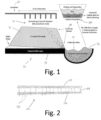
- a copper mining site 10 is illustrated in Fig. 1 and includes crushed ore is piled in a heap 12 on top of a liner or layer 14, and a percolating chemical solution (typically dilute sulfuric acid) 16 is percolated through sprinklers 20 onto the heap 12, thereby leaching metals 24 down through the heap 12.
- a percolating chemical solution typically dilute sulfuric acid
- the liner 14 at the bottom of the heap 12 is sloped so that the leaching metals flow to a collection pool 28 which collects pregnant leach solution 32.
- the pregnant leach solution 32 is typically 60% to 70% pure copper in solution, which is taken from the collection pool 28 to a solvent extraction site 36 (where the sulfuric acid is separated and then recycled back to the sprinklers 20 and then onto the heap 12).
- GCLs geosynthetic clay liners
- GCLs geosynthetic clay liners
- lining systems to collect leach solution from heap leaching of copper ore.
- the high concentration and low pH of the solutions in such systems can suppress swelling of such GCLs, resulting in high hydraulic conductivity through the barrier.
- Document WO 2012/101410 A1 provides a method comprising: providing a bentonite barrier composition comprising: bentonite; and a polyanionic low molecular weight polymer; and forming a containment using the bentonite barrier composition to provide at least partial separation for a containment from its environment.
- Document CN 114 149 203 B states a compound polymer modified bentonite anti-seepage barrier material as well as a preparation method and application thereof.
- the compound polymer modified bentonite anti-seepage barrier material is prepared from the following components in percentage by mass: 80 to 95 percent of sodium modified bentonite, 0.5 to 15 percent of polyanionic cellulose and 0.7 to 2.5 percent of hydroxypropyl methyl cellulose, the polyanionic cellulose and the hydroxypropyl methyl cellulose are a compound polymer.
- a geosynthetic clay liner for containing low pH, acidic fluids such as leachate including a dry blended mix of bentonite and a high molecular weight cellulose ether polymer, wherein the mix is 1%-10% by weight of the polymer and 90%-99% by weight bentonite, wherein when hydrated the high molecular weight cellulose ether particles form a gel that clogs open pores between the hydrated bentonite particles, resulting in narrow and tortuous flow paths around said bentonite particles.
- the geosynthetic clay liner is adhered to a geotextile.
- the geosynthetic clay liner is between two geotextiles wherein the geotextiles are connected together on opposite sides of the clay liner by needle punching.
- the polymer and the bentonite have a maximum particle size of 16 mesh. In a further form, when mixed the polymer has a maximum particle size of 200 mesh.
- a method of protecting an environment around a site having low pH, acidic fluids including (a) providing a geosynthetic clay liner by mixing a bentonite barrier composition consisting of a dry mix of 90%-99% by weight bentonite particles and 1%-10% by weight high molecular weight cellulose ether particles, and (b) lining a containment with the geosynthetic clay liner, wherein the geosynthetic clay liner provides separation between low pH acidic fluids in the containment and a surrounding environment, wherein when hydrated the high molecular weight cellulose ether particles form a gel that clogs open pores between the hydrated bentonite particles, resulting in narrow and tortuous flow paths around the bentonite particles.
- a geosynthetic clay liner 100 is disclosed herein having low permeability in applications encountering low pH, acidic (i.e., pH less than 7) fluids such as leachate from a low pH, acidic copper heap.
- the liner consists of a dry blended mix of 90%-99% by weight bentonite and 1%-10% by weight polymer, with the polymer being high molecular weight cellulose ether.
- the bentonite and polymer are particles when dry mixed to form the liner, and have a maximum particle size of about 16 mesh.
- the polymer particles may have a maximum particle size less than the bentonite maximum particle size. That is, the polymer maximum sizes may be about 200 mesh so that polymer particles will fit into spaces between the bentonite particles.
- the high molecular weight cellulose ether When hydrated, the high molecular weight cellulose ether not only releases water which allows the bentonite of the liner to swell but it also forms a gel that still further clogs open pores between the hydrated bentonite particles, resulting in narrow and tortuous flow paths around the bentonite granules and low hydraulic conductivity.
- liners as disclosed herein may be used advantageously not only in copper mining but also in a variety of applications and environments requiring containment of acidic fluids ( i.e., with a pH less than 7), particularly those with a pH of about 2 or less.
Landscapes
- Engineering & Computer Science (AREA)
- Chemical & Material Sciences (AREA)
- Ceramic Engineering (AREA)
- Structural Engineering (AREA)
- Life Sciences & Earth Sciences (AREA)
- Environmental & Geological Engineering (AREA)
- Civil Engineering (AREA)
- Organic Chemistry (AREA)
- Materials Engineering (AREA)
- Mining & Mineral Resources (AREA)
- General Life Sciences & Earth Sciences (AREA)
- General Engineering & Computer Science (AREA)
- Paleontology (AREA)
- Dispersion Chemistry (AREA)
- Hydrology & Water Resources (AREA)
- Soil Sciences (AREA)
- Agronomy & Crop Science (AREA)
- Chemical Kinetics & Catalysis (AREA)
- Inorganic Chemistry (AREA)
- Solid-Sorbent Or Filter-Aiding Compositions (AREA)
- Silicates, Zeolites, And Molecular Sieves (AREA)
- Manufacture And Refinement Of Metals (AREA)
Description
- The present invention relates to the use of geosynthetic clay liners, and more particularly to bentonite barrier compositions for use in acidic / low pH environments.
- Various materials and procedures have been developed and utilized to form low permeability barriers in containment applications. For example, low permeability barriers are needed to separate waste fluids from contaminating the surrounding environment in industrial mineral and metal mining sites, and landfill sites. These barriers are also useful for aqueous containment applications such as leachate ponds, retention ponds, and water storage reservoirs. The term "containment" when used herein refers to both aqueous containments (e.g., ponds) as well as other containments that have components that are better separated from the surrounding environment. For example, "containment" may refer to the separation of ponds of liquid waste streams from industrial processes or leachates produced from these or other industrial processes from the surrounding environments.
- For example, a
copper mining site 10 is illustrated inFig. 1 and includes crushed ore is piled in a heap 12 on top of a liner or layer 14, and a percolating chemical solution (typically dilute sulfuric acid) 16 is percolated through sprinklers 20 onto the heap 12, thereby leaching metals 24 down through the heap 12. - The liner 14 at the bottom of the heap 12 is sloped so that the leaching metals flow to a collection pool 28 which collects pregnant leach solution 32. The pregnant leach solution 32 is typically 60% to 70% pure copper in solution, which is taken from the collection pool 28 to a solvent extraction site 36 (where the sulfuric acid is separated and then recycled back to the sprinklers 20 and then onto the heap 12).
- Of course, regulations (e.g., local, international, state and federal standards) require that materials in the mining process do not contaminate the surrounding environment. It is thus crucial that the barriers, such as the liner 14 and the collection pool 28, have low permeability to block contaminants from escaping to the surrounding environment, particularly in application with highly acidic (low pH) materials such as sulfuric acid.
- Barrier geomembranes such as geosynthetic clay liners (GCLs) have often been used in geotechnical sites for a variety of reasons, including to block contaminants from escaping to the environment around the site. See, for example,
U.S. Patent No. 9,758,432 U.S. Publication Nos. 2012/0216707 and2012/0219366 regarding high pH environments. Further, geosynthetic clay liners (GCL) comprised of sodium (Na) bentonite have been used in many applications, including lining systems to collect leach solution from heap leaching of copper ore. However, the high concentration and low pH of the solutions in such systems can suppress swelling of such GCLs, resulting in high hydraulic conductivity through the barrier. As a result, maintaining the necessary barrier low permeability in low pH, high acidic applications has been difficult over time, particularly given the aggressiveness of the leachate in those applications.
DocumentWO 2012/101410 A1 , according to its abstract, provides a method comprising: providing a bentonite barrier composition comprising: bentonite; and a polyanionic low molecular weight polymer; and forming a containment using the bentonite barrier composition to provide at least partial separation for a containment from its environment. DocumentCN 114 149 203 B , according to its abstract, states a compound polymer modified bentonite anti-seepage barrier material as well as a preparation method and application thereof. The compound polymer modified bentonite anti-seepage barrier material is prepared from the following components in percentage by mass: 80 to 95 percent of sodium modified bentonite, 0.5 to 15 percent of polyanionic cellulose and 0.7 to 2.5 percent of hydroxypropyl methyl cellulose, the polyanionic cellulose and the hydroxypropyl methyl cellulose are a compound polymer. - In one aspect of the disclosure, a geosynthetic clay liner for containing low pH, acidic fluids such as leachate is provided, including a dry blended mix of bentonite and a high molecular weight cellulose ether polymer, wherein the mix is 1%-10% by weight of the polymer and 90%-99% by weight bentonite, wherein when hydrated the high molecular weight cellulose ether particles form a gel that clogs open pores between the hydrated bentonite particles, resulting in narrow and tortuous flow paths around said bentonite particles.
- In one form of this aspect of the disclosure, the geosynthetic clay liner is adhered to a geotextile. In an alternate form, the geosynthetic clay liner is between two geotextiles wherein the geotextiles are connected together on opposite sides of the clay liner by needle punching.
- In another form of this aspect of the disclosure, the polymer and the bentonite have a maximum particle size of 16 mesh. In a further form, when mixed the polymer has a maximum particle size of 200 mesh.
- In another aspect of the disclosure, a method of protecting an environment around a site having low pH, acidic fluids is provided, including (a) providing a geosynthetic clay liner by mixing a bentonite barrier composition consisting of a dry mix of 90%-99% by weight bentonite particles and 1%-10% by weight high molecular weight cellulose ether particles, and (b) lining a containment with the geosynthetic clay liner, wherein the geosynthetic clay liner provides separation between low pH acidic fluids in the containment and a surrounding environment, wherein when hydrated the high molecular weight cellulose ether particles form a gel that clogs open pores between the hydrated bentonite particles, resulting in narrow and tortuous flow paths around the bentonite particles.
- In one form of this aspect of the disclosure, at least some of the fluids have a pH which is no more than about 2.
- In another form of this aspect of the disclosure, the polymer and the bentonite have a maximum particle size of 16 mesh. In a further form, when mixed the polymer has a maximum particle size of 200 mesh.
- In still another form of this aspect of the disclosure, the fluid is leachate from copper extracted from ore at the site.
- In yet another aspect of the disclosure, a containment for low pH, acidic fluids is provided, including a geosynthetic clay liner consisting of a bentonite barrier composition consisting of a dry mix of 90%-99% by weight bentonite particles and 1%-10% by weight polymer particles of high molecular weight cellulose ether. A containment area for the fluids is lined with the geosynthetic clay liner so that the geosynthetic clay liner provides a barrier between the containment area and a surrounding environment. When hydrated the high molecular weight cellulose ether particles form a gel that clogs open pores in the hydrated bentonite, resulting in narrow and tortuous flow paths around the bentonite particles.
- In one form of this aspect of the disclosure, the liner is adapted to result in the narrow and tortuous flow paths with fluids having a pH which is about 2 and lower.
- In another form of this aspect of the disclosure, the liner is adapted to contain leachate from extraction of copper from copper ore.
- In still another form of this aspect of the disclosure, the geosynthetic clay liner is adhered to a geotextile. In an alternate form, the geosynthetic clay liner is between two geotextiles wherein the geotextiles are connected together on opposite sides of the clay liner by needle punching.
- In yet another form of this aspect of the disclosure, the polymer and the bentonite have a maximum particle size of 16 mesh. In a further form, when mixed the polymer has a maximum particle size of 200 mesh.
- Other objects, features, and advantages of the invention will become apparent from a review of the entire specification, including the appended claims and drawings.
-
-
Figure 1 illustrates a site for extracting copper from a crushed ore heap, and -
Figure 2 illustrates a geosynthetic clay liner as disclosed herein for use in low pH, high acidic environments such as copper heap leaching. - A
geosynthetic clay liner 100 is disclosed herein having low permeability in applications encountering low pH, acidic (i.e., pH less than 7) fluids such as leachate from a low pH, acidic copper heap. The liner consists of a dry blended mix of 90%-99% by weight bentonite and 1%-10% by weight polymer, with the polymer being high molecular weight cellulose ether. The bentonite and polymer are particles when dry mixed to form the liner, and have a maximum particle size of about 16 mesh. Advantageously, the polymer particles may have a maximum particle size less than the bentonite maximum particle size. That is, the polymer maximum sizes may be about 200 mesh so that polymer particles will fit into spaces between the bentonite particles. - In low pH, high acidic environments such as extraction sites with copper heap leaching of low grade ore, water is tied up in chemical reactions and thus not as readily available to result in swelling of bentonite particles necessary for the barrier liner permeability to be low enough to prevent leak of materials through the barrier and into the surrounding environment.
- Bentonite + high molecular weight cellulose ether polymer liners as disclosed herein are less chemically sensitive, whereby the polymer releases water which allows the bentonite of the liner to swell so as to close spaces between bentonite particles. As a result of such swelling, the
liner 100 will have narrow and tortuous flow paths between the bentonite particles, and therefore low permeability through the liner. - It should be appreciated that the polymer-
bentonite mixture 104 as disclosed herein may for convenience of handling and installing be adhered to a geotextile or, as illustrated inFig. 2 , may be a layer between twogeotextiles geotextiles - It should then also be appreciated that the
liner 100 can be used to form a containment area for low pH, acidic leachate, such as the collection pool 28 and/or liner/layer 14 ofcopper mining sites 10 such as shown inFig. 1 . That is, containment areas for such leachate may advantageously be lined with the polymer-bentonitegeosynthetic clay liner 100 described herein so that the geosynthetic clay liner provides a barrier between leachate in the containment area and a surrounding environment. Moreover, when hydrated, the high molecular weight cellulose ether particles may also form a gel that clogs open pores within the hydrated bentonite, further narrowing the flow paths around the bentonite particles and resulting in low hydraulic conductivity through theliner 100. - It should be still further recognized that a
liner 100 with the polymer-bentonite mixture 104 as described herein (with or without geotextiles) may advantageously be used in a method of protecting an environment surrounding a site having low pH, acidic fluids, including but not limited to leachate. That is, ageosynthetic clay liner 100 consisting of a mixture of bentonite and a high molecular weight cellulose ether (in the described 1%-10% / 90%-99% by weight proportions) may be used to line a containment for the low pH, acidic fluid so that the geosynthetic clay liner provides a barrier between leachate in the containment and a surrounding environment. When hydrated, the high molecular weight cellulose ether not only releases water which allows the bentonite of the liner to swell but it also forms a gel that still further clogs open pores between the hydrated bentonite particles, resulting in narrow and tortuous flow paths around the bentonite granules and low hydraulic conductivity. - It should be appreciated that liners as disclosed herein may be used advantageously not only in copper mining but also in a variety of applications and environments requiring containment of acidic fluids (i.e., with a pH less than 7), particularly those with a pH of about 2 or less.
- Still other aspects, uses, objects and advantages of the geosynthetic clay liners disclosed herein will be recognizable by a full review of the specification and drawings herein.
Claims (17)
- A geosynthetic clay liner (100) for containing low pH, acidic fluids, comprising a dry blended mix of bentonite and a high molecular weight cellulose ether polymer (114), wherein said mix is 1%-10% by weight of said polymer and 90%-99% by weight bentonite, wherein when hydrated the high molecular weight cellulose ether particles form a gel that clogs open pores between the hydrated bentonite particles, resulting in narrow and tortuous flow paths around said bentonite particles.
- The clay liner (100) of claim 1, wherein said geosynthetic clay liner (100) is adhered to a geotextile (110, 112).
- The clay liner (100) of claim 1, wherein said geosynthetic clay liner (100) comprises a layer between two geotextiles (110, 112) wherein said geotextiles (110, 112) are connected together on opposite sides of said clay liner (100) by needle punching.
- The clay liner (100) of claim 1, wherein when mixed said polymer and said bentonite have a maximum particle size of 16 mesh.
- The clay liner (100) of claim 4, wherein when mixed said polymer has a maximum particle size of 200 mesh.
- A method of protecting an environment around a site having low pH, acidic fluids, comprising:providing a geosynthetic clay liner (100) by mixing a bentonite barrier composition consisting of a dry mix of 90%-99% by weight bentonite particles, and 1%-10% by weight high molecular weight cellulose ether polymer particles; andlining a containment with the geosynthetic clay liner (100), wherein the geosynthetic clay liner (100) provides separation between low pH, acidic fluids in the containment and a surrounding environment, wherein when hydrated the high molecular weight cellulose ether particles form a gel that clogs open pores between the hydrated bentonite particles, resulting in narrow and tortuous flow paths around said bentonite particles.
- The method of claim 6, wherein at least some of said fluids have a pH which is no more than about 2.
- The method of claim 6, wherein when mixed said polymer and said bentonite have a maximum particle size of 16 mesh.
- The method of claim 8, wherein when mixed said polymer has a maximum particle size of 200 mesh.
- The method of claim 6, wherein copper is extracted from ore at said site and said fluid is leachate.
- A containment for low pH, acidic fluids, comprising:the geosynthetic clay liner (100) of claim 1;a containment area for the fluids, said area being lined with the geosynthetic clay liner (100), wherein the geosynthetic clay liner (100) provides a barrier between the containment area and a surrounding environment.
- The containment of claim 11, wherein said liner is adapted to result in said narrow and tortuous flow paths with fluids having a pH which is about 2 and lower.
- The containment of claim 11, wherein said liner is adapted to contain leachate from extraction of copper from copper ore.
- The containment of claim 11, wherein said geosynthetic clay liner (100) is adhered to a geotextile.
- The containment of claim 11, wherein said geosynthetic clay liner (100) comprises a layer between two geotextiles (110, 112) wherein said geotextiles (110, 112) are connected together on opposite sides of said clay liner (110) by needle punching.
- The containment of claim 11, wherein when mixed said polymer and said bentonite have a maximum particle size of 16 mesh.
- The containment of claim 16, wherein when mixed said polymer has a maximum particle size of 200 mesh.
Applications Claiming Priority (1)
| Application Number | Priority Date | Filing Date | Title |
|---|---|---|---|
| US17/965,186 US12209380B2 (en) | 2022-10-13 | 2022-10-13 | Heap leach liner |
Publications (3)
| Publication Number | Publication Date |
|---|---|
| EP4353371A1 EP4353371A1 (en) | 2024-04-17 |
| EP4353371C0 EP4353371C0 (en) | 2025-03-12 |
| EP4353371B1 true EP4353371B1 (en) | 2025-03-12 |
Family
ID=88417329
Family Applications (1)
| Application Number | Title | Priority Date | Filing Date |
|---|---|---|---|
| EP23203125.2A Active EP4353371B1 (en) | 2022-10-13 | 2023-10-12 | Heap leach liner |
Country Status (7)
| Country | Link |
|---|---|
| US (1) | US12209380B2 (en) |
| EP (1) | EP4353371B1 (en) |
| CN (1) | CN117886549A (en) |
| AU (1) | AU2023248077A1 (en) |
| CA (1) | CA3215918A1 (en) |
| MX (1) | MX2023012097A (en) |
| PL (1) | PL4353371T3 (en) |
Family Cites Families (10)
| Publication number | Priority date | Publication date | Assignee | Title |
|---|---|---|---|---|
| US5114275A (en) * | 1983-11-28 | 1992-05-19 | West Philip W | Process and waste pit liner for improved hydrophobic waste storage |
| US4624982A (en) * | 1985-04-05 | 1986-11-25 | American Colloid Company | Method of temporarily inhibiting the swellability of water swellable clays and compositions |
| EP0724674B1 (en) * | 1994-08-29 | 2003-03-26 | Laviosa Chimica Mineraria S.P.A. | High shear strength clay liner, method and apparatus for its production |
| US5584609A (en) * | 1995-04-04 | 1996-12-17 | Claymax Corporation | Geosynthetic clay liner and method of manufacture |
| WO2012025564A1 (en) * | 2010-08-27 | 2012-03-01 | Universiteit Gent | Clayey barriers |
| MX2013008678A (en) | 2011-01-28 | 2013-10-30 | Halliburton Energy Serv Inc | Improved bentonite barrier compositions and related geosynthetic clay liners for use in containment applications. |
| MX2013008677A (en) * | 2011-01-28 | 2013-10-30 | Halliburton Energy Serv Inc | Methods of using improved bentonite barrier compositions and related geosynthetic clay liners. |
| CA2825608C (en) | 2011-01-28 | 2015-10-20 | Halliburton Energy Services, Inc. | Improved bentonite barrier compositions and methods of use in containment applications |
| US11692325B2 (en) * | 2016-12-16 | 2023-07-04 | Imertech Sas | Compositions for use in geosynthetic liners |
| CN114149203B (en) * | 2021-11-11 | 2022-09-02 | 东南大学 | A kind of compound polymer modified bentonite anti-seepage barrier material and its preparation method and application |
-
2022
- 2022-10-13 US US17/965,186 patent/US12209380B2/en active Active
-
2023
- 2023-10-10 CA CA3215918A patent/CA3215918A1/en active Pending
- 2023-10-10 AU AU2023248077A patent/AU2023248077A1/en active Pending
- 2023-10-12 PL PL23203125.2T patent/PL4353371T3/en unknown
- 2023-10-12 MX MX2023012097A patent/MX2023012097A/en unknown
- 2023-10-12 EP EP23203125.2A patent/EP4353371B1/en active Active
- 2023-10-13 CN CN202311329872.8A patent/CN117886549A/en active Pending
Non-Patent Citations (4)
| Title |
|---|
| D1 - Certech data sheet (01.09.2019) |
| D2 - The first offer of the product Izolbent 30 Acid, email 09.05.2016 12:40 |
| D3 - The second offer of the product Izolbent 30 Acid, email 09.05.2016 15:06 |
| D4 - Data sheets of the Eurobent products 13SEP2019 (EUROBENT CS 1,0 ACID (3600/350/300 Compo TL), EUROBENT CS 1,5 ACID (3600/350/300 Compo TL), EUROBENT CS 2,0 ACID (3600/350/300 Compo TL) |
Also Published As
| Publication number | Publication date |
|---|---|
| EP4353371C0 (en) | 2025-03-12 |
| CN117886549A (en) | 2024-04-16 |
| US20240125080A1 (en) | 2024-04-18 |
| CA3215918A1 (en) | 2024-04-13 |
| PL4353371T3 (en) | 2025-06-23 |
| US12209380B2 (en) | 2025-01-28 |
| EP4353371A1 (en) | 2024-04-17 |
| AU2023248077A1 (en) | 2024-05-02 |
| MX2023012097A (en) | 2024-04-15 |
Similar Documents
| Publication | Publication Date | Title |
|---|---|---|
| Hornsey et al. | The impact of mining solutions/liquors on geosynthetics | |
| US4456400A (en) | Process of safely disposing of waste materials | |
| Tampouris et al. | Removal of contaminant metals from fine grained soils, using agglomeration, chloride solutions and pile leaching techniques | |
| Patil et al. | Mechanical dewatering of red mud | |
| EP2668343B1 (en) | Method of using improved bentonite barrier compositions and related geosynthetic clay liners | |
| EP2668345B1 (en) | Improved bentonite barrier compositions and containment comprising said compositions | |
| Paleologos et al. | Sustainability challenges of clean-energy critical minerals: copper and rare earths | |
| EP2668344B1 (en) | Geosynthetic clay liners comprising bentonite barrier compositions for use in containment applications | |
| Marchiori et al. | Critical review of industrial solid wastes as barrier material for impermeabilization of storage waste facilities | |
| EP4353371B1 (en) | Heap leach liner | |
| Fourie et al. | Improving the performance of mining infrastructure through the judicious use of geosynthetics | |
| Karunaratne et al. | Bentonite: kaolinite clay liner | |
| Ören et al. | Barrier performance of geosynthetic clay liners to copper (II) chloride solutions | |
| Chan et al. | Integrated waste and water management in mining and metallurgical industries | |
| Al-Soudany et al. | A review of landfill liner and liner systems | |
| WO2021090220A2 (en) | Heap leach structure | |
| Chaabane et al. | Factors affecting the leaching of heavy metals (Ni+ 2, Pb+ 2, Cr+ 3) contained in sludge waste stabilization/solidification by hydraulic benders, Part I: water/cement and waste/cement ratio in S/S mortars | |
| Hage et al. | Comparative column elution of jarosite waste and its autoclaved product-evidence for the immobilization of deleterious elements in jarosite | |
| CN107558492A (en) | A kind of compound underground anti-seepage isolation wall construction and construction method | |
| Steemson et al. | The development of nickel laterite heap leach projects | |
| Thomson et al. | Geochemical constraints on underground disposal of uranium mill tailings | |
| CN212248388U (en) | In-situ blocking structure, blocking system and liquid drainage system | |
| Reddy et al. | Suitability of bauxite residue as a landfill liner material—An overview | |
| CA1172660A (en) | Process of safely disposing of waste materials | |
| Sellaf et al. | Assessment of the performance of sediments and scrap rubber layers to filter the leachate of landfills |
Legal Events
| Date | Code | Title | Description |
|---|---|---|---|
| PUAI | Public reference made under article 153(3) epc to a published international application that has entered the european phase |
Free format text: ORIGINAL CODE: 0009012 |
|
| STAA | Information on the status of an ep patent application or granted ep patent |
Free format text: STATUS: THE APPLICATION HAS BEEN PUBLISHED |
|
| AK | Designated contracting states |
Kind code of ref document: A1 Designated state(s): AL AT BE BG CH CY CZ DE DK EE ES FI FR GB GR HR HU IE IS IT LI LT LU LV MC ME MK MT NL NO PL PT RO RS SE SI SK SM TR |
|
| STAA | Information on the status of an ep patent application or granted ep patent |
Free format text: STATUS: REQUEST FOR EXAMINATION WAS MADE |
|
| GRAP | Despatch of communication of intention to grant a patent |
Free format text: ORIGINAL CODE: EPIDOSNIGR1 |
|
| STAA | Information on the status of an ep patent application or granted ep patent |
Free format text: STATUS: GRANT OF PATENT IS INTENDED |
|
| 17P | Request for examination filed |
Effective date: 20240918 |
|
| RBV | Designated contracting states (corrected) |
Designated state(s): AL AT BE BG CH CY CZ DE DK EE ES FI FR GB GR HR HU IE IS IT LI LT LU LV MC ME MK MT NL NO PL PT RO RS SE SI SK SM TR |
|
| RIC1 | Information provided on ipc code assigned before grant |
Ipc: E02D 31/00 20060101ALI20241009BHEP Ipc: C04B 28/00 20060101ALI20241009BHEP Ipc: B09B 1/00 20060101AFI20241009BHEP |
|
| INTG | Intention to grant announced |
Effective date: 20241022 |
|
| GRAS | Grant fee paid |
Free format text: ORIGINAL CODE: EPIDOSNIGR3 |
|
| GRAA | (expected) grant |
Free format text: ORIGINAL CODE: 0009210 |
|
| STAA | Information on the status of an ep patent application or granted ep patent |
Free format text: STATUS: THE PATENT HAS BEEN GRANTED |
|
| AK | Designated contracting states |
Kind code of ref document: B1 Designated state(s): AL AT BE BG CH CY CZ DE DK EE ES FI FR GB GR HR HU IE IS IT LI LT LU LV MC ME MK MT NL NO PL PT RO RS SE SI SK SM TR |
|
| REG | Reference to a national code |
Ref country code: GB Ref legal event code: FG4D |
|
| REG | Reference to a national code |
Ref country code: CH Ref legal event code: EP |
|
| REG | Reference to a national code |
Ref country code: DE Ref legal event code: R096 Ref document number: 602023002403 Country of ref document: DE |
|
| REG | Reference to a national code |
Ref country code: IE Ref legal event code: FG4D |
|
| U01 | Request for unitary effect filed |
Effective date: 20250328 |
|
| U07 | Unitary effect registered |
Designated state(s): AT BE BG DE DK EE FI FR IT LT LU LV MT NL PT RO SE SI Effective date: 20250403 |
|
| PG25 | Lapsed in a contracting state [announced via postgrant information from national office to epo] |
Ref country code: RS Free format text: LAPSE BECAUSE OF FAILURE TO SUBMIT A TRANSLATION OF THE DESCRIPTION OR TO PAY THE FEE WITHIN THE PRESCRIBED TIME-LIMIT Effective date: 20250612 |
|
| PG25 | Lapsed in a contracting state [announced via postgrant information from national office to epo] |
Ref country code: ES Free format text: LAPSE BECAUSE OF FAILURE TO SUBMIT A TRANSLATION OF THE DESCRIPTION OR TO PAY THE FEE WITHIN THE PRESCRIBED TIME-LIMIT Effective date: 20250312 |
|
| PG25 | Lapsed in a contracting state [announced via postgrant information from national office to epo] |
Ref country code: NO Free format text: LAPSE BECAUSE OF FAILURE TO SUBMIT A TRANSLATION OF THE DESCRIPTION OR TO PAY THE FEE WITHIN THE PRESCRIBED TIME-LIMIT Effective date: 20250612 |
|
| PG25 | Lapsed in a contracting state [announced via postgrant information from national office to epo] |
Ref country code: HR Free format text: LAPSE BECAUSE OF FAILURE TO SUBMIT A TRANSLATION OF THE DESCRIPTION OR TO PAY THE FEE WITHIN THE PRESCRIBED TIME-LIMIT Effective date: 20250312 |
|
| PG25 | Lapsed in a contracting state [announced via postgrant information from national office to epo] |
Ref country code: GR Free format text: LAPSE BECAUSE OF FAILURE TO SUBMIT A TRANSLATION OF THE DESCRIPTION OR TO PAY THE FEE WITHIN THE PRESCRIBED TIME-LIMIT Effective date: 20250613 |
|
| PG25 | Lapsed in a contracting state [announced via postgrant information from national office to epo] |
Ref country code: SM Free format text: LAPSE BECAUSE OF FAILURE TO SUBMIT A TRANSLATION OF THE DESCRIPTION OR TO PAY THE FEE WITHIN THE PRESCRIBED TIME-LIMIT Effective date: 20250312 |
|
| PGFP | Annual fee paid to national office [announced via postgrant information from national office to epo] |
Ref country code: TR Payment date: 20250925 Year of fee payment: 3 Ref country code: PL Payment date: 20250918 Year of fee payment: 3 |
|
| PG25 | Lapsed in a contracting state [announced via postgrant information from national office to epo] |
Ref country code: CZ Free format text: LAPSE BECAUSE OF FAILURE TO SUBMIT A TRANSLATION OF THE DESCRIPTION OR TO PAY THE FEE WITHIN THE PRESCRIBED TIME-LIMIT Effective date: 20250312 |
|
| PG25 | Lapsed in a contracting state [announced via postgrant information from national office to epo] |
Ref country code: SK Free format text: LAPSE BECAUSE OF FAILURE TO SUBMIT A TRANSLATION OF THE DESCRIPTION OR TO PAY THE FEE WITHIN THE PRESCRIBED TIME-LIMIT Effective date: 20250312 |
|
| PG25 | Lapsed in a contracting state [announced via postgrant information from national office to epo] |
Ref country code: IS Free format text: LAPSE BECAUSE OF FAILURE TO SUBMIT A TRANSLATION OF THE DESCRIPTION OR TO PAY THE FEE WITHIN THE PRESCRIBED TIME-LIMIT Effective date: 20250712 |
|
| U20 | Renewal fee for the european patent with unitary effect paid |
Year of fee payment: 3 Effective date: 20251027 |
|
| PLAZ | Examination of admissibility of opposition: despatch of communication + time limit |
Free format text: ORIGINAL CODE: EPIDOSNOPE2 |
|
| PLBA | Examination of admissibility of opposition: reply received |
Free format text: ORIGINAL CODE: EPIDOSNOPE4 |
|
| PLBI | Opposition filed |
Free format text: ORIGINAL CODE: 0009260 |
|
| PLAF | Information modified related to communication of a notice of opposition and request to file observations + time limit |
Free format text: ORIGINAL CODE: EPIDOSCOBS2 |
|
| PLAX | Notice of opposition and request to file observation + time limit sent |
Free format text: ORIGINAL CODE: EPIDOSNOBS2 |
|
| 26 | Opposition filed |
Opponent name: PTH CERTECH Effective date: 20251211 |