EP4353121A1 - Method for curl reduction of keratin fibers - Google Patents
Method for curl reduction of keratin fibers Download PDFInfo
- Publication number
- EP4353121A1 EP4353121A1 EP22200645.4A EP22200645A EP4353121A1 EP 4353121 A1 EP4353121 A1 EP 4353121A1 EP 22200645 A EP22200645 A EP 22200645A EP 4353121 A1 EP4353121 A1 EP 4353121A1
- Authority
- EP
- European Patent Office
- Prior art keywords
- keratin fibers
- range
- composition
- weight
- curl
- Prior art date
- Legal status (The legal status is an assumption and is not a legal conclusion. Google has not performed a legal analysis and makes no representation as to the accuracy of the status listed.)
- Pending
Links
- 239000000835 fiber Substances 0.000 title claims abstract description 73
- 102000011782 Keratins Human genes 0.000 title claims abstract description 72
- 108010076876 Keratins Proteins 0.000 title claims abstract description 72
- 238000000034 method Methods 0.000 title claims abstract description 39
- 239000000203 mixture Substances 0.000 claims abstract description 122
- 230000001590 oxidative effect Effects 0.000 claims abstract description 44
- 230000004888 barrier function Effects 0.000 claims abstract description 8
- 238000010438 heat treatment Methods 0.000 claims abstract description 8
- 239000000126 substance Substances 0.000 claims abstract description 7
- 150000003839 salts Chemical class 0.000 claims description 30
- 229920000642 polymer Polymers 0.000 claims description 16
- 230000008719 thickening Effects 0.000 claims description 16
- -1 sulfite salt Chemical class 0.000 claims description 15
- QGZKDVFQNNGYKY-UHFFFAOYSA-N Ammonia Chemical compound N QGZKDVFQNNGYKY-UHFFFAOYSA-N 0.000 claims description 12
- 239000003638 chemical reducing agent Substances 0.000 claims description 11
- 230000003113 alkalizing effect Effects 0.000 claims description 10
- 239000003795 chemical substances by application Substances 0.000 claims description 10
- 125000000129 anionic group Chemical group 0.000 claims description 8
- ZMANZCXQSJIPKH-UHFFFAOYSA-N Triethylamine Chemical compound CCN(CC)CC ZMANZCXQSJIPKH-UHFFFAOYSA-N 0.000 claims description 6
- CBTVGIZVANVGBH-UHFFFAOYSA-N aminomethyl propanol Chemical compound CC(C)(N)CO CBTVGIZVANVGBH-UHFFFAOYSA-N 0.000 claims description 6
- 229910021529 ammonia Inorganic materials 0.000 claims description 6
- LENZDBCJOHFCAS-UHFFFAOYSA-N tris Chemical compound OCC(N)(CO)CO LENZDBCJOHFCAS-UHFFFAOYSA-N 0.000 claims description 5
- HZAXFHJVJLSVMW-UHFFFAOYSA-N 2-Aminoethan-1-ol Chemical compound NCCO HZAXFHJVJLSVMW-UHFFFAOYSA-N 0.000 claims description 4
- PMNLUUOXGOOLSP-UHFFFAOYSA-N 2-mercaptopropanoic acid Chemical compound CC(S)C(O)=O PMNLUUOXGOOLSP-UHFFFAOYSA-N 0.000 claims description 4
- GSEJCLTVZPLZKY-UHFFFAOYSA-N Triethanolamine Chemical compound OCCN(CCO)CCO GSEJCLTVZPLZKY-UHFFFAOYSA-N 0.000 claims description 4
- 150000001412 amines Chemical class 0.000 claims description 4
- 150000001720 carbohydrates Chemical class 0.000 claims description 4
- XOAAWQZATWQOTB-UHFFFAOYSA-N taurine Chemical compound NCCS(O)(=O)=O XOAAWQZATWQOTB-UHFFFAOYSA-N 0.000 claims description 4
- 239000002562 thickening agent Substances 0.000 claims description 4
- CWERGRDVMFNCDR-UHFFFAOYSA-N thioglycolic acid Chemical compound OC(=O)CS CWERGRDVMFNCDR-UHFFFAOYSA-N 0.000 claims description 4
- NIXOWILDQLNWCW-UHFFFAOYSA-M Acrylate Chemical compound [O-]C(=O)C=C NIXOWILDQLNWCW-UHFFFAOYSA-M 0.000 claims description 3
- CERQOIWHTDAKMF-UHFFFAOYSA-M Methacrylate Chemical compound CC(=C)C([O-])=O CERQOIWHTDAKMF-UHFFFAOYSA-M 0.000 claims description 3
- 239000000178 monomer Substances 0.000 claims description 3
- 125000004169 (C1-C6) alkyl group Chemical group 0.000 claims description 2
- NCXUNZWLEYGQAH-UHFFFAOYSA-N 1-(dimethylamino)propan-2-ol Chemical compound CC(O)CN(C)C NCXUNZWLEYGQAH-UHFFFAOYSA-N 0.000 claims description 2
- HXKKHQJGJAFBHI-UHFFFAOYSA-N 1-aminopropan-2-ol Chemical compound CC(O)CN HXKKHQJGJAFBHI-UHFFFAOYSA-N 0.000 claims description 2
- LJDSTRZHPWMDPG-UHFFFAOYSA-N 2-(butylamino)ethanol Chemical compound CCCCNCCO LJDSTRZHPWMDPG-UHFFFAOYSA-N 0.000 claims description 2
- IWSZDQRGNFLMJS-UHFFFAOYSA-N 2-(dibutylamino)ethanol Chemical compound CCCCN(CCO)CCCC IWSZDQRGNFLMJS-UHFFFAOYSA-N 0.000 claims description 2
- GVNHOISKXMSMPX-UHFFFAOYSA-N 2-[butyl(2-hydroxyethyl)amino]ethanol Chemical compound CCCCN(CCO)CCO GVNHOISKXMSMPX-UHFFFAOYSA-N 0.000 claims description 2
- NKFNBVMJTSYZDV-UHFFFAOYSA-N 2-[dodecyl(2-hydroxyethyl)amino]ethanol Chemical compound CCCCCCCCCCCCN(CCO)CCO NKFNBVMJTSYZDV-UHFFFAOYSA-N 0.000 claims description 2
- XUJNEKJLAYXESH-REOHCLBHSA-N L-Cysteine Chemical compound SC[C@H](N)C(O)=O XUJNEKJLAYXESH-REOHCLBHSA-N 0.000 claims description 2
- FFFHZYDWPBMWHY-VKHMYHEASA-N L-homocysteine Chemical compound OC(=O)[C@@H](N)CCS FFFHZYDWPBMWHY-VKHMYHEASA-N 0.000 claims description 2
- OPKOKAMJFNKNAS-UHFFFAOYSA-N N-methylethanolamine Chemical compound CNCCO OPKOKAMJFNKNAS-UHFFFAOYSA-N 0.000 claims description 2
- SLINHMUFWFWBMU-UHFFFAOYSA-N Triisopropanolamine Chemical compound CC(O)CN(CC(C)O)CC(C)O SLINHMUFWFWBMU-UHFFFAOYSA-N 0.000 claims description 2
- 239000002253 acid Substances 0.000 claims description 2
- UFULAYFCSOUIOV-UHFFFAOYSA-N cysteamine Chemical compound NCCS UFULAYFCSOUIOV-UHFFFAOYSA-N 0.000 claims description 2
- 235000018417 cysteine Nutrition 0.000 claims description 2
- XUJNEKJLAYXESH-UHFFFAOYSA-N cysteine Natural products SCC(N)C(O)=O XUJNEKJLAYXESH-UHFFFAOYSA-N 0.000 claims description 2
- ZBCBWPMODOFKDW-UHFFFAOYSA-N diethanolamine Chemical compound OCCNCCO ZBCBWPMODOFKDW-UHFFFAOYSA-N 0.000 claims description 2
- LVTYICIALWPMFW-UHFFFAOYSA-N diisopropanolamine Chemical compound CC(O)CNCC(C)O LVTYICIALWPMFW-UHFFFAOYSA-N 0.000 claims description 2
- 229940043276 diisopropanolamine Drugs 0.000 claims description 2
- 150000002314 glycerols Chemical class 0.000 claims description 2
- 229940079826 hydrogen sulfite Drugs 0.000 claims description 2
- 125000002887 hydroxy group Chemical group [H]O* 0.000 claims description 2
- 229940102253 isopropanolamine Drugs 0.000 claims description 2
- 229960003151 mercaptamine Drugs 0.000 claims description 2
- PJUIMOJAAPLTRJ-UHFFFAOYSA-N monothioglycerol Chemical compound OCC(O)CS PJUIMOJAAPLTRJ-UHFFFAOYSA-N 0.000 claims description 2
- 125000000020 sulfo group Chemical group O=S(=O)([*])O[H] 0.000 claims description 2
- 229960003080 taurine Drugs 0.000 claims description 2
- 125000000217 alkyl group Chemical group 0.000 description 21
- QAOWNCQODCNURD-UHFFFAOYSA-L Sulfate Chemical compound [O-]S([O-])(=O)=O QAOWNCQODCNURD-UHFFFAOYSA-L 0.000 description 11
- 239000004094 surface-active agent Substances 0.000 description 11
- 229910021653 sulphate ion Inorganic materials 0.000 description 10
- MHAJPDPJQMAIIY-UHFFFAOYSA-N Hydrogen peroxide Chemical compound OO MHAJPDPJQMAIIY-UHFFFAOYSA-N 0.000 description 8
- 150000001875 compounds Chemical class 0.000 description 8
- 241001124569 Lycaenidae Species 0.000 description 7
- 229920001577 copolymer Polymers 0.000 description 7
- 229920006395 saturated elastomer Polymers 0.000 description 6
- OKTJSMMVPCPJKN-UHFFFAOYSA-N Carbon Chemical compound [C] OKTJSMMVPCPJKN-UHFFFAOYSA-N 0.000 description 5
- 150000001252 acrylic acid derivatives Chemical class 0.000 description 5
- 229910052799 carbon Inorganic materials 0.000 description 5
- XLYOFNOQVPJJNP-UHFFFAOYSA-N water Substances O XLYOFNOQVPJJNP-UHFFFAOYSA-N 0.000 description 5
- KWIUHFFTVRNATP-UHFFFAOYSA-N glycine betaine Chemical compound C[N+](C)(C)CC([O-])=O KWIUHFFTVRNATP-UHFFFAOYSA-N 0.000 description 4
- 150000002634 lipophilic molecules Chemical class 0.000 description 4
- 239000007800 oxidant agent Substances 0.000 description 4
- 239000002453 shampoo Substances 0.000 description 4
- HEMHJVSKTPXQMS-UHFFFAOYSA-M Sodium hydroxide Chemical compound [OH-].[Na+] HEMHJVSKTPXQMS-UHFFFAOYSA-M 0.000 description 3
- 150000008051 alkyl sulfates Chemical class 0.000 description 3
- 239000002280 amphoteric surfactant Substances 0.000 description 3
- 239000003945 anionic surfactant Substances 0.000 description 3
- 239000002537 cosmetic Substances 0.000 description 3
- 239000002888 zwitterionic surfactant Substances 0.000 description 3
- QLAJNZSPVITUCQ-UHFFFAOYSA-N 1,3,2-dioxathietane 2,2-dioxide Chemical compound O=S1(=O)OCO1 QLAJNZSPVITUCQ-UHFFFAOYSA-N 0.000 description 2
- AMEMLELAMQEAIA-UHFFFAOYSA-N 6-(tert-butyl)thieno[3,2-d]pyrimidin-4(3H)-one Chemical compound N1C=NC(=O)C2=C1C=C(C(C)(C)C)S2 AMEMLELAMQEAIA-UHFFFAOYSA-N 0.000 description 2
- JTHZUSWLNCPZLX-UHFFFAOYSA-N 6-fluoro-3-methyl-2h-indazole Chemical compound FC1=CC=C2C(C)=NNC2=C1 JTHZUSWLNCPZLX-UHFFFAOYSA-N 0.000 description 2
- 244000215068 Acacia senegal Species 0.000 description 2
- 229920002134 Carboxymethyl cellulose Polymers 0.000 description 2
- VEXZGXHMUGYJMC-UHFFFAOYSA-M Chloride anion Chemical compound [Cl-] VEXZGXHMUGYJMC-UHFFFAOYSA-M 0.000 description 2
- JDRSMPFHFNXQRB-CMTNHCDUSA-N Decyl beta-D-threo-hexopyranoside Chemical compound CCCCCCCCCCO[C@@H]1O[C@H](CO)C(O)[C@H](O)C1O JDRSMPFHFNXQRB-CMTNHCDUSA-N 0.000 description 2
- ROSDSFDQCJNGOL-UHFFFAOYSA-N Dimethylamine Chemical compound CNC ROSDSFDQCJNGOL-UHFFFAOYSA-N 0.000 description 2
- 229920002907 Guar gum Polymers 0.000 description 2
- 229920000084 Gum arabic Polymers 0.000 description 2
- NBIIXXVUZAFLBC-UHFFFAOYSA-N Phosphoric acid Chemical compound OP(O)(O)=O NBIIXXVUZAFLBC-UHFFFAOYSA-N 0.000 description 2
- 229920002125 Sokalan® Polymers 0.000 description 2
- 235000010489 acacia gum Nutrition 0.000 description 2
- 239000000205 acacia gum Substances 0.000 description 2
- 235000010443 alginic acid Nutrition 0.000 description 2
- 229920000615 alginic acid Polymers 0.000 description 2
- 150000004781 alginic acids Chemical class 0.000 description 2
- 235000010407 ammonium alginate Nutrition 0.000 description 2
- 229960003237 betaine Drugs 0.000 description 2
- SXDBWCPKPHAZSM-UHFFFAOYSA-N bromic acid Chemical class OBr(=O)=O SXDBWCPKPHAZSM-UHFFFAOYSA-N 0.000 description 2
- 235000010410 calcium alginate Nutrition 0.000 description 2
- 239000001768 carboxy methyl cellulose Substances 0.000 description 2
- 235000010948 carboxy methyl cellulose Nutrition 0.000 description 2
- 239000008112 carboxymethyl-cellulose Substances 0.000 description 2
- 239000003093 cationic surfactant Substances 0.000 description 2
- 229920006037 cross link polymer Polymers 0.000 description 2
- 229940073499 decyl glucoside Drugs 0.000 description 2
- 235000014113 dietary fatty acids Nutrition 0.000 description 2
- 239000000194 fatty acid Substances 0.000 description 2
- 229930195729 fatty acid Natural products 0.000 description 2
- HHLFWLYXYJOTON-UHFFFAOYSA-N glyoxylic acid Chemical compound OC(=O)C=O HHLFWLYXYJOTON-UHFFFAOYSA-N 0.000 description 2
- 235000010417 guar gum Nutrition 0.000 description 2
- 239000000665 guar gum Substances 0.000 description 2
- 229960002154 guar gum Drugs 0.000 description 2
- 229940033357 isopropyl laurate Drugs 0.000 description 2
- XUGNVMKQXJXZCD-UHFFFAOYSA-N isopropyl palmitate Chemical compound CCCCCCCCCCCCCCCC(=O)OC(C)C XUGNVMKQXJXZCD-UHFFFAOYSA-N 0.000 description 2
- 238000005259 measurement Methods 0.000 description 2
- 150000007522 mineralic acids Chemical class 0.000 description 2
- 239000002736 nonionic surfactant Substances 0.000 description 2
- OQILCOQZDHPEAZ-UHFFFAOYSA-N octyl palmitate Chemical compound CCCCCCCCCCCCCCCC(=O)OCCCCCCCC OQILCOQZDHPEAZ-UHFFFAOYSA-N 0.000 description 2
- 150000007524 organic acids Chemical class 0.000 description 2
- 238000011946 reduction process Methods 0.000 description 2
- 238000010187 selection method Methods 0.000 description 2
- 235000010413 sodium alginate Nutrition 0.000 description 2
- 235000010493 xanthan gum Nutrition 0.000 description 2
- 239000000230 xanthan gum Substances 0.000 description 2
- 229920001285 xanthan gum Polymers 0.000 description 2
- 229940082509 xanthan gum Drugs 0.000 description 2
- PORPENFLTBBHSG-MGBGTMOVSA-N 1,2-dihexadecanoyl-sn-glycerol-3-phosphate Chemical group CCCCCCCCCCCCCCCC(=O)OC[C@H](COP(O)(O)=O)OC(=O)CCCCCCCCCCCCCCC PORPENFLTBBHSG-MGBGTMOVSA-N 0.000 description 1
- OUZOBPPZPCBJAR-UHFFFAOYSA-N 14-methylpentadecyl hexadecanoate Chemical compound CCCCCCCCCCCCCCCC(=O)OCCCCCCCCCCCCCC(C)C OUZOBPPZPCBJAR-UHFFFAOYSA-N 0.000 description 1
- OMIGHNLMNHATMP-UHFFFAOYSA-N 2-hydroxyethyl prop-2-enoate Chemical compound OCCOC(=O)C=C OMIGHNLMNHATMP-UHFFFAOYSA-N 0.000 description 1
- LEEPBJHNOBBYOU-YIQDKWKASA-M 2-hydroxyethyl-methyl-bis[2-[(z)-octadec-9-enoyl]oxyethyl]azanium;methyl sulfate Chemical compound COS([O-])(=O)=O.CCCCCCCC\C=C/CCCCCCCC(=O)OCC[N+](C)(CCO)CCOC(=O)CCCCCCC\C=C/CCCCCCCC LEEPBJHNOBBYOU-YIQDKWKASA-M 0.000 description 1
- ONYHQNURMVNRJZ-QXMHVHEDSA-N 3-[3-[[(Z)-docos-13-enoyl]amino]propyl-dimethylazaniumyl]-2-hydroxypropane-1-sulfonate Chemical compound CCCCCCCC\C=C/CCCCCCCCCCCC(=O)NCCC[N+](C)(C)CC(O)CS([O-])(=O)=O ONYHQNURMVNRJZ-QXMHVHEDSA-N 0.000 description 1
- DDGPBVIAYDDWDH-UHFFFAOYSA-N 3-[dodecyl(dimethyl)azaniumyl]-2-hydroxypropane-1-sulfonate Chemical compound CCCCCCCCCCCC[N+](C)(C)CC(O)CS([O-])(=O)=O DDGPBVIAYDDWDH-UHFFFAOYSA-N 0.000 description 1
- HIQIXEFWDLTDED-UHFFFAOYSA-N 4-hydroxy-1-piperidin-4-ylpyrrolidin-2-one Chemical compound O=C1CC(O)CN1C1CCNCC1 HIQIXEFWDLTDED-UHFFFAOYSA-N 0.000 description 1
- NIXOWILDQLNWCW-UHFFFAOYSA-N Acrylic acid Chemical compound OC(=O)C=C NIXOWILDQLNWCW-UHFFFAOYSA-N 0.000 description 1
- QGZKDVFQNNGYKY-UHFFFAOYSA-O Ammonium Chemical compound [NH4+] QGZKDVFQNNGYKY-UHFFFAOYSA-O 0.000 description 1
- VHUUQVKOLVNVRT-UHFFFAOYSA-N Ammonium hydroxide Chemical compound [NH4+].[OH-] VHUUQVKOLVNVRT-UHFFFAOYSA-N 0.000 description 1
- CPELXLSAUQHCOX-UHFFFAOYSA-M Bromide Chemical compound [Br-] CPELXLSAUQHCOX-UHFFFAOYSA-M 0.000 description 1
- DGAQECJNVWCQMB-PUAWFVPOSA-M Ilexoside XXIX Chemical compound C[C@@H]1CC[C@@]2(CC[C@@]3(C(=CC[C@H]4[C@]3(CC[C@@H]5[C@@]4(CC[C@@H](C5(C)C)OS(=O)(=O)[O-])C)C)[C@@H]2[C@]1(C)O)C)C(=O)O[C@H]6[C@@H]([C@H]([C@@H]([C@H](O6)CO)O)O)O.[Na+] DGAQECJNVWCQMB-PUAWFVPOSA-M 0.000 description 1
- FYYHWMGAXLPEAU-UHFFFAOYSA-N Magnesium Chemical compound [Mg] FYYHWMGAXLPEAU-UHFFFAOYSA-N 0.000 description 1
- ZLMJMSJWJFRBEC-UHFFFAOYSA-N Potassium Chemical compound [K] ZLMJMSJWJFRBEC-UHFFFAOYSA-N 0.000 description 1
- DBMJMQXJHONAFJ-UHFFFAOYSA-M Sodium laurylsulphate Chemical compound [Na+].CCCCCCCCCCCCOS([O-])(=O)=O DBMJMQXJHONAFJ-UHFFFAOYSA-M 0.000 description 1
- 239000007983 Tris buffer Substances 0.000 description 1
- 230000002378 acidificating effect Effects 0.000 description 1
- 229910001854 alkali hydroxide Inorganic materials 0.000 description 1
- 150000008044 alkali metal hydroxides Chemical class 0.000 description 1
- 125000005250 alkyl acrylate group Chemical group 0.000 description 1
- 125000005599 alkyl carboxylate group Chemical group 0.000 description 1
- 229910000147 aluminium phosphate Inorganic materials 0.000 description 1
- 150000001408 amides Chemical group 0.000 description 1
- 235000001014 amino acid Nutrition 0.000 description 1
- 150000001413 amino acids Chemical class 0.000 description 1
- 239000000908 ammonium hydroxide Substances 0.000 description 1
- ZZTCCAPMZLDHFM-UHFFFAOYSA-N ammonium thioglycolate Chemical compound [NH4+].[O-]C(=O)CS ZZTCCAPMZLDHFM-UHFFFAOYSA-N 0.000 description 1
- 229940075861 ammonium thioglycolate Drugs 0.000 description 1
- 239000002585 base Substances 0.000 description 1
- 229940110830 beheneth-25 methacrylate Drugs 0.000 description 1
- YSJGOMATDFSEED-UHFFFAOYSA-M behentrimonium chloride Chemical compound [Cl-].CCCCCCCCCCCCCCCCCCCCCC[N+](C)(C)C YSJGOMATDFSEED-UHFFFAOYSA-M 0.000 description 1
- 229960001631 carbomer Drugs 0.000 description 1
- BVKZGUZCCUSVTD-UHFFFAOYSA-N carbonic acid Chemical class OC(O)=O BVKZGUZCCUSVTD-UHFFFAOYSA-N 0.000 description 1
- 150000001768 cations Chemical class 0.000 description 1
- WOWHHFRSBJGXCM-UHFFFAOYSA-M cetyltrimethylammonium chloride Chemical compound [Cl-].CCCCCCCCCCCCCCCC[N+](C)(C)C WOWHHFRSBJGXCM-UHFFFAOYSA-M 0.000 description 1
- 150000001805 chlorine compounds Chemical group 0.000 description 1
- MRUAUOIMASANKQ-UHFFFAOYSA-N cocamidopropyl betaine Chemical compound CCCCCCCCCCCC(=O)NCCC[N+](C)(C)CC([O-])=O MRUAUOIMASANKQ-UHFFFAOYSA-N 0.000 description 1
- 229940073507 cocamidopropyl betaine Drugs 0.000 description 1
- 229940080421 coco glucoside Drugs 0.000 description 1
- CSMFSDCPJHNZRY-UHFFFAOYSA-N decyl hydrogen sulfate Chemical compound CCCCCCCCCCOS(O)(=O)=O CSMFSDCPJHNZRY-UHFFFAOYSA-N 0.000 description 1
- 229940008099 dimethicone Drugs 0.000 description 1
- 239000004205 dimethyl polysiloxane Substances 0.000 description 1
- 235000013870 dimethyl polysiloxane Nutrition 0.000 description 1
- REZZEXDLIUJMMS-UHFFFAOYSA-M dimethyldioctadecylammonium chloride Chemical compound [Cl-].CCCCCCCCCCCCCCCCCC[N+](C)(C)CCCCCCCCCCCCCCCCCC REZZEXDLIUJMMS-UHFFFAOYSA-M 0.000 description 1
- 239000004664 distearyldimethylammonium chloride (DHTDMAC) Substances 0.000 description 1
- LGFIRJFZBSYRDL-UHFFFAOYSA-N docosyl hydrogen sulfate Chemical compound CCCCCCCCCCCCCCCCCCCCCCOS(O)(=O)=O LGFIRJFZBSYRDL-UHFFFAOYSA-N 0.000 description 1
- MOTZDAYCYVMXPC-UHFFFAOYSA-N dodecyl hydrogen sulfate Chemical compound CCCCCCCCCCCCOS(O)(=O)=O MOTZDAYCYVMXPC-UHFFFAOYSA-N 0.000 description 1
- 230000000694 effects Effects 0.000 description 1
- 125000004185 ester group Chemical group 0.000 description 1
- 125000001495 ethyl group Chemical group [H]C([H])([H])C([H])([H])* 0.000 description 1
- 229920005676 ethylene-propylene block copolymer Polymers 0.000 description 1
- 238000002474 experimental method Methods 0.000 description 1
- 150000002191 fatty alcohols Chemical class 0.000 description 1
- 229930182470 glycoside Natural products 0.000 description 1
- 150000002338 glycosides Chemical class 0.000 description 1
- LPTIRUACFKQDHZ-UHFFFAOYSA-N hexadecyl sulfate;hydron Chemical compound CCCCCCCCCCCCCCCCOS(O)(=O)=O LPTIRUACFKQDHZ-UHFFFAOYSA-N 0.000 description 1
- 230000002209 hydrophobic effect Effects 0.000 description 1
- 239000004615 ingredient Substances 0.000 description 1
- PBOSTUDLECTMNL-UHFFFAOYSA-N lauryl acrylate Chemical compound CCCCCCCCCCCCOC(=O)C=C PBOSTUDLECTMNL-UHFFFAOYSA-N 0.000 description 1
- 229940094506 lauryl betaine Drugs 0.000 description 1
- PYIDGJJWBIBVIA-UYTYNIKBSA-N lauryl glucoside Chemical compound CCCCCCCCCCCCO[C@@H]1O[C@H](CO)[C@@H](O)[C@H](O)[C@H]1O PYIDGJJWBIBVIA-UYTYNIKBSA-N 0.000 description 1
- 229940048848 lauryl glucoside Drugs 0.000 description 1
- 239000011777 magnesium Substances 0.000 description 1
- 229910052749 magnesium Inorganic materials 0.000 description 1
- 125000002496 methyl group Chemical group [H]C([H])([H])* 0.000 description 1
- 239000002480 mineral oil Substances 0.000 description 1
- 235000010446 mineral oil Nutrition 0.000 description 1
- 229940078812 myristyl myristate Drugs 0.000 description 1
- DVEKCXOJTLDBFE-UHFFFAOYSA-N n-dodecyl-n,n-dimethylglycinate Chemical compound CCCCCCCCCCCC[N+](C)(C)CC([O-])=O DVEKCXOJTLDBFE-UHFFFAOYSA-N 0.000 description 1
- IIGMITQLXAGZTL-UHFFFAOYSA-N octyl octadecanoate Chemical compound CCCCCCCCCCCCCCCCCC(=O)OCCCCCCCC IIGMITQLXAGZTL-UHFFFAOYSA-N 0.000 description 1
- BARWIPMJPCRCTP-UHFFFAOYSA-N oleic acid oleyl ester Natural products CCCCCCCCC=CCCCCCCCCOC(=O)CCCCCCCC=CCCCCCCCC BARWIPMJPCRCTP-UHFFFAOYSA-N 0.000 description 1
- BARWIPMJPCRCTP-CLFAGFIQSA-N oleyl oleate Chemical compound CCCCCCCC\C=C/CCCCCCCCOC(=O)CCCCCCC\C=C/CCCCCCCC BARWIPMJPCRCTP-CLFAGFIQSA-N 0.000 description 1
- 235000005985 organic acids Nutrition 0.000 description 1
- 229920000435 poly(dimethylsiloxane) Polymers 0.000 description 1
- 229920001296 polysiloxane Polymers 0.000 description 1
- 239000011591 potassium Substances 0.000 description 1
- 229910052700 potassium Inorganic materials 0.000 description 1
- 150000003138 primary alcohols Chemical class 0.000 description 1
- 125000001436 propyl group Chemical group [H]C([*])([H])C([H])([H])C([H])([H])[H] 0.000 description 1
- 125000001453 quaternary ammonium group Chemical group 0.000 description 1
- 150000004671 saturated fatty acids Chemical class 0.000 description 1
- 235000003441 saturated fatty acids Nutrition 0.000 description 1
- 239000011734 sodium Substances 0.000 description 1
- 229910052708 sodium Inorganic materials 0.000 description 1
- XUXNAKZDHHEHPC-UHFFFAOYSA-M sodium bromate Chemical compound [Na+].[O-]Br(=O)=O XUXNAKZDHHEHPC-UHFFFAOYSA-M 0.000 description 1
- 235000019333 sodium laurylsulphate Nutrition 0.000 description 1
- 239000000243 solution Substances 0.000 description 1
- 229940073743 steareth-20 methacrylate Drugs 0.000 description 1
- 125000004079 stearyl group Chemical group [H]C([*])([H])C([H])([H])C([H])([H])C([H])([H])C([H])([H])C([H])([H])C([H])([H])C([H])([H])C([H])([H])C([H])([H])C([H])([H])C([H])([H])C([H])([H])C([H])([H])C([H])([H])C([H])([H])C([H])([H])C([H])([H])[H] 0.000 description 1
- DZKXJUASMGQEMA-UHFFFAOYSA-N tetradecyl tetradecanoate Chemical compound CCCCCCCCCCCCCCOC(=O)CCCCCCCCCCCCC DZKXJUASMGQEMA-UHFFFAOYSA-N 0.000 description 1
- 150000003626 triacylglycerols Chemical class 0.000 description 1
- MBNPWFXZGJXGFP-UHFFFAOYSA-N trimethyl-[3-(octadecanoylamino)propyl]azanium;chloride Chemical compound [Cl-].CCCCCCCCCCCCCCCCCC(=O)NCCC[N+](C)(C)C MBNPWFXZGJXGFP-UHFFFAOYSA-N 0.000 description 1
- 150000004670 unsaturated fatty acids Chemical class 0.000 description 1
- 235000021122 unsaturated fatty acids Nutrition 0.000 description 1
- 235000015112 vegetable and seed oil Nutrition 0.000 description 1
- 239000008158 vegetable oil Substances 0.000 description 1
- 230000000007 visual effect Effects 0.000 description 1
- 238000005303 weighing Methods 0.000 description 1
Images


Classifications
-
- A—HUMAN NECESSITIES
- A45—HAND OR TRAVELLING ARTICLES
- A45D—HAIRDRESSING OR SHAVING EQUIPMENT; EQUIPMENT FOR COSMETICS OR COSMETIC TREATMENTS, e.g. FOR MANICURING OR PEDICURING
- A45D7/00—Processes of waving, straightening or curling hair
- A45D7/04—Processes of waving, straightening or curling hair chemical
-
- A—HUMAN NECESSITIES
- A45—HAND OR TRAVELLING ARTICLES
- A45D—HAIRDRESSING OR SHAVING EQUIPMENT; EQUIPMENT FOR COSMETICS OR COSMETIC TREATMENTS, e.g. FOR MANICURING OR PEDICURING
- A45D7/00—Processes of waving, straightening or curling hair
- A45D7/06—Processes of waving, straightening or curling hair combined chemical and thermal
Definitions
- the present application is directed to a method for curl reduction of keratin fibers.
- the customer has the choice between permanently straight hair and permanently waved hair. There is no process available that durably reduces the curling of hair while not completely straightening it.
- the object of the present invention is a method for reducing curls on keratin fibers, preferably on human keratin fibers, more preferably on human hair, comprising the steps of:
- the inventor of the present invention has unexpectedly and surprisingly found out that the process according to the claims delivered a curl reduction even though keratin fibers were treated with a perming process.
- the decisive factor was the selection of the curler size in relation to the curl size of the keratin fibers. Selecting a larger curler diameter with respect to the curl size delivered a curl reduction, which was durable, cosmetically appealing, and low damaging.
- the present invention is directed to a method for reducing curls on keratin fibers, preferably on human keratin fibers, more preferably on human hair, comprising the steps of:
- Fig. 1 illustrates the method to determine the mean curl diameter d curl of the portion of keratin fibers to be treated by the naked human eye.
- the operator of this method may be the customer, a stylist, or another user skilled in curling methods.
- the operator follows the following steps to select one or more curler(s) (1) with a larger diameter than the curl diameter d curl of the selected portion of the keratin fibers (2) to be treated:
- measurements may be performed on the portion of keratin fibers to be treated. This aspect of the present invention is illustrated in Fig. 2 .
- Fig. 2 illustrates two options to ensure that the one or more curler(s) (1) have a larger diameter than d curl of step i).
- Options a) and b) include the following steps:
- the ratio of the diameter of the one or more curler(s) (1) in step i) to the curl diameter d curl is 1.1 or higher, preferably 1.2 or higher, more preferably 1.5 or higher.
- the curl diameter d curl of step i) is/are measured with a ruler (7) by holding the portion of keratin fibers (5, 6) in the operator's hand (8) without applying mechanical force onto it.
- the first step of curl reduction is achieved by the selection of the appropriate diameter of the one or more curler(s) (1) which is close to the desired curl diameter upon completion of the entire process.
- the chemical composition of step iii) is a permanent waving composition having a pH in the range of 3 to 12 and comprising one or more reducing agent(s).
- the pH of the permanent waving composition may preferably be in the range of 4 to 11, more preferably in the range of 7.5 to 10.5.
- the pH may be adjusted with the known organic and/or inorganic acids and alkalizing agents (such as detailed below).
- the permanent waving composition of step iii) may be left on the hair for a period of 1 to 60 min, preferably 2 to 45 min, more preferably 5 to 30 min, further more preferably 5 to 20 min at ambient temperature and without using any heat and/or heating device.
- the permanent waving composition comprises one or more reducing agent(s) selected from one or more sulfite salt(s) and/or hydrogen sulfite salt(s), thiogylcolic acid and/or its salts, cysteamine and/or its salts, thioglycerin and/or its salts, glycerol esters of thioglycolic acid and/or its salts, thiolactic acid and/or its salts, cysteine or homocysteine and/or its salts, and their mixtures.
- reducing agent(s) selected from one or more sulfite salt(s) and/or hydrogen sulfite salt(s), thiogylcolic acid and/or its salts, cysteamine and/or its salts, thioglycerin and/or its salts, glycerol esters of thioglycolic acid and/or its salts, thiolactic acid and/or its salts, cysteine or homoc
- the permanent waving composition of step iii) comprises one or more reducing agent(s) at a total concentration in the range of 0.1% to 30% by weight, still more preferably in the range of 0.25% to 25% by weight, still further more preferably 0.5% to 20% by weight, calculated to the total weight of the permanent waving composition.
- the permanent waving composition is an aqueous composition, i.e., it preferably has a water content of 50% by weight or more, preferably of 70% by weight or more, calculated to the total weight of the permanent waving composition.
- step vi) requires the application of an oxidative composition, preferably comprising hydrogen peroxide or a bromate salt.
- the oxidative composition is applied onto hair and left on the hair for 0.5 to 30 min, preferably 2 to 25 min, more preferably 3 to 20 min and further more preferably 5 to 15 min at ambient temperature without application of any heat and/or heating device.
- the fibers are preferably rinsed off at the end of the above referred processing time.
- the oxidizing composition may also be left on the hair, i.e., not rinsed off from hair.
- the total concentration of one or more oxidizing agents in the oxidizing composition is in the range of 0.1 to 15%, preferably 0.2 to 12.5%, more preferably 0.25 to 10% and most preferably 0.5 to 8% by weight, calculated to the total weight of the oxidizing composition.
- the pH of the oxidizing composition is in the range of 2 to 8.
- the pH of the composition is depending on the oxidizing agent of the composition. In case of hydrogen peroxide a pH in the range of 2 to 6 is suitable. In case of sodium bromate a pH of 5 to 8 is suitable.
- the pH of the composition may be adjusted using inorganic and/or organic acids and bases well known in the art.
- the chemical composition for semi-permanently or permanently reshaping of keratin fibers of step iii) is a non-reducing, non-oxidative composition having a pH in the range of 7 to 12.
- the non-reducing, non-oxidative composition of step iii) has a pH is in the range of 7.5 to 11, preferably in the range of 8.0 to 10.5, more preferably in the range of 8.25 to 10.
- non-reducing denotes a composition comprising reducing agents at 1% by weight or less, preferably at 0.5% by weight or less, more preferably at 0.1% by weight or less, calculated to the total weight of the non-reducing, non-oxidative composition or permanent waving composition, further more preferably the non-reducing, non-oxidative composition is free of reducing agents.
- non-oxidizing denotes a composition comprises oxidizing agents at 1% by weight or less, preferably at 0.5% by weight or less, more preferably at 0.1% by weight or less, calculated to the total weight of the non-reducing, non-oxidative composition, further more preferably the non-reducing, non-oxidative composition is free of oxidizing agents.
- the non-reducing, non-oxidative composition or the permanent waving composition comprises one or more alkalizing agent(s), preferably ammonia and/or its salt(s), organic amine(s) and/or salt(s) of organic amines according to the following general structure: wherein R 1 , R 2 , and R 3 are independently selected from H, linear C 1 -C 6 alkyl which may be substituted with one hydroxyl group and/or sulfo group, or branched C 3 -C 12 alkyl or alkanol, wherein at least one of R 1 , R 2 , or R 3 is different from H, and/or their mixtures.
- alkalizing agent(s) preferably ammonia and/or its salt(s), organic amine(s) and/or salt(s) of organic amines according to the following general structure: wherein R 1 , R 2 , and R 3 are independently selected from H, linear C 1 -C 6 alkyl which may be substituted with one hydroxyl group and/or
- one or more alkalizing agent(s) of the non-reducing, non-oxidative composition or the permanent waving composition is/are ammonia and/or its salt(s), mono- and/or diethanolamine, butyl ethanolamine, butyl diethanolamine, dibutyl ethanolamine, methylethanolamine, triethanolamine, N-lauryl diethanolamine, diisopropanolamine, dimethyl isopropanolamine, isopropanolamine, triisopropanolamine, isobutanolamine, triethylamine, tris-(hydroxymethyl)-aminomethane, taurine, and/or aminomethyl propanol, and/or their salt(s), and/or their mixture(s).
- the most preferred alkalizing agents of the non-reducing, non-oxidative composition is/are ammonia and/or its salt(s), monoethanolamine, triethanolamine, tris-(hydroxymethyl)-aminomethane, and/or aminomethyl propanol, and/or their salt(s), and/or their mixture(s).
- the total concentration of alkalizing agents in the non-reducing, non-oxidative composition or the permanent waving composition of step iii) is in the range of 0.1% to 25% by weight, preferably in the range of 0.5% to 20% by weight, more preferably in the range of 1% to 15% by weight, calculated to the total weight of the non-reducing, non-oxidative composition or the permanent waving composition.
- the non-reducing, non-oxidative composition or the permanent waving composition comprises one or more thickening agent(s), preferably one or more thickening polymer(s), more preferably one or more anionic thickening polymer(s).
- the preferred anionic thickening polymers from the viewpoint of cosmetic acceptance are carbohydrate-based thickening polymers and/or thickening polymer(s) comprising acrylate or methacrylate monomers, and/or their salt(s), and/or their mixtures.
- Suitable anionic thickening polymers are copolymers and/or crosspolymers which comprise an acrylate and/or methacrylate monomer unit and optionally least one more hydrophobic unit such as alkyl chains.
- Examples are acrylates/c10-30 alkyl acrylate crosspolymer, acrylates/steareth-20 methacrylate copolymer, acrylates/stearyl acrylate/dimethicone methacrylate copolymer, acrylates/beheneth-25 methacrylate copolymer, acrylates/lauryl acrylate/stearyl acrylate/ ethylamine oxide methacrylate copolymer, Hydroxyethyl acrylate / sodium acryloyldimethyl taurate copolymer, carboxymethyl cellulose, alginic acids, sodium alginates, ammonium alginates, calcium alginates, gum arabic, guar gum or xanthan gum, dehydroxanthan gum or acrylic acid polymers known
- the most preferred anionic thickening polymers are carbohydrate-based thickening polymers such as carboxymethyl cellulose, alginic acids, sodium alginates, ammonium alginates, calcium alginates, gum arabic, guar gum or xanthan gum, dehydroxanthan gum, and/or their salt(s), and/or their mixtures.
- the total concentration of thickening agent(s), preferably the total concentration of thickening polymer(s), more preferably the total concentration of anionic thickening polymer(s) is in the range of 0.1% to 15% by weight, preferably in the range of 0.25% to 12.5% by weight, more preferably in the range of 0.5% to 10% by weight, calculated to the total weight of the non-reducing, non-oxidative composition or the permanent waving composition.
- the non-reducing, non-oxidative composition or the permanent waving composition comprises one or more one or more lipophilic compound(s).
- one or more lipophilic compound(s) is/are selected from C 12 -C 22 fatty alcohols, natural and/or vegetable oils, mineral oil, and fatty acid esters consisting of linear or branched, saturated or unsaturated fatty acids with C 12 to C 22 being esterified with linear or branched primary alcohols with C 3 to C 12 , and/or silicones, and/or their mixtures.
- the preferred lipophilic compound(s) is/are isopropyl palmitate, isopropyl laurate, octyl palmitate, isocetyl palmitate, octyl stearate, oleyl oleate, myristyl myristate, and/or their mixtures, the most referred ones are isopropyl palmitate and/or isopropyl laurate, and/or their mixtures.
- the total concentration of lipophilic compound(s) in the non-reducing, non-oxidative composition or the permanent waving composition is in the range of 5% to 75% by weight, preferably 10% to 70% by weight, more preferably 15% to 60% by weight, further more preferably 20% to 50% by weight, still further more preferably 25% to 40% by weight, calculated to the total weight of the non-reducing, non-oxidative composition or the permanent waving composition.
- the non-reducing, non-oxidative composition or the permanent waving composition may comprise one or more surfactant(s).
- such surfactants are anionic, non-ionic, amphoteric and/or zwitterionic, and/or cationic surfactants, and/or their mixtures.
- Suitable anionic surfactants are selected from ethoxylated or non-ethoxylated alkyl ether sulfate surfactants, alkyl sulfates, ethoxylated and/or non-ethoxylated alkyl carboxylates, ethoxylated or non-ethoxylated amino acid surfactants, and/or their mixtures.
- Suitable alkyl sulfate or preferably ethoxylated alkyl ether sulfate surfactant or mixtures thereof have an alkyl chain length of C 10 to C 22 .
- Suitable example anionic surfactants are laureth sulfates, coceth sulfate, pareth sulfate, capryleth sulphate, myreth sulfate, oleth sulfate, deceth sulfate, trideceth sulfate, coco sulphate, C 10 -C 16 alkyl sulphate, C 11 -C 15 alkyl sulphate, C 12 -C 18 alkyl sulphate, C 12 -C 15 alkyl sulphate, C 12 -C 16 alkyl sulphate, C 12 -C 13 alkyl sulfate, lauryl sulphate, myrystyl sulphate, palm kernel sulphate, cetearyl sulfate, cetyl sulphate, decyl sulphate, oleyl sulphate, behenyl sulphate and/or their salts. All of the
- Cations for the surfactants may be selected from sodium, potassium, magnesium and/or ammonium.
- Suitable non-ionic surfactants are alkyl polyglycosides, ethoxylated triglycerides, ethoxylated fatty alcohols, ethoxylated fatty acid esters, and/or their mixtures.
- Preferred non-ionic surfactants are alkyl (poly)glycosides according to the general structure: R 23 O(R 24 O) t Z x
- Z denotes a carbohydrate with C 5 to C 6
- R 23 is an alkyl group with C 8 to C 18
- R 24 is methyl, ethyl or propyl
- t ranges from 0 to 10
- x ranges from 1 to 5.
- Suitable compounds according to this structure are C 9 -C 11 alkylpolyglycoside, the structures disclosed in EP-A 70 074 , and JP 2015-123019A .
- the most preferred compounds according to the structure of above are decyl glucoside, lauryl glucoside, and coco glucoside.
- Suitable amphoteric/zwitterionic surfactants are compounds according to the general structure(s) wherein R 15 is a straight or branched, saturated or unsaturated, substituted or unsubstituted alkyl chain with a carbon number of C 10 to C 22 , preferably R 15 is a straight alkyl chain with a carbon number of C 10 to C 16 , A is a straight alkyl chain with a carbon number of C 1 to C 6 or a branched alkyl chain with a carbon number of C 3 to C 6 , preferably A is a linear alkyl chain with a carbon number of C 3 , and B is an amide or an ester group.
- Suitable compounds are known as hydroxysultaine surfactants, such as cocoamidopropyl hydroxysultaine, laurylamidopropyl hydroxysultaine, erucamidopropyl hydroxysultaine, lauryl hydroxysultaine, and cocoyl hydroxysultaine, and/or their salt(s).
- amphoteric/zwitterionic surfactants are of betaine type.
- Suitable compounds may be selected from alkyl betaines and/or alkylamido betaines.
- a preferred compound selected from alkyl betaines is lauryl betaine.
- a preferred compound selected from alkylamido betaines is cocamidopropyl betaine.
- the disclosure also relates to the salts of the compounds.
- amphoteric/zwitterionic surfactant(s) is/are selected from alkylamido betaines and/or alkylamidoalkyl betaine surfactants.
- Suitable cationic surfactants are of quaternary ammonium structure according to the following general structure
- R 32 and R 33 have an alkyl chain with C 1 to C 4 , and X - typically is chloride, bromide, or methosulfate.
- Typical examples of those ingredients are cetyl trimethyl ammonium chloride, stearyl trimonium chloride, dipalmitoyl dimonium chloride, distearyl dimethyl ammonium chloride, stearamidopropyl trimethyl ammonium chloride, dioleoylethyl dimethyl ammonium methosulfate, dioleoylethyl hydroxyethylmonium methosulfate, behenyl trimethyl ammonium chloride, and/or their mixtures.
- the total concentration of surfactants is 0.1% by weight or more, preferably 0.5% by weight or more, further more preferably 0.75% by weight or more, calculated to the total weight of the non-reducing, non-oxidative composition or the permanent waving composition.
- the total concentration surfactants is 10% by weight or less, further more preferably 7% by weight or less, still further more preferably 5% by weight or less, calculated to the total weight of the non-reducing, non-oxidative composition or the permanent waving composition.
- the total concentration of surfactants is in the range of 0.1% to 10% by weight, preferably 0.5% to 7% by weight, more preferably in the range of 0.75% to 5% by weight, calculated to the total weight of the non-reducing, non-oxidative composition or the permanent waving composition.
- the keratin fibers are heated in step v) to a temperature in the range of 70°C to 210°C, preferably to a temperature in the range of 80°C to 180°C, more preferably to a temperature in the range of 90°C to 150°C.
- the keratin fibers in step v) are heated for a time period in the range of 1 min to 90 min, preferably for a time period in the range of 5 min to 60 min, more preferably for a time period in the range of 10 min to 45 min.
- the pH of the above composition was adjusted to pH 8.5.
- the curler selection was carried out as described above and the same type of curly hair was used.
- a hair streak weighing approximately 5 g and having a length of 20 cm was treated using the above compositions. Firstly, the streak was washed with a commercially available shampoo composition and towel dried. Afterwards, the streak was dipped into the aqueous reducing composition and left in the solution for 15 min and taken out and rinsed off with water. Afterwards, the streak was put on curlers. After 10 min, the streak was taken out and rinsed off and dipped into the oxidizing composition for 15 min and the curlers were taken off. It was observed that the streak had less curls in comparison to its state prior to the curl reduction treatment.
Landscapes
- Cosmetics (AREA)
Abstract
Description
- The present application is directed to a method for curl reduction of keratin fibers.
- Current curl reduction processes usually involve certain types of straightening process, which typically involve the application of highly alkaline compositions comprising alkali hydroxides or acidic compositions comprising hydroxy carboxylic acids such as glyoxylic acid. Either way, the customer's hair is straight at the end of the treatment.
- Alternatively, there are processes available that permanently or semi-permanently wave the hair. Such perming processes either require steps of reducing and later oxidizing the hair or applying moderately alkaline non-reducing, non-oxidizing compositions to hair in combination with a heating sequence as disclosed in
WO2016/098870 . - In summary, the customer has the choice between permanently straight hair and permanently waved hair. There is no process available that durably reduces the curling of hair while not completely straightening it.
- Therefore, it is highly desirable to develop curl reducing processes that confer low damage to keratin fibers and permanently reduce curls while not completely straightening the hair.
- Therefore, the object of the present invention is a method for reducing curls on keratin fibers, preferably on human keratin fibers, more preferably on human hair, comprising the steps of:
- i) selecting one or more curler(s) with a larger diameter than the curl diameter dcurl of the selected portion of the keratin fibers to be treated,
- ii) putting the selected portion of keratin fibers under mechanical tension on the selected one or more curler(s) of step i),
- iii) applying to the keratin fibers a chemical composition for semi-permanently or permanently reshaping of keratin fibers,
- iv) optionally covering keratin fibers with a moisture barrier,
- v) optionally heating the keratin fibers to a temperature in the range of 50°C to 230°C,
- vi) optionally applying an oxidative composition and optionally removing the moisture barrier from keratin fibers,
- vii) removing the one or more curler(s) from the keratin fibers,
- viii) rinsing-off the keratin fibers
-
-
Fig. 1 depicts the selection method of a larger curler size with respect to the size of the curls of the hair by the naked human eye. -
Fig. 2 depicts the selection method of a larger curler size with respect to the size of the curls of the hair by measuring with a ruler. - The inventor of the present invention has unexpectedly and surprisingly found out that the process according to the claims delivered a curl reduction even though keratin fibers were treated with a perming process. The decisive factor was the selection of the curler size in relation to the curl size of the keratin fibers. Selecting a larger curler diameter with respect to the curl size delivered a curl reduction, which was durable, cosmetically appealing, and low damaging.
- The present invention is directed to a method for reducing curls on keratin fibers, preferably on human keratin fibers, more preferably on human hair, comprising the steps of:
- i) selecting one or more curler(s) (1) with a larger diameter than the curl diameter dcurl of the selected portion of the keratin fibers (2) to be treated,
- ii) putting the selected portion of keratin fibers (2) under mechanical tension on the selected one or more curler(s) (1) of step i),
- iii) applying to the keratin fibers (2) a chemical composition for semi-permanently or permanently reshaping of keratin fibers,
- iv) optionally covering keratin fibers (2) with a moisture barrier,
- v) optionally heating the keratin fibers (2) to a temperature in the range of 50°C to 230°C,
- vi) optionally applying an oxidative composition and optionally removing the moisture barrier from keratin fibers (2),
- vii) removing the one or more curler(s) (1) from the keratin fibers (2),
- viii) rinsing-off the keratin fibers (2),
-
Fig. 1 illustrates the method to determine the mean curl diameter dcurl of the portion of keratin fibers to be treated by the naked human eye. - The operator of this method may be the customer, a stylist, or another user skilled in curling methods.
- The operator follows the following steps to select one or more curler(s) (1) with a larger diameter than the curl diameter dcurl of the selected portion of the keratin fibers (2) to be treated:
- x) holding the portion of keratin fibers (1) to be treated in the operator's hand (3) without applying force onto the keratin fibers,
- xi) placing the curler (1) in an axial direction next to the portion of the keratin fibers (2) to be treated,
- xii) comparing with the naked human eye (4) the diameter of the curler (1) with the distance dcurl between the infliction points I1 and I2 of two adjacent curls along the portion of keratin fibers (2) to be treated.
- As an alternative to judging the diameter of the one or more curler(s) (1) by the naked human eye with respect to the curl diameter, measurements may be performed on the portion of keratin fibers to be treated. This aspect of the present invention is illustrated in
Fig. 2 . -
Fig. 2 illustrates two options to ensure that the one or more curler(s) (1) have a larger diameter than dcurl of step i). Options a) and b) include the following steps: - xx) measuring on the portion of the keratin fiber to be treated (5) the distance d1,2 between a first infliction point I1 and the next adjacent infliction point I2 corresponding to dcurl (option a)), or
- xxi) measuring on the portion of keratin fibers (6) to be treated the distance d1,n between a number n of infliction points with respect to the first infliction point I1 and dividing the received distance d1,n by the number n of infliction points to receive dcurl (option b)).
- It is preferred from the viewpoint of curl reduction that the ratio of the diameter of the one or more curler(s) (1) in step i) to the curl diameter dcurl is 1.1 or higher, preferably 1.2 or higher, more preferably 1.5 or higher.
- It is preferred from the viewpoint of accuracy of measurements that the curl diameter dcurl of step i) is/are measured with a ruler (7) by holding the portion of keratin fibers (5, 6) in the operator's hand (8) without applying mechanical force onto it.
- By using any of the above-described methods, the first step of curl reduction is achieved by the selection of the appropriate diameter of the one or more curler(s) (1) which is close to the desired curl diameter upon completion of the entire process.
- It is preferred from the viewpoint of permanent reshaping performance that the chemical composition of step iii) is a permanent waving composition having a pH in the range of 3 to 12 and comprising one or more reducing agent(s).
- The pH of the permanent waving composition may preferably be in the range of 4 to 11, more preferably in the range of 7.5 to 10.5. The pH may be adjusted with the known organic and/or inorganic acids and alkalizing agents (such as detailed below).
- It is preferred from the viewpoint of reshaping performance that the permanent waving composition of step iii) may be left on the hair for a period of 1 to 60 min, preferably 2 to 45 min, more preferably 5 to 30 min, further more preferably 5 to 20 min at ambient temperature and without using any heat and/or heating device.
- For this aspect of the present invention, the permanent waving composition comprises one or more reducing agent(s) selected from one or more sulfite salt(s) and/or hydrogen sulfite salt(s), thiogylcolic acid and/or its salts, cysteamine and/or its salts, thioglycerin and/or its salts, glycerol esters of thioglycolic acid and/or its salts, thiolactic acid and/or its salts, cysteine or homocysteine and/or its salts, and their mixtures.
- It is preferred from the viewpoint of reshaping performance that the permanent waving composition of step iii) comprises one or more reducing agent(s) at a total concentration in the range of 0.1% to 30% by weight, still more preferably in the range of 0.25% to 25% by weight, still further more preferably 0.5% to 20% by weight, calculated to the total weight of the permanent waving composition.
- It is preferred from the viewpoint of user convenience that the permanent waving composition is an aqueous composition, i.e., it preferably has a water content of 50% by weight or more, preferably of 70% by weight or more, calculated to the total weight of the permanent waving composition.
- In case the method of the present invention is practiced with a permanent waving composition comprising one or more reducing agents, step vi) requires the application of an oxidative composition, preferably comprising hydrogen peroxide or a bromate salt. The oxidative composition is applied onto hair and left on the hair for 0.5 to 30 min, preferably 2 to 25 min, more preferably 3 to 20 min and further more preferably 5 to 15 min at ambient temperature without application of any heat and/or heating device.
- The fibers are preferably rinsed off at the end of the above referred processing time. Optionally the oxidizing composition may also be left on the hair, i.e., not rinsed off from hair.
- The total concentration of one or more oxidizing agents in the oxidizing composition, preferably hydrogen peroxide or bromate salt, is in the range of 0.1 to 15%, preferably 0.2 to 12.5%, more preferably 0.25 to 10% and most preferably 0.5 to 8% by weight, calculated to the total weight of the oxidizing composition.
- In general, the pH of the oxidizing composition is in the range of 2 to 8. The pH of the composition is depending on the oxidizing agent of the composition. In case of hydrogen peroxide a pH in the range of 2 to 6 is suitable. In case of sodium bromate a pH of 5 to 8 is suitable. The pH of the composition may be adjusted using inorganic and/or organic acids and bases well known in the art.
- It is preferred from the viewpoint of damage reduction that the chemical composition for semi-permanently or permanently reshaping of keratin fibers of step iii) is a non-reducing, non-oxidative composition having a pH in the range of 7 to 12.
- It is further preferred from the viewpoint of curl reduction that the non-reducing, non-oxidative composition of step iii) has a pH is in the range of 7.5 to 11, preferably in the range of 8.0 to 10.5, more preferably in the range of 8.25 to 10.
- The term non-reducing denotes a composition comprising reducing agents at 1% by weight or less, preferably at 0.5% by weight or less, more preferably at 0.1% by weight or less, calculated to the total weight of the non-reducing, non-oxidative composition or permanent waving composition, further more preferably the non-reducing, non-oxidative composition is free of reducing agents.
- The term non-oxidizing denotes a composition comprises oxidizing agents at 1% by weight or less, preferably at 0.5% by weight or less, more preferably at 0.1% by weight or less, calculated to the total weight of the non-reducing, non-oxidative composition, further more preferably the non-reducing, non-oxidative composition is free of oxidizing agents.
- It is further preferred from the viewpoint of curl reduction that the non-reducing, non-oxidative composition or the permanent waving composition comprises one or more alkalizing agent(s), preferably ammonia and/or its salt(s), organic amine(s) and/or salt(s) of organic amines according to the following general structure:
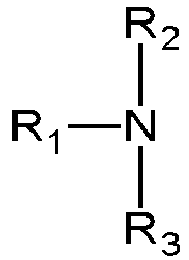
- It is further preferred from the viewpoint of curl reduction that one or more alkalizing agent(s) of the non-reducing, non-oxidative composition or the permanent waving composition is/are ammonia and/or its salt(s), mono- and/or diethanolamine, butyl ethanolamine, butyl diethanolamine, dibutyl ethanolamine, methylethanolamine, triethanolamine, N-lauryl diethanolamine, diisopropanolamine, dimethyl isopropanolamine, isopropanolamine, triisopropanolamine, isobutanolamine, triethylamine, tris-(hydroxymethyl)-aminomethane, taurine, and/or aminomethyl propanol, and/or their salt(s), and/or their mixture(s).
- The most preferred alkalizing agents of the non-reducing, non-oxidative composition is/are ammonia and/or its salt(s), monoethanolamine, triethanolamine, tris-(hydroxymethyl)-aminomethane, and/or aminomethyl propanol, and/or their salt(s), and/or their mixture(s).
- It is preferred from the viewpoint of curl reduction that the total concentration of alkalizing agents in the non-reducing, non-oxidative composition or the permanent waving composition of step iii) is in the range of 0.1% to 25% by weight, preferably in the range of 0.5% to 20% by weight, more preferably in the range of 1% to 15% by weight, calculated to the total weight of the non-reducing, non-oxidative composition or the permanent waving composition.
- It is further preferred from the viewpoint of cosmetic safety and curl reduction that the non-reducing, non-oxidative composition or the permanent waving composition comprises one or more thickening agent(s), preferably one or more thickening polymer(s), more preferably one or more anionic thickening polymer(s).
- The preferred anionic thickening polymers from the viewpoint of cosmetic acceptance are carbohydrate-based thickening polymers and/or thickening polymer(s) comprising acrylate or methacrylate monomers, and/or their salt(s), and/or their mixtures.
- Suitable anionic thickening polymers are copolymers and/or crosspolymers which comprise an acrylate and/or methacrylate monomer unit and optionally least one more hydrophobic unit such as alkyl chains. Examples are acrylates/c10-30 alkyl acrylate crosspolymer, acrylates/steareth-20 methacrylate copolymer, acrylates/stearyl acrylate/dimethicone methacrylate copolymer, acrylates/beheneth-25 methacrylate copolymer, acrylates/lauryl acrylate/stearyl acrylate/ ethylamine oxide methacrylate copolymer, Hydroxyethyl acrylate / sodium acryloyldimethyl taurate copolymer, carboxymethyl cellulose, alginic acids, sodium alginates, ammonium alginates, calcium alginates, gum arabic, guar gum or xanthan gum, dehydroxanthan gum or acrylic acid polymers known with the CTFA adopted name Carbomer and its derivatives.
- The most preferred anionic thickening polymers are carbohydrate-based thickening polymers such as carboxymethyl cellulose, alginic acids, sodium alginates, ammonium alginates, calcium alginates, gum arabic, guar gum or xanthan gum, dehydroxanthan gum, and/or their salt(s), and/or their mixtures.
- It is preferred from the viewpoint of cosmetic safety, user convenience, and composition stability that the total concentration of thickening agent(s), preferably the total concentration of thickening polymer(s), more preferably the total concentration of anionic thickening polymer(s) is in the range of 0.1% to 15% by weight, preferably in the range of 0.25% to 12.5% by weight, more preferably in the range of 0.5% to 10% by weight, calculated to the total weight of the non-reducing, non-oxidative composition or the permanent waving composition.
- It is further preferred from the viewpoint of curl reduction that the non-reducing, non-oxidative composition or the permanent waving composition comprises one or more one or more lipophilic compound(s).
- Preferably one or more lipophilic compound(s) is/are selected from C12-C22 fatty alcohols, natural and/or vegetable oils, mineral oil, and fatty acid esters consisting of linear or branched, saturated or unsaturated fatty acids with C12 to C22 being esterified with linear or branched primary alcohols with C3 to C12, and/or silicones, and/or their mixtures.
- The preferred lipophilic compound(s) is/are isopropyl palmitate, isopropyl laurate, octyl palmitate, isocetyl palmitate, octyl stearate, oleyl oleate, myristyl myristate, and/or their mixtures, the most referred ones are isopropyl palmitate and/or isopropyl laurate, and/or their mixtures.
- It is preferred from the viewpoint of composition stability and curl reduction that the total concentration of lipophilic compound(s) in the non-reducing, non-oxidative composition or the permanent waving composition is in the range of 5% to 75% by weight, preferably 10% to 70% by weight, more preferably 15% to 60% by weight, further more preferably 20% to 50% by weight, still further more preferably 25% to 40% by weight, calculated to the total weight of the non-reducing, non-oxidative composition or the permanent waving composition.
- The non-reducing, non-oxidative composition or the permanent waving composition may comprise one or more surfactant(s).
- Suitably, such surfactants are anionic, non-ionic, amphoteric and/or zwitterionic, and/or cationic surfactants, and/or their mixtures.
- Suitable anionic surfactants are selected from ethoxylated or non-ethoxylated alkyl ether sulfate surfactants, alkyl sulfates, ethoxylated and/or non-ethoxylated alkyl carboxylates, ethoxylated or non-ethoxylated amino acid surfactants, and/or their mixtures.
- Suitable alkyl sulfate or preferably ethoxylated alkyl ether sulfate surfactant or mixtures thereof have an alkyl chain length of C10 to C22.
- Suitable example anionic surfactants are laureth sulfates, coceth sulfate, pareth sulfate, capryleth sulphate, myreth sulfate, oleth sulfate, deceth sulfate, trideceth sulfate, coco sulphate, C10-C16 alkyl sulphate, C11-C15 alkyl sulphate, C12-C18 alkyl sulphate, C12-C15 alkyl sulphate, C12-C16 alkyl sulphate, C12-C13 alkyl sulfate, lauryl sulphate, myrystyl sulphate, palm kernel sulphate, cetearyl sulfate, cetyl sulphate, decyl sulphate, oleyl sulphate, behenyl sulphate and/or their salts. All of the aforementioned anionic surfactants may or may not be ethoxylated at various degrees.
- Cations for the surfactants may be selected from sodium, potassium, magnesium and/or ammonium.
- Suitable non-ionic surfactants are alkyl polyglycosides, ethoxylated triglycerides, ethoxylated fatty alcohols, ethoxylated fatty acid esters, and/or their mixtures.
- Preferred non-ionic surfactants are alkyl (poly)glycosides according to the general structure:
R23O(R24O)tZx
- Wherein Z denotes a carbohydrate with C5 to C6, R23 is an alkyl group with C8 to C18, R24 is methyl, ethyl or propyl, t ranges from 0 to 10, and x ranges from 1 to 5. Suitable compounds according to this structure are C9-C11 alkylpolyglycoside, the structures disclosed in
EP-A 70 074 JP 2015-123019A - The most preferred compounds according to the structure of above are decyl glucoside, lauryl glucoside, and coco glucoside.
- Suitable amphoteric/zwitterionic surfactants are compounds according to the general structure(s)

- Suitable compounds are known as hydroxysultaine surfactants, such as cocoamidopropyl hydroxysultaine, laurylamidopropyl hydroxysultaine, erucamidopropyl hydroxysultaine, lauryl hydroxysultaine, and cocoyl hydroxysultaine, and/or their salt(s).
- Further suitable amphoteric/zwitterionic surfactants are of betaine type. Suitable compounds may be selected from alkyl betaines and/or alkylamido betaines. A preferred compound selected from alkyl betaines is lauryl betaine. A preferred compound selected from alkylamido betaines is cocamidopropyl betaine. The disclosure also relates to the salts of the compounds.
- The preferred amphoteric/zwitterionic surfactant(s) is/are selected from alkylamido betaines and/or alkylamidoalkyl betaine surfactants.
- Suitable cationic surfactants are of quaternary ammonium structure according to the following general structure

- where R30 is a saturated or unsaturated, branched or linear alkyl chain with C8-C22 or
R34 CO NH (CH2)n
- where R34 is saturated or unsaturated, branched or linear alkyl chain with C7-C21 atoms and n has typical value of 1-4 or
R35 CO O (CH2)n
- where R35 is saturated or unsaturated, branched or linear alkyl chain with C7-C21 atoms and n has typical value of 1-4, and
- R31 is unsaturated or saturated, branched or linear alkyl chain with C1-C22 atoms or
R5 CO NH (CH2)n
or
R6 CO O (CH2)n
- where R34, R35 and n are same as above.
- R32 and R33 have an alkyl chain with C1 to C4, and X- typically is chloride, bromide, or methosulfate.
- Typical examples of those ingredients are cetyl trimethyl ammonium chloride, stearyl trimonium chloride, dipalmitoyl dimonium chloride, distearyl dimethyl ammonium chloride, stearamidopropyl trimethyl ammonium chloride, dioleoylethyl dimethyl ammonium methosulfate, dioleoylethyl hydroxyethylmonium methosulfate, behenyl trimethyl ammonium chloride, and/or their mixtures.
- It is preferred from the viewpoint of composition stability that the total concentration of surfactants is 0.1% by weight or more, preferably 0.5% by weight or more, further more preferably 0.75% by weight or more, calculated to the total weight of the non-reducing, non-oxidative composition or the permanent waving composition.
- It is preferred from the viewpoint of composition stability and cost of goods that the that the total concentration surfactants is 10% by weight or less, further more preferably 7% by weight or less, still further more preferably 5% by weight or less, calculated to the total weight of the non-reducing, non-oxidative composition or the permanent waving composition.
- For attaining the above-mentioned effects, it is preferred that the total concentration of surfactants is in the range of 0.1% to 10% by weight, preferably 0.5% to 7% by weight, more preferably in the range of 0.75% to 5% by weight, calculated to the total weight of the non-reducing, non-oxidative composition or the permanent waving composition.
- It is further preferred from the viewpoint of curl reduction that the keratin fibers are heated in step v) to a temperature in the range of 70°C to 210°C, preferably to a temperature in the range of 80°C to 180°C, more preferably to a temperature in the range of 90°C to 150°C.
- It is further preferred from the viewpoint of curl reduction and user convenience that the keratin fibers in step v) are heated for a time period in the range of 1 min to 90 min, preferably for a time period in the range of 5 min to 60 min, more preferably for a time period in the range of 10 min to 45 min.
- The following examples are to illustrate the present invention and not to limit it.
- Curly hair was purchased from International Hair Importers & Products Inc., Glendale, New York, USA. Mean curl diameter dcurl of Indian frizzy hair (15 cm, 2 g per bundle) was determined with a ruler according to method b) with n=3. Curler diameters were selected as listed in table 1. The hair streaks were shampooed with a commercially available shampoo under the brand name Goldwell Deep Cleansing Shampoo. Then the streaks were towel dried. 1 g of the non-reducing, non-oxidizing composition detailed below was applied to each of the hair streaks with a brush. The streaks were then wound on curlers possessing an electrical heating system and the selected diameter. The rods were then heated to a temperature in the range of 90°C for 20 min with a digital perming machine. Then the rods were allowed to cool down, and the hair was shampooed with the same shampoo from above. The streaks were then blow-dried.
- Assessment of curling efficiency was investigated by measuring and calculating the curl reduction efficiency SE according to the formula:

-
% by weight Tris(hydroxymethyl)am inomethane 5.0 Isopropyl myristate 25.0 Decyl glucoside 5.0 Sodium lauryl sulfate 1.0 Acrylates copolymer 1.5 Styrene-ethylene-propylene- block copolymer 1.0 NaOH/HCI ad pH 9.4 Water ad 100.0 Table 1 Parameters/results Comp. ex. 1 Inv. ex. 1 Inv. ex. 2 Mean curl diameter dcurl [mm] 26 26 26 Selected rod diameter [mm] 24 30 40 Rod diameter / dcurl 0.92 1.2 1.5 Curl reduction efficiency SE [%] 61 72 83 Tress appearance Wavy Slightly wavy Essentially Straight - Selecting a curler with a diameter below dcurl (comp. ex. 1) did not have a visual influence on the curly appearance of the hair streak. Selecting a curler diameter larger than dcurl (inv. ex. 1 and 2) reduced the curling of the hair. Inv. ex. 2 was essentially curl reduction with the inventive process.
-
% by weight Ammonium thioglycolate 10 Ammonium hydroxide 2 Water to 100 - The pH of the above composition was adjusted to pH 8.5.
-
Hydrogen peroxide 3 Phosphoric acid q.s. to pH 3Water to 100 - The curler selection was carried out as described above and the same type of curly hair was used. A hair streak weighing approximately 5 g and having a length of 20 cm was treated using the above compositions. Firstly, the streak was washed with a commercially available shampoo composition and towel dried. Afterwards, the streak was dipped into the aqueous reducing composition and left in the solution for 15 min and taken out and rinsed off with water. Afterwards, the streak was put on curlers. After 10 min, the streak was taken out and rinsed off and dipped into the oxidizing composition for 15 min and the curlers were taken off. It was observed that the streak had less curls in comparison to its state prior to the curl reduction treatment.
Claims (15)
- A method for reducing curls on keratin fibers, preferably on human keratin fibers, more preferably on human hair, comprising the steps of:i) selecting one or more curler(s) (1) with a larger diameter than the curl diameter dcurl of the selected portion of the keratin fibers (2) to be treated,ii) putting the selected portion of keratin fibers (2) under mechanical tension on the selected one or more curler(s) (1) of step i),iii) applying to the keratin fibers (2) a chemical composition for semi-permanently or permanently reshaping of keratin fibers,iv) optionally covering keratin fibers (2) with a moisture barrier,v) optionally heating the keratin fibers (2) to a temperature in the range of 50°C to 230°C,vi) optionally applying an oxidative composition and optionally removing the moisture barrier from keratin fibers (2),vii) removing the one or more curler(s) (1) from the keratin fibers (2),viii) rinsing-off the keratin fibers (2),wherein process steps ii), iii), and vii), viii) can be executed in either order.
- The method according to claim 1 characterized in that the one or more curler(s) (1) having a larger diameter than dcurl of step i) is/are selected by the following steps:x) holding the portion of keratin fibers (1) to be treated in the operator's hand (3) without applying force onto the keratin fibers,xi) placing the curler (1) in an axial direction next to the portion of the keratin fibers (2) to be treated,xii) comparing with the naked human eye (4) the diameter of the curler (1) with the distance dcurl between the infliction points I1 and I2 of two adjacent curls along the portion of keratin fibers (2) to be treated.
- The method according to claim 1 characterized in that the one or more curler(s) (1) having a larger diameter than dcurl of step i) is/are selected by the following steps:xx) measuring on the portion of the keratin fiber to be treated (5) the distance d1,2 between a first infliction point I1 and the next adjacent infliction point I2 corresponding to dcurl, orxxi) measuring on the portion of keratin fibers (6) to be treated the distance d1,n between a number n of infliction points with respect to the first infliction point I1 and dividing the received distance d1,n by the number n of infliction points to receive dcurl.
- The method according to claim 3 characterized in that the ratio of the diameter of the one or more curler(s) (1) in step i) to the curl diameter dcurl is 1.1 or higher, preferably 1.2 or higher, more preferably 1.5 or higher.
- The method according to any of claims 3 or 4 characterized in that the curl diameter dcurl of step i) is/are measured with a ruler (7) by holding the portion of keratin fibers (5, 6) in the operator's hand (8) without applying mechanical force onto it.
- The method according to any of the preceding claims characterized in that the chemical composition of step iii) is a permanent waving composition having a pH in the range of 3 to 12 and comprising one or more reducing agent(s).
- The method according to claim 6 characterized in that the permanent waving composition comprises one or more reducing agent(s) selected from one or more sulfite salt(s) and/or hydrogen sulfite salt(s), thiogylcolic acid and/or its salts, cysteamine and/or its salts, thioglycerin and/or its salts, glycerol esters of thioglycolic acid and/or its salts, thiolactic acid and/or its salts, cysteine or homocysteine and/or its salts, and their mixtures, more preferably the permanent waving composition comprises one or more reducing agent(s) at a total concentration in the range of 0.1% to 30% by weight, still more preferably in the range of 0.25% to 25% by weight, still further more preferably 0.5% to 20% by weight, calculated to the total weight of the permanent waving composition.
- The method according to any of the claims 1 to 5 characterized in that the semi-permanent or permanent waving composition of step ii) is a non-reducing, non-oxidative composition having a pH in the range of 7 to 12.
- The method according to any of the preceding claims characterized in that the non-reducing, non-oxidative composition comprises reducing agents at 1% by weight or less, preferably at 0.5% by weight or less, more preferably at 0.1% by weight or less, calculated to the total weight of the non-reducing, non-oxidative composition, further more preferably the non-reducing, non-oxidative composition is free of reducing agents.
- The method according to any of the claims 8 to 9 characterized in that the semi-permanent or permanent waving composition of step iii) has a pH is in the range of 7.5 to 11, preferably in the range of 8.0 to 10.5, more preferably in the range of 8.25 to 10.
- The method according to any of the preceding claims characterized in that the semi-permanent or permanent waving composition comprises one or more alkalizing agent(s), preferably the one or more alkalizing agent(s) is/are ammonia and/or its salt(s), organic amine(s) and/or salt(s) of organic amines according to the following general structure:

- The method according to any of the preceding claims characterized in that the total concentration of alkalizing agents in the semi-permanent or permanent waving composition of step ii) is in the range of 0.1% to 25% by weight, preferably in the range of 0.5% to 20% by weight, more preferably in the range of 1%to 15% by weight, calculated to the total weight of the semi-permanent or permanent waving composition.
- The method according to any of the preceding claims characterized in that the semi-permanent or permanent waving composition of step ii) comprises one or more thickening agent(s), preferably one or more thickening polymer(s), more preferably one or more anionic thickening polymer(s), still more preferably carbohydrate-based thickening polymers and/or thickening polymer(s) comprising acrylate or methacrylate monomers, and/or their salt(s), and/or their mixtures, still further more preferably the total concentration of thickening agent(s), preferably the total concentration of thickening polymer(s), more preferably the total concentration of anionic thickening polymer(s) is in the range of 0.1% to 15% by weight, preferably in the range of 0.25% to 12.5% by weight, more preferably in the range of 0.5% to 10% by weight, calculated to the total weight of the semi-permanent or permanent waving composition of step ii).
- The method according to any of the preceding claims characterized in that keratin fibers are heated in step v) to a temperature in the range of 70°C to 210°C, preferably to a temperature in the range of 80°C to 180°C, more preferably to a temperature in the range of 90°C to 150°C.
- The method according to any of the preceding claims characterized in that the keratin fibers in step v) are heated for a time period in the range of 1 min to 90 min, preferably for a time period in the range of 5 min to 60 min, more preferably for a time period in the range of 10 min to 45 min.
Priority Applications (1)
| Application Number | Priority Date | Filing Date | Title |
|---|---|---|---|
| EP22200645.4A EP4353121A1 (en) | 2022-10-10 | 2022-10-10 | Method for curl reduction of keratin fibers |
Applications Claiming Priority (1)
| Application Number | Priority Date | Filing Date | Title |
|---|---|---|---|
| EP22200645.4A EP4353121A1 (en) | 2022-10-10 | 2022-10-10 | Method for curl reduction of keratin fibers |
Publications (1)
| Publication Number | Publication Date |
|---|---|
| EP4353121A1 true EP4353121A1 (en) | 2024-04-17 |
Family
ID=83689925
Family Applications (1)
| Application Number | Title | Priority Date | Filing Date |
|---|---|---|---|
| EP22200645.4A Pending EP4353121A1 (en) | 2022-10-10 | 2022-10-10 | Method for curl reduction of keratin fibers |
Country Status (1)
| Country | Link |
|---|---|
| EP (1) | EP4353121A1 (en) |
Citations (3)
| Publication number | Priority date | Publication date | Assignee | Title |
|---|---|---|---|---|
| EP0070074A2 (en) | 1981-07-13 | 1983-01-19 | THE PROCTER & GAMBLE COMPANY | Foaming surfactant compositions |
| JP2015123019A (en) | 2013-12-26 | 2015-07-06 | 花王株式会社 | Method for producing alkyl poly glycoside |
| WO2016098870A1 (en) | 2014-12-18 | 2016-06-23 | L'oreal | Process for treating keratin fibers technical field |
-
2022
- 2022-10-10 EP EP22200645.4A patent/EP4353121A1/en active Pending
Patent Citations (3)
| Publication number | Priority date | Publication date | Assignee | Title |
|---|---|---|---|---|
| EP0070074A2 (en) | 1981-07-13 | 1983-01-19 | THE PROCTER & GAMBLE COMPANY | Foaming surfactant compositions |
| JP2015123019A (en) | 2013-12-26 | 2015-07-06 | 花王株式会社 | Method for producing alkyl poly glycoside |
| WO2016098870A1 (en) | 2014-12-18 | 2016-06-23 | L'oreal | Process for treating keratin fibers technical field |
Non-Patent Citations (4)
| Title |
|---|
| HAIRSTYLES BY EDEN: "BEAUTIFUL NATURAL HAIR / ROLLER SET!!", 18 March 2019 (2019-03-18), XP093035535, Retrieved from the Internet <URL:https://www.youtube.com/watch?v=xbUcPURGBrc> [retrieved on 20230328] * |
| HAZEL GODDESSS: "PERM ROD SET on SHORT NATURAL HAIR | First Rod Set On My Big Chopped Hair", 12 July 2021 (2021-07-12), XP093035529, Retrieved from the Internet <URL:https://www.youtube.com/watch?v=uB41kYPgdHA> [retrieved on 20230328] * |
| JOY ARTHUR: "Naturally Curly Hair to Soft Curls using Velcro Rollers", 1 September 2018 (2018-09-01), XP093035412, Retrieved from the Internet <URL:https://www.youtube.com/watch?v=WYcaJXIUyqw> [retrieved on 20230328] * |
| PERKINS SABRINA - ET AL: "The Right Rollers for Every Style, Length and Hair Type | NaturallyCurly.com", -, 9 December 2014 (2014-12-09), -, pages 1 - 16, XP093035425, Retrieved from the Internet <URL:https://www.naturallycurly.com/curlreading/home/the-right-rollers-for-every-hairstyle-curl-pattern> * |
Similar Documents
| Publication | Publication Date | Title |
|---|---|---|
| RU2763495C2 (en) | Methods, compositions and applications related to them | |
| US8551464B2 (en) | Hair styling method | |
| EP0685219A2 (en) | Hair treatment agent and process for its use | |
| US8540975B2 (en) | Hair styling method | |
| BR112018071568B1 (en) | METHOD, USE, COLORING PRODUCT AND HAIR CARE COMPOSITION | |
| US20110180093A1 (en) | Hair styling method | |
| EP3225229A1 (en) | Process for treating hair | |
| EP4353121A1 (en) | Method for curl reduction of keratin fibers | |
| EP4021379B1 (en) | Composition, process and kit for semi-permanent straightening and curling of keratin fibers | |
| EP3463276B1 (en) | Process for treating hair | |
| EP4069376B1 (en) | Reshaping composition for keratin fibers | |
| EP4308066B1 (en) | Reshaping composition for keratin fibers | |
| EP4122440B1 (en) | Process for permanent waving keratin fibers | |
| EP3871656A1 (en) | Reshaping composition for keratin fibers |
Legal Events
| Date | Code | Title | Description |
|---|---|---|---|
| PUAI | Public reference made under article 153(3) epc to a published international application that has entered the european phase |
Free format text: ORIGINAL CODE: 0009012 |
|
| STAA | Information on the status of an ep patent application or granted ep patent |
Free format text: STATUS: THE APPLICATION HAS BEEN PUBLISHED |
|
| AK | Designated contracting states |
Kind code of ref document: A1 Designated state(s): AL AT BE BG CH CY CZ DE DK EE ES FI FR GB GR HR HU IE IS IT LI LT LU LV MC ME MK MT NL NO PL PT RO RS SE SI SK SM TR |
|
| STAA | Information on the status of an ep patent application or granted ep patent |
Free format text: STATUS: REQUEST FOR EXAMINATION WAS MADE |
|
| 17P | Request for examination filed |
Effective date: 20241016 |
|
| RBV | Designated contracting states (corrected) |
Designated state(s): AL AT BE BG CH CY CZ DE DK EE ES FI FR GB GR HR HU IE IS IT LI LT LU LV MC ME MK MT NL NO PL PT RO RS SE SI SK SM TR |