EP4350805A2 - Cathode for lithium secondary battery and lithium secondary battery including the same - Google Patents
Cathode for lithium secondary battery and lithium secondary battery including the same Download PDFInfo
- Publication number
- EP4350805A2 EP4350805A2 EP23193527.1A EP23193527A EP4350805A2 EP 4350805 A2 EP4350805 A2 EP 4350805A2 EP 23193527 A EP23193527 A EP 23193527A EP 4350805 A2 EP4350805 A2 EP 4350805A2
- Authority
- EP
- European Patent Office
- Prior art keywords
- cathode
- metal oxide
- active material
- secondary battery
- lithium
- Prior art date
- Legal status (The legal status is an assumption and is not a legal conclusion. Google has not performed a legal analysis and makes no representation as to the accuracy of the status listed.)
- Granted
Links
Images
Classifications
-
- H—ELECTRICITY
- H01—ELECTRIC ELEMENTS
- H01M—PROCESSES OR MEANS, e.g. BATTERIES, FOR THE DIRECT CONVERSION OF CHEMICAL ENERGY INTO ELECTRICAL ENERGY
- H01M4/00—Electrodes
- H01M4/02—Electrodes composed of, or comprising, active material
- H01M4/36—Selection of substances as active materials, active masses, active liquids
- H01M4/48—Selection of substances as active materials, active masses, active liquids of inorganic oxides or hydroxides
- H01M4/52—Selection of substances as active materials, active masses, active liquids of inorganic oxides or hydroxides of nickel, cobalt or iron
- H01M4/525—Selection of substances as active materials, active masses, active liquids of inorganic oxides or hydroxides of nickel, cobalt or iron of mixed oxides or hydroxides containing iron, cobalt or nickel for inserting or intercalating light metals, e.g. LiNiO2, LiCoO2 or LiCoOxFy
-
- H—ELECTRICITY
- H01—ELECTRIC ELEMENTS
- H01M—PROCESSES OR MEANS, e.g. BATTERIES, FOR THE DIRECT CONVERSION OF CHEMICAL ENERGY INTO ELECTRICAL ENERGY
- H01M4/00—Electrodes
- H01M4/02—Electrodes composed of, or comprising, active material
- H01M4/13—Electrodes for accumulators with non-aqueous electrolyte, e.g. for lithium-accumulators; Processes of manufacture thereof
- H01M4/131—Electrodes based on mixed oxides or hydroxides, or on mixtures of oxides or hydroxides, e.g. LiCoOx
-
- H—ELECTRICITY
- H01—ELECTRIC ELEMENTS
- H01M—PROCESSES OR MEANS, e.g. BATTERIES, FOR THE DIRECT CONVERSION OF CHEMICAL ENERGY INTO ELECTRICAL ENERGY
- H01M10/00—Secondary cells; Manufacture thereof
- H01M10/05—Accumulators with non-aqueous electrolyte
- H01M10/052—Li-accumulators
-
- H—ELECTRICITY
- H01—ELECTRIC ELEMENTS
- H01M—PROCESSES OR MEANS, e.g. BATTERIES, FOR THE DIRECT CONVERSION OF CHEMICAL ENERGY INTO ELECTRICAL ENERGY
- H01M10/00—Secondary cells; Manufacture thereof
- H01M10/05—Accumulators with non-aqueous electrolyte
- H01M10/052—Li-accumulators
- H01M10/0525—Rocking-chair batteries, i.e. batteries with lithium insertion or intercalation in both electrodes; Lithium-ion batteries
-
- H—ELECTRICITY
- H01—ELECTRIC ELEMENTS
- H01M—PROCESSES OR MEANS, e.g. BATTERIES, FOR THE DIRECT CONVERSION OF CHEMICAL ENERGY INTO ELECTRICAL ENERGY
- H01M4/00—Electrodes
- H01M4/02—Electrodes composed of, or comprising, active material
- H01M4/36—Selection of substances as active materials, active masses, active liquids
- H01M4/362—Composites
- H01M4/364—Composites as mixtures
-
- H—ELECTRICITY
- H01—ELECTRIC ELEMENTS
- H01M—PROCESSES OR MEANS, e.g. BATTERIES, FOR THE DIRECT CONVERSION OF CHEMICAL ENERGY INTO ELECTRICAL ENERGY
- H01M4/00—Electrodes
- H01M4/02—Electrodes composed of, or comprising, active material
- H01M4/36—Selection of substances as active materials, active masses, active liquids
- H01M4/362—Composites
- H01M4/366—Composites as layered products
-
- H—ELECTRICITY
- H01—ELECTRIC ELEMENTS
- H01M—PROCESSES OR MEANS, e.g. BATTERIES, FOR THE DIRECT CONVERSION OF CHEMICAL ENERGY INTO ELECTRICAL ENERGY
- H01M4/00—Electrodes
- H01M4/02—Electrodes composed of, or comprising, active material
- H01M4/36—Selection of substances as active materials, active masses, active liquids
- H01M4/48—Selection of substances as active materials, active masses, active liquids of inorganic oxides or hydroxides
- H01M4/485—Selection of substances as active materials, active masses, active liquids of inorganic oxides or hydroxides of mixed oxides or hydroxides for inserting or intercalating light metals, e.g. LiTi2O4 or LiTi2OxFy
-
- H—ELECTRICITY
- H01—ELECTRIC ELEMENTS
- H01M—PROCESSES OR MEANS, e.g. BATTERIES, FOR THE DIRECT CONVERSION OF CHEMICAL ENERGY INTO ELECTRICAL ENERGY
- H01M4/00—Electrodes
- H01M4/02—Electrodes composed of, or comprising, active material
- H01M4/36—Selection of substances as active materials, active masses, active liquids
- H01M4/48—Selection of substances as active materials, active masses, active liquids of inorganic oxides or hydroxides
- H01M4/50—Selection of substances as active materials, active masses, active liquids of inorganic oxides or hydroxides of manganese
- H01M4/505—Selection of substances as active materials, active masses, active liquids of inorganic oxides or hydroxides of manganese of mixed oxides or hydroxides containing manganese for inserting or intercalating light metals, e.g. LiMn2O4 or LiMn2OxFy
-
- H—ELECTRICITY
- H01—ELECTRIC ELEMENTS
- H01M—PROCESSES OR MEANS, e.g. BATTERIES, FOR THE DIRECT CONVERSION OF CHEMICAL ENERGY INTO ELECTRICAL ENERGY
- H01M4/00—Electrodes
- H01M4/02—Electrodes composed of, or comprising, active material
- H01M4/62—Selection of inactive substances as ingredients for active masses, e.g. binders, fillers
- H01M4/624—Electric conductive fillers
- H01M4/625—Carbon or graphite
-
- H—ELECTRICITY
- H01—ELECTRIC ELEMENTS
- H01M—PROCESSES OR MEANS, e.g. BATTERIES, FOR THE DIRECT CONVERSION OF CHEMICAL ENERGY INTO ELECTRICAL ENERGY
- H01M4/00—Electrodes
- H01M4/02—Electrodes composed of, or comprising, active material
- H01M2004/021—Physical characteristics, e.g. porosity, surface area
-
- H—ELECTRICITY
- H01—ELECTRIC ELEMENTS
- H01M—PROCESSES OR MEANS, e.g. BATTERIES, FOR THE DIRECT CONVERSION OF CHEMICAL ENERGY INTO ELECTRICAL ENERGY
- H01M4/00—Electrodes
- H01M4/02—Electrodes composed of, or comprising, active material
- H01M2004/026—Electrodes composed of, or comprising, active material characterised by the polarity
- H01M2004/028—Positive electrodes
-
- Y—GENERAL TAGGING OF NEW TECHNOLOGICAL DEVELOPMENTS; GENERAL TAGGING OF CROSS-SECTIONAL TECHNOLOGIES SPANNING OVER SEVERAL SECTIONS OF THE IPC; TECHNICAL SUBJECTS COVERED BY FORMER USPC CROSS-REFERENCE ART COLLECTIONS [XRACs] AND DIGESTS
- Y02—TECHNOLOGIES OR APPLICATIONS FOR MITIGATION OR ADAPTATION AGAINST CLIMATE CHANGE
- Y02E—REDUCTION OF GREENHOUSE GAS [GHG] EMISSIONS, RELATED TO ENERGY GENERATION, TRANSMISSION OR DISTRIBUTION
- Y02E60/00—Enabling technologies; Technologies with a potential or indirect contribution to GHG emissions mitigation
- Y02E60/10—Energy storage using batteries
Definitions
- the present invention relates to a cathode for a lithium secondary battery and a lithium secondary battery including the same.
- a secondary battery which can be charged and discharged repeatedly has been widely employed as a power source of a mobile electronic device such as a camcorder, a mobile phone, a laptop computer, etc.
- a lithium secondary battery has been used due to its high operational voltage and energy density per unit weight, a high charging rate, a compact dimension, etc.
- a lithium secondary battery typically includes an electrode assembly including a cathode, an anode and a separation layer (separator), and an electrolyte immersing the electrode assembly.
- the cathode may include a cathode current collector and a cathode active material layer formed on the cathode current collector.
- the cathode active material layer may include a lithium metal oxide as a cathode active material.
- Cathode active materials have included lithium cobalt oxide (LiCoO 2 ), lithium nickel oxide (LiNiO 2 ), lithium manganese oxide (LiMnO 2 , LiMn 2 O 4 , etc.), a lithium iron phosphate compound (LiFePO 4 ), an NCM-based lithium metal oxide containing nickel, cobalt and manganese, an NCA-based lithium metal oxides containing nickel, cobalt and aluminum.
- a cathode for a lithium secondary battery having improved operational reliability and electrochemical stability.
- a lithium secondary battery having improved operational reliability and electrochemical stability.
- a cathode for a lithium secondary battery includes a cathode current collector, and a cathode active material layer formed on the cathode current collector.
- the cathode active material layer includes cathode active material particles and satisfies Equation 1.
- the cathode active material particles include lithium metal oxide particles containing nickel and having a mole fraction of cobalt of 0.02 or less among all elements except lithium and oxygen. Ca / Cn ⁇ 6.44 ⁇ m 2
- Equation 1 Cn is a total number of contact surfaces between the cathode active material particles in the cathode active material layer, and Ca is a total area of the contact surfaces in a 3D model showing a distribution of the cathode active material particles.
- Ca/Cn may be in a range from 4.5 ⁇ m 2 to 6.44 ⁇ m 2 .
- the lithium metal oxide particles contain nickel and manganese, and do not contain cobalt.
- a mole fraction of nickel in the lithium metal oxide particles may be in a range from 0.7 to 0.85 among all elements except lithium and oxygen.
- the lithium metal oxide particles comprise first lithium metal oxide particles each having a shape of a secondary particle in which a plurality of primary particles are aggregated, and second lithium metal oxide particles each having a shape of a single particle.
- a ratio of a content of the second lithium metal oxide particles relative to a content of the first lithium metal oxide particles in the cathode active material layer may be in a range from 1/3 to 3.
- the lithium metal oxide particles may include first lithium metal oxide particles, and second lithium metal oxide particles having a smaller particle diameter (D 50 ) than that of the first lithium metal oxide particles.
- the first lithium metal oxide particles may have a particle diameter (D 50 ) from 9 ⁇ m to 18 ⁇ m
- the second lithium metal oxide particles may have a particle diameter (D 50 ) from 2 ⁇ m to 7 ⁇ m.
- the cathode active material layer may further include a conductive material, and a content of the lithium metal oxide particles may be in a range from 80 wt% to 99 wt% based on a total weight of the cathode active material layer.
- the conductive material may include a sphere-type conductive material having an aspect ratio from 0.5 to 1.5, and a needle-type conductive material having an aspect ratio of 2 or more.
- a particle diameter (D 50 ) of the sphere-type conductive material may be in a range from 10 nm to 60 nm, and a length of the needle-type conductive material is in a range from 15 ⁇ m to 65 ⁇ m.
- a ratio of a content of the sphere-type conductive material relative to a content of the needle-type conductive material in the cathode active material layer may be in a range from 0.6 to 0.8.
- a ratio of a content of the sphere-type conductive material relative to a content of the needle-type conductive material in the cathode active material layer may be in a range from 1.8 to 3.5.
- a density of the cathode active material layer may be in a range from 3.4 g/cc to 3.7 g/cc.
- a lithium secondary battery includes the cathode for a lithium secondary battery according to the above-described embodiments, and an anode facing the cathode.
- a cathode for a lithium secondary battery employing lithium metal oxide particles containing a low content of cobalt and/or lithium metal oxide particles devoid of cobalt as a cathode active material may be provided.
- the cathode may satisfy Equation 1 to have a low bulk resistance even when the lithium metal oxide particles are used.
- lithium metal oxide particles containing only a small amount of cobalt on a surface of the particles have been used as a cathode active material.
- Korean Published Patent Application No. 10-2020-0085679 describes a lithium secondary battery having improved life-span properties by employing lithium metal oxide particles containing only a small amount of cobalt on a surface of the particles.
- the lithium metal oxide does not contain cobalt, a crystal structure may become unstable, thereby degrading operational reliability and electrochemical stability of the lithium secondary battery. Yet, the price of cobalt is relatively high compared to those of other metals such as nickel and manganese.
- the present invention addresses this need to avoid using lithium metal oxide particles containing a high concentration of cobalt and avoid its relatively high cobalt cost.
- a cathode for a lithium secondary battery including a lithium metal oxide particle is provided. According to other embodiments of the present invention, a lithium secondary battery including the cathode is also provided.
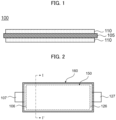
- FIG. 1 is a schematic cross-sectional view illustrating a cathode for a lithium secondary battery in accordance with various embodiments.
- a cathode 100 for a lithium secondary battery includes a cathode current collector 105 and a cathode active material layer 110 formed on the cathode current collector 105 .
- the cathode active material layer 110 may be formed on one surface, or may be formed on both surfaces of the cathode current collector 105 as shown in FIG. 1 .
- the cathode current collector 105 may include stainless steel, nickel, aluminum, titanium, copper, or an alloy thereof.
- the cathode active material layer 110 may include a cathode active material particle capable of reversibly intercalating and de-intercalating lithium ions.
- the cathode active material layer 110 may include a plurality of the cathode active material particles.
- the cathode active material particles include lithium metal oxide particles having a mole fraction of cobalt (Co) of 0.02 or less among all elements other than lithium (Li) and oxygen (O).
- the mole fraction of Co in the lithium metal oxide particles may be 0.015 or less, preferably 0.01 or less.
- the lithium metal oxide particles may substantially not contain Co.
- Co may not be detected when components of the lithium metal oxide particle are analyzed by a inductively coupled plasma (ICP) analysis.
- ICP inductively coupled plasma
- the lithium metal oxide particle may contain nickel (Ni). In one embodiment, the lithium metal oxide particle may contain Ni and manganese (Mn).
- a mole fraction of Ni in the lithium metal oxide particle may be in a range from 0.6 to 0.9, from 0.65 to 0.85, or from 0.7 to 0.85 among all elements except Li and O.
- a mole fraction of Mn in the lithium metal oxide particle may be in a range from 0.05 to 0.3, from 0.1 to 0.3, or from 0.15 to 0.3 of all elements except Li and O.
- the lithium metal oxide particle may include a crystalline structure or chemical structure represented by Chemical Formula 1 below.
- Chemical Formula 1 Li a Ni x Mn y Co z M 1-x-y-z O 2
- M may include at least one of Mg, V, Ti, Al, Fe, Ru, Zr, W, Sn, Nb, Mo, Cu, Zn, Cr, Ga, V and Bi.
- Mg 0.9 ⁇ a ⁇ 1.2, 0.6 ⁇ x ⁇ 0.9, 0 ⁇ z ⁇ 0.02, and 0.8 ⁇ x+y+z ⁇ 1.
- z 0.015 or z ⁇ 0.01.
- z 0.
- the lithium metal oxide particles may contain a small amount of Co or may not contain Co, so that a production cost may be lowered.
- the lithium metal oxide particle may have relatively low electrical conductivity and thermal stability of the crystal structure. Accordingly, the cathode and the secondary battery employing the lithium metal oxide particle may provide relatively high resistance and low power.
- the cathode active material layer 110 according to various embodiments of the present invention satisfy Equation 1 below to resolve the issues that may be caused by the reduced amount of Co.
- Cn is a total number of contact surfaces between the cathode active material particles in a 3D model showing a distribution of the cathode active material particles in the cathode active material layer
- Ca is a total area of the contact surfaces.
- Ca/Cn may indicate a size of an average contact area per one contact surface.
- the 3D model of the anode may be obtained using an XRM.
- Cn and Ca values can be automatically calculated by analyzing the 3D model using Geodict S/W (see Evaluation Example 1).
- the lithium secondary battery has shown improved (e.g., lowered) resistance properties.
- the resistance of the cathode may be excessively increased.
- a direct current internal resistance (DCIR) of the lithium secondary battery may be excessively increased.
- the lithium metal oxide particle may be substantially free of Co meaning that Co is not intentionally added and that only trace Co amounts from the source materials are present.
- Ca/Cn may be 3 ⁇ m 2 or more, 4 ⁇ m 2 or more, 4.5 ⁇ m 2 or more, 5 ⁇ m 2 or more, or 5.2 ⁇ m 2 or more. In this case, power and rapid charging properties of the lithium secondary battery can be improved.
- the Ca/Cn value may be determined by various factors such as a particle size and a content of the cathode active material particles in the cathode active material layer 100; morphology of the cathode active material particles; a mixing ratio between a plurality of cathode active material particles (when the cathode active material particles are a blend of the plurality of cathode active material particles having different physical properties); morphology and content of a conductive material; a mixing ratio of a plurality of conductive materials (when the conductive material is a blend of the plurality of conductive materials having different physical properties); a density of the cathode active material layer 100, etc.
- the lithium metal oxide particle may further contain a doping element.
- the doping element may include Al, Ti, Ba, Zr, Si, B, Mg, P, Sr, W, La, etc.
- the cathode active material may further include a coating layer formed on at least a portion of a surface of the lithium metal oxide particle.
- the coating layer may contain Al, Ti, Ba, Zr, Si, B, Mg, P, Sr, W, La, etc.
- the lithium metal oxide particles may include first lithium metal oxide particles and second lithium metal oxide particles, with the second lithium metal oxide particles having a particle diameter (D 50 ) smaller than that of the first lithium metal oxide particles.
- the particle diameter (D 50 ) is a particle diameter at 50 volume percent (vol%) of a volumetric cumulative particle diameter distribution.
- the particle diameter (D 50 ) can be measured using a laser diffraction method.
- the particle diameter (D 50 ) of the first lithium metal oxide particles may be in a range from 9 ⁇ m to 18 ⁇ m, or from 10 ⁇ m to 18 ⁇ m. In some embodiments, the particle diameter (D 50 ) of the second lithium metal oxide particles may be in a range from 1 to 9 ⁇ m, or from 2 to 7 ⁇ m.
- a ratio of a content of the second lithium metal oxide particles relative to a content of the first lithium metal oxide particle based on a total weight of the cathode active material layer 110 may be in a range from 1/4 to 4, preferably from 1/3 to 3.
- the lithium metal oxide particle may include a first lithium metal oxide particle having a shape of a secondary particle in which a plurality of primary particles are aggregated, and a second lithium metal oxide particle having a shape of a single particle.
- the single particle and the secondary particle can be distinguished based on a cross-sectional image of the particles measured by a scanning electron microscope (SEM).
- SEM scanning electron microscope
- the secondary particle may refer to a particle that is considered or observed as one particle by aggregation of a plurality of the primary particles. Boundaries of the primary particles can be viewed in the SEM cross-sectional image of the secondary particle.
- more than 10, 30 or more, 50 or more, or 100 or more primary particles may be aggregated in the secondary particle.
- the particle in the SEM cross-sectional image, when the above-mentioned number of the primary particles are aggregated to form, e.g., a substantially circular outer boundary of a particle, the particle can be determined as the secondary particle.
- the single particle may refer to a monolith rather than an aggregate.
- boundaries of the primary particles may not be recognized in the SEM cross-sectional image in the single particle, which may distinguish the above-mentioned shape of the secondary particle.
- fine particles e.g., particles having a volume of 1/100 or less of a volume of the single particle
- the above shape may not be excluded from the shape of the single particle.
- the single particles may exist in contact with each other.
- 2 to 10, 2 to 5, or 2 to 3 single particles may exist in contact with each other.
- a density of the cathode active material layer 110 may be in a range from 2.5 g/cc to 3.7 g/cc, from 2.8 g/cc to 3.7 g/cc, from 3.0 g/cc to 3.7 g/cc, from 3.2 g/cc to 3.7 g/cc, or from 3.4 to 3.7 g/cc.
- the density of the cathode active material layer 110 can be calculated using a weight of the cathode from which a weight of the cathode current collector is subtracted and a volume of the cathode active material layer that can be calculated using measured length, width and thickness of the cathode active material layer.
- the cathode active material layer 110 may further include a conductive material.
- the cathode active material layer 110 may further include a binder.
- a content of the cathode active material particles may be in a range from 80 weight percent (wt%) to 99 wt%, from 85 wt% to 98 wt%, or from 90 wt% to 95 wt% based on a total weight of the cathode active material layer 110.
- a content of the lithium metal oxide particles may be in a range from 80 wt% to 99 wt%, 85 wt% to 98 wt%, or 90 wt% to 95 wt% based on a total weight of the cathode active material layer 110.
- a content of the conductive material may be in a range from 1 wt% to 10 wt%, from 1 wt% to 5 wt%, or from 1 wt% to 3 wt% based on a total weight of the cathode active material layer 110.
- a content of the binder may be in a range from 1 wt% to 10 wt%, from 1 wt% to 5 wt%, or from 1 wt% to 3 wt% based on a total weight of the cathode active material layer 110.
- the conductive material may include a needle-type conductive material.
- the needle-type conductive material may include a rod-shaped conductive material, a fiber-shaped conductive material, etc.
- an aspect ratio (length/diameter) of the needle-type conductive material may be in a range from 2 to 10,000, from 10 to 5,000, from 50 to 3,000, or from 100 to 1,000.
- the aspect ratio is measured as a ratio of a length of a major axis relative to a length of a minor axis.
- the length of the major axis is determined as the largest length of an imaginary cross-sectional line of a particle passing through a center of the particle.
- the length of the minor axis is determined as the smallest length of an imaginary cross-sectional line of the particle extending through the center of the particle.
- the needle-type conductive material may include a carbon nanotube (CNT).
- CNT carbon nanotube
- the carbon nanotube may include a single-walled CNT (SWCNT), a double-walled CNTs (DWCNT), a multi-walled carbon nanotube (MWCNT), a rope-type CNT, etc.
- SWCNT single-walled CNT
- DWCNT double-walled CNTs
- MWCNT multi-walled carbon nanotube
- rope-type CNT etc.
- a length of the needle-type conductive material may be in a range from 15 ⁇ m to 65 ⁇ m.
- the length of the needle-type conductive material can be measured as an average length of the predetermined number (e.g., 10 to 100) of the conductive materials included in an SEM image.
- the conductive material may further include a sphere-type conductive material.
- the needle-type conductive material may form a conductive network in a wide range
- the sphere-type conductive material may additionally form a conductive network in a narrow range. Accordingly, the reduction of the electrical conductivity due to the use of the lithium metal oxide particle may be reduced or prevented.
- the sphere-type conductive material is combined with the lithium metal oxide particle (e.g., NCM 811) having a Co mole fraction exceeding 0.02 (based on all elements except Li and O) to satisfy Equation 1, rapid charging properties of the lithium secondary battery may be degraded.
- the lithium metal oxide particle e.g., NCM 811
- an aspect ratio (length/diameter) of the sphere-type conductive material may be in a range from 0.5 to 1.5.
- a sphericity of the sphere-type conductive material (i.e., the ratio of the surface area of a sphere to the surface area of the sphere-type conductive material) may be in a range from 0.7 to 1, from 0.8 to 1, or from 0.9 to 1.
- a particle diameter (D 50 ) of the sphere-type conductive material may be in a range from 10 nm to 60 nm.
- the particle diameter (D 50 ) the sphere-type conductive material can be measured using a laser diffraction method.
- the sphere-type conductive material may include a carbon-based conductive material such as graphite, carbon black, graphene, etc.; and a metal-based conductive material such as tin, tin oxide, titanium oxide, LaSrCoO3, LaSrMnO 3 , etc.
- a ratio of the content of the sphere-type conductive material to a content of the needle-type conductive material in a total weight of the cathode active material layer 110 may be in a range from 0.6 to 0.9, or from 0.6 to 0.8.
- a ratio of the content of the sphere-type conductive material to the content of the needle-type conductive material in the total weight of the cathode active material layer 110 may be in a range from 1.5 to 4, from 1.8 to 3.5, or from 2 to 3.
- the binder may include a fluorine-based polymer binder.
- the fluorine-based polymer binder may include polyvinylidene fluoride (PVDF), vinylidene fluoride-hexafluoro propylene copolymer (PVDF-co-HFP), etc.
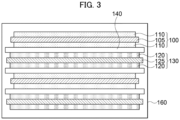
- FIGS. 2 and 3 are a schematic plan view and a schematic cross-sectional view, respectively, illustrating a lithium secondary battery in accordance with various embodiments.
- An anode 130 may include an anode current collector 125 and an anode active material layer 120 formed on the anode current collector 125.
- the anode active material layer 120 may be formed on one surface or both surfaces of the anode current collector 125.
- the anode active material layer 120 may include an anode active material capable of reversibly intercalating and de-intercalating lithium ions.
- the anode active material layer 120 may further include a binder, a conductive material, etc.
- the anode current collector 125 may include gold, stainless steel, nickel, aluminum, titanium, copper, or an alloy thereof.
- the anode active material may include a lithium alloy, a carbon-based active material, a silicon-based active material, etc.
- the lithium alloy may further include aluminum, zinc, bismuth, cadmium, antimony, silicon, lead, tin, gallium, indium, etc.
- the carbon-based active material may include a crystalline carbon, an amorphous carbon, a carbon composite, a carbon fiber, etc.
- the amorphous carbon may include, e.g., a hard carbon, coke, a mesocarbon microbead (MCMB), a mesophase pitch-based carbon fiber (MPCF), etc.
- MCMB mesocarbon microbead
- MPCF mesophase pitch-based carbon fiber
- the crystalline carbon may include, e.g., artificial graphite, natural graphite, graphitized coke, graphitized MCMB, graphitized MPCF, etc.
- the anode active material may include the silicon-based active material.
- the silicon-based active material may include, e.g., Si, SiO x (0 ⁇ x ⁇ 2), Si/C, SiO/C, Si-metal, etc. In this case, the capacity of the lithium secondary battery can increase.
- an area of the anode 130 may be greater than that of the cathode 100. Accordingly, lithium ions generated from the cathode 100 can be transferred to the anode 130 without necessarily being precipitated.
- the cathode 100 and the anode 130 may be alternately and repeatedly disposed to form an electrode assembly 150.
- a separation layer 140 may be interposed between the cathode 100 and the anode 130.
- the electrode assembly 150 may be formed by winding, stacking or zigzag folding (z-folding) of the separation layer 140.
- the separation layer 140 may include a porous polymer film prepared from, e.g., a polyolefin-based polymer such as an ethylene homopolymer, a propylene homopolymer, an ethylene/butene copolymer, an ethylene/hexene copolymer, an ethylene/methacrylate copolymer, etc.
- the separation layer 140 may also include a non-woven fabric formed from a glass fiber with a high melting point, a polyethylene terephthalate fiber, etc.
- the lithium secondary battery may include a cathode lead 107 connected to the cathode 100 to protrude to an outside of a case 160, and an anode lead 127 connected to the anode 130 to protrude to the outside of the case 160.
- the cathode lead 107 may be electrically connected to the cathode current collector 105.
- the anode lead 130 may be electrically connected to the anode current collector 125.
- the cathode current collector 105 may include a cathode tab 106 at one side thereof.
- the cathode active material layer 110 may not be formed on the cathode tab 106.
- the cathode tab 106 may be integral with the cathode current collector 105 or may be connected to the cathode current collector 105 by, e.g., welding.
- the cathode current collector 105 and the cathode lead 107 may be electrically connected via the cathode tab 106.
- the anode current collector 125 may include an anode tab 126 at one side thereof.
- the anode active material layer 120 may not be formed on the anode tab 126.
- the anode tab 126 may be integral with the anode current collector 125 or may be connected to the anode current collector 125 by, e.g., welding.
- the anode electrode current collector 125 and the anode lead 127 may be electrically connected via the anode tab 126.
- the electrode assembly 150 may be accommodated together with an electrolyte in the case 160 to define the lithium secondary battery.
- the lithium secondary battery may be manufactured in, e.g., a cylindrical shape using a can, a square shape, a pouch shape or a coin shape.
- the electrolyte may include a lithium salt and an organic solvent.
- the lithium salt may be represented by Li + X - , and an anion of the lithium salt X - may include any one of, e.g., F - , Cl - , Br - , I - , NO 3 - , N(CN) 2 - , BF 4 - , ClO 4 - , PF 6 - , (CF 3 ) 2 PF 4 - , (CF 3 ) 3 PF 3 - , (CF 3 ) 4 PF 2 - , (CF 3 ) 5 PF - , (CF 3 ) 6 P - , CF 3 SO 3 - , CF 3 CF 2 SO 3 - , (CF 3 SO 2 ) 2 N - , (FSO 2 ) 2 N - ; CF 3 CF 2 (CF 3 ) 2 CO - , (CF 3 SO 2 ) 2 CH - , (SF 5 ) 3 C - , (CF 3 SO 2 ) 3 C
- the organic solvent may include a carbonate-based solvent such as ethylene carbonate (EC), propylene carbonate (PC), dimethyl carbonate (DMC), diethyl carbonate (DEC), ethyl methyl carbonate (EMC), etc.; an ester-based solvent such as methyl propionate, ethyl propionate, ethyl acetate, propyl acetate, butyl acetate, butyrolactone, caprolactone, valerolactone, etc.; an ether-based solvent such as dibutyl ether, tetraethylene glycol dimethyl ether (TEGDME), diethylene glycol dimethyl ether (DEGDME), tetrahydrofuran (THF), etc.; an alcohol-based solvent such as ethyl alcohol, isopropyl alcohol, etc.; a ketone-based solvent such as cyclohexanone; an amide-based solvent (e.g., dimethylformamide), a dioxanone
- a mixed solution was prepared by adding NiSO 4 and MnSO 4 by a molar ratio of 75:25 to distilled water from which dissolved oxygen was removed.
- the mixed solution, NaOH and NH 4 OH were put into a reactor, and coprecipitation was performed for 55 hours to prepare metal hydroxide particles (Ni 0.75 Mn 0.25 (OH) 2 ).
- the metal hydroxide particles and lithium hydroxide were put into a dry highspeed mixer so that the molar ratio became 1:1.03 to form a mixture.
- the mixture was put into a furnace, and a temperature of the furnace was raised to 780 °C at a temperature ramp rate of 2°C/min, and maintained at 780°C for 13 hours.
- oxygen gas was passed through the furnace at a flow rate of 10 mL/min.
- the fired product was cooled to room temperature, and then pulverized and classified to obtain lithium metal oxide particles (LiNi 0.75 Mn 0.25 O 2 ).
- a cross-section of the lithium metal oxide particle was observed with a scanning electron microscope (SEM), and it was confirmed that the primary particles were aggregated to form secondary particles.
- a particle diameter (D 50 ) of the lithium metal oxide particles was measured using a laser diffraction method.
- the measured particle diameter (D 50 ) of the lithium metal oxide particles was 13 ⁇ m.
- a mixed solution was prepared by adding NiSO 4 and MnSO 4 by a molar ratio of 75:25 to distilled water from which dissolved oxygen was removed.
- the mixed solution, NaOH and NH 4 OH were put into a reactor and coprecipitation was performed for 60 hours to prepare metal hydroxide particles Ni 0.75 Mn 0.25 (OH) 2 .
- the metal hydroxide particles and lithium hydroxide were put into a dry highspeed mixer so that the molar ratio became 1:1.03 to form a mixture.
- the mixture was put into a furnace, a temperature of the furnace was raised to 950°C at a temperature ramp rate of 2°C/min, and the mixture was fired at 950°C for 10 hours. During the firing of the furnace, oxygen gas was passed through the furnace at a flow rate of 10 mL/min.
- the fired product was cooled to room temperature, and then pulverized and classified to obtain lithium metal oxide particles (LiN 0.75 Mn 0.25 O 2 ).
- a cross-section of the lithium metal oxide particles was observed with a scanning electron microscope (SEM), and it was confirmed that the particles had a single particle shape.
- the particle diameter (D 50 ) of the lithium metal oxide particles was measured using a laser diffraction method.
- the measured particle diameter (D 50 ) of the lithium metal oxide particles was 3.5 ⁇ m.
- a mixed solution was prepared by adding NiSO 4 , CoSO 4 and MnSO 4 at a molar ratio of 75:2:23 to distilled water from which dissolved oxygen was removed.
- Lithium metal oxide particles (LiNi 0.75 Co 0.02 Mn 0.23 O 2 ) were prepared by the same method as that in Preparation Example 1, except that the-above mixed solution was used.
- a cross-section of the lithium metal oxide particles was observed with a scanning electron microscope (SEM), and it was confirmed that the primary particles were aggregated to form secondary particles.
- the particle diameter (D 50 ) of the lithium metal oxide particles was measured using a laser diffraction method.
- the measured particle diameter (D 50 ) of the lithium metal oxide particles was 13 ⁇ m.
- a mixed solution was prepared by adding NiSO 4 , CoSO 4 and MnSO 4 by a molar ratio of 75:2:23 to distilled water from which dissolved oxygen was removed.
- Lithium metal oxide particles (LiNi 0.75 Co 0.02 Mn 0.23 O 2 ) were prepared by the same method as that in Preparation Example 2, except that the above mixed solution was used.
- a cross-section of the lithium metal oxide particles were observed with a scanning electron microscope (SEM), and it was confirmed that the particles had a single particle shape.
- the particle diameter (D 50 ) of the lithium metal oxide particles was measured using a laser diffraction method.
- the particle diameter (D 50 ) of the lithium metal oxide particles was 3.4 ⁇ m.
- the cathode active materials listed in Table 1, PVDF, and the conductive materials listed in Table 1 below were dispersed in N-methyl pyrrolidone (NMP) to prepare a cathode slurry.
- NMP N-methyl pyrrolidone
- the cathode slurry was coated on an aluminum foil having a thickness of 15 ⁇ m, dried and pressed to prepare a cathode having a cathode active material layer formed thereon.
- the pressing was performed so that a density of the cathode active material layer was adjusted to about 3.5 g/cc.
- a lithium metal was used as a counter electrode (anode).
- the cathode and the anode were each notched in a circular shape, and a circular polyethylene separator having a thickness of 13 ⁇ m was interposed between the cathode and the anode to prepare an electrode assembly.
- Evaluation Example 1 Analysis of contact state of cathode active material particles in the cathode active material layer
- a bulk resistance of the cathode was measured using the following measurement equipment and conditions.
- the lithium secondary batteries of Examples and Comparative Examples were charged at 45°C at 0.33C in constant current mode (CC) and constant voltage mode(CV) (or, 4.2V 0.05C CUT-OFF) and then discharged at 0.33C CC until reaching a state of charge (SOC) 50%.
- CC constant current mode
- CV constant voltage mode
- SOC state of charge
- the batteries were discharged and supplementary-charged by 1C C-rate at the SOC 50% for 10 seconds to measure DCIR R1. Specifically, in the discharge and supplementary-charge, an end point of the voltage was set in an equation of a straight line, and a slope was adopted as the DCIR value.
- the lithium secondary battery was repeatedly charged and discharged 300 times at 45 °C according to the charging and discharging conditions noted above. After charging and discharging 300 times, a DCIR R2 was measured by the same method as that described above.
- DCIR increase ratio R 2 ⁇ R 1 / R 1 ⁇ 100
- the lithium secondary batteries of the Examples provided cathode bulk resistances and high-temperature resistance increase ratios which both were lower than those from the lithium secondary batteries of the Comparative Examples.
Landscapes
- Chemical & Material Sciences (AREA)
- Chemical Kinetics & Catalysis (AREA)
- Electrochemistry (AREA)
- General Chemical & Material Sciences (AREA)
- Inorganic Chemistry (AREA)
- Engineering & Computer Science (AREA)
- Composite Materials (AREA)
- Materials Engineering (AREA)
- Manufacturing & Machinery (AREA)
- Battery Electrode And Active Subsutance (AREA)
Abstract
Description
- The present invention relates to a cathode for a lithium secondary battery and a lithium secondary battery including the same.
- A secondary battery which can be charged and discharged repeatedly has been widely employed as a power source of a mobile electronic device such as a camcorder, a mobile phone, a laptop computer, etc.
- A lithium secondary battery has been used due to its high operational voltage and energy density per unit weight, a high charging rate, a compact dimension, etc.
- A lithium secondary battery typically includes an electrode assembly including a cathode, an anode and a separation layer (separator), and an electrolyte immersing the electrode assembly.
- The cathode may include a cathode current collector and a cathode active material layer formed on the cathode current collector. The cathode active material layer may include a lithium metal oxide as a cathode active material.
- Cathode active materials have included lithium cobalt oxide (LiCoO2), lithium nickel oxide (LiNiO2), lithium manganese oxide (LiMnO2, LiMn2O4, etc.), a lithium iron phosphate compound (LiFePO4), an NCM-based lithium metal oxide containing nickel, cobalt and manganese, an NCA-based lithium metal oxides containing nickel, cobalt and aluminum.
- According to one aspect of the present invention, there is provided a cathode for a lithium secondary battery having improved operational reliability and electrochemical stability.
- According to another aspect of the present invention, there is provided a lithium secondary battery having improved operational reliability and electrochemical stability.
- A cathode for a lithium secondary battery includes a cathode current collector, and a cathode active material layer formed on the cathode current collector. The cathode active material layer includes cathode active material particles and satisfies Equation 1. The cathode active material particles include lithium metal oxide particles containing nickel and having a mole fraction of cobalt of 0.02 or less among all elements except lithium and oxygen.

- In Equation 1, Cn is a total number of contact surfaces between the cathode active material particles in the cathode active material layer, and Ca is a total area of the contact surfaces in a 3D model showing a distribution of the cathode active material particles.
- In some embodiments, Ca/Cn may be in a range from 4.5 µm2 to 6.44 µm2.
- In some embodiments, the lithium metal oxide particles contain nickel and manganese, and do not contain cobalt.
- In some embodiments, a mole fraction of nickel in the lithium metal oxide particles may be in a range from 0.7 to 0.85 among all elements except lithium and oxygen.
- In some embodiments, the lithium metal oxide particles comprise first lithium metal oxide particles each having a shape of a secondary particle in which a plurality of primary particles are aggregated, and second lithium metal oxide particles each having a shape of a single particle.
- In some embodiments, a ratio of a content of the second lithium metal oxide particles relative to a content of the first lithium metal oxide particles in the cathode active material layer may be in a range from 1/3 to 3.
- In some embodiments, the lithium metal oxide particles may include first lithium metal oxide particles, and second lithium metal oxide particles having a smaller particle diameter (D50) than that of the first lithium metal oxide particles.
- In some embodiments, the first lithium metal oxide particles may have a particle diameter (D50) from 9 µm to 18 µm, and the second lithium metal oxide particles may have a particle diameter (D50) from 2 µm to 7 µm.
- In some embodiments, the cathode active material layer may further include a conductive material, and a content of the lithium metal oxide particles may be in a range from 80 wt% to 99 wt% based on a total weight of the cathode active material layer.
- In some embodiments, the conductive material may include a sphere-type conductive material having an aspect ratio from 0.5 to 1.5, and a needle-type conductive material having an aspect ratio of 2 or more.
- In some embodiments, a particle diameter (D50) of the sphere-type conductive material may be in a range from 10 nm to 60 nm, and a length of the needle-type conductive material is in a range from 15 µm to 65 µm.
- In some embodiments, a ratio of a content of the sphere-type conductive material relative to a content of the needle-type conductive material in the cathode active material layer may be in a range from 0.6 to 0.8.
- In some embodiments, a ratio of a content of the sphere-type conductive material relative to a content of the needle-type conductive material in the cathode active material layer may be in a range from 1.8 to 3.5.
- In some embodiments, a density of the cathode active material layer may be in a range from 3.4 g/cc to 3.7 g/cc.
- A lithium secondary battery includes the cathode for a lithium secondary battery according to the above-described embodiments, and an anode facing the cathode.
- According to various embodiments of the present invention, a cathode for a lithium secondary battery employing lithium metal oxide particles containing a low content of cobalt and/or lithium metal oxide particles devoid of cobalt as a cathode active material may be provided. The cathode may satisfy Equation 1 to have a low bulk resistance even when the lithium metal oxide particles are used.
-
-
FIG. 1 is a schematic cross-sectional view illustrating a cathode for a lithium secondary battery in accordance with various embodiments. -
FIGS. 2 and3 are a schematic plan view and a schematic cross-sectional view, respectively, illustrating a lithium secondary battery in accordance with various embodiments. - As noted above, lithium metal oxide particles containing only a small amount of cobalt on a surface of the particles have been used as a cathode active material. For example,
Korean Published Patent Application No. 10-2020-0085679 - However, if the lithium metal oxide does not contain cobalt, a crystal structure may become unstable, thereby degrading operational reliability and electrochemical stability of the lithium secondary battery. Yet, the price of cobalt is relatively high compared to those of other metals such as nickel and manganese. The present invention addresses this need to avoid using lithium metal oxide particles containing a high concentration of cobalt and avoid its relatively high cobalt cost.
- According to various embodiments of the present invention, a cathode for a lithium secondary battery including a lithium metal oxide particle is provided. According to other embodiments of the present invention, a lithium secondary battery including the cathode is also provided.
-
FIG. 1 is a schematic cross-sectional view illustrating a cathode for a lithium secondary battery in accordance with various embodiments. - Referring to
FIG. 1 , acathode 100 for a lithium secondary battery includes a cathodecurrent collector 105 and a cathodeactive material layer 110 formed on the cathodecurrent collector 105 . - For example, the cathode
active material layer 110 may be formed on one surface, or may be formed on both surfaces of the cathodecurrent collector 105 as shown inFIG. 1 . - In one example, the cathode
current collector 105 may include stainless steel, nickel, aluminum, titanium, copper, or an alloy thereof. - The cathode
active material layer 110 may include a cathode active material particle capable of reversibly intercalating and de-intercalating lithium ions. The cathodeactive material layer 110 may include a plurality of the cathode active material particles. - In various embodiments, the cathode active material particles include lithium metal oxide particles having a mole fraction of cobalt (Co) of 0.02 or less among all elements other than lithium (Li) and oxygen (O).
- In one embodiment, the mole fraction of Co in the lithium metal oxide particles may be 0.015 or less, preferably 0.01 or less.
- In another embodiment, the lithium metal oxide particles may substantially not contain Co. For example, Co may not be detected when components of the lithium metal oxide particle are analyzed by a inductively coupled plasma (ICP) analysis.
- In various embodiments, the lithium metal oxide particle may contain nickel (Ni). In one embodiment, the lithium metal oxide particle may contain Ni and manganese (Mn).
- In some embodiments, a mole fraction of Ni in the lithium metal oxide particle may be in a range from 0.6 to 0.9, from 0.65 to 0.85, or from 0.7 to 0.85 among all elements except Li and O.
- In some embodiments, a mole fraction of Mn in the lithium metal oxide particle may be in a range from 0.05 to 0.3, from 0.1 to 0.3, or from 0.15 to 0.3 of all elements except Li and O.
- In exemplary embodiments, the lithium metal oxide particle may include a crystalline structure or chemical structure represented by Chemical Formula 1 below.
[Chemical Formula 1] LiaNixMnyCozM1-x-y-zO2
- In Chemical Formula 1, M may include at least one of Mg, V, Ti, Al, Fe, Ru, Zr, W, Sn, Nb, Mo, Cu, Zn, Cr, Ga, V and Bi. In Chemical Formula 1, 0.9≤a≤1.2, 0.6≤x≤0.9, 0≤z≤0.02, and 0.8≤x+y+z≤1.
- In some embodiments, 0.9≤<a<1.1.
- In some embodiments, 0.65≤x≤0.85 or 0.7≤x≤0.85.
- In some embodiments, z≤0.015 or z≤0.01.
- In some embodiments, z>0, or z≥0.001.
- In some embodiments, z=0.
- The lithium metal oxide particles may contain a small amount of Co or may not contain Co, so that a production cost may be lowered. However, the lithium metal oxide particle may have relatively low electrical conductivity and thermal stability of the crystal structure. Accordingly, the cathode and the secondary battery employing the lithium metal oxide particle may provide relatively high resistance and low power.
- However, the cathode
active material layer 110 according to various embodiments of the present invention satisfy Equation 1 below to resolve the issues that may be caused by the reduced amount of Co.
- In Equation 1, Cn is a total number of contact surfaces between the cathode active material particles in a 3D model showing a distribution of the cathode active material particles in the cathode active material layer, and Ca is a total area of the contact surfaces. Ca/Cn may indicate a size of an average contact area per one contact surface.
- In exemplary embodiments, the 3D model of the anode may be obtained using an XRM. Cn and Ca values can be automatically calculated by analyzing the 3D model using Geodict S/W (see Evaluation Example 1).
- Under the condition of Equation 1, even though the lithium metal oxide particle is employed, the lithium secondary battery has shown improved (e.g., lowered) resistance properties.
- In the case of not satisfying the conditions of Equation 1, the resistance of the cathode may be excessively increased. Further, when the lithium secondary battery is operated at a high temperature, a direct current internal resistance (DCIR) of the lithium secondary battery may be excessively increased.
- When using a lithium metal oxide particle (e.g., NCM 811) having a Co mole fraction exceeding 0.02 (based on all elements except Li and O), effects or improvements from satisfying the condition of Equation 1 have been found to be insignificant. Accordingly, in one embodiment, the lithium metal oxide particle may be substantially free of Co meaning that Co is not intentionally added and that only trace Co amounts from the source materials are present.
- In some embodiments, Ca/Cn may be 3 µm2 or more, 4 µm2 or more, 4.5 µm2 or more, 5 µm2 or more, or 5.2 µm2 or more. In this case, power and rapid charging properties of the lithium secondary battery can be improved.
- For example, the Ca/Cn value may be determined by various factors such as a particle size and a content of the cathode active material particles in the cathode
active material layer 100; morphology of the cathode active material particles; a mixing ratio between a plurality of cathode active material particles (when the cathode active material particles are a blend of the plurality of cathode active material particles having different physical properties); morphology and content of a conductive material; a mixing ratio of a plurality of conductive materials (when the conductive material is a blend of the plurality of conductive materials having different physical properties); a density of the cathodeactive material layer 100, etc. - In some embodiments, the lithium metal oxide particle may further contain a doping element. For example, the doping element may include Al, Ti, Ba, Zr, Si, B, Mg, P, Sr, W, La, etc.
- In one embodiment, the cathode active material may further include a coating layer formed on at least a portion of a surface of the lithium metal oxide particle. For example, the coating layer may contain Al, Ti, Ba, Zr, Si, B, Mg, P, Sr, W, La, etc.
- In some embodiments, the lithium metal oxide particles may include first lithium metal oxide particles and second lithium metal oxide particles, with the second lithium metal oxide particles having a particle diameter (D50) smaller than that of the first lithium metal oxide particles.
- The particle diameter (D50) is a particle diameter at 50 volume percent (vol%) of a volumetric cumulative particle diameter distribution. The particle diameter (D50) can be measured using a laser diffraction method.
- In some embodiments, the particle diameter (D50) of the first lithium metal oxide particles may be in a range from 9 µm to 18 µm, or from 10 µm to 18 µm. In some embodiments, the particle diameter (D50) of the second lithium metal oxide particles may be in a range from 1 to 9 µm, or from 2 to 7 µm.
- In some embodiments, a ratio of a content of the second lithium metal oxide particles relative to a content of the first lithium metal oxide particle based on a total weight of the cathode
active material layer 110 may be in a range from 1/4 to 4, preferably from 1/3 to 3. - In some embodiments, the lithium metal oxide particle may include a first lithium metal oxide particle having a shape of a secondary particle in which a plurality of primary particles are aggregated, and a second lithium metal oxide particle having a shape of a single particle.
- The single particle and the secondary particle can be distinguished based on a cross-sectional image of the particles measured by a scanning electron microscope (SEM).
- The secondary particle may refer to a particle that is considered or observed as one particle by aggregation of a plurality of the primary particles. Boundaries of the primary particles can be viewed in the SEM cross-sectional image of the secondary particle.
- For example, more than 10, 30 or more, 50 or more, or 100 or more primary particles may be aggregated in the secondary particle. For example, in the SEM cross-sectional image, when the above-mentioned number of the primary particles are aggregated to form, e.g., a substantially circular outer boundary of a particle, the particle can be determined as the secondary particle.
- In one embodiment, the single particle may refer to a monolith rather than an aggregate. For example, boundaries of the primary particles may not be recognized in the SEM cross-sectional image in the single particle, which may distinguish the above-mentioned shape of the secondary particle.
- In one embodiment, fine particles (e.g., particles having a volume of 1/100 or less of a volume of the single particle) may be attached to a surface of the single particle, and the above shape may not be excluded from the shape of the single particle.
- In one embodiment, the single particles may exist in contact with each other. For example, 2 to 10, 2 to 5, or 2 to 3 single particles may exist in contact with each other.
- In one embodiment, a density of the cathode
active material layer 110 may be in a range from 2.5 g/cc to 3.7 g/cc, from 2.8 g/cc to 3.7 g/cc, from 3.0 g/cc to 3.7 g/cc, from 3.2 g/cc to 3.7 g/cc, or from 3.4 to 3.7 g/cc. The density of the cathodeactive material layer 110 can be calculated using a weight of the cathode from which a weight of the cathode current collector is subtracted and a volume of the cathode active material layer that can be calculated using measured length, width and thickness of the cathode active material layer. - The cathode
active material layer 110 may further include a conductive material. The cathodeactive material layer 110 may further include a binder. - In some embodiments, a content of the cathode active material particles may be in a range from 80 weight percent (wt%) to 99 wt%, from 85 wt% to 98 wt%, or from 90 wt% to 95 wt% based on a total weight of the cathode
active material layer 110. - In some embodiments, a content of the lithium metal oxide particles may be in a range from 80 wt% to 99 wt%, 85 wt% to 98 wt%, or 90 wt% to 95 wt% based on a total weight of the cathode
active material layer 110. - In some embodiments, a content of the conductive material may be in a range from 1 wt% to 10 wt%, from 1 wt% to 5 wt%, or from 1 wt% to 3 wt% based on a total weight of the cathode
active material layer 110. - In some embodiments, a content of the binder may be in a range from 1 wt% to 10 wt%, from 1 wt% to 5 wt%, or from 1 wt% to 3 wt% based on a total weight of the cathode
active material layer 110. - In one embodiment, the conductive material may include a needle-type conductive material. For example, the needle-type conductive material may include a rod-shaped conductive material, a fiber-shaped conductive material, etc.
- In some embodiments, an aspect ratio (length/diameter) of the needle-type conductive material may be in a range from 2 to 10,000, from 10 to 5,000, from 50 to 3,000, or from 100 to 1,000.
- The aspect ratio is measured as a ratio of a length of a major axis relative to a length of a minor axis. The length of the major axis is determined as the largest length of an imaginary cross-sectional line of a particle passing through a center of the particle. The length of the minor axis is determined as the smallest length of an imaginary cross-sectional line of the particle extending through the center of the particle.
- In some embodiments, the needle-type conductive material may include a carbon nanotube (CNT).
- For example, the carbon nanotube (CNT) may include a single-walled CNT (SWCNT), a double-walled CNTs (DWCNT), a multi-walled carbon nanotube (MWCNT), a rope-type CNT, etc.
- In some embodiments, a length of the needle-type conductive material may be in a range from 15 µm to 65 µm. For example, the length of the needle-type conductive material can be measured as an average length of the predetermined number (e.g., 10 to 100) of the conductive materials included in an SEM image.
- In some embodiments, the conductive material may further include a sphere-type conductive material. In this case, the needle-type conductive material may form a conductive network in a wide range, and the sphere-type conductive material may additionally form a conductive network in a narrow range. Accordingly, the reduction of the electrical conductivity due to the use of the lithium metal oxide particle may be reduced or prevented.
- If the sphere-type conductive material is combined with the lithium metal oxide particle (e.g., NCM 811) having a Co mole fraction exceeding 0.02 (based on all elements except Li and O) to satisfy Equation 1, rapid charging properties of the lithium secondary battery may be degraded.
- In some embodiments, an aspect ratio (length/diameter) of the sphere-type conductive material may be in a range from 0.5 to 1.5.
- In some embodiments, a sphericity of the sphere-type conductive material (i.e., the ratio of the surface area of a sphere to the surface area of the sphere-type conductive material) may be in a range from 0.7 to 1, from 0.8 to 1, or from 0.9 to 1.
- In some embodiments, a particle diameter (D50) of the sphere-type conductive material may be in a range from 10 nm to 60 nm. The particle diameter (D50) the sphere-type conductive material can be measured using a laser diffraction method.
- For example, the sphere-type conductive material may include a carbon-based conductive material such as graphite, carbon black, graphene, etc.; and a metal-based conductive material such as tin, tin oxide, titanium oxide, LaSrCoO3, LaSrMnO3, etc.
- In some embodiments, a ratio of the content of the sphere-type conductive material to a content of the needle-type conductive material in a total weight of the cathode
active material layer 110 may be in a range from 0.6 to 0.9, or from 0.6 to 0.8. - In some embodiments, a ratio of the content of the sphere-type conductive material to the content of the needle-type conductive material in the total weight of the cathode
active material layer 110 may be in a range from 1.5 to 4, from 1.8 to 3.5, or from 2 to 3. - In one embodiment, the binder may include a fluorine-based polymer binder. In some embodiments, the fluorine-based polymer binder may include polyvinylidene fluoride (PVDF), vinylidene fluoride-hexafluoro propylene copolymer (PVDF-co-HFP), etc.
-
FIGS. 2 and3 are a schematic plan view and a schematic cross-sectional view, respectively, illustrating a lithium secondary battery in accordance with various embodiments. - An
anode 130 may include an anodecurrent collector 125 and an anodeactive material layer 120 formed on the anodecurrent collector 125. For example, the anodeactive material layer 120 may be formed on one surface or both surfaces of the anodecurrent collector 125. - The anode
active material layer 120 may include an anode active material capable of reversibly intercalating and de-intercalating lithium ions. - In one embodiment, the anode
active material layer 120 may further include a binder, a conductive material, etc. - For example, the anode
current collector 125 may include gold, stainless steel, nickel, aluminum, titanium, copper, or an alloy thereof. - In one embodiment, the anode active material may include a lithium alloy, a carbon-based active material, a silicon-based active material, etc.
- For example, the lithium alloy may further include aluminum, zinc, bismuth, cadmium, antimony, silicon, lead, tin, gallium, indium, etc.
- For example, the carbon-based active material may include a crystalline carbon, an amorphous carbon, a carbon composite, a carbon fiber, etc.
- For example, the amorphous carbon may include, e.g., a hard carbon, coke, a mesocarbon microbead (MCMB), a mesophase pitch-based carbon fiber (MPCF), etc.
- For example, the crystalline carbon may include, e.g., artificial graphite, natural graphite, graphitized coke, graphitized MCMB, graphitized MPCF, etc.
- In another embodiment, the anode active material may include the silicon-based active material. The silicon-based active material may include, e.g., Si, SiOx (0<x<2), Si/C, SiO/C, Si-metal, etc. In this case, the capacity of the lithium secondary battery can increase.
- In some embodiments, an area of the
anode 130 may be greater than that of thecathode 100. Accordingly, lithium ions generated from thecathode 100 can be transferred to theanode 130 without necessarily being precipitated. - In one example, the
cathode 100 and theanode 130 may be alternately and repeatedly disposed to form anelectrode assembly 150. - A
separation layer 140 may be interposed between thecathode 100 and theanode 130. For example, theelectrode assembly 150 may be formed by winding, stacking or zigzag folding (z-folding) of theseparation layer 140. - In one embodiment, the
separation layer 140 may include a porous polymer film prepared from, e.g., a polyolefin-based polymer such as an ethylene homopolymer, a propylene homopolymer, an ethylene/butene copolymer, an ethylene/hexene copolymer, an ethylene/methacrylate copolymer, etc. Theseparation layer 140 may also include a non-woven fabric formed from a glass fiber with a high melting point, a polyethylene terephthalate fiber, etc. - The lithium secondary battery according to various embodiments may include a
cathode lead 107 connected to thecathode 100 to protrude to an outside of acase 160, and ananode lead 127 connected to theanode 130 to protrude to the outside of thecase 160. - In one example, the
cathode lead 107 may be electrically connected to the cathodecurrent collector 105. Theanode lead 130 may be electrically connected to the anodecurrent collector 125. - For example, the cathode
current collector 105 may include acathode tab 106 at one side thereof. The cathodeactive material layer 110 may not be formed on thecathode tab 106. Thecathode tab 106 may be integral with the cathodecurrent collector 105 or may be connected to the cathodecurrent collector 105 by, e.g., welding. The cathodecurrent collector 105 and thecathode lead 107 may be electrically connected via thecathode tab 106. - The anode
current collector 125 may include ananode tab 126 at one side thereof. The anodeactive material layer 120 may not be formed on theanode tab 126. Theanode tab 126 may be integral with the anodecurrent collector 125 or may be connected to the anodecurrent collector 125 by, e.g., welding. The anode electrodecurrent collector 125 and theanode lead 127 may be electrically connected via theanode tab 126. - In one embodiment, the
electrode assembly 150 may be accommodated together with an electrolyte in thecase 160 to define the lithium secondary battery. - The lithium secondary battery may be manufactured in, e.g., a cylindrical shape using a can, a square shape, a pouch shape or a coin shape.
- In another embodiment, the electrolyte may include a lithium salt and an organic solvent.
- The lithium salt may be represented by Li+X- , and an anion of the lithium salt X- may include any one of, e.g., F-, Cl-, Br-, I-, NO3 -, N(CN)2 -, BF4 -, ClO4 -, PF6 -, (CF3)2PF4 -, (CF3)3PF3 -, (CF3)4PF2 -, (CF3)5PF-, (CF3)6P-, CF3SO3 -, CF3CF2SO3 -, (CF3SO2)2N-, (FSO2)2N-; CF3CF2(CF3)2CO-, (CF3SO2)2CH-, (SF5)3C-, (CF3SO2)3C-, CF3(CF2)7SO3 -, CF3CO2 -, CH3CO2 -, SCN- and (CF3CF2SO2)2N-.
- For example, the organic solvent may include a carbonate-based solvent such as ethylene carbonate (EC), propylene carbonate (PC), dimethyl carbonate (DMC), diethyl carbonate (DEC), ethyl methyl carbonate (EMC), etc.; an ester-based solvent such as methyl propionate, ethyl propionate, ethyl acetate, propyl acetate, butyl acetate, butyrolactone, caprolactone, valerolactone, etc.; an ether-based solvent such as dibutyl ether, tetraethylene glycol dimethyl ether (TEGDME), diethylene glycol dimethyl ether (DEGDME), tetrahydrofuran (THF), etc.; an alcohol-based solvent such as ethyl alcohol, isopropyl alcohol, etc.; a ketone-based solvent such as cyclohexanone; an amide-based solvent (e.g., dimethylformamide), a dioxolane-based solvent (e.g., 1,3-dioxolane), a sulfolane-based solvent, an aprotic solvent such as a nitrile-based solvent, etc.
- A mixed solution was prepared by adding NiSO4 and MnSO4 by a molar ratio of 75:25 to distilled water from which dissolved oxygen was removed.
- The mixed solution, NaOH and NH4OH were put into a reactor, and coprecipitation was performed for 55 hours to prepare metal hydroxide particles (Ni0.75Mn0.25(OH)2).
- The metal hydroxide particles and lithium hydroxide were put into a dry highspeed mixer so that the molar ratio became 1:1.03 to form a mixture.
- The mixture was put into a furnace, and a temperature of the furnace was raised to 780 °C at a temperature ramp rate of 2°C/min, and maintained at 780°C for 13 hours. During the firing of the furnace, oxygen gas was passed through the furnace at a flow rate of 10 mL/min.
- Thereafter, the fired product was cooled to room temperature, and then pulverized and classified to obtain lithium metal oxide particles (LiNi0.75Mn0.25O2).
- A cross-section of the lithium metal oxide particle was observed with a scanning electron microscope (SEM), and it was confirmed that the primary particles were aggregated to form secondary particles.
- A particle diameter (D50) of the lithium metal oxide particles was measured using a laser diffraction method. The measured particle diameter (D50) of the lithium metal oxide particles was 13 µm.
- A mixed solution was prepared by adding NiSO4 and MnSO4 by a molar ratio of 75:25 to distilled water from which dissolved oxygen was removed.
- The mixed solution, NaOH and NH4OH were put into a reactor and coprecipitation was performed for 60 hours to prepare metal hydroxide particles Ni0.75Mn0.25(OH)2.
- The metal hydroxide particles and lithium hydroxide were put into a dry highspeed mixer so that the molar ratio became 1:1.03 to form a mixture.
- The mixture was put into a furnace, a temperature of the furnace was raised to 950°C at a temperature ramp rate of 2°C/min, and the mixture was fired at 950°C for 10 hours. During the firing of the furnace, oxygen gas was passed through the furnace at a flow rate of 10 mL/min.
- Thereafter, the fired product was cooled to room temperature, and then pulverized and classified to obtain lithium metal oxide particles (LiN0.75Mn0.25O2).
- A cross-section of the lithium metal oxide particles was observed with a scanning electron microscope (SEM), and it was confirmed that the particles had a single particle shape.
- The particle diameter (D50) of the lithium metal oxide particles was measured using a laser diffraction method. The measured particle diameter (D50) of the lithium metal oxide particles was 3.5 µm.
- A mixed solution was prepared by adding NiSO4, CoSO4 and MnSO4 at a molar ratio of 75:2:23 to distilled water from which dissolved oxygen was removed.
- Lithium metal oxide particles (LiNi0.75Co0.02Mn0.23O2) were prepared by the same method as that in Preparation Example 1, except that the-above mixed solution was used.
- A cross-section of the lithium metal oxide particles was observed with a scanning electron microscope (SEM), and it was confirmed that the primary particles were aggregated to form secondary particles.
- The particle diameter (D50) of the lithium metal oxide particles was measured using a laser diffraction method. The measured particle diameter (D50) of the lithium metal oxide particles was 13 µm.
- A mixed solution was prepared by adding NiSO4, CoSO4 and MnSO4 by a molar ratio of 75:2:23 to distilled water from which dissolved oxygen was removed.
- Lithium metal oxide particles (LiNi0.75Co0.02Mn0.23O2) were prepared by the same method as that in Preparation Example 2, except that the above mixed solution was used.
- A cross-section of the lithium metal oxide particles were observed with a scanning electron microscope (SEM), and it was confirmed that the particles had a single particle shape.
- The particle diameter (D50) of the lithium metal oxide particles was measured using a laser diffraction method. The particle diameter (D50) of the lithium metal oxide particles was 3.4 µm.
- The cathode active materials listed in Table 1, PVDF, and the conductive materials listed in Table 1 below were dispersed in N-methyl pyrrolidone (NMP) to prepare a cathode slurry.
- Based on a total 100 wt% of the cathode active material, 1.2 wt% of PVDF, the conductive material with the content of Table 1, and a remainder of the cathode active material were used.
- The cathode slurry was coated on an aluminum foil having a thickness of 15 µm, dried and pressed to prepare a cathode having a cathode active material layer formed thereon. The pressing was performed so that a density of the cathode active material layer was adjusted to about 3.5 g/cc.
- A lithium metal was used as a counter electrode (anode).
- The cathode and the anode were each notched in a circular shape, and a circular polyethylene separator having a thickness of 13 µm was interposed between the cathode and the anode to prepare an electrode assembly.
- The electrode assembly and an 1M LiPF6 solution, with solvent: EC/EMC 3:7 v/v, were put into a coin-type case to prepare a coin-type lithium secondary battery.
-
- (1) Specimens were prepared by cutting the cathodes of Examples and Comparative Examples into a size of 100 mm×100 mm.
- (2) A 3D model (3D modeling only evaluating the cathode active material particles) showing a distribution of the particles of the cathode active material in the specimen was produced. Specifically, images of the cathode specimen were obtained using an XRM while rotating the cathode specimen, and the images were merged to obtain the 3D model.
- (3) The 3D model was analyzed to calculate the total number of contact surfaces (Cn) and the total area of the contact surfaces (Ca, i.e., the sum of the areas of the contact surfaces) formed by the cathode active material particles contacting each other. Specifically, the 3D model was analyzed using a 3D image analysis software, Geodict S/W, to measure the number of contact pixels of the cathode active material particles and obtain contact areas of the contact pixels).
- (4) An average contact area per a contact surface was calculated by dividing Ca by Cn.
- The 3D modeling and analysis were performed with the following equipment and conditions.
- 1) Measuring equipment: an X-ray microscope (Zeiss, 620 versa)
- 2) Measurement conditions: X-ray source condition 50 kV / 4.5 W; Voxel size (spatial resolution) 300 nm
- 3) Analysis program: Geodict S/W (a commercial software program from Math2Market), Identify Grain
- 4) Analysis conditions: setting an interface threshold of grain-fragment reconnection to 22%; set to include grains in domain boundary; grain shape was set to Ellipsoid type.
- A bulk resistance of the cathode was measured using the following measurement equipment and conditions.
- 1) Measurement equipment: Hioki XF057 Probe unit
- 2) Measurement conditions: Current 1 uA; voltage range 10V
- 3) Number of Pin contacts: 500
- The lithium secondary batteries of Examples and Comparative Examples were charged at 45°C at 0.33C in constant current mode (CC) and constant voltage mode(CV) (or, 4.2V 0.05C CUT-OFF) and then discharged at 0.33C CC until reaching a state of charge (SOC) 50%.
- The batteries were discharged and supplementary-charged by 1C C-rate at the SOC 50% for 10 seconds to measure DCIR R1. Specifically, in the discharge and supplementary-charge, an end point of the voltage was set in an equation of a straight line, and a slope was adopted as the DCIR value.
- The lithium secondary battery was repeatedly charged and discharged 300 times at 45 °C according to the charging and discharging conditions noted above. After charging and discharging 300 times, a DCIR R2 was measured by the same method as that described above.
- A resistance (DCIR) increase ratio was calculated by the following equation.

- The results are shown in Table 1.
[Table 1] No. composition of cathode active material composition of conductive material Ca/Cn (µm2) cathode Bulk resistance (Ωcm) DCIR increase ratio (45°C, 300 cycles) (%) Example 1 A-1 + A-2 B-1(0.4wt%) 6.44 4.42 7 75:25 (w/w) B-2(0.8wt%) Example 2 A-1 + A-2 B-1(0.4wt%) 5.26 3.88 6 75:25 (w/w) B-2(1.2wt%) Example 3 A-1 + A-2 B-1(0.6wt%) 6.04 2.7 6.5 75:25 (w/w) B-2(0.4wt%) Example 4 A-3 + A-4 B-1(0.4wt%) 6.4 4.4 6 75:25 (w/w) B-2(0.8wt%) Comparative Example 1 A-1 + A-2 B-1(0.6wt%) 6.5 9 50 75:25 (w/w) Comparative Example 2 A-1 + A-2 B-1(0.6wt%) 11.78 6.6 26 90:10 (w/w) Comparative Example 3 A-1 + A-2 B-1(0.4wt%) 8.12 6.02 10 75:25 (w/w) B-2(0.4wt%) Comparative Example 4 A-5 + A-6 B-1(0.4wt%) 6.4 4.1 30 75:25 (w/w) B-2(0.8wt%) Comparative Example 5 A-5 + A-6 B-1(0.4wt%) 7.5 4.0 30 75:25 (w/w) B-2(0.4wt%) A-1: Preparation Example 1 A-2: Preparation Example 2 A-3: Preparation Example 3 A-4: Preparation Example 4 A-5: NCM 811(LiNi0.8Co0.1Mn0.1O2), secondary particle , particle diameter (D50): 13 µm A-6: NCM 811(LiNi0.8Co0.1Mn0.1O2), single particle, particle diameter (D50): 3.8 µm B-1: MWCNT, length : 40 µm B-2: carbon black, sphericity>0.8, D50: 35 nm - Referring to Table 1, the lithium secondary batteries of the Examples provided cathode bulk resistances and high-temperature resistance increase ratios which both were lower than those from the lithium secondary batteries of the Comparative Examples.
Claims (15)
- A cathode for a lithium secondary battery, comprising:a cathode current collector; anda cathode active material layer formed on the cathode current collector, the cathode active material layer comprising cathode active material particles and satisfying Equation 1,wherein the cathode active material particles comprise lithium metal oxide particles containing nickel and having a mole fraction of cobalt of 0.02 or less among all elements except lithium and oxygen:
 wherein, in Equation 1, Cn is a total number of contact surfaces between the cathode active material particles in the cathode active material layer, and Ca is a total area of the contact surfaces as measured with a 3D model of a distribution of the cathode active material particles.
 - The cathode for a lithium secondary battery according to claim 1, wherein Ca/Cn is in a range from 4.5 µm2 to 6.44 µm2.
- The cathode for a lithium secondary battery according to any one of claims 1 and 2, wherein the lithium metal oxide particles contain nickel and manganese, and contain no cobalt.
- The cathode for a lithium secondary battery according to any one of claims 1 to 3, wherein a mole fraction of nickel in the lithium metal oxide particles is in a range from 0.7 to 0.85 among all elements except lithium and oxygen.
- The cathode for a lithium secondary battery according to any one of claims 1 to 4, wherein the lithium metal oxide particles comprise:first lithium metal oxide particles each having a shape of a secondary particle in which a plurality of primary particles are aggregated; andsecond lithium metal oxide particles each having a shape of a single particle.
- The cathode for a lithium secondary battery according to claim 5, wherein a ratio of a content of the second lithium metal oxide particles relative to a content of the first lithium metal oxide particles in the cathode active material layer is in a range from 1/3 to 3.
- The cathode for a lithium secondary battery according to any one of claims 1 to 6, wherein the lithium metal oxide particles comprise:first lithium metal oxide particles; andsecond lithium metal oxide particles having a smaller particle diameter (D50) than that of the first lithium metal oxide particles.
- The cathode for a lithium secondary battery according to any one of claims 5 to 7, wherein the first lithium metal oxide particles have a particle diameter (D50) from 9 µm to 18 µm, and the second lithium metal oxide particles have a particle diameter (D50) from 2 µm to 7 µm.
- The cathode for a lithium secondary battery according to any one of claims 1 to 8, wherein the cathode active material layer further comprises a conductive material, and
a content of the lithium metal oxide particles is in a range from 80 wt% to 99 wt% based on a total weight of the cathode active material layer including the conductive material. - The cathode for a lithium secondary battery according to claim 9, wherein the conductive material comprises:a sphere-type conductive material having an aspect ratio from 0.5 to 1.5; anda needle-type conductive material having an aspect ratio of 2 or more.
- The cathode for a lithium secondary battery according to claim 10, wherein a particle diameter (D50) of the sphere-type conductive material is in a range from 10 nm to 60 nm, and
a length of the needle-type conductive material is in a range from 15 µm to 65 µm. - The cathode for a lithium secondary battery according to any one of claims 10 and 11, wherein a ratio of a content of the sphere-type conductive material relative to a content of the needle-type conductive material in the cathode active material layer is in a range from 0.6 to 0.8.
- The cathode for a lithium secondary battery according to any one of claims 10 and 11, wherein a ratio of a content of the sphere-type conductive material relative to a content of the needle-type conductive material in the cathode active material layer is in a range from 1.8 to 3.5.
- The cathode for a lithium secondary battery according to any one of claims 1 to 13, wherein a density of the cathode active material layer is in a range from 3.4 g/cc to 3.7 g/cc.
- A lithium secondary battery, comprising:the cathode for a lithium secondary battery of any one of claims 1 to 14; andan anode facing the cathode.
Applications Claiming Priority (1)
| Application Number | Priority Date | Filing Date | Title |
|---|---|---|---|
| KR1020220116418A KR102833403B1 (en) | 2022-09-15 | 2022-09-15 | Cathode for lithium secondary battery and lithium secondary battery including the same |
Publications (3)
| Publication Number | Publication Date |
|---|---|
| EP4350805A2 true EP4350805A2 (en) | 2024-04-10 |
| EP4350805A3 EP4350805A3 (en) | 2024-06-19 |
| EP4350805B1 EP4350805B1 (en) | 2025-06-25 |
Family
ID=87845850
Family Applications (1)
| Application Number | Title | Priority Date | Filing Date |
|---|---|---|---|
| EP23193527.1A Active EP4350805B1 (en) | 2022-09-15 | 2023-08-25 | Cathode for lithium secondary battery and lithium secondary battery including the same |
Country Status (4)
| Country | Link |
|---|---|
| US (1) | US20240097125A1 (en) |
| EP (1) | EP4350805B1 (en) |
| KR (2) | KR102833403B1 (en) |
| CN (2) | CN121905798A (en) |
Families Citing this family (1)
| Publication number | Priority date | Publication date | Assignee | Title |
|---|---|---|---|---|
| KR20240066860A (en) * | 2022-11-08 | 2024-05-16 | 에스케이이노베이션 주식회사 | Cathode for lithium secondary battery and lithium secondary battery including the same |
Citations (1)
| Publication number | Priority date | Publication date | Assignee | Title |
|---|---|---|---|---|
| KR20200085679A (en) | 2019-01-07 | 2020-07-15 | 주식회사 엘지화학 | Positive electrode active material, preparing method of the same, positive electrode and lithium secondary battery including the same |
Family Cites Families (15)
| Publication number | Priority date | Publication date | Assignee | Title |
|---|---|---|---|---|
| US9177689B2 (en) * | 2007-01-29 | 2015-11-03 | Umicore | High density and high voltage stable cathode materials for secondary batteries |
| JP2015510666A (en) * | 2012-01-30 | 2015-04-09 | ネクソン リミテッドNexeon Limited | Si / C electroactive material composition |
| KR101507013B1 (en) * | 2013-03-08 | 2015-03-30 | 주식회사 엘지화학 | Stepped Electrode Group Stack |
| KR102152366B1 (en) * | 2013-12-30 | 2020-09-04 | 삼성에스디아이 주식회사 | cathode active material for lithium secondary battery, a method for preparing the same, and lithium secondary batteries including the same |
| CN104852041B (en) * | 2014-02-14 | 2018-01-19 | 北京国能电池科技有限公司 | The preparation method and anode material of lithium battery of nickel cobalt aluminium anode material of lithium battery |
| JP5971279B2 (en) * | 2014-05-30 | 2016-08-17 | エス・イー・アイ株式会社 | Method for producing electrode material |
| KR102314626B1 (en) * | 2016-12-26 | 2021-10-20 | 주식회사 엘지에너지솔루션 | Electrode for secondary battery, method for preparing the same, and lithium secondary battery comprising the same |
| CN111033828B (en) * | 2017-08-28 | 2023-03-24 | 三井金属矿业株式会社 | Positive electrode active material for all-solid-state lithium secondary battery |
| CN109755497B (en) * | 2017-11-08 | 2022-10-25 | 株式会社Lg新能源 | Electrode having three-dimensional structure and electrochemical device comprising the same |
| KR102485994B1 (en) * | 2018-06-20 | 2023-01-05 | 에스케이온 주식회사 | Lithium secondary battery and method of manufacturing the same |
| KR102543571B1 (en) * | 2018-12-10 | 2023-06-15 | 주식회사 엘지에너지솔루션 | Positive electrode material, producing method thereof, positive electrode and lithium secondary battery comprising the same |
| JP2020136097A (en) * | 2019-02-20 | 2020-08-31 | 住友金属鉱山株式会社 | Method for manufacturing positive electrode active material for lithium ion secondary battery, positive electrode active material for lithium ion secondary battery, lithium ion secondary battery |
| US20200343550A1 (en) * | 2019-04-26 | 2020-10-29 | Samsung Sdi Co., Ltd. | Positive active material for rechargeable lithium battery, method of preparing the same, and rechargeable lithium battery including the same |
| KR102877668B1 (en) * | 2021-02-16 | 2025-10-27 | 에스케이온 주식회사 | Lithium secondary battery |
| KR102930413B1 (en) * | 2021-02-17 | 2026-02-23 | 에스케이온 주식회사 | Cathode active material for lithium secondary battery and lithium secondary battery including the same |
-
2022
- 2022-09-15 KR KR1020220116418A patent/KR102833403B1/en active Active
-
2023
- 2023-07-11 US US18/349,955 patent/US20240097125A1/en active Pending
- 2023-07-31 CN CN202610099953.0A patent/CN121905798A/en active Pending
- 2023-07-31 CN CN202310949821.9A patent/CN117712284B/en active Active
- 2023-08-25 EP EP23193527.1A patent/EP4350805B1/en active Active
-
2025
- 2025-07-04 KR KR1020250090288A patent/KR20250107149A/en active Pending
Patent Citations (1)
| Publication number | Priority date | Publication date | Assignee | Title |
|---|---|---|---|---|
| KR20200085679A (en) | 2019-01-07 | 2020-07-15 | 주식회사 엘지화학 | Positive electrode active material, preparing method of the same, positive electrode and lithium secondary battery including the same |
Also Published As
| Publication number | Publication date |
|---|---|
| KR20240037646A (en) | 2024-03-22 |
| KR20250107149A (en) | 2025-07-11 |
| EP4350805B1 (en) | 2025-06-25 |
| KR102833403B1 (en) | 2025-07-10 |
| CN117712284B (en) | 2026-02-13 |
| CN117712284A (en) | 2024-03-15 |
| CN121905798A (en) | 2026-04-21 |
| US20240097125A1 (en) | 2024-03-21 |
| EP4350805A3 (en) | 2024-06-19 |
Similar Documents
| Publication | Publication Date | Title |
|---|---|---|
| JP5002872B2 (en) | Positive electrode active material for lithium secondary battery, positive electrode for lithium secondary battery, lithium secondary battery, and method for producing positive electrode active material for lithium secondary battery | |
| US20230307660A1 (en) | Lithium secondary battery | |
| US20260005232A1 (en) | Cathode for lithium secondary battery and lithium secondary battery including the same | |
| US20250316692A1 (en) | Cathode for lithium secondary battery and lithium secondary battery including the same | |
| EP4589688A1 (en) | Positive electrode for lithium secondary battery, and lithium secondary battery comprising same | |
| EP4350805B1 (en) | Cathode for lithium secondary battery and lithium secondary battery including the same | |
| CN119948638A (en) | Positive electrode for nonaqueous electrolyte secondary battery, nonaqueous electrolyte secondary battery using the same, and positive electrode slurry for positive electrode of nonaqueous electrolyte secondary battery | |
| EP4024509B1 (en) | Negative electrode for secondary battery and non-aqueous electrolyte secondary battery | |
| EP4012807A1 (en) | Positive electrode active material for nonaqueous electrolyte secondary batteries, and nonaqueous electrolyte secondary battery | |
| EP4557403A1 (en) | Lithium secondary battery | |
| US20230253546A1 (en) | Anode active material for lithium secondary battery and lithium secondary battery including the same | |
| US12580191B2 (en) | Non-aqueous electrolyte secondary battery | |
| EP4300620A1 (en) | Cathode for lithium secondary battery and lithium secondary battery including the same | |
| EP4579782A1 (en) | Cathode for lithium secondary battery, and lithium secondary battery comprising same | |
| EP4040541B1 (en) | Positive electrode active material for nonaqueous electrolyte secondary batteries, and nonaqueous electrolyte secondary battery | |
| EP4597608A1 (en) | Positive electrode for nonaqueous electrolyte secondary batteries, nonaqueous electrolyte secondary battery using same, and positive electrode slurry for positive electrodes of nonaqueous electrolyte secondary batteries | |
| EP4597607A1 (en) | Positive electrode for nonaqueous electrolyte secondary batteries, nonaqueous electrolyte secondary battery using same, and positive electrode slurry for positive electrodes of nonaqueous electrolyte secondary batteries | |
| CN115152075B (en) | Method for charging nonaqueous electrolyte secondary battery | |
| EP4383364A1 (en) | Cathode active material for lithium secondary battery and lithium secondary battery including the same | |
| CN118213464A (en) | Positive electrode for lithium secondary battery and lithium secondary battery including the same | |
| KR20240093296A (en) | Cathode for lithium secondary battery and lithium secondary battery including the same |
Legal Events
| Date | Code | Title | Description |
|---|---|---|---|
| PUAI | Public reference made under article 153(3) epc to a published international application that has entered the european phase |
Free format text: ORIGINAL CODE: 0009012 |
|
| STAA | Information on the status of an ep patent application or granted ep patent |
Free format text: STATUS: REQUEST FOR EXAMINATION WAS MADE |
|
| 17P | Request for examination filed |
Effective date: 20230825 |
|
| AK | Designated contracting states |
Kind code of ref document: A2 Designated state(s): AL AT BE BG CH CY CZ DE DK EE ES FI FR GB GR HR HU IE IS IT LI LT LU LV MC ME MK MT NL NO PL PT RO RS SE SI SK SM TR |
|
| PUAL | Search report despatched |
Free format text: ORIGINAL CODE: 0009013 |
|
| AK | Designated contracting states |
Kind code of ref document: A3 Designated state(s): AL AT BE BG CH CY CZ DE DK EE ES FI FR GB GR HR HU IE IS IT LI LT LU LV MC ME MK MT NL NO PL PT RO RS SE SI SK SM TR |
|
| RIC1 | Information provided on ipc code assigned before grant |
Ipc: H01M 4/02 20060101ALN20240516BHEP Ipc: H01M 4/62 20060101ALI20240516BHEP Ipc: H01M 4/525 20100101ALI20240516BHEP Ipc: H01M 4/36 20060101ALI20240516BHEP Ipc: H01M 4/131 20100101AFI20240516BHEP |
|
| GRAP | Despatch of communication of intention to grant a patent |
Free format text: ORIGINAL CODE: EPIDOSNIGR1 |
|
| STAA | Information on the status of an ep patent application or granted ep patent |
Free format text: STATUS: GRANT OF PATENT IS INTENDED |
|
| RIC1 | Information provided on ipc code assigned before grant |
Ipc: H01M 4/02 20060101ALN20250109BHEP Ipc: H01M 4/62 20060101ALI20250109BHEP Ipc: H01M 4/525 20100101ALI20250109BHEP Ipc: H01M 4/36 20060101ALI20250109BHEP Ipc: H01M 4/131 20100101AFI20250109BHEP |
|
| INTG | Intention to grant announced |
Effective date: 20250116 |
|
| GRAS | Grant fee paid |
Free format text: ORIGINAL CODE: EPIDOSNIGR3 |
|
| GRAA | (expected) grant |
Free format text: ORIGINAL CODE: 0009210 |
|
| STAA | Information on the status of an ep patent application or granted ep patent |
Free format text: STATUS: THE PATENT HAS BEEN GRANTED |
|
| AK | Designated contracting states |
Kind code of ref document: B1 Designated state(s): AL AT BE BG CH CY CZ DE DK EE ES FI FR GB GR HR HU IE IS IT LI LT LU LV MC ME MK MT NL NO PL PT RO RS SE SI SK SM TR |
|
| REG | Reference to a national code |
Ref country code: GB Ref legal event code: FG4D |
|
| REG | Reference to a national code |
Ref country code: CH Ref legal event code: EP |
|
| REG | Reference to a national code |
Ref country code: DE Ref legal event code: R096 Ref document number: 602023004258 Country of ref document: DE |
|
| REG | Reference to a national code |
Ref country code: CH Ref legal event code: EP |
|
| REG | Reference to a national code |
Ref country code: IE Ref legal event code: FG4D |
|
| PG25 | Lapsed in a contracting state [announced via postgrant information from national office to epo] |
Ref country code: FI Free format text: LAPSE BECAUSE OF FAILURE TO SUBMIT A TRANSLATION OF THE DESCRIPTION OR TO PAY THE FEE WITHIN THE PRESCRIBED TIME-LIMIT Effective date: 20250625 |
|
| PGFP | Annual fee paid to national office [announced via postgrant information from national office to epo] |
Ref country code: DE Payment date: 20250827 Year of fee payment: 3 |
|
| REG | Reference to a national code |
Ref country code: LT Ref legal event code: MG9D |
|
| PG25 | Lapsed in a contracting state [announced via postgrant information from national office to epo] |
Ref country code: NO Free format text: LAPSE BECAUSE OF FAILURE TO SUBMIT A TRANSLATION OF THE DESCRIPTION OR TO PAY THE FEE WITHIN THE PRESCRIBED TIME-LIMIT Effective date: 20250925 Ref country code: GR Free format text: LAPSE BECAUSE OF FAILURE TO SUBMIT A TRANSLATION OF THE DESCRIPTION OR TO PAY THE FEE WITHIN THE PRESCRIBED TIME-LIMIT Effective date: 20250926 |
|
| PG25 | Lapsed in a contracting state [announced via postgrant information from national office to epo] |
Ref country code: BG Free format text: LAPSE BECAUSE OF FAILURE TO SUBMIT A TRANSLATION OF THE DESCRIPTION OR TO PAY THE FEE WITHIN THE PRESCRIBED TIME-LIMIT Effective date: 20250625 |
|
| PG25 | Lapsed in a contracting state [announced via postgrant information from national office to epo] |
Ref country code: HR Free format text: LAPSE BECAUSE OF FAILURE TO SUBMIT A TRANSLATION OF THE DESCRIPTION OR TO PAY THE FEE WITHIN THE PRESCRIBED TIME-LIMIT Effective date: 20250625 |
|
| PGFP | Annual fee paid to national office [announced via postgrant information from national office to epo] |
Ref country code: AT Payment date: 20251020 Year of fee payment: 3 Ref country code: FR Payment date: 20250814 Year of fee payment: 3 |
|
| PG25 | Lapsed in a contracting state [announced via postgrant information from national office to epo] |
Ref country code: RS Free format text: LAPSE BECAUSE OF FAILURE TO SUBMIT A TRANSLATION OF THE DESCRIPTION OR TO PAY THE FEE WITHIN THE PRESCRIBED TIME-LIMIT Effective date: 20250925 |
|
| PG25 | Lapsed in a contracting state [announced via postgrant information from national office to epo] |
Ref country code: LV Free format text: LAPSE BECAUSE OF FAILURE TO SUBMIT A TRANSLATION OF THE DESCRIPTION OR TO PAY THE FEE WITHIN THE PRESCRIBED TIME-LIMIT Effective date: 20250625 |
|
| REG | Reference to a national code |
Ref country code: NL Ref legal event code: MP Effective date: 20250625 |
|
| PG25 | Lapsed in a contracting state [announced via postgrant information from national office to epo] |
Ref country code: NL Free format text: LAPSE BECAUSE OF FAILURE TO SUBMIT A TRANSLATION OF THE DESCRIPTION OR TO PAY THE FEE WITHIN THE PRESCRIBED TIME-LIMIT Effective date: 20250625 |
|
| PG25 | Lapsed in a contracting state [announced via postgrant information from national office to epo] |
Ref country code: PT Free format text: LAPSE BECAUSE OF FAILURE TO SUBMIT A TRANSLATION OF THE DESCRIPTION OR TO PAY THE FEE WITHIN THE PRESCRIBED TIME-LIMIT Effective date: 20251027 |
|
| REG | Reference to a national code |
Ref country code: AT Ref legal event code: MK05 Ref document number: 1807504 Country of ref document: AT Kind code of ref document: T Effective date: 20250625 |
|
| PG25 | Lapsed in a contracting state [announced via postgrant information from national office to epo] |
Ref country code: IS Free format text: LAPSE BECAUSE OF FAILURE TO SUBMIT A TRANSLATION OF THE DESCRIPTION OR TO PAY THE FEE WITHIN THE PRESCRIBED TIME-LIMIT Effective date: 20251025 |
|
| PG25 | Lapsed in a contracting state [announced via postgrant information from national office to epo] |
Ref country code: AT Free format text: LAPSE BECAUSE OF FAILURE TO SUBMIT A TRANSLATION OF THE DESCRIPTION OR TO PAY THE FEE WITHIN THE PRESCRIBED TIME-LIMIT Effective date: 20250625 Ref country code: SM Free format text: LAPSE BECAUSE OF FAILURE TO SUBMIT A TRANSLATION OF THE DESCRIPTION OR TO PAY THE FEE WITHIN THE PRESCRIBED TIME-LIMIT Effective date: 20250625 |
|
| PG25 | Lapsed in a contracting state [announced via postgrant information from national office to epo] |
Ref country code: CZ Free format text: LAPSE BECAUSE OF FAILURE TO SUBMIT A TRANSLATION OF THE DESCRIPTION OR TO PAY THE FEE WITHIN THE PRESCRIBED TIME-LIMIT Effective date: 20250625 |
|
| PG25 | Lapsed in a contracting state [announced via postgrant information from national office to epo] |
Ref country code: PL Free format text: LAPSE BECAUSE OF FAILURE TO SUBMIT A TRANSLATION OF THE DESCRIPTION OR TO PAY THE FEE WITHIN THE PRESCRIBED TIME-LIMIT Effective date: 20250625 |
|
| PG25 | Lapsed in a contracting state [announced via postgrant information from national office to epo] |
Ref country code: EE Free format text: LAPSE BECAUSE OF FAILURE TO SUBMIT A TRANSLATION OF THE DESCRIPTION OR TO PAY THE FEE WITHIN THE PRESCRIBED TIME-LIMIT Effective date: 20250625 |
|
| PG25 | Lapsed in a contracting state [announced via postgrant information from national office to epo] |
Ref country code: SK Free format text: LAPSE BECAUSE OF FAILURE TO SUBMIT A TRANSLATION OF THE DESCRIPTION OR TO PAY THE FEE WITHIN THE PRESCRIBED TIME-LIMIT Effective date: 20250625 |
|
| PG25 | Lapsed in a contracting state [announced via postgrant information from national office to epo] |
Ref country code: ES Free format text: LAPSE BECAUSE OF FAILURE TO SUBMIT A TRANSLATION OF THE DESCRIPTION OR TO PAY THE FEE WITHIN THE PRESCRIBED TIME-LIMIT Effective date: 20250625 |
|
| PG25 | Lapsed in a contracting state [announced via postgrant information from national office to epo] |
Ref country code: RO Free format text: LAPSE BECAUSE OF FAILURE TO SUBMIT A TRANSLATION OF THE DESCRIPTION OR TO PAY THE FEE WITHIN THE PRESCRIBED TIME-LIMIT Effective date: 20250625 |
|
| PG25 | Lapsed in a contracting state [announced via postgrant information from national office to epo] |
Ref country code: MC Free format text: LAPSE BECAUSE OF FAILURE TO SUBMIT A TRANSLATION OF THE DESCRIPTION OR TO PAY THE FEE WITHIN THE PRESCRIBED TIME-LIMIT Effective date: 20250625 |
|
| PG25 | Lapsed in a contracting state [announced via postgrant information from national office to epo] |
Ref country code: DK Free format text: LAPSE BECAUSE OF FAILURE TO SUBMIT A TRANSLATION OF THE DESCRIPTION OR TO PAY THE FEE WITHIN THE PRESCRIBED TIME-LIMIT Effective date: 20250625 |
|
| PG25 | Lapsed in a contracting state [announced via postgrant information from national office to epo] |
Ref country code: IT Free format text: LAPSE BECAUSE OF FAILURE TO SUBMIT A TRANSLATION OF THE DESCRIPTION OR TO PAY THE FEE WITHIN THE PRESCRIBED TIME-LIMIT Effective date: 20250625 Ref country code: LU Free format text: LAPSE BECAUSE OF NON-PAYMENT OF DUE FEES Effective date: 20250825 |
|
| PLBE | No opposition filed within time limit |
Free format text: ORIGINAL CODE: 0009261 |
|
| STAA | Information on the status of an ep patent application or granted ep patent |
Free format text: STATUS: NO OPPOSITION FILED WITHIN TIME LIMIT |