EP4350693A2 - Sprachverarbeitungsverfahren und -vorrichtung, computervorrichtung und speichermedium - Google Patents
Sprachverarbeitungsverfahren und -vorrichtung, computervorrichtung und speichermedium Download PDFInfo
- Publication number
- EP4350693A2 EP4350693A2 EP23219691.5A EP23219691A EP4350693A2 EP 4350693 A2 EP4350693 A2 EP 4350693A2 EP 23219691 A EP23219691 A EP 23219691A EP 4350693 A2 EP4350693 A2 EP 4350693A2
- Authority
- EP
- European Patent Office
- Prior art keywords
- recognition result
- voice
- recognition
- voice signal
- preset
- Prior art date
- Legal status (The legal status is an assumption and is not a legal conclusion. Google has not performed a legal analysis and makes no representation as to the accuracy of the status listed.)
- Pending
Links
Images




Classifications
-
- G—PHYSICS
- G10—MUSICAL INSTRUMENTS; ACOUSTICS
- G10L—SPEECH ANALYSIS TECHNIQUES OR SPEECH SYNTHESIS; SPEECH RECOGNITION; SPEECH OR VOICE PROCESSING TECHNIQUES; SPEECH OR AUDIO CODING OR DECODING
- G10L15/00—Speech recognition
- G10L15/22—Procedures used during a speech recognition process, e.g. man-machine dialogue
-
- G—PHYSICS
- G10—MUSICAL INSTRUMENTS; ACOUSTICS
- G10L—SPEECH ANALYSIS TECHNIQUES OR SPEECH SYNTHESIS; SPEECH RECOGNITION; SPEECH OR VOICE PROCESSING TECHNIQUES; SPEECH OR AUDIO CODING OR DECODING
- G10L15/00—Speech recognition
- G10L15/08—Speech classification or search
- G10L15/16—Speech classification or search using artificial neural networks
-
- G—PHYSICS
- G10—MUSICAL INSTRUMENTS; ACOUSTICS
- G10L—SPEECH ANALYSIS TECHNIQUES OR SPEECH SYNTHESIS; SPEECH RECOGNITION; SPEECH OR VOICE PROCESSING TECHNIQUES; SPEECH OR AUDIO CODING OR DECODING
- G10L15/00—Speech recognition
- G10L15/08—Speech classification or search
- G10L15/18—Speech classification or search using natural language modelling
- G10L15/1822—Parsing for meaning understanding
-
- G—PHYSICS
- G10—MUSICAL INSTRUMENTS; ACOUSTICS
- G10L—SPEECH ANALYSIS TECHNIQUES OR SPEECH SYNTHESIS; SPEECH RECOGNITION; SPEECH OR VOICE PROCESSING TECHNIQUES; SPEECH OR AUDIO CODING OR DECODING
- G10L15/00—Speech recognition
- G10L15/28—Constructional details of speech recognition systems
- G10L15/30—Distributed recognition, e.g. in client-server systems, for mobile phones or network applications
-
- G—PHYSICS
- G10—MUSICAL INSTRUMENTS; ACOUSTICS
- G10L—SPEECH ANALYSIS TECHNIQUES OR SPEECH SYNTHESIS; SPEECH RECOGNITION; SPEECH OR VOICE PROCESSING TECHNIQUES; SPEECH OR AUDIO CODING OR DECODING
- G10L15/00—Speech recognition
- G10L15/28—Constructional details of speech recognition systems
- G10L15/32—Multiple recognisers used in sequence or in parallel; Score combination systems therefor, e.g. voting systems
-
- G—PHYSICS
- G10—MUSICAL INSTRUMENTS; ACOUSTICS
- G10L—SPEECH ANALYSIS TECHNIQUES OR SPEECH SYNTHESIS; SPEECH RECOGNITION; SPEECH OR VOICE PROCESSING TECHNIQUES; SPEECH OR AUDIO CODING OR DECODING
- G10L15/00—Speech recognition
- G10L15/22—Procedures used during a speech recognition process, e.g. man-machine dialogue
- G10L2015/223—Execution procedure of a spoken command
Definitions
- the disclosure relates to the field of intelligent vehicle technologies, and in particular, to a voice processing method and apparatus, a computer device, a storage medium, and a computer program product.
- the disclosure provides a voice processing method, including:
- a plurality of the voice recognition models are provided, and processing, by the server, the voice signal again based on the preset voice recognition model and the association between the accuracy of the voice recognition model and the intention category to obtain the second recognition result includes:
- the method further includes posterior to obtaining a plurality of corresponding initial second recognition results: if a preset number of the intention results are not of the same intention category, determining an initial second recognition result from a preset main voice recognition model as the second recognition result.
- generating a task control instruction based on the first recognition result and the second recognition result includes:
- the method further includes posterior to receiving the second recognition result and determining the time of reception: if the delay between the time of transmission and the time of reception of the voice signal is less than or equal to the preset threshold, replacing the displayed first recognition result with the second recognition result.
- processing, by the server, the voice signal again based on the preset voice recognition model and the association between the accuracy of the voice recognition model and the intention category to obtain the second recognition result comprises:
- displaying, in response to receiving a voice signal, a first recognition result of processing the voice signal by the terminal includes:
- the disclosure further provides a voice processing apparatus, including:
- each of the processing modules includes:
- the processing module further includes: a third determination submodule configured to if a preset number of intention results are of the same intention category, determining an initial second recognition result from a preset main voice recognition model as the second recognition result.
- the generation module includes:
- the display module further includes: a display submodule configured to if the delay between the time of transmission and the time of reception of the voice signal is less than or equal to the preset threshold, replace the displayed first recognition result with the second recognition result.
- the processing module includes:
- the display module includes:
- the disclosure further provides a computer device, including a memory having a computer program stored thereon, and a processor, wherein the computer program, when executed by the processor, causes the processor to carry out the method according to any one of the embodiments of the disclosure.
- the disclosure further provides a computer-readable storage medium.
- the computer-readable storage medium has a computer program stored thereon, wherein the computer program, when executed by a processor, causes the processor to carry out the method according to any one of the embodiments of the disclosure.
- the disclosure further provides a computer program product, including a computer program, which, when executed by a processor, causes the processor to carry out the method according to any one of the embodiments of the disclosure.
- the first recognition result is displayed by the terminal. Since the first recognition result is obtained by processing by the terminal, during the processing, a display response rate is high, and good interaction experience is provided for a user.
- the voice signal is recognized again by the voice recognition model in the server, and the server comprises a plurality of voice recognition models and an association between corresponding accuracy and an intention category, such that advantages of the plurality of voice recognition models can be integrated, and the second recognition result is more accurate. Therefore, the task control instruction generated based on the second recognition result is more accurate.
- user information including but not limited to user device information, user profile, etc.
- data including but not limited to data used for displaying, analysed data, etc.
- user information and data are information and data authorized by a user or fully authorized by all parties.
- Obtaining, storage, use, and processing of the data in the technical solutions of the disclosure need to comply with the relevant provisions of national laws and regulations.
- a voice processing method provided in the embodiments of the disclosure may be applied in an application scenario as shown in FIG. 1 .
- a terminal 102 communicates with a server 104 through a network.
- a data storage system may store data to be processed by the server 104.
- the data storage system may be integrated in the server 104 or deployed in cloud or another network server.
- the terminal 102 may include but is not limited to various personal computers, notebook computers, smart phones, tablet computers, Internet of things devices, and portable wearable devices.
- the Internet of things device may be a smart speaker, a smart television, a smart air conditioner, a smart onboard device, or the like.
- the portable wearable device may be a smartwatch, a smart band, a head-mounted device, or the like.
- the server 104 may be implemented as an independent server or a server cluster including a plurality of servers.
- a voice processing method is provided, as shown in FIG. 2 .
- the application of the method to the terminal 102 in FIG. 1 is taken as an example for description.
- the method includes the following steps.
- a first recognition result of processing a voice signal by the terminal is displayed in response to receiving the voice signal.
- the received voice signal may include a voice signal received by the terminal, for example, a mobile terminal, a smart speaker terminal, or a vehicle.
- a voice signal from a user in the vehicle may be received through a microphone sensor.
- the user enables a voice interaction function of the terminal through preset wakeup words.
- the terminal after receiving the voice signal, by means of a front-end echo cancellation and noise reduction (ECNR) module, the terminal may obtain a location of a voice signal source and perform noise and echo cancellation on the voice signal to enhance a human voice signal. High voice interaction quality can be achieved.
- ECNR front-end echo cancellation and noise reduction
- the terminal processes the voice signal.
- the processing may include some general processing on the voice signal to obtain the first recognition result, for example, converting the voice signal into "what you just said" or some expressions or symbols, for example, a listening expression, to quickly respond to improve user experience.
- the terminal may store some lightweight voice recognition models to process the voice signal to obtain the first recognition result. The accuracy of the first recognition result is lower than the accuracy of a second recognition result from a cloud server, so that the recognition efficiency is high and the first recognition result may be quickly displayed.
- the voice signal is transmitted to a server to instruct the server to process the voice signal again based on a preset voice recognition model and an association between the accuracy of the voice recognition model and an intention category to obtain the second recognition result.
- the server may include a cloud server.
- the voice recognition model in the server may include a more complex voice recognition model that may provide a recognition result with higher accuracy.
- the server includes one voice recognition model, the recognition accuracy of the voice recognition model is higher than the recognition accuracy of a voice recognition model of the terminal.
- the server includes a plurality of voice recognition models, an association between the accuracy of the voice recognition models and an intention category may be established. For example, for an intention category X, the accuracy of a model A is 60%, the accuracy of a model B is 70%, and the accuracy of a model C is 80%.
- the recognition accuracy of the model A is higher than the recognition accuracy of other models for (0 to 300) intentions, and is, for example, 80%
- the recognition accuracy of the model B is higher than the recognition accuracy of other models for (200 to 600) intentions, and is, for example, 95%
- the recognition accuracy of the model C is higher than the recognition accuracy of other models for (600 to 800) intentions, and is, for example, 90%.
- a model with higher accuracy can be determined based on an intention category of a recognition result, and the second recognition result of processing the voice signal again by the model is selected.
- a task control instruction is generated based on the first recognition result and the second recognition result.
- the task control instruction may include converting a recognition result into a specific machine instruction, for example, "vehicle window", or "play Song XX".
- a corresponding task control instruction may be generated based on the second recognition result with higher accuracy. Since the accuracy of the second recognition result is higher, the generated task control instruction is more accurate.
- a preset delay may be set, and if the duration of calculation of the second recognition result is within the preset delay, the corresponding task control instruction is generated based on the second recognition result with higher accuracy.
- the first recognition result is displayed by the terminal. Since the first recognition result is obtained by processing by the terminal, during the processing, a display response rate is high, and good interaction experience is provided for a user.
- the voice signal is recognized again by the voice recognition model in the server, and the server comprises a plurality of voice recognition models and an association between corresponding accuracy and an intention category, such that advantages of the plurality of voice recognition models can be integrated, and the second recognition result is more accurate. Therefore, the task control instruction generated based on the second recognition result is more accurate.
- a plurality of the voice recognition models are provided, and processing, by the server, the voice signal again based on the preset voice recognition model and the association between the accuracy of the voice recognition model and the intention category to obtain the second recognition result includes:
- a plurality of the voice recognition models may be provided, for example, voice recognition models enabling cloud sharing and developed by different service providers, or different types of voice recognition models developed by the same service provider, or a combination thereof.
- the server inputs the voice signal to each of the plurality of preset voice recognition models to obtain a plurality of corresponding initial second recognition results.
- the plurality of initial second recognition results are input to the intention recognition model, and an intention result corresponding to each initial second recognition result is output.
- the intention result may include a classification result of the initial second recognition results.
- the intention recognition model may be obtained by training an artificial neural network-based classification model.
- the preset number may be the total number of all voice recognition models, or a preset proportion of the total number, for example, 80%.
- the preset number of intention results are of the same intention category.
- the initial second recognition results include: A: turn right; B: pull up on the right; and C: turn left. All of the initial second recognition results are of a navigation intention category, and the accuracy of a voice recognition model B for the navigation intention category is higher. Therefore, the second recognition result is an initial second recognition result from the voice recognition model B: pull up on the right.
- the initial second recognition results include: A: play a children's song; B: play second older brother; and C: play two songs. All of the initial second recognition results are of a leisure and entertainment intention category, and the accuracy of a voice recognition model A for the leisure and entertainment intention category is higher. Therefore, the second recognition result is an initial second recognition result from the voice recognition model A.
- the association between the accuracy of the voice recognition model and the intention category may further be updated. For example, when a test shows that for a specific intention, the effects of a service A are poorer than the effects of B, the intention may be redistributed to the service B.
- the voice recognition model with high accuracy may be selected from the plurality of voice recognition models to increase the accuracy of voice recognition.
- the method further includes posterior to obtaining a plurality of corresponding initial second recognition results: if a preset number of the intention results are not of the same intention category, determining an initial second recognition result from a preset main voice recognition model as the second recognition result.
- the initial second recognition result from the preset main voice recognition model may be used as a reference, for example, the voice recognition model B is set as the main voice recognition model.
- the second recognition result is determined as the navigation intention category.
- the recognition accuracy of the main voice recognition model is higher than the recognition accuracy of the terminal.
- the main voice recognition model may include a voice recognition model with a high overall performance.
- the initial second recognition result from the preset main voice recognition model is used as the second recognition result. In this way, the accuracy of the recognition result can be increased to the maximum extent.
- generating a task control instruction based on the first recognition result and the second recognition result includes:
- the preset threshold may be determined according to a specific application scenario, and is, for example, 1 minute or 1.5 minutes.
- the second recognition result is received, the time of reception is determined, and when the delay between the time of transmission and the time of reception of the voice signal is less than or equal to the preset threshold, the task control instruction is generated based on the second recognition result.
- the task control instruction is generated based on the first recognition result.
- a timeout mechanism is provided. If the second recognition result is not returned within a long period of time, the first recognition result is used; or if the second recognition result is returned within a short period of time, the second recognition result is used, thereby ensuring the user experience.
- the timeout mechanism is not limited to the case in which the delay between the time of transmission and the time of reception of the voice signal is less than or equal to the preset threshold in the previous embodiment, and the server may further monitor a calculation delay of the model, and when the delay is long and greater than the preset threshold, sends a timeout prompt to the terminal.
- the terminal may generate the task control instruction based on the first recognition result when not receiving the second recognition result within the preset threshold time.
- the method further includes posterior to receiving the second recognition result and determining the time of reception: if the delay between the time of transmission and the time of reception of the voice signal is less than or equal to the preset threshold, replacing the displayed first recognition result with the second recognition result.
- the displayed first recognition result is replaced with the second recognition result, and the second recognition result is displayed.
- the first recognition result may be dynamically updated by replacing a specific word, a punctuation, etc., to finally stably display the second recognition result.
- the first recognition result is replaced with the second recognition result, and the second recognition result is displayed. This helps the user know the accuracy of the second recognition result in time.
- processing, by the server, the voice signal again based on the preset voice recognition model and the association between the accuracy of the voice recognition model and the intention category to obtain the second recognition result comprises:
- the target voice recognition model may include the voice recognition model with high accuracy as described in the previous embodiment, or may include the main voice recognition model as described in the previous embodiment.
- the intermediate recognition result of the voice signal is obtained.
- the original word in the intermediate recognition result is replaced with a corresponding target word according to the preset mapping relationship between an original word and a target word.
- the target word may include a naming word associated with a component of the terminal.
- a preset filtered word may further be provided. For example, when the intermediate recognition result includes "XX", the word is filtered.
- mapping association between an original word and a target word is established, and the original word in the intermediate recognition result is replaced with a corresponding target word. This contributes to increasing the accuracy of a recognition result from a specific terminal.
- displaying, in response to receiving a voice signal, a first recognition result of processing the voice signal by the terminal includes:
- the user preference information may be analytically obtained based on historical usage data of the user.
- the contact list information may include an association between the user and another user, for example, a phone contact list and instant chat communication records.
- recognition processing may be performed on the voice signal in response to receiving the voice signal according to the processing method of the terminal in the previous embodiment, to obtain the initial first recognition result.
- corresponding user preference information and contact list information may be stored in the terminal, and the initial first recognition result may be corrected based on the user preference information and the contact list information that correspond to the terminal.
- a contact list of the user includes "Chang An”
- the initial first recognition result includes: call Chang'an.
- the initial first recognition result is corrected based on the contact list information, including replacing "Chang'an" in the initial first recognition result with "Chang An”.
- the user preference information includes listening to a Cantonese version of a song A, and the initial first recognition result is an English version of the song A.
- the initial first recognition result is corrected based on the user preference information, including replacing the English version of the song A in the initial first recognition result with the Cantonese version of the song A.
- the user preference information and the contact list information may be uploaded to the server, and the server corrects the second recognition result according to the preference information and the contact list information.
- the initial first recognition result is corrected according to the user preference information and the contact list information, so that the obtained first recognition result can be more accurate.
- FIG. 3 is a second schematic flowchart of a voice processing method according to another embodiment. As shown in FIG. 3 , the method includes the following steps.
- a first recognition result of processing a voice signal by the terminal is displayed in response to receiving the voice signal.
- the terminal processes the voice signal.
- the processing may include some general processing on the voice signal to obtain the first recognition result, for example, converting the voice signal into "what you just said" or some expressions or symbols, for example, a listening expression, to quickly respond to improve user experience.
- the terminal may store some lightweight voice recognition models to process the voice signal to obtain the first recognition result. The accuracy of the first recognition result is lower than the accuracy of a second recognition result from a cloud server, so that the recognition efficiency is high and the first recognition result may be displayed.
- the server inputs the voice signal to each of the plurality of preset voice recognition models to obtain a plurality of corresponding initial second recognition results, inputs the plurality of initial second recognition results to an intention recognition model, and outputs an intention result corresponding to each initial second recognition result;
- a voice recognition model that is matched with the intention category and that has the highest accuracy is determined based on the association between the accuracy of the voice recognition model and the intention category.
- an initial second recognition result from the voice recognition model with the highest accuracy is determined as the second recognition result.
- a plurality of the voice recognition models may be provided, for example, voice recognition models enabling cloud sharing and developed by different service providers, or different types of voice recognition models developed by the same service provider, or a combination thereof.
- the server inputs the voice signal to each of the plurality of preset voice recognition models to obtain a plurality of corresponding initial second recognition results.
- the preset number may be the total number of all voice recognition models, or a preset proportion of the total number, for example, 80%. If the preset number of intention results are of the same intention category, the voice recognition model with high accuracy may be selected from the plurality of voice recognition models to increase the accuracy of voice recognition.
- step S307 if a preset number of the intention results are not of the same intention category, an initial second recognition result from a preset main voice recognition model is determined as the second recognition result.
- the initial second recognition result from the preset main voice recognition model may be used as a reference, for example, the voice recognition model B is set as the main voice recognition model.
- the second recognition result is determined as the navigation intention category.
- the recognition accuracy of the main voice recognition model is higher than the recognition accuracy of the terminal.
- the main voice recognition model may include a voice recognition model with a high overall performance.
- step S309 the second recognition result is received, and time of reception is determined.
- step S311 if a delay between the time of transmission and the time of reception of the voice signal is less than or equal to a preset threshold, the task control instruction is generated based on the second recognition result.
- the preset threshold may be determined according to a specific application scenario, and is, for example, 1 minute or 1.5 minutes.
- the second recognition result is received, the time of reception is determined, and when the delay between the time of transmission and the time of reception of the voice signal is less than or equal to the preset threshold, the task control instruction is generated based on the second recognition result.
- the task control instruction is generated based on the first recognition result.
- a timeout mechanism is provided. If the second recognition result is not returned within a long period of time, the first recognition result is used; or if the second recognition result is returned within a short period of time, the second recognition result is used, thereby ensuring the user experience.
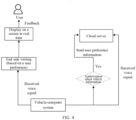
- FIGS. 4-6 are schematic flowcharts of a voice processing method according to another embodiment.
- a terminal may include a vehicle-computer system.
- the vehicle-computer system performs end side writing on a received voice signal, obtains a first recognition result according to a user preference (information), and displays the first recognition result on a screen in real time for a user to view.
- the vehicle-computer system transmits the received voice signal to a cloud server, and sends the user preference information to the cloud server under the authorization about vehicle information.
- FIG. 4 a terminal may include a vehicle-computer system.
- the vehicle-computer system performs end side writing on a received voice signal, obtains a first recognition result according to a user preference (information), and displays the first recognition result on a screen in real time for a user to view.
- the vehicle-computer system transmits the received voice signal to a cloud server, and sends the user preference information to the cloud server under the authorization about vehicle information.
- the cloud server recognizes the voice signal using a plurality of voice recognition models to obtain a plurality of initial second recognition results, inputs the plurality of initial second recognition results to an intention recognition model, and outputs an intention result corresponding to each initial second recognition result, for example: (text A, intention A), (text B, intention B)...
- the cloud server selects a second recognition result from a voice recognition model with high accuracy based on a category that the recognized intention result belongs to.
- a text in the second recognition result is sent to the terminal, and downstream task processing is performed.
- a timeout mechanism is established. Whether there is a timeout when the cloud server returns the second recognition result is calculated. If yes, a downstream task corresponding to the first recognition result is assigned; or if not, a downstream task corresponding to the second recognition result is assigned.
- steps in the flowcharts involved in the above embodiments are shown in sequence as indicated by the arrows, these steps are not necessarily executed in the order indicated by the arrows. Unless explicitly stated herein, there is no strict order restriction on the execution of these steps, and these steps can be executed in other orders. Moreover, at least some of the steps in the flowcharts involved in the above embodiments may include a plurality of steps or stages. These steps or stages are not necessarily executed at the same time, but may be executed at different times. The execution order of these steps or stages is not necessarily sequential, but they may be performed in turn or alternately with other steps or at least some of the steps or stages in other steps.
- an embodiment of the disclosure further provides a voice processing apparatus for implementing the voice processing method mentioned above.
- the solution provided by this apparatus to solve the problem is similar to that described in the above method. Therefore, for specific definitions in one or more voice processing apparatus embodiments provided below, reference may be made to the above definitions of the voice processing method, and details are not repeated herein.
- a voice processing apparatus is provided.
- the apparatus 700 includes:
- each of the processing modules includes:
- the processing module further includes: a third determination submodule configured to if a preset number of intention results are of the same intention category, determining an initial second recognition result from a preset main voice recognition model as the second recognition result.
- the generation module includes:
- the display module further includes: a display submodule configured to if the delay between the time of transmission and the time of reception of the voice signal is less than or equal to the preset threshold, replace the displayed first recognition result with the second recognition result.
- the processing module includes:
- the display module includes:
- All or some of the modules in the foregoing voice processing apparatus may be implemented in software, hardware or a combination thereof.
- the modules may be embedded in or independent of a processor in a computer device in a form of hardware, or may be stored in a memory of a computer device in a form of software, so that the processor can invoke the modules to perform the operations corresponding to the modules.
- a computer device is provided.
- the computer device may be a terminal.
- FIG. 8 shows a diagram of an internal structure of the computer device.
- the computer device includes a processor, a memory, a communication interface, a display screen, and an input device that are connected by a system bus.
- the processor of the computer device is configured to provide computing and control capabilities.
- the memory of the computer device includes a non-volatile storage medium and an internal memory. An operating system and a computer program are stored in the non-volatile storage medium.
- the internal memory provides environment for running the operating system and the computer program in the non-volatile storage medium.
- the communication interface of the computer device is configured for wired or wireless communication with an external terminal.
- the wireless communication may be implemented by Wi-Fi, a mobile cellular network, near field communication (NFC), or other technology.
- the computer program when executed by the processor, causes the processor to carry out a voice processing method.
- the display screen of the computer device may be a liquid crystal display screen or an e-ink display screen.
- the input apparatus of the computer device may be a touch layer covering the display screen, may be a button, a trackball, or a touchpad disposed on a housing of the computer device, or may be an external keyboard, touchpad, mouse, or the like.
- FIG. 8 is only a block diagram of a partial structure related to the solution of the disclosure, and does not form a limitation on the computer device to which the solution of the disclosure is applied.
- the computer device may specifically include more or fewer components than those shown in the figure, some components are combined, or a different component arrangement is used.
- the non-volatile memory may include a read-only memory (ROM), a magnetic tape, a floppy disk, a flash memory, an optical memory, a high-density embedded non-volatile memory, a resistive random access memory (ReRAM), a magnetoresistive random access memory (MRAM), a ferroelectric random access memory (FRAM), a phase change memory (PCM), a graphene memory, and the like.
- the volatile memory may include a random access memory (RAM), an external cache memory, and the like.
- the RAM may be in various forms, such as a static random access memory (SRAM) or a dynamic random access memory (DRAM).
- the database involved in the embodiments provided in the disclosure may include at least one of a relational database and a non-relational database.
- the non-relational database may include but is not limited to a blockchain-based distributed database, and the like.
- the processor involved in the embodiments provided in the disclosure may be but is not limited to a general-purpose processor, a central processing unit, a graphics processor, a digital signal processor, a programmable logic device, a quantum computing-based data processing logic device, and the like.
Landscapes
- Engineering & Computer Science (AREA)
- Computational Linguistics (AREA)
- Health & Medical Sciences (AREA)
- Audiology, Speech & Language Pathology (AREA)
- Human Computer Interaction (AREA)
- Physics & Mathematics (AREA)
- Acoustics & Sound (AREA)
- Multimedia (AREA)
- Artificial Intelligence (AREA)
- Evolutionary Computation (AREA)
- Telephonic Communication Services (AREA)
- User Interface Of Digital Computer (AREA)
Applications Claiming Priority (1)
| Application Number | Priority Date | Filing Date | Title |
|---|---|---|---|
| CN202310159633.6A CN116206606B (zh) | 2023-02-21 | 2023-02-21 | 语音处理方法、装置、计算机设备和存储介质 |
Publications (2)
| Publication Number | Publication Date |
|---|---|
| EP4350693A2 true EP4350693A2 (de) | 2024-04-10 |
| EP4350693A3 EP4350693A3 (de) | 2024-07-17 |
Family
ID=86507358
Family Applications (1)
| Application Number | Title | Priority Date | Filing Date |
|---|---|---|---|
| EP23219691.5A Pending EP4350693A3 (de) | 2023-02-21 | 2023-12-22 | Sprachverarbeitungsverfahren und -vorrichtung, computervorrichtung und speichermedium |
Country Status (2)
| Country | Link |
|---|---|
| EP (1) | EP4350693A3 (de) |
| CN (1) | CN116206606B (de) |
Cited By (1)
| Publication number | Priority date | Publication date | Assignee | Title |
|---|---|---|---|---|
| CN116206606A (zh) * | 2023-02-21 | 2023-06-02 | 蔚来汽车科技(安徽)有限公司 | 语音处理方法、装置、计算机设备和存储介质 |
Family Cites Families (15)
| Publication number | Priority date | Publication date | Assignee | Title |
|---|---|---|---|---|
| JP5530729B2 (ja) * | 2009-01-23 | 2014-06-25 | 本田技研工業株式会社 | 音声理解装置 |
| KR20170032114A (ko) * | 2015-09-14 | 2017-03-22 | 삼성전자주식회사 | 음성 인식 장치 및 그의 제어방법 |
| US20190043487A1 (en) * | 2017-08-02 | 2019-02-07 | Veritone, Inc. | Methods and systems for optimizing engine selection using machine learning modeling |
| CN110797014B (zh) * | 2018-07-17 | 2024-06-07 | 中兴通讯股份有限公司 | 一种语音识别方法、装置及计算机存储介质 |
| KR102225984B1 (ko) * | 2018-09-03 | 2021-03-10 | 엘지전자 주식회사 | 음성 인식 서비스를 제공하는 서버 |
| WO2021029643A1 (en) * | 2019-08-13 | 2021-02-18 | Samsung Electronics Co., Ltd. | System and method for modifying speech recognition result |
| KR102925108B1 (ko) * | 2019-10-10 | 2026-02-09 | 삼성전자주식회사 | 전자 장치 및 이의 제어 방법 |
| CN110992940B (zh) * | 2019-11-25 | 2021-06-15 | 百度在线网络技术(北京)有限公司 | 语音交互的方法、装置、设备和计算机可读存储介质 |
| CN112151031A (zh) * | 2020-09-09 | 2020-12-29 | 上海汽车集团股份有限公司 | 一种语音指令识别方法及相关装置 |
| CN112417855B (zh) * | 2020-11-20 | 2025-01-10 | 平安科技(深圳)有限公司 | 文本意图识别方法、装置以及相关设备 |
| CN113094481A (zh) * | 2021-03-03 | 2021-07-09 | 北京智齿博创科技有限公司 | 意图识别方法、装置、电子设备及计算机可读存储介质 |
| CN115497468B (zh) * | 2021-06-18 | 2025-12-05 | 顺丰科技有限公司 | 语音控制方法、装置、计算机设备及计算机可读存储介质 |
| CN113674472B (zh) * | 2021-07-13 | 2022-09-09 | 深圳市神州云海智能科技有限公司 | 基于深度学习的彩票服务方法及装置、彩票智能服务终端 |
| CN114005448A (zh) * | 2021-12-29 | 2022-02-01 | 广州小鹏汽车科技有限公司 | 语音交互方法及其装置、模型训练方法、车辆和存储介质 |
| CN116206606B (zh) * | 2023-02-21 | 2026-01-23 | 蔚来汽车科技(安徽)有限公司 | 语音处理方法、装置、计算机设备和存储介质 |
-
2023
- 2023-02-21 CN CN202310159633.6A patent/CN116206606B/zh active Active
- 2023-12-22 EP EP23219691.5A patent/EP4350693A3/de active Pending
Cited By (2)
| Publication number | Priority date | Publication date | Assignee | Title |
|---|---|---|---|---|
| CN116206606A (zh) * | 2023-02-21 | 2023-06-02 | 蔚来汽车科技(安徽)有限公司 | 语音处理方法、装置、计算机设备和存储介质 |
| CN116206606B (zh) * | 2023-02-21 | 2026-01-23 | 蔚来汽车科技(安徽)有限公司 | 语音处理方法、装置、计算机设备和存储介质 |
Also Published As
| Publication number | Publication date |
|---|---|
| EP4350693A3 (de) | 2024-07-17 |
| CN116206606A (zh) | 2023-06-02 |
| CN116206606B (zh) | 2026-01-23 |
Similar Documents
| Publication | Publication Date | Title |
|---|---|---|
| CN111428483B (zh) | 语音交互方法、装置和终端设备 | |
| US9711145B2 (en) | Word-level correction of speech input | |
| US20130110992A1 (en) | Electronic device management using interdomain profile-based inferences | |
| US11532309B2 (en) | Techniques for converting natural speech to programming code | |
| CN108156317B (zh) | 通话语音控制方法、装置及存储介质和移动终端 | |
| CN110472251A (zh) | 翻译模型训练的方法、语句翻译的方法、设备及存储介质 | |
| US20250117769A1 (en) | GenAI LETTER OF CONFIRMATION OF BENEFITS | |
| CN111276127B (zh) | 语音唤醒方法、装置、存储介质及电子设备 | |
| US11810553B2 (en) | Using backpropagation to train a dialog system | |
| US11862178B2 (en) | Electronic device for supporting artificial intelligence agent services to talk to users | |
| US20220164071A1 (en) | Method and device for providing user-selection-based information | |
| EP4350693A2 (de) | Sprachverarbeitungsverfahren und -vorrichtung, computervorrichtung und speichermedium | |
| JP2024500778A (ja) | オンデバイス文法チェック | |
| CN118861427A (zh) | 推荐问题生成方法、装置、相关设备及计算机程序产品 | |
| CN110720104B (zh) | 一种语音信息处理方法、装置及终端 | |
| CN112489632A (zh) | 实施校正模型以减少自动语音识别错误的传播 | |
| EP4571733A1 (de) | Elektronische vorrichtung und benutzeräusserungsverarbeitungsverfahren | |
| KR20260007951A (ko) | 메시지를 생성하기 위한 전자 장치, 방법, 및 비-일시적 컴퓨터 판독가능 저장 매체 | |
| KR20260002062A (ko) | 전자 장치에서 정보 안내 장치 및 그 동작 방법 | |
| KR20260044720A (ko) | 인공지능 모델을 이용하여 대화 맥락에 기반한 응답 메시지를 생성하는 전자 장치, 이의 제어 방법 및 저장 매체 | |
| CN120931769A (zh) | 一种图像编辑方法及相关装置 | |
| HK40071034B (zh) | 语音识别方法、装置、计算机设备及存储介质 | |
| CN120179761A (zh) | 用于对话交互的方法、装置、设备和存储介质 | |
| HK40027851B (zh) | 一种信息采集的方法、会话配置的方法、装置及存储介质 |
Legal Events
| Date | Code | Title | Description |
|---|---|---|---|
| PUAI | Public reference made under article 153(3) epc to a published international application that has entered the european phase |
Free format text: ORIGINAL CODE: 0009012 |
|
| STAA | Information on the status of an ep patent application or granted ep patent |
Free format text: STATUS: REQUEST FOR EXAMINATION WAS MADE |
|
| 17P | Request for examination filed |
Effective date: 20231222 |
|
| AK | Designated contracting states |
Kind code of ref document: A2 Designated state(s): AL AT BE BG CH CY CZ DE DK EE ES FI FR GB GR HR HU IE IS IT LI LT LU LV MC ME MK MT NL NO PL PT RO RS SE SI SK SM TR |
|
| RIC1 | Information provided on ipc code assigned before grant |
Ipc: G10L 15/18 20130101ALN20240321BHEP Ipc: G10L 15/22 20060101ALI20240321BHEP Ipc: G10L 15/32 20130101ALI20240321BHEP Ipc: G10L 15/30 20130101AFI20240321BHEP |
|
| PUAL | Search report despatched |
Free format text: ORIGINAL CODE: 0009013 |
|
| AK | Designated contracting states |
Kind code of ref document: A3 Designated state(s): AL AT BE BG CH CY CZ DE DK EE ES FI FR GB GR HR HU IE IS IT LI LT LU LV MC ME MK MT NL NO PL PT RO RS SE SI SK SM TR |
|
| RIC1 | Information provided on ipc code assigned before grant |
Ipc: G10L 15/18 20130101ALN20240611BHEP Ipc: G10L 15/22 20060101ALI20240611BHEP Ipc: G10L 15/32 20130101ALI20240611BHEP Ipc: G10L 15/30 20130101AFI20240611BHEP |
|
| STAA | Information on the status of an ep patent application or granted ep patent |
Free format text: STATUS: EXAMINATION IS IN PROGRESS |
|
| 17Q | First examination report despatched |
Effective date: 20250723 |