EP4349931A1 - Pressure-sensitive adhesive composition and pressure-sensitive adhesive tape - Google Patents
Pressure-sensitive adhesive composition and pressure-sensitive adhesive tape Download PDFInfo
- Publication number
- EP4349931A1 EP4349931A1 EP22815804.4A EP22815804A EP4349931A1 EP 4349931 A1 EP4349931 A1 EP 4349931A1 EP 22815804 A EP22815804 A EP 22815804A EP 4349931 A1 EP4349931 A1 EP 4349931A1
- Authority
- EP
- European Patent Office
- Prior art keywords
- group
- pressure
- sensitive adhesive
- meth
- weight
- Prior art date
- Legal status (The legal status is an assumption and is not a legal conclusion. Google has not performed a legal analysis and makes no representation as to the accuracy of the status listed.)
- Withdrawn
Links
- 239000004820 Pressure-sensitive adhesive Substances 0.000 title claims abstract description 135
- 239000000203 mixture Substances 0.000 title claims abstract description 91
- 229920002498 Beta-glucan Polymers 0.000 claims abstract description 119
- 125000000524 functional group Chemical group 0.000 claims abstract description 85
- 125000002252 acyl group Chemical group 0.000 claims abstract description 33
- 238000006467 substitution reaction Methods 0.000 claims abstract description 31
- 125000003647 acryloyl group Chemical group O=C([*])C([H])=C([H])[H] 0.000 claims abstract description 29
- 150000001875 compounds Chemical class 0.000 claims abstract description 26
- 239000007795 chemical reaction product Substances 0.000 claims abstract description 25
- 239000000178 monomer Substances 0.000 claims description 45
- 239000010410 layer Substances 0.000 claims description 17
- 125000003178 carboxy group Chemical group [H]OC(*)=O 0.000 claims description 12
- IQPQWNKOIGAROB-UHFFFAOYSA-N isocyanate group Chemical group [N-]=C=O IQPQWNKOIGAROB-UHFFFAOYSA-N 0.000 claims description 2
- YXFVVABEGXRONW-UHFFFAOYSA-N Toluene Chemical compound CC1=CC=CC=C1 YXFVVABEGXRONW-UHFFFAOYSA-N 0.000 description 81
- -1 ethylhexyl Chemical group 0.000 description 73
- NIXOWILDQLNWCW-UHFFFAOYSA-N acrylic acid group Chemical group C(C=C)(=O)O NIXOWILDQLNWCW-UHFFFAOYSA-N 0.000 description 35
- NIXOWILDQLNWCW-UHFFFAOYSA-M Acrylate Chemical compound [O-]C(=O)C=C NIXOWILDQLNWCW-UHFFFAOYSA-M 0.000 description 28
- 230000015572 biosynthetic process Effects 0.000 description 28
- 238000003786 synthesis reaction Methods 0.000 description 28
- 125000002887 hydroxy group Chemical group [H]O* 0.000 description 22
- 238000002156 mixing Methods 0.000 description 21
- 239000000758 substrate Substances 0.000 description 19
- 230000000052 comparative effect Effects 0.000 description 15
- 125000004432 carbon atom Chemical group C* 0.000 description 13
- 239000012948 isocyanate Substances 0.000 description 13
- 125000001419 myristoyl group Chemical group O=C([*])C([H])([H])C([H])([H])C([H])([H])C([H])([H])C([H])([H])C([H])([H])C([H])([H])C([H])([H])C([H])([H])C([H])([H])C([H])([H])C([H])([H])C([H])([H])[H] 0.000 description 13
- 125000000217 alkyl group Chemical group 0.000 description 11
- 150000002513 isocyanates Chemical class 0.000 description 11
- 239000003999 initiator Substances 0.000 description 10
- 238000005160 1H NMR spectroscopy Methods 0.000 description 9
- OKKJLVBELUTLKV-UHFFFAOYSA-N Methanol Chemical compound OC OKKJLVBELUTLKV-UHFFFAOYSA-N 0.000 description 9
- 239000012298 atmosphere Substances 0.000 description 9
- LYCAIKOWRPUZTN-UHFFFAOYSA-N Ethylene glycol Chemical compound OCCO LYCAIKOWRPUZTN-UHFFFAOYSA-N 0.000 description 8
- 125000001931 aliphatic group Chemical group 0.000 description 8
- 238000006243 chemical reaction Methods 0.000 description 8
- 239000007787 solid Substances 0.000 description 8
- CERQOIWHTDAKMF-UHFFFAOYSA-N Methacrylic acid Chemical group CC(=C)C(O)=O CERQOIWHTDAKMF-UHFFFAOYSA-N 0.000 description 7
- 150000003254 radicals Chemical class 0.000 description 7
- 238000010438 heat treatment Methods 0.000 description 6
- 229920005989 resin Polymers 0.000 description 6
- 239000011347 resin Substances 0.000 description 6
- 239000012265 solid product Substances 0.000 description 6
- DPNXHTDWGGVXID-UHFFFAOYSA-N 2-isocyanatoethyl prop-2-enoate Chemical compound C=CC(=O)OCCN=C=O DPNXHTDWGGVXID-UHFFFAOYSA-N 0.000 description 5
- UNSAJINGUOTTRA-UHFFFAOYSA-N 3-(3-bromophenyl)prop-2-yn-1-ol Chemical compound OCC#CC1=CC=CC(Br)=C1 UNSAJINGUOTTRA-UHFFFAOYSA-N 0.000 description 5
- 238000011156 evaluation Methods 0.000 description 5
- 238000000034 method Methods 0.000 description 5
- 239000000047 product Substances 0.000 description 5
- 239000004593 Epoxy Substances 0.000 description 4
- 239000000654 additive Substances 0.000 description 4
- 230000000996 additive effect Effects 0.000 description 4
- 125000001797 benzyl group Chemical group [H]C1=C([H])C([H])=C(C([H])=C1[H])C([H])([H])* 0.000 description 4
- 239000003795 chemical substances by application Substances 0.000 description 4
- 150000002430 hydrocarbons Chemical group 0.000 description 4
- WGCNASOHLSPBMP-UHFFFAOYSA-N hydroxyacetaldehyde Natural products OCC=O WGCNASOHLSPBMP-UHFFFAOYSA-N 0.000 description 4
- 125000003342 alkenyl group Chemical group 0.000 description 3
- 238000001035 drying Methods 0.000 description 3
- 230000000694 effects Effects 0.000 description 3
- 125000000400 lauroyl group Chemical group O=C([*])C([H])([H])C([H])([H])C([H])([H])C([H])([H])C([H])([H])C([H])([H])C([H])([H])C([H])([H])C([H])([H])C([H])([H])C([H])([H])[H] 0.000 description 3
- 238000005259 measurement Methods 0.000 description 3
- 125000001400 nonyl group Chemical group [H]C([*])([H])C([H])([H])C([H])([H])C([H])([H])C([H])([H])C([H])([H])C([H])([H])C([H])([H])C([H])([H])[H] 0.000 description 3
- 125000001312 palmitoyl group Chemical group O=C([*])C([H])([H])C([H])([H])C([H])([H])C([H])([H])C([H])([H])C([H])([H])C([H])([H])C([H])([H])C([H])([H])C([H])([H])C([H])([H])C([H])([H])C([H])([H])C([H])([H])C([H])([H])[H] 0.000 description 3
- 230000000704 physical effect Effects 0.000 description 3
- 229920001610 polycaprolactone Polymers 0.000 description 3
- 239000004632 polycaprolactone Substances 0.000 description 3
- 238000002360 preparation method Methods 0.000 description 3
- 239000011541 reaction mixture Substances 0.000 description 3
- 239000002904 solvent Substances 0.000 description 3
- 239000000126 substance Substances 0.000 description 3
- SXIFAEWFOJETOA-UHFFFAOYSA-N 4-hydroxy-butyl Chemical group [CH2]CCCO SXIFAEWFOJETOA-UHFFFAOYSA-N 0.000 description 2
- FJKROLUGYXJWQN-UHFFFAOYSA-N 4-hydroxybenzoic acid Chemical compound OC(=O)C1=CC=C(O)C=C1 FJKROLUGYXJWQN-UHFFFAOYSA-N 0.000 description 2
- KWOLFJPFCHCOCG-UHFFFAOYSA-N Acetophenone Chemical compound CC(=O)C1=CC=CC=C1 KWOLFJPFCHCOCG-UHFFFAOYSA-N 0.000 description 2
- IJGRMHOSHXDMSA-UHFFFAOYSA-N Atomic nitrogen Chemical compound N#N IJGRMHOSHXDMSA-UHFFFAOYSA-N 0.000 description 2
- WQZGKKKJIJFFOK-GASJEMHNSA-N Glucose Natural products OC[C@H]1OC(O)[C@H](O)[C@@H](O)[C@@H]1O WQZGKKKJIJFFOK-GASJEMHNSA-N 0.000 description 2
- JUJWROOIHBZHMG-UHFFFAOYSA-N Pyridine Chemical compound C1=CC=NC=C1 JUJWROOIHBZHMG-UHFFFAOYSA-N 0.000 description 2
- 150000008065 acid anhydrides Chemical class 0.000 description 2
- DZBUGLKDJFMEHC-UHFFFAOYSA-N acridine Chemical compound C1=CC=CC2=CC3=CC=CC=C3N=C21 DZBUGLKDJFMEHC-UHFFFAOYSA-N 0.000 description 2
- 125000002723 alicyclic group Chemical group 0.000 description 2
- 125000003545 alkoxy group Chemical group 0.000 description 2
- 125000005370 alkoxysilyl group Chemical group 0.000 description 2
- 229920005601 base polymer Polymers 0.000 description 2
- 125000000484 butyl group Chemical group [H]C([*])([H])C([H])([H])C([H])([H])C([H])([H])[H] 0.000 description 2
- 150000001732 carboxylic acid derivatives Chemical class 0.000 description 2
- 125000003074 decanoyl group Chemical group [H]C([H])([H])C([H])([H])C([H])([H])C([H])([H])C([H])([H])C([H])([H])C([H])([H])C([H])([H])C([H])([H])C(*)=O 0.000 description 2
- 230000007423 decrease Effects 0.000 description 2
- 125000003438 dodecyl group Chemical group [H]C([H])([H])C([H])([H])C([H])([H])C([H])([H])C([H])([H])C([H])([H])C([H])([H])C([H])([H])C([H])([H])C([H])([H])C([H])([H])C([H])([H])* 0.000 description 2
- 239000008103 glucose Substances 0.000 description 2
- 125000003187 heptyl group Chemical group [H]C([*])([H])C([H])([H])C([H])([H])C([H])([H])C([H])([H])C([H])([H])C([H])([H])[H] 0.000 description 2
- 125000004051 hexyl group Chemical group [H]C([H])([H])C([H])([H])C([H])([H])C([H])([H])C([H])([H])C([H])([H])* 0.000 description 2
- 125000004435 hydrogen atom Chemical group [H]* 0.000 description 2
- 238000004519 manufacturing process Methods 0.000 description 2
- 125000002960 margaryl group Chemical group [H]C([*])([H])C([H])([H])C([H])([H])C([H])([H])C([H])([H])C([H])([H])C([H])([H])C([H])([H])C([H])([H])C([H])([H])C([H])([H])C([H])([H])C([H])([H])C([H])([H])C([H])([H])C([H])([H])C([H])([H])[H] 0.000 description 2
- 125000001402 nonanoyl group Chemical group O=C([*])C([H])([H])C([H])([H])C([H])([H])C([H])([H])C([H])([H])C([H])([H])C([H])([H])C([H])([H])[H] 0.000 description 2
- REEZZSHJLXOIHL-UHFFFAOYSA-N octanoyl chloride Chemical compound CCCCCCCC(Cl)=O REEZZSHJLXOIHL-UHFFFAOYSA-N 0.000 description 2
- 125000002801 octanoyl group Chemical group C(CCCCCCC)(=O)* 0.000 description 2
- 125000002347 octyl group Chemical group [H]C([*])([H])C([H])([H])C([H])([H])C([H])([H])C([H])([H])C([H])([H])C([H])([H])C([H])([H])[H] 0.000 description 2
- 125000002958 pentadecyl group Chemical group [H]C([*])([H])C([H])([H])C([H])([H])C([H])([H])C([H])([H])C([H])([H])C([H])([H])C([H])([H])C([H])([H])C([H])([H])C([H])([H])C([H])([H])C([H])([H])C([H])([H])C([H])([H])[H] 0.000 description 2
- 229920000728 polyester Polymers 0.000 description 2
- 238000006116 polymerization reaction Methods 0.000 description 2
- 125000003696 stearoyl group Chemical group O=C([*])C([H])([H])C([H])([H])C([H])([H])C([H])([H])C([H])([H])C([H])([H])C([H])([H])C([H])([H])C([H])([H])C([H])([H])C([H])([H])C([H])([H])C([H])([H])C([H])([H])C([H])([H])C([H])([H])C([H])([H])[H] 0.000 description 2
- 125000004079 stearyl group Chemical group [H]C([*])([H])C([H])([H])C([H])([H])C([H])([H])C([H])([H])C([H])([H])C([H])([H])C([H])([H])C([H])([H])C([H])([H])C([H])([H])C([H])([H])C([H])([H])C([H])([H])C([H])([H])C([H])([H])C([H])([H])C([H])([H])[H] 0.000 description 2
- 125000002889 tridecyl group Chemical group [H]C([*])([H])C([H])([H])C([H])([H])C([H])([H])C([H])([H])C([H])([H])C([H])([H])C([H])([H])C([H])([H])C([H])([H])C([H])([H])C([H])([H])C([H])([H])[H] 0.000 description 2
- 125000002948 undecyl group Chemical group [H]C([*])([H])C([H])([H])C([H])([H])C([H])([H])C([H])([H])C([H])([H])C([H])([H])C([H])([H])C([H])([H])C([H])([H])C([H])([H])[H] 0.000 description 2
- DBRHKXSUGNZOLP-UHFFFAOYSA-N 2-(2-isocyanatoethoxy)ethyl 2-methylprop-2-enoate Chemical compound CC(=C)C(=O)OCCOCCN=C=O DBRHKXSUGNZOLP-UHFFFAOYSA-N 0.000 description 1
- IMSODMZESSGVBE-UHFFFAOYSA-N 2-Oxazoline Chemical compound C1CN=CO1 IMSODMZESSGVBE-UHFFFAOYSA-N 0.000 description 1
- 125000000954 2-hydroxyethyl group Chemical group [H]C([*])([H])C([H])([H])O[H] 0.000 description 1
- QOXOZONBQWIKDA-UHFFFAOYSA-N 3-hydroxypropyl Chemical group [CH2]CCO QOXOZONBQWIKDA-UHFFFAOYSA-N 0.000 description 1
- NDWUBGAGUCISDV-UHFFFAOYSA-N 4-hydroxybutyl prop-2-enoate Chemical compound OCCCCOC(=O)C=C NDWUBGAGUCISDV-UHFFFAOYSA-N 0.000 description 1
- 239000004925 Acrylic resin Substances 0.000 description 1
- 229920000178 Acrylic resin Polymers 0.000 description 1
- 229920001342 Bakelite® Polymers 0.000 description 1
- WPYMKLBDIGXBTP-UHFFFAOYSA-N Benzoic acid Natural products OC(=O)C1=CC=CC=C1 WPYMKLBDIGXBTP-UHFFFAOYSA-N 0.000 description 1
- 239000005711 Benzoic acid Substances 0.000 description 1
- SNRUBQQJIBEYMU-UHFFFAOYSA-N Dodecane Natural products CCCCCCCCCCCC SNRUBQQJIBEYMU-UHFFFAOYSA-N 0.000 description 1
- 229920001503 Glucan Polymers 0.000 description 1
- 229920003171 Poly (ethylene oxide) Polymers 0.000 description 1
- ZJCCRDAZUWHFQH-UHFFFAOYSA-N Trimethylolpropane Chemical compound CCC(CO)(CO)CO ZJCCRDAZUWHFQH-UHFFFAOYSA-N 0.000 description 1
- 150000003926 acrylamides Chemical class 0.000 description 1
- 150000003855 acyl compounds Chemical class 0.000 description 1
- 230000003712 anti-aging effect Effects 0.000 description 1
- 125000002029 aromatic hydrocarbon group Chemical group 0.000 description 1
- 125000003118 aryl group Chemical group 0.000 description 1
- 239000004637 bakelite Substances 0.000 description 1
- WURBFLDFSFBTLW-UHFFFAOYSA-N benzil Chemical compound C=1C=CC=CC=1C(=O)C(=O)C1=CC=CC=C1 WURBFLDFSFBTLW-UHFFFAOYSA-N 0.000 description 1
- 235000010233 benzoic acid Nutrition 0.000 description 1
- RWCCWEUUXYIKHB-UHFFFAOYSA-N benzophenone Chemical compound C=1C=CC=CC=1C(=O)C1=CC=CC=C1 RWCCWEUUXYIKHB-UHFFFAOYSA-N 0.000 description 1
- 239000012965 benzophenone Substances 0.000 description 1
- 238000010504 bond cleavage reaction Methods 0.000 description 1
- 125000004063 butyryl group Chemical group O=C([*])C([H])([H])C([H])([H])C([H])([H])[H] 0.000 description 1
- 150000001718 carbodiimides Chemical class 0.000 description 1
- 229910052799 carbon Inorganic materials 0.000 description 1
- 238000003776 cleavage reaction Methods 0.000 description 1
- 125000000113 cyclohexyl group Chemical group [H]C1([H])C([H])([H])C([H])([H])C([H])(*)C([H])([H])C1([H])[H] 0.000 description 1
- KOMDZQSPRDYARS-UHFFFAOYSA-N cyclopenta-1,3-diene titanium Chemical compound [Ti].C1C=CC=C1.C1C=CC=C1 KOMDZQSPRDYARS-UHFFFAOYSA-N 0.000 description 1
- 125000002704 decyl group Chemical group [H]C([H])([H])C([H])([H])C([H])([H])C([H])([H])C([H])([H])C([H])([H])C([H])([H])C([H])([H])C([H])([H])C([H])([H])* 0.000 description 1
- 238000006356 dehydrogenation reaction Methods 0.000 description 1
- 125000001495 ethyl group Chemical group [H]C([H])([H])C([H])([H])* 0.000 description 1
- WUDNUHPRLBTKOJ-UHFFFAOYSA-N ethyl isocyanate Chemical compound CCN=C=O WUDNUHPRLBTKOJ-UHFFFAOYSA-N 0.000 description 1
- 239000000945 filler Substances 0.000 description 1
- 238000009472 formulation Methods 0.000 description 1
- 125000002791 glucosyl group Chemical group C1([C@H](O)[C@@H](O)[C@H](O)[C@H](O1)CO)* 0.000 description 1
- 125000003055 glycidyl group Chemical group C(C1CO1)* 0.000 description 1
- 125000000268 heptanoyl group Chemical group O=C([*])C([H])([H])C([H])([H])C([H])([H])C([H])([H])C([H])([H])C([H])([H])[H] 0.000 description 1
- 125000003104 hexanoyl group Chemical group O=C([*])C([H])([H])C([H])([H])C([H])([H])C([H])([H])C([H])([H])[H] 0.000 description 1
- 230000003993 interaction Effects 0.000 description 1
- 239000013067 intermediate product Substances 0.000 description 1
- 239000000463 material Substances 0.000 description 1
- 125000005641 methacryl group Chemical group 0.000 description 1
- RBQRWNWVPQDTJJ-UHFFFAOYSA-N methacryloyloxyethyl isocyanate Chemical compound CC(=C)C(=O)OCCN=C=O RBQRWNWVPQDTJJ-UHFFFAOYSA-N 0.000 description 1
- 125000002496 methyl group Chemical group [H]C([H])([H])* 0.000 description 1
- 238000012986 modification Methods 0.000 description 1
- 230000004048 modification Effects 0.000 description 1
- 125000000896 monocarboxylic acid group Chemical group 0.000 description 1
- 125000001421 myristyl group Chemical group [H]C([*])([H])C([H])([H])C([H])([H])C([H])([H])C([H])([H])C([H])([H])C([H])([H])C([H])([H])C([H])([H])C([H])([H])C([H])([H])C([H])([H])C([H])([H])C([H])([H])[H] 0.000 description 1
- 229910052757 nitrogen Inorganic materials 0.000 description 1
- 239000012299 nitrogen atmosphere Substances 0.000 description 1
- 125000002811 oleoyl group Chemical group O=C([*])C([H])([H])C([H])([H])C([H])([H])C([H])([H])C([H])([H])C([H])([H])C([H])([H])/C([H])=C([H])\C([H])([H])C([H])([H])C([H])([H])C([H])([H])C([H])([H])C([H])([H])C([H])([H])C([H])([H])[H] 0.000 description 1
- 239000003960 organic solvent Substances 0.000 description 1
- 125000000913 palmityl group Chemical group [H]C([*])([H])C([H])([H])C([H])([H])C([H])([H])C([H])([H])C([H])([H])C([H])([H])C([H])([H])C([H])([H])C([H])([H])C([H])([H])C([H])([H])C([H])([H])C([H])([H])C([H])([H])C([H])([H])[H] 0.000 description 1
- 125000001147 pentyl group Chemical group C(CCCC)* 0.000 description 1
- 239000004014 plasticizer Substances 0.000 description 1
- 229920001223 polyethylene glycol Polymers 0.000 description 1
- 239000003755 preservative agent Substances 0.000 description 1
- 230000002335 preservative effect Effects 0.000 description 1
- 125000001436 propyl group Chemical group [H]C([*])([H])C([H])([H])C([H])([H])[H] 0.000 description 1
- UMJSCPRVCHMLSP-UHFFFAOYSA-N pyridine Natural products COC1=CC=CN=C1 UMJSCPRVCHMLSP-UHFFFAOYSA-N 0.000 description 1
- 150000003222 pyridines Chemical class 0.000 description 1
- 230000005855 radiation Effects 0.000 description 1
- 230000007017 scission Effects 0.000 description 1
- 239000003381 stabilizer Substances 0.000 description 1
- 238000003860 storage Methods 0.000 description 1
- 238000012360 testing method Methods 0.000 description 1
- DVKJHBMWWAPEIU-UHFFFAOYSA-N toluene 2,4-diisocyanate Chemical compound CC1=CC=C(N=C=O)C=C1N=C=O DVKJHBMWWAPEIU-UHFFFAOYSA-N 0.000 description 1
- 238000009281 ultraviolet germicidal irradiation Methods 0.000 description 1
- 125000003774 valeryl group Chemical group O=C([*])C([H])([H])C([H])([H])C([H])([H])C([H])([H])[H] 0.000 description 1
- 229920001567 vinyl ester resin Polymers 0.000 description 1
- 125000000391 vinyl group Chemical group [H]C([*])=C([H])[H] 0.000 description 1
- 229920002554 vinyl polymer Polymers 0.000 description 1
- 239000004034 viscosity adjusting agent Substances 0.000 description 1
- 230000000007 visual effect Effects 0.000 description 1
Images


Classifications
-
- C—CHEMISTRY; METALLURGY
- C09—DYES; PAINTS; POLISHES; NATURAL RESINS; ADHESIVES; COMPOSITIONS NOT OTHERWISE PROVIDED FOR; APPLICATIONS OF MATERIALS NOT OTHERWISE PROVIDED FOR
- C09J—ADHESIVES; NON-MECHANICAL ASPECTS OF ADHESIVE PROCESSES IN GENERAL; ADHESIVE PROCESSES NOT PROVIDED FOR ELSEWHERE; USE OF MATERIALS AS ADHESIVES
- C09J105/00—Adhesives based on polysaccharides or on their derivatives, not provided for in groups C09J101/00 or C09J103/00
-
- C—CHEMISTRY; METALLURGY
- C08—ORGANIC MACROMOLECULAR COMPOUNDS; THEIR PREPARATION OR CHEMICAL WORKING-UP; COMPOSITIONS BASED THEREON
- C08B—POLYSACCHARIDES; DERIVATIVES THEREOF
- C08B37/00—Preparation of polysaccharides not provided for in groups C08B1/00 - C08B35/00; Derivatives thereof
- C08B37/0006—Homoglycans, i.e. polysaccharides having a main chain consisting of one single sugar, e.g. colominic acid
- C08B37/0024—Homoglycans, i.e. polysaccharides having a main chain consisting of one single sugar, e.g. colominic acid beta-D-Glucans; (beta-1,3)-D-Glucans, e.g. paramylon, coriolan, sclerotan, pachyman, callose, scleroglucan, schizophyllan, laminaran, lentinan or curdlan; (beta-1,6)-D-Glucans, e.g. pustulan; (beta-1,4)-D-Glucans; (beta-1,3)(beta-1,4)-D-Glucans, e.g. lichenan; Derivatives thereof
-
- C—CHEMISTRY; METALLURGY
- C08—ORGANIC MACROMOLECULAR COMPOUNDS; THEIR PREPARATION OR CHEMICAL WORKING-UP; COMPOSITIONS BASED THEREON
- C08F—MACROMOLECULAR COMPOUNDS OBTAINED BY REACTIONS ONLY INVOLVING CARBON-TO-CARBON UNSATURATED BONDS
- C08F251/00—Macromolecular compounds obtained by polymerising monomers on to polysaccharides or derivatives thereof
-
- C—CHEMISTRY; METALLURGY
- C09—DYES; PAINTS; POLISHES; NATURAL RESINS; ADHESIVES; COMPOSITIONS NOT OTHERWISE PROVIDED FOR; APPLICATIONS OF MATERIALS NOT OTHERWISE PROVIDED FOR
- C09J—ADHESIVES; NON-MECHANICAL ASPECTS OF ADHESIVE PROCESSES IN GENERAL; ADHESIVE PROCESSES NOT PROVIDED FOR ELSEWHERE; USE OF MATERIALS AS ADHESIVES
- C09J4/00—Adhesives based on organic non-macromolecular compounds having at least one polymerisable carbon-to-carbon unsaturated bond ; adhesives, based on monomers of macromolecular compounds of groups C09J183/00 - C09J183/16
-
- C—CHEMISTRY; METALLURGY
- C09—DYES; PAINTS; POLISHES; NATURAL RESINS; ADHESIVES; COMPOSITIONS NOT OTHERWISE PROVIDED FOR; APPLICATIONS OF MATERIALS NOT OTHERWISE PROVIDED FOR
- C09J—ADHESIVES; NON-MECHANICAL ASPECTS OF ADHESIVE PROCESSES IN GENERAL; ADHESIVE PROCESSES NOT PROVIDED FOR ELSEWHERE; USE OF MATERIALS AS ADHESIVES
- C09J4/00—Adhesives based on organic non-macromolecular compounds having at least one polymerisable carbon-to-carbon unsaturated bond ; adhesives, based on monomers of macromolecular compounds of groups C09J183/00 - C09J183/16
- C09J4/06—Organic non-macromolecular compounds having at least one polymerisable carbon-to-carbon unsaturated bond in combination with a macromolecular compound other than an unsaturated polymer of groups C09J159/00 - C09J187/00
-
- C—CHEMISTRY; METALLURGY
- C09—DYES; PAINTS; POLISHES; NATURAL RESINS; ADHESIVES; COMPOSITIONS NOT OTHERWISE PROVIDED FOR; APPLICATIONS OF MATERIALS NOT OTHERWISE PROVIDED FOR
- C09J—ADHESIVES; NON-MECHANICAL ASPECTS OF ADHESIVE PROCESSES IN GENERAL; ADHESIVE PROCESSES NOT PROVIDED FOR ELSEWHERE; USE OF MATERIALS AS ADHESIVES
- C09J7/00—Adhesives in the form of films or foils
- C09J7/30—Adhesives in the form of films or foils characterised by the adhesive composition
- C09J7/38—Pressure-sensitive adhesives [PSA]
-
- C—CHEMISTRY; METALLURGY
- C09—DYES; PAINTS; POLISHES; NATURAL RESINS; ADHESIVES; COMPOSITIONS NOT OTHERWISE PROVIDED FOR; APPLICATIONS OF MATERIALS NOT OTHERWISE PROVIDED FOR
- C09J—ADHESIVES; NON-MECHANICAL ASPECTS OF ADHESIVE PROCESSES IN GENERAL; ADHESIVE PROCESSES NOT PROVIDED FOR ELSEWHERE; USE OF MATERIALS AS ADHESIVES
- C09J2301/00—Additional features of adhesives in the form of films or foils
- C09J2301/30—Additional features of adhesives in the form of films or foils characterized by the chemical, physicochemical or physical properties of the adhesive or the carrier
- C09J2301/302—Additional features of adhesives in the form of films or foils characterized by the chemical, physicochemical or physical properties of the adhesive or the carrier the adhesive being pressure-sensitive, i.e. tacky at temperatures inferior to 30°C
-
- C—CHEMISTRY; METALLURGY
- C09—DYES; PAINTS; POLISHES; NATURAL RESINS; ADHESIVES; COMPOSITIONS NOT OTHERWISE PROVIDED FOR; APPLICATIONS OF MATERIALS NOT OTHERWISE PROVIDED FOR
- C09J—ADHESIVES; NON-MECHANICAL ASPECTS OF ADHESIVE PROCESSES IN GENERAL; ADHESIVE PROCESSES NOT PROVIDED FOR ELSEWHERE; USE OF MATERIALS AS ADHESIVES
- C09J2405/00—Presence of polysaccharides
Definitions
- the present invention relates to a pressure-sensitive adhesive composition and a pressure-sensitive adhesive tape.
- a pressure-sensitive adhesive composition containing a ⁇ -1,3-glucan derivative obtained by introducing an acyl group into a ⁇ -1,3-glucan has been known (for example, see Patent document 1 below).
- the pressure-sensitive adhesive described in Patent document 1 includes a ⁇ -1,3-glucan derivative of which acyl group has a degree of substitution of 1.0 or more and 3.0 or less.
- Patent Document 1 Japanese Unexamined Patent Publication No. 2018-154723
- Patent document 1 is disadvantageous in that it does not meet the above-described requirement.
- Such a pressure-sensitive adhesive composition is required to have a high holding force under high-temperature atmosphere.
- a pressure-sensitive adhesive composition has a high holding force under high-temperature atmosphere, the sliding distance of an adherend is short after a predetermined period of time has passed since the adhering of the adherend under high-temperature atmosphere.
- the pressure-sensitive adhesive composition described in Patent document 1 is disadvantageous in that it does not meet the above-described requirement.
- the present invention provides a pressure-sensitive adhesive composition and a pressure-sensitive adhesive tape, both of which have high adhesion and also have a high holding force under high-temperature atmosphere.
- the present invention [1] includes a pressure-sensitive adhesive composition including: a ⁇ -1,3-glucan derivative obtained by introducing an acyl group into a ⁇ -1,3-glucan, the ⁇ -1,3-glucan derivative having a degree of substitution of the acyl group of 2.6 or more and less than 3.0, and a compound having both of a (meth)acryloyl group and a hydroxyl-group-reactive functional group, and/or a reaction product of the ⁇ -1,3-glucan derivative and the compound having both of a (meth)acryloyl group and a hydroxyl-group-reactive functional group; and a photo-radical generator.
- the present invention [2] includes the pressure-sensitive adhesive composition described in the above-described [1], wherein the hydroxyl-group-reactive functional group of the compound is an isocyanate group.
- the present invention [3] includes the pressure-sensitive adhesive composition described in the above-described [1] or [2], wherein the compound is isocyanatoalkyl (meth)acrylate.
- the present invention [4] includes the pressure-sensitive adhesive composition described in the above-described [1] to [3], wherein the content ratio of the compound to 100 parts by weight of the ⁇ -1,3-glucan derivative is 1 part by weight or more and 20 parts by weight or less.
- the present invention [5] includes the pressure-sensitive adhesive composition described in the above-described [1] to [4], further including: a radically polymerizable monomer.
- the present invention [6] includes the pressure-sensitive adhesive composition described in the above-described [5], wherein the radically polymerizable monomer has a carboxyl group.
- the present invention [7] includes the pressure-sensitive adhesive composition described in the above-described [5] or [6], wherein the radically polymerizable monomer is a (meth)acrylic acid ester in which a remaining group bonding with the (meth)acryloyl group has repeating units.
- the present invention [8] includes the pressure-sensitive adhesive composition described in the above-described [5] to [7], wherein the content ratio of the radically polymerizable monomer to 100 parts by weight of the ⁇ -1,3-glucan derivative is 0.01 parts by weight or more and 10 parts by weight or less.
- the present invention includes the pressure-sensitive adhesive composition described in the above-described [1] to [8], wherein the photo-radical generator is a benzyl ketal-based compound.
- the present invention [10] includes the pressure-sensitive adhesive composition described in the above-described [1] to [9], wherein the content ratio of the photo-radical generator to 100 parts by weight of the ⁇ -1,3-glucan derivative is 0.01 parts by weight or more and 5 parts by weight or less.
- the present invention [11] includes a pressure-sensitive adhesive tape including: a pressure-sensitive adhesive layer made of a pressure-sensitive adhesive composition described in any one of the above-described [1] to [10].
- a ⁇ -1,3-glucan derivative and a compound containing both of a (meth)acryloyl group and a hydroxyl-group-reactive functional group are allowed to react with each other by heat.
- the thermal reaction of the (meth)acryloyl group of their reaction product is suppressed.
- the reaction product is enabled to cross-link by light irradiation at an arbitrary time.
- the pressure-sensitive adhesive composition of the present invention while gelatinization by heat is suppressed, a cross-linkage can be formed at an arbitrary time. This increases the adhesion and achieves an excellent holding force under high-temperature atmosphere.
- the pressure-sensitive adhesive composition of the present invention contains a ⁇ -1,3-glucan derivative, and a compound containing both of a (meth)acryloyl group and a hydroxyl-group-reactive functional group, and/or a reaction product of the ⁇ -1,3-glucan derivative and the compound having both of a (meth)acryloyl group and a hydroxyl-group-reactive functional group, and a photo-radical generator.
- the ⁇ -1,3-glucan derivative is a base polymer in the pressure-sensitive adhesive composition.
- the ⁇ -1,3-glucan derivative is a partially-acylated compound obtained by acylating a part of the hydroxy group in the glucose contained in a ⁇ -1,3-glucan with an acyl group.
- the ⁇ -1,3-glucan derivative is an acyl compound obtained by introducing an acyl group into a ⁇ -1,3-glucan.
- the acyl group is shown as RCO-.
- R include a hydrocarbon group.
- the hydrocarbon group include an aliphatic hydrocarbon group, an alicyclic hydrocarbon group, and an aromatic hydrocarbon group. An aliphatic hydrocarbon group is preferably used.
- Examples of the aliphatic hydrocarbon group include a saturated aliphatic hydrocarbon group and an unsaturated aliphatic hydrocarbon group.
- Examples of the saturated aliphatic hydrocarbon group include an alkyl group.
- alkyl group examples include a straight-chain alkyl group and a branched alkyl group.
- a straight-chain alkyl group is preferably used.
- the alkyl group has carbon atoms of, for example, 3 or more, and, for example, 18 or less.
- Examples of the straight-chain alkyl group include propyl, butyl, pentyl, hexyl, heptyl, octyl, nonyl, decyl, undecyl, dodecyl, tridecyl, tetradecyl, pentadecyl, hexadecyl, heptadecyl, and octadecyl.
- Examples of the branched alkyl group include ethylhexyl.
- Examples of the unsaturated aliphatic hydrocarbon group include an alkenyl group.
- the alkenyl group has carbon atoms of, for example, 3 or more and 18 or less.
- Examples of the alkenyl group include heptadecenyl.
- the hydrocarbon group (R in RCO-) has carbon atoms of preferably 7 or more, more preferably 9 or more, even more preferably 11 or more, and preferably 15 or less.
- the number of carbon atoms of the hydrocarbon group is the above-described lower limit or more and the upper limit or less, the adhesion sufficiently improves.
- acyl group examples include butanoyl (an example when R in RCO is C 3 H 7 ), pentanoyl (an example when R in RCO is C 4 H 9 ), hexanoyl (an example when R in RCO is C 5 H 11 ), heptanoyl (an example when R in RCO is C 6 H 13 ), octanoyl (an example when R in RCO is C 7 H 15 ), nonanoyl (an example when R in RCO is C 8 H 17 ), decanoyl (an example when R in RCO is C 9 H 19 ), lauroyl (i.e., dodecanoyl) (when R in RCO is C 11 H 23 ), myristoyl (i.e., tetradecanoyl) (an example when R in RCO is C 13 H 27 ), palmitoyl (i.e., hexadecanoyl) (an example when R in RCO is C 15 H 31
- the lower limit of the degree of substitution of the acyl group in the ⁇ -1,3-glucan derivative is 2.6.
- the degree of substitution of the acyl group is less than 2.6, an excessive amount of the hydroxyl group remains in the ⁇ -1,3-glucan derivative. In other words, the interaction between the molecular chains of the ⁇ -1,3-glucan derivative becomes too strong. Thus, the pressure-sensitive adhesive composition becomes hard. As a result, the adhesion of the pressure-sensitive adhesive composition decreases.
- the degree of substitution of the acyl group may be referred to as DS.
- the degree of substitution of the acyl group in the ⁇ -1,3-glucan derivative is the average number of replacements of the hydroxyl group with an acyl group (introductions of an acyl group to the hydroxyl group) among the three hydroxyl groups in a unit of 0-1,3-glucan.
- the upper limit of the degree of substitution of the acyl group in the ⁇ -1,3-glucan derivative is 3.0.
- the degree of substitution of the acyl group in the ⁇ -1,3-glucan derivative is less than 3.0.
- the degree of substitution of the acyl group in the ⁇ -1,3-glucan derivative is 3.0, the hydroxyl groups do not remain in the ⁇ -1,3-glucan derivative.
- the compound having both of the (meth)acryloyl group and the hydroxyl-group-reactive functional group is not allowed to react.
- the holding force of the pressure-sensitive adhesive composition decreases.
- the degree of substitution of the acyl group in the ⁇ -1,3-glucan derivative is preferably 2.7 or more, 2.8 or more, and also, for example, 2.9 or less, preferably 2.8 or less.
- the type, physical properties, and production method of the ⁇ -1,3-glucan derivative are described, for example, in Japanese Unexamined Patent Publication No. 2018-154723 .
- the degree of substitution of the acyl group in the ⁇ -1,3-glucan derivative is determined with 1 H-NMR.
- the measurement with 1 H-NMR is described, for example, in Japanese Unexamined Patent Publication No. 2015-124183 and WO2014-077340 .
- the ratio of the ⁇ -1,3-glucan derivative in the pressure-sensitive adhesive composition is, for example, 80% by weight or more, and, for example, 99.99% by weight or less.
- the compound having both of a (meth)acryloyl group and a hydroxyl-group-reactive functional group is a compound having both a (meth)acryloyl group and a hydroxyl group functional group in one molecule.
- the compound having both of a (meth)acryloyl group and a hydroxyl-group-reactive functional group may be abbreviated as a functional group-containing acryl compound.
- the (meth)acryloyl group means an acryloyl group and/or a methacryloyl group.
- the functional group-containing acryl compound may have one or two or more (meth)acryloyl group(s) per one molecule, and preferably has one (meth)acryloyl group per one molecule.
- the hydroxyl-group-reactive functional group means a functional group capable of reacting with the hydroxyl group of the ⁇ -1,3-glucan derivative.
- the functional group-containing acryl compound may have one or two or more hydroxyl-group-reactive functional group(s) per one molecule, and preferably has one hydroxyl-group-reactive functional group.
- hydroxyl-group-reactive functional group examples include isocyanate, epoxy, alkoxysilyl, acid anhydride, and carboxylic acid chloride. In terms of facilitating the reaction with a hydroxyl group, isocyanate is preferably used.
- Examples of the functional group-containing acryl compound include an isocyanate-containing acryl compound, an epoxy-containing acryl compound, an alkoxysilyl-containing acryl compound, an acid anhydride-containing acryl compound, and a carboxylic acid chloride-containing acryl compound.
- These functional group-containing acryl compounds may be used alone or in a combination of two or more.
- An isocyanate-containing acryl compound and an epoxy-containing acryl compound are preferably used.
- an isocyanate-containing acryl compound is preferably used.
- isocyanate-containing acryl compound examples include isocyanatoalkyl (meth)acrylate and (meth)acryloyl (poly) oxyalkylene alkyl isocyanate. These isocyanate-containing acryl compounds may be used alone or in a combination of two or more.
- isocyanatoalkyl (meth)acrylate examples include isocyanatoalkyl (meth)acrylate having alkyl group of 1 to 4 carbon atom(s). Specifically, examples thereof include isocyanatomethyl (meth)acrylate, isocyanatoethyl (meth)acrylate, isocyanatopropyl (meth)acrylate, and isocyanatobutyl (meth)acrylate.
- Examples of the (meth)acryloyl (poly)oxyalkylene alkyl isocyanate include (meth)acryloylpolyoxyethylene ethyl isocyanate and (meth)acryloyloxyethyloxyethylisocyanate.
- isocyanatoalkyl (meth)acrylate is preferably used as the isocyanate-containing acryl compound.
- isocyanatoethyl (meth)acrylate is more preferably used.
- 2-isocyanatoethylacrylate is even more preferably used.
- Example the product include Karenz AOI (manufactured by Showa Denko K. K., 2-isocyanatoethylacrylate), Karenz MOI (manufactured by Showa Denko K. K., 2-isocyanatoethyl methacrylate), and Karenz MOI-EG (manufactured by Showa Denko K. K., 2-(2-methacryloyloxyethyloxy)ethylisocyanate).
- Karenz AOI manufactured by Showa Denko K. K., 2-isocyanatoethylacrylate
- the functional group-containing acryl compound is, for example, 1 part by weight or more, preferably 3 parts by weight or more, more preferably 5 parts by weight or more.
- the part by weight of the functional group-containing acryl compound relative to 100 parts by weight of the ⁇ -1,3-glucan derivative is the above-described lower limit or more, the holding force of the pressure-sensitive adhesive composition further more increases.
- the functional group-containing acryl compound is, for example, 50 parts by weight or less, preferably 25 parts by weight or less, more preferably 15 parts by weight or less, even more preferably 10 parts by weight or less.
- the part by weight of the functional group-containing acryl compound relative to 100 parts by weight of the ⁇ -1,3-glucan derivative is the above-described upper limit or less, the holding force of the pressure-sensitive adhesive composition further more increases.
- the functional group-containing acryl compound is preferably blended in an amount in which an equivalent ratio (hydroxyl-group-reactive functional group/hydroxyl group) is in excess of 1 and 3 or less so that the hydroxyl-group-reactive functional group of the functional group-containing acryl compound exceeds the hydroxyl group of the ⁇ -1,3-glucan derivative.
- the photo-radical generator is a compound that generates radical as an active species by light (for example, radiation (gamma rays, X rays, etc.), ultraviolet rays, visible light) irradiation.
- the photo-radical generator is not especially limited and is selected depending on the wavelength of the light used for the irradiation.
- the photo-radical generator is a compound that generates radical by the bond cleavage and/or hydrogen abstraction by light irradiation.
- the photo-radical generator include a benzyl ketal-based compound, an ⁇ -hydroxyketone-based photopolymerization initiator, an ⁇ -amino ketone-based photopolymerization initiator, an acyl phosphineoxide-based photopolymerization initiator, an oximeester-based photopolymerization initiator, an acridine-based photopolymerization initiator, a titanocene-based photopolymerization initiator, a benzophenone-based photopolymerization initiator, an acetophenone-based photopolymerization initiator, an aromatic ketoester-based photopolymerization initiator, and a benzoic acid ester-based photopolymerization initiator.
- photo-radical generators are used alone or in a combination of two or more.
- a benzyl ketal-based compound is preferably used as the photo-radical generator.
- the photo-radical generator As the photo-radical generator, a commercially available product may be used. Examples of the product include Omnirad 184, 369, 500, 651, 819, 907, 784, 2959 (all of which are manufactured by IGM Resins B.V.), CGI-1700, -1750, -1850, CG 24-61, Darocur 1116 and 1173 (all of which are manufactured by BASF).
- Omnirad 651 that is a benzyl ketal-based compound is preferably used.
- the photo-radical generator Relative to 100 parts by weight of the ⁇ -1,3-glucan derivative, the photo-radical generator is, for example, 0.01 parts by weight or more, preferably 0.05 parts by weight or more, more preferably 0.075 parts by weight or more, even more preferably 0.1 parts by weight or more.
- the part by weight of the photo-radical generator relative to 100 parts by weight of the ⁇ -1,3-glucan derivative is the above-described lower limit or more, the pressure-sensitive adhesive composition can have an even higher holding force.
- the photo-radical generator Relative to 100 parts by weight of the ⁇ -1,3-glucan derivative, the photo-radical generator is, for example, 5 parts by weight or less, preferably 1 part by weight or less, more preferably 0.5 parts by weight or less, even more preferably 0.2 parts by weight or less.
- the parts by weight of the photo-radical generator relative to 100 parts by weight of the ⁇ -1,3-glucan derivative is the above-described upper limit or less, the pressure-sensitive adhesive composition can have an even higher holding force.
- the pressure-sensitive adhesive composition of the present invention contains the ⁇ -1,3-glucan derivative, the functional group-containing acryl compound, and the photo-radical generator .
- the pressure-sensitive adhesive composition of the present invention contains the reaction product of the ⁇ -1,3-glucan derivative and the functional group-containing acryl compound and a photo-radical generator.
- the pressure-sensitive adhesive composition of the present invention contains a ⁇ -1,3-glucan derivative, and a functional group-containing acryl compound, and/or a reaction product thereof, and a photo-radical generator.
- the pressure-sensitive adhesive composition contains a reaction product of the ⁇ -1,3-glucan derivative and the functional group-containing acryl compound and a photo-radical generator, and the ⁇ -1,3-glucan derivative and/or the functional group-containing acryl compound remain in the composition;
- the pressure-sensitive adhesive composition of the present invention contains the ⁇ -1,3-glucan derivative and/or the functional group-containing acryl compound (at least one of the ⁇ -1,3-glucan derivative and the functional group-containing acryl compound), the reaction product thereof, and the photo-radical generator.
- the present invention may further include a radically polymerizable monomer that is copolymerizable with the functional group-containing acryl compound.
- the pressure-sensitive adhesive composition of the present invention contains a ⁇ -1,3-glucan derivative, a functional group-containing acryl compound, a photo-radical generator, and a radically polymerizable monomer.
- the pressure-sensitive adhesive composition of the present invention contains a reaction product thereof; the pressure-sensitive adhesive composition of the present invention contains the reaction product of the ⁇ -1,3-glucan derivative and the functional group-containing acryl compound, the photo-radical generator, and the radically polymerizable monomer.
- the pressure-sensitive adhesive composition of the present invention includes a ⁇ -1,3-glucan derivative, and a functional group-containing acryl compound, and/or a reaction product thereof, and a photo-radical generator, and further includes a radically polymerizable monomer.
- the pressure-sensitive composition of the present invention preferably includes a ⁇ -1,3-glucan derivative, and a functional group-containing acryl compound, and/or a reaction product of the ⁇ -1,3-glucan derivative and the functional group-containing acryl compound, and a photo-radical generator, and a radically polymerizable monomer.
- the pressure-sensitive adhesive composition includes the reaction product of the ⁇ -1,3-glucan derivative and the functional group-containing acryl compound, the photo-radical generator, and the radically polymerizable monomer, and the ⁇ -1,3-glucan derivative and/or the functional group-containing acryl compound remain;
- the pressure-sensitive adhesive composition of the present invention includes the ⁇ -1,3-glucan derivative and/or the functional group-containing acryl compound (at least one of the ⁇ -1,3-glucan derivative and the functional group-containing acryl compound), the photo-radical generator, the reaction product of the ⁇ -1,3-glucan derivative and the functional group-containing acryl compound, and the radically polymerizable monomer.
- the radically polymerizable monomer is a monomer that has a radically polymerizable unsaturated double bond, and examples thereof include (meth)acryls, (meth)acrylamides, aromatic vinyls, vinyl esters, and acrylonitrils.
- (Meth)acryls are preferably used.
- (Meth)acryl means acryl and/or methacryl.
- Examples of (meth)acryls include a (meth)acrylic monomer and a (meth)acrylic oligomer.
- the (meth)acrylic monomer is (meth)acryls in which the remaining group bonding with the (meth)acryloyl group does not have repeating units, and examples thereof include a functional group-free (meth)acrylic monomer and a functional group-containing (meth)acrylic monomer.
- the functional group-free (meth)acrylic monomer is a (meth)acrylic monomer that does not have a functional group, and examples thereof include a (meth)acrylic acid alkyl ester.
- Examples of the (meth)acrylic acid alkyl ester include a (meth)acrylic acid alkyl ester having a straight chain or branched aliphatic alkyl group or an alicyclic alkyl group. Specifically, examples thereof include methyl (meth)acrylate, ethyl (meth)acrylate, butyl (meth)acrylate, 2-ethylhexyl (meth)acrylate, nonyl (meth)acrylate, lauryl (meth)acrylate, cyclohexyl (meth)acrylate, and isobomyl (meth)acrylate.
- the functional group-containing (meth)acrylic monomer is a (meth)acrylic monomer having a functional group other than the above-described hydroxyl-group-reactive functional group, and examples thereof include a carboxyl group-containing (meth)acrylic monomer and a hydroxy group-containing (meth)acrylic monomer.
- Examples of the carboxyl group-containing (meth)acrylic monomer include (meth)acrylic acid.
- Examples of the hydroxy group-containing (meth)acrylic monomer include a hydroxy group-containing (meth)acrylic acid ester.
- Examples of the hydroxy group-containing (meth)acrylic acid ester include 2-hydroxyethyl (meth)acrylate, 3-hydroxypropyl (meth)acrylate, and 4-hydroxybutyl (meth)acrylate.
- a hydroxy group-containing (meth)acrylic acid ester is preferably used, and 4-hydroxybutyl (meth)acrylate is more preferably used.
- a (meth)acrylic oligomer is (meth)acryls in which the remaining group bonding with the (meth)acryloyl group has repeating units (a (meth)acrylic acid ester in which the remaining group bonding with the (meth)acryloyl group has repeating units), and examples thereof include a functional group-free (meth)acrylic oligomer and a functional group-containing (meth)acrylic oligomer.
- the functional group-free (meth)acrylic oligomer is a (meth)acrylic oligomer that does not have a functional group, and examples thereof include alkoxy polyoxyalkylene glycol mono (meth)acrylate.
- Alkoxy polyoxyethylene glycol mono (meth)acrylate is preferably used.
- Methoxypolyoxyethylene glycol mono (meth)acrylate is more preferably used.
- the functional group-containing (meth)acrylic oligomer is a (meth)acrylic oligomer that has a functional group other than the above-described hydroxyl-group-reactive functional group, and examples thereof include a carboxyl group-containing (meth)acrylic oligomer and a hydroxy group-containing (meth)acrylic oligomer.
- carboxyl group-containing (meth)acrylic oligomer examples include ⁇ -carboxy-polycaprolactone mono(meth)acrylate.
- hydroxy group-containing (meth)acrylic oligomer examples include polyoxyalkylene glycol mono(meth)acrylate.
- the (meth)acrylic oligomer As the (meth)acrylic oligomer, a commercial available product may be used.
- the functional group-free (meth)acrylic oligomer include BLEMMER AME 400 (manufactured by NOF CORPORATION, methoxypolyethylene glycol-acrylate).
- the functional group-containing (meth)acrylic oligomer include Aronix M-5300 (manufactured by TOAGOSEI CO., LTD., ⁇ -carboxy-polycaprolactone (n(degree of polymerization) ⁇ 2)monoacrylate).
- functional group-containing (meth)acryls i.e., a functional group-containing (meth)acrylic monomer and a functional group-containing (meth)acrylic oligomer
- carboxyl group-containing (meth)acryls i.e., a carboxyl group-containing (meth)acrylic monomer ((meth)acrylic acid) and a carboxyl group-containing (meth)acrylic oligomer
- the radically polymerizable monomer preferably has a carboxyl group.
- a (meth)acrylic oligomer is also preferably used, and a functional group-containing (meth)acrylic oligomer is more preferably used, and a carboxyl group-containing (meth)acrylic oligomer is even more preferably used.
- radically polymerizable monomers may be used alone or in a combination of two or more.
- the radically polymerizable monomer is, for example, 0.001 parts by weight or more, preferably 0.01 parts by weight or more, more preferably 0.1 parts by weight or more, even more preferably 1 part by weight or more, most preferably 3 parts by weight or more.
- the part by weight of the radically polymerizable monomer relative to 100 parts by weight of the ⁇ -1,3-glucan derivative is the above-described lower limit or more, the gelatinization of the pressure-sensitive adhesive composition can further be suppressed.
- the radically polymerizable monomer is, for example, 100 parts by weight or less, preferably 10 parts by weight or less, more preferably 7 parts by weight or less.
- the part by weight of the radically polymerizable monomer relative to 100 parts by weight of the ⁇ -1,3-glucan derivative is the above-described upper limit or less, the pressure-sensitive adhesive composition can exhibit an excellent holding force.
- the radically polymerizable monomer is, for example, 0.25 parts by weight or more, preferably 2.5 parts by weight or more, more preferably 25 parts by weight or more, even more preferably 50 parts by weight or more, particularly preferably 100 parts by weight or more.
- the part by weight of the radically polymerizable monomer relative to 100 parts by weight of the functional group-containing acryl compound is the above-described lower limit or more, the gelatinization of the pressure-sensitive adhesive composition can further be suppressed.
- the radically polymerizable monomer is, for example, 2500 parts by weight or less, preferably 250 parts by weight or less, more preferably 200 parts by weight or less, even more preferably 150 parts by weight or less.
- the part by weight of the radically polymerizable monomer relative to 100 parts by weight of the functional group-containing acryl compound is the above-described upper limit or less, the pressure-sensitive adhesive composition can exhibit an excellent holding force.
- the radically polymerizable monomer is mixed together with the ⁇ -1,3-glucan derivative, the functional group-containing acryl compound, and the photo-radical generator in the above-described blending ratio.
- the pressure-sensitive adhesive composition may contain an additive in an appropriate ratio in a range that does not inhibit the effects of the present application.
- the additive include another base polymer (acrylic resin), a cross-linkage agent (isocyanate-based, oxazoline-based, carbodiimide-based, or epoxy-based), a tackifier, a viscosity modifier, a leveling agent, a plasticizer, a filler, a stabilizer, a preservative, a cross-linkage accelerator, and an anti-aging agent.
- the pressure-sensitive adhesive tape of the present invention includes, for example, a pressure-sensitive adhesive film and a pressure-sensitive adhesive sheet, and denotes a double-sided pressure-sensitive adhesive tape (a pressure-sensitive adhesive layer alone, substrate-less) without a substrate sheet, and a pressure-sensitive adhesive tape including a substrate sheet or a double-sided pressure-sensitive adhesive tape including a substrate sheet.
- the pressure-sensitive adhesive tape of the present invention preferably includes a pressure-sensitive adhesive layer consisting of the pressure-sensitive adhesive composition of the present invention on at least one side of the substrate sheet.
- Examples of the material of the substrate sheet include resin.
- Examples of the resin include polyester.
- the substrate sheet has a thickness of 0.5 ⁇ m or more, and, for example, 900 ⁇ m or less.
- a solvent is mixed as necessary to prepare a solution of the pressure-sensitive adhesive composition.
- a known organic solvent may be used.
- the ⁇ -1,3-glucan derivative and functional group-containing acryl compound in the pressure-sensitive adhesive composition are allowed to entirely or partially react with each other.
- the conditions for the heating are not especially limited as long as the entire or partial reaction of the ⁇ -1,3-glucan derivative with the functional group-containing acryl compound is carried out.
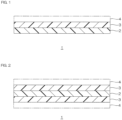
- the pressure-sensitive adhesive composition or the solution thereof is, as illustrated in FIG. 1 , applied to a substrate sheet 2, and as necessary dried and subjected to light irradiation.
- the conditions for the light irradiation are not especially limited as long as the reaction product in the pressure-sensitive adhesive composition is enabled to cross-link. In this manner, a pressure-sensitive adhesive layer 3 can be formed.
- the pressure-sensitive adhesive composition or the solution thereof is applied to the substrate sheet 2 and dried without allowing the components to react with each other. During the drying, the ⁇ -1,3-glucan derivative and functional group-containing acryl compound in the pressure-sensitive adhesive composition are allowed to partially or entirely react with each other. Thereafter, light irradiation is carried out. Also in this manner, a pressure-sensitive adhesive layer 3 can be formed.
- a ⁇ -1,3-glucan derivative is dissolved in the solvent to prepare a solution.
- concentration of the solid content in the solution is, for example, 1% by weight or more and 30% by weight or less.
- the functional group-containing acryl compound is blended into the solution and heated.
- the heating temperature is, for example, 30°C or more, 90°C or less, preferably 70°C or less.
- the heating time is, for example, 30 minutes or more, 10 hours or less, preferably 5 hours or less.
- a photo-radical generator and, as necessary, a radically polymerizable monomer and an additive is(are) blended into the solution containing the reaction product to prepare a solution of the pressure-sensitive adhesive composition.
- the solution of the pressure-sensitive adhesive composition is applied to the substrate sheet 2 as illustrated in FIG. 1 and, as necessary, dried and subjected to light irradiation.
- the drying temperature is, for example, 30°C or more and 150°C or less.
- the drying time is, for example, 1 minute or more and 1 hour or less.
- the light irradiation is preferably UV light irradiation, and the amount of irradiation light is appropriately set depending on the area or thickness of the pressure-sensitive adhesive layer.
- the solution of the pressure-sensitive adhesive composition may be applied to the substrate sheet 2 and dried at a relatively low temperature (for example, 60°C or less), and subjected to light irradiation, and dried again at a relatively high temperature (for example, 100°C or more).
- a relatively low temperature for example, 60°C or less
- a relatively high temperature for example, 100°C or more
- a pressure-sensitive adhesive layer 3 can be formed.
- a pressure-sensitive adhesive tape 1 including a substrate sheet 2 and a pressure-sensitive adhesive layer 3 is produced.
- the pressure-sensitive adhesive layer 3 has a thickness of, for example, 1 ⁇ m or more, and, for example, 1000 ⁇ m or less.
- the thickness of the pressure-sensitive adhesive tape 1 is, for example, 2 ⁇ m or more, and, for example, 1100 ⁇ m or less.
- the pressure-sensitive adhesive tape 1 may include a substrate sheet 2 and a pressure-sensitive adhesive layer 3 disposed on both of the front and back surfaces of the substrate sheet 2.
- a substrate-less pressure-sensitive adhesive tape 1 that only includes a pressure-sensitive adhesive layer 3 can be produced without using a substrate sheet 2.
- the pressure-sensitive adhesive tape 1 consists of only a pressure-sensitive adhesive layer 3.
- the pressure-sensitive adhesive tape 1 may further include a release sheet 4 disposed on the front surface of the pressure-sensitive adhesive layer 3.
- the ⁇ -1,3-glucan derivative and the functional group-containing acryl compound are allowed to react with each other by heat. More specifically, in the pressure-sensitive adhesive composition of the present invention, first, the hydroxyl-group-reactive functional group is easily thermally reacted with the hydroxyl group corresponding to the above-described degree of substitution of the acyl group, thereby generating a reaction product having a (meth)acryloyl group.
- the thermal reaction of the (meth)acryloyl group of the reaction product is suppressed while the cross-linkage of the (meth)acryloyl group of the reaction product is caused by light.
- the pressure-sensitive adhesive composition of the present invention is heated, the gelatinization is suppressed.
- the pressure-sensitive adhesive composition can be applied to a substrate sheet, and excellent handleability and storage stability are maintained for a long period of time.
- the pressure-sensitive adhesive composition of the present invention further contains a radically polymerizable monomer, the gelatinization can further be suppressed.
- the gelatinization can further be suppressed.
- a reaction vessel equipped with a condenser tube, a nitrogen introduction tube, a thermometer, and a stirrer was charged with 13.3 g of a ⁇ -1,3-glucan (manufactured by Euglena Co., Ltd.: 82.03 mmol of glucose parts) and 1000 mL of dehydrated pyridine (manufactured by FUJIFILM Wako Pure Chemical Corporation), and the mixture was stirred at a temperature of 60°C under nitrogen atmosphere for 0.5 hours.
- 133.05 mL of Myristoylchloride (492.2 mmol: manufactured by FUJIFILM Wako Pure Chemical Corporation) was added to the pyridine solution and thereafter the mixture was heated to 60°C, and stirred for 1 hour. In this manner, a reaction mixture solution was prepared.
- a solid intermediate product was produced from the reaction mixture solution.
- 2000 mL of methanol was added to the reaction mixture solution and the mixture was cooled to a room temperature.
- the generated solid product was taken out and dissolved into 600 mL of toluene, thereby preparing a toluene solution.
- the toluene solution was poured into 2000 mL of methanol that was being stirred, thereby yielding a solid product.
- the solid product was washed by repeating dissolving the solid product into toluene and pouring the dissolved solution into methanol three times, thereby yielding a solid product.
- the solid product was dried under reduced pressure at 60°C for 4 hours.
- the myristoylated ⁇ -1,3-glucan is a ⁇ -1,3-glucan derivative obtained by introducing myristoyl into a ⁇ -1,3-glucan.
- the degree of substitution of the myristoyl group in the myristoylated ⁇ -1,3-glucan was determined with 1 H-NMR.
- the signal of the hydrogen atom forming the hydroxyl group in the glucose units and the signal of the hydrogen atom forming myristoyl (C 13 H 27 CO) were separately detected.
- the degree of substitution of the myristoyl group (the acyl group) was determined.
- the degree of substitution (DS) was 2.9.
- the degree of substitution (DS) of the acyl group in the ⁇ -1,3-glucan derivative in each Synthesis Example below was determined in the same manner as described above.
- a myristoylated ⁇ -1,3-glucan was produced by the same process as in Synthesis Example 1. However, the blending amount of myristoyl chloride was changed from 133.05 mL (492.2 mmol) to 110.87 mL (410.1 mmol). The degree of substitution of the myristoyl group by 1 H-NMR was 2.8.
- a myristoylated ⁇ -1,3-glucan was produced by the same process as in Synthesis Example 1. However, the blending amount of myristoyl chloride was changed from 133.05 mL (492.2 mmol) to 88.7 mL (328.1 mmol). The degree of substitution of the myristoyl group by 1 H-NMR was 2.7.
- a myristoylated ⁇ -1,3-glucan was produced by the same process as in Synthesis Example 1. However, the temperature at the reaction was changed from 60°C to 92°C. The degree of substitution of the myristoyl group by 1 H-NMR was 3.0.
- a myristoylated ⁇ -1,3-glucan was produced by the same process as in Synthesis Example 1. However, the blending amount of myristoyl chloride was changed from 133.05 mL (492.2 mmol) to 66.52 mL (246.1 mmol). The degree of substitution of the myristoyl group by 1 H-NMR was 2.5.
- the myristoylated ⁇ -1,3-glucan of Synthesis Example 1 was dissolved into toluene, thereby preparing a toluene solution of the concentration of the solid content of 10% by weight.
- Karenz AOI manufactured by Showa Denko K. K., 2-acryloyloxyethylisocyanate
- a functional group-containing acryl compound was blended into the prepared toluene solution.
- the mixture was heated at 60°C for 3 hours, and cooled to a room temperature.
- Omnirad 651 manufactured by IGM Resins B.V., intramolecular cleavage type, benzil ketal
- a UV radical generator 0.1 parts by weight of Omnirad 651 (manufactured by IGM Resins B.V., intramolecular cleavage type, benzil ketal) was added as a UV radical generator. In this manner, a toluene solution of the pressure-sensitive adhesive composition was produced.
- the toluene solution of the pressure-sensitive adhesive composition was applied using an applicator (manufactured by TESTER SANGYO CO,. LTD.), heated at 50°C for 5 minutes, and subjected to UV irradiation (3.0 mW/cm 2 , 900 mJ/cm 2 ), and thereafter further heated at 120°C for 5 minutes to dry the toluene solution.
- an applicator manufactured by TESTER SANGYO CO,. LTD.
- the myristoylated ⁇ -1,3-glucan of Synthesis Example 1 was dissolved into toluene, thereby preparing a toluene solution of the concentration of the solid content of 10% by weight.
- Karenz AOI manufactured by Showa Denko K. K., 2-acryloyloxyethylisocyanate
- the blending amount of Karenz AOI relative to 100 parts by weight of the solid content (myristoylated ⁇ -1,3-glucan) of the toluene solution was 3.7 parts by weight.
- the mixture was heated at 60°C for 3 hours, and cooled to a room temperature.
- Example 5 was carried out in the same manner as Example 4.
- Example 6 was carried out in the same manner as Example 4.
- Example 7 was carried out in the same manner as Example 4.
- Example 8 was carried out in the same manner as Example 4.
- Example 9 was carried out in the same manner as Example 4.
- Example 10 was carried out in the same manner as Example 4.
- Example 11 was carried out in the same manner as Example 4.
- Comparative Example 1 was carried out in the same manner as Example 1.
- the myristoylated ⁇ -1,3-glucan of Synthesis Example 1 was dissolved into toluene, thereby preparing a toluene solution of the concentration of the solid content of 10% by weight.
- CORONATE L manufactured by TOSOH CORPORATION, a trimethylol propane adduct of tolylenediisocyanate
- TOSOH CORPORATION a trimethylol propane adduct of tolylenediisocyanate
- the blending amount of CORONATE L relative to 100 parts by weight of the solid content (myristoylated ⁇ -1,3-glucan) of toluene solution was 1.0 part by weight. In this manner, a toluene solution of the pressure-sensitive adhesive composition was produced.
- Octanoylated ⁇ -1,3-glucan was produced by the same process as in Synthesis Example 1. However, myristoylchloride was changed to octanoylchloride, and the blending amount of the octanoylchloride was changed from 133.05 mL (492.2 mmol) to 84.0 mL (492.2 mmol). The degree of substitution of the myristoyl group by 1 H-NMR was 2.9.
- a width 10 mm ⁇ length 100 mm piece was cut from the pressure-sensitive adhesive tape of each of Examples, Comparative Examples, and Reference Example.
- a pressure-sensitive adhesive surface of the cut piece was bonded to an adherend made of a bakelite plate by pressure bonding operation of reciprocating a 2Kg roller once so that the pressure-sensitive adhesive area became width 10 mm ⁇ length 20 mm, thereby producing an adherend sample 7 as illustrated in FIG. 4 .
- the adherend sample 7 was left to stand in 23°C atmosphere for 30 minutes, and thereafter further left to stand in 80°C atmosphere for 30 minutes. Subsequently, a load of 0.5 kg was applied to a lower end portion of the pressure-sensitive adhesive tape 1.
- the pressure-sensitive adhesive tape 1 was left to stand in 80°C atmosphere for 1 hour (60 minutes). Thereafter, the length (mm) of the slide of the pressure-sensitive adhesive tape 1 relative to the adherend 6 was measured, and the measured length was obtained as a "holding force". In the case that the pressure-sensitive adhesive tape 1 fell off during the test, the time (minute) when the tape fell off was specified. Further, in the case that the pressure-sensitive adhesive tape 1 fell off, the release mode was noted in parenthesis.
- the toluene solution of the pressure-sensitive adhesive composition of each of Examples, Comparative Examples, and Reference Example was heated at 60°C for 3 hours. Then, it was visually checked whether the toluene solution flew or not. The case in which the toluene solution flew and was applicable was evaluated as "Good”. The case in which the toluene solution did not flow and was difficult to apply was evaluated as "Bad”.
- the toluene solution used for the above-described evaluation of pot life at a high temperature was further stirred at 8000 rpm for 5 minutes, and the appearance of the toluene solution was evaluated.
- the visual check of the size of the gel was used as the criterion, and determined according to Table 1 below.
- the pressure-sensitive adhesive composition of the present invention is used, for example, for a pressure-sensitive adhesive tape.
Landscapes
- Chemical & Material Sciences (AREA)
- Organic Chemistry (AREA)
- Health & Medical Sciences (AREA)
- Life Sciences & Earth Sciences (AREA)
- Chemical Kinetics & Catalysis (AREA)
- Medicinal Chemistry (AREA)
- Polymers & Plastics (AREA)
- Molecular Biology (AREA)
- General Health & Medical Sciences (AREA)
- Engineering & Computer Science (AREA)
- Biochemistry (AREA)
- Materials Engineering (AREA)
- Adhesives Or Adhesive Processes (AREA)
- Addition Polymer Or Copolymer, Post-Treatments, Or Chemical Modifications (AREA)
- Adhesive Tapes (AREA)
- Graft Or Block Polymers (AREA)
Abstract
Description
- The present invention relates to a pressure-sensitive adhesive composition and a pressure-sensitive adhesive tape.
- A pressure-sensitive adhesive composition containing a β-1,3-glucan derivative obtained by introducing an acyl group into a β-1,3-glucan has been known (for example, see
Patent document 1 below). The pressure-sensitive adhesive described inPatent document 1 includes a β-1,3-glucan derivative of which acyl group has a degree of substitution of 1.0 or more and 3.0 or less. -
Patent Document 1Japanese Unexamined Patent Publication No. 2018-154723 - Recently, a higher level of adhesion has been required. However, the pressure-sensitive adhesive composition described in
Patent document 1 is disadvantageous in that it does not meet the above-described requirement. - Further, such a pressure-sensitive adhesive composition is required to have a high holding force under high-temperature atmosphere. When a pressure-sensitive adhesive composition has a high holding force under high-temperature atmosphere, the sliding distance of an adherend is short after a predetermined period of time has passed since the adhering of the adherend under high-temperature atmosphere. The pressure-sensitive adhesive composition described in
Patent document 1 is disadvantageous in that it does not meet the above-described requirement. - The present invention provides a pressure-sensitive adhesive composition and a pressure-sensitive adhesive tape, both of which have high adhesion and also have a high holding force under high-temperature atmosphere.
- The present invention [1] includes a pressure-sensitive adhesive composition including: a β-1,3-glucan derivative obtained by introducing an acyl group into a β-1,3-glucan, the β-1,3-glucan derivative having a degree of substitution of the acyl group of 2.6 or more and less than 3.0, and a compound having both of a (meth)acryloyl group and a hydroxyl-group-reactive functional group, and/or a reaction product of the β-1,3-glucan derivative and the compound having both of a (meth)acryloyl group and a hydroxyl-group-reactive functional group; and a photo-radical generator.
- The present invention [2] includes the pressure-sensitive adhesive composition described in the above-described [1], wherein the hydroxyl-group-reactive functional group of the compound is an isocyanate group.
- The present invention [3] includes the pressure-sensitive adhesive composition described in the above-described [1] or [2], wherein the compound is isocyanatoalkyl (meth)acrylate.
- The present invention [4] includes the pressure-sensitive adhesive composition described in the above-described [1] to [3], wherein the content ratio of the compound to 100 parts by weight of the β-1,3-glucan derivative is 1 part by weight or more and 20 parts by weight or less.
- The present invention [5] includes the pressure-sensitive adhesive composition described in the above-described [1] to [4], further including: a radically polymerizable monomer.
- The present invention [6] includes the pressure-sensitive adhesive composition described in the above-described [5], wherein the radically polymerizable monomer has a carboxyl group.
- The present invention [7] includes the pressure-sensitive adhesive composition described in the above-described [5] or [6], wherein the radically polymerizable monomer is a (meth)acrylic acid ester in which a remaining group bonding with the (meth)acryloyl group has repeating units.
- The present invention [8] includes the pressure-sensitive adhesive composition described in the above-described [5] to [7], wherein the content ratio of the radically polymerizable monomer to 100 parts by weight of the β-1,3-glucan derivative is 0.01 parts by weight or more and 10 parts by weight or less.
- The present invention [9] includes the pressure-sensitive adhesive composition described in the above-described [1] to [8], wherein the photo-radical generator is a benzyl ketal-based compound.
- The present invention [10] includes the pressure-sensitive adhesive composition described in the above-described [1] to [9], wherein the content ratio of the photo-radical generator to 100 parts by weight of the β-1,3-glucan derivative is 0.01 parts by weight or more and 5 parts by weight or less.
- The present invention [11] includes a pressure-sensitive adhesive tape including: a pressure-sensitive adhesive layer made of a pressure-sensitive adhesive composition described in any one of the above-described [1] to [10].
- A β-1,3-glucan derivative and a compound containing both of a (meth)acryloyl group and a hydroxyl-group-reactive functional group are allowed to react with each other by heat. On the other hand, the thermal reaction of the (meth)acryloyl group of their reaction product is suppressed. Thus, in the pressure-sensitive adhesive composition of the present invention, while the cross-linkage that is promoted by heat in the reaction product is suppressed, the reaction product is enabled to cross-link by light irradiation at an arbitrary time.
- As a result, in the pressure-sensitive adhesive composition of the present invention, while gelatinization by heat is suppressed, a cross-linkage can be formed at an arbitrary time. This increases the adhesion and achieves an excellent holding force under high-temperature atmosphere.
-
-
FIG. 1 is a cross-sectional view of one embodiment of the pressure-sensitive adhesive tape of the present invention. -
FIG. 2 is a cross-sectional view of another embodiment of the pressure-sensitive adhesive tape. -
FIG. 3 is a cross-sectional view of another embodiment of the pressure-sensitive adhesive tape. -
FIG. 4 is a schematic view of the measurement of the holding force in Example. - The pressure-sensitive adhesive composition of the present invention contains a β-1,3-glucan derivative, and a compound containing both of a (meth)acryloyl group and a hydroxyl-group-reactive functional group, and/or a reaction product of the β-1,3-glucan derivative and the compound having both of a (meth)acryloyl group and a hydroxyl-group-reactive functional group, and a photo-radical generator.
- The β-1,3-glucan derivative is a base polymer in the pressure-sensitive adhesive composition. The β-1,3-glucan derivative is a partially-acylated compound obtained by acylating a part of the hydroxy group in the glucose contained in a β-1,3-glucan with an acyl group. In other words, the β-1,3-glucan derivative is an acyl compound obtained by introducing an acyl group into a β-1,3-glucan.
- The acyl group is shown as RCO-. Examples of R include a hydrocarbon group. Examples of the hydrocarbon group include an aliphatic hydrocarbon group, an alicyclic hydrocarbon group, and an aromatic hydrocarbon group. An aliphatic hydrocarbon group is preferably used.
- Examples of the aliphatic hydrocarbon group include a saturated aliphatic hydrocarbon group and an unsaturated aliphatic hydrocarbon group. Examples of the saturated aliphatic hydrocarbon group include an alkyl group.
- Examples of the alkyl group include a straight-chain alkyl group and a branched alkyl group. A straight-chain alkyl group is preferably used. The alkyl group has carbon atoms of, for example, 3 or more, and, for example, 18 or less. Examples of the straight-chain alkyl group include propyl, butyl, pentyl, hexyl, heptyl, octyl, nonyl, decyl, undecyl, dodecyl, tridecyl, tetradecyl, pentadecyl, hexadecyl, heptadecyl, and octadecyl. Examples of the branched alkyl group include ethylhexyl.
- Examples of the unsaturated aliphatic hydrocarbon group include an alkenyl group. The alkenyl group has carbon atoms of, for example, 3 or more and 18 or less. Examples of the alkenyl group include heptadecenyl.
- The hydrocarbon group (R in RCO-) has carbon atoms of preferably 7 or more, more preferably 9 or more, even more preferably 11 or more, and preferably 15 or less. When the number of carbon atoms of the hydrocarbon group is the above-described lower limit or more and the upper limit or less, the adhesion sufficiently improves.
- Specific examples of the acyl group include butanoyl (an example when R in RCO is C3H7), pentanoyl (an example when R in RCO is C4H9), hexanoyl (an example when R in RCO is C5H11), heptanoyl (an example when R in RCO is C6H13), octanoyl (an example when R in RCO is C7H15), nonanoyl (an example when R in RCO is C8H17), decanoyl (an example when R in RCO is C9H19), lauroyl (i.e., dodecanoyl) (when R in RCO is C11H23), myristoyl (i.e., tetradecanoyl) (an example when R in RCO is C13H27), palmitoyl (i.e., hexadecanoyl) (an example when R in RCO is C15H31), stearoyl (i.e., octadecanoyl) (an example when R in RCO is C17H35), oleoyl (an example when R in RCO is C17H33) and nonadecanoyl (an example when R in RCO is C18H37). Octanoyl, nonanoyl, decanoyl, lauroyl, myristoyl, and palmitoyl are preferably used.
- In the present invention, the lower limit of the degree of substitution of the acyl group in the β-1,3-glucan derivative is 2.6. When the degree of substitution of the acyl group is less than 2.6, an excessive amount of the hydroxyl group remains in the β-1,3-glucan derivative. In other words, the interaction between the molecular chains of the β-1,3-glucan derivative becomes too strong. Thus, the pressure-sensitive adhesive composition becomes hard. As a result, the adhesion of the pressure-sensitive adhesive composition decreases.
- The degree of substitution of the acyl group may be referred to as DS. The degree of substitution of the acyl group in the β-1,3-glucan derivative is the average number of replacements of the hydroxyl group with an acyl group (introductions of an acyl group to the hydroxyl group) among the three hydroxyl groups in a unit of 0-1,3-glucan. Thus, theoretically, the upper limit of the degree of substitution of the acyl group in the β-1,3-glucan derivative is 3.0.
- In the present invention, the degree of substitution of the acyl group in the β-1,3-glucan derivative is less than 3.0. When the degree of substitution of the acyl group in the β-1,3-glucan derivative is 3.0, the hydroxyl groups do not remain in the β-1,3-glucan derivative. Thus, there is no cross-linkage point in the β-1,3-glucan derivative. And the compound having both of the (meth)acryloyl group and the hydroxyl-group-reactive functional group is not allowed to react. Thus, even if light irradiation is carried out thereafter, no cross-linkage occurs. Therefore, the holding force of the pressure-sensitive adhesive composition decreases.
- The degree of substitution of the acyl group in the β-1,3-glucan derivative is preferably 2.7 or more, 2.8 or more, and also, for example, 2.9 or less, preferably 2.8 or less.
- The type, physical properties, and production method of the β-1,3-glucan derivative are described, for example, in
Japanese Unexamined Patent Publication No. 2018-154723 Japanese Unexamined Patent Publication No. 2015-124183 WO2014-077340 . - The ratio of the β-1,3-glucan derivative in the pressure-sensitive adhesive composition is, for example, 80% by weight or more, and, for example, 99.99% by weight or less.
- The compound having both of a (meth)acryloyl group and a hydroxyl-group-reactive functional group is a compound having both a (meth)acryloyl group and a hydroxyl group functional group in one molecule. The compound having both of a (meth)acryloyl group and a hydroxyl-group-reactive functional group may be abbreviated as a functional group-containing acryl compound.
- The (meth)acryloyl group means an acryloyl group and/or a methacryloyl group. The functional group-containing acryl compound may have one or two or more (meth)acryloyl group(s) per one molecule, and preferably has one (meth)acryloyl group per one molecule.
- The hydroxyl-group-reactive functional group means a functional group capable of reacting with the hydroxyl group of the β-1,3-glucan derivative. The functional group-containing acryl compound may have one or two or more hydroxyl-group-reactive functional group(s) per one molecule, and preferably has one hydroxyl-group-reactive functional group.
- Examples of the hydroxyl-group-reactive functional group include isocyanate, epoxy, alkoxysilyl, acid anhydride, and carboxylic acid chloride. In terms of facilitating the reaction with a hydroxyl group, isocyanate is preferably used.
- Examples of the functional group-containing acryl compound include an isocyanate-containing acryl compound, an epoxy-containing acryl compound, an alkoxysilyl-containing acryl compound, an acid anhydride-containing acryl compound, and a carboxylic acid chloride-containing acryl compound.
- These functional group-containing acryl compounds may be used alone or in a combination of two or more.
- An isocyanate-containing acryl compound and an epoxy-containing acryl compound (for example, glycidyl (meth)acrylate) are preferably used. In terms of facilitating the reaction with a hydroxyl group, an isocyanate-containing acryl compound is preferably used.
- Examples of the isocyanate-containing acryl compound include isocyanatoalkyl (meth)acrylate and (meth)acryloyl (poly) oxyalkylene alkyl isocyanate. These isocyanate-containing acryl compounds may be used alone or in a combination of two or more.
- Examples of the isocyanatoalkyl (meth)acrylate include isocyanatoalkyl (meth)acrylate having alkyl group of 1 to 4 carbon atom(s). Specifically, examples thereof include isocyanatomethyl (meth)acrylate, isocyanatoethyl (meth)acrylate, isocyanatopropyl (meth)acrylate, and isocyanatobutyl (meth)acrylate.
- Examples of the (meth)acryloyl (poly)oxyalkylene alkyl isocyanate include (meth)acryloylpolyoxyethylene ethyl isocyanate and (meth)acryloyloxyethyloxyethylisocyanate.
- As the isocyanate-containing acryl compound, isocyanatoalkyl (meth)acrylate is preferably used. Isocyanatoethyl (meth)acrylate is more preferably used. 2-isocyanatoethylacrylate is even more preferably used.
- As such an isocyanate-containing acryl compound, a commercially available product may be used. Example the product include Karenz AOI (manufactured by Showa Denko K. K., 2-isocyanatoethylacrylate), Karenz MOI (manufactured by Showa Denko K. K., 2-isocyanatoethyl methacrylate), and Karenz MOI-EG (manufactured by Showa Denko K. K., 2-(2-methacryloyloxyethyloxy)ethylisocyanate). Karenz AOI (manufactured by Showa Denko K. K., 2-isocyanatoethylacrylate) is preferably used.
- Relative to 100 parts by weight of the β-1,3-glucan derivative, the functional group-containing acryl compound is, for example, 1 part by weight or more, preferably 3 parts by weight or more, more preferably 5 parts by weight or more. When the part by weight of the functional group-containing acryl compound relative to 100 parts by weight of the β-1,3-glucan derivative is the above-described lower limit or more, the holding force of the pressure-sensitive adhesive composition further more increases.
- Relative to 100 parts by weight of the β-1,3-glucan derivative, the functional group-containing acryl compound is, for example, 50 parts by weight or less, preferably 25 parts by weight or less, more preferably 15 parts by weight or less, even more preferably 10 parts by weight or less. When the part by weight of the functional group-containing acryl compound relative to 100 parts by weight of the β-1,3-glucan derivative is the above-described upper limit or less, the holding force of the pressure-sensitive adhesive composition further more increases.
- The functional group-containing acryl compound is preferably blended in an amount in which an equivalent ratio (hydroxyl-group-reactive functional group/hydroxyl group) is in excess of 1 and 3 or less so that the hydroxyl-group-reactive functional group of the functional group-containing acryl compound exceeds the hydroxyl group of the β-1,3-glucan derivative.
- The photo-radical generator is a compound that generates radical as an active species by light (for example, radiation (gamma rays, X rays, etc.), ultraviolet rays, visible light) irradiation. The photo-radical generator is not especially limited and is selected depending on the wavelength of the light used for the irradiation.
- The photo-radical generator is a compound that generates radical by the bond cleavage and/or hydrogen abstraction by light irradiation. Examples of the photo-radical generator include a benzyl ketal-based compound, an α-hydroxyketone-based photopolymerization initiator, an α-amino ketone-based photopolymerization initiator, an acyl phosphineoxide-based photopolymerization initiator, an oximeester-based photopolymerization initiator, an acridine-based photopolymerization initiator, a titanocene-based photopolymerization initiator, a benzophenone-based photopolymerization initiator, an acetophenone-based photopolymerization initiator, an aromatic ketoester-based photopolymerization initiator, and a benzoic acid ester-based photopolymerization initiator.
- The above-described photo-radical generators are used alone or in a combination of two or more.
- As the photo-radical generator, a benzyl ketal-based compound is preferably used.
- As the photo-radical generator, a commercially available product may be used. Examples of the product include Omnirad 184, 369, 500, 651, 819, 907, 784, 2959 (all of which are manufactured by IGM Resins B.V.), CGI-1700, -1750, -1850, CG 24-61, Darocur 1116 and 1173 (all of which are manufactured by BASF).
- As the photo-radical generator, Omnirad 651 that is a benzyl ketal-based compound is preferably used.
- Relative to 100 parts by weight of the β-1,3-glucan derivative, the photo-radical generator is, for example, 0.01 parts by weight or more, preferably 0.05 parts by weight or more, more preferably 0.075 parts by weight or more, even more preferably 0.1 parts by weight or more. When the part by weight of the photo-radical generator relative to 100 parts by weight of the β-1,3-glucan derivative is the above-described lower limit or more, the pressure-sensitive adhesive composition can have an even higher holding force.
- Relative to 100 parts by weight of the β-1,3-glucan derivative, the photo-radical generator is, for example, 5 parts by weight or less, preferably 1 part by weight or less, more preferably 0.5 parts by weight or less, even more preferably 0.2 parts by weight or less. When the parts by weight of the photo-radical generator relative to 100 parts by weight of the β-1,3-glucan derivative is the above-described upper limit or less, the pressure-sensitive adhesive composition can have an even higher holding force.
- By mixing the above-described β-1,3-glucan derivative, functional group-containing acryl compound, and photo-radical generator in the above-described blending ratio, the pressure-sensitive adhesive composition of the present invention is obtained. In other words, the pressure-sensitive adhesive composition of the present invention contains the β-1,3-glucan derivative, the functional group-containing acryl compound, and the photo-radical generator .
- When a subsequent heating allows the β-1,3-glucan derivative and the functional group-containing acryl compound to react with each other and the pressure-sensitive adhesive composition of the present invention contains a reaction product of the derivative and the compound, the pressure-sensitive adhesive composition of the present invention contains the reaction product of the β-1,3-glucan derivative and the functional group-containing acryl compound and a photo-radical generator. In other words, the pressure-sensitive adhesive composition of the present invention contains a β-1,3-glucan derivative, and a functional group-containing acryl compound, and/or a reaction product thereof, and a photo-radical generator. When the pressure-sensitive adhesive composition contains a reaction product of the β-1,3-glucan derivative and the functional group-containing acryl compound and a photo-radical generator, and the β-1,3-glucan derivative and/or the functional group-containing acryl compound remain in the composition; the pressure-sensitive adhesive composition of the present invention contains the β-1,3-glucan derivative and/or the functional group-containing acryl compound (at least one of the β-1,3-glucan derivative and the functional group-containing acryl compound), the reaction product thereof, and the photo-radical generator.
- The present invention may further include a radically polymerizable monomer that is copolymerizable with the functional group-containing acryl compound. In such a case, the pressure-sensitive adhesive composition of the present invention contains a β-1,3-glucan derivative, a functional group-containing acryl compound, a photo-radical generator, and a radically polymerizable monomer. Alternatively, when a subsequent heating allows the β-1,3-glucan derivative to react with the functional group-containing acryl compound, and the pressure-sensitive adhesive composition of the present invention contains a reaction product thereof; the pressure-sensitive adhesive composition of the present invention contains the reaction product of the β-1,3-glucan derivative and the functional group-containing acryl compound, the photo-radical generator, and the radically polymerizable monomer. In other words, the pressure-sensitive adhesive composition of the present invention includes a β-1,3-glucan derivative, and a functional group-containing acryl compound, and/or a reaction product thereof, and a photo-radical generator, and further includes a radically polymerizable monomer. The pressure-sensitive composition of the present invention preferably includes a β-1,3-glucan derivative, and a functional group-containing acryl compound, and/or a reaction product of the β-1,3-glucan derivative and the functional group-containing acryl compound, and a photo-radical generator, and a radically polymerizable monomer. When the pressure-sensitive adhesive composition includes the reaction product of the β-1,3-glucan derivative and the functional group-containing acryl compound, the photo-radical generator, and the radically polymerizable monomer, and the β-1,3-glucan derivative and/or the functional group-containing acryl compound remain; the pressure-sensitive adhesive composition of the present invention includes the β-1,3-glucan derivative and/or the functional group-containing acryl compound (at least one of the β-1,3-glucan derivative and the functional group-containing acryl compound), the photo-radical generator, the reaction product of the β-1,3-glucan derivative and the functional group-containing acryl compound, and the radically polymerizable monomer.
- The radically polymerizable monomer is a monomer that has a radically polymerizable unsaturated double bond, and examples thereof include (meth)acryls, (meth)acrylamides, aromatic vinyls, vinyl esters, and acrylonitrils. (Meth)acryls are preferably used. (Meth)acryl means acryl and/or methacryl.
- Examples of (meth)acryls include a (meth)acrylic monomer and a (meth)acrylic oligomer.
- The (meth)acrylic monomer is (meth)acryls in which the remaining group bonding with the (meth)acryloyl group does not have repeating units, and examples thereof include a functional group-free (meth)acrylic monomer and a functional group-containing (meth)acrylic monomer.
- The functional group-free (meth)acrylic monomer is a (meth)acrylic monomer that does not have a functional group, and examples thereof include a (meth)acrylic acid alkyl ester.
- Examples of the (meth)acrylic acid alkyl ester include a (meth)acrylic acid alkyl ester having a straight chain or branched aliphatic alkyl group or an alicyclic alkyl group. Specifically, examples thereof include methyl (meth)acrylate, ethyl (meth)acrylate, butyl (meth)acrylate, 2-ethylhexyl (meth)acrylate, nonyl (meth)acrylate, lauryl (meth)acrylate, cyclohexyl (meth)acrylate, and isobomyl (meth)acrylate.
- The functional group-containing (meth)acrylic monomer is a (meth)acrylic monomer having a functional group other than the above-described hydroxyl-group-reactive functional group, and examples thereof include a carboxyl group-containing (meth)acrylic monomer and a hydroxy group-containing (meth)acrylic monomer.
- Examples of the carboxyl group-containing (meth)acrylic monomer include (meth)acrylic acid. Examples of the hydroxy group-containing (meth)acrylic monomer include a hydroxy group-containing (meth)acrylic acid ester. Examples of the hydroxy group-containing (meth)acrylic acid ester include 2-hydroxyethyl (meth)acrylate, 3-hydroxypropyl (meth)acrylate, and 4-hydroxybutyl (meth)acrylate.
- As the functional group-containing (meth)acrylic monomer, a hydroxy group-containing (meth)acrylic acid ester is preferably used, and 4-hydroxybutyl (meth)acrylate is more preferably used.
- A (meth)acrylic oligomer is (meth)acryls in which the remaining group bonding with the (meth)acryloyl group has repeating units (a (meth)acrylic acid ester in which the remaining group bonding with the (meth)acryloyl group has repeating units), and examples thereof include a functional group-free (meth)acrylic oligomer and a functional group-containing (meth)acrylic oligomer.
- The functional group-free (meth)acrylic oligomer is a (meth)acrylic oligomer that does not have a functional group, and examples thereof include alkoxy polyoxyalkylene glycol mono (meth)acrylate. Alkoxy polyoxyethylene glycol mono (meth)acrylate is preferably used. Methoxypolyoxyethylene glycol mono (meth)acrylate is more preferably used.
- The functional group-containing (meth)acrylic oligomer is a (meth)acrylic oligomer that has a functional group other than the above-described hydroxyl-group-reactive functional group, and examples thereof include a carboxyl group-containing (meth)acrylic oligomer and a hydroxy group-containing (meth)acrylic oligomer.
- Examples of the carboxyl group-containing (meth)acrylic oligomer include ω-carboxy-polycaprolactone mono(meth)acrylate.
- Examples of the hydroxy group-containing (meth)acrylic oligomer include polyoxyalkylene glycol mono(meth)acrylate.
- As the (meth)acrylic oligomer, a commercial available product may be used. Examples of the functional group-free (meth)acrylic oligomer include BLEMMER AME 400 (manufactured by NOF CORPORATION, methoxypolyethylene glycol-acrylate). Examples of the functional group-containing (meth)acrylic oligomer include Aronix M-5300 (manufactured by TOAGOSEI CO., LTD., ω-carboxy-polycaprolactone (n(degree of polymerization) ≈ 2)monoacrylate).
- Among these (meth)acryls, in terms of suppressing the gelatinization, functional group-containing (meth)acryls (i.e., a functional group-containing (meth)acrylic monomer and a functional group-containing (meth)acrylic oligomer) are preferably used, and carboxyl group-containing (meth)acryls (i.e., a carboxyl group-containing (meth)acrylic monomer ((meth)acrylic acid) and a carboxyl group-containing (meth)acrylic oligomer) are more preferably used. In other words, the radically polymerizable monomer preferably has a carboxyl group.
- Similarly, in terms of suppressing the gelatinization, a (meth)acrylic oligomer is also preferably used, and a functional group-containing (meth)acrylic oligomer is more preferably used, and a carboxyl group-containing (meth)acrylic oligomer is even more preferably used.
- These radically polymerizable monomers may be used alone or in a combination of two or more.
- Relative to 100 parts by weight of the β-1,3-glucan derivative, the radically polymerizable monomer is, for example, 0.001 parts by weight or more, preferably 0.01 parts by weight or more, more preferably 0.1 parts by weight or more, even more preferably 1 part by weight or more, most preferably 3 parts by weight or more. When the part by weight of the radically polymerizable monomer relative to 100 parts by weight of the β-1,3-glucan derivative is the above-described lower limit or more, the gelatinization of the pressure-sensitive adhesive composition can further be suppressed.
- Relative to 100 parts by weight of the β-1,3-glucan derivative, the radically polymerizable monomer is, for example, 100 parts by weight or less, preferably 10 parts by weight or less, more preferably 7 parts by weight or less. When the part by weight of the radically polymerizable monomer relative to 100 parts by weight of the β-1,3-glucan derivative is the above-described upper limit or less, the pressure-sensitive adhesive composition can exhibit an excellent holding force.
- Relative to 100 parts by weight of the functional group-containing acryl compound, the radically polymerizable monomer is, for example, 0.25 parts by weight or more, preferably 2.5 parts by weight or more, more preferably 25 parts by weight or more, even more preferably 50 parts by weight or more, particularly preferably 100 parts by weight or more. When the part by weight of the radically polymerizable monomer relative to 100 parts by weight of the functional group-containing acryl compound is the above-described lower limit or more, the gelatinization of the pressure-sensitive adhesive composition can further be suppressed.
- Relative to 100 parts by weight of the functional group-containing acryl compound, the radically polymerizable monomer is, for example, 2500 parts by weight or less, preferably 250 parts by weight or less, more preferably 200 parts by weight or less, even more preferably 150 parts by weight or less. When the part by weight of the radically polymerizable monomer relative to 100 parts by weight of the functional group-containing acryl compound is the above-described upper limit or less, the pressure-sensitive adhesive composition can exhibit an excellent holding force.
- In the preparation of the above-described pressure-sensitive composition, the radically polymerizable monomer is mixed together with the β-1,3-glucan derivative, the functional group-containing acryl compound, and the photo-radical generator in the above-described blending ratio.
- The pressure-sensitive adhesive composition may contain an additive in an appropriate ratio in a range that does not inhibit the effects of the present application. Examples of the additive include another base polymer (acrylic resin), a cross-linkage agent (isocyanate-based, oxazoline-based, carbodiimide-based, or epoxy-based), a tackifier, a viscosity modifier, a leveling agent, a plasticizer, a filler, a stabilizer, a preservative, a cross-linkage accelerator, and an anti-aging agent.
- The pressure-sensitive adhesive tape of the present invention includes, for example, a pressure-sensitive adhesive film and a pressure-sensitive adhesive sheet, and denotes a double-sided pressure-sensitive adhesive tape (a pressure-sensitive adhesive layer alone, substrate-less) without a substrate sheet, and a pressure-sensitive adhesive tape including a substrate sheet or a double-sided pressure-sensitive adhesive tape including a substrate sheet. The pressure-sensitive adhesive tape of the present invention preferably includes a pressure-sensitive adhesive layer consisting of the pressure-sensitive adhesive composition of the present invention on at least one side of the substrate sheet.
- Examples of the material of the substrate sheet include resin. Examples of the resin include polyester. The substrate sheet has a thickness of 0.5 µm or more, and, for example, 900 µm or less.
- To form the pressure-sensitive adhesive layer, first, in the preparation of the above-described pressure-sensitive adhesive composition, a solvent is mixed as necessary to prepare a solution of the pressure-sensitive adhesive composition. As the solvent, a known organic solvent may be used. Thereafter, by heating, the β-1,3-glucan derivative and functional group-containing acryl compound in the pressure-sensitive adhesive composition are allowed to entirely or partially react with each other. The conditions for the heating are not especially limited as long as the entire or partial reaction of the β-1,3-glucan derivative with the functional group-containing acryl compound is carried out. Thereafter, the pressure-sensitive adhesive composition or the solution thereof is, as illustrated in
FIG. 1 , applied to asubstrate sheet 2, and as necessary dried and subjected to light irradiation. The conditions for the light irradiation are not especially limited as long as the reaction product in the pressure-sensitive adhesive composition is enabled to cross-link. In this manner, a pressure-sensitive adhesive layer 3 can be formed. - Alternatively, the pressure-sensitive adhesive composition or the solution thereof is applied to the
substrate sheet 2 and dried without allowing the components to react with each other. During the drying, the β-1,3-glucan derivative and functional group-containing acryl compound in the pressure-sensitive adhesive composition are allowed to partially or entirely react with each other. Thereafter, light irradiation is carried out. Also in this manner, a pressure-sensitive adhesive layer 3 can be formed. - More specifically, for example, first, a β-1,3-glucan derivative is dissolved in the solvent to prepare a solution. The concentration of the solid content in the solution is, for example, 1% by weight or more and 30% by weight or less.
- Thereafter, the functional group-containing acryl compound is blended into the solution and heated. The heating temperature is, for example, 30°C or more, 90°C or less, preferably 70°C or less. The heating time is, for example, 30 minutes or more, 10 hours or less, preferably 5 hours or less. In this manner, a reaction product of the β-1,3-glucan derivative and the functional group-containing acryl compound is generated. Then, a photo-radical generator and, as necessary, a radically polymerizable monomer and an additive is(are) blended into the solution containing the reaction product to prepare a solution of the pressure-sensitive adhesive composition.
- Then, the solution of the pressure-sensitive adhesive composition is applied to the
substrate sheet 2 as illustrated inFIG. 1 and, as necessary, dried and subjected to light irradiation. The drying temperature is, for example, 30°C or more and 150°C or less. The drying time is, for example, 1 minute or more and 1 hour or less. The light irradiation is preferably UV light irradiation, and the amount of irradiation light is appropriately set depending on the area or thickness of the pressure-sensitive adhesive layer. - Alternatively, the solution of the pressure-sensitive adhesive composition may be applied to the
substrate sheet 2 and dried at a relatively low temperature (for example, 60°C or less), and subjected to light irradiation, and dried again at a relatively high temperature (for example, 100°C or more). - In this manner, a pressure-
sensitive adhesive layer 3 can be formed. - As described above, a pressure-sensitive
adhesive tape 1 including asubstrate sheet 2 and a pressure-sensitive adhesive layer 3 is produced. - The pressure-
sensitive adhesive layer 3 has a thickness of, for example, 1 µm or more, and, for example, 1000 µm or less. The thickness of the pressure-sensitiveadhesive tape 1 is, for example, 2 µm or more, and, for example, 1100 µm or less. - Further, as illustrated in
FIG. 2 , the pressure-sensitiveadhesive tape 1 may include asubstrate sheet 2 and a pressure-sensitive adhesive layer 3 disposed on both of the front and back surfaces of thesubstrate sheet 2. - Alternatively, as illustrated in
FIG. 3 , a substrate-less pressure-sensitiveadhesive tape 1 that only includes a pressure-sensitive adhesive layer 3 can be produced without using asubstrate sheet 2. The pressure-sensitiveadhesive tape 1 consists of only a pressure-sensitive adhesive layer 3. - As shown with the phantom lines of
FIGS. 1 and 2 , the pressure-sensitiveadhesive tape 1 may further include arelease sheet 4 disposed on the front surface of the pressure-sensitive adhesive layer 3. - In the pressure-sensitive adhesive composition of the present invention, the β-1,3-glucan derivative and the functional group-containing acryl compound are allowed to react with each other by heat. More specifically, in the pressure-sensitive adhesive composition of the present invention, first, the hydroxyl-group-reactive functional group is easily thermally reacted with the hydroxyl group corresponding to the above-described degree of substitution of the acyl group, thereby generating a reaction product having a (meth)acryloyl group.
- On the other hand, the thermal reaction of the (meth)acryloyl group of the reaction product is suppressed while the cross-linkage of the (meth)acryloyl group of the reaction product is caused by light. Thus, even when the pressure-sensitive adhesive composition of the present invention is heated, the gelatinization is suppressed. As a result, until light irradiation is carried out, the pressure-sensitive adhesive composition can be applied to a substrate sheet, and excellent handleability and storage stability are maintained for a long period of time.
- Further, subjecting the pressure-sensitive adhesive composition of the present invention to light irradiation at an arbitrary time enables the (meth)acryloyl group of the reaction product to cross-link. This can increase the adhesion, and achieve an excellent holding force under high-temperature atmosphere.
- Furthermore, when the pressure-sensitive adhesive composition of the present invention further contains a radically polymerizable monomer, the gelatinization can further be suppressed.
- In particular, when the radically polymerizable monomer has a carboxyl group in the pressure-sensitive adhesive composition of the present invention, the gelatinization can further be suppressed.
- Hereinafter, with reference to Synthesis Examples, Examples, Comparative Examples, and Reference Example, the present invention is more specifically described. The present invention is not limited to Synthesis Examples, Examples, Comparative Examples, and Reference Example in any way. The specific numeral values used in the description below, such as mixing ratios (contents), physical property values, and parameters can be replaced with the corresponding mixing ratios (contents), physical property values, and parameters in the above-described "DESCRIPTION OF EMBODIMENTS", including the upper limit values (numeral values defined with "or less", and "less than") or the lower limit values (numeral values defined with "or more", and "more than"). The "parts" and "%" are based on weight unless otherwise specified.
- A reaction vessel equipped with a condenser tube, a nitrogen introduction tube, a thermometer, and a stirrer was charged with 13.3 g of a β-1,3-glucan (manufactured by Euglena Co., Ltd.: 82.03 mmol of glucose parts) and 1000 mL of dehydrated pyridine (manufactured by FUJIFILM Wako Pure Chemical Corporation), and the mixture was stirred at a temperature of 60°C under nitrogen atmosphere for 0.5 hours. 133.05 mL of Myristoylchloride (492.2 mmol: manufactured by FUJIFILM Wako Pure Chemical Corporation) was added to the pyridine solution and thereafter the mixture was heated to 60°C, and stirred for 1 hour. In this manner, a reaction mixture solution was prepared.
- Thereafter, a solid intermediate product was produced from the reaction mixture solution. First, 1 hour after the beginning of the reaction, 2000 mL of methanol was added to the reaction mixture solution and the mixture was cooled to a room temperature. Next, the generated solid product was taken out and dissolved into 600 mL of toluene, thereby preparing a toluene solution. The toluene solution was poured into 2000 mL of methanol that was being stirred, thereby yielding a solid product. The solid product was washed by repeating dissolving the solid product into toluene and pouring the dissolved solution into methanol three times, thereby yielding a solid product. The solid product was dried under reduced pressure at 60°C for 4 hours.
- In this manner, a myristoylated β-1,3-glucan was produced. In other words, the myristoylated β-1,3-glucan is a β-1,3-glucan derivative obtained by introducing myristoyl into a β-1,3-glucan.
- Further, the degree of substitution of the myristoyl group in the myristoylated β-1,3-glucan was determined with 1H-NMR. In the 1H-NMR, the signal of the hydrogen atom forming the hydroxyl group in the glucose units and the signal of the hydrogen atom forming myristoyl (C13H27CO) were separately detected. Based on the value of integral of each of the two signals, the degree of substitution of the myristoyl group (the acyl group) was determined. As a result, the degree of substitution (DS) was 2.9.
- The degree of substitution (DS) of the acyl group in the β-1,3-glucan derivative in each Synthesis Example below was determined in the same manner as described above.
- A myristoylated β-1,3-glucan was produced by the same process as in Synthesis Example 1. However, the blending amount of myristoyl chloride was changed from 133.05 mL (492.2 mmol) to 110.87 mL (410.1 mmol). The degree of substitution of the myristoyl group by 1H-NMR was 2.8.
- A myristoylated β-1,3-glucan was produced by the same process as in Synthesis Example 1. However, the blending amount of myristoyl chloride was changed from 133.05 mL (492.2 mmol) to 88.7 mL (328.1 mmol). The degree of substitution of the myristoyl group by 1H-NMR was 2.7.
- A myristoylated β-1,3-glucan was produced by the same process as in Synthesis Example 1. However, the temperature at the reaction was changed from 60°C to 92°C. The degree of substitution of the myristoyl group by 1H-NMR was 3.0.
- A myristoylated β-1,3-glucan was produced by the same process as in Synthesis Example 1. However, the blending amount of myristoyl chloride was changed from 133.05 mL (492.2 mmol) to 66.52 mL (246.1 mmol). The degree of substitution of the myristoyl group by 1H-NMR was 2.5.
- The myristoylated β-1,3-glucan of Synthesis Example 1 was dissolved into toluene, thereby preparing a toluene solution of the concentration of the solid content of 10% by weight.
- Karenz AOI (manufactured by Showa Denko K. K., 2-acryloyloxyethylisocyanate) as a functional group-containing acryl compound was blended into the prepared toluene solution. Relative to 100 parts by weight of the solid content (myristoylated β-1,3-glucan) of the toluene solution, the blending amount of Karenz AOI was 3.7 parts by weight (NCO group in Karenz AOI/OH group in the β-1,3-glucan derivative = 2). The mixture was heated at 60°C for 3 hours, and cooled to a room temperature. Thereafter, 0.1 parts by weight of Omnirad 651 (manufactured by IGM Resins B.V., intramolecular cleavage type, benzil ketal) was added as a UV radical generator. In this manner, a toluene solution of the pressure-sensitive adhesive composition was produced.
- To a front surface of a polyester substrate (manufactured by TORAY INDUSTRIES, INC.: Lumirror S-10, a thickness of 25 µm) as a substrate sheet, the toluene solution of the pressure-sensitive adhesive composition was applied using an applicator (manufactured by TESTER SANGYO CO,. LTD.), heated at 50°C for 5 minutes, and subjected to UV irradiation (3.0 mW/cm2, 900 mJ/cm2), and thereafter further heated at 120°C for 5 minutes to dry the toluene solution.
- In this manner, a pressure-sensitive adhesive tape including the substrate sheet and a pressure-sensitive adhesive layer having a thickness of 50 µm was produced.
- Except that the myristoylated β-1,3-glucan of Synthesis Example 2 was used and the blending amount of Karenz AOI was changed from 3.7 parts by weight to 7.5 parts by weight (NCO group in Karenz AOI/OH group in the β-1,3-glucan derivative = 2), Example 2 was carried out in the same manner as Example 1.
- Except that the myristoylated β-1,3-glucan of Synthesis Example 3 was used and the blending amount of Karenz AOI was changed from 3.7 parts by weight to 11.6 parts by weight (NCO group in Karenz AOI/OH group in the β-1,3-glucan derivative = 2), Example 3 was carried out in the same manner as Example 1.
- The myristoylated β-1,3-glucan of Synthesis Example 1 was dissolved into toluene, thereby preparing a toluene solution of the concentration of the solid content of 10% by weight. Karenz AOI (manufactured by Showa Denko K. K., 2-acryloyloxyethylisocyanate) was blended as a functional group-containing acryl compound to the prepared toluene solution. The blending amount of Karenz AOI relative to 100 parts by weight of the solid content (myristoylated β-1,3-glucan) of the toluene solution was 3.7 parts by weight. The mixture was heated at 60°C for 3 hours, and cooled to a room temperature. Thereafter, 5.0 parts by weight of Aronix M-5300 (manufactured by TOAGOSEI CO., LTD., ω-carboxy-polycaprolactone (n(degree of polymerization) ≈ 2)monoacrylate) was added thereto. Then, 0.1 parts by weight of Omnirad 651 (manufactured by IGM Resins B.V.) was added as a UV radical generator. In this manner, a toluene solution of the pressure-sensitive adhesive composition was produced.
- Thereafter, a pressure-sensitive adhesive tape was produced in the manner as in Example 1.
- Except that Aronix M-5300 was changed to 4-HBA (manufactured by OSAKA ORGANIC CHEMICAL INDUSTRY LTD., 4-hydroxybutylacrylate), Example 5 was carried out in the same manner as Example 4.
- Except that Aronix M-5300 was changed to BLEMMER AME 400 (manufactured by NOF CORPORATION, methoxypolyethylene glycol-acrylate), Example 6 was carried out in the same manner as Example 4.
- Except that the blending amount of Aronix M-5300 was changed from 5 parts by weight to 0.01 parts by weight, Example 7 was carried out in the same manner as Example 4.
- Except that the blending amount of Aronix M-5300 was changed from 5 parts by weight to 0.1 parts by weight, Example 8 was carried out in the same manner as Example 4.
- Except that the blending amount of Aronix M-5300 was changed from 5 parts by weight to 1.0 part by weight, Example 9 was carried out in the same manner as Example 4.
- Except that the blending amount of Aronix M-5300 was changed from 5 parts by weight to 10 parts by weight, Example 10 was carried out in the same manner as Example 4.
- Except that the blending amount of Aronix M-5300 was changed from 5 parts by weight to 100 parts by weight, Example 11 was carried out in the same manner as Example 4.
- Except that the myristoylated β-1,3-glucan of Comparative Synthesis Example 1 was used and Karenz AOI was not blended, Comparative Example 1 was carried out in the same manner as Example 1.
- Except that the myristoylated β-1,3-glucan of Comparative Synthesis Example 2 was used and the blending amount of Karenz AOI was changed from 4 parts by weight to 20.5 parts by weight (NCO group in Karenz AOI/OH group in the β-1,3-glucan derivative = 2), Comparative Example 2 was carried out in the same manner as Example 1.
- Except that the UV radical generator Omnirad 651 (manufactured by IGM Resins B.V.) was not blended, Comparative Example 3 was carried out in the same manner as Example 1.
- The myristoylated β-1,3-glucan of Synthesis Example 1 was dissolved into toluene, thereby preparing a toluene solution of the concentration of the solid content of 10% by weight.
- CORONATE L (manufactured by TOSOH CORPORATION, a trimethylol propane adduct of tolylenediisocyanate) was blended as an isocyanate-based cross-linkage agent to the prepared toluene solution. The blending amount of CORONATE L relative to 100 parts by weight of the solid content (myristoylated β-1,3-glucan) of toluene solution was 1.0 part by weight. In this manner, a toluene solution of the pressure-sensitive adhesive composition was produced.
- Octanoylated β-1,3-glucan was produced by the same process as in Synthesis Example 1. However, myristoylchloride was changed to octanoylchloride, and the blending amount of the octanoylchloride was changed from 133.05 mL (492.2 mmol) to 84.0 mL (492.2 mmol). The degree of substitution of the myristoyl group by 1H-NMR was 2.9.
- Except that the octanoylated β-1,3-glucan of Synthesis Example was used and the blending amount of Karenz AOI was changed from 3.7 parts by weight to 5.3 parts by weight (NCO group in Karenz AOI/OH group in the β-1,3-glucan derivative = 2), this Example was carried out in the same manner as Example 1.
- The results of the evaluations below are shown together with the formulations of Examples, Comparative Examples, and Reference Example in Tables 2 to 4.
- A width 10 mm × length 100 mm piece was cut from the pressure-sensitive adhesive tape of each of Examples, Comparative Examples, and Reference Example. A pressure-sensitive adhesive surface of the cut piece was bonded to an adherend made of a bakelite plate by pressure bonding operation of reciprocating a 2Kg roller once so that the pressure-sensitive adhesive area became width 10 mm × length 20 mm, thereby producing an
adherend sample 7 as illustrated inFIG. 4 . Theadherend sample 7 was left to stand in 23°C atmosphere for 30 minutes, and thereafter further left to stand in 80°C atmosphere for 30 minutes. Subsequently, a load of 0.5 kg was applied to a lower end portion of the pressure-sensitiveadhesive tape 1. In the state, the pressure-sensitiveadhesive tape 1 was left to stand in 80°C atmosphere for 1 hour (60 minutes). Thereafter, the length (mm) of the slide of the pressure-sensitiveadhesive tape 1 relative to theadherend 6 was measured, and the measured length was obtained as a "holding force". In the case that the pressure-sensitiveadhesive tape 1 fell off during the test, the time (minute) when the tape fell off was specified. Further, in the case that the pressure-sensitiveadhesive tape 1 fell off, the release mode was noted in parenthesis. - The toluene solution of the pressure-sensitive adhesive composition of each of Examples, Comparative Examples, and Reference Example was heated at 60°C for 3 hours. Then, it was visually checked whether the toluene solution flew or not. The case in which the toluene solution flew and was applicable was evaluated as "Good". The case in which the toluene solution did not flow and was difficult to apply was evaluated as "Bad".
- The toluene solution used for the above-described evaluation of pot life at a high temperature was further stirred at 8000 rpm for 5 minutes, and the appearance of the toluene solution was evaluated. The visual check of the size of the gel was used as the criterion, and determined according to Table 1 below.
-
Table 1 Evaluation of gelatinization Evaluation criteria Bad A more than 5 mm gel was present Fair A 1 to 5 mm gel was present Good A less than 1 mm gel was present Excellent No gel was present 
-
Table 3 Ex. 1 Ex. 4 Ex 5 Ex. 6 Ex 7Ex. 8 Ex 9 Ex. 10 Ex. 11 DS2.9 100 100 100 100 100 100 100 100 100 Karenz AOI 3.7 3.7 3.7 3.7 3.7 3.7 37 3.7 3.7 Omnirad 651 (UV radical generator) 0.1 0.1 0.1 0.1 0.1 0.1 0.1 0.1 0.1 M-5300 (COOH) - 5 - - 0.01 0.1 1 10 100 4-HBA (Hydroxyl group) - - 5 - - - - - - AME-400(PEG) - - - 5 - - - - - Holding force at high temperature(mm) 02 0.2 0.2 0.3 0.2 0.2 02 0.2 0.3 Pot Life at high temperature Good Good Good Good Good Good Good Good Good Presence or absence of gel Fair Excellent Good Good Good Excellent Excellent Excellent Excellent -
Table 4 Ex. 12 Octanoylated β -1,3-glucan 100 Karenz AOI 5.3 Omnirad651 (UV radical generate) 0.1 Holding force at high temperature(mm) 0.2 Pot Life at high temperature Good Presence or absence of gel Fair - While the illustrative embodiments of the present invention are provided in the above description, such is for illustrative purpose only and it is not to be construed as limiting in any manner. Modification and variation of the present invention that will be obvious to those skilled in the art is to be covered by the following claims.
- The pressure-sensitive adhesive composition of the present invention is used, for example, for a pressure-sensitive adhesive tape.
-
- 1
- pressure-sensitive adhesive tape
- 2
- substrate sheet
- 3
- pressure-sensitive adhesive layer
Claims (5)
- A pressure-sensitive adhesive composition comprising:a β-1,3-glucan derivative obtained by introducing an acyl group into a β-1,3-glucan, the β-1,3-glucan derivative having a degree of substitution of the acyl group of 2.6 or more and less than 3.0, and a compound having both of a (meth)acryloyl group and a hydroxyl-group-reactive functional group, and/ora reaction product of the β-1,3-glucan derivative and the compound having both of a (meth)acryloyl group and a hydroxyl-group-reactive functional group; anda photo-radical generator.
- The pressure-sensitive adhesive composition according to claim 1, wherein the hydroxyl-group-reactive functional group of the compound is an isocyanate group.
- The pressure-sensitive adhesive composition according to claim 1, further comprising:
a radically polymerizable monomer. - The pressure-sensitive adhesive composition according to claim 3, wherein the radically polymerizable monomer has a carboxyl group.
- A pressure-sensitive adhesive tape comprising:
a pressure-sensitive adhesive layer made of the pressure-sensitive adhesive composition according to claim 1.
Applications Claiming Priority (2)
| Application Number | Priority Date | Filing Date | Title |
|---|---|---|---|
| JP2021092282A JP2022184436A (en) | 2021-06-01 | 2021-06-01 | Adhesive composition and adhesive tape |
| PCT/JP2022/019917 WO2022255049A1 (en) | 2021-06-01 | 2022-05-11 | Pressure-sensitive adhesive composition and pressure-sensitive adhesive tape |
Publications (1)
| Publication Number | Publication Date |
|---|---|
| EP4349931A1 true EP4349931A1 (en) | 2024-04-10 |
Family
ID=84324329
Family Applications (1)
| Application Number | Title | Priority Date | Filing Date |
|---|---|---|---|
| EP22815804.4A Withdrawn EP4349931A1 (en) | 2021-06-01 | 2022-05-11 | Pressure-sensitive adhesive composition and pressure-sensitive adhesive tape |
Country Status (5)
| Country | Link |
|---|---|
| US (1) | US20240287357A1 (en) |
| EP (1) | EP4349931A1 (en) |
| JP (1) | JP2022184436A (en) |
| CN (1) | CN117413035A (en) |
| WO (1) | WO2022255049A1 (en) |
Families Citing this family (3)
| Publication number | Priority date | Publication date | Assignee | Title |
|---|---|---|---|---|
| EP4303260A4 (en) * | 2021-03-01 | 2025-03-05 | Nitto Denko Corporation | FILM AND ADHESIVE TAPE |
| US20250320385A1 (en) * | 2022-06-22 | 2025-10-16 | Nitto Denko Corporation | PRESSURE-SENSITIVE ADHESIVE COMPOSITION, PRESSURE-SENSITIVE ADHESIVE SHEET, LAMINATE, AND METHOD FOR PRODUCING ß-1,3-GLUCAN DERIVATIVE |
| WO2024237226A1 (en) * | 2023-05-17 | 2024-11-21 | 国立研究開発法人産業技術総合研究所 | Hot-melt adhesive |
Family Cites Families (7)
| Publication number | Priority date | Publication date | Assignee | Title |
|---|---|---|---|---|
| JPS5639354B2 (en) * | 1973-03-14 | 1981-09-12 | ||
| JPS5650757B2 (en) * | 1974-06-17 | 1981-12-01 | ||
| WO2006021054A1 (en) * | 2004-08-27 | 2006-03-02 | Newsouth Innovations Pty Limited | Bioadhesive for tissue repair |
| JP5164098B2 (en) * | 2007-11-06 | 2013-03-13 | 大阪シーリング印刷株式会社 | Adhesives and labels |
| JP6029155B2 (en) | 2012-11-14 | 2016-11-24 | 国立研究開発法人産業技術総合研究所 | β-1,3-glucan derivative and method for producing β-1,3-glucan derivative |
| JP2015124183A (en) | 2013-12-26 | 2015-07-06 | 株式会社ダイセル | Cosmetic |
| JP6890316B2 (en) | 2017-03-17 | 2021-06-18 | 国立研究開発法人産業技術総合研究所 | Adhesives and adhesives |
-
2021
- 2021-06-01 JP JP2021092282A patent/JP2022184436A/en not_active Withdrawn
-
2022
- 2022-05-11 EP EP22815804.4A patent/EP4349931A1/en not_active Withdrawn
- 2022-05-11 WO PCT/JP2022/019917 patent/WO2022255049A1/en not_active Ceased
- 2022-05-11 CN CN202280039505.1A patent/CN117413035A/en active Pending
- 2022-05-11 US US18/566,505 patent/US20240287357A1/en active Pending
Also Published As
| Publication number | Publication date |
|---|---|
| JP2022184436A (en) | 2022-12-13 |
| WO2022255049A1 (en) | 2022-12-08 |
| CN117413035A (en) | 2024-01-16 |
| US20240287357A1 (en) | 2024-08-29 |
Similar Documents
| Publication | Publication Date | Title |
|---|---|---|
| EP4349931A1 (en) | Pressure-sensitive adhesive composition and pressure-sensitive adhesive tape | |
| US11319470B2 (en) | Pressure sensitive adhesive, curable pressure sensitive adhesive composition, pressure sensitive adhesive sheet and method for manufacturing thereof | |
| JP5540219B2 (en) | Adhesive composition | |
| US9080085B2 (en) | Pressure-sensitive adhesive composition for optical member and processed product thereof | |
| US11319462B2 (en) | Pressure sensitive adhesive sheet, method for manufacturing thereof, and pressure sensitive adhesive film | |
| EP4079517A1 (en) | Adhesive agent, adhesive tape, electrical appliance, onboard member, and securing method | |
| EP3922692A1 (en) | Pressure-sensitive adhesive sheet | |
| EP2990454B1 (en) | Pressure-sensitive adhesive composition and pressure-sensitive adhesive sheet using same | |
| TW202045653A (en) | Adhesive sheet and use thereof | |
| JP2018119028A (en) | Pressure-sensitive adhesive and adhesive film | |
| US20250326953A1 (en) | Pressure-sensitive adhesive composition, pressure-sensitive adhesive sheet, laminate, and glucan derivative | |
| KR102267592B1 (en) | Preparation method of aqueous adhesive composition for clothes | |
| EP3394125B1 (en) | Curable polymeric materials and methods of using same | |
| US20250346789A1 (en) | PRESSURE-SENSITIVE ADHESIVE COMPOSITION, PRESSURE-SENSITIVE ADHESIVE SHEET, LAMINATE, AND METHOD FOR PRODUCING ß-1,3-GLUCAN DERIVATIVE | |
| US20250320385A1 (en) | PRESSURE-SENSITIVE ADHESIVE COMPOSITION, PRESSURE-SENSITIVE ADHESIVE SHEET, LAMINATE, AND METHOD FOR PRODUCING ß-1,3-GLUCAN DERIVATIVE | |
| EP3910037A1 (en) | Acrylic emulsion adhesive composition | |
| EP4296327A1 (en) | Adhesive composition and adhesive tape | |
| KR102734120B1 (en) | Aqueous acrylic adhesive composition | |
| EP4303261A1 (en) | Adhesive sheet | |
| JP3034060B2 (en) | α-cyanoacrylate adhesive composition | |
| EP4174097B1 (en) | Acrylic emulsion-based polymer and pressure-sensitive adhesive compositions comprising the same | |
| JPH06122859A (en) | Pressure sensitive adhesive composition | |
| CN113767156A (en) | Composition for adhesive, adhesive film, and surface protective film |
Legal Events
| Date | Code | Title | Description |
|---|---|---|---|
| STAA | Information on the status of an ep patent application or granted ep patent |
Free format text: STATUS: THE INTERNATIONAL PUBLICATION HAS BEEN MADE |
|
| PUAI | Public reference made under article 153(3) epc to a published international application that has entered the european phase |
Free format text: ORIGINAL CODE: 0009012 |
|
| STAA | Information on the status of an ep patent application or granted ep patent |
Free format text: STATUS: REQUEST FOR EXAMINATION WAS MADE |
|
| 17P | Request for examination filed |
Effective date: 20231130 |
|
| AK | Designated contracting states |
Kind code of ref document: A1 Designated state(s): AL AT BE BG CH CY CZ DE DK EE ES FI FR GB GR HR HU IE IS IT LI LT LU LV MC MK MT NL NO PL PT RO RS SE SI SK SM TR |
|
| DAV | Request for validation of the european patent (deleted) | ||
| DAX | Request for extension of the european patent (deleted) | ||
| STAA | Information on the status of an ep patent application or granted ep patent |
Free format text: STATUS: THE APPLICATION HAS BEEN WITHDRAWN |
|
| 18W | Application withdrawn |
Effective date: 20250314 |