EP4349823A1 - Novel amino compound and method for producing same, and epoxy resin curing agent, epoxy rein composition and epoxy resin cured product using same - Google Patents
Novel amino compound and method for producing same, and epoxy resin curing agent, epoxy rein composition and epoxy resin cured product using same Download PDFInfo
- Publication number
- EP4349823A1 EP4349823A1 EP22815792.1A EP22815792A EP4349823A1 EP 4349823 A1 EP4349823 A1 EP 4349823A1 EP 22815792 A EP22815792 A EP 22815792A EP 4349823 A1 EP4349823 A1 EP 4349823A1
- Authority
- EP
- European Patent Office
- Prior art keywords
- epoxy resin
- amino
- carbon
- amino compound
- hydrocarbon group
- Prior art date
- Legal status (The legal status is an assumption and is not a legal conclusion. Google has not performed a legal analysis and makes no representation as to the accuracy of the status listed.)
- Pending
Links
Classifications
-
- C—CHEMISTRY; METALLURGY
- C08—ORGANIC MACROMOLECULAR COMPOUNDS; THEIR PREPARATION OR CHEMICAL WORKING-UP; COMPOSITIONS BASED THEREON
- C08G—MACROMOLECULAR COMPOUNDS OBTAINED OTHERWISE THAN BY REACTIONS ONLY INVOLVING UNSATURATED CARBON-TO-CARBON BONDS
- C08G59/00—Polycondensates containing more than one epoxy group per molecule; Macromolecules obtained by polymerising compounds containing more than one epoxy group per molecule using curing agents or catalysts which react with the epoxy groups
- C08G59/18—Macromolecules obtained by polymerising compounds containing more than one epoxy group per molecule using curing agents or catalysts which react with the epoxy groups ; e.g. general methods of curing
- C08G59/40—Macromolecules obtained by polymerising compounds containing more than one epoxy group per molecule using curing agents or catalysts which react with the epoxy groups ; e.g. general methods of curing characterised by the curing agents used
- C08G59/50—Amines
- C08G59/5046—Amines heterocyclic
-
- C—CHEMISTRY; METALLURGY
- C07—ORGANIC CHEMISTRY
- C07D—HETEROCYCLIC COMPOUNDS
- C07D319/00—Heterocyclic compounds containing six-membered rings having two oxygen atoms as the only ring hetero atoms
- C07D319/04—1,3-Dioxanes; Hydrogenated 1,3-dioxanes
- C07D319/06—1,3-Dioxanes; Hydrogenated 1,3-dioxanes not condensed with other rings
-
- C—CHEMISTRY; METALLURGY
- C07—ORGANIC CHEMISTRY
- C07D—HETEROCYCLIC COMPOUNDS
- C07D319/00—Heterocyclic compounds containing six-membered rings having two oxygen atoms as the only ring hetero atoms
- C07D319/04—1,3-Dioxanes; Hydrogenated 1,3-dioxanes
- C07D319/08—1,3-Dioxanes; Hydrogenated 1,3-dioxanes condensed with carbocyclic rings or ring systems
-
- C—CHEMISTRY; METALLURGY
- C07—ORGANIC CHEMISTRY
- C07D—HETEROCYCLIC COMPOUNDS
- C07D493/00—Heterocyclic compounds containing oxygen atoms as the only ring hetero atoms in the condensed system
- C07D493/02—Heterocyclic compounds containing oxygen atoms as the only ring hetero atoms in the condensed system in which the condensed system contains two hetero rings
- C07D493/10—Spiro-condensed systems
-
- C—CHEMISTRY; METALLURGY
- C08—ORGANIC MACROMOLECULAR COMPOUNDS; THEIR PREPARATION OR CHEMICAL WORKING-UP; COMPOSITIONS BASED THEREON
- C08L—COMPOSITIONS OF MACROMOLECULAR COMPOUNDS
- C08L63/00—Compositions of epoxy resins; Compositions of derivatives of epoxy resins
-
- C—CHEMISTRY; METALLURGY
- C09—DYES; PAINTS; POLISHES; NATURAL RESINS; ADHESIVES; COMPOSITIONS NOT OTHERWISE PROVIDED FOR; APPLICATIONS OF MATERIALS NOT OTHERWISE PROVIDED FOR
- C09D—COATING COMPOSITIONS, e.g. PAINTS, VARNISHES OR LACQUERS; FILLING PASTES; CHEMICAL PAINT OR INK REMOVERS; INKS; CORRECTING FLUIDS; WOODSTAINS; PASTES OR SOLIDS FOR COLOURING OR PRINTING; USE OF MATERIALS THEREFOR
- C09D163/00—Coating compositions based on epoxy resins; Coating compositions based on derivatives of epoxy resins
Definitions
- the present invention provides an amino compound, which is a novel compound, and a method for producing the same, and also relates to an epoxy resin curing agent, an epoxy resin composition, and an epoxy resin cured product containing a novel amino compound.
- Amino compounds that have been conventionally used as epoxy resin curing agents include, for example, diethylenetriamine, triethylenetetramine, polyoxypropylenediamine (registered trademark: Jeffamine), isophoronediamine (IPDA), metaxylylenediamine, 1,3-bis(aminomethyl)cyclohexane (1,3-BAC), and the like. These are industrially produced, and epoxy resin curing agents containing an amino compound have been sold. Additionally, general reviews of performances of various amines have been published (for example, see Non Patent Literature 1 below).
- Non Patent Literature 1 Sosetsu Epoxy Resin (in Japanese) (General review of epoxy resins) (The Japan Society of Epoxy Resin Technology)
- an amino compound having a primary amino group reacts fast to an epoxy resin and has fast curing property.
- the time that takes to gelling due to since blended is short, thereby posing a drawback of limiting work time once blended.
- fast curing is not suitable for use.
- one of the methods for producing a fiberreinforced composite material includes the filament winding method.
- the filament winding method is a method of coating the outer surface of a mandrel, and the like, using reinforced fiber yarns with which a matrix resin or a precursor thereof is impregnated, and forming a formed article.
- a thermosetting resin composition such as an epoxy resin composition can be used as a matrix resin precursor, but when such a resin composition has a short pot life and is fast curing, a problem arises that the thermosetting resin cures at a pre-formation stage.
- the present invention has been completed in view of the above problems, and aims to provide a novel amino compound that was not known so far to be useful as an epoxy resin curing agent and a method for producing the same, and an epoxy resin curing agent, an epoxy resin composition, and an epoxy resin cured product using the same.
- the present inventors have conducted extensive studies to solve the above problem and found that the use of an amino compound having a specific structure prevents the excessive fast curing, which is the problem described above, and can achieve a long pot life thereby enhancing the workability, whereby the present invention has been accomplished. That is, the contents of the present disclosure are as follows.
- the present disclosure can accordingly provide a novel amino compound that is useful to be an epoxy resin curing agent, which excels particularly in a long pot life, water spot resistance, and chemical resistance while having a good coating film appearance and coating film drying property, a method for producing the same, and an epoxy resin curing agent, an epoxy resin composition, and an epoxy resin cured product using the same.
- the amino compound according to the present embodiment is a compound having a quaternary carbon at the ⁇ -position of an amino group, and at least one -O-bond bonded to the carbon at the ⁇ -position of the amino group (in other words, a moiety in which -O- bonds to the carbon at the ⁇ -position of the amino group), and is specifically represented by the following formula (1).
- A is any of the following ( ⁇ ), ( ⁇ ), and ( ⁇ ). That is, A is
- A is a hydrocarbon group containing an oxygen atom as the heteroatom.
- R 1 , R 2 , R 3 , and R 4 are each independently a hydrocarbon group having 1 to 10 carbon atoms and optionally having a substituent.
- Examples of the hydrocarbon group having 1 to 30 carbon atoms at R 1 , R 2 , R 3 , and R 4 include alkyl groups and alkoxy groups having 1 to 10 carbon atoms, such as methyl group, and ethyl group; straight or branched-chain propyl group, butyl group, pentyl group, hexyl group, heptyl group, octyl group, nonyl group, and decyl group; and cyclic cyclohexyl group, cyclopentyl group, phenyl group, benzyl group, bicyclic hydrocarbon group having a spiro-cyclic skeleton.
- examples of the substituent at A, and R 1 , R 2 , R 3 , and R 4 include hydroxy group and carbonyl group.
- A independently has a dioxane structure, or has a dioxane structure while bonding to any one of R 1 , R 2 , R 3 , and R 4 .
- the amino compound of formula (1) in the present embodiment include, further specifically, 2,2'-(2,4,8,10-tetraoxaspiro[5.5]undecane-3,9-diyl)bis(2-methylpropane-1-amine) represented by the following formula (2), and 2-(5-(aminomethyl)-5-ethyl-1,3-dioxan-2-yl)-2-methylpropane-1-amine represented by the following formula (3).
- amino compound represented by the above formula (1) examples include 3-amino-2,2-dimethylpropyl 3-amino-2,2-dimethylpropanoate represented by the following formula (4), 2,2'-(oxybis(methylene))bis(2-(aminomethyl)butan-1-ol) represented by the following formula (5-1), 2-((2,2-bis(aminomethyl)butoxy)methyl-2-ethylpropane-1,3-diol represented by the following formula (5-2), 2-(aminomethyl)-2-((2,2-bis(aminomethyl)butoxy)methyl)butan-1-ol) represented by the following formula (5-3), 2,2'-(oxybis(methylene))bis(2-ethylpropane-1,3-diamine) represented by the following formula (5-4), 3,3'-oxybis(2,2-dimethylpropane-1-amine) represented by the following formula (6), 2-((3-amino-2,2-dimethylpropoxy)methyl)-2-ethyl 3-a
- amino compound represented by the above formula (1) examples include (3,12-diethyl-1,5,10,14-tetraoxadispiro[5.2.5 9 .2 6 ]hexadecane-3,12-diyl)dimethaneamine represented by the following formula (9), and the compounds represented by the following formula (10).
- X is a group selected from the group consisting of straight-chain alkyl groups having 0 to 6 carbon atoms, branched-chain alkyl groups and aryl groups having 3 to 6 carbon atoms, and groups having 6 to 20 carbon atoms.
- Examples of such compound represented by the formula (10) include (propane-2,2-diylbis(3-ethyl-1,5-dioxaspiro[5.5]undecane-9.3-diyl))dimethanamine represented by the following formula (10-1), and ((9H-fluorene-9,9-diyl)bis(3-ethyl-1,5-dioxaspiro[5,5]undecane-9,3-diyl)dimethanamine represented by the following formula (10-2).
- the compound (spiro bisamine) represented by formula (2), the compound represented by formula (4), the compounds represented by formula (5-1) to formula (5-4), the compound represented by formula (6), the compound represented by formula (7), and the compounds represented by formula (8-1) to formula (8-3) are considered as examples of the amino compound containing A of ( ⁇ ) described above.
- the compound (dioxane bisamine) represented by formula (3) is considered as an example of the amino compound containing A of ( ⁇ ) described above.
- the compound represented by formula (9), the compound represented by formula (10), the compound represented by formula (10-1), and the compound represented by formula (10-2) are considered as examples of the amino compound containing A of ( ⁇ ) described above.
- the production method of the amino compound represented by the above formula (1) is not particularly limited but, for example, as described below, the amino compound can be obtained by aminizing the polyol compound represented by formula (1a).
- A is, as is mentioned above, any of the following ( ⁇ ), ( ⁇ ), and ( ⁇ ). That is, A is
- the amination reaction herein is not particularly limited but, for example, it is preferable that a polyol compound, which is a starting material, and ammonia are reacted in the presence of a reduction catalyst.
- a reduction catalyst any catalyst typically used for the amination reaction can be used.
- usable catalysts include precious metal catalysts such as platinum, palladium, ruthenium, and rhodium; and metalbased catalysts such as nickel, cobalt, and iron catalyst. These catalysts can be used as metal independently, or used as supported on a carrier such as activated carbon, alumina, silica, titania, and zirconia.
- the catalysts can be used singly, or two or more can be used in combination. Of these, it is further preferable to use a catalyst supporting ruthenium from the viewpoint of increasing the yield of the amino compound.
- the mass ratio of the polyol compound to the reduction catalyst is preferably 2 to 30, more preferably 5 to 20, and further preferably 5 to 15.
- a mass ratio of the polyol compound to the reduction catalyst is within the above ranges, the yield and selectivity of the amino compound to be obtained are likely to increase.
- the molar ratio of ammonia to the polyol compound is preferably 2 to 150, more preferably 5 to 100, and further preferably 8 to 80.
- a molar ratio is a lower limit value or more, the reaction is likely to be fast, whereas when a molar ratio is an upper limit value or less, the subsequent time to remove liquid ammonia is reduced, and the production efficiency improves.
- Ammonia can also be used as a solvent, and ammonia can be in any form and used in forms of, for example, liquid ammonia, and ammonia water.
- the amination reaction is not particularly needed, but a solvent typically used for the amination reaction can be used.
- a solvent typically used for the amination reaction can be used. Examples include benzene, toluene, xylene, nitromethane, nitrobenzene, carbon disulfide, acetonitrile, benzonitrile, hexane, cyclohexane, petroleum ether, diethyl ether, 1,4-dioxane, methyl acetate, tetrahydrofuran, acetone, methyl ethyl ketone, dichloroethane, dimethylformamide, dimethyl sulfoxide, dimethyl carbonate, and propylene carbonate.
- solvents can be used singly, or two or more can be used in combination.
- the reaction temperature of the amination reaction is preferably 100 to 350°C, more preferably 150 to 300°C, and further preferably 200 to 250°C.
- a reaction temperature of the amination reaction is a lower limit value or more, the reactivity improves, whereas a reaction temperature of the amination reaction is an upper limit value or less, high-boiling compounds are likely to be reduced.
- the initial hydrogen charging pressure (excluding the self pressure of liquid ammonia) of the amination reaction is preferably 0 to 20 MPa, more preferably 0.1 to 10 MPa, and further preferably 1 to 8 MPa.
- a pressure of the amination reaction is within the above ranges, the yield and selectivity of the amino compound to be obtained are likely to increase.
- the amination reaction is carried out until the reaction completes, but examples of the reaction time include 1 to 48 hours, 2 to 24 hours, and 4 to 10 hours.
- a in formula (1) and formula (1a) independently has a dioxane structure, or has a dioxane structure while bonding to any one of R 1 , R 2 , R 3 , and R 4 .
- the method for producing the amino compound of formula (1) in the present embodiment include, further specifically, in the presence of a suitable catalyst and ammonia, a method of aminizing 2,2'-(2,4,8,10-tetraoxaspiro[5.5]undecane-3,9-diyl)bis(2-methylpropan-1-ol) represented by the following formula (2a) described above to obtain the amino compound of formula (2), and a method of aminizing 2-(5-ethyl-5-(hydroxymethyl)-1,3-dioxan-2-yl)-2-methylpropan-1-ol represented by the following formula (3a) to obtain the amino compound of formula (3).
- polyol compound represented by the above formula (1a) examples include 3-hydroxy-2,2-dimethylpropyl 3-hydroxy-2,2-dimethylpropanoate represented by the following formula (4a), 2,2'-(oxybis(methylene))bis(2-ethylpropane-1,3-diol) represented by the following formula (5a), 3,3'-oxybis(2,2-dimethylpropan-1-ol) represented by the following formula (6a), 2-ethyl-2-((3-hydroxy-2,2-dimethylpropoxy)methyl)hexan-1-ol represented by the following formula (7a), and 2-ethyl-2-((3-hydroxy-2,2-dimethylpropoxy)methyl)propane-1,3-diol represented by the following formula (8a).
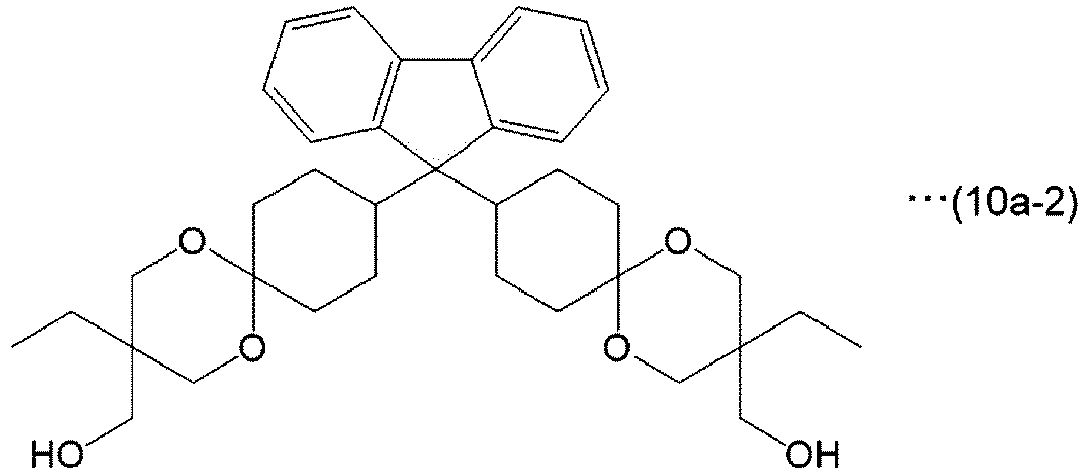
- polyol compound represented by the above formula (1a) examples include (3,12-diethyl-1,5,10,14-tetraoxadispiro[5.2.5 9 .2 6 ]hexadecane-3,12-diyl)dimethanol represented by the following formula (9a), compounds represented by the following formula (10a) (X is the same as in the above formula (10), (propane-2,2-diylbis(3-ethyl-1,5-dioxaspiro[5.5]undecane-9,3-diyl))dimethanol represented by the following formula (10a-1), and ((9H-fluorene-9,9-diyl)bis(3-ethyl-1,5-dioxaspiro[5.5]undecane-9,3-diyl))dimethanol represented by the following formula (10a-2).
- an epoxy resin composition and an epoxy resin cured product as to be described later, that excel particularly in a longer pot life, water spot resistance, and chemical resistance compared with the conventionally used amino compounds while having a good coating film appearance and coating film drying property, can be obtained.
- the amino compound represented by the above formula (1) can be suitably used as an epoxy resin curing agent.
- the amino compound represented by formula (1) is used as an epoxy resin curing agent, other amine compounds contributing to the curing of an epoxy resin can also be used in combination.
- an amount of the amino compound represented by formula (1) is 20 mass% or more to the total amount of the amino compound represented by formula (1) and other amine compounds.
- the amount of the amino compound represented by formula (1) to the total amount of the amino compound represented by formula (1) and other amine compounds is more preferably 30 mass% or more, and further preferably 50 mass% or more.
- the epoxy resin curing agent according to the present disclosure that uses the amino compound represented by formula (1) may contain, in addition to other amine compounds described above, a component that does not contribute to the curing of a solvent, and the like, in the range in which the effects of the present invention are not affected. Furthermore, the epoxy resin curing agent according to the present disclosure, when used as an epoxy resin composition to be described later, can be obviously used in combination with other curing agents.
- the epoxy resin composition according to the present disclosure contains an epoxy resin and the epoxy resin curing agent that uses the amino compound represented by the above formula (1).
- the epoxy resin used in the epoxy resin composition according to the present disclosure is not particularly limited as long as an epoxy resin has a glycidyl group reactable to the active hydrogen derived from the amino group contained in the epoxy resin curing agent according to the present disclosure and, for example, bisphenol A epoxy resin, bisphenol F epoxy resin, or an epoxy resin having a mixture of these as the main component can be suitably used.
- the epoxy resin composition according to the present disclosure in accordance with the purpose of use, can suitably use additives including modification components such as a filler, and a plasticizer, a reactive or unreactive diluent, flow regulating components such as a thixotropic agent, components such as a pigment, a leveling agent, and a tackifier, a cissing inhibitor, an anti-sagging agent, a flowing agent, a defoaming agent, an ultraviolet absorbent, and a light stabilizer.
- modification components such as a filler, and a plasticizer
- a reactive or unreactive diluent such as a thixotropic agent
- components such as a pigment, a leveling agent, and a tackifier
- a cissing inhibitor such as a pigment, a leveling agent, and a tackifier
- an anti-sagging agent such as a flowing agent, a defoaming agent, an ultraviolet absorbent, and a
- the ratio in the number of functional groups [ep] calculated from an epoxy equivalent weight of the epoxy resin to the number of functional groups [h] calculated from an active hydrogen equivalent weight of the epoxy resin curing agent [ep/h] is preferably in the range from 0.90 to 1.10, and more preferably 0.95 to 1.05. The closer this mixing ratio to an equivalent weight, the number of remaining functional groups decreases, thereby obtaining an epoxy resin with excellent performances.
- the epoxy resin composition according to the present disclosure can be cured by a known method, thereby obtaining an epoxy resin cured product.
- Curing conditions are suitably selected in accordance with the purpose of use and is not particularly limited.
- the epoxy resin composition according to the present disclosure can be used at a common temperature condition of 15 to 30°C, and can also be heated to 30°C or more to heat curing.
- the product obtained by curing the epoxy resin composition according to the present disclosure has advantages of achieving good drying property and water resistance, further with an outstanding appearance.
- a 100 mL-SUS316 pressure resistant container (agitation type) was charged with 4.1 g of spiroglycol (SPG) (reagent manufactured by Tokyo Chemical Industry Co., Ltd.), 8.8 g of liquid ammonia (manufactured by MITSUBISHI GAS CHEMICAL COMPANY, INC.), and 0.41 g of 5% Ru/C catalyst (manufactured by N.E. CHEMCAT Corporation, type A) as the catalyst, and a hydrogen gas was introduced until a pressure in the system reached 4.1 MPa.
- SPG spiroglycol
- MITSUBISHI GAS CHEMICAL COMPANY, INC. 8.8 g of liquid ammonia
- Ru/C catalyst manufactured by N.E. CHEMCAT Corporation, type A
- the above catalyst was used after reduction at 250°C in a predetermined reduction device for 2 hours. Subsequently, inside the container was heated until the temperature reached 230°C, and the container was agitated while maintaining the same temperature, thereby
- reaction yield was calculated by area percentage of the components detected by gas chromatography.
- reaction yield of 2,2'-(2,4,8,10-tetraoxaspiro[5.5]undecane-3,9-diyl)bis(2-methylpropane-1-amine) represented by the above formula (2) was 97.6%.
- a 100 mL-SUS316 pressure resistant container (agitation type) was charged with 20.0 g of spiroglycol (reagent manufactured by Tokyo Chemical Industry Co., Ltd.), 10.1 g of liquid ammonia (manufactured by MITSUBISHI GAS CHEMICAL COMPANY, INC.), and 2.00 g of 5% Ru/C catalyst (manufactured by N.E. CHEMCAT Corporation, type A) as the catalyst, and a hydrogen gas was introduced until a pressure in the system reached 4.0 MPa.
- the above catalyst was used after reduction at 250°C in a predetermined reduction device for 2 hours. Subsequently, inside the container was heated until the temperature reached 228°C, and the container was agitated while maintaining the same temperature, thereby allowing the amination reaction to proceed for 4.5 hours.
- reaction yield was calculated by area percentage of the components detected by gas chromatography.
- reaction yield of 2,2'-(2,4,8,10-tetraoxaspiro[5.5]undecane-3,9-diyl)bis(2-methylpropane-1-amine) represented by the above formula (2) was 88.1%.
- a 100 mL-SUS316 pressure resistant container (agitation type) was charged with 2.9 g of dioxane glycol, 8.9 g of liquid ammonia (manufactured by MITSUBISHI GAS CHEMICAL COMPANY, INC.), and 0.29 g of 5% Ru/C catalyst (manufactured by N.E. CHEMCAT Corporation, type A) as the catalyst, and a hydrogen gas was introduced until a pressure in the system reached 4.8 MPa.
- the above catalyst was used after reduction at 250°C in a predetermined reduction device for 2 hours. Subsequently, inside the container was heated until the temperature reached 232°C, and the container was agitated while maintaining the same temperature, thereby allowing the amination reaction to proceed for 4.5 hours.
- reaction yield was calculated by area percentage of the components detected by gas chromatography.
- reaction yield of 2-(5-(aminomethyl)-5-ethyl-1,3-dioxan-2-yl)-2-methylpropane-1-amine represented by the above formula (3) was 79.9%.
- AHEW active hydrogen equivalent weight
- An epoxy resin curing agent composition was prepared in the same manner as in Example 4, except that 39.4 mass% of 1,3-bis(aminomethyl)cyclohexane (1,3-BAC) (manufactured by MITSUBISHI GAS CHEMICAL COMPANY, INC.) and 20.6 mass% of an epoxy resin (manufactured by Mitsubishi Chemical Corporation, bisphenol A diglycidyl ether jER828) were used. Further, 3.5 g of the above curing agent composition was blended with 6.5 g of a base compound epoxy resin (manufactured by Mitsubishi Chemical Corporation, bisphenol A diglycidyl ether jER828) to prepare an epoxy resin composition. An active hydrogen equivalent weight (AHEW) of 1,3-BAC was 100.
- AHEW active hydrogen equivalent weight
- An epoxy resin curing agent composition was prepared in the same manner as in Example 4, except that 41.8 mass% of isophoronediamine (IPDA) (manufactured by Evonik Industries AG., Vestamine IPD) and 18.2 mass% of an epoxy resin (manufactured by Mitsubishi Chemical Corporation, bisphenol A diglycidyl ether jER828) were used. Further, 3.6 g of the above curing agent composition was blended with 6.4 g of a base compound epoxy resin (manufactured by Mitsubishi Chemical Corporation, bisphenol A diglycidyl ether jER828) to prepare an epoxy resin composition. An active hydrogen equivalent weight (AHEW) of IPDA was 106.
- IPDA isophoronediamine
- AHEW active hydrogen equivalent weight
- the epoxy resin compositions obtained in Examples 4 and 5, and Comparative Examples 1 and 2 were applied onto a glass plate (manufactured by Taiyu Kizai Co., Ltd. 25 ⁇ 348 ⁇ 2.0 mm) as a base material under the conditions of 23°C, 50% R.H. using a 76 ⁇ m applicator to form coating films.
- the glass plate on which the coating film was formed was set on a paint dry time tester (manufactured by Taiyu Kizai Co., Ltd.), and streaks remained when needles of the tester scratched the coating film surface were observed to measure the time needed to reach each of the dry stages (Set to Touch, Dust Free, Dry through) by the following criteria. The shorter such a time is, the faster a curing rate (pot life is short) of the epoxy resin composition is.
- the epoxy resin compositions obtained in Examples 4 and 5, and Comparative Examples 1 and 2 were applied onto a zinc phosphate treated iron plate (manufactured by PALTEK CORPORATION. SPCC-SD PB-N144 0.8 ⁇ 70 ⁇ 150 mm) as the base material under the conditions of 23°C, 50% R.H. using a 200 ⁇ m applicator to form coating films (thickness immediately after applied: 200 ⁇ m). These coating films were stored under the conditions of 23°C, 50% R.H., and the 1-day old appearance was visually observed to evaluate the transparency and gloss by the following criteria. Ex: Excellent, G: Good, F: Slightly Poor, P: Poor
- the epoxy resin compositions obtained in Examples 4 and 5, and Comparative Examples 1 and 2 were applied onto a base material (zinc phosphate treated iron plate) by the same method as the above ⁇ Coating film appearance> to form coating films (thickness immediately after applied: 200 ⁇ m). These coating films were stored under the conditions of 23°C, 50% R.H., and the drying property of 1-, 2-, and 7-days old coating film was evaluated by touch by the following criteria.
- the epoxy resin compositions obtained in Examples 4 and 5, and Comparative Examples 1 and 2 were applied onto a base material (zinc phosphate treated iron plate) by the same method as the above ⁇ Coating film appearance> to form coating films (thickness immediately after applied: 200 ⁇ m). These coating films were stored under the conditions of 23°C, 50% R.H., and the 7-days old pencil hardness was measured in conformity with JIS K5600-5-4: 1999.
- the epoxy resin compositions obtained in Examples 4 and 5, and Comparative Examples 1 and 2 were applied onto a base material (zinc phosphate treated iron plate) by the same method as the above ⁇ Coating film appearance> to form coating films (thickness immediately after applied: 200 ⁇ m). These coating films were cured for 7 days under the conditions of 23°C, 50% R.H., and 2 to 3 drops of pure water, or 5% brine, were put using a dropper on the coating film surface, and the spots on which pure water or 5% brine was dropped were capped with 50 mL screw tube bottles. Water or the brine was wiped off 1, 2, 3, and 4 weeks later, and the appearance was visually observed and evaluated by the following criteria.
- Table 1 collectively shows the evaluation results of each of the above characteristics. As evident from Table 1, it was confirmed that the epoxy resin compositions of Examples significantly excel in a longer pot life, water spot resistance, and chemical resistance compared with the epoxy resin compositions of Comparative Examples in which the conventional epoxy resin curing agents was used. Further, it is presumed that the amino compounds according to the present disclosure other than Examples can also similarly provide equivalent effects by the same mechanism as Examples, because such compounds have a quaternary carbon at the ⁇ -position of an amino group, and have the A moiety containing an -O- bond bonded to the carbon at the ⁇ -position of the amino group.
- the amino compounds and the method for producing the same according to the present disclosure, and the epoxy resin curing agent, the epoxy resin composition, and the epoxy resin cured product using the same have good coating film appearance and coating film drying property and excel particularly in a longer pot life, water spot resistance, and chemical resistance compared with the conventional products, and thus can be widely and effectively used in various purposes of use where these performances are demanded.
- the present application is based on the Japanese Patent Application No. 2021-091643 filed on May 31, 2021 , and its contents are incorporated herein.
Landscapes
- Chemical & Material Sciences (AREA)
- Organic Chemistry (AREA)
- Health & Medical Sciences (AREA)
- Chemical Kinetics & Catalysis (AREA)
- Medicinal Chemistry (AREA)
- Polymers & Plastics (AREA)
- Life Sciences & Earth Sciences (AREA)
- Engineering & Computer Science (AREA)
- Materials Engineering (AREA)
- Wood Science & Technology (AREA)
- Organic Low-Molecular-Weight Compounds And Preparation Thereof (AREA)
- Epoxy Resins (AREA)
Abstract

A is any of;
(α) a hydrocarbon group independently having one or more -O- bond bonded to the carbon at the γ-position of the amino group, and having 2 to 30 carbon atoms and optionally having a substituent (the same hereinafter),
(β) a hydrocarbon group having one or more -O-bond bonded to the carbon at the γ-position of the amino group while bonding to any one of R1 to R4, and having 2 to 30 carbon atoms, and
(γ) a hydrocarbon group having one or more -O-bond bonded to the carbon at the γ-position of the amino group while bonding to R1 or R2 and R3 or R4, and having 2 to 30 carbon atoms, wherein
R1 to R4 are each independently a hydrocarbon group having 1 to 10 carbon atoms (provided that a hydrocarbon group bonded to A is excluded).
Description
- The present invention provides an amino compound, which is a novel compound, and a method for producing the same, and also relates to an epoxy resin curing agent, an epoxy resin composition, and an epoxy resin cured product containing a novel amino compound.
- Amino compounds that have been conventionally used as epoxy resin curing agents include, for example, diethylenetriamine, triethylenetetramine, polyoxypropylenediamine (registered trademark: Jeffamine), isophoronediamine (IPDA), metaxylylenediamine, 1,3-bis(aminomethyl)cyclohexane (1,3-BAC), and the like. These are industrially produced, and epoxy resin curing agents containing an amino compound have been sold. Additionally, general reviews of performances of various amines have been published (for example, see Non Patent Literature 1 below).
- Non Patent Literature 1:
Sosetsu Epoxy Resin (in Japanese) (General review of epoxy resins) (The Japan Society of Epoxy Resin Technology) - Generally, an amino compound having a primary amino group reacts fast to an epoxy resin and has fast curing property. On the other hand, the time that takes to gelling due to since blended is short, thereby posing a drawback of limiting work time once blended. In particular, depending on the purpose of use of an epoxy resin composition, fast curing is not suitable for use. For example, one of the methods for producing a fiberreinforced composite material (hereinafter, also referred to as "FRP (Fiber Reinforced Plastics)") includes the filament winding method. The filament winding method is a method of coating the outer surface of a mandrel, and the like, using reinforced fiber yarns with which a matrix resin or a precursor thereof is impregnated, and forming a formed article. A thermosetting resin composition such as an epoxy resin composition can be used as a matrix resin precursor, but when such a resin composition has a short pot life and is fast curing, a problem arises that the thermosetting resin cures at a pre-formation stage.
- Under the circumstances, the present invention has been completed in view of the above problems, and aims to provide a novel amino compound that was not known so far to be useful as an epoxy resin curing agent and a method for producing the same, and an epoxy resin curing agent, an epoxy resin composition, and an epoxy resin cured product using the same.
- The present inventors have conducted extensive studies to solve the above problem and found that the use of an amino compound having a specific structure prevents the excessive fast curing, which is the problem described above, and can achieve a long pot life thereby enhancing the workability, whereby the present invention has been accomplished. That is, the contents of the present disclosure are as follows.
- [1] An amino compound having a quaternary carbon at the β-position of an amino group and represented by the following formula (1).

- A is any of the following (α), (β), and (γ);
- (α) a hydrocarbon group independently having at least one -O- bond bonded to the carbon at the γ-position of the amino group, and having 2 to 30 carbon atoms and optionally having a substituent,
- (β) a hydrocarbon group having at least one -O-bond bonded to the carbon at the γ-position of the amino group while bonding to any one of R1, R2, R3, and R4, and having 2 to 30 carbon atoms and optionally having a substituent,
- (γ) a hydrocarbon group having at least one -O-bond bonded to the carbon at the γ-position of the amino group while bonding to R1 or R2 and R3 or R4, and having 2 to 30 carbon atoms and optionally having a substituent, wherein
- R1, R2, R3, and R4 are each independently a hydrocarbon group having 1 to 10 carbon atoms and optionally having a substituent (provided that a hydrocarbon group bonded to A is excluded).
- A is any of the following (α), (β), and (γ);
- [2] The amino compound according to the above [1],
- wherein A independently has a dioxane structure, or
- A has a dioxane structure while bonding to any one of R1, R2, R3, and R4, or
- A has a dioxane structure while bonding to R1 or R2 and R3 or R4.
- [3] The amino compound according to the above [1] or [2], represented by the following formula (2) or formula (3).

- [4] A method for producing an amino compound comprising:
a step of aminizing a polyol compound represented by the following formula (1a) in the presence of a catalyst and ammonia to obtain an amino compound having a quaternary carbon at the β-position of an amino group and represented by the following formula (1).
- A is any of the following (α), (β), and (γ);
- (α) a hydrocarbon group independently having at least one -O- bond bonded to the carbon at the γ-position of the amino group, and having 2 to 30 carbon atoms and optionally having a substituent,
- (β) a hydrocarbon group having at least one -O-bond bonded to the carbon at the γ-position of the amino group while bonding to any one of R1, R2, R3, and R4, and having 2 to 30 carbon atoms and optionally having a substituent,
- (γ) a hydrocarbon group having at least one -O-bond bonded to the carbon at the γ-position of the amino group while bonding to R1 or R2 and R3 or R4, and having 2 to 30 carbon atoms and optionally having a substituent, wherein
- R1, R2, R3, and R4 are each independently a hydrocarbon group having 1 to 10 carbon atoms and optionally having a substituent (provided that a hydrocarbon group bonded to A is excluded).
- A is any of the following (α), (β), and (γ);
- [5] The method for producing the amino compound according to the above [4],
- wherein A independently has a dioxane structure, or
- A has a dioxane structure while bonding to any one of R1, R2, R3, and R4.
- [6] A method for producing an amino compound comprising:
- a step of aminizing a polyol compound represented by the following formula (2a) in the presence of a catalyst and ammonia to obtain an amino compound represented by the following formula (2), or
- a step of aminizing a polyol compound represented by the following formula (3a) in the presence of a catalyst and ammonia to obtain an amino compound represented by the following formula (3).


- [7] An epoxy resin curing agent, comprising the amino compound according to any one of the above [1] to [3].
- [8] An epoxy resin composition comprising the epoxy resin curing agent according to the above [7], and an epoxy resin.
- [9] An epoxy resin cured product obtained by curing the epoxy resin composition according to the above [8].
- The present disclosure can accordingly provide a novel amino compound that is useful to be an epoxy resin curing agent, which excels particularly in a long pot life, water spot resistance, and chemical resistance while having a good coating film appearance and coating film drying property, a method for producing the same, and an epoxy resin curing agent, an epoxy resin composition, and an epoxy resin cured product using the same.
- Hereinafter, embodiments of the present disclosure will be described. The following embodiments are examples for describing the present disclosure, and the present disclosure is not limited only to these embodiments, and various modifications can be made without departing from the gist thereof.
- The amino compound according to the present embodiment is a compound having a quaternary carbon at the β-position of an amino group, and at least one -O-bond bonded to the carbon at the γ-position of the amino group (in other words, a moiety in which -O- bonds to the carbon at the γ-position of the amino group), and is specifically represented by the following formula (1).

- (α) a hydrocarbon group independently having at least one -O- bond bonded to the carbon at the γ-position of the amino group, and having 2 to 30 carbon atoms and optionally having a substituent, or
- (β) a hydrocarbon group having at least one -O- bond
bonded to the carbon at the γ-position of the amino group while bonding to any one of R1, R2, R3, and R4, and having 2 to 30 carbon atoms and optionally having a substituent, or - (γ) a hydrocarbon group having at least one -O- bond
bonded to the carbon at the γ-position of the amino group while bonding to R1 or R2 and R3 or R4, and having 2 to 30 carbon atoms and optionally having a substituent. - As described, A is a hydrocarbon group containing an oxygen atom as the heteroatom.
- Additionally, in formula (1), R1, R2, R3, and R4 are each independently a hydrocarbon group having 1 to 10 carbon atoms and optionally having a substituent. However, R1, R2, R3, and/or R4 bonding to A, as in (β) and (γ) described above, forms a part of A, for the reason of which these are excluded from the definition herein.
- Examples of the hydrocarbon group having 1 to 30 carbon atoms at R1, R2, R3, and R4 include alkyl groups and alkoxy groups having 1 to 10 carbon atoms, such as methyl group, and ethyl group; straight or branched-chain propyl group, butyl group, pentyl group, hexyl group, heptyl group, octyl group, nonyl group, and decyl group; and cyclic cyclohexyl group, cyclopentyl group, phenyl group, benzyl group, bicyclic hydrocarbon group having a spiro-cyclic skeleton. Additionally, examples of the substituent at A, and R1, R2, R3, and R4 include hydroxy group and carbonyl group.
- More specifically, it is preferable that A independently has a dioxane structure, or has a dioxane structure while bonding to any one of R1, R2, R3, and R4. In this case, more preferable examples of the amino compound of formula (1) in the present embodiment include, further specifically, 2,2'-(2,4,8,10-tetraoxaspiro[5.5]undecane-3,9-diyl)bis(2-methylpropane-1-amine) represented by the following formula (2), and 2-(5-(aminomethyl)-5-ethyl-1,3-dioxan-2-yl)-2-methylpropane-1-amine represented by the following formula (3).

- Additionally, other examples of the amino compound represented by the above formula (1) include 3-amino-2,2-dimethylpropyl 3-amino-2,2-dimethylpropanoate represented by the following formula (4), 2,2'-(oxybis(methylene))bis(2-(aminomethyl)butan-1-ol) represented by the following formula (5-1), 2-((2,2-bis(aminomethyl)butoxy)methyl-2-ethylpropane-1,3-diol represented by the following formula (5-2), 2-(aminomethyl)-2-((2,2-bis(aminomethyl)butoxy)methyl)butan-1-ol) represented by the following formula (5-3), 2,2'-(oxybis(methylene))bis(2-ethylpropane-1,3-diamine) represented by the following formula (5-4), 3,3'-oxybis(2,2-dimethylpropane-1-amine) represented by the following formula (6), 2-((3-amino-2,2-dimethylpropoxy)methyl)-2-ethylhexane-1-amine represented by the following formula (7), 2-((3-amino-2,2-dimethylpropoxy)methyl)-2-(aminomethyl)butan-1-ol represented by the following formula (8-1), 3-(2,2-bis(aminomethyl)butoxy)-2,2-dimethylpropan-1-ol represented by the following formula (8-2), and 2-((3-amino-2,2-dimethylpropoxy)methyl)-2-ethylpropane-1,3-diamine represented by the following formula (8-3).


- Further, other examples of the amino compound represented by the above formula (1) include (3,12-diethyl-1,5,10,14-tetraoxadispiro[5.2.59.26]hexadecane-3,12-diyl)dimethaneamine represented by the following formula (9), and the compounds represented by the following formula (10). In formula (10), X is a group selected from the group consisting of straight-chain alkyl groups having 0 to 6 carbon atoms, branched-chain alkyl groups and aryl groups having 3 to 6 carbon atoms, and groups having 6 to 20 carbon atoms. Examples of such compound represented by the formula (10) include (propane-2,2-diylbis(3-ethyl-1,5-dioxaspiro[5.5]undecane-9.3-diyl))dimethanamine represented by the following formula (10-1), and ((9H-fluorene-9,9-diyl)bis(3-ethyl-1,5-dioxaspiro[5,5]undecane-9,3-diyl)dimethanamine represented by the following formula (10-2).


- As described, the compound (spiro bisamine) represented by formula (2), the compound represented by formula (4), the compounds represented by formula (5-1) to formula (5-4), the compound represented by formula (6), the compound represented by formula (7), and the compounds represented by formula (8-1) to formula (8-3) are considered as examples of the amino compound containing A of (α) described above. Further, the compound (dioxane bisamine) represented by formula (3) is considered as an example of the amino compound containing A of (β) described above. Further, the compound represented by formula (9), the compound represented by formula (10), the compound represented by formula (10-1), and the compound represented by formula (10-2) are considered as examples of the amino compound containing A of (γ) described above.
- The production method of the amino compound represented by the above formula (1) is not particularly limited but, for example, as described below, the amino compound can be obtained by aminizing the polyol compound represented by formula (1a).

- In formula (1) and formula (1a), A is, as is mentioned above, any of the following (α), (β), and (γ). That is, A is
- (α) a hydrocarbon group independently having at least one -O- bond bonded to the carbon at the γ-position of the amino group, and having 2 to 30 carbon atoms and optionally having a substituent, or
- (β) a hydrocarbon group having at least one -O- bond bonded to the carbon at the γ-position of the amino group while bonding to any one of R1, R2, R3, and R4, and having 2 to 30 carbon atoms and optionally having a substituent, or
- (γ) a hydrocarbon group having at least one -O- bond bonded to the carbon at the γ-position of the amino group while bonding to R1 or R2 and R3 or R4, and having 2 to 30 carbon atoms and optionally having a substituent.
- The amination reaction herein is not particularly limited but, for example, it is preferable that a polyol compound, which is a starting material, and ammonia are reacted in the presence of a reduction catalyst. For the reduction catalyst, any catalyst typically used for the amination reaction can be used. For example, usable catalysts include precious metal catalysts such as platinum, palladium, ruthenium, and rhodium; and metalbased catalysts such as nickel, cobalt, and iron catalyst. These catalysts can be used as metal independently, or used as supported on a carrier such as activated carbon, alumina, silica, titania, and zirconia. The catalysts can be used singly, or two or more can be used in combination. Of these, it is further preferable to use a catalyst supporting ruthenium from the viewpoint of increasing the yield of the amino compound.
- The mass ratio of the polyol compound to the reduction catalyst is preferably 2 to 30, more preferably 5 to 20, and further preferably 5 to 15. When a mass ratio of the polyol compound to the reduction catalyst is within the above ranges, the yield and selectivity of the amino compound to be obtained are likely to increase.
- The molar ratio of ammonia to the polyol compound is preferably 2 to 150, more preferably 5 to 100, and further preferably 8 to 80. When a molar ratio is a lower limit value or more, the reaction is likely to be fast, whereas when a molar ratio is an upper limit value or less, the subsequent time to remove liquid ammonia is reduced, and the production efficiency improves. Ammonia can also be used as a solvent, and ammonia can be in any form and used in forms of, for example, liquid ammonia, and ammonia water.
- The amination reaction is not particularly needed, but a solvent typically used for the amination reaction can be used. Examples include benzene, toluene, xylene, nitromethane, nitrobenzene, carbon disulfide, acetonitrile, benzonitrile, hexane, cyclohexane, petroleum ether, diethyl ether, 1,4-dioxane, methyl acetate, tetrahydrofuran, acetone, methyl ethyl ketone, dichloroethane, dimethylformamide, dimethyl sulfoxide, dimethyl carbonate, and propylene carbonate. These solvents can be used singly, or two or more can be used in combination.
- The reaction temperature of the amination reaction is preferably 100 to 350°C, more preferably 150 to 300°C, and further preferably 200 to 250°C. When a reaction temperature of the amination reaction is a lower limit value or more, the reactivity improves, whereas a reaction temperature of the amination reaction is an upper limit value or less, high-boiling compounds are likely to be reduced.
- Further, the initial hydrogen charging pressure (excluding the self pressure of liquid ammonia) of the amination reaction is preferably 0 to 20 MPa, more preferably 0.1 to 10 MPa, and further preferably 1 to 8 MPa. When a pressure of the amination reaction is within the above ranges, the yield and selectivity of the amino compound to be obtained are likely to increase.
- Furthermore, the amination reaction is carried out until the reaction completes, but examples of the reaction time include 1 to 48 hours, 2 to 24 hours, and 4 to 10 hours.
- More specifically, it is preferable that A in formula (1) and formula (1a) independently has a dioxane structure, or has a dioxane structure while bonding to any one of R1, R2, R3, and R4. In this case, more preferable examples of the method for producing the amino compound of formula (1) in the present embodiment include, further specifically, in the presence of a suitable catalyst and ammonia, a method of aminizing 2,2'-(2,4,8,10-tetraoxaspiro[5.5]undecane-3,9-diyl)bis(2-methylpropan-1-ol) represented by the following formula (2a) described above to obtain the amino compound of formula (2), and a method of aminizing 2-(5-ethyl-5-(hydroxymethyl)-1,3-dioxan-2-yl)-2-methylpropan-1-ol represented by the following formula (3a) to obtain the amino compound of formula (3).


- Additionally, other examples of the polyol compound represented by the above formula (1a) include 3-hydroxy-2,2-dimethylpropyl 3-hydroxy-2,2-dimethylpropanoate represented by the following formula (4a), 2,2'-(oxybis(methylene))bis(2-ethylpropane-1,3-diol) represented by the following formula (5a), 3,3'-oxybis(2,2-dimethylpropan-1-ol) represented by the following formula (6a), 2-ethyl-2-((3-hydroxy-2,2-dimethylpropoxy)methyl)hexan-1-ol represented by the following formula (7a), and 2-ethyl-2-((3-hydroxy-2,2-dimethylpropoxy)methyl)propane-1,3-diol represented by the following formula (8a).


- Further, other examples of the polyol compound represented by the above formula (1a) include (3,12-diethyl-1,5,10,14-tetraoxadispiro[5.2.59.26]hexadecane-3,12-diyl)dimethanol represented by the following formula (9a), compounds represented by the following formula (10a) (X is the same as in the above formula (10), (propane-2,2-diylbis(3-ethyl-1,5-dioxaspiro[5.5]undecane-9,3-diyl))dimethanol represented by the following formula (10a-1), and ((9H-fluorene-9,9-diyl)bis(3-ethyl-1,5-dioxaspiro[5.5]undecane-9,3-diyl))dimethanol represented by the following formula (10a-2).


- When such an amino compound according to the present disclosure is used as an epoxy resin curing agent, an epoxy resin composition and an epoxy resin cured product, as to be described later, that excel particularly in a longer pot life, water spot resistance, and chemical resistance compared with the conventionally used amino compounds while having a good coating film appearance and coating film drying property, can be obtained. Details of the action mechanism thereof are still unknown in part, but in the amino compounds according to the present disclosure, it is presumed that the quaternary carbon located at the β-position of an amino group, or, in addition thereto, the A moiety containing an -O- bond bonded to the carbon at the γ-position of the amino group becomes steric hinderance and blocks the curing reaction of an epoxy resin, thereby achieving outstanding excellent characteristics, particularly, in the viewpoint of the long pot life. However, the action is not limited thereto.
- The amino compound represented by the above formula (1) can be suitably used as an epoxy resin curing agent. When the amino compound represented by formula (1) is used as an epoxy resin curing agent, other amine compounds contributing to the curing of an epoxy resin can also be used in combination. In such a case, it is preferable that an amount of the amino compound represented by formula (1) is 20 mass% or more to the total amount of the amino compound represented by formula (1) and other amine compounds. Further, for more benefiting the features of the epoxy resin curing agent, the amount of the amino compound represented by formula (1) to the total amount of the amino compound represented by formula (1) and other amine compounds is more preferably 30 mass% or more, and further preferably 50 mass% or more. Further, the epoxy resin curing agent according to the present disclosure that uses the amino compound represented by formula (1) may contain, in addition to other amine compounds described above, a component that does not contribute to the curing of a solvent, and the like, in the range in which the effects of the present invention are not affected. Furthermore, the epoxy resin curing agent according to the present disclosure, when used as an epoxy resin composition to be described later, can be obviously used in combination with other curing agents.
- The epoxy resin composition according to the present disclosure contains an epoxy resin and the epoxy resin curing agent that uses the amino compound represented by the above formula (1). The epoxy resin used in the epoxy resin composition according to the present disclosure is not particularly limited as long as an epoxy resin has a glycidyl group reactable to the active hydrogen derived from the amino group contained in the epoxy resin curing agent according to the present disclosure and, for example, bisphenol A epoxy resin, bisphenol F epoxy resin, or an epoxy resin having a mixture of these as the main component can be suitably used. Additionally, the epoxy resin composition according to the present disclosure, in accordance with the purpose of use, can suitably use additives including modification components such as a filler, and a plasticizer, a reactive or unreactive diluent, flow regulating components such as a thixotropic agent, components such as a pigment, a leveling agent, and a tackifier, a cissing inhibitor, an anti-sagging agent, a flowing agent, a defoaming agent, an ultraviolet absorbent, and a light stabilizer. For the mixing ratio of the epoxy resin and the epoxy resin curing agent in the epoxy resin composition according to the present disclosure, the ratio in the number of functional groups [ep] calculated from an epoxy equivalent weight of the epoxy resin to the number of functional groups [h] calculated from an active hydrogen equivalent weight of the epoxy resin curing agent [ep/h] is preferably in the range from 0.90 to 1.10, and more preferably 0.95 to 1.05. The closer this mixing ratio to an equivalent weight, the number of remaining functional groups decreases, thereby obtaining an epoxy resin with excellent performances.
- The epoxy resin composition according to the present disclosure can be cured by a known method, thereby obtaining an epoxy resin cured product. Curing conditions are suitably selected in accordance with the purpose of use and is not particularly limited. For example, the epoxy resin composition according to the present disclosure can be used at a common temperature condition of 15 to 30°C, and can also be heated to 30°C or more to heat curing. Further, the product obtained by curing the epoxy resin composition according to the present disclosure has advantages of achieving good drying property and water resistance, further with an outstanding appearance.
- Hereinafter, the present invention will be described further in detail in reference to examples and comparative examples, but the present invention is not limited at all to these examples.
- A 100 mL-SUS316 pressure resistant container (agitation type) was charged with 4.1 g of spiroglycol (SPG) (reagent manufactured by Tokyo Chemical Industry Co., Ltd.), 8.8 g of liquid ammonia (manufactured by MITSUBISHI GAS CHEMICAL COMPANY, INC.), and 0.41 g of 5% Ru/C catalyst (manufactured by N.E. CHEMCAT Corporation, type A) as the catalyst, and a hydrogen gas was introduced until a pressure in the system reached 4.1 MPa. The above catalyst was used after reduction at 250°C in a predetermined reduction device for 2 hours. Subsequently, inside the container was heated until the temperature reached 230°C, and the container was agitated while maintaining the same temperature, thereby allowing the amination reaction to proceed for 4.5 hours.
- After completion of the reaction, the liquid ammonia was purged, the reaction product was dissolved in 200 g of methanol, and the catalyst in the liquid was removed by filtration and then analyzed using GC (manufactured by Shimadzu Corporation, type name "GC2010 PLUS", column: product name "HP-5ms", manufactured by Agilent Technologies Japan, Ltd., length 30 m × inner diameter 0.25 mm, film thickness 0.25 µm, conditions ··· carrier gas: He (constant pressure: 73.9 kPa), inlet temperature: 300°C, detector: FID, detector temperature: 325°C, column oven temperatures: started at 80°C, increased to 230°C at 20°C/min, increased to 240°C at 1°C /min, then increased to 325°C at 20°C/min, and maintained at 325°C for 20 minutes). The reaction yield was calculated by area percentage of the components detected by gas chromatography. As a result, the reaction yield of 2,2'-(2,4,8,10-tetraoxaspiro[5.5]undecane-3,9-diyl)bis(2-methylpropane-1-amine) represented by the above formula (2) was 97.6%.
- A 100 mL-SUS316 pressure resistant container (agitation type) was charged with 20.0 g of spiroglycol (reagent manufactured by Tokyo Chemical Industry Co., Ltd.), 10.1 g of liquid ammonia (manufactured by MITSUBISHI GAS CHEMICAL COMPANY, INC.), and 2.00 g of 5% Ru/C catalyst (manufactured by N.E. CHEMCAT Corporation, type A) as the catalyst, and a hydrogen gas was introduced until a pressure in the system reached 4.0 MPa. The above catalyst was used after reduction at 250°C in a predetermined reduction device for 2 hours. Subsequently, inside the container was heated until the temperature reached 228°C, and the container was agitated while maintaining the same temperature, thereby allowing the amination reaction to proceed for 4.5 hours.
- After completion of the reaction, the liquid ammonia was purged, the reaction product was dissolved in 1000 g of methanol, and the catalyst in the liquid was removed by filtration and then analyzed using GC (manufactured by Shimadzu Corporation, type name "GC2010 PLUS", column: product name "HP-5ms", manufactured by Agilent Technologies Japan, Ltd., length 30 m × inner diameter 0.25 mm, film thickness 0.25 µm, conditions ··· carrier gas: He (constant pressure: 73.9 kPa), inlet temperature: 300°C, detector: FID, detector temperature: 325°C, column oven temperatures: started at 80°C, increased to 230°C at 20°C/min, increased to 240°C at 1°C /min, then increased to 325°C at 20°C/min, and maintained at 325°C for 20 minutes). The reaction yield was calculated by area percentage of the components detected by gas chromatography. As a result, the reaction yield of 2,2'-(2,4,8,10-tetraoxaspiro[5.5]undecane-3,9-diyl)bis(2-methylpropane-1-amine) represented by the above formula (2) was 88.1%.
- A 100 mL-SUS316 pressure resistant container (agitation type) was charged with 2.9 g of dioxane glycol, 8.9 g of liquid ammonia (manufactured by MITSUBISHI GAS CHEMICAL COMPANY, INC.), and 0.29 g of 5% Ru/C catalyst (manufactured by N.E. CHEMCAT Corporation, type A) as the catalyst, and a hydrogen gas was introduced until a pressure in the system reached 4.8 MPa. The above catalyst was used after reduction at 250°C in a predetermined reduction device for 2 hours. Subsequently, inside the container was heated until the temperature reached 232°C, and the container was agitated while maintaining the same temperature, thereby allowing the amination reaction to proceed for 4.5 hours.
- After completion of the reaction, the liquid ammonia was purged, the reaction product was dissolved in 150 g of methanol, and the catalyst in the liquid was removed by filtration and then analyzed using GC (manufactured by Shimadzu Corporation, type name "GC2010 PLUS", column: product name "HP-5ms", manufactured by Agilent Technologies Japan, Ltd., length 30 m × inner diameter 0.25 mm, film thickness 0.25 µm, conditions ··· carrier gas: He (constant pressure: 73.9 kPa), inlet temperature: 300°C, detector: FID, detector temperature: 325°C, column oven temperatures: started at 80°C, increased to 230°C at 20°C/min, increased to 240°C at 1°C /min, then increased to 325°C at 20°C/min, and maintained at 325°C for 20 minutes). The reaction yield was calculated by area percentage of the components detected by gas chromatography. As a result, the reaction yield of 2-(5-(aminomethyl)-5-ethyl-1,3-dioxan-2-yl)-2-methylpropane-1-amine represented by the above formula (3) was 79.9%.
- An epoxy resin curing agent composition containing 48.2 mass% of the amino compound (spiro bisamine) obtained in Example 1, 11.8 mass% of an epoxy resin (manufactured by Mitsubishi Chemical Corporation, bisphenol A diglycidyl ether jER828), and 40 mass% of benzyl alcohol (manufactured by KANTO CHEMICAL CO., INC.) was prepared. Further, 4.2 g of the above curing agent composition was blended with 5.8 g of a base compound epoxy resin (manufactured by Mitsubishi Chemical Corporation, bisphenol A diglycidyl ether jER828) to prepare an epoxy resin composition. An active hydrogen equivalent weight (AHEW) of spiro bisamine calculated from the following formula (B), supposing that the purity of the isolated compound was 100% (the same hereinafter), was 174.

- An epoxy resin curing agent composition containing 44.6 mass% of the amino compound (dioxane bisamine) obtained in Example 3, 15.4 mass% of an epoxy resin (manufactured by Mitsubishi Chemical Corporation, bisphenol A diglycidyl ether jER828), and 40 mass% of benzyl alcohol (manufactured by KANTO CHEMICAL CO., INC.) was prepared. Further, 4.8 g of the above curing agent composition was blended with 5.2 g of a base compound epoxy resin (manufactured by Mitsubishi Chemical Corporation, bisphenol A diglycidyl ether jER828) to prepare an epoxy resin composition. An active hydrogen equivalent weight (AHEW) of dioxane bisamine calculated from the above formula (B), supposing that the purity of the isolated compound was 100%, was 135.
- An epoxy resin curing agent composition was prepared in the same manner as in Example 4, except that 39.4 mass% of 1,3-bis(aminomethyl)cyclohexane (1,3-BAC) (manufactured by MITSUBISHI GAS CHEMICAL COMPANY, INC.) and 20.6 mass% of an epoxy resin (manufactured by Mitsubishi Chemical Corporation, bisphenol A diglycidyl ether jER828) were used. Further, 3.5 g of the above curing agent composition was blended with 6.5 g of a base compound epoxy resin (manufactured by Mitsubishi Chemical Corporation, bisphenol A diglycidyl ether jER828) to prepare an epoxy resin composition. An active hydrogen equivalent weight (AHEW) of 1,3-BAC was 100.
- An epoxy resin curing agent composition was prepared in the same manner as in Example 4, except that 41.8 mass% of isophoronediamine (IPDA) (manufactured by Evonik Industries AG., Vestamine IPD) and 18.2 mass% of an epoxy resin (manufactured by Mitsubishi Chemical Corporation, bisphenol A diglycidyl ether jER828) were used. Further, 3.6 g of the above curing agent composition was blended with 6.4 g of a base compound epoxy resin (manufactured by Mitsubishi Chemical Corporation, bisphenol A diglycidyl ether jER828) to prepare an epoxy resin composition. An active hydrogen equivalent weight (AHEW) of IPDA was 106.
- The epoxy resin compositions obtained in Examples 4 and 5, and Comparative Examples 1 and 2 were applied onto a glass plate (manufactured by Taiyu Kizai Co., Ltd. 25 × 348 × 2.0 mm) as a base material under the conditions of 23°C, 50% R.H. using a 76 µm applicator to form coating films. The glass plate on which the coating film was formed was set on a paint dry time tester (manufactured by Taiyu Kizai Co., Ltd.), and streaks remained when needles of the tester scratched the coating film surface were observed to measure the time needed to reach each of the dry stages (Set to Touch, Dust Free, Dry through) by the following criteria. The shorter such a time is, the faster a curing rate (pot life is short) of the epoxy resin composition is.
- Set to Touch: time at which needle marks start remaining on the glass plate
- Dust Free: time at which needle marks float to the coating film surface from inside the coating film
- Dry through: time at which no needle mark is remained on the coating film
- The epoxy resin compositions obtained in Examples 4 and 5, and Comparative Examples 1 and 2 were applied onto a zinc phosphate treated iron plate (manufactured by PALTEK CORPORATION. SPCC-SD PB-N144 0.8 × 70 × 150 mm) as the base material under the conditions of 23°C, 50% R.H. using a 200 µm applicator to form coating films (thickness immediately after applied: 200 µm). These coating films were stored under the conditions of 23°C, 50% R.H., and the 1-day old appearance was visually observed to evaluate the transparency and gloss by the following criteria.
Ex: Excellent, G: Good, F: Slightly Poor, P: Poor - The epoxy resin compositions obtained in Examples 4 and 5, and Comparative Examples 1 and 2 were applied onto a base material (zinc phosphate treated iron plate) by the same method as the above <Coating film appearance> to form coating films (thickness immediately after applied: 200 µm). These coating films were stored under the conditions of 23°C, 50% R.H., and the drying property of 1-, 2-, and 7-days old coating film was evaluated by touch by the following criteria.
- Ex: Excellent (coating film is not sticky after being pressed by the thumb with a force of about 50 N and no fingerprint is remained)
- G: Good (coating film is not sticky after being pressed by the thumb with a force of about 50 N, but a fingerprint is remained after touched)
- F: Fair (coating film is sticky after being pressed by the thumb with a force of about 50 N)
- P: Poor (coating film is sticky after being pressed by the thumb with a force of about 5 N)
- The epoxy resin compositions obtained in Examples 4 and 5, and Comparative Examples 1 and 2 were applied onto a base material (zinc phosphate treated iron plate) by the same method as the above <Coating film appearance> to form coating films (thickness immediately after applied: 200 µm). These coating films were stored under the conditions of 23°C, 50% R.H., and the 7-days old pencil hardness was measured in conformity with JIS K5600-5-4: 1999.
- The epoxy resin compositions obtained in Examples 4 and 5, and Comparative Examples 1 and 2 were applied onto a base material (zinc phosphate treated iron plate) by the same method as the above <Coating film appearance> to form coating films (thickness immediately after applied: 200 µm). These coating films were stored under the conditions of 23°C, 50% R.H., and 2 to 3 drops of pure water were put using a dropper on the surface of 1-, 2-, and 7-days old coating film, and the spots on which pure water was dropped were capped with 50 mL screw tube bottles. Water was wiped off 24 hours later, and the appearance was visually observed and evaluated by the following criteria.
Ex: No change, G: Slightly changed but good, F: Changes were observed - The epoxy resin compositions obtained in Examples 4 and 5, and Comparative Examples 1 and 2 were applied onto a base material (zinc phosphate treated iron plate) by the same method as the above <Coating film appearance> to form coating films (thickness immediately after applied: 200 µm). These coating films were cured for 7 days under the conditions of 23°C, 50% R.H., and 2 to 3 drops of pure water, or 5% brine, were put using a dropper on the coating film surface, and the spots on which pure water or 5% brine was dropped were capped with 50 mL screw tube bottles. Water or the brine was wiped off 1, 2, 3, and 4 weeks later, and the appearance was visually observed and evaluated by the following criteria.
- Ex: No change
- G: Rough surface
- F: Surface was whitened, and a few rust spots were confirmed
- P: Rough surface, and rust spots were confirmed overall
- Table 1 collectively shows the evaluation results of each of the above characteristics. As evident from Table 1, it was confirmed that the epoxy resin compositions of Examples significantly excel in a longer pot life, water spot resistance, and chemical resistance compared with the epoxy resin compositions of Comparative Examples in which the conventional epoxy resin curing agents was used. Further, it is presumed that the amino compounds according to the present disclosure other than Examples can also similarly provide equivalent effects by the same mechanism as Examples, because such compounds have a quaternary carbon at the β-position of an amino group, and have the A moiety containing an -O- bond bonded to the carbon at the γ-position of the amino group.
[Table 1] Curing conditions: 23°C/50% RH (Epoxy resin curing agent) Example 4 (Spiro bisamine) Example 5 (Dioxane bisamine) Comparative Example 1 (1,3-BAC) Comparative Example 2 (IPDA) Active hydrogen equivalent weight (AHEW) 174 135 100 106 RCI curing rate (hr: min) Set to Touch 2:45 2:30 1:00 - Dust Free 6:15 5:15 2:15 4:15 Dry through 18:45 19:30 3:30 - Coating film appearance (transparency/gloss) Ex/Ex Ex/Ex Ex/Ex Ex/Ex Coating film dry property (1/2/7 days old) Ex/Ex/Ex Ex/Ex/Ex Ex/Ex/Ex Ex/Ex/Ex Pencil hardness (7 days old) H H H H Water spot resistance (1/2/7 days old) Ex/Ex/Ex G/Ex/Ex F/F/F F/F/F Chemical resistance (1/2/3/4 weeks old) 5% Brine Ex/Ex/Ex/G Ex/Ex/Ex/Ex F (Rough surface, rust spots)/F/F/F F (Whitened)/F/F/F Water Ex/Ex/Ex/Ex Ex/Ex/Ex/Ex G (Rough surface)/F (Whitened)/F/F P (Rust spots, whitened)/P/P/P - As described above, the amino compounds and the method for producing the same according to the present disclosure, and the epoxy resin curing agent, the epoxy resin composition, and the epoxy resin cured product using the same have good coating film appearance and coating film drying property and excel particularly in a longer pot life, water spot resistance, and chemical resistance compared with the conventional products, and thus can be widely and effectively used in various purposes of use where these performances are demanded. The present application is based on the
Japanese Patent Application No. 2021-091643 filed on May 31, 2021
Claims (9)
- An amino compound having a quaternary carbon at the β-position of an amino group and represented by the following formula (1).
 A is any of the following (α), (β), and (γ);(α) a hydrocarbon group independently having at least one -O- bond bonded to the carbon at the γ-position of the amino group, and having 2 to 30 carbon atoms and optionally having a substituent,(β) a hydrocarbon group having at least one -O-bond bonded to the carbon at the γ-position of the amino group while bonding to any one of R1, R2, R3, and R4, and having 2 to 30 carbon atoms and optionally having a substituent,(γ) a hydrocarbon group having at least one -O-bond bonded to the carbon at the γ-position of the amino group while bonding to R1 or R2 and R3 or R4, and having 2 to 30 carbon atoms and optionally having a substituent, whereinR1, R2, R3, and R4 are each independently a hydrocarbon group having 1 to 10 carbon atoms and optionally having a substituent (provided that a hydrocarbon group bonded to A is excluded).
 - The amino compound according to claim 1,wherein A independently has a dioxane structure, orA has a dioxane structure while bonding to any one of R1, R2, R3, and R4, orA has a dioxane structure while bonding to R1 or R2 and R3 or R4.
- The amino compound according to claim 1 or 2, represented by the following formula (2) or formula (3).

- A method for producing an amino compound comprising:a step of aminizing a polyol compound represented by the following formula (1a) in the presence of a catalyst and ammonia to obtain an amino compound having a quaternary carbon at the β-position of an amino group and represented by the following formula (1).
 In formula (1) and formula (1a),A is any of the following (α), (β), and (γ);(α) a hydrocarbon group independently having at least one -O- bond bonded to the carbon at the γ-position of the amino group, and having 2 to 30 carbon atoms and optionally having a substituent,(β) a hydrocarbon group having at least one -O-bond bonded to the carbon at the γ-position of the amino group while bonding to any one of R1, R2, R3, and R4, and having 2 to 30 carbon atoms and optionally having a substituent,(γ) a hydrocarbon group having at least one -O-bond bonded to the carbon at the γ-position of the amino group while bonding to R1 or R2 and R3 or R4, and having 2 to 30 carbon atoms and optionally having a substituent, whereinR1, R2, R3, and R4 are each independently a hydrocarbon group having 1 to 10 carbon atoms and optionally having a substituent (provided that a hydrocarbon group bonded to A is excluded).
 - The method for producing the amino compound according to claim 4,wherein A independently has a dioxane structure, orA has a dioxane structure while bonding to any one of R1, R2, R3, and R4, orA has a dioxane structure while bonding to R1 or R2 and R3 or R4.
- A method for producing an amino compound comprising:a step of aminizing a polyol compound represented by the following formula (2a) in the presence of a catalyst and ammonia to obtain an amino compound represented by the following formula (2), ora step of aminizing a polyol compound represented by the following formula (3a) in the presence of a catalyst and ammonia to obtain an amino compound represented by the following formula (3).


- An epoxy resin curing agent, comprising the amino compound according to any one of claims 1 to 3.
- An epoxy resin composition comprising the epoxy resin curing agent according to claim 7, and an epoxy resin.
- An epoxy resin cured product obtained by curing the epoxy resin composition according to claim 8.
Applications Claiming Priority (2)
| Application Number | Priority Date | Filing Date | Title |
|---|---|---|---|
| JP2021091643 | 2021-05-31 | ||
| PCT/JP2022/019776 WO2022255037A1 (en) | 2021-05-31 | 2022-05-10 | Novel amino compound and method for producing same, and epoxy resin curing agent, epoxy rein composition and epoxy resin cured product using same |
Publications (2)
| Publication Number | Publication Date |
|---|---|
| EP4349823A1 true EP4349823A1 (en) | 2024-04-10 |
| EP4349823A4 EP4349823A4 (en) | 2024-11-20 |
Family
ID=84324264
Family Applications (1)
| Application Number | Title | Priority Date | Filing Date |
|---|---|---|---|
| EP22815792.1A Pending EP4349823A4 (en) | 2021-05-31 | 2022-05-10 | NOVEL AMINO COMPOUND AND PRODUCTION METHOD THEREOF, AND EPOXY RESIN CURING AGENT, EPOXY RESIN COMPOSITION AND EPOXY RESIN CURED PRODUCT USING SAME |
Country Status (6)
| Country | Link |
|---|---|
| US (1) | US20240247097A1 (en) |
| EP (1) | EP4349823A4 (en) |
| JP (1) | JP7859006B2 (en) |
| KR (1) | KR20240001118A (en) |
| CN (1) | CN117480160A (en) |
| WO (1) | WO2022255037A1 (en) |
Cited By (1)
| Publication number | Priority date | Publication date | Assignee | Title |
|---|---|---|---|---|
| WO2026041754A1 (en) | 2024-08-22 | 2026-02-26 | Basf Se | Process for the synthesis of functionalized cleavable amines via alcohol amination |
Family Cites Families (18)
| Publication number | Priority date | Publication date | Assignee | Title |
|---|---|---|---|---|
| DE1092029B (en) * | 1956-08-01 | 1960-11-03 | Union Carbide Corp | Process for the production of bis- (aminoaethyl) -spiro-bis- (m-dioxanes) |
| FR1531350A (en) * | 1965-06-26 | 1968-07-05 | Ajinomoto Kk | Flexible epoxy resin composition |
| JPS62169776A (en) * | 1986-01-21 | 1987-07-25 | Toray Ind Inc | Novel dioxane derivative |
| US5135737A (en) * | 1986-11-10 | 1992-08-04 | The State Of Oregon Acting By And Through The State Board Of Higher Education On Behalf Of The University Of Oregon | Amplifier molecules for enhancement of diagnosis and therapy |
| JPH09202821A (en) * | 1996-01-26 | 1997-08-05 | Mitsubishi Gas Chem Co Inc | Curing agent for epoxy resin |
| JP4759123B2 (en) * | 1999-10-22 | 2011-08-31 | Dic株式会社 | Polyurethane resin and process for producing the same, resin composition and sheet |
| JP5014573B2 (en) * | 2002-05-09 | 2012-08-29 | オンコサイレオン インコーポレーテッド | Lipid A and other carbohydrate ligand analogues |
| CN102471248B (en) * | 2009-08-10 | 2015-01-07 | Bhi有限合伙公司 | Methods, compounds, and compositions for delivering 1,3-propan ed isulfonic acid |
| CN102786544B (en) * | 2012-08-28 | 2015-02-04 | 中国科学院长春应用化学研究所 | Schiff base aluminum compound, preparation process of Schiff base aluminum compound and preparation process of polylactic acid |
| CN102872700B (en) * | 2012-10-15 | 2015-08-19 | 南京信息工程大学 | A kind of sour gas trapping agent and the absorbent containing this trapping agent |
| JP5956325B2 (en) * | 2012-12-13 | 2016-07-27 | 富士フイルム株式会社 | Curable composition and polymerizable compound |
| JP2014224194A (en) * | 2013-05-16 | 2014-12-04 | 日産化学工業株式会社 | Cationic water-soluble polymer and hydrogel comprising the same |
| CN106267225B (en) * | 2015-05-29 | 2020-03-06 | 上海新理念生物医药科技有限公司 | Trimaleimide-type linker and use thereof |
| WO2018213317A1 (en) * | 2017-05-15 | 2018-11-22 | Adesso Advanced Materials Inc. | Degradable cyclic amine curing agents with high glass temperature and applications thereof |
| US11124473B2 (en) * | 2017-07-11 | 2021-09-21 | Aditya Birla Chemicals (Usa) Llc | Salts of diaminoacetals and diaminoketals and their synthesis, and their transformations to diaminoacetals and diaminoketals |
| JP7106842B2 (en) * | 2017-11-16 | 2022-07-27 | Dic株式会社 | Curing agent for epoxy resin and epoxy resin mortar |
| JP7388267B2 (en) * | 2019-04-12 | 2023-11-29 | 三菱瓦斯化学株式会社 | Epoxy resin composition and cured product thereof |
| JP7537871B2 (en) | 2019-12-12 | 2024-08-21 | 株式会社ノエビア | Skin preparations |
-
2022
- 2022-05-10 KR KR1020237031305A patent/KR20240001118A/en active Pending
- 2022-05-10 WO PCT/JP2022/019776 patent/WO2022255037A1/en not_active Ceased
- 2022-05-10 EP EP22815792.1A patent/EP4349823A4/en active Pending
- 2022-05-10 CN CN202280038396.1A patent/CN117480160A/en active Pending
- 2022-05-10 US US18/558,988 patent/US20240247097A1/en active Pending
- 2022-05-10 JP JP2023525682A patent/JP7859006B2/en active Active
Cited By (1)
| Publication number | Priority date | Publication date | Assignee | Title |
|---|---|---|---|---|
| WO2026041754A1 (en) | 2024-08-22 | 2026-02-26 | Basf Se | Process for the synthesis of functionalized cleavable amines via alcohol amination |
Also Published As
| Publication number | Publication date |
|---|---|
| CN117480160A (en) | 2024-01-30 |
| US20240247097A1 (en) | 2024-07-25 |
| JP7859006B2 (en) | 2026-05-15 |
| KR20240001118A (en) | 2024-01-03 |
| EP4349823A4 (en) | 2024-11-20 |
| JPWO2022255037A1 (en) | 2022-12-08 |
| WO2022255037A1 (en) | 2022-12-08 |
Similar Documents
| Publication | Publication Date | Title |
|---|---|---|
| EP3441385B1 (en) | Amine compound, amine composition, and epoxy resin curing agent | |
| JP5653623B2 (en) | Epoxy resin curing agent, method for producing the same, and epoxy resin composition | |
| KR101903956B1 (en) | Nitrogen-containing heterocyclic epoxy curing agents, compositions and methods | |
| EP2796443B1 (en) | Curing agent for low temperature cure applications | |
| EP3805288B1 (en) | Curing agent for water-based epoxy resin, water-based epoxy resin composition, and cured product thereof | |
| US12060458B2 (en) | Polymers of a compound comprising a monothiocarbonate group and an ethylenically unsaturated group | |
| US11292873B2 (en) | Etheramines prepared from a mixture of two or more multifunctional alcohol initiators, and their use as curatives or intermediates for polymer synthesis | |
| KR20150023316A (en) | Aromatic aldehyde, epoxy resin curing agent comprising aromatic aldehyde, and epoxy resin composition comprising same | |
| US20240262956A1 (en) | Accelerator for epoxy resins | |
| JP7859006B2 (en) | Novel amino compounds and methods for producing the same, and epoxy resin curing agents, epoxy resin compositions, and epoxy resin cured products using the same. | |
| EP0722965A2 (en) | Curing agents for epoxy resins | |
| JP5722914B2 (en) | Etheramines containing soft and hard segments and their use as intermediates for polymer synthesis | |
| JP7747002B2 (en) | Epoxy resin curing agents, epoxy resin compositions, paints and adhesives | |
| JP7827061B2 (en) | Epoxy resin curing agent, epoxy resin composition and paint | |
| KR101161475B1 (en) | Curing agent for low temperature cure applications | |
| JP7608847B2 (en) | Epoxy resin curing agent, epoxy resin composition, and coating material | |
| US11015015B2 (en) | Co-preparation of polyetheramines and alklyene amines | |
| US20240247096A1 (en) | Hardener for epoxy resins |
Legal Events
| Date | Code | Title | Description |
|---|---|---|---|
| STAA | Information on the status of an ep patent application or granted ep patent |
Free format text: STATUS: THE INTERNATIONAL PUBLICATION HAS BEEN MADE |
|
| PUAI | Public reference made under article 153(3) epc to a published international application that has entered the european phase |
Free format text: ORIGINAL CODE: 0009012 |
|
| STAA | Information on the status of an ep patent application or granted ep patent |
Free format text: STATUS: REQUEST FOR EXAMINATION WAS MADE |
|
| 17P | Request for examination filed |
Effective date: 20231213 |
|
| AK | Designated contracting states |
Kind code of ref document: A1 Designated state(s): AL AT BE BG CH CY CZ DE DK EE ES FI FR GB GR HR HU IE IS IT LI LT LU LV MC MK MT NL NO PL PT RO RS SE SI SK SM TR |
|
| DAV | Request for validation of the european patent (deleted) | ||
| DAX | Request for extension of the european patent (deleted) | ||
| A4 | Supplementary search report drawn up and despatched |
Effective date: 20241017 |
|
| RIC1 | Information provided on ipc code assigned before grant |
Ipc: C09D 163/00 20060101ALI20241011BHEP Ipc: C07D 493/10 20060101ALI20241011BHEP Ipc: C08L 63/00 20060101ALI20241011BHEP Ipc: C07B 61/00 20060101ALI20241011BHEP Ipc: C08G 59/50 20060101ALI20241011BHEP Ipc: C07D 319/06 20060101AFI20241011BHEP |