EP4349482A1 - Carbon dioxide absorption and reduction solution, carbon dioxide absorption and reduction device, and carbon dioxide absorption and reduction method - Google Patents
Carbon dioxide absorption and reduction solution, carbon dioxide absorption and reduction device, and carbon dioxide absorption and reduction method Download PDFInfo
- Publication number
- EP4349482A1 EP4349482A1 EP22861145.5A EP22861145A EP4349482A1 EP 4349482 A1 EP4349482 A1 EP 4349482A1 EP 22861145 A EP22861145 A EP 22861145A EP 4349482 A1 EP4349482 A1 EP 4349482A1
- Authority
- EP
- European Patent Office
- Prior art keywords
- carbon dioxide
- absorption
- reduction
- dioxide absorption
- reduction solution
- Prior art date
- Legal status (The legal status is an assumption and is not a legal conclusion. Google has not performed a legal analysis and makes no representation as to the accuracy of the status listed.)
- Pending
Links
- CURLTUGMZLYLDI-UHFFFAOYSA-N Carbon dioxide Chemical compound O=C=O CURLTUGMZLYLDI-UHFFFAOYSA-N 0.000 title claims abstract description 524
- 229910002092 carbon dioxide Inorganic materials 0.000 title claims abstract description 263
- 239000001569 carbon dioxide Substances 0.000 title claims abstract description 260
- 238000010521 absorption reaction Methods 0.000 title claims abstract description 212
- 230000009467 reduction Effects 0.000 title claims abstract description 161
- 238000000034 method Methods 0.000 title claims description 15
- 150000004696 coordination complex Chemical class 0.000 claims abstract description 83
- XLYOFNOQVPJJNP-UHFFFAOYSA-N water Substances O XLYOFNOQVPJJNP-UHFFFAOYSA-N 0.000 claims abstract description 32
- 239000012046 mixed solvent Substances 0.000 claims abstract description 25
- 239000003021 water soluble solvent Substances 0.000 claims abstract description 24
- 229910052751 metal Inorganic materials 0.000 claims abstract description 22
- 239000002184 metal Substances 0.000 claims abstract description 22
- 125000002887 hydroxy group Chemical group [H]O* 0.000 claims abstract description 20
- 239000003446 ligand Substances 0.000 claims abstract description 20
- 125000001424 substituent group Chemical group 0.000 claims abstract description 13
- 125000002915 carbonyl group Chemical group [*:2]C([*:1])=O 0.000 claims abstract description 11
- 125000003178 carboxy group Chemical group [H]OC(*)=O 0.000 claims abstract description 11
- XEEYBQQBJWHFJM-UHFFFAOYSA-N Iron Chemical compound [Fe] XEEYBQQBJWHFJM-UHFFFAOYSA-N 0.000 claims abstract description 10
- KJTLSVCANCCWHF-UHFFFAOYSA-N Ruthenium Chemical group [Ru] KJTLSVCANCCWHF-UHFFFAOYSA-N 0.000 claims abstract description 9
- 229910052707 ruthenium Inorganic materials 0.000 claims abstract description 9
- 229910052742 iron Inorganic materials 0.000 claims abstract description 5
- WPBNNNQJVZRUHP-UHFFFAOYSA-L manganese(2+);methyl n-[[2-(methoxycarbonylcarbamothioylamino)phenyl]carbamothioyl]carbamate;n-[2-(sulfidocarbothioylamino)ethyl]carbamodithioate Chemical compound [Mn+2].[S-]C(=S)NCCNC([S-])=S.COC(=O)NC(=S)NC1=CC=CC=C1NC(=S)NC(=O)OC WPBNNNQJVZRUHP-UHFFFAOYSA-L 0.000 claims abstract description 5
- 229910052702 rhenium Inorganic materials 0.000 claims abstract description 5
- WUAPFZMCVAUBPE-UHFFFAOYSA-N rhenium atom Chemical compound [Re] WUAPFZMCVAUBPE-UHFFFAOYSA-N 0.000 claims abstract description 5
- 239000007789 gas Substances 0.000 claims description 43
- BDAGIHXWWSANSR-UHFFFAOYSA-N methanoic acid Natural products OC=O BDAGIHXWWSANSR-UHFFFAOYSA-N 0.000 claims description 35
- 238000005868 electrolysis reaction Methods 0.000 claims description 33
- LFQSCWFLJHTTHZ-UHFFFAOYSA-N Ethanol Chemical compound CCO LFQSCWFLJHTTHZ-UHFFFAOYSA-N 0.000 claims description 18
- 235000019253 formic acid Nutrition 0.000 claims description 18
- OSWFIVFLDKOXQC-UHFFFAOYSA-N 4-(3-methoxyphenyl)aniline Chemical compound COC1=CC=CC(C=2C=CC(N)=CC=2)=C1 OSWFIVFLDKOXQC-UHFFFAOYSA-N 0.000 claims description 17
- 230000008929 regeneration Effects 0.000 claims description 16
- 238000011069 regeneration method Methods 0.000 claims description 16
- 150000002894 organic compounds Chemical class 0.000 claims description 15
- UGFAIRIUMAVXCW-UHFFFAOYSA-N Carbon monoxide Chemical compound [O+]#[C-] UGFAIRIUMAVXCW-UHFFFAOYSA-N 0.000 claims description 13
- 229910002091 carbon monoxide Inorganic materials 0.000 claims description 13
- 239000007788 liquid Substances 0.000 claims description 11
- 238000011084 recovery Methods 0.000 claims description 10
- OKKJLVBELUTLKV-UHFFFAOYSA-N Methanol Chemical compound OC OKKJLVBELUTLKV-UHFFFAOYSA-N 0.000 claims description 9
- 235000019441 ethanol Nutrition 0.000 claims description 9
- -1 hydroxyethyl group Chemical group 0.000 claims description 7
- BDERNNFJNOPAEC-UHFFFAOYSA-N propan-1-ol Chemical compound CCCO BDERNNFJNOPAEC-UHFFFAOYSA-N 0.000 claims description 6
- 229910052806 inorganic carbonate Inorganic materials 0.000 claims description 5
- 229910001853 inorganic hydroxide Inorganic materials 0.000 claims description 5
- 229910017053 inorganic salt Inorganic materials 0.000 claims description 5
- 150000001413 amino acids Chemical class 0.000 claims description 4
- 125000004029 hydroxymethyl group Chemical group [H]OC([H])([H])* 0.000 claims description 4
- KFZMGEQAYNKOFK-UHFFFAOYSA-N Isopropanol Chemical compound CC(C)O KFZMGEQAYNKOFK-UHFFFAOYSA-N 0.000 claims description 3
- 229910052757 nitrogen Inorganic materials 0.000 abstract description 4
- 125000004429 atom Chemical group 0.000 abstract 3
- 125000000623 heterocyclic group Chemical group 0.000 abstract 3
- 125000004433 nitrogen atom Chemical group N* 0.000 abstract 3
- 238000006722 reduction reaction Methods 0.000 description 132
- 239000000243 solution Substances 0.000 description 103
- 238000001556 precipitation Methods 0.000 description 25
- 238000000926 separation method Methods 0.000 description 11
- 239000003054 catalyst Substances 0.000 description 10
- 230000000052 comparative effect Effects 0.000 description 10
- 239000012528 membrane Substances 0.000 description 9
- QVGXLLKOCUKJST-UHFFFAOYSA-N atomic oxygen Chemical compound [O] QVGXLLKOCUKJST-UHFFFAOYSA-N 0.000 description 7
- 239000000567 combustion gas Substances 0.000 description 7
- 229910052760 oxygen Inorganic materials 0.000 description 7
- 239000001301 oxygen Substances 0.000 description 7
- 238000006243 chemical reaction Methods 0.000 description 6
- 238000010923 batch production Methods 0.000 description 4
- 238000007599 discharging Methods 0.000 description 4
- 239000003792 electrolyte Substances 0.000 description 4
- 239000008151 electrolyte solution Substances 0.000 description 4
- KWYUFKZDYYNOTN-UHFFFAOYSA-M Potassium hydroxide Chemical compound [OH-].[K+] KWYUFKZDYYNOTN-UHFFFAOYSA-M 0.000 description 3
- PMZURENOXWZQFD-UHFFFAOYSA-L Sodium Sulfate Chemical compound [Na+].[Na+].[O-]S([O-])(=O)=O PMZURENOXWZQFD-UHFFFAOYSA-L 0.000 description 3
- HEMHJVSKTPXQMS-UHFFFAOYSA-M Sodium hydroxide Chemical compound [OH-].[Na+] HEMHJVSKTPXQMS-UHFFFAOYSA-M 0.000 description 3
- 235000001014 amino acid Nutrition 0.000 description 3
- 238000010586 diagram Methods 0.000 description 3
- 125000000524 functional group Chemical group 0.000 description 3
- 229910052938 sodium sulfate Inorganic materials 0.000 description 3
- 235000011152 sodium sulphate Nutrition 0.000 description 3
- 238000003860 storage Methods 0.000 description 3
- 239000000126 substance Substances 0.000 description 3
- IJGRMHOSHXDMSA-UHFFFAOYSA-N Atomic nitrogen Chemical compound N#N IJGRMHOSHXDMSA-UHFFFAOYSA-N 0.000 description 2
- VTYYLEPIZMXCLO-UHFFFAOYSA-L Calcium carbonate Chemical compound [Ca+2].[O-]C([O-])=O VTYYLEPIZMXCLO-UHFFFAOYSA-L 0.000 description 2
- OKTJSMMVPCPJKN-UHFFFAOYSA-N Carbon Chemical compound [C] OKTJSMMVPCPJKN-UHFFFAOYSA-N 0.000 description 2
- DHMQDGOQFOQNFH-UHFFFAOYSA-N Glycine Chemical compound NCC(O)=O DHMQDGOQFOQNFH-UHFFFAOYSA-N 0.000 description 2
- CDBYLPFSWZWCQE-UHFFFAOYSA-L Sodium Carbonate Chemical compound [Na+].[Na+].[O-]C([O-])=O CDBYLPFSWZWCQE-UHFFFAOYSA-L 0.000 description 2
- GSEJCLTVZPLZKY-UHFFFAOYSA-N Triethanolamine Chemical compound OCCN(CCO)CCO GSEJCLTVZPLZKY-UHFFFAOYSA-N 0.000 description 2
- 150000001298 alcohols Chemical class 0.000 description 2
- 125000004432 carbon atom Chemical group C* 0.000 description 2
- 230000003197 catalytic effect Effects 0.000 description 2
- 230000000694 effects Effects 0.000 description 2
- 125000002768 hydroxyalkyl group Chemical group 0.000 description 2
- 239000000203 mixture Substances 0.000 description 2
- 230000004048 modification Effects 0.000 description 2
- 238000012986 modification Methods 0.000 description 2
- 150000002989 phenols Chemical class 0.000 description 2
- BWHMMNNQKKPAPP-UHFFFAOYSA-L potassium carbonate Chemical compound [K+].[K+].[O-]C([O-])=O BWHMMNNQKKPAPP-UHFFFAOYSA-L 0.000 description 2
- 239000000047 product Substances 0.000 description 2
- 230000000630 rising effect Effects 0.000 description 2
- 150000003839 salts Chemical class 0.000 description 2
- 229960004418 trolamine Drugs 0.000 description 2
- HZAXFHJVJLSVMW-UHFFFAOYSA-N 2-Aminoethan-1-ol Chemical compound NCCO HZAXFHJVJLSVMW-UHFFFAOYSA-N 0.000 description 1
- 239000004471 Glycine Substances 0.000 description 1
- QNAYBMKLOCPYGJ-REOHCLBHSA-N L-alanine Chemical compound C[C@H](N)C(O)=O QNAYBMKLOCPYGJ-REOHCLBHSA-N 0.000 description 1
- OAICVXFJPJFONN-UHFFFAOYSA-N Phosphorus Chemical compound [P] OAICVXFJPJFONN-UHFFFAOYSA-N 0.000 description 1
- NINIDFKCEFEMDL-UHFFFAOYSA-N Sulfur Chemical compound [S] NINIDFKCEFEMDL-UHFFFAOYSA-N 0.000 description 1
- OJNBAGCXFHUOIQ-UHFFFAOYSA-N [Re+] Chemical compound [Re+] OJNBAGCXFHUOIQ-UHFFFAOYSA-N 0.000 description 1
- 239000000654 additive Substances 0.000 description 1
- 230000000996 additive effect Effects 0.000 description 1
- 235000004279 alanine Nutrition 0.000 description 1
- 150000001412 amines Chemical class 0.000 description 1
- 229910000019 calcium carbonate Inorganic materials 0.000 description 1
- AXCZMVOFGPJBDE-UHFFFAOYSA-L calcium dihydroxide Chemical compound [OH-].[OH-].[Ca+2] AXCZMVOFGPJBDE-UHFFFAOYSA-L 0.000 description 1
- 239000000920 calcium hydroxide Substances 0.000 description 1
- 229910001861 calcium hydroxide Inorganic materials 0.000 description 1
- 229910052799 carbon Inorganic materials 0.000 description 1
- 150000004649 carbonic acid derivatives Chemical class 0.000 description 1
- 238000002485 combustion reaction Methods 0.000 description 1
- 125000006165 cyclic alkyl group Chemical group 0.000 description 1
- 230000007423 decrease Effects 0.000 description 1
- 238000004821 distillation Methods 0.000 description 1
- 238000002474 experimental method Methods 0.000 description 1
- 238000000605 extraction Methods 0.000 description 1
- 239000002803 fossil fuel Substances 0.000 description 1
- 150000002334 glycols Chemical class 0.000 description 1
- 229910052736 halogen Inorganic materials 0.000 description 1
- 150000002367 halogens Chemical class 0.000 description 1
- XLYOFNOQVPJJNP-ZSJDYOACSA-N heavy water Substances [2H]O[2H] XLYOFNOQVPJJNP-ZSJDYOACSA-N 0.000 description 1
- 239000003014 ion exchange membrane Substances 0.000 description 1
- 239000007791 liquid phase Substances 0.000 description 1
- 238000004519 manufacturing process Methods 0.000 description 1
- 230000007246 mechanism Effects 0.000 description 1
- 239000011259 mixed solution Substances 0.000 description 1
- 150000002823 nitrates Chemical class 0.000 description 1
- 239000012071 phase Substances 0.000 description 1
- 229910052698 phosphorus Inorganic materials 0.000 description 1
- 239000011574 phosphorus Substances 0.000 description 1
- 229910000027 potassium carbonate Inorganic materials 0.000 description 1
- 239000002244 precipitate Substances 0.000 description 1
- 150000003141 primary amines Chemical class 0.000 description 1
- 230000008569 process Effects 0.000 description 1
- 239000000376 reactant Substances 0.000 description 1
- 150000003335 secondary amines Chemical class 0.000 description 1
- 229910000029 sodium carbonate Inorganic materials 0.000 description 1
- 239000007787 solid Substances 0.000 description 1
- 239000002904 solvent Substances 0.000 description 1
- 238000003756 stirring Methods 0.000 description 1
- 239000000758 substrate Substances 0.000 description 1
- 229910052717 sulfur Inorganic materials 0.000 description 1
- 239000011593 sulfur Substances 0.000 description 1
- 150000003467 sulfuric acid derivatives Chemical class 0.000 description 1
- 150000003512 tertiary amines Chemical class 0.000 description 1
- 238000010792 warming Methods 0.000 description 1
Images


Classifications
-
- B—PERFORMING OPERATIONS; TRANSPORTING
- B01—PHYSICAL OR CHEMICAL PROCESSES OR APPARATUS IN GENERAL
- B01D—SEPARATION
- B01D53/00—Separation of gases or vapours; Recovering vapours of volatile solvents from gases; Chemical or biological purification of waste gases, e.g. engine exhaust gases, smoke, fumes, flue gases, aerosols
- B01D53/14—Separation of gases or vapours; Recovering vapours of volatile solvents from gases; Chemical or biological purification of waste gases, e.g. engine exhaust gases, smoke, fumes, flue gases, aerosols by absorption
- B01D53/1456—Removing acid components
- B01D53/1475—Removing carbon dioxide
-
- B—PERFORMING OPERATIONS; TRANSPORTING
- B01—PHYSICAL OR CHEMICAL PROCESSES OR APPARATUS IN GENERAL
- B01D—SEPARATION
- B01D53/00—Separation of gases or vapours; Recovering vapours of volatile solvents from gases; Chemical or biological purification of waste gases, e.g. engine exhaust gases, smoke, fumes, flue gases, aerosols
- B01D53/14—Separation of gases or vapours; Recovering vapours of volatile solvents from gases; Chemical or biological purification of waste gases, e.g. engine exhaust gases, smoke, fumes, flue gases, aerosols by absorption
-
- B—PERFORMING OPERATIONS; TRANSPORTING
- B01—PHYSICAL OR CHEMICAL PROCESSES OR APPARATUS IN GENERAL
- B01D—SEPARATION
- B01D53/00—Separation of gases or vapours; Recovering vapours of volatile solvents from gases; Chemical or biological purification of waste gases, e.g. engine exhaust gases, smoke, fumes, flue gases, aerosols
- B01D53/34—Chemical or biological purification of waste gases
- B01D53/46—Removing components of defined structure
- B01D53/62—Carbon oxides
-
- B—PERFORMING OPERATIONS; TRANSPORTING
- B01—PHYSICAL OR CHEMICAL PROCESSES OR APPARATUS IN GENERAL
- B01D—SEPARATION
- B01D53/00—Separation of gases or vapours; Recovering vapours of volatile solvents from gases; Chemical or biological purification of waste gases, e.g. engine exhaust gases, smoke, fumes, flue gases, aerosols
- B01D53/34—Chemical or biological purification of waste gases
- B01D53/74—General processes for purification of waste gases; Apparatus or devices specially adapted therefor
- B01D53/77—Liquid phase processes
- B01D53/78—Liquid phase processes with gas-liquid contact
-
- B—PERFORMING OPERATIONS; TRANSPORTING
- B01—PHYSICAL OR CHEMICAL PROCESSES OR APPARATUS IN GENERAL
- B01J—CHEMICAL OR PHYSICAL PROCESSES, e.g. CATALYSIS OR COLLOID CHEMISTRY; THEIR RELEVANT APPARATUS
- B01J31/00—Catalysts comprising hydrides, coordination complexes or organic compounds
- B01J31/16—Catalysts comprising hydrides, coordination complexes or organic compounds containing coordination complexes
- B01J31/18—Catalysts comprising hydrides, coordination complexes or organic compounds containing coordination complexes containing nitrogen, phosphorus, arsenic or antimony as complexing atoms, e.g. in pyridine ligands, or in resonance therewith, e.g. in isocyanide ligands C=N-R or as complexed central atoms
- B01J31/1805—Catalysts comprising hydrides, coordination complexes or organic compounds containing coordination complexes containing nitrogen, phosphorus, arsenic or antimony as complexing atoms, e.g. in pyridine ligands, or in resonance therewith, e.g. in isocyanide ligands C=N-R or as complexed central atoms the ligands containing nitrogen
- B01J31/181—Cyclic ligands, including e.g. non-condensed polycyclic ligands, comprising at least one complexing nitrogen atom as ring member, e.g. pyridine
- B01J31/1815—Cyclic ligands, including e.g. non-condensed polycyclic ligands, comprising at least one complexing nitrogen atom as ring member, e.g. pyridine with more than one complexing nitrogen atom, e.g. bipyridyl, 2-aminopyridine
-
- B—PERFORMING OPERATIONS; TRANSPORTING
- B01—PHYSICAL OR CHEMICAL PROCESSES OR APPARATUS IN GENERAL
- B01J—CHEMICAL OR PHYSICAL PROCESSES, e.g. CATALYSIS OR COLLOID CHEMISTRY; THEIR RELEVANT APPARATUS
- B01J31/00—Catalysts comprising hydrides, coordination complexes or organic compounds
- B01J31/16—Catalysts comprising hydrides, coordination complexes or organic compounds containing coordination complexes
- B01J31/20—Carbonyls
-
- C—CHEMISTRY; METALLURGY
- C01—INORGANIC CHEMISTRY
- C01B—NON-METALLIC ELEMENTS; COMPOUNDS THEREOF; METALLOIDS OR COMPOUNDS THEREOF NOT COVERED BY SUBCLASS C01C
- C01B32/00—Carbon; Compounds thereof
- C01B32/40—Carbon monoxide
-
- C—CHEMISTRY; METALLURGY
- C25—ELECTROLYTIC OR ELECTROPHORETIC PROCESSES; APPARATUS THEREFOR
- C25B—ELECTROLYTIC OR ELECTROPHORETIC PROCESSES FOR THE PRODUCTION OF COMPOUNDS OR NON-METALS; APPARATUS THEREFOR
- C25B1/00—Electrolytic production of inorganic compounds or non-metals
- C25B1/01—Products
- C25B1/23—Carbon monoxide or syngas
-
- C—CHEMISTRY; METALLURGY
- C25—ELECTROLYTIC OR ELECTROPHORETIC PROCESSES; APPARATUS THEREFOR
- C25B—ELECTROLYTIC OR ELECTROPHORETIC PROCESSES FOR THE PRODUCTION OF COMPOUNDS OR NON-METALS; APPARATUS THEREFOR
- C25B3/00—Electrolytic production of organic compounds
- C25B3/01—Products
- C25B3/07—Oxygen containing compounds
-
- C—CHEMISTRY; METALLURGY
- C25—ELECTROLYTIC OR ELECTROPHORETIC PROCESSES; APPARATUS THEREFOR
- C25B—ELECTROLYTIC OR ELECTROPHORETIC PROCESSES FOR THE PRODUCTION OF COMPOUNDS OR NON-METALS; APPARATUS THEREFOR
- C25B3/00—Electrolytic production of organic compounds
- C25B3/20—Processes
- C25B3/25—Reduction
- C25B3/26—Reduction of carbon dioxide
-
- C—CHEMISTRY; METALLURGY
- C25—ELECTROLYTIC OR ELECTROPHORETIC PROCESSES; APPARATUS THEREFOR
- C25B—ELECTROLYTIC OR ELECTROPHORETIC PROCESSES FOR THE PRODUCTION OF COMPOUNDS OR NON-METALS; APPARATUS THEREFOR
- C25B9/00—Cells or assemblies of cells; Constructional parts of cells; Assemblies of constructional parts, e.g. electrode-diaphragm assemblies; Process-related cell features
-
- B—PERFORMING OPERATIONS; TRANSPORTING
- B01—PHYSICAL OR CHEMICAL PROCESSES OR APPARATUS IN GENERAL
- B01D—SEPARATION
- B01D2258/00—Sources of waste gases
- B01D2258/02—Other waste gases
- B01D2258/0283—Flue gases
-
- B—PERFORMING OPERATIONS; TRANSPORTING
- B01—PHYSICAL OR CHEMICAL PROCESSES OR APPARATUS IN GENERAL
- B01J—CHEMICAL OR PHYSICAL PROCESSES, e.g. CATALYSIS OR COLLOID CHEMISTRY; THEIR RELEVANT APPARATUS
- B01J2231/00—Catalytic reactions performed with catalysts classified in B01J31/00
- B01J2231/60—Reduction reactions, e.g. hydrogenation
- B01J2231/62—Reductions in general of inorganic substrates, e.g. formal hydrogenation, e.g. of N2
- B01J2231/625—Reductions in general of inorganic substrates, e.g. formal hydrogenation, e.g. of N2 of CO2
-
- B—PERFORMING OPERATIONS; TRANSPORTING
- B01—PHYSICAL OR CHEMICAL PROCESSES OR APPARATUS IN GENERAL
- B01J—CHEMICAL OR PHYSICAL PROCESSES, e.g. CATALYSIS OR COLLOID CHEMISTRY; THEIR RELEVANT APPARATUS
- B01J2531/00—Additional information regarding catalytic systems classified in B01J31/00
- B01J2531/70—Complexes comprising metals of Group VII (VIIB) as the central metal
- B01J2531/72—Manganese
-
- B—PERFORMING OPERATIONS; TRANSPORTING
- B01—PHYSICAL OR CHEMICAL PROCESSES OR APPARATUS IN GENERAL
- B01J—CHEMICAL OR PHYSICAL PROCESSES, e.g. CATALYSIS OR COLLOID CHEMISTRY; THEIR RELEVANT APPARATUS
- B01J2531/00—Additional information regarding catalytic systems classified in B01J31/00
- B01J2531/70—Complexes comprising metals of Group VII (VIIB) as the central metal
- B01J2531/74—Rhenium
-
- B—PERFORMING OPERATIONS; TRANSPORTING
- B01—PHYSICAL OR CHEMICAL PROCESSES OR APPARATUS IN GENERAL
- B01J—CHEMICAL OR PHYSICAL PROCESSES, e.g. CATALYSIS OR COLLOID CHEMISTRY; THEIR RELEVANT APPARATUS
- B01J2531/00—Additional information regarding catalytic systems classified in B01J31/00
- B01J2531/80—Complexes comprising metals of Group VIII as the central metal
- B01J2531/84—Metals of the iron group
- B01J2531/842—Iron
-
- B—PERFORMING OPERATIONS; TRANSPORTING
- B01—PHYSICAL OR CHEMICAL PROCESSES OR APPARATUS IN GENERAL
- B01J—CHEMICAL OR PHYSICAL PROCESSES, e.g. CATALYSIS OR COLLOID CHEMISTRY; THEIR RELEVANT APPARATUS
- B01J2531/00—Additional information regarding catalytic systems classified in B01J31/00
- B01J2531/90—Catalytic systems characterized by the solvent or solvent system used
-
- B—PERFORMING OPERATIONS; TRANSPORTING
- B01—PHYSICAL OR CHEMICAL PROCESSES OR APPARATUS IN GENERAL
- B01J—CHEMICAL OR PHYSICAL PROCESSES, e.g. CATALYSIS OR COLLOID CHEMISTRY; THEIR RELEVANT APPARATUS
- B01J2540/00—Compositional aspects of coordination complexes or ligands in catalyst systems
- B01J2540/10—Non-coordinating groups comprising only oxygen beside carbon or hydrogen
-
- B—PERFORMING OPERATIONS; TRANSPORTING
- B01—PHYSICAL OR CHEMICAL PROCESSES OR APPARATUS IN GENERAL
- B01J—CHEMICAL OR PHYSICAL PROCESSES, e.g. CATALYSIS OR COLLOID CHEMISTRY; THEIR RELEVANT APPARATUS
- B01J2540/00—Compositional aspects of coordination complexes or ligands in catalyst systems
- B01J2540/10—Non-coordinating groups comprising only oxygen beside carbon or hydrogen
- B01J2540/12—Carboxylic acid groups
Definitions
- the present disclosure relates to a carbon dioxide absorption and reduction solution, a carbon dioxide absorption and reduction device, and a carbon dioxide absorption and reduction method.
- Non-Patent Document 1 When fossil fuels are burned in power plants and chemical plants, a large amount of carbon dioxide is produced, which is one cause of global warming. Therefore, attention is focused on carbon circulation process for recovering and effectively using carbon dioxide, or converting carbon dioxide into valuable resources.
- electrochemical reduction and photo-electrochemical reduction using light energy there may be mentioned electrochemical reduction and photo-electrochemical reduction using light energy.
- Metal complexes can be used as catalysts for such electrochemical reduction and photo-electrochemical reduction.
- the carbon dioxide reduction method using such catalysts is described in, for example, Non-Patent Document 1.
- Non-Patent Document 1 A. Nakada et al. "Selective Electrocatalysis of a Water-Soluble Rhenium(I) Complex for CO2 Reduction Using Water As an Electron Donor” ACS. Catal. 2018, 8, p354-363
- carbon dioxide-containing gas often contains water, and when watercontaining gas is supplied to an electrolyte solution of a metal complex catalyst that is waterinsoluble, the metal complex does not dissolve in water and will precipitate.
- the concentration of the metal complex in the electrolyte solution is kept as low as 0.5 mM in order to prevent the precipitation of metal complexes, but such a low concentration of metal complexes causes a problem of low efficiency of carbon dioxide reduction.
- an object of at least one embodiment of the present disclosure is to provide a carbon dioxide absorption and reduction solution, a carbon dioxide absorption and reduction device, and a carbon dioxide absorption and reduction method whereby it is possible to suppress the precipitation of metal complexes as the catalyst for carbon dioxide absorption and reduction.
- a carbon dioxide absorption and reduction solution is a carbon dioxide absorption and reduction solution containing 0.01 to 100 mM of a metal complex in a mixed solvent of water and a water-soluble solvent, the metal complex containing: a central metal which is any of rhenium, manganese, or iron; and a ligand which coordinates to the central metal.
- the ligand includes two or more carbonyl groups and two or more nitrogen-containing heterocycles, and at least one of the two or more nitrogen-containing heterocycles has at least one substituent including a carboxy group or a hydroxy group.
- a carbon dioxide absorption and reduction solution is a carbon dioxide absorption and reduction solution containing 0.01 to 100 mM of a metal complex in a mixed solvent of water and a water-soluble solvent, the metal complex containing: ruthenium; and a ligand which coordinates to ruthenium.
- the ligand includes two or more carbonyl groups and two or more nitrogen-containing heterocycles.
- the precipitation of the metal complex can be suppressed by dissolving the water-soluble metal complex as the catalyst for carbon dioxide absorption and reduction in the mixed solvent of water and a water-soluble solvent.
- the carbon dioxide absorption and reduction solution according to an embodiment of the present disclosure is used as an electrolytic solution for electrolysis, and carbon dioxide supplied to the electrolytic solution is reduced to valuable substances such as carbon monoxide and formic acid through electrolysis.
- This carbon dioxide absorption and reduction solution contains a metal complex in a mixed solvent of water and a water-soluble solvent.
- the concentration of the metal complex in the mixed solvent is 0.01 to 100 mM as disclosed in the literature ( JP6615175B ) based on the previous research of one of the inventors of this application.
- the concentration of the water-soluble solvent in the mixed solvent is preferably 1 wt% or more and 60 wt% or less, more preferably 10 wt% or more and 50 wt% or less, most preferably 20 wt% or more and 40 wt% or less.
- metal complex those represented by the following molecular structures (1) or (2) can be used.
- M the central metal of the metal complex
- the metal complex contains at least two carbonyl groups, at least two nitrogen-containing heterocycles A and B, and ligands X and Y as ligands for the central metal (M and ruthenium).
- ligands X and Y may be any functional group, such as a chain or cyclic alkyl group or a functional group containing oxygen, nitrogen, sulfur, phosphorus, or halogen, or may be a carbonyl group or a nitrogen-containing heterocycle, or may be water or a hydroxy group.
- the at least two nitrogen-containing heterocycles may have the same or different structures. At least one of the two nitrogen-containing heterocycles A and B of the metal complex represented by molecular structure (1) has a substituent containing a hydroxy group (-R-OH/-R'-OH) as a functional group. In molecular structure (1), both nitrogen-containing heterocycles A and B have substituents containing hydroxy groups, but either one of the nitrogen-containing heterocycles may have a substituent containing a hydroxy group. In the case where the metal complex has three or more nitrogen-containing heterocycles, at least one nitrogen-containing heterocycle may have a substituent containing a hydroxy group. The substituent containing a hydroxy group makes the metal complex represented by molecular structure (1) water-soluble.
- the metal complex represented by molecular structure (2) containing ruthenium as the central metal is water-soluble even if the nitrogen-containing heterocycles A and B have no substituents containing hydroxy groups, but even in the metal complex represented by molecular structure (2), at least one of the nitrogen-containing heterocycles may have a substituent containing a hydroxy group.
- the water-soluble solvent is a liquid containing an organic compound having a hydroxy group or a carboxy group.
- the organic compound include alcohols, glycols, phenols, phenol derivatives, alkanolamines, and amino acids. Even the organic compound having a hydroxy group or a carboxy group, substances with fewer carbons are preferred since the water solubility decreases as the number of carbons increases. For example, methyl alcohol, ethyl alcohol, 1-propyl alcohol, or 2-propyl alcohol are preferred among alcohols.
- alkanolamines have the property of absorbing carbon dioxide, carbon dioxide can be reduced efficiently by using an alkanolamine as the water-soluble solvent.
- Alkanolamines can be classified by structure as primary amines, secondary amines, or tertiary amines, and although amines of each structure differ in their ability to absorb carbon dioxide, they have a higher ability to absorb carbon dioxide than other organic compounds, so alkanolamines of any structure can be used.
- amino acids include, but are not limited to, glycine and alanine. Since they are solids at room temperature, they are used in the form of dissolved in water or other liquid organic compounds.
- the mixed solvent preferably contains an inorganic carbonate, an inorganic hydroxide, or an inorganic salt.
- the inorganic carbonate for example, sodium carbonate, potassium carbonate, and calcium carbonate can be used.
- the inorganic hydroxide for example, sodium hydroxide, potassium hydroxide, and calcium hydroxide can be used.
- the inorganic salt for example, carbonates, nitrates, and sulfates can be used.
- the ionic conductivity of the carbon dioxide absorption and reduction solution may be low with only 0.01 to 100 mM of the metal complex, making it difficult for the electrolysis reaction to occur.
- the presence of such salts in the mixed solvent maintains the ionic conductivity necessary to allow the reduction reaction by electrolysis of carbon dioxide in the carbon dioxide absorption and reduction solution to proceed.
- a carbon dioxide absorption and reduction device 1 includes an electrolysis device 3 containing the above-described carbon dioxide absorption and reduction solution 2.
- the interior of the electrolysis device 3 is divided into a first chamber 3a and a second chamber 3b by a diaphragm 4.
- the electrolysis device 3 is provided with a cathode 5 immersed in the carbon dioxide absorption and reduction solution 2 in the first chamber 3a and an anode 6 immersed in the carbon dioxide absorption and reduction solution 2 in the second chamber 3b.
- Each of the cathode 5 and the anode 6 is electrically connected to a DC power supply 7.
- the electrolysis device 3 is not limited to the configuration shown in FIG. 1 , i.e., the cathode 5 and the anode 6 are each immersed in the carbon dioxide absorption and reduction solution 2 in the electrolyzer.
- Another example of the configuration may include an electrolyzer, a power supply electrically connected to the electrolyzer, a pipe for supplying liquid or gaseous reactants to the electrolyzer, and a pipe for discharging the products.
- the electrolyzer may be composed of an anode section, a cathode section, an electrolyte section, and an electrolyzer vessel with anode and cathode terminals, and the anode section electrically connected to the anode terminal and the cathode section electrically connected to the cathode terminal may be arranged on opposite sides of the electrolyte section in the electrolyzer.
- the anode section and the cathode section may be composed of a single member, with a catalytic electrode layer on a power feeding substrate to promote electrolysis reaction.
- a diaphragm may be arranged in the electrolyte section between the anode section and the cathode section to separate the products of the anode section from those of the cathode section.
- the diaphragm can be a porous membrane permeated with electrolyte or an ion-permeable non-porous membrane.
- the anode and cathode sections and the diaphragm may be placed apart or in contact with each other, and the two may be joined together to form a single unit.
- Yet another example may have an electrode junction membrane in which the electrodes (cathode 5 and anode 6) and the ion exchange membrane are bonded together.
- carbon dioxide dissolved in the carbon dioxide absorption and reduction solution 2 is reduced by electrolysis to produce at least one of carbon monoxide or formic acid in the first chamber 3a and oxygen in the second chamber 3b.
- the carbon dioxide absorption and reduction device 1 is connected to first outflow lines 8a and 8b through which carbon monoxide and formic acid flow out of the first chamber 3a, respectively, and a second outflow line 9 through which oxygen flows out of the second chamber 3b.
- the first outflow line 8a is connected to a gas phase portion of the first chamber 3a.
- the first outflow line 8b is connected to a liquid phase portion of the first chamber 3a, and the first outflow line 8b is provided with a separation device 10 to separate formic acid from the carbon dioxide absorption and reduction solution 2 flowing out of the first chamber 3a, for example, a distillation device or a membrane separation device, and with a return line 11 to return the carbon dioxide absorption and reduction solution 2 from which formic acid has been separated in the separation device 10 to the first chamber 3a. If only carbon monoxide is produced in the first chamber 3a and no formic acid is produced, there is no need to install the separation device 10.
- a separation device 10 to separate formic acid from the carbon dioxide absorption and reduction solution 2 flowing out of the first chamber 3a
- an absorption tower 14 configured to bring a gas containing carbon dioxide into gas-liquid contact with the carbon dioxide absorption and reduction solution 2 as the absorption solution
- a gas supply line 15 for supplying a gas containing carbon dioxide, for example, combustion gas to the absorption tower 14 and a gas outflow line 16 for discharging the gas from which carbon dioxide has been removed from the absorption tower 14.
- the supply line 12 is connected to the bottom of the absorption tower 14, and the outflow line 13 is connected to the absorption tower 14 above the position where the gas supply line 15 is connected to the absorption tower 14.
- the supply line 12 and the outflow line 13 are provided with pumps 17 and 18, respectively.
- the carbon dioxide absorption and reduction device 1 shown in FIG. 2 includes, as a carbon dioxide recovery device 20 for recovering carbon dioxide from a gas containing carbon dioxide, an absorption tower 14 configured to bring a gas containing carbon dioxide into gas-liquid contact with an absorption solution, and a regeneration tower 21 for releasing carbon dioxide from the absorption solution that has absorbed carbon dioxide in the absorption tower 14.
- the absorption solution used in the absorption tower 14 is a different absorption solution than the carbon dioxide absorption and reduction solution 2.
- the absorption tower 14 and the regeneration tower 21 are connected by a supply line 12.
- the regeneration tower 21 is equipped with a heat exchanger (reboiler) 23 that includes a heat medium flow passage 22 through which a heat medium (e.g., steam) flows and an absorption solution circulation passage 24 through which the absorption solution in the regeneration tower 21 flows out of the regeneration tower 21 and circulates back to the regeneration tower 21, so that the heat medium flowing through the heat medium flow passage 22 and the absorption solution circulating through the absorption solution circulation passage 24 exchange heat.
- the bottom of the regeneration tower 21 is connected to an extraction line 25 for extracting the absorption solution.
- the top of the regeneration tower 21 is connected to the other end of a gas supply line 26, one end of which is connected to the bottom of the first chamber 3a of the electrolysis device 3.
- the gas supply line 26 is provided with a compressor 27.
- the carbon dioxide recovery device 20 is not limited to the configuration described above, including the absorption tower 14 and the regeneration tower 21. Any configuration is acceptable as long as it can recover carbon dioxide from a gas containing carbon dioxide and supply the recovered carbon dioxide to the carbon dioxide absorption and reduction solution 2 in the first chamber 3a of the electrolysis device 3.
- the carbon dioxide absorption and reduction device 1 shown in FIG. 3 is equipped with a membrane separation device 30 capable of separating carbon dioxide as the carbon dioxide recovery device 20.
- the membrane separation device 30 is connected to a gas outflow line 16 for discharging the gas from which carbon dioxide has been separated from the membrane separation device 30.
- the membrane separation device 30 is connected to the bottom of the first chamber 3a through a gas supply line 26 so that the separated carbon dioxide can be fed into the first chamber 3a.
- the gas supply line 26 is provided with a compressor 27.
- the absorption tower 14 is supplied with a gas containing carbon dioxide, e.g., combustion gas discharged from a combustion facility (not shown), via the gas supply line 15.
- the combustion gas supplied to the absorption tower 14 rises up in the absorption tower 14.
- the absorption tower 14 is supplied with the carbon dioxide absorption and reduction solution 2 as the absorption solution via the outflow line 13.
- the absorption solution supplied to the absorption tower 14 falls down in the absorption tower 14.
- the rising combustion gas and the falling absorption solution come into gas-liquid contact, so that carbon dioxide contained in the combustion gas is absorbed by the absorption solution, and the combustion gas from which carbon dioxide has been removed flows out of the absorption tower 14 through the gas outflow line 16.
- the absorption solution that has absorbed carbon dioxide is accumulated in a lower portion of the absorption tower 14, but the absorption solution is extracted from the absorption tower 14 by the pump 17 and supplied to the first chamber 3a of the electrolysis device 3 through the supply line 12.
- Carbon monoxide produced in the first chamber 3a flows out of the first chamber 3a via the first outflow line 8a and is sent to a facility that use carbon monoxide, a carbon monoxide storage facility, etc.
- the formic acid produced in the first chamber 3a flows out of the first chamber 3a together with the carbon dioxide absorption and reduction solution 2 via the first outflow line 8b, and the formic acid is separated from the carbon dioxide absorption and reduction solution 2 in the separation device 10 and sent to a facility that uses formic acid, a formic acid storage facility, etc.
- the carbon dioxide absorption and reduction solution 2 from which formic acid has been separated in the separation device 10 can be returned to the first chamber 3a via the return line 11.
- Oxygen produced in the second chamber 3b flows out of the second chamber 3b via the second outflow line 9 and is sent to a facility that use oxygen, an oxygen storage facility, etc.
- the pump 18 causes part of the carbon dioxide absorption and reduction solution 2 in the first chamber 3a to flow out of the first chamber 3a through the outflow line 13.
- the carbon dioxide absorption and reduction solution 2 flowing through the outflow line 13 is supplied to the absorption tower 14, falls in the absorption tower 14, and comes into gas-liquid contact with the combustion gas rising in the absorption tower 14 as the absorption solution.
- the precipitation of the metal complex can be suppressed.
- the effect of the metal complex to suppress the precipitation will be described based on the following examples.
- carbon dioxide is absorbed by the absorption solution as a result of gas-liquid contact between the gas containing carbon dioxide and the absorption solution in the absorption tower 14.
- the absorption solution that has absorbed carbon dioxide is supplied to the regeneration tower 21 through the supply line 12.
- the absorption solution is heated by a heat exchanger 23 to release carbon dioxide.
- the released carbon dioxide is supplied into the first chamber 3a through the gas supply line 26 by the compressor 27. At least part of the carbon dioxide supplied into the first chamber 3 dissolves in the carbon dioxide absorption and reduction solution 2.
- the DC power supply 7 applies a voltage between the cathode 5 and the anode 6, so that the carbon dioxide dissolved in the carbon dioxide absorption and reduction solution 2 is reduced according to the above principle.
- carbon dioxide is separated from a gas containing carbon dioxide in the membrane separation device 30.
- the separated carbon dioxide is supplied into the first chamber 3a through the gas supply line 26 by the compressor 27.
- At least part of the carbon dioxide supplied into the first chamber 3 dissolves in the carbon dioxide absorption and reduction solution 2.
- the DC power supply 7 applies a voltage between the cathode 5 and the anode 6, so that the carbon dioxide dissolved in the carbon dioxide absorption and reduction solution 2 is reduced according to the above principle.
- Metal complex (3) corresponds to molecular structure (1)
- metal complex (4) in which the nitrogen-containing heterocycle does not contain a hydroxyalkyl group, does not correspond to molecular structure (1).
- Examples 1 through 5 in which metal complex (3) was dissolved in various organic compounds in liquid form, and Comparative Examples 1 and 2, in which metal complex (4) was dissolved, and Comparative Example 3, in which metal complex (3) was dissolved, were prepared as mixed solutions at predetermined concentrations: specifically, a mixture solvent of water and a water-soluble solvent was prepared, and each metal complex was added to reach the target concentration of each example or each comparison example, and while stirring the mixture with a stirrer, it was checked whether the metal complex could be dissolved or not.
- Examples 1 to 5 and Comparative Example 1 contain trace amounts of water.
Landscapes
- Chemical & Material Sciences (AREA)
- Engineering & Computer Science (AREA)
- Chemical Kinetics & Catalysis (AREA)
- Organic Chemistry (AREA)
- Oil, Petroleum & Natural Gas (AREA)
- Analytical Chemistry (AREA)
- General Chemical & Material Sciences (AREA)
- Materials Engineering (AREA)
- Environmental & Geological Engineering (AREA)
- Electrochemistry (AREA)
- Metallurgy (AREA)
- Health & Medical Sciences (AREA)
- Biomedical Technology (AREA)
- Inorganic Chemistry (AREA)
- Gas Separation By Absorption (AREA)
- Carbon And Carbon Compounds (AREA)
- Treating Waste Gases (AREA)
- Catalysts (AREA)
- Electrolytic Production Of Non-Metals, Compounds, Apparatuses Therefor (AREA)
Abstract
Description
- The present disclosure relates to a carbon dioxide absorption and reduction solution, a carbon dioxide absorption and reduction device, and a carbon dioxide absorption and reduction method.
- The present application claims priority based on
Japanese Patent Application No. 2021-137715 filed on August 26, 2021 - When fossil fuels are burned in power plants and chemical plants, a large amount of carbon dioxide is produced, which is one cause of global warming. Therefore, attention is focused on carbon circulation process for recovering and effectively using carbon dioxide, or converting carbon dioxide into valuable resources. As examples of the method of converting carbon dioxide into valuable resources, there may be mentioned electrochemical reduction and photo-electrochemical reduction using light energy. Metal complexes can be used as catalysts for such electrochemical reduction and photo-electrochemical reduction. The carbon dioxide reduction method using such catalysts is described in, for example, Non-Patent
Document 1. - Non-Patent Document 1: A. Nakada et al. "Selective Electrocatalysis of a Water-Soluble Rhenium(I) Complex for CO2 Reduction Using Water As an Electron Donor" ACS. Catal. 2018, 8, p354-363
- However, carbon dioxide-containing gas often contains water, and when watercontaining gas is supplied to an electrolyte solution of a metal complex catalyst that is waterinsoluble, the metal complex does not dissolve in water and will precipitate. In the method described in
Non-Patent Document 1, the concentration of the metal complex in the electrolyte solution is kept as low as 0.5 mM in order to prevent the precipitation of metal complexes, but such a low concentration of metal complexes causes a problem of low efficiency of carbon dioxide reduction. - In view of the above, an object of at least one embodiment of the present disclosure is to provide a carbon dioxide absorption and reduction solution, a carbon dioxide absorption and reduction device, and a carbon dioxide absorption and reduction method whereby it is possible to suppress the precipitation of metal complexes as the catalyst for carbon dioxide absorption and reduction.
- To achieve the above object, a carbon dioxide absorption and reduction solution according to the present disclosure is a carbon dioxide absorption and reduction solution containing 0.01 to 100 mM of a metal complex in a mixed solvent of water and a water-soluble solvent, the metal complex containing: a central metal which is any of rhenium, manganese, or iron; and a ligand which coordinates to the central metal. The ligand includes two or more carbonyl groups and two or more nitrogen-containing heterocycles, and at least one of the two or more nitrogen-containing heterocycles has at least one substituent including a carboxy group or a hydroxy group.
- Further, a carbon dioxide absorption and reduction solution according to the present disclosure is a carbon dioxide absorption and reduction solution containing 0.01 to 100 mM of a metal complex in a mixed solvent of water and a water-soluble solvent, the metal complex containing: ruthenium; and a ligand which coordinates to ruthenium. The ligand includes two or more carbonyl groups and two or more nitrogen-containing heterocycles.
- With the carbon dioxide absorption and reduction solution of the present disclosure, the precipitation of the metal complex can be suppressed by dissolving the water-soluble metal complex as the catalyst for carbon dioxide absorption and reduction in the mixed solvent of water and a water-soluble solvent.
-
-
FIG. 1 is a schematic configuration diagram of a carbon dioxide absorption and reduction device according to an embodiment of the present disclosure. -
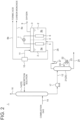
FIG. 2 is a schematic configuration diagram of a carbon dioxide absorption and reduction device according to a modification of the present disclosure. -
FIG. 3 is a schematic configuration diagram of a carbon dioxide absorption and reduction device according to another modification of the present disclosure. - Hereinafter, a carbon dioxide absorption and reduction solution according to embodiments of the present disclosure will be described with reference to the drawings. The embodiment to be described below indicates one aspect of the present disclosure, does not intend to limit the disclosure, and can optionally be modified within a range of a technical idea of the present disclosure.
- The carbon dioxide absorption and reduction solution according to an embodiment of the present disclosure is used as an electrolytic solution for electrolysis, and carbon dioxide supplied to the electrolytic solution is reduced to valuable substances such as carbon monoxide and formic acid through electrolysis. This carbon dioxide absorption and reduction solution contains a metal complex in a mixed solvent of water and a water-soluble solvent. The concentration of the metal complex in the mixed solvent is 0.01 to 100 mM as disclosed in the literature (
JP6615175B - The concentration of the water-soluble solvent in the mixed solvent is preferably 1 wt% or more and 60 wt% or less, more preferably 10 wt% or more and 50 wt% or less, most preferably 20 wt% or more and 40 wt% or less.
- As the metal complex, those represented by the following molecular structures (1) or (2) can be used.


- In molecular structure (1), M, the central metal of the metal complex, is either rhenium, manganese, or iron. In molecular structures (1) and (2), the metal complex contains at least two carbonyl groups, at least two nitrogen-containing heterocycles A and B, and ligands X and Y as ligands for the central metal (M and ruthenium). There is no limitation on ligands X and Y, but they may be any functional group, such as a chain or cyclic alkyl group or a functional group containing oxygen, nitrogen, sulfur, phosphorus, or halogen, or may be a carbonyl group or a nitrogen-containing heterocycle, or may be water or a hydroxy group.
- The at least two nitrogen-containing heterocycles may have the same or different structures. At least one of the two nitrogen-containing heterocycles A and B of the metal complex represented by molecular structure (1) has a substituent containing a hydroxy group (-R-OH/-R'-OH) as a functional group. In molecular structure (1), both nitrogen-containing heterocycles A and B have substituents containing hydroxy groups, but either one of the nitrogen-containing heterocycles may have a substituent containing a hydroxy group. In the case where the metal complex has three or more nitrogen-containing heterocycles, at least one nitrogen-containing heterocycle may have a substituent containing a hydroxy group. The substituent containing a hydroxy group makes the metal complex represented by molecular structure (1) water-soluble. However, the more carbon atoms in the structure with a substituent containing a hydroxy group, the less soluble the metal complex is in water. For this reason, a hydroxymethyl group or a hydroxyethyl group or a carboxy group are preferred as the substituent containing a hydroxy group. The metal complex represented by molecular structure (2) containing ruthenium as the central metal is water-soluble even if the nitrogen-containing heterocycles A and B have no substituents containing hydroxy groups, but even in the metal complex represented by molecular structure (2), at least one of the nitrogen-containing heterocycles may have a substituent containing a hydroxy group.
- The water-soluble solvent is a liquid containing an organic compound having a hydroxy group or a carboxy group. Examples of the organic compound include alcohols, glycols, phenols, phenol derivatives, alkanolamines, and amino acids. Even the organic compound having a hydroxy group or a carboxy group, substances with fewer carbons are preferred since the water solubility decreases as the number of carbons increases. For example, methyl alcohol, ethyl alcohol, 1-propyl alcohol, or 2-propyl alcohol are preferred among alcohols.
- Since alkanolamines have the property of absorbing carbon dioxide, carbon dioxide can be reduced efficiently by using an alkanolamine as the water-soluble solvent. Alkanolamines can be classified by structure as primary amines, secondary amines, or tertiary amines, and although amines of each structure differ in their ability to absorb carbon dioxide, they have a higher ability to absorb carbon dioxide than other organic compounds, so alkanolamines of any structure can be used.
- Examples of amino acids include, but are not limited to, glycine and alanine. Since they are solids at room temperature, they are used in the form of dissolved in water or other liquid organic compounds.
- The mixed solvent preferably contains an inorganic carbonate, an inorganic hydroxide, or an inorganic salt. As the inorganic carbonate, for example, sodium carbonate, potassium carbonate, and calcium carbonate can be used. As the inorganic hydroxide, for example, sodium hydroxide, potassium hydroxide, and calcium hydroxide can be used. As the inorganic salt, for example, carbonates, nitrates, and sulfates can be used. When such salts are not present in the mixed solvent, the ionic conductivity of the carbon dioxide absorption and reduction solution may be low with only 0.01 to 100 mM of the metal complex, making it difficult for the electrolysis reaction to occur. In contrast, the presence of such salts in the mixed solvent maintains the ionic conductivity necessary to allow the reduction reaction by electrolysis of carbon dioxide in the carbon dioxide absorption and reduction solution to proceed.
- As shown in
FIG. 1 , a carbon dioxide absorption andreduction device 1 according to an embodiment of the present disclosure includes an electrolysis device 3 containing the above-described carbon dioxide absorption andreduction solution 2. The interior of the electrolysis device 3 is divided into afirst chamber 3a and asecond chamber 3b by adiaphragm 4. The electrolysis device 3 is provided with acathode 5 immersed in the carbon dioxide absorption andreduction solution 2 in thefirst chamber 3a and ananode 6 immersed in the carbon dioxide absorption andreduction solution 2 in thesecond chamber 3b. Each of thecathode 5 and theanode 6 is electrically connected to aDC power supply 7. - The electrolysis device 3 is not limited to the configuration shown in
FIG. 1 , i.e., thecathode 5 and theanode 6 are each immersed in the carbon dioxide absorption andreduction solution 2 in the electrolyzer. Another example of the configuration may include an electrolyzer, a power supply electrically connected to the electrolyzer, a pipe for supplying liquid or gaseous reactants to the electrolyzer, and a pipe for discharging the products. As another example, the electrolyzer may be composed of an anode section, a cathode section, an electrolyte section, and an electrolyzer vessel with anode and cathode terminals, and the anode section electrically connected to the anode terminal and the cathode section electrically connected to the cathode terminal may be arranged on opposite sides of the electrolyte section in the electrolyzer. As yet another example, the anode section and the cathode section may be composed of a single member, with a catalytic electrode layer on a power feeding substrate to promote electrolysis reaction. As yet another example, a diaphragm may be arranged in the electrolyte section between the anode section and the cathode section to separate the products of the anode section from those of the cathode section. The diaphragm can be a porous membrane permeated with electrolyte or an ion-permeable non-porous membrane. As yet another example, the anode and cathode sections and the diaphragm may be placed apart or in contact with each other, and the two may be joined together to form a single unit. Yet another example may have an electrode junction membrane in which the electrodes (cathode 5 and anode 6) and the ion exchange membrane are bonded together. - Although the operation of the carbon dioxide absorption and
reduction device 1 will be described below, carbon dioxide dissolved in the carbon dioxide absorption andreduction solution 2 is reduced by electrolysis to produce at least one of carbon monoxide or formic acid in thefirst chamber 3a and oxygen in thesecond chamber 3b. The carbon dioxide absorption andreduction device 1 is connected tofirst outflow lines first chamber 3a, respectively, and asecond outflow line 9 through which oxygen flows out of thesecond chamber 3b. To allow carbon monoxide produced in thefirst chamber 3a to flow out of thefirst chamber 3a, thefirst outflow line 8a is connected to a gas phase portion of thefirst chamber 3a. To allow the carbon dioxide absorption andreduction solution 2 containing formic acid produced in thefirst chamber 3a to flow out of thefirst chamber 3a, thefirst outflow line 8b is connected to a liquid phase portion of thefirst chamber 3a, and thefirst outflow line 8b is provided with aseparation device 10 to separate formic acid from the carbon dioxide absorption andreduction solution 2 flowing out of thefirst chamber 3a, for example, a distillation device or a membrane separation device, and with areturn line 11 to return the carbon dioxide absorption andreduction solution 2 from which formic acid has been separated in theseparation device 10 to thefirst chamber 3a. If only carbon monoxide is produced in thefirst chamber 3a and no formic acid is produced, there is no need to install theseparation device 10. - When carbon dioxide is reduced in a batch process, as in the case where the carbon dioxide absorption and
reduction solution 2 dissolved with carbon dioxide is supplied into the electrolysis device 3 and electrolyzed, or in the case where carbon dioxide is dissolved by supplying a gas containing carbon dioxide to the carbon dioxide absorption andreduction solution 2 supplied into the electrolysis device 3 and then decomposed, the above configuration is sufficient for the carbon dioxide absorption andreduction device 1. However, in order to continuously supply carbon dioxide to the electrolysis device 3 for continuous carbon dioxide reduction, asupply line 12 for supplying the carbon dioxide absorption andreduction solution 2 dissolved with carbon dioxide to thefirst chamber 3a and anoutflow line 13 for discharging the carbon dioxide absorption andreduction solution 2 from thefirst chamber 3a are needed to connect to thefirst chamber 3a. - As a device for dissolving carbon dioxide into the carbon dioxide absorption and
reduction solution 2, for example, but not limited to, anabsorption tower 14 configured to bring a gas containing carbon dioxide into gas-liquid contact with the carbon dioxide absorption andreduction solution 2 as the absorption solution may be provided. To theabsorption tower 14 is connected agas supply line 15 for supplying a gas containing carbon dioxide, for example, combustion gas to theabsorption tower 14 and agas outflow line 16 for discharging the gas from which carbon dioxide has been removed from theabsorption tower 14. Thesupply line 12 is connected to the bottom of theabsorption tower 14, and theoutflow line 13 is connected to theabsorption tower 14 above the position where thegas supply line 15 is connected to theabsorption tower 14. Thesupply line 12 and theoutflow line 13 are provided withpumps - Some embodiments of the carbon dioxide absorption and
reduction device 1 configured to reduce carbon dioxide in a batch process as described above are shown inFIGs. 2 and3 . The carbon dioxide absorption andreduction device 1 shown inFIG. 2 includes, as a carbondioxide recovery device 20 for recovering carbon dioxide from a gas containing carbon dioxide, anabsorption tower 14 configured to bring a gas containing carbon dioxide into gas-liquid contact with an absorption solution, and aregeneration tower 21 for releasing carbon dioxide from the absorption solution that has absorbed carbon dioxide in theabsorption tower 14. Unlike the carbon dioxide absorption andreduction device 1 shown inFIG. 1 , the absorption solution used in theabsorption tower 14 is a different absorption solution than the carbon dioxide absorption andreduction solution 2. Theabsorption tower 14 and theregeneration tower 21 are connected by asupply line 12. - The
regeneration tower 21 is equipped with a heat exchanger (reboiler) 23 that includes a heatmedium flow passage 22 through which a heat medium (e.g., steam) flows and an absorptionsolution circulation passage 24 through which the absorption solution in theregeneration tower 21 flows out of theregeneration tower 21 and circulates back to theregeneration tower 21, so that the heat medium flowing through the heatmedium flow passage 22 and the absorption solution circulating through the absorptionsolution circulation passage 24 exchange heat. The bottom of theregeneration tower 21 is connected to anextraction line 25 for extracting the absorption solution. The top of theregeneration tower 21 is connected to the other end of agas supply line 26, one end of which is connected to the bottom of thefirst chamber 3a of the electrolysis device 3. Thegas supply line 26 is provided with acompressor 27. - The carbon
dioxide recovery device 20 is not limited to the configuration described above, including theabsorption tower 14 and theregeneration tower 21. Any configuration is acceptable as long as it can recover carbon dioxide from a gas containing carbon dioxide and supply the recovered carbon dioxide to the carbon dioxide absorption andreduction solution 2 in thefirst chamber 3a of the electrolysis device 3. For example, the carbon dioxide absorption andreduction device 1 shown inFIG. 3 is equipped with amembrane separation device 30 capable of separating carbon dioxide as the carbondioxide recovery device 20. Themembrane separation device 30 is connected to agas outflow line 16 for discharging the gas from which carbon dioxide has been separated from themembrane separation device 30. Themembrane separation device 30 is connected to the bottom of thefirst chamber 3a through agas supply line 26 so that the separated carbon dioxide can be fed into thefirst chamber 3a. Thegas supply line 26 is provided with acompressor 27. - The operation of the carbon dioxide absorption and reduction solution 2 (carbon dioxide absorption and reduction method) will be now described based on
FIG. 1 . Theabsorption tower 14 is supplied with a gas containing carbon dioxide, e.g., combustion gas discharged from a combustion facility (not shown), via thegas supply line 15. The combustion gas supplied to theabsorption tower 14 rises up in theabsorption tower 14. Further, theabsorption tower 14 is supplied with the carbon dioxide absorption andreduction solution 2 as the absorption solution via theoutflow line 13. The absorption solution supplied to theabsorption tower 14 falls down in theabsorption tower 14. In theabsorption tower 14, the rising combustion gas and the falling absorption solution come into gas-liquid contact, so that carbon dioxide contained in the combustion gas is absorbed by the absorption solution, and the combustion gas from which carbon dioxide has been removed flows out of theabsorption tower 14 through thegas outflow line 16. The absorption solution that has absorbed carbon dioxide is accumulated in a lower portion of theabsorption tower 14, but the absorption solution is extracted from theabsorption tower 14 by thepump 17 and supplied to thefirst chamber 3a of the electrolysis device 3 through thesupply line 12. - When the
DC power supply 7 applies a voltage between thecathode 5 and theanode 6 in the electrolysis device 3, at least one of carbon monoxide or formic acid is produced in thefirst chamber 3a by the catalytic action of the metal complex dissolved in the carbon dioxide absorption andreduction solution 2, as shown in the following semi-reaction equations (A) and (B). On the other hand, oxygen is produced in thesecond chamber 3b as shown in the following semi-reaction equation (C).
CO2+H2O+2e-→CO+2OH- (A)
CO2+2H2O+2e- →HCOOH+2OH- (B)
2OH-→(1/2)O2+H2O+2e- (C)
- It is rare that only one of the half-reaction equation (A) or (B) occurs, and usually both reactions occur simultaneously, with the ratio of both reactions varying depending on the type of metal complex. In other words, the production ratio of carbon monoxide and formic acid varies depending on the type of metal complex used.
- Carbon monoxide produced in the
first chamber 3a flows out of thefirst chamber 3a via thefirst outflow line 8a and is sent to a facility that use carbon monoxide, a carbon monoxide storage facility, etc. The formic acid produced in thefirst chamber 3a flows out of thefirst chamber 3a together with the carbon dioxide absorption andreduction solution 2 via thefirst outflow line 8b, and the formic acid is separated from the carbon dioxide absorption andreduction solution 2 in theseparation device 10 and sent to a facility that uses formic acid, a formic acid storage facility, etc. The carbon dioxide absorption andreduction solution 2 from which formic acid has been separated in theseparation device 10 can be returned to thefirst chamber 3a via thereturn line 11. Oxygen produced in thesecond chamber 3b flows out of thesecond chamber 3b via thesecond outflow line 9 and is sent to a facility that use oxygen, an oxygen storage facility, etc. - The
pump 18 causes part of the carbon dioxide absorption andreduction solution 2 in thefirst chamber 3a to flow out of thefirst chamber 3a through theoutflow line 13. The carbon dioxide absorption andreduction solution 2 flowing through theoutflow line 13 is supplied to theabsorption tower 14, falls in theabsorption tower 14, and comes into gas-liquid contact with the combustion gas rising in theabsorption tower 14 as the absorption solution. - Thus, by dissolving the water-soluble metal complex as the catalyst for carbon dioxide absorption and reduction in the mixed solvent of water and a water-soluble solvent, the precipitation of the metal complex can be suppressed. As a result, it is possible to improve the reduction efficiency of carbon dioxide. The effect of the metal complex to suppress the precipitation will be described based on the following examples.
- In the carbon dioxide absorption and
reduction device 1 shown inFIG. 2 , carbon dioxide is absorbed by the absorption solution as a result of gas-liquid contact between the gas containing carbon dioxide and the absorption solution in theabsorption tower 14. The absorption solution that has absorbed carbon dioxide is supplied to theregeneration tower 21 through thesupply line 12. In theregeneration tower 21, the absorption solution is heated by aheat exchanger 23 to release carbon dioxide. The released carbon dioxide is supplied into thefirst chamber 3a through thegas supply line 26 by thecompressor 27. At least part of the carbon dioxide supplied into the first chamber 3 dissolves in the carbon dioxide absorption andreduction solution 2. After a certain amount of carbon dioxide is dissolved in the carbon dioxide absorption andreduction solution 2, theDC power supply 7 applies a voltage between thecathode 5 and theanode 6, so that the carbon dioxide dissolved in the carbon dioxide absorption andreduction solution 2 is reduced according to the above principle. - In the carbon dioxide absorption and
reduction device 1 shown inFIG. 3 , carbon dioxide is separated from a gas containing carbon dioxide in themembrane separation device 30. The separated carbon dioxide is supplied into thefirst chamber 3a through thegas supply line 26 by thecompressor 27. At least part of the carbon dioxide supplied into the first chamber 3 dissolves in the carbon dioxide absorption andreduction solution 2. After a certain amount of carbon dioxide is dissolved in the carbon dioxide absorption andreduction solution 2, theDC power supply 7 applies a voltage between thecathode 5 and theanode 6, so that the carbon dioxide dissolved in the carbon dioxide absorption andreduction solution 2 is reduced according to the above principle. - Experiments were conducted on the following metal complexes (3) and (4) to check for the presence or absence of precipitation. Metal complex (3) corresponds to molecular structure (1), while metal complex (4), in which the nitrogen-containing heterocycle does not contain a hydroxyalkyl group, does not correspond to molecular structure (1).
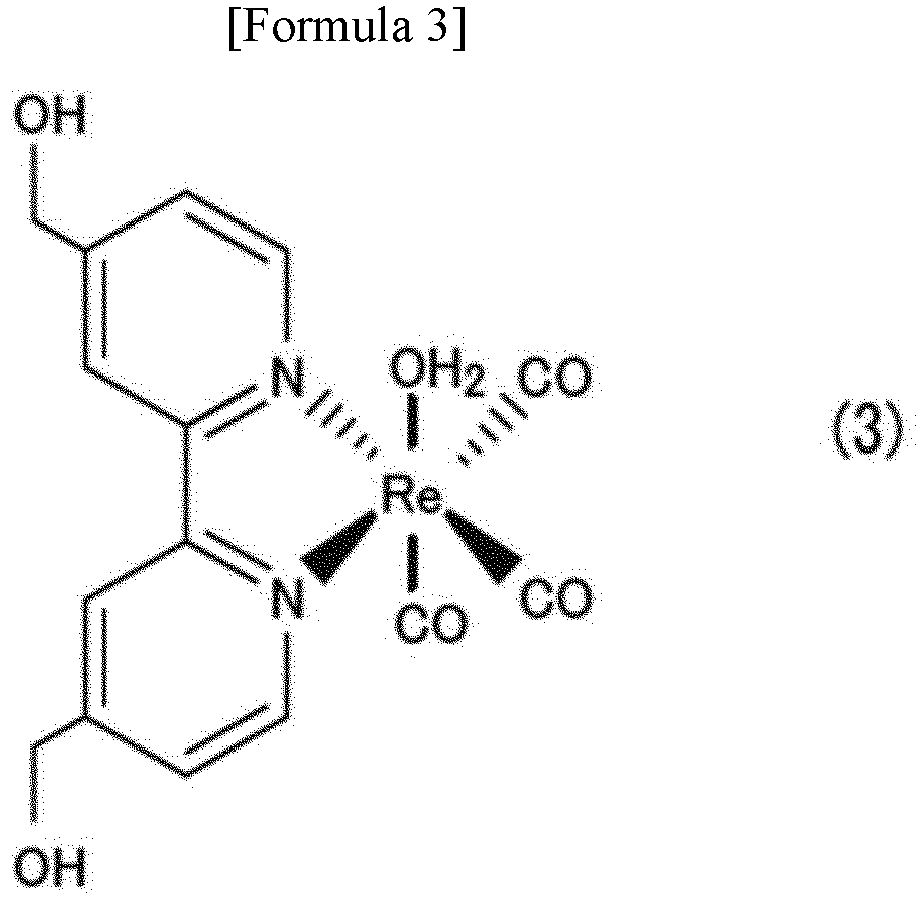

- As shown in Table 1 below, Examples 1 through 5, in which metal complex (3) was dissolved in various organic compounds in liquid form, and Comparative Examples 1 and 2, in which metal complex (4) was dissolved, and Comparative Example 3, in which metal complex (3) was dissolved, were prepared as mixed solutions at predetermined concentrations: specifically, a mixture solvent of water and a water-soluble solvent was prepared, and each metal complex was added to reach the target concentration of each example or each comparison example, and while stirring the mixture with a stirrer, it was checked whether the metal complex could be dissolved or not. Examples 1 to 5 and Comparative Example 1 contain trace amounts of water. After confirming that all metal complexes were dissolved in the respective solutions, carbon dioxide-containing gas (with carbon dioxide concentration of 10 vol%) was blown into each solution to check for the precipitation of the complex.
(Table 1) Example/ Comparative Example Metal compex [Concentration] Organic compound [Concentration] Additive [Concentration] Precipi tation Example 1 (3) [1.5mM] Ethanol [10wt%] - Absence Example 2 (3) [1.5mM] Ethanol [10wt%] Sodium sulfate [0.1 M] Absence Example 3 (3) [1.5mM] Ethanol [50wt%] - Absence Example 4 (3) [0.5mM] Triethanol amine [30wt%] Sodium sulfate [0.1M] Absence Example 5 (3) [0.5mM] Monoethanol amine [30wt%] Sodium sulfate [0.1M] Absence Comparative Example 1 (4) Triethanol amine [100wt%] - Absence Comparative Example 2 ( 4 ) Only water - Presence Comparative Example 3 ( 3 ) Only water - Presence - In all Examples 1 to 5, no precipitation of the metal complexes was observed. In contrast, in Comparative Example 1, where metal complex (4), which is not water-soluble, was used, no precipitation of the metal complex was observed because the organic compound was not mixed with water, while in Comparative Example 2, where the organic compound could be mixed with water, the precipitation of the metal complex was observed. Moreover, in Comparative Example 2, the metal complex precipitation was observed even though the concentration of the metal complex was lowered to prevent the metal complex precipitation. In Example 3, where metal complex (3) was used, the precipitation of the metal complex was observed. These results indicate that the use of the carbon dioxide absorption and reduction solution of the present disclosure can suppress the precipitation of the metal complex.
- Under the conditions of the coexistence of water and ethanol as in Example 1, the equilibrium reaction of each complex formed results in a total of six complexes with Re as the central metal, as shown below. This has suppressed and prevented the precipitation of the metal complex. Based on this mechanism, under conditions of coexistence of water and water-soluble solvent, the use of a water-soluble metal complex allows carbon dioxide to be added without precipitation of the metal complex.

- The contents described in the above embodiments would be understood as follows, for instance.
- [1] A carbon dioxide absorption and reduction solution according to one aspect is a carbon dioxide absorption and reduction solution (2) containing 0.01 to 100 mM of a metal complex in a mixed solvent of water and a water-soluble solvent, the metal complex containing: a central metal which is any of rhenium, manganese, or iron; and a ligand which coordinates to the central metal. The ligand includes two or more carbonyl groups and two or more nitrogen-containing heterocycles, and at least one of the two or more nitrogen-containing heterocycles has at least one substituent including a carboxy group or a hydroxy group.
With the carbon dioxide absorption and reduction solution of the present disclosure, the precipitation of the metal complex can be suppressed by dissolving the water-soluble metal complex as the catalyst for carbon dioxide absorption and reduction in the mixed solvent of water and a water-soluble solvent. - [2] A carbon dioxide absorption and reduction solution according to another aspect is the carbon dioxide absorption and reduction solution described in [1], in which the ligand includes two or more carbonyl groups and two or more nitrogen-containing heterocycles, and at least one of the two or more nitrogen-containing heterocycles is at least one hydroxymethyl group or hydroxyethyl group or carboxy group.
The presence of a hydroxy group at the terminal of the side chain of the nitrogen-containing heterocycle of the ligand coordinating to the central metal makes the metal complex water-soluble, but the more the number of carbon atoms in the carbon chain, the less soluble the metal complex is in water. In contrast, as in the above configuration [2], if the hydroxyalkyl group is a hydroxymethyl group or hydroxyethyl group or carboxy group, the metal complex becomes water-soluble, and the precipitation of the metal complex can be suppressed. - [3] A carbon dioxide absorption and reduction solution according to one aspect is a carbon dioxide absorption and reduction solution containing 0.01 to 100 mM of a metal complex in a mixed solvent of water and a water-soluble solvent, the metal complex containing: ruthenium; and a ligand which coordinates to ruthenium. The ligand includes two or more carbonyl groups and two or more nitrogen-containing heterocycles.
With the carbon dioxide absorption and reduction solution of the present disclosure, the precipitation of the metal complex can be suppressed by dissolving the water-soluble metal complex as the catalyst for carbon dioxide absorption and reduction in the mixed solvent of water and a water-soluble solvent. - [4] A carbon dioxide absorption and reduction solution according to another aspect is the carbon dioxide absorption and reduction solution described in any one of [1] to [3], in which the water-soluble solvent is a liquid that contains an organic compound having a hydroxy group.
With this configuration, since the water-soluble metal complex dissolves in the mixed solvent, it is possible to suppress the precipitation of the metal complex. - [5] A carbon dioxide absorption and reduction solution according to still another aspect is the carbon dioxide absorption and reduction solution described in [4], in which the organic compound is methyl alcohol, ethyl alcohol, 1-propyl alcohol, or 2-propyl alcohol.
With this configuration, since the water-soluble metal complex dissolves in the mixed solvent, it is possible to suppress the precipitation of the metal complex. - [6] A carbon dioxide absorption and reduction solution according to still another aspect is the carbon dioxide absorption and reduction solution described in [4], in which the organic compound is an alkanolamine.
With this configuration, by using an alkanolamine, which can absorb carbon dioxide, as the water-soluble solvent, carbon dioxide can be reduced efficiently. - [7] A carbon dioxide absorption and reduction solution according to still another aspect is the carbon dioxide absorption and reduction solution described in any one of [1] to [6], in which the mixed solvent contains an inorganic carbonate, an inorganic hydroxide, or an inorganic salt.
With this configuration, by adding an inorganic carbonate, an inorganic hydroxide, or an inorganic salt to the mixed solvent, it is possible to maintain the ionic conductivity necessary to allow the reduction reaction of carbon dioxide in the carbon dioxide absorption and reduction solution by electrolysis to proceed. - [8] A carbon dioxide absorption and reduction solution according to still another aspect is the carbon dioxide absorption and reduction solution described in any one of [1] to [7], in which the water-soluble solvent contains an amino acid.
With this configuration, since the water-soluble metal complex dissolves in the mixed solvent, it is possible to suppress the precipitation of the metal complex. - [9] A carbon dioxide absorption and reduction device according to one aspect includes an electrolysis device (3) containing the carbon dioxide absorption and reduction solution (2) described in any one of [1] to [8].
With the carbon dioxide absorption and reduction device of the present disclosure, the precipitation of the metal complex can be suppressed by dissolving the water-soluble metal complex as the catalyst for carbon dioxide absorption and reduction in the mixed solvent of water and a water-soluble solvent. As a result, it is possible to improve the reduction efficiency of carbon dioxide. - [10] A carbon dioxide absorption and reduction device according to another aspect is the carbon dioxide absorption and reduction device described in [9], including: a supply line (12) for supplying the carbon dioxide absorption and reduction solution that has absorbed carbon dioxide into the electrolysis device (3); and an outflow line (13) through which the carbon dioxide absorption and reduction solution (2) flows out of the electrolysis device (3).
This configuration allows for continuous carbon dioxide absorption and reduction. - [11] A carbon dioxide absorption and reduction device according to still another aspect is the carbon dioxide absorption and reduction device described in [10], further including an absorption tower (14) configured to bring a gas containing carbon dioxide into contact with the carbon dioxide absorption and reduction solution so that carbon dioxide is absorbed by the carbon dioxide absorption and reduction solution. The carbon dioxide absorption and reduction solution that has absorbed carbon dioxide in the absorption tower (14) is supplied into the electrolysis device (3) through the supply line (12), and the carbon dioxide absorption and reduction solution flowing out of the electrolysis device (3) through the outflow line (13) is supplied to the absorption tower (14) and comes into contact with the gas.
With this configuration, carbon dioxide recovered from the gas containing carbon dioxide can be reduced continuously. - [12] A carbon dioxide absorption and reduction device according to still another aspect is the carbon dioxide absorption and reduction device described in [9], including: a carbon dioxide recovery device (20) for recovering carbon dioxide from a gas containing carbon dioxide; and a gas supply line (26) for supplying carbon dioxide recovered in the carbon dioxide recovery device (20) to the carbon dioxide absorption and reduction solution (2) contained in the electrolysis device (3).
With this configuration, carbon dioxide recovered from the gas containing carbon dioxide can be reduced in a batch process. - [13] A carbon dioxide absorption and reduction device according to still another aspect is the carbon dioxide absorption and reduction device described in [12], in which the carbon dioxide recovery device (20) includes: an absorption tower (14) configured to bring the gas containing carbon dioxide into contact with an absorption solution so that carbon dioxide is absorbed by the absorption solution; and a regeneration tower (21) configured to release carbon dioxide from the absorption solution that has absorbed carbon dioxide. Carbon dioxide released in the regeneration tower (21) is supplied to the carbon dioxide absorption and reduction solution (2) contained in the electrolysis device (3) through the gas supply line (26).
With this configuration, carbon dioxide recovered from the gas containing carbon dioxide can be reduced in a batch process. - [14] A carbon dioxide absorption and reduction method according to one aspect includes: a step of supplying carbon dioxide to the carbon dioxide absorption and reduction solution (2) described in any one of [1] to [8]; and a step of electrolyzing the carbon dioxide absorption and reduction solution (2) supplied with carbon dioxide.
With the carbon dioxide absorption and reduction method of the present disclosure, the precipitation of the metal complex can be suppressed by dissolving the water-soluble metal complex as the catalyst for carbon dioxide absorption and reduction in the mixed solvent of water and a water-soluble solvent. As a result, it is possible to improve the reduction efficiency of carbon dioxide. - [15] A carbon dioxide absorption and reduction method according to another aspect is the carbon dioxide absorption and reduction method described in [14], in which at least one of carbon monoxide or formic acid is produced by electrolyzing the carbon dioxide absorption and reduction solution (2).
- With this method, by reducing carbon dioxide to produce at least one of carbon monoxide or formic acid, carbon dioxide can be converted into a valuable resource and effectively used.
-
- 1
- Carbon dioxide absorption and reduction device
- 2
- Carbon dioxide absorption and reduction solution
- 3
- Electrolysis device
- 12
- Supply line
- 13
- Outflow line
- 14
- Absorption tower
- 20
- Carbon dioxide recovery device
- 21
- Regeneration tower
- 26
- Gas supply line
Claims (15)
- A carbon dioxide absorption and reduction solution, comprising 0.01 to 100 mM of a metal complex in a mixed solvent of water and a water-soluble solvent,wherein the metal complex contains:a central metal which is any of rhenium, manganese, or iron; anda ligand which coordinates to the central metal, andwherein the ligand includes two or more carbonyl groups and two or more nitrogen-containing heterocycles, and at least one of the two or more nitrogen-containing heterocycles has at least one substituent including a carboxy group or a hydroxy group.
- The carbon dioxide absorption and reduction solution according to claim 1,
wherein the ligand includes two or more carbonyl groups and two or more nitrogen-containing heterocycles, and at least one of the two or more nitrogen-containing heterocycles is at least one hydroxymethyl group or hydroxyethyl group or carboxy group. - A carbon dioxide absorption and reduction solution, comprising 0.01 to 100 mM of a metal complex in a mixed solvent of water and a water-soluble solvent,wherein the metal complex contains:ruthenium; anda ligand which coordinates to ruthenium, andwherein the ligand includes two or more carbonyl groups and two or more nitrogen-containing heterocycles.
- The carbon dioxide absorption and reduction solution according to any one of claims 1 to 3,
wherein the water-soluble solvent is a liquid that contains an organic compound having a hydroxy group. - The carbon dioxide absorption and reduction solution according to claim 4,
wherein the organic compound is methyl alcohol, ethyl alcohol, 1-propyl alcohol, or 2-propyl alcohol. - The carbon dioxide absorption and reduction solution according to claim 4,
wherein the organic compound is an alkanolamine. - The carbon dioxide absorption and reduction solution according to any one of claims 1 to 3,
wherein the mixed solvent contains an inorganic carbonate, an inorganic hydroxide, or an inorganic salt. - The carbon dioxide absorption and reduction solution according to any one of claims 1 to 3,
wherein the water-soluble solvent contains an amino acid. - A carbon dioxide absorption and reduction device, comprising an electrolysis device containing the carbon dioxide absorption and reduction solution according to any one of claims 1 to 3.
- The carbon dioxide absorption and reduction device according to claim 9, comprising:a supply line for supplying the carbon dioxide absorption and reduction solution that has absorbed carbon dioxide into the electrolysis device; andan outflow line through which the carbon dioxide absorption and reduction solution flows out of the electrolysis device.
- The carbon dioxide absorption and reduction device according to claim 10, further comprising an absorption tower configured to bring a gas containing carbon dioxide into contact with the carbon dioxide absorption and reduction solution so that carbon dioxide is absorbed by the carbon dioxide absorption and reduction solution,
wherein the carbon dioxide absorption and reduction solution that has absorbed carbon dioxide in the absorption tower is supplied into the electrolysis device through the supply line, and the carbon dioxide absorption and reduction solution flowing out of the electrolysis device through the outflow line is supplied to the absorption tower and comes into contact with the gas. - The carbon dioxide absorption and reduction device according to claim 9, comprising:a carbon dioxide recovery device for recovering carbon dioxide from a gas containing carbon dioxide; anda gas supply line for supplying carbon dioxide recovered in the carbon dioxide recovery device to the carbon dioxide absorption and reduction solution contained in the electrolysis device.
- The carbon dioxide absorption and reduction device according to claim 12,wherein the carbon dioxide recovery device includes:an absorption tower configured to bring the gas containing carbon dioxide into contact with an absorption solution so that carbon dioxide is absorbed by the absorption solution; anda regeneration tower configured to release carbon dioxide from the absorption solution that has absorbed carbon dioxide, andwherein carbon dioxide released in the regeneration tower is supplied to the carbon dioxide absorption and reduction solution contained in the electrolysis device through the gas supply line.
- A carbon dioxide absorption and reduction method, comprising:a step of supplying carbon dioxide to the carbon dioxide absorption and reduction solution according to any one of claims 1 to 3; anda step of electrolyzing the carbon dioxide absorption and reduction solution supplied with carbon dioxide.
- The carbon dioxide absorption and reduction method according to claim 14,
wherein at least one of carbon monoxide or formic acid is produced by electrolyzing the carbon dioxide absorption and reduction solution.
Applications Claiming Priority (2)
| Application Number | Priority Date | Filing Date | Title |
|---|---|---|---|
| JP2021137715A JP7730500B2 (en) | 2021-08-26 | 2021-08-26 | Carbon dioxide absorption/reduction solution, carbon dioxide absorption/reduction device, and carbon dioxide absorption/reduction method |
| PCT/JP2022/030439 WO2023026855A1 (en) | 2021-08-26 | 2022-08-09 | Carbon dioxide absorption and reduction solution, carbon dioxide absorption and reduction device, and carbon dioxide absorption and reduction method |
Publications (2)
| Publication Number | Publication Date |
|---|---|
| EP4349482A1 true EP4349482A1 (en) | 2024-04-10 |
| EP4349482A4 EP4349482A4 (en) | 2025-03-05 |
Family
ID=85323176
Family Applications (1)
| Application Number | Title | Priority Date | Filing Date |
|---|---|---|---|
| EP22861145.5A Pending EP4349482A4 (en) | 2021-08-26 | 2022-08-09 | Carbon dioxide absorption and reduction solution, carbon dioxide absorption and reduction device, and carbon dioxide absorption and reduction method |
Country Status (6)
| Country | Link |
|---|---|
| US (1) | US20240293771A1 (en) |
| EP (1) | EP4349482A4 (en) |
| JP (1) | JP7730500B2 (en) |
| AU (1) | AU2022333697B2 (en) |
| CA (1) | CA3226753A1 (en) |
| WO (1) | WO2023026855A1 (en) |
Families Citing this family (1)
| Publication number | Priority date | Publication date | Assignee | Title |
|---|---|---|---|---|
| JP2024125604A (en) * | 2023-03-06 | 2024-09-19 | 三菱重工業株式会社 | Carbon dioxide absorption/reduction solution, carbon dioxide absorption/reduction device, and carbon dioxide absorption/reduction method |
Family Cites Families (8)
| Publication number | Priority date | Publication date | Assignee | Title |
|---|---|---|---|---|
| JP4838489B2 (en) * | 2003-07-25 | 2011-12-14 | 関西電力株式会社 | Method and apparatus for removing nitrogen dioxide and carbon dioxide |
| US20130277209A1 (en) * | 2010-12-28 | 2013-10-24 | Kabushiki Kaisha Toyota Chuo Kenkyusho | Photochemical reaction device |
| DE102015202258A1 (en) * | 2015-02-09 | 2016-08-25 | Siemens Aktiengesellschaft | Reduction process and electrolysis system for electrochemical carbon dioxide recovery |
| CN111621797B (en) | 2015-02-27 | 2023-06-02 | 国立研究开发法人科学技术振兴机构 | Electrochemical reduction of carbon dioxide |
| WO2018074443A1 (en) * | 2016-10-19 | 2018-04-26 | 三菱重工業株式会社 | Carbon dioxide recovery system, thermal power generation facility, and method for recovering carbon dioxide |
| JP7330042B2 (en) * | 2019-09-27 | 2023-08-21 | 三菱重工業株式会社 | Carbon dioxide reduction system and carbon dioxide reduction method |
| JP7533872B2 (en) | 2020-03-04 | 2024-08-14 | トーメイダイヤ株式会社 | Method for manufacturing diamond-based block tool blanks |
| GB2602030A (en) * | 2020-12-15 | 2022-06-22 | Univ Liverpool | Improvements in electrochemical reduction of carbon dioxide |
-
2021
- 2021-08-26 JP JP2021137715A patent/JP7730500B2/en active Active
-
2022
- 2022-08-09 US US18/570,494 patent/US20240293771A1/en active Pending
- 2022-08-09 WO PCT/JP2022/030439 patent/WO2023026855A1/en not_active Ceased
- 2022-08-09 CA CA3226753A patent/CA3226753A1/en active Pending
- 2022-08-09 EP EP22861145.5A patent/EP4349482A4/en active Pending
- 2022-08-09 AU AU2022333697A patent/AU2022333697B2/en active Active
Also Published As
| Publication number | Publication date |
|---|---|
| EP4349482A4 (en) | 2025-03-05 |
| AU2022333697A1 (en) | 2024-01-04 |
| AU2022333697B2 (en) | 2025-08-28 |
| US20240293771A1 (en) | 2024-09-05 |
| JP2023031928A (en) | 2023-03-09 |
| JP7730500B2 (en) | 2025-08-28 |
| CA3226753A1 (en) | 2023-03-02 |
| WO2023026855A1 (en) | 2023-03-02 |
Similar Documents
| Publication | Publication Date | Title |
|---|---|---|
| RU2479558C2 (en) | Electrochemical method of producing nitrogen fertilisers | |
| EP3752660B1 (en) | Integrated electrochemical capture and conversion of carbon dioxide | |
| US11198942B2 (en) | Electrolysis system for carbon dioxide | |
| US8658016B2 (en) | Carbon dioxide capture and conversion to organic products | |
| KR20140050038A (en) | Reduction of carbon dioxide to carboxylic acids, glycols, and carboxylates | |
| JP2021516290A (en) | How to electrochemically reduce carbon dioxide | |
| JP7330042B2 (en) | Carbon dioxide reduction system and carbon dioxide reduction method | |
| KR101795465B1 (en) | Carbon Capture Utilization System | |
| AU2018302325A1 (en) | CO2 electrolyser | |
| CN114585773B (en) | Electrolysis device and method for reducing carbon dioxide | |
| EP3292231B1 (en) | Electrochemical reduction of carbon dioxide in aqueous ionic liquid containing electrolytes | |
| US20240293771A1 (en) | Carbon dioxide absorption and reduction solution, carbon dioxide absorption and reduction device, and carbon dioxide absorption and reduction method | |
| WO2018027322A1 (en) | Electrochemical carbon dioxide utilization | |
| WO2023180922A2 (en) | Electrolyser | |
| WO2024185236A1 (en) | Carbon dioxide absorption and reduction solution, carbon dioxide absorption and reduction device, and carbon dioxide absorption and reduction method | |
| EP4556595A1 (en) | Carbon dioxide absorption and reduction solution, carbon dioxide absorption and reduction device, and carbon dioxide absorption and reduction method | |
| KR102675741B1 (en) | Method for electrochemically synthesizing alkylene carbonate | |
| KR20260037454A (en) | Electrolysis method of ammonia using electrolyte circulation |
Legal Events
| Date | Code | Title | Description |
|---|---|---|---|
| STAA | Information on the status of an ep patent application or granted ep patent |
Free format text: STATUS: THE INTERNATIONAL PUBLICATION HAS BEEN MADE |
|
| PUAI | Public reference made under article 153(3) epc to a published international application that has entered the european phase |
Free format text: ORIGINAL CODE: 0009012 |
|
| STAA | Information on the status of an ep patent application or granted ep patent |
Free format text: STATUS: REQUEST FOR EXAMINATION WAS MADE |
|
| 17P | Request for examination filed |
Effective date: 20240105 |
|
| AK | Designated contracting states |
Kind code of ref document: A1 Designated state(s): AL AT BE BG CH CY CZ DE DK EE ES FI FR GB GR HR HU IE IS IT LI LT LU LV MC MK MT NL NO PL PT RO RS SE SI SK SM TR |
|
| REG | Reference to a national code |
Ref country code: DE Ref legal event code: R079 Free format text: PREVIOUS MAIN CLASS: B01J0031220000 Ipc: B01J0031180000 |
|
| RIC1 | Information provided on ipc code assigned before grant |
Ipc: C25B 9/00 20210101ALI20240726BHEP Ipc: C25B 3/26 20210101ALI20240726BHEP Ipc: C25B 3/07 20210101ALI20240726BHEP Ipc: C25B 1/23 20210101ALI20240726BHEP Ipc: C01B 32/40 20170101ALI20240726BHEP Ipc: B01D 53/78 20060101ALI20240726BHEP Ipc: B01D 53/62 20060101ALI20240726BHEP Ipc: B01J 31/18 20060101AFI20240726BHEP |
|
| DAV | Request for validation of the european patent (deleted) | ||
| DAX | Request for extension of the european patent (deleted) | ||
| A4 | Supplementary search report drawn up and despatched |
Effective date: 20250204 |
|
| RIC1 | Information provided on ipc code assigned before grant |
Ipc: C25B 9/00 20210101ALI20250129BHEP Ipc: C25B 3/26 20210101ALI20250129BHEP Ipc: C25B 3/07 20210101ALI20250129BHEP Ipc: C25B 1/23 20210101ALI20250129BHEP Ipc: C01B 32/40 20170101ALI20250129BHEP Ipc: B01D 53/78 20060101ALI20250129BHEP Ipc: B01D 53/62 20060101ALI20250129BHEP Ipc: B01J 31/18 20060101AFI20250129BHEP |