EP4348377B1 - Alternate route finding for waypoint-based navigation maps - Google Patents
Alternate route finding for waypoint-based navigation maps Download PDFInfo
- Publication number
- EP4348377B1 EP4348377B1 EP22734464.5A EP22734464A EP4348377B1 EP 4348377 B1 EP4348377 B1 EP 4348377B1 EP 22734464 A EP22734464 A EP 22734464A EP 4348377 B1 EP4348377 B1 EP 4348377B1
- Authority
- EP
- European Patent Office
- Prior art keywords
- alternate
- route
- waypoint
- robot
- waypoints
- Prior art date
- Legal status (The legal status is an assumption and is not a legal conclusion. Google has not performed a legal analysis and makes no representation as to the accuracy of the status listed.)
- Active
Links
Images








Classifications
-
- G—PHYSICS
- G05—CONTROLLING; REGULATING
- G05D—SYSTEMS FOR CONTROLLING OR REGULATING NON-ELECTRIC VARIABLES
- G05D1/00—Control of position, course, altitude or attitude of land, water, air or space vehicles, e.g. using automatic pilots
- G05D1/02—Control of position or course in two dimensions
- G05D1/021—Control of position or course in two dimensions specially adapted to land vehicles
- G05D1/0268—Control of position or course in two dimensions specially adapted to land vehicles using internal positioning means
- G05D1/0274—Control of position or course in two dimensions specially adapted to land vehicles using internal positioning means using mapping information stored in a memory device
-
- B—PERFORMING OPERATIONS; TRANSPORTING
- B25—HAND TOOLS; PORTABLE POWER-DRIVEN TOOLS; MANIPULATORS
- B25J—MANIPULATORS; CHAMBERS PROVIDED WITH MANIPULATION DEVICES
- B25J9/00—Program-controlled manipulators
- B25J9/16—Program controls
- B25J9/1656—Program controls characterised by programming, planning systems for manipulators
- B25J9/1664—Program controls characterised by programming, planning systems for manipulators characterised by motion, path, trajectory planning
-
- B—PERFORMING OPERATIONS; TRANSPORTING
- B25—HAND TOOLS; PORTABLE POWER-DRIVEN TOOLS; MANIPULATORS
- B25J—MANIPULATORS; CHAMBERS PROVIDED WITH MANIPULATION DEVICES
- B25J19/00—Accessories fitted to manipulators, e.g. for monitoring, for viewing; Safety devices combined with or specially adapted for use in connection with manipulators
- B25J19/02—Sensing devices
- B25J19/021—Optical sensing devices
- B25J19/023—Optical sensing devices including video camera means
-
- B—PERFORMING OPERATIONS; TRANSPORTING
- B25—HAND TOOLS; PORTABLE POWER-DRIVEN TOOLS; MANIPULATORS
- B25J—MANIPULATORS; CHAMBERS PROVIDED WITH MANIPULATION DEVICES
- B25J9/00—Program-controlled manipulators
- B25J9/16—Program controls
- B25J9/1615—Program controls characterised by special kind of manipulator, e.g. planar, scara, gantry, cantilever, space, closed chain, passive/active joints and tendon driven manipulators
- B25J9/162—Mobile manipulator, movable base with manipulator arm mounted on it
-
- B—PERFORMING OPERATIONS; TRANSPORTING
- B25—HAND TOOLS; PORTABLE POWER-DRIVEN TOOLS; MANIPULATORS
- B25J—MANIPULATORS; CHAMBERS PROVIDED WITH MANIPULATION DEVICES
- B25J9/00—Program-controlled manipulators
- B25J9/16—Program controls
- B25J9/1694—Program controls characterised by use of sensors other than normal servo-feedback from position, speed or acceleration sensors, perception control, multi-sensor controlled systems, sensor fusion
- B25J9/1697—Vision controlled systems
-
- G—PHYSICS
- G01—MEASURING; TESTING
- G01C—MEASURING DISTANCES, LEVELS OR BEARINGS; SURVEYING; NAVIGATION; GYROSCOPIC INSTRUMENTS; PHOTOGRAMMETRY OR VIDEOGRAMMETRY
- G01C21/00—Navigation; Navigational instruments not provided for in groups G01C1/00 - G01C19/00
- G01C21/20—Instruments for performing navigational calculations
-
- G—PHYSICS
- G05—CONTROLLING; REGULATING
- G05D—SYSTEMS FOR CONTROLLING OR REGULATING NON-ELECTRIC VARIABLES
- G05D1/00—Control of position, course, altitude or attitude of land, water, air or space vehicles, e.g. using automatic pilots
- G05D1/02—Control of position or course in two dimensions
- G05D1/021—Control of position or course in two dimensions specially adapted to land vehicles
- G05D1/0231—Control of position or course in two dimensions specially adapted to land vehicles using optical position detecting means
- G05D1/0246—Control of position or course in two dimensions specially adapted to land vehicles using optical position detecting means using a video camera in combination with image processing means
- G05D1/0248—Control of position or course in two dimensions specially adapted to land vehicles using optical position detecting means using a video camera in combination with image processing means in combination with a laser
Definitions
- This disclosure relates to alternate route finding for navigation maps.
- Robotic devices navigate constrained environments to perform a variety of tasks or functions. To navigate through these constrained environments, the robotic devices may identify obstacles. Based on the identification of the obstacles, the robotic devices can navigate the constrained environment without contacting the obstacles.
- US 2021/041243 A1 discloses a method for generating intermediate waypoints for a navigation system of a robot including receiving a navigation route.
- the navigation route includes a series of high-level waypoints that begin at a starting location and end at a destination location and is based on high-level navigation data.
- the high-level navigation data is representative of locations of static obstacles in an area the robot is to navigate.
- the method also includes receiving image data of an environment about the robot from an image sensor and generating at least one intermediate waypoint based on the image data.
- the method also includes adding the at least one intermediate waypoint to the series of high-level waypoints of the navigation route and navigating the robot from the starting location along the series of high-level waypoints and the at least one intermediate waypoint toward the destination location.
- US 2006/167621 A1 discloses a method, system, and logic where planning a journey from an origin to a destination involves establishing selection criteria that includes one or more journey parameters and one or more rules.
- a journey parameter describes a constraint of the journey, and a rule specifies an action to perform in response to a trigger event.
- a route for the journey from the origin to the destination is planned.
- a trigger event is detected after initiation of the journey.
- a rule specifying an action to perform in response to the detected trigger event is accessed.
- One or more alternate waypoints are selected in accordance with the action and the selection criteria. The one or more alternate waypoints are inserted into the route to create a next route.
- US 2020/249033 A1 discloses a method and system where information about selection parameters is obtained from a starting position to a destination position along an initial route. At least one alternative route is calculated by selecting a waypoint as an intermediate destination based on an initial route calculation and the selection parameters. The at least one alternative route is determined through the waypoint differs from the initial route on a specific section on which the intermediate destination lies.
- An aspect of the present disclosure provides a computer-implemented method that when executed by data processing hardware of a robot causes the data processing hardware to perform operations as defined by the appended independent claim 1.
- the operations include obtaining a topological map including a series of route waypoints representative of a navigation route for the robot to follow from a start location to a destination location.
- the operations include receiving image data of an environment of the robot from an image sensor.
- the operations include determining, using the image data, that a route edge that connects a first route waypoint of the series of route waypoints to a second route waypoint of the series of route waypoints is at least partially blocked by an obstacle.
- the operations include generating, using the image data and the topological map, an alternate waypoint and an alternate edge connecting the alternate waypoint to the first route waypoint.
- the operations include adjusting the navigation route to include the alternate waypoint and the alternate edge, the alternate waypoint and the alternate edge bypassing the route edge that is at least partially blocked by the obstacle.
- the operations include navigating the robot from the first route waypoint to the alternate waypoint by traversing the robot along the alternate edge connecting the alternate waypoint to the first route waypoint.
- adjusting the navigation route includes obtaining a cost for each route edge of a series of route edges of the topological map and each alternate edge of one or more alternate edges and determining a route from a current location of the robot to the destination location using one or more route edges and/or alternate edges with an aggregate cost less than a cost threshold value.
- route edges that are not at least partially blocked by one or more obstacles may have a cost less than a cost of alternate edges.
- route edges that are at least partially blocked by one or more obstacles may have a cost greater than or equal to the cost of alternate edges.
- the alternate waypoint is offset from at least one route waypoint of the series of route waypoints by an offset distance. The offset distance may be less than or equal to an operational range of the image sensor.
- the operations further include generating a second alternate edge connecting the alternate waypoint and a second alternate waypoint. In some examples, the operations further include, determining that the second alternate edge connecting the alternate waypoint and the second alternate waypoint is blocked, and readjusting the navigation route to include a third alternate waypoint. The readjusted navigation route may bypass the second alternate edge.
- generating the alternate waypoint includes using a polyline buffer algorithm to generate the alternate waypoint. In some examples, generating the alternate waypoint includes generating one or more alternate waypoints within a threshold distance of a current location of the robot.
- the topological map indicates one or more locations of one or more static obstacles within the environment. In some cases, the topological map indicates a location of the alternate waypoint is free from static obstacles.
- generating the alternate waypoint includes generating at least two alternate waypoints, and the at least two alternate waypoints are connected by a respective alternate edge.
- the system includes data processing hardware of a robot and memory hardware in communication with the data processing hardware.
- the memory hardware stores instructions that when executed on the data processing hardware cause the data processing hardware to perform operations as defined by the appended independent claim 13.
- the operations include obtaining a topological map including a series of route waypoints representative of a navigation route for the robot to follow from a start location to a destination location.
- the operations include receiving image data of an environment of the robot from an image sensor.
- the operations include determining, using the image data, that a route edge that connects a first route waypoint of the series of route waypoints to a second route waypoint of the series of route waypoints is at least partially blocked by an obstacle.
- the operations include generating, using the image data and the topological map, an alternate waypoint and an alternate edge connecting the alternate waypoint to the first route waypoint.
- the operations include adjusting the navigation route to include the alternate waypoint and the alternate edge, the alternate waypoint and the alternate edge bypassing the route edge that is at least partially blocked by the obstacle.
- the operations include navigating the robot from the first route waypoint to the alternate waypoint by traversing the robot along the alternate edge connecting the alternate waypoint to the first route waypoint.
- adjusting the navigation route includes obtaining a cost for each route edge of a series of route edges of the topological map and each alternate edge of one or more alternate edges and determining a route from a current location of the robot to the destination location using one or more route edges and/or alternate edges with an aggregate cost less than a cost threshold value.
- route edges that are not at least partially blocked by one or more obstacles may have a cost less than a cost of alternate edges.
- route edges that are at least partially blocked by one or more obstacles may have a cost greater than or equal the cost of alternate edges.
- the alternate waypoint is offset from at least one route waypoint of the series of route waypoints by an offset distance. The offset distance may be less than or equal to an operational range of the image sensor.
- the operations further include generating a second alternate edge connecting the alternate waypoint and a second alternate waypoint. In some examples, the operations further include, determining that the second alternate edge connecting the alternate waypoint and the second alternate waypoint is blocked, and readjusting the navigation route to include a third alternate waypoint. The readjusted navigation route may bypass the second alternate edge.
- generating the alternate waypoint includes using a polyline buffer algorithm to generate the alternate waypoint. In some examples, generating the alternate waypoint includes generating one or more alternate waypoints within a threshold distance of a current location of the robot.
- the topological map indicates one or more locations of one or more static obstacles within the environment. In some cases, the topological map indicates a location of the alternate waypoint is free from static obstacles.
- generating the alternate waypoint includes generating at least two alternate waypoints, and the at least two alternate waypoints are connected by a respective alternate edge.
- Autonomous and semi-autonomous robots may be equipped with complex mapping, localization, and navigation systems. These systems may utilize navigation graphs.
- the navigation graph may include an obstacle map for local navigation.
- the obstacle map for local navigation may be limited in size, complexity, the information provided by the obstacle map, etc.
- the obstacle map may be limited based on a sensing range threshold (e.g., a sensing range threshold of the robot) and/or to increase efficiency, reduce computational cost, etc.
- the obstacle map may be limited to limit the robot to exploring a particular known safe area around a recorded path of the obstacle map and/or to prevent oscillating interactions by the robot with the obstacle map. Therefore, the obstacle map may lead to the robot becoming "stuck" on obstacles due to the obstacle map.
- Implementations herein are directed toward systems and methods for navigating a robot with additional flexibility for exploration in a verifiably-safe manner.
- the navigation system enables a robot to reroute (e.g., deterministically) around a plurality of classes of obstacles using an automated post-processing algorithm that adds graph structure in particular areas (e.g., areas where a predicted traversability of the area exceeds or matches a traversability threshold and/or areas where an observed portion of the area exceeds or matches an observed threshold).
- the robot may identify one or more additional paths based on the added graph structure that the robot may take to avoid a blockage within the nominal path. After avoiding the blockage, the robot may return to the nominal path. Therefore, the robot can gain additional navigation flexibility during runtime using the added graph structure in a deterministic manner and the added graph structure can be tuned and verified offline.
- a robot 100 includes a body 110 with one or more locomotion-based structures such as legs 120a-d coupled to the body 110 that enable the robot 100 to move within an environment 30 that surrounds the robot 100.
- all or a portion of the legs 120 are an articulable structure such that one or more joints J permit members 122 of the leg 120 to move.
- all or a portion of the legs 120 include a hip joint J H coupling an upper member 122, 122U of the leg 120 to the body 110 and a knee joint J K coupling the upper member 122U of the leg 120 to a lower member 122L of the leg 120.
- the robot 100 may include any number of legs or locomotive based structures (e.g., a biped or humanoid robot with two legs, or other arrangements of one or more legs) that provide a means to traverse the terrain within the environment 30.
- legs or locomotive based structures e.g., a biped or humanoid robot with two legs, or other arrangements of one or more legs
- the legs 120 may have a distal end 124 that contacts a surface of the terrain (e.g., a traction surface).
- the distal end 124 of the leg 120 may be the end of the leg 120 used by the robot 100 to pivot, plant, or generally provide traction during movement of the robot 100.
- the distal end 124 of a leg 120 corresponds to a foot of the robot 100.
- the distal end of the leg includes an ankle joint such that the distal end is articulable with respect to the lower member of the leg.
- the robot 100 includes an arm 126 that functions as a robotic manipulator.
- the arm 126 may move about multiple degrees of freedom in order to engage elements of the environment 30 (e.g., objects within the environment 30).
- the arm 126 includes one or more members 128, where the members 128 are coupled by joints J such that the arm 126 may pivot or rotate about the joint(s) J.
- the arm 126 may extend or to retract.
- FIG. 1 depicts the arm 126 with three members 128 corresponding to a lower member 128 L , an upper member 128 U , and a hand member 128 H (also referred to as an end-effector).
- the moveable jaw can move relative to the fixed jaw to move between an open position for the gripper and a closed position for the gripper (e.g., closed around an object).
- the arm 126 additionally includes a fourth joint J A4 .
- the fourth joint J A4 may be located near the coupling of the lower member 128 L to the upper member 128 U and function to allow the upper member 128u to twist or rotate relative to the lower member 128 L . Therefore, the fourth joint J A4 may function as a twist joint similarly to the third joint J A3 or wrist joint of the arm 126 adjacent the hand member 128 H .
- one member coupled at the joint J may move or rotate relative to another member coupled at the joint J (e.g., a first member coupled at the twist joint is fixed while the second member coupled at the twist joint rotates).
- the arm 126 connects to the robot 100 at a socket on the body 110 of the robot 100.
- the socket is configured as a connector such that the arm 126 attaches or detaches from the robot 100 depending on whether the arm 126 is desired for particular operations.
- the robot 100 has a vertical gravitational axis (e.g., shown as a Z-direction axis A Z ) along a direction of gravity, and a center of mass CM, which is a position that corresponds to an average position of all parts of the robot 100 where the parts are weighted according to their masses (e.g., a point where the weighted relative position of the distributed mass of the robot 100 sums to zero).
- the robot 100 further has a pose P based on the CM relative to the vertical gravitational axis A Z (e.g., the fixed reference frame with respect to gravity) to define a particular attitude or stance assumed by the robot 100.
- the attitude of the robot 100 can be defined by an orientation or an angular position of the robot 100 in space.
- a height generally refers to a distance along the z-direction (e.g., along a z-direction axis A Z ).
- the sagittal plane of the robot 100 corresponds to the Y-Z plane extending in directions of a y-direction axis A Y and the z-direction axis A Z . Therefore, the sagittal plane bisects the robot 100 into a left and a right side.
- a ground plane (also referred to as a transverse plane) spans the X-Y plane by extending in directions of the x-direction axis A X and the y-direction axis A Y .
- the ground plane refers to a ground surface 14 where distal ends 124 of the legs 120 of the robot 100 may generate traction to help the robot 100 move within the environment 30.
- Another anatomical plane of the robot 100 is the frontal plane that extends across the body 110 of the robot 100 (e.g., from a right side of the robot 100 with a first leg 120a to a left side of the robot 100 with a second leg 120b).
- the frontal plane spans the X-Z plane by extending in directions of the x-direction axis A X and the z-direction axis A z .
- the robot 100 includes a sensor system 130 (also referred to as a vision system) with one or more sensors 132, 132a-n.
- a sensor system 130 also referred to as a vision system
- FIG. 1A illustrates a first sensor 132, 132a mounted at a head of the robot 100 (e.g., near a front portion of the robot 100 adjacent the front legs 120a-b), a second sensor 132, 132b mounted near the hip of the second leg 120b of the robot 100, a third sensor 132, 132c corresponding to one of the sensors 132 mounted on a side of the body 110 of the robot 100, a fourth sensor 132, 132d mounted near the hip of the fourth leg 120d of the robot 100, and a fifth sensor 132, 132e mounted at or near the hand member 128 H of the arm 126 of the robot 100.
- the sensors 132 may include vision/image sensors, inertial sensors (e.g., an inertial measurement unit (IMU)), force sensors, and/or kinematic sensors.
- the sensors 132 may include one or more of an image sensor, (e.g., a camera, a stereo camera, etc.), a time-of-flight (TOF) sensor, a scanning light-detection and ranging (LIDAR) sensor, or a scanning laser-detection and ranging (LADAR) sensor.
- the sensor 132 has a corresponding field(s) of view F v defining a sensing range or region corresponding to the sensor 132. For instance, FIG.
- each sensor 132 may be pivotable and/or rotatable such that the sensor 132, for example, changes the field of view F V about one or more axis (e.g., an x-axis, a y-axis, or a z-axis in relation to a ground plane).
- multiple sensors 132 may be clustered together (e.g., similar to the first sensor 132a) to stitch a larger field of view F V than any single sensor 132.
- the sensor system 130 may have a 360 degree view or a nearly 360 degree view of the surroundings of the robot 100 about vertical or horizontal axes.
- the sensor system 130 When surveying a field of view F V with a sensor 132 (see e.g., FIG. 1B ), the sensor system 130 generates sensor data 134 (e.g., image data) corresponding to the field of view F V .
- the sensor system 130 may generate the field of view F V with a sensor 132 mounted on or near the body 110 of the robot 100 (e.g., sensor(s) 132a, 132b).
- the sensor system may additionally and/or alternatively generate the field of view F V with a sensor 132 mounted at or near the hand member 128 H of the arm 126 (e.g., sensor(s) 132c).
- the one or more sensors 132 capture the sensor data 134 that defines the three-dimensional point cloud for the area within the environment 30 of the robot 100.
- the sensor data 134 is image data that corresponds to a three-dimensional volumetric point cloud generated by a three-dimensional volumetric image sensor 132. Additionally or alternatively, when the robot 100 is maneuvering within the environment 30, the sensor system 130 gathers pose data for the robot 100 that includes inertial measurement data (e.g., measured by an IMU). In some examples, the pose data includes kinematic data and/or orientation data about the robot 100, for instance, kinematic data and/or orientation data about joints J or other portions of a leg 120 or arm 126 of the robot 100.
- the sensor system 130 includes sensor(s) 132 coupled to a joint J. Moreover, these sensors 132 may couple to a motor M that operates a joint J of the robot 100 (e.g., sensors 132). Here, these sensors 132 generate joint dynamics in the form of joint-based sensor data 134. Joint dynamics collected as joint-based sensor data 134 may include joint angles (e.g., an upper member 122 U relative to a lower member 122 L or hand member 126 H relative to another member of the arm 126 or robot 100), joint speed joint angular velocity, joint angular acceleration, and/or forces experienced at a joint J (also referred to as joint forces).
- joint angles e.g., an upper member 122 U relative to a lower member 122 L or hand member 126 H relative to another member of the arm 126 or robot 100
- joint speed joint angular velocity e.g., an upper member 122 U relative to a lower member 122 L or hand member 126 H relative to another member of the arm 126 or robot 100
- Joint-based sensor data generated by one or more sensors 132 may be raw sensor data, data that is further processed to form different types of joint dynamics, or some combination of both.
- a sensor 132 measures joint position (or a position of member(s) 122 or 128 coupled at a joint J) and systems of the robot 100 perform further processing to derive velocity and/or acceleration from the positional data.
- a sensor 132 can measure velocity and/or acceleration directly.
- a computing system 140 stores, processes, and/or communicates the sensor data 134 to various systems of the robot 100 (e.g., the control system 170, a navigation system 200, and/or remote controller 10).
- the computing system 140 of the robot 100 includes data processing hardware 142 (e.g., a hardware processor) and memory hardware 144 (e.g., a memory circuit).
- the data processing hardware 142 can execute instructions stored in the memory hardware 144 to perform computing tasks related to activities (e.g., movement and/or movement based activities) for the robot 100.
- the computing system 140 may refer to one or more locations of data processing hardware 142 and/or memory hardware 144.
- the computing system 140 is a local system located on the robot 100.
- the computing system 140 may be centralized (e.g., in a single location/area on the robot 100, for example, the body 110 of the robot 100), decentralized (e.g., located at various locations about the robot 100), or a hybrid combination of both (e.g., including centralized hardware and decentralized hardware).
- a decentralized computing system 140 may allow processing to occur at an activity location (e.g., at a motor that moves a joint of a leg 120) while a centralized computing system 140 may allow for a central processing hub that communicates to systems located at various positions on the robot 100 (e.g., communicate to the motor that moves the joint of the leg 120).
- the computing system 140 includes computing resources that are located remote from the robot 100.
- the computing system 140 communicates via a network 180 with a remote system 160 (e.g., a remote server or a cloud-based environment).
- the remote system 160 includes remote computing resources such as remote data processing hardware 162 and remote memory hardware 164.
- Sensor data 134 or other processed data may be stored in the remote system 160 and may be accessible to the computing system 140.
- the computing system 140 can utilize the remote resources 162, 164 as extensions of the computing resources 142, 144 such that resources of the computing system 140 reside on resources of the remote system 160.
- the remote system 160, or at least a portion of the remote resources 162, 164 reside on a remote controller 10 in communication with the robot 100.
- the robot 100 includes a control system 170.
- the control system 170 may communicate with systems of the robot 100, such as the at least one sensor system 130 and the navigation system 200.
- the control system 170 may perform operations and other functions using hardware 140.
- the control system 170 includes at least one controller 172 that can control the robot 100.
- the controller 172 controls movement of the robot 100 to about the environment 30 based on input or feedback from the systems of the robot 100 (e.g., the sensor system 130 and/or the control system 170).
- the controller 172 controls movement between poses and/or behaviors of the robot 100.
- the at least one controller 172 may control movement of the arm 126 of the robot 100 in order for the arm 126 to perform various tasks using the hand member 128 H .
- the at least one controller 172 may control the hand member 128 H (e.g., a gripper) to manipulate an object or element in the environment 30.
- the controller 172 actuates the movable jaw in a direction towards the fixed jaw to close the gripper. In other examples, the controller 172 actuates the movable jaw in a direction away from the fixed jaw to close the gripper.
- a given controller 172 of the control system 170 may control the robot 100 by controlling movement about one or more joints J of the robot 100.
- the given controller 172 includes software or firmware with programming logic that controls at least one joint J or a motor M which operates, or is coupled to, a joint J.
- a software application (a software resource) may refer to computer software that causes a computing device to perform a task.
- a software application may be referred to as an "application,” an "app,” or a "program.”
- the controller 172 may control an amount of force that is applied to a joint J (e.g., torque at a joint J).
- the number of joints J that a controller 172 controls is scalable and/or customizable for a particular control purpose.
- a controller 172 may control a single joint J (e.g., control a torque at a single joint J), multiple joints J, or actuation of one or more members 128 (e.g., actuation of the hand member 128 H ) of the robot 100.
- the controller 172 may coordinate movement for all different parts of the robot 100 (e.g., the body 110, one or more legs 120, the arm 126).
- a controller 172 may control movement of multiple parts of the robot 100 such as, for example, two legs 120a-b, four legs 120a-d, or two legs 120a-b combined with the arm 126.
- the controller 172 is an object-based controller that is set up to perform a particular behavior or set of behaviors for interacting with an interactable object.
- an operator 12 may interact with the robot 100 via the remote controller 10 that communicates with the robot 100 to perform actions.
- the operator 12 transmits commands 174 to the robot 100 (executed via the control system 170) via a wireless communication network 16.
- the robot 100 may communicate with the remote controller 10 to display an image on a user interface 190 (e.g., UI 190) of the remote controller 10.
- the UI 190 can display the image that corresponds to a three-dimensional field of view Fv of the one or more sensors 132.
- the image displayed on the UI 190 of the remote controller 10 may be a two-dimensional image that corresponds to the three-dimensional point cloud of sensor data 134 (e.g., field of view Fv) for the area within the environment 30 of the robot 100. That is, the image displayed on the UI 190 may be a two-dimensional image representation that corresponds to the three-dimensional field of view Fv of the one or more sensors 132.
- the three-dimensional point cloud of sensor data 134 e.g., field of view Fv
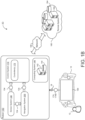
- the robot 100 executes the navigation system 200 for enabling the robot 100 to navigate the environment 30.
- the sensor system 130 includes one or more imaging sensors 132 (e.g., image sensors, LIDAR sensors, LADAR sensors, etc.) that can each capture sensor data 134 of the environment 30 surrounding the robot 100 within the field of view F V .
- the one or more sensors 132 may be one or more cameras.
- the sensor system 130 may move the field of view F V by adjusting an angle of view or by panning and/or tilting (either independently or via the robot 100) one or more sensors 132 to move the field of view F V in any direction.
- the sensor system 130 includes multiple sensors 132 (e.g., multiple cameras) such that the sensor system 130 captures a generally 360-degree field of view around the robot 100.
- Route edges may connect corresponding pairs of adjacent route waypoints.
- the route edges record geometric transforms between route waypoints based on odometry data.
- the route waypoints and the route edges may be representative of the navigation route 212 for the robot 100 to follow from a start location to a destination location.
- the high-level navigation module 220 produces the navigation route 212 over a greater than 10 meter scale (e.g., the navigation route 212 may include distances greater than 10 meters from the robot 100).
- the navigation system 200 also includes a local navigation module 230 that can receive the navigation route 212 and the image or sensor data 134 from the sensor system 130.
- the local navigation module 230 using the sensor data 134, can generate an obstacle map 232.
- the obstacle map 232 may be a robot-centered map that maps obstacles (static and/or dynamic obstacles) in the vicinity (e.g., within a threshold distance) of the robot 100 based on the sensor data 134.
- the obstacle map 232 may include information regarding a stack of boxes placed in the hallway that were not present during the original recording.
- the size of the obstacle map 232 may be dependent upon both the operational range of the sensors 132 (e.g., a camera, LIDAR, etc.) and the available computational resources.
- the local navigation module 230 can generate a step plan 240 (e.g., using an A* search algorithm) that plots all or a portion of the individual steps (or other movement) of the robot 100 to navigate from the current location of the robot 100 to the next waypoint along the navigation route 212.
- the robot 100 can maneuver through the environment 30.
- the local navigation module 230 may obtain a path for the robot 100 to the next waypoint using an obstacle grid map based on the captured sensor data 134.
- the local navigation module 230 operates on a range correlated with the operational range of the sensor 132 (e.g., four meters) that is generally less than the scale of high-level navigation module 220.
- the navigation system imposes one or more constraints on the robot 100 as the robot 100 attempts to traverse a navigation route.
- the robot 100 may be constrained from deviating more than a threshold distance from the navigation route and/or route waypoints 310a, b or route edges 312 that make up the navigation route.
- the obstacle map is smaller than a particular threshold value (e.g., to reduce computational cost or due to sensor range)
- the navigation system may impose constraints to limit the robot's exploration during navigation to known safe areas near the navigation route and to, for example, prevent oscillating interactions with the small obstacle map size.
- these constraints can limit the robot's ability to navigate around obstacles that impede or block the navigation route.
- a schematic view 300a illustrates a location of the robot 100 on the graph map 222.
- the local navigation module of the robot may impose a boundary constraint 320 on exploration of the robot 100 as the robot attempts to navigate from a first route waypoint 310a to a second route waypoint 310b along an edge 312.
- the size and location of the boundary constraint 320 may be based on the location of the route waypoints 310a, b, the sensor range of the robot's sensors, the computational resources of the robot 100, and/or the size and quality of the graph map 222.
- the robot 100 while navigating toward the waypoint 310b, encounters an obstacle 330. As shown in FIG.
- the obstacle 330 extends from the left side of the boundary box 320 to the right side of the boundary box 320.
- the robot may become stuck based on the position of the obstacle 330. For example, because the robot 100 cannot see a path around the obstacle 330 without violating the constraint imposed by the bounding constraint 320, the robot may become stuck.
- FIG. 3B a schematic view 300b illustrates that, in this example, that, after manually driving the robot 100 to the left, there is ample room to bypass the obstacle 330. However, due to constraints (e.g., the boundary constraint 320), the robot 100 may be unable to bypass the obstacle 330 autonomously.
- the navigation system 200 includes an alternate waypoint generator 400.
- the local navigation module 230 may obtain the sensor data 134 (e.g., image data) of the environment of the robot 100.
- the local navigation module 230 may determine, using the sensor data 134, that a corresponding one of the series of route edges 312a that connects the first route waypoint 310a and the second route waypoint 310b is blocked by an obstacle 330.
- the local navigation module 230 may determine that the route edge is blocked, as the robot 100 navigates along the navigation route 212 from a first route waypoint 310a to a second route waypoint 310b.
- the robot 100 navigates the navigation route 212 by traversing along the route edge 312a that connects the route waypoint 310a and the route waypoint 310b, the robot 100 encounters the obstacle 330 that blocks the route edge 312a. Because the obstacle 330 intersects the width of the boundary constraint 320 (which may correspond to a size of the obstacle map 232), the robot 100 may be unable to determine a route around the obstacle 330 and may remain within the boundary constraint 320.
- the alternate waypoint generator 400 may receive the sensor data 134 (or a derivative of the sensor data 134 such as the obstacle map 232) and the graph map 222 with the navigation route 212A.
- the alternate waypoint generator 400 can generate, using the sensor data 134 and the graph map 222, one or more alternate waypoints 310Aa, b each offset from one of the route waypoints 310a, b by an offset distance 420.
- the offset distance 420 may be correlated with an operations range of the sensor(s) (e.g., the offset distance is less than the operational range of the sensor(s), such as an image sensor, LIDAR sensor, LADAR sensor, etc.).
- a user computing device may provide information indicating the offset distance.
- the offset distance 420 may be based on a number of factors, including the environment the robot 100 is traversing.
- the alternate waypoint generator 400 may use sensor data 134 from one or more sensors that is different than the original sensor(s) 132 used to capture sensor data 134 associated with the obstacle 330 and/or the boundary constraint 320.
- the robot 100 may primarily operate on image data captured by a camera to reduce computational resources.
- the alternate waypoint generator 400 may process longer-range data (e.g., captured by a different sensor such as a LIDAR sensor) that is more computationally expensive than the image sensor so that the alternate waypoint generator 400 may generate alternate waypoints 310Aa, b and/or alternate edges 312Aa, b, c further from the original route 212A (when there are no obstacles 330) than the alternate waypoint generator 400 otherwise would be able to with the sensor data 134.
- longer-range data e.g., captured by a different sensor such as a LIDAR sensor
- the alternate waypoint generator 400 may generate a respective alternate edge 312Aa, b, c connecting the alternate waypoint 310Aa, b to a respective route waypoint 310a, b. In some examples, the alternate waypoint generator 400 determines a correspondence between all or a portion of the alternate waypoints 310Aa, b and a route waypoint 310a, b.
- the alternate waypoint generator 400 For all or a portion of the correspondence, if the robot 100 determines that the traversability of the straight-line region from the alternate waypoint 310Aa, b to the corresponding route waypoint 310a, b is greater than a threshold value (e.g., the robot 100 determines that the robot can traverse the straight-line region), the alternate waypoint generator 400 generates the alternate edge 312Aa, b, c and confirms the alternate waypoint 310Aa, b.
- a threshold value e.g., the robot 100 determines that the robot can traverse the straight-line region
- the alternate waypoint generator 400 may adjust the location of the alternate waypoint 310Aa, b (e.g., within a threshold distance of the original location) and may evaluate the path again.
- the alternate waypoint generator 400 may generate alternate waypoints 310Aa and 310Ab.
- the alternate waypoint 310Aa is connected to the route waypoint 310a via the alternate edge 312Aa and the alternate waypoint 310Ab is connected to the route waypoint 310b via the alternate edge 312Ac. Further, the alternate waypoints 310Aa, 310Ab are connected via the alternate edge 312Ab.
- the alternate waypoint generator 400 may generate alternate edges 312Aa, b, c between pairs of alternate waypoints 310Aa, b when all or a portion of the alternate waypoints 310Aa, b satisfy one of the following criteria.
- a first criteria is satisfied when all or a portion of the alternate waypoints 310Aa, b connect to the same route waypoint 310a, b.
- a second criteria is satisfied when all or a portion of the alternate waypoints 310Aa, b connect to an end of a single route edge 312.
- a third criteria is satisfied when all or a portion of the alternate waypoints 310Aa, b connect to one of two route waypoints 310a, b that have a particular path length between the two route waypoints 310a, b (e.g., a path length with a length below or equal to a particular threshold value, a normal path length, etc.). If the third criteria is satisfied, as discussed in more detail below, the alternate waypoint generator 400 may increase a cost of the corresponding alternate edge 312Aa, b, c to maintain a preference for the original navigation route 212. The alternate waypoint generator 400 may perform all or a portion of the traversability checks performed on the route edge 312 on all or a portion of the alternate edges 312, 312A.
- the alternate waypoint generator 400 may minimize the extent to which the region of allowed space around any alternate edge 312Aa, b, c duplicates the region of allowed space around any route edge 312. Therefore, the alternate waypoint generator 400 can minimize the overlap of the boundary constraint 320 and any new boundary constraints established by the alternate edges 312Aa, b, c based on sensor and/or computation constraints. As detecting that an edge is not traversable at playback time is time consuming and has an increased risk of the robot 100 falling while trying to traverse a blocked and/or modified area, it may be important to minimize the overlap.
- the alternate edges 312Aa, b, c may not traverse redundant areas of space (or the amount of traversed redundant space may be reduced), the alternate edges 312Aa, b, c can maximize the regions available to the robot without duplicating potentially blocked regions.
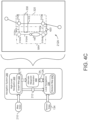
- the alternate waypoint generator 400 may adjust the navigation route 212 to include at least one of the one or more alternate waypoints 310Aa, b that bypass the route edge(s) 312 blocked by the obstacle 330. As discussed in more detail below, in some implementations, the alternate waypoint generator 400 generates the alternate waypoints 310Aa, b using a polyline buffer algorithm. The alternate waypoint generator 400 may apply one or more polyline buffer algorithms to a flattened two-dimensional map (e.g., the graph map 222) to generate candidate alternate waypoints 310Aa, b. The alternate waypoint generator 400 may evaluate all or a portion of the candidate alternate waypoints 310Aa, b using one or more constraints and/or checks to verify the validity of the candidate alternate edge.
- a polyline buffer algorithm e.g., the graph map 222
- the alternate waypoint generator 400 can perform collision checking via signed distance fields, perform ground-height variation checks, determine a maximum recorded and/or nominal path length bypassed by the candidate alternate waypoint 310Aa, b, and/or check for compatibility with user configuration options (e.g., the user may disable alternate waypoint 310Aa, b generation in some scenarios).
- the alternate waypoint generator 400 may confirm the alternate waypoint 310Aa, b for inclusion in the graph map 222 and/or the adjusted navigation route 212A.
- the alternate waypoint generator 400 may perform similar checks and evaluations for candidate alternate edges 312Aa, b, c along with appropriate additional checks (e.g., determining whether the alternate edge causes a maximum recorded or nominal path length to be exceeded).
- the local navigation module 230 may receive the adjusted navigation route 212A and navigate the robot 100 accordingly.
- the adjusted navigation route 212A may include one or more adjusted boundary constraints 320A.
- An additional boundary constraint 320A centered on the alternate edge 312A may enable the robot 100 the freedom to traverse the alternate edges 312Aa, b, c.
- the alternate waypoint generator 400 may generate new boundary constraints 320 (or, alternatively, adjust current boundary constraints 320) based on the generated alternate waypoints 310Aa, b and/or alternate edges 312Aa, b, c.
- the adjusted navigation route 212A includes the alternate waypoints 310Aa, 310Ab and the robot 100 navigates (e.g., first) to the alternate waypoint 310Aa via the edge 312Aa to the second alternate waypoint 310Ab via the edge 312Ab.
- the local navigation module 230 may navigate the robot 100 from a route waypoint 310a to an alternate waypoint 310Aa, b included in the adjusted navigation route 212A by traversing the robot 100 along the respective alternate edge 312Aa, b, c connecting the alternate waypoint 310Aa, b to the route waypoint 310a.
- the robot 100 may bypass the obstacle 330 utilizing the alternate waypoints 310Aa, b and return to the original navigation route 212 at the route waypoint 310b.
- all or a portion of the route waypoints 310a, b, the alternate waypoints 310Aa, b, the route edge 312, and/or the alternate edges 312Aa, b, c is associated with a respective cost.
- the navigation system 200 when determining the navigation route 212 and the adjusted navigation route 212A, may obtain the cost associated with all or a portion of the waypoints 310a, b, 310Aa, b and/or edges 312, 312Aa, b, c.
- the navigation system 200 may generate the adjusted navigation route 212A using the route edges 312 and alternate edges 312Aa, b, c (and or waypoints 310, 310Aa, b) that have a lowest aggregate cost.
- route edges 312 have a lower cost than alternate edges 312Aa, b, c to incentivize the robot 100 to return to the original navigation route 212 after bypassing the obstacle 330 (e.g., as soon as possible after bypassing the obstacle 330).
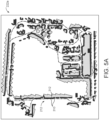
- an exemplary graph map 222b includes an adjusted navigation route 212A (e.g., an adjusted version of the navigation route as shown in FIG. 5A ) populated with a series of route waypoints 310 connected by the same route edges 312.
- the navigation route 212A is populated with alternate waypoints 310A (and the corresponding alternate edges 312A) at all applicable locations throughout the graph map 222b.
- the alternate waypoint generator generates an alternate waypoint 310A at every location on the graph map 222 that meets the criteria for alternate waypoint 310A generation.
- the criteria for generating an alternate waypoint 310A may include sufficient distance (e.g., the offset distance) between a respective route waypoint 310 and obstacles represented in the graph map 222b. Therefore, the alternate waypoint generator may generate alternate waypoints 310A based on the alternate waypoint generator determining (via the data from the graph map 222b) that there is sufficient room for the robot to traverse the alternate waypoint 310A without colliding with an obstacle indicated by the graph map 222b.
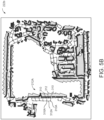
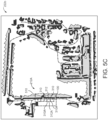
- the alternate waypoint generator may generate alternate waypoints 310A within a threshold distance of the robot.
- An exemplary graph map 222c indicates a current position of the robot and a bounding box 510 that represents a valid area for the alternate waypoint generator to generate alternate waypoints 310A.
- the navigation system 200 may reduce resources (e.g., computational or temporal) necessary to generate the adjusted navigation route 212A.
- the alternate waypoint generator may generate alternate waypoints 310A near a current location of the robot all or a portion of the times the robot's progress is impeded (e.g., the robot gets "stuck").
- the threshold distance may vary based on direction from the robot.
- the alternate waypoint generator may generate alternate waypoints 310A that are within a first threshold distance in front of the robot (e.g., ten meters, twenty meters, thirty meters, thirty-five meters, etc.) and within a second threshold distance behind the robot (e.g. five meters, ten meters, twenty meters, etc.).
- the alternate waypoint generator generates several candidate alternate waypoints.
- the high-level navigation module may initially generate the graph map using inputs such as the desired path (e.g., a prior recorded path selected by the user computing device or otherwise representative of the desired mission for the robot), point clouds generated from the sensor data captured by the sensor system, and/or local grid maps.
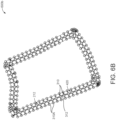
- a schematic view 600b of FIG. 6B illustrates exemplary candidate alternate waypoints generated from a graph map.
- the alternate waypoint generator may generate candidate alternate waypoints from all or a portion of the route waypoints. Each candidate alternate waypoint may be offset from the route waypoint by the offset distance.
- a schematic view 600c of FIG. 6C provides an enhanced view of the route waypoints, route edges, the candidate alternate waypoints, and the corresponding alternate edges.
- the navigation system may perform any number of constraint checks and/or evaluations prior to confirming all or a portion of the candidate alternate waypoints.
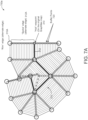
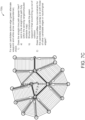
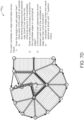
- the alternate waypoint generator determines chain transforms of one or more route waypoints 310 of the navigation route 212 (e.g., starting from the "oldest" route waypoint 310) and converts to two-dimensional geometry. As illustrated in schematic views 700a-d, the alternate waypoint generator may determine a series of offset polygons (e.g., "buffers") out to a threshold distance (e.g., 1.5 meters) using one or more polyline-buffer algorithms.
- a series of offset polygons e.g., "buffers”
- a threshold distance e.g. 1.5 meters
- the alternate waypoint generator in some examples, iteratively corresponds the outermost ("rim") of the alternate waypoints 310A to the nearest point on the polygon buffer and evaluates the straight line (the "spoke" or alternate edge 312A) formed by buffer points 720 and the candidate alternate waypoint 310A.
- the alternate waypoint generator in some examples, will skip a buffer point 720 when the buffer point 720 crosses a route edge 312 or when the buffer point 720 is within a threshold distance of a route waypoint 310.
- the alternate waypoint generator may also skip the buffer point 720 when the hub waypoint 310 crosses another spoke.
- the alternate waypoint generator computes new transforms for spokes (alternate edges 312A) and rim edges (alternate edges 312A between adjacent alternate waypoints 310A).
- the alternate waypoint generator connects successive rim waypoints (alternate waypoints 310A) when the waypoints create a small loop.
- the alternate waypoint generator may determine whether the path between all or a portion of the alternate waypoints 310A of the candidate rim edge 312A (e.g., the shortest path as compared to other paths between the alternate waypoints 310A) satisfies a threshold.
- the alternate waypoint generator may evaluate alternate edges 312A between alternate waypoints 310A to determine whether the alternate edges 312A satisfy one or more conditions. For example, the alternate edges 312A connecting adjacent alternate waypoints 310A may be required to be within a threshold distance of the nearest route waypoint 310. The alternate edges 312A may be evaluated by generating the buffer points 720 between all or a portion of the alternate waypoints 310A and route waypoint 310 closest (e.g., spatially) to the alternate waypoint 310A on the original graph map 222.
- the alternate edge 312A that the robot 100 is capable of navigating may be drawn between the alternate waypoint 310A and the route waypoint 310 along the corresponding buffer points 720 and this process may be iterated for all or a portion of the alternate waypoints 310A within the graph map 222 or within a threshold distance of the robot 100.
- the alternate waypoint generator may verify that all or a portion of the alternate edges 312A are free of obstacles and within the sensing threshold range of the robot 100.
- the alternate waypoint generator may shorten or relocate the alternate waypoint 310A to bring the alternate edge 312A into compliance.
- the alternate waypoint generator may evaluate the alternate edges 312A connecting adjacent alternate waypoints 310A to be free of obstacles and to be within a threshold distance of at least one route waypoint 310.
- the alternate edges 312A connecting adjacent alternate waypoints 310A may not be within a sensing range of a current location of the robot (at a route waypoint 310) if the alternate edge 312A is within the threshold distance of another route waypoint 310.
- the navigation system provides additional flexibility in a way that can be tuned and verified offline while runtime behavior remains deterministic.
- the robot may have a limited number of paths to avoid an obstacle or blockage of the nominal navigation route 212 and the navigation system may identify all or a portion of the paths. Additionally, the robot may return to the nominal (original) path after traversing the obstacle.
- the alternate waypoint generator may generate the alternate waypoints 310A and the alternate edges 312A either offline (e.g., prior to the robot traversing the navigation route 212) or online (e.g., after the robot has encountered the blocked route edge 312).
- the alternate waypoint generator generates the alternate waypoints 310A prior to encountering a blocked route edge 312 (or route waypoint 310) and enables the alternate waypoints 310A after encountering the blocked route edge 312.
- the robot may rely on a higher cost of the alternate waypoint 310A to maintain the original navigation route 212 whenever possible.
- the alternate waypoint generator generates the alternate waypoints 310A after encountering the blocked route edge 312.
- the alternate waypoint generator may not generate alternate waypoint 310A in specified regions.
- the user computing device may specify regions (e.g., via a controller) where alternate waypoints 310A are prohibited.
- FIG. 8 is a flowchart of an exemplary arrangement of operations for a method 800 of providing alternate route finding for waypoint-based navigation maps.
- the computer-implemented method 800 when executed by data processing hardware causes the data processing hardware to perform operations.
- the method 800 includes obtaining a topological map that includes a series of route waypoints.
- the topological map may further include a series of route edges. All or a portion of the route edges in the series of route edges may connect a corresponding pair of adjacent route waypoints in the series of route waypoints.
- the series of route waypoints and the series of route edges may be representative of a navigation route for a robot to follow from a start location to a destination location.
- the method 800 includes receiving image data of an environment of the robot from an image sensor.
- determining, using the image data, that a route edge of the series of route edges is blocked by an obstacle For example, the operation 806 may include determining that the route edge is blocked by the obstacle as the robot navigates along the navigation route from a first route waypoint in the series of route waypoints to a second route waypoint in the series of route waypoints.
- the route edge may connect the first route waypoint and the second route waypoint.
- the method 800 at operation 808, includes generating, using the image data and the topological map, an alternate waypoint and an alternate edge.
- the alternate waypoint may be offset from at least one route waypoint in the series of route waypoints by an offset distance.
- the alternate edge may connect the alternate waypoint to the first route waypoint.
- the operation 808 may include generating an alternate edge for all or a portion of a plurality of alternate waypoints.
- the method 800 at operation 810, includes adjusting the navigation route to include the alternate waypoint and the alternate edge.
- the alternate waypoint and the alternate edge may bypass the route edge blocked by the obstacle.
- the method 800 includes navigating the robot from the first route waypoint to the alternate waypoint by traversing the robot along the alternate edge connecting the alternate waypoint to the first route waypoint.
- FIG. 9 is schematic view of an example computing device 900 that may be used to implement the systems and methods described in this document.
- the computing device 900 is intended to represent various forms of digital computers, such as laptops, desktops, workstations, personal digital assistants, servers, blade servers, mainframes, and other appropriate computers.
- the components shown here, their connections and relationships, and their functions, are meant to be exemplary only, and are not meant to limit implementations of the inventions described and/or claimed in this document.
- the computing device 900 includes a processor 910, memory 920, a storage device 930, a high-speed interface/controller 940 connecting to the memory 920 and high-speed expansion ports 950, and a low speed interface/controller 960 connecting to a low speed bus 970 and a storage device 930.
- a processor 910 processor 910
- memory 920 memory 920
- storage device 930 storage device 930
- high-speed interface/controller 940 connecting to the memory 920 and high-speed expansion ports 950
- a low speed interface/controller 960 connecting to a low speed bus 970 and a storage device 930.
- Each of the components 910, 920, 930, 940, 950, and 960 are interconnected using various busses, and may be mounted on a common motherboard or in other manners as appropriate.
- the processor 910 can process instructions for execution within the computing device 900, including instructions stored in the memory 920 or on the storage device 930 to display graphical information for a graphical user interface (GUI) on an external input/output device, such as display 980 coupled to high speed interface 940.
- GUI graphical user interface
- multiple processors and/or multiple buses may be used, as appropriate, along with multiple memories and types of memory.
- multiple computing devices 900 may be connected, with each device providing portions of the necessary operations (e.g., as a server bank, a group of blade servers, or a multi-processor system).
- the memory 920 stores information non-transitorily within the computing device 900.
- the memory 920 may be a computer-readable medium, a volatile memory unit(s), or non-volatile memory unit(s).
- the non-transitory memory 920 may be physical devices used to store programs (e.g., sequences of instructions) or data (e.g., program state information) on a temporary or permanent basis for use by the computing device 900.
- non-volatile memory examples include, but are not limited to, flash memory and read-only memory (ROM) / programmable read-only memory (PROM) / erasable programmable read-only memory (EPROM) / electronically erasable programmable read-only memory (EEPROM) (e.g., typically used for firmware, such as boot programs).
- volatile memory examples include, but are not limited to, random access memory (RAM), dynamic random access memory (DRAM), static random access memory (SRAM), phase change memory (PCM) as well as disks or tapes.
- the storage device 930 is capable of providing mass storage for the computing device 900.
- the storage device 930 is a computer-readable medium.
- the storage device 930 may be a floppy disk device, a hard disk device, an optical disk device, or a tape device, a flash memory or other similar solid state memory device, or an array of devices, including devices in a storage area network or other configurations.
- a computer program product is tangibly embodied in an information carrier.
- the computer program product contains instructions that, when executed, perform one or more methods, such as those described above.
- the information carrier is a computer- or machine-readable medium, such as the memory 920, the storage device 930, or memory on processor 910.
- the high speed controller 940 manages bandwidth-intensive operations for the computing device 900, while the low speed controller 960 manages lower bandwidth-intensive operations. Such allocation of duties is exemplary only.
- the high-speed controller 940 is coupled to the memory 920, the display 980 (e.g., through a graphics processor or accelerator), and to the high-speed expansion ports 950, which may accept various expansion cards (not shown).
- the low-speed controller 960 is coupled to the storage device 930 and a low-speed expansion port 990.
- the low-speed expansion port 990 which may include various communication ports (e.g., USB, Bluetooth, Ethernet, wireless Ethernet), may be coupled to one or more input/output devices, such as a keyboard, a pointing device, a scanner, or a networking device such as a switch or router, e.g., through a network adapter.
- input/output devices such as a keyboard, a pointing device, a scanner, or a networking device such as a switch or router, e.g., through a network adapter.
- the computing device 900 may be implemented in a number of different forms, as shown in the figure. For example, it may be implemented as a standard server 900a or multiple times in a group of such servers 900a, as a laptop computer 900b, or as part of a rack server system 900c.
- the processes and logic flows described in this specification can be performed by one or more programmable processors, also referred to as data processing hardware, executing one or more computer programs to perform functions by operating on input data and generating output.
- the processes and logic flows can also be performed by special purpose logic circuitry, e.g., an FPGA (field programmable gate array) or an ASIC (application specific integrated circuit).
- processors suitable for the execution of a computer program include, by way of example, both general and special purpose microprocessors, and any one or more processors of any kind of digital computer.
- a processor will receive instructions and data from a read only memory or a random access memory or both.
- the essential elements of a computer are a processor for performing instructions and one or more memory devices for storing instructions and data.
- a computer will also include, or be operatively coupled to receive data from or transfer data to, or both, one or more mass storage devices for storing data, e.g., magnetic, magneto optical disks, or optical disks.
- mass storage devices for storing data
- a computer need not have such devices.
- Computer readable media suitable for storing computer program instructions and data include all forms of non-volatile memory, media and memory devices, including by way of example semiconductor memory devices, e.g., EPROM, EEPROM, and flash memory devices; magnetic disks, e.g., internal hard disks or removable disks; magneto optical disks; and CD ROM and DVD-ROM disks.
- the processor and the memory can be supplemented by, or incorporated in, special purpose logic circuitry.
Landscapes
- Engineering & Computer Science (AREA)
- Radar, Positioning & Navigation (AREA)
- Robotics (AREA)
- Mechanical Engineering (AREA)
- Remote Sensing (AREA)
- Physics & Mathematics (AREA)
- General Physics & Mathematics (AREA)
- Automation & Control Theory (AREA)
- Multimedia (AREA)
- Aviation & Aerospace Engineering (AREA)
- Health & Medical Sciences (AREA)
- Orthopedic Medicine & Surgery (AREA)
- General Health & Medical Sciences (AREA)
- Optics & Photonics (AREA)
- Computer Vision & Pattern Recognition (AREA)
- Electromagnetism (AREA)
- Control Of Position, Course, Altitude, Or Attitude Of Moving Bodies (AREA)
- Manipulator (AREA)
Description
- This application claims priority under 35 U.S.C. §119(e) to
U.S. Provisional Application 63/202,288, filed on June 4, 2021 - This disclosure relates to alternate route finding for navigation maps.
- Robotic devices navigate constrained environments to perform a variety of tasks or functions. To navigate through these constrained environments, the robotic devices may identify obstacles. Based on the identification of the obstacles, the robotic devices can navigate the constrained environment without contacting the obstacles.
-
US 2021/041243 A1 discloses a method for generating intermediate waypoints for a navigation system of a robot including receiving a navigation route. The navigation route includes a series of high-level waypoints that begin at a starting location and end at a destination location and is based on high-level navigation data. The high-level navigation data is representative of locations of static obstacles in an area the robot is to navigate. The method also includes receiving image data of an environment about the robot from an image sensor and generating at least one intermediate waypoint based on the image data. The method also includes adding the at least one intermediate waypoint to the series of high-level waypoints of the navigation route and navigating the robot from the starting location along the series of high-level waypoints and the at least one intermediate waypoint toward the destination location. -
US 2006/167621 A1 discloses a method, system, and logic where planning a journey from an origin to a destination involves establishing selection criteria that includes one or more journey parameters and one or more rules. A journey parameter describes a constraint of the journey, and a rule specifies an action to perform in response to a trigger event. A route for the journey from the origin to the destination is planned. A trigger event is detected after initiation of the journey. A rule specifying an action to perform in response to the detected trigger event is accessed. One or more alternate waypoints are selected in accordance with the action and the selection criteria. The one or more alternate waypoints are inserted into the route to create a next route. -
US 2020/249033 A1 discloses a method and system where information about selection parameters is obtained from a starting position to a destination position along an initial route. At least one alternative route is calculated by selecting a waypoint as an intermediate destination based on an initial route calculation and the selection parameters. The at least one alternative route is determined through the waypoint differs from the initial route on a specific section on which the intermediate destination lies. - An aspect of the present disclosure provides a computer-implemented method that when executed by data processing hardware of a robot causes the data processing hardware to perform operations as defined by the appended
independent claim 1. The operations include obtaining a topological map including a series of route waypoints representative of a navigation route for the robot to follow from a start location to a destination location. The operations include receiving image data of an environment of the robot from an image sensor. The operations include determining, using the image data, that a route edge that connects a first route waypoint of the series of route waypoints to a second route waypoint of the series of route waypoints is at least partially blocked by an obstacle. The operations include generating, using the image data and the topological map, an alternate waypoint and an alternate edge connecting the alternate waypoint to the first route waypoint. The operations include adjusting the navigation route to include the alternate waypoint and the alternate edge, the alternate waypoint and the alternate edge bypassing the route edge that is at least partially blocked by the obstacle. - In some implementations, the operations include navigating the robot from the first route waypoint to the alternate waypoint by traversing the robot along the alternate edge connecting the alternate waypoint to the first route waypoint.
- In some implementations, adjusting the navigation route includes obtaining a cost for each route edge of a series of route edges of the topological map and each alternate edge of one or more alternate edges and determining a route from a current location of the robot to the destination location using one or more route edges and/or alternate edges with an aggregate cost less than a cost threshold value. In some embodiments, route edges that are not at least partially blocked by one or more obstacles may have a cost less than a cost of alternate edges. In other embodiments, route edges that are at least partially blocked by one or more obstacles may have a cost greater than or equal to the cost of alternate edges. In some examples, the alternate waypoint is offset from at least one route waypoint of the series of route waypoints by an offset distance. The offset distance may be less than or equal to an operational range of the image sensor.
- In some implementations, the operations further include generating a second alternate edge connecting the alternate waypoint and a second alternate waypoint. In some examples, the operations further include, determining that the second alternate edge connecting the alternate waypoint and the second alternate waypoint is blocked, and readjusting the navigation route to include a third alternate waypoint. The readjusted navigation route may bypass the second alternate edge.
- In some embodiments, generating the alternate waypoint includes using a polyline buffer algorithm to generate the alternate waypoint. In some examples, generating the alternate waypoint includes generating one or more alternate waypoints within a threshold distance of a current location of the robot.
- In some implementations, the topological map indicates one or more locations of one or more static obstacles within the environment. In some cases, the topological map indicates a location of the alternate waypoint is free from static obstacles.
- In some examples, generating the alternate waypoint includes generating at least two alternate waypoints, and the at least two alternate waypoints are connected by a respective alternate edge.
- Another aspect of the present disclosure provides a system. The system includes data processing hardware of a robot and memory hardware in communication with the data processing hardware. The memory hardware stores instructions that when executed on the data processing hardware cause the data processing hardware to perform operations as defined by the appended independent claim 13. The operations include obtaining a topological map including a series of route waypoints representative of a navigation route for the robot to follow from a start location to a destination location. The operations include receiving image data of an environment of the robot from an image sensor. The operations include determining, using the image data, that a route edge that connects a first route waypoint of the series of route waypoints to a second route waypoint of the series of route waypoints is at least partially blocked by an obstacle. The operations include generating, using the image data and the topological map, an alternate waypoint and an alternate edge connecting the alternate waypoint to the first route waypoint. The operations include adjusting the navigation route to include the alternate waypoint and the alternate edge, the alternate waypoint and the alternate edge bypassing the route edge that is at least partially blocked by the obstacle.
- In some implementations, the operations include navigating the robot from the first route waypoint to the alternate waypoint by traversing the robot along the alternate edge connecting the alternate waypoint to the first route waypoint.
- In some implementations, adjusting the navigation route includes obtaining a cost for each route edge of a series of route edges of the topological map and each alternate edge of one or more alternate edges and determining a route from a current location of the robot to the destination location using one or more route edges and/or alternate edges with an aggregate cost less than a cost threshold value. In some embodiments, route edges that are not at least partially blocked by one or more obstacles may have a cost less than a cost of alternate edges. In other embodiments, route edges that are at least partially blocked by one or more obstacles may have a cost greater than or equal the cost of alternate edges. In some examples, the alternate waypoint is offset from at least one route waypoint of the series of route waypoints by an offset distance. The offset distance may be less than or equal to an operational range of the image sensor.
- In some implementations, the operations further include generating a second alternate edge connecting the alternate waypoint and a second alternate waypoint. In some examples, the operations further include, determining that the second alternate edge connecting the alternate waypoint and the second alternate waypoint is blocked, and readjusting the navigation route to include a third alternate waypoint. The readjusted navigation route may bypass the second alternate edge.
- In some embodiments, generating the alternate waypoint includes using a polyline buffer algorithm to generate the alternate waypoint. In some examples, generating the alternate waypoint includes generating one or more alternate waypoints within a threshold distance of a current location of the robot.
- In some implementations, the topological map indicates one or more locations of one or more static obstacles within the environment. In some cases, the topological map indicates a location of the alternate waypoint is free from static obstacles.
- In some examples, generating the alternate waypoint includes generating at least two alternate waypoints, and the at least two alternate waypoints are connected by a respective alternate edge.
- The details of the one or more implementations of the disclosure are set forth in the accompanying drawings and the description below. Other aspects, features, and advantages will be apparent from the description and drawings, and from the claims.
-
-
FIG. 1A is a schematic view of an example robot for navigating about an environment. -
FIG. 1B is a schematic view of a navigation system for navigating the robot ofFIG. 1A . -
FIG. 2 is a schematic view of exemplary components of the navigation system. -
FIG. 3A is a schematic view of a robot encountering an obstacle -
FIG. 3B is a schematic view of a robot encountering an obstacle -
FIG. 4A is a schematic view of a robot encountering an obstacle and generating alternate waypoints to bypass the obstacle. -
FIG. 4B is a schematic view of a robot encountering an obstacle and generating alternate waypoints to bypass the obstacle. -
FIG. 4C is a schematic view of a robot encountering an obstacle and generating alternate waypoints to bypass the obstacle. -
FIG. 5A is a schematic view of an exemplary graph map. -
FIG. 5B is a schematic view of an exemplary graph map. -
FIG. 5C is a schematic view of an exemplary graph map. -
FIG. 6A is a schematic view of an exemplary graph map with candidate alternate waypoints. -
FIG. 6B is a schematic view of an exemplary graph map with candidate alternate waypoints. -
FIG. 6C is a schematic view of an exemplary graph map with candidate alternate waypoints. -
FIG. 7A is a schematic view of generating alternate waypoints and alternate edges using a polyline buffer algorithm. -
FIG. 7B is a schematic view of generating alternate waypoints and alternate edges using a polyline buffer algorithm. -
FIG. 7C is a schematic view of generating alternate waypoints and alternate edges using a polyline buffer algorithm. -
FIG. 7D is a schematic view of generating alternate waypoints and alternate edges using a polyline buffer algorithm. -
FIG. 8 is a flowchart of an example arrangement of operations for a method of alternate route finding processing for waypoint-based navigation maps. -
FIG. 9 is a schematic view of an example computing device that may be used to implement the systems and methods described herein. - Like reference symbols in the various drawings indicate like elements.
- Autonomous and semi-autonomous robots may be equipped with complex mapping, localization, and navigation systems. These systems may utilize navigation graphs. The navigation graph may include an obstacle map for local navigation. However, the obstacle map for local navigation may be limited in size, complexity, the information provided by the obstacle map, etc. For example, the obstacle map may be limited based on a sensing range threshold (e.g., a sensing range threshold of the robot) and/or to increase efficiency, reduce computational cost, etc. Further, the obstacle map may be limited to limit the robot to exploring a particular known safe area around a recorded path of the obstacle map and/or to prevent oscillating interactions by the robot with the obstacle map. Therefore, the obstacle map may lead to the robot becoming "stuck" on obstacles due to the obstacle map.
- Implementations herein are directed toward systems and methods for navigating a robot with additional flexibility for exploration in a verifiably-safe manner. The navigation system enables a robot to reroute (e.g., deterministically) around a plurality of classes of obstacles using an automated post-processing algorithm that adds graph structure in particular areas (e.g., areas where a predicted traversability of the area exceeds or matches a traversability threshold and/or areas where an observed portion of the area exceeds or matches an observed threshold). The robot may identify one or more additional paths based on the added graph structure that the robot may take to avoid a blockage within the nominal path. After avoiding the blockage, the robot may return to the nominal path. Therefore, the robot can gain additional navigation flexibility during runtime using the added graph structure in a deterministic manner and the added graph structure can be tuned and verified offline.
- Referring to
FIGS. 1A and1B , in some implementations, arobot 100 includes abody 110 with one or more locomotion-based structures such as legs 120a-d coupled to thebody 110 that enable therobot 100 to move within anenvironment 30 that surrounds therobot 100. In some examples, all or a portion of thelegs 120 are an articulable structure such that one or more jointsJ permit members 122 of theleg 120 to move. For instance, in the illustrated embodiment, all or a portion of thelegs 120 include a hip joint JH coupling anupper member 122, 122U of theleg 120 to thebody 110 and a knee joint JK coupling the upper member 122U of theleg 120 to alower member 122L of theleg 120. AlthoughFIG. 1A depicts a quadruped robot with four legs 120a-d, therobot 100 may include any number of legs or locomotive based structures (e.g., a biped or humanoid robot with two legs, or other arrangements of one or more legs) that provide a means to traverse the terrain within theenvironment 30. - In order to traverse the terrain, all or a portion of the
legs 120 may have adistal end 124 that contacts a surface of the terrain (e.g., a traction surface). Further, thedistal end 124 of theleg 120 may be the end of theleg 120 used by therobot 100 to pivot, plant, or generally provide traction during movement of therobot 100. For example, thedistal end 124 of aleg 120 corresponds to a foot of therobot 100. In some examples, though not shown, the distal end of the leg includes an ankle joint such that the distal end is articulable with respect to the lower member of the leg. - In the examples shown, the
robot 100 includes anarm 126 that functions as a robotic manipulator. Thearm 126 may move about multiple degrees of freedom in order to engage elements of the environment 30 (e.g., objects within the environment 30). In some examples, thearm 126 includes one or more members 128, where the members 128 are coupled by joints J such that thearm 126 may pivot or rotate about the joint(s) J. For instance, with more than one member 128, thearm 126 may extend or to retract. To illustrate an example,FIG. 1 depicts thearm 126 with three members 128 corresponding to a lower member 128L, an upper member 128U, and a hand member 128H (also referred to as an end-effector). Here, the lower member 128L may rotate or pivot about a first arm joint JA1 located adjacent to the body 110 (e.g., where thearm 126 connects to thebody 110 of the robot 100). The lower member 128L is coupled to the upper member 128U at a second arm joint JA2 and the upper member 128U is coupled to the hand member 128H at a third arm joint JA3. In some examples, such asFIG. 1A , the hand member 128H is a mechanical gripper that includes a moveable jaw and a fixed jaw that perform different types of grasping of elements within theenvironment 30. In the example shown, the hand member 128H includes a fixed first jaw and a moveable second jaw that grasps objects by clamping the object between the jaws. The moveable jaw can move relative to the fixed jaw to move between an open position for the gripper and a closed position for the gripper (e.g., closed around an object). In some implementations, thearm 126 additionally includes a fourth joint JA4. The fourth joint JA4 may be located near the coupling of the lower member 128L to the upper member 128U and function to allow theupper member 128u to twist or rotate relative to the lower member 128L. Therefore, the fourth joint JA4 may function as a twist joint similarly to the third joint JA3 or wrist joint of thearm 126 adjacent the hand member 128H. For instance, as a twist joint, one member coupled at the joint J may move or rotate relative to another member coupled at the joint J (e.g., a first member coupled at the twist joint is fixed while the second member coupled at the twist joint rotates). In some implementations, thearm 126 connects to therobot 100 at a socket on thebody 110 of therobot 100. In some configurations, the socket is configured as a connector such that thearm 126 attaches or detaches from therobot 100 depending on whether thearm 126 is desired for particular operations. - The
robot 100 has a vertical gravitational axis (e.g., shown as a Z-direction axis AZ) along a direction of gravity, and a center of mass CM, which is a position that corresponds to an average position of all parts of therobot 100 where the parts are weighted according to their masses (e.g., a point where the weighted relative position of the distributed mass of therobot 100 sums to zero). Therobot 100 further has a pose P based on the CM relative to the vertical gravitational axis AZ (e.g., the fixed reference frame with respect to gravity) to define a particular attitude or stance assumed by therobot 100. The attitude of therobot 100 can be defined by an orientation or an angular position of therobot 100 in space. Movement by thelegs 120 relative to thebody 110 alters the pose P of the robot 100 (e.g., the combination of the position of the CM of the robot and the attitude or orientation of the robot 100). Here, a height generally refers to a distance along the z-direction (e.g., along a z-direction axis AZ). The sagittal plane of therobot 100 corresponds to the Y-Z plane extending in directions of a y-direction axis AY and the z-direction axis AZ. Therefore, the sagittal plane bisects therobot 100 into a left and a right side. Generally perpendicular to the sagittal plane, a ground plane (also referred to as a transverse plane) spans the X-Y plane by extending in directions of the x-direction axis AX and the y-direction axis AY. The ground plane refers to aground surface 14 where distal ends 124 of thelegs 120 of therobot 100 may generate traction to help therobot 100 move within theenvironment 30. Another anatomical plane of therobot 100 is the frontal plane that extends across thebody 110 of the robot 100 (e.g., from a right side of therobot 100 with a first leg 120a to a left side of therobot 100 with asecond leg 120b). The frontal plane spans the X-Z plane by extending in directions of the x-direction axis AX and the z-direction axis Az. - In order to maneuver within the
environment 30 or to perform tasks using thearm 126, therobot 100 includes a sensor system 130 (also referred to as a vision system) with one ormore sensors FIG. 1A illustrates afirst sensor robot 100 adjacent the front legs 120a-b), asecond sensor 132, 132b mounted near the hip of thesecond leg 120b of therobot 100, athird sensor 132, 132c corresponding to one of thesensors 132 mounted on a side of thebody 110 of therobot 100, afourth sensor 132, 132d mounted near the hip of thefourth leg 120d of therobot 100, and afifth sensor 132, 132e mounted at or near the hand member 128H of thearm 126 of therobot 100. Thesensors 132 may include vision/image sensors, inertial sensors (e.g., an inertial measurement unit (IMU)), force sensors, and/or kinematic sensors. For example, thesensors 132 may include one or more of an image sensor, (e.g., a camera, a stereo camera, etc.), a time-of-flight (TOF) sensor, a scanning light-detection and ranging (LIDAR) sensor, or a scanning laser-detection and ranging (LADAR) sensor. In some examples, thesensor 132 has a corresponding field(s) of view Fv defining a sensing range or region corresponding to thesensor 132. For instance,FIG. 1A depicts a field of a view FV for thefirst sensor robot 100. Eachsensor 132 may be pivotable and/or rotatable such that thesensor 132, for example, changes the field of view FV about one or more axis (e.g., an x-axis, a y-axis, or a z-axis in relation to a ground plane). In some examples,multiple sensors 132 may be clustered together (e.g., similar to thefirst sensor 132a) to stitch a larger field of view FV than anysingle sensor 132. Withmultiple sensors 132 placed about therobot 100, thesensor system 130 may have a 360 degree view or a nearly 360 degree view of the surroundings of therobot 100 about vertical or horizontal axes. - When surveying a field of view FV with a sensor 132 (see e.g.,
FIG. 1B ), thesensor system 130 generates sensor data 134 (e.g., image data) corresponding to the field of view FV. Thesensor system 130 may generate the field of view FV with asensor 132 mounted on or near thebody 110 of the robot 100 (e.g., sensor(s) 132a, 132b). The sensor system may additionally and/or alternatively generate the field of view FV with asensor 132 mounted at or near the hand member 128H of the arm 126 (e.g., sensor(s) 132c). The one ormore sensors 132 capture thesensor data 134 that defines the three-dimensional point cloud for the area within theenvironment 30 of therobot 100. In some examples, thesensor data 134 is image data that corresponds to a three-dimensional volumetric point cloud generated by a three-dimensionalvolumetric image sensor 132. Additionally or alternatively, when therobot 100 is maneuvering within theenvironment 30, thesensor system 130 gathers pose data for therobot 100 that includes inertial measurement data (e.g., measured by an IMU). In some examples, the pose data includes kinematic data and/or orientation data about therobot 100, for instance, kinematic data and/or orientation data about joints J or other portions of aleg 120 orarm 126 of therobot 100. With thesensor data 134, various systems of therobot 100 may use thesensor data 134 to define a current state of the robot 100 (e.g., of the kinematics of the robot 100) and/or a current state of theenvironment 30 of therobot 100. Therefore, thesensor system 130 may communicate thesensor data 134 from one ormore sensors 132 to any other system of therobot 100 in order to assist the functionality of that system. - In some implementations, the
sensor system 130 includes sensor(s) 132 coupled to a joint J. Moreover, thesesensors 132 may couple to a motor M that operates a joint J of the robot 100 (e.g., sensors 132). Here, thesesensors 132 generate joint dynamics in the form of joint-basedsensor data 134. Joint dynamics collected as joint-basedsensor data 134 may include joint angles (e.g., anupper member 122U relative to alower member 122L orhand member 126H relative to another member of thearm 126 or robot 100), joint speed joint angular velocity, joint angular acceleration, and/or forces experienced at a joint J (also referred to as joint forces). Joint-based sensor data generated by one ormore sensors 132 may be raw sensor data, data that is further processed to form different types of joint dynamics, or some combination of both. For instance, asensor 132 measures joint position (or a position of member(s) 122 or 128 coupled at a joint J) and systems of therobot 100 perform further processing to derive velocity and/or acceleration from the positional data. In other examples, asensor 132 can measure velocity and/or acceleration directly. - With reference to
FIG. 1B , as thesensor system 130 gatherssensor data 134, acomputing system 140 stores, processes, and/or communicates thesensor data 134 to various systems of the robot 100 (e.g., thecontrol system 170, anavigation system 200, and/or remote controller 10). In order to perform computing tasks related to thesensor data 134, thecomputing system 140 of therobot 100 includes data processing hardware 142 (e.g., a hardware processor) and memory hardware 144 (e.g., a memory circuit). Thedata processing hardware 142 can execute instructions stored in thememory hardware 144 to perform computing tasks related to activities (e.g., movement and/or movement based activities) for therobot 100. Thecomputing system 140 may refer to one or more locations ofdata processing hardware 142 and/ormemory hardware 144. - In some examples, the
computing system 140 is a local system located on therobot 100. When located on therobot 100, thecomputing system 140 may be centralized (e.g., in a single location/area on therobot 100, for example, thebody 110 of the robot 100), decentralized (e.g., located at various locations about the robot 100), or a hybrid combination of both (e.g., including centralized hardware and decentralized hardware). To illustrate some differences, adecentralized computing system 140 may allow processing to occur at an activity location (e.g., at a motor that moves a joint of a leg 120) while acentralized computing system 140 may allow for a central processing hub that communicates to systems located at various positions on the robot 100 (e.g., communicate to the motor that moves the joint of the leg 120). - Additionally or alternatively, the
computing system 140 includes computing resources that are located remote from therobot 100. For instance, thecomputing system 140 communicates via anetwork 180 with a remote system 160 (e.g., a remote server or a cloud-based environment). Much like thecomputing system 140, theremote system 160 includes remote computing resources such as remotedata processing hardware 162 andremote memory hardware 164.Sensor data 134 or other processed data (e.g., data processing locally by the computing system 140) may be stored in theremote system 160 and may be accessible to thecomputing system 140. In additional examples, thecomputing system 140 can utilize theremote resources computing resources computing system 140 reside on resources of theremote system 160. In some examples, theremote system 160, or at least a portion of theremote resources remote controller 10 in communication with therobot 100. - In some implementations, as shown in
FIG. 1B , therobot 100 includes acontrol system 170. Thecontrol system 170 may communicate with systems of therobot 100, such as the at least onesensor system 130 and thenavigation system 200. Thecontrol system 170 may perform operations and otherfunctions using hardware 140. Thecontrol system 170 includes at least onecontroller 172 that can control therobot 100. For example, thecontroller 172 controls movement of therobot 100 to about theenvironment 30 based on input or feedback from the systems of the robot 100 (e.g., thesensor system 130 and/or the control system 170). In additional examples, thecontroller 172 controls movement between poses and/or behaviors of therobot 100. The at least onecontroller 172 may control movement of thearm 126 of therobot 100 in order for thearm 126 to perform various tasks using the hand member 128H. For instance, the at least onecontroller 172 may control the hand member 128H (e.g., a gripper) to manipulate an object or element in theenvironment 30. For example, thecontroller 172 actuates the movable jaw in a direction towards the fixed jaw to close the gripper. In other examples, thecontroller 172 actuates the movable jaw in a direction away from the fixed jaw to close the gripper. - A given
controller 172 of thecontrol system 170 may control therobot 100 by controlling movement about one or more joints J of therobot 100. In some configurations, the givencontroller 172 includes software or firmware with programming logic that controls at least one joint J or a motor M which operates, or is coupled to, a joint J. A software application (a software resource) may refer to computer software that causes a computing device to perform a task. In some examples, a software application may be referred to as an "application," an "app," or a "program." For instance, thecontroller 172 may control an amount of force that is applied to a joint J (e.g., torque at a joint J). Asprogrammable controllers 172, the number of joints J that acontroller 172 controls is scalable and/or customizable for a particular control purpose. Acontroller 172 may control a single joint J (e.g., control a torque at a single joint J), multiple joints J, or actuation of one or more members 128 (e.g., actuation of the hand member 128H) of therobot 100. By controlling one or more joints J, actuators or motors M, thecontroller 172 may coordinate movement for all different parts of the robot 100 (e.g., thebody 110, one ormore legs 120, the arm 126). For example, to perform a behavior with some movements, acontroller 172 may control movement of multiple parts of therobot 100 such as, for example, two legs 120a-b, four legs 120a-d, or two legs 120a-b combined with thearm 126. In some examples, thecontroller 172 is an object-based controller that is set up to perform a particular behavior or set of behaviors for interacting with an interactable object. - With continued reference to
FIG. 1B , an operator 12 (also referred to herein as a user or a client) may interact with therobot 100 via theremote controller 10 that communicates with therobot 100 to perform actions. For example, theoperator 12 transmits commands 174 to the robot 100 (executed via the control system 170) via awireless communication network 16. Additionally, therobot 100 may communicate with theremote controller 10 to display an image on a user interface 190 (e.g., UI 190) of theremote controller 10. For example, theUI 190 can display the image that corresponds to a three-dimensional field of view Fv of the one ormore sensors 132. The image displayed on theUI 190 of theremote controller 10 may be a two-dimensional image that corresponds to the three-dimensional point cloud of sensor data 134 (e.g., field of view Fv) for the area within theenvironment 30 of therobot 100. That is, the image displayed on theUI 190 may be a two-dimensional image representation that corresponds to the three-dimensional field of view Fv of the one ormore sensors 132. - Referring now to
FIG. 2 , the robot 100 (e.g., the data processing hardware 142) executes thenavigation system 200 for enabling therobot 100 to navigate theenvironment 30. Thesensor system 130 includes one or more imaging sensors 132 (e.g., image sensors, LIDAR sensors, LADAR sensors, etc.) that can each capturesensor data 134 of theenvironment 30 surrounding therobot 100 within the field of view FV. For example, the one ormore sensors 132 may be one or more cameras. Thesensor system 130 may move the field of view FV by adjusting an angle of view or by panning and/or tilting (either independently or via the robot 100) one ormore sensors 132 to move the field of view FV in any direction. In some implementations, thesensor system 130 includes multiple sensors 132 (e.g., multiple cameras) such that thesensor system 130 captures a generally 360-degree field of view around therobot 100. - In the example of
FIG. 2 , thenavigation system 200 includes a high-level navigation module 220 that receives map data 210 (e.g., high-level navigation data representative of locations of static obstacles in an area therobot 100 is to navigate). In some cases, themap data 210 includes agraph map 222. In other cases, the high-level navigation module 220 generates thegraph map 222. Thegraph map 222 may include a topological map of a given area therobot 100 is to traverse. The high-level navigation module 220 can obtain (e.g., from theremote system 160 or the remote controller 10) and/or generate a series ofroute waypoints 310a, 310b (as shown inFIGS. 3A and3B ) on thegraph map 222 for anavigation route 212 that plots a path around large and/or static obstacles from a start location (e.g., the current location of the robot 100) to a destination. Route edges may connect corresponding pairs of adjacent route waypoints. In some examples, the route edges record geometric transforms between route waypoints based on odometry data. The route waypoints and the route edges may be representative of thenavigation route 212 for therobot 100 to follow from a start location to a destination location. - In some examples, the high-
level navigation module 220 produces thenavigation route 212 over a greater than 10 meter scale (e.g., thenavigation route 212 may include distances greater than 10 meters from the robot 100). Thenavigation system 200 also includes alocal navigation module 230 that can receive thenavigation route 212 and the image orsensor data 134 from thesensor system 130. Thelocal navigation module 230, using thesensor data 134, can generate anobstacle map 232. Theobstacle map 232 may be a robot-centered map that maps obstacles (static and/or dynamic obstacles) in the vicinity (e.g., within a threshold distance) of therobot 100 based on thesensor data 134. For example, while thegraph map 222 may include information relating to the locations of walls of a hallway, the obstacle map 232 (populated by thesensor data 134 as therobot 100 traverses the environment 30) may include information regarding a stack of boxes placed in the hallway that were not present during the original recording. The size of theobstacle map 232 may be dependent upon both the operational range of the sensors 132 (e.g., a camera, LIDAR, etc.) and the available computational resources. - The
local navigation module 230 can generate a step plan 240 (e.g., using an A* search algorithm) that plots all or a portion of the individual steps (or other movement) of therobot 100 to navigate from the current location of therobot 100 to the next waypoint along thenavigation route 212. Using thestep plan 240, therobot 100 can maneuver through theenvironment 30. Thelocal navigation module 230 may obtain a path for therobot 100 to the next waypoint using an obstacle grid map based on the capturedsensor data 134. In some examples, thelocal navigation module 230 operates on a range correlated with the operational range of the sensor 132 (e.g., four meters) that is generally less than the scale of high-level navigation module 220. - Referring now to
FIGS. 3A and3B , in some examples, the navigation system imposes one or more constraints on therobot 100 as therobot 100 attempts to traverse a navigation route. For example, therobot 100 may be constrained from deviating more than a threshold distance from the navigation route and/or route waypoints 310a, b or route edges 312 that make up the navigation route. When the obstacle map is smaller than a particular threshold value (e.g., to reduce computational cost or due to sensor range), the navigation system may impose constraints to limit the robot's exploration during navigation to known safe areas near the navigation route and to, for example, prevent oscillating interactions with the small obstacle map size. However, these constraints can limit the robot's ability to navigate around obstacles that impede or block the navigation route. - A
schematic view 300a illustrates a location of therobot 100 on thegraph map 222. The local navigation module of the robot may impose aboundary constraint 320 on exploration of therobot 100 as the robot attempts to navigate from a first route waypoint 310a to asecond route waypoint 310b along anedge 312. The size and location of theboundary constraint 320 may be based on the location of the route waypoints 310a, b, the sensor range of the robot's sensors, the computational resources of therobot 100, and/or the size and quality of thegraph map 222. In the example ofFIG. 3A , therobot 100, while navigating toward thewaypoint 310b, encounters anobstacle 330. As shown inFIG. 3A , theobstacle 330 extends from the left side of theboundary box 320 to the right side of theboundary box 320. The robot may become stuck based on the position of theobstacle 330. For example, because therobot 100 cannot see a path around theobstacle 330 without violating the constraint imposed by the boundingconstraint 320, the robot may become stuck. Referring now toFIG. 3B , aschematic view 300b illustrates that, in this example, that, after manually driving therobot 100 to the left, there is ample room to bypass theobstacle 330. However, due to constraints (e.g., the boundary constraint 320), therobot 100 may be unable to bypass theobstacle 330 autonomously. - Referring now to
FIG. 4A , in some examples, thenavigation system 200 includes analternate waypoint generator 400. Thelocal navigation module 230 may obtain the sensor data 134 (e.g., image data) of the environment of therobot 100. Thelocal navigation module 230 may determine, using thesensor data 134, that a corresponding one of the series ofroute edges 312a that connects the first route waypoint 310a and thesecond route waypoint 310b is blocked by anobstacle 330. For example, thelocal navigation module 230 may determine that the route edge is blocked, as therobot 100 navigates along thenavigation route 212 from a first route waypoint 310a to asecond route waypoint 310b. In the example ofFIG. 4A , as therobot 100 navigates thenavigation route 212 by traversing along theroute edge 312a that connects the route waypoint 310a and theroute waypoint 310b, therobot 100 encounters theobstacle 330 that blocks theroute edge 312a. Because theobstacle 330 intersects the width of the boundary constraint 320 (which may correspond to a size of the obstacle map 232), therobot 100 may be unable to determine a route around theobstacle 330 and may remain within theboundary constraint 320. - Referring now to
FIG. 4B , thealternate waypoint generator 400 may receive the sensor data 134 (or a derivative of thesensor data 134 such as the obstacle map 232) and thegraph map 222 with thenavigation route 212A. Thealternate waypoint generator 400 can generate, using thesensor data 134 and thegraph map 222, one or more alternate waypoints 310Aa, b each offset from one of the route waypoints 310a, b by an offsetdistance 420. The offsetdistance 420 may be correlated with an operations range of the sensor(s) (e.g., the offset distance is less than the operational range of the sensor(s), such as an image sensor, LIDAR sensor, LADAR sensor, etc.). A user computing device may provide information indicating the offset distance. Further, the offsetdistance 420 may be based on a number of factors, including the environment therobot 100 is traversing. In some implementations, thealternate waypoint generator 400 may usesensor data 134 from one or more sensors that is different than the original sensor(s) 132 used to capturesensor data 134 associated with theobstacle 330 and/or theboundary constraint 320. For example, therobot 100 may primarily operate on image data captured by a camera to reduce computational resources. However, thealternate waypoint generator 400 may process longer-range data (e.g., captured by a different sensor such as a LIDAR sensor) that is more computationally expensive than the image sensor so that thealternate waypoint generator 400 may generate alternate waypoints 310Aa, b and/or alternate edges 312Aa, b, c further from theoriginal route 212A (when there are no obstacles 330) than thealternate waypoint generator 400 otherwise would be able to with thesensor data 134. - For all or a portion of the alternate waypoints 310Aa, b, the
alternate waypoint generator 400 may generate a respective alternate edge 312Aa, b, c connecting the alternate waypoint 310Aa, b to a respective route waypoint 310a, b. In some examples, thealternate waypoint generator 400 determines a correspondence between all or a portion of the alternate waypoints 310Aa, b and a route waypoint 310a, b. For all or a portion of the correspondence, if therobot 100 determines that the traversability of the straight-line region from the alternate waypoint 310Aa, b to the corresponding route waypoint 310a, b is greater than a threshold value (e.g., therobot 100 determines that the robot can traverse the straight-line region), thealternate waypoint generator 400 generates the alternate edge 312Aa, b, c and confirms the alternate waypoint 310Aa, b. In some implementations, when therobot 100 determines that the traversability of the straight-line region from the alternate waypoint 310Aa, b to the corresponding route waypoint 310a, b is below a particular threshold value, thealternate waypoint generator 400 may adjust the location of the alternate waypoint 310Aa, b (e.g., within a threshold distance of the original location) and may evaluate the path again. - In the example of
FIG. 4B , thealternate waypoint generator 400 may generate alternate waypoints 310Aa and 310Ab. The alternate waypoint 310Aa is connected to the route waypoint 310a via the alternate edge 312Aa and the alternate waypoint 310Ab is connected to theroute waypoint 310b via the alternate edge 312Ac. Further, the alternate waypoints 310Aa, 310Ab are connected via the alternate edge 312Ab. - The
alternate waypoint generator 400 may generate alternate edges 312Aa, b, c between pairs of alternate waypoints 310Aa, b when all or a portion of the alternate waypoints 310Aa, b satisfy one of the following criteria. A first criteria is satisfied when all or a portion of the alternate waypoints 310Aa, b connect to the same route waypoint 310a, b. A second criteria is satisfied when all or a portion of the alternate waypoints 310Aa, b connect to an end of asingle route edge 312. A third criteria is satisfied when all or a portion of the alternate waypoints 310Aa, b connect to one of two route waypoints 310a, b that have a particular path length between the two route waypoints 310a, b (e.g., a path length with a length below or equal to a particular threshold value, a normal path length, etc.). If the third criteria is satisfied, as discussed in more detail below, thealternate waypoint generator 400 may increase a cost of the corresponding alternate edge 312Aa, b, c to maintain a preference for theoriginal navigation route 212. Thealternate waypoint generator 400 may perform all or a portion of the traversability checks performed on theroute edge 312 on all or a portion of thealternate edges alternate waypoint generator 400 may minimize the extent to which the region of allowed space around any alternate edge 312Aa, b, c duplicates the region of allowed space around anyroute edge 312. Therefore, thealternate waypoint generator 400 can minimize the overlap of theboundary constraint 320 and any new boundary constraints established by the alternate edges 312Aa, b, c based on sensor and/or computation constraints. As detecting that an edge is not traversable at playback time is time consuming and has an increased risk of therobot 100 falling while trying to traverse a blocked and/or modified area, it may be important to minimize the overlap. Because the alternate edges 312Aa, b, c may not traverse redundant areas of space (or the amount of traversed redundant space may be reduced), the alternate edges 312Aa, b, c can maximize the regions available to the robot without duplicating potentially blocked regions. - The
alternate waypoint generator 400 may adjust thenavigation route 212 to include at least one of the one or more alternate waypoints 310Aa, b that bypass the route edge(s) 312 blocked by theobstacle 330. As discussed in more detail below, in some implementations, thealternate waypoint generator 400 generates the alternate waypoints 310Aa, b using a polyline buffer algorithm. Thealternate waypoint generator 400 may apply one or more polyline buffer algorithms to a flattened two-dimensional map (e.g., the graph map 222) to generate candidate alternate waypoints 310Aa, b. Thealternate waypoint generator 400 may evaluate all or a portion of the candidate alternate waypoints 310Aa, b using one or more constraints and/or checks to verify the validity of the candidate alternate edge. For example, thealternate waypoint generator 400 can perform collision checking via signed distance fields, perform ground-height variation checks, determine a maximum recorded and/or nominal path length bypassed by the candidate alternate waypoint 310Aa, b, and/or check for compatibility with user configuration options (e.g., the user may disable alternate waypoint 310Aa, b generation in some scenarios). When the candidate alternate waypoint 310Aa, b passes all or a portion of the checks and/or constraints, thealternate waypoint generator 400 may confirm the alternate waypoint 310Aa, b for inclusion in thegraph map 222 and/or the adjustednavigation route 212A. Thealternate waypoint generator 400 may perform similar checks and evaluations for candidate alternate edges 312Aa, b, c along with appropriate additional checks (e.g., determining whether the alternate edge causes a maximum recorded or nominal path length to be exceeded). - As shown in
FIG. 4C , thelocal navigation module 230 may receive the adjustednavigation route 212A and navigate therobot 100 accordingly. The adjustednavigation route 212A may include one or moreadjusted boundary constraints 320A. Anadditional boundary constraint 320A centered on thealternate edge 312A may enable therobot 100 the freedom to traverse the alternate edges 312Aa, b, c. Thealternate waypoint generator 400 may generate new boundary constraints 320 (or, alternatively, adjust current boundary constraints 320) based on the generated alternate waypoints 310Aa, b and/or alternate edges 312Aa, b, c. The adjustednavigation route 212A includes the alternate waypoints 310Aa, 310Ab and therobot 100 navigates (e.g., first) to the alternate waypoint 310Aa via the edge 312Aa to the second alternate waypoint 310Ab via the edge 312Ab. Thelocal navigation module 230 may navigate therobot 100 from a route waypoint 310a to an alternate waypoint 310Aa, b included in the adjustednavigation route 212A by traversing therobot 100 along the respective alternate edge 312Aa, b, c connecting the alternate waypoint 310Aa, b to the route waypoint 310a. In this example, therobot 100 may bypass theobstacle 330 utilizing the alternate waypoints 310Aa, b and return to theoriginal navigation route 212 at theroute waypoint 310b. - In some examples, the
navigation system 200 determines that (e.g., while traversing an obstacle 330) an alternate edge 312Aa, b, c connecting an alternate waypoint 310Aa, b and aroute waypoint 310b or another alternate waypoint 310Aa, b, c is blocked (e.g., by thesame obstacle 330 blocking theroute waypoint 312 or a separate obstacle 330). Thenavigation system 200 may readjust the adjustednavigation route 212A to include one or more additional alternate waypoints 310Aa, b. The readjustednavigation route 212A thus bypasses the blocked alternate edge 312Aa, b, c. - In some implementations, all or a portion of the route waypoints 310a, b, the alternate waypoints 310Aa, b, the
route edge 312, and/or the alternate edges 312Aa, b, c is associated with a respective cost. Thenavigation system 200, when determining thenavigation route 212 and the adjustednavigation route 212A, may obtain the cost associated with all or a portion of the waypoints 310a, b, 310Aa, b and/oredges 312, 312Aa, b, c. Thenavigation system 200 may generate the adjustednavigation route 212A using the route edges 312 and alternate edges 312Aa, b, c (and orwaypoints 310, 310Aa, b) that have a lowest aggregate cost. In some embodiments, route edges 312 have a lower cost than alternate edges 312Aa, b, c to incentivize therobot 100 to return to theoriginal navigation route 212 after bypassing the obstacle 330 (e.g., as soon as possible after bypassing the obstacle 330). - Referring now to
FIG. 5A , anexemplary graph map 222a includes anavigation route 212 populated with a series ofroute waypoints 310 connected by route edges 312. In some examples, thegraph map 222a is generated based on sensor data captured by a robot during a previous mission. For example, the robot may autonomously or semi-autonomously (e.g., at least partially manually controlled by a user computing device) traverse an environment while performing simultaneous localization and mapping (SLAM). The robot may periodically or aperiodically "drop" aroute waypoint 310 as the robot traverses the environment. The robot may capture sensor data (e.g., using the sensor system) at all or a portion of theroute waypoints 310 to generate thegraph map 222a. - Referring now to
FIG. 5B , anexemplary graph map 222b includes an adjustednavigation route 212A (e.g., an adjusted version of the navigation route as shown inFIG. 5A ) populated with a series ofroute waypoints 310 connected by the same route edges 312. Thenavigation route 212A is populated withalternate waypoints 310A (and the correspondingalternate edges 312A) at all applicable locations throughout thegraph map 222b. In some implementations, the alternate waypoint generator generates analternate waypoint 310A at every location on thegraph map 222 that meets the criteria foralternate waypoint 310A generation. The criteria for generating analternate waypoint 310A may include sufficient distance (e.g., the offset distance) between arespective route waypoint 310 and obstacles represented in thegraph map 222b. Therefore, the alternate waypoint generator may generatealternate waypoints 310A based on the alternate waypoint generator determining (via the data from thegraph map 222b) that there is sufficient room for the robot to traverse thealternate waypoint 310A without colliding with an obstacle indicated by thegraph map 222b. - Referring now to
FIG. 5C , in some examples, the alternate waypoint generator may generatealternate waypoints 310A within a threshold distance of the robot. Anexemplary graph map 222c indicates a current position of the robot and abounding box 510 that represents a valid area for the alternate waypoint generator to generatealternate waypoints 310A. By constraining the area that the alternate waypoint generator generatesalternate waypoints 310A, thenavigation system 200 may reduce resources (e.g., computational or temporal) necessary to generate the adjustednavigation route 212A. In these examples, the alternate waypoint generator may generatealternate waypoints 310A near a current location of the robot all or a portion of the times the robot's progress is impeded (e.g., the robot gets "stuck"). The threshold distance may vary based on direction from the robot. For example, the alternate waypoint generator may generatealternate waypoints 310A that are within a first threshold distance in front of the robot (e.g., ten meters, twenty meters, thirty meters, thirty-five meters, etc.) and within a second threshold distance behind the robot (e.g. five meters, ten meters, twenty meters, etc.). - Referring now to
FIGS. 6A-6C , in some implementations, the alternate waypoint generator generates several candidate alternate waypoints. As shown in theschematic view 600a ofFIG. 6A , the high-level navigation module may initially generate the graph map using inputs such as the desired path (e.g., a prior recorded path selected by the user computing device or otherwise representative of the desired mission for the robot), point clouds generated from the sensor data captured by the sensor system, and/or local grid maps. Aschematic view 600b ofFIG. 6B illustrates exemplary candidate alternate waypoints generated from a graph map. The alternate waypoint generator may generate candidate alternate waypoints from all or a portion of the route waypoints. Each candidate alternate waypoint may be offset from the route waypoint by the offset distance. Aschematic view 600c ofFIG. 6C provides an enhanced view of the route waypoints, route edges, the candidate alternate waypoints, and the corresponding alternate edges. The navigation system may perform any number of constraint checks and/or evaluations prior to confirming all or a portion of the candidate alternate waypoints. - Referring now to
FIGS. 7A-7D , in some implementations, to generate the candidatealternate waypoints 310A andalternate edges 312A, the alternate waypoint generator determines chain transforms of one ormore route waypoints 310 of the navigation route 212 (e.g., starting from the "oldest" route waypoint 310) and converts to two-dimensional geometry. As illustrated inschematic views 700a-d, the alternate waypoint generator may determine a series of offset polygons (e.g., "buffers") out to a threshold distance (e.g., 1.5 meters) using one or more polyline-buffer algorithms. The alternate waypoint generator, in some examples, iteratively corresponds the outermost ("rim") of thealternate waypoints 310A to the nearest point on the polygon buffer and evaluates the straight line (the "spoke" oralternate edge 312A) formed bybuffer points 720 and the candidatealternate waypoint 310A. The alternate waypoint generator, in some examples, will skip abuffer point 720 when thebuffer point 720 crosses aroute edge 312 or when thebuffer point 720 is within a threshold distance of aroute waypoint 310. The alternate waypoint generator may also skip thebuffer point 720 when thehub waypoint 310 crosses another spoke. The alternate waypoint generator computes new transforms for spokes (alternate edges 312A) and rim edges (alternate edges 312A between adjacentalternate waypoints 310A). In some examples, the alternate waypoint generator connects successive rim waypoints (alternate waypoints 310A) when the waypoints create a small loop. As seen inFIG. 7D , the alternate waypoint generator may determine whether the path between all or a portion of thealternate waypoints 310A of thecandidate rim edge 312A (e.g., the shortest path as compared to other paths between thealternate waypoints 310A) satisfies a threshold. - The alternate waypoint generator may evaluate
alternate edges 312A betweenalternate waypoints 310A to determine whether thealternate edges 312A satisfy one or more conditions. For example, thealternate edges 312A connecting adjacentalternate waypoints 310A may be required to be within a threshold distance of thenearest route waypoint 310. Thealternate edges 312A may be evaluated by generating the buffer points 720 between all or a portion of thealternate waypoints 310A androute waypoint 310 closest (e.g., spatially) to thealternate waypoint 310A on theoriginal graph map 222. Thealternate edge 312A that therobot 100 is capable of navigating may be drawn between thealternate waypoint 310A and theroute waypoint 310 along the corresponding buffer points 720 and this process may be iterated for all or a portion of thealternate waypoints 310A within thegraph map 222 or within a threshold distance of therobot 100. For all or a portion of thealternate edges 312A connecting analternate waypoint 310A and theroute waypoint 310, the alternate waypoint generator may verify that all or a portion of thealternate edges 312A are free of obstacles and within the sensing threshold range of therobot 100. When thealternate edge 312A connecting thealternate waypoint 310A and theroute waypoint 310 is not free of obstacles or within the sensing threshold range, the alternate waypoint generator may shorten or relocate thealternate waypoint 310A to bring thealternate edge 312A into compliance. Once thealternate waypoints 310A are evaluated (and in some implementations adjusted according to thealternate edges 312A connectingalternate waypoints 310A and the route waypoints 310), the alternate waypoint generator may evaluate thealternate edges 312A connecting adjacentalternate waypoints 310A to be free of obstacles and to be within a threshold distance of at least oneroute waypoint 310. Therefore, thealternate edges 312A connecting adjacentalternate waypoints 310A may not be within a sensing range of a current location of the robot (at a route waypoint 310) if thealternate edge 312A is within the threshold distance of anotherroute waypoint 310. - Thus, the navigation system provides additional flexibility in a way that can be tuned and verified offline while runtime behavior remains deterministic. The robot may have a limited number of paths to avoid an obstacle or blockage of the
nominal navigation route 212 and the navigation system may identify all or a portion of the paths. Additionally, the robot may return to the nominal (original) path after traversing the obstacle. The alternate waypoint generator may generate thealternate waypoints 310A and thealternate edges 312A either offline (e.g., prior to the robot traversing the navigation route 212) or online (e.g., after the robot has encountered the blocked route edge 312). For example, the alternate waypoint generator generates thealternate waypoints 310A prior to encountering a blocked route edge 312 (or route waypoint 310) and enables thealternate waypoints 310A after encountering the blockedroute edge 312. Alternatively, the robot may rely on a higher cost of thealternate waypoint 310A to maintain theoriginal navigation route 212 whenever possible. In other examples, the alternate waypoint generator generates thealternate waypoints 310A after encountering the blockedroute edge 312. In some examples, the alternate waypoint generator may not generatealternate waypoint 310A in specified regions. For example, the user computing device may specify regions (e.g., via a controller) wherealternate waypoints 310A are prohibited. -
FIG. 8 is a flowchart of an exemplary arrangement of operations for amethod 800 of providing alternate route finding for waypoint-based navigation maps. The computer-implementedmethod 800, when executed by data processing hardware causes the data processing hardware to perform operations. Atoperation 802, themethod 800 includes obtaining a topological map that includes a series of route waypoints. The topological map may further include a series of route edges. All or a portion of the route edges in the series of route edges may connect a corresponding pair of adjacent route waypoints in the series of route waypoints. The series of route waypoints and the series of route edges may be representative of a navigation route for a robot to follow from a start location to a destination location. - The
method 800, atoperation 804, includes receiving image data of an environment of the robot from an image sensor. Atoperation 806, determining, using the image data, that a route edge of the series of route edges is blocked by an obstacle. For example, theoperation 806 may include determining that the route edge is blocked by the obstacle as the robot navigates along the navigation route from a first route waypoint in the series of route waypoints to a second route waypoint in the series of route waypoints. The route edge may connect the first route waypoint and the second route waypoint. Themethod 800, atoperation 808, includes generating, using the image data and the topological map, an alternate waypoint and an alternate edge. The alternate waypoint may be offset from at least one route waypoint in the series of route waypoints by an offset distance. The alternate edge may connect the alternate waypoint to the first route waypoint. Theoperation 808 may include generating an alternate edge for all or a portion of a plurality of alternate waypoints. Themethod 800, atoperation 810, includes adjusting the navigation route to include the alternate waypoint and the alternate edge. The alternate waypoint and the alternate edge may bypass the route edge blocked by the obstacle. In some embodiments, themethod 800 includes navigating the robot from the first route waypoint to the alternate waypoint by traversing the robot along the alternate edge connecting the alternate waypoint to the first route waypoint. -
FIG. 9 is schematic view of anexample computing device 900 that may be used to implement the systems and methods described in this document. Thecomputing device 900 is intended to represent various forms of digital computers, such as laptops, desktops, workstations, personal digital assistants, servers, blade servers, mainframes, and other appropriate computers. The components shown here, their connections and relationships, and their functions, are meant to be exemplary only, and are not meant to limit implementations of the inventions described and/or claimed in this document. - The
computing device 900 includes aprocessor 910,memory 920, astorage device 930, a high-speed interface/controller 940 connecting to thememory 920 and high-speed expansion ports 950, and a low speed interface/controller 960 connecting to a low speed bus 970 and astorage device 930. Each of thecomponents processor 910 can process instructions for execution within thecomputing device 900, including instructions stored in thememory 920 or on thestorage device 930 to display graphical information for a graphical user interface (GUI) on an external input/output device, such asdisplay 980 coupled tohigh speed interface 940. In other implementations, multiple processors and/or multiple buses may be used, as appropriate, along with multiple memories and types of memory. Also,multiple computing devices 900 may be connected, with each device providing portions of the necessary operations (e.g., as a server bank, a group of blade servers, or a multi-processor system). - The
memory 920 stores information non-transitorily within thecomputing device 900. Thememory 920 may be a computer-readable medium, a volatile memory unit(s), or non-volatile memory unit(s). Thenon-transitory memory 920 may be physical devices used to store programs (e.g., sequences of instructions) or data (e.g., program state information) on a temporary or permanent basis for use by thecomputing device 900. Examples of non-volatile memory include, but are not limited to, flash memory and read-only memory (ROM) / programmable read-only memory (PROM) / erasable programmable read-only memory (EPROM) / electronically erasable programmable read-only memory (EEPROM) (e.g., typically used for firmware, such as boot programs). Examples of volatile memory include, but are not limited to, random access memory (RAM), dynamic random access memory (DRAM), static random access memory (SRAM), phase change memory (PCM) as well as disks or tapes. - The
storage device 930 is capable of providing mass storage for thecomputing device 900. In some implementations, thestorage device 930 is a computer-readable medium. In various different implementations, thestorage device 930 may be a floppy disk device, a hard disk device, an optical disk device, or a tape device, a flash memory or other similar solid state memory device, or an array of devices, including devices in a storage area network or other configurations. In additional implementations, a computer program product is tangibly embodied in an information carrier. The computer program product contains instructions that, when executed, perform one or more methods, such as those described above. The information carrier is a computer- or machine-readable medium, such as thememory 920, thestorage device 930, or memory onprocessor 910. - The
high speed controller 940 manages bandwidth-intensive operations for thecomputing device 900, while thelow speed controller 960 manages lower bandwidth-intensive operations. Such allocation of duties is exemplary only. In some implementations, the high-speed controller 940 is coupled to thememory 920, the display 980 (e.g., through a graphics processor or accelerator), and to the high-speed expansion ports 950, which may accept various expansion cards (not shown). In some implementations, the low-speed controller 960 is coupled to thestorage device 930 and a low-speed expansion port 990. The low-speed expansion port 990, which may include various communication ports (e.g., USB, Bluetooth, Ethernet, wireless Ethernet), may be coupled to one or more input/output devices, such as a keyboard, a pointing device, a scanner, or a networking device such as a switch or router, e.g., through a network adapter. - The
computing device 900 may be implemented in a number of different forms, as shown in the figure. For example, it may be implemented as astandard server 900a or multiple times in a group ofsuch servers 900a, as alaptop computer 900b, or as part of a rack server system 900c. - Various implementations of the systems and techniques described herein can be realized in digital electronic and/or optical circuitry, integrated circuitry, specially designed ASICs (application specific integrated circuits), computer hardware, firmware, software, and/or combinations thereof. These various implementations can include implementation in one or more computer programs that are executable and/or interpretable on a programmable system including at least one programmable processor, which may be special or general purpose, coupled to receive data and instructions from, and to transmit data and instructions to, a storage system, at least one input device, and at least one output device.
- These computer programs (also known as programs, software, software applications or code) include machine instructions for a programmable processor, and can be implemented in a high-level procedural and/or object-oriented programming language, and/or in assembly/machine language. As used herein, the terms "machine-readable medium" and "computer-readable medium" refer to any computer program product, non-transitory computer readable medium, apparatus and/or device (e.g., magnetic discs, optical disks, memory, Programmable Logic Devices (PLDs)) used to provide machine instructions and/or data to a programmable processor, including a machine-readable medium that receives machine instructions as a machine-readable signal. The term "machine-readable signal" refers to any signal used to provide machine instructions and/or data to a programmable processor.
- The processes and logic flows described in this specification can be performed by one or more programmable processors, also referred to as data processing hardware, executing one or more computer programs to perform functions by operating on input data and generating output. The processes and logic flows can also be performed by special purpose logic circuitry, e.g., an FPGA (field programmable gate array) or an ASIC (application specific integrated circuit). Processors suitable for the execution of a computer program include, by way of example, both general and special purpose microprocessors, and any one or more processors of any kind of digital computer. Generally, a processor will receive instructions and data from a read only memory or a random access memory or both. The essential elements of a computer are a processor for performing instructions and one or more memory devices for storing instructions and data. Generally, a computer will also include, or be operatively coupled to receive data from or transfer data to, or both, one or more mass storage devices for storing data, e.g., magnetic, magneto optical disks, or optical disks. However, a computer need not have such devices. Computer readable media suitable for storing computer program instructions and data include all forms of non-volatile memory, media and memory devices, including by way of example semiconductor memory devices, e.g., EPROM, EEPROM, and flash memory devices; magnetic disks, e.g., internal hard disks or removable disks; magneto optical disks; and CD ROM and DVD-ROM disks. The processor and the memory can be supplemented by, or incorporated in, special purpose logic circuitry.
- To provide for interaction with a user, one or more aspects of the disclosure can be implemented on a computer having a display device, e.g., a CRT (cathode ray tube), LCD (liquid crystal display) monitor, or touch screen for displaying information to the user and optionally a keyboard and a pointing device, e.g., a mouse or a trackball, by which the user can provide input to the computer. Other kinds of devices can be used to provide interaction with a user as well; for example, feedback provided to the user can be any form of sensory feedback, e.g., visual feedback, auditory feedback, or tactile feedback; and input from the user can be received in any form, including acoustic, speech, or tactile input. In addition, a computer can interact with a user by sending documents to and receiving documents from a device that is used by the user; for example, by sending web pages to a web browser on a user's client device in response to requests received from the web browser.
- A number of implementations have been described. Nevertheless, it will be understood that various modifications may be made without departing from the scope of the disclosure as defined by the appended claims. For example, while processes or blocks are presented in a given order, alternative embodiments may perform routines having steps, or employ systems having blocks, in a different order, and some processes or blocks may be deleted, moved, added, subdivided, combined, and/or modified. Each of these processes or blocks may be implemented in a variety of different ways. Also, while processes or blocks are at times shown as being performed in series, these processes or blocks may instead be performed in parallel, or may be performed at different times. Furthermore, the elements and acts of the various embodiments described above can be combined to provide further embodiments. Indeed, the methods and systems described herein may be embodied in a variety of other forms; furthermore, various omissions, substitutions and changes in the form of the methods and systems described herein may be made. Accordingly, other implementations are within the scope of the following claims.
Claims (15)
- A computer-implemented method when executed by data processing hardware (142) of a robot (100) causes the data processing hardware (142) to perform operations comprising:obtaining a topological map comprising a series of route waypoints (310a, 310b) representative of a navigation route (212) for the robot (100) to follow from a start location to a destination location, wherein navigation by the robot (100) using the navigation route (212) is constrained by a first boundary constraint (320) for the robot (100), wherein the first boundary constraint (320) for the robot (100) is based on the series of route waypoints (310a, 310b);receiving image data (134) of an environment (30) of the robot (100) from an image sensor;determining, using the image data (134) and the first boundary constraint (320) for the robot (100), that a route edge (312) that connects a first route waypoint (310a) of the series of route waypoints (310a, 310b) to a second route waypoint (310b) of the series of route waypoints (310a, 310b) is at least partially blocked by an obstacle (330);generating, using the image data (134) and the topological map, an alternate waypoint (310Aa) and an alternate edge (312Aa) connecting the alternate waypoint (310Aa) to the first route waypoint (310a); andadjusting the navigation route (212) to include the alternate waypoint (310Aa) and the alternate edge (312Aa), the alternate waypoint (310Aa) and the alternate edge (312Aa) bypassing the route edge (312) that is at least partially blocked by the obstacle (330), wherein navigation by the robot (100) using the adjusted navigation route (212A) is constrained by a second boundary constraint (320A) for the robot (100), wherein the second boundary constraint (320A) for the robot (100) is based on the alternate waypoint (310Aa, 310Ab).
- The method of claim 1, wherein the operations further comprise navigating the robot (100) from the first route waypoint (310a) to the alternate waypoint (310Aa) by traversing the robot (100) along the alternate edge (312Aa) connecting the alternate waypoint (310Aa) to the first route waypoint (310a).
- The method of claim 1, wherein adjusting the navigation route (212) comprises:obtaining a cost for each route edge of a series of route edges (312a) of the topological map and each alternate edge of one or more alternate edges (312Aa, 312Ab, 312Ac); anddetermining a route from a current location of the robot (100) to the destination location using one or more route edges (312a) and/or alternate edges (312Aa, 312Ab, 312Ac) with an aggregate cost less than a cost threshold value.
- The method of claim 1, wherein route edges that are not at least partially blocked by one or more obstacles (330) have a cost less than a cost of alternate edges (312Aa, 312Ab, 312Ac), and wherein route edges (312a) that are least partially blocked by one or more obstacles (330) have a cost greater than or equal to the cost of alternate edges (312Aa, 312Ab, 312Ac).
- The method of claim 1, wherein the alternate waypoint (310Aa) is offset from at least one route waypoint of the series of route waypoints (312a) by an offset distance (420), and wherein the offset distance (420) is less than or equal to an operational range of the image sensor.
- The method of claim 1, wherein the operations further comprise generating a second alternate edge (312Ab) connecting the alternate waypoint (310Aa) and a second alternate waypoint (310Ab).
- The method of claim 6, wherein the operations further comprise:determining that the second alternate edge (312Ab) connecting the alternate waypoint (310Aa) and the second alternate waypoint (310Ab) is blocked; andreadjusting the navigation route (212A) to include a third alternate waypoint, the readjusted navigation route bypassing the second alternate edge (312Ab).
- The method of claim 1, wherein generating the alternate waypoint (310Aa, 310Ab) comprises using a polyline buffer algorithm to generate the alternate waypoint.
- The method of claim 1, where generating the alternate waypoint (310Aa, 310Ab) comprises generating one or more alternate waypoints (310Aa, 310Ab) within a threshold distance of a current location of the robot (100).
- The method of claim 1, wherein the topological map indicates one or more locations of one or more static obstacles (330) within the environment (30).
- The method of claim 10, wherein the topological map indicates a location of the alternate waypoint (310Aa, 310Ab) is free from static obstacles (330).
- The method of claim 1, wherein generating the alternate waypoint (310Aa, 310Ab) comprises generating at least two alternate waypoints (310Aa, 310Ab), the at least two alternate waypoints (310Aa, 310Ab) connected by a respective alternate edge (312Ab).
- A system comprising:data processing hardware (142) of a robot (100); andmemory hardware (144) in communication with the data processing hardware (142), the memory hardware (144) storing instructions that when executed on the data processing hardware (142) cause the data processing hardware (142) to perform operations comprising:obtaining a topological map comprising a series of route waypoints (310a, 310b) representative of a navigation route (212) for the robot (100) to follow from a start location to a destination location, wherein navigation by the robot (100) using the navigation route (212) is constrained by a first boundary constraint (320) for the robot (100), wherein the first boundary constraint (320) for the robot (100) is based on the series of route waypoints (310a, 310b);receiving image data (134) of an environment (30) of the robot (100) from an image sensor;determining, using the image data (134) and the first boundary constraint (320) for the robot (100), that a route edge (312) that connects a first route waypoint (310a) of the series of route waypoints (310a, 310b) and a second route waypoint (310b) of the series of route waypoints (310a, 310b) is at least partially blocked by an obstacle (330);generating, using the image data (134) and the topological map, an alternate waypoint (310Aa) and an alternate edge (312Aa) connecting the alternate waypoint (310Aa) to the first route waypoint (310a); andadjusting the navigation route (212) to include the alternate waypoint (310Aa) and the alternate edge (312Aa), the alternate waypoint (310Aa) and the alternate edge (312Aa) bypassing the route edge (312) that is at least partially blocked by the obstacle (330), wherein navigation by the robot (100) using the adjusted navigation route (212A) is constrained by a second boundary constraint (320A) for the robot (100), wherein the second boundary constraint (320A) for the robot (100) is based on the alternate waypoint (310Aa).
- The system of claim 13, where generating the alternate waypoint (310Aa) comprises generating one or more alternate waypoints (310Aa, 310Ab) within a threshold distance of a current location of the robot (100).
- The system of claim 13, wherein generating the alternate waypoint (310Aa) comprises generating at least two alternate waypoints (310Aa, 310Ab), the at least two alternate waypoints (310Aa, 310Ab) connected by a respective alternate edge (312Ab).
Applications Claiming Priority (2)
| Application Number | Priority Date | Filing Date | Title |
|---|---|---|---|
| US202163202288P | 2021-06-04 | 2021-06-04 | |
| PCT/US2022/072703 WO2022256811A1 (en) | 2021-06-04 | 2022-06-02 | Alternate route finding for waypoint-based navigation maps |
Publications (2)
| Publication Number | Publication Date |
|---|---|
| EP4348377A1 EP4348377A1 (en) | 2024-04-10 |
| EP4348377B1 true EP4348377B1 (en) | 2025-04-09 |
Family
ID=82258508
Family Applications (1)
| Application Number | Title | Priority Date | Filing Date |
|---|---|---|---|
| EP22734464.5A Active EP4348377B1 (en) | 2021-06-04 | 2022-06-02 | Alternate route finding for waypoint-based navigation maps |
Country Status (4)
| Country | Link |
|---|---|
| US (2) | US12304082B2 (en) |
| EP (1) | EP4348377B1 (en) |
| CN (1) | CN117795445A (en) |
| WO (1) | WO2022256811A1 (en) |
Families Citing this family (18)
| Publication number | Priority date | Publication date | Assignee | Title |
|---|---|---|---|---|
| US9594377B1 (en) * | 2015-05-12 | 2017-03-14 | Google Inc. | Auto-height swing adjustment |
| US11287826B2 (en) | 2018-10-12 | 2022-03-29 | Boston Dynamics, Inc. | Terrain aware step planning system |
| US11747825B2 (en) | 2018-10-12 | 2023-09-05 | Boston Dynamics, Inc. | Autonomous map traversal with waypoint matching |
| US11548151B2 (en) * | 2019-04-12 | 2023-01-10 | Boston Dynamics, Inc. | Robotically negotiating stairs |
| US11268816B2 (en) | 2019-08-06 | 2022-03-08 | Boston Dynamics, Inc. | Intermediate waypoint generator |
| CN114503043B (en) | 2019-08-06 | 2025-04-01 | 波士顿动力公司 | Restricted Mobility Mapping |
| US12094195B2 (en) | 2020-04-20 | 2024-09-17 | Boston Dynamics, Inc. | Identifying stairs from footfalls |
| US12077229B2 (en) | 2020-04-22 | 2024-09-03 | Boston Dynamics, Inc. | Stair tracking for modeled and perceived terrain |
| US12304082B2 (en) | 2021-06-04 | 2025-05-20 | Boston Dynamics, Inc. | Alternate route finding for waypoint-based navigation maps |
| US12468300B2 (en) | 2021-06-04 | 2025-11-11 | Boston Dynamics, Inc. | Detecting negative obstacles |
| US12461531B2 (en) | 2021-06-04 | 2025-11-04 | Boston Dynamics, Inc. | Topology processing for waypoint-based navigation maps |
| WO2022256821A1 (en) | 2021-06-04 | 2022-12-08 | Boston Dynamics, Inc. | Directed exploration for navigation in dynamic environments |
| CN117769484A (en) | 2021-06-04 | 2024-03-26 | 波士顿动力公司 | Autonomous and remotely operated sensors for mobile robots |
| US11906314B2 (en) * | 2021-09-10 | 2024-02-20 | Nec Corporation | System for waypoint selection and method of using |
| EP4457488A4 (en) * | 2021-12-30 | 2026-04-15 | 3M Innovative Properties Company | PERSONAL PROTECTIVE EQUIPMENT WITH MOTION-BASED NAVIGATION |
| US20230211842A1 (en) * | 2021-12-31 | 2023-07-06 | Hyundai Motor Company | Autonomous walking vehicle |
| US12449822B2 (en) | 2022-06-23 | 2025-10-21 | Boston Dynamics, Inc. | Ground clutter avoidance for a mobile robot |
| WO2024232947A1 (en) | 2023-05-08 | 2024-11-14 | Boston Dynamics, Inc. | Location based change detection within image data by a mobile robot |
Family Cites Families (146)
| Publication number | Priority date | Publication date | Assignee | Title |
|---|---|---|---|---|
| JPH08370B2 (en) | 1988-11-07 | 1996-01-10 | 工業技術院長 | Walking leg control device for walking machine |
| US5111401A (en) | 1990-05-19 | 1992-05-05 | The United States Of America As Represented By The Secretary Of The Navy | Navigational control system for an autonomous vehicle |
| JP3176701B2 (en) | 1992-04-15 | 2001-06-18 | 本田技研工業株式会社 | Mobile object current position recognition processor |
| JP3467136B2 (en) | 1995-11-07 | 2003-11-17 | 富士重工業株式会社 | Travel control device for autonomous vehicles |
| JP4583098B2 (en) | 2003-08-11 | 2010-11-17 | 学校法人早稲田大学 | Robot motion pattern creation program, motion pattern creation device, and robot using the same. |
| JP3994950B2 (en) | 2003-09-19 | 2007-10-24 | ソニー株式会社 | Environment recognition apparatus and method, path planning apparatus and method, and robot apparatus |
| US20050216182A1 (en) | 2004-03-24 | 2005-09-29 | Hussain Talib S | Vehicle routing and path planning |
| US20060009876A1 (en) | 2004-06-09 | 2006-01-12 | Mcneil Dean | Guidance system for a robot |
| JP4479372B2 (en) | 2004-06-25 | 2010-06-09 | ソニー株式会社 | Environmental map creation method, environmental map creation device, and mobile robot device |
| US7444237B2 (en) | 2005-01-26 | 2008-10-28 | Fujitsu Limited | Planning a journey that includes waypoints |
| JP2006239844A (en) | 2005-03-04 | 2006-09-14 | Sony Corp | Obstacle avoidance device, obstacle avoidance method, obstacle avoidance program, and mobile robot device |
| JP2007041656A (en) | 2005-07-29 | 2007-02-15 | Sony Corp | MOBILE BODY CONTROL METHOD AND MOBILE BODY |
| WO2007051972A1 (en) | 2005-10-31 | 2007-05-10 | Qinetiq Limited | Navigation system |
| US20070282564A1 (en) | 2005-12-06 | 2007-12-06 | Microvision, Inc. | Spatially aware mobile projection |
| US7603212B2 (en) | 2006-03-30 | 2009-10-13 | Honeywell International, Inc. | Real time planning and scheduling for a team of unmanned vehicles |
| US8326469B2 (en) | 2006-07-14 | 2012-12-04 | Irobot Corporation | Autonomous behaviors for a remote vehicle |
| US7211980B1 (en) | 2006-07-05 | 2007-05-01 | Battelle Energy Alliance, Llc | Robotic follow system and method |
| US7584020B2 (en) | 2006-07-05 | 2009-09-01 | Battelle Energy Alliance, Llc | Occupancy change detection system and method |
| US8843244B2 (en) | 2006-10-06 | 2014-09-23 | Irobot Corporation | Autonomous behaviors for a remove vehicle |
| US20100066587A1 (en) | 2006-07-14 | 2010-03-18 | Brian Masao Yamauchi | Method and System for Controlling a Remote Vehicle |
| GB0616688D0 (en) | 2006-08-23 | 2006-10-04 | Qinetiq Ltd | Target orientation |
| US8548734B2 (en) | 2006-09-14 | 2013-10-01 | University Of South Florida | System and method for real-time travel path prediction and automatic incident alerts |
| JP2008072963A (en) | 2006-09-21 | 2008-04-03 | Yanmar Co Ltd | Agricultural work vehicle |
| US8346391B1 (en) | 2006-12-28 | 2013-01-01 | Science Applications International Corporation | Methods and systems for an autonomous robotic platform |
| JP5067215B2 (en) | 2008-03-17 | 2012-11-07 | トヨタ自動車株式会社 | Mobile robot and environmental map generation method |
| KR100988568B1 (en) | 2008-04-30 | 2010-10-18 | 삼성전자주식회사 | Robots and how to map them |
| CN102037317A (en) | 2008-10-08 | 2011-04-27 | 通腾科技股份有限公司 | Improvements relating to navigation apparatus used in-vehicle |
| US8930058B1 (en) | 2008-10-20 | 2015-01-06 | The United States Of America As Represented By The Secretary Of The Navy | System and method for controlling a vehicle traveling along a path |
| KR101572851B1 (en) | 2008-12-22 | 2015-11-30 | 삼성전자 주식회사 | How to map your mobile platform in a dynamic environment |
| KR101581197B1 (en) | 2009-01-06 | 2015-12-30 | 삼성전자주식회사 | Robot and control method thereof |
| JP4998506B2 (en) | 2009-04-22 | 2012-08-15 | トヨタ自動車株式会社 | Robot control device, robot control method, and legged robot |
| KR101667029B1 (en) | 2009-08-10 | 2016-10-17 | 삼성전자 주식회사 | Method and apparatus of path planing for a robot |
| IL200921A (en) | 2009-09-14 | 2016-05-31 | Israel Aerospace Ind Ltd | Infantry robotic porter system and methods useful in conjunction therewith |
| US8918209B2 (en) | 2010-05-20 | 2014-12-23 | Irobot Corporation | Mobile human interface robot |
| US9014848B2 (en) | 2010-05-20 | 2015-04-21 | Irobot Corporation | Mobile robot system |
| KR101210498B1 (en) | 2010-08-27 | 2012-12-10 | 한국과학기술원 | Footstep Planning Method for Bipedal Robot |
| US20130145401A1 (en) | 2011-11-16 | 2013-06-06 | Flextronics Ap, Llc | Music streaming |
| KR101772977B1 (en) | 2010-10-07 | 2017-08-31 | 삼성전자주식회사 | Moving robot and map-building method thereof |
| US9146558B2 (en) | 2010-11-30 | 2015-09-29 | Irobot Corporation | Mobile robot and method of operating thereof |
| CA2928262C (en) | 2010-12-30 | 2018-06-26 | Irobot Corporation | Mobile robot system |
| US9323250B2 (en) | 2011-01-28 | 2016-04-26 | Intouch Technologies, Inc. | Time-dependent navigation of telepresence robots |
| US8589012B2 (en) | 2011-06-14 | 2013-11-19 | Crown Equipment Limited | Method and apparatus for facilitating map data processing for industrial vehicle navigation |
| KR20130020107A (en) | 2011-08-19 | 2013-02-27 | 박재형 | The algorythm of hybrid-way moving robot and itself |
| US9463574B2 (en) | 2012-03-01 | 2016-10-11 | Irobot Corporation | Mobile inspection robot |
| JP2013250795A (en) | 2012-05-31 | 2013-12-12 | Aisin Seiki Co Ltd | Movable body guiding device and movable body guiding method |
| JP5886502B2 (en) | 2012-12-20 | 2016-03-16 | トヨタ自動車株式会社 | MOBILE BODY CONTROL DEVICE, MOBILE BODY CONTROL METHOD, AND CONTROL PROGRAM |
| US9483055B2 (en) | 2012-12-28 | 2016-11-01 | Irobot Corporation | Autonomous coverage robot |
| WO2014113091A1 (en) | 2013-01-18 | 2014-07-24 | Irobot Corporation | Environmental management systems including mobile robots and methods using same |
| JP6015474B2 (en) | 2013-02-05 | 2016-10-26 | トヨタ自動車株式会社 | Control method for legged robot and legged robot |
| US8849494B1 (en) | 2013-03-15 | 2014-09-30 | Google Inc. | Data selection by an autonomous vehicle for trajectory modification |
| CN203371557U (en) | 2013-07-19 | 2014-01-01 | 上海化学工业区公共管廊有限公司 | Robot video system |
| ES2617307T3 (en) | 2014-04-14 | 2017-06-16 | Softbank Robotics Europe | A procedure for locating a robot in a location plane |
| CN104083258B (en) | 2014-06-17 | 2016-10-05 | 华南理工大学 | A kind of method for controlling intelligent wheelchair based on brain-computer interface and automatic Pilot technology |
| CN104075715B (en) | 2014-07-07 | 2017-09-01 | 东南大学 | An Underwater Navigation and Positioning Method Combining Terrain and Environmental Features |
| US10081098B1 (en) | 2014-08-25 | 2018-09-25 | Boston Dynamics, Inc. | Generalized coordinate surrogates for integrated estimation and control |
| US9902061B1 (en) | 2014-08-25 | 2018-02-27 | X Development Llc | Robot to human feedback |
| JP2016081404A (en) | 2014-10-21 | 2016-05-16 | 株式会社日立製作所 | Autonomous movement device |
| US9352470B1 (en) | 2014-11-11 | 2016-05-31 | Google Inc. | Yaw slip handling in a robotic device |
| JP6481347B2 (en) | 2014-11-28 | 2019-03-13 | 村田機械株式会社 | Travel amount estimation device, autonomous mobile body, and travel amount estimation method |
| CN104536445B (en) | 2014-12-19 | 2018-07-03 | 深圳先进技术研究院 | Mobile navigation method and system |
| US9717387B1 (en) | 2015-02-26 | 2017-08-01 | Brain Corporation | Apparatus and methods for programming and training of robotic household appliances |
| US9574883B2 (en) | 2015-03-24 | 2017-02-21 | X Development Llc | Associating semantic location data with automated environment mapping |
| US9594377B1 (en) | 2015-05-12 | 2017-03-14 | Google Inc. | Auto-height swing adjustment |
| US9561592B1 (en) | 2015-05-15 | 2017-02-07 | Google Inc. | Ground plane compensation for legged robots |
| US9821801B2 (en) | 2015-06-29 | 2017-11-21 | Mitsubishi Electric Research Laboratories, Inc. | System and method for controlling semi-autonomous vehicles |
| KR101695557B1 (en) | 2015-07-17 | 2017-01-24 | 고려대학교 산학협력단 | Automated guided vehicle system based on autonomous mobile technique and a method for controlling the same |
| US10269257B1 (en) | 2015-08-11 | 2019-04-23 | Gopro, Inc. | Systems and methods for vehicle guidance |
| US9586316B1 (en) | 2015-09-15 | 2017-03-07 | Google Inc. | Determination of robotic step path |
| KR101748632B1 (en) | 2015-10-29 | 2017-06-20 | 한국과학기술연구원 | Robot control system and method for planning driving path of robot |
| US9789607B1 (en) | 2015-11-03 | 2017-10-17 | Google Inc. | Achieving a target gait in a legged robot based on steering commands |
| CN107922119B (en) | 2015-11-25 | 2020-05-29 | 株式会社日立制作所 | Shelf arrangement system, transfer robot, and shelf arrangement method |
| US20170165835A1 (en) | 2015-12-09 | 2017-06-15 | Qualcomm Incorporated | Rapidly-exploring randomizing feedback-based motion planning |
| US9868210B1 (en) | 2015-12-30 | 2018-01-16 | Google Inc. | Methods and systems for planning a body position of a robotic device |
| WO2017123761A1 (en) | 2016-01-15 | 2017-07-20 | Irobot Corporation | Autonomous monitoring robot systems |
| WO2017144350A1 (en) | 2016-02-25 | 2017-08-31 | Nec Europe Ltd. | Method for motion planning for autonomous moving objects |
| JP6492024B2 (en) | 2016-03-30 | 2019-03-27 | 株式会社豊田中央研究所 | Moving body |
| GB2550347A (en) | 2016-05-13 | 2017-11-22 | The Imp College Of Science Tech & Medicine | Real-Time Height Mapping |
| KR20180018211A (en) | 2016-08-12 | 2018-02-21 | 엘지전자 주식회사 | Self-learning robot |
| US10054447B2 (en) | 2016-08-17 | 2018-08-21 | Sharp Laboratories Of America, Inc. | Lazier graph-based path planning for autonomous navigation |
| US9896091B1 (en) | 2016-08-19 | 2018-02-20 | Ohio State Innovation Foundation | Optimized path planner for an autonomous valet parking system for a motor vehicle |
| US11314262B2 (en) | 2016-08-29 | 2022-04-26 | Trifo, Inc. | Autonomous platform guidance systems with task planning and obstacle avoidance |
| CN106371445B (en) | 2016-11-17 | 2019-05-14 | 浙江大学 | A planning and control method of unmanned vehicle based on topology map |
| US9933781B1 (en) | 2016-11-23 | 2018-04-03 | Denso International America, Inc. | Data-driven planning for automated driving |
| WO2018111920A1 (en) | 2016-12-12 | 2018-06-21 | The Charles Stark Draper Laboratory, Inc. | System and method for semantic simultaneous localization and mapping of static and dynamic objects |
| US10296012B2 (en) | 2016-12-21 | 2019-05-21 | X Development Llc | Pre-computation of kinematically feasible roadmaps |
| DE102017208174A1 (en) | 2017-05-15 | 2018-11-15 | Siemens Schweiz Ag | Method and arrangement for calculating navigation paths for objects in buildings or on a campus |
| US9844879B1 (en) | 2017-05-17 | 2017-12-19 | Savioke, Inc. | System and method for utilizing non-local information to constrain robot services |
| WO2018213931A1 (en) | 2017-05-25 | 2018-11-29 | Clearpath Robotics Inc. | Systems and methods for process tending with a robot arm |
| US20180348742A1 (en) | 2017-06-01 | 2018-12-06 | X Development Llc | Planning and Adapting Projects Based on a Buildability Analysis |
| CN107301654B (en) | 2017-06-12 | 2020-04-03 | 西北工业大学 | A multi-sensor high-precision real-time localization and mapping method |
| US10444759B2 (en) | 2017-06-14 | 2019-10-15 | Zoox, Inc. | Voxel based ground plane estimation and object segmentation |
| CN110799804A (en) | 2017-06-30 | 2020-02-14 | 深圳市大疆创新科技有限公司 | Map generation system and method |
| US10369974B2 (en) * | 2017-07-14 | 2019-08-06 | Nio Usa, Inc. | Control and coordination of driverless fuel replenishment for autonomous vehicles |
| JP6982999B2 (en) | 2017-07-20 | 2021-12-17 | 株式会社Ihiエアロスペース | Route determination device and route determination method |
| DE102017214746A1 (en) | 2017-08-23 | 2019-02-28 | Neusoft Technology Solutions Gmbh | Method for generating alternative route suggestions |
| US10754339B2 (en) | 2017-09-11 | 2020-08-25 | Baidu Usa Llc | Dynamic programming and quadratic programming based decision and planning for autonomous driving vehicles |
| US10503172B2 (en) * | 2017-10-18 | 2019-12-10 | Luminar Technologies, Inc. | Controlling an autonomous vehicle based on independent driving decisions |
| CN108303972B (en) | 2017-10-31 | 2020-01-17 | 腾讯科技(深圳)有限公司 | Interactive method and device for mobile robot |
| US11537131B2 (en) | 2017-11-20 | 2022-12-27 | Sony Corporation | Control device, control method, and mobile body |
| CN107943038A (en) | 2017-11-28 | 2018-04-20 | 广东工业大学 | A kind of mobile robot embedded laser SLAM method and system |
| US10572775B2 (en) | 2017-12-05 | 2020-02-25 | X Development Llc | Learning and applying empirical knowledge of environments by robots |
| CN108052103B (en) | 2017-12-13 | 2020-12-04 | 中国矿业大学 | Simultaneous localization and map construction method of inspection robot in underground space based on deep inertial odometry |
| US10394234B2 (en) | 2017-12-18 | 2019-08-27 | The Boeing Company | Multi-sensor safe path system for autonomous vehicles |
| US10606269B2 (en) * | 2017-12-19 | 2020-03-31 | X Development Llc | Semantic obstacle recognition for path planning |
| US12038756B2 (en) | 2017-12-19 | 2024-07-16 | Carnegie Mellon University | Intelligent cleaning robot |
| KR102466940B1 (en) | 2018-04-05 | 2022-11-14 | 한국전자통신연구원 | Topological map generation apparatus for traveling robot and method thereof |
| WO2019200053A1 (en) | 2018-04-12 | 2019-10-17 | Uber Technologies, Inc. | Autonomous vehicle control using service pools across different service entities |
| US20190332114A1 (en) | 2018-04-26 | 2019-10-31 | Maidbot, Inc. | Robot Contextualization of Map Regions |
| CN109029417B (en) | 2018-05-21 | 2021-08-10 | 南京航空航天大学 | Unmanned aerial vehicle SLAM method based on mixed visual odometer and multi-scale map |
| CN108801269B (en) | 2018-08-29 | 2021-11-12 | 山东大学 | Indoor cloud robot navigation system and method |
| US11287826B2 (en) | 2018-10-12 | 2022-03-29 | Boston Dynamics, Inc. | Terrain aware step planning system |
| US11747825B2 (en) | 2018-10-12 | 2023-09-05 | Boston Dynamics, Inc. | Autonomous map traversal with waypoint matching |
| CN109540142B (en) | 2018-11-27 | 2021-04-06 | 达闼科技(北京)有限公司 | A method, device and computing device for robot positioning and navigation |
| US11911908B2 (en) | 2018-12-21 | 2024-02-27 | Intrinsic Innovation Llc | Dynamic probabilistic motion planning |
| US11237572B2 (en) | 2018-12-27 | 2022-02-01 | Intel Corporation | Collision avoidance system, depth imaging system, vehicle, map generator and methods thereof |
| US11161501B2 (en) * | 2019-01-07 | 2021-11-02 | Toyota Research Insititute, Inc. | System and method for optimizing a path for obstacle evasion for a vehicle |
| US11175664B1 (en) | 2019-01-15 | 2021-11-16 | Amazon Technologies, Inc. | Navigation directly from perception data without pre-mapping |
| US20200258400A1 (en) | 2019-02-13 | 2020-08-13 | Foresight Ai Inc. | Ground-aware uav flight planning and operation system |
| DE102019202702B3 (en) | 2019-02-28 | 2020-08-13 | Kuka Deutschland Gmbh | Driving along a predetermined arrangement of paths with a mobile robot |
| US11346937B2 (en) | 2019-06-10 | 2022-05-31 | International Business Machines Corporation | Remote tracking of progress at construction sites |
| CN114503043B (en) | 2019-08-06 | 2025-04-01 | 波士顿动力公司 | Restricted Mobility Mapping |
| US11268816B2 (en) | 2019-08-06 | 2022-03-08 | Boston Dynamics, Inc. | Intermediate waypoint generator |
| KR20210028426A (en) | 2019-09-04 | 2021-03-12 | 엘지전자 주식회사 | Robot Cleaner and Controlling method for the same |
| KR102125538B1 (en) | 2019-12-13 | 2020-06-22 | 주식회사 토르 드라이브 | Efficient Map Matching Method for Autonomous Driving and Apparatus Thereof |
| US20210197377A1 (en) * | 2019-12-26 | 2021-07-01 | X Development Llc | Robot plan online adjustment |
| US12094195B2 (en) | 2020-04-20 | 2024-09-17 | Boston Dynamics, Inc. | Identifying stairs from footfalls |
| CN211956515U (en) | 2020-04-30 | 2020-11-17 | 上海允登信息科技有限公司 | Intelligent asset checking system of data center IT equipment |
| CN111604916B (en) | 2020-04-30 | 2024-04-02 | 杭州优云科技有限公司 | Machine room IT equipment fault cabinet U-position positioning system and method |
| JP7382901B2 (en) | 2020-06-09 | 2023-11-17 | 株式会社日立製作所 | Self-propelled inspection robot |
| US11931900B2 (en) | 2020-07-24 | 2024-03-19 | Samsung Electronics Co., Ltd. | Method of predicting occupancy of unseen areas for path planning, associated device, and network training method |
| US20220063662A1 (en) | 2020-08-26 | 2022-03-03 | Waymo Llc | Autonomous driving with surfel maps |
| US20220083062A1 (en) | 2020-09-11 | 2022-03-17 | Locus Robotics Corp. | Robot navigation management between zones in an environment |
| CN112034861A (en) | 2020-09-15 | 2020-12-04 | 航天科工智能机器人有限责任公司 | Bionic autonomous robot autonomous obstacle avoidance system and obstacle avoidance method thereof |
| CN112137529B (en) | 2020-09-28 | 2021-08-24 | 珠海市一微半导体有限公司 | A cleaning control method based on dense obstacles |
| CN115427910B (en) | 2020-12-23 | 2024-03-15 | 松下知识产权经营株式会社 | Robot control method, robot and program |
| JP2022110260A (en) | 2021-01-18 | 2022-07-29 | ソニーグループ株式会社 | Mobile device and mobile device control method |
| US12321178B2 (en) | 2021-01-29 | 2025-06-03 | Boston Dynamics, Inc. | Semantic models for robot autonomy on dynamic sites |
| KR20220138438A (en) | 2021-02-26 | 2022-10-13 | 현대자동차주식회사 | Apparatus for generating multi path of moving robot and method thereof |
| US12384047B2 (en) | 2021-03-06 | 2025-08-12 | Autonopia Technologies Inc. | Apparatus and method for performing a process on a structure |
| US11940800B2 (en) | 2021-04-23 | 2024-03-26 | Irobot Corporation | Navigational control of autonomous cleaning robots |
| WO2022256821A1 (en) | 2021-06-04 | 2022-12-08 | Boston Dynamics, Inc. | Directed exploration for navigation in dynamic environments |
| US12461531B2 (en) | 2021-06-04 | 2025-11-04 | Boston Dynamics, Inc. | Topology processing for waypoint-based navigation maps |
| US12304082B2 (en) | 2021-06-04 | 2025-05-20 | Boston Dynamics, Inc. | Alternate route finding for waypoint-based navigation maps |
| CN113633219B (en) | 2021-07-23 | 2022-12-20 | 美智纵横科技有限责任公司 | Recharging path determination method, device, equipment and computer-readable storage medium |
| US12449822B2 (en) | 2022-06-23 | 2025-10-21 | Boston Dynamics, Inc. | Ground clutter avoidance for a mobile robot |
| EP4698351A2 (en) | 2023-04-21 | 2026-02-25 | Boston Dynamics, Inc. | Light and/or audio output using light and/or audio sources of a robot |
-
2022
- 2022-06-01 US US17/805,005 patent/US12304082B2/en active Active
- 2022-06-02 WO PCT/US2022/072703 patent/WO2022256811A1/en not_active Ceased
- 2022-06-02 CN CN202280054378.2A patent/CN117795445A/en active Pending
- 2022-06-02 EP EP22734464.5A patent/EP4348377B1/en active Active
-
2025
- 2025-04-22 US US19/186,269 patent/US20250312917A1/en active Pending
Also Published As
| Publication number | Publication date |
|---|---|
| US12304082B2 (en) | 2025-05-20 |
| EP4348377A1 (en) | 2024-04-10 |
| US20250312917A1 (en) | 2025-10-09 |
| CN117795445A (en) | 2024-03-29 |
| WO2022256811A1 (en) | 2022-12-08 |
| US20220388170A1 (en) | 2022-12-08 |
Similar Documents
| Publication | Publication Date | Title |
|---|---|---|
| EP4348377B1 (en) | Alternate route finding for waypoint-based navigation maps | |
| US12222723B2 (en) | Directed exploration for navigation in dynamic environments | |
| US12466075B2 (en) | Autonomous and teleoperated sensor pointing on a mobile robot | |
| US12461531B2 (en) | Topology processing for waypoint-based navigation maps | |
| KR102844845B1 (en) | Intermediate Waypoint Generator | |
| US12321178B2 (en) | Semantic models for robot autonomy on dynamic sites | |
| US20230321830A1 (en) | Construction constrained motion primitives from robot maps | |
| US20250196345A1 (en) | Dynamic and variable definition of robot missions | |
| US12585292B2 (en) | Location based change detection within image data by a mobile robot | |
| EP4139764B1 (en) | Constrained robot autonomy language | |
| Piccinelli et al. | Hybrid motion planner integrating global voronoi diagrams and local velocity obstacle method | |
| US20240111293A1 (en) | Automated return of teleoperated vehicles | |
| US20260062028A1 (en) | Sensor data filtering for machine learning model prompt generation | |
| US20260062075A1 (en) | Performance of docking maneuvers by legged robots using dock associations | |
| US20260054392A1 (en) | Semantic robot hazard avoidance with multi-modal prompting | |
| Charabaruk et al. | Design and development of an autonomous omnidirectional hazardous materials handling robot |
Legal Events
| Date | Code | Title | Description |
|---|---|---|---|
| STAA | Information on the status of an ep patent application or granted ep patent |
Free format text: STATUS: UNKNOWN |
|
| STAA | Information on the status of an ep patent application or granted ep patent |
Free format text: STATUS: THE INTERNATIONAL PUBLICATION HAS BEEN MADE |
|
| PUAI | Public reference made under article 153(3) epc to a published international application that has entered the european phase |
Free format text: ORIGINAL CODE: 0009012 |
|
| STAA | Information on the status of an ep patent application or granted ep patent |
Free format text: STATUS: REQUEST FOR EXAMINATION WAS MADE |
|
| 17P | Request for examination filed |
Effective date: 20231219 |
|
| AK | Designated contracting states |
Kind code of ref document: A1 Designated state(s): AL AT BE BG CH CY CZ DE DK EE ES FI FR GB GR HR HU IE IS IT LI LT LU LV MC MK MT NL NO PL PT RO RS SE SI SK SM TR |
|
| DAV | Request for validation of the european patent (deleted) | ||
| DAX | Request for extension of the european patent (deleted) | ||
| REG | Reference to a national code |
Ref country code: DE Ref legal event code: R079 Free format text: PREVIOUS MAIN CLASS: G05D0001020000 Ipc: G05D0001000000 Ref country code: DE Ref legal event code: R079 Ref document number: 602022012990 Country of ref document: DE Free format text: PREVIOUS MAIN CLASS: G05D0001020000 Ipc: G05D0001000000 |
|
| GRAP | Despatch of communication of intention to grant a patent |
Free format text: ORIGINAL CODE: EPIDOSNIGR1 |
|
| STAA | Information on the status of an ep patent application or granted ep patent |
Free format text: STATUS: GRANT OF PATENT IS INTENDED |
|
| RIC1 | Information provided on ipc code assigned before grant |
Ipc: G01C 21/20 20060101ALI20240927BHEP Ipc: G05D 1/00 20240101AFI20240927BHEP |
|
| INTG | Intention to grant announced |
Effective date: 20241028 |
|
| GRAS | Grant fee paid |
Free format text: ORIGINAL CODE: EPIDOSNIGR3 |
|
| GRAA | (expected) grant |
Free format text: ORIGINAL CODE: 0009210 |
|
| STAA | Information on the status of an ep patent application or granted ep patent |
Free format text: STATUS: THE PATENT HAS BEEN GRANTED |
|
| P01 | Opt-out of the competence of the unified patent court (upc) registered |
Free format text: CASE NUMBER: APP_8228/2025 Effective date: 20250218 |
|
| AK | Designated contracting states |
Kind code of ref document: B1 Designated state(s): AL AT BE BG CH CY CZ DE DK EE ES FI FR GB GR HR HU IE IS IT LI LT LU LV MC MK MT NL NO PL PT RO RS SE SI SK SM TR |
|
| REG | Reference to a national code |
Ref country code: GB Ref legal event code: FG4D |
|
| REG | Reference to a national code |
Ref country code: CH Ref legal event code: EP |
|
| REG | Reference to a national code |
Ref country code: DE Ref legal event code: R096 Ref document number: 602022012990 Country of ref document: DE |
|
| REG | Reference to a national code |
Ref country code: IE Ref legal event code: FG4D |
|
| PGFP | Annual fee paid to national office [announced via postgrant information from national office to epo] |
Ref country code: DE Payment date: 20250627 Year of fee payment: 4 |
|
| PGFP | Annual fee paid to national office [announced via postgrant information from national office to epo] |
Ref country code: FR Payment date: 20250625 Year of fee payment: 4 |
|
| PGFP | Annual fee paid to national office [announced via postgrant information from national office to epo] |
Ref country code: AT Payment date: 20250721 Year of fee payment: 4 |
|
| REG | Reference to a national code |
Ref country code: NL Ref legal event code: MP Effective date: 20250409 |
|
| PG25 | Lapsed in a contracting state [announced via postgrant information from national office to epo] |
Ref country code: NL Free format text: LAPSE BECAUSE OF FAILURE TO SUBMIT A TRANSLATION OF THE DESCRIPTION OR TO PAY THE FEE WITHIN THE PRESCRIBED TIME-LIMIT Effective date: 20250409 |
|
| REG | Reference to a national code |
Ref country code: AT Ref legal event code: MK05 Ref document number: 1784090 Country of ref document: AT Kind code of ref document: T Effective date: 20250409 |
|
| PG25 | Lapsed in a contracting state [announced via postgrant information from national office to epo] |
Ref country code: FI Free format text: LAPSE BECAUSE OF FAILURE TO SUBMIT A TRANSLATION OF THE DESCRIPTION OR TO PAY THE FEE WITHIN THE PRESCRIBED TIME-LIMIT Effective date: 20250409 Ref country code: PT Free format text: LAPSE BECAUSE OF FAILURE TO SUBMIT A TRANSLATION OF THE DESCRIPTION OR TO PAY THE FEE WITHIN THE PRESCRIBED TIME-LIMIT Effective date: 20250811 Ref country code: ES Free format text: LAPSE BECAUSE OF FAILURE TO SUBMIT A TRANSLATION OF THE DESCRIPTION OR TO PAY THE FEE WITHIN THE PRESCRIBED TIME-LIMIT Effective date: 20250409 |
|
| REG | Reference to a national code |
Ref country code: LT Ref legal event code: MG9D |
|
| PG25 | Lapsed in a contracting state [announced via postgrant information from national office to epo] |
Ref country code: NO Free format text: LAPSE BECAUSE OF FAILURE TO SUBMIT A TRANSLATION OF THE DESCRIPTION OR TO PAY THE FEE WITHIN THE PRESCRIBED TIME-LIMIT Effective date: 20250709 Ref country code: GR Free format text: LAPSE BECAUSE OF FAILURE TO SUBMIT A TRANSLATION OF THE DESCRIPTION OR TO PAY THE FEE WITHIN THE PRESCRIBED TIME-LIMIT Effective date: 20250710 |
|
| PG25 | Lapsed in a contracting state [announced via postgrant information from national office to epo] |
Ref country code: PL Free format text: LAPSE BECAUSE OF FAILURE TO SUBMIT A TRANSLATION OF THE DESCRIPTION OR TO PAY THE FEE WITHIN THE PRESCRIBED TIME-LIMIT Effective date: 20250409 |
|
| PG25 | Lapsed in a contracting state [announced via postgrant information from national office to epo] |
Ref country code: BG Free format text: LAPSE BECAUSE OF FAILURE TO SUBMIT A TRANSLATION OF THE DESCRIPTION OR TO PAY THE FEE WITHIN THE PRESCRIBED TIME-LIMIT Effective date: 20250409 |
|
| PG25 | Lapsed in a contracting state [announced via postgrant information from national office to epo] |
Ref country code: AT Free format text: LAPSE BECAUSE OF FAILURE TO SUBMIT A TRANSLATION OF THE DESCRIPTION OR TO PAY THE FEE WITHIN THE PRESCRIBED TIME-LIMIT Effective date: 20250409 Ref country code: HR Free format text: LAPSE BECAUSE OF FAILURE TO SUBMIT A TRANSLATION OF THE DESCRIPTION OR TO PAY THE FEE WITHIN THE PRESCRIBED TIME-LIMIT Effective date: 20250409 |
|
| PGFP | Annual fee paid to national office [announced via postgrant information from national office to epo] |
Ref country code: CH Payment date: 20250701 Year of fee payment: 4 |
|
| PG25 | Lapsed in a contracting state [announced via postgrant information from national office to epo] |
Ref country code: RS Free format text: LAPSE BECAUSE OF FAILURE TO SUBMIT A TRANSLATION OF THE DESCRIPTION OR TO PAY THE FEE WITHIN THE PRESCRIBED TIME-LIMIT Effective date: 20250709 |
|
| PG25 | Lapsed in a contracting state [announced via postgrant information from national office to epo] |
Ref country code: IS Free format text: LAPSE BECAUSE OF FAILURE TO SUBMIT A TRANSLATION OF THE DESCRIPTION OR TO PAY THE FEE WITHIN THE PRESCRIBED TIME-LIMIT Effective date: 20250809 |
|
| PG25 | Lapsed in a contracting state [announced via postgrant information from national office to epo] |
Ref country code: LV Free format text: LAPSE BECAUSE OF FAILURE TO SUBMIT A TRANSLATION OF THE DESCRIPTION OR TO PAY THE FEE WITHIN THE PRESCRIBED TIME-LIMIT Effective date: 20250409 |
|
| REG | Reference to a national code |
Ref country code: DE Ref legal event code: R097 Ref document number: 602022012990 Country of ref document: DE |
|
| PG25 | Lapsed in a contracting state [announced via postgrant information from national office to epo] |
Ref country code: SM Free format text: LAPSE BECAUSE OF FAILURE TO SUBMIT A TRANSLATION OF THE DESCRIPTION OR TO PAY THE FEE WITHIN THE PRESCRIBED TIME-LIMIT Effective date: 20250409 Ref country code: DK Free format text: LAPSE BECAUSE OF FAILURE TO SUBMIT A TRANSLATION OF THE DESCRIPTION OR TO PAY THE FEE WITHIN THE PRESCRIBED TIME-LIMIT Effective date: 20250409 |
|
| PG25 | Lapsed in a contracting state [announced via postgrant information from national office to epo] |
Ref country code: CZ Free format text: LAPSE BECAUSE OF FAILURE TO SUBMIT A TRANSLATION OF THE DESCRIPTION OR TO PAY THE FEE WITHIN THE PRESCRIBED TIME-LIMIT Effective date: 20250409 |
|
| PG25 | Lapsed in a contracting state [announced via postgrant information from national office to epo] |
Ref country code: EE Free format text: LAPSE BECAUSE OF FAILURE TO SUBMIT A TRANSLATION OF THE DESCRIPTION OR TO PAY THE FEE WITHIN THE PRESCRIBED TIME-LIMIT Effective date: 20250409 |
|
| PG25 | Lapsed in a contracting state [announced via postgrant information from national office to epo] |
Ref country code: SK Free format text: LAPSE BECAUSE OF FAILURE TO SUBMIT A TRANSLATION OF THE DESCRIPTION OR TO PAY THE FEE WITHIN THE PRESCRIBED TIME-LIMIT Effective date: 20250409 |
|
| PG25 | Lapsed in a contracting state [announced via postgrant information from national office to epo] |
Ref country code: IT Free format text: LAPSE BECAUSE OF FAILURE TO SUBMIT A TRANSLATION OF THE DESCRIPTION OR TO PAY THE FEE WITHIN THE PRESCRIBED TIME-LIMIT Effective date: 20250409 |
|
| PG25 | Lapsed in a contracting state [announced via postgrant information from national office to epo] |
Ref country code: MC Free format text: LAPSE BECAUSE OF FAILURE TO SUBMIT A TRANSLATION OF THE DESCRIPTION OR TO PAY THE FEE WITHIN THE PRESCRIBED TIME-LIMIT Effective date: 20250409 |
|
| PLBE | No opposition filed within time limit |
Free format text: ORIGINAL CODE: 0009261 |
|
| STAA | Information on the status of an ep patent application or granted ep patent |
Free format text: STATUS: NO OPPOSITION FILED WITHIN TIME LIMIT |
|
| PG25 | Lapsed in a contracting state [announced via postgrant information from national office to epo] |
Ref country code: LU Free format text: LAPSE BECAUSE OF NON-PAYMENT OF DUE FEES Effective date: 20250602 |
|
| REG | Reference to a national code |
Ref country code: CH Ref legal event code: L10 Free format text: ST27 STATUS EVENT CODE: U-0-0-L10-L00 (AS PROVIDED BY THE NATIONAL OFFICE) Effective date: 20260218 |
|
| REG | Reference to a national code |
Ref country code: BE Ref legal event code: MM Effective date: 20250630 |
|
| PG25 | Lapsed in a contracting state [announced via postgrant information from national office to epo] |
Ref country code: RO Free format text: LAPSE BECAUSE OF FAILURE TO SUBMIT A TRANSLATION OF THE DESCRIPTION OR TO PAY THE FEE WITHIN THE PRESCRIBED TIME-LIMIT Effective date: 20250409 |
|
| 26N | No opposition filed |
Effective date: 20260112 |
|
| PG25 | Lapsed in a contracting state [announced via postgrant information from national office to epo] |
Ref country code: IE Free format text: LAPSE BECAUSE OF NON-PAYMENT OF DUE FEES Effective date: 20250602 |
|
| PG25 | Lapsed in a contracting state [announced via postgrant information from national office to epo] |
Ref country code: BE Free format text: LAPSE BECAUSE OF NON-PAYMENT OF DUE FEES Effective date: 20250630 |