EP4347387B1 - Segelgetriebenes fahrzeug - Google Patents
Segelgetriebenes fahrzeug Download PDFInfo
- Publication number
- EP4347387B1 EP4347387B1 EP22733697.1A EP22733697A EP4347387B1 EP 4347387 B1 EP4347387 B1 EP 4347387B1 EP 22733697 A EP22733697 A EP 22733697A EP 4347387 B1 EP4347387 B1 EP 4347387B1
- Authority
- EP
- European Patent Office
- Prior art keywords
- sail
- force
- wind
- boat
- thrust
- Prior art date
- Legal status (The legal status is an assumption and is not a legal conclusion. Google has not performed a legal analysis and makes no representation as to the accuracy of the status listed.)
- Active
Links
Images


Classifications
-
- B—PERFORMING OPERATIONS; TRANSPORTING
- B63—SHIPS OR OTHER WATERBORNE VESSELS; RELATED EQUIPMENT
- B63H—MARINE PROPULSION OR STEERING
- B63H9/00—Marine propulsion provided directly by wind power
- B63H9/04—Marine propulsion provided directly by wind power using sails or like wind-catching surfaces
- B63H9/06—Types of sail; Constructional features of sails; Arrangements thereof on vessels
- B63H9/061—Rigid sails; Aerofoil sails
- B63H9/0615—Inflatable aerofoil sails
-
- B—PERFORMING OPERATIONS; TRANSPORTING
- B63—SHIPS OR OTHER WATERBORNE VESSELS; RELATED EQUIPMENT
- B63H—MARINE PROPULSION OR STEERING
- B63H9/00—Marine propulsion provided directly by wind power
- B63H9/04—Marine propulsion provided directly by wind power using sails or like wind-catching surfaces
- B63H9/06—Types of sail; Constructional features of sails; Arrangements thereof on vessels
- B63H9/061—Rigid sails; Aerofoil sails
-
- B—PERFORMING OPERATIONS; TRANSPORTING
- B63—SHIPS OR OTHER WATERBORNE VESSELS; RELATED EQUIPMENT
- B63B—SHIPS OR OTHER WATERBORNE VESSELS; EQUIPMENT FOR SHIPPING
- B63B79/00—Monitoring properties or operating parameters of vessels in operation
- B63B79/10—Monitoring properties or operating parameters of vessels in operation using sensors, e.g. pressure sensors, strain gauges or accelerometers
-
- B—PERFORMING OPERATIONS; TRANSPORTING
- B63—SHIPS OR OTHER WATERBORNE VESSELS; RELATED EQUIPMENT
- B63B—SHIPS OR OTHER WATERBORNE VESSELS; EQUIPMENT FOR SHIPPING
- B63B79/00—Monitoring properties or operating parameters of vessels in operation
- B63B79/30—Monitoring properties or operating parameters of vessels in operation for diagnosing, testing or predicting the integrity or performance of vessels
-
- B—PERFORMING OPERATIONS; TRANSPORTING
- B63—SHIPS OR OTHER WATERBORNE VESSELS; RELATED EQUIPMENT
- B63B—SHIPS OR OTHER WATERBORNE VESSELS; EQUIPMENT FOR SHIPPING
- B63B35/00—Vessels or similar floating structures specially adapted for specific purposes and not otherwise provided for
- B63B2035/009—Wind propelled vessels comprising arrangements, installations or devices specially adapted therefor, other than wind propulsion arrangements, installations, or devices, such as sails, running rigging, or the like, and other than sailboards or the like or related equipment
-
- Y—GENERAL TAGGING OF NEW TECHNOLOGICAL DEVELOPMENTS; GENERAL TAGGING OF CROSS-SECTIONAL TECHNOLOGIES SPANNING OVER SEVERAL SECTIONS OF THE IPC; TECHNICAL SUBJECTS COVERED BY FORMER USPC CROSS-REFERENCE ART COLLECTIONS [XRACs] AND DIGESTS
- Y02—TECHNOLOGIES OR APPLICATIONS FOR MITIGATION OR ADAPTATION AGAINST CLIMATE CHANGE
- Y02T—CLIMATE CHANGE MITIGATION TECHNOLOGIES RELATED TO TRANSPORTATION
- Y02T70/00—Maritime or waterways transport
- Y02T70/50—Measures to reduce greenhouse gas emissions related to the propulsion system
- Y02T70/5218—Less carbon-intensive fuels, e.g. natural gas, biofuels
- Y02T70/5236—Renewable or hybrid-electric solutions
Definitions
- the invention relates to a sail-powered vehicle and is in the field of sail propulsion or hybrid sail propulsion.
- the document JP 2015 205525 A discloses a sail-powered vehicle with sensors for measuring mast-to-hull force. It does not disclose an inflatable sail or sensors for measuring sail differential pressure.
- the invention relates to a vehicle with total or partial sail propulsion comprising a hull, at least one inflatable sail (or wing), at least one self-supporting mast having a vertical axis, said mast comprising a fixed part arranged at the hull and a part movable around the vertical axis.
- the vehicle according to the invention is characterized in that said mast comprises, either in the fixed part, sensors for measuring physical parameters intended to provide digital data on the thrust force in the axis of the boat, the drift force of the boat, the differential pressure of the sail for an inflatable sail (or of the wing for an inflatable vertical wing), or in the mobile part, sensors for measuring physical parameters intended to provide digital data on the aerodynamic thrust force projected in the axis of the sail (or in the axis of the wing), the aerodynamic thrust force projected in the axis perpendicular to the sail (or to the wing), the differential pressure of the sail for an inflatable sail (wing).
- the solution of the invention can be applied to sail-powered vehicles comprising inflatable or non-inflatable sails, to taut sails, to rigid sails supported by a mast in a non-stayed manner or to sails mounted on a self-supporting mast.
- the sensors incorporated in the fixed part relative to the reference frame of the boat make it possible to reliably and directly measure the forces transmitted to the boat and to directly know the forces in the axis of the boat (forces used for propulsion) and the forces perpendicular to the axis of the boat (forces which cause the boat to list).
- the mast is telescopic, it is preferable to equip one of the bearings which provides support and rotational guidance for the lower tube of the mast with strain gauges.
- the measuring system can include measuring sensors fixed to the mast, for example by sticking strain gauges to it, which makes it possible to know the forces in the axis of the sail (or of the wing when it is an inflated sail) and the forces perpendicular to it. In this case, it is necessary to have a precise measurement of the angle of the wing in relation to the axis of the boat (forces used for propulsion) and the forces perpendicular to the boat (which cause the boat to heel).
- the measured values also provide the possibility to modify the operation of the vessel using open loop control and/or closed loop control.
- the measured values of the forces are used for monitoring during the movement of the boat so as not to exceed pre-established limit values of the measured forces.
- a computer equipped with a numerical data calculation algorithm calculates, according to an open-loop control system, and from said numerical data, such as wind speed and direction, the adjustment values, such as the desired differential pressure, angle of incidence and sail area settings. If, in this open-loop operating mode, the angle of incidence, wing area and pressure settings lead to excessive forces, exceeding pre-established limits, the system receives an alert from the force sensors so as to be able to act to reduce these forces.
- a computer equipped with a digital data calculation algorithm, calculates, according to a closed-loop control system, from said digital data, the forces transmitted from the sail to the hull in order to modify in real time the operation of the ship to optimize or finely regulate its aerodynamic thrust.
- the computer uses the measured thrust value to try to regulate it (to a value chosen below the maximum thrust) or optimize it (search for the maximum thrust) and therefore maximize the energy gain.
- the vehicle according to the invention has the advantages of being able to easily follow in real time the evolution of the system and therefore its drift compared to the initial values, and of taking this evolution into account in the optimization of the thrust, and therefore allowing the programming of maintenance operations, and finally, as for example in the document WO 2017/221117A1 , to visualize the evolution of its pressure for a given action of the inflation system, and thus monitor the evolution of its permeability.
- the system tracks the maximum effort or the setpoint effort and makes it possible to overcome errors in modeling the speed polar. If, over time, for the same wind and inflation pressure conditions, the operating point (angle of incidence) found by the closed-loop regulation system changes, it is because the system has evolved. It has certainly deteriorated and maintenance work can be planned.
- the control system of the sail-powered vehicle of the invention can operate with both loops: open and closed in combination when everything is operational.
- the open loop allows the wing to be pre-positioned in order to produce the desired force by adjusting an angle of incidence, a wing surface and a differential pressure based on modeling tables.
- the closed loop refines these settings in order to optimize the thrust based (in counter-reaction) on the measurement of the thrust force.
- the system can operate in degraded mode with only one of the two control loops (open or closed).
- the vehicle according to the invention makes it possible to specify the gains obtained with the sail propulsion system.
- the vehicle according to the invention makes it possible to quantify precisely and in a measured manner the sail propulsion force in the axis of the boat, which combined with the boat speed will provide the kW supplied, the kWh consumed, and the CO2 savings.
- hybrid propulsion vehicle we mean the vehicular propulsion coupled to another propulsion source such as for example a propulsion by a propeller, driven by an electric or combustion engine, with energy storage using batteries, hydrogen (with a fuel cell), natural gas or fuel.
- another propulsion source such as for example a propulsion by a propeller, driven by an electric or combustion engine, with energy storage using batteries, hydrogen (with a fuel cell), natural gas or fuel.
- Examples of sail-powered vehicles include sand yachts, ice yachts, cars and boats, provided that the connection between the sail and the vehicle is made in an unstayed manner with a self-supporting mast system.
- a sail-powered vehicle hereinafter referred to as a sailboat or ship, is in contact with air and water.
- the predominant factors are the hydrodynamic and aerodynamic forces acting on the hull, sails and appendages (daggerboards, keel, rudder), propeller.
- the aerodynamic force results from the deflection of the air by at least one sail.
- the aerodynamic force is relative to the position and surface of the sail and to the position and strength of the relative wind.
- the drag force is in the direction of the relative wind
- the lift force is in the perpendicular direction of the relative wind, it is not always perpendicular to the sail. For example, at 0°, a symmetrical profile has no lift because the air travels exactly the same distance on the extrados and the intrados. At this point, it only generates drag.
- the aerodynamic force generated by the sail can also be decomposed in the frame of reference of the boat, and not in that of the sail, to be composed of the sail propulsive force (which is in the axis of movement of the boat) and a drift force (perpendicular to the axis of the boat) which can induce heeling (transverse inclination of a boat caused by an external phenomenon such as the wind).
- the hydrodynamic force results from the friction of the water on the hull and the drift or keel and the various submerged appendages. Its direction depends on the aerodynamic force to which it opposes, the propulsive force in hybrid mode, the state of the sea and the sea currents.
- the longitudinal component is called hydrodynamic drag
- the transverse component is called drift lift or anti-drift force or hydrodynamic lift.
- the direction and intensity of the hydrodynamic force does not only depend on the aerodynamic force. For a vessel (boat) operating in hybrid mode (wind and other energy), the hydrodynamic force will depend strongly on the speed of the vessel generated by thermal or electric propulsion for example, the state of the sea and the sea currents.
- the boat accelerates.
- the sail force is less than the hydrodynamic force, the boat slows down.
- the aerodynamic force is greater but directed towards the rear of the boat, the latter will slow down. If the hydrodynamic force is in the direction of travel of the boat (because there is a strong current), the boat (sailboat) will accelerate.
- the boat (sailboat) will achieve its maximum performance in terms of sail thrust in the direction of travel. Indeed, it is the optimization of the angle of the sail in relation to the relative wind and the direction of the boat, as well as the adjustment of the sail surface which will allow the boat to reach the maximum of its sail propulsion in the axis of the boat.
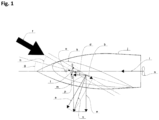
- the information given by the figure 1 allow the transfer of values measured in the hull reference frame to data sensors coming from the sail reference frame, and vice versa.
- the closed-loop control system used in the subject of the invention comprises different calculation steps from the measured input data.
- the control system used according to the invention aims either to reach a set value of the thrust force if achievable, corresponding to a gas control for example, or to go to the maximum value of the thrust force in the axis of the ship.
- This control system must also take into account intrinsic limitations of the system such as the maximum acceptable force on the mast, the maximum acceptable pressure difference for an inflated sail, or constraints linked to the vessel, such as the maximum acceptable heel angle for example.
- this pressure difference can be measured by a differential pressure sensor and regulated by a fixed pressure difference setpoint, or controlled by taking into account, for example, the strength and direction of the wind, variations in strength and direction of the wind (ratio between max. and min. value), the state of the sea, for example.
- the inflation system can for example be carried out with fans. Fans are regulated in order to reach the pressure difference setpoint between the inside and the outside of the wing.
- Using a closed-loop control or regulation system allows optimization of efforts and, using the values provided by the effort sensors, quantification of the gain in reducing CO2 emissions.
- the calculation algorithm equipping the ship according to the invention can calculate a setpoint for the angle of incidence of the wing (or inflatable sail), a setpoint for the surface of the wing (or inflatable sail) and a setpoint for the pressure differential of the wing (or inflatable sail), according to an open-loop control system, based on conversion tables for example, for a desired thrust value.
- These adjustment values wing incidence angle setpoint, a wing surface setpoint and a wing differential pressure setpoint
- the advantage of the open-loop control system is that it allows us to know a priori the values to put in the system to obtain a certain thrust. It also allows us to do without force measurement sensors.
- the thrust regulation is however less precise, and if the initial estimates are bad, we will not know it, nor if the performances deteriorate over time since we do not have the physical reaction of the system through the force sensors for example.
- the algorithm used by the ship computer according to the invention can combine the closed-loop control system, and the open-loop control system.
- the regulation using only the measuring sensors in the hull (mast support), in the event of failure of the wind vane used to measure wind speed and direction, can operate autonomously in the following ways.
- the system faces the relative wind, and the sail is used as a weather vane. This is possible thanks to the offset of the mast versus the center of thrust (self-alignment of the wing in the wind).
- thrust optimum or setpoint can then be achieved, taking into account system limitations, such as maximum heeling forces for example.
- control systems can also be used with the possibility of measuring the evolution of the responses obtained.
- the sail polars are used for the calculations.
- the polars provide, for different wind speeds and angles of incidence, different sail areas (total or reduced by one, two or three reefs), and possibly different differential pressures, the lift and drag values of the sail that can be achieved. From these data, the aerodynamic resultant force is calculated.
- the sail is folded into the sail receptacle, with the mast if it is telescopic in the folded position.
- the sail receptacle can be closed on top automatically or manually so as to protect the sail fabric from UV, humidity, wind, salt, etc.
- the sail is locked in rotation, and positioned in the axis of the ship.
- the electronic power controls are stopped.
- the electronic controls are powered up and checked. If everything is correct, the upper part of the sail receptacle is opened manually or automatically. The sail rotation is also unlocked (exit from parking mode) manually or automatically. The sail is ready for operation.
- the sail is hoisted as follows.
- the first step is to put the sail facing the relative wind, which can be done by leaving free the control of the angle of incidence of the sail relative to the boat.
- the sail or the sail receptacle are used as a wind vane, thanks to the fact that the aerodynamic center of thrust is offset from the axis of the mast.
- the system automatically turns itself into the wind, and from there, the wind direction is known.
- the wind strength it is possible to have an initial assessment by observing the speed of movement of the sail, to return facing the wind.
- the setting is known a priori thanks to the open loop, but with a permanent verification of the consistency of the projected values with the measured values (closed loop) and real-time updates of the calculation models.
- the sail works as follows.
- the setting When the sail is in operation, the setting will be constantly optimized or regulated so as to correspond to the requested setpoint value in taking into account the limitations, or to have the maximum thrust taking into account the limitations.
- the thrust is optimized, but the other values such as the drift for example are also observed, so as not to exceed the imposed limitations. If these values are exceeded, it is possible to limit them by adjusting the angle of incidence, or by reducing the sail area (see reefing). Conversely, if the values are too low, and there are still one or more reefs to release, it is necessary to do so while continuing to monitor the thrust and drift forces.
- the advantage of playing on the angle is that it is a quick operation requiring little energy. When the wind is changing for example, this is the maneuver to use.
- Closed control loop sensor failure the open control loop takes over alone.
- Loss of the actuator adjusting the angle of the sail In the event of loss of control of the mast angle actuator, the incidence system automatically goes into free mode, which causes the sail to be feathered into the wind. However, it could happen that the actuator gets stuck, and that the sail is then at a fixed angle, which could be dangerous depending on the wind conditions. If it is possible to go with the boat to an angle that makes the sail face the wind, this allows the sail to be lowered. This is the case for all sailboats with classic sails, where it is necessary to hoist or lower the mainsail while facing the wind. The other solution in the case where it is not possible or not desired to divert the vessel from its course, it is possible to have a manual disconnection system, or a fusible element in the force transmission chain, which will release the sail to allow it to go into the wind.
- CO2 savings can range from 100% of the ship's consumption (in the case where we switch to a fully sail propulsion mode like NEOLINE) to 0% if we have the wind head on and we have to lower the sail because there is no lift and otherwise we generate drag. It is still better than a rotor solution that cannot fold and will brake. We will go negative. For an average gain value we will expect 10 to 15% depending on the roads.
- the wind propulsive force in the axis of the boat will vary among other things depending on the strength and direction of the real wind, the speed of the boat, the angle of incidence of the wing, the number of sails, the profile of the sail and the surface area of the sails.
- the sail considered will be a single sail of approximately 500 m2 .
- the angle of incidence of the sail will be provided for a value of 8°.
- the speed of the boat also has an important influence, we will look at the efforts for boat speeds of 20 knots.
- the propulsive force for a boat speed of 20 knots, with a true wind of 15 knots making an angle of 90° to the boat's course, the angle of incidence of the sail being approximately 8°, the propulsive force in the axis of the boat for a single wing of 500 m 2 will be of the order of 27 kN, i.e. a power supplied of about 280 kW. With four sails in these conditions, the power supplied is beyond the MW.
- drift thrust value it will vary depending on the chosen point of sail in an order of magnitude ranging from 0 to approximately 75% of the thrust in the axis of the boat.
Landscapes
- Engineering & Computer Science (AREA)
- Chemical & Material Sciences (AREA)
- Combustion & Propulsion (AREA)
- Mechanical Engineering (AREA)
- Ocean & Marine Engineering (AREA)
- Life Sciences & Earth Sciences (AREA)
- Sustainable Development (AREA)
- Sustainable Energy (AREA)
- Wind Motors (AREA)
- Force Measurement Appropriate To Specific Purposes (AREA)
Claims (3)
- Vollständig oder teilweise segelgetriebenes Fahrzeug, beinhaltend einen Rumpf (j), mindestens ein aufblasbares Segel, mindestens einen selbsttragenden Mast (l) mit einer vertikalen Achse, wobei der Mast einen festen Teil (o), der an dem Rumpf angeordnet ist, und einen um die vertikale Achse beweglichen Teil (p) beinhaltet, dadurch gekennzeichnet, dass der Mast Folgendes beinhaltet:a. in dem festen Teil (o), Sensoren zum Messen von physikalischen Parametern, die dazu bestimmt sind, digitale Daten über die Schubkraft, die Abdriftkraft und den Differenzdruck des Segels im Fall eines aufblasbaren Segels bereitzustellen, oder aber,b. in dem beweglichen Teil (p), Sensoren zum Messen von physikalischen Parametern, die dazu bestimmt sind, digitale Daten über die in die Achse des Segels projizierte aerodynamische Schubkraft, die in die zum Segel senkrecht verlaufende Achse projizierte aerodynamische Schubkraft und den Differenzdruck des Segels im Fall eines aufblasbaren Segels bereitzustellen.
- Fahrzeug nach Anspruch 1, wobei ein Computer, der über einen Rechenalgorithmus für die digitalen Daten verfügt, mit einem System mit geschlossenem Regelkreis anhand der digitalen Daten die von dem Segel auf den Rumpf übertragenen Kräfte berechnet, um den Betrieb des Schiffes in Echtzeit zu modifizieren, um seinen aerodynamischen Schub zu optimieren oder zu regeln.
- Fahrzeug nach Anspruch 2, wobei der Computer, der über einen Rechenalgorithmus für die digitalen Daten verfügt, zusätzlich zu dem System mit geschlossenem Regelkreis mit einem System mit offenem Regelkreis und anhand der digitalen Daten die von dem Segel auf den Rumpf übertragenen Kräfte berechnet, um den Betrieb des Schiffes in Echtzeit zu modifizieren, um seinen aerodynamischen Schub zu optimieren.
Applications Claiming Priority (2)
| Application Number | Priority Date | Filing Date | Title |
|---|---|---|---|
| FR2105611A FR3123307B1 (fr) | 2021-05-28 | 2021-05-28 | Véhicule à propulsion vélique |
| PCT/FR2022/051020 WO2022248814A1 (fr) | 2021-05-28 | 2022-05-30 | Vehicule a propulsion velique |
Publications (2)
| Publication Number | Publication Date |
|---|---|
| EP4347387A1 EP4347387A1 (de) | 2024-04-10 |
| EP4347387B1 true EP4347387B1 (de) | 2025-02-26 |
Family
ID=81346289
Family Applications (1)
| Application Number | Title | Priority Date | Filing Date |
|---|---|---|---|
| EP22733697.1A Active EP4347387B1 (de) | 2021-05-28 | 2022-05-30 | Segelgetriebenes fahrzeug |
Country Status (7)
| Country | Link |
|---|---|
| US (1) | US20240262478A1 (de) |
| EP (1) | EP4347387B1 (de) |
| JP (1) | JP2024521330A (de) |
| KR (1) | KR20240013738A (de) |
| CN (1) | CN117396401A (de) |
| FR (1) | FR3123307B1 (de) |
| WO (1) | WO2022248814A1 (de) |
Family Cites Families (19)
| Publication number | Priority date | Publication date | Assignee | Title |
|---|---|---|---|---|
| US3763703A (en) * | 1972-03-10 | 1973-10-09 | J Man | Apparatus for trimming sails |
| US3935828A (en) * | 1972-04-12 | 1976-02-03 | Pfund Charles E | Method and apparatus for obtaining maximum sail boat velocity |
| JPS59206296A (ja) * | 1983-05-10 | 1984-11-22 | Nippon Kokan Kk <Nkk> | 帆船における複数帆の制御方法 |
| JPS60148795A (ja) * | 1984-01-12 | 1985-08-06 | Mitsubishi Heavy Ind Ltd | 帆付き船舶の帆角制御装置 |
| US4753186A (en) * | 1986-12-19 | 1988-06-28 | Paras Ricardo S | Inflatable sail for sailing craft |
| US5406902A (en) * | 1994-05-24 | 1995-04-18 | Heinsohn; Gerd | Method and apparatus for optimum sail shaping |
| US6308649B1 (en) * | 1999-01-12 | 2001-10-30 | Steven A. Gedeon | Sailboat and crew performance optimization system |
| NZ529216A (en) * | 2001-03-09 | 2007-12-21 | Ilan Gonen | Flexible wing-sail and wind-propelled vehicle including same |
| FR2872777A1 (fr) * | 2004-07-08 | 2006-01-13 | Maumenee Gerard Jacques George | Dispositif pour obtenir une indication de la force velique a partir de capteurs sur le greement des voiliers ainsi que le couple de chavirage et de propulsion |
| DE102010040917A1 (de) * | 2010-09-16 | 2012-03-22 | Aloys Wobben | Magnus-Rotor |
| CN113232818A (zh) * | 2012-06-29 | 2021-08-10 | 帆船技术有限公司 | 翼型帆 |
| US10223325B2 (en) * | 2012-12-20 | 2019-03-05 | Jeffrey A Lawrence | Electronic device for measuring the relative force acting upon a sail |
| JP6439260B2 (ja) * | 2014-03-18 | 2018-12-19 | 株式会社タダノ | 硬帆船の伸縮硬帆制御方法および制御装置 |
| JP2015205525A (ja) * | 2014-04-17 | 2015-11-19 | 株式会社タダノ | 硬帆船 |
| CN203996852U (zh) * | 2014-06-16 | 2014-12-10 | 江苏海事职业技术学院 | 船用充气式翼型风帆装置 |
| EP3317178B1 (de) * | 2015-07-05 | 2023-12-27 | Nayam Wings Ltd. | Flügelartiges segelsystem |
| WO2017221117A1 (fr) | 2016-06-22 | 2017-12-28 | Laurent De Kalbermatten | Element de propulsion velique comprenant une voile gonflable a profil symetrique |
| CN107878720B (zh) | 2017-11-09 | 2019-06-04 | 沈阳工程学院 | 一种可收放的对称翼型风帆装置 |
| FR3074298B1 (fr) * | 2017-11-30 | 2020-02-07 | Airbus Operations | Ensemble comprenant un profil aerodynamique et un systeme pour la determination de caracteristiques d'un ecoulement d'air incident sur un bord d'attaque du profil aerodynamique |
-
2021
- 2021-05-28 FR FR2105611A patent/FR3123307B1/fr active Active
-
2022
- 2022-05-30 EP EP22733697.1A patent/EP4347387B1/de active Active
- 2022-05-30 KR KR1020237040247A patent/KR20240013738A/ko active Pending
- 2022-05-30 CN CN202280037988.1A patent/CN117396401A/zh active Pending
- 2022-05-30 JP JP2023573402A patent/JP2024521330A/ja active Pending
- 2022-05-30 US US18/564,757 patent/US20240262478A1/en active Pending
- 2022-05-30 WO PCT/FR2022/051020 patent/WO2022248814A1/fr not_active Ceased
Also Published As
| Publication number | Publication date |
|---|---|
| US20240262478A1 (en) | 2024-08-08 |
| WO2022248814A1 (fr) | 2022-12-01 |
| KR20240013738A (ko) | 2024-01-30 |
| JP2024521330A (ja) | 2024-05-31 |
| FR3123307A1 (fr) | 2022-12-02 |
| CN117396401A (zh) | 2024-01-12 |
| EP4347387A1 (de) | 2024-04-10 |
| FR3123307B1 (fr) | 2025-05-30 |
Similar Documents
| Publication | Publication Date | Title |
|---|---|---|
| EP1373065B1 (de) | Duch drachensegel angetriebenes wasserfahzeug | |
| EP3169581B1 (de) | Motorboot mit einziehbaren tragflächen | |
| EP1716040A2 (de) | Dynamischer stabilisator für ein mit einer stabilisiervorrichtung versehenes schiff und so hergestelltes schiff | |
| EP4347385B1 (de) | Segelantriebselement, segelangetriebenes fahrzeug | |
| WO2020064859A1 (fr) | Système de gréement | |
| US6732670B2 (en) | Sailing craft | |
| EP4347387A1 (de) | Segelgetriebenes fahrzeug | |
| EP4347384B1 (de) | Segelantriebselement, segelangetriebenes fahrzeug | |
| FR2978420A1 (fr) | Engin flottant rapide a propulsion eolienne | |
| EP4347386A1 (de) | Segelantriebselement, segelangetriebenes fahrzeug | |
| EP4116182B1 (de) | Schiff und system geeignet für die aufnahme von entferntem windkraft | |
| US5915322A (en) | Self-steering system for sailboats | |
| WO1994029168A1 (fr) | Greement comportant une voilure non supportee par un mat et hydroptere pourvu d'un tel greement | |
| FR3151832A3 (fr) | Dispositif de propulsion vélique pour un navire | |
| FR2914274A1 (fr) | Prao avec greement latin | |
| AU752459B2 (en) | Sailing craft | |
| CH721820A2 (fr) | Système de transport à hydroptère | |
| WO2001096176A1 (en) | Sailing craft | |
| FR2643329A1 (fr) | Voile universelle automatique | |
| FR3162201A1 (fr) | Systeme de transport a hydroptere | |
| FR3152486A1 (fr) | Ensemble comportant une structure flottante, une éolienne et des moyens de motorisation de celle-ci | |
| FR2524569A1 (fr) | Helice aerienne inclinee pour bateau ou eolienne |
Legal Events
| Date | Code | Title | Description |
|---|---|---|---|
| STAA | Information on the status of an ep patent application or granted ep patent |
Free format text: STATUS: UNKNOWN |
|
| STAA | Information on the status of an ep patent application or granted ep patent |
Free format text: STATUS: THE INTERNATIONAL PUBLICATION HAS BEEN MADE |
|
| PUAI | Public reference made under article 153(3) epc to a published international application that has entered the european phase |
Free format text: ORIGINAL CODE: 0009012 |
|
| STAA | Information on the status of an ep patent application or granted ep patent |
Free format text: STATUS: REQUEST FOR EXAMINATION WAS MADE |
|
| 17P | Request for examination filed |
Effective date: 20240102 |
|
| AK | Designated contracting states |
Kind code of ref document: A1 Designated state(s): AL AT BE BG CH CY CZ DE DK EE ES FI FR GB GR HR HU IE IS IT LI LT LU LV MC MK MT NL NO PL PT RO RS SE SI SK SM TR |
|
| DAV | Request for validation of the european patent (deleted) | ||
| DAX | Request for extension of the european patent (deleted) | ||
| GRAP | Despatch of communication of intention to grant a patent |
Free format text: ORIGINAL CODE: EPIDOSNIGR1 |
|
| STAA | Information on the status of an ep patent application or granted ep patent |
Free format text: STATUS: GRANT OF PATENT IS INTENDED |
|
| INTG | Intention to grant announced |
Effective date: 20241014 |
|
| GRAS | Grant fee paid |
Free format text: ORIGINAL CODE: EPIDOSNIGR3 |
|
| GRAA | (expected) grant |
Free format text: ORIGINAL CODE: 0009210 |
|
| STAA | Information on the status of an ep patent application or granted ep patent |
Free format text: STATUS: THE PATENT HAS BEEN GRANTED |
|
| AK | Designated contracting states |
Kind code of ref document: B1 Designated state(s): AL AT BE BG CH CY CZ DE DK EE ES FI FR GB GR HR HU IE IS IT LI LT LU LV MC MK MT NL NO PL PT RO RS SE SI SK SM TR |
|
| REG | Reference to a national code |
Ref country code: GB Ref legal event code: FG4D Free format text: NOT ENGLISH |
|
| REG | Reference to a national code |
Ref country code: CH Ref legal event code: EP |
|
| REG | Reference to a national code |
Ref country code: DE Ref legal event code: R096 Ref document number: 602022011193 Country of ref document: DE |
|
| REG | Reference to a national code |
Ref country code: IE Ref legal event code: FG4D Free format text: LANGUAGE OF EP DOCUMENT: FRENCH |
|
| REG | Reference to a national code |
Ref country code: NL Ref legal event code: MP Effective date: 20250226 |
|
| PG25 | Lapsed in a contracting state [announced via postgrant information from national office to epo] |
Ref country code: RS Free format text: LAPSE BECAUSE OF FAILURE TO SUBMIT A TRANSLATION OF THE DESCRIPTION OR TO PAY THE FEE WITHIN THE PRESCRIBED TIME-LIMIT Effective date: 20250526 |
|
| PG25 | Lapsed in a contracting state [announced via postgrant information from national office to epo] |
Ref country code: FI Free format text: LAPSE BECAUSE OF FAILURE TO SUBMIT A TRANSLATION OF THE DESCRIPTION OR TO PAY THE FEE WITHIN THE PRESCRIBED TIME-LIMIT Effective date: 20250226 |
|
| PG25 | Lapsed in a contracting state [announced via postgrant information from national office to epo] |
Ref country code: PL Free format text: LAPSE BECAUSE OF FAILURE TO SUBMIT A TRANSLATION OF THE DESCRIPTION OR TO PAY THE FEE WITHIN THE PRESCRIBED TIME-LIMIT Effective date: 20250226 |
|
| PG25 | Lapsed in a contracting state [announced via postgrant information from national office to epo] |
Ref country code: ES Free format text: LAPSE BECAUSE OF FAILURE TO SUBMIT A TRANSLATION OF THE DESCRIPTION OR TO PAY THE FEE WITHIN THE PRESCRIBED TIME-LIMIT Effective date: 20250226 |
|
| REG | Reference to a national code |
Ref country code: LT Ref legal event code: MG9D |
|
| PG25 | Lapsed in a contracting state [announced via postgrant information from national office to epo] |
Ref country code: NO Free format text: LAPSE BECAUSE OF FAILURE TO SUBMIT A TRANSLATION OF THE DESCRIPTION OR TO PAY THE FEE WITHIN THE PRESCRIBED TIME-LIMIT Effective date: 20250526 Ref country code: IS Free format text: LAPSE BECAUSE OF FAILURE TO SUBMIT A TRANSLATION OF THE DESCRIPTION OR TO PAY THE FEE WITHIN THE PRESCRIBED TIME-LIMIT Effective date: 20250626 |
|
| PG25 | Lapsed in a contracting state [announced via postgrant information from national office to epo] |
Ref country code: NL Free format text: LAPSE BECAUSE OF FAILURE TO SUBMIT A TRANSLATION OF THE DESCRIPTION OR TO PAY THE FEE WITHIN THE PRESCRIBED TIME-LIMIT Effective date: 20250226 |
|
| PG25 | Lapsed in a contracting state [announced via postgrant information from national office to epo] |
Ref country code: HR Free format text: LAPSE BECAUSE OF FAILURE TO SUBMIT A TRANSLATION OF THE DESCRIPTION OR TO PAY THE FEE WITHIN THE PRESCRIBED TIME-LIMIT Effective date: 20250226 |
|
| PG25 | Lapsed in a contracting state [announced via postgrant information from national office to epo] |
Ref country code: LV Free format text: LAPSE BECAUSE OF FAILURE TO SUBMIT A TRANSLATION OF THE DESCRIPTION OR TO PAY THE FEE WITHIN THE PRESCRIBED TIME-LIMIT Effective date: 20250226 Ref country code: PT Free format text: LAPSE BECAUSE OF FAILURE TO SUBMIT A TRANSLATION OF THE DESCRIPTION OR TO PAY THE FEE WITHIN THE PRESCRIBED TIME-LIMIT Effective date: 20250626 |
|
| PGFP | Annual fee paid to national office [announced via postgrant information from national office to epo] |
Ref country code: FR Payment date: 20250528 Year of fee payment: 4 |
|
| PG25 | Lapsed in a contracting state [announced via postgrant information from national office to epo] |
Ref country code: GR Free format text: LAPSE BECAUSE OF FAILURE TO SUBMIT A TRANSLATION OF THE DESCRIPTION OR TO PAY THE FEE WITHIN THE PRESCRIBED TIME-LIMIT Effective date: 20250527 Ref country code: BG Free format text: LAPSE BECAUSE OF FAILURE TO SUBMIT A TRANSLATION OF THE DESCRIPTION OR TO PAY THE FEE WITHIN THE PRESCRIBED TIME-LIMIT Effective date: 20250226 |
|
| PGFP | Annual fee paid to national office [announced via postgrant information from national office to epo] |
Ref country code: TR Payment date: 20250526 Year of fee payment: 4 |
|
| REG | Reference to a national code |
Ref country code: AT Ref legal event code: MK05 Ref document number: 1770423 Country of ref document: AT Kind code of ref document: T Effective date: 20250226 |
|
| PG25 | Lapsed in a contracting state [announced via postgrant information from national office to epo] |
Ref country code: SE Free format text: LAPSE BECAUSE OF FAILURE TO SUBMIT A TRANSLATION OF THE DESCRIPTION OR TO PAY THE FEE WITHIN THE PRESCRIBED TIME-LIMIT Effective date: 20250226 |
|
| PG25 | Lapsed in a contracting state [announced via postgrant information from national office to epo] |
Ref country code: SM Free format text: LAPSE BECAUSE OF FAILURE TO SUBMIT A TRANSLATION OF THE DESCRIPTION OR TO PAY THE FEE WITHIN THE PRESCRIBED TIME-LIMIT Effective date: 20250226 |
|
| PG25 | Lapsed in a contracting state [announced via postgrant information from national office to epo] |
Ref country code: DK Free format text: LAPSE BECAUSE OF FAILURE TO SUBMIT A TRANSLATION OF THE DESCRIPTION OR TO PAY THE FEE WITHIN THE PRESCRIBED TIME-LIMIT Effective date: 20250226 |
|
| PG25 | Lapsed in a contracting state [announced via postgrant information from national office to epo] |
Ref country code: IT Free format text: LAPSE BECAUSE OF FAILURE TO SUBMIT A TRANSLATION OF THE DESCRIPTION OR TO PAY THE FEE WITHIN THE PRESCRIBED TIME-LIMIT Effective date: 20250226 |
|
| PG25 | Lapsed in a contracting state [announced via postgrant information from national office to epo] |
Ref country code: AT Free format text: LAPSE BECAUSE OF FAILURE TO SUBMIT A TRANSLATION OF THE DESCRIPTION OR TO PAY THE FEE WITHIN THE PRESCRIBED TIME-LIMIT Effective date: 20250226 |
|
| PG25 | Lapsed in a contracting state [announced via postgrant information from national office to epo] |
Ref country code: EE Free format text: LAPSE BECAUSE OF FAILURE TO SUBMIT A TRANSLATION OF THE DESCRIPTION OR TO PAY THE FEE WITHIN THE PRESCRIBED TIME-LIMIT Effective date: 20250226 Ref country code: CZ Free format text: LAPSE BECAUSE OF FAILURE TO SUBMIT A TRANSLATION OF THE DESCRIPTION OR TO PAY THE FEE WITHIN THE PRESCRIBED TIME-LIMIT Effective date: 20250226 |
|
| PG25 | Lapsed in a contracting state [announced via postgrant information from national office to epo] |
Ref country code: RO Free format text: LAPSE BECAUSE OF FAILURE TO SUBMIT A TRANSLATION OF THE DESCRIPTION OR TO PAY THE FEE WITHIN THE PRESCRIBED TIME-LIMIT Effective date: 20250226 |
|
| PG25 | Lapsed in a contracting state [announced via postgrant information from national office to epo] |
Ref country code: SK Free format text: LAPSE BECAUSE OF FAILURE TO SUBMIT A TRANSLATION OF THE DESCRIPTION OR TO PAY THE FEE WITHIN THE PRESCRIBED TIME-LIMIT Effective date: 20250226 |
|
| REG | Reference to a national code |
Ref country code: DE Ref legal event code: R097 Ref document number: 602022011193 Country of ref document: DE |
|
| REG | Reference to a national code |
Ref country code: DE Ref legal event code: R119 Ref document number: 602022011193 Country of ref document: DE |
|
| REG | Reference to a national code |
Ref country code: CH Ref legal event code: H13 Free format text: ST27 STATUS EVENT CODE: U-0-0-H10-H13 (AS PROVIDED BY THE NATIONAL OFFICE) Effective date: 20251223 |
|
| PLBE | No opposition filed within time limit |
Free format text: ORIGINAL CODE: 0009261 |
|
| STAA | Information on the status of an ep patent application or granted ep patent |
Free format text: STATUS: NO OPPOSITION FILED WITHIN TIME LIMIT |
|
| PG25 | Lapsed in a contracting state [announced via postgrant information from national office to epo] |
Ref country code: LU Free format text: LAPSE BECAUSE OF NON-PAYMENT OF DUE FEES Effective date: 20250530 |
|
| PG25 | Lapsed in a contracting state [announced via postgrant information from national office to epo] |
Ref country code: CH Free format text: LAPSE BECAUSE OF NON-PAYMENT OF DUE FEES Effective date: 20250531 |
|
| REG | Reference to a national code |
Ref country code: BE Ref legal event code: MM Effective date: 20250531 |
|
| PG25 | Lapsed in a contracting state [announced via postgrant information from national office to epo] |
Ref country code: MC Free format text: LAPSE BECAUSE OF FAILURE TO SUBMIT A TRANSLATION OF THE DESCRIPTION OR TO PAY THE FEE WITHIN THE PRESCRIBED TIME-LIMIT Effective date: 20250226 |
|
| 26N | No opposition filed |
Effective date: 20251127 |
|
| PG25 | Lapsed in a contracting state [announced via postgrant information from national office to epo] |
Ref country code: DE Free format text: LAPSE BECAUSE OF NON-PAYMENT OF DUE FEES Effective date: 20251202 Ref country code: IE Free format text: LAPSE BECAUSE OF NON-PAYMENT OF DUE FEES Effective date: 20250530 |
|
| PG25 | Lapsed in a contracting state [announced via postgrant information from national office to epo] |
Ref country code: BE Free format text: LAPSE BECAUSE OF NON-PAYMENT OF DUE FEES Effective date: 20250531 |