EP4347153B1 - Verfahren zur beschichtung eines teils aus einer feuerfesten legierung und so beschichtetes teil - Google Patents
Verfahren zur beschichtung eines teils aus einer feuerfesten legierung und so beschichtetes teil Download PDFInfo
- Publication number
- EP4347153B1 EP4347153B1 EP22733698.9A EP22733698A EP4347153B1 EP 4347153 B1 EP4347153 B1 EP 4347153B1 EP 22733698 A EP22733698 A EP 22733698A EP 4347153 B1 EP4347153 B1 EP 4347153B1
- Authority
- EP
- European Patent Office
- Prior art keywords
- ceramic
- layer
- powder
- coating
- alloy
- Prior art date
- Legal status (The legal status is an assumption and is not a legal conclusion. Google has not performed a legal analysis and makes no representation as to the accuracy of the status listed.)
- Active
Links
Images


Classifications
-
- B—PERFORMING OPERATIONS; TRANSPORTING
- B22—CASTING; POWDER METALLURGY
- B22C—FOUNDRY MOULDING
- B22C23/00—Tools; Devices not mentioned before for moulding
- B22C23/02—Devices for coating moulds or cores
-
- B—PERFORMING OPERATIONS; TRANSPORTING
- B22—CASTING; POWDER METALLURGY
- B22C—FOUNDRY MOULDING
- B22C3/00—Selection of compositions for coating the surfaces of moulds, cores, or patterns
-
- B—PERFORMING OPERATIONS; TRANSPORTING
- B22—CASTING; POWDER METALLURGY
- B22C—FOUNDRY MOULDING
- B22C9/00—Moulds or cores; Moulding processes
- B22C9/10—Cores; Manufacture or installation of cores
-
- B—PERFORMING OPERATIONS; TRANSPORTING
- B22—CASTING; POWDER METALLURGY
- B22C—FOUNDRY MOULDING
- B22C9/00—Moulds or cores; Moulding processes
- B22C9/12—Treating moulds or cores, e.g. drying, hardening
-
- B—PERFORMING OPERATIONS; TRANSPORTING
- B22—CASTING; POWDER METALLURGY
- B22C—FOUNDRY MOULDING
- B22C9/00—Moulds or cores; Moulding processes
- B22C9/18—Finishing
-
- C—CHEMISTRY; METALLURGY
- C23—COATING METALLIC MATERIAL; COATING MATERIAL WITH METALLIC MATERIAL; CHEMICAL SURFACE TREATMENT; DIFFUSION TREATMENT OF METALLIC MATERIAL; COATING BY VACUUM EVAPORATION, BY SPUTTERING, BY ION IMPLANTATION OR BY CHEMICAL VAPOUR DEPOSITION, IN GENERAL; INHIBITING CORROSION OF METALLIC MATERIAL OR INCRUSTATION IN GENERAL
- C23C—COATING METALLIC MATERIAL; COATING MATERIAL WITH METALLIC MATERIAL; SURFACE TREATMENT OF METALLIC MATERIAL BY DIFFUSION INTO THE SURFACE, BY CHEMICAL CONVERSION OR SUBSTITUTION; COATING BY VACUUM EVAPORATION, BY SPUTTERING, BY ION IMPLANTATION OR BY CHEMICAL VAPOUR DEPOSITION, IN GENERAL
- C23C24/00—Coating starting from inorganic powder
- C23C24/08—Coating starting from inorganic powder by application of heat or pressure and heat
- C23C24/082—Coating starting from inorganic powder by application of heat or pressure and heat without intermediate formation of a liquid in the layer
-
- C—CHEMISTRY; METALLURGY
- C23—COATING METALLIC MATERIAL; COATING MATERIAL WITH METALLIC MATERIAL; CHEMICAL SURFACE TREATMENT; DIFFUSION TREATMENT OF METALLIC MATERIAL; COATING BY VACUUM EVAPORATION, BY SPUTTERING, BY ION IMPLANTATION OR BY CHEMICAL VAPOUR DEPOSITION, IN GENERAL; INHIBITING CORROSION OF METALLIC MATERIAL OR INCRUSTATION IN GENERAL
- C23C—COATING METALLIC MATERIAL; COATING MATERIAL WITH METALLIC MATERIAL; SURFACE TREATMENT OF METALLIC MATERIAL BY DIFFUSION INTO THE SURFACE, BY CHEMICAL CONVERSION OR SUBSTITUTION; COATING BY VACUUM EVAPORATION, BY SPUTTERING, BY ION IMPLANTATION OR BY CHEMICAL VAPOUR DEPOSITION, IN GENERAL
- C23C28/00—Coating for obtaining at least two superposed coatings either by methods not provided for in a single one of groups C23C2/00 - C23C26/00 or by combinations of methods provided for in subclasses C23C and C25C or C25D
-
- C—CHEMISTRY; METALLURGY
- C23—COATING METALLIC MATERIAL; COATING MATERIAL WITH METALLIC MATERIAL; CHEMICAL SURFACE TREATMENT; DIFFUSION TREATMENT OF METALLIC MATERIAL; COATING BY VACUUM EVAPORATION, BY SPUTTERING, BY ION IMPLANTATION OR BY CHEMICAL VAPOUR DEPOSITION, IN GENERAL; INHIBITING CORROSION OF METALLIC MATERIAL OR INCRUSTATION IN GENERAL
- C23C—COATING METALLIC MATERIAL; COATING MATERIAL WITH METALLIC MATERIAL; SURFACE TREATMENT OF METALLIC MATERIAL BY DIFFUSION INTO THE SURFACE, BY CHEMICAL CONVERSION OR SUBSTITUTION; COATING BY VACUUM EVAPORATION, BY SPUTTERING, BY ION IMPLANTATION OR BY CHEMICAL VAPOUR DEPOSITION, IN GENERAL
- C23C28/00—Coating for obtaining at least two superposed coatings either by methods not provided for in a single one of groups C23C2/00 - C23C26/00 or by combinations of methods provided for in subclasses C23C and C25C or C25D
- C23C28/30—Coatings combining at least one metallic layer and at least one inorganic non-metallic layer
-
- C—CHEMISTRY; METALLURGY
- C23—COATING METALLIC MATERIAL; COATING MATERIAL WITH METALLIC MATERIAL; CHEMICAL SURFACE TREATMENT; DIFFUSION TREATMENT OF METALLIC MATERIAL; COATING BY VACUUM EVAPORATION, BY SPUTTERING, BY ION IMPLANTATION OR BY CHEMICAL VAPOUR DEPOSITION, IN GENERAL; INHIBITING CORROSION OF METALLIC MATERIAL OR INCRUSTATION IN GENERAL
- C23C—COATING METALLIC MATERIAL; COATING MATERIAL WITH METALLIC MATERIAL; SURFACE TREATMENT OF METALLIC MATERIAL BY DIFFUSION INTO THE SURFACE, BY CHEMICAL CONVERSION OR SUBSTITUTION; COATING BY VACUUM EVAPORATION, BY SPUTTERING, BY ION IMPLANTATION OR BY CHEMICAL VAPOUR DEPOSITION, IN GENERAL
- C23C28/00—Coating for obtaining at least two superposed coatings either by methods not provided for in a single one of groups C23C2/00 - C23C26/00 or by combinations of methods provided for in subclasses C23C and C25C or C25D
- C23C28/30—Coatings combining at least one metallic layer and at least one inorganic non-metallic layer
- C23C28/32—Coatings combining at least one metallic layer and at least one inorganic non-metallic layer including at least one pure metallic layer
-
- C—CHEMISTRY; METALLURGY
- C23—COATING METALLIC MATERIAL; COATING MATERIAL WITH METALLIC MATERIAL; CHEMICAL SURFACE TREATMENT; DIFFUSION TREATMENT OF METALLIC MATERIAL; COATING BY VACUUM EVAPORATION, BY SPUTTERING, BY ION IMPLANTATION OR BY CHEMICAL VAPOUR DEPOSITION, IN GENERAL; INHIBITING CORROSION OF METALLIC MATERIAL OR INCRUSTATION IN GENERAL
- C23C—COATING METALLIC MATERIAL; COATING MATERIAL WITH METALLIC MATERIAL; SURFACE TREATMENT OF METALLIC MATERIAL BY DIFFUSION INTO THE SURFACE, BY CHEMICAL CONVERSION OR SUBSTITUTION; COATING BY VACUUM EVAPORATION, BY SPUTTERING, BY ION IMPLANTATION OR BY CHEMICAL VAPOUR DEPOSITION, IN GENERAL
- C23C28/00—Coating for obtaining at least two superposed coatings either by methods not provided for in a single one of groups C23C2/00 - C23C26/00 or by combinations of methods provided for in subclasses C23C and C25C or C25D
- C23C28/30—Coatings combining at least one metallic layer and at least one inorganic non-metallic layer
- C23C28/32—Coatings combining at least one metallic layer and at least one inorganic non-metallic layer including at least one pure metallic layer
- C23C28/321—Coatings combining at least one metallic layer and at least one inorganic non-metallic layer including at least one pure metallic layer with at least one metal alloy layer
-
- C—CHEMISTRY; METALLURGY
- C23—COATING METALLIC MATERIAL; COATING MATERIAL WITH METALLIC MATERIAL; CHEMICAL SURFACE TREATMENT; DIFFUSION TREATMENT OF METALLIC MATERIAL; COATING BY VACUUM EVAPORATION, BY SPUTTERING, BY ION IMPLANTATION OR BY CHEMICAL VAPOUR DEPOSITION, IN GENERAL; INHIBITING CORROSION OF METALLIC MATERIAL OR INCRUSTATION IN GENERAL
- C23C—COATING METALLIC MATERIAL; COATING MATERIAL WITH METALLIC MATERIAL; SURFACE TREATMENT OF METALLIC MATERIAL BY DIFFUSION INTO THE SURFACE, BY CHEMICAL CONVERSION OR SUBSTITUTION; COATING BY VACUUM EVAPORATION, BY SPUTTERING, BY ION IMPLANTATION OR BY CHEMICAL VAPOUR DEPOSITION, IN GENERAL
- C23C28/00—Coating for obtaining at least two superposed coatings either by methods not provided for in a single one of groups C23C2/00 - C23C26/00 or by combinations of methods provided for in subclasses C23C and C25C or C25D
- C23C28/30—Coatings combining at least one metallic layer and at least one inorganic non-metallic layer
- C23C28/34—Coatings combining at least one metallic layer and at least one inorganic non-metallic layer including at least one inorganic non-metallic material layer, e.g. metal carbide, nitride, boride, silicide layer and their mixtures, enamels, phosphates and sulphates
-
- C—CHEMISTRY; METALLURGY
- C23—COATING METALLIC MATERIAL; COATING MATERIAL WITH METALLIC MATERIAL; CHEMICAL SURFACE TREATMENT; DIFFUSION TREATMENT OF METALLIC MATERIAL; COATING BY VACUUM EVAPORATION, BY SPUTTERING, BY ION IMPLANTATION OR BY CHEMICAL VAPOUR DEPOSITION, IN GENERAL; INHIBITING CORROSION OF METALLIC MATERIAL OR INCRUSTATION IN GENERAL
- C23C—COATING METALLIC MATERIAL; COATING MATERIAL WITH METALLIC MATERIAL; SURFACE TREATMENT OF METALLIC MATERIAL BY DIFFUSION INTO THE SURFACE, BY CHEMICAL CONVERSION OR SUBSTITUTION; COATING BY VACUUM EVAPORATION, BY SPUTTERING, BY ION IMPLANTATION OR BY CHEMICAL VAPOUR DEPOSITION, IN GENERAL
- C23C28/00—Coating for obtaining at least two superposed coatings either by methods not provided for in a single one of groups C23C2/00 - C23C26/00 or by combinations of methods provided for in subclasses C23C and C25C or C25D
- C23C28/30—Coatings combining at least one metallic layer and at least one inorganic non-metallic layer
- C23C28/34—Coatings combining at least one metallic layer and at least one inorganic non-metallic layer including at least one inorganic non-metallic material layer, e.g. metal carbide, nitride, boride, silicide layer and their mixtures, enamels, phosphates and sulphates
- C23C28/345—Coatings combining at least one metallic layer and at least one inorganic non-metallic layer including at least one inorganic non-metallic material layer, e.g. metal carbide, nitride, boride, silicide layer and their mixtures, enamels, phosphates and sulphates with at least one oxide layer
Definitions
- This process consists of using a low mass proportion of active charge, less than 35%. Analyses of the protective coatings thus obtained have shown that a discontinuous protective layer of a binary alloy resulting from the co-reactivity of this active charge with the refractory alloy part is obtained on the refractory alloy part, this discontinuous layer being covered with a ceramic layer resulting from the conversion of the pre-ceramic polymer. The reactivity of the active charge with respect to the substrate is limited because this charge is coated in the pre-ceramic polymer which hinders inter-diffusion.
- the preceramic polymer advantageously comprises polysiloxanes with a high ceramization efficiency which convert into silica (SiO 2 ) or silicon oxycarbide (Si-OC) by pyrolysis but can also be chosen from polysilazanes or polycarbosilanes.
- high ceramization efficiency it is understood that the theoretical conversion rate into ceramic, silicon dioxide SiO 2 or silicon oxycarbide Si-OC is at least 70% by mass, preferably at least 80%.
- the solvent is preferably organic and may comprise, for example, a solvent or a combination of solvents selected from glycol ethers, terpineol, butanone, methyl ethyl ketone (MEK), acetone, benzene, xylene, toluene or other organic solvents.
- a solvent or a combination of solvents selected from glycol ethers, terpineol, butanone, methyl ethyl ketone (MEK), acetone, benzene, xylene, toluene or other organic solvents.
- the active filler(s) used are chosen so that at least one of them reacts with the refractory alloy part and with the preceramic polymer during the heat treatment which will be described below.
- reaction with the preceramic polymer is meant that the active filler and the refractory alloy part co-react with the solid and gaseous decomposition products of this preceramic polymer and/or with the atmosphere of the pyrolysis of the preceramic polymer which leads to the formation of the ceramic.
- This continuous layer 3 forms directly in contact with the refractory alloy metal part 1 and forms under the ceramic layer 4 formed.
- Minimum ternary alloy means a ternary alloy composed of three different atomic elements, or any other alloy composed of more than three different atomic elements, for example, one or more quaternary alloys.
- This continuous layer 3 of ternary minimum alloy is then capable of generating a passivating oxide layer when subjected to oxidizing conditions.
- the continuous layer 3 of alloy formed is locally exposed to external conditions.
- this minimum ternary alloy 3 generates on the surface a passivating oxide layer, capable of protecting the part 1 against oxidation and the diffusion of external species.
- This healing effect therefore makes it possible to greatly increase the lifespan of the refractory alloy 1 part.
- the active metal fillers may advantageously contain one species or a combination of several of the species listed below: a silicon powder, an aluminum powder, an iron powder, a copper powder, a cobalt powder, a nickel powder, a lanthanum powder, a germanium powder, a zirconium powder, a chromium powder, a titanium powder, a hafnium powder, a lanthanum powder, a rhenium powder.
- the ternary minimum alloys (layer 3) formed on the surface of part 1 by solid diffusion of the active charge(s) of composition 2 in this part 1 are thermodynamically stable compounds.
- the alloys likely to be formed are defined by the phase diagrams between its active charges and the part 1 to be covered.
- the excess preceramic polymer forms, after pyrolysis, a continuous ceramic layer on the surface of part 1.
- This generally porous ceramic layer can act as a thermal barrier for part 1 or even have an impact on the corrosion resistance of part 1 by modifying the wettability of part 1 thus coated with respect to a molten metal in contact.
- the treatment composition 2 may contain as active filler a germanium powder and as preceramic polymer, a polysiloxane and a solvent, all while respecting the mass proportions and mass ratios in accordance with the invention mentioned above.
- the part 1 is made of molybdenum or a molybdenum-based alloy comprising zirconium and titanium (TZM alloy), and it is coated with said composition 2 by coating, then it undergoes the heat treatment in accordance with the invention and which will be described later, then a continuous layer 3 of a ternary alloy of Mo(Si x Ge 1-x ) 2 is formed on the surface of said part 1, this layer 3 being surmounted by the ceramic layer 4 formed by conversion of the preceramic polymer (SiO 2 and/or SiOC phase depending on the partial pressure of oxygen during the heat treatment.
- the source of silicon to form this ternary alloy comes from the products of the pyrolysis of the preceramic polymer.
- This layer of ternary alloy 3 is capable of forming a passivating layer of silica in oxidizing conditions, as mentioned previously.
- the treatment composition 2 may contain as active filler a cobalt powder and as preceramic polymer, a polysiloxane and a solvent, all while respecting the mass proportions and mass ratios in accordance with the invention mentioned above.
- Cobalt-based coatings are used to protect parts against wear or corrosion by forming a passivating layer of chromium(III) oxide , Cr2O3 .
- the treatment composition 2 may contain an aluminum powder as active filler and a polysiloxane and a solvent as preceramic polymer, all while respecting the mass proportions and mass ratios in accordance with the aforementioned invention.
- This ternary alloy layer is capable of forming a passivating layer of silica and alumina under oxidizing conditions, as mentioned previously, and in ratios which depend on the respective contents of aluminum and silicon in the ternary alloy.
- passive fillers up to 30% by mass of the total mass.
- this mass percentage of passive filler(s) will be adapted according to the quantities of active filler(s) used, and the maximum will therefore, in certain cases, be less than 30% by mass.
- a passive filler helps prevent excessive shrinkage caused by ceramization during heat treatment after coating.
- the passive loads also make it possible to modulate the coefficient of thermal expansion of the layer 3 of ternary minimum alloy, depending on the properties of the covered part 1, in particular so as to avoid gradients of coefficients of thermal expansion at the interface between the layer 3 and the part 1.
- a difference in coefficient of thermal expansion of less than 3.10 -6 K -1 between the part 1 and the layer 3 of ternary minimum alloy and a difference in coefficient of thermal expansion of less than 3.10 -6 K -1 between the layer 3 of ternary minimum alloy and the ceramic layer 4 make it possible to avoid delamination and cracking during heat treatments.
- the passive filler(s) comprise ceramic fillers derived partly or totally from the composition of the ceramic cores conventionally used, for example zircon, alumina or silica, but also other oxides, for example aluminosilicates, calcite, magnesia, or other unlisted species or a mixture thereof.
- ceramic compositions can be found in the patent US 5,043,014 .
- the demolding of the foundry cores can be simplified. Indeed, if the ceramic layer 4 has been obtained using a composition 2 with passive fillers comprising ceramic fillers, such as those mentioned above, then it will be possible to dissolve this ceramic layer 4 using a basic solvent, as was done in the prior art for ceramic foundry cores. Thus, there will be a clearance between the foundry product (for example a blade) and the foundry core constituting the part 1 and it will be easier to demold the foundry product.
- Passive fillers could also be used oxides: zircon, zirconia, mullite, alumina or silica, but also other oxides, for example aluminosilicates, calcite, magnesia, or a mixture of these, carbides for example SiC or nitrides, for example Si 3 N 4 .
- the coating of the part 1 can be carried out using a process comprising one or more coating steps, which can themselves be carried out using the same method or using different methods.
- the choice of coating method depends in particular on the viscosity of the treatment composition 2, the size and complexity of the geometry of the part 1 to be coated and its surface condition.
- the desired layer thickness influences the choice of coating method.
- Coating is preferably carried out by centrifugation, dipping or spraying.
- a crosslinking step (heat treatment) of the coating can advantageously be carried out.
- the heat treatment of the preceramic polymer is preferably carried out in a non-oxidizing atmosphere for part 1, but whose partial oxygen pressure is sufficient to convert the preceramic polymer into ceramic, in particular into oxycarbide ceramic or oxide ceramic.
- This treatment is carried out at a first temperature, preferably between 100°C and 400°C, more preferably at a temperature around 200°C.
- crosslinking can be induced by ultraviolet radiation.
- the heat treatment of the part 1 made of refractory alloy (whether it is made of molybdenum or molybdenum alloy), coated with the composition 2, is configured and carried out so as to ensure the conversion into ceramic 4 of all or part of the preceramic polymer contained in the treatment composition 2 and to allow the co-reactivity of the products of the decomposition of the preceramic polymer with the active charge and with the part 1.
- the mass ratio of active filler/preceramic polymer is equal to 44.5/18.5 or 2.4, i.e. greater than or equal to 2.
- the preceramic polymer is dissolved in the Terpineol solvent at 60°C, with magnetic stirring, in a beaker for at least 30 minutes.
- the aluminum powder is then added and stirring is continued for at least 12 hours.
- Treatment composition 2 is then cooled and stabilized between 19°C and 21°C during the soaking phase and also maintained under magnetic stirring.
- the molybdenum or molybdenum alloy part 1 is introduced into the treatment composition 2 at a speed of 10 mm/min, kept in the formulation for 30 seconds, then removed at a speed of 10 mm/min.
- the part When the part is completely emerged from the treatment composition 2, it is dried with hot air (between 150°C and 220°C) until the solvent evaporates. A total of six successive dippings with intermediate hot air drying were carried out to obtain a perfectly continuous coating with a thickness of 40 to 50 microns.
- the part is then subjected to a crosslinking heat treatment in air for 1 hour, at a temperature between 170°C and 230°C, for example at 200°C.
- any cracks in a first layer of the coating will be filled by an additional coating layer, thus achieving a crack-free coating.
- the heat treatment must lead to the partial or total conversion of SILRES MK ® into ceramic but also allow the reactivity of the solid and gaseous silicon decomposition products of SILRES with part 1 and the active aluminum charge.
- the heat treatment holding time must be sufficient to then allow interdiffusion in the molybdenum or molybdenum base support to form a continuous layer of molybdenum-silicon-aluminum ternary alloy.
- the heat treatments can optionally be carried out during the same thermal cycle in an alumina tube furnace under argon sweeping at a flow rate of 35 to 40 L/h.
- the thermal cycle imposed on the coated part is carried out in an alumina tubular furnace and includes temperature rise and fall ramps of 200°C/h and a 15-hour hold at 900°C under argon flushing of 35L/h.
- a zirconium oxygen watcher is placed upstream of the part relative to the argon flow to prevent oxidation of the molybdenum part during heat treatment.
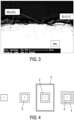
- FIG. 5 shows a sectional view, obtained by scanning electron microscope (SEM), of a molybdenum rod 1 coated with the composition of the example cited above, after heat treatment.
- SEM scanning electron microscope
- the ceramic part 4 consists of a layer less than 50 microns thick of heterogeneous compositions: the matrix is made of silicon oxycarbide (Si-O-C) resulting from the conversion of the preceramic polymer into ceramic.
- the layer also contains inclusions of aluminum (residue of the active charge of the formulation which has not reacted because it is too far from the rod), free carbon (decomposition product of the preceramic polymer), silica (idem) and possibly polysiloxane if the conversion of the initial preceramic polymer is not complete.
- the mass ratio of active filler/preceramic polymer is greater than 2 (here 58/25 or 2.32).
- the molybdenum or molybdenum alloy part 1 is introduced into the treatment composition 2 at a speed of 10 mm/min, kept in the formulation for 30 seconds, then removed at a speed of 10 mm/min.
- the ceramic part 4 made of silicon oxycarbide (Si-O-C) with a thickness of less than 40 ⁇ m was removed by mechanical action (sandblasting).
Landscapes
- Chemical & Material Sciences (AREA)
- Engineering & Computer Science (AREA)
- Mechanical Engineering (AREA)
- Inorganic Chemistry (AREA)
- Chemical Kinetics & Catalysis (AREA)
- Materials Engineering (AREA)
- Metallurgy (AREA)
- Organic Chemistry (AREA)
- Other Surface Treatments For Metallic Materials (AREA)
- Application Of Or Painting With Fluid Materials (AREA)
Claims (14)
- Verfahren zur Beschichtung eines Teils aus einer feuerfesten Legierung (1), insbesondere auf Molybdänbasis, das folgende Schritte umfasst:- Beschichtung mindestens eines Bereichs des Teils mit einer Behandlungszusammensetzung (2), die mindestens einen Typ eines präkeramischen Polymers, ein Lösungsmittel und mindestens einen aktiven Füllstoff umfasst,- Wärmebehandlung des mit der Behandlungszusammensetzung (2) beschichteten Teils (1), wobei diese Wärmebehandlung erlaubt, das präkeramische Polymer zumindest teilweise umzuwandeln, um eine Keramikschicht (4) zu bilden,wobei der aktive Füllstoff gewählt ist, um durch feste oder flüssige Diffusion an der Oberfläche des Teils aus einer feuerfesten Legierung (1) mindestens eine mindestens ternäre Legierung zu bilden, die aus der gemeinsamen Reaktivität dieses aktiven Füllstoffs mit dem Teil aus einer feuerfesten Legierung und dem präkeramischen Polymer resultiert, wobei diese mindestens ternäre Legierung eine durchgehende Schicht (3) zwischen der Oberfläche des Teils aus einer feuerfesten Legierung (1) und der durch Umwandlung erhaltenen Keramikschicht (4) bildet,und die Wärmebehandlung derart durchgeführt wird, dass diese durchgehende Schicht (3) aus mindestens ternärer Legierung gebildet wird, die das Teils aus einer feuerfesten Legierung vor Oxidation schützt,dadurch gekennzeichnet, dass die Behandlungszusammensetzung (2) in Bezug auf ihre Gesamtmasse einen Massenanteil zwischen 40 % und 66 % mindestens eines aktiven Füllstoffs umfasstund dass das Massenverhältnis aktiver Füllstoff/präkeramisches Polymer größer oder gleich 2 ist.
- Verfahren nach Anspruch 1, dadurch gekennzeichnet, dass die Behandlungszusammensetzung (2) in Bezug auf ihre Gesamtmasse einen Massenanteil zwischen 45 % und 60 % mindestens eines aktiven Füllstoffs umfasst und dass das Massenverhältnis aktiver Füllstoff/präkeramisches Polymer zwischen 2 und 3 liegt.
- Verfahren nach Anspruch 1, dadurch gekennzeichnet, dass die Behandlungszusammensetzung (2) in Bezug auf ihre Gesamtmasse einen Massenanteil zwischen 55 % und 60 % mindestens eines aktiven Füllstoffs umfasst und dass das Massenverhältnis aktiver Füllstoff/präkeramisches Polymer zwischen 2 und 2,5 liegt.
- Verfahren nach einem der vorhergehenden Ansprüche, dadurch gekennzeichnet, dass der mindestens eine aktive Füllstoff aus einem Siliziumpulver, einem Aluminiumpulver, einem Eisenpulver, einem Kupferpulver, einem Kobaltpulver, einem Nickelpulver, einem Lanthanpulver, einem Germaniumpulver, einem Zirkoniumpulver, einem Chrompulver, einem Titanpulver, einem Hafniumpulver, einem Lanthanpulver und einem Rheniumpulver ausgewählt ist.
- Verfahren nach einem der vorhergehenden Ansprüche, dadurch gekennzeichnet, dass das präkeramische Polymer aus den Siloxanen, den Polysiloxanen mit hohem Keramisierungsgrad, die sich durch Pyrolyse in Siliziumdioxid (SiO2) oder Siliziumoxycarbid (Si-O-C) umwandeln, den Polysilazanen oder den Polycarbosilanen ausgewählt ist.
- Verfahren nach einem der vorhergehenden Ansprüche, dadurch gekennzeichnet, dass die Behandlungszusammensetzung (2) ferner als passiv bezeichnete Füllstoffe umfasst, die ausgelegt sind, um den Wärmeausdehnungskoeffizienten der Schicht (3) aus mindestens ternärer Legierung derart zu modulieren, dass die Differenz zwischen dem Wärmeausdehnungskoeffizienten des Teils aus einer feuerfesten Legierung und dem Wärmeausdehnungskoeffizienten der Schicht (3) aus mindestens ternärer Legierung kleiner als 3.10-6 K -1 ist.
- Verfahren nach einem der vorhergehenden Ansprüche, dadurch gekennzeichnet, dass das Verfahren mindestens einen ersten Beschichtungsschritt und einen zweiten Beschichtungsschritt nacheinander und mindestens einen Wärmebehandlungsschritt, der zwischen zwei aufeinanderfolgenden Beschichtungsschritten durchgeführt wird, umfasst, wobei der Wärmebehandlungsschritt ein Vernetzungsschritt des oder der präkeramischen Polymere ist, der ausgelegt ist, um ein unschmelzbares Polymernetzwerk zu erzeugen, das imstande ist, den nachfolgenden Pyrolyseschritten standzuhalten, wobei der zweite Beschichtungsschritt durchgeführt wird, um eine dickere Behandlungszusammensetzungsschicht (2) zu erhalten.
- Verfahren nach Anspruch 7, wobei die beim zweiten Beschichtungsschritt verwendete Behandlungszusammensetzung (2) eine niedrigere Viskosität aufweist als die beim ersten Beschichtungsschritt verwendete Behandlungszusammensetzung (2).
- Verfahren nach einem der Ansprüche 7 oder 8, wobei der Vernetzungsschritt in Gegenwart von Luft bei einer Temperatur durchgeführt wird, die höher oder gleich der höchsten Vernetzungstemperatur unter den verschiedenen Vernetzungstemperaturen der verschiedenen präkeramischen Polymerspezies der Behandlungslösung (2) ist.
- Verfahren nach einem der vorhergehenden Ansprüche, dadurch gekennzeichnet, dass der Wärmebehandlungsschritt die folgenden Schritte umfasst:- Vernetzung bei einer ersten Temperatur, die ausgelegt ist, um das Lösungsmittel zu verdampfen und dadurch die Vernetzung zu beschleunigen,- Umwandlung, die bei einer zweiten Temperatur über der ersten durchgeführt wird, die ausgelegt ist, um das Polymer in Keramik umzuwandeln und die organischen Spezies zu entfernen, so dass eine Keramik mit einer amorphen Struktur erhalten wird,- Strukturierung, die bei einer dritten Temperatur über der zweiten durchgeführt wird, die ausgelegt ist, um die Keramik mit amorpher Struktur in eine Keramik mit kristalliner Struktur umzuwandeln.
- Verfahren nach einem der vorhergehenden Ansprüche, dadurch gekennzeichnet, dass der Wärmebehandlungsschritt unter kontrollierter Atmosphäre derart durchgeführt wird, dass die Oxidation des Teils aus einer feuerfesten Legierung (1) vermieden wird, während ein ausreichender Sauerstoffpartialdruck vorhanden ist, um die Umwandlung des präkeramischen Polymers in Oxycarbidkeramik oder Oxidkeramik sicherzustellen.
- Verfahren nach einem der vorhergehenden Ansprüche, dadurch gekennzeichnet, dass die durch Umwandlung erhaltene Keramikschicht (4) nach der Wärmebehandlung durch mechanische oder chemische Einwirkung entfernt wird, damit nur die Schicht (3) aus mindestens ternärer Legierung verbleibt.
- Teil aus einer feuerfesten Legierung (1), insbesondere auf Molybdänbasis, dadurch gekennzeichnet, dass es durch das Beschichtungsverfahren nach einem der Ansprüche 1 bis 12 hergestellt wird und dass es mit einer durchgehenden Schicht (3) aus mindestens einer mindestens ternären Legierung, die aus der gemeinsamen Reaktivität des aktiven Füllstoffs mit dem Teil aus einer feuerfesten Legierung und dem präkeramischen Polymer resultiert, und einer Keramikschicht (4) bedeckt ist, wobei die durchgehende Schicht (3) aus mindestens einer mindestens ternären Legierung zwischen dem Teil aus einer feuerfesten Legierung (1) und der Keramikschicht (4) angeordnet ist.
- Teil aus einer feuerfesten Legierung nach Anspruch 13, dadurch gekennzeichnet, dass es sich um einen Gießereikern aus einer feuerfesten Legierung handelt.
Applications Claiming Priority (2)
| Application Number | Priority Date | Filing Date | Title |
|---|---|---|---|
| FR2105756A FR3123365B1 (fr) | 2021-06-01 | 2021-06-01 | Procede de revetement d'une piece en alliage refractaire et piece ainsi revetue. |
| PCT/FR2022/051021 WO2022254139A1 (fr) | 2021-06-01 | 2022-05-30 | Procede de revetement d'une piece en alliage refractaire et piece ainsi revetue |
Publications (2)
| Publication Number | Publication Date |
|---|---|
| EP4347153A1 EP4347153A1 (de) | 2024-04-10 |
| EP4347153B1 true EP4347153B1 (de) | 2025-07-02 |
Family
ID=77710901
Family Applications (1)
| Application Number | Title | Priority Date | Filing Date |
|---|---|---|---|
| EP22733698.9A Active EP4347153B1 (de) | 2021-06-01 | 2022-05-30 | Verfahren zur beschichtung eines teils aus einer feuerfesten legierung und so beschichtetes teil |
Country Status (5)
| Country | Link |
|---|---|
| US (1) | US20240246140A1 (de) |
| EP (1) | EP4347153B1 (de) |
| CN (1) | CN117412824A (de) |
| FR (1) | FR3123365B1 (de) |
| WO (1) | WO2022254139A1 (de) |
Families Citing this family (2)
| Publication number | Priority date | Publication date | Assignee | Title |
|---|---|---|---|---|
| CN119662125A (zh) * | 2024-11-05 | 2025-03-21 | 北京科技大学 | 一种可用于热加工的涂层钢板及其制备方法和应用 |
| CN119592222A (zh) * | 2024-11-05 | 2025-03-11 | 北京科技大学 | 一种用于金属表面的复合防护涂层及其制备方法 |
Family Cites Families (12)
| Publication number | Priority date | Publication date | Assignee | Title |
|---|---|---|---|---|
| FR2626794B1 (fr) | 1988-02-10 | 1993-07-02 | Snecma | Pate thermoplastique pour la preparation de noyaux de fonderie et procede de preparation desdits noyaux |
| JP3133158B2 (ja) * | 1992-07-10 | 2001-02-05 | 株式会社アーレスティ | 崩壊性置中子用塗型剤 |
| US6042883A (en) * | 1997-10-03 | 2000-03-28 | Southwest Research Institute | Methods for making high temperature coatings from precursor polymers to refractory metal carbides and metal borides |
| US6627126B2 (en) * | 2001-07-16 | 2003-09-30 | United Technologies Corporation | Method for preparing refractory carbides |
| US7507481B2 (en) * | 2002-11-20 | 2009-03-24 | Shin-Etsu Chemical Co., Ltd. | Heat resistant coated member, making method, and treatment using the same |
| CN101654778A (zh) * | 2008-08-21 | 2010-02-24 | 北京盘天新技术有限公司 | 一种由聚合物先驱体制备绝缘导热陶瓷涂层的方法 |
| FR2939430B1 (fr) * | 2008-12-04 | 2011-01-07 | Snecma Propulsion Solide | Procede pour le lissage de la surface d'une piece en materiau cmc |
| FR2979629B1 (fr) * | 2011-09-06 | 2013-09-27 | Snecma Propulsion Solide | Procede de formation sur un substrat en cmc contenant du sic d'un revetement lisse d'aspect glace et piece en cmc munie d'un tel revetement |
| CN103898499B (zh) * | 2014-03-17 | 2017-01-04 | 中国人民解放军装甲兵工程学院 | 一种由先驱体转化法制备SiC/Al2O3涂层的方法 |
| FR3084894B1 (fr) * | 2018-08-07 | 2022-01-21 | Commissariat Energie Atomique | Revetement ceramique pour noyau de fonderie |
| FR3084891B1 (fr) * | 2018-08-07 | 2022-06-24 | Commissariat Energie Atomique | Revetement pour piece en alliage refractaire |
| KR102142771B1 (ko) * | 2018-10-24 | 2020-08-07 | 주식회사 포스코 | 3가 크롬 및 무기화합물을 함유한 표면처리 용액 조성물, 이를 이용하여 표면 처리된 용융아연 도금강판 제조방법 |
-
2021
- 2021-06-01 FR FR2105756A patent/FR3123365B1/fr active Active
-
2022
- 2022-05-30 EP EP22733698.9A patent/EP4347153B1/de active Active
- 2022-05-30 US US18/565,998 patent/US20240246140A1/en active Pending
- 2022-05-30 CN CN202280039876.XA patent/CN117412824A/zh active Pending
- 2022-05-30 WO PCT/FR2022/051021 patent/WO2022254139A1/fr not_active Ceased
Also Published As
| Publication number | Publication date |
|---|---|
| FR3123365A1 (fr) | 2022-12-02 |
| EP4347153A1 (de) | 2024-04-10 |
| WO2022254139A1 (fr) | 2022-12-08 |
| CN117412824A (zh) | 2024-01-16 |
| FR3123365B1 (fr) | 2024-05-31 |
| US20240246140A1 (en) | 2024-07-25 |
Similar Documents
| Publication | Publication Date | Title |
|---|---|---|
| EP3830056B1 (de) | Verfahren zur herstellung eines aus cmc gefertigten teils | |
| EP2632877B1 (de) | Verfahren zur beschichtung eines teils mit einer oxidationsschutzbeschichtung | |
| EP2414305B1 (de) | Verfahren zum glätten der oberfläche eines teils aus cmc-material | |
| EP3538500B1 (de) | Mit einer wärmedämmung beschichtetes turbomaschinenteil und verfahren zur herstellung davon | |
| EP4347153B1 (de) | Verfahren zur beschichtung eines teils aus einer feuerfesten legierung und so beschichtetes teil | |
| EP1587773B1 (de) | Verfahren zur behandlung der oberfläche eines teils aus einem wärmestrukturierten verbundwerkstoff und verwendung davon beim hartverlöten von teilen aus einem wärmestrukturierten verbundwerkstoff | |
| EP3833497B1 (de) | Keramische beschichtung für giesskern | |
| FR3113255A1 (fr) | Protection contre l’oxydation ou la corrosion d’une pièce creuse en superalliage | |
| WO2020030880A1 (fr) | Revetement pour piece en alliage refractaire | |
| EP4370261B1 (de) | Verbesserter giesskern zur herstellung eines hohlen aeronautischen metallteils | |
| EP1391444B1 (de) | Verfahren zur Herstellung eines Feuerfestmaterials, damit herstellbare Schutzbeschichtung und deren Verwendungen | |
| WO2015036975A1 (fr) | Substrat pour la solidification de lingot de silicium | |
| FR3139567A1 (fr) | Procédé de fabrication d’une éprouvette de caractérisation | |
| WO2022018088A1 (fr) | Revetement a base d'une ceramique de silicium pour la protection d'un substrat | |
| EP3487649B1 (de) | Verfahren zur herstellung einer schalenform | |
| FR3152807A1 (fr) | Procédé de préparation d’un matériau composite à matrice en céramique ultra haute température et à renforts en fibres de carbone | |
| FR3113254A1 (fr) | Protection contre l’oxydation ou la corrosion d’une pièce creuse en superalliage | |
| FR3147275A1 (fr) | Réalisation d'une couche de barrière environnementale |
Legal Events
| Date | Code | Title | Description |
|---|---|---|---|
| STAA | Information on the status of an ep patent application or granted ep patent |
Free format text: STATUS: UNKNOWN |
|
| STAA | Information on the status of an ep patent application or granted ep patent |
Free format text: STATUS: THE INTERNATIONAL PUBLICATION HAS BEEN MADE |
|
| PUAI | Public reference made under article 153(3) epc to a published international application that has entered the european phase |
Free format text: ORIGINAL CODE: 0009012 |
|
| STAA | Information on the status of an ep patent application or granted ep patent |
Free format text: STATUS: REQUEST FOR EXAMINATION WAS MADE |
|
| 17P | Request for examination filed |
Effective date: 20231130 |
|
| AK | Designated contracting states |
Kind code of ref document: A1 Designated state(s): AL AT BE BG CH CY CZ DE DK EE ES FI FR GB GR HR HU IE IS IT LI LT LU LV MC MK MT NL NO PL PT RO RS SE SI SK SM TR |
|
| DAV | Request for validation of the european patent (deleted) | ||
| DAX | Request for extension of the european patent (deleted) | ||
| RAP3 | Party data changed (applicant data changed or rights of an application transferred) |
Owner name: COMMISSARIAT A L'ENERGIE ATOMIQUE ET AUX ENERGIESALTERNATIVES Owner name: SAFRAN |
|
| GRAP | Despatch of communication of intention to grant a patent |
Free format text: ORIGINAL CODE: EPIDOSNIGR1 |
|
| STAA | Information on the status of an ep patent application or granted ep patent |
Free format text: STATUS: GRANT OF PATENT IS INTENDED |
|
| INTG | Intention to grant announced |
Effective date: 20250214 |
|
| GRAS | Grant fee paid |
Free format text: ORIGINAL CODE: EPIDOSNIGR3 |
|
| GRAA | (expected) grant |
Free format text: ORIGINAL CODE: 0009210 |
|
| STAA | Information on the status of an ep patent application or granted ep patent |
Free format text: STATUS: THE PATENT HAS BEEN GRANTED |
|
| AK | Designated contracting states |
Kind code of ref document: B1 Designated state(s): AL AT BE BG CH CY CZ DE DK EE ES FI FR GB GR HR HU IE IS IT LI LT LU LV MC MK MT NL NO PL PT RO RS SE SI SK SM TR |
|
| REG | Reference to a national code |
Ref country code: GB Ref legal event code: FG4D Free format text: NOT ENGLISH |
|
| REG | Reference to a national code |
Ref country code: CH Ref legal event code: EP |
|
| REG | Reference to a national code |
Ref country code: DE Ref legal event code: R096 Ref document number: 602022016958 Country of ref document: DE |
|
| REG | Reference to a national code |
Ref country code: IE Ref legal event code: FG4D Free format text: LANGUAGE OF EP DOCUMENT: FRENCH |
|
| REG | Reference to a national code |
Ref country code: NL Ref legal event code: MP Effective date: 20250702 |
|
| PG25 | Lapsed in a contracting state [announced via postgrant information from national office to epo] |
Ref country code: PT Free format text: LAPSE BECAUSE OF FAILURE TO SUBMIT A TRANSLATION OF THE DESCRIPTION OR TO PAY THE FEE WITHIN THE PRESCRIBED TIME-LIMIT Effective date: 20251103 |
|
| PG25 | Lapsed in a contracting state [announced via postgrant information from national office to epo] |
Ref country code: NL Free format text: LAPSE BECAUSE OF FAILURE TO SUBMIT A TRANSLATION OF THE DESCRIPTION OR TO PAY THE FEE WITHIN THE PRESCRIBED TIME-LIMIT Effective date: 20250702 |
|
| REG | Reference to a national code |
Ref country code: AT Ref legal event code: MK05 Ref document number: 1808702 Country of ref document: AT Kind code of ref document: T Effective date: 20250702 |
|
| PG25 | Lapsed in a contracting state [announced via postgrant information from national office to epo] |
Ref country code: IS Free format text: LAPSE BECAUSE OF FAILURE TO SUBMIT A TRANSLATION OF THE DESCRIPTION OR TO PAY THE FEE WITHIN THE PRESCRIBED TIME-LIMIT Effective date: 20251102 |
|
| PG25 | Lapsed in a contracting state [announced via postgrant information from national office to epo] |
Ref country code: NO Free format text: LAPSE BECAUSE OF FAILURE TO SUBMIT A TRANSLATION OF THE DESCRIPTION OR TO PAY THE FEE WITHIN THE PRESCRIBED TIME-LIMIT Effective date: 20251002 |
|
| REG | Reference to a national code |
Ref country code: LT Ref legal event code: MG9D |
|
| PG25 | Lapsed in a contracting state [announced via postgrant information from national office to epo] |
Ref country code: AT Free format text: LAPSE BECAUSE OF FAILURE TO SUBMIT A TRANSLATION OF THE DESCRIPTION OR TO PAY THE FEE WITHIN THE PRESCRIBED TIME-LIMIT Effective date: 20250702 |
|
| PG25 | Lapsed in a contracting state [announced via postgrant information from national office to epo] |
Ref country code: FI Free format text: LAPSE BECAUSE OF FAILURE TO SUBMIT A TRANSLATION OF THE DESCRIPTION OR TO PAY THE FEE WITHIN THE PRESCRIBED TIME-LIMIT Effective date: 20250702 |
|
| PG25 | Lapsed in a contracting state [announced via postgrant information from national office to epo] |
Ref country code: HR Free format text: LAPSE BECAUSE OF FAILURE TO SUBMIT A TRANSLATION OF THE DESCRIPTION OR TO PAY THE FEE WITHIN THE PRESCRIBED TIME-LIMIT Effective date: 20250702 |
|
| PG25 | Lapsed in a contracting state [announced via postgrant information from national office to epo] |
Ref country code: GR Free format text: LAPSE BECAUSE OF FAILURE TO SUBMIT A TRANSLATION OF THE DESCRIPTION OR TO PAY THE FEE WITHIN THE PRESCRIBED TIME-LIMIT Effective date: 20251003 |
|
| PG25 | Lapsed in a contracting state [announced via postgrant information from national office to epo] |
Ref country code: CZ Free format text: LAPSE BECAUSE OF FAILURE TO SUBMIT A TRANSLATION OF THE DESCRIPTION OR TO PAY THE FEE WITHIN THE PRESCRIBED TIME-LIMIT Effective date: 20250702 Ref country code: SE Free format text: LAPSE BECAUSE OF FAILURE TO SUBMIT A TRANSLATION OF THE DESCRIPTION OR TO PAY THE FEE WITHIN THE PRESCRIBED TIME-LIMIT Effective date: 20250702 |
|
| PG25 | Lapsed in a contracting state [announced via postgrant information from national office to epo] |
Ref country code: LV Free format text: LAPSE BECAUSE OF FAILURE TO SUBMIT A TRANSLATION OF THE DESCRIPTION OR TO PAY THE FEE WITHIN THE PRESCRIBED TIME-LIMIT Effective date: 20250702 |
|
| PG25 | Lapsed in a contracting state [announced via postgrant information from national office to epo] |
Ref country code: BG Free format text: LAPSE BECAUSE OF FAILURE TO SUBMIT A TRANSLATION OF THE DESCRIPTION OR TO PAY THE FEE WITHIN THE PRESCRIBED TIME-LIMIT Effective date: 20250702 Ref country code: PL Free format text: LAPSE BECAUSE OF FAILURE TO SUBMIT A TRANSLATION OF THE DESCRIPTION OR TO PAY THE FEE WITHIN THE PRESCRIBED TIME-LIMIT Effective date: 20250702 |
|
| PG25 | Lapsed in a contracting state [announced via postgrant information from national office to epo] |
Ref country code: RS Free format text: LAPSE BECAUSE OF FAILURE TO SUBMIT A TRANSLATION OF THE DESCRIPTION OR TO PAY THE FEE WITHIN THE PRESCRIBED TIME-LIMIT Effective date: 20251002 |
|
| PG25 | Lapsed in a contracting state [announced via postgrant information from national office to epo] |
Ref country code: ES Free format text: LAPSE BECAUSE OF FAILURE TO SUBMIT A TRANSLATION OF THE DESCRIPTION OR TO PAY THE FEE WITHIN THE PRESCRIBED TIME-LIMIT Effective date: 20250702 |