EP4345985B1 - Battery module - Google Patents
Battery module Download PDFInfo
- Publication number
- EP4345985B1 EP4345985B1 EP23163369.4A EP23163369A EP4345985B1 EP 4345985 B1 EP4345985 B1 EP 4345985B1 EP 23163369 A EP23163369 A EP 23163369A EP 4345985 B1 EP4345985 B1 EP 4345985B1
- Authority
- EP
- European Patent Office
- Prior art keywords
- sub
- flow path
- module
- disposed
- battery module
- Prior art date
- Legal status (The legal status is an assumption and is not a legal conclusion. Google has not performed a legal analysis and makes no representation as to the accuracy of the status listed.)
- Active
Links
Images



Classifications
-
- H—ELECTRICITY
- H01—ELECTRIC ELEMENTS
- H01M—PROCESSES OR MEANS, e.g. BATTERIES, FOR THE DIRECT CONVERSION OF CHEMICAL ENERGY INTO ELECTRICAL ENERGY
- H01M10/00—Secondary cells; Manufacture thereof
- H01M10/60—Heating or cooling; Temperature control
- H01M10/65—Means for temperature control structurally associated with the cells
- H01M10/655—Solid structures for heat exchange or heat conduction
- H01M10/6554—Rods or plates
-
- H—ELECTRICITY
- H01—ELECTRIC ELEMENTS
- H01M—PROCESSES OR MEANS, e.g. BATTERIES, FOR THE DIRECT CONVERSION OF CHEMICAL ENERGY INTO ELECTRICAL ENERGY
- H01M10/00—Secondary cells; Manufacture thereof
- H01M10/60—Heating or cooling; Temperature control
- H01M10/61—Types of temperature control
- H01M10/613—Cooling or keeping cold
-
- H—ELECTRICITY
- H01—ELECTRIC ELEMENTS
- H01M—PROCESSES OR MEANS, e.g. BATTERIES, FOR THE DIRECT CONVERSION OF CHEMICAL ENERGY INTO ELECTRICAL ENERGY
- H01M10/00—Secondary cells; Manufacture thereof
- H01M10/60—Heating or cooling; Temperature control
- H01M10/62—Heating or cooling; Temperature control specially adapted for specific applications
- H01M10/625—Vehicles
-
- H—ELECTRICITY
- H01—ELECTRIC ELEMENTS
- H01M—PROCESSES OR MEANS, e.g. BATTERIES, FOR THE DIRECT CONVERSION OF CHEMICAL ENERGY INTO ELECTRICAL ENERGY
- H01M10/00—Secondary cells; Manufacture thereof
- H01M10/60—Heating or cooling; Temperature control
- H01M10/64—Heating or cooling; Temperature control characterised by the shape of the cells
- H01M10/647—Prismatic or flat cells, e.g. pouch cells
-
- H—ELECTRICITY
- H01—ELECTRIC ELEMENTS
- H01M—PROCESSES OR MEANS, e.g. BATTERIES, FOR THE DIRECT CONVERSION OF CHEMICAL ENERGY INTO ELECTRICAL ENERGY
- H01M10/00—Secondary cells; Manufacture thereof
- H01M10/60—Heating or cooling; Temperature control
- H01M10/65—Means for temperature control structurally associated with the cells
- H01M10/655—Solid structures for heat exchange or heat conduction
- H01M10/6556—Solid parts with flow channel passages or pipes for heat exchange
-
- H—ELECTRICITY
- H01—ELECTRIC ELEMENTS
- H01M—PROCESSES OR MEANS, e.g. BATTERIES, FOR THE DIRECT CONVERSION OF CHEMICAL ENERGY INTO ELECTRICAL ENERGY
- H01M10/00—Secondary cells; Manufacture thereof
- H01M10/60—Heating or cooling; Temperature control
- H01M10/65—Means for temperature control structurally associated with the cells
- H01M10/656—Means for temperature control structurally associated with the cells characterised by the type of heat-exchange fluid
- H01M10/6561—Gases
- H01M10/6566—Means within the gas flow to guide the flow around one or more cells, e.g. manifolds, baffles or other barriers
-
- H—ELECTRICITY
- H01—ELECTRIC ELEMENTS
- H01M—PROCESSES OR MEANS, e.g. BATTERIES, FOR THE DIRECT CONVERSION OF CHEMICAL ENERGY INTO ELECTRICAL ENERGY
- H01M10/00—Secondary cells; Manufacture thereof
- H01M10/60—Heating or cooling; Temperature control
- H01M10/65—Means for temperature control structurally associated with the cells
- H01M10/656—Means for temperature control structurally associated with the cells characterised by the type of heat-exchange fluid
- H01M10/6567—Liquids
-
- H—ELECTRICITY
- H01—ELECTRIC ELEMENTS
- H01M—PROCESSES OR MEANS, e.g. BATTERIES, FOR THE DIRECT CONVERSION OF CHEMICAL ENERGY INTO ELECTRICAL ENERGY
- H01M10/00—Secondary cells; Manufacture thereof
- H01M10/60—Heating or cooling; Temperature control
- H01M10/65—Means for temperature control structurally associated with the cells
- H01M10/656—Means for temperature control structurally associated with the cells characterised by the type of heat-exchange fluid
- H01M10/6567—Liquids
- H01M10/6568—Liquids characterised by flow circuits, e.g. loops, located externally to the cells or cell casings
-
- H—ELECTRICITY
- H01—ELECTRIC ELEMENTS
- H01M—PROCESSES OR MEANS, e.g. BATTERIES, FOR THE DIRECT CONVERSION OF CHEMICAL ENERGY INTO ELECTRICAL ENERGY
- H01M50/00—Constructional details or processes of manufacture of the non-active parts of electrochemical cells other than fuel cells, e.g. hybrid cells
- H01M50/20—Mountings; Secondary casings or frames; Racks, modules or packs; Suspension devices; Shock absorbers; Transport or carrying devices; Holders
- H01M50/204—Racks, modules or packs for multiple batteries or multiple cells
-
- H—ELECTRICITY
- H01—ELECTRIC ELEMENTS
- H01M—PROCESSES OR MEANS, e.g. BATTERIES, FOR THE DIRECT CONVERSION OF CHEMICAL ENERGY INTO ELECTRICAL ENERGY
- H01M50/00—Constructional details or processes of manufacture of the non-active parts of electrochemical cells other than fuel cells, e.g. hybrid cells
- H01M50/20—Mountings; Secondary casings or frames; Racks, modules or packs; Suspension devices; Shock absorbers; Transport or carrying devices; Holders
- H01M50/204—Racks, modules or packs for multiple batteries or multiple cells
- H01M50/207—Racks, modules or packs for multiple batteries or multiple cells characterised by their shape
- H01M50/209—Racks, modules or packs for multiple batteries or multiple cells characterised by their shape adapted for prismatic or rectangular cells
-
- H—ELECTRICITY
- H01—ELECTRIC ELEMENTS
- H01M—PROCESSES OR MEANS, e.g. BATTERIES, FOR THE DIRECT CONVERSION OF CHEMICAL ENERGY INTO ELECTRICAL ENERGY
- H01M50/00—Constructional details or processes of manufacture of the non-active parts of electrochemical cells other than fuel cells, e.g. hybrid cells
- H01M50/20—Mountings; Secondary casings or frames; Racks, modules or packs; Suspension devices; Shock absorbers; Transport or carrying devices; Holders
- H01M50/249—Mountings; Secondary casings or frames; Racks, modules or packs; Suspension devices; Shock absorbers; Transport or carrying devices; Holders specially adapted for aircraft or vehicles, e.g. cars or trains
-
- H—ELECTRICITY
- H01—ELECTRIC ELEMENTS
- H01M—PROCESSES OR MEANS, e.g. BATTERIES, FOR THE DIRECT CONVERSION OF CHEMICAL ENERGY INTO ELECTRICAL ENERGY
- H01M50/00—Constructional details or processes of manufacture of the non-active parts of electrochemical cells other than fuel cells, e.g. hybrid cells
- H01M50/20—Mountings; Secondary casings or frames; Racks, modules or packs; Suspension devices; Shock absorbers; Transport or carrying devices; Holders
- H01M50/262—Mountings; Secondary casings or frames; Racks, modules or packs; Suspension devices; Shock absorbers; Transport or carrying devices; Holders with fastening means, e.g. locks
-
- H—ELECTRICITY
- H01—ELECTRIC ELEMENTS
- H01M—PROCESSES OR MEANS, e.g. BATTERIES, FOR THE DIRECT CONVERSION OF CHEMICAL ENERGY INTO ELECTRICAL ENERGY
- H01M50/00—Constructional details or processes of manufacture of the non-active parts of electrochemical cells other than fuel cells, e.g. hybrid cells
- H01M50/20—Mountings; Secondary casings or frames; Racks, modules or packs; Suspension devices; Shock absorbers; Transport or carrying devices; Holders
- H01M50/289—Mountings; Secondary casings or frames; Racks, modules or packs; Suspension devices; Shock absorbers; Transport or carrying devices; Holders characterised by spacing elements or positioning means within frames, racks or packs
- H01M50/291—Mountings; Secondary casings or frames; Racks, modules or packs; Suspension devices; Shock absorbers; Transport or carrying devices; Holders characterised by spacing elements or positioning means within frames, racks or packs characterised by their shape
-
- H—ELECTRICITY
- H01—ELECTRIC ELEMENTS
- H01M—PROCESSES OR MEANS, e.g. BATTERIES, FOR THE DIRECT CONVERSION OF CHEMICAL ENERGY INTO ELECTRICAL ENERGY
- H01M2220/00—Batteries for particular applications
- H01M2220/20—Batteries in motive systems, e.g. vehicle, ship, plane
-
- Y—GENERAL TAGGING OF NEW TECHNOLOGICAL DEVELOPMENTS; GENERAL TAGGING OF CROSS-SECTIONAL TECHNOLOGIES SPANNING OVER SEVERAL SECTIONS OF THE IPC; TECHNICAL SUBJECTS COVERED BY FORMER USPC CROSS-REFERENCE ART COLLECTIONS [XRACs] AND DIGESTS
- Y02—TECHNOLOGIES OR APPLICATIONS FOR MITIGATION OR ADAPTATION AGAINST CLIMATE CHANGE
- Y02E—REDUCTION OF GREENHOUSE GAS [GHG] EMISSIONS, RELATED TO ENERGY GENERATION, TRANSMISSION OR DISTRIBUTION
- Y02E60/00—Enabling technologies; Technologies with a potential or indirect contribution to GHG emissions mitigation
- Y02E60/10—Energy storage using batteries
Definitions
- Example embodiments of the present disclosure relate to a battery module.
- a battery module including submodules with battery cells has been developed and applied as an eco-friendly power source for an electric automobile such as a hybrid vehicle.
- a secondary battery may be charged and discharged differently from primary batteries, and has attracted attention as a power source of various mobile devices and electric vehicles.
- a battery module may be formed by connecting a plurality of secondary batteries using a high energy density non-aqueous electrolyte, and the battery module may be used as a power source for an electric vehicle.
- EP 4 016 712 A1 relates to a battery module including first and second cell block assemblies that include a battery cell stack and are arranged along a direction perpendicular to the stacking direction of the battery cell stack.
- a module frame that houses the first and second cell block assemblies and is opened in a front and rear direction. Further, a cooling plate arranged below the bottom portion of the module frame, wherein a flow path through which refrigerant flows is formed in the cooling plate, and the flow path is formed in a direction parallel to the arrangement direction of the first and second cell block assemblies.
- US 2021/184303 A1 relates to battery module including a module housing including a first plate in which one side is open, a second plate coupled with the first plate to form an internal space, and a partition member disposed across the internal space to couple the first plate with the second plate, and a battery cell stack disposed in the internal space, in which a plurality of battery cells are stacked.
- EP 4 239 759 A1 relates to battery device including a plurality of cell assemblies each including a plurality of battery cells, a housing including an accommodation space in which the plurality of cell assemblies are accommodated, and a cooling plate installed in the housing to cool the plurality of cell assemblies.
- the cooling plate includes a plurality of seating portions on which the cell assemblies are seated, respectively, and a heat transfer delay portion disposed between the plurality of seating portions and preventing or reducing heat transfer between the seating portions adjacent to each other.
- a temperature of a secondary battery when a temperature of a secondary battery is higher than an appropriate temperature, performance of the secondary battery may deteriorate, and in severe cases, there may be a risk of explosion or ignition.
- the number of required battery cells may increase, but as a plurality of battery cells are concentrated in a small space, temperature of the battery module may increase rapidly.
- a cooling structure for efficiently controlling a temperature of the battery module may be necessary.
- An example embodiment of the present disclosure is to provide a cooling plate for swiftly and effectively cooling a battery module having high capacity and a battery module including the same.
- An example embodiment of the present disclosure is to provide a cooling plate having a structure corresponding to a structure in which a plurality of sub-modules are coupled, and a battery module including the same.
- an eco-friendly power source such as a battery module for a transportation vehicle, includes a first sub-module and a second sub-module, each of the first and second sub-modules including a plurality of battery cells; a connection member having a first side coupled to the first sub-module and a second side coupled to the second sub-module, the second side being opposite to the first side; and a cooling plate configured to cool the first and second sub-modules.
- the battery module includes a lower cover supporting the first sub-module and the second sub-module.
- the cooling plate couples to the lower cover and forming a flow path through which a refrigerant can flow, wherein at least a portion of the flow path is disposed to oppose the connection member with the lower cover interposed therebetween.
- the flow path may include a first flow path disposed below the first sub-module; a second flow path disposed below the second sub-module; and a third flow path connecting the first flow path to the second flow path, wherein at least a portion of the third flow path is disposed to oppose the connection member with the lower cover interposed therebetween.
- the cooling plate includes a guide disposed in the flow path and configured to guide a flow of the refrigerant.
- the guide may include a plurality of guide protrusions protruding in a direction toward the lower cover and in contact with the lower cover.
- the first sub-module and the second sub-module may be disposed to oppose each other in a first direction, and at least one of the plurality of guide protrusions includes a flat portion inclined with respect to the first direction; and curved portions disposed on both ends of the flat portion.
- the first sub-module and the second sub-module may be disposed to oppose each other in a first direction, and the guide may include one or more guide protrusion groups consisting of a plurality of guide protrusions arranged in a second direction different from the first direction.
- the one or more guide protrusion groups may include a first guide protrusion group and a second guide protrusion group, the plurality of guide protrusions included in the first guide protrusion group may be spaced apart from each other by a first distance, one of the plurality of guide protrusions included in the first guide protrusion group is spaced apart from the second guide protrusion group with a second distance therebetween, and the first distance may be less than or equal to the second distance.
- the first flow path may communicate with the second flow path through the third flow path.
- connection member is coupled to one surface of the lower cover, and the cooling plate may be coupled to the other surface opposite to the one surface of the lower cover.
- the lower cover may include a fastening portion fastened to the connection member, and the cooling plate may include an avoidance portion preventing contact between the fastening portion and the refrigerant.
- the avoidance portion may have an opening shape penetrating through the cooling plate between a first flow path disposed below the first sub-module and a second flow path disposed below the second sub-module.
- the flow path may include a first flow path forming a first path through which the refrigerant can flow; and a second flow path forming a second path partitioned from the first path, and a portion of the first flow path and a portion of the second flow path are disposed spaced apart from each other with the avoidance portion interposed therebetween.
- a plurality of the avoidance portions may be disposed in a length direction of the connection member, and at least one of the first flow path and the second flow path may include a first sub-flow path and a second sub-flow path spaced apart from each other with at least one of the plurality of avoidance portions interposed therebetween.
- a heat dissipation member may be disposed on the one surface of the lower cover.
- a battery module includes a first sub-module and a second sub-module including a plurality of battery cells, respectively; a lower cover supporting the first sub-module and the second sub-module; a connection member disposed between the first sub-module and the second sub-module; and a cooling plate coupled to the lower cover and forming a flow path through which a refrigerant can flow, wherein the lower cover includes a fastening portion fastened to the connection member, and the cooling plate includes an avoidance portion exposing the fastening portion.
- the cooling plate may include a plurality of avoidance portions, the first sub-module and the second sub-module may be disposed to oppose each other in a first direction with the connection member interposed therebetween, and the plurality of avoidance portions may be spaced apart from each other in a second direction perpendicular to the first direction.
- the cooling plate may include a flow path forming a flow path through which a refrigerant can flow, and at least a portion of the flow path may be disposed between the plurality of avoidance portions.
- the flow path may include a first flow path for cooling the first sub-module; a second flow path for cooling the second sub-module; and a third flow path connecting the first flow path to the second flow path, and at least a portion of the third flow path is disposed between the plurality of avoidance portions.
- the battery module may further include a fastening member penetrating through the fastening portion and fastened to the connection member.
- a battery module includes a first sub-module including a first plurality of battery cells; a second sub-module including a second plurality of battery cells, a connection member having a first side coupled to the first sub-module and a second side coupled to the second sub-module, the second side being opposite to the first side; and a cooling plate configured to cool the first and second sub-modules.
- terms such as an upper side, an upper portion, a lower side, a lower portion, a side surface, a front surface, a rear surface, or the like are represented based on the directions in the drawings, and may be used differently if the direction of an element is changed.
- first may be used to distinguish one element from the other, and may not limit a sequence and/or an importance, or others, in relation to the elements.
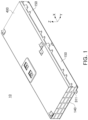
- FIG. 1 is a perspective diagram illustrating a battery module according to an example embodiment.
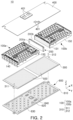
- FIG. 2 is an exploded perspective diagram illustrating a battery module according to an example embodiment.
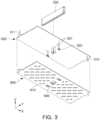
- FIG. 3 is a diagram illustrating a state in which a cooling plate is coupled to a lower cover.
- the battery module 10 includes a plurality of sub-modules 100, a connection member 200 disposed between the sub-modules 100, a lower cover 300 and an upper cover 400.
- the lower cover 300 and the upper cover 400 may support the sub-modules 100.
- the battery module 10 may further include a cooling plate 600 for cooling the battery module 10.
- the plurality of sub-modules 100 include a first sub-module 100a and a second sub-module 100b arranged adjacent to each other in a first direction, e.g., an X-axis direction, with the connection member 200 disposed between them.
- the first sub-module 100a and the second sub-module 100b may be assembled together and may form at least a portion of one battery module 10.
- connection members 200 may be disposed between two of the plurality of sub-modules 100.
- a connection member 200 is disposed between the first sub-module 100a and the second sub-module 100b disposed side by side in the first direction (X-axis direction).
- connection member 200 may have a shape of a partitioner extending in a second direction (Y-axis direction) perpendicular to the first direction (X-axis direction).
- the connection member 200 may be formed of a material having a predetermined level of rigidity so as to structurally support the first sub-module 100a and the second sub-module 100b.
- the connection member 200 may include a metal material such as aluminum or stainless steel.
- the first sub-module 100a and the second sub-module 100b may be coupled to opposite sides of the connection member 200, respectively.
- the first sub-module 100a may be fastened to at least one portion of a first side of the connection member 200
- the second sub-module 100b may be fastened to at least one portion of a second side of the connection member 200.
- the second side of the connection member 200 may be opposite to the first side of the connection member 200. Accordingly, the first sub-module 100a and the second sub-module 100b may be fixed to each other via the connection member 200.
- connection member 200 may work as a reference point for assembling the sub-modules 100. That is, the connection member 200 may partition a space in the battery module 10 in which each sub module 100 is accommodated, and may guide a position in which the sub module 100 is disposed.
- the battery module 10 may include lower cover 300 and upper cover 400 for supporting the plurality of sub-modules 100.
- the integrally formed lower cover 300 may be disposed to cover the lower surfaces of the plurality of sub-modules 100
- the integrally formed upper cover 400 may be disposed to cover the upper surfaces of the plurality of sub-modules 100.
- the lower cover 300 and the upper cover 400 may be integrally formed to stably support the plurality of sub-modules 100 .
- the battery module 10 includes a cooling plate 600 for cooling the battery modules.
- the cooling plate 600 is coupled to the lower cover 300 and may absorb thermal energy generated by the sub-modules 100a and 100b.
- the cooling plate 600 may include a cooling frame 610 forming a flow path 620.
- the cooling frame 610 may form a structure of the cooling plate 600 and may be combined with the lower cover 300 and may form a flow path 620 which may be a path through which a refrigerant can flow.
- Any suitable coupling method may be used between the cooling frame 610 and the lower cover 300, such as, for example, welding, brazing, roll-bonding, thermal fusion, filler bonding, friction welding, or a physical fastening method through a separate fastening member. These methods may be applied alone or in combination with each other.
- the flow path 620 may be formed on one surface of the cooling frame 610.
- the cooling frame 610 may have a structure in which at least a portion thereof is recessed in a downward direction (e.g., in a negative Z-axis direction), and as the cooling frame 610 is coupled to the lower cover 300, a flow path 620 through which refrigerant can flow may be formed in the space defined between the recessed portion of the cooling frame 610 and the lower cover 300.
- FIG. 2 only illustrates an example shape of the flow path 620, and the flow path 620 may be formed in the cooling frame 610.
- a portion of the cooling plate 600 may be shaded, which is only for distinguishing a portion in which the refrigerant may flow and a portion in which the refrigerant does not flow in the flow path 620.
- the shading does not indicate that the shaded portion and the non-shaded portion are separate members.
- the cooling plate 600 in FIG. 2 may have an integrated cooling frame 610 and a flow path 620 formed on at least a portion of the cooling frame 610. The shading is applied in FIGS. 5 to 11 for the same reasons as indicated above for FIG. 2 .
- the refrigerant flowing through the flow path 620 may be any suitable cooling fluid.
- the refrigerant flowing through the flow path 620 may be, for example, cooling water.
- the refrigerant flowing into the cooling plate 600 may absorb thermal energy generated in the first and second sub-modules 100a and 100b for cooling the first and second sub-modules 100a and 100b.
- the cooling plate 600 may include a guide 630 for guiding the flow of the refrigerant.
- the guide 630 may be formed such that a portion of the cooling frame 610 may protrude in a direction toward the lower cover 300 in the flow path 620.
- the guide 630 may be in contact with the lower cover 300. Accordingly, the refrigerant may not pass through the guide 630 and may flow along the circumference of the guide 630. Accordingly, the flow path or flow rate of the refrigerant may be determined by appropriately designing the shape of the guide 630.
- the shape of the guide 630 may be configured in various manners.
- at least a portion of the guide 630 may have a shape of a protrusion extending in a direction oblique with respect to the first direction (X-axis direction) in which the first sub-module 100a and the second sub-module 100b oppose each other.
- the shape of the guide 630 is not limited to the example illustrated in the drawings.
- the flow rate, cooling efficiency, and pressure drop of the refrigerant flowing through the flow path 620 may vary.
- the guide 630 may, for example, have a shape that optimizes the flow of the cooling fluid for enhance heat removal. A specific shape of the guide 630 will be described later.
- the cooling frame 610 or the lower cover 300 may include a plurality of ports 310 through which refrigerant flows in and out.
- the lower cover 300 may include a first port 311 and a second port 312 communicating with the flow path 620 of the cooling plate 600.
- the first port 311 may be an inlet for the refrigerant
- the second port 312 may be an outlet through which the refrigerant may be discharged. That is, the refrigerant may flow into the first port 311, may flow along the flow path 620 formed by the cooling frame 610, and may be discharged to the outside of the battery module 10 through the second port 312.
- FIG. 2 illustrates a configuration according to which the first and second ports 311 and 312 are disposed on opposite ends of the lower cover 300.
- the first port 311 and the second port 312 may be disposed in the cooling frame 610.
- a plurality of ports 310 may be disposed.
- the battery module 10 may include a single first port 311 and a single second port 312, and in this case, the refrigerant flowing into the first port 311 may cool both the first sub-module 100a and the second sub-module 100b.
- a plurality of first ports 311 and a plurality of second ports 312 may be disposed such that independent cooling flow paths may be formed for each of the sub-modules 100a and 100b.
- connection member 200 and the cooling plate 600 are coupled to the lower cover 300.
- connection member 200 is coupled to one surface of the lower cover 300 and the cooling plate 600 is coupled to the other surface of the lower cover 300.
- the cooling plate 600 may include one or more avoidance portions 640 not to interfere with the coupling structure of the connection member 200 and the lower cover 300.
- the avoidance portion 640 may be an opening penetrating through the cooling frame 610.
- One or more avoidance portions 640 may be provided to correspond to positions in which the connection member 200 and the lower cover 300 are coupled to each other.
- the lower cover 300 may include a fastening portion 321 coupled to the connection member 200, and the fastening portion 321 may be exposed in a downward direction (e.g., a negative Z-axis direction) of the battery module 10 through the avoidance portion 640.
- the battery module 10 may include a fastening member 322 for coupling the lower cover 300 to the connection member 200.
- the fastening portion 321 of the lower cover 300 may have a hole shape into which the fastening member 322 may be inserted.
- the fastening member 322 may pass through the fastening portion 321 of the lower cover 300 and may be fastened to the connection member 200, and the plurality of fastening members 322 may be connected to the cooling frame 610 corresponding to the position to which the avoidance portion 640 is fastened.
- the avoidance portion 640 may be disposed to oppose the connection member 200 with the lower cover 300 therebetween.
- the fastening portion 321 of the lower cover 300 may be exposed through the avoidance portion 640, and the fastening member 322 may be inserted into the exposed fastening portion 321 and may be coupled to the connection member 200.
- At least a portion of the flow path 620 may be formed between the plurality of avoidance portions 640. That is, a cooling flow path may be formed between the avoidance portions 640, and accordingly, at least a portion of the refrigerant flowing into the cooling plate 600 may flow between the plurality of avoidance portions 640.
- the flow path 620 may be configured to cover the entirety of the plurality of sub-modules 100.
- the flow path 620 of the cooling plate 600 may have a cooling region opposing the lower surface of the first sub-module 100a and the lower surface of the second sub-module 100b to cool both the first sub-module 100a and the second sub-module 100b. That is, the cooling plate 600 of the battery module 10 may be configured to have an integrated cooling structure for cooling the entirety of the plurality of sub-modules 100.
- a heat dissipation member 500 may be disposed between the lower cover 300 and the plurality of sub-modules 100.
- One surface of the heat dissipation member 500 may be disposed to be in contact with the sub-module 100 and the other surface opposite to the one surface may be in contact with the lower cover 300.
- the heat dissipation member 500 may be provided with a thermal adhesive.
- the heat dissipation member 500 may fill a space between the sub module 100 and the lower cover 300 such that heat transfer by conduction may be actively performed. Accordingly, heat dissipation efficiency of the battery module 10 may be increased.
- the battery module 10 may include an upper cover 400 covering the upper portion of the sub-module 100.
- the upper cover 400 may be integrally formed to simultaneously support the plurality of sub-modules 100.
- the upper cover 400 may have an opening 401 to expose a terminal portion of the sub-module 100 (e.g., 122 in FIG. 4 ) or a portion of the sensing module of the sub-module 100.
- Each sub-module 100 includes a plurality of battery cells and may be configured to store or discharge electrical energy.
- a plurality of sub-modules 100 may be electrically connected to each other and may output design power values required for the battery module.
- the two sub-modules 100 opposing each other with the connection member 200 interposed therebetween may be connected to each other in series or in parallel through terminal portions (e.g., 122 in FIG. 4 ).
- the plurality of sub-modules 100 may be electrically isolated from each other.
- the two sub-modules 100 opposing each other with the connection member 200 interposed therebetween may be electrically separated from each other, and the terminal portion of each sub-module 100 (e.g., 122 in FIG. 4 ) may be configured to be electrically connected to another neighboring battery module 10.
- FIG. 4 is an exploded perspective diagram illustrating a sub-module 100 included in a battery module 10 according to an example embodiment. Since the sub-module 100 described with reference to FIG. 4 may correspond to one of the first sub-module 100a and the second sub-module 100b previously described with reference to FIGS. 1 to 3 , overlapping descriptions may be omitted.
- the battery module 10 may include a plurality of sub-modules 100. At least one of the plurality of sub-modules 100 included in the battery module 10 may include a cell assembly CA and a plurality of protective covers 140 and 150 protecting the cell assembly CA.
- the protective covers 140 and 150 may include an end cover 140 covering at least one side of the cell assembly CA and one or more side covers 150.
- the cell assembly CA may include a cell stack 110 including battery cells 1000 stacked in one direction (e.g., the Y-axis direction in FIG. 4 ), a busbar assembly 120 electrically connected to the cell stack 110, and an insulating cover 130 coupled to the busbar assembly 120.
- the cell stack 110 may include a plurality of battery cells 1000 electrically connected to each other.
- the plurality of battery cells 1000 may be stacked in one direction (e.g., the Y-axis direction).
- the stacking direction of the battery cells 1000 included in the cell stack 110 may be referred to as a "second direction” or a "cell stacking direction.”
- the busbar assembly 120 may include a plurality of busbars 121 electrically connecting the battery cells 1000 of the cell stack 110 to each other and a support frame supporting the busbars 121.
- the busbar 121 may be formed of a conductive material and may electrically connect the plurality of battery cells 1000 to each other.
- the busbar 121 may be electrically connected to the battery cell 1000 while being fixed to the support frame.
- the support frame may support the busbar 121 to be stably connected to the battery cell 1000.
- the support frame may include a non-conductive material (e.g., plastic) having a predetermined stiffness and may structurally support the plurality of busbars 121.
- the support frame may oppose at least one side of the cell stack 110.
- the support frame may include a busbar frame 123 opposing the cell stack 110 in a first direction (X-axis direction) and supporting the busbar 121, and a connection frame 124 opposing the cell stack 110 in the third direction (Z-axis direction) and connected to the busbar frame 123.
- the second direction may be perpendicular to the first direction
- the third direction may be perpendicular to both the first and second directions.
- a sensing module 125 for sensing the electrical and thermal states of the battery cells 1000 may be disposed on the connection frame 124. Voltage information or temperature information sensed by the sensing module 125 may be transmitted to the outside of the sub-module 100 and may be used to control the battery module 10.
- the cell assembly CA may include the insulating cover 130 covering at least one surface of the busbar assembly 120.
- the insulating cover 130 may include a non-conductive material and may prevent the busbar 121 of the busbar assembly 120 from being unintentionally shorted with other components.
- An end cover 140 may be disposed on the outermost side of one side of the sub module 100.
- the end cover 140 may include a rigid material (e.g., a metal material such as aluminum) and may protect the cell assembly CA from external impact.
- the end cover 140 In a state in which the sub-module 100 is coupled to the connection member (e.g., 200 in FIG. 2 ) and the lower cover (e.g., 300 in FIG. 2 ), the end cover 140 may be spaced apart from the connection member 200 and may be disposed on one of the edges of the lower cover 300.
- a plurality of insulating covers 130 of the cell assembly CA may be provided.
- the sub module 100 may include a first insulating cover 131 electrically separating the connecting member 200 and the busbar assembly 120 from each other, and a second insulating cover 132 electrically separating the end cover 140 and the busbar assembly 120 from each other.
- the first insulating cover 131 may be disposed between the connection member 200 and the busbar 121 and may electrically separate the components from each other.
- the second insulating cover 132 may be disposed between the end cover 140 and the busbar 121 and may electrically separate the components from each other.
- the insulating cover 130 may be coupled to the busbar assembly 120.
- each of the first insulating cover 131 and the second insulating cover 132 may be inserted into and fixed to the busbar frame 123.
- the insulating cover 130 may be fixed to the busbar frame 123 through a fastening member.
- the sub module 100 may include a side cover 150 opposing at least one side of the cell stack 110.
- a pair of side covers 150 may be provided to cover different surfaces of the cell stack 110.
- the pair of side covers 150 may be coupled to the end cover 140 and the connection member 200, may form a side surface of the sub module 100 and may protect the cell stack 110 from an external environment.
- the side cover 150 may oppose the cell stack 110 in a different direction from the end cover 140.
- the side cover 150 may be disposed to oppose the cell stack 110 in the second direction (Y-axis direction)
- the end cover 140 may be disposed to oppose the cell stack 110 in the first direction (X-axis direction) with the busbar assembly 120 and the second insulating cover 132 interposed therebetween.
- the end cover 140, the pair of side covers 150, and the first insulating cover 131 may form four surfaces of the sub module 100.
- the end cover 140 may be coupled to one end, and the connection member 200 of the battery module 10 may be coupled to the other end opposite to one side.
- the busbar assembly 120 may also be coupled to the side cover 150.
- the side cover 150 may further include a connection portion 153 which may be structurally connected to an external component of the battery module 10.
- the connection portion 153 may have a structure protruding from the surface of the side cover 150 in a second direction (Y-axis direction).
- the battery module 10 may be coupled to an external component (e.g., a battery pack housing in which the plurality of battery modules 10 are accommodated) through the connection portion 153 of the side cover 150.
- the lower surface of the sub-module 100 may be configured such that the cell stack 110 may be exposed.
- the sub-module 100 may not have a cover member on a lower surface thereof, and accordingly, the cell stack 110 may be in direct contact with an external component of the sub-module 100 (e.g., the lower cover 300 or the heat dissipation member 500 of the battery module 10 illustrated in FIG. 2 ). Accordingly, heat may be smoothly discharged from the cell stack 110 toward the lower portion of the sub-module 100, such that heat dissipation efficiency of the sub-module 100 may be increased.
- an end cover 140 may be disposed in an outermost portion of one side and a first insulating cover 131 may be disposed in an outermost portion of the other side. That is, one sub-module 100 may include a first surface on which the insulating cover 131 is disposed and a second surface on which the end cover 140 is disposed. For example, referring to FIG. 4 , the first surface of one sub-module 100 may be closed with an insulating cover 131, and the second surface opposite to the first surface may be closed with an end cover 140.
- the two sub-modules 100 disposed to oppose each other with the connection member 200 interposed therebetween may be disposed such that the first surfaces thereof may oppose the connection member 200.
- the first sub-module 100a may be coupled to the connection member 200 such that the first surface on which the insulating cover 130 is disposed may oppose the connection member 200
- the second sub-module 100b may be coupled to the connection member 200 such that the first surface on which the insulating cover 130 is disposed may oppose the connection member 200.
- the end covers 140 of each sub-module 100 may form the front and rear outer surfaces
- the side covers 150 coupled to the end cover 140 may form the side outer surfaces
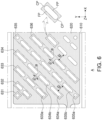
- FIG. 5 is a diagram illustrating cooling plate 600 according to an example embodiment, viewed from above.
- FIG. 6 is an enlarged diagram illustrating a portion of the cooling plate 600 in FIG. 5 according to an example embodiment.
- FIG. 7 is a diagram illustrating an example in which a shape of an avoidance portion 640 is partially changed in the cooling plate 600 in FIG. 5 . Since the cooling plate 600 described with reference to FIGS. 5 and 6 may be similar to the cooling plate 600 previously described with reference to FIGS. 1 to 3 , overlapping descriptions may not be provided.
- the cooling plate 600 may be configured to cool the entirety of the plurality of sub-modules (e.g., 100 in FIG. 2 ) included in the battery module (e.g., 10 in FIGS. 1 and 2 ).
- the cooling plate 600 may cool first and second regions A and C corresponding to the first sub-module 100a and the second sub-module 100b, respectively, and a third region B corresponding to a portion in which a connecting member (e.g., 200 in FIGS. 2 and 3 ) is disposed.
- the flow path of the cooling plate 600 may include a first flow path 621 for cooling the first region A, a second flow path 623 for cooling the second region C, and third flow path 622 for cooling the third region B.
- the first flow path 621, the third flow path 622, and the second flow path 623 may be arranged in a direction parallel to the first direction (e.g., the X-axis direction) in which the first sub-module 100a and the second sub-module 100b are arranged.
- the first flow path 621 of the cooling plate 600 may communicate with the second flow path 623 through the third flow path 622.
- the refrigerant flowing from the first port 311 may cool the first sub-module 100a while flowing along the first flow path 621.
- the refrigerant passing through the first flow path 621 may flow to the second flow path 623 through the third flow path 622.
- the refrigerant may cool the second sub-module 100b while flowing along the second flow path 623 and may exit through the second port 312.
- the cooling frame 610 forming the first to third flow paths 621, 622, and 623 may be integrally formed, and accordingly, the cooling plate 600 having a structurally simple and stable cooling performance may be implemented.
- Guide 630 may be disposed in the first flow path 621 and the second flow path 623.
- the guide 630 may guide the flow of the refrigerant.
- the guide 630 may include a plurality of guide protrusions 630a and 630b arranged in a predetermined pattern.
- the pattern formed by the guide protrusions 630a and 630b may be varied depending on the cooling performance requirements of the battery module 10.
- the cooling plate 600 may include a plurality of guide protrusions 630a and 630b forming an oblique pattern with respect to a first direction (X-axis direction) such that the refrigerant which flow in may spread swiftly and widely.
- the refrigerant flowing in through the first port 311 may spread swiftly and evenly to the first flow path 621 by the guide protrusions 630a disposed in an oblique pattern in the first flow path 621. Accordingly, a decrease of pressure may be prevented while the refrigerant flows through the flow path and may secure high cooling performance.
- the guide 630 may include a guide protrusion groups 631, 632, 633, and 634, a plurality of groups of a plurality of guide protrusions 634a, 634b, or the like, arranged in an oblique direction with respect to one edge of the cooling frame 610.
- a plurality of guide protrusion groups 631, 632, 633, and 634 may be formed.
- the guide 630 may include a plurality of guide protrusion groups 631, 632, 633, and 634, each having a different number of guide protrusions.
- the first guide protrusion group 631 may include a guide protrusion
- the second guide protrusion group 632 may include two guide protrusions
- the third guide protrusion group 633 may include three guide protrusions.
- the guide protrusions included in one of the groups of guide protrusions may have different shapes.
- a portion of guide protrusions 635a may have a circular shape
- the other portion of the guide protrusions 635b may have curved ends and a flat central portion.
- the guide protrusions included in a group of guide protrusions may be spaced apart from each other in one direction.
- the guide protrusions 634a, 634b, or the like, of the fourth guide protrusion group 634 may be spaced apart to have a first distance d1 therebetween, and may be disposed in the fourth direction having a predetermined angle (a) with the first direction (X-axis direction).
- the predetermined angle may be an acute angle.
- One of the guide protrusion groups may be spaced apart from another guide protrusion group with a predetermined distance therebetween.
- the guide protrusion 634a included in the fourth guide protrusion group 634 and the guide protrusion 625b included in the fifth guide protrusion group 635 may be spaced apart from each other to have a second distance d2 therebetween.
- the first distance d1 may be equal to or smaller than the second distance d2.
- the refrigerant may smoothly flow in the fourth direction.
- At least one of the plurality of guide protrusions may include a flat portion FP having a surface parallel to the fourth direction and a curved portion CP disposed on both ends of the flat portion FP.
- one of the guide protrusions may include a pair of flat portions FP having an inclination with respect to a first direction (X-axis direction) and a curved portion CP connecting the pair of flat portions FP to each other.
- the plurality of guide protrusions included in one of the guide protrusion groups may be arranged such that the curved portions CP may oppose each other. Due to this arrangement structure, a decrease of pressure may be prevented while the refrigerant flows between the plurality of guide protrusions, and an effect of facilitating the diffusion of the refrigerant may be obtained.
- a plurality of guides 630 may be disposed in the second flow path 623 as well.
- the guide 630 disposed on the second flow path 623 may have a pattern similar to that of the guide 630 disposed on the first flow path 621.
- a plurality of guide protrusions 630b forming a pattern in a direction parallel to the fourth direction described above may be formed in the second flow path 623.
- the fourth direction which is the pattern direction of the guide, may be substantially parallel to a diagonal line connecting the lower left corner (hereinafter referred to as a first corner) and the upper right corner (hereinafter referred to as a second corner) of the first region A and the second region C.
- the first port 311 through which the refrigerant flows may be disposed adjacent to the first corner of the first region A.
- the second port 312 through which the refrigerant is discharged may be disposed adjacent to the second corner of the second region C.
- the guide 630 may reduce the flow friction in the flow process until the refrigerant flowing into the first port 311 is discharged to the second port 312, thereby reducing the pressure of the refrigerant. Therefore, since the flow of the refrigerant may be smoothly maintained even with a small amount of energy, energy required for cooling the battery module 10 may be saved.
- the third flow path 622 disposed between the first flow path 621 and the second flow path 623 may have a plurality of flow paths such that the refrigerant may smoothly flow through the first flow path 621 and the second flow path 623.
- the cooling frame 610 may have a plurality of avoidance portions 640 avoiding a portion in which the connection member 200 and the lower cover are coupled to each other, and a flow path may be formed between the avoidance portions 640.
- the third flow path 622 may include a side flow path 622a disposed between the avoidance portion 640 and the edge of the cooling frame 610 and a center flow path 622b disposed between the side flow path 622a and the plurality of avoidance portions 640.
- the cooling plate 600 has a plurality of flow paths between the avoidance portions 640, interference with the coupling structure of the battery module 10 may be prevented and a smooth cooling flow path may be secured. Also, by forming a flow path by avoiding the portion in which the fastening member (e.g., 322 in FIG. 3 ), the refrigerant may be prevented from leaking through the fastening portion.
- the fastening member e.g., 322 in FIG. 3
- the specific shape of the guide 630 is not limited to the above example.
- the guide 630 formed in the first flow path 621 and the guide 630 formed on the second flow path 623 may include a plurality of guide protrusions arranged in different patterns.
- connection flow paths 622a may be formed along both ends of the avoidance portion 640 in the second direction (Y-axis direction), respectively.
- the configurations other than the shape of the avoidance portion 640 and the connection flow paths 622a may correspond to those of the cooling plate 600 in FIG. 5 .
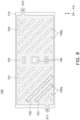
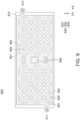
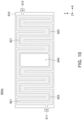
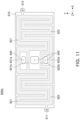
- FIGS. 8 to 11 are diagrams illustrating a cooling plate according to another example embodiment, viewed from above.
- the configurations other than the shape of the guide may correspond to those of the cooling plate described with reference to FIGS. 1 to 6 , and accordingly, overlapping descriptions may not be provided.
- guides 730a and 730b of a cooling plate 700 may include a plurality of guide protrusion groups 731 and 732 forming a pattern in a direction different from the fourth direction described with reference to FIG. 6 .
- the guides 730a and 730b may include a plurality of guide protrusion groups 731 and 732 formed by a plurality of guide protrusions arranged in a fifth direction perpendicular to the fourth direction.
- the refrigerant flowing in through the first port 311 may diffuse widely into the first flow path 721 by the guide 730a having a pattern in the fifth direction. Accordingly, the entire first region may be rapidly cooled, which may be advantageous.
- the guide 830 of the cooling plate 800 may have a pattern in which guide protrusions 831, 832, and 833 having different shapes and orientations may be alternately disposed.
- the guide 830 may include a first guide protrusion 831 extending in the fourth direction described above with reference to FIG. 6 , a second guide protrusion 832 extending in the fifth direction described with reference to FIG. 8 , and a third guide protrusion 833 having an approximately elliptical (or oval) shape.
- the first guide protrusion 831, the second guide protrusion 832, and the third guide protrusion 833 may be alternately arranged in various manners.
- the first guide protrusion 831 and the second guide protrusion 832 may be alternately arranged in the first direction (X-axis direction) and the second direction (Y-axis direction), and a third guide protrusion 833 may be disposed therebetween.
- the third guide protrusion 833 may be disposed between two first guide protrusions 831 and between two second guide protrusions 832.
- the refrigerant may be induced to stably flow in the first direction (X-axis direction) and the second direction (Y-axis direction), and a decrease of pressure due to friction may be prevented.
- the guides of the cooling plates 900a and 900b may be formed in a continuous wall shape to form flow paths 921 and 922 having a tubular shape.
- the guide may be configured such that the refrigerant flowing in through the first port 311 may flow along the first flow path 921 and the second flow path 922 separated from each other and may be discharged through the second port 312.
- the first flow path 921 may form a first path through which the refrigerant may flow.
- the second flow path 922 may be partitioned from the first flow path and may form a second flow path through which the refrigerant may flow. Accordingly, the refrigerant flowing in through the first port 311 may flow along two or more different paths, and may cool the battery module 10, and may be discharged through the second port 312.
- first flow path 921 and the second flow path 922 may have paths bent multiple times, such that the refrigerant may flow evenly throughout regions corresponding to lower portions of the first sub-module and the second sub-module.
- a portion of the first flow path 921 and a portion of the second flow path 922 may be spaced apart in the second direction (Y-axis direction) with the avoidance portion 940 of the cooling plates 900a and 900b interposed therebetween.
- a portion of the first flow path 921 and a portion of the second flow path 922 may be formed along the edge of the cooling frame with the avoidance portion 940 interposed therebetween.
- the first flow path 921 may include a first sub-flow path 921a and a second sub-flow path 921b spaced apart from each other with at least the avoidance portion 940 interposed therebetween.
- the first sub-flow path 921a and the second sub-flow path 921b may pass through the avoidance portion 940, may merge into one path and may form the first flow path 921.
- the second flow path 922 may include a third sub-flow path 922a and a fourth sub-flow path 922b spaced apart from each other with at least one avoidance portion 940 interposed therebetween.
- the third sub-flow path 922a and the fourth sub-flow path 922b may pass through the avoidance portion 940, may merge and may form the first flow path 922.
- a method of manufacturing a battery module may include a sub-module manufacturing step of manufacturing a plurality of sub-modules 100, a connecting step of connecting the manufactured sub-modules 100 to each other via a connection member 200, and a cover step of closing the upper and lower portions of the connected sub-modules by covering the portions with a case (e.g., an upper cover and a lower cover) .
- a case e.g., an upper cover and a lower cover
- a sub-module may be a sub-unit included in at least a portion of a battery module, and a battery module may be manufactured by assembling a plurality of sub-modules.
- the plurality of sub-modules 100 manufactured as above may be assembled with each other via the connection member 200.
- the plurality of sub-modules 100 connected to each other by the connection member 200 may be combined with the upper cover 400 and the lower cover 300 covering the upper and lower portions.
- the plurality of sub-modules 100a and 100b may be seated on the lower cover 300 which may integrally support the components.
- a heat dissipation member 500 may be applied to an upper surface of the lower cover 300.
- the connection member 200 disposed between the plurality of sub-modules 100a and 100b may be fastened to the lower cover 300 and the upper cover 400. In this case, a bolting coupling method using a separate fastening member 322 may be applied.
- the method of manufacturing the battery module 10 may further include a cooling plate coupling step of coupling the cooling plate 600 for cooling the sub-modules 100 to the lower cover 300.
- the cooling plate 600 may be coupled to the lower cover 300 by welding, brazing, roll-bonding, thermal fusion, filler bonding, or friction welding.
- the step of assembling the cooling plate may already be performed before assembling the plurality of sub-modules 100 with the lower cover 300.
- the coupling of the cooling plate 600 may be performed simultaneously in or after the process of coupling the plurality of sub-modules 100 to the lower cover 300.
- the manufacturing method of the battery module 10 is not limited to the above, and for example, the method may further include a step of connecting sensing modules (125 in FIG. 3 ) for sensing the state of the sub-modules 100 to each other, or a step of connecting a connector to the terminal unit (122 in FIG. 3 ) of the sub-modules 100.
- the cooling plate included in the battery module may form a cooling flow path for cooling the entirety of the plurality of sub-modules without interfering with a coupling structure of a connection member for connecting the plurality of sub-modules to each other.
- the cooling plate may guide the flow of the refrigerant through a guide having a predetermined pattern, thereby reducing a decrease of pressure generated during the flow process and rapidly cooling a plurality of sub-modules including a large number of battery cells.
Landscapes
- Chemical & Material Sciences (AREA)
- Chemical Kinetics & Catalysis (AREA)
- Electrochemistry (AREA)
- General Chemical & Material Sciences (AREA)
- Engineering & Computer Science (AREA)
- Manufacturing & Machinery (AREA)
- Aviation & Aerospace Engineering (AREA)
- Secondary Cells (AREA)
- Battery Mounting, Suspending (AREA)
Applications Claiming Priority (1)
| Application Number | Priority Date | Filing Date | Title |
|---|---|---|---|
| KR1020220109303A KR102642027B1 (ko) | 2022-08-30 | 2022-08-30 | 배터리 모듈 |
Publications (3)
| Publication Number | Publication Date |
|---|---|
| EP4345985A2 EP4345985A2 (en) | 2024-04-03 |
| EP4345985A3 EP4345985A3 (en) | 2024-04-10 |
| EP4345985B1 true EP4345985B1 (en) | 2025-05-28 |
Family
ID=85724868
Family Applications (1)
| Application Number | Title | Priority Date | Filing Date |
|---|---|---|---|
| EP23163369.4A Active EP4345985B1 (en) | 2022-08-30 | 2023-03-22 | Battery module |
Country Status (5)
| Country | Link |
|---|---|
| US (1) | US20240072330A1 (pl) |
| EP (1) | EP4345985B1 (pl) |
| KR (2) | KR102642027B1 (pl) |
| CN (2) | CN220400714U (pl) |
| PL (1) | PL4345985T3 (pl) |
Families Citing this family (3)
| Publication number | Priority date | Publication date | Assignee | Title |
|---|---|---|---|---|
| KR102851447B1 (ko) * | 2022-11-16 | 2025-08-26 | 주식회사 엘지에너지솔루션 | 전지 모듈 및 이를 포함하는 전지 팩 |
| KR20250128005A (ko) * | 2024-02-20 | 2025-08-27 | 주식회사 엘지에너지솔루션 | 전지 모듈 및 이를 포함하는 전지팩 |
| CN119636458B (zh) * | 2024-12-27 | 2025-11-04 | 华为技术有限公司 | 具有立体水冷回路的车载充电器、动力总成及电动车辆 |
Family Cites Families (6)
| Publication number | Priority date | Publication date | Assignee | Title |
|---|---|---|---|---|
| KR102314041B1 (ko) * | 2015-03-12 | 2021-10-18 | 삼성에스디아이 주식회사 | 베터리 팩 |
| KR102056875B1 (ko) * | 2015-11-10 | 2019-12-17 | 주식회사 엘지화학 | 배터리 모듈 및 이를 포함하는 배터리 팩 |
| US11916244B2 (en) * | 2019-12-17 | 2024-02-27 | Sk On Co., Ltd. | Battery module including partition member |
| KR20220041428A (ko) * | 2020-09-25 | 2022-04-01 | 주식회사 엘지에너지솔루션 | 전지 모듈, 전지팩 및 이를 포함하는 자동차 |
| KR102269290B1 (ko) * | 2020-11-10 | 2021-06-25 | 주식회사 원진 | 전기자동차용 배터리냉각장치 |
| US20230282903A1 (en) * | 2022-03-04 | 2023-09-07 | Sk On Co., Ltd. | Battery device |
-
2022
- 2022-08-30 KR KR1020220109303A patent/KR102642027B1/ko active Active
-
2023
- 2023-03-15 US US18/184,429 patent/US20240072330A1/en active Pending
- 2023-03-22 EP EP23163369.4A patent/EP4345985B1/en active Active
- 2023-03-22 PL PL23163369.4T patent/PL4345985T3/pl unknown
- 2023-06-09 CN CN202321464829.8U patent/CN220400714U/zh active Active
- 2023-06-09 CN CN202310681142.8A patent/CN117638295B/zh active Active
-
2024
- 2024-02-23 KR KR1020240026816A patent/KR20240031280A/ko active Pending
Also Published As
| Publication number | Publication date |
|---|---|
| KR20240031280A (ko) | 2024-03-07 |
| PL4345985T3 (pl) | 2025-08-18 |
| KR102642027B1 (ko) | 2024-02-28 |
| EP4345985A3 (en) | 2024-04-10 |
| US20240072330A1 (en) | 2024-02-29 |
| CN117638295B (zh) | 2025-03-04 |
| EP4345985A2 (en) | 2024-04-03 |
| CN117638295A (zh) | 2024-03-01 |
| CN220400714U (zh) | 2024-01-26 |
Similar Documents
| Publication | Publication Date | Title |
|---|---|---|
| EP4345985B1 (en) | Battery module | |
| US12288861B2 (en) | Battery pack | |
| US11799159B2 (en) | Battery pack | |
| EP3716392B1 (en) | Battery module having improved cooling structure | |
| KR102433361B1 (ko) | 전지 모듈 및 이를 포함하는 전지팩 | |
| EP2533350B1 (en) | Battery module with improved heat exchange efficiency | |
| EP3067962B1 (en) | Battery pack | |
| US20220285759A1 (en) | Battery Module and Battery Pack Including the Same | |
| CN115066795B (zh) | 电池组和包括该电池组的设备 | |
| KR102846582B1 (ko) | 배터리 모듈 | |
| US12015163B2 (en) | Eco-friendly power source such as battery module for a transportation vehicle and method of manufacturing battery module | |
| KR20210127316A (ko) | 전지 모듈 및 이를 포함하는 전지팩 | |
| EP3972034A1 (en) | Battery module and battery pack including same | |
| US20230282931A1 (en) | Battery pack | |
| KR20240012302A (ko) | 배터리 팩 및 이를 포함하는 디바이스 | |
| EP4535512A2 (en) | Battery pack and vehicle including same | |
| US20230282928A1 (en) | Battery pack | |
| EP4362183A1 (en) | Battery module | |
| EP4507087A1 (en) | Battery pack and device comprising same | |
| EP4550530A1 (en) | Battery module and battery pack comprising same | |
| EP4586371A1 (en) | Battery module and battery pack including same | |
| US20250357578A1 (en) | Battery Module and Battery Pack Including the Same | |
| KR20250127514A (ko) | 배터리 셀 및 이를 포함하는 배터리 모듈 | |
| KR20250147389A (ko) | 향상된 냉각성능을 가지는 배터리 팩 | |
| CN120917599A (zh) | 电池组和包括该电池组的装置 |
Legal Events
| Date | Code | Title | Description |
|---|---|---|---|
| PUAI | Public reference made under article 153(3) epc to a published international application that has entered the european phase |
Free format text: ORIGINAL CODE: 0009012 |
|
| STAA | Information on the status of an ep patent application or granted ep patent |
Free format text: STATUS: REQUEST FOR EXAMINATION WAS MADE |
|
| PUAL | Search report despatched |
Free format text: ORIGINAL CODE: 0009013 |
|
| 17P | Request for examination filed |
Effective date: 20230322 |
|
| AK | Designated contracting states |
Kind code of ref document: A2 Designated state(s): AL AT BE BG CH CY CZ DE DK EE ES FI FR GB GR HR HU IE IS IT LI LT LU LV MC ME MK MT NL NO PL PT RO RS SE SI SK SM TR |
|
| AK | Designated contracting states |
Kind code of ref document: A3 Designated state(s): AL AT BE BG CH CY CZ DE DK EE ES FI FR GB GR HR HU IE IS IT LI LT LU LV MC ME MK MT NL NO PL PT RO RS SE SI SK SM TR |
|
| RIC1 | Information provided on ipc code assigned before grant |
Ipc: H01M 50/291 20210101ALI20240305BHEP Ipc: H01M 50/262 20210101ALI20240305BHEP Ipc: H01M 50/209 20210101ALI20240305BHEP Ipc: H01M 10/6568 20140101ALI20240305BHEP Ipc: H01M 10/6556 20140101ALI20240305BHEP Ipc: H01M 10/647 20140101ALI20240305BHEP Ipc: H01M 10/625 20140101ALI20240305BHEP Ipc: H01M 10/613 20140101AFI20240305BHEP |
|
| GRAP | Despatch of communication of intention to grant a patent |
Free format text: ORIGINAL CODE: EPIDOSNIGR1 |
|
| STAA | Information on the status of an ep patent application or granted ep patent |
Free format text: STATUS: GRANT OF PATENT IS INTENDED |
|
| INTG | Intention to grant announced |
Effective date: 20241220 |
|
| GRAS | Grant fee paid |
Free format text: ORIGINAL CODE: EPIDOSNIGR3 |
|
| GRAA | (expected) grant |
Free format text: ORIGINAL CODE: 0009210 |
|
| STAA | Information on the status of an ep patent application or granted ep patent |
Free format text: STATUS: THE PATENT HAS BEEN GRANTED |
|
| AK | Designated contracting states |
Kind code of ref document: B1 Designated state(s): AL AT BE BG CH CY CZ DE DK EE ES FI FR GB GR HR HU IE IS IT LI LT LU LV MC ME MK MT NL NO PL PT RO RS SE SI SK SM TR |
|
| REG | Reference to a national code |
Ref country code: GB Ref legal event code: FG4D |
|
| REG | Reference to a national code |
Ref country code: CH Ref legal event code: EP |
|
| REG | Reference to a national code |
Ref country code: IE Ref legal event code: FG4D Ref country code: DE Ref legal event code: R096 Ref document number: 602023003662 Country of ref document: DE |
|
| REG | Reference to a national code |
Ref country code: NL Ref legal event code: MP Effective date: 20250528 |
|
| PG25 | Lapsed in a contracting state [announced via postgrant information from national office to epo] |
Ref country code: FI Free format text: LAPSE BECAUSE OF FAILURE TO SUBMIT A TRANSLATION OF THE DESCRIPTION OR TO PAY THE FEE WITHIN THE PRESCRIBED TIME-LIMIT Effective date: 20250528 Ref country code: ES Free format text: LAPSE BECAUSE OF FAILURE TO SUBMIT A TRANSLATION OF THE DESCRIPTION OR TO PAY THE FEE WITHIN THE PRESCRIBED TIME-LIMIT Effective date: 20250528 |
|
| REG | Reference to a national code |
Ref country code: LT Ref legal event code: MG9D |
|
| PG25 | Lapsed in a contracting state [announced via postgrant information from national office to epo] |
Ref country code: GR Free format text: LAPSE BECAUSE OF FAILURE TO SUBMIT A TRANSLATION OF THE DESCRIPTION OR TO PAY THE FEE WITHIN THE PRESCRIBED TIME-LIMIT Effective date: 20250829 Ref country code: NO Free format text: LAPSE BECAUSE OF FAILURE TO SUBMIT A TRANSLATION OF THE DESCRIPTION OR TO PAY THE FEE WITHIN THE PRESCRIBED TIME-LIMIT Effective date: 20250828 |
|
| PG25 | Lapsed in a contracting state [announced via postgrant information from national office to epo] |
Ref country code: NL Free format text: LAPSE BECAUSE OF FAILURE TO SUBMIT A TRANSLATION OF THE DESCRIPTION OR TO PAY THE FEE WITHIN THE PRESCRIBED TIME-LIMIT Effective date: 20250528 |
|
| PG25 | Lapsed in a contracting state [announced via postgrant information from national office to epo] |
Ref country code: BG Free format text: LAPSE BECAUSE OF FAILURE TO SUBMIT A TRANSLATION OF THE DESCRIPTION OR TO PAY THE FEE WITHIN THE PRESCRIBED TIME-LIMIT Effective date: 20250528 |
|
| PG25 | Lapsed in a contracting state [announced via postgrant information from national office to epo] |
Ref country code: HR Free format text: LAPSE BECAUSE OF FAILURE TO SUBMIT A TRANSLATION OF THE DESCRIPTION OR TO PAY THE FEE WITHIN THE PRESCRIBED TIME-LIMIT Effective date: 20250528 |
|
| PG25 | Lapsed in a contracting state [announced via postgrant information from national office to epo] |
Ref country code: RS Free format text: LAPSE BECAUSE OF FAILURE TO SUBMIT A TRANSLATION OF THE DESCRIPTION OR TO PAY THE FEE WITHIN THE PRESCRIBED TIME-LIMIT Effective date: 20250828 |
|
| PG25 | Lapsed in a contracting state [announced via postgrant information from national office to epo] |
Ref country code: IS Free format text: LAPSE BECAUSE OF FAILURE TO SUBMIT A TRANSLATION OF THE DESCRIPTION OR TO PAY THE FEE WITHIN THE PRESCRIBED TIME-LIMIT Effective date: 20250928 |
|
| PG25 | Lapsed in a contracting state [announced via postgrant information from national office to epo] |
Ref country code: LV Free format text: LAPSE BECAUSE OF FAILURE TO SUBMIT A TRANSLATION OF THE DESCRIPTION OR TO PAY THE FEE WITHIN THE PRESCRIBED TIME-LIMIT Effective date: 20250528 |