EP4345947A1 - Surface-coated positive electrode material and preparation method therefor, and lithium ion battery - Google Patents
Surface-coated positive electrode material and preparation method therefor, and lithium ion battery Download PDFInfo
- Publication number
- EP4345947A1 EP4345947A1 EP23819071.4A EP23819071A EP4345947A1 EP 4345947 A1 EP4345947 A1 EP 4345947A1 EP 23819071 A EP23819071 A EP 23819071A EP 4345947 A1 EP4345947 A1 EP 4345947A1
- Authority
- EP
- European Patent Office
- Prior art keywords
- source
- cathode material
- range
- sintering
- lithium
- Prior art date
- Legal status (The legal status is an assumption and is not a legal conclusion. Google has not performed a legal analysis and makes no representation as to the accuracy of the status listed.)
- Pending
Links
Images


Classifications
-
- H—ELECTRICITY
- H01—ELECTRIC ELEMENTS
- H01M—PROCESSES OR MEANS, e.g. BATTERIES, FOR THE DIRECT CONVERSION OF CHEMICAL ENERGY INTO ELECTRICAL ENERGY
- H01M4/00—Electrodes
- H01M4/02—Electrodes composed of, or comprising, active material
- H01M4/36—Selection of substances as active materials, active masses, active liquids
- H01M4/362—Composites
- H01M4/366—Composites as layered products
-
- C—CHEMISTRY; METALLURGY
- C01—INORGANIC CHEMISTRY
- C01G—COMPOUNDS CONTAINING METALS NOT COVERED BY SUBCLASSES C01D OR C01F
- C01G53/00—Compounds of nickel
- C01G53/40—Complex oxides containing nickel and at least one other metal element
- C01G53/42—Complex oxides containing nickel and at least one other metal element containing alkali metals, e.g. LiNiO2
- C01G53/44—Complex oxides containing nickel and at least one other metal element containing alkali metals, e.g. LiNiO2 containing manganese
- C01G53/50—Complex oxides containing nickel and at least one other metal element containing alkali metals, e.g. LiNiO2 containing manganese of the type (MnO2)n-, e.g. Li(NixMn1-x)O2 or Li(MyNixMn1-x-y)O2
-
- H—ELECTRICITY
- H01—ELECTRIC ELEMENTS
- H01M—PROCESSES OR MEANS, e.g. BATTERIES, FOR THE DIRECT CONVERSION OF CHEMICAL ENERGY INTO ELECTRICAL ENERGY
- H01M10/00—Secondary cells; Manufacture thereof
- H01M10/05—Accumulators with non-aqueous electrolyte
- H01M10/052—Li-accumulators
- H01M10/0525—Rocking-chair batteries, i.e. batteries with lithium insertion or intercalation in both electrodes; Lithium-ion batteries
-
- H—ELECTRICITY
- H01—ELECTRIC ELEMENTS
- H01M—PROCESSES OR MEANS, e.g. BATTERIES, FOR THE DIRECT CONVERSION OF CHEMICAL ENERGY INTO ELECTRICAL ENERGY
- H01M4/00—Electrodes
- H01M4/02—Electrodes composed of, or comprising, active material
- H01M4/04—Processes of manufacture in general
- H01M4/0471—Processes of manufacture in general involving thermal treatment, e.g. firing, sintering, backing particulate active material, thermal decomposition, pyrolysis
-
- H—ELECTRICITY
- H01—ELECTRIC ELEMENTS
- H01M—PROCESSES OR MEANS, e.g. BATTERIES, FOR THE DIRECT CONVERSION OF CHEMICAL ENERGY INTO ELECTRICAL ENERGY
- H01M4/00—Electrodes
- H01M4/02—Electrodes composed of, or comprising, active material
- H01M4/13—Electrodes for accumulators with non-aqueous electrolyte, e.g. for lithium-accumulators; Processes of manufacture thereof
- H01M4/131—Electrodes based on mixed oxides or hydroxides, or on mixtures of oxides or hydroxides, e.g. LiCoOx
-
- H—ELECTRICITY
- H01—ELECTRIC ELEMENTS
- H01M—PROCESSES OR MEANS, e.g. BATTERIES, FOR THE DIRECT CONVERSION OF CHEMICAL ENERGY INTO ELECTRICAL ENERGY
- H01M4/00—Electrodes
- H01M4/02—Electrodes composed of, or comprising, active material
- H01M4/36—Selection of substances as active materials, active masses, active liquids
-
- H—ELECTRICITY
- H01—ELECTRIC ELEMENTS
- H01M—PROCESSES OR MEANS, e.g. BATTERIES, FOR THE DIRECT CONVERSION OF CHEMICAL ENERGY INTO ELECTRICAL ENERGY
- H01M4/00—Electrodes
- H01M4/02—Electrodes composed of, or comprising, active material
- H01M4/36—Selection of substances as active materials, active masses, active liquids
- H01M4/48—Selection of substances as active materials, active masses, active liquids of inorganic oxides or hydroxides
- H01M4/485—Selection of substances as active materials, active masses, active liquids of inorganic oxides or hydroxides of mixed oxides or hydroxides for inserting or intercalating light metals, e.g. LiTi2O4 or LiTi2OxFy
-
- H—ELECTRICITY
- H01—ELECTRIC ELEMENTS
- H01M—PROCESSES OR MEANS, e.g. BATTERIES, FOR THE DIRECT CONVERSION OF CHEMICAL ENERGY INTO ELECTRICAL ENERGY
- H01M4/00—Electrodes
- H01M4/02—Electrodes composed of, or comprising, active material
- H01M4/36—Selection of substances as active materials, active masses, active liquids
- H01M4/48—Selection of substances as active materials, active masses, active liquids of inorganic oxides or hydroxides
- H01M4/50—Selection of substances as active materials, active masses, active liquids of inorganic oxides or hydroxides of manganese
- H01M4/505—Selection of substances as active materials, active masses, active liquids of inorganic oxides or hydroxides of manganese of mixed oxides or hydroxides containing manganese for inserting or intercalating light metals, e.g. LiMn2O4 or LiMn2OxFy
-
- H—ELECTRICITY
- H01—ELECTRIC ELEMENTS
- H01M—PROCESSES OR MEANS, e.g. BATTERIES, FOR THE DIRECT CONVERSION OF CHEMICAL ENERGY INTO ELECTRICAL ENERGY
- H01M4/00—Electrodes
- H01M4/02—Electrodes composed of, or comprising, active material
- H01M4/36—Selection of substances as active materials, active masses, active liquids
- H01M4/48—Selection of substances as active materials, active masses, active liquids of inorganic oxides or hydroxides
- H01M4/52—Selection of substances as active materials, active masses, active liquids of inorganic oxides or hydroxides of nickel, cobalt or iron
- H01M4/525—Selection of substances as active materials, active masses, active liquids of inorganic oxides or hydroxides of nickel, cobalt or iron of mixed oxides or hydroxides containing iron, cobalt or nickel for inserting or intercalating light metals, e.g. LiNiO2, LiCoO2 or LiCoOxFy
-
- H—ELECTRICITY
- H01—ELECTRIC ELEMENTS
- H01M—PROCESSES OR MEANS, e.g. BATTERIES, FOR THE DIRECT CONVERSION OF CHEMICAL ENERGY INTO ELECTRICAL ENERGY
- H01M4/00—Electrodes
- H01M4/02—Electrodes composed of, or comprising, active material
- H01M4/62—Selection of inactive substances as ingredients for active masses, e.g. binders, fillers
-
- C—CHEMISTRY; METALLURGY
- C01—INORGANIC CHEMISTRY
- C01P—INDEXING SCHEME RELATING TO STRUCTURAL AND PHYSICAL ASPECTS OF SOLID INORGANIC COMPOUNDS
- C01P2002/00—Crystal-structural characteristics
- C01P2002/70—Crystal-structural characteristics defined by measured X-ray, neutron or electron diffraction data
-
- H—ELECTRICITY
- H01—ELECTRIC ELEMENTS
- H01M—PROCESSES OR MEANS, e.g. BATTERIES, FOR THE DIRECT CONVERSION OF CHEMICAL ENERGY INTO ELECTRICAL ENERGY
- H01M4/00—Electrodes
- H01M4/02—Electrodes composed of, or comprising, active material
- H01M2004/021—Physical characteristics, e.g. porosity, surface area
-
- H—ELECTRICITY
- H01—ELECTRIC ELEMENTS
- H01M—PROCESSES OR MEANS, e.g. BATTERIES, FOR THE DIRECT CONVERSION OF CHEMICAL ENERGY INTO ELECTRICAL ENERGY
- H01M4/00—Electrodes
- H01M4/02—Electrodes composed of, or comprising, active material
- H01M2004/026—Electrodes composed of, or comprising, active material characterised by the polarity
- H01M2004/028—Positive electrodes
-
- Y—GENERAL TAGGING OF NEW TECHNOLOGICAL DEVELOPMENTS; GENERAL TAGGING OF CROSS-SECTIONAL TECHNOLOGIES SPANNING OVER SEVERAL SECTIONS OF THE IPC; TECHNICAL SUBJECTS COVERED BY FORMER USPC CROSS-REFERENCE ART COLLECTIONS [XRACs] AND DIGESTS
- Y02—TECHNOLOGIES OR APPLICATIONS FOR MITIGATION OR ADAPTATION AGAINST CLIMATE CHANGE
- Y02E—REDUCTION OF GREENHOUSE GAS [GHG] EMISSIONS, RELATED TO ENERGY GENERATION, TRANSMISSION OR DISTRIBUTION
- Y02E60/00—Enabling technologies; Technologies with a potential or indirect contribution to GHG emissions mitigation
- Y02E60/10—Energy storage using batteries
Definitions
- the present disclosure relates to the technical field of lithium-ion batteries, particularly to a surface-coated cathode material and preparation method thereof, and a lithium-ion battery.
- CN109065875A discloses a preparation method of a high nickel multiple material coated with ultrafine powder, wherein Zr02, Ti02, Al 2 O 3 , MgO, and other materials are used as the coating agents, although the coating can reduce the side reaction between the cathode and the electrolyte, and improve the battery performance, but each of the coating agents used in the method is an inert material, which does not participate in the ion and electron transport, and the thermal stability of high nickel materials is not improved.
- the present disclosure aims to overcome the defects in the prior art, and provides a surface-coated cathode material and preparation method thereof, and a lithium-ion battery, wherein the surface-coated cathode material comprises a substrate and a coating layer coated on a surface of the substrate; the coating layer has a bimodal distribution of characteristic peaks at 31 °-35° of 2 ⁇ tested by X-Ray Diffraction (XRD); and the bimodal distribution has a specific ratio of the peak intensity of the primary peak to the peak intensity of the secondary peak, such that the surface-coated cathode material has a high electronic conductivity and ionic conductivity, and can accelerate the diffusion rate of ions and electrons in the cathode material, thereby significantly enhancing the rate performance of a lithium-ion battery including the cathode material.
- XRD X-Ray Diffraction
- the surface-coated cathode material including the specific coating layer can avoid the catalytic corrosion between the cathode material and an electrolyte, and improve the cycling stability of a lithium-ion battery including the cathode material. Moreover, the thermal stability of the surface-coated cathode material including the specific coating layer is significantly improved.
- the first aspect of the present disclosure provides a surface-coated cathode material, wherein the cathode material comprises a substrate and a coating layer coated on a surface of the substrate;
- the coating layer has a bimodal distribution of characteristic peaks at 31°-35° of 2 ⁇ tested by XRD, and a ratio I b / I a of the peak intensity I b of the secondary peak to the peak intensity I a of the primary peak in the bimodal distribution is within a range of 0.8-1.
- the second aspect of the present disclosure provides a method for preparing the surface-coated cathode comprising the following steps:
- S1 subjecting a lithium source, a La source, an optional N 1 source, an optional N 2 source, an optional N 3 source, and an optional N 4 source to a first mixing to obtain a first mixture, performing a first sintering on the first mixture, and crushing it to obtain a coating agent;
- the third aspect of the present disclosure provides a method for preparing the surface-coated cathode comprising the following steps:
- a lithium source subjecting a lithium source, a La source, an optional N 1 source, an optional N 2 source, an optional N 3 source, an optional N 4 source, and a cathode material substrate to a third mixing to obtain a third mixture, performing a third sintering on the third mixture to prepare the surface-coated cathode material.
- the fourth aspect of the present disclosure provides a surface-coated cathode material produced with the aforementioned method.
- the fifth aspect of the present disclosure provides a lithium-ion battery wherein the lithium-ion battery comprises the aforementioned surface-coated cathode material.
- the surface-coated cathode material, and the preparation method and use thereof, the lithium-ion battery provided by the present disclosure produces the following beneficial effects:
- the surface-coated cathode material provided by the present disclosure comprises a substrate and a coating layer coated on a surface of the substrate; the coating layer has a bimodal distribution of characteristic peaks at 31°-35° of 2 ⁇ tested by X-Ray Diffraction (XRD); and the bimodal distribution has a specific ratio of the peak intensity of the primary peak to the peak intensity of the secondary peak, such that the surface-coated cathode material has high electronic conductivity and ionic conductivity, and can accelerate the diffusion rate of ions and electrons in the cathode material, thereby significantly enhancing the rate performance of a lithium-ion battery including the cathode material.
- XRD X-Ray Diffraction
- the surface-coated cathode material including the specific coating layer can avoid the catalytic corrosion between the cathode material and an electrolyte, and improve the cycling stability of a lithium-ion battery including the cathode material. Moreover, the thermal stability of the surface-coated cathode material including the specific coating layer is significantly improved.
- the substrate and the coating material of the surface-coated cathode material provided by the present disclosure have a specific composition, such that the cathode material has an electrochemical activity for lithium ion deintercalation, the coating material has a high lithium ion transmission capacity; in addition, the coating material has a lower oxygen vacancy formation energy, which can increase the electronic conductivity and accelerates the diffusion rates of ions and electrons in the cathode material, thereby significantly improving rate performance of the lithium-ion battery including the cathode material.
- the coating layer having a specific composition of the present disclosure can effectively suppress the interfacial side reaction of the particle surface of the cathode material with an electrolyte, remarkably improve the cycling stability of the lithium-ion battery comprising the cathode material, and effectively improve the thermal stability of the cathode material.
- the method of the cathode material provided by the present disclosure has a simple process, it is free from contamination and has a simple mode of introducing the doping elements and coating layer, requires a small dosage of the doping element and coating layer, it does not impose special requirements on the heat treatment atmosphere, and has low production costs, thus the preparation method is suitable for the large-scale industrial production.
- any value of the ranges disclosed herein are not limited to the precise ranges or values, such ranges or values shall be comprehended as comprising the values adjacent to the ranges or values.
- numerical ranges the endpoint values of the various ranges, the endpoint values and the individual point values of the various ranges, and the individual point values may be combined with each another to produce one or more new numerical ranges, which should be deemed have been specifically disclosed herein.
- the first aspect of the present disclosure provides a surface-coated cathode material, wherein the cathode material comprises a substrate and a coating layer coated on a surface of the substrate; the coating layer has a bimodal distribution of characteristic peaks at 31°-35° of 2 ⁇ tested by XRD, and a ratio I b / I a of the peak intensity I b of the secondary peak to the peak intensity I a of the primary peak in the bimodal distribution is within a range of 0.8-1.
- the surface-coated cathode material comprises a substrate and a coating layer coated on a surface of the substrate, the coating layer has a bimodal distribution of characteristic peaks at 31°-35° of 2 ⁇ tested by XRD, and the bimodal distribution has a specific ratio of the peak intensity of the primary peak to the peak intensity of the secondary peak, such that the surface-coated cathode material has a high electronic conductivity and ionic conductivity, and can accelerate the diffusion rate of ions and electrons in the cathode material, thereby significantly enhancing the rate performance of a lithium-ion battery including the cathode material.
- the surface-coated cathode material including the specific coating layer can avoid the catalytic corrosion between the cathode material and an electrolyte, and improve the cycling stability of a lithium-ion battery including the cathode material. Moreover, the thermal stability of the surface-coated cathode material including the specific coating layer is significantly improved.
- the peak intensity I b of the secondary peak and the peak intensity I a of the primary peak in the bimodal distribution are measured by XRD, respectively.
- the ratio I b / I a is within a range of 0.97-1.
- the substrate has a peak intensity I (003) of the characteristic peak (003) corresponding to the (003) crystal plane tested by XRD, 0.01% ⁇ I a /I (003) ⁇ 100% ⁇ 3.5%.
- the thermal stability of the cathode material can be improved, increasing the temperature corresponding to the exothermic peak of the cathode material tested by the DSC, such that the lithium-ion battery containing the cathode material has an improved safety performance.
- the peak intensity I (003) of the characteristic peak (003) corresponding to the (003) crystal plane of the substrate is tested by XRD.
- the substrate has a peak area A (003) of the characteristic peak (003) corresponding to the (003) crystal plane tested by XRD
- the coating layer has a peak area A a of the primary peak in the bimodal distribution of characteristic peaks at 31°-35° of 2 ⁇ tested by XRD, 0.01% ⁇ A a /A (003) ⁇ 100% ⁇ 6%.
- the thermal stability of the cathode material can be improved, increasing the temperature corresponding to the exothermic peak of the cathode material tested by the DSC, such that the lithium-ion battery containing the cathode material has an improved safety performance.
- both the peak area A a of the primary peak in the bimodal distribution of characteristic peaks at 31°-35° of 2 ⁇ of the coating layer and the peak area A (003) of the characteristic peak (003) corresponding to the (003) crystal plane of the substrate are measured by XRD.
- the substrate has a composition represented by formula 1: Li 1+ a Ni x Co y Mn z M k O 2 formula I; wherein -0.05 ⁇ a ⁇ 0.5, 0 ⁇ x ⁇ 1, 0 ⁇ y ⁇ 1, 0 ⁇ z ⁇ 1, 0 ⁇ k ⁇ 0.06, 0 ⁇ x + y + z + k ⁇ 1 , and M is at least one element selected from Ga, Sc, In, Y, Ce, Co, La, Cr, Mo, Mn, Fe, Hf, Zr, W, Nb, Sm, and Al;
- the coating layer has a composition represented by formula II: Li ⁇ - ⁇ - ⁇ La ⁇ N 1 ⁇ N 2 ⁇ N 3 1- ⁇ N 4 ⁇ O 3 formula II; wherein 0.7 ⁇ a ⁇ 1.5, 0.2 ⁇ ⁇ ⁇ 1, 0 ⁇ y ⁇ 0.5, 0 ⁇ ⁇ ⁇ 0.5, 0 ⁇ A ⁇ 0.5; N 1 is at least one element selected from Y, Nd, Pr, Ce, Sm, and Sc, N 2 is at least one element selected from Sr, Ca, Mg, Si, Ge, and Ru, N 3 is at least one element selected from Ni, Mn, and Co, N 4 is at least one element selected from Cr, Al, V, Nb, Zr, Ti, and Fe.
- formula II Li ⁇ - ⁇ - ⁇ La ⁇ N 1 ⁇ N 2 ⁇ N 3 1- ⁇ N 4 ⁇ O 3 formula II; wherein 0.7 ⁇ a ⁇ 1.5, 0.2 ⁇ ⁇ ⁇ 1, 0 ⁇ y ⁇ 0.5, 0 ⁇ ⁇ ⁇ 0.5, 0 ⁇ A ⁇ 0.5; N 1
- the substrate and the coating material of the surface-coated cathode material have a specific composition, such that the cathode material has an electrochemical activity for lithium ion deintercalation, the coating material has a high lithium ion transport ability; in addition, the coating material has a lower oxygen vacancy formation energy, which can increase the electronic conductivity and accelerate the diffusion rates of ions and electrons in the cathode material, thereby significantly improving rate performance of the lithium-ion battery including the cathode material.
- the coating layer having a specific composition of the present disclosure can effectively suppress the interfacial side reaction of the particle surface of the cathode material with an electrolyte, remarkably improve the cycling stability of the lithium-ion battery comprising the cathode material, and effectively improve the thermal stability of the cathode material.
- M in formula I is at least one element selected from Ce, Co, La, Cr, Mo, Y, Zr, W, Nb, and Al.
- N 1 in formula II is at least one element selected from Nd, Pr, Ce, Sm, and Sc.
- N 2 in formula II is at least one element selected from Sr, Ca, Mg, Si, and Ru.
- N 3 in formula II is selected from Ni and/or Mn.
- N 4 in formula II is at least one element selected from Cr, Al, Nb, Zr, Ti, and Fe.
- the content of the coating layer is within a range of 0.05-4wt%, based on the total weight of the substrate.
- the cathode material surface when the content of said coating layer satisfies the above-mentioned range, the cathode material surface has a uniform coating layer, which enables the cathode material surface to exhibit high ion and electron transport properties, such that the lithium-ion battery containing the cathode material has excellent electrochemical properties.
- the content of the coating layer is within a range of 0.5-3.6wt%, based on the total weight of the substrate.
- an average particle diameter D 50 of the surface-coated cathode material is within a range of 2-17 ⁇ m.
- an average particle diameter D 50 of the surface-coated cathode material is within a range of 3-12 ⁇ m.
- the electronic conductivity of the coating layer is within a range of 1 ⁇ 10 -5 S/cm - 8 ⁇ 10 -3 S/cm.
- the coating layer when the electronic conductivity of the coating layer is within the above range, the coating layer has high electron-transport property and can form an electronic conductive layer on the surface of the cathode material, thereby causing that the lithium-ion battery containing the cathode material has excellent electrochemical properties.
- the electronic conductivity of the coating layer is within a range of 1.8 ⁇ 10 -5 S/cm - 7.2 ⁇ 10 -3 S/cm.
- the ionic conductivity of the coating layer is within a range of 1 ⁇ 10 -6 S/cm - 6 ⁇ 10 -4 S/cm.
- the ionic conductivity of the coating layer when the ionic conductivity of the coating layer is within the above range, it has high ion transport property and can form an ionic conductive layer on the surface of the cathode material, thereby causing that the lithium-ion battery containing the cathode material has an excellent electrochemical properties.
- the ionic conductivity of the coating layer is within a range of 3 ⁇ 10 -6 S/cm - 5 ⁇ 10 -4 S/cm.
- the oxygen vacancy formation energy of the coating layer is from -2eV to 4.5eV.
- the coating layer when the oxygen vacancy formation energy of the coating layer is within the above range, the coating layer has high electron-transport property and can form an electronic conductive layer on the surface of the cathode material, thereby causing that the lithium-ion battery containing the cathode material has an excellent electrochemical properties.
- the oxygen vacancy formation energy of the coating layer is from -1.8eV to 4eV.
- the temperature corresponding to an exothermic peak of surface-coated cathode material tested by the Differential Scanning Calorimeter (DSC) is Tl
- the temperature corresponding to an exothermic peak of the substrate tested by DSC is TO
- T1-T0 is within a range of 3-15°C.
- the thermal stability of the cathode material can be significantly improved, thereby causing that the lithium-ion battery comprising the cathode material has a high safety performance.
- T1-TO is within a range of 3-14°C.
- the second aspect of the present disclosure provides a method for preparing the surface-coated cathode comprising the following steps:
- S1 subjecting a lithium source, a La source, an optional N 1 source, an optional N 2 source, an N 3 source, and an optional N 4 source to a first mixing to obtain a first mixture, performing a first sintering on the first mixture, and crushing it to obtain a coating agent;
- a coating agent is obtained by sintering the first mixture comprising a lithium source, a La source, an optional N 1 source, an optional N 2 source, a N 3 source and an optional N 4 source, then blending the coating agent with a cathode substrate, and subjecting to a heat treatment, the surface-coated cathode material comprising a substrate and a coating layer coated on a surface of the substrate can be prepared, and the coating layer has the characteristics according to the first aspect of the present disclosure, in particular, in the surface-coated cathode material produced with the method provided by the present disclosure, the coating layer has a bimodal distribution of characteristic peaks at 31°-35° of 2 ⁇ tested by XRD; and the bimodal distribution has a specific ratio of the peak intensity of the primary peak to the peak intensity of the secondary peak, such that the surface-coated cathode material has a high electronic conductivity and ionic conductivity, and can accelerate the diffusion rate of ions and electrons in the cathode material,
- the surface-coated cathode material including the specific coating layer can avoid the catalytic corrosion between the cathode material and an electrolyte, and improve the cycling stability of a lithium-ion battery including the cathode material. Moreover, the thermal stability of the surface-coated cathode material including the specific coating layer is significantly improved.
- the method has a simple process, is free from contamination, and has a simple mode of introducing the doping elements and coating layer, requires a small dosage of the doping element and coating layer, and does not impose special requirements on the heat treatment atmosphere and has low production costs, thus the method is suitable for the large-scale industrial production.
- the lithium source, the La source, the N 1 source, the N 2 source, the N 3 source, and the N 4 source are used in amounts such that n(Li):n(La):n(N 1 ):n(N 2 ):n(N 3 ):n(N 4 ) is ( ⁇ - ⁇ - ⁇ - ⁇ ): ⁇ : ⁇ :(1- ⁇ ) : ⁇ , wherein 0.7 ⁇ ⁇ ⁇ 1.5, 0.2 ⁇ ⁇ ⁇ 1, 0 ⁇ ⁇ ⁇ 0.5, 0 ⁇ ⁇ ⁇ 0.5, 0 ⁇ ⁇ ⁇ 0.5.
- the content of the coating agent is within a range of 0.05-4wt%, preferably within a range of 0.1-3.6wt%, based on the total weight of the substrate.
- the N 1 source is a compound containing at least one element selected from Y, Nd, Pr, Ce, Sm, and Sc.
- the N 2 source is a compound containing at least one element selected from Sr, Ca, Mg, Si, Ge, and Ru.
- the N 3 source is a compound containing at least one element selected from Ni, Mn, and Co.
- the N 4 source is a compound containing at least one element selected from Cr, Al, V, Nb, Zr, Ti, and Fe.
- the specific kind of the lithium source is not particularly limited in the present disclosure, it may be a lithium source commonly used in the art, for example, the lithium source is at least one selected from the group consisting of lithium carbonate, lithium hydroxide, lithium fluoride, lithium chloride, lithium nitrate, and lithium acetate.
- the specific kind of La source is not specifically limited in the present disclosure, it may be a conventional compound capable of providing La element in the art.
- the conditions for the first mixing are not particularly limited, as long as the lithium source, the La source, the N 1 source, the N 2 source, the N 3 source, and the N 4 source can be blended sufficiently and uniformly, and preferably, the conditions for the first mixing comprise a mixing rotational speed of 400-1,000 rpm and a mixing time of 3-6h.
- the conditions of the first sintering comprise a sintering temperature within a range of 500-1,120°C and a sintering time within a range of 3-9h.
- the coating agent having a high ionic conductivity and electronic conductivity can be prepared by sintering a first mixture comprising a lithium source, a La source, an optional N 1 source, an optional N 2 source, an N 3 source, an optional N 4 source under the above conditions.
- the conditions of the first sintering comprise a sintering temperature within a range of 600-1,000°C and a sintering time within a range of 3-9h
- the average particle diameter D 50 of the coating agent is within a range of 30-200nm.
- the apparatus used for crushing is not particularly limited, for example, the sintered product is crushed by at least one selected from the group consisting of a flow mill, a mechanical mill, a colloid mill, a high-energy pulverizer, a stirring mill, and a sand mill to obtain the coating agent.
- the average particle diameter D 50 of the coating agent is within a range of 50-180nm.
- the conditions for the second mixing are not particularly limited, as long as the coating agent and the cathode material substrate can be blended sufficiently and uniformly, and preferably, the conditions of the second mixing comprise a mixing rotational speed of 400-1,000 rpm and a mixing time of 3-6h.
- the device used for the first mixing and the second mixing is not particularly limited, it may be the conventional mixing equipment in the art, such as a high-speed blender.
- the conditions of the second sintering comprise a sintering temperature within a range of 300-900°C and a sintering time within a range of 1-12h.
- the conditions of the second sintering comprise a sintering temperature within a range of 400-800°C and a sintering time within a range of 4-10h.
- the coating agent is prepared according to the following steps:
- the conditions of the fourth mixing are not particularly limited as long as the lithium source, the La source, the N 1 source, the N 2 source, the N 3 source, and the N 4 source can be blended sufficiently and uniformly, and preferably, the conditions of the fourth mixing comprise a mixing rotational speed of 400-1,000 rpm and a mixing time of 3-6h.
- the conditions of the fourth mixing and the conditions of the first mixing may be the same or different.
- the conditions of the fourth sintering comprise a sintering temperature within a range of 600-1,000°C and a sintering time within a range of 3-9h.
- the conditions of the fourth sintering comprise a sintering temperature within a range of 700-1,000°C and a sintering time within a range of 5-9h.
- the coating agent is prepared according to the following steps:
- the conditions for the fifth mixing are not particularly limited as long as the lithium source, the La source, the N 1 source, the N 2 source, the N 3 source, the N 4 source, and the solvent are blended sufficiently and uniformly, and preferably, the conditions for the fifth mixing comprising a mixing rotational speed of 400-1,000rpm and a mixing time of 3-6h.
- the kind of solvent is not particularly limited as long as the lithium source, the La source, the N 1 source, the N 2 source, the N 3 source, and the N 4 source can be prepared into a solution, for instance, the solvent is ethanol.
- the pH of the fifth mixture may be adjusted by using a conventional acidic solution in the art, such as citric acid; preferably, an acidic solution is added so that the pH of the fifth mixture is between 9 and 12.
- the conditions for drying are not particularly limited as long as the fifth mixture is sufficiently dried, and preferably, the drying conditions include a drying temperature within a range of 40-120°C and a drying time of 5-12h.
- the conditions of the fifth sintering comprise a sintering temperature within a range of 500-850°C and a sintering time within a range of 4-8h.
- the conditions of the fifth sintering comprise a sintering temperature within a range of 550-800°C and a sintering time within a range of 5-8h.
- a third aspect of the present disclosure provides a method for preparing the surface-coated cathode comprising the following steps:
- a lithium source subjecting a lithium source, a La source, an optional N 1 source, an optional N 2 source, an N 3 source, an optional N 4 source, and a cathode material substrate to a third mixing to obtain a third mixture, performing a third sintering on the third mixture to prepare the surface-coated cathode material.
- the lithium source, the La source, the N 1 source, the N 2 source, the N 3 source, and the N 4 source are used in amounts such that n(Li):n(La):n(N 1 ):n(N 2 ):n(N 3 ):n(N 4 ) is ( ⁇ - ⁇ - ⁇ - ⁇ ): ⁇ : y: ⁇ :(1- ⁇ ) : ⁇ , wherein 0.7 ⁇ ⁇ ⁇ 1.5, 0.2 ⁇ ⁇ ⁇ 1, 0 ⁇ ⁇ ⁇ 0.5, 0 ⁇ ⁇ ⁇ 0.5, 0 ⁇ ⁇ ⁇ 0.5.
- the total amount of the lithium source, the La source, the N 1 source, the N 2 source, the N 3 source, and the N 4 source causes the content of a product of the lithium source, the La source, the N 1 source, the N 2 source, the N 3 source, and the N 4 source obtained after the third sintering is within a range of 0.05-4wt%, preferably within a range of 0.1-3.6wt%, based on the total weight of the cathode material substrate.
- the conditions of the third sintering comprise a sintering temperature within a range of 300-900°C and a sintering time within a range of 1-12h.
- the conditions of the third sintering comprise a sintering temperature within a range of 400-800°C and a sintering time within a range of 4-10h.
- the average particle diameter D 50 of the cathode material substrate is within a range of 2.3-12 ⁇ m.
- the cathode material substrate used in the second aspect and the third aspect is not particularly limited, it may be prepared by using a conventional preparation method in the art, and in order to further improve the electrochemical activity of lithium-ion deintercalation of a surface-coated cathode material, such that the lithium-ion battery including the surface-coated cathode material has excellent rate performance, it is preferable that the cathode material substrate is prepared according to the following steps:
- 0 ⁇ x ⁇ 1, 0 ⁇ y ⁇ 1, 0 ⁇ z ⁇ l 0 ⁇ x ⁇ 1, 0 ⁇ y ⁇ 1, 0 ⁇ z ⁇ l.
- At least one of the nickel salt, the cobalt salt, the manganese salt, and the compound containing an M element is added in the method of the cathode material substrate.
- the kind of nickel salt is not particularly limited, it may be a nickel salt that is conventional in the art, for example, at least one of nickel sulfate, nickel chloride, nickel nitrate, and nickel acetate.
- the kind of cobalt salt is not particularly limited, it may be a cobalt salt that is commonly used in the art, for example, at least one of cobalt sulfate, cobalt chloride, cobalt nitrate, and cobalt acetate.
- the kind of the manganese salt is not particularly limited, it may be a manganese salt that is commonly used in the art, such as at least one of manganese sulfate, manganese chloride, manganese nitrate, and manganese acetate.
- the kind of the precipitant is not particularly limited, it may be a conventional precipitant in the art, for example, at least one selected from the group consisting of ammonium carbonate, ammonium bicarbonate, sodium carbonate, sodium bicarbonate, potassium carbonate, potassium bicarbonate, sodium hydroxide, potassium hydroxide, and lithium hydroxide.
- the kinds of the complexing agent are not particularly limited, both may be a complexing agent commonly used in the art, for example, at least one selected from the group consisting of ammonia water, disodium ethylenediaminetetraacetate, ammonium nitrate, ammonium chloride, and ammonium sulfate.
- the nickel-cobalt-manganese hydroxide precursor, the lithium source, and the compound containing an M element are used in amounts such that n(Li)/[n(Ni)+n(Co)+n(Mn)+n(M)] is within a range of 0.95-1.5; n(M)/[n(Ni)+n(Co)+n(Mn)+n(M)] is within a range of 0-0.06.
- the nickel-cobalt-manganese hydroxide precursor, the lithium source, and the compound containing an M element are used in amounts such that n(Li)/[n(Ni)+n(Co)+n(Mn)+n(M)] is within a range of 0.96-1.03; n(M)/[n(Ni)+n(Co)+n(Mn)+n(M)] is within a range of 0-0.05.
- the compound containing an M element is selected from compounds containing at least one element of Ga, Sc, In, Y, Ce, Co, La, Cr, Mo, Mn, Fe, Hf, Zr, W, Nb, Sm, and Al.
- the kind of the lithium source is not particularly limited, it may be a conventional lithium source in the art, for example, at least one selected from the group consisting of lithium carbonate, lithium hydroxide, lithium fluoride, lithium chloride, lithium nitrate, and lithium acetate.
- the conditions of the coprecipitation reaction comprise a reaction temperature within a range of 40-120°C and a pH within a range of 9-12.
- the conditions for the sixth mixing are not particularly limited as long as the nickel-cobalt-manganese hydroxide precursor, the lithium source, and the compound containing an M element can be blended sufficiently and uniformly, and preferably, the conditions for the sixth mixing comprise a mixing rotational speed within a range of 400-1,000rpm and a mixing time of 3-6h.
- the conditions of the sixth sintering comprise a sintering temperature within a range of 500-1,000°C and a sintering time within a range of 3-18h.
- the obtained cathode material is free from a heterogeneous phase.
- the conditions of the sixth sintering comprise a sintering temperature within a range of 600-1,000°C and a sintering time within a range of 5-9h.
- the fourth aspect of the present disclosure provides a surface-coated cathode material produced with the aforementioned method.
- the fifth aspect of the present disclosure provides a lithium-ion battery, wherein the lithium-ion battery comprises the aforementioned surface-coated cathode material.
- the lithium-ion battery further comprises a negative electrode and an electrolyte.
- the types of the negative electrode and the electrolyte are not particularly limited, the conventional type of the negative electrode and the electrolyte in the art may be used, for example, the electrolyte is the commonly used and commercially available electrolyte, which is a mixed solution having a concentration of 1mol/L containing the equivalent amount of LiPF 6 , Ethylene Carbonate (EC), and diethyl carbonate (DEC).
- the average particle diameter D 50 of the surface-coated cathode material was measured by using a Malvern particle meter.
- composition of the surface-coated reactive electrode material was calculated from the molar ratio of the reactants.
- phase structure of the coating agent and the coated cathode material was measured by XRD.
- the electronic conductivity of the coating agent was measured through a four-probe method.
- the oxygen vacancy formation energy of the coating agent can be calculated according to the First Principle of Thinking.
- a surface-coated cathode material, acetylene black, and polyvinylidene fluoride (PVDF) were mixed according to the mass ratio of 95:2.5:2.5, the mixture was coated on an aluminum foil and subjected to the drying treatment, the aluminum foil was punched into a cathode pole piece having a diameter of 12mm and a thickness of 120 ⁇ m by using the pressure of 100MPa, the cathode pole piece was then subjected to drying in a vacuum drying box at the temperature of 120°C for 12h.
- PVDF polyvinylidene fluoride
- the Li metal sheet with a diameter of 17mm and a thickness of 1mm was used as a negative electrode; the polyethylene porous film having a thickness of 25 ⁇ m was used as the separator; the mixed solution having a concentration of 1mol/L containing the equivalent amount of LiPF 6 , Ethylene Carbonate (EC), and diethyl carbonate (DEC) was used as the electrolyte.
- the cathode pole piece, the separators, the negative electrode pole piece, and the electrolyte were assembled into the 2025 type button cell in an Ar gas glove box with both the water content and the oxygen content less than 5ppm.
- the thermal stability of surface-coated cathode materials was measured by the DSC testing on the cathode pole piece in the delithiation state (i.e., at the end of the battery charging process).
- the properties of the button cell were evaluated as follows:
- composition and particle size of the cathode material substrate were measured, and the results were shown in Table 1.
- S1 a lithium source, a La source, an N 1 source, an N 2 source, an N 3 source, and an N 4 source were added into a high-speed blender, the materials were stirred at the rotational speed of 1,000rpm for 3h to obtain a first mixture, the first mixture was sintered at 800°C in an air atmosphere for 8h, then cooled to room temperature, subsequently crushed and sieved to obtain a coating agent Li 0.2 La 0.48 Nd 0.1 Sr 0.05 Mn 0.8 Ti 0.2 O 3 , which had a particle diameter D 50 of 170nm.
- the coating agent Li 0.2 La 0.48 Nd 0.1 Sr 0.05 Mn 0.8 Ti 0.2 O 3 was prepared with a solid phase method, and the raw materials lithium hydroxide, lanthanum oxide, neodymium oxide, strontium oxide, trimanganese tetroxide, and titanium dioxide were weighed according to the stoichiometric ratio of elements in the chemical formula.
- the coating agent and the cathode material substrate P1 were added into the high-speed blender, and stirred at the rotational speed of 800 rpm for 6 hours, then sintered at 450°C for 8 hours, after the sintered product was cooled to room temperature, it was crushed and sieved to obtain a surface-coated cathode material A1.
- the coating agent was used in an amount of 3wt%, based on the total weight of the cathode material substrate P1.
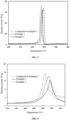
- the XRD spectrogram of the coating agent was shown in FIG. 1 , as illustrated in FIG. 1 , the characteristic peaks at 31°-35° of 2 ⁇ exhibited a bimodal distribution.
- the XRD spectrogram of the surface-coated cathode material A1 was shown in FIG. 2 , as illustrated in FIG. 2 , the doublet belonging to the coating agent still existed at 31°-35° of 2 ⁇ after the coating process.
- the following parameters in the bimodal distribution of the characteristic peaks of the coating agent at 31°-35° of 2 ⁇ were calculated, namely a ratio I b / I a of the peak intensity I b of the secondary peak to the peak intensity I a of the primary peak, a ratio I a / I (003) of the peak intensity I a of the primary peak of the coating layer Li 0.2 La 0.48 Nd 0.1 Sr 0.05 Mn 0.8 Ti 0.2 O 3 at 31°-35° of 2 ⁇ and the peak intensity I (003) of the characteristic peak (003) corresponding to the (003) crystal plane of the cathode material substrate P1, a ratio of A a / A (003) of the peak area A a of the primary peak of the coating layer Li 0.2 La 0.48 Nd 0.1 Sr 0.05 Mn 0.8 Ti 0.2 O 3 at 31°-35° of 2 ⁇ and the peak area A (003) of the characteristic
- the particle size, ionic conductivity, electronic conductivity, and oxygen vacancy formation energy of the coating agent were measured, and the results were shown in Table 3.
- the XRD measurements were performed on the coating agent, the cathode material substrate, and the surface-coated cathode material, and the results were shown in Table 3.
- S1 a lithium source, a La source, an N 1 source, an N 2 source, and an N 3 source were added into a high-speed blender, the materials were stirred at the rotational speed of 1,200rpm for 2h to obtain a first mixture, the first mixture was sintered at 750°C in an air atmosphere for 6h, then cooled to room temperature, subsequently crushed and sieved to obtain a coating material Li 0.34 La 0.47 Ce 0.05 Mg 0.05 MnO 3 , which had a particle diameter D 50 of 200nm.
- the coating material Li 0.34 La 0.47 Ce 0.05 Mg 0.05 MnO 3 was prepared with a solid phase method, and the raw materials lithium carbonate, lanthanum oxide, cerium oxide (an N 1 source), magnesium oxide (an N 2 source) and trimanganese tetroxide (an N 3 source) were weighed according to the stoichiometric ratio of elements in the chemical formula.
- the coating agent and the cathode material substrate P2 were added into the high-speed blender, and stirred at the rotating speed of 950 rpm for 4 hours, then sintered at 500°C for 5 hours, after the sintered product was cooled to room temperature, it was crushed and sieved to obtain a surface-coated cathode material A2.
- the coating agent was used in an amount of 1.5wt%, based on the total weight of the cathode material substrate P2.
- the following parameters in the bimodal distribution of the characteristic peaks of the coating agent at 31°-35° of 2 ⁇ were calculated, namely a ratio I b / I a of the peak intensity I b of the secondary peak to the peak intensity I a of the primary peak, a ratio I a / I (003) of the peak intensity I a of the primary peak of the coating layer Li 0.34 La 0.47 Ce 0.05 Mg 0.05 MnO 3 at 31°-35° of 2 ⁇ and the peak intensity I (003) of the characteristic peak (003) corresponding to the (003) crystal plane of the cathode material substrate P2, a ratio of A a / A (003) of the peak area A a of the primary peak of the coating layer Li 0.34 La 0.47 Ce 0.05 Mg 0.05 MnO 3 at 31°-35° of 2 ⁇ and the peak area A (003) of the characteristic peak (003) corresponding to the (003) crystal
- the particle size, ionic conductivity, electronic conductivity, and oxygen vacancy formation energy of the coating agent were measured, and the results were shown in Table 3.
- the XRD measurements were performed on the coating agent, the cathode material substrate, and the surface-coated cathode material, and the results were shown in Table 3.
- S1 a lithium source, a La source, an N 1 source, an N 3 source, and an N 4 source were added into a high-speed blender, the materials were stirred at the rotational speed of 1,000rpm for 3h to obtain a first mixture, the first mixture was sintered at 800°C in an air atmosphere for 8h, then cooled to room temperature, subsequently crushed and sieved to obtain a coating agent Li 0.5 La 0.4 Sm 0.2 Ni 0.7 Cr 0.3 O 3 , which had a particle diameter D 50 of 110nm.
- the coating agent Li 0.5 La 0.4 Sm 0.2 Ni 0.7 Cr 0.3 O 3 was prepared with a solid phase method, and the raw materials lithium carbonate, lanthanum oxide, samarium oxide (an N 1 source), nickel oxide (an N 3 source) and chromic oxide (an N 4 source) were weighed according to the stoichiometric ratio of elements in the chemical formula.
- the coating agent and the cathode material substrate P2 were added into the high-speed blender, and stirred at the rotating speed of 800 rpm for 4 hours, then sintered at 500°C for 8 hours, after the sintered product was cooled to room temperature, it was crushed and sieved to obtain a surface-coated cathode material A3.
- the coating agent was used in an amount of 2.2wt%, based on the total weight of the cathode material substrate P2.
- the following parameters in the bimodal distribution of the characteristic peaks of the coating agent at 31°-35° of 2 ⁇ were calculated, namely a ratio I b / I a of the peak intensity I b of the secondary peak to the peak intensity I a of the primary peak, a ratio I a / I (003) of the peak intensity I a of the primary peak of the coating layer Li 0.5 La 0.4 Sm 0.2 Ni 0.7 Cr 0.3 O 3 at 31°-35° of 2 ⁇ and the peak intensity I (003) of the characteristic peak (003) corresponding to the (003) crystal plane of the cathode material substrate P2, a ratio of A a / A (003) of the peak area A a of the primary peak of the coating layer Li 0.5 La 0.4 Sm 0.2 Ni 0.7 Cr 0.3 O 3 at 31°-35° of 2 ⁇ and the peak area A (003) of the characteristic peak (003) corresponding to the (003)
- the particle size, ionic conductivity, electronic conductivity, and oxygen vacancy formation energy of the coating agent were measured, and the results were shown in Table 3.
- the XRD measurements were performed on the coating agent, the cathode material substrate, and the surface-coated cathode material, and the results were shown in Table 3.
- S1 a lithium source, a La source, an N 1 source, an N 2 source, an N 3 source, an N 4 source, and an ethanol solution were blended, citric acid was then added into the solution to form a mixed solution with a pH of 9.6, the mixed solution was stirred at 60°C and 500 rpm for 5h, and then transferred to an oven for drying at 120°C for 8h, the product was sintered at 800°C in an air atmosphere for 8h, then cooled to room temperature, subsequently crushed and sieved to obtain a coating agent Li 0.43 La 0.48 Pr 0.08 Ca 0.1 Mn 0.7 Fe 0.3 O 3 , which had a particle diameter D 50 of 80nm.
- the coating agent Li 0.43 La 0.48 Pr 0.08 Ca 0.1 Mn 0.7 Fe 0.3 O 3 was prepared with a sol-gel method, and the raw materials lithium nitrate, lanthanum nitrate, praseodymium chloride (an N 1 source), calcium chloride (an N 2 source), manganese chloride (an N 3 source) and ferric chloride (an N 4 source) were weighed according to the stoichiometric ratio of elements in the chemical formula.
- the coating agent and the cathode material substrate P1 were added into the high-speed blender, and stirred at the rotating speed of 800 rpm for 6 hours, then sintered at 450°C for 8 hours, after the sintered product was cooled to room temperature, it was crushed and sieved to obtain a surface-coated cathode material A4.
- the coating agent was used in an amount of 0.8wt%, based on the total weight of the cathode material substrate P1.
- the following parameters in the bimodal distribution of the characteristic peaks of the coating agent at 31°-35° of 2 ⁇ were calculated, namely a ratio I b / I a of the peak intensity I b of the secondary peak to the peak intensity I a of the primary peak, a ratio I a / I (003) of the peak intensity I a of the primary peak of the coating layer Li 0.43 La 0.48 Pr 0.08 Ca 0.1 Mn 0.7 Fe 0.3 O 3 at 31°-35° of 2 ⁇ and the peak intensity I (003) of the characteristic peak (003) corresponding to the (003) crystal plane of the cathode material substrate P1, a ratio of A a / A (003) of the peak area A a of the primary peak of the coating layer Li 0.43 La 0.48 Pr 0.08 Ca 0.1 Mn 0.7 Fe 0.3 O 3 at 31°-35° of 2 ⁇ and the peak area A (003) of the characteristic peak (003)
- the particle size, ionic conductivity, electronic conductivity, and oxygen vacancy formation energy of the coating agent were measured, and the results were shown in Table 3.
- the XRD measurements were performed on the coating agent, the cathode material substrate, and the surface-coated cathode material, and the results were shown in Table 3.
- S1 a lithium source, a La source, an N 1 source, an N 3 source, and an N 4 source were added into a high-speed blender, the materials were stirred at the rotational speed of 1,000rpm for 3h to obtain a first mixture, the first mixture was sintered at 800°C in an air atmosphere for 8h, then cooled to room temperature, subsequently crushed and sieved to obtain a coating agent Li 0.5 La 0.4 Sm 0.2 Ni 0.7 Cr 0.3 O 3 , which had a particle diameter D 50 of 110nm.
- the coating agent Li 0.5 La 0.4 Sm 0.2 Ni 0.7 Cr 0.3 O 3 was prepared with a solid phase method, and the raw materials lithium carbonate, lanthanum oxide, samarium oxide (an N 1 source), nickel oxide (an N 3 source) and chromic oxide (a N 4 source) were weighed according to the stoichiometric ratio of elements in the chemical formula.
- the coating agent and the cathode material substrate P2 were added into the high-speed blender, and stirred at the rotating speed of 800 rpm for 4 hours, then sintered at 500°C for 8 hours, after the sintered product was cooled to room temperature, it was crushed and sieved to obtain a surface-coated cathode material A5.
- the coating agent was used in an amount of 0.2wt%, based on the total weight of the cathode material substrate P2.
- the following parameters in the bimodal distribution of the characteristic peaks of the coating agent at 31°-35° of 2 ⁇ were calculated, namely a ratio I b / I a of the peak intensity I b of the secondary peak to the peak intensity I a of the primary peak, a ratio I a / I (003) of the peak intensity I a of the primary peak of the coating layer Li 0.5 La 0.4 Sm 0.2 Ni 0.7 Cr 0.3 O 3 at 31°-35° of 2 ⁇ and the peak intensity I (003) of the characteristic peak (003) corresponding to the (003) crystal plane of the cathode material substrate P2, a ratio of A a / A (003) of the peak area A a of the primary peak of the coating layer Li 0.5 La 0.4 Sm 0.2 Ni 0.7 Cr 0.3 O 3 at 31°-35° of 2 ⁇ and the peak area A (003) of the characteristic peak (003) corresponding to the (003)
- the particle size, ionic conductivity, electronic conductivity, and oxygen vacancy formation energy of the coating agent were measured, and the results were shown in Table 3.
- the XRD measurements were performed on the coating agent, the cathode material substrate, and the surface-coated cathode material, and the results were shown in Table 3.
- S1 a lithium source, a La source, an N 1 source, an N 2 source, an N 3 source, and an N 4 source were added into a high-speed blender, the materials were stirred at the rotational speed of 1,000rpm for 3h to obtain a first mixture, the first mixture was sintered at 900°C in an air atmosphere for 8h, then cooled to room temperature, subsequently crushed and sieved to obtain a coating agent Li 0.2 La 0.48 Nd 0.1 Sr 0.05 Mn 0.8 Ti 0.2 O 3 , which had a particle diameter D 50 of 220nm.
- the coating agent Li 0.2 La 0.48 Nd 0.1 Sr 0.05 Mn 0.8 Ti 0.2 O 3 was prepared with a solid phase method, and the raw materials lithium hydroxide, lanthanum oxide, neodymium oxide (an N 1 source), strontium oxide (an N 2 source), trimanganese tetroxide (an N 3 source) and titanium dioxide (an N 4 source) were weighed according to the stoichiometric ratio of elements in the chemical formula.
- the coating agent and the cathode material substrate P3 were added into the high-speed blender, and stirred at the rotating speed of 800 rpm for 6 hours, then sintered at 300°C for 8 hours, after the sintered product was cooled to room temperature, it was crushed and sieved to obtain a surface-coated cathode material A6.
- the coating agent was used in an amount of 8wt%, based on the total weight of the cathode material substrate P3.
- the following parameters in the bimodal distribution of the characteristic peaks of the coating agent at 31°-35° of 2 ⁇ were calculated, namely a ratio I b / I a of the peak intensity I b of the secondary peak to the peak intensity I a of the primary peak, a ratio I a / I (003) of the peak intensity I a of the primary peak of the coating layer Li 0.2 La 0.48 Nd 0.1 Sr 0.05 Mn 0.8 Ti 0.2 O 3 at 31°-35° of 2 ⁇ and the peak intensity I (003) of the characteristic peak (003) corresponding to the (003) crystal plane of the cathode material substrate P3, a ratio of A a / A (003) of the peak area A a of the primary peak of the coating layer Li 0.2 La 0.48 Nd 0.1 Sr 0.05 Mn 0.8 Ti 0.2 O 3 at 31°-35° of 2 ⁇ and the peak area A (003) of the characteristic
- the particle size, ionic conductivity, electronic conductivity, and oxygen vacancy formation energy of the coating agent were measured, and the results were shown in Table 3.
- the XRD measurements were performed on the coating agent, the cathode material substrate, and the surface-coated cathode material, and the results were shown in Table 3.
- the cathode material substrate P1 obtained in Preparation Example 1 was used as a cathode material D1.
- the XRD test was performed on the cathode material D1, and the results were shown in Table 3.
- the cathode material substrate P2 obtained in Preparation Example 2 was used as a cathode material D2.
- the XRD test was performed on the cathode material D2, and the results were shown in Table 3.
- the cathode material substrate P3 obtained in Preparation Example 3 was used as a cathode material D3.
- the XRD test was performed on the cathode material D3, and the results were shown in Table 3.
- Table 2 A1 A2 A3 A4 A5 A6 S1 Lithium source Lithium hydroxide Lithium carbonate Lithium carbonate Lithium nitrate Lithium carbonate Lithium hydroxide La source Lanthanum oxide Lanthanum oxide Lanthanum oxide Lanthanum nitrate Lanthanum oxide Lanthanum oxide N 1 source Neodymium oxide Cerium oxide Samarium oxide Praseodymiu m chloride Samarium oxide Neodymium oxide N 2 source Strontium oxide Magnesium oxide / Calcium chloride / Strontium oxide N 3 source Trimanganes e tetroxide Trimanganes e tetroxide Nickel oxide Manganese chloride Nickel oxide Trimanganes e tetroxide N 4 source Titanium dioxide / Chromium oxide
- the cathode materials in Examples and Comparative Examples were assembled into lithium-ion batteries, the thermal stabilities of the cathode materials in the delithiation state were tested respectively, and the results were shown in Table 4. The properties of the lithium-ion batteries were tested, and the results were shown in Table 5.
- the temperature corresponding to the DSC peak after complete delithiation of the cathode materials obtained in Examples 1-6 is higher than that of Comparative Examples 1-3, indicating that the cathode materials of Examples 1-6 have more excellent thermal stability.
- both the rate performance and cycling performance of the lithium-ion batteries assembled with the cathode materials of Examples 1-6 are improved.
- the temperature corresponding to the DSC peak for the cathode material in a complete delithiation state in Example 1 is 210°C
- the temperature corresponding to the DSC peak for the cathode material in a complete delithiation state in Example 4 is 207°C
- the temperature corresponding to the DSC peak for the cathode material in a complete delithiation state in Comparative Example 1 is 203°C
- the batteries in Examples 1 and 4 have slightly improved discharge capacity at different multiplying powers, indicating that the coated cathode material exhibits an improved rate performance, and the thermal stability of the materials is improved by moving backward the DSC peak position.
- the temperature corresponding to the DSC peak for the cathode material in a complete delithiation state in Example 2 is 218°C
- the temperature corresponding to the DSC peak for the cathode material in a complete delithiation state in Example 3 is 213°C
- the temperature corresponding to the DSC peak for the cathode material in a complete delithiation state in Comparative Example 2 is 205°C
- the cathode materials in Examples 2 and 3 have an improved capacity retention rate after 80 charging and discharging cycles than the Comparative Example 2, indicating that coated cathode materials have reduced side reactions between the cathode material and the electrolyte.
- the temperature corresponding to the DSC peak for the cathode materials is raised, demonstrating an improved thermal stability of the materials per se.
Landscapes
- Chemical & Material Sciences (AREA)
- Chemical Kinetics & Catalysis (AREA)
- Electrochemistry (AREA)
- General Chemical & Material Sciences (AREA)
- Inorganic Chemistry (AREA)
- Composite Materials (AREA)
- Engineering & Computer Science (AREA)
- Manufacturing & Machinery (AREA)
- Materials Engineering (AREA)
- Organic Chemistry (AREA)
- Battery Electrode And Active Subsutance (AREA)
- Inorganic Compounds Of Heavy Metals (AREA)
Abstract
Description
- The application claims benefits of the
Chinese Application No. "202210770763.9", filed on June 30, 2022 - The present disclosure relates to the technical field of lithium-ion batteries, particularly to a surface-coated cathode material and preparation method thereof, and a lithium-ion battery.
- With the rapid development of the power battery market, people have imposed higher requirements on the energy density and safety performance of lithium-ion batteries. The practice of increasing the content of nickel and reducing the content of cobalt has gradually emerged as a tendency in recent years, in order to further increase the energy density of lithium-ion batteries and reduce the costs thereof. However, an increase in the nickel content causes a deterioration in the thermal stability of the material, and a degeneration of the safety performance during the use of the batteries. In addition, the tetravalent nickel generated during the charging and discharging process has strong oxidability, it is prone to react with the electrolyte, so the cycle performance of the batteries deteriorates, and the batteries may swell.
- Therefore, for the sake of further improving the thermal stability and cycling stability of the cathode materials, a coating modification technique is widely applied in various cathode materials.
CN109065875A discloses a preparation method of a high nickel multiple material coated with ultrafine powder, wherein Zr02, Ti02, Al2O3, MgO, and other materials are used as the coating agents, although the coating can reduce the side reaction between the cathode and the electrolyte, and improve the battery performance, but each of the coating agents used in the method is an inert material, which does not participate in the ion and electron transport, and the thermal stability of high nickel materials is not improved. - The present disclosure aims to overcome the defects in the prior art, and provides a surface-coated cathode material and preparation method thereof, and a lithium-ion battery, wherein the surface-coated cathode material comprises a substrate and a coating layer coated on a surface of the substrate; the coating layer has a bimodal distribution of characteristic peaks at 31 °-35° of 2θ tested by X-Ray Diffraction (XRD); and the bimodal distribution has a specific ratio of the peak intensity of the primary peak to the peak intensity of the secondary peak, such that the surface-coated cathode material has a high electronic conductivity and ionic conductivity, and can accelerate the diffusion rate of ions and electrons in the cathode material, thereby significantly enhancing the rate performance of a lithium-ion battery including the cathode material. In addition, the surface-coated cathode material including the specific coating layer can avoid the catalytic corrosion between the cathode material and an electrolyte, and improve the cycling stability of a lithium-ion battery including the cathode material. Moreover, the thermal stability of the surface-coated cathode material including the specific coating layer is significantly improved.
- In order to achieve the above object, the first aspect of the present disclosure provides a surface-coated cathode material, wherein the cathode material comprises a substrate and a coating layer coated on a surface of the substrate;
- the coating layer has a bimodal distribution of characteristic peaks at 31°-35° of 2θ tested by XRD, and a ratio I b/I a of the peak intensity I b of the secondary peak to the peak intensity I a of the primary peak in the bimodal distribution is within a range of 0.8-1.
- The second aspect of the present disclosure provides a method for preparing the surface-coated cathode comprising the following steps:
- S1: subjecting a lithium source, a La source, an optional N1 source, an optional N2 source, an optional N3 source, and an optional N4 source to a first mixing to obtain a first mixture, performing a first sintering on the first mixture, and crushing it to obtain a coating agent;
- S2: subjecting the coating agent and a cathode material substrate to a second mixing to obtain a second mixture, performing a second sintering on the second mixture to prepare the surface-coated cathode material.
- The third aspect of the present disclosure provides a method for preparing the surface-coated cathode comprising the following steps:
- subjecting a lithium source, a La source, an optional N1 source, an optional N2 source, an optional N3 source, an optional N4 source, and a cathode material substrate to a third mixing to obtain a third mixture, performing a third sintering on the third mixture to prepare the surface-coated cathode material.
- The fourth aspect of the present disclosure provides a surface-coated cathode material produced with the aforementioned method.
- The fifth aspect of the present disclosure provides a lithium-ion battery wherein the lithium-ion battery comprises the aforementioned surface-coated cathode material.
- Due to the technical scheme, the surface-coated cathode material, and the preparation method and use thereof, the lithium-ion battery provided by the present disclosure produces the following beneficial effects:
- The surface-coated cathode material provided by the present disclosure comprises a substrate and a coating layer coated on a surface of the substrate; the coating layer has a bimodal distribution of characteristic peaks at 31°-35° of 2θ tested by X-Ray Diffraction (XRD); and the bimodal distribution has a specific ratio of the peak intensity of the primary peak to the peak intensity of the secondary peak, such that the surface-coated cathode material has high electronic conductivity and ionic conductivity, and can accelerate the diffusion rate of ions and electrons in the cathode material, thereby significantly enhancing the rate performance of a lithium-ion battery including the cathode material. In addition, the surface-coated cathode material including the specific coating layer can avoid the catalytic corrosion between the cathode material and an electrolyte, and improve the cycling stability of a lithium-ion battery including the cathode material. Moreover, the thermal stability of the surface-coated cathode material including the specific coating layer is significantly improved.
- The substrate and the coating material of the surface-coated cathode material provided by the present disclosure have a specific composition, such that the cathode material has an electrochemical activity for lithium ion deintercalation, the coating material has a high lithium ion transmission capacity; in addition, the coating material has a lower oxygen vacancy formation energy, which can increase the electronic conductivity and accelerates the diffusion rates of ions and electrons in the cathode material, thereby significantly improving rate performance of the lithium-ion battery including the cathode material. In the meantime, the coating layer having a specific composition of the present disclosure can effectively suppress the interfacial side reaction of the particle surface of the cathode material with an electrolyte, remarkably improve the cycling stability of the lithium-ion battery comprising the cathode material, and effectively improve the thermal stability of the cathode material.
- The method of the cathode material provided by the present disclosure has a simple process, it is free from contamination and has a simple mode of introducing the doping elements and coating layer, requires a small dosage of the doping element and coating layer, it does not impose special requirements on the heat treatment atmosphere, and has low production costs, thus the preparation method is suitable for the large-scale industrial production.
-
-
FIG. 1 illustrates an XRD phase diagram of the coating agent in Example 1. -
Figure 2 illustrates an XRD phase diagram of the coated cathode material in Example 1. -
FIG. 3 is a graph showing the charging and discharging curves of the half cells prepared in Comparative Example 1, Example 1, and Example 4 at 0.1C. -
FIG. 4 is a graph showing the charging and discharging curves of the half cells prepared in Comparative Example 2, Example 2, and Example 3 at 0.1C. -
FIG. 5 is a graph showing the DSC curves of Comparative Example 1, Example 1, and Example 4. -
FIG. 6 is a graph showing the DSC curves of Comparative Example 2, Example 2, and Example 3. - The terminals and any value of the ranges disclosed herein are not limited to the precise ranges or values, such ranges or values shall be comprehended as comprising the values adjacent to the ranges or values. As for numerical ranges, the endpoint values of the various ranges, the endpoint values and the individual point values of the various ranges, and the individual point values may be combined with each another to produce one or more new numerical ranges, which should be deemed have been specifically disclosed herein.
- The first aspect of the present disclosure provides a surface-coated cathode material, wherein the cathode material comprises a substrate and a coating layer coated on a surface of the substrate;
the coating layer has a bimodal distribution of characteristic peaks at 31°-35° of 2θ tested by XRD, and a ratio I b/I a of the peak intensity I b of the secondary peak to the peak intensity I a of the primary peak in the bimodal distribution is within a range of 0.8-1. - In the present disclosure, the surface-coated cathode material comprises a substrate and a coating layer coated on a surface of the substrate, the coating layer has a bimodal distribution of characteristic peaks at 31°-35° of 2θ tested by XRD, and the bimodal distribution has a specific ratio of the peak intensity of the primary peak to the peak intensity of the secondary peak, such that the surface-coated cathode material has a high electronic conductivity and ionic conductivity, and can accelerate the diffusion rate of ions and electrons in the cathode material, thereby significantly enhancing the rate performance of a lithium-ion battery including the cathode material.
- In addition, the surface-coated cathode material including the specific coating layer can avoid the catalytic corrosion between the cathode material and an electrolyte, and improve the cycling stability of a lithium-ion battery including the cathode material. Moreover, the thermal stability of the surface-coated cathode material including the specific coating layer is significantly improved.
- In the present disclosure, the peak intensity I b of the secondary peak and the peak intensity I a of the primary peak in the bimodal distribution are measured by XRD, respectively.
- Preferably, the ratio I b/I a is within a range of 0.97-1.
- According to the present disclosure, the substrate has a peak intensity I (003) of the characteristic peak (003) corresponding to the (003) crystal plane tested by XRD, 0.01%≤I a/I(003)×100%≤3.5%.
- In the present disclosure, when the ratio of the peak intensity I a of the primary peak in the bimodal distribution of characteristic peaks at 31°-35° of 2θ of the coating layer to the peak intensity I (003) of the characteristic peak (003) corresponding to the (003) crystal plane of the substrate is within the above range, the thermal stability of the cathode material can be improved, increasing the temperature corresponding to the exothermic peak of the cathode material tested by the DSC, such that the lithium-ion battery containing the cathode material has an improved safety performance.
- In the present disclosure, the peak intensity I (003) of the characteristic peak (003) corresponding to the (003) crystal plane of the substrate is tested by XRD.
- Preferably, 0.08%≤I a/I(003)×100%≤3.1%.
- According to the present disclosure, the substrate has a peak area A (003) of the characteristic peak (003) corresponding to the (003) crystal plane tested by XRD, the coating layer has a peak area A a of the primary peak in the bimodal distribution of characteristic peaks at 31°-35° of 2θ tested by XRD, 0.01%≤A a/A(003)×100%≤6%.
- In the present disclosure, when the ratio of the peak area A a of the primary peak in the bimodal distribution of characteristic peaks at 31°-35° of 2θ of the coating layer and the peak area A (003) of the characteristic peak (003) corresponding to the (003) crystal plane of the substrate is within the above range, the thermal stability of the cathode material can be improved, increasing the temperature corresponding to the exothermic peak of the cathode material tested by the DSC, such that the lithium-ion battery containing the cathode material has an improved safety performance.
- In the present disclosure, both the peak area A a of the primary peak in the bimodal distribution of characteristic peaks at 31°-35° of 2θ of the coating layer and the peak area A (003) of the characteristic peak (003) corresponding to the (003) crystal plane of the substrate are measured by XRD.
- Preferably, 0.5%≤A a/A (003)×100%≤4.8%.
- According to the present disclosure, the substrate has a composition represented by formula 1:
Li1+a Ni x Co y Mn z M k O2 formula I;
wherein -0.05≤a≤0.5, 0≤x≤1, 0≤y≤1, 0<z<1, 0≤k≤0.06, 0<x+y+z+k≤1, and M is at least one element selected from Ga, Sc, In, Y, Ce, Co, La, Cr, Mo, Mn, Fe, Hf, Zr, W, Nb, Sm, and Al; - the coating layer has a composition represented by formula II:
Li α-β-γ La β N1 γ N2 δ N3 1-λ N4 λ O3 formula II;
wherein 0.7<a<1.5, 0.2<β<1, 0<y<0.5, 0≤δ<0.5, 0<A<0.5; N1 is at least one element selected from Y, Nd, Pr, Ce, Sm, and Sc, N2 is at least one element selected from Sr, Ca, Mg, Si, Ge, and Ru, N3 is at least one element selected from Ni, Mn, and Co, N4 is at least one element selected from Cr, Al, V, Nb, Zr, Ti, and Fe. - In the present disclosure, the substrate and the coating material of the surface-coated cathode material have a specific composition, such that the cathode material has an electrochemical activity for lithium ion deintercalation, the coating material has a high lithium ion transport ability; in addition, the coating material has a lower oxygen vacancy formation energy, which can increase the electronic conductivity and accelerate the diffusion rates of ions and electrons in the cathode material, thereby significantly improving rate performance of the lithium-ion battery including the cathode material. In the meantime, the coating layer having a specific composition of the present disclosure can effectively suppress the interfacial side reaction of the particle surface of the cathode material with an electrolyte, remarkably improve the cycling stability of the lithium-ion battery comprising the cathode material, and effectively improve the thermal stability of the cathode material.
- Further, M in formula I is at least one element selected from Ce, Co, La, Cr, Mo, Y, Zr, W, Nb, and Al.
- Further, in formula II, 0.9<a<1.3, 0.35<β<0.7, 0.04<y<0.4, 0<δ<0.3, 0≤λ<0.46.
- Further, N1 in formula II is at least one element selected from Nd, Pr, Ce, Sm, and Sc.
- Further, N2 in formula II is at least one element selected from Sr, Ca, Mg, Si, and Ru.
- Further, N3 in formula II is selected from Ni and/or Mn.
- Further, N4 in formula II is at least one element selected from Cr, Al, Nb, Zr, Ti, and Fe.
- According to the present disclosure, the content of the coating layer is within a range of 0.05-4wt%, based on the total weight of the substrate.
- In the present disclosure, when the content of said coating layer satisfies the above-mentioned range, the cathode material surface has a uniform coating layer, which enables the cathode material surface to exhibit high ion and electron transport properties, such that the lithium-ion battery containing the cathode material has excellent electrochemical properties.
- Preferably, the content of the coating layer is within a range of 0.5-3.6wt%, based on the total weight of the substrate.
- According to the present disclosure, an average particle diameter D50 of the surface-coated cathode material is within a range of 2-17µm.
- Preferably, an average particle diameter D50 of the surface-coated cathode material is within a range of 3-12µm.
- According to the present disclosure, the electronic conductivity of the coating layer is within a range of 1×10⁻⁵S/cm - 8×10⁻³S/cm.
- In the present disclosure, when the electronic conductivity of the coating layer is within the above range, the coating layer has high electron-transport property and can form an electronic conductive layer on the surface of the cathode material, thereby causing that the lithium-ion battery containing the cathode material has excellent electrochemical properties.
- Preferably, the electronic conductivity of the coating layer is within a range of 1.8×10⁻⁵S/cm - 7.2×10⁻³S/cm.
- According to the present disclosure, the ionic conductivity of the coating layer is within a range of 1×10⁻⁶S/cm - 6×10⁻⁴S/cm.
- In the present disclosure, when the ionic conductivity of the coating layer is within the above range, it has high ion transport property and can form an ionic conductive layer on the surface of the cathode material, thereby causing that the lithium-ion battery containing the cathode material has an excellent electrochemical properties.
- Further, the ionic conductivity of the coating layer is within a range of 3×10⁻⁶S/cm - 5×10⁻⁴S/cm.
- According to the present disclosure, the oxygen vacancy formation energy of the coating layer is from -2eV to 4.5eV.
- In the present disclosure, when the oxygen vacancy formation energy of the coating layer is within the above range, the coating layer has high electron-transport property and can form an electronic conductive layer on the surface of the cathode material, thereby causing that the lithium-ion battery containing the cathode material has an excellent electrochemical properties.
- Further, the oxygen vacancy formation energy of the coating layer is from -1.8eV to 4eV.
- According to the present disclosure, the temperature corresponding to an exothermic peak of surface-coated cathode material tested by the Differential Scanning Calorimeter (DSC) is Tl, the temperature corresponding to an exothermic peak of the substrate tested by DSC is TO, T1-T0 is within a range of 3-15°C.
- In the present disclosure, when the difference between the temperatures corresponding to the exothermic peak of the surface-coated cathode material tested by DSC and the temperature corresponding to the exothermic peak of the substrate tested by DSC is within the above range, the thermal stability of the cathode material can be significantly improved, thereby causing that the lithium-ion battery comprising the cathode material has a high safety performance.
- Preferably, T1-TO is within a range of 3-14°C.
- The second aspect of the present disclosure provides a method for preparing the surface-coated cathode comprising the following steps:
- S1: subjecting a lithium source, a La source, an optional N1 source, an optional N2 source, an N3 source, and an optional N4 source to a first mixing to obtain a first mixture, performing a first sintering on the first mixture, and crushing it to obtain a coating agent;
- S2: subjecting the coating agent and a cathode material substrate to a second mixing to obtain a second mixture, performing a second sintering on the second mixture to prepare the surface-coated cathode material.
- According to the present disclosure, a coating agent is obtained by sintering the first mixture comprising a lithium source, a La source, an optional N1 source, an optional N2 source, a N3 source and an optional N4 source, then blending the coating agent with a cathode substrate, and subjecting to a heat treatment, the surface-coated cathode material comprising a substrate and a coating layer coated on a surface of the substrate can be prepared, and the coating layer has the characteristics according to the first aspect of the present disclosure, in particular, in the surface-coated cathode material produced with the method provided by the present disclosure, the coating layer has a bimodal distribution of characteristic peaks at 31°-35° of 2θ tested by XRD; and the bimodal distribution has a specific ratio of the peak intensity of the primary peak to the peak intensity of the secondary peak, such that the surface-coated cathode material has a high electronic conductivity and ionic conductivity, and can accelerate the diffusion rate of ions and electrons in the cathode material, thereby significantly enhancing the rate performance of a lithium-ion battery including the cathode material.
- Further, the surface-coated cathode material including the specific coating layer can avoid the catalytic corrosion between the cathode material and an electrolyte, and improve the cycling stability of a lithium-ion battery including the cathode material. Moreover, the thermal stability of the surface-coated cathode material including the specific coating layer is significantly improved.
- Furthermore, the method has a simple process, is free from contamination, and has a simple mode of introducing the doping elements and coating layer, requires a small dosage of the doping element and coating layer, and does not impose special requirements on the heat treatment atmosphere and has low production costs, thus the method is suitable for the large-scale industrial production.
- According to the present disclosure, the lithium source, the La source, the N1 source, the N2 source, the N3 source, and the N4 source are used in amounts such that n(Li):n(La):n(N1):n(N2):n(N3):n(N4) is (α-β-γ-δ):β:γ: δ:(1-λ):λ, wherein 0.7<α<1.5, 0.2<β<1, 0≤γ<0.5, 0≤δ<0.5, 0≤λ<0.5.
- Preferably, 0.9<α<1.3, 0.35<β<0.7, 0.04≤γ<0.4, 0<δ<0.3, 0≤λ<0.46.
- According to the present disclosure, the content of the coating agent is within a range of 0.05-4wt%, preferably within a range of 0.1-3.6wt%, based on the total weight of the substrate.
- According to the present disclosure, the N1 source is a compound containing at least one element selected from Y, Nd, Pr, Ce, Sm, and Sc.
- According to the present disclosure, the N2 source is a compound containing at least one element selected from Sr, Ca, Mg, Si, Ge, and Ru.
- According to the present disclosure, the N3 source is a compound containing at least one element selected from Ni, Mn, and Co.
- According to the present disclosure, the N4 source is a compound containing at least one element selected from Cr, Al, V, Nb, Zr, Ti, and Fe.
- The specific kind of the lithium source is not particularly limited in the present disclosure, it may be a lithium source commonly used in the art, for example, the lithium source is at least one selected from the group consisting of lithium carbonate, lithium hydroxide, lithium fluoride, lithium chloride, lithium nitrate, and lithium acetate.
- The specific kind of La source is not specifically limited in the present disclosure, it may be a conventional compound capable of providing La element in the art.
- In the present disclosure, the conditions for the first mixing are not particularly limited, as long as the lithium source, the La source, the N1 source, the N2 source, the N3 source, and the N4 source can be blended sufficiently and uniformly, and preferably, the conditions for the first mixing comprise a mixing rotational speed of 400-1,000 rpm and a mixing time of 3-6h.
- According to the present disclosure, the conditions of the first sintering comprise a sintering temperature within a range of 500-1,120°C and a sintering time within a range of 3-9h.
- In the present disclosure, the coating agent having a high ionic conductivity and electronic conductivity can be prepared by sintering a first mixture comprising a lithium source, a La source, an optional N1 source, an optional N2 source, an N3 source, an optional N4 source under the above conditions.
- Preferably, the conditions of the first sintering comprise a sintering temperature within a range of 600-1,000°C and a sintering time within a range of 3-9h
- According to the present disclosure, the average particle diameter D50 of the coating agent is within a range of 30-200nm.
- In the present disclosure, the apparatus used for crushing is not particularly limited, for example, the sintered product is crushed by at least one selected from the group consisting of a flow mill, a mechanical mill, a colloid mill, a high-energy pulverizer, a stirring mill, and a sand mill to obtain the coating agent.
- Further preferably, the average particle diameter D50 of the coating agent is within a range of 50-180nm.
- In the present disclosure, the conditions for the second mixing are not particularly limited, as long as the coating agent and the cathode material substrate can be blended sufficiently and uniformly, and preferably, the conditions of the second mixing comprise a mixing rotational speed of 400-1,000 rpm and a mixing time of 3-6h.
- In the present disclosure, the device used for the first mixing and the second mixing is not particularly limited, it may be the conventional mixing equipment in the art, such as a high-speed blender.
- According to the present disclosure, the conditions of the second sintering comprise a sintering temperature within a range of 300-900°C and a sintering time within a range of 1-12h.
- In the present disclosure, carrying out the second sintering on the second mixture under the above-mentioned conditions, such that the surface of the cathode material has the ion and electron transport properties, such that the lithium-ion battery comprising the cathode material has excellent electrochemical performance.
- Preferably, the conditions of the second sintering comprise a sintering temperature within a range of 400-800°C and a sintering time within a range of 4-10h.
- In a specific embodiment of the present disclosure, the coating agent is prepared according to the following steps:
- (a) subjecting a lithium source, a La source, an optional N1 source, an optional N2 source, a N3 source, and an optional N4 source to a fourth mixing to obtain a fourth mixture, performing a fourth sintering on the fourth mixture, and crushing it to obtain a coating agent.
- In the present disclosure, the conditions of the fourth mixing are not particularly limited as long as the lithium source, the La source, the N1 source, the N2 source, the N3 source, and the N4 source can be blended sufficiently and uniformly, and preferably, the conditions of the fourth mixing comprise a mixing rotational speed of 400-1,000 rpm and a mixing time of 3-6h. In the present disclosure, the conditions of the fourth mixing and the conditions of the first mixing may be the same or different.
- According to the present disclosure, the conditions of the fourth sintering comprise a sintering temperature within a range of 600-1,000°C and a sintering time within a range of 3-9h.
- Preferably, the conditions of the fourth sintering comprise a sintering temperature within a range of 700-1,000°C and a sintering time within a range of 5-9h.
- In another specific embodiment of the present disclosure, the coating agent is prepared according to the following steps:
- (b) subjecting a lithium source, a La source, an optional N1 source, an optional N2 source, a N3 source, an optional N4 source, and a solvent to a fifth mixing to obtain a fifth mixture, adjusting the pH of the fifth mixture, drying and performing a fifth sintering, and crushing it to obtain a coating agent.
- In the present disclosure, the conditions for the fifth mixing are not particularly limited as long as the lithium source, the La source, the N1 source, the N2 source, the N3 source, the N4 source, and the solvent are blended sufficiently and uniformly, and preferably, the conditions for the fifth mixing comprising a mixing rotational speed of 400-1,000rpm and a mixing time of 3-6h.
- In the present disclosure, the kind of solvent is not particularly limited as long as the lithium source, the La source, the N1 source, the N2 source, the N3 source, and the N4 source can be prepared into a solution, for instance, the solvent is ethanol.
- In the present disclosure, the pH of the fifth mixture may be adjusted by using a conventional acidic solution in the art, such as citric acid; preferably, an acidic solution is added so that the pH of the fifth mixture is between 9 and 12.
- In the present disclosure, the conditions for drying are not particularly limited as long as the fifth mixture is sufficiently dried, and preferably, the drying conditions include a drying temperature within a range of 40-120°C and a drying time of 5-12h.
- According to the present disclosure, the conditions of the fifth sintering comprise a sintering temperature within a range of 500-850°C and a sintering time within a range of 4-8h.
- Preferably, the conditions of the fifth sintering comprise a sintering temperature within a range of 550-800°C and a sintering time within a range of 5-8h.
- A third aspect of the present disclosure provides a method for preparing the surface-coated cathode comprising the following steps:
- subjecting a lithium source, a La source, an optional N1 source, an optional N2 source, an N3 source, an optional N4 source, and a cathode material substrate to a third mixing to obtain a third mixture, performing a third sintering on the third mixture to prepare the surface-coated cathode material.
- In the method for preparing the surface-coated cathode material according to the third aspect of the present disclosure, other material types and amounts, conditions of each step, and parameters involved therein are identical to those in the method of the previously mentioned second aspect, and in order to avoid repetition, the present disclosure does not repeat some characteristics of the materials (e.g. alternative types of the materials) in the second aspect.
- According to the present disclosure, the lithium source, the La source, the N1 source, the N2 source, the N3 source, and the N4 source are used in amounts such that n(Li):n(La):n(N1):n(N2):n(N3):n(N4) is (α-β-γ-δ):β: y: δ:(1-λ):λ, wherein 0.7<α<1.5, 0.2<β<1, 0≤γ<0.5, 0≤δ<0.5, 0≤λ<0.5.
- According to the present disclosure, the total amount of the lithium source, the La source, the N1 source, the N2 source, the N3 source, and the N4 source causes the content of a product of the lithium source, the La source, the N1 source, the N2 source, the N3 source, and the N4 source obtained after the third sintering is within a range of 0.05-4wt%, preferably within a range of 0.1-3.6wt%, based on the total weight of the cathode material substrate.
- According to the present disclosure, the conditions of the third sintering comprise a sintering temperature within a range of 300-900°C and a sintering time within a range of 1-12h.
- In the present disclosure, carrying out the third sintering on the third mixture under the above-mentioned conditions, such that the surface of the cathode material has the ion and electron transport properties, such that the lithium-ion battery comprising the cathode material has excellent electrochemical performance.
- Preferably, the conditions of the third sintering comprise a sintering temperature within a range of 400-800°C and a sintering time within a range of 4-10h.
- In the present disclosure, the average particle diameter D50 of the cathode material substrate is within a range of 2.3-12µm.
- In the present disclosure, the cathode material substrate used in the second aspect and the third aspect is not particularly limited, it may be prepared by using a conventional preparation method in the art, and in order to further improve the electrochemical activity of lithium-ion deintercalation of a surface-coated cathode material, such that the lithium-ion battery including the surface-coated cathode material has excellent rate performance, it is preferable that the cathode material substrate is prepared according to the following steps:
- (1) preparing a mixed salt solution with a nickel salt, a cobalt salt, and a manganese salt according to the molar ratio of n(Ni):n(Co):n(Mn) being x:y: z; preparing a precipitant solution and a complexing agent solution with a precipitant and a complexing agent respectively;
- (2) adding the mixed salt solution, the precipitant solution, and the complexing agent solution into a reaction kettle, and performing a coprecipitation reaction to obtain a precursor slurry, wherein the precursor slurry is subjected to solid-liquid separation, washing, drying, and sieving to obtain a nickel-cobalt-manganese hydroxide precursor;
- (3) blending the nickel-cobalt-manganese hydroxide precursor, a lithium source, and an optional compound containing an M element to obtain a sixth mixture, carrying out a sixth sintering on the sixth mixture in an oxygen-containing atmosphere, and crushing and sieving to obtain the cathode material substrate.
- According to the present disclosure, 0<x<1, 0≤y≤1, 0<z<l.
- In the present disclosure, at least one of the nickel salt, the cobalt salt, the manganese salt, and the compound containing an M element is added in the method of the cathode material substrate.
- In the present disclosure, the kind of nickel salt is not particularly limited, it may be a nickel salt that is conventional in the art, for example, at least one of nickel sulfate, nickel chloride, nickel nitrate, and nickel acetate.
- In the present disclosure, the kind of cobalt salt is not particularly limited, it may be a cobalt salt that is commonly used in the art, for example, at least one of cobalt sulfate, cobalt chloride, cobalt nitrate, and cobalt acetate.
- In the present disclosure, the kind of the manganese salt is not particularly limited, it may be a manganese salt that is commonly used in the art, such as at least one of manganese sulfate, manganese chloride, manganese nitrate, and manganese acetate.
- In the present disclosure, the kind of the precipitant is not particularly limited, it may be a conventional precipitant in the art, for example, at least one selected from the group consisting of ammonium carbonate, ammonium bicarbonate, sodium carbonate, sodium bicarbonate, potassium carbonate, potassium bicarbonate, sodium hydroxide, potassium hydroxide, and lithium hydroxide.
- In the present disclosure, the kinds of the complexing agent are not particularly limited, both may be a complexing agent commonly used in the art, for example, at least one selected from the group consisting of ammonia water, disodium ethylenediaminetetraacetate, ammonium nitrate, ammonium chloride, and ammonium sulfate.
- According to the present disclosure, the nickel-cobalt-manganese hydroxide precursor, the lithium source, and the compound containing an M element are used in amounts such that n(Li)/[n(Ni)+n(Co)+n(Mn)+n(M)] is within a range of 0.95-1.5; n(M)/[n(Ni)+n(Co)+n(Mn)+n(M)] is within a range of 0-0.06.
- Preferably, the nickel-cobalt-manganese hydroxide precursor, the lithium source, and the compound containing an M element are used in amounts such that n(Li)/[n(Ni)+n(Co)+n(Mn)+n(M)] is within a range of 0.96-1.03; n(M)/[n(Ni)+n(Co)+n(Mn)+n(M)] is within a range of 0-0.05.
- According to the present disclosure, the compound containing an M element is selected from compounds containing at least one element of Ga, Sc, In, Y, Ce, Co, La, Cr, Mo, Mn, Fe, Hf, Zr, W, Nb, Sm, and Al.
- In the present disclosure, the kind of the lithium source is not particularly limited, it may be a conventional lithium source in the art, for example, at least one selected from the group consisting of lithium carbonate, lithium hydroxide, lithium fluoride, lithium chloride, lithium nitrate, and lithium acetate.
- According to the present disclosure, the conditions of the coprecipitation reaction comprise a reaction temperature within a range of 40-120°C and a pH within a range of 9-12.
- In the present disclosure, the conditions for the sixth mixing are not particularly limited as long as the nickel-cobalt-manganese hydroxide precursor, the lithium source, and the compound containing an M element can be blended sufficiently and uniformly, and preferably, the conditions for the sixth mixing comprise a mixing rotational speed within a range of 400-1,000rpm and a mixing time of 3-6h.
- According to the present disclosure, the conditions of the sixth sintering comprise a sintering temperature within a range of 500-1,000°C and a sintering time within a range of 3-18h.
- In the present disclosure, when the sixth mixture is subjected to the sixth sintering under the above-mentioned conditions, the obtained cathode material is free from a heterogeneous phase.
- Preferably, the conditions of the sixth sintering comprise a sintering temperature within a range of 600-1,000°C and a sintering time within a range of 5-9h.
- The fourth aspect of the present disclosure provides a surface-coated cathode material produced with the aforementioned method.
- The fifth aspect of the present disclosure provides a lithium-ion battery, wherein the lithium-ion battery comprises the aforementioned surface-coated cathode material.
- In the present disclosure, the lithium-ion battery further comprises a negative electrode and an electrolyte. The types of the negative electrode and the electrolyte are not particularly limited, the conventional type of the negative electrode and the electrolyte in the art may be used, for example, the electrolyte is the commonly used and commercially available electrolyte, which is a mixed solution having a concentration of 1mol/L containing the equivalent amount of LiPF6, Ethylene Carbonate (EC), and diethyl carbonate (DEC).
- The present disclosure will be described in detail below with reference to examples. In the following examples,
the average particle diameter D50 of the surface-coated cathode material was measured by using a Malvern particle meter. - The composition of the surface-coated reactive electrode material was calculated from the molar ratio of the reactants.
- The phase structure of the coating agent and the coated cathode material was measured by XRD.
- The electronic conductivity of the coating agent was measured through a four-probe method.
- The ionic conductivity of the coating agent was obtained by sintering the ceramic chip and carrying out the blocking electrode alternating current impedance test, and then calculated according to the formula σ =L/RS, wherein L denoted the thickness of a ceramic chip, R denoted an impedance value, and S denoted the effective electrode area.
- The oxygen vacancy formation energy of the coating agent can be calculated according to the First Principle of Thinking.
- Assembling the liquid button cell:
- Firstly, a surface-coated cathode material, acetylene black, and polyvinylidene fluoride (PVDF) were mixed according to the mass ratio of 95:2.5:2.5, the mixture was coated on an aluminum foil and subjected to the drying treatment, the aluminum foil was punched into a cathode pole piece having a diameter of 12mm and a thickness of 120µm by using the pressure of 100MPa, the cathode pole piece was then subjected to drying in a vacuum drying box at the temperature of 120°C for 12h.
- The Li metal sheet with a diameter of 17mm and a thickness of 1mm was used as a negative electrode; the polyethylene porous film having a thickness of 25µm was used as the separator; the mixed solution having a concentration of 1mol/L containing the equivalent amount of LiPF6, Ethylene Carbonate (EC), and diethyl carbonate (DEC) was used as the electrolyte.
- The cathode pole piece, the separators, the negative electrode pole piece, and the electrolyte were assembled into the 2025 type button cell in an Ar gas glove box with both the water content and the oxygen content less than 5ppm.
- The thermal stability of surface-coated cathode materials was measured by the DSC testing on the cathode pole piece in the delithiation state (i.e., at the end of the battery charging process).
- The properties of the button cell were evaluated as follows:
- (1) The testing of charging and discharging performance: the charging and discharging performance of the material was measured at the temperature of 25°C and under the multiplying power of 0.1C within the voltage range of 3.0-4.3V.
- (2) The testing of cycle performance: the capacity retention rate of the material was measured after 80 charging and discharging cycles at the temperature of 25°C and under the multiplying power of 1C within the voltage range of 3.0-4.3V.
-
- (1) A mixed salt solution having a concentration of 2mol/L and consisting of nickel sulfate, cobalt sulfate, and manganese sulfate was prepared according to the molar ratio of Ni, Co, and Mn being 93: 2: 5. A sodium hydroxide alkali solution having a concentration of 7mol/L was prepared, and an ammonia-water complexing agent solution with a concentration of 4mol/L was prepared.
- (2) The mixed salt solution, the sodium hydroxide alkali solution, and the ammonia-water complexing agent solution were continuously added into a stirrer in a co-current flow manner for carrying out a reaction, wherein the stirring rotational speed was 120rpm. In addition, the feed liquor flow rate of the mixed salt solution was controlled to be 40L/h, the feed liquor flow rate of the sodium hydroxide alkali solution was controlled to be 20L/h, the feed liquor flow rate of the complexing agent solution was controlled to be 7L/h, the pH value was 11.5 and the temperature was 60°C. When the reaction was finished, the obtained nickel-cobalt-manganese hydroxide slurry was subjected to solid-liquid separation and washing, the filter cake was subjected to drying at 100°C for 10 hours, the dried filter cake was sieved, the product was subjected to washing, filtering and drying to obtain a precursor.
- (3) The precursor, lithium hydroxide, and aluminum oxide were uniformly mixed according to the proportion of Li/(Ni+Co+Mn+Al)=1.02 and Al/(Ni+Co+Mn+Al)=0.01, the mixture was sintered at 900°C for 10 hours, and the product was crushed and sieved to obtain a cathode material substrate P1, which had an average particle diameter D50 of 3.4µm.
- The composition and particle size of the cathode material substrate were measured, and the results were shown in Table 1.
-
- (1) A mixed salt solution having a concentration of 2mol/L and consisting of nickel sulfate, cobalt sulfate, and manganese sulfate was prepared according to the molar ratio of Ni, Co, and Mn being 90: 3: 7. A sodium hydroxide alkali solution having a concentration of 7mol/L was prepared, and an ammonia-water complexing agent solution with a concentration of 6mol/L was prepared.
- (2) The mixed salt solution, the sodium hydroxide alkali solution, and the ammonia water complexing agent solution were continuously added into a stirrer in a co-current flow manner for carrying out a reaction, wherein the stirring rotational speed was 100rpm. In addition, the feed liquor flow rate of the mixed salt solution was controlled to be 35L/h, the feed liquor flow rate of the sodium hydroxide alkali solution was controlled to be 17L/h, the feed liquor flow rate of the complexing agent solution was controlled to be 9L/h, the pH value was controlled to be 11.6, and the temperature was 60°C. When the reaction was finished, the obtained nickel-cobalt-manganese hydroxide slurry was subjected to solid-liquid separation and washing, the filter cake was subjected to drying at 100°C for 10 hours, the dried filter cake was sieved, the product was subjected to washing, filtering and drying to obtain a precursor.
- (3) The precursor, lithium carbonate, and zirconium oxide were uniformly mixed according to the proportion of Li/(Ni+Co+Mn+Zr)=1.03 and Zr/(Ni+Co+Mn+Zr)=0.02, the mixture was sintered at 750°C for 10 hours, and the product was crushed and sieved to obtain a cathode material substrate P2, which had an average particle diameter D50 of 3.7µm. The composition and particle size of the cathode material substrate were measured, and the results were shown in Table 1.
-
- (1) A mixed salt solution having a concentration of 2mol/L and consisting of nickel sulfate, cobalt sulfate, and manganese sulfate was prepared according to the molar ratio of Ni, Co, and Mn being 90: 5: 5. A sodium hydroxide alkali solution having a concentration of 7mol/L was prepared, and an ammonia-water complexing agent solution with a concentration of 5mol/L was prepared.
- (2) The mixed salt solution, the sodium hydroxide alkali solution, and the ammonia water complexing agent solution were continuously added into a stirrer in a co-current flow manner for carrying out a reaction, wherein the stirring rotational speed was 100rpm. In addition, the feed liquor flow rate of the mixed salt solution was controlled to be 40L/h, the feed liquor flow rate of the sodium hydroxide alkali solution was controlled to be 19L/h, the feed liquor flow rate of the complexing agent solution was controlled to be 9L/h, the pH value was controlled to be 11.6, and the temperature was 60°C. When the reaction was finished, the obtained nickel-cobalt-manganese hydroxide slurry was subjected to solid-liquid separation and washing, the filter cake was subjected to drying at 100°C for 10 hours, the dried filter cake was sieved, the product was subjected to washing, filtering and drying to obtain a precursor.
- (3) The precursor, lithium carbonate, and zirconium oxide were uniformly mixed according to the proportion of Li/(Ni+Co+Mn+Zr)=1.03 and Zr/(Ni+Co+Mn+Zr)=0.02, the mixture was sintered at 750°C for 10 hours, and the product was crushed and sieved to obtain a cathode material substrate P3, which had an average particle diameter D50 of 3.5µm. The composition and particle size of the cathode material substrate were measured, and the results were shown in Table 1.
- S1: a lithium source, a La source, an N1 source, an N2 source, an N3 source, and an N4 source were added into a high-speed blender, the materials were stirred at the rotational speed of 1,000rpm for 3h to obtain a first mixture, the first mixture was sintered at 800°C in an air atmosphere for 8h, then cooled to room temperature, subsequently crushed and sieved to obtain a coating agent Li0.2La0.48Nd0.1Sr0.05Mn0.8Ti0.2O3, which had a particle diameter D50 of 170nm.
- The coating agent Li0.2La0.48Nd0.1Sr0.05Mn0.8Ti0.2O3 was prepared with a solid phase method, and the raw materials lithium hydroxide, lanthanum oxide, neodymium oxide, strontium oxide, trimanganese tetroxide, and titanium dioxide were weighed according to the stoichiometric ratio of elements in the chemical formula.
- S2: the coating agent and the cathode material substrate P1 were added into the high-speed blender, and stirred at the rotational speed of 800 rpm for 6 hours, then sintered at 450°C for 8 hours, after the sintered product was cooled to room temperature, it was crushed and sieved to obtain a surface-coated cathode material A1. Wherein the coating agent was used in an amount of 3wt%, based on the total weight of the cathode material substrate P1.
- The kinds and used amounts of the materials and the specific operating conditions of the preparation process were shown in Table 2.
- The XRD spectrogram of the coating agent was shown in
FIG. 1 , as illustrated inFIG. 1 , the characteristic peaks at 31°-35° of 2θ exhibited a bimodal distribution. The XRD spectrogram of the surface-coated cathode material A1 was shown inFIG. 2 , as illustrated inFIG. 2 , the doublet belonging to the coating agent still existed at 31°-35° of 2Θ after the coating process. - According to XRD spectrograms of the coating agent and the surface-coated cathode material, the following parameters in the bimodal distribution of the characteristic peaks of the coating agent at 31°-35° of 2θ were calculated, namely a ratio I b/I a of the peak intensity I b of the secondary peak to the peak intensity I a of the primary peak, a ratio I a/I (003) of the peak intensity I a of the primary peak of the coating layer Li0.2La0.48Nd0.1Sr0.05Mn0.8Ti0.2O3 at 31°-35° of 2θ and the peak intensity I (003) of the characteristic peak (003) corresponding to the (003) crystal plane of the cathode material substrate P1, a ratio of A a/A (003) of the peak area A a of the primary peak of the coating layer Li0.2La0.48Nd0.1Sr0.05Mn0.8Ti0.2O3 at 31°-35° of 2Θ and the peak area A (003) of the characteristic peak (003) corresponding to the (003) crystal plane of the cathode material substrate P1, the results were shown in Table 3.
- The particle size, ionic conductivity, electronic conductivity, and oxygen vacancy formation energy of the coating agent were measured, and the results were shown in Table 3. The XRD measurements were performed on the coating agent, the cathode material substrate, and the surface-coated cathode material, and the results were shown in Table 3.
- S1: a lithium source, a La source, an N1 source, an N2 source, and an N3 source were added into a high-speed blender, the materials were stirred at the rotational speed of 1,200rpm for 2h to obtain a first mixture, the first mixture was sintered at 750°C in an air atmosphere for 6h, then cooled to room temperature, subsequently crushed and sieved to obtain a coating material Li0.34La0.47Ce0.05Mg0.05MnO3, which had a particle diameter D50 of 200nm.
- The coating material Li0.34La0.47Ce0.05Mg0.05MnO3 was prepared with a solid phase method, and the raw materials lithium carbonate, lanthanum oxide, cerium oxide (an N1 source), magnesium oxide (an N2 source) and trimanganese tetroxide (an N3 source) were weighed according to the stoichiometric ratio of elements in the chemical formula.
- S2: the coating agent and the cathode material substrate P2 were added into the high-speed blender, and stirred at the rotating speed of 950 rpm for 4 hours, then sintered at 500°C for 5 hours, after the sintered product was cooled to room temperature, it was crushed and sieved to obtain a surface-coated cathode material A2. Wherein the coating agent was used in an amount of 1.5wt%, based on the total weight of the cathode material substrate P2.
- The kinds and used amounts of the materials and the specific operating conditions of the preparation process were shown in Table 2.
- According to XRD spectrograms of the coating agent and the surface-coated cathode material, the following parameters in the bimodal distribution of the characteristic peaks of the coating agent at 31°-35° of 2θ were calculated, namely a ratio I b/I a of the peak intensity I b of the secondary peak to the peak intensity I a of the primary peak, a ratio I a/I (003) of the peak intensity I a of the primary peak of the coating layer Li0.34La0.47Ce0.05Mg0.05MnO3 at 31°-35° of 2Θ and the peak intensity I (003) of the characteristic peak (003) corresponding to the (003) crystal plane of the cathode material substrate P2, a ratio of A a/A (003) of the peak area A a of the primary peak of the coating layer Li0.34La0.47Ce0.05Mg0.05MnO3 at 31°-35° of 2θ and the peak area A (003) of the characteristic peak (003) corresponding to the (003) crystal plane of the cathode material substrate P, the results were shown in Table 3.
- The particle size, ionic conductivity, electronic conductivity, and oxygen vacancy formation energy of the coating agent were measured, and the results were shown in Table 3. The XRD measurements were performed on the coating agent, the cathode material substrate, and the surface-coated cathode material, and the results were shown in Table 3.
- S1: a lithium source, a La source, an N1 source, an N3 source, and an N4 source were added into a high-speed blender, the materials were stirred at the rotational speed of 1,000rpm for 3h to obtain a first mixture, the first mixture was sintered at 800°C in an air atmosphere for 8h, then cooled to room temperature, subsequently crushed and sieved to obtain a coating agent Li0.5La0.4Sm0.2Ni0.7Cr0.3O3, which had a particle diameter D50 of 110nm.
- The coating agent Li0.5La0.4Sm0.2Ni0.7Cr0.3O3 was prepared with a solid phase method, and the raw materials lithium carbonate, lanthanum oxide, samarium oxide (an N1 source), nickel oxide (an N3 source) and chromic oxide (an N4 source) were weighed according to the stoichiometric ratio of elements in the chemical formula.
- S2: the coating agent and the cathode material substrate P2 were added into the high-speed blender, and stirred at the rotating speed of 800 rpm for 4 hours, then sintered at 500°C for 8 hours, after the sintered product was cooled to room temperature, it was crushed and sieved to obtain a surface-coated cathode material A3. Wherein the coating agent was used in an amount of 2.2wt%, based on the total weight of the cathode material substrate P2.
- The kinds and used amounts of the materials and the specific operating conditions of the preparation process were shown in Table 2.
- According to XRD spectrograms of the coating agent and the surface-coated cathode material, the following parameters in the bimodal distribution of the characteristic peaks of the coating agent at 31°-35° of 2θ were calculated, namely a ratio I b/I a of the peak intensity I b of the secondary peak to the peak intensity I a of the primary peak, a ratio I a/I (003) of the peak intensity I a of the primary peak of the coating layer Li0.5La0.4Sm0.2Ni0.7Cr0.3O3 at 31°-35° of 2Θ and the peak intensity I (003) of the characteristic peak (003) corresponding to the (003) crystal plane of the cathode material substrate P2, a ratio of A a/A (003) of the peak area A a of the primary peak of the coating layer Li0.5La0.4Sm0.2Ni0.7Cr0.3O3 at 31°-35° of 2Θ and the peak area A (003) of the characteristic peak (003) corresponding to the (003) crystal plane of the cathode material substrate P2, the results were shown in Table 3.
- The particle size, ionic conductivity, electronic conductivity, and oxygen vacancy formation energy of the coating agent were measured, and the results were shown in Table 3. The XRD measurements were performed on the coating agent, the cathode material substrate, and the surface-coated cathode material, and the results were shown in Table 3.
- S1: a lithium source, a La source, an N1 source, an N2 source, an N3 source, an N4 source, and an ethanol solution were blended, citric acid was then added into the solution to form a mixed solution with a pH of 9.6, the mixed solution was stirred at 60°C and 500 rpm for 5h, and then transferred to an oven for drying at 120°C for 8h, the product was sintered at 800°C in an air atmosphere for 8h, then cooled to room temperature, subsequently crushed and sieved to obtain a coating agent Li0.43La0.48Pr0.08Ca0.1Mn0.7Fe0.3O3, which had a particle diameter D50 of 80nm.
- The coating agent Li0.43La0.48Pr0.08Ca0.1Mn0.7Fe0.3O3 was prepared with a sol-gel method, and the raw materials lithium nitrate, lanthanum nitrate, praseodymium chloride (an N1 source), calcium chloride (an N2 source), manganese chloride (an N3 source) and ferric chloride (an N4 source) were weighed according to the stoichiometric ratio of elements in the chemical formula.
- S2: the coating agent and the cathode material substrate P1 were added into the high-speed blender, and stirred at the rotating speed of 800 rpm for 6 hours, then sintered at 450°C for 8 hours, after the sintered product was cooled to room temperature, it was crushed and sieved to obtain a surface-coated cathode material A4. Wherein the coating agent was used in an amount of 0.8wt%, based on the total weight of the cathode material substrate P1.
- The kinds and used amounts of the materials and the specific operating conditions of the preparation process were shown in Table 2.
- According to XRD spectrograms of the coating agent and the surface-coated cathode material, the following parameters in the bimodal distribution of the characteristic peaks of the coating agent at 31°-35° of 2θ were calculated, namely a ratio I b/I a of the peak intensity I b of the secondary peak to the peak intensity I a of the primary peak, a ratio I a/I (003) of the peak intensity I a of the primary peak of the coating layer Li0.43La0.48Pr0.08Ca0.1Mn0.7Fe0.3O3 at 31°-35° of 2Θ and the peak intensity I (003) of the characteristic peak (003) corresponding to the (003) crystal plane of the cathode material substrate P1, a ratio of A a/A (003) of the peak area A a of the primary peak of the coating layer Li0.43La0.48Pr0.08Ca0.1Mn0.7Fe0.3O3 at 31°-35° of 2Θ and the peak area A (003) of the characteristic peak (003) corresponding to the (003) crystal plane of the cathode material substrate P1, the results were shown in Table 3.
- The particle size, ionic conductivity, electronic conductivity, and oxygen vacancy formation energy of the coating agent were measured, and the results were shown in Table 3. The XRD measurements were performed on the coating agent, the cathode material substrate, and the surface-coated cathode material, and the results were shown in Table 3.
- S1: a lithium source, a La source, an N1 source, an N3 source, and an N4 source were added into a high-speed blender, the materials were stirred at the rotational speed of 1,000rpm for 3h to obtain a first mixture, the first mixture was sintered at 800°C in an air atmosphere for 8h, then cooled to room temperature, subsequently crushed and sieved to obtain a coating agent Li0.5La0.4Sm0.2Ni0.7Cr0.3O3, which had a particle diameter D50 of 110nm.
- The coating agent Li0.5La0.4Sm0.2Ni0.7Cr0.3O3 was prepared with a solid phase method, and the raw materials lithium carbonate, lanthanum oxide, samarium oxide (an N1 source), nickel oxide (an N3 source) and chromic oxide (a N4 source) were weighed according to the stoichiometric ratio of elements in the chemical formula.
- S2: the coating agent and the cathode material substrate P2 were added into the high-speed blender, and stirred at the rotating speed of 800 rpm for 4 hours, then sintered at 500°C for 8 hours, after the sintered product was cooled to room temperature, it was crushed and sieved to obtain a surface-coated cathode material A5. Wherein the coating agent was used in an amount of 0.2wt%, based on the total weight of the cathode material substrate P2.
- The kinds and used amounts of the materials and the specific operating conditions of the preparation process were shown in Table 2.
- According to XRD spectrograms of the coating agent and the surface-coated cathode material, the following parameters in the bimodal distribution of the characteristic peaks of the coating agent at 31°-35° of 2θ were calculated, namely a ratio I b/I a of the peak intensity I b of the secondary peak to the peak intensity I a of the primary peak, a ratio I a/I (003) of the peak intensity I a of the primary peak of the coating layer Li0.5La0.4Sm0.2Ni0.7Cr0.3O3 at 31°-35° of 2Θ and the peak intensity I (003) of the characteristic peak (003) corresponding to the (003) crystal plane of the cathode material substrate P2, a ratio of A a/A (003) of the peak area A a of the primary peak of the coating layer Li0.5La0.4Sm0.2Ni0.7Cr0.3O3 at 31°-35° of 2Θ and the peak area A (003) of the characteristic peak (003) corresponding to the (003) crystal plane of the cathode material substrate P2, the results were shown in Table 3.
- The particle size, ionic conductivity, electronic conductivity, and oxygen vacancy formation energy of the coating agent were measured, and the results were shown in Table 3. The XRD measurements were performed on the coating agent, the cathode material substrate, and the surface-coated cathode material, and the results were shown in Table 3.
- S1: a lithium source, a La source, an N1 source, an N2 source, an N3 source, and an N4 source were added into a high-speed blender, the materials were stirred at the rotational speed of 1,000rpm for 3h to obtain a first mixture, the first mixture was sintered at 900°C in an air atmosphere for 8h, then cooled to room temperature, subsequently crushed and sieved to obtain a coating agent Li0.2La0.48Nd0.1Sr0.05Mn0.8Ti0.2O3, which had a particle diameter D50 of 220nm.
- The coating agent Li0.2La0.48Nd0.1Sr0.05Mn0.8Ti0.2O3 was prepared with a solid phase method, and the raw materials lithium hydroxide, lanthanum oxide, neodymium oxide (an N1 source), strontium oxide (an N2 source), trimanganese tetroxide (an N3 source) and titanium dioxide (an N4 source) were weighed according to the stoichiometric ratio of elements in the chemical formula.
- S2: the coating agent and the cathode material substrate P3 were added into the high-speed blender, and stirred at the rotating speed of 800 rpm for 6 hours, then sintered at 300°C for 8 hours, after the sintered product was cooled to room temperature, it was crushed and sieved to obtain a surface-coated cathode material A6. Wherein the coating agent was used in an amount of 8wt%, based on the total weight of the cathode material substrate P3.
- The kinds and used amounts of the materials and the specific operating conditions of the preparation process were shown in Table 2.
- According to XRD spectrograms of the coating agent and the surface-coated cathode material, the following parameters in the bimodal distribution of the characteristic peaks of the coating agent at 31°-35° of 2θ were calculated, namely a ratio I b/I a of the peak intensity I b of the secondary peak to the peak intensity I a of the primary peak, a ratio I a/I (003) of the peak intensity I a of the primary peak of the coating layer Li0.2La0.48Nd0.1Sr0.05Mn0.8Ti0.2O3 at 31°-35° of 2θ and the peak intensity I (003) of the characteristic peak (003) corresponding to the (003) crystal plane of the cathode material substrate P3, a ratio of A a/A (003) of the peak area A a of the primary peak of the coating layer Li0.2La0.48Nd0.1Sr0.05Mn0.8Ti0.2O3 at 31°-35° of 2Θ and the peak area A (003) of the characteristic peak (003) corresponding to the (003) crystal plane of the cathode material substrate P3, the results were shown in Table 3.
- The particle size, ionic conductivity, electronic conductivity, and oxygen vacancy formation energy of the coating agent were measured, and the results were shown in Table 3. The XRD measurements were performed on the coating agent, the cathode material substrate, and the surface-coated cathode material, and the results were shown in Table 3.
- The cathode material substrate P1 obtained in Preparation Example 1 was used as a cathode material D1. The XRD test was performed on the cathode material D1, and the results were shown in Table 3.
- The cathode material substrate P2 obtained in Preparation Example 2 was used as a cathode material D2. The XRD test was performed on the cathode material D2, and the results were shown in Table 3.
- The cathode material substrate P3 obtained in Preparation Example 3 was used as a cathode material D3. The XRD test was performed on the cathode material D3, and the results were shown in Table 3.
Table 2 A1 A2 A3 A4 A5 A6 S1 Lithium source Lithium hydroxide Lithium carbonate Lithium carbonate Lithium nitrate Lithium carbonate Lithium hydroxide La source Lanthanum oxide Lanthanum oxide Lanthanum oxide Lanthanum nitrate Lanthanum oxide Lanthanum oxide N1 source Neodymium oxide Cerium oxide Samarium oxide Praseodymiu m chloride Samarium oxide Neodymium oxide N2 source Strontium oxide Magnesium oxide / Calcium chloride / Strontium oxide N3 source Trimanganes e tetroxide Trimanganes e tetroxide Nickel oxide Manganese chloride Nickel oxide Trimanganes e tetroxide N4 source Titanium dioxide / Chromium oxide Ferric chloride Chromium oxide Titanium dioxide n(Li):n(La):n(N1):n (N2):n(N3):n(N4) 0.2:0.48:0.1: 0.05:0.8:0.2 0.34:0.47:0. 05:0.05:1:0 0.5:0.4:0.2 :0:0.7:0.3 0.43:0.48:0.08 :0.1:0.7:0.3 0.5:0.4:0.2 :0:0.7:0.3 0.2:0.48:0.1: 0.05:0.8:0.2 Mixing rotational speed/rpm 1000 1200 1000 500 1000 1000 Mixing time/h 3 2 3 5 3 3 Mixing temperature/°C / / / 60 / / pH / / / 9.6 / / Drying time/h / / / 120 / / Drying temperature/°C / / / 8 / / First sintering temperature/°C 800 750 1000 800 1000 900 First sintering time/h 8 6 8 8 8 8 S2 Cathode material substrate P1 P2 P2 P1 P2 P3 Used amount of coating agent/wt% 3 1.5 2.2 0.8 0.2 8 Second mixing rotational speed/rpm 800 950 800 800 800 800 Second mixing time/h 6 4 4 6 4 6 Second sintering temperature/°C 450 500 500 450 500 300 Second sintering time/h 8 5 8 8 8 8 Table 3 Results Particle diameter I a/I b Ionic conductivity Electronic conductivity Oxygen vacancy formation energy nm S/cm S/cm eV A1 170 0.97 1.8×10⁻⁴ 2.9×10⁻⁵ 0.68 A2 200 0.98 2×10⁻⁵ 3.5×10⁻⁴ -1.07 A3 110 0.96 5.6×10⁻⁵ 3.3×10⁻⁵ 0.43 A4 80 0.98 3.7×10⁻⁵ 4.7×10⁻⁴ 0.95 A5 110 0.96 5.6×10⁻⁵ 3.3×10⁻⁵ 0.43 A6 220 1.10 0.6×10⁻⁵ 0.3×10⁻⁶ 4.70 Table 3 (continued) Results Coating layer Substrate I a/I (003) A a/A (003) Composition % % A1 Li0.2La0.48Nd0.1Sr0.05Mn0.8Ti0.2O3 P1 2.1 4.3 A2 Li0.34La0.47Ce0.05Mg0.05MnO3 P2 1.6 2.1 A3 Li0.5La0.4Sm0.2Ni0.7Cr0.3O3 P2 1.9 3.2 A4 Li0.43La0.48Pr0.08Ca0.1Mn0.7Fe0.3O3 P1 0.8 1.6 A5 Li0.5La0.4Sm0.2Ni0.7Cr0.3O3 P2 1 2.6 A6 Li0.2La0.48Nd0.1Sr0.05Mn0.8Ti0.2O3 P3 3.6 6.3 D1 / P1 / / D2 / P2 / / D3 / P3 / / - The cathode materials in Examples and Comparative Examples were assembled into lithium-ion batteries, the thermal stabilities of the cathode materials in the delithiation state were tested respectively, and the results were shown in Table 4. The properties of the lithium-ion batteries were tested, and the results were shown in Table 5.
Table 4 Results T1 T1-T0 °C ° C A1 210 7 A2 218 13 A3 213 8 A4 207 4 A5 206 2 A6 201 1 D1 203 0 D2 205 0 D3 200 0 Table 5 Discharge capacity at 0.1C multiplying power Discharge capacity at 0.2C multiplying power Discharge capacity at 0.5C multiplying power Discharge capacity at 1C multiplying power Capacity retention rate after 80 cycles at 1C multiplying power Unit mAh/g mAh/g mAh/g mAh/g % Example 1 221.6 217 209.6 206.5 94.7 Example 2 220.4 213.9 205.5 199 94.2 Example 3 218.7 211.8 202.6 197.1 78.1 Example 4 219.4 214.8 207.7 202.2 94.0 Example 5 212.0 210.2 204.2 202.0 68.0 Example 6 210.0 208.4 203.4 201.3 61.7 Comparative Example 1 216.9 210.8 204.2 197.6 87.5 Comparative Example 2 211.9 204.5 195.2 189.3 66.8 Comparative Example 3 209.4 207.6 203.2 200.1 60.2 - As can be seen with reference to Table 4 and Table 5, the temperature corresponding to the DSC peak after complete delithiation of the cathode materials obtained in Examples 1-6 is higher than that of Comparative Examples 1-3, indicating that the cathode materials of Examples 1-6 have more excellent thermal stability. In addition, both the rate performance and cycling performance of the lithium-ion batteries assembled with the cathode materials of Examples 1-6 are improved.
- As shown in
FIG. 5 , the temperature corresponding to the DSC peak for the cathode material in a complete delithiation state in Example 1 is 210°C, the temperature corresponding to the DSC peak for the cathode material in a complete delithiation state in Example 4 is 207°C, the temperature corresponding to the DSC peak for the cathode material in a complete delithiation state in Comparative Example 1 is 203°C, it demonstrates that the cathode materials of Examples 1 and 4 have more excellent thermal stability than the cathode material of Comparative Example 1. - As shown in
FIG. 3 , compared with the battery in Comparative Example 1, the batteries in Examples 1 and 4 have slightly improved discharge capacity at different multiplying powers, indicating that the coated cathode material exhibits an improved rate performance, and the thermal stability of the materials is improved by moving backward the DSC peak position. - As shown in
FIG. 6 , the temperature corresponding to the DSC peak for the cathode material in a complete delithiation state in Example 2 is 218°C, the temperature corresponding to the DSC peak for the cathode material in a complete delithiation state in Example 3 is 213°C, the temperature corresponding to the DSC peak for the cathode material in a complete delithiation state in Comparative Example 2 is 205°C, it demonstrates that the cathode materials of Examples 2 and 3 exhibit more excellent thermal stability than the cathode material of Comparative Example 2. - As shown in
FIG. 4 , the cathode materials in Examples 2 and 3 have an improved capacity retention rate after 80 charging and discharging cycles than the Comparative Example 2, indicating that coated cathode materials have reduced side reactions between the cathode material and the electrolyte. The temperature corresponding to the DSC peak for the cathode materials is raised, demonstrating an improved thermal stability of the materials per se.
| Composition | D50/µm | |
| Preparation Example 1 | Li1.02Ni0.93Co0.01Mn0.05Al0.01O2 | 3.4 |
| Preparation Example 2 | Li1.03Ni0.9Co0.03Mn0.05Zr0.02O2 | 3.7 |
| Preparation Example 3 | Li1.03Ni0.9Co0.05Mn0.05O2 | 3.5 |
Claims (12)
- A surface-coated cathode material, wherein the cathode material comprises a substrate and a coating layer coated on a surface of the substrate;
the coating layer has a bimodal distribution of characteristic peaks at 31°-35° of 2θ tested by X-Ray Diffraction (XRD); and a ratio I b/I a of the peak intensity I b of the secondary peak to the peak intensity I a of the primary peak in the bimodal distribution is within a range of 0.8-1, preferably within a range of 0.97-1. - The surface-coated reactive electrode material of claim 1, wherein the substrate has a peak intensity I (003) of the characteristic peak (003) corresponding to the (003) crystal plane tested by XRD, 0.01%≤I a/I(003)×100%≤3.5%, preferably 0.08%≤I a/I(003)×100%≤3.1%; preferably, the substrate has a peak area A (003) of the characteristic peak (003) corresponding to the (003) crystal plane tested by XRD, the coating layer has a peak area A a of the primary peak in the bimodal distribution of characteristic peaks at 31°-35° of 2θ tested by XRD, 0.01%≤A a/A (003)×100%≤6%, more preferably 0.5%≤A a/A (003)×100%≤4.8%.
- The surface-coated cathode material of claim 1 or 2, wherein the substrate has a composition represented by formula I:
Li1+a Ni x Co y Mn z M k O2 formula I;
wherein -0.05≤a≤0.5, 0≤x≤1, 0≤y≤1, 0≤z≤1, 0≤k≤0.06, 0<x+y+z+k≤1, andM is at least one element selected from Ga, Sc, In, Y, Ce, Co, La, Cr, Mo,Mn, Fe, Hf, Zr, W, Nb, Sm, and Al;the coating layer has a composition represented by formula II:
Li α-β-γ-δ La β N1 γ N2 δ N3 1-λ N4 λ O3 formula II;
wherein 0.7<α<1.5, 0.2<β<1, 0<γ<0.5, 0≤δ<0.5, 0≤λ<0.5; N1 is at least one element selected from Y, Nd, Pr, Ce, Sm, and Sc, N2 is at least one element selected from Sr, Ca, Mg, Si, Ge, and Ru, N3 is at least one element selected from Ni, Mn, and Co, N4 is at least one element selected from Cr, Al, V, Nb, Zr, Ti, and Fe;preferably, M in formula I is at least one element selected from Ce, Co, La, Cr, Mo, Y, Zr, W, Nb, and Al;preferably, in formula II, 0.9<α<1.3, 0.35<β<0.7, 0.04≤γ<0.4, 0<δ<0.3, 0≤λ<0.46;preferably, N1 in formula II is at least one element selected from Nd, Pr, Ce, Sm, and Sc;preferably, N2 in formula II is at least one element selected from Sr, Ca, Mg, Si, and Ru;preferably, N3 in formula II is selected from Ni and/or Mn;preferably, N4 in formula II is at least one element selected from Cr, Al, Nb, Zr, Ti, and Fe;preferably, the content of the coating layer is within a range of 0.05-4wt%,more preferably within a range of 0.5-3.6wt%, based on the total weight of the substrate. - The surface-coated cathode material of any one of claims 1-3, wherein an average particle diameter D50 of the surface-coated cathode material is within a range of 2-17µm, preferably 3-12µm;preferably, an electronic conductivity of the coating layer is within a range of 1×10⁻⁵S/cm - 8×10⁻³S/cm, more preferably within a range of 1.8×10⁻⁵S/cm - 7.2×10⁻³S/cm;preferably, the ionic conductivity of the coating layer is within a range of 1×10⁻⁶S/cm - 6×10⁻⁴S/cm, more preferably within a range of 3×10⁻⁶S/cm-5×10-4S/cm;preferably, an oxygen vacancy formation energy of the coating layer is from -2eV to 4.5eV, more preferably from -1.8eV to 4eV.
- The surface-coated cathode material of any one of claims 1-4, wherein the temperature corresponding to an exothermic peak of the surface-coated cathode material tested by DSC is T1, the temperature corresponding to an exothermic peak of the substrate tested by DSC is T0, T1-T0 is within a range of 3-15°C, preferably within a range of 3-14°C.
- A method for preparing the surface-coated cathode comprising the following steps:S1: subjecting a lithium source, a La source, an optional N1 source, an optional N2 source, an N3 source, and an optional N4 source to a first mixing to obtain a first mixture, performing a first sintering on the first mixture, and crushing it to obtain a coating agent;S2: subjecting the coating agent and a cathode material substrate to a second mixing to obtain a second mixture, performing a second sintering on the second mixture to prepare the surface-coated cathode material;preferably, the lithium source, the La source, the N1 source, the N2 source, the N3 source, and the N4 source are used in amounts such that n(Li):n(La):n(N1):n(N2):n(N3):n(N4) is (α-β-γ-δ):β:γ:δ:(1-λ):λ, wherein 0.7<α<1.5, 0.2<β<1, 0≤γ<0.5, 0≤δ<0.5, 0≤λ<0.5;preferably, the coating agent is used in an amount of 0.05-4wt%, more preferably 0.1-3.6wt%, based on the total weight of the cathode material substrate.
- A method for preparing the surface-coated cathode comprising the following steps:subjecting a lithium source, a La source, an optional N1 source, an optional N2 source, an N3 source, an optional N4 source, and a cathode material substrate to a third mixing to obtain a third mixture, performing a third sintering on the third mixture to prepare the surface-coated cathode material;preferably, the lithium source, the La source, the N1 source, the N2 source, the N3 source, and the N4 source are used in amounts such that n(Li):n(La):n(N1):n(N2):n(N3):n(N4) is (α-β-γ-δ):β: γ: δ:(1-λ):λ, wherein 0.7<α<1.5, 0.2<β<1, 0≤γ<0.5, 0≤δ<0.5, 0≤λ<0.5;preferably, the total amount of the lithium source, the La source, the N1 source, the N2 source, the N3 source, and the N4 source causes the content of a product of the lithium source, the La source, the N1 source, the N2 source, the N3 source, and the N4 source obtained after the third sintering is within a range of 0.05-4wt%, more preferably within a range of 0.1-3.6wt%, based on the total weight of the cathode material substrate.
- The method of claim 6 or 7, wherein the N1 source is a compound containing at least one element selected from Y, Nd, Pr, Ce, Sm, and Sc; preferably, the N2 source is a compound containing at least one element selected from Sr, Ca, Mg, Si, Ge, and Ru;preferably, the N3 source is a compound containing at least one element selected from Ni, Mn, and Co;preferably, the N4 source is a compound containing at least one element selected from Cr, Al, V, Nb, Zr, Ti, and Fe;preferably, the conditions of the first sintering comprise a sintering temperature within a range of 500-1,120°C and a sintering time within a range of 3-9h;preferably, the average particle diameter D50 of the coating agent is within a range of 30-200nm;preferably, the conditions of the second sintering comprise a sintering temperature within a range of 300-900°C and a sintering time within a range of 1-12h;preferably, the conditions of the third sintering comprise a sintering temperature within a range of 300-900°C and a sintering time within a range of 1-12h.
- The method of claim 6 or 8, wherein the step S1 comprising:(a) subjecting a lithium source, a La source, an optional N1 source, an optional N2 source, an N3 source, and an optional N4 source to a fourth mixing to obtain a fourth mixture, performing fourth sintering on the fourth mixture, and crushing it to obtain a coating agent; or(b) subjecting a lithium source, a La source, an optional N1 source, an optional N2 source, a N3 source, an optional N4 source, and a solvent to a fifth mixing to obtain a fifth mixture, adjusting the pH of the fifth mixture, drying and performing a fifth sintering, and crushing it to obtain a coating agent;preferably, the conditions of the fourth sintering comprise a sintering temperature within a range of 600-1,000°C and a sintering time within a range of 3-9h;preferably, the conditions of the fifth sintering comprise a sintering temperature within a range of 500-850°C and a sintering time within a range of 4-8h.
- The method of any one of claims 6-9, wherein the cathode material substrate is prepared according to the following steps:(1) preparing a mixed salt solution with a nickel salt, a cobalt salt, and a manganese salt according to the molar ratio of n(Ni):n(Co):n(Mn) being x:y:z; preparing a precipitant solution and a complexing agent solution with a precipitant and a complexing agent respectively;(2) adding the mixed salt solution, the precipitant solution, and the complexing agent solution into a reaction kettle, and performing a coprecipitation reaction to obtain a precursor slurry, wherein the precursor slurry is subjected to solid-liquid separation, washing, drying, and sieving to obtain a nickel-cobalt-manganese hydroxide precursor;(3) blending the nickel-cobalt-manganese hydroxide precursor, a lithium source, and an optional compound containing an M element to obtain a sixth mixture, carrying out a sixth sintering on the sixth mixture in an oxygen-containing atmosphere, and crushing and sieving it to prepare the cathode material substrate;preferably, 0≤x≤1, 0≤y≤1, 0≤z≤1;preferably, the nickel-cobalt-manganese hydroxide precursor, the lithium source, and the compound containing an M element are used in amounts such that n(Li)/[n(Ni)+n(Co)+n(Mn)+n(M)] is within a range of 0.95-1.5; n(M)/[n(Ni)+n(Co)+n(Mn)+n(M)] is within a range of 0-0.06; preferably, the compound containing an M element is selected from compounds containing at least one element of Ga, Sc, In, Y, Ce, Co, La, Cr, Mo, Mn, Fe, Hf, Zr, W, Nb, Sm, and Al;preferably, the conditions of the coprecipitation reaction comprise a reaction temperature within a range of 40-120°C and a pH within a range of 9-12;preferably, the conditions of the sixth sintering comprise a sintering temperature within a range of 500-1,000°C and a sintering time within a range of 3-18h.
- A surface-coated cathode material produced with the method of any one of claims 6-10.
- A lithium-ion battery comprising the surface-coated cathode material of any one of claims 1-5 and 11.
Applications Claiming Priority (2)
| Application Number | Priority Date | Filing Date | Title |
|---|---|---|---|
| CN202210770763.9A CN115084472B (en) | 2022-06-30 | 2022-06-30 | Surface-coated positive electrode material, preparation method thereof and lithium ion battery |
| PCT/CN2023/098360 WO2023236906A1 (en) | 2022-06-30 | 2023-06-05 | Surface-coated positive electrode material and preparation method therefor, and lithium ion battery |
Publications (2)
| Publication Number | Publication Date |
|---|---|
| EP4345947A1 true EP4345947A1 (en) | 2024-04-03 |
| EP4345947A4 EP4345947A4 (en) | 2025-07-30 |
Family
ID=83258630
Family Applications (1)
| Application Number | Title | Priority Date | Filing Date |
|---|---|---|---|
| EP23819071.4A Pending EP4345947A4 (en) | 2022-06-30 | 2023-06-05 | Surface-coated positive electrode material and manufacturing method therefor, as well as lithium-ion battery |
Country Status (6)
| Country | Link |
|---|---|
| US (1) | US11984586B1 (en) |
| EP (1) | EP4345947A4 (en) |
| JP (1) | JP7640758B2 (en) |
| KR (1) | KR102724244B1 (en) |
| CN (1) | CN115084472B (en) |
| WO (1) | WO2023236906A1 (en) |
Cited By (1)
| Publication number | Priority date | Publication date | Assignee | Title |
|---|---|---|---|---|
| EP4603460A1 (en) * | 2024-02-19 | 2025-08-20 | SK On Co., Ltd. | Cathode active material for lithium secondary battery and lithium secondary battery including the same |
Families Citing this family (8)
| Publication number | Priority date | Publication date | Assignee | Title |
|---|---|---|---|---|
| CN115810754B (en) * | 2021-09-14 | 2025-05-06 | 华为技术有限公司 | Composite positive electrode material, positive electrode sheet, secondary battery and electronic device |
| CN115084472B (en) | 2022-06-30 | 2023-05-26 | 北京当升材料科技股份有限公司 | Surface-coated positive electrode material, preparation method thereof and lithium ion battery |
| CN115663139B (en) * | 2022-10-28 | 2026-01-13 | 北京当升材料科技股份有限公司 | Nickel-cobalt-manganese multi-element positive electrode material, preparation method and application thereof, and lithium ion battery |
| CN115986107B (en) * | 2022-12-12 | 2024-03-12 | 广东邦普循环科技有限公司 | Lithium cobalt oxide positive electrode material and preparation method thereof |
| CN116864687A (en) * | 2023-05-19 | 2023-10-10 | 北京当升材料科技股份有限公司 | Positive electrode material, preparation method thereof and lithium ion battery |
| CN118645603B (en) * | 2024-06-17 | 2026-02-24 | 宁波容百新能源科技股份有限公司 | A positive electrode active material, its preparation method and application |
| CN119116777B (en) * | 2024-11-14 | 2025-02-14 | 成都市技师学院(成都工贸职业技术学院、成都市高级技工学校、成都铁路工程学校) | Battery monitoring method for new energy automobile |
| CN120504350A (en) * | 2025-07-18 | 2025-08-19 | 四川新能源汽车创新中心有限公司 | Ternary precursor, positive electrode material, positive electrode, solid-state lithium battery and preparation method |
Family Cites Families (18)
| Publication number | Priority date | Publication date | Assignee | Title |
|---|---|---|---|---|
| CN103493264A (en) * | 2011-04-07 | 2014-01-01 | 古河电气工业株式会社 | Positive electrode active material, non-aqueous electrolyte secondary battery, and process for producing positive electrode active material |
| CN104966833B (en) * | 2015-07-28 | 2017-07-14 | 宁德时代新能源科技股份有限公司 | Cathode material, preparation method thereof and lithium ion battery containing cathode material |
| KR102603503B1 (en) * | 2016-12-26 | 2023-11-20 | 스미토모 긴조쿠 고잔 가부시키가이샤 | Positive electrode active material for non-aqueous electrolyte secondary battery, manufacturing method thereof, and non-aqueous electrolyte secondary battery |
| CN107369826B (en) * | 2017-08-04 | 2019-08-02 | 长沙理工大学 | Doping and coating double-modified lithium/sodium layered metal oxide positive electrode material and one-step synthesis method thereof |
| CN111033828B (en) * | 2017-08-28 | 2023-03-24 | 三井金属矿业株式会社 | Positive electrode active material for all-solid-state lithium secondary battery |
| CN109473636A (en) * | 2018-05-03 | 2019-03-15 | 北京当升材料科技股份有限公司 | A kind of solid state lithium battery surface modified anode material and preparation method thereof |
| JP7010176B2 (en) * | 2018-08-29 | 2022-01-26 | トヨタ自動車株式会社 | Lithium niobate and its manufacturing method |
| CN109065875A (en) | 2018-08-31 | 2018-12-21 | 淮安新能源材料技术研究院 | A kind of preparation method of the tertiary cathode material of Coated powder |
| KR102200967B1 (en) * | 2019-01-08 | 2021-01-11 | 한국생산기술연구원 | Galium- gadolinium dopped solid electrolyte material for all-solid-state lithium secondary battery and method for preparing the same |
| JP7274868B2 (en) * | 2019-01-09 | 2023-05-17 | Fdk株式会社 | Cathode material for all-solid-state battery, all-solid-state battery, and method for producing cathode active material for all-solid-state battery |
| CN111435742A (en) | 2019-01-11 | 2020-07-21 | 宁德时代新能源科技股份有限公司 | Positive electrode active material, positive electrode plate and sodium ion battery |
| CN113471414A (en) * | 2020-03-31 | 2021-10-01 | 北京卫蓝新能源科技有限公司 | Lithium ion battery composite positive electrode material and preparation method and application thereof |
| KR102428607B1 (en) * | 2020-04-24 | 2022-08-02 | 한양대학교 산학협력단 | Lithium halide-based solid electrolyte, preparation method thereof and all-solid battery using the same |
| KR102449815B1 (en) * | 2020-05-08 | 2022-10-04 | 한국과학기술연구원 | Cathode active material for all solid battery, manufacturing method thereof and all solid battery comprising the cathode active material |
| US20210408539A1 (en) * | 2020-06-30 | 2021-12-30 | Northeastern University | Coated Cathode For Solid State Batteries |
| EP4211734A1 (en) * | 2020-09-08 | 2023-07-19 | QuantumScape Battery, Inc. | Cathode coating |
| KR20220062880A (en) * | 2020-11-09 | 2022-05-17 | 삼성전자주식회사 | Solid ion conductor, solid electrolyte and electrochemical device including the same, and method of preparing the solid ion conductor |
| CN115084472B (en) * | 2022-06-30 | 2023-05-26 | 北京当升材料科技股份有限公司 | Surface-coated positive electrode material, preparation method thereof and lithium ion battery |
-
2022
- 2022-06-30 CN CN202210770763.9A patent/CN115084472B/en active Active
-
2023
- 2023-06-05 WO PCT/CN2023/098360 patent/WO2023236906A1/en not_active Ceased
- 2023-06-05 EP EP23819071.4A patent/EP4345947A4/en active Pending
- 2023-06-05 KR KR1020237044757A patent/KR102724244B1/en active Active
- 2023-06-05 JP JP2023580763A patent/JP7640758B2/en active Active
- 2023-12-29 US US18/400,312 patent/US11984586B1/en active Active
Cited By (1)
| Publication number | Priority date | Publication date | Assignee | Title |
|---|---|---|---|---|
| EP4603460A1 (en) * | 2024-02-19 | 2025-08-20 | SK On Co., Ltd. | Cathode active material for lithium secondary battery and lithium secondary battery including the same |
Also Published As
| Publication number | Publication date |
|---|---|
| CN115084472A (en) | 2022-09-20 |
| JP2024526436A (en) | 2024-07-18 |
| US11984586B1 (en) | 2024-05-14 |
| US20240234700A9 (en) | 2024-07-11 |
| JP7640758B2 (en) | 2025-03-05 |
| EP4345947A4 (en) | 2025-07-30 |
| KR102724244B1 (en) | 2024-11-01 |
| WO2023236906A1 (en) | 2023-12-14 |
| KR20240011822A (en) | 2024-01-26 |
| US20240136512A1 (en) | 2024-04-25 |
| CN115084472B (en) | 2023-05-26 |
Similar Documents
| Publication | Publication Date | Title |
|---|---|---|
| EP4345947A1 (en) | Surface-coated positive electrode material and preparation method therefor, and lithium ion battery | |
| EP4047688B1 (en) | Lithium-manganese-rich material, preparation method for same, and applications thereof | |
| CN112750999B (en) | Cathode material, preparation method thereof and lithium ion battery | |
| EP4343891A1 (en) | Sodium-containing oxide positive electrode material and preparation method therefor and use thereof, and positive electrode plate and use thereof | |
| EP4421919A1 (en) | Single-crystal ternary positive electrode material, preparation method therefor, and application thereof | |
| CN110931768B (en) | High-nickel monocrystal lithium ion battery positive electrode material and preparation method thereof | |
| EP2717360B1 (en) | Preparing method of a positive electrode material for lithium battery | |
| JP4954451B2 (en) | Positive electrode material for lithium secondary battery and method for producing the same | |
| EP4270544A1 (en) | Single-crystal high-nickel positive electrode material and preparation method therefor and application thereof | |
| EP1652819A1 (en) | Lithium-nickel-manganese composite oxide, process for producing the same and use thereof | |
| CN111082041B (en) | Lithium-rich multi-element positive electrode material, preparation method thereof, positive electrode and lithium ion power battery | |
| EP4531135A1 (en) | Agglomeration-like multi-element positive electrode material, preparation method therefor, use thereof, and lithium-ion battery | |
| CN111370666A (en) | Positive electrode material, preparation method and application thereof | |
| CN114447296A (en) | Cathode material, preparation method and application thereof, and lithium ion battery | |
| CN116979039A (en) | A perovskite conductor-coated ternary cathode material and preparation method | |
| CN118724080A (en) | A lithium-rich manganese-based precursor for solid-state batteries and its preparation method and application | |
| JP3355102B2 (en) | Positive active material for lithium secondary battery and secondary battery using the same | |
| JP2025511658A (en) | Lithium oxide-containing positive electrode material precursor, lithium oxide-containing positive electrode material, preparation method thereof and use thereof, positive electrode sheet and use thereof | |
| CN112831838A (en) | A kind of preparation method of single crystal nickel cobalt lithium aluminate cathode material | |
| EP4475220A1 (en) | Positive electrode composite material and preparation method therefor, positive electrode sheet, and battery | |
| CN117154033A (en) | Lithium-rich manganese oxide positive electrode material, preparation method and application thereof, positive electrode plate and application thereof | |
| CN117810415A (en) | Doped core-shell structure positive electrode material and preparation method and application thereof | |
| EP4525086A1 (en) | Lithium-rich manganese oxide positive electrode material, preparation method therefor, and use thereof, and positive electrode sheet and use thereof | |
| EP4640635A1 (en) | Lithium-metal complex oxide, positive electrode active material for lithium secondary battery, positive electrode for lithium secondary battery, and lithium secondary battery | |
| EP4682109A1 (en) | Lithium-metal complex oxide, positive electrode active material for lithium secondary battery, positive electrode for lithium secondary battery, and lithium secondary battery |
Legal Events
| Date | Code | Title | Description |
|---|---|---|---|
| STAA | Information on the status of an ep patent application or granted ep patent |
Free format text: STATUS: THE INTERNATIONAL PUBLICATION HAS BEEN MADE |
|
| PUAI | Public reference made under article 153(3) epc to a published international application that has entered the european phase |
Free format text: ORIGINAL CODE: 0009012 |
|
| STAA | Information on the status of an ep patent application or granted ep patent |
Free format text: STATUS: REQUEST FOR EXAMINATION WAS MADE |
|
| 17P | Request for examination filed |
Effective date: 20231228 |
|
| AK | Designated contracting states |
Kind code of ref document: A1 Designated state(s): AL AT BE BG CH CY CZ DE DK EE ES FI FR GB GR HR HU IE IS IT LI LT LU LV MC ME MK MT NL NO PL PT RO RS SE SI SK SM TR |
|
| REG | Reference to a national code |
Ref country code: DE Ref legal event code: R079 Free format text: PREVIOUS MAIN CLASS: H01M0004360000 Ipc: H01M0004131000 |
|
| STAA | Information on the status of an ep patent application or granted ep patent |
Free format text: STATUS: EXAMINATION IS IN PROGRESS |
|
| A4 | Supplementary search report drawn up and despatched |
Effective date: 20250701 |
|
| RIC1 | Information provided on ipc code assigned before grant |
Ipc: H01M 4/131 20100101AFI20250625BHEP Ipc: H01M 4/36 20060101ALI20250625BHEP Ipc: H01M 4/485 20100101ALI20250625BHEP Ipc: H01M 4/505 20100101ALI20250625BHEP Ipc: H01M 4/525 20100101ALI20250625BHEP Ipc: H01M 4/62 20060101ALI20250625BHEP Ipc: H01M 10/0525 20100101ALI20250625BHEP Ipc: H01M 4/02 20060101ALN20250625BHEP |
|
| 17Q | First examination report despatched |
Effective date: 20250725 |
|
| DAV | Request for validation of the european patent (deleted) | ||
| DAX | Request for extension of the european patent (deleted) |